US12307331B2 - Method for utilizing dimensional manipulation - Google Patents
Method for utilizing dimensional manipulation Download PDFInfo
- Publication number
- US12307331B2 US12307331B2 US17/291,632 US201917291632A US12307331B2 US 12307331 B2 US12307331 B2 US 12307331B2 US 201917291632 A US201917291632 A US 201917291632A US 12307331 B2 US12307331 B2 US 12307331B2
- Authority
- US
- United States
- Prior art keywords
- states
- fractal
- compression
- information
- electron
- Prior art date
- Legal status (The legal status is an assumption and is not a legal conclusion. Google has not performed a legal analysis and makes no representation as to the accuracy of the status listed.)
- Active, expires
Links
Images




Classifications
-
- H—ELECTRICITY
- H05—ELECTRIC TECHNIQUES NOT OTHERWISE PROVIDED FOR
- H05H—PLASMA TECHNIQUE; PRODUCTION OF ACCELERATED ELECTRICALLY-CHARGED PARTICLES OR OF NEUTRONS; PRODUCTION OR ACCELERATION OF NEUTRAL MOLECULAR OR ATOMIC BEAMS
- H05H1/00—Generating plasma; Handling plasma
- H05H1/01—Handling plasma, e.g. of subatomic particles
-
- G—PHYSICS
- G06—COMPUTING OR CALCULATING; COUNTING
- G06N—COMPUTING ARRANGEMENTS BASED ON SPECIFIC COMPUTATIONAL MODELS
- G06N10/00—Quantum computing, i.e. information processing based on quantum-mechanical phenomena
- G06N10/70—Quantum error correction, detection or prevention, e.g. surface codes or magic state distillation
-
- G—PHYSICS
- G21—NUCLEAR PHYSICS; NUCLEAR ENGINEERING
- G21D—NUCLEAR POWER PLANT
- G21D3/00—Control of nuclear power plant
- G21D3/001—Computer implemented control
-
- G—PHYSICS
- G21—NUCLEAR PHYSICS; NUCLEAR ENGINEERING
- G21G—CONVERSION OF CHEMICAL ELEMENTS; RADIOACTIVE SOURCES
- G21G7/00—Conversion of chemical elements not provided for in other groups of this subclass
-
- G—PHYSICS
- G99—SUBJECT MATTER NOT OTHERWISE PROVIDED FOR IN THIS SECTION
- G99Z—SUBJECT MATTER NOT OTHERWISE PROVIDED FOR IN THIS SECTION
- G99Z99/00—Subject matter not otherwise provided for in this section
-
- G—PHYSICS
- G06—COMPUTING OR CALCULATING; COUNTING
- G06N—COMPUTING ARRANGEMENTS BASED ON SPECIFIC COMPUTATIONAL MODELS
- G06N10/00—Quantum computing, i.e. information processing based on quantum-mechanical phenomena
- G06N10/40—Physical realisations or architectures of quantum processors or components for manipulating qubits, e.g. qubit coupling or qubit control
-
- G—PHYSICS
- G21—NUCLEAR PHYSICS; NUCLEAR ENGINEERING
- G21B—FUSION REACTORS
- G21B3/00—Low temperature nuclear fusion reactors, e.g. alleged cold fusion reactors
-
- Y—GENERAL TAGGING OF NEW TECHNOLOGICAL DEVELOPMENTS; GENERAL TAGGING OF CROSS-SECTIONAL TECHNOLOGIES SPANNING OVER SEVERAL SECTIONS OF THE IPC; TECHNICAL SUBJECTS COVERED BY FORMER USPC CROSS-REFERENCE ART COLLECTIONS [XRACs] AND DIGESTS
- Y02—TECHNOLOGIES OR APPLICATIONS FOR MITIGATION OR ADAPTATION AGAINST CLIMATE CHANGE
- Y02E—REDUCTION OF GREENHOUSE GAS [GHG] EMISSIONS, RELATED TO ENERGY GENERATION, TRANSMISSION OR DISTRIBUTION
- Y02E30/00—Energy generation of nuclear origin
-
- Y—GENERAL TAGGING OF NEW TECHNOLOGICAL DEVELOPMENTS; GENERAL TAGGING OF CROSS-SECTIONAL TECHNOLOGIES SPANNING OVER SEVERAL SECTIONS OF THE IPC; TECHNICAL SUBJECTS COVERED BY FORMER USPC CROSS-REFERENCE ART COLLECTIONS [XRACs] AND DIGESTS
- Y02—TECHNOLOGIES OR APPLICATIONS FOR MITIGATION OR ADAPTATION AGAINST CLIMATE CHANGE
- Y02E—REDUCTION OF GREENHOUSE GAS [GHG] EMISSIONS, RELATED TO ENERGY GENERATION, TRANSMISSION OR DISTRIBUTION
- Y02E30/00—Energy generation of nuclear origin
- Y02E30/10—Nuclear fusion reactors
Definitions
- Pre-time pre-time
- post-time features result.
- the invention relates manipulation of time, force and matter using pre-dimensional features and manipulation based on maximizing the efficiency of interactions by focusing on the specific fractal dimensional features of each of the elements involved.
- the standard model has a view of the universe which is time and dimension driven.
- Tokamaks use magnetized fuel plasma to help mitigate losses of particles and thermal energy.
- a heavy imploding shell (the plasma liner, often a foam) rapidly compresses and heats the fuel. They typically have a 6 percent yield.
- Magneto-inertial fusion uses an implosion of material surrounding magnetized plasma to compress it and thereby generate temperatures in excess of the 20 million degrees.
- Attempted techniques involve pre-magnetized plasma by a magnetic field of 100,000 Gauss. This applies a force of 20 million Amperes over 100 nanoseconds to implode reactants, compressing the plasma and raising temperatures to 30 million degrees and a magnetic flux to 100 million Gauss to contain it.
- the present invention is a method utilizing pre-dimensional features and previously misunderstood dimensional features. Iterated equations yield fractals when they change from one solution to the next.
- Fpix produces Ct1 bits, the most solid thing in the universe, in the sense that there is nothing between quantum solutions because there is no room for anything to be between the solutions.
- Relative solution order is the only separation medium possible is multiple pre-time layers.
- the numerator refers to the base number of dimensions changing together corresponding to the number of places being solved as Fibonacci sequential solutions with two aspects balancing it (2 of the 2(f(n)) and forms the base of the state (base 2, 4, 6, 10, 16, 32 . . . ) and higher states include the lesser states as the quantum elements for the next higher state.
- the multiple numbering systems (different base systems) creates interacting base information states.
- Quantum bits, fpix results, are super computers. They can memorize results over unimaginably large numbers. We can easily write 100 ⁇ circumflex over ( ) ⁇ 153, but we cannot comprehend it the way that particles of space do.
- Each element in the fractal model is capable of separate manipulation and such separate manipulation is helpful in material manipulation.
- Time can be replaced in reactions and recharacterized as a consequence of compression and largely the ratio of ct1-3 exchange (seen as light speed) to higher ct states which are inversely proportional to velocity; although it also involves lower ct4 transitional states, particularly those below the ct4t13 level where pre-time elements provide for both energy observations and probabilistic effects.
- Velocity below light speed may be viewed as the ratio of low ct4t states to those above ct4t6. This ratio appears in the Lorentz equation as v ⁇ circumflex over ( ) ⁇ 2/c ⁇ circumflex over ( ) ⁇ 2 where change of ct1-3 are invisible.
- AuT has no contact between particles.
- the closest thing to contact is solution order between quantum solutions, so the idea of something that is between quantum points in contraindicated.
- Ct state refers to the numerator of pi for any state. So ct1 is 1/fpix for ct1, ct2 is 2/fpix. The numerator is also the value of x in fpix equations. Ct1 is the quantum non-dimensional basic building block of dimension.
- a “vacuum” is composed of ct1-3 and possibly low compression ct4 transition states. CT1-3 and lower states match the concept of virtual particles, unobservable, but the idea of matched annihilating pairs is not valid.
- AuT can solve for both position and momentum because in the early stages of information, the results for each quantum of information are certain as is their arrangement one to the other.
- Electrons and protons are transitional states (ct3-ct4) between ct3 and neutrons ct4.
- Atoms (after hydrogen) and molecular states through neutron stars are transitional states between neutrons (ct4) and black holes (ct5).
- Both the proton, electron, photon and neutron are built from ct3 states which align along the information arms of the ct4 state.
- N 4 for ct4 neutrons so the full neutron has 16 folds of 10(2*f(4)) times the prior folded state (ct3).
- Neutrons can stack along ct5 compression arms, this is not the case for Hydrogen even though it is approximately the same dimensionally, it has not reached the compression state adequate for alignment of fractals being a base 6 and not a base 10 fractal base.
- Each ct4 is surrounded by a cloud of transitional solutions, ct3 solutions and transitional ct3-ct4 solutions which, in turn, are surrounded by ct2 solutions and ct2-3 transitional solutions in turn surrounded by ct1 and ct1-2 transitional solutions, the transitional solutions being less dimensionally complex as the compression state is reduced.
- the ct4 neutron is smaller than the proton because it folds into another dimension and this dimensional change releases lower ct states otherwise a part of the proton cloud reflected by bundle. This dimensional change is a paradox of AuT.
- Ct1 solution change drives the movement of the higher ct state movements via the charge change, compression mechanism.
- This ct1 like a string pulling a higher ct state “top” string.
- the movement of the planets, the elliptical orbits which define the constant falling around the planets represents the same feature on the larger fractal scale. Actual orbital movements are a faction of the elliptical movement about the unwinding axis of the universe.
- Energy is ct3:ct4 ratio of dimensional change.
- One area where the invention provides insight is the ability to manipulate atomic and molecular interior structures by manipulating exterior fractal structures.
- Neutrons for example are ct4, electrons a collection of 5 ct4t12 states along with clouds of lower ct states. An electron appears like a fundamental particle only because the changes below the level of ct4t13 are largely pre-time changes so only the net structure is observed.
- the proton by weight is essentially a T-16 state (over 99% of the way there) but while the the proton is a ct3-ct4 base 6 transitional state; the neutron is a base 10 state and that transition is fundamental and appears to be inflection point driven; meaning there are not transition states, but instead consists of a single transition point.
- 10 ⁇ circumflex over ( ) ⁇ 10 is to 2 ⁇ 10 ⁇ circumflex over ( ) ⁇ 21 as 10 ⁇ circumflex over ( ) ⁇ 24 is to 6.9 ⁇ 10 ⁇ circumflex over ( ) ⁇ 24
- the electron is 5.4 ⁇ 10 ⁇ circumflex over ( ) ⁇ 12 ct3 and the analysis above uses pure spatial quantities.
- the ratio 1844 of the neutron to the electron is approximately 1:1836 which is the best indication that T12 is the primary component (with other, lower ct states) of the electron.
- the “charge” of the electron is thought to be either the movement of t12 or the T6 shell around the electron interacting with the comparable shell around the T16 proton (t6 or t12 spew).
- the 0.5 ⁇ 10 ⁇ circumflex over ( ) ⁇ 12 part of electrons can be seen as lower transitional states more directly tied to the electron than to other states in proximity.
- Positrons, electrons, gamma rays, other radiation (high energy light, heat for example) and muons are examples of pre-AuT designations for informational states that can be added to or removed from a regional matrix.
- An example of the redesign is to treat muons as T14 base 6 states with the extra energy being an increase in lower ct4 compression states and possibly ct3 states.
- Time is a gradual dimensional feature which is best envisioned as a function of “stop frame animation” where the dimensional structures that are seen as pre-time are those below the level of the electron, generally.
- stop frame animation where the dimensional structures that are seen as pre-time are those below the level of the electron, generally.
- Hydrogen is a ct3-4 T (transitional) state, we see 1/1; 6/12; 7/14 and 8/16 building which is very much an AuT result.
- Li, B and Be are tied to their inability to form stable geometric forms, 1 to 3 sides of the four-sided fractal box for charge, uneven sides of the 5-unit box for compression, total mass.
- Carbon is 6/12 (even/even) which is more stable even though it fails to match the charge box and does not match a compression box. It does, however, match a 2+4 charge and more importantly it has a 1:2 charge to mass ratio allowing a greater alignment of the ct4 and ct5 compression states.
- Nitrogen 7/14 (odd/even). This also has the 1:2 charge to mass which continues in the periodic table with increasing instability (intervening lower states) once you get past the 3rd row and introduce the next fractal state.
- Oxygen at 8/16 has fractal stability like Hydrogen. Hydrogen supplies additional stability to mimic the next higher stable fractal state.
- Absorption and Spew reflect the approximately balanced absorption of a lower state and spew of a higher state; or a balance of the same state that maintain higher ct states.
- the Neutron experiences attraction of the proton as absorption of something spewed by the proton and spew of a state allowing movement of the molecular structure but with something less dense.
- Ct1 absorption may be enough in proximity to hold the protons in place relative to the neutrons which spew something which does not completely drive them away. The same can be present between two Neutrons. Since this spew and absorption is not seen as charge, it is presumably not ct4t12; but we do see ct4t12 absorption and spew between electrons and protons.
- the proton suggests by its failure to combine with the electron that at close quarters, the spew of the proton is the same as the electron as the number of intervening states decrease or that fractals cannot merge because of difference in structure reflecting the lower fractal requirement of alignment to fold.
- a neutron in weak force terms, decays into a proton, neutrino and electron.
- the view of AuT is not dissimilar, except that the transition involves a solid ct4 state decaying into more cloud like dispersed ct3-4 transition states.
- T12 electron spew would be exponentially ((10 ⁇ circumflex over ( ) ⁇ 4) times less in terms of ct state) than a proton, but the charge features, theorized as T6, appear balanced. While a proton spew would not be exponentially less than a neutron, the dimensional inflection point change suggests that the type of spew would change.
- the charge neutral electron like neutrino that is theorized is less easy to pinpoint, but given the relationship of charge to absorption, these are presumably not t6 absorption/spew states and not t12 states.
- Spew and absorption can be tapped for more fundamental power and the transition at the quantum level used for better conduction and for quantum computing.
- Anti-matter appears to be the anti-spew form of matter where absorption and spew are reversed.
- spew sharing suggests that the extra information lost as energy in the fusion reaction occurs as the two neutrons pull together squeezing the protons out of the way and freeing up other sources of information required to hold the atoms together without the neutron core.
- Radiation is a type of spew where a ct5T state spews other ct5 transition states, often in response to the interaction with ct4T states (T14 muons, being one example). Obviously, a ct4 state cannot spew a ct5 state, but it can spew or even break into multiple lower ct4 transitional states.
- Wavelength The electron's wavelength is the approximate size of the atom suggesting that its fractional existence around the atom. This is supported by the mass and the center of gravity of the electron. As the center of gravity moves out, the wavelength changes as it takes longer for a complete circuit against the next higher dimensional state.
- the Origin of the Wave Function ( 104 ( z )) from quantum elements is based on Frequency, a change in location of the electron over several values of x once represented along a defined vector.
- T 12 E 5.4 ⁇ 10 ⁇ circumflex over ( ) ⁇ 12
- the t16 proton is a 4:4:8:8 type of fractal alignment which is not indicated but can reflect the underlying 2:2 ct2 fractal alignment.
- the next compression is the 5:5 compression of the neutron and ct5 state.
- 10 ⁇ circumflex over ( ) ⁇ 4 is the separation of the electron from the proton but they match each other in charge because the proton shares charge spew with the electron.
- Gamma rays and photons involve different compression states and amounts of pre-time change relative and the resulting change in “dimensional” footprint to the next higher compression states.
- 10 ⁇ circumflex over ( ) ⁇ 36m molecule size wavelength reflects the rotation of the molecule about a large line of rotation for the entire atom or molecule being rotated within a fractal matrix.
- AuT suggests that wavelength is a function of the “size” from the ct4-5 centerline (COC) to the orbital average length around a line of rotation.
- quantum theory shows the interaction of ct3-4 T wave states and ct3-4 T-Fractal states is with the ultraviolet wave interaction with certain atom-molecule metals to “eject” electrons upon applying sufficient kinetic energy (kmax) in the form of ultraviolet vs. for example, infrared light.
- Pre-AuT math says that the electron has insufficient energy to change position and that the energy of the light is absorbed by the electron.
- the T6 states merge with the electron cloud.
- Plank's constant is a function of ct3-4 compression and frequency is a function of fuse lengths within the matrix and changes in x and is a function of that same ct3-ct4 transition scale that defines energy and above which is seen as time and below which is pre-time change.
- the broad process can be defined as 1) Targeting fractal states (their effects and relationships) in order to manipulate dimensional states and 2) basing this manipulation on time and pre-time elements.
- the method can be described as manipulation through the steps of targeting one or more fractal features and based on their pretime and post time features.
- Reactants are not the pre-AuT reactants because they include the pre-time underlying structural states and the fractal structures of the reactants which means it includes quantum states of energy, part of the frozen ‘fractal matrix’ of the operative fractal elements at each step of the reaction.
- This process is a way of modeling the features chosen using the AuT fractal model for energy generation, material manipulation or prediction since all features of any dimensional matrix including time features and energy features can be treated as fractals with this process.
- Treatments can be centered around fixing or disrupting structures in accordance with the structures and spew defined by this model.
- the invention is a method of manipulating dimensional features comprising the step of treating all features, including compression state, energy, force and time, as dimension changes between ct states. This primarily involves solving for features comprised of at least two fractal states derived from at least two iterated equations. Force and time can be treated as results of the application of two fractal equations for a use from the group selected from, comparing, compressing, computing, folding, and unfolding, targeting relationship between ct states.
- Targeting comprises manipulating interior structures by manipulating exterior information or manipulating the exterior structures by manipulating interior information.
- Targeting can comprise reacting the most compressed states (heads) together, reacting less compressed states (tails) or both with each other based on the structure to be obtained.
- Fractal analysis indicates stable atomic and molecular structures are head oriented reactions with creating stable tails being a necessary following structure in the process.
- Manipulation is broadly considered, and can come from the idea of targeting fractal relationship in the reaction or fundamental change of the universe, which term targeting is a way to include, inter alia, the group comprising: treating energy as information change between pre-time and post time effects at different dimensional levels; manipulating alternatively trapped states, transitional states, hinge states and compression states, treating space as non-dimensional and black holes as 4 dimensional and the intervening states as dimensional compression states between the black hole state and the non-dimensional space state; treating dimensional features as fractals defined by the fractal iterated equations giving rise to the dimensional states; comparing one or more fractals, targeting relationships between the two fractals; targeting fractal changes for the group comprised of energy generation, quantum computing, transportation, material manipulation or a combination of those; changing information states (ct states) by changing a feature of at least one fractal component ct state (including transitional states in almost all cases); compressing states and decompressing states; including the step of creating a regional change using one or
- decompression state stripping compressed states from non-compressed states or non-compressed states from compressed states in order to create quantum changes for computing and the like; manipulating features that are not 3 dimensional as non-3-dimensional features; manipulating features that are not 3 dimensional as a single entangled strand and; treating force and time as effects of an underlying dimensional change and where dimensions refer to different base states; changing selectively dimensional features as odd and even exponential features: changing a fractal, dimension, ct state feature, component, or regional change, using one or the other coexisting opposite ct states, defining energy in terms of pre-time changes in the location of different spew states; creating velocity from the unfolding of space comprising the steps of; Identifying a first mass comprised of at least one ct3-ct4 transition state and a second mass comprised of at least one first intervening ct2 or higher state and a least one second state where intervening refers to the folded order of location between the two states; converting the intervening at least one ct1 state
- the invention can include at least one reaction place and including sending ct1 states in groups or individually sequentially or in groups where they can react there. It can also include the process of taking the resulting matrix and reacting the matrix in another location.
- the process to get a compression reaction is encouraged by having at least one neutron with its own shell in the form of at least one proton and at least one electron which allow for the net result to be stabilized by having both the proton and electron shells necessary to maintain absorption and spew balance.
- Disrupting and recombining these provides an environment where sequentially elements can be prepared and then put into proximity with the correct balance and length of energy relative to one element to another so that they can combine and stabilize.
- a key to this process is to keep the elements together long enough for them to react. Swirling is in different dimensional states and the forces vary with the compression state of each structure, reactant or resulting fractal.
- This mixture of compression means, isolating means and energizing means can be thought of as a means for maintaining the parts in proximity with minimal relative movement with the appropriate stabilizing spew at least on average for a sufficient time for stable more circular or at least more fractally balanced structures to form a combination of expanding, contracting and destabilizing and slowing and stabilizing features to allow the constituent parts to combine and then form stable intermediary states.
- fusion There are several different reactions that are called fusion, specific examples are given below: 1) where a proton collapses into a neutron. This is referred to as pre-atomic fusion since ct4 transitional state to ct4 neutron fusion results, a ct3-4 reaction: 2) where neutrons are stabilized within a shell which has two basic types. 2a) taking one unstable neutron (e.g. from deuterium or tritium and combining it with a collapsing proton; which is a ct3-4 reaction followed by a ct4-5 reaction: 2(b) where two unstable neutrons are brought together. This is a ct4-5 type reaction with heavy aspects of ct3 stabilization.
- the “energy” generated is the release of lower ct4 transitional states, many being below the t12-t13 electron state whose pre-time features are reflected as heat and light and the creation of lower ct4 transitional states from decompressing ct4.
- the goal of the reactor changes depending on the type of reaction. In the case of any reaction involving an existing neutron, one goal is to partially separate the neutrons to be combined from the supporting matrix. They may then combine.
- Hydrogen marks an unusual place where ct4 compression has been interrupted or broken down leaving a partially formed but charged electron/proton pair instead of a neutron.
- the collapse requires that the entire shell be closed around the proton.
- to make this collapse stable you need to bring in another proton to form the shell around the newly formed neutron.
- One process is enhancing this water, proton exposing state to enhance the availability of exposed fractals to obtain intermediary stability for the combination. Any molecule which provides the same effect will work and the claim of creating of fusion reaction by targeting the reactants to expose the most compressed states to each other (a proton to a neutron core) and to stabilize the resulting compression is new since the existence of these required fractals was unknown before this model was developed.
- the process is targeting the dimensional features as suggested by AuT allow for more effective manipulation of these two different reactions.
- transitions in this case can be reconsidered using the new model.
- the transition between molecular and nuclear reactions involves removing more lower states between the higher compression states.
- the positron/electron pair is two electrons with absorption/spew characteristics have been altered so one is in “entropy” mode and the other “anti-entropy” mode.
- the “freed” information comes from the electron shells and not the protons. Five times as much information is released by the second example (hydrogen and deuterium), but it is still on the scale of electrons being freed. The same is true regarding the final reaction in the list. One can look at these as two electron shells released, then 10, then 24 in rough terms.
- the first reaction maintains the “purity” of the released states.
- the second two reflect a break-down of the electrons into their component states as t12 and t6 states along with the related intervening transitional states, the greater break down reflecting the greater compression stability of the resulting reactants compared to the initial reactants.
- He (i3) has an extra proton which is destabilized and requires a highly distorted electron fractal shell to exist for any length of time. During the reaction, the Protons are released and form stable electron shells with t12 states of the distorted fractal or from the surrounding matrix. The unstable shell of He (i3) collapses to the more stable fractal shell balanced in the same way that figures of spiral galaxies appear balanced. Because you have this large t12 shell breaking apart it naturally gives rise to light as electron/positron fractals include photon fractals.
- the intermediate reaction begins with a relatively stable H2 matrix and combines a unstable Deuterium where a neutron is able to exist as a “bastard” 1 ⁇ 2 Helium because the water has exposed two protons by pulling their electron shells open so that the core of the bastard is exposed to the core of the two protons so they can share absorption and spew.
- the Helium in such as case only has a bastard shell from the exposed protons which may involve multiple water atoms.
- two bastards are combined, stripping away two protons and their electron shells to form a stable atom.
- Hydrogens combine using existing shells also. The energy comes from whatever information is freed from the numerous resulting reactions which can include O2 forming from water.
- the energy relates to information “trapped” with time-based states being released in the form of pre-time states free from the time state fractals.
- Hydrogen has three isotopes. The dominant one contains one electron and one proton. It is so stable that it requires more than 20 million degrees F. to break it apart as plasma and these energies are involved in the creation of a fusion reaction with hydrogen. This reflects ct3-4 loading just short of that seen where neutrons are formed, and it collapses to the next dimensional state in AuT. There is a common fractal that binds the two and while the best theoretical modes are shown, additional experimentation will refine these.
- the Pre-AuT necessary temperature for fusion is a temperature of about 20 million degrees F. then hydrogen can stabilize as Helium. It is not temperature that is the focus in AuT since there are not operative thermodynamics at the quantum level, but instead is a focused fractal reactant and fractal resultant method.
- fractal intermediaries Dimensional extremes (such as those involving pressure and vacuum) have to be imagined in terms of fractal intermediaries and results.
- the fractals are formed together by sharing (one example being t6) spew from electrons and absorption by the protons matrix and the cycle of information back again binds the proton and electron as well as stabilizing them, the stability of one fractal is tied to the presence of a cooperating fractal and shared information between “complete compressed states.” e.g.
- neutrons allows them to stabilize each other, to remove or thin the outer clouds in Hydrogen, remove or thin the outer clouds from a neutron source (heavy hydrogen or heavy water being two likely candidates): place the neutrons within the hydrogen protons or wrap the hydrogen protons around the neutrons; and finally reintroduce stabilizing structure of lower compression states, particularly if not primarily electrons.
- Fusion general steps start with (i) determining the reactants to be used.
- reactants are Hydrogen and a neutron donor.
- Heavy water (Deuterium or D) and any neutron source can be reactants.
- the process involves (ii) changing the ct state structure by adding or removing different ct states or transitional states of the hydrogen and H2 with information bundles which here include electron components, and/or positron components to (III) expose the nucleus protons and (IV) expose the neutron 30 of the H2 nucleus.
- Moving states apart is typically done by increasing the energy levels by shining radiation, adding charge (inserting ct4t6-ct4t12 range compression, for example) at absorbed wavelengths or particulate amounts to increase operationally the amount of ct1-2 type states or or breaking them loose from surrounding states which can involve adding heat (increasing pre-time unfolding and folding) and these can be moderated as to any of the involved states to maximize the results focusing on the core fractals or information arm fractals to be destabilized and expanded, sequentially if necessary.
- compression pressure
- vacuum can work with this process since that varies ct1-3 information within the reaction chamber. Since vacuum is not really nothing, having a high compression medium for the reactants chosen, can improve putting everything together.
- Fusion can be described as (1) expansion of outer, lower information states. (2) bringing in equivalent information states enough to create a stable core. (3) surrounding the core with a stable fractal from lower compression states.
- neutrons It is not enough to have neutrons.
- the neutrons must be brought close enough, so they share information. They also need a shell of protons (2 neutrons need two protons in helium) to have enough information to remain stable just as the two protons needed the complete shell of electrons and so on as things get smaller.
- the key to a fusion reaction of this type (one where you are not making neutrons, but merely building helium for existing neutrons) requires you get everything proximate enough in the right order for it to stabilize.
- Fission can also be practiced with this method more efficiently described as expanding of outer, lower information states. (2) bringing out a stable core. (3) surrounding the two resulting cores with a stable fractal matrix of lower compression states.
- the process of exposing the cores of atomic and molecular matrix can come in several forms: (1) increasing the ratio of lower transitional states around them. (2) removing transitional states around them or (3) changing the nature of absorption and spew of the different matrix of reactants; and (4) it is particularly a goal to target the center of charge for this purpose to lift back the outer shells around the more compressed cores, so that the additional steps can be carried out.
- the mixer and expander means can serve a couple of purposes. One is to push together the neutrons, but it can also push apart protons and bring them back together to create a compression pounding effect like a pile driver.
- Another way is to mix the elements, for example using ionized hydrogen (to give charge) cycled through the neutrons, perhaps with cycled electrons and even magnetic fields to allow near collisions of neutrons to occur in a mix that is stabilizing once they begin sharing information.
- ionized hydrogen to give charge
- Neutrons need to be mixed or pounded into proximity so they can enter the proton shell but without disrupting the stabilizing fractals or subsequently stabilizing the resulting fractals.
- Fission type reactions can be enhanced by separating the neutrons and their proton shells at the proper fractal connections to encourage formation of separate stable isotopes and shaping the reaction to match those resulting shapes can enhance the transition.
- This process recognizes the importance of stabilizing the new nucleus by adding information bundles including ct4t12 states with accompanying shells of lower ct states to allow the formation of stable bundles to encourage fusion formation by adding the type and quantity of information necessary for stabilizing the new neutron core according to the fractal model taught herein.
- the change in the number of photons not only the changes mass but the center of gravity of the electron forming the higher state of energy. Instead of the electron moving, the entire spiral shape of the fractal is shifted, outward where photons are added.
- the photon “energy” is preserved because the photon is attached to the chain of information forming the electron just as the electron is connected to the protons by absorption and spew.
- the fractal nature of the math ensures that the energy states will tend towards set jumps from one fractal to the next, not “in energy.” but in terms of pre-time information states compression altering the fractals, which are in the standard model attributed to spin and orbital energies, orbital energies being the equivalent of fractal stable increases in size.
- This process can be viewed in terms of “beams of neutrons” being added to an expanded ct4 neutron core and then bathing the resulting combination in the type of ct states which would stabilize by providing the necessary absorption and spew to allow the fusion to take hold. The process if controlled would then slowly remove the fused result.
- Helium from Hydrogen in the simplest example and keep the reactant mix balanced or rebalanced to continue the process.
- the cores can come in several forms: (1) increasing the amount of lower transitional states around them, removing transitional states around them or around one side of them and it is particularly a goal to target the center of charge (spew) or areas offset from the center of charge of any reactant for this purpose.
- a method of practicing fusion for proton and electron shells comprising the steps of (1) lifting back the electron and proton outer shells around the neutron cores of two protons to be fused, (2) lifting back the electron shells around at least two proton cores; (3) separating the two protons, (3) bringing the two neutron cores together; (4) putting the neutron cores between the separated protons to form a new neutron core and (5) closing the proton and electron outer shells around the new neutron core (with the amounts of the information states necessary to stabilize the new core) according to the fractal model taught herein.
- One aspect of this might be keeping the speeds of the movements down to levels allowing them to stay together or draining off the excess momentum.
- the method can include the steps of treating the proton and electron as base 3 or base 6 fractal shells, treating energy as “essentially” pre-time change features of sub-fractals primarily within the ct3-4 transition, using energy generators defined and deciding which energies need to be applied and when.
- a trigger for the reaction could be a plasma stream or a radioactive source delivering neutrons as a reactant, but AuT suggests the more important features are targeted changes in the informational matrix around the primary reactants including the structure and combination of lesser compression states.
- the number of chambers and the shape of “dimensional features” may vary to get different effects of fractal manipulation.
- a larger fractal chamber such as a five-sided cube would encourage a 5:5 type alignment as the larger fractal encouraged the smaller just as the smaller dense fractals shape the outer orbitals.
- the sequence would be subject to experimentation a 5:5 chamber made of walls energy (photonic or wave) or any combination of ct states for ct4 alignment, transforming through moving the reactants or reshaping the chamber to a 6:6 type ratio when the stabilizing protons were added would be a natural progression.
- the plasma portion of the reaction can be carried out by introducing the reactants from the mixing chamber to one or more reaction chambers designed to give fractal structure to the different compression states surrounding the finished fractal, e.g. Helium.
- the changing structure of the reaction chamber(s) is an important aspect of this invention.
- Controlling the interaction of neutrons with containment is more likely using the same methods for dealing with the intervening spaces as the type of ct states they are and through their interaction.
- Tritium composites are also common reactants.
- Other reactants are 1) hydrogen, a pre-atomic state under fractal geometry and 2) a neutron donor state which might be deuterium or heavy water, by way of example.
- the deuterium and Tritium example there are three dimensional and at least transitional 4-dimensional features and there is the application of different transitional states which include (theoretically) T14 muons and could easily involve comparable transitional states in the transitional 4-dimensional features.
- the anti-matter may be used to manipulate information breaking down ct2-4 or removing it to increase the compression to bring the neutrons together or create the proper sharing mix of absorption and spew states to enhance a fusion reaction.
- An example of material manipulation would be to slow the degradation of the containment vessels in fission reactors by targeting the fractal features of the reactor core: to introduce post reaction amelioration of the degrading ct states or to alter the containment materials to reduce the effect of the degrading ct states. It might be possible to make the degrading states into states that were of a spew type to strengthen the containment vessel using this method.
- a method is described of quantum computing comprising the steps of creating quantum state electronics based on AuT dimensional characteristics of dimensional features.
- the method of creating is selected from the group consisting of: creating Qubits by treating time as bubbles of information as partially durable partially changing dimensional arrangements of compression states; using at least one tie of lower state strands of information between at least two higher state of lower states to create information transfers; tracing a quantum state, such as a photon in its pre or post time positions: tracing using a net valuation but opening the possibility of a pre-time calculation of results; working with the location of quantum states or portions of quantum states as they move along a line or as they move back and forth between a group selected from compression or decompression; positive and negative net results, or folded or unfolded results; tracing particles states being traded back and forth between two places or between two higher state particles; computing using at least one of the 3 iterated functions defining the compression of the qubits; using the different ways of folding alignment, linear solution order alignment or other Lines of quantum entanglement and tracing vibrational changes for the chains of lower ct states connecting higher ct states together; using one or more of the
- prephoton laser is a design to target specific fractal structures of quantum dimensional states. Such a device as a prephoton laser would apply laser concepts to ct state features.
- the model indicates that the various stable fractal states, neutrons and black holes being the most visible examples although planets fill a transitional place, absorb ct1 and spew exponentially higher compression states, e.g. neutrons absorb ct1 and spew ct2 as do planets: black holes absorb ct1 and spew ct3. This is not a fixed relationship but reflects net results and polynomial approximate net state solutions (ie. black holes might spew ct1 and ct2, but in amounts so much less than ct3 in quantity as to be less significant). Presumably these states absorb ct1 and spew ct1. We know this partially to be true under the model because there is a net absorption of ct1 by higher compression states on the earth, otherwise we would experience dark energy: gravitational attraction being the net result of ct2 absorption vs spew.
- a pre-photon laser would operate more specifically and with smaller fractals.
- pre-photon laser is just a name for a process as opposed to something you'd point at atoms to create fusion just as a laser is a process that generates a beam of focused radiation within a given wavelength.
- the difference in the prephoton laser is that there is no radiation as such, radiation being a function of pretime elements of ct3-4 transition states.
- Coherence reflects where all of a limited group of ct state fractals are polarized in one direction and in phase, synchronization allows for energies to be focused and thereby increased; all these things can be simulated in lower fractal states and in higher ones.
- AuT can improve existing lasers in the same way. AuT focuses on several places where absorption occurs, at the electron, the proton or the neutron. However, it can also focus in theory at the photon and any other sufficiently stable transitional states, typically seen as invisible or non-existent by pre-AuT physics.
- Spontaneous emission When the energy is raised in a system this can be viewed as “spew” increases where lower state to higher state ratios are upset. Absorption is the opposite effect. This process occurs at all levels including with stable transitional elements and this includes at the pre-photon level although the spew in such a case is ct2 stable transitional states.
- Vacuum energy also does not exist but is replaced with ct1-ct2-ct3 and possibly low ct3-4 transitional state interactions which are the source of the Vacuum energy misunderstanding.
- Stimulated emission is accomplished by having a photon interact with the excited electron to get it to fall back. This is where the pre-photon laser comes into play.
- the idea is that a beam of T4 or T8 states pushes enough of the wave states out to allow destabilization of the ct transitional state under examination.
- the focus would be on, for example, the T12-T8 or T12-T4 state to get a more specific result.
- Compression/decompression into a stable matrix mirrors the reason why Hydrogen, a ct3-ct4 transition state exists in pairs and why Helium involves paired protons and Neutrons. There has to be high enough information sharing to create a stable matrix or the unit reverts back to the next lower information stable state. This is, in fact, why the electron can be held in an excited state, the same type of pair is forced on the system.
- Antimatter may be produced by building antimatter generators generating antimatter based on the differentiation of charge described herein. Using antimatter based on the understanding of its role in breaking down certain ct states into lower ct states can also be undertaken.
- the math of AuT describes method of working with block chains utilizing the math model of AuT of generating data and then using it to form subsequent solutions to mark or otherwise maintain a blockchain as inviolate.
- the algorithm such, as at least one hinge type, compression type, free state type or combination taught may be given to unlock the chain in the form of all or a part of the hash or contents of one or more blocks.
- results are limited regionally or by the number of decimal points or the specific compression level to be utilized based on a compression state tied to the number of decimal points.
- Treating medical conditions by controlling pre-time changes within the human body is possible and a method of treating a medical condition can be seen as blocking, breaking-up or otherwise changing the interface with or the structure of a fractal to treat a condition by lowering or improving the function of a higher or lower fractal with a system, matrix, region or body.
- LiH3 gas to be pressurized and accelerated against proton plasma; then mixture allowed to stabilize down the way in an electron bath.
- the pressure equation (pv-nrt) can be broken down. NR can be eliminated for purposes of the discussion as constants in each volume. Pressure being the effect in question is a function of temperature and volume. Volume in turn can be broken down as ct1-ct3 along with early ct4 transitional states at or below ct4t12. Temperature reflects the pretime changes in this volume reflected in time which is the energy portion of the temperature. Pressure then is a function of pre-time change of the volume divided by the volume or, effectively, pretime change divided by total amount of information subject to change.
- the primary elements are neutrons and the spew states that separate them, the ct1-ct3 and ct4 up through ct4t12 plus the higher ct4 transitional states that have to be moved out of the way.
- the pressure in the system may be increased outside of the neutrons and reduced between the neutrons and, in part, this can be done by putting protons around the neutron core of two or more neutrons and then bringing them together. It can be further enhanced by putting electrons around the protons and doing the same with them.
- the idea is to have an unstable core of neutrons, an unstable core of protons around it and an unstable core of electrons outside of the protons and then to bring them together by eliminating non-absorbed states including those which emanate as spew, to some extent this can be encouraged by having the neutron core require more absorption to be balanced than spew and the same for the protons and electrons.
- One method is determining spew characteristics desired (e.g. absorbing ct1 and spewing, for example ct2) which might bring together greater than absorbing ct1 and spewing ct3. These features can be changed as the reactants move.
- FIG. 1 shows a diagram of the preferred embodiment of a fusion reactor constructed according to the teachings of this patent.
- FIG. 1 A is a detail view of the items 73 d and 73 e through the 1 a - 1 a axis of FIG. 1 .
- FIG. 1 B is a detail view of items 97 , 67 and 30 from FIG. 1 .
- FIG. 1 C shows a concentrator means in one embodiment from FIG. 1 .
- FIG. 1 D shows a side view of item 307 from FIG. 1 C
- FIG. 1 E shows a spiraling means
- FIG. 1 F shows an alternate to FIG. 1 E .
- FIG. 1 G shows how fractals interact at the electron level.
- FIG. 1 H shows the change in FIG. 1 G .
- FIG. 1 I shows Helium fusion
- FIG. 1 J shows an alternative to FIG. 1 .
- FIG. 1 K shows an alternative to FIG. 1 J .
- FIG. 2 shows a catalyst and should be viewed in conjunction with FIGS. 2 A- 2 B .
- FIG. 2 A shows the view of a catalyst of FIG. 2 with the elements reduced.
- FIG. 2 B shows how particles interact, focusing on one fractal example at the proton level.
- FIG. 3 shows conceptually how the type of balanced information building shown in FIG. 2 can be applied to a more complex balanced fractal than hydrogen.
- FIG. 3 A is an exploded view of FIG. 3 .
- FIG. 4 shows an embodiment of the concentrator means from FIG. 1 C .
- FIG. 4 A shows a secondary position of the concentrator of FIG. 4 .
- FIG. 4 B shows the use of shaped openings and knobs.
- FIG. 4 C shows an alternate embodiment of FIG. 4 .
- FIG. 5 shows the derivation of dimension from space.
- FIG. 5 A shows the linear nature of transitions of the type shown in FIG. 5 .
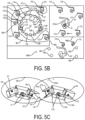
- FIG. 5 B shows the reaction of compression states.
- FIG. 5 C shows a reaction of two neutrons to form helium.
- FIG. 5 D shows the results of the reaction shown in FIG. 5 C .
- FIG. 6 shows how fractal interactions of the type shown in FIG. 5 can be applied to larger reactants.
- FIG. 6 A shows the resulting reaction of the reactants from FIG. 6 .
- FIG. 7 shows a concept view of the orbitals shown in FIG. 6 for Neon.
- FIG. 8 shows the evolution of the view in FIG. 7 towards the base 6 to base 10 view.
- FIG. 8 A shows a view the electron shell of FIG. 8 .
- FIG. 9 shows a two-dimensional view of fusion and introduces spew and absorption.
- FIG. 9 A shows item I from FIG. 9 .
- FIG. 9 B shows item II from FIG. 9 .
- FIG. 9 C shows items III, Iv and V from FIG. 9 .
- FIG. 9 D shows item VI from FIG. 9
- FIG. 10 shows a perspective matrix view of FIG. 9 .
- FIG. 10 A shows item 99 a from FIG. 10
- FIG. 10 B shows item 276 from FIG. 10 .
- FIG. 11 shows how odd and even fractals interact.
- FIG. 12 shows boat diagrams for information compression change.
- FIG. 13 shows how qubits can be better monitored using the method.
- FIG. 14 shows a different fractal model.
- a new feature would be to affect the stability of a proton by affecting the individual transitional ct4t12 states of the electron.
- An example of a traditional manipulation would be using plasma temperatures and magnetic containment for separating protons and electrons.
- Another new feature is the reacting of the most compressed feature of any reactant through the elimination of interfering lower transitional states and the addition of shared low compression states as absorption and spew within a matrix. This can be compared to the old idea of “generating a vacuum” which is an inaccurate view of the collection of possible reactant states within a pre-time matrix where a reaction is held.
- ct1.2 and 3 states be removed from between the neutrons 30 to the extent they are not shared. While ct1 was designated as “space.” it is better referred to as ct1 since “space” according the standard model is ct1, ct2 and ct3 along with some lower transitional states of ct4. While often referred to as ct1, ct2 and ct3; the lower transitional states of ct4 along with unobservable higher transitional ct states can make up what is called “space” in the prior art.
- ct1, ct2 and ct3 and other aspects of space are modified to allow direct sharing of spew and absorption between two neutrons in ct5t1 fusion and to bring ct4 transitional states together into ct4 base 10 states in ct3-ct4 fusion, it is necessary that a stabilizing shell of protons and electrons be constructed around the combined neutrons in ct5t1 fusion and to bring an additional neutron 4 and a stabilizing shell to create stable neutrons in ct4-5 fusion.
- the newly stabilized atom allows for the release of enough information from post time states to create the beneficial or destructive “energy” effects.
- neutrons 30 are fed from a neutron source, here reaction driver means 73 for supplying neutrons, into the reaction chamber 82 .
- Protons 67 are then accelerated by top driver means 73 a and bottom driver means 73 b towards the reaction chamber 82 to compress the neutrons 30 between the streams of protons 67 .
- a stream of electrons 97 is driven through the same top driver means 73 a for accelerating charged particles or bottom driver means 73 b for accelerating charged particles although separate drivers can be used for the electrons and protons.
- the various driver means can both insert and remove information sequentially and reinsert information where pulsing is required to mix or compress or decompress the information mix defining the different forms of information within the reaction chamber.
- One type of information may be used to push another out, such as using energy to push neutrons together and remove pre-time information states between the neutrons, but also the ensure that shared information states between neutrons and stabilizing information states around combined neutrons are present.
- top driver means 73 a and bottom driver means 73 b are magnetic coils.
- ct1-ct3 states (not shown) to be drawn out of the reaction chamber through vacuum line means 136 which can be identified as a means for preferentially changing the mix of ct1, 2 and 3 and low compression ct3-4 transition states within the reaction chamber 82 sequentially or otherwise.
- vacuum line means 136 can be identified as a means for preferentially changing the mix of ct1, 2 and 3 and low compression ct3-4 transition states within the reaction chamber 82 sequentially or otherwise.
- a fourth driver means 73 c for accelerating compression such as a stream of photons, typically by lasers, may be used to further accelerate one or more of the reactants.
- One way to practice the invention to to use a stream of charged atoms to achieve compression by bringing them into continuous contact with the reactants could include streams of protons via a plasma, but it could also include ionic hydrogen, electron streams and beams of lower ct states, like lasers coming in sequentially to compress at least some of the reactants.
- FIG. 1 A shows a side view through the 1 A- 1 A axis of FIG. 1 of items 73 d and 73 c.
- Fifth driver means 73 d and sixth driver means 73 e can be provided for additional dimensional addition of information continuously as they are looped as shown in FIG. 1 A . They can, for example, be provided to accelerate the electrons and the driver 73 b may only accelerate the protons.
- Driver means 73 d goes beside the concentrator means 296 .
- Driver means 73 e is shown going through the concentrator 296 . These are continuous delivery systems as opposed to loading reactants, at least for the sequence of time to which their carried reactants apply.
- At least one reactant recycling line means 125 can pull off reactants.
- At least one second reactant recycling means 125 a is shown outside of the chamber 82 or at least outside of the concentrator means 296 .
- FIG. 1 B shows the electron 97 viewed as an approximately six sided ct3-4 transitional fractal, with 5 ct4T12 172 states forming the primary elements of the shell 97 of the transitional fractal.
- the ‘subtle’ difference between the bundle 99 and shell 97 is based on the fractal nature of the shell and the surrounding nature of the bundle 99 .
- the two designations necessarily overlap but can be distinguished by the effect of the t12 states on the surrounding cloud of information which forms shell 97 .
- the open spiral form is due in part to the spew and by extension absorption of the higher compression states since the lower information states must, using spiraling outward (spew) or inward (absorption) get to the center of compression in bulk to stabilize the structures. Knowing these structures, they can be targeted in order to manipulate dimensional results.
- the proton 67 has a similar spiral shape, although it tends more towards the 10 sided fractal shape of the neutrons.
- the neutrons 30 are not open to higher states, although they are not entirely closed as they absorb lower ct states from the surrounding matrix to pull other neutrons and other lower ct states within their orbits.
- the sizes are shown as they are expected according to the model, but are not to scale, scales being impossible to show because of the exponential compression.
- the idea is to pick a fractal having sufficient pretime elements to do quantum computing experiments. Rather than having a complex supercooled isolation of an electron; the shell designated as 99 in the drawing; the more complex fractal model would be used.
- the shell is used as a fractal with minimal pre-time elements changing compared to the person although both are scaled similarly.
- FIG. 1 c describes the operation of a Catalyst for the reaction in a non-thermodynamic environment, concentrator means 296 is shown in one embodiment in FIG. 1 C .
- This model uses the new science to select reactants, particularly for fusion.
- dimensional states may be used for holding protons or neutrons to bring them closer together or separate them into another concentration medium.
- the concentrator means 296 detailed in FIG. 1 C has a first substrate means 307 for holding neutrons 30 .
- Neutrons 30 are delivered to the concentrator means 296 as taught relative to FIG. 1 and become attached neutrons 30 a .
- a second reactant, here protons 67 become attached protons 67 a to a second substrate means 307 a .
- the means 307 and 307 a are determinable materials from the prior art including catalysts.
- Both means 307 and 307 a may be mounted and rotational about first spindle means 317 and second spindle means 317 a respectively which allows them to be rotated closer to the reaction chamber means 315 which provides a location for the reaction to the extent not handled on the means 307 and 307 a .
- first scraper means 309 can provided which can engage by moving operatively to location 310 to mechanically, electronically or chemically separate the reactants on means 307 , 307 a or both.
- the scraper means can be eliminated by having means 307 and 307 a brought together into physical or, more accurately, reactional contact.
- a third substrate means 311 and a fourth substrate means 312 may be provided with a second scraper means 314 to sequentially provide other reactants, such as electrons or photons into means 315 .
- the scraper means 309 and 314 may be physical or electronic, changing the charge or fields of the substrate means 307 and 307 a .
- the scraper means 309 and 314 is a means for releasing a reactant and might be nothing more complex than releasing or reversing a static charge on the substrate means to which the reactant is attached.
- FIG. 1 d shows a side perspective view of one embodiment of item 307 and 307 a from FIG. 1 c .
- the scraper having varying amounts of contact where the extended point of contact 326 can be retracted within the scraper means 309 .
- the number and amount of staged contacts can be varied within the disclosure set forth herein to control the type and amount of information present both within first substrate means 307 which can be drawn out and around means 307 in reaction chamber 315 to get different stages of reactions.
- the first scraper means 309 moves along item 307 so that the at least one scraper means 309 can vary the release of the reactants. More than one scraper means 309 may be present and these may act in concert to free reactants together or sequentially as shown in more detail in other figures.
- an information delivery means 324 for bringing or delivering information, for example charge toward or away from a resistor means 325 for accepting or delivery of charge to the first substrate means 307 by way of a first spindle arm 322 and second spindle arm 323 .
- first insulator means 326 separating first catalyst means 316 from a second catalyst means 318 separated by a second insulator means 319 from a third catalyst means 320 separated in this case by a third insulator means 326 from the second spindle arm 323 .
- One or more reactant, here items 30 a and 67 a can be present on a single substrate means, here first substrate means 307 having two different reactants.
- One purpose is to put reactants in proximity along with a proximate stabilizing matrix of lower compression states in the order required for the reaction.
- the second substrate means 307 a which would be similar in design and have a second scraper means 314 functioning like the first scraper means 309 .
- the second substrate means 307 a is cone shaped in this embodiment which changes the shape of the reaction chamber 315 to the extent it is defined by the changing separation from a wide separation 350 to a narrow separation 350 a due to the taper of the second substrate means 307 a which is a way to have the reactants, in this example only items 30 a and 67 a are specifically identified, flow toward the wide separation 350 or narrow separation 350 a as the pressure increases or decreases for the reactants sensitive to the dimensional features of the fractal surfaces of the means 307 and 307 a change in the reaction chamber 315 .
- the change in reactants due to the action of the first scraper means 309 and second scraper means 314 necessarily results in a different matrix of reactants within the reaction chamber 315 at different locations within the reaction chamber 315 in this embodiment.
- added information 362 may come from the catalyst arm 355 or go into the catalyst 355 to enhance the reactant in this case core 375 .
- the suggested operation of a catalyst is as follows: Information 362 within the catalyst 355 is operational to move separation within the catalyst between the first separation 369 and second separation 370 to bring the reactants 351 and 352 close enough to react, to share a fractal structure reflecting the sharing of information, squeezing out non-reactive states from shared reactants information 366 .
- Information 362 may go to item 366 or the core 343 or both in the operation of the catalyst to attract and hold the reactants and bring them together. The movement of information 362 may be reversed with information 362 going back into and re-expanding the catalyst to its longer form to separate the reactants once the reaction is completed.
- the catalyst matrix 329 which is the ambient environment around the reaction which may be enriched with free t12 states or loose t12 states as is envisioned in, for example, a dissolved salt (NaCl) water solution and drawn out of the catalyst at a catalyst resistor 328 to generate electrical energy or other informational energy more directly.
- NaCl dissolved salt
- the exact shared information necessarily varies.
- the operation of bonding in general is sharing information in the fashion generally shown for two protons in the H2 case.
- information goes from the catalyst to the shared information, the catalyst then moves the location of the reactants relative to one another, and the shared information is returned to the catalyst without or without information in the form of heat or energy to enhance these features.
- Information may be added externally to stabilize the two neutrons in the manner taught in the invention disclosed herein.
- the catalyst process for fusion can be described with these steps: 1) generate neutrons. 2) secure the neutrons to a first substrate. 3) alter the information of the substrate to bring the neutrons closer together to generate compressed neutrons. 4) supply protons, possibly from a second substrate to stabilize the compressed neutrons: 5) add such other information as is necessary to stabilize the reactants. 6) take the excess information in the form of energy to utilize as power.
- the idea is to mechanically, electronically, chemically concentrate neutrons with other reactants on a substrate.
- the substrates or catalysts and/or effective interaction of arm 355 may have varying and alternating bands and mechanical, chemical, electromagnetic and/or photonic assistance to change the features of reactants or bring reactants together or even separate them.
- Neutron holding There may be in this process Neutron holding. Proton holding and Electron holding along with a means to pull everything together. Also shown are ways of staggering material and mechanisms to hold them together or separate them.
- the fusion process may be described according to these steps: 1) separating out neutrons from their associated shells to the extent possible within a matrix of ct1-ct3 states; 2) utilizing the compression of ct states between ct1 and ct4 to crowd out lower ct states until the neutrons are sufficiently close to allow the sparing of spew between the neutrons and 3) utilizing ct3-4 transition states in order to provide a stable shell to allow for the absorption and spew of the neutrons to be maintained. While these terms require additional definition, that definition is provided in this specification.
- FIG. 1 E shows the most mechanical way to bring things together in a spiraling fashion, by providing a track means 364 shown here as an actual F-series spiral for carrying reaction chamber means 315 either within or on the means 364 .
- a compression means 313 (shown as a reduction in diameter) increases the pressure while heater means 377 adds heat to get to a stripper means 374 (here shown as a narrow diameter opening) to minimize the reactants that come into the expansion means 371 here shown as an expanded opening for allowing the reactants to stabilize.
- An anti-spiral means 346 b is shown for allowing compression along an expanding spiral for carrying an altered reaction chamber means 315 b to enhance or continue the action of the expansion means 371 within depressurization means 378 here shown as an expanding chamber of increasing diameter as it moves from the expansion means 371 .
- the material of each of these chambers may vary in order to encourage the effects desired as taught herein.
- FIG. 1 F shows a second reaction chamber means 315 a can be collided along a separate spiral track means 346 a shown here outside of the compression means 313 (although it could be beside the means 346 in the compression means 313 ) and here entering the means 371 without a stripper means 374 although one could be included in the fashion shown in FIG. 1 E .
- FIG. 1 G shows how fractals interact at the electron level, here showing an electron shell 97 primarily built from ct4t12 states 172 with one ct4t12 state 172 c being separately identified. The rest of the shell 97 is defined by lower ct states. Also shown in the corresponding ct412 state also shown as a base 6 shell and made of a lower state, here theorized as 5 ct4t6 states, one of which is shown identified as 166 a.
- FIG. 1 H shows the change in FIG. 1 G in the pre-time elements of 172 c and the even greater pre-time element 166 a having moved within the items 97 and 172 while the basic structures have not changed otherwise. Given the number of elements changing net charge both in pre-time and conglomerate post time frames, one can see that the system is dynamic.
- FIG. 1 I takes the construction generally shown in FIG. 1 through FIG. 1 H and shows Helium fusion.
- the proton shells 8 are drawn as matching spirals to the electron shells 97 .
- the first step in the process is to add such information energies 203 as are necessary in order to separate protons 67 from neutrons 30 .
- the energies are ct states of a desired compression with desired post and pre-time elements.
- a second set of information energies 204 push the freed neutrons towards a proton shell 97 A which has been opened with third energies 205 .
- the new shell 97 a is created from hydrogen atom 70 which have their fractal structures opened with third energies 205 .
- reaction energies 208 are envisioned. While the term energies suggests that it is the addition of information, it can be the withdrawing of energy, as by having closing energy 209 to close the new electron shell 97 A about the neutrons 30 A and 30 B while forming a proton shell from proper alignment of the proton centers of charge 91 A and 91 B. There is a closed neutron 30 A and a partially open neutron 30 B shown to indicate that by destabilizing the lower ct state protons, the neutrons within them can be destabilized to allow reaction. Just creating a plasma to give this destabilizing effect is only part of obtaining a fusion reaction which requires re-stabilizing the molecule produced from the atoms.
- FIG. 1 J shows a reactor having a mixing chamber 75 receiving a first reactant (hydrogen) 78 pushed by a first source driver 73 , moving the first reactant into a first strip chamber 79 where the outer shell (step II) of the first reactant is modified by a shell stripper means 81 for reducing the compression of a reactant shell before it is introduced into chamber 75 .
- the reaction driver means 73 b pushes the reactants from the mixing chamber 75 to the reaction chamber 82 which may include concentration as by ramps 77 reducing the chamber size, a plasma generator 121 and a heat sink 123 which may be used to increase and reduce the heat of the reaction respectively.
- a trigger means 88 is shown. This could be a plasma stream or a radioactive source delivering neutrons as a reactant (as opposed to coming from a driver source 73 ) or energies of the type involved in a reaction like this. The suggestion is that alpha (helium) particles might not be a trigger, but they could act as a catalyst.
- Neutrons are a reactant, but there are also the gamma rays and other ct state effects seen as high energy which can come from a radioactive source.
- a more direct potential is that radioactivity includes the transition of protons and neutrons and this involves the opening and closing of the ct4 state which can open the proton shell and compressing the proton-electron interface to create a neutron.
- the number of chambers of any type may vary to get different effects of fractal manipulation.
- the plasma trigger means 88 can be used to open protons.
- the use of different reactants means that at different points you can have different purity of plasma and reactants.
- the ramps 77 could be replaced with other dimension reducing features, such as accelerating the reactants together with magnetic fields, lasers and/or pistons.
- the heat sink 123 may draw off heat to use the reaction for power generation in the manner taught by the prior art or may be replaced with a new process of the type taught herein, namely taking states which were previously thought of as energy (e.g. changes in the Center of Charge 93 over values of x) and migrating those changes directly to a generator means 108 for generating power from the reaction.
- a separation chamber 124 is envisioned with a separation driver means 73 c which removes helium to the helium tank 125 b , and returns unused reactants through reactant recycling means 125 and 125 a.
- the mixer and expander means 127 can serve a couple of functions. One is to push together the neutrons 30 , but it can also push apart protons and electrons and bring them back together, mixing the reactants.
- Waste products relative to any stage may be removed by waste means 128 and 128 a for drawing off information states which are produced during the various stages of the reaction.
- the compression from Hydrogen to a Neutron involves not only the compression of the Hydrogen, but also the stability of the resulting transitional states. It is envisioned that energy for the rest of the reaction could utilize this lower energy reaction in the mixing chamber 75 and/or reacting chamber 82 shown for a reactor shown in FIG. 35 .
- Plasma stability can be achieved by creating a desired spew pattern, resulting fusion including a solid object of high neutron content within the plasma to provide neutrons to stabilize fused states.
- the sun is a molecular fractal state with a core spew largely hidden by the high spew rates on the surface which may supplement, mask or even diffuse the core spew.
- At the surface of the molten layer of the lesser earthly fractal state a similar result is possible.
- a plasma may be stabilized by recreating the “solar spew” effect on a small scale with the center or perhaps even at the edges of a plasma field at plasma generator 121 which is kept at a high energy and compression state for this purpose.
- FIG. 1 K shows an alternative arrangement where a torus type design is utilized. The same method of introducing reactants into the mixing chamber 75 is used. Other reactants may be added as at 75 a .
- a plasma generator means 122 generates plasma in plasma generator 121 which is shown here as a plasma torus 157 .
- the plasma portion of the reaction can be carried out by introducing the stripped proton and neutron reactants from the mixing chamber to one or more reaction chambers 82 , here through a plasma inlet 155 (bypass means 156 can control the flow) where it contacts plasma in the plasma generator 121 defined by plasma torus 157 maintained by a plasma generator 122 within the torus 157 by inner magnet means 153 and outer magnet means 154 which together form a reactor 258 .
- bypass means 156 for allowing material to pass through guide means, here ramp 77 , allows for some material to be channeled away from the trigger means, here the opening 88 to the plasma in the plasma generator 121 .
- the ramp 77 and bypass means 156 along with inlet 155 , allow the proper concentration and structure of the reactants to be directed to trigger 88 timing the reaction to be controlled by this combination as a flow control means 259 overlapping with or being part of the reactor 258 to ensure that the reaction is done when the reactants are at the optimum state for various stages of the reaction and the torus design means that a plurality of these flow control means can be used around the torus 157 with various reactors 258 although only one is shown in only one place.
- injectors 257 and 258 can be seen where the reactants are fed into the chamber 75 before being acted on by the various reactors 59 and mixing chambers 75 and 75 a.
- the lasers, magnetic fields and reactant sources are informational altering means for generating and delivery different forms of information in the form of pre-time structured energies or post time dimensional states at the appropriate value of x and place to get the function of the reaction desired according to the fractal design taught herein.
- the method taught is varying the nature of the plasma to deliver modified ct states to the reaction chambers to encourage fusion before stabilizing states are added.
- FIGS. 2 and 2 A shows how catalysts, e.g. item 316 from FIG. 1 D , operate and can be used in order to act to increase compression for fusion or other material manipulation processes.
- a compression catalyst works in the opposite fashion. (See FIGS. 2 , 2 A and 2 B ).
- the affected particles are a first reactant (e.g. a neutron) 351 and a second reactant (e.g. another neutron or Proton) 352 .
- the first reactant shares shared information 353 with a first catalyst arm 355 of the first catalyst 316 .
- the second reactant which can be different is a second neutron 352 held by second shared information 354 to second catalyst arm 356 .
- the two reactants here first reactant 352 and second reactant 351 ) have reactant information 366 between them, but this does not necessarily encourage reaction.
- information 366 and information 362 allows for reactants (in the form of information 366 and 362 ) to be added and the ability to control the spacing between first spacing 369 and second spacing 370 allows this information exchange to be increased and decreased creating the potential for a catalyst pump.
- T12 states There may be an enhanced draw of T12 states from item 343 into items 355 and 356 which can be drawn out as energy.
- first catalyst bond 357 which is information which can change from first separation 358 to second separation 359 bringing the two reactants (first reactant 351 and second reactant 352 ) together.
- these arm separations 357 and 358 and shared information 343 work together with the squeezing together by putting out information into the shared information 343 and/or 366 from which it is effectively recycled back to 343 and/or 366 when the reaction is completed.
- shared reactant information 366 allows for the reactants to interact and as taught herein information 366 and 343 can be enhanced to encourage the sharing of spew and absorption between reactants 351 and 352 .
- FIG. 2 B is a detail of a molecular reaction or H2 reaction. It shows a “perfect” overlap. 1 ⁇ 2 of the length of the two arms, forms a specific grouping, a central compression circle with two half circles (1 ⁇ 2 the length of the two arms in diameter) form on either side.
- FIG. 2 B allows a better understanding of how the reactants are brought together with a catalyst.
- the representation is of two hydrogens each having a proton core 373 and core 375 and an electron represented by a first offset spiral 375 and second offset spiral 372 to stabilize each of the protons.
- There is shared information 353 which when the two hydrogens are bound represents the overlap of information shown in FIG. 2 B .
- Fibonacci form in going from one state to the other, e.g. swirling it to smaller area according to this formula or a bigger one to enhance the potential to fuse the neutrons, to bring them together within a reaction chamber 315 .
- FIG. 2 B shows the steps in the catalyst arm 355 securing the proton core 375 via shared information 353 between items 375 and 372 which cores 373 and 375 are secured to balancing electrons represented by the spirals 372 and 376 which are part of the catalyst arm 355 , the proton core 373 of the catalyst portion coming out of the catalyst to shared information 343 to secure core 375 .
- Similar, but different ct compression states can be used to secure whatever reactants, including neutrons desired in a catalyst.
- FIG. 2 B is an idealized view of the layout and hence bundle 99 and electron shell 97 are shown as they generally would appear to draw an analogy with
- One embodiment is a pre-fusion energy reactor using a current carrying layer within or below the first catalyst are 355 to carry current to a chosen location.
- the broad view of the process is using the framework of fractal organization and information exchange as absorption and spew to predict reactions and interactions and to encourage or discourage reactions and interactions of different dimensional states as defined herein.
- exciting an electron might take the information shown as 353 a 1 and expand and excite it to the information shown as 353 a 2 . While these would remain parts of bundle 99 , they would be pushed out physically. Unless the arms 375 and 372 were balanced, the addition of information would be destabilized and would, in any event, destabilize the shared information 353 .
- Energy is not just a function of compression state, it is also a function of the number of changes in x between positive and negative changes of any fractal, a function of underlying fuse states and the fractal equivalent under increased compression. Sorting information states to increase the energy can be accomplished from this model.
- FIGS. 3 and 3 A take the model and show how it varies with higher compression states within the framework.
- This model could represent where 2 neutrons form Helium. Unlike where H2 is formed as shown in FIG. 2 B .
- the two cores of hydrogen 373 and 375 are on either side of shared information 353 in this case includes two neutrons (not shown individually) to form helium. If the shared information 353 increase to hold additional neutrons, a second orbital 348 forms which extends outside of the second Fibonacci turn of the first hydrogen electron shells 372 and 376 .
- FIG. 3 a shows the core of FIG. 3 exploded outward to allow a clearer exploded view of the various parts, but they are of the same basic structure.
- the ct4-5 compression should largely reflect the view of a galaxy.
- the higher concentrations of information are closer to the core and include other, more compressed ct4-5 compression states which at the galactic level would be black holes and associated neutron stars.
- the neutron (or proton) arrangement is shown for clarity, but as is described in more detail in priority patent applications and covered generally herein the surrounding proton and electron shells are largely pulled toward the same fractal relationship from their base 6-10 naturally occurring structure to the base 10-16 structure by the required information sharing that gives these structures their rotational symmetry.
- the additional compression states collapse within the core of shared information 353 , but probably begin by building onto the extended orbitals represented here by second orbital 348 and third orbital 349 where the buildup of information is represented by spiral arms 337 , 338 , 339 , 340 and 341 .
- New cores 343 345 , around third shared information 344 and 342 and 347 around second shared information 353 a are parts of this continued compression from a simple H2 to Helium to the higher ct5 transitional states beginning at the second line of the standard periodic table.
- the effective result is that the first circle would have room for two electrons, the second 4, the third 4, the fifth 8, etc.: with all the arms built mathematically of the inner arms and using this arrangement along with the underlying 2f(n) ⁇ circumflex over ( ) ⁇ 2(n) compression to get more effective reactions extends to both chemical and nuclear reactions.
- the secondary orbitals come off the initial H2 or Helium structure. Again, using the galactic model the base is thicker towards center and this indicates that compression grows out from the arms.
- the periodic table reflects base 16 compression at the ct5 transitional level. How this is reflected in FIG. 3 may be balancing arms off the main two arms 372 and 376 at the four corners, another is a doubling model based on the greater number of arms possible when the atom is balanced as described.
- the base for this is in the neutron area, but the proton and electron outer components are considered, and these are between a base 6 and base 10 arrangement befitting their transitional status between ct3 and ct4.
- lower ct states can be used to open any reactants for combining or to open and close features of catalysts just as the surrounding information matrix structure can be used for the same purpose, whether in solution or part of the reactant or catalyst structure.
- Photons, like electrons are a collection of particles, probably 5 T6 states plus others due to the transitioning 6 to 10f(x) base architecture.
- Heat in the reaction adds and removes photon like elements, t6, to the structure of the reactant expanding it in the manner shown which allows for the reaction to occur.
- AuT One method inherent in AuT is using the structures and interactions of higher ct states to understand interactions of lower states. This means that insights are directly applicable, subject to dimensional changes and compression numbers, between large and small ct state observations, e.g. comparing two galaxy collisions to two atom collisions.
- FIGS. 4 and 4 a show an alternate embodiment for first substrate means 307 and second substrate means 307 A. This shows the process rearranged so that first scraper means 309 is moved inside substrate 307 and a matching second scraper means 309 a moved inside second substrate 307 a.
- Energy means 324 a and second energy means 324 a mounted as shown provide information to energize the exterior of substrate means 307 and 307 a when particles neutron 30 a and proton 67 a are aligned as described in more detail below.
- shared proton-neutron information 343353 is added as by first reactant means 369 and second reactant means 370 which may, for example, be lasers, providing information 343353 to drive the reactants 30 a and 67 a together within the chamber 315 and to reshape the chamber means 315 (shown in FIG. 4 ) to some extent.
- first reactant means 369 and second reactant means 370 which may, for example, be lasers, providing information 343353 to drive the reactants 30 a and 67 a together within the chamber 315 and to reshape the chamber means 315 (shown in FIG. 4 ) to some extent.
- the exact structure can be varied within the teachings of the prior art for each knob 305 shown numbered from 1 to 6 in FIG. 4 D .
- each substrate means 307 and 307 a have at least two structures, e.g. knobs 350 and recesses 346 for first substrate means 307 , multiple reactants can be carried by either or both interlocking features of the interlocking substrate means 307 and 307 a.
- first swirler means 367 for mixing the reactants within the chamber means 315 and a second swirler means 368 for the same effect.
- These may, for example, be magnetic field generators and may also act to hand off the reactants to the next defined chamber as means 307 and 307 a rotate.
- different shapes may be defined for the chamber using different shaped openings 363 on the knob 305 of the substrate 307 as shown in FIG. 4 B .
- FIG. 4 C Another way to accomplish this is shown in FIG. 4 C where the shape of knob 350 al has been changed so that knob 350 l , knob 350 a 1 and knob 350 a 6 along with the intervening recess between 350 a 1 and 350 a 2 form a chamber means 315 of a desired shape.
- the position of knob 350 a 6 can also be changed through rotation or, as shown in FIG. 4 c by recessing it into the substrate 307 a to change the shape of the chamber means 315 or to allow rotation of the substrates 307 and 307 a relative to one another without as great an impact on the reaction chamber means 315 .
- the nature of the movement of the various physical parts and the information adding portions can work together to shape the chambers interactions to take advantage of fractals structures and the underlying spiral features to catalyze the reactions involved and achieve the stabilities required to maintain the interactions forced on the reactants.
- first and second swirling means 367 and 368 here magnetic coils can align as items 307 and 307 a rotate to mix the reactants in reaction chamber means 315 .
- FIG. 5 shows how this arrangement of different compression states can be viewed as shells with structure varying based on the base compression state and the underlying compression states.
- FIG. 5 includes Electron-Proton Compression to get ct3-4 fusion, shows compression along with the associated force.
- the first compression is the first fold of space 1 along a fold 1 a and leads to gravity 209 .
- the decompression would form anti-gravity, commonly referred to as dark energy.
- math suggests 4 steps, identified as + “arms” of folding for ct1 to ct2, the first arm 2 a being 4 ct1 states, the second arm 2 b (change on drawing) being 16, the third arm 2 c being 64 and the third arm 2 d being 256.
- the hinge mechanisms after the folding at the ct1 level are suggested by the math to be a first ct2 hinge 118 a (change numbering here too given 1 a - 1 d above) being a 3 ct1 state hinge, the second ct2 hinge 118 b of 9 ct1 states, and the third ct2 hinge 118 c being 27 ct1 state hinge with the math suggesting this arrangement being set out in the various documents supporting the model.
- ct2 to c3 compression there are 6 ct2 states of 256 ct1 states each that form the first ct3 arm 119 (move on drawing) of ct3 3 with the same exponential compression for the six arms shown, but not individually numbered.
- Ct4 4 is the next state of compression and represents the neutron.
- ct4t1 161 is 10 ct3 states, ct4t2 being 100 ct3 states and so on to ct4t16 which is the proton when unfilled, and the neutron when filled.
- the neutron 30 shown encasing a ct4t16 175 surrounded by an electron 35 a to distinguish it from electron 35 which is the approximate location of compression where the electron forms shown around ct4t13 173 .
- the bundle 99 from the prior figures is largely represented by the arms ct4t1-ct4t12 which is the location of the electromagnetic force 192 where time is largely finalized for observational purposes and the electron is ct4t13 173 destabilized so that an electron 35 can form proximately.
- the weak force 193 exists between the electron and the neutron compression states along with the electromagnetic effects generated within the framework 192 between ct4t1 161 or ct4t2 162 and ct4t13 173 .
- the final stage of compression shown here is the ct5 state 5 .
- the first arms ct5t1 292 and the second arm ct5t2 293 are where up the 16 ⁇ circumflex over ( ) ⁇ 4 ct4 states are folded together and form the compression states of the periodic table. This is the area where the strong force 294 can be found.
- At the final arm is the region of the black hole 291 just as the full final arm of the ct4 state is the neutron 30 .
- FIG. 5 shows the electron derivation between the ct3 state 3 and the ct4 state 4 shown as electron 35 before the ct13 173 state of compression.
- ct3 has a base of 6 and ct4 has a base of 10.
- T1 or ct4t1 161 When 10 of these ct4t1 states fold together you get ct4t2 162 .
- ct4T12 172 is a primary component state of the electron, one can think of this fractally as a star in galaxy or a large planet in a solar system. Measurements suggest there are 5 of these ct4t12 172 components form a single electron 35 and they exist within a cloud of lower transitional states which in turn are separated by multiple lower states. The photon is primarily a ct4t6 state 166 just as the electron is primarily a ct4t12 component state in theory although additional testing might show the photon to be different, for example a ct4t10 or even ct4t11 state. Designations like “electron, photon and even proton” are misleading but are used as transitional terms between the new model and the prior art.
- FIG. 5 A shows how this compression occurs in a linear arrangement showing ct1 1, ct2 2, ct3 3, ct3 as part of ct4 designated at first compression arm ct3 3a, second compression arm ct3 3b and third compression arm ct3 3c. It shows how a 1-2-3 bundle 149 of ct1, ct2 and ct3 exist between two ct3 3 states.
- a ct4 transitional state bundle 119 is shown between two neutrons.
- a similar, but fractally denser bundle would exist between neutrons and black holes, ct5 5 states which are not shown, but can be envisioned as the galactic cloud around a black hole.
- FIG. 5 B shows how this arrangement can result in a reaction.
- the different ct4 transition arms can be seen numbered from 161 through 176.
- Electrons 12 surround the proton 67 just as a group of planets surround a star.
- the fractal analogy is imperfect because the of the base transitions and dimensional transitions that occur and that keep the system stable.
- a center of charge (COC) 93 exists at any quantum moment, but the movement of the various parts of the system keeps the location of the COC 93 in constant flux.
- Prior art designates the electron according to this center of charge (COC).
- COC center of charge
- This figure shows that it is likely that the COC 93 is aligned with the opening 214 in the proton matching the opening 215 in the electron t12 state 172 .
- the electron is shown as two sides 179 and 180 of 6 arms to reflect the ct3 base six from which it is built, although a fractal analysis yields an arrangement more like that shown in FIG. 2 B .
- This proton is existing within a matrix 360 which contains information like t12 and t6 information states most directly affecting the proton 67 .
- a second matrix 360 a contains a neutron 4. To get a stable collapse in this arrangement, there must be enough information in the right order to stabilize the resulting reactants.
- This ‘stabilizing information’ is shown in a third matrix 360 b which contains a proton 67 as well as other states, t12 172 states and t6 166 states in particular, seen respectively as the building blocks of electrons and protons as the proton 67 within matrix 360 collapses and combines with the neutron 4 in the matrix 360 a to form helium, the additional information represented by the proton 67 in matrix 360 b becomes part of the Helium stabilizing matrix. Since there were already two electrons worth of information in matrix 360 and 360 a , the excess t12 within 360 b can be released from the matrix 360 b.
- FIGS. 5 C and 5 D take the reaction in FIG. 5 one step further showing Deuterium fusion.
- two water molecules are show in a first matrix 360 and a second matrix 360 a overlapping in overlapping shared matrix 361 .
- a neutron Within shared matrix 361 is a neutron, held in a stable matrix formed when the shells 95 a and 95 b of are opened by the oxygen atoms 217 and 218 being formed, by example, of atom 218 by oxygen electron shell 218 b and electron nucleus 218 a to allow information sharing between neutron 247 and the protons 67 a and 67 b within shells 95 a and 95 b.
- FIG. 5 D shows the resulting reaction when another neutron is combined with the neutron in the heavy water to yield a neutron comprised of a 8 sided cube neutron 251 , balanced by two protons 67 a and 67 b coming from the water.
- the matrix 219 within which the neutron exists can be expanded or contracted depending on the examination of information.
- the neutron includes the electron shell 95 of stabilizing information. Outside of the matrix 219 is excess information 361 a from the overlap 361 which represents information which was held as part of the post-time matrix 360 a and 360 b which is now in a pretime states of t12 and lower states which appear as energy.
- the balancing of the reactants in this way allows for more efficient fusion and fission and even molecular reactions and this process of balancing the reactants is one aspect of the invention.
- One aspect of the method taught for fusion type compression is allowing escaping information to leave the matrix while allowing the desired fractals to stabilize.
- FIGS. 6 and 6 A show another view of the reaction between hydrogen and oxygen can be viewed through the prism of balancing the reactants, and how the neutron core 15 plays a limited role other than holding the oxygen structure in place.
- the balanced oxygen ions appear largely the same as 02 217 .
- the two halves of the 02 217 have shared information corresponding to 353 for the hydrogen shown as first oxygen shared information 334 and second oxygen shared information 335 .
- first oxygen shared information 334 and second oxygen shared information 335 For clarity information 334 is split between first oxygen ion shared information 334 a and second oxygen shared information 334 b .
- Structurally, the same type of arrangement is present in higher compression states and lower compression states although the levels of compression and base numbering affects the arrangement as is otherwise taught by the disclosure in the cited co-pending specifications and herein.
- This shared information at this level of compression is largely Ct4t12 electron information shown shared along lines 334 and 335 in a way to balance the structure in the fashion taught herein although the arms are structured around the neutron core 15 which is bending the base 10 structure of the protons t16 176 in the oxygen to the fractal structure of the base 16 ct5T1 form involved.
- the interaction of the base 10 and base 16 structures is transitional so that only at the black hole is a full base 16 structure observed completed.
- the H2 228 is comprised of two t12 protons 330 and 331 having shared information between them 353 corresponding loosely to the shared information 334 and 335 of the Oxygen.
- the reaction occurs at this shared information, but in a fusion reaction it would be the shared information between two neutrons or the higher compression of this type of shared information depending on whether it is a ct4-5 reaction a ct5t1-ct5t1 reaction or some hybrid between those as taught herein.
- the shared information has combined so that you have 353 and 334 combined and this provides room for the proton 331 to occupy a common expanded field of shared information 331334 b shown in FIG. 5 a .
- the excess information will be ejected as heat, movement, light and space shown as 172166 , containing items 172 , 166 , 1, 2 and 3 which are not shown allowing the shared information 334 b to form the shared information between the now separated protons 330 and 331 as part of the overall shared information between the two now more securely and perfectly balanced halves of the oxygen atoms, converting 2H2 and 02 to H20 plus the excess information which has been released.
- the reactions occur at the shared information level, the area 353 between 375 and 376 shared between two protons in FIG. 3 where a stable fractal interface is built.
- this connection can be opened and if the neutrons can then be brought together, the connection is more likely to occur between the two neutrons especially if the energy level can then be dropped to allow the reaction to continue without the neutrons falling apart.
- This model varies significantly from the model for shared orbitals or disrupted orbitals because this model takes into account that information is graduated and that the fractals can be supported by shared t12 states which are imperfectly formed electrons which we know exist because of comparison to larger fractal models which are visible.
- Ionic lattice energies typically fall in the range of 600-4000 KJ/mol (some even higher), covalent bond dissociation energies are typically between 150-400 KJ/mol for single bonds.
- Ct4 transitional states are responsible for both. This is the main difference between AuT and the standard model, is the structures are more precise in AuT.
- Ionic and covalent bonds are creatures of atoms, although Hydrogen, the pre-atoms also have covalent bonds.
- the “electron shell filling” is replaced with a core fractal structure in the nucleus (two protons) surrounded by a corresponding stable fractal shell, two 5.4 t12 spirals feeding off of one another and the core protons which, while heavier, are exponentially smaller due to compressive energies. Because the electron components are too small to see, involve absorption and spew to have effect, presumably of t12 states which are largely pre-time, we only see them as net effects, part of the wave particle duality feature of electrons.
- Molecules are co-valent in nature, shared electrons which in this case means shared fractal structures of t12 states (mostly) rather than shared orbitals.
- the main difference between molecules and Hydrogens lies in the core of neutrons which give structure to the protons, but this difference is enough to allow the distinction of Hydrogen Bonds outside of the stronger covalent molecular bonds.
- Ionic matrix shares something stronger, but it still is the absorption and spew of t6 associated with charge.
- the fractal structures affected are not in the electron fractal, but between the electron fractal and the proton fractal. What this means is that even though the absorption and spew is of a lower ct state of enormous magnitude, the compression involved is higher.
- a spiral galaxy has two arms which serve to balance the core of black holes. Each of these arms represents a higher fractal form of an electron.
- the galaxy appears more balanced with two of these arms than one; otherwise the “center” of gravity, the center of ct1-2 interacting would be offset and rotational unwinding would be irregular. If one were to speed up this process, the galaxy could be expected to fall apart, or at least to reorganize in a more balanced fashion, the same being true of the smaller fractal.
- the arrangement of the two arms involves an enormous amount of information but is fractally the same as the arrangement of the two electrons around the hydrogen two proton core.
- FIG. 7 is a concept view of a neon atom as existing within a fractal matrix comprised of all the element drawn. Although this is a very clean atom, the same model works with less clean atoms. This same conceptual framework would apply to a galaxy, except that being a more compressed base 16 system the nature of the fractal would change. The atom is more of a ct3-4 state, the galaxy more of a ct4-5 state.
- the electron and proton are both clouds of, respectively, pre-electron and pre-proton states like t12 states 172 and t6 states 166 here represented as photons 96 .
- the protons are more compressed and within the proton core fractal 86 around the neutron core fractal 85 which has a COCN 84 where the maximum absorption of ct1-2 states occurs.
- Certain neutron shell fragments such as the 2-neutron helium shell may be independent of the remaining 8 neutron shell although together they would form the neutron fractal 85 even though they may be separated by intervening states including individual protons 94 .
- FIG. 8 shows the evolution of the view of FIG. 7 reflecting the base numbering of the states, and the need for shared information, where two atoms are sharing information at the orbital level, co-valent bonding or ionic bonding both being related to this conceptual view of averaged interaction.
- FIG. 8 shows a lithium and Hydrogen atom together, in this case the hydrogen is tritium and has two free neutrons 30 .
- the regional matrix 20 is the total information selected as relevant for the molecule.
- the lithium has three embedded neutrons 299 .
- Tritium electron shell 297 and a lithium electron shell 298 which is the result of the separate bundles arranging in a fractal pattern mandated by the proton shell 8 . Both are shown as six sided stacked structures to reflect the folding of base 6 two dimensional ct3 sates.
- the electron CoC (electron center of charge) 93 for the ct4t12 states of the two different atoms shown are unique for the atom in question, but also overlap, as shown by the shared ct4T12 172 a and shared ct4T6 96 a.
- proton center of charge 91 and neutron center of charge 84 representing the averaged spew which can be seen as exemplary items neutron to neutron spew 231 , proton spew 256 and ct4T12 spew 272 .
- each element would have a type of ‘charge’ characteristic of this type defined by the transitioning of the element within a system, in this case comprised of lithium 298 and tritium 297 .
- AuT restructures the 2,8,4 shells conceptually basing them on fractal states, but does not reject the resulting numeric framework; but instead adopts it to the extent it can be explained with the Fractal model.
- FIG. 8 A shows the electron framework from FIG. 8 alone.
- the bundle 99 is shown more clearly as coming off as a fractal shells 97 and 97 a with a resulting spiral gap 215 much like a galactic opening.
- FIG. 8 A shows the bundle comprised of overlapping electron shells 97 and 97 A along with a clear view of one different sized, but dimensionally similar shell 97 B.
- the bundle comes off in a longer leg 213 with more information and tapers inward or outward to a dispersed cloud 212 which merges into the surrounding information matrix 219 from which the more compressed matrix states emerge and melt.
- Ct states do not follow a curved line because of folding. Therefore, two-dimensional travel of photons appears straight in the middle of the universe. They cannot follow the curves because of the bulk unfolding at higher dimensional states within the middle.
- Shared T12 172 a reflects current to the extent that it moves from one electron shell 97 to another 97 a .
- transitional states 164 also move and if these are within a shell ( 97 or 97 a ) they are part of the current. If, however, the transitional states are outside of the shell, they form the basis for magnetic effects.
- Electromagnetism is this movement outside of the compression, giving a dimensionally complex momentum basis to the creation of a magnetic field using a current and a coiling a wire to create over changes of x a moving outer shell of the transitional states 164 which are interpreted as magnetism to the extent their pre-time features interact with post time dimensional features under the AuT definition of pre and post time features.
- FIG. 9 FUSION REACTANTS
- FIG. 9 gives the AuT fusion view and introduces spew and absorption.
- Positrons, electrons, gamma rays, other radiation (high energy light, heat for example) and muons are examples of pre-AuT approximation for AuT informational states. For example, it is more logical to treat muons as ct4T14 base 6 states and energy as pre-time changes to get a more accurate understanding of the process.
- the cores around neutrons must be exposed.
- the process of exposing these cores fractally can come in several forms: (1) increasing the amount of lower selective transitional states around them, removing selective transitional states around them or around one side of them. It is particularly a goal to target the COC 93 for this purpose.
- the idea is that with reasonable experimentation, given the model and process, you are lifting back the outer shells around the cores, here of protons 94 and Neutrons 30 , so that the additional steps can be carried out.
- the process would replace the neutrons 30 in step IV with the appropriate compression states that would fill the last information arms of the proton, effectively eliminating intermediary states that separate information states.
- the number of protons and neutrons in the exposing step is one of experimentation.
- the next step is (V) bringing the two exposed neutron cores together and (VI) creating a new proton shell 8 around the exposed neutrons 30 made up of at least one proton, but usually at least two protons 67 around the neutrons.
- current 110 is used to control the movement of the protons which, being charged, can be directed in this way.
- this process is rather randomized, heat is used to break up the reactant shells 97 and 8 and the hope is that the elements will somehow combine to create fusion. For this reason, even where fission reactions are used to trigger stripping and combination results, only a 6% yield is expected. Spew and absorption should occur in spiral fashion as winding or unwinding even though they are shown with curved or straight lines here to give net directions.
- Moving states apart is typically done by increasing the energy levels by shining radiation, adding charge (inserting ct4t6-ct4t12 range compression, for example) at absorbed wavelengths or particulate amounts to increase operationally the amount of ct1-ct2 type states or adding heat as pre-time vibrational features.
- These can be moderated as to any of the involved states to maximize the results focusing on the boats of information or information arms to be destabilized and expanded, sequentially if necessary.
- compression (pressure) and vacuum can work with this process since that varies different ct information states within the reaction chamber by crowding out lower states with higher states which can then be removed to bring reactants together.
- Fusion can be described as (1) expansion of outer, lower information states. (2) bringing in equivalent information states to create a more stable core. (3) surrounding the core with a stable mix of lower compression states.
- Neutron have to be brought close enough, so they share information. They also need a shell of protons (2 neutrons need two protons in helium) to have enough information to remain stable just as the two protons needed the complete shell of electrons to have stability over values of x as lower information states compress and decompress.
- the key to a fusion reaction of this type (one where you are not making neutrons, but merely building helium from existing neutrons) requires you get everything proximate enough in the right order for it to stabilize.
- Fission can also be practiced more efficiently described as expanding of outer, lower information states, (2) bringing out a stable core, (3) surrounding the at least two resulting cores with a stable mix of lower compression states.
- Pre-AuT would describe this process in terms of generating heat by concentration of wave states, but under AuT wave states are point structures changing multiple times before slower structural changes more subject to time and their action on the “solid” states in exciting them to action to get replacement results is controlled by reference to the underlying effects and the need to achieve specific transitional states to best effectuate the information loading necessary to destabilize and therefore expand (or stabilize and therefore contract) the underlying states.
- This process can be viewed in terms of “beams of neutrons” being added to an expanded ct4 neutron core 15 and then bathing it in the type of ct state which would stabilize by providing the necessary absorption and spew to allow the fusion to take hold. The process if controlled would then slowly remove the fused result.
- Helium from Hydrogen in the simplest example out and keep the Hydrogen mix sufficiently balanced to continue the process.
- FIG. 9 A shows the hydrogen atom, item I in FIG. 9 .
- This atom has 5 ct4t12 states 172 along with lower ct states, here ct4t6 states 96 , typically called photons, are shown. Everything within the bundle 99 is part of the atom.
- SM Standard Model
- electrons are considered fundamental particles, but this is obviously an approximation (Zeno's Paradox discussion) and the variation for SM is that everything below the electron is part of the hidden variable model, therefore energy, and everything above the electron is matter (see FIG. 8 ).
- COC 93 is the net spew from bundle 99 towards the proton, observed as the negative energy of the electron. COC 93 composed of many sub-spews. Examples shown are 93 a , 93 b , and 93 d.
- Ct4T12 Spew 93 a is of a single ct4T12 172 state towards the proton 94 .
- the direction of spew can change.
- Spew 93 B is the spew from a photon towards a ct4t12 state 172 .
- Spew 93 d is the spew of a photon towards the proton 94 .
- the lines representing the different spews are merely exemplary as fuses and alignment change as x changes for each bit of information resulting in changed centers for spew.
- Second CoC 93 e is used as an example of where the coc 93 has shifted to a new net spew at second CoC 93 e from CoC 93 . Second Coc 93 e and coc 93 would not exist together.
- Ct4T16 or proton 94 represents the center of mass or point charge of the proton, marked by the absorption directly from the electron bundle 99 and corresponding to COC 93 .
- FIG. 9 B shows item II from FIG. 9 .
- a ct4T4 bundle 106 around a ct4t12 bundle 107 transfers spew 106 a towards bundle 99 from FIG. 9 A .
- the bundle 106 contains ct4t12 states 172 and photonic ct4t6 states 96 in a ct4t6 bundle 68 .
- the ct4t4 bundle 106 is defined by t4 states 164 , necessarily containing lower states and possibly containing higher transitional states. Any higher state is built from lower states so they are implicitly present if not shown, but spew varies for fully compressed states which indicates they have broken free from the spew of much of the surrounding states and are internally stable.
- the result of the change in information representing the extension of t4 bundle 106 into electron bundle 99 is typically called a plasma when it reaches to form shown in FIG. 9 C . Item III from FIG. 9 .
- the bundle 99 has been broken up by the information added in FIG. 9 B so that the protons 94 are no longer in an organized bundle 99 .
- item IV a similar process is shown where neutrons 30 are broken out of deuterium 98 by adding ct4t12 states in a ct4t12 bundle 107 by way of spew 107 a.
- the goal of AuT is to get to FIG. 9 D where fusion has occurred and there is balanced ct4 to ct4 spew 231 between neutrons, ct4t16-ct4 spew 234 between protons and the neutrons.
- Ct5 to 99 spew 232 is important spew between neutrons 30 and bundle 99 .
- Spew can extend outside of the primary matrix represented by ct4T12 bundle 107 b outside of Helium bundle 99 H.
- Hydrogen is not a ct5 transitional state, it is a ct4 transitional state.
- FIG. 10 Spew and the Molecular State of Water
- FIG. 10 a perspective matrix view of FIG. 9 and shows how dimensions increase towards the center of compression, in this case towards the hydrogen nucleus. Collections of ct states are defined by a regional matrix, solution region 277 . Within this region 277 , a molecular bundle 276 and an atomic bundle 275 are defined with compression and therefore dimension increasing as the center is approached.
- FIG. 10 A is compared to the view in FIG. 9 A and shows how for a single hydrogen atom bundle 99 A there is a dimensional component 99 B which tapers towards a lesser dimension towards the edges 300 .
- Spew 232 of FIG. 9 a is broken up into exiting spew 91 A from the proton 94 going outside of a matrix defined by bundle 99 and dimensional component 99 B and internal spew 91 B which remains within the matrix.
- FIG. 10 B shows a region of carbon CH4 defined by area within the atomic shell 275 , a loosely defined matrix.
- a molecular shell 276 holds protons 94 which share information most directly with the atomic shell 275 .
- region 277 might be very small.
- region 277 might be very large.
- Absorption of a lower ct state and the net expulsion of higher ct states provides a mechanism to control the spew utilizing the features of absorption so that both gravity and the electromagnetic spew of the earth can be manipulated to essentially create a thermostat with sufficient focusing of the spew through manipulation of the absorption and to a large extent the opposite result can be accomplished using what are largely pre-time Newtonian concepts.
- FIG. 11 involves the electron which is made of a disrupted ct4T13 173 .
- ct state e.g. ct1
- a higher state e.g. ct3
- ct4t4 is absorbed
- ct4t5 is spewed: one may be seen as positive and another is the charge.
- FIG. 11 shows a ct4T12 state 172 a spew components ct4T11 171 which Electron spew line 281 moves towards the proton 94 and is seen as negative charge.
- the proton takes the ct4T11 171 and compresses it back to ct4T12 which goes along proton spew line 282 back into the electron bundle which is the disrupted ct4T13 and is seen as positive charge.
- the neutron to neutron spew 231 can be non-transitional or it can be transitional under the ct3 which might not have charge characteristics. Spew, being the movement of information, occurs between all information states except ct1, the manipulation of which is pre-dimensional. Another example is ct4T12 to neutron spew 233 .
- Charge 2 The model suggests that charge reflects transitional absorption and spew: while neutral particles (neutrinos and neutrons) function by having non-transitional ct states absorbed and spewed or by having low order absorption and a higher order spew.
- the black hole is the largest fractal version and it absorbs space, but that may be ct1-ct3 inclusive. It spews plasma which may be ct4T16. This suggests that the neutron, for example, would absorb ct1, ct2 or ct3 (or a combination thereof) and spew a pre ct4t12 transitional state.
- FIG. 12 shows the fractal nature of molecules.
- Shared ct4T12 172 a reflects current to the extent that it moves from one electron shell 97 to a second electron shell 97 a .
- the two atoms in FIG. 12 are 3 neutron lithium and one neutron deuterium. Lithium is highly reactive as is the deuterium. If it were helium, it would be internally more stable and less reactive although charge could still move through the system less efficiently.
- transitional states 160 also move and if these are within the shell ( 97 or 97 a ) they are part of the current since they play a role in the overall movement of the charge.
- transitional states are outside of the shell, they form the basis for magnetic effects, although additional pre-time rotational movement of the shell is required to derive the effect of magnetism.
- Magnetism is a stream of pre-photons classically.
- FIG. 12 shows the Boat diagram representing how lower states are loaded onto higher states to create a regional compression state. It will be used to attempt to give a broad frame of reference.
- ct3 boats 145 The alignment of ct2 states results in ct3 boats 145 . These can receive destabilizing amounts of ct2 and ct1 and break down into ct1 and ct1 clouds or they can receive stabilizing amounts and form ct3 boats 145 . Up to this level of organization, the results are pre-time results and are not observed directly, although the net results are gravity for the filling of ct2 boats, dark energy for the emptying of ct2 boats, and electromagnetic effects partially caused by the filling and emptying of ct3 boats.
- the speed of light reflects the rate change of ct1 and ct2 states increase between ct3 boats 145 and ct4 boats 151 .
- FIG. 13 shows how qubits can be better monitored using the method.
- Quantum computing can be enhanced by targeting one or more fractal or a plurality of fractals, applying heat and other energies targeting individual fractals to get a long and short view of information change based on the observed tendency of one sample of information compared to another within a relatively closed system.
- AuT provides a data model for building a ledger and a complex, unique mathematical model for tying a pre-time protocol for timestamping of transactions.
- Distributed ledger technology generally consists of three basic components:
- AuT can enhance the security of these by tying them to the pre and post time elements of any time element where the time equation is constructed from the pre-time calculations.
- FIG. 13 a method for viewing quantum change in a pre-time environment, replacing probability with pre time and post time estimates and by better defining the quantum elements allows for more precise pre-time computing visualizing and eliminating errors inherent in pure probability analysis. Put simply, if you don't know what particles you are working with and what really happens in the probability analysis of pre-AuT science which is shown to merely be pre-time but not pre-change, you cannot do accurate quantum computing.
- a particle generator 260 generates near simultaneous particles 301 and 302 ) (electrons in this example which have similar ct state profiles) which are held between respective magnets 266 and 265 : 267 and 268 for observation by sensors, respectively 261 and 262 .
- Movement of 302 to sensor 263 creates the same effect as temperature change where an alternate magnet 271 is used to accomplish the move interacting with the magnets 267 and 268 .
- the idea is to pass comparable information, but accelerated in time, through a sensor to see how much is net positive or negative to estimate how much of colder positive or negative during some time frame.
- Averaging pre-time changes helps to estimate what is going on and the average ct states changes for different features can be used in the same fashion that quantum computing uses the probabilities for false Schrodinger dual state, the main difference being that one is based on the more accurate compression and decompression of AuT.
- the same way that the universe separates time and change can be used to create a quantum computer result of having multiple results possible in a pre-time math (change) which changes to a ‘potential’ when applied to a time (dimensional result from the change) based use to create artificial qubits.
- the amount of ct1 change is necessarily increased at higher compression so that more ct1 chains are straightening out (or compressing) through concentrations of ct4 and higher than with lower states so that the amount of change within ct4-5 is higher than ct4 per square inch, except that the inch is decreasing in length.
- a corollary is that net charge has to do with the absorption/spew net features of the electron bundle and proton bundle of states.
- FIG. 14 shows a more detailed fractal model
- FIG. 14 shows conceptual models of dimensional features that can exist during the fusion process and is exemplary in conjunction with the disclosure above, in this case showing different fractals 251253 B for the Neon Fractal and the more complex 251253 C fractal for Argon with representative electron shells.
- a 5-sided cube 247 conceivably has sufficient stability through ct state sharing to exist independent of any other state.
- the proton has a first center of charge 91 which interacts with the center of charge of the electron (not shown in this view).
- a second center of a different charge 120 forms to interact with the neutron. For purposes of fusion, this is a likely target for getting the appropriate interactions to bring neutrons together.
- the type of charge that is experienced relates to the purity (fully compressed states e.g. ct3 as opposed to ct3t2) of the absorption and spew (theorized) or the less likely balancing of spew which might be related to sharing charged spew between neutrons or between neutrons and the proton.
- the proton and electron shells mimic this internal arrangement of neutrons.
- the precise forms vary and create dimensional characteristics.
- a five-sided cubed form 247 transitioning into a 8 sided cube arrangement “within” the the 8 sided cube 251253 C is suggested by the compression model, although this is counter intuitive. It is likely that there is substantial interaction between these states due to the relative similarity of the different sizes.
- the view of neon shows how the electron model around this arrangement of neutrons mimicked by the protons.
- the standard designations from the standard model orbitals are used to show how these may shift from one fractal shape 251253 A to another fractal shape 251253 B during the compression process.
Landscapes
- Engineering & Computer Science (AREA)
- Physics & Mathematics (AREA)
- General Engineering & Computer Science (AREA)
- Plasma & Fusion (AREA)
- High Energy & Nuclear Physics (AREA)
- Theoretical Computer Science (AREA)
- General Physics & Mathematics (AREA)
- Computing Systems (AREA)
- Mathematical Optimization (AREA)
- Artificial Intelligence (AREA)
- Computational Mathematics (AREA)
- Condensed Matter Physics & Semiconductors (AREA)
- Data Mining & Analysis (AREA)
- Evolutionary Computation (AREA)
- Software Systems (AREA)
- Mathematical Analysis (AREA)
- Mathematical Physics (AREA)
- Pure & Applied Mathematics (AREA)
- Chemical & Material Sciences (AREA)
- General Chemical & Material Sciences (AREA)
- Chemical Kinetics & Catalysis (AREA)
- Spectroscopy & Molecular Physics (AREA)
- Management, Administration, Business Operations System, And Electronic Commerce (AREA)
- Compression Or Coding Systems Of Tv Signals (AREA)
- Compression Of Band Width Or Redundancy In Fax (AREA)
- Compression, Expansion, Code Conversion, And Decoders (AREA)
Abstract
Description
-
- Serial No Filed EFS ID
- Serial No Filed Status
- 62771044 Nov. 24, 2018 (U.S. Provisional) expired
- 62787982 Jan. 3, 2019 (U.S. Provisional) expired
- 62798573 Jan. 30, 2019 (U.S. Provisional) expired
- 62851832 May 23, 2019 (U.S. Provisional) expired
- 62870352 Jul. 3, 2019 (U.S. Provisional) expired
- U.S. Pat. No. 16,530,339 Aug. 2, 2019 (U.S. Pat.) abandoned
- U.S. Pat. No. 16,552,481 Aug. 27, 2019 (U.S. Pat.) abandoned
- 62910889 Oct. 4, 2019 (U.S. Provisional) expired
- 16,670,029 Oct. 31, 2019 (U.S. Pat.) pending
1{circumflex over ( )}x+2x(−1){circumflex over ( )}(x−1)
5.44628E+12.
T12E=5.4×10{circumflex over ( )}12
| Reaction | Energy | Particles | ||
| H2 to N (ct3-ct4) | 1.44 MEV | Positron, electron | ||
| H + D to He(ion3) (ct3-ct5) | 5.49 MeV | Gamma rays | ||
| He(i3) + He(13)toHe(14) | 12.86 MeV | Light spectrum | ||
| plus 2H (ct5) | ||||
Claims (17)
Applications Claiming Priority (10)
| Application Number | Priority Date | Filing Date | Title |
|---|---|---|---|
| US201862771044P | 2018-11-24 | 2018-11-24 | |
| US201962787982P | 2019-01-03 | 2019-01-03 | |
| US201962798573P | 2019-01-30 | 2019-01-30 | |
| US201962851832P | 2019-05-23 | 2019-05-23 | |
| US201962870352P | 2019-07-03 | 2019-07-03 | |
| US201916530339A | 2019-08-02 | 2019-08-02 | |
| US201916552481A | 2019-08-27 | 2019-08-27 | |
| US201962910889P | 2019-10-04 | 2019-10-04 | |
| US201916670029A | 2019-10-31 | 2019-10-31 | |
| PCT/US2019/062892 WO2020107032A2 (en) | 2018-11-24 | 2019-11-24 | Method for utilizing dimensional manipulation |
Publications (2)
| Publication Number | Publication Date |
|---|---|
| US20230245793A1 US20230245793A1 (en) | 2023-08-03 |
| US12307331B2 true US12307331B2 (en) | 2025-05-20 |
Family
ID=70773712
Family Applications (1)
| Application Number | Title | Priority Date | Filing Date |
|---|---|---|---|
| US17/291,632 Active 2040-10-17 US12307331B2 (en) | 2018-11-24 | 2019-11-24 | Method for utilizing dimensional manipulation |
Country Status (2)
| Country | Link |
|---|---|
| US (1) | US12307331B2 (en) |
| WO (1) | WO2020107032A2 (en) |
Families Citing this family (1)
| Publication number | Priority date | Publication date | Assignee | Title |
|---|---|---|---|---|
| WO2024238423A2 (en) * | 2023-05-12 | 2024-11-21 | Friedlander Gregory M | Products and processes using key fractal elements |
Citations (2)
| Publication number | Priority date | Publication date | Assignee | Title |
|---|---|---|---|---|
| US20120071333A1 (en) * | 2010-07-26 | 2012-03-22 | Tampere University Of Technology | Uses of systems with degrees of freedom poised between fully quantum and fully classical states |
| US20170104426A1 (en) * | 2003-09-05 | 2017-04-13 | Brilliant Light Power, Inc | Electrical power generation systems and methods regarding same |
-
2019
- 2019-11-24 US US17/291,632 patent/US12307331B2/en active Active
- 2019-11-24 WO PCT/US2019/062892 patent/WO2020107032A2/en not_active Ceased
Patent Citations (2)
| Publication number | Priority date | Publication date | Assignee | Title |
|---|---|---|---|---|
| US20170104426A1 (en) * | 2003-09-05 | 2017-04-13 | Brilliant Light Power, Inc | Electrical power generation systems and methods regarding same |
| US20120071333A1 (en) * | 2010-07-26 | 2012-03-22 | Tampere University Of Technology | Uses of systems with degrees of freedom poised between fully quantum and fully classical states |
Non-Patent Citations (4)
| Title |
|---|
| Agliari et al, "Quantum walk approach to search on fractal stuctures" Cornell University Library/Quantum Physics, Jul. 20, 2010. REtrieved from the Internet https:arxiv.org/abs/1002.1274. (Year: 2010). * |
| Feng et al, "Fractals in Quantum Information Process" Chin. Phys. Lett. vol. 30, No. 1 (2013) 010206. (Year: 2013). * |
| Sasaki et al., "Local State Transition of Feedback Controlled Quantum Systems with Imperfect Detector Efficiency: Part I: Differential Geometric Analys for Dynamical Systems with Matrix-Value States" SICE journalof Control, Measurement, and System Integratation, vol. 3, No. 6, pp. 409-416, Nov. 2010. (Year: 2010). * |
| Schaftenaar et al, "Molden: a pre- and post-processing program for molecular and electronic structures", Journal of Computer-Aided Molecular Design, 14 pp. 123-134, 2000. (Year: 2020). * |
Also Published As
| Publication number | Publication date |
|---|---|
| WO2020107032A4 (en) | 2020-08-27 |
| WO2020107032A2 (en) | 2020-05-28 |
| US20230245793A1 (en) | 2023-08-03 |
| WO2020107032A3 (en) | 2020-07-16 |
Similar Documents
| Publication | Publication Date | Title |
|---|---|---|
| Weinberg | Living in the multiverse | |
| Leonov | Quantum Energetics. Volume 1, Theory of Superunification | |
| Weinberg | What is quantum field theory, and what did we think it is? | |
| Ginzburg | Physics and astrophysics: a selection of key problems | |
| Launey et al. | Emergent symplectic symmetry in atomic nuclei: Ab initio symmetry-adapted no-core shell model | |
| Mielke et al. | Boson stars: Early history and recent prospects | |
| Vladimir | Leonov mechanism of mass formation versus the Higgs mechanism | |
| Maldacena | Gravity, particle physics and their unification | |
| US12307331B2 (en) | Method for utilizing dimensional manipulation | |
| US20240379193A1 (en) | Process for Practicing Fractal Science using KFE | |
| US20210004708A1 (en) | Method for dimensional manipulation | |
| WO2022197781A1 (en) | Process for dimensional manipulation using key fractal elements | |
| WO2004044923A2 (en) | A device, system and method for increasing multiple occupancy of hydrogen isotopes in a host lattice | |
| US20230245728A1 (en) | Process for Dimensional Manipulation using Key Fractal Elements | |
| Moynihan et al. | Fusion Technology | |
| Pitkänen | Introduction to” TGD and Fringe Physics” | |
| Martinou et al. | Magic numbers of cylindrical symmetry | |
| Calvachi Salas | Astrophysical S-factor calculation for selected reactions | |
| Bjorken | The future of particle physics | |
| Pitkänen | Introduction to” p-Adic Length Scale Hypothesis and Dark Matter Hierarchy: Part II” | |
| Villeponteau | Unified Quantum Substructures for Spacetime, Quarks, Leptons, and Bosons | |
| KR20220110492A (en) | How to manipulate dimensions | |
| Chomaz | Introduction: The terra incognita of exotic nuclei | |
| Singh | Basic Concepts in Nuclear and Particle Physics | |
| Amoroso et al. | Speculation on a Unified Field Theory (UFT), Grand Unification Theories (GUT) and Supersymmetry and Superstring Theories |
Legal Events
| Date | Code | Title | Description |
|---|---|---|---|
| FEPP | Fee payment procedure |
Free format text: ENTITY STATUS SET TO UNDISCOUNTED (ORIGINAL EVENT CODE: BIG.); ENTITY STATUS OF PATENT OWNER: SMALL ENTITY |
|
| FEPP | Fee payment procedure |
Free format text: ENTITY STATUS SET TO SMALL (ORIGINAL EVENT CODE: SMAL); ENTITY STATUS OF PATENT OWNER: SMALL ENTITY |
|
| STPP | Information on status: patent application and granting procedure in general |
Free format text: DOCKETED NEW CASE - READY FOR EXAMINATION |
|
| STPP | Information on status: patent application and granting procedure in general |
Free format text: NON FINAL ACTION MAILED |
|
| STPP | Information on status: patent application and granting procedure in general |
Free format text: RESPONSE TO NON-FINAL OFFICE ACTION ENTERED AND FORWARDED TO EXAMINER |
|
| STPP | Information on status: patent application and granting procedure in general |
Free format text: NON FINAL ACTION MAILED |
|
| STPP | Information on status: patent application and granting procedure in general |
Free format text: RESPONSE TO NON-FINAL OFFICE ACTION ENTERED AND FORWARDED TO EXAMINER |
|
| STPP | Information on status: patent application and granting procedure in general |
Free format text: NON FINAL ACTION MAILED |
|
| STPP | Information on status: patent application and granting procedure in general |
Free format text: RESPONSE TO NON-FINAL OFFICE ACTION ENTERED AND FORWARDED TO EXAMINER |
|
| STPP | Information on status: patent application and granting procedure in general |
Free format text: FINAL REJECTION MAILED |
|
| STPP | Information on status: patent application and granting procedure in general |
Free format text: RESPONSE AFTER FINAL ACTION FORWARDED TO EXAMINER |
|
| STPP | Information on status: patent application and granting procedure in general |
Free format text: NOTICE OF ALLOWANCE MAILED -- APPLICATION RECEIVED IN OFFICE OF PUBLICATIONS |
|
| STPP | Information on status: patent application and granting procedure in general |
Free format text: PUBLICATIONS -- ISSUE FEE PAYMENT VERIFIED |
|
| STCF | Information on status: patent grant |
Free format text: PATENTED CASE |