US12304436B2 - Vehicle drying system - Google Patents

Vehicle drying system Download PDF

Info

Publication number
US12304436B2
US12304436B2 US18/951,609 US202418951609A US12304436B2 US 12304436 B2 US12304436 B2 US 12304436B2 US 202418951609 A US202418951609 A US 202418951609A US 12304436 B2 US12304436 B2 US 12304436B2
Authority
US
United States
Prior art keywords
body section
adapter
section
flexible tubular
nozzle
Prior art date
Legal status (The legal status is an assumption and is not a legal conclusion. Google has not performed a legal analysis and makes no representation as to the accuracy of the status listed.)
Active
Application number
US18/951,609
Other versions
US20250074365A1 (en
Inventor
David L. Beaver, IV
Current Assignee (The listed assignees may be inaccurate. Google has not performed a legal analysis and makes no representation or warranty as to the accuracy of the list.)
Apexip LLC
Original Assignee
Apexip LLC
Priority date (The priority date is an assumption and is not a legal conclusion. Google has not performed a legal analysis and makes no representation as to the accuracy of the date listed.)
Filing date
Publication date
Priority claimed from US16/945,413 external-priority patent/US11919488B2/en
Application filed by Apexip LLC filed Critical Apexip LLC
Priority to US18/951,609 priority Critical patent/US12304436B2/en
Assigned to APEXIP, LLC reassignment APEXIP, LLC ASSIGNMENT OF ASSIGNORS INTEREST (SEE DOCUMENT FOR DETAILS). Assignors: BEAVER, DAVID L., IV
Publication of US20250074365A1 publication Critical patent/US20250074365A1/en
Application granted granted Critical
Publication of US12304436B2 publication Critical patent/US12304436B2/en
Active legal-status Critical Current
Anticipated expiration legal-status Critical

Links

Images

Classifications

    • BPERFORMING OPERATIONS; TRANSPORTING
    • B60VEHICLES IN GENERAL
    • B60SSERVICING, CLEANING, REPAIRING, SUPPORTING, LIFTING, OR MANOEUVRING OF VEHICLES, NOT OTHERWISE PROVIDED FOR
    • B60S3/00Vehicle cleaning apparatus not integral with vehicles
    • B60S3/002Vehicle drying apparatus
    • AHUMAN NECESSITIES
    • A01AGRICULTURE; FORESTRY; ANIMAL HUSBANDRY; HUNTING; TRAPPING; FISHING
    • A01GHORTICULTURE; CULTIVATION OF VEGETABLES, FLOWERS, RICE, FRUIT, VINES, HOPS OR SEAWEED; FORESTRY; WATERING
    • A01G20/00Cultivation of turf, lawn or the like; Apparatus or methods therefor
    • A01G20/40Apparatus for cleaning the lawn or grass surface
    • A01G20/43Apparatus for cleaning the lawn or grass surface for sweeping, collecting or disintegrating lawn debris
    • A01G20/47Vacuum or blower devices

Definitions

  • Embodiments of the present invention generally relate to drying a vehicle, and more specifically to drying a vehicle using a handheld blower.
  • blowers used for yard and other outdoor work are common. Invented in the late 1950's, they have gained popularity and versatility over time. Originally, blowers were used to spray chemicals in the agricultural industry and now have many uses, from blowing leaves into piles, to cleaning gutters and surfaces of debris. They are versatile instruments and readily available at most hardware, lawn and garden, and big box stores. Additionally, with the introduction of gas and battery powered lawn care tools, the restrictions of a power cord are eliminated and blowers may now be used in more places and for more end uses.
  • Drying the vehicle involves either significant manual labor by the owner using towels or chammies or paying for an automated car wash that utilizes large industrial blowers for blow drying the vehicle or manual laborers to hand dry the vehicle.
  • Towel drying a vehicle is tedious and may be difficult depending upon the size of the vehicle and the owner.
  • drying a car with a cloth can cause micro scratches on the vehicle's paint.
  • car owners have long faced the dilemma of choosing between allowing water spots to form on the car, manually drying their vehicles themselves with towels, paying for an automated car wash with drying, or paying others to manually dry the vehicle.
  • the standard air tube that is sold with a leaf blower has an intentionally long length in order that the outlet end is proximate the ground when held by a user to focus the air output close to where the yard debris is located.
  • the standard long length of the air tube makes it impractical and unwieldy to use a leaf blower to dry a vehicle. A user will likely repeatedly strike the vehicle with the hard plastic tip of the standard air tube and be unable to easily hold the blower overhead for purposes of directing airflow downward toward vehicle surfaces.
  • the present disclosure inexpensively solves the problem of drying vehicles without damaging the paint by providing a drying attachment for use with handheld yard blowers that is substantially shorter in length than the air tube that is used for yard clean up.
  • This critical difference in length is apparent in FIG. 25 .
  • the length is twelve inches shorter than a standard yard blower air tube.
  • a shorter air tube improves handling and maneuverability when working in close proximity to a vehicle reducing damage to the vehicle from inadvertent or unintended contact.
  • the attachment includes an adapter configured to attach to a pre-existing yard blower and a nozzle configured to connect to the adapter.
  • the adapter has a first end that is configured to attach to a pre-existing blower's outlet and a second, opposite end that is designed to connect to a nozzle or, in other embodiments, a plurality of other component pieces.
  • the remaining component sections comprise a variety of extenders, other nozzles, and a weighted section to assist a user in counterbalancing the weight of the blower.
  • blowers typically have a removable blower tube which is connected to a fixed or non-removable air outlet port of the blower by some sort of attachment feature.
  • a variety of multiple adapters are available wherein the first end is specially configured to interconnect with the particular outlet port of different blower brands, e.g., Black & Decker, DeWalt, Ryobi, EGo, Husqvarna, Toro, Snapper, Echo, and Milwaukee, among others, while the second, opposite outlet end of these various adapters will be identical in order to interconnect with the various nozzles and other components comprising the different embodiments of a drying adapter assembly.
  • the attachment feature may be a raised edge, a recessed groove, a notch, a locking element, or similar associated with the non-removable outlet port.
  • the adapter is configured to engage this attachment feature at the adapter section inlet and provide a new downstream outlet for the air expelled from the blower.
  • the adapter outlet has a common size to mate with all other downstream sections, which are discussed below, thus reducing manufacturing costs and increasing the configurations available to the end user.
  • the adapter section includes an in-line filter.
  • the filter may be disposed at the adapter section outlet, or anywhere along the body of the adapter while in the airflow path.
  • the filter may comprise a mesh which allows air to flow through the device but prevents the expulsion of small debris that could scratch or mar the surface of the vehicle.
  • the mesh would be sized to prevent the passage of debris without restricting airflow significantly.
  • the filter may also be removable and include different sized configurations that prevent the expulsion of different sized debris ranging from small particles such as pieces of leaves and other debris, to larger debris such as sticks and pine needles.
  • a conical nozzle is connected to the outlet of the adapter section.
  • the conical nozzle attaches to the outlet of the adapter section via a number of attachment clips.
  • a clip may be on either the adapter section, the nozzle section, or both and is configured to engage a clip receiving feature associated with the opposite component section.
  • the clip receiving feature may include a raised edge, a recessed groove, a notch, a locking element or some other structure known to those of skill in the art and used to secure one component in a mating position with a second component.
  • the adapter section with a selectively articulating nozzle.
  • the articulating nozzle pivots in at least one direction and may also rotate.
  • the articulating nozzle may be composed of two separate sections, an inlet section configured to mate with the outlet end of the adapter or the outlet end of an extender tube (discussed herein), and an outlet section.
  • the inlet section is generally tubular and in at least one embodiment has a first or inlet end that fits over the outlet end of an adapter or extender tube, and a second end, opposite the first end, having a partial spherical outer surface having a slot shaped aperture to allow air to pass through the inlet section and into the outlet section.
  • the inlet section is capable of rotating 360 degrees in either direction relative to the adapter or extender tube.
  • the outlet section of the articulating nozzle has a first, upstream end with a partial spherical surface which engages and covers the partial spherical end of the inlet section when the two sections are joined.
  • a pair of pins, rivets or screws connect the outlet section to the inlet section wherein the partial spherical section of the inlet section and the partial spherical cover section of the outlet section mate or nest and the outlet section is free to pivot about the pins and redirect airflow as a result.
  • the outlet section has a wedge-shaped pivoting nozzle section extending from the partial spherical cover portion and optionally ends in a rubber safety tip. This configuration allows the air flow to be directed up to 45 degrees off the longitudinal axis of the airflow.
  • the articulating nozzle section may be attached by clips located on the nozzle section, the adapter section, or both which engage a clip attachment feature of the opposite section.
  • the clip attachment feature may be a raised edge or a recessed groove.
  • the articulating nozzle may be able to rotate around the adapter section, allowing two degrees of motion.
  • an extender section connects the adapter section with either of the nozzle sections.
  • the extender is a hollow tube having a certain length and is intended to extend the location of the air outlet from the blower in order for a user to reach and dry farther away portions of the vehicle. Multiple extender sections may be joined to extend the nozzle farther, for example, when drying larger vehicles such as campers and RVs.
  • the extender has an inlet side that is configured to be connected to the adapter section by clips which engage a clip attachment feature on the corresponding section.
  • the clips may be on the adapter section, the extender section, or both.
  • the clip attachment feature may be a raised edge or a recessed groove.
  • the outlet section of the extender section may be the same size as the outlet of the adapter section and therefore, be able to receive any of the other sections, except for the adapter section, discussed herein.
  • the outlet section of the extender may have clips for attaching an additional section, or a clip attachment feature, or both.
  • a weighted section may be joined with the other components to provide a counterbalance to the weight of the blower body and facilitate use of the blower as a vehicle dryer.
  • the weighted section may be positioned between the adapter section and a nozzle section.
  • the weighted section is configured to be connected to the adapter section by clips.
  • the clips may be on either the weighted section, the adapter section, or both, and engage a clip receiving feature.
  • the clip receiving feature may be a raised edge or a recessed groove.
  • the weighted section may have a weighted collar between the weighted section inlet and the weighted section outlet.
  • the weighted collar may be weighted by sand, metal, plastic, water, or other suitable dense material.
  • the outlet of the weighted section may connect to an additional section by clips on either the weighted section, nozzle section, or both, which engage a clip attachment feature.
  • the clip attachment feature may be on either the weighted section, the downstream section, or both, and is configured to engage a clip attachment feature.
  • the clip attachment feature may be a raised edge or a recessed groove and may be on the weighted section, the nozzle section, or both.
  • Another embodiment of the invention comprises a safety tip for the nozzle sections.
  • the safety tip is located on the outer edge or outlet end of the nozzle where the air flow is expelled from the device.
  • the safety tip may be over-molded or attached by a friction fit or adhesive.
  • the safety tip is composed of a soft material which may be rubber or some other soft polymer. The safety tip prevents the configured blower attachment from denting or scratching the surface of a vehicle upon contact.
  • FIG. 1 is a perspective view of one embodiment of a blower body.
  • FIG. 2 is an elevation view of the blower body with one embodiment of a drying assembly having an adapter section and conical nozzle.
  • FIG. 3 is an exploded elevation view of the blower body with the drying assembly of FIG. 2 , further including an inline filter.
  • FIG. 4 is a cross sectional view of the adapter section and conical nozzle of FIG. 2 attached to a blower body.
  • FIG. 5 is a close-up view of an adapter attachment clip in an engaged position.
  • FIG. 6 is a close-up view of an adapter attachment clip in a disengaged position.
  • FIG. 7 is a close-up view of a nozzle attachment clip in an engaged position.
  • FIG. 8 is a close-up view of a nozzle attachment clip in a disengaged position.
  • FIG. 9 is a top plan view of the adapter section of FIG. 2 .
  • FIG. 10 is a top plan view of the conical nozzle of FIG. 2 .
  • FIG. 11 is a perspective view of the conical nozzle of FIG. 2 .
  • FIG. 12 is a top plan view of one embodiment of an articulating nozzle.
  • FIG. 13 is a perspective view of the articulating nozzle of FIG. 12 .
  • FIG. 14 is a first exploded perspective view of the articulating nozzle of FIG. 12 .
  • FIG. 15 is a second exploded perspective view of the articulating nozzle of FIG. 12 .
  • FIG. 16 is a cross section view of the articulating nozzle of FIG. 12 .
  • FIG. 17 is a front perspective view of the articulating nozzle of FIG. 12 .
  • FIG. 18 is a top plan view of one embodiment of a weighted collar section.
  • FIG. 19 is an exploded view of a second drying assembly having the adapter and conical nozzle of FIG. 2 with the weighted collar section of FIG. 18 .
  • FIG. 20 is top plan view of one embodiment of an extender section.
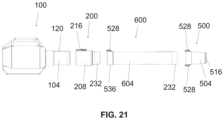
  • FIG. 21 is an exploded view of a third embodiment of a drying assembly having the adapter section and conical nozzle of FIG. 2 with the extender section of FIG. 20 .
  • FIG. 22 is an elevation view of a fourth embodiment of a drying assembly with the adapter of FIG. 2 , the extender of FIG. 20 and the articulating nozzle of FIG. 12 , with the nozzle oriented upwards.
  • FIG. 23 is a side elevation view of a fifth embodiment of a drying assembly with the adapter of FIG. 2 and the articulating nozzle of FIG. 12 .
  • FIG. 24 reproduces FIGS. 9 and 10 in a side-by-side manner.
  • FIG. 25 is a side-by-side comparison of a leaf blower with a standard air tube to the embodiment of FIG. 2 .
  • FIG. 1 is a perspective view of a generic blower ( 100 ).
  • the blower has a blower body ( 112 ).
  • the blower body has a blower outlet tube ( 104 ) extending from the blower body ( 112 ).
  • the blower outlet tube ( 104 ) has at least one attachment feature ( 120 ) situated between the blower body ( 112 ) and the blower outlet ( 108 ).
  • This attachment feature ( 120 ) is used to engage and secure attachments that are sold commercially with blowers such as an extension tube. It is shown here as a raised hexagonal shape but could also include other geometric shapes known to those of skill in the art.
  • the blower outlet tube ( 104 ) defines an axis ( 116 ) coextensive with the direction of air flow out of the blower outlet tube ( 104 ).
  • An extension tube or standard tube ( 150 ) for landscaping is illustrated in FIG. 25 .
  • FIGS. 2 - 8 are elevation views showing the blower ( 100 ) and one embodiment of a dryer kit or assembly that can be attached to a commercial blower.
  • the assembly as illustrated includes an adapter section ( 200 ) and a conical nozzle ( 500 ).
  • the adapter section ( 200 ) further includes an adapter attachment clip ( 216 ) configured to engage the attachment feature ( 120 ) of the blower outlet tube ( 104 ).
  • the adapter section ( 200 ) is configured to be attached to the blower outlet tube ( 104 ) in an overlapping manner.
  • Adapter body ( 208 ) overlaps the blower tube overlapping portion ( 124 ) by a sufficient distance to provide stability. The overlap, dimension D 1 in FIG.
  • the adapter attachment clip ( 216 ) has an adapter clip release button ( 224 ) that when depressed disengages the adapter attachment clip ( 216 ) from the attachment feature ( 120 ) and allows the user to remove or disassemble the adapter section ( 200 ) from the blower outlet tube ( 104 ).
  • the adapter section ( 200 ), as shown in FIGS. 2 , 4 , and 9 is tubular to allow airflow from the blower outlet tube ( 104 ) to travel from the adapter inlet ( 244 ) through the adapter section ( 200 ) to the adapter outlet ( 240 ) and into the conical nozzle inlet ( 508 ) of the conical nozzle ( 500 ).
  • the adapter section ( 200 ) has an adapter body ( 208 ) and an adapter connection collar ( 232 ).
  • the adapter connection collar ( 232 ) is located at the outlet end of the adapter section ( 200 ).
  • the adapter connection collar has a clip attachment feature ( 236 ).
  • This clip attachment feature ( 236 ) may be a shoulder formed by a raised edge or a recessed groove.
  • the adapter connection collar ( 232 ) is designed to overlap with the nozzle connection collar ( 536 ) of the conical nozzle ( 500 ). This overlap, dimension D 2 in FIG. 24 , is between 0.5 and 3 inches, preferably between 1 and 2.5 inches, and most preferably between 1.5 and 2 inches.
  • the end of the adapter connection collar ( 232 ) is the adapter outlet ( 240 ).
  • the adapter attachment clip ( 216 ) has an adapter clip spring ( 228 ), an adapter clip tooth ( 220 ), an adapter clip body ( 212 ), a clip pin ( 552 ), and an adapter clip release button ( 224 ).
  • the adapter clip release button ( 224 ) is positioned over the adapter clip spring ( 228 ) so that the spring provides a force radially outwards from the adapter tube.
  • the clip body connects the adapter clip release button to the adapter clip tooth ( 220 ).
  • the clip pin ( 552 ) is between the clip release button and the adapter clip tooth and provides a fulcrum for the adapter clip body ( 212 ).
  • the adapter attachment clip ( 216 ) is designed to engage a raised geometric shape ( 120 ) on the blower outlet tube ( 104 ).
  • the adapter attachment clip ( 216 ) is self-locking so that it automatically engages the attachment feature ( 120 ) when the adapter ( 200 ) is placed on the blower outlet tube ( 104 ) without the need to depress the clip release button ( 532 ).
  • the attachment clip ( 528 ) may not be removed unless the clip release button ( 532 ) is depressed.
  • the adapter clip spring ( 228 ) provides a biasing force against the underside of the adapter clip release button ( 224 ) which forces the adapter clip tooth ( 220 ) down.
  • the adapter clip tooth ( 220 ) As the adapter section ( 200 ) is slid over the blower outlet tube ( 104 ), the adapter clip tooth ( 220 ) has an angled leading edge ( 221 ) that forces the adapter clip tooth ( 220 ) to raise over the attachment feature ( 120 ).
  • the force from the adapter clip spring ( 228 ) pushes the adapter clip release button ( 224 ) up and the adapter clip tooth ( 220 ) down which creates a secure engagement and prevents the adapter section ( 200 ) from being removed from the blower outlet tube ( 104 ) unless the adapter clip tooth ( 220 ) is raised by depressing the adapter clip release button ( 224 ).
  • the conical nozzle ( 500 ) is designed to overlap the exterior of the adapter connection collar of the adapter section ( 200 ) and attach to the adapter connection collar ( 232 ) by at least one nozzle attachment clip ( 528 ).
  • the one or more nozzle attachment clips ( 528 ) are configured to engage the clip attachment feature ( 236 ) of the adapter.
  • the nozzle attachment clip ( 528 ) has a clip release button ( 532 ) that when depressed disengages the clip attachment feature ( 236 ).
  • the nozzle attachment clip ( 528 ) may be located on the adapter section ( 200 ), the nozzle section ( 500 ), or both, and the clip attachment feature ( 236 ) would be oppositely located in order to mate with the nozzle attachment clip ( 528 ).
  • the clip attachment feature ( 236 ) may be a raised edge, a recessed groove, a notch, or similar. In the shown configuration, the attachment feature is a recessed groove that is engaged by the clip tooth ( 544 ).
  • the nozzle attachment clip ( 528 ) has a clip release button ( 532 ), a clip spring ( 548 ), a clip pin ( 552 ), a clip body ( 540 ), and a clip tooth ( 544 ).
  • the clip spring provides a force on the underside of the clip release button ( 532 ).
  • the clip body ( 540 ) connects the clip release button ( 532 ) to the clip tooth ( 544 ).
  • the clip pin ( 552 ) is between the clip release button ( 532 ) and the clip tooth ( 544 ) and acts as a fulcrum for the spring force.
  • the clip tooth ( 544 ) is slanted to compel the clip tooth to ride over the adapter connection collar ( 232 ) as the nozzle connection collar ( 536 ) is placed over the adapter connection collar ( 232 ).
  • the spring force forces the clip tooth ( 544 ) down and prevents the nozzle connection collar from being disconnected unless the clip release button is depressed.
  • the adapter section ( 200 ) preferably has an overall length D4 of approximately 3-11 inches.
  • Dimension D4 is the sum of dimensions D1+D2+D3.
  • D1 is preferably between 1-6 inches.
  • D2 is preferably between 1-2.5 inches and the length of D3 is less than D2 ( ⁇ 1-2.5 inches).
  • Nozzle ( 500 ) preferably has an overall length represented by dimension D6.
  • D6 is less than D4 as seen in FIG. 24 , specifically less than 3-11 inches preferably.
  • the overall length is preferably approximately 4-18.5 inches.
  • This length dimension is critical to maneuverability of the blower and attachment combination when drying a vehicle, allowing a user to reduce if not eliminate striking the surface of the vehicle with the tip of the attachment and further facilitating a user to hold the blower at a higher elevation, including overhead, to achieve a drying flow of air in a downward direction.
  • the conical nozzle ( 500 ) has a conical nozzle inlet ( 508 ) in which air from the adapter section ( 200 ) enters the conical nozzle ( 500 ) and a conical nozzle outlet ( 512 ) where air exits the conical nozzle ( 500 ).
  • the conical shape of the nozzle body ( 504 ) causes the airflow generated by the blower ( 100 ) to compress into a smaller area and increases the flowrate of the air exiting the nozzle outlet ( 512 ).
  • a safety tip ( 516 ) is preferably located proximate the conical nozzle outlet ( 512 ).
  • the safety tip ( 516 ) is constructed of a relatively soft flexible material that will not scratch the surface of a vehicle being dried upon contact.
  • the safety tip ( 516 ) may be composed of rubber, polymer, silicone, or other similar soft, flexible material.
  • the safety tip ( 516 ) may be over-molded onto the rim of the nozzle outlet or may be frictionally engaged or attached with an adhesive.
  • a screen or filter ( 300 ) is configured to be located in the air flow path between the blower and the end outlet of the dryer assembly. More particularly, the filter ( 300 ) may be located between the blower outlet ( 108 ) and the adapter section ( 200 ) as shown in FIG. 3 , so that the adapter section ( 200 ) holds the filter ( 300 ) in place across the blower outlet ( 108 ). Alternatively, the filter may be located between any of the other component pieces of the various dryer assembly combinations described in the present disclosure. Further still, rather than being located between two components, any of the components may be configured with an opening or slot which would permit the filter to be positioned across the air flow path.
  • the filter may be a mesh material which prevents debris, such as pieces of leaves or other particulate drawn into the blower motor which are of a size that could damage the surface of the vehicle, from being expelled through the blower outlet and damaging the surface of the vehicle.
  • the filter may also be larger so that smaller debris may be passed through but larger debris, such as leaves and twigs are not able to be expelled from the blower outlet ( 108 ).
  • the filter ( 300 ) may be exchangeable to accommodate different types of filters.
  • the filter may comprise a mesh or foam that is designed to be attached to the air intake of the blower ( 100 ) itself. This configuration allows for easy cleaning and removing of debris from the filter without requiring removal of the adapter section ( 200 ) from the blower ( 100 ).
  • FIGS. 12 - 17 show one embodiment of an articulating nozzle ( 700 ).
  • the articulating nozzle ( 700 ) has a rotatable body ( 720 ) and a pivoting nozzle section ( 724 ).
  • a nozzle connection collar ( 536 ) is located proximate the inlet ( 744 ) of the rotatable body ( 720 ) and includes at least one nozzle attachment clip ( 528 ).
  • the rotatable body ( 720 ) further includes a rotatable body outlet ( 728 ).
  • the rotatable body outlet ( 728 ) has a partially spherical outer surface ( 712 ) with an opening ( 732 ) allowing air to pass through.
  • the pivoting nozzle section ( 724 ) is repositionable relative to the rotatable body ( 720 ).
  • the pivoting nozzle section ( 724 ) includes a tapered body ( 736 ) with an outlet ( 740 ) and a partially spherical inlet section ( 716 ) that is configured to mate with the partially spherical outer surface ( 712 ) of the rotatable body ( 720 ).
  • the pivoting nozzle section ( 724 ) pivots about a connection between the partially spherical outer surface ( 712 ) of the rotatable body ( 720 ) and the partially spherical inlet section ( 716 ) so as to direct the air flow from the opening ( 732 ) in a direction within 45 degrees of the blower axis ( 116 ).
  • the rotatable body ( 720 ) permits the entire articulating nozzle ( 700 ) to rotate 360 degrees about the end of the adapter connection collar ( 232 ) of the preceding section.
  • the rotatable body ( 720 ) has pin holes ( 708 ) for accepting a pin ( 704 ) that connects the rotatable body ( 720 ) to the pivoting nozzle section ( 724 ).
  • the rotatable body ( 720 ) ends in a partially spherical outer surface ( 712 ) having an opening ( 732 ).
  • the opening ( 732 ) is somewhat slot shaped to direct air flow from a cylindrical flow pattern to a more flat pattern corresponding to the articulating nozzle outlet ( 740 ).
  • the pivoting nozzle section ( 724 ) then transitions from the partially spherical inlet section ( 716 ) into the tapered body ( 736 ) which terminates in the articulating nozzle outlet ( 740 ) and optionally a safety tip ( 516 ).
  • the cross section of the tapered body ( 736 ) where the tapered body connects to the partially spherical inlet section ( 716 ) is smaller than the cross section of the articulating nozzle outlet ( 740 ) such that the air passing through the tapered body is dispersed over a wider area.
  • the articulating nozzle ( 700 ) connects to an upstream section by having the nozzle connection collar ( 536 ) overlapping the adapter connection collar ( 232 ) and securing the connection with the use of at least one nozzle attachment clip ( 528 ) as discussed above.
  • This connection allows the articulating nozzle ( 700 ) to rotate around the upstream section. This rotation allows the articulating nozzle ( 700 ) to have two degrees of motion—rotation of the articulating nozzle relative to the adapter connection collar ( 232 ) and a pivoting nozzle section ( 724 ).
  • FIGS. 18 and 19 show one embodiment of a weighted section ( 400 ) that is configured to mate with the other components of the dryer kits described herein.
  • the weighted section ( 400 ) is located between the adapter section ( 200 ) and a downstream section, being either a nozzle or extender tube section.
  • the weighted section ( 400 ) is a tube and has a nozzle connection collar ( 536 ) at the weighted section inlet ( 412 ), a body section ( 404 ), including a weighted ring ( 408 ), and an adapter connection collar ( 232 ) at the weighted section outlet ( 413 ).
  • the nozzle connection collar ( 536 ) has at least one attachment clip ( 528 ) that is designed to engage a clip attachment feature ( 236 ) of a second component of the dryer kit.
  • the weighted ring ( 408 ) extends outwards from the weighted body ( 404 ) and is of a certain width.
  • the weighted ring ( 408 ) is comprised of a ring exterior ( 416 ), preferably comprised of plastic, and is filled with sand, metal, plastic, water, rubber, or other suitably dense material.
  • the adapter connection collar ( 232 ) comprises a clip attachment feature ( 236 ).
  • the weighted section ( 400 ) is designed to counter the tendency of the blower to point upwards during use due to the weight of the blower.
  • the force of the air leaving a nozzle can create rotation in the blower about the handle and cause it to point towards the sky rather than the vehicle surface.
  • the plastic tubes, by themselves, do not provide much weight to counter the blower force. Therefore, the added weight provided by the weighted section ( 400 ) will prevent the blower from rotating during use and provide more control for the user. Additionally, the farther downstream the weighted section is from the blower, the more resistance will be provided. Thus, it is not required that the weighted section ( 400 ) be attached directly to the adapter section ( 200 ). Certain blowers may be more prone to raising than others, and so placing the weighted section ( 400 ) farther downstream may be advantageous.
  • FIG. 19 shows an exploded view of the adapter section ( 200 ) connected to the blower ( 100 ) and the weighted section ( 400 ) between the adapter section ( 200 ) and conical nozzle ( 500 ).
  • FIG. 20 shows one embodiment of an extender section ( 600 ).
  • the extender section ( 600 ) has an inlet ( 608 ), a nozzle connection collar ( 536 ) having a nozzle attachment clip ( 528 ), an extender tube ( 604 ), and an adapter connection collar ( 232 ) having a clip attachment feature ( 236 ).
  • the nozzle connection collar ( 232 ) transitions into the extender tube ( 604 ).
  • the extender tube ( 604 ) may be of any length within 6 to 36 inches.
  • the extender tube ( 604 ) then ends at the adapter connection collar ( 232 ).
  • the adapter connection collar ( 232 ) has a clip attachment feature ( 236 ) described above.
  • FIG. 21 shows an exploded view of an assembly of a blower ( 100 ), the adapter section ( 200 ), the extender section ( 600 ), and the conical nozzle ( 500 ).
  • FIG. 22 shows one embodiment of an assembly of a blower ( 100 ), the adapter section ( 200 ), the extender section ( 600 ), and the articulating nozzle ( 700 ).
  • the pivoting nozzle section ( 724 ) of the articulating nozzle ( 700 ) is shown pivoted at an angle in this configuration.
  • the rotatable body ( 720 ) may rotate as much as 45 degrees in a direction off of the blower axis ( 116 ).
  • the nozzle connection collar ( 536 ) of the articulating nozzle ( 700 ) may be rotated about the adapter connection collar ( 232 ) of the previous section. This provides two degrees of movement for the articulating nozzle ( 700 ). It may rotate axially about the adapter connection collar ( 232 ) of the preceding or upstream section, and it may pivot so that the articulating nozzle outlet is facing up to 45 degrees off the blower axis ( 116 ) in opposite directions.
  • any of the adapter connection collars ( 232 ) may be attached to any of the nozzle connection collars ( 536 ).
  • any configuration that begins with the adapter section ( 200 ) and ends with either the conical nozzle ( 500 ) or the articulating nozzle ( 700 ) is possible.
  • a configuration of the adapter section ( 200 ) connected to the extender section ( 600 ), which then connects to the weighted section ( 400 ) and ends in the conical nozzle ( 500 ) is possible.
  • the adapter section could have the weighted section ( 400 ), then the extender section ( 600 ), then the articulating nozzle ( 700 ).
  • weighted section ( 400 ) and extender section ( 600 ) are possible. Specifically, when drying larger vehicles, such as RV's and campers, it would be beneficial to combine multiple extender sections ( 600 ) together so that the blower's range is extended and a larger effective range is achieved.
  • the component parts may connect on the inside, not the outside, the clips may be different, the diameters may be different, the nozzle shape may be different, the length of the sections may be different, etc.
  • the above configurations show the nozzle attachment clips going over the adapter connection collar; however, it is contemplated that the nozzle connection collars fit within the adapter connection collars.
  • the above embodiments and configurations show the nozzle attachment clips contained on the nozzle connection collar and the clip attachment feature on the adapter connection collar; however, the clips may be found on the adapter connection collar and the clip attachment feature may be on the nozzle connection collar. Alternatively, it is contemplated that both the adapter connection collar and the nozzle connection collar have both nozzle attachment clips and clip attachment features.
  • the clip attachment feature shown in the above embodiments is a recessed groove in the collar; however, any suitable method for attaching the collar may be used. These include a ball and groove system, a raised feature similar to the one shown on the blower tube, magnets, a high friction surface to hold the connection together, a notch and groove, and other methods that would be obvious to one having skill in the art.
  • FIG. 1 shows that there are two nozzle attachment clips, there may be one nozzle attachment clip or more than two nozzle attachment clips. Alternatively, there may be no nozzle attachment clips as described in certain embodiments such as those having a radial notch and groove attachment feature, a frictional attachment, or a biased attachment.
  • This loop or ring may consist of an arcuate extension extending radially out from each of these sections.
  • the airflow outlet of the nozzles may vary beyond what is shown in the accompanying drawings to provide a focused narrow airflow or a wider coverage area a would be appreciated by those of skill in the art upon reading the present disclosure. These nozzles would be useful for drying the tops of taller vehicles without requiring a ladder or platform.

Landscapes

  • Engineering & Computer Science (AREA)
  • Mechanical Engineering (AREA)
  • Structures Of Non-Positive Displacement Pumps (AREA)

Abstract

A non-flexible tubular attachment to convert a hand-held electric blower into a device for drying vehicles. The attachment includes a first end configured to mate with the hand-held electric blower and a second end in fluid communication with the blower to output air for drying a vehicle. A non-uniform internal air passageway extends from the first end to the second end.

Description

CROSS-REFERENCE TO RELATED APPLICATIONS
This application is a continuation and claims the benefit of U.S. patent application Ser. No. 18/595,171 filed Mar. 4, 2024 entitled “VEHICLE DRYING SYSTEM,” which is a continuation-in-part and claims the benefit of U.S. patent application Ser. No. 16/945,413 filed on Jul. 31, 2020, now issued U.S. Pat. No. 11,919,488, which claimed the benefit of U.S. Provisional Application No. 62/881,072 filed on Jul. 31, 2019, both entitled “CAR DRYING LEAF BLOWER TUBE,” which applications are incorporated herein by reference in their entirety.
FIELD OF THE INVENTION
Embodiments of the present invention generally relate to drying a vehicle, and more specifically to drying a vehicle using a handheld blower.
BACKGROUND OF THE INVENTION
Handheld blowers used for yard and other outdoor work are common. Invented in the late 1950's, they have gained popularity and versatility over time. Originally, blowers were used to spray chemicals in the agricultural industry and now have many uses, from blowing leaves into piles, to cleaning gutters and surfaces of debris. They are versatile instruments and readily available at most hardware, lawn and garden, and big box stores. Additionally, with the introduction of gas and battery powered lawn care tools, the restrictions of a power cord are eliminated and blowers may now be used in more places and for more end uses.
With over 250 million motor vehicles, the United States has one of the world's highest vehicle-per-capita rates with almost 1 vehicle for every person in the country. In order to maintain proper care of their vehicles, vehicle owners must wash and clean the exterior of the vehicles to prevent rust and deterioration of the paint from salt and other damaging materials. Maintaining a clean vehicle also prevents the user from becoming dirty when entering and exiting the vehicle. Further, many users take pride in keeping their vehicle clean and aesthetically pleasing. For these purposes, it is important to dry the vehicle after washing to remove residual dirt and chemicals and prevent the formation of water marks on the vehicle surface. Drying the vehicle involves either significant manual labor by the owner using towels or chammies or paying for an automated car wash that utilizes large industrial blowers for blow drying the vehicle or manual laborers to hand dry the vehicle. Towel drying a vehicle is tedious and may be difficult depending upon the size of the vehicle and the owner. Moreover, drying a car with a cloth can cause micro scratches on the vehicle's paint. Automated car washes with industrial drying blowers, while involving little to no labor, use high power water jets, large contact roller brushes or pads which may also cause damage to the vehicle's exterior. Automated car washes also cost money to use. Thus, car owners have long faced the dilemma of choosing between allowing water spots to form on the car, manually drying their vehicles themselves with towels, paying for an automated car wash with drying, or paying others to manually dry the vehicle.
There has thus been a long felt need for a vehicle dryer that is inexpensive, readily accessible and does not cause damage to the vehicle's exterior. With the amount of vehicles in the United States and worldwide, there is a large market for a device that it inexpensive and can quickly dry a vehicle with minimal user effort without damaging the vehicle's exterior surface. Despite the large need and demand, and given the widespread availability of lawn and/or debris blowers for decades, there has been a surprising failure to successfully develop a vehicle drying blower using a lawn blower. Examples exist of persons attempting to use a standard leaf or yard blower to dry a vehicle but such blowers are not intended for drying vehicles but are designed for landscaping work. The standard air tube that is sold with a leaf blower has an intentionally long length in order that the outlet end is proximate the ground when held by a user to focus the air output close to where the yard debris is located. The standard long length of the air tube makes it impractical and unwieldy to use a leaf blower to dry a vehicle. A user will likely repeatedly strike the vehicle with the hard plastic tip of the standard air tube and be unable to easily hold the blower overhead for purposes of directing airflow downward toward vehicle surfaces.
SUMMARY OF THE INVENTION
The present disclosure inexpensively solves the problem of drying vehicles without damaging the paint by providing a drying attachment for use with handheld yard blowers that is substantially shorter in length than the air tube that is used for yard clean up. This critical difference in length is apparent in FIG. 25 . Preferably, the length is twelve inches shorter than a standard yard blower air tube. A shorter air tube improves handling and maneuverability when working in close proximity to a vehicle reducing damage to the vehicle from inadvertent or unintended contact. According to aspects of the present disclosure, in one embodiment the attachment includes an adapter configured to attach to a pre-existing yard blower and a nozzle configured to connect to the adapter. The adapter has a first end that is configured to attach to a pre-existing blower's outlet and a second, opposite end that is designed to connect to a nozzle or, in other embodiments, a plurality of other component pieces. The remaining component sections comprise a variety of extenders, other nozzles, and a weighted section to assist a user in counterbalancing the weight of the blower.
Existing commercial blowers typically have a removable blower tube which is connected to a fixed or non-removable air outlet port of the blower by some sort of attachment feature. According to aspects of the present disclosure, a variety of multiple adapters are available wherein the first end is specially configured to interconnect with the particular outlet port of different blower brands, e.g., Black & Decker, DeWalt, Ryobi, EGo, Husqvarna, Toro, Snapper, Echo, and Milwaukee, among others, while the second, opposite outlet end of these various adapters will be identical in order to interconnect with the various nozzles and other components comprising the different embodiments of a drying adapter assembly. The attachment feature may be a raised edge, a recessed groove, a notch, a locking element, or similar associated with the non-removable outlet port. The adapter is configured to engage this attachment feature at the adapter section inlet and provide a new downstream outlet for the air expelled from the blower. As noted, in preferred embodiments, the adapter outlet has a common size to mate with all other downstream sections, which are discussed below, thus reducing manufacturing costs and increasing the configurations available to the end user.
In at least one embodiment, the adapter section includes an in-line filter. The filter may be disposed at the adapter section outlet, or anywhere along the body of the adapter while in the airflow path. The filter may comprise a mesh which allows air to flow through the device but prevents the expulsion of small debris that could scratch or mar the surface of the vehicle. The mesh would be sized to prevent the passage of debris without restricting airflow significantly. The filter may also be removable and include different sized configurations that prevent the expulsion of different sized debris ranging from small particles such as pieces of leaves and other debris, to larger debris such as sticks and pine needles.
In one embodiment, a conical nozzle is connected to the outlet of the adapter section. The conical nozzle attaches to the outlet of the adapter section via a number of attachment clips. A clip may be on either the adapter section, the nozzle section, or both and is configured to engage a clip receiving feature associated with the opposite component section. The clip receiving feature may include a raised edge, a recessed groove, a notch, a locking element or some other structure known to those of skill in the art and used to secure one component in a mating position with a second component.
Another embodiment comprises the adapter section with a selectively articulating nozzle. The articulating nozzle pivots in at least one direction and may also rotate. The articulating nozzle may be composed of two separate sections, an inlet section configured to mate with the outlet end of the adapter or the outlet end of an extender tube (discussed herein), and an outlet section. The inlet section is generally tubular and in at least one embodiment has a first or inlet end that fits over the outlet end of an adapter or extender tube, and a second end, opposite the first end, having a partial spherical outer surface having a slot shaped aperture to allow air to pass through the inlet section and into the outlet section. According to aspects of the present disclosure, the inlet section is capable of rotating 360 degrees in either direction relative to the adapter or extender tube.
The outlet section of the articulating nozzle has a first, upstream end with a partial spherical surface which engages and covers the partial spherical end of the inlet section when the two sections are joined. A pair of pins, rivets or screws connect the outlet section to the inlet section wherein the partial spherical section of the inlet section and the partial spherical cover section of the outlet section mate or nest and the outlet section is free to pivot about the pins and redirect airflow as a result. The outlet section has a wedge-shaped pivoting nozzle section extending from the partial spherical cover portion and optionally ends in a rubber safety tip. This configuration allows the air flow to be directed up to 45 degrees off the longitudinal axis of the airflow. The articulating nozzle section may be attached by clips located on the nozzle section, the adapter section, or both which engage a clip attachment feature of the opposite section. The clip attachment feature may be a raised edge or a recessed groove. The articulating nozzle may be able to rotate around the adapter section, allowing two degrees of motion.
In another embodiment, an extender section connects the adapter section with either of the nozzle sections. The extender is a hollow tube having a certain length and is intended to extend the location of the air outlet from the blower in order for a user to reach and dry farther away portions of the vehicle. Multiple extender sections may be joined to extend the nozzle farther, for example, when drying larger vehicles such as campers and RVs. The extender has an inlet side that is configured to be connected to the adapter section by clips which engage a clip attachment feature on the corresponding section. The clips may be on the adapter section, the extender section, or both. The clip attachment feature may be a raised edge or a recessed groove. The outlet section of the extender section may be the same size as the outlet of the adapter section and therefore, be able to receive any of the other sections, except for the adapter section, discussed herein. The outlet section of the extender may have clips for attaching an additional section, or a clip attachment feature, or both.
In another embodiment, a weighted section may be joined with the other components to provide a counterbalance to the weight of the blower body and facilitate use of the blower as a vehicle dryer. The weighted section may be positioned between the adapter section and a nozzle section. The weighted section is configured to be connected to the adapter section by clips. The clips may be on either the weighted section, the adapter section, or both, and engage a clip receiving feature. The clip receiving feature may be a raised edge or a recessed groove. The weighted section may have a weighted collar between the weighted section inlet and the weighted section outlet. The weighted collar may be weighted by sand, metal, plastic, water, or other suitable dense material. The outlet of the weighted section may connect to an additional section by clips on either the weighted section, nozzle section, or both, which engage a clip attachment feature. The clip attachment feature may be on either the weighted section, the downstream section, or both, and is configured to engage a clip attachment feature. The clip attachment feature may be a raised edge or a recessed groove and may be on the weighted section, the nozzle section, or both.
Another embodiment of the invention comprises a safety tip for the nozzle sections. The safety tip is located on the outer edge or outlet end of the nozzle where the air flow is expelled from the device. The safety tip may be over-molded or attached by a friction fit or adhesive. The safety tip is composed of a soft material which may be rubber or some other soft polymer. The safety tip prevents the configured blower attachment from denting or scratching the surface of a vehicle upon contact.
DESCRIPTION OF FIGURES
FIG. 1 is a perspective view of one embodiment of a blower body.
FIG. 2 is an elevation view of the blower body with one embodiment of a drying assembly having an adapter section and conical nozzle.
FIG. 3 is an exploded elevation view of the blower body with the drying assembly of FIG. 2 , further including an inline filter.
FIG. 4 is a cross sectional view of the adapter section and conical nozzle of FIG. 2 attached to a blower body.
FIG. 5 is a close-up view of an adapter attachment clip in an engaged position.
FIG. 6 is a close-up view of an adapter attachment clip in a disengaged position.
FIG. 7 is a close-up view of a nozzle attachment clip in an engaged position.
FIG. 8 is a close-up view of a nozzle attachment clip in a disengaged position.
FIG. 9 is a top plan view of the adapter section of FIG. 2 .
FIG. 10 is a top plan view of the conical nozzle of FIG. 2 .
FIG. 11 is a perspective view of the conical nozzle of FIG. 2 .
FIG. 12 is a top plan view of one embodiment of an articulating nozzle.
FIG. 13 is a perspective view of the articulating nozzle of FIG. 12 .
FIG. 14 is a first exploded perspective view of the articulating nozzle of FIG. 12 .
FIG. 15 is a second exploded perspective view of the articulating nozzle of FIG. 12 .
FIG. 16 is a cross section view of the articulating nozzle of FIG. 12 .
FIG. 17 is a front perspective view of the articulating nozzle of FIG. 12 .
FIG. 18 is a top plan view of one embodiment of a weighted collar section.
FIG. 19 is an exploded view of a second drying assembly having the adapter and conical nozzle of FIG. 2 with the weighted collar section of FIG. 18 .
FIG. 20 is top plan view of one embodiment of an extender section.
FIG. 21 is an exploded view of a third embodiment of a drying assembly having the adapter section and conical nozzle of FIG. 2 with the extender section of FIG. 20 .
FIG. 22 is an elevation view of a fourth embodiment of a drying assembly with the adapter of FIG. 2 , the extender of FIG. 20 and the articulating nozzle of FIG. 12 , with the nozzle oriented upwards.
FIG. 23 is a side elevation view of a fifth embodiment of a drying assembly with the adapter of FIG. 2 and the articulating nozzle of FIG. 12 .
FIG. 24 reproduces FIGS. 9 and 10 in a side-by-side manner.
FIG. 25 is a side-by-side comparison of a leaf blower with a standard air tube to the embodiment of FIG. 2 .
DETAILED DESCRIPTION OF DRAWINGS Component List
    • Blower 100
    • Blower Outlet Tube 104
    • Blower Outlet 108
    • Blower Body 112
    • Blower axis 116
    • Attachment Feature 120
    • Overlapping Portion 124
    • Adapter Section 200
    • Adapter body 208
    • Adapter Clip Body 212
    • Adapter Attachment Clip 216
    • Adapter Clip Tooth 220
    • Tooth Leading Edge 221
    • Adapter Clip Release Button 224
    • Adapter Clip Spring 228
    • Adapter Connection Collar 232
    • Clip Attachment Feature 236
    • Adapter Outlet 240
    • Adapter Inlet 244
    • Filter 300
    • Weighted Section 400
    • Weighted body 404
    • Weighted Ring 408
    • Weighted Section Inlet 412
    • Weighted Section Outlet 413
    • Ring exterior 416
    • Conical Nozzle 500
    • Conical nozzle body 504
    • Conical nozzle inlet 508
    • Conical nozzle outlet 512
    • Safety Tip 516
    • Nozzle attachment clip 528
    • Clip release button 532
    • Nozzle Connection collar 536
    • Clip Body 540
    • Clip tooth 544
    • Clip spring 548
    • Clip pin 552
    • Extender Section 600
    • Extender tube 604
    • Extender inlet 608
    • Articulating Nozzle 700
    • Pin 704
    • Pin holes 708
    • Partially spherical outer surface 712
    • Partially spherical inlet section 716
    • Rotatable body 720
    • Pivoting nozzle section 724
    • Rotatable body outlet 728
    • Opening 732
    • Tapered body 736
    • Articulating nozzle outlet 740
    • Articulating nozzle inlet 744
FIG. 1 is a perspective view of a generic blower (100). The blower has a blower body (112). The blower body has a blower outlet tube (104) extending from the blower body (112). The blower outlet tube (104) has at least one attachment feature (120) situated between the blower body (112) and the blower outlet (108). This attachment feature (120) is used to engage and secure attachments that are sold commercially with blowers such as an extension tube. It is shown here as a raised hexagonal shape but could also include other geometric shapes known to those of skill in the art. The blower outlet tube (104) defines an axis (116) coextensive with the direction of air flow out of the blower outlet tube (104). An extension tube or standard tube (150) for landscaping is illustrated in FIG. 25 .
FIGS. 2-8 are elevation views showing the blower (100) and one embodiment of a dryer kit or assembly that can be attached to a commercial blower. The assembly as illustrated includes an adapter section (200) and a conical nozzle (500). The adapter section (200) further includes an adapter attachment clip (216) configured to engage the attachment feature (120) of the blower outlet tube (104). The adapter section (200) is configured to be attached to the blower outlet tube (104) in an overlapping manner. Adapter body (208) overlaps the blower tube overlapping portion (124) by a sufficient distance to provide stability. The overlap, dimension D1 in FIG. 24 , is between 0.5 and 8 inches, preferably between 1 and 6 inches, and most preferably 3 and 5 inches. While the illustrated configuration shows the adapter positioned outside of the blower outlet tube, the orientation may be reversed where the adapter fits inside the existing blower outlet tube (104). The adapter attachment clip (216) has an adapter clip release button (224) that when depressed disengages the adapter attachment clip (216) from the attachment feature (120) and allows the user to remove or disassemble the adapter section (200) from the blower outlet tube (104).
The adapter section (200), as shown in FIGS. 2, 4, and 9 is tubular to allow airflow from the blower outlet tube (104) to travel from the adapter inlet (244) through the adapter section (200) to the adapter outlet (240) and into the conical nozzle inlet (508) of the conical nozzle (500). The adapter section (200) has an adapter body (208) and an adapter connection collar (232). The adapter connection collar (232) is located at the outlet end of the adapter section (200). The adapter connection collar has a clip attachment feature (236). This clip attachment feature (236) may be a shoulder formed by a raised edge or a recessed groove. The adapter connection collar (232) is designed to overlap with the nozzle connection collar (536) of the conical nozzle (500). This overlap, dimension D2 in FIG. 24 , is between 0.5 and 3 inches, preferably between 1 and 2.5 inches, and most preferably between 1.5 and 2 inches. The end of the adapter connection collar (232) is the adapter outlet (240).
The adapter attachment clip (216) has an adapter clip spring (228), an adapter clip tooth (220), an adapter clip body (212), a clip pin (552), and an adapter clip release button (224). The adapter clip release button (224) is positioned over the adapter clip spring (228) so that the spring provides a force radially outwards from the adapter tube. The clip body connects the adapter clip release button to the adapter clip tooth (220). The clip pin (552) is between the clip release button and the adapter clip tooth and provides a fulcrum for the adapter clip body (212). The adapter attachment clip (216) is designed to engage a raised geometric shape (120) on the blower outlet tube (104). The adapter attachment clip (216) is self-locking so that it automatically engages the attachment feature (120) when the adapter (200) is placed on the blower outlet tube (104) without the need to depress the clip release button (532). However, the attachment clip (528) may not be removed unless the clip release button (532) is depressed. The adapter clip spring (228) provides a biasing force against the underside of the adapter clip release button (224) which forces the adapter clip tooth (220) down. As the adapter section (200) is slid over the blower outlet tube (104), the adapter clip tooth (220) has an angled leading edge (221) that forces the adapter clip tooth (220) to raise over the attachment feature (120). When the adapter clip tooth (220) passes the attachment feature (120), the force from the adapter clip spring (228) pushes the adapter clip release button (224) up and the adapter clip tooth (220) down which creates a secure engagement and prevents the adapter section (200) from being removed from the blower outlet tube (104) unless the adapter clip tooth (220) is raised by depressing the adapter clip release button (224).
As shown in FIGS. 10 and 11 , the conical nozzle (500) is designed to overlap the exterior of the adapter connection collar of the adapter section (200) and attach to the adapter connection collar (232) by at least one nozzle attachment clip (528). The one or more nozzle attachment clips (528) are configured to engage the clip attachment feature (236) of the adapter. Preferably, there are two nozzle attachment clips positioned on opposite sides of the collar. The nozzle attachment clip (528) has a clip release button (532) that when depressed disengages the clip attachment feature (236). It should be understood that, while shown as the embodiment described above, the nozzle attachment clip (528) may be located on the adapter section (200), the nozzle section (500), or both, and the clip attachment feature (236) would be oppositely located in order to mate with the nozzle attachment clip (528). The clip attachment feature (236) may be a raised edge, a recessed groove, a notch, or similar. In the shown configuration, the attachment feature is a recessed groove that is engaged by the clip tooth (544). Similar to the adapter attachment clip (216), the nozzle attachment clip (528) has a clip release button (532), a clip spring (548), a clip pin (552), a clip body (540), and a clip tooth (544). The clip spring provides a force on the underside of the clip release button (532). The clip body (540) connects the clip release button (532) to the clip tooth (544). The clip pin (552) is between the clip release button (532) and the clip tooth (544) and acts as a fulcrum for the spring force. The clip tooth (544) is slanted to compel the clip tooth to ride over the adapter connection collar (232) as the nozzle connection collar (536) is placed over the adapter connection collar (232). When the clip tooth (544) passes the clip attachment feature (236) the spring force forces the clip tooth (544) down and prevents the nozzle connection collar from being disconnected unless the clip release button is depressed.
With reference to FIGS. 9, 10 and 24 the adapter section (200) preferably has an overall length D4 of approximately 3-11 inches. Dimension D4 is the sum of dimensions D1+D2+D3. D1 is preferably between 1-6 inches. D2 is preferably between 1-2.5 inches and the length of D3 is less than D2 (<1-2.5 inches). Nozzle (500) preferably has an overall length represented by dimension D6. D6 is the sum of dimensions D2 and D5 (D2+D5=D6). D6 is less than D4 as seen in FIG. 24 , specifically less than 3-11 inches preferably. Considering the overlap of dimension D2 when adapter section (200) and nozzle (500) are joined, the overall length is preferably approximately 4-18.5 inches. This length dimension is critical to maneuverability of the blower and attachment combination when drying a vehicle, allowing a user to reduce if not eliminate striking the surface of the vehicle with the tip of the attachment and further facilitating a user to hold the blower at a higher elevation, including overhead, to achieve a drying flow of air in a downward direction.
The conical nozzle (500) has a conical nozzle inlet (508) in which air from the adapter section (200) enters the conical nozzle (500) and a conical nozzle outlet (512) where air exits the conical nozzle (500). The conical shape of the nozzle body (504) causes the airflow generated by the blower (100) to compress into a smaller area and increases the flowrate of the air exiting the nozzle outlet (512).
A safety tip (516) is preferably located proximate the conical nozzle outlet (512). The safety tip (516) is constructed of a relatively soft flexible material that will not scratch the surface of a vehicle being dried upon contact. The safety tip (516) may be composed of rubber, polymer, silicone, or other similar soft, flexible material. The safety tip (516) may be over-molded onto the rim of the nozzle outlet or may be frictionally engaged or attached with an adhesive.
In some embodiments, a screen or filter (300) is configured to be located in the air flow path between the blower and the end outlet of the dryer assembly. More particularly, the filter (300) may be located between the blower outlet (108) and the adapter section (200) as shown in FIG. 3 , so that the adapter section (200) holds the filter (300) in place across the blower outlet (108). Alternatively, the filter may be located between any of the other component pieces of the various dryer assembly combinations described in the present disclosure. Further still, rather than being located between two components, any of the components may be configured with an opening or slot which would permit the filter to be positioned across the air flow path. The filter may be a mesh material which prevents debris, such as pieces of leaves or other particulate drawn into the blower motor which are of a size that could damage the surface of the vehicle, from being expelled through the blower outlet and damaging the surface of the vehicle. The filter may also be larger so that smaller debris may be passed through but larger debris, such as leaves and twigs are not able to be expelled from the blower outlet (108). In other embodiments, the filter (300) may be exchangeable to accommodate different types of filters. In still other embodiments, the filter may comprise a mesh or foam that is designed to be attached to the air intake of the blower (100) itself. This configuration allows for easy cleaning and removing of debris from the filter without requiring removal of the adapter section (200) from the blower (100).
FIGS. 12-17 show one embodiment of an articulating nozzle (700). The articulating nozzle (700) has a rotatable body (720) and a pivoting nozzle section (724). A nozzle connection collar (536) is located proximate the inlet (744) of the rotatable body (720) and includes at least one nozzle attachment clip (528). The rotatable body (720) further includes a rotatable body outlet (728). In this embodiment, the rotatable body outlet (728) has a partially spherical outer surface (712) with an opening (732) allowing air to pass through. The pivoting nozzle section (724) is repositionable relative to the rotatable body (720). The pivoting nozzle section (724) includes a tapered body (736) with an outlet (740) and a partially spherical inlet section (716) that is configured to mate with the partially spherical outer surface (712) of the rotatable body (720). The pivoting nozzle section (724) pivots about a connection between the partially spherical outer surface (712) of the rotatable body (720) and the partially spherical inlet section (716) so as to direct the air flow from the opening (732) in a direction within 45 degrees of the blower axis (116). The rotatable body (720) permits the entire articulating nozzle (700) to rotate 360 degrees about the end of the adapter connection collar (232) of the preceding section.
The rotatable body (720) has pin holes (708) for accepting a pin (704) that connects the rotatable body (720) to the pivoting nozzle section (724). The rotatable body (720) ends in a partially spherical outer surface (712) having an opening (732). The opening (732) is somewhat slot shaped to direct air flow from a cylindrical flow pattern to a more flat pattern corresponding to the articulating nozzle outlet (740). The overlap between the partially spherical outer surface (712) of the rotatable body (720) and the partially spherical inlet section (716) of the pivoting nozzle section (724) prevents most of the air from escaping through the connection and forces the air out of the articulating nozzle outlet (740). The pivoting nozzle section (724) then transitions from the partially spherical inlet section (716) into the tapered body (736) which terminates in the articulating nozzle outlet (740) and optionally a safety tip (516). The cross section of the tapered body (736) where the tapered body connects to the partially spherical inlet section (716) is smaller than the cross section of the articulating nozzle outlet (740) such that the air passing through the tapered body is dispersed over a wider area.
The articulating nozzle (700) connects to an upstream section by having the nozzle connection collar (536) overlapping the adapter connection collar (232) and securing the connection with the use of at least one nozzle attachment clip (528) as discussed above. This connection allows the articulating nozzle (700) to rotate around the upstream section. This rotation allows the articulating nozzle (700) to have two degrees of motion—rotation of the articulating nozzle relative to the adapter connection collar (232) and a pivoting nozzle section (724).
FIGS. 18 and 19 show one embodiment of a weighted section (400) that is configured to mate with the other components of the dryer kits described herein. The weighted section (400) is located between the adapter section (200) and a downstream section, being either a nozzle or extender tube section. The weighted section (400) is a tube and has a nozzle connection collar (536) at the weighted section inlet (412), a body section (404), including a weighted ring (408), and an adapter connection collar (232) at the weighted section outlet (413). The nozzle connection collar (536) has at least one attachment clip (528) that is designed to engage a clip attachment feature (236) of a second component of the dryer kit. In one embodiment, the weighted ring (408) extends outwards from the weighted body (404) and is of a certain width. The weighted ring (408) is comprised of a ring exterior (416), preferably comprised of plastic, and is filled with sand, metal, plastic, water, rubber, or other suitably dense material. The adapter connection collar (232) comprises a clip attachment feature (236).
The weighted section (400) is designed to counter the tendency of the blower to point upwards during use due to the weight of the blower. The force of the air leaving a nozzle can create rotation in the blower about the handle and cause it to point towards the sky rather than the vehicle surface. The plastic tubes, by themselves, do not provide much weight to counter the blower force. Therefore, the added weight provided by the weighted section (400) will prevent the blower from rotating during use and provide more control for the user. Additionally, the farther downstream the weighted section is from the blower, the more resistance will be provided. Thus, it is not required that the weighted section (400) be attached directly to the adapter section (200). Certain blowers may be more prone to raising than others, and so placing the weighted section (400) farther downstream may be advantageous.
FIG. 19 shows an exploded view of the adapter section (200) connected to the blower (100) and the weighted section (400) between the adapter section (200) and conical nozzle (500).
FIG. 20 shows one embodiment of an extender section (600). The extender section (600) has an inlet (608), a nozzle connection collar (536) having a nozzle attachment clip (528), an extender tube (604), and an adapter connection collar (232) having a clip attachment feature (236). The nozzle connection collar (232) transitions into the extender tube (604). The extender tube (604) may be of any length within 6 to 36 inches. The extender tube (604) then ends at the adapter connection collar (232). The adapter connection collar (232) has a clip attachment feature (236) described above.
FIG. 21 shows an exploded view of an assembly of a blower (100), the adapter section (200), the extender section (600), and the conical nozzle (500).
FIG. 22 shows one embodiment of an assembly of a blower (100), the adapter section (200), the extender section (600), and the articulating nozzle (700). The pivoting nozzle section (724) of the articulating nozzle (700) is shown pivoted at an angle in this configuration. The rotatable body (720) may rotate as much as 45 degrees in a direction off of the blower axis (116).
As shown by FIG. 23 , the nozzle connection collar (536) of the articulating nozzle (700) may be rotated about the adapter connection collar (232) of the previous section. This provides two degrees of movement for the articulating nozzle (700). It may rotate axially about the adapter connection collar (232) of the preceding or upstream section, and it may pivot so that the articulating nozzle outlet is facing up to 45 degrees off the blower axis (116) in opposite directions.
It is to be understood that any of the adapter connection collars (232) may be attached to any of the nozzle connection collars (536). Thus, while only some configurations are described and shown in the figures, any configuration that begins with the adapter section (200) and ends with either the conical nozzle (500) or the articulating nozzle (700) is possible. Thus, a configuration of the adapter section (200) connected to the extender section (600), which then connects to the weighted section (400) and ends in the conical nozzle (500) is possible. Alternatively, the adapter section could have the weighted section (400), then the extender section (600), then the articulating nozzle (700). Additionally, multiples of the weighted section (400) and extender section (600) are possible. Specifically, when drying larger vehicles, such as RV's and campers, it would be beneficial to combine multiple extender sections (600) together so that the blower's range is extended and a larger effective range is achieved.
It is therefore to be understood that while different embodiments are herein set forth and described, the above and other modifications and changes may be made in the construction and arrangement of elements as well as intended use of the apparatus without departing from the spirit and scope thereof. For example, the component parts may connect on the inside, not the outside, the clips may be different, the diameters may be different, the nozzle shape may be different, the length of the sections may be different, etc. The above configurations show the nozzle attachment clips going over the adapter connection collar; however, it is contemplated that the nozzle connection collars fit within the adapter connection collars. The above embodiments and configurations show the nozzle attachment clips contained on the nozzle connection collar and the clip attachment feature on the adapter connection collar; however, the clips may be found on the adapter connection collar and the clip attachment feature may be on the nozzle connection collar. Alternatively, it is contemplated that both the adapter connection collar and the nozzle connection collar have both nozzle attachment clips and clip attachment features. Additionally, the clip attachment feature shown in the above embodiments is a recessed groove in the collar; however, any suitable method for attaching the collar may be used. These include a ball and groove system, a raised feature similar to the one shown on the blower tube, magnets, a high friction surface to hold the connection together, a notch and groove, and other methods that would be obvious to one having skill in the art. While the figures show that there are two nozzle attachment clips, there may be one nozzle attachment clip or more than two nozzle attachment clips. Alternatively, there may be no nozzle attachment clips as described in certain embodiments such as those having a radial notch and groove attachment feature, a frictional attachment, or a biased attachment. There may also be a loop or ring attached to the each of the adapter section, the extender section and the nozzle sections to accommodate a shoulder strap. The strap would be connected to any of these loops and to the blower to facilitate carrying and use of the device. This loop or ring may consist of an arcuate extension extending radially out from each of these sections. Additionally, the airflow outlet of the nozzles may vary beyond what is shown in the accompanying drawings to provide a focused narrow airflow or a wider coverage area a would be appreciated by those of skill in the art upon reading the present disclosure. These nozzles would be useful for drying the tops of taller vehicles without requiring a ladder or platform.
Although the preferred embodiments according to the present disclosure have been described herein, the above description is merely illustrative. The embodiments disclosed do not limit the scope of the present disclosure. Further modification of the embodiments disclosed will occur to those skilled in the respective arts and all such modifications are deemed to be within the scope of the invention as defined by the appended claims.
The foregoing discussion of the invention has been presented for purposes of illustration and description. The foregoing is not intended to limit the invention to the form or forms disclosed herein. In the foregoing Detailed Description for example, various features of the invention are grouped together in one or more embodiments. The features of the embodiments may be combined in alternate embodiments other than those discussed above.
Moreover, though the description of the invention has included description of one or more embodiments and certain variations and modifications, other variations, combinations, and modifications are within the scope of the invention, e.g., as may be within the skill and knowledge of those in the art, after understanding the present disclosure. It is intended to obtain rights which include alternative embodiments to the extent permitted, including alternate, interchangeable and/or equivalent structures, functions, ranges or steps to those claimed, whether or not such alternate, interchangeable and/or equivalent structures, functions, ranges or steps are disclosed herein, and without intending to publicly dedicate any patentable subject matter.

Claims (25)

What is claimed:
1. An adapter for use in drying a vehicle and configured to mate with a tubular air outlet of a cordless hand-held blower, comprising:
a non-flexible tubular body having first end and a second end spaced from the first end, the non-flexible tubular body defining a longitudinal axis extending between the first end of the non-flexible tubular body and the second end of the non-flexible tubular body, the non-flexible tubular body having:
a first body section extending from the first end of the non-flexible tubular body toward the second end of the non-flexible tubular body, the first body section having a first end and a second end;
a second body section having a first end and a second end, the first end of the second body section in fluid communication with the second end of the first body section, the second body section having a cross-sectional shape that decreases in diameter from the first end to the second end;
a third body section extending from the second body section toward the second end of the non-flexible tubular body, the third body section having a first end and a second end, the third body section in fluid communication with the second body section; and
a fourth body section extending from the third body section toward the second end of the non-flexible tubular body, the fourth body section having a first end and a second end, the fourth body section in fluid communication with the third body section, the second end of the fourth body section defining the second end of the non-flexible tubular body.
2. The adapter of claim 1, wherein the first body section has a first inner surface, the second body section has a second inner surface, the third body section has a third inner surface and the fourth body section has a fourth inner surface, and wherein the straight-line distance measured from a first point on the first inner surface to a second point on the first inner surface and passing through the longitudinal axis is larger than the straight-line distance measured from a first point on the third inner surface to a second point on the third inner surface and passing through the longitudinal axis.
3. The adapter of claim 2, wherein the second inner surface defines an inner diameter of the second body section, and wherein the inner diameter of the second body section defined by the second inner surface decreases from the first end of the second body section to the second end of the second body section.
4. The adapter of claim 2, wherein the fourth inner surface of the fourth body section defines an inner diameter of the fourth body section, and wherein the inner diameter of the fourth body section decreases from the first end of the fourth body section to the second end of the fourth body section.
5. The adapter of claim 2, wherein the first inner surface is configured to overfit the tubular outlet of the cordless hand-held blower.
6. The adapter of claim 5, wherein the first inner surface overlaps the tubular air outlet of the cordless hand-held blower between 3 and 5 inches.
7. The adapter of claim 5, where the first body section comprises a clip configured to engage an attachment feature of the cordless hand-held blower.
8. The adapter of claim 1, wherein the fourth body section comprises an exterior side surface, and the adapter further comprises a soft safety member positioned over at least a portion of the exterior side surface of the fourth body section proximate the second end of the fourth body section.
9. The adapter of claim 8, wherein the soft safety member frictionally engages the exterior side surface of the fourth body section.
10. The adapter of claim 8, wherein the second end of the fourth body section comprises an exterior end surface different from the exterior side surface and oriented perpendicular to the longitudinal axis, and the soft safety member overlaps the exterior end surface of the fourth body section.
11. A vehicle drying assembly configured to mate with a tubular air outlet of a cordless hand-held blower, comprising:
a non-flexible tubular adapter comprising:
a first end and a second end, the first end having an air inlet and the second end having an air outlet, the air inlet configured to fit over an exterior surface of the cordless hand-held blower tubular air outlet, and at least one first attachment member configured to engage a first attachment feature of the cordless hand-held blower, the non-flexible tubular adapter having a longitudinal axis extending between the first end and the second end;
a first body section incorporating the air inlet and extending toward the second end, the first body section having a first inner surface defining a first air pathway, at least a portion of the first inner surface having a first diameter;
a second body section incorporating the air outlet and extending from the air outlet toward the first end, the second body section having a second inner surface defining a second air pathway, wherein the diameter of the second air pathway defined by the second inner surface increases from the air outlet and moving toward the first end of the non-flexible tubular adapter, the air outlet defining a nozzle opening; and,
a soft safety tip disposed around the nozzle opening.
12. The vehicle drying assembly of claim 11, further comprising;
a third body section having a third inner surface forming a third air pathway, the third air pathway having a first end and a second end, the first end of the third air pathway in fluid communication with the first air pathway, the third body section extending from the first body section toward the second end of the non-flexible tubular adapter, wherein the diameter of the third air pathway defined by the third inner surface decreases along the longitudinal axis from the first end of the third body section to the second end of the third body section; and
a fourth body section having a fourth inner surface forming a fourth air pathway, the fourth inner surface forming a cylinder, the fourth pathway having a first end and a second end, the first end of the fourth pathway in fluid communication with the second end of the third air pathway and the second end of the fourth air pathway in fluid communication with the second air pathway.
13. The vehicle drying assembly of claim 12:
wherein the first and third body sections are formed and as a single unitary first component and the second and fourth body sections are formed as a single unitary second component separate from the first component;
wherein the third body section has a first attachment collar and a second attachment feature proximate the second end of the third body section; and
wherein the fourth body section has a second attachment collar configured to fit over the first attachment collar and a second attachment member configured to engage the second attachment feature when the second attachment collar is positioned over the first attachment collar.
14. The vehicle drying assembly of claim 12, wherein the second body section comprises an exterior side surface proximate the nozzle opening and the soft safety tip frictionally engages the exterior side surface.
15. The vehicle drying assembly of claim 14, wherein the nozzle opening comprises an exterior end surface adjacent to the exterior side surface, and the soft safety tip overlaps the exterior end surface.
16. The vehicle drying assembly of claim 11, further comprising a second attachment feature disposed on an exterior surface of the non-flexible tubular adapter.
17. The vehicle drying assembly of claim 11, wherein the first attachment feature comprises a raised edge or a notch and the attachment member comprises a spring biased clip configured to engage the raised edge or notch.
18. The vehicle drying assembly of claim 11, wherein the length of the non-flexible tubular adapter measured along the longitudinal axis from the first end to the second end is 4 to 18.5 inches.
19. The vehicle drying assembly of claim 11, wherein the first body section has a length measured along the longitudinal axis of at least 0.5 inches.
20. A vehicle drying assembly configured to mate with an air outlet of a cordless hand-held blower, comprising a non-flexible tubular adapter having a first end and a second end, the first end configured to mate with the outlet of the cordless hand-held blower the second end having an air outlet, and an internal air passageway extending between the first end and the second end bounded by an internal surface of the non-flexible tubular adapter, the internal surface having a non-uniform cross-sectional shape from the first end to the second end, the air passageway having a length between 4 and 18.5 inches.
21. The vehicle drying assembly of claim 20, further comprising a soft safety member positioned at the second end of non-flexible tubular member.
22. The vehicle drying assembly of claim 20, wherein the soft safety member frictionally engages the non-flexible tubular member.
23. The vehicle drying assembly of claim 20, wherein the first end defines a first opening and the second end defines a second opening and the second opening is smaller than the first opening.
24. The vehicle drying assembly of claim 20, wherein the non-flexible tubular adapter comprises an adapter section configured to mate the non-flexible tubular adapter with the cordless hand-held blower, and a nozzle section.
25. The vehicle drying assembly of claim 24, wherein the nozzle section is detachable from the adapter section.
US18/951,609 2019-07-31 2024-11-18 Vehicle drying system Active US12304436B2 (en)

Priority Applications (1)

Application Number Priority Date Filing Date Title
US18/951,609 US12304436B2 (en) 2019-07-31 2024-11-18 Vehicle drying system

Applications Claiming Priority (4)

Application Number Priority Date Filing Date Title
US201962881072P 2019-07-31 2019-07-31
US16/945,413 US11919488B2 (en) 2019-07-31 2020-07-31 Car drying leaf blower tube
US18/595,171 US12145545B2 (en) 2019-07-31 2024-03-04 Vehicle drying system
US18/951,609 US12304436B2 (en) 2019-07-31 2024-11-18 Vehicle drying system

Related Parent Applications (1)

Application Number Title Priority Date Filing Date
US18/595,171 Continuation US12145545B2 (en) 2019-07-31 2024-03-04 Vehicle drying system

Publications (2)

Publication Number Publication Date
US20250074365A1 US20250074365A1 (en) 2025-03-06
US12304436B2 true US12304436B2 (en) 2025-05-20

Family

ID=91474225

Family Applications (2)

Application Number Title Priority Date Filing Date
US18/595,171 Active US12145545B2 (en) 2019-07-31 2024-03-04 Vehicle drying system
US18/951,609 Active US12304436B2 (en) 2019-07-31 2024-11-18 Vehicle drying system

Family Applications Before (1)

Application Number Title Priority Date Filing Date
US18/595,171 Active US12145545B2 (en) 2019-07-31 2024-03-04 Vehicle drying system

Country Status (1)

Country Link
US (2) US12145545B2 (en)

Families Citing this family (1)

* Cited by examiner, † Cited by third party
Publication number Priority date Publication date Assignee Title
US12145545B2 (en) * 2019-07-31 2024-11-19 Apexip, Llc Vehicle drying system

Citations (35)

* Cited by examiner, † Cited by third party
Publication number Priority date Publication date Assignee Title
US1094050A (en) * 1911-02-27 1914-04-21 Wisconsin Electric Company Casing for cleaning devices.
US1139736A (en) 1912-10-16 1915-05-18 Domestic Appliances Company Cleaning-tool.
US2440157A (en) * 1944-08-19 1948-04-20 Minit Man Inc Drier for motor vehicle washing and cleaning apparatus
US3367040A (en) * 1964-06-05 1968-02-06 A J Ind Inc Automobile drier unit with muffler means and selectively operable air diverting means
US4325163A (en) * 1980-04-07 1982-04-20 Allegretti & Company Portable blower-vacuum unit
USD265418S (en) 1979-09-26 1982-07-13 Beatrice Foods Co. Hose coupling
ATA523379A (en) 1978-08-09 1982-07-15 Metallgesellschaft Ag DUST SEPARATOR WITH PRESSURE RELEASE OPENING
US4884314A (en) 1987-11-12 1989-12-05 Black & Decker Inc. Portable blower
US5216822A (en) 1992-05-05 1993-06-08 Silvia Madiedo Blow dryer air filter
US5584436A (en) 1994-11-18 1996-12-17 White Consolidated Industires, Inc. Portable blower with detachable nozzle
US5638609A (en) 1995-11-13 1997-06-17 Manufacturing And Technology Conversion International, Inc. Process and apparatus for drying and heating
US5661912A (en) 1994-10-08 1997-09-02 Durr Gmbh Drier for a painting plant
US5722111A (en) * 1996-07-26 1998-03-03 Ryobi North America Blower vacuum
US5926972A (en) 1996-12-16 1999-07-27 Di Peso; Charles C. Animal grooming apparatus
US6158082A (en) 1998-03-10 2000-12-12 The Toro Company Portable blower with blower tube noise reduction
US6195907B1 (en) 1999-07-16 2001-03-06 Quick Air, Inc. Air blower apparatus
US6530115B2 (en) 2001-04-30 2003-03-11 Macneil Daniel J. Dryer
US8465597B2 (en) 2009-02-05 2013-06-18 John C. Turner Modular recycling cleaning system
US8752241B2 (en) 2010-10-06 2014-06-17 Duepro Ag Vacuum cleaner nozzle with magnetic lock
US9131643B2 (en) 2012-03-15 2015-09-15 The Toro Company Cord wrap system and portable blower incorporating same
US9282799B2 (en) * 2012-07-04 2016-03-15 Dyson Technology Limited Attachment for a hand held appliance
US9332694B2 (en) 2011-03-18 2016-05-10 Andreas Stihl Ag & Co. Kg Blower apparatus
WO2016134768A1 (en) 2015-02-26 2016-09-01 Alfred Kärcher Gmbh & Co. Kg Vehicle washing system
US20180146628A1 (en) 2014-04-10 2018-05-31 Positec Power Tools (Suzhou) Co., Ltd. Blow-suction device
US10315627B2 (en) 2011-09-13 2019-06-11 Bryan Richard Chambers Method of cleaning underside of wheeled outdoor equipment
DE112018004300T5 (en) * 2017-09-29 2020-05-14 Husqvarna Ab An adjustable nozzle for a blower
US10660487B1 (en) 2018-01-23 2020-05-26 Gregory Borja Hair dryer mountable between spaced apart wall panels
WO2020192753A1 (en) * 2019-03-27 2020-10-01 苏州宝时得电动工具有限公司 Garden blower
AT523379B1 (en) 2020-06-10 2021-08-15 Airffect Gmbh Flat nozzle device
US11634107B2 (en) 2021-05-25 2023-04-25 Glenn Smith Portable blower assembly
US20230147771A1 (en) * 2021-11-05 2023-05-11 Techtronic Cordless Gp Blowers with variable nozzles
US20230313805A1 (en) * 2020-08-31 2023-10-05 Koki Holdings Co., Ltd. Blower
US11919488B2 (en) * 2019-07-31 2024-03-05 Apexip, Llc Car drying leaf blower tube
US20240130307A1 (en) * 2020-12-30 2024-04-25 Milwaukee Electric Tool Corporation Handheld blower
US12145545B2 (en) * 2019-07-31 2024-11-19 Apexip, Llc Vehicle drying system

Patent Citations (37)

* Cited by examiner, † Cited by third party
Publication number Priority date Publication date Assignee Title
US1094050A (en) * 1911-02-27 1914-04-21 Wisconsin Electric Company Casing for cleaning devices.
US1139736A (en) 1912-10-16 1915-05-18 Domestic Appliances Company Cleaning-tool.
US2440157A (en) * 1944-08-19 1948-04-20 Minit Man Inc Drier for motor vehicle washing and cleaning apparatus
US3367040A (en) * 1964-06-05 1968-02-06 A J Ind Inc Automobile drier unit with muffler means and selectively operable air diverting means
ATA523379A (en) 1978-08-09 1982-07-15 Metallgesellschaft Ag DUST SEPARATOR WITH PRESSURE RELEASE OPENING
USD265418S (en) 1979-09-26 1982-07-13 Beatrice Foods Co. Hose coupling
US4325163A (en) * 1980-04-07 1982-04-20 Allegretti & Company Portable blower-vacuum unit
US4884314A (en) 1987-11-12 1989-12-05 Black & Decker Inc. Portable blower
US5216822A (en) 1992-05-05 1993-06-08 Silvia Madiedo Blow dryer air filter
US5661912A (en) 1994-10-08 1997-09-02 Durr Gmbh Drier for a painting plant
US5584436A (en) 1994-11-18 1996-12-17 White Consolidated Industires, Inc. Portable blower with detachable nozzle
US5638609A (en) 1995-11-13 1997-06-17 Manufacturing And Technology Conversion International, Inc. Process and apparatus for drying and heating
US5722111A (en) * 1996-07-26 1998-03-03 Ryobi North America Blower vacuum
US5926972A (en) 1996-12-16 1999-07-27 Di Peso; Charles C. Animal grooming apparatus
US6158082A (en) 1998-03-10 2000-12-12 The Toro Company Portable blower with blower tube noise reduction
US6195907B1 (en) 1999-07-16 2001-03-06 Quick Air, Inc. Air blower apparatus
US6530115B2 (en) 2001-04-30 2003-03-11 Macneil Daniel J. Dryer
US8465597B2 (en) 2009-02-05 2013-06-18 John C. Turner Modular recycling cleaning system
US8752241B2 (en) 2010-10-06 2014-06-17 Duepro Ag Vacuum cleaner nozzle with magnetic lock
US9332694B2 (en) 2011-03-18 2016-05-10 Andreas Stihl Ag & Co. Kg Blower apparatus
US10315627B2 (en) 2011-09-13 2019-06-11 Bryan Richard Chambers Method of cleaning underside of wheeled outdoor equipment
US9131643B2 (en) 2012-03-15 2015-09-15 The Toro Company Cord wrap system and portable blower incorporating same
US9282799B2 (en) * 2012-07-04 2016-03-15 Dyson Technology Limited Attachment for a hand held appliance
US20180146628A1 (en) 2014-04-10 2018-05-31 Positec Power Tools (Suzhou) Co., Ltd. Blow-suction device
WO2016134768A1 (en) 2015-02-26 2016-09-01 Alfred Kärcher Gmbh & Co. Kg Vehicle washing system
DE112018004300T5 (en) * 2017-09-29 2020-05-14 Husqvarna Ab An adjustable nozzle for a blower
US10660487B1 (en) 2018-01-23 2020-05-26 Gregory Borja Hair dryer mountable between spaced apart wall panels
WO2020192753A1 (en) * 2019-03-27 2020-10-01 苏州宝时得电动工具有限公司 Garden blower
CN111749913A (en) * 2019-03-27 2020-10-09 苏州宝时得电动工具有限公司 garden hair dryer
US11919488B2 (en) * 2019-07-31 2024-03-05 Apexip, Llc Car drying leaf blower tube
US12145545B2 (en) * 2019-07-31 2024-11-19 Apexip, Llc Vehicle drying system
AT523379B1 (en) 2020-06-10 2021-08-15 Airffect Gmbh Flat nozzle device
US20230313805A1 (en) * 2020-08-31 2023-10-05 Koki Holdings Co., Ltd. Blower
US20240130307A1 (en) * 2020-12-30 2024-04-25 Milwaukee Electric Tool Corporation Handheld blower
US11634107B2 (en) 2021-05-25 2023-04-25 Glenn Smith Portable blower assembly
US20230147771A1 (en) * 2021-11-05 2023-05-11 Techtronic Cordless Gp Blowers with variable nozzles
US11668311B2 (en) * 2021-11-05 2023-06-06 Techtronic Cordless Gp Blowers with variable nozzles

Non-Patent Citations (16)

* Cited by examiner, † Cited by third party
Title
"Adam's Sidekick Blaster makes a great gift!," Uploaded to Instagram by Adam's Polishes, Dec. 7, 2018, retrieved from https://www.instagram.com/p/BrGEjPWItZC/, 1 page.
"Bigboi's got you covered. From entry level cars to the most desirable cars in the world," Uploaded to Instagram by BigBoi Car Care, Jul. 26, 2019, retrieved from https://www.instagram.com/p/B0YU1OOhzk5/, 1 page.
"Ego Power+ Home Page," Ego Power+, publication date unknown, archived webpage dated Jun. 12, 2019, retrieved from https://web.archive.org/web/20190612043745/https:/egopowerplus.com/, 5 pages.
"Leaf Blower Drying Method | Safe and Effective," Uploaded to YouTube by Obsessed Garage, Aug. 23, 2015, retrieved from https://www.youtube.com/watch?v=nirkRQZvpa0, 4 pages.
"Metrovac Home Page," Metrovac, publication date unknown, archived webpage dated Jul. 3, 2019, retrieved from https://web.archive.org/web/20190703095537/https://metrovac.com/, 5 pages.
"Mosmatic Dryer," Mosmatic Professional Dealer, publication date unknown, archived webpage dated Dec. 22, 2018, retrieved from https://web.archive.org/web/20181222123239/https:/mosmaticpro.com/collections/mosmatic-dryer, 9 pages.
"Ryobi Home Page," Ryobi Limited, publication date unknown, archived webpage dated Jul. 20, 2019, retrieved from https://web.archive.org/web/20190720103644/https:/www.ryobitools.com/, 3 pages.
"The clock is ticking! Need it in time for Father's Day?" Uploaded to Instagram by Adam's Polishes, Jun. 7, 2019, retrieved from https://www.instagram.com/p/BybSkJOlkk5/, 2 pages.
ApexAire "Blower Tube Prototype V1.2," YouTube, Jan. 14, 2020, 7 pages [retrieved online from: https://www.youtube.com/watch?v=z61Cv72KEIY&feature=youtu.be].
Notice of Allowance for U.S. Appl. No. 16/945,413, dated Nov. 1, 2023, 6 pages.
Notice of Allowance for U.S. Appl. No. 16/945,413, dated Nov. 29, 2023, 7 pages.
Notice of Allowance for U.S. Appl. No. 18/595,171, dated Jul. 18, 2024 5 pages.
Obsessed Garage "Which Ego Leaf Blower for Drying Car?" YouTube, Jul. 13, 2019, 90 pages [retrieved online from: https://www.youtube.com/watch?v=DOVslsth8XM].
Official Action for U.S. Appl. No. 16/945,413, dated Aug. 21, 2023, 8 pages.
Official Action for U.S. Appl. No. 16/945,413, dated May 3, 2023, 8 pages.
Official Action for U.S. Appl. No. 18/595,171, dated May 10, 2024 9 pages DP.

Also Published As

Publication number Publication date
US20240198977A1 (en) 2024-06-20
US12145545B2 (en) 2024-11-19
US20250074365A1 (en) 2025-03-06

Similar Documents

Publication Publication Date Title
US11919488B2 (en) Car drying leaf blower tube
US12304436B2 (en) Vehicle drying system
US20080031678A1 (en) Accessory mount for a pressurized fluid delivery apparatus
US7063281B2 (en) Water conserving and cleaning apparatus
CN109715018B (en) Cleaning head for a vacuum cleaner
US7318249B2 (en) Vacuum collector having sweeping device
KR101506175B1 (en) A vacuum cleaner
US7770254B2 (en) Floor scrubber
US20060222438A1 (en) Water floor broom with clean-up squeegee
US8075030B2 (en) Ball retrieving apparatus
US10315627B2 (en) Method of cleaning underside of wheeled outdoor equipment
US6413002B1 (en) Aqua broom
CA2609443A1 (en) Adaptable nozzle attachment for pool cleaner
US6715501B2 (en) Filter cleaning device and system
US20060068948A1 (en) Tennis ball collection, dispensing, and transport apparatus
US4552476A (en) Combination high pressure wand and brush for vehicle washing
US5881419A (en) Hose cleaner and holder
US8727245B2 (en) Pressure washer wand edger
WO2007084543A2 (en) Stair cleaning vacuum cleaner
US20110030724A1 (en) Multifunction Pressure Washer
US20080229530A1 (en) Grout cleaning apparatus
US20060048317A1 (en) Hand-guided sweeper
US20100140377A1 (en) Portable sprayer
US8186366B2 (en) Portable manual car wash assembly
CA1305101C (en) Adjustable handle for applicator

Legal Events

Date Code Title Description
FEPP Fee payment procedure

Free format text: ENTITY STATUS SET TO UNDISCOUNTED (ORIGINAL EVENT CODE: BIG.); ENTITY STATUS OF PATENT OWNER: SMALL ENTITY

FEPP Fee payment procedure

Free format text: ENTITY STATUS SET TO SMALL (ORIGINAL EVENT CODE: SMAL); ENTITY STATUS OF PATENT OWNER: SMALL ENTITY

AS Assignment

Owner name: APEXIP, LLC, COLORADO

Free format text: ASSIGNMENT OF ASSIGNORS INTEREST;ASSIGNOR:BEAVER, DAVID L., IV;REEL/FRAME:069507/0650

Effective date: 20240118

STPP Information on status: patent application and granting procedure in general

Free format text: RESPONSE TO NON-FINAL OFFICE ACTION ENTERED AND FORWARDED TO EXAMINER

STCF Information on status: patent grant

Free format text: PATENTED CASE