US12304412B2 - Device for activating/deactivating an airbag function in a vehicle - Google Patents
Device for activating/deactivating an airbag function in a vehicle Download PDFInfo
- Publication number
- US12304412B2 US12304412B2 US18/535,035 US202318535035A US12304412B2 US 12304412 B2 US12304412 B2 US 12304412B2 US 202318535035 A US202318535035 A US 202318535035A US 12304412 B2 US12304412 B2 US 12304412B2
- Authority
- US
- United States
- Prior art keywords
- sensor
- evaluation unit
- occupant
- vehicle
- classification
- Prior art date
- Legal status (The legal status is an assumption and is not a legal conclusion. Google has not performed a legal analysis and makes no representation as to the accuracy of the status listed.)
- Active
Links
Images



Classifications
-
- B—PERFORMING OPERATIONS; TRANSPORTING
- B60—VEHICLES IN GENERAL
- B60R—VEHICLES, VEHICLE FITTINGS, OR VEHICLE PARTS, NOT OTHERWISE PROVIDED FOR
- B60R21/00—Arrangements or fittings on vehicles for protecting or preventing injuries to occupants or pedestrians in case of accidents or other traffic risks
- B60R21/01—Electrical circuits for triggering passive safety arrangements, e.g. airbags, safety belt tighteners, in case of vehicle accidents or impending vehicle accidents
- B60R21/015—Electrical circuits for triggering passive safety arrangements, e.g. airbags, safety belt tighteners, in case of vehicle accidents or impending vehicle accidents including means for detecting the presence or position of passengers, passenger seats or child seats, and the related safety parameters therefor, e.g. speed or timing of airbag inflation in relation to occupant position or seat belt use
- B60R21/01512—Passenger detection systems
- B60R21/0153—Passenger detection systems using field detection presence sensors
-
- B—PERFORMING OPERATIONS; TRANSPORTING
- B60—VEHICLES IN GENERAL
- B60R—VEHICLES, VEHICLE FITTINGS, OR VEHICLE PARTS, NOT OTHERWISE PROVIDED FOR
- B60R21/00—Arrangements or fittings on vehicles for protecting or preventing injuries to occupants or pedestrians in case of accidents or other traffic risks
- B60R21/01—Electrical circuits for triggering passive safety arrangements, e.g. airbags, safety belt tighteners, in case of vehicle accidents or impending vehicle accidents
- B60R21/015—Electrical circuits for triggering passive safety arrangements, e.g. airbags, safety belt tighteners, in case of vehicle accidents or impending vehicle accidents including means for detecting the presence or position of passengers, passenger seats or child seats, and the related safety parameters therefor, e.g. speed or timing of airbag inflation in relation to occupant position or seat belt use
- B60R21/01512—Passenger detection systems
-
- B—PERFORMING OPERATIONS; TRANSPORTING
- B60—VEHICLES IN GENERAL
- B60R—VEHICLES, VEHICLE FITTINGS, OR VEHICLE PARTS, NOT OTHERWISE PROVIDED FOR
- B60R21/00—Arrangements or fittings on vehicles for protecting or preventing injuries to occupants or pedestrians in case of accidents or other traffic risks
- B60R21/01—Electrical circuits for triggering passive safety arrangements, e.g. airbags, safety belt tighteners, in case of vehicle accidents or impending vehicle accidents
- B60R21/015—Electrical circuits for triggering passive safety arrangements, e.g. airbags, safety belt tighteners, in case of vehicle accidents or impending vehicle accidents including means for detecting the presence or position of passengers, passenger seats or child seats, and the related safety parameters therefor, e.g. speed or timing of airbag inflation in relation to occupant position or seat belt use
- B60R21/01512—Passenger detection systems
- B60R21/01516—Passenger detection systems using force or pressure sensing means
-
- B—PERFORMING OPERATIONS; TRANSPORTING
- B60—VEHICLES IN GENERAL
- B60R—VEHICLES, VEHICLE FITTINGS, OR VEHICLE PARTS, NOT OTHERWISE PROVIDED FOR
- B60R21/00—Arrangements or fittings on vehicles for protecting or preventing injuries to occupants or pedestrians in case of accidents or other traffic risks
- B60R21/01—Electrical circuits for triggering passive safety arrangements, e.g. airbags, safety belt tighteners, in case of vehicle accidents or impending vehicle accidents
- B60R21/015—Electrical circuits for triggering passive safety arrangements, e.g. airbags, safety belt tighteners, in case of vehicle accidents or impending vehicle accidents including means for detecting the presence or position of passengers, passenger seats or child seats, and the related safety parameters therefor, e.g. speed or timing of airbag inflation in relation to occupant position or seat belt use
- B60R21/01512—Passenger detection systems
- B60R21/01544—Passenger detection systems detecting seat belt parameters, e.g. length, tension or height-adjustment
-
- B—PERFORMING OPERATIONS; TRANSPORTING
- B60—VEHICLES IN GENERAL
- B60R—VEHICLES, VEHICLE FITTINGS, OR VEHICLE PARTS, NOT OTHERWISE PROVIDED FOR
- B60R21/00—Arrangements or fittings on vehicles for protecting or preventing injuries to occupants or pedestrians in case of accidents or other traffic risks
- B60R21/01—Electrical circuits for triggering passive safety arrangements, e.g. airbags, safety belt tighteners, in case of vehicle accidents or impending vehicle accidents
- B60R21/015—Electrical circuits for triggering passive safety arrangements, e.g. airbags, safety belt tighteners, in case of vehicle accidents or impending vehicle accidents including means for detecting the presence or position of passengers, passenger seats or child seats, and the related safety parameters therefor, e.g. speed or timing of airbag inflation in relation to occupant position or seat belt use
- B60R21/01556—Child-seat detection systems
-
- B—PERFORMING OPERATIONS; TRANSPORTING
- B60—VEHICLES IN GENERAL
- B60R—VEHICLES, VEHICLE FITTINGS, OR VEHICLE PARTS, NOT OTHERWISE PROVIDED FOR
- B60R21/00—Arrangements or fittings on vehicles for protecting or preventing injuries to occupants or pedestrians in case of accidents or other traffic risks
- B60R21/01—Electrical circuits for triggering passive safety arrangements, e.g. airbags, safety belt tighteners, in case of vehicle accidents or impending vehicle accidents
- B60R2021/01013—Means for detecting collision, impending collision or roll-over
-
- B—PERFORMING OPERATIONS; TRANSPORTING
- B60—VEHICLES IN GENERAL
- B60R—VEHICLES, VEHICLE FITTINGS, OR VEHICLE PARTS, NOT OTHERWISE PROVIDED FOR
- B60R21/00—Arrangements or fittings on vehicles for protecting or preventing injuries to occupants or pedestrians in case of accidents or other traffic risks
- B60R21/01—Electrical circuits for triggering passive safety arrangements, e.g. airbags, safety belt tighteners, in case of vehicle accidents or impending vehicle accidents
- B60R2021/01204—Actuation parameters of safety arrangents
- B60R2021/01211—Expansion of air bags
Definitions
- the invention relates to a device for activating/deactivating an airbag function in a vehicle.
- Restraint means i.e., airbags and safety belts
- airbags and safety belts are used in vehicles to protect the occupants adequately in an upright seated position in case of a crash.
- One requirement for avoiding injuries due to the airbag, in particular in children, can be met as follows: Upon identification of a child on the front passenger seat, a front passenger airbag is automatically deactivated. In contrast thereto, upon identification of an adult person on the front passenger seat, the airbag function of the front passenger airbag is activated to provide a restraint effect in case of a crash.
- a generic device for activating/deactivating an airbag function in a vehicle has an identification system for occupant identification and an evaluation unit.
- the evaluation unit By means of the evaluation unit, the occupant on the vehicle seat is classifiable either as a child/child seat or as an adult person on the basis of the sensor data of the identification system. Upon classification of a child/child seat, the evaluation unit deactivates the airbag function. In contrast, the evaluation unit activates the airbag function if an adult person is classified.
- the occupant identification is carried out, for example, by means of an image acquisition sensor, by means of a seat occupancy sensor or a force measuring bolt, due to which a misclassification can occur.
- the evaluation unit often carries out the occupant identification in dependence on the respective current occupant position on the passenger seat. A position change of the occupant that takes place during driving operation, for example, into a position “out of position” therefore can also result in a misclassification.
- Such a generic device is known from DE 10 2019 105 675 A1, in which the person identification sensor is designed as an image acquisition sensor, which is coupled to an image evaluation unit to distinguish an adult and a child on the vehicle seat.
- An occupant classification system for triggering an airbag is known from EP 1 262 376 A1.
- a device is known from EP 2 149 478 A2, by means of which triggering of a so-called low risk deployment airbag is made possible in case of a crash.
- the object of the invention is to provide a device for activating/deactivating an airbag function in a vehicle, which operates with operational reliability in a simple manner in comparison to the prior art.
- the invention relates to a device for activating/deactivating an airbag function in a vehicle.
- the device has an identification system for occupant identification and an evaluation unit.
- the evaluation unit executes a classification of the occupant positioned on the vehicle seat on the basis of the sensor data of the identification system. In dependence on the occupant classification, the evaluation unit activates or deactivates the airbag function of the airbag assigned to the vehicle seat as restraint means.
- a misclassification is prevented in a simple manner as follows:
- the identification system according to the invention not only has a single person identification sensor, but rather a plurality of different sensors.
- the evaluation unit carries out the occupant classification on the basis of the sensor data of all involved sensors.
- An interior sensor, an exterior sensor, a vehicle seat sensor, a belt sensor, a baggage compartment sensor, and/or a speech recognition sensor are preferably incorporated in the identification system, which have a single connection to a signal input of the evaluation unit.
- a data analysis and a data fusion take place in the evaluation unit on the basis of all sensor data, on the basis of which the evaluation unit performs the occupant classification in an operationally reliable manner.
- the vehicle occupant can be classified either as a child/child seat or as an adult position by means of the evaluation unit.
- the evaluation unit deactivates the airbag function if a child/child seat is classified. In contrast thereto, the evaluation unit activates the airbag function if an adult position is activated.
- the evaluation unit can moreover be assigned a crash sensor, by means of which an imminent accident is detectable. Moreover, a risk assessment about the imminent accident severity can take place in the evaluation unit. If the accident severity determined in the evaluation unit exceeds a predefined threshold, the evaluation unit can activate the airbag function independently of the performed occupant classification. This is based on the substantive matter that the protective effect of the airbag always outweighs the potential injury due to the airbag from a certain accident severity.
- the vehicle occupant is therefore unambiguously identifiable and classifiable by the evaluation unit.
- a further core concept of the invention is that the occupant protection required for the vehicle occupant is maintained during the entire driving operation, and independently of the current seat behavior of the vehicle occupant.
- a further core concept of the invention proceeds from the substantive matter that in the prior art, the occupant classification carried out in the evaluation unit is adapted continuously to current sensor data of the identification system during the driving operation. That is to say, in the case of a current seat position of the vehicle occupant “out of position”, the evaluation unit possibly performs an incorrect reclassification of the vehicle occupant. Such an incorrect reclassification can be avoided as follows according to the invention: The evaluation unit does not continuously carry out the occupant classification on the basis of current sensor data of the identification system. Rather, the evaluation unit only carries out the occupant classification once at a predefined point in time at the beginning of driving operation, for example, upon switching on the ignition, upon actuating the selector lever, or at a belt fastening point in time.
- the occupant classification remains unchanged during the entire driving operation after the predefined point in time.
- the evaluation unit can identify the continuing driving operation by means of sensors after the driving operation start. In particular, the evaluation unit identifies driving operation if the following conditions are met: vehicle door closed, safety belt applied, minimum vehicle velocity greater than a limiting value, vehicle acceleration data greater than a limiting value, and/or seat occupancy present.
- the evaluation unit cannot carry out a reliable occupant classification on the basis of the sensor data of the different sensors of the identification system.
- a query of the evaluation unit to the vehicle user is carried out with the prompt for user-side performance of an occupant classification.
- the evaluation unit can be assigned a database in which the sensor data can be stored in conjunction with this user-side occupant classification. In this case, the evaluation unit can independently access the corresponding user-side occupant classification in the event of further driving operation with comparable sensor data, without again carrying out a query to the vehicle user.
- FIG. 1 shows a vehicle to illustrate the invention.
- FIG. 3 shows a flow chart to illustrate the invention.
- FIG. 1 indicates a vehicle to the extent necessary for understanding the invention.
- a vehicle occupant 3 who is in the present case a child 7 buckled onto a child seat 5 , is located on the front passenger seat 1 of the vehicle.
- the vehicle has as restraint means a front passenger airbag 9 in the dashboard 10 and a three-point safety belt 11 , the safety belt component of which is led to a belt tensioner 13 , reversible by an electric motor, in the backrest 15 of the front passenger seat 1 .
- the belt tensioner 13 has a belt sensor 17 , using which a front passenger seat occupancy, a belt webbing extension, and an extension torque are detectable.
- the vehicle has an exterior sensor 19 , which detects the size and the body shape of persons approaching the vehicle, and an interior sensor 21 , which detects the size, the body shape, and the age of vehicle occupants.
- Both the exterior sensor 19 and the interior sensor 21 are implemented as optical image acquisition sensors (camera, radar system).
- the vehicle has a baggage compartment sensor 23 , which is also implemented as an optical image acquisition sensor and can identify objects, such as a stroller.
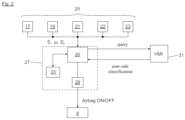
- the belt sensor 17 , the exterior sensor 19 , the interior sensor 21 , and the baggage compartment sensor 23 are parts of an identification system 25 for occupant identification.
- the identification system 25 can perform activation/deactivation of the front passenger airbag 9 together with an evaluation unit 27 .
- the sensors 17 , 19 , 21 , 22 , 23 have a signal connection to the signal input of the evaluation unit 27 .
- the evaluation unit 27 has by way of example a classification device 26 described hereinafter, a signal generating device 29 , and a database 33 as program components in FIG. 2 .
- Data analysis and data fusion are carried out in the classification device 26 of the evaluation unit 27 on the basis of all sensor data S 1 to S 5 of all sensors 17 to 23 .
- the evaluation unit 27 carries out the occupant classification on the basis of this data analysis and data fusion. That is to say, the evaluation unit 27 classifies the vehicle occupant 3 either as a child/child seat or as an adult position.
- the occupant 3 is classified as a child located in the child seat 5 . Accordingly, a deactivation signal “airbag OFF” is generated in the signal generating unit 29 ( FIG. 2 ) of the evaluation unit 27 in order to deactivate the airbag function.
- the signal generating unit 29 generates an activation signal “airbag ON”, using which the airbag function is activated, upon classification of the vehicle occupant 3 as an adult position.
- the evaluation unit 27 carries out the data analysis/data fusion of all sensor data S 1 to S 5 only once at a predefined point in time at the beginning of driving operation, for example upon switching on the ignition, upon actuation of the selector lever, or at the point in time the belt is fastened.
- the occupant classification performed by the evaluation unit 27 remains unchanged after the predefined point in time during the entire driving operation until the end of driving operation. In this way, a change of the seat position of the vehicle occupant taking place after the predefined point in time remains without effect on the occupant classification.
- the seating behavior of the vehicle occupant during the driving operation therefore has no influence on the occupant classification.
- the evaluation unit 27 cannot carry out an unambiguous occupant classification on the basis of the sensor data S 1 to S 5 .
- a query of the evaluation unit 27 to the vehicle user takes place with the request for the user to perform the occupant classification.
- the classification device 26 of the evaluation unit 27 in FIG. 1 or 2 has a signal connection to an HMI interface 31 , in which the query is implemented, for example, as a text overlay by the vehicle user.
- the classification device 26 of the evaluation unit 27 is moreover assigned the database 33 in FIG. 2 , into which the sensor data S 1 to S 5 can be input in conjunction with the user-side occupant classification. Upon further driving operations having comparable sensor data S 1 to S 5 , the corresponding user-side occupant classification which has been stored in the database 33 can be read automatically into the classification device 26 , without again carrying out a query to the vehicle user.
- Exemplary sequences for occupant identification and for deactivation/activation of the front passenger airbag 9 are indicated on the basis of the flow chart shown in FIG. 3 .
- the exterior sensor 19 is activated upon an occupant approach.
- a door is opened.
- the baggage compartment is opened by the occupant, by which the baggage compartment sensor 23 is also activated.
- the interior sensor 21 , the seat sensor 22 , and the belt sensor 17 are activated, after the vehicle occupant 3 has sat down on the vehicle seat 1 . All sensors 17 , 19 , 21 , 22 , 23 generate corresponding sensor data S 1 to S 5 , which are applied at the signal input of the evaluation unit 27 .
- the evaluation unit 27 defines an occupant classification at the predefined point in time.
- the vehicle user is requested to perform a user-side occupant classification.
- the front passenger airbag 9 is activated upon a classification of an adult person in the flow chart of FIG. 3 .
- the front passenger airbag 9 is deactivated upon a classification of a child.
- a first classification takes place upon a detection of the occupant 3 on the front passenger seat (with the aid of the seat sensor 22 ). This can be confirmed with a second classification which is carried out by the interior sensor 21 (camera, radar, UWB, or the like).
Landscapes
- Engineering & Computer Science (AREA)
- Mechanical Engineering (AREA)
- Air Bags (AREA)
Abstract
Description
-
- 1 front passenger seat
- 3 vehicle occupant
- 5 child seat
- 7 child
- 9 front passenger airbag
- 10 dashboard
- 11 safety belt
- 13 belt tensioner
- 15 backrest
- 17 belt sensor
- 19 exterior sensor
- 21 interior sensor
- 22 seat sensor
- 23 baggage compartment sensor
- 25 identification system
- 26 classification device
- 27 evaluation unit
- 29 signal generating device
- 31 HMI interface
- 33 database
- 25 crash sensor
- S1 to S5 sensor data
Claims (16)
Applications Claiming Priority (2)
| Application Number | Priority Date | Filing Date | Title |
|---|---|---|---|
| DE102023103210.0A DE102023103210A1 (en) | 2023-02-09 | 2023-02-09 | Device for activating/deactivating an airbag function in a vehicle |
| DE102023103210.0 | 2023-02-09 |
Publications (2)
| Publication Number | Publication Date |
|---|---|
| US20240270192A1 US20240270192A1 (en) | 2024-08-15 |
| US12304412B2 true US12304412B2 (en) | 2025-05-20 |
Family
ID=91962115
Family Applications (1)
| Application Number | Title | Priority Date | Filing Date |
|---|---|---|---|
| US18/535,035 Active US12304412B2 (en) | 2023-02-09 | 2023-12-11 | Device for activating/deactivating an airbag function in a vehicle |
Country Status (2)
| Country | Link |
|---|---|
| US (1) | US12304412B2 (en) |
| DE (1) | DE102023103210A1 (en) |
Families Citing this family (2)
| Publication number | Priority date | Publication date | Assignee | Title |
|---|---|---|---|---|
| US12479384B2 (en) * | 2023-11-10 | 2025-11-25 | GM Global Technology Operations LLC | Airbag and restraint system control using seat pressure data |
| DE102024102757A1 (en) * | 2024-01-31 | 2025-07-31 | Bayerische Motoren Werke Aktiengesellschaft | Method and device for checking the airbag status of a passenger airbag |
Citations (33)
| Publication number | Priority date | Publication date | Assignee | Title |
|---|---|---|---|---|
| US5906393A (en) * | 1997-09-16 | 1999-05-25 | Trw Inc. | Occupant restraint system and control method with variable sense, sample, and determination rates |
| DE19932520A1 (en) | 1999-07-12 | 2001-02-01 | Hirschmann Austria Gmbh Rankwe | Device for controlling a security system |
| US6213512B1 (en) * | 1998-12-14 | 2001-04-10 | Trw Inc. | Seat belt tightening apparatus |
| US6282473B1 (en) * | 1999-12-07 | 2001-08-28 | Trw Vehicle Safety Systems Inc. | System and method for controlling a vehicle occupant protection device |
| US6405607B2 (en) * | 2000-06-22 | 2002-06-18 | Trw Vehicle Safety Systems Inc. | Vehicle seat belt tension and seat weight apparatus |
| EP1262376A1 (en) | 2001-05-30 | 2002-12-04 | Eaton Corporation | A rules-based occupant classification system for airbag deployment |
| DE10204134A1 (en) | 2002-02-01 | 2003-08-21 | Bosch Gmbh Robert | Device for controlling a reversible restraint |
| DE10239761A1 (en) | 2002-08-29 | 2004-03-18 | Sartorius Ag | Method and device for identifying the type of occupancy of a support surface |
| US20060108154A1 (en) * | 2002-09-19 | 2006-05-25 | Frank Mack | Device for determining the overall mass of a vehicle |
| US7268704B2 (en) * | 2001-11-30 | 2007-09-11 | Robert Bosch Gmbh | Input device in a vehicle and method of occupant classification |
| EP2149478A2 (en) | 2008-07-31 | 2010-02-03 | Delphi Technologies, Inc. | Apparatus for allowing or suppressing deployment of a low risk deployment airbag |
| US7717215B2 (en) * | 2004-05-19 | 2010-05-18 | Takata Corporation | Seat belt retractor |
| US7761207B2 (en) * | 2004-10-29 | 2010-07-20 | Autoliv Development Ab | Seat belt device |
| US8095274B2 (en) * | 2007-06-01 | 2012-01-10 | Trw Automotive Gmbh | Device and method for protecting a vehicle occupant in a motor vehicle |
| US9637083B2 (en) * | 2014-04-03 | 2017-05-02 | Audi Ag | Method for operating a seat belt system in a motor vehicle and motor vehicle |
| US9676356B2 (en) * | 2014-03-10 | 2017-06-13 | Ford Global Technologies Llc | System and method for seatbelt use monitoring |
| DE102017201965A1 (en) | 2017-02-08 | 2018-08-09 | Robert Bosch Gmbh | Method for detecting a seat occupancy |
| US20180345893A1 (en) * | 2017-06-06 | 2018-12-06 | Toyota Jidosha Kabushiki Kaisha | Seatbelt controlling device |
| US10272872B2 (en) * | 2016-11-30 | 2019-04-30 | Ford Global Technologies, Llc | Belt assembly allowing payout measurement |
| DE102018220043A1 (en) | 2018-05-08 | 2019-11-14 | Hyundai Motor Company | Sensor-bound occupant detection method and seat occupancy detection system |
| US20200216005A1 (en) * | 2017-09-29 | 2020-07-09 | Zf Automotive Germany Gmbh | Method for operating a safety belt system |
| DE102019105675A1 (en) | 2019-03-06 | 2020-09-10 | Schaeffler Technologies AG & Co. KG | Device for activating an airbag function in a motor vehicle |
| US10953850B1 (en) * | 2018-04-05 | 2021-03-23 | Ambarella International Lp | Seatbelt detection using computer vision |
| US11117545B2 (en) * | 2019-04-19 | 2021-09-14 | GM Global Technology Operations LLC | System and method for determining seatbelt routing |
| DE102021102814A1 (en) | 2020-03-31 | 2021-09-30 | GM Global Technology Operations LLC | SYSTEM AND PROCEDURES FOR OCCUPANT CLASSIFICATION AND THE REGULATION OF THE AIRBAG RELEASE BASED ON IT |
| US11167719B2 (en) * | 2018-12-05 | 2021-11-09 | Hyundai Motor Company | Advanced four-point seat belt and vehicle including the same |
| US20220212658A1 (en) * | 2021-01-05 | 2022-07-07 | Toyota Motor Engineering & Manufacturing North America, Inc. | Personalized drive with occupant identification |
| US11527080B2 (en) * | 2020-12-22 | 2022-12-13 | PathPartner Technology Private Limited | System and method for classification of objects in vehicle using feature vectors |
| US20230047872A1 (en) * | 2021-08-10 | 2023-02-16 | GM Global Technology Operations LLC | Multimodal occupant-seat mapping for safety and personalization applications |
| US11603060B2 (en) * | 2020-05-11 | 2023-03-14 | GM Global Technology Operations LLC | System and method for monitoring seat belt routing using both a webbing payout sensor and an in-cabin sensor |
| US11691586B2 (en) * | 2021-05-06 | 2023-07-04 | ZF Passive Safety Systems US Inc. | Seatbelt airbag |
| US11794690B2 (en) * | 2020-08-25 | 2023-10-24 | GM Global Technology Operations LLC | Seatbelt monitoring system |
| US11884232B2 (en) * | 2022-06-16 | 2024-01-30 | Toyota Motor Engineering & Manufacturing North America, Inc. | Seatbelt assistance systems, vehicles, and methods |
-
2023
- 2023-02-09 DE DE102023103210.0A patent/DE102023103210A1/en active Pending
- 2023-12-11 US US18/535,035 patent/US12304412B2/en active Active
Patent Citations (33)
| Publication number | Priority date | Publication date | Assignee | Title |
|---|---|---|---|---|
| US5906393A (en) * | 1997-09-16 | 1999-05-25 | Trw Inc. | Occupant restraint system and control method with variable sense, sample, and determination rates |
| US6213512B1 (en) * | 1998-12-14 | 2001-04-10 | Trw Inc. | Seat belt tightening apparatus |
| DE19932520A1 (en) | 1999-07-12 | 2001-02-01 | Hirschmann Austria Gmbh Rankwe | Device for controlling a security system |
| US6282473B1 (en) * | 1999-12-07 | 2001-08-28 | Trw Vehicle Safety Systems Inc. | System and method for controlling a vehicle occupant protection device |
| US6405607B2 (en) * | 2000-06-22 | 2002-06-18 | Trw Vehicle Safety Systems Inc. | Vehicle seat belt tension and seat weight apparatus |
| EP1262376A1 (en) | 2001-05-30 | 2002-12-04 | Eaton Corporation | A rules-based occupant classification system for airbag deployment |
| US7268704B2 (en) * | 2001-11-30 | 2007-09-11 | Robert Bosch Gmbh | Input device in a vehicle and method of occupant classification |
| DE10204134A1 (en) | 2002-02-01 | 2003-08-21 | Bosch Gmbh Robert | Device for controlling a reversible restraint |
| DE10239761A1 (en) | 2002-08-29 | 2004-03-18 | Sartorius Ag | Method and device for identifying the type of occupancy of a support surface |
| US20060108154A1 (en) * | 2002-09-19 | 2006-05-25 | Frank Mack | Device for determining the overall mass of a vehicle |
| US7717215B2 (en) * | 2004-05-19 | 2010-05-18 | Takata Corporation | Seat belt retractor |
| US7761207B2 (en) * | 2004-10-29 | 2010-07-20 | Autoliv Development Ab | Seat belt device |
| US8095274B2 (en) * | 2007-06-01 | 2012-01-10 | Trw Automotive Gmbh | Device and method for protecting a vehicle occupant in a motor vehicle |
| EP2149478A2 (en) | 2008-07-31 | 2010-02-03 | Delphi Technologies, Inc. | Apparatus for allowing or suppressing deployment of a low risk deployment airbag |
| US9676356B2 (en) * | 2014-03-10 | 2017-06-13 | Ford Global Technologies Llc | System and method for seatbelt use monitoring |
| US9637083B2 (en) * | 2014-04-03 | 2017-05-02 | Audi Ag | Method for operating a seat belt system in a motor vehicle and motor vehicle |
| US10272872B2 (en) * | 2016-11-30 | 2019-04-30 | Ford Global Technologies, Llc | Belt assembly allowing payout measurement |
| DE102017201965A1 (en) | 2017-02-08 | 2018-08-09 | Robert Bosch Gmbh | Method for detecting a seat occupancy |
| US20180345893A1 (en) * | 2017-06-06 | 2018-12-06 | Toyota Jidosha Kabushiki Kaisha | Seatbelt controlling device |
| US20200216005A1 (en) * | 2017-09-29 | 2020-07-09 | Zf Automotive Germany Gmbh | Method for operating a safety belt system |
| US10953850B1 (en) * | 2018-04-05 | 2021-03-23 | Ambarella International Lp | Seatbelt detection using computer vision |
| DE102018220043A1 (en) | 2018-05-08 | 2019-11-14 | Hyundai Motor Company | Sensor-bound occupant detection method and seat occupancy detection system |
| US11167719B2 (en) * | 2018-12-05 | 2021-11-09 | Hyundai Motor Company | Advanced four-point seat belt and vehicle including the same |
| DE102019105675A1 (en) | 2019-03-06 | 2020-09-10 | Schaeffler Technologies AG & Co. KG | Device for activating an airbag function in a motor vehicle |
| US11117545B2 (en) * | 2019-04-19 | 2021-09-14 | GM Global Technology Operations LLC | System and method for determining seatbelt routing |
| DE102021102814A1 (en) | 2020-03-31 | 2021-09-30 | GM Global Technology Operations LLC | SYSTEM AND PROCEDURES FOR OCCUPANT CLASSIFICATION AND THE REGULATION OF THE AIRBAG RELEASE BASED ON IT |
| US11603060B2 (en) * | 2020-05-11 | 2023-03-14 | GM Global Technology Operations LLC | System and method for monitoring seat belt routing using both a webbing payout sensor and an in-cabin sensor |
| US11794690B2 (en) * | 2020-08-25 | 2023-10-24 | GM Global Technology Operations LLC | Seatbelt monitoring system |
| US11527080B2 (en) * | 2020-12-22 | 2022-12-13 | PathPartner Technology Private Limited | System and method for classification of objects in vehicle using feature vectors |
| US20220212658A1 (en) * | 2021-01-05 | 2022-07-07 | Toyota Motor Engineering & Manufacturing North America, Inc. | Personalized drive with occupant identification |
| US11691586B2 (en) * | 2021-05-06 | 2023-07-04 | ZF Passive Safety Systems US Inc. | Seatbelt airbag |
| US20230047872A1 (en) * | 2021-08-10 | 2023-02-16 | GM Global Technology Operations LLC | Multimodal occupant-seat mapping for safety and personalization applications |
| US11884232B2 (en) * | 2022-06-16 | 2024-01-30 | Toyota Motor Engineering & Manufacturing North America, Inc. | Seatbelt assistance systems, vehicles, and methods |
Non-Patent Citations (1)
| Title |
|---|
| Examination Report issued on Oct. 9, 2023, in corresponding German Application No. 102023103210.0, 8 pages. |
Also Published As
| Publication number | Publication date |
|---|---|
| US20240270192A1 (en) | 2024-08-15 |
| DE102023103210A1 (en) | 2024-08-14 |
Similar Documents
| Publication | Publication Date | Title |
|---|---|---|
| US20240270192A1 (en) | Device for activating/deactivating an airbag function in a vehicle | |
| US7416042B2 (en) | Method for triggering a two-stage belt tensioner | |
| US10988103B2 (en) | Knee airbag apparatus for autonomous vehicle and method of controlling the same | |
| US7140637B2 (en) | Method for triggering restraining means in a motor vehicle | |
| US8991545B2 (en) | Method for determining the weight of at least one occupant of a vehicle | |
| US7873473B2 (en) | Motor vehicle having a preventive protection system | |
| US6448890B1 (en) | Air bag system with biomechanical gray zones | |
| US20160082912A1 (en) | Airbag deployment control apparatus and method | |
| US20180222360A1 (en) | Method and device for activating a vehicle seat | |
| US8036795B2 (en) | Image based occupant classification systems for determining occupant classification and seat belt status and vehicles having same | |
| CN105980216B (en) | For generating the method and apparatus for the signal for representing seat occupancy and corresponding computer program and machine readable storage medium | |
| US6164693A (en) | Device for detecting the type of occupancy of the passenger's seat of a motor vehicle | |
| US20120191303A1 (en) | Method for Controlling a Restraint Device for Occupants of a Vehicle | |
| US6804595B1 (en) | Controller for occupant restraint system | |
| Chan | A treatise on crash sensing for automotive air bag systems | |
| CN110562180B (en) | Method and system for igniting safety airbag according to different passengers and vehicle | |
| US20070200323A1 (en) | Vehicle Occupant Protection System for a Motor Vehicle | |
| US20060082110A1 (en) | Smart airbag for vehicular applications | |
| US20090024282A1 (en) | Method for a Preventive-Action Protection System In a Motor Vehicle Having an Inter-Vehicle Distance Sensor System | |
| US20030193176A1 (en) | Vehicle with a child seat arranged in the front or the back | |
| CN108583502A (en) | A kind of safety device of vehicle | |
| CN103863244B (en) | For identifying method and the device of the mistake use of safety of vehicle passengers band | |
| CN117962797A (en) | Automobile interior safety protection system and method | |
| US20070095595A1 (en) | Anti-squeeze method utilizing airbag information | |
| CN108556790A (en) | A kind of safety device of vehicle |
Legal Events
| Date | Code | Title | Description |
|---|---|---|---|
| FEPP | Fee payment procedure |
Free format text: ENTITY STATUS SET TO UNDISCOUNTED (ORIGINAL EVENT CODE: BIG.); ENTITY STATUS OF PATENT OWNER: LARGE ENTITY |
|
| AS | Assignment |
Owner name: AUDI AG, GERMANY Free format text: ASSIGNMENT OF ASSIGNORS INTEREST;ASSIGNORS:JAKOBS, BERND;KRAUSE, HARALD;MUELLER, JOERG;AND OTHERS;SIGNING DATES FROM 20231214 TO 20231220;REEL/FRAME:066285/0878 |
|
| STPP | Information on status: patent application and granting procedure in general |
Free format text: DOCKETED NEW CASE - READY FOR EXAMINATION |
|
| STPP | Information on status: patent application and granting procedure in general |
Free format text: NON FINAL ACTION MAILED |
|
| STPP | Information on status: patent application and granting procedure in general |
Free format text: RESPONSE TO NON-FINAL OFFICE ACTION ENTERED AND FORWARDED TO EXAMINER |
|
| STPP | Information on status: patent application and granting procedure in general |
Free format text: NON FINAL ACTION MAILED |
|
| STPP | Information on status: patent application and granting procedure in general |
Free format text: RESPONSE TO NON-FINAL OFFICE ACTION ENTERED AND FORWARDED TO EXAMINER |
|
| STPP | Information on status: patent application and granting procedure in general |
Free format text: FINAL REJECTION MAILED |
|
| STPP | Information on status: patent application and granting procedure in general |
Free format text: NOTICE OF ALLOWANCE MAILED -- APPLICATION RECEIVED IN OFFICE OF PUBLICATIONS |
|
| STCF | Information on status: patent grant |
Free format text: PATENTED CASE |