US12303239B2 - Apparatus for estimating bio-information and method of detecting abnormal bio-signal - Google Patents
Apparatus for estimating bio-information and method of detecting abnormal bio-signal Download PDFInfo
- Publication number
- US12303239B2 US12303239B2 US18/118,562 US202318118562A US12303239B2 US 12303239 B2 US12303239 B2 US 12303239B2 US 202318118562 A US202318118562 A US 202318118562A US 12303239 B2 US12303239 B2 US 12303239B2
- Authority
- US
- United States
- Prior art keywords
- signal
- pair
- processor
- bio
- ppg signal
- Prior art date
- Legal status (The legal status is an assumption and is not a legal conclusion. Google has not performed a legal analysis and makes no representation as to the accuracy of the status listed.)
- Active, expires
Links
Images




Classifications
-
- A—HUMAN NECESSITIES
- A61—MEDICAL OR VETERINARY SCIENCE; HYGIENE
- A61B—DIAGNOSIS; SURGERY; IDENTIFICATION
- A61B5/00—Measuring for diagnostic purposes; Identification of persons
- A61B5/02—Detecting, measuring or recording for evaluating the cardiovascular system, e.g. pulse, heart rate, blood pressure or blood flow
- A61B5/021—Measuring pressure in heart or blood vessels
- A61B5/02108—Measuring pressure in heart or blood vessels from analysis of pulse wave characteristics
-
- A—HUMAN NECESSITIES
- A61—MEDICAL OR VETERINARY SCIENCE; HYGIENE
- A61B—DIAGNOSIS; SURGERY; IDENTIFICATION
- A61B5/00—Measuring for diagnostic purposes; Identification of persons
- A61B5/02—Detecting, measuring or recording for evaluating the cardiovascular system, e.g. pulse, heart rate, blood pressure or blood flow
- A61B5/021—Measuring pressure in heart or blood vessels
- A61B5/02108—Measuring pressure in heart or blood vessels from analysis of pulse wave characteristics
- A61B5/02116—Measuring pressure in heart or blood vessels from analysis of pulse wave characteristics of pulse wave amplitude
-
- A—HUMAN NECESSITIES
- A61—MEDICAL OR VETERINARY SCIENCE; HYGIENE
- A61B—DIAGNOSIS; SURGERY; IDENTIFICATION
- A61B5/00—Measuring for diagnostic purposes; Identification of persons
- A61B5/02—Detecting, measuring or recording for evaluating the cardiovascular system, e.g. pulse, heart rate, blood pressure or blood flow
- A61B5/024—Measuring pulse rate or heart rate
- A61B5/02416—Measuring pulse rate or heart rate using photoplethysmograph signals, e.g. generated by infrared radiation
-
- A—HUMAN NECESSITIES
- A61—MEDICAL OR VETERINARY SCIENCE; HYGIENE
- A61B—DIAGNOSIS; SURGERY; IDENTIFICATION
- A61B5/00—Measuring for diagnostic purposes; Identification of persons
- A61B5/72—Signal processing specially adapted for physiological signals or for diagnostic purposes
- A61B5/7221—Determining signal validity, reliability or quality
-
- A—HUMAN NECESSITIES
- A61—MEDICAL OR VETERINARY SCIENCE; HYGIENE
- A61B—DIAGNOSIS; SURGERY; IDENTIFICATION
- A61B5/00—Measuring for diagnostic purposes; Identification of persons
- A61B5/72—Signal processing specially adapted for physiological signals or for diagnostic purposes
- A61B5/7235—Details of waveform analysis
- A61B5/7239—Details of waveform analysis using differentiation including higher order derivatives
-
- A—HUMAN NECESSITIES
- A61—MEDICAL OR VETERINARY SCIENCE; HYGIENE
- A61B—DIAGNOSIS; SURGERY; IDENTIFICATION
- A61B5/00—Measuring for diagnostic purposes; Identification of persons
- A61B5/74—Details of notification to user or communication with user or patient; User input means
Definitions
- the following description relates to an apparatus for non-invasively estimating bio-information and a method of detecting an abnormal bio-signal.
- IT information technology
- medical convergence technology in which IT and medical technology are combined, is being recently carried out to address the aging population, rapid increase in medical expenses, and shortage of specialized medical service personnel.
- monitoring of the health condition of the human body is not limited to a fixed place, such as a hospital, but is expanding to a mobile healthcare sector for monitoring a user's health status at any time and any place in daily life such as at home and office.
- Electrocardiography (ECG), photoplethysmogram (PPG), and electromyography (EMG) signals are examples of bio-signals that indicate the individual's health condition.
- ECG electrocardiography
- PPG photoplethysmogram
- EMG electromyography
- a variety of signal sensors are being developed to measure such signals in daily life.
- PPG sensor it is possible to estimate blood pressure of a human body by analyzing a form of pulse wave that reflects a cardiovascular state.
- the whole PPG signal is a summation of a propagation wave propagating from the heart to peripheral parts of a body and reflection waves returning from the peripheral parts of the body. It is known that information for use in estimating blood pressure can be obtained by extracting various features related to propagation waves or reflection waves.
- an apparatus for estimating bio-information including: a photoplethysmogram (PPG) sensor including a light source, configured to emit light toward an object, and a detector, configured to detect light scattered or reflected from the object, the PPG sensor being configured to measure a PPG signal based on the detected light; and a processor configured to obtain a second derivative signal of the PPG signal, configured to extract a plurality of pairs of local maximum points and local minimum points from the obtained second derivative signal, configured to select at least one reference pair from among the extracted plurality of pairs, and configured to determine whether the PPG signal is normal by using the selected at least one reference pair.
- PPG photoplethysmogram
- the processor may be configured to estimate bio-information by using the PPG signal, the bio-information including a blood pressure; and based on a determination that the PPG signal is abnormal, the processor may be configured to determine an estimation failure and terminate estimation of bio-information, or configured to estimate the bio-information after modifying one periodic signal of the PPG signal determined as abnormal, or configured to estimate the bio-information after setting a pair from the selected at least one reference pair as a first pair that is valid for the second derivative signal.
- the apparatus for estimating bio-information may further include an output interface configured to output at least one of a result of the estimation of the bio-information or information about the estimation failure.
- the processor may sequentially extract the plurality of pairs of local maximum points and local minimum points from the second derivative signal in a time sequential order.
- the processor may obtain a difference between a local maximum value and a local maximum value of each pair of the extracted plurality of pairs, and may select the at least one reference pair based on the obtained difference between the local maximum value and the local maximum value.
- the processor may select the at least one reference pair within a predetermined time period which is set based on one cycle of the PPG signal.
- the processor may select, as a reference pair, a pair having a largest difference between the local maximum value and the local minimum value, or a pair having a largest value obtained by multiplying the obtained difference between the local maximum value and the local minimum value by a predetermined coefficient.
- the processor may compare a time value of a local maximum point of a selected reference pair with a predetermined threshold value, and based on the time value of the local maximum point being greater than the predetermined threshold value, the processor may determine that the PPG signal is abnormal.
- the processor may set a reference pair as the first pair that is valid for the second derivative signal, and may estimate the bio-information by using at least one of the second derivative signal or the PPG signal.
- the processor may select a first pair and a second pair as a first reference pair and a second reference pair, respectively, from among the extracted plurality of pairs.
- the processor may determine whether the PPG signal is normal.
- the processor may determine that the PPG signal is abnormal.
- a method of detecting an abnormal PPG signal including: by a photoplethysmogram (PPG) sensor, emitting light to an object and detecting light scattered or reflected from the object to measure a PPG signal; by a processor, obtaining a second derivative signal of the PPG signal; by the processor, extracting a plurality of pairs of local maximum points and local minimum points from the obtained second derivative signal; by the processor, selecting at least one reference pair from among the extracted plurality of pairs of local maximum points and local minimum points; and by the processor, determining whether the PPG signal is normal by using the selected at least one reference pair.
- PPG photoplethysmogram
- the selecting of the at least one reference pair may include obtaining a difference between a local maximum value and a local maximum value of each pair of the plurality of extracted pairs, and selecting the reference pair based on the obtained difference between the local maximum value and the local maximum value.
- the selecting of the at least one reference pair may include selecting, as a reference pair, a pair having a largest difference between the local maximum value and the local minimum value, or a pair having a largest value obtained by multiplying the obtained difference between the local maximum value and the local minimum value by a predetermined coefficient.
- the determining whether the PPG signal is normal may include comparing a time value of a local maximum point of a selected reference pair with a predetermined threshold value, and based on the time value of the local maximum point being greater than the predetermined threshold value, determining that the PPG signal is abnormal.
- the selecting of the at least one reference pair may include selecting a first pair and a second pair as a first reference pair and a second reference pair, respectively, from among the extracted plurality of pairs.
- the determining whether the PPG signal is normal may include determining whether the PPG signal is normal by using a first amplitude of the PPG signal, which corresponds to a local minimum point of the first reference pair, and a second amplitude of the PPG signal which corresponds to a local minimum point of the second reference pair.
- the determining whether the PPG signal is normal may include, based on a ratio between the first amplitude and the second amplitude being greater than a predetermined threshold value, determining that the PPG signal is abnormal.
- an apparatus for estimating bio-information including: a photoplethysmogram (PPG) sensor including a light source, configured to emit light to an object, and a detector, configured to detect light scattered or reflected from the object, the PPG sensor being configured to measure a PPG signal based on the detected light; and a processor configured to obtain a second derivative signal of the PPG signal, to extract a plurality of pairs of local maximum points and local minimum points from the obtained second derivative signal, and to determine whether the PPG signal is normal based on one reference pair selected from among the extracted plurality of pairs according to a first condition, and based on determining that the PPG signal is abnormal, configured to determine again whether the PPG signal is normal by using two reference pairs selected from among the extracted plurality of pairs according to a second condition.
- PPG photoplethysmogram
- FIG. 1 is a block diagram illustrating an apparatus for estimating bio-information according to an embodiment of the disclosure.
- FIGS. 2 A to 2 D are diagrams explaining the principle of generating component waveforms of a photoplethysmogram (PPG) signal.
- PPG photoplethysmogram
- FIGS. 3 A and 3 B are diagrams explaining examples of determining whether a PPG signal is normal.
- FIG. 4 is a block diagram illustrating an apparatus for estimating bio-information according to another embodiment of the disclosure.
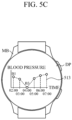
- FIGS. 5 A to 5 C are diagrams illustrating an example of providing information related to estimating blood pressure by an electronic device.
- FIG. 6 is a flowchart illustrating a method of determining whether a bio-signal is normal according to an embodiment of the disclosure.
- FIG. 7 is a flowchart illustrating a method of determining whether a bio-signal is normal according to another embodiment of the disclosure.
- FIG. 8 is a flowchart illustrating a method of determining whether a bio-signal is normal according to yet another embodiment of the disclosure.
- FIGS. 9 to 11 are diagrams illustrating various structures of an electronic device including an apparatus for estimating bio-information.
- FIG. 1 is a block diagram illustrating an apparatus for estimating bio-information according to an embodiment of the disclosure.
- FIGS. 2 A to 2 D are diagrams explaining the principle of generating component waveforms of a photoplethysmogram (PPG) signal.
- FIGS. 3 A and 3 B are diagrams explaining examples of determining whether a PPG signal is normal.
- an apparatus for estimating bio-information may be implemented as an electronic device, such as a smartphone, a tablet PC, a desktop computer, a laptop computer, or various types of wearable devices, such as a wristwatch-type wearable device, a bracelet-type wearable device, a wristband-type wearable device, a ring-type wearable device, a glasses-type wearable device, a headband-type wearable device, and the like.
- an electronic device such as a smartphone, a tablet PC, a desktop computer, a laptop computer, or various types of wearable devices, such as a wristwatch-type wearable device, a bracelet-type wearable device, a wristband-type wearable device, a ring-type wearable device, a glasses-type wearable device, a headband-type wearable device, and the like.
- an apparatus 100 for estimating bio-information includes a sensor 110 and a processor 120 .
- the sensor 110 may measure a bio-signal from an object.
- the bio-signal may include a photoplethysmogram (PPG) signal, an electrocardiography (ECG) signal, an electromyography (EMG) signal, an impedance plethysmogram (IPG) signal, a pressure wave signal, a video plethysmogram (VPG) signal, and the like.
- the object may be a body part coming into contact with or adjacent to the sensor 110 , and may be a body part where pulse waves may be easily measured.
- the object may be a skin of a wrist that is adjacent to a radial artery and an upper part of the wrist where venous blood or capillary blood passes.
- the object is not limited thereto, and may be a peripheral part of the body, such as a finger, a toe, or the like, which is a region with relatively high blood vessel density.
- the sensor 110 may be a PPG sensor for measuring a PPG signal from an object.
- the PPG sensor may include one or more light sources configured to emit light to an object and one or more detectors configured to detect light scattered or reflected from or transmitted into the object after light is emitted by the light source to the object.
- the light source may include a light emitting diode (LED), a laser diode (LD), a phosphor, and the like.
- the light source may emit light of one or more wavelengths (e.g., red, green, blue, and infrared wavelengths).
- the detector may include one or more photodiodes, photo transistors (PTr), image sensors (e.g., complementary metal-oxide semiconductor (CMOS) image sensor), etc., but is not limited thereto.
- CMOS complementary metal-oxide semiconductor
- the processor 120 may be electrically or functionally connected to the sensor 110 and may control the sensor 110 to acquire a bio-signal.
- the processor 120 may analyze a waveform of the bio-signal to determine whether the bio-signal is normal, and based on the determination, the processor 120 may proceed with estimation of bio-information, or may determine an estimation failure and terminate the estimation.
- the bio-information may include blood pressure, arrhythmia, vascular age, skin elasticity, skin age, arterial stiffness, aortic pressure waveform, stress index, fatigue level, etc., but is not limited thereto.
- the processor 120 may perform preprocessing, such as removing noise from the received signal and the like. For example, the processor 120 may perform signal correction, such as filtering (e.g., band-pass filtering between 0.4 Hz and 10 Hz), amplification of the bio-signal, converting the signal into a digital signal, smoothing, ensemble averaging of continuously measured bio-signals, and the like. In addition, the processor 120 may extract a representative waveform of one cycle from a waveform of the bio-signal, and may analyze the extracted representative waveform to determine whether the bio-signal is normal and/or to estimate bio-information.
- preprocessing such as removing noise from the received signal and the like.
- the processor 120 may perform signal correction, such as filtering (e.g., band-pass filtering between 0.4 Hz and 10 Hz), amplification of the bio-signal, converting the signal into a digital signal, smoothing, ensemble averaging of continuously measured bio-signals, and the like.
- the processor 120 may extract a representative
- the processor 120 may extract a representative waveform of one cycle by using the lowest points in the waveform of the bio-signal.
- the processor 120 may obtain a plurality of unit waveforms of one cycle from the waveform of the bio-signal, and may obtain the representative waveform by using any one or a combination of two or more of the plurality of unit waveforms.
- FIG. 2 A is a diagram explaining the principle of generating component waveforms of a PPG signal.
- a PPG signal may be generally a summation of a propagation wave propagating from the heart by blood ejection from the left ventricle to peripheral parts of the body and vascular branching points, and reflection waves returning from the peripheral parts of the body or the vascular branching points.
- the propagation wave is related to cardiac characteristics
- the reflection waves are related to vascular characteristics.
- the propagation wave generated by blood ejection from the left ventricle are mainly reflected from the renal arteries and the iliac arteries to generate a first reflection wave P 2 and a second reflection wave P 3 .
- the processor 120 may estimate blood pressure by dividing the waveform of the PPG signal into component waveforms P 1 , P 2 , P 3 , and P 4 and by analyzing time values associated with the respective component waveforms P 1 , P 2 , P 3 , and P 4 and/or amplitudes of the PPG signal.
- FIG. 2 B is a diagram illustrating a waveform of one cycle (Tp) of a normal PPG signal measured while a user is in a sitting position.
- FIG. 2 C is a diagram illustrating a waveform of one cycle (Tp) of an abnormal PPG signal measured while a user is in a supine position (during sleep).
- a fourth waveform component P 4 and a third waveform component P 3 substantially overlap each other on a time axis in the normal PPG signal.
- the aorta positioned perpendicular to the heart changes to a position that is horizontal to the heart, such that hydrostatic pressure, which was applied to the aorta due to gravity resulting from a height difference from the heart, is significantly reduced or disappears.
- the decrease in the hydrostatic pressure physiologically leads to an increase in elasticity of the aortic vessels and decrease in diameter thereof, such that waveform components passing through the aorta in the chest and abdomen may decrease in velocity.
- FIG. 2 D is a diagram illustrating one periodic PPG signal and a second derivative signal when an abnormal waveform appears. As illustrated in FIG. 2 C , if an interval between the waveform components P 3 and P 4 in the systolic region becomes wider, a concave point between the third waveform component P 3 and the fourth waveform component P 4 may be a lowest point. When one periodic signal is segmented based on the lowest point in a normal waveform, the signal is segmented as having a time interval (Ta-Tb) as one cycle.
- Ta-Tb time interval
- FIGS. 3 A and 3 B are diagrams explaining examples of determining whether a PPG signal is normal.
- the processor 120 may obtain a second derivative signal by performing quadratic differential on the PPG signal.
- the processor 120 may extract a plurality of pairs of local maximum points and local minimum points from the obtained second derivative signal, may select at least one reference pair from among the extracted pairs of local maximum points and local minimum points, and may determine whether the PPG signal has a normal waveform by using the local maximum point and/or local minimum point of the selected reference pair.
- the processor 120 may obtain a representative waveform of one cycle (0-Tp) of the PPG signal, and may obtain a second derivative signal by performing quadratic differential on the representative waveform.
- the processor 120 may sequentially extract pairs ((M1, N1), (M2, N2), (M3, N3), (M4, N4), . . . ) of local maximum points and local minimum points from the second derivative signal in a time sequential order.
- the processor 120 may select one reference pair from among the extracted pairs ((M1, N1), (M2, N2), (M3, N3), (M4, N4), . . . ) of local maximum points and local minimum points according to predetermined criteria.
- the processor 120 may select the reference pair by calculating a difference between the local maximum point and the local minimum point in a predetermined time interval (0 to Trange).
- an end point Trange of the interval may be a value based on one cycle Tp and may be, for example, Tp/2.
- the processor 120 may calculate the difference between the local maximum value and the local minimum value for each of the pairs and may select a pair having a largest difference as the reference pair.
- D ( n ) V max ( n ) ⁇ V min ( n ) [Equation 1]
- n denotes an index of a pair of a local maximum point and a local minimum point
- V max (n) denotes a local maximum value in an nth pair
- V min (n) denotes a local minimum value in the nth pair
- D(n) denotes a difference between the local maximum value V max (n) and the local minimum value V min (n) in the nth pair.
- the processor 120 may select a pair having a largest value obtained by multiplying the difference between the local maximum value and the local minimum value by a predetermined coefficient for each pair.
- D ( n ) ( V max ( n ) ⁇ V min ( n )) ⁇ a ( n ) [Equation 2]
- n denotes an index of a pair of a local maximum point and a local minimum point
- V max (n) denotes a local maximum value in an nth pair
- V min (n) denotes a local minimum value in the nth pair
- a(n) denotes a coefficient for the nth pair.
- a(n) is a value smaller than or equal to 1, and may be defined as, for example, (1 ⁇ 2) (n-1)
- D(n) denotes a result obtained by multiplying the difference between the local maximum value V max and the local minimum value V min in the nth pair by the coefficient a(n).
- the processor 120 may determine whether a waveform of the PPG signal is an ideal waveform by using a time value at the local maximum point of the selected reference pair. For example, as the difference between the local maximum value and the local minimum value in the second pair (M2, N2) is largest in FIG. 3 A , the processor 120 may select the second pair (M2, N2) as the reference pair, and may compare a time value Teff, corresponding to the local maximum point M2 of the selected second pair (M2, N2), with a predetermined threshold value.
- the processor 120 may determine that the waveform of the PPG signal is abnormal, and if not, the processor 120 may determine that the waveform of the PPG signal is normal.
- the threshold value may be preset as a fixed value (e.g. 120 ms) which may be universally applied to all users, or the fixed value may be adjusted to a personalized value by performing calibration for each individual user.
- the processor 120 may proceed with estimation of bio-information, and upon determining that the PPG signal is abnormal, the processor 120 may determine an estimation failure and terminate the estimation of bio-information, or may determine that the PPG signal is abnormal and proceed with the estimation of bio-information.
- the processor 120 may provide a user with information about the determination of the abnormal PPG signal or the estimation failure, and/or a bio-information estimation result, etc. by using an output device (e.g., display, audio output device, haptic device, etc.).
- the processor 120 may set the selected reference pair (M2, N2) as a valid first pair in the second derivative signal, may analyze a waveform of the second derivative signal and/or the PPG signal starting from the time point Teff corresponding to the local maximum point of the set first pair, and may extract one or more features for estimating bio-information to estimate bio-information by using the extracted features.
- the processor 120 may estimate bio-information after modifying one periodic signal by changing the sequence of an abnormal portion of the PPG signal.
- the processor 120 may modify the current periodic signal by moving an abnormal portion (e.g., a time interval prior to the reference pair in the current periodic signal or a predetermined time interval from a start point of the current periodic signal) of the current periodic signal in the PPG signal to an interval subsequent to the current periodic signal.
- the processor 120 may modify the current periodic signal by deleting the abnormal portion from the current periodic signal in the PPG signal and by adding a signal of an interval, corresponding to the abnormal portion, to be subsequent to the current periodic signal, i.e., to follow a last part of the current periodic signal.
- the disclosure is not limited thereto.
- the processor 120 may obtain a representative waveform of one cycle (0 to Tp) of the PPG signal, and may obtain a second derivative signal by performing quadratic differential on the representative waveform.
- the processor 120 may sequentially extract pairs ((M1, N1), (M2, N2), (M3, N3), (M4, N4), . . . ) of local maximum points and local minimum points from the second derivative signal in a time sequential order.
- the processor 120 may select two reference pairs from among the extracted pairs ((M1, N1), (M2, N2), (M3, N3), (M4, N4), . . . ) of local maximum points and local minimum points according to predetermined criteria.
- the processor 120 may select a first pair as a first reference pair and a second pair as a second reference pair.
- the processor 120 is not limited thereto, and may select the first and second reference pairs by various methods.
- the processor 120 may select the reference pair, in the manner as described in the example of FIG. 3 A , as the second reference pair, and select a pair preceding the selected pair as the first reference pair.
- the processor 120 may determine whether the PPG signal is normal by using a local minimum point N1 of the first reference pair and a local minimum point N2 of the second reference pair.
- the processor 120 may compare a ratio A 2 /A 1 between an amplitude A 1 , corresponding to a time value T 1 of the local minimum point N1 in the first reference pair of the PPG signal, and an amplitude A 2 , corresponding to a time value T 2 of the local minimum point N2 in the second reference pair of the PPG signal, with a predetermined threshold value (e.g., 10), and if the ratio (A 2 /A 1 ) is greater than or equal to the threshold value, the processor 120 may determine that the PPG signal is abnormal, and if not, the processor 120 may determine that the PPG signal is normal.
- the threshold value may be preset based on performance of the apparatus, accuracy in estimating bio-information, and the like.
- the processor 120 may proceed with estimation of bio-information, and upon determining that the PPG signal is abnormal, the processor 120 may determine an estimation failure and terminate the estimation of bio-information or may determine that the PPG signal is abnormal and proceed with the estimation of bio-information.
- the processor 120 may provide a user with information about the determination of the abnormal PPG signal or the estimation failure, and/or a bio-information estimation result, etc. by using an output device (e.g., display, audio output device, haptic device, etc.).
- the processor 120 may set the first reference pair or the second reference pair as a valid first pair in the second derivative signal, and may estimate bio-information by analyzing a waveform starting from the valid first pair in the second derivative signal and/or the PPG signal.
- a condition for setting the valid first pair may be predetermined. For example, if the PPG signal is normal, the processor 120 may unconditionally set the first reference pair as the valid first pair. Alternatively, even when the ratio (A 2 /A 1 ) is within a normal range, if the ratio is greater than or equal to a predetermined level, the processor 120 may set the second reference pair as the valid first pair.
- the processor 120 may set the second reference pair as the valid first pair.
- the processor 120 may estimate bio-information after modifying the periodic signal by changing the sequence of an abnormal portion of the PPG signal.
- the processor 120 may determine whether the bio-signal is abnormal based on both the embodiments of FIGS. 3 A and 3 B . For example, first based on the embodiment of FIG. 3 A , the processor 120 may determine whether the bio-signal is abnormal, and upon determining that the bio-signal is abnormal, the processor 120 may determine again whether the bio-signal is abnormal based on the embodiment of FIG. 3 B . Upon determining that the bio-signal is abnormal in both the first and second determination processes according to the embodiments of FIGS. 3 A and 3 B , the processor 120 may finally determine an estimation failure and terminate the estimation of bio-information, and upon determining that the bio-signal is normal in the second determination process, the processor 120 may proceed with the estimation of bio-information.
- the processor 120 may extract one or more features associated with blood pressure by analyzing a waveform starting from a point at which the valid first pair is set in the second derivative signal.
- MAP mean arterial pressure
- CO cardiac output
- TPR total peripheral resistance
- ⁇ MAP denotes a difference in MAP between a left ventricle and a right atrium, in which MAP of the right atrium is generally in a range of 3 mmHg to 5 mmHg, such that the MAP in the right atrium is similar to MAP in the left ventricle or MAP of the upper arm.
- MAP may be obtained from the aorta or the upper arm.
- the blood pressure variation may be obtained using a feature associated with the CO (hereinafter referred to as a CO feature) or a feature associated with the TPR (hereinafter referred to as a TPR feature).
- the CO feature may be a feature value which shows an increasing/decreasing trend in proportion to an actual CO value which relatively increases/decreases when an actual TPR value does not change significantly compared to a resting state.
- the TPR feature may be a feature value which shows an increasing/decreasing trend in proportion to an actual TPR value which relatively increases/decreases when an actual CO value does not change significantly compared to a resting state.
- the processor 120 may extract the CO feature and the TPR feature from the PPG signal and/or the second derivative signal. For example, the processor 120 may extract heart rate (HR) as the CO feature from the PPG signal.
- HR heart rate
- the processor 120 may extract a ratio (P 2 /P 1 ) between the amplitude values, corresponding to the time values T 1 and T 2 , as the TPR feature.
- the processor 120 may extract, for example, time values of the respective waveform components in the second derivative signal, a time value and an amplitude value of a point at which an amplitude has a maximum value in a systolic region of the PPG signal, a time value and an amplitude value of a point at which a slope of the PPG signal is closest to zero in the systolic region, a time value and an amplitude value of an internally dividing point between time values of adjacent waveform components in the second derivative signal, and a value obtained by using one or an appropriate combination of two or more of a total or partial area of the PPG signal, duration, cycle, and pulse pressure as the CO feature and/or the TPR feature from the second derivative signal.
- the processor 120 may estimate blood pressure by using a predefined blood pressure estimation model.
- the processor 120 may further obtain features in addition to the CO feature and the TPR feature, and may obtain a final blood pressure value by inputting the respective feature values to the blood pressure estimation model.
- the blood pressure estimation model may be a model that defines a correlation between the feature values and the blood pressure and may be defined as a linear and/or nonlinear equation(s).
- the processor 120 may compare blood pressure, which is estimated during sleep, with blood pressure estimated in a normal posture rather than during sleep. In addition, based on the comparison, the processor 120 may predict a variety of information associated with cardiovascular diseases. For example, if the blood pressure during sleep does not fall by a threshold value or more compared to a blood pressure level during non-sleep or if the blood pressure during sleep is not within a normal blood pressure range, the processor 120 may guide (e.g., notify or output related information) a user on the risk of developing cardiovascular diseases, such as thrombosis, orthostatic hypotension, and the like.
- cardiovascular diseases such as thrombosis, orthostatic hypotension, and the like.
- FIG. 4 is a block diagram illustrating an apparatus for estimating bio-information according to another embodiment of the disclosure.
- FIGS. 5 A to 5 C are diagrams illustrating an example of providing information related to estimating blood pressure by an electronic device.
- an apparatus 400 for estimating bio-information includes the sensor 110 , the processor 120 , a communication interface 410 , an output interface 420 , and a storage 430 .
- the sensor 110 and the processor 120 are described in detail above, such that a description thereof will be omitted.
- the communication interface 410 may be electrically connected to the processor 120 and may communicate with another electronic device under the control of the processor 120 to transmit and receive data, such as reference blood pressure, blood pressure estimation model, information as to whether a bio-signal is normal, blood pressure estimation result, etc., by using various communication techniques.
- Another electronic device may include a blood pressure measuring device such as a cuff sphygmomanometer, a smartphone, a tablet PC, a desktop computer, a laptop computer, and the like.
- a blood pressure measuring device such as a cuff sphygmomanometer, a smartphone, a tablet PC, a desktop computer, a laptop computer, and the like.
- the electronic device is not limited thereto.
- the communication techniques may include Bluetooth communication, Bluetooth Low Energy (BLE) communication, Near Field Communication (NFC), WLAN communication, Zigbee communication, Infrared Data Association (IrDA) communication, Wi-Fi Direct (WFD) communication, Ultra-Wideband (UWB) communication, Ant+ communication, WIFI communication, 3G, 4G, and 5G communications, and the like.
- BLE Bluetooth Low Energy
- NFC Near Field Communication
- IrDA Infrared Data Association
- UWB Ultra-Wideband
- Ant+ communication WIFI communication, 3G, 4G, and 5G communications, and the like.
- WIFI communication 3G, 4G, and 5G communications, and the like.
- the output interface 420 may output processing results of the sensor 110 and/or the processor 120 and may provide the results to a user.
- the output interface 420 may provide the user with information by various visual and/or non-visual methods using, for example, a visual output module such as a display, an audio output module such as a speaker, and/or a haptic module using vibrations, tactile sensation, and the like.
- the output interface 420 may display a blood pressure estimation result 511 on a display DP disposed on a main body MB of the apparatus 400 .
- the output interface 420 may output information about the determination of the abnormal PPG signal, e.g., a text such as “your PPG signal is abnormal.”
- the output interface 420 may output a text 512 , such as “measurement failure,” as illustrated in FIG. 5 B .
- a text 512 such as “measurement failure,” as illustrated in FIG. 5 B .
- the output interface 420 may display a measurement result in a visual graph 513 .
- the output interface 420 may display a blood pressure estimation result at a corresponding time (e.g., 2:00 a.m.) as illustrated in FIG. 5 A
- the output interface 420 may display information about a measurement failure at a corresponding time (e.g., 4:00 a.m.) as illustrated in FIG. 5 B .
- these examples are merely for convenience of explanation, and the output interface 420 is not limited thereto.
- the storage 430 may store data related to operations of the sensor 110 and/or the processor 120 , and/or the processing results of the sensor 110 and/or the processing results of the processor 120 .
- the storage 430 may store a blood pressure estimation model, criteria for determining whether the PPG signal is normal, a threshold value, user characteristics (e.g., gender, age, health condition, etc.), a bio-signal, a feature value, a reference blood pressure, an estimated blood pressure value, and the like.
- the storage 430 may include at least one storage medium of a flash memory type memory, a hard disk type memory, a multimedia card micro type memory, a card type memory (e.g., an SD memory, an XD memory, etc.), a Random Access Memory (RAM), a Static Random Access Memory (SRAM), a Read Only Memory (ROM), an Electrically Erasable Programmable Read Only Memory (EEPROM), a Programmable Read Only Memory (PROM), a magnetic memory, a magnetic disk, and an optical disk, and the like, but is not limited thereto.
- a flash memory type memory e.g., an SD memory, an XD memory, etc.
- RAM Random Access Memory
- SRAM Static Random Access Memory
- ROM Read Only Memory
- EEPROM Electrically Erasable Programmable Read Only Memory
- PROM Programmable Read Only Memory
- magnetic memory a magnetic disk, and an optical disk, and the like, but is not limited thereto.
- FIG. 6 is a flowchart illustrating a method of determining whether a bio-signal is normal according to an embodiment of the disclosure.
- the method of determining whether the bio-signal is normal in FIG. 6 may be performed by any one of the aforementioned apparatuses 100 and 400 for estimating bio-information.
- the apparatus for estimating bio-information may receive an input of a bio-signal in 610 .
- the apparatus for estimating bio-information may emit light to an object and detect light scattered or reflected from the object to measure a bio-signal.
- the apparatus for estimating bio-information is not limited thereto, and may receive, from another electronic device, a bio-signal measured from an object.
- the apparatus for estimating bio-information may perform preprocessing such as removing noise from the input bio-signal and the like.
- the apparatus for estimating bio-information may obtain a second derivative signal by performing quadratic differential on the bio-signal in 620 .
- the apparatus for estimating bio-information may obtain a representative waveform of one cycle based on a minimum point of the waveform of the bio-signal, and may perform quadratic differential on the representative waveform.
- the apparatus for estimating bio-information may extract a plurality of pairs of (local maximum points, local minimum points) from the waveform of the second derivative signal in 630 .
- the apparatus for estimating bio-information may sequentially extract the pairs of (local maximum points, local minimum points) from the waveform of the second derivative signal in a time sequential order.
- the apparatus for estimating bio-information may select one reference pair for use in determining whether the bio-signal is normal from among the plurality of pairs of (local maximum points, local minimum points) in 640 .
- the apparatus for estimating bio-information may select, as the reference pair, a pair having a largest value obtained by subtracting a local minimum value from a local maximum value of each pair in a predetermined time interval, or a pair having a largest value obtained by multiplying the value, obtained by subtracting the local minimum value from the local maximum value of each pair, by a predetermined coefficient.
- the apparatus for estimating bio-information may compare a time value of the local maximum point of the selected reference pair with a threshold value in 650 . Upon comparison, if the time value of the local maximum point in the reference pair is greater than or equal to the threshold value, the apparatus for estimating bio-information may determine that a waveform of the bio-signal is abnormal in 660 , and if not, the apparatus for estimating bio-information may determine that the waveform of the bio-signal is normal in 670 .
- the apparatus for estimating bio-information may proceed with estimation of bio-information, and if the waveform of the bio-signal is abnormal, the apparatus for estimating bio-information may determine an estimation failure and may terminate the estimation of bio-information, or may determine that the waveform of the bio-signal is abnormal and may proceed with the estimation of bio-information.
- FIG. 7 is a flowchart illustrating a method of determining whether a bio-signal is normal according to another embodiment of the disclosure.
- the method of determining whether the bio-signal is normal in FIG. 7 may be performed by any one of the aforementioned apparatuses 100 and 400 for estimating bio-information.
- the apparatus for estimating bio-information may receive an input of a bio-signal in 710 .
- the apparatus for estimating bio-information may receive a bio-signal from a sensor or may receive, from another electronic device, a bio-signal measured from an object.
- the apparatus for estimating bio-information may perform preprocessing such as removing noise from the input bio-signal.
- the apparatus for estimating bio-information may obtain a second derivative signal by performing quadratic differential on the bio-signal in 720 .
- the apparatus for estimating bio-information may obtain a representative waveform of one cycle based on a minimum point of the waveform of the bio-signal, and may perform quadratic differential on the representative waveform.
- the apparatus for estimating bio-information may extract a plurality of pairs of (local maximum points, local minimum points) from the waveform of the second derivative signal in 730 .
- the apparatus for estimating bio-information may sequentially extract the pairs of (local maximum points, local minimum points) from the waveform of the second derivative signal in a time sequential order.
- the apparatus for estimating bio-information may select two reference pairs for use in determining whether the bio-signal is normal from among the plurality of pairs of (local maximum points, local minimum points) in 740 .
- the apparatus for estimating bio-information may obtain first and second pairs as the reference pairs in a predetermined time interval.
- the apparatus for estimating bio-information may compare a ratio between amplitude values of the PPG signal, which respectively correspond to the time values of the local minimum points of the selected reference pairs, with a threshold value in 750 . Upon comparison, if the ratio between the amplitude values of the reference pairs is greater than or equal to the threshold value, the apparatus for estimating bio-information may determine that a waveform of the bio-signal is abnormal in 760 , and if not, the apparatus for estimating bio-information may determine that the waveform of the bio-signal is normal in 770 .
- the apparatus for estimating bio-information may proceed with estimation of bio-information, and if the waveform of the bio-signal is abnormal, the apparatus for estimating bio-information may determine an estimation failure and may terminate the estimation of bio-information, or may determine that the waveform of the bio-signal is abnormal and may proceed with the estimation of bio-information.
- FIG. 8 is a flowchart illustrating a method of determining whether a bio-signal is normal according to yet another embodiment of the disclosure.
- the method of determining whether the bio-signal is normal in FIG. 8 may be performed by any one of the aforementioned apparatuses 100 and 400 for estimating bio-information.
- the apparatus for estimating bio-information may receive an input of a bio-signal in 810 and may obtain a second derivative signal by performing quadratic differential on the input bio-signal in 820 . Then, the apparatus for estimating bio-information may extract a plurality of pairs of (local maximum points, local minimum points) from the waveform of the second derivative signal in 830 and may select one reference pair from among the plurality of pairs of (local maximum points, local minimum points) according to a first condition in 840 .
- the first condition may be a condition for selecting a pair having a largest value, obtained by subtracting a local minimum value from a local maximum value of each pair in a predetermined time interval, or a pair having a largest value obtained by multiplying the value, obtained by subtracting the local minimum value from the local maximum value of each pair, by a predetermined coefficient.
- the apparatus for estimating bio-information may compare a time value of the local maximum point of the selected reference pair with a threshold value (e.g., a first threshold value) in 850 .
- a threshold value e.g., a first threshold value
- the apparatus for estimating bio-information may select again two reference pairs according to a second condition in 860 , and may compare a ratio between amplitude values of the PPG signal, which correspond to the time values of the local minimum points of the selected reference pairs, with a threshold value (e.g., a second threshold value) in 870 .
- the apparatus for estimating bio-information may determine that a waveform of the bio-signal is abnormal in 880 . If the time value of the local maximum point of the reference pair is smaller than the threshold value (e.g., the first threshold value) upon comparison in 850 , or if the ratio between the amplitude values of the reference pairs is smaller than the threshold value (e.g., the second threshold value) in 870 , the apparatus for estimating bio-information may determine that the waveform of the bio-signal is normal in 890 .
- the threshold value e.g., the first threshold value
- the apparatus for estimating bio-information may determine that the waveform of the bio-signal is normal in 890 .
- FIGS. 9 to 11 are diagrams illustrating various structures of an electronic device including an apparatus for estimating bio-information.
- the electronic device may include, for example, various types of wearable devices, e.g., a smart watch, a smart band, smart glasses, smart earphones, a smart ring, a smart patch, and a smart necklace, and a mobile device such as a smartphone, a tablet PC, etc., or home appliances or various Internet of Things (IoT) devices (e.g., home IoT device, etc.) based on Internet of Things (IoT) technology.
- various types of wearable devices e.g., a smart watch, a smart band, smart glasses, smart earphones, a smart ring, a smart patch, and a smart necklace
- a mobile device such as a smartphone, a tablet PC, etc., or home appliances or various Internet of Things (IoT) devices (e.g., home IoT device, etc.) based on Internet of Things (IoT) technology.
- IoT Internet of Things
- the electronic device may include a sensor device, a processor, an input device, a communication module, a camera module, an output device, a storage device, and a power module. All the components of the electronic device may be integrally mounted in a specific device or may be distributed in two or more devices.
- the sensor device may include the sensor (e.g., PPG sensor) of the apparatuses 100 and 400 for estimating bio-information, and may further include an additional sensor, such as a gyro sensor, a Global Positioning System (GPS), and the like.
- the processor may execute programs, stored in the storage device, to control components connected to the processor, and may perform various data processing or computation, including estimation of bio-information.
- the processor may include a main processor, e.g., a central processing unit (CPU) or an application processor (AP), etc., and an auxiliary processor, e.g., a graphics processing unit (GPU), an image signal processor (ISP), a sensor hub processor, or a communication processor (CP), etc., which is operable independently from, or in conjunction with, the main processor.
- a main processor e.g., a central processing unit (CPU) or an application processor (AP), etc.
- auxiliary processor e.g., a graphics processing unit (GPU), an image signal processor (ISP), a sensor hub processor, or a communication processor (CP), etc.
- the input device may receive a command and/or data to be used by each component of the electronic device, from a user and the like.
- the input device may include, for example, a microphone, a mouse, a keyboard, or a digital pen (e.g., a stylus pen, etc.).
- the communication module may support establishment of a direct (e.g., wired) communication channel and/or a wireless communication channel between the electronic device and other electronic device, a server, or the sensor device within a network environment, and performing; of communication via the established communication channel.
- the communication module may include one or more communication processors that are operable independently from the processor and supports a direct communication and/or a wireless communication.
- the communication module may include a wireless communication module, e.g., a cellular communication module, a short-range wireless communication module, or a global navigation satellite system (GNSS) communication module, etc., and/or a wired communication module, e.g., a local area network (LAN) communication module, a power line communication (PLC) module, and the like.
- a wireless communication module e.g., a cellular communication module, a short-range wireless communication module, or a global navigation satellite system (GNSS) communication module, etc.
- GNSS global navigation satellite system
- wired communication module e
- the wireless communication module may identify and authenticate the electronic device in a communication network by using subscriber information (e.g., international mobile subscriber identity (MIST), etc.) stored in a subscriber identification module.
- subscriber information e.g., international mobile subscriber identity (MIST), etc.
- the camera module may capture still images or moving images.
- the camera module may include a lens assembly having one more lenses, image sensors, image signal processors, and/or flashes.
- the lens assembly included in the camera module may collect light emanating from a subject to be imaged.
- the output device may visually and/or non-visually output data (e.g., estimated blood pressure values, health condition, warning, actions, etc.) generated or processed by the electronic device.
- the output device may include a sound output device, a display device, an audio module, and/or a haptic module.
- the sound output device may output sound signals to the outside of the electronic device.
- the sound output device may include a speaker and/or a receiver.
- the speaker may be used for general purposes, such as playing multimedia or playing record, and the receiver may be used for incoming calls.
- the receiver may be implemented separately from, or as part of, the speaker.
- the display device may visually provide information to the outside of the electronic device.
- the display device may include, for example, a display, a hologram device, or a projector and control circuitry to control the devices.
- the display device may include touch circuitry adapted to detect a touch, and/or sensor circuitry (e.g., pressure sensor, etc.) adapted to measure the intensity of force incurred by the touch.
- the audio module may convert a sound into an electrical signal or vice versa.
- the audio module may obtain the sound via the input device, or may output the sound via the sound output device, and/or a speaker and/or a headphone of another electronic device directly or wirelessly connected to the electronic device.
- the haptic module may convert an electrical signal into a mechanical stimulus (e.g., vibration, motion, etc.) or electrical stimulus which may be recognized by a user by tactile sensation or kinesthetic sensation.
- the haptic module may include, for example, a motor, a piezoelectric element, and/or an electric stimulator.
- the storage device may store driving conditions required for driving the sensor device, and various data required for other components of the electronic device.
- the various data may include, for example, software and input data and/or output data for a command related thereto.
- the storage device may include a volatile memory and/or a non-volatile memory.
- the power module may manage power supplied to the electronic device.
- the power module may be implemented as part of, for example, a power management integrated circuit (MIC).
- the power module may include a battery, which may include a primary cell which is not rechargeable, a secondary cell which is rechargeable, and/or a fuel cell.
- the electronic device may be implemented as a wristwatch wearable device 900 , and may include a main body and a wrist strap.
- a display is provided on a front surface of the main body, and may display various application screens, including time information, received message information, and the like.
- a sensor device 910 may be disposed on a rear surface of the main body.
- the electronic device may be implemented as a mobile device 1000 such as a smartphone.
- the mobile device 1000 may include a housing and a display panel.
- the housing may form an exterior of the mobile device 1000 .
- the housing has a first surface, on which a display panel and a cover glass may be disposed sequentially, and the display panel may be exposed to the outside through the cover glass.
- a sensor device 1010 , a camera module and/or an infrared sensor, and the like may be disposed on a second surface of the housing.
- the processor and various other components may be disposed in the housing.
- the electronic device may be implemented as an ear-wearable device 1100 .
- the ear-wearable device 1100 may include a main body and an ear strap.
- a user may wear the ear-wearable device 1100 by hanging the ear strap on the auricle.
- the ear strap may be omitted depending on a shape of the ear-wearable device 1100 .
- the main body may be inserted into the external auditory meatus.
- a sensor device 1110 may be mounted in the main body.
- the processor may be disposed in the main body, and may estimate blood bio-information by using a PPG signal measured by the sensor device 1110 .
- the ear-wearable device 1100 may estimate bio-information by interworking with an external device.
- the ear-wearable device 1100 may transmit the PPG signal, measured by the sensor device 1110 of the ear-wearable device 1100 , to an external device, e.g., a smartphone, a tablet PC, etc., through a communication module provided in the main body, so that a processor of the external device may estimate bio-information, and may output the estimated bio-information value through a sound output module provided in the main body of the ear-wearable device 1100 .
- an external device e.g., a smartphone, a tablet PC, etc.
- the disclosure may be realized as a computer-readable code written on a computer-readable recording medium.
- the computer-readable recording medium may be any type of recording device in which data is stored in a computer-readable manner.
Landscapes
- Health & Medical Sciences (AREA)
- Life Sciences & Earth Sciences (AREA)
- Engineering & Computer Science (AREA)
- Cardiology (AREA)
- Medical Informatics (AREA)
- Animal Behavior & Ethology (AREA)
- Pathology (AREA)
- Physics & Mathematics (AREA)
- Biomedical Technology (AREA)
- Heart & Thoracic Surgery (AREA)
- Veterinary Medicine (AREA)
- Molecular Biology (AREA)
- Surgery (AREA)
- Biophysics (AREA)
- General Health & Medical Sciences (AREA)
- Public Health (AREA)
- Physiology (AREA)
- Artificial Intelligence (AREA)
- Computer Vision & Pattern Recognition (AREA)
- Psychiatry (AREA)
- Signal Processing (AREA)
- Vascular Medicine (AREA)
- Measuring Pulse, Heart Rate, Blood Pressure Or Blood Flow (AREA)
Abstract
Description
D(n)=V max(n)−V min(n) [Equation 1]
D(n)=(V max(n)−V min(n))×a(n) [Equation 2]
ΔMAP=CO×TPR [Equation 3]
Claims (12)
Applications Claiming Priority (2)
| Application Number | Priority Date | Filing Date | Title |
|---|---|---|---|
| KR1020220115612A KR102792452B1 (en) | 2022-09-14 | 2022-09-14 | Apparatus for estimating bio-information, method for detecting abnormal bio-signal |
| KR10-2022-0115612 | 2022-09-14 |
Publications (2)
| Publication Number | Publication Date |
|---|---|
| US20240081663A1 US20240081663A1 (en) | 2024-03-14 |
| US12303239B2 true US12303239B2 (en) | 2025-05-20 |
Family
ID=90142687
Family Applications (1)
| Application Number | Title | Priority Date | Filing Date |
|---|---|---|---|
| US18/118,562 Active 2043-06-21 US12303239B2 (en) | 2022-09-14 | 2023-03-07 | Apparatus for estimating bio-information and method of detecting abnormal bio-signal |
Country Status (2)
| Country | Link |
|---|---|
| US (1) | US12303239B2 (en) |
| KR (1) | KR102792452B1 (en) |
Families Citing this family (3)
| Publication number | Priority date | Publication date | Assignee | Title |
|---|---|---|---|---|
| US12405211B2 (en) | 2012-06-14 | 2025-09-02 | Medibotics Llc | Nerd of the rings (smart ring with spectroscopic sensors) |
| US12484815B2 (en) | 2012-06-14 | 2025-12-02 | Medibotics Llc | Biometric wearable device (e.g. finger ring or smart watch) with optical sensors and scanning light beams |
| US12341800B1 (en) * | 2024-08-12 | 2025-06-24 | Sas Institute Inc. | Real-time anomaly detection and mitigation for streaming functional data |
Citations (22)
| Publication number | Priority date | Publication date | Assignee | Title |
|---|---|---|---|---|
| WO2011116018A1 (en) | 2010-03-15 | 2011-09-22 | Qualcomm Incorporated | Method and apparatus for processing and reconstructing data |
| WO2012034006A1 (en) | 2010-09-10 | 2012-03-15 | Qualcomm Incorporated | Method and apparatus for low complexity compression of signals |
| WO2012040957A1 (en) | 2010-09-30 | 2012-04-05 | 福建中科万邦光电股份有限公司 | Package structure of led light source module |
| JP2013111467A (en) | 2011-11-30 | 2013-06-10 | Zinc Software Ltd | Method and device for measuring rsa component from heart rate data |
| KR101361578B1 (en) | 2012-05-30 | 2014-02-11 | 울산대학교 산학협력단 | Apparatus for PPG signal processing |
| KR101503604B1 (en) | 2013-09-30 | 2015-03-17 | 길영준 | Wearable type System for realtime monitoring blood pressure estimation and Method for controlling the same |
| US20150112158A1 (en) | 2013-10-23 | 2015-04-23 | Quanttus, Inc. | Health Metrics |
| US20150164351A1 (en) | 2013-10-23 | 2015-06-18 | Quanttus, Inc. | Calculating pulse transit time from chest vibrations |
| US20160270668A1 (en) | 2013-09-30 | 2016-09-22 | Huinno, Co.,Ltd. | Systems and apparatuses for monitoring blood pressure in real time |
| US20170325744A1 (en) | 2016-05-10 | 2017-11-16 | Apple Inc. | Systems and methods for increasing localized pressure to improve ppg motion performance |
| WO2017197033A1 (en) | 2016-05-10 | 2017-11-16 | Apple Inc. | Systems and methods for non-pulsatile blood volume measurements |
| US20180020990A1 (en) | 2016-07-20 | 2018-01-25 | Samsung Electronics Co., Ltd. | Apparatus and method for extracting feature of bio-signal, and apparatus for detecting bio- information |
| US20180192899A1 (en) | 2017-01-09 | 2018-07-12 | Industrial Technology Research Institute | Detecting apparatus and detecting method for physiological information |
| US20180289288A1 (en) * | 2017-04-07 | 2018-10-11 | University Of Maryland At College Park | Monitor for blood pressure and other arterial properties |
| US20190313980A1 (en) * | 2018-04-16 | 2019-10-17 | Samsung Electronics Co., Ltd. | Apparatus and method for monitoring bio-signal measuring condition, and apparatus and method for measuring bio-information |
| KR20190120684A (en) | 2018-04-16 | 2019-10-24 | 삼성전자주식회사 | Apparatus and method for monitoring bio-signal measuring condition, and apparatus and method for measuring bio-information |
| US20200268263A1 (en) * | 2019-02-25 | 2020-08-27 | Samsung Electronics Co., Ltd. | Electronic device for measuring biometric information and method for operating the same |
| US20210052175A1 (en) | 2019-08-23 | 2021-02-25 | Verily Life Sciences Llc | Systems and methods for using characteristics of photoplethysmography (ppg) data to detect cardiac conditions |
| US20210353164A1 (en) * | 2020-05-15 | 2021-11-18 | Beijing Shunyuan Kaihua Technology Limited | Blood Pressure Measurement |
| KR102361725B1 (en) | 2020-06-03 | 2022-02-09 | 전남대학교산학협력단 | A method and apparatus for postoperative pain assessment using differential index of photoplethysmogram |
| US20220233079A1 (en) | 2021-01-25 | 2022-07-28 | Samsung Electronics Co., Ltd. | Apparatus and method for estimating blood pressure |
| KR20220107909A (en) | 2021-01-25 | 2022-08-02 | 삼성전자주식회사 | Apparatus and method for estimating blood pressure |
-
2022
- 2022-09-14 KR KR1020220115612A patent/KR102792452B1/en active Active
-
2023
- 2023-03-07 US US18/118,562 patent/US12303239B2/en active Active
Patent Citations (39)
| Publication number | Priority date | Publication date | Assignee | Title |
|---|---|---|---|---|
| US9075446B2 (en) | 2010-03-15 | 2015-07-07 | Qualcomm Incorporated | Method and apparatus for processing and reconstructing data |
| US9658825B2 (en) | 2010-03-15 | 2017-05-23 | Qualcomm Incorporated | Method and apparatus for processing and reconstructing data |
| WO2011116018A1 (en) | 2010-03-15 | 2011-09-22 | Qualcomm Incorporated | Method and apparatus for processing and reconstructing data |
| WO2012034006A1 (en) | 2010-09-10 | 2012-03-15 | Qualcomm Incorporated | Method and apparatus for low complexity compression of signals |
| US9356731B2 (en) | 2010-09-10 | 2016-05-31 | Qualcomm Incorporated | Method and apparatus for low complexity compression of signals employing differential operation for transient segment detection |
| US9136980B2 (en) | 2010-09-10 | 2015-09-15 | Qualcomm Incorporated | Method and apparatus for low complexity compression of signals |
| WO2012040957A1 (en) | 2010-09-30 | 2012-04-05 | 福建中科万邦光电股份有限公司 | Package structure of led light source module |
| JP2013111467A (en) | 2011-11-30 | 2013-06-10 | Zinc Software Ltd | Method and device for measuring rsa component from heart rate data |
| KR101361578B1 (en) | 2012-05-30 | 2014-02-11 | 울산대학교 산학협력단 | Apparatus for PPG signal processing |
| KR101503604B1 (en) | 2013-09-30 | 2015-03-17 | 길영준 | Wearable type System for realtime monitoring blood pressure estimation and Method for controlling the same |
| US20160270668A1 (en) | 2013-09-30 | 2016-09-22 | Huinno, Co.,Ltd. | Systems and apparatuses for monitoring blood pressure in real time |
| KR20160075677A (en) | 2013-10-23 | 2016-06-29 | 콴투스, 아이엔씨. | Consumer biometric devices |
| US20150112157A1 (en) | 2013-10-23 | 2015-04-23 | Quanttus, Inc. | Arrhythmia detection |
| US20150112155A1 (en) | 2013-10-23 | 2015-04-23 | Quanttus, Inc. | Sleep parameters |
| US20150164351A1 (en) | 2013-10-23 | 2015-06-18 | Quanttus, Inc. | Calculating pulse transit time from chest vibrations |
| US20150112208A1 (en) | 2013-10-23 | 2015-04-23 | Quanttus, Inc. | Medication management |
| US20150112154A1 (en) | 2013-10-23 | 2015-04-23 | Quanttus, Inc. | Biometrics in risk situations |
| US20150112606A1 (en) | 2013-10-23 | 2015-04-23 | Quanttus, Inc. | Calculating Pulse Transit Time |
| US20150112156A1 (en) | 2013-10-23 | 2015-04-23 | Quanttus, Inc. | Predicting medical events |
| US9396643B2 (en) | 2013-10-23 | 2016-07-19 | Quanttus, Inc. | Biometric authentication |
| US9396642B2 (en) | 2013-10-23 | 2016-07-19 | Quanttus, Inc. | Control using connected biometric devices |
| US20150112159A1 (en) | 2013-10-23 | 2015-04-23 | Quanttus, Inc. | Alertness Detection |
| US20150112158A1 (en) | 2013-10-23 | 2015-04-23 | Quanttus, Inc. | Health Metrics |
| WO2017197033A1 (en) | 2016-05-10 | 2017-11-16 | Apple Inc. | Systems and methods for non-pulsatile blood volume measurements |
| US10687718B2 (en) | 2016-05-10 | 2020-06-23 | Apple Inc. | Systems and methods for non-pulsatile blood volume measurements |
| US20170325744A1 (en) | 2016-05-10 | 2017-11-16 | Apple Inc. | Systems and methods for increasing localized pressure to improve ppg motion performance |
| US20210100456A1 (en) | 2016-07-20 | 2021-04-08 | Samsung Electronics Co., Ltd. | Apparatus and method for extracting feature of bio-signal, and apparatus for detecting bio-information |
| US20180020990A1 (en) | 2016-07-20 | 2018-01-25 | Samsung Electronics Co., Ltd. | Apparatus and method for extracting feature of bio-signal, and apparatus for detecting bio- information |
| US20180192899A1 (en) | 2017-01-09 | 2018-07-12 | Industrial Technology Research Institute | Detecting apparatus and detecting method for physiological information |
| US20180289288A1 (en) * | 2017-04-07 | 2018-10-11 | University Of Maryland At College Park | Monitor for blood pressure and other arterial properties |
| US20190313980A1 (en) * | 2018-04-16 | 2019-10-17 | Samsung Electronics Co., Ltd. | Apparatus and method for monitoring bio-signal measuring condition, and apparatus and method for measuring bio-information |
| KR20190120684A (en) | 2018-04-16 | 2019-10-24 | 삼성전자주식회사 | Apparatus and method for monitoring bio-signal measuring condition, and apparatus and method for measuring bio-information |
| US11660053B2 (en) | 2018-04-16 | 2023-05-30 | Samsung Electronics Co., Ltd. | Apparatus and method for monitoring bio-signal measuring condition, and apparatus and method for measuring bio-information |
| US20200268263A1 (en) * | 2019-02-25 | 2020-08-27 | Samsung Electronics Co., Ltd. | Electronic device for measuring biometric information and method for operating the same |
| US20210052175A1 (en) | 2019-08-23 | 2021-02-25 | Verily Life Sciences Llc | Systems and methods for using characteristics of photoplethysmography (ppg) data to detect cardiac conditions |
| US20210353164A1 (en) * | 2020-05-15 | 2021-11-18 | Beijing Shunyuan Kaihua Technology Limited | Blood Pressure Measurement |
| KR102361725B1 (en) | 2020-06-03 | 2022-02-09 | 전남대학교산학협력단 | A method and apparatus for postoperative pain assessment using differential index of photoplethysmogram |
| US20220233079A1 (en) | 2021-01-25 | 2022-07-28 | Samsung Electronics Co., Ltd. | Apparatus and method for estimating blood pressure |
| KR20220107909A (en) | 2021-01-25 | 2022-08-02 | 삼성전자주식회사 | Apparatus and method for estimating blood pressure |
Non-Patent Citations (3)
| Title |
|---|
| Lin, W., et al., "Towards accurate estimation of cuffless and continuous blood pressure using multi-order derivative and multivariate photoplethysmogram features," Biomedical Signal Processing and Control. vol. 63, 2021. p. 1-12 (Year: 2021). * |
| Martin C.Baruch et al., "Validation of the pulse decomposition analysis algorithm using central arterial blood pressure", BoiMedical Engineering OnLine, 2014, 20 Pages Total. |
| Office Action issued Jul. 26, 2024 by the Korean Patent Office for KR Patent Application No. 10-2022-0115612. |
Also Published As
| Publication number | Publication date |
|---|---|
| KR20240036943A (en) | 2024-03-21 |
| US20240081663A1 (en) | 2024-03-14 |
| KR102792452B1 (en) | 2025-04-04 |
Similar Documents
| Publication | Publication Date | Title |
|---|---|---|
| US20230309844A1 (en) | Apparatus and method for estimating blood pressure | |
| US12290344B2 (en) | Apparatus and method for estimating blood pressure | |
| US20240081663A1 (en) | Apparatus for estimating bio-information and method of detecting abnormal bio-signal | |
| US12616423B2 (en) | Apparatus and method for estimating physiological variables | |
| EP4137043B1 (en) | Apparatus and method for estimating blood pressure | |
| EP4059418B1 (en) | Apparatus and method for estimating bio-information | |
| US20240188834A1 (en) | Apparatus and method for measuring blood pressure | |
| US20230255503A1 (en) | Apparatus and method for estimating bio-information | |
| US12274535B2 (en) | Apparatus and method for estimating blood pressure | |
| US20240225457A1 (en) | Apparatus and method for estimating blood pressure | |
| KR102721189B1 (en) | Apparatus and method for estimating blood pressure | |
| US20230119697A1 (en) | Method of evaluating quality of bio-signal and apparatus for estimating bio-information | |
| US12239425B2 (en) | Apparatus and method for estimating blood pressure | |
| US12364404B2 (en) | Apparatus and method for estimating bio-information | |
| US11896353B2 (en) | Apparatus for estimating bio-information, and method of determining false detection of bio-signal peaks | |
| US20230139441A1 (en) | Method of extracting representative waveform of bio-signal and apparatus for estimating bio-information |
Legal Events
| Date | Code | Title | Description |
|---|---|---|---|
| FEPP | Fee payment procedure |
Free format text: ENTITY STATUS SET TO UNDISCOUNTED (ORIGINAL EVENT CODE: BIG.); ENTITY STATUS OF PATENT OWNER: LARGE ENTITY |
|
| AS | Assignment |
Owner name: SAMSUNG ELECTRONICS CO., LTD., KOREA, REPUBLIC OF Free format text: ASSIGNMENT OF ASSIGNORS INTEREST;ASSIGNORS:PARK, CHANG SOON;KWON, UI KUN;KIM, YOUNG SOO;AND OTHERS;REEL/FRAME:062923/0945 Effective date: 20230203 |
|
| STPP | Information on status: patent application and granting procedure in general |
Free format text: DOCKETED NEW CASE - READY FOR EXAMINATION |
|
| STPP | Information on status: patent application and granting procedure in general |
Free format text: NON FINAL ACTION MAILED |
|
| STPP | Information on status: patent application and granting procedure in general |
Free format text: RESPONSE TO NON-FINAL OFFICE ACTION ENTERED AND FORWARDED TO EXAMINER |
|
| STPP | Information on status: patent application and granting procedure in general |
Free format text: NOTICE OF ALLOWANCE MAILED -- APPLICATION RECEIVED IN OFFICE OF PUBLICATIONS |
|
| STCF | Information on status: patent grant |
Free format text: PATENTED CASE |