US12302270B2 - Method of dynamic adjusting timing between adjacent networks in synchronized networks and electronic shelf label system - Google Patents

Method of dynamic adjusting timing between adjacent networks in synchronized networks and electronic shelf label system Download PDF

Info

Publication number
US12302270B2
US12302270B2 US18/629,933 US202418629933A US12302270B2 US 12302270 B2 US12302270 B2 US 12302270B2 US 202418629933 A US202418629933 A US 202418629933A US 12302270 B2 US12302270 B2 US 12302270B2
Authority
US
United States
Prior art keywords
network
timing
base station
current
interference
Prior art date
Legal status (The legal status is an assumption and is not a legal conclusion. Google has not performed a legal analysis and makes no representation as to the accuracy of the status listed.)
Active
Application number
US18/629,933
Other versions
US20240292355A1 (en
Inventor
Yaping Ji
Xi Zhong
Guofeng Zhang
Qi Jiang
Jun Zhou
Min Liang
Current Assignee (The listed assignees may be inaccurate. Google has not performed a legal analysis and makes no representation or warranty as to the accuracy of the list.)
Hanshow Technology Co Ltd
Original Assignee
Hanshow Technology Co Ltd
Priority date (The priority date is an assumption and is not a legal conclusion. Google has not performed a legal analysis and makes no representation as to the accuracy of the date listed.)
Filing date
Publication date
Priority claimed from CN202310022840.7A external-priority patent/CN115802477B/en
Application filed by Hanshow Technology Co Ltd filed Critical Hanshow Technology Co Ltd
Priority to US18/629,933 priority Critical patent/US12302270B2/en
Assigned to Hanshow Technology Co., Ltd. reassignment Hanshow Technology Co., Ltd. ASSIGNMENT OF ASSIGNORS INTEREST (SEE DOCUMENT FOR DETAILS). Assignors: JI, Yaping, JIANG, Qi, LIANG, MIN, ZHANG, GUOFENG, ZHONG, Xi, ZHOU, JUN
Publication of US20240292355A1 publication Critical patent/US20240292355A1/en
Application granted granted Critical
Publication of US12302270B2 publication Critical patent/US12302270B2/en
Active legal-status Critical Current
Anticipated expiration legal-status Critical

Links

Images

Classifications

    • GPHYSICS
    • G06COMPUTING OR CALCULATING; COUNTING
    • G06KGRAPHICAL DATA READING; PRESENTATION OF DATA; RECORD CARRIERS; HANDLING RECORD CARRIERS
    • G06K19/00Record carriers for use with machines and with at least a part designed to carry digital markings
    • G06K19/06Record carriers for use with machines and with at least a part designed to carry digital markings characterised by the kind of the digital marking, e.g. shape, nature, code
    • HELECTRICITY
    • H04ELECTRIC COMMUNICATION TECHNIQUE
    • H04BTRANSMISSION
    • H04B17/00Monitoring; Testing
    • H04B17/30Monitoring; Testing of propagation channels
    • H04B17/309Measuring or estimating channel quality parameters
    • H04B17/336Signal-to-interference ratio [SIR] or carrier-to-interference ratio [CIR]
    • HELECTRICITY
    • H04ELECTRIC COMMUNICATION TECHNIQUE
    • H04LTRANSMISSION OF DIGITAL INFORMATION, e.g. TELEGRAPHIC COMMUNICATION
    • H04L27/00Modulated-carrier systems
    • H04L27/26Systems using multi-frequency codes
    • HELECTRICITY
    • H04ELECTRIC COMMUNICATION TECHNIQUE
    • H04WWIRELESS COMMUNICATION NETWORKS
    • H04W56/00Synchronisation arrangements
    • HELECTRICITY
    • H04ELECTRIC COMMUNICATION TECHNIQUE
    • H04WWIRELESS COMMUNICATION NETWORKS
    • H04W56/00Synchronisation arrangements
    • H04W56/001Synchronization between nodes
    • H04W56/0015Synchronization between nodes one node acting as a reference for the others
    • HELECTRICITY
    • H04ELECTRIC COMMUNICATION TECHNIQUE
    • H04WWIRELESS COMMUNICATION NETWORKS
    • H04W56/00Synchronisation arrangements
    • H04W56/0055Synchronisation arrangements determining timing error of reception due to propagation delay
    • H04W56/006Synchronisation arrangements determining timing error of reception due to propagation delay using known positions of transmitter and receiver
    • YGENERAL TAGGING OF NEW TECHNOLOGICAL DEVELOPMENTS; GENERAL TAGGING OF CROSS-SECTIONAL TECHNOLOGIES SPANNING OVER SEVERAL SECTIONS OF THE IPC; TECHNICAL SUBJECTS COVERED BY FORMER USPC CROSS-REFERENCE ART COLLECTIONS [XRACs] AND DIGESTS
    • Y02TECHNOLOGIES OR APPLICATIONS FOR MITIGATION OR ADAPTATION AGAINST CLIMATE CHANGE
    • Y02DCLIMATE CHANGE MITIGATION TECHNOLOGIES IN INFORMATION AND COMMUNICATION TECHNOLOGIES [ICT], I.E. INFORMATION AND COMMUNICATION TECHNOLOGIES AIMING AT THE REDUCTION OF THEIR OWN ENERGY USE
    • Y02D30/00Reducing energy consumption in communication networks
    • Y02D30/70Reducing energy consumption in communication networks in wireless communication networks

Definitions

  • Electronic shelf label systems are increasingly used in various retail areas with the increasing scale of stores, and a plurality of base stations need to be deployed in the stores, where the plurality of base stations communicate by establishing one or more synchronous networks, one synchronous network is used by one master base station and a plurality of secondary base stations. Timing of the secondary base stations is synchronized with that of the master base station. However, a clock of the master base station may drift, and the lower the clock accuracy, the greater a possibility of the drift, then the clock of the secondary base stations also drifts accordingly, so that synchronous networks of adjacent stores or different networks of a same store that do not conflict in time, may drift over time and interfere with each other. In addition, when the network is initially established, timing avoidance is also required between synchronous networks of adjacent stores or different networks of the same store to avoid interference caused by time conflicts.
  • synchronous networks of adjacent stores or different networks of the same store may have a problem of mutual interference as time drifts or in the initial establishment in the prior art, which reduces the synchronization accuracy and stability of the electronic shelf label system and fails to meet actual needs of the store.
  • This disclosure relates to the technical field of communication, in particular to a method of dynamically adjusting timing between adjacent networks in a synchronous network and an electronic shelf label system.
  • some embodiments of this disclosure provide a method of dynamically adjusting timing between adjacent networks in a synchronous network, including: controlling, by a server, each base station in the synchronous network in each scanning period to perform an interference scanning with a predetermined time duration, so that each base station sends an interference scanning result to the server, wherein the interference scanning result comprises timing characteristic information of an interfering base station, and the synchronous network comprises a current network; and determining, by the server, timing adjustment of the current network based on the interference scanning result of each base station in the synchronous network.
  • some embodiments of this disclosure provide an electronic shelf label system, and the electronic shelf label system includes a plurality of base stations, and a server communicating with the plurality of base stations.
  • the server is configured to adjust timing by adopting a method of dynamically adjusting timing between adjacent networks in a synchronous network according to the first aspect.
  • some embodiments of this disclosure provide a non-transitory computer readable storage medium for storing computer-executable instructions that, when executed by one or more computer processors, cause the one or more computer processors to perform the method according to the first aspect.
  • FIG. 1 is a flow schematic diagram of a method of dynamically adjusting timing between adjacent networks in a synchronous network according to an embodiment of this disclosure
  • FIG. 2 is a schematic diagram of a synchronous network according to an embodiment of this disclosure
  • FIG. 3 is a schematic diagram of another synchronous network according to an embodiment of this disclosure.
  • FIG. 4 is a schematic diagram of a specific process of step S 101 in FIG. 1 ;
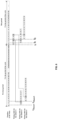
  • FIG. 5 is a schematic diagram of a timing table according to an embodiment of this disclosure.
  • FIG. 6 is a schematic diagram of an interference timing relationship diagram according to an embodiment of this disclosure.
  • FIG. 7 is a schematic diagram of a timing table adjustment according to an embodiment of this disclosure.
  • FIG. 8 is a flow diagram of another method of dynamically adjusting timing between adjacent networks in a synchronous network according to an embodiment of this disclosure.
  • FIG. 9 is a schematic diagram of another timing table adjustment according to an embodiment of this disclosure.
  • some embodiments of this disclosure provide a method of dynamically adjusting timing between adjacent networks in a synchronous network, specifically including the following embodiments.
  • FIG. 1 is a flow diagram of a method of dynamically adjusting timing between adjacent networks in a synchronous network according to an embodiment of this disclosure. As shown in FIG. 1 , when the method of dynamically adjusting timing between adjacent networks in a synchronous network is applied to an electronic shelf label system including a server, a base station and an electronic shelf label, the method specifically includes the steps of:
  • adjacent networks in this embodiment include a plurality of networks within a same store or/and a plurality of networks generated between adjacent stores.
  • the server when all base stations in the synchronous network are idle, the server sends an interference scanning task to each base station, so that each base station scans the base stations simultaneously based on the interference scanning task, and generates an interference scanning result from a scanned interfering base station serial number and a relative position thereof on a timeline.
  • the server judges whether the base station meets a requirement for issuing the interference scanning task every fixed period (usually 32 s). If the requirement is met, the server issues the interference scanning task to all the base stations in the store, and then waits to receive the interference scanning result reported by the base stations.
  • the base station scans surrounding base stations. A plurality of interfering base stations may be scanned by the same one base station. The base station reports all scanned base station serial numbers and a start moment difference between a network where a current base station is located and a network where the interfering base station is located.
  • the base station serial number includes: a base station store number, a network number and a base station offset number.
  • the base station offset number is a time offset number when the base station operates.
  • the above network may be a synchronous network.
  • the server constructs an interference timing relationship diagram between adjacent networks and the current network based on the interference scanning result of each base station in the network, the method specifically includes the steps of:
  • the current scanning period is divided into a plurality of parts based on a preset interval to construct a timeline, then the corresponding timing table for each synchronous network in the current scanning period is constructed based on the timeline of the current scanning period; and the server can construct a corresponding timing table for each synchronous network in the current scanning period based on the relative position relationship of the time of reporting interfering base station serial number on the timeline of the current scanning period.
  • the interfering base station serial number includes: a store number, a network number and an offset serial number in a network in which the base station is located.
  • the interference scanning result of each base station includes other base stations that can interfere with the current base station.
  • Other base stations that generate interference may be base stations in a same one network (identical network) or base stations in other networks.
  • the server collects results in this round reported by the base stations, filters out the scanning results with the same network as the reported base station in the results reported by the base station, and then constructs a time offset relationship between the base stations that interfere with each other, and obtains the interference timing relationship diagram as shown in FIG. 6 .
  • the base station with an offset number 2 in a network 1 interferes with the base station with an offset number 1 in a network 2
  • the base station corresponding to an offset number 5 in the network 1 interferes with the base station corresponding to the offset number 2 in a network 3.
  • an offset number of a master base station in each network may be 0 or other numbers, and other secondary base stations are numbered based on a relative offset from the master base station.
  • the method before determining the timing adjustment direction and the timing adjustment value of the current network, the method further includes: obtaining, by the server, a reference network that has an interference relationship with the current network based on the interference timing relationship diagram; obtaining a maximum base station serial number with a base station interference relationship in the current network based on the interference timing relationship diagram; determining, by the server, a mirroring direction of the reference network based on a relative position relationship between the current network and the corresponding reference network on the timeline of current scanning period; obtaining a mirroring timing table of the reference network of the current network in a corresponding period based on the mirroring direction of the reference network, in which the mirror timing table is a timing table corresponding to the mirroring network of the reference network; and judging whether the current network needs to adjust timing based on a reference network timing table of the current network and the mirror timing table of the reference network in the corresponding period.
  • determining the timing adjustment direction and the timing adjustment value of the current network when determining that the current network needs to adjust timing based on the mirror timing table of the reference network of the current network in the corresponding period includes: determining a first time difference between the current network and the reference network, and a second time difference between the current network and the mirroring network of the reference network, based on a start moment of the current network, a start moment of the reference network of the current network, a start moment of the mirroring network of the reference network, a moment on the timeline corresponding to a maximum interfering base station offset number of the reference network, and a moment on the timeline corresponding to a maximum interfering base station offset number of the current network; determining a first adjustment value of the current network relative to the reference network and a second adjustment value of the current network relative to the mirroring network of the reference network based on a preset interval threshold, the first time difference and the second time difference; and obtaining the timing adjustment direction and the timing adjustment value of the current network relative to the reference network
  • the timing adjustment direction indicates shifting right relative to the timeline when the timing adjustment value is a positive value; and the timing adjustment direction indicates shifting left relative to the timeline when the timing adjustment value is a negative value.
  • a formula expression for determining the timing adjustment value of the current network includes:
  • a formula expression for determining the first adjustment value of the current network relative to the reference network and the second adjustment value of the current network relative to the mirroring network of the reference network based on the preset interval threshold, the first time difference, and the second time difference includes:
  • the reference network corresponding to each network is different. This embodiment is illustrated with the reference network corresponding to the current network as an example.
  • the adjustment value of each network is comprehensively calculated based on the calculated distance that each network and the mirror network need to move; the direction of adjustment is determined by the positive or negative value of the adjustment value.
  • start moments of the network 1 (a network No. 1), the network 2 (a network No. 2) and the network 3 (a network No. 3) are currently defined as t 1 , t 2 and t 3 , respectively, a start moment of the network 2 relative to a mirroring period network of the network 1 is defined as , and a start moment of the network 3 relative to a mirroring period network of the network 1 is defined as t 3 base 1 ,
  • Time that needs to be adjusted for the current network 1 relative to the network 2 is d 12
  • time that needs to be adjusted for the current network 1 relative to the mirror network of the network 2 is d 1 2
  • time that needs to be adjusted for the current network 1 relative to the network 3 is d 13
  • time that needs to be adjusted for the current network 1 relative to the mirror network of the network 3 is d 1 3
  • a distance D 13 that the network No. 1 needs to move relative to the network No. 3 is defined as
  • the calculation process of D for the network 1 is as follows: the interference networks of the network 1 are the network 2 and the network 3.
  • a value D 12 that needs to be adjusted for the network 1 relative to the network 2 can be, for example,
  • a value D 13 that needs to be adjusted for the network 1 relative to the network 3 can be, for example,
  • the network 1 shifts left and needs to be moved and adjusted by 65 ms with each adjustment to 1 ms.
  • the position after timing adjustment is as shown in FIG. 7 .
  • the server may simultaneously process timing adjustments in some other manner, which is not limited to S 104 in the embodiment of the present disclosure.
  • the server of a current network sends the adjustment task only to the master station of the current network. If the server's communication with the master station is unsuccessful, the current network is not in the synchronous network any more.
  • generating, by the server, the corresponding adjustment task from the timing adjustment direction and the timing adjustment value of the current network, respectively includes: dividing the timing adjustment value of the current network into a plurality of single adjustment values based on a preset number of adjustment times; and generating, by the server, a plurality of adjustment tasks based on the timing adjustment direction and the plurality of single adjustment values, respectively.
  • a preset number of adjustment times is 5 times.
  • Each single adjustment value can be 1 ms. Based on the adjustment direction and the single adjustment values, a plurality of single adjustment tasks are generated, respectively, among which, the single adjustment values may be individually equivalent or different.
  • generating, by the server, the corresponding adjustment task from the timing adjustment direction and the timing adjustment value of the current network, respectively includes: obtaining a number of current adjustment times based on the timing adjustment value and a preset single adjustment value; and generating a plurality of adjustment tasks based on the number of current adjustment times, the timing adjustment value and the preset single adjustment value.
  • the preset single adjustment value is a fixed value for each adjustment, such as 1 ms, then the number of current adjustment times corresponding to the timing adjustment value of 5 ms is 5 times.
  • the server In the current scanning period, the server generates 5 adjustment tasks and sends the adjustment tasks to the corresponding network. For example, after generating the plurality of adjustment tasks, the adjustment tasks may also be sent to the base station a plurality of times within the same adjustment period.
  • the server can perform timing adjustments on one or more networks simultaneously.
  • the base station after receiving time adjustment tasks issued by the server, the base station adjusts the time of the master base station. At the same time, the synchronization time adjusted by the master base station is sent to the secondary base stations level by level, so that the time of an entire network is adjusted.
  • the server repeatedly controls the base station to perform interference scanning based on a length of the scanning period, and cyclically performs a dynamic timing adjustment between the adjacent networks.
  • the method provided by some embodiments of the present disclosure at least has the following technical benefits:
  • An interference timing relationship diagram between a plurality of synchronous networks is constructed based on the interference scanning result of each base station, the timing adjustment direction and the timing adjustment value of each network is obtained based on the interference timing relationship diagram, a corresponding adjustment task is generated from the timing adjustment direction and the timing adjustment value of the network, respectively, and each adjustment task is sent to the corresponding network, such that the master base station and a secondary base station in the network dynamically adjust timing based on the adjustment task, achieves an objective of mutual timing avoidance between the networks and solves the problem of signal interference caused by overlap in timing between networks in the same store and networks in the adjacent stores as time drifts or in the initial establishment, and improves the communication stability of the synchronous networks.
  • FIG. 8 is a flow diagram of another method of dynamically adjusting timing between adjacent networks in a synchronous network according to an embodiment of this disclosure. As shown in FIG. 8 , the method of dynamically adjusting timing includes the steps of:
  • the relative time difference between the networks and the time difference between the networks that can be scanned by each other may be continuously monitored, so as to adjust the time difference to the interval GAP (usually 50 ms) between the networks and maintain stability, therefore, the interference between the networks is significantly reduced, the stability of the networks is greatly improved and a phenomenon of base station out-of-synchronization is reduced.
  • some embodiments of this disclosure provide an electronic shelf label system, which adjusts timing using the method of dynamically adjusting timing between adjacent networks in a synchronous network.
  • the non-volatile memory may include: a read-only memory (ROM), a programmable ROM (PROM), an electrically programmable ROM (EPROM), an electrically erasable programmable ROM (EEPROM), or a flash memory.
  • the volatile memory may include a random access memory (RAM) or an external cache memory.
  • the RAM is available in a plurality of forms, such as a static RAM (SRAM), a dynamic RAM (DRAM), a synchronous DRAM (SDRAM), a dual data rate SDRAM (DDRSDRAM), an enhanced SDRAM (ESDRAM), a synchronous link DRAM (SLDRAM), a Rambus direct RAM (RDRAM), a direct memory bus dynamic RAM (DRDRAM), and a memory bus dynamic RAM (RDRAM).
  • SRAM static RAM
  • DRAM dynamic RAM
  • SDRAM synchronous DRAM
  • DDRSDRAM dual data rate SDRAM
  • ESDRAM enhanced SDRAM
  • SLDRAM synchronous link DRAM
  • RDRAM Rambus direct RAM
  • DRAM direct memory bus dynamic RAM
  • RDRAM memory bus dynamic RAM
  • Relational terms such as “first” and “second” herein are only used to distinguish one entity or operation from another entity or operation and do not essentially require or suggest any actual relationship or order between these entities or operations.
  • the terms “comprising”, “including” or any other variation thereof are intended to encompass a non-exclusive inclusion such that a process, method, article or device including a series of elements not only includes those elements, but also includes other elements that are not explicitly listed, or also includes elements inherent in such a process, method, article or device. Without further limitations, the elements limited by the statement “comprising a . . . ” do not exclude the presence of other identical elements in the process, method, article or device that includes the elements.

Landscapes

  • Engineering & Computer Science (AREA)
  • Computer Networks & Wireless Communication (AREA)
  • Signal Processing (AREA)
  • Physics & Mathematics (AREA)
  • Quality & Reliability (AREA)
  • Electromagnetism (AREA)
  • General Physics & Mathematics (AREA)
  • Theoretical Computer Science (AREA)
  • Mobile Radio Communication Systems (AREA)

Abstract

This disclosure provides a method of dynamically adjusting timing between adjacent networks in a synchronous network and an electronic shelf label system. The method includes: determining, by a server, a timing adjustment direction and a timing adjustment value of a current network based on an interference timing relationship diagram; generating, by the server, a corresponding adjustment task form the timing adjustment direction and the timing adjustment value of the current network, and sending the adjustment task to a master base station in the current network in the processing of each of the current networks, such that the master base station and a secondary base station dynamically adjust timing based on the adjustment task.

Description

CROSS-REFERENCE TO RELATED APPLICATIONS
This application is a continuation of U.S. application Ser. No. 18/513,485 filed on Nov. 17, 2023, which is a continuation of International Application No. PCT/CN2023/115652 filed on Aug. 30, 2023, which claims priority to Chinese Patent Application No. CN202310022840.7 filed on Jan. 8, 2023, both of which are hereby incorporated by reference in their entireties for all purposes.
BACKGROUND
Electronic shelf label systems are increasingly used in various retail areas with the increasing scale of stores, and a plurality of base stations need to be deployed in the stores, where the plurality of base stations communicate by establishing one or more synchronous networks, one synchronous network is used by one master base station and a plurality of secondary base stations. Timing of the secondary base stations is synchronized with that of the master base station. However, a clock of the master base station may drift, and the lower the clock accuracy, the greater a possibility of the drift, then the clock of the secondary base stations also drifts accordingly, so that synchronous networks of adjacent stores or different networks of a same store that do not conflict in time, may drift over time and interfere with each other. In addition, when the network is initially established, timing avoidance is also required between synchronous networks of adjacent stores or different networks of the same store to avoid interference caused by time conflicts.
As can be seen, synchronous networks of adjacent stores or different networks of the same store may have a problem of mutual interference as time drifts or in the initial establishment in the prior art, which reduces the synchronization accuracy and stability of the electronic shelf label system and fails to meet actual needs of the store.
SUMMARY
This disclosure relates to the technical field of communication, in particular to a method of dynamically adjusting timing between adjacent networks in a synchronous network and an electronic shelf label system.
In a first aspect, some embodiments of this disclosure provide a method of dynamically adjusting timing between adjacent networks in a synchronous network, including: controlling, by a server, each base station in the synchronous network in each scanning period to perform an interference scanning with a predetermined time duration, so that each base station sends an interference scanning result to the server, wherein the interference scanning result comprises timing characteristic information of an interfering base station, and the synchronous network comprises a current network; and determining, by the server, timing adjustment of the current network based on the interference scanning result of each base station in the synchronous network.
In a second aspect of the present disclosure, some embodiments of this disclosure provide an electronic shelf label system, and the electronic shelf label system includes a plurality of base stations, and a server communicating with the plurality of base stations. The server is configured to adjust timing by adopting a method of dynamically adjusting timing between adjacent networks in a synchronous network according to the first aspect.
In third aspect of the present disclosure, some embodiments of this disclosure provide a non-transitory computer readable storage medium for storing computer-executable instructions that, when executed by one or more computer processors, cause the one or more computer processors to perform the method according to the first aspect.
BRIEF DESCRIPTION OF THE DRAWINGS
In order to more clearly explain the embodiments of this disclosure or the technical solution in the prior art, a brief description of the drawings for the embodiments or the prior art will be given below.
FIG. 1 is a flow schematic diagram of a method of dynamically adjusting timing between adjacent networks in a synchronous network according to an embodiment of this disclosure;
FIG. 2 is a schematic diagram of a synchronous network according to an embodiment of this disclosure;
FIG. 3 is a schematic diagram of another synchronous network according to an embodiment of this disclosure;
FIG. 4 is a schematic diagram of a specific process of step S101 in FIG. 1 ;
FIG. 5 is a schematic diagram of a timing table according to an embodiment of this disclosure;
FIG. 6 is a schematic diagram of an interference timing relationship diagram according to an embodiment of this disclosure;
FIG. 7 is a schematic diagram of a timing table adjustment according to an embodiment of this disclosure;
FIG. 8 is a flow diagram of another method of dynamically adjusting timing between adjacent networks in a synchronous network according to an embodiment of this disclosure; and
FIG. 9 is a schematic diagram of another timing table adjustment according to an embodiment of this disclosure.
DETAILED DESCRIPTION
To make the objective, technical solutions and advantages of the embodiments of the disclosure clearer, the technical solution in the embodiments of this disclosure will be described clearly and integrally below with reference to drawings in the embodiments of this disclosure, and obviously the described embodiments are merely part of the embodiments, not all of the embodiments of this disclosure. Based on the embodiments of this disclosure, any other embodiments that are obtained by those of ordinary skilled in the art without paying any creative effort should fall within the protection scope of this disclosure.
In a first aspect, some embodiments of this disclosure provide a method of dynamically adjusting timing between adjacent networks in a synchronous network, specifically including the following embodiments.
FIG. 1 is a flow diagram of a method of dynamically adjusting timing between adjacent networks in a synchronous network according to an embodiment of this disclosure. As shown in FIG. 1 , when the method of dynamically adjusting timing between adjacent networks in a synchronous network is applied to an electronic shelf label system including a server, a base station and an electronic shelf label, the method specifically includes the steps of:
    • S101, controlling, by a server, each base station in the synchronous network in each scanning period to perform an interference scanning with a predetermined time duration, so that each base station sends an interference scanning result to the server.
In some embodiments, as shown in FIGS. 2 and 3 , adjacent networks in this embodiment include a plurality of networks within a same store or/and a plurality of networks generated between adjacent stores.
In some embodiments, when all base stations in the synchronous network are idle, the server sends an interference scanning task to each base station, so that each base station scans the base stations simultaneously based on the interference scanning task, and generates an interference scanning result from a scanned interfering base station serial number and a relative position thereof on a timeline.
In some embodiments, when the store is initially established or the network within the store is in a synchronous state, the server judges whether the base station meets a requirement for issuing the interference scanning task every fixed period (usually 32 s). If the requirement is met, the server issues the interference scanning task to all the base stations in the store, and then waits to receive the interference scanning result reported by the base stations. After receiving the interference scanning task issued by the server, the base station scans surrounding base stations. A plurality of interfering base stations may be scanned by the same one base station. The base station reports all scanned base station serial numbers and a start moment difference between a network where a current base station is located and a network where the interfering base station is located. The base station serial number includes: a base station store number, a network number and a base station offset number. The base station offset number is a time offset number when the base station operates.
    • S102, constructing, by the server, an interference timing relationship diagram between an adjacent network and a current network based on the interference scanning result of each base station in the network, in which the interference scanning result includes a scanned interfering base station serial number and a relative position thereof on a timeline. In some embodiments, the interference scanning result may include other timing characteristic information of an interfering base station, which reflects the characters of the interfering base station on the dimension of time. The timing characteristic information included in the interference scanning result is not limited to the scanned interfering base station serial number and the relative position disclosed in the embodiments of the present disclosure.
In some embodiments, the above network may be a synchronous network.
As shown in FIG. 4 , the server constructs an interference timing relationship diagram between adjacent networks and the current network based on the interference scanning result of each base station in the network, the method specifically includes the steps of:
    • S201, constructing, by the server, the timeline of current scanning period, and constructing the corresponding timing table for each synchronous network in a current scanning period based on the timeline of current scanning period;
    • S202, filtering out, by the server, base station information with a same network as the reported base station in all interference scanning results based on the interference scanning result of each base station, and obtaining a target interference scanning result; and
    • S203, constructing, by the server, a time deviation relationship between the corresponding base station serial number in each timing table and the corresponding interfering base station serial number based on the target interference scanning result, and generating the interference timing relationship diagram.
As shown in FIG. 5 , in this embodiment, the current scanning period is divided into a plurality of parts based on a preset interval to construct a timeline, then the corresponding timing table for each synchronous network in the current scanning period is constructed based on the timeline of the current scanning period; and the server can construct a corresponding timing table for each synchronous network in the current scanning period based on the relative position relationship of the time of reporting interfering base station serial number on the timeline of the current scanning period. The interfering base station serial number includes: a store number, a network number and an offset serial number in a network in which the base station is located.
Further, the interference scanning result of each base station includes other base stations that can interfere with the current base station. Other base stations that generate interference may be base stations in a same one network (identical network) or base stations in other networks. Thus, the server collects results in this round reported by the base stations, filters out the scanning results with the same network as the reported base station in the results reported by the base station, and then constructs a time offset relationship between the base stations that interfere with each other, and obtains the interference timing relationship diagram as shown in FIG. 6 . In FIG. 6 , the base station with an offset number 2 in a network 1 interferes with the base station with an offset number 1 in a network 2, the base station corresponding to an offset number 5 in the network 1 interferes with the base station corresponding to the offset number 2 in a network 3. In this embodiment, an offset number of a master base station in each network may be 0 or other numbers, and other secondary base stations are numbered based on a relative offset from the master base station.
    • S103, determining, by the server, a timing adjustment direction and a timing adjustment value of the current network based on a relative position of the adjacent networks on the timeline of current scanning period in the interference timing relationship diagram, a serial number of each base station in one or more adjacent networks, and a time deviation relationship between interfering base stations.
In some embodiments, before determining the timing adjustment direction and the timing adjustment value of the current network, the method further includes: obtaining, by the server, a reference network that has an interference relationship with the current network based on the interference timing relationship diagram; obtaining a maximum base station serial number with a base station interference relationship in the current network based on the interference timing relationship diagram; determining, by the server, a mirroring direction of the reference network based on a relative position relationship between the current network and the corresponding reference network on the timeline of current scanning period; obtaining a mirroring timing table of the reference network of the current network in a corresponding period based on the mirroring direction of the reference network, in which the mirror timing table is a timing table corresponding to the mirroring network of the reference network; and judging whether the current network needs to adjust timing based on a reference network timing table of the current network and the mirror timing table of the reference network in the corresponding period.
In some embodiments, determining the timing adjustment direction and the timing adjustment value of the current network when determining that the current network needs to adjust timing based on the mirror timing table of the reference network of the current network in the corresponding period, includes: determining a first time difference between the current network and the reference network, and a second time difference between the current network and the mirroring network of the reference network, based on a start moment of the current network, a start moment of the reference network of the current network, a start moment of the mirroring network of the reference network, a moment on the timeline corresponding to a maximum interfering base station offset number of the reference network, and a moment on the timeline corresponding to a maximum interfering base station offset number of the current network; determining a first adjustment value of the current network relative to the reference network and a second adjustment value of the current network relative to the mirroring network of the reference network based on a preset interval threshold, the first time difference and the second time difference; and obtaining the timing adjustment direction and the timing adjustment value of the current network relative to the reference network based on the first adjustment value and the second adjustment value.
In some embodiments, the timing adjustment direction indicates shifting right relative to the timeline when the timing adjustment value is a positive value; and the timing adjustment direction indicates shifting left relative to the timeline when the timing adjustment value is a negative value.
In some embodiments, when two reference networks are present in the current network, a formula expression for determining the timing adjustment value of the current network includes:
D = { D 1 + D 2 , D 1 · D 2 < 0 D 1 , "\[LeftBracketingBar]" D 1 "\[RightBracketingBar]" "\[LeftBracketingBar]" D 2 "\[RightBracketingBar]" , D 1 · D 2 0 D 2 , "\[LeftBracketingBar]" D 2 "\[RightBracketingBar]" > "\[LeftBracketingBar]" D 1 "\[RightBracketingBar]" , D 1 · D 2 0
    • where D1 represents the timing adjustment value of the current network relative to the first reference network; D2 represents the timing adjustment value of the current network relative to the second reference network.
In some embodiments, a formula expression for determining the first adjustment value of the current network relative to the reference network and the second adjustment value of the current network relative to the mirroring network of the reference network based on the preset interval threshold, the first time difference, and the second time difference includes:
d 1 = { - ( GAP - x 1 ) , x 1 < GAP , t 1 t 2 0 , x 1 GAP , t 1 t 2 GAP - x 1 , x 1 < GAP , t 1 > t 2 0 , x 1 GAP , t 1 > t 2 d 1 = { GAP - x 1 _ , x 1 _ < GAP , t 1 t 2 0 , x 1 _ GAP , t 1 t 2 - ( GAP - x 1 _ ) , x 1 _ < GAP , t 1 > t 2 0 , x 1 _ GAP , t 1 > t 2
    • where d1 represents the first adjustment value, d 1 represents the second adjustment value, GAP represents the preset interval threshold, t1 represents the start moment of the current network, t2 represents the start moment of the reference network, x1 represents the first time difference, and x 1 represents the second time difference.
In some embodiments, the reference network corresponding to each network is different. This embodiment is illustrated with the reference network corresponding to the current network as an example.
In some embodiments, the adjustment value of each network is comprehensively calculated based on the calculated distance that each network and the mirror network need to move; the direction of adjustment is determined by the positive or negative value of the adjustment value.
As shown in FIG. 6 , if a network No. 1 (a subnet 1) interferes with both a network No. 2 (a subnet 2) and a network No. 3 (a subnet 3), start moments of the network 1 (a network No. 1), the network 2 (a network No. 2) and the network 3 (a network No. 3) are currently defined as t1, t2 and t3, respectively, a start moment of the network 2 relative to a mirroring period network of the network 1 is defined as
Figure US12302270-20250513-P00001
, and a start moment of the network 3 relative to a mirroring period network of the network 1 is defined as t 3base 1 ,
t 2 _ base 1 = { t 2 - 1000 , t 1 t 2 t 2 + 1000 , t 1 > t 2 t 3 _ base 1 = { t 3 - 1000 , t 1 t 3 t 3 + 1000 , t 1 > t 3
    • a time difference in timing between the current network 1 and the network 2 is x12, a time difference in timing between the current network 1 and the mirror network of the network 2 is x12 , a time difference in timing between the current network 1 and the network 3 is x13, and a time difference in timing between the current network 1 and the mirror network of the network 3 is x13 ,
x 12 is defined as x 12 = { t 2 - ( t 1 + offset net 12 * 5 ) , t 1 t 2 t 1 - ( t 2 + offset net 21 * 5 ) , t 1 > t 2 , x 1 2 _ is defined as x 1 2 _ = { t 1 - ( t 2 _ base 1 + offset net 21 * 5 ) , t 1 t 2 t 2 _ base 1 - ( t 1 + offset net 12 * 5 ) , t 1 > t 2 ,
    • where offsetnet12 is a maximum conflict ap (access point) number (2 herein) between the network No. 1 and the network No. 2, and offsetnet21 is a maximum conflict ap number (1 herein) between the network No. 2 and the network No. 1.
x 13 is defined as x 13 = { t 3 - ( t 1 + offset net 13 * 5 ) , t 1 t 3 t 1 - ( t 3 + offset net 31 * 5 ) , t 1 > t 3 , x 1 3 _ is defined as x 1 3 _ = { t 1 - ( t 3 _ base 1 + offset net 31 * 5 ) , t 1 t 3 t 3 _ base 1 - ( t 1 + offset net 13 * 5 ) , t 1 > t 3
    • where offsetnet13 is a maximum conflict ap number (5 herein) between the network No. 1 and the network No. 3, and offsetnet31 is a maximum conflict ap number (2 herein) between the network No. 3 and the network No. 1.
Time that needs to be adjusted for the current network 1 relative to the network 2 is d12, time that needs to be adjusted for the current network 1 relative to the mirror network of the network 2 is d12 , time that needs to be adjusted for the current network 1 relative to the network 3 is d13, and time that needs to be adjusted for the current network 1 relative to the mirror network of the network 3 is d13 ,
d 12 is defined as d 12 = { - ( 50 - x 12 ) , x 12 < GAP , t 1 t 2 ( GAP = 50 ms ) 0 , x 12 GAP , t 1 t 2 50 - x 12 , x 12 < GAP , t 1 > t 2 0 , x 12 GAP , t 1 > t 2 , d 1 2 _ is defined as d 1 2 _ = { 50 - x 1 2 _ , x 1 2 _ < GAP , t 1 t 2 ( GAP = 50 ms ) 0 , x 1 2 _ GAP , t 1 t 2 - ( 50 - x 1 2 _ ) , x 1 2 _ < GAP , t 1 > t 2 0 , x 1 2 _ GAP , t 1 > t 2 ,
    • d13 and d13 are defined in a similar manner.
In this embodiment, a distance D12 that the network No. 1 needs to move relative to the network No. 2 is defined as D12=d12+d12 .
Similarly, a distance D13 that the network No. 1 needs to move relative to the network No. 3 is defined as
D 13 = d 13 + d 1 3 _ .
Thus a value that needs to be adjusted for the network 1 is
D = { D 12 + D 13 , D 12 · D 13 < 0 D 12 , "\[LeftBracketingBar]" D 12 "\[RightBracketingBar]" "\[LeftBracketingBar]" D 13 "\[RightBracketingBar]" , D 12 · D 13 0 D 13 , "\[LeftBracketingBar]" D 13 "\[RightBracketingBar]" > "\[LeftBracketingBar]" D 12 "\[RightBracketingBar]" , D 12 · D 13 0 ,
    • a direction of adjustment of the network No. 1 is decided by a positive or negative result of D. If D1 is positive, the network needs to shift right, whereas if D1 is negative, the network needs to shift left.
To further illustrate with a specific example, the calculation process of D for the network 1 is as follows: the interference networks of the network 1 are the network 2 and the network 3.
A value D12 that needs to be adjusted for the network 1 relative to the network 2 can be, for example,
D 12 = d 12 + d 1 2 _ = - ( 50 - ( - 10 ) ) + 0 = - 60.
A value D13 that needs to be adjusted for the network 1 relative to the network 3 can be, for example,
D 13 = d 13 + d 1 3 _ = - ( 50 - ( - 15 ) ) + 0 = - 65.
Finally, D=D13=−65, the network 1 shifts left and needs to be moved and adjusted by 65 ms with each adjustment to 1 ms. The position after timing adjustment is as shown in FIG. 7 .
    • S104, processing, by the server, timing adjustments for one or more networks simultaneously, generating a corresponding adjustment task from the timing adjustment direction and the timing adjustment value of the current network, and sending the adjustment task to a master base station in the current network in the processing of each of the current networks, such that the master base station and a secondary base station dynamically adjust timing based on the adjustment task.
In some embodiments, the server may simultaneously process timing adjustments in some other manner, which is not limited to S104 in the embodiment of the present disclosure. In some embodiments, the server of a current network sends the adjustment task only to the master station of the current network. If the server's communication with the master station is unsuccessful, the current network is not in the synchronous network any more.
In a first implementation of this embodiment, generating, by the server, the corresponding adjustment task from the timing adjustment direction and the timing adjustment value of the current network, respectively, includes: dividing the timing adjustment value of the current network into a plurality of single adjustment values based on a preset number of adjustment times; and generating, by the server, a plurality of adjustment tasks based on the timing adjustment direction and the plurality of single adjustment values, respectively.
In some embodiments, if the timing adjustment value is 5 ms, a preset number of adjustment times is 5 times. Each single adjustment value can be 1 ms. Based on the adjustment direction and the single adjustment values, a plurality of single adjustment tasks are generated, respectively, among which, the single adjustment values may be individually equivalent or different.
In a second implementation of this embodiment, generating, by the server, the corresponding adjustment task from the timing adjustment direction and the timing adjustment value of the current network, respectively, includes: obtaining a number of current adjustment times based on the timing adjustment value and a preset single adjustment value; and generating a plurality of adjustment tasks based on the number of current adjustment times, the timing adjustment value and the preset single adjustment value.
In some embodiments, the preset single adjustment value is a fixed value for each adjustment, such as 1 ms, then the number of current adjustment times corresponding to the timing adjustment value of 5 ms is 5 times. In the current scanning period, the server generates 5 adjustment tasks and sends the adjustment tasks to the corresponding network. For example, after generating the plurality of adjustment tasks, the adjustment tasks may also be sent to the base station a plurality of times within the same adjustment period.
In some embodiments, the server can perform timing adjustments on one or more networks simultaneously.
In some embodiments, after receiving time adjustment tasks issued by the server, the base station adjusts the time of the master base station. At the same time, the synchronization time adjusted by the master base station is sent to the secondary base stations level by level, so that the time of an entire network is adjusted.
In some embodiments, the server repeatedly controls the base station to perform interference scanning based on a length of the scanning period, and cyclically performs a dynamic timing adjustment between the adjacent networks.
As compared with the prior art, the method provided by some embodiments of the present disclosure at least has the following technical benefits:
An interference timing relationship diagram between a plurality of synchronous networks is constructed based on the interference scanning result of each base station, the timing adjustment direction and the timing adjustment value of each network is obtained based on the interference timing relationship diagram, a corresponding adjustment task is generated from the timing adjustment direction and the timing adjustment value of the network, respectively, and each adjustment task is sent to the corresponding network, such that the master base station and a secondary base station in the network dynamically adjust timing based on the adjustment task, achieves an objective of mutual timing avoidance between the networks and solves the problem of signal interference caused by overlap in timing between networks in the same store and networks in the adjacent stores as time drifts or in the initial establishment, and improves the communication stability of the synchronous networks.
FIG. 8 is a flow diagram of another method of dynamically adjusting timing between adjacent networks in a synchronous network according to an embodiment of this disclosure. As shown in FIG. 8 , the method of dynamically adjusting timing includes the steps of:
    • 1. issuing a scanning task: when the store is initially established or the network within the store is in a synchronous state, the server judges whether the base station meets the requirement for issuing the interference scanning task every fixed period (usually 32 s). If the requirement is met, the server issues the interference scanning task to all the base stations in the store, and then waits to receive the interference scanning result reported by the base station.
    • 2. reporting, by the base station, the interference scanning result: after receiving the interference scanning task issued by the server, the base station scans surrounding base stations. A plurality of interfering base stations may be scanned by the same one base station. The base station reports all scanned base station store numbers, network number, and base station offset numbers and a start moment difference between a network where a current base station is located and a network where the interfering base stations are located.
    • 3. processing the scanning result: the server collects results in this round reported by the base station, filters out a scanning result of the same network as the reported base station in the results reported by the base station, sorts out the interference relationship between the networks, and determines the maximum interference base station offset number between the networks. As shown in FIG. 7 , the base stations that interfere with the network 1 (subnet 1) and the network 2 (subnet 2) involve a base station No. 2 of the network 1 and a base station No. 1 of the network 2. The relative position of the two networks on the timeline of this period can be determined based on the reported time interval. Taking calculations of adjustment time and adjustment direction of the network 1 as an example, it is necessary to mirror network 2 to a previous period, while judgments are made on whether a time difference between the base station No. 2 of the network 1 (the maximum interfering base station serial number of the network 1) and the start moment of the network 2 is greater than GAP (usually 50 ms); whether the time difference between the base station No. 1 of the mirror network of the network 2 (the maximum interfering base station serial number of the network 2) and the start moment of the network 1 is greater than GAP, if any one of the requirements is not met, an adjustment is required; and the time adjustment between networks in the same store is performed in a similar manner. As shown in FIG. 9 , the time and direction that need to be adjusted for each network is calculated based on a time adjustment algorithm. The principle of adjustment allows a time interval between a start point of the network and the maximum interfering base station serial number of the mirror network of the interfering network to be greater than the GAP, and also allows a time interval between a moment corresponding to the maximum interfering base station serial number of the network and a start moment of the interfering network to be greater than the GAP.
    • 4. issuing adjustment tasks: generating adjustment tasks and issuing the adjustment task to the master ap in each network based on the network value to be adjusted and the direction to be adjusted as calculated by the server. If no adjustment is required, no adjustment task is issued. The adjustment task may be issued a plurality of times in one period, and only a maximum time adjustment of 1 ms is issued to the master base station of each network each time. The task is sent regularly based on the calculated number of times. A next period is about to be entered after all adjustment tasks have already been sent.
    • 5. adjusting base station time: after receiving the time adjustment task issued by the server, the master base station adjusts the time of the master base station. At the same time, the synchronization time adjusted by the master base station is sent to the secondary base stations level by level, so that the time of the entire network is adjusted.
In some embodiments, after the time adjustment solution is applied between the networks, the relative time difference between the networks and the time difference between the networks that can be scanned by each other (i.e., between the two networks with interference) may be continuously monitored, so as to adjust the time difference to the interval GAP (usually 50 ms) between the networks and maintain stability, therefore, the interference between the networks is significantly reduced, the stability of the networks is greatly improved and a phenomenon of base station out-of-synchronization is reduced.
In a second aspect, some embodiments of this disclosure provide an electronic shelf label system, which adjusts timing using the method of dynamically adjusting timing between adjacent networks in a synchronous network.
All or part of the processes in the method of the embodiments can be completed by instructing relevant hardware through a computer program, and the program may be stored in one non-volatile computer-readable storage medium. When executed, the program may include the processes of the embodiments of the above method. Any reference to a memory, a storage, a database, or other medium used in the embodiments provided herein may include a non-volatile and/or volatile memory. The non-volatile memory may include: a read-only memory (ROM), a programmable ROM (PROM), an electrically programmable ROM (EPROM), an electrically erasable programmable ROM (EEPROM), or a flash memory. The volatile memory may include a random access memory (RAM) or an external cache memory. As an explanation rather than limitation, the RAM is available in a plurality of forms, such as a static RAM (SRAM), a dynamic RAM (DRAM), a synchronous DRAM (SDRAM), a dual data rate SDRAM (DDRSDRAM), an enhanced SDRAM (ESDRAM), a synchronous link DRAM (SLDRAM), a Rambus direct RAM (RDRAM), a direct memory bus dynamic RAM (DRDRAM), and a memory bus dynamic RAM (RDRAM).
Relational terms such as “first” and “second” herein are only used to distinguish one entity or operation from another entity or operation and do not essentially require or suggest any actual relationship or order between these entities or operations. The terms “comprising”, “including” or any other variation thereof are intended to encompass a non-exclusive inclusion such that a process, method, article or device including a series of elements not only includes those elements, but also includes other elements that are not explicitly listed, or also includes elements inherent in such a process, method, article or device. Without further limitations, the elements limited by the statement “comprising a . . . ” do not exclude the presence of other identical elements in the process, method, article or device that includes the elements.

Claims (20)

What is claimed is:
1. A method for avoiding timing interference in a synchronous network, comprising:
controlling, by a server, each base station in the synchronous network in each scanning period to perform an interference scanning with a predetermined time duration, so that each base station sends an interference scanning result to the server, wherein the interference scanning result comprises timing characteristic information of an interfering base station, and the synchronous network comprises a current network; and
determining, by the server, timing adjustment of the current network based on the interference scanning result of each base station in the synchronous network.
2. The method according to claim 1, determining the timing adjustment of the current network based on the interference scanning result of each base station in the synchronous network comprises:
constructing, by the server, an interference timing relationship diagram between an adjacent network and the current network based on the interference scanning result of each base station in the synchronous network; and
determining, by the server, a timing adjustment direction and a timing adjustment value of the current network based on the interference timing relationship diagram.
3. The method according to claim 2, further comprising:
processing, by the server, a timing adjustment of one or more current networks simultaneously, generating a corresponding adjustment task from the timing adjustment direction and the timing adjustment value of the current network, and sending the adjustment task to a master base station in the current network, such that the master base station and a secondary base station dynamically adjust timing based on the adjustment task.
4. The method according to claim 2, wherein the timing characteristic information of an interfering base station comprises a scanned interfering base station serial number and a relative position thereof on a timeline, and
determining the timing adjustment direction and the timing adjustment value of the current network based on the interference timing relationship diagram comprises:
determining the timing adjustment direction and the timing adjustment value of the current network based on a relative position of adjacent networks on the timeline of current scanning period in the interference timing relationship diagram, a serial number of each base station in one or more adjacent networks, and a time deviation relationship between interfering base stations.
5. The method according to claim 4, wherein the scanned interfering base station serial number includes: a store number, a network number and an offset serial number in a network in which the interfering base station is located.
6. The method according to claim 5, wherein before determining the timing adjustment direction and the timing adjustment value of the current network, the method further comprises:
obtaining, by the server, a reference network that has an interference relationship with the current network based on the interference timing relationship diagram;
obtaining, by the server, a maximum base station serial number with a base station interference relationship in the current network based on the interference timing relationship diagram;
determining, by the server, a mirroring direction of the reference network based on a relative position relationship between the current network and a corresponding reference network on the timeline of current scanning period;
obtaining, by the server, a mirroring timing table of the reference network of the current network in a corresponding period based on the mirroring direction of the reference network, wherein the mirror timing table is a timing table corresponding to a mirroring network of the reference network; and
judging, by the server, whether the current network needs a timing adjustment based on a reference network timing table of the current network and the mirror timing table of the reference network in a corresponding period.
7. The method according to claim 6, wherein determining the timing adjustment direction and the timing adjustment value of the current network in response to determining that the current network needs a timing adjustment based on the reference network timing table of the current network and the mirror timing table of the reference network in a corresponding period, comprises:
determining a first time difference between the current network and the reference network, and a second time difference between the current network and the mirroring network of the reference network, based on a start moment of the current network, a start moment of the reference network of the current network, a start moment of the mirroring network of the reference network, a moment on the timeline corresponding to a maximum interfering base station offset number of the reference network, and a moment on the timeline corresponding to a maximum interfering base station offset number of the current network;
determining a first adjustment value of the current network relative to the reference network and a second adjustment value of the current network relative to the mirroring network of the reference network based on a preset interval threshold, the first time difference and the second time difference; and
obtaining the timing adjustment direction and the timing adjustment value of the current network relative to the reference network based on the first adjustment value and the second adjustment value.
8. The method according to claim 7, wherein the timing adjustment direction indicates shifting right relative to the timeline when the timing adjustment value is a positive value; and the timing adjustment direction indicates shifting left relative to the timeline when the timing adjustment value is a negative value.
9. The method according to claim 4, wherein constructing, by the server, the interference timing relationship diagram between the adjacent network and the current network based on the interference scanning result of each base station in the synchronous network, comprises:
constructing, by the server, the timeline of current scanning period, and constructing the corresponding timing table for each network in the synchronous network in a current scanning period based on the timeline of current scanning period;
filtering out, by the server, base station information with a same network as a reported base station in all interference scanning results based on the interference scanning result of each base station, and obtaining a target interference scanning result; and
constructing, by the server, a time deviation relationship between a corresponding base station serial number in each timing table and a corresponding interfering base station serial number based on the target interference scanning result, and generating the interference timing relationship diagram.
10. The method according to claim 3, wherein generating the corresponding adjustment task from the timing adjustment direction and the timing adjustment value of each of the current network, respectively, comprises:
dividing the timing adjustment value of the current network into a plurality of single adjustment values based on a preset number of adjustment times; and
generating a plurality of adjustment tasks based on the timing adjustment direction and the plurality of single adjustment values, respectively;
or,
obtaining a number of current adjustment times based on the timing adjustment value and a preset single adjustment value; and
generating a plurality of adjustment tasks based on the number of current adjustment times, the timing adjustment value and the preset single adjustment value, and sending the adjustment tasks to the base station a plurality of times within a same adjustment period.
11. The method according to claim 2, wherein the server repeatedly controls the base station to perform interference scanning based on a scanning period and cyclically performs a dynamic timing adjustment between adjacent networks.
12. An electronic shelf label system, comprising:
a plurality of base stations, and a server communicating with the plurality of base stations;
wherein the server is configured to perform acts comprising:
controlling each base station in a synchronous network in each scanning period to perform an interference scanning with a predetermined time duration, so that each base station sends an interference scanning result to the server, wherein the interference scanning result comprises timing characteristic information of an interfering base station, and the synchronous network comprises a current network; and
determining timing adjustment of a current network based on the interference scanning result of each base station in the synchronous network.
13. The electronic shelf label system according to claim 12, wherein determining the timing adjustment of the current network based on the interference scanning result of each base station in the synchronous network comprises:
constructing an interference timing relationship diagram between an adjacent network and the current network based on the interference scanning result of each base station in the synchronous network; and
determining a timing adjustment direction and a timing adjustment value of the current network based on the interference timing relationship diagram.
14. The electronic shelf label system according to claim 13, wherein the method further comprises:
processing a timing adjustment of one or more current networks simultaneously, generating a corresponding adjustment task from the timing adjustment direction and the timing adjustment value of the current network, and sending the adjustment task to a master base station in the current network in a processing of each of the current networks, such that the master base station and a secondary base station dynamically adjust timing based on the adjustment task.
15. The electronic shelf label system according to claim 13, wherein the timing characteristic information of an interfering base station comprises a scanned interfering base station serial number and a relative position thereof on a timeline, and
determining the timing adjustment direction and the timing adjustment value of the current network based on the interference timing relationship diagram comprises:
determining the timing adjustment direction and the timing adjustment value of the current network based on a relative position of adjacent networks on the timeline of current scanning period in the interference timing relationship diagram, a serial number of each base station in one or more adjacent networks, and a time deviation relationship between interfering base stations.
16. The electronic shelf label system according to claim 15, wherein the scanned interfering base station serial number includes: a store number, a network number and an offset serial number in a network in which the interfering base station is located.
17. The electronic shelf label system according to claim 16, wherein before determining the timing adjustment direction and the timing adjustment value of the current network, the server is configured to perform acts further comprising:
obtaining a reference network that has an interference relationship with the current network based on the interference timing relationship diagram;
obtaining a maximum base station serial number with a base station interference relationship in the current network based on the interference timing relationship diagram;
determining a mirroring direction of the reference network based on a relative position relationship between the current network and the corresponding reference network on the timeline of current scanning period;
obtaining a mirroring timing table of the reference network of the current network in a corresponding period based on the mirroring direction of the reference network, wherein the mirror timing table is a timing table corresponding to a mirroring network of the reference network; and
judging whether the current network needs a timing adjustment based on a reference network timing table of the current network and the mirror timing table of the reference network in a corresponding period.
18. The electronic shelf label system according to claim 17, wherein determining the timing adjustment direction and the timing adjustment value of the current network in response to determining that the current network needs a timing adjustment based on a reference network timing table of the current network and the mirror timing table of the reference network in a corresponding period, comprises:
determining a first time difference between the current network and the reference network, and a second time difference between the current network and the mirroring network of the reference network, based on a start moment of the current network, a start moment of the reference network of the current network, a start moment of the mirroring network of the reference network, a moment on the timeline corresponding to a maximum interfering base station offset number of the reference network, and a moment on a timeline corresponding to a maximum interfering base station offset number of the current network;
determining a first adjustment value of the current network relative to the reference network and a second adjustment value of the current network relative to the mirroring network of the reference network based on a preset interval threshold, the first time difference and the second time difference; and
obtaining the timing adjustment direction and the timing adjustment value of the current network relative to the reference network based on the first adjustment value and the second adjustment value.
19. The electronic shelf label system according to claim 15, wherein constructing the interference timing relationship diagram between the adjacent network and the current network based on the interference scanning result of each base station in the synchronous network, comprises:
constructing the timeline of current scanning period, and constructing the corresponding timing table for each network in the synchronous network in a current scanning period based on the timeline of current scanning period;
filtering out base station information with a same network as a reported base station in all interference scanning results based on the interference scanning result of each base station, and obtaining a target interference scanning result; and
constructing a time deviation relationship between a corresponding base station serial number in each timing table and a corresponding interfering base station serial number based on the target interference scanning result, and generating the interference timing relationship diagram; and
wherein generating the corresponding adjustment task from the timing adjustment direction and the timing adjustment value of each of the current network, respectively, comprises:
dividing the timing adjustment value of the current network into a plurality of single adjustment values based on a preset number of adjustment times; and generating, by the server, a plurality of adjustment tasks based on the timing adjustment direction and the plurality of single adjustment values, respectively;
or,
obtaining a number of current adjustment times based on the timing adjustment value and a preset single adjustment value; and generating a plurality of adjustment tasks based on the number of current adjustment times, the timing adjustment value and the preset single adjustment value, and sending the adjustment tasks to the base station a plurality of times within a same adjustment period.
20. A non-transitory computer readable storage medium storing a plurality of programs for execution by a server having one or more processors, wherein the plurality of programs, when executed by the one or more processors, cause the server to perform acts comprising:
controlling each base station in the synchronous network in each scanning period to perform an interference scanning with a predetermined time duration, so that each base station sends an interference scanning result to the server, wherein the interference scanning result comprises timing characteristic information of an interfering base station, and the synchronous network comprises a current network; and
determining timing adjustment of the current network based on the interference scanning result of each base station in the synchronous network.
US18/629,933 2023-01-08 2024-04-08 Method of dynamic adjusting timing between adjacent networks in synchronized networks and electronic shelf label system Active US12302270B2 (en)

Priority Applications (1)

Application Number Priority Date Filing Date Title
US18/629,933 US12302270B2 (en) 2023-01-08 2024-04-08 Method of dynamic adjusting timing between adjacent networks in synchronized networks and electronic shelf label system

Applications Claiming Priority (5)

Application Number Priority Date Filing Date Title
CN202310022840.7 2023-01-08
CN202310022840.7A CN115802477B (en) 2023-01-08 2023-01-08 Method for dynamically adjusting time sequence between adjacent networks of synchronous network and electronic price tag system
PCT/CN2023/115652 WO2024146152A1 (en) 2023-01-08 2023-08-30 Method for dynamically adjusting timing sequence between adjacent synchronization networks, and electronic price tag system
US18/513,485 US11997626B1 (en) 2023-01-08 2023-11-17 Method of dynamic adjusting timing between adjacent networks in synchronized networks and electronic shelf label system
US18/629,933 US12302270B2 (en) 2023-01-08 2024-04-08 Method of dynamic adjusting timing between adjacent networks in synchronized networks and electronic shelf label system

Related Parent Applications (1)

Application Number Title Priority Date Filing Date
US18/513,485 Continuation US11997626B1 (en) 2023-01-08 2023-11-17 Method of dynamic adjusting timing between adjacent networks in synchronized networks and electronic shelf label system

Publications (2)

Publication Number Publication Date
US20240292355A1 US20240292355A1 (en) 2024-08-29
US12302270B2 true US12302270B2 (en) 2025-05-13

Family

ID=91197029

Family Applications (2)

Application Number Title Priority Date Filing Date
US18/513,485 Active US11997626B1 (en) 2023-01-08 2023-11-17 Method of dynamic adjusting timing between adjacent networks in synchronized networks and electronic shelf label system
US18/629,933 Active US12302270B2 (en) 2023-01-08 2024-04-08 Method of dynamic adjusting timing between adjacent networks in synchronized networks and electronic shelf label system

Family Applications Before (1)

Application Number Title Priority Date Filing Date
US18/513,485 Active US11997626B1 (en) 2023-01-08 2023-11-17 Method of dynamic adjusting timing between adjacent networks in synchronized networks and electronic shelf label system

Country Status (5)

Country Link
US (2) US11997626B1 (en)
EP (1) EP4422134A4 (en)
JP (1) JP7625143B1 (en)
AU (1) AU2023358131B2 (en)
CA (1) CA3231828A1 (en)

Citations (20)

* Cited by examiner, † Cited by third party
Publication number Priority date Publication date Assignee Title
JP2004040645A (en) 2002-07-05 2004-02-05 Sony Corp Wireless communication system, wireless communication device, wireless communication method, and computer program
CN101420747A (en) 2008-11-12 2009-04-29 华为技术有限公司 Synchronization method, base station, network server and communication system
CN102301804A (en) 2010-01-08 2011-12-28 联发科技股份有限公司 Two-phase uplink synchronization for picocells/femtocells
US20120082038A1 (en) 2010-10-01 2012-04-05 Clear Wireless, Llc Enabling coexistence between fdd and tdd wireless networks
CN103136498A (en) 2013-02-27 2013-06-05 深圳市远望谷信息技术股份有限公司 Method and device for reading electronic tag data under condition of multiple reader-writers
US20130315194A1 (en) 2011-02-10 2013-11-28 Pantech Co., Ltd Device and method for adjusting coexistence inference in a device in a wireless communication system
CN103517321A (en) * 2012-06-26 2014-01-15 上海无线通信研究中心 Heterogeneous network fusion-based interference collection and suppression method
US20140086089A1 (en) 2011-05-31 2014-03-27 Huawei Technologies Co., Ltd. Method for detecting interference between base stations and base station
US20150172140A1 (en) 2013-12-18 2015-06-18 Thomson Reuters Global Resources (Trgr) System and method for dynamically scheduling network scanning tasks
US20160262163A1 (en) 2013-10-15 2016-09-08 Aoife Solutions, S.L. System and method for decentralized control of wireless networks
CN108990076A (en) 2017-05-31 2018-12-11 上海华为技术有限公司 A kind of method of wave beam adjustment and base station
CN109905212A (en) 2017-12-11 2019-06-18 深圳市金立通信设备有限公司 Indicating means, base station and the user equipment of time sequence relationship of hybrid automatic retransmission request
WO2019155753A1 (en) 2018-02-07 2019-08-15 ソニー株式会社 Communication device and communication method
CN112105004A (en) * 2020-09-15 2020-12-18 努比亚技术有限公司 Electronic price tag network detection method, device and computer readable storage medium
US20210352607A1 (en) 2018-10-05 2021-11-11 Apple Inc. Downlink (DL) Transmission Timing of Integrated Access and Backhaul (IAB) Node
CN113950102A (en) 2021-12-21 2022-01-18 汉朔科技股份有限公司 Communication method, electronic price tag system, computer equipment and storage medium
CN114554399A (en) 2022-04-25 2022-05-27 汉朔科技股份有限公司 Synchronous network construction method, price tag system, computer device and storage medium
CN114615747A (en) 2022-05-09 2022-06-10 汉朔科技股份有限公司 Dynamic allocation method of base station frequency, price tag system and computer equipment
CN115510881A (en) 2021-06-07 2022-12-23 深圳市中融数字科技有限公司 Timing sequence adjusting method, storage medium, reader-writer, electronic tag and system
CN115802477A (en) 2023-01-08 2023-03-14 汉朔科技股份有限公司 Dynamic adjustment method for time sequence between adjacent networks of synchronous network and electronic price tag system

Patent Citations (21)

* Cited by examiner, † Cited by third party
Publication number Priority date Publication date Assignee Title
JP2004040645A (en) 2002-07-05 2004-02-05 Sony Corp Wireless communication system, wireless communication device, wireless communication method, and computer program
CN101420747A (en) 2008-11-12 2009-04-29 华为技术有限公司 Synchronization method, base station, network server and communication system
CN102301804A (en) 2010-01-08 2011-12-28 联发科技股份有限公司 Two-phase uplink synchronization for picocells/femtocells
US20120082038A1 (en) 2010-10-01 2012-04-05 Clear Wireless, Llc Enabling coexistence between fdd and tdd wireless networks
US20130315194A1 (en) 2011-02-10 2013-11-28 Pantech Co., Ltd Device and method for adjusting coexistence inference in a device in a wireless communication system
US20140086089A1 (en) 2011-05-31 2014-03-27 Huawei Technologies Co., Ltd. Method for detecting interference between base stations and base station
CN103517321A (en) * 2012-06-26 2014-01-15 上海无线通信研究中心 Heterogeneous network fusion-based interference collection and suppression method
CN103136498A (en) 2013-02-27 2013-06-05 深圳市远望谷信息技术股份有限公司 Method and device for reading electronic tag data under condition of multiple reader-writers
US20160262163A1 (en) 2013-10-15 2016-09-08 Aoife Solutions, S.L. System and method for decentralized control of wireless networks
US20150172140A1 (en) 2013-12-18 2015-06-18 Thomson Reuters Global Resources (Trgr) System and method for dynamically scheduling network scanning tasks
CN108990076A (en) 2017-05-31 2018-12-11 上海华为技术有限公司 A kind of method of wave beam adjustment and base station
CN109905212A (en) 2017-12-11 2019-06-18 深圳市金立通信设备有限公司 Indicating means, base station and the user equipment of time sequence relationship of hybrid automatic retransmission request
WO2019155753A1 (en) 2018-02-07 2019-08-15 ソニー株式会社 Communication device and communication method
US20210352607A1 (en) 2018-10-05 2021-11-11 Apple Inc. Downlink (DL) Transmission Timing of Integrated Access and Backhaul (IAB) Node
CN112105004A (en) * 2020-09-15 2020-12-18 努比亚技术有限公司 Electronic price tag network detection method, device and computer readable storage medium
CN115510881A (en) 2021-06-07 2022-12-23 深圳市中融数字科技有限公司 Timing sequence adjusting method, storage medium, reader-writer, electronic tag and system
CN113950102A (en) 2021-12-21 2022-01-18 汉朔科技股份有限公司 Communication method, electronic price tag system, computer equipment and storage medium
CN114554399A (en) 2022-04-25 2022-05-27 汉朔科技股份有限公司 Synchronous network construction method, price tag system, computer device and storage medium
CN114615747A (en) 2022-05-09 2022-06-10 汉朔科技股份有限公司 Dynamic allocation method of base station frequency, price tag system and computer equipment
CN115802477A (en) 2023-01-08 2023-03-14 汉朔科技股份有限公司 Dynamic adjustment method for time sequence between adjacent networks of synchronous network and electronic price tag system
CN115802477B (en) 2023-01-08 2023-06-09 汉朔科技股份有限公司 Method for dynamically adjusting time sequence between adjacent networks of synchronous network and electronic price tag system

Non-Patent Citations (9)

* Cited by examiner, † Cited by third party
Title
CNIPA Patent Granted Notification of Application No. CN202310022840.7, dated Mar. 26, 2023,(1p).
CNIPA Search Report of of Application No. CN202310022840.7, dated Mar. 22, 2023,(4p).
Li, et al., "Timing and Frequency Synchronization Using ZCZ Sequences for Multi-Cell OFDM Systems", 2017 3rd IEEE International Conference on Computer and Communications, (6p).
Liu et al., "Analysis of spectral eficiency on cel range expansion and time-domain interference coordination in heterogeneous networks", WINLab , University of Science and Technology of China , Hefei 230027 , China, Journal of University of Science and Technology of China , vol. 43, No. 10. Oct. 2013, (7p).
The International Search Report, and Written Opinion of the International Search Authority of PCT Application No. PCT/CN2023/115652 dated on Oct. 31, 2023, (10p).
The JPOA issued in JP Application No. 2024530046 dated Jan. 7, 2025, (3p).
Ying Wang, "Research on Synchronization Technology of Data Acquisition System Based Network on Chip", Jun. 24, 2020. Guilin University of Electronic Technology, (69p).
Zhang et al., "Solution of HARQ timing collision in dynamic TDD technology", School of Communication Engineering, Chongqing University of Posts & Telecommunications, Chongqing 400065, China, (9p).
Zhu et al., "Anti-Interference Digital Filter Method in EAS RF Label Detection System", School of Automation, Hangzhou Dianzi University, Chinese Journal of Sensors and Actuators, vol. 22. No. 12, Dec. 2009, (5p).

Also Published As

Publication number Publication date
US11997626B1 (en) 2024-05-28
EP4422134A4 (en) 2025-02-19
US20240292355A1 (en) 2024-08-29
AU2023358131A1 (en) 2024-07-25
JP2025504262A (en) 2025-02-10
JP7625143B1 (en) 2025-01-31
EP4422134A1 (en) 2024-08-28
CA3231828A1 (en) 2025-04-10
AU2023358131B2 (en) 2025-04-17

Similar Documents

Publication Publication Date Title
CN115802477B (en) Method for dynamically adjusting time sequence between adjacent networks of synchronous network and electronic price tag system
CN113950102B (en) Communication method, electronic price tag system, computer equipment and storage medium
US11943113B2 (en) Method for constructing synchronous network, shelf label system, and computer device
US11323947B2 (en) PRK-based scheduling for predictable link reliability
AU2023258451B2 (en) Dynamic frequency allocation method for base station, shelf label system and computer device
CN113473620B (en) Dynamic time slot allocation method, device, computer equipment and readable storage medium
KR101152161B1 (en) Distributed synchronization method and system
US20220286863A1 (en) Methods for cognitive physical random access channel planning and related apparatus
US12302270B2 (en) Method of dynamic adjusting timing between adjacent networks in synchronized networks and electronic shelf label system
EP4507405A1 (en) Communication method of electronic shelf label system, system, computer device and storage medium
US20250045128A1 (en) Shelf label communication method based on synchronous network, shelf label system and computer device
CN104320769A (en) Neighbor discovery method based on synchronized time slices in node number unknown single-hop network
CN104202792A (en) Network neighbourhood discovery method based on feedback information under single-hop network

Legal Events

Date Code Title Description
FEPP Fee payment procedure

Free format text: ENTITY STATUS SET TO UNDISCOUNTED (ORIGINAL EVENT CODE: BIG.); ENTITY STATUS OF PATENT OWNER: LARGE ENTITY

AS Assignment

Owner name: HANSHOW TECHNOLOGY CO., LTD., CHINA

Free format text: ASSIGNMENT OF ASSIGNORS INTEREST;ASSIGNORS:JI, YAPING;ZHONG, XI;ZHANG, GUOFENG;AND OTHERS;REEL/FRAME:067199/0787

Effective date: 20231115

STPP Information on status: patent application and granting procedure in general

Free format text: DOCKETED NEW CASE - READY FOR EXAMINATION

STPP Information on status: patent application and granting procedure in general

Free format text: NOTICE OF ALLOWANCE MAILED -- APPLICATION RECEIVED IN OFFICE OF PUBLICATIONS

STPP Information on status: patent application and granting procedure in general

Free format text: NOTICE OF ALLOWANCE MAILED -- APPLICATION RECEIVED IN OFFICE OF PUBLICATIONS

STPP Information on status: patent application and granting procedure in general

Free format text: NOTICE OF ALLOWANCE MAILED -- APPLICATION RECEIVED IN OFFICE OF PUBLICATIONS

STCF Information on status: patent grant

Free format text: PATENTED CASE