US12297191B2 - Heterocyclic derivative and organic electroluminescent device thereof - Google Patents

Heterocyclic derivative and organic electroluminescent device thereof Download PDF

Info

Publication number
US12297191B2
US12297191B2 US17/535,110 US202117535110A US12297191B2 US 12297191 B2 US12297191 B2 US 12297191B2 US 202117535110 A US202117535110 A US 202117535110A US 12297191 B2 US12297191 B2 US 12297191B2
Authority
US
United States
Prior art keywords
compound
unsubstituted
substituted
heteroaryl
aryl
Prior art date
Legal status (The legal status is an assumption and is not a legal conclusion. Google has not performed a legal analysis and makes no representation as to the accuracy of the status listed.)
Active, expires
Application number
US17/535,110
Other versions
US20220173333A1 (en
Inventor
Qian Zhao
Xiaohui Wang
Dongda ZHU
Current Assignee (The listed assignees may be inaccurate. Google has not performed a legal analysis and makes no representation or warranty as to the accuracy of the list.)
Changchun Hyperions Technology Co Ltd
Original Assignee
Changchun Hyperions Technology Co Ltd
Priority date (The priority date is an assumption and is not a legal conclusion. Google has not performed a legal analysis and makes no representation as to the accuracy of the date listed.)
Filing date
Publication date
Application filed by Changchun Hyperions Technology Co Ltd filed Critical Changchun Hyperions Technology Co Ltd
Assigned to CHANGCHUN HYPERIONS TECHNOLOGY CO., LTD reassignment CHANGCHUN HYPERIONS TECHNOLOGY CO., LTD ASSIGNMENT OF ASSIGNORS INTEREST (SEE DOCUMENT FOR DETAILS). Assignors: WANG, XIAOHUI, ZHAO, QIAN, ZHU, Dongda
Publication of US20220173333A1 publication Critical patent/US20220173333A1/en
Application granted granted Critical
Publication of US12297191B2 publication Critical patent/US12297191B2/en
Active legal-status Critical Current
Adjusted expiration legal-status Critical

Links

Images

Classifications

    • CCHEMISTRY; METALLURGY
    • C07ORGANIC CHEMISTRY
    • C07DHETEROCYCLIC COMPOUNDS
    • C07D403/00Heterocyclic compounds containing two or more hetero rings, having nitrogen atoms as the only ring hetero atoms, not provided for by group C07D401/00
    • C07D403/14Heterocyclic compounds containing two or more hetero rings, having nitrogen atoms as the only ring hetero atoms, not provided for by group C07D401/00 containing three or more hetero rings
    • CCHEMISTRY; METALLURGY
    • C07ORGANIC CHEMISTRY
    • C07CACYCLIC OR CARBOCYCLIC COMPOUNDS
    • C07C211/00Compounds containing amino groups bound to a carbon skeleton
    • C07C211/43Compounds containing amino groups bound to a carbon skeleton having amino groups bound to carbon atoms of six-membered aromatic rings of the carbon skeleton
    • C07C211/54Compounds containing amino groups bound to a carbon skeleton having amino groups bound to carbon atoms of six-membered aromatic rings of the carbon skeleton having amino groups bound to two or three six-membered aromatic rings
    • CCHEMISTRY; METALLURGY
    • C07ORGANIC CHEMISTRY
    • C07CACYCLIC OR CARBOCYCLIC COMPOUNDS
    • C07C211/00Compounds containing amino groups bound to a carbon skeleton
    • C07C211/43Compounds containing amino groups bound to a carbon skeleton having amino groups bound to carbon atoms of six-membered aromatic rings of the carbon skeleton
    • C07C211/57Compounds containing amino groups bound to a carbon skeleton having amino groups bound to carbon atoms of six-membered aromatic rings of the carbon skeleton having amino groups bound to carbon atoms of six-membered aromatic rings being part of condensed ring systems of the carbon skeleton
    • C07C211/61Compounds containing amino groups bound to a carbon skeleton having amino groups bound to carbon atoms of six-membered aromatic rings of the carbon skeleton having amino groups bound to carbon atoms of six-membered aromatic rings being part of condensed ring systems of the carbon skeleton with at least one of the condensed ring systems formed by three or more rings
    • CCHEMISTRY; METALLURGY
    • C07ORGANIC CHEMISTRY
    • C07DHETEROCYCLIC COMPOUNDS
    • C07D235/00Heterocyclic compounds containing 1,3-diazole or hydrogenated 1,3-diazole rings, condensed with other rings
    • C07D235/02Heterocyclic compounds containing 1,3-diazole or hydrogenated 1,3-diazole rings, condensed with other rings condensed with carbocyclic rings or ring systems
    • C07D235/04Benzimidazoles; Hydrogenated benzimidazoles
    • C07D235/18Benzimidazoles; Hydrogenated benzimidazoles with aryl radicals directly attached in position 2
    • CCHEMISTRY; METALLURGY
    • C07ORGANIC CHEMISTRY
    • C07DHETEROCYCLIC COMPOUNDS
    • C07D263/00Heterocyclic compounds containing 1,3-oxazole or hydrogenated 1,3-oxazole rings
    • C07D263/52Heterocyclic compounds containing 1,3-oxazole or hydrogenated 1,3-oxazole rings condensed with carbocyclic rings or ring systems
    • C07D263/54Benzoxazoles; Hydrogenated benzoxazoles
    • C07D263/56Benzoxazoles; Hydrogenated benzoxazoles with only hydrogen atoms, hydrocarbon or substituted hydrocarbon radicals, directly attached in position 2
    • C07D263/57Aryl or substituted aryl radicals
    • CCHEMISTRY; METALLURGY
    • C07ORGANIC CHEMISTRY
    • C07DHETEROCYCLIC COMPOUNDS
    • C07D277/00Heterocyclic compounds containing 1,3-thiazole or hydrogenated 1,3-thiazole rings
    • C07D277/60Heterocyclic compounds containing 1,3-thiazole or hydrogenated 1,3-thiazole rings condensed with carbocyclic rings or ring systems
    • C07D277/62Benzothiazoles
    • C07D277/64Benzothiazoles with only hydrocarbon or substituted hydrocarbon radicals attached in position 2
    • C07D277/66Benzothiazoles with only hydrocarbon or substituted hydrocarbon radicals attached in position 2 with aromatic rings or ring systems directly attached in position 2
    • CCHEMISTRY; METALLURGY
    • C07ORGANIC CHEMISTRY
    • C07DHETEROCYCLIC COMPOUNDS
    • C07D401/00Heterocyclic compounds containing two or more hetero rings, having nitrogen atoms as the only ring hetero atoms, at least one ring being a six-membered ring with only one nitrogen atom
    • C07D401/14Heterocyclic compounds containing two or more hetero rings, having nitrogen atoms as the only ring hetero atoms, at least one ring being a six-membered ring with only one nitrogen atom containing three or more hetero rings
    • CCHEMISTRY; METALLURGY
    • C07ORGANIC CHEMISTRY
    • C07DHETEROCYCLIC COMPOUNDS
    • C07D405/00Heterocyclic compounds containing both one or more hetero rings having oxygen atoms as the only ring hetero atoms, and one or more rings having nitrogen as the only ring hetero atom
    • C07D405/14Heterocyclic compounds containing both one or more hetero rings having oxygen atoms as the only ring hetero atoms, and one or more rings having nitrogen as the only ring hetero atom containing three or more hetero rings
    • CCHEMISTRY; METALLURGY
    • C07ORGANIC CHEMISTRY
    • C07DHETEROCYCLIC COMPOUNDS
    • C07D407/00Heterocyclic compounds containing two or more hetero rings, at least one ring having oxygen atoms as the only ring hetero atoms, not provided for by group C07D405/00
    • C07D407/14Heterocyclic compounds containing two or more hetero rings, at least one ring having oxygen atoms as the only ring hetero atoms, not provided for by group C07D405/00 containing three or more hetero rings
    • CCHEMISTRY; METALLURGY
    • C07ORGANIC CHEMISTRY
    • C07DHETEROCYCLIC COMPOUNDS
    • C07D409/00Heterocyclic compounds containing two or more hetero rings, at least one ring having sulfur atoms as the only ring hetero atoms
    • C07D409/14Heterocyclic compounds containing two or more hetero rings, at least one ring having sulfur atoms as the only ring hetero atoms containing three or more hetero rings
    • CCHEMISTRY; METALLURGY
    • C07ORGANIC CHEMISTRY
    • C07DHETEROCYCLIC COMPOUNDS
    • C07D413/00Heterocyclic compounds containing two or more hetero rings, at least one ring having nitrogen and oxygen atoms as the only ring hetero atoms
    • C07D413/02Heterocyclic compounds containing two or more hetero rings, at least one ring having nitrogen and oxygen atoms as the only ring hetero atoms containing two hetero rings
    • C07D413/10Heterocyclic compounds containing two or more hetero rings, at least one ring having nitrogen and oxygen atoms as the only ring hetero atoms containing two hetero rings linked by a carbon chain containing aromatic rings
    • CCHEMISTRY; METALLURGY
    • C07ORGANIC CHEMISTRY
    • C07DHETEROCYCLIC COMPOUNDS
    • C07D413/00Heterocyclic compounds containing two or more hetero rings, at least one ring having nitrogen and oxygen atoms as the only ring hetero atoms
    • C07D413/14Heterocyclic compounds containing two or more hetero rings, at least one ring having nitrogen and oxygen atoms as the only ring hetero atoms containing three or more hetero rings
    • CCHEMISTRY; METALLURGY
    • C07ORGANIC CHEMISTRY
    • C07DHETEROCYCLIC COMPOUNDS
    • C07D417/00Heterocyclic compounds containing two or more hetero rings, at least one ring having nitrogen and sulfur atoms as the only ring hetero atoms, not provided for by group C07D415/00
    • C07D417/02Heterocyclic compounds containing two or more hetero rings, at least one ring having nitrogen and sulfur atoms as the only ring hetero atoms, not provided for by group C07D415/00 containing two hetero rings
    • C07D417/10Heterocyclic compounds containing two or more hetero rings, at least one ring having nitrogen and sulfur atoms as the only ring hetero atoms, not provided for by group C07D415/00 containing two hetero rings linked by a carbon chain containing aromatic rings
    • CCHEMISTRY; METALLURGY
    • C07ORGANIC CHEMISTRY
    • C07DHETEROCYCLIC COMPOUNDS
    • C07D417/00Heterocyclic compounds containing two or more hetero rings, at least one ring having nitrogen and sulfur atoms as the only ring hetero atoms, not provided for by group C07D415/00
    • C07D417/14Heterocyclic compounds containing two or more hetero rings, at least one ring having nitrogen and sulfur atoms as the only ring hetero atoms, not provided for by group C07D415/00 containing three or more hetero rings
    • CCHEMISTRY; METALLURGY
    • C07ORGANIC CHEMISTRY
    • C07DHETEROCYCLIC COMPOUNDS
    • C07D471/00Heterocyclic compounds containing nitrogen atoms as the only ring hetero atoms in the condensed system, at least one ring being a six-membered ring with one nitrogen atom, not provided for by groups C07D451/00 - C07D463/00
    • C07D471/02Heterocyclic compounds containing nitrogen atoms as the only ring hetero atoms in the condensed system, at least one ring being a six-membered ring with one nitrogen atom, not provided for by groups C07D451/00 - C07D463/00 in which the condensed system contains two hetero rings
    • C07D471/04Ortho-condensed systems
    • CCHEMISTRY; METALLURGY
    • C07ORGANIC CHEMISTRY
    • C07DHETEROCYCLIC COMPOUNDS
    • C07D498/00Heterocyclic compounds containing in the condensed system at least one hetero ring having nitrogen and oxygen atoms as the only ring hetero atoms
    • C07D498/02Heterocyclic compounds containing in the condensed system at least one hetero ring having nitrogen and oxygen atoms as the only ring hetero atoms in which the condensed system contains two hetero rings
    • C07D498/04Ortho-condensed systems
    • CCHEMISTRY; METALLURGY
    • C07ORGANIC CHEMISTRY
    • C07DHETEROCYCLIC COMPOUNDS
    • C07D513/00Heterocyclic compounds containing in the condensed system at least one hetero ring having nitrogen and sulfur atoms as the only ring hetero atoms, not provided for in groups C07D463/00, C07D477/00 or C07D499/00 - C07D507/00
    • C07D513/02Heterocyclic compounds containing in the condensed system at least one hetero ring having nitrogen and sulfur atoms as the only ring hetero atoms, not provided for in groups C07D463/00, C07D477/00 or C07D499/00 - C07D507/00 in which the condensed system contains two hetero rings
    • C07D513/04Ortho-condensed systems
    • CCHEMISTRY; METALLURGY
    • C07ORGANIC CHEMISTRY
    • C07DHETEROCYCLIC COMPOUNDS
    • C07D519/00Heterocyclic compounds containing more than one system of two or more relevant hetero rings condensed among themselves or condensed with a common carbocyclic ring system not provided for in groups C07D453/00 or C07D455/00
    • CCHEMISTRY; METALLURGY
    • C07ORGANIC CHEMISTRY
    • C07FACYCLIC, CARBOCYCLIC OR HETEROCYCLIC COMPOUNDS CONTAINING ELEMENTS OTHER THAN CARBON, HYDROGEN, HALOGEN, OXYGEN, NITROGEN, SULFUR, SELENIUM OR TELLURIUM
    • C07F7/00Compounds containing elements of Groups 4 or 14 of the Periodic Table
    • C07F7/02Silicon compounds
    • C07F7/08Compounds having one or more C—Si linkages
    • C07F7/0803Compounds with Si-C or Si-Si linkages
    • C07F7/081Compounds with Si-C or Si-Si linkages comprising at least one atom selected from the elements N, O, halogen, S, Se or Te
    • C07F7/0812Compounds with Si-C or Si-Si linkages comprising at least one atom selected from the elements N, O, halogen, S, Se or Te comprising a heterocyclic ring
    • C07F7/0816Compounds with Si-C or Si-Si linkages comprising at least one atom selected from the elements N, O, halogen, S, Se or Te comprising a heterocyclic ring said ring comprising Si as a ring atom
    • CCHEMISTRY; METALLURGY
    • C09DYES; PAINTS; POLISHES; NATURAL RESINS; ADHESIVES; COMPOSITIONS NOT OTHERWISE PROVIDED FOR; APPLICATIONS OF MATERIALS NOT OTHERWISE PROVIDED FOR
    • C09KMATERIALS FOR MISCELLANEOUS APPLICATIONS, NOT PROVIDED FOR ELSEWHERE
    • C09K11/00Luminescent, e.g. electroluminescent, chemiluminescent materials
    • C09K11/06Luminescent, e.g. electroluminescent, chemiluminescent materials containing organic luminescent materials
    • HELECTRICITY
    • H10SEMICONDUCTOR DEVICES; ELECTRIC SOLID-STATE DEVICES NOT OTHERWISE PROVIDED FOR
    • H10KORGANIC ELECTRIC SOLID-STATE DEVICES
    • H10K50/00Organic light-emitting devices
    • H10K50/10OLEDs or polymer light-emitting diodes [PLED]
    • H10K50/14Carrier transporting layers
    • H10K50/15Hole transporting layers
    • HELECTRICITY
    • H10SEMICONDUCTOR DEVICES; ELECTRIC SOLID-STATE DEVICES NOT OTHERWISE PROVIDED FOR
    • H10KORGANIC ELECTRIC SOLID-STATE DEVICES
    • H10K85/00Organic materials used in the body or electrodes of devices covered by this subclass
    • H10K85/40Organosilicon compounds, e.g. TIPS pentacene
    • HELECTRICITY
    • H10SEMICONDUCTOR DEVICES; ELECTRIC SOLID-STATE DEVICES NOT OTHERWISE PROVIDED FOR
    • H10KORGANIC ELECTRIC SOLID-STATE DEVICES
    • H10K85/00Organic materials used in the body or electrodes of devices covered by this subclass
    • H10K85/60Organic compounds having low molecular weight
    • H10K85/615Polycyclic condensed aromatic hydrocarbons, e.g. anthracene
    • HELECTRICITY
    • H10SEMICONDUCTOR DEVICES; ELECTRIC SOLID-STATE DEVICES NOT OTHERWISE PROVIDED FOR
    • H10KORGANIC ELECTRIC SOLID-STATE DEVICES
    • H10K85/00Organic materials used in the body or electrodes of devices covered by this subclass
    • H10K85/60Organic compounds having low molecular weight
    • H10K85/615Polycyclic condensed aromatic hydrocarbons, e.g. anthracene
    • H10K85/624Polycyclic condensed aromatic hydrocarbons, e.g. anthracene containing six or more rings
    • HELECTRICITY
    • H10SEMICONDUCTOR DEVICES; ELECTRIC SOLID-STATE DEVICES NOT OTHERWISE PROVIDED FOR
    • H10KORGANIC ELECTRIC SOLID-STATE DEVICES
    • H10K85/00Organic materials used in the body or electrodes of devices covered by this subclass
    • H10K85/60Organic compounds having low molecular weight
    • H10K85/631Amine compounds having at least two aryl rest on at least one amine-nitrogen atom, e.g. triphenylamine
    • H10K85/633Amine compounds having at least two aryl rest on at least one amine-nitrogen atom, e.g. triphenylamine comprising polycyclic condensed aromatic hydrocarbons as substituents on the nitrogen atom
    • HELECTRICITY
    • H10SEMICONDUCTOR DEVICES; ELECTRIC SOLID-STATE DEVICES NOT OTHERWISE PROVIDED FOR
    • H10KORGANIC ELECTRIC SOLID-STATE DEVICES
    • H10K85/00Organic materials used in the body or electrodes of devices covered by this subclass
    • H10K85/60Organic compounds having low molecular weight
    • H10K85/649Aromatic compounds comprising a hetero atom
    • H10K85/654Aromatic compounds comprising a hetero atom comprising only nitrogen as heteroatom
    • HELECTRICITY
    • H10SEMICONDUCTOR DEVICES; ELECTRIC SOLID-STATE DEVICES NOT OTHERWISE PROVIDED FOR
    • H10KORGANIC ELECTRIC SOLID-STATE DEVICES
    • H10K85/00Organic materials used in the body or electrodes of devices covered by this subclass
    • H10K85/60Organic compounds having low molecular weight
    • H10K85/649Aromatic compounds comprising a hetero atom
    • H10K85/656Aromatic compounds comprising a hetero atom comprising two or more different heteroatoms per ring
    • HELECTRICITY
    • H10SEMICONDUCTOR DEVICES; ELECTRIC SOLID-STATE DEVICES NOT OTHERWISE PROVIDED FOR
    • H10KORGANIC ELECTRIC SOLID-STATE DEVICES
    • H10K85/00Organic materials used in the body or electrodes of devices covered by this subclass
    • H10K85/60Organic compounds having low molecular weight
    • H10K85/649Aromatic compounds comprising a hetero atom
    • H10K85/657Polycyclic condensed heteroaromatic hydrocarbons
    • HELECTRICITY
    • H10SEMICONDUCTOR DEVICES; ELECTRIC SOLID-STATE DEVICES NOT OTHERWISE PROVIDED FOR
    • H10KORGANIC ELECTRIC SOLID-STATE DEVICES
    • H10K85/00Organic materials used in the body or electrodes of devices covered by this subclass
    • H10K85/60Organic compounds having low molecular weight
    • H10K85/649Aromatic compounds comprising a hetero atom
    • H10K85/657Polycyclic condensed heteroaromatic hydrocarbons
    • H10K85/6572Polycyclic condensed heteroaromatic hydrocarbons comprising only nitrogen in the heteroaromatic polycondensed ring system, e.g. phenanthroline or carbazole
    • HELECTRICITY
    • H10SEMICONDUCTOR DEVICES; ELECTRIC SOLID-STATE DEVICES NOT OTHERWISE PROVIDED FOR
    • H10KORGANIC ELECTRIC SOLID-STATE DEVICES
    • H10K85/00Organic materials used in the body or electrodes of devices covered by this subclass
    • H10K85/60Organic compounds having low molecular weight
    • H10K85/649Aromatic compounds comprising a hetero atom
    • H10K85/657Polycyclic condensed heteroaromatic hydrocarbons
    • H10K85/6574Polycyclic condensed heteroaromatic hydrocarbons comprising only oxygen in the heteroaromatic polycondensed ring system, e.g. cumarine dyes
    • HELECTRICITY
    • H10SEMICONDUCTOR DEVICES; ELECTRIC SOLID-STATE DEVICES NOT OTHERWISE PROVIDED FOR
    • H10KORGANIC ELECTRIC SOLID-STATE DEVICES
    • H10K85/00Organic materials used in the body or electrodes of devices covered by this subclass
    • H10K85/60Organic compounds having low molecular weight
    • H10K85/649Aromatic compounds comprising a hetero atom
    • H10K85/657Polycyclic condensed heteroaromatic hydrocarbons
    • H10K85/6576Polycyclic condensed heteroaromatic hydrocarbons comprising only sulfur in the heteroaromatic polycondensed ring system, e.g. benzothiophene
    • CCHEMISTRY; METALLURGY
    • C07ORGANIC CHEMISTRY
    • C07BGENERAL METHODS OF ORGANIC CHEMISTRY; APPARATUS THEREFOR
    • C07B2200/00Indexing scheme relating to specific properties of organic compounds
    • C07B2200/05Isotopically modified compounds, e.g. labelled
    • CCHEMISTRY; METALLURGY
    • C07ORGANIC CHEMISTRY
    • C07CACYCLIC OR CARBOCYCLIC COMPOUNDS
    • C07C2603/00Systems containing at least three condensed rings
    • C07C2603/02Ortho- or ortho- and peri-condensed systems
    • C07C2603/04Ortho- or ortho- and peri-condensed systems containing three rings
    • C07C2603/06Ortho- or ortho- and peri-condensed systems containing three rings containing at least one ring with less than six ring members
    • C07C2603/10Ortho- or ortho- and peri-condensed systems containing three rings containing at least one ring with less than six ring members containing five-membered rings
    • C07C2603/12Ortho- or ortho- and peri-condensed systems containing three rings containing at least one ring with less than six ring members containing five-membered rings only one five-membered ring
    • C07C2603/18Fluorenes; Hydrogenated fluorenes
    • CCHEMISTRY; METALLURGY
    • C07ORGANIC CHEMISTRY
    • C07CACYCLIC OR CARBOCYCLIC COMPOUNDS
    • C07C2603/00Systems containing at least three condensed rings
    • C07C2603/02Ortho- or ortho- and peri-condensed systems
    • C07C2603/40Ortho- or ortho- and peri-condensed systems containing four condensed rings
    • C07C2603/42Ortho- or ortho- and peri-condensed systems containing four condensed rings containing only six-membered rings
    • CCHEMISTRY; METALLURGY
    • C07ORGANIC CHEMISTRY
    • C07CACYCLIC OR CARBOCYCLIC COMPOUNDS
    • C07C2603/00Systems containing at least three condensed rings
    • C07C2603/56Ring systems containing bridged rings
    • C07C2603/58Ring systems containing bridged rings containing three rings
    • C07C2603/70Ring systems containing bridged rings containing three rings containing only six-membered rings
    • C07C2603/74Adamantanes
    • CCHEMISTRY; METALLURGY
    • C09DYES; PAINTS; POLISHES; NATURAL RESINS; ADHESIVES; COMPOSITIONS NOT OTHERWISE PROVIDED FOR; APPLICATIONS OF MATERIALS NOT OTHERWISE PROVIDED FOR
    • C09KMATERIALS FOR MISCELLANEOUS APPLICATIONS, NOT PROVIDED FOR ELSEWHERE
    • C09K2211/00Chemical nature of organic luminescent or tenebrescent compounds
    • C09K2211/10Non-macromolecular compounds
    • C09K2211/1003Carbocyclic compounds
    • C09K2211/1007Non-condensed systems
    • CCHEMISTRY; METALLURGY
    • C09DYES; PAINTS; POLISHES; NATURAL RESINS; ADHESIVES; COMPOSITIONS NOT OTHERWISE PROVIDED FOR; APPLICATIONS OF MATERIALS NOT OTHERWISE PROVIDED FOR
    • C09KMATERIALS FOR MISCELLANEOUS APPLICATIONS, NOT PROVIDED FOR ELSEWHERE
    • C09K2211/00Chemical nature of organic luminescent or tenebrescent compounds
    • C09K2211/10Non-macromolecular compounds
    • C09K2211/1003Carbocyclic compounds
    • C09K2211/1011Condensed systems
    • CCHEMISTRY; METALLURGY
    • C09DYES; PAINTS; POLISHES; NATURAL RESINS; ADHESIVES; COMPOSITIONS NOT OTHERWISE PROVIDED FOR; APPLICATIONS OF MATERIALS NOT OTHERWISE PROVIDED FOR
    • C09KMATERIALS FOR MISCELLANEOUS APPLICATIONS, NOT PROVIDED FOR ELSEWHERE
    • C09K2211/00Chemical nature of organic luminescent or tenebrescent compounds
    • C09K2211/10Non-macromolecular compounds
    • C09K2211/1003Carbocyclic compounds
    • C09K2211/1014Carbocyclic compounds bridged by heteroatoms, e.g. N, P, Si or B
    • CCHEMISTRY; METALLURGY
    • C09DYES; PAINTS; POLISHES; NATURAL RESINS; ADHESIVES; COMPOSITIONS NOT OTHERWISE PROVIDED FOR; APPLICATIONS OF MATERIALS NOT OTHERWISE PROVIDED FOR
    • C09KMATERIALS FOR MISCELLANEOUS APPLICATIONS, NOT PROVIDED FOR ELSEWHERE
    • C09K2211/00Chemical nature of organic luminescent or tenebrescent compounds
    • C09K2211/10Non-macromolecular compounds
    • C09K2211/1018Heterocyclic compounds
    • CCHEMISTRY; METALLURGY
    • C09DYES; PAINTS; POLISHES; NATURAL RESINS; ADHESIVES; COMPOSITIONS NOT OTHERWISE PROVIDED FOR; APPLICATIONS OF MATERIALS NOT OTHERWISE PROVIDED FOR
    • C09KMATERIALS FOR MISCELLANEOUS APPLICATIONS, NOT PROVIDED FOR ELSEWHERE
    • C09K2211/00Chemical nature of organic luminescent or tenebrescent compounds
    • C09K2211/10Non-macromolecular compounds
    • C09K2211/1018Heterocyclic compounds
    • C09K2211/1025Heterocyclic compounds characterised by ligands
    • C09K2211/1029Heterocyclic compounds characterised by ligands containing one nitrogen atom as the heteroatom
    • CCHEMISTRY; METALLURGY
    • C09DYES; PAINTS; POLISHES; NATURAL RESINS; ADHESIVES; COMPOSITIONS NOT OTHERWISE PROVIDED FOR; APPLICATIONS OF MATERIALS NOT OTHERWISE PROVIDED FOR
    • C09KMATERIALS FOR MISCELLANEOUS APPLICATIONS, NOT PROVIDED FOR ELSEWHERE
    • C09K2211/00Chemical nature of organic luminescent or tenebrescent compounds
    • C09K2211/10Non-macromolecular compounds
    • C09K2211/1018Heterocyclic compounds
    • C09K2211/1025Heterocyclic compounds characterised by ligands
    • C09K2211/1029Heterocyclic compounds characterised by ligands containing one nitrogen atom as the heteroatom
    • C09K2211/1033Heterocyclic compounds characterised by ligands containing one nitrogen atom as the heteroatom with oxygen
    • CCHEMISTRY; METALLURGY
    • C09DYES; PAINTS; POLISHES; NATURAL RESINS; ADHESIVES; COMPOSITIONS NOT OTHERWISE PROVIDED FOR; APPLICATIONS OF MATERIALS NOT OTHERWISE PROVIDED FOR
    • C09KMATERIALS FOR MISCELLANEOUS APPLICATIONS, NOT PROVIDED FOR ELSEWHERE
    • C09K2211/00Chemical nature of organic luminescent or tenebrescent compounds
    • C09K2211/10Non-macromolecular compounds
    • C09K2211/1018Heterocyclic compounds
    • C09K2211/1025Heterocyclic compounds characterised by ligands
    • C09K2211/1029Heterocyclic compounds characterised by ligands containing one nitrogen atom as the heteroatom
    • C09K2211/1037Heterocyclic compounds characterised by ligands containing one nitrogen atom as the heteroatom with sulfur
    • CCHEMISTRY; METALLURGY
    • C09DYES; PAINTS; POLISHES; NATURAL RESINS; ADHESIVES; COMPOSITIONS NOT OTHERWISE PROVIDED FOR; APPLICATIONS OF MATERIALS NOT OTHERWISE PROVIDED FOR
    • C09KMATERIALS FOR MISCELLANEOUS APPLICATIONS, NOT PROVIDED FOR ELSEWHERE
    • C09K2211/00Chemical nature of organic luminescent or tenebrescent compounds
    • C09K2211/10Non-macromolecular compounds
    • C09K2211/1018Heterocyclic compounds
    • C09K2211/1025Heterocyclic compounds characterised by ligands
    • C09K2211/1044Heterocyclic compounds characterised by ligands containing two nitrogen atoms as heteroatoms
    • CCHEMISTRY; METALLURGY
    • C09DYES; PAINTS; POLISHES; NATURAL RESINS; ADHESIVES; COMPOSITIONS NOT OTHERWISE PROVIDED FOR; APPLICATIONS OF MATERIALS NOT OTHERWISE PROVIDED FOR
    • C09KMATERIALS FOR MISCELLANEOUS APPLICATIONS, NOT PROVIDED FOR ELSEWHERE
    • C09K2211/00Chemical nature of organic luminescent or tenebrescent compounds
    • C09K2211/10Non-macromolecular compounds
    • C09K2211/1018Heterocyclic compounds
    • C09K2211/1025Heterocyclic compounds characterised by ligands
    • C09K2211/1044Heterocyclic compounds characterised by ligands containing two nitrogen atoms as heteroatoms
    • C09K2211/1048Heterocyclic compounds characterised by ligands containing two nitrogen atoms as heteroatoms with oxygen
    • CCHEMISTRY; METALLURGY
    • C09DYES; PAINTS; POLISHES; NATURAL RESINS; ADHESIVES; COMPOSITIONS NOT OTHERWISE PROVIDED FOR; APPLICATIONS OF MATERIALS NOT OTHERWISE PROVIDED FOR
    • C09KMATERIALS FOR MISCELLANEOUS APPLICATIONS, NOT PROVIDED FOR ELSEWHERE
    • C09K2211/00Chemical nature of organic luminescent or tenebrescent compounds
    • C09K2211/10Non-macromolecular compounds
    • C09K2211/1018Heterocyclic compounds
    • C09K2211/1025Heterocyclic compounds characterised by ligands
    • C09K2211/1044Heterocyclic compounds characterised by ligands containing two nitrogen atoms as heteroatoms
    • C09K2211/1051Heterocyclic compounds characterised by ligands containing two nitrogen atoms as heteroatoms with sulfur
    • CCHEMISTRY; METALLURGY
    • C09DYES; PAINTS; POLISHES; NATURAL RESINS; ADHESIVES; COMPOSITIONS NOT OTHERWISE PROVIDED FOR; APPLICATIONS OF MATERIALS NOT OTHERWISE PROVIDED FOR
    • C09KMATERIALS FOR MISCELLANEOUS APPLICATIONS, NOT PROVIDED FOR ELSEWHERE
    • C09K2211/00Chemical nature of organic luminescent or tenebrescent compounds
    • C09K2211/10Non-macromolecular compounds
    • C09K2211/1018Heterocyclic compounds
    • C09K2211/1025Heterocyclic compounds characterised by ligands
    • C09K2211/1059Heterocyclic compounds characterised by ligands containing three nitrogen atoms as heteroatoms
    • CCHEMISTRY; METALLURGY
    • C09DYES; PAINTS; POLISHES; NATURAL RESINS; ADHESIVES; COMPOSITIONS NOT OTHERWISE PROVIDED FOR; APPLICATIONS OF MATERIALS NOT OTHERWISE PROVIDED FOR
    • C09KMATERIALS FOR MISCELLANEOUS APPLICATIONS, NOT PROVIDED FOR ELSEWHERE
    • C09K2211/00Chemical nature of organic luminescent or tenebrescent compounds
    • C09K2211/10Non-macromolecular compounds
    • C09K2211/1018Heterocyclic compounds
    • C09K2211/1025Heterocyclic compounds characterised by ligands
    • C09K2211/1088Heterocyclic compounds characterised by ligands containing oxygen as the only heteroatom
    • CCHEMISTRY; METALLURGY
    • C09DYES; PAINTS; POLISHES; NATURAL RESINS; ADHESIVES; COMPOSITIONS NOT OTHERWISE PROVIDED FOR; APPLICATIONS OF MATERIALS NOT OTHERWISE PROVIDED FOR
    • C09KMATERIALS FOR MISCELLANEOUS APPLICATIONS, NOT PROVIDED FOR ELSEWHERE
    • C09K2211/00Chemical nature of organic luminescent or tenebrescent compounds
    • C09K2211/10Non-macromolecular compounds
    • C09K2211/1018Heterocyclic compounds
    • C09K2211/1025Heterocyclic compounds characterised by ligands
    • C09K2211/1092Heterocyclic compounds characterised by ligands containing sulfur as the only heteroatom
    • CCHEMISTRY; METALLURGY
    • C09DYES; PAINTS; POLISHES; NATURAL RESINS; ADHESIVES; COMPOSITIONS NOT OTHERWISE PROVIDED FOR; APPLICATIONS OF MATERIALS NOT OTHERWISE PROVIDED FOR
    • C09KMATERIALS FOR MISCELLANEOUS APPLICATIONS, NOT PROVIDED FOR ELSEWHERE
    • C09K2211/00Chemical nature of organic luminescent or tenebrescent compounds
    • C09K2211/10Non-macromolecular compounds
    • C09K2211/1018Heterocyclic compounds
    • C09K2211/1025Heterocyclic compounds characterised by ligands
    • C09K2211/1096Heterocyclic compounds characterised by ligands containing other heteroatoms
    • HELECTRICITY
    • H10SEMICONDUCTOR DEVICES; ELECTRIC SOLID-STATE DEVICES NOT OTHERWISE PROVIDED FOR
    • H10KORGANIC ELECTRIC SOLID-STATE DEVICES
    • H10K50/00Organic light-emitting devices
    • H10K50/10OLEDs or polymer light-emitting diodes [PLED]
    • H10K50/14Carrier transporting layers
    • H10K50/16Electron transporting layers
    • HELECTRICITY
    • H10SEMICONDUCTOR DEVICES; ELECTRIC SOLID-STATE DEVICES NOT OTHERWISE PROVIDED FOR
    • H10KORGANIC ELECTRIC SOLID-STATE DEVICES
    • H10K50/00Organic light-emitting devices
    • H10K50/10OLEDs or polymer light-emitting diodes [PLED]
    • H10K50/18Carrier blocking layers
    • HELECTRICITY
    • H10SEMICONDUCTOR DEVICES; ELECTRIC SOLID-STATE DEVICES NOT OTHERWISE PROVIDED FOR
    • H10KORGANIC ELECTRIC SOLID-STATE DEVICES
    • H10K50/00Organic light-emitting devices
    • H10K50/10OLEDs or polymer light-emitting diodes [PLED]
    • H10K50/18Carrier blocking layers
    • H10K50/181Electron blocking layers
    • HELECTRICITY
    • H10SEMICONDUCTOR DEVICES; ELECTRIC SOLID-STATE DEVICES NOT OTHERWISE PROVIDED FOR
    • H10KORGANIC ELECTRIC SOLID-STATE DEVICES
    • H10K85/00Organic materials used in the body or electrodes of devices covered by this subclass
    • H10K85/60Organic compounds having low molecular weight
    • H10K85/615Polycyclic condensed aromatic hydrocarbons, e.g. anthracene
    • H10K85/622Polycyclic condensed aromatic hydrocarbons, e.g. anthracene containing four rings, e.g. pyrene
    • HELECTRICITY
    • H10SEMICONDUCTOR DEVICES; ELECTRIC SOLID-STATE DEVICES NOT OTHERWISE PROVIDED FOR
    • H10KORGANIC ELECTRIC SOLID-STATE DEVICES
    • H10K85/00Organic materials used in the body or electrodes of devices covered by this subclass
    • H10K85/60Organic compounds having low molecular weight
    • H10K85/615Polycyclic condensed aromatic hydrocarbons, e.g. anthracene
    • H10K85/626Polycyclic condensed aromatic hydrocarbons, e.g. anthracene containing more than one polycyclic condensed aromatic rings, e.g. bis-anthracene

Definitions

  • the present disclosure relates to the technical field of organic photoelectric materials and specifically, relates to a heterocyclic derivative and an organic electroluminescent device thereof.
  • OLED technology refers to the technology that organic materials emit light under the action of the electric field. According to the difference in driving modes, OLED can be divided into passive-matrix OLED (PMOLED) and active-matrix OLED (AMOLED). OLED is a new generation of flat panel display technology after CRT and LCD. It has the characteristics of wide viewing angle, fast response speed, low power consumption, good shock resistance of solid structure, wide working temperature range, thinness, and flexibility, and is known as “fantastic display technology”.
  • the electroluminescence process of organic electroluminescent devices is a process of energy transfer.
  • the organic electroluminescent device converts electric energy into light energy
  • the organic electroluminescent device is regarded as an injection-type light-emitting diode in this conversion process.
  • a voltage is applied to both ends of the organic electroluminescent device. Through the electric field generated by this voltage, holes are injected into the hole transport layer from the anode of the device, while electrons are injected into the electron transport layer from the cathode of the device.
  • These two kinds of carriers migrate into the emissive layer and combine to form excitons, and the radiative transition of excitons causes light emission.
  • the structure of organic electroluminescent devices is a simple “sandwich” structure, and a basic device is formed by placing an organic functional layer between the anode and the cathode.
  • the organic functional layer can be a single-layer organic functional layer, a double-layer organic functional layer, a three-layer organic functional layer, and a multi-layer organic functional layer, and the types of the organic functional layer can be a hole injection layer, a hole transport layer, an electron blocking layer, an emissive layer, a hole blocking layer, an electron transport layer, an electron injection layer, etc.
  • the organic electroluminescent device is a stacked structure composed of a variety of functional layers with different properties, and these functional layers have different functions and cooperate with each other to form an organic whole.
  • Each functional layer corresponds to related functional material, that is, the hole injection material, the hole transport material, the electron blocking material, the light-emitting material, the hole blocking material, the electron transport material, the electron injection material, and so on.
  • the properties of the light-emitting material are very important for organic electroluminescent devices, in order to improve the performance of devices comprehensively, it is necessary not only to have high-quality light-emitting materials but also to have many auxiliary materials with excellent properties, such as hole injection materials, hole transport materials, electron blocking materials, hole blocking materials, electron transport materials, electron injection materials and so on.
  • auxiliary materials with excellent properties, such as hole injection materials, hole transport materials, electron blocking materials, hole blocking materials, electron transport materials, electron injection materials and so on.
  • the improvement of the properties of these auxiliary materials is helpful to improve the performance of organic electroluminescent devices. Therefore, it is of great significance to research and develop new auxiliary materials.
  • the present disclosure provides a heterocyclic derivative and an organic electroluminescent device thereof.
  • the present disclosure further provides an organic electroluminescent device including an anode, an organic layer, and a cathode, wherein the organic layer is disposed between the anode and the cathode, and the organic layer includes an electron transport region containing the above-mentioned heterocyclic derivative of the present disclosure.
  • the heterocyclic derivative as shown in Formula I of the present disclosure has high electron mobility and great hole blocking performance, and can not only balance carriers well, but also block holes from entering the electron transport region, so the organic electroluminescent device prepared by using the heterocyclic derivative as the hole blocking layer shows low drive voltage and high luminous efficiency.
  • the hole transport region where the triarylamine compound is located when used as the emissive auxiliary layer and the electron transport region where the hole blocking layer is located can effectively balance carriers, which reduces the quenching of excitons and improves the recombination probability of carriers, and thus the device shows great photoelectric performance.
  • FIG. 1 is a 1 H NMR graph of Compound 1 of the present disclosure
  • FIG. 2 is a 1 H NMR graph of Compound 22 of the present disclosure
  • FIG. 3 is a 1 H NMR graph of Compound 51 of the present disclosure.
  • FIG. 4 is a 1 H NMR graph of Compound 108 of the present disclosure.
  • halogen includes fluorine, chlorine, bromine, and iodine.
  • unsubstituted in “substituted or unsubstituted” means that the hydrogen atom on the group is not replaced with any substituent.
  • substituted in “substituted or unsubstituted” means that at least one hydrogen atom on the group is replaced with substituents.
  • the plurality of substituents may be identical or different.
  • the position of the hydrogen replaced with the substituent can be any position.
  • the substituent represented in the “substitution” includes, but is not limited to, at least one of deuterium, halogen, cyano, nitro, C1 to C30 alkyl, C3 to C30 cycloalkyl, C6 to C60 aryl, C3 to C60 heteroaryl or C6 to C60 amine.
  • the expression of being joined to form a ring means that two groups are attached to each other through a chemical bond.
  • the formed ring can be a five-membered ring, a six-membered ring or a fused ring, such as a benzene ring, a naphthalene ring, a phenanthrene ring, an anthracene ring, a triphenylene ring, a fluorene ring, a quinoline ring, a dibenzofuran ring, a dibenzothiophene ring, a carbazole ring, etc., but is not limited thereto.
  • the alkyl refers to a monovalent group formed by removing a hydrogen atom from an alkane molecule.
  • the alkyl includes straight and branched chain alkyl groups.
  • the number of carbon atoms of the alkyl is not particularly limited and is preferably C1 to C60, further preferably C1 to C30, more preferably C1 to C15, and most preferably C1 to C10.
  • Examples of the alkyl include, but are not limited to, the following groups: methyl, ethyl, propyl, butyl, amyl, hexyl, heptyl, octyl, nonyl, decyl, etc.
  • the chain alkyl group having more than three carbons in the present disclosure includes its isomers, for example, propyl includes n-propyl, isopropyl, t-butyl includes n-butyl, t-butyl, isobutyl, sec-butyl group, and so on.
  • the cycloalkyl refers to a monovalent group formed by removing a hydrogen atom from a cycloalkane molecule.
  • the number of carbon atoms of the cycloalkyl is not particularly limited and is preferably C3 to C60, further preferably C3 to C30, more preferably C3 to C15, and most preferably C3 to C10.
  • Examples of the cycloalkyl include, but are not limited to, the following groups: cyclopropyl, cyclobutyl, cyclopentyl, cyclohexyl, cyclooctane, adamantyl, camphanyl, norbornyl, cubyl, etc.
  • the aryl refers to a monovalent group formed by removing a hydrogen atom from the parent nucleus of an arene molecule.
  • the aryl includes monocyclic aryl, polycyclic aryl, and fused aryl.
  • the number of carbon atoms of the aryl is not particularly limited and is preferably C6 to C60, further preferably C6 to C30, more preferably C6 to C18, and most preferably C6 to C14.
  • aryl examples include, but are not limited to, the following groups: phenyl, biphenyl, triphenyl, tetraphenyl, naphthyl, anthryl, benzoanthryl, phenanthryl, triphenylenyl, pyrenyl, benzopyrenyl, perylenyl, fluoranthenyl, indenyl, fluorenyl, benzofluorenyl, dibenzofluorenyl, spirofluorenyl, benzospirofluorenyl, dibenzospirofluorenyl, etc.
  • the heteroaryl refers to a monovalent group formed by removing a hydrogen atom from the parent nucleus of a heterocyclic arene molecule.
  • the heteroatoms in the heteroaryl include, but are not limited to, the following atoms: O, S, N, Si, B, P, Se, etc.
  • the heteroaryl includes monocyclic heteroaryl, polycyclic heteroaryl, and fused ring heteroaryl.
  • the number of carbon atoms of the heteroaryl is not particularly limited and is preferably C3 to C60, further preferably C3 to C30, more preferably C3 to C15, and most preferably C3 to C8.
  • heteroaryl examples include, but are not limited to, the following groups: pyridyl, pyrazinyl, pyridazinyl, pyrimidinyl, triazinyl, quinolinyl, isoquinolinyl, quinoxalinyl, quinazolinyl, phenanthrolinyl, oxadiazolyl, oxazolyl, benzoxazolyl, naphthoxazolyl, phenanthroxazolyl, thiazolyl, benzothiazolyl, naphthothiazolyl, phenanthrothiazolyl, imidazolyl, benzimidazolyl, naphthoimidazolyl, phenanthroimidazolyl, furanyl, benzofuranyl, dibenzofuranyl, benzodibenzofuranyl, thiophenyl, benzothiophenyl, dibenzothiophenyl, benzodibenzothi
  • the alkynyl refers to a monovalent group formed by removing a hydrogen atom from an alkyne molecule
  • the alkynyl includes monoalkynyl, dialkynyl, polyalkynyl, etc.
  • the number of carbon atoms of the alkynyl is not particularly limited and is preferably C2 to C60, further preferably C2 to C30, more preferably C2 to C15, and most preferably C2 to C10.
  • Examples of the alkynyl include, but are not limited to, the following groups: ethynyl, butadiynyl, etc.
  • the alkylene refers to a divalent group formed by removing two hydrogens from an alkane molecule.
  • the number of carbon atoms of the alkylene is not particularly limited and is preferably C1 to C60, further preferably C1 to C30, more preferably C1 to C15, and most preferably C1 to C10.
  • Examples of the alkylene include, but are not limited to, the following groups: methylene, ethylene, etc.
  • the cycloalkylene refers to a divalent group formed by removing two hydrogens from a cycloalkane molecule.
  • the number of carbon atoms of the cycloalkylene is not particularly limited and is preferably C3 to C60, further preferably C3 to C30, more preferably C3 to C15, and most preferably C3 to C10.
  • Examples of the cycloalkylene include, but are not limited to, the following groups: adamantylene, camphanylene, norbornylene, etc.
  • the arylene refers to a divalent group formed by removing two hydrogen atoms from the parent nucleus of an aromatic hydrocarbon molecule.
  • the arylene includes monocyclic arylene, polycyclic arylene, fused ring arylene or combinations thereof.
  • the number of carbon atoms of the arylene is not particularly limited and is preferably C6 to C60, further preferably C6 to C30, more preferably C6 to C18, and most preferably C6 to C14.
  • arylene examples include, but are not limited to, the following groups: phenylene, biphenylene, triphenylene, tetraphenylene, naphthylene, phenanthrylene, anthrylene, triphenylenylene, pyrenylene, fluorenylene, benzofluorenylene, spirodifluorenylene, benzospirodifluorenylene, etc.
  • the arylene of the present disclosure also includes a divalent group formed by connecting a monocyclic arene with a polycyclic arene through a single bond, a divalent group formed by connecting a fused ring arene with a fused ring arene through a single bond, such as
  • the heteroarylene refers to a divalent group formed by removing two hydrogen atoms from the parent nucleus of a heterocyclic arene molecule.
  • the heteroatoms include, but are not limited to, the following atoms: O, S, N, Si, B, P, Se, etc.
  • the heteroarylene includes monocyclic heteroarylene, polycyclic heteroarylene, fused ring heteroarylene or combinations thereof.
  • the polycyclic heteroarylene can have only one benzene ring substituted by heteroatoms or a plurality of benzene rings substituted by heteroatoms.
  • the number of carbon atoms of the heteroarylene is not particularly limited and is preferably C6 to C60, further preferably C6 to C30, more preferably C3 to C15, and most preferably C3 to C8.
  • the heteroarylene include, but are not limited to, the following groups: pyridinylene, pyrimidinylene, pyrazinylene, pyridazinylene, triazinylene, furanylene, thiophenylene, quinolinylene, isoquinolinylene, quinoxalinylene, quinazolinylene, phenanthrolinylene, benzofuranylene, dibenzofuranylene, benzodibenzofuranylene, benzothiophenylene, dibenzothiophenylene, benzodibenzothiophenylene, carbazolylene, benzocarbazolylene, etc.
  • the heteroarylene of the present disclosure also includes a divalent group formed by connecting a heterocyclic arene with a heterocyclic arene through a single bond, a divalent group formed by connecting an arene with a heterocyclic arene through a single bond, such as
  • C1 to C30 in the “substituted or unsubstituted C1 to C30 alkyl” represents the number of carbon atoms in the unsubstituted “alkyl” and does not include the number of carbon atoms in the substituent; “C6 to C60” in the “substituted or unsubstituted C6 to C60 aryl” represents the number of carbon atoms in the unsubstituted “aryl” and does not include the number of carbon atoms in the substituent; “C3 to C60” in the “substituted or unsubstituted C3 to C60 heteroaryl” represents the number of carbon atoms in the unsubstituted “heteroaryl” and does not include the number of carbon atoms in the substituent; “C6 to C60” in the “substituted or unsubstituted C6 to C60 arylene” represents the number of carbon atoms in the unsubstituted “arylene
  • L x and L y are independently selected from a single bond, substituted or unsubstituted adamantylene, substituted or unsubstituted camphanylene, substituted or unsubstituted norbornylene, substituted or unsubstituted phenylene, substituted or unsubstituted biphenylene, substituted or unsubstituted terphenylene, substituted or unsubstituted naphthylene, substituted or unsubstituted phenanthrylene, substituted or unsubstituted triphenylenylene, substituted or unsubstituted fluorenylene, substituted or unsubstituted benzofluorenylene, substituted or unsubstituted spirodifluorenylene, substituted or unsubstituted benzospirodifluorenylene, substituted or unsubstituted dibenzofuranylene, substituted or unsubstituted dibenzothi
  • Ar 1 and Ar 2 are independently selected from one of the following groups:
  • L 1 and L 2 are independently selected from a single bond or one of the following groups:
  • heterocyclic derivative is selected from one of the following structures:
  • the present disclosure further provides an organic electroluminescent device including an anode, an organic layer, and a cathode, wherein the organic layer is disposed between the anode and the cathode, and the organic layer includes an electron transport region containing the heterocyclic derivative of the above-mentioned present disclosure.
  • the electron transport region of the present disclosure is composed of one or more of a hole blocking layer, an electron transport layer, an electron injection layer or a functional layer having an electron injection/transport property.
  • the hole blocking layer and/or the electron transport layer contain the heterocyclic derivative of the present disclosure, and most preferably, the hole blocking layer contains the heterocyclic derivative of the present disclosure.
  • the organic layer further includes a hole transport region containing a triarylamine compound as shown in Formula II, and the hole transport region of the present disclosure is composed of one or more of an electron blocking layer, an emissive auxiliary layer, a hole transport layer, a hole injection layer or a functional layer having a hole injection/transport property.
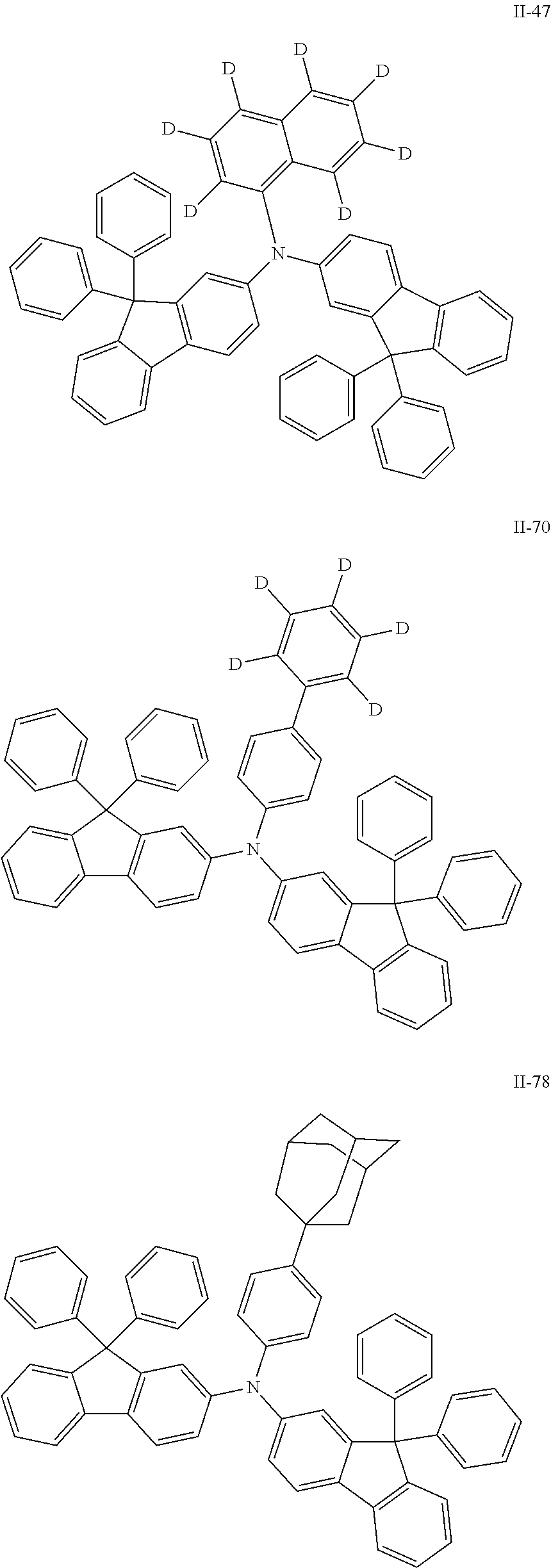
  • the electron blocking layer, the emissive auxiliary layer and/or the hole transport layer contain the triarylamine compound as shown in Formula II of the present disclosure, and most preferably, the emissive auxiliary layer and/or the hole transport layer contain the triarylamine compound as shown in Formula II of the present disclosure:
  • C is selected from one of the following groups:
  • R a is independently selected from one of hydrogen, deuterium, methyl, ethyl, propyl, butyl, adamantyl, camphanyl, norbornyl, phenyl, tolyl, biphenyl, triphenyl, naphthyl, anthryl, phenanthryl, triphenylenyl, acridinyl, spirodifluorenyl, 9,9-dimethylfluorenyl, 9,9-diphenylfluorenyl, 9-phenylcarbazolyl, pyrenyl, indolyl, benzothiophenyl, benzofuranyl, dibenzothiophenyl or dibenzofuranyl, or two adjacent groups are joined to form a ring;
  • At least one of the substituents A, B or C contains deuterium.
  • At least one of the substituents A, B or C contains adamantyl.
  • the groups A and B are independently selected from one of the following groups:
  • the group C is independently selected from one of the following groups:
  • the triarylamine compound as shown in Formula II is selected from one of the following structures:
  • the organic layer of the organic electroluminescent device of the present disclosure can include one or more of the following functional layers: a hole injection layer, an emissive auxiliary layer, a hole transport layer, an electron blocking layer, an emissive layer, a hole blocking layer, an electron transport layer, an electron injection layer, etc.
  • Each functional layer can consist of a single film or a plurality of films, and each film can include one material or a plurality of materials.
  • the film thickness of each functional layer is not particularly limited and is preferably 0.01 nm to 1 ⁇ m.
  • At least one functional layer includes the heterocyclic derivative as shown in Formula I, and preferably, the electron transport region, that is, the hole blocking layer, the electron transport layer and/or the electron injection layer, contains the heterocyclic derivative as shown in Formula I.
  • the hole transport region that is, the electron blocking layer, the emissive auxiliary layer, the hole transport layer and/or the hole injection layer, contains the triarylamine compound as shown in Formula II of the present disclosure.
  • the present disclosure does not particularly limit the material of each film in the organic electroluminescent device, and in addition to the above-mentioned heterocyclic derivative as shown in Formula I or the triarylamine compound as shown in Formula II of the present disclosure, substances known in the art can be used.
  • the materials in each organic functional layer of the above-mentioned organic electroluminescent device and the electrode materials on both sides of the device are introduced respectively below.
  • the anode material is preferably a material having a high work function to facilitate the injection of holes into the organic layer.
  • the anode material of the present disclosure includes metals, metal oxides, metal alloys, combinations of metals and oxides, conductive polymers, etc.
  • the anode materials include, but are not limited to, the following examples: gold, vanadium, chromium, copper, palladium, nickel, indium tin oxide (ITO), indium zinc oxide (IZO), zinc oxide, indium oxide, tin oxide:antimony (SnO 2 :Sb), polypyrrole, etc.
  • the hole injection material has the function of injecting holes into the organic layer, including metal oxides, phthalocyanine compounds, aromatic amine compounds, conjugated organic materials containing multicyanos, polymer materials, etc.
  • the hole transport material include, but are not limited to, molybdenum trioxide (MoO 3 ), copper phthalocyanine (CuPc), 4,4′,4′′-tris(N-3-methylphenyl-N-phenylamino)triphenylamine (m-MTDATA), 4,4′,4′′-tris(2-naphthyl(phenyl)amino]triphenylamine (2T-NATA), 1,4,5,8,9,11-hexaazatriphenylene (HAT-CN), (2E,2′E,2′′E)-2,2′,2′′-(cyclopropane-1,2,3-triylene)tris(2-(perfluorophenyl)-acetonitrile), poly(3,4-ethylenedioxythiophene
  • the hole transport material has the function of injecting holes and balancing carriers, including aromatic amine compounds, carbazole compounds, etc.
  • the hole transport material include, but are not limited to, the following materials: N,N′-biphenyl-N,N′-(1-naphthalenyl)-1,1′-biphenyl-4,4′-diamine (NPB), N4,N4,N4′,N4′-tetrakis([1,1′-biphenyl]-4-yl)-[1,1′-biphenyl]-4,4′-diamine, 4,4′-cyclohexylidenebis[N,N-bis(4-methylphenyl)aniline] (TAPC), N,N′-diphenyl-N,N′-bis(3-methylphenyl)-[1,1′-biphenyl]-4,4′-diamine (TPD), 2,2,7,7-tetrakis(diphenylamino)-9,
  • the emissive auxiliary material has the function of injecting holes and balancing carriers and may also have the function of blocking electrons.
  • the emissive auxiliary material includes aromatic amine compounds, carbazole compounds, etc.
  • Examples of the emissive auxiliary material include, but are not limited to, the following materials: tri(biphenyl-4-yl)amine (TBA), 4,4′,4′′-tris(N-3-methylphenyl-N-phenylamino)triphenylamine (MTDATA), N,N′-biphenyl-N,N′-(1-naphthalenyl)-1,1′-biphenyl-4,4′-diamine (NPB), 4,4′-cyclohexylidenebis[N,N-bis(4-methylphenyl)aniline] (TAPC), 2,2,7,7-tetrakis(diphenylamino)-9,9-spirobifluorene (Spiro-TAD), 4,4′,
  • the electron blocking material has the function of blocking electrons in the emissive layer, including aromatic amine compounds, etc.
  • the electron blocking material include, but are not limited to, the following materials: 4,4′,4′′-tris(carbazol-9-yl)-triphenylamine (TCTA), N,N′-biphenyl-N,N′-(1-naphthalenyl)-1,1′-biphenyl-4,4′-diamine (NPB), etc.
  • the light-emitting material has the function of receiving holes and electrons and enabling them to combine to emit visible light, and according to the emitting color, can be divided into red light-emitting materials, green light-emitting materials, and blue light-emitting materials.
  • the light-emitting material can be fluorescent materials or phosphorescent materials.
  • the light-emitting material can act as the emissive layer alone or may be doped into the host material as the emissive layer.
  • the blue light-emitting material includes perylene derivatives, styrene amine derivatives, anthracene derivatives, fluorene derivatives, metal complexes, organosilicon, organoboron, etc.
  • examples of the blue light-emitting material include, but are not limited to, the following materials: 2,5,8,11-tetra-tert-butylperylene (TBPe), 4,4′-bis[4-(ditolylamino)styryl]biphenyl (BDAVBi), 9-[4-(2-(7-(N,N-diphenylamino)-9,9-diethylfluoren-2-yl)vinyl)phenyl]-9-phenyl-fluorene (DPAFVF), 9,10-di(2-naphthyl)anthracene (AND), bis(4,6-difluorophenylpyridine-C2,N)picolinatoiridium (FIrpic), etc
  • the green light-emitting material includes coumarin dyes, quinacridone derivatives, polycyclic aromatic hydrocarbons, organosilicon compounds, pyrazoloquinoxaline derivatives, amino anthracene derivatives, hexabenzobenzene, imidazolone derivatives, thiophenopyrrole, naphthalimide, metal complexes, etc.
  • Examples of the green light-emitting material include, but are not limited to, the following materials: coumarin 545T, N,N′-dimethylquinacridone (DMQA), 5,12-diphenylnaphthonaphthalene (DPT), tris(2-phenylpyridine)iridium (Ir(ppy) 3 ), etc.
  • the red light-emitting material includes DCM series materials, metal complexes, etc.
  • Examples of the red light-emitting material include, but are not limited to, the following materials: 4-(dicyanomethylene)-2-methyl-6-(4-dimethylaminostyryl)-4h-pyran (DCM), 4-(dicyanomethylene)-2-tert-butyl-6-(1,1,7,7-tetramethyljulolidin-9-yl-vinyl)-4H-pyran (DCJTB), bis(1-phenyl-isoquinoline)(acetylacetonato)iridium(III) (Ir(piq) 2 (acac), octaethylporphine platin (PtOEP), etc.
  • DCM 4-(dicyanomethylene)-2-methyl-6-(4-dimethylaminostyryl)-4h-pyran
  • DCJTB 4-(dicyanomethylene)-2-tert-butyl-6-
  • the hole blocking material has the function of blocking holes in the emissive layer, including heterocyclic compounds such as imidazole compounds and phenanthroline compounds.
  • heterocyclic compounds such as imidazole compounds and phenanthroline compounds.
  • examples of the hole blocking material include, but are not limited to, the following materials: 1,3,5-tris(N-phenyl-2-benzimidazol)benzene (TPBi), 4,7-diphenyl-1,10-phenanthroline (Bphen), etc.
  • TPBi 1,3,5-tris(N-phenyl-2-benzimidazol)benzene
  • Bphen 4,7-diphenyl-1,10-phenanthroline
  • the hole blocking material is preferably the heterocyclic derivative as shown in Formula I of the present disclosure.
  • the electron transport material has the function of injecting electrons and balancing carriers, including heterocyclic compounds such as pyridine derivatives, imidazole derivatives, oxadiazole derivatives, triazole derivatives, phenanthroline derivatives and other, etc., and metal complexes.
  • heterocyclic compounds such as pyridine derivatives, imidazole derivatives, oxadiazole derivatives, triazole derivatives, phenanthroline derivatives and other, etc., and metal complexes.
  • electron transport material examples include, but are not limited to, the following materials: tris-(8-hydroxyquinoline)aluminum(III) (Alq 3 ), 3,3′-[5′-[3-(3-pyridinyl)phenyl] (TmPyPB), 1,3,5-tris(N-phenyl-2-benzimidazol)benzene (TPBi), 2-(4-biphenyl)-5-(4-tert-butylphenyl)-1,3,4-oxadiazole (PBD), 3-(biphenyl-4-yl)-4-phenyl-5-(4-tert-butylphenyl)-1,2,4-triazole (TAZ), 4,7-diphenyl-1,10-phenanthroline (Bphen), etc.
  • TmPyPB tris-(8-hydroxyquinoline)aluminum(III)
  • TmPyPB 3,3′-[5′-[3-(3-pyridinyl)
  • the electron injection material has the function of injecting electrons into the organic layer, including inorganic salts of alkali metals, alkali metal oxides, organic salts of alkali metals, alkali metal fluorides, alkali metal complexes, etc.
  • the electron injection material include, but are not limited to, the following materials: cesium carbonate (Cs 2 CO 3 ), lithium oxide (Li 2 O), potassium acetate (CH 3 COOK), lithium fluoride (LiF), 8-hydroxyquinolinolato-lithium (Liq), etc.
  • the cathode material is preferably a material having a low work function to facilitate the injection of electrons into the organic layer.
  • the cathode material of the present disclosure includes metals, metal alloys, etc.
  • the cathode includes, but is not limited to, the following examples: aluminum, silver, magnesium, calcium, magnesium-silver alloys, etc.
  • each film in the organic electroluminescent device of the present disclosure is not particularly limited, which may be a vacuum evaporation method, a sputtering method, a spin coating method, a spraying method, a silk-screen printing method, a laser transfer printing method, but is not limited thereto.
  • the organic electroluminescent device of the present disclosure is mainly applied to the technical field of information display and is widely applied to various information displays in the aspect of information display, such as tablet computers, flat-panel televisions, mobile phones, smart watches, digital cameras, VR, vehicle-mounted systems, wearable devices, etc.
  • the method for preparing the heterocyclic derivative as shown in Formula I of the present disclosure is not particularly limited, and conventional methods well known to those skilled in the art can be adopted.
  • a carbon-carbon coupling reaction more specifically, Suzuki reaction
  • the heterocyclic derivatives of Formula I of the present disclosure can be prepared according to the following synthetic routes.
  • the method for preparing the triarylamine compound as shown in Formula II of the present disclosure is not particularly limited, and conventional methods well known to those skilled in the art can be adopted.
  • a carbon-nitrogen coupling reaction more specifically, Buchwald reaction or Ullman reaction, can be adopted.
  • Raw materials and reagents are pure reagents.
  • the raw materials or reagents used in the following synthesis examples are not particularly limited in the present disclosure and may be commercially available products or be prepared in a preparation method known to those skilled in the art.
  • Theoretical element content (%) of C 60 H 38 N 2 OS 2 C, 83.11; H, 4.42; N, 3.23, measured element content (%): C, 83.10; H, 4.45; N, 3.28.
  • toluene 600 mL
  • a-1 (20.00 g, 0.06 mol)
  • b-1 23.83 g, 0.06 mol
  • palladium acetate 0.21 g, 0.93 mmol
  • sodium t-butoxide 11.3 g, 0.117 mol
  • tri-tert-butyl phosphine 8 mL of toluene solution
  • toluene solvent 600 ml
  • c-1 5.83 g, 36 mmol
  • Intermediate A-1 23.39 g, 36 mmol
  • Pd 2 (dba) 3 330 mg, 0.36 mmol
  • BINAP 0.67 g, 1.08 mmol
  • sodium t-butoxide 3.23 g, 33.6 mmol
  • Organic materials all organic materials were sublimated, achieving a purity above 99.99%.
  • Substrate a glass substrate was subjected to ultrasonic cleaning twice with 5% glass cleaning liquid for 20 minutes each time and then subjected to ultrasonic cleaning twice with deionized water for 10 minutes each time.
  • the glass substrate was subjected to ultrasonic cleaning sequentially with acetone and isoacetone for 20 minutes and dried at 120° C.
  • Evaporation system the devices were prepared by using a vacuum evaporation system, and the preparation was completed by consecutive evaporation under uninterrupted vacuum.
  • the materials used herein were respectively placed in quartz crucibles with different evaporation sources, and the temperature of evaporation sources could be controlled independently.
  • the thermal evaporation rate of the organic materials or the doped parent organic materials was generally set at 0.1 nm/s, and the evaporation rate of the doped materials was adjusted according to the doping ratio; the evaporation rate of the electrode metals was 0.4 nm/s to 0.6 nm/s.
  • the processed glass substrate was placed in an OLED vacuum coating machine.
  • the vacuum degree of the system was maintained below (5 ⁇ 10 ⁇ 5 ) Pa
  • the organic layers and the metal electrodes were respectively evaporated by replacing mask plates
  • the evaporation rate was detected by an SQM160 quartz crystal film thickness detector produced by INFICON
  • the film thickness was detected by a quartz crystal oscillator.
  • Test system test software, a computer, K2400 SourceMeter produced by KEITHLEY, USA, and PR788 SpectraScan produced by PHOTO RESEARCH, USA were combined into a joint IVL test system to test the drive voltage, the luminous efficiency and the like of the organic electroluminescent devices.
  • HAT-CN was deposited on the ITO transparent electrode by thermal evaporation as the hole injection layer with an evaporation thickness of 10 nm
  • NPB was deposited on the hole injection layer by thermal evaporation as the hole transport layer with an evaporation thickness of 50 nm
  • Compound 1 of the present disclosure was deposited on the emissive layer by thermal evaporation as the hole blocking layer with an evaporation thickness of 5 nm
  • Liq was deposited on the electron transport layer by thermal evaporation as the electron injection layer with an evaporation thickness of 1 nm
  • Al was deposited on the electron injection layer by
  • the device structure of the organic electroluminescent device 1 is as follows:
  • the organic electroluminescent devices 2 to 11 were prepared according to the same steps as described in Example 1 except that Compound 1 in the hole blocking layer in Example 1 was replaced with Compound 6, Compound 19, Compound 22, Compound 29, Compound 37, Compound 57, Compound 77, Compound 173, Compound 219, and Compound 244 respectively.
  • HAT-CN was deposited on the ITO transparent electrode by thermal evaporation as the hole injection layer with an evaporation thickness of 10 nm
  • NPB was deposited on the hole injection layer by thermal evaporation as the hole transport layer with an evaporation thickness of 50 nm
  • Compound II-21 of the present disclosure was deposited on the hole transport layer by thermal evaporation as the emissive auxiliary layer with an evaporation thickness of 10 nm
  • Compound 1 of the present disclosure was deposited on the emissive layer by thermal evaporation as the hole blocking layer with an evaporation thickness of 5 nm
  • the device structure of the organic electroluminescent device 12 is as follows:
  • the organic electroluminescent devices 13 to 25 were prepared according to the same steps as described in Example 12 except that Compound 1 in the hole blocking layer in Example 12 was replaced with Compound 42, Compound 43, Compound 51, Compound 65, Compound 71, Compound 95, Compound 102, Compound 106, Compound 108, Compound 153, Compound 164, Compound 201, and Compound 250 respectively and Compound II-21 in the emissive auxiliary layer was replaced with Compound II-102, Compound II-1, Compound II-47, Compound II-70, Compound II-119, Compound II-85, Compound II-77, Compound II-79, Compound II-76, Compound II-159, Compound II-90, Compound II-73, and Compound II-78 respectively.
  • Comparative Examples 1 to 3 Preparation of Comparative Organic Electroluminescence Devices 1 to 3
  • the comparative organic electroluminescent devices 1 to 3 were prepared according to the same steps as described in Example 1 except that Compound 1 in the hole blocking layer in Example 1 was replaced with Compound R-1, Compound R-2, and Compound R-3 respectively.
  • the comparative organic electroluminescent devices 4 to 6 were prepared according to the same steps as described in Example 12 except that Compound 1 in the hole blocking layer in Example 12 was replaced with Compound 1, Compound R-1 and Compound R-1 respectively and Compound II-1 in the emissive auxiliary layer was replaced with Compound HT-1, Compound HT-2, and Compound HT-2 respectively.
  • devices 1 to 11 had lower drive voltages and higher luminous efficiency than comparative devices 1 to 3 .
  • the heterocyclic derivative of Formula I of the present disclosure has good electron mobility and good hole blocking performance and can effectively block holes in the emissive layer to enable electrons and holes to effectively form excitons in the emissive layer.
  • the organic electroluminescent devices 12 to 25 had lower drive voltages and higher luminous efficiency.
  • the triarylamine compound as shown in Formula II of the present disclosure has high hole mobility and can effectively transport holes. Meanwhile, it also shows that the electron transport region where the hole blocking layer containing the heterocyclic derivative of Formula I is located and the hole transport region where the emissive auxiliary layer containing the triarylamine compound of Formula II is located balance the injection and transport of electrons and holes well, which reduces the quenching of excitons and improves the recombination probability of carriers, and thus the device has low drive voltage and high luminous efficiency.

Landscapes

  • Chemical & Material Sciences (AREA)
  • Organic Chemistry (AREA)
  • Engineering & Computer Science (AREA)
  • Materials Engineering (AREA)
  • Physics & Mathematics (AREA)
  • Spectroscopy & Molecular Physics (AREA)
  • Optics & Photonics (AREA)
  • Electroluminescent Light Sources (AREA)
  • Plural Heterocyclic Compounds (AREA)
  • Nitrogen And Oxygen Or Sulfur-Condensed Heterocyclic Ring Systems (AREA)

Abstract

Provided are a heterocyclic derivative and an organic electroluminescent device thereof, which relates to the field of organic photoelectric materials. The heterocyclic derivative of Formula I has high electron mobility and great hole blocking performance, and thus the organic electroluminescent device prepared by using the heterocyclic derivative as the electron transport region material, especially the hole blocking material, has low drive voltage and high luminous efficiency. The organic electroluminescent device can also include a hole transport region, and the hole transport region, especially the emissive auxiliary layer, contains the triarylamine compound of Formula II. Since the electron transport region and the hole transport region of the device can effectively balance carriers, which reduces the quenching of excitons and improves the recombination probability of carriers, the device shows low drive voltage and high luminous efficiency.

Description

CROSS-REFERENCE TO RELATED APPLICATION(S)
This application claims priority to Chinese Patent Application No. CN 202011377608.8 filed on Nov. 30, 2020, the disclosure of which is incorporated herein by reference in its entirety.
TECHNICAL FIELD
The present disclosure relates to the technical field of organic photoelectric materials and specifically, relates to a heterocyclic derivative and an organic electroluminescent device thereof.
BACKGROUND
OLED technology refers to the technology that organic materials emit light under the action of the electric field. According to the difference in driving modes, OLED can be divided into passive-matrix OLED (PMOLED) and active-matrix OLED (AMOLED). OLED is a new generation of flat panel display technology after CRT and LCD. It has the characteristics of wide viewing angle, fast response speed, low power consumption, good shock resistance of solid structure, wide working temperature range, thinness, and flexibility, and is known as “fantastic display technology”.
The electroluminescence process of organic electroluminescent devices is a process of energy transfer. In this process, the organic electroluminescent device converts electric energy into light energy, and the organic electroluminescent device is regarded as an injection-type light-emitting diode in this conversion process. A voltage is applied to both ends of the organic electroluminescent device. Through the electric field generated by this voltage, holes are injected into the hole transport layer from the anode of the device, while electrons are injected into the electron transport layer from the cathode of the device. These two kinds of carriers migrate into the emissive layer and combine to form excitons, and the radiative transition of excitons causes light emission.
The structure of organic electroluminescent devices is a simple “sandwich” structure, and a basic device is formed by placing an organic functional layer between the anode and the cathode. The organic functional layer can be a single-layer organic functional layer, a double-layer organic functional layer, a three-layer organic functional layer, and a multi-layer organic functional layer, and the types of the organic functional layer can be a hole injection layer, a hole transport layer, an electron blocking layer, an emissive layer, a hole blocking layer, an electron transport layer, an electron injection layer, etc.
It can be seen from the above that the organic electroluminescent device is a stacked structure composed of a variety of functional layers with different properties, and these functional layers have different functions and cooperate with each other to form an organic whole. Each functional layer corresponds to related functional material, that is, the hole injection material, the hole transport material, the electron blocking material, the light-emitting material, the hole blocking material, the electron transport material, the electron injection material, and so on. Although the properties of the light-emitting material are very important for organic electroluminescent devices, in order to improve the performance of devices comprehensively, it is necessary not only to have high-quality light-emitting materials but also to have many auxiliary materials with excellent properties, such as hole injection materials, hole transport materials, electron blocking materials, hole blocking materials, electron transport materials, electron injection materials and so on. The improvement of the properties of these auxiliary materials is helpful to improve the performance of organic electroluminescent devices. Therefore, it is of great significance to research and develop new auxiliary materials.
SUMMARY
In view of the preceding problems in the related art, the present disclosure provides a heterocyclic derivative and an organic electroluminescent device thereof.
The present disclosure provides a heterocyclic derivative having a general structural formula as shown in Formula I:
Figure US12297191-20250513-C00001
    • wherein Ar1 and Ar2 are identical or different and selected from the following group:
Figure US12297191-20250513-C00002
    • wherein R0 is selected from one of hydrogen, deuterium, halogen, cyano, nitro, substituted or unsubstituted C1 to C30 alkyl, substituted or unsubstituted C3 to C30 cycloalkyl, substituted or unsubstituted C6 to C60 aryl or substituted or unsubstituted C3 to C60 heteroaryl,
    • X0 is selected from one of O, S, N(Rx) or C(Rx)2, wherein Rx is selected from one of substituted or unsubstituted C1 to C30 alkyl, substituted or unsubstituted C3 to C30 cycloalkyl, substituted or unsubstituted C6 to C60 aryl or substituted or unsubstituted C3 to C60 heteroaryl,
    • Z is selected from C(Ry) or N, wherein Ry is selected from one of hydrogen, deuterium, halogen, cyano, nitro, substituted or unsubstituted C1 to C30 alkyl, substituted or unsubstituted C3 to C30 cycloalkyl, substituted or unsubstituted C2 to C30 alkenyl, substituted or unsubstituted C2 to C30 alkynyl, substituted or unsubstituted C6 to C60 aryl or substituted or unsubstituted C3 to C60 heteroaryl, or two adjacent groups are joined to form a ring;
    • X is selected from one of O, S, N(Ar), C(Ar)2 or Si(Ar)2, wherein Ar is selected from one of substituted or unsubstituted C1 to C30 alkyl, substituted or unsubstituted C3 to C30 cycloalkyl, substituted or unsubstituted C6 to C60 aryl or substituted or unsubstituted C3 to C60 heteroaryl;
    • m is selected from 0, 1, 2, 3 or 4, and R is identically or differently selected from one of deuterium, cyano, nitro, substituted or unsubstituted C1 to C30 alkyl, substituted or unsubstituted C3 to C30 cycloalkyl, substituted or unsubstituted C2 to C30 alkenyl, substituted or unsubstituted C2 to C30 alkynyl, substituted or unsubstituted C6 to C60 aryl or substituted or unsubstituted C3 to C60 heteroaryl, or two adjacent groups are joined to form a ring;
    • Lx and Ly are independently selected from one of a single bond, substituted or unsubstituted C1 to C30 alkylene, substituted or unsubstituted C3 to C30 cycloalkylene, substituted or unsubstituted C6 to C60 arylene or substituted or unsubstituted C3 to C60 heteroarylene; and
    • L1 and L2 are independently selected from one of a single bond, substituted or unsubstituted C6 to C60 arylene or substituted or unsubstituted C3 to C60 heteroarylene.
The present disclosure further provides an organic electroluminescent device including an anode, an organic layer, and a cathode, wherein the organic layer is disposed between the anode and the cathode, and the organic layer includes an electron transport region containing the above-mentioned heterocyclic derivative of the present disclosure.
Beneficial effects: The heterocyclic derivative as shown in Formula I of the present disclosure has high electron mobility and great hole blocking performance, and can not only balance carriers well, but also block holes from entering the electron transport region, so the organic electroluminescent device prepared by using the heterocyclic derivative as the hole blocking layer shows low drive voltage and high luminous efficiency.
In addition, since the triarylamine compound of Formula II has high hole mobility, the hole transport region where the triarylamine compound is located when used as the emissive auxiliary layer and the electron transport region where the hole blocking layer is located can effectively balance carriers, which reduces the quenching of excitons and improves the recombination probability of carriers, and thus the device shows great photoelectric performance.
BRIEF DESCRIPTION OF DRAWINGS
FIG. 1 is a 1H NMR graph of Compound 1 of the present disclosure;
FIG. 2 is a 1H NMR graph of Compound 22 of the present disclosure;
FIG. 3 is a 1H NMR graph of Compound 51 of the present disclosure;
FIG. 4 is a 1H NMR graph of Compound 108 of the present disclosure.
DETAILED DESCRIPTION
The present disclosure is further illustrated below in conjunction with specific embodiments. It is understood that these embodiments are intended to illustrate the present disclosure and not to limit the scope thereof, and modifications of various equivalents of the present disclosure by those skilled in the art after reading the present disclosure fall within the scope of the claims of the present application.
In the present disclosure, “halogen” includes fluorine, chlorine, bromine, and iodine.
In the present disclosure, “unsubstituted” in “substituted or unsubstituted” means that the hydrogen atom on the group is not replaced with any substituent.
In the present disclosure, “substituted” in “substituted or unsubstituted” means that at least one hydrogen atom on the group is replaced with substituents. When a plurality of hydrogen is replaced with a plurality of substituents, the plurality of substituents may be identical or different. The position of the hydrogen replaced with the substituent can be any position. The substituent represented in the “substitution” includes, but is not limited to, at least one of deuterium, halogen, cyano, nitro, C1 to C30 alkyl, C3 to C30 cycloalkyl, C6 to C60 aryl, C3 to C60 heteroaryl or C6 to C60 amine.
In the present disclosure, the expression of being joined to form a ring means that two groups are attached to each other through a chemical bond. In the present disclosure, the formed ring can be a five-membered ring, a six-membered ring or a fused ring, such as a benzene ring, a naphthalene ring, a phenanthrene ring, an anthracene ring, a triphenylene ring, a fluorene ring, a quinoline ring, a dibenzofuran ring, a dibenzothiophene ring, a carbazole ring, etc., but is not limited thereto.
In the present disclosure, the alkyl refers to a monovalent group formed by removing a hydrogen atom from an alkane molecule. The alkyl includes straight and branched chain alkyl groups. The number of carbon atoms of the alkyl is not particularly limited and is preferably C1 to C60, further preferably C1 to C30, more preferably C1 to C15, and most preferably C1 to C10. Examples of the alkyl include, but are not limited to, the following groups: methyl, ethyl, propyl, butyl, amyl, hexyl, heptyl, octyl, nonyl, decyl, etc. The chain alkyl group having more than three carbons in the present disclosure includes its isomers, for example, propyl includes n-propyl, isopropyl, t-butyl includes n-butyl, t-butyl, isobutyl, sec-butyl group, and so on.
In the present disclosure, the cycloalkyl refers to a monovalent group formed by removing a hydrogen atom from a cycloalkane molecule. The number of carbon atoms of the cycloalkyl is not particularly limited and is preferably C3 to C60, further preferably C3 to C30, more preferably C3 to C15, and most preferably C3 to C10. Examples of the cycloalkyl include, but are not limited to, the following groups: cyclopropyl, cyclobutyl, cyclopentyl, cyclohexyl, cyclooctane, adamantyl, camphanyl, norbornyl, cubyl, etc.
In the present disclosure, the aryl refers to a monovalent group formed by removing a hydrogen atom from the parent nucleus of an arene molecule. The aryl includes monocyclic aryl, polycyclic aryl, and fused aryl. The number of carbon atoms of the aryl is not particularly limited and is preferably C6 to C60, further preferably C6 to C30, more preferably C6 to C18, and most preferably C6 to C14. Examples of the aryl include, but are not limited to, the following groups: phenyl, biphenyl, triphenyl, tetraphenyl, naphthyl, anthryl, benzoanthryl, phenanthryl, triphenylenyl, pyrenyl, benzopyrenyl, perylenyl, fluoranthenyl, indenyl, fluorenyl, benzofluorenyl, dibenzofluorenyl, spirofluorenyl, benzospirofluorenyl, dibenzospirofluorenyl, etc.
In the present disclosure, the heteroaryl refers to a monovalent group formed by removing a hydrogen atom from the parent nucleus of a heterocyclic arene molecule. The heteroatoms in the heteroaryl include, but are not limited to, the following atoms: O, S, N, Si, B, P, Se, etc. The heteroaryl includes monocyclic heteroaryl, polycyclic heteroaryl, and fused ring heteroaryl. The number of carbon atoms of the heteroaryl is not particularly limited and is preferably C3 to C60, further preferably C3 to C30, more preferably C3 to C15, and most preferably C3 to C8. Examples of the heteroaryl include, but are not limited to, the following groups: pyridyl, pyrazinyl, pyridazinyl, pyrimidinyl, triazinyl, quinolinyl, isoquinolinyl, quinoxalinyl, quinazolinyl, phenanthrolinyl, oxadiazolyl, oxazolyl, benzoxazolyl, naphthoxazolyl, phenanthroxazolyl, thiazolyl, benzothiazolyl, naphthothiazolyl, phenanthrothiazolyl, imidazolyl, benzimidazolyl, naphthoimidazolyl, phenanthroimidazolyl, furanyl, benzofuranyl, dibenzofuranyl, benzodibenzofuranyl, thiophenyl, benzothiophenyl, dibenzothiophenyl, benzodibenzothiophenyl, carbazolyl, benzocarbazolyl, dibenzocarbazolyl, acridinyl, etc.
In the present disclosure, the alkenyl refers to a monovalent group formed by removing a hydrogen atom from an olefin molecule, and the alkenyl includes monoalkenyl, dialkenyl, polyalkenyl, etc. The number of carbon atoms of the alkenyl is not particularly limited and is preferably C2 to C60, further preferably C2 to C30, more preferably C2 to C15, and most preferably C2 to C10. Examples of the alkenyl include, but are not limited to, the following groups: vinyl, butadienyl, etc.
In the present disclosure, the alkynyl refers to a monovalent group formed by removing a hydrogen atom from an alkyne molecule, and the alkynyl includes monoalkynyl, dialkynyl, polyalkynyl, etc. The number of carbon atoms of the alkynyl is not particularly limited and is preferably C2 to C60, further preferably C2 to C30, more preferably C2 to C15, and most preferably C2 to C10. Examples of the alkynyl include, but are not limited to, the following groups: ethynyl, butadiynyl, etc.
In the present disclosure, the alkylene refers to a divalent group formed by removing two hydrogens from an alkane molecule. The number of carbon atoms of the alkylene is not particularly limited and is preferably C1 to C60, further preferably C1 to C30, more preferably C1 to C15, and most preferably C1 to C10. Examples of the alkylene include, but are not limited to, the following groups: methylene, ethylene, etc.
In the present disclosure, the cycloalkylene refers to a divalent group formed by removing two hydrogens from a cycloalkane molecule. The number of carbon atoms of the cycloalkylene is not particularly limited and is preferably C3 to C60, further preferably C3 to C30, more preferably C3 to C15, and most preferably C3 to C10. Examples of the cycloalkylene include, but are not limited to, the following groups: adamantylene, camphanylene, norbornylene, etc.
In the present disclosure, the arylene refers to a divalent group formed by removing two hydrogen atoms from the parent nucleus of an aromatic hydrocarbon molecule. The arylene includes monocyclic arylene, polycyclic arylene, fused ring arylene or combinations thereof. The number of carbon atoms of the arylene is not particularly limited and is preferably C6 to C60, further preferably C6 to C30, more preferably C6 to C18, and most preferably C6 to C14. Examples of the arylene include, but are not limited to, the following groups: phenylene, biphenylene, triphenylene, tetraphenylene, naphthylene, phenanthrylene, anthrylene, triphenylenylene, pyrenylene, fluorenylene, benzofluorenylene, spirodifluorenylene, benzospirodifluorenylene, etc. The arylene of the present disclosure also includes a divalent group formed by connecting a monocyclic arene with a polycyclic arene through a single bond, a divalent group formed by connecting a fused ring arene with a fused ring arene through a single bond, such as
Figure US12297191-20250513-C00003

which is a divalent group formed by connecting benzene with phenanthrene through a single bond, and so on.
In the present disclosure, the heteroarylene refers to a divalent group formed by removing two hydrogen atoms from the parent nucleus of a heterocyclic arene molecule. The heteroatoms include, but are not limited to, the following atoms: O, S, N, Si, B, P, Se, etc. The heteroarylene includes monocyclic heteroarylene, polycyclic heteroarylene, fused ring heteroarylene or combinations thereof. The polycyclic heteroarylene can have only one benzene ring substituted by heteroatoms or a plurality of benzene rings substituted by heteroatoms. The number of carbon atoms of the heteroarylene is not particularly limited and is preferably C6 to C60, further preferably C6 to C30, more preferably C3 to C15, and most preferably C3 to C8. Examples of the heteroarylene include, but are not limited to, the following groups: pyridinylene, pyrimidinylene, pyrazinylene, pyridazinylene, triazinylene, furanylene, thiophenylene, quinolinylene, isoquinolinylene, quinoxalinylene, quinazolinylene, phenanthrolinylene, benzofuranylene, dibenzofuranylene, benzodibenzofuranylene, benzothiophenylene, dibenzothiophenylene, benzodibenzothiophenylene, carbazolylene, benzocarbazolylene, etc. The heteroarylene of the present disclosure also includes a divalent group formed by connecting a heterocyclic arene with a heterocyclic arene through a single bond, a divalent group formed by connecting an arene with a heterocyclic arene through a single bond, such as
Figure US12297191-20250513-C00004

which is a divalent group formed by connecting pyridine with benzene through a single bond, and so on.
“C1 to C30” in the “substituted or unsubstituted C1 to C30 alkyl” represents the number of carbon atoms in the unsubstituted “alkyl” and does not include the number of carbon atoms in the substituent; “C6 to C60” in the “substituted or unsubstituted C6 to C60 aryl” represents the number of carbon atoms in the unsubstituted “aryl” and does not include the number of carbon atoms in the substituent; “C3 to C60” in the “substituted or unsubstituted C3 to C60 heteroaryl” represents the number of carbon atoms in the unsubstituted “heteroaryl” and does not include the number of carbon atoms in the substituent; “C6 to C60” in the “substituted or unsubstituted C6 to C60 arylene” represents the number of carbon atoms in the unsubstituted “arylene” and does not include the number of carbon atoms in the substituent; “C3 to C60” in the “substituted or unsubstituted C3 to C60 heteroarylene” represents the number of carbon atoms in the unsubstituted “heteroarylene” and does not include the number of carbon atoms in the substituent; and son on.
The present disclosure provides a heterocyclic derivative having a general structural formula as shown in Formula I:
Figure US12297191-20250513-C00005
    • wherein Ar1 and Ar2 are identical or different and selected from the following group:
Figure US12297191-20250513-C00006
    • wherein R0 is selected from one of hydrogen, deuterium, halogen, cyano, nitro, substituted or unsubstituted C1 to C30 alkyl, substituted or unsubstituted C3 to C30 cycloalkyl, substituted or unsubstituted C6 to C60 aryl or substituted or unsubstituted C3 to C60 heteroaryl,
    • X0 is selected from one of O, S, N(Rx) or C(Rx)2, and Rx is selected from one of substituted or unsubstituted C1 to C30 alkyl, substituted or unsubstituted C3 to C30 cycloalkyl, substituted or unsubstituted C6 to C60 aryl or substituted or unsubstituted C3 to C60 heteroaryl,
    • Z is selected from C(Ry) or N, wherein Ry is selected from one of hydrogen, deuterium, halogen, cyano, nitro, substituted or unsubstituted C1 to C30 alkyl, substituted or unsubstituted C3 to C30 cycloalkyl, substituted or unsubstituted C2 to C30 alkenyl, substituted or unsubstituted C2 to C30 alkynyl, substituted or unsubstituted C6 to C60 aryl or substituted or unsubstituted C3 to C60 heteroaryl, or two adjacent groups are joined to form a ring;
    • X is selected from one of O, S, N(Ar), C(Ar)2 or Si(Ar)2, wherein Ar is selected from one of substituted or unsubstituted C1 to C30 alkyl, substituted or unsubstituted C3 to C30 cycloalkyl, substituted or unsubstituted C6 to C60 aryl or substituted or unsubstituted C3 to C60 heteroaryl;
    • m is selected from 0, 1, 2, 3 or 4, and R is identically or differently selected from one of deuterium, cyano, nitro, substituted or unsubstituted C1 to C30 alkyl, substituted or unsubstituted C3 to C30 cycloalkyl, substituted or unsubstituted C2 to C30 alkenyl, substituted or unsubstituted C2 to C30 alkynyl, substituted or unsubstituted C6 to C60 aryl or substituted or unsubstituted C3 to C60 heteroaryl, or two adjacent groups are joined to form a ring;
    • Lx and Ly are independently selected from one of a single bond, substituted or unsubstituted C1 to C30 alkylene, substituted or unsubstituted C3 to C30 cycloalkylene, substituted or unsubstituted C6 to C60 arylene or substituted or unsubstituted C3 to C60 heteroarylene; and
    • L1 and L2 are independently selected from one of a single bond, substituted or unsubstituted C6 to C60 arylene or substituted or unsubstituted C3 to C60 heteroarylene.
Preferably, Lx and Ly are independently selected from a single bond, substituted or unsubstituted adamantylene, substituted or unsubstituted camphanylene, substituted or unsubstituted norbornylene, substituted or unsubstituted phenylene, substituted or unsubstituted biphenylene, substituted or unsubstituted terphenylene, substituted or unsubstituted naphthylene, substituted or unsubstituted phenanthrylene, substituted or unsubstituted triphenylenylene, substituted or unsubstituted fluorenylene, substituted or unsubstituted benzofluorenylene, substituted or unsubstituted spirodifluorenylene, substituted or unsubstituted benzospirodifluorenylene, substituted or unsubstituted dibenzofuranylene, substituted or unsubstituted dibenzothiophenylene, substituted or unsubstituted carbazolylene, substituted or unsubstituted quinolinylene, substituted or unsubstituted isoquinolinylene, substituted or unsubstituted naphthyridinylene, substituted or unsubstituted quinoxalinylene, substituted or unsubstituted quinazolinylene or substituted or unsubstituted phenanthrolinylene; and
    • L1 and L2 are independently selected from a single bond or one of the following groups:
Figure US12297191-20250513-C00007
    • wherein T is identically or differently selected from N or C(Rm), wherein Rm is selected from one of hydrogen, deuterium, cyano, nitro, substituted or unsubstituted C1 to C30 alkyl, substituted or unsubstituted C3 to C30 cycloalkyl, substituted or unsubstituted C6 to C60 aryl or substituted or unsubstituted C3 to C60 heteroaryl;
    • Y is selected from O, S, N(Rn) or C(Rn)2, wherein Rn is selected from one of hydrogen, deuterium, substituted or unsubstituted C1 to C30 alkyl, substituted or unsubstituted C3 to C30 cycloalkyl, substituted or unsubstituted C2 to C30 alkenyl, substituted or unsubstituted C2 to C30 alkynyl, substituted or unsubstituted C6 to C60 aryl or substituted or unsubstituted C3 to C60 heteroaryl, or two adjacent groups are joined to form a ring; and
    • L0 is identically or differently selected from one of a single bond, substituted or unsubstituted C6 to C60 arylene or substituted or unsubstituted C3 to C60 heteroarylene.
Preferably, Ar1 and Ar2 are independently selected from one of the following groups:
Figure US12297191-20250513-C00008
Figure US12297191-20250513-C00009
Figure US12297191-20250513-C00010
Figure US12297191-20250513-C00011
Figure US12297191-20250513-C00012
Figure US12297191-20250513-C00013
Figure US12297191-20250513-C00014
Figure US12297191-20250513-C00015
Figure US12297191-20250513-C00016
Figure US12297191-20250513-C00017
Figure US12297191-20250513-C00018
Figure US12297191-20250513-C00019
Preferably, L1 and L2 are independently selected from a single bond or one of the following groups:
Figure US12297191-20250513-C00020
Figure US12297191-20250513-C00021
Figure US12297191-20250513-C00022
Figure US12297191-20250513-C00023
Figure US12297191-20250513-C00024
Figure US12297191-20250513-C00025
Figure US12297191-20250513-C00026
Preferably, the heterocyclic derivative is selected from one of the following structures:
Figure US12297191-20250513-C00027
Figure US12297191-20250513-C00028
Figure US12297191-20250513-C00029
Figure US12297191-20250513-C00030
Figure US12297191-20250513-C00031
Figure US12297191-20250513-C00032
Figure US12297191-20250513-C00033
Figure US12297191-20250513-C00034
Figure US12297191-20250513-C00035
Figure US12297191-20250513-C00036
Figure US12297191-20250513-C00037
Figure US12297191-20250513-C00038
Figure US12297191-20250513-C00039
Figure US12297191-20250513-C00040
Figure US12297191-20250513-C00041
Figure US12297191-20250513-C00042
Figure US12297191-20250513-C00043
Figure US12297191-20250513-C00044
Figure US12297191-20250513-C00045
Figure US12297191-20250513-C00046
Figure US12297191-20250513-C00047
Figure US12297191-20250513-C00048
Figure US12297191-20250513-C00049
Figure US12297191-20250513-C00050
Figure US12297191-20250513-C00051
Figure US12297191-20250513-C00052
Figure US12297191-20250513-C00053
Figure US12297191-20250513-C00054
Figure US12297191-20250513-C00055
Figure US12297191-20250513-C00056
Figure US12297191-20250513-C00057
Figure US12297191-20250513-C00058
Figure US12297191-20250513-C00059
Figure US12297191-20250513-C00060
Figure US12297191-20250513-C00061
Figure US12297191-20250513-C00062
Figure US12297191-20250513-C00063
Figure US12297191-20250513-C00064
Figure US12297191-20250513-C00065
Figure US12297191-20250513-C00066
Some specific chemical structures of the heterocyclic derivative as shown in Formula I of the present disclosure are listed above, but the present disclosure is not limited to these chemical structures. Any group based on the structure shown in Formula I and having a substituent as defined above shall be included.
Further, the present disclosure further provides an organic electroluminescent device including an anode, an organic layer, and a cathode, wherein the organic layer is disposed between the anode and the cathode, and the organic layer includes an electron transport region containing the heterocyclic derivative of the above-mentioned present disclosure.
The electron transport region of the present disclosure is composed of one or more of a hole blocking layer, an electron transport layer, an electron injection layer or a functional layer having an electron injection/transport property. Preferably, the hole blocking layer and/or the electron transport layer contain the heterocyclic derivative of the present disclosure, and most preferably, the hole blocking layer contains the heterocyclic derivative of the present disclosure.
Preferably, the organic layer further includes a hole transport region containing a triarylamine compound as shown in Formula II, and the hole transport region of the present disclosure is composed of one or more of an electron blocking layer, an emissive auxiliary layer, a hole transport layer, a hole injection layer or a functional layer having a hole injection/transport property. Preferably, the electron blocking layer, the emissive auxiliary layer and/or the hole transport layer contain the triarylamine compound as shown in Formula II of the present disclosure, and most preferably, the emissive auxiliary layer and/or the hole transport layer contain the triarylamine compound as shown in Formula II of the present disclosure:
Figure US12297191-20250513-C00067
    • wherein A and B are independently selected from one of the following substituents:
Figure US12297191-20250513-C00068
    • wherein Ra is identically or differently selected from one of hydrogen, deuterium, substituted or unsubstituted C1 to C15 alkyl, substituted or unsubstituted C3 to C15 cycloalkyl, substituted or unsubstituted C2 to C30 alkenyl, substituted or unsubstituted C6 to C30 aryl or substituted or unsubstituted C3 to C30 heteroaryl, or two adjacent groups are joined to form a ring;
    • Rb is identically or differently selected from one of hydrogen, deuterium, substituted or unsubstituted C1 to C15 alkyl, substituted or unsubstituted C3 to C15 cycloalkyl, substituted or unsubstituted C2 to C30 alkenyl, substituted or unsubstituted C6 to C30 aryl or substituted or unsubstituted C3 to C30 heteroaryl, or two adjacent groups are joined to form a ring;
    • La is selected from one of a single bond, substituted or unsubstituted C6 to C30 arylene or substituted or unsubstituted C3 to C30 heteroarylene;
    • a is selected from 0, 1, 2, 3 or 4, and b is selected from 0, 1, 2, 3, 4 or 5; and
    • C is selected from one of the following groups:
Figure US12297191-20250513-C00069
Figure US12297191-20250513-C00070
    • wherein R12 is selected from one of methyl, ethyl, propyl, butyl, phenyl, tolyl, biphenyl or naphthyl;
    • R13 is selected from one of deuterium, methyl, ethyl, propyl, butyl, cyclohexyl, adamantyl, phenyl, tolyl, biphenyl, terphenyl, naphthyl, anthryl, phenanthryl, triphenylenyl, acridyl, spirodifluorenyl, 9,9-dimethylfluorenyl, 9,9-diphenylfluorenyl, 9-phenylcarbazolyl, pyrenyl, indolyl, benzothiophenyl, benzofuranyl, dibenzothiophenyl or dibenzofuranyl;
    • Lb is selected from one of a single bond, phenylene, deuterated phenylene, deuterated naphthylene, tolylene, biphenylene, naphthylene, terphenylene, dibenzofuranylene, fluorenylene or dibenzothienylene; and
    • c is selected from 0, 1, 2, 3, 4 or 5; d is selected from 0, 1, 2, 3 or 4; e is selected from 0, 1, 2, 3, 4, 5, 6 or 7; f is selected from 0, 1, 2, 3, 4, 5, 6, 7, 8 or 9.
Preferably, C is selected from one of the following groups:
Figure US12297191-20250513-C00071
Figure US12297191-20250513-C00072
Figure US12297191-20250513-C00073
Figure US12297191-20250513-C00074
Figure US12297191-20250513-C00075
Figure US12297191-20250513-C00076
Figure US12297191-20250513-C00077
Figure US12297191-20250513-C00078
Figure US12297191-20250513-C00079
Figure US12297191-20250513-C00080
Preferably, Ra is independently selected from one of hydrogen, deuterium, methyl, ethyl, propyl, butyl, adamantyl, camphanyl, norbornyl, phenyl, tolyl, biphenyl, triphenyl, naphthyl, anthryl, phenanthryl, triphenylenyl, acridinyl, spirodifluorenyl, 9,9-dimethylfluorenyl, 9,9-diphenylfluorenyl, 9-phenylcarbazolyl, pyrenyl, indolyl, benzothiophenyl, benzofuranyl, dibenzothiophenyl or dibenzofuranyl, or two adjacent groups are joined to form a ring;
    • La is selected from one of a single bond, phenylene, tolylene, biphenylene, naphthylene, terphenylene, dibenzofuranylene, fluorenylene or dibenzothienylene; and
    • Rb is identically or differently selected from one of hydrogen, deuterium, methyl, ethyl, propyl, butyl, adamantyl, camphanyl, norbornyl, phenyl, tolyl, biphenyl or triphenyl, or two adjacent groups are joined to form a ring.
Preferably, in the triarylamine compound as shown in Formula II, at least one of the substituents A, B or C contains deuterium.
Preferably, in the triarylamine compound as shown in Formula II, at least one of the substituents A, B or C contains adamantyl.
Preferably, the groups A and B are independently selected from one of the following groups:
Figure US12297191-20250513-C00081
Figure US12297191-20250513-C00082
Figure US12297191-20250513-C00083
Figure US12297191-20250513-C00084
Figure US12297191-20250513-C00085
Figure US12297191-20250513-C00086
Preferably, the group C is independently selected from one of the following groups:
Figure US12297191-20250513-C00087
Figure US12297191-20250513-C00088
Figure US12297191-20250513-C00089
Figure US12297191-20250513-C00090
Figure US12297191-20250513-C00091
Figure US12297191-20250513-C00092
Figure US12297191-20250513-C00093
Figure US12297191-20250513-C00094
Preferably, the triarylamine compound as shown in Formula II is selected from one of the following structures:
Figure US12297191-20250513-C00095
Figure US12297191-20250513-C00096
Figure US12297191-20250513-C00097
Figure US12297191-20250513-C00098
Figure US12297191-20250513-C00099
Figure US12297191-20250513-C00100
Figure US12297191-20250513-C00101
Figure US12297191-20250513-C00102
Figure US12297191-20250513-C00103
Figure US12297191-20250513-C00104
Figure US12297191-20250513-C00105
Figure US12297191-20250513-C00106
Figure US12297191-20250513-C00107
Figure US12297191-20250513-C00108
Figure US12297191-20250513-C00109
Figure US12297191-20250513-C00110
Figure US12297191-20250513-C00111
Figure US12297191-20250513-C00112
Figure US12297191-20250513-C00113
Figure US12297191-20250513-C00114
Figure US12297191-20250513-C00115
Figure US12297191-20250513-C00116
Figure US12297191-20250513-C00117
Figure US12297191-20250513-C00118
Figure US12297191-20250513-C00119
Figure US12297191-20250513-C00120
Figure US12297191-20250513-C00121
Figure US12297191-20250513-C00122
Figure US12297191-20250513-C00123
Figure US12297191-20250513-C00124
Figure US12297191-20250513-C00125
Figure US12297191-20250513-C00126
Figure US12297191-20250513-C00127
Figure US12297191-20250513-C00128
Figure US12297191-20250513-C00129
Figure US12297191-20250513-C00130
Figure US12297191-20250513-C00131
Figure US12297191-20250513-C00132
Figure US12297191-20250513-C00133
Figure US12297191-20250513-C00134
Figure US12297191-20250513-C00135
Figure US12297191-20250513-C00136
Figure US12297191-20250513-C00137
Figure US12297191-20250513-C00138
Figure US12297191-20250513-C00139
Figure US12297191-20250513-C00140
Figure US12297191-20250513-C00141
Figure US12297191-20250513-C00142
Figure US12297191-20250513-C00143
Figure US12297191-20250513-C00144
Figure US12297191-20250513-C00145
Figure US12297191-20250513-C00146
Figure US12297191-20250513-C00147
Figure US12297191-20250513-C00148
Figure US12297191-20250513-C00149
Figure US12297191-20250513-C00150
Figure US12297191-20250513-C00151
Figure US12297191-20250513-C00152
Figure US12297191-20250513-C00153
Some specific chemical structures of the triarylamine compound as shown in Formula II of the present disclosure are listed above, but the present disclosure is not limited to these chemical structures. Any group based on the structure shown in Formula I and having a substituent as defined above shall be included.
The organic layer of the organic electroluminescent device of the present disclosure can include one or more of the following functional layers: a hole injection layer, an emissive auxiliary layer, a hole transport layer, an electron blocking layer, an emissive layer, a hole blocking layer, an electron transport layer, an electron injection layer, etc. Each functional layer can consist of a single film or a plurality of films, and each film can include one material or a plurality of materials. The film thickness of each functional layer is not particularly limited and is preferably 0.01 nm to 1 μm. At least one functional layer includes the heterocyclic derivative as shown in Formula I, and preferably, the electron transport region, that is, the hole blocking layer, the electron transport layer and/or the electron injection layer, contains the heterocyclic derivative as shown in Formula I. Preferably, the hole transport region, that is, the electron blocking layer, the emissive auxiliary layer, the hole transport layer and/or the hole injection layer, contains the triarylamine compound as shown in Formula II of the present disclosure.
The present disclosure does not particularly limit the material of each film in the organic electroluminescent device, and in addition to the above-mentioned heterocyclic derivative as shown in Formula I or the triarylamine compound as shown in Formula II of the present disclosure, substances known in the art can be used. The materials in each organic functional layer of the above-mentioned organic electroluminescent device and the electrode materials on both sides of the device are introduced respectively below.
The anode material is preferably a material having a high work function to facilitate the injection of holes into the organic layer. The anode material of the present disclosure includes metals, metal oxides, metal alloys, combinations of metals and oxides, conductive polymers, etc. The anode materials include, but are not limited to, the following examples: gold, vanadium, chromium, copper, palladium, nickel, indium tin oxide (ITO), indium zinc oxide (IZO), zinc oxide, indium oxide, tin oxide:antimony (SnO2:Sb), polypyrrole, etc.
The hole injection material has the function of injecting holes into the organic layer, including metal oxides, phthalocyanine compounds, aromatic amine compounds, conjugated organic materials containing multicyanos, polymer materials, etc. Examples of the hole transport material include, but are not limited to, molybdenum trioxide (MoO3), copper phthalocyanine (CuPc), 4,4′,4″-tris(N-3-methylphenyl-N-phenylamino)triphenylamine (m-MTDATA), 4,4′,4″-tris(2-naphthyl(phenyl)amino]triphenylamine (2T-NATA), 1,4,5,8,9,11-hexaazatriphenylene (HAT-CN), (2E,2′E,2″E)-2,2′,2″-(cyclopropane-1,2,3-triylene)tris(2-(perfluorophenyl)-acetonitrile), poly(3,4-ethylenedioxythiophene)/poly(styrenesulfonate) (PEDOT/PSS), etc.
The hole transport material has the function of injecting holes and balancing carriers, including aromatic amine compounds, carbazole compounds, etc. Examples of the hole transport material include, but are not limited to, the following materials: N,N′-biphenyl-N,N′-(1-naphthalenyl)-1,1′-biphenyl-4,4′-diamine (NPB), N4,N4,N4′,N4′-tetrakis([1,1′-biphenyl]-4-yl)-[1,1′-biphenyl]-4,4′-diamine, 4,4′-cyclohexylidenebis[N,N-bis(4-methylphenyl)aniline] (TAPC), N,N′-diphenyl-N,N′-bis(3-methylphenyl)-[1,1′-biphenyl]-4,4′-diamine (TPD), 2,2,7,7-tetrakis(diphenylamino)-9,9-spirobifluorene (Spiro-TAD), 4,4′,4″-tris(carbazol-9-yl)-triphenylamine (TCTA), etc.
The emissive auxiliary material has the function of injecting holes and balancing carriers and may also have the function of blocking electrons. The emissive auxiliary material includes aromatic amine compounds, carbazole compounds, etc. Examples of the emissive auxiliary material include, but are not limited to, the following materials: tri(biphenyl-4-yl)amine (TBA), 4,4′,4″-tris(N-3-methylphenyl-N-phenylamino)triphenylamine (MTDATA), N,N′-biphenyl-N,N′-(1-naphthalenyl)-1,1′-biphenyl-4,4′-diamine (NPB), 4,4′-cyclohexylidenebis[N,N-bis(4-methylphenyl)aniline] (TAPC), 2,2,7,7-tetrakis(diphenylamino)-9,9-spirobifluorene (Spiro-TAD), 4,4′,4″-tris(carbazol-9-yl)-triphenylamine (TCTA), etc.
The electron blocking material has the function of blocking electrons in the emissive layer, including aromatic amine compounds, etc. Examples of the electron blocking material include, but are not limited to, the following materials: 4,4′,4″-tris(carbazol-9-yl)-triphenylamine (TCTA), N,N′-biphenyl-N,N′-(1-naphthalenyl)-1,1′-biphenyl-4,4′-diamine (NPB), etc.
The light-emitting material has the function of receiving holes and electrons and enabling them to combine to emit visible light, and according to the emitting color, can be divided into red light-emitting materials, green light-emitting materials, and blue light-emitting materials. The light-emitting material can be fluorescent materials or phosphorescent materials. The light-emitting material can act as the emissive layer alone or may be doped into the host material as the emissive layer.
The blue light-emitting material includes perylene derivatives, styrene amine derivatives, anthracene derivatives, fluorene derivatives, metal complexes, organosilicon, organoboron, etc. Examples of the blue light-emitting material include, but are not limited to, the following materials: 2,5,8,11-tetra-tert-butylperylene (TBPe), 4,4′-bis[4-(ditolylamino)styryl]biphenyl (BDAVBi), 9-[4-(2-(7-(N,N-diphenylamino)-9,9-diethylfluoren-2-yl)vinyl)phenyl]-9-phenyl-fluorene (DPAFVF), 9,10-di(2-naphthyl)anthracene (AND), bis(4,6-difluorophenylpyridine-C2,N)picolinatoiridium (FIrpic), etc.
The green light-emitting material includes coumarin dyes, quinacridone derivatives, polycyclic aromatic hydrocarbons, organosilicon compounds, pyrazoloquinoxaline derivatives, amino anthracene derivatives, hexabenzobenzene, imidazolone derivatives, thiophenopyrrole, naphthalimide, metal complexes, etc. Examples of the green light-emitting material include, but are not limited to, the following materials: coumarin 545T, N,N′-dimethylquinacridone (DMQA), 5,12-diphenylnaphthonaphthalene (DPT), tris(2-phenylpyridine)iridium (Ir(ppy)3), etc.
The red light-emitting material includes DCM series materials, metal complexes, etc. Examples of the red light-emitting material include, but are not limited to, the following materials: 4-(dicyanomethylene)-2-methyl-6-(4-dimethylaminostyryl)-4h-pyran (DCM), 4-(dicyanomethylene)-2-tert-butyl-6-(1,1,7,7-tetramethyljulolidin-9-yl-vinyl)-4H-pyran (DCJTB), bis(1-phenyl-isoquinoline)(acetylacetonato)iridium(III) (Ir(piq)2(acac), octaethylporphine platin (PtOEP), etc.
The hole blocking material has the function of blocking holes in the emissive layer, including heterocyclic compounds such as imidazole compounds and phenanthroline compounds. Examples of the hole blocking material include, but are not limited to, the following materials: 1,3,5-tris(N-phenyl-2-benzimidazol)benzene (TPBi), 4,7-diphenyl-1,10-phenanthroline (Bphen), etc. The hole blocking material is preferably the heterocyclic derivative as shown in Formula I of the present disclosure.
The electron transport material has the function of injecting electrons and balancing carriers, including heterocyclic compounds such as pyridine derivatives, imidazole derivatives, oxadiazole derivatives, triazole derivatives, phenanthroline derivatives and other, etc., and metal complexes. Examples of the electron transport material include, but are not limited to, the following materials: tris-(8-hydroxyquinoline)aluminum(III) (Alq3), 3,3′-[5′-[3-(3-pyridinyl)phenyl] (TmPyPB), 1,3,5-tris(N-phenyl-2-benzimidazol)benzene (TPBi), 2-(4-biphenyl)-5-(4-tert-butylphenyl)-1,3,4-oxadiazole (PBD), 3-(biphenyl-4-yl)-4-phenyl-5-(4-tert-butylphenyl)-1,2,4-triazole (TAZ), 4,7-diphenyl-1,10-phenanthroline (Bphen), etc.
The electron injection material has the function of injecting electrons into the organic layer, including inorganic salts of alkali metals, alkali metal oxides, organic salts of alkali metals, alkali metal fluorides, alkali metal complexes, etc. Examples of the electron injection material include, but are not limited to, the following materials: cesium carbonate (Cs2CO3), lithium oxide (Li2O), potassium acetate (CH3COOK), lithium fluoride (LiF), 8-hydroxyquinolinolato-lithium (Liq), etc.
The cathode material is preferably a material having a low work function to facilitate the injection of electrons into the organic layer. The cathode material of the present disclosure includes metals, metal alloys, etc. The cathode includes, but is not limited to, the following examples: aluminum, silver, magnesium, calcium, magnesium-silver alloys, etc.
The preparation method of each film in the organic electroluminescent device of the present disclosure is not particularly limited, which may be a vacuum evaporation method, a sputtering method, a spin coating method, a spraying method, a silk-screen printing method, a laser transfer printing method, but is not limited thereto.
The organic electroluminescent device of the present disclosure is mainly applied to the technical field of information display and is widely applied to various information displays in the aspect of information display, such as tablet computers, flat-panel televisions, mobile phones, smart watches, digital cameras, VR, vehicle-mounted systems, wearable devices, etc.
SYNTHESIS EXAMPLE
The method for preparing the heterocyclic derivative as shown in Formula I of the present disclosure is not particularly limited, and conventional methods well known to those skilled in the art can be adopted. For example, a carbon-carbon coupling reaction, more specifically, Suzuki reaction, may be adopted, and the heterocyclic derivatives of Formula I of the present disclosure can be prepared according to the following synthetic routes.
Route one: Lx and Ly are not single bonds at the same time
Figure US12297191-20250513-C00154
Route two: Lx and Ly are single bonds at the same time
Figure US12297191-20250513-C00155
    • wherein, each Q is identical or different and is selected from F, Cl, Br, and I; each K is identical or different and is selected from
Figure US12297191-20250513-C00156
The method for preparing the triarylamine compound as shown in Formula II of the present disclosure is not particularly limited, and conventional methods well known to those skilled in the art can be adopted. For example, a carbon-nitrogen coupling reaction, more specifically, Buchwald reaction or Ullman reaction, can be adopted.
Raw materials and reagents: The raw materials and reagents used in the present disclosure are pure reagents. The raw materials or reagents used in the following synthesis examples are not particularly limited in the present disclosure and may be commercially available products or be prepared in a preparation method known to those skilled in the art.
Instruments: (1) G2-Si quadrupole-time-of-flight mass spectrometry (WATER CORPORATION, UK); (2) Vario EL cube elemental analyzer (ELEMENTAR CO., GERMANY); (3) Bruker-510 nuclear magnetic resonance spectrometer (BRUKER CO., GERMANY).
Synthesis Example 1: Synthesis of Compound 1
Figure US12297191-20250513-C00157
(1) Under N2 atmosphere, tricyclohexyl phosphine (0.280 g, 1.0 mmol) and tris(dibenzylideneacetone)dipalladium (0.458 g, 0.5 mmol) were added to a mixed solution of 2-bromospiro[fluoren-9,9′-xanthene] (12.3 g, 30 mmol), 4-chlorophenylboronic acid (3.91 g, 25 mmol), dioxane (80 ml), and sodium carbonate solution (1.25 M, 40 ml) and refluxed overnight. The reaction solution was cooled to room temperature and extracted with ethyl acetate. The organic layer was dried with anhydrous magnesium sulfate, filtered, distilled under reduced pressure to remove the solvent, and then separated by silica gel column with dichloromethane and n-hexane (2:1) as the eluent to give 8.42 g of Compound D1 in 76% yield.
(2) Under N2 atmosphere, bis(triphenylphosphine)palladium(II) dichloride (0.245 g, 0.35 mmol) was added to a mixed solution of bis(pinacolato)diboron (5.33 g, 21.0 mmol), Compound D1 (7.79 g, 17.5 mmol), potassium acetate (5.15 g, 52.5 mmol), and tetrahydrofuran (230 ml) and reacted for 4 hours under reflux. The reaction solution was cooled to room temperature, and the tetrahydrofuran solution was removed by distillation under reduced pressure. Chloroform and distilled water were added to separate the organic layer. Then, the water layer was extracted with chloroform, and the organic layer was dried with anhydrous magnesium sulfate, filtered, distilled under reduced pressure to remove the solvent, and separated by silica gel column with dichloromethane and petroleum ether (3:1) as the eluent to give 7.76 g of compound E1 in 83% yield.
(3) Under N2 atmosphere, tetrakis(triphenylphosphine)palladium (0.162 g, 0.14 mmol) was added to a mixed solution of 1-bromo-3,5-dichlorobenzene (3.16 g, 14 mmol), Compound E1 (7.48 g, 14 mmol), sodium carbonate solution (2 M, 24.5 ml), ethanol (25 ml), and toluene (250 ml) and stirred under reflux overnight. The reaction solution was cooled to room temperature and extracted with chloroform. The organic layer was dried with anhydrous magnesium sulfate, filtered, distilled under reduced pressure to remove the solvent, and then separated by silica gel column with ethyl acetate and n-hexane (2:1) as the eluent to give 6.28 g of Compound F1 in 81% yield.
(4) Under N2 atmosphere, tris(dibenzylideneacetone)dipalladium (0.366 g, 0.4 mmol) and tricyclohexyl phosphine (0.244 g, 0.8 mmol) were added to a mixed solution of Compound F1 (5.54 g, 10 mmol), bis(pinacolato)diboron (5.08 g, 20 mmol), sodium carbonate solution (1.25 M, 32 ml), and dioxane (65 ml) and refluxed overnight. The reaction solution was cooled to room temperature and extracted with dichloromethane. The organic layer was dried with anhydrous magnesium sulfate, filtered, distilled under reduced pressure to remove the solvent, and then separated by silica gel column with dichloromethane and n-hexane (5:2) as the eluent to give 5.38 g of Compound G1 in 73% yield.
(5) Under N2 atmosphere, [1,1′-bis(diphenylphosphino)ferrocene]dichloropalladium(II) (0.732 g, 0.1 mmol) was added to a mixed solution of Compound G1 (3.68 g, 5 mmol), 2-chlorobenzoxazole (1.84 g, 12 mmol), potassium phosphate solution (2 M, 10 ml), and toluene (50 ml) and reacted for one day under reflux. The reaction solution was cooled to room temperature and extracted with dichloromethane. The organic layer was dried with anhydrous magnesium sulfate, filtered, distilled under reduced pressure to remove the solvent, and then separated by silica gel column with dichloromethane and ethanol (3:1) as the eluent to give 2.84 g of Compound 1 in 79% yield. The purity of the solid detected by HPLC was greater than or equal to 99.9%. Mass spectrum m/z, theoretical value: 718.2256, measured value: 718.2267. Theoretical element content (%) of C51H30N2O3: C, 85.22; H, 4.21; N, 3.90, measured element content (%): C, 85.20; H, 4.27; N, 3.94. 1H NMR (600 MHz, CDCl3, ppm) δ: 8.28 (s, 1H), 8.22-8.19 (m, 2H), 8.07 (d, 1H), 8.02 (s, 1H), 7.95-7.90 (m, 3H), 7.89-7.83 (m, 3H), 7.66-7.62 (m, 5H), 7.60-7.57 (m, 1H), 7.46-7.42 (m, 1H), 7.40-7.33 (m, 6H), 7.31-7.24 (m, 2H), 7.11-7.06 (m, 2H), 7.02-6.95 (m, 2H). The above results confirmed that the obtained product was the target product.
Synthesis Example 2: Synthesis of Compound 6
2.58 g of Compound 6 was given according to the same steps as described in Synthesis Example 1 except that 2-chlorobenzoxazole in Synthesis Example 1 was replaced with an equimolar amount of 2-chloro-6-methyl-benzooxazole. The purity of the solid detected by HPLC was greater than or equal to 99.9%. Mass spectrum m/z, theoretical value: 746.2569, measured value: 746.2593. Theoretical element content (%) of C53H34N2O3: C, 85.23; H, 4.59; N, 3.75, measured element content (%): C, 85.12; H, 4.76; N, 3.83.
Synthesis Example 3: Synthesis of Compound 19
3.05 g of Compound 19 was given according to the same steps as described in Synthesis Example 1 except that 2-chlorobenzoxazole in Synthesis Example 1 was replaced with an equimolar amount of 6-bromo-2-phenylbenzo[D]oxazole. The purity of the solid detected by HPLC was greater than or equal to 99.9%. Mass spectrum m/z, theoretical value: 870.2882, measured value: 870.2894. Theoretical element content (%) of C63H38N2O3: C, 86.88; H, 4.40; N, 3.22, measured element content (%): C, 86.97; H, 4.30; N, 3.21.
Synthesis Example 4: Synthesis of Compound 22
2.59 g of Compound 22 was given according to the same steps as described in Synthesis Example 1 except that 4-chlorophenylboronic acid in Synthesis Example 1 was replaced with an equimolar amount of 3-chlorophenylboronic acid and 2-chlorobenzoxazole was replaced with an equimolar amount of 2-chlorooxazolo[5,4-C]pyridine. The purity of the solid detected by HPLC was greater than or equal to 99.9%. Mass spectrum m/z, theoretical value: 720.2161, measured value: 720.2180. Theoretical element content (%) of C49H28N4O3: C, 81.65; H, 3.92; N, 7.77, measured element content (%): C, 81.74; H, 3.98; N, 7.63. 1H NMR (600 MHz, CDCl3, ppm) δ: 8.70 (s, 1H), 8.67 (s, 1H), 8.42 (d, 1H), 8.39 (d, 1H), 8.27 (t, 1H), 8.20 (d, 2H), 8.09-8.04 (m, 2H), 8.02 (t, 1H), 7.93 (d, 1H), 7.88-7.85 (m, 1H), 7.78-7.70 (m, 4H), 7.67-7.63 (m, 2H), 7.61-7.56 (m, 1H), 7.47-7.41 (m, 1H), 7.37-7.33 (m, 2H), 7.30-7.25 (m, 2H), 7.14-7.10 (m, 2H), 7.01-6.95 (m, 2H).
Synthesis Example 5: Synthesis of Compound 29
3.26 g of Compound 29 was given according to the same steps as described in Synthesis Example 1 except that 4-chlorophenylboronic acid in Synthesis Example 1 was replaced with an equimolar amount of 4-chloro-4-biphenylboronic acid. The purity of the solid detected by HPLC was greater than or equal to 99.9%. Mass spectrum m/z, theoretical value: 794.2569, measured value: 794.2585. Theoretical element content (%) of C57H34N2O3: C, 86.13; H, 4.31; N, 3.52, measured element content (%): C, 86.09; H, 4.25; N, 3.60.
Synthesis Example 6: Synthesis of Compound 37
3.03 g of Compound 37 was given according to the same steps as described in Synthesis Example 1 except that 4-chlorophenylboronic acid in Synthesis Example 1 was replaced with an equimolar amount of 7-chlorodibenzo[B,D]furan-3-ylboronic acid. The purity of the solid detected by HPLC was greater than or equal to 99.9%. Mass spectrum m/z, theoretical value: 808.2362, measured value: 808.2382. Theoretical element content (%) of C57H32N2O4: C, 84.64; H, 3.99; N, 3.46, measured element content (%): C, 84.70; H, 3.92; N, 3.43.
Synthesis Example 7: Synthesis of Compound 42
2.53 g of Compound 42 was given according to the same steps as described in Synthesis Example 1 except that 4-chlorophenylboronic acid in Synthesis Example 1 was replaced with an equimolar amount of 3-chloro-5-cyanophenylboronic acid. The purity of the solid detected by HPLC was greater than or equal to 99.9%. Mass spectrum m/z, theoretical value: 743.2209, measured value: 743.2237. Theoretical element content (%) of C52H29N3O3: C, 83.97; H, 3.93; N, 5.65, measured element content (%): C, 83.94; H, 3.98; N, 5.70.
Synthesis Example 8: Synthesis of Compound 43
2.64 g of Compound 43 was given according to the same steps as described in Synthesis Example 1 except that 4-chlorophenylboronic acid in Synthesis Example 1 was replaced with an equimolar amount of (4-chlorophenyl-2,3,5, 6-d4)boronic acid. The purity of the solid detected by HPLC was greater than or equal to 99.9%. Mass spectrum m/z, theoretical value: 722.2507, measured value: 722.2533. Theoretical element content (%) of C51H26D4N2O3: C, 84.74; H, 4.74; N, 3.88, measured element content (%): C, 84.69; H, 4.77; N, 3.85.
Synthesis Example 9: Synthesis of Compound 51
Under N2 atmosphere, bis(triphenylphosphine)palladium(II) dichloride (0.123 g, 0.175 mmol) was added to a mixed solution of 2-bromospiro[fluoren-9,9′-xanthene] (7.20 g, 17.5 mmol), bis(pinacolato)diboron (5.33 g, 21.0 mmol), potassium acetate (4.29 g, 43.75 mmol), and tetrahydrofuran (200 ml) and reacted for 3 hours under reflux. The reaction solution was cooled to room temperature, and the tetrahydrofuran solution was removed by distillation under reduced pressure. Dichloromethane and distilled water were added to separate the organic layer. Then, the water layer was extracted with dichloromethane, and the organic layer was dried with anhydrous magnesium sulfate, filtered, distilled under reduced pressure to remove the solvent, and separated by silica gel column with dichloromethane and petroleum ether (3:1) as the eluent to give 6.98 g of compound E5 in 87% yield.
3.50 g of Compound 51 was given according to the same steps as described in Synthesis Example 1 except that Compound E5 in step (3) in Synthesis Example 1 was replaced with an equimolar amount of Compound E5, and 2-chlorobenzoxazole in step (5) was replaced with an equimolar amount of 6-bromo-2-phenylbenzo[D]oxazole. The purity of the solid detected by HPLC was greater than or equal to 99.9%. Mass spectrum m/z, theoretical value: 794.2569, measured value: 794.2597. Theoretical element content (%) of C57H34N2O3: C, 86.13; H, 4.31; N, 3.52, measured element content (%): C, 86.02; H, 4.39; N, 3.48. 1H NMR (600 MHz, CDCl3, ppm) δ: 8.16 (s, 2H), 8.11-8.05 (m, 7H), 7.94 (d, 1H), 7.90 (dd, 1H), 7.80-7.74 (m, 4H), 7.69-7.63 (m, 3H), 7.61-7.57 (m, 1H), 7.46-7.39 (m, 7H), 7.38-7.34 (m, 2H), 7.30-7.26 (m, 2H), 7.12-7.07 (m, 2H), 7.03-6.96 (m, 2H).
Synthesis Example 10: Synthesis of Compound 57
3.38 g of Compound 57 was given according to the same steps as described in Synthesis Example 1 except that 2-bromospiro[fluoren-9,9′-xanthene] in Synthesis Example 1 was replaced with an equimolar amount of 3-bromospiro[fluorene-9,9′-xanthene] and 4-chlorophenylboronic acid was replaced with an equimolar amount of 3′-chloro-3-biphenylboronic acid. The purity of the solid detected by HPLC was greater than or equal to 99.9%. Mass spectrum m/z, theoretical value: 794.2569, measured value: 794.2634. Theoretical element content (%) of C57H34N2O3: C, 86.13; H, 4.31; N, 3.52, measured element content (%): C, 86.16; H, 4.27; N, 3.50.
Synthesis Example 11: Synthesis of Compound 65
2.41 g of Compound 65 was given according to the same steps as described in Synthesis Example 9 except that 2-bromospiro[fluoren-9,9′-xanthene] in Synthesis Example 9 was replaced with an equimolar amount of 3-bromospiro[fluorene-9,9′-xanthene] and 6-bromo-2-phenylbenzo[D]oxazole was replaced with an equimolar amount of 2-chlorobenzoxazole. The purity of the solid detected by HPLC was greater than or equal to 99.9%. Mass spectrum m/z, theoretical value: 642.1943, measured value: 642.1964. Theoretical element content (%) of C45H26N2O3: C, 84.10; H, 4.08; N, 4.36, measured element content (%): C, 84.21; H, 4.19; N, 4.28.
Synthesis Example 12: Synthesis of Compound 71
2.73 g of Compound 71 was given according to the same steps as described in Synthesis Example 1 except that 2-bromospiro[fluoren-9,9′-xanthene] in Synthesis Example 1 was replaced with an equimolar amount of 3-bromospiro[fluorene-9,9′-xanthene] and 4-chlorophenylboronic acid was replaced with an equimolar amount of 6-chloro-2-naphthaleneboronic acid. The purity of the solid detected by HPLC was greater than or equal to 99.9%. Mass spectrum m/z, theoretical value: 768.2413, measured value: 768.2446. Theoretical element content (%) of C55H32N2O3: C, 85.92; H, 4.20; N, 3.64, measured element content (%): C, 85.80; H, 4.15; N, 3.68.
Synthesis Example 13: Synthesis of Compound 77
2.69 g of Compound 77 was given according to the same steps as described in Synthesis Example 1 except that 2-bromospiro[fluoren-9,9′-xanthene] in Synthesis Example 1 was replaced with an equimolar amount of 2-bromospiro[benzo[B]fluorene-11,9′-xanthene]. The purity of the solid detected by HPLC was greater than or equal to 99.9%. Mass spectrum m/z, theoretical value: 768.2413, measured value: 768.2448. Theoretical element content (%) of C55H32N2O3: C, 85.92; H, 4.20; N, 3.64, measured element content (%): C, 85.96; H, 4.27; N, 3.73.
Synthesis Example 14: Synthesis of Compound 95
2.88 g of Compound 95 was given according to the same steps as described in Synthesis Example 1 except that 2-chlorobenzoxazole in Synthesis Example 1 was replaced with an equimolar amount of 2-chloro-6-trifluoromethylbenzothiazole. The purity of the solid detected by HPLC was greater than or equal to 99.9%. Mass spectrum m/z, theoretical value: 886.1547, measured value: 886.1565. Theoretical element content (%) of C53H28F6N2OS2: C, 71.77; H, 3.18; N, 3.16, measured element content (%): C, 71.61; H, 3.21; N, 3.09.
Synthesis Example 15: Synthesis of Compound 102
2.70 g of Compound 102 was given according to the same steps as described in Synthesis Example 1 except that 4-chlorophenylboronic acid in Synthesis Example 1 was replaced with an equimolar amount of 3′-chloro-3-biphenylboronic acid and 2-chlorobenzoxazole was replaced with an equimolar amount of 2-chlorobenzothiazole. The purity of the solid detected by HPLC was greater than or equal to 99.9%. Mass spectrum m/z, theoretical value: 826.2113, measured value: 826.2126. Theoretical element content (%) of C57H34N2OS2: C, 82.78; H, 4.14; N, 3.39, measured element content (%): C, 82.91; H, 4.18; N, 3.30.
Synthesis Example 16: Synthesis of Compound 106
2.95 g of Compound 106 was given according to the same steps as described in Synthesis Example 1 except that 2-bromospiro[fluoren-9,9′-xanthene] in Synthesis Example 1 was replaced with an equimolar amount of 3-bromospiro[fluorene-9,9′-xanthene], 4-chlorophenylboronic acid was replaced with an equimolar amount of (7-chloro-9,9-dimethyl-9H-fluoren-2-yl)boronic acid, and 2-chlorobenzoxazole was replaced with an equimolar amount of 2-chlorobenzothiazole. The purity of the solid detected by HPLC was greater than or equal to 99.9%. Mass spectrum m/z, theoretical value: 866.2426, measured value: 866.2451. Theoretical element content (%) of C60H38N2OS2: C, 83.11; H, 4.42; N, 3.23, measured element content (%): C, 83.10; H, 4.45; N, 3.28.
Synthesis Example 17: Synthesis of Compound 108
Under N2 atmosphere, tetrakis(triphenylphosphine)palladium (0.104 g, 0.09 mmol) was added to a mixed solution of Compound G2 (13.3 g, 18 mmol), 2-chlorobenzothiazole (3.66 g, 21.6 mmol), potassium carbonate (2 M, 18 ml), and dioxane (60 ml) and reacted for 5 hours under reflux. The reaction solution was cooled to room temperature and extracted with chloroform. The organic layer was dried with anhydrous magnesium sulfate, filtered, distilled under reduced pressure to remove the solvent, and then separated by silica gel column with chloroform and n-hexane (3:2) as the eluent to give 6.16 g of Compound G2-1 in 46% yield.
Under N2 atmosphere, bis(triphenylphosphine)palladium(II) dichloride (0.104 g, 0.09 mmol) was added to a mixed solution of Compound G2-1 (13.3 g, 5 mmol), 2-chlorobenzothiazole (3.66 g, 6 mmol), sodium carbonate (1.25 M, 8 ml), and dioxane (25 ml) and reacted for 8 hours under reflux. The reaction solution was cooled to room temperature and extracted with dichloromethane. The organic layer was dried with anhydrous magnesium sulfate, filtered, distilled under reduced pressure to remove the solvent, and then separated by silica gel column with dichloromethane and n-hexane (2:1) as the eluent to give 3.16 g of Compound 108 in 86% yield. The purity of the solid detected by HPLC was greater than or equal to 99.9%. Mass spectrum m/z, theoretical value: 734.2028, measured value: 734.2046. Theoretical element content (%) of C51H30N2O2S: C, 83.36; H, 4.11; N, 3.81, measured element content (%): C, 83.47; H, 4.12; N, 3.79. 1H NMR (600 MHz, CDCl3, ppm) δ: 8.33 (s, 1H), 8.29 (s, 1H), 8.23-8.20 (m, 2H), 8.15-8.10 (m, 2H), 8.09-8.05 (m, 2H), 7.93 (d, 1H), 7.87 (dd, 1H), 7.80-7.77 (m, 1H), 7.74-7.70 (m, 1H), 7.68-7.62 (m, 4H), 7.61-7.56 (m, 2H), 7.52-7.48 (m, 1H), 7.46-7.42 (m, 1H), 7.41-7.33 (m, 4H), 7.30-7.25 (m, 2H), 7.22 (dd, 1H), 7.12 (dd, 1H), 7.01-6.95 (m, 2H).
Synthesis Example 18: Synthesis of Compound 153
2.65 g of Compound 153 was given according to the same steps as described in Synthesis Example 1 except that 2-bromospiro[fluoren-9,9′-xanthene] in Synthesis Example 1 was replaced with an equimolar amount of 3-bromospiro[fluorene-9,9′-thioxanthene] and 4-chlorophenylboronic acid was replaced with an equimolar amount of 3-chlorophenylboronic acid. The purity of the solid detected by HPLC was greater than or equal to 99.9%. Mass spectrum m/z, theoretical value: 734.2028, measured value: 734.2032. Theoretical element content (%) of C51H30N2O2S: C, 83.36; H, 4.11; N, 3.81, measured element content (%): C, 83.22; H, 4.07; N, 3.71.
Synthesis Example 19: Synthesis of Compound 164
3.02 g of Compound 164 was given according to the same steps as described in Synthesis Example 1 except that 2-bromospiro[fluoren-9,9′-xanthene] in Synthesis Example 1 was replaced with an equimolar amount of 3-bromospiro[fluorene-9,9′-thioxanthene] and 4-chlorophenylboronic acid was replaced with an equimolar amount of (7-chloro-9,9-dimethyl-9H-fluoren-2-yl)boronic acid. The purity of the solid detected by HPLC was greater than or equal to 99.9%. Mass spectrum m/z, theoretical value: 850.2654, measured value: 850.2647. Theoretical element content (%) of C60H38N2O2S: C, 84.68; H, 4.50; N, 3.29, measured element content (%): C, 84.59; H, 4.45; N, 3.26.
Synthesis Example 20: Synthesis of Compound 173
2.56 g of Compound 173 was given according to the same steps as described in Synthesis Example 1 except that 2-bromospiro[fluoren-9,9′-xanthene] in Synthesis Example 1 was replaced with an equimolar amount of 3-bromospiro[fluorene-9,9′-thioxanthene] and 2-chlorobenzothiazole was replaced with an equimolar amount of 2-chlorobenzothiazole. The purity of the solid detected by HPLC was greater than or equal to 99.9%. Mass spectrum m/z, theoretical value: 766.1571, measured value: 766.1585. Theoretical element content (%) of C51H30N2S3: C, 79.87; H, 3.94; N, 3.65, measured element content (%): C, 79.68; H, 3.83; N, 3.75.
Synthesis Example 21: Synthesis of Compound 201
3.33 g of Compound 201 was given according to the same steps as described in Synthesis Example 1 except that 2-bromospiro[fluoren-9,9′-xanthene] in Synthesis Example 1 was replaced with an equimolar amount of 2′-bromo-10-phenyl-10H-spiro[acridine-9,9′-fluorene]. The purity of the solid detected by HPLC was greater than or equal to 99.9%. Mass spectrum m/z, theoretical value: 793.2729, measured value: 793.2815. Theoretical element content (%) of C57H35N3O2: C, 86.23; H, 4.44; N, 5.29, measured element content (%): C, 86.32; H, 4.38; N, 5.20.
Synthesis Example 22: Synthesis of Compound 219
3.14 g of Compound 219 was given according to the same steps as described in Synthesis Example 9 except that 2-bromospiro[fluoren-9,9′-xanthene] in Synthesis Example 9 was replaced with an equimolar amount of 2′-bromo-10-phenyl-10H-spiro[acridine-9,9′-fluorene]and 2-chlorobenzothiazole was replaced with an equimolar amount of 2-(4-chlorophenyl)benzothiazole. The purity of the solid detected by HPLC was greater than or equal to 99.9%. Mass spectrum m/z, theoretical value: 901.2585, measured value: 901.2607. Theoretical element content (%) of C63H39N3S2: C, 83.88; H, 4.36; N, 4.66, measured element content (%): C, 83.74; H, 4.41; N, 4.74.
Synthesis Example 23: Synthesis of Compound 244
3.11 g of Compound 244 was given according to the same steps as described in Synthesis Example 9 except that 2-bromospiro[fluoren-9,9′-xanthene] in Synthesis Example 9 was replaced with an equimolar amount of 3′-bromo-10,10-dimethyl-spiro[anthracene-9(10H),9′-[9H]fluorene] and 2-chlorobenzothiazole was replaced with an equimolar amount of 5-bromo-1,2-diphenyl-1H-benzoimidazole. The purity of the solid detected by HPLC was greater than or equal to 99.9%. Mass spectrum m/z, theoretical value: 970.4035, measured value: 970.4072. Theoretical element content (%) of C72H50N4: C, 89.04; H, 5.19; N, 5.77, measured element content (%): C, 89.18; H, 5.08; N, 5.72.
Synthesis Example 24: Synthesis of Compound 250
2.88 g of Compound 201 was given according to the same steps as described in Synthesis Example 1 except that 2-bromospiro[fluoren-9,9′-xanthene] in Synthesis Example 1 was replaced with an equimolar amount of 2-bromo-spiro[9H-fluorene-9,9′-[9H]xanthene] and 4-chlorophenylboronic acid was replaced with an equimolar amount of 3-chlorophenylboronic acid. The purity of the solid detected by HPLC was greater than or equal to 99.9%. Mass spectrum m/z, theoretical value: 718.2256, measured value: 718.2291. Theoretical element content (%) of C51H30N2O3: C, 85.22; H, 4.21; N, 3.90, measured element content (%): C, 85.33; H, 4.26; N, 3.80.
The target compounds in Synthesis Examples 2 to 24 are as follows:
Figure US12297191-20250513-C00158
Figure US12297191-20250513-C00159
Figure US12297191-20250513-C00160
Figure US12297191-20250513-C00161
Figure US12297191-20250513-C00162
Figure US12297191-20250513-C00163
Figure US12297191-20250513-C00164
Synthesis Example 25: Synthesis of Compound II-1
Figure US12297191-20250513-C00165
Figure US12297191-20250513-C00166
Under nitrogen protection, toluene (600 mL), a-1 (20.00 g, 0.06 mol), b-1 (23.83 g, 0.06 mol), palladium acetate (0.21 g, 0.93 mmol), sodium t-butoxide (11.3 g, 0.117 mol), and tri-tert-butyl phosphine (8 mL of toluene solution) were successively added to a 1 L flask, and reacted under reflux for 2 h. After the reaction stopped, the mixture was cooled to room temperature and filtered with Celite, and the filtrate was concentrated, recrystallized with methanol, filtered by suction, and leached with methanol to give recrystallized solid to give Intermediate A-1 (30.41 g, 78 yield). The purity of the solid detected by HPLC was greater than or equal to 99.7%.
Under nitrogen protection, toluene solvent (600 ml), c-1 (5.83 g, 36 mmol), Intermediate A-1 (23.39 g, 36 mmol), Pd2(dba)3 (330 mg, 0.36 mmol), BINAP (0.67 g, 1.08 mmol), and sodium t-butoxide (3.23 g, 33.6 mmol) were successively added into a 1 L flask, stirred to dissolve, and reacted for 24 hours under reflux under nitrogen protection. After the reaction was complete, the reaction solution was washed with dichloromethane and distilled water. Layers were separated and extracted. The organic layer was dried with anhydrous magnesium sulfate, filtered to remove the solvent, and then separated, purified and refined by silica gel column with cyclohexane:ethyl acetate=10:1 as the eluent to give Compound II-1 (17.89 g, 68% yield). The purity of the solid detected by HPLC was greater than or equal to 99.1%.
Mass spectrum m/z, theoretical value: 730.3396, measured value: 730.3425. Theoretical element content (%) of C56H34D5N: C, 92.02; H, 6.07; N, 1.92, measured element content (%): C, 92.02; H, 6.08; N, 1.89.
The following target compounds were prepared according to the same method as described in Synthesis Example 25:
Compound II-47 (17.43 g), with the purity of the solid detected by HPLC of greater than or equal to 99.2%. Mass spectrum m/z: 782.3693 (theoretical value: 782.3678). Theoretical element content (%) of C60H34D7N: C, 92.03; H, 6.18; N, 1.79, measured element content (%): C, 92.05; H, 6.18; N, 1.78.
Compound II-70 (19.18 g), with the purity of the solid detected by HPLC of greater than or equal to 99.2%. Mass spectrum m/z: 806.3798 (theoretical value: 806.3709). Theoretical element content (%) of C62H38D5N: C, 92.27; H, 5.99; N, 1.74, measured element content (%): C, 92.29; H, 5.99; N, 1.74.
Compound II-78 (19.82 g), with the purity of the solid detected by HPLC of greater than or equal to 99.6%. Mass spectrum m/z: 859.4209 (theoretical value: 859.4178). Theoretical element content (%) of C66H53N: C, 92.16; H, 6.21; N, 1.63, measured element content (%): C, 92.16; H, 6.28; N, 1.60.
Compound II-85 (18.19 g), with the purity of the solid detected by HPLC of greater than or equal to 99.7%. Mass spectrum m/z: 801.3411 (theoretical value: 801.3396). Theoretical element content (%) of C62H43N: C, 92.85; H, 5.40; N, 1.75, measured element content (%): C, 92.83; H, 5.40; N, 1.70.
Compound II-90 (20.13 g), with the purity of the solid detected by HPLC of greater than or equal to 98.8%. Mass spectrum m/z: 859.4197 (theoretical value: 859.4178). Theoretical element content (%) of C66H53N: C, 92.16; H, 6.21; N, 1.63, measured element content (%): C, 92.10; H, 6.20; N, 1.62.
Compound II-102 (18.92 g), with the purity of the solid detected by HPLC of greater than or equal to 99.3%. Mass spectrum m/z: 875.3584 (theoretical value: 875.3552). Theoretical element content (%) of C68H45N: C, 93.22; H, 5.18; N, 1.60, measured element content (%): C, 93.24; H, 5.15; N, 1.53.
The above target compounds are as follows:
Figure US12297191-20250513-C00167
Figure US12297191-20250513-C00168
Device Example
Organic materials: all organic materials were sublimated, achieving a purity above 99.99%.
Substrate: a glass substrate was subjected to ultrasonic cleaning twice with 5% glass cleaning liquid for 20 minutes each time and then subjected to ultrasonic cleaning twice with deionized water for 10 minutes each time. The glass substrate was subjected to ultrasonic cleaning sequentially with acetone and isoacetone for 20 minutes and dried at 120° C.
Evaporation system: the devices were prepared by using a vacuum evaporation system, and the preparation was completed by consecutive evaporation under uninterrupted vacuum. The materials used herein were respectively placed in quartz crucibles with different evaporation sources, and the temperature of evaporation sources could be controlled independently. The thermal evaporation rate of the organic materials or the doped parent organic materials was generally set at 0.1 nm/s, and the evaporation rate of the doped materials was adjusted according to the doping ratio; the evaporation rate of the electrode metals was 0.4 nm/s to 0.6 nm/s. The processed glass substrate was placed in an OLED vacuum coating machine. In the film manufacture process, the vacuum degree of the system was maintained below (5×10⁻⁵) Pa, the organic layers and the metal electrodes were respectively evaporated by replacing mask plates, the evaporation rate was detected by an SQM160 quartz crystal film thickness detector produced by INFICON, and the film thickness was detected by a quartz crystal oscillator.
Test system: test software, a computer, K2400 SourceMeter produced by KEITHLEY, USA, and PR788 SpectraScan produced by PHOTO RESEARCH, USA were combined into a joint IVL test system to test the drive voltage, the luminous efficiency and the like of the organic electroluminescent devices.
Example 1: Preparation of Organic Electroluminescence Device 1
HAT-CN was deposited on the ITO transparent electrode by thermal evaporation as the hole injection layer with an evaporation thickness of 10 nm; NPB was deposited on the hole injection layer by thermal evaporation as the hole transport layer with an evaporation thickness of 50 nm; GH-1:GH-2:GD=47.5:47.5:5 were deposited on the hole transport layer by thermal evaporation as the emissive layer with an evaporation thickness of 30 nm; Compound 1 of the present disclosure was deposited on the emissive layer by thermal evaporation as the hole blocking layer with an evaporation thickness of 5 nm; ET-1:Liq=50:50 were deposited on the hole blocking layer by thermal evaporation as the electron transport layer with an evaporation thickness of 30 nm; Liq was deposited on the electron transport layer by thermal evaporation as the electron injection layer with an evaporation thickness of 1 nm; Al was deposited on the electron injection layer by thermal evaporation as the cathode with an evaporation thickness of 150 nm.
The device structure of the organic electroluminescent device 1 is as follows:
ITO/HAT-CN (10 nm)/NPB (50 nm)/GH-1:GH-2:GD=47.5:47.5:5 (30 nm)/Compound 1 (5 nm)/ET-1:Liq=50:50 (30 nm)/Liq (1 nm)/Al (150 nm).
Examples 2 to 11: Preparation of Organic Electroluminescence Devices 2 to 11
The organic electroluminescent devices 2 to 11 were prepared according to the same steps as described in Example 1 except that Compound 1 in the hole blocking layer in Example 1 was replaced with Compound 6, Compound 19, Compound 22, Compound 29, Compound 37, Compound 57, Compound 77, Compound 173, Compound 219, and Compound 244 respectively.
Example 12: Preparation of Organic Electroluminescence Device 12
HAT-CN was deposited on the ITO transparent electrode by thermal evaporation as the hole injection layer with an evaporation thickness of 10 nm; NPB was deposited on the hole injection layer by thermal evaporation as the hole transport layer with an evaporation thickness of 50 nm; Compound II-21 of the present disclosure was deposited on the hole transport layer by thermal evaporation as the emissive auxiliary layer with an evaporation thickness of 10 nm; GH-1:GH-2:GD=47.5:47.5:5 were deposited on the emissive auxiliary layer by thermal evaporation as the emissive layer with an evaporation thickness of 30 nm; Compound 1 of the present disclosure was deposited on the emissive layer by thermal evaporation as the hole blocking layer with an evaporation thickness of 5 nm; ET-1:Liq=50:50 were deposited on the hole blocking layer by thermal evaporation as the electron transport layer with an evaporation thickness of 30 nm; Liq was deposited on the electron transport layer by thermal evaporation as the electron injection layer with an evaporation thickness of 1 nm; Al was deposited on the electron injection layer by thermal evaporation as the cathode with an evaporation thickness of 150 nm.
The device structure of the organic electroluminescent device 12 is as follows:
ITO/HAT-CN (10 nm)/NPB (50 nm)/Compound II-21 (10 nm)/GH-1:GH-2:GD=47.5:47.5:5 (30 nm)/Compound 1(5 nm)/ET-1:Liq=50:50 (30 nm)/Liq(1 nm)/Al (150 nm).
Examples 13 to 25: Preparation of Organic Electroluminescence Devices 13 to 25
The organic electroluminescent devices 13 to 25 were prepared according to the same steps as described in Example 12 except that Compound 1 in the hole blocking layer in Example 12 was replaced with Compound 42, Compound 43, Compound 51, Compound 65, Compound 71, Compound 95, Compound 102, Compound 106, Compound 108, Compound 153, Compound 164, Compound 201, and Compound 250 respectively and Compound II-21 in the emissive auxiliary layer was replaced with Compound II-102, Compound II-1, Compound II-47, Compound II-70, Compound II-119, Compound II-85, Compound II-77, Compound II-79, Compound II-76, Compound II-159, Compound II-90, Compound II-73, and Compound II-78 respectively.
Comparative Examples 1 to 3: Preparation of Comparative Organic Electroluminescence Devices 1 to 3
The comparative organic electroluminescent devices 1 to 3 were prepared according to the same steps as described in Example 1 except that Compound 1 in the hole blocking layer in Example 1 was replaced with Compound R-1, Compound R-2, and Compound R-3 respectively.
Comparative Examples 4 to 6: Preparation of Comparative Organic Electroluminescence Devices 4 to 6
The comparative organic electroluminescent devices 4 to 6 were prepared according to the same steps as described in Example 12 except that Compound 1 in the hole blocking layer in Example 12 was replaced with Compound 1, Compound R-1 and Compound R-1 respectively and Compound II-1 in the emissive auxiliary layer was replaced with Compound HT-1, Compound HT-2, and Compound HT-2 respectively.
Figure US12297191-20250513-C00169
Figure US12297191-20250513-C00170
The test results of luminescence characteristics of the organic electroluminescence devices prepared in Examples 1 to 25 and Comparative Examples 1 to 6 of the present disclosure are shown in Table 1.
TABLE 1
Luminescence characteristic test data of organic electroluminescent devices
luminous efficiency
Hole blocking Emissive auxiliary Drive voltage (V) [cd/A]
Example material material (@10 mA/cm2) (@10 mA/cm2)
Example 1 Compound 1 4.23 66.35
Example 2 Compound 6 4.39 63.12
Example 3 Compound 19 4.28 65.51
Example 4 Compound 22 4.46 61.45
Example 5 Compound 29 4.25 66.14
Example 6 Compound 37 4.40 62.59
Example 7 Compound 57 4.26 66.07
Example 8 Compound 77 4.48 60.27
Example 9 Compound 173 4.24 66.29
Example 10 Compound 219 4.49 60.06
Example 11 Compound 244 4.50 59.24
Example 12 Compound 1 Compound II-21 3.82 76.42
Example 13 Compound 42 Compound II-102 4.01 72.91
Example 14 Compound 43 Compound II-1 3.81 76.86
Example 15 Compound 51 Compound II-47 3.85 75.71
Example 16 Compound 65 Compound II-70 3.84 76.01
Example 17 Compound 71 Compound II-119 3.97 73.67
Example 18 Compound 95 Compound II-85 4.03 72.08
Example 19 Compound 102 Compound II-77 3.89 74.94
Example 20 Compound 106 Compound II-79 3.93 74.12
Example 21 Compound 108 Compound II-76 3.91 74.41
Example 22 Compound 153 Compound II-159 3.88 75.02
Example 23 Compound 164 Compound II-90 3.96 73.93
Example 24 Compound 201 Compound II-73 3.99 73.04
Example 25 Compound 250 Compound II-78 3.87 75.33
Comparative R-1 5.14 50.67
Example 1
Comparative R-2 5.10 52.10
Example 2
Comparative R-3 5.12 51.84
Example 3
Comparative Compound 1 HT-1 4.18 68.74
Example 4
Comparative Compound 1 HT-2 4.16 69.15
Example 5
Comparative R-1 HT-2 4.85 55.34
Example 6
As can be seen from Table 1, devices 1 to 11 had lower drive voltages and higher luminous efficiency than comparative devices 1 to 3. This shows that the heterocyclic derivative of Formula I of the present disclosure has good electron mobility and good hole blocking performance and can effectively block holes in the emissive layer to enable electrons and holes to effectively form excitons in the emissive layer.
Compared with the comparative devices 4 to 6, the organic electroluminescent devices 12 to 25 had lower drive voltages and higher luminous efficiency. This shows that the triarylamine compound as shown in Formula II of the present disclosure has high hole mobility and can effectively transport holes. Meanwhile, it also shows that the electron transport region where the hole blocking layer containing the heterocyclic derivative of Formula I is located and the hole transport region where the emissive auxiliary layer containing the triarylamine compound of Formula II is located balance the injection and transport of electrons and holes well, which reduces the quenching of excitons and improves the recombination probability of carriers, and thus the device has low drive voltage and high luminous efficiency.
It is to be noted that the present disclosure has been described in particular through some embodiments, but without departing from the principle of the present disclosure, modifications in various forms or details may be made to the present disclosure by those of ordinary skill in the art, and such modifications fall within the scope of the present disclosure.

Claims (10)

What is claimed is:
1. A heterocyclic derivative, having a structure as shown in Formula I:
Figure US12297191-20250513-C00171
wherein Ar1 and Ar2 are identical or different and selected from the following group:
Figure US12297191-20250513-C00172
wherein R0 is selected from one of hydrogen, deuterium, halogen, cyano, nitro, C1 to C30 alkyl, C3 to C30 cycloalkyl, C6 to C60 aryl or C3 to C60 heteroaryl,
X0 is selected from one of O, S, N(Rx) or C(Rx)2, wherein Rx is selected from one of C1 to C30 alkyl, C3 to C30 cycloalkyl, C6 to C60 aryl or C3 to C60 heteroaryl,
Z is selected from C(Ry) or N, wherein Ry is selected from one of hydrogen, deuterium, halogen, cyano, nitro, C1 to C30 alkyl, C3 to C30 cycloalkyl, C2 to C30 alkenyl, C2 to C30 alkynyl, C6 to C60 aryl or C3 to C60 heteroaryl, or two adjacent groups are joined to form a ring;
X is selected from one of O, S, N(Art), C(Ar)2 or Si(Ar)2, wherein Ar is selected from one of C1 to C30 alkyl, C3 to C30 cycloalkyl, C6 to C60 aryl or C3 to C60 heteroaryl;
m is selected from 0, 1, 2, 3 or 4, and R is identically or differently selected from one of deuterium, cyano, nitro, C1 to C30 alkyl, C3 to C30 cycloalkyl, C2 to C30 alkenyl, C2 to C30 alkynyl, C6 to C60 aryl or C3 to C60 heteroaryl, or two adjacent groups are joined to form a ring;
Lx and Ly are independently selected from one of a single bond, C1 to C30 alkylene, C1 to C30 cycloalkylene, C6 to C60 arylene or C3 to C60 heteroarylene; and
L1 and L2 are independently selected from one of a single bond, C6 to C60 arylene or C3 to C60 heteroarylene;
wherein said alkyl, cycloalkyl, aryl, heteroaryl, alkenyl, alkynyl, alkylene, cycloalkylene, arylene, and heteroarylene are unsubstituted or substituted with at least one substituent selected from deuterium, halogen, cyano, nitro, C1 to C30 alkyl, C3 to C30 cycloalkyl, C6 to C60 aryl, C3 to C60 heteroaryl and C6 to C60 amine.
2. The heterocyclic derivative according to claim 1, wherein Lx and Ly are independently selected from one of a single bond, adamantylene, camphanylene, norbornylene, phenylene, biphenylene, terphenylene, naphthylene, phenanthrylene, triphenylenylene, fluorenylene, benzofluorenylene, spirodifluorenylene, benzospirodifluorenylene, dibenzofuranylene, dibenzothiophenylene, carbazolylene, quinolinylene, isoquinolinylene, naphthyridinylene, quinoxalinylene, quinazolinylene or phenanthrolinylene; and
L1 and L2 are independently selected from a single bond or one of the following groups:
Figure US12297191-20250513-C00173
wherein T is identically or differently selected from N or C(Rm), wherein Rm is selected from one of hydrogen, deuterium, cyano, nitro, C1 to C30 alkyl, C3 to C30 cycloalkyl, C6 to C60 aryl C3 to C60 heteroaryl;
Y is selected from O, S, N(Rn) or C(Rn)2, wherein Rn is selected from one of hydrogen, deuterium, C1 to C30 alkyl, C3 to C30 cycloalkyl, C2 to C30 alkenyl, C2 to C30 alkynyl, C6 to C60 aryl or C3 to C60 heteroaryl, or two adjacent groups are joined to form a ring; and
L0 is identically or differently selected from one of a single bond, C6 to C60 arylene or C3 to C60 heteroarylene.
3. The heterocyclic derivative according to claim 1, wherein Ar1 and Ar2 are independently selected from one of the following groups:
Figure US12297191-20250513-C00174
Figure US12297191-20250513-C00175
Figure US12297191-20250513-C00176
Figure US12297191-20250513-C00177
Figure US12297191-20250513-C00178
Figure US12297191-20250513-C00179
Figure US12297191-20250513-C00180
Figure US12297191-20250513-C00181
Figure US12297191-20250513-C00182
4. The heterocyclic derivative according to claim 1, wherein L1 and L2 are independently selected from a single bond or one of the following groups:
Figure US12297191-20250513-C00183
Figure US12297191-20250513-C00184
Figure US12297191-20250513-C00185
Figure US12297191-20250513-C00186
Figure US12297191-20250513-C00187
Figure US12297191-20250513-C00188
Figure US12297191-20250513-C00189
5. The heterocyclic derivative according to claim 1, selected from the following compounds:
Figure US12297191-20250513-C00190
Figure US12297191-20250513-C00191
Figure US12297191-20250513-C00192
Figure US12297191-20250513-C00193
Figure US12297191-20250513-C00194
Figure US12297191-20250513-C00195
Figure US12297191-20250513-C00196
Figure US12297191-20250513-C00197
Figure US12297191-20250513-C00198
Figure US12297191-20250513-C00199
Figure US12297191-20250513-C00200
Figure US12297191-20250513-C00201
Figure US12297191-20250513-C00202
Figure US12297191-20250513-C00203
Figure US12297191-20250513-C00204
Figure US12297191-20250513-C00205
Figure US12297191-20250513-C00206
Figure US12297191-20250513-C00207
Figure US12297191-20250513-C00208
Figure US12297191-20250513-C00209
Figure US12297191-20250513-C00210
Figure US12297191-20250513-C00211
Figure US12297191-20250513-C00212
Figure US12297191-20250513-C00213
Figure US12297191-20250513-C00214
Figure US12297191-20250513-C00215
Figure US12297191-20250513-C00216
Figure US12297191-20250513-C00217
Figure US12297191-20250513-C00218
Figure US12297191-20250513-C00219
Figure US12297191-20250513-C00220
Figure US12297191-20250513-C00221
Figure US12297191-20250513-C00222
Figure US12297191-20250513-C00223
Figure US12297191-20250513-C00224
Figure US12297191-20250513-C00225
Figure US12297191-20250513-C00226
Figure US12297191-20250513-C00227
Figure US12297191-20250513-C00228
Figure US12297191-20250513-C00229
Figure US12297191-20250513-C00230
Figure US12297191-20250513-C00231
Figure US12297191-20250513-C00232
Figure US12297191-20250513-C00233
Figure US12297191-20250513-C00234
Figure US12297191-20250513-C00235
Figure US12297191-20250513-C00236
Figure US12297191-20250513-C00237
Figure US12297191-20250513-C00238
Figure US12297191-20250513-C00239
6. An organic electroluminescent device, comprising an anode, an organic layer, and a cathode, wherein the organic layer is disposed between the anode and the cathode, and the organic layer comprises an electron transport region containing the heterocyclic derivative according to claim 1.
7. The organic electroluminescent device according to claim 6, wherein the organic layer further comprises a hole transport region containing a triarylamine compound as shown in Formula II:
Figure US12297191-20250513-C00240
wherein A and B are independently selected from one of the following substituents:
Figure US12297191-20250513-C00241
wherein Ra is identically or differently selected from one of hydrogen, deuterium, C1 to C15 alkyl, C3 to C15 cycloalkyl, C2 to C30 alkenyl, C6 to C30 aryl or C3 to C30 heteroaryl, or two adjacent groups are joined to form a ring;
Rb is identically or differently selected from one of hydrogen, deuterium, C1 to C15 alkyl, C3 to C15 cycloalkyl, C2 to C30 alkenyl, C6 to C30 aryl or C3 to C30 heteroaryl, or two adjacent groups are joined to form a ring;
La is selected from one of a single bond, C6 to C30 arylene or C3 to C30 heteroarylene;
a is selected from 0, 1, 2, 3 or 4, and b is selected from 0, 1, 2, 3, 4 or 5; and
C is selected from one of the following groups:
Figure US12297191-20250513-C00242
Figure US12297191-20250513-C00243
wherein R12 is selected from one of methyl, ethyl, propyl, butyl, phenyl, tolyl, biphenyl or naphthyl;
R13 is selected from one of deuterium, methyl, ethyl, propyl, butyl, cyclohexyl, adamantyl, phenyl, tolyl, biphenyl, terphenyl, naphthyl, anthryl, phenanthryl, triphenylenyl, acridyl, spirodifluorenyl, 9,9-dimethylfluorenyl, 9,9-diphenylfluorenyl, 9-phenylcarbazolyl, pyrenyl, indolyl, benzothiophenyl, benzofuranyl, dibenzothiophenyl or dibenzofuranyl;
Lb is selected from one of a single bond, phenylene, deuterated phenylene, deuterated naphthylene, tolylene, biphenylene, naphthylene, terphenylene, dibenzofuranylene, fluorenylene or dibenzothiophenylene; and
c is selected from 0, 1, 2, 3, 4 or 5; d is selected from 0, 1, 2, 3 or 4; e is selected from 0, 1, 2, 3, 4, 5, 6 or 7; f is selected from 0, 1, 2, 3, 4, 5, 6, 7, 8 or 9.
8. The organic electroluminescent device according to claim 7, wherein C is selected from one of the following groups:
Figure US12297191-20250513-C00244
Figure US12297191-20250513-C00245
Figure US12297191-20250513-C00246
Figure US12297191-20250513-C00247
Figure US12297191-20250513-C00248
Figure US12297191-20250513-C00249
Figure US12297191-20250513-C00250
Figure US12297191-20250513-C00251
Figure US12297191-20250513-C00252
Figure US12297191-20250513-C00253
Figure US12297191-20250513-C00254
9. The organic electroluminescent device according to claim 7, wherein Ra is independently selected from one of hydrogen, deuterium, methyl, ethyl, propyl, butyl, adamantyl, camphanyl, norbornyl, phenyl, tolyl, biphenyl, triphenyl, naphthyl, anthryl, phenanthryl, triphenylenyl, acridinyl, spirodifluorenyl, 9,9-dimethylfluorenyl, 9,9-diphenylfluorenyl, 9-phenylcarbazolyl, pyrenyl, indolyl, benzothiophenyl, benzofuranyl, dibenzothiophenyl or dibenzofuranyl, or two adjacent groups are joined to form a ring;
La is selected from one of a single bond, phenylene, tolylene, biphenylene, naphthylene, terphenylene, dibenzofuranylene, fluorenylene or dibenzothiophenylene; and
Rb is identically or differently selected from one of hydrogen, deuterium, methyl, ethyl, propyl, butyl, adamantyl, camphanyl, norbornyl, phenyl, tolyl, biphenyl or triphenyl, or two adjacent groups are joined to form a ring.
10. The organic electroluminescent device according to claim 7, wherein the triarylamine compound as shown in Formula II is selected from one of the following structures:
Figure US12297191-20250513-C00255
Figure US12297191-20250513-C00256
Figure US12297191-20250513-C00257
Figure US12297191-20250513-C00258
Figure US12297191-20250513-C00259
Figure US12297191-20250513-C00260
Figure US12297191-20250513-C00261
Figure US12297191-20250513-C00262
Figure US12297191-20250513-C00263
Figure US12297191-20250513-C00264
Figure US12297191-20250513-C00265
Figure US12297191-20250513-C00266
Figure US12297191-20250513-C00267
Figure US12297191-20250513-C00268
Figure US12297191-20250513-C00269
Figure US12297191-20250513-C00270
Figure US12297191-20250513-C00271
Figure US12297191-20250513-C00272
Figure US12297191-20250513-C00273
Figure US12297191-20250513-C00274
Figure US12297191-20250513-C00275
Figure US12297191-20250513-C00276
Figure US12297191-20250513-C00277
Figure US12297191-20250513-C00278
Figure US12297191-20250513-C00279
Figure US12297191-20250513-C00280
US17/535,110 2020-11-30 2021-11-24 Heterocyclic derivative and organic electroluminescent device thereof Active 2044-01-07 US12297191B2 (en)

Applications Claiming Priority (2)

Application Number Priority Date Filing Date Title
CN202011377608.8A CN112442023B (en) 2020-11-30 2020-11-30 Heterocyclic derivative and organic electroluminescent device thereof
CN202011377608.8 2020-11-30

Publications (2)

Publication Number Publication Date
US20220173333A1 US20220173333A1 (en) 2022-06-02
US12297191B2 true US12297191B2 (en) 2025-05-13

Family

ID=74739106

Family Applications (1)

Application Number Title Priority Date Filing Date
US17/535,110 Active 2044-01-07 US12297191B2 (en) 2020-11-30 2021-11-24 Heterocyclic derivative and organic electroluminescent device thereof

Country Status (5)

Country Link
US (1) US12297191B2 (en)
EP (1) EP4006025A1 (en)
JP (1) JP7262138B2 (en)
KR (1) KR102811423B1 (en)
CN (1) CN112442023B (en)

Families Citing this family (27)

* Cited by examiner, † Cited by third party
Publication number Priority date Publication date Assignee Title
CN112442023B (en) 2020-11-30 2021-08-24 长春海谱润斯科技股份有限公司 Heterocyclic derivative and organic electroluminescent device thereof
CN112661714B (en) * 2020-12-22 2022-01-07 长春海谱润斯科技股份有限公司 Heterocyclic compound and organic electroluminescent device containing same
CN112939788A (en) * 2021-03-01 2021-06-11 浙江虹舞科技有限公司 Amantadine compound, application thereof and organic electroluminescent device containing amantadine compound
US20220348534A1 (en) * 2021-04-09 2022-11-03 Semiconductor Energy Laboratory Co., Ltd. Organic compound, light-emitting device, light-emitting apparatus, electronic device, and lighting device
CN117279886A (en) * 2021-04-28 2023-12-22 出光兴产株式会社 Compounds, materials for organic electroluminescent elements, organic electroluminescent elements and electronic devices
CN115433198B (en) * 2021-06-03 2023-12-08 宁波卢米蓝新材料有限公司 Heterocyclic compound and application thereof
CN115093332B (en) * 2021-07-01 2023-06-16 四川阿格瑞新材料有限公司 Spiro compound and application thereof
CN113582854B (en) * 2021-07-30 2024-01-26 上海钥熠电子科技有限公司 Compound and application thereof in organic electroluminescent display device
CN113717153B (en) * 2021-09-18 2022-11-04 长春海谱润斯科技股份有限公司 Spiro compound and organic light-emitting device thereof
CN113845512B (en) * 2021-09-18 2023-05-05 长春海谱润斯科技股份有限公司 Compound containing heterocycle and organic electroluminescent device thereof
CN113683630B (en) * 2021-09-24 2024-01-26 长春海谱润斯科技股份有限公司 Nitrogen-containing heterocyclic derivative and organic electroluminescent device thereof
CN113735793B (en) * 2021-09-24 2022-12-13 长春海谱润斯科技股份有限公司 Compound containing benzo five-membered heterocycle and organic electroluminescent device thereof
CN113735780B (en) * 2021-09-26 2024-04-05 长春海谱润斯科技股份有限公司 Benzo five-membered heterocyclic derivative and organic electroluminescent device thereof
CN115322189B (en) * 2021-09-28 2023-11-28 四川阿格瑞新材料有限公司 Spiro compound and application thereof
CN114105891B (en) * 2021-12-02 2024-01-26 长春海谱润斯科技股份有限公司 Fluorene derivative and organic electroluminescent device thereof
CN114835591B (en) * 2022-06-02 2024-07-09 南京高光半导体材料有限公司 Compound containing cycloalkyl group and organic electroluminescent device
CN115050900A (en) * 2022-06-10 2022-09-13 长春海谱润斯科技股份有限公司 Organic electroluminescent device
CN115050915B (en) * 2022-06-10 2025-05-02 长春海谱润斯科技股份有限公司 An organic electroluminescent device
CN114944459B (en) * 2022-06-10 2024-07-02 长春海谱润斯科技股份有限公司 Organic electroluminescent device
CN115084414B (en) * 2022-06-17 2025-11-28 长春海谱润斯科技股份有限公司 Organic electroluminescent device
CN118026856A (en) * 2022-11-14 2024-05-14 广东阿格蕾雅光电材料有限公司 A spiro compound containing asymmetric alkyl substitution and an organic electroluminescent device
CN115802781B (en) * 2023-01-05 2024-08-13 长春海谱润斯科技股份有限公司 Organic electroluminescent device
CN116283862A (en) * 2023-02-16 2023-06-23 长春海谱润斯科技股份有限公司 Star-shaped triarylamine derivative and organic electroluminescent device thereof
CN116621716B (en) * 2023-03-31 2025-05-06 宁波卢米蓝新材料有限公司 Triptycene derivative and application thereof
CN116730846B (en) * 2023-06-27 2025-06-13 长春海谱润斯科技股份有限公司 An organic compound containing phenylfluorene and an organic light-emitting device thereof
KR20250011755A (en) * 2023-07-12 2025-01-22 덕산네오룩스 주식회사 An organic electronic element comprising compound for organic electronic element and an electronic device thereof
CN118890949B (en) * 2024-01-02 2025-07-04 陕西莱特光电材料股份有限公司 Organic electroluminescent device and electronic device

Citations (17)

* Cited by examiner, † Cited by third party
Publication number Priority date Publication date Assignee Title
US6171715B1 (en) 1997-08-07 2001-01-09 Fuji Photo Film Co., Ltd. Organic electroluminescent element
WO2011046182A1 (en) 2009-10-16 2011-04-21 出光興産株式会社 Fluorene-containing aromatic compound, material for organic electroluminescent element, and organic electroluminescent element using same
CN104193738A (en) 2014-08-21 2014-12-10 上海道亦化工科技有限公司 Benzimidazole-based electronic transmission compound
US20150318487A1 (en) 2014-05-02 2015-11-05 Samsung Display Co., Ltd. Organic light-emitting device
US20150318510A1 (en) 2014-05-02 2015-11-05 Samsung Display Co., Ltd. Organic light-emitting device
WO2016012075A1 (en) 2014-07-21 2016-01-28 Merck Patent Gmbh Materials for electronic devices
CN106753340A (en) 2016-12-20 2017-05-31 中节能万润股份有限公司 A kind of benzimidazole electroluminescent organic material and its preparation method and application
CN108997322A (en) 2018-09-25 2018-12-14 武汉天马微电子有限公司 Nitrogen heterocyclic compound, display panel and display device
CN109206420A (en) 2017-12-14 2019-01-15 江苏三月光电科技有限公司 A kind of organic compound based on triazine and its application on organic electroluminescence device
US20190027695A1 (en) 2018-03-27 2019-01-24 Shanghai Tianma AM-OLED Co., Ltd Compound, method for preparing compound and organic light emitting display device
CN109879812A (en) 2019-04-22 2019-06-14 吉林奥来德光电材料股份有限公司 Anthracene class organic luminescent compounds and its preparation method and application
WO2019114478A1 (en) 2017-12-14 2019-06-20 江苏三月光电科技有限公司 Organic compound based on triazine and benzoxazole and use thereof in organic electroluminescent device
WO2019166206A1 (en) 2018-02-28 2019-09-06 Novaled Gmbh Organic material for an electronic optoelectronic device and electronic device comprising the organic material
CN110229145A (en) 2019-03-28 2019-09-13 江苏三月光电科技有限公司 Azabenzene-based organic compound and application thereof in OLED
CN111253332A (en) 2018-11-30 2020-06-09 江苏三月光电科技有限公司 Organic compound, preparation method thereof and application of organic compound in OLED
CN111943902A (en) 2020-08-21 2020-11-17 长春海谱润斯科技有限公司 Triarylamine compound and organic light-emitting device thereof
CN112442023A (en) 2020-11-30 2021-03-05 长春海谱润斯科技股份有限公司 Heterocyclic derivative and organic electroluminescent device thereof

Family Cites Families (2)

* Cited by examiner, † Cited by third party
Publication number Priority date Publication date Assignee Title
JP4843889B2 (en) * 2001-09-26 2011-12-21 東レ株式会社 Light emitting element
WO2019059611A1 (en) * 2017-09-19 2019-03-28 주식회사 엘지화학 Organic light emitting element

Patent Citations (26)

* Cited by examiner, † Cited by third party
Publication number Priority date Publication date Assignee Title
US6171715B1 (en) 1997-08-07 2001-01-09 Fuji Photo Film Co., Ltd. Organic electroluminescent element
WO2011046182A1 (en) 2009-10-16 2011-04-21 出光興産株式会社 Fluorene-containing aromatic compound, material for organic electroluminescent element, and organic electroluminescent element using same
US9266851B2 (en) 2009-10-16 2016-02-23 Idemitsu Kosan Co., Ltd. Fluorene-containing aromatic compound, material for organic electroluminescent element, and organic electroluminescent element using same
US20150318487A1 (en) 2014-05-02 2015-11-05 Samsung Display Co., Ltd. Organic light-emitting device
US20150318510A1 (en) 2014-05-02 2015-11-05 Samsung Display Co., Ltd. Organic light-emitting device
WO2016012075A1 (en) 2014-07-21 2016-01-28 Merck Patent Gmbh Materials for electronic devices
KR20170032414A (en) 2014-07-21 2017-03-22 메르크 파텐트 게엠베하 Materials for electronic devices
CN106536485A (en) 2014-07-21 2017-03-22 默克专利有限公司 Materials for Electronic Devices
JP2017524699A (en) 2014-07-21 2017-08-31 メルク、パテント、ゲゼルシャフト、ミット、ベシュレンクテル、ハフツングMerck Patent GmbH Materials for electronic devices
US10903430B2 (en) * 2014-07-21 2021-01-26 Merck Patent Gmbh Materials for electronic devices
CN104193738A (en) 2014-08-21 2014-12-10 上海道亦化工科技有限公司 Benzimidazole-based electronic transmission compound
CN106753340A (en) 2016-12-20 2017-05-31 中节能万润股份有限公司 A kind of benzimidazole electroluminescent organic material and its preparation method and application
CN109206420A (en) 2017-12-14 2019-01-15 江苏三月光电科技有限公司 A kind of organic compound based on triazine and its application on organic electroluminescence device
WO2019114478A1 (en) 2017-12-14 2019-06-20 江苏三月光电科技有限公司 Organic compound based on triazine and benzoxazole and use thereof in organic electroluminescent device
WO2019166206A1 (en) 2018-02-28 2019-09-06 Novaled Gmbh Organic material for an electronic optoelectronic device and electronic device comprising the organic material
US20190027695A1 (en) 2018-03-27 2019-01-24 Shanghai Tianma AM-OLED Co., Ltd Compound, method for preparing compound and organic light emitting display device
CN108997322A (en) 2018-09-25 2018-12-14 武汉天马微电子有限公司 Nitrogen heterocyclic compound, display panel and display device
CN111253332A (en) 2018-11-30 2020-06-09 江苏三月光电科技有限公司 Organic compound, preparation method thereof and application of organic compound in OLED
CN110229145A (en) 2019-03-28 2019-09-13 江苏三月光电科技有限公司 Azabenzene-based organic compound and application thereof in OLED
CN109879812A (en) 2019-04-22 2019-06-14 吉林奥来德光电材料股份有限公司 Anthracene class organic luminescent compounds and its preparation method and application
CN111943902A (en) 2020-08-21 2020-11-17 长春海谱润斯科技有限公司 Triarylamine compound and organic light-emitting device thereof
CN112442023A (en) 2020-11-30 2021-03-05 长春海谱润斯科技股份有限公司 Heterocyclic derivative and organic electroluminescent device thereof
EP4006025A1 (en) 2020-11-30 2022-06-01 Changchun Hyperions Technology Co., Ltd. Heterocyclic derivative and organic electroluminescent device thereof
US20220173333A1 (en) 2020-11-30 2022-06-02 Changchun Hyperions Technology Co., Ltd Heterocyclic derivative and organic electroluminescent device thereof
JP2022087059A (en) 2020-11-30 2022-06-09 長春海譜潤斯科技股フン有限公司 Heterocyclic derivative and its organic electroluminescent device
JP7262138B2 (en) 2020-11-30 2023-04-21 長春海譜潤斯科技股フン有限公司 Heterocyclic derivative and its organic electroluminescence device

Non-Patent Citations (13)

* Cited by examiner, † Cited by third party
Title
European Search Report dated Apr. 25, 2022 in EP Patent Application No. 21214051.1, pp. 1-12.
European Search Report dated Aug. 1, 2022 in EP Patent Application No. 21214051.1, pp. 1-11.
Extended European Search Report dated Apr. 25, 2022 in EP Patent Application No. 21208948.6, pp. 1-7.
First Search Report in CN Patent Application No. 202011377608.8, Date: Unknown, pp. 1.
Negi, S., et al., "Impact of Different Layers on Performance of OLED", In Microsystem Technologies, vol. 24, No. 12, Berlin, DE, May 4, 2018, pp. 4981-4989.
Office Action dated Apr. 20, 2021 in CN Patent Application No. 202011377608.8, pp. 1-8.
Office Action dated Dec. 14, 2022 in JP Patent Application No. 2021-206236, pp. 1-14.
Office Action dated Feb. 20, 2024 in JP Patent Application No. 2021-206236, pp. 1-6.
Office Action dated Jan. 12, 2024 in KR Patent Application No. 10-2021-0167964, pp. 1-15.
Office Action dated Jun. 16, 2023 in JP Patent Application No. 2021-206236, pp. 1-13.
Office Action dated Nov. 21, 2024 in U.S. Appl. No. 17/557,595, pp. 1-134.
Office Action dated Nov. 4, 2022 in JP Patent Application No. 2021-192199, pp. 1-10.
Office Action undated in CN Patent Application No. 2020115350376, pp. 1-11.

Also Published As

Publication number Publication date
EP4006025A1 (en) 2022-06-01
KR20220077093A (en) 2022-06-08
CN112442023A (en) 2021-03-05
CN112442023B (en) 2021-08-24
JP7262138B2 (en) 2023-04-21
JP2022087059A (en) 2022-06-09
US20220173333A1 (en) 2022-06-02
KR102811423B1 (en) 2025-05-23

Similar Documents

Publication Publication Date Title
US12297191B2 (en) Heterocyclic derivative and organic electroluminescent device thereof
US11469378B2 (en) Electroluminescent compound and electroluminescent device including the same
US11718583B2 (en) Nitrogen-containing compound, electronic component using same and electronic device
US9732036B2 (en) Compound having carbazole ring structure, and organic electroluminescent device
US20230269958A1 (en) Organic compound, and electronic component and electronic device having same
US11492314B2 (en) Organic compound, organic electroluminescent device and electronic apparatus
US20230146030A1 (en) Arylamine compound, electronic component using same and electronic device
CN115974806B (en) Heterocyclic compound and organic electroluminescent device thereof
US9252370B2 (en) Heterocyclic compounds and organic light emitting devices including the same
US12108660B2 (en) Organic compound, electronic component, and electronic apparatus
US12144247B2 (en) Organic compound and electronic device and electronic apparatus thereof
US20230052660A1 (en) Nitrogen-containing compound, and electronic element and electronic device using same
CN113735809B (en) Aromatic amine derivative and organic electroluminescent device thereof
US20250109091A1 (en) Nitrogen-containing compound, electronic element, and electronic device
US20230320205A1 (en) Nitrogen-containing compound, organic electroluminescent device, and electronic apparatus
US12338217B2 (en) Nitrogen-containing compound, electronic element and electronic device
US11800792B2 (en) Organic compound with spirocyclic adamantane, and electronic element and electronic device using same
CN111606812A (en) Triarylamine derivative and organic electroluminescent device thereof
US11873311B2 (en) Heterocyclic compound, organic electroluminescent device, and electronic device
US20250066385A1 (en) Organic compound, organic electroluminescent device, and electronic apparatus
US20250366365A1 (en) Organic compound, organic electroluminescent device, and electronic apparatus
US20250331414A1 (en) Heterocyclic compound, organic electroluminescent device and electronic apparatus
US20230397493A1 (en) Organic electroluminescent devices and electronic apparatus
CN111785849B (en) Top-emitting organic electroluminescent device with covering layer
CN116082328B (en) Imidazole compound and organic electroluminescent device thereof

Legal Events

Date Code Title Description
FEPP Fee payment procedure

Free format text: ENTITY STATUS SET TO UNDISCOUNTED (ORIGINAL EVENT CODE: BIG.); ENTITY STATUS OF PATENT OWNER: SMALL ENTITY

AS Assignment

Owner name: CHANGCHUN HYPERIONS TECHNOLOGY CO., LTD, CHINA

Free format text: ASSIGNMENT OF ASSIGNORS INTEREST;ASSIGNORS:ZHAO, QIAN;WANG, XIAOHUI;ZHU, DONGDA;REEL/FRAME:058221/0557

Effective date: 20211109

FEPP Fee payment procedure

Free format text: ENTITY STATUS SET TO SMALL (ORIGINAL EVENT CODE: SMAL); ENTITY STATUS OF PATENT OWNER: SMALL ENTITY

STPP Information on status: patent application and granting procedure in general

Free format text: DOCKETED NEW CASE - READY FOR EXAMINATION

STPP Information on status: patent application and granting procedure in general

Free format text: NON FINAL ACTION MAILED

STPP Information on status: patent application and granting procedure in general

Free format text: RESPONSE TO NON-FINAL OFFICE ACTION ENTERED AND FORWARDED TO EXAMINER

STPP Information on status: patent application and granting procedure in general

Free format text: NOTICE OF ALLOWANCE MAILED -- APPLICATION RECEIVED IN OFFICE OF PUBLICATIONS

STCF Information on status: patent grant

Free format text: PATENTED CASE