US12295257B2 - Organic electroluminescence device and polycyclic compound for same - Google Patents

Organic electroluminescence device and polycyclic compound for same Download PDF

Info

Publication number
US12295257B2
US12295257B2 US17/010,424 US202017010424A US12295257B2 US 12295257 B2 US12295257 B2 US 12295257B2 US 202017010424 A US202017010424 A US 202017010424A US 12295257 B2 US12295257 B2 US 12295257B2
Authority
US
United States
Prior art keywords
formula
group
substituted
carbon atoms
compound
Prior art date
Legal status (The legal status is an assumption and is not a legal conclusion. Google has not performed a legal analysis and makes no representation as to the accuracy of the status listed.)
Active, expires
Application number
US17/010,424
Other versions
US20210126199A1 (en
Inventor
Takuya Uno
Current Assignee (The listed assignees may be inaccurate. Google has not performed a legal analysis and makes no representation or warranty as to the accuracy of the list.)
Samsung Display Co Ltd
Original Assignee
Samsung Display Co Ltd
Priority date (The priority date is an assumption and is not a legal conclusion. Google has not performed a legal analysis and makes no representation as to the accuracy of the date listed.)
Filing date
Publication date
Application filed by Samsung Display Co Ltd filed Critical Samsung Display Co Ltd
Assigned to SAMSUNG DISPLAY CO., LTD. reassignment SAMSUNG DISPLAY CO., LTD. ASSIGNMENT OF ASSIGNORS INTEREST (SEE DOCUMENT FOR DETAILS). Assignors: UNO, TAKUYA
Publication of US20210126199A1 publication Critical patent/US20210126199A1/en
Application granted granted Critical
Publication of US12295257B2 publication Critical patent/US12295257B2/en
Active legal-status Critical Current
Adjusted expiration legal-status Critical

Links

Images

Classifications

    • CCHEMISTRY; METALLURGY
    • C09DYES; PAINTS; POLISHES; NATURAL RESINS; ADHESIVES; COMPOSITIONS NOT OTHERWISE PROVIDED FOR; APPLICATIONS OF MATERIALS NOT OTHERWISE PROVIDED FOR
    • C09KMATERIALS FOR MISCELLANEOUS APPLICATIONS, NOT PROVIDED FOR ELSEWHERE
    • C09K11/00Luminescent, e.g. electroluminescent, chemiluminescent materials
    • C09K11/06Luminescent, e.g. electroluminescent, chemiluminescent materials containing organic luminescent materials
    • CCHEMISTRY; METALLURGY
    • C07ORGANIC CHEMISTRY
    • C07DHETEROCYCLIC COMPOUNDS
    • C07D491/00Heterocyclic compounds containing in the condensed ring system both one or more rings having oxygen atoms as the only ring hetero atoms and one or more rings having nitrogen atoms as the only ring hetero atoms, not provided for by groups C07D451/00 - C07D459/00, C07D463/00, C07D477/00 or C07D489/00
    • C07D491/02Heterocyclic compounds containing in the condensed ring system both one or more rings having oxygen atoms as the only ring hetero atoms and one or more rings having nitrogen atoms as the only ring hetero atoms, not provided for by groups C07D451/00 - C07D459/00, C07D463/00, C07D477/00 or C07D489/00 in which the condensed system contains two hetero rings
    • C07D491/06Peri-condensed systems
    • CCHEMISTRY; METALLURGY
    • C07ORGANIC CHEMISTRY
    • C07BGENERAL METHODS OF ORGANIC CHEMISTRY; APPARATUS THEREFOR
    • C07B59/00Introduction of isotopes of elements into organic compounds ; Labelled organic compounds per se
    • C07B59/001Acyclic or carbocyclic compounds
    • CCHEMISTRY; METALLURGY
    • C07ORGANIC CHEMISTRY
    • C07DHETEROCYCLIC COMPOUNDS
    • C07D498/00Heterocyclic compounds containing in the condensed system at least one hetero ring having nitrogen and oxygen atoms as the only ring hetero atoms
    • C07D498/02Heterocyclic compounds containing in the condensed system at least one hetero ring having nitrogen and oxygen atoms as the only ring hetero atoms in which the condensed system contains two hetero rings
    • C07D498/06Peri-condensed systems
    • CCHEMISTRY; METALLURGY
    • C07ORGANIC CHEMISTRY
    • C07DHETEROCYCLIC COMPOUNDS
    • C07D513/00Heterocyclic compounds containing in the condensed system at least one hetero ring having nitrogen and sulfur atoms as the only ring hetero atoms, not provided for in groups C07D463/00, C07D477/00 or C07D499/00 - C07D507/00
    • C07D513/02Heterocyclic compounds containing in the condensed system at least one hetero ring having nitrogen and sulfur atoms as the only ring hetero atoms, not provided for in groups C07D463/00, C07D477/00 or C07D499/00 - C07D507/00 in which the condensed system contains two hetero rings
    • C07D513/06Peri-condensed systems
    • CCHEMISTRY; METALLURGY
    • C07ORGANIC CHEMISTRY
    • C07FACYCLIC, CARBOCYCLIC OR HETEROCYCLIC COMPOUNDS CONTAINING ELEMENTS OTHER THAN CARBON, HYDROGEN, HALOGEN, OXYGEN, NITROGEN, SULFUR, SELENIUM OR TELLURIUM
    • C07F7/00Compounds containing elements of Groups 4 or 14 of the Periodic Table
    • C07F7/02Silicon compounds
    • C07F7/08Compounds having one or more C—Si linkages
    • C07F7/0803Compounds with Si-C or Si-Si linkages
    • C07F7/081Compounds with Si-C or Si-Si linkages comprising at least one atom selected from the elements N, O, halogen, S, Se or Te
    • C07F7/0812Compounds with Si-C or Si-Si linkages comprising at least one atom selected from the elements N, O, halogen, S, Se or Te comprising a heterocyclic ring
    • HELECTRICITY
    • H10SEMICONDUCTOR DEVICES; ELECTRIC SOLID-STATE DEVICES NOT OTHERWISE PROVIDED FOR
    • H10KORGANIC ELECTRIC SOLID-STATE DEVICES
    • H10K85/00Organic materials used in the body or electrodes of devices covered by this subclass
    • H10K85/40Organosilicon compounds, e.g. TIPS pentacene
    • HELECTRICITY
    • H10SEMICONDUCTOR DEVICES; ELECTRIC SOLID-STATE DEVICES NOT OTHERWISE PROVIDED FOR
    • H10KORGANIC ELECTRIC SOLID-STATE DEVICES
    • H10K85/00Organic materials used in the body or electrodes of devices covered by this subclass
    • H10K85/60Organic compounds having low molecular weight
    • H10K85/631Amine compounds having at least two aryl rest on at least one amine-nitrogen atom, e.g. triphenylamine
    • H10K85/633Amine compounds having at least two aryl rest on at least one amine-nitrogen atom, e.g. triphenylamine comprising polycyclic condensed aromatic hydrocarbons as substituents on the nitrogen atom
    • HELECTRICITY
    • H10SEMICONDUCTOR DEVICES; ELECTRIC SOLID-STATE DEVICES NOT OTHERWISE PROVIDED FOR
    • H10KORGANIC ELECTRIC SOLID-STATE DEVICES
    • H10K85/00Organic materials used in the body or electrodes of devices covered by this subclass
    • H10K85/60Organic compounds having low molecular weight
    • H10K85/631Amine compounds having at least two aryl rest on at least one amine-nitrogen atom, e.g. triphenylamine
    • H10K85/636Amine compounds having at least two aryl rest on at least one amine-nitrogen atom, e.g. triphenylamine comprising heteroaromatic hydrocarbons as substituents on the nitrogen atom
    • CCHEMISTRY; METALLURGY
    • C09DYES; PAINTS; POLISHES; NATURAL RESINS; ADHESIVES; COMPOSITIONS NOT OTHERWISE PROVIDED FOR; APPLICATIONS OF MATERIALS NOT OTHERWISE PROVIDED FOR
    • C09KMATERIALS FOR MISCELLANEOUS APPLICATIONS, NOT PROVIDED FOR ELSEWHERE
    • C09K2211/00Chemical nature of organic luminescent or tenebrescent compounds
    • C09K2211/10Non-macromolecular compounds
    • C09K2211/1018Heterocyclic compounds
    • HELECTRICITY
    • H10SEMICONDUCTOR DEVICES; ELECTRIC SOLID-STATE DEVICES NOT OTHERWISE PROVIDED FOR
    • H10KORGANIC ELECTRIC SOLID-STATE DEVICES
    • H10K2101/00Properties of the organic materials covered by group H10K85/00
    • H10K2101/10Triplet emission
    • HELECTRICITY
    • H10SEMICONDUCTOR DEVICES; ELECTRIC SOLID-STATE DEVICES NOT OTHERWISE PROVIDED FOR
    • H10KORGANIC ELECTRIC SOLID-STATE DEVICES
    • H10K50/00Organic light-emitting devices
    • H10K50/10OLEDs or polymer light-emitting diodes [PLED]
    • H10K50/11OLEDs or polymer light-emitting diodes [PLED] characterised by the electroluminescent [EL] layers
    • HELECTRICITY
    • H10SEMICONDUCTOR DEVICES; ELECTRIC SOLID-STATE DEVICES NOT OTHERWISE PROVIDED FOR
    • H10KORGANIC ELECTRIC SOLID-STATE DEVICES
    • H10K50/00Organic light-emitting devices
    • H10K50/10OLEDs or polymer light-emitting diodes [PLED]
    • H10K50/14Carrier transporting layers
    • H10K50/15Hole transporting layers
    • HELECTRICITY
    • H10SEMICONDUCTOR DEVICES; ELECTRIC SOLID-STATE DEVICES NOT OTHERWISE PROVIDED FOR
    • H10KORGANIC ELECTRIC SOLID-STATE DEVICES
    • H10K50/00Organic light-emitting devices
    • H10K50/10OLEDs or polymer light-emitting diodes [PLED]
    • H10K50/17Carrier injection layers
    • HELECTRICITY
    • H10SEMICONDUCTOR DEVICES; ELECTRIC SOLID-STATE DEVICES NOT OTHERWISE PROVIDED FOR
    • H10KORGANIC ELECTRIC SOLID-STATE DEVICES
    • H10K85/00Organic materials used in the body or electrodes of devices covered by this subclass
    • H10K85/60Organic compounds having low molecular weight
    • H10K85/615Polycyclic condensed aromatic hydrocarbons, e.g. anthracene
    • HELECTRICITY
    • H10SEMICONDUCTOR DEVICES; ELECTRIC SOLID-STATE DEVICES NOT OTHERWISE PROVIDED FOR
    • H10KORGANIC ELECTRIC SOLID-STATE DEVICES
    • H10K85/00Organic materials used in the body or electrodes of devices covered by this subclass
    • H10K85/60Organic compounds having low molecular weight
    • H10K85/615Polycyclic condensed aromatic hydrocarbons, e.g. anthracene
    • H10K85/624Polycyclic condensed aromatic hydrocarbons, e.g. anthracene containing six or more rings
    • HELECTRICITY
    • H10SEMICONDUCTOR DEVICES; ELECTRIC SOLID-STATE DEVICES NOT OTHERWISE PROVIDED FOR
    • H10KORGANIC ELECTRIC SOLID-STATE DEVICES
    • H10K85/00Organic materials used in the body or electrodes of devices covered by this subclass
    • H10K85/60Organic compounds having low molecular weight
    • H10K85/615Polycyclic condensed aromatic hydrocarbons, e.g. anthracene
    • H10K85/626Polycyclic condensed aromatic hydrocarbons, e.g. anthracene containing more than one polycyclic condensed aromatic rings, e.g. bis-anthracene
    • HELECTRICITY
    • H10SEMICONDUCTOR DEVICES; ELECTRIC SOLID-STATE DEVICES NOT OTHERWISE PROVIDED FOR
    • H10KORGANIC ELECTRIC SOLID-STATE DEVICES
    • H10K85/00Organic materials used in the body or electrodes of devices covered by this subclass
    • H10K85/60Organic compounds having low molecular weight
    • H10K85/649Aromatic compounds comprising a hetero atom
    • H10K85/657Polycyclic condensed heteroaromatic hydrocarbons
    • HELECTRICITY
    • H10SEMICONDUCTOR DEVICES; ELECTRIC SOLID-STATE DEVICES NOT OTHERWISE PROVIDED FOR
    • H10KORGANIC ELECTRIC SOLID-STATE DEVICES
    • H10K85/00Organic materials used in the body or electrodes of devices covered by this subclass
    • H10K85/60Organic compounds having low molecular weight
    • H10K85/649Aromatic compounds comprising a hetero atom
    • H10K85/657Polycyclic condensed heteroaromatic hydrocarbons
    • H10K85/6574Polycyclic condensed heteroaromatic hydrocarbons comprising only oxygen in the heteroaromatic polycondensed ring system, e.g. cumarine dyes
    • HELECTRICITY
    • H10SEMICONDUCTOR DEVICES; ELECTRIC SOLID-STATE DEVICES NOT OTHERWISE PROVIDED FOR
    • H10KORGANIC ELECTRIC SOLID-STATE DEVICES
    • H10K85/00Organic materials used in the body or electrodes of devices covered by this subclass
    • H10K85/60Organic compounds having low molecular weight
    • H10K85/649Aromatic compounds comprising a hetero atom
    • H10K85/657Polycyclic condensed heteroaromatic hydrocarbons
    • H10K85/6576Polycyclic condensed heteroaromatic hydrocarbons comprising only sulfur in the heteroaromatic polycondensed ring system, e.g. benzothiophene

Definitions

  • Exemplary embodiments of the invention relate generally to an organic electroluminescence device, and more particularly, to a polycyclic compound for the organic electroluminescence device.
  • organic electroluminescence displays are so-called self-luminescent display devices in which holes and electrons injected from a first electrode and a second electrode recombine in an emission layer, and thus a luminescent material including an organic compound in the emission layer emits light to implement a display.
  • Applicant discovered that by combining a hole transport region having a polycyclic compound in an organic electroluminescence device with one or more other regions and/or layers with different attributes unexpected synergistic improvements in organic electroluminescence devices can be obtained, including low driving voltage, high luminous efficiency, and/or long life.
  • Organic electroluminescence devices constructed according to the principles and exemplary implementations of the invention have low driving voltage, high luminous efficiency, and/or long life.
  • the hole transport region having the polycyclic compound may optionally be combined with an emission layer to obtain improved low driving voltage, high luminous efficiency, and long life in organic electroluminescence devices.
  • an organic electroluminescence device includes a first electrode; a hole transport region disposed on the first electrode; an emission layer disposed on the hole transport region; an electron transport region disposed on the emission layer; and a second electrode disposed on the electron transport region, wherein the hole transport region includes a polycyclic compound of Formula 1:
  • the variables R1, R3 to R5, R7, R8, and R10 may each, independently from one another, be a hydrogen atom, a deuterium atom, a halogen atom, a substituted or unsubstituted alkyl group having 1 to 20 carbon atoms, or a substituted or unsubstituted aryl group having 6 to 30 ring-forming carbon atoms, and at least one of R1, R3 to R5, R7, R8, and R10 is a group of Formula 2.
  • the compound of Formula 1 may be a compound of Formula 3 to Formula 5:
  • the compound Formula 1 may be a compound of Formula 6 or Formula 7:
  • the compound of Formula 1 may be a compound of Formula 8 or Formula 9:
  • the variables R2, R6, and R9 may each, independently from one another, be a hydrogen atom, a deuterium atom, a halogen atom, or a substituted or unsubstituted alkyl group having 1 to 20 carbon atoms.
  • variable X may be O.
  • variable L may be a direct linkage, a substituted or unsubstituted phenylene group, a substituted or unsubstituted biphenylene group, a substituted or unsubstituted fluorenylene group, or a substituted or unsubstituted naphthylene group.
  • the variables Ar1 and Ar2 may each, independently from one another, be a substituted or unsubstituted phenyl group, a substituted or unsubstituted biphenyl group, a substituted or unsubstituted triphenyl group, a substituted or unsubstituted fluorenyl group, a substituted or unsubstituted dibenzofuran group, or a substituted or unsubstituted dibenzothiophene group.
  • the hole transport region may include a hole injection layer disposed on the first electrode; and a hole transport layer including a polycyclic compound of Formula 1 disposed on the hole injection layer.
  • the polycyclic compound of Formula 1 may be at least one compound of Compound Group 1, as defined herein.
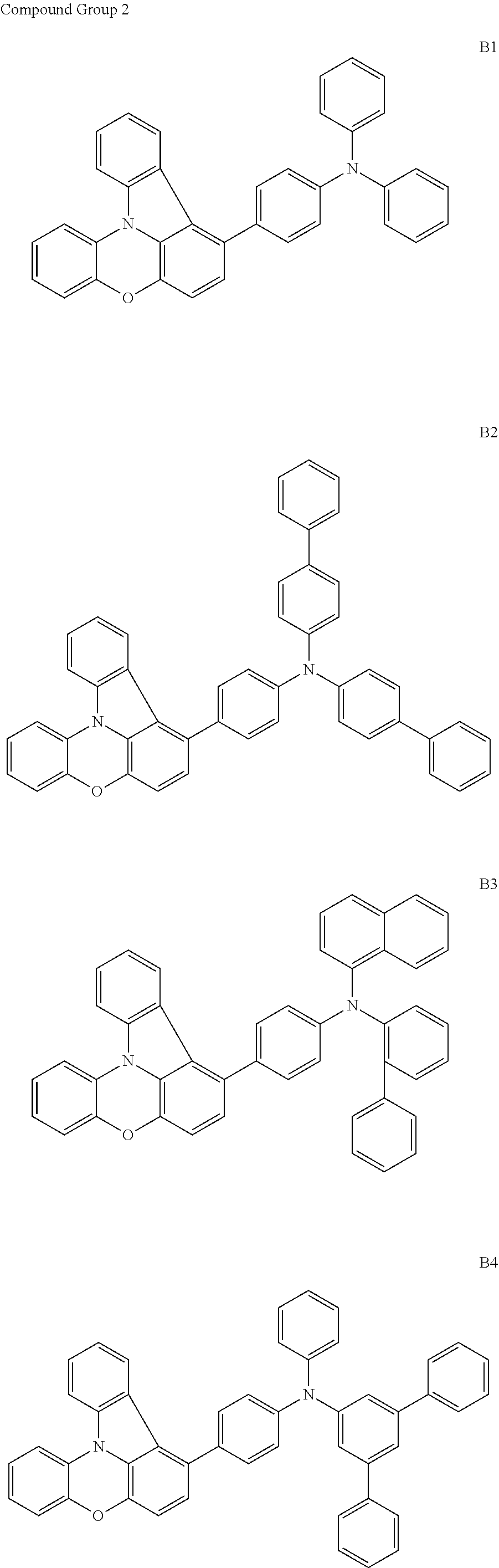
  • the polycyclic compound of Formula 1 may be at least one compound of Compound Group 2, as defined herein.
  • the polycyclic compound of Formula 1 may be at least one compound of Compound Group 3, as defined herein:
  • a polycyclic compound for an organic electroluminescence device is of Formula 1:
  • the compound of Formula 1 may be a compound of Formula 3 to Formula 5:
  • the compound of Formula 1 may be a compound of Formula 6 or Formula 7:
  • the compound of Formula 1 may be a compound of Formula 8 or Formula 9:
  • the polycyclic compound of Formula 1 may be a compound of Compound Group 1, as defined herein.
  • the polycyclic compound of Formula 1 may be a compound of Compound Group 2, as defined herein.
  • the polycyclic compound of Formula 1 may be a compound of Compound Group 3, as defined herein.
  • FIG. 1 is a schematic cross-sectional diagram of an exemplary embodiment of an organic electroluminescence device constructed according to principles of the invention.
  • FIG. 2 is a schematic cross-sectional diagram of another exemplary embodiment of an organic electroluminescence device constructed according to principles of the invention.
  • FIG. 3 is a schematic cross-sectional diagram of yet another exemplary embodiment of an organic electroluminescence device constructed according to principles of the invention.
  • FIG. 4 is a schematic cross-sectional diagram of a further exemplary embodiment of an organic electroluminescence device constructed according to principles of the invention.
  • the illustrated exemplary embodiments are to be understood as providing exemplary features of varying detail of some ways in which the inventive concepts may be implemented in practice. Therefore, unless otherwise specified, the features, components, modules, layers, films, panels, regions, and/or aspects, etc. (hereinafter individually or collectively referred to as “elements”), of the various embodiments may be otherwise combined, separated, interchanged, and/or rearranged without departing from the inventive concepts.
  • an element such as a layer
  • it may be directly on, connected to, or coupled to the other element or layer or intervening elements or layers may be present.
  • an element or layer is referred to as being “directly on,” “directly connected to,” or “directly coupled to” another element or layer, there are no intervening elements or layers present.
  • the term “connected” may refer to physical, electrical, and/or fluid connection, with or without intervening elements.
  • the D1-axis, the D2-axis, and the D3-axis are not limited to three axes of a rectangular coordinate system, such as the x, y, and z-axes, and may be interpreted in a broader sense.
  • the D1-axis, the D2-axis, and the D3-axis may be perpendicular to one another, or may represent different directions that are not perpendicular to one another.
  • “at least one of X, Y, and Z” and “at least one selected from the group consisting of X, Y, and Z” may be construed as X only, Y only, Z only, or any combination of two or more of X, Y, and Z, such as, for instance, XYZ, XYY, YZ, and ZZ.
  • the term “and/or” includes any and all combinations of one or more of the associated listed items.
  • Spatially relative terms such as “beneath,” “below,” “under,” “lower,” “above,” “upper,” “over,” “higher,” “side” (e.g., as in “sidewall”), and the like, may be used herein for descriptive purposes, and, thereby, to describe one elements relationship to another element(s) as illustrated in the drawings.
  • Spatially relative terms are intended to encompass different orientations of an apparatus in use, operation, and/or manufacture in addition to the orientation depicted in the drawings. For example, if the apparatus in the drawings is turned over, elements described as “below” or “beneath” other elements or features would then be oriented “above” the other elements or features.
  • the exemplary term “below” can encompass both an orientation of above and below.
  • the apparatus may be otherwise oriented (e.g., rotated 90 degrees or at other orientations), and, as such, the spatially relative descriptors used herein interpreted accordingly.
  • substituted means at least one substituent selected from the group consisting of a deuterium atom, a halogen atom, a cyano group, a nitro group, an amino group, a silyl group, an oxy group, a thio group, a sulfinyl group, a sulfonyl group, a carbonyl group, a boron group, a phosphine oxide group, a phosphine sulfide group, an alkyl group, an alkenyl group, an alkoxy group, a hydrocarbon ring group, an aryl group, and a heterocyclic group.
  • each of the substituents may be substituted or unsubstituted.
  • a biphenyl group may be interpreted as an aryl group or a phenyl group substituted with a phenyl group. If a compound or a group unsubstituted, then the compound or group lacks a substituent.
  • examples of the halogen atom may include a fluorine atom, a chlorine atom, a bromine atom, and an iodine atom, or a corresponding radical.
  • atom may mean an element or its corresponding radical bonded to one or more other atoms
  • alkyl may mean a paraffinic hydrocarbon group optionally derived from an alkane by dropping one hydrogen from the formula, and be linear, branched or cyclic.
  • the number of carbon atoms in the alkyl group may be 1 to 50, 1 to 30, 1 to 20, 1 to 10, or 1 to 6.
  • alkyl group may include, but are not limited to, methyl group, ethyl group, n-propyl group, isopropyl group, n-butyl group, s-butyl group, t-butyl group, i-butyl group, 2-ethylbutyl group, 3,3-dimethylbutyl group, n-pentyl group, i-pentyl group, neopentyl group, t-pentyl group, cyclopentyl group, 1-methylpentyl group, 3-methylpentyl group, 2-ethylpentyl group, 4-methyl-2-pentyl group, n-hexyl group, 1-methylhexyl group, 2-ethylhexyl group, 2-butylhexyl group, cyclohexyl group, 4-methylcyclohexyl group, 4-t-butylcyclohexyl group, n-heptyl group
  • alkenyl means an unsaturated aliphatic hydrocarbon group including at least one carbon double bond at the middle or end of a carbon chain having two or more carbon atoms.
  • the alkenyl group may be a linear or branched chain. The number of carbon atoms may be 2 to 30, 2 to 20 or 2 to 10, but is not limited thereto.
  • Examples of the alkenyl group include, but are not limited to, a vinyl group, 1-butenyl group, 1-pentenyl group, 1,3-butadienyl aryl group, styrenyl group, styryl vinyl group, etc., without limitation.
  • alkynyl means an unsaturated aliphatic hydrocarbon group including at least one carbon triple bond at the middle or end of a carbon chain having two or more carbon atoms.
  • the alkynyl group may be a linear or branched chain.
  • the number of carbon atoms may be 2 to 30, 2 to 20 or 2 to 10, but is not limited thereto.
  • Specific examples of the alkynyl group may include, but are not limited to, ethynyl, propynyl, etc.
  • the hydrocarbon ring group may be an optional functional group or substituent derived from an aliphatic hydrocarbon ring, or any functional group or substituent derived from an aromatic hydrocarbon ring.
  • the number of carbon atoms for forming a ring of the hydrocarbon ring group may be 5 to 60, 5 to 30, or 5 to 20.
  • aryl means an optional functional group or substituent whose ring structure may have the characteristics of benzene, naphthalene, phenanthrene, anthracene, etc.
  • the aryl group may be a monocyclic aryl group or a polycyclic aryl group.
  • the number of carbon atoms for forming a ring in the aryl group may be 6 to 30, 6 to 20, or 6 to 15.
  • aryl group may include, but are not limited to, phenyl, naphthyl, fluorenyl, anthracenyl, phenanthryl, biphenyl, terphenyl, quaterphenyl, quinquephenyl, sexiphenyl, triphenylenyl, pyrenyl, benzofluoranthenyl, chrysenyl, etc.
  • fluorenyl is a polycyclic aromatic group that may be substituted, and two substituents may be combined with each other to form a spiro structure.
  • substituted fluorenyl group are as follows, however, the exemplary embodiments are not limited thereto.
  • the heterocyclic group may be a closed-ring structure usually of five or six members that one or more of the atoms in the ring is an element other than carbon and may include one or more of B, O, N, P, Si, and S as a heteroatom.
  • the heterocyclic ring includes an aliphatic heterocyclic ring and an aromatic heterocyclic ring.
  • the aromatic heterocyclic group may be a heteroaryl group.
  • the aliphatic heterocyclic ring and the aromatic heterocyclic ring may be monocyclic or polycyclic. If the heterocyclic group includes two or more heteroatoms, two or more heteroatoms may be the same as or different from each other.
  • the heterocyclic group may be a monocyclic heterocyclic group or a polycyclic heterocyclic group, and include a heteroaryl group.
  • the number of carbon atoms for forming a ring of the heterocyclic group may be 2 to 30, 2 to 20, or 2 to 10.
  • the aliphatic heterocyclic group may include one or more of B, O, N, P, Si, and S as a heteroatom.
  • the number of carbon atoms for forming a ring of the aliphatic heterocyclic group may be 2 to 30, 2 to 20, or 2 to 10.
  • Examples of the aliphatic heterocyclic group may include, but are not limited to, oxirane, thiirane, pyrrolidine, piperidine, tetrahydrofuran, tetrahydrothiophene, thiane, tetrahydropyran, 1,4-dioxane, etc.
  • heteroaryl may include one or more among B, O, N, P, Si, and S as a heteroatom in a group. If the heteroaryl group includes two or more heteroatoms, two or more heteroatoms may be the same as or different from each other.
  • the heteroaryl group may be a monocyclic heterocyclic group or a polycyclic heterocyclic group. The number of carbon atoms for forming a ring of the heteroaryl group may be 2 to 30, 2 to 20, or 2 to 10.
  • heteroaryl group may include, but are not limited to, thiophene, furan, pyrrole, imidazole, triazole, pyridine, bipyridine, pyrimidine, triazine, triazole, acridyl, pyridazine, pyrazinyl, quinoline, quinazoline, quinoxaline, phenoxazine, phthalazine, pyrido pyrimidine, pyrido pyrazine, pyrazino pyrazine, isoquinoline, indole, carbazole, N-arylcarbazole, N-heteroarylcarbazole, N-alkylcarbazole, benzoxazole, benzoimidazole, benzothiazole, benzocarbazole, benzothiophene, dibenzothiophene, thienothiophene, benzofuran, phenanthroline, thiazole, is
  • the number of carbon atoms of the amine group may be 1 to 30, but is not particularly limited thereto.
  • the amine group may include an alkyl amine group, aryl amine group, or a heteroaryl amine group. Examples of the amine group includes, but are not limited to, methylamine group, dimethylamine group, phenylamine group, diphenylamine group, naphthylamine group, 9-methyl-anthracenylamine group, triphenylamine group, etc.
  • the definition of the aryl group may be applied to an arylene group except that the arylene group is a divalent group.
  • heteroaryl group may be applied to a heteroarylene group except that the heteroarylene group is a divalent group.
  • SiPh 3 represents a group having three phenyl moieties, each typically connected the silicon serving as a linker, which in turn may be connected to an aryl ring.
  • a substituent for a monovalent group e.g., alkyl
  • a substituent for a corresponding divalent group e.g., alkylene
  • exemplary embodiments are described herein with reference to sectional and/or exploded illustrations that are schematic illustrations of idealized exemplary embodiments and/or intermediate structures. As such, variations from the shapes of the illustrations as a result, for example, of manufacturing techniques and/or tolerances, are to be expected. Thus, exemplary embodiments disclosed herein should not necessarily be construed as limited to the particular illustrated shapes of regions, but are to include deviations in shapes that result from, for instance, manufacturing. In this manner, regions illustrated in the drawings may be schematic in nature and the shapes of these regions may not reflect actual shapes of regions of a device and, as such, are not necessarily intended to be limiting.
  • FIG. 1 is a schematic cross-sectional diagram of an exemplary embodiment of an organic electroluminescence device constructed according to principles of the invention.
  • FIG. 2 is a schematic cross-sectional diagram of another exemplary embodiment of an organic electroluminescence device constructed according to principles of the invention.
  • FIG. 3 is a schematic cross-sectional diagram of yet another exemplary embodiment of an organic electroluminescence device constructed according to principles of the invention.
  • FIG. 4 is a schematic cross-sectional diagram of a further exemplary embodiment of an organic electroluminescence device constructed according to principles of the invention.
  • an organic electroluminescence device 10 includes a first electrode EL 1 and a second electrode EL 2 disposed opposite each other, and an emission layer EML disposed between the first electrode EL 1 and the second electrode EL 2 . Furthermore, the organic electroluminescence device 10 further includes a plurality of functional layers disposed between the first electrode EL 1 and the second electrode EL 2 , as well as the emission layer EML.
  • the plurality of functional layers may include a hole transport region HTR, and an electron transport region ETR.
  • the organic electroluminescence device 10 may include a first electrode EL 1 , a hole transport region HTR, an emission layer EML, an electron transport region ETR, and a second electrode EL 2 laminated sequentially.
  • the organic electroluminescence device 10 of some exemplary embodiments may include a capping layer CPL disposed on the second electrode EL 2 , as depicted in FIG. 4 .
  • the organic electroluminescence device 10 includes a polycyclic compound described below in the emission layer EML disposed between the first electrode EL 1 and the second electrode EL 2 .
  • the exemplary embodiments are not limited thereto, and the organic electroluminescence device 10 may include a compound described below in the hole transport region HTR or the electron transport region ETR, which is one of the plurality of functional layers disposed between the first electrode EL 1 and the second electrode EL 2 , or may include a compound described below in the capping layer CPL disposed on the second electrode EL 2 , as well as in the emission layer EML.
  • FIG. 2 shows a cross-sectional view of an organic electroluminescence device 10 , where the hole transport region HTR includes a hole injection layer HIL and a hole transport layer HTL, and the electron transport region ETR includes an electron injection layer EIL and an electron transport layer ETL.
  • FIG. 3 shows a cross-sectional view of an organic electroluminescence device 10 , where the hole transport region HTR includes a hole injection layer HIL, a hole transport layer HTL, and an electron blocking layer EBL, the electron transport region ETR includes an electron injection layer EIL, an electron transport layer ETL, and a hole blocking layer HBL.
  • FIG. 4 shows a cross-sectional view of an organic electroluminescence device 10 including the capping layer CPL disposed on the second electrode EL 2 .
  • the first electrode EL 1 has conductivity.
  • the first electrode EL 1 may be formed of a metal alloy or a conductive compound.
  • the first electrode EL 1 may be a pixel electrode or positive electrode.
  • the first electrode EL 1 may be a transmissive electrode, a transflective electrode, or a reflective electrode.
  • the first electrode EL 1 may include a transparent metal oxide, for example, an indium tin oxide (ITO), an indium zinc oxide (IZO), a zinc oxide (ZnO), or an indium tin zinc oxide (ITZO).
  • the first electrode EL 1 When the first electrode EL 1 is the transflective electrode or the reflective electrode, the first electrode EL 1 may include Ag, Mg Cu, Al, Pt, Pd, Au, Ni, Nd, Ir, Cr, Li, Ca, LiF/Ca, LiF/Al, Mo, Ti, or a compound or mixture (e.g., a mixture of Ag and Mg) thereof.
  • the first electrode EL 1 may have a multi-layered structure including a reflective layer or transflective layer and a transparent conductive layer formed of an indium tin oxide (ITO), an indium zinc oxide (IZO), a zinc oxide (ZnO), and/or an indium tin zinc oxide (ITZO).
  • ITO indium tin oxide
  • IZO indium zinc oxide
  • ZnO zinc oxide
  • ITZO indium tin zinc oxide
  • the first electrode EL 1 may have, but is not limited to, a three-layer structure of ITO/Ag/ITO.
  • the first electrode EL 1 may have a thickness from about 1,000 ⁇ to about 10,000 ⁇ , for example, from about 1,000 ⁇ to about 3,000 ⁇ .
  • the hole transport region HTR is provided on the first electrode EL 1 .
  • the hole transport region HTR may include at least one of a hole injection layer HIL, a hole transport layer HTL, a hole buffer layer, or the electron blocking layer EBL.
  • the hole transport region HTR may have a multilayer structure having a single layer formed of a single material, a single layer formed of materials different from each other, or a plurality of layers formed of materials different from each other.
  • the hole transport region HTR may have a single layer structure of the hole injection layer HIL or the hole transport layer HTL, or a single layer structure formed of a hole injection material and a hole transport material.
  • the hole transport region HTR may have a single layer structure formed of a plurality of different materials, or a structure of hole injection layer HIL/hole transport layer HTL, hole injection layer HIL/hole transport layer HTL/hole buffer layer, hole injection layer HIL/hole buffer layer, hole transport layer HTL/hole buffer layer, or hole injection layer HIL/hole transport layer HTL/electron blocking layer EBL which are sequentially laminated from the first electrode EL 1 , but the exemplary embodiments are not limited thereto.
  • the hole transport region HTR in the organic electroluminescence device 10 includes a polycyclic compound.
  • polycyclic compound according to some exemplary embodiments may be represented by Formula 1 below:
  • X is O or S.
  • R1 to R10 are each independently a hydrogen atom, a deuterium atom, a halogen atom, a substituted or unsubstituted alkyl group having 1 to 20 carbon atoms, a substituted or unsubstituted aryl group having 6 to 30 ring-forming carbon atoms, or a substituted or unsubstituted heteroaryl group having 2 to 30 ring-forming carbon atoms, and at least one among R1, R3 to R5, R7, R8, and R10 is represented by Formula 2 below:
  • L is a direct linkage, a substituted or unsubstituted arylene group having 6 to 30 ring-forming carbon atoms, or a substituted or unsubstituted heteroarylene group having 2 to 30 ring-forming carbon atoms.
  • Ar1 and Ar2 are each independently a substituted or unsubstituted aryl group having 6 to 30 ring-forming carbon atoms, or a substituted or unsubstituted heteroaryl group having 2 to 30 ring-forming carbon atoms.
  • variable “a” is an integer of 0 to 4.
  • variable “a” is 2 or more, a plurality of L's are the same as or different from each other.
  • any one among R1, R3 to R5, R7, R8, and R10 in Formula 1 may be represented by Formula 2 below.
  • any one among R1, R3 to R4 in Formula 1 may be represented by Formula 2.
  • R1 in Formula 1 may be represented by Formula 2.
  • Formula 1 may be represented by Formula 3 below:
  • R2 to R10 may be each independently a hydrogen atom, a deuterium atom, a halogen atom, a substituted or unsubstituted alkyl group having 1 to 20 carbon atoms, a substituted or unsubstituted aryl group having 6 to 30 ring-forming carbon atoms, or a substituted or unsubstituted heteroaryl group having 2 to 30 ring-forming carbon atoms.
  • R3 in Formula 1 may be represented by Formula 2.
  • Formula 1 may be represented by Formula 4 below:
  • R1, R2, and R4 to R10 may be each independently a hydrogen atom, a deuterium atom, a halogen atom, a substituted or unsubstituted alkyl group having 1 to 20 carbon atoms, a substituted or unsubstituted aryl group having 6 to 30 ring-forming carbon atoms, or a substituted or unsubstituted heteroaryl group having 2 to 30 ring-forming carbon atoms.
  • R4 in Formula 1 may be represented by Formula 2.
  • Formula 1 may be represented by Formula 5 below:
  • R1 to R3 and R5 to R10 may be each independently a hydrogen atom, a deuterium atom, a halogen atom, a substituted or unsubstituted alkyl group having 1 to 20 carbon atoms, a substituted or unsubstituted aryl group having 6 to 30 ring-forming carbon atoms, or a substituted or unsubstituted heteroaryl group having 2 to 30 ring-forming carbon atoms.
  • R5 or R7 in Formula 1 may be represented by Formula 2.
  • R5 in Formula 1 may be represented by Formula 2.
  • Formula 1 may be represented by Formula 6 below:
  • R1 to R4 and R6 to R10 may be each independently a hydrogen atom, a deuterium atom, a halogen atom, a substituted or unsubstituted alkyl group having 1 to 20 carbon atoms, a substituted or unsubstituted aryl group having 6 to 30 ring-forming carbon atoms, or a substituted or unsubstituted heteroaryl group having 2 to 30 ring-forming carbon atoms.
  • R7 in Formula 1 may be represented by Formula 2.
  • Formula 1 may be represented by Formula 7 below:
  • R1 to R6 and R8 to R10 may be each independently a hydrogen atom, a deuterium atom, a halogen atom, a substituted or unsubstituted alkyl group having 1 to 20 carbon atoms, a substituted or unsubstituted aryl group having 6 to 30 ring-forming carbon atoms, or a substituted or unsubstituted heteroaryl group having 2 to 30 ring-forming carbon atoms.
  • R8 or R10 in Formula 1 may be represented by Formula 2.
  • R8 in Formula 1 may be represented by Formula 2.
  • Formula 1 may be represented by Formula 8 below:
  • R1 to R7, R9 and R10 may be each independently a hydrogen atom, a deuterium atom, a halogen atom, a substituted or unsubstituted alkyl group having 1 to 20 carbon atoms, a substituted or unsubstituted aryl group having 6 to 30 ring-forming carbon atoms, or a substituted or unsubstituted heteroaryl group having 2 to 30 ring-forming carbon atoms.
  • R10 in Formula 1 may be represented by Formula 2.
  • Formula 1 may be represented by Formula 9 below:
  • R1 to R9 may be each independently a hydrogen atom, a deuterium atom, a halogen atom, a substituted or unsubstituted alkyl group having 1 to 20 carbon atoms, a substituted or unsubstituted aryl group having 6 to 30 ring-forming carbon atoms, or a substituted or unsubstituted heteroaryl group having 2 to 30 ring-forming carbon atoms.
  • R1, R3 to R5, R7, R8, and R10 in Formula 1 and Formula 3 to Formula 9 may be each independently a hydrogen atom, a deuterium atom, a halogen atom, a substituted or unsubstituted alkyl group having 1 to 20 carbon atoms, or a substituted or unsubstituted aryl group having 6 to 30 ring-forming carbon atoms.
  • R2, R6, and R9 in Formula 1 and Formula 3 to Formula 9 may be each independently a hydrogen atom, a deuterium atom, a halogen atom, a substituted or unsubstituted alkyl group having 1 to 20 carbon atoms.
  • X in Formula 1 and Formula 3 to Formula 9 may be O.
  • L in Formula 1 and Formula 3 to Formula 9 may be a direct linkage, a substituted or unsubstituted phenylene group, a substituted or unsubstituted biphenylene group, a substituted or unsubstituted fluorenylene group, or a substituted or unsubstituted naphthylene group.
  • the polycyclic compound represented by Formula 1 may be any one selected from among compounds represented by Compound Groups 1 to 3 below: However, the exemplary embodiments are not limited thereto.
  • any hydrogen atom in a molecule in the polycyclic compound according to some exemplary embodiments may be substituted with a deuterium atom.
  • the organic electroluminescence devices 10 has the hole transport region HTR including the polycyclic compound.
  • the hole transport region HTR includes the polycyclic compound represented by Formula 1.
  • any one layer of the plurality of layers may include a polycyclic compound represented by Formula 1.
  • the hole transport region HTR may include the hole injection layer HIL disposed on the first electrode EL 1 and the hole transport layer HTL disposed on the hole injection layer HIL, wherein the hole transport layer HTL may include a polycyclic compound represented by Formula 1.
  • the exemplary embodiments are not limited thereto, for example, the hole injection layer HIL may include a polycyclic compound represented by Formula 1.
  • the hole transport region HTR may include one or two or more of polycyclic compounds represented by Formula 1.
  • the hole transport region HTR may include at least one selected from among compounds represented by Compound Groups 1 to 3 as described above.
  • the hole transport region HTR may be formed by using various methods such as a vacuum deposition method, a spin coating method, a casting method, a Langmuir-Blodgett (LB) method, an inject printing method, a laser printing method, and a laser induced thermal imaging (LITI) method.
  • a vacuum deposition method such as a vacuum deposition method, a spin coating method, a casting method, a Langmuir-Blodgett (LB) method, an inject printing method, a laser printing method, and a laser induced thermal imaging (LITI) method.
  • LB Langmuir-Blodgett
  • LITI laser induced thermal imaging
  • the hole transport region HTR may further include materials below in each layer.
  • the hole injection layer HIL may include, for example, a phthalocyanine compound such as copper phthalocyanine; N,N′-diphenyl-N,N′-bis-[4-(phenyl-m-tolyl-amino)-phenyl]-biphenyl-4,4′-diamine (DNTPD), 4,4′,4′′-[tris(3-methylphenyl)phenylamino]triphenylamine] (m-MTDATA), 4,4′,4′′-tris(N,N-diphenylamino)triphenylamine (TDATA), 4,4′,4′′-tris ⁇ N,-(2-naphthyl-N-(phenyl)amino ⁇ -triphenylamine (2-TNATA), poly(3,4-ethylenedioxythiophene)/poly(4-styrenesulfonate) (PEDOT/PSS), polyaniline/dodecylbenzenesulfonic acid
  • the hole transport layer HTL may include a material that is well known to the art.
  • the hole transport layer HTL may further include, for example, one or more carbazole derivatives such as N-phenyl carbazole and polyvinyl carbazole, one or more fluorene derivatives, N,N′-bis(3-methylphenyl)-N,N′-diphenyl-[1,1-biphenyl]-4,4′-diamine (TPD), triphenylamine derivatives such as 4,4′,4′′-tris(N-carbazolyl)triphenylamine (TCTA), N,N′-di(naphthalene-1-yl)-N,N′-diphenyl-benzidine (NPD), 4,4′-cyclohexylidene bis[N,N-bis(4-methylphenyl]benzenamine] (TAPC), 3,3′-Dimethyl-N4,N4,N4′,N4′-tetra-m-tolyl-
  • the hole transport region HTR may have a thickness from about 50 ⁇ to about 15,000 ⁇ , for example, from about 100 ⁇ to about 5,000 ⁇ .
  • the hole injection region HIL may have a thickness, for example, from about 30 ⁇ to about 1,000 ⁇
  • the hole transport layer HTL may have a thickness from about 30 ⁇ to about 1,000 ⁇ .
  • the electron blocking layer EBL may have a thickness from about 10 ⁇ to about 1,000 ⁇ . If the thickness of each of the hole transport region HTR, the hole injection layer HIL, the hole transport layer HTL, and the electron blocking layer EBL satisfies the above-described range, satisfactory hole transport characteristics may be achieved without a substantial increase in driving voltage.
  • the hole transport region HTR may further include a charge generating material in addition to the above-described materials to improve conductivity.
  • the charge generating material may be uniformly or non-uniformly dispersed into the hole transport region HTR.
  • the charge generating material may be, for example, a p-dopant.
  • the p-dopant may be one of quinone derivatives, metal oxides, and cyano group-containing compounds, but is not limited thereto.
  • non-limiting examples of the p-dopant may include, but are not limited to, quinone derivatives such as tetracyanoquinodimethane (TCNQ) and 2,3,5,6-tetrafluoro-7,7,8,8-tetracyanoquinodimethane (F4-TCNQ), one or more metal halides such as MgF 2 , CuI, and RbI, and one or more metal oxides such as at least one of tungsten and/or molybdenum oxides.
  • quinone derivatives such as tetracyanoquinodimethane (TCNQ) and 2,3,5,6-tetrafluoro-7,7,8,8-tetracyanoquinodimethane (F4-TCNQ)
  • one or more metal halides such as MgF 2 , CuI, and RbI
  • metal oxides such as at least one of tungsten and/or molybdenum oxides.
  • the hole transport region HTR may further include at least one of the hole buffer layer or the electron blocking layer EBL.
  • the hole buffer layer may compensate the resonance distance according to the wavelength of light emitted from the emission layer EML to increase light emission efficiency.
  • a material that may be contained in the hole transport region HTR may be used as a material to be contained in the hole buffer layer.
  • the electron blocking layer EBL is a layer playing the role of blocking the electron injection from the electron transport region ETR to the hole transport region HTR.
  • the emission layer EML is disposed on the hole transport region HTR.
  • the emission layer EML may have a thickness, for example, from about 100 ⁇ to about 1,000 ⁇ , or from about 100 ⁇ to about 600 ⁇ .
  • the emission layer EML may have a multilayer structure having a single layer formed of a single material, a single layer formed of materials different from each other, or a plurality of layers formed of materials different from each other.
  • the host materials may include one or more of pyrene derivatives, perylene derivatives, and anthracene derivatives.
  • one or more anthracene derivatives represented by the following Formula 10 may be used as the host materials of the emission layer EML.
  • W1 to W4 may be each independently a hydrogen atom, a deuterium atom, a halogen atom, a substituted or unsubstituted silyl group, a substituted or unsubstituted alkyl group having 1 to 20 carbon atoms, a substituted or unsubstituted aryl group having 6 to 30 ring-forming carbon atoms, or a substituted or unsubstituted heteroaryl group having 2 to 30 ring-forming carbon atoms, or may be combined with an adjacent group to form a ring, where m1 and m2 are each independently an integer of 0 to 4, and m3 and m4 are each independently an integer of 0 to 5.
  • W1 may not be a hydrogen atom; if the variable m2 is 1, W2 may not be a hydrogen atom; if the variable m3 is 1, W3 may not be a hydrogen atom; and if the variable m4 is 1, W4 may not be a hydrogen atom.
  • variable m1 is 2 or more, a plurality of W1 groups are the same or different. If the variable m2 is 2 or more, a plurality of W2 groups are the same or different. If the variable m3 is 2 or more, a plurality of W3 groups are the same or different. If the variable m4 is 2 or more, a plurality of W4 groups are the same or different.
  • the compound represented by Formula 10 may include, for example, a compound represented by the following structures. However, the compound represented by Formula 10 is not limited thereto.
  • the emission layer EML may include a dopant, know materials may be used as the dopant.
  • a dopant know materials may be used as the dopant.
  • styryl derivatives e.g., 1,4-bis[2-(3-N-ethylcarbazoryl)vinyl]benzene (BCzVB), 4-(di-p-tolylamino)-4′-[(di-p-tolylamino)styryl]stilbene (DPAVB), and N-(4-((E)-2-(6-((E)-4-(diphenylamino)styryl)naphthalen-2-yl)vinyl)phenyl)-N-phenylbenzenamine (N-BDAVBi), perylene and one or more derivatives thereof (e.g., 2,5,8,11-tetra-t-butylperylene (TBPe)), pyrene and one or more derivatives thereof (e.g.,
  • the emission layer EML may include a host material.
  • the emission layer EML may include, but is not limited to, as a host material, at least one of tris(8-hydroxyquinolino)aluminum (Alq3), bis[2-(diphenylphosphino)phenyl] ether oxide (DPEPO), 4,4′-bis(carbazol-9-yl)biphenyl (CBP), 1,3-bis(carbazol-9-yl)benzene (mCP), 2,8-bis(diphenylphosphoryl)dibenzo[b,d]furan (PPF), 4,4′,4′′-tris(carbazol-9-yl)-triphenylamine (TCTA), poly(n-vinylcabazole (PVK), 9,10-di(naphthalene-2-yl)anthracene (ADN), 3-tert-butyl-9,10-di(naphth-2-yl)anthracene (TBA
  • the emission layer EML emits red light and may include, for example, a fluorescent material including tris(dibenzoylmethanato)phenanthoroline europium (PBD:Eu(DBM)3(Phen)) and perylene.
  • a fluorescent material including tris(dibenzoylmethanato)phenanthoroline europium (PBD:Eu(DBM)3(Phen)) and perylene.
  • the dopant contained in the emission layer EML may be, for example, selected from among a metal complex or organometallic complex such as bis(1-phenylisoquinoline)acetylacetonate iridium (PIQIr(acac)), bis(1-phenylquinoline)acetylacetonate iridium (PQIr(acac)), tris(1-phenylquinoline)iridium (PQIr), and octaethylporphyrin platinum (PtOEP), rubrene and one or more derivatives thereof, and 4-dicyanomethylene-2-(p-dimethylaminostyryl)-6-methyl-4H-pyran (DCM) and one or more derivatives thereof.
  • a metal complex or organometallic complex such as bis(1-phenylisoquinoline)acetylacetonate iridium (PIQIr(acac)), bis(1-phenylquinoline)acetylace
  • the emission layer EML emits green light and may further include, for example, a fluorescent material including tris(8-hydroxyquinolino)aluminum (Alq3).
  • the dopant contained in the emission layer EML may be, for example, selected from among a metal complex or organometallic complex such as fac-tris(2-phenylpyridine)iridium (Ir(ppy)3), and coumarin and one or more derivatives thereof.
  • the emission layer EML emits blue light and may further include a fluorescence material including any one selected from the group consisting of spiro-DPVBi, spiro-6P, distyryl-benzene (DSB), distyryl-arylene (DSA), polyfluorene (PFO)-based polymer and poly(p-phenylene vinylene (PPV)-based polymer.
  • a fluorescence material including any one selected from the group consisting of spiro-DPVBi, spiro-6P, distyryl-benzene (DSB), distyryl-arylene (DSA), polyfluorene (PFO)-based polymer and poly(p-phenylene vinylene (PPV)-based polymer.
  • the dopant contained in the light emitting layer EML may be selected derivatives thereof, for example, a metal complex or organometallic complex such as (4,6-F2ppy)2Irpic, perylene and one or more derivatives thereof.
  • the electron transport region ETR is disposed on the emission layer EML.
  • the electron transport region ETR may include, but is not limited to, at least one of the hole blocking layer HBL, the electron transport layer ETL, or the electron injection layer EIL.
  • the electron transport region ETR may have a multilayer structure having a single layer formed of a single material, a single layer formed of materials different from each other, or a plurality of layers formed of materials different from each other.
  • the electron transport region HTR may have a single layer structure of an electron injection layer EIL or an electron transport layer ETL, or a single layer structure formed of electron injection materials or electron transport materials.
  • the electron transport region ETR may have a single layer structure formed of materials different from each other, or a structure of electron transport layer ETL/electron injection layer EIL, hole blocking layer HBL/electron transport layer ETL/electron injection layer (EIL) which are sequentially laminated from the emission layer EML, but the exemplary embodiments are not limited thereto.
  • the electron transport region ETR may have a thickness, for example, from about 100 ⁇ to about 1,500 ⁇ .
  • the electron transport region ETR may be formed by using various methods such as a vacuum deposition method, a spin coating method, a casting method, a Langmuir-Blodgett (LB) method, an inkject printing method, a laser printing method, and a laser induced thermal imaging (LITI) method.
  • a vacuum deposition method such as a vacuum deposition method, a spin coating method, a casting method, a Langmuir-Blodgett (LB) method, an inkject printing method, a laser printing method, and a laser induced thermal imaging (LITI) method.
  • LB Langmuir-Blodgett
  • LITI laser induced thermal imaging
  • the electron transport region ETR may include an anthracene-based compound.
  • the exemplary embodiments are not limited thereto, and the electron transport region ETR may include, for example, tris(8-hydroxyquinolinato)aluminum (Alq3), 1,3,5-tri[(3-pyridyl)-phen-3-yl]benzene, 2,4,6-tris(3′-(pyridin-3-yl)biphenyl-3-yl)-1,3,5-triazine, bis[2-(diphenylphosphino)phenyl]ether oxide (DPEPO), 2-(4-(N-phenylbenzoimidazolyl-1-ylphenyl)-9,10-dinaphthylanthracene, 1,3,5-tri(1-phenyl-1H-benzo[d]imidazol-2-yl)phenyl (TPBi), 2,9-dimethyl-4,7-
  • Alq3 tris(8-hydroxyquinolinato
  • the thickness of the electron transport layers ETL may be from about 100 ⁇ to about 1,000 ⁇ , for example, from about 150 ⁇ to about 500 ⁇ . If the thickness of the electron transport layer ETL satisfies the above-described range, satisfactory electron transport characteristics may be achieved without a substantial increase in driving voltage.
  • the electron transport region ETR may be formed using metal halides such as LiF, NaCl, CsF, RbCl, and RbI, lanthanum metals such as Yb, metal oxides such as Li 2 O and BaO, lithium quinolate (LiQ), etc., but the exemplary embodiments are not limited thereto.
  • the electron injection layer EIL may be also formed of a mixture of an electron transport material and an organo metal salt.
  • the organo metal salt may be a material having an energy band gap of about 4 eV or more.
  • the organo metal salt may include at least one of a metal acetate, a metal benzoate, a metal acetoacetate, a metal acetylacetonate or a metal stearate.
  • the electron injection layers EIL may have a thickness from about 1 ⁇ to about 100 ⁇ , and from about 3 ⁇ to about 90 ⁇ . If the thickness of the electron injection layers EIL satisfies the above-described range, satisfactory electron injection characteristics may be achieved without a substantial increase in driving voltage.
  • the electron transport region ETR may include the hole blocking layer HBL.
  • the hole blocking layer HBL may include, but is not limited to, for example, at least one of 2,9-dimethyl-4,7-diphenyl-1,10-phenanthroline (BCP), bis[2-(diphenylphosphino)phenyl]ether oxide (DPEPO), or 4,7-diphenyl-1,10-phenanthroline (Bphen).
  • the second electrode EL 2 may be disposed on the electron transport region HTR.
  • the second electrode EL 2 may be a common electrode or a negative electrode.
  • the second electrode EL 2 may be a transmissive electrode, a transflective electrode, or a reflective electrode.
  • the second electrode EL 2 may be formed of transparent metal oxides, for example, at least one of an indium tin oxide (ITO), an indium zinc oxide (IZO), a zinc oxide (ZnO), an indium tin zinc oxide (ITZO), etc.
  • the second electrode EL 2 When the second electrode EL 2 is the transflective electrode or the reflective electrode, the second electrode EL 2 may include Ag, Mg Cu, Al, Pt, Pd, Au, Ni, Nd, Ir, Cr, Li, Ca, LiF/Ca, LiF/Al, Mo, Ti, or a compound or mixture (e.g., a mixture of Ag and Mg) including the same.
  • the first electrode EL 1 may have a multi-layered structure including a reflective layer or transflective layer and a transparent conductive layer formed of at least one of an indium tin oxide (ITO), an indium zinc oxide (IZO), a zinc oxide (ZnO), or an indium tin zinc oxide (ITZO).
  • ITO indium tin oxide
  • IZO indium zinc oxide
  • ZnO zinc oxide
  • ITZO indium tin zinc oxide
  • the second electrode EL may be connected to an auxiliary electrode.
  • resistance of the second electrode EL 2 may be decreased.
  • a capping layer CPL may be further included on the second electrode EL 2 of the organic electroluminescence device 10 of some exemplary embodiments.
  • the capping layer CPL may include, for example, 2,2′-Dimethyl-N,N′-di-[(1-naphthyl)-N,N′-diphenyl]-1,1′-biphenyl-4,4′-diamine ( ⁇ -NPD), N,N′-di(1-naphthalene-1-yl)-N,N′-diphenyl-benzidine (NPB), TPD, m-MTDATA, Alq3, copper(II) phthalocyanine (CuPc), N4,N4,N4′,N4′-tetra (biphenyl-4-yl) biphenyl-4,4′-diamine (TPD15), 4,4′,4′′-Tris (carbazol sol-9-yl) triphenylamine (TCTA), N, N, N, N-
  • the holes injected from the first electrode EL 1 are moved through the hole transport region HTR to the emission layer EML, and the electrons injected from the second electrode EL 2 are moved through the electron transport region ETR to the emission layer EML.
  • the electrons and holes are recombined in the emission layer EML to generate excitons and emit light when the excitons return to a ground state from an excited state.
  • the organic electroluminescence device 10 is a front emission type, and the first electrode EL 1 may be the reflective electrode, and the second electrode EL 2 may be the transmissive electrode or transflective electrode. In some exemplary embodiments, the organic electroluminescence device 10 is a rear emission type and the first electrode EL 1 may be the transmissive electrode or transflective electrode, and the second electrode EL 2 may be the reflective electrode.
  • the organic electroluminescence device 10 is characterized by including the polycyclic compound represented by Formula 1, and thereby achieving high efficiency and long service life. In addition, a low driving voltage may be achieved.
  • a polycyclic compound according to at least some exemplary embodiments may be synthesized as, for example, by the following.
  • a synthetic method of the polycyclic compound is not limited to the exemplary embodiments.
  • phenoxazine (20.00 g, 109.2 mmol), palladium(0) bis(dibenzylideneacetone) (Pd(dba) 2 ) (1.88 g, 0.03 weight equivalent, 3.3 mmol), sodium tert-butoxide (NaOtBu) (31.47 g, 3.0 weight equivalent, 327.5 mmol), toluene (545 mL), 1,3-dichloro-2-iodobenzene (32.77 g, 1.1 weight equivalent, 120.1 mmol), and tri-tert-butylphosphine (tBu 3 P) (2.09 g, 0.1 weight equivalent, 10.9 mmol) were sequentially added and heated and stirred under reflux.
  • the organic layer was fractionated by adding water to the reaction solvent.
  • the organic layer was further extracted by adding toluene to a water layer, and then the combined organic layers were washed with saline and dried with MgSO 4 .
  • the MgSO 4 was filtered off and the organic layers were concentrated, and then the resulting crude product was purified by a silica gel column chromatography (using mixture solvent of hexane and toluene as an eluent) to obtain Intermediate IM-1 (25.08 g, yield 70%).
  • IM-1 (20.00 g, 60.9 mmol), palladium(II) acetate (Pd(OAc) 2 ) (0.82 g, 0.06 weight equivalent, 3.7 mmol), K 2 CO 3 (16.85 g, 2.0 weight equivalent, 121.9 mmol), N,N-dimethylacetamide (DMA) (305 mL), and tricyclohexylphosphine (PCy 3 ) ⁇ tetrafluoroboric acid solution (HBF 4 ) solution (2.69 g, 0.12 weight equivalent, 7.3 mmol) were sequentially added and heated and stirred under reflux.
  • IM-1 20.00 g, 60.9 mmol
  • palladium(II) acetate Pd(OAc) 2
  • K 2 CO 3 (16.85 g, 2.0 weight equivalent, 121.9 mmol
  • DMA N,N-dimethylacetamide
  • PCy 3 tricyclohexylphosphine
  • HHF 4 tricyclohexylphos
  • the organic layer was fractionated by adding water to the reaction solvent.
  • the organic layer was further extracted by adding toluene to a water layer, and then the combined organic layers were washed with saline and dried with MgSO 4 .
  • the MgSO 4 was filtered off and the organic layers were concentrated, and then the resulting crude product was purified by a silica gel column chromatography (using mixture solvent of hexane and toluene as an eluent) to obtain Intermediate IM-2 (14.40 g, yield 81%).
  • phenoxazine (20.00 g, 109.2 mmol), Pd(dba) 2 (1.88 g, 0.03 weight equivalent, 3.3 mmol), sodium tert-butoxide (NaOtBu) (31.47 g, 3.0 weight equivalent, 327.5 mmol), toluene (545 mL), 1,4-dichloro-2-iodobenzene (32.77 g, 1.1 weight equivalent, 120.1 mmol), and (tBu 3 P) (2.09 g, 0.1 weight equivalent, 10.9 mmol) were sequentially added and heated and stirred under reflux.
  • the organic layer was fractionated by adding water to the reaction solvent.
  • the organic layer was further extracted by adding toluene to a water layer, and then the combined organic layers were washed with saline and dried with MgSO 4 .
  • the MgSO 4 was filtered off and the organic layers were concentrated, and then the resulting crude product was purified by a silica gel column chromatography (using mixture solvent of hexane and toluene as eluent) to obtain Intermediate IM-3 (26.87 g, yield 75%).
  • IM-3 (20.00 g, 60.9 mmol), Pd(OAc) 2 (0.82 g, 0.06 weight equivalent, 3.7 mmol), K 2 CO 3 (16.85 g, 2.0 weight equivalent, 121.9 mmol), N,N-dimethylacetamide (DMA) (305 mL), and PCy 3 ⁇ HBF 4 (2.69 g, 0.12 weight equivalent, 7.3 mmol) were sequentially added and heated and stirred under reflux. After air cooling to room temperature, the organic layer was fractionated by adding water to the reaction solvent.
  • the organic layer was further extracted by adding toluene to a water layer, and then the combined organic layers were washed with saline and dried with MgSO 4 .
  • the MgSO 4 was filtered off and the organic layers were concentrated, and then the resulting crude product was purified by a silica gel column chromatography (using mixture solvent of hexane and toluene as eluent) to obtain Intermediate IM-4 (14.76 g, yield 83%).
  • IM-4 (5.00 g, 17.1 mmol), N-[4-(naphthalen-2-yl)phenyl]-N-[4-(4,4,5,5-tetramethyl-1,3,2-dioxaborolan-2-yl)phenyl]dibenzo[b,d]furan-4-amine (11.68 g, 1.1 weight equivalent, 18.9 mmol), K 2 CO 3 (7.11 g, 3.0 weight equivalent, 51.4 mmol), Pd(PPh 3 ) 4 (0.99 g, 0.05 weight equivalent, 0.9 mmol), and the mixture solution of toluene/ethanol/H 2 O (4/2/1) (120 mL) were sequentially added, and heated and stirred at about 80° C.
  • phenoxazine (20.00 g, 109.2 mmol), Pd(dba) 2 (1.88 g, 0.03 weight equivalent, 3.3 mmol), NaOtBu (31.47 g, 3.0 weight equivalent, 327.5 mmol), toluene (545 mL), 1,2-dichloro-3-iodobenzene (32.77 g, 1.1 weight equivalent, 120.1 mmol), and tBu 3 P (2.09 g, 0.1 weight equivalent, 10.9 mmol) were sequentially added and heated and stirred under reflux. After air cooling to room temperature, the organic layer was fractionated by adding water to the reaction solvent.
  • the organic layer was further extracted by adding toluene to a water layer, and then the combined organic layers were washed with saline and dried with MgSO 4 .
  • the MgSO 4 was filtered off and the organic layers were concentrated, and then the resulting crude product was purified by a silica gel column chromatography (using mixture solvent of hexane and toluene as an eluent) to obtain Intermediate IM-3 (26.87 g, yield 75%).
  • IM-7 (20.00 g, 60.9 mmol), Pd(OAc) 2 (0.82 g, 0.06 weight equivalent, 3.7 mmol), K 2 CO 3 (16.85 g, 2.0 weight equivalent, 121.9 mmol), N,N-dimethylacetamide (DMA) (305 mL), and PCy 3 ⁇ HBF 4 (2.69 g, 0.12 weight equivalent, 7.3 mmol) were sequentially added and heated and stirred under reflux. After air cooling to room temperature, the organic layer was fractionated by adding water to the reaction solvent.
  • the organic layer was further extracted by adding toluene to a water layer, and then the combined organic layers were washed with saline and dried with MgSO 4 .
  • the MgSO 4 was filtered off and the organic layers were concentrated, and then the resulting crude product was purified by a silica gel column chromatography (using mixture solvent of hexane and toluene as an eluent) to obtain Intermediate IM-8 (13.87 g, yield 78%).
  • IM-8 (5.00 g, 17.1 mmol), N-[4-(naphthalen-1-yl)phenyl]-N-[4-(4,4,5,5-tetramethyl-1,3,2-dioxaborolan-2-yl)phenyl]phenanthren-9-amine (11.87 g, 1.1 weight equivalent, 18.9 mmol), K 2 CO 3 (7.11 g, 3.0 weight equivalent, 51.4 mmol), Pd(PPh 3 ) 4 (0.99 g, 0.05 weight equivalent, 0.9 mmol), and the mixture solution of toluene/ethanol/H 2 O (4/2/1) (120 mL) were sequentially added, and heated and stirred at about 80° C.
  • the organic layer was further extracted by adding toluene to a water layer, and then the combined organic layers were washed with saline and dried with MgSO 4 .
  • the MgSO 4 was filtered off and the organic layers were concentrated, and then the resulting crude product was purified by a silica gel column chromatography (using mixture solvent of hexane and toluene as an eluent) to obtain Intermediate IM-9 (27.12 g, yield 77%).
  • IM-9 (20.00 g, 60.7 mmol), N,N-dimethylformamide (DMF) (303 mL) and K 2 CO 3 (33.53 g, 4 weight equivalent, 242.6 mmol) were sequentially added and heated and stirred at about 140° C. After air cooling to room temperature, H 2 O was added to the reaction solution, the reaction solution was extracted with toluene, and organic layers were washed with saturated saline, and then dried with MgSO 4 .
  • DMF N,N-dimethylformamide
  • K 2 CO 3 33.53 g, 4 weight equivalent, 242.6 mmol
  • IM-10 15.00 g, 48.4 mmol
  • Pd(OAc) 2 (0.65 g, 0.06 weight equivalent, 2.9 mmol
  • K 2 CO 3 13.39 g, 2.0 weight equivalent, 96.9 mmol
  • N,N-dimethylacetamide (DMA) (242 mL)
  • PCy3 ⁇ HBF 4 (2.14 g, 0.12 weight equivalent, 5.8 mmol)
  • the organic layer was further extracted by adding toluene to a water layer, and then the combined organic layers were washed with saline and dried with MgSO 4 .
  • the MgSO 4 was filtered off and the organic layers were concentrated, and then the resulting crude product was purified by a silica gel column chromatography (using mixture solvent of hexane and toluene as an eluent) to obtain Intermediate IM-11 (10.46 g, yield 79%).
  • IM-11 (10.00 g, 36.6 mmol), pyridine 8.68 g (3.0 weight equivalent, 109.8 mmol), CH 2 Cl 2 (282 mL), and trifluoromethanesulfonic anhydride (T20) (15.49 g, 1.5 weight equivalent, 54.9 mmol) were sequentially added and stirred at room temperature.
  • T20 trifluoromethanesulfonic anhydride
  • IM-12 (5.00 g, 12.3 mmol), Pd(dba) 2 (0.21 g, 0.03 weight equivalent, 0.4 mmol), NaOtBu (3.56 g, 3.0 weight equivalent, 37.0 mmol), toluene (62 mL), di[(1,1′-biphenyl)-4-yl]amine (4.36 g, 1.1 weight equivalent, 13.6 mmol), and tBu 3 P (0.25 g, 0.1 weight equivalent, 1.2 mmol) were sequentially added and heated and stirred under reflux. After air cooling to room temperature, the organic layer was fractionated by adding water to the reaction solvent.
  • the organic layer was further extracted by adding toluene to a water layer, and then the combined organic layers were washed with saline and dried with MgSO 4 .
  • the MgSO 4 was filtered off and the organic layers were concentrated, and then the resulting crude product was purified by a silica gel column chromatography (using mixture solvent of hexane and toluene as an eluent) to obtain Compound B31 (6.62 g, yield 89%).
  • the organic layer was further extracted by adding toluene to a water layer, and then the combined organic layers were washed with saline and dried with MgSO 4 .
  • the MgSO 4 was filtered off and the organic layers were concentrated, and then the resulting crude product was purified by a silica gel column chromatography (using mixture solvent of hexane and toluene as an eluent) to obtain Intermediate IM-16 (18.85 g, yield 75%).
  • IM-16 15.00 g, 40.3 mmol
  • Pd(OAc) 2 (0.54 g, 0.06 weight equivalent, 2.4 mmol
  • K 2 CO 3 11.13 g, 2.0 weight equivalent, 80.5 mmol
  • N,N-dimethylacetamide (DMA) (201 mL)
  • PCy 3 ⁇ HBF 4 (1.78 g, 0.12 weight equivalent, 4.8 mmol)
  • the organic layer was further extracted by adding toluene to a water layer, and then the combined organic layers were washed with saline and dried with MgSO 4 .
  • the MgSO 4 was filtered off and the organic layers were concentrated, and then the resulting crude product was purified by a silica gel column chromatography (using mixture solvent of hexane and toluene as an eluent) to obtain Intermediate IM-17 (8.45 g, yield 72%).
  • IM-17 (5.00 g, 17.1 mmol), 4-(naphthalen-2-yl)-N-[4-(4,4,5,5-tetramethyl-1,3,2-dioxaborolan-2-yl)phenyl]-N-[4-(triphenylsilyl)phen yl]aniline (14.25 g, 1.1 weight equivalent, 18.9 mmol), K 2 CO 3 (7.11 g, 3.0 weight equivalent, 51.4 mmol), Pd(PPh 3 ) 4 (0.99 g, 0.05 weight equivalent, 0.9 mmol), and the mixture solution of toluene/ethanol/H 2 O (4/2/1) (120 mL) were sequentially added, and heated and stirred at 80° C.
  • the organic layer was further extracted by adding toluene to a water layer, and then the combined organic layers were washed with saline and dried with MgSO 4 .
  • the MgSO 4 was filtered off and the organic layers were concentrated, and then the resulting crude product was purified by a silica gel column chromatography (using mixture solvent of hexane and toluene as an eluent) to obtain Intermediate IM-18 (30.03 g, yield 69%).
  • IM-16 15.00 g, 41.2 mmol
  • TfOH trifluoromethanesulfonic acid
  • the organic layer was further extracted by adding toluene to a water layer, and then the combined organic layers were washed with saline and dried with MgSO 4 .
  • the MgSO 4 was filtered off and the organic layers were concentrated, and then the resulting crude product was purified by a silica gel column chromatography (using mixture solvent of hexane and toluene as an eluent) to obtain Intermediate IM-20 (31.77 g, yield 73%).
  • IM-20 15.00 g, 41.2 mmol
  • TfOH 61.87 g (10.0 weight equivalent, 412.3 mmol) were sequentially added and stirred at room temperature.
  • the mixture solvent of pyridine (106 mL, 0.2 M) and H 2 O (41 mL, 1 M) was slowly added to the reaction solution and stirred for 1 hour, and then CH 2 Cl 2 was added to the reaction solution to fractionate an organic layer.
  • the organic layer was further extracted by adding CH 2 Cl 2 to a water layer, and then the combined organic layers were washed with saline and dried with MgSO 4 .
  • N-phenyl-4-(9-phenyl-9H-fluoren-9-yl)-N-[4-(4,4,5,5-tetramethyl-1,3,2-dioxaborolan-2-yl)phenyl]aniline 11.53 g, 1.1 weight equivalent, 18.9 mmol
  • K 2 CO 3 7.11 g, 3.0 weight equivalent, 51.4 mmol
  • Pd(PPh 3 ) 4 (0.99 g, 0.05 weight equivalent, 0.9 mmol)
  • the mixture solution of toluene/ethanol/H 2 O (4/2/1) 120 mL
  • the organic layer was further extracted by adding toluene to a water layer, and then the combined organic layers were washed with saline and dried with MgSO 4 .
  • the MgSO 4 was filtered off and the organic layers were concentrated, and then the resulting crude product was purified by a silica gel column chromatography (using mixture solvent of hexane and toluene as an eluent) to obtain Intermediate IM-25 (33.70 g, yield 69%).
  • IM-20 15.00 g, 36.7 mmol
  • TfOH 55.13 g (10.0 weight equivalent, 367.4 mmol) were sequentially added and stirred at room temperature.
  • the mixture solvent of pyridine (184 mL, 0.2 M) and H 2 O (36 mL, 1 M) was slowly added to the reaction solution and stirred for 1 hour, and then CH 2 Cl 2 was added to the reaction solution to fractionate an organic layer.
  • the organic layer was further extracted by adding CH 2 Cl 2 to a water layer, and then the combined organic layers were washed with saline and dried with MgSO 4 .
  • IM-26 (5.00 g, 14.9 mmol), N-phenyl-4-(9-phenyl-9H-fluoren-9-yl)-N-[4-(4,4,5,5-tetramethyl-1,3,2-dioxaborolan-2-yl)phenyl]aniline (10.79 g, 1.1 weight equivalent, 16.4 mmol), K 2 CO 3 (6.17 g, 3.0 weight equivalent, 44.6 mmol), Pd(PPh 3 ) 4 (0.86 g, 0.05 weight equivalent, 0.7 mmol), and the mixture solution of toluene/ethanol/H 2 O (4/2/1) (104 mL) were sequentially added, and heated and stirred at about 80° C.
  • the organic electroluminescence devices of Examples and Comparative Examples were manufactured as follows. After ITO having a thickness of about 150 nm was patterned on a glass substrate, the glass substrate was washed with pure water and treated with ultraviolet (UV) and ozone for about 10 minutes to form a first electrode. Then, 2-TNATA was deposited thereon to a thickness of about 60 nm, and Example Compounds or Comparative Example Compounds were used to form a hole transport layer having a thickness of about 30 nm.
  • UV ultraviolet
  • ADN 9,10-bis(2-naphthyl)anthrace
  • TBP 9,10-bis(2-naphthyl)anthrace
  • the luminous efficiencies of the organic electroluminescence devices according to Examples 1 to 8 and Comparative Examples 1 to 10 are shown in Table 1 below.
  • the luminous efficiencies were measured at 10 mA/cm 2 .
  • Voltages and luminous efficiencies of the devices were measured in a dark room using 2400 Series source meter from Keithley Instruments, Inc., a company affiliated with Tektronix of Beaverton, Oregon, CS-200, Color and luminance meter from Konica Minolta, Inc. of Tokyo, Japan, and a software program sold under the trade designation LaVIEW 8.2 for the measurement from Japan National Instruments Co, of Minato-ku, Japan.
  • Example 3 Example Compound A144 5.7 7.6 1950
  • Example 4 Example Compound B31 5.7 7.5 2150
  • Example 5 Example Compound B101 5.7 7.6 2150
  • Example 6 Example Compound C26 5.6 7.8 1900
  • Example 7 Example Compound C61 5.6 7.6 2050
  • Example 8 Example Compound C154 5.6 7.7 2000 Comparative Comparative Example 6.4 5.9 1700
  • Example 2 Compound R2 Comparative Comparative Example 6.6 5.9 1500
  • Example 3 Compound R3 Comparative Comparative Example 6.5 6.1 1550
  • Example 4 Compound R4 Comparative Comparative Example 6.1 6.4 1500
  • Example 5 Compound R5 Comparative Comparative Example 6.1 6.5 1550
  • Example 6 Compound R6 Comparative Comparative Example 6.8 5.8 1600
  • Example 7 Compound R7 Comparative Comparative Example 6.3 6.6 1650
  • Example 8 Example Com
  • Examples 1 to 8 have significantly and unexpectedly achieved low voltage, long service life, and high efficiency compared to Comparative Examples 1 to 10.
  • a polycyclic compound according to exemplary embodiments is used in the hole transport region to facilitate a low driving voltage, high efficiency, and long service life of organic electroluminescence devices.
  • an amine group is included in an indolo phenoxazine or indolophenothiazine skeleton, and thus the organic electroluminescence devices may achieve longer service life while having resistance for high temperature and charge.
  • two hetero atoms included in the indolo phenoxazine or indolophenothiazine skeleton may improve the hole transporting ability of the entire molecule, and thus a reunion probability of holes and electrons in the emission layer may be improved to better luminous efficiency.
  • an amine group is substituted to a side chain of the benzene rings (A ring, C ring of Formula 11 below) present at the both ends in aromatic rings included in the indolo phenoxazine skeleton, and thus, particularly, luminous efficiencies of the devices were improved.
  • the indolo phenoxazine has a structure which is slightly twisted in a complete plane because hydrogen atoms substituted to the benzene rings at the both ends repel stereoelectrically from each other.
  • an amine group is substituted to the side chain of the aromatic ring (B ring of Formula 11 below) present at the center in aromatic rings included in the indolo phenoxazine skeleton, and thus, particularly, service lives of the devices were improved.
  • the aromatic ring at the center in aromatic rings included in the indolo phenoxazine skeleton has the most electrons, HOMO orbitals are widely spread all over the molecule, and thus stability in a radical state is improved to achieve long service life.
  • Comparative Examples 1 and 2 are materials having the indolo phenoxazine skeleton, but show results of reducing both efficiency and service life of the devices compared to Examples. Although not wanting to be bound by theory, it is believed that a carbazole group and an acridine group have insufficient hole transport properties compared to an amine group which is present in at least some exemplary embodiments, thereby losing a carrier balance.
  • comparative Examples 3 and 4 are materials having a fused heterocyclic ring, but show a result of reducing, in particular, service life of the devices due to thermal instability since Comparative Examples 3 and 4 have a sp3 hybridization carbon atom site in a fused structure.
  • Comparative Examples 5 and 6 are materials including an amine group and an indolo phenoxazine skeleton, but have a carbazole site together, thereby losing a carrier balance, and thus, in particular, service lives of the devices were reduced.
  • Comparative Example 7 is a material having two indolo phenoxazine skeletons, and shows a result of reducing both of efficiency and service life of the device because a hole transport property is reduced compared to Examples.
  • Comparative Example 8 is a material having an indolocarbazole skeleton
  • Comparative Example 9 is a material having an indolophenazine skeleton
  • both of Comparative Example 8 and Comparative Example 9 show a result of reducing efficiency and service life of the devices compared to Examples.
  • Comparative Example 10 is a material having an indolo phenoxazine skeleton and an amine group in the para-position of a nitrogen atom at the center of the indolo phenoxazine skeleton, and reduces both luminous efficiency and service life compared to Examples.
  • introducing an amine group to the para-position of a nitrogen atom at the center of the indolo phenoxazine skeleton results in 6 electrons leaked out of the amine group to the indolo phenoxazine skeleton.
  • the electron density in rings of the indolo phenoxazine is relatively increased, and thereby a HOMO energy level becomes shallow to delay influx of holes into the emission layer and the electron density in the amine group is relatively decreased, and thus the effect of the amine group resulting in long service life is reduced.
  • Some of the advantages that may be achieved by exemplary implementations of the invention and/or exemplary methods of the invention include providing a polycyclic compound used in the hole transport region to facilitate a low driving voltage, high efficiency, and long service life of organic electroluminescence devices. Moreover, the organic electroluminescence devices according to some exemplary embodiments may have excellent efficiency. The polycyclic compound according to some exemplary embodiments may be used as a material of the hole transport region of the organic electroluminescence device, and thereby the organic electroluminescence device may have improved efficiency.

Landscapes

  • Chemical & Material Sciences (AREA)
  • Organic Chemistry (AREA)
  • Engineering & Computer Science (AREA)
  • Materials Engineering (AREA)
  • Physics & Mathematics (AREA)
  • Spectroscopy & Molecular Physics (AREA)
  • Electroluminescent Light Sources (AREA)
  • Optics & Photonics (AREA)

Abstract

An organic electroluminescence device includes a first electrode; a hole transport region disposed on the first electrode; an emission layer disposed on the hole transport region; an electron transport region disposed on the emission layer; and a second electrode disposed on the electron transport region, wherein the hole transport region includes a polycyclic compound of Formula 1:
Figure US12295257-20250506-C00001
    • wherein, in Formula 1, the variables are defined herein.

Description

CROSS-REFERENCE TO RELATED APPLICATION
This application claims priority from and the benefit of Korean Patent Application No. 10-2019-0133147, filed on Oct. 24, 2019, which is hereby incorporated by reference for all purposes as if fully set forth herein.
BACKGROUND Field
Exemplary embodiments of the invention relate generally to an organic electroluminescence device, and more particularly, to a polycyclic compound for the organic electroluminescence device.
Discussion of the Background
Recently, the development of organic electroluminescence displays as an image display is being actively conducted. Unlike liquid crystal display devices and the like, organic electroluminescence displays are so-called self-luminescent display devices in which holes and electrons injected from a first electrode and a second electrode recombine in an emission layer, and thus a luminescent material including an organic compound in the emission layer emits light to implement a display.
For a display having an organic electroluminescence device, there is a demand for an organic electroluminescence device having a low driving voltage, high luminous efficiency, and long life, and development of materials of stably attaining such characteristics for an organic electroluminescence device is continuously being required.
The above information disclosed in this Background section is only for understanding of the background of the inventive concepts, and, therefore, it may contain information that does not constitute prior art.
SUMMARY
Applicant discovered that by combining a hole transport region having a polycyclic compound in an organic electroluminescence device with one or more other regions and/or layers with different attributes unexpected synergistic improvements in organic electroluminescence devices can be obtained, including low driving voltage, high luminous efficiency, and/or long life.
Organic electroluminescence devices constructed according to the principles and exemplary implementations of the invention have low driving voltage, high luminous efficiency, and/or long life. For example, the hole transport region having the polycyclic compound may optionally be combined with an emission layer to obtain improved low driving voltage, high luminous efficiency, and long life in organic electroluminescence devices.
Additional features of the inventive concepts will be set forth in the description which follows, and in part will be apparent from the description, or may be learned by practice of the inventive concepts.
According to one aspect of the invention, an organic electroluminescence device includes a first electrode; a hole transport region disposed on the first electrode; an emission layer disposed on the hole transport region; an electron transport region disposed on the emission layer; and a second electrode disposed on the electron transport region, wherein the hole transport region includes a polycyclic compound of Formula 1:
Figure US12295257-20250506-C00002
    • wherein, in Formula 1
    • X is O or S;
    • R1 to R10 are each, independently from one another, a hydrogen atom, a deuterium atom, a halogen atom, a substituted or unsubstituted alkyl group having 1 to 20 carbon atoms, a substituted or unsubstituted aryl group having 6 to 30 ring-forming carbon atoms, or a substituted or unsubstituted heteroaryl group having 2 to 30 ring-forming carbon atoms; and
    • at least one of R1, R3 to R5, R7, R8, and R10 is a group of Formula 2:
Figure US12295257-20250506-C00003
    • wherein, in Formula 2,
    • L is a direct linkage, a substituted or unsubstituted arylene group having 6 to 30 ring-forming carbon atoms, or a substituted or unsubstituted heteroarylene group having 2 to 30 ring-forming carbon atoms;
    • Ar1 and Ar2 are each, independently from one another, a substituted or unsubstituted aryl group having 6 to 30 ring-forming carbon atoms or a substituted or unsubstituted heteroaryl group having 2 to 30 ring-forming carbon atoms; and
    • a is 0, 1, 2, 3, or 4.
The variables R1, R3 to R5, R7, R8, and R10 may each, independently from one another, be a hydrogen atom, a deuterium atom, a halogen atom, a substituted or unsubstituted alkyl group having 1 to 20 carbon atoms, or a substituted or unsubstituted aryl group having 6 to 30 ring-forming carbon atoms, and at least one of R1, R3 to R5, R7, R8, and R10 is a group of Formula 2.
The compound of Formula 1 may be a compound of Formula 3 to Formula 5:
Figure US12295257-20250506-C00004
    • wherein, the variables are defined herein.
The compound Formula 1 may be a compound of Formula 6 or Formula 7:
Figure US12295257-20250506-C00005
    • wherein, the variables are defined herein.
The compound of Formula 1 may be a compound of Formula 8 or Formula 9:
Figure US12295257-20250506-C00006
    • wherein, the variables are defined herein.
The variables R2, R6, and R9 may each, independently from one another, be a hydrogen atom, a deuterium atom, a halogen atom, or a substituted or unsubstituted alkyl group having 1 to 20 carbon atoms.
The variable X may be O.
The variable L may be a direct linkage, a substituted or unsubstituted phenylene group, a substituted or unsubstituted biphenylene group, a substituted or unsubstituted fluorenylene group, or a substituted or unsubstituted naphthylene group.
The variables Ar1 and Ar2 may each, independently from one another, be a substituted or unsubstituted phenyl group, a substituted or unsubstituted biphenyl group, a substituted or unsubstituted triphenyl group, a substituted or unsubstituted fluorenyl group, a substituted or unsubstituted dibenzofuran group, or a substituted or unsubstituted dibenzothiophene group.
The hole transport region may include a hole injection layer disposed on the first electrode; and a hole transport layer including a polycyclic compound of Formula 1 disposed on the hole injection layer.
The polycyclic compound of Formula 1 may be at least one compound of Compound Group 1, as defined herein.
The polycyclic compound of Formula 1 may be at least one compound of Compound Group 2, as defined herein.
The polycyclic compound of Formula 1 may be at least one compound of Compound Group 3, as defined herein:
According to another aspect of the invention, a polycyclic compound for an organic electroluminescence device is of Formula 1:
Figure US12295257-20250506-C00007
    • wherein, in Formula 1,
    • X is O or S;
    • R1 to R10 are each, independently from one another, a hydrogen atom, a deuterium atom, a halogen atom, a substituted or unsubstituted alkyl group having 1 to 20 carbon atoms, a substituted or unsubstituted aryl group having 6 to 30 ring-forming carbon atoms, or a substituted or unsubstituted heteroaryl group having 2 to 30 ring-forming carbon atoms; and
    • at least one among R1, R3 to R5, R7, R8, and R10 is a group of Formula 2:
Figure US12295257-20250506-C00008
    • wherein, in Formula 2,
    • L is a direct linkage, a substituted or unsubstituted arylene group having 6 to 30 ring-forming carbon atoms, or a substituted or unsubstituted heteroarylene group having 2 to 30 ring-forming carbon atoms;
    • Ar1 and Ar2 are each, independently from one another, a substituted or unsubstituted aryl group having 6 to 30 ring-forming carbon atoms, or a substituted or unsubstituted heteroaryl group having 2 to 30 ring-forming carbon atoms, and
    • a is 0, 1, 2, 3, or 4.
The compound of Formula 1 may be a compound of Formula 3 to Formula 5:
Figure US12295257-20250506-C00009
    • wherein, in Formula 3 to Formula 5, the variables are defined herein.
The compound of Formula 1 may be a compound of Formula 6 or Formula 7:
Figure US12295257-20250506-C00010
    • wherein, in Formula 6 and Formula 7, the variables are defined herein.
The compound of Formula 1 may be a compound of Formula 8 or Formula 9:
Figure US12295257-20250506-C00011
    • wherein, in Formula 8 and Formula 9, the variables are defined herein.
The polycyclic compound of Formula 1 may be a compound of Compound Group 1, as defined herein.
The polycyclic compound of Formula 1 may be a compound of Compound Group 2, as defined herein.
The polycyclic compound of Formula 1 may be a compound of Compound Group 3, as defined herein.
It is to be understood that both the foregoing general description and the following detailed description are exemplary and explanatory and are intended to provide further explanation of the invention as claimed.
BRIEF DESCRIPTION OF THE DRAWINGS
The accompanying drawings, which are included to provide a further understanding of the invention and are incorporated in and constitute a part of this specification, illustrate exemplary embodiments of the invention, and together with the description serve to explain the inventive concepts.
FIG. 1 is a schematic cross-sectional diagram of an exemplary embodiment of an organic electroluminescence device constructed according to principles of the invention.
FIG. 2 is a schematic cross-sectional diagram of another exemplary embodiment of an organic electroluminescence device constructed according to principles of the invention.
FIG. 3 is a schematic cross-sectional diagram of yet another exemplary embodiment of an organic electroluminescence device constructed according to principles of the invention.
FIG. 4 is a schematic cross-sectional diagram of a further exemplary embodiment of an organic electroluminescence device constructed according to principles of the invention.
DETAILED DESCRIPTION
In the following description, for the purposes of explanation, numerous specific details are set forth in order to provide a thorough understanding of various exemplary embodiments or implementations of the invention. As used herein “embodiments” and “implementations” are interchangeable words that are non-limiting examples of devices or methods employing one or more of the inventive concepts disclosed herein. It is apparent, however, that various exemplary embodiments may be practiced without these specific details or with one or more equivalent arrangements. In other instances, well-known structures and devices are shown in block diagram form in order to avoid unnecessarily obscuring various exemplary embodiments. Further, various exemplary embodiments may be different, but do not have to be exclusive. For example, specific shapes, configurations, and characteristics of an exemplary embodiment may be used or implemented in another exemplary embodiment without departing from the inventive concepts.
Unless otherwise specified, the illustrated exemplary embodiments are to be understood as providing exemplary features of varying detail of some ways in which the inventive concepts may be implemented in practice. Therefore, unless otherwise specified, the features, components, modules, layers, films, panels, regions, and/or aspects, etc. (hereinafter individually or collectively referred to as “elements”), of the various embodiments may be otherwise combined, separated, interchanged, and/or rearranged without departing from the inventive concepts.
The use of cross-hatching and/or shading in the accompanying drawings is generally provided to clarify boundaries between adjacent elements. As such, neither the presence nor the absence of cross-hatching or shading conveys or indicates any preference or requirement for particular materials, material properties, dimensions, proportions, commonalities between illustrated elements, and/or any other characteristic, attribute, property, etc., of the elements, unless specified. Further, in the accompanying drawings, the size and relative sizes of elements may be exaggerated for clarity and/or descriptive purposes. When an exemplary embodiment may be implemented differently, a specific process order may be performed differently from the described order. For example, two consecutively described processes may be performed substantially at the same time or performed in an order opposite to the described order. Also, like reference numerals denote like elements.
When an element, such as a layer, is referred to as being “on,” “connected to,” or “coupled to” another element or layer, it may be directly on, connected to, or coupled to the other element or layer or intervening elements or layers may be present. When, however, an element or layer is referred to as being “directly on,” “directly connected to,” or “directly coupled to” another element or layer, there are no intervening elements or layers present. To this end, the term “connected” may refer to physical, electrical, and/or fluid connection, with or without intervening elements. Further, the D1-axis, the D2-axis, and the D3-axis are not limited to three axes of a rectangular coordinate system, such as the x, y, and z-axes, and may be interpreted in a broader sense. For example, the D1-axis, the D2-axis, and the D3-axis may be perpendicular to one another, or may represent different directions that are not perpendicular to one another. For the purposes of this disclosure, “at least one of X, Y, and Z” and “at least one selected from the group consisting of X, Y, and Z” may be construed as X only, Y only, Z only, or any combination of two or more of X, Y, and Z, such as, for instance, XYZ, XYY, YZ, and ZZ. As used herein, the term “and/or” includes any and all combinations of one or more of the associated listed items.
Although the terms “first,” “second,” etc. may be used herein to describe various types of elements, these elements should not be limited by these terms. These terms are used to distinguish one element from another element. Thus, a first element discussed below could be termed a second element without departing from the teachings of the disclosure.
Spatially relative terms, such as “beneath,” “below,” “under,” “lower,” “above,” “upper,” “over,” “higher,” “side” (e.g., as in “sidewall”), and the like, may be used herein for descriptive purposes, and, thereby, to describe one elements relationship to another element(s) as illustrated in the drawings. Spatially relative terms are intended to encompass different orientations of an apparatus in use, operation, and/or manufacture in addition to the orientation depicted in the drawings. For example, if the apparatus in the drawings is turned over, elements described as “below” or “beneath” other elements or features would then be oriented “above” the other elements or features. Thus, the exemplary term “below” can encompass both an orientation of above and below. Furthermore, the apparatus may be otherwise oriented (e.g., rotated 90 degrees or at other orientations), and, as such, the spatially relative descriptors used herein interpreted accordingly.
The terminology used herein is for the purpose of describing particular embodiments and is not intended to be limiting. As used herein, the singular forms, “a,” “an,” and “the” are intended to include the plural forms as well, unless the context clearly indicates otherwise. Moreover, the terms “comprises,” “comprising,” “includes,” and/or “including,” when used in this specification, specify the presence of stated features, integers, steps, operations, elements, components, and/or groups thereof, but do not preclude the presence or addition of one or more other features, integers, steps, operations, elements, components, and/or groups thereof. It is also noted that, as used herein, the terms “substantially,” “about,” and other similar terms, are used as terms of approximation and not as terms of degree, and, as such, are utilized to account for inherent deviations in measured, calculated, and/or provided values that would be recognized by one of ordinary skill in the art.
As used herein, the term “substituted” means at least one substituent selected from the group consisting of a deuterium atom, a halogen atom, a cyano group, a nitro group, an amino group, a silyl group, an oxy group, a thio group, a sulfinyl group, a sulfonyl group, a carbonyl group, a boron group, a phosphine oxide group, a phosphine sulfide group, an alkyl group, an alkenyl group, an alkoxy group, a hydrocarbon ring group, an aryl group, and a heterocyclic group. In addition, each of the substituents may be substituted or unsubstituted. For example, a biphenyl group may be interpreted as an aryl group or a phenyl group substituted with a phenyl group. If a compound or a group unsubstituted, then the compound or group lacks a substituent.
As used herein, examples of the halogen atom may include a fluorine atom, a chlorine atom, a bromine atom, and an iodine atom, or a corresponding radical.
As used herein, the term “atom” may mean an element or its corresponding radical bonded to one or more other atoms
As used herein, the term “alkyl” may mean a paraffinic hydrocarbon group optionally derived from an alkane by dropping one hydrogen from the formula, and be linear, branched or cyclic. The number of carbon atoms in the alkyl group may be 1 to 50, 1 to 30, 1 to 20, 1 to 10, or 1 to 6. Examples of the alkyl group may include, but are not limited to, methyl group, ethyl group, n-propyl group, isopropyl group, n-butyl group, s-butyl group, t-butyl group, i-butyl group, 2-ethylbutyl group, 3,3-dimethylbutyl group, n-pentyl group, i-pentyl group, neopentyl group, t-pentyl group, cyclopentyl group, 1-methylpentyl group, 3-methylpentyl group, 2-ethylpentyl group, 4-methyl-2-pentyl group, n-hexyl group, 1-methylhexyl group, 2-ethylhexyl group, 2-butylhexyl group, cyclohexyl group, 4-methylcyclohexyl group, 4-t-butylcyclohexyl group, n-heptyl group, 1-methylheptyl group, 2,2-dimethylheptyl group, 2-ethylheptyl group, 2-butylheptyl group, n-octyl group, t-octyl group, 2-ethyloctyl group, 2-butyloctyl group, 2-hexyloctyl group, 3,7-dimethyloctyl group, cyclooctyl group, n-nonyl group, n-decyl group, adamantyl group, 2-ethyldecyl group, 2-butyldecyl group, 2-hexyldecyl group, 2-octyldecyl group, n-undecyl group, n-dodecyl group, 2-ethyldodecyl group, 2-butyldodecyl group, 2-hexyldocecyl group, 2-octyldodecyl group, n-tridecyl group, n-tetradecyl group, n-pentadecyl group, n-hexadecyl group, 2-ethylhexadecyl group, 2-butylhexadecyl group, 2-hexylhexadecyl group, 2-octylhexadecyl group, n-heptadecyl group, n-octadecyl group, n-nonadecyl group, n-eicosyl group, 2-ethyleicosyl group, 2-butyleicosyl group, 2-hexyleicosyl group, 2-octyleicosyl group, n-henicosyl group, n-docosyl group, n-tricosyl group, n-tetracosyl group, n-pentacosyl group, n-hexacosyl group, n-heptacosyl group, n-octacosyl group, n-nonacosyl group, n-triacontyl group, etc., without limitation.
As used herein, alkenyl means an unsaturated aliphatic hydrocarbon group including at least one carbon double bond at the middle or end of a carbon chain having two or more carbon atoms. The alkenyl group may be a linear or branched chain. The number of carbon atoms may be 2 to 30, 2 to 20 or 2 to 10, but is not limited thereto. Examples of the alkenyl group include, but are not limited to, a vinyl group, 1-butenyl group, 1-pentenyl group, 1,3-butadienyl aryl group, styrenyl group, styryl vinyl group, etc., without limitation.
As used herein, alkynyl means an unsaturated aliphatic hydrocarbon group including at least one carbon triple bond at the middle or end of a carbon chain having two or more carbon atoms. The alkynyl group may be a linear or branched chain. The number of carbon atoms may be 2 to 30, 2 to 20 or 2 to 10, but is not limited thereto. Specific examples of the alkynyl group may include, but are not limited to, ethynyl, propynyl, etc.
As used herein, the hydrocarbon ring group may be an optional functional group or substituent derived from an aliphatic hydrocarbon ring, or any functional group or substituent derived from an aromatic hydrocarbon ring. The number of carbon atoms for forming a ring of the hydrocarbon ring group may be 5 to 60, 5 to 30, or 5 to 20.
As used herein, aryl means an optional functional group or substituent whose ring structure may have the characteristics of benzene, naphthalene, phenanthrene, anthracene, etc. The aryl group may be a monocyclic aryl group or a polycyclic aryl group. The number of carbon atoms for forming a ring in the aryl group may be 6 to 30, 6 to 20, or 6 to 15. Examples of the aryl group may include, but are not limited to, phenyl, naphthyl, fluorenyl, anthracenyl, phenanthryl, biphenyl, terphenyl, quaterphenyl, quinquephenyl, sexiphenyl, triphenylenyl, pyrenyl, benzofluoranthenyl, chrysenyl, etc.
As used herein, fluorenyl is a polycyclic aromatic group that may be substituted, and two substituents may be combined with each other to form a spiro structure. Examples of the substituted fluorenyl group are as follows, however, the exemplary embodiments are not limited thereto.
Figure US12295257-20250506-C00012
As used herein, the heterocyclic group may be a closed-ring structure usually of five or six members that one or more of the atoms in the ring is an element other than carbon and may include one or more of B, O, N, P, Si, and S as a heteroatom. The heterocyclic ring includes an aliphatic heterocyclic ring and an aromatic heterocyclic ring. The aromatic heterocyclic group may be a heteroaryl group. The aliphatic heterocyclic ring and the aromatic heterocyclic ring may be monocyclic or polycyclic. If the heterocyclic group includes two or more heteroatoms, two or more heteroatoms may be the same as or different from each other. The heterocyclic group may be a monocyclic heterocyclic group or a polycyclic heterocyclic group, and include a heteroaryl group. The number of carbon atoms for forming a ring of the heterocyclic group may be 2 to 30, 2 to 20, or 2 to 10.
As used herein, the aliphatic heterocyclic group may include one or more of B, O, N, P, Si, and S as a heteroatom. The number of carbon atoms for forming a ring of the aliphatic heterocyclic group may be 2 to 30, 2 to 20, or 2 to 10. Examples of the aliphatic heterocyclic group may include, but are not limited to, oxirane, thiirane, pyrrolidine, piperidine, tetrahydrofuran, tetrahydrothiophene, thiane, tetrahydropyran, 1,4-dioxane, etc.
As used herein, heteroaryl may include one or more among B, O, N, P, Si, and S as a heteroatom in a group. If the heteroaryl group includes two or more heteroatoms, two or more heteroatoms may be the same as or different from each other. The heteroaryl group may be a monocyclic heterocyclic group or a polycyclic heterocyclic group. The number of carbon atoms for forming a ring of the heteroaryl group may be 2 to 30, 2 to 20, or 2 to 10. Examples of the heteroaryl group may include, but are not limited to, thiophene, furan, pyrrole, imidazole, triazole, pyridine, bipyridine, pyrimidine, triazine, triazole, acridyl, pyridazine, pyrazinyl, quinoline, quinazoline, quinoxaline, phenoxazine, phthalazine, pyrido pyrimidine, pyrido pyrazine, pyrazino pyrazine, isoquinoline, indole, carbazole, N-arylcarbazole, N-heteroarylcarbazole, N-alkylcarbazole, benzoxazole, benzoimidazole, benzothiazole, benzocarbazole, benzothiophene, dibenzothiophene, thienothiophene, benzofuran, phenanthroline, thiazole, isooxazole, oxazole, oxadiazole, thiadiazole, phenothiazine, dibenzosilole, dibenzofuran, etc.
As used herein, the number of carbon atoms of the amine group may be 1 to 30, but is not particularly limited thereto. The amine group may include an alkyl amine group, aryl amine group, or a heteroaryl amine group. Examples of the amine group includes, but are not limited to, methylamine group, dimethylamine group, phenylamine group, diphenylamine group, naphthylamine group, 9-methyl-anthracenylamine group, triphenylamine group, etc.
As used herein, the definition of the aryl group may be applied to an arylene group except that the arylene group is a divalent group.
As used herein, the definition of the heteroaryl group may be applied to a heteroarylene group except that the heteroarylene group is a divalent group.
As used herein, the abbreviation “SiPh3” represents a group having three phenyl moieties, each typically connected the silicon serving as a linker, which in turn may be connected to an aryl ring.
As used herein, a substituent for a monovalent group, e.g., alkyl, may also be, independently, a substituent for a corresponding divalent group, e.g., alkylene.
As used herein, “
Figure US12295257-20250506-P00001
” means the position to be linked.
Various exemplary embodiments are described herein with reference to sectional and/or exploded illustrations that are schematic illustrations of idealized exemplary embodiments and/or intermediate structures. As such, variations from the shapes of the illustrations as a result, for example, of manufacturing techniques and/or tolerances, are to be expected. Thus, exemplary embodiments disclosed herein should not necessarily be construed as limited to the particular illustrated shapes of regions, but are to include deviations in shapes that result from, for instance, manufacturing. In this manner, regions illustrated in the drawings may be schematic in nature and the shapes of these regions may not reflect actual shapes of regions of a device and, as such, are not necessarily intended to be limiting.
Unless otherwise defined, all terms (including technical and scientific terms) used herein have the same meaning as commonly understood by one of ordinary skill in the art to which this disclosure is a part. Terms, such as those defined in commonly used dictionaries, should be interpreted as having a meaning that is consistent with their meaning in the context of the relevant art and should not be interpreted in an idealized or overly formal sense, unless expressly so defined herein.
FIG. 1 is a schematic cross-sectional diagram of an exemplary embodiment of an organic electroluminescence device constructed according to principles of the invention. FIG. 2 is a schematic cross-sectional diagram of another exemplary embodiment of an organic electroluminescence device constructed according to principles of the invention. FIG. 3 is a schematic cross-sectional diagram of yet another exemplary embodiment of an organic electroluminescence device constructed according to principles of the invention. FIG. 4 is a schematic cross-sectional diagram of a further exemplary embodiment of an organic electroluminescence device constructed according to principles of the invention.
Referring to FIGS. 1 to 4 , an organic electroluminescence device 10 includes a first electrode EL1 and a second electrode EL2 disposed opposite each other, and an emission layer EML disposed between the first electrode EL1 and the second electrode EL2. Furthermore, the organic electroluminescence device 10 further includes a plurality of functional layers disposed between the first electrode EL1 and the second electrode EL2, as well as the emission layer EML. The plurality of functional layers may include a hole transport region HTR, and an electron transport region ETR. That is, the organic electroluminescence device 10 according to some exemplary embodiments may include a first electrode EL1, a hole transport region HTR, an emission layer EML, an electron transport region ETR, and a second electrode EL2 laminated sequentially. In addition, the organic electroluminescence device 10 of some exemplary embodiments may include a capping layer CPL disposed on the second electrode EL2, as depicted in FIG. 4 .
The organic electroluminescence device 10 includes a polycyclic compound described below in the emission layer EML disposed between the first electrode EL1 and the second electrode EL2. However, the exemplary embodiments are not limited thereto, and the organic electroluminescence device 10 may include a compound described below in the hole transport region HTR or the electron transport region ETR, which is one of the plurality of functional layers disposed between the first electrode EL1 and the second electrode EL2, or may include a compound described below in the capping layer CPL disposed on the second electrode EL2, as well as in the emission layer EML.
In comparison to FIG. 1 , FIG. 2 shows a cross-sectional view of an organic electroluminescence device 10, where the hole transport region HTR includes a hole injection layer HIL and a hole transport layer HTL, and the electron transport region ETR includes an electron injection layer EIL and an electron transport layer ETL. Furthermore, FIG. 3 shows a cross-sectional view of an organic electroluminescence device 10, where the hole transport region HTR includes a hole injection layer HIL, a hole transport layer HTL, and an electron blocking layer EBL, the electron transport region ETR includes an electron injection layer EIL, an electron transport layer ETL, and a hole blocking layer HBL. In comparison with FIG. 2 , FIG. 4 shows a cross-sectional view of an organic electroluminescence device 10 including the capping layer CPL disposed on the second electrode EL2.
The first electrode EL1 has conductivity. The first electrode EL1 may be formed of a metal alloy or a conductive compound. The first electrode EL1 may be a pixel electrode or positive electrode. The first electrode EL1 may be a transmissive electrode, a transflective electrode, or a reflective electrode. When the first electrode EL1 is the transmissive electrode, the first electrode EL1 may include a transparent metal oxide, for example, an indium tin oxide (ITO), an indium zinc oxide (IZO), a zinc oxide (ZnO), or an indium tin zinc oxide (ITZO). When the first electrode EL1 is the transflective electrode or the reflective electrode, the first electrode EL1 may include Ag, Mg Cu, Al, Pt, Pd, Au, Ni, Nd, Ir, Cr, Li, Ca, LiF/Ca, LiF/Al, Mo, Ti, or a compound or mixture (e.g., a mixture of Ag and Mg) thereof. Alternatively, the first electrode EL1 may have a multi-layered structure including a reflective layer or transflective layer and a transparent conductive layer formed of an indium tin oxide (ITO), an indium zinc oxide (IZO), a zinc oxide (ZnO), and/or an indium tin zinc oxide (ITZO). For example, the first electrode EL1 may have, but is not limited to, a three-layer structure of ITO/Ag/ITO. The first electrode EL1 may have a thickness from about 1,000 Å to about 10,000 Å, for example, from about 1,000 Å to about 3,000 Å.
The hole transport region HTR is provided on the first electrode EL1. The hole transport region HTR may include at least one of a hole injection layer HIL, a hole transport layer HTL, a hole buffer layer, or the electron blocking layer EBL.
The hole transport region HTR may have a multilayer structure having a single layer formed of a single material, a single layer formed of materials different from each other, or a plurality of layers formed of materials different from each other.
For example, the hole transport region HTR may have a single layer structure of the hole injection layer HIL or the hole transport layer HTL, or a single layer structure formed of a hole injection material and a hole transport material. Furthermore, the hole transport region HTR may have a single layer structure formed of a plurality of different materials, or a structure of hole injection layer HIL/hole transport layer HTL, hole injection layer HIL/hole transport layer HTL/hole buffer layer, hole injection layer HIL/hole buffer layer, hole transport layer HTL/hole buffer layer, or hole injection layer HIL/hole transport layer HTL/electron blocking layer EBL which are sequentially laminated from the first electrode EL1, but the exemplary embodiments are not limited thereto.
The hole transport region HTR in the organic electroluminescence device 10 includes a polycyclic compound.
The polycyclic compound according to some exemplary embodiments may be represented by Formula 1 below:
Figure US12295257-20250506-C00013

In Formula 1, X is O or S.
In Formula 1, R1 to R10 are each independently a hydrogen atom, a deuterium atom, a halogen atom, a substituted or unsubstituted alkyl group having 1 to 20 carbon atoms, a substituted or unsubstituted aryl group having 6 to 30 ring-forming carbon atoms, or a substituted or unsubstituted heteroaryl group having 2 to 30 ring-forming carbon atoms, and at least one among R1, R3 to R5, R7, R8, and R10 is represented by Formula 2 below:
Figure US12295257-20250506-C00014
In Formula 2, L is a direct linkage, a substituted or unsubstituted arylene group having 6 to 30 ring-forming carbon atoms, or a substituted or unsubstituted heteroarylene group having 2 to 30 ring-forming carbon atoms.
In Formula 2, Ar1 and Ar2 are each independently a substituted or unsubstituted aryl group having 6 to 30 ring-forming carbon atoms, or a substituted or unsubstituted heteroaryl group having 2 to 30 ring-forming carbon atoms.
In Formula 2, the variable “a” is an integer of 0 to 4. When the variable “a” is 2 or more, a plurality of L's are the same as or different from each other.
In an exemplary embodiment, any one among R1, R3 to R5, R7, R8, and R10 in Formula 1 may be represented by Formula 2 below.
In some exemplary embodiments, any one among R1, R3 to R4 in Formula 1 may be represented by Formula 2.
In some exemplary embodiments, R1 in Formula 1 may be represented by Formula 2. In this case, Formula 1 may be represented by Formula 3 below:
Figure US12295257-20250506-C00015
In Formula 3, R2 to R10 may be each independently a hydrogen atom, a deuterium atom, a halogen atom, a substituted or unsubstituted alkyl group having 1 to 20 carbon atoms, a substituted or unsubstituted aryl group having 6 to 30 ring-forming carbon atoms, or a substituted or unsubstituted heteroaryl group having 2 to 30 ring-forming carbon atoms.
In Formula 3, the variables X, Ar1, Ar2, L, and a are the same as defined in Formula 1 and Formula 2.
In some exemplary embodiments, R3 in Formula 1 may be represented by Formula 2. In this case, Formula 1 may be represented by Formula 4 below:
Figure US12295257-20250506-C00016
In Formula 4, R1, R2, and R4 to R10 may be each independently a hydrogen atom, a deuterium atom, a halogen atom, a substituted or unsubstituted alkyl group having 1 to 20 carbon atoms, a substituted or unsubstituted aryl group having 6 to 30 ring-forming carbon atoms, or a substituted or unsubstituted heteroaryl group having 2 to 30 ring-forming carbon atoms.
In Formula 4, the variables X, Ar1, Ar2, L, and a are the same as defined in Formula 1 and Formula 2.
In some exemplary embodiments, R4 in Formula 1 may be represented by Formula 2. In this case, Formula 1 may be represented by Formula 5 below:
Figure US12295257-20250506-C00017
In Formula 5, R1 to R3 and R5 to R10 may be each independently a hydrogen atom, a deuterium atom, a halogen atom, a substituted or unsubstituted alkyl group having 1 to 20 carbon atoms, a substituted or unsubstituted aryl group having 6 to 30 ring-forming carbon atoms, or a substituted or unsubstituted heteroaryl group having 2 to 30 ring-forming carbon atoms.
In Formula 5, the variables X, Ar1, Ar2, L, and a are the same as defined in Formula 1 and Formula 2.
In some exemplary embodiments, R5 or R7 in Formula 1 may be represented by Formula 2.
In an exemplary embodiment, R5 in Formula 1 may be represented by Formula 2. In this case, Formula 1 may be represented by Formula 6 below:
Figure US12295257-20250506-C00018
In Formula 6, R1 to R4 and R6 to R10 may be each independently a hydrogen atom, a deuterium atom, a halogen atom, a substituted or unsubstituted alkyl group having 1 to 20 carbon atoms, a substituted or unsubstituted aryl group having 6 to 30 ring-forming carbon atoms, or a substituted or unsubstituted heteroaryl group having 2 to 30 ring-forming carbon atoms.
In Formula 6, the variables X, Ar1, Ar2, L, and a are the same as defined in Formula 1 and Formula 2.
In some exemplary embodiments, R7 in Formula 1 may be represented by Formula 2. In this case, Formula 1 may be represented by Formula 7 below:
Figure US12295257-20250506-C00019
In Formula 7, R1 to R6 and R8 to R10 may be each independently a hydrogen atom, a deuterium atom, a halogen atom, a substituted or unsubstituted alkyl group having 1 to 20 carbon atoms, a substituted or unsubstituted aryl group having 6 to 30 ring-forming carbon atoms, or a substituted or unsubstituted heteroaryl group having 2 to 30 ring-forming carbon atoms.
In Formula 7, the variables X, Ar1, Ar2, L, and a are the same as defined in Formula 1 and Formula 2.
In some exemplary embodiments, R8 or R10 in Formula 1 may be represented by Formula 2.
In some exemplary embodiments, R8 in Formula 1 may be represented by Formula 2. In this case, Formula 1 may be represented by Formula 8 below:
Figure US12295257-20250506-C00020
In Formula 8, R1 to R7, R9 and R10 may be each independently a hydrogen atom, a deuterium atom, a halogen atom, a substituted or unsubstituted alkyl group having 1 to 20 carbon atoms, a substituted or unsubstituted aryl group having 6 to 30 ring-forming carbon atoms, or a substituted or unsubstituted heteroaryl group having 2 to 30 ring-forming carbon atoms.
In Formula 8, the variables X, Ar1, Ar2, L, and a are the same as defined in Formula 1 and Formula 2.
In some exemplary embodiments, R10 in Formula 1 may be represented by Formula 2. In this case, Formula 1 may be represented by Formula 9 below:
Figure US12295257-20250506-C00021
In Formula 9, R1 to R9 may be each independently a hydrogen atom, a deuterium atom, a halogen atom, a substituted or unsubstituted alkyl group having 1 to 20 carbon atoms, a substituted or unsubstituted aryl group having 6 to 30 ring-forming carbon atoms, or a substituted or unsubstituted heteroaryl group having 2 to 30 ring-forming carbon atoms.
In Formula 9, the variables X, Ar1, Ar2, L, and a are the same as defined in Formula 1 and Formula 2.
In some exemplary embodiments, R1, R3 to R5, R7, R8, and R10 in Formula 1 and Formula 3 to Formula 9 may be each independently a hydrogen atom, a deuterium atom, a halogen atom, a substituted or unsubstituted alkyl group having 1 to 20 carbon atoms, or a substituted or unsubstituted aryl group having 6 to 30 ring-forming carbon atoms.
In some exemplary embodiments, R2, R6, and R9 in Formula 1 and Formula 3 to Formula 9 may be each independently a hydrogen atom, a deuterium atom, a halogen atom, a substituted or unsubstituted alkyl group having 1 to 20 carbon atoms.
In some exemplary embodiments, X in Formula 1 and Formula 3 to Formula 9 may be O.
In some exemplary embodiments, L in Formula 1 and Formula 3 to Formula 9 may be a direct linkage, a substituted or unsubstituted phenylene group, a substituted or unsubstituted biphenylene group, a substituted or unsubstituted fluorenylene group, or a substituted or unsubstituted naphthylene group.
The polycyclic compound represented by Formula 1 according to some exemplary embodiments may be any one selected from among compounds represented by Compound Groups 1 to 3 below: However, the exemplary embodiments are not limited thereto.
Figure US12295257-20250506-C00022
Figure US12295257-20250506-C00023
Figure US12295257-20250506-C00024
Figure US12295257-20250506-C00025
Figure US12295257-20250506-C00026
Figure US12295257-20250506-C00027
Figure US12295257-20250506-C00028
Figure US12295257-20250506-C00029
Figure US12295257-20250506-C00030
Figure US12295257-20250506-C00031
Figure US12295257-20250506-C00032
Figure US12295257-20250506-C00033
Figure US12295257-20250506-C00034
Figure US12295257-20250506-C00035
Figure US12295257-20250506-C00036
Figure US12295257-20250506-C00037
Figure US12295257-20250506-C00038
Figure US12295257-20250506-C00039
Figure US12295257-20250506-C00040
Figure US12295257-20250506-C00041
Figure US12295257-20250506-C00042
Figure US12295257-20250506-C00043
Figure US12295257-20250506-C00044
Figure US12295257-20250506-C00045
Figure US12295257-20250506-C00046
Figure US12295257-20250506-C00047
Figure US12295257-20250506-C00048
Figure US12295257-20250506-C00049
Figure US12295257-20250506-C00050
Figure US12295257-20250506-C00051
Figure US12295257-20250506-C00052
Figure US12295257-20250506-C00053
Figure US12295257-20250506-C00054
Figure US12295257-20250506-C00055
Figure US12295257-20250506-C00056
Figure US12295257-20250506-C00057
Figure US12295257-20250506-C00058
Figure US12295257-20250506-C00059
Figure US12295257-20250506-C00060
Figure US12295257-20250506-C00061
Figure US12295257-20250506-C00062
Figure US12295257-20250506-C00063
Figure US12295257-20250506-C00064
Figure US12295257-20250506-C00065
Figure US12295257-20250506-C00066
Figure US12295257-20250506-C00067
Figure US12295257-20250506-C00068
Figure US12295257-20250506-C00069
Figure US12295257-20250506-C00070
Figure US12295257-20250506-C00071
Figure US12295257-20250506-C00072
Figure US12295257-20250506-C00073
Figure US12295257-20250506-C00074
Figure US12295257-20250506-C00075
Figure US12295257-20250506-C00076
Figure US12295257-20250506-C00077
Figure US12295257-20250506-C00078
Figure US12295257-20250506-C00079
Figure US12295257-20250506-C00080
Figure US12295257-20250506-C00081
Figure US12295257-20250506-C00082
Figure US12295257-20250506-C00083
Figure US12295257-20250506-C00084
Figure US12295257-20250506-C00085
Figure US12295257-20250506-C00086
Figure US12295257-20250506-C00087
Figure US12295257-20250506-C00088
Figure US12295257-20250506-C00089
Figure US12295257-20250506-C00090
Figure US12295257-20250506-C00091
Figure US12295257-20250506-C00092
Figure US12295257-20250506-C00093
Figure US12295257-20250506-C00094
Figure US12295257-20250506-C00095
Figure US12295257-20250506-C00096
Figure US12295257-20250506-C00097
Figure US12295257-20250506-C00098
Figure US12295257-20250506-C00099
Figure US12295257-20250506-C00100
Figure US12295257-20250506-C00101
Figure US12295257-20250506-C00102
Figure US12295257-20250506-C00103
Figure US12295257-20250506-C00104
Figure US12295257-20250506-C00105
Figure US12295257-20250506-C00106
Figure US12295257-20250506-C00107
Figure US12295257-20250506-C00108
Figure US12295257-20250506-C00109
Figure US12295257-20250506-C00110
Figure US12295257-20250506-C00111
Figure US12295257-20250506-C00112
Figure US12295257-20250506-C00113
Figure US12295257-20250506-C00114
Figure US12295257-20250506-C00115
Figure US12295257-20250506-C00116
Figure US12295257-20250506-C00117
Figure US12295257-20250506-C00118
Figure US12295257-20250506-C00119
Figure US12295257-20250506-C00120
Figure US12295257-20250506-C00121
Figure US12295257-20250506-C00122
Figure US12295257-20250506-C00123
Figure US12295257-20250506-C00124
However, any hydrogen atom in a molecule in the polycyclic compound according to some exemplary embodiments may be substituted with a deuterium atom.
Referring to FIGS. 1 to 3 , the organic electroluminescence devices 10 according to some exemplary embodiments has the hole transport region HTR including the polycyclic compound. For example, the hole transport region HTR includes the polycyclic compound represented by Formula 1.
When the hole transport region HTR is a multilayer structure having a plurality of layers, any one layer of the plurality of layers may include a polycyclic compound represented by Formula 1. For example, the hole transport region HTR may include the hole injection layer HIL disposed on the first electrode EL1 and the hole transport layer HTL disposed on the hole injection layer HIL, wherein the hole transport layer HTL may include a polycyclic compound represented by Formula 1. However, the exemplary embodiments are not limited thereto, for example, the hole injection layer HIL may include a polycyclic compound represented by Formula 1.
The hole transport region HTR may include one or two or more of polycyclic compounds represented by Formula 1. For example, the hole transport region HTR may include at least one selected from among compounds represented by Compound Groups 1 to 3 as described above.
The hole transport region HTR may be formed by using various methods such as a vacuum deposition method, a spin coating method, a casting method, a Langmuir-Blodgett (LB) method, an inject printing method, a laser printing method, and a laser induced thermal imaging (LITI) method.
The hole transport region HTR may further include materials below in each layer.
The hole injection layer HIL may include, for example, a phthalocyanine compound such as copper phthalocyanine; N,N′-diphenyl-N,N′-bis-[4-(phenyl-m-tolyl-amino)-phenyl]-biphenyl-4,4′-diamine (DNTPD), 4,4′,4″-[tris(3-methylphenyl)phenylamino]triphenylamine] (m-MTDATA), 4,4′,4″-tris(N,N-diphenylamino)triphenylamine (TDATA), 4,4′,4″-tris{N,-(2-naphthyl-N-(phenyl)amino}-triphenylamine (2-TNATA), poly(3,4-ethylenedioxythiophene)/poly(4-styrenesulfonate) (PEDOT/PSS), polyaniline/dodecylbenzenesulfonic acid (PANI/DBSA), polyaniline/camphor sulfonic acid (PANI/CSA), polyaniline/poly(4-styrenesulfonate) (PANI/PSS), N,N′-di(naphthalene-1-yl)-N,N′-diphenyl-benzidine (NPD), triphenylamine-containing polyetherketone (TPAPEK), 4-isopropyl-4′-methyldiphenyliodonium tetrakis(pentafluorophenyl)borate, dipyrazino[2,3-f 2′,3′-h]quinoxaline-2,3,6,7,10,11-hexacarbonitrile (HAT-CN), etc.
The hole transport layer HTL may include a material that is well known to the art. The hole transport layer HTL may further include, for example, one or more carbazole derivatives such as N-phenyl carbazole and polyvinyl carbazole, one or more fluorene derivatives, N,N′-bis(3-methylphenyl)-N,N′-diphenyl-[1,1-biphenyl]-4,4′-diamine (TPD), triphenylamine derivatives such as 4,4′,4″-tris(N-carbazolyl)triphenylamine (TCTA), N,N′-di(naphthalene-1-yl)-N,N′-diphenyl-benzidine (NPD), 4,4′-cyclohexylidene bis[N,N-bis(4-methylphenyl]benzenamine] (TAPC), 3,3′-Dimethyl-N4,N4,N4′,N4′-tetra-m-tolyl-[1,1′-biphenyl]-4,4′-diamine (HMTPD), 1,3-Bis(N-carbazolyl)benzene (mCP), etc.
The hole transport region HTR may have a thickness from about 50 Å to about 15,000 Å, for example, from about 100 Å to about 5,000 Å. The hole injection region HIL may have a thickness, for example, from about 30 Å to about 1,000 Å, the hole transport layer HTL may have a thickness from about 30 Å to about 1,000 Å. For example, the electron blocking layer EBL may have a thickness from about 10 Å to about 1,000 Å. If the thickness of each of the hole transport region HTR, the hole injection layer HIL, the hole transport layer HTL, and the electron blocking layer EBL satisfies the above-described range, satisfactory hole transport characteristics may be achieved without a substantial increase in driving voltage.
The hole transport region HTR may further include a charge generating material in addition to the above-described materials to improve conductivity. The charge generating material may be uniformly or non-uniformly dispersed into the hole transport region HTR. The charge generating material may be, for example, a p-dopant. The p-dopant may be one of quinone derivatives, metal oxides, and cyano group-containing compounds, but is not limited thereto. For example, non-limiting examples of the p-dopant may include, but are not limited to, quinone derivatives such as tetracyanoquinodimethane (TCNQ) and 2,3,5,6-tetrafluoro-7,7,8,8-tetracyanoquinodimethane (F4-TCNQ), one or more metal halides such as MgF2, CuI, and RbI, and one or more metal oxides such as at least one of tungsten and/or molybdenum oxides.
As described above, the hole transport region HTR may further include at least one of the hole buffer layer or the electron blocking layer EBL. The hole buffer layer may compensate the resonance distance according to the wavelength of light emitted from the emission layer EML to increase light emission efficiency. A material that may be contained in the hole transport region HTR may be used as a material to be contained in the hole buffer layer. The electron blocking layer EBL is a layer playing the role of blocking the electron injection from the electron transport region ETR to the hole transport region HTR.
The emission layer EML is disposed on the hole transport region HTR. The emission layer EML may have a thickness, for example, from about 100 Å to about 1,000 Å, or from about 100 Å to about 600 Å. The emission layer EML may have a multilayer structure having a single layer formed of a single material, a single layer formed of materials different from each other, or a plurality of layers formed of materials different from each other.
As materials of the emission layer EML, known materials may be used, and one selected among one or more of fluoranthene derivatives, pyrene derivatives, arylacetylene derivatives, anthracene derivatives, fluorene derivatives, perylene derivatives, chrysene derivatives, etc. may be used, without specific limitation. Preferably, the host materials may include one or more of pyrene derivatives, perylene derivatives, and anthracene derivatives. For example, as the host materials of the emission layer EML, one or more anthracene derivatives represented by the following Formula 10 may be used.
Figure US12295257-20250506-C00125
In Formula 10, W1 to W4 may be each independently a hydrogen atom, a deuterium atom, a halogen atom, a substituted or unsubstituted silyl group, a substituted or unsubstituted alkyl group having 1 to 20 carbon atoms, a substituted or unsubstituted aryl group having 6 to 30 ring-forming carbon atoms, or a substituted or unsubstituted heteroaryl group having 2 to 30 ring-forming carbon atoms, or may be combined with an adjacent group to form a ring, where m1 and m2 are each independently an integer of 0 to 4, and m3 and m4 are each independently an integer of 0 to 5.
If the variable m1 is 1, W1 may not be a hydrogen atom; if the variable m2 is 1, W2 may not be a hydrogen atom; if the variable m3 is 1, W3 may not be a hydrogen atom; and if the variable m4 is 1, W4 may not be a hydrogen atom.
If the variable m1 is 2 or more, a plurality of W1 groups are the same or different. If the variable m2 is 2 or more, a plurality of W2 groups are the same or different. If the variable m3 is 2 or more, a plurality of W3 groups are the same or different. If the variable m4 is 2 or more, a plurality of W4 groups are the same or different.
The compound represented by Formula 10 may include, for example, a compound represented by the following structures. However, the compound represented by Formula 10 is not limited thereto.
Figure US12295257-20250506-C00126
Figure US12295257-20250506-C00127
Figure US12295257-20250506-C00128
Figure US12295257-20250506-C00129
The emission layer EML may include a dopant, know materials may be used as the dopant. For example, at least one among styryl derivatives (e.g., 1,4-bis[2-(3-N-ethylcarbazoryl)vinyl]benzene (BCzVB), 4-(di-p-tolylamino)-4′-[(di-p-tolylamino)styryl]stilbene (DPAVB), and N-(4-((E)-2-(6-((E)-4-(diphenylamino)styryl)naphthalen-2-yl)vinyl)phenyl)-N-phenylbenzenamine (N-BDAVBi), perylene and one or more derivatives thereof (e.g., 2,5,8,11-tetra-t-butylperylene (TBPe)), pyrene and one or more derivatives thereof (e.g., 1,1-dipyrene, 1,4-dipyrenylbenzene, 1,4-bis(N,N-diphenylamino)pyrene, 1,6-bis(N,N-diphenylamino)pyrene), 2,5,8,11-tetra-t-butylperylene (TBP), and 1,3,5-tris(1-phenyl-1H-benzo[d]imidazole-2-yl)benzene (TPBi) may be used as a dopant, but the exemplary embodiments are not limited thereto.
The emission layer EML may include a host material. For example, the emission layer EML may include, but is not limited to, as a host material, at least one of tris(8-hydroxyquinolino)aluminum (Alq3), bis[2-(diphenylphosphino)phenyl] ether oxide (DPEPO), 4,4′-bis(carbazol-9-yl)biphenyl (CBP), 1,3-bis(carbazol-9-yl)benzene (mCP), 2,8-bis(diphenylphosphoryl)dibenzo[b,d]furan (PPF), 4,4′,4″-tris(carbazol-9-yl)-triphenylamine (TCTA), poly(n-vinylcabazole (PVK), 9,10-di(naphthalene-2-yl)anthracene (ADN), 3-tert-butyl-9,10-di(naphth-2-yl)anthracene (TBADN), distyrylarylene (DSA), 4,4′-bis(9-carbazolyl)-2,2′-dimethyl-biphenyl (CDBP), 2-methyl-9,10-bis(naphthalen-2-yl)anthracene (MADN), hexaphenyl cyclotriphosphazene (CP1), 1,4-bis(triphenylsilyl)benzene (UGH-2), hexaphenylcyclotrisiloxane (DPSiO3), octaphenylcyclotetra siloxane (DPSiO4), 2,8-bis(diphenylphosphoryl)dibenzofuran (PPF), or 1,3,5-tris(1-phenyl-1H-benzo[d]imidazole-2-yl)benzene (TPBi).
In some exemplary embodiments, the emission layer EML emits red light and may include, for example, a fluorescent material including tris(dibenzoylmethanato)phenanthoroline europium (PBD:Eu(DBM)3(Phen)) and perylene. When the emission layer EML emits red light, the dopant contained in the emission layer EML may be, for example, selected from among a metal complex or organometallic complex such as bis(1-phenylisoquinoline)acetylacetonate iridium (PIQIr(acac)), bis(1-phenylquinoline)acetylacetonate iridium (PQIr(acac)), tris(1-phenylquinoline)iridium (PQIr), and octaethylporphyrin platinum (PtOEP), rubrene and one or more derivatives thereof, and 4-dicyanomethylene-2-(p-dimethylaminostyryl)-6-methyl-4H-pyran (DCM) and one or more derivatives thereof.
In some exemplary embodiments, the emission layer EML emits green light and may further include, for example, a fluorescent material including tris(8-hydroxyquinolino)aluminum (Alq3). When the emission layer EML emits green light, the dopant contained in the emission layer EML may be, for example, selected from among a metal complex or organometallic complex such as fac-tris(2-phenylpyridine)iridium (Ir(ppy)3), and coumarin and one or more derivatives thereof.
In some exemplary embodiments, the emission layer EML emits blue light and may further include a fluorescence material including any one selected from the group consisting of spiro-DPVBi, spiro-6P, distyryl-benzene (DSB), distyryl-arylene (DSA), polyfluorene (PFO)-based polymer and poly(p-phenylene vinylene (PPV)-based polymer. When the light emitting layer EML emits the blue light, the dopant contained in the light emitting layer EML may be selected derivatives thereof, for example, a metal complex or organometallic complex such as (4,6-F2ppy)2Irpic, perylene and one or more derivatives thereof.
The electron transport region ETR is disposed on the emission layer EML. Referring to FIG. 3 , the electron transport region ETR may include, but is not limited to, at least one of the hole blocking layer HBL, the electron transport layer ETL, or the electron injection layer EIL.
The electron transport region ETR may have a multilayer structure having a single layer formed of a single material, a single layer formed of materials different from each other, or a plurality of layers formed of materials different from each other.
For example, the electron transport region HTR may have a single layer structure of an electron injection layer EIL or an electron transport layer ETL, or a single layer structure formed of electron injection materials or electron transport materials. In addition, the electron transport region ETR may have a single layer structure formed of materials different from each other, or a structure of electron transport layer ETL/electron injection layer EIL, hole blocking layer HBL/electron transport layer ETL/electron injection layer (EIL) which are sequentially laminated from the emission layer EML, but the exemplary embodiments are not limited thereto. The electron transport region ETR may have a thickness, for example, from about 100 Å to about 1,500 Å.
The electron transport region ETR may be formed by using various methods such as a vacuum deposition method, a spin coating method, a casting method, a Langmuir-Blodgett (LB) method, an inkject printing method, a laser printing method, and a laser induced thermal imaging (LITI) method.
If the electron transport region ETR includes the electron transport layer ETL, the electron transport region ETR may include an anthracene-based compound. However, the exemplary embodiments are not limited thereto, and the electron transport region ETR may include, for example, tris(8-hydroxyquinolinato)aluminum (Alq3), 1,3,5-tri[(3-pyridyl)-phen-3-yl]benzene, 2,4,6-tris(3′-(pyridin-3-yl)biphenyl-3-yl)-1,3,5-triazine, bis[2-(diphenylphosphino)phenyl]ether oxide (DPEPO), 2-(4-(N-phenylbenzoimidazolyl-1-ylphenyl)-9,10-dinaphthylanthracene, 1,3,5-tri(1-phenyl-1H-benzo[d]imidazol-2-yl)phenyl (TPBi), 2,9-dimethyl-4,7-diphenyl-1,10-phenanthroline (BCP), 4,7-diphenyl-1,10-phenanthroline (Bphen), 3-(4-biphenylyl)-4-phenyl-5-tert-butylphenyl-1,2,4-triazole (TAZ), 4-(naphthalen-1-yl)-3,5-diphenyl-4H-1,2,4-triazole (NTAZ), 2-(4-biphenylyl)-5-(4-tert-butylphenyl)-1,3,4-oxadiazole (tBu-PBD), bis(2-methyl-8-quinolinolato-N1,O8)-(1,1′-biphenyl-4-olato)aluminum (BAlq), berylliumbis(benzoquinolin-10-olate (Bebg2), 9,10-di(naphthalene-2-yl)anthracene (ADN), or a mixture thereof. The thickness of the electron transport layers ETL may be from about 100 Å to about 1,000 Å, for example, from about 150 Å to about 500 Å. If the thickness of the electron transport layer ETL satisfies the above-described range, satisfactory electron transport characteristics may be achieved without a substantial increase in driving voltage.
If the electron transport region ETR includes the electron injection layer EIL, the electron transport region ETR may be formed using metal halides such as LiF, NaCl, CsF, RbCl, and RbI, lanthanum metals such as Yb, metal oxides such as Li2O and BaO, lithium quinolate (LiQ), etc., but the exemplary embodiments are not limited thereto. The electron injection layer EIL may be also formed of a mixture of an electron transport material and an organo metal salt. The organo metal salt may be a material having an energy band gap of about 4 eV or more. For example, the organo metal salt may include at least one of a metal acetate, a metal benzoate, a metal acetoacetate, a metal acetylacetonate or a metal stearate. The electron injection layers EIL may have a thickness from about 1 Å to about 100 Å, and from about 3 Å to about 90 Å. If the thickness of the electron injection layers EIL satisfies the above-described range, satisfactory electron injection characteristics may be achieved without a substantial increase in driving voltage.
As described above, the electron transport region ETR may include the hole blocking layer HBL. The hole blocking layer HBL may include, but is not limited to, for example, at least one of 2,9-dimethyl-4,7-diphenyl-1,10-phenanthroline (BCP), bis[2-(diphenylphosphino)phenyl]ether oxide (DPEPO), or 4,7-diphenyl-1,10-phenanthroline (Bphen).
The second electrode EL2 may be disposed on the electron transport region HTR. The second electrode EL2 may be a common electrode or a negative electrode. The second electrode EL2 may be a transmissive electrode, a transflective electrode, or a reflective electrode. When the second electrode EL2 is the transmissive electrode, the second electrode EL2 may be formed of transparent metal oxides, for example, at least one of an indium tin oxide (ITO), an indium zinc oxide (IZO), a zinc oxide (ZnO), an indium tin zinc oxide (ITZO), etc.
When the second electrode EL2 is the transflective electrode or the reflective electrode, the second electrode EL2 may include Ag, Mg Cu, Al, Pt, Pd, Au, Ni, Nd, Ir, Cr, Li, Ca, LiF/Ca, LiF/Al, Mo, Ti, or a compound or mixture (e.g., a mixture of Ag and Mg) including the same. Alternatively, the first electrode EL1 may have a multi-layered structure including a reflective layer or transflective layer and a transparent conductive layer formed of at least one of an indium tin oxide (ITO), an indium zinc oxide (IZO), a zinc oxide (ZnO), or an indium tin zinc oxide (ITZO).
The second electrode EL may be connected to an auxiliary electrode. When the second electrode EL2 is connected to the auxiliary electrode, resistance of the second electrode EL2 may be decreased.
Referring to FIG. 4 , a capping layer CPL may be further included on the second electrode EL2 of the organic electroluminescence device 10 of some exemplary embodiments. The capping layer CPL may include, for example, 2,2′-Dimethyl-N,N′-di-[(1-naphthyl)-N,N′-diphenyl]-1,1′-biphenyl-4,4′-diamine (α-NPD), N,N′-di(1-naphthalene-1-yl)-N,N′-diphenyl-benzidine (NPB), TPD, m-MTDATA, Alq3, copper(II) phthalocyanine (CuPc), N4,N4,N4′,N4′-tetra (biphenyl-4-yl) biphenyl-4,4′-diamine (TPD15), 4,4′,4″-Tris (carbazol sol-9-yl) triphenylamine (TCTA), N, N′-bis (naphthalen-1-yl), etc.
In the organic electroluminescence device 10 as a voltage is applied to the first electrode EL1 and the second electrode EL2, respectively, the holes injected from the first electrode EL1 are moved through the hole transport region HTR to the emission layer EML, and the electrons injected from the second electrode EL2 are moved through the electron transport region ETR to the emission layer EML. The electrons and holes are recombined in the emission layer EML to generate excitons and emit light when the excitons return to a ground state from an excited state.
In some exemplary embodiments, the organic electroluminescence device 10 is a front emission type, and the first electrode EL1 may be the reflective electrode, and the second electrode EL2 may be the transmissive electrode or transflective electrode. In some exemplary embodiments, the organic electroluminescence device 10 is a rear emission type and the first electrode EL1 may be the transmissive electrode or transflective electrode, and the second electrode EL2 may be the reflective electrode.
The organic electroluminescence device 10 according to some exemplary embodiments is characterized by including the polycyclic compound represented by Formula 1, and thereby achieving high efficiency and long service life. In addition, a low driving voltage may be achieved.
Examples
Although not wanting to be bound by theory, a polycyclic compound according to at least some exemplary embodiments may be synthesized as, for example, by the following. However, a synthetic method of the polycyclic compound is not limited to the exemplary embodiments.
1. Synthesis of Compound A2
Figure US12295257-20250506-C00130
In an argon atmosphere, in a 1000 mL three-neck flask, phenoxazine (20.00 g, 109.2 mmol), palladium(0) bis(dibenzylideneacetone) (Pd(dba)2) (1.88 g, 0.03 weight equivalent, 3.3 mmol), sodium tert-butoxide (NaOtBu) (31.47 g, 3.0 weight equivalent, 327.5 mmol), toluene (545 mL), 1,3-dichloro-2-iodobenzene (32.77 g, 1.1 weight equivalent, 120.1 mmol), and tri-tert-butylphosphine (tBu3P) (2.09 g, 0.1 weight equivalent, 10.9 mmol) were sequentially added and heated and stirred under reflux. After air cooling to room temperature, the organic layer was fractionated by adding water to the reaction solvent. The organic layer was further extracted by adding toluene to a water layer, and then the combined organic layers were washed with saline and dried with MgSO4. The MgSO4 was filtered off and the organic layers were concentrated, and then the resulting crude product was purified by a silica gel column chromatography (using mixture solvent of hexane and toluene as an eluent) to obtain Intermediate IM-1 (25.08 g, yield 70%).
By measuring with fast atom bombardment-mass spectroscopy (FAB-MS), a mass number of m/z=328 was observed by molecular ion peak, thereby identifying Intermediate IM-1.
Synthesis of Intermediate IM-2
Figure US12295257-20250506-C00131
In an argon atmosphere, in a 500 mL three-neck flask, IM-1 (20.00 g, 60.9 mmol), palladium(II) acetate (Pd(OAc)2) (0.82 g, 0.06 weight equivalent, 3.7 mmol), K2CO3 (16.85 g, 2.0 weight equivalent, 121.9 mmol), N,N-dimethylacetamide (DMA) (305 mL), and tricyclohexylphosphine (PCy3)·tetrafluoroboric acid solution (HBF4) solution (2.69 g, 0.12 weight equivalent, 7.3 mmol) were sequentially added and heated and stirred under reflux. After air cooling to room temperature, the organic layer was fractionated by adding water to the reaction solvent. The organic layer was further extracted by adding toluene to a water layer, and then the combined organic layers were washed with saline and dried with MgSO4. The MgSO4 was filtered off and the organic layers were concentrated, and then the resulting crude product was purified by a silica gel column chromatography (using mixture solvent of hexane and toluene as an eluent) to obtain Intermediate IM-2 (14.40 g, yield 81%).
By measuring with FAB-MS, a mass number of m/z=291 was observed by molecular ion peak, thereby identifying Intermediate IM-2.
Synthesis of Compound A2
Figure US12295257-20250506-C00132
64 In an argon atmosphere, in a 300 mL three-neck flask, IM-2 (5.00 g, 17.1 mmol), {4-[di(1,1′-biphenyl)-4-yl]amino}phenylboronic acid (8.32 g, 1.1 weight equivalent, 18.9 mmol), K2CO3 (7.11 g, 3.0 weight equivalent, 51.4 mmol), tetrakis(triphenylphosphine)-palladium(0) (Pd(PPh3)4) (0.99 g, 0.05 weight equivalent, 0.9 mmol), and the mixture solution of toluene/ethanol/H2O (volumetric ratio: 4/2/1) (120 mL) were sequentially added, and heated and stirred at about 80° C. After air cooling to room temperature, the reaction solution was extracted with toluene. A water layer was removed, the organic layer was washed with saturated saline, and then dried with MgSO4. The MgSO4 was filtered off and the organic layers were concentrated, and then the resulting crude product was purified by a silica gel column chromatography (using mixture solvent of hexane and toluene as an eluent) to obtain Compound A2 (9.51 g, yield 85%).
By measuring with FAB-MS, a mass number of m/z=652 was observed by molecular ion peak, thereby identifying Compound A2.
2. Synthesis of Compound A68
Synthesis of Intermediate IM-3
Figure US12295257-20250506-C00133
In an argon atmosphere, in a 1000 mL three-neck flask, phenoxazine (20.00 g, 109.2 mmol), Pd(dba)2 (1.88 g, 0.03 weight equivalent, 3.3 mmol), sodium tert-butoxide (NaOtBu) (31.47 g, 3.0 weight equivalent, 327.5 mmol), toluene (545 mL), 1,4-dichloro-2-iodobenzene (32.77 g, 1.1 weight equivalent, 120.1 mmol), and (tBu3P) (2.09 g, 0.1 weight equivalent, 10.9 mmol) were sequentially added and heated and stirred under reflux. After air cooling to room temperature, the organic layer was fractionated by adding water to the reaction solvent. The organic layer was further extracted by adding toluene to a water layer, and then the combined organic layers were washed with saline and dried with MgSO4. The MgSO4 was filtered off and the organic layers were concentrated, and then the resulting crude product was purified by a silica gel column chromatography (using mixture solvent of hexane and toluene as eluent) to obtain Intermediate IM-3 (26.87 g, yield 75%).
By measuring FAB-MS, a mass number of m/z=328 was observed by molecular ion peak, thereby identifying Intermediate IM-3.
Synthesis of Intermediate IM-4
Figure US12295257-20250506-C00134
In an argon atmosphere, in a 500 mL three-neck flask, IM-3 (20.00 g, 60.9 mmol), Pd(OAc)2 (0.82 g, 0.06 weight equivalent, 3.7 mmol), K2CO3 (16.85 g, 2.0 weight equivalent, 121.9 mmol), N,N-dimethylacetamide (DMA) (305 mL), and PCy3·HBF4 (2.69 g, 0.12 weight equivalent, 7.3 mmol) were sequentially added and heated and stirred under reflux. After air cooling to room temperature, the organic layer was fractionated by adding water to the reaction solvent. The organic layer was further extracted by adding toluene to a water layer, and then the combined organic layers were washed with saline and dried with MgSO4. The MgSO4 was filtered off and the organic layers were concentrated, and then the resulting crude product was purified by a silica gel column chromatography (using mixture solvent of hexane and toluene as eluent) to obtain Intermediate IM-4 (14.76 g, yield 83%).
By measuring with FAB-MS, a mass number of m/z=291 was observed by molecular ion peak, thereby identifying Intermediate IM-4.
Synthesis of Compound A68
Figure US12295257-20250506-C00135
In an argon atmosphere, in a 300 mL three-neck flask, IM-4 (5.00 g, 17.1 mmol), N-[4-(naphthalen-2-yl)phenyl]-N-[4-(4,4,5,5-tetramethyl-1,3,2-dioxaborolan-2-yl)phenyl]dibenzo[b,d]furan-4-amine (11.68 g, 1.1 weight equivalent, 18.9 mmol), K2CO3 (7.11 g, 3.0 weight equivalent, 51.4 mmol), Pd(PPh3)4 (0.99 g, 0.05 weight equivalent, 0.9 mmol), and the mixture solution of toluene/ethanol/H2O (4/2/1) (120 mL) were sequentially added, and heated and stirred at about 80° C. After air cooling to room temperature, the reaction solution was extracted with toluene. A water layer was removed, the organic layer was washed with saturated saline, and then dried with MgSO4. The MgSO4 was filtered off and the organic layers were concentrated, and then the resulting crude product was purified by a silica gel column chromatography (using mixture solvent of hexane and toluene as an eluent) to obtain Compound A68 (9.71 g, yield 79%).
By measuring with FAB-MS, a mass number of m/z=716 was observed by molecular ion peak, thereby identifying Compound A68.
3. Synthesis of Compound A144
Synthesis of Intermediate IM-7
Figure US12295257-20250506-C00136
In an argon atmosphere, in a 1000 mL three-neck flask, phenoxazine (20.00 g, 109.2 mmol), Pd(dba)2 (1.88 g, 0.03 weight equivalent, 3.3 mmol), NaOtBu (31.47 g, 3.0 weight equivalent, 327.5 mmol), toluene (545 mL), 1,2-dichloro-3-iodobenzene (32.77 g, 1.1 weight equivalent, 120.1 mmol), and tBu3P (2.09 g, 0.1 weight equivalent, 10.9 mmol) were sequentially added and heated and stirred under reflux. After air cooling to room temperature, the organic layer was fractionated by adding water to the reaction solvent. The organic layer was further extracted by adding toluene to a water layer, and then the combined organic layers were washed with saline and dried with MgSO4. The MgSO4 was filtered off and the organic layers were concentrated, and then the resulting crude product was purified by a silica gel column chromatography (using mixture solvent of hexane and toluene as an eluent) to obtain Intermediate IM-3 (26.87 g, yield 75%).
By measuring with FAB-MS, a mass number of m/z=328 was observed by molecular ion peak, thereby identifying Intermediate IM-3.
Synthesis of Intermediate IM-8
Figure US12295257-20250506-C00137
In an argon atmosphere, in a 500 mL three-neck flask, IM-7 (20.00 g, 60.9 mmol), Pd(OAc)2 (0.82 g, 0.06 weight equivalent, 3.7 mmol), K2CO3 (16.85 g, 2.0 weight equivalent, 121.9 mmol), N,N-dimethylacetamide (DMA) (305 mL), and PCy3·HBF4 (2.69 g, 0.12 weight equivalent, 7.3 mmol) were sequentially added and heated and stirred under reflux. After air cooling to room temperature, the organic layer was fractionated by adding water to the reaction solvent. The organic layer was further extracted by adding toluene to a water layer, and then the combined organic layers were washed with saline and dried with MgSO4. The MgSO4 was filtered off and the organic layers were concentrated, and then the resulting crude product was purified by a silica gel column chromatography (using mixture solvent of hexane and toluene as an eluent) to obtain Intermediate IM-8 (13.87 g, yield 78%).
By measuring with FAB-MS, a mass number of m/z=291 was observed by molecular ion peak, thereby identifying Intermediate IM-4.
Synthesis of Compound A144
Figure US12295257-20250506-C00138
In an argon atmosphere, in a 300 mL three-neck flask, IM-8 (5.00 g, 17.1 mmol), N-[4-(naphthalen-1-yl)phenyl]-N-[4-(4,4,5,5-tetramethyl-1,3,2-dioxaborolan-2-yl)phenyl]phenanthren-9-amine (11.87 g, 1.1 weight equivalent, 18.9 mmol), K2CO3 (7.11 g, 3.0 weight equivalent, 51.4 mmol), Pd(PPh3)4 (0.99 g, 0.05 weight equivalent, 0.9 mmol), and the mixture solution of toluene/ethanol/H2O (4/2/1) (120 mL) were sequentially added, and heated and stirred at about 80° C. After air cooling to room temperature, the reaction solution was extracted with toluene. A water layer was removed, the organic layer was washed with saturated saline, and then dried with MgSO4. The MgSO4 was filtered off and the organic layers were concentrated, and then the resulting crude product was purified by a silica gel column chromatography (using mixture solvent of hexane and toluene as an eluent) to obtain Compound A144 (10.09 g, yield 81%).
By measuring with FAB-MS, a mass number of m/z=726 was observed by molecular ion peak, thereby identifying Compound A144.
4. Synthesis of Compound B31
Synthesis of Intermediate IM-9
Figure US12295257-20250506-C00139
In an argon atmosphere, in a 1000 mL three-neck flask, 2-fluoro-N-phenylaniline (20.00 g, 106.8 mmol), Pd(dba)2 (1.84 g, 0.03 weight equivalent, 3.9 mmol), NaOtBu (11.29 g, 1.1 weight equivalent, 117.8 mmol), toluene (534 mL), p-biphenylamine (21.03 g, 1.1 weight equivalent, 117.5 mmol), and tBu3P (2.16 g, 0.1 weight equivalent, 10.7 mmol) were sequentially added and heated and stirred under reflux. After air cooling to room temperature, the organic layer was fractionated by adding water to the reaction solvent. The organic layer was further extracted by adding toluene to a water layer, and then the combined organic layers were washed with saline and dried with MgSO4. The MgSO4 was filtered off and the organic layers were concentrated, and then the resulting crude product was purified by a silica gel column chromatography (using mixture solvent of hexane and toluene as an eluent) to obtain Intermediate IM-9 (27.12 g, yield 77%).
By measuring with FAB-MS, a mass number of m/z=329 was observed by molecular ion peak, thereby identifying Intermediate IM-9.
Synthesis of Intermediate IM-10
Figure US12295257-20250506-C00140
In an argon atmosphere, in a 500 mL three-neck flask, IM-9 (20.00 g, 60.7 mmol), N,N-dimethylformamide (DMF) (303 mL) and K2CO3 (33.53 g, 4 weight equivalent, 242.6 mmol) were sequentially added and heated and stirred at about 140° C. After air cooling to room temperature, H2O was added to the reaction solution, the reaction solution was extracted with toluene, and organic layers were washed with saturated saline, and then dried with MgSO4. The MgSO4 was filtered off and the organic layers were concentrated, and then the resulting crude product was purified by a silica gel column chromatography (using mixture solvent of hexane and toluene as an eluent) to obtain Intermediate IM-10 (15.97 g, yield 85%).
By measuring with FAB-MS, a mass number of m/z=309 was observed by molecular ion peak, thereby identifying Intermediate IM-10.
Synthesis of Intermediate IM-11
Figure US12295257-20250506-C00141
In an argon atmosphere, in a 500 mL three-neck flask, IM-10 (15.00 g, 48.4 mmol), Pd(OAc)2 (0.65 g, 0.06 weight equivalent, 2.9 mmol), K2CO3 (13.39 g, 2.0 weight equivalent, 96.9 mmol), N,N-dimethylacetamide (DMA) (242 mL), and PCy3·HBF4 (2.14 g, 0.12 weight equivalent, 5.8 mmol) were sequentially added and heated and stirred under reflux. After air cooling to room temperature, the organic layer was fractionated by adding water to the reaction solvent. The organic layer was further extracted by adding toluene to a water layer, and then the combined organic layers were washed with saline and dried with MgSO4. The MgSO4 was filtered off and the organic layers were concentrated, and then the resulting crude product was purified by a silica gel column chromatography (using mixture solvent of hexane and toluene as an eluent) to obtain Intermediate IM-11 (10.46 g, yield 79%).
By measuring with FAB-MS, a mass number of m/z=273 was observed by molecular ion peak, thereby identifying Intermediate IM-11.
Synthesis of Intermediate IM-12
Figure US12295257-20250506-C00142
In an argon atmosphere, in a 500 mL three-neck flask, IM-11 (10.00 g, 36.6 mmol), pyridine 8.68 g (3.0 weight equivalent, 109.8 mmol), CH2Cl2 (282 mL), and trifluoromethanesulfonic anhydride (T20) (15.49 g, 1.5 weight equivalent, 54.9 mmol) were sequentially added and stirred at room temperature. After reaction was completed, H2O was added to the reaction solution, the reaction solution was extracted with CH2Cl2, and organic layers were washed with saturated saline, and then dried with MgSO4. The MgSO4 was filtered off and the organic layers were concentrated, and then the resulting crude product was purified by a silica gel column chromatography (using mixture solvent of hexane and toluene as an eluent) to obtain Intermediate IM-12 (13.35 g, yield 90%).
By measuring with FAB-MS, a mass number of m/z=405 was observed by molecular ion peak, thereby identifying Intermediate IM-12.
Synthesis of Compound B31
Figure US12295257-20250506-C00143
In an argon atmosphere, in a 300 mL three-neck flask, IM-12 (5.00 g, 12.3 mmol), Pd(dba)2 (0.21 g, 0.03 weight equivalent, 0.4 mmol), NaOtBu (3.56 g, 3.0 weight equivalent, 37.0 mmol), toluene (62 mL), di[(1,1′-biphenyl)-4-yl]amine (4.36 g, 1.1 weight equivalent, 13.6 mmol), and tBu3P (0.25 g, 0.1 weight equivalent, 1.2 mmol) were sequentially added and heated and stirred under reflux. After air cooling to room temperature, the organic layer was fractionated by adding water to the reaction solvent. The organic layer was further extracted by adding toluene to a water layer, and then the combined organic layers were washed with saline and dried with MgSO4. The MgSO4 was filtered off and the organic layers were concentrated, and then the resulting crude product was purified by a silica gel column chromatography (using mixture solvent of hexane and toluene as an eluent) to obtain Compound B31 (6.62 g, yield 89%).
By measuring with FAB-MS, a mass number of m/z=602 was observed by molecular ion peak, thereby identifying Compound B31.
5. Synthesis of Compound B101
Synthesis of Intermediate IM-16
Figure US12295257-20250506-C00144
In an argon atmosphere, in a 1000 mL three-neck flask, 1-bromo-4-chloro-10H-phenoxazine (20.00 g, 67.4 mmol), Pd(dba)2 (1.16 g, 0.03 weight equivalent, 2.0 mmol), NaOtBu (7.13 g, 3.0 weight equivalent, 74.2 mmol), toluene (337 mL), iodobenzene (15.13 g, 1.1 weight equivalent, 74.2 mmol), and tBu3P (1.36 g, 0.1 weight equivalent, 6.7 mmol) were sequentially added and heated and stirred under reflux. After air cooling to room temperature, the organic layer was fractionated by adding water to the reaction solvent. The organic layer was further extracted by adding toluene to a water layer, and then the combined organic layers were washed with saline and dried with MgSO4. The MgSO4 was filtered off and the organic layers were concentrated, and then the resulting crude product was purified by a silica gel column chromatography (using mixture solvent of hexane and toluene as an eluent) to obtain Intermediate IM-16 (18.85 g, yield 75%).
By measuring with FAB-MS, a mass number of m/z=372 was observed by molecular ion peak, thereby identifying Intermediate IM-16.
Synthesis of Intermediate IM-17
Figure US12295257-20250506-C00145
In an argon atmosphere, in a 500 mL three-neck flask, IM-16 (15.00 g, 40.3 mmol), Pd(OAc)2 (0.54 g, 0.06 weight equivalent, 2.4 mmol), K2CO3 (11.13 g, 2.0 weight equivalent, 80.5 mmol), N,N-dimethylacetamide (DMA) (201 mL), and PCy3·HBF4 (1.78 g, 0.12 weight equivalent, 4.8 mmol) were sequentially added and heated and stirred under reflux. After air cooling to room temperature, the organic layer was fractionated by adding water to the reaction solvent. The organic layer was further extracted by adding toluene to a water layer, and then the combined organic layers were washed with saline and dried with MgSO4. The MgSO4 was filtered off and the organic layers were concentrated, and then the resulting crude product was purified by a silica gel column chromatography (using mixture solvent of hexane and toluene as an eluent) to obtain Intermediate IM-17 (8.45 g, yield 72%).
By measuring with FAB-MS, a mass number of m/z=291 was observed by molecular ion peak, thereby identifying Intermediate IM-17.
Synthesis of Compound B101
Figure US12295257-20250506-C00146
In an argon atmosphere, in a 300 mL three-neck flask, IM-17 (5.00 g, 17.1 mmol), 4-(naphthalen-2-yl)-N-[4-(4,4,5,5-tetramethyl-1,3,2-dioxaborolan-2-yl)phenyl]-N-[4-(triphenylsilyl)phen yl]aniline (14.25 g, 1.1 weight equivalent, 18.9 mmol), K2CO3 (7.11 g, 3.0 weight equivalent, 51.4 mmol), Pd(PPh3)4 (0.99 g, 0.05 weight equivalent, 0.9 mmol), and the mixture solution of toluene/ethanol/H2O (4/2/1) (120 mL) were sequentially added, and heated and stirred at 80° C. After air cooling to room temperature, the reaction solution was extracted with toluene. A water layer was removed, the organic layer was washed with saturated saline, and then dried with MgSO4. The MgSO4 was filtered off and the organic layers were concentrated, and then the resulting crude product was purified by a silica gel column chromatography (using mixture solvent of hexane and toluene as an eluent) to obtain Compound B101 (13.20 g, yield 87%).
By measuring with FAB-MS, a mass number of m/z=885 was observed by molecular ion peak, thereby identifying Compound B101.
6. Synthesis of Compound C26
Synthesis of Intermediate IM-18
Figure US12295257-20250506-C00147
In an argon atmosphere, in a 1000 mL three-neck flask, carbazole (20.00 g, 119.6 mmol), Pd(dba)2 (2.06 g, 0.03 weight equivalent, 3.6 mmol), NaOtBu (12.6 g, 1.1 weight equivalent, 131.6 mmol), toluene (590 mL), 1-(2-bromo-3-chlorophenoxy)butan-2-one (36.52 g, 1.1 weight equivalent, 131.6 mmol), and tBu3P (2.42 g, 0.1 weight equivalent, 12.0 mmol) were sequentially added and heated and stirred under reflux. After air cooling to room temperature, the organic layer was fractionated by adding water to the reaction solvent. The organic layer was further extracted by adding toluene to a water layer, and then the combined organic layers were washed with saline and dried with MgSO4. The MgSO4 was filtered off and the organic layers were concentrated, and then the resulting crude product was purified by a silica gel column chromatography (using mixture solvent of hexane and toluene as an eluent) to obtain Intermediate IM-18 (30.03 g, yield 69%).
By measuring with FAB-MS, a mass number of m/z=363 was observed by molecular ion peak, thereby identifying Intermediate IM-18.
Synthesis of Intermediate IM-19
Figure US12295257-20250506-C00148
In an argon atmosphere, in a 500 mL three-neck flask, IM-16 (15.00 g, 41.2 mmol), and trifluoromethanesulfonic acid (TfOH) 61.87 g (10.0 weight equivalent, 412.3 mmol) were sequentially added and stirred at room temperature. After the reaction was completed, the mixture solvent of pyridine (106 mL, 0.2 M) and H2O (41 mL, 1 M) was slowly added to the reaction solution and stirred for 1 hour, and then CH2Cl2 was added to the reaction solution to fractionate an organic layer. The organic layer was further extracted by adding CH2Cl2 to a water layer, and then the combined organic layers were washed with saline and dried with MgSO4. The MgSO4 was filtered off and the organic layers were concentrated, and then the resulting crude product was purified by a silica gel column chromatography (using mixture solvent of hexane and toluene as an eluent) to obtain Intermediate IM-19 (9.74 g, yield 81%).
By measuring with FAB-MS, a mass number of m/z=291 was observed by molecular ion peak, thereby identifying Intermediate IM-19.
Synthesis of Compound C26
Figure US12295257-20250506-C00149
In an argon atmosphere, in a 300 mL three-neck flask, IM-19 (5.00 g, 17.1 mmol), N-(dibenzo[b,d]thiophen-4-yl)-N-[4-(4,4,5,5-tetramethyl-1,3,2-dioxaborolan-2-yl)phenyl]dibenzo[b,d]thi ophen-4-amine (11.01 g, 1.1 weight equivalent, 18.9 mmol), K2CO3 (7.11 g, 3.0 weight equivalent, 51.4 mmol), Pd(PPh3)4 (0.99 g, 0.05 weight equivalent, 0.9 mmol), and the mixture solution of toluene/ethanol/H2O (4/2/1) (120 mL) were sequentially added, and heated and stirred at about 80° C. After air cooling to room temperature, the reaction solution was extracted with toluene. A water layer was removed, the organic layer was washed with saturated saline, and then dried with MgSO4. The MgSO4 was filtered off and the organic layers were concentrated, and then the resulting crude product was purified by a silica gel column chromatography (using mixture solvent of hexane and toluene as an eluent) to obtain Compound C26 (9.41 g, yield 77%).
By measuring with FAB-MS, a mass number of m/z=712 was observed by molecular ion peak, thereby identifying Compound C26.
7. Synthesis of Compound C61
Synthesis of Intermediate IM-20
Figure US12295257-20250506-C00150
In an argon atmosphere, in a 1000 mL three-neck flask, carbazole (20.00 g, 119.6 mmol), Pd(dba)2 (2.06 g, 0.03 weight equivalent, 3.6 mmol), NaOtBu (12.6 g, 1.1 weight equivalent, 131.6 mmol), toluene (590 mL), 1-(2-bromo-4-chlorophenoxy)butan-2-one (36.52 g, 1.1 weight equivalent, 131.6 mmol), and tBu3P (2.42 g, 0.1 weight equivalent, 12.0 mmol) were sequentially added and heated and stirred under reflux. After air cooling to room temperature, the organic layer was fractionated by adding water to the reaction solvent. The organic layer was further extracted by adding toluene to a water layer, and then the combined organic layers were washed with saline and dried with MgSO4. The MgSO4 was filtered off and the organic layers were concentrated, and then the resulting crude product was purified by a silica gel column chromatography (using mixture solvent of hexane and toluene as an eluent) to obtain Intermediate IM-20 (31.77 g, yield 73%).
By measuring with FAB-MS, a mass number of m/z=363 was observed by molecular ion peak, thereby identifying Intermediate IM-20.
Synthesis of Intermediate IM-21
Figure US12295257-20250506-C00151
In an argon atmosphere, in a 500 mL three-neck flask, IM-20 (15.00 g, 41.2 mmol), and TfOH 61.87 g (10.0 weight equivalent, 412.3 mmol) were sequentially added and stirred at room temperature. After the reaction was completed, the mixture solvent of pyridine (106 mL, 0.2 M) and H2O (41 mL, 1 M) was slowly added to the reaction solution and stirred for 1 hour, and then CH2Cl2 was added to the reaction solution to fractionate an organic layer. The organic layer was further extracted by adding CH2Cl2 to a water layer, and then the combined organic layers were washed with saline and dried with MgSO4. The MgSO4 was filtered off and the organic layers were concentrated, and then the resulting crude product was purified by a silica gel column chromatography (using mixture solvent of hexane and toluene as an eluent) to obtain Intermediate IM-21 (10.22 g, yield 85%).
By measuring with FAB-MS, a mass number of m/z=291 was observed by molecular ion peak, thereby identifying Intermediate IM-21.
Synthesis of Compound C61
Figure US12295257-20250506-C00152
N-phenyl-4-(9-phenyl-9H-fluoren-9-yl)-N-[4-(4,4,5,5-tetramethyl-1,3,2-dioxaborolan-2-yl)phenyl]aniline (11.53 g, 1.1 weight equivalent, 18.9 mmol), K2CO3 (7.11 g, 3.0 weight equivalent, 51.4 mmol), Pd(PPh3)4 (0.99 g, 0.05 weight equivalent, 0.9 mmol), and the mixture solution of toluene/ethanol/H2O (4/2/1) (120 mL) were sequentially added, and heated and stirred at 80° C. After air cooling to room temperature, the reaction solution was extracted with toluene. A water layer was removed, the organic layer was washed with saturated saline, and then dried with MgSO4. The MgSO4 was filtered off and the organic layers were concentrated, and then the resulting crude product was purified by a silica gel column chromatography (using mixture solvent of hexane and toluene as an eluent) to obtain Compound C61 (10.03 g, yield 79%).
By measuring with FAB-MS, a mass number of m/z=740 was observed by molecular ion peak, thereby identifying Compound C61.
8. Synthesis of Compound C154
Synthesis of Intermediate IM-25
Figure US12295257-20250506-C00153
In an argon atmosphere, in a 1000 mL three-neck flask, carbazole (20.00 g, 119.6 mmol), Pd(dba)2 (2.06 g, 0.03 weight equivalent, 3.6 mmol), NaOtBu (12.6 g, 1.1 weight equivalent, 131.6 mmol), toluene (590 mL), 1-(2,6-dibromophenoxy)butan-2-one (42.37 g, 1.1 weight equivalent, 131.6 mmol), and tBu3P (2.42 g, 0.1 weight equivalent, 12.0 mmol) were sequentially added and heated and stirred under reflux. After air cooling to room temperature, the organic layer was fractionated by adding water to the reaction solvent. The organic layer was further extracted by adding toluene to a water layer, and then the combined organic layers were washed with saline and dried with MgSO4. The MgSO4 was filtered off and the organic layers were concentrated, and then the resulting crude product was purified by a silica gel column chromatography (using mixture solvent of hexane and toluene as an eluent) to obtain Intermediate IM-25 (33.70 g, yield 69%).
By measuring with FAB-MS, a mass number of m/z=408 was observed by molecular ion peak, thereby identifying Intermediate IM-25.
Synthesis of Intermediate IM-26
Figure US12295257-20250506-C00154
In an argon atmosphere, in a 500 mL three-neck flask, IM-20 (15.00 g, 36.7 mmol), and TfOH 55.13 g (10.0 weight equivalent, 367.4 mmol) were sequentially added and stirred at room temperature. After the reaction was completed, the mixture solvent of pyridine (184 mL, 0.2 M) and H2O (36 mL, 1 M) was slowly added to the reaction solution and stirred for 1 hour, and then CH2Cl2 was added to the reaction solution to fractionate an organic layer. The organic layer was further extracted by adding CH2Cl2 to a water layer, and then the combined organic layers were washed with saline and dried with MgSO4. The MgSO4 was filtered off and the organic layers were concentrated, and then the resulting crude product was purified by a silica gel column chromatography (using mixture solvent of hexane and toluene as an eluent) to obtain Intermediate IM-26 (9.64 g, yield 78%).
By measuring with FAB-MS, a mass number of m/z=336 was observed by molecular ion peak, thereby identifying Intermediate IM-26.
Synthesis of Compound C154
Figure US12295257-20250506-C00155
In an argon atmosphere in a 300 mL three-neck flask, IM-26 (5.00 g, 14.9 mmol), N-phenyl-4-(9-phenyl-9H-fluoren-9-yl)-N-[4-(4,4,5,5-tetramethyl-1,3,2-dioxaborolan-2-yl)phenyl]aniline (10.79 g, 1.1 weight equivalent, 16.4 mmol), K2CO3 (6.17 g, 3.0 weight equivalent, 44.6 mmol), Pd(PPh3)4 (0.86 g, 0.05 weight equivalent, 0.7 mmol), and the mixture solution of toluene/ethanol/H2O (4/2/1) (104 mL) were sequentially added, and heated and stirred at about 80° C. After air cooling to room temperature, the reaction solution was extracted with toluene. A water layer was removed, the organic layer was washed with saturated saline, and then dried with MgSO4. The MgSO4 was filtered off and the organic layers were concentrated, and then the resulting crude product was purified by a silica gel column chromatography (using mixture solvent of hexane and toluene as an eluent) to obtain Compound C154 (9.97 g, yield 85%).
By measuring with FAB-MS, a mass number of m/z=788 was observed by molecular ion peak, thereby identifying Compound C154.
Device Manufactured Examples
Organic electroluminescence devices were manufactured using Example Compounds and Comparative Example Compounds below as a hole transport region material:
Figure US12295257-20250506-C00156
Figure US12295257-20250506-C00157
Figure US12295257-20250506-C00158
Figure US12295257-20250506-C00159
Figure US12295257-20250506-C00160
The organic electroluminescence devices of Examples and Comparative Examples were manufactured as follows. After ITO having a thickness of about 150 nm was patterned on a glass substrate, the glass substrate was washed with pure water and treated with ultraviolet (UV) and ozone for about 10 minutes to form a first electrode. Then, 2-TNATA was deposited thereon to a thickness of about 60 nm, and Example Compounds or Comparative Example Compounds were used to form a hole transport layer having a thickness of about 30 nm. Then, 9,10-bis(2-naphthyl)anthrace (ADN) doped by 3% (mole percent) TBP is used to form an emission layer having a thickness of about 25 nm, a layer having a thickness of about 25 nm was formed with Alq3 on the emission layer, and a layer having a thickness of about 1 nm was formed with LiF to form an electron transport region. Then, a second electrode having a thickness of about 100 nm was formed with Al. Each layer was formed by a vacuum deposition method.
The luminous efficiencies of the organic electroluminescence devices according to Examples 1 to 8 and Comparative Examples 1 to 10 are shown in Table 1 below. The luminous efficiencies were measured at 10 mA/cm2. Voltages and luminous efficiencies of the devices were measured in a dark room using 2400 Series source meter from Keithley Instruments, Inc., a company affiliated with Tektronix of Beaverton, Oregon, CS-200, Color and luminance meter from Konica Minolta, Inc. of Tokyo, Japan, and a software program sold under the trade designation LaVIEW 8.2 for the measurement from Japan National Instruments Co, of Minato-ku, Japan.
TABLE 1
Luminous Service
Voltage efficiency life
Hole transport layer (V) (%) LT50(h)
Example 1 Example Compound A2 5.7 7.7 1950
Example 2 Example Compound A68 5.6 7.6 2050
Example 3 Example Compound A144 5.7 7.6 1950
Example 4 Example Compound B31 5.7 7.5 2150
Example 5 Example Compound B101 5.7 7.6 2150
Example 6 Example Compound C26 5.6 7.8 1900
Example 7 Example Compound C61 5.6 7.6 2050
Example 8 Example Compound C154 5.6 7.7 2000
Comparative Comparative Example 6.4 5.9 1700
Example 1 Compound R1
Comparative Comparative Example 6.5 6.0 1650
Example 2 Compound R2
Comparative Comparative Example 6.6 5.9 1500
Example 3 Compound R3
Comparative Comparative Example 6.5 6.1 1550
Example 4 Compound R4
Comparative Comparative Example 6.1 6.4 1500
Example 5 Compound R5
Comparative Comparative Example 6.1 6.5 1550
Example 6 Compound R6
Comparative Comparative Example 6.8 5.8 1600
Example 7 Compound R7
Comparative Comparative Example 6.3 6.6 1650
Example 8 Compound R8
Comparative Comparative Example 6.2 6.5 1550
Example 9 Compound R9
Comparative Comparative Example 6.0 5.9 1700
Example 10 Compound R10
Referring to Table 1 above, Examples 1 to 8 have significantly and unexpectedly achieved low voltage, long service life, and high efficiency compared to Comparative Examples 1 to 10.
A polycyclic compound according to exemplary embodiments is used in the hole transport region to facilitate a low driving voltage, high efficiency, and long service life of organic electroluminescence devices. Specifically, an amine group is included in an indolo phenoxazine or indolophenothiazine skeleton, and thus the organic electroluminescence devices may achieve longer service life while having resistance for high temperature and charge. In addition, two hetero atoms included in the indolo phenoxazine or indolophenothiazine skeleton may improve the hole transporting ability of the entire molecule, and thus a reunion probability of holes and electrons in the emission layer may be improved to better luminous efficiency.
In Examples 1, 2, 3, 6, 7, and 8, although not wanting to be bound by theory, an amine group is substituted to a side chain of the benzene rings (A ring, C ring of Formula 11 below) present at the both ends in aromatic rings included in the indolo phenoxazine skeleton, and thus, particularly, luminous efficiencies of the devices were improved. The indolo phenoxazine has a structure which is slightly twisted in a complete plane because hydrogen atoms substituted to the benzene rings at the both ends repel stereoelectrically from each other. When the amine group is substituted to the benzene rings at the both ends of the indolo phenoxazine, the planarity of the entire molecule is reduced by the effect of a twist of the skeleton. As a result, it is found that a hole-transport property is improved by reducing crystallinity and improving film quality, and thus the reunion probability of holes and electrons in the emission layer is improved, thereby improving luminous efficiency.
In Examples 4 and 5, an amine group is substituted to the side chain of the aromatic ring (B ring of Formula 11 below) present at the center in aromatic rings included in the indolo phenoxazine skeleton, and thus, particularly, service lives of the devices were improved. The aromatic ring at the center in aromatic rings included in the indolo phenoxazine skeleton has the most electrons, HOMO orbitals are widely spread all over the molecule, and thus stability in a radical state is improved to achieve long service life.
Figure US12295257-20250506-C00161
Comparative Examples 1 and 2 are materials having the indolo phenoxazine skeleton, but show results of reducing both efficiency and service life of the devices compared to Examples. Although not wanting to be bound by theory, it is believed that a carbazole group and an acridine group have insufficient hole transport properties compared to an amine group which is present in at least some exemplary embodiments, thereby losing a carrier balance.
Although not wanting to be bound by theory, comparative Examples 3 and 4 are materials having a fused heterocyclic ring, but show a result of reducing, in particular, service life of the devices due to thermal instability since Comparative Examples 3 and 4 have a sp3 hybridization carbon atom site in a fused structure.
Comparative Examples 5 and 6 are materials including an amine group and an indolo phenoxazine skeleton, but have a carbazole site together, thereby losing a carrier balance, and thus, in particular, service lives of the devices were reduced.
Comparative Example 7 is a material having two indolo phenoxazine skeletons, and shows a result of reducing both of efficiency and service life of the device because a hole transport property is reduced compared to Examples.
Comparative Example 8 is a material having an indolocarbazole skeleton, Comparative Example 9 is a material having an indolophenazine skeleton, and both of Comparative Example 8 and Comparative Example 9 show a result of reducing efficiency and service life of the devices compared to Examples. Although not wanting to be bound by theory, it is reasoned that a hole transport property is lost compared to a polycyclic compound of some exemplary embodiments because materials having an indolocarbazole skeleton and an indolophenazine skeleton do not give a suitable HOMO level.
Comparative Example 10 is a material having an indolo phenoxazine skeleton and an amine group in the para-position of a nitrogen atom at the center of the indolo phenoxazine skeleton, and reduces both luminous efficiency and service life compared to Examples. Although not wanting to be bound by theory, introducing an amine group to the para-position of a nitrogen atom at the center of the indolo phenoxazine skeleton results in 6 electrons leaked out of the amine group to the indolo phenoxazine skeleton. As such, the electron density in rings of the indolo phenoxazine is relatively increased, and thereby a HOMO energy level becomes shallow to delay influx of holes into the emission layer and the electron density in the amine group is relatively decreased, and thus the effect of the amine group resulting in long service life is reduced.
Some of the advantages that may be achieved by exemplary implementations of the invention and/or exemplary methods of the invention include providing a polycyclic compound used in the hole transport region to facilitate a low driving voltage, high efficiency, and long service life of organic electroluminescence devices. Moreover, the organic electroluminescence devices according to some exemplary embodiments may have excellent efficiency. The polycyclic compound according to some exemplary embodiments may be used as a material of the hole transport region of the organic electroluminescence device, and thereby the organic electroluminescence device may have improved efficiency.
Although certain exemplary embodiments and implementations have been described herein, other embodiments and modifications will be apparent from this description. Accordingly, the inventive concepts are not limited to such embodiments, but rather to the broader scope of the appended claims and various obvious modifications and equivalent arrangements as would be apparent to a person of ordinary skill in the art.

Claims (20)

What is claimed is:
1. An organic electroluminescence device comprising:
a first electrode;
a hole transport region disposed on the first electrode;
an emission layer disposed on the hole transport region;
an electron transport region disposed on the emission layer; and
a second electrode disposed on the electron transport region,
wherein the hole transport region comprises a polycyclic compound of Formula 1:
Figure US12295257-20250506-C00162
wherein, in Formula 1,
X is O or S;
at least one of R1, R3 to R5, R7, R8, and R10 is an amine group of Formula 2:
Figure US12295257-20250506-C00163
wherein, in Formula 2,
L is a direct linkage, a substituted or unsubstituted arylene group having 6 to 30 ring-forming carbon atoms, or a substituted or unsubstituted heteroarylene group having 2 to 30 ring-forming carbon atoms, provided that L does not include a carbazole group;
Ar1 and Ar2 are each, independently from one another, a substituted or unsubstituted aryl group having 6 to 30 ring-forming carbon atoms or a substituted or unsubstituted heteroaryl group having 2 to 30 ring-forming carbon atoms, where Ar1 and Ar2 do not bond to each other to form a ring; and
a is 0, 1, 2, 3, or 4, and
the remainder of R1, R3 to R5, R7, R8, and R10, which do not include an amine group of Formula 2, are each independently a hydrogen atom, a deuterium atom, a halogen atom, a substituted or unsubstituted alkyl group having 1 to 20 carbon atoms, a substituted or unsubstituted aryl group having 6 to 30 ring-forming carbon atoms, or a substituted or unsubstituted heteroaryl group having 2 to 30 ring-forming carbon atoms,
R2, R6, and R9 are each, independently from one another, a hydrogen atom, a deuterium atom, a halogen atom, a substituted or unsubstituted alkyl group having 1 to 20 carbon atoms, a substituted or unsubstituted aryl group having 6 to 30 ring-forming carbon atoms, or a substituted or unsubstituted heteroaryl group having 2 to 30 ring-forming carbon atoms, and
when a is 0, only one of R1, R3 to R5, R7, R8, and R10 is an amine group of Formula 2, and
when a is 0, neither Ar1 nor Ar2 are phenyl groups having six ring-forming carbon atoms.
2. The organic electroluminescence device of claim 1,
wherein only one among R1, R3 to R5, R7, R8, and R10 is an amine group of Formula 2,
wherein another one among R1, R3 to R5, R7, R8, and R10 not an amine group of Formula 2 is each, independently from one another, a hydrogen atom, a deuterium atom, a halogen atom, a substituted or unsubstituted alkyl group having 1 to 20 carbon atoms, or a substituted or unsubstituted aryl group having 6 to 30 ring-forming carbon atoms.
3. The organic electroluminescence device of claim 1,
wherein the compound of Formula 1 is a compound by any one among Formula 3 to Formula 5:
Figure US12295257-20250506-C00164
wherein, in Formula 3 and Formula 5 above,
R1 to R10 are each, independently from one another, a hydrogen atom, a deuterium atom, a halogen atom, a substituted or unsubstituted alkyl group having 1 to 20 carbon atoms, a substituted or unsubstituted aryl group having 6 to 30 ring-forming carbon atoms, or a substituted or unsubstituted heteroaryl group having 2 to 30 ring-forming carbon atoms; and
X, Ar1, Ar2, L, and a have the same meanings as in Formula 1 and Formula 2 of claim 1.
4. The organic electroluminescence device of claim 1,
wherein the compound Formula 1 is a compound of Formula 6 or Formula 7:
Figure US12295257-20250506-C00165
wherein, in Formula 6 and Formula 7,
R1 to R10 are each, independently from one another, a hydrogen atom, a deuterium atom, a halogen atom, a substituted or unsubstituted alkyl group having 1 to 20 carbon atoms, a substituted or unsubstituted aryl group having 6 to 30 ring-forming carbon atoms, or a substituted or unsubstituted heteroaryl group having 2 to 30 ring-forming carbon atoms; and
X, Ar1, Ar2, L, and a have the same meanings as in Formula 1 and Formula 2 of claim 1.
5. The organic electroluminescence device of claim 1,
wherein the compound of Formula 1 is a compound of Formula 8 or Formula 9:
Figure US12295257-20250506-C00166
wherein, in Formula 8 and Formula 9,
R1 to R10 are each, independently from one another, a hydrogen atom, a deuterium atom, a halogen atom, a substituted or unsubstituted alkyl group having 1 to 20 carbon atoms, a substituted or unsubstituted aryl group having 6 to 30 ring-forming carbon atoms, or a substituted or unsubstituted heteroaryl group having 2 to 30 ring-forming carbon atoms; and
X, Ar1, Ar2, L, and a have the same meanings as in Formula 1 and Formula 2 of claim 1.
6. The organic electroluminescence device of claim 1, wherein R2, R6, and Ry are each, independently from one another, a hydrogen atom, a deuterium atom, a halogen atom, or a substituted or unsubstituted alkyl group having 1 to 20 carbon atoms.
7. The organic electroluminescence device of claim 1, wherein X is O.
8. The organic electroluminescence device of claim 1, wherein L is a direct linkage, a substituted or unsubstituted phenylene group, a substituted or unsubstituted biphenylene group, a substituted or unsubstituted fluorenylene group, or a substituted or unsubstituted naphthylene group.
9. The organic electroluminescence device of claim 1,
wherein Ar1 and Ar2 are each, independently from one another, a substituted or unsubstituted phenyl group, a substituted or unsubstituted biphenyl group, a substituted or unsubstituted triphenyl group, a substituted or unsubstituted fluorenyl group, a substituted or unsubstituted dibenzofuran group, or a substituted or unsubstituted dibenzothiophene group.
10. The organic electroluminescence device of claim 1, wherein the hole transport region comprises:
a hole injection layer disposed on the first electrode; and
a hole transport layer comprising the polycyclic compound of Formula 1 disposed on the hole injection layer.
11. The organic electroluminescence device of claim 1, wherein the polycyclic compound of Formula 1 is at least one compound of Compound Group 1:
Figure US12295257-20250506-C00167
Figure US12295257-20250506-C00168
Figure US12295257-20250506-C00169
Figure US12295257-20250506-C00170
Figure US12295257-20250506-C00171
Figure US12295257-20250506-C00172
Figure US12295257-20250506-C00173
Figure US12295257-20250506-C00174
Figure US12295257-20250506-C00175
Figure US12295257-20250506-C00176
Figure US12295257-20250506-C00177
Figure US12295257-20250506-C00178
Figure US12295257-20250506-C00179
Figure US12295257-20250506-C00180
Figure US12295257-20250506-C00181
Figure US12295257-20250506-C00182
Figure US12295257-20250506-C00183
Figure US12295257-20250506-C00184
Figure US12295257-20250506-C00185
Figure US12295257-20250506-C00186
Figure US12295257-20250506-C00187
Figure US12295257-20250506-C00188
Figure US12295257-20250506-C00189
Figure US12295257-20250506-C00190
Figure US12295257-20250506-C00191
Figure US12295257-20250506-C00192
Figure US12295257-20250506-C00193
Figure US12295257-20250506-C00194
Figure US12295257-20250506-C00195
Figure US12295257-20250506-C00196
Figure US12295257-20250506-C00197
Figure US12295257-20250506-C00198
Figure US12295257-20250506-C00199
Figure US12295257-20250506-C00200
Figure US12295257-20250506-C00201
12. The organic electroluminescence device of claim 1, wherein the polycyclic compound of Formula 1 is at least one compound of Compound Group 2:
Figure US12295257-20250506-C00202
Figure US12295257-20250506-C00203
Figure US12295257-20250506-C00204
Figure US12295257-20250506-C00205
Figure US12295257-20250506-C00206
Figure US12295257-20250506-C00207
Figure US12295257-20250506-C00208
Figure US12295257-20250506-C00209
Figure US12295257-20250506-C00210
Figure US12295257-20250506-C00211
Figure US12295257-20250506-C00212
Figure US12295257-20250506-C00213
Figure US12295257-20250506-C00214
Figure US12295257-20250506-C00215
Figure US12295257-20250506-C00216
Figure US12295257-20250506-C00217
Figure US12295257-20250506-C00218
Figure US12295257-20250506-C00219
Figure US12295257-20250506-C00220
Figure US12295257-20250506-C00221
Figure US12295257-20250506-C00222
Figure US12295257-20250506-C00223
Figure US12295257-20250506-C00224
13. The organic electroluminescence device of claim 1, wherein the polycyclic compound of Formula 1 is at least one compound of Compound Group 3:
Figure US12295257-20250506-C00225
Figure US12295257-20250506-C00226
Figure US12295257-20250506-C00227
Figure US12295257-20250506-C00228
Figure US12295257-20250506-C00229
Figure US12295257-20250506-C00230
Figure US12295257-20250506-C00231
Figure US12295257-20250506-C00232
Figure US12295257-20250506-C00233
Figure US12295257-20250506-C00234
Figure US12295257-20250506-C00235
Figure US12295257-20250506-C00236
Figure US12295257-20250506-C00237
Figure US12295257-20250506-C00238
Figure US12295257-20250506-C00239
Figure US12295257-20250506-C00240
Figure US12295257-20250506-C00241
Figure US12295257-20250506-C00242
Figure US12295257-20250506-C00243
Figure US12295257-20250506-C00244
Figure US12295257-20250506-C00245
Figure US12295257-20250506-C00246
Figure US12295257-20250506-C00247
Figure US12295257-20250506-C00248
Figure US12295257-20250506-C00249
Figure US12295257-20250506-C00250
Figure US12295257-20250506-C00251
Figure US12295257-20250506-C00252
Figure US12295257-20250506-C00253
Figure US12295257-20250506-C00254
Figure US12295257-20250506-C00255
Figure US12295257-20250506-C00256
Figure US12295257-20250506-C00257
Figure US12295257-20250506-C00258
Figure US12295257-20250506-C00259
14. A polycyclic compound of the following Formula 1 for an organic electroluminescence device:
Figure US12295257-20250506-C00260
wherein, in Formula 1,
X is O or S;
at least one among R1, R3 to R5, R7, R8, and R10 is an amine group of Formula 2:
Figure US12295257-20250506-C00261
wherein, in Formula 2,
L is a direct linkage, a substituted or unsubstituted arylene group having 6 to 30 ring-forming carbon atoms, or a substituted or unsubstituted heteroarylene group having 2 to 30 ring-forming carbon atoms, provided that L does not include a carbazole group;
Ar1 and Ar2 are each, independently from one another, a substituted or unsubstituted aryl group having 6 to 30 ring-forming carbon atoms, or a substituted or unsubstituted heteroaryl group having 2 to 30 ring-forming carbon atoms, where Ar1 and Ar2 do not bond to each other to form a ring, and
a is 0, 1, 2, 3, or 4, and
the remainder of R1, R3 to R5, R7, R8, and R10, which do not include an amine group of Formula 2, are each independently a hydrogen atom, a deuterium atom, a halogen atom, a substituted or unsubstituted alkyl group having 1 to 20 carbon atoms, a substituted or unsubstituted aryl group having 6 to 30 ring-forming carbon atoms, or a substituted or unsubstituted heteroaryl group having 2 to 30 ring-forming carbon atoms,
R2, R6, and Ry are each, independently from one another, a hydrogen atom, a deuterium atom, a halogen atom, a substituted or unsubstituted alkyl group having 1 to 20 carbon atoms, a substituted or unsubstituted aryl group having 6 to 30 ring-forming carbon atoms, or a substituted or unsubstituted heteroaryl group having 2 to 30 ring-forming carbon atoms, and
when a is 0, only one of R1, R3 to R5, R7, R8, and R10 is an amine group of Formula 2, and
when a is 0, neither Ar1 nor Ar2 are phenyl groups having six ring-forming carbon atoms.
15. The polycyclic compound of claim 14, wherein the compound of Formula 1 is a compound by any one among Formula 3 to Formula 5:
Figure US12295257-20250506-C00262
wherein, in Formula 3 to Formula 5,
R1 to R10 are each, independently from one another, a deuterium atom, a halogen atom, a substituted or unsubstituted alkyl group having 1 to 20 carbon atoms, a substituted or unsubstituted aryl group having 6 to 30 ring-forming carbon atoms, or a substituted or unsubstituted heteroaryl group having 2 to 30 ring-forming carbon atoms; and
X, Ar1, Ar2, L, and a have the same meanings as in Formula 1 and Formula 2 of claim 14.
16. The polycyclic compound of claim 14, wherein the compound of Formula 1 is a compound of Formula 6 or Formula 7:
Figure US12295257-20250506-C00263
wherein, in Formula 6 and Formula 7,
R1 to R10 are each, independently from one another, a deuterium atom, a halogen atom, a substituted or unsubstituted alkyl group having 1 to 20 carbon atoms, a substituted or unsubstituted aryl group having 6 to 30 ring-forming carbon atoms, or a substituted or unsubstituted heteroaryl group having 2 to 30 ring-forming carbon atoms; and
X, Ar1, Ar2, L, and a have the same meanings as in Formula 1 and Formula 2 of claim 14.
17. The polycyclic compound of claim 14, wherein the compound of Formula 1 is a compound of Formula 8 or Formula 9:
Figure US12295257-20250506-C00264
wherein, in Formula 8 and Formula 9,
R1 to R10 are each, independently from one another, a deuterium atom, a halogen atom, a substituted or unsubstituted alkyl group having 1 to 20 carbon atoms, a substituted or unsubstituted aryl group having 6 to 30 ring-forming carbon atoms, or a substituted or unsubstituted heteroaryl group having 2 to 30 ring-forming carbon atoms; and
X, Ar1, Ar2, L, and a have the same meanings as in Formula 1 and Formula 2 of claim 14.
18. The polycyclic compound of claim 14, wherein the polycyclic compound of Formula 1 is a compound of Compound Group 1:
Figure US12295257-20250506-C00265
Figure US12295257-20250506-C00266
Figure US12295257-20250506-C00267
Figure US12295257-20250506-C00268
Figure US12295257-20250506-C00269
Figure US12295257-20250506-C00270
Figure US12295257-20250506-C00271
Figure US12295257-20250506-C00272
Figure US12295257-20250506-C00273
Figure US12295257-20250506-C00274
Figure US12295257-20250506-C00275
Figure US12295257-20250506-C00276
Figure US12295257-20250506-C00277
Figure US12295257-20250506-C00278
Figure US12295257-20250506-C00279
Figure US12295257-20250506-C00280
Figure US12295257-20250506-C00281
Figure US12295257-20250506-C00282
Figure US12295257-20250506-C00283
Figure US12295257-20250506-C00284
Figure US12295257-20250506-C00285
Figure US12295257-20250506-C00286
Figure US12295257-20250506-C00287
Figure US12295257-20250506-C00288
Figure US12295257-20250506-C00289
Figure US12295257-20250506-C00290
Figure US12295257-20250506-C00291
Figure US12295257-20250506-C00292
Figure US12295257-20250506-C00293
Figure US12295257-20250506-C00294
Figure US12295257-20250506-C00295
Figure US12295257-20250506-C00296
Figure US12295257-20250506-C00297
Figure US12295257-20250506-C00298
19. The polycyclic compound of claim 14, wherein the polycyclic compound of Formula 1 is a compound of Compound Group 2:
Figure US12295257-20250506-C00299
Figure US12295257-20250506-C00300
Figure US12295257-20250506-C00301
Figure US12295257-20250506-C00302
Figure US12295257-20250506-C00303
Figure US12295257-20250506-C00304
Figure US12295257-20250506-C00305
Figure US12295257-20250506-C00306
Figure US12295257-20250506-C00307
Figure US12295257-20250506-C00308
Figure US12295257-20250506-C00309
Figure US12295257-20250506-C00310
Figure US12295257-20250506-C00311
Figure US12295257-20250506-C00312
Figure US12295257-20250506-C00313
Figure US12295257-20250506-C00314
Figure US12295257-20250506-C00315
Figure US12295257-20250506-C00316
Figure US12295257-20250506-C00317
Figure US12295257-20250506-C00318
Figure US12295257-20250506-C00319
Figure US12295257-20250506-C00320
Figure US12295257-20250506-C00321
20. The polycyclic compound of claim 14, wherein the polycyclic compound of Formula 1 is a compound of Compound Group 3:
Figure US12295257-20250506-C00322
Figure US12295257-20250506-C00323
Figure US12295257-20250506-C00324
Figure US12295257-20250506-C00325
Figure US12295257-20250506-C00326
Figure US12295257-20250506-C00327
Figure US12295257-20250506-C00328
Figure US12295257-20250506-C00329
Figure US12295257-20250506-C00330
Figure US12295257-20250506-C00331
Figure US12295257-20250506-C00332
Figure US12295257-20250506-C00333
Figure US12295257-20250506-C00334
Figure US12295257-20250506-C00335
Figure US12295257-20250506-C00336
Figure US12295257-20250506-C00337
Figure US12295257-20250506-C00338
Figure US12295257-20250506-C00339
Figure US12295257-20250506-C00340
Figure US12295257-20250506-C00341
Figure US12295257-20250506-C00342
Figure US12295257-20250506-C00343
Figure US12295257-20250506-C00344
Figure US12295257-20250506-C00345
Figure US12295257-20250506-C00346
Figure US12295257-20250506-C00347
Figure US12295257-20250506-C00348
Figure US12295257-20250506-C00349
Figure US12295257-20250506-C00350
Figure US12295257-20250506-C00351
Figure US12295257-20250506-C00352
Figure US12295257-20250506-C00353
Figure US12295257-20250506-C00354
Figure US12295257-20250506-C00355
US17/010,424 2019-10-24 2020-09-02 Organic electroluminescence device and polycyclic compound for same Active 2043-01-05 US12295257B2 (en)

Applications Claiming Priority (2)

Application Number Priority Date Filing Date Title
KR10-2019-0133147 2019-10-24
KR1020190133147A KR102890850B1 (en) 2019-10-24 2019-10-24 Organic electroluminescence device and polycyclic compound for organic electroluminescence device

Publications (2)

Publication Number Publication Date
US20210126199A1 US20210126199A1 (en) 2021-04-29
US12295257B2 true US12295257B2 (en) 2025-05-06

Family

ID=75586235

Family Applications (1)

Application Number Title Priority Date Filing Date
US17/010,424 Active 2043-01-05 US12295257B2 (en) 2019-10-24 2020-09-02 Organic electroluminescence device and polycyclic compound for same

Country Status (2)

Country Link
US (1) US12295257B2 (en)
KR (1) KR102890850B1 (en)

Families Citing this family (1)

* Cited by examiner, † Cited by third party
Publication number Priority date Publication date Assignee Title
EP4587441A1 (en) * 2022-09-15 2025-07-23 Merck Patent GmbH Method for producing materials for use in electronic devices

Citations (24)

* Cited by examiner, † Cited by third party
Publication number Priority date Publication date Assignee Title
WO2010050778A1 (en) 2008-10-31 2010-05-06 Gracel Display Inc. Novel compounds for organic electronic material and organic electronic device using the same
WO2011088877A1 (en) 2010-01-25 2011-07-28 Merck Patent Gmbh Compounds for electronic devices
WO2012077582A1 (en) 2010-12-10 2012-06-14 Canon Kabushiki Kaisha Indolophenoxazine compound and organic light emitting device using the same
US20140027747A1 (en) * 2011-04-01 2014-01-30 Duksan High Metal Co., Ltd. Compound, organic electronic element using same, and electronic device using the latter
US9012599B2 (en) 2009-11-18 2015-04-21 Merck Patent Gmbh Nitrogen-containing condensed heterocyclic compounds for OLEDs
US9093650B2 (en) 2013-08-02 2015-07-28 Samsung Display Co., Ltd. Organic light-emitting device
KR101546215B1 (en) 2013-04-24 2015-08-20 롬엔드하스전자재료코리아유한회사 Novel compounds for organic electronic material and organic electronic device using the same
JP5782836B2 (en) 2011-05-27 2015-09-24 コニカミノルタ株式会社 ORGANIC ELECTROLUMINESCENT ELEMENT MATERIAL, ORGANIC ELECTROLUMINESCENT ELEMENT, DISPLAY DEVICE, LIGHTING DEVICE, AND COMPOUND
KR20150130797A (en) 2014-05-14 2015-11-24 에스에프씨 주식회사 An electroluminescent compound and an electroluminescent device comprising the same
KR20160006472A (en) 2014-07-09 2016-01-19 삼성에스디아이 주식회사 Compound, organic optoelectric device and display device
US20160079542A1 (en) * 2014-09-09 2016-03-17 Samsung Display Co., Ltd. Organic electroluminescence device
JP6009816B2 (en) 2012-05-22 2016-10-19 ユー・ディー・シー アイルランド リミテッド Charge transport material, organic electroluminescent element, light emitting device, display device and lighting device
US20170018600A1 (en) 2015-07-13 2017-01-19 Samsung Display Co., Ltd. Organic light-emitting display device
US20170054083A1 (en) 2015-08-21 2017-02-23 Samsung Display Co., Ltd. Organic light-emitting device
WO2017099326A1 (en) 2015-12-08 2017-06-15 삼성에스디아이 주식회사 Compound for organic optoelectronic device, organic optoelectronic device, and display apparatus
US20170183360A1 (en) * 2015-12-28 2017-06-29 Samsung Electronics Co., Ltd. Bicarbazole compound, material for organic light-emitting device including bicarbazole compound, and organic light-emitting device including bicarbazole compound
US20170200899A1 (en) 2016-01-13 2017-07-13 Samsung Display Co., Ltd. Organic light-emitting device
KR20170116974A (en) 2016-04-12 2017-10-20 주식회사 엘지화학 Hetero-cyclic compound and organic light emitting device comprising the same
KR20170139350A (en) 2016-06-09 2017-12-19 주식회사 엘지화학 Heterocyclic compound and organic light emitting device comprising the same
WO2018197447A1 (en) 2017-04-25 2018-11-01 Merck Patent Gmbh Compounds for electronic devices
US10326111B2 (en) 2015-04-16 2019-06-18 Samsung Display Co., Ltd. Organic light-emitting display apparatus and method of manufacturing the same
CN111704624A (en) 2020-07-02 2020-09-25 苏州大学 Indolo[3,2,1-kl]phenoxazine compound, preparation method and application thereof, and electronic device
KR20200136713A (en) 2019-05-28 2020-12-08 주식회사 엘지화학 Novel compound and organic light emitting device comprising the same
US20220199912A1 (en) * 2020-12-15 2022-06-23 Samsung Display Co., Ltd. Light emitting device and polycyclic compound for the same

Patent Citations (39)

* Cited by examiner, † Cited by third party
Publication number Priority date Publication date Assignee Title
WO2010050778A1 (en) 2008-10-31 2010-05-06 Gracel Display Inc. Novel compounds for organic electronic material and organic electronic device using the same
US9012599B2 (en) 2009-11-18 2015-04-21 Merck Patent Gmbh Nitrogen-containing condensed heterocyclic compounds for OLEDs
KR101781235B1 (en) 2009-11-18 2017-09-22 메르크 파텐트 게엠베하 Nitrogen-containing condensed heterocyclic compounds for oleds
WO2011088877A1 (en) 2010-01-25 2011-07-28 Merck Patent Gmbh Compounds for electronic devices
US20120292576A1 (en) * 2010-01-25 2012-11-22 Merck Patent Gmbh Compounds for electronic devices
US9708262B2 (en) 2010-01-25 2017-07-18 Merck Patent Gmbh Compounds for electronic devices
US9133119B2 (en) 2010-01-25 2015-09-15 Merck Patent Gmbh Compounds for electronic devices
WO2012077582A1 (en) 2010-12-10 2012-06-14 Canon Kabushiki Kaisha Indolophenoxazine compound and organic light emitting device using the same
US20130228770A1 (en) * 2010-12-10 2013-09-05 Canon Kabushiki Kaisha Indolophenoxazine compound and organic light emitting device using the same
US9515270B2 (en) 2010-12-10 2016-12-06 Canon Kabushiki Kaisha Indolophenoxazine compound and organic light emitting device using the same
US20140027747A1 (en) * 2011-04-01 2014-01-30 Duksan High Metal Co., Ltd. Compound, organic electronic element using same, and electronic device using the latter
JP5782836B2 (en) 2011-05-27 2015-09-24 コニカミノルタ株式会社 ORGANIC ELECTROLUMINESCENT ELEMENT MATERIAL, ORGANIC ELECTROLUMINESCENT ELEMENT, DISPLAY DEVICE, LIGHTING DEVICE, AND COMPOUND
US10283718B2 (en) 2012-05-22 2019-05-07 Udc Ireland Limited Charge transporting material, organic electroluminescent element, light emitting device, display device and illumination device
JP6009816B2 (en) 2012-05-22 2016-10-19 ユー・ディー・シー アイルランド リミテッド Charge transport material, organic electroluminescent element, light emitting device, display device and lighting device
KR101546215B1 (en) 2013-04-24 2015-08-20 롬엔드하스전자재료코리아유한회사 Novel compounds for organic electronic material and organic electronic device using the same
US9093650B2 (en) 2013-08-02 2015-07-28 Samsung Display Co., Ltd. Organic light-emitting device
KR20150130797A (en) 2014-05-14 2015-11-24 에스에프씨 주식회사 An electroluminescent compound and an electroluminescent device comprising the same
US20170077416A1 (en) 2014-07-09 2017-03-16 Samsung Sdi Co., Ltd. Compound, organic optoelectronic diode comprising same, and display
KR20160006472A (en) 2014-07-09 2016-01-19 삼성에스디아이 주식회사 Compound, organic optoelectric device and display device
US20160079542A1 (en) * 2014-09-09 2016-03-17 Samsung Display Co., Ltd. Organic electroluminescence device
US10326111B2 (en) 2015-04-16 2019-06-18 Samsung Display Co., Ltd. Organic light-emitting display apparatus and method of manufacturing the same
US20170018600A1 (en) 2015-07-13 2017-01-19 Samsung Display Co., Ltd. Organic light-emitting display device
US10797246B2 (en) 2015-08-21 2020-10-06 Samsung Display Co., Ltd. Organic light-emitting device
KR101796227B1 (en) 2015-08-21 2017-11-10 삼성디스플레이 주식회사 Organic light-emitting device
US20170054083A1 (en) 2015-08-21 2017-02-23 Samsung Display Co., Ltd. Organic light-emitting device
WO2017099326A1 (en) 2015-12-08 2017-06-15 삼성에스디아이 주식회사 Compound for organic optoelectronic device, organic optoelectronic device, and display apparatus
KR101962420B1 (en) 2015-12-08 2019-03-26 삼성에스디아이 주식회사 Organic compound for optoelectronic device and organic optoelectronic device and display device
US20170183360A1 (en) * 2015-12-28 2017-06-29 Samsung Electronics Co., Ltd. Bicarbazole compound, material for organic light-emitting device including bicarbazole compound, and organic light-emitting device including bicarbazole compound
US10336772B2 (en) 2015-12-28 2019-07-02 Samsung Electronics Co., Ltd. Bicarbazole compound, material for organic light-emitting device including bicarbazole compound, and organic light-emitting device including bicarbazole compound
US20170200899A1 (en) 2016-01-13 2017-07-13 Samsung Display Co., Ltd. Organic light-emitting device
KR101936221B1 (en) 2016-04-12 2019-01-08 주식회사 엘지화학 Hetero-cyclic compound and organic light emitting device comprising the same
KR20170116974A (en) 2016-04-12 2017-10-20 주식회사 엘지화학 Hetero-cyclic compound and organic light emitting device comprising the same
KR20170139350A (en) 2016-06-09 2017-12-19 주식회사 엘지화학 Heterocyclic compound and organic light emitting device comprising the same
WO2018197447A1 (en) 2017-04-25 2018-11-01 Merck Patent Gmbh Compounds for electronic devices
KR20190141220A (en) 2017-04-25 2019-12-23 메르크 파텐트 게엠베하 Compound for electronic device
US20200199154A1 (en) 2017-04-25 2020-06-25 Merck Patent Gmbh Compounds for electronic devices
KR20200136713A (en) 2019-05-28 2020-12-08 주식회사 엘지화학 Novel compound and organic light emitting device comprising the same
CN111704624A (en) 2020-07-02 2020-09-25 苏州大学 Indolo[3,2,1-kl]phenoxazine compound, preparation method and application thereof, and electronic device
US20220199912A1 (en) * 2020-12-15 2022-06-23 Samsung Display Co., Ltd. Light emitting device and polycyclic compound for the same

Non-Patent Citations (4)

* Cited by examiner, † Cited by third party
Title
English translation of JP 2012/248663A, and the original JP 2012/248663A, Mayuka Hikime, Dec. 13, 2012 (Year: 2012). *
English translation of WO 2013/183851 A1, and the original WO 2013/183851 A1, Seo-Yong Hyun, Dec. 12, 2013 (Year: 2013). *
Google_Translation_of_CN_111704624 (Year: 2024).
U.S. Office Action dated Aug. 28, 2024, issued in U.S. Appl. No. 17/486,049 (12 pages).

Also Published As

Publication number Publication date
KR102890850B1 (en) 2025-11-27
KR20210049240A (en) 2021-05-06
US20210126199A1 (en) 2021-04-29

Similar Documents

Publication Publication Date Title
EP3909946B1 (en) Organic electroluminescence device and polycyclic compound for organic electroluminescence device
US11121329B2 (en) Amine compound and organic electroluminescence device including the same
US11230521B2 (en) Monoamine compound and organic electroluminescence device including the same
US20210119135A1 (en) Luminescence device and amine compound for luminescence device
US20210202861A1 (en) Organic electroluminescence device and polycyclic compound for organic electroluminescence device
US20230127951A1 (en) Organic electroluminescence device and polycyclic compound for organic electroluminescence device
US11980091B2 (en) Organic electroluminescence device and compound for organic electroluminescence device
US11335860B2 (en) Organic electroluminescence device and condensed cyclic compound for organic electroluminescence device
US12114564B2 (en) Nitrogen-containing compound for organic electroluminescence device
US11785837B2 (en) Organic electroluminescence device and polycyclic compound for organic electroluminescence device
US20210126197A1 (en) Organic electroluminescence device and amine compound for organic electroluminescence device
US12089489B2 (en) Organic electroluminescence device and diamine compound for organic electroluminescence device
US11849633B2 (en) Organic electroluminescence device and monoamine compound for organic electroluminescence device
EP3915980A2 (en) Organic electroluminescence device and amine compound for organic electroluminescence device
US12441699B2 (en) Organic electroluminescence device and amine compound for organic electroluminescence device
US12295257B2 (en) Organic electroluminescence device and polycyclic compound for same
US11980088B2 (en) Organic electroluminescence device and amine compound for organic electroluminescence device
KR102779138B1 (en) Organic electroluminescence device and monoamine compound for organic electroluminescence device
US12446464B2 (en) Organic electroluminescence device and polycyclic compound for organic electroluminescence device
US20210305509A1 (en) Organic electroluminescence device and amine compound for organic electroluminescence device
US20210126195A1 (en) Organic electroluminescence device and polycyclic compound for organic electroluminescence device
US11770973B2 (en) Organic electroluminescence device and amine compound for organic electroluminescence device

Legal Events

Date Code Title Description
AS Assignment

Owner name: SAMSUNG DISPLAY CO., LTD., KOREA, REPUBLIC OF

Free format text: ASSIGNMENT OF ASSIGNORS INTEREST;ASSIGNOR:UNO, TAKUYA;REEL/FRAME:053676/0722

Effective date: 20200604

FEPP Fee payment procedure

Free format text: ENTITY STATUS SET TO UNDISCOUNTED (ORIGINAL EVENT CODE: BIG.); ENTITY STATUS OF PATENT OWNER: LARGE ENTITY

STPP Information on status: patent application and granting procedure in general

Free format text: APPLICATION DISPATCHED FROM PREEXAM, NOT YET DOCKETED

STPP Information on status: patent application and granting procedure in general

Free format text: DOCKETED NEW CASE - READY FOR EXAMINATION

STPP Information on status: patent application and granting procedure in general

Free format text: NON FINAL ACTION MAILED

STPP Information on status: patent application and granting procedure in general

Free format text: RESPONSE TO NON-FINAL OFFICE ACTION ENTERED AND FORWARDED TO EXAMINER

STPP Information on status: patent application and granting procedure in general

Free format text: FINAL REJECTION MAILED

STPP Information on status: patent application and granting procedure in general

Free format text: RESPONSE AFTER FINAL ACTION FORWARDED TO EXAMINER

STPP Information on status: patent application and granting procedure in general

Free format text: ADVISORY ACTION MAILED

STPP Information on status: patent application and granting procedure in general

Free format text: DOCKETED NEW CASE - READY FOR EXAMINATION

STPP Information on status: patent application and granting procedure in general

Free format text: NON FINAL ACTION MAILED

STPP Information on status: patent application and granting procedure in general

Free format text: RESPONSE TO NON-FINAL OFFICE ACTION ENTERED AND FORWARDED TO EXAMINER

STPP Information on status: patent application and granting procedure in general

Free format text: AWAITING TC RESP., ISSUE FEE NOT PAID

STPP Information on status: patent application and granting procedure in general

Free format text: NOTICE OF ALLOWANCE MAILED -- APPLICATION RECEIVED IN OFFICE OF PUBLICATIONS

STPP Information on status: patent application and granting procedure in general

Free format text: PUBLICATIONS -- ISSUE FEE PAYMENT VERIFIED

STCF Information on status: patent grant

Free format text: PATENTED CASE