US12294520B1 - Systems and methods for optimizing data transmission in a capacity constrained data communication network - Google Patents
Systems and methods for optimizing data transmission in a capacity constrained data communication network Download PDFInfo
- Publication number
- US12294520B1 US12294520B1 US18/499,659 US202318499659A US12294520B1 US 12294520 B1 US12294520 B1 US 12294520B1 US 202318499659 A US202318499659 A US 202318499659A US 12294520 B1 US12294520 B1 US 12294520B1
- Authority
- US
- United States
- Prior art keywords
- requests
- request
- accept
- demand
- data
- Prior art date
- Legal status (The legal status is an assumption and is not a legal conclusion. Google has not performed a legal analysis and makes no representation as to the accuracy of the status listed.)
- Active
Links
Images




Classifications
-
- H—ELECTRICITY
- H04—ELECTRIC COMMUNICATION TECHNIQUE
- H04L—TRANSMISSION OF DIGITAL INFORMATION, e.g. TELEGRAPHIC COMMUNICATION
- H04L47/00—Traffic control in data switching networks
- H04L47/10—Flow control; Congestion control
- H04L47/12—Avoiding congestion; Recovering from congestion
-
- H—ELECTRICITY
- H04—ELECTRIC COMMUNICATION TECHNIQUE
- H04L—TRANSMISSION OF DIGITAL INFORMATION, e.g. TELEGRAPHIC COMMUNICATION
- H04L47/00—Traffic control in data switching networks
- H04L47/10—Flow control; Congestion control
- H04L47/24—Traffic characterised by specific attributes, e.g. priority or QoS
Definitions
- the present disclosure is related, generally, to data communication networks, and more specifically, to optimizing data transmission within a data communication network.
- a data communication network typically includes multiple data communication nodes interconnected by multiple links, resulting in multiple communication pathways for data to traverse the network.
- the data communication nodes can include any combination of ground-based and/or satellite-based communications systems.
- the data communication network can include end nodes, such as servers, clients, user devices, etc., that serve as data sources and/or data sinks. Communications between these end nodes traverse the communication pathways of the network. Determining how various data communication should traverse the network is often a complex task for network operators. In some cases, the demands of end nodes may exceed the capabilities of one or more of the data communication pathways. As such, not all demands of a given set of end nodes seeking to use a given data communication node may be accepted at a given point in time.
- Systems and methods include determining which data communications requests for use of a communication pathway should be accepted where the aggregate demand of all of the requests for use of a communication pathway exceeds at least one constraint of the communication pathway.
- the determination can include seeking to maximize a value and/or value density of the selected set of requests to accept.
- the value density for a given request may be a function of a value associated with each request and the demand of the request.
- a value can be for example, a fee the requestor is willing to pay for the request to be accepted or a priority associated with the requestor.
- Requests can include demands for different capabilities of a communication pathway that include different constraints, and the determination of which requests to accept can include selecting the set of requests that results in minimizing the aggregate residual space across the capabilities of the communication pathway.
- the residual space for a given capability of the communication pathway can be defined as the difference between the constraint of the capability (e.g., the maximum data rate) and the sum of the demands for the capability of the selected set of requests.
- Such techniques can find approximations of optimal solutions, balancing the countervailing interests of finding the optimal solution and avoiding unacceptable computational penalties (e.g., excessive computation time).
- the systems and methods can determine which requests to accept when the requests exceed at least one constraint of a data communication node in a complex communications network without excessive computational penalties.
- a method for managing data transmissions of a communication network includes receiving requests from a plurality of data transmission requestors requesting data transmissions via a communication pathway of a communication network, the communication pathway having at least one data transmission constraint that is exceeded by an aggregate of at least one corresponding demand of the requests; and determining which requests to accept such that the at least one data transmission constraint is not exceeded, wherein determining which requests to accept comprises: selecting a set of requests to accept based on value densities of the requests such that the at least one data transmission constraint is not exceeded, wherein the value densities are each a function of a value associated with at least one characteristic of a respective request and the at least one demand of the respective request, and wherein a total of the at least one demand of the selected set of requests to accept is less than the at least one data transmission constraint by at least one residual amount, determining a first non-selected request for which the at least one demand of the first non-selected request does not exceed the at least one residual amount, determining whether a
- the at least one demand may include a data communication rate demand and the at least one data transmission constraint may include a data communication rate capacity.
- the at least one demand may include an uplink demand and a downlink demand and the at least one data transmission constraint may include an uplink constraint and a downlink constraint.
- the at least one demand may include multiple data communication rate demands for different data types and the at least one data transmission constraint may include corresponding data communication rate capacities for the different data types.
- the communication pathway may include at least one satellite and/or at least one router.
- the at least one characteristic of each of the requests may be a price paid by a respective requestor for communication via the communication pathway and/or a priority associated with the respective request or the respective requestor.
- the at least one demand may be represented as a multiple of a base demand
- determining which requests to accept may include representing at least one request as a plurality of artificial requests that each have the base demand, wherein a number of the plurality of artificial requests is the multiple of the base demand.
- determining which requests to accept may include determining a demand to accept for a respective request based on a number of artificial requests associated with the respective request that are in the set of requests to accept.
- the method may include transmitting data via the communication pathway according to the determination of which requests to accept. Selecting the set of requests to accept based on value densities of the requests such that the at least one data transmission constraint is not exceeded may include ranking the requests based on the value densities and selecting a first k requests in the ranking having the highest value densities that, in aggregate, do not exceed the at least one data transmission constraint. Updating the selected set of requests to accept may generate an updated set of requests to accept, and determining which requests to accept may include determining a request that is not in the updated set of requests to accept that can replace at least one request in the updated set of requests to accept to increase a total of the value associated with the at least one characteristic for the requests to accept.
- a system for managing data transmissions of a communication network includes one or more processor and memory storing one or more programs executable by the one or more processors, the one or more programs including instructions for causing the one or more processors to perform a method comprising: receiving requests from a plurality of data transmission requestors requesting data transmissions via a communication pathway of a communication network, the communication pathway having at least one data transmission constraint that is exceeded by an aggregate of at least one corresponding demand of the requests; and determining which requests to accept such that the at least one data transmission constraint is not exceeded, wherein determining which requests to accept includes: selecting a set of requests to accept based on value densities of the requests such that the at least one data transmission constraint is not exceeded, wherein the value densities are each a function of a value associated with at least one characteristic of a respective request and the at least one demand of the respective request, and wherein a total of the at least one demand of the selected set of requests to accept is less than the at least one data transmission constraint by
- the at least one demand may include a data communication rate demand and the at least one data transmission constraint may include a data communication rate capacity.
- the at least one demand may include an uplink demand and a downlink demand and the at least one data transmission constraint may include an uplink constraint and a downlink constraint.
- the at least one demand may include multiple data communication rate demands for different data types and the at least one data transmission constraint may include corresponding data communication rate capacities for the different data types.
- the communication pathway may include at least one satellite and/or may include at least one router.
- the at least one characteristic of each of the requests may be a price paid by a respective requestor for communication via the communication pathway and/or a priority associated with the respective request or the respective requestor.
- the at least one demand may be represented as a multiple of a base demand
- determining which requests to accept may include representing at least one request as a plurality of artificial requests that each have the base demand, wherein a number of the plurality of artificial requests is the multiple of the base demand.
- determining which requests to accept may include determining a demand to accept for a respective request based on a number of artificial requests associated with the respective request that are in the set of requests to accept.
- the one or more programs may include instructions for transmitting data via the communication pathway according to the determination of which requests to accept. Selecting the set of requests to accept based on value densities of the requests such that the at least one data transmission constraint is not exceeded may include ranking the requests based on the value densities and selecting a first k requests in the ranking having the highest value densities that, in aggregate, do not exceed the at least one data transmission constraint. Updating the selected set of requests to accept may generate an updated set of requests to accept, and determining which requests to accept may include determining a request that is not in the updated set of requests to accept that can replace at least one request in the updated set of requests to accept to increase a total of the value associated with the at least one characteristic for the requests to accept.
- a method for managing data transmissions of a communication network includes: receiving requests from a plurality of data transmission requestors requesting data transmissions via a communication pathway of a communication network, the communication pathway having a plurality of data transmission constraints, at least one of which is exceeded by an aggregate of at least one corresponding demand of the requests; and determining which requests to accept such that the data transmission constraints are not exceeded, wherein determining which requests to accept comprises: selecting a set of requests to accept such that the data transmission constraints are not exceeded, wherein for each data transmission constraint, a total of the corresponding demands of the selected set of requests to accept is less than the data transmission constraint by a corresponding constraint slack, determining a set of non-selected requests such that each non-selected request in the set of non-selected requests has demands that fit within the corresponding constraint slacks, and updating the selected set of requests to accept to include one or more requests of the set of non-selected requests such that a residual space is reduced, wherein the residual space
- the communication pathway may include a plurality of data communication capabilities, wherein each data transmission constraint corresponds to one of the plurality of data communication capabilities.
- the plurality of data communication capabilities may include a plurality of communication channels. Each communication channel may be used for transmitting a different type of data.
- the demands of the requests may include a data communication rate demand and the data transmission constraints may include a data communication rate capacity.
- the demands of the requests may include an uplink demand and a downlink demand and the data transmission constraints may include an uplink constraint and a downlink constraint.
- the demands of the requests may include multiple data communication rate demands for different data types and the data transmission constraints may include corresponding data communication rate capacities for the different data types.
- the communication pathway may include at least one satellite and/or at least one router.
- a demand of a respective request may be represented as a multiple of a base demand, and determining which requests to accept may include representing the respective request as a plurality of artificial requests that each have the base demand, wherein a number of the plurality of artificial requests is the multiple of the base demand. Determining which requests to accept may include determining a demand to accept for the respective request based on a number of artificial requests associated with the respective request that are in the set of requests to accept.
- Determining whether at least one non-selected request can replace at least one selected request for reduction in residual space may include: (a) if there are more non-selected requests than selected requests, for each non-selected request, determining whether the non-selected request can replace one of the selected requests for reduction in the residual space; and (b) if there are more selected requests than non-selected requests, for each selected request, determining whether the selected request can be replaced by one of the non-selected request for reduction in the residual space.
- a system for managing data transmissions of a communication network includes one or more processor and memory storing one or more programs executable by the one or more processors, the one or more programs including instructions for causing the one or more processors to perform a method that includes: receiving requests from a plurality of data transmission requestors requesting data transmissions via a communication pathway of a communication network, the communication pathway having a plurality of data transmission constraints, at least one of which is exceeded by an aggregate of at least one corresponding demand of the requests; and determining which requests to accept such that the data transmission constraints are not exceeded, wherein determining which requests to accept includes: selecting a set of requests to accept such that the data transmission constraints are not exceeded, wherein for each data transmission constraint, a total of the corresponding demands of the selected set of requests to accept is less than the data transmission constraint by a corresponding constraint slack, determining a set of non-selected requests such that each non-selected request in the set of non-selected requests has demands that fit within the corresponding constrain
- the communication pathway may include a plurality of data communication capabilities, wherein each data transmission constraint corresponds to one of the plurality of data communication capabilities.
- the plurality of data communication capabilities may include a plurality of communication channels. Each communication channel may be used for transmitting a different type of data.
- the demands of the requests may include a data communication rate demand and the data transmission constraints may include a data communication rate capacity.
- the demands of the requests may include an uplink demand and a downlink demand and the data transmission constraints may include an uplink constraint and a downlink constraint.
- the demands of the requests may include multiple data communication rate demands for different data types and the data transmission constraints may include corresponding data communication rate capacities for the different data types.
- the communication pathway may include at least one satellite and/or at least one router.
- a demand of a respective request may be represented as a multiple of a base demand, and determining which requests to accept may include representing the respective request as a plurality of artificial requests that each have the base demand, wherein a number of the plurality of artificial requests is the multiple of the base demand. Determining which requests to accept may include determining a demand to accept for the respective request based on a number of artificial requests associated with the respective request that are in the set of requests to accept.
- Determining whether at least one non-selected request can replace at least one selected request for reduction in residual space may include: (a) if there are more non-selected requests than selected requests, for each non-selected request, determining whether the non-selected request can replace one of the selected requests for reduction in the residual space; and (b) if there are more selected requests than non-selected requests, for each selected request, determining whether the selected request can be replaced by one of the non-selected request for reduction in the residual space.
- FIG. 1 illustrates an exemplary data communication network
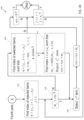
- FIG. 2 is a flow diagram of an exemplary method for determining requests for data transmission via a data communication pathway of the data communication network to accept where an aggregate of demands of the requests exceeds at least one constraint of the data communication pathway;
- FIG. 3 is an exemplary implementation of one or more steps of the method of FIG. 2 ;
- FIGS. 4 A-E are flow diagrams of an exemplary method for implementing one or more steps of the method of FIG. 3 ;
- FIG. 5 is an exemplary implementation of one or more steps of the method of FIG. 2 ;
- FIGS. 6 A-C are flow diagrams of an exemplary method for implementing one or more steps of the method of FIG. 5 ;
- FIG. 7 is an exemplary computing system.
- Described herein are examples of systems and methods for optimizing data communication in a data communication network in which requests to utilize a data communication pathway exceed one or more capacities (e.g., a maximum data transmission rate) of the pathway.
- Requests to transmit data via the communication pathway are received at a computing system.
- the requests include one or more demands for transmitting the data via the communication pathway.
- the computing system determines a set of the requests to accept such that an aggregate of the demands will not exceed one or more capacities of the communication pathway.
- the computing system seeks to maximize at least one attribute of the operation of the data communication network within a suitable tolerance that enables solutions to be determined in a computationally efficient manner.
- the systems and methods may seek to maximize an aggregate data transmission rate or may seek to ensure that higher priority data is preferential.
- systems and methods described herein may determine which requests to accept by representing the selection problem as a binary knapsack packing problem that seeks to fill one or more knapsacks to the extent possible without exceeding the communication pathway capacity, while also seeking to maximize at least one attribute of the operation of the data communication network.
- a maximum-value-density optimization approach is used to “fill” the knapsack(s).
- a value density may be defined as a value associated with a request divided by the demand for the request. If the maximum-value-density optimization selects a set of requests to accept that still leaves some residual capacity of the communication pathway, which may be unacceptably large for some applications, then maximum-value optimization steps may be used.
- the maximum-value-density optimization may include first selecting a set of candidate requests that have the highest value densities such that an aggregate of the demands of those candidate requests does not exceed the capacity of the communication pathway. This may be followed by determining a non-selected request (X) that has a demand that can fit within the residual capacity, and determining if there exists a non-selected request (Y) that has a higher value density than the value density of the combined non-selected request X and the selected request (Z) that has the lowest value density of all of the selected requests. If none exists, then the non-selected request X is added to the list of requests selected for acceptance.
- the non-selected request Y does exist and its demand is no larger than the sum of the residual capacity and the demand of the selected request Z, then the lowest value-density selected request Z is replaced by the non-selected request Y. The process may be repeated until no further reduction in residual capacity in the prescribed manner is possible.
- Maximum-value optimization may be used if the above maximum-value-density optimization leaves some residual capacity of the communication pathway that may be unacceptably large for some applications.
- the maximum-value optimization may include replacing selected requests with one or more non-selected requests such that the total value associated with the selected requests is increased.
- the value can be a fee that the requestors are willing to pay for their requests to be accepted, a priority associated with each request, etc.
- Increasing the total value can include determining if a non-selected request can replace several smaller selected requests to improve the total value with smallest degradation in average density. Additionally, or alternatively, increasing the total value can include determining if a non-selected request can replace a single selected request to increase the total value with the smallest degradation in average density.
- systems and methods may be configured to determine an optimal set of requests to accept where the requests include demands for multiple different capabilities of the communication pathway, such as multiple communication channels that each have their own capacities.
- the systems and methods may take a multiple-knapsack packing problem approach in which, given a population of n requests, each request being represented by m demands (correspond to the m capabilities of the communication pathway), among the n requests, select the subset of requests that packs all m knapsacks as close to their limits as possible. This optimization problem seeks to minimize the aggregate residual space in all knapsacks.
- the multiple knapsack packing problem can be optimized by first selecting a set of candidate requests that, in aggregate, satisfy all constraints. Then, non-selected requests are found that fit within the residuals of the constraints. Non-selected requests that fit within the residuals of the constraints are selected that minimize the residual space. If sufficient residual space remains, then a determination is made whether each non-selected request can replace one single previously selected request for maximum reduction in the residual space and/or a determination is made whether each selected request can be replaced by one single previously non-selected request for maximum reduction in the residual space.
- the systems and methods described herein can improve a data communication network by optimizing the selection of requests for data transmission to accept for a given communication pathway to maximize one or more attributes of the operation of the data communication network such that an aggregate of the demands by the accepted requests on network resources will not exceed one or more capacities of the communication pathway. This can ensure, for example, that the aggregate data transmission rate is maximized or that higher priority data transmission requests are accepted preferentially over lower priority data transmission requests while guaranteeing that an aggregate of the demands on network resources by the accepted requests will not exceed one or more capacities of the communication pathway.
- the techniques described herein can optimize request selection without incurring excessive computational penalties such that a solution for which requests to select can be reached in a timely manner (e.g., in real time).
- Certain aspects of the present disclosure include process steps and instructions described herein in the form of an algorithm. It should be noted that the process steps and instructions of the present disclosure could be embodied in software, firmware, or hardware and, when embodied in software, could be downloaded to reside on and be operated from different platforms used by a variety of operating systems. Unless specifically stated otherwise as apparent from the following discussion, it is appreciated that, throughout the description, discussions utilizing terms such as “processing,” “computing,” “calculating,” “determining,” “displaying,” “generating” or the like, refer to the action and processes of a computer system, or similar electronic computing device, that manipulates and transforms data represented as physical (electronic) quantities within the computer system memories or registers or other such information storage, transmission, or display devices.
- the present disclosure in some examples also relates to a device for performing the operations herein.
- This device may be specially constructed for the required purposes, or it may comprise a general-purpose computer selectively activated or reconfigured by a computer program stored in the computer or on a remote server.
- a computer program may be stored in a non-transitory, computer readable storage medium, such as, but not limited to, any type of disk, including floppy disks, USB flash drives, external hard drives, optical disks, CD-ROMs, magnetic-optical disks, read-only memories (ROMs), random access memories (RAMs), EPROMs, EEPROMs, magnetic or optical cards, application specific integrated circuits (ASICs), or any type of media suitable for storing electronic instructions, and each connected to a computer system bus.
- any type of disk including floppy disks, USB flash drives, external hard drives, optical disks, CD-ROMs, magnetic-optical disks, read-only memories (ROMs), random access memories (RAMs), EPROMs, EEPROM
- processors include central processing units (CPUs), graphical processing units (GPUs), field programmable gate arrays (FPGAs), quantum processing units (QPUs), and ASICs.
- CPUs central processing units
- GPUs graphical processing units
- FPGAs field programmable gate arrays
- QPUs quantum processing units
- ASICs ASICs
- FIG. 1 illustrates an exemplary data communication network 100 .
- the data communication network 100 can be a satellite communications network, a cellular communications network, a wired communications network, or a combination of any of these.
- the network 100 includes a plurality of end nodes 102 that can each be data sources and/or data sinks.
- the end nodes 102 can be any computing device that is a source of data for transmission over the network 100 and/or a consumer of data transmitted over the network 100 (i.e., a node can be only a source, only a consumer, or both a source and consumer of data).
- End nodes 102 can include, for example, consumer, commercial, industrial, and/or governmental computing systems.
- End nodes 102 can include user devices such as smartphones, sensor systems, server systems, unmanned vehicles, and any other computing system that can transmit and/or receive data via the network 100 .
- Network 100 includes a plurality of data transmission nodes 104 that handle data transmission between the end nodes 102 .
- the data transmission nodes 104 can include, for example, routers, satellites, cellular tower nodes, etc.
- a data transmission node 104 may be communicatively connected to at least one other data transmission node 104 via one or more links 106 for transmitting data to and/or receiving data from the at least one other data transmission node 104 .
- a data transmission node 104 handles communication between end nodes 102 connected directly to it (i.e., without any other data transmission nodes 104 ).
- At least some of the data transmission nodes 104 are connected to at least one end node 102 for transmitting data to and/or receiving data from the at least one end node 102 .
- one or more control computing systems 108 may be connected to one or more of the data transmission nodes for controlling at least some aspects of how data is to be transmitted by a data transmission node.
- a router may have a maximum data rate throughput
- a satellite communication link may have maximum uplink and downlink data rates
- a cellular tower node may have one or more communication channels having maximum data rate capacities.
- a given data transmission node 104 may have multiple different data transmission capacity constraints.
- a data transmission node 104 may have different maximum data transmission rates for different types of data, such as different maximum data rates for voice, video, text, command and control messages, system overhead messages, etc.
- FIG. 2 is a flow diagram of an exemplary method 200 for determining which data transmission requests to accept and which to reject.
- Method 200 may be performed by any suitable computing system.
- method 200 may be performed by one or more of the transmission nodes 104 for the respective transmission node 104 to select which data transmission requests from among the requests it receives that it is going to accept.
- method 200 may be performed by a computing system communicatively coupled to a transmission node 104 , such as a control computing system 108 of FIG. 1 .
- control computing system 108 may receive information (such as information corresponding to data transmission requests from the connected end nodes 102 ) from a connected transmission node 104 and/or one or more end nodes 102 connected to the control computing system 108 , may determine which data transmission requests the transmission node 104 should accept, and may transmit information to the transmission node 104 indicating which data transmission requests to accept. Any combination of steps of method 200 may be performed by any combination of computing systems, including any combination of a transmission node 104 and a control computing system 108 .
- a plurality of requests from a plurality of data transmission requestors requesting data transmissions via a communication pathway (e.g., a data transmission node 104 and/or one or more links 106 ) of a communication network are received at a computing system.
- the requestors may be, for example, at least some of the end nodes 102 communicatively connected to the transmission node 104 .
- the requests may be received at the transmission node 104 .
- the requests may be received at a control computing system 108 from the end nodes 102 , e.g., directly or via transmission node 104 .
- the received requests include requests for data transmissions via a communication pathway that includes the transmission node 104 .
- the communication pathway that is being requested by the requestors to be used for transmitting data has at least one data transmission constraint.
- the data transmission constraint can include, for example, a data transmission rate limit.
- the data transmission rate limit may be a limit of the transmission rate of data being transmitted across all accepted requests. In other words, the constraint is not a per-requestor limit, but rather a limit that applies to a set of accepted requests.
- An example includes a first data transmission limit for video data transmission and a second data transmission limit for voice data transmission.
- At least one data transmission constraint associated with the communication pathway may be exceeded by an aggregate of at least one demand of the requests for data transmission by the requestors.
- each request may include a demand for a specified data transmission rate or a specified amount of data to be transmitted within a requested period of time and an aggregate of the demands for the data transmission rates and/or data per unit time from the requestors may exceed a data rate capability of the transmission node 104 .
- the data transmission demand aggregated across the requests exceeds a capability of the communication pathway (e.g., the data transmission rate capability of the transmission node 104 ). Therefore, all of the requests cannot be accepted and at least one request will have to be denied.
- the transmission node 104 may be a satellite and the requests can include an uplink demand (e.g., an amount of data or a data rate to be transmitted via the satellite uplink) and a downlink demand (e.g., an amount of data or a data rate to be transmitted via the satellite uplink).
- the satellite may include an uplink constraint and a downlink constraint (e.g., a maximum of data to be handled over a certain period or a maximum data rate). These constraints may be the same or different.
- Another example of multiple demands is multiple data communication rate demands for different data types, such as different communication rate demands for one or more of voice, video, audio, text, images, command and control messages, system overhead messages, etc.
- the communication node 104 (e.g., a communication node in a 5G network) may have different data rate capacities for the different data types.
- Requestors may be associated with different agreed upon prices, and this difference can be leveraged in method 200 to select requests in such a way as to maximize revenue.
- a value associated with at least one characteristic of a request may be a value associated with honoring the request. So, for example, where a requester agrees to pay a certain fee per unit data, the associated value may be a product of the fee per unit data and the total amount of data associated with the request.
- step 204 may determine which requests to accept by seeking to maximize an aggregate value while ensuring that the at least one data transmission constraint is not exceeded.
- step 204 may include selecting a set of requests that, in sum, have the highest data transmission rate demand, without exceeding the capacity of the communication pathway.
- FIG. 3 illustrates an exemplary method 300 for implementing step 204 of method 200 .
- an initial selection is made of a set of candidate requests to accept based on value densities of the requests. This initial selection is made such that the data transmission constraint (or constraints) is not exceeded. Further, the initial selection is made such that a total of at least one demand of the initial selection of candidate requests to accept is less than the at least one data transmission constraint by at least one residual amount. In other words, the total demand across the set of requests in the initial selection does not exceed the data transmission constraint (or constraints) and may be less than the data transmission constraint, with the difference being a residual amount.
- non-selected requests are identified that have a value density greater than:
- FIGS. 4 A-E are flow diagrams illustrating an exemplary method 400 implementing the steps described above (i.e., an example implementation of method 300 ).
- the requests are sorted in order of descending value density. If requests have the same value density, then those requests may be sorted in order of descending demand. This step may be preceded by a step of determining the value densities for each request.
- the requests may be sorted in order of descending value densities (those requests that have the same value density may be sorted in order of descending demands).
- the first k requests (starting from the top of the sorted requests and moving in descending order) are selected such that the sum of the demands (m) of the selected requests are less than the corresponding constraint of the communication pathway (M) and adding the k+1 request to the selection would exceed the constraint.
- This step results in a residual that is the sum of the demands of the selected requests subtracted from the value of the constraint (M).
- step 412 a determination is made whether the demand m j of the non-selected request identified in step 410 (or step 416 or step 418 , depending on the stage of the process as discussed further below), exceeds the residual determined in step 404 (or step 416 or step 418 , depending on the stage of the process). If it does, then the next lower value-density non-selected requests are checked until one is found that does not exceed the residual (i.e., step 412 is repeated). If all non-selected requests have been analyzed according to step 412 and all have been found to have demands in excess of the residual, then the method may proceed to step 420 shown in FIG. 4 D and described further below.
- step 414 of FIG. 4 C determines whether there is a non-selected request (a request not in the selected requests from step 404 (or step 416 or step 418 , depending on the stage of the process)) that has a demand that does not exceed the sum of the demand (m j ) of the request determined at step 412 and the demand (m l ) of the lowest value-density request determined at step 410 (or step 416 or step 418 , depending on the stage of the process), and has a value that exceeds the sum of the value (v j ) of the request determined at step 412 (or step 416 or step 418 , depending on the stage of the process) and the value (v l ) of the lowest value-density request in the selected requests determined from either step 410 (or step 416 or step 418 , depending on the stage of the process
- the request with the highest value-density is selected.
- the list of selected requests is updated by replacing the lowest value-density selected request (i.e., the request with demand mi and value vi) with the request determined in step 414 .
- the residual, the lowest value-density selected request, and the highest value-density non-selected request are all updated at the end of step 416 after the lists of selected and non-selected requests have been updated. If no request is found that satisfies the requirement in step 414 , then at step 418 the list of selected requests is updated to include the request determined at step 412 (i.e., with demand m j and value v j ).
- the residual, the lowest value-density selected request and the highest value-density non-selected request are all updated at the end of step 418 after the lists of selected and non-selected requests have been updated.
- the method may end, resulting in the updated list from either step 416 or step 418 being the final list of requests to accept. If there is still a residual after step 416 or step 418 , then the method may return to step 412 of FIG. 4 B .
- the threshold may be associated with a number of requests above which subsequent steps may impose too high a computational penalty to justify the likely improvement in results.
- the total number of requests can be compared to a second predetermined threshold at step 422 . This threshold may be lower than the threshold of step 420 and may be associated with a number of requests above which a portion of subsequent steps may impose too high a computational penalty to justify the likely improvement in results from those steps. If the number of requests is not below the second threshold, then method 400 may proceed to step 434 of FIG. 4 E , which is described further below.
- the set of requests not in the updated list of selected requests from the preceding steps is determined.
- a request from the set determined at step 423 is analyzed and its demand is compared to the residual corresponding to the updated set of selected requests. If its demand is less than the residual, then it is added to the updated list of selected requests at step 426 . If this results in the residual being zero, then the method may end, resulting in the updated list from step 426 being the final list of requests to accept.
- step 423 If there is still some residual and not all requests of the set from step 423 have been analyzed, then the method may return to step 424 for analysis of a different request from the set determined at step 423 . If there is still some residual after all requests in the set from step 423 have been analyzed, then method 400 may proceed to step 434 of FIG. 4 E , which is described further below.
- the updated list of selected requests from the preceding steps is searched for selected requests that have demands that are less than the demand of the request from step 424 less the residual.
- a subset of these requests is found where the sum of their demands is greater than the demand of the request from step 424 less the residual and the sum of their values is less than the value of the request from step 424 . If such a subset (which can be a subset that has one or more than one requests) exists, then at step 432 , the subset of requests is removed from the updated list of requests to accept from the preceding steps, and at step 426 , the request from step 424 is added to the list of requests to accept. If, however, such a subset does not exist (step 430 ) and not all requests of the set from step 423 have been analyzed, then the method may return to step 424 for analysis of a different request from the set determined at step 423 .
- step 434 the set of requests that are not in the updated list of selected requests from previous steps (i.e., an updated list of non-selected requests) is determined.
- step 436 one of the requests from the set determined in step 434 is analyzed and its demand is compared to the residual corresponding to the updated list of selected requests from previous steps. If its demand is less than or equal to the residual, then at step 438 , the list of requests to accept is updated to include the request. If this reduces the residual to zero, then the method ends, and the updated list may be used as the final set of requests to accept.
- the method may return to step 436 for analysis of a different request from the set of requests identified in step 434 . If the demand of the request is larger than the residual at step 436 , then at step 440 , a set of requests in the updated set of selected requests is determined for which each request in the set have a demand that is greater than or equal to the demand of the request identified at step 436 less the residual associated with the updated set of selected requests and have a value that is less than the value of the request identified at step 436 .
- step 434 the method may return to step 436 for analysis of a different request from the set of requests determined at step 434 .
- step 442 the request having the minimum demand in the set of requests is removed from the updated list of selected requests, and the method proceeds to step 438 in which the request identified in step 436 is added to the updated list of requests to accept. If this reduces the residual to zero, then the method ends, and the updated list may be used as the final set of requests to accept. If there is still some remaining residual and all of the requests from the set identified in step 434 have not been analyzed, the method may return to step 436 for analysis of a different request from the set of requests identified in step 434 .
- Method 400 takes an approach of packing a single knapsack to maximize the value of the selected set of data communication requests.
- the knapsack limit can be, for example, a communication channel capacity and the value that is maximized may be, for example, an aggregate users' subscription fee, users' priority, etc.
- a data communication pathway may include multiple different communication capabilities having corresponding constraints and data transmission requests may include demands that correspond to the multiple capabilities of the communication pathway, with at least some of the constraints being exceeded by an aggregate of the demands of the requests. Described further below are methods for determining which requests to accept where the communication pathway has multiple capabilities for which the requests have corresponding demands that, in aggregate, exceed the upper limit of at least one of the capabilities.
- the problem can be thought of as having m knapsacks representing the m attributes of the requests.
- n requests choose the subset of requests that packs all m knapsacks as close to their limits as possible (or some approximation of this). This is an optimization problem that seeks to minimize the aggregate residual space in all knapsacks.
- requests may be selected such that the aggregate of the data rate demands (UL and DL) are maximized (or approximately maximized) subject to the capacity limits. This can be represented as:
Landscapes
- Engineering & Computer Science (AREA)
- Computer Networks & Wireless Communication (AREA)
- Signal Processing (AREA)
- Mobile Radio Communication Systems (AREA)
Abstract
Description
Determining which requests to accept, according to
The non-selected requests that meet this requirement (requirement (1) above) are then compared to determine which of the non-selected requests has the largest demand that is no larger than the sum of the residual amount and the demand (D2) of the lowest value-density request from the initial selection. This step may include searching along the ranking of the requests from step 302 (only those requests that are not in the initial selection) in descending order until a request is located that meets the requirements outlined above. If
where uj and dj are, respectively, the uplink and downlink data rate demands corresponding to the jth request, U and L are, respectively, the uplink and downlink capacities (e.g., maximum data rates) of the satellite communication link, and xj is the binary selection variable (which is 1 if the corresponding request is selected and 0 if not).
where ai=[aij, j=1, . . . , n], aij is the demand (e.g., data transmission rate) of the jth request for the ith data type, and x is set of binary selection variables, x=[xj; j=1, . . . , n] (i.e., xj=1 (jth user is selected) or xj=0 (jth user is rejected)). Each data type is packed into a knapsack and the system selects a subset of the n users to minimize the aggregate residual space in all knapsacks taken together.
This approximation may include selecting the first k requests that in aggregate satisfy all constraints. k is selected such that inclusion of the (k+1)th request violates some constraint(s), i.e.:
where cj is the value (e.g., an amount to be paid by the requestor, a priority of the request, etc.) associated with request j, xj is the binary selection value for request j, n is the number of requests, and uj and dj are, respectively, the uplink and downlink data rates corresponding to the request j. This can be generalized to an arbitrary number of capabilities of the communication link as follows:
where there are m types of demand (e.g., data types) for m capabilities (e.g., dedicated communication channels for different data types) of the communication pathway, the capability (e.g., channel) dedicated to the ith type of demand (e.g., data type) has a maximum capacity (e.g., data rate) bi, there are n requests, each having one or more types of demands (e.g., data type demands) for transmission of data over the communication pathway, the jth (j=1, . . . , n) request has the ith (i=1, . . . , m) demand type (e.g., data type) with demand (e.g., data rate) aij, the jth request's value=cj(e.g., the fee paid to the service provider for the data transmission), and x is the set of binary selection values. With this approach, each demand type is packed into a knapsack and the system selects a subset of the n requests in order to maximize (e.g., within a certain predetermine tolerance) the aggregate value of the selection.
-
- subject to 0≤aix≤bi, 0≤x≤X (n×1 bounded integer selection variable)

- c=[cj]=1×n real, ai=[aij; j=1, . . . , n]=1×n real, i=1, . . . , m
-
-
- x=[x1 x2 . . . xn], where xk are integers satisfying 0≤xk≤Nk, k=1, . . . , n
- subject to 0≤Ax≤b, A=[aij]m×n, b=[bi]m×1, c=1×n

-
- x=[x1 x2 . . . xn], where xk are integers satisfying 0≤xk≤Nk, k=1, . . . , n
entries. The integer programming problem is then mapped to the following binary integer programming problem:
-
- subject to 0≤Aaugxaug≤b

-
Claims (26)
Priority Applications (2)
| Application Number | Priority Date | Filing Date | Title |
|---|---|---|---|
| US18/499,659 US12294520B1 (en) | 2023-11-01 | 2023-11-01 | Systems and methods for optimizing data transmission in a capacity constrained data communication network |
| US19/098,671 US20250260646A1 (en) | 2023-11-01 | 2025-04-02 | Systems and method for optimizing data transmission in a capacity constrained data communication network |
Applications Claiming Priority (1)
| Application Number | Priority Date | Filing Date | Title |
|---|---|---|---|
| US18/499,659 US12294520B1 (en) | 2023-11-01 | 2023-11-01 | Systems and methods for optimizing data transmission in a capacity constrained data communication network |
Related Child Applications (1)
| Application Number | Title | Priority Date | Filing Date |
|---|---|---|---|
| US19/098,671 Division US20250260646A1 (en) | 2023-11-01 | 2025-04-02 | Systems and method for optimizing data transmission in a capacity constrained data communication network |
Publications (2)
| Publication Number | Publication Date |
|---|---|
| US20250141804A1 US20250141804A1 (en) | 2025-05-01 |
| US12294520B1 true US12294520B1 (en) | 2025-05-06 |
Family
ID=95483351
Family Applications (2)
| Application Number | Title | Priority Date | Filing Date |
|---|---|---|---|
| US18/499,659 Active US12294520B1 (en) | 2023-11-01 | 2023-11-01 | Systems and methods for optimizing data transmission in a capacity constrained data communication network |
| US19/098,671 Pending US20250260646A1 (en) | 2023-11-01 | 2025-04-02 | Systems and method for optimizing data transmission in a capacity constrained data communication network |
Family Applications After (1)
| Application Number | Title | Priority Date | Filing Date |
|---|---|---|---|
| US19/098,671 Pending US20250260646A1 (en) | 2023-11-01 | 2025-04-02 | Systems and method for optimizing data transmission in a capacity constrained data communication network |
Country Status (1)
| Country | Link |
|---|---|
| US (2) | US12294520B1 (en) |
Citations (11)
| Publication number | Priority date | Publication date | Assignee | Title |
|---|---|---|---|---|
| KR101396884B1 (en) | 2012-12-04 | 2014-05-19 | 국방과학연구소 | System for joint bandwidth allocation and path selection in uplink and mehtod thereof |
| CN104393394A (en) | 2014-11-21 | 2015-03-04 | 陕西欧赛通信科技有限公司 | Knapsack emergency satellite communication servo system |
| CN109218747B (en) | 2018-09-21 | 2020-05-26 | 北京邮电大学 | A classification and caching method for video services based on user mobility in ultra-dense heterogeneous networks |
| CN113923791A (en) | 2021-10-21 | 2022-01-11 | 南京邮电大学 | A method for allocating virtual radio resources in the uplink of radio access network slices |
| CN114040453A (en) | 2021-09-28 | 2022-02-11 | 中国空间技术研究院 | Method and device for allocating resources of satellite return link |
| CN114785403A (en) | 2022-04-21 | 2022-07-22 | 北京鹏鹄物宇科技发展有限公司 | Satellite-ground communication-oriented data transmission scheduling optimization method |
| CN115103377A (en) | 2022-06-02 | 2022-09-23 | 南京工业大学 | NOMA enhanced SVC video multicast mechanism in unmanned aerial vehicle assisted wireless access network |
| US20220393972A1 (en) * | 2019-09-18 | 2022-12-08 | Lenovo (Singapore) Pte. Ltd. | Establishing a new qos flow for a data connection |
| CN115765843A (en) | 2022-11-15 | 2023-03-07 | 华安中云股份有限公司 | Time delay control method and device of satellite link, processing equipment and backpack base station |
| CN111683381B (en) | 2020-04-28 | 2023-04-07 | 南京邮电大学 | End-to-end network slice resource allocation method based on deep reinforcement learning |
| US20240243936A1 (en) * | 2021-12-30 | 2024-07-18 | Intel Corporation | Charging for edge enabling infrastructure resources |
-
2023
- 2023-11-01 US US18/499,659 patent/US12294520B1/en active Active
-
2025
- 2025-04-02 US US19/098,671 patent/US20250260646A1/en active Pending
Patent Citations (11)
| Publication number | Priority date | Publication date | Assignee | Title |
|---|---|---|---|---|
| KR101396884B1 (en) | 2012-12-04 | 2014-05-19 | 국방과학연구소 | System for joint bandwidth allocation and path selection in uplink and mehtod thereof |
| CN104393394A (en) | 2014-11-21 | 2015-03-04 | 陕西欧赛通信科技有限公司 | Knapsack emergency satellite communication servo system |
| CN109218747B (en) | 2018-09-21 | 2020-05-26 | 北京邮电大学 | A classification and caching method for video services based on user mobility in ultra-dense heterogeneous networks |
| US20220393972A1 (en) * | 2019-09-18 | 2022-12-08 | Lenovo (Singapore) Pte. Ltd. | Establishing a new qos flow for a data connection |
| CN111683381B (en) | 2020-04-28 | 2023-04-07 | 南京邮电大学 | End-to-end network slice resource allocation method based on deep reinforcement learning |
| CN114040453A (en) | 2021-09-28 | 2022-02-11 | 中国空间技术研究院 | Method and device for allocating resources of satellite return link |
| CN113923791A (en) | 2021-10-21 | 2022-01-11 | 南京邮电大学 | A method for allocating virtual radio resources in the uplink of radio access network slices |
| US20240243936A1 (en) * | 2021-12-30 | 2024-07-18 | Intel Corporation | Charging for edge enabling infrastructure resources |
| CN114785403A (en) | 2022-04-21 | 2022-07-22 | 北京鹏鹄物宇科技发展有限公司 | Satellite-ground communication-oriented data transmission scheduling optimization method |
| CN115103377A (en) | 2022-06-02 | 2022-09-23 | 南京工业大学 | NOMA enhanced SVC video multicast mechanism in unmanned aerial vehicle assisted wireless access network |
| CN115765843A (en) | 2022-11-15 | 2023-03-07 | 华安中云股份有限公司 | Time delay control method and device of satellite link, processing equipment and backpack base station |
Non-Patent Citations (8)
| Title |
|---|
| Cacchiani et al. (Feb. 2022) "Knapsack problems—An overview of recent advances. Part II: Multiple, multidimensional, and quadratic knapsack problems," Computers & Operations Research 143. (14 pages). |
| Cacchiani et al. (Feb. 2022). "Knapsack problems—An overview of recent advances. Part I: Single knapsack problems," Computers & Operations Research 143. (14 pages). |
| Chen et al. (Apr. 2022). "Approximation Algorithms for Interdiction Problem with Packing Constraints," arXiv:2204.11106v1; (46 pages). |
| Cicek et al. (Aug. 2020). "Backhaul-Aware Optimization of UAV Base Station Location and Bandwidth Allocation for Profit Maximization," IEEE Access 8: 154573-154588. |
| Csébfalvi et al. "The Multidimensional 0-1 Knapsack Problem A New Heuristic Algorithm Combined with 0-1 Linear Programming," Proceedings of the International Conference on Evolutionary Computation Theory and Applications (ECTA-2011), Oct. 24-26, 2011, Paris, France; pp. 203-207. |
| Köse et al. "Resource Allocation for Underlaying Device-to-Device Communications Using Maximal Independent Sets and Knapsack Algorithm," 2018 IEEE 29th Annual International Symposium on Personal, Indoor, and Mobile Radio Communications (PIMRC), Sep. 9-12, 2018, Bologna, Italy; 5 pages. |
| Morrison et al. (2016). "Branch-and-bound algorithms: A survey of recent advances in searching, branching, and pruning," Discrete Optimization 19:79-102. |
| Pasandideh et al. (Mar. 2023). "An Improved Particle Swarm Optimization Algorithm for UAV Base Station Placement," Wireless Personal Communications. (28 pages). |
Also Published As
| Publication number | Publication date |
|---|---|
| US20250260646A1 (en) | 2025-08-14 |
| US20250141804A1 (en) | 2025-05-01 |
Similar Documents
| Publication | Publication Date | Title |
|---|---|---|
| US9860190B2 (en) | Adaptive algorithm for cloud admission policies | |
| CN110035410A (en) | Federated resource distribution and the method and system of unloading are calculated in a kind of vehicle-mounted edge network of software definition | |
| CN112561167B (en) | Travel recommendation methods, devices, electronic devices and storage media | |
| CN113259144A (en) | Storage network planning method and device | |
| CN111798167B (en) | Warehouse replenishment method and device | |
| US11334758B2 (en) | Method and apparatus of data processing using multiple types of non-linear combination processing | |
| CN115952832A (en) | Adaptive model quantization method and device, storage medium and electronic device | |
| Selvam et al. | Optimized Self‐Guided Quantum Generative Adversarial Network Based Scheduling Framework for Efficient Resource Utilization in Cloud Computing to Enhance Performance and Reliability | |
| CN118055160A (en) | Edge computing server task allocation system and method | |
| US20250260646A1 (en) | Systems and method for optimizing data transmission in a capacity constrained data communication network | |
| CN113596106B (en) | Delay-sensitive slice resource scheduling method based on multi-edge server cooperation | |
| CN120111530B (en) | A task scheduling and caching optimization method in a memory-computing collaborative edge computing network | |
| Wang et al. | QoS and energy-aware resource allocation in cloud computing data centers using particle swarm optimization algorithm and fuzzy logic system | |
| CN120390259A (en) | Multi-task oriented edge computing resource allocation method, device, equipment and medium | |
| WO2006001820A1 (en) | Methods and apparatus for cost minimization of multi-tiered infrastructure with end-to-end delay guarantees | |
| CN116521369A (en) | Edge computing task allocation method and device and nonvolatile storage medium | |
| US12408070B2 (en) | Method for providing service in edge network including multiple access points, and system therefor | |
| De Turck | Efficient resource allocation through integer linear programming: a detailed example | |
| CN111915236B (en) | Method and apparatus for coordinated delivery of vehicles, device and readable medium | |
| CN115801791A (en) | A method and load balancer for implementing load balancing | |
| US20240039833A1 (en) | Multi-path routing method and apparatus oriented to supercomputing user experience quality | |
| Koganti et al. | QoS-Aware Application Assignment and Resource Utilisation Maximization Using AHP in Edge Computing | |
| Taka et al. | Joint service placement and user assignment model in multi‐access edge computing networks against base‐station failure | |
| Varshney et al. | An effective multi-criteria decision-making approach for allocation of resources in the fog computing environment | |
| EP2611068A1 (en) | Method for selecting a chain of service level specifications |
Legal Events
| Date | Code | Title | Description |
|---|---|---|---|
| FEPP | Fee payment procedure |
Free format text: ENTITY STATUS SET TO UNDISCOUNTED (ORIGINAL EVENT CODE: BIG.); ENTITY STATUS OF PATENT OWNER: LARGE ENTITY |
|
| AS | Assignment |
Owner name: LINQUEST CORPORATION, VIRGINIA Free format text: ASSIGNMENT OF ASSIGNORS INTEREST;ASSIGNORS:VU, HOAI XUAN;VU, CAN XUAN;VU, DAO NGOC;REEL/FRAME:066331/0813 Effective date: 20231214 |
|
| AS | Assignment |
Owner name: LINQUEST CORPORATION, VIRGINIA Free format text: ASSIGNMENT OF ASSIGNORS INTEREST;ASSIGNORS:VU, HOAI XUAN;VU, CAN XUAN;VU, DAO NGOC;REEL/FRAME:070548/0989 Effective date: 20231214 |
|
| AS | Assignment |
Owner name: KBR WYLE SERVICES, LLC, TEXAS Free format text: MERGER;ASSIGNOR:LINQUEST CORPORATION;REEL/FRAME:070633/0100 Effective date: 20241211 |
|
| AS | Assignment |
Owner name: LINQUEST CORPORATION, VIRGINIA Free format text: ASSIGNMENT OF ASSIGNORS INTEREST;ASSIGNORS:VU, HOAI XUAN;VU, CAN XUAN;VU, DAO NGOC;REEL/FRAME:070650/0820 Effective date: 20231214 |
|
| STCF | Information on status: patent grant |
Free format text: PATENTED CASE |