US12294478B2 - Telecommunications method with phase-offset polar constellation for reducing PAPR, and corresponding devices - Google Patents
Telecommunications method with phase-offset polar constellation for reducing PAPR, and corresponding devices Download PDFInfo
- Publication number
- US12294478B2 US12294478B2 US18/042,523 US202118042523A US12294478B2 US 12294478 B2 US12294478 B2 US 12294478B2 US 202118042523 A US202118042523 A US 202118042523A US 12294478 B2 US12294478 B2 US 12294478B2
- Authority
- US
- United States
- Prior art keywords
- points
- phase
- constellation
- polar
- papr
- Prior art date
- Legal status (The legal status is an assumption and is not a legal conclusion. Google has not performed a legal analysis and makes no representation as to the accuracy of the status listed.)
- Active, expires
Links
Images


Classifications
-
- H—ELECTRICITY
- H04—ELECTRIC COMMUNICATION TECHNIQUE
- H04L—TRANSMISSION OF DIGITAL INFORMATION, e.g. TELEGRAPHIC COMMUNICATION
- H04L27/00—Modulated-carrier systems
- H04L27/26—Systems using multi-frequency codes
- H04L27/2601—Multicarrier modulation systems
- H04L27/2614—Peak power aspects
- H04L27/2621—Reduction thereof using phase offsets between subcarriers
-
- H—ELECTRICITY
- H04—ELECTRIC COMMUNICATION TECHNIQUE
- H04L—TRANSMISSION OF DIGITAL INFORMATION, e.g. TELEGRAPHIC COMMUNICATION
- H04L27/00—Modulated-carrier systems
- H04L27/26—Systems using multi-frequency codes
- H04L27/2601—Multicarrier modulation systems
- H04L27/2626—Arrangements specific to the transmitter only
- H04L27/2627—Modulators
- H04L27/2628—Inverse Fourier transform modulators, e.g. inverse fast Fourier transform [IFFT] or inverse discrete Fourier transform [IDFT] modulators
-
- H—ELECTRICITY
- H04—ELECTRIC COMMUNICATION TECHNIQUE
- H04L—TRANSMISSION OF DIGITAL INFORMATION, e.g. TELEGRAPHIC COMMUNICATION
- H04L27/00—Modulated-carrier systems
- H04L27/32—Carrier systems characterised by combinations of two or more of the types covered by groups H04L27/02, H04L27/10, H04L27/18 or H04L27/26
- H04L27/34—Amplitude- and phase-modulated carrier systems, e.g. quadrature-amplitude modulated carrier systems
-
- H—ELECTRICITY
- H04—ELECTRIC COMMUNICATION TECHNIQUE
- H04L—TRANSMISSION OF DIGITAL INFORMATION, e.g. TELEGRAPHIC COMMUNICATION
- H04L27/00—Modulated-carrier systems
- H04L27/32—Carrier systems characterised by combinations of two or more of the types covered by groups H04L27/02, H04L27/10, H04L27/18 or H04L27/26
- H04L27/34—Amplitude- and phase-modulated carrier systems, e.g. quadrature-amplitude modulated carrier systems
- H04L27/3405—Modifications of the signal space to increase the efficiency of transmission, e.g. reduction of the bit error rate, bandwidth, or average power
- H04L27/3411—Modifications of the signal space to increase the efficiency of transmission, e.g. reduction of the bit error rate, bandwidth, or average power reducing the peak to average power ratio or the mean power of the constellation; Arrangements for increasing the shape gain of a signal set
Definitions
- the present invention relates to the field of telecommunications. Within this field, the invention more particularly relates to digital communications involving transmission of a radio signal (6G, 5G, Wi-Fi, etc.) the PAPR of which is limited.
- a radio signal (6G, 5G, Wi-Fi, etc.) the PAPR of which is limited.
- Digital communications employ digital transmission chains that use well-known signal-processing modules such as illustrated in FIG. 1 .
- a conventional chain has been schematically shown in FIG. 1 .
- This chain receives input data Bit from a binary source, the binary data being representative, for example, of an audio signal (voice), of a multimedia signal (television stream, Internet stream), etc.
- the input data are encoded via an error-correcting encoder COD (e.g. turbo code, LDPC, polar code).
- COD error-correcting encoder
- An interleaver ENT interleaves the encoded data.
- a signal binary encoder MAP converts a binary data packet, such as a code word, into one point of a constellation (BPSK, QPSK, mQAM, etc.).
- This encoder is also called a mapper, and it is equivalently said that the mapper maps the input data to the points of the constellation.
- the output of this mapper consists of the symbols of the constellation to which the input data were mapped, or equivalently mapped data is referred to when designating the data output.
- mQAM QAM being the acronym of Quadrature Amplitude Modulation
- FIG. 2 shows conventional 16 QAM modulation.
- the signal binary encoder allows the binary data delivered by the channel encoder (error-correcting encoder) to be projected, or in other words mapped, onto a two-axis plane, according to a given constellation. Each point of the constellation thus transports one packet formed from one or more bits. For example, when mapping to BPSK, QPSK or mQAM constellations, the number of bits that may be mapped to a point of the given constellation is as follows:
- the mapped data are modulated by a multi-carrier modulator MOD to generate multi-carrier symbols.
- the output of the modulator is fed to a power amplifier of the transmitter, with a view to transmitting a radio signal.
- OFDM modulation OFDM being the acronym of Orthogonal Frequency-division Multiplexing
- FIG. 3 illustrates the output of a modulator implementing OFDM modulation.
- Such an OFDM modulator is often achieved by means of an inverse Fourier transform (IFFT).
- IFFT inverse Fourier transform
- the various carriers of an OFDM symbol are modulated with the points of the constellation to which the data packets were mapped.
- the frequency interval between carriers is 1/t s with t s the duration of an OFDM symbol.
- a guard interval of duration A is inserted between two successive OFDM symbols symb. This guard interval makes it possible to handle echoes caused by the multiple reflections that occur during radio transmissions over the channel, which is generally air.
- This interval may be used to perform a first so-called coarse time synchronization of the system (between a transmitter and a receiver).
- reception-end the FFT window to be positioned before the received radio signal is demodulated.
- Applying an FFT reception-end allows the IFFT applied transmission-end to be inverted, i.e. allows the received OFDM symbols to be demodulated.
- PAPR peak-to-average power ratio
- PAPR ( dB ) 10 * log 10 ( max ⁇ ( x ( t ) 2 ) x ( t ) 2 _ )
- FIG. 4 illustrates the PAPR of a time-domain signal resulting from an OFDM modulation composed of 2048 carriers modulated with the points of a 16-QAM modulation.
- the average PAPR of this signal is about 9.2 dB.
- PTS partial transmit sequence
- One subject of the invention is a telecommunication method involving transmission of a multi-carrier symbol constructed from the points of a polar constellation, said points being block modulated with control of at least one phase-rotation vector of one of these blocks of modulated points to decrease a PAPR of the transmitted multi-carrier symbol.
- phase rotation or phase shift to one or more of the points mapped to the carriers, by means of the rotation vector, to decrease the PAPR of the multi-carrier symbol is achieved, according to the method, without transmission of any information on this phase shift to the receiver.
- the receiver is advantageously able to determine, without ambiguity, the received points of the constellation.
- the polar constellation allows up to a certain amount of phase shift to be accommodated, which amount is determined by the number of points of the constellation on a given circle.
- a telecommunication method according to the invention allows various constraints with respect to phase variations to be addressed through definition of the phase values used for the various points. This method is therefore very flexible and adaptable depending on the phase constraints.
- the constellation used also allows the robustness of the system against phase variations caused by oscillator imperfections to be increased, in particular at high frequencies beyond 6 GHz.
- a telecommunication method according to the invention allows various constraints with respect to variations in amplitude (noise) to be addressed through modification of the value of the interval, which may be parametrizable. This method is therefore very flexible and adaptable depending on the noise constraints.
- a telecommunication method comprises:
- the modulation is implemented via an inverse Fourier transform.
- An inverse Fourier transform allows a frequency domain to be efficiently and simply converted to a time domain, and an OFDM symbol to be obtained.
- the phase rotation, the 2nd addition, and the comparison are performed iteratively for a plurality of different phase-rotation vectors.
- This embodiment makes it possible to use high modulation orders to meet the increasing demand for throughput even in the absence of pilots, while making it possible to absorb a phase variation that may range up to ⁇ /2 by limiting to four the number of points on a given circle.
- This embodiment is particularly advantageous because the obtained symbols may be demodulated by a conventional demodulator: they are compatible with demodulators designed for conventional 16-QAM modulation, in which the four points of a quadrant are distributed in a square.
- a constellation comprises a set of M points the coordinates of which expressed in polar form a m ⁇ e j ⁇ m , . . .
- This embodiment makes it possible to use high modulation orders to meet the increasing demand for throughput even in the absence of pilots, while making it possible to absorb a phase variation that may range up to ⁇ by limiting the number points on a given circle to two.
- the polar constellation according to this embodiment is defined per block of two quadrants and replicated between these two blocks with the particularity that the phase of the points is the same within a block.
- This mode uses constellations, which are said to be spiral constellations, defined on all the quadrants i.e. over 2 ⁇ , i.e. the four quadrants are considered to be one.
- This embodiment of the method makes it possible to introduce a phase variation that may range up to 2 ⁇ on any point of the constellation. Although no phase-rotation information is transmitted to the receiver in the method, the receiver is nonetheless able to determine, without ambiguity, the received constellation points since the constellation allows any phase rotation (up to 2 ⁇ ) to be absorbed.
- Such an embodiment is particularly suitable for systems confronted with a lot of phase noise, which is the case with communications taking place in the terahertz band. Specifically, at these frequencies oscillators exhibit a lot of phase noise. Spiral constellations make it possible to obtain both good immunity to noise and a good immunity to phase variations, and are therefore particularly advantageous for communications in the terahertz domain.
- This embodiment is as robust against phase variations as an embodiment in which all the points of the constellation have the same phase, but in addition it advantageously increases the minimum Euclidean distance of the points of the constellation.
- the polar constellation according to this embodiment comprises points all having the same phase with a constant amplitude interval between two neighboring points.
- This type of polar constellation has a high immunity to phase variations i.e. of up to 2 ⁇ , but a relatively low immunity to noise.
- Another subject of the invention is a reception method, comprising:
- the invention further relates to a telecommunication equipment, which comprises:
- the invention further relates to a telecommunication equipment, which comprises:
- the proposed invention thus allows a plurality of objectives to be achieved:
- FIG. 1 is a diagram illustrating a transmission-end baseband processing chain according to the prior art
- FIG. 2 is a representation of a conventional 16 QAM constellation
- FIG. 3 is a conventional time-frequency representation of OFDM symbols
- FIG. 4 is a time-domain representation of an OFDM signal delivered by a conventional transmission-end baseband chain with an OFDM modulator by which only 10% of the carriers are used,
- FIG. 5 is a representation, against a real axis X(I) and an imaginary axis Y(Q), of a first configuration of a polar constellation employable in a method according to the invention
- FIG. 6 is an illustration of one example of the phase variation applicable to the points of the modulation illustrated in FIG. 5 .
- FIG. 7 is a representation, against a real axis X(I) and an imaginary axis Y(Q), of a second configuration of a polar constellation employable in a method according to the invention
- FIG. 8 schematically shows the maximum phase variation applicable to the points of the modulation illustrated in FIG. 7 .
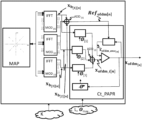
- FIG. 9 is a block diagram illustrating the implementation of a method according to the invention by a corresponding device
- FIG. 10 shows the curve of the CCDF values obtained without the reduction method according to the invention, and the curve of the CCDF values obtained with the reduction method according to the invention with a block of 120 carriers,
- FIG. 11 shows the curve of the CCDF values obtained without the reduction method according to the invention, and the curve of the CCDF values obtained with the reduction method according to the invention with a block of 12 carriers,
- FIG. 12 is a diagram of the simplified structure of an equipment according to the invention able to implement a telecommunication method according to the invention.
- FIG. 13 is a diagram of the simplified structure of an equipment according to the invention able to implement a reception method according to the invention.
- the general principle behind the invention is to map input data to a polar constellation the M points of which are distributed on concentric circles, there being a constant interval p between the circles, and then to perform multi-carrier block modulation of the points of the constellation and controlled rotation of the phase of the blocks before addition to form a multi-carrier symbol.
- the modulation employs N IFFT subcarriers.
- the modulation is performed blockwise by K modulators of N IFFT subcarriers. Each output of a modulator or block may be phase shifted with a phase-rotation vector before the blocks are added together.
- the PAPR of the multi-carrier symbol resulting from a complex addition after phase rotation of a symbol resulting from a block is compared with the PAPR of a multi-carrier symbol obtained with a different phase rotation. The comparison may be repeated for various phase-rotation values. Only the symbol of lowest PAPR is selected and transmitted.
- the interval p is a non-zero positive real number.
- the points of the constellation are therefore distributed over at least two distinct circles.
- a m is the amplitude of a point, and ⁇ m is the phase of this point.
- M is the order of the modulation.
- the constellation has the particularity that there is at most one point on each circle per quadrant considered in respect of the expression in polar form of the constellation.
- the constellation is determined for a quadrant of size 27 ⁇ , namely the quadrant [0 ⁇ 2 ⁇ [, then there is at most one point per circle.
- the constellation is determined per quadrant of size ⁇ , namely for the quadrants
- the normalization factor “F” depends on the interval between the points of the constellation and on the modulation order M. Under these conditions, it is given by the expression:
- phase ⁇ m does not remain constant but varies between the successive points.
- This first configuration is particularly advantageous with respect to phase variations because the reception-end demodulation may be performed based solely on detection of the amplitude of the received constellation points. Any phase variation during the transmission between the transmitter and the receiver does not affect the demodulation.
- the following table is one possible example of the way in which binary input data may be mapped to the points of a polar constellation according to the first configuration (illustrated in FIG. 5 ), employing Gray code.
- the phase is a multiple of ⁇ /4.
- FIG. 6 illustrates me result or a frequency deviation between the transmitter and the receiver with the constellation defined above over a plurality of consecutive OFDM symbols.
- FIG. 6 illustrates one example of the phase variation applicable to the points of the modulation called the spiral modulation, which is illustrated in FIG. 5 , that remains acceptable with respect to obtaining correct demodulation.
- This “spiral” structure makes it possible to withstand large variations in phase between the transmitter and the receiver of the system.
- This embodiment is particularly suitable for systems operating in the terahertz's, by which a lot of phase noise is generated due to poor oscillator performance.
- FIG. 7 shows a second configuration of a polar constellation used according to the invention.
- This second embodiment as illustrated is very advantageous because it is compatible with many existing OFDM demodulators capable of demodulating an OFDM/16 QAM modulation. Specifically, for each quadrant, the points are close to those of a conventional 16 QAM constellation as shown in FIG. 2 .
- FIG. 8 shows the maximum amount of phase variation applicable to the points of the modulation illustrated in FIG. 7 , transmission-end, that remains compatible with obtaining correct demodulation reception-end.
- the receiver is able to demodulate, without ambiguity, the received modulation points despite the phase variation between the transmitter and the receiver.
- FIG. 9 illustrates implementation of one embodiment of a method according to the invention by a corresponding device.
- a symbol binary encoder MAP converts (maps) an input binary data packet, for example a binary code word of data of a multimedia communication, into a complex point of a constellation using a conventional technique known to those skilled in the art.
- the constellation is a polar constellation.
- K is configurable.
- the constellation points are input into the K modulators in such a way that each point is modulated using a different subcarrier of the equivalent modulator of N IFFT subcarriers.
- the controller Ct_PAPR receives, by way of input, each of the N outputs of the K modulators, and the N samples Ref ofdm[n] of the multi-carrier symbol Ref ofdm .
- the controller Ct_PAPR determines the PAPR, which is said to be the initial PAPR, of the multi-carrier symbol Ref ofdm , which itself serves as initial value for the current reference multi-carrier symbol x ofdm_aux .
- the controller Ct_PAPR determines at least one phase-rotation vector ⁇ [1] , ⁇ [2] , ⁇ [3] and applies it to at least one of the symbols delivered by the K modulators.
- all the points of the constellation that are input into the K modulators undergo the phase rotations ⁇ [1] , ⁇ [2] , and ⁇ [3] respectively.
- the various phase-rotation vectors ⁇ [1] , ⁇ [2] , and ⁇ [3] may have different values or indeed some or all may be the same.
- the controller Ct_PAPR compares the PAPR of the multi-carrier symbol x ofdm_i resulting from the complex addition by a 2 nd adder ADD [2] of the samples n of the symbols after rotation of at least one of the symbols input into the adder, with the PAPR of the current reference x ofdm_aux .
- the output multi-carrier symbol x ofdm is that of the two input multi-carrier symbols that has the lowest PAPR.
- This multi-carrier symbol x ofdm of lower PAPR becomes the new current reference multi-carrier symbol x ofdm_aux .
- the comparison may be repeated for various phase-rotation vectors using an iterative method of L iterations, L being configurable. At the end of the iterations, only the multi-carrier symbol of lowest PAPR is transmitted.
- phase rotation applied to a point of the constellation by means of the phase-rotation vector is bounded by the value ⁇ max , which is configurable.
- each modulator implements an inverse Fourier transform.
- the multi-carrier symbols obtained are said to be OFDM symbols.
- n of the time-domain signal delivered by a block IFFT (implementation of an inverse Fourier transform) is denoted: x b [k][n] with k the index of the IFFT block k ⁇ [0: K ⁇ 1], K the total number of IFFT blocks and n the time index n ⁇ [0: N ⁇ 1].
- N N IFFT the size of the inverse Fourier transform IFFT.
- the method evaluates the PAPR of the reference OFDM symbol Ref ofdm , which is said to be the initial PAPR.
- the method scrambles the constellation points with a scrambler.
- This scrambling is carried out in the frequency domain, after the mapping by the mapper MAP and before the modulation by the K modulators.
- This scrambling makes it possible to reduce PAPR which is, as a result of the construction of a polar constellation, greater than that obtained with a QAM constellation.
- CCDF Complementary Cumulative Distribution Function
- the second (2) is used to illustrate the performance in terms of PAPR reduction obtained according to the invention.
- Performance was assessed with a transmission-end device employing a 2048-point FFT with 1200 payload carriers, the other carriers being null. Reception-end, a 1504-bit duo-binary turbo-code decoder and 8 iterations were used for decoding.
- FIG. 10 shows the curve of the CCDF values obtained without the reduction method according to the invention, and the curve of the CCDF values obtained with the reduction method according to the invention.
- FIG. 11 shows the curve of the CCDF values obtained without the reduction method according to the invention, and the curve of the CCDF values obtained with the reduction method according to the invention.
- the reduction method according to the invention was implemented with a block of 12 carriers, with reference to the block of 4G-LTE (Resource Block).
- Comparison of the curves of each of FIG. 10 and FIG. 11 illustrates the improvement in respect of reduction of PAPR obtained with the invention.
- Comparison of the curves according to the invention of FIG. 10 and FIG. 11 illustrates the fact that the increase in the number of blocks allows the reduction in PAPR to be increased.
- This equipment DEV_E may irrespectively be a base station or a mobile terminal.
- the equipment DEV_E comprises a microprocessor ⁇ P, operation of which is controlled via execution of a program Pg the instructions of which allow a telecommunication method according to the invention to be implemented.
- the equipment DEV_E further comprises a mapper MAP, an OFDM modulator MOD, a PAPR limiter Ct-PAPR, a transmitter EM, and a memory Mem comprising a buffer memory.
- the OFDM modulator MOD conventionally employs a plurality of inverse Fourier transforms IFFT, as illustrated in the diagram in FIG. 9 .
- the code instructions of the program Pg are for example loaded into the buffer memory Mem before being executed by the processor ⁇ P.
- the microprocessor ⁇ P controls the various components: mapper MAP, K modulators MOD 1 , MOD 2 , MOD 3 , PAPR limiter Ct-PAPR, and transmitter EM.
- Configuration of the equipment involves configuring at least the order of the modulation, the interval p of the constellation, the value of a 0 , the number of iterations L, the maximum rotation angle ⁇ max , and the number K of (IFFT) blocks.
- the order of the modulation determines the number of points M.
- This equipment DEV_R may irrespectively be a base station or a mobile terminal.
- the equipment DEV_R comprises a microprocessor ⁇ P, the operation of which is controlled via execution of a program Pg the instructions of which allows a reception method according to the invention to be implemented.
- the equipment DEV_R further comprises a demapper DEMAP, an OFDM demodulator DEMOD, a receiver RE, and a memory Mem comprising a buffer memory.
- the code instructions of the program Pg are for example loaded into the buffer memory Mem before being executed by the processor ⁇ P.
- the microprocessor ⁇ P controls the various components: demapper DEMAP, demodulator DEMOD, and receiver RE.
- the demodulator DEMOD implements a two-step demodulation to combat against a relative weakness of a polar constellation with respect to additive white Gaussian noise.
- the demodulator DEMOD assesses the common phase error for a received OFDM symbol and corrects the OFDM symbol accordingly.
- the demodulator DEMOD demodulates the constellation points in a conventional way by means of an LLR computation (LLR being the acronym of Log-Likelihood Ratio), as with a QAM constellation.
- LLR being the acronym of Log-Likelihood Ratio
- the demodulator employs a Fourier transform FFT.
- the demapper DEMAP performs the inverse operation of the mapper MAP.
- Configuration of the equipment comprises at least configuring the order of the modulation, the interval of the constellation, and the value of a 0 .
- the order of the modulation determines the number of points M.
- b x and b y being the additive white Gaussian noise projected onto the channels X and Y.
- the equipment DEV_R is therefore able, based on amplitude, to determine the received point even if there is an uncertainty in its position, provided that a plurality of quadrants were employed transmission-end to define the constellation.
- the equipment DEV_R may estimate phase error by comparing the estimated points projected onto the axes X(I) and Y(Q) with the transmitted points.
- the equipment DEV_R may correct all of the constellation points modulating an OFDM symbol. This correction may be made both in the frequency domain i.e. after the IFFT demodulation, and in the time domain i.e. before the IFFT demodulation. By making the correction in the time domain, it is possible to decrease the interference between carriers that results from the phase rotation.
- Reception-end correction power is directly related to the structure of the polar constellations—for example, for the polar constellation limited to one quadrant, the maximum phase rotation is ⁇ /4 and for the spiral constellation the limit is ⁇ . Limiting phase rotation to reduce PAPR also makes it possible to continue to assess phase variations caused by Doppler shift or by the phase noise of the oscillators.
- the invention also applies to one or more computer programs, in particular a computer program on or in a data medium, suitable for implementing the invention.
- This program may use any programming language and take the form of source code, object code or of code intermediate between source code and object code, such as code in a partially compiled form, or in any other form desirable for implementing a method according to the invention.
- the data medium may be any entity or device capable of storing the program.
- the medium may comprise a storage means, such as a ROM, for example a CD-ROM or a microelectronic circuit ROM, or else a magnetic recording means, for example a USB key or a hard disk.
- the data medium may be a transmissible medium such as an electrical or optical signal, which may be routed via an electrical or optical cable, by radio or by other means.
- the program according to the invention may in particular be downloaded from a network such as the Internet.
- the data medium may be an integrated circuit into which the program is incorporated, the circuit being configured to execute or to be used in the execution of the method in question.
Landscapes
- Engineering & Computer Science (AREA)
- Computer Networks & Wireless Communication (AREA)
- Signal Processing (AREA)
- Physics & Mathematics (AREA)
- Discrete Mathematics (AREA)
- General Physics & Mathematics (AREA)
- Mathematical Physics (AREA)
- Digital Transmission Methods That Use Modulated Carrier Waves (AREA)
Abstract
Description
-
- 1 bit for BPSK,
- 2 bits for QPSK or 4-QAM,
- 3 bits for 8-QAM,
- 4 bits for 16-QAM, etc.
-
- mapping, via a mapper, input data to points of a constellation comprising a set of M points the coordinates of which expressed in polar form am×ejφm, m=0, . . . , M−1 are determined such that am+1=am+p, p>0, a real number, being the amplitude interval of the constellation, which is said to be polar,
- block modulation, via K modulators, of the points of the constellation, these points being input into the K modulators, to generate K symbols, K≥2,
- 1st addition, via an adder, of the K symbols, to obtain a multi-carrier symbol, and determination of a PAPR of the multi-carrier symbol, which is said to be the initial PAPR,
- phase rotation, via a phase shifter, of at least one of the K symbols by a rotation angle θ, to generate K symbols, which are said to be phase-shifted,
- 2nd addition, via an adder, of the K phase-shifted symbols, to obtain a new multi-carrier symbol,
- comparison of the initial PAPR and of a PAPR of the new multi-carrier symbol, the lowest PAPR becoming the initial PAPR,
- transmission of the multi-carrier symbol of lowest PAPR.
-
- reception of a radio signal representing multi-carrier symbols,
- demodulation by a demodulator (DEMOD) of multi-carrier symbols, to estimate points of a constellation,
- demapping, via a demapper (DEMAP), of the points of the constellation, to estimate data mapped to these constellation points, the constellation comprising a set of M points the coordinates of which expressed in polar form am×ejφ,, m=0, . . . , M−1, which are said to be polar coordinates, with reference to a representation with two axes, are determined such that am+1=am+p, with p>0, a positive real number, being the amplitude interval of the constellation.
-
- a mapper for mapping input data to points of a constellation, the constellation comprising a set of M points the coordinates of which expressed in polar form am×ejφm, m=0, . . . , M−1, which are said to be polar coordinates, with reference to a representation with two axes defining four quadrants, are determined such that am+1=am+p, p>0, a real number, being the amplitude interval of the constellation,
- K modulators for block modulating the points of the constellation and for generating K symbols, K≥2,
- a 1st complex adder for adding the K symbols to obtain a multi-carrier symbol,
- a computer for computing a PAPR of the multi-carrier symbol, which is said to be the initial PAPR,
- a phase shifter for shifting the phase of at least one of the K symbols by a phase-rotation vector, to generate K symbols, which are said to be phase-shifted,
- a 2nd complex adder for adding the K phase-shifted symbols to obtain a new multi-carrier symbol,
- a computer for comparing the initial PAPR and a PAPR of the new multi-carrier symbol, the lowest PAPR becoming the initial PAPR,
- a transmitter for transmitting the multi-carrier symbol of lowest PAPR.
-
- a receiver for receiving a radio signal representing multi-carrier symbols,
- a demodulator for demodulating the multi-carrier symbols and estimating points of a constellation, the constellation comprising a set of M points the coordinates of which expressed in polar form am×ejφm, m=1, . . . , M−1, which are said to be polar coordinates, with reference to a representation with two axes defining four quadrants, are determined such that am+1=am+p, p>0, a real number, being the amplitude interval of the constellation,
- a demapper for demapping the points of the constellation and estimating data mapped to these constellation points.
-
- PAPR to be limited via block modulation of the points of the polar constellation, followed by application of a phase rotation to one or more of these modulated blocks,
- the robustness of the system against phase variations caused by oscillator imperfections to be increased, at high frequencies beyond 6 GHz,
- the intrinsic quality of so-called low-cost systems to be improved,
- the robustness of modulators and demodulators against Doppler shift, which is mainly caused by movement of the receiver/terminal, to be improved.
then there is at most one point per semicircle.
then there is at most one point per quarter circle.
s m =a m·cos (φm);y m =a m·sin (φm) with φmε[0,2π[
a 0=1 and a m+1 =a m+1.
| TABLE 1 | ||
| m | Gray code | Xm before normalization |
| 0 | 0000 | 1 · ejπ/4 |
| 1 | 0001 | 2 |
| 2 | 0011 |
|
| 3 | 0010 |
|
| 4 | 0110 |
|
| 5 | 0111 | 6 · e−jπ |
| 6 | 0101 |
|
| 7 | 0100 |
|
| 8 | 1100 | 9 · ejπ/4 |
| 9 | 1101 | 10 |
| 10 | 1111 |
|
| 11 | 1110 |
|
| 12 | 1010 |
|
| 13 | 1011 | 14 · e−jπ |
| 14 | 1001 |
|
| 15 | 1000 |
|
Thus, for each quadrant, there is only one point per concentric circle and the phase φm of the point m is chosen according to a determined criterion, for example with a constant interval of π/8 between two points or an interval of zero between the two points on the circles most distant in the same quadrant. This second mode is robust against additive white Gaussian noise because the minimum distance between the emitted points is large. According to the illustrated example of this second embodiment, the phase φm is a multiple of π/12 and more particularly φ0=φ3=π/2, φ1=π/12 and φ2=5π/12. This second embodiment as illustrated is very advantageous because it is compatible with many existing OFDM demodulators capable of demodulating an OFDM/16 QAM modulation. Specifically, for each quadrant, the points are close to those of a conventional 16 QAM constellation as shown in
-
- initialization:
- of the overall-rotation-angle vectors: θG[k]=0, k ε [0: K−1]
- of a current reference OFDM symbol: xofdm_aux=Refofdm
- PAPR=initial PAPR
-
loop n ∘1 of a number L of iterations of the method-
loop n ∘2 of the number of blocks K: k ε [0: K−1]- Initialization of the phase-rotation angle θ[k] with θ[k] ε [−θmax/2: θmax/2], θmax being the maximum range of phase variation in radians for a block “k”,
-
loop n ∘3 of a number P of phase rotations θ[k] to be tested with Δθ a phase increment,- the complex rotation vector for block “k” is written: e(j2πθ
[k] ), the variable “j” is the imaginary unit, - for n ε [0: N−1], sample [n] of the new OFDM symbol xofdm is thus obtained:
x ofdm[n] =x ofdm)aux[n] +x b[k][n] (e (j2πθ[k] )−1) - computation of the PAPR value of the new OFDM symbol xofdm
- if this PAPR value is better than the previous one, storage in memory of the rotation angle, denoted θopt[k]=θ[k], storage in memory of the new PAPR
- if the new value of the overall rotation angle θG[k]+θopt[k] exceeds the determined maximum threshold: θG[k]+θopt[k]≥θmax then exit
loop n ∘3 - update of the overall rotation angle: θG[k]=θG[k]+θopt[k]
- θ[k]=θ[k]+Δθ
- the complex rotation vector for block “k” is written: e(j2πθ
-
- initialization:
-
-
-
-
- for n ε [0: N−1]
- end of
loop n ∘3 - if the angle of rotation θopt[k] is different from “0”, then sample [n], for n ε [0: N−1], of the new OFDM symbol is updated with this angle θopt[k] for the block k in question:
x ofdm[n] =x ofdm[n] +x b[k][n] (e (j2πθopt[k] )−1)
Update of the: xb[k][n]
x b[k][n] =x b[k][n] e (j2πθopt[k] )
-
- end of
loop n ∘2
-
-
end loop n ∘1 - transmission of the new multi-carrier symbol: xofdm
[n] n ε [0: N−1].
-
d (n) =d (n)*Pseudo(n)
Pseudo(n)=2*p (n)−1
-
- determines the polar coordinates of the points of the constellation: am×ejφm, m=0, . . . , M−1, such that am+1=a0+p, p>0,
- controls the various components so that, for an input data packet DATA:
- the mapper MAP maps the data DATA to points of the constellation,
- the K modulators MOD1, MOD2, MOD3 modulate the data mapped to the various carriers, to generate K symbols,
- a complex adder adds the K symbols to obtain the OFDM symbol with which the reference Ref is initialized,
- the PAPR limiter Ct-PAPR determines the rotation angles θG[k] to be applied to the symbols output from the K modulators (K blocks of index k) to obtain the OFDM symbol to be transmitted, which has the lowest PAPR, via comparison with the Ref, which is updated, on each new determined rotation angle, with the obtained OFDM symbol of lower PAPR,
- the transmitter EM transmits a radio signal representing the OFDM symbol of lowest PAPR.
-
- determines the polar coordinates of the points of the constellation: am×ejφm, m=0, . . . , M−1, such that am+1=am+p, p>0,
- controls the various components so that:
- the receiver RE receives the radio signal representative of the OFDM symbols,
- the demodulator DEMOD demodulates the successive OFDM symbols to estimate the points of the constellation mapped to the various carriers,
- the demapper DEMAP demaps the points of the constellation to estimate the data DATA.
x r
y r
Δφi=φi−(φr
Δφ =LΣ i=1 LΔφi
with L the number of OFDM carriers used to estimate the phase variations.
Claims (14)
Applications Claiming Priority (3)
| Application Number | Priority Date | Filing Date | Title |
|---|---|---|---|
| FR2008865 | 2020-09-01 | ||
| FR2008865A FR3113805A1 (en) | 2020-09-01 | 2020-09-01 | Method of telecommunication with phase-shifted polar constellation for reduction of the PAPR and corresponding devices |
| PCT/FR2021/051505 WO2022049343A1 (en) | 2020-09-01 | 2021-09-01 | Telecommunications method with phase-offset polar constellation for reducing papr, and corresponding devices |
Publications (2)
| Publication Number | Publication Date |
|---|---|
| US20230327935A1 US20230327935A1 (en) | 2023-10-12 |
| US12294478B2 true US12294478B2 (en) | 2025-05-06 |
Family
ID=74668894
Family Applications (1)
| Application Number | Title | Priority Date | Filing Date |
|---|---|---|---|
| US18/042,523 Active 2041-11-25 US12294478B2 (en) | 2020-09-01 | 2021-09-01 | Telecommunications method with phase-offset polar constellation for reducing PAPR, and corresponding devices |
Country Status (7)
| Country | Link |
|---|---|
| US (1) | US12294478B2 (en) |
| EP (1) | EP4208989A1 (en) |
| JP (1) | JP2023539310A (en) |
| KR (1) | KR20230078634A (en) |
| CN (1) | CN116097627A (en) |
| FR (1) | FR3113805A1 (en) |
| WO (1) | WO2022049343A1 (en) |
Families Citing this family (4)
| Publication number | Priority date | Publication date | Assignee | Title |
|---|---|---|---|---|
| WO2023130379A1 (en) * | 2022-01-07 | 2023-07-13 | 株式会社Ntt都科摩 | Sending device, receiving device and receiving method |
| US20250047547A1 (en) * | 2022-01-07 | 2025-02-06 | Ntt Docomo, Inc. | Transmitting device, receiving device, and modulation method |
| CN114978837B (en) * | 2022-05-11 | 2023-07-25 | 苏州大学 | Method, device and storage medium for transmitting signals of filter bank multi-carrier system |
| KR102755523B1 (en) * | 2022-10-07 | 2025-01-21 | 한국전자통신연구원 | Method and apparatus for performing two dimension fast fourier transform for hologram processing |
Citations (2)
| Publication number | Priority date | Publication date | Assignee | Title |
|---|---|---|---|---|
| US20170163459A1 (en) * | 2015-02-23 | 2017-06-08 | Kabushiki Kaisha Toshiba | Wireless communication apparatus, integrated circuit, transmission method, reception method, and communication method |
| US20210091858A1 (en) * | 2019-09-20 | 2021-03-25 | Nokia Solutions And Networks Oy | Optical communication system employing a multidimensional constellation with an increased minimum distance |
Family Cites Families (5)
| Publication number | Priority date | Publication date | Assignee | Title |
|---|---|---|---|---|
| US8265489B2 (en) * | 2007-11-09 | 2012-09-11 | Hitachi, Ltd. | Optical field transmitter and optical field transmission system |
| CN110086736B (en) * | 2013-04-12 | 2022-09-23 | 太阳专利托管公司 | Transmission device, transmission method, reception device, and reception method |
| US10778500B2 (en) * | 2016-06-27 | 2020-09-15 | Lg Electronics Inc. | Method for transmitting and receiving reference signal in wireless communication system and device therefor |
| JP6971569B2 (en) * | 2016-12-22 | 2021-11-24 | 株式会社東芝 | Transmitter and transmission method |
| CN110832818A (en) * | 2017-11-07 | 2020-02-21 | 华为技术有限公司 | Apparatus and method for generating APSK signal |
-
2020
- 2020-09-01 FR FR2008865A patent/FR3113805A1/en not_active Withdrawn
-
2021
- 2021-09-01 CN CN202180053687.3A patent/CN116097627A/en active Pending
- 2021-09-01 JP JP2023513817A patent/JP2023539310A/en active Pending
- 2021-09-01 KR KR1020237007520A patent/KR20230078634A/en active Pending
- 2021-09-01 WO PCT/FR2021/051505 patent/WO2022049343A1/en not_active Ceased
- 2021-09-01 EP EP21778170.7A patent/EP4208989A1/en active Pending
- 2021-09-01 US US18/042,523 patent/US12294478B2/en active Active
Patent Citations (2)
| Publication number | Priority date | Publication date | Assignee | Title |
|---|---|---|---|---|
| US20170163459A1 (en) * | 2015-02-23 | 2017-06-08 | Kabushiki Kaisha Toshiba | Wireless communication apparatus, integrated circuit, transmission method, reception method, and communication method |
| US20210091858A1 (en) * | 2019-09-20 | 2021-03-25 | Nokia Solutions And Networks Oy | Optical communication system employing a multidimensional constellation with an increased minimum distance |
Non-Patent Citations (5)
| Title |
|---|
| International Search Report dated Nov. 29, 2021 for corresponding International Application No. PCT/FR2021/051505, filed Sep. 1, 2021. |
| Krishna Patteti et al., "Optimal Performance of OFDM Signal using PAPR Reduction Techniques in LTE Systems", Jan. 1, 2014 (Jan. 1, 2014), p. 1022-1027, Retrieved from the Internet: URL:https://www.researchgate.net/publication/275207543_Optimal_Performance_of_OFDM_Signal_using_PAPR_Reduction_Techniques_in_LTE_Systems, XP055816133. |
| Ugolini Alessandro et al., "Spiral Constellations for Phase Noise Channels", Nov. 1, 2019 (Nov. 1, 2019), vol. 67, No. 11, p. 7799-7810, XP011757246. |
| Written Opinion of the International Searching Authority dated Nov. 29, 2021 for corresponding International Application No. PCT/FR2021/051505, filed Sep. 1, 2021. |
| Zhou Dekun et al., "Polar-coded modulation based on the amplitude phase shift keying constellations", Sep. 1, 2017 (Sep. 1, 2017), vol. 14, No. 9, p. 166-177, XP011671178. |
Also Published As
| Publication number | Publication date |
|---|---|
| FR3113805A1 (en) | 2022-03-04 |
| WO2022049343A1 (en) | 2022-03-10 |
| US20230327935A1 (en) | 2023-10-12 |
| CN116097627A (en) | 2023-05-09 |
| JP2023539310A (en) | 2023-09-13 |
| EP4208989A1 (en) | 2023-07-12 |
| KR20230078634A (en) | 2023-06-02 |
Similar Documents
| Publication | Publication Date | Title |
|---|---|---|
| US12294478B2 (en) | Telecommunications method with phase-offset polar constellation for reducing PAPR, and corresponding devices | |
| US7313750B1 (en) | Efficient soft decision demapper to minimize viterbi decoder complexity | |
| US7751472B2 (en) | Wireless communication apparatus, wireless communication method and computer program therefor | |
| Abu-Alhiga et al. | Subcarrier-index modulation OFDM | |
| Kim | PAPR reduction in OFDM-IM using multilevel dither signals | |
| US20080239936A1 (en) | Method and apparatus for mitigating interference in multicarrier modulation systems | |
| US8027294B2 (en) | Apparatus and method for transmitting OFDMA symbols | |
| US7620113B2 (en) | Selectively changing demodulation modes depending on quality of received signal or a control signal | |
| US20150195119A1 (en) | Method and apparatus for transmitting and receiving signal in ofdm system | |
| Patel et al. | A comparative performance analysis of OFDM using MATLAB simulation with M-PSK and M-QAM mapping | |
| US12177056B2 (en) | Method for telecommunication with symbol binary repetition coding and corresponding devices | |
| Ndujiuba et al. | Dynamic Differential Modulation of Sub-Carriers in OFDM | |
| Na et al. | PAPR reduction scheme for FBMC-OQAM without side information | |
| Sergienko | Semi-blind approach to reception of short QAM data packets with pilot symbols | |
| US12047221B2 (en) | Telecommunication method with polar constellations and corresponding devices | |
| Kumar et al. | A spectrally efficient intercarrier interference reduction scheme for orthogonal frequency division multiplexing systems in low signal-to-noise ratio environment | |
| Chandrakala et al. | An Efficient Hierarchical Modulation based OFDM transmission scheme for Digital video broadcasting | |
| KR101541912B1 (en) | A TRANSMITTER OF SUPPORTING A LOW PAPRPeak-to-Average Power Ratio IN A WIRELESS COMMUNICATION SYSTEM | |
| Thakur et al. | Proposed OFDM System using Different Modulation Schemes and Varied Cyclic Prefix Length for WIMAX System | |
| KR20080070147A (en) | Apparatus and Method for Reducing Peak-to-Average Power Ratio in Wireless Communication Systems | |
| Lopes et al. | Improving bit error rate under burst noise in OFDM power line communications | |
| Sathananthan et al. | Novel adaptive modulation scheme to reduce both PAR and ICI of an OFDM signal | |
| Tozawa et al. | Performance improvement of Voronoi constellations by multi-dimensional rotation for fading channels | |
| WO2025153188A1 (en) | Repeated and offset qpsk dft-s-ofdm modulation | |
| Chandrakala et al. | An Efficient Hierarchical Modulation based Orthogonal Frequency Division Multiplexing Transmission Scheme for Digital Video Broadcasting |
Legal Events
| Date | Code | Title | Description |
|---|---|---|---|
| FEPP | Fee payment procedure |
Free format text: ENTITY STATUS SET TO UNDISCOUNTED (ORIGINAL EVENT CODE: BIG.); ENTITY STATUS OF PATENT OWNER: LARGE ENTITY |
|
| AS | Assignment |
Owner name: ORANGE, FRANCE Free format text: ASSIGNMENT OF ASSIGNORS INTEREST;ASSIGNOR:JAHAN, BRUNO;REEL/FRAME:062988/0769 Effective date: 20230306 |
|
| STPP | Information on status: patent application and granting procedure in general |
Free format text: DOCKETED NEW CASE - READY FOR EXAMINATION |
|
| STPP | Information on status: patent application and granting procedure in general |
Free format text: NON FINAL ACTION MAILED |
|
| STPP | Information on status: patent application and granting procedure in general |
Free format text: RESPONSE TO NON-FINAL OFFICE ACTION ENTERED AND FORWARDED TO EXAMINER |
|
| STPP | Information on status: patent application and granting procedure in general |
Free format text: NOTICE OF ALLOWANCE MAILED -- APPLICATION RECEIVED IN OFFICE OF PUBLICATIONS |
|
| STCF | Information on status: patent grant |
Free format text: PATENTED CASE |