US12294047B2 - Laminator for battery assembly - Google Patents
Laminator for battery assembly Download PDFInfo
- Publication number
- US12294047B2 US12294047B2 US17/889,966 US202217889966A US12294047B2 US 12294047 B2 US12294047 B2 US 12294047B2 US 202217889966 A US202217889966 A US 202217889966A US 12294047 B2 US12294047 B2 US 12294047B2
- Authority
- US
- United States
- Prior art keywords
- laminator
- film
- electrode film
- solid electrolyte
- electrode
- Prior art date
- Legal status (The legal status is an assumption and is not a legal conclusion. Google has not performed a legal analysis and makes no representation as to the accuracy of the status listed.)
- Active, expires
Links
Images


Classifications
-
- H—ELECTRICITY
- H01—ELECTRIC ELEMENTS
- H01M—PROCESSES OR MEANS, e.g. BATTERIES, FOR THE DIRECT CONVERSION OF CHEMICAL ENERGY INTO ELECTRICAL ENERGY
- H01M10/00—Secondary cells; Manufacture thereof
- H01M10/04—Construction or manufacture in general
- H01M10/0404—Machines for assembling batteries
-
- H—ELECTRICITY
- H01—ELECTRIC ELEMENTS
- H01M—PROCESSES OR MEANS, e.g. BATTERIES, FOR THE DIRECT CONVERSION OF CHEMICAL ENERGY INTO ELECTRICAL ENERGY
- H01M10/00—Secondary cells; Manufacture thereof
- H01M10/04—Construction or manufacture in general
- H01M10/0468—Compression means for stacks of electrodes and separators
-
- H—ELECTRICITY
- H01—ELECTRIC ELEMENTS
- H01M—PROCESSES OR MEANS, e.g. BATTERIES, FOR THE DIRECT CONVERSION OF CHEMICAL ENERGY INTO ELECTRICAL ENERGY
- H01M10/00—Secondary cells; Manufacture thereof
- H01M10/05—Accumulators with non-aqueous electrolyte
- H01M10/056—Accumulators with non-aqueous electrolyte characterised by the materials used as electrolytes, e.g. mixed inorganic/organic electrolytes
- H01M10/0561—Accumulators with non-aqueous electrolyte characterised by the materials used as electrolytes, e.g. mixed inorganic/organic electrolytes the electrolyte being constituted of inorganic materials only
- H01M10/0562—Solid materials
-
- H—ELECTRICITY
- H01—ELECTRIC ELEMENTS
- H01M—PROCESSES OR MEANS, e.g. BATTERIES, FOR THE DIRECT CONVERSION OF CHEMICAL ENERGY INTO ELECTRICAL ENERGY
- H01M10/00—Secondary cells; Manufacture thereof
- H01M10/05—Accumulators with non-aqueous electrolyte
- H01M10/058—Construction or manufacture
- H01M10/0585—Construction or manufacture of accumulators having only flat construction elements, i.e. flat positive electrodes, flat negative electrodes and flat separators
-
- H—ELECTRICITY
- H01—ELECTRIC ELEMENTS
- H01M—PROCESSES OR MEANS, e.g. BATTERIES, FOR THE DIRECT CONVERSION OF CHEMICAL ENERGY INTO ELECTRICAL ENERGY
- H01M4/00—Electrodes
- H01M4/02—Electrodes composed of, or comprising, active material
- H01M4/04—Processes of manufacture in general
- H01M4/043—Processes of manufacture in general involving compressing or compaction
-
- H—ELECTRICITY
- H01—ELECTRIC ELEMENTS
- H01M—PROCESSES OR MEANS, e.g. BATTERIES, FOR THE DIRECT CONVERSION OF CHEMICAL ENERGY INTO ELECTRICAL ENERGY
- H01M4/00—Electrodes
- H01M4/02—Electrodes composed of, or comprising, active material
- H01M4/04—Processes of manufacture in general
- H01M4/043—Processes of manufacture in general involving compressing or compaction
- H01M4/0435—Rolling or calendering
-
- H—ELECTRICITY
- H01—ELECTRIC ELEMENTS
- H01M—PROCESSES OR MEANS, e.g. BATTERIES, FOR THE DIRECT CONVERSION OF CHEMICAL ENERGY INTO ELECTRICAL ENERGY
- H01M4/00—Electrodes
- H01M4/02—Electrodes composed of, or comprising, active material
- H01M4/04—Processes of manufacture in general
- H01M4/0471—Processes of manufacture in general involving thermal treatment, e.g. firing, sintering, backing particulate active material, thermal decomposition, pyrolysis
-
- H—ELECTRICITY
- H01—ELECTRIC ELEMENTS
- H01M—PROCESSES OR MEANS, e.g. BATTERIES, FOR THE DIRECT CONVERSION OF CHEMICAL ENERGY INTO ELECTRICAL ENERGY
- H01M50/00—Constructional details or processes of manufacture of the non-active parts of electrochemical cells other than fuel cells, e.g. hybrid cells
- H01M50/40—Separators; Membranes; Diaphragms; Spacing elements inside cells
- H01M50/46—Separators, membranes or diaphragms characterised by their combination with electrodes
-
- B—PERFORMING OPERATIONS; TRANSPORTING
- B29—WORKING OF PLASTICS; WORKING OF SUBSTANCES IN A PLASTIC STATE IN GENERAL
- B29C—SHAPING OR JOINING OF PLASTICS; SHAPING OF MATERIAL IN A PLASTIC STATE, NOT OTHERWISE PROVIDED FOR; AFTER-TREATMENT OF THE SHAPED PRODUCTS, e.g. REPAIRING
- B29C65/00—Joining or sealing of preformed parts, e.g. welding of plastics materials; Apparatus therefor
- B29C65/78—Means for handling the parts to be joined, e.g. for making containers or hollow articles, e.g. means for handling sheets, plates, web-like materials, tubular articles, hollow articles or elements to be joined therewith; Means for discharging the joined articles from the joining apparatus
- B29C65/7858—Means for handling the parts to be joined, e.g. for making containers or hollow articles, e.g. means for handling sheets, plates, web-like materials, tubular articles, hollow articles or elements to be joined therewith; Means for discharging the joined articles from the joining apparatus characterised by the feeding movement of the parts to be joined
- B29C65/7888—Means for handling of moving sheets or webs
- B29C65/7894—Means for handling of moving sheets or webs of continuously moving sheets or webs
-
- B—PERFORMING OPERATIONS; TRANSPORTING
- B29—WORKING OF PLASTICS; WORKING OF SUBSTANCES IN A PLASTIC STATE IN GENERAL
- B29C—SHAPING OR JOINING OF PLASTICS; SHAPING OF MATERIAL IN A PLASTIC STATE, NOT OTHERWISE PROVIDED FOR; AFTER-TREATMENT OF THE SHAPED PRODUCTS, e.g. REPAIRING
- B29C66/00—General aspects of processes or apparatus for joining preformed parts
- B29C66/80—General aspects of machine operations or constructions and parts thereof
- B29C66/83—General aspects of machine operations or constructions and parts thereof characterised by the movement of the joining or pressing tools
- B29C66/834—General aspects of machine operations or constructions and parts thereof characterised by the movement of the joining or pressing tools moving with the parts to be joined
- B29C66/8341—Roller, cylinder or drum types; Band or belt types; Ball types
- B29C66/83411—Roller, cylinder or drum types
- B29C66/83413—Roller, cylinder or drum types cooperating rollers, cylinders or drums
-
- H—ELECTRICITY
- H01—ELECTRIC ELEMENTS
- H01M—PROCESSES OR MEANS, e.g. BATTERIES, FOR THE DIRECT CONVERSION OF CHEMICAL ENERGY INTO ELECTRICAL ENERGY
- H01M4/00—Electrodes
- H01M4/02—Electrodes composed of, or comprising, active material
- H01M2004/021—Physical characteristics, e.g. porosity, surface area
-
- H—ELECTRICITY
- H01—ELECTRIC ELEMENTS
- H01M—PROCESSES OR MEANS, e.g. BATTERIES, FOR THE DIRECT CONVERSION OF CHEMICAL ENERGY INTO ELECTRICAL ENERGY
- H01M4/00—Electrodes
- H01M4/02—Electrodes composed of, or comprising, active material
- H01M2004/026—Electrodes composed of, or comprising, active material characterised by the polarity
- H01M2004/027—Negative electrodes
-
- H—ELECTRICITY
- H01—ELECTRIC ELEMENTS
- H01M—PROCESSES OR MEANS, e.g. BATTERIES, FOR THE DIRECT CONVERSION OF CHEMICAL ENERGY INTO ELECTRICAL ENERGY
- H01M4/00—Electrodes
- H01M4/02—Electrodes composed of, or comprising, active material
- H01M2004/026—Electrodes composed of, or comprising, active material characterised by the polarity
- H01M2004/028—Positive electrodes
-
- Y—GENERAL TAGGING OF NEW TECHNOLOGICAL DEVELOPMENTS; GENERAL TAGGING OF CROSS-SECTIONAL TECHNOLOGIES SPANNING OVER SEVERAL SECTIONS OF THE IPC; TECHNICAL SUBJECTS COVERED BY FORMER USPC CROSS-REFERENCE ART COLLECTIONS [XRACs] AND DIGESTS
- Y02—TECHNOLOGIES OR APPLICATIONS FOR MITIGATION OR ADAPTATION AGAINST CLIMATE CHANGE
- Y02E—REDUCTION OF GREENHOUSE GAS [GHG] EMISSIONS, RELATED TO ENERGY GENERATION, TRANSMISSION OR DISTRIBUTION
- Y02E60/00—Enabling technologies; Technologies with a potential or indirect contribution to GHG emissions mitigation
- Y02E60/10—Energy storage using batteries
-
- Y—GENERAL TAGGING OF NEW TECHNOLOGICAL DEVELOPMENTS; GENERAL TAGGING OF CROSS-SECTIONAL TECHNOLOGIES SPANNING OVER SEVERAL SECTIONS OF THE IPC; TECHNICAL SUBJECTS COVERED BY FORMER USPC CROSS-REFERENCE ART COLLECTIONS [XRACs] AND DIGESTS
- Y02—TECHNOLOGIES OR APPLICATIONS FOR MITIGATION OR ADAPTATION AGAINST CLIMATE CHANGE
- Y02P—CLIMATE CHANGE MITIGATION TECHNOLOGIES IN THE PRODUCTION OR PROCESSING OF GOODS
- Y02P70/00—Climate change mitigation technologies in the production process for final industrial or consumer products
- Y02P70/50—Manufacturing or production processes characterised by the final manufactured product
Definitions
- This disclosure relates generally to batteries and methods of preparing batteries, and more specifically, to a laminator system and methods of using such system to prepare batteries.
- a system includes: a laminator configured to densify an electrode film; and a notcher configured to receive the densified electrode film from the laminator and cut the densified electrode film into a plurality of electrodes, and a web path of the densified electrode film from the laminator to the notcher has a bend angle greater than 165 degrees.
- the densified electrode film has a porosity of 0.5-15%.
- the densified electrode film has a press density of 0.5-5 g/cm 2 .
- the system includes at least one electrode unwinder configured to unwind a roll of the electrode film.
- the laminator is configured to receive the unwound electrode film from the at least one electrode unwinder.
- the system includes at least one solid electrolyte unwinder configured to unwind a roll of a solid electrolyte film.
- the laminator is configured to receive the unwound solid electrolyte film from the at least one solid electrolyte unwinder.
- the laminator is configured to bond at least one surface of the electrode film to a surface of the solid electrolyte film to form the densified electrode film.
- the laminator is configured to bond a first surface of the electrode film to a first solid electrolyte film and a second surface of the electrode film to a second solid electrolyte film to form the densified electrode film.
- the solid electrolyte film comprises an electrolyte layer and a substrate layer and the electrolyte layer is bonded to the at least one surface of the electrode film.
- the substrate layer is separated from the densified electrode film after lamination.
- the system includes at least one rewinder configured to rewind the substrate layer from the densified electrode film.
- the solid electrolyte film comprises an electrolyte layer and a substrate layer.
- the substrate layer is separated from the unwound solid electrolyte film.
- the system includes at least one rewinder configured to rewind the substrate layer from the unwound solid electrolyte film.
- the laminator is configured to receive at least the electrolyte layer.
- the laminator is configured to bond at least one surface of the electrode film to a surface of the electrolyte layer to form the densified electrode film.
- the laminator is configured to bond a first surface of the electrode film to a first electrolyte layer and a second surface of the electrode film to a second electrolyte layer to form the densified electrode film.
- the electrode film comprises a cathode film. In some embodiments, the electrode film comprises an anode film. In some embodiments, the electrode film comprises an electrode layer and a substrate layer. In some embodiments, the substrate layer of the electrode film is separated from the electrode layer. In some embodiments, the system includes at least one rewinder configured to rewind the substrate layer of the electrode film.
- a method of manufacturing solid-state batteries includes: densifying an electrode film in a laminator; feeding the densified electrode film along a web path from the laminator to a notcher with the web path having a bend angle greater than 165 degrees; and cutting the densified electrode film into a plurality of electrodes using the notcher.
- the method includes unwinding a roll of the electrode film and feeding the unwound electrode film to the laminator.
- the method includes unwinding a roll of a solid electrolyte film and feeding the unwound solid electrolyte film to the laminator.
- the solid electrolyte film in the method includes an electrolyte layer and a substrate layer.
- the method includes separating the substrate layer from the electrolyte layer of the solid electrolyte film prior to feeding the electrolyte layer to the laminator. In some embodiments, the method includes rewinding the substrate layer into a roll. In some embodiments, the method includes separating the substrate layer from the densified electrode film after the laminator. In some embodiments, the method includes rewinding the substrate layer into a roll.
- Embodiments disclosed above are only examples, and the scope of this disclosure is not limited to them. Particular embodiments may include all, some, or none of the components, elements, features, functions, operations, or steps of the embodiments disclosed above.
- Embodiments according to the invention are in particular disclosed in the attached claims directed to a method, a storage medium, a system and a computer program product, wherein any feature mentioned in one claim category, e.g., method, can be claimed in another claim category, e.g., system, as well.
- the dependencies or references back in the attached claims are chosen for formal reasons only.
- any subject matter resulting from a deliberate reference back to any previous claims can be claimed as well, so that any combination of claims and the features thereof are disclosed and can be claimed regardless of the dependencies chosen in the attached claims.
- the subject-matter which can be claimed comprises not only the combinations of features as set out in the attached claims but also any other combination of features in the claims, wherein each feature mentioned in the claims can be combined with any other feature or combination of other features in the claims.
- any of the embodiments and features described or depicted herein can be claimed in a separate claim and/or in any combination with any embodiment or feature described or depicted herein or with any of the features of the attached claims.
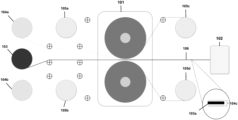
- FIG. 1 illustrates an exemplary layout of a laminator and notcher system in accordance with some embodiments disclosed herein.
- FIG. 2 illustrates another exemplary layout of a laminator and notcher system in accordance with some embodiments disclosed herein.
- FIG. 3 A illustrates an example of a web path in accordance with some embodiments disclosed herein.
- FIG. 3 B illustrates another example of a web path in accordance with some embodiments disclosed herein.
- FIG. 3 C illustrates examples of bend angles in accordance with some embodiments disclosed herein.
- FIG. 4 illustrates another exemplary layout of a laminator and notcher system in accordance with some embodiments disclosed herein.
- FIG. 5 illustrates another exemplary layout of a laminator and notcher system in accordance with some embodiments disclosed herein.
- FIG. 6 illustrates a flow chart for a typical battery cell manufacturing process in accordance with some embodiments disclosed herein.
- FIG. 7 depicts an illustrative example of a cross sectional view of a cylindrical battery cell in accordance with some embodiments disclosed herein.
- FIG. 8 depicts an illustrative example of a cross sectional view of a prismatic battery cell in accordance with some embodiments disclosed herein.
- FIG. 9 depicts an illustrative example of a cross section view of a pouch battery cell in accordance with some embodiments disclosed herein.
- FIG. 10 illustrates cylindrical battery cells being inserted into a frame to form a battery module and pack in accordance with some embodiments disclosed herein.
- FIG. 11 illustrates prismatic battery cells being inserted into a frame to form a battery module and pack in accordance with some embodiments disclosed herein.
- FIG. 12 illustrates pouch battery cells being inserted into a frame to form a battery module and pack in accordance with some embodiments disclosed herein.
- FIG. 13 illustrates an example of a cross sectional view of an electric vehicle that includes at least one battery pack in accordance with some embodiments disclosed herein.
- Li-ion batteries conduct lithium ions from a negatively charged anode to a positively charged cathode through a liquid electrolyte.
- a separator which is usually a sheet or roll of material that serves as an electrical insulator but is conductive to lithium ions, runs between the anode and cathode.
- lithium atoms are ionized in the anode and are separated from their electrons by passing through the separator via the liquid electrolyte until they reach the cathode.
- the lithium ions then recombine with their electrons in the cathode, generating electricity in the process.
- traditional Li-ion batteries have high energy densities and are relatively low-maintenance, they are commonly used in consumer electronics and electric vehicles. However, traditional Li-ion batteries are dangerously combustive and can overheat and catch fire at high voltages.
- solid-state batteries provide similar benefits without being combustive, thus alleviating many of the dangers posed by traditional Li-ion batteries.
- solid-state batteries use solid electrolytes for ion transport.
- Solid-state battery cells contain layers of electrodes separated by solid electrolyte separators (SES).
- a system can include a laminator.
- FIG. 1 illustrates an exemplary layout of a system that can include a laminator 101 .
- laminator 101 can include a plurality of rollers (e.g., pressure rollers, hard rollers) to apply pressure to both sides of the electrode film.
- laminator 101 can be used to assemble and densify components of a battery.
- laminator 101 can be capable of densifying (e.g., increase the density of) an electrode film. In some embodiments, laminator 101 can operate at speeds of about 5 to about 100 m/s. In some embodiments, laminator 101 can exert pressures of about 0.5 tons to about 5 tons. In some embodiments, laminator 101 can apply temperatures of about 25° C. to about 150° C.
- the electrode film can include a current collector and at least one electrode layer. In some embodiments, the electrode film can be one or more electrode layers described herein without the current collector. In some embodiments, the electrode film can be only the current collector. In some embodiments, the electrode film can include a current collector and an electrode layer on each or both sides of the current collector. In some embodiments, the current collector can be a ribbon or foil. In some embodiments, the current collector can include a metal or metal alloy. In some embodiments, the metal can be aluminum, copper, nickel, iron, titanium, stainless steel, or combinations thereof. In some embodiments, the current collector can include a carbonaceous material. In some embodiments, the current collector can be coated with carbon. For example, the current collector may be a metal that is coated with carbon (e.g., carbon-coated aluminum foil).
- an electrode layer can be deposited on both sides of the current collector.
- the electrode film can have a corresponding structure (in order) of electrode layer, current collector, and electrode layer.
- an electrode layer can be deposited on at least one side of the current collector via slot-die coating, microgravure coating, reverse comma coating, comma coating, physical vapor deposition, and/or extrusion coating.
- the electrode layer can include electrode active materials, conductive carbon material, binders, and/or other additives.
- the electrode active materials can include cathode active materials.
- the cathode active materials can include high-nickel content (greater than or equal to about 80% Ni) lithium transition metal oxide.
- lithium transition metal oxides can include a particulate lithium nickel manganese cobalt oxide (“LiNMC”), lithium nickel cobalt aluminum oxide (“LiNCA”), lithium nickel manganese cobalt aluminum oxide (“LiNMCA”), lithium cobalt oxide (LCO), lithium manganese oxide (LMO), lithium metal phosphates like lithium iron phosphate (“LFP”), Lithium iron manganese phosphate (“LMFP”), and combinations thereof.
- the electrode active materials can include anode active materials.
- the anode active materials can include graphitic carbon (e.g., ordered or disordered carbon with sp2 hybridization, artificial or natural Graphite, or blended), Li metal anode, silicon-based anode (e.g., silicon-based carbon composite anode, silicon metal, oxide, carbide, pre-lithiated), silicon-based carbon composite anode, lithium alloys (e.g., Li—Mg, Li—Al, Li—Ag alloy), lithium titanate, or combinations thereof.
- an anode material can be formed within a current collector material.
- an electrode can include a current collector (e.g., a copper foil) with an in situ-formed anode (e.g., Li metal) on a surface of the current collector facing the separator or solid-state electrolyte.
- a current collector e.g., a copper foil
- an in situ-formed anode e.g., Li metal
- the assembled cell may not comprise an anode active material in an uncharged state.
- the conductive carbon material can include graphite, carbon black, carbon nanotubes, Super P carbon black material, Ketjen Black, Acetylene Black, SWCNT, MWCNT, carbon nanofiber, graphene, and combinations thereof.
- the binders can include polymeric materials such as polyvinylidenefluoride (“PVDF”), polyvinylpyrrolidone (“PVP”), styrene-butadiene or styrene-butadiene rubber (“SBR”), polytetrafluoroethylene (“PTFE”), carboxymethylcellulose (“CMC”), agar-agar, alginate, amylose, Arabic gum, carrageenan, caseine, chitosan, cyclodextrines (carbonyl-beta), ethylene propylene diene monomer (EPDM) rubber, gelatine, gellan gum, guar gum, karaya gum, cellulose (natural), pectine, poly(3,4-
- an electrode layer can have a cathode active material of about 70-85 wt. %, about 70-75 wt. %, about 75-85 wt. %, or about 80-85 wt. % of the electrode layer.
- an electrode layer can have an anode active material of about 30-85 wt. %, about 60-85 wt. %, about 30-60 wt. %, about 70-80 wt. %, or about 60-75 wt. % of the electrode layer.
- an electrode layer can have binders of about 0.1-5 wt. %, about 0.5-3 wt. % or about 1-2 wt.
- an electrode layer can have a conductive carbon material of about 0.1-5 wt. %, about 0.1-2.5 wt. %, about 2.5-5 wt. %, or about 2-3 wt. % of the electrode layer.
- an electrode layer loading on the current collector can be about 0.5-30 mg/cm 2 , about 10-20 mg/cm 2 , about 15-22 mg/cm 2 , about 3-10 mg/cm 2 or about 1-5 mg/cm 2 on a side of the current collector.
- an electrode layer can have a thickness of about 1-200 ⁇ m, about 100-150 ⁇ m, about 150-200 ⁇ m, about 50-150 ⁇ m or about 1-50 ⁇ m.
- the electrode film (e.g., current collector with at least one electrode layer on a side of it) can be laminated.
- laminator 101 can be configured to receive the electrode film and apply pressure to the electrode film.
- the electrode film can be laminated to a desired porosity.
- a desired porosity may be about 0.5-15%, about 9-12%, about 10-12%, about 5-10%, about 0.5-5%, or about 12-15%.
- Porosity percentage can be defined as the ratio of the volume of the voids or pore space divided by the total volume.
- press densities (after lamination) of the electrode film can be from about 0.5-5 g/cm 2 , about 1-4 g/cm 2 , about 1-3 g/cm 2 , about 1-2 g/cm 2 , or about 1.5-1.7 g/cm 2 .
- an electrode film and a solid electrolyte film can be arranged in alternating layers upon entering the laminator (e.g., a structure in order of solid electrolyte film, electrode film, solid electrolyte film).
- the arrangement of the electrode film and solid electrolyte layers can depend on the desired configuration of the resulting battery cell component.
- the solid electrolyte film can include at least one layer of a solid electrolyte.
- Solid electrolyte materials of the solid electrolyte layer can include inorganic solid electrolyte materials such as oxides, sulfides, phosphides, halides, ceramics, solid polymer electrolyte materials, hybrid solid state electrolytes, or glassy electrolyte materials, among others, or in any combinations thereof.
- inorganic solid electrolyte materials such as oxides, sulfides, phosphides, halides, ceramics, solid polymer electrolyte materials, hybrid solid state electrolytes, or glassy electrolyte materials, among others, or in any combinations thereof.
- LISICONs Lithium Superionic Conductors
- NBICONs Sodium Superionic Conductors
- the solid electrolyte layer can include a glassy, ceramic and/or crystalline electrolyte material such as Li 3 PS 4 , Li 7 P 3 S 11 , Li 2 S—P 2 S 5 , Li 2 S—B 2 S 3 , SnS—P 2 S 5 , Li 2 S—SiS 2 , Li 2 S—P 2 S 5 , Li 2 S—GeS 2 , lithium phosphorous oxy-nitride (Li x PO y N z ), lithium germanium phosphate sulfur (Li 10 GeP 2 S 12 ), Yttria-stabilized Zirconia (YSZ), NASICON (Na 3 Zr 2 Si 2 PO 12 ), beta-alumina solid electrolyte (BASE), perovskite ceramics (e.g., strontium titanate (SrTiO 3 )), Lithium lanthanum zirconium oxide (La 3 Li 7 O 12 Zr 2 ), LiSiCON (Li2
- solid state polymer electrolyte materials can include a polymer electrolyte material (e.g., a hybrid or pseudo-solid state electrolyte), for example, polyacrylonitrile (PAN), polyethylene oxide (PEO), polymethyl-methacrylate (PMMA), and polyvinylidene fluoride (PVDF), and PEG, among others, or in any combinations thereof.
- a polymer electrolyte material e.g., a hybrid or pseudo-solid state electrolyte
- PAN polyacrylonitrile
- PEO polyethylene oxide
- PMMA polymethyl-methacrylate
- PVDF polyvinylidene fluoride
- the solid electrolyte film can include a substrate layer and an electrolyte layer.
- the substrate layer could be made out of a variety of materials, such as metal or plastic.
- the substrate layer can be free-standing such that it can be separated or peeled from the electrolyte layer without the application of pressure by the laminator. Free-standing substrates can be included in the solid electrolyte film to prevent a surface of the electrolyte layer from coming in contact with another surface while the solid electrolyte film is still in a rolled or wound configuration.
- free-standing substrates can include a plastic material that may not withstand the pressure applied by the laminator and may not be a desired component of the final densified film, free-standing substrates can be separated from the electrolyte layer and rewound before passing through the laminator.
- laminator 101 can be configured to bond at least one surface of the electrode film to a surface of the solid electrolyte film to form the densified electrode film 106 .
- laminator 101 can exert a sufficiently high pressure so that a surface(s) of the electrode film can bond to a surface(s) of a solid electrolyte film resulting in minimal voids or gaps. Such voids or gaps should be minimized because they can potentially decrease the battery cell life.
- the electrolyte layer of the solid electrolyte film can be bonded to the at least one surface of the electrode film during lamination.
- the laminator 101 can bond one layer of the electrode film to one layer of the solid electrolyte film on one surface.
- the laminator 101 can be configured to bond a first surface of the electrode film to a first solid electrolyte film and a second surface of the electrode film to a second solid electrolyte film to form the densified electrode film.
- the laminator 101 can bond the electrode film between layers of solid electrolyte film on both a first and second surface so as to sandwich the electrode film between layers of solid electrolyte film.
- the layers/film exit the laminator 101 bonded together as a densified electrode film 106 .
- the laminator can densify an electrode film with a solid electrolyte layer(s) or film to a densified electrode film with a desired density and porosity.
- a desired porosity may be about 0.5-15%, about 9-12%, about 10-12%, about 5-10%, about 0.5-5%, or about 12-15%.
- press densities (after lamination) of the electrode film can be from about 0.5-5 g/cm 2 , about 1-4 g/cm 2 , about 1-3 g/cm 2 , about 1-2 g/cm 2 , or about 1.5-1.7 g/cm 2 In some embodiments, these density and porosity ranges can apply to the electrode layer and/or the solid electrolyte layers.
- the layers/film exit the laminator bonded together as a densified electrode film 106 without the need for additional materials or bonding agents.
- the laminator 101 is not limited for use in electrode and/or solid electrolyte lamination. In some embodiments, the laminator 101 can also be used for the assembly of other components of a battery cell such as a cathode, a separator, electrolyte layer, and/or an anode, for example.
- the system can have a notcher 102 that is configured to receive the densified electrode film 106 from the laminator 101 and to cut the densified electrode film 106 into a plurality of electrodes.
- the configuration of notcher 102 can depend on the desired configuration of the battery cell component.
- notcher 102 can cut the densified film into stand-alone electrodes, or it can cut electrodes that can be transferred into a magazine and/or stacked in alternating layers (e.g., of cathode, electrolyte, and anode) to build up a battery cell.
- notcher 102 may be a roll to roll notcher.
- notcher 102 may be a roll to sheet notcher. In some embodiments, notcher 102 may cut the densified film using mold cutting. In some embodiments, notcher 102 may cut the densified film using laser cutting. In some embodiments, notcher 102 may include varying notching parameters. In some embodiments, varying notching parameters can include line speed, burr size, and cutting accuracy.
- the system can be configured so that laminator 101 feeds into notcher 102 in a manner that allows the battery cell to be assembled without destroying the densified electrode film 106 , which can be very brittle.
- the densified electrode film travels along a web path from the laminator 101 to the notcher 102 .
- the notcher is located in-line with the laminator. Being in-line with the laminator can mean that the web path of the densified electrode film between the laminator 101 and notcher 102 is kept as straight as possible such that the densified electrode film 106 bends as little as possible.
- the web path of the densified electrode film can have a bend angle greater greater than about 150 degrees, greater than about 155 degrees, greater than about 160, greater than about 165 degrees, greater than about 170 degrees, greater than about 175 degrees, or about 180 degrees.
- the bend angle of the web path from the laminator to the notcher is about 150-180 degrees, about 155-180 degrees, about 160-180 degrees, about 165-180 degrees, about 170-180 degrees, or about 175-180 degrees.
- the densified electrode film 106 can be prevented from minimally bending in any direction so as to form an angle less than the bend angle relative to a neutral axis between the laminator exit and notcher entrance.
- this neutral axis can be a straight line (e.g., bend angle of 180 ) between the laminator exit and the notcher entrance.
- the bend angle of other web paths before the laminator such as the web path from the unwound electrode film to the laminator, can be greater than 165 degrees as well.
- the bend angle can be less than 180 degrees (e.g. the web path of the densified electrode film is not a perfectly straight line), and the bend angle can be defined as an angle that is supplementary to an acute angle formed between the densified electrode film and a neutral axis between the laminator exit and notcher entrance.
- FIG. 3 A depicts a web path of a densified electrode film 106 from laminator 101 to notcher 102 in which bend angle 110 is supplementary to acute angle 110 s that is formed between densified electrode film 106 and a neutral axis 111 between the laminator 101 exit and notcher 102 entrance.
- a web path of a densified electrode film 106 between laminator 101 and notcher 102 can have more than one bend angle, and each bend angle can be greater than about 165 degrees.
- a first bend angle 110 a and a second bend angle 110 b in FIG. 3 B can each be greater than about 165 degrees relative to neutral axis 111 between laminator 101 exit and notcher 102 entrance.
- any bend of the densified electrode film 106 between the laminator 101 exit and notcher 102 entrance will have a bend angle greater than 165 degrees.
- a bend angle of a web path of densified electrode film 106 can be in a positive or a negative direction relative to neutral axis 111 .
- dashed lines in FIG. 3 C depict various ways in which densified electrode film 106 can bend that could result in the formation of bend angles measured in both positive and negative directions relative to neutral axis 111 .
- the bend angle will be the absolute value such that the bend angle will be positive (e.g., greater than 165 degrees) despite a bend angle measured in the negative direction relative to neutral axis 111 .
- the system described herein can have one or more unwinders configured to unwind a roll of electrode film.
- the laminator can be configured to receive the unwound electrode film from the at least one electrode unwinder.
- the electrode film can travel along a web path to the laminator once it is unwound.
- the electrode film can pass through the laminator without being densified further.
- the electrode film 107 can be lithium metal, which can be at a final density upon being unwound and can thus bypass laminator 101 .
- the system can be configured so that laminator 101 will be bypassed depending on the density of the electrode film 107 that is used.
- the system described herein can also have one or more solid electrolyte unwinders configured to unwind a roll of solid electrolyte film.
- the laminator can be configured to receive the unwound solid electrolyte film from the at least one solid electrolyte unwinder.
- the number and arrangement of the solid electrolyte unwinders can depend on the desired design and geometry of the resulting battery cell component. For example, as shown in FIG. 1 , there can be two solid electrolyte unwinders 104 a and 104 b arranged such that the resulting densified electrode film 106 can have an electrode layer 103 a sandwiched between electrolyte layers 104 c . As shown in FIG. 1 , after passing through the laminator, electrolyte layers 104 c can be bonded to a first and second surface of electrode layer 103 a to sandwich the electrode layer 103 a between electrolyte layers 104 c.
- an electrolyte film or layer can be bonded to a surface of the electrode film after passing through the laminator. This can result in a battery cell component that could be stacked with other similar components in a magazine so as to form alternating layers of electrode and solid electrolyte. Additional electrode unwinders and solid electrolyte unwinders can be added depending on the desired configuration of the resulting densified electrode film.
- the substrate layer of the solid electrolyte film can be removed before or after laminator.
- the system can include at least one rewinder configured to rewind the substrate layer into a substrate roll from the solid electrolyte film before or after lamination.
- the system described herein can further comprise one or more substrate rewinders 105 a and 105 b before laminator 101 that are configured to rewind a substrate layer of the solid electrolyte film after the solid electrolyte film is unwound by solid electrolyte unwinder 104 a / 104 b but before the solid electrolyte film enters the laminator 101 .
- the substrate layer can be separated from the unwound solid electrolyte film.
- at least one rewinder can be configured to rewind the separated substrate layer from the unwound solid electrolyte film.
- the laminator can be configured to receive at least the electrolyte layer of the solid electrolyte film (i.e., the substrate layer was removed and will not enter the laminator).
- One or more substrate rewinders can be present depending on corresponding configuration of solid electrolyte unwinders and the desired configuration of the final densified film. For example, if there are two solid electrolyte unwinders, the desired configuration of the densified film may be the electrode layer sandwiched between electrolyte layers. In some embodiments, the substrate rewinders can be before or after the laminator.
- the substrate layer may be removed/separated from an electrolyte layer of the solid electrolyte film by the pressure from the laminator.
- the substrate layer can also be casted onto the electrolyte layer such that pressure from the laminator can separate the substrate layer from the electrolyte layer.
- Casted substrates can be included in the solid electrolyte film to provide structural support for the electrolyte layer as it passes through the laminator. However, the substrate layer may not be a desired component of the final densified film.
- Casted substrates can include a metal that can withstand the pressure exerted by the laminator. As such, some substrate layers (e.g., casted substrates) can pass through the laminator and can be separated from the densified electrode film and rewound after lamination.
- the system described herein can include one or more substrate rewinders 105 c and 105 d after laminator 101 but before notcher 102 that are configured to rewind the substrate layer from the densified electrode film 106 after the substrate layer is separated from it during lamination.
- One or more substrate rewinders can be present depending on corresponding configuration of solid electrolyte unwinders and the desired configuration of the final densified film.
- an electrode film 107 can include an electrode layer and a substrate layer.
- the electrode layer can be lithium metal
- the substrate layer can be an interleaf film or layer.
- the interleaf film or layer can help prevent the electrode film (e.g., lithium layers) from adhering to one another during storage and/or protect the electrode film.
- the system can include a rewinder 108 that is configured to rewind the substrate layer of the electrode film into a roll. As shown in FIG. 4 , if the electrode film includes a substrate layer, as with lithium metal having an interleaf film, the substrate layer can be rewound in a rewinder 108 .
- the electrode layer can be able to bypass the laminator after the substrate layer is rewound if the electrode layer enters the system at a desired final density.
- electrode film 107 can pass through laminator 101 without being densified further because the electrode film (e.g., lithium metal) may already be at a final density upon entering the system.
- the system can be configured so that laminator 101 can be bypassed depending on the density of the electrode film 107 that is used.
- the system described herein can be configured to densify an electrode.
- the electrode film can be densified by laminator 101 into a densified electrode film 106 before entering notcher 102 .
- the electrode film can be densified by the laminator without any layers of solid electrolyte.
- electrode unwinder 109 can unwind an electrode film that is an anode including silicon, and the silicon can be densified by laminator 101 into a densified electrode film 106 without any layers of solid electrolyte.
- the system and methods described herein can be used for various purposes.
- the system can be used for the lamination of stand-alone electrodes.
- the system can be used for the assembly of solid-state battery cells comprising a cathode and anode separated by a SES. More unwinders and rewinders can be added to the system to accommodate additional web paths and components.
- the densified electrode film After the densified electrode film has been created, it can be inserted into a battery cell, which can be used as an electrical energy source.
- the densified electrodes or densified electrode films disclosed herein can be used as an electrode layer (e.g., cathode or anode layer), an electrolyte layer, or an electrode and electrolyte layer.
- FIG. 6 illustrates a flow chart for a typical battery cell manufacturing process 1000 .
- the electrode precursors e.g., binder, active material, conductive carbon additive
- this step can include mixing electrode materials (e.g., active materials) with additional components (e.g., binders, solvents, conductive additives, etc.) to form an electrode slurry.
- this step can include synthesizing the electrode materials themselves.
- the electrode can be formed.
- this step can include coating an electrode slurry on a current collector. After coating, the coated current collector can be dried to evaporate any solvent.
- this step can include calendaring the coated current collectors. Calendaring can adjust the physical properties (e.g., bonding, conductivity, density, porosity, etc.) of the electrodes.
- the electrode can then be sized via a slitting and/or notching machine to cut the electrode into the proper size and/or shape.
- the battery cell can be assembled.
- a battery cell can be assembled/prepared.
- the separator and/or an electrolyte layer can be assembled between the anode and cathode layers to form the internal structure of a battery cell.
- These layers can be assembled by a winding method such as a round winding or prismatic/flat winding, a stacking method, or a z-folding method.
- the assembled cell structure can then be inserted into a cell housing which is then partially or completed sealed.
- the assembled structure can be connected to terminals and/or cell tabs (via a welding process).
- the housed cell with the electrode structure inside it can also be filled with electrolyte and subsequently sealed.
- Battery cells can have a variety of form factors, shapes, or sizes.
- battery cells and their housings/casings
- Battery cells can be assembled, for example, by inserting a winding and/or stacked electrode roll (e.g., a jellyroll) into a battery cell casing or housing.
- the winded or stacked electrode roll can include the electrolyte material.
- the electrolyte material can be inserted in the battery casing or housing separate from the electrode roll.
- the electrolyte material includes, but is not limited to, an ionically conductive fluid or other material (e.g., a layer) that can allow the flow of electrical charge (i.e., ion transportation) between the cathode and anode.
- the electrolyte material can include a non-aqueous polar solvent (e.g., a carbonate such as ethylene carbonate, propylene carbonate, diethyl carbonate, ethyl methyl carbonate, dimethyl carbonate, or a mixture of any two or more thereof).
- the electrolytes may also include other additives such as, but not limited to, vinylidene carbonate, fluoroethylene carbonate, ethyl propionate, methyl propionate, methyl acetate, ethyl acetate, or a mixture of any two or more thereof.
- the lithium salt of the electrolyte may be any of those used in lithium battery construction including, but not limited to, lithium perchlorate, lithium hexafluorophosphate, lithium bis(fluorosulfonyl)imide, lithium bis(trifluorosulfonyl)imide, or a mixture of any two or more thereof.
- the salt may be present in the electrolyte from greater than 0 M to about 0.5 M.
- FIG. 7 depicts an illustrative example of a cross sectional view of a cylindrical battery cell 100 .
- the cylindrical battery cell can include layers (e.g., sheet-like layers) of anode layers 10 , separator and/or electrolyte layers 20 , and cathode layers 30 .
- a battery cell can include at least one anode layer, which can be disposed within the cavity of the housing/casing.
- the battery cell can also include at least one cathode layer.
- the at least one cathode layer can also be disposed within the housing/casing.
- the at least one anode layer releases ions (e.g., lithium ions) to the at least one cathode layer generating a flow of electrons from one side to the other.
- the at least one cathode layer when the battery cell is charging, the at least one cathode layer can release ions and the at least one anode layer can receive these ions.
- a separator layer (and/or electrolyte layer) 20 can be arranged between an anode layer 10 and a cathode layer 30 to separate the anode layer 20 and the cathode layer 30 .
- the layers in the battery cell can alternate such that a separator layer (and/or electrolyte layer) separates an anode layer from a cathode layer.
- the layers of the battery electrode can be (in order) separator layer, anode/cathode layer, separator layer, opposite of other anode/cathode layer and so on.
- the separator layer (and/or electrolyte layer) 20 can prevent contact between the anode and cathode layers while facilitating ion (e.g., lithium ions) transport in the cell.
- the battery cell can also include at least one terminal 50 .
- the at least one terminal can be electrical contacts used to connect a load or charger to a battery cell.
- the terminal can be made of an electrically conductive material to carry electrical current from the battery cell to an electrical load, such as a component or system of an electric vehicle as discussed further herein.
- FIG. 8 depicts an illustrative example of a cross sectional view of a prismatic battery cell 200 .
- the prismatic battery cell can include layers (e.g., sheet-like layers) of anode layers 10 , separator and/or electrolyte layers 20 , and cathode layers 30 . Similar to the cylindrical battery cell, the layers of a prismatic battery cell can be sandwiched, rolled, and/or pressed to fit into cubic or rectangular cuboid (e.g., hyperrectangle) shaped casing/housing 40 . In some embodiments, the layers can be assembled by layer stacking rather than jelly rolling. In some embodiments, the casing or housing can be rigid such as those made from a metal and/or hard-plastic. In some embodiments, the prismatic battery cell 200 can include more than one terminal 50 . In some embodiments, one of these terminals can be the positive terminal and the other a negative terminal. These terminals can be used to connect a load or charger to the battery cell.
- layers
- FIG. 9 depicts an illustrative example of a cross section view of a pouch battery cell 300 .
- the pouch battery cells do not have a rigid enclosure and instead use a flexible material for the casing/housing 40 .
- This flexible material can be, for example, a sealed flexible foil.
- the pouch battery cell can include layers (e.g., sheet-like layers) of anode layers 10 , separator and/or electrolyte layers 20 , and cathode layers 30 . In some embodiments, these layers are stacked in the casing/housing.
- the pouch battery cell 200 can include more than one terminal 50 . In some embodiments, one of these terminals can be the positive terminal and the other the negative terminal. These terminals can be used to connect a load or charger to the battery cell.
- the casings/housings of battery cells can include one or more materials with various electrical conductivity or thermal conductivity, or a combination thereof.
- the electrically conductive and thermally conductive material for the casing/housing of the battery cell can include a metallic material, such as aluminum, an aluminum alloy with copper, silicon, tin, magnesium, manganese, or zinc (e.g., aluminum 1000, 4000, or 5000 series), iron, an iron-carbon alloy (e.g., steel), silver, nickel, copper, and a copper alloy, among others.
- the electrically conductive and thermally conductive material for the housing of the battery cell can include a ceramic material (e.g., silicon nitride, silicon carbide, titanium carbide, zirconium dioxide, beryllium oxide, and among others) and/or a thermoplastic material (e.g., polyethylene, polypropylene, polystyrene, polyvinyl chloride, or nylon), among others.
- a ceramic material e.g., silicon nitride, silicon carbide, titanium carbide, zirconium dioxide, beryllium oxide, and among others
- a thermoplastic material e.g., polyethylene, polypropylene, polystyrene, polyvinyl chloride, or nylon
- the battery cell can be finalized.
- this step includes the formation process wherein the first charging and discharging process for the battery cell takes place.
- this initial charge and discharge can form a solid electrolyte interface between the electrolyte and the electrodes.
- this step may cause some of the cells to produce gas which can be removed in a degassing process from the battery cell.
- this step includes aging the battery cell. Aging can include monitoring cell characteristics and performance over a fixed period of time.
- this step can also include testing the cells in an end-of-line (EOL) test rig.
- the EOL testing can include discharging the battery cells to the shipping state of charge, pulse testing, testing internal resistance measurements, testing OCV, testing for leakage, and/or optically inspecting the battery cells for deficiencies.
- a plurality of battery cells ( 100 , 200 , and/or 300 ) can be assembled or packaged together in the same housing, frame, or casing to form a battery module and/or battery pack.
- the battery cells of a battery module can be electrically connected to generate an amount of electrical energy.
- These multiple battery cells can be linked to the outside of the housing, frame, or casing, through a uniform boundary.
- the battery cells of the battery module can be in parallel, in series, or in a series-parallel combination of battery cells.
- the housing, frame, or casing can protect the battery cells from a variety of dangers (e.g., external elements, heat, vibration, etc.).
- FIG. 10 illustrates cylindrical battery cells 100 being inserted into a frame to form battery module 112 .
- FIG. 10 illustrates cylindrical battery cells 100 being inserted into a frame to form battery module 112 .
- FIG. 11 illustrates prismatic battery cells 200 being inserted into a frame to form battery module 112 .
- FIG. 12 illustrates pouch battery cells 300 being inserted into a frame to form battery module 112 .
- the battery pack may not include modules.
- the battery pack can have a “module-free” or cell-to-pack configuration wherein battery cells are arranged directly into a battery pack without assembly into a module.
- a plurality of the battery modules 112 can be disposed within another housing, frame, or casing to form a battery pack 120 as shown in FIGS. 10 - 12 .
- a plurality of battery cells can be assembled, packed, or disposed within a housing, frame, or casing to form a battery pack (not shown).
- the battery pack may not include a battery module (e.g., module-free).
- the battery pack can have a module-free or cell-to-pack configuration where the battery cells can be arranged directly into a battery pack without assembly into a battery module.
- the battery cells of the battery pack can be electrically connected to generate an amount of electrical energy to be provided to another system (e.g., an electric vehicle).
- the battery modules of a battery pack can be electrically connected to generate an amount of electrical energy to be provided to another system (e.g., an electric vehicle).
- the battery pack can also include various control and/or protection systems such as a heat exchanger system (e.g., a cooling system) configured to regulate the temperature of the battery pack (and the individual modules and battery cells) and a battery management system configured to control the battery pack's voltage, for example.
- a battery pack housing, frame, or casing can include a shield on the bottom or underneath the battery modules to protect the battery modules from external elements.
- a battery pack can include at least one heat exchanger (e.g., a cooling line configured to distribute fluid through the battery pack or a cold plate as part of a thermal/temperature control or heat exchange).
- battery modules can collect current or electrical power from the individual battery cells that make up the battery modules and can provide the current or electrical power as output from the battery pack.
- the battery modules can include any number of battery cells and the battery pack can include any number of battery modules.
- the battery pack can have one, two, three, four, five, six, seven, eight, nine, ten, eleven, twelve or other number of battery modules disposed in the housing/frame/casing.
- a battery module can include multiple submodules. In some embodiments, these submodules may be separated by a heat exchanger configured to regulate or control the temperature of the individual battery module.
- a battery module can include a top battery submodule and a bottom battery submodule. These submodules can be separated by a heat exchanger such as a cold plate in between the top and bottom battery submodules.
- the battery packs can come in all shapes and sizes.
- FIGS. 10 - 12 illustrates three differently shaped battery packs 120 .
- the battery packs 120 can include or define a plurality of areas, slots, holders, containers, etc. for positioning of the battery modules.
- the battery modules can come in all shapes and sizes.
- the battery modules can be square, rectangular, circular, triangular, symmetrical, or asymmetrical.
- battery modules in a single battery pack may be shaped differently.
- the battery module can include or define a plurality of areas, slots, holders, containers, etc. for the plurality of battery cells.
- FIG. 13 illustrates an example of a cross sectional view 700 of an electric vehicle 705 that includes at least one battery pack 120 .
- Electric vehicles can include, but are not limited to, electric trucks, electric sport utility vehicles (SUVs), electric delivery vans, electric automobiles, electric cars, electric motorcycles, electric scooters, electric passenger vehicles, electric passenger or commercial trucks, hybrid vehicles, or other vehicles such as sea or air transport vehicles, planes, helicopters, submarines, boats, or drones, among other possibilities.
- Electric vehicles can be fully electric or partially electric (e.g., plug-in hybrid) and further, electric vehicles can be fully autonomous, partially autonomous, or unmanned.
- electric vehicles can also be human operated or non-autonomous.
- Electric vehicles 705 can be installed with a battery pack 120 that includes battery modules 112 with battery cells ( 100 , 200 , and/or 300 ) to power the electric vehicles.
- the electric vehicle 705 can include a chassis 725 (e.g., a frame, internal frame, or support structure).
- the chassis 725 can support various components of the electric vehicle 705 .
- the chassis 725 can span a front portion 730 (e.g., a hood or bonnet portion), a body portion 735 , and a rear portion 740 (e.g., a trunk, payload, or boot portion) of the electric vehicle 705 .
- the battery pack 120 can be installed or placed within the electric vehicle 705 .
- the battery pack 120 can be installed on the chassis 725 of the electric vehicle 705 within one or more of the front portion 730 , the body portion 735 , or the rear portion 740 .
- the battery pack 120 can include or connect with at least one busbar, e.g., a current collector element.
- the first busbar 745 and the second busbar 750 can include electrically conductive material to connect or otherwise electrically couple the battery pack 120 (and/or battery modules 112 or the battery cells 100 , 200 , and/or 300 ) with other electrical components of the electric vehicle 705 to provide electrical power to various systems or components of the electric vehicle 705 .
- battery pack 120 can also be used as an energy storage system to power a building, such as a residential home or commercial building instead of or in addition to an electric vehicle.
- a building such as a residential home or commercial building.
- battery pack 120 can also be used as an energy storage system to power a building, such as a residential home or commercial building instead of or in addition to an electric vehicle.
- references to “about” a value or parameter herein includes (and describes) variations that are directed to that value or parameter per se. For example, description referring to “about X” includes description of “X”.
- reference to phrases “less than”, “greater than”, “at most”, “at least”, “less than or equal to”, “greater than or equal to”, or other similar phrases followed by a string of values or parameters is meant to apply the phrase to each value or parameter in the string of values or parameters.
- references in the appended claims to an apparatus or system or a component of an apparatus or system being adapted to, arranged to, capable of, configured to, enabled to, operable to, or operative to perform a particular function encompasses that apparatus, system, component, whether or not it or that particular function is activated, turned on, or unlocked, as long as that apparatus, system, or component is so adapted, arranged, capable, configured, enabled, operable, or operative. Additionally, although this disclosure describes or illustrates particular embodiments as providing particular advantages, particular embodiments may provide none, some, or all of these advantages.
Landscapes
- Chemical & Material Sciences (AREA)
- Chemical Kinetics & Catalysis (AREA)
- Electrochemistry (AREA)
- General Chemical & Material Sciences (AREA)
- Engineering & Computer Science (AREA)
- Manufacturing & Machinery (AREA)
- Physics & Mathematics (AREA)
- Condensed Matter Physics & Semiconductors (AREA)
- General Physics & Mathematics (AREA)
- Inorganic Chemistry (AREA)
- Secondary Cells (AREA)
Abstract
Description
Claims (20)
Priority Applications (1)
| Application Number | Priority Date | Filing Date | Title |
|---|---|---|---|
| US17/889,966 US12294047B2 (en) | 2022-08-17 | 2022-08-17 | Laminator for battery assembly |
Applications Claiming Priority (1)
| Application Number | Priority Date | Filing Date | Title |
|---|---|---|---|
| US17/889,966 US12294047B2 (en) | 2022-08-17 | 2022-08-17 | Laminator for battery assembly |
Publications (2)
| Publication Number | Publication Date |
|---|---|
| US20240063420A1 US20240063420A1 (en) | 2024-02-22 |
| US12294047B2 true US12294047B2 (en) | 2025-05-06 |
Family
ID=89906110
Family Applications (1)
| Application Number | Title | Priority Date | Filing Date |
|---|---|---|---|
| US17/889,966 Active 2043-03-17 US12294047B2 (en) | 2022-08-17 | 2022-08-17 | Laminator for battery assembly |
Country Status (1)
| Country | Link |
|---|---|
| US (1) | US12294047B2 (en) |
Citations (9)
| Publication number | Priority date | Publication date | Assignee | Title |
|---|---|---|---|---|
| US20140020238A1 (en) * | 2011-04-07 | 2014-01-23 | Nissan Motor Co., Ltd. | Production device for packaged electrode and manufacturing method of packaged electrode |
| US20150372325A1 (en) * | 2013-02-08 | 2015-12-24 | Toyota Jidosha Kabushiki Kaisha | Joining device and joining method (as amended) |
| US20200014062A1 (en) * | 2018-07-05 | 2020-01-09 | Hitachi, Ltd. | Battery Cell Sheet, Secondary Battery, Method of Manufacturing Battery Cell Sheet, and Method of Manufacturing Secondary Battery |
| US20200223202A1 (en) * | 2019-01-14 | 2020-07-16 | Toyota Jidosha Kabushiki Kaisha | Laminated body pressing apparatus, pressed strip-shaped laminated body manufacturing method, laminated electrode body manufacturing method, and battery manufacturing method |
| US20220052372A1 (en) * | 2019-03-06 | 2022-02-17 | Lg Energy Solution, Ltd. | Apparatus and method for manufacturing cell |
| US20220173427A1 (en) * | 2019-03-29 | 2022-06-02 | Panasonic Corporation | Layered electrode body manufacturing device |
| US20220200038A1 (en) * | 2019-12-10 | 2022-06-23 | Lg Energy Solution, Ltd. | Unit cell, and method and apparatus for manufacturing same |
| US20220294024A1 (en) * | 2019-11-19 | 2022-09-15 | Lg Energy Solution, Ltd. | Method for manufacturing secondary battery and equipment for manufacturing the secondary battery |
| US20230246161A1 (en) * | 2022-01-28 | 2023-08-03 | GM Global Technology Operations LLC | Pre-lithiation, precursor electrodes and methods of making and using the same |
-
2022
- 2022-08-17 US US17/889,966 patent/US12294047B2/en active Active
Patent Citations (9)
| Publication number | Priority date | Publication date | Assignee | Title |
|---|---|---|---|---|
| US20140020238A1 (en) * | 2011-04-07 | 2014-01-23 | Nissan Motor Co., Ltd. | Production device for packaged electrode and manufacturing method of packaged electrode |
| US20150372325A1 (en) * | 2013-02-08 | 2015-12-24 | Toyota Jidosha Kabushiki Kaisha | Joining device and joining method (as amended) |
| US20200014062A1 (en) * | 2018-07-05 | 2020-01-09 | Hitachi, Ltd. | Battery Cell Sheet, Secondary Battery, Method of Manufacturing Battery Cell Sheet, and Method of Manufacturing Secondary Battery |
| US20200223202A1 (en) * | 2019-01-14 | 2020-07-16 | Toyota Jidosha Kabushiki Kaisha | Laminated body pressing apparatus, pressed strip-shaped laminated body manufacturing method, laminated electrode body manufacturing method, and battery manufacturing method |
| US20220052372A1 (en) * | 2019-03-06 | 2022-02-17 | Lg Energy Solution, Ltd. | Apparatus and method for manufacturing cell |
| US20220173427A1 (en) * | 2019-03-29 | 2022-06-02 | Panasonic Corporation | Layered electrode body manufacturing device |
| US20220294024A1 (en) * | 2019-11-19 | 2022-09-15 | Lg Energy Solution, Ltd. | Method for manufacturing secondary battery and equipment for manufacturing the secondary battery |
| US20220200038A1 (en) * | 2019-12-10 | 2022-06-23 | Lg Energy Solution, Ltd. | Unit cell, and method and apparatus for manufacturing same |
| US20230246161A1 (en) * | 2022-01-28 | 2023-08-03 | GM Global Technology Operations LLC | Pre-lithiation, precursor electrodes and methods of making and using the same |
Also Published As
| Publication number | Publication date |
|---|---|
| US20240063420A1 (en) | 2024-02-22 |
Similar Documents
| Publication | Publication Date | Title |
|---|---|---|
| EP3188298B1 (en) | Stacked cell and production method for same | |
| KR102110054B1 (en) | Lithium ion secondary battery | |
| CN103918104B (en) | Partition with heat-resistant insulation | |
| EP2772978B1 (en) | Electrode assembly and electrochemical device comprising same | |
| US20030072996A1 (en) | Separation for a lithium ion secondary battery, method for producing the same, and a lithium ion secondary battery using the same | |
| CN114914399B (en) | Lithium-containing electrode comprising ceramic particles and method for making the same | |
| US20240105946A1 (en) | Hybrid electrode design for high energy cells | |
| KR102912921B1 (en) | Electrode plates, electrode assemblies and secondary batteries | |
| US20240079587A1 (en) | Composite cathodes for li-ion batteries | |
| US20230155108A1 (en) | Methods for making thick multilayer electrodes | |
| EP4597724A1 (en) | Separator and preparation method therefor, secondary battery and electric device | |
| JPWO2017183633A1 (en) | Secondary battery | |
| JP7583907B2 (en) | Electrode and method for producing same, battery and electric device | |
| US20240322184A1 (en) | Interfacial materials in argyrodite-based all-solid-state batteries | |
| WO2022199301A1 (en) | Anode plate of lithium ion battery and application thereof | |
| US20240063366A1 (en) | Pre-lithiated electrodes for li-ion batteries | |
| US20240077253A1 (en) | Dryer for electrode manufacturing | |
| US12294047B2 (en) | Laminator for battery assembly | |
| US20240234734A1 (en) | Using functional groups in conducting agents for mn-based cathode materials | |
| US20240154248A1 (en) | Laser patterned separator | |
| US12548851B2 (en) | Separator coating materials for rechargeable batteries | |
| KR20250081931A (en) | Separator and method for manufacturing the same, secondary battery and electrical device | |
| US20240322366A1 (en) | Interfacial materials in argyrodite-based all-solid-state batteries | |
| US20240047699A1 (en) | Electrolyte filling using microchannels | |
| US12424630B2 (en) | Mn+1AX carbide additive materials for lithium-ion batteries |
Legal Events
| Date | Code | Title | Description |
|---|---|---|---|
| FEPP | Fee payment procedure |
Free format text: ENTITY STATUS SET TO UNDISCOUNTED (ORIGINAL EVENT CODE: BIG.); ENTITY STATUS OF PATENT OWNER: LARGE ENTITY |
|
| STPP | Information on status: patent application and granting procedure in general |
Free format text: DOCKETED NEW CASE - READY FOR EXAMINATION |
|
| STPP | Information on status: patent application and granting procedure in general |
Free format text: NON FINAL ACTION MAILED |
|
| STPP | Information on status: patent application and granting procedure in general |
Free format text: RESPONSE TO NON-FINAL OFFICE ACTION ENTERED AND FORWARDED TO EXAMINER |
|
| STPP | Information on status: patent application and granting procedure in general |
Free format text: NON FINAL ACTION MAILED |
|
| STPP | Information on status: patent application and granting procedure in general |
Free format text: RESPONSE TO NON-FINAL OFFICE ACTION ENTERED AND FORWARDED TO EXAMINER |
|
| STPP | Information on status: patent application and granting procedure in general |
Free format text: FINAL REJECTION MAILED |
|
| STPP | Information on status: patent application and granting procedure in general |
Free format text: RESPONSE AFTER FINAL ACTION FORWARDED TO EXAMINER |
|
| STPP | Information on status: patent application and granting procedure in general |
Free format text: NOTICE OF ALLOWANCE MAILED -- APPLICATION RECEIVED IN OFFICE OF PUBLICATIONS |
|
| STCF | Information on status: patent grant |
Free format text: PATENTED CASE |