US12292689B2 - Alkaline cleaning composition, cleaning method, and manufacturing method of semiconductor - Google Patents

Alkaline cleaning composition, cleaning method, and manufacturing method of semiconductor Download PDF

Info

Publication number
US12292689B2
US12292689B2 US17/561,603 US202117561603A US12292689B2 US 12292689 B2 US12292689 B2 US 12292689B2 US 202117561603 A US202117561603 A US 202117561603A US 12292689 B2 US12292689 B2 US 12292689B2
Authority
US
United States
Prior art keywords
cleaning composition
alkaline cleaning
hydroxide
weight
polar solvent
Prior art date
Legal status (The legal status is an assumption and is not a legal conclusion. Google has not performed a legal analysis and makes no representation as to the accuracy of the status listed.)
Active, expires
Application number
US17/561,603
Other versions
US20220206394A1 (en
Inventor
Hui-yi Tang
Tzu-chi Wang
Yu-nung Chen
Yi-Cheng Chen
Current Assignee (The listed assignees may be inaccurate. Google has not performed a legal analysis and makes no representation or warranty as to the accuracy of the list.)
Daxin Materials Corp
Original Assignee
Daxin Materials Corp
Priority date (The priority date is an assumption and is not a legal conclusion. Google has not performed a legal analysis and makes no representation as to the accuracy of the date listed.)
Filing date
Publication date
Application filed by Daxin Materials Corp filed Critical Daxin Materials Corp
Assigned to DAXIN MATERIALS CORPORATION reassignment DAXIN MATERIALS CORPORATION ASSIGNMENT OF ASSIGNORS INTEREST (SEE DOCUMENT FOR DETAILS). Assignors: CHEN, YI-CHENG, CHEN, YU-NUNG, TANG, HUI-YI, WANG, TZU-CHI
Publication of US20220206394A1 publication Critical patent/US20220206394A1/en
Application granted granted Critical
Publication of US12292689B2 publication Critical patent/US12292689B2/en
Active legal-status Critical Current
Adjusted expiration legal-status Critical

Links

Classifications

    • GPHYSICS
    • G03PHOTOGRAPHY; CINEMATOGRAPHY; ANALOGOUS TECHNIQUES USING WAVES OTHER THAN OPTICAL WAVES; ELECTROGRAPHY; HOLOGRAPHY
    • G03FPHOTOMECHANICAL PRODUCTION OF TEXTURED OR PATTERNED SURFACES, e.g. FOR PRINTING, FOR PROCESSING OF SEMICONDUCTOR DEVICES; MATERIALS THEREFOR; ORIGINALS THEREFOR; APPARATUS SPECIALLY ADAPTED THEREFOR
    • G03F7/00Photomechanical, e.g. photolithographic, production of textured or patterned surfaces, e.g. printing surfaces; Materials therefor, e.g. comprising photoresists; Apparatus specially adapted therefor
    • G03F7/26Processing photosensitive materials; Apparatus therefor
    • G03F7/30Imagewise removal using liquid means
    • G03F7/32Liquid compositions therefor, e.g. developers
    • G03F7/322Aqueous alkaline compositions
    • CCHEMISTRY; METALLURGY
    • C11ANIMAL OR VEGETABLE OILS, FATS, FATTY SUBSTANCES OR WAXES; FATTY ACIDS THEREFROM; DETERGENTS; CANDLES
    • C11DDETERGENT COMPOSITIONS; USE OF SINGLE SUBSTANCES AS DETERGENTS; SOAP OR SOAP-MAKING; RESIN SOAPS; RECOVERY OF GLYCEROL
    • C11D3/00Other compounding ingredients of detergent compositions covered in group C11D1/00
    • C11D3/16Organic compounds
    • C11D3/20Organic compounds containing oxygen
    • C11D3/2068Ethers
    • CCHEMISTRY; METALLURGY
    • C11ANIMAL OR VEGETABLE OILS, FATS, FATTY SUBSTANCES OR WAXES; FATTY ACIDS THEREFROM; DETERGENTS; CANDLES
    • C11DDETERGENT COMPOSITIONS; USE OF SINGLE SUBSTANCES AS DETERGENTS; SOAP OR SOAP-MAKING; RESIN SOAPS; RECOVERY OF GLYCEROL
    • C11D3/00Other compounding ingredients of detergent compositions covered in group C11D1/00
    • C11D3/16Organic compounds
    • C11D3/26Organic compounds containing nitrogen
    • C11D3/28Heterocyclic compounds containing nitrogen in the ring
    • CCHEMISTRY; METALLURGY
    • C11ANIMAL OR VEGETABLE OILS, FATS, FATTY SUBSTANCES OR WAXES; FATTY ACIDS THEREFROM; DETERGENTS; CANDLES
    • C11DDETERGENT COMPOSITIONS; USE OF SINGLE SUBSTANCES AS DETERGENTS; SOAP OR SOAP-MAKING; RESIN SOAPS; RECOVERY OF GLYCEROL
    • C11D3/00Other compounding ingredients of detergent compositions covered in group C11D1/00
    • C11D3/16Organic compounds
    • C11D3/26Organic compounds containing nitrogen
    • C11D3/30Amines; Substituted amines ; Quaternized amines
    • CCHEMISTRY; METALLURGY
    • C11ANIMAL OR VEGETABLE OILS, FATS, FATTY SUBSTANCES OR WAXES; FATTY ACIDS THEREFROM; DETERGENTS; CANDLES
    • C11DDETERGENT COMPOSITIONS; USE OF SINGLE SUBSTANCES AS DETERGENTS; SOAP OR SOAP-MAKING; RESIN SOAPS; RECOVERY OF GLYCEROL
    • C11D3/00Other compounding ingredients of detergent compositions covered in group C11D1/00
    • C11D3/43Solvents
    • CCHEMISTRY; METALLURGY
    • C11ANIMAL OR VEGETABLE OILS, FATS, FATTY SUBSTANCES OR WAXES; FATTY ACIDS THEREFROM; DETERGENTS; CANDLES
    • C11DDETERGENT COMPOSITIONS; USE OF SINGLE SUBSTANCES AS DETERGENTS; SOAP OR SOAP-MAKING; RESIN SOAPS; RECOVERY OF GLYCEROL
    • C11D7/00Compositions of detergents based essentially on non-surface-active compounds
    • C11D7/22Organic compounds
    • C11D7/32Organic compounds containing nitrogen
    • C11D7/3209Amines or imines with one to four nitrogen atoms; Quaternized amines
    • CCHEMISTRY; METALLURGY
    • C11ANIMAL OR VEGETABLE OILS, FATS, FATTY SUBSTANCES OR WAXES; FATTY ACIDS THEREFROM; DETERGENTS; CANDLES
    • C11DDETERGENT COMPOSITIONS; USE OF SINGLE SUBSTANCES AS DETERGENTS; SOAP OR SOAP-MAKING; RESIN SOAPS; RECOVERY OF GLYCEROL
    • C11D7/00Compositions of detergents based essentially on non-surface-active compounds
    • C11D7/22Organic compounds
    • C11D7/32Organic compounds containing nitrogen
    • C11D7/3218Alkanolamines or alkanolimines
    • CCHEMISTRY; METALLURGY
    • C11ANIMAL OR VEGETABLE OILS, FATS, FATTY SUBSTANCES OR WAXES; FATTY ACIDS THEREFROM; DETERGENTS; CANDLES
    • C11DDETERGENT COMPOSITIONS; USE OF SINGLE SUBSTANCES AS DETERGENTS; SOAP OR SOAP-MAKING; RESIN SOAPS; RECOVERY OF GLYCEROL
    • C11D7/00Compositions of detergents based essentially on non-surface-active compounds
    • C11D7/22Organic compounds
    • C11D7/32Organic compounds containing nitrogen
    • C11D7/3281Heterocyclic compounds
    • CCHEMISTRY; METALLURGY
    • C11ANIMAL OR VEGETABLE OILS, FATS, FATTY SUBSTANCES OR WAXES; FATTY ACIDS THEREFROM; DETERGENTS; CANDLES
    • C11DDETERGENT COMPOSITIONS; USE OF SINGLE SUBSTANCES AS DETERGENTS; SOAP OR SOAP-MAKING; RESIN SOAPS; RECOVERY OF GLYCEROL
    • C11D7/00Compositions of detergents based essentially on non-surface-active compounds
    • C11D7/50Solvents
    • CCHEMISTRY; METALLURGY
    • C11ANIMAL OR VEGETABLE OILS, FATS, FATTY SUBSTANCES OR WAXES; FATTY ACIDS THEREFROM; DETERGENTS; CANDLES
    • C11DDETERGENT COMPOSITIONS; USE OF SINGLE SUBSTANCES AS DETERGENTS; SOAP OR SOAP-MAKING; RESIN SOAPS; RECOVERY OF GLYCEROL
    • C11D7/00Compositions of detergents based essentially on non-surface-active compounds
    • C11D7/50Solvents
    • C11D7/5004Organic solvents
    • C11D7/5013Organic solvents containing nitrogen
    • CCHEMISTRY; METALLURGY
    • C11ANIMAL OR VEGETABLE OILS, FATS, FATTY SUBSTANCES OR WAXES; FATTY ACIDS THEREFROM; DETERGENTS; CANDLES
    • C11DDETERGENT COMPOSITIONS; USE OF SINGLE SUBSTANCES AS DETERGENTS; SOAP OR SOAP-MAKING; RESIN SOAPS; RECOVERY OF GLYCEROL
    • C11D7/00Compositions of detergents based essentially on non-surface-active compounds
    • C11D7/50Solvents
    • C11D7/5004Organic solvents
    • C11D7/5022Organic solvents containing oxygen
    • H10P70/20
    • H10P70/23
    • CCHEMISTRY; METALLURGY
    • C11ANIMAL OR VEGETABLE OILS, FATS, FATTY SUBSTANCES OR WAXES; FATTY ACIDS THEREFROM; DETERGENTS; CANDLES
    • C11DDETERGENT COMPOSITIONS; USE OF SINGLE SUBSTANCES AS DETERGENTS; SOAP OR SOAP-MAKING; RESIN SOAPS; RECOVERY OF GLYCEROL
    • C11D2111/00Cleaning compositions characterised by the objects to be cleaned; Cleaning compositions characterised by non-standard cleaning or washing processes
    • C11D2111/10Objects to be cleaned
    • C11D2111/14Hard surfaces
    • C11D2111/22Electronic devices, e.g. PCBs or semiconductors
    • CCHEMISTRY; METALLURGY
    • C11ANIMAL OR VEGETABLE OILS, FATS, FATTY SUBSTANCES OR WAXES; FATTY ACIDS THEREFROM; DETERGENTS; CANDLES
    • C11DDETERGENT COMPOSITIONS; USE OF SINGLE SUBSTANCES AS DETERGENTS; SOAP OR SOAP-MAKING; RESIN SOAPS; RECOVERY OF GLYCEROL
    • C11D7/00Compositions of detergents based essentially on non-surface-active compounds
    • C11D7/22Organic compounds
    • C11D7/26Organic compounds containing oxygen
    • C11D7/263Ethers
    • CCHEMISTRY; METALLURGY
    • C11ANIMAL OR VEGETABLE OILS, FATS, FATTY SUBSTANCES OR WAXES; FATTY ACIDS THEREFROM; DETERGENTS; CANDLES
    • C11DDETERGENT COMPOSITIONS; USE OF SINGLE SUBSTANCES AS DETERGENTS; SOAP OR SOAP-MAKING; RESIN SOAPS; RECOVERY OF GLYCEROL
    • C11D7/00Compositions of detergents based essentially on non-surface-active compounds
    • C11D7/22Organic compounds
    • C11D7/26Organic compounds containing oxygen
    • C11D7/264Aldehydes; Ketones; Acetals or ketals

Definitions

  • the present disclosure relates to a cleaning composition for a semiconductor manufacturing process, and more particularly, to an alkaline cleaning composition, a cleaning method using the alkaline cleaning composition, and a manufacturing method of a semiconductor.
  • Semiconductor devices are usually formed by stacking functional layers such as metal wiring layers, dielectric layers, insulating layers, and anti-reflective layers on semiconductor substrates which are composed of silicon wafers.
  • Resist patterns formed by photolithography processes are used as masks for etching, and above-mentioned layers are processed to form above-mentioned laminated layers.
  • the resist patterns in the photolithography processes mentioned above are formed by using film layers such as resist films, anti-reflective films, or sacrificial films.
  • Residues generated from the metal wiring layers or the dielectric layers in etching steps are removed by cleaning liquid, thereby preventing subsequent processes from being adversely affected, and reducing problems of yields of the semiconductor devices caused by the residues.
  • coating films that can be removed by the cleaning liquid are, for example, the resist films corresponding to various exposure wavelengths such as g-line, i-line, KrF excimer laser, ArF excimer laser, EUV, etc., the anti-reflective films disposed under the resist films, the sacrificial films composed of inorganic films such as silicon masks that contain silicon atoms, or protective films disposed on the resist films.
  • An objective of the present disclosure is to provide an alkaline cleaning composition to effectively clean and remove residues of resists, inorganic films containing silicon, or other film layers on substrates or semiconductor substrates.
  • the alkaline cleaning composition for semiconductor manufacturing pollutant emissions can be reduced to realize requirements of environmental protection and can effectively prevent yields of subsequent processes from being affected.
  • the alkaline cleaning composition includes an alkaline compound, 5% to 40% by weight of propylene glycol monomethyl ether, 10% to 30% by weight of water, and a polar solvent.
  • the polar solvent includes acetals, glycol ethers, pyrrolidones, or a combination thereof, and the alkaline cleaning composition is free of benzenesulfonic acid.
  • the cleaning method includes a step of using the alkaline cleaning composition mentioned above to clean and remove a residue or a residual film attached onto a device component, wherein, the residue or the residual film includes a resist or an inorganic substance containing silicon atoms.
  • Yet another objective of the present disclosure is to provide a manufacturing method of a semiconductor.
  • the manufacturing method of the semiconductor includes following steps:
  • the present disclosure provides an alkaline cleaning composition that can effectively clean and remove residues of resists, inorganic films containing silicon, or other film layers on substrates or semiconductor substrates.
  • the alkaline cleaning composition includes an alkaline compound, 5% to 40% by weight of propylene glycol monomethyl ether, 10% to 30% by weight of water, and a polar solvent.
  • the polar solvent includes acetals, glycol ethers, pyrrolidones, or a combination thereof to be a second solvent
  • the alkaline cleaning composition is free of benzenesulfonic acid.
  • This combination of the alkaline cleaning composition can effectively remove the residues of the resists and film layers remaining on the substrates and has a lower content of volatile organic compounds (VOCs), thereby realizing requirements of environmental protection.
  • VOCs volatile organic compounds
  • the alkaline compound may include quaternary ammonium hydroxide, an alkanolamine compound, or a mixture thereof.
  • the quaternary ammonium hydroxide has a structure shown in a following formula (1):
  • the quaternary ammonium hydroxide may include at least one of tetramethylammonium hydroxide (TMAH), tetraethylammonium hydroxide, tetrapropylammonium hydroxide, tetrabutylammonium hydroxide, ethyltrimethylammonium hydroxide, diethyldimethylammonium hydroxide, (2-hydroxyethyl)trimethylammonium hydroxide, bis(2-hydroxyethyl)dimethylammonium hydroxide, or tris(2-hydroxyethyl)methylammonium hydroxide.
  • the quaternary ammonium hydroxide is preferably tetramethylammonium hydroxide.
  • the alkanolamine compound has a structure shown in a following formula (2):
  • the alkanolamine compound may include at least one of ethanolamine (MEA), diethanolamine, triethanolamine, propanolamine (N-PA), bis(3-hydroxypropyl)amine, tris(3-hydroxypropyl)amine, diisopropanolamine, triisopropanolamine, N-methylethanolamine, 2-amino-2-methyl-1,3-propanediol, or 2-(2-aminoethoxy)ethanol.
  • the alkanolamine compound is preferably propanolamine, ethanolamine, or 2-amino-2-methyl-1,3-propanediol.
  • the alkaline compound may be a mixture of the quaternary ammonium hydroxide mentioned above and the alkanolamine compound mentioned above.
  • an amount of the alkaline compound in a total amount of the alkaline cleaning composition ranges from 0.1% to 20% by weight, and preferably 0.5% to 10% by weight. In this range, the alkaline compound can effectively remove the residues of the resists, the inorganic films containing silicon, or other film layers.
  • the first solvent includes 5% to 40% by weight of propylene glycol monomethyl ether (PGME).
  • PGME propylene glycol monomethyl ether
  • propylene glycol monomethyl ether ranges from 15% to 30% by weight. It should be noted that the above-mentioned weight percentages are based on the total amount of the alkaline cleaning composition.
  • the alkaline cleaning composition of the present disclosure has an excellent cleaning ability to the residues of the resists, the inorganic films containing silicon, or other film layers.
  • the alkaline cleaning composition of the present disclosure includes 10% to 30% by weight of water.
  • a weight percentage of water ranges from 15% to 25% by weight. It should be noted that the above-mentioned weight percentages are based on the total amount of the alkaline cleaning composition.
  • pure water, deionized water, or ion exchange water may be used as water of the present disclosure, which is not specifically limited herein, as long as the weight percentage of water is within the above-mentioned weight ranges.
  • the alkaline cleaning composition of the present disclosure also includes the polar solvent as the second solvent.
  • the polar solvent includes acetals, glycol ethers, pyrrolidones, or a combination thereof.
  • the acetals include a structure shown in a following formula (3):
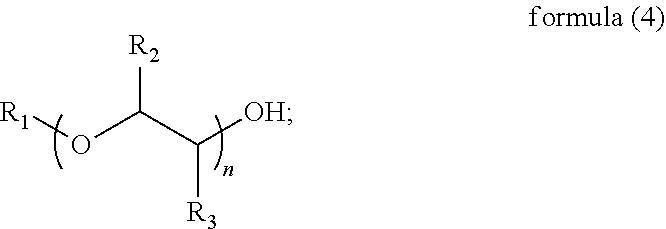
  • the glycol ethers include a structure shown in a following formula (4):
  • the pyrrolidones include a structure shown in a following formula (5):
  • the polar solvent is preferably at least one:
  • the polar solvent may include one, two, or more than two.
  • the polar solvent is at least one:
  • N-isopropyl-2-pyrrolidone N-ethyl-2-pyrrolidone, 2,5,7,10-tetraoxaundecane, diethylene glycol monoethyl ether, diethylene glycol monobutyl ether, and propylene glycol.
  • the polar solvent accounts for 5% to 84.9% by weight of the total amount of the alkaline cleaning composition, and preferably 20% to 70% by weight.
  • the alkaline cleaning composition can effectively remove the residues of the resists, the inorganic films containing silicon, or other film layers.
  • the alkaline cleaning composition of the present disclosure may also include other additives, such as a surfactant and a metal corrosion inhibitor.
  • the metal corrosion inhibitor has no other special restrictions except that the metal corrosion inhibitor is free of benzenesulfonic acids.
  • the metal corrosion inhibitor may be, for example, benzimidazole, benzotriazole, methyl benzotriazole, 3-amino-1,2,4-triazole, 1,2,4-triazole, 1,2,3-triazole, 5-aminotetrazole, 2,6-pyridinedicarboxylic acid, phenylurea, p-methoxyphenol, pyrocatechol, resorcinol, 2-hydroxypyridine, 2-aminophenol, 8-hydroxyquinoline, phosphoric acid, boric acid, phthalic acid, ascorbic acid, adipic acid, malic acid, oxalic acid, or salicylic acid.
  • the surfactant may be an anionic surfactant, a cationic surfactant, or a non-ionic surfactant, and is not specifically limited herein.
  • the surfactant may be, for example, polyoxyethylene alkyl ether, ethylene oxide/propylene oxide copolymer, polyoxyethylene alkyl aryl ether, acetylenic alcohol-based surfactants, etc.; specifically, such as octylphenol polyethylene glycol ether, ethoxylated tetramethyldecynediol, etc.
  • the cleaning method of the present disclosure includes a step of using the alkaline cleaning composition of the present disclosure to clean and remove a residue or a residual film attached onto any device component.
  • the cleaning method of the present disclosure includes various cleaning methods, such as immersion cleaning, spray cleaning, or other cleaning methods.
  • the residue or the residual film mentioned above includes the resists or inorganic substances containing silicon atoms.
  • the device component mentioned above is not specifically limited, as long as it is necessary to use film layers such as resist films, anti-reflective films, sacrificial films composed of inorganic films such as silicon masks that contain silicon atoms, or protective films, and then the film layers need to be removed, which all belong to the scope of the device component of the present disclosure.
  • the device component may be, for example, a semiconductor device or a semiconductor component.
  • the present disclosure also provides a manufacturing method of a semiconductor, which includes following steps:
  • the substrate is a semiconductor substrate, such as a silicon substrate.
  • the siloxane resin layer as an anti-reflective coating layer
  • the photoresist layer is coated on the siloxane resin layer to pattern the siloxane resin layer by the photolithography process, and a pattern is transferred to the substrate by the etching process to complete patterning of the substrate.
  • the alkaline cleaning composition of the present disclosure is used to clean and remove the residues of the siloxane resin layer and the photoresist layer attached onto the substrate.
  • a polysiloxane anti-reflective layer is taken as an example in the present disclosure.
  • means that the polysiloxane anti-reflective layer can be removed within 90 seconds
  • X means that the polysiloxane anti-reflective layer cannot be removed within 90 seconds.
  • the polysiloxane anti-reflective layer mentioned above is a cured film layer having a thickness of 120 nm, which is formed by coating a polysiloxane resin onto a silicon wafer and then baking for 3 minutes. Then cured film layers are individually soaked in cleaning compositions of the examples and the comparative examples as cleaning agents for 90 seconds, and temperatures of the cleaning agents are 60° C. After soaking, the cured film layers are rinsed with pure water at 22° C. for 30 seconds. After drying by air blade, confirming a removal state of the cured film layers on surfaces of silicon wafers. The removal state of the cured film layers on the surfaces of the silicon wafers can be judged directly with naked eyes.
  • VOCs volatile organic compounds
  • the alkaline cleaning composition of the present disclosure can be equipped with the lower content of the volatile organic compounds and an excellent removal ability of residual films, thereby preventing yields of subsequent processes from being affected.
  • the comparative examples do not use 5% to 40% by weight of propylene glycol monomethyl ether as the first solvent and 10% to 30% by weight of water, a removal ability of residual films thereof is poor, an amount of the volatile organic compounds thereof is higher, or even both evaluation results are poor.

Landscapes

  • Chemical & Material Sciences (AREA)
  • Oil, Petroleum & Natural Gas (AREA)
  • Organic Chemistry (AREA)
  • Life Sciences & Earth Sciences (AREA)
  • Engineering & Computer Science (AREA)
  • Chemical Kinetics & Catalysis (AREA)
  • Wood Science & Technology (AREA)
  • Health & Medical Sciences (AREA)
  • Emergency Medicine (AREA)
  • Physics & Mathematics (AREA)
  • General Physics & Mathematics (AREA)
  • Detergent Compositions (AREA)
  • Cleaning Or Drying Semiconductors (AREA)
  • Photosensitive Polymer And Photoresist Processing (AREA)
  • Weting (AREA)

Abstract

An alkaline cleaning composition is provided. The alkaline cleaning composition includes an alkaline compound, 5% to 40% by weight of propylene glycol monomethyl ether, 10% to 30% by weight of water, and a polar solvent. Wherein, the polar solvent includes acetals, glycol ethers, pyrrolidones, or a combination thereof, and the alkaline cleaning composition is free of benzenesulfonic acid.

Description

CROSS REFERENCE TO RELATED APPLICATIONS
The present application claims priority of the Taiwan Patent Application No. 109146082, filed on Dec. 24, 2020 with the Taiwan Intellectual Property Office, titled “Alkaline cleaning composition, cleaning method, and manufacturing method of semiconductor”, which is incorporated by reference in the present application in its entirety.
FIELD OF INVENTION
The present disclosure relates to a cleaning composition for a semiconductor manufacturing process, and more particularly, to an alkaline cleaning composition, a cleaning method using the alkaline cleaning composition, and a manufacturing method of a semiconductor.
BACKGROUND OF INVENTION
Semiconductor devices are usually formed by stacking functional layers such as metal wiring layers, dielectric layers, insulating layers, and anti-reflective layers on semiconductor substrates which are composed of silicon wafers. Resist patterns formed by photolithography processes are used as masks for etching, and above-mentioned layers are processed to form above-mentioned laminated layers. The resist patterns in the photolithography processes mentioned above are formed by using film layers such as resist films, anti-reflective films, or sacrificial films.
Residues generated from the metal wiring layers or the dielectric layers in etching steps are removed by cleaning liquid, thereby preventing subsequent processes from being adversely affected, and reducing problems of yields of the semiconductor devices caused by the residues. In general, coating films that can be removed by the cleaning liquid are, for example, the resist films corresponding to various exposure wavelengths such as g-line, i-line, KrF excimer laser, ArF excimer laser, EUV, etc., the anti-reflective films disposed under the resist films, the sacrificial films composed of inorganic films such as silicon masks that contain silicon atoms, or protective films disposed on the resist films. Specifically, in liquid immersion lithography, resist underlayers, the resist films, and the protective films are stacked on substrates in sequence, so developing a cleaning liquid that can be used to clean and effectively remove various film layers that are used as masks without affecting yields of the subsequent processes has always been a direction of continuous efforts for industries.
SUMMARY OF INVENTION
An objective of the present disclosure is to provide an alkaline cleaning composition to effectively clean and remove residues of resists, inorganic films containing silicon, or other film layers on substrates or semiconductor substrates. The alkaline cleaning composition for semiconductor manufacturing pollutant emissions can be reduced to realize requirements of environmental protection and can effectively prevent yields of subsequent processes from being affected.
In an embodiment of the present disclosure, the alkaline cleaning composition includes an alkaline compound, 5% to 40% by weight of propylene glycol monomethyl ether, 10% to 30% by weight of water, and a polar solvent. Wherein, the polar solvent includes acetals, glycol ethers, pyrrolidones, or a combination thereof, and the alkaline cleaning composition is free of benzenesulfonic acid.
Another objective of the present disclosure is to provide a cleaning method. The cleaning method includes a step of using the alkaline cleaning composition mentioned above to clean and remove a residue or a residual film attached onto a device component, wherein, the residue or the residual film includes a resist or an inorganic substance containing silicon atoms.
Yet another objective of the present disclosure is to provide a manufacturing method of a semiconductor. The manufacturing method of the semiconductor includes following steps:
    • providing a substrate;
    • coating a siloxane resin layer on the substrate;
    • coating a photoresist layer on the siloxane resin layer to form a multilayered substrate;
    • performing photolithography and etching processes on the multilayered substrate; and
    • using the alkaline cleaning composition mentioned above to clean and remove residues of the siloxane resin layer and the photoresist layer attached onto the substrate.
DETAILED DESCRIPTION OF PREFERRED EMBODIMENTS
Before describing at least one embodiment of the present disclosure in detail, it should be understood that the present disclosure is not necessarily limited to its application in the details illustrated in the following examples, for example, the number of embodiments, specific mixing ratio used thereof, etc. The present disclosure can be implemented or realized in other embodiments or in various ways.
[Alkaline Cleaning Composition]
The present disclosure provides an alkaline cleaning composition that can effectively clean and remove residues of resists, inorganic films containing silicon, or other film layers on substrates or semiconductor substrates. The alkaline cleaning composition includes an alkaline compound, 5% to 40% by weight of propylene glycol monomethyl ether, 10% to 30% by weight of water, and a polar solvent. Wherein, the polar solvent includes acetals, glycol ethers, pyrrolidones, or a combination thereof to be a second solvent, and the alkaline cleaning composition is free of benzenesulfonic acid. This combination of the alkaline cleaning composition can effectively remove the residues of the resists and film layers remaining on the substrates and has a lower content of volatile organic compounds (VOCs), thereby realizing requirements of environmental protection. Each component will be described in detail in the following.
[Alkaline Compound]
In an embodiment of the present disclosure, the alkaline compound may include quaternary ammonium hydroxide, an alkanolamine compound, or a mixture thereof.
In an embodiment of the present disclosure, the quaternary ammonium hydroxide has a structure shown in a following formula (1):
Figure US12292689-20250506-C00001
    • wherein, R1 to R4 are each independently a C1-C4 linear or branched alkyl group that is unsubstituted or substituted with a hydroxyl group, and X is OH.
Specifically, in an embodiment of the present disclosure, the quaternary ammonium hydroxide may include at least one of tetramethylammonium hydroxide (TMAH), tetraethylammonium hydroxide, tetrapropylammonium hydroxide, tetrabutylammonium hydroxide, ethyltrimethylammonium hydroxide, diethyldimethylammonium hydroxide, (2-hydroxyethyl)trimethylammonium hydroxide, bis(2-hydroxyethyl)dimethylammonium hydroxide, or tris(2-hydroxyethyl)methylammonium hydroxide. In an embodiment of the present disclosure, the quaternary ammonium hydroxide is preferably tetramethylammonium hydroxide.
In an embodiment of the present disclosure, the alkanolamine compound has a structure shown in a following formula (2):
Figure US12292689-20250506-C00002
    • wherein, R1 and R2 are independently hydrogen or a C1-C6 linear or branched alkyl group that is unsubstituted or substituted with a hydroxyl group; R3 is a C1-C8 alkylene group that is unsubstituted or at least one —CH2— is substituted with —O— or —NH—, wherein, when two or more than two —CH2— are substituted, —O— is not directly bonded to —O— or —NH—, and —NH— is not directly bonded to —NH—; R4 and R5 are each independently hydrogen or a C1-C3 alkyl group that is unsubstituted or substituted with a hydroxyl group.
Specifically, in an embodiment of the present disclosure, the alkanolamine compound may include at least one of ethanolamine (MEA), diethanolamine, triethanolamine, propanolamine (N-PA), bis(3-hydroxypropyl)amine, tris(3-hydroxypropyl)amine, diisopropanolamine, triisopropanolamine, N-methylethanolamine, 2-amino-2-methyl-1,3-propanediol, or 2-(2-aminoethoxy)ethanol. In an embodiment of the present disclosure, the alkanolamine compound is preferably propanolamine, ethanolamine, or 2-amino-2-methyl-1,3-propanediol.
In an embodiment of the present disclosure, the alkaline compound may be a mixture of the quaternary ammonium hydroxide mentioned above and the alkanolamine compound mentioned above.
Specifically, an amount of the alkaline compound in a total amount of the alkaline cleaning composition ranges from 0.1% to 20% by weight, and preferably 0.5% to 10% by weight. In this range, the alkaline compound can effectively remove the residues of the resists, the inorganic films containing silicon, or other film layers.
[First Solvent]
In an embodiment of the present disclosure, the first solvent includes 5% to 40% by weight of propylene glycol monomethyl ether (PGME). Preferably, propylene glycol monomethyl ether ranges from 15% to 30% by weight. It should be noted that the above-mentioned weight percentages are based on the total amount of the alkaline cleaning composition.
Specifically, by including propylene glycol monomethyl ether in the aforementioned weight ranges as the first solvent, the alkaline cleaning composition of the present disclosure has an excellent cleaning ability to the residues of the resists, the inorganic films containing silicon, or other film layers.
[Water]
In an embodiment of the present disclosure, the alkaline cleaning composition of the present disclosure includes 10% to 30% by weight of water. Preferably, a weight percentage of water ranges from 15% to 25% by weight. It should be noted that the above-mentioned weight percentages are based on the total amount of the alkaline cleaning composition.
Specifically, pure water, deionized water, or ion exchange water may be used as water of the present disclosure, which is not specifically limited herein, as long as the weight percentage of water is within the above-mentioned weight ranges.
[Polar Solvent as a Second Solvent]
In an embodiment of the present disclosure, the alkaline cleaning composition of the present disclosure also includes the polar solvent as the second solvent. The polar solvent includes acetals, glycol ethers, pyrrolidones, or a combination thereof.
In an embodiment of the present disclosure, the acetals include a structure shown in a following formula (3):
Figure US12292689-20250506-C00003
    • wherein, R1 and R2 are independently hydrogen or a C1-C6 linear or branched alkyl group that is unsubstituted or at least one —CH2— is substituted with —O—; R3 and R4 are independently a C1-C4alkylene group; and R5 and R6 are independently a C1-C3 alkyl group.
In an embodiment of the present disclosure, the glycol ethers include a structure shown in a following formula (4):
Figure US12292689-20250506-C00004
    • wherein, R1 is hydrogen or a C1-C4 linear or branched alkyl group that is unsubstituted or substituted with a hydroxyl group; R2 and R3 are independently hydrogen or a C1-C2 alkyl group; and n is an integer ranging from 1 to 4.
In an embodiment of the present disclosure, the pyrrolidones include a structure shown in a following formula (5):
Figure US12292689-20250506-C00005
    • wherein, R1 is a C1-C3 alkyl group.
Specifically, in an embodiment of the present disclosure, the polar solvent is preferably at least one:
4,8-dimethyl-2,5,7,10-tetraoxaundecane, 2,5,7,10-tetraoxaundecane (TOU), 6-(2-methoxyethoxy)-2,5,7,10-tetraoxaundecane, propylene glycol (PG), propylene glycol monoethyl ether, ethylene glycol monomethyl ether, ethylene glycol monobutyl ether, diethylene glycol monomethyl ether, diethylene glycol monoethyl ether (EDG), diethylene glycol monobutyl ether, dipropylene glycol monomethyl ether (DPGME), N-methyl-2-pyrrolidone, N-ethyl-2-pyrrolidone, and N-isopropyl-2-pyrrolidone (NIP). Among the above, the polar solvent may include one, two, or more than two.
More preferably, the polar solvent is at least one:
N-isopropyl-2-pyrrolidone, N-ethyl-2-pyrrolidone, 2,5,7,10-tetraoxaundecane, diethylene glycol monoethyl ether, diethylene glycol monobutyl ether, and propylene glycol.
Specifically, the polar solvent accounts for 5% to 84.9% by weight of the total amount of the alkaline cleaning composition, and preferably 20% to 70% by weight. By defining the polar solvent within this range, the alkaline cleaning composition can effectively remove the residues of the resists, the inorganic films containing silicon, or other film layers.
[Other Additives]
The alkaline cleaning composition of the present disclosure may also include other additives, such as a surfactant and a metal corrosion inhibitor.
Specifically, the metal corrosion inhibitor has no other special restrictions except that the metal corrosion inhibitor is free of benzenesulfonic acids. The metal corrosion inhibitor may be, for example, benzimidazole, benzotriazole, methyl benzotriazole, 3-amino-1,2,4-triazole, 1,2,4-triazole, 1,2,3-triazole, 5-aminotetrazole, 2,6-pyridinedicarboxylic acid, phenylurea, p-methoxyphenol, pyrocatechol, resorcinol, 2-hydroxypyridine, 2-aminophenol, 8-hydroxyquinoline, phosphoric acid, boric acid, phthalic acid, ascorbic acid, adipic acid, malic acid, oxalic acid, or salicylic acid.
The surfactant may be an anionic surfactant, a cationic surfactant, or a non-ionic surfactant, and is not specifically limited herein. The surfactant may be, for example, polyoxyethylene alkyl ether, ethylene oxide/propylene oxide copolymer, polyoxyethylene alkyl aryl ether, acetylenic alcohol-based surfactants, etc.; specifically, such as octylphenol polyethylene glycol ether, ethoxylated tetramethyldecynediol, etc.
[Cleaning Method]
The cleaning method of the present disclosure includes a step of using the alkaline cleaning composition of the present disclosure to clean and remove a residue or a residual film attached onto any device component. The cleaning method of the present disclosure includes various cleaning methods, such as immersion cleaning, spray cleaning, or other cleaning methods. The residue or the residual film mentioned above includes the resists or inorganic substances containing silicon atoms. The device component mentioned above is not specifically limited, as long as it is necessary to use film layers such as resist films, anti-reflective films, sacrificial films composed of inorganic films such as silicon masks that contain silicon atoms, or protective films, and then the film layers need to be removed, which all belong to the scope of the device component of the present disclosure. Specifically, the device component may be, for example, a semiconductor device or a semiconductor component.
[Manufacturing Method of Semiconductor]
The present disclosure also provides a manufacturing method of a semiconductor, which includes following steps:
    • providing a substrate;
    • coating a siloxane resin layer on the substrate;
    • coating a photoresist layer on the siloxane resin layer to form a multilayered substrate;
    • performing photolithography and etching processes on the multilayered substrate; and
    • using the alkaline cleaning composition of the present disclosure to clean and remove residues of the siloxane resin layer and the photoresist layer attached onto the substrate.
Specifically, the substrate is a semiconductor substrate, such as a silicon substrate. The siloxane resin layer as an anti-reflective coating layer, the photoresist layer is coated on the siloxane resin layer to pattern the siloxane resin layer by the photolithography process, and a pattern is transferred to the substrate by the etching process to complete patterning of the substrate. Next, the alkaline cleaning composition of the present disclosure is used to clean and remove the residues of the siloxane resin layer and the photoresist layer attached onto the substrate.
EXAMPLES
Specific examples 1 to 15 of the present disclosure and comparative examples 1 to 14 are shown in table 1, and evaluation results of removal abilities and contents of the volatile organic compounds thereof are shown in table 2.
    • PGME: propylene glycol monomethyl ether
    • DPGME: dipropylene glycol monomethyl ether
    • PG: propylene glycol
    • EDG: diethylene glycol monoethyl ether
    • NIP: N-isopropyl-2-pyrrolidone
    • TOU: 2,5,7,10-tetraoxaundecane
    • TMAH: tetramethylammonium hydroxide
    • MEA: ethanolamine
    • N-PA: propanolamine
    • surfactant: octylphenol polyethylene glycol ether (an average number of ethylene oxide is 9).
TABLE 1
first second alkaline
solvent solvent compound surfactant water
example 1 40.0% EDG 49.5% TMAH 0.5% 10.0%
example 2 40.0% EDG 46.7% TMAH 3.3% 10.0%
example 3 30.0% NIP 49.0% TMAH 1.0% 20.0%
example 4 10.0% NIP 69.0% TMAH 1.0% 20.0%
example 5 28.0% TOU 47.6% TMAH 1.8% 22.6%
example 6 30.0% PG  5.0% TMAH 2.0% 28.0%
TOU 35.0%
example 7 20.0% PG 15.0% TMAH 2.0% 28.0%
TOU 35.0%
example 8 40.0% EDG 29.5% TMAH 0.5% 30.0%
example 9 40.0% EDG 20.0% TMAH 10.0%  30.0%
example 10 30.0% EDG 39.5% TMAH 0.5% 30.0%
example 11 20.0% EDG 49.5% TMAH 0.5% 30.0%
example 12 10.0% EDG 59.5% TMAH 0.5% 30.0%
example 13  5.0% EDG 64.5% TMAH 0.5% 30.0%
example 14 25.0% TOU 35.0% TMAH 2.0% 28.0%
N-PA 10.0% 
example 15 27.3% EDG 49.1% TMAH 0.9% 18.2%
MEA 4.5%
comparative 40.0% EDG 54.5% TMAH 0.5%  5.0%
example 1
comparative 40.0% EDG 52.5% TMAH 0.5%  7.0%
example 2
comparative DPGME 78.0% TMAH 2.0% 20.0%
example 3
comparative EDG 69.5% TMAH 0.5% 30.0%
example 4
comparative 10.0% EDG 49.5% TMAH 0.5% 40.0%
example 5
comparative 10.0% PG 25.0% TMAH 2.0% 40.0%
example 6 TOU 23.0%
comparative 68.6% TOU  7.6% TMAH 1.8% 22.0%
example 7
comparative 60.0% TOU  9.5% TMAH 3.0% 27.5%
example 8
comparative 60.0% EDG  9.5% TMAH 0.5% 30.0%
example 9
comparative 45.0% EDG 24.5% TMAH 0.5% 30.0%
example 10
comparative 97.5% TMAH 0.5%  2.0%
example 11
comparative 40.0% EDG 57.5% TMAH 0.5%  2.0%
example 12
comparative 50.0% MEA 15.0%  12.0% 23.0%
example 13
comparative 10.0% TMAH 8.0% 10.0% 64.0%
example 14 MEA 8.0%
TABLE 2
removal
ability VOCs
example 1
example 2
example 3
example 4
example 5
example 6
example 7
example 8
example 9
example 10
example 11
example 12
example 13
example 14
example 15
comparative X
example 1
comparative X
example 2
comparative X
example 3
comparative X
example 4
comparative X
example 5
comparative X
example 6
comparative X
example 7
comparative X
example 8
comparative X
example 9
comparative X
example 10
comparative X X
example 11
comparative X X
example 12
comparative X X
example 13
comparative X
example 14
Evaluation of removal ability: a polysiloxane anti-reflective layer is taken as an example in the present disclosure. ∘ means that the polysiloxane anti-reflective layer can be removed within 90 seconds, and X means that the polysiloxane anti-reflective layer cannot be removed within 90 seconds.
The polysiloxane anti-reflective layer mentioned above is a cured film layer having a thickness of 120 nm, which is formed by coating a polysiloxane resin onto a silicon wafer and then baking for 3 minutes. Then cured film layers are individually soaked in cleaning compositions of the examples and the comparative examples as cleaning agents for 90 seconds, and temperatures of the cleaning agents are 60° C. After soaking, the cured film layers are rinsed with pure water at 22° C. for 30 seconds. After drying by air blade, confirming a removal state of the cured film layers on surfaces of silicon wafers. The removal state of the cured film layers on the surfaces of the silicon wafers can be judged directly with naked eyes.
Evaluation of the contents of the volatile organic compounds (VOCs): Using a handheld photoionized VOC detector for measurement. Keeping 100 mL of the cleaning agents in 500 mL bottles under 1 atm, tighten caps of the bottles, and place the bottles at 23° C. for 20 minutes. While opening the caps, put a sampling nozzle at mouths of the 500 mL bottles, and read maximum detection values of the VOC detector within 30 seconds. ∘ means that the contents of the volatile organic compounds are less than 50 ppm, and X means that the contents of the volatile organic compounds are greater than 50 ppm.
From the examples and the comparative examples mentioned above, it can be known that by using 5% to 40% by weight of propylene glycol monomethyl ether as the first solvent and 10% to 30% by weight of water, and combining the polar solvent of other acetals, glycol ethers, pyrrolidones, or a combination thereof as the second solvent in the existence of the alkaline compound, the alkaline cleaning composition of the present disclosure can be equipped with the lower content of the volatile organic compounds and an excellent removal ability of residual films, thereby preventing yields of subsequent processes from being affected.
On the contrary, since the comparative examples do not use 5% to 40% by weight of propylene glycol monomethyl ether as the first solvent and 10% to 30% by weight of water, a removal ability of residual films thereof is poor, an amount of the volatile organic compounds thereof is higher, or even both evaluation results are poor.
Although the present disclosure has been disclosed in a number of preferred embodiments, it is not intended to limit the present disclosure, but only to enable those with ordinary knowledge to clearly understand the implementation content of the present disclosure. For a person of ordinary skill in the art, various changes and modifications can be made without departing from the spirit and scope of the present disclosure that is intended to be limited only by the appended claims.

Claims (9)

What is claimed is:
1. An alkaline cleaning composition, comprising a quaternary ammonium hydroxide, 5% to 40% by weight of propylene glycol monomethyl ether, 10% to 30% by weight of water, and a polar solvent;
wherein the polar solvent comprises a solvent having a structure shown in a following formula (3), (4), or (5), or a combination thereof:
Figure US12292689-20250506-C00006
wherein R1 and R2 are independently hydrogen or a C1-C6 alkyl group that is unsubstituted or at least one —CH2— is substituted with —O—; R3 and R4 are independently a C1-C4 alkylene group; and R5 and R6 are independently a C1-C3 alkyl group;
Figure US12292689-20250506-C00007
wherein R1 is hydrogen or a C1-C4 alkyl group that is unsubstituted or substituted with a hydroxyl group; R2 and R3 are independently hydrogen or a C1-C2 alkyl group; and n is an integer ranging from 1 to 4; and
Figure US12292689-20250506-C00008
wherein R1 is a C1-C3 alkyl group; and the alkaline cleaning composition is free of benzenesulfonic acid.
2. The alkaline cleaning composition according to claim 1, wherein the quaternary ammonium hydroxide has a structure shown in a following formula (1):
Figure US12292689-20250506-C00009
wherein R1 to R4 are each independently a C1-C4 alkyl group that is unsubstituted or substituted with a hydroxyl group.
3. The alkaline cleaning composition according to claim 1, wherein the quaternary ammonium hydroxide is at least one selected from the group consisting of tetramethylammonium hydroxide, tetraethylammonium hydroxide, tetrapropylammonium hydroxide, tetrabutylammonium hydroxide, ethyltrimethylammonium hydroxide, diethyldimethylammonium hydroxide, (2-hydroxyethyl)trimethylammonium hydroxide, bis(2-hydroxyethyl)dimethylammonium hydroxide, and tris(2-hydroxyethyl)methylammonium hydroxide.
4. The alkaline cleaning composition according to claim 1, wherein an amount of the quaternary ammonium hydroxide in the alkaline cleaning composition ranges from 0.1% to 20% by weight.
5. The alkaline cleaning composition according to claim 1, wherein the polar solvent is at least one selected from the group consisting of 4,8-dimethyl-2,5,7,10-tetraoxaundecane, 2,5,7,10-tetraoxaundecane, 6-(2-methoxyethoxy)-2,5,7,10-tetraoxaundecane, propylene glycol, propylene glycol monoethyl ether, ethylene glycol monomethyl ether, ethylene glycol monobutyl ether, diethylene glycol monomethyl ether, diethylene glycol monoethyl ether, diethylene glycol monobutyl ether, dipropylene glycol monomethyl ether, N-methyl-2-pyrrolidone, N-ethyl-2-pyrrolidone, and N-isopropyl-2-pyrrolidone.
6. The alkaline cleaning composition according to claim 1, wherein an amount of the polar solvent in the alkaline cleaning composition ranges from 5% to 84.9% by weight.
7. An alkaline cleaning composition, comprising a quaternary ammonium hydroxide, 5% to 40% by weight of propylene glycol monomethyl ether, 10% to 30% by weight of water, and a polar solvent;
wherein the polar solvent is at least one selected from the group consisting of N-isopropyl-2-pyrrolidone, N-ethyl-2-pyrrolidone, 2,5,7,10-tetraoxaundecane, diethylene glycol monoethyl ether, diethylene glycol monobutyl ether, and propylene glycol, and the alkaline cleaning composition is free of benzenesulfonic acid.
8. A cleaning method, comprising a step of using the alkaline cleaning composition according to claim 1 to clean and remove a residue or a residual film attached onto a device component, wherein the residue or the residual film comprises a resist or an inorganic substance comprising silicon atoms.
9. A manufacturing method of a semiconductor, comprising following steps:
providing a substrate;
coating a siloxane resin layer on the substrate;
coating a photoresist layer on the siloxane resin layer to form a multilayered substrate;
performing photolithography and etching processes on the multilayered substrate; and
using the alkaline cleaning composition according to claim 1 to clean and remove residues of the siloxane resin layer and the photoresist layer attached onto the substrate.
US17/561,603 2020-12-24 2021-12-23 Alkaline cleaning composition, cleaning method, and manufacturing method of semiconductor Active 2044-01-13 US12292689B2 (en)

Applications Claiming Priority (2)

Application Number Priority Date Filing Date Title
TW109146082 2020-12-24
TW109146082A TWI749964B (en) 2020-12-24 2020-12-24 Alkaline cleaning composition, cleaning method, and manufacturing method of semiconductor

Publications (2)

Publication Number Publication Date
US20220206394A1 US20220206394A1 (en) 2022-06-30
US12292689B2 true US12292689B2 (en) 2025-05-06

Family

ID=79024925

Family Applications (1)

Application Number Title Priority Date Filing Date
US17/561,603 Active 2044-01-13 US12292689B2 (en) 2020-12-24 2021-12-23 Alkaline cleaning composition, cleaning method, and manufacturing method of semiconductor

Country Status (5)

Country Link
US (1) US12292689B2 (en)
EP (1) EP4019618A3 (en)
JP (1) JP7291773B2 (en)
CN (1) CN114672378B (en)
TW (1) TWI749964B (en)

Families Citing this family (2)

* Cited by examiner, † Cited by third party
Publication number Priority date Publication date Assignee Title
TWI861658B (en) * 2022-12-30 2024-11-11 達興材料股份有限公司 Cleaning composition, cleaning method, and manufacturing method of semiconductor
TWI899856B (en) * 2024-02-23 2025-10-01 微勁精密有限公司 Wafer cleaning liquid and wafer cleaning method

Citations (20)

* Cited by examiner, † Cited by third party
Publication number Priority date Publication date Assignee Title
JPH09269601A (en) 1996-01-29 1997-10-14 Tokyo Ohka Kogyo Co Ltd Cleaning solution for removing resist and method for producing base material for producing electronic parts using the same
EP1612858A2 (en) 2004-07-01 2006-01-04 Air Products And Chemicals, Inc. Composition for stripping and cleaning and use thereof
TW200700938A (en) 2005-06-23 2007-01-01 Air Prod & Chem Composition for removal of residue comprising cationic salts and methods using same
US20070225188A1 (en) 2006-03-21 2007-09-27 Daxin Materials Corporation Remover solution composition and use thereof
US20080096785A1 (en) 2006-10-19 2008-04-24 Air Products And Chemicals, Inc. Stripper Containing an Acetal or Ketal for Removing Post-Etched Photo-Resist, Etch Polymer and Residue
JP2008129571A (en) 2006-11-21 2008-06-05 Air Products & Chemicals Inc Formulation for removing photoresist, etch residue and BARC and method comprising the same
JP2009224782A (en) 2008-03-13 2009-10-01 Air Products & Chemicals Inc Semi-aqueous stripping and cleaning composition containing aminobenzenesulfonic acid
US20100152086A1 (en) * 2008-12-17 2010-06-17 Air Products And Chemicals, Inc. Wet Clean Compositions for CoWP and Porous Dielectrics
CN101794088A (en) 2004-07-22 2010-08-04 气体产品与化学公司 Composition and use thereof for removing photoresist and/or etch residues from substrates
EP2281867A1 (en) * 2009-08-05 2011-02-09 Air Products And Chemicals, Inc. Semi-Aqueous Stripping and Cleaning Formulation for Metal Substrate and Methods for Using Same
US7888301B2 (en) 2003-12-02 2011-02-15 Advanced Technology Materials, Inc. Resist, barc and gap fill material stripping chemical and method
CN102051283A (en) 2009-10-30 2011-05-11 安集微电子(上海)有限公司 Hydroxylamine-containing cleaning solution and use thereof
TW201139659A (en) 2010-05-14 2011-11-16 Fujifilm Corp Cleaning composition and manufacturing method of semiconductor device and cleaning method
US20150133356A1 (en) * 2011-11-08 2015-05-14 Dynaloy, Llc Photoresist and post etch residue cleaning solution
WO2015166826A1 (en) 2014-05-02 2015-11-05 三菱瓦斯化学株式会社 Semiconductor element cleaning liquid and cleaning method
TW201638679A (en) 2015-04-17 2016-11-01 台灣積體電路製造股份有限公司 Semiconductor device manufacturing method
WO2017150620A1 (en) 2016-03-01 2017-09-08 東京応化工業株式会社 Cleaning solution and cleaning method for a semiconductor substrate or device
JP2018109154A (en) 2016-12-29 2018-07-12 東京応化工業株式会社 Cleaning liquid and method for manufacturing the same
EP3553811A1 (en) * 2018-04-12 2019-10-16 Versum Materials US, LLC Photoresist stripper
WO2020235605A1 (en) 2019-05-22 2020-11-26 信越化学工業株式会社 Cleaning agent composition, method for cleaning substrate, and method for cleaning support body or substrate

Patent Citations (27)

* Cited by examiner, † Cited by third party
Publication number Priority date Publication date Assignee Title
JPH09269601A (en) 1996-01-29 1997-10-14 Tokyo Ohka Kogyo Co Ltd Cleaning solution for removing resist and method for producing base material for producing electronic parts using the same
US7888301B2 (en) 2003-12-02 2011-02-15 Advanced Technology Materials, Inc. Resist, barc and gap fill material stripping chemical and method
EP1612858A2 (en) 2004-07-01 2006-01-04 Air Products And Chemicals, Inc. Composition for stripping and cleaning and use thereof
US8440599B2 (en) 2004-07-01 2013-05-14 Air Products And Chemicals, Inc. Composition for stripping and cleaning and use thereof
US9217929B2 (en) 2004-07-22 2015-12-22 Air Products And Chemicals, Inc. Composition for removing photoresist and/or etching residue from a substrate and use thereof
CN101794088A (en) 2004-07-22 2010-08-04 气体产品与化学公司 Composition and use thereof for removing photoresist and/or etch residues from substrates
TW200700938A (en) 2005-06-23 2007-01-01 Air Prod & Chem Composition for removal of residue comprising cationic salts and methods using same
US7700533B2 (en) 2005-06-23 2010-04-20 Air Products And Chemicals, Inc. Composition for removal of residue comprising cationic salts and methods using same
US20070225188A1 (en) 2006-03-21 2007-09-27 Daxin Materials Corporation Remover solution composition and use thereof
US20080096785A1 (en) 2006-10-19 2008-04-24 Air Products And Chemicals, Inc. Stripper Containing an Acetal or Ketal for Removing Post-Etched Photo-Resist, Etch Polymer and Residue
JP2008103730A (en) 2006-10-19 2008-05-01 Air Products & Chemicals Inc Stripper containing acetal or ketal for removing post-etched photoresist, etching polymer, and residue
JP2008129571A (en) 2006-11-21 2008-06-05 Air Products & Chemicals Inc Formulation for removing photoresist, etch residue and BARC and method comprising the same
JP2009224782A (en) 2008-03-13 2009-10-01 Air Products & Chemicals Inc Semi-aqueous stripping and cleaning composition containing aminobenzenesulfonic acid
US20100152086A1 (en) * 2008-12-17 2010-06-17 Air Products And Chemicals, Inc. Wet Clean Compositions for CoWP and Porous Dielectrics
EP2281867A1 (en) * 2009-08-05 2011-02-09 Air Products And Chemicals, Inc. Semi-Aqueous Stripping and Cleaning Formulation for Metal Substrate and Methods for Using Same
CN102051283A (en) 2009-10-30 2011-05-11 安集微电子(上海)有限公司 Hydroxylamine-containing cleaning solution and use thereof
TW201139659A (en) 2010-05-14 2011-11-16 Fujifilm Corp Cleaning composition and manufacturing method of semiconductor device and cleaning method
US8617417B2 (en) 2010-05-14 2013-12-31 Fujifilm Corporation Cleaning composition, method for producing semiconductor device, and cleaning method
US20150133356A1 (en) * 2011-11-08 2015-05-14 Dynaloy, Llc Photoresist and post etch residue cleaning solution
WO2015166826A1 (en) 2014-05-02 2015-11-05 三菱瓦斯化学株式会社 Semiconductor element cleaning liquid and cleaning method
US10035978B2 (en) 2014-05-02 2018-07-31 Mitsubishi Gas Chemical Company, Inc. Semiconductor element cleaning liquid and cleaning method
TW201638679A (en) 2015-04-17 2016-11-01 台灣積體電路製造股份有限公司 Semiconductor device manufacturing method
US9570285B2 (en) 2015-04-17 2017-02-14 Taiwan Semiconductor Manufacturing Company, Ltd. Cleaning composition and methods thereof
WO2017150620A1 (en) 2016-03-01 2017-09-08 東京応化工業株式会社 Cleaning solution and cleaning method for a semiconductor substrate or device
JP2018109154A (en) 2016-12-29 2018-07-12 東京応化工業株式会社 Cleaning liquid and method for manufacturing the same
EP3553811A1 (en) * 2018-04-12 2019-10-16 Versum Materials US, LLC Photoresist stripper
WO2020235605A1 (en) 2019-05-22 2020-11-26 信越化学工業株式会社 Cleaning agent composition, method for cleaning substrate, and method for cleaning support body or substrate

Non-Patent Citations (2)

* Cited by examiner, † Cited by third party
Title
European Search Report in European application No. 21216531.0,mailed on Aug. 26, 2022.
Japanese Office Action issued in corresponding Japanese Patent Application No. 2021206025.A dated Feb. 14, 2023, pp. 1-3.

Also Published As

Publication number Publication date
JP7291773B2 (en) 2023-06-15
CN114672378A (en) 2022-06-28
TWI749964B (en) 2021-12-11
TW202225863A (en) 2022-07-01
CN114672378B (en) 2024-08-13
US20220206394A1 (en) 2022-06-30
JP2022101503A (en) 2022-07-06
EP4019618A3 (en) 2022-09-28
EP4019618A2 (en) 2022-06-29

Similar Documents

Publication Publication Date Title
TWI293646B (en) Semiconductor process residue removal composition and process
EP1404797B1 (en) Ammonia-free alkaline microelectronic cleaning compositions with improved substrate compatibility
US8003587B2 (en) Semiconductor process residue removal composition and process
JP4773562B2 (en) Stripper composition for photoresist
US10133180B2 (en) Microelectronic substrate cleaning compositions having copper/azole polymer inhibition
CN103782368B (en) The semi-aqueous polymer to copper, tungsten and porous low-k dielectrics with enhanced compatibility removes composition
EP0944708A4 (en) Non-corrosive cleaning composition for removing plasma etching residues
US12292689B2 (en) Alkaline cleaning composition, cleaning method, and manufacturing method of semiconductor
US20220243150A1 (en) Cleaning Composition For Semiconductor Substrates
US20040220066A1 (en) Stripper
US6245155B1 (en) Method for removing photoresist and plasma etch residues
KR100544889B1 (en) Stripper composition for photoresist
US7015183B2 (en) Resist remover composition
JP3868686B2 (en) Photoresist pattern forming method with reduced defects and developer for reducing defects
KR100440484B1 (en) Photoresist stripper composition
US20240218294A1 (en) Cleaning composition, cleaning method, and manufacturing method of semiconductor
KR100568558B1 (en) Photoresist Stripper Composition for Copper Wiring
KR20230055557A (en) Cleaning composition for photoresist and method of forming photoresist pattern using the same
JP2004348103A (en) Photoresist stripper
KR101888696B1 (en) A composition for removing organic-inorganic hybrid alignment layer
KR100544888B1 (en) Photoresist Stripper Composition for Copper Wiring

Legal Events

Date Code Title Description
FEPP Fee payment procedure

Free format text: ENTITY STATUS SET TO UNDISCOUNTED (ORIGINAL EVENT CODE: BIG.); ENTITY STATUS OF PATENT OWNER: LARGE ENTITY

FEPP Fee payment procedure

Free format text: ENTITY STATUS SET TO SMALL (ORIGINAL EVENT CODE: SMAL); ENTITY STATUS OF PATENT OWNER: LARGE ENTITY

STPP Information on status: patent application and granting procedure in general

Free format text: DOCKETED NEW CASE - READY FOR EXAMINATION

FEPP Fee payment procedure

Free format text: ENTITY STATUS SET TO UNDISCOUNTED (ORIGINAL EVENT CODE: BIG.); ENTITY STATUS OF PATENT OWNER: LARGE ENTITY

AS Assignment

Owner name: DAXIN MATERIALS CORPORATION, TAIWAN

Free format text: ASSIGNMENT OF ASSIGNORS INTEREST;ASSIGNORS:TANG, HUI-YI;WANG, TZU-CHI;CHEN, YU-NUNG;AND OTHERS;REEL/FRAME:059803/0030

Effective date: 20211124

STPP Information on status: patent application and granting procedure in general

Free format text: NON FINAL ACTION MAILED

STPP Information on status: patent application and granting procedure in general

Free format text: RESPONSE TO NON-FINAL OFFICE ACTION ENTERED AND FORWARDED TO EXAMINER

STPP Information on status: patent application and granting procedure in general

Free format text: AWAITING TC RESP., ISSUE FEE NOT PAID

STPP Information on status: patent application and granting procedure in general

Free format text: NOTICE OF ALLOWANCE MAILED -- APPLICATION RECEIVED IN OFFICE OF PUBLICATIONS

STCF Information on status: patent grant

Free format text: PATENTED CASE