US12289992B2 - Display apparatus and light absorber included in display apparatus - Google Patents

Display apparatus and light absorber included in display apparatus Download PDF

Info

Publication number
US12289992B2
US12289992B2 US17/250,808 US201917250808A US12289992B2 US 12289992 B2 US12289992 B2 US 12289992B2 US 201917250808 A US201917250808 A US 201917250808A US 12289992 B2 US12289992 B2 US 12289992B2
Authority
US
United States
Prior art keywords
group
substituted
unsubstituted
carbon atoms
formula
Prior art date
Legal status (The legal status is an assumption and is not a legal conclusion. Google has not performed a legal analysis and makes no representation as to the accuracy of the status listed.)
Active, expires
Application number
US17/250,808
Other versions
US20220158099A1 (en
Inventor
Sanghyun HAN
Jongwoo Kim
Eunjae JEONG
Dongjun Kim
Wonmin Yun
Young kook Kim
Eung Seok Park
Yongchan Ju
Yisu Kim
Byoungduk Lee
Seokhwan Hwang
Current Assignee (The listed assignees may be inaccurate. Google has not performed a legal analysis and makes no representation or warranty as to the accuracy of the list.)
Samsung Display Co Ltd
Original Assignee
Samsung Display Co Ltd
Priority date (The priority date is an assumption and is not a legal conclusion. Google has not performed a legal analysis and makes no representation as to the accuracy of the date listed.)
Filing date
Publication date
Priority claimed from KR1020180118701A external-priority patent/KR20200039856A/en
Priority claimed from KR1020180118704A external-priority patent/KR20200039857A/en
Priority claimed from KR1020190020685A external-priority patent/KR102726074B1/en
Application filed by Samsung Display Co Ltd filed Critical Samsung Display Co Ltd
Assigned to SAMSUNG DISPLAY CO., LTD. reassignment SAMSUNG DISPLAY CO., LTD. ASSIGNMENT OF ASSIGNORS INTEREST (SEE DOCUMENT FOR DETAILS). Assignors: HAN, SANGHYUN, HWANG, SEOKHWAN, JEONG, EUNJAE, JU, YONGCHAN, KIM, DONGJUN, KIM, JONGWOO, KIM, YISU, KIM, YOUNG KOOK, LEE, BYOUNGDUK, PARK, EUNG SEOK, YUN, WONMIN
Publication of US20220158099A1 publication Critical patent/US20220158099A1/en
Application granted granted Critical
Publication of US12289992B2 publication Critical patent/US12289992B2/en
Active legal-status Critical Current
Adjusted expiration legal-status Critical

Links

Images

Classifications

    • CCHEMISTRY; METALLURGY
    • C07ORGANIC CHEMISTRY
    • C07DHETEROCYCLIC COMPOUNDS
    • C07D239/00Heterocyclic compounds containing 1,3-diazine or hydrogenated 1,3-diazine rings
    • C07D239/02Heterocyclic compounds containing 1,3-diazine or hydrogenated 1,3-diazine rings not condensed with other rings
    • C07D239/24Heterocyclic compounds containing 1,3-diazine or hydrogenated 1,3-diazine rings not condensed with other rings having three or more double bonds between ring members or between ring members and non-ring members
    • C07D239/28Heterocyclic compounds containing 1,3-diazine or hydrogenated 1,3-diazine rings not condensed with other rings having three or more double bonds between ring members or between ring members and non-ring members with hetero atoms or with carbon atoms having three bonds to hetero atoms with at the most one bond to halogen, directly attached to ring carbon atoms
    • C07D239/32One oxygen, sulfur or nitrogen atom
    • C07D239/34One oxygen atom
    • CCHEMISTRY; METALLURGY
    • C07ORGANIC CHEMISTRY
    • C07DHETEROCYCLIC COMPOUNDS
    • C07D239/00Heterocyclic compounds containing 1,3-diazine or hydrogenated 1,3-diazine rings
    • C07D239/02Heterocyclic compounds containing 1,3-diazine or hydrogenated 1,3-diazine rings not condensed with other rings
    • C07D239/24Heterocyclic compounds containing 1,3-diazine or hydrogenated 1,3-diazine rings not condensed with other rings having three or more double bonds between ring members or between ring members and non-ring members
    • C07D239/26Heterocyclic compounds containing 1,3-diazine or hydrogenated 1,3-diazine rings not condensed with other rings having three or more double bonds between ring members or between ring members and non-ring members with only hydrogen atoms, hydrocarbon or substituted hydrocarbon radicals, directly attached to ring carbon atoms
    • CCHEMISTRY; METALLURGY
    • C07ORGANIC CHEMISTRY
    • C07DHETEROCYCLIC COMPOUNDS
    • C07D239/00Heterocyclic compounds containing 1,3-diazine or hydrogenated 1,3-diazine rings
    • C07D239/02Heterocyclic compounds containing 1,3-diazine or hydrogenated 1,3-diazine rings not condensed with other rings
    • C07D239/24Heterocyclic compounds containing 1,3-diazine or hydrogenated 1,3-diazine rings not condensed with other rings having three or more double bonds between ring members or between ring members and non-ring members
    • C07D239/28Heterocyclic compounds containing 1,3-diazine or hydrogenated 1,3-diazine rings not condensed with other rings having three or more double bonds between ring members or between ring members and non-ring members with hetero atoms or with carbon atoms having three bonds to hetero atoms with at the most one bond to halogen, directly attached to ring carbon atoms
    • C07D239/32One oxygen, sulfur or nitrogen atom
    • C07D239/38One sulfur atom
    • CCHEMISTRY; METALLURGY
    • C07ORGANIC CHEMISTRY
    • C07DHETEROCYCLIC COMPOUNDS
    • C07D251/00Heterocyclic compounds containing 1,3,5-triazine rings
    • C07D251/02Heterocyclic compounds containing 1,3,5-triazine rings not condensed with other rings
    • C07D251/12Heterocyclic compounds containing 1,3,5-triazine rings not condensed with other rings having three double bonds between ring members or between ring members and non-ring members
    • C07D251/14Heterocyclic compounds containing 1,3,5-triazine rings not condensed with other rings having three double bonds between ring members or between ring members and non-ring members with hydrogen or carbon atoms directly attached to at least one ring carbon atom
    • C07D251/22Heterocyclic compounds containing 1,3,5-triazine rings not condensed with other rings having three double bonds between ring members or between ring members and non-ring members with hydrogen or carbon atoms directly attached to at least one ring carbon atom to two ring carbon atoms
    • CCHEMISTRY; METALLURGY
    • C07ORGANIC CHEMISTRY
    • C07DHETEROCYCLIC COMPOUNDS
    • C07D403/00Heterocyclic compounds containing two or more hetero rings, having nitrogen atoms as the only ring hetero atoms, not provided for by group C07D401/00
    • C07D403/02Heterocyclic compounds containing two or more hetero rings, having nitrogen atoms as the only ring hetero atoms, not provided for by group C07D401/00 containing two hetero rings
    • C07D403/04Heterocyclic compounds containing two or more hetero rings, having nitrogen atoms as the only ring hetero atoms, not provided for by group C07D401/00 containing two hetero rings directly linked by a ring-member-to-ring-member bond
    • CCHEMISTRY; METALLURGY
    • C07ORGANIC CHEMISTRY
    • C07DHETEROCYCLIC COMPOUNDS
    • C07D405/00Heterocyclic compounds containing both one or more hetero rings having oxygen atoms as the only ring hetero atoms, and one or more rings having nitrogen as the only ring hetero atom
    • C07D405/02Heterocyclic compounds containing both one or more hetero rings having oxygen atoms as the only ring hetero atoms, and one or more rings having nitrogen as the only ring hetero atom containing two hetero rings
    • C07D405/04Heterocyclic compounds containing both one or more hetero rings having oxygen atoms as the only ring hetero atoms, and one or more rings having nitrogen as the only ring hetero atom containing two hetero rings directly linked by a ring-member-to-ring-member bond
    • CCHEMISTRY; METALLURGY
    • C07ORGANIC CHEMISTRY
    • C07DHETEROCYCLIC COMPOUNDS
    • C07D405/00Heterocyclic compounds containing both one or more hetero rings having oxygen atoms as the only ring hetero atoms, and one or more rings having nitrogen as the only ring hetero atom
    • C07D405/02Heterocyclic compounds containing both one or more hetero rings having oxygen atoms as the only ring hetero atoms, and one or more rings having nitrogen as the only ring hetero atom containing two hetero rings
    • C07D405/12Heterocyclic compounds containing both one or more hetero rings having oxygen atoms as the only ring hetero atoms, and one or more rings having nitrogen as the only ring hetero atom containing two hetero rings linked by a chain containing hetero atoms as chain links
    • CCHEMISTRY; METALLURGY
    • C07ORGANIC CHEMISTRY
    • C07DHETEROCYCLIC COMPOUNDS
    • C07D409/00Heterocyclic compounds containing two or more hetero rings, at least one ring having sulfur atoms as the only ring hetero atoms
    • C07D409/02Heterocyclic compounds containing two or more hetero rings, at least one ring having sulfur atoms as the only ring hetero atoms containing two hetero rings
    • C07D409/04Heterocyclic compounds containing two or more hetero rings, at least one ring having sulfur atoms as the only ring hetero atoms containing two hetero rings directly linked by a ring-member-to-ring-member bond
    • CCHEMISTRY; METALLURGY
    • C09DYES; PAINTS; POLISHES; NATURAL RESINS; ADHESIVES; COMPOSITIONS NOT OTHERWISE PROVIDED FOR; APPLICATIONS OF MATERIALS NOT OTHERWISE PROVIDED FOR
    • C09KMATERIALS FOR MISCELLANEOUS APPLICATIONS, NOT PROVIDED FOR ELSEWHERE
    • C09K11/00Luminescent, e.g. electroluminescent, chemiluminescent materials
    • C09K11/06Luminescent, e.g. electroluminescent, chemiluminescent materials containing organic luminescent materials
    • HELECTRICITY
    • H10SEMICONDUCTOR DEVICES; ELECTRIC SOLID-STATE DEVICES NOT OTHERWISE PROVIDED FOR
    • H10KORGANIC ELECTRIC SOLID-STATE DEVICES
    • H10K50/00Organic light-emitting devices
    • H10K50/80Constructional details
    • H10K50/84Passivation; Containers; Encapsulations
    • H10K50/844Encapsulations
    • H10K50/8445Encapsulations multilayered coatings having a repetitive structure, e.g. having multiple organic-inorganic bilayers
    • HELECTRICITY
    • H10SEMICONDUCTOR DEVICES; ELECTRIC SOLID-STATE DEVICES NOT OTHERWISE PROVIDED FOR
    • H10KORGANIC ELECTRIC SOLID-STATE DEVICES
    • H10K50/00Organic light-emitting devices
    • H10K50/80Constructional details
    • H10K50/86Arrangements for improving contrast, e.g. preventing reflection of ambient light
    • H10K50/865Arrangements for improving contrast, e.g. preventing reflection of ambient light comprising light absorbing layers, e.g. light-blocking layers
    • HELECTRICITY
    • H10SEMICONDUCTOR DEVICES; ELECTRIC SOLID-STATE DEVICES NOT OTHERWISE PROVIDED FOR
    • H10KORGANIC ELECTRIC SOLID-STATE DEVICES
    • H10K59/00Integrated devices, or assemblies of multiple devices, comprising at least one organic light-emitting element covered by group H10K50/00
    • H10K59/80Constructional details
    • H10K59/87Passivation; Containers; Encapsulations
    • H10K59/873Encapsulations
    • HELECTRICITY
    • H10SEMICONDUCTOR DEVICES; ELECTRIC SOLID-STATE DEVICES NOT OTHERWISE PROVIDED FOR
    • H10KORGANIC ELECTRIC SOLID-STATE DEVICES
    • H10K59/00Integrated devices, or assemblies of multiple devices, comprising at least one organic light-emitting element covered by group H10K50/00
    • H10K59/80Constructional details
    • H10K59/8791Arrangements for improving contrast, e.g. preventing reflection of ambient light
    • H10K59/8792Arrangements for improving contrast, e.g. preventing reflection of ambient light comprising light absorbing layers, e.g. black layers
    • HELECTRICITY
    • H10SEMICONDUCTOR DEVICES; ELECTRIC SOLID-STATE DEVICES NOT OTHERWISE PROVIDED FOR
    • H10KORGANIC ELECTRIC SOLID-STATE DEVICES
    • H10K85/00Organic materials used in the body or electrodes of devices covered by this subclass
    • H10K85/60Organic compounds having low molecular weight
    • H10K85/615Polycyclic condensed aromatic hydrocarbons, e.g. anthracene
    • HELECTRICITY
    • H10SEMICONDUCTOR DEVICES; ELECTRIC SOLID-STATE DEVICES NOT OTHERWISE PROVIDED FOR
    • H10KORGANIC ELECTRIC SOLID-STATE DEVICES
    • H10K85/00Organic materials used in the body or electrodes of devices covered by this subclass
    • H10K85/60Organic compounds having low molecular weight
    • H10K85/615Polycyclic condensed aromatic hydrocarbons, e.g. anthracene
    • H10K85/622Polycyclic condensed aromatic hydrocarbons, e.g. anthracene containing four rings, e.g. pyrene
    • HELECTRICITY
    • H10SEMICONDUCTOR DEVICES; ELECTRIC SOLID-STATE DEVICES NOT OTHERWISE PROVIDED FOR
    • H10KORGANIC ELECTRIC SOLID-STATE DEVICES
    • H10K85/00Organic materials used in the body or electrodes of devices covered by this subclass
    • H10K85/60Organic compounds having low molecular weight
    • H10K85/615Polycyclic condensed aromatic hydrocarbons, e.g. anthracene
    • H10K85/623Polycyclic condensed aromatic hydrocarbons, e.g. anthracene containing five rings, e.g. pentacene
    • HELECTRICITY
    • H10SEMICONDUCTOR DEVICES; ELECTRIC SOLID-STATE DEVICES NOT OTHERWISE PROVIDED FOR
    • H10KORGANIC ELECTRIC SOLID-STATE DEVICES
    • H10K85/00Organic materials used in the body or electrodes of devices covered by this subclass
    • H10K85/60Organic compounds having low molecular weight
    • H10K85/649Aromatic compounds comprising a hetero atom
    • H10K85/654Aromatic compounds comprising a hetero atom comprising only nitrogen as heteroatom
    • HELECTRICITY
    • H10SEMICONDUCTOR DEVICES; ELECTRIC SOLID-STATE DEVICES NOT OTHERWISE PROVIDED FOR
    • H10KORGANIC ELECTRIC SOLID-STATE DEVICES
    • H10K85/00Organic materials used in the body or electrodes of devices covered by this subclass
    • H10K85/60Organic compounds having low molecular weight
    • H10K85/649Aromatic compounds comprising a hetero atom
    • H10K85/657Polycyclic condensed heteroaromatic hydrocarbons
    • H10K85/6574Polycyclic condensed heteroaromatic hydrocarbons comprising only oxygen in the heteroaromatic polycondensed ring system, e.g. cumarine dyes
    • HELECTRICITY
    • H10SEMICONDUCTOR DEVICES; ELECTRIC SOLID-STATE DEVICES NOT OTHERWISE PROVIDED FOR
    • H10KORGANIC ELECTRIC SOLID-STATE DEVICES
    • H10K59/00Integrated devices, or assemblies of multiple devices, comprising at least one organic light-emitting element covered by group H10K50/00
    • H10K59/10OLED displays
    • H10K59/12Active-matrix OLED [AMOLED] displays
    • HELECTRICITY
    • H10SEMICONDUCTOR DEVICES; ELECTRIC SOLID-STATE DEVICES NOT OTHERWISE PROVIDED FOR
    • H10KORGANIC ELECTRIC SOLID-STATE DEVICES
    • H10K59/00Integrated devices, or assemblies of multiple devices, comprising at least one organic light-emitting element covered by group H10K50/00
    • H10K59/30Devices specially adapted for multicolour light emission
    • H10K59/35Devices specially adapted for multicolour light emission comprising red-green-blue [RGB] subpixels
    • HELECTRICITY
    • H10SEMICONDUCTOR DEVICES; ELECTRIC SOLID-STATE DEVICES NOT OTHERWISE PROVIDED FOR
    • H10KORGANIC ELECTRIC SOLID-STATE DEVICES
    • H10K59/00Integrated devices, or assemblies of multiple devices, comprising at least one organic light-emitting element covered by group H10K50/00
    • H10K59/30Devices specially adapted for multicolour light emission
    • H10K59/38Devices specially adapted for multicolour light emission comprising colour filters or colour changing media [CCM]
    • HELECTRICITY
    • H10SEMICONDUCTOR DEVICES; ELECTRIC SOLID-STATE DEVICES NOT OTHERWISE PROVIDED FOR
    • H10KORGANIC ELECTRIC SOLID-STATE DEVICES
    • H10K59/00Integrated devices, or assemblies of multiple devices, comprising at least one organic light-emitting element covered by group H10K50/00
    • H10K59/80Constructional details
    • H10K59/87Passivation; Containers; Encapsulations
    • H10K59/873Encapsulations
    • H10K59/8731Encapsulations multilayered coatings having a repetitive structure, e.g. having multiple organic-inorganic bilayers

Definitions

  • the present invention disclosed herein relates to a display apparatus and a light absorber used in the display apparatus, and more particularly, to a light absorber included in an encapsulation member and a display apparatus including the same.
  • the organic electroluminescence display is a so-called self-luminescent display apparatus, in which holes and electrons injected from a first electrode and a second electrode recombine in an emission layer, and thus a luminescent material including an organic compound in the emission layer emits light to implement display.
  • a self-luminescent light emitting device to a display apparatus, there is a demand for a light-emitting device having a low driving voltage, high luminous efficiency, and a long service life, and ensuring stability of the light-emitting device is necessary so that such characteristics can be stably attained.
  • the light-emitting device has vulnerability in that it is easily degraded by exposure to ultraviolet rays during a manufacturing process, or exposure to sunlight due to outdoor use, and thus a technique for blocking ultraviolet rays and a portion of visible rays from entering the inside of the light-emitting device is being continuously required.
  • An object of the present invention is to provide a display apparatus having improved reliability of a light-emitting device by including a light absorber in an encapsulation member.
  • Another object of the present invention is to provide a light absorber which efficiently absorbs a portion of visible rays and ultraviolet rays.
  • An embodiment provides a display apparatus including: a light-emitting device including a first electrode, a second electrode facing the first electrode, and a plurality of organic layers disposed between the first electrode and the second electrode; and an encapsulation member which is disposed on the light-emitting device and includes a light absorber, wherein the light absorber includes a hexagonal heterocycle containing two or more nitrogen atoms as ring-forming atoms, and first to third substituents which are substituted at the hexagonal heterocycle, the first to third substituents being different from one another, where the first substituent is a substituted phenyl group containing at least one hydroxyl group, and the second substituent is a condensed ring group in which three or more rings are condensed.
  • the encapsulation member may include at least one organic film and at least one inorganic film, and the at least one organic film may include the light absorber.
  • the at least one organic film and the at least one inorganic film may be alternately laminated, and the at least one organic film may include: a first organic film configured to absorb light in a first wavelength region; and a second organic film configured to absorb light in a second wavelength region different from the light in the first wavelength region.
  • the encapsulation member may cover the light-emitting device.
  • a polarizing member disposed on the encapsulation member may be further included.
  • the encapsulation member may include: a first inorganic film disposed adjacent to the second electrode; a second inorganic film disposed on the first inorganic film; and an organic film which is disposed between the first inorganic film and the second inorganic film and includes the light absorber, wherein the organic film may have a transmittance of 10% or less in a wavelength of 405 nm, a transmittance of 70% or more in a wavelength of 430 nm, and a transmittance of 97% or more in a wavelength of 450 nm.
  • the plurality of organic layers may include: a hole transport region disposed on the first electrode; an emission layer disposed on the hole transport region; and an electron transport region disposed on the emission layer.
  • a light shield layer disposed on the encapsulation member may be further included.
  • the hexagonal heterocycle may be triazine or pyrimidine.
  • the first substituent may be represented by any one among H1 to H5 below, and R in H4 and H5 below is a substituted or unsubstituted alkoxy group having 1 to 20 carbon atoms.
  • the light absorber may be represented by Formula 1 or Formula 2 below:
  • Ar is a substituted or unsubstituted aryl group having 13 to 60 ring-forming carbon atoms, or a substituted or unsubstituted heteroaryl group having 12 to 60 ring-forming carbon atoms
  • R 2 to R 5 are each independently a hydrogen atom, a deuterium atom, a halogen atom, a cyano group, a substituted or unsubstituted alkyl group having 1 to 30 carbon atoms, a substituted or unsubstituted alkoxy group having 1 to 20 carbon atoms, a substituted or unsubstituted aryloxy group having 6 to 30 ring-forming carbon atoms, a substituted or unsubstituted alkylamine group having 1 to 30 carbon atoms, a substituted or unsubstituted arylamine group having 6 to 30 ring-forming carbon atoms, a substituted or unsubstituted heterocyclic group having 2 to 30
  • R 1 is a hydrogen atom, a substituted or unsubstituted alkyl group having 1 to 30 carbon atoms, a substituted or unsubstituted alkoxy group having 1 to 20 carbon atoms, a substituted or unsubstituted aryloxy group having 6 to 30 ring-forming carbon atoms, a substituted or unsubstituted alkylthio group having 1 to 20 carbon atoms, a substituted or unsubstituted arylthio group having 6 to 30 ring-forming carbon atoms, a substituted or unsubstituted heterocyclic group having 2 to 30 ring-forming carbon atoms, or a substituted or unsubstituted aryl group having 6 to 30 ring-forming carbon atoms.
  • X is O or S
  • R 6 is a substituted or unsubstituted alkyl group having 1 to 30 carbon atoms, a substituted or unsubstituted heterocyclic group having 2 to 30 ring-forming carbon atoms, or a substituted or unsubstituted aryl group having 6 to 30 ring-forming carbon atoms.
  • Formula 1 above may be represented by any one among Formula 1-1 to Formula 1-4 below.
  • Ar, Y 1 to Y 3 , R 1 , and R 4 are the same as defined in Formula 1.
  • Formula 2 above may be represented by any one among Formula 2-1 to Formula 2-4 below.
  • X, Ar, R 4 , and R 6 are the same as defined in Formula 1 and Formula 2.
  • R 11 to R 18 are each independently a hydrogen atom, a deuterium atom, a halogen atom, an alkyl group having 1 to 20 carbon atoms, a substituted or unsubstituted aryl group having 6 to 30 ring-forming carbon atoms, or a substituted or unsubstituted heteroaryl group having 2 to 30 ring-forming carbon atoms
  • m1 to m8 are each independently a hydrogen atom, a deuterium atom, a
  • Formula 1 above may be represented by any one among Formula 1-A to Formula 1-C below.
  • Y 1 to Y 3 , Ar, and R 1 to R 5 are the same as defined in Formula 1.
  • An embodiment provides a display apparatus including: a light-emitting device including a first electrode, a second electrode facing the first electrode, and a plurality of organic layers disposed between the first electrode and the second electrode; and an encapsulation member which is disposed on the light-emitting device and comprises an organic film including a light absorber, wherein the organic film has a transmittance of 10% or less in a wavelength of 405 nm, a transmittance of 70% or more in a wavelength of 430 nm, and a transmittance of 97% or more in a wavelength of 450 nm, and the light absorber includes a hexagonal heterocycle containing two or more N atoms as a ring-forming atom and first to third substituents which are substituted at the hexagonal heterocycle, the first to third being different from one another.
  • the hexagonal heterocycle may be triazine or pyrimidine.
  • the first substituent may be a substituted phenyl group containing at least one hydroxyl group
  • the second substituent may be a condensed ring group in which three or more rings are condensed
  • the third substituent may be a substituted or unsubstituted oxy group, a substituted or unsubstituted thio group, or a substituted or unsubstituted phenyl group.
  • the first substituent may be represented by any one among H1 to H5 below.
  • R is a substituted or unsubstituted alkoxy group having 1 to 20 carbon atoms.
  • the second substituent may be represented by any one among Ar-a to Ar-h below:
  • R 11 to R 18 are each independently a hydrogen atom, a deuterium atom, a halogen atom, an alkyl group having 1 to 20 carbon atoms, a substituted or unsubstituted aryl group having 6 to 30 ring-forming carbon atoms, or a substituted or unsubstituted heteroaryl group having 2 to 30 ring-forming carbon atoms
  • m1 to m8 are each independently a hydrogen atom, a deuterium atom, a
  • the third substituent may be represented by any one among S1 to S15 below:
  • Another embodiment provides a light absorber represented by Formula 1 or Formula 2 below:
  • Ar is a substituted or unsubstituted aryl group having 13 to 60 ring-forming carbon atoms, or a substituted or unsubstituted heteroaryl group having 12 to 60 ring-forming carbon atoms
  • R 2 to R 5 are each independently a hydrogen atom, a deuterium atom, a halogen atom, a cyano group, a substituted or unsubstituted alkyl group having 1 to 30 carbon atoms, a substituted or unsubstituted alkoxy group having 1 to 20 carbon atoms, a substituted or unsubstituted aryloxy group having 6 to 30 ring-forming carbon atoms, a substituted or unsubstituted alkylamine group having 1 to 30 carbon atoms, a substituted or unsubstituted arylamine group having 6 to 30 ring-forming carbon atoms, a substituted or unsubstituted heterocyclic group having 2 to 30
  • R 1 is a hydrogen atom, a substituted or unsubstituted alkyl group having 1 to 30 carbon atoms, a substituted or unsubstituted alkoxy group having 1 to 20 carbon atoms, a substituted or unsubstituted aryloxy group having 6 to 30 ring-forming carbon atoms, a substituted or unsubstituted alkylthio group having 1 to 20 carbon atoms, a substituted or unsubstituted arylthio group having 6 to 30 ring-forming carbon atoms, a substituted or unsubstituted heterocyclic group having 2 to 30 ring-forming carbon atoms, or a substituted or unsubstituted aryl group having 6 to 30 ring-forming carbon atoms.
  • X is O or S
  • R 6 is a substituted or unsubstituted alkyl group having 1 to 30 carbon atoms, a substituted or unsubstituted heterocyclic group having 2 to 30 ring-forming carbon atoms, or a substituted or unsubstituted aryl group having 6 to 30 ring-forming carbon atoms.
  • the display apparatus of an embodiment may have improved reliability by absorbing external light in the encapsulation member.
  • the light absorber of an embodiment may be applied to the encapsulation member on the light-emitting device to mainly absorb light in an ultraviolet wavelength region, thereby preventing deterioration of the light-emitting device and improving reliability.
  • FIG. 1 is a perspective view of a display apparatus of an embodiment.
  • FIG. 2 A is a cross-sectional view taken long line I-I′ of FIG. 1 .
  • FIG. 2 B is a cross-sectional view of a display apparatus of an embodiment.
  • FIGS. 7 to 9 each are a cross-sectional view of a display apparatus according to an embodiment.
  • FIG. 11 is a cross-sectional view of an encapsulation member according to an embodiment.
  • FIGS. 12 and 13 each are a cross-sectional view of an encapsulation member according to an embodiment.
  • FIG. 14 is a graph illustrating a transmittance of an encapsulation member in an organic film according to an embodiment.
  • FIG. 15 is a graph illustrating a transmittance in a display apparatus of an embodiment.
  • FIG. 16 is an image illustrating the presence/absence of damage depending on the exposure time of ultraviolet rays in Example and Comparative Example.
  • an element when an element (or a region, a layer, a portion, etc.) is referred to as being “on,” “connected to,” or “coupled to” another element, it means that the element may be directly disposed on/connected to/coupled to the other element, or that a third element may be disposed therebetween.
  • the normal direction of the display surface IS that is, the thickness direction of the display apparatus DS, is indicated by a third direction DR 3 .
  • a front surface (or a top surface) and a rear surface (or a bottom surface) in each of the members are distinguished by the third directional axis DR 3 .
  • the directions indicated by the first to third directional axes DR 1 , DR 2 , and DR 3 are relative concepts, and may thus be changed to other directions.
  • the display surface IS includes a display region DA on which the image IM is displayed and a non-display region NDA adjacent to the display region DA.
  • the non-display region NDA is a region in which an image is not displayed.
  • FIG. 1 illustrates watch windows and application icons as an example of the image IM.
  • the display region DA may have a tetragonal shape.
  • the non-display region NDA may surround the display region DA.
  • the embodiment is not limited thereto, and the shape of the display region DA and the shape of the non-display region NDA may be relatively designed. Also, the non-display region NDA may not be present on a front surface of the display apparatus DS.
  • Display panels DP, DP- 1 , and DP- 2 may be luminous display panels included in the display apparatuses DS, DS-a, DS- 1 , DS- 1 a , and DS- 2 of embodiments illustrated in FIGS. 1 to 9 .
  • the display panels DP, DP- 1 , and DP- 2 may be organic electroluminescence display panels or quantum dot light emitting display panels.
  • the embodiment is not limited thereto.
  • the display apparatuses DS and DS-a and the display panel DP illustrated in FIGS. 1 to 5 will be mainly described, but the embodiment is not limited thereto, and the description of the configuration with the same or similar reference numerals may be equally applied to the description of the display apparatuses DS- 1 , DS- 1 a , and DS- 2 illustrated in FIGS. 7 to 9 .
  • the encapsulation member TFE in the display apparatuses DS and DS-a may include a light absorber.
  • the encapsulation member TFE may include the light absorber to absorb a portion of incident light from the outside of the display apparatuses DS and DS-a.
  • the encapsulation member TFE including the light absorber may absorb external light to block at least a portion of external light transmitted to the light-emitting device OEL.
  • the encapsulation member TFE in the display apparatuses DS and DS-a of an embodiment may include the light absorber of an embodiment including a hexagonal heterocycle containing two or more nitrogen atoms as a ring-forming atom, and first to third substituents which are substituted at the hexagonal heterocycle.
  • the light absorber of an embodiment may include a hexagonal heterocycle containing two or more nitrogen atoms as a ring-forming atom, and first to third substituents which are substituted at the hexagonal heterocycle, the first to third substituents being different from each other.
  • the first substituent in the light absorber of an embodiment may be a substituted phenyl group containing at least one hydroxyl group, and the second substituent may be a condensed ring group in which three or more rings are condensed.
  • the third substituent may be different from the first substituent and the second substituent.
  • the third substituent may be an alkyl group, an oxy group, a thio group, an alkyl group, a heterocyclic group, etc.
  • the third substituent may be a substituted or unsubstituted oxy group or a substituted or unsubstituted thio group that is directly substituted at a core, which is a hexagonal heterocycle, or a substituted or unsubstituted phenyl group that is directly substituted at the hexagonal heterocycle.
  • the hexagonal heterocycle may be triazine or pyrimidine.
  • the first substituent may be a phenyl group substituted with 1 to 3 hydroxyl groups.
  • the first substituent may be represented by any one among H1 to H5 below.
  • R may be a substituted or unsubstituted alkoxy group.
  • R may be a methoxy group, an undecyloxy group, a dodecyloxy group, a cyclopentoxy group, or an ethyl pentyloxy group, but is not limited thereto.
  • the second substituent may be a substituted or unsubstituted anthracene group, a substituted or unsubstituted pyrene group, a substituted or unsubstituted chrysene group, a substituted or unsubstituted dibenzofuran derivative, a substituted or unsubstituted carbazole derivative, or a substituted or unsubstituted fluorene derivative.
  • a substituent of the substituted or unsubstituted dibenzofuran derivative, a substituent of the substituted or unsubstituted carbazole derivative, and a substituent of the substituted or unsubstituted fluorene derivative may be each independently a hydrogen atom, an alkyl group having 1 to 20 carbon atoms, an alkenyl group having 1 to 20 carbon atoms, a substituted or unsubstituted aryl group having 6 to 30 ring-forming carbon atoms, or a substituted or unsubstituted heteroaryl group having 2 to 30 ring-forming carbon atoms, and/or adjacent groups may be bonded to each other to form a ring.
  • the second substituent may be represented by any one among Ar-a to Ar-h.
  • Z may be O, S, NR a , CR b R c , and R a to Re may be each independently a hydrogen atom, a deuterium atom, a halogen atom, an alkyl group having 1 to 20 carbon atoms, a substituted or unsubstituted aryl group having 6 to 30 ring-forming carbon atoms, or a substituted or unsubstituted heteroaryl group having 2 to 30 ring-forming carbon atoms.
  • R 11 to R 18 are each independently a hydrogen atom, a deuterium atom, a halogen atom, an alkyl group having 1 to 20 carbon atoms, a substituted or unsubstituted aryl group having 6 to 30 ring-forming carbon atoms, or a substituted or unsubstituted heteroaryl group having 2 to 30 ring-forming carbon atoms, and m1 to m8 may be each independently an integer of 0 to 4.
  • a plurality of R 11 's to R 18 's may be the same as or different from each other.
  • the third substituent may be a hydrogen atom, a substituted or unsubstituted alkyl group having 1 to 30 carbon atoms, a substituted or unsubstituted alkoxy group having 1 to 20 carbon atoms, a substituted or unsubstituted aryloxy group having 6 to 30 ring-forming carbon atoms, a substituted or unsubstituted alkylthio group having 1 to 20 carbon atoms, a substituted or unsubstituted arylthio group having 6 to 30 ring-forming carbon atoms, a substituted or unsubstituted heterocyclic group having 2 to 30 ring-forming carbon atoms, or a substituted or unsubstituted aryl group having 6 to 30 ring-forming carbon atoms.
  • the third substituent may be a substituted or unsubstituted alkoxy group having 1 to 20 carbon atoms, a substituted or unsubstituted aryloxy group having 6 to 30 ring-forming carbon atoms, a substituted or unsubstituted alkylthio group having 1 to 20 carbon atoms, a substituted or unsubstituted arylthio group having 6 to 30 ring-forming carbon atoms, or a substituted or unsubstituted phenyl group.
  • the third substituent may be represented by any one among S1 to S15.
  • the term “substituted or unsubstituted” may indicate that a group is unsubstituted or is substituted with at least one substituent selected from the group consisting of a deuterium atom, a halogen atom, a cyano group, a nitro group, an amino group, a silyl group, an oxy group, a thio group, a sulfinyl group, a sulfonyl group, a carbonyl group, a boron group, a phosphine oxide group, a phosphine sulfide group, an alkyl group, an alkenyl group, an alkoxy group, a hydrocarbon ring group, an aryl group, and a heterocyclic group.
  • each of the substituents exemplified above may be substituted or unsubstituted.
  • a biphenyl group may be interpreted as an aryl group or a phenyl group substituted with a phenyl group.
  • an adjacent group may mean a substituent substituted for an atom which is directly connected to an atom substituted with a corresponding substituent, another substituent substituted for an atom which is substituted with a corresponding substituent, or a substituent sterically positioned at the nearest position to a corresponding substituent.
  • two methyl groups in 1,2-dimethylbenzene may be interpreted as “adjacent groups” to each other, and two ethyl groups in 1,1-diethylcyclopentane may be interpreted as “adjacent groups” to each other.
  • examples of the halogen atom may include a fluorine atom, a chlorine atom, a bromine atom, and an iodine atom.
  • the alkyl group may be a linear, branched or cyclic type.
  • the number of carbons in the alkyl group is 1 to 50, 1 to 30, 1 to 20, 1 to 10, or 1 to 6.
  • Examples of the alkyl group may include a methyl group, an ethyl group, an n-propyl group, an isopropyl group, an n-butyl group, an s-butyl group, a t-butyl group, an i-butyl group, a 2-ethylbutyl group, a 3,3-dimethylbutyl group, an n-pentyl group, an i-pentyl group, a neopentyl group, a t-pentyl group, a cyclopentyl group, a 1-methylpentyl group, a 3-methylpentyl group, a 2-ethylpentyl group, a 4-methyl-2-pentyl group, an
  • an aliphatic hydrocarbon ring group means any functional group or substituent derived from an aliphatic hydrocarbon ring.
  • the aliphatic hydrocarbon ring group may be a saturated hydrocarbon ring group having 5 to 20 ring-forming carbon atoms.
  • an aryl group means any functional group or substituent derived from an aromatic hydrocarbon ring.
  • the aryl group may be a monocyclic aryl group or a polycyclic aryl group.
  • the number of ring-forming carbon atoms in the aryl group may be 6 to 30, 6 to 20, or 6 to 15.
  • aryl group may include a phenyl group, a naphthyl group, a fluorenyl group, an anthracenyl group, a phenanthryl group, a biphenyl group, a terphenyl group, a quaterphenyl group, a quinquephenyl group, a sexiphenyl group, a triphenylenyl group, a pyrenyl group, a benzofluoranthenyl group, a chrysenyl group, etc., but are not limited thereto.
  • the fluorenyl group may be substituted, and two substituents may be combined with each other to form a spiro structure.
  • Examples of the substituted fluorenyl group are as follows. However, an embodiment of the present invention is not limited thereto.
  • a heterocyclic group means any functional group or substituent derived from a ring containing at least one of B, O, N, P, Si, or S as a hetero atom.
  • the heterocyclic group includes an aliphatic heterocyclic group and an aromatic heterocyclic group.
  • the aromatic heterocyclic group may be a heteroaryl group.
  • the aliphatic heterocycle and the aromatic heterocycle may be monocyclic or polycyclic.
  • the aliphatic heterocyclic group may include at least one of B, O, N, P, Si, or S as a hetero atom.
  • the two or more hetero atoms may be the same as or different from each other.
  • the number of ring-forming carbon atoms in the aliphatic heterocyclic group may be 2 to 30, 2 to 20, or 2 to 10.
  • Examples of the aliphatic heterocyclic group include an oxirane group, a pyran group, a pyrrolidine group, a piperidine group, a tetrahydrofuran group, a tetrahydrothiophene group, a thiane group, a tetrahydropyran group, a 1,4-dioxane group, etc., but are not limited to thereto.
  • the heteroaryl group may include at least one of B, O, N, P, Si, or S as a hetero atom.
  • the heteroaryl group may contain two or more heteroatoms, the two or more heteroatoms may be the same as or different from each other.
  • the heteroaryl group may be a monocyclic heteroaryl group or a polycyclic heteroaryl group.
  • the number of ring-forming carbon atoms in the heteroaryl group may be 2 to 30, 2 to 20, or 2 to 10.
  • heteroaryl group may include a thiophene group, a furan group, a pyrrole group, an imidazole group, a triazole group, a pyridine group, a bipyridine group, a pyrimidine group, a triazine group, a triazole group, an acridyl group, a pyridazine group, a pyrazinyl group, a quinoline group, a quinazoline group, a quinoxaline group, a phenoxazine group, a phthalazine group, a pyrido pyrimidine group, a pyrido pyrazine group, a pyrazino pyrazine group, an isoquinoline group, an indole group, a carbazole group, an N-arylcarbazole group, an N-heteroarylcarbazole group, an N-alkylcarbazole group,
  • the number of carbon atoms in an amino group is not specifically limited, but may be 1 to 30.
  • the amino group may include an alkyl amino group, an aryl amino group, or a heteroaryl amino group.
  • Examples of the amino group include a methylamino group, a dimethylamino group, a phenylamino group, a diphenylamino group, a naphthylamino group, a 9-methyl-anthracenylamino group, a triphenylamino group, etc., but are not limited thereto.
  • a thio group may include an alkylthio group and an arylthio group.
  • an oxy group may include an alkoxy group and an aryl oxy group.
  • the alkoxy group may be a linear, branched or cyclic chain.
  • the number of carbon atoms in the alkoxy group is not particularly limited, but for example, it may be 1 to 20 or 1 to 10.
  • Examples of an oxy group include methoxy, ethoxy, n-propoxy, isopropoxy, butoxy, pentyloxy, hexyloxy, octyloxy, nonyloxy, decyloxy, benzyloxy, etc., but the embodiment of the inventive concept is not limited thereto.
  • the alkenyl group may be linear or branched. Although the number of carbon atoms is not specifically limited, it is 2 to 30, 2 to 20, or 2 to 10.
  • Examples of the alkenyl group include a vinyl group, a 1-butenyl group, a 1-pentenyl group, a 1,3-butadienyl aryl group, a styrenyl group, a styryl vinyl group, etc., but the embodiment of the inventive concept is not limited thereto.
  • the number of carbon atoms in an amine group is not specifically limited, but may be 1 to 30.
  • the amine group may include an alkyl amine group and an aryl amine group. Examples of the amine group may include a methylamine group, a dimethylamine group, a phenylamine group, a diphenylamine group, a naphthylamine group, a 9-methyl-anthracenylamine group, a triphenylamine group, etc., but are not limited thereto.
  • alkyl group in an alkylthio group, an alkylsulfoxy group, an alkylaryl group, an alkylamino group, an alkyl boron group, an alkyl silyl group, and an alkyl amine group is the same as the examples of the alkyl group described above.
  • the aryl group in an aryloxy group, an arylthio group, an arylsulfoxy group, an arylamino group, an arylboron group, an arylsilyl group, an arylamine group is the same as the examples of the aryl group described above.
  • the first substituent includes at least one hydroxyl group (—OH), and may be a part which absorbs light to be converted into thermal energy.
  • the second substituent may be a part which adjusts a wavelength region of light absorbed by the light absorber.
  • the third substituent may be a part which adjusts solubility of the light absorber of an embodiment.
  • the light absorber of an embodiment may absorb light in an ultraviolet wavelength region.
  • the light absorber of an embodiment may primarily absorb light in a wavelength region of 405 nm or less.
  • the light absorber of an embodiment may primarily absorb light in a wavelength region of 380 nm to 405 nm.
  • the light absorber of an embodiment may be represented by Formula 1 or Formula 2 below:
  • two among Y 1 to Y 3 may be N, and the rest may be CH.
  • Formula 1 represents the case where a core is pyrimidine in the light absorber of an embodiment
  • Formula 2 represents the case where a core is triazine in the light absorber of an embodiment.
  • Ar may be a substituted or unsubstituted aryl group having 13 to 60 ring-forming carbon atoms, or a substituted or unsubstituted heteroaryl group having 12 to 60 ring-forming carbon atoms.
  • R 2 to R 5 may be each independently a hydrogen atom, a deuterium atom, a halogen atom, a cyano group, a substituted or unsubstituted alkyl group having 1 to 30 carbon atoms, a substituted or unsubstituted alkoxy group having 1 to 20 carbon atoms, a substituted or unsubstituted aryloxy group having 6 to 30 ring-forming carbon atoms, a substituted or unsubstituted alkylamine group having 1 to 30 carbon atoms, a substituted or unsubstituted arylamine group having 6 to 30 ring-forming carbon atoms, a substituted or unsubstituted heterocyclic group having 2 to 30 ring-forming carbon atoms, or a substituted or unsubstituted aryl group having 6 to 30 ring-forming carbon atoms.
  • R 1 may be a hydrogen atom, a substituted or unsubstituted alkyl group having 1 to 30 carbon atoms, a substituted or unsubstituted alkoxy group having 1 to 20 carbon atoms, a substituted or unsubstituted aryloxy group having 6 to 30 ring-forming carbon atoms, a substituted or unsubstituted alkylthio group having 1 to 20 carbon atoms, a substituted or unsubstituted arylthio group having 6 to 30 ring-forming carbon atoms, a substituted or unsubstituted heterocyclic group having 2 to 30 ring-forming carbon atoms, or a substituted or unsubstituted aryl group having 6 to 30 ring-forming carbon atoms.
  • R 1 may be a substituted or unsubstituted alkoxy group having 1 to 20 carbon atoms, a substituted or unsubstituted alkylthio group having 1 to 20 carbon atoms, or an unsubstituted phenyl group.
  • the light absorber represented by Formula 1 includes three different substituents, and the three substituents each may be
  • the light absorber represented by Formula 2 may include each of three different substituents of
  • a condensed ring having three rings or more, and ma be a part which adjusts a wavelength region of light absorbed by the light absorber.
  • solubility of the light absorber of an embodiment may be more improved.
  • Ar may be represented by any one among Ar-a to Ar-h below
  • R 11 to R 18 are each independently a hydrogen atom, a deuterium atom, a halogen atom, an alkyl group having 1 to 20 carbon atoms, a substituted or unsubstituted aryl group having 6 to 30 ring-forming carbon atoms, or a substituted or unsubstituted heteroaryl group having 2 to 30 ring-forming carbon atoms, and m1 to m8 are each independently an integer of 0 to 4.
  • Ar-a to Ar-h each may be unsubstituted.
  • Ar may be unsubstituted anthracene, unsubstituted phenanthrene, unsubstituted pyrene, or unsubstituted chrysene.
  • Formula 1 may be represented by any one among Formula 1-1 to Formula 1-4.
  • Formula 2 may be represented by any one among Formula 2-1 to Formula 2-4.
  • the phenyl group substituted at a hexagonal heterocycle which is a core, includes one hydroxyl group; in Formula 1-2, Formula 2-2, Formula 1-3, and Formula 2-3, the phenyl group substituted at the hexagonal heterocycle includes two hydroxyl groups, and in Formula 1-4 and Formula 2-4, the phenyl group substituted at the hexagonal heterocycle includes three hydroxyl groups.
  • Formula 1-2 and Formula 2-2 represent the case where both of the two hydroxyl groups are substituted in the ortho-position relative to the attachment position of hexagonal heterocycle, which is a core
  • Formula 1-3 and Formula 2-3 represent the case where one of the two hydroxyl groups is substituted in the ortho-position relative to the hexagonal heterocycle, and the other hydroxyl group is substituted in the para-position relative to the attachment position of hexagonal heterocycle.
  • two selected from among Y 1 to Y 3 may be a nitrogen atom (N). That is, in Formula 1, two selected from among Y 1 to Y 3 may be a nitrogen atom (N), and the rest may be CH.
  • Y 1 and Y 2 may be nitrogen atoms and Y 3 may be CH, or Y 1 and Y 3 may be nitrogen atoms and Y 2 may be CH, or Y 2 and Y 3 may be nitrogen atoms and Y 2 may be CH.
  • the light absorber represented by Formula 1 of an embodiment may be represented by any one among Formula 1-A to Formula 1-C below.
  • Formula 1-A to Formula 1-C represent the light absorber of an embodiment having pyrimidine as the core.
  • Formula 1-A to Formula 1-C represent the case where the arrangement positions of the nitrogen atoms in the core that is pyrimidine are different from each other.
  • Formula 1-A is the case where Y 1 and Y 3 are nitrogen atoms in Formula 1
  • Formula 1-B is the case where Y 1 and Y 2 are nitrogen atoms in Formula 1
  • Formula 1-C is the case where Y 2 and Y 3 are nitrogen atoms in Formula 1.
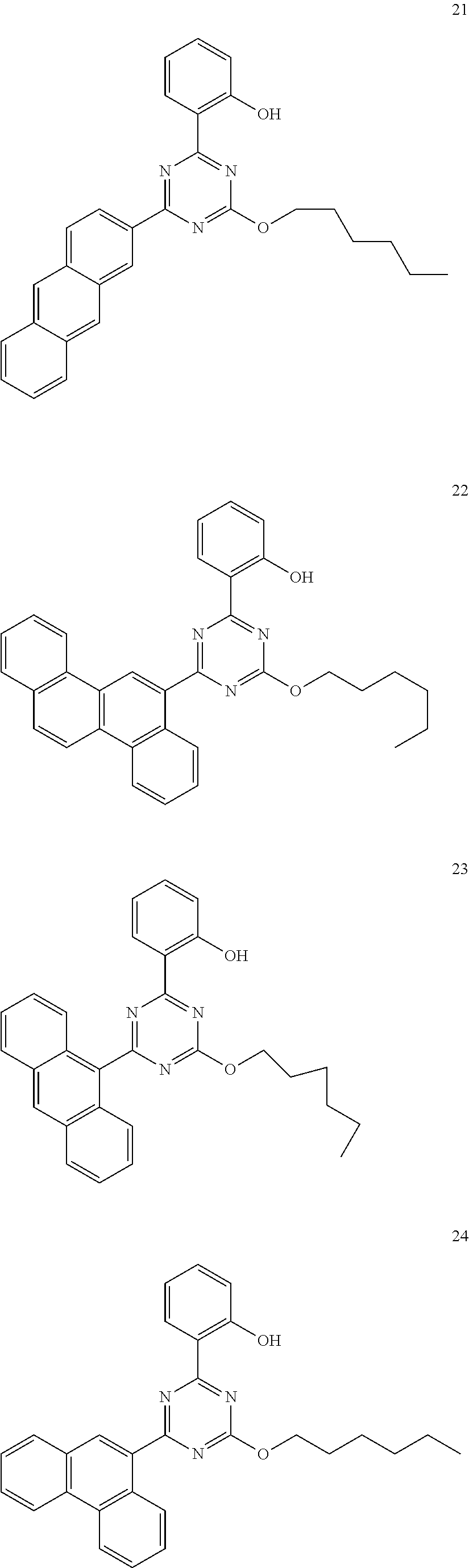
  • the light absorber of an embodiment may be represented by any one among the compounds represented by Compound Group 1 below.
  • the light absorber represented by Formula 1 may be represented by any one among the compounds represented by Compound Group 1 below:
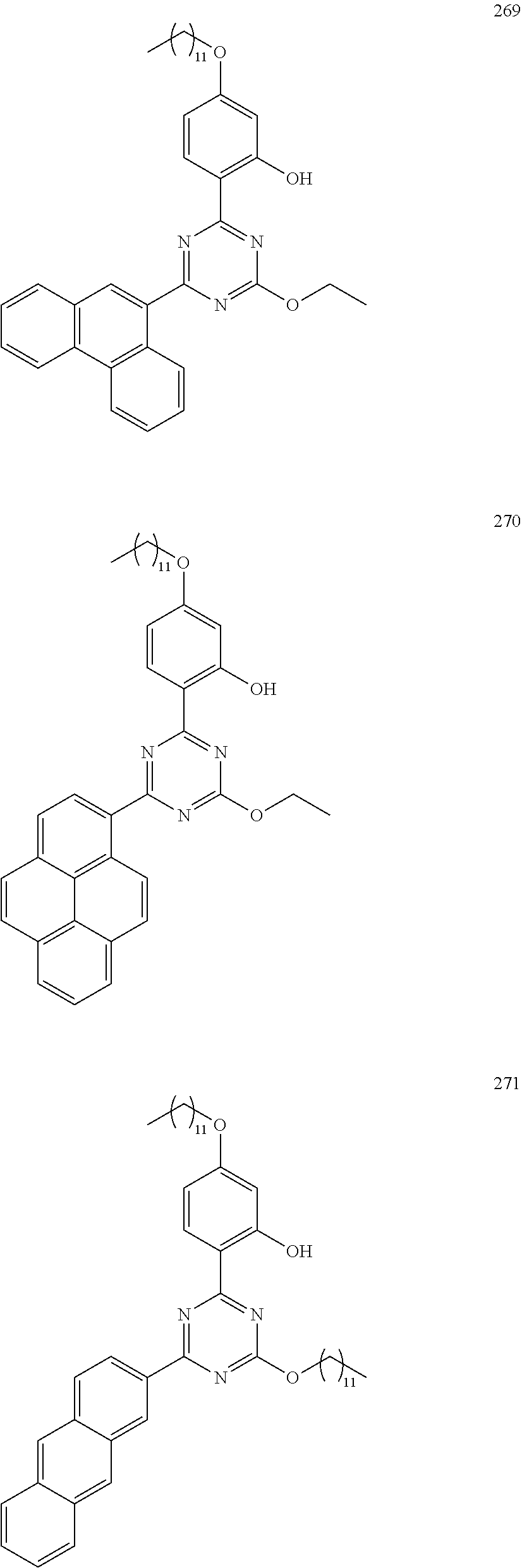
  • the light absorber of an embodiment may be represented by any one among the compounds represented by Compound Group 2 below.
  • the light absorber represented by Formula 2 may be represented by any one among the compounds represented by Compound Group 2 below:
  • the display apparatuses DS and DS-a of an embodiment may include, as a light absorber, at least one among the compounds of Compound Group 1 or Compound Group 2 as described above.
  • the encapsulation member TFE may include, as a light absorber, at least one among the compounds of Compound Group 1 or Compound Group 2.
  • the light absorber of an embodiment as described above may be included in the display apparatus to absorb a portion of incident light into the display apparatus.
  • the light absorber of an embodiment may absorb light in an ultraviolet wavelength region.
  • the light absorber of an embodiment may absorb a portion of external light of the display apparatus.
  • the light absorber of an embodiment may primarily absorb light in a wavelength region of 405 nm.
  • the light absorber of an embodiment may primarily absorb light in a wavelength region of 380 nm to 410 nm.
  • the display apparatuses DS and DS-a of an embodiment may include the light absorber of an embodiment as described above.
  • the display panel DP of the display apparatuses DS and DS-a of an embodiment may include the encapsulation member TFE, and the encapsulation member TFE may include the light absorber of an embodiment as described above.
  • the display apparatuses DS and DS-a of an embodiment may include the light absorber of an embodiment as described above in the encapsulation member TFE to prevent the external light from entering the light-emitting device OEL.
  • the display apparatuses DS- 1 , DS- 1 a , and DS- 2 may include the light absorber of an embodiment as described above.
  • the display panels DP- 1 and DP- 2 of the display apparatuses DS- 1 , DS- 1 a , and DS- 2 of an embodiment may include the encapsulation member TFE, and the encapsulation member TFE may include the light absorber of an embodiment as described above.
  • the display apparatuses DS- 1 , DS- 1 a , and DS- 2 of an embodiment may include the light absorber of an embodiment as described above in the encapsulation member TFE to prevent the external light from entering the light-emitting device OEL- 1 and OEL- 2 .
  • a display apparatus DS of an embodiment may include a display panel DP, an input sensing unit TP disposed on the display panel DP, and a polarizing member PP disposed on the display panel DP.
  • the polarizing member PP may be disposed on the input sensing unit TP.
  • the display panel DP may be an organic electroluminescence display panel.
  • the display panel DP may include a base layer BL, a circuit layer CL disposed on the base layer BL, and a display device layer DD.
  • the base layer BL may be a member providing a base surface on which the display device layer DD is disposed.
  • the base layer BL may be a glass substrate, a metal substrate, a plastic substrate, etc.
  • the embodiment is not limited thereto, and the base layer BL may be an inorganic layer, an organic layer, or a composite material layer.
  • the circuit layer CL is disposed on the base layer BL, and the circuit layer CL may include a plurality of transistors (not shown). Each of the transistors (not shown) may include a control electrode, an input electrode, and an output electrode.
  • the circuit layer CL may include a switching transistor and a driving transistor for driving the light-emitting device OEL.
  • the polarizing member PP may block the external light provided from the outside to the display panel DP.
  • the polarizing member PP may block a portion of the external light, and the polarizing member PP may block, for example, light having a wavelength of 380 nm or less.
  • the polarizing member PP may reduce reflected light which is generated in the display panel DP by the external light.
  • the polarizing member PP may prevent reflected light in the case where the light provided from the outside of the display apparatus DS enters the display panel DP and emits back.
  • the polarizing member PP may be a circular polarizer having an anti-reflective function, or the polarizing member PP may include a linear polarizer and a ⁇ /4 phase retarder.
  • the input sensing unit TP may perceive a direct touch by a user, an indirect touch by a user, a direct touch by an object, or an indirect touch by an object. Meanwhile, the input sensing unit TP may detect at least one among the position and force (pressure) of the externally applied touch.
  • the input sensing unit TP of an embodiment of the present invention may have various configurations or be configured using various materials, and is not limited to any one embodiment.
  • the input sensing unit TP may be a touch sensing unit configured to sense a touch.
  • the display apparatus DS of an embodiment may further include a window member WP.
  • the window member WP may define the front surface of the display apparatus DS.
  • the window member WP may stably protect internal components of the display apparatus DS from the external impacts.
  • the window member WP may include a glass substrate or a plastic substrate.
  • FIG. 2 A a cross-sectional view shown in FIG. 2 A illustrates that the display apparatus DS includes all of the input sensing unit TP, the polarizing member PP, and the window member WP, but the embodiment is not limited thereto.
  • the display apparatus DS of an embodiment at least one among the input sensing unit TP, the polarizing member PP, and the window member WP may be omitted.
  • the input sensing unit TP or the window member WP may be omitted.
  • the polarizing member PP or the window member WP may be omitted.
  • the display apparatus DS of an embodiment shown in FIG. 2 A may further include an adhesive member (not shown) for coupling each of members.
  • the adhesive member (not shown) may be an optical clear adhesive layer OCA or OCR.
  • the adhesive member (not shown) may be disposed between the input sensing unit TP and the polarizing member PP, or between the polarizing member PP and the window member WP.
  • At least one member provided on the display panel DP in the display apparatus DS of an embodiment shown in FIG. 2 A may include a light shielding material.
  • at least one among the input sensing unit TP, the polarizing member PP, the window member WP, and the adhesive member (not shown) may include an ultraviolet light absorber as the light blocking material.
  • at least one among the input sensing unit TP, the polarizing member PP, the window member WP, and the adhesive member (not shown) may include the light absorber of an embodiment as described above or the known ultraviolet light absorber as the light blocking material.
  • FIG. 2 B illustrates a cross-sectional view of a display apparatus DS-a of an embodiment
  • the display apparatus DS-a may include a display panel DP and a light blocking layer LBL provided on the display panel DP.
  • the light blocking layer LBL may block light provided from the outside of the display panel DP, for example ultraviolet light.
  • the light blocking layer LBL may be provided in a film shape.
  • the light blocking layer LBL may be provided on the display panel DP in a film shape including a polymer.
  • the display panel DP may be an organic electroluminescence display panel.
  • the display panel DP may include a base layer BL, a circuit layer CL and a display device layer DD.
  • the display panel DP may include a base layer BL, a circuit layer CL, and a display device layer DD which are sequentially stacked in a direction of a third directional axis DR 3 .
  • the display device layer DD may include a light-emitting device OEL and an encapsulation member TFE.
  • the light-emitting device OEL may an organic electroluminescence device.
  • the encapsulation member TFE may be disposed on the light-emitting device OEL.
  • the encapsulation member TFE may cover the light-emitting device OEL.
  • the light-emitting device OEL may be sealed by the encapsulation member TFE.
  • FIG. 4 is an enlarged plan view of a portion of a display panel DP included in a display apparatus DS according to an embodiment.
  • FIG. 5 is a cross-sectional view of a display panel DP according to an embodiment, and FIG. 5 is a cross-sectional view illustrating a part taken along line II-II′ of FIG. 4 .
  • the display panel DP may include non-light emitting regions NPXA and light emitting regions PXA-R, PXA-G, and PXA-B.
  • the light emitting regions PXA-R, PXA-G, and PXA-B each may be a region in which light generated in the light-emitting device OEL is emitted.
  • Each area of the light emitting regions PXA-R, PXA-G, and PXA-B may be different from each other, where the area means area when viewed on a plane.
  • the light emitting regions PXA-R, PXA-G, and PXA-B may be divided into a plurality of groups according to colors of light generated in the light-emitting device OEL.
  • the display panel DP of an embodiment shown in FIGS. 4 and 5 three light emitting regions PXA-R, PXA-G, and PXA-B which emit red light, green light, and blue light are illustrated as an example.
  • the light emitting regions PXA-R, PXA-G, and PXA-B may have different area according to colors of light emitted in an emission layer EML of the light-emitting device OEL.
  • the blue light emitting region PXA-B of the light-emitting device which emits blue light may have the largest area
  • the green light emitting region PXA-G of the light-emitting device which generates green light may have the smallest area.
  • the embodiment is not limited thereto, and the light emitting regions PXA-R, PXA-G, and PXA-B may emit different color light other than the blue light, green light, and red light, the light emitting regions PXA-R, PXA-G, and PXA-B may have the same area as each other, or the light emitting regions PXA-R, PXA-G, and PXA-B may be provided in a different area ratio from those illustrated in FIG. 4 .
  • Each of the light emitting regions PXA-R, PXA-G, and PXA-B may be a region divided by a pixel defining layer PDL.
  • the non-light emitting regions NPXA may be regions between the adjacent light emitting regions PXA-R, PXA-G, and PXA-B, which correspond to the pixel defining layer PDL. Meanwhile, in the description, each of the light emitting regions PXA-R, PXA-G, and PXA-B may correspond to a pixel.
  • the pixel defining layer PDL may be formed of a polymer resin.
  • the pixel defining layer PDL may include a polyacrylate-based resin or a polyimide-based resin.
  • the pixel defining layer PDL may further include an inorganic material, in addition to the polymer resin.
  • the pixel defining layer PDL may include a light absorbing material or a black pigment or a black dye.
  • the pixel defining layer PDL including the black pigment or the black dye may implement a black pixel defining layer.
  • carbon black, etc. may be used as the black pigment or the black dye, but the embodiment is not limited thereto.
  • the blue light emitting regions PXA-B and the red light emitting regions PXA-R may be alternately arranged along the first directional axis DR 1 to constitute a first group PXG 1 .
  • the green light emitting regions PXA-G may be arranged along the first directional axis DR 1 to constitute a second group PXG 2 .
  • the first group PXG 1 may be disposed to be spaced apart from the second group PXG 2 in the second direction DR 2 .
  • Each of the first group PXG 1 and the second group PXG 2 may be provided in plurality.
  • the first groups PXG 1 and the second groups PXG 2 may be alternately arranged with respect to each other along the second directional axis DR 2 .
  • One green light emitting region PXA-G may be disposed to be spaced apart from one blue light emitting region PXA-B or one red light emitting region PXA-R in a direction of a fourth directional axis DR 4 .
  • the direction of the fourth directional axis DR 4 may be a direction between the direction of the first directional axis DR 1 and the direction of the second directional axis DR 2 .
  • the arrangement structure of the light emitting regions PXA-R, PXA-G, and PXA-B shown in FIG. 4 may be referred to as a PenTile®/PENTILE® structure.
  • the arrangement structure of the light emitting regions PXA-R, PXA-G, and PXA-B in the display panel DP according to an embodiment is not limited to the arrangement structure shown in FIG. 4 .
  • the light emitting regions PXA-R, PXA-G, and PXA-B may have a stripe structure, in which a red light emitting region PXA-R, a green light emitting region PXA-G, and a blue light emitting region PXA-B are sequentially and alternately arranged along the first directional axis DR 1 .
  • the light-emitting device OEL may include a first electrode EL 1 and a second electrode EL 2 which face each other, and a plurality of organic layers OL disposed between the first electrode EL 1 and the second electrode EL 2 .
  • the organic layers OL may include a hole transport region HTR, an emission layer EML, and an electron transport region ETR.
  • the light-emitting device OEL may include the first electrode EL 1 , the hole transport region HTR disposed on the first electrode EL 1 , the emission layer EML disposed on the hole transport region HTR, and the electron transport region ETR disposed on the emission layer EML, and the second electrode EL 2 disposed on the electron transport region ETR.
  • the encapsulation member TFE may be disposed on the light-emitting device OEL, and the encapsulation member TFE may disposed on the second electrode EL 2 .
  • the encapsulation member TFE may be directly disposed on the second electrode EL 2 .
  • the encapsulation member TFE may be formed by stacking one layer or a plurality of layers.
  • the encapsulation member TFE may be a thin film encapsulation layer.
  • the encapsulation member TFE may protect the light-emitting device OEL.
  • the encapsulation member TFE may cover an upper surface of the second electrode EL 2 disposed in an opening OH, and may fill the opening OH.
  • the encapsulation member TFE may include the light absorber of an embodiment as described above to absorb a portion of light provided in the light-emitting device OEL.
  • the display apparatuses DS and DS-a of an embodiment may include the encapsulation member TFE including the light absorber of an embodiment.
  • the display apparatuses DS and DS-a of an embodiment may further include functional layers which absorb or block the external light, in addition to the encapsulation member TFE.
  • the display apparatus DS of an embodiment shown in FIG. 2 A at least one among the input sensing unit TP, the polarizing member PP, the window member WP, and the adhesive member (not shown) may serve as a functional layer configured to block a portion of the external light.
  • the light blocking layer LBL disposed on the display panel DP may be a functional layer which blocks a portion of the external light.
  • FIG. 6 is a cross-sectional view representing an embodiment of the light-emitting device OEL included in the display panel DP of an embodiment.
  • the light-emitting device OEL may include a first electrode EL 1 , a hole transport region HTR disposed on the first electrode EL 1 , an emission layer EML disposed on the hole transport region HTR, and an electron transport region ETR disposed on the emission layer EML, and a second electrode EL 2 disposed on the electron transport region ETR, wherein the hole transport region HTR may include a hole injection layer HIL and a hole transport layer HTL, and the electron transport region ETR may include an electron injection layer EIL and an electron transport layer ETL.
  • the first electrode constituting the light-emitting device OEL has conductivity.
  • the first electrode EL 1 may be formed of a metal alloy or a conductive compound.
  • the first electrode EL 1 may be an anode.
  • the first electrode EL 1 may be a pixel electrode.
  • the first electrode EL 1 may be a reflective electrode.
  • the first electrode EL 1 may be a transmissive electrode or a transflective electrode.
  • the first electrode EL 1 may include Ag, Mg Cu, Al, Pt, Pd, Au, Ni, Nd, Ir, Cr, Li, Ca, LiF/Ca, LiF/Al, Mo, Ti, a compound thereof or a mixture thereof (e.g., a mixture of Ag and Mg).
  • the first electrode EL 1 may have a multilayer structure including a reflective layer or a transflective layer formed of the above-illustrated materials, and a transparent conductive layer formed of indium tin oxide (ITO), indium zinc oxide (IZO), zinc oxide (ZnO), indium tin zinc oxide (ITZO), etc.
  • the first electrode EL 1 may be a multilayer metal film and have a structure in which a metal film of ITO/Ag/ITO is stacked.
  • the hole transport region HTR may have a single layer formed of a single material, a single layer formed of a plurality of different materials, or a multilayer structure including a plurality of layers formed of a plurality of different materials.
  • the hole transport region HTR may have a single layer structure formed of a plurality of different materials, or a structure of a hole injection layer HIL/hole transport layer HTL, a hole injection layer HIL/hole transport layer HTL/buffer layer (not shown), a hole injection layer HIL/buffer layer (not shown), a hole transport layer HTL/buffer layer (not shown), or a hole injection layer HIL/hole transport layer HTL/electron blocking layer (not shown), which are sequentially stacked from the first electrode EL 1 , but the embodiment is not limited thereto.
  • the hole transport region HTR may include the hole injection layer HIL and the hole transport layer HTL, and a known hole injection material and a known hole transport material may be used in the hole injection layer HIL and the hole transport layer HTL, respectively.
  • the hole transport region HTR may be disposed on the first electrode EL 1 in the opening OH defined in the pixel defining layer PDL, and may be disposed extending to an upper portion of the pixel defining layer PDL.
  • the embodiment is not limited thereto, and the hole transport region HTR may be patterned to be disposed inside the opening OH.
  • the emission layer EML is provided on the hole transport region HTR.
  • the emission layer EML may have a single layer formed of a single material, a single layer formed of a plurality of different materials, or a multilayer structure having a plurality of layers formed of a plurality of different materials.
  • the emission layer EML is not specifically limited to a material if the material for forming the emission layer EML is usually used, but for example, the emission layer EML may be formed of materials that emit red, green, and blue colors, and may include a fluorescent material or a phosphorescent material. Also, the emission layer EML may include a host or dopant. For example, the emission layer EML may be disposed in the opening OH defined in the pixel defining layer PDL, but the embodiment is not limited thereto.
  • the emission layer EML may include, as a host material, at least one of bis[2-(diphenylphosphino)phenyl]ether oxide (DPEPO), 4,4′-bis(carbazol-9-yl)biphenyl (CBP), 1,3-Bis(carbazol-9-yl)benzene (mCP), 2,8-bis(diphenylphosphoryl)dibenzo[b,d]furan (PPF), 4,4′,4′′-tris(carbazol-9-yl)-triphenylamine (TcTa), or 1,3,5-tris(N-phenylbenzimidazole-2-yl)benzene (TPBi).
  • DPEPO bis[2-(diphenylphosphino)phenyl]ether oxide
  • CBP 4,4′-bis(carbazol-9-yl)biphenyl
  • mCP 1,3-Bis(carbazol-9-yl)benzene
  • PPF 2,8-bis(diphen
  • the embodiment is not limited thereto and, for example, tris(8-hydroxyquinolino)aluminum (Alq 3 ), 4,4′-bis(N-carbazolyl)-1,1′-biphenyl (CBP), poly(n-vinylcabazole (PVK), 9,10-di(naphthalene-2-yl)anthracene (ADN), 4,4′,4′′-Tris(carbazol-9-yl)-triphenylamine (TCTA), 1,3,5-tris(N-phenylbenzimidazole-2-yl)benzene (TPBi), 3-tert-butyl-9,10-di(naphth-2-yl)anthracene (TBADN), distyrylarylene (DSA), 4,4′-bis(9-carbazolyl)-2,2′-dimethyl-biphenyl (CDBP), 2-methyl-9,10-bis(naphthalen-2-yl)
  • the emission layer EML may include, as a dopant material, styryl derivatives (e.g., 1,4-bis[2-(3-N-ethylcarbazoryl)vinyl]benzene (BCzVB), 4-(di-p-tolylamino)-4′-[(di-p-tolylamino)styryl]stilbene (DPAVB), and N-(4-((E)-2-(6-((E)-4-(diphenylamino)styryl)naphthalen-2-yl)vinyl)phenyl)-N-phenylbenz enamine (N-BDAVBi)), perylene and the derivatives thereof (e.g., 2,5,8,11-tetra-t-butylperylene (TBP)), pyrene and the derivatives thereof (e.g., 1-dipyrene, 1,4-dipyrenylbenzene, 1,4-bis(N,N-diphen)
  • the display panel DP may include a quantum dot material in the emission layer EML.
  • the core of the quantum dot may be selected from among a Group II-VI compound, a Group III-V compound, a Group IV-VI compound, a Group IV element, a Group IV compound, and a combination thereof.
  • the Group II-VI compound may be selected from the group consisting of a binary compound selected from the group consisting of CdSe, CdTe, ZnS, ZnSe, ZnTe, ZnO, HgS, HgSe, HgTe, MgSe, MgS, and a mixture thereof; a ternary compound selected from the group consisting of AgInS, CulnS, CdSeS, CdSeTe, CdSTe, ZnSeS, ZnSeTe, ZnSTe, HgSeS, HgSeTe, HgSTe, CdZnS, CdZnSe, CdZnTe, CdHgS, CdHgSe, CdHgTe, HgZnS, HgZnSe, HgZnTe, MgZnSe, MgZnS, and a mixture thereof; and a quaternary compound selected from the group consisting of H
  • the Group III-V compound may be selected from the group consisting of a binary compound selected from the group consisting of GaN, GaP, GaAs, GaSb, AlN, AlP, AlAs, AlSb, InN, InP, InAs, InSb, and a mixture thereof; a ternary compound selected from the group consisting of GaNP, GaNAs, GaNSb, GaPAs, GaPSb, AlNP, AlNAs, AlNSb, AlPAs, AlPSb, InGaP, InNP, InNAs, InNSb, InPAs, InPSb, GaAlNP, and a mixture thereof; and a quaternary compound selected from the group consisting of GaAlNAs, GaAlNSb, GaAlPAs, GaAlPSb, GaInNP, GaInNAs, GalnNSb, GaInPAs, GalnPSb, InAlNP, InAlNAs, InAlNSb, InAlPAs, InAlPSb, and
  • the Group IV-VI compound may be selected from the group consisting of a binary compound selected from the group consisting of SnS, SnSe, SnTe, PbS, PbSe, PbTe, and a mixture thereof; a ternary compound selected from the group consisting of SnSeS, SnSeTe, SnSTe, PbSeS, PbSeTe, PbSTe, SnPbS, SnPbSe, SnPbTe, and a mixture thereof; and a quaternary compound selected from the group consisting of SnPbSSe, SnPbSeTe, SnPbSTe, and a mixture thereof.
  • the Group IV element may be selected from the group consisting of Si, Ge, and a mixture thereof.
  • the Group IV compound may be a binary compound selected from the group consisting of SiC, SiGe, and a mixture thereof.
  • a binary compound, a ternary compound, or a quaternary compound may be present in a particle with a uniform concentration distribution, or may be present in the same particle with a partially different concentration.
  • the quantum dot may have a core/shell structure in which one quantum dot surrounds another quantum dot.
  • An interface between the core and the shell may have a concentration gradient in which the concentration of an element present in the shell becomes lower toward the center.
  • a quantum dot may have the above-described core-shell structure including a core having nano-crystals and a shell surrounding the core.
  • the shell of the quantum dot may serve as a protective layer to prevent the chemical deformation of the core so as to maintain semiconductor properties, and/or a charging layer to impart electrophoresis properties to the quantum dot.
  • the shell may be a single layer or multiple layers.
  • An interface between a core and a shell may have a concentration gradient in which the concentration of an element present in the shell becomes lower toward the center.
  • An example of the quantum dot shell may be a metal or non-metal oxide, a semiconductor compound, or a combination thereof.
  • the metal or non-metal oxide may be a binary compound such as SiO 2 , Al 2 O 3 , TiO 2 , ZnO, MnO, Mn 2 O 3 , Mn 3 O 4 , CuO, FeO, Fe 2 O 3 , Fe 3 O 4 , CoO, Co 3 O 4 , and NiO, or a ternary compound such as MgAl 2 O 4 , CoFe 2 O 4 , NiFe 2 O 4 , and CoMn 2 O 4 , but the present invention is not limited thereto.
  • the semiconductor compound may be, for example, CdS, CdSe, CdTe, ZnS, ZnSe, ZnTe, ZnSeS, ZnTeS, GaAs, GaP, GaSb, HgS, HgSe, HgTe, InAs, InP, InGaP, InSb, AlAs, AlP, AlSb, etc., but the present invention is not limited thereto.
  • the quantum dot may have a full width of half maximum (FWHM) of a light emission wavelength spectrum of about 45 nm or less, preferably about 40 nm or less, more preferably about 30 nm or less, and color purity or color reproducibility may be improved in the above range.
  • FWHM full width of half maximum
  • light emitted through such a quantum dot is emitted in all directions, and thus a wide viewing angle may be improved.
  • a quantum dot is not particularly limited as long as it is a form commonly used in the art, more specifically, a quantum dot in the form of spherical, pyramidal, multi-arm, or cubic nanoparticles, nanotubes, nanowires, nanofibers, nanoparticles, etc. may be used.
  • the quantum dot may control the color of emitted light according to the particle size thereof. Accordingly, the quantum dot may have various light emission colors such as blue, red, and green.
  • the electron transport region ETR is disposed on the emission layer EML.
  • the electron transport region ETR may include at least one of a hole blocking layer (not shown), the electron transport layer ETL, or the electron injection layer EIL, but is not limited thereto.
  • the electron transport region ETR includes the electron injection layer EIL and the electron transport layer ETL
  • a known electron injection material and a known electron transport material may be used in the electron injection layer EIL and the electron transport layer ETL, respectively.
  • the second electrode EL 2 is provided on the electron transport region ETR.
  • the second electrode EL 2 may be a common electrode or a cathode.
  • the second electrode EL 2 may be formed of a metal alloy or a conductive compound.
  • the second electrode EL 2 may be a transmissive electrode, a transflective electrode, or a reflective electrode.
  • the second electrode EL 2 may be formed of a transparent metal oxide, for example, indium tin oxide (ITO), indium zinc oxide (IZO), zinc oxide (ZnO), indium tin zinc oxide (ITZO), etc.
  • the second electrode EL 2 may include Ag, Mg Cu, Al, Pt, Pd, Au, Ni, Nd, Ir, Cr, Li, Ca, LiF/Ca, LiF/Al, Mo, Ti, a compound thereof or a mixture thereof (e.g., a mixture of Ag and Mg).
  • the second electrode EL 2 may have a multilayer structure including a reflective layer or a transflective layer formed of the above-illustrated materials, and a transparent conductive layer formed of indium tin oxide (ITO), indium zinc oxide (IZO), zinc oxide (ZnO), indium tin zinc oxide (ITZO), etc.
  • the electron transport region ETR and the second electrode EL 2 may be disposed in a region overlapping the first electrode EL 1 as well as may be disposed further extending in the pixel defining layer PDL. Meanwhile, although not shown, the second electrode EL 2 may be connected with an auxiliary electrode. If the second electrode EL 2 is connected with the auxiliary electrode, the resistance of the second electrode EL 2 may decrease.
  • the first electrode EL 1 among the first electrode and the second electrode which face each other, may be a reflective electrode, and the second electrode may be a transmissive electrode.
  • the light-emitting device OEL may emit light through a front surface.
  • the embodiment is not limited thereto.
  • FIGS. 7 to 9 are cross-sectional views of display apparatuses of an embodiment.
  • the display apparatuses DS- 1 and DS- 1 a of an embodiment shown in FIGS. 7 and 8 include the display panel DP- 1 including a base layer BL, a circuit layer CL disposed on the base layer BL, and a display device layer DD- 1 .
  • the display panel DP- 1 may be a quantum dot light-emitting display panel.
  • the display panel DP- 1 may include a plurality of light-emitting devices OEL- 11 , OEL- 12 , and OEL- 13 , and the light-emitting devices OEL- 11 , OEL- 12 , and OEL- 13 may include emission layers EML-B, EML-G, and EML-R containing quantum dots QD 1 , QD 2 , and QD 3 .
  • quantum dots QD 1 , QD 2 , and QD 3 included in the light-emitting device OEL- 1 of an embodiment may be equally applied to the quantum dots QD 1 , QD 2 , and QD 3 included in the light-emitting device OEL- 1 of an embodiment.
  • the display apparatuses DS- 1 and DS- 1 a may include non-light emitting regions NPXA and light emitting regions PXA-B, PXA-G, and PXA-R.
  • the light emitting regions PXA-B, PXA-G, and PXA-R each may be a region in which light generated from light-emitting devices OEL- 11 , OEL- 12 , and OEL- 13 is emitted, respectively.
  • the light emitting regions PXA-B, PXA-G, and PXA-R may be spaced apart from each other on a plane.
  • the plurality of light-emitting devices OEL- 11 , OEL- 12 , and OEL- 13 may emit light in different wavelength regions.
  • a first emission layer EML-B of a first light-emitting device OEL- 11 may include a first quantum dot QD 1 .
  • the first quantum dot QD 1 may emit blue light that is first color light.
  • a second emission layer EML-G of a second light-emitting device OEL- 12 and a third emission layer EML-R of a third light-emitting device OEL- 13 may include a second quantum dot QD 2 and a third quantum dot QD 3 , respectively.
  • the second quantum dot QD 2 and the third quantum dot QD 3 may emit green light that is second color light and red light that is third color light, respectively.
  • the first to third quantum dots QD 1 , QD 2 , and QD 3 may have different sizes.
  • the first quantum dot QD 1 used in the first light-emitting device OEL- 11 which emits light in a relatively short wavelength region, may have a relatively small average diameter compared to the second quantum dot QD 2 of the second light-emitting device OEL- 12 and the third quantum dot QD 3 of the third light-emitting device OEL- 13 , which emit light in a relatively long wavelength region.
  • the embodiment is not limited thereto, the first to third quantum dots QD 1 , QD 2 , and QD 3 may have similar diameters.
  • FIG. 7 illustrates an embodiment of the display apparatus DS- 1 including a polarizing member PP disposed on an upper portion of the display panel DP- 1
  • FIG. 8 illustrates an embodiment of the display apparatus DS- 1 a including a color filter layer CFL disposed on an upper portion of the display panel DP- 1
  • the polarizing member PP and the color filter layer CFL may block external light provided from the outside of the display apparatuses DS- 1 and DS- 1 a to the display panel DP.
  • the polarizing member PP and the color filter layer CFL may function to prevent reflection for minimizing the reflection by the external light.
  • FIG. 2 A as described above may be equally applied to the polarizing member PP.
  • the color filter layer CFL may include a light shielding unit BM and a color filter part CF.
  • the color filter part CF may include a plurality of filters CF-B, CF-G, and CF-R. That is, the color filter layer CFL may include a first filter CF-B configured to transmit the first color light, a second filter CF-G configured to transmit the second color light, and a third filter CF-R configured to transmit the third color light.
  • the first filter CF-B may be a blue color filter
  • the second filter CF-G may be a green color filter
  • the third filter CF-R may be a red color filter.
  • the filters CF-B, CF-G, and CF-R each may include a polymeric photosensitive resin and a pigment or dye.
  • the first filter CF-B may include a blue pigment or dye
  • the second filter CF-G may include a green pigment or dye
  • the third filter CF-R may include a red pigment or dye.
  • the embodiment is not limited thereto, and the first filter CF-B may not include a pigment or dye.
  • the first filter CF-B may include a polymeric photosensitive resin and may not include a pigment or dye.
  • the first filter CF-B may be transparent.
  • the first filter CF-B may be formed of a transparent photosensitive resin.
  • the light shielding unit BM may be a black matrix.
  • the light shielding unit BM may include an organic light shielding material or an inorganic light shielding material containing a black pigment or dye.
  • the light shielding unit BM may prevent light leakage, and may separate boundaries between the adjacent filters CF-B, CF-G, and CF-R.
  • the color filter layer CFL may further include a buffer layer BFL.
  • the buffer layer BFL may be a protective layer which protects the filters CF-B, CF-G, and CF-R.
  • the buffer layer BFL may be an inorganic material layer containing at least one inorganic material from among silicon nitride, silicon oxide, and silicon oxynitride.
  • the buffer layer BFL may be formed of a single layer or a plurality of layers.
  • the first filter CF-B of the color filter layer CFL is illustrated to overlap the second filter CF-G and the third filter CF-R, but the embodiment is not limited thereto.
  • the first to third filters CF-B, CF-G, and CF-R may be divided by the light shielding unit BM and not overlap one another.
  • the first to third filters CF-B, CF-G, and CF-R may be disposed corresponding to the blue light emitting region PXA-B, the green light emitting region PXA-G, and the red light emitting region PXA-R, respectively.
  • the display apparatus DS- 1 a of an embodiment may include a base substrate BS disposed on an upper portion of the color filter layer CFL.
  • the base substrate BS may be a member configured to provide a base surface in which the color filter layer CFL or the like is disposed.
  • the base substrate BS may be a glass substrate, a metal substrate, a plastic substrate, etc.
  • the embodiment is not limited thereto, and the base substrate BS may be an inorganic layer, an organic layer, or a composite material layer.
  • the display apparatus DS- 2 of an embodiment shown in FIG. 9 includes the display panel DP- 2 including a base layer BL, a circuit layer CL disposed on the base layer BL, and a light-emitting device OEL- 2 .
  • the display panel DP- 2 may be an organic electroluminescence display panel.
  • the light-emitting device OEL- 2 included in the display panel DP- 2 may be a tandem type light-emitting device as shown in FIG. 10 .
  • the light-emitting device OEL- 2 may include a first electrode EL 1 and a second electrode EL 2 which face each other, and a plurality of light emitting units LU- 1 , LU- 2 , and LU- 3 disposed between the first electrode EL 1 and the second electrode EL 2 .
  • the light emitting units LU- 1 , LU- 2 , and LU- 3 may be stacked in the thickness direction.
  • a charge generation layer CGL may be disposed between two of the light emitting units LU- 1 , LU- 2 , and LU- 3 .
  • the light emitting units LU- 1 , LU- 2 , and LU- 3 each may include a hole transport region HTR, emission layers EML-B 1 , EML-B 2 , and EML-B 3 , and an electron transport region ETR.
  • the emission layers EML-B 1 , EML-B 2 , and EML-B 3 included in the light emitting units LU- 1 , LU- 2 , and LU- 3 , respectively, may emit light in the same wavelength region.
  • the emission layers EML-B 1 , EML-B 2 , and EML-B 3 may all emit blue light.
  • the embodiment is not limited thereto, and the emission layers EML-B 1 , EML-B 2 , and EML-B 3 may emit light in different wavelength regions.
  • the display apparatus DS- 2 of an embodiment may include a color conversion layer CCL disposed on the display panel DP- 2 .
  • the display apparatus DS- 2 may further include a color filter layer CFL.
  • the color filter layer CFL may be disposed between the base substrate BS and the color conversion layer CCL.
  • the color conversion layer CCL may include a plurality of partition walls BK, which are disposed to be spaced apart from each other, and color control units CCP-B, CCP-G, and CCP-R, which are disposed between the partition walls BK.
  • the partition walls BK may include a polymer resin and a liquid-repellent additive.
  • the partition walls BK may include a light absorbing material or a pigment or dye PG.
  • the partition walls BK may include a black pigment or black dye to implement black partition walls. In forming the black partition walls, carbon black, etc. may be used as the black pigment or the black dye, but the embodiment is not limited thereto.
  • the color conversion layer CCL may include a first color control unit CCP-B configured to transmit first color light, a second color control unit CCP-G containing a quantum dot which converts the first color light into second color light, and a third color control unit CCP-R containing a quantum dot which converts the first color light into third color light.
  • the second color light may be light in a longer wavelength region than the first color light
  • the third color light may be light in a longer wavelength region than the first color light and the second color light.
  • the first color light may be blue light
  • the second color light may be green light
  • the third color light may be red light.
  • the color conversion layer CCL may further include a capping layer CPL.
  • the capping layer CPL may be disposed on the color control units CCP-B, CCP-G, and CCP-R and the partition walls BK.
  • the capping layer CPL may serve to prevent the penetration of moisture and/or oxygen (hereinafter, referred to as ‘moisture/oxygen’).
  • the capping layer CPL may be disposed on the color control units CCP-B, CCP-G, and CCP-R to block the color control units CCP-B, CCP-G, and CCP-R from being exposed to moisture/oxygen.
  • the capping layer CPL may include at least one inorganic layer.
  • the display apparatus DS- 2 of an embodiment may include the color filter layer CFL disposed on the color conversion layer CCL, and those descriptions provided in FIG. 8 may be equally applied to the color filter layer CFL and the base substrate BS.
  • FIGS. 11 to 13 are cross-sectional views illustrating examples of encapsulation members according to an embodiment.
  • the encapsulation members TFE, TFE- 1 , and TFE- 2 may include at least one organic film and at least one inorganic film.
  • the encapsulation member TFE of an embodiment shown in FIG. 11 may include one organic film ML and inorganic films IL 1 and IL 2 disposed on an upper surface and a lower surface of the organic film ML, respectively. That is, the encapsulation member TFE of an embodiment may be a structure in which the first inorganic film IL 1 , the organic film ML, and the second inorganic film IL 2 are stacked in this order.
  • the organic film ML may include a light absorber LA of an embodiment.
  • the organic film ML may include the light absorber LA and a base resin OR.
  • the base resin OR may be formed from an acrylic monomer and a photoinitiator.
  • the base resin OR may be formed through an ultraviolet-curing process from a plurality of different acrylic monomers and the photoinitiator, or one acrylic monomer and the photoinitiator.
  • the acrylic monomer may be a methacrylate monomer.
  • the organic film ML may be formed to have a thickness of 3 ⁇ m to 30 ⁇ m.
  • the light absorber LA may be included in an amount of 1-5 wt % with respect to 100 of the weight of the monomer forming the base resin OR.
  • the degree of the light absorption in the organic film ML may be reduced, thereby not exhibiting the effect of blocking the external light.
  • the light absorber LA is included in an amount of greater than 5 wt % with respect to the weight of the monomer, there may be limitations that the activation of the photoinitiator used to form the organic film ML may be reduced, and the phase-separation may occur after the step of forming the organic film ML by using ultraviolet rays.
  • the monomer used to form the organic film ML may be at least one among M1 to M4 below:
  • the photoinitiator used to form the organic film ML may be activated in a wavelength region of 360 nm to 400 nm.
  • the photoinitiator may be I1 or I2 below:
  • the organic film ML may include the light absorber of an embodiment as described above to absorb UV light.
  • the organic film ML may have a transmittance of 10% or less at 405 nm wavelength, a transmittance of 70% or more at 430 nm wavelength, and a transmittance of 97% or more at 450 nm wavelength.
  • the inorganic films IL 1 and IL 2 may include at least one of SiON, SiN X , SiO X , SiC, Al 2 O 3 , or ZrO X .
  • the first inorganic film IL 1 and the second inorganic film IL 2 may be layers formed by including the same material. In addition, unlike this, the first inorganic film IL 1 and the second inorganic film IL 2 may be formed of different materials.
  • the first inorganic film IL 1 and the second inorganic film IL 2 each may be formed to have a thickness of 0.5 ⁇ m to 2.0 ⁇ m.
  • the inorganic films IL 1 and IL 2 may have a single layer including one material, or a plurality of layers each including a different material.
  • FIGS. 12 and 13 are views illustrating examples of encapsulation members according to an embodiment, and in the description with respect to examples of the encapsulation members shown in FIGS. 12 and 13 , the duplicated features with respect to the encapsulation member TFE illustrated in FIG. 11 are not described again, but their differences will be mainly described.
  • FIG. 12 is a cross-sectional view illustrating another example of an encapsulation member according to an embodiment.
  • the encapsulation member TFE- 1 shown in FIG. 12 may include, in an organic film ML-a, a first light absorber LA-a and a second light absorber LA-b, which absorb light in a different wavelength region.
  • At least one of the first light absorber LA-a or the second light absorber LA-b may have a structure of the light absorber of an embodiment as described above.
  • the first light absorber LA-a or the second light absorber LA-b may have a partially different wavelength of the light absorbed. Meanwhile, FIG.
  • the organic film ML-a in the encapsulation member TFE- 1 of an embodiment may include at least three different light absorbers. Meanwhile, different light absorbers may all be light absorbers of an embodiment as described above. In addition, unlike this, the organic film ML-a may further include a known light absorber, in addition to the light absorber of an embodiment.
  • FIG. 13 is a cross-sectional view illustrating an example of an encapsulation member including a plurality of inorganic films and a plurality of organic films.
  • the encapsulation member TFE- 2 may include n inorganic films IL 1 , . . . , ILn and (n ⁇ 1) organic films ML 1 , . . . , ML(n ⁇ 1). Meanwhile, n may be an integer of 2 or more.
  • the first inorganic film IL 1 among the n inorganic films IL 1 , . . . , ILn of the encapsulation member TFE- 2 may be disposed to be directly contacted with the second electrode EL 2 ( FIG. 5 ) of the light-emitting device OEL.
  • the (n ⁇ 1) organic films ML 1 , . . . , ML(n ⁇ 1) of the encapsulation member TFE- 2 may be disposed alternately with the n inorganic films IL 1 , . . . , ILn.
  • the (n ⁇ 1) organic films ML 1 , . . . , ML(n ⁇ 1) may have greater average thickness than the n inorganic films IL 1 , . . . , ILn.
  • the n inorganic films IL 1 , . . . , ILn may include the same or different inorganic material, and may have the same or different thickness.
  • the (n ⁇ 1) organic films ML 1 , . . . , ML(n ⁇ 1) may include the same or different organic material, and may have the same or different thickness.
  • At least one organic film among the (n ⁇ 1) organic films ML 1 , . . . , ML (n ⁇ 1) may include the light absorber of an embodiment as described above.
  • at any one organic film among the (n ⁇ 1) organic films ML 1 , . . . , ML(n ⁇ 1) may include the light absorber of an embodiment.
  • a plurality of organic films selected from among the (n ⁇ 1) organic films ML 1 , . . . , ML(n ⁇ 1) may include the light absorber of an embodiment.
  • each of the (n ⁇ 1) organic films ML 1 , . . . ML(n ⁇ 1) may include the light absorber of an embodiment.
  • the light absorbers LA 1 , . . . , LA(n ⁇ 1) of an embodiment included in the (n ⁇ 1) organic films ML 1 , . . . , ML(n ⁇ 1), respectively may be all the same or at least one may be different. Meanwhile, the (n ⁇ 1) organic films ML 1 , . . . , ML(n ⁇ 1) may further include a known light absorber, in addition to the light absorber of an embodiment as described above.
  • FIG. 14 is a graph in which light transmittance in the organic film of the encapsulation member including the light absorber of an embodiment is measured.
  • FIG. 14 is that transmittance according to a wavelength is measured with respect to a single layer organic film manufactured to have a thickness of 10 ⁇ m, wherein the organic film includes 3 wt % of the light absorber of an embodiment with respect to the total content of the monomers.
  • the light absorber used in an embodiment shown in FIG. 14 corresponds to Compound 35 of Compound Group 2, but when other compounds in Compound Group 1 or Compound Group 2 corresponding to the light absorber according to an embodiment are included as an organic film material, similar results may also be shown.
  • the organic film exhibits transmittance of 10% or less at 405 nm wavelength, and thus, it may be confirmed that the light absorber of an embodiment efficiently absorbs light in a wavelength region in the vicinity of 405 nm.
  • the organic film of the encapsulation member including the light absorber of an embodiment exhibits transmittance of 70% or more at 430 nm wavelength, and transmittance of 97% or more at 450 nm wavelength. That is, the organic film has transmittance of 70% or more at 430 nm and high transmittance of 97% or more in a visible light region of 450 nm or more, and thus since the wavelength region of the light emitted from the light-emitting device OEL ( FIG. 5 ) is not overlapped, luminous efficiency of the light-emitting device OEL ( FIG. 5 ) may not be reduced even when the organic film includes the light absorber.
  • FIG. 15 is a graph in which light transmittance is measured in the case of the encapsulation member including the light absorber of an embodiment and the polarizing member disposed on the encapsulation member.
  • FIG. 15 is that transmittance according to a wavelength is measured after the polarizing member is provided on the organic film manufactured in the same conditions as those used in the evaluation of transmittance of FIG. 14 .
  • the polarizing member is included in the organic film, transmittance of 5% or less at 405 nm wavelength is exhibited, and thus, it may be confirmed that the light absorber of an embodiment efficiently absorbs light in a wavelength region in the vicinity of 405 nm.
  • the transmittance graph of FIG. 15 shows a low transmittance even in a wavelength region of 400 nm or less. That is, compared to FIG. 14 , it may be seen that when the polarizing member is further included on the encapsulation member, transmittance in a short wavelength region of 400 nm or less may be more decreased, and thus when the polarizing member is further included on the encapsulation member, light in an ultraviolet wavelength region is more effectively blocked.
  • FIG. 16 is an image confirming reliability of the display panel during exposure to UV light.
  • Comparative Example is the case where the organic film of the encapsulation member does not include the light absorber
  • Example is the case where the organic film of the encapsulation member includes the light absorber of an embodiment.
  • the light absorber used in Example shown in FIG. 16 may be the same as the light absorber used in Example in FIG. 14 .
  • Comparative Example When comparing Comparative Example and Example of FIG. 16 , Comparative Example already showed damaged surface characteristics 6 hours after the exposure, and Example did not show changes in surface characteristics even until 18 hours after the exposure. Referring to FIG. 16 , it may be confirmed that the light absorber of an embodiment effectively absorbs light in a wavelength region of 405 nm, and thus the encapsulation member according to an embodiment may effectively block the external light in a wavelength region of 405 nm.
  • the display apparatus includes, in the encapsulation member, the light absorber including the hexagonal heterocycle containing two or more nitrogen atoms as a ring-forming atom and three different substituents which are substituted at the hexagonal heterocycle, and thus can effectively block the external light which enters the light-emitting device, thereby exhibiting improved reliability.
  • at least one organic film of the encapsulation member includes the light absorber including the hexagonal heterocycle containing two or more nitrogen atoms as a ring-forming atom and three different substituents which are substituted at the hexagonal heterocycle, and thus blocks the external light which enters the light-emitting device, thereby exhibiting improved display quality.
  • a synthesis method of a light absorber represented by Formula 1 of an embodiment as described above will be described in detail by illustrating a synthesis method of Compounds 2, 15, 25, 36, 56, 78, 95, 115, 148, and 177 of Compound Group 1.
  • a synthesis method of the light absorber is provided as an example, but the synthesis method according to an embodiment of the present invention is not limited to the following examples.
  • Compound 1 of Compound Group 1 of the light absorber according to an embodiment may be synthesized, for example, by Reaction Scheme 1-1 below:
  • Compound 15 of Compound Group 1 of the light absorber according to an example may be synthesized by Reaction Scheme 1-2 below, for example.
  • Compound 25 of Compound Group 1 of the light absorber according to an example may be synthesized by Reaction Scheme 1-3 below, for example.
  • Compound 36 of Compound Group 1 of the light absorber according to an example may be synthesized by Reaction Scheme 1-4 below, for example.
  • Compound 56 of Compound Group 1 of the light absorber according to an example may be synthesized by Reaction Scheme 1-5 below, for example.
  • Compound 78 of Compound Group 1 of the light absorber according to an example may be synthesized by Reaction Scheme 1-6 below, for example.
  • Compound 95 of Compound Group 1 of the light absorber according to an example may be synthesized by Reaction Scheme 1-7 below, for example.
  • Compound 115 of Compound Group 1 of the light absorber according to an example may be synthesized by Reaction Scheme 1-8 below, for example.
  • Compound 148 of Compound Group 1 of the light absorber according to an example may be synthesized by Reaction Scheme 1-9 below, for example.
  • Compound 177 of Compound Group 1 of the light absorber according to an example may be synthesized by Reaction Scheme 1-10 below, for example.
  • Synthesis method of a light absorber represented by Formula 2 of an embodiment as described above will be described in detail by illustrating a synthesis method of Compounds 2, 15, 20, 24, 35, 40, 75, 94, 102, 154, 169, 227, 280, 295, 299, and 320 of Compound Group 2.
  • a synthesis method of the light absorber is provided as an example, but the synthesis method according to an embodiment of the present invention is not limited to the following examples.
  • Compound 2 of Compound Group 2 of the light absorber according to an example may be synthesized by Reaction Scheme 2-1 below, for example.
  • Compound 15 of Compound Group 2 of the light absorber according to an example may be synthesized by Reaction Scheme 2-2 below, for example.
  • Compound 20 of Compound Group 2 of the light absorber according to an example may be synthesized by Reaction Scheme 2-3 below, for example.
  • Compound 24 of Compound Group 2 of the light absorber according to an example may be synthesized by Reaction Scheme 2-4 below, for example.
  • 9-bromophenanthrene (5 g) was mixed in 50 mL of THF, and then the reaction temperature was decreased to ⁇ 78° C.
  • n-BuLi (8 mL, 2.43 M in hexane) was slowly dropped and the mixture was stirred for 1 hour while maintaining the reaction temperature.
  • Cyanuric chloride (3.6 g) was mixed in 15 mL of THF, and then slowly added dropwise to the reaction container. After 3 hours, the reaction was quenched with a saturated ammonium chloride aqueous solution, and was extracted with ethyl acetate three times. The separated filtrate was dried with anhydrous magnesium sulfate, and then was distilled under reduced pressure to obtain residues.
  • Compound 35 of Compound Group 2 of the light absorber according to an example may be synthesized by Reaction Scheme 2-5 below, for example.
  • Compound 40 of Compound Group 2 of the light absorber according to an example may be synthesized by Reaction Scheme 2-6 below, for example.
  • Compound 75 of Compound Group 2 of the light absorber according to an example may be synthesized by Reaction Scheme 2-7 below, for example.
  • Compound 94 of Compound Group 2 of the light absorber according to an example may be synthesized by Reaction Scheme 2-8 below, for example.
  • Compound 102 of Compound Group 2 of the light absorber according to an example may be synthesized by Reaction Scheme 2-9 below, for example.
  • Compound 154 of Compound Group 2 of the light absorber according to an example may be synthesized by Reaction Scheme 2-10 below, for example.
  • Compound 169 of Compound Group 2 of the light absorber according to an example may be synthesized by Reaction Scheme 2-11 below, for example.
  • Compound 227 of Compound Group 2 of the light absorber according to an example may be synthesized by Reaction Scheme 2-12 below, for example.
  • Compound 280 of Compound Group 2 of the light absorber according to an example may be synthesized by Reaction Scheme 2-13 below, for example.
  • Compound 295 of Compound Group 2 of the light absorber according to an example may be synthesized by Reaction Scheme 2-14 below, for example.
  • Compound 299 of Compound Group 2 of the light absorber according to an example may be synthesized by Reaction Scheme 2-15 below, for example.
  • Compound 320 of Compound Group 2 of the light absorber according to an example may be synthesized by Reaction Scheme 2-16 below, for example.
  • the transmittance of the organic film including the light absorber of an example was evaluated at each of 405 nm wavelength and 430 nm wavelength.
  • the light absorber compounds used in Examples and Comparative Examples are listed in Table 3.
  • Table 4 shows the light transmittance at each of 405 nm wavelength and 430 nm in Examples and Comparative Examples, and the evaluation results listed in Table 4 show transmittance in the case where the polarizing member was added on the organic film including Example and Comparative Example Compounds.
  • the transmittance was measured by UV-Vis spectrophotometer (Lambda 650, PerkinElmer Inc.), and the measured wavelength range was 300-780 nm.
  • the Examples including the organic films using the light absorbers according to an example show high transmittance values at 430 nm compared to Comparative Examples. That is, Examples show higher transmittance values in the case where the polarizing members are added on the organic films including Example and Comparative Example Compounds, and thus the transmittances at 430 nm of the organic films included Examples are higher than those of the organic films included in Comparative Examples.
  • Examples have relatively high transmittance values at a wavelength of 430 nm, and thus the transmittances of light in a blue wavelength region are higher than those of Comparative Examples. Therefore, it may be confirmed that Examples show low transmittance values at a wavelength of 405 nm, and thus UV light or a portion of visible light is effectively absorbed in the organic film. Moreover, it may be confirmed that Examples show relatively high transmittance values at a wavelength of 430 nm, and thus light in a blue wavelength region is minimally absorbed in the organic film, thereby minimizing the reduction of efficiency emitted from the light-emitting device. That is, Examples have similar absorption rate of UV light to Comparative Examples, but have an excellent reliability characteristic and reduce the degree of the light absorption in the blue wavelength region, thereby exhibiting excellent display quality compared to Comparative Examples.
  • the light absorber of an example may include a hexagonal heterocycle containing two or more nitrogen atoms as a ring-forming atom and three different substituents which are substituted at the hexagonal heterocycle, thereby efficiently absorbing UV light and a portion of visible light.
  • the light absorber of an example may include the pyrimidine core or the triazine core, the first substituent that is a phenyl group substituted with at least one hydroxyl group, the second substituent that is a condensed ring group in which three or more rings are condensed, and the third substituent that is a substituted or unsubstituted oxy group or a substituted or unsubstituted thio group, to form an organic film having a transmittance of 10% or less at 405 nm wavelength, a transmittance of 70% or more at 430 nm wavelength, and a transmittance of 97% or more at 450 nm wavelength.
  • the light absorber according to an embodiment of the present invention has excellent degree of the light absorption with respect to UV light and a portion of visible light, and the light-emitting device of the display apparatus including the same in the encapsulation member may exhibit good efficiency and an excellent service life characteristic because the deterioration due to external light is efficiently prevented.
  • the present invention relates to a light absorber having excellent light absorption with respect to UV light and a portion of visible light, and to a light-emitting device including the same in the encapsulation member and having good efficiency and an excellent service life characteristic, and industrial applicability is high.

Landscapes

  • Chemical & Material Sciences (AREA)
  • Organic Chemistry (AREA)
  • Physics & Mathematics (AREA)
  • Engineering & Computer Science (AREA)
  • Materials Engineering (AREA)
  • Spectroscopy & Molecular Physics (AREA)
  • Optics & Photonics (AREA)
  • Inorganic Chemistry (AREA)
  • Electroluminescent Light Sources (AREA)
  • Optical Filters (AREA)
  • Plural Heterocyclic Compounds (AREA)
  • Devices For Indicating Variable Information By Combining Individual Elements (AREA)

Abstract

A display apparatus according to an embodiment includes light-emitting devices and an encapsulation member, wherein the encapsulation member includes a light absorber including a hexagonal heterocycle containing two or more nitrogen atoms as ring-forming atoms, and first to third substituents substituted at the hexagonal heterocycle, the first to third substituents being different from one another, and thus can effectively block external light, thereby exhibiting improved reliability.

Description

CROSS-REFERENCE TO RELATED APPLICATION
This application is a National Phase Application of International Application No. PCT/KR2019/012652 filed Sep. 27, 2019, which claims priority to Korean Patent Application No. 10-2018-0118701, filed on Oct. 5, 2018, Korean Patent Application No. 10-2018-0118707, filed on Oct. 5, 2018, Korean Patent Application No. 10-2018-0118704, filed on Oct. 5, 2018, and Korean Patent Application No. 10-2019-0020685, filed on Feb. 21, 2019, the entire content of each of which is hereby incorporated by reference.
DESCRIPTION Technical Field
The present invention disclosed herein relates to a display apparatus and a light absorber used in the display apparatus, and more particularly, to a light absorber included in an encapsulation member and a display apparatus including the same.
Background Art
Recently, the development of an organic electroluminescence display as an image display apparatus is being actively conducted. Unlike liquid crystal display apparatuses and the like, the organic electroluminescence display is a so-called self-luminescent display apparatus, in which holes and electrons injected from a first electrode and a second electrode recombine in an emission layer, and thus a luminescent material including an organic compound in the emission layer emits light to implement display. In the application of a self-luminescent light emitting device to a display apparatus, there is a demand for a light-emitting device having a low driving voltage, high luminous efficiency, and a long service life, and ensuring stability of the light-emitting device is necessary so that such characteristics can be stably attained.
In particular, the light-emitting device has vulnerability in that it is easily degraded by exposure to ultraviolet rays during a manufacturing process, or exposure to sunlight due to outdoor use, and thus a technique for blocking ultraviolet rays and a portion of visible rays from entering the inside of the light-emitting device is being continuously required.
DISCLOSURE OF THE INVENTION Technical Problem
An object of the present invention is to provide a display apparatus having improved reliability of a light-emitting device by including a light absorber in an encapsulation member.
Another object of the present invention is to provide a light absorber which efficiently absorbs a portion of visible rays and ultraviolet rays.
Technical Solution
An embodiment provides a display apparatus including: a light-emitting device including a first electrode, a second electrode facing the first electrode, and a plurality of organic layers disposed between the first electrode and the second electrode; and an encapsulation member which is disposed on the light-emitting device and includes a light absorber, wherein the light absorber includes a hexagonal heterocycle containing two or more nitrogen atoms as ring-forming atoms, and first to third substituents which are substituted at the hexagonal heterocycle, the first to third substituents being different from one another, where the first substituent is a substituted phenyl group containing at least one hydroxyl group, and the second substituent is a condensed ring group in which three or more rings are condensed.
The encapsulation member may include at least one organic film and at least one inorganic film, and the at least one organic film may include the light absorber.
The at least one organic film and the at least one inorganic film may be alternately laminated, and the at least one organic film may include: a first organic film configured to absorb light in a first wavelength region; and a second organic film configured to absorb light in a second wavelength region different from the light in the first wavelength region.
The encapsulation member may cover the light-emitting device.
A polarizing member disposed on the encapsulation member may be further included.
The encapsulation member may include: a first inorganic film disposed adjacent to the second electrode; a second inorganic film disposed on the first inorganic film; and an organic film which is disposed between the first inorganic film and the second inorganic film and includes the light absorber, wherein the organic film may have a transmittance of 10% or less in a wavelength of 405 nm, a transmittance of 70% or more in a wavelength of 430 nm, and a transmittance of 97% or more in a wavelength of 450 nm.
The plurality of organic layers may include: a hole transport region disposed on the first electrode; an emission layer disposed on the hole transport region; and an electron transport region disposed on the emission layer.
A light shield layer disposed on the encapsulation member may be further included.
The hexagonal heterocycle may be triazine or pyrimidine.
The first substituent may be represented by any one among H1 to H5 below, and R in H4 and H5 below is a substituted or unsubstituted alkoxy group having 1 to 20 carbon atoms.
Figure US12289992-20250429-C00001
The second substituent may be a substituted or unsubstituted anthracene group, a substituted or unsubstituted pyrene group, a substituted or unsubstituted chrysene group, a substituted or unsubstituted dibenzofuran derivative, a substituted or unsubstituted carbazole derivative, or a substituted or unsubstituted fluorene derivative, a substituent of the substituted or unsubstituted dibenzofuran derivative, a substituent of the substituted or unsubstituted carbazole derivative, and a substituent of the substituted or unsubstituted fluorene derivative may be each independently a hydrogen atom, an alkyl group having 1 to 20 carbon atoms, an alkenyl group having 1 to 20 carbon atoms, a substituted or unsubstituted aryl group having 6 to 30 ring-forming carbon atoms, or a substituted or unsubstituted heteroaryl group having 2 to 30 ring-forming carbon atoms, and/or adjacent groups may be bonded to each other to form a ring.
The third substituent may be a substituted or unsubstituted alkoxy group having 1 to 20 carbon atoms, a substituted or unsubstituted aryloxy group having 6 to 30 ring-forming carbon atoms, a substituted or unsubstituted alkylthio group having 1 to 20 carbon atoms, a substituted or unsubstituted arylthio group having 6 to 30 ring-forming carbon atoms, or a substituted or unsubstituted phenyl group.
The light absorber may be represented by Formula 1 or Formula 2 below:
Figure US12289992-20250429-C00002
In Formula 1 and Formula 2 above, Ar is a substituted or unsubstituted aryl group having 13 to 60 ring-forming carbon atoms, or a substituted or unsubstituted heteroaryl group having 12 to 60 ring-forming carbon atoms, R2 to R5 are each independently a hydrogen atom, a deuterium atom, a halogen atom, a cyano group, a substituted or unsubstituted alkyl group having 1 to 30 carbon atoms, a substituted or unsubstituted alkoxy group having 1 to 20 carbon atoms, a substituted or unsubstituted aryloxy group having 6 to 30 ring-forming carbon atoms, a substituted or unsubstituted alkylamine group having 1 to 30 carbon atoms, a substituted or unsubstituted arylamine group having 6 to 30 ring-forming carbon atoms, a substituted or unsubstituted heterocyclic group having 2 to 30 ring-forming carbon atoms, or a substituted or unsubstituted aryl group having 6 to 30 ring-forming carbon atoms. In Formula 1 above, two among Y1 to Y3 are N and the rest is CH, R1 is a hydrogen atom, a substituted or unsubstituted alkyl group having 1 to 30 carbon atoms, a substituted or unsubstituted alkoxy group having 1 to 20 carbon atoms, a substituted or unsubstituted aryloxy group having 6 to 30 ring-forming carbon atoms, a substituted or unsubstituted alkylthio group having 1 to 20 carbon atoms, a substituted or unsubstituted arylthio group having 6 to 30 ring-forming carbon atoms, a substituted or unsubstituted heterocyclic group having 2 to 30 ring-forming carbon atoms, or a substituted or unsubstituted aryl group having 6 to 30 ring-forming carbon atoms. In Formula 2 above, X is O or S, and R6 is a substituted or unsubstituted alkyl group having 1 to 30 carbon atoms, a substituted or unsubstituted heterocyclic group having 2 to 30 ring-forming carbon atoms, or a substituted or unsubstituted aryl group having 6 to 30 ring-forming carbon atoms.
Formula 1 above may be represented by any one among Formula 1-1 to Formula 1-4 below. In Formula 1-1 to Formula 1-4 below, Ar, Y1 to Y3, R1, and R4 are the same as defined in Formula 1.
Figure US12289992-20250429-C00003
Formula 2 above may be represented by any one among Formula 2-1 to Formula 2-4 below. In Formula 2-1 to Formula 2-4 below, X, Ar, R4, and R6 are the same as defined in Formula 1 and Formula 2.
Figure US12289992-20250429-C00004
Ar above may be represented by any one among Ar-a to Ar-h below:
Figure US12289992-20250429-C00005
In Ar-e to Ar-h above, Z is O, S, NRa, CRbRc, Ra to Rc are each independently a hydrogen atom, a deuterium atom, a halogen atom, an alkyl group having 1 to 20 carbon atoms, a substituted or unsubstituted aryl group having 6 to 30 ring-forming carbon atoms, or a substituted or unsubstituted heteroaryl group having 2 to 30 ring-forming carbon atoms, in Ar-a to Ar-h above, R11 to R18 are each independently a hydrogen atom, a deuterium atom, a halogen atom, an alkyl group having 1 to 20 carbon atoms, a substituted or unsubstituted aryl group having 6 to 30 ring-forming carbon atoms, or a substituted or unsubstituted heteroaryl group having 2 to 30 ring-forming carbon atoms, and m1 to m8 are each independently an integer of 0 to 4.
Formula 1 above may be represented by any one among Formula 1-A to Formula 1-C below. In Formula 1-A to Formula 1-C below, Y1 to Y3, Ar, and R1 to R5 are the same as defined in Formula 1.
Figure US12289992-20250429-C00006
An embodiment provides a display apparatus including: a light-emitting device including a first electrode, a second electrode facing the first electrode, and a plurality of organic layers disposed between the first electrode and the second electrode; and an encapsulation member which is disposed on the light-emitting device and comprises an organic film including a light absorber, wherein the organic film has a transmittance of 10% or less in a wavelength of 405 nm, a transmittance of 70% or more in a wavelength of 430 nm, and a transmittance of 97% or more in a wavelength of 450 nm, and the light absorber includes a hexagonal heterocycle containing two or more N atoms as a ring-forming atom and first to third substituents which are substituted at the hexagonal heterocycle, the first to third being different from one another.
The hexagonal heterocycle may be triazine or pyrimidine.
The first substituent may be a substituted phenyl group containing at least one hydroxyl group, the second substituent may be a condensed ring group in which three or more rings are condensed, and the third substituent may be a substituted or unsubstituted oxy group, a substituted or unsubstituted thio group, or a substituted or unsubstituted phenyl group.
The first substituent may be represented by any one among H1 to H5 below. In H4 and H5 below, R is a substituted or unsubstituted alkoxy group having 1 to 20 carbon atoms.
Figure US12289992-20250429-C00007
The second substituent may be represented by any one among Ar-a to Ar-h below:
Figure US12289992-20250429-C00008
In Ar-e to Ar-h above, Z is O, S, NRa, CRbRc, Ra to Rc are each independently a hydrogen atom, a deuterium atom, a halogen atom, an alkyl group having 1 to 20 carbon atoms, a substituted or unsubstituted aryl group having 6 to 30 ring-forming carbon atoms, or a substituted or unsubstituted heteroaryl group having 2 to 30 ring-forming carbon atoms, in Ar-a to Ar-h above, R11 to R18 are each independently a hydrogen atom, a deuterium atom, a halogen atom, an alkyl group having 1 to 20 carbon atoms, a substituted or unsubstituted aryl group having 6 to 30 ring-forming carbon atoms, or a substituted or unsubstituted heteroaryl group having 2 to 30 ring-forming carbon atoms, and m1 to m8 are each independently an integer of 0 to 4.
The third substituent may be represented by any one among S1 to S15 below:
Figure US12289992-20250429-C00009
Another embodiment provides a light absorber represented by Formula 1 or Formula 2 below:
Figure US12289992-20250429-C00010
In Formula 1 and Formula 2 above, Ar is a substituted or unsubstituted aryl group having 13 to 60 ring-forming carbon atoms, or a substituted or unsubstituted heteroaryl group having 12 to 60 ring-forming carbon atoms, R2 to R5 are each independently a hydrogen atom, a deuterium atom, a halogen atom, a cyano group, a substituted or unsubstituted alkyl group having 1 to 30 carbon atoms, a substituted or unsubstituted alkoxy group having 1 to 20 carbon atoms, a substituted or unsubstituted aryloxy group having 6 to 30 ring-forming carbon atoms, a substituted or unsubstituted alkylamine group having 1 to 30 carbon atoms, a substituted or unsubstituted arylamine group having 6 to 30 ring-forming carbon atoms, a substituted or unsubstituted heterocyclic group having 2 to 30 ring-forming carbon atoms, or a substituted or unsubstituted aryl group having 6 to 30 ring-forming carbon atoms. In Formula 1 above, two among Y1 to Y3 are N and the rest is CH, R1 is a hydrogen atom, a substituted or unsubstituted alkyl group having 1 to 30 carbon atoms, a substituted or unsubstituted alkoxy group having 1 to 20 carbon atoms, a substituted or unsubstituted aryloxy group having 6 to 30 ring-forming carbon atoms, a substituted or unsubstituted alkylthio group having 1 to 20 carbon atoms, a substituted or unsubstituted arylthio group having 6 to 30 ring-forming carbon atoms, a substituted or unsubstituted heterocyclic group having 2 to 30 ring-forming carbon atoms, or a substituted or unsubstituted aryl group having 6 to 30 ring-forming carbon atoms. In Formula 2 above, X is O or S, and R6 is a substituted or unsubstituted alkyl group having 1 to 30 carbon atoms, a substituted or unsubstituted heterocyclic group having 2 to 30 ring-forming carbon atoms, or a substituted or unsubstituted aryl group having 6 to 30 ring-forming carbon atoms.
Advantageous Effects
The display apparatus of an embodiment may have improved reliability by absorbing external light in the encapsulation member.
The light absorber of an embodiment may be applied to the encapsulation member on the light-emitting device to mainly absorb light in an ultraviolet wavelength region, thereby preventing deterioration of the light-emitting device and improving reliability.
BRIEF DESCRIPTION OF THE DRAWINGS
FIG. 1 is a perspective view of a display apparatus of an embodiment.
FIG. 2A is a cross-sectional view taken long line I-I′ of FIG. 1 .
FIG. 2B is a cross-sectional view of a display apparatus of an embodiment.
FIG. 3 is a cross-sectional view of a display panel according to an embodiment.
FIG. 4 is a plan view of a display panel according to an embodiment.
FIG. 5 is a cross-sectional view taken along line II-II′ of FIG. 4 .
FIG. 6 is a cross-sectional view of a light-emitting device according to an embodiment.
FIGS. 7 to 9 each are a cross-sectional view of a display apparatus according to an embodiment.
FIG. 10 is a cross-sectional view of a light-emitting device according to an embodiment.
FIG. 11 is a cross-sectional view of an encapsulation member according to an embodiment.
FIGS. 12 and 13 each are a cross-sectional view of an encapsulation member according to an embodiment.
FIG. 14 is a graph illustrating a transmittance of an encapsulation member in an organic film according to an embodiment.
FIG. 15 is a graph illustrating a transmittance in a display apparatus of an embodiment.
FIG. 16 is an image illustrating the presence/absence of damage depending on the exposure time of ultraviolet rays in Example and Comparative Example.
MODE FOR CARRYING OUT THE INVENTION
Since the present invention may make various modifications and have various shapes, particular embodiments are illustrated in the drawings and are described in the detailed description. It should be understood, however, that it is not intended to limit the present invention to the particular forms disclosed, but rather, is intended to cover all modifications, equivalents, and alternatives falling within the spirit and scope of the invention.
In the present description, when an element (or a region, a layer, a portion, etc.) is referred to as being “on,” “connected to,” or “coupled to” another element, it means that the element may be directly disposed on/connected to/coupled to the other element, or that a third element may be disposed therebetween.
Like reference numerals refer to like elements throughout. Also, in the drawings, the thickness, the ratio, and the dimensions of elements are exaggerated for an effective description of technical contents.
The term “and/or” includes all combinations of one or more of which associated configurations may define.
It will be understood that, although the terms “first,” “second,” etc. may be used herein to describe various elements, these elements should not be limited by these terms. These terms are only used to distinguish one element from another. For example, a first element could be termed a second element, and, similarly, a second element could be termed a first element, without departing from the scope of example embodiments of the inventive concept. The terms of a singular form may include plural forms unless the context clearly indicates otherwise.
In addition, terms such as “below,” “lower,” “above,” “upper,” and the like are used to describe the relationship of the configurations shown in the drawings. The terms are used as a relative concept and are described with reference to the direction indicated in the drawings.
Unless otherwise defined, all terms (including technical and scientific terms) used herein have the same meaning as commonly understood by one of ordinary skill in the art to which the inventive concept pertains. In addition, terms defined in commonly used dictionaries should be interpreted as having meanings consistent with the meanings in the context of the related art, and are expressly defined herein unless they are interpreted in an ideal or overly formal sense.
It should be understood that the terms “comprise,” or “have” are intended to specify the presence of stated features, integers, steps, operations, elements, components, or combinations thereof in the disclosure, but do not preclude the presence or addition of one or more other features, integers, steps, operations, elements, components, or combinations thereof.
Hereinafter, a display apparatus according to an embodiment of the preset invention and a light absorber of an embodiment included therein will be described with reference to the accompanying drawings.
FIG. 1 is a perspective view of the display apparatus of an embodiment, and FIGS. 2A and 2B each are a cross-sectional view of the display apparatus of an embodiment. FIG. 2A is a cross-sectional view illustrating a part taken along line I-I′ of FIG. 1 . FIG. 3 is a cross-sectional view of a display panel included in a display apparatus of an embodiment. FIG. 4 is a plan view of a display panel included in a display apparatus of an embodiment, and FIG. 5 is a cross-sectional view illustrating a part taken along line II-II′ of FIG. 4 . FIG. 6 is a cross-sectional view of a light-emitting device according to an embodiment. FIGS. 7 to 9 each are a cross-sectional view of a display apparatus of an embodiment. FIG. 10 is a cross-sectional view of a light-emitting device according to an embodiment.
Referring to FIG. 1 , a display apparatus DS can display an image IM through a display surface IS. In FIG. 1 , the display surface IS is illustrated parallel to a surface defined by a first directional axis DR1 and a second directional axis DR2 crossing the first directional axis DR1. However, this is merely an example, and in another embodiment, a display device (not shown) may have a curved shape.
The normal direction of the display surface IS, that is, the thickness direction of the display apparatus DS, is indicated by a third direction DR3. A front surface (or a top surface) and a rear surface (or a bottom surface) in each of the members are distinguished by the third directional axis DR3. However, the directions indicated by the first to third directional axes DR1, DR2, and DR3 are relative concepts, and may thus be changed to other directions.
In FIG. 1 , a mobile electronic device is illustrated as an example of the display apparatus DS. However, the display apparatus DS may be used in large scale electronic devices such as a television, a monitor, or an outdoor advertising board, as well as, in small-to-medium scale electronic devices such as a personal computer, a laptop computer, a personal digital terminal, a vehicle navigation unit, a game console, a smart phone, a tablet, and a camera. These are merely provided as embodiments, and thus other electronic devices may be adopted as long as not departing from the inventive concept.
The display surface IS includes a display region DA on which the image IM is displayed and a non-display region NDA adjacent to the display region DA. The non-display region NDA is a region in which an image is not displayed. FIG. 1 illustrates watch windows and application icons as an example of the image IM.
The display region DA may have a tetragonal shape. The non-display region NDA may surround the display region DA. However, the embodiment is not limited thereto, and the shape of the display region DA and the shape of the non-display region NDA may be relatively designed. Also, the non-display region NDA may not be present on a front surface of the display apparatus DS.
Display panels DP, DP-1, and DP-2 may be luminous display panels included in the display apparatuses DS, DS-a, DS-1, DS-1 a, and DS-2 of embodiments illustrated in FIGS. 1 to 9 . For example, the display panels DP, DP-1, and DP-2 may be organic electroluminescence display panels or quantum dot light emitting display panels. However, the embodiment is not limited thereto.
The display panel DP according to an embodiment may include an encapsulation member TFE disposed on the light-emitting devices OEL, OEL-1, and OEL-2.
Hereinafter, in the description of the display apparatus and the display panel of an embodiment, the display apparatuses DS and DS-a and the display panel DP illustrated in FIGS. 1 to 5 will be mainly described, but the embodiment is not limited thereto, and the description of the configuration with the same or similar reference numerals may be equally applied to the description of the display apparatuses DS-1, DS-1 a, and DS-2 illustrated in FIGS. 7 to 9 .
The encapsulation member TFE in the display apparatuses DS and DS-a may include a light absorber. In an embodiment, the encapsulation member TFE may include the light absorber to absorb a portion of incident light from the outside of the display apparatuses DS and DS-a. The encapsulation member TFE including the light absorber may absorb external light to block at least a portion of external light transmitted to the light-emitting device OEL.
The encapsulation member TFE in the display apparatuses DS and DS-a of an embodiment may include the light absorber of an embodiment including a hexagonal heterocycle containing two or more nitrogen atoms as a ring-forming atom, and first to third substituents which are substituted at the hexagonal heterocycle.
The light absorber of an embodiment may include a hexagonal heterocycle containing two or more nitrogen atoms as a ring-forming atom, and first to third substituents which are substituted at the hexagonal heterocycle, the first to third substituents being different from each other. The first substituent in the light absorber of an embodiment may be a substituted phenyl group containing at least one hydroxyl group, and the second substituent may be a condensed ring group in which three or more rings are condensed.
The third substituent may be different from the first substituent and the second substituent. The third substituent may be an alkyl group, an oxy group, a thio group, an alkyl group, a heterocyclic group, etc. For example, the third substituent may be a substituted or unsubstituted oxy group or a substituted or unsubstituted thio group that is directly substituted at a core, which is a hexagonal heterocycle, or a substituted or unsubstituted phenyl group that is directly substituted at the hexagonal heterocycle.
In the light absorber of an embodiment, the hexagonal heterocycle may be triazine or pyrimidine.
In the light absorber of an embodiment, the first substituent may be a phenyl group substituted with 1 to 3 hydroxyl groups. The first substituent may be represented by any one among H1 to H5 below.
Figure US12289992-20250429-C00011
Meanwhile, in H4 and H5, R may be a substituted or unsubstituted alkoxy group. For example, in H4 and H5, R may be a methoxy group, an undecyloxy group, a dodecyloxy group, a cyclopentoxy group, or an ethyl pentyloxy group, but is not limited thereto.
The second substituent may be a substituted or unsubstituted anthracene group, a substituted or unsubstituted pyrene group, a substituted or unsubstituted chrysene group, a substituted or unsubstituted dibenzofuran derivative, a substituted or unsubstituted carbazole derivative, or a substituted or unsubstituted fluorene derivative. Meanwhile, a substituent of the substituted or unsubstituted dibenzofuran derivative, a substituent of the substituted or unsubstituted carbazole derivative, and a substituent of the substituted or unsubstituted fluorene derivative may be each independently a hydrogen atom, an alkyl group having 1 to 20 carbon atoms, an alkenyl group having 1 to 20 carbon atoms, a substituted or unsubstituted aryl group having 6 to 30 ring-forming carbon atoms, or a substituted or unsubstituted heteroaryl group having 2 to 30 ring-forming carbon atoms, and/or adjacent groups may be bonded to each other to form a ring.
The second substituent may be represented by any one among Ar-a to Ar-h.
Figure US12289992-20250429-C00012
In Ar-e to Ar-h, Z may be O, S, NRa, CRbRc, and Ra to Re may be each independently a hydrogen atom, a deuterium atom, a halogen atom, an alkyl group having 1 to 20 carbon atoms, a substituted or unsubstituted aryl group having 6 to 30 ring-forming carbon atoms, or a substituted or unsubstituted heteroaryl group having 2 to 30 ring-forming carbon atoms.
In addition, in Ar-a to Ar-h, R11 to R18 are each independently a hydrogen atom, a deuterium atom, a halogen atom, an alkyl group having 1 to 20 carbon atoms, a substituted or unsubstituted aryl group having 6 to 30 ring-forming carbon atoms, or a substituted or unsubstituted heteroaryl group having 2 to 30 ring-forming carbon atoms, and m1 to m8 may be each independently an integer of 0 to 4.
When m1 to m8 are an integer of 2 or more, a plurality of R11's to R18's may be the same as or different from each other.
In the light absorber of an embodiment, the third substituent may be a hydrogen atom, a substituted or unsubstituted alkyl group having 1 to 30 carbon atoms, a substituted or unsubstituted alkoxy group having 1 to 20 carbon atoms, a substituted or unsubstituted aryloxy group having 6 to 30 ring-forming carbon atoms, a substituted or unsubstituted alkylthio group having 1 to 20 carbon atoms, a substituted or unsubstituted arylthio group having 6 to 30 ring-forming carbon atoms, a substituted or unsubstituted heterocyclic group having 2 to 30 ring-forming carbon atoms, or a substituted or unsubstituted aryl group having 6 to 30 ring-forming carbon atoms. For example, the third substituent may be a substituted or unsubstituted alkoxy group having 1 to 20 carbon atoms, a substituted or unsubstituted aryloxy group having 6 to 30 ring-forming carbon atoms, a substituted or unsubstituted alkylthio group having 1 to 20 carbon atoms, a substituted or unsubstituted arylthio group having 6 to 30 ring-forming carbon atoms, or a substituted or unsubstituted phenyl group.
The third substituent may be represented by any one among S1 to S15.
Figure US12289992-20250429-C00013
In the description, the term “substituted or unsubstituted” may indicate that a group is unsubstituted or is substituted with at least one substituent selected from the group consisting of a deuterium atom, a halogen atom, a cyano group, a nitro group, an amino group, a silyl group, an oxy group, a thio group, a sulfinyl group, a sulfonyl group, a carbonyl group, a boron group, a phosphine oxide group, a phosphine sulfide group, an alkyl group, an alkenyl group, an alkoxy group, a hydrocarbon ring group, an aryl group, and a heterocyclic group. In addition, each of the substituents exemplified above may be substituted or unsubstituted. For example, a biphenyl group may be interpreted as an aryl group or a phenyl group substituted with a phenyl group.
In the description, the phrase “bonded to an adjacent group to form a ring” may indicate that one is bonded to an adjacent group to form a substituted or unsubstituted hydrocarbon ring, or a substituted or unsubstituted heterocycle. The hydrocarbon ring includes an aliphatic hydrocarbon ring and an aromatic hydrocarbon ring. The heterocycle includes an aliphatic heterocycle and an aromatic heterocycle. The hydrocarbon ring and the heterocycle may be monocyclic or polycyclic. In addition, the rings formed by being bonded to each other may be connected to another ring to form a spiro structure.
In the description, the term “an adjacent group” may mean a substituent substituted for an atom which is directly connected to an atom substituted with a corresponding substituent, another substituent substituted for an atom which is substituted with a corresponding substituent, or a substituent sterically positioned at the nearest position to a corresponding substituent. For example, two methyl groups in 1,2-dimethylbenzene may be interpreted as “adjacent groups” to each other, and two ethyl groups in 1,1-diethylcyclopentane may be interpreted as “adjacent groups” to each other.
In the description, examples of the halogen atom may include a fluorine atom, a chlorine atom, a bromine atom, and an iodine atom.
In the description, the alkyl group may be a linear, branched or cyclic type. The number of carbons in the alkyl group is 1 to 50, 1 to 30, 1 to 20, 1 to 10, or 1 to 6. Examples of the alkyl group may include a methyl group, an ethyl group, an n-propyl group, an isopropyl group, an n-butyl group, an s-butyl group, a t-butyl group, an i-butyl group, a 2-ethylbutyl group, a 3,3-dimethylbutyl group, an n-pentyl group, an i-pentyl group, a neopentyl group, a t-pentyl group, a cyclopentyl group, a 1-methylpentyl group, a 3-methylpentyl group, a 2-ethylpentyl group, a 4-methyl-2-pentyl group, an n-hexyl group, a 1-methylhexyl group, a 2-ethylhexyl group, a 2-butylhexyl group, a cyclohexyl group, a 4-methylcyclohexyl group, a 4-t-butylcyclohexyl group, an n-heptyl group, a 1-methylheptyl group, a 2,2-dimethylheptyl group, a 2-ethylheptyl group, a 2-butylheptyl group, an n-octyl group, a t-octyl group, a 2-ethyloctyl group, a 2-butyloctyl group, a 2-hexyloctyl group, a 3,7-dimethyloctyl group, a cyclooctyl group, an n-nonyl group, an n-decyl group, an adamantyl group, a 2-ethyldecyl group, a 2-butyldecyl group, a 2-hexyldecyl group, a 2-octyldecyl group, an n-undecyl group, an n-dodecyl group, a 2-ethyldodecyl group, a 2-butyldodecyl group, a 2-hexyldocecyl group, a 2-octyldodecyl group, an n-tridecyl group, an n-tetradecyl group, an n-pentadecyl group, an n-hexadecyl group, a 2-ethylhexadecyl group, a 2-butylhexadecyl group, a 2-hexylhexadecyl group, a 2-octylhexadecyl group, an n-heptadecyl group, an n-octadecyl group, an n-nonadecyl group, an n-eicosyl group, a 2-ethyleicosyl group, a 2-butyleicosyl group, a 2-hexyleicosyl group, a 2-octyleicosyl group, an n-henicosyl group, an n-docosyl group, an n-tricosyl group, an n-tetracosyl group, an n-pentacosyl group, an n-hexacosyl group, an n-heptacosyl group, an n-octacosyl group, an n-nonacosyl group, an n-triacontyl group, etc., but are not limited thereto.
In the description, an aliphatic hydrocarbon ring group means any functional group or substituent derived from an aliphatic hydrocarbon ring. The aliphatic hydrocarbon ring group may be a saturated hydrocarbon ring group having 5 to 20 ring-forming carbon atoms.
In the description, an aryl group means any functional group or substituent derived from an aromatic hydrocarbon ring. The aryl group may be a monocyclic aryl group or a polycyclic aryl group. The number of ring-forming carbon atoms in the aryl group may be 6 to 30, 6 to 20, or 6 to 15. Examples of the aryl group may include a phenyl group, a naphthyl group, a fluorenyl group, an anthracenyl group, a phenanthryl group, a biphenyl group, a terphenyl group, a quaterphenyl group, a quinquephenyl group, a sexiphenyl group, a triphenylenyl group, a pyrenyl group, a benzofluoranthenyl group, a chrysenyl group, etc., but are not limited thereto.
In the description, the fluorenyl group may be substituted, and two substituents may be combined with each other to form a spiro structure. Examples of the substituted fluorenyl group are as follows. However, an embodiment of the present invention is not limited thereto.
Figure US12289992-20250429-C00014
In the description, a heterocyclic group means any functional group or substituent derived from a ring containing at least one of B, O, N, P, Si, or S as a hetero atom. The heterocyclic group includes an aliphatic heterocyclic group and an aromatic heterocyclic group. The aromatic heterocyclic group may be a heteroaryl group. The aliphatic heterocycle and the aromatic heterocycle may be monocyclic or polycyclic.
In the description, the aliphatic heterocyclic group may include at least one of B, O, N, P, Si, or S as a hetero atom. When the aliphatic heterocyclic group includes two or more hetero atoms, the two or more hetero atoms may be the same as or different from each other. The number of ring-forming carbon atoms in the aliphatic heterocyclic group may be 2 to 30, 2 to 20, or 2 to 10. Examples of the aliphatic heterocyclic group include an oxirane group, a pyran group, a pyrrolidine group, a piperidine group, a tetrahydrofuran group, a tetrahydrothiophene group, a thiane group, a tetrahydropyran group, a 1,4-dioxane group, etc., but are not limited to thereto.
In the description, the heteroaryl group may include at least one of B, O, N, P, Si, or S as a hetero atom. When the heteroaryl group contains two or more heteroatoms, the two or more heteroatoms may be the same as or different from each other. The heteroaryl group may be a monocyclic heteroaryl group or a polycyclic heteroaryl group. The number of ring-forming carbon atoms in the heteroaryl group may be 2 to 30, 2 to 20, or 2 to 10. Examples of the heteroaryl group may include a thiophene group, a furan group, a pyrrole group, an imidazole group, a triazole group, a pyridine group, a bipyridine group, a pyrimidine group, a triazine group, a triazole group, an acridyl group, a pyridazine group, a pyrazinyl group, a quinoline group, a quinazoline group, a quinoxaline group, a phenoxazine group, a phthalazine group, a pyrido pyrimidine group, a pyrido pyrazine group, a pyrazino pyrazine group, an isoquinoline group, an indole group, a carbazole group, an N-arylcarbazole group, an N-heteroarylcarbazole group, an N-alkylcarbazole group, a benzoxazole group, a benzoimidazole group, a benzothiazole group, a benzocarbazole group, a benzothiophene group, a dibenzothiophene group, a thienothiophene group, a benzofuran group, a phenanthroline group, a thiazole group, an isoxazole group, an oxazole group, an oxadiazolyl group, a thiadiazole group, a phenothiazine group, a dibenzosilole group, a dibenzofuran group, etc., but the embodiment of the inventive concept is not limited thereto.
In the description, the number of carbon atoms in an amino group is not specifically limited, but may be 1 to 30. The amino group may include an alkyl amino group, an aryl amino group, or a heteroaryl amino group. Examples of the amino group include a methylamino group, a dimethylamino group, a phenylamino group, a diphenylamino group, a naphthylamino group, a 9-methyl-anthracenylamino group, a triphenylamino group, etc., but are not limited thereto.
In the description, a thio group may include an alkylthio group and an arylthio group.
In the description, an oxy group may include an alkoxy group and an aryl oxy group. The alkoxy group may be a linear, branched or cyclic chain. The number of carbon atoms in the alkoxy group is not particularly limited, but for example, it may be 1 to 20 or 1 to 10. Examples of an oxy group include methoxy, ethoxy, n-propoxy, isopropoxy, butoxy, pentyloxy, hexyloxy, octyloxy, nonyloxy, decyloxy, benzyloxy, etc., but the embodiment of the inventive concept is not limited thereto.
In the description, the alkenyl group may be linear or branched. Although the number of carbon atoms is not specifically limited, it is 2 to 30, 2 to 20, or 2 to 10. Examples of the alkenyl group include a vinyl group, a 1-butenyl group, a 1-pentenyl group, a 1,3-butadienyl aryl group, a styrenyl group, a styryl vinyl group, etc., but the embodiment of the inventive concept is not limited thereto.
In the description, the number of carbon atoms in an amine group is not specifically limited, but may be 1 to 30. The amine group may include an alkyl amine group and an aryl amine group. Examples of the amine group may include a methylamine group, a dimethylamine group, a phenylamine group, a diphenylamine group, a naphthylamine group, a 9-methyl-anthracenylamine group, a triphenylamine group, etc., but are not limited thereto.
In the description, the alkyl group in an alkylthio group, an alkylsulfoxy group, an alkylaryl group, an alkylamino group, an alkyl boron group, an alkyl silyl group, and an alkyl amine group is the same as the examples of the alkyl group described above.
In the description, the aryl group in an aryloxy group, an arylthio group, an arylsulfoxy group, an arylamino group, an arylboron group, an arylsilyl group, an arylamine group is the same as the examples of the aryl group described above.
Meanwhile, in the description,
Figure US12289992-20250429-P00001
refers to a position to be connected.
In the light absorber of an embodiment, the first substituent includes at least one hydroxyl group (—OH), and may be a part which absorbs light to be converted into thermal energy. In addition, the second substituent may be a part which adjusts a wavelength region of light absorbed by the light absorber. The third substituent may be a part which adjusts solubility of the light absorber of an embodiment.
The light absorber of an embodiment may absorb light in an ultraviolet wavelength region. For example, the light absorber of an embodiment may primarily absorb light in a wavelength region of 405 nm or less. The light absorber of an embodiment may primarily absorb light in a wavelength region of 380 nm to 405 nm.
The light absorber of an embodiment may be represented by Formula 1 or Formula 2 below:
Figure US12289992-20250429-C00015
In Formula 1 above, two among Y1 to Y3 may be N, and the rest may be CH.
Formula 1 represents the case where a core is pyrimidine in the light absorber of an embodiment, and Formula 2 represents the case where a core is triazine in the light absorber of an embodiment.
In Formula 1 and Formula 2, Ar may be a substituted or unsubstituted aryl group having 13 to 60 ring-forming carbon atoms, or a substituted or unsubstituted heteroaryl group having 12 to 60 ring-forming carbon atoms. In addition, in Formula 1 and Formula 2, R2 to R5 may be each independently a hydrogen atom, a deuterium atom, a halogen atom, a cyano group, a substituted or unsubstituted alkyl group having 1 to 30 carbon atoms, a substituted or unsubstituted alkoxy group having 1 to 20 carbon atoms, a substituted or unsubstituted aryloxy group having 6 to 30 ring-forming carbon atoms, a substituted or unsubstituted alkylamine group having 1 to 30 carbon atoms, a substituted or unsubstituted arylamine group having 6 to 30 ring-forming carbon atoms, a substituted or unsubstituted heterocyclic group having 2 to 30 ring-forming carbon atoms, or a substituted or unsubstituted aryl group having 6 to 30 ring-forming carbon atoms.
Meanwhile, in Formula 1, R1 may be a hydrogen atom, a substituted or unsubstituted alkyl group having 1 to 30 carbon atoms, a substituted or unsubstituted alkoxy group having 1 to 20 carbon atoms, a substituted or unsubstituted aryloxy group having 6 to 30 ring-forming carbon atoms, a substituted or unsubstituted alkylthio group having 1 to 20 carbon atoms, a substituted or unsubstituted arylthio group having 6 to 30 ring-forming carbon atoms, a substituted or unsubstituted heterocyclic group having 2 to 30 ring-forming carbon atoms, or a substituted or unsubstituted aryl group having 6 to 30 ring-forming carbon atoms. For example, in Formula 1, R1 may be a substituted or unsubstituted alkoxy group having 1 to 20 carbon atoms, a substituted or unsubstituted alkylthio group having 1 to 20 carbon atoms, or an unsubstituted phenyl group.
The light absorber represented by Formula 1 includes three different substituents, and the three substituents each may be
Figure US12289992-20250429-C00016

In addition, the light absorber represented by Formula 2 may include each of three different substituents of
Figure US12289992-20250429-C00017
Figure US12289992-20250429-C00018

among the three substituents may be a part which absorbs light to be converted into thermal energy. In addition,
Figure US12289992-20250429-C00019

includes a condensed ring having three rings or more, and ma be a part which adjusts a wavelength region of light absorbed by the light absorber.
Figure US12289992-20250429-C00020

may be a part which adjusts solubility of the light absorber of an embodiment. In particular, when R1 is a substituted or unsubstituted alkoxy or R6 is a substituted or unsubstituted alkyl group, solubility of the light absorber of an embodiment may be more improved.
In Formula 1 and Formula 2, Ar may be represented by any one among Ar-a to Ar-h below
Figure US12289992-20250429-C00021
In Ar-a to Ar-h above, R11 to R18 are each independently a hydrogen atom, a deuterium atom, a halogen atom, an alkyl group having 1 to 20 carbon atoms, a substituted or unsubstituted aryl group having 6 to 30 ring-forming carbon atoms, or a substituted or unsubstituted heteroaryl group having 2 to 30 ring-forming carbon atoms, and m1 to m8 are each independently an integer of 0 to 4.
When m1 to m8 are 0, Ar-a to Ar-h each may be unsubstituted. For example, Ar may be unsubstituted anthracene, unsubstituted phenanthrene, unsubstituted pyrene, or unsubstituted chrysene.
Formula 1 may be represented by any one among Formula 1-1 to Formula 1-4.
Figure US12289992-20250429-C00022
In addition, Formula 2 may be represented by any one among Formula 2-1 to Formula 2-4.
Figure US12289992-20250429-C00023
In Formula 1-1 and Formula 2-1, the phenyl group substituted at a hexagonal heterocycle, which is a core, includes one hydroxyl group; in Formula 1-2, Formula 2-2, Formula 1-3, and Formula 2-3, the phenyl group substituted at the hexagonal heterocycle includes two hydroxyl groups, and in Formula 1-4 and Formula 2-4, the phenyl group substituted at the hexagonal heterocycle includes three hydroxyl groups. Meanwhile, Formula 1-2 and Formula 2-2 represent the case where both of the two hydroxyl groups are substituted in the ortho-position relative to the attachment position of hexagonal heterocycle, which is a core, and Formula 1-3 and Formula 2-3 represent the case where one of the two hydroxyl groups is substituted in the ortho-position relative to the hexagonal heterocycle, and the other hydroxyl group is substituted in the para-position relative to the attachment position of hexagonal heterocycle.
In Formula 1-1 to Formula 1-4, the same descriptions as those in Formula 1 above may be applied to Ar, Y1 to Y3, R1, and R4. In addition, in Formula 2-1 to Formula 2-4 above, the same descriptions as those described in Formula 1 and Formula 2 above may be applied to X, Ar, R4, and R6.
Meanwhile, in the light absorber represented by Formula 1 of an embodiment, two selected from among Y1 to Y3 may be a nitrogen atom (N). That is, in Formula 1, two selected from among Y1 to Y3 may be a nitrogen atom (N), and the rest may be CH. For example, Y1 and Y2 may be nitrogen atoms and Y3 may be CH, or Y1 and Y3 may be nitrogen atoms and Y2 may be CH, or Y2 and Y3 may be nitrogen atoms and Y2 may be CH.
The light absorber represented by Formula 1 of an embodiment may be represented by any one among Formula 1-A to Formula 1-C below. Formula 1-A to Formula 1-C represent the light absorber of an embodiment having pyrimidine as the core. Formula 1-A to Formula 1-C represent the case where the arrangement positions of the nitrogen atoms in the core that is pyrimidine are different from each other. Formula 1-A is the case where Y1 and Y3 are nitrogen atoms in Formula 1, Formula 1-B is the case where Y1 and Y2 are nitrogen atoms in Formula 1, and Formula 1-C is the case where Y2 and Y3 are nitrogen atoms in Formula 1.
Figure US12289992-20250429-C00024
In Formula 1-A to Formula 1-C above, the same descriptions as those in Formula 1 above may be applied to Y1 to Y3, Ar, and R1 to R5.
The light absorber of an embodiment may be represented by any one among the compounds represented by Compound Group 1 below. The light absorber represented by Formula 1 may be represented by any one among the compounds represented by Compound Group 1 below:
Figure US12289992-20250429-C00025
Figure US12289992-20250429-C00026
Figure US12289992-20250429-C00027
Figure US12289992-20250429-C00028
Figure US12289992-20250429-C00029
Figure US12289992-20250429-C00030
Figure US12289992-20250429-C00031
Figure US12289992-20250429-C00032
Figure US12289992-20250429-C00033
Figure US12289992-20250429-C00034
Figure US12289992-20250429-C00035
Figure US12289992-20250429-C00036
Figure US12289992-20250429-C00037
Figure US12289992-20250429-C00038
Figure US12289992-20250429-C00039
Figure US12289992-20250429-C00040
Figure US12289992-20250429-C00041
Figure US12289992-20250429-C00042
Figure US12289992-20250429-C00043
Figure US12289992-20250429-C00044
Figure US12289992-20250429-C00045
Figure US12289992-20250429-C00046
Figure US12289992-20250429-C00047
Figure US12289992-20250429-C00048
Figure US12289992-20250429-C00049
Figure US12289992-20250429-C00050
Figure US12289992-20250429-C00051
Figure US12289992-20250429-C00052
Figure US12289992-20250429-C00053
Figure US12289992-20250429-C00054
Figure US12289992-20250429-C00055
Figure US12289992-20250429-C00056
Figure US12289992-20250429-C00057
Figure US12289992-20250429-C00058
Figure US12289992-20250429-C00059
Figure US12289992-20250429-C00060
Figure US12289992-20250429-C00061
Figure US12289992-20250429-C00062
Figure US12289992-20250429-C00063
Figure US12289992-20250429-C00064
Figure US12289992-20250429-C00065
Figure US12289992-20250429-C00066
Figure US12289992-20250429-C00067
Figure US12289992-20250429-C00068
Figure US12289992-20250429-C00069
Figure US12289992-20250429-C00070
Figure US12289992-20250429-C00071
Figure US12289992-20250429-C00072
The light absorber of an embodiment may be represented by any one among the compounds represented by Compound Group 2 below. The light absorber represented by Formula 2 may be represented by any one among the compounds represented by Compound Group 2 below:
Figure US12289992-20250429-C00073
Figure US12289992-20250429-C00074
Figure US12289992-20250429-C00075
Figure US12289992-20250429-C00076
Figure US12289992-20250429-C00077
Figure US12289992-20250429-C00078
Figure US12289992-20250429-C00079
Figure US12289992-20250429-C00080
Figure US12289992-20250429-C00081
Figure US12289992-20250429-C00082
Figure US12289992-20250429-C00083
Figure US12289992-20250429-C00084
Figure US12289992-20250429-C00085
Figure US12289992-20250429-C00086
Figure US12289992-20250429-C00087
Figure US12289992-20250429-C00088
Figure US12289992-20250429-C00089
Figure US12289992-20250429-C00090
Figure US12289992-20250429-C00091
Figure US12289992-20250429-C00092
Figure US12289992-20250429-C00093
Figure US12289992-20250429-C00094
Figure US12289992-20250429-C00095
Figure US12289992-20250429-C00096
Figure US12289992-20250429-C00097
Figure US12289992-20250429-C00098
Figure US12289992-20250429-C00099
Figure US12289992-20250429-C00100
Figure US12289992-20250429-C00101
Figure US12289992-20250429-C00102
Figure US12289992-20250429-C00103
Figure US12289992-20250429-C00104
Figure US12289992-20250429-C00105
Figure US12289992-20250429-C00106
Figure US12289992-20250429-C00107
Figure US12289992-20250429-C00108
Figure US12289992-20250429-C00109
Figure US12289992-20250429-C00110
Figure US12289992-20250429-C00111
Figure US12289992-20250429-C00112
Figure US12289992-20250429-C00113
Figure US12289992-20250429-C00114
Figure US12289992-20250429-C00115
Figure US12289992-20250429-C00116
Figure US12289992-20250429-C00117
Figure US12289992-20250429-C00118
Figure US12289992-20250429-C00119
Figure US12289992-20250429-C00120
Figure US12289992-20250429-C00121
Figure US12289992-20250429-C00122
Figure US12289992-20250429-C00123
Figure US12289992-20250429-C00124
Figure US12289992-20250429-C00125
Figure US12289992-20250429-C00126
Figure US12289992-20250429-C00127
Figure US12289992-20250429-C00128
Figure US12289992-20250429-C00129
Figure US12289992-20250429-C00130
Figure US12289992-20250429-C00131
Figure US12289992-20250429-C00132
Figure US12289992-20250429-C00133
Figure US12289992-20250429-C00134
Figure US12289992-20250429-C00135
Figure US12289992-20250429-C00136
Figure US12289992-20250429-C00137
Figure US12289992-20250429-C00138
Figure US12289992-20250429-C00139
Figure US12289992-20250429-C00140
Figure US12289992-20250429-C00141
Figure US12289992-20250429-C00142
Figure US12289992-20250429-C00143
Figure US12289992-20250429-C00144
Figure US12289992-20250429-C00145
Figure US12289992-20250429-C00146
Figure US12289992-20250429-C00147
Figure US12289992-20250429-C00148
Figure US12289992-20250429-C00149
Figure US12289992-20250429-C00150
Figure US12289992-20250429-C00151
Figure US12289992-20250429-C00152
Figure US12289992-20250429-C00153
Figure US12289992-20250429-C00154
Figure US12289992-20250429-C00155
Figure US12289992-20250429-C00156
Figure US12289992-20250429-C00157
Figure US12289992-20250429-C00158
Figure US12289992-20250429-C00159
Figure US12289992-20250429-C00160
Figure US12289992-20250429-C00161
Figure US12289992-20250429-C00162
Figure US12289992-20250429-C00163
Figure US12289992-20250429-C00164
Figure US12289992-20250429-C00165
Figure US12289992-20250429-C00166
Figure US12289992-20250429-C00167
Figure US12289992-20250429-C00168
Figure US12289992-20250429-C00169
Figure US12289992-20250429-C00170
The display apparatuses DS and DS-a of an embodiment may include, as a light absorber, at least one among the compounds of Compound Group 1 or Compound Group 2 as described above. In an embodiment, the encapsulation member TFE may include, as a light absorber, at least one among the compounds of Compound Group 1 or Compound Group 2.
The light absorber of an embodiment as described above may be included in the display apparatus to absorb a portion of incident light into the display apparatus. For example, the light absorber of an embodiment may absorb light in an ultraviolet wavelength region. The light absorber of an embodiment may absorb a portion of external light of the display apparatus.
The light absorber of an embodiment may primarily absorb light in a wavelength region of 405 nm. The light absorber of an embodiment may primarily absorb light in a wavelength region of 380 nm to 410 nm.
In FIGS. 1 to 5 , the display apparatuses DS and DS-a of an embodiment may include the light absorber of an embodiment as described above. The display panel DP of the display apparatuses DS and DS-a of an embodiment may include the encapsulation member TFE, and the encapsulation member TFE may include the light absorber of an embodiment as described above. The display apparatuses DS and DS-a of an embodiment may include the light absorber of an embodiment as described above in the encapsulation member TFE to prevent the external light from entering the light-emitting device OEL.
In addition, the display apparatuses DS-1, DS-1 a, and DS-2 according to an embodiment illustrated in FIGS. 7 to 9 as described below may include the light absorber of an embodiment as described above. The display panels DP-1 and DP-2 of the display apparatuses DS-1, DS-1 a, and DS-2 of an embodiment may include the encapsulation member TFE, and the encapsulation member TFE may include the light absorber of an embodiment as described above. The display apparatuses DS-1, DS-1 a, and DS-2 of an embodiment may include the light absorber of an embodiment as described above in the encapsulation member TFE to prevent the external light from entering the light-emitting device OEL-1 and OEL-2.
Referring to FIG. 2A, a display apparatus DS of an embodiment may include a display panel DP, an input sensing unit TP disposed on the display panel DP, and a polarizing member PP disposed on the display panel DP. The polarizing member PP may be disposed on the input sensing unit TP.
In the display apparatus DS of an embodiment, the display panel DP may be an organic electroluminescence display panel. The display panel DP may include a base layer BL, a circuit layer CL disposed on the base layer BL, and a display device layer DD.
The base layer BL may be a member providing a base surface on which the display device layer DD is disposed. The base layer BL may be a glass substrate, a metal substrate, a plastic substrate, etc. However, the embodiment is not limited thereto, and the base layer BL may be an inorganic layer, an organic layer, or a composite material layer.
In an embodiment, the circuit layer CL is disposed on the base layer BL, and the circuit layer CL may include a plurality of transistors (not shown). Each of the transistors (not shown) may include a control electrode, an input electrode, and an output electrode. For example, the circuit layer CL may include a switching transistor and a driving transistor for driving the light-emitting device OEL.
The polarizing member PP may block the external light provided from the outside to the display panel DP. The polarizing member PP may block a portion of the external light, and the polarizing member PP may block, for example, light having a wavelength of 380 nm or less.
Alternatively, the polarizing member PP may reduce reflected light which is generated in the display panel DP by the external light. For example, the polarizing member PP may prevent reflected light in the case where the light provided from the outside of the display apparatus DS enters the display panel DP and emits back. The polarizing member PP may be a circular polarizer having an anti-reflective function, or the polarizing member PP may include a linear polarizer and a λ/4 phase retarder.
The input sensing unit TP may perceive a direct touch by a user, an indirect touch by a user, a direct touch by an object, or an indirect touch by an object. Meanwhile, the input sensing unit TP may detect at least one among the position and force (pressure) of the externally applied touch. The input sensing unit TP of an embodiment of the present invention may have various configurations or be configured using various materials, and is not limited to any one embodiment. For example, in the display apparatus DS of an embodiment, the input sensing unit TP may be a touch sensing unit configured to sense a touch.
In addition, the display apparatus DS of an embodiment may further include a window member WP. The window member WP may define the front surface of the display apparatus DS. The window member WP may stably protect internal components of the display apparatus DS from the external impacts. The window member WP may include a glass substrate or a plastic substrate.
Meanwhile, a cross-sectional view shown in FIG. 2A illustrates that the display apparatus DS includes all of the input sensing unit TP, the polarizing member PP, and the window member WP, but the embodiment is not limited thereto. In the display apparatus DS of an embodiment, at least one among the input sensing unit TP, the polarizing member PP, and the window member WP may be omitted. For example, in the display apparatus DS of an embodiment, the input sensing unit TP or the window member WP may be omitted. In addition, unlike this, in the display apparatus DS of an embodiment, the polarizing member PP or the window member WP may be omitted.
The display apparatus DS of an embodiment shown in FIG. 2A may further include an adhesive member (not shown) for coupling each of members. The adhesive member (not shown) may be an optical clear adhesive layer OCA or OCR. The adhesive member (not shown) may be disposed between the input sensing unit TP and the polarizing member PP, or between the polarizing member PP and the window member WP.
At least one member provided on the display panel DP in the display apparatus DS of an embodiment shown in FIG. 2A may include a light shielding material. For example, at least one among the input sensing unit TP, the polarizing member PP, the window member WP, and the adhesive member (not shown) may include an ultraviolet light absorber as the light blocking material. Meanwhile, at least one among the input sensing unit TP, the polarizing member PP, the window member WP, and the adhesive member (not shown) may include the light absorber of an embodiment as described above or the known ultraviolet light absorber as the light blocking material.
FIG. 2B illustrates a cross-sectional view of a display apparatus DS-a of an embodiment, and the display apparatus DS-a may include a display panel DP and a light blocking layer LBL provided on the display panel DP. The light blocking layer LBL may block light provided from the outside of the display panel DP, for example ultraviolet light. The light blocking layer LBL may be provided in a film shape. The light blocking layer LBL may be provided on the display panel DP in a film shape including a polymer. In the display apparatus DS-a of an embodiment, the display panel DP may be an organic electroluminescence display panel. In the display apparatus DS-a, the display panel DP may include a base layer BL, a circuit layer CL and a display device layer DD. FIG. 3 illustrates a cross-sectional view of a display panel DP of an embodiment, and the display panel DP may include a base layer BL, a circuit layer CL, and a display device layer DD which are sequentially stacked in a direction of a third directional axis DR3. The display device layer DD may include a light-emitting device OEL and an encapsulation member TFE. In an embodiment, the light-emitting device OEL may an organic electroluminescence device.
The encapsulation member TFE may be disposed on the light-emitting device OEL. The encapsulation member TFE may cover the light-emitting device OEL. The light-emitting device OEL may be sealed by the encapsulation member TFE.
FIG. 4 is an enlarged plan view of a portion of a display panel DP included in a display apparatus DS according to an embodiment. FIG. 5 is a cross-sectional view of a display panel DP according to an embodiment, and FIG. 5 is a cross-sectional view illustrating a part taken along line II-II′ of FIG. 4 .
Referring to FIGS. 4 and 5 , the display panel DP may include non-light emitting regions NPXA and light emitting regions PXA-R, PXA-G, and PXA-B. The light emitting regions PXA-R, PXA-G, and PXA-B each may be a region in which light generated in the light-emitting device OEL is emitted. Each area of the light emitting regions PXA-R, PXA-G, and PXA-B may be different from each other, where the area means area when viewed on a plane.
The light emitting regions PXA-R, PXA-G, and PXA-B may be divided into a plurality of groups according to colors of light generated in the light-emitting device OEL. In the display panel DP of an embodiment shown in FIGS. 4 and 5 , three light emitting regions PXA-R, PXA-G, and PXA-B which emit red light, green light, and blue light are illustrated as an example.
The light emitting regions PXA-R, PXA-G, and PXA-B may have different area according to colors of light emitted in an emission layer EML of the light-emitting device OEL. For example, referring to FIG. 4 , in the display panel DP of an embodiment, the blue light emitting region PXA-B of the light-emitting device which emits blue light may have the largest area, and the green light emitting region PXA-G of the light-emitting device which generates green light may have the smallest area. However, the embodiment is not limited thereto, and the light emitting regions PXA-R, PXA-G, and PXA-B may emit different color light other than the blue light, green light, and red light, the light emitting regions PXA-R, PXA-G, and PXA-B may have the same area as each other, or the light emitting regions PXA-R, PXA-G, and PXA-B may be provided in a different area ratio from those illustrated in FIG. 4 .
Each of the light emitting regions PXA-R, PXA-G, and PXA-B may be a region divided by a pixel defining layer PDL. The non-light emitting regions NPXA may be regions between the adjacent light emitting regions PXA-R, PXA-G, and PXA-B, which correspond to the pixel defining layer PDL. Meanwhile, in the description, each of the light emitting regions PXA-R, PXA-G, and PXA-B may correspond to a pixel.
The pixel defining layer PDL may be formed of a polymer resin. For example, the pixel defining layer PDL may include a polyacrylate-based resin or a polyimide-based resin. In addition, the pixel defining layer PDL may further include an inorganic material, in addition to the polymer resin. Meanwhile, the pixel defining layer PDL may include a light absorbing material or a black pigment or a black dye. The pixel defining layer PDL including the black pigment or the black dye may implement a black pixel defining layer. In forming the pixel defining layer PDL, carbon black, etc. may be used as the black pigment or the black dye, but the embodiment is not limited thereto.
Also, the pixel defining layer PDL may be formed of an inorganic material. For example, the pixel defining layer PDL may include silicon nitride (SiNx), silicon oxide (SiOx), silicon oxynitride (SiOxNy), etc. The pixel defining layer PDL may define the light emitting regions PXA-R, PXA-G, and PXA-B. The light emitting regions PXA-R, PXA-G, and PXA-B and the non-light emitting regions NPXA may be divided by the pixel defining layer PDL.
The blue light emitting regions PXA-B and the red light emitting regions PXA-R may be alternately arranged along the first directional axis DR1 to constitute a first group PXG1. The green light emitting regions PXA-G may be arranged along the first directional axis DR1 to constitute a second group PXG2.
The first group PXG1 may be disposed to be spaced apart from the second group PXG2 in the second direction DR2. Each of the first group PXG1 and the second group PXG2 may be provided in plurality. The first groups PXG1 and the second groups PXG2 may be alternately arranged with respect to each other along the second directional axis DR2.
One green light emitting region PXA-G may be disposed to be spaced apart from one blue light emitting region PXA-B or one red light emitting region PXA-R in a direction of a fourth directional axis DR4. The direction of the fourth directional axis DR4 may be a direction between the direction of the first directional axis DR1 and the direction of the second directional axis DR2.
The arrangement structure of the light emitting regions PXA-R, PXA-G, and PXA-B shown in FIG. 4 may be referred to as a PenTile®/PENTILE® structure. However, the arrangement structure of the light emitting regions PXA-R, PXA-G, and PXA-B in the display panel DP according to an embodiment is not limited to the arrangement structure shown in FIG. 4 . For example, in an embodiment, the light emitting regions PXA-R, PXA-G, and PXA-B may have a stripe structure, in which a red light emitting region PXA-R, a green light emitting region PXA-G, and a blue light emitting region PXA-B are sequentially and alternately arranged along the first directional axis DR1.
In an embodiment, the light-emitting device OEL may include a first electrode EL1 and a second electrode EL2 which face each other, and a plurality of organic layers OL disposed between the first electrode EL1 and the second electrode EL2. The organic layers OL may include a hole transport region HTR, an emission layer EML, and an electron transport region ETR.
The light-emitting device OEL may include the first electrode EL1, the hole transport region HTR disposed on the first electrode EL1, the emission layer EML disposed on the hole transport region HTR, and the electron transport region ETR disposed on the emission layer EML, and the second electrode EL2 disposed on the electron transport region ETR.
The encapsulation member TFE may be disposed on the light-emitting device OEL, and the encapsulation member TFE may disposed on the second electrode EL2. The encapsulation member TFE may be directly disposed on the second electrode EL2. The encapsulation member TFE may be formed by stacking one layer or a plurality of layers. The encapsulation member TFE may be a thin film encapsulation layer. The encapsulation member TFE may protect the light-emitting device OEL. The encapsulation member TFE may cover an upper surface of the second electrode EL2 disposed in an opening OH, and may fill the opening OH. The encapsulation member TFE may include the light absorber of an embodiment as described above to absorb a portion of light provided in the light-emitting device OEL.
That is, referring to FIGS. 1 to 5 , the display apparatuses DS and DS-a of an embodiment may include the encapsulation member TFE including the light absorber of an embodiment. In addition, the display apparatuses DS and DS-a of an embodiment may further include functional layers which absorb or block the external light, in addition to the encapsulation member TFE.
For example, in the display apparatus DS of an embodiment shown in FIG. 2A, at least one among the input sensing unit TP, the polarizing member PP, the window member WP, and the adhesive member (not shown) may serve as a functional layer configured to block a portion of the external light. Meanwhile, in the display apparatus DS-1 of an embodiment shown in FIG. 2B, the light blocking layer LBL disposed on the display panel DP may be a functional layer which blocks a portion of the external light.
FIG. 6 is a cross-sectional view representing an embodiment of the light-emitting device OEL included in the display panel DP of an embodiment. The light-emitting device OEL may include a first electrode EL1, a hole transport region HTR disposed on the first electrode EL1, an emission layer EML disposed on the hole transport region HTR, and an electron transport region ETR disposed on the emission layer EML, and a second electrode EL2 disposed on the electron transport region ETR, wherein the hole transport region HTR may include a hole injection layer HIL and a hole transport layer HTL, and the electron transport region ETR may include an electron injection layer EIL and an electron transport layer ETL.
In FIGS. 5 and 6 , the first electrode constituting the light-emitting device OEL has conductivity. The first electrode EL1 may be formed of a metal alloy or a conductive compound. The first electrode EL1 may be an anode. The first electrode EL1 may be a pixel electrode.
In the display panel DP according to an embodiment, the first electrode EL1 may be a reflective electrode. However, the embodiment is not limited thereto. For example, the first electrode EL1 may be a transmissive electrode or a transflective electrode. When the first electrode EL1 is the transflective electrode or the reflective electrode, the first electrode EL1 may include Ag, Mg Cu, Al, Pt, Pd, Au, Ni, Nd, Ir, Cr, Li, Ca, LiF/Ca, LiF/Al, Mo, Ti, a compound thereof or a mixture thereof (e.g., a mixture of Ag and Mg). Alternatively, the first electrode EL1 may have a multilayer structure including a reflective layer or a transflective layer formed of the above-illustrated materials, and a transparent conductive layer formed of indium tin oxide (ITO), indium zinc oxide (IZO), zinc oxide (ZnO), indium tin zinc oxide (ITZO), etc. For example, the first electrode EL1 may be a multilayer metal film and have a structure in which a metal film of ITO/Ag/ITO is stacked.
The hole transport region HTR may have a single layer formed of a single material, a single layer formed of a plurality of different materials, or a multilayer structure including a plurality of layers formed of a plurality of different materials. For example, the hole transport region HTR may have a single layer structure formed of a plurality of different materials, or a structure of a hole injection layer HIL/hole transport layer HTL, a hole injection layer HIL/hole transport layer HTL/buffer layer (not shown), a hole injection layer HIL/buffer layer (not shown), a hole transport layer HTL/buffer layer (not shown), or a hole injection layer HIL/hole transport layer HTL/electron blocking layer (not shown), which are sequentially stacked from the first electrode EL1, but the embodiment is not limited thereto.
For example, the hole transport region HTR may include the hole injection layer HIL and the hole transport layer HTL, and a known hole injection material and a known hole transport material may be used in the hole injection layer HIL and the hole transport layer HTL, respectively.
Meanwhile, the hole transport region HTR may be disposed on the first electrode EL1 in the opening OH defined in the pixel defining layer PDL, and may be disposed extending to an upper portion of the pixel defining layer PDL. However, the embodiment is not limited thereto, and the hole transport region HTR may be patterned to be disposed inside the opening OH.
The emission layer EML is provided on the hole transport region HTR. The emission layer EML may have a single layer formed of a single material, a single layer formed of a plurality of different materials, or a multilayer structure having a plurality of layers formed of a plurality of different materials.
The emission layer EML is not specifically limited to a material if the material for forming the emission layer EML is usually used, but for example, the emission layer EML may be formed of materials that emit red, green, and blue colors, and may include a fluorescent material or a phosphorescent material. Also, the emission layer EML may include a host or dopant. For example, the emission layer EML may be disposed in the opening OH defined in the pixel defining layer PDL, but the embodiment is not limited thereto.
When the display panel DP is the organic electroluminescence display panel, the emission layer EML, for example, may include, as a host material, at least one of bis[2-(diphenylphosphino)phenyl]ether oxide (DPEPO), 4,4′-bis(carbazol-9-yl)biphenyl (CBP), 1,3-Bis(carbazol-9-yl)benzene (mCP), 2,8-bis(diphenylphosphoryl)dibenzo[b,d]furan (PPF), 4,4′,4″-tris(carbazol-9-yl)-triphenylamine (TcTa), or 1,3,5-tris(N-phenylbenzimidazole-2-yl)benzene (TPBi). However, the embodiment is not limited thereto and, for example, tris(8-hydroxyquinolino)aluminum (Alq3), 4,4′-bis(N-carbazolyl)-1,1′-biphenyl (CBP), poly(n-vinylcabazole (PVK), 9,10-di(naphthalene-2-yl)anthracene (ADN), 4,4′,4″-Tris(carbazol-9-yl)-triphenylamine (TCTA), 1,3,5-tris(N-phenylbenzimidazole-2-yl)benzene (TPBi), 3-tert-butyl-9,10-di(naphth-2-yl)anthracene (TBADN), distyrylarylene (DSA), 4,4′-bis(9-carbazolyl)-2,2′-dimethyl-biphenyl (CDBP), 2-methyl-9,10-bis(naphthalen-2-yl)anthracene (MADN), hexaphenylcyclotriphosphazene (CP1), 1,4-bis(triphenylsilyl)benzene (UGH2), hexaphenylcyclotrisiloxane (DPSiO3), octaphenylcyclotetra siloxane (DPSiO4), 2,8-bis(diphenylphosphoryl)dibenzofuran (PPF), etc. may be used as a host material.
In addition, the emission layer EML may include, as a dopant material, styryl derivatives (e.g., 1,4-bis[2-(3-N-ethylcarbazoryl)vinyl]benzene (BCzVB), 4-(di-p-tolylamino)-4′-[(di-p-tolylamino)styryl]stilbene (DPAVB), and N-(4-((E)-2-(6-((E)-4-(diphenylamino)styryl)naphthalen-2-yl)vinyl)phenyl)-N-phenylbenz enamine (N-BDAVBi)), perylene and the derivatives thereof (e.g., 2,5,8,11-tetra-t-butylperylene (TBP)), pyrene and the derivatives thereof (e.g., 1-dipyrene, 1,4-dipyrenylbenzene, 1,4-bis(N,N-diphenylamino)pyrene), etc.
When the display panel DP according to an embodiment is a quantum dot light emitting display panel, the display panel DP may include a quantum dot material in the emission layer EML. The core of the quantum dot may be selected from among a Group II-VI compound, a Group III-V compound, a Group IV-VI compound, a Group IV element, a Group IV compound, and a combination thereof.
The Group II-VI compound may be selected from the group consisting of a binary compound selected from the group consisting of CdSe, CdTe, ZnS, ZnSe, ZnTe, ZnO, HgS, HgSe, HgTe, MgSe, MgS, and a mixture thereof; a ternary compound selected from the group consisting of AgInS, CulnS, CdSeS, CdSeTe, CdSTe, ZnSeS, ZnSeTe, ZnSTe, HgSeS, HgSeTe, HgSTe, CdZnS, CdZnSe, CdZnTe, CdHgS, CdHgSe, CdHgTe, HgZnS, HgZnSe, HgZnTe, MgZnSe, MgZnS, and a mixture thereof; and a quaternary compound selected from the group consisting of HgZnTeS, CdZnSeS, CdZnSeTe, CdZnSTe, CdHgSeS, CdHgSeTe, CdHgSTe, HgZnSeS, HgZnSeTe, HgZnSTe, and a mixture thereof.
The Group III-V compound may be selected from the group consisting of a binary compound selected from the group consisting of GaN, GaP, GaAs, GaSb, AlN, AlP, AlAs, AlSb, InN, InP, InAs, InSb, and a mixture thereof; a ternary compound selected from the group consisting of GaNP, GaNAs, GaNSb, GaPAs, GaPSb, AlNP, AlNAs, AlNSb, AlPAs, AlPSb, InGaP, InNP, InNAs, InNSb, InPAs, InPSb, GaAlNP, and a mixture thereof; and a quaternary compound selected from the group consisting of GaAlNAs, GaAlNSb, GaAlPAs, GaAlPSb, GaInNP, GaInNAs, GalnNSb, GaInPAs, GalnPSb, InAlNP, InAlNAs, InAlNSb, InAlPAs, InAlPSb, and a mixture thereof.
The Group IV-VI compound may be selected from the group consisting of a binary compound selected from the group consisting of SnS, SnSe, SnTe, PbS, PbSe, PbTe, and a mixture thereof; a ternary compound selected from the group consisting of SnSeS, SnSeTe, SnSTe, PbSeS, PbSeTe, PbSTe, SnPbS, SnPbSe, SnPbTe, and a mixture thereof; and a quaternary compound selected from the group consisting of SnPbSSe, SnPbSeTe, SnPbSTe, and a mixture thereof. The Group IV element may be selected from the group consisting of Si, Ge, and a mixture thereof. The Group IV compound may be a binary compound selected from the group consisting of SiC, SiGe, and a mixture thereof.
In this case, a binary compound, a ternary compound, or a quaternary compound may be present in a particle with a uniform concentration distribution, or may be present in the same particle with a partially different concentration. In addition, the quantum dot may have a core/shell structure in which one quantum dot surrounds another quantum dot. An interface between the core and the shell may have a concentration gradient in which the concentration of an element present in the shell becomes lower toward the center.
In some embodiments, a quantum dot may have the above-described core-shell structure including a core having nano-crystals and a shell surrounding the core. The shell of the quantum dot may serve as a protective layer to prevent the chemical deformation of the core so as to maintain semiconductor properties, and/or a charging layer to impart electrophoresis properties to the quantum dot. The shell may be a single layer or multiple layers. An interface between a core and a shell may have a concentration gradient in which the concentration of an element present in the shell becomes lower toward the center. An example of the quantum dot shell may be a metal or non-metal oxide, a semiconductor compound, or a combination thereof.
For example, the metal or non-metal oxide may be a binary compound such as SiO2, Al2O3, TiO2, ZnO, MnO, Mn2O3, Mn3O4, CuO, FeO, Fe2O3, Fe3O4, CoO, Co3O4, and NiO, or a ternary compound such as MgAl2O4, CoFe2O4, NiFe2O4, and CoMn2O4, but the present invention is not limited thereto.
Also, the semiconductor compound may be, for example, CdS, CdSe, CdTe, ZnS, ZnSe, ZnTe, ZnSeS, ZnTeS, GaAs, GaP, GaSb, HgS, HgSe, HgTe, InAs, InP, InGaP, InSb, AlAs, AlP, AlSb, etc., but the present invention is not limited thereto.
The quantum dot may have a full width of half maximum (FWHM) of a light emission wavelength spectrum of about 45 nm or less, preferably about 40 nm or less, more preferably about 30 nm or less, and color purity or color reproducibility may be improved in the above range. In addition, light emitted through such a quantum dot is emitted in all directions, and thus a wide viewing angle may be improved.
In addition, although the form of a quantum dot is not particularly limited as long as it is a form commonly used in the art, more specifically, a quantum dot in the form of spherical, pyramidal, multi-arm, or cubic nanoparticles, nanotubes, nanowires, nanofibers, nanoparticles, etc. may be used.
The quantum dot may control the color of emitted light according to the particle size thereof. Accordingly, the quantum dot may have various light emission colors such as blue, red, and green.
The electron transport region ETR is disposed on the emission layer EML. The electron transport region ETR may include at least one of a hole blocking layer (not shown), the electron transport layer ETL, or the electron injection layer EIL, but is not limited thereto.
When the electron transport region ETR includes the electron injection layer EIL and the electron transport layer ETL, a known electron injection material and a known electron transport material may be used in the electron injection layer EIL and the electron transport layer ETL, respectively.
The second electrode EL2 is provided on the electron transport region ETR. The second electrode EL2 may be a common electrode or a cathode. The second electrode EL2 may be formed of a metal alloy or a conductive compound. The second electrode EL2 may be a transmissive electrode, a transflective electrode, or a reflective electrode. When the second electrode EL2 is the transmissive electrode, the second electrode EL2 may be formed of a transparent metal oxide, for example, indium tin oxide (ITO), indium zinc oxide (IZO), zinc oxide (ZnO), indium tin zinc oxide (ITZO), etc.
When the second electrode EL2 is the transflective electrode or the reflective electrode, the second electrode EL2 may include Ag, Mg Cu, Al, Pt, Pd, Au, Ni, Nd, Ir, Cr, Li, Ca, LiF/Ca, LiF/Al, Mo, Ti, a compound thereof or a mixture thereof (e.g., a mixture of Ag and Mg). Alternatively, the second electrode EL2 may have a multilayer structure including a reflective layer or a transflective layer formed of the above-illustrated materials, and a transparent conductive layer formed of indium tin oxide (ITO), indium zinc oxide (IZO), zinc oxide (ZnO), indium tin zinc oxide (ITZO), etc.
Referring to FIG. 5 , the electron transport region ETR and the second electrode EL2 may be disposed in a region overlapping the first electrode EL1 as well as may be disposed further extending in the pixel defining layer PDL. Meanwhile, although not shown, the second electrode EL2 may be connected with an auxiliary electrode. If the second electrode EL2 is connected with the auxiliary electrode, the resistance of the second electrode EL2 may decrease.
In the display panel DP of an embodiment, the first electrode EL1, among the first electrode and the second electrode which face each other, may be a reflective electrode, and the second electrode may be a transmissive electrode. In an embodiment, the light-emitting device OEL may emit light through a front surface. However, the embodiment is not limited thereto.
FIGS. 7 to 9 are cross-sectional views of display apparatuses of an embodiment. The display apparatuses DS-1 and DS-1 a of an embodiment shown in FIGS. 7 and 8 include the display panel DP-1 including a base layer BL, a circuit layer CL disposed on the base layer BL, and a display device layer DD-1. In the display apparatuses DS-1 and DS-1 a of an embodiment shown in FIGS. 7 and 8 , the display panel DP-1 may be a quantum dot light-emitting display panel. The display panel DP-1 may include a plurality of light-emitting devices OEL-11, OEL-12, and OEL-13, and the light-emitting devices OEL-11, OEL-12, and OEL-13 may include emission layers EML-B, EML-G, and EML-R containing quantum dots QD1, QD2, and QD3.
Those descriptions provided with respect to the quantum dot used in the emission layer EML may be equally applied to the quantum dots QD1, QD2, and QD3 included in the light-emitting device OEL-1 of an embodiment.
The display apparatuses DS-1 and DS-1 a according to an embodiment shown in FIGS. 7 and 8 may include non-light emitting regions NPXA and light emitting regions PXA-B, PXA-G, and PXA-R. The light emitting regions PXA-B, PXA-G, and PXA-R each may be a region in which light generated from light-emitting devices OEL-11, OEL-12, and OEL-13 is emitted, respectively. The light emitting regions PXA-B, PXA-G, and PXA-R may be spaced apart from each other on a plane.
The plurality of light-emitting devices OEL-11, OEL-12, and OEL-13 may emit light in different wavelength regions. A first emission layer EML-B of a first light-emitting device OEL-11 may include a first quantum dot QD1. The first quantum dot QD1 may emit blue light that is first color light. A second emission layer EML-G of a second light-emitting device OEL-12 and a third emission layer EML-R of a third light-emitting device OEL-13 may include a second quantum dot QD2 and a third quantum dot QD3, respectively. The second quantum dot QD2 and the third quantum dot QD3 may emit green light that is second color light and red light that is third color light, respectively.
In an embodiment shown in FIGS. 7 and 8 , the first to third quantum dots QD1, QD2, and QD3 may have different sizes. For example, the first quantum dot QD1 used in the first light-emitting device OEL-11, which emits light in a relatively short wavelength region, may have a relatively small average diameter compared to the second quantum dot QD2 of the second light-emitting device OEL-12 and the third quantum dot QD3 of the third light-emitting device OEL-13, which emit light in a relatively long wavelength region. However, the embodiment is not limited thereto, the first to third quantum dots QD1, QD2, and QD3 may have similar diameters.
FIG. 7 illustrates an embodiment of the display apparatus DS-1 including a polarizing member PP disposed on an upper portion of the display panel DP-1, and FIG. 8 illustrates an embodiment of the display apparatus DS-1 a including a color filter layer CFL disposed on an upper portion of the display panel DP-1. The polarizing member PP and the color filter layer CFL may block external light provided from the outside of the display apparatuses DS-1 and DS-1 a to the display panel DP. The polarizing member PP and the color filter layer CFL may function to prevent reflection for minimizing the reflection by the external light. Those descriptions provided in FIG. 2A as described above may be equally applied to the polarizing member PP.
In the display apparatus DS-1 a of an embodiment shown in FIG. 8 , the color filter layer CFL may include a light shielding unit BM and a color filter part CF. The color filter part CF may include a plurality of filters CF-B, CF-G, and CF-R. That is, the color filter layer CFL may include a first filter CF-B configured to transmit the first color light, a second filter CF-G configured to transmit the second color light, and a third filter CF-R configured to transmit the third color light. For example, the first filter CF-B may be a blue color filter, the second filter CF-G may be a green color filter, and the third filter CF-R may be a red color filter.
The filters CF-B, CF-G, and CF-R each may include a polymeric photosensitive resin and a pigment or dye. The first filter CF-B may include a blue pigment or dye, the second filter CF-G may include a green pigment or dye, and the third filter CF-R may include a red pigment or dye.
Meanwhile, the embodiment is not limited thereto, and the first filter CF-B may not include a pigment or dye. The first filter CF-B may include a polymeric photosensitive resin and may not include a pigment or dye. The first filter CF-B may be transparent. The first filter CF-B may be formed of a transparent photosensitive resin.
The light shielding unit BM may be a black matrix. The light shielding unit BM may include an organic light shielding material or an inorganic light shielding material containing a black pigment or dye. The light shielding unit BM may prevent light leakage, and may separate boundaries between the adjacent filters CF-B, CF-G, and CF-R.
The color filter layer CFL may further include a buffer layer BFL. For example, the buffer layer BFL may be a protective layer which protects the filters CF-B, CF-G, and CF-R. The buffer layer BFL may be an inorganic material layer containing at least one inorganic material from among silicon nitride, silicon oxide, and silicon oxynitride. The buffer layer BFL may be formed of a single layer or a plurality of layers.
In an embodiment shown in FIG. 8 , the first filter CF-B of the color filter layer CFL is illustrated to overlap the second filter CF-G and the third filter CF-R, but the embodiment is not limited thereto. For example, the first to third filters CF-B, CF-G, and CF-R may be divided by the light shielding unit BM and not overlap one another. Meanwhile, in an embodiment, the first to third filters CF-B, CF-G, and CF-R may be disposed corresponding to the blue light emitting region PXA-B, the green light emitting region PXA-G, and the red light emitting region PXA-R, respectively.
Meanwhile, referring to FIG. 8 , the display apparatus DS-1 a of an embodiment may include a base substrate BS disposed on an upper portion of the color filter layer CFL. The base substrate BS may be a member configured to provide a base surface in which the color filter layer CFL or the like is disposed. The base substrate BS may be a glass substrate, a metal substrate, a plastic substrate, etc. However, the embodiment is not limited thereto, and the base substrate BS may be an inorganic layer, an organic layer, or a composite material layer.
The display apparatus DS-2 of an embodiment shown in FIG. 9 includes the display panel DP-2 including a base layer BL, a circuit layer CL disposed on the base layer BL, and a light-emitting device OEL-2. In the display apparatus DS-2 of an embodiment shown in FIG. 9 , the display panel DP-2 may be an organic electroluminescence display panel. For example, the light-emitting device OEL-2 included in the display panel DP-2 may be a tandem type light-emitting device as shown in FIG. 10 .
The light-emitting device OEL-2 according to an embodiment may include a first electrode EL1 and a second electrode EL2 which face each other, and a plurality of light emitting units LU-1, LU-2, and LU-3 disposed between the first electrode EL1 and the second electrode EL2. The light emitting units LU-1, LU-2, and LU-3 may be stacked in the thickness direction. A charge generation layer CGL may be disposed between two of the light emitting units LU-1, LU-2, and LU-3. The light emitting units LU-1, LU-2, and LU-3 each may include a hole transport region HTR, emission layers EML-B1, EML-B2, and EML-B3, and an electron transport region ETR. The emission layers EML-B1, EML-B2, and EML-B3 included in the light emitting units LU-1, LU-2, and LU-3, respectively, may emit light in the same wavelength region. For example, in the light-emitting device OEL according to an embodiment, the emission layers EML-B1, EML-B2, and EML-B3 may all emit blue light. However, the embodiment is not limited thereto, and the emission layers EML-B1, EML-B2, and EML-B3 may emit light in different wavelength regions.
Referring to FIG. 9 , the display apparatus DS-2 of an embodiment may include a color conversion layer CCL disposed on the display panel DP-2. In addition, the display apparatus DS-2 according to an embodiment may further include a color filter layer CFL. The color filter layer CFL may be disposed between the base substrate BS and the color conversion layer CCL.
The color conversion layer CCL may include a plurality of partition walls BK, which are disposed to be spaced apart from each other, and color control units CCP-B, CCP-G, and CCP-R, which are disposed between the partition walls BK. The partition walls BK may include a polymer resin and a liquid-repellent additive. The partition walls BK may include a light absorbing material or a pigment or dye PG. For example, the partition walls BK may include a black pigment or black dye to implement black partition walls. In forming the black partition walls, carbon black, etc. may be used as the black pigment or the black dye, but the embodiment is not limited thereto.
The color conversion layer CCL may include a first color control unit CCP-B configured to transmit first color light, a second color control unit CCP-G containing a quantum dot which converts the first color light into second color light, and a third color control unit CCP-R containing a quantum dot which converts the first color light into third color light. The second color light may be light in a longer wavelength region than the first color light, and the third color light may be light in a longer wavelength region than the first color light and the second color light. For example, the first color light may be blue light, the second color light may be green light, and the third color light may be red light. Those descriptions provided with respect to the quantum dot used in the emission layer EML as described above may be equally applied to the quantum dot included in the color control units CCP-B, CCP-G, and CCP-R.
The color conversion layer CCL may further include a capping layer CPL. The capping layer CPL may be disposed on the color control units CCP-B, CCP-G, and CCP-R and the partition walls BK. The capping layer CPL may serve to prevent the penetration of moisture and/or oxygen (hereinafter, referred to as ‘moisture/oxygen’). The capping layer CPL may be disposed on the color control units CCP-B, CCP-G, and CCP-R to block the color control units CCP-B, CCP-G, and CCP-R from being exposed to moisture/oxygen. The capping layer CPL may include at least one inorganic layer.
The display apparatus DS-2 of an embodiment may include the color filter layer CFL disposed on the color conversion layer CCL, and those descriptions provided in FIG. 8 may be equally applied to the color filter layer CFL and the base substrate BS. FIGS. 11 to 13 are cross-sectional views illustrating examples of encapsulation members according to an embodiment. Referring to FIGS. 11 to 13 , the encapsulation members TFE, TFE-1, and TFE-2 according to an embodiment may include at least one organic film and at least one inorganic film.
The encapsulation member TFE of an embodiment shown in FIG. 11 may include one organic film ML and inorganic films IL1 and IL2 disposed on an upper surface and a lower surface of the organic film ML, respectively. That is, the encapsulation member TFE of an embodiment may be a structure in which the first inorganic film IL1, the organic film ML, and the second inorganic film IL2 are stacked in this order.
The organic film ML may include a light absorber LA of an embodiment. The organic film ML may include the light absorber LA and a base resin OR. The base resin OR may be formed from an acrylic monomer and a photoinitiator. The base resin OR may be formed through an ultraviolet-curing process from a plurality of different acrylic monomers and the photoinitiator, or one acrylic monomer and the photoinitiator. For example, the acrylic monomer may be a methacrylate monomer. The organic film ML may be formed to have a thickness of 3 μm to 30 μm.
In the organic film ML, the light absorber LA may be included in an amount of 1-5 wt % with respect to 100 of the weight of the monomer forming the base resin OR. When the light absorber LA is included in an amount of less than 1 wt % with respect to the weight of the monomer, the degree of the light absorption in the organic film ML may be reduced, thereby not exhibiting the effect of blocking the external light. In addition, when the light absorber LA is included in an amount of greater than 5 wt % with respect to the weight of the monomer, there may be limitations that the activation of the photoinitiator used to form the organic film ML may be reduced, and the phase-separation may occur after the step of forming the organic film ML by using ultraviolet rays.
For example, the monomer used to form the organic film ML may be at least one among M1 to M4 below:
Figure US12289992-20250429-C00171
In addition, the photoinitiator used to form the organic film ML may be activated in a wavelength region of 360 nm to 400 nm. For example, the photoinitiator may be I1 or I2 below:
Figure US12289992-20250429-C00172
The organic film ML may include the light absorber of an embodiment as described above to absorb UV light. The organic film ML may have a transmittance of 10% or less at 405 nm wavelength, a transmittance of 70% or more at 430 nm wavelength, and a transmittance of 97% or more at 450 nm wavelength.
The inorganic films IL1 and IL2 may include at least one of SiON, SiNX, SiOX, SiC, Al2O3, or ZrOX. The first inorganic film IL1 and the second inorganic film IL2 may be layers formed by including the same material. In addition, unlike this, the first inorganic film IL1 and the second inorganic film IL2 may be formed of different materials. The first inorganic film IL1 and the second inorganic film IL2 each may be formed to have a thickness of 0.5 μm to 2.0 μm. The inorganic films IL1 and IL2 may have a single layer including one material, or a plurality of layers each including a different material.
FIGS. 12 and 13 are views illustrating examples of encapsulation members according to an embodiment, and in the description with respect to examples of the encapsulation members shown in FIGS. 12 and 13 , the duplicated features with respect to the encapsulation member TFE illustrated in FIG. 11 are not described again, but their differences will be mainly described.
FIG. 12 is a cross-sectional view illustrating another example of an encapsulation member according to an embodiment. Unlike the encapsulation member TFE shown in FIG. 11 , the encapsulation member TFE-1 shown in FIG. 12 may include, in an organic film ML-a, a first light absorber LA-a and a second light absorber LA-b, which absorb light in a different wavelength region. At least one of the first light absorber LA-a or the second light absorber LA-b may have a structure of the light absorber of an embodiment as described above. However, the first light absorber LA-a or the second light absorber LA-b may have a partially different wavelength of the light absorbed. Meanwhile, FIG. 12 illustrates the case of including two different light absorbers, but the embodiment is not limited thereto, and the organic film ML-a in the encapsulation member TFE-1 of an embodiment may include at least three different light absorbers. Meanwhile, different light absorbers may all be light absorbers of an embodiment as described above. In addition, unlike this, the organic film ML-a may further include a known light absorber, in addition to the light absorber of an embodiment.
FIG. 13 is a cross-sectional view illustrating an example of an encapsulation member including a plurality of inorganic films and a plurality of organic films. Referring to FIG. 9 , the encapsulation member TFE-2 may include n inorganic films IL1, . . . , ILn and (n−1) organic films ML1, . . . , ML(n−1). Meanwhile, n may be an integer of 2 or more.
The first inorganic film IL1 among the n inorganic films IL1, . . . , ILn of the encapsulation member TFE-2 may be disposed to be directly contacted with the second electrode EL2 (FIG. 5 ) of the light-emitting device OEL.
The (n−1) organic films ML1, . . . , ML(n−1) of the encapsulation member TFE-2 may be disposed alternately with the n inorganic films IL1, . . . , ILn. The (n−1) organic films ML1, . . . , ML(n−1) may have greater average thickness than the n inorganic films IL1, . . . , ILn.
The n inorganic films IL1, . . . , ILn may include the same or different inorganic material, and may have the same or different thickness. In addition, the (n−1) organic films ML1, . . . , ML(n−1) may include the same or different organic material, and may have the same or different thickness.
Meanwhile, at least one organic film among the (n−1) organic films ML1, . . . , ML (n−1) may include the light absorber of an embodiment as described above. In the encapsulation member TFE-2 of an embodiment, at any one organic film among the (n−1) organic films ML1, . . . , ML(n−1) may include the light absorber of an embodiment. In addition, in the encapsulation member TFE-2 of an embodiment, a plurality of organic films selected from among the (n−1) organic films ML1, . . . , ML(n−1) may include the light absorber of an embodiment. In addition, each of the (n−1) organic films ML1, . . . ML(n−1) may include the light absorber of an embodiment.
The light absorbers LA1, . . . , LA(n−1) of an embodiment included in the (n−1) organic films ML1, . . . , ML(n−1), respectively may be all the same or at least one may be different. Meanwhile, the (n−1) organic films ML1, . . . , ML(n−1) may further include a known light absorber, in addition to the light absorber of an embodiment as described above.
FIG. 14 is a graph in which light transmittance in the organic film of the encapsulation member including the light absorber of an embodiment is measured. FIG. 14 is that transmittance according to a wavelength is measured with respect to a single layer organic film manufactured to have a thickness of 10 μm, wherein the organic film includes 3 wt % of the light absorber of an embodiment with respect to the total content of the monomers. The light absorber used in an embodiment shown in FIG. 14 corresponds to Compound 35 of Compound Group 2, but when other compounds in Compound Group 1 or Compound Group 2 corresponding to the light absorber according to an embodiment are included as an organic film material, similar results may also be shown. Referring to the graph of FIG. 14 , the organic film exhibits transmittance of 10% or less at 405 nm wavelength, and thus, it may be confirmed that the light absorber of an embodiment efficiently absorbs light in a wavelength region in the vicinity of 405 nm.
In addition, referring to FIG. 14 , it may be confirmed that the organic film of the encapsulation member including the light absorber of an embodiment exhibits transmittance of 70% or more at 430 nm wavelength, and transmittance of 97% or more at 450 nm wavelength. That is, the organic film has transmittance of 70% or more at 430 nm and high transmittance of 97% or more in a visible light region of 450 nm or more, and thus since the wavelength region of the light emitted from the light-emitting device OEL (FIG. 5 ) is not overlapped, luminous efficiency of the light-emitting device OEL (FIG. 5 ) may not be reduced even when the organic film includes the light absorber.
FIG. 15 is a graph in which light transmittance is measured in the case of the encapsulation member including the light absorber of an embodiment and the polarizing member disposed on the encapsulation member. FIG. 15 is that transmittance according to a wavelength is measured after the polarizing member is provided on the organic film manufactured in the same conditions as those used in the evaluation of transmittance of FIG. 14 . Referring to the graph of FIG. 15 , when the polarizing member is included in the organic film, transmittance of 5% or less at 405 nm wavelength is exhibited, and thus, it may be confirmed that the light absorber of an embodiment efficiently absorbs light in a wavelength region in the vicinity of 405 nm.
In addition, referring to FIG. 15 , it may be seen that when the organic film of the encapsulation member including the light absorber of an embodiment and the polarizing member are stacked, transmittance of 30% or more at 430 nm wavelength is exhibited.
Meanwhile, compared to FIG. 14 , it may be seen that the transmittance graph of FIG. 15 shows a low transmittance even in a wavelength region of 400 nm or less. That is, compared to FIG. 14 , it may be seen that when the polarizing member is further included on the encapsulation member, transmittance in a short wavelength region of 400 nm or less may be more decreased, and thus when the polarizing member is further included on the encapsulation member, light in an ultraviolet wavelength region is more effectively blocked.
FIG. 16 is an image confirming reliability of the display panel during exposure to UV light. In FIG. 16 , Comparative Example is the case where the organic film of the encapsulation member does not include the light absorber, and Example is the case where the organic film of the encapsulation member includes the light absorber of an embodiment. The light absorber used in Example shown in FIG. 16 may be the same as the light absorber used in Example in FIG. 14 .
Samples of Comparative Example and Example was exposed to light having a short wavelength of 405 nm, and it was observed whether the display panel was damaged over time. In FIG. 16 , EP represents a part which is exposed to the light having a short wavelength of 405 nm.
When comparing Comparative Example and Example of FIG. 16 , Comparative Example already showed damaged surface characteristics 6 hours after the exposure, and Example did not show changes in surface characteristics even until 18 hours after the exposure. Referring to FIG. 16 , it may be confirmed that the light absorber of an embodiment effectively absorbs light in a wavelength region of 405 nm, and thus the encapsulation member according to an embodiment may effectively block the external light in a wavelength region of 405 nm.
The display apparatus according to an embodiment includes, in the encapsulation member, the light absorber including the hexagonal heterocycle containing two or more nitrogen atoms as a ring-forming atom and three different substituents which are substituted at the hexagonal heterocycle, and thus can effectively block the external light which enters the light-emitting device, thereby exhibiting improved reliability. In the display apparatus according to an embodiment, at least one organic film of the encapsulation member includes the light absorber including the hexagonal heterocycle containing two or more nitrogen atoms as a ring-forming atom and three different substituents which are substituted at the hexagonal heterocycle, and thus blocks the external light which enters the light-emitting device, thereby exhibiting improved display quality.
Hereinafter, with reference to Examples and Comparative Examples, the light absorber according to an embodiment of the present invention will be described in detail. In addition, Examples shown below are illustrated only for the understanding of the present invention, and the scope of the invention is not limited thereto.
Examples
1. Synthesis of Light Absorber
1-1. Synthesis of Light Absorber Represented by Formula 1
A synthesis method of a light absorber represented by Formula 1 of an embodiment as described above will be described in detail by illustrating a synthesis method of Compounds 2, 15, 25, 36, 56, 78, 95, 115, 148, and 177 of Compound Group 1. In addition, in the following descriptions, a synthesis method of the light absorber is provided as an example, but the synthesis method according to an embodiment of the present invention is not limited to the following examples.
(1) Synthesis of Compound 2 of Compound Group 1
Compound 1 of Compound Group 1 of the light absorber according to an embodiment may be synthesized, for example, by Reaction Scheme 1-1 below:
Figure US12289992-20250429-C00173

Synthesis of Intermediate A
2-bromo-4,6,-dichloro-pyrimidine (2.25 g), 2-hydroxyphenylboronic acid (1.38 g), Pd(PPh3)4 (0.5 g), and K2CO3 (2.72 g) were added to a solution of THF/water (50 mL/25 mL), and then the mixture was stirred at 80° C. for 5 hours. After the reaction was completed, the temperature was decreased to room temperature and the reaction solution was extracted with ethyl acetate three times. The product was dried with anhydrous magnesium sulfate, filtered, and concentrated at reduced pressure to obtain residues. The obtained residues were cleansed with methylene chloride (MC) to obtain Intermediate 2-3 (1.97 g, yield: 80%). The produced compound was identified by using LC-MS. (Calculated value: 239.99, measured value: 240.52).
Synthesis of Intermediate B
Intermediate A (1.97 g) was mixed in 50 mL of dimethylformamide (DMF), and then NaOMe (1 g) was added thereto. Then, the mixture was stirred at 100° C. for 1 hour. After the reaction, the temperature was decreased to room temperature, the reaction was quenched with water to obtain residues, and the obtained residues were cleansed with MC to obtain Intermediate 2-4 (1.69 g, yield: 90%). The produced compound was identified by using LC-MS. (Calculated value: 236.04, measured value: 236.9852).
Synthesis of Compound 2
Compound 2 (2.56 g, yield: 83%) was obtained in the same manner as the synthesis of Intermediate A except that Intermediate B instead of 2-bromo-4,6,-dichloro-pyrimidine, and 6-chryseneboronic acid instead of 2-hydroxyphenylboronic acid, were used. The produced compound was identified by using LC-MS. (Calculated value: 428.15, measured value: 429.06).
(2) Synthesis of Compound 15 of Compound Group 1
Compound 15 of Compound Group 1 of the light absorber according to an example may be synthesized by Reaction Scheme 1-2 below, for example.
Figure US12289992-20250429-C00174

Synthesis of Intermediate C
Isopropyl alcohol (0.6 g) was mixed in 50 mL of DMF, and then the reaction temperature was decreased to 0° C. NaH (60% mineral oil, 400 mg) was slowly added thereto, the temperature was then increased to room temperature, and the mixture was stirred for 1 hour. The reaction temperature was decreased again to 0° C., and then Intermediate A (2.41 g) mixed in 50 mL of DMF was slowly added dropwise to the reaction container. The reaction temperature was maintained for 30 minutes, the temperature was then slowly increased to room temperature, and the mixture was stirred for 6 hours. After the reaction was quenched with water, the reaction solution was extracted with ethyl acetate and cleansed with water four times. After performing distillation under reduced pressure, the obtained residues were cleansed with MC to obtain Intermediate C (2.112 g, yield: 80%) The produced compound was identified to be Intermediate C by using LC-MS. (Calculated value: 264.07, measured value: 265.10).
Synthesis of Compound 15
Compound 15 (2.75 g, yield: 80%) was obtained in the same manner as the synthesis of Intermediate A except that Intermediate C instead of 2-bromo-4,6,-dichloro-pyrimidine, and 1-pyreneboronic acid instead of 2-hydroxyphenylboronic acid, were used. The produced compound was identified by using LC-MS. (Calculated value: 430.17, measured value: 431.22).
(3) Synthesis of Compound 25 of Compound Group 1
Compound 25 of Compound Group 1 of the light absorber according to an example may be synthesized by Reaction Scheme 1-3 below, for example.
Figure US12289992-20250429-C00175

Synthesis of Intermediate D
Intermediate D (2.45 g, yield: 80%) was obtained in the same manner as the synthesis of Intermediate C except that 1-hexanol instead of isopropyl alcohol was used. The produced compound was identified by using LC-MS. (Calculated value: 306.11, measured value: 307.04).
Synthesis of Compound 25
Compound 25 (3.02 g, yield: 80%) was obtained in the same manner as the synthesis of Intermediate A except that Intermediate C instead of 2-bromo-4,6,-dichloro-pyrimidine, and 1-pyreneboronic acid instead of 2-hydroxyphenylboronic acid, were used. The produced compound was identified by using LC-MS. (Calculated value: 472.22, measured value: 473.10).
(4) Synthesis of Compound 36 of Compound Group 1
Compound 36 of Compound Group 1 of the light absorber according to an example may be synthesized by Reaction Scheme 1-4 below, for example.
Figure US12289992-20250429-C00176

Synthesis of Intermediate E
Intermediate E (2.32 g, yield: 80%) was obtained in the same manner as the synthesis of Intermediate C except that cyclopentanol instead of isopropyl alcohol was used. The produced compound was identified by using LC-MS. (Calculated value: 290.08, measured value: 290.98).
Synthesis of Compound 36
Compound 36 (2.76 g, yield: 80%) was obtained in the same manner as the synthesis of Intermediate A except that Intermediate E instead of 2-bromo-4,6,-dichloro-pyrimidine, and 2-anthraceneboronic acid instead of 2-hydroxyphenylboronic acid, were used. The produced compound was identified by using LC-MS. (Calculated value: 432.18, measured value: 433.10).
(5) Synthesis of Compound 56 of Compound Group 1
Compound 56 of Compound Group 1 of the light absorber according to an example may be synthesized by Reaction Scheme 1-5 below, for example.
Figure US12289992-20250429-C00177

Synthesis of Intermediate F
Intermediate F (2.11 g, yield: 80%) was obtained in the same manner as the synthesis of Intermediate C except that propanol instead of isopropyl alcohol was used. The produced compound was identified by using LC-MS. (Calculated value: 264.07, measured value: 264.90).
<Synthesis of Compound 56
Compound 56 (2.59 g, yield: 80%) was obtained in the same manner as the synthesis of Intermediate A except that Intermediate F instead of 2-bromo-4,6,-dichloro-pyrimidine, and 2-anthraceneboronic acid instead of 2-hydroxyphenylboronic acid, were used. The produced compound was identified by using LC-MS. (Calculated value: 406.17, measured value: 407.96).
(6) Synthesis of Compound 78 of Compound Group 1
Compound 78 of Compound Group 1 of the light absorber according to an example may be synthesized by Reaction Scheme 1-6 below, for example.
Figure US12289992-20250429-C00178
Compound 78 (2.76 g, yield: 80%) was obtained in the same manner as the synthesis of Compound 36 except that 9-anthraceneboronic acid instead of 2-anthraceneboronic acid was used. The produced compound was identified by using LC-MS. (Calculated value: 432.18, measured value: 433.12).
(7) Synthesis of Compound 95 of Compound Group 1
Compound 95 of Compound Group 1 of the light absorber according to an example may be synthesized by Reaction Scheme 1-7 below, for example.
Figure US12289992-20250429-C00179
Compound 95 (2.85 g, yield: 80%) was obtained in the same manner as the synthesis of Compound 15 except that naphtho[2,3-b]benzofuran-2-ylboronic acid instead of 1-pyreneboronic acid was used. The produced compound was identified by using LC-MS. (Calculated value: 446.16, measured value: 447.08).
(8) Synthesis of Compound 115 of Compound Group 1
Compound 115 of Compound Group 1 of the light absorber according to an example may be synthesized by Reaction Scheme 1-8 below, for example.
Figure US12289992-20250429-C00180

Synthesis of Intermediate G
Intermediate G (2.67 g, yield: 80%) was obtained in the same manner as the synthesis of Intermediate C except that 2-ethyl-hexanol instead of isopropyl alcohol was used. The produced compound was identified by using LC-MS. (Calculated value: 334.14, measured value: 264.90).
Synthesis of Compound 115
Compound 115 (3.30 g, yield: 80%) was obtained in the same manner as the synthesis of Intermediate A except that Intermediate G instead of 2-bromo-4,6,-dichloro-pyrimidine, and naphtho[2,3-b]benzofuran-2-ylboronic acid instead of 2-hydroxyphenylboronic acid, were used. The produced compound was identified by using LC-MS. (Calculated value: 516.24, measured value: 517.10).
(9) Synthesis of Compound 148 of Compound Group 1
Compound 148 of Compound Group 1 of the light absorber according to an example may be synthesized by Reaction Scheme 1-9 below, for example.
Figure US12289992-20250429-C00181

Synthesis of Intermediate H
Intermediate H (3.12 g, yield: 80%) was obtained in the same manner as the synthesis of Intermediate C except that dodecanol instead of isopropyl alcohol was used. The produced compound was identified by using LC-MS. (Calculated value: 390.21, measured value: 391.10).
Synthesis of Compound 148
Compound 148 (3.82 g, yield: 80%) was obtained in the same manner as the synthesis of Intermediate A except that Intermediate H instead of 2-bromo-4,6,-dichloro-pyrimidine, and (7,7-dimethyl-7H-benzo[c]fluoren-5-yl)boronic acid instead of 2-hydroxyphenylboronic acid, were used. The produced compound was identified by using LC-MS. (Calculated value: 598.36, measured value: 599.20).
(10) Synthesis of Compound 177 of Compound Group 1
Compound 177 of Compound Group 1 of the light absorber according to an example may be synthesized by Reaction Scheme 1-10 below, for example.
Figure US12289992-20250429-C00182

Synthesis of Intermediate I
Intermediate I (2.94 g, yield: 80%) was obtained in the same manner as the synthesis of Intermediate A except that (4-((2-ethylhexyl)oxy)-2-hydroxyphenyl)boronic acid instead of 2-hydroxyphenylboronic acid was used. The produced compound was identified by using LC-MS. (Calculated value: 368.11, measured value: 369.90).
Synthesis of Intermediate J
Intermediate J (3.48 g, yield: 80%) was obtained in the same manner as the synthesis of Compound 2 except that Intermediate I instead of Intermediate B, and (6-(2-methoxyphenyl)pyren-1-yl)boronic acid instead of 6-chryseneboronic acid, was used. The produced compound was identified by using LC-MS. (Calculated value: 680.34, measured value: 681.22),
Synthesis of Compound 177
Compound 177 (3.30 g, yield: 80%) was obtained in the same manner as the synthesis of Intermediate A except that Intermediate J instead of 2-bromo-4,6,-dichloro-pyrimidine, and naphtho[2,3-b]benzofuran-2-ylboronic acid instead of 2-hydroxyphenylboronic acid, were used. The produced compound was identified by using LC-MS. (Calculated value: 516.24, measured value: 517.10).
(11) NMR Data
NMR data on the Example Compounds of Compound Group 1 synthesized by the above-described synthesis method are listed in Table 1 below:
TABLE 1
Example
Compounds NMR (400 hz)
Compound 2 9.61(brs, 1H), 9.27(s, 1H), 9.08(d, 1H), 8.84(d, 1H), 8.17(d, 1H), 7.92(m,
of Compound 2H), 7.81-7.54(m, 6H), 7.32(t, 1H), 7.06(d, 1H), 7.02-7.00(m, 2H), 3.85(s,
Group 1 3H)
Compound 15 9.61(brs, 1H), 8.52(d, 1H), 8.31(d, 1H), 8.16(d, 1H), 8.08-8.04(m, 4H),
of Compound 7.92(m, 1H), 7.7-7.55(m, 2H), 7.32(t, 1H), 7.06-7.00(m, 2H), 5.24(m, 1H),
Group 1 1.35(d, 2H)
Compound 25 15.30(s, 1H), 8.73(d, 1H), 8.31(d, 1H), 8.21-7.88(m, 7H), 7.86(d, 1H),
of Compound 7.40(m, 1H), 7.08-7.00(m, 2H) 4.64(t, 2H), 2.06(m, 2H), 1.16(t, 3H)
Group 1
Compound 36 15.30(s, 1H), 9.01(s, 1H), 8.81(d, 1H), 8.46(d, 1H), 7.97-7.95(m, 2H),
of Compound 7.79-7.36(m, 5H), 7.07-7.00(m, 2H), 4.67(t, 2H), 1.94-1.85(m, 2H),
Group 1 1.68-1.58(m, 2H), 1.29-1.23(m, 4H) 0.97-0.98(m, 3H)
Compound 56 15.30(s, 1H), 8.74(d, 1H), 8.31(d, 1H), 8.19-7.86(m, 8H), 7.40(m, 1H),
of Compound 7.08-7.00(m, 2H), 4.29(d, 1H), 4.17(d, 1H), 2.00-1.74(m, H), 1.68-1.59(m,
Group 1 H), 1.43-1.18(m, H), 0.89(q, 3H)
Compound 78 15.30(s, 1H), 8.73(d, 1H), 8.31(d, 1H), 8.22-7.94(m, 6H), 7.88(d, 1H),
of Compound 7.40-7.34(m, 1H), 7.10-7.00(m, 2H), 5.86(m, 1 H), 2.26-2.16(m, 2H),
Group 1 1.93-1.74(m, 4H), 1.72-1.62(m, 2H)
Compound 95 15.30(s, 2H), 8.75(d, 1H), 8.31(d, 1H), 8.16-8.02(m, 6H), 7.86(d, 1H),
of Compound 7.16(t, 1H), 6.17(d, 2H), 4.28(ab, 2H), 2.00-1.80(m, 2H), 1.71-1.60(m,
Group 1 1H), 1.48-1.19(m, 6H), 0.91(t, 3H), 0.84(t, 3H)
Compound 115 12.81(s, 3H), 9.01(m, 1H), 8.85-8.76(m, 2H), 8.46-8.44(m, 1H),
of Compound 7.98-7.95(m, 1H), 7.82-7.77(m, 1H), 7.69-7.60(m, 2H), 7.56(dt, 1H),
Group 1 5.88(s, 2H), 5.50(m, 1H), 1.37(d, 3H)
Compound 148 15.30(s, 1H), 9.46(s, 1H), 8.76-8.65(m, 3H), 8.02-7.96(m, 2H), 7.81(t,
of Compound 1H), 7.65-7.56(m, 3H), 7.40(m, 1H), 7.08-7.00(m, 2H), 4.67(t, 2H),
Group 1 1.95-1.91(m, 2H), 1.66-1.58(m, 2H), 1.32-1.24(m, 4H), 0.96-0.87(m, 3H)
Compound 177 10.90(s, 2H), 9.01(s, 1H), 8.81(d, 2H), 8.46(m, 1H), 8.22(d, 1H), 7.98(d,
of Compound 1H), 7.78(t, 1H). 7.66-7.53(m, 3H), 6.53(s, 1H), 6.31 (d, 1H), 4.36(ab, 2H),
Group 1 2.20(m, 1H), 1.43-1.20(m, 6H), 0.96-0.87(m, 6H)

1-2. Synthesis of Light Absorber Represented by Formula 2A
Synthesis method of a light absorber represented by Formula 2 of an embodiment as described above will be described in detail by illustrating a synthesis method of Compounds 2, 15, 20, 24, 35, 40, 75, 94, 102, 154, 169, 227, 280, 295, 299, and 320 of Compound Group 2. In addition, in the following descriptions, a synthesis method of the light absorber is provided as an example, but the synthesis method according to an embodiment of the present invention is not limited to the following examples.
(1) Synthesis of Compound 2 of Compound Group 2
Compound 2 of Compound Group 2 of the light absorber according to an example may be synthesized by Reaction Scheme 2-1 below, for example.
Figure US12289992-20250429-C00183

Synthesis of Intermediate 2-3
Compound 2-1 (chrysen-6-ylboronic acid, 5.4 g), Compound 2-2 (cyanuric chloride, 3.6 g), Pd(PPh3)4 (0.8 g), and K2CO3 (7.2 g) were added to a solution of THF/water (80 mL/20 mL), and then the mixture was stirred at 70° C. for 5 hours. After the reaction was completed, the temperature was decreased to room temperature and extracted with ethyl acetate three times. The product was dried with anhydrous magnesium sulfate, filtered, and concentrated at reduced pressure to obtain residues. The obtained residues were cleansed with methylene chloride (MC) to obtain Intermediate 2-3 (6.2 g, yield: 84%). The produced compound was identified to be Intermediate 2-3 by using LC-MS. (C21H11Cl2N3, calculated value: 375.03, measured value: 375.05).
Synthesis of Intermediate 2-4
Intermediate 2-3 (6 g) was mixed in 300 mL of dimethylformamide (DMF) and then NaOMe (860 mg) was added thereto. Then, the mixture was stirred at 100° C. for 1 hour. After the reaction, the temperature was decreased to room temperature, the reaction was quenched with water to obtain residues, and the obtained residues were cleansed with MC to obtain Intermediate 2-4 (4.8 g, yield: 81%). The produced compound was identified to be Intermediate 2-4 by using LC-MS. (C22H14ClN3O, calculated value: 371.08, measured value: 371.09).
Synthesis of Compound 2
Compound 2 (4.5 g, yield: 82%) was obtained in the same manner as the synthesis of Intermediate 2-3 except that Intermediate 2-4 (4.8 g) and (2-hydroxyphenyl)boronic acid (1.9 g) were used. The produced compound was identified to be Compound 2 by using LC-MS. (C28H19N3O2, calculated value: 429.15, measured value: 429.17).
(2) Synthesis of Compound 15 of Compound Group 2
Compound 15 of Compound Group 2 of the light absorber according to an example may be synthesized by Reaction Scheme 2-2 below, for example.
Figure US12289992-20250429-C00184

Synthesis of Intermediate 15-2
Intermediate 15-2 (5.7 g, yield: 80%) was obtained in the same manner as the synthesis of Intermediate 2-3 except that Intermediate 15-1 (5 g) was used. The produced compound was identified to be Intermediate 15-2 by using LC-MS. (C19H9Cl2N3, calculated value: 349.02, measured value: 349.01).
Synthesis of Intermediate 15-3
Isopropyl alcohol (1 g) was mixed in 40 mL of DMF, and then the reaction temperature was decreased to 0° C. NaH (60% mineral oil, 400 mg) was slowly added thereto, the temperature was then increased to room temperature, and the mixture was stirred for 1 hour. The reaction temperature was decreased again to 0° C., and then Intermediate 15-2 (5.7 g) mixed in 50 mL of DMF was slowly added dropwise to the reaction container. The reaction temperature was maintained for 30 minutes, the temperature was then slowly increased to room temperature, and the mixture was stirred for 6 hours. After the reaction was quenched with water, the reaction solution was extracted with ethyl acetate and cleansed with water four times. After performing distillation under reduced pressure, the obtained residues were cleansed with MC to obtain Intermediate 15-3 (5.2 g, yield: 86%) The produced compound was identified to be Intermediate 15-3 by using LC-MS. (C22H16ClN3O, calculated value: 373.10, measured value: 373.14).
Synthesis of Compound 15
Compound 15 (4.7 g, yield: 78%) was obtained in the same manner as the synthesis of Intermediate 2-3 except that Intermediate 2-4 (5.2 g) and (2-hydroxyphenyl)boronic acid (2.1 g) were used. The produced compound was identified to be Compound 15 by using LC-MS. (C28H21N3O2, calculated value: 431.16, measured value: 431.19).
(3) Synthesis of Compound 20 of Compound Group 2
Compound 20 of Compound Group 2 of the light absorber according to an example may be synthesized by Reaction Scheme 2-3 below, for example.
Figure US12289992-20250429-C00185

Synthesis of Intermediate 20-1
Intermediate 20-1 (4.6 g, yield: 87%) was obtained in the same manner as the synthesis of Intermediate 15-3 except that Intermediate 15-2 (5 g) and n-propanol (1 g) were used. The produced compound was identified to be Intermediate 20-1 by using LC-MS. (C22H16ClN3O, calculated value: 373.10, measured value: 373.12).
Synthesis of Compound 20
Compound 20 (4.8 g, yield: 91%) was obtained in the same manner as the synthesis of Compound 2 except that Intermediate 20-1 (4.6 g) was used. The produced compound was identified to be Compound 20 by using LC-MS. (C28H21N3O2, calculated value: 431.16, measured value: 431.18).
(4) Synthesis of Compound 24 of Compound Group 2
Compound 24 of Compound Group 2 of the light absorber according to an example may be synthesized by Reaction Scheme 2-4 below, for example.
Figure US12289992-20250429-C00186

Synthesis of Intermediate 24-2
9-bromophenanthrene (5 g) was mixed in 50 mL of THF, and then the reaction temperature was decreased to −78° C. n-BuLi (8 mL, 2.43 M in hexane) was slowly dropped and the mixture was stirred for 1 hour while maintaining the reaction temperature. Cyanuric chloride (3.6 g) was mixed in 15 mL of THF, and then slowly added dropwise to the reaction container. After 3 hours, the reaction was quenched with a saturated ammonium chloride aqueous solution, and was extracted with ethyl acetate three times. The separated filtrate was dried with anhydrous magnesium sulfate, and then was distilled under reduced pressure to obtain residues. The residues thus obtained were recrystallized with MC to obtain Intermediate 24-2 (5.8 g, yield: 91%) The produced compound was identified to be Intermediate 24-2 by using LC-MS. (C17H9Cl2N3, calculated value: 325.02, measured value: 325.01).
Synthesis of Intermediate 24-3
Intermediate 24-3 (6 g, yield: 86%) was obtained in the same manner as the synthesis of Intermediate 15-3 except that Intermediate 24-2 (5.8 g) and n-hexanol (1.9 g) were used. The produced compound was identified to be Intermediate 24-3 by using LC-MS. (C23H22ClN3O, calculated value: 391.15, measured value: 391.16).
Synthesis of Compound 24
Compound 24 (6.1 g, yield: 88%) was obtained in the same manner as the synthesis of Compound 2 except that Intermediate 24-3 (6 g) was used. The produced compound was identified to be Compound 24 by using LC-MS. (C29H27N3O2, calculated value: 449.21, measured value: 449.25).
(5) Synthesis of Compound 35 of Compound Group 2
Compound 35 of Compound Group 2 of the light absorber according to an example may be synthesized by Reaction Scheme 2-5 below, for example.
Figure US12289992-20250429-C00187

Synthesis of Intermediate 35-1
Intermediate 35-1 (3.8 g, yield: 86%) was obtained in the same manner as the synthesis of Intermediate 20-1 except that Intermediate 15-2 (3.5 g) and 2-ethylhexan-1-ol (1.3 g) were used. The produced compound was identified to be Intermediate 35-1 by using LC-MS. (C27H26ClN3O, calculated value: 443.18, measured value: 443.19).
Synthesis of Compound 35
Compound 35 (3.5 g, yield: 81%) was obtained in the same manner as the synthesis of Compound 2 except that Intermediate 35-1 (3.8 g) was used. The produced compound was identified to be Compound 35 by using LC-MS. (C33H31N3O2, calculated value: 501.24, measured value: 501.25).
(6) Synthesis of Compound 40 of Compound Group 2
Compound 40 of Compound Group 2 of the light absorber according to an example may be synthesized by Reaction Scheme 2-6 below, for example.
Figure US12289992-20250429-C00188

Synthesis of Intermediate 40-1
Intermediate 40-1 (3.7 g, yield: 93%) was obtained in the same manner as the synthesis of Intermediate 20-1 except that Intermediate 15-2 (3.5 g) and 2-ethylhexan-1-ol (860 mg) were used. The produced compound was identified to be Intermediate 40-1 by using LC-MS. (C24H18ClN3O, calculated value: 399.11, measured value: 399.12).
Synthesis of Compound 40
Compound 40 (3.6 g, yield: 85%) was obtained in the same manner as the synthesis of Compound 2 except that Intermediate 40-1 (3.7 g) was used. The produced compound was identified to be Compound 40 by using LC-MS. (C30H23N3O2, calculated value: 457.18, measured value: 457.20).
(7) Synthesis of Compound 75 of Compound Group 2
Compound 75 of Compound Group 2 of the light absorber according to an example may be synthesized by Reaction Scheme 2-7 below, for example.
Figure US12289992-20250429-C00189
Compound 75 (3 g, yield: 86%) was obtained in the same manner as the synthesis of Compound 2 except that Intermediate 35-1 (3 g) and 2-(4,4,5,5-tetramethyl-1,3,2-dioxaborolan-2-yl)benzene-1,3-diol (1.4 g) were used. The produced compound was identified to be Compound 75 by using LC-MS. (C33H31N3O3, calculated value: 517.24, measured value: 517.29).
(8) Synthesis of Compound 94 of Compound Group 2
Compound 94 of Compound Group 2 of the light absorber according to an example may be synthesized by Reaction Scheme 2-8 below, for example.
Figure US12289992-20250429-C00190

Synthesis of Intermediate 94-1
Intermediate 94-1 (3.7 g, yield: 53%) was obtained in the same manner as the synthesis of Intermediate 24-3 except that Intermediate 24-2 (6.5 g) and isopropyl alcohol (1.2 g) were used. The produced compound was identified to be Intermediate 94-1 by using LC-MS. (C20H16ClN3O, calculated value: 349.1, measured value: 349.15).
Synthesis of Compound 94
Compound 94 (2.8 g, yield: 64%) was obtained in the same manner as the synthesis of Compound 2 except that Intermediate 94-1 (3.5 g) and 2-(4,4,5,5-tetramethyl-1,3,2-dioxaborolan-2-yl)benzene-1,3,5-triol (2.7 g) were used. The produced compound was identified to be Compound 94 by using LC-MS. (C26H21N3O4, calculated value: 439.16, measured value: 439.18).
(9) Synthesis of Compound 102 of Compound Group 2
Compound 102 of Compound Group 2 of the light absorber according to an example may be synthesized by Reaction Scheme 2-9 below, for example.
Figure US12289992-20250429-C00191

Synthesis of Intermediate 102-1
Intermediate 102-1 (3.3 g, yield: 75%) was obtained in the same manner as the synthesis of Intermediate 24-3 except that Intermediate 2-3 (3.8 g) and n-hexan-1-ol (1.1 g) were used. The produced compound was identified to be Intermediate 102-1 by using LC-MS. (C27H24ClN3O, calculated value: 441.16, measured value: 441.19).
Synthesis of Compound 102
Compound 102 (2.8 g, yield: 76%) was obtained in the same manner as the synthesis of Compound 2 except that Intermediate 102-1 (3.3 g) was used. The produced compound was identified to be Compound 102 by using LC-MS. (C33H29N3O2, calculated value: 499.23, measured value: 499.26).
(10) Synthesis of Compound 154 of Compound Group 2
Compound 154 of Compound Group 2 of the light absorber according to an example may be synthesized by Reaction Scheme 2-10 below, for example.
Figure US12289992-20250429-C00192

Synthesis of Intermediate 154-1
Intermediate 154-1 (3.2 g, yield: 76%) was obtained in the same manner as the synthesis of Intermediate 24-3 except that Intermediate 24-2 (3.3 g) and 2-ethylhexan-1-ol (1.3 g) were used. The produced compound was identified to be Intermediate 154-1 by using LC-MS. (C25H26ClN3O, calculated value: 419.18, measured value: 419.20).
Synthesis of Compound 154
Compound 154 (3.2 g, yield: 83%) was obtained in the same manner as the synthesis of Compound 2 except that Intermediate 154-1 (3.3 g) and 4-(4,4,5,5-tetramethyl-1,3,2-dioxaborolan-2-yl)benzene-1,3-diol (1.8 g) were used. The produced compound was identified to be Compound 154 by using LC-MS. (C30H29N3O3, calculated value: 479.22, measured value: 479.23).
(11) Synthesis of Compound 169 of Compound Group 2
Compound 169 of Compound Group 2 of the light absorber according to an example may be synthesized by Reaction Scheme 2-11 below, for example.
Figure US12289992-20250429-C00193

Synthesis of Intermediate 169-2
Intermediate 169-2 (4.3 g, yield: 59%) was obtained in the same manner as the synthesis of Intermediate 2-3 except that Intermediate 169-1 (5.2 g) (disclosed in the prior document WO2014141725A1) and Compound 2-2 (3.6 g) were used. The produced compound was identified to be Intermediate 169-2 by using LC-MS. (C19H9Cl2N30, calculated value: 365.01, measured value: 365.04).
Synthesis of Intermediate 169-3
Intermediate 169-3 (3.2 g, yield: 81%) was obtained in the same manner as the synthesis of Intermediate 2-4 except that Intermediate 169-2 (4.3 g) was used. The produced compound was identified to be Intermediate 169-3 by using LC-MS. (C20H12ClN3O2, calculated value: 361.06, measured value: 361.12).
Synthesis of Compound 169
Compound 169 (2.8 g, yield: 76%) was obtained in the same manner as the synthesis of Compound 2 except that Intermediate 169-3 (3.2 g) was used. The produced compound was identified to be Compound 169 by using LC-MS. (C26H17N3O3, calculated value: 419.13, measured value: 419.16).
(12) Synthesis of Compound 227 of Compound Group 2
Compound 227 of Compound Group 2 of the light absorber according to an example may be synthesized by Reaction Scheme 2-12 below, for example.
Figure US12289992-20250429-C00194

Synthesis of Intermediate 227-2
Intermediate 227-2 (3.6 g, yield: 81%) was obtained in the same manner as the synthesis of Intermediate 2-3 except that Intermediate 227-1 (3.4 g) and Compound 2-2 (2 g) were used. The produced compound was identified to be Intermediate 227-2 by using LC-MS. (C26H17Cl2N3, calculated value: 441.08, measured value: 441.09).
Synthesis of Intermediate 227-3
Intermediate 227-3 (3.9 g, yield: 83%) was obtained in the same manner as the synthesis of Intermediate 24-3 except that Intermediate 227-2 (3.6 g) and undecan-1-ol (1.4 g) were used. The produced compound was identified to be Intermediate 227-3 by using LC-MS. (C37H40ClN3O, calculated value: 577.29, measured value: 577.30).
Synthesis of Compound 227
Compound 227 (3.3 g, yield: 77%) was obtained in the same manner as the synthesis of Compound 2 except that Intermediate 227-3 (3.9 g) was used. The produced compound was identified to be Compound 227 by using LC-MS. (C43H45N3O2, calculated value: 635.35, measured value: 635.39).
(13) Synthesis of Compound 280 of Compound Group 2
Compound 280 of Compound Group 2 of the light absorber according to an example may be synthesized by Reaction Scheme 2-13 below, for example.
Figure US12289992-20250429-C00195

Synthesis of Intermediate 280-1
Intermediate 15-2 (3.5 g) and 3-(dodecyloxy)phenol (2.8 g) were mixed in 100 mL of methylene chloride, and then AlCl3 (1.4 g) was slowly added dropwise thereto at 0° C. The reaction temperature was increased to 40° C., and the mixture was refluxed and stirred for 3 hours. When the reaction was completed, the reaction was quenched with water at 0° C., and the reaction solution was extracted with MC three times. The obtained filtrate was dried with anhydrous magnesium sulfate, filtered, and distilled at reduced pressure to obtain Intermediate 280-1 (3.2 g, yield: 54%). The produced compound was identified to be Intermediate 280-1 by using LC-MS. (C37H38ClN3O—2, calculated value: 591.27, measured value: 591.28).
Synthesis of Compound 280
Compound 280 (2.4 g, yield: 67%) was obtained in the same manner as the synthesis of Intermediate 24-3 except that Intermediate 280-1 (3.2 g) and 2-ethylhexan-1-ol (0.7 g) were used. The produced compound was identified to be Compound 280 by using LC-MS. (C45H55N3O3, calculated value: 685.42, measured value: 685.43).
(14) Synthesis of Compound 295 of Compound Group 2
Compound 295 of Compound Group 2 of the light absorber according to an example may be synthesized by Reaction Scheme 2-14 below, for example.
Figure US12289992-20250429-C00196

Synthesis of Intermediate 295-1
Intermediate 295-1 (3.7 g, yield: 68%) was obtained in the same manner as the synthesis of Intermediate 280-1 except that 3-((2-ethylhexyl)oxy)phenol (2.2 g) was used. The produced compound was identified to be Intermediate 295-1 by using LC-MS. (C33H30ClN3O—2, calculated value: 535.2, measured value: 535.21).
Synthesis of Compound 295
Compound 295 (3.9 g, yield: 84%) was obtained in the same manner as the synthesis of Intermediate 24-3 except that Intermediate 295-1 (3.7 g) and n-dodecanol (1.3 g) were used. The produced compound was identified to be Compound 295 by using LC-MS. (C45H55N3O3, calculated value: 685.42, measured value: 685.43).
(15) Synthesis of Compound 299 of Compound Group 2
Compound 299 of Compound Group 2 of the light absorber according to an example may be synthesized by Reaction Scheme 2-15 below, for example.
Figure US12289992-20250429-C00197

Synthesis of Intermediate 299-1
Intermediate 299-1 (3 g, yield: 71%) was obtained in the same manner as the synthesis of Intermediate 280-1 except that Intermediate 24-2 and 5-methoxybenzene-1,3-diol (1.4 g) were used. The produced compound was identified to be Intermediate 299-1 by using LC-MS. (C24H16ClN3O—3, calculated value: 429.09, measured value: 429.12)
Synthesis of Compound 299
Compound 299 (2.3 g, yield: 76%) was obtained in the same manner as the synthesis of Intermediate 2-4 except that Intermediate 299-1 (3 g) and 2-ethylhexan-1-ol (0.74 g) were used. The produced compound was identified to be Compound 299 by using LC-MS. (C25H19N3O4, calculated value: 425.14, measured value: 425.15)
(16) Synthesis of Compound 320 of Compound Group 2
Compound 320 of Compound Group 2 of the light absorber according to an example may be synthesized by Reaction Scheme 2-16 below, for example.
Figure US12289992-20250429-C00198

Synthesis of Intermediate 320-1
Intermediate 320-1 (3.1 g, yield: 57%) was obtained in the same manner as the synthesis of Intermediate 280-1 except that 5-((2-ethylhexyl)oxy)benzene-1,3-diol (2.4 g) was used. The produced compound was identified to be Intermediate 320-1 by using LC-MS. (C33H30ClN3O—3, calculated value: 551.20, measured value: 551.23).
Synthesis of Compound 320
Compound 320 (2.4 g, yield: 66%) was obtained in the same manner as the synthesis of Intermediate 24-3 except that Intermediate 320-1 (3.1 g) and 2-ethylhexan-1-ol (0.74 g) were used. The produced compound was identified to be Compound 320 by using LC-MS. (C41H47N3O4, calculated value: 645.36, measured value: 645.39).
(17) NMR Data of Compounds of Compound Group 2
NMR data on the Example Compounds synthesized by the above-described synthesis method are listed in Table 2 below:
TABLE 2
Example
Compounds NMR (400 hz)
Compound 2 9.61(brs, 1H), 9.27(s, 1H), 9.08(d, 1H), 8.84(d, 1H), 8.17(d, 1H), 7.92(m,
of Compound 2H), 7.81-7.54(m, 6H), 7.32(t, 1H), 7.06(d, 1H), 7.02-7.00(m, 2H),
Group 2 3.85(s, 3H)
Compound 15 9.61(brs, 1H), 8.52(d, 1H), 8.31(d, 1H), 8.16(d, 1H), 8.08-8.04(m, 4H),
of Compound 7.92(m, 1H), 7.7-7.55(m, 2H), 7.32(t, 1H), 7.06-7.00(m, 2H), 5.24(m,
Group 2 1H), 1.35(d, 2H)
Compound 20 15.30(s, 1H), 8.73(d, 1H), 8.31(d, 1H), 8.21-7.88 (m, 7H), 7.86(d, 1H),
of Compound 7.40(m, 1H), 7.08-7.00(m,2H) 4.64(t, 2H), 2.06(m, 2H), 1.16(t, 3H)
Group 2
Compound 24 15.30(s, 1H), 9.01(s, 1H), 8.81(d, 1H), 8.46(d, 1H), 7.97-7.95(m, 2H),
of Compound 7.79-7.36(m, 5H), 7.07-7.00(m, 2H), 4.67(t, 2H), 1.94-1.85(m, 2H),
Group 2 1.68-1.58(m, 2H), 1.29-1.23(m, 4H) 0.97-0.98(m, 3H)
Compound 35 15.30(s, 1H), 8.74(d, 1H), 8.31(d, 1H), 8.19-7.86(m, 8H), 7.40(m, 1H),
of Compound 7.08-7.00(m, 2H), 4.29(d, 1H), 4.17(d, 1H), 2.00-1.74(m, H),
Group 2 1.68-1.59(m, H), 1.43-1.18(m, H), 0.89(q, 3H)
Compound 40 15.30(s, 1H), 8.73(d, 1H), 8.31(d, 1H), 8.22-7.94(m, 6H), 7.88(d, 1H),
of Compound 7.40-7.34(m, 1H), 7.10-7.00(m, 2H), 5.86(m, 1H), 2.26-2.16(m, 2H),
Group 2 1.93-1.74(m, 4H), 1.72-1.62(m, 2H)
Compound 75 15.30(s, 2H), 8.75(d, 1H), 8.31(d, 1H), 8.16-8.02(m, 6H), 7.86(d, 1H),
of Compound 7.16(t, 1H), 6.17(d, 2H), 4.28(ab, 2H), 2.00-1.80(m, 2H), 1.71-1.60(m,
Group 2 1H), 1.48-1.19(m, 6H), 0.91(t, 3H), 0.84(t, 3H)
Compound 94 12.81(s, 3H), 9.01(m, 1H), 8.85-8.76(m, 2H), 8.46-8.44(m, 1H),
of Compound 7.98-7.95(m, 1H), 7.82-7.77(m, 1H), 7.69-7.60(m, 2H), 7.56(dt, 1H),
Group 2 5.88(s, 2H), 5.50(m, 1H), 1.37(d, 3H)
Compound 102 15.30(s, 1H), 9.46(s, 1H), 8.76-8.65(m, 3H), 8.02-7.96(m, 2H), 7.81(t,
of Compound 1H), 7.65-7.56(m, 3H), 7.40(m, 1H), 7.08-7.00(m, 2H), 4.67(t, 2H),
Group 2 1.95-1.91(m, 2H), 1.66-1.58(m, 2H), 1.32-1.24(m, 4H), 0.96-0.87(m, 3H)
Compound 154 10.90(s, 2H), 9.01(s, 1H), 8.81(d, 2H), 8.46(m, 1H), 8.22(d, 1H), 7.98(d,
of Compound 1H), 7.78(t, 1H), 7.66-7.53(m, 3H), 6.53(s, 1H), 6.31(d, 1H), 4.36(ab,
Group 2 2H), 2.20(m, 1H), 1.43-1.20(m, 6H), 0.96-0.87(m, 6H)
Compound 169 15.30(s, 1H), 8.65(m, 1H), 8.63(m, 1H), 8.36(m, 1H), 8.23-8.20(m, 1H),
of Compound 8.14(s, 1H), 8.07-8.00(m, 2H), 7.91-7.86(m, 1H), 7.42-7.35(m, 3H),
Group 2 7.07(t, 1H), 7.02(dd, 1H), 4.01 (s, 3H)
Compound 227 15.30(s, 1H), 8.62(s, 1H), 8.41(td, 1H), 7.98(dd, 1H), 7.77(d, 1H),
of Compound 7.74(m, 1H), 7.69(dt, 1H), 7.48-7.32(m, 5H), 7.26(dt, H), 7.16(dt, 1H),
Group 2 7.06(t, 1H), 7.00(dd, 1H), 4.57(t, 2H), 1.90(p, 2H), 1.68(s, 6H), 1.58(p,
2H), 1.35-1.22(m, 14H), 0.87(t, 3H)
Compound 280 15.30(s, 1H), 8.74(s, 1H), 8.31(d, 1H), 8.19(d, 1H), 8.15-8.08(m, 4H),
of Compound 8.01(m, 1H), 7.88(d, 1H), 7.86(dd, 1H), 6.33(m, 1H), 4.30(ab, 2H),
Group 2 3.89(t, 2H), 1.99-1.90(m, 1H), 1.85-1.75(m, 3H), 1.69-1.60(m, 1H),
1.51-1.19(m, 24H), 0.91-0.83(m, 9H)
Compound 295 15.30(s, 1H), 8.74(d, 1H), 8.31(d, 1H), 8.19-8.08(m, 5H), 8.02(t, 1H),
of Compound 7.88(d, 1H), 7.83(dd, 1H), 6.36(dd, H), 6.31(t, 1H), 4.59(t, 2H), 4.09(dd,
Group 2 1H), 3.88(d, 1H), 1.94-1.74(m, 4H), 1.63-1.51(m, 3H), 1.39-1.15(m,
22H), 0.90-0.85(m, 9H)
Compound 299 15.30(s, 2H), 9.04(m, 1H), 8.81-8.79(m, 2H), 8.46-8.44(m, 2H),
of Compound 7.98-7.96(m, 1H), 7.82(t, 1H), 7.69-7.52(m, 3H), 5.77(s, 2H), 4.01(s,
Group 2 3H), 3.77(s, 3H)
Compound 320 15.30(s, 2H), 8.73(d, 1H), 8.31(d, 1H), 8.19-8.13(m, 3H), 8.10(t, 1H),
of Compound 8.02-7.99(m, 2H) 5.75(s, 2H), 4.29(d, 1H), 4.18(m, 1H), , 4.13-4.12(m,
Group 2 H), 4.11(d, 1H), 3.95(dd, 1H) 1.99-1.90(m, 2H), 1.87-1.72(m, 2H),
1.69-1.54(m, 2H), 1.42-1.14(m, 12H), 0.91-0.85(m, 12H)

2. Absorbance Evaluation of Light Absorber
To evaluate the absorbance of the light absorber of an example, the transmittance of the organic film including the light absorber of an example was evaluated at each of 405 nm wavelength and 430 nm wavelength. The light absorber compounds used in Examples and Comparative Examples are listed in Table 3.
TABLE 3
Compound Group 1 Compound 2
Figure US12289992-20250429-C00199
  2
Compound Group 1 Compound 15
Figure US12289992-20250429-C00200
  15
Compound Group 1 Compound 25
Figure US12289992-20250429-C00201
  25
Compound Group 1 Compound 36
Figure US12289992-20250429-C00202
  36
Compound Group 1 Compound 56
Figure US12289992-20250429-C00203
  56
Compound Group 1 Compound 78
Figure US12289992-20250429-C00204
  78
Compound Group 1 Compound 95
Figure US12289992-20250429-C00205
  95
Compound Group 1 Compound 115
Figure US12289992-20250429-C00206
115
Compound Group
1 Compound 148
Figure US12289992-20250429-C00207
  148
Compound Group 1 Compound 177
Figure US12289992-20250429-C00208
  177
Compound Group 2 Compound 2
Figure US12289992-20250429-C00209
  2
Compound Group 2 Compound 15
Figure US12289992-20250429-C00210
  15
Compound Group 2 Compound 20
Figure US12289992-20250429-C00211
  20
Compound Group 2 Compound 24
Figure US12289992-20250429-C00212
  24
Compound Group 2 Compound 35
Figure US12289992-20250429-C00213
  35
Compound Group 2 Compound 40
Figure US12289992-20250429-C00214
  40
Compound Group 2 Compound 75
Figure US12289992-20250429-C00215
  75
Compound Group 2 Compound 94
Figure US12289992-20250429-C00216
  94
Compound Group 2 Compound 102
Figure US12289992-20250429-C00217
  102
Compound Group 2 Compound 154
Figure US12289992-20250429-C00218
  154
Compound Group 2 Compound 169
Figure US12289992-20250429-C00219
  19
Compound Group 2 Compound 227
Figure US12289992-20250429-C00220
227
Compound Group
2 Compound 280
Figure US12289992-20250429-C00221
  280
Compound Group 2 Compound 295
Figure US12289992-20250429-C00222
  295
Compound Group 2 Compound 299
Figure US12289992-20250429-C00223
  299
Compound Group 2 Compound 320
Figure US12289992-20250429-C00224
  320
Comparative Example Compound C1
Figure US12289992-20250429-C00225
  C1
Comparative Example Compound C2
Figure US12289992-20250429-C00226
  C2
Comparative Example Compound C3
Figure US12289992-20250429-C00227
  C3
Table 4 shows the light transmittance at each of 405 nm wavelength and 430 nm in Examples and Comparative Examples, and the evaluation results listed in Table 4 show transmittance in the case where the polarizing member was added on the organic film including Example and Comparative Example Compounds. The transmittance was measured by UV-Vis spectrophotometer (Lambda 650, PerkinElmer Inc.), and the measured wavelength range was 300-780 nm.
TABLE 4
Transmittance Transmittance
(%) (%)
Division Example Compounds (@ 405 nm) (@ 430 nm)
Example 1-1 Compound Group 1 3.6 24.2
Compound 2
Example 1-2 Compound Group 1 3.4 33.3
Compound 15
Example 1-3 Compound Group 1 3.5 34.6
Compound 25
Example 1-4 Compound Group 1 3.0 30.0
Compound 36
Example 1-5 Compound Group 1 2.9 31.5
Compound 56
Example 1-6 Compound Group 1 2.6 27.5
Compound 78
Example 1-7 Compound Group 1 2.3 24.3
Compound 95
Example 1-8 Compound Group 1 2.2 21.2
Compound 115
Example 1-9 Compound Group 1 2.4 23.2
Compound 148
Example 1-10 Compound Group 1 2.1 28.5
Compound 177
Example 2-1 Compound Group 2 3.6 24.2
Compound 2
Example 2-2 Compound Group 2 3.4 33.3
Compound 15
Example 2-3 Compound Group 2 3.5 34.6
Compound 20
Example 2-4 Compound Group 2 3.3 31.5
Compound 24
Example 2-5 Compound Group 2 3.0 30.0
Compound 35
Example 2-6 Compound Group 2 2.6 27.5
Compound 40
Example 2-7 Compound Group 2 2.3 24.3
Compound 75
Example 2-8 Compound Group 2 2.2 21.2
Compound 94
Example 2-9 Compound Group 2 2.4 23.2
Compound 102
Example 2-10 Compound Group 2 3.5 27.2
Compound 154
Example 2-11 Compound Group 2 4.0 33.2
Compound 169
Example 2-12 Compound Group 2 3.6 31.2
Compound 227
Example 2-13 Compound Group 2 3.4 29.6
Compound 280
Example 2-14 Compound Group 2 3.5 28.6
Compound 295
Example 2-15 Compound Group 2 2.7 29.3
Compound 299
Example 2-16 Compound Group 2 2.5 30.2
Compound 320
Comparative Comparative Example 0.8 5.3
Example 1 Compound C1
Comparative Comparative Example 0.5 3.2
Example 2 Compound C2
Comparative Comparative Example 1.5 6.08
Example 3 Compound C3
Referring to the results of Table 4, it may be confirmed that the Examples including the organic films using the light absorbers according to an example show high transmittance values at 430 nm compared to Comparative Examples. That is, Examples show higher transmittance values in the case where the polarizing members are added on the organic films including Example and Comparative Example Compounds, and thus the transmittances at 430 nm of the organic films included Examples are higher than those of the organic films included in Comparative Examples.
Referring to the results of Table 4, it may be confirmed that Examples have relatively high transmittance values at a wavelength of 430 nm, and thus the transmittances of light in a blue wavelength region are higher than those of Comparative Examples. Therefore, it may be confirmed that Examples show low transmittance values at a wavelength of 405 nm, and thus UV light or a portion of visible light is effectively absorbed in the organic film. Moreover, it may be confirmed that Examples show relatively high transmittance values at a wavelength of 430 nm, and thus light in a blue wavelength region is minimally absorbed in the organic film, thereby minimizing the reduction of efficiency emitted from the light-emitting device. That is, Examples have similar absorption rate of UV light to Comparative Examples, but have an excellent reliability characteristic and reduce the degree of the light absorption in the blue wavelength region, thereby exhibiting excellent display quality compared to Comparative Examples.
The light absorber of an example may include a hexagonal heterocycle containing two or more nitrogen atoms as a ring-forming atom and three different substituents which are substituted at the hexagonal heterocycle, thereby efficiently absorbing UV light and a portion of visible light. That is, the light absorber of an example may include the pyrimidine core or the triazine core, the first substituent that is a phenyl group substituted with at least one hydroxyl group, the second substituent that is a condensed ring group in which three or more rings are condensed, and the third substituent that is a substituted or unsubstituted oxy group or a substituted or unsubstituted thio group, to form an organic film having a transmittance of 10% or less at 405 nm wavelength, a transmittance of 70% or more at 430 nm wavelength, and a transmittance of 97% or more at 450 nm wavelength.
The light absorber according to an embodiment of the present invention has excellent degree of the light absorption with respect to UV light and a portion of visible light, and the light-emitting device of the display apparatus including the same in the encapsulation member may exhibit good efficiency and an excellent service life characteristic because the deterioration due to external light is efficiently prevented.
Although the inventive concept has been described with reference to a preferred embodiment of the inventive concept, it will be understood that the inventive concept should not be limited to these preferred embodiments but various changes and modifications can be made by those skilled in the art without departing from the spirit and scope of the inventive concept.
Accordingly, the technical scope of the inventive concept is not intended to be limited to the contents set forth in the detailed description of the specification, but is intended to be defined by the appended claims.
INDUSTRIAL APPLICABILITY
The present invention relates to a light absorber having excellent light absorption with respect to UV light and a portion of visible light, and to a light-emitting device including the same in the encapsulation member and having good efficiency and an excellent service life characteristic, and industrial applicability is high.

Claims (31)

The invention claimed is:
1. A display apparatus comprising:
a light-emitting device comprising a first electrode, a second electrode facing the first electrode, and a plurality of organic layers between the first electrode and the second electrode; and
an encapsulation member on the light-emitting device and comprising a light absorber,
wherein the light absorber comprises a hexagonal heterocycle comprising two or more nitrogen atoms as ring-forming atoms, and first to third substituents substituted at the hexagonal heterocycle, the first to third substituents being different from one another,
the first substituent is a substituted phenyl group comprising at least one hydroxyl group, and
the second substituent is a substituted or unsubstituted anthracene group, a substituted or unsubstituted phenanthrene, a substituted or unsubstituted pyrene group, a substituted or unsubstituted chrysene group, a substituted or unsubstituted dibenzofuran derivative, a substituted or unsubstituted carbazole derivative, or a substituted or unsubstituted fluorene derivative,
wherein a substituent of the substituted or unsubstituted dibenzofuran derivative, a substituent of the substituted or unsubstituted carbazole derivative, and a substituent of the substituted or unsubstituted fluorene derivative are each independently a hydrogen atom, an alkyl group having 1 to 20 carbon atoms, an alkenyl group having 1 to 20 carbon atoms, a substituted or unsubstituted aryl group having 6 to 30 ring-forming carbon atoms, or a substituted or unsubstituted heteroaryl group having 2 to 30 ring-forming carbon atoms, and/or adjacent groups are bonded to each other to form a ring, and
wherein when the hexagonal heterocycle comprises three nitrogen atoms as ring-forming atoms, then the third substituent is a substituted or unsubstituted alkoxy group having 1 to 20 carbon atoms, a substituted or unsubstituted aryloxy group having 6 to 30 ring-forming carbon atoms, a substituted or unsubstituted alkylthio group having 1 to 20 carbon atoms, or a substituted or unsubstituted arylthio group having 6 to 30 ring-forming carbon atoms.
2. The display apparatus of claim 1, wherein the encapsulation member comprises at least one organic film and at least one inorganic film, and the at least one organic film comprises the light absorber.
3. The display apparatus of claim 2, wherein the at least one organic film and the at least one inorganic film are alternately laminated, and
the at least one organic film comprises:
a first organic film to absorb light in a first wavelength region; and
a second organic film to absorb light in a second wavelength region different from the light in the first wavelength region.
4. The display apparatus of claim 1, wherein the encapsulation member covers the light-emitting device.
5. The display apparatus of claim 1, further comprising a polarizing member on the encapsulation member.
6. The display apparatus of claim 1, wherein the encapsulation member comprises:
a first inorganic film adjacent to the second electrode;
a second inorganic film on the first inorganic film; and
an organic film between the first inorganic film and the second inorganic film, the organic film comprising the light absorber,
wherein the organic film has a transmittance of 10% or less at about 405 nm wavelength, a transmittance of 70% or more at about 430 nm wavelength, and a transmittance of 97% or more at about 450 nm wavelength.
7. The display apparatus of claim 1, wherein the plurality of organic layers comprises:
a hole transport region on the first electrode;
an emission layer on the hole transport region; and
an electron transport region on the emission layer.
8. The display apparatus of claim 1, further comprising a light blocking layer on the encapsulation member.
9. The display apparatus of claim 1, wherein the hexagonal heterocycle is triazine or pyrimidine.
10. The display apparatus of claim 1, wherein the first substituent is represented by at least one among Formulae H1 to H5:
Figure US12289992-20250429-C00228
and
wherein R, in Formulae H4 and H5, is a substituted or unsubstituted alkoxy group having 1 to 20 carbon atoms.
11. The display apparatus of claim 1, wherein the light absorber is represented by Formula 1 or Formula 2:
Figure US12289992-20250429-C00229
and
wherein, in Formula 1 and Formula 2,
Ar is a substituted or unsubstituted anthracene group, a substituted or unsubstituted phenanthrene, a substituted or unsubstituted pyrene group, a substituted or unsubstituted chrysene group, a substituted or unsubstituted dibenzofuran derivative, a substituted or unsubstituted carbazole derivative, or a substituted or unsubstituted fluorene derivative,
a substituent of the substituted or unsubstituted dibenzofuran derivative, a substituent of the substituted or unsubstituted carbazole derivative, and a substituent of the substituted or unsubstituted fluorene derivative are each independently a hydrogen atom, an alkyl group having 1 to 20 carbon atoms, an alkenyl group having 1 to 20 carbon atoms, a substituted or unsubstituted aryl group having 6 to 30 ring-forming carbon atoms, or a substituted or unsubstituted heteroaryl group having 2 to 30 ring-forming carbon atoms, and/or adjacent groups are bonded to each other to form a ring, and
R2 to R5 are each independently a hydrogen atom, a deuterium atom, a halogen atom, a cyano group, a substituted or unsubstituted alkyl group having 1 to 30 carbon atoms, a substituted or unsubstituted alkoxy group having 1 to 20 carbon atoms, a substituted or unsubstituted aryloxy group having 6 to 30 ring-forming carbon atoms, a substituted or unsubstituted alkylamine group having 1 to 30 carbon atoms, a substituted or unsubstituted arylamine group having 6 to 30 ring-forming carbon atoms, a substituted or unsubstituted heterocyclic group having 2 to 30 ring-forming carbon atoms, or a substituted or unsubstituted aryl group having 6 to 30 ring-forming carbon atoms,
in Formula 1, two among Y1 to Y3 are N and the remaining one among Y1 to Y3 is CH, and
R1 is a substituted or unsubstituted alkoxy group having 1 to 20 carbon atoms, a substituted or unsubstituted aryloxy group having 6 to 30 ring-forming carbon atoms, a substituted or unsubstituted alkylthio group having 1 to 20 carbon atoms, or a substituted or unsubstituted arylthio group having 6 to 30 ring-forming carbon atoms, and
in Formula 2, X is O or S, and
R6 is a substituted or unsubstituted alkyl group having 1 to 30 carbon atoms, a substituted or unsubstituted heterocyclic group having 2 to 30 ring-forming carbon atoms, or a substituted or unsubstituted aryl group having 6 to 30 ring-forming carbon atoms.
12. The display apparatus of claim 11, wherein Formula 1 is represented by at least one among Formula 1-1 to Formula 1-4:
Figure US12289992-20250429-C00230
wherein, in Formula 1-1 to Formula 1-4, Ar, Y1 to Y3, R1, and R4 are the same as defined in Formula 1.
13. The display apparatus of claim 11, wherein Formula 2 is represented by at least one among Formula 2-1 to Formula 2-4:
Figure US12289992-20250429-C00231
and
wherein, in Formula 2-1 to Formula 2-4, X, Ar, R4, and R6 are the same as defined in Formula 2.
14. The display apparatus of claim 11, wherein Ar is represented by at least one among Ar-a to Ar-h:
Figure US12289992-20250429-C00232
and
wherein, in Ar-e to Ar-h, Z is O, S, NRa, or CRbRc, and
Ra to Rc are each independently a hydrogen atom, a deuterium atom, a halogen atom, a substituted or unsubstituted alkyl group having 1 to 20 carbon atoms, a substituted or unsubstituted aryl group having 6 to 30 ring-forming carbon atoms, or a substituted or unsubstituted heteroaryl group having 2 to 30 ring-forming carbon atoms, and
in Ar-a to Ar-h, R11 to R18 are each independently a hydrogen atom, a deuterium atom, a halogen atom, an alkyl group having 1 to 20 carbon atoms, a substituted or unsubstituted aryl group having 6 to 30 ring-forming carbon atoms, or a substituted or unsubstituted heteroaryl group having 2 to 30 ring-forming carbon atoms, and
m1 to m8 are each independently an integer of 0 to 4.
15. The display apparatus of claim 11, wherein Formula 1 is represented by at least one among Formula 1-A to Formula 1-C:
Figure US12289992-20250429-C00233
and
wherein, in Formula 1-A to Formula 1-C, Y1 to Y3, Ar, and R1 to R5 are the same as defined in Formula 1.
16. The display apparatus of claim 1, wherein the light absorber comprises at least one among the compounds represented by Compound Group 1 and Compound Group 2:
Figure US12289992-20250429-C00234
Figure US12289992-20250429-C00235
Figure US12289992-20250429-C00236
Figure US12289992-20250429-C00237
Figure US12289992-20250429-C00238
Figure US12289992-20250429-C00239
Figure US12289992-20250429-C00240
Figure US12289992-20250429-C00241
Figure US12289992-20250429-C00242
Figure US12289992-20250429-C00243
Figure US12289992-20250429-C00244
Figure US12289992-20250429-C00245
Figure US12289992-20250429-C00246
Figure US12289992-20250429-C00247
Figure US12289992-20250429-C00248
Figure US12289992-20250429-C00249
Figure US12289992-20250429-C00250
Figure US12289992-20250429-C00251
Figure US12289992-20250429-C00252
Figure US12289992-20250429-C00253
Figure US12289992-20250429-C00254
Figure US12289992-20250429-C00255
Figure US12289992-20250429-C00256
Figure US12289992-20250429-C00257
Figure US12289992-20250429-C00258
Figure US12289992-20250429-C00259
Figure US12289992-20250429-C00260
Figure US12289992-20250429-C00261
Figure US12289992-20250429-C00262
Figure US12289992-20250429-C00263
Figure US12289992-20250429-C00264
Figure US12289992-20250429-C00265
Figure US12289992-20250429-C00266
Figure US12289992-20250429-C00267
Figure US12289992-20250429-C00268
Figure US12289992-20250429-C00269
Figure US12289992-20250429-C00270
Figure US12289992-20250429-C00271
Figure US12289992-20250429-C00272
Figure US12289992-20250429-C00273
Figure US12289992-20250429-C00274
Figure US12289992-20250429-C00275
Figure US12289992-20250429-C00276
Figure US12289992-20250429-C00277
Figure US12289992-20250429-C00278
Figure US12289992-20250429-C00279
Figure US12289992-20250429-C00280
Figure US12289992-20250429-C00281
Figure US12289992-20250429-C00282
Figure US12289992-20250429-C00283
Figure US12289992-20250429-C00284
Figure US12289992-20250429-C00285
Figure US12289992-20250429-C00286
Figure US12289992-20250429-C00287
Figure US12289992-20250429-C00288
Figure US12289992-20250429-C00289
Figure US12289992-20250429-C00290
Figure US12289992-20250429-C00291
Figure US12289992-20250429-C00292
Figure US12289992-20250429-C00293
Figure US12289992-20250429-C00294
Figure US12289992-20250429-C00295
Figure US12289992-20250429-C00296
Figure US12289992-20250429-C00297
Figure US12289992-20250429-C00298
Figure US12289992-20250429-C00299
Figure US12289992-20250429-C00300
Figure US12289992-20250429-C00301
Figure US12289992-20250429-C00302
Figure US12289992-20250429-C00303
Figure US12289992-20250429-C00304
Figure US12289992-20250429-C00305
Figure US12289992-20250429-C00306
Figure US12289992-20250429-C00307
Figure US12289992-20250429-C00308
Figure US12289992-20250429-C00309
Figure US12289992-20250429-C00310
Figure US12289992-20250429-C00311
Figure US12289992-20250429-C00312
Figure US12289992-20250429-C00313
Figure US12289992-20250429-C00314
Figure US12289992-20250429-C00315
Figure US12289992-20250429-C00316
Figure US12289992-20250429-C00317
Figure US12289992-20250429-C00318
Figure US12289992-20250429-C00319
Figure US12289992-20250429-C00320
Figure US12289992-20250429-C00321
Figure US12289992-20250429-C00322
Figure US12289992-20250429-C00323
Figure US12289992-20250429-C00324
Figure US12289992-20250429-C00325
Figure US12289992-20250429-C00326
Figure US12289992-20250429-C00327
Figure US12289992-20250429-C00328
Figure US12289992-20250429-C00329
Figure US12289992-20250429-C00330
Figure US12289992-20250429-C00331
Figure US12289992-20250429-C00332
Figure US12289992-20250429-C00333
Figure US12289992-20250429-C00334
Figure US12289992-20250429-C00335
Figure US12289992-20250429-C00336
Figure US12289992-20250429-C00337
Figure US12289992-20250429-C00338
Figure US12289992-20250429-C00339
Figure US12289992-20250429-C00340
Figure US12289992-20250429-C00341
Figure US12289992-20250429-C00342
Figure US12289992-20250429-C00343
Figure US12289992-20250429-C00344
Figure US12289992-20250429-C00345
Figure US12289992-20250429-C00346
Figure US12289992-20250429-C00347
Figure US12289992-20250429-C00348
Figure US12289992-20250429-C00349
Figure US12289992-20250429-C00350
Figure US12289992-20250429-C00351
Figure US12289992-20250429-C00352
Figure US12289992-20250429-C00353
Figure US12289992-20250429-C00354
Figure US12289992-20250429-C00355
Figure US12289992-20250429-C00356
Figure US12289992-20250429-C00357
Figure US12289992-20250429-C00358
Figure US12289992-20250429-C00359
Figure US12289992-20250429-C00360
Figure US12289992-20250429-C00361
Figure US12289992-20250429-C00362
Figure US12289992-20250429-C00363
Figure US12289992-20250429-C00364
Figure US12289992-20250429-C00365
Figure US12289992-20250429-C00366
Figure US12289992-20250429-C00367
Figure US12289992-20250429-C00368
Figure US12289992-20250429-C00369
Figure US12289992-20250429-C00370
Figure US12289992-20250429-C00371
Figure US12289992-20250429-C00372
Figure US12289992-20250429-C00373
Figure US12289992-20250429-C00374
Figure US12289992-20250429-C00375
Figure US12289992-20250429-C00376
Figure US12289992-20250429-C00377
Figure US12289992-20250429-C00378
Figure US12289992-20250429-C00379
17. A display apparatus comprising:
a light-emitting device comprising a first electrode, a second electrode facing the first electrode, and a plurality of organic layers between the first electrode and the second electrode; and
an encapsulation member on the light-emitting device and comprising an organic film comprising a light absorber,
wherein the organic film has a transmittance of 10% or less at about 405 nm wavelength, a transmittance of 70% or more at about 430 nm wavelength, and a transmittance of 97% or more at about 450 nm wavelength,
the light absorber comprises a hexagonal heterocycle comprising two or more N atoms as ring-forming atoms, and first to third substituents substituted at the hexagonal heterocycle, the first to third substituents being different from one another,
the second substituent is substituted or unsubstituted anthracene group, a substituted or unsubstituted phenanthrene, a substituted or unsubstituted pyrene group, a substituted or unsubstituted chrysene group, a substituted or unsubstituted dibenzofuran derivative, a substituted or unsubstituted carbazole derivative, or a substituted or unsubstituted fluorene derivative,
a substituent of the substituted or unsubstituted dibenzofuran derivative, a substituent of the substituted or unsubstituted carbazole derivative, and a substituent of the substituted or unsubstituted fluorene derivative are each independently a hydrogen atom, an alkyl group having 1 to 20 carbon atoms, an alkenyl group having 1 to 20 carbon atoms, a substituted or unsubstituted aryl group having 6 to 30 ring-forming carbon atoms, or a substituted or unsubstituted heteroaryl group having 2 to 30 ring-forming carbon atoms, and/or adjacent groups are bonded to each other to form a ring, and
when the hexagonal heterocycle comprises three N atoms as ring-forming atoms, then the third substituent is a substituted or unsubstituted oxy group, or a substituted or unsubstituted thio group.
18. The display apparatus of claim 17, wherein the hexagonal heterocycle is triazine or pyrimidine.
19. The display apparatus of claim 17, wherein the first substituent is a substituted phenyl group comprising at least one hydroxyl group.
20. The display apparatus of claim 17, wherein the first substituent is represented by at least one among Formulae H1 to H5:
Figure US12289992-20250429-C00380
and
wherein R in Formulae H4 and H5 is a substituted or unsubstituted alkoxy group having 1 to 20 carbon atoms.
21. The display apparatus of claim 17, wherein the second substituent is represented by at least one among Ar-a to Ar-h:
Figure US12289992-20250429-C00381
and
wherein, in Ar-e to Ar-h, Z is O, S, NRa, or CRbRc, and
Ra to Rc are each independently a hydrogen atom, a deuterium atom, a halogen atom, a substituted or unsubstituted alkyl group having 1 to 20 carbon atoms, a substituted or unsubstituted aryl group having 6 to 30 ring-forming carbon atoms, or a substituted or unsubstituted heteroaryl group having 2 to 30 ring-forming carbon atoms, and
in Ar-a to Ar-h, R11 to R18 are each independently a hydrogen atom, a deuterium atom, a halogen atom, an alkyl group having 1 to 20 carbon atoms, a substituted or unsubstituted aryl group having 6 to 30 ring-forming carbon atoms, or a substituted or unsubstituted heteroaryl group having 2 to 30 ring-forming carbon atoms, and
m1 to m8 are each independently an integer of 0 to 4.
22. The display apparatus of claim 17, wherein the third substituent is represented by at least one among S1 to S15:
Figure US12289992-20250429-C00382
23. The display apparatus of claim 17, wherein the light absorber comprises at least one among the compounds represented by Compound Group 1 and Compound Group 2:
Figure US12289992-20250429-C00383
Figure US12289992-20250429-C00384
Figure US12289992-20250429-C00385
Figure US12289992-20250429-C00386
Figure US12289992-20250429-C00387
Figure US12289992-20250429-C00388
Figure US12289992-20250429-C00389
Figure US12289992-20250429-C00390
Figure US12289992-20250429-C00391
Figure US12289992-20250429-C00392
Figure US12289992-20250429-C00393
Figure US12289992-20250429-C00394
Figure US12289992-20250429-C00395
Figure US12289992-20250429-C00396
Figure US12289992-20250429-C00397
Figure US12289992-20250429-C00398
Figure US12289992-20250429-C00399
Figure US12289992-20250429-C00400
Figure US12289992-20250429-C00401
Figure US12289992-20250429-C00402
Figure US12289992-20250429-C00403
Figure US12289992-20250429-C00404
Figure US12289992-20250429-C00405
Figure US12289992-20250429-C00406
Figure US12289992-20250429-C00407
Figure US12289992-20250429-C00408
Figure US12289992-20250429-C00409
Figure US12289992-20250429-C00410
Figure US12289992-20250429-C00411
Figure US12289992-20250429-C00412
Figure US12289992-20250429-C00413
Figure US12289992-20250429-C00414
Figure US12289992-20250429-C00415
Figure US12289992-20250429-C00416
Figure US12289992-20250429-C00417
Figure US12289992-20250429-C00418
Figure US12289992-20250429-C00419
Figure US12289992-20250429-C00420
Figure US12289992-20250429-C00421
Figure US12289992-20250429-C00422
Figure US12289992-20250429-C00423
Figure US12289992-20250429-C00424
Figure US12289992-20250429-C00425
Figure US12289992-20250429-C00426
Figure US12289992-20250429-C00427
Figure US12289992-20250429-C00428
Figure US12289992-20250429-C00429
Figure US12289992-20250429-C00430
Figure US12289992-20250429-C00431
Figure US12289992-20250429-C00432
Figure US12289992-20250429-C00433
Figure US12289992-20250429-C00434
Figure US12289992-20250429-C00435
Figure US12289992-20250429-C00436
Figure US12289992-20250429-C00437
Figure US12289992-20250429-C00438
Figure US12289992-20250429-C00439
Figure US12289992-20250429-C00440
Figure US12289992-20250429-C00441
Figure US12289992-20250429-C00442
Figure US12289992-20250429-C00443
Figure US12289992-20250429-C00444
Figure US12289992-20250429-C00445
Figure US12289992-20250429-C00446
Figure US12289992-20250429-C00447
Figure US12289992-20250429-C00448
Figure US12289992-20250429-C00449
Figure US12289992-20250429-C00450
Figure US12289992-20250429-C00451
Figure US12289992-20250429-C00452
Figure US12289992-20250429-C00453
Figure US12289992-20250429-C00454
Figure US12289992-20250429-C00455
Figure US12289992-20250429-C00456
Figure US12289992-20250429-C00457
Figure US12289992-20250429-C00458
Figure US12289992-20250429-C00459
Figure US12289992-20250429-C00460
Figure US12289992-20250429-C00461
Figure US12289992-20250429-C00462
Figure US12289992-20250429-C00463
Figure US12289992-20250429-C00464
Figure US12289992-20250429-C00465
Figure US12289992-20250429-C00466
Figure US12289992-20250429-C00467
Figure US12289992-20250429-C00468
Figure US12289992-20250429-C00469
Figure US12289992-20250429-C00470
Figure US12289992-20250429-C00471
Figure US12289992-20250429-C00472
Figure US12289992-20250429-C00473
Figure US12289992-20250429-C00474
Figure US12289992-20250429-C00475
Figure US12289992-20250429-C00476
Figure US12289992-20250429-C00477
Figure US12289992-20250429-C00478
Figure US12289992-20250429-C00479
Figure US12289992-20250429-C00480
Figure US12289992-20250429-C00481
Figure US12289992-20250429-C00482
Figure US12289992-20250429-C00483
Figure US12289992-20250429-C00484
Figure US12289992-20250429-C00485
Figure US12289992-20250429-C00486
Figure US12289992-20250429-C00487
Figure US12289992-20250429-C00488
Figure US12289992-20250429-C00489
Figure US12289992-20250429-C00490
Figure US12289992-20250429-C00491
Figure US12289992-20250429-C00492
Figure US12289992-20250429-C00493
Figure US12289992-20250429-C00494
Figure US12289992-20250429-C00495
Figure US12289992-20250429-C00496
Figure US12289992-20250429-C00497
Figure US12289992-20250429-C00498
Figure US12289992-20250429-C00499
Figure US12289992-20250429-C00500
Figure US12289992-20250429-C00501
Figure US12289992-20250429-C00502
Figure US12289992-20250429-C00503
Figure US12289992-20250429-C00504
Figure US12289992-20250429-C00505
Figure US12289992-20250429-C00506
Figure US12289992-20250429-C00507
Figure US12289992-20250429-C00508
Figure US12289992-20250429-C00509
Figure US12289992-20250429-C00510
Figure US12289992-20250429-C00511
Figure US12289992-20250429-C00512
Figure US12289992-20250429-C00513
Figure US12289992-20250429-C00514
Figure US12289992-20250429-C00515
Figure US12289992-20250429-C00516
Figure US12289992-20250429-C00517
Figure US12289992-20250429-C00518
Figure US12289992-20250429-C00519
Figure US12289992-20250429-C00520
Figure US12289992-20250429-C00521
Figure US12289992-20250429-C00522
24. A light absorber represented by Formula 1 or Formula 2:
Figure US12289992-20250429-C00523
and
wherein, in Formula 1 and Formula 2,
Ar is a substituted or unsubstituted anthracene group, a substituted or unsubstituted phenanthrene, a substituted or unsubstituted pyrene group, a substituted or unsubstituted chrysene group, a substituted or unsubstituted dibenzofuran derivative, a substituted or unsubstituted carbazole derivative, or a substituted or unsubstituted fluorene derivative,
a substituent of the substituted or unsubstituted dibenzofuran derivative, a substituent of the substituted or unsubstituted carbazole derivative, and a substituent of the substituted or unsubstituted fluorene derivative are each independently a hydrogen atom, an alkyl group having 1 to 20 carbon atoms, an alkenyl group having 1 to 20 carbon atoms, a substituted or unsubstituted aryl group having 6 to 30 ring-forming carbon atoms, or a substituted or unsubstituted heteroaryl group having 2 to 30 ring-forming carbon atoms, and/or adjacent groups are bonded to each other to form a ring, and
R2 to R5 are each independently a hydrogen atom, a deuterium atom, a halogen atom, a cyano group, a substituted or unsubstituted alkyl group having 1 to 30 carbon atoms, a substituted or unsubstituted alkoxy group having 1 to 20 carbon atoms, a substituted or unsubstituted aryloxy group having 6 to 30 ring-forming carbon atoms, a substituted or unsubstituted alkylamine group having 1 to 30 carbon atoms, a substituted or unsubstituted arylamine group having 6 to 30 ring-forming carbon atoms, a substituted or unsubstituted heterocyclic group having 2 to 30 ring-forming carbon atoms, or a substituted or unsubstituted aryl group having 6 to 30 ring-forming carbon atoms,
in Formula 1, two among Y1 to Y3 are N and the remaining one among Y1 to Y3 is CH,
R1 is a substituted or unsubstituted alkoxy group having 1 to 20 carbon atoms, a substituted or unsubstituted aryloxy group having 6 to 30 ring-forming carbon atoms, a substituted or unsubstituted alkylthio group having 1 to 20 carbon atoms, or a substituted or unsubstituted arylthio group having 6 to 30 ring-forming carbon atoms, and
in Formula 2, X is O or S, and
R6 is a substituted or unsubstituted alkyl group having 1 to 30 carbon atoms, a substituted or unsubstituted heterocyclic group having 2 to 30 ring-forming carbon atoms, or a substituted or unsubstituted aryl group having 6 to 30 ring-forming carbon atoms.
25. The light absorber of claim 24, wherein Formula 1 is represented by at least one among Formula 1-1 to Formula 1-4:
Figure US12289992-20250429-C00524
and
wherein, in Formula 1-1 to Formula 1-4, Ar, Y1 to Y3, R1, and R4 are the same as defined in Formula 1.
26. The light absorber of claim 24, wherein Formula 2 is represented by at least one among Formula 2-1 to Formula 2-4:
Figure US12289992-20250429-C00525
and
wherein, in Formula 2-1 to Formula 2-4, X, Ar, R4, and R6 are the same as defined in Formula 1 and Formula 2.
27. The light absorber of claim 24, wherein Formula 1 is represented by at least one among Formula 1-A to Formula 1-C:
Figure US12289992-20250429-C00526
and
wherein, in Formula 1-A to Formula 1-C, Y1 to Y3, Ar, and R1 to R5 are the same as defined in Formula 1.
28. The light absorber of claim 24, wherein Ar is represented by at least one among Ar-a to Ar-h:
Figure US12289992-20250429-C00527
and
wherein, in Ar-e to Ar-h, Z is O, S, NRa, or CRbRc, and
Ra to Rc are each independently a hydrogen atom, a deuterium atom, a halogen atom, a substituted or unsubstituted alkyl group having 1 to 20 carbon atoms, a substituted or unsubstituted aryl group having 6 to 30 ring-forming carbon atoms, or a substituted or unsubstituted heteroaryl group having 2 to 30 ring-forming carbon atoms, and
in Ar-a to Ar-h, R11 to R18 are each independently a hydrogen atom, a deuterium atom, a halogen atom, an alkyl group having 1 to 20 carbon atoms, a substituted or unsubstituted aryl group having 6 to 30 ring-forming carbon atoms, or a substituted or unsubstituted heteroaryl group having 2 to 30 ring-forming carbon atoms, and
m1 to m8 are each independently an integer of 0 to 4.
29. The light absorber of claim 24, wherein Ar is an unsubstituted anthracene, an unsubstituted phenanthrene, an unsubstituted pyrene, or an unsubstituted chrysene.
30. The light absorber of claim 24, wherein R1 is represented by at least one among S1 to S15:
Figure US12289992-20250429-C00528
31. The light absorber of claim 24, wherein the light absorber represented by Formula 1 is at least one among the compounds represented by Compound Group 1 and Compound Group 2:
Figure US12289992-20250429-C00529
Figure US12289992-20250429-C00530
Figure US12289992-20250429-C00531
Figure US12289992-20250429-C00532
Figure US12289992-20250429-C00533
Figure US12289992-20250429-C00534
Figure US12289992-20250429-C00535
Figure US12289992-20250429-C00536
Figure US12289992-20250429-C00537
Figure US12289992-20250429-C00538
Figure US12289992-20250429-C00539
Figure US12289992-20250429-C00540
Figure US12289992-20250429-C00541
Figure US12289992-20250429-C00542
Figure US12289992-20250429-C00543
Figure US12289992-20250429-C00544
Figure US12289992-20250429-C00545
Figure US12289992-20250429-C00546
Figure US12289992-20250429-C00547
Figure US12289992-20250429-C00548
Figure US12289992-20250429-C00549
Figure US12289992-20250429-C00550
Figure US12289992-20250429-C00551
Figure US12289992-20250429-C00552
Figure US12289992-20250429-C00553
Figure US12289992-20250429-C00554
Figure US12289992-20250429-C00555
Figure US12289992-20250429-C00556
Figure US12289992-20250429-C00557
Figure US12289992-20250429-C00558
Figure US12289992-20250429-C00559
Figure US12289992-20250429-C00560
Figure US12289992-20250429-C00561
Figure US12289992-20250429-C00562
Figure US12289992-20250429-C00563
Figure US12289992-20250429-C00564
Figure US12289992-20250429-C00565
Figure US12289992-20250429-C00566
Figure US12289992-20250429-C00567
Figure US12289992-20250429-C00568
Figure US12289992-20250429-C00569
Figure US12289992-20250429-C00570
Figure US12289992-20250429-C00571
Figure US12289992-20250429-C00572
Figure US12289992-20250429-C00573
Figure US12289992-20250429-C00574
Figure US12289992-20250429-C00575
Figure US12289992-20250429-C00576
Figure US12289992-20250429-C00577
Figure US12289992-20250429-C00578
Figure US12289992-20250429-C00579
Figure US12289992-20250429-C00580
Figure US12289992-20250429-C00581
Figure US12289992-20250429-C00582
Figure US12289992-20250429-C00583
Figure US12289992-20250429-C00584
Figure US12289992-20250429-C00585
Figure US12289992-20250429-C00586
Figure US12289992-20250429-C00587
Figure US12289992-20250429-C00588
Figure US12289992-20250429-C00589
Figure US12289992-20250429-C00590
Figure US12289992-20250429-C00591
Figure US12289992-20250429-C00592
Figure US12289992-20250429-C00593
Figure US12289992-20250429-C00594
Figure US12289992-20250429-C00595
Figure US12289992-20250429-C00596
Figure US12289992-20250429-C00597
Figure US12289992-20250429-C00598
Figure US12289992-20250429-C00599
Figure US12289992-20250429-C00600
Figure US12289992-20250429-C00601
Figure US12289992-20250429-C00602
Figure US12289992-20250429-C00603
Figure US12289992-20250429-C00604
Figure US12289992-20250429-C00605
Figure US12289992-20250429-C00606
Figure US12289992-20250429-C00607
Figure US12289992-20250429-C00608
Figure US12289992-20250429-C00609
Figure US12289992-20250429-C00610
Figure US12289992-20250429-C00611
Figure US12289992-20250429-C00612
Figure US12289992-20250429-C00613
Figure US12289992-20250429-C00614
Figure US12289992-20250429-C00615
Figure US12289992-20250429-C00616
Figure US12289992-20250429-C00617
Figure US12289992-20250429-C00618
Figure US12289992-20250429-C00619
Figure US12289992-20250429-C00620
Figure US12289992-20250429-C00621
Figure US12289992-20250429-C00622
Figure US12289992-20250429-C00623
Figure US12289992-20250429-C00624
Figure US12289992-20250429-C00625
Figure US12289992-20250429-C00626
Figure US12289992-20250429-C00627
Figure US12289992-20250429-C00628
Figure US12289992-20250429-C00629
Figure US12289992-20250429-C00630
Figure US12289992-20250429-C00631
Figure US12289992-20250429-C00632
Figure US12289992-20250429-C00633
Figure US12289992-20250429-C00634
Figure US12289992-20250429-C00635
Figure US12289992-20250429-C00636
Figure US12289992-20250429-C00637
Figure US12289992-20250429-C00638
Figure US12289992-20250429-C00639
Figure US12289992-20250429-C00640
Figure US12289992-20250429-C00641
Figure US12289992-20250429-C00642
Figure US12289992-20250429-C00643
Figure US12289992-20250429-C00644
Figure US12289992-20250429-C00645
Figure US12289992-20250429-C00646
Figure US12289992-20250429-C00647
Figure US12289992-20250429-C00648
Figure US12289992-20250429-C00649
Figure US12289992-20250429-C00650
Figure US12289992-20250429-C00651
Figure US12289992-20250429-C00652
Figure US12289992-20250429-C00653
Figure US12289992-20250429-C00654
Figure US12289992-20250429-C00655
Figure US12289992-20250429-C00656
Figure US12289992-20250429-C00657
Figure US12289992-20250429-C00658
Figure US12289992-20250429-C00659
Figure US12289992-20250429-C00660
Figure US12289992-20250429-C00661
Figure US12289992-20250429-C00662
Figure US12289992-20250429-C00663
Figure US12289992-20250429-C00664
Figure US12289992-20250429-C00665
Figure US12289992-20250429-C00666
Figure US12289992-20250429-C00667
Figure US12289992-20250429-C00668
Figure US12289992-20250429-C00669
Figure US12289992-20250429-C00670
Figure US12289992-20250429-C00671
Figure US12289992-20250429-C00672
Figure US12289992-20250429-C00673
Figure US12289992-20250429-C00674
Figure US12289992-20250429-C00675
Figure US12289992-20250429-C00676
Figure US12289992-20250429-C00677
Figure US12289992-20250429-C00678
Figure US12289992-20250429-C00679
Figure US12289992-20250429-C00680
Figure US12289992-20250429-C00681
Figure US12289992-20250429-C00682
Figure US12289992-20250429-C00683
US17/250,808 2018-10-05 2019-09-27 Display apparatus and light absorber included in display apparatus Active 2041-12-29 US12289992B2 (en)

Applications Claiming Priority (9)

Application Number Priority Date Filing Date Title
KR1020180118701A KR20200039856A (en) 2018-10-05 2018-10-05 Display device and fused polycyclic compound for organic electroluminescence device
KR10-2018-0118701 2018-10-05
KR1020180118704A KR20200039857A (en) 2018-10-05 2018-10-05 Display device and fused polycyclic compound for organic electroluminescence device
KR10-2018-0118704 2018-10-05
KR10-2018-0118707 2018-10-05
KR20180118707 2018-10-05
KR10-2019-0020685 2019-02-21
KR1020190020685A KR102726074B1 (en) 2018-10-05 2019-02-21 Display device and light abosrbing material for the same
PCT/KR2019/012652 WO2020071695A1 (en) 2018-10-05 2019-09-27 Display apparatus and light absorber included in display apparatus

Related Parent Applications (1)

Application Number Title Priority Date Filing Date
PCT/KR2019/012652 A-371-Of-International WO2020071695A1 (en) 2018-10-05 2019-09-27 Display apparatus and light absorber included in display apparatus

Related Child Applications (1)

Application Number Title Priority Date Filing Date
US19/076,952 Continuation US20250230132A1 (en) 2018-10-05 2025-03-11 Display apparatus and light absorber included in display apparatus

Publications (2)

Publication Number Publication Date
US20220158099A1 US20220158099A1 (en) 2022-05-19
US12289992B2 true US12289992B2 (en) 2025-04-29

Family

ID=70055652

Family Applications (2)

Application Number Title Priority Date Filing Date
US17/250,808 Active 2041-12-29 US12289992B2 (en) 2018-10-05 2019-09-27 Display apparatus and light absorber included in display apparatus
US19/076,952 Pending US20250230132A1 (en) 2018-10-05 2025-03-11 Display apparatus and light absorber included in display apparatus

Family Applications After (1)

Application Number Title Priority Date Filing Date
US19/076,952 Pending US20250230132A1 (en) 2018-10-05 2025-03-11 Display apparatus and light absorber included in display apparatus

Country Status (4)

Country Link
US (2) US12289992B2 (en)
EP (1) EP3863076B1 (en)
JP (2) JP7525479B2 (en)
WO (1) WO2020071695A1 (en)

Families Citing this family (2)

* Cited by examiner, † Cited by third party
Publication number Priority date Publication date Assignee Title
KR102870803B1 (en) 2020-08-20 2025-10-14 삼성디스플레이 주식회사 Amine compound and light emitting device including the same
KR102908971B1 (en) * 2021-12-02 2026-01-08 삼성디스플레이 주식회사 Display device

Citations (38)

* Cited by examiner, † Cited by third party
Publication number Priority date Publication date Assignee Title
US3442898A (en) 1963-05-04 1969-05-06 Ciba Ltd Hydroxyaryl-pyrimidines,process for their preparation and their use
JPS6124577A (en) 1984-06-22 1986-02-03 イルフオード アクチエンゲゼルシヤフト Hydroxyphenyltriazine, manufacture and use as ultraviolet ray absorbent
US5096489A (en) 1989-08-25 1992-03-17 Ciba-Geigy Corporation Light-stabilized ink compositions
US5753729A (en) 1993-05-17 1998-05-19 Valet; Andreas Coating compositions stabilized against damage by light, heat, and oxygen
KR19990008299A (en) 1995-05-04 1999-01-25 워렌리차드보비 Biological adsorption scaffold
KR0178403B1 (en) 1990-07-23 1999-04-01 클레에바인 발터; 비틀린 한스-페터 Aqueous acid solution of poorly soluble UV absorber
KR19990072128A (en) 1995-12-14 1999-09-27 스타르크, 카르크 2- (O- [pyrimidin-4-yl] methyleneoxy) phenyl acetic acid derivative and its use for inhibiting harmful fungi and animal pests
KR19990077522A (en) 1998-03-02 1999-10-25 시바 스폐셜티 케미칼스 홀딩 인코포레이티드 NOVEL METHODS FOR THE PREPARATION OF TRIS-ARYL-o-HYDROXYPHENYL-s-TRIAZINES
US6111103A (en) 1998-04-09 2000-08-29 Ciba Specialty Chemicals Corporation Diresorcinyl-alkoxy- and -aryloxy-s-triazines
US20010003363A1 (en) 1999-12-01 2001-06-14 August Marien UV-absorbing film and its use as protective sheet
KR20010053056A (en) 1998-06-22 2001-06-25 마이클 제이. 켈리 Benzocycle-substituted triazine and pyrimidine ultraviolet light absorbers
US20020028937A1 (en) 1998-06-22 2002-03-07 Cytec Technology Corp. Benzocycle-substituted triazine and pyrimidine ultraviolet light absorbers
US20020171606A1 (en) 2000-10-17 2002-11-21 Yoshiharu Yabuki Optical filter having filter layer containing infrared absorbing dye and ultraviolet absorbing agent
WO2003035734A1 (en) 2001-10-18 2003-05-01 Ciba Specialty Chemicals Holding Inc. Naphthyltriazines as stabilizers for organic material
US20030146412A1 (en) * 2001-11-09 2003-08-07 Gupta Ram Baboo Phenyl ether-substituted hydroxyphenyl triazine ultraviolet light absorbers
KR20050084912A (en) 2002-10-30 2005-08-29 시바 스페셜티 케미칼스 홀딩 인크. Electroluminescent device
CN1795232A (en) 2003-05-26 2006-06-28 西巴特殊化学品控股有限公司 Highly compatible and non-migratory polymeric uv-absorber
US20070184212A1 (en) 2006-01-27 2007-08-09 Fujifilm Corporation Polarizer-protective film, and polarizer and liquid-crystal display device comprising the film
KR20080020677A (en) 2005-06-10 2008-03-05 시바 스페셜티 케미칼스 홀딩 인크. Hydroxyphenyltriazines Having Aromatic Carbocyclic Fused Ring Systems
KR20130043929A (en) 2011-10-21 2013-05-02 엘지디스플레이 주식회사 Organic light emitting display device
US20140203257A1 (en) * 2013-01-18 2014-07-24 Cheil Industries Inc. Compound for organic optoelectronic device, organic light emitting diode including the same, and display including the organic light emitting diode
WO2014141725A1 (en) 2013-03-15 2014-09-18 出光興産株式会社 Anthracene derivative and organic electroluminescence element using same
KR20170050742A (en) 2015-10-30 2017-05-11 엘지디스플레이 주식회사 Liquid Crystal Display Device
US9660222B2 (en) 2012-12-12 2017-05-23 Semiconductor Energy Laboratory Co., Ltd. Light-emitting device and method for manufacturing the same
CN106835693A (en) 2015-12-07 2017-06-13 东丽纤维研究所(中国)有限公司 A kind of antifouling ultraviolet resistant textiles
US20170352837A1 (en) * 2016-06-01 2017-12-07 Samsung Display Co., Ltd. Display apparatus and method of manufacturing the same
KR20170136972A (en) 2016-06-01 2017-12-12 삼성디스플레이 주식회사 Display apparatus and manufacturing method thereof
KR20180000913A (en) 2016-06-24 2018-01-04 주식회사 엘지화학 Organic electronic device for virtual reality display
KR20180035000A (en) 2016-09-28 2018-04-05 엘지디스플레이 주식회사 Organic light emitting display device
KR20180051313A (en) 2016-11-08 2018-05-16 엘지디스플레이 주식회사 Organic light emitting display device
US20180203174A1 (en) 2017-01-13 2018-07-19 Samsung Sdi Co., Ltd. Polarizing plate for light emitting display apparatus and light emitting display apparatus including the same
EP3477722A1 (en) 2017-10-31 2019-05-01 Samsung Display Co., Ltd. Light absorber and organic electroluminescence device including the same
KR101981294B1 (en) 2017-10-31 2019-05-23 삼성디스플레이 주식회사 Light absorber and organic electroluminescence device including the same
US20190229290A1 (en) 2018-01-24 2019-07-25 Samsung Display Co., Ltd. Heterocyclic compound and electronic apparatus
US20190280064A1 (en) 2018-03-09 2019-09-12 Samsung Display Co., Ltd. Electronic apparatus
KR20200040166A (en) 2018-10-05 2020-04-17 삼성디스플레이 주식회사 Display device and light abosrbing material for the same
KR20200039857A (en) 2018-10-05 2020-04-17 삼성디스플레이 주식회사 Display device and fused polycyclic compound for organic electroluminescence device
KR20200039856A (en) 2018-10-05 2020-04-17 삼성디스플레이 주식회사 Display device and fused polycyclic compound for organic electroluminescence device

Patent Citations (63)

* Cited by examiner, † Cited by third party
Publication number Priority date Publication date Assignee Title
US3442898A (en) 1963-05-04 1969-05-06 Ciba Ltd Hydroxyaryl-pyrimidines,process for their preparation and their use
JPS6124577A (en) 1984-06-22 1986-02-03 イルフオード アクチエンゲゼルシヤフト Hydroxyphenyltriazine, manufacture and use as ultraviolet ray absorbent
US5096489A (en) 1989-08-25 1992-03-17 Ciba-Geigy Corporation Light-stabilized ink compositions
KR0178403B1 (en) 1990-07-23 1999-04-01 클레에바인 발터; 비틀린 한스-페터 Aqueous acid solution of poorly soluble UV absorber
US5753729A (en) 1993-05-17 1998-05-19 Valet; Andreas Coating compositions stabilized against damage by light, heat, and oxygen
KR100361628B1 (en) 1993-05-17 2003-02-11 시바 스페셜티 케미칼스 홀딩 인크. Stabilized paint from damage caused by light, heat and oxygen
KR19990008299A (en) 1995-05-04 1999-01-25 워렌리차드보비 Biological adsorption scaffold
US6310071B1 (en) 1995-12-14 2001-10-30 Basf Aktiengesellschaft 2-(0-(Pyrimidin-4-yl)methyleneoxy)phenylacetic acid derivatives and their use for controlling harmful fungi and animal pests
KR19990072128A (en) 1995-12-14 1999-09-27 스타르크, 카르크 2- (O- [pyrimidin-4-yl] methyleneoxy) phenyl acetic acid derivative and its use for inhibiting harmful fungi and animal pests
KR100555072B1 (en) 1998-03-02 2006-02-24 시바 스폐셜티 케미칼스 홀딩 인코포레이티드 Novel Process for Preparing Tris-aryl- (R) -hydroxyphenyl-s-triazine
US6242598B1 (en) 1998-03-02 2001-06-05 Ciba Specialty Chemicals Corporation Methods for the preparation of tris-aryl-o-hydroxyphenyl-s-triazines
KR19990077522A (en) 1998-03-02 1999-10-25 시바 스폐셜티 케미칼스 홀딩 인코포레이티드 NOVEL METHODS FOR THE PREPARATION OF TRIS-ARYL-o-HYDROXYPHENYL-s-TRIAZINES
US6111103A (en) 1998-04-09 2000-08-29 Ciba Specialty Chemicals Corporation Diresorcinyl-alkoxy- and -aryloxy-s-triazines
KR100589869B1 (en) 1998-04-09 2006-06-15 시바 스페셜티 케미칼스 홀딩 인크. Diresorcinyl-alkoxy- and -aryloxy-s-triazines
KR20010053056A (en) 1998-06-22 2001-06-25 마이클 제이. 켈리 Benzocycle-substituted triazine and pyrimidine ultraviolet light absorbers
US20020028937A1 (en) 1998-06-22 2002-03-07 Cytec Technology Corp. Benzocycle-substituted triazine and pyrimidine ultraviolet light absorbers
US20010003363A1 (en) 1999-12-01 2001-06-14 August Marien UV-absorbing film and its use as protective sheet
US20020171606A1 (en) 2000-10-17 2002-11-21 Yoshiharu Yabuki Optical filter having filter layer containing infrared absorbing dye and ultraviolet absorbing agent
WO2003035734A1 (en) 2001-10-18 2003-05-01 Ciba Specialty Chemicals Holding Inc. Naphthyltriazines as stabilizers for organic material
JP2005506384A (en) 2001-10-18 2005-03-03 チバ スペシャルティ ケミカルズ ホールディング インコーポレーテッド Naphtilriadine as a stabilizer for organic materials
CN1571814A (en) 2001-10-18 2005-01-26 西巴特殊化学品控股有限公司 Naphthyl triazines as stabilizers for organic materials
US7087753B2 (en) 2001-10-18 2006-08-08 Ciba Specialty Chemicals Corp. Naphthyltriazines as stabilizers for organic material
US20030146412A1 (en) * 2001-11-09 2003-08-07 Gupta Ram Baboo Phenyl ether-substituted hydroxyphenyl triazine ultraviolet light absorbers
KR20050084912A (en) 2002-10-30 2005-08-29 시바 스페셜티 케미칼스 홀딩 인크. Electroluminescent device
CN1795232A (en) 2003-05-26 2006-06-28 西巴特殊化学品控股有限公司 Highly compatible and non-migratory polymeric uv-absorber
US8389719B2 (en) 2005-06-10 2013-03-05 Ciba Specialty Chemicals Corp. Hydroxyphenyltriazines with an aromatic carbocyclic fused ring system
CN101193870A (en) 2005-06-10 2008-06-04 西巴特殊化学品控股有限公司 Hydroxyphenyltriazines with aromatic carbocyclic fused ring systems
JP2008545771A (en) 2005-06-10 2008-12-18 チバ ホールディング インコーポレーテッド Hydroxyphenyltriazines containing aromatic carbon fused ring systems
US20090136768A1 (en) * 2005-06-10 2009-05-28 Thomas Vogel Hydroxyphenyltriazines With An Aromatic Carbocyclic Fused Ring System
US8586735B2 (en) 2005-06-10 2013-11-19 Basf Se Hydroxyphenyl triazines with an aromatic carbocyclic fused ring system
KR101355874B1 (en) 2005-06-10 2014-02-03 시바 홀딩 인크 Hydroxyphenyltriazines with an aromatic carbocyclic fused ring system
KR20080020677A (en) 2005-06-10 2008-03-05 시바 스페셜티 케미칼스 홀딩 인크. Hydroxyphenyltriazines Having Aromatic Carbocyclic Fused Ring Systems
US20070184212A1 (en) 2006-01-27 2007-08-09 Fujifilm Corporation Polarizer-protective film, and polarizer and liquid-crystal display device comprising the film
KR20130043929A (en) 2011-10-21 2013-05-02 엘지디스플레이 주식회사 Organic light emitting display device
US9660222B2 (en) 2012-12-12 2017-05-23 Semiconductor Energy Laboratory Co., Ltd. Light-emitting device and method for manufacturing the same
US20140203257A1 (en) * 2013-01-18 2014-07-24 Cheil Industries Inc. Compound for organic optoelectronic device, organic light emitting diode including the same, and display including the organic light emitting diode
WO2014141725A1 (en) 2013-03-15 2014-09-18 出光興産株式会社 Anthracene derivative and organic electroluminescence element using same
KR20170050742A (en) 2015-10-30 2017-05-11 엘지디스플레이 주식회사 Liquid Crystal Display Device
KR101744876B1 (en) 2015-10-30 2017-06-08 엘지디스플레이 주식회사 Liquid Crystal Display Device
CN106835693A (en) 2015-12-07 2017-06-13 东丽纤维研究所(中国)有限公司 A kind of antifouling ultraviolet resistant textiles
US20170352837A1 (en) * 2016-06-01 2017-12-07 Samsung Display Co., Ltd. Display apparatus and method of manufacturing the same
CN107452752A (en) 2016-06-01 2017-12-08 三星显示有限公司 Display device and its manufacture method
KR20170136972A (en) 2016-06-01 2017-12-12 삼성디스플레이 주식회사 Display apparatus and manufacturing method thereof
US10707445B2 (en) 2016-06-01 2020-07-07 Samsung Display Co., Ltd. Display apparatus and method of manufacturing the same
KR20180000913A (en) 2016-06-24 2018-01-04 주식회사 엘지화학 Organic electronic device for virtual reality display
KR20180035000A (en) 2016-09-28 2018-04-05 엘지디스플레이 주식회사 Organic light emitting display device
KR20180051313A (en) 2016-11-08 2018-05-16 엘지디스플레이 주식회사 Organic light emitting display device
US20180203174A1 (en) 2017-01-13 2018-07-19 Samsung Sdi Co., Ltd. Polarizing plate for light emitting display apparatus and light emitting display apparatus including the same
KR102103589B1 (en) 2017-10-31 2020-04-24 삼성디스플레이 주식회사 Light absorber and organic electroluminescence device including the same
EP3477722A1 (en) 2017-10-31 2019-05-01 Samsung Display Co., Ltd. Light absorber and organic electroluminescence device including the same
US20190131532A1 (en) 2017-10-31 2019-05-02 Samsung Display Co., Ltd. Light absorber and organic electroluminescence device including the same
CN109721482A (en) 2017-10-31 2019-05-07 三星显示有限公司 Light absorber and organic electroluminescence device including the light absorber
KR101981294B1 (en) 2017-10-31 2019-05-23 삼성디스플레이 주식회사 Light absorber and organic electroluminescence device including the same
JP2019081756A (en) 2017-10-31 2019-05-30 三星ディスプレイ株式會社Samsung Display Co.,Ltd. Light absorber and organic electroluminescence device including the same
KR20200043951A (en) 2017-10-31 2020-04-28 삼성디스플레이 주식회사 Light absorber and organic electroluminescence device including the same
EP3517533A2 (en) 2018-01-24 2019-07-31 Samsung Display Co., Ltd. Heterocyclic compound and electronic apparatus
CN110071095A (en) 2018-01-24 2019-07-30 三星显示有限公司 Heterocyclic compound and electronic device
US20190229290A1 (en) 2018-01-24 2019-07-25 Samsung Display Co., Ltd. Heterocyclic compound and electronic apparatus
CN110246980A (en) 2018-03-09 2019-09-17 三星显示有限公司 Electronic device
US20190280064A1 (en) 2018-03-09 2019-09-12 Samsung Display Co., Ltd. Electronic apparatus
KR20200040166A (en) 2018-10-05 2020-04-17 삼성디스플레이 주식회사 Display device and light abosrbing material for the same
KR20200039857A (en) 2018-10-05 2020-04-17 삼성디스플레이 주식회사 Display device and fused polycyclic compound for organic electroluminescence device
KR20200039856A (en) 2018-10-05 2020-04-17 삼성디스플레이 주식회사 Display device and fused polycyclic compound for organic electroluminescence device

Non-Patent Citations (4)

* Cited by examiner, † Cited by third party
Title
Chinese Examination report issued on Jan. 26, 2024, from the Chinese Patent Office in corresponding Chinese Patent Application No. 201980065956.0 (12 pages).
European Examination Report dated Sep. 3, 2024, in corresponding European Patent Application No. 19 868 585.1 (7 pages).
International Search Report for corresponding Application No. PCT/KR2019/012652 dated Jan. 6, 2020, 4pp.
Pater, Richard, "Photostable o-Hydroxyphenylquinazolines", Research and Development Division Publication No. 461, vol. 7, (Oct. 1970) JWilmington, Del.19899, pp. 1113-1124 (12 pages).

Also Published As

Publication number Publication date
JP2024045108A (en) 2024-04-02
JP2022504116A (en) 2022-01-13
JP7525479B2 (en) 2024-07-30
EP3863076B1 (en) 2025-08-06
WO2020071695A1 (en) 2020-04-09
EP3863076A1 (en) 2021-08-11
US20250230132A1 (en) 2025-07-17
US20220158099A1 (en) 2022-05-19
EP3863076A4 (en) 2022-06-08

Similar Documents

Publication Publication Date Title
KR102726074B1 (en) Display device and light abosrbing material for the same
US20250230132A1 (en) Display apparatus and light absorber included in display apparatus
US20250176422A1 (en) Organic electroluminescence device and organometallic compound for organic electroluminescence device
US20220059771A1 (en) Organic electroluminescence device and amine compound for organic electroluminescence device
US20220115594A1 (en) Organic electroluminescence device and amine compound for organic electroluminescence device
US20250017034A1 (en) Light-emitting element, display device, and amine compound for the light-emitting element
CN112805844B (en) Display device and light absorber included in the same
US20230129980A1 (en) Light emitting element and display device including the same
US20230165137A1 (en) Light emitting element and amine compound for the same
US20220310934A1 (en) Compound including nitrogen emitting device including the same
US12178121B2 (en) Luminescence device and amine compound for organic electroluminescence device
KR102890547B1 (en) Display device and light abosrbing material for the same
US20260013320A1 (en) Light emitting element, fused polycyclic compound for the light emitting element, and electronic apparatus including the light emitting element
US20250056966A1 (en) Light emitting element and display device including the same
US20250098529A1 (en) Light emitting element, amine compound for the same, and display device including the same
US20260047269A1 (en) Light emitting element and electronic device including the same
US20250031575A1 (en) Light emitting element and polycyclic compound for the same
US20250107313A1 (en) Light-emitting element, heterocyclic compound for light-emitting element, and electronic device including the light-emitting element
US20230189633A1 (en) Polycyclic compound, light emitting element including the same, and display device including the same
US12171142B2 (en) Light emitting device and polycyclic compound for the same
US20250366301A1 (en) Light emitting element, fused polycyclic compound for the same, and electronic apparatus including the same
US20240284796A1 (en) Light emitting element and fused polycyclic compound for the light emitting element
US20250008839A1 (en) Light emitting element, polycyclic compound for the light emitting element, and display device comprising the light emitting element
US20250311621A1 (en) Light emitting element, amine compound for the same, and electronic apparatus including the same
US20240365577A1 (en) Light emitting element, and display device including the same

Legal Events

Date Code Title Description
AS Assignment

Owner name: SAMSUNG DISPLAY CO., LTD., KOREA, REPUBLIC OF

Free format text: ASSIGNMENT OF ASSIGNORS INTEREST;ASSIGNORS:HAN, SANGHYUN;KIM, JONGWOO;JEONG, EUNJAE;AND OTHERS;REEL/FRAME:055500/0739

Effective date: 20210114

FEPP Fee payment procedure

Free format text: ENTITY STATUS SET TO UNDISCOUNTED (ORIGINAL EVENT CODE: BIG.); ENTITY STATUS OF PATENT OWNER: LARGE ENTITY

STPP Information on status: patent application and granting procedure in general

Free format text: DOCKETED NEW CASE - READY FOR EXAMINATION

STPP Information on status: patent application and granting procedure in general

Free format text: NON FINAL ACTION MAILED

STPP Information on status: patent application and granting procedure in general

Free format text: RESPONSE TO NON-FINAL OFFICE ACTION ENTERED AND FORWARDED TO EXAMINER

STPP Information on status: patent application and granting procedure in general

Free format text: FINAL REJECTION MAILED

STPP Information on status: patent application and granting procedure in general

Free format text: RESPONSE AFTER FINAL ACTION FORWARDED TO EXAMINER

STPP Information on status: patent application and granting procedure in general

Free format text: DOCKETED NEW CASE - READY FOR EXAMINATION

STPP Information on status: patent application and granting procedure in general

Free format text: NOTICE OF ALLOWANCE MAILED -- APPLICATION RECEIVED IN OFFICE OF PUBLICATIONS

STPP Information on status: patent application and granting procedure in general

Free format text: AWAITING TC RESP, ISSUE FEE PAYMENT VERIFIED

STPP Information on status: patent application and granting procedure in general

Free format text: PUBLICATIONS -- ISSUE FEE PAYMENT VERIFIED

STPP Information on status: patent application and granting procedure in general

Free format text: AWAITING TC RESP., ISSUE FEE NOT PAID

STCF Information on status: patent grant

Free format text: PATENTED CASE

CC Certificate of correction