US12285758B2 - In vitro diagnostic device with integrated plasma separator - Google Patents
In vitro diagnostic device with integrated plasma separator Download PDFInfo
- Publication number
- US12285758B2 US12285758B2 US17/500,251 US202117500251A US12285758B2 US 12285758 B2 US12285758 B2 US 12285758B2 US 202117500251 A US202117500251 A US 202117500251A US 12285758 B2 US12285758 B2 US 12285758B2
- Authority
- US
- United States
- Prior art keywords
- lab
- chamber
- chip
- flow path
- cartridge
- Prior art date
- Legal status (The legal status is an assumption and is not a legal conclusion. Google has not performed a legal analysis and makes no representation as to the accuracy of the status listed.)
- Active, expires
Links
Images




Classifications
-
- B—PERFORMING OPERATIONS; TRANSPORTING
- B01—PHYSICAL OR CHEMICAL PROCESSES OR APPARATUS IN GENERAL
- B01L—CHEMICAL OR PHYSICAL LABORATORY APPARATUS FOR GENERAL USE
- B01L3/00—Containers or dishes for laboratory use, e.g. laboratory glassware; Droppers
- B01L3/50—Containers for the purpose of retaining a material to be analysed, e.g. test tubes
- B01L3/502—Containers for the purpose of retaining a material to be analysed, e.g. test tubes with fluid transport, e.g. in multi-compartment structures
- B01L3/5027—Containers for the purpose of retaining a material to be analysed, e.g. test tubes with fluid transport, e.g. in multi-compartment structures by integrated microfluidic structures, i.e. dimensions of channels and chambers are such that surface tension forces are important, e.g. lab-on-a-chip
- B01L3/502753—Containers for the purpose of retaining a material to be analysed, e.g. test tubes with fluid transport, e.g. in multi-compartment structures by integrated microfluidic structures, i.e. dimensions of channels and chambers are such that surface tension forces are important, e.g. lab-on-a-chip characterised by bulk separation arrangements on lab-on-a-chip devices, e.g. for filtration or centrifugation
-
- B—PERFORMING OPERATIONS; TRANSPORTING
- B01—PHYSICAL OR CHEMICAL PROCESSES OR APPARATUS IN GENERAL
- B01D—SEPARATION
- B01D61/00—Processes of separation using semi-permeable membranes, e.g. dialysis, osmosis or ultrafiltration; Apparatus, accessories or auxiliary operations specially adapted therefor
- B01D61/14—Ultrafiltration; Microfiltration
- B01D61/18—Apparatus therefor
-
- B—PERFORMING OPERATIONS; TRANSPORTING
- B01—PHYSICAL OR CHEMICAL PROCESSES OR APPARATUS IN GENERAL
- B01D—SEPARATION
- B01D63/00—Apparatus in general for separation processes using semi-permeable membranes
- B01D63/06—Tubular membrane modules
- B01D63/062—Tubular membrane modules with membranes on a surface of a support tube
-
- B—PERFORMING OPERATIONS; TRANSPORTING
- B01—PHYSICAL OR CHEMICAL PROCESSES OR APPARATUS IN GENERAL
- B01D—SEPARATION
- B01D63/00—Apparatus in general for separation processes using semi-permeable membranes
- B01D63/16—Rotary, reciprocated or vibrated modules
-
- G—PHYSICS
- G01—MEASURING; TESTING
- G01N—INVESTIGATING OR ANALYSING MATERIALS BY DETERMINING THEIR CHEMICAL OR PHYSICAL PROPERTIES
- G01N1/00—Sampling; Preparing specimens for investigation
- G01N1/28—Preparing specimens for investigation including physical details of (bio-)chemical methods covered elsewhere, e.g. G01N33/50, C12Q
- G01N1/40—Concentrating samples
- G01N1/4005—Concentrating samples by transferring a selected component through a membrane
-
- B—PERFORMING OPERATIONS; TRANSPORTING
- B01—PHYSICAL OR CHEMICAL PROCESSES OR APPARATUS IN GENERAL
- B01D—SEPARATION
- B01D2315/00—Details relating to the membrane module operation
- B01D2315/02—Rotation or turning
-
- B—PERFORMING OPERATIONS; TRANSPORTING
- B01—PHYSICAL OR CHEMICAL PROCESSES OR APPARATUS IN GENERAL
- B01L—CHEMICAL OR PHYSICAL LABORATORY APPARATUS FOR GENERAL USE
- B01L2200/00—Solutions for specific problems relating to chemical or physical laboratory apparatus
- B01L2200/06—Fluid handling related problems
- B01L2200/0631—Purification arrangements, e.g. solid phase extraction [SPE]
-
- B—PERFORMING OPERATIONS; TRANSPORTING
- B01—PHYSICAL OR CHEMICAL PROCESSES OR APPARATUS IN GENERAL
- B01L—CHEMICAL OR PHYSICAL LABORATORY APPARATUS FOR GENERAL USE
- B01L2200/00—Solutions for specific problems relating to chemical or physical laboratory apparatus
- B01L2200/10—Integrating sample preparation and analysis in single entity, e.g. lab-on-a-chip concept
-
- B—PERFORMING OPERATIONS; TRANSPORTING
- B01—PHYSICAL OR CHEMICAL PROCESSES OR APPARATUS IN GENERAL
- B01L—CHEMICAL OR PHYSICAL LABORATORY APPARATUS FOR GENERAL USE
- B01L2300/00—Additional constructional details
- B01L2300/06—Auxiliary integrated devices, integrated components
- B01L2300/0681—Filter
-
- B—PERFORMING OPERATIONS; TRANSPORTING
- B01—PHYSICAL OR CHEMICAL PROCESSES OR APPARATUS IN GENERAL
- B01L—CHEMICAL OR PHYSICAL LABORATORY APPARATUS FOR GENERAL USE
- B01L2300/00—Additional constructional details
- B01L2300/08—Geometry, shape and general structure
- B01L2300/0848—Specific forms of parts of containers
- B01L2300/0858—Side walls
-
- B—PERFORMING OPERATIONS; TRANSPORTING
- B01—PHYSICAL OR CHEMICAL PROCESSES OR APPARATUS IN GENERAL
- B01L—CHEMICAL OR PHYSICAL LABORATORY APPARATUS FOR GENERAL USE
- B01L2300/00—Additional constructional details
- B01L2300/08—Geometry, shape and general structure
- B01L2300/0861—Configuration of multiple channels and/or chambers in a single devices
- B01L2300/0864—Configuration of multiple channels and/or chambers in a single devices comprising only one inlet and multiple receiving wells, e.g. for separation, splitting
-
- B—PERFORMING OPERATIONS; TRANSPORTING
- B01—PHYSICAL OR CHEMICAL PROCESSES OR APPARATUS IN GENERAL
- B01L—CHEMICAL OR PHYSICAL LABORATORY APPARATUS FOR GENERAL USE
- B01L2300/00—Additional constructional details
- B01L2300/08—Geometry, shape and general structure
- B01L2300/0861—Configuration of multiple channels and/or chambers in a single devices
- B01L2300/087—Multiple sequential chambers
-
- B—PERFORMING OPERATIONS; TRANSPORTING
- B01—PHYSICAL OR CHEMICAL PROCESSES OR APPARATUS IN GENERAL
- B01L—CHEMICAL OR PHYSICAL LABORATORY APPARATUS FOR GENERAL USE
- B01L2300/00—Additional constructional details
- B01L2300/08—Geometry, shape and general structure
- B01L2300/0887—Laminated structure
-
- B—PERFORMING OPERATIONS; TRANSPORTING
- B01—PHYSICAL OR CHEMICAL PROCESSES OR APPARATUS IN GENERAL
- B01L—CHEMICAL OR PHYSICAL LABORATORY APPARATUS FOR GENERAL USE
- B01L2400/00—Moving or stopping fluids
- B01L2400/04—Moving fluids with specific forces or mechanical means
- B01L2400/0403—Moving fluids with specific forces or mechanical means specific forces
- B01L2400/0409—Moving fluids with specific forces or mechanical means specific forces centrifugal forces
-
- B—PERFORMING OPERATIONS; TRANSPORTING
- B01—PHYSICAL OR CHEMICAL PROCESSES OR APPARATUS IN GENERAL
- B01L—CHEMICAL OR PHYSICAL LABORATORY APPARATUS FOR GENERAL USE
- B01L2400/00—Moving or stopping fluids
- B01L2400/04—Moving fluids with specific forces or mechanical means
- B01L2400/0475—Moving fluids with specific forces or mechanical means specific mechanical means and fluid pressure
- B01L2400/0481—Moving fluids with specific forces or mechanical means specific mechanical means and fluid pressure squeezing of channels or chambers
-
- G—PHYSICS
- G01—MEASURING; TESTING
- G01N—INVESTIGATING OR ANALYSING MATERIALS BY DETERMINING THEIR CHEMICAL OR PHYSICAL PROPERTIES
- G01N33/00—Investigating or analysing materials by specific methods not covered by groups G01N1/00 - G01N31/00
- G01N33/48—Biological material, e.g. blood, urine; Haemocytometers
- G01N33/483—Physical analysis of biological material
- G01N33/487—Physical analysis of biological material of liquid biological material
- G01N33/49—Blood
- G01N33/491—Blood by separating the blood components
-
- G—PHYSICS
- G01—MEASURING; TESTING
- G01N—INVESTIGATING OR ANALYSING MATERIALS BY DETERMINING THEIR CHEMICAL OR PHYSICAL PROPERTIES
- G01N33/00—Investigating or analysing materials by specific methods not covered by groups G01N1/00 - G01N31/00
- G01N33/48—Biological material, e.g. blood, urine; Haemocytometers
- G01N33/483—Physical analysis of biological material
- G01N33/487—Physical analysis of biological material of liquid biological material
- G01N33/49—Blood
- G01N33/4915—Blood using flow cells
Definitions
- IVD In vitro diagnostics
- samples such as blood or tissue
- IVD can detect diseases or other conditions, and can be used to monitor a person's overall health and to help cure, treat or prevent diseases.
- IVD can also be used in precision medicine to identify patients who are likely to benefit from specific treatments or therapies.
- LOCs Lab-on-a-chip devices
- An LOC is a device that integrates one or several laboratory functions on a single integrated circuit (or chip) to achieve automation and high-throughput screening. LOCs can handle extremely small fluid volumes, down to less than pico-liters.
- LOCs may provide advantages, which are specific to their application. Typical advantages are: low fluid volumes consumption (less waste, lower reagents costs and less required sample volumes for diagnostics); faster analysis and response times due to short diffusion distances, fast heating, high surface to volume ratios, small heat capacities; better process control because of a faster response of the system (e.g. thermal control for exothermic chemical reactions); compactness of the systems due to integration of much functionality and small volumes; massive parallelization due to compactness, which allows high-throughput analysis; lower fabrication costs, allowing cost-effective disposable chips, fabricated in mass production; and safer platform for chemical, radioactive or biological studies because of integration of functionality, smaller fluid volumes and stored energies.
- plasma biomarkers can diagnose many diseases, such as cancer, Alzheimer's disease, or sepsis.
- plasma is separated from whole blood before analysis to prevent contamination of the biomarkers by the presence of leukocytes, erythrocytes and hemolysis, which could increase test variability and reduce test accuracy.
- the current state of the art for acquiring plasma for LOC devices consists of either using a traditional bench-top centrifuge or using plasma separation filters.
- a bench-top centrifuge When using a bench-top centrifuge, the whole blood sample is placed into the centrifuge and spun down, allowing for plasma extraction.
- centrifugation is an efficient method of plasma separation, it takes time and requires a two-step process wherein plasma is first extracted in a stand-alone centrifuge and then subsequently placed into a LOC device for biomarker analysis. This two-step process does not lend itself to point-of-care devices.
- the second standard method of using a plasma separation filter functions by capillary action to draw small volumes (about 50 ⁇ l) of whole blood through a tortuous path filter to extract plasma.
- Capillary action is the driving force for these filters, and they stop extracting plasma upon becoming completely wetted out. While filters work adequately for very small plasma volumes, they are unable to process larger volumes which may be required for analysis of low concentration biomarkers.
- Using a plasma separation filter is also a two-step process, wherein plasma is separated from the whole blood using a filter and then subsequently placed into a LOC device for biomarker analysis. Again, this two-step process does not lend itself to point-of-care devices.
- an integrated LOC device that extracts plasma from a whole blood sample that is placed directly into a point-of-care device and analyzed.
- a lab-on-a-chip cartridge comprising a housing having a plurality of side wall members defining first, second, third and fourth separate chambers on the interior of the cartridge.
- Each of the first, second and third chambers has a pump interface associated therewith, and at least the first chamber has a port through which a fluid may be introduced into the first chamber.
- a filter membrane is rotatably mounted in the fourth chamber so as to define a gap between an outer surface of the membrane and an inner surface of the side wall member defining the fourth chamber.
- a first passageway is provided in the side wall member between the first chamber and the gap in the fourth chamber for flowing a fluid from the first chamber into the gap between the filter membrane and the inner surface of the fourth chamber.
- a first flow path is provided that extends between the fourth chamber and the second chamber to permit fluid flow between the inner surface of the membrane and the second chamber, with a lab-on-a chip device being positioned within the first flow path for contact with fluid flowing from the fourth chamber into the second chamber.
- a second flow path extends between the fourth chamber and the third chamber to permit fluid flow between the gap in the fourth chamber and the third chamber.
- An interface in an exterior surface of the fourth chamber is provided for coupling a drive device with the membrane for rotating the membrane within the fourth chamber.
- the housing of the lab-on-a-chip further comprises a top plate, a bottom plate, and an intermediate plate defining the side wall members positioned between the top and bottom plates, the first flow path, second flow path, pump interfaces, port, and drive device interface being contained within one of the top and bottom plates.
- the pump interfaces comprise a recessed well sealed with a flexible diaphragm.
- each of the second and third chambers includes a port through which a fluid may be extracted.
- any or all of the injection and extraction ports may have an adhesive seal associated therewith for providing access to or sealing the port.
- FIG. 1 is a perspective view of a lab-on-a-chip cartridge having an integral spinning membrane separator according to the present disclosure, with interior structures shaded to show detail.
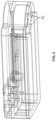
- FIG. 2 is a top view of the lab-on-a-chip cartridge of FIG. 1 .
- FIG. 3 is a further perspective view of the lab-on-a-chip cartridge of FIG. 1 .
- FIGS. 4 A- 4 E are top views of the lab-on-a-chip cartridge of FIG. 1 showing the workflow through the cartridge.
- FIG. 5 is a further perspective view of the lab-on-a-chip cartridge of FIG. 1 showing the bottom face of the cartridge.
- FIGS. 6 A and 6 B are perspective views of the lab-on-a-chip cartridge of FIG. 1 in combination with a separate drive mechanism for rotating the membrane of the separator.
- FIGS. 7 A and 7 B are exploded perspective views of the lab-on-a-chip cartridge of FIG. 1 showing the top surface and the bottom surface, respectively, of the subparts of the cartridge.
- FIGS. 8 A- 8 D are top and bottom views of the top plate of the lab-on-a-chip cartridge of FIG. 1 .
- FIGS. 9 A- 9 D are top and bottom views of the middle plate of the lab-on-a-chip cartridge of FIG. 1 .
- FIGS. 10 A- 10 D are top and bottom views of the bottom plate of the lab-on-a-chip cartridge of FIG. 1 .
- FIG. 11 is a perspective view of the lab-on-a-chip cartridge of FIG. 1 having an interface associated with the top plate that provides for, among other things, viewing of the chip in combination with a microscope objective lens.
- FIG. 12 is an exploded perspective view of the lab-on-a-chip cartridge, interface, and lens of FIG. 11 .
- FIG. 13 is a top view of the top plate of the lab-on-a-chip cartridge in combination with the interface.
- FIG. 14 is a top view of the top plate of the lab-on-a-chip cartridge of FIG. 13 with the interface removed.
- a lab-on-a-chip cartridge 10 is provided that comprises a housing 12 having a series separate chambers on the interior thereof.
- the housing 12 comprises a top plate 14 , a bottom plate 16 , and an intermediate or middle plate 18 positioned between the top and bottom plates.
- the plates 14 , 16 , 18 of the housing 12 may be made by injection molding of a rigid medical grade plastic material.
- the cartridge 10 may have an overall length of approximately 80 mm, a width of 40 mm and a thickness of 18.5 mm.
- the middle plate 18 has a top face 20 from which a plurality of side wall members 22 depend that define the various chambers of the cartridge 10 , specifically, a whole blood chamber 24 , a plasma chamber 26 , a red blood cell (RBC) chamber 28 and a separation chamber 30 .
- the top face 20 of the middle plate 18 is of a sufficient thickness so that a red blood cell concentrate (RCC) flow path 32 may be formed therein, the RCC flow path 32 including a first port 34 on one end in communication with the separation chamber 30 for flowing RCC into the flow path 32 and a second port 36 on the other end for flowing RCC into the RBC chamber 28 .
- the top face 20 of the middle plate also includes a cut-out 38 for receiving the lab on a chip 40 .
- the portion of the side walls 22 separating the whole blood chamber 24 from the separation chamber 30 includes a cut-out 42 to permit whole blood to flow from whole blood chamber 24 into the separation chamber 30 .
- the bottom plate 16 is secured to the side wall members 22 to close the chambers and may include or define a pin 90 for alignment of a rotatable filter membrane 60 (which will be described in greater detail).
- the top plate 14 has a bottom face 44 that, when the cartridge 10 is assembled, contacts the top face 20 of the middle plate 18 .
- the bottom face 44 of the top plate 14 is of a sufficient thickness so that a plasma flow path 46 may be formed that is aligned with the lab-on-a-chip 40 mounted to the top face 20 of the middle plate 18 , so that plasma may flow from the separation chamber 30 through a port 48 in the top face 20 of the middle plate 18 , into the plasma flow path 46 where it contacts the lab-on-a-chip device 40 , and then flow into the plasma chamber 26 through a port 50 in the top face 20 of the middle plate 18 .
- An input or injection port 52 is formed through the bottom face 44 of the top plate 14 and the top face 20 of the middle plate 18 , through which whole blood may be injected into the whole blood chamber 24 . Further, the bottom face 44 of the top plate 14 and the top face 20 of the middle plate 18 also include extraction ports 54 a , 54 b formed therein through which separated plasma (extraction port 54 a ) or red blood cells (extraction port 54 b ) may be withdrawn for additional testing, such as elution assays.
- An adhesive seal 56 preferably overlies each of the injection and extraction ports 52 , 54 a , 54 b which may be lifted to provide access to the ports and then reseal the ports.
- Each of the whole blood, plasma and red blood cell chambers 24 , 26 , 28 also has a pump interface 58 associated therewith through the bottom face 44 of the top plate 14 and the top face 20 of the middle plate 18 .
- the pump interfaces 58 may each be in the form of a recessed well formed in the bottom face 44 of the top plate 14 , with a flexible diaphragm (not shown) overlying each recessed well to seal the interface. Positive and negative pressure is applied to the diaphragms through a separate device (not shown), to direct fluid flow through the various chambers of the cartridge.
- a rotatable filter membrane 60 is disposed within the separation chamber 30 , so that the cartridge 10 includes an integral spinning membrane separator for separating whole blood into plasma and red blood cell fractions.
- the use of spinning member separators is well established in the field of apheresis, where whole blood is withdrawn from a patient or donor or other blood source (which may include precollected blood in a container), separated into its constituents (e.g., plasma, red blood cells, white blood cells, and platelets), and one or more of the constituents reinfused into the patient or donor or other blood source.
- a spinning membrane separator is particularly well suited for extracting plasma from whole blood. Spinning membrane separators for apheresis are described in U.S. Pat. No. 5,194,145 to Schoendorfer and in U.S. Pat. No. 9,381,291 to Boggs et al., both of which are incorporated herein by reference, and which can be referenced for further details.
- a spinning membrane separator in general, includes a generally cylindrical housing with an internal spinning member rotatably mounted therein, a gap being formed between the interior surface of the housing and the exterior surface of the spinner.
- the spinner comprises a central mandrel or rotor having a central orifice, to which a porous membrane is mounted.
- the outer surface of the rotor is typically shaped to define a series of spaced-apart circumferential grooves that are interconnected by longitudinal grooves so that matter passing through the porous membrane is able to flow into the interior of the spinner.
- the porous membrane When used for separating plasma from whole blood, typically has a nominal pore size of 0.6 ⁇ m.
- the housing includes an inlet through which whole blood is introduced into the gap, a first outlet in communication with the gap through which separated red blood cells are flowed, and a second outlet in communication with the interior of the spinner through which separated plasma is flowed.
- the spinner is typically rotated using a magnetic drive assembly, in which an end portion of the spinner is encompassed by as ring of permanent magnetic material 62 (as seen in FIGS. 5 , 6 a and 6 b ), so that a drive mechanism 64 having a magnetic drive member 66 external to the cartridge 10 is indirectly coupled to the rotatable filter membrane 60 .
- a drive mechanism 64 having a magnetic drive member 66 external to the cartridge 10 is indirectly coupled to the rotatable filter membrane 60 .
- magnetic attraction between the drive member 66 and the rotatable filter membrane 60 locks the rotatable membrane 60 to the drive member 66 , so that rotation of the drive member 66 rotates the membrane 60 .
- one of the faces of the cartridge 10 may be provided with an interface 68 , such as a recessed area, for seating and aligning the drive member of the drive mechanism with the magnetic members 62 of the rotatable membrane 60 .
- a small volume of whole blood 100 is withdrawn from a patient and introduced into the whole blood chamber 24 of the cartridge through the injection port 52 by means of, e.g., a syringe ( FIG. 4 A ). Then the whole blood 100 is pushed into the separation chamber 30 of the cartridge by action of a pump associated with pump interface 58 for the whole blood chamber 24 ( FIG. 4 B ).
- the membrane 60 is rotated through magnetic coupling to an external drive device 64 to create Taylor vortices in the gap between the outer surface of the filter membrane and the inner wall of the separation chamber 30 .
- Flow into and out of the separation chamber 30 is controlled by pumps associated with the various pump interfaces 58 so that plasma 200 (with biomarkers) is pushed through the membrane 60 and flowed out of the separation chamber 30 into the plasma flow path 46 , where it contacts the lab-on-a-chip 40 , while the red blood cells 300 (and other cellular material remaining in the gap) is flowed out of the separation chamber 30 into the red blood cell fluid flow path 32 ( FIG. 4 C ).
- Whole blood 100 continues to be introduced into the separation chamber 30 , separated into plasma and red blood cells, and plasma flowed into the plasma flow path 46 and red blood cells flowed into the red blood cell flow path 32 until the flow paths are filled ( FIG. 4 D ), and then spill over into the plasma and red blood cell chambers ( FIG. 4 E ).
- the housing 12 of the cartridge 10 may be provided with one or more interfaces to provide for additional functionality.
- an interface may be provided on the exterior of the housing for thermal regulation (e.g., cooling or thermal cycling) of the lab-on-a-chip device, to permit imaging of the surface of the lab-on-a-chip device, or to permit the application, control and sensing of electrical signals to and from the lab-on-a-chip device as plasma flows over the surface of the device.
- an interface 70 in lens interface system 110 may provide for each of the functionalities described above.
- the interface 70 may be associated with the top surface of the top plate 14 to provide for thermal-electric cooling of the plasma flow path 46 by conduction through the top plate 14 .
- the interface 70 may include a transparent material 72 to permit imaging of the chip by means of, e.g., a microscopic objective lens 74 .
- the interface may additionally or alternatively include conductive pins 76 that extend through the top surface of the top plate 14 to contact electrical pads 78 on the surface of the chip 40 to permit that transmission of electrical signals to and from the chip 40 .
- an LOC device having an integrated blood separator that extracts plasma from a whole blood sample that is placed directly into a point-of-care device in which it can be analyzed.
- the need for a stand-alone centrifuge is eliminated, and larger sample volumes can be collected than current static membrane plasma separation devices allow, thus enabling low concentration biomarkers to be analyzed.
- plasma IVD could be performed at a hospital bedside or at remote locations outside a medical center for real-time health decision making for underserved populations.
Landscapes
- Chemical & Material Sciences (AREA)
- Health & Medical Sciences (AREA)
- Chemical Kinetics & Catalysis (AREA)
- Life Sciences & Earth Sciences (AREA)
- Analytical Chemistry (AREA)
- General Health & Medical Sciences (AREA)
- Clinical Laboratory Science (AREA)
- Hematology (AREA)
- Dispersion Chemistry (AREA)
- Molecular Biology (AREA)
- Water Supply & Treatment (AREA)
- Engineering & Computer Science (AREA)
- Physics & Mathematics (AREA)
- Pathology (AREA)
- Immunology (AREA)
- General Physics & Mathematics (AREA)
- Biochemistry (AREA)
- Investigating Or Analysing Biological Materials (AREA)
- External Artificial Organs (AREA)
Abstract
Description
Claims (20)
Priority Applications (1)
| Application Number | Priority Date | Filing Date | Title |
|---|---|---|---|
| US17/500,251 US12285758B2 (en) | 2020-10-14 | 2021-10-13 | In vitro diagnostic device with integrated plasma separator |
Applications Claiming Priority (2)
| Application Number | Priority Date | Filing Date | Title |
|---|---|---|---|
| US202063091405P | 2020-10-14 | 2020-10-14 | |
| US17/500,251 US12285758B2 (en) | 2020-10-14 | 2021-10-13 | In vitro diagnostic device with integrated plasma separator |
Publications (2)
| Publication Number | Publication Date |
|---|---|
| US20220111383A1 US20220111383A1 (en) | 2022-04-14 |
| US12285758B2 true US12285758B2 (en) | 2025-04-29 |
Family
ID=78134889
Family Applications (1)
| Application Number | Title | Priority Date | Filing Date |
|---|---|---|---|
| US17/500,251 Active 2043-02-15 US12285758B2 (en) | 2020-10-14 | 2021-10-13 | In vitro diagnostic device with integrated plasma separator |
Country Status (2)
| Country | Link |
|---|---|
| US (1) | US12285758B2 (en) |
| EP (1) | EP3984569A1 (en) |
Citations (5)
| Publication number | Priority date | Publication date | Assignee | Title |
|---|---|---|---|---|
| WO2002056992A1 (en) | 2000-11-22 | 2002-07-25 | Baxter International Inc. | Cassette with integral separation device |
| US20070197922A1 (en) * | 2006-02-17 | 2007-08-23 | Honeywell International Inc. | Disposable pressure sensor systems and packages therefor |
| US20130150225A1 (en) * | 2011-12-07 | 2013-06-13 | Fenwal, Inc. | Pressure sensor |
| US20130334139A1 (en) | 2011-03-11 | 2013-12-19 | Fenwal, Inc. | Membrane separation devices, systems and methods employing same, and data management systems and methods |
| US20160074565A1 (en) | 2014-09-12 | 2016-03-17 | Asit Engineering Corp. | Portable hemodialysis machine and disposable cartridge with flow sensor |
Family Cites Families (1)
| Publication number | Priority date | Publication date | Assignee | Title |
|---|---|---|---|---|
| EP0177564B1 (en) | 1984-03-21 | 1990-02-07 | McLaughlin, William Francis | Method and apparatus for filtration |
-
2021
- 2021-10-13 US US17/500,251 patent/US12285758B2/en active Active
- 2021-10-13 EP EP21202311.3A patent/EP3984569A1/en active Pending
Patent Citations (6)
| Publication number | Priority date | Publication date | Assignee | Title |
|---|---|---|---|---|
| WO2002056992A1 (en) | 2000-11-22 | 2002-07-25 | Baxter International Inc. | Cassette with integral separation device |
| US6471855B1 (en) * | 2000-11-22 | 2002-10-29 | Baxter International Inc. | Cassette with integral separation device |
| US20070197922A1 (en) * | 2006-02-17 | 2007-08-23 | Honeywell International Inc. | Disposable pressure sensor systems and packages therefor |
| US20130334139A1 (en) | 2011-03-11 | 2013-12-19 | Fenwal, Inc. | Membrane separation devices, systems and methods employing same, and data management systems and methods |
| US20130150225A1 (en) * | 2011-12-07 | 2013-06-13 | Fenwal, Inc. | Pressure sensor |
| US20160074565A1 (en) | 2014-09-12 | 2016-03-17 | Asit Engineering Corp. | Portable hemodialysis machine and disposable cartridge with flow sensor |
Non-Patent Citations (1)
| Title |
|---|
| European Patent Office, "Extended European Search Report", issued in connection with European patent application No. 21202311.3 on Jan. 5, 2022, 10 pages. |
Also Published As
| Publication number | Publication date |
|---|---|
| US20220111383A1 (en) | 2022-04-14 |
| EP3984569A1 (en) | 2022-04-20 |
Similar Documents
| Publication | Publication Date | Title |
|---|---|---|
| US8663583B2 (en) | Disposable cartridge for fluid analysis | |
| US8741235B2 (en) | Two step sample loading of a fluid analysis cartridge | |
| US8889071B2 (en) | Apparatus and method for separating plasma | |
| CN103185689B (en) | For the disposable cassette of fluid analysis | |
| RU2462717C2 (en) | Apparatus and method for blood separation and analysis | |
| US6878271B2 (en) | Implementation of microfluidic components in a microfluidic system | |
| US20110117577A1 (en) | Microfluidic system for trapping and detection of a biological entity in a sample | |
| CN104111324B (en) | Blood sampling transmission equipment, blood separation and test system and blood sampling Transmission system | |
| CN203989960U (en) | Biological fluid separation box, separation device and biological fluid separation and inspection system | |
| WO2004027391A1 (en) | Blood analyzer and method of separating plasma | |
| KR102089633B1 (en) | Diagnostic cartridge for microfluidic control and Molecular diagnostics system for point-of-care including the same | |
| US10605718B2 (en) | Arrangement for individualized patient blood analysis | |
| US20150375228A1 (en) | Devices for sorting cells in a sample and methods for use thereof | |
| CN215493304U (en) | Whole blood treatment and detection micro-fluidic chip | |
| JP4368383B2 (en) | Solid-liquid separation structure | |
| US20220111383A1 (en) | In Vitro Diagnostic Device with Integrated Plasma Separator | |
| KR101092128B1 (en) | Sampler | |
| CN118067591B (en) | Consumable for blood analysis | |
| JP2023026421A (en) | biological fluid separator | |
| CN210356708U (en) | Blood filtering device | |
| CN112517095A (en) | Whole blood filtration and plasma quantitative micro-fluidic chip | |
| WO2019207724A1 (en) | Blood component separation device, blood component separation method, and blood component analysis method | |
| CN221674326U (en) | Microfluidic chip | |
| Hsiao et al. | Portable self-flowing platform for filtration separation of samples | |
| CN217502786U (en) | Liquid releasing mechanism, micro-fluidic chip and in-vitro detection device |
Legal Events
| Date | Code | Title | Description |
|---|---|---|---|
| FEPP | Fee payment procedure |
Free format text: ENTITY STATUS SET TO UNDISCOUNTED (ORIGINAL EVENT CODE: BIG.); ENTITY STATUS OF PATENT OWNER: LARGE ENTITY |
|
| STPP | Information on status: patent application and granting procedure in general |
Free format text: DOCKETED NEW CASE - READY FOR EXAMINATION |
|
| STPP | Information on status: patent application and granting procedure in general |
Free format text: NON FINAL ACTION MAILED |
|
| STPP | Information on status: patent application and granting procedure in general |
Free format text: RESPONSE TO NON-FINAL OFFICE ACTION ENTERED AND FORWARDED TO EXAMINER |
|
| STPP | Information on status: patent application and granting procedure in general |
Free format text: FINAL REJECTION MAILED |
|
| STPP | Information on status: patent application and granting procedure in general |
Free format text: RESPONSE AFTER FINAL ACTION FORWARDED TO EXAMINER |
|
| STPP | Information on status: patent application and granting procedure in general |
Free format text: ADVISORY ACTION MAILED |
|
| STPP | Information on status: patent application and granting procedure in general |
Free format text: DOCKETED NEW CASE - READY FOR EXAMINATION |
|
| STPP | Information on status: patent application and granting procedure in general |
Free format text: NOTICE OF ALLOWANCE MAILED -- APPLICATION RECEIVED IN OFFICE OF PUBLICATIONS |
|
| AS | Assignment |
Owner name: FENWAL, INC., ILLINOIS Free format text: ASSIGNMENT OF ASSIGNORS INTEREST;ASSIGNOR:MADSEN, JAMES;REEL/FRAME:070648/0361 Effective date: 20191018 |
|
| STCF | Information on status: patent grant |
Free format text: PATENTED CASE |