US12282985B2 - User selectable dimension ungrouping for enterprise cloud analytic charts - Google Patents
User selectable dimension ungrouping for enterprise cloud analytic charts Download PDFInfo
- Publication number
- US12282985B2 US12282985B2 US18/062,256 US202218062256A US12282985B2 US 12282985 B2 US12282985 B2 US 12282985B2 US 202218062256 A US202218062256 A US 202218062256A US 12282985 B2 US12282985 B2 US 12282985B2
- Authority
- US
- United States
- Prior art keywords
- dimension
- analytic
- data structure
- chart
- enterprise information
- Prior art date
- Legal status (The legal status is an assumption and is not a legal conclusion. Google has not performed a legal analysis and makes no representation as to the accuracy of the status listed.)
- Active, expires
Links
Images


Classifications
-
- G06T11/206—
-
- G—PHYSICS
- G06—COMPUTING OR CALCULATING; COUNTING
- G06T—IMAGE DATA PROCESSING OR GENERATION, IN GENERAL
- G06T11/00—Two-dimensional [2D] image generation
- G06T11/20—Drawing from basic elements
- G06T11/26—Drawing of charts or graphs
-
- G—PHYSICS
- G06—COMPUTING OR CALCULATING; COUNTING
- G06F—ELECTRIC DIGITAL DATA PROCESSING
- G06F16/00—Information retrieval; Database structures therefor; File system structures therefor
- G06F16/20—Information retrieval; Database structures therefor; File system structures therefor of structured data, e.g. relational data
- G06F16/26—Visual data mining; Browsing structured data
-
- G—PHYSICS
- G06—COMPUTING OR CALCULATING; COUNTING
- G06F—ELECTRIC DIGITAL DATA PROCESSING
- G06F3/00—Input arrangements for transferring data to be processed into a form capable of being handled by the computer; Output arrangements for transferring data from processing unit to output unit, e.g. interface arrangements
- G06F3/01—Input arrangements or combined input and output arrangements for interaction between user and computer
- G06F3/048—Interaction techniques based on graphical user interfaces [GUI]
- G06F3/0481—Interaction techniques based on graphical user interfaces [GUI] based on specific properties of the displayed interaction object or a metaphor-based environment, e.g. interaction with desktop elements like windows or icons, or assisted by a cursor's changing behaviour or appearance
- G06F3/0482—Interaction with lists of selectable items, e.g. menus
-
- G06T11/001—
-
- G—PHYSICS
- G06—COMPUTING OR CALCULATING; COUNTING
- G06T—IMAGE DATA PROCESSING OR GENERATION, IN GENERAL
- G06T11/00—Two-dimensional [2D] image generation
- G06T11/10—Texturing; Colouring; Generation of textures or colours
-
- H—ELECTRICITY
- H04—ELECTRIC COMMUNICATION TECHNIQUE
- H04L—TRANSMISSION OF DIGITAL INFORMATION, e.g. TELEGRAPHIC COMMUNICATION
- H04L67/00—Network arrangements or protocols for supporting network services or applications
- H04L67/50—Network services
- H04L67/60—Scheduling or organising the servicing of application requests, e.g. requests for application data transmissions using the analysis and optimisation of the required network resources
-
- G—PHYSICS
- G06—COMPUTING OR CALCULATING; COUNTING
- G06T—IMAGE DATA PROCESSING OR GENERATION, IN GENERAL
- G06T2200/00—Indexing scheme for image data processing or generation, in general
- G06T2200/24—Indexing scheme for image data processing or generation, in general involving graphical user interfaces [GUIs]
Definitions
- a user may perform analytics in connection with enterprise information.
- the information might be stored in a cloud-based environment such as the SAP® Analytics Cloud that combines analytics and planning along with integration to other applications and access to heterogeneous data sources.
- the user may compare income amounts, profit, spending, etc. for various geographic regions or organizations within the enterprise. Such analysis may let the user make resource allocation decisions, predict future performance, etc.
- One way the user may receive the enterprise information is via one or more analytic charts (e.g., comparison charts, trend charts, distribution charts, correlation charts, indicator charts, etc.).
- a bar chart might show various costs associated with a product over a user-defined time period (e.g., during the last four fiscal quarters).
- An analytic chart data store may contain an enterprise information data structure, based on a result set received from a back-end application computer server, and a user selectable dimension ungrouping indication.
- the enterprise information data structure may include: an outermost dimension arranged on a row axis; an innermost dimension arranged on the row axis; and measure values arranged on the row axis.
- a computer processor of an analytic chart creation platform may determine that the user selectable dimension ungrouping indication is set to “ungroup.” Responsive to said determination, the analytic chart creation platform may automatically re-organize the enterprise information structure such that the innermost dimension information is arranged on the column axis instead of the row axis. The analytic chart creation platform may then automatically create an analytic chart and transmit the chart to a remote user device.
- Some embodiments comprise: means for accessing, by a computer processor of an analytic chart creation platform, an analytic chart data store that contains an enterprise information data structure based on a result set received from a back-end application computer server and a user selectable dimension ungrouping indication, wherein the enterprise information data structure includes: an outermost dimension arranged on a row axis, an innermost dimension arranged on the row axis, and measure values arranged on the row axis; means for determining that the user selectable dimension ungrouping indication is set to “ungroup;” responsive to said determination, means for automatically re-organizing the enterprise information structure such that the innermost dimension information is arranged on the column axis instead of the row axis; means for automatically creating an analytic chart based on the re-organized enterprise information data structure; and means for transmitting the created analytic chart to a remote user device via a distributed communication network.
- Some technical advantages of some embodiments disclosed herein are improved systems and methods to provide flexible analytic charts in an automatic and appropriate manner.
- FIG. 1 is high-level diagram of an enterprise cloud analytics system in accordance with some embodiments.
- FIG. 2 is an enterprise information data structure according to some embodiments.
- FIG. 3 is an analytic chart in accordance with some embodiments.
- FIGS. 4 and 5 illustrate an analytics sort according to some embodiments.
- FIGS. 6 and 7 illustrate analytics ranking in accordance with some embodiments.
- FIG. 8 is a method according to some embodiments.
- FIG. 9 illustrates a user interface according to some embodiments.
- FIG. 10 illustrates an enterprise information data structure re-organization in accordance with some embodiments.
- FIG. 11 is a re-organized enterprise information data structure according to some embodiments.
- FIG. 12 is an analytic chart in accordance with some embodiments.
- FIG. 13 is a user interface method according to some embodiments.
- FIG. 14 is an opt-in method in accordance with some embodiments.
- FIG. 17 is an apparatus or platform according to some embodiments.
- FIG. 18 illustrates an analytic chart database in accordance with some embodiments.
- FIG. 19 is a cloud-based enterprise analytics display according to some embodiments.
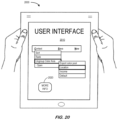
- FIG. 20 is a handheld tablet computer in accordance with some embodiments.
- FIG. 1 is an enterprise cloud analytics system 100 in accordance with some embodiments.
- An analytic chart creation platform 150 may exchange information with a back-end application computer server 160 that can access an enterprise information data store 110 .
- the back-end application computer server 160 and/or enterprise information data store 110 might be associated with, for example, an SAP® HANA Database-as-a-Service (“DBaaS”) and/or Business Intelligence (“BI”) cloud-based platform.
- a user 101 may provide information to an analytics creation platform 150 at (A) (e.g., via a user interface 155 ).
- the analytic chart creation platform 150 may access information in an analytic chart data store 120 , such as an enterprise information data structure 122 .
- the analytic chart creation platform 150 constructs an appropriate query that is provided to the back-end application computer server 160 at (B).
- the back-end application computer server 160 executes the query to retrieve the appropriate information from the enterprise information store 110 at (C) and transmits a result set to the analytic chart creation platform 150 at (D).
- the result set and other information in the analytic chart data store 120 may then be used to automatically provide an appropriate analytic chart to the user at (E).
- the term “automatic” may refer to an operation that is performed with little or no human intervention.
- Devices may exchange information via any communication network which may be one or more of a Local Area Network (“LAN”), a Metropolitan Area Network (“MAN”), a Wide Area Network (“WAN”), a proprietary network, a Public Switched Telephone Network (“PSTN”), a Wireless Application Protocol (“WAP”) network, a Bluetooth network, a wireless LAN network, and/or an Internet Protocol (“IP”) network such as the Internet, an intranet, or an extranet.
- LAN Local Area Network
- MAN Metropolitan Area Network
- WAN Wide Area Network
- PSTN Public Switched Telephone Network
- WAP Wireless Application Protocol
- Bluetooth a Bluetooth network
- wireless LAN network a wireless LAN network
- IP Internet Protocol
- any devices described herein may communicate via one or more such communication networks.
- the system 100 may store information into and/or retrieve information from various data stores (e.g., the analytic chart data store 120 ), which may be locally stored or reside remote from the analytic chart creation platform 150 .
- various data stores e.g., the analytic chart data store 120
- FIG. 1 a single analytic chart creation platform 150 is shown in FIG. 1 , any number of such devices may be included.
- various devices described herein might be combined according to embodiments of the present invention.
- the analytic chart creation platform 150 and analytic chart data store 120 might comprise a single apparatus.
- the system 100 functions may be performed by a constellation of networked apparatuses, such as in a distributed processing or cloud-based architecture.
- a user may access the system 100 via a remote device (e.g., a Personal Computer (“PC”), tablet, or smartphone) to view information about and/or manage operational information in accordance with any of the embodiments described herein.
- a remote device e.g., a Personal Computer (“PC”), tablet, or smartphone
- an interactive display of the graphical user interface 155 may let an operator or administrator define and/or adjust certain parameters (e.g., to implement various mapping and preferences) and/or provide or receive automatically generated recommendations, alerts, or results from the system 100 .
- FIG. 2 is an enterprise information data structure 200 according to some embodiments.
- the enterprise information data structure 200 might be associated with, for example, a result set generated by a back-end application computer server in response to a query.
- the result set of a data source can be represented a two-dimensional table with a column axis and a row axis. Each axis has a list of dimensions, and one dimension can contain measures. Each dimension has dimension members (or simply “members”), and the dimension members on an axis form an axis tuple at each axis position (the intersection of each row and column may contain a data value).
- members or simply “members”
- the chart includes an outermost “NAME” dimension arranged on a row axis and an innermost “LOCATION” or color dimension arranged on the row axis (“Ottawa,” “Vancouver,” etc.). Measure values (e.g., income amounts) are also arranged on the row axis.
- FIG. 3 is an analytic chart 300 that might be created using the information in the data structure 200 of FIG. 2 in accordance with some embodiments.
- the income values are presented graphically as bars for each location of each of the category names.
- a legend 310 shows the user how each bar maps to a location (e.g., a particular type of cross-hatching is associated with “Vancouver”). Note that the order of the locations in the legend 310 is based on their appearance in the underlying data structure 200 (that is, “Ottawa” appears first in the data structure 200 and is therefore first in the legend 310 ). Note, however, that a user might prefer that a different order be used in the legend 310 . For example, the user might instead want the locations to appear in alphabetical order.
- FIGS. 4 and 5 illustrate an analytics sort according to some embodiments.
- FIG. 4 shows the enterprise information data structure 200 of FIG. 2 after a descending measure sort operation has been performed (e.g., based on the income values).
- FIG. 5 is an analytic chart 500 that might be created using the information in the data structure 400 of FIG. 4 in accordance with some embodiments.
- a legend 510 shows how each bar maps to a location.
- the order of the locations in the legend 510 is based on their appearance in the underlying data structure 400 (that is, “Vancouver” appears first in the data structure 400 and is therefore first in the legend 510 ). That is, the locations in the legend 510 are still not in alphabetical order.
- FIGS. 6 and 7 illustrate analytics ranking in accordance with some embodiments.
- FIG. 6 shows the enterprise information data structure 400 of FIG. 4 after a ranking operation has been performed (e.g., requesting that only the “top 1” income be shown). Note that this query might result in the back-end application computer server including new names in the data structure 600 (e.g., “Name B” and “Name G”).
- FIG. 7 is an analytic chart 700 that might be created using the information in the data structure 600 of FIG. 6 in accordance with some embodiments.
- a legend 710 shows how each bar maps to a location.
- the order of the locations in the legend 710 is based on their appearance in the underlying data structure 600 (that is, “Ottawa” appears first in the data structure 600 and is therefore first in the legend 710 ).
- the locations in the legend 710 are still not in alphabetical order.
- FIG. 8 is a method that might performed by some or all of the elements of any embodiment described herein.
- the flow charts described herein do not imply a fixed order to the steps, and embodiments of the present invention may be practiced in any order that is practicable.
- any of the methods described herein may be performed by hardware, software, an automated script of commands, or any combination of these approaches.
- a computer-readable storage medium may store thereon instructions that when executed by a machine result in performance according to any of the embodiments described herein.
- a computer processor of an analytic chart creation platform may access an analytic chart data store.
- the analytic chart data store contains an enterprise information data structure based on a result set received from a back-end application computer server.
- the analytic chart data store may also include a user selectable dimension ungrouping indication (described in connection with FIGS. 9 through 12 ).
- the enterprise information data structure includes:
- the system may determine that the user selectable dimension ungrouping indication is set to “ungroup.” Responsive to this determination, at S 830 the system may automatically re-organize the enterprise information structure such that the innermost dimension information is arranged on the column axis instead of the row axis (e.g., by adjusting a query to the back-end application computer server). According to some embodiments, the analytic chart creation platform performs sort and/or rank operations on the re-organized enterprise information data structure.
- An analytic chart may then be automatically created based on the re-organized enterprise information data structure at S 840 .
- the computer server may transmit the created analytic chart to a remote user device via a distributed communication network.
- the analytic chart creation platform may subsequently determine that that the user selectable dimension ungrouping indication has changed to “group” and again re-organize the enterprise information data structure such that the innermost dimension information is arranged on the row axis instead of the column axis.
- FIG. 9 illustrates a user interface 900 according to some embodiments.
- the user interface 900 includes a drop-down menu 920 (e.g., as part of a context menu 910 ) where a user can set a user selectable dimension ungrouping indication to “ungroup” (that is, “Ungroup Color Axis” for “Location” as illustrated in FIG. 9 ) via a touchscreen or computer mouse pointer 930 .
- FIG. 10 illustrates an enterprise information data structure re-organization 1000 in accordance with some embodiments. The original chart was described in connection with FIGS. 2 and 3 (and the legend 310 was not in alphabetical order).
- FIG. 11 is a re-organized enterprise information data structure 1100 according to some embodiments.
- the data structure 1100 now includes the location values (“Seattle,” “Vancouver,” etc.) arranged on the column axis.
- the data structure 1100 executed dimension sorting for row axis and column axis so that dimension members on both axes are displayed in alphabetical order. Note that other types of sorts might be implemented instead (e.g., a complex measure sort based on aggregated income totals on row only or column only).
- FIG. 12 is an analytic chart 1200 with a legend 1210 representing the data structure of FIG. 11 in accordance with some embodiments. Note that various aspects of the data structure 1100 and chart 1200 can now be sorted as desired by the user (e.g., so that the legend 1210 appears in ascending alphabetical order).
- embodiments may enable a transformation of a query structure through new user interface option in a chart context menu that can select “Ungroup Color Axis.” This will move the color dimensions to the column axis, and selecting “Group Color Axis” will move the color dimensions back to the row axis. According to some embodiments, this option is enabled only when:
- FIG. 14 is an opt-in method in accordance with some embodiments.
- a user accesses an analytic chart. If the chart being accessed is an existing chart (e.g., a legacy chart) at S 1420 , the system may maintain current behavior (e.g., by not automatically enabling the “Ungroup” feature) at S 1430 .
- the chart being accessed is a new chart at S 1420 . If the chart being accessed is a new chart at S 1420 , it is determined if the user has decided to suppress automatic opt-in for the “Ungroup” feature at S 1440 . If so, the system may maintain current behavior (e.g., by not automatically enabling the “Ungroup” feature) at S 1430 . If the user has not decided to suppress automatic opt-in for the “Ungroup” feature at S 1440 , the system automatically selects the “Ungroup” color axis option of the new analytic chart at S 1450 .
- some embodiments may update rank and sort when updating to the new query structure. For example, measure sorting may switch from a “Datacell” to a “Complex” measure sort when there are dimensions on column. The meaning of the sort changes as the final data would be sorted based on aggregated measure values across each axis. In other embodiments, the sort type remains as a “Measure” sort which handles the new query structure in the same way. Moreover, a rank across all dimensions may create two conditions (one for all dimensions on the row axis, and one for all dimensions on the column axis) to help ensure that rank across all will produce the correct overall top N.
- embodiments may keep the dimension on rows axis even if the user opts-in the new query structure (because a dimension can only be on one of the axes—either the row or column axis—and dimension/trellis feeds may have a higher priority as compared to a color feed.
- embodiments may also update the query structure and update any rank or sort.
- This approach may provide the flexibility to rank the Top N on a color dimension (independent from any outer grouping dimensions).
- selecting the “Ungroup Color Axis” feature results in now only 2 locations being shown in the chart 1600 and the legend 1610 . That is because when “Ungroup color axis” is selected, the system can now look at the overall values associated with the color dimension and display only the top 2 members.
- FIG. 17 is a block diagram of an apparatus or platform 1700 that may be, for example, associated with the system 100 of FIG. 1 (and/or any other system described herein).
- the platform 1700 comprises a processor 1710 , such as one or more commercially available CPUs in the form of one-chip microprocessors, coupled to a communication device 1720 configured to communicate via a communication network (not shown in FIG. 17 ).
- the communication device 1720 may be used to communicate, for example, with one or more remote user platforms, cloud resource providers, etc.
- the platform 1700 further includes an input device 1740 (e.g., a computer mouse and/or keyboard to input chart options) and/an output device 1750 (e.g., a computer monitor to render a chart, transmit recommendations, and/or create reports).
- an input device 1740 e.g., a computer mouse and/or keyboard to input chart options
- an output device 1750 e.g., a computer monitor to render a chart, transmit recommendations, and/or create reports.
- a mobile device and/or PC may be used to exchange information with the platform 1700 .
- the processor 1710 also communicates with a storage device 1730 .
- the storage device 1730 can be implemented as a single database or the different components of the storage device 1730 can be distributed using multiple databases (that is, different deployment information storage options are possible).
- the storage device 1730 may comprise any appropriate information storage device, including combinations of magnetic storage devices (e.g., a hard disk drive), optical storage devices, mobile telephones, and/or semiconductor memory devices.
- the storage device 1730 stores a program 1712 and/or an analytic chart creation engine 1714 for controlling the processor 1710 .
- the processor 1710 performs instructions of the programs 1712 , 1714 , and thereby operates in accordance with any of the embodiments described herein.
- the processor 1710 may determine that the user selectable dimension ungrouping indication is set to “ungroup.” Responsive to said determination, the processor 1710 may automatically re-organize an enterprise information structure such that innermost dimension information is arranged on a column axis instead of a row axis. The processor 1710 may then automatically create an analytic chart and transmit the chart to a remote user device.
- the programs 1712 , 1714 may be stored in a compressed, uncompiled and/or encrypted format.
- the programs 1712 , 1714 may furthermore include other program elements, such as an operating system, clipboard application, a database management system, and/or device drivers used by the processor 1710 to interface with peripheral devices.
- information may be “received” by or “transmitted” to, for example: (i) the platform 1700 from another device; or (ii) a software application or module within the platform 1700 from another software application, module, or any other source.
- the storage device 1730 further stores a user interface preference database 1760 and an analytic chart database 1800 .
- a database that may be used in connection with the platform 1700 will now be described in detail with respect to FIG. 18 . Note that the database described herein is only one example, and additional and/or different information may be stored therein. Moreover, various databases might be split or combined in accordance with any of the embodiments described herein.
- a table that represents the analytic chart database 1800 that may be stored at the platform 1700 according to some embodiments.
- the table may include, for example, entries associated with analytic charts created by/for a user.
- the table may also define fields 1802 , 1804 , 1806 , 1808 , for each of the entries.
- the fields 1802 , 1804 , 1806 , 1808 may, according to some embodiments, specify: a chart identifier 1802 , a data structure 1804 , a dimension ungrouping indication 1806 , and a chart type 1808 .
- the analytic chart database 1800 may be created and updated, for example, when a new chart is created, an existing chart is updated, etc.
- the chart identifier 1802 may be a unique alphanumeric identifier that is associated with a particular analytics chart created by/for a user.
- the data structure 1804 may comprise a result set that was returned by a back-end application computer server in response to a query.
- the dimension ungrouping indication 1806 indicates if the user has turned the “ungroup” feature on (or off). When the “ungroup” feature is turned on, the data structures 1804 will be re-organized such that an innermost (color) dimension is arranged on a column axis instead of a row axis.
- the chart type 1808 may indicate the type of analytic chart that is rendered (e.g., a comparison chart, a trend chart, a distribution chart, a correlation chart, an indicator chart, etc.).
- embodiments may provide flexible analytic charts in an automatic and appropriate manner. Moreover, embodiments may provide flexibility to rank the Top N elements on a color dimension.
- FIG. 19 is a human machine interface display 1900 according to some embodiments.
- the display 1900 includes a graphical representation 1910 of elements of an analytic chart creation system.
- Selection of an element may result in display of a popup window containing various options (e.g., to adjust chart preferences, add or remove dimensions, etc.).
- the display 1900 may also include a user-selectable “Setup” icon 1900 (e.g., to configure parameters to alter or adjust processes as described with respect any of the embodiments described herein).
- FIG. 20 shows a handheld tablet computer 2000 rendering a user interface display 2010 that may be used to select (or deselect) an “ungroup” option for a data structure and/or to request additional parameters such as measures (e.g., via a “More Info” icon 2020 ).
Landscapes
- Engineering & Computer Science (AREA)
- Theoretical Computer Science (AREA)
- Physics & Mathematics (AREA)
- General Physics & Mathematics (AREA)
- General Engineering & Computer Science (AREA)
- Databases & Information Systems (AREA)
- Data Mining & Analysis (AREA)
- Computer Networks & Wireless Communication (AREA)
- Signal Processing (AREA)
- Human Computer Interaction (AREA)
- Management, Administration, Business Operations System, And Electronic Commerce (AREA)
Abstract
Description
-
- An outermost dimension arranged on a row axis.
- An innermost dimension arranged on the row axis (e.g., an enterprise color feed). Note that embodiments could have multiple dimensions on a category feed as well as a color feed. When color dimensions are on the row axis, they as a group will still be innermost, and using the “ungroup” option may move all color dimensions to the column axis.
- Measure values arranged on the row axis.
-
- the chart type supports rank or sort, and
- there is at least one dimension in color feed that is not duplicated in other dimension type feeds.
FIG. 13 is a user interface method according to some embodiments. At S1310, the user accesses a context menu. If the chart type being accessed does not support sort or rank operations at S1320, the “Ungroup Color Axis” option is not offered at S1330. If the chart type being accessed does support sort or rank operations at S1320, it is determined if a dimension in the color feed is not duplicated in other dimension type feeds at S1340. If not, the “Ungroup Color Axis” option is not offered at S1330. If a dimension in the color feed is not duplicated in other dimension type feeds at S1340, the “Ungroup Color Axis” option is offered to the user at S1350.
Claims (16)
Priority Applications (1)
| Application Number | Priority Date | Filing Date | Title |
|---|---|---|---|
| US18/062,256 US12282985B2 (en) | 2022-12-06 | 2022-12-06 | User selectable dimension ungrouping for enterprise cloud analytic charts |
Applications Claiming Priority (1)
| Application Number | Priority Date | Filing Date | Title |
|---|---|---|---|
| US18/062,256 US12282985B2 (en) | 2022-12-06 | 2022-12-06 | User selectable dimension ungrouping for enterprise cloud analytic charts |
Publications (2)
| Publication Number | Publication Date |
|---|---|
| US20240185489A1 US20240185489A1 (en) | 2024-06-06 |
| US12282985B2 true US12282985B2 (en) | 2025-04-22 |
Family
ID=91279912
Family Applications (1)
| Application Number | Title | Priority Date | Filing Date |
|---|---|---|---|
| US18/062,256 Active 2043-05-11 US12282985B2 (en) | 2022-12-06 | 2022-12-06 | User selectable dimension ungrouping for enterprise cloud analytic charts |
Country Status (1)
| Country | Link |
|---|---|
| US (1) | US12282985B2 (en) |
Citations (5)
| Publication number | Priority date | Publication date | Assignee | Title |
|---|---|---|---|---|
| US20060112123A1 (en) * | 2004-11-24 | 2006-05-25 | Macnica, Inc. | Spreadsheet user-interfaced business data visualization and publishing system |
| US20110310112A1 (en) * | 2010-03-31 | 2011-12-22 | Alexandre Zolotovitski | Method for statistical visualization of client service events |
| US10956989B2 (en) * | 2019-06-11 | 2021-03-23 | Ford Squared Technologies LLC. | Accounting platform functionalities |
| US20210342399A1 (en) * | 2014-07-25 | 2021-11-04 | Searchable AI Corp | Neural network-based semantic information retrieval |
| US11301811B2 (en) * | 2020-05-01 | 2022-04-12 | Monday.com Ltd. | Digital processing systems and methods for self-monitoring software recommending more efficient tool usage in collaborative work systems |
-
2022
- 2022-12-06 US US18/062,256 patent/US12282985B2/en active Active
Patent Citations (5)
| Publication number | Priority date | Publication date | Assignee | Title |
|---|---|---|---|---|
| US20060112123A1 (en) * | 2004-11-24 | 2006-05-25 | Macnica, Inc. | Spreadsheet user-interfaced business data visualization and publishing system |
| US20110310112A1 (en) * | 2010-03-31 | 2011-12-22 | Alexandre Zolotovitski | Method for statistical visualization of client service events |
| US20210342399A1 (en) * | 2014-07-25 | 2021-11-04 | Searchable AI Corp | Neural network-based semantic information retrieval |
| US10956989B2 (en) * | 2019-06-11 | 2021-03-23 | Ford Squared Technologies LLC. | Accounting platform functionalities |
| US11301811B2 (en) * | 2020-05-01 | 2022-04-12 | Monday.com Ltd. | Digital processing systems and methods for self-monitoring software recommending more efficient tool usage in collaborative work systems |
Non-Patent Citations (3)
| Title |
|---|
| Excel Board, How to Create Multi-Category Chart in Excel, Jun. 14, 2017, https://www.youtube.com/watch?v=cozNbt5HhZ4. * |
| Hora JM, Kronz A, Möller-McNett S, Wörner G. An Excel-based tool for evaluating and visualizing geothermobarometry data. Computers & geosciences. Jul. 1, 2013;56:178-85. * |
| Mahajan KN, Gokhale LA. Advanced charting techniques of Microsoft excel 2016 aiming visualization. International Journal of Computer Sciences and Engineering (IJCSE). 2019;7(1). * |
Also Published As
| Publication number | Publication date |
|---|---|
| US20240185489A1 (en) | 2024-06-06 |
Similar Documents
| Publication | Publication Date | Title |
|---|---|---|
| US20250148019A1 (en) | Systems and methods for creating and managing a data integration workspace | |
| US10304021B2 (en) | Metadata-configurable systems and methods for network services | |
| US10713251B2 (en) | Pushing data to a plurality of devices in an on-demand service environment | |
| US6298349B1 (en) | System resource display apparatus and method thereof | |
| US11030210B2 (en) | Hierarchical rules for displaying user interface pages | |
| US12493837B2 (en) | System with capacity and resource allocation display to facilitate update of electronic record information | |
| WO2015077216A1 (en) | Efficient data mapping requirements establishment and reference | |
| US20180018066A1 (en) | Data visualization configuration system and method | |
| US20110313729A1 (en) | System for providing performance testing information to users | |
| US20200272665A1 (en) | Template-based faceted search experience | |
| CN106204285A (en) | Insurance rules process method based on cloud computing and system | |
| US20230048310A1 (en) | System and method for identifying members of a dynamic target segment | |
| US9465607B2 (en) | Configuration-based processing of requests by conditional execution of software code to render regions in a display | |
| US20240185489A1 (en) | User selectable dimension ungrouping for enterprise cloud analytic charts | |
| US10474996B2 (en) | Workflow management system platform | |
| US20240111939A1 (en) | Multi-parameter, rule-based user experience variants in cloud application | |
| US8943397B2 (en) | Configurable column display of information at a web client | |
| US20240054145A1 (en) | Object Lineage Analysis For Package Transport | |
| KR101351079B1 (en) | Method and system for providing service for controlling program linked to database | |
| US20230195792A1 (en) | Database management methods and associated apparatus | |
| US10452255B2 (en) | Logical set operations | |
| KR20220144646A (en) | Electronic approval system and method of electronic approval using the same | |
| US20250321999A1 (en) | Feedback techniques for processing natural language queries | |
| US20240394618A1 (en) | Computing systems and methods for defining work item assignment workflows and intelligently assigning work items | |
| US20220147568A1 (en) | Mapping expression generator |
Legal Events
| Date | Code | Title | Description |
|---|---|---|---|
| AS | Assignment |
Owner name: SAP SE, GERMANY Free format text: ASSIGNMENT OF ASSIGNORS INTEREST;ASSIGNORS:WILKIE, ROBERT;LAW, GLORIA;HUANG, YUE QIAN;SIGNING DATES FROM 20221201 TO 20221202;REEL/FRAME:061995/0872 |
|
| FEPP | Fee payment procedure |
Free format text: ENTITY STATUS SET TO UNDISCOUNTED (ORIGINAL EVENT CODE: BIG.); ENTITY STATUS OF PATENT OWNER: LARGE ENTITY |
|
| STPP | Information on status: patent application and granting procedure in general |
Free format text: DOCKETED NEW CASE - READY FOR EXAMINATION |
|
| STPP | Information on status: patent application and granting procedure in general |
Free format text: NON FINAL ACTION MAILED |
|
| STPP | Information on status: patent application and granting procedure in general |
Free format text: RESPONSE TO NON-FINAL OFFICE ACTION ENTERED AND FORWARDED TO EXAMINER |
|
| STPP | Information on status: patent application and granting procedure in general |
Free format text: NOTICE OF ALLOWANCE MAILED -- APPLICATION RECEIVED IN OFFICE OF PUBLICATIONS |
|
| ZAAB | Notice of allowance mailed |
Free format text: ORIGINAL CODE: MN/=. |
|
| STPP | Information on status: patent application and granting procedure in general |
Free format text: AWAITING TC RESP., ISSUE FEE NOT PAID |
|
| STPP | Information on status: patent application and granting procedure in general |
Free format text: NOTICE OF ALLOWANCE MAILED -- APPLICATION RECEIVED IN OFFICE OF PUBLICATIONS |
|
| STCF | Information on status: patent grant |
Free format text: PATENTED CASE |