US12277421B2 - Message-based processing with assignment of neural network layers to processor clusters - Google Patents
Message-based processing with assignment of neural network layers to processor clusters Download PDFInfo
- Publication number
- US12277421B2 US12277421B2 US18/017,538 US202118017538A US12277421B2 US 12277421 B2 US12277421 B2 US 12277421B2 US 202118017538 A US202118017538 A US 202118017538A US 12277421 B2 US12277421 B2 US 12277421B2
- Authority
- US
- United States
- Prior art keywords
- message
- processor
- processor cluster
- destination
- neural network
- Prior art date
- Legal status (The legal status is an assumption and is not a legal conclusion. Google has not performed a legal analysis and makes no representation as to the accuracy of the status listed.)
- Active
Links
Images




Classifications
-
- G—PHYSICS
- G06—COMPUTING OR CALCULATING; COUNTING
- G06F—ELECTRIC DIGITAL DATA PROCESSING
- G06F15/00—Digital computers in general; Data processing equipment in general
- G06F15/16—Combinations of two or more digital computers each having at least an arithmetic unit, a program unit and a register, e.g. for a simultaneous processing of several programs
- G06F15/163—Interprocessor communication
-
- G—PHYSICS
- G06—COMPUTING OR CALCULATING; COUNTING
- G06F—ELECTRIC DIGITAL DATA PROCESSING
- G06F9/00—Arrangements for program control, e.g. control units
- G06F9/06—Arrangements for program control, e.g. control units using stored programs, i.e. using an internal store of processing equipment to receive or retain programs
- G06F9/30—Arrangements for executing machine instructions, e.g. instruction decode
- G06F9/34—Addressing or accessing the instruction operand or the result ; Formation of operand address; Addressing modes
- G06F9/355—Indexed addressing
- G06F9/3555—Indexed addressing using scaling, e.g. multiplication of index
-
- G—PHYSICS
- G06—COMPUTING OR CALCULATING; COUNTING
- G06F—ELECTRIC DIGITAL DATA PROCESSING
- G06F9/00—Arrangements for program control, e.g. control units
- G06F9/06—Arrangements for program control, e.g. control units using stored programs, i.e. using an internal store of processing equipment to receive or retain programs
- G06F9/30—Arrangements for executing machine instructions, e.g. instruction decode
- G06F9/38—Concurrent instruction execution, e.g. pipeline or look ahead
- G06F9/3877—Concurrent instruction execution, e.g. pipeline or look ahead using a secondary processor, e.g. coprocessor
-
- G—PHYSICS
- G06—COMPUTING OR CALCULATING; COUNTING
- G06N—COMPUTING ARRANGEMENTS BASED ON SPECIFIC COMPUTATIONAL MODELS
- G06N3/00—Computing arrangements based on biological models
- G06N3/02—Neural networks
- G06N3/04—Architecture, e.g. interconnection topology
- G06N3/045—Combinations of networks
-
- G—PHYSICS
- G06—COMPUTING OR CALCULATING; COUNTING
- G06N—COMPUTING ARRANGEMENTS BASED ON SPECIFIC COMPUTATIONAL MODELS
- G06N3/00—Computing arrangements based on biological models
- G06N3/02—Neural networks
- G06N3/04—Architecture, e.g. interconnection topology
- G06N3/0464—Convolutional networks [CNN, ConvNet]
-
- G—PHYSICS
- G06—COMPUTING OR CALCULATING; COUNTING
- G06N—COMPUTING ARRANGEMENTS BASED ON SPECIFIC COMPUTATIONAL MODELS
- G06N3/00—Computing arrangements based on biological models
- G06N3/02—Neural networks
- G06N3/06—Physical realisation, i.e. hardware implementation of neural networks, neurons or parts of neurons
- G06N3/063—Physical realisation, i.e. hardware implementation of neural networks, neurons or parts of neurons using electronic means
Definitions
- the present application pertains to a message based multi-processor system configurable as a deep neural network.
- a processor cluster element configured as a neural network core element may receive input messages and transmit output messages.
- the neural network layers typically comprise a plurality of processor clusters
- the transmission of an output message requires a preparatory stage wherein it is determined which of the processor clusters of the succeeding destination layer is to be addressed.
- a look-up table is used having for each processor cluster element of a core an entry specifying the proper destination core that has the processor cluster element that is to receive the message. This approach, however, requires a substantial amount of memory.
- the number of destination cores is typically substantially smaller than the number processor cluster elements.
- a processor cluster may comprise hundred thousands of processor cluster elements, whereas the number of destination cores may be modest, typically less than 10, e.g. in the range of 1 to 5.
- processor clusters in the improved message based multi-processor system require substantially less memory.
- a modest number of control data elements suffices for the operation of the logic module. These control data elements include at least an offset indication, a destination size indication and a destination core indication.
- the destination core indication specifies the address of the destination core.
- the address may for example be a relative indication, i.e. indicating the coordinates of the destination core in the message exchange network relative to those of the transmitting processor cluster.
- the address may be provided as an absolute indication.
- the arrangement of processor clusters in the message exchange network do not need to reflect an organization of the layers in the configured neural network processing system. It is also not necessary that the arrangement of processor clusters in a neural network processor layer imposes restrictions on their arrangement in the message exchange network.
- the processor cluster elements configured as neural network processing elements are associated with a proper coordinate(s) (x 1 , x 2 , . . . , x n ) in an n-dimensional space, wherein n is an integer greater or equal than 1.
- the coordinates may for example comprise one or more spatial coordinates and one or more feature coordinates.
- a processor cluster element with coordinates (x 1 , x 2 , x 3 ) has a position (x 1 , x 2 ) in a two-dimensional space and represents a feature indicated by x 3 .
- the offset indication can be computed in a preparatory step from the coordinates of the message transmitting processor cluster in the source layer and the message receiving processor cluster in the destination layer.
- the coordinates of a processor cluster in a layer are understood to mean the coordinates of a reference processor cluster element of the processor cluster in the coordinate system of the layer.
- the reference processor cluster element is typically the processor cluster element having the lowest coordinate values in the layer's coordinate system.
- the coordinate value of the processor cluster element representing a neural network layer element of a neural network layer is the vectorial sum of the coordinate value of the processor cluster in the neural network processor layer and the local coordinate value of the processor cluster element in the processor cluster (i.e. relative to the reference processor cluster element)
- the destination size indication is representative for the size of the space represented by the core in the destination layer. In case the space is multidimensional, a size in each dimension may be specified in the destination size indication. Alternatively, less control data may be required if it is presumed that the size is equal in two or more of the dimensions.
- the message generator Upon confirming that this condition is complied with, the message generator proceeds by preparing and transmitting an output message to the destination processor cluster specified in the control data.
- the message comprises a coordinate of a processor cluster element in the destination processor cluster.
- the destination processor cluster applies the message to that processor cluster element only or to a set of processor cluster elements comprising that processor cluster element depending if the kernel size indicator differs from 0.
- the logic module comprises a respective logic module section to compute for the coordinate values of the processor cluster element associated with the activation signal a potential destination range having minimum and maximum coordinate values for respective coordinates in a coordinate system of the destination processor cluster.
- the logic module also comprises a further logic module section to determine whether or not the condition is complied with that for each of the coordinates at least one of the computed minimum value and the computed maximum value is within the corresponding range for that coordinate.
- the further logic module section is configured to enable a message transmission if the condition is complied with and to disable a message transmission if for any of the coordinates neither the computed minimum value nor the computed maximum value are within the corresponding range.
- FIG. 4 shows another example of an assignment of processor clusters with their associated processor cluster elements to neural network processing elements in neural network layers
- FIG. 6 shows an example, wherein the operation is an upsampling (i.e. adding zeros) to be performed before applying a convolution;
- FIG. 10 shows aspects of a configuration for a convolution without padding
- FIG. 11 shows aspects of a configuration for a transpose convolution
- FIG. 12 A, 12 B shows aspects of a configuration for concatenating independent feature maps into one larger feature map in a next layer
- FIG. 17 shows aspects of a configuration for combining an average pooling operation with subsequent convolution
- the fourth convolutional neural network processing layer NL 4 has 50 feature maps with a resolution of 19 ⁇ 19 pixels and the fifth neural network processing layer NL 5 is a fully connected layer.
- the neural network processing layers NL 4 , NL 5 are both assigned to processor cluster C 2 , 2 . It is noted that the processor cluster C 0 , 0 is not used to configure the neural network processor system and may be used for other purposes.
- a core may include thousands of processor cluster elements and the message based multiprocessor system may include hundreds or more of such cores arranged in the message exchange network. Also it is not necessary that there is such a clear geometrical relationship between the position of the cores in the message based processor system and their assignment to neural network processing layers.
- the message generator MG of a processor cluster Ci,j comprises a logic module MGL and an associated message generator control storage space MGM.
- the logic module MGL of a message generator is configured to respond to an activation signal S act ([X,Y]) of a processor cluster element.
- an activation signal S act ([X,Y]) it selectively generates and transmits a message for each of a set of destination processor clusters in accordance with respective message generation control data CD 1 , CD 2 , CD 3 for the destination processor clusters stored in the message generator control storage space MGM (note that in this case there are three control data words, as the destination feature map is cut over three cores, that are all reachable by the source feature map cut).
- the space is two-dimensional, having coordinates (X,Y) and each feature map has a proper coordinate Z.
- feature maps may be provided in a one-dimensional space, or alternatively in a space with a dimension higher than 2.
- the coordinate ranges (4,4) to (7,7) for the feature-maps 4-7 of the source neural network layer NLS are assigned to a processor cluster PCS 1 .
- the other coordinate ranges are assigned to other processor clusters.
- the processor cluster PCS 1 assigned to this range has destinations in the destination feature map assigned to:
- the evaluation is as follows.
- the kernel shape is rectangular and can be specified with a pair of kernel sizes.
- the combined operation is equivalent to a convolution with (KH+1) ⁇ (KH+1).
- Neuron X,Y will be shifted left (i.e., multiplied by two) before applying inverse convolution
- FIG. 7 E shows a fourth module that determines whether or not a message is to be send.
- the first module shown in FIG. 7 A performs the following operations.
- the Y-value indicated in the activation signal is optionally left-shifted in element GLY 1 by a factor indicated by the parameter Upsamp contained in the message generation control data CD 1 , CD 2 , . . . .
- the number of bits with which the left-shift operation is applied is equal to 2 Log (UpsamplingFactor). It is presumed that only upsampling by a power of 2 is required. If no upsampling is required the input value of Y is passed to the output of element GLY 1 . It may be contemplated to provide for upsampling factors other than powers of 2. In that case the shift-left operation should be replaced by a multiplier, which is computationally more expensive.
- the exemplary embodiment of the method shown in FIG. 8 proceeds according to the following steps.
- step S 4 a Boolean value of a further message type indication “Flatten” is determined. If the Boolean value is True, a step S 5 is performed, which is succeeded by a step S 6 . If the Boolean value is False, procedure directly continues with step S 6 .
- Ymin and Xmin in the destination feature map respectively are equal to Y and X in the source minus (KernelSize ⁇ 1), and
- the values for Ymin and Xmin in the destination feature map are equal to Y and X in the source FM.
- independent feature maps may be concatenated to one larger FM in a next layer.
- a concatenation can be merged with a subsequent convolution to save on neural network layer elements, i.e. processor cluster elements assigned as neural network layer elements.
- neural network layer elements i.e. processor cluster elements assigned as neural network layer elements.
- partitioning a feature map to assign partitions thereof to respective processor clusters.
- partitions in the XY plane can be simply controlled by setting the values for OffsetY and OffsetX.
- a feature map may be split into a plurality of FMs. This can be combined with a subsequent convolution to save on neural network layer elements, i.e. processor cluster elements assigned as neural network layer elements.
- the logic module MGL of the message generator may be extended with an additional detection section that detects whether also for the Z-coordinate at least one of a computed minimum value Zmin and the computed maximum value Zmax is within a corresponding range SizeZ for that coordinate.
- additional detection section that detects whether also for the Z-coordinate at least one of a computed minimum value Zmin and the computed maximum value Zmax is within a corresponding range SizeZ for that coordinate.
- these otherwise excluded destination processor clusters may apply a zero-operation pattern, i.e. a pattern having a single zero-value weight, so that effectively the processor cluster elements in that pattern are not affected by the message, as if the message was not directed to the otherwise excluded destination processor cluster at all.
- the resulting strided convolution has the weights w′( ⁇ KernelSize+1, ⁇ KernelSize+1) to w′(KernelSize, KernelSize).
- an average pooling followed by a convolution can be expressed by a convolution with a kernel that is increased by a factor two and a subsequent down-sampling/striding. This allows to save the number of required neurons by 50%.
- an average pooling followed by convolution with a 3 ⁇ 3 kernel ( w - 1 , - 1 w 0 , - 1 w 1 , - 1 w - 1 , 0 w 0 , 0 w 1 , 0 w - 1 , 0 w 0 , 1 w 1 , 1 ) , ( 8 ) can be substituted by a single strided convolution with: ( w - 2 , - 2 ′ w - 1 , - 2 ′ w 0 , - 2 ′ w 1 , - 2 ′ w 2 , - 2 ′ w 3 , - 2 ′ w - 2 , - 1 ′
Landscapes
- Engineering & Computer Science (AREA)
- Theoretical Computer Science (AREA)
- Physics & Mathematics (AREA)
- Software Systems (AREA)
- General Physics & Mathematics (AREA)
- General Engineering & Computer Science (AREA)
- Health & Medical Sciences (AREA)
- Life Sciences & Earth Sciences (AREA)
- Biomedical Technology (AREA)
- Biophysics (AREA)
- General Health & Medical Sciences (AREA)
- Molecular Biology (AREA)
- Computing Systems (AREA)
- Evolutionary Computation (AREA)
- Data Mining & Analysis (AREA)
- Mathematical Physics (AREA)
- Computational Linguistics (AREA)
- Artificial Intelligence (AREA)
- Computer Hardware Design (AREA)
- Neurology (AREA)
- Multi Processors (AREA)
Abstract
Description
-
- a) It retrieves the ith set of control data from the ith respective storage entry.
- b) Based on the control data the logic unit determines whether or not a message is to be transmitted by the source processor cluster element to the destination processor cluster specified by the control data.
- c) If the result of the determination is affirmative, an output message is transmitted to the ith designated processor cluster.
[Ymin,Xmin]=[Y,X]+[Yoffs,Xoffs]
Wherein [Yoffs, Xoffs] is the corresponding pair of offset values in the control data.
W=1+KC<<1 or equivalently KC=(W−1)>>1
Therein the notation “<<k” and “>>k” respectively indicate a binary shift left operation and a binary shift right operation with k positions. I.e. these operations respectively result in a multiplication with 2k and a division by 2k.
Accordingly [Ymax,Xmax]=[Ymin,Xmin]+KC
-
- a first destination processor cluster PCD1 for the range (Xdst0, Ydst0, Zdst0)=(0, 0, 0) to (3, 7, 15)
- second destination processor cluster PCD2 for the range (Xdst0, Ydst0, Zdst0)=(4, 0, 0) to (7, 7, 7)
- a third destination processor cluster PCD3 for the range (Xdst0, Ydst0, Zdst0)=(4,0, 8) to (7, 7, 15).
X src =X=X src0 Y src =Y+Y src0
Xoffs=Xsrc0−Xdst0−ΔXmin
Yoffs=Ysrc0−Ydst0−ΔYmin
(Xmin,Ymin)=(X,Y)+(Xoffs,Yoffs),
Therein Xmin, Ymin are the minimum X-value and the minimum Y-value respectively.
(Xmax,Ymax)=(Xmin,Ymin)+(Kx,Ky)(=(Xmin,Ymin)+(K,K) for a rectangular kernel).
Therein Xmax, Ymax are the maximum X-value and the maximum Y-value respectively. Furthermore:
-
- K=KernelSize−1, or in the more general case:
- Kx=KernelSizeX
- Ky=KernelSizeY
(Xmin,Ymin)=(0,1)+(3,3)=(3,4)
(Xmax,Ymax)=(3,4)+(2,2)=(5,6)
-
- a) The cluster address specified in the message generation control data (CD1) and the value pair (Xmin, Ymin) computed with the logic module (MGL).
- b) In exemplary embodiments the message includes a value. This is not essential. In some cases the presence or absence of a message may be considered as indicating a Boolean value. Also the distance in time between subsequent messages may indicate a value to the recipient processor cluster (PCS1).
- c) In exemplary embodiments, the message alternatively or additionally comprises a pattern identification. The pattern identification enables the destination processor cluster (PCS1) to select one of a plurality of patterns of weight values to be applied to its processor cluster elements to which the message is to be applied. Alternatively, the destination processor cluster (PCS1) may apply a standard pattern. A pattern identification may be determined as the sum of a base ID (PatternID0) and a coordinate value Z indicating a feature map index associated with the processor cluster element processor cluster element (PCE) in the processor cluster (PCS1) that is responsible for the activation signal. The receiving destination processor cluster (PCD1) applies the message value in accordance with the weights of the pattern to its processor cluster elements (PCE). Therein the message value is either a value explicitly specified in the message or a value implicit from the presence or absence of the message or the amount of time passed since a previous message and the pattern is either a default pattern or a pattern specified by a pattern identification in the message.
Xoffs=Xsrc0−Xdst0−ΔXmin=4−4−1=−1
Yoffs=Ysrc0−Ydst0−ΔYmin=4−0−1=3
(Xmin,Ymin)=(0,1)+(−1,3)=(−1,4)
(Xmax,Ymax)=(−1,4)+(2,2)=(1,6)
-
- (Xdst0, Ydst0, Zdst0)=(0, 0, 0) to (0, 0, 1023) and
- (Xdst0, Ydst0, Zdst0)=(0, 0, 1024) to (0, 0, 1067) in the coordinate range of fully connected neural network processing layer FC2.
| message generation | ||||
| control data | CD1 | CD2 | ||
| PatternID0 | 512 | 611 | ||
| |
0 | 0 | ||
| |
0 | 0 | ||
| |
0 | 0 | ||
| address | Address of PCD1 | Address of | ||
| W | ||||
| 1 | 1 | |||
| |
1 | 1 | ||
[Xmin,Ymin]=[0,0]
[Xmax,Ymax]=[0,0]
-
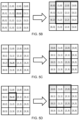
- Both Xmin and Ymin are odd (
FIG. 5A ) - Xmin is odd, Ymin is even (
FIG. 5B ) - Xmin is even, Ymin is odd (
FIG. 5C ) - Both Xmin and Ymin are even (
FIG. 5D )
- Both Xmin and Ymin are odd (
KH=(KernelSize−1)>>1)
This is for example a 1×1 cony with w(0,0), wherein w (.,.) indicates the weights of the convolution kernel C1, i.e. w(0,0) is the weight of the convolution kernel C1 for the coordinates (0,0).
Ymin=Y<<CDi.UpSamp+CDi.Yoffset (See FIG. 7A, elements GLY1 and GLY2 respectively)
Xmin=X<<CDi.UpSamp+CDi.Xoffset (See FIG. 7B, elements GLX1 and GLX2 respectively)
Ymax=Ymin+CDi.KC (See FIG. 7A: adder GLY5)
Xmax=Xmin+CDi.KC (See FIG. 7B: adder GLX5)
Final lower boundary values [Ymin, Xmin] for the mapping window are computed as:
Ymin=CDi.S2*Yodd+Ymin>>CDi.S2 (See FIG. 7A: multiplexer GLY3, shift-right element GLY4 and adder GLY6 respectively)
Xmin=CDi.S2*Xodd+Xmin>>CDi.S2 (See FIG. 7B: multiplexer GLX3, shift-right element GLX4 and adder GLX6 respectively)
Ymax=Ymax>>CDi.S2 (See FIG. 7A: shift-right element GLY7)
Xmax=Xmax>>CDi.S2 (See FIG. 7B: shift-right element GLX7)
PatternIDoffset=(Z<<2*S2)+S2(2*Yodd+Xodd)
Nrel=N−FMstart
[X,Y,Z]=getXYZ(Nrel,FMsizeZv;FMsizeY,FMsizeX)
Nrel=X+Y<< 2 log FMsizeX+Z<<(2 log FMsizeX+ 2 log FMsizeY)
X=Nrel[0:2 log FMsizeX−1]
Y=Nrel[ 2 log FMsizeX: 2 log FMsizeX+ 2 log FMsizeY−1]
Z=Nrel[2 log FMsizeX+ 2 log FMsizeY:]
[X,Y,Z]=[0,0,Nrel]
Ymin=Yoffset+Y<<UpSamp
Xmin=Xoffset+X<<UpSamp
Initial upper boundary values are computed as
Ymax=Ymin+KC
Xmax=Xmin+KC
Ymin=S2*Yodd+Ymin>>S2
Xmin=S2*Xodd+Xmin>>S2
Ymax=Ymax>>S2
Xmax=Xmax>>S2
Hit=hitDetect(Ymin,Ymax,Xmin,CutHeight,CutWidth);
-
- a) DstClsIDY, DstClslDX, together specifying the network address of the destination processor cluster,
- b) DestN, the address of the destination processor cluster element in that destination processor cluster,
- c) SynType, indicating a type of operation to be performed by the destination processor cluster,
- d) PatternID0+PatternID, an indication of a spatial pattern, e.g. a convolution pattern.
- e) Value. A value to be used in an operation to be performed by the processor cluster for the processor cluster element which is specifically referred to in case of a non-packed message or to a set of processor cluster elements within a range defined by the spatial pattern, typically centered around and including the destination processor cluster element designated in the message.
Xmin=X−(kernelSizeX−1)/2
Ymin=Y−(kernelSizeY−1)/2
Therein kernelSizeX, kernelSizeY are the dimensions of the convolution kernel. These may be equal in value, i.e. KernelSizeX=KernelSize=KernelSize.
I.e.
Convolution without Padding
N ID −FMStart=FMsizeY·FMsizeZ·X+FMsizeZ·Y+Z
Average Pooling
ΔX min=KernelSize−1=2
ΔY min=KernelSize−1=2
KC=2KernelSize−1=5
A more formal proof is provided in Annex 1:
| ANNEX 1: |
| Proof that average pooling can be merged with subsequent convolution using a stride |
The initial/input layer is symbolized as I ∈  |
| Point number. Moreover, the intermediate averaged layer and the output layer (after the subsequent |
| convolution) are symbolized as A ∈ |
| zero-padded convolution is assumed). Since the output O is generated out of A by applying a |
| convolution with a KS × KS kernel (weights: wi,j), the following formula expresses the output layer: |
|
|
| To simplify the notation, (KS−1)/2 is abbreviated in the following as KH. |
| The relation between the intermediate average-pooled layer A and the input layer is |
| mathematically expressed as: |
|
|
| Substituting Eq. (2) in Eq. (1) results in: |
|
|
| In the following, it is shown that this relationship between the output layer O and the input |
| layer I can also be realized by means of a single convolution with a subsequent stride (a stride is a |
| logical down-sampling by a factor two after the convolution. After, down-sampling (i.e., applying a |
| stride) only the neurons/pixels with an even x and y address remain. That means that we don not |
| care what the single convolution, used to present the average pooling and the subsequent |
| convolution, is generating on the entries with an odd x or y as these values either-way will be |
| suppressed by the subsequent down-sampling/striding. Hence - using Eq. (3) - the formula |
| describing the output layer before sub-sampling/striding must full-fill: |
|
|
| As we don't care what are the entries of Opre-sub for odd numbered x and/or y, Opre-sub can be |
| expressed as: |
|
|
| Using w'[i, j] = (w[i/2┘, └j/2┘)/4, Eq. (6) can be expressed as: |
|
|
| Comparing Eq. (7) with (1) shows that this is equal to a convolution with an even (i.e., non- |
| symmetric) kernel of size 2KH + 2KH + 2 = 2KS. |
| Thus, an average pooling followed by a convolution can be expressed by a convolution with |
| a kernel that is increased by a factor two and a subsequent down-sampling/striding. This allows to |
| save the number of required neurons by 50%. |
| For example, an average pooling followed by convolution with a 3 × 3 kernel: |
|
|
| can be substituted by a single strided convolution with: |
|
|
Claims (20)
Xoffs=Xsrc0−Xdst0−ΔXmin,
Yoffs=Ysrc0−Ydst0−ΔYmin,
Xoffs=Xsrc0−Xdst0−ΔXmin,
Yoffs=Ysrc0−Ydst0−ΔYmin,
Applications Claiming Priority (4)
| Application Number | Priority Date | Filing Date | Title |
|---|---|---|---|
| EP20187770.1A EP3944153A1 (en) | 2020-07-24 | 2020-07-24 | Message based multi-processor system and method of operating the same |
| EP20187770 | 2020-07-24 | ||
| EP20187770.1 | 2020-07-24 | ||
| PCT/EP2021/070666 WO2022018261A1 (en) | 2020-07-24 | 2021-07-23 | Message based multi-processor system and method of operating the same |
Related Parent Applications (1)
| Application Number | Title | Priority Date | Filing Date |
|---|---|---|---|
| PCT/EP2021/070666 A-371-Of-International WO2022018261A1 (en) | 2020-07-24 | 2021-07-23 | Message based multi-processor system and method of operating the same |
Related Child Applications (1)
| Application Number | Title | Priority Date | Filing Date |
|---|---|---|---|
| US19/065,949 Continuation US20250217159A1 (en) | 2020-07-24 | 2025-02-27 | Message-based processing with assignment of neural network layers to processor clusters |
Publications (2)
| Publication Number | Publication Date |
|---|---|
| US20230266974A1 US20230266974A1 (en) | 2023-08-24 |
| US12277421B2 true US12277421B2 (en) | 2025-04-15 |
Family
ID=71948419
Family Applications (2)
| Application Number | Title | Priority Date | Filing Date |
|---|---|---|---|
| US18/017,538 Active US12277421B2 (en) | 2020-07-24 | 2021-07-23 | Message-based processing with assignment of neural network layers to processor clusters |
| US19/065,949 Pending US20250217159A1 (en) | 2020-07-24 | 2025-02-27 | Message-based processing with assignment of neural network layers to processor clusters |
Family Applications After (1)
| Application Number | Title | Priority Date | Filing Date |
|---|---|---|---|
| US19/065,949 Pending US20250217159A1 (en) | 2020-07-24 | 2025-02-27 | Message-based processing with assignment of neural network layers to processor clusters |
Country Status (5)
| Country | Link |
|---|---|
| US (2) | US12277421B2 (en) |
| EP (2) | EP3944153A1 (en) |
| JP (2) | JP7726981B2 (en) |
| KR (1) | KR20230070448A (en) |
| WO (1) | WO2022018261A1 (en) |
Families Citing this family (2)
| Publication number | Priority date | Publication date | Assignee | Title |
|---|---|---|---|---|
| EP3944153A1 (en) | 2020-07-24 | 2022-01-26 | GrAl Matter Labs S.A.S. | Message based multi-processor system and method of operating the same |
| EP4296902A1 (en) * | 2022-06-23 | 2023-12-27 | GrAl Matter Labs S.A.S. | Processor system and method for operating the same |
Citations (11)
| Publication number | Priority date | Publication date | Assignee | Title |
|---|---|---|---|---|
| US20180189645A1 (en) | 2016-12-30 | 2018-07-05 | Intel Corporation | Neuromorphic computer with reconfigurable memory mapping for various neural network topologies |
| US20180322386A1 (en) * | 2017-05-05 | 2018-11-08 | Intel Corporation | Fine-grain compute communication execution for deep learning frameworks |
| US20190042915A1 (en) | 2018-03-30 | 2019-02-07 | Intel Corporation | Procedural neural network synaptic connection modes |
| US20190324759A1 (en) * | 2017-04-07 | 2019-10-24 | Intel Corporation | Methods and apparatus for deep learning network execution pipeline on multi-processor platform |
| JP2019204492A (en) | 2018-03-27 | 2019-11-28 | インテル・コーポレーション | Neuromorphic accelerator multitasking |
| WO2020078945A1 (en) | 2018-10-15 | 2020-04-23 | Grai Matter Labs S.A.S. | Neural network evaluation tool and method |
| US20210374947A1 (en) * | 2020-05-26 | 2021-12-02 | Nvidia Corporation | Contextual image translation using neural networks |
| EP3944153A1 (en) | 2020-07-24 | 2022-01-26 | GrAl Matter Labs S.A.S. | Message based multi-processor system and method of operating the same |
| US11468145B1 (en) * | 2018-04-20 | 2022-10-11 | Perceive Corporation | Storage of input values within core of neural network inference circuit |
| US11842230B2 (en) | 2019-07-15 | 2023-12-12 | Grai Matter Labs S.A.S. | Processing device and method of operating the same |
| US11960946B2 (en) | 2019-12-20 | 2024-04-16 | Snap Inc. | Message-based processing system and method of operating the same |
Family Cites Families (3)
| Publication number | Priority date | Publication date | Assignee | Title |
|---|---|---|---|---|
| US10497084B2 (en) * | 2017-04-24 | 2019-12-03 | Intel Corporation | Efficient sharing and compression expansion of data across processing systems |
| CN112905240B (en) * | 2019-03-15 | 2025-05-02 | 英特尔公司 | Architecture for block-sparse operations on systolic arrays |
| US12013808B2 (en) * | 2019-03-15 | 2024-06-18 | Intel Corporation | Multi-tile architecture for graphics operations |
-
2020
- 2020-07-24 EP EP20187770.1A patent/EP3944153A1/en not_active Withdrawn
-
2021
- 2021-07-23 EP EP21748885.7A patent/EP4185998A1/en active Pending
- 2021-07-23 JP JP2023504846A patent/JP7726981B2/en active Active
- 2021-07-23 WO PCT/EP2021/070666 patent/WO2022018261A1/en not_active Ceased
- 2021-07-23 US US18/017,538 patent/US12277421B2/en active Active
- 2021-07-23 KR KR1020237006560A patent/KR20230070448A/en active Pending
-
2025
- 2025-02-27 US US19/065,949 patent/US20250217159A1/en active Pending
- 2025-08-06 JP JP2025131609A patent/JP2025169306A/en active Pending
Patent Citations (15)
| Publication number | Priority date | Publication date | Assignee | Title |
|---|---|---|---|---|
| US20180189645A1 (en) | 2016-12-30 | 2018-07-05 | Intel Corporation | Neuromorphic computer with reconfigurable memory mapping for various neural network topologies |
| US20190324759A1 (en) * | 2017-04-07 | 2019-10-24 | Intel Corporation | Methods and apparatus for deep learning network execution pipeline on multi-processor platform |
| US20180322386A1 (en) * | 2017-05-05 | 2018-11-08 | Intel Corporation | Fine-grain compute communication execution for deep learning frameworks |
| JP2019204492A (en) | 2018-03-27 | 2019-11-28 | インテル・コーポレーション | Neuromorphic accelerator multitasking |
| US20190042915A1 (en) | 2018-03-30 | 2019-02-07 | Intel Corporation | Procedural neural network synaptic connection modes |
| US11468145B1 (en) * | 2018-04-20 | 2022-10-11 | Perceive Corporation | Storage of input values within core of neural network inference circuit |
| WO2020078945A1 (en) | 2018-10-15 | 2020-04-23 | Grai Matter Labs S.A.S. | Neural network evaluation tool and method |
| US11842230B2 (en) | 2019-07-15 | 2023-12-12 | Grai Matter Labs S.A.S. | Processing device and method of operating the same |
| US11960946B2 (en) | 2019-12-20 | 2024-04-16 | Snap Inc. | Message-based processing system and method of operating the same |
| US20210374947A1 (en) * | 2020-05-26 | 2021-12-02 | Nvidia Corporation | Contextual image translation using neural networks |
| EP3944153A1 (en) | 2020-07-24 | 2022-01-26 | GrAl Matter Labs S.A.S. | Message based multi-processor system and method of operating the same |
| WO2022018261A1 (en) | 2020-07-24 | 2022-01-27 | Grai Matter Labs S.A.S. | Message based multi-processor system and method of operating the same |
| KR20230070448A (en) | 2020-07-24 | 2023-05-23 | 그레이 매터 랩스 에스에이에스 | Message-based multiprocessor system and its operating method |
| EP4185998A1 (en) | 2020-07-24 | 2023-05-31 | GrAl Matter Labs S.A.S. | Message based multi-processor system and method of operating the same |
| JP2023535749A (en) | 2020-07-24 | 2023-08-21 | ジーアールエーアイ・マター・ラボズ・エス・ア・エス | Message-based multiprocessor system and method of operating it |
Non-Patent Citations (7)
| Title |
|---|
| "European Application Serial No. 20187770.1, Extended European Search Report mailed Jan. 26, 2021", 9 pgs. |
| "European Application Serial No. 20187770.1, Noting of loss of rights pursuant to Rule 112(1) EPC mailed Aug. 17, 2022", 2 pgs. |
| "European Application Serial No. 21748885.7, Response to Communication pursuant to Rules 161(2) and 162 EPC filed Aug. 28, 2023", 28 pgs. |
| "International Application Serial No. PCT/EP2021/070666, International Preliminary Report on Patentability mailed Feb. 2, 2023", 9 pgs. |
| "International Application Serial No. PCT/EP2021/070666, Written Opinion mailed Aug. 19, 2021", 7 pgs. |
| "Japanese Application Serial No. 2023-504846, Notification of Reasons for Rejection mailed Jan. 28, 2025", W/English Translation, 10 pgs. |
| European Patent Office, International Search Report in corresponding International Application No. PCT/EP2021/070666, dated Aug. 19, 2021 (2 pages). |
Also Published As
| Publication number | Publication date |
|---|---|
| JP2023535749A (en) | 2023-08-21 |
| US20230266974A1 (en) | 2023-08-24 |
| JP2025169306A (en) | 2025-11-12 |
| KR20230070448A (en) | 2023-05-23 |
| US20250217159A1 (en) | 2025-07-03 |
| WO2022018261A1 (en) | 2022-01-27 |
| EP4185998A1 (en) | 2023-05-31 |
| EP3944153A1 (en) | 2022-01-26 |
| JP7726981B2 (en) | 2025-08-20 |
Similar Documents
| Publication | Publication Date | Title |
|---|---|---|
| US20250217159A1 (en) | Message-based processing with assignment of neural network layers to processor clusters | |
| EP4446984B1 (en) | Operations using sparse volumetric data | |
| EP3734543B1 (en) | Image transformation for machine learning | |
| US20040139413A1 (en) | Element placement method and apparatus | |
| US20040024779A1 (en) | Method for traversing quadtrees, octrees, and N-dimensional bi-trees | |
| US7991240B2 (en) | Methods, systems and apparatuses for modeling optical images | |
| CN116012515B (en) | Neural radiation field network training method and related equipment | |
| JP4778561B2 (en) | Method, program, and system for image classification and segmentation based on binary | |
| CN115760940B (en) | Object texture processing method, device, equipment and storage medium | |
| CN112799599A (en) | Data storage method, computing core, chip and electronic equipment | |
| US12124935B2 (en) | Neural processing system | |
| US20240202991A1 (en) | Cube mapping using gradients of an input block of fragments | |
| CN117911473A (en) | Medical image registration method and device, operation path planning method and navigation device | |
| CN120125635B (en) | Depth priori guided multi-view three-dimensional reconstruction method | |
| CN119375955B (en) | Earthquake fault identification method, storage medium and equipment | |
| US12393832B2 (en) | Neuromorphic processing system and method of operating the same | |
| US20250166282A1 (en) | Intersection testing in a ray tracing system | |
| CN119540470A (en) | Three-dimensional reconstruction method, device, electronic device, storage medium and program product | |
| KR101547366B1 (en) | Addressing device for parallel processor | |
| KR102343053B1 (en) | a creation method of a 3D bounding box for a lidar point group, and computer program recorded on record-medium for executing method therefor | |
| CN120070153B (en) | An acceleration system for geometric transformation of digital images | |
| CN119493950B (en) | Sparse convolution rule table generation method, calculation method and tensor processing unit | |
| KR102343052B1 (en) | Method for identifying the path of an object in a 2D image based on 3D data, and computer program recorded on record-medium for executing method therefor | |
| CN113837923B (en) | Data processing device, data processing method and related products | |
| Bykovsky | Method for simulating digital maps based on discrete multiple-valued logic |
Legal Events
| Date | Code | Title | Description |
|---|---|---|---|
| FEPP | Fee payment procedure |
Free format text: ENTITY STATUS SET TO UNDISCOUNTED (ORIGINAL EVENT CODE: BIG.); ENTITY STATUS OF PATENT OWNER: LARGE ENTITY |
|
| AS | Assignment |
Owner name: GRAI MATTER LABS S.A.S., FRANCE Free format text: ASSIGNMENT OF ASSIGNORS INTEREST;ASSIGNOR:BAMBERG, LENNART;REEL/FRAME:063402/0042 Effective date: 20230314 |
|
| STPP | Information on status: patent application and granting procedure in general |
Free format text: DOCKETED NEW CASE - READY FOR EXAMINATION |
|
| STPP | Information on status: patent application and granting procedure in general |
Free format text: NON FINAL ACTION MAILED |
|
| AS | Assignment |
Owner name: SNAP INC., CALIFORNIA Free format text: ASSIGNMENT OF ASSIGNORS INTEREST;ASSIGNOR:GRAI MATTER LABS S.A.S.;REEL/FRAME:067537/0339 Effective date: 20240122 |
|
| STPP | Information on status: patent application and granting procedure in general |
Free format text: RESPONSE TO NON-FINAL OFFICE ACTION ENTERED AND FORWARDED TO EXAMINER |
|
| STPP | Information on status: patent application and granting procedure in general |
Free format text: NOTICE OF ALLOWANCE MAILED -- APPLICATION RECEIVED IN OFFICE OF PUBLICATIONS |
|
| STPP | Information on status: patent application and granting procedure in general |
Free format text: DOCKETED NEW CASE - READY FOR EXAMINATION |
|
| STPP | Information on status: patent application and granting procedure in general |
Free format text: NOTICE OF ALLOWANCE MAILED -- APPLICATION RECEIVED IN OFFICE OF PUBLICATIONS |
|
| STPP | Information on status: patent application and granting procedure in general |
Free format text: AWAITING TC RESP, ISSUE FEE PAYMENT VERIFIED |
|
| STPP | Information on status: patent application and granting procedure in general |
Free format text: PUBLICATIONS -- ISSUE FEE PAYMENT VERIFIED |
|
| STCF | Information on status: patent grant |
Free format text: PATENTED CASE |