US12277416B2 - Multi-environment cellular network development and testing system - Google Patents
Multi-environment cellular network development and testing system Download PDFInfo
- Publication number
- US12277416B2 US12277416B2 US17/876,933 US202217876933A US12277416B2 US 12277416 B2 US12277416 B2 US 12277416B2 US 202217876933 A US202217876933 A US 202217876933A US 12277416 B2 US12277416 B2 US 12277416B2
- Authority
- US
- United States
- Prior art keywords
- environment
- cloud
- software
- testing
- development
- Prior art date
- Legal status (The legal status is an assumption and is not a legal conclusion. Google has not performed a legal analysis and makes no representation as to the accuracy of the status listed.)
- Active, expires
Links
Images




Classifications
-
- G—PHYSICS
- G06—COMPUTING OR CALCULATING; COUNTING
- G06F—ELECTRIC DIGITAL DATA PROCESSING
- G06F8/00—Arrangements for software engineering
- G06F8/70—Software maintenance or management
- G06F8/71—Version control; Configuration management
-
- G—PHYSICS
- G06—COMPUTING OR CALCULATING; COUNTING
- G06F—ELECTRIC DIGITAL DATA PROCESSING
- G06F8/00—Arrangements for software engineering
- G06F8/60—Software deployment
- G06F8/65—Updates
-
- G—PHYSICS
- G06—COMPUTING OR CALCULATING; COUNTING
- G06F—ELECTRIC DIGITAL DATA PROCESSING
- G06F8/00—Arrangements for software engineering
- G06F8/70—Software maintenance or management
- G06F8/77—Software metrics
-
- H—ELECTRICITY
- H04—ELECTRIC COMMUNICATION TECHNIQUE
- H04W—WIRELESS COMMUNICATION NETWORKS
- H04W16/00—Network planning, e.g. coverage or traffic planning tools; Network deployment, e.g. resource partitioning or cells structures
- H04W16/18—Network planning tools
-
- G—PHYSICS
- G06—COMPUTING OR CALCULATING; COUNTING
- G06F—ELECTRIC DIGITAL DATA PROCESSING
- G06F11/00—Error detection; Error correction; Monitoring
- G06F11/30—Monitoring
- G06F11/34—Recording or statistical evaluation of computer activity, e.g. of down time, of input/output operation ; Recording or statistical evaluation of user activity, e.g. usability assessment
- G06F11/3466—Performance evaluation by tracing or monitoring
- G06F11/3476—Data logging
-
- G06F11/3664—
-
- G—PHYSICS
- G06—COMPUTING OR CALCULATING; COUNTING
- G06F—ELECTRIC DIGITAL DATA PROCESSING
- G06F11/00—Error detection; Error correction; Monitoring
- G06F11/36—Prevention of errors by analysis, debugging or testing of software
- G06F11/3668—Testing of software
- G06F11/3672—Test management
- G06F11/3684—Test management for test design, e.g. generating new test cases
-
- G—PHYSICS
- G06—COMPUTING OR CALCULATING; COUNTING
- G06F—ELECTRIC DIGITAL DATA PROCESSING
- G06F11/00—Error detection; Error correction; Monitoring
- G06F11/36—Prevention of errors by analysis, debugging or testing of software
- G06F11/3698—Environments for analysis, debugging or testing of software
-
- G—PHYSICS
- G06—COMPUTING OR CALCULATING; COUNTING
- G06F—ELECTRIC DIGITAL DATA PROCESSING
- G06F8/00—Arrangements for software engineering
- G06F8/60—Software deployment
-
- H—ELECTRICITY
- H04—ELECTRIC COMMUNICATION TECHNIQUE
- H04W—WIRELESS COMMUNICATION NETWORKS
- H04W16/00—Network planning, e.g. coverage or traffic planning tools; Network deployment, e.g. resource partitioning or cells structures
- H04W16/22—Traffic simulation tools or models
Definitions
- the plurality of cloud-based environments may be communicatively coupled to one or more issue monitors via a second plurality of pipelines.
- the plurality of cloud-based environments may be exposed to service provider systems and allowing the service provider systems to develop and/or test features and/or services with respect to the cellular network within the plurality of cloud-based environments.
- At least one issue monitor of the one or more issue monitors may log the one or more issues, and the software or the version of the software may be returned to a lower of the plurality of cloud-based environments according to the hierarchical order to allow remediation of the one or more issues.
- the plurality of cloud-based environments may allow for development and/or testing of the features and/or the services with respect to the cellular network based at least in part on specifications of one or more network states.
- at least some of the plurality of cloud-based environments may be virtual development environments instantiated via a cloud infrastructure.
- the plurality of cloud-based environments may be virtual integration environments instantiated via a cloud infrastructure.
- the plurality of cloud-based environments may allow the service provider system to test and/or develop features and/or services in parallel with respect to the cellular network.
- FIG. 1 illustrates an embodiment of a cellular network, in accordance with embodiments according to the present disclosure.
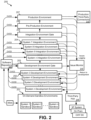
- FIG. 2 illustrates a multi-environment cellular network development and testing system, in accordance with embodiments according to the present disclosure.
- FIG. 2 A illustrates a method for multi-environment cellular network development and testing, in accordance with embodiments according to the present disclosure.
- FIG. 3 illustrates a cellular network test environment hierarchy, in accordance with embodiments according to the present disclosure.
- FIG. 4 illustrates a testing system, in accordance with certain embodiments according to the present disclosure.
- UE 110 can represent various types of end-user devices, such as smartphones, cellular modems, cellular-enabled computerized devices, sensor devices, gaming devices, access points (APs), any computerized device capable of communicating via a cellular network, etc.
- UE 110 may use RF to communicate with various base stations of cellular network 120 .
- two base stations 115 (BS 115 - 1 , 115 - 2 ) are illustrated.
- Real-world implementations of system 100 can include many (e.g., thousands) of base stations, RUs, DUs, and CUs.
- BS 115 can include one or more antennas that allow RUs 125 to communicate wirelessly with UEs 110 .
- DUs 127 , CU 129 , 5G core 139 , and orchestrator 138 can be implemented as software being executed by general-purpose computing equipment, such as in a data center. Therefore, depending on needs, the functionality of a DU, CU, and/or 5G core may be implemented locally to each other and/or specific functions of any given component can be performed by physically separated server systems (e.g., at different server farms). For example, some functions of a CU may be located at a same server facility as where the DU is executed, while other functions are executed at a separate server system.
- Kubernetes can be used to create and destroy the logical DU, CU, 5G core units and subunits as needed for the cellular network 120 to function properly.
- Kubernetes allows for container deployment, scaling, and management. As an example, if cellular traffic increases substantially in a region, an additional logical DU or components of a DU may be deployed in a data center near where the traffic is occurring without any new hardware being deployed. (Rather, processing and storage capabilities of the data center would be devoted to the needed functions.) When the need for the logical DU or subcomponents of the DU is no longer needed, Kubernetes can allow for removal of the logical DU.
- high-priority data sent by a UE may be mapped to a layer having relatively higher QoS parameters and network configurations than lower-priority data sent by the UE that is mapped to a second layer having relatively less stringent QoS parameters and different network configurations.
- Components such as DUs 127 , CU 129 , orchestrator 138 , and 5G core 139 may include various software components that are required to communicate with each other, handle large volumes of data traffic, and be able to properly respond to changes in the network. In order to ensure not only the functionality and interoperability of such components, but also the ability to respond to changing network conditions and the ability to meet or perform above vendor specifications, significant testing must be performed.
- Service provider systems 150 may include one or more server systems that can interface with a testing and development system 200 , which may correspond to one or more portions or all of the cellular network 120 , the cloud-based cellular system components 123 , and/or the orchestrator 138 .
- the service provider systems 150 may communicate with the testing and development system 200 to conduct development and testing in accordance with embodiments disclosed herein via one or more networks 140 , which may include the Internet.
- the development and testing features disclosed herein may include validating services and features with respect to traffic to and from the network 140 .
- the service provider systems 150 may include, for example, ISV (independent software vendor) systems, device vendor systems, roaming partner systems, and other service provider systems 150 , which may or may not be remote, third-party systems, and which may be internal or external to the cellular network 120 .
- ISV independent software vendor
- FIG. 2 illustrates a multi-environment cellular network development and testing system 200 , in accordance with embodiments according to the present disclosure.
- FIG. 2 A illustrates a method 250 for multi-environment cellular network development and testing, in accordance with embodiments according to the present disclosure.
- testing and development system 200 illustrated is an example topology and flow of the environment cellular network development and testing system 200 (“testing and development system 200 ”).
- the system 200 may be built and operated with elasticity in the cloud and may include a virtual infrastructure that can allow for rapid instantiation, expansion, and takedown of any of the various lab environments disclosed herein on demand. For example, a new environment may be spun up for a new service provider system 150 in a matter of hours or less, or likewise taken down rapidly as needed.
- the environments may be configured by the service provider systems 150 with autonomy.
- the system 200 may include one or more server systems that allow a service provider system 150 to send one or more requests to the system 200 via one or more networks 140 , such as the Internet.
- the testing and development system 200 may correspond to a massively parallel network of networks testing and development system that may allow for development and testing on target environments as the target environments exist in the field, with real cellular network equipment and real cellular network traffic.
- the network of networks may be created, updated, and changed on demand—providing the resources, including underlying hardware, to service provider systems 150 for a period of time as needed for development and testing.
- the network of networks may extend all the way down to service provider systems 150 in a multiplicity of lower environments, each particularized to a particular service provider system 150 while allowing access to live wireless telecom network snapshots.
- the testing and development system 200 provides for technical improvements and solutions that enable internal and external service provider systems 150 (e.g., ISV (independent software vendor) systems, device vendor systems, roaming partner systems, and other service provider systems 150 , which may or may not be remote, third-party systems) to actually develop and test software with respect to real cellular network equipment and real cellular network traffic.
- the service provider systems 150 may correspond to operator systems and may develop and test network features and services.
- a network feature and/or network service may include, for example, NFs (network functions), VNFs, PNFs, CNFs (cloud-native network functions), and/or the like.
- the technical improvements and solutions disclosed herein accelerate speed of effective development, testing, and deployment of network features and network services, as well as deployment to the production environments.
- the system 200 provides the ability to test and gather data from a real, live environment, as opposed to a software-simulated environment that does not mimic the actual production target and that causes various problems because the labs are out of sync with respect to the production environment (which slows down the operators ability to take something developed in the labs all the way to production).
- the system 200 provides multi-level testing on live environments, which speeds up feature development, the hardening of the network, and the gathering of data to create a virtuous cycle for network improvement.
- the system 200 minimizes the number and types of issues that arise when services and features get rolled into production, while increasing the speed at which services and features can be developed and deployed to the network.
- Each environment may have its own software repository 225 , so dropping of the software in the software repository 225 may automatically trigger deployment via the CI/CD pipelines.
- the data platform that is used across the networks may extend all the way across down to the lower service provider system 150 environments.
- the orchestration may extend all the way to the lower service provider system 150 environments.
- the network of networks approach may include development and testing that occurs with respect to clones of the actual network—not at some remote, isolated lab with an ad hoc set of assumptions.
- the system 200 may exactly replicate the actual network in production (e.g., mirroring the CNFs, the configuration, etc.), without breach of privacy with respect to subscriber data.
- the testing and development system 200 may allow service provider systems 150 to access the independent, parallel, comprehensive, and accelerated development and testing services disclosed herein, which provide access to real-time or near-real-time replicas of any or all of the cellular network equipment and cellular network traffic.
- the production environment 207 may handle live communication traffic by customers of the cellular network provider.
- the service provider systems 150 can each have access to all or part of the production environment 207 in parallel.
- the system 200 may create mirror copies of the production environment 207 , which the system 200 may instantiate in one, all or another combination of the lower environments 201 through 206 in accordance with various embodiments.
- This may include snapshots of any or all of the logical data centers (e.g., national data center, regional data center, edge data center, and/or the like) created as a function of parameters of requests from the service provider systems 150 .
- the system 200 may create an exact replica of the network in the lower environments, including geo-redundancy, multi-regional deployment, not localized to one location, and/or the like.
- the system 200 may provide for the ability to test geo-redundancy (telecom network components deployed in production with multiple instances running in multiple, different physical locations to provide high availability of service to traffic on the network even when one or more of the components fail).
- the testing and development system 200 may minimize the time required to roll out and integrate network functions, features, and services into the upper environments, up to and including the production network.
- the testing and development system 200 may allow service provider systems 150 the flexibility to instantiate and develop against any combination of or all the network functions included in a network declared state for the 5G network.
- the system 200 may control processes of updating the declared state, propagating updates via CI/CD (continuous integration, continuous delivery/deployment) pipelines and processes. Then any new environment that the system 200 brings online would then mirror the updated state and everything remains in sync.
- the testing and development system 200 may ensure that the output of lower environments align with the production environment—e.g., CNFs exiting lower environments may be deployable in production with no design change.
- the testing and development system 200 may create the capability to scale the testing environments with elasticity and turn down environments when they are no longer required.
- the testing and development system 200 may employ software development practice of developing against a mainline code stream in branches and merging them back into the mainline code—for networks.
- the software repository 225 may store all NFs and configurations, the functions and configurations of the radio network as software, the functions and configurations of the 5G Core as software, the functions and configurations of the cloud-based cellular system components 123 and replicas/snapshots thereof, and simulated cellular networks and slices—including versioning of one or a combination of the foregoing, to facilitate deployment of appropriate version of the same into any particular environment.
- the testing and development system 200 may facilitate deployment in all environments. All NFs deployed in all environments may be done via CI/CD pipelines and processes. There may be no manual deployment of NFs in any of the environments.
- All environments may be used to facilitate continuous testing.
- Various scopes of testing may be facilitated in each of the environments.
- nodal, pairwise, and high availability testing may be performed in the development environments.
- 3GPP, performance, and high availability testing may be performed in the dev-performance environments.
- Integration, 3GPP, and availability testing may be performed in the integration environments.
- Performance and high availability testing may be performed in the integration—performance environments.
- 3GPP, performance, high availability, and chaos testing may be performed in the preproduction environments.
- Performance and chaos testing may be performed in the production environments.
- Other embodiments are possible to facilitate additional testing strategies and additional test vectors, methodologies, and tools.
- All test cases, test results, and any issues identified during testing, in any environment may be documented and tracked by the issue monitor 210 .
- All KPIs, alarms, logs from any environment may flow into and be stored in a data repository, which may, for example, correspond to a data lake.
- the data flow to the data repository may occur in the same manner as the flow of data in pre-production and production environments.
- the testing and development system 200 may be configured to provide test automation to automate the execution of the tests and capture of results from the test cases.
- the testing and development system 200 may be configured to provide a first set of one or more test tools for the testing to be shared with the service provider systems 150 so that the service provider systems 150 may select one or more of the tools to execute the testing.
- the testing and development system 200 may be configured to receive one or more additional sets of one or more test tools from the service provider systems 150 . After a tool is uploaded to the testing and development system 200 , the testing and development system 200 may install at least temporarily the tool code and execute the tool so that the service provider systems 150 may selectively use the tool to execute the testing.
- Any new service provider system 150 introduced to the system 200 may begin by onboarding the NFs of into an on-demand sandbox environment 201 .
- the sandbox environment 201 may allow the service provider system 150 to complete initial onboarding processes required to enable onboarding of service provider system 150 NFs/platforms into the system 200 .
- Each service provider system 150 may instantiate its own sandbox environment 201 .
- the next level in the process flow for the system 200 may include the service provider system 150 instantiating its own development environment 202 to enable the service provider system 150 to develop its functions and carry out pair-wise integration activities.
- the system 200 may facilitate a progressive flow into upper environments, with appropriate gates, to ensure that service provider systems 150 can continuously develop, integrate, and test solutions against the real cellular network equipment and real cellular network traffic in parallel with other service provider system, without being gated by any other activity by another service provider system.
- Instantiations of a declared network state may be stored in, made use of by, and/or otherwise correspond to the development environment gate 203 and/or the integration environment gate 205 .
- the declared network state may be maintained and published by the system 200 and may be updated or changed only by the system 200 .
- the system 200 may maintain the declared state of the network by way of updates that are continuous and triggered by detected state changes in the network, periodic, on-demand and triggered by a test/development request, and/or the like. All the network functions, in terms of their versions, configurations, topology, connectivity, and design, may be published as part of the network declared state.
- the declared network state specifications may be the template for all environments. Accordingly, the declared network state specifications may correspond to a baseline according to which other environments may be set up.
- a declared network state may be provided to a development environment 202 to provide a declared development environment network state.
- a service provider system 150 e.g., ISV
- the service provider system 150 may test the NF in the on-demand sandbox environment 201 and may verify that the NF works in the sandbox environment (e.g., with a particular cloud infrastructure, etc.).
- the NF may be elevated to a system development environment 202 , which may the access the development environment declared network state that is in the development environment gate 203 .
- the NF may be deployed in the system development environment 202 and may cause failures (e.g., breaking a particular system NRF with the deployment and/or the like).
- the validated NF may be deployed in the development environment gate 203 .
- the deployment with the previous declared network state may become the new development environment declared network state.
- the new development environment declared network state may then be communicated to the integration environment gate 205 , and can then be propagated down to an integration environment 204 .
- the development environments 202 may be an equivalent of a branch of the mainline code. Each service provider system 150 may clone all or part of the network declared state into its development environment 202 to conduct its development and testing activities. In various embodiments, the development environments 202 may facilitate testing with respect to RAN (radio access network), 5GC (5G Core), IMS (IP Multimedia Core Network Subsystem), OSS/BSS (operations support system/business support system), orchestrator, TaaS (testing as a service), third-party connections, and/or the like components of the environments.
- RAN radio access network
- 5G Core 5G Core
- IMS IP Multimedia Core Network Subsystem
- OSS/BSS operations support system/business support system
- orchestrator operations support system/business support system
- TaaS testing as a service
- third-party connections and/or the like components of the environments.
- Network configurations and associated NFs that pass the testing in this environment may be deemed to be accepted for deployment in the upper environments, as illustrated.
- the output of this environment in the form of MOPs, configurations, and artifacts, may correspond to the final approved release that can then be promoted to upper environments. Releases exiting this environment may be maintained as derivatives of the network declared state in repositories of the system 202 and may be available for deployment into the integration environment 204 . Any specific release that is deployed in production may be become the current network declared state.
- the integration environments 204 may not be used for any kind of development and integration activities by service provider systems 150 . If system 200 detects an issue, the system 200 may tag the fault and then flow returns to the development environment 202 so the service provider system 150 with the issue can fix the issue in the development environment 202 . Issues discovered with any service provider system 150 NF in the integration environments 204 may be logged and the fixes may be developed in the respective development environment 202 by the impacted service provider system. Successful testing and certification by a service provider system 150 against the network functions may be criteria to exit from this environment. A certified network release may then be promoted to the integration gate environment 205 , as disclosed herein.
- the pre-production environment 206 may be maintained as an exact copy of the current production network environment 207 . However, as new releases are developed in the newer environments, the next target release for production may be introduced into the pre-production environment 206 to allow for full end-to-end feature, high availability (HA) and redundancy, performance, and soak testing for a duration determined by the system 200 . When a release successfully passes the required testing in the pre-production environment 206 , it may be approved for deployment in the production network environment 207 . The release that is rolled into production may then be deemed the current network declared state. In various embodiments, the pre-production environment 206 may facilitate testing with respect to RAN, 5GC, IMS, OSS/BSS, orchestrator, TaaS, third-party connections, and/or the like components of the environment.
- the production environment 207 may be the current running configuration for the network that forms the basis of the network declared state. New releases promoted from the lower environments may be rolled out to production environment 207 based on specifications of the business and technical requirements of the system 200 . In some embodiments, there may be only one network declared state for the network. However, in some embodiments facilitating slicing, there may be multiple versions of the production environment 207 , based on the requirements of each of the slices that the system 200 configures for deployment in production. In various embodiments, the production environment 207 may include the RAN, 5GC, IMS, OSS/BSS, orchestrator, third-party connections, and/or the like components of the environment. There may be no development, testing, or integration activities in the production environment(s) 207 .
- the system 200 may control most if not all aspects of environments 203 through 207 but may provide environments 201 and 202 to allow more control by service provider systems 150 .
- a service provider system 150 may have control over the version of its NFs, which surrounding NFs are selected for replication into its development environment 202 . Additionally or alternatively, a service provider system 150 may make changes to its NF code and configurations. Additionally or alternatively, a service provider system 150 may communicate and cooperate with service provider systems 150 of the surrounding NFs to develop updated configurations for end-to-end integration of its NF. Additionally or alternatively, a service provider system 150 may deploy and use its specific development and test tools to support its development activities. Additionally or alternatively, a service provider system 150 may communicate and cooperate with the system 200 to update infrastructure configurations, as needed.
- a service provider system 150 may develop and test its device/chipset features against the 5G network. Additionally or alternatively, a service provider system 150 may communicate and cooperate with other service provider systems 150 to develop configuration changes required to test and certify its solutions. Additionally or alternatively, a service provider system 150 may deploy its specific development and test tools to support its testing and certification activities. Additionally or alternatively, a service provider system 150 may communicate and cooperate with the system 200 to update infrastructure configurations, as needed.
- each test environment various layers may be present, which each need to be tested. For example, six layers of the development test environment 202 are illustrated; these same layers may be present for each other layer of the test environments.
- the layers may include: physical layer 230 ; virtual machine layer 231 ; application layer 232 ; orchestration layer 233 ; service layer 234 ; and apps layer 235 . In other embodiments, fewer or greater numbers of layers may be present within each environment.
- testing may be performed within production environment 207 .
- production environment 207 customers of the cellular network may be using the implemented cellular network for communication and therefore expect that their SLAs be met.
- testing may be performed within the production environment.
- FIG. 4 illustrates a testing system 400 , in accordance with certain embodiments according to the present disclosure.
- the testing system 400 may correspond to each of the environments of system 200 . Accordingly, each of the environments may include and/or make use of one or more aspects of a respective testing system 400 .
- the testing system 400 may include: test parameter creator system 412 ; end-to-end traffic simulator 414 ; intra-core traffic simulator 415 ; system monitor 416 ; test configurer 418 ; and simulated cellular network 420 .
- Simulated cellular network 420 can represent an embodiment of the cellular network that is being simulated at varying levels of complexity, such as disclosed above with respect to the test environments. For simulated cellular network 420 , components that are not executed using exclusively general-purpose computing equipment, such as radio units, may also be simulated.
- Simulated cellular network 420 can represent an embodiment of the cellular network that is being simulated at varying levels of complexity, such as disclosed above with respect to the test environments.
- components that are not executed using exclusively general-purpose computing equipment, such as radio units, may also be simulated.
- the slice testing may correspond to test of connected vehicle without testing general purpose eMBB broadband consumption.
- the slice testing system 400 - 1 may create one or more slices specifically configured to support the requirements of a connected vehicle type application (versus another slice for standard video streaming or surfing the Internet, for example).
- the slice testing system 400 - 1 may tune and configure bandwidth, latency, availability to take into account the requirements of that test case, whereas other test cases may not require high bandwidth, low latency, high availability.
Landscapes
- Engineering & Computer Science (AREA)
- Theoretical Computer Science (AREA)
- General Engineering & Computer Science (AREA)
- Software Systems (AREA)
- Physics & Mathematics (AREA)
- General Physics & Mathematics (AREA)
- Computer Security & Cryptography (AREA)
- Computer Networks & Wireless Communication (AREA)
- Signal Processing (AREA)
- Quality & Reliability (AREA)
- Computer Hardware Design (AREA)
- Data Exchanges In Wide-Area Networks (AREA)
- Soundproofing, Sound Blocking, And Sound Damping (AREA)
- Mobile Radio Communication Systems (AREA)
Abstract
Description
Claims (20)
Priority Applications (3)
| Application Number | Priority Date | Filing Date | Title |
|---|---|---|---|
| US17/876,933 US12277416B2 (en) | 2021-07-29 | 2022-07-29 | Multi-environment cellular network development and testing system |
| CA3207799A CA3207799A1 (en) | 2021-07-29 | 2023-07-27 | Active sound attenuation for aircraft electrical system |
| US19/090,803 US20250284489A1 (en) | 2021-07-29 | 2025-03-26 | Multi-environment cellular network development and testing system |
Applications Claiming Priority (2)
| Application Number | Priority Date | Filing Date | Title |
|---|---|---|---|
| US202163227082P | 2021-07-29 | 2021-07-29 | |
| US17/876,933 US12277416B2 (en) | 2021-07-29 | 2022-07-29 | Multi-environment cellular network development and testing system |
Related Child Applications (1)
| Application Number | Title | Priority Date | Filing Date |
|---|---|---|---|
| US19/090,803 Continuation US20250284489A1 (en) | 2021-07-29 | 2025-03-26 | Multi-environment cellular network development and testing system |
Publications (2)
| Publication Number | Publication Date |
|---|---|
| US20230032088A1 US20230032088A1 (en) | 2023-02-02 |
| US12277416B2 true US12277416B2 (en) | 2025-04-15 |
Family
ID=85039407
Family Applications (2)
| Application Number | Title | Priority Date | Filing Date |
|---|---|---|---|
| US17/876,933 Active 2042-10-06 US12277416B2 (en) | 2021-07-29 | 2022-07-29 | Multi-environment cellular network development and testing system |
| US19/090,803 Pending US20250284489A1 (en) | 2021-07-29 | 2025-03-26 | Multi-environment cellular network development and testing system |
Family Applications After (1)
| Application Number | Title | Priority Date | Filing Date |
|---|---|---|---|
| US19/090,803 Pending US20250284489A1 (en) | 2021-07-29 | 2025-03-26 | Multi-environment cellular network development and testing system |
Country Status (2)
| Country | Link |
|---|---|
| US (2) | US12277416B2 (en) |
| CA (1) | CA3207799A1 (en) |
Families Citing this family (9)
| Publication number | Priority date | Publication date | Assignee | Title |
|---|---|---|---|---|
| US12386732B2 (en) * | 2021-02-24 | 2025-08-12 | Applause App Quality, Inc. | Systems and methods for capturing test execution and communication |
| US12461740B2 (en) | 2021-04-22 | 2025-11-04 | Applause App Quality, Inc. | Systems and method for analyzing software and testing integration |
| US11888699B1 (en) | 2022-09-30 | 2024-01-30 | Verizon Patent And Licensing Inc. | Method and system for hybrid network slicing |
| US11863393B1 (en) * | 2022-11-24 | 2024-01-02 | EdgeQ, Inc. | Systems and methods for high availability in telco cloud for radio access network |
| US11962460B1 (en) * | 2022-11-30 | 2024-04-16 | Microsoft Technology Licensing, Llc | End-to-end service creation, management, and orchestration in mobile networks |
| WO2024172817A1 (en) * | 2023-02-17 | 2024-08-22 | Rakuten Symphony, Inc. | Intelligent internet protocol security (ipsec) manager for ipsec simulation |
| US12367031B2 (en) * | 2023-05-24 | 2025-07-22 | T-Mobile Usa, Inc. | Intelligent method and systems for automated radio network performance evaluation of a wireless telecommunication network |
| US20240427587A1 (en) * | 2023-06-22 | 2024-12-26 | Bank Of America Corporation | Determining a security patch for a cyberattack by executing simulations of different security protocols |
| US20250113221A1 (en) * | 2023-09-29 | 2025-04-03 | Dish Wireless L.L.C. | Blocking malfunctioning network functions in a cellular telecommunications network |
Citations (11)
| Publication number | Priority date | Publication date | Assignee | Title |
|---|---|---|---|---|
| US20170180459A1 (en) * | 2015-12-21 | 2017-06-22 | Amazon Technologies, Inc. | Building deployment pipelines for a production computing service using live pipeline templates |
| US9768893B1 (en) * | 2016-11-16 | 2017-09-19 | Spirent Communications, Inc. | Over-the-air isolation testing |
| US20170324617A1 (en) * | 2016-05-03 | 2017-11-09 | Verizon Patent And Licensing Inc. | Testing and validation of user equipment for a cellular network |
| US10146524B1 (en) * | 2016-03-28 | 2018-12-04 | Amazon Technologies, Inc. | Preemptive deployment in software deployment pipelines |
| US20190129712A1 (en) * | 2017-10-27 | 2019-05-02 | Intuit Inc. | Methods, systems, and computer program products for an integrated platform for continuous deployment of software application delivery models |
| US10318285B1 (en) * | 2017-08-16 | 2019-06-11 | Amazon Technologies, Inc. | Deployment of infrastructure in pipelines |
| US20190215707A1 (en) * | 2018-01-09 | 2019-07-11 | Keysight Technologies, Inc. | Methods, systems and computer readable media for stimulating and testing wireless devices |
| US20210173767A1 (en) * | 2019-12-10 | 2021-06-10 | Paypal, Inc. | Systems and methods for testing software applications |
| US11350294B1 (en) * | 2020-11-16 | 2022-05-31 | Sprint Communications Company L.P. | Rolling production test |
| US20220286363A1 (en) * | 2021-03-08 | 2022-09-08 | International Business Machines Corporation | Broadband cellular network deployment fractal generation |
| US11809301B2 (en) * | 2021-03-03 | 2023-11-07 | Oracle International Corporation | Techniques for large-scale functional testing in cloud-computing environments |
-
2022
- 2022-07-29 US US17/876,933 patent/US12277416B2/en active Active
-
2023
- 2023-07-27 CA CA3207799A patent/CA3207799A1/en active Pending
-
2025
- 2025-03-26 US US19/090,803 patent/US20250284489A1/en active Pending
Patent Citations (11)
| Publication number | Priority date | Publication date | Assignee | Title |
|---|---|---|---|---|
| US20170180459A1 (en) * | 2015-12-21 | 2017-06-22 | Amazon Technologies, Inc. | Building deployment pipelines for a production computing service using live pipeline templates |
| US10146524B1 (en) * | 2016-03-28 | 2018-12-04 | Amazon Technologies, Inc. | Preemptive deployment in software deployment pipelines |
| US20170324617A1 (en) * | 2016-05-03 | 2017-11-09 | Verizon Patent And Licensing Inc. | Testing and validation of user equipment for a cellular network |
| US9768893B1 (en) * | 2016-11-16 | 2017-09-19 | Spirent Communications, Inc. | Over-the-air isolation testing |
| US10318285B1 (en) * | 2017-08-16 | 2019-06-11 | Amazon Technologies, Inc. | Deployment of infrastructure in pipelines |
| US20190129712A1 (en) * | 2017-10-27 | 2019-05-02 | Intuit Inc. | Methods, systems, and computer program products for an integrated platform for continuous deployment of software application delivery models |
| US20190215707A1 (en) * | 2018-01-09 | 2019-07-11 | Keysight Technologies, Inc. | Methods, systems and computer readable media for stimulating and testing wireless devices |
| US20210173767A1 (en) * | 2019-12-10 | 2021-06-10 | Paypal, Inc. | Systems and methods for testing software applications |
| US11350294B1 (en) * | 2020-11-16 | 2022-05-31 | Sprint Communications Company L.P. | Rolling production test |
| US11809301B2 (en) * | 2021-03-03 | 2023-11-07 | Oracle International Corporation | Techniques for large-scale functional testing in cloud-computing environments |
| US20220286363A1 (en) * | 2021-03-08 | 2022-09-08 | International Business Machines Corporation | Broadband cellular network deployment fractal generation |
Non-Patent Citations (1)
| Title |
|---|
| T. Francis, A Comparison of Cloud Execution Mechanisms Fog, Edge, and Clone Cloud Computing, Dec. 2018, [Retrieved on Nov. 25, 2024]. Retrieved from the internet: <URL: https://core.ac.uk/reader/329119630> 8 Pages (4646-4653) (Year: 2018). * |
Also Published As
| Publication number | Publication date |
|---|---|
| US20230032088A1 (en) | 2023-02-02 |
| CA3207799A1 (en) | 2024-01-29 |
| US20250284489A1 (en) | 2025-09-11 |
Similar Documents
| Publication | Publication Date | Title |
|---|---|---|
| US12425877B2 (en) | Multi-environment cellular network slice testing system | |
| US12277416B2 (en) | Multi-environment cellular network development and testing system | |
| US12278752B2 (en) | Virtualized cellular network multi-stage test and ticketing environment | |
| EP3886367B1 (en) | Automating 5g slices using real-time analytics | |
| US9893940B1 (en) | Topologically aware network device configuration | |
| US20230284053A1 (en) | Integration of physical test environments with a cloud-native cellular core | |
| US20250132971A1 (en) | Fallout handling for zero touch provisioning of cell sites | |
| US12563422B2 (en) | Intelligent synthetic data injection | |
| US20230100322A1 (en) | Method and system to monitor drift in a virtual developmental environment of abstracted containerized applications | |
| US12542711B2 (en) | Cell site data validation for zero-touch in O-RAN | |
| US12574756B2 (en) | Fallout handling for zero touch provisioning of cell sites | |
| US12432116B2 (en) | ZTP execution workflow in O-RAN | |
| US20250374090A1 (en) | Fallout handling for o-ran component errors and testing platform to develop playbooks | |
| US20250097132A1 (en) | Cell site router and server cabling verification | |
| US20250159491A1 (en) | Centralized unit (cu) deployment and management | |
| US20250119762A1 (en) | Vendor ran swapping using zero touch provisioning | |
| US20250119353A1 (en) | Cloud radio access network zero touch provisioning | |
| US12494967B2 (en) | Zero touch provisioning orchestration of open ran (O-RAN) components | |
| US20250097720A1 (en) | Ru/du setup and chaining in o-ran | |
| US20250094557A1 (en) | Validation engine for zero touch provisioning | |
| US20250358641A1 (en) | Automation of radio unit tasks associated with a cell site | |
| US20250106101A1 (en) | Data collection for zero-touch in o-ran | |
| US20250365607A1 (en) | Automated interaction with an element management system and data validation associated with a cell site | |
| US20260046641A1 (en) | Universal network function update tool for o-ran deployed sites | |
| US20240430650A1 (en) | Zero Touch Provisioning of Advanced Open RAN (O-RAN) Architecture |
Legal Events
| Date | Code | Title | Description |
|---|---|---|---|
| FEPP | Fee payment procedure |
Free format text: ENTITY STATUS SET TO UNDISCOUNTED (ORIGINAL EVENT CODE: BIG.); ENTITY STATUS OF PATENT OWNER: LARGE ENTITY |
|
| STPP | Information on status: patent application and granting procedure in general |
Free format text: DOCKETED NEW CASE - READY FOR EXAMINATION |
|
| AS | Assignment |
Owner name: DISH WIRELESS L.L.C., COLORADO Free format text: ASSIGNMENT OF ASSIGNORS INTEREST;ASSIGNORS:GOSWAMI, SUNDEEP;KIERZYK, ROBERT;BERRAHIL, SAID;AND OTHERS;SIGNING DATES FROM 20220805 TO 20221017;REEL/FRAME:061548/0958 |
|
| STPP | Information on status: patent application and granting procedure in general |
Free format text: NON FINAL ACTION MAILED |
|
| STPP | Information on status: patent application and granting procedure in general |
Free format text: FINAL REJECTION MAILED |
|
| STPP | Information on status: patent application and granting procedure in general |
Free format text: DOCKETED NEW CASE - READY FOR EXAMINATION |
|
| STPP | Information on status: patent application and granting procedure in general |
Free format text: NON FINAL ACTION MAILED |
|
| STPP | Information on status: patent application and granting procedure in general |
Free format text: RESPONSE TO NON-FINAL OFFICE ACTION ENTERED AND FORWARDED TO EXAMINER |
|
| STPP | Information on status: patent application and granting procedure in general |
Free format text: NOTICE OF ALLOWANCE MAILED -- APPLICATION RECEIVED IN OFFICE OF PUBLICATIONS |
|
| STPP | Information on status: patent application and granting procedure in general |
Free format text: PUBLICATIONS -- ISSUE FEE PAYMENT VERIFIED |
|
| STCF | Information on status: patent grant |
Free format text: PATENTED CASE |
|
| AS | Assignment |
Owner name: BOOST SUBSCRIBERCO L.L.C., COLORADO Free format text: ASSIGNMENT OF ASSIGNORS INTEREST;ASSIGNOR:DISH WIRELESS L.L.C.;REEL/FRAME:073066/0001 Effective date: 20251007 |