US12277165B2 - Image processing apparatus, and image processing method - Google Patents
Image processing apparatus, and image processing method Download PDFInfo
- Publication number
- US12277165B2 US12277165B2 US18/275,765 US202118275765A US12277165B2 US 12277165 B2 US12277165 B2 US 12277165B2 US 202118275765 A US202118275765 A US 202118275765A US 12277165 B2 US12277165 B2 US 12277165B2
- Authority
- US
- United States
- Prior art keywords
- image
- query
- search
- frame
- feature value
- Prior art date
- Legal status (The legal status is an assumption and is not a legal conclusion. Google has not performed a legal analysis and makes no representation as to the accuracy of the status listed.)
- Active
Links
Images




Classifications
-
- G—PHYSICS
- G06—COMPUTING OR CALCULATING; COUNTING
- G06V—IMAGE OR VIDEO RECOGNITION OR UNDERSTANDING
- G06V40/00—Recognition of biometric, human-related or animal-related patterns in image or video data
- G06V40/10—Human or animal bodies, e.g. vehicle occupants or pedestrians; Body parts, e.g. hands
- G06V40/103—Static body considered as a whole, e.g. static pedestrian or occupant recognition
-
- G—PHYSICS
- G06—COMPUTING OR CALCULATING; COUNTING
- G06F—ELECTRIC DIGITAL DATA PROCESSING
- G06F16/00—Information retrieval; Database structures therefor; File system structures therefor
- G06F16/40—Information retrieval; Database structures therefor; File system structures therefor of multimedia data, e.g. slideshows comprising image and additional audio data
- G06F16/48—Retrieval characterised by using metadata, e.g. metadata not derived from the content or metadata generated manually
- G06F16/483—Retrieval characterised by using metadata, e.g. metadata not derived from the content or metadata generated manually using metadata automatically derived from the content
-
- G—PHYSICS
- G06—COMPUTING OR CALCULATING; COUNTING
- G06F—ELECTRIC DIGITAL DATA PROCESSING
- G06F16/00—Information retrieval; Database structures therefor; File system structures therefor
- G06F16/40—Information retrieval; Database structures therefor; File system structures therefor of multimedia data, e.g. slideshows comprising image and additional audio data
- G06F16/43—Querying
- G06F16/432—Query formulation
- G06F16/434—Query formulation using image data, e.g. images, photos, pictures taken by a user
-
- G—PHYSICS
- G06—COMPUTING OR CALCULATING; COUNTING
- G06F—ELECTRIC DIGITAL DATA PROCESSING
- G06F16/00—Information retrieval; Database structures therefor; File system structures therefor
- G06F16/50—Information retrieval; Database structures therefor; File system structures therefor of still image data
- G06F16/53—Querying
- G06F16/532—Query formulation, e.g. graphical querying
-
- G—PHYSICS
- G06—COMPUTING OR CALCULATING; COUNTING
- G06F—ELECTRIC DIGITAL DATA PROCESSING
- G06F16/00—Information retrieval; Database structures therefor; File system structures therefor
- G06F16/70—Information retrieval; Database structures therefor; File system structures therefor of video data
- G06F16/73—Querying
- G06F16/732—Query formulation
-
- G—PHYSICS
- G06—COMPUTING OR CALCULATING; COUNTING
- G06T—IMAGE DATA PROCESSING OR GENERATION, IN GENERAL
- G06T7/00—Image analysis
- G06T7/20—Analysis of motion
-
- G—PHYSICS
- G06—COMPUTING OR CALCULATING; COUNTING
- G06V—IMAGE OR VIDEO RECOGNITION OR UNDERSTANDING
- G06V10/00—Arrangements for image or video recognition or understanding
- G06V10/40—Extraction of image or video features
-
- G—PHYSICS
- G06—COMPUTING OR CALCULATING; COUNTING
- G06V—IMAGE OR VIDEO RECOGNITION OR UNDERSTANDING
- G06V10/00—Arrangements for image or video recognition or understanding
- G06V10/40—Extraction of image or video features
- G06V10/44—Local feature extraction by analysis of parts of the pattern, e.g. by detecting edges, contours, loops, corners, strokes or intersections; Connectivity analysis, e.g. of connected components
-
- G—PHYSICS
- G06—COMPUTING OR CALCULATING; COUNTING
- G06V—IMAGE OR VIDEO RECOGNITION OR UNDERSTANDING
- G06V10/00—Arrangements for image or video recognition or understanding
- G06V10/70—Arrangements for image or video recognition or understanding using pattern recognition or machine learning
- G06V10/74—Image or video pattern matching; Proximity measures in feature spaces
- G06V10/761—Proximity, similarity or dissimilarity measures
-
- G—PHYSICS
- G06—COMPUTING OR CALCULATING; COUNTING
- G06V—IMAGE OR VIDEO RECOGNITION OR UNDERSTANDING
- G06V10/00—Arrangements for image or video recognition or understanding
- G06V10/70—Arrangements for image or video recognition or understanding using pattern recognition or machine learning
- G06V10/77—Processing image or video features in feature spaces; using data integration or data reduction, e.g. principal component analysis [PCA] or independent component analysis [ICA] or self-organising maps [SOM]; Blind source separation
- G06V10/80—Fusion, i.e. combining data from various sources at the sensor level, preprocessing level, feature extraction level or classification level
- G06V10/806—Fusion, i.e. combining data from various sources at the sensor level, preprocessing level, feature extraction level or classification level of extracted features
Definitions
- Patent Document 3 describes that, when a reference video serving as a query is input, a similar video is searched for by using the number of faces of characters, and positions, sizes, and orientations of the faces of the characters.
- Patent Document 4 describes computing an integrated scene feature value being an average of scene feature values of each of a plurality of query videos.
- Patent Document 5 describes a technique of extracting an image that may be favorably received from a moving image including a plurality of frame images.
- One aspect of the present invention provides a program causing a computer to function as:
- FIG. 14 is a diagram for describing the search method according to the first example embodiment.
- FIG. 15 is a diagram for describing the search method according to the first example embodiment.
- FIG. 16 is a diagram for describing the search method according to the first example embodiment.
- FIG. 17 is a diagram illustrating a display example of a search result according to the first example embodiment.
- FIG. 18 is a configuration diagram illustrating a configuration of an image processing apparatus according to a second example embodiment.
- FIG. 19 is a flowchart illustrating an image processing method according to the second example embodiment.
- FIG. 20 is a flowchart illustrating a specific example 1 of a method of computing the number of pixels of height according to the second example embodiment.
- FIG. 21 is a flowchart illustrating a specific example 2 of the method of computing the number of pixels of height according to the second example embodiment.
- FIG. 22 is a flowchart illustrating the specific example 2 of the method of computing the number of pixels of height according to the third example embodiment.
- FIG. 24 is a diagram illustrating a human body model according to the second example embodiment.
- FIG. 27 is a diagram illustrating a detection example of a skeletal structure according to the second example embodiment.
- FIG. 28 is a diagram illustrating a human body model according to the second example embodiment.
- FIG. 29 is a diagram illustrating a detection example of a skeletal structure according to the second example embodiment.
- FIG. 32 is a diagram illustrating a three-dimensional human body model according to the second example embodiment.
- FIG. 33 is a diagram for describing the method of computing the number of pixels of height according to the second example embodiment.
- FIG. 34 is a diagram for describing the method of computing the number of pixels of height according to the second example embodiment.
- FIG. 35 is a diagram for describing the method of computing the number of pixels of height according to the second example embodiment.
- FIG. 37 is a diagram for describing the normalization method according to the second example embodiment.
- FIG. 39 is a diagram illustrating an example of a hardware configuration of an image processing apparatus.
- FIG. 42 is a diagram for describing the query frame selection processing according to the third example embodiment.
- FIG. 50 is a configuration diagram illustrating one example of a configuration of the image processing apparatus according to the fourth example embodiment.
- FIG. 52 is a diagram illustrating details of processing performed by the image processing apparatus according to the fourth example embodiment.
- FIG. 53 is a diagram illustrating details of processing performed by the image processing apparatus according to the fourth example embodiment.
- FIG. 54 is a flowchart illustrating one example of a flow of processing performed by the image processing apparatus according to the fourth example embodiment.
- FIG. 55 is a flowchart illustrating one example of a flow of processing performed by the image processing apparatus according to the fourth example embodiment.
- FIG. 57 is a diagram illustrating details of processing performed by the image processing apparatus according to the fifth example embodiment.
- a state of a person desired by a user may not always be recognized on demand.
- a state of a person to be searched for and recognized by a user may be determined in advance, and in other cases, a state may not be specifically determined such as an unknown state. Then, in some cases, it is not possible to specify the state of a person the user wants to search for in detail.
- a search or the like cannot be performed.
- since the state of a person can be searched only from a specific search condition it is difficult to flexibly search for or classify the desired state of a person.
- Non-Patent Document 1 a skeleton estimation technique such as Non-Patent Document 1 in order to recognize a state of a person desired by a user from an image on demand.
- a related skeleton estimation technique such as OpenPose disclosed in Non-Patent Document 1
- OpenPose a skeleton of a person is estimated by learning image data with correct answers of various patterns.
- the skeletal structure estimated by a skeleton estimation technique such as OpenPose is composed of [keypoints] which are feature points such as joints, and [bones (bone links)] which indicate links between the keypoints. Therefore, in the following example embodiments, the skeletal structure will be described using the terms [keypoint] and [bone], but unless otherwise limited, a [keypoint] corresponds to a [joint] of a person and a [bone] corresponds to a [bone] of a person.
- FIG. 1 illustrates an outline of an image processing apparatus 10 according to the example embodiments.
- the image processing apparatus 10 includes a skeleton detection unit 11 , a feature value computing unit 12 , and a recognition unit 13 .
- the skeleton detection unit 11 detects two-dimensional skeletal structures of a plurality of persons, based on a two-dimensional image acquired from a camera or the like.
- the feature value computing unit 12 computes feature values of the plurality of two-dimensional skeletal structures detected by the skeleton detection unit 11 .
- the recognition unit 13 performs processing of recognizing the states of the plurality of persons, based on a degree of similarity between the plurality of feature values computed by the feature value computing unit 12 .
- the recognition processing is classification processing, search processing, or the like of a state of a person.
- FIG. 2 illustrates a configuration of an image processing apparatus 100 according to the present example embodiment.
- the image processing apparatus 100 constitutes an image processing system 1 together with a camera 200 and a database (DB) 201 .
- the image processing system 1 including the image processing apparatus 100 is a system that classifies and searches for a state such as a pose and an action of a person, based on a skeletal structure of the person estimated from the image.
- the database 201 is a database that stores information (data) necessary for processing performed by the image processing apparatus 100 , processing results, and the like.
- the database 201 stores an image acquired by an image acquisition unit 101 , a detection result of a skeletal structure detection unit 102 , data for machine learning, a feature value computed by a feature value computing unit 103 , a classification result of a classification unit 104 , a search result of a search unit 105 , and the like.
- the database 201 is connected directly or via a network or the like to the image processing apparatus 100 in such a way that data can be input to and output from the image processing apparatus 100 as necessary.
- the database 201 may be provided inside the image processing apparatus 100 as a nonvolatile memory such as a flash memory, a hard disk device, or the like.
- the classification unit 104 classifies (clusters) a plurality of skeletal structures stored in the database 201 , based on the degree of similarity of the feature values of the skeletal structures. It can be said that, as the processing of recognizing the state of the person, the classification unit 104 classifies the states of a plurality of persons, based on the feature value of the skeletal structure.
- the degree of similarity is a distance between feature values of the skeletal structures.
- the classification unit 104 may classify the state of the person including the pose and the action of the person, based on the feature value of the skeletal structure. For example, the classification unit 104 classifies a plurality of skeletal structures in a plurality of images captured in a predetermined surveillance period. The classification unit 104 obtains the degree of similarity between the feature values to be classified, and classifies the skeletal structures having a high degree of similarity into the same cluster (a group having a similar pose). As in the search, the classification condition may be specified by the user. The classification unit 104 stores the classification result of the skeletal structure in the database 201 and displays the classification result on the display unit 107 .
- the search unit 105 searches for a skeletal structure having a high degree of similarity with a feature value of a search query (query state) from among a plurality of skeletal structures stored in the database 201 . It can be said that, as the processing of recognizing the state of the person, the search unit 105 searches for a state of a person that meets a search condition (query state) from among states of a plurality of persons, based on a feature value of a skeletal structure. Similar to the classification, the degree of similarity is the distance between the feature values of the skeletal structures.
- the search unit 105 may search for the state of the person including the pose and the action of the person, based on the feature value of the skeletal structure. For example, similarly to the case of the classification target, the search unit 105 searches for feature values of a plurality of skeletal structures in a plurality of images captured in a predetermined surveillance period. Further, a skeletal structure (pose) specified by the user among the classification results displayed by the classification unit 104 is set as a search query (search key). Note that, the search query may be selected not only from the classification results but also from a plurality of non-classified skeletal structures, or a skeletal structure to be used as a search query may be input by the user.
- the search unit 105 searches for a feature value having a high degree of similarity with the feature value of the skeletal structure of the search query from among the feature values to be searched for.
- the search unit 105 stores the search result of the feature value in the database 201 and displays the search result on the display unit 107 .
- the input unit 106 is an input interface for acquiring information input by a user operating the image processing apparatus 100 .
- the user is an observer who surveils a person in a suspicious state from an image of the surveillance camera.
- the input unit 106 is, for example, a graphical user interface (GUI), and receives input of information in response to an operation made by the user from an input device such as a keyboard, a mouse, or a touch panel.
- GUI graphical user interface
- the input unit 106 receives, as a search query, a skeletal structure of a specified person from among the skeletal structures (poses) classified by the classification unit 104 .
- the display unit 107 is a display unit that displays a result of the operation (processing) and the like of the image processing apparatus 100 , and is, for example, a display device such as a liquid crystal display or an organic electroluminescence (EL) display.
- the display unit 107 displays the classification result of the classification unit 104 and the search result of the search unit 105 in the GUI according to the degree of similarity or the like.
- FIG. 39 is a diagram illustrating an example of a hardware configuration of the image processing apparatus 100 .
- the image processing apparatus 100 includes a bus 1010 , a processor 1020 , a memory 1030 , a storage device 1040 , an input/output interface 1050 , and a network interface 1060 .
- the bus 1010 is a data transmission path through which the processor 1020 , the memory 1030 , the storage device 1040 , the input/output interface 1050 , and the network interface 1060 transmit and receive data to and from one another.
- the method of connecting the processors 1020 and the like to one another is not limited to bus connection.
- the memory 1030 is a main storage device implemented by a random access memory (RAM) or the like.
- the storage device 1040 is an auxiliary storage device implemented by a hard disk drive (HDD), a solid state drive (SSD), a memory card, a read only memory (ROM), or the like.
- the storage device 1040 stores program modules which implement each of the functions (for example, the image acquisition unit 101 , the skeletal structure detection unit 102 , the feature value computing unit 103 , the classification unit 104 , the search unit 105 , and the input unit 106 ) of the image processing apparatus 100 .
- the processor 1020 reads and executes each of the program modules on the memory 1030 , and thereby each function associated with the program modules are implemented.
- the storage device 1040 may also function as the database 201 .
- the input/output interface 1050 is an interface for connecting the image processing apparatus 100 and various input/output devices.
- the image processing apparatus 100 may connect to the database 201 via the input/output interface 1050 .
- the network interface 1060 is an interface for connecting the image processing apparatus 100 to a network.
- the network is, for example, a local area network (LAN) or a wide area network (WAN).
- the method by which the network interface 1060 connects to the network may be a wireless connection or a wired connection.
- the image processing apparatus 100 may communicate with the camera 200 via the network interface 1060 .
- the image processing apparatus 100 may connect to the database 201 via the network interface 1060 .
- an example of the hardware configuration of the image processing apparatus 100 is the same in all the following example embodiments.
- FIGS. 3 to 5 illustrate operations of the image processing apparatus 100 according to the present example embodiment.
- FIG. 3 illustrates a flow from image acquisition to search processing in the image processing apparatus 100
- FIG. 4 illustrates a flow of classification processing (S 104 ) in FIG. 3
- FIG. 5 illustrates a flow of search processing (S 105 ) in FIG. 3 .
- the image processing apparatus 100 acquires an image from the camera 200 (S 101 ).
- the image acquisition unit 101 acquires from the skeletal structure an image acquired by capturing a person in order to perform a classification or a search, and stores the acquired image in the database 201 .
- the image acquisition unit 101 acquires a plurality of images captured in a predetermined surveillance period, and performs subsequent processing on all persons included in the plurality of images.
- FIG. 6 illustrates a detection example of a skeletal structure.
- an image acquired from a surveillance camera or the like includes a plurality of persons, and a skeletal structure is detected for each person included in the image.
- FIG. 7 illustrates a skeletal structure of a human body model 300 to be detected at this time
- FIGS. 8 to 10 illustrate detection examples of the skeletal structure.
- the skeletal structure detection unit 102 detects the skeletal structure of the human body model (two-dimensional skeleton model) 300 as illustrated in FIG. 7 from the two-dimensional image by using a skeleton estimation technique such as OpenPose.
- the human body model 300 is a two-dimensional model composed of keypoints such as a joint of a person and bones connecting each of the keypoints.
- the skeletal structure detection unit 102 extracts feature points that may be keypoints from the image, and detects each keypoint of the person with reference to information acquired by machine learning the image of the keypoint.
- the head A 1 , the neck A 2 , the right shoulder A 31 , the left shoulder A 32 , the right elbow A 41 , the left elbow A 42 , the right hand A 51 , the left hand A 52 , the right waist A 61 , the left waist A 62 , the right knee A 71 , the left knee A 72 , the right foot A 81 , and the left foot A 82 are detected as keypoints of the person.
- the classification unit 104 displays the classification result of the skeletal structure (S 113 ).
- the classification unit 104 acquires a necessary image of a skeletal structure or a person from the database 201 , and displays the skeletal structure and the person on the display unit 107 for each similar pose (cluster) as a classification result.
- FIG. 12 illustrates a display example when the pose is classified into three groups. For example, as illustrated in FIG. 12 , pose regions WA 1 to WA 3 for each pose are displayed in a display window W 1 , and the skeletal structure and the person (image) of the pose corresponding to each of the pose regions WA 1 to WA 3 are displayed.
- the pose region WA 1 is, for example, a display region of a standing pose, and displays a skeletal structure and a person similar to the standing pose and classified in the cluster C 1 .
- the pose region WA 2 is, for example, a display region of a sitting pose, and displays a skeletal structure and a person similar to the sitting pose and classified in the cluster C 2 .
- the pose region WA 3 is, for example, a display region of a lying pose, and displays a skeletal structure and a person similar to the lying pose and classified in the cluster C 3 .
- the image processing apparatus 100 performs search processing (S 105 ).
- the search unit 105 receives an input of a search condition (S 121 ), and searches for a skeletal structure, according to the search condition (S 122 ).
- the search unit 105 receives, from the input unit 106 , an input of a search query being a search condition according to an operation by the user.
- the search query is input from the classification result, for example, in the display example of FIG. 12 , the user specifies (selects) the skeletal structure of the pose to be searched for from among the pose regions WA 1 to WA 3 displayed in the display window W 1 .
- the search unit 105 searches for a skeletal structure having a high degree of similarity of feature values from all the skeletal structures stored in the database 201 being searched, by using the skeletal structure specified by the user as a search query.
- the search unit 105 computes the degree of similarity between the feature value of the skeletal structure of the search query and the feature value of the skeletal structure of the search target, and extracts the skeletal structure which has the computed degree of similarity higher than a predetermined threshold.
- a feature value computed in advance may be used, or a feature value acquired at the time of search may be used.
- the search query may be input by moving each part of the skeletal structure according to an operation of the user, or a pose performed by the user in front of the camera may be used as a search query.
- search unit 105 performs a search by the following search method. Any search method may be used, or any selected search methods may be combined with each other.
- the search may be performed by combining a plurality of search methods (search conditions) by using a logical expression (for example, AND (logical conjunction), OR (logical disjunction), or NOT (negative)).
- search may be performed by using [(a pose in which the right hand is raised) AND (a pose in which the left foot is raised)] as the search condition.
- a search is performed by using only the feature value in the height direction of a person, thereby the influence of a change in the lateral direction of the person can be suppressed, and the robustness against changes in the orientation of the person and the body shape of the person is improved.
- the skeletal structures 501 to 503 of FIG. 13 even when the orientation and the body shape of the person are different, the feature value in the height direction does not change greatly. Therefore, it can be determined that the skeletal structures 501 to 503 are in the same pose at the time of search (at the time of classification).
- a search is performed by using only information of recognizable portions. For example, as in the skeletal structures 511 and 512 of FIG. 14 , even when the keypoint of the left foot cannot be detected due to the left foot being hidden, it is possible to perform the search by using feature values of other keypoints being detected. Therefore, it can be determined that the skeletal structures 511 and 512 are in the same pose at the time of search (at the time of classification). That is, classification and search may be performed by using feature values of some of the keypoints instead of all the keypoints. In the example of the skeletal structures 521 and 522 of FIG.
- a search may be performed by weighting a portion (feature point) to be searched for, or the threshold value for the determination of the degree of similarity may be changed.
- the search may be performed by ignoring the hidden portion, or the search may be performed by taking the hidden portion into consideration. By searching including a hidden portion, it is possible to search for a pose in which the same portion may be hidden.
- a search is performed by assuming that skeletal structures in which the right side and the left side of the person are opposite to each other as the same skeletal structure.
- a pose in which the right hand is raised and a pose in which the left hand is raised can be searched (classified) as the same pose.
- the skeletal structure 531 and the skeletal structure 532 have different positions of the keypoint A 51 of the right hand, the keypoint A 41 of the right elbow, the keypoint A 52 of the left hand, and the keypoint A 42 of the left elbow, but the other keypoints are in the same positions.
- Search based on feature values in the vertical direction and the lateral direction a search is performed based on only the feature value in the vertical direction (Y-axis direction) of the person, thereafter the acquired result is further searched by using the feature value in the lateral direction (X-axis direction) of the person.
- Search based on a plurality of time-series images a search is performed based on a feature value of a skeletal structure in a plurality of images consecutive in time series.
- the feature values may be accumulated in time series direction and searched based on the accumulated values.
- the search may be performed based on a change (change amount) in the feature value of the skeletal structure in a plurality of consecutive images.
- the search unit 105 displays the search result of the skeletal structure (S 123 ).
- the search unit 105 acquires a necessary image of a skeletal structure and a person from the database 201 , and displays the skeletal structure and the person acquired as a search result on the display unit 107 .
- search queries search conditions
- FIG. 17 illustrates a display example in a case of searching by three search queries (poses). For example, as illustrated in FIG.
- the skeletal structures and the persons of the specified search queries Q 10 , Q 20 , Q 30 are displayed at the left end portion, and the skeletal structures and the persons of the search results Q 11 , Q 21 , Q 31 of each of the search queries are displayed in line on the right side of the search queries Q 10 , Q 20 , Q 30 .
- the order in which the search results are displayed in line from next to the search query may be the order in which the corresponding skeletal structures were found, or may be the order in which the degree of similarity is high.
- the search results may be displayed in the order of the degree of similarity computed by weighting.
- the search results may be displayed in the order of the degree of similarity computed from only a portion (feature point) selected by a user. Further, the images (frames) for a certain period before and after the image (frame) of the search result in time series may be cut out and displayed.
- the present example embodiment a specific example of feature value computation in the first example embodiment will be described.
- the feature value is acquired by normalization by using the height of the person.
- Other configurations are the same as those in the first example embodiment.
- FIG. 18 illustrates a configuration of an image processing apparatus 100 according to the present example embodiment.
- the image processing apparatus 100 further includes a height computing unit 108 in addition to the configuration of the first example embodiment.
- a feature value computing unit 103 and the height computing unit 108 may be one processing unit.
- the number of pixels of height is determined by using the lengths of the bones from the head part to the foot part.
- the height computing unit 108 acquires the length of each bone (S 211 ), and sums the acquired lengths of the bones (S 212 ).
- the height computing unit 108 acquires the lengths of the bones on the two-dimensional image from the head part to the foot part of a person, and acquires the number of pixels of height. That is, among the bones in FIG. 24 , the respective lengths (the number of pixels) of a bone B 1 (a length L 1 ), a bone B 51 (a length L 21 ), a bone B 61 (a length L 31 ), and a B 71 (a length L 41 ), or the bone B 1 (the length L 1 ), a bone B 52 (a length L 22 ), a bone B 62 (a length L 32 ), and a bone B 72 (a length L 42 ) are acquired from the image in which the skeletal structure is detected.
- the length of each bone can be determined from the coordinates of each keypoint in the two-dimensional image.
- a value acquired by multiplying the sum of the acquired lengths, i.e., L 1 +L 21 +L 31 +L 41 or L 1 +L 22 +L 32 +L 42 , by a correction constant is computed as the number of pixels of height (h).
- the longer value is set as the number of pixels of height. That is, when each bone is captured from the front, the length in the image is the longest, and when the bone is inclined in the depth direction with respect to the camera, the bone is displayed short. Therefore, it is highly likely that a long bone is captured from the front, and considered to be close to a true value. Therefore, it is preferable to select the longer value.
- a bone B 1 , bones B 51 and B 52 , bones B 61 and B 62 , and bones B 71 and B 72 are each detected without overlapping one another.
- L 1 +L 21 +L 31 +L 41 and L 1 +L 22 +L 32 +L 42 which are the sum of these bones, are acquired, and a value acquired by multiplying, for example, L 1 +L 22 +L 32 +L 42 on the left foot side where the length of the detected bones is long by a correction constant is set as the number of pixels of height.
- a bone B 1 , bones B 51 and B 52 , bones B 61 and B 62 , and bones B 71 and B 72 are each detected, and the bones B 61 and B 71 of the right leg and the bones B 62 and B 72 of the left leg overlap each other.
- L 1 +L 21 +L 31 +L 41 and L 1 +L 22 +L 32 +L 42 which are the sum of these bones, are acquired, and a value acquired by multiplying, for example, L 1 +L 21 +L 31 +L 41 on the right foot side where the length of the detected bone is long by a correction constant is set as the number of pixels of height.
- a bone B 1 , bones B 51 and B 52 , bones B 61 and B 62 , and bones B 71 and B 72 are each detected, and the bones B 61 and B 71 of the right leg and the bones B 62 and B 72 of the left leg overlap each other.
- L 1 +L 21 +L 31 +L 41 and L 1 +L 22 +L 32 +L 42 which are the sum of these bones, are acquired, and a value acquired by multiplying, for example, L 1 +L 22 +L 32 +L 42 on the left foot side where the detected length of the bone is long by a correction constant is set as the number of pixels of height.
- the height can be acquired by summing the lengths of the bones from the head to the foot, the number of pixels of height can be acquired by a simple method. Further, since it is only necessary to detect at least the skeleton from the head to the foot by the skeleton estimation technique using machine learning, it is possible to accurately estimate the number of pixels of height even when the whole of a person is not always captured in the image, such as in a state in which the person is squatted.
- the number of pixels of height is acquired by using a two-dimensional skeleton model indicating a relationship between the lengths of the bones included in the two-dimensional skeletal structure and the length of the whole body of the person in the two-dimensional image space.
- FIG. 28 is a human body model (two-dimensional skeleton model) 301 indicating a relationship between the length of each bone in the two-dimensional image space and the length of the whole body in the two-dimensional image space, which is being used in the specific example 2. As illustrated in FIG. 28 , the relationship between the length of each bone and the length of the whole body (the ratio of the length of each bone to the length of the whole body) of an average person is being associated with each bone of the human body model 301 .
- the length of a bone B 1 of the head is 0.2 times (20%) of the length of the whole body
- the length of a bone B 41 of the right hand is 0.15 times (15%) of the length of the whole body
- the length of a bone B 71 of the right foot is 0.25 times (25%) of the length of the whole body.
- the height computing unit 108 acquires the length of each bone (S 221 ).
- the height computing unit 108 acquires the lengths of all bones (lengths in the two-dimensional image space) in the detected skeletal structure.
- FIG. 29 is an example in which an image of a person in a squatted state is captured from diagonally backward right and a skeletal structure is detected.
- the respective lengths of the bones B 21 , B 22 , B 31 , B 41 , B 51 , B 52 , B 61 , B 62 , B 71 , and B 72 being detected are acquired.
- the height computing unit 108 computes the number of pixels of height from the length of each bone, based on the human body model (S 222 ).
- the height computing unit 108 refers to the human body model 301 indicating the relationship between each bone and the length of the whole body, as illustrated in FIG. 28 , and acquires the number of pixels of height from the length of each bone. For example, since the length of the bone B 41 of the right hand is 0.15 times of the length of the whole body, the number of pixels of height based on the bone B 41 is acquired from (the length of the bone B 41 )/0.15. Further, since the length of the bone B 71 of the right leg is 0.25 times of the length of the whole body, the number of pixels of height based on the bone B 71 is acquired from (the length of the bone B 71 )/0.25.
- the human body model referred to at this time is, for example, a human body model of an average person, but the human body model may be selected according to attributes of the person such as age, sex, and nationality. For example, when a face of a person is captured in a captured image, the attribute of the person is discriminated based on the face, and a human body model associated with the discriminated attribute is referred to. It is possible to recognize the attribute of the person from the feature of the face in the image by referring to information acquired by machine learning a face for each attribute. In addition, in a case where the attribute of the person cannot be discriminated from the image, a human body model of an average person may be used.
- the number of pixels of height computed from the lengths of the bones may be corrected by the camera parameter.
- the camera parameter For example, in a case where the camera is set in a high position and image is captured so as to look down on a person, the lateral length of the shoulder width bone or the like in the two-dimensional skeletal structure is not affected by the depression angle of the camera, but the vertical length of the neck-waist bone or the like decreases as the depression angle of the camera increases. In such a case, the number of pixels of height computed from the lateral length of the shoulder width bone or the like tends to be larger than the actual number.
- the camera parameters when the camera parameters are being utilized, at what angle the person is viewed by the camera is apparent, and thus it is possible to correct the captured image to a two-dimensional skeletal structure as captured from the front by using the information of the depression angle.
- the number of pixels of height can be computed more accurately.
- the height computing unit 108 computes an optimum value of the number of pixels of height (S 223 ).
- the height computing unit 108 computes an optimum value of the number of pixels of height from the number of pixels of height acquired for each bone. For example, as illustrated in FIG. 30 , a histogram of the number of pixels of height acquired for each bone is generated, and the number of pixels of height having a large value is selected from the histogram. That is, the number of pixels of height longer than the others is selected from among the plurality of numbers of pixels of height acquired based on the plurality of bones. For example, the highest 30% is set to be valid, and in FIG.
- the numbers of pixels of height according to the bones B 71 , B 61 , and B 51 are selected.
- the average of the selected numbers of pixels of height may be determined as an optimum value, or the largest number of pixels of height may be set as an optimum value.
- the length of the bone is shorter than in a case where the bone is captured from the front. In such a case, a value having a larger number of pixels of height is more likely to be captured from the front than a value having a smaller number of pixels of height and is a more likely value, and therefore, a larger value is set as an optimum value.
- the number of pixels of height is acquired based on the bone of the detected skeletal structure by using the human body model indicating the relationship between the bones on the two-dimensional image space and the length of the whole body, even when the whole skeleton from the head to the foot cannot be acquired, the number of pixels of height may be acquired from part of the bones. In particular, by adopting a larger value among values acquired from a plurality of bones, it is possible to accurately estimate the number of pixels of height.
- a two-dimensional skeletal structure is fitted to a three-dimensional human body model (three-dimensional skeleton model), and the skeleton vector of the whole body is acquired by using the number of pixels of height of the fitted three-dimensional human body model.
- the height computing unit 108 first computes a camera parameter, based on an image captured by the camera 200 (S 231 ).
- the height computing unit 108 extracts an object the length of which is known in advance from a plurality of images captured by the camera 200 , and acquires a camera parameter from the size (the number of pixels) of the extracted object.
- the camera parameters may be acquired in advance, and the acquired camera parameters may be acquired as necessary.
- FIG. 31 is an example in which an image of a person who is squatting is captured from diagonally front left and a two-dimensional skeletal structure 401 is detected.
- the two-dimensional skeletal structure 401 has two-dimensional coordinate information. Note that, although it is preferable that all bones are detected, some bones may not necessarily be detected.
- a three-dimensional human body model 402 as illustrated in FIG. 32 is prepared for the two-dimensional skeletal structure 401 .
- the three-dimensional human body model (three-dimensional skeleton model) 402 is a model of a skeleton having three-dimensional coordinate information and having the same shape as the two-dimensional skeletal structure 401 . Then, as illustrated in FIG.
- the prepared three-dimensional human body model 402 is arranged and superimposed on the detected two-dimensional skeletal structure 401 .
- the height of the three-dimensional human body model 402 is adjusted so as to conform to the two-dimensional skeletal structure 401 .
- the three-dimensional human body model 402 prepared at this time may be a model in a state close to the pose of the two-dimensional skeletal structure 401 or may be a model in an upright state.
- the three-dimensional human body model 402 of the estimated pose may be generated by using a technique of estimating the pose in the three-dimensional space from the two-dimensional image by using machine learning. By learning information of the joint of the two-dimensional image and the joint of the three-dimensional space, the three-dimensional pose can be estimated from the two-dimensional image.
- the height computing unit 108 fits the three-dimensional human body model to the two-dimensional skeletal structure (S 233 ).
- the height computing unit 108 deforms the three-dimensional human body model 402 such that the poses of the three-dimensional human body model 402 and the two-dimensional skeletal structure 401 match with each other in a state in which the three-dimensional human body model 402 is superimposed on the two-dimensional skeletal structure 401 . That is, the height, the orientation of the body, and the angles of the joints of the three-dimensional human body model 402 are adjusted and optimized so as to eliminate the difference from the two-dimensional skeletal structure 401 .
- the height computing unit 108 computes the number of pixels of height of the fitted three-dimensional human body model (S 234 ). As illustrated in FIG. 35 , the height computing unit 108 acquires the number of pixels of height of the three-dimensional human body model 402 in the state when there is no difference between the three-dimensional human body model 402 and the two-dimensional skeletal structure 401 and the poses match. As an upright state of the optimized three-dimensional human body model 402 , the length of the whole body in the two-dimensional space is acquired based on the camera parameters.
- the number of pixels of height is computed based on the length (the number of pixels) of the bones from the head to the foot when the three-dimensional human body model 402 is in an upright state.
- the lengths of the bones from the head part to the foot part of the three-dimensional human body model 402 may be summed.
- the image processing apparatus 100 performs normalization processing (S 202 ) following the number of pixels of height computing processing.
- the feature value computing unit 103 computes the keypoint height (S 241 ).
- the feature value computing unit 103 computes the keypoint heights (the number of pixels) of all the keypoints included in the detected skeletal structure.
- the keypoint height is the length (number of pixels) in the height direction from the lowermost end of the skeletal structure (for example, the keypoint of either foot) to the keypoint.
- the keypoint height is acquired from the Y-coordinate of the keypoint in the image.
- the feature value computing unit 103 normalizes the keypoint height (yi) by the number of pixels of height (S 243 ).
- the feature value computing unit 103 normalizes each keypoint by using the keypoint height, the reference point, and the number of pixels of height of each keypoint. Specifically, the feature value computing unit 103 normalizes the relative height of the keypoint with respect to the reference point by the number of pixels of height.
- the Y-coordinate is extracted, and normalization is performed by using the keypoint of the neck as the reference point.
- the feature value (normalized value) is acquired by using the following formula (1) with the Y-coordinate of the reference point (the keypoint of the neck) as (yc).
- (yi) and (yc) are converted into values in a direction along the vertical projection axis.
- [Mathematical Formula 1] f i ( y i ⁇ y c )/ h (1):
- FIG. 36 illustrates an example of the feature value of each keypoint acquired by the feature value computing unit 103 .
- the feature value of the keypoint A 2 is 0.0
- the feature values of the keypoint A 31 of the right shoulder and the keypoint A 32 of the left shoulder that are the same height as the neck is also 0.0.
- the feature value of the keypoint A 1 of the head being higher than the neck is ⁇ 0.2.
- the feature values of the keypoint A 51 of the right hand and the keypoint A 52 of the left hand being lower than the neck are 0.4, and the feature values of the keypoint A 81 of the right foot and the keypoint A 82 of the left foot are 0.9.
- the skeletal structure of the person is detected from the two-dimensional image, and each keypoint of the skeletal structure is normalized by using the number of pixels of height (height in an upright state in the two-dimensional image space) acquired from the detected skeletal structure.
- the normalized feature values it is possible to improve the robustness in the case where a classification, a search, or the like is performed. That is, since the feature value of the present example embodiment is not affected by the change in the lateral direction of the person as described above, robustness to the change in the orientation of the person or the body shape of the person is high.
- the query acquisition unit 109 acquires a query moving image composed of a plurality of time-series first frame images. For example, the query acquisition unit 109 acquires a query moving image (moving image file) input/specified/selected by a user operation.
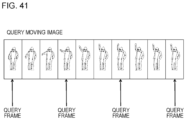
- the query frame selection unit 112 selects at least a part of the plurality of first frame images as a query frame. As illustrated in FIGS. 41 and 42 , the query frame selection unit 112 may intermittently select a query frame from a plurality of time-series first frame images included in the query moving image. The number of the first frame images between the query frames may be constant or may be varied. The query frame selection unit 112 may execute any one of the following selection processing 1 to 3, for example.
- the query frame selection unit 112 selects a query frame according to a predetermined rule.
- the query frame selection unit 112 selects a plurality of query frames from the plurality of first frame images at predetermined regular intervals. That is, the query frame selection unit 112 selects a query frame every M frames. M is, for example, 2 or more and 10 or less, but is not limited thereto. M may be determined in advance or may be selected by the user.
- the query frame selection unit 112 computes the degree of similarity between the one query frame and each of first frame images that are after the one query frame in time series.
- the degree of similarity is the same concept as in the first and second example embodiments.
- the query frame selection unit 112 selects, as a new query frame, the first frame image which has a degree of similarity equal to or smaller than the reference value and which is the earliest in time series.
- the feature value computing unit 103 computes the feature value of the detected keypoint, that is, the feature value of the detected two-dimensional skeletal structure, for each first frame image.
- the feature value computing unit 103 may set only the query frame as the target of the computing processing, or may set all the first frame images as the target of the computing processing. Since the configuration of the feature value computing unit 103 is similar to that of the first and second example embodiments, detailed description thereof will be omitted.
- the change computing unit 110 may compute time-series data indicating a time-series change in the direction of the change in the feature value.
- the time-series data is, for example, [direction in which the numerical value increases] ⁇ [direction in which the numerical value increases] ⁇ [direction in which the numerical value increases] ⁇ [no change in the numerical value] ⁇ [no change in the numerical value] ⁇ [direction in which the numerical value increases], and the like.
- the time-series data can be expressed as a numerical sequence as [111001], for example.
- the search unit 111 may search for a DB moving image in which the degree of similarity of the time-series data is equal to or greater than a reference value.
- the method of computing the degree of similarity of the time-series data is not particularly limited, and any technique can be adopted.
- the image processing apparatus 100 detects a keypoint of an object being included in each of the plurality of first frame images (S 402 ). Note that, only the query frame selected in S 401 may be the target of such processing, or all the first frame images may be the target of such processing.
- the image processing apparatus 100 computes the direction of the change in the feature value along the time axis of the plurality of time-series first frame images (S 404 ).
- the image processing apparatus 100 computes the direction of change in the feature value between adjacent query frames.
- the direction of change is divided into three, for example, [direction in which the numerical value increases], [no change in the numerical value], and [direction in which the numerical value decreases].
- the image processing apparatus 100 searches for a DB moving image by using the direction of the change in the feature value computed in S 404 as a key (S 405 ). Specifically, the image processing apparatus 100 searches for a DB moving image matching the key, from among the DB moving images being stored in the database 201 . Then, the image processing apparatus 100 outputs a search result.
- the output of the search result may be implemented by employing any technique.
- the image processing apparatus 100 according to the present example embodiment may be configured to employ one or more of the following modification examples 1 to 7.
- the image processing apparatus 100 may not necessarily include the query frame selection unit 112 .
- the change computing unit 110 may compute the direction of the change in the feature value between adjacent first frame images.
- the change computing unit 110 may compute time-series data indicating a time-series change in the direction of the change in the feature value.
- the change computing unit 110 may compute the direction of the change in the feature value occurring between such two images.
- the image processing apparatus 100 searches for a DB moving image by using the direction of the change in the feature value computed in S 303 as a key (S 304 ). Specifically, the image processing apparatus 100 searches for a DB moving image matching a key from among the DB moving images stored in the database 201 . Then, the image processing apparatus 100 outputs a search result.
- the output of the search result may be implemented by employing any technique.
- the image processing apparatus 100 detects a keypoint of a person's body, and searches for a DB moving image by using the direction of the change thereof as a key.
- the image processing apparatus 100 may detect a keypoint of an object other than a person and search for a DB moving image by using the direction of the change thereof as a key.
- the object is not particularly limited, and examples thereof include animals, plants, natural products, artifacts, and the like.
- the change computing unit 110 may compute the magnitude of the change in the feature value in addition to the direction of the change in the feature value.
- the change computing unit 110 may compute the magnitude of the change in the feature value between adjacent query frames or between adjacent first frame images.
- the magnitude of the change in the feature value can be expressed by, for example, an absolute value of a difference between numerical values indicating the feature value.
- the magnitude of the change in the feature value may be a value acquired by normalizing such absolute value.
- the change computing unit 110 may compute time-series data that further indicates a time-series change in the magnitude of the change in addition to the direction of the change in the feature value.
- the change computing unit 110 may compute the direction and magnitude of the change in the feature value occurring between such two images.
- the search unit 111 searches for a DB moving image by using the direction of change and the magnitude of change computed by the change computing unit 110 as keys.
- the search unit 111 may search for a DB moving image in which the degree of similarity of the time-series data is equal to or greater than a reference value.
- the method of computing the degree of similarity of the time-series data is not particularly limited, and any technique may be adopted.
- the search unit 111 may search for a DB moving image indicating the direction and the magnitude of the change in the feature value.
- the change computing unit 110 may compute the speed of the change in the feature value in addition to the direction of the change in the feature value.
- This modification example is effective when query frames are selected from the first frame image at discrete intervals as illustrated in FIG. 42 , and the direction of change in the feature value is computed between adjacent query frames. In such a case, by referring to the speed of the change in the feature value between adjacent query frames, it is possible to search for a DB moving image being more similar.
- the change computing unit 110 may compute the speed of change in the feature value between adjacent query frames.
- the speed may be computed by dividing the magnitude of the change in the feature value by a value (the number of frames, a value converted into time based on a frame rate, or the like) indicating the magnitude of time between adjacent query frames.
- the magnitude of the change in the feature value may be expressed by, for example, an absolute value of a difference between numerical values indicating the feature value.
- the magnitude of the change in the feature value may be a value acquired by normalizing such absolute value.
- the change computing unit 110 may compute time-series data indicating the speed of the change in addition to the direction of the change in the feature value.
- the change computing unit 110 may compute the direction and speed of the change in the feature value occurring between such two images.
- the search unit 111 searches for a DB moving by image using the direction of the change and the speed of the change computed by the change computing unit 110 as keys.
- the search unit 111 may search for a DB moving image in which the similarity of the time-series data is equal to or greater than the reference value.
- the method of computing the degree of similarity of the time-series data is not particularly limited, and any technique may be adopted.
- the search unit 111 may search for a DB moving image indicating the direction and the speed of the change in the feature value.
- a DB moving image which has the same direction of the change as that of the query moving image and has the magnitude of the change and the speed of the change that are similar to those indicated by the query moving image, has a higher degree of similarity.
- the same advantageous effect as those of the first and second example embodiments may be achieved. Further, according to the image processing apparatus 100 of the present example embodiment, it is possible to search for a moving image by using the direction of the change in the pose of the object being included in the image, the magnitude of the change, the speed of the change, and the like as keys. According to the image processing apparatus 100 of the present example embodiment, it is possible to accurately search for a moving image including a desired scene.
- a fourth example embodiment will be described with reference to the drawings.
- a plurality of queries indicating the same pose and the same action are integrated, and a search is performed by using the integrated query, thereby an image indicating the same pose and action as the pose and action indicated by the query can be accurately searched for.
- the correspondence relationship determination unit 114 determines the second frame image in which the person takes the same pose as the pose of a person indicated by each of the plurality of first frame images, and associates the second frame images with each other.
- the first frame image and the second frame image associated with each other are connected by a line.
- one first frame image may be associated with a plurality of second frame images.
- one second frame image may be associated with a plurality of first frame images.
- the integration unit 113 performs processing of integrating feature values computed from each of the first frame image and the second frame image associated with each other.
- the integration unit 113 performs such processing on a plurality of combinations of the first frame image and the second frame image associated with each other, thereby generating an integrated query in which the integrated feature values are arranged in time series.
- FIG. 53 schematically illustrates one example of an integrated query.
- the illustrated integrated query is generated based on the first query moving image and the second query moving image illustrated in FIG. 51 and the correspondence relationship illustrated in FIG. 52 .
- feature values f 1 to f p associated with [F 11 +F 21 ] are acquired by integrating feature values f 1 to f p computed from a first frame image F 11 and feature values f 1 to f p computed from a second frame image F 21 .
- feature values f 1 to f p associated with [F 11 +F 22 ] are acquired by integrating feature values f 1 to f p computed from the first frame image F 11 and feature values f 1 to f p computed from the second frame image F 22 .
- FIG. 53 feature values f 1 to f p associated with [F 11 +F 21 ] are acquired by integrating feature values f 1 to f p computed from a first frame image F 11 and feature values f 1 to f p computed from the second frame image F 22 .
- the integration unit 113 may compute, as the integrated feature values, an arithmetic average value or a weighted average value of the feature values computed from each of the first frame image and the second frame image.
- the feature value f 1 among the integrated feature values f 1 to f p associated with [F 11 +F 21 ] is an arithmetic average value or a weighted average value of the feature value f 1 computed from the first frame image F 11 and the feature value f 1 computed from the second frame image F 21 .
- an integrated query is generated based on the first query moving image and the plurality of second query moving images, similarly, a correspondence relationship is determined with each other, and an arithmetic average value or a weighted average value of feature values computed from each of the plurality of frame images associated with each other is computed, whereby an integrated query in which the integrated feature values are arranged in time series may be created.
- the search unit 111 searches for a moving image by using an integrated query in which the integrated feature values f 1 to f p are arranged in time series.
- the method of searching for a moving image is not particularly limited, and any method may be adopted.
- the search unit 111 may adopt the methods described in the first to third example embodiments, or may adopt other methods.
- the image processing apparatus 100 acquires a first query moving image having a plurality of time-series first frame images and at least one second query moving image having a plurality of time-series second frame images (S 500 ).
- the image processing apparatus 100 detects a keypoint of an object being included in each of the first frame image and the second frame image (S 501 ). Then, the image processing apparatus 100 computes the feature value of the detected keypoint (S 502 ).
- the image processing apparatus 100 determines a correspondence relationship between the plurality of first frame images and the plurality of second frame images (S 503 ). Then, the image processing apparatus 100 performs processing of integrating the feature values computed from each of the first frame image and the second frame image associated with each other with respect to a plurality of combinations of the first frame image and the second frame image associated with each other, thereby generating an integrated query in which the integrated feature values are arranged in time series (S 504 ).
- the search unit 111 may search for a moving image by using a weighting value set for each of a plurality of types of feature values.
- weighting values are set for each of the feature values f 1 to f p , and a moving image is searched for by using the weighting values.
- the search unit 111 computes the degree of similarity between the query image and the image to be searched for, for each of the plurality of types of feature values, integrates (for example, adds together) the plurality of degrees of similarity computed for each of the plurality of types of feature values, and computes the integrated degree of similarity.
- weighting values may be utilized.
- the integrated degree of similarity may be computed by adding up values acquired by multiplying each of the plurality of degrees of similarity computed for each of the plurality of types of feature values by a coefficient corresponding to the weighting value of each feature value.
- the search unit 111 may search for an image having an integrated degree of similarity equal to or greater than a threshold as an image similar to a query image.
- an upright pose is defined as a reference pose
- a time period in which a change from the upright pose is above a threshold value for example, a time period in which a hand is raised or the person has squatted
- the reference pose may be defined by a user.
- the average pose or the most frequent pose of the poses indicated by the plurality of images may be computed as the reference pose.
- the plurality of images may be images stored in a database, may be images extracted from a query moving image, or may be images specified by a user.
- the integration unit 113 integrates the feature values computed from each of the first query still image and the second query still image, and generates an integrated query.
- FIG. 57 illustrates an integrated query having a plurality of types of feature values f 1 to f p computed from the first query still image, a plurality of types of feature values f 1 to f p computed from the second query still image, and a plurality of types of feature values f 1 to f p generated by integrating such feature values.
- the integration unit 113 may compute, as the integrated feature values, an arithmetic average value or a weighted average value of the feature values computed from each of the first query still image and the second query still image.
- the feature value f 1 among the feature values f 1 to f p included in the illustrated integrated query is an arithmetic mean value or a weighted mean value of the feature value f 1 computed from the first query still image and the feature value f 1 computed from the second query still image.
Landscapes
- Engineering & Computer Science (AREA)
- Theoretical Computer Science (AREA)
- Physics & Mathematics (AREA)
- General Physics & Mathematics (AREA)
- Multimedia (AREA)
- Computer Vision & Pattern Recognition (AREA)
- Databases & Information Systems (AREA)
- Data Mining & Analysis (AREA)
- General Engineering & Computer Science (AREA)
- Mathematical Physics (AREA)
- Library & Information Science (AREA)
- Evolutionary Computation (AREA)
- Health & Medical Sciences (AREA)
- Artificial Intelligence (AREA)
- Computing Systems (AREA)
- General Health & Medical Sciences (AREA)
- Medical Informatics (AREA)
- Software Systems (AREA)
- Computational Linguistics (AREA)
- Human Computer Interaction (AREA)
- Image Analysis (AREA)
Abstract
Description
-
- Patent Document 1: Published Japanese Translation of PCT International Publication for Patent Application No. 2014-522035
- Patent Document 2: Japanese Patent Application Publication No. 2006-260405
- Patent Document 3: International Patent Publication No. WO2006/025272
- Patent Document 4: Japanese Patent Application Publication No. 2021-006956
- Patent Document 5: Japanese Patent Application Publication No. 2020-035086
-
- Non-Patent Document 1: Zhe Cao, Tomas Simon, Shih-En Wei, Yaser Sheikh, “Realtime Multi-Person 2D Pose Estimation using Part Affinity Fields”, The IEEE Conference on Computer Vision and Pattern Recognition (CVPR), 2017, pages 7291 to 7299
-
- a query acquisition unit that acquires a first query moving image having a plurality of time-series first frame images and at least one second query moving image having a plurality of time-series second frame images;
- a feature value computing unit that computes a feature value of a keypoint detected from an object being included in each of the first frame images and the second frame images;
- a correspondence relationship determination unit that determines the second frame image associated with each of a plurality of the first frame images; and
- an integration unit that performs, for a plurality of combinations of the first frame image and the second frame image associated with each other, processing of integrating the feature values computed from each of the first frame image and the second frame image, and thereby generates an integrated query in which the integrated feature values are arranged in time series.
-
- by a computer:
- a query acquisition step of acquiring a first query moving image having a plurality of time-series first frame images and at least one second query moving image having a plurality of time-series second frame images;
- a feature value computing step of computing a feature value of a keypoint detected from an object being included in each of the first frame images and the second frame images;
- a correspondence relationship determination step of determining the second frame image associated with each of a plurality of the first frame images; and
- an integration step of performing, for a plurality of combinations of the first frame image and the second frame image associated with each other, processing of integrating the feature values computed from each of the first frame image and the second frame image, and thereby generating an integrated query in which the integrated feature values are arranged in time series.
-
- a query acquisition unit that acquires a first query moving image having a plurality of time-series first frame images and at least one second query moving image having a plurality of time-series second frame images;
- a feature value computing unit that computes a feature value of a keypoint detected from an object being included in each of the first frame images and the second frame images;
- a correspondence relationship determination unit that determines the second frame image associated with each of a plurality of the first frame images; and
- an integration unit that performs, for a plurality of combinations of the first frame image and the second frame image associated with each other, processing of integrating the feature values computed from each of the first frame image and the second frame image, and thereby generates an integrated query in which the integrated feature values are arranged in time series.
-
- a query acquisition unit that acquires a first query still image and at least one second query still image;
- a feature value computing unit that computes a feature value of a keypoint detected from an object being included in each of the first query still image and the second query still image;
- an integration unit that integrates the feature values computed from each of the first query still image and the second query still image, and thereby generates an integrated query; and
- a search unit that searches for a still image by using the integrated query as a key,
- wherein the search unit searches for a still image by using a weighting value for each of the feature values being set, based on a degree of similarity between each of a plurality of types of the feature values computed from the first query still image and each of a plurality of types of the feature values computed from the second query still image.
-
- by a computer:
- a query acquisition step of acquiring a first query still image and at least one second query still image;
- a feature value computing step of computing a feature value of a keypoint detected from an object being included in each of the first query still image and the second query still image;
- an integration step of integrating the feature values computed from each of the first query still image and the second query still image, and thereby generating an integrated query; and
- a search step of searching for a still image by using the integrated query as a key,
- wherein, the search step includes searching for a still image by using a weighting value for each of the feature values being set, based on a degree of similarity between each of a plurality of types of the feature values computed from the first query still image and each of a plurality of types of the feature values computed from the second query still image.
-
- a query acquisition unit that acquires a first query still image and at least one second query still image;
- a feature value computing unit that computes a feature value of a keypoint detected from an object being included in each of the first query still image and the second query still image;
- an integration unit that integrates the feature values computed from each of the first query still image and the second query still image, and thereby generates an integrated query; and
- a search unit that searches for a still image by using the integrated query as a key,
- wherein the search unit searches for a still image by using a weighting value for each of the feature values being set, based on a degree of similarity between each of a plurality of types of the feature values computed from the first query still image and each of a plurality of types of the feature values computed from the second query still image.
[Mathematical Formula 1]
f i=(y i −y c)/h (1):
-
- The degree of similarity of a DB moving image including a frame image having a degree of similarity with the representative image equal to or larger than a reference value is increased.
- When there are a plurality of representative images, the degree of similarity of a DB moving image including a frame image similar to more of the representative images (the degree of similarity is equal to or greater than the reference value) is increased.
- When there are a plurality of representative images, the degree of similarity of a DB moving image is increased as the time-series order of the plurality of representative images and the time-series order of the frame images similar to each of the plurality of representative images become similar.
-
- 1. An image processing apparatus including:
- a query acquisition unit that acquires a first query moving image having a plurality of time-series first frame images and at least one second query moving image having a plurality of time-series second frame images;
- a feature value computing unit that computes a feature value of a keypoint detected from an object being included in each of the first frame images and the second frame images;
- a correspondence relationship determination unit that determines the second frame image associated with each of a plurality of the first frame images; and
- an integration unit that performs processing of integrating the feature values computed from each of the first frame image and the second frame image associated with each other on a plurality of combinations of the first frame image and the second frame image associated with each other, and thereby generates an integrated query in which the integrated feature values are arranged in time series.
- 2. The image processing apparatus according to
supplementary note 1, wherein the integration unit computes, as the integrated feature value, an arithmetic average value or a weighted average value of the feature values computed from each of the first frame image and the second frame image. - 3. The image processing apparatus according to
supplementary note - 4. The image processing apparatus according to
supplementary note 3, wherein the search unit searches for the moving image by using a weighting value being set for each of a plurality of types of the feature values. - 5. The image processing apparatus according to
supplementary note 4, wherein the weighting value for each of the feature values is set based on a degree of similarity of each of a plurality of types of the feature values computed from each of the first frame image and the second frame image associated with each other. - 6. The image processing apparatus according to any one of
supplementary notes 3 to 5, wherein- the search unit searches for a moving image by using a part of the integrated query as a key, the part being generated based on the first frame image and the second frame image included in a time period in which a change in the feature value equal to or larger than a threshold value occurs commonly in both the first query moving image and the second query moving image.
- 7. An image processing method causing a computer to execute:
- a query acquisition step of acquiring a first query moving image having a plurality of time-series first frame images and at least one second query moving image having a plurality of time-series second frame images;
- a feature value computing step of computing a feature value of a keypoint detected from an object being included in each of the first frame images and the second frame images;
- a correspondence relationship determination step of determining the second frame image associated with each of a plurality of the first frame images; and
- an integration step of performing processing of integrating the feature values computed from each of the first frame image and the second frame image associated with each other on a plurality of combinations of the first frame image and the second frame image associated with each other, and thereby generating an integrated query in which the integrated feature values are arranged in time series.
- 8. A program causing a computer to function as:
- a query acquisition unit that acquires a first query moving image having a plurality of time-series first frame images and at least one second query moving image having a plurality of time-series second frame images;
- a feature value computing unit that computes a feature value of a keypoint detected from an object being included in each of the first frame images and the second frame images;
- a correspondence relationship determination unit that determines the second frame image associated with each of a plurality of the first frame images; and
- an integration unit that performs processing of integrating the feature values computed from each of the first frame image and the second frame image associated with each other on a plurality of combinations of the first frame image and the second frame image associated with each other, and thereby generates an integrated query in which the integrated feature values are arranged in time series.
- 9. An image processing apparatus including:
- a query acquisition unit that acquires a first query still image and at least one second query still image;
- a feature value computing unit that computes a feature value of a keypoint detected from an object being included in the first query still image and the second query still image;
- an integration unit that integrates the feature values computed from each of the first query still image and the second query still image, and thereby generates an integrated query; and
- a search unit that searches for a still image by using the integrated query as a key,
- wherein the search unit searches for a still image by using a weighting value for each of the feature values being set, based on a degree of similarity between each of a plurality of types of the feature values computed from the first query still image and each of a plurality of types of the feature values computed from the second query still image.
- 10. An image processing method causing a computer to execute:
- a query acquisition step of acquiring a first query still image and at least one second query still image;
- a feature value computing step of computing a feature value of a keypoint detected from an object being included in the first query still image and the second query still image;
- an integration step of integrating the feature values computed from each of the first query still image and the second query still image, and thereby generating an integrated query; and
- a search step of searching for a still image by using the integrated query as a key,
- wherein the search step includes searching for a still image by using a weighting value for each of the feature values being set, based on a degree of similarity between each of a plurality of types of the feature values computed from the first query still image and each of a plurality of types of the feature values computed from the second query still image.
- 11. A program causing a computer to function as:
- a query acquisition unit that acquires a first query still image and at least one second query still image;
- a feature value computing unit that computes a feature value of a keypoint detected from an object being included in the first query still image and the second query still image;
- an integration unit that integrates the feature values computed from each of the first query still image and the second query still image, and thereby generates an integrated query; and
- a search unit that searches for a still image by using the integrated query as a key,
- wherein the search unit searches for a still image by using a weighting value for each of the feature values being set, based on a degree of similarity between each of a plurality of types of the feature values computed from the first query still image and each of a plurality of types of the feature values computed from the second query still image.
- 1. An image processing apparatus including:
-
- 1 Image processing system
- 10 Image processing apparatus
- 11 Skeleton detection unit
- 12 Feature value computing unit
- 13 Recognition unit
- 100 Image processing apparatus
- 101 Image acquisition unit
- 102 Skeletal structure detection unit
- 103 Feature value computing unit
- 104 Classification unit
- 105 Search unit
- 106 Input unit
- 107 Display unit
- 108 Height computing unit
- 109 Query acquisition unit
- 110 Change computing unit
- 111 Search unit
- 112 Query frame selection unit
- 113 Integration unit
- 114 Correspondence relationship determination unit
- 200 Camera
- 201 Database
- 300, 301 Human body model
- 401 Two-dimensional skeletal structure
Claims (7)
Applications Claiming Priority (1)
| Application Number | Priority Date | Filing Date | Title |
|---|---|---|---|
| PCT/JP2021/019993 WO2022249331A1 (en) | 2021-05-26 | 2021-05-26 | Image processing device, image processing method, and program |
Related Parent Applications (1)
| Application Number | Title | Priority Date | Filing Date |
|---|---|---|---|
| PCT/JP2021/019993 A-371-Of-International WO2022249331A1 (en) | 2021-05-26 | 2021-05-26 | Image processing device, image processing method, and program |
Related Child Applications (1)
| Application Number | Title | Priority Date | Filing Date |
|---|---|---|---|
| US18/780,753 Division US20250005073A1 (en) | 2021-05-26 | 2024-07-23 | Image processing apparatus, and image processing method |
Publications (2)
| Publication Number | Publication Date |
|---|---|
| US20240126806A1 US20240126806A1 (en) | 2024-04-18 |
| US12277165B2 true US12277165B2 (en) | 2025-04-15 |
Family
ID=84228654
Family Applications (2)
| Application Number | Title | Priority Date | Filing Date |
|---|---|---|---|
| US18/275,765 Active US12277165B2 (en) | 2021-05-26 | 2021-05-26 | Image processing apparatus, and image processing method |
| US18/780,753 Pending US20250005073A1 (en) | 2021-05-26 | 2024-07-23 | Image processing apparatus, and image processing method |
Family Applications After (1)
| Application Number | Title | Priority Date | Filing Date |
|---|---|---|---|
| US18/780,753 Pending US20250005073A1 (en) | 2021-05-26 | 2024-07-23 | Image processing apparatus, and image processing method |
Country Status (3)
| Country | Link |
|---|---|
| US (2) | US12277165B2 (en) |
| JP (1) | JP7632608B2 (en) |
| WO (1) | WO2022249331A1 (en) |
Families Citing this family (1)
| Publication number | Priority date | Publication date | Assignee | Title |
|---|---|---|---|---|
| JP2024006695A (en) * | 2022-07-04 | 2024-01-17 | 富士通株式会社 | Verification program, verification method, and information processing device |
Citations (13)
| Publication number | Priority date | Publication date | Assignee | Title |
|---|---|---|---|---|
| WO2006025272A1 (en) | 2004-09-01 | 2006-03-09 | Nec Corporation | Video classification device, video classification program, video search device, and videos search program |
| JP2006260405A (en) | 2005-03-18 | 2006-09-28 | Ricoh Co Ltd | Image information update system, image input device, image processing device, image update device, image information update method, image information update program, and recording medium on which the program is recorded |
| US20090304267A1 (en) * | 2008-03-05 | 2009-12-10 | John Tapley | Identification of items depicted in images |
| JP2014522035A (en) | 2011-07-27 | 2014-08-28 | サムスン エレクトロニクス カンパニー リミテッド | Object posture search apparatus and method |
| US20160284098A1 (en) * | 2015-03-23 | 2016-09-29 | Kabushiki Kaisha Toshiba | Image processing device, image processing method, computer program product, and image processing system |
| US20170337271A1 (en) * | 2016-05-17 | 2017-11-23 | Intel Corporation | Visual search and retrieval using semantic information |
| US20180246910A1 (en) * | 2017-02-28 | 2018-08-30 | Ent. Services Development Corporation Lp | Image based target analysis |
| US20190005069A1 (en) * | 2017-06-28 | 2019-01-03 | Google Inc. | Image Retrieval with Deep Local Feature Descriptors and Attention-Based Keypoint Descriptors |
| JP2020035086A (en) | 2018-08-28 | 2020-03-05 | 富士ゼロックス株式会社 | Information processing system, information processing apparatus and program |
| US20200242402A1 (en) * | 2017-08-08 | 2020-07-30 | Samsung Electronics Co., Ltd. | Method and apparatus for recognizing object |
| JP2020135747A (en) | 2019-02-25 | 2020-08-31 | 株式会社日立ソリューションズ | Action analysis device and action analysis method |
| CN109308438B (en) | 2017-07-28 | 2020-11-27 | 上海形趣信息科技有限公司 | Method for establishing action recognition library, electronic equipment and storage medium |
| JP2021006956A (en) | 2019-06-28 | 2021-01-21 | 日本電信電話株式会社 | Search device, search method, and search program |
-
2021
- 2021-05-26 WO PCT/JP2021/019993 patent/WO2022249331A1/en not_active Ceased
- 2021-05-26 US US18/275,765 patent/US12277165B2/en active Active
- 2021-05-26 JP JP2023523804A patent/JP7632608B2/en active Active
-
2024
- 2024-07-23 US US18/780,753 patent/US20250005073A1/en active Pending
Patent Citations (14)
| Publication number | Priority date | Publication date | Assignee | Title |
|---|---|---|---|---|
| WO2006025272A1 (en) | 2004-09-01 | 2006-03-09 | Nec Corporation | Video classification device, video classification program, video search device, and videos search program |
| JP2006260405A (en) | 2005-03-18 | 2006-09-28 | Ricoh Co Ltd | Image information update system, image input device, image processing device, image update device, image information update method, image information update program, and recording medium on which the program is recorded |
| US20090304267A1 (en) * | 2008-03-05 | 2009-12-10 | John Tapley | Identification of items depicted in images |
| JP2014522035A (en) | 2011-07-27 | 2014-08-28 | サムスン エレクトロニクス カンパニー リミテッド | Object posture search apparatus and method |
| US20160284098A1 (en) * | 2015-03-23 | 2016-09-29 | Kabushiki Kaisha Toshiba | Image processing device, image processing method, computer program product, and image processing system |
| JP2016181743A (en) | 2015-03-23 | 2016-10-13 | 株式会社東芝 | Image processing apparatus, image processing method, image processing program, and image processing system |
| US20170337271A1 (en) * | 2016-05-17 | 2017-11-23 | Intel Corporation | Visual search and retrieval using semantic information |
| US20180246910A1 (en) * | 2017-02-28 | 2018-08-30 | Ent. Services Development Corporation Lp | Image based target analysis |
| US20190005069A1 (en) * | 2017-06-28 | 2019-01-03 | Google Inc. | Image Retrieval with Deep Local Feature Descriptors and Attention-Based Keypoint Descriptors |
| CN109308438B (en) | 2017-07-28 | 2020-11-27 | 上海形趣信息科技有限公司 | Method for establishing action recognition library, electronic equipment and storage medium |
| US20200242402A1 (en) * | 2017-08-08 | 2020-07-30 | Samsung Electronics Co., Ltd. | Method and apparatus for recognizing object |
| JP2020035086A (en) | 2018-08-28 | 2020-03-05 | 富士ゼロックス株式会社 | Information processing system, information processing apparatus and program |
| JP2020135747A (en) | 2019-02-25 | 2020-08-31 | 株式会社日立ソリューションズ | Action analysis device and action analysis method |
| JP2021006956A (en) | 2019-06-28 | 2021-01-21 | 日本電信電話株式会社 | Search device, search method, and search program |
Non-Patent Citations (3)
| Title |
|---|
| International Search Report for PCT Application No. PCT/JP2021/019993, mailed on Aug. 24, 2021. |
| JP Office Communication for JP Application No. 2023-523804, mailed on Jan. 7, 2025 with English Translation. |
| Zhe Cao, Tomas Simon, Shih-En Wei, Yaser Sheikh, "Realtime Multi-Person 2D Pose Estimation using Part Affinity Fields", The IEEE Conference on Computer Vision and Pattern Recognition (CVPR), 2017, p. 7291-7299. |
Also Published As
| Publication number | Publication date |
|---|---|
| US20240126806A1 (en) | 2024-04-18 |
| US20250005073A1 (en) | 2025-01-02 |
| JPWO2022249331A1 (en) | 2022-12-01 |
| JP7632608B2 (en) | 2025-02-19 |
| WO2022249331A1 (en) | 2022-12-01 |
Similar Documents
| Publication | Publication Date | Title |
|---|---|---|
| US20250232606A1 (en) | Image processing apparatus, image processing method, and non-transitory computer readable medium storing image processing program | |
| US12182197B2 (en) | Image processing apparatus, image processing method, and non-transitory storage medium | |
| US20240394301A1 (en) | Image selection apparatus, image selection method, and non-transitory computer-readable medium | |
| US20250005073A1 (en) | Image processing apparatus, and image processing method | |
| US20240119087A1 (en) | Image processing apparatus, image processing method, and non-transitory storage medium | |
| US12530795B2 (en) | Image selection apparatus, image selection method, and non-transitory computer-readable medium | |
| US12481696B2 (en) | Image selection apparatus, image selection method, and non-transitory computer-readable medium | |
| US12579674B2 (en) | Image selection apparatus, image selection method, and non-transitory computer-readable medium | |
| JP7658380B2 (en) | IMAGE SELECTION DEVICE, IMAGE SELECTION METHOD, AND PROGRAM | |
| JP7589744B2 (en) | IMAGE SELECTION DEVICE, IMAGE SELECTION METHOD, AND PROGRAM | |
| US20230244713A1 (en) | Image processing apparatus, image processing method, and non-transitory storage medium | |
| US12411889B2 (en) | Image selection apparatus, image selection method, and non-transitory computer-readable medium | |
| US20250157077A1 (en) | Image processing system, image processing method, and non-transitory computer-readable medium | |
| JP7375921B2 (en) | Image classification device, image classification method, and program | |
| US20250029363A1 (en) | Image processing system, image processing method, and non-transitory computer-readable medium | |
| US12573177B2 (en) | Image processing apparatus, image processing method, and non-transitory storage medium | |
| JP7302741B2 (en) | Image selection device, image selection method, and program | |
| JPWO2022249331A5 (en) |
Legal Events
| Date | Code | Title | Description |
|---|---|---|---|
| AS | Assignment |
Owner name: NEC CORPORATION, JAPAN Free format text: ASSIGNMENT OF ASSIGNORS INTEREST;ASSIGNORS:YOSHIDA, NOBORU;LIU, JIANQUAN;REEL/FRAME:064487/0336 Effective date: 20230720 |
|
| FEPP | Fee payment procedure |
Free format text: ENTITY STATUS SET TO UNDISCOUNTED (ORIGINAL EVENT CODE: BIG.); ENTITY STATUS OF PATENT OWNER: LARGE ENTITY |
|
| STPP | Information on status: patent application and granting procedure in general |
Free format text: DOCKETED NEW CASE - READY FOR EXAMINATION |
|
| STPP | Information on status: patent application and granting procedure in general |
Free format text: NON FINAL ACTION MAILED |
|
| STPP | Information on status: patent application and granting procedure in general |
Free format text: RESPONSE TO NON-FINAL OFFICE ACTION ENTERED AND FORWARDED TO EXAMINER |
|
| STPP | Information on status: patent application and granting procedure in general |
Free format text: NON FINAL ACTION MAILED |
|
| STPP | Information on status: patent application and granting procedure in general |
Free format text: RESPONSE TO NON-FINAL OFFICE ACTION ENTERED AND FORWARDED TO EXAMINER |
|
| STPP | Information on status: patent application and granting procedure in general |
Free format text: NOTICE OF ALLOWANCE MAILED -- APPLICATION RECEIVED IN OFFICE OF PUBLICATIONS |
|
| STPP | Information on status: patent application and granting procedure in general |
Free format text: AWAITING TC RESP., ISSUE FEE NOT PAID |
|
| STPP | Information on status: patent application and granting procedure in general |
Free format text: NOTICE OF ALLOWANCE MAILED -- APPLICATION RECEIVED IN OFFICE OF PUBLICATIONS |
|
| STPP | Information on status: patent application and granting procedure in general |
Free format text: PUBLICATIONS -- ISSUE FEE PAYMENT VERIFIED |
|
| STCF | Information on status: patent grant |
Free format text: PATENTED CASE |