US12276896B2 - Tunable orbital angular momentum system - Google Patents
Tunable orbital angular momentum system Download PDFInfo
- Publication number
- US12276896B2 US12276896B2 US17/838,632 US202217838632A US12276896B2 US 12276896 B2 US12276896 B2 US 12276896B2 US 202217838632 A US202217838632 A US 202217838632A US 12276896 B2 US12276896 B2 US 12276896B2
- Authority
- US
- United States
- Prior art keywords
- output
- receive
- acousto
- deflection
- log
- Prior art date
- Legal status (The legal status is an assumption and is not a legal conclusion. Google has not performed a legal analysis and makes no representation as to the accuracy of the status listed.)
- Active
Links
Images




Classifications
-
- G—PHYSICS
- G02—OPTICS
- G02F—OPTICAL DEVICES OR ARRANGEMENTS FOR THE CONTROL OF LIGHT BY MODIFICATION OF THE OPTICAL PROPERTIES OF THE MEDIA OF THE ELEMENTS INVOLVED THEREIN; NON-LINEAR OPTICS; FREQUENCY-CHANGING OF LIGHT; OPTICAL LOGIC ELEMENTS; OPTICAL ANALOGUE/DIGITAL CONVERTERS
- G02F1/00—Devices or arrangements for the control of the intensity, colour, phase, polarisation or direction of light arriving from an independent light source, e.g. switching, gating or modulating; Non-linear optics
- G02F1/29—Devices or arrangements for the control of the intensity, colour, phase, polarisation or direction of light arriving from an independent light source, e.g. switching, gating or modulating; Non-linear optics for the control of the position or the direction of light beams, i.e. deflection
- G02F1/33—Acousto-optical deflection devices
-
- H—ELECTRICITY
- H04—ELECTRIC COMMUNICATION TECHNIQUE
- H04B—TRANSMISSION
- H04B10/00—Transmission systems employing electromagnetic waves other than radio-waves, e.g. infrared, visible or ultraviolet light, or employing corpuscular radiation, e.g. quantum communication
- H04B10/27—Arrangements for networking
-
- H—ELECTRICITY
- H04—ELECTRIC COMMUNICATION TECHNIQUE
- H04B—TRANSMISSION
- H04B10/00—Transmission systems employing electromagnetic waves other than radio-waves, e.g. infrared, visible or ultraviolet light, or employing corpuscular radiation, e.g. quantum communication
- H04B10/50—Transmitters
- H04B10/516—Details of coding or modulation
-
- H—ELECTRICITY
- H04—ELECTRIC COMMUNICATION TECHNIQUE
- H04B—TRANSMISSION
- H04B10/00—Transmission systems employing electromagnetic waves other than radio-waves, e.g. infrared, visible or ultraviolet light, or employing corpuscular radiation, e.g. quantum communication
- H04B10/70—Photonic quantum communication
Definitions
- This tunable orbital angular momentum system can generate optical beams using an AOD that can wrap elliptically-shaped Gaussian beams with linear phase tilt to provide a ring.
- the system can be used with an optical source that can be continuous wave and/or pulsed.
- the optical source can be encoded with information in terms of a time signal and can be composed of a single wavelength or multiple wavelengths.
- the system can transmit single or multiple coherent beams with different OAM topological charge numbers.
- This system can include the use of an AOD in conjunction with log-polar transformation optics and provides for fast and continuous tuning of the orbital angular momentum (OAM) topological charge number of the output beams.
- the system generates beams with integer and fractional topological charge numbers.
- This system can include an acousto-optic deflector to add a linear phase ramp to an optical beam that can be wrapped into an azimuthal phase.
- the AOD in conjunction with the log-polar optics assembly results in a system that can be used at high power, with fast and continuous OAM mode tuning.
- the AOD can support a superposition of acoustic signals, producing multiple output beams with different OAM charge numbers. The different OAM modes leaving the system will then coherently interfere.
- the log-polar optics assembly can be disposed along the optical axis and adapted to receive the second output beam and adapted to transform the second output beam into a third output beam having an asymmetric annular-distribution to provide a fourth output linear phase wrapped into an asymmetric ring with azimuthal orbital angular momentum phase wherein the fourth output includes multiple modes.
- the multiple modes can be provided by applying a superposition of multiple RF frequencies.
- the multiple modes can include factional modes.
- This system can alco include a log-polar optics assembly adapted to receive an input beam having an orbital angular momentum and provide a first output beam; an acousto-optic deflector adapted to receive the first output beam and scan through a frequency range and detect charge numbers associated with the input beam; and, a fiber coupled detector adapted for receiving the first output beam and determining the orbital angular momentum modes.
- the system can include a first telescope adapted to receive the input beam prior to the input beam being received by the log-polar optics assembly and a second telescope adapted to receive an output beam from the log-polar optics assembly and project the output beam to the acousto-optic deflector.
- FIG. 1 is a schematic of aspects of the system
- FIG. 4 is an illustration of aspects and results of the system
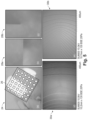
- FIG. 6 shows illustrations of aspects and results of the system
- FIG. 7 shows illustrations of aspects and results of the system
- FIG. 8 shows illustrations of aspects and results of the system
- FIG. 10 is an illustration of aspects and results of the system
- FIG. 11 A is an illustration of aspects and results of the system
- FIG. 11 B is an illustration of aspects and results of the system
- FIG. 12 A is an illustration of aspects and results of the system
- FIG. 13 is an illustration of aspects and results of the system
- FIGS. 14 A and 14 B are illustrations of aspects and results of the system.
- FIGS. 15 A and 15 B are illustrations of aspects and results of the system
- this invention has the capability of switching or hopping between OAM modes can significantly increase data transmissions rates.
- Such technical improvements in computer functionality can provide for the increased efficiency in computer system and information system as a whole.
- switching between different OAM modes can provide for different propagation performances through turbulence environment thereby improving transition rates.
- the fast switching between OAM modes can provide for the ability to investigate a wide range of OAM modes.
- sensing applications can benefit from rapidly tunable OAM that includes beam steering through a scattering media, particle manipulation using three dimensional beams, object rotation detection, temperature sensing, and motion detection. Therefore, transmission of data can be improved and customized to the environment dynamically.
- an optical configuration 10 used to generate OAM modes is shown.
- an input beam 12 Gaussian or otherwise, is passed through an acousto-optic deflector (“AOD”) 14 .
- AOD acousto-optic deflector
- the 1 st order deflection of the Gaussian input is at the Bragg condition with the Gaussian beam propagating along the optical axis.
- the Gaussian beam can have a flat wavefront and the designed system will generate an OAM mode of charge equal to zero, 16 a .
- the 1 st order deflected beam exiting the AOD is a Gaussian distribution, which can be expressed as
- the far-field of the ring-shaped beam in Eq. (9) is the combination of a group of Bessel-Gaussian (BG) beams carrying OAM. It can be a weighted linear combination of integer OAM phase carrying nth-order Bessel function of the 1 st kind modulated by the same Gaussian envelope.
- the parameter B n is the weighting or selection factor, which distributes the power within the central 2 to 3 modes and decays rapidly as in approaches positive and negative infinity.
- fractional-charged OAM-carrying BG beams are a linear combination of integer BG beams.
- the standing wave terms sin ⁇ m ⁇ m FB m+1 J m (2 ⁇ 0 r/ ⁇ m F)/ ⁇ 0 r and cos ⁇ B m+1 [J m+1 (2 ⁇ 0 r/ ⁇ m F) ⁇ J m ⁇ 1 (2 ⁇ 0 r/ ⁇ m F)] contribute to the asymmetric intensity of this group of BG beams.
- the rest of the B n factors are really small in comparison with the central term and contribute minimally to the BG beam, but still in the form of standing waves.
- Amplitude is shown as 34 with phase shown as 36 .
- the log-polar coordinate transform theory assumes that the input is a rectangular shaped beam. This input results in a reduced translation efficiency due to the fact that a Fourier transform of a rectangular function contains high spatial frequency components. Further, a Gaussian shape produces a Gaussian distribution. In the present system, however, an elliptical Gaussian beam can be generated from a Gaussian input resulting in a higher power efficiency compared to that of a rectangular beam input traditionally used.
- the AOD that can couple up to 70% of the optical energy into its 1 st diffraction order.
- This deflection angle is continuously tunable by adjusting the frequency of the acoustic signal.
- the system can apply a 4-f system to image the AOD output deflection angle into the line shape beam's linear phase and another 4-f system to elongate the circular Gaussian beam into an elliptical Gaussian beam.
- the elliptical Gaussian beam can be incident upon the wrapper and then can be mapped into an azimuthally asymmetric ring shaped beam during propagation to the phase corrector. After phase correction at the second optical element, the ring-shaped beam carrying OAM phase will form a BG beam in the far-field.
- One configuration is shown in FIG. 6 .
- the AOD 14 is shown receiving incident light which is then transmitted to a line generator, such as the 4-f line generator 15 a in this configuration and on to the log-polar optics 20 .
- the deflected beam can be generated using a Gooch & Housego AODF 4120-3.
- This AOD is constructed using a tellurium dioxide (TeO 2 ) crystal, with a Bragg angle of 2.9°, computed by Eq. (1).
- the input 36 having two deflections, passes through the line generator 18 and log polar optics 20 to produce an output beam 38 .
- a series of rings with different OAM phases are output from the log-polar optics assembly.
- the far-field of this group of ring shape OAM phase carrying beams are BG beams.
- the generated BG beams are shown in FIG. 6 .
- FIG. 7 a comparison of the radius of the dark vortex to the corresponding charge numbers as well as driving signal frequencies is shown for both the experimental and simulated beam profiles. This radius was measured by finding the inner radial location of the half-maximum amplitude.
- the simulated and experiment results of BG beams central dark area's radius vary with charge number as well as AOD driving signal's frequency.
- the deflection angle of the 1 st order AOD output is continuously tunable as well as the OAM phase.
- a sample of fractional OAM modes spanning from charge ⁇ 1.2 to +1.2 in steps of 0.6 is shown in FIG. 8 .
- generated fractional OAM BG beams as shown as (a) charge ⁇ 1.2, (b) charge ⁇ 0.6, (c) charge 0, (d) charge 0.6, and (e) charge 1.2.
- This system and method provide for cascading an AOD with log-polar optics assembly providing for transformation of an optical system to rapidly and continuously tune the output OAM mode of a BG beam.
- This system has the capability of generating tunable fractional OAM modes.
- the OAM mode can be controlled through the AOD driving frequency, which can control the amount of linear tilt to be wrapped into a ring through the log-polar transformation.
- charge number scans can be defined by an arbitrary waveform across the acousto-optic deflector.
- the acousto-optic deflector can also be high efficiency and can be configured to withstand high powers with modulation rates 20 ⁇ over LC spatial light modulators.
- the scalar form of the far-field system described herein has results in a group of asymmetric fractional BG beams. This system provides for a fast and continuous OAM carrying BG beam tuning solution.
- the charge number can be related to the fiber input port on the input plane. Further, OAMs can be created from any two input port locations. The charge number can be fixed by fiber spacing on the input array and focal length of the lends in the present design.
- the system herein also provides for a linear phase tilt (which can be the same as shifting the point source above and below the optic axis). A phase tilt can be introduced at the input plane to the system.
- FIG. 11 A shows a single charge number continuous scanning +5 to ⁇ 5.
- FIG. 11 B shows a coherent combination of conjugate pairs continuous scanning +/ ⁇ 5 to 0.
- This system can be a receiver as well as a transmitter. This system can also be used in reverse so that the system provides for a sensor to detect beams with OAM. Instead of generating specific OAM modes corresponding to the RF driving frequency, the AOD can scan through the frequency range to detect the OAM charge number of incoming beams.
- the input beam can enter a first telescope and be directed into the log polar optics. The beam can enter into a second telescope and be directed into the AOD. A fiber detector can then receive the beam.
- the acousto-optic deflector can include crystals that can be used as Q-switch modulators in solid state lasers. Since these are used intracavity, they have a large optical power handling capacity and have typical damage thresholds on the order of MW/cm 2 .
- the switching speed of the present system can be determined by the acoustic wave velocity in the AOD and the input beam size. The switching speed of the current system has been demonstrated to be on the order of 400 kHz, which is much faster than traditional DMD/SLM systems.
- the AOD can be driven with a single frequency or multiple frequencies. Multiple frequencies that generate charges +m and ⁇ m can be applied to the AOD simultaneously to create coherently combined OAM modes.
- the deflection of both charge +m and ⁇ m can be 1 st order deflections with slightly different deflection angles.
- Information can be encoded onto both the amplitude and relative phase of the coherently coupled OAM modes and mapped to a three-dimensional constellation space.
- the 3D quadrature amplitude modulation (QAM) constellation can be based on a higher-order Poincare sphere equivalent for OAM states.
- Two different modulation schemes can be applied to the acoustic cell to control the output beam.
- a 16-PSK signal and a 512-QAM signal with the modulation rate of 200 kHz are shown in FIGS. 12 A and 12 B .
- This system can have advantages directed to improving the spectral efficiency of a communications link.
- This system can improve upon and advantage to encoding schemes and multiplexing techniques in both free-space and optical fiber-based communication links.
- Optical beams can be used as a data carrier for both free-space and underwater communications.
- the laser source is a ThorLabs LP450-SF15 single-mode fiber-pigtailed diode placed in a ThorLabs LDM9LP pigtailed driver mount.
- the output is then polarized vertically and resized to approximately 3 mm in diameter where it is passed through the AOD.
- the output of the AOD is then shaped into a line approximately 3 mm by 0.3 mm using a soft aperture.
- the line is then passed through the log-polar optical transformation system after which a 400 mm lens is used to image the far field beam profile onto a Spiricon SP300 CCD camera with an integration time of 10 ms and a frame rate of 30 Hz.
- This rotation far exceeds the framerate of the CCD array and therefore the average image is collected and appears as a ring.
- a 20 ns Gaussian pulse was applied to the diode at a repetition rate of 3 MHz which can be greater than the switching speed of the AOD; limited by the velocity of the acoustic wave and the beam diameter.
- the voltage signal applied to the AOD can have the same repetition rate.
- the CCD array can integrate with approximately 30,000 pulses per frame, timed so that the pulse is synced with the signal applied to the AOD.
- This pulse can be coupled with a DC bias current using a bias-tee located inside a laser diode mount.
- the DC bias applied to the laser diode can be set to about 30 mA and/or a level just above the threshold.
- the output pulse incident on the CCD array can have a peak power of 17 mW.
- the relative phase between the two signals ⁇ can be adjusted to rotate the interference fringes.
- the apparent rotation angle is proportional to this difference as can be seen.
- the FWHM of the pulse is approximately 12% of the rotation rate for the first case and approximately 26% for the second. This difference is due to the required frequencies listed above, causing a faster rotation rate for the larger beams. This indicates that there will still be some blurring of the beam over the pulse which could impact sensing systems.
Landscapes
- Physics & Mathematics (AREA)
- Nonlinear Science (AREA)
- Engineering & Computer Science (AREA)
- Electromagnetism (AREA)
- Computer Networks & Wireless Communication (AREA)
- Signal Processing (AREA)
- General Physics & Mathematics (AREA)
- Optics & Photonics (AREA)
- Computing Systems (AREA)
- Optical Modulation, Optical Deflection, Nonlinear Optics, Optical Demodulation, Optical Logic Elements (AREA)
Abstract
Description
where λ0 is the electromagnetic wave Doppler shifted wavelengths corresponding to the
where λm is the electromagnetic wave Doppler shifted wavelengths corresponding to the OAM charge m. Since these wavelengths are extremely close with each other, differing by femtometers for a 532 nm input signal, we can assume λm≈λ0. The angle deviation after the line generator, Δθ′m, will be scaled by the magnification of the 1st 4-f system according to
where F1 and F2 are the focal lengths of the lenses L1 and FL1, respectively, in
where α is the log-polar optics design parameter that scales the transformed line length in the unwrapping procedure. Combining Eq. (2)-(4) results in an expression for charge in as a function of the frequency change from the Bragg condition given by
where u and v are both Cartesian coordinates, fc is the input laser's central frequency, k2=2π cos(Δθm)/λm and ku=2π sin(Δθm)/λm≈2πΔθm/λm are the wavenumbers along the z and u direction, and finally (fc+fm) and λm are the electromagnetic wave Doppler shifted frequency and wavelength corresponding to the OAM charge m. After passing through the AOD 14 (
where the wavenumber along z direction is k′z=2π cos (Δθm′)/λm=2π cos(ΔθmF1/F2)/λm, and the wavenumber along u direction is ku′=2πΔθm′/λm=m/a.
where ρ and ϕ are both the radial and azimuthal polar coordinates in the near-field plane, ρ0=b exp(−v0/a) is the wrapped ring's radius defined from the origin to peak intensity location, wring=ρ0 sin h(wv/a) is the wrapped ring's half width v0, is the input elliptical Gaussian beam's offset from the center of the wrapper, wv=w0F3/F2 is the half width of the input elliptical Gaussian beam, a is the log-polar optics design parameter which scales the transformed line length in unwrapping procedure, b is another log-polar optics design parameter which scales the transformed ring size in the wrapping procedure, and β=w0F2/(πaF1) is the ratio of input elliptical Gaussian line's length to the designed input line length 2πa. The Fourier transform of Eq. (8) can then be derived as
where r and θ are the radial and azimuthal polar coordinates in the far field plane, A=wring 2βπ5/2 ρ0/(2λ0F), wG=λmF/(πwring), F is the focal length of the Fourier lens, Bn=(−i)n-12 exp[−β2π2(1+α−n)2/4] Im[erfi(i/β+βπ(1+α−n)/2)], erfi(x)=erf(ix)/i is the imaginary error function, and finally Im(z) gives the imaginary part of complex number z. The far-field of the ring-shaped beam in Eq. (9) is the combination of a group of Bessel-Gaussian (BG) beams carrying OAM. It can be a weighted linear combination of integer OAM phase carrying nth-order Bessel function of the 1st kind modulated by the same Gaussian envelope. The parameter Bn is the weighting or selection factor, which distributes the power within the central 2 to 3 modes and decays rapidly as in approaches positive and negative infinity. When α=0, then m=l, meaning an integer charge will be select as n=l, and Bl is the maximum value. As a increases, the central weighting factor Bn's maximum value will move from n=l to n=l+1. This means fractional-charged OAM-carrying BG beams are a linear combination of integer BG beams. Considering the α=0 case, the Bn parameter has the property of
B m−k=(−1)k B m+k ,k=0,1,2, . . . (10)
This indicates that these beams are comprised of only one integer OAM phase exp(imθ), and the Bessel term of BmJm(2πp0r/λmF) dominates, since Bm is the maximum of Bn. The standing wave terms sin θ·mλmFBm+1Jm(2πρ0r/λm F)/πρ0r and cos θ·Bm+1[Jm+1(2πρ0r/λmF)−Jm−1(2πρ0r/λmF)] contribute to the asymmetric intensity of this group of BG beams. In fact, the rest of the Bn factors are really small in comparison with the central term and contribute minimally to the BG beam, but still in the form of standing waves.
As shown in Eq. (15), there are two Fourier transforms that can be solved. Starting with the definition of the polar coordinate Fourier transform,
the term

Eq. 17 can be expanded into
which allows for Eq. 17 to be rewritten as
The azimuthal integral can be solved by
The far field light distribution in Eq. (15) reduces to the final analytic terms as given by Eq. (9), in which the Bn term is the weighting term and shifts power between different Bessel terms. Considering the α=0 case, given n=m+k=l+k, k=0, 1, 2 . . .
When using the case where n=m−k=l−k,
Since the imaginary error function is an odd function, we have
Claims (22)
Priority Applications (3)
| Application Number | Priority Date | Filing Date | Title |
|---|---|---|---|
| US17/838,632 US12276896B2 (en) | 2018-12-21 | 2022-06-13 | Tunable orbital angular momentum system |
| US18/318,345 US20260072327A1 (en) | 2018-12-21 | 2023-05-16 | Orbital angular momentum generation |
| US18/882,287 US20250164851A1 (en) | 2018-12-21 | 2024-09-11 | Tunable orbital angular momentum system |
Applications Claiming Priority (3)
| Application Number | Priority Date | Filing Date | Title |
|---|---|---|---|
| US201862784202P | 2018-12-21 | 2018-12-21 | |
| US16/725,293 US11402722B2 (en) | 2018-12-21 | 2019-12-23 | Tunable orbital angular momentum system |
| US17/838,632 US12276896B2 (en) | 2018-12-21 | 2022-06-13 | Tunable orbital angular momentum system |
Related Parent Applications (1)
| Application Number | Title | Priority Date | Filing Date |
|---|---|---|---|
| US16/725,293 Continuation US11402722B2 (en) | 2018-12-21 | 2019-12-23 | Tunable orbital angular momentum system |
Related Child Applications (1)
| Application Number | Title | Priority Date | Filing Date |
|---|---|---|---|
| US18/318,345 Continuation-In-Part US20260072327A1 (en) | 2018-12-21 | 2023-05-16 | Orbital angular momentum generation |
Publications (2)
| Publication Number | Publication Date |
|---|---|
| US20220390810A1 US20220390810A1 (en) | 2022-12-08 |
| US12276896B2 true US12276896B2 (en) | 2025-04-15 |
Family
ID=71099474
Family Applications (2)
| Application Number | Title | Priority Date | Filing Date |
|---|---|---|---|
| US16/725,293 Active 2040-08-15 US11402722B2 (en) | 2018-12-21 | 2019-12-23 | Tunable orbital angular momentum system |
| US17/838,632 Active US12276896B2 (en) | 2018-12-21 | 2022-06-13 | Tunable orbital angular momentum system |
Family Applications Before (1)
| Application Number | Title | Priority Date | Filing Date |
|---|---|---|---|
| US16/725,293 Active 2040-08-15 US11402722B2 (en) | 2018-12-21 | 2019-12-23 | Tunable orbital angular momentum system |
Country Status (1)
| Country | Link |
|---|---|
| US (2) | US11402722B2 (en) |
Families Citing this family (8)
| Publication number | Priority date | Publication date | Assignee | Title |
|---|---|---|---|---|
| US11402722B2 (en) * | 2018-12-21 | 2022-08-02 | Clemson Univeristy Research Foundation | Tunable orbital angular momentum system |
| WO2022029616A1 (en) * | 2020-08-05 | 2022-02-10 | Università Degli Studi Di Padova | Device for multipole phase division demultiplexing/multiplexing and spatial division telecommunications system thereof |
| CN112083431B (en) * | 2020-09-10 | 2024-02-13 | 天津水聿方舟海洋工程技术有限公司 | Low-frequency long-range three-dimensional imaging method based on acoustic orbital angular momentum |
| CN113225141B (en) * | 2021-04-21 | 2023-04-18 | 南京师范大学 | Acoustic vortex communication transceiving array calibration method based on orbital angular momentum spectral decomposition |
| CN113541803B (en) * | 2021-06-23 | 2022-12-27 | 吉林大学 | Singular point light beam transmitting and receiving system |
| CN115825468B (en) * | 2022-11-09 | 2024-10-18 | 山西工程科技职业大学 | Device for measuring two-dimensional speed in real time |
| CN116576976B (en) * | 2023-04-06 | 2025-08-29 | 太原理工大学 | Single-pixel OAM mode common-path interferometry method |
| WO2025165772A1 (en) * | 2024-01-30 | 2025-08-07 | Giant Leap Holdings, Llc | Extinguishing wildfires with light and other applications |
Citations (4)
| Publication number | Priority date | Publication date | Assignee | Title |
|---|---|---|---|---|
| US20040004746A1 (en) * | 2000-11-03 | 2004-01-08 | Riza Nabeel Agha | Multiplexed optical scanner technology |
| US20130208332A1 (en) * | 2011-08-31 | 2013-08-15 | President And Fellows Of Harvard College | Amplitude, Phase and Polarization Plate for Photonics |
| US20150166395A1 (en) * | 2013-12-17 | 2015-06-18 | Corning Incorporated | Method for Rapid Laser Drilling of Holes in Glass and Products Made Therefrom |
| US11402722B2 (en) * | 2018-12-21 | 2022-08-02 | Clemson Univeristy Research Foundation | Tunable orbital angular momentum system |
Family Cites Families (2)
| Publication number | Priority date | Publication date | Assignee | Title |
|---|---|---|---|---|
| EP3417331A4 (en) * | 2016-02-16 | 2019-10-30 | Universite Laval | METHOD AND SYSTEM FOR ENHANCED LATERAL RESOLUTION OF OPTICAL SCANNING MICROSCOPY |
| EP3538939A1 (en) * | 2016-11-11 | 2019-09-18 | Leica Microsystems CMS GmbH | Illumination arrangement and method for illumination in a microscope and microscope |
-
2019
- 2019-12-23 US US16/725,293 patent/US11402722B2/en active Active
-
2022
- 2022-06-13 US US17/838,632 patent/US12276896B2/en active Active
Patent Citations (4)
| Publication number | Priority date | Publication date | Assignee | Title |
|---|---|---|---|---|
| US20040004746A1 (en) * | 2000-11-03 | 2004-01-08 | Riza Nabeel Agha | Multiplexed optical scanner technology |
| US20130208332A1 (en) * | 2011-08-31 | 2013-08-15 | President And Fellows Of Harvard College | Amplitude, Phase and Polarization Plate for Photonics |
| US20150166395A1 (en) * | 2013-12-17 | 2015-06-18 | Corning Incorporated | Method for Rapid Laser Drilling of Holes in Glass and Products Made Therefrom |
| US11402722B2 (en) * | 2018-12-21 | 2022-08-02 | Clemson Univeristy Research Foundation | Tunable orbital angular momentum system |
Also Published As
| Publication number | Publication date |
|---|---|
| US20200201136A1 (en) | 2020-06-25 |
| US11402722B2 (en) | 2022-08-02 |
| US20220390810A1 (en) | 2022-12-08 |
Similar Documents
| Publication | Publication Date | Title |
|---|---|---|
| US12276896B2 (en) | Tunable orbital angular momentum system | |
| Li et al. | Rapidly tunable orbital angular momentum (OAM) system for higher order Bessel beams integrated in time (HOBBIT) | |
| US20250164851A1 (en) | Tunable orbital angular momentum system | |
| US7961371B2 (en) | Optical beam generating device | |
| Chen et al. | Realization of the Einstein-Podolsky-Rosen paradox using radial position and radial momentum variables | |
| CN114019690B (en) | Optical system for generating optical vortex array of arbitrary order and optical lattice with defect limitation | |
| US12352921B2 (en) | Spin-to-orbital angular momentum converter for light | |
| Du et al. | Optical vortex array: generation and applications | |
| US8553733B2 (en) | Light source device, observation device, and processing device | |
| Ke et al. | Generation, transmission, detection, and application of vortex beams | |
| US12379589B2 (en) | Method and device for generating airy light needle with long depth of focus and high aspect ratio | |
| CN117692747B (en) | Circular sodium beacon generation system and method based on circular-cubic phase modulation | |
| CN113534475A (en) | Method for generating Bessel space-time wave packet and Bessel space-time vortex wave packet | |
| Vaičaitis et al. | Formation of Bessel beams with continuously variable cone angle | |
| Kollarova et al. | Application of nondiffracting beams to wireless optical communications | |
| Connes et al. | A fiber-linked version of project TRIO | |
| Johnson et al. | Higher-order Bessel beams integrated with time (HOBBIT) for dynamic structured light control | |
| Jing-Zhi et al. | Light beams with orbital angular momentum for free space optics | |
| Zheng et al. | Arbitrary phasing technique for two-dimensional coherent laser array based on an active segmented mirror | |
| Robertson | A Study on Utilizing Coherently Coupled Orbital Angular Momentum Beams for Maritime Sensing and Communication | |
| Morgan | A Study on the Dynamic Manipulation of Structured Light Using Orbital Angular Momentum for Wireless Underwater Links | |
| Morgan et al. | Dynamic beam shaping exploiting orbital angular momentum for underwater structured light illumination | |
| Hayes et al. | High-power-laser adaptive phased arrays | |
| Free et al. | OAM-Based Optical Wavelet for Real-Time Probing and Sensing | |
| Serabyn et al. | The potential of rotating-baseline nulling interferometers operating within large single-telescope apertures |
Legal Events
| Date | Code | Title | Description |
|---|---|---|---|
| AS | Assignment |
Owner name: CLEMSON UNIVERSITY, SOUTH CAROLINA Free format text: ASSIGNMENT OF ASSIGNORS INTEREST;ASSIGNORS:JOHNSON, ERIC G.;MILLER, JEROME KEITH;WATKINS, RICHARD;AND OTHERS;SIGNING DATES FROM 20190208 TO 20190211;REEL/FRAME:060182/0107 |
|
| FEPP | Fee payment procedure |
Free format text: ENTITY STATUS SET TO UNDISCOUNTED (ORIGINAL EVENT CODE: BIG.); ENTITY STATUS OF PATENT OWNER: SMALL ENTITY |
|
| FEPP | Fee payment procedure |
Free format text: ENTITY STATUS SET TO SMALL (ORIGINAL EVENT CODE: SMAL); ENTITY STATUS OF PATENT OWNER: SMALL ENTITY |
|
| STPP | Information on status: patent application and granting procedure in general |
Free format text: DOCKETED NEW CASE - READY FOR EXAMINATION |
|
| AS | Assignment |
Owner name: CLEMSON UNIVERSITY RESEARCH FOUNDATION, SOUTH CAROLINA Free format text: ASSIGNMENT OF ASSIGNORS INTEREST;ASSIGNOR:CLEMSON UNIVERSITY;REEL/FRAME:061942/0810 Effective date: 20220713 |
|
| STPP | Information on status: patent application and granting procedure in general |
Free format text: NON FINAL ACTION MAILED |
|
| STCB | Information on status: application discontinuation |
Free format text: ABANDONED -- FAILURE TO RESPOND TO AN OFFICE ACTION |
|
| STCC | Information on status: application revival |
Free format text: WITHDRAWN ABANDONMENT, AWAITING EXAMINER ACTION |
|
| STPP | Information on status: patent application and granting procedure in general |
Free format text: NON FINAL ACTION MAILED |
|
| STPP | Information on status: patent application and granting procedure in general |
Free format text: NOTICE OF ALLOWANCE MAILED -- APPLICATION RECEIVED IN OFFICE OF PUBLICATIONS |
|
| STCF | Information on status: patent grant |
Free format text: PATENTED CASE |