US12273675B2 - Leakage compensation method and system for headphone - Google Patents
Leakage compensation method and system for headphone Download PDFInfo
- Publication number
- US12273675B2 US12273675B2 US17/874,363 US202217874363A US12273675B2 US 12273675 B2 US12273675 B2 US 12273675B2 US 202217874363 A US202217874363 A US 202217874363A US 12273675 B2 US12273675 B2 US 12273675B2
- Authority
- US
- United States
- Prior art keywords
- signal
- music
- filter
- compensation
- audio
- Prior art date
- Legal status (The legal status is an assumption and is not a legal conclusion. Google has not performed a legal analysis and makes no representation as to the accuracy of the status listed.)
- Active, expires
Links
Images



Classifications
-
- H—ELECTRICITY
- H04—ELECTRIC COMMUNICATION TECHNIQUE
- H04R—LOUDSPEAKERS, MICROPHONES, GRAMOPHONE PICK-UPS OR LIKE ACOUSTIC ELECTROMECHANICAL TRANSDUCERS; ELECTRIC HEARING AIDS; PUBLIC ADDRESS SYSTEMS
- H04R1/00—Details of transducers, loudspeakers or microphones
- H04R1/10—Earpieces; Attachments therefor ; Earphones; Monophonic headphones
- H04R1/1041—Mechanical or electronic switches, or control elements
-
- H—ELECTRICITY
- H04—ELECTRIC COMMUNICATION TECHNIQUE
- H04R—LOUDSPEAKERS, MICROPHONES, GRAMOPHONE PICK-UPS OR LIKE ACOUSTIC ELECTROMECHANICAL TRANSDUCERS; ELECTRIC HEARING AIDS; PUBLIC ADDRESS SYSTEMS
- H04R1/00—Details of transducers, loudspeakers or microphones
- H04R1/08—Mouthpieces; Microphones; Attachments therefor
-
- H—ELECTRICITY
- H04—ELECTRIC COMMUNICATION TECHNIQUE
- H04R—LOUDSPEAKERS, MICROPHONES, GRAMOPHONE PICK-UPS OR LIKE ACOUSTIC ELECTROMECHANICAL TRANSDUCERS; ELECTRIC HEARING AIDS; PUBLIC ADDRESS SYSTEMS
- H04R29/00—Monitoring arrangements; Testing arrangements
- H04R29/001—Monitoring arrangements; Testing arrangements for loudspeakers
-
- H—ELECTRICITY
- H04—ELECTRIC COMMUNICATION TECHNIQUE
- H04R—LOUDSPEAKERS, MICROPHONES, GRAMOPHONE PICK-UPS OR LIKE ACOUSTIC ELECTROMECHANICAL TRANSDUCERS; ELECTRIC HEARING AIDS; PUBLIC ADDRESS SYSTEMS
- H04R3/00—Circuits for transducers
- H04R3/04—Circuits for transducers for correcting frequency response
Definitions
- the present disclosure relates to a leakage compensation method and system for a headphone.
- Headphones are widely used by users to bring in comfortable and enjoyable music listening experience in various noisy environments such as airports, subways, airplanes, restaurants, etc.
- a structure difference in each user's ear and ear canal may cause a different degree of leakage of the headphone, which can weaken a low-frequency part of a music signal played by the headphone and affect the user's listening experience.
- an in-ear earphone e.g., especially a semi-in-ear earphone
- different earphone wearing manners such as different wearing tightness, different wearing directions, etc.
- individual differences in the users' ear canal structures such as different ear canal lengths, different ear canal widths, and reflections, etc.
- headphones are equipped with different types of earplugs to attempt to solve the leakage problem caused by the ear-canal differences.
- some users may like to wear loose earplugs (rather than tight earplugs) in order to make the wearing experience more comfortable.
- the looseness of the earplugs can result in a severe leakage condition in the headphones, causing poor low-frequency listening experience on the headphones.
- a leakage compensation method for a headphone is disclosed.
- An audio reference signal is obtained responsive to an audio signal to be played by a speaker of the headphone.
- An audio feedback signal is obtained based on a microphone signal acquired by a microphone of the headphone responsive to the audio signal being played by the speaker.
- One or more compensation parameters of a compensation filter are determined based on the audio reference signal and the audio feedback signal.
- the compensation filter is configured using the one or more compensation parameters.
- a music signal is processed using the compensation filter to generate a leakage-compensated music signal to be played by the speaker.
- a headphone configured to play an audio signal.
- the headphone further includes a microphone configured to acquire a microphone signal responsive to the audio signal being played by the speaker.
- the headphone additionally includes a processor configured to: obtain an audio reference signal responsive to the audio signal to be played by the speaker; obtain an audio feedback signal based on the microphone signal; determine one or more compensation parameters of a compensation filter based on the audio reference signal and the audio feedback signal; and configure the compensation filter using the one or more compensation parameters.
- the headphone also includes a compensation filter configured to process a music signal to generate a leakage-compensated music signal to be played by the speaker.
- a leakage compensation system for a headphone.
- the leakage compensation system includes a memory storing code and a processor coupled to the memory.
- the processor is configured to: obtain an audio reference signal responsive to an audio signal to be played by a speaker of the headphone; obtain an audio feedback signal based on a microphone signal acquired by a microphone of the headphone responsive to the audio signal being played by the speaker; determine one or more compensation parameters of a compensation filter based on the audio reference signal and the audio feedback signal; configure the compensation filter using the one or more compensation parameters; and process a music signal using the compensation filter to generate a leakage-compensated music signal to be played by the speaker.
- FIG. 2 A illustrates a block diagram of an exemplary headphone with leakage compensation, according to some aspects of the present disclosure.
- FIGS. 2 B- 2 G illustrate block diagrams of various exemplary implementations of a headphone with leakage compensation, according to some aspects of the present disclosure.
- FIG. 3 A illustrates a block diagram of an exemplary process for determining a self-adaptive filter used as a compensation filter, according to some aspects of the present disclosure.
- FIG. 5 is a graphical representation illustrating exemplary performance of a headphone when leakage compensation is applied, according to some aspects of the present disclosure.
- FIG. 6 illustrates a flowchart of an exemplary leakage compensation method for a headphone, according to some aspects of the present disclosure.
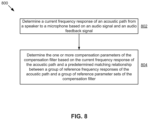
- FIG. 8 illustrates a flowchart of an exemplary method for determining one or more compensation parameters of a compensation filter, according to some aspects of the present disclosure.
- terminology may be understood at least in part from usage in context.
- the term “one or more” as used herein, depending at least in part upon context may be used to describe any feature, structure, or characteristic in a singular sense or may be used to describe combinations of features, structures or characteristics in a plural sense.
- terms, such as “a,” “an,” or “the,” again, may be understood to convey a singular usage or to convey a plural usage, depending at least in part upon context.
- the term “based on” may be understood as not necessarily intended to convey an exclusive set of factors and may, instead, allow for existence of additional factors not necessarily expressly described, again, depending at least in part on context.
- FIG. 1 illustrates a block diagram of an exemplary process 100 for compensating leakage in a headphone, according to some examples.
- the headphone may include an equalization filter 102 , a digital-to-analog converter (DAC) 104 , a speaker 106 , a microphone 108 , an analog-to-digital converter (ADC) 110 , and any other suitable component not shown in FIG. 1 .
- the headphone may be an earbud with speaker 106 and microphone 108 placed inside an ear canal of a user when the earbud is worn by the user.
- preset filter coefficients of equalization filter 102 are usually adjusted and obtained by a tuner through trial listening, and are configured as factory settings for the headphone.
- the preset filter coefficients can be used to configure equalization filter 102 of headphones with the same model or similar models to achieve equalization processing.
- a sound leakage may exist even for the same type of headphones due to ear-canal differences of different users (e.g., structures of the ear canals of individual users may be different with different lengths of the ear canals, different widths of the ear canals, different reflection effects, etc.).
- different headphone wearing manners (such as different wearing tightness, different wearing directions, etc.) may also cause the sound leakage of the same headphone when the headphone is worn by different users.
- the method and system disclosed herein may then determine one or more compensation parameters of the compensation filter based on the audio reference signal and the audio feedback signal, and may configure the compensation filter using the one or more compensation parameters. Subsequently, the method and system disclosed herein may process a second music signal to be played by the speaker of the headphone using the compensation filter, so that a leakage-compensated music signal can be generated and played by the speaker.
- the first and second music signals may be different music signals or the same music signal.
- the method and system disclosed herein can make full use of a music signal that a user listens to when using the headphone, and appropriately supplement the music signal with a pilot tone signal if needed without introducing other playback that may interfere with the user's music listening experience.
- the method and system disclosed herein may adjust the compensation parameters of the compensation filter in a timely manner based on the playing of the music signal and/or the pilot tone signal, so that the sound field of the headphone can be effectively compensated by the compensation filter under various leakage conditions in different usage scenarios.
- the user's listening experience with the headphone can be greatly enhanced.
- Internal microphone 208 may be any transducer that converts an audio sound into an electrical signal (referred to as a microphone signal herein). Internal microphone 208 may be disposed inside the ear canal when headphone 200 is worn by the user and configured to obtain a microphone signal based on the audio played by speaker 206 . That is, by disposing internal microphone 208 inside the user's ear canal, any sound in the ear canal can be obtained up by internal microphone 208 , which includes the audio signal currently being played by speaker 206 .
- Microphone 208 of the headphone may be configured to generate a microphone signal responsive to the audio signal being played by speaker 206 .
- the audio sound generated by the playing of the audio signal may be reflected by the ear canal of the user and captured by microphone 208 to generate the microphone signal.
- the microphone signal may be processed by an ADC 210 and converted into an audio feedback signal. That is, the audio feedback signal may be obtained based on the microphone signal acquired by microphone 208 of the headphone responsive to the audio signal being played by speaker 206 .
- the audio feedback signal may be fed to compensation determination module 216 of processor 214 .
- the audio signal may include a first music signal to be played by speaker 206
- the audio reference signal may include a music reference signal generated from the first music signal
- the audio feedback signal may include a music feedback signal, as described below in more detail with reference to FIGS. 2 C- 2 D
- the audio signal may include a pilot tone signal to be played by speaker 206
- the audio reference signal may include the pilot tone signal
- the audio feedback signal may include a pilot tone feedback signal, as described below in more detail with reference to FIG. 2 E .
- the audio signal may include both the first music signal and the pilot tone signal
- the audio reference signal may include a combination of the music reference signal and the pilot tone signal
- the audio feedback signal may include a combination of the music feedback signal and the pilot tone feedback signal, as described below in more detail with reference to FIG. 2 F .
- the audio reference signal may be configured to include the music reference signal, and the audio feedback signal may include the music feedback signal, as described below in more detail with reference to FIG. 2 G .
- the audio reference signal may be configured to include the pilot tone signal, and the audio feedback signal may include the pilot tone feedback signal, as described below in more detail with reference to FIG. 2 G .
- the audio reference signal may also be configured to include a combination of the music reference signal and the pilot tone signal, and the audio feedback signal may include a combination of the music feedback signal and the pilot tone feedback signal, as described below in more detail with reference to FIG. 2 F .
- compensation determination module 216 may determine one or more compensation parameters of compensation filter 218 based on the current frequency response of the acoustic path and a predetermined matching relationship between a group of reference frequency responses of the acoustic path and a group of reference parameter sets of compensation filter 218 .
- the one or more compensation parameters of compensation filter 218 may include a filter type and/or filter coefficients (e.g., self-adaptive filter coefficients).
- the one or more compensation parameters may indicate whether compensation filter 218 is a frequency-domain filter or a time-domain filter, and may include corresponding filter coefficients for the frequency-domain or time-domain filter.
- a time-domain filter may include a finite impulse response (FIR) filter or an infinite impulse response (IIR) filter.
- different reference frequency responses of the acoustic path can be measured under different usage scenarios of the headphone (such as the headphone being worn very loosely, loosely, tightly, or very tightly, etc.) which correspond to different leakage conditions of the headphone.
- one or more parameters of compensation filter 218 can be updated automatically or manually until music played by speaker 206 achieves a satisfactory equalization effect (e.g., until a tuner of the headphone determines that the music played by speaker 206 achieves a satisfactory listening experience).
- the one or more updated parameters that achieve the satisfactory equalization effect can be determined to be one or more reference compensation parameters in a reference parameter set for the reference frequency response.
- a group of reference parameter sets can be determined for the group of reference frequency responses, respectively.
- the correspondence between each reference frequency response and the one or more corresponding leakage conditions of the headphone may be pre-measured or predetermined in the design phase in various usage scenarios corresponding to various leakage conditions of the headphone.
- the various usage scenarios may be determined by different wearing manners and different ear canal structures of the users (or artificial ears). For example, different wearing manners (such as different wearing tightness, different wearing directions, etc.) and different ear canal structures (such as different ear canal lengths, different ear canal widths, etc.) may have different impacts on the leakage of headphone, which correspond to different usage scenarios of the headphone.
- compensation determination module 216 may determine, from the group of reference frequency responses, one or more reference frequency responses that match the current frequency response. For example, the one or more reference frequency responses match the current frequency response if a maximum difference between each of the one or more reference frequency responses and the current frequency response is not greater than a predetermined matching threshold. Then, compensation determination module 216 may determine, from the group of reference parameter sets, one or more reference parameter sets corresponding to the one or more reference frequency responses, respectively, and determine the one or more compensation parameters based on the one or more reference parameter sets.
- compensation determination module 216 may select a reference frequency response from the one or more reference frequency responses, and use one or more reference compensation parameters in a reference parameter set corresponding to the selected reference frequency response as the one or more compensation parameters for compensation filter 218 .
- compensation determination module 216 may determine each of the one or more compensation parameters to be a weighted average of one or more corresponding reference compensation parameters included in the one or more reference parameter sets.
- compensation determination module 216 can determine one or more reference frequency responses matching the current frequency response. Then, based on the one or more reference frequency responses, compensation determination module 216 can not only determine the one or more compensation parameters of compensation filter 218 , but also can determine the current leakage condition of the headphone.
- the current leakage condition can be one of the leakage conditions corresponding to the one or more reference frequency responses, or an average of the leakage conditions corresponding to the one or more reference frequency responses.
- compensation determination module 216 may configure compensation filter 218 using the one or more compensation parameters.
- a second music signal to be played by speaker 206 may be processed using compensation filter 218 to generate a leakage-compensated music signal, so that the leakage-compensated music signal (rather than the second music signal) can be played by speaker 206 .
- the second music signal can be processed by compensation filter 218 to generate an intermediate music signal.
- the second music signal may also be processed by a delay aligner 222 to adjust a delay of the second music signal, so that the delay of the second music signal is aligned with the intermediate music signal.
- an adder 220 can add the intermediate music signal to the second music signal to generate the leakage-compensated music signal.
- the leakage-compensated music signal can reduce or eliminate the impact of the leakage of the headphone caused by different wearing manners (such as different wearing tightness, different wearing directions, etc.) and different ear canal structures (such as different ear canal lengths, different ear canal widths, etc.).
- different wearing manners such as different wearing tightness, different wearing directions, etc.
- different ear canal structures such as different ear canal lengths, different ear canal widths, etc.
- Reference-path filter 232 may be configured using the one or more reference parameters. Reference-path filter 232 may filter the audio signal (e.g., the first music signal) to generate a music reference signal, which is then fed to compensation determination module 216 .
- the audio signal e.g., the first music signal
- the first music signal may also be processed by DAC 204 and then played by speaker 206 to generate an acoustic signal.
- microphone 208 may capture at least part of the acoustic signal and generate a microphone signal.
- the microphone signal may be processed by ADC 210 to generate an audio feedback signal.
- the audio feedback signal only includes a music feedback signal.
- the music feedback signal can be fed to compensation determination module 216 .
- Compensation determination module 216 may determine one or more compensation parameters of compensation filter 218 based on the audio reference signal and the audio feedback signal. For example, compensation determination module 216 may determine a current frequency response of an acoustic path from speaker 206 to microphone 208 based on the audio signal and the audio feedback signal. Compensation determination module 216 may determine the one or more compensation parameters of compensation filter 218 based on the current frequency response of the acoustic path and a predetermined matching relationship between a group of reference frequency responses of the acoustic path and a group of reference parameter sets of the compensation filter, as described above with reference to FIG. 2 B .
- compensation filter 218 may determine filter coefficients of compensation filter 218 at a time point of n+1 as follows:
- h(n) [h 0 (n), h 1 (n), h 2 (n), . . . , h M-1 (n)] T .
- f(n+1) denotes the filter coefficients of compensation filter 218 at the time point of n+1.
- n denotes an integer with n ⁇ 0.
- M denotes a length of compensation filter 218 .
- y denotes a step size of compensation filter 218 .
- y(n) [y(n), y(n ⁇ 1), . . . , y(n ⁇ M+1)] T denotes the audio feedback signal at a time point of n.
- x(n) denotes the music reference signal at the time point of n.
- compensation determination module 216 may configure compensation filter 218 using the one or more compensation parameters.
- a second music signal to be played by speaker 206 may be processed using compensation filter 218 to generate a leakage-compensated music signal as described above with reference to FIG. 2 B .
- the leakage-compensated music signal can be played by speaker 206 to improve the listening experience of the headphone.
- the first music signal may be filtered by reference-path filter 232 to generate the music reference signal x(n). Also at the time point of n, the first music signal may processed by DAC 204 and played by speaker 206 , so that the music feedback signal y(n) at the time point of n can be obtained through microphone 208 .
- Compensation determination module 216 may determine the one or more compensation filter coefficients f(n+1) for the time point of n+1 using the above equations (1) and (2) based on the music reference signal x(n) and the music feedback signal y(n).
- the second music signal may be filtered by compensation filter 218 to generate the leakage-compensated music signal, so that the leakage-compensated music signal can be played by speaker 206 .
- the second music signal and the first music signal can be the same music signal.
- the first and second music signals can be the same music signal at different time points (e.g., the n th time point and the (n+1) th time point, respectively).
- the second music signal can be a music signal different from the first music signal.
- the first music signal can be a preset music signal, while the second music signal can be any music signal selected by the user.
- the music reference signal generated by reference-path filter 232 and the music feedback signal received through microphone 208 can reflect a situation in which a listening effect of the headphone is deteriorated due to leakage caused by difference in a wearing manner and/or difference in a structure of an ear canal.
- Compensation filter 218 with compensation parameters determined based on the music reference signal and the music feedback signal can effectively improve the listening effect of the headphone. For example, a sound leakage caused by the difference in the wearing manner and/or difference in the structure of the ear canal can be effectively compensated by compensation filter 218 , so that the listening experience of the headphone can be improved.
- the music reference signal is a first sound signal that is only filtered by reference-path filter 232 but not played by speaker 206
- the music feedback signal received through microphone 208 is a second sound signal acquired through microphone 208 after being reflected by the ear canal.
- the difference in the wearing manner and/or difference in the structure of the ear canal may not impact the music reference signal generated by reference-path filter 232
- the music feedback signal received through microphone 208 is affected by the difference in the wearing manner and/or difference in the structure of the ear canal.
- the difference in the wearing manner of the headphone may lead to a cavity leakage in the ear canal, which may cause the first music signal played by speaker 206 to be partially leaked after being reflected by the ear canal.
- FIG. 2 D illustrates another exemplary scenario when an audio signal to be played by speaker 206 of a headphone only includes a first music signal, according to some aspects of the present disclosure.
- the headphone of FIG. 2 D may include components like that of FIG. 2 C , and the similar description will not be repeated here. Comparing with FIG. 2 C , the headphone of FIG. 2 D may further include a first downsampling filter 242 , a second downsampling filter 244 , a third downsampling filter 246 , and an upsampling filter 219 .
- the first or second music signal can be downsampled to reduce computation complexity and save memory resource.
- the first music signal can be downsampled by first downsampling filter 242 by N times (e.g., N being a positive integer) and then processed by reference-path filter 232 to generate a music reference signal.
- the first music signal can be played by speaker 206 , so that a microphone signal can be acquired by microphone 208 responsive to the playing of the first music signal by speaker 206 .
- the microphone signal can be processed by ADC 210 and downsampled by second downsampling filter 244 to generate a music feedback signal.
- compensation determination module 216 may determine one or more compensation parameters of compensation filter 218 based on the music reference signal and the music feedback signal. Compensation determination module 216 may configure compensation filter 218 using the one or more compensation parameters. Then, a second music signal to be played can be downsampled using third downsampling filter 246 to generate a downsampled music signal. The downsampled music signal can be filtered using compensation filter 218 to generate an intermediate music signal. The intermediate music signal can be upsampled using upsampling filter 219 to generate an upsampled intermediate music signal. The second music signal may also be processed by delay aligner 222 to align with the upsampled intermediate music signal. Adder 220 may then add the upsampled intermediate music signal to the second music signal to generate a leakage-compensated music signal.
- the first music signal or the second music signal can be downsampled to a signal within 2 KHz or any appropriate frequency range, which is not limited herein.
- FIG. 2 E illustrates an exemplary scenario when an audio signal to be played by speaker 206 of a headphone only includes a pilot tone signal, according to some aspects of the present disclosure.
- the headphone of FIG. 2 E may include components like those of FIG. 2 B , and the similar description will not be repeated herein.
- the headphone of FIG. 2 E may further include a signal generator 252 and a passband filter 256 .
- Passband filter 256 may be a peak filter.
- Signal generator 252 may be configured to generate the pilot tone signal.
- the pilot tone signal may be used as an example of an audio reference signal and fed to compensation determination module 216 .
- the pilot tone signal may also be processed by DAC 204 and played by 206 .
- Microphone 208 may generate a microphone signal responsive to the pilot tone signal being played by speaker 206 .
- the microphone signal may be processed by ADC 210 and filtered by passband filter 256 to generate a pilot tone feedback signal.
- the pilot tone feedback signal may be used as an example of an audio feedback signal and fed to compensation determination module 216 .
- Compensation determination module 216 may determine one or more compensation parameters of compensation filter 218 based on the pilot tone signal and the pilot tone feedback signal. For example, compensation determination module 216 may determine a current frequency response of an acoustic path from speaker 206 to microphone 208 based on the pilot tone signal and the pilot tone feedback signal. Compensation determination module 216 may determine the one or more compensation parameters of compensation filter 218 based on the current frequency response of the acoustic path and a predetermined matching relationship between a group of reference frequency responses of the acoustic path and a group of reference parameter sets of the compensation filter, as described above with reference to FIG. 2 B .
- the pilot tone signal can be added to the music reference signal as well as the first music signal to improve the effectiveness of the leakage compensation function. Since the frequency of the pilot tone signal is outside a hearing range of the human ear, the playback of the pilot tone signal cannot be heard by the human ear, which avoids introducing additional interference to the user. Besides, the pilot tone signal can be played at any time based on the needs of the leakage compensation, which makes the application of the leakage compensation function disclosed herein more flexible.
- the deviation between the first and second reference frequency responses is greater than the deviation threshold, which indicates that the signal components in the predetermined pilot tone frequency range are affected by low frequency interference.
- the second reference frequency response which matches the current frequency response in the predetermined pilot tone frequency band may be no longer reliable for the determination of the compensation parameters.
- only the first reference frequency response, which matches the current frequency response in the predetermined music frequency band, is used for the determination of the compensation parameters. As a result, the performance of the leakage compensation function is not deteriorated by the low frequency interference, and the robustness of the leakage compensation function is guaranteed.
- compensation determination module 216 may configure compensation filter 218 using the one or more compensation parameters.
- a second music signal to be played by speaker 206 may be processed using compensation filter 218 to generate a leakage-compensated music signal as described above with reference to FIG. 2 B .
- the leakage-compensated music signal can be played by speaker 206 to improve the listening experience of the headphone.
- first downsampling filter 242 and second downsampling filter 244 may downsample corresponding signals to be below 1 kHz, respectively, so that the calculation burden of a frequency response of an acoustic path from speaker 206 to microphone 208 can be reduced.
- Compensation determination module 216 may determine one or more compensation parameters of compensation filter 218 based on the music reference signal and the music feedback signal.
- compensation determination module 216 may configure compensation filter 218 using the one or more compensation parameters. Then, a second music signal to be played by speaker 206 may be processed using compensation filter 218 to generate a leakage-compensated music signal as described above. Thus, the leakage-compensated music can be played by speaker 206 to improve the listening experience of the headphone.
- Self-adaptive filter 302 is coupled between the audio reference signal and the audio feedback signal.
- Self-adaptive filter 302 may be configured to filter the audio feedback signal.
- Self-adaptive filter 302 can be a correction filter whose filter coefficients can be adjusted adaptively and obtained based on the audio reference signal and the audio feedback signal, so that the audio reference signal output by reference-path filter 232 and the audio feedback signal filtered by self-adaptive filter 302 can cancel out with each other.
- the filter coefficients of adaptive filter 303 obtained through an adaptive adjustment based on the audio signal inputted to DAC 204 and the audio feedback signal outputted from ADC 210 can be transformed into a frequency domain (e.g., using a fast Fourier transform (FFT)), so that a frequency response (e.g., an amplitude frequency response) of adaptive filter 303 can be obtained as the frequency response of the acoustic path from speaker 206 to microphone 208 .
- FFT fast Fourier transform
- FIG. 4 is a graphical representation illustrating exemplary frequency responses of an acoustic path from a speaker (e.g., speaker 206 ) of a headphone to a microphone (e.g., microphone 208 ) of the headphone, according to some aspects of the present disclosure.
- Different frequency response curves in FIG. 4 may correspond to different leakage conditions of the headphone caused by different wearing tightness of the headphone.
- the frequency response curves of FIG. 4 can be used as a group of reference frequency responses for the headphone.
- FIG. 5 is a graphical representation illustrating exemplary performance of a headphone when leakage compensation is applied, according to some aspects of the present disclosure.
- a frequency response curve measured in a normal mode 502 e.g., a mode without leakage
- frequency response curves measured in leakage modes 1 and 2 are significantly attenuated in a frequency range of 20 Hz-600 Hz.
- the attenuation of the frequency response curves measured in leakage modes 1 and 2 are greatly reduced in the frequency range of 20 Hz-600 Hz, as shown in frequency response curves labeled with “leakage mode 1 with compensation” and “leakage mode 2 with compensation,” respectively.
- the listening experience of the headphone can be improved under different leakage conditions through the leakage compensation of the headphone.
- Method 600 proceeds to operation 604 , as illustrated in FIG. 6 , in which an audio feedback signal is obtained based on a microphone signal acquired by a microphone of the headphone responsive to the audio signal being played by the speaker.
- Method 600 proceeds to operation 606 , as illustrated in FIG. 6 , in which one or more compensation parameters of a compensation filter (e.g., compensation filter 218 ) are determined based on the audio reference signal and the audio feedback signal.
- a compensation filter e.g., compensation filter 218
- Method 600 proceeds to operation 608 , as illustrated in FIG. 6 , in which the compensation filter is configured using the one or more compensation parameters.
- Method 600 proceeds to operation 610 , as illustrated in FIG. 6 , in which a music signal is processed using the compensation filter to generate a leakage-compensated music signal to be played by the speaker.
- FIG. 7 illustrates a flowchart of an exemplary method 700 for obtaining an audio reference signal, according to some aspects of the present disclosure.
- Method 700 may be implemented by a processor (e.g., processor 214 ) or any other suitable component of the headphone.
- Method 700 may be an exemplary implementation of operation 602 of FIG. 6 . It is understood that the operations shown in method 700 may not be exhaustive and that other operations can be performed as well before, after, or between any of the illustrated operations. Further, some of the operations may be performed simultaneously, or in a different order than shown in FIG. 7 .
- Method 700 proceeds to operation 704 , as illustrated in FIG. 7 , in which it is determined whether a strength of the music reference signal is equal to or greater than a first signal threshold. Responsive to the strength of the music reference signal being equal to or greater than the first signal threshold, method 700 proceeds to operation 706 . Otherwise, method 700 proceeds to operation 707 .
- an audio reference signal including the music reference signal is obtained.
- a pilot tone signal is obtained.
- FIG. 8 illustrates a flowchart of an exemplary method 800 for determining one or more compensation parameters of a compensation filter, according to some aspects of the present disclosure.
- Method 800 may be implemented by a processor (e.g., processor 214 ) or any other suitable component of a headphone.
- Method 800 may be an exemplary implementation of operation 606 of FIG. 6 . It is understood that the operations shown in method 800 may not be exhaustive and that other operations can be performed as well before, after, or between any of the illustrated operations. Further, some of the operations may be performed simultaneously, or in a different order than shown in FIG. 8 .
- method 800 starts at operation 802 , in which a current frequency response of an acoustic path from a speaker of the headphone to a microphone of the headphone is determined based on an audio signal and an audio feedback signal.
- Method 800 proceeds to operation 804 , as illustrated in FIG. 8 , in which the one or more compensation parameters of the compensation filter are determined based on the current frequency response of the acoustic path and a predetermined matching relationship between a group of reference frequency responses of the acoustic path and a group of reference parameter sets of the compensation filter.
- FIG. 9 illustrates a flowchart of another exemplary method 900 for determining one or more compensation parameters of a compensation filter, according to some aspects of the present disclosure.
- Method 900 may be implemented by a processor (e.g., processor 214 ) or any other suitable component of a headphone.
- Method 900 may be an exemplary implementation of operation 804 of FIG. 8 . It is understood that the operations shown in method 900 may not be exhaustive and that other operations can be performed as well before, after, or between any of the illustrated operations. Further, some of the operations may be performed simultaneously, or in a different order than shown in FIG. 9 .
- method 900 starts at operation 902 , in which one or more reference frequency responses that match a current frequency response of an acoustic path from a speaker of the headphone to a microphone of the headphone are determined from a group of reference frequency responses.
- Method 900 proceeds to operation 904 , as illustrated in FIG. 9 , in which one or more reference parameter sets corresponding to the one or more reference frequency responses are determined from a group of reference parameter sets, respectively.
- Method 900 proceeds to operation 906 , as illustrated in FIG. 9 , in which the one or more compensation parameters are determined based on the one or more reference parameter sets.
- a leakage compensation method for a headphone is disclosed.
- An audio reference signal is obtained responsive to an audio signal to be played by a speaker of the headphone.
- An audio feedback signal is obtained based on a microphone signal acquired by a microphone of the headphone responsive to the audio signal being played by the speaker.
- One or more compensation parameters of a compensation filter are determined based on the audio reference signal and the audio feedback signal.
- the compensation filter is configured using the one or more compensation parameters.
- a music signal is processed using the compensation filter to generate a leakage-compensated music signal to be played by the speaker.
- the audio reference signal includes a music reference signal, a pilot tone signal, or a combination of the music reference signal and the pilot tone signal.
- the audio signal is downsampled using a first downsampling filter.
- the audio feedback signal is downsampled using a second downsampling filter.
- processing the music signal using the compensation filter to generate the leakage-compensated music signal to be played by the speaker includes: downsampling the music signal using a third downsampling filter to generate a downsampled music signal; filtering the downsampled music signal using the compensation filter to generate an intermediate music signal; upsampling the intermediate music signal using an upsampling filter to generate an upsampled intermediate music signal; and adding the upsampled intermediate music signal to the music signal to generate the leakage-compensated music signal.
- determining the one or more compensation parameters of the compensation filter includes determining filter coefficients of the compensation filter at a time point of n+1 as follows:
- the audio reference signal includes a music reference signal, a pilot tone signal, or a combination of the music reference signal and the pilot tone signal.
Landscapes
- Physics & Mathematics (AREA)
- Engineering & Computer Science (AREA)
- Acoustics & Sound (AREA)
- Signal Processing (AREA)
- Health & Medical Sciences (AREA)
- General Health & Medical Sciences (AREA)
- Otolaryngology (AREA)
- Headphones And Earphones (AREA)
- Soundproofing, Sound Blocking, And Sound Damping (AREA)
Abstract
Description
-
- where h(n)=[h0(n), h1(n), h2(n), . . . , hM-1(n)]T, f(n+1) denotes the filter coefficients of the compensation filter at the time point of n+1, n denotes an integer with n≥0, M denotes a length of the compensation filter, y denotes a step size of the compensation filter, y(n)=[y(n), y(n−1), . . . , y(n−M+1)]T denotes the audio feedback signal at a time point of n, e(n)=x(n)−hT(n)y(n) denotes a residual signal at the time point of n, and x(n) denotes the music reference signal at the time point of n.
Claims (17)
Applications Claiming Priority (4)
| Application Number | Priority Date | Filing Date | Title |
|---|---|---|---|
| CN202111190216.5 | 2021-10-12 | ||
| CN202111190216.5A CN113938799B (en) | 2021-10-12 | 2021-10-12 | Equalization control method, equalization control device and storage medium for earphone |
| CN202111427431.2A CN113938786B (en) | 2021-11-26 | 2021-11-26 | Method, device and earphone for compensating earphone leakage |
| CN202111427431.2 | 2021-11-26 |
Publications (2)
| Publication Number | Publication Date |
|---|---|
| US20230114392A1 US20230114392A1 (en) | 2023-04-13 |
| US12273675B2 true US12273675B2 (en) | 2025-04-08 |
Family
ID=85798153
Family Applications (1)
| Application Number | Title | Priority Date | Filing Date |
|---|---|---|---|
| US17/874,363 Active 2043-02-28 US12273675B2 (en) | 2021-10-12 | 2022-07-27 | Leakage compensation method and system for headphone |
Country Status (1)
| Country | Link |
|---|---|
| US (1) | US12273675B2 (en) |
Citations (7)
| Publication number | Priority date | Publication date | Assignee | Title |
|---|---|---|---|---|
| US20180075862A1 (en) * | 2015-03-27 | 2018-03-15 | Dolby Laboratories Licensing Corporation | Adaptive Audio Filtering |
| US20200288244A1 (en) * | 2017-11-02 | 2020-09-10 | Ams Ag | Method for determining a response function of a noise cancellation enabled audio device |
| US20210190702A1 (en) * | 2019-12-18 | 2021-06-24 | Chenshu Wu | Method, apparatus, and system for wireless material sensing |
| US20220076656A1 (en) * | 2020-09-10 | 2022-03-10 | Maxim Integrated Products, Inc. | Robust open-ear ambient sound control with leakage detection |
| US20220157291A1 (en) * | 2019-03-22 | 2022-05-19 | Ams Ag | Audio system and signal processing method for an ear mountable playback device |
| US11468875B2 (en) * | 2020-12-15 | 2022-10-11 | Google Llc | Ambient detector for dual mode ANC |
| US11683643B2 (en) * | 2007-05-04 | 2023-06-20 | Staton Techiya Llc | Method and device for in ear canal echo suppression |
-
2022
- 2022-07-27 US US17/874,363 patent/US12273675B2/en active Active
Patent Citations (7)
| Publication number | Priority date | Publication date | Assignee | Title |
|---|---|---|---|---|
| US11683643B2 (en) * | 2007-05-04 | 2023-06-20 | Staton Techiya Llc | Method and device for in ear canal echo suppression |
| US20180075862A1 (en) * | 2015-03-27 | 2018-03-15 | Dolby Laboratories Licensing Corporation | Adaptive Audio Filtering |
| US20200288244A1 (en) * | 2017-11-02 | 2020-09-10 | Ams Ag | Method for determining a response function of a noise cancellation enabled audio device |
| US20220157291A1 (en) * | 2019-03-22 | 2022-05-19 | Ams Ag | Audio system and signal processing method for an ear mountable playback device |
| US20210190702A1 (en) * | 2019-12-18 | 2021-06-24 | Chenshu Wu | Method, apparatus, and system for wireless material sensing |
| US20220076656A1 (en) * | 2020-09-10 | 2022-03-10 | Maxim Integrated Products, Inc. | Robust open-ear ambient sound control with leakage detection |
| US11468875B2 (en) * | 2020-12-15 | 2022-10-11 | Google Llc | Ambient detector for dual mode ANC |
Also Published As
| Publication number | Publication date |
|---|---|
| US20230114392A1 (en) | 2023-04-13 |
Similar Documents
| Publication | Publication Date | Title |
|---|---|---|
| US8315400B2 (en) | Method and device for acoustic management control of multiple microphones | |
| US9479860B2 (en) | Systems and methods for enhancing performance of audio transducer based on detection of transducer status | |
| US20210176558A1 (en) | Earphone signal processing method and system, and earphone | |
| US8081769B2 (en) | Apparatus for rectifying resonance in the outer-ear canals and method of rectifying | |
| US11595764B2 (en) | Tuning method, manufacturing method, computer-readable storage medium and tuning system | |
| CN111818439B (en) | Earphone control method, earphone control device and storage medium | |
| US8611552B1 (en) | Direction-aware active noise cancellation system | |
| CN114450745B (en) | Audio system and signal processing method for ear-worn playback device | |
| US11683643B2 (en) | Method and device for in ear canal echo suppression | |
| EP3799031A1 (en) | Audio system and signal processing method for an ear mountable playback device | |
| US9654855B2 (en) | Self-voice occlusion mitigation in headsets | |
| US12293754B2 (en) | Active noise control method and system for headphone | |
| US11516604B2 (en) | System and method for evaluating an ear seal using external stimulus | |
| US11206502B1 (en) | System and method for evaluating an ear seal using normalization | |
| EP3840402B1 (en) | Wearable electronic device with low frequency noise reduction | |
| US11889257B2 (en) | Wearable audio device zero-crossing based parasitic oscillation detection | |
| US20240251197A1 (en) | Sound Signal Processing Method and Headset Device | |
| US20200186923A1 (en) | Methods, systems and apparatus for improved feedback control | |
| US20230114392A1 (en) | Leakage compensation method and system for headphone | |
| CN113727232A (en) | Automatically calibrate in-ear headphones | |
| CN113938799B (en) | Equalization control method, equalization control device and storage medium for earphone | |
| CN113938786A (en) | Method and device for compensating earphone leakage and earphone | |
| US20250037696A1 (en) | Device for active noise suppression and/or occlusion suppression, corresponding method, and computer program | |
| EP4492816A1 (en) | Method and device for detecting state of earphone based on multiple sensors | |
| CN115175046B (en) | Headphone noise reduction method, device, electronic device and computer-readable storage medium |
Legal Events
| Date | Code | Title | Description |
|---|---|---|---|
| AS | Assignment |
Owner name: BESTECHNIC (SHANGHAI) CO., LTD., CHINA Free format text: ASSIGNMENT OF ASSIGNORS INTEREST;ASSIGNORS:LI, QIAN;WANG, ZHICONG;WU, XINGQIANG;SIGNING DATES FROM 20220722 TO 20220723;REEL/FRAME:060636/0004 |
|
| FEPP | Fee payment procedure |
Free format text: ENTITY STATUS SET TO UNDISCOUNTED (ORIGINAL EVENT CODE: BIG.); ENTITY STATUS OF PATENT OWNER: SMALL ENTITY |
|
| FEPP | Fee payment procedure |
Free format text: ENTITY STATUS SET TO SMALL (ORIGINAL EVENT CODE: SMAL); ENTITY STATUS OF PATENT OWNER: SMALL ENTITY |
|
| STPP | Information on status: patent application and granting procedure in general |
Free format text: DOCKETED NEW CASE - READY FOR EXAMINATION |
|
| STPP | Information on status: patent application and granting procedure in general |
Free format text: NON FINAL ACTION MAILED |
|
| STPP | Information on status: patent application and granting procedure in general |
Free format text: RESPONSE TO NON-FINAL OFFICE ACTION ENTERED AND FORWARDED TO EXAMINER |
|
| STPP | Information on status: patent application and granting procedure in general |
Free format text: FINAL REJECTION MAILED |
|
| STPP | Information on status: patent application and granting procedure in general |
Free format text: RESPONSE AFTER FINAL ACTION FORWARDED TO EXAMINER |
|
| STPP | Information on status: patent application and granting procedure in general |
Free format text: NOTICE OF ALLOWANCE MAILED -- APPLICATION RECEIVED IN OFFICE OF PUBLICATIONS |
|
| STPP | Information on status: patent application and granting procedure in general |
Free format text: PUBLICATIONS -- ISSUE FEE PAYMENT VERIFIED |
|
| STCF | Information on status: patent grant |
Free format text: PATENTED CASE |