US12268694B2 - Combination pharmaceutical agents as RSV inhibitors - Google Patents
Combination pharmaceutical agents as RSV inhibitors Download PDFInfo
- Publication number
- US12268694B2 US12268694B2 US17/094,029 US202017094029A US12268694B2 US 12268694 B2 US12268694 B2 US 12268694B2 US 202017094029 A US202017094029 A US 202017094029A US 12268694 B2 US12268694 B2 US 12268694B2
- Authority
- US
- United States
- Prior art keywords
- methyl
- compound
- amino
- compounds
- optionally substituted
- Prior art date
- Legal status (The legal status is an assumption and is not a legal conclusion. Google has not performed a legal analysis and makes no representation as to the accuracy of the status listed.)
- Active, expires
Links
Images


Classifications
-
- A—HUMAN NECESSITIES
- A61—MEDICAL OR VETERINARY SCIENCE; HYGIENE
- A61K—PREPARATIONS FOR MEDICAL, DENTAL OR TOILETRY PURPOSES
- A61K31/00—Medicinal preparations containing organic active ingredients
- A61K31/33—Heterocyclic compounds
- A61K31/395—Heterocyclic compounds having nitrogen as a ring hetero atom, e.g. guanethidine or rifamycins
- A61K31/55—Heterocyclic compounds having nitrogen as a ring hetero atom, e.g. guanethidine or rifamycins having seven-membered rings, e.g. azelastine, pentylenetetrazole
- A61K31/551—Heterocyclic compounds having nitrogen as a ring hetero atom, e.g. guanethidine or rifamycins having seven-membered rings, e.g. azelastine, pentylenetetrazole having two nitrogen atoms, e.g. dilazep
- A61K31/5513—1,4-Benzodiazepines, e.g. diazepam or clozapine
-
- A—HUMAN NECESSITIES
- A61—MEDICAL OR VETERINARY SCIENCE; HYGIENE
- A61K—PREPARATIONS FOR MEDICAL, DENTAL OR TOILETRY PURPOSES
- A61K31/00—Medicinal preparations containing organic active ingredients
- A61K31/33—Heterocyclic compounds
- A61K31/395—Heterocyclic compounds having nitrogen as a ring hetero atom, e.g. guanethidine or rifamycins
- A61K31/435—Heterocyclic compounds having nitrogen as a ring hetero atom, e.g. guanethidine or rifamycins having six-membered rings with one nitrogen as the only ring hetero atom
- A61K31/44—Non condensed pyridines; Hydrogenated derivatives thereof
- A61K31/4427—Non condensed pyridines; Hydrogenated derivatives thereof containing further heterocyclic ring systems
- A61K31/4439—Non condensed pyridines; Hydrogenated derivatives thereof containing further heterocyclic ring systems containing a five-membered ring with nitrogen as a ring hetero atom, e.g. omeprazole
-
- A—HUMAN NECESSITIES
- A61—MEDICAL OR VETERINARY SCIENCE; HYGIENE
- A61K—PREPARATIONS FOR MEDICAL, DENTAL OR TOILETRY PURPOSES
- A61K31/00—Medicinal preparations containing organic active ingredients
- A61K31/33—Heterocyclic compounds
- A61K31/395—Heterocyclic compounds having nitrogen as a ring hetero atom, e.g. guanethidine or rifamycins
- A61K31/495—Heterocyclic compounds having nitrogen as a ring hetero atom, e.g. guanethidine or rifamycins having six-membered rings with two or more nitrogen atoms as the only ring heteroatoms, e.g. piperazine or tetrazines
- A61K31/505—Pyrimidines; Hydrogenated pyrimidines, e.g. trimethoprim
- A61K31/519—Pyrimidines; Hydrogenated pyrimidines, e.g. trimethoprim ortho- or peri-condensed with heterocyclic rings
-
- A—HUMAN NECESSITIES
- A61—MEDICAL OR VETERINARY SCIENCE; HYGIENE
- A61K—PREPARATIONS FOR MEDICAL, DENTAL OR TOILETRY PURPOSES
- A61K31/00—Medicinal preparations containing organic active ingredients
- A61K31/33—Heterocyclic compounds
- A61K31/395—Heterocyclic compounds having nitrogen as a ring hetero atom, e.g. guanethidine or rifamycins
- A61K31/55—Heterocyclic compounds having nitrogen as a ring hetero atom, e.g. guanethidine or rifamycins having seven-membered rings, e.g. azelastine, pentylenetetrazole
-
- A—HUMAN NECESSITIES
- A61—MEDICAL OR VETERINARY SCIENCE; HYGIENE
- A61K—PREPARATIONS FOR MEDICAL, DENTAL OR TOILETRY PURPOSES
- A61K31/00—Medicinal preparations containing organic active ingredients
- A61K31/70—Carbohydrates; Sugars; Derivatives thereof
- A61K31/7042—Compounds having saccharide radicals and heterocyclic rings
- A61K31/7052—Compounds having saccharide radicals and heterocyclic rings having nitrogen as a ring hetero atom, e.g. nucleosides, nucleotides
- A61K31/7056—Compounds having saccharide radicals and heterocyclic rings having nitrogen as a ring hetero atom, e.g. nucleosides, nucleotides containing five-membered rings with nitrogen as a ring hetero atom
-
- A—HUMAN NECESSITIES
- A61—MEDICAL OR VETERINARY SCIENCE; HYGIENE
- A61K—PREPARATIONS FOR MEDICAL, DENTAL OR TOILETRY PURPOSES
- A61K31/00—Medicinal preparations containing organic active ingredients
- A61K31/70—Carbohydrates; Sugars; Derivatives thereof
- A61K31/7042—Compounds having saccharide radicals and heterocyclic rings
- A61K31/7052—Compounds having saccharide radicals and heterocyclic rings having nitrogen as a ring hetero atom, e.g. nucleosides, nucleotides
- A61K31/706—Compounds having saccharide radicals and heterocyclic rings having nitrogen as a ring hetero atom, e.g. nucleosides, nucleotides containing six-membered rings with nitrogen as a ring hetero atom
- A61K31/7064—Compounds having saccharide radicals and heterocyclic rings having nitrogen as a ring hetero atom, e.g. nucleosides, nucleotides containing six-membered rings with nitrogen as a ring hetero atom containing condensed or non-condensed pyrimidines
- A61K31/7068—Compounds having saccharide radicals and heterocyclic rings having nitrogen as a ring hetero atom, e.g. nucleosides, nucleotides containing six-membered rings with nitrogen as a ring hetero atom containing condensed or non-condensed pyrimidines having oxo groups directly attached to the pyrimidine ring, e.g. cytidine, cytidylic acid
-
- A—HUMAN NECESSITIES
- A61—MEDICAL OR VETERINARY SCIENCE; HYGIENE
- A61K—PREPARATIONS FOR MEDICAL, DENTAL OR TOILETRY PURPOSES
- A61K39/00—Medicinal preparations containing antigens or antibodies
- A61K39/395—Antibodies; Immunoglobulins; Immune serum, e.g. antilymphocytic serum
-
- A—HUMAN NECESSITIES
- A61—MEDICAL OR VETERINARY SCIENCE; HYGIENE
- A61K—PREPARATIONS FOR MEDICAL, DENTAL OR TOILETRY PURPOSES
- A61K39/00—Medicinal preparations containing antigens or antibodies
- A61K39/395—Antibodies; Immunoglobulins; Immune serum, e.g. antilymphocytic serum
- A61K39/42—Antibodies; Immunoglobulins; Immune serum, e.g. antilymphocytic serum viral
-
- A—HUMAN NECESSITIES
- A61—MEDICAL OR VETERINARY SCIENCE; HYGIENE
- A61K—PREPARATIONS FOR MEDICAL, DENTAL OR TOILETRY PURPOSES
- A61K45/00—Medicinal preparations containing active ingredients not provided for in groups A61K31/00 - A61K41/00
- A61K45/06—Mixtures of active ingredients without chemical characterisation, e.g. antiphlogistics and cardiaca
-
- A—HUMAN NECESSITIES
- A61—MEDICAL OR VETERINARY SCIENCE; HYGIENE
- A61P—SPECIFIC THERAPEUTIC ACTIVITY OF CHEMICAL COMPOUNDS OR MEDICINAL PREPARATIONS
- A61P31/00—Antiinfectives, i.e. antibiotics, antiseptics, chemotherapeutics
- A61P31/12—Antivirals
- A61P31/14—Antivirals for RNA viruses
-
- C—CHEMISTRY; METALLURGY
- C07—ORGANIC CHEMISTRY
- C07D—HETEROCYCLIC COMPOUNDS
- C07D213/00—Heterocyclic compounds containing six-membered rings, not condensed with other rings, with one nitrogen atom as the only ring hetero atom and three or more double bonds between ring members or between ring members and non-ring members
- C07D213/02—Heterocyclic compounds containing six-membered rings, not condensed with other rings, with one nitrogen atom as the only ring hetero atom and three or more double bonds between ring members or between ring members and non-ring members having three double bonds between ring members or between ring members and non-ring members
- C07D213/04—Heterocyclic compounds containing six-membered rings, not condensed with other rings, with one nitrogen atom as the only ring hetero atom and three or more double bonds between ring members or between ring members and non-ring members having three double bonds between ring members or between ring members and non-ring members having no bond between the ring nitrogen atom and a non-ring member or having only hydrogen or carbon atoms directly attached to the ring nitrogen atom
- C07D213/06—Heterocyclic compounds containing six-membered rings, not condensed with other rings, with one nitrogen atom as the only ring hetero atom and three or more double bonds between ring members or between ring members and non-ring members having three double bonds between ring members or between ring members and non-ring members having no bond between the ring nitrogen atom and a non-ring member or having only hydrogen or carbon atoms directly attached to the ring nitrogen atom containing only hydrogen and carbon atoms in addition to the ring nitrogen atom
- C07D213/08—Preparation by ring-closure
- C07D213/09—Preparation by ring-closure involving the use of ammonia, amines, amine salts, or nitriles
- C07D213/12—Preparation by ring-closure involving the use of ammonia, amines, amine salts, or nitriles from unsaturated compounds
-
- C—CHEMISTRY; METALLURGY
- C07—ORGANIC CHEMISTRY
- C07D—HETEROCYCLIC COMPOUNDS
- C07D213/00—Heterocyclic compounds containing six-membered rings, not condensed with other rings, with one nitrogen atom as the only ring hetero atom and three or more double bonds between ring members or between ring members and non-ring members
- C07D213/02—Heterocyclic compounds containing six-membered rings, not condensed with other rings, with one nitrogen atom as the only ring hetero atom and three or more double bonds between ring members or between ring members and non-ring members having three double bonds between ring members or between ring members and non-ring members
- C07D213/04—Heterocyclic compounds containing six-membered rings, not condensed with other rings, with one nitrogen atom as the only ring hetero atom and three or more double bonds between ring members or between ring members and non-ring members having three double bonds between ring members or between ring members and non-ring members having no bond between the ring nitrogen atom and a non-ring member or having only hydrogen or carbon atoms directly attached to the ring nitrogen atom
- C07D213/06—Heterocyclic compounds containing six-membered rings, not condensed with other rings, with one nitrogen atom as the only ring hetero atom and three or more double bonds between ring members or between ring members and non-ring members having three double bonds between ring members or between ring members and non-ring members having no bond between the ring nitrogen atom and a non-ring member or having only hydrogen or carbon atoms directly attached to the ring nitrogen atom containing only hydrogen and carbon atoms in addition to the ring nitrogen atom
- C07D213/14—Preparation from compounds containing heterocyclic oxygen
-
- C—CHEMISTRY; METALLURGY
- C07—ORGANIC CHEMISTRY
- C07D—HETEROCYCLIC COMPOUNDS
- C07D217/00—Heterocyclic compounds containing isoquinoline or hydrogenated isoquinoline ring systems
- C07D217/12—Heterocyclic compounds containing isoquinoline or hydrogenated isoquinoline ring systems with radicals, substituted by hetero atoms, attached to carbon atoms of the nitrogen-containing ring
-
- C—CHEMISTRY; METALLURGY
- C07—ORGANIC CHEMISTRY
- C07D—HETEROCYCLIC COMPOUNDS
- C07D217/00—Heterocyclic compounds containing isoquinoline or hydrogenated isoquinoline ring systems
- C07D217/12—Heterocyclic compounds containing isoquinoline or hydrogenated isoquinoline ring systems with radicals, substituted by hetero atoms, attached to carbon atoms of the nitrogen-containing ring
- C07D217/14—Heterocyclic compounds containing isoquinoline or hydrogenated isoquinoline ring systems with radicals, substituted by hetero atoms, attached to carbon atoms of the nitrogen-containing ring other than aralkyl radicals
-
- C—CHEMISTRY; METALLURGY
- C07—ORGANIC CHEMISTRY
- C07D—HETEROCYCLIC COMPOUNDS
- C07D243/00—Heterocyclic compounds containing seven-membered rings having two nitrogen atoms as the only ring hetero atoms
- C07D243/06—Heterocyclic compounds containing seven-membered rings having two nitrogen atoms as the only ring hetero atoms having the nitrogen atoms in positions 1 and 4
- C07D243/10—Heterocyclic compounds containing seven-membered rings having two nitrogen atoms as the only ring hetero atoms having the nitrogen atoms in positions 1 and 4 condensed with carbocyclic rings or ring systems
- C07D243/14—1,4-Benzodiazepines; Hydrogenated 1,4-benzodiazepines
- C07D243/16—1,4-Benzodiazepines; Hydrogenated 1,4-benzodiazepines substituted in position 5 by aryl radicals
- C07D243/18—1,4-Benzodiazepines; Hydrogenated 1,4-benzodiazepines substituted in position 5 by aryl radicals substituted in position 2 by nitrogen, oxygen or sulfur atoms
- C07D243/24—Oxygen atoms
-
- C—CHEMISTRY; METALLURGY
- C07—ORGANIC CHEMISTRY
- C07D—HETEROCYCLIC COMPOUNDS
- C07D403/00—Heterocyclic compounds containing two or more hetero rings, having nitrogen atoms as the only ring hetero atoms, not provided for by group C07D401/00
- C07D403/02—Heterocyclic compounds containing two or more hetero rings, having nitrogen atoms as the only ring hetero atoms, not provided for by group C07D401/00 containing two hetero rings
- C07D403/12—Heterocyclic compounds containing two or more hetero rings, having nitrogen atoms as the only ring hetero atoms, not provided for by group C07D401/00 containing two hetero rings linked by a chain containing hetero atoms as chain links
-
- C—CHEMISTRY; METALLURGY
- C07—ORGANIC CHEMISTRY
- C07D—HETEROCYCLIC COMPOUNDS
- C07D413/00—Heterocyclic compounds containing two or more hetero rings, at least one ring having nitrogen and oxygen atoms as the only ring hetero atoms
- C07D413/02—Heterocyclic compounds containing two or more hetero rings, at least one ring having nitrogen and oxygen atoms as the only ring hetero atoms containing two hetero rings
- C07D413/12—Heterocyclic compounds containing two or more hetero rings, at least one ring having nitrogen and oxygen atoms as the only ring hetero atoms containing two hetero rings linked by a chain containing hetero atoms as chain links
-
- C—CHEMISTRY; METALLURGY
- C07—ORGANIC CHEMISTRY
- C07D—HETEROCYCLIC COMPOUNDS
- C07D413/00—Heterocyclic compounds containing two or more hetero rings, at least one ring having nitrogen and oxygen atoms as the only ring hetero atoms
- C07D413/14—Heterocyclic compounds containing two or more hetero rings, at least one ring having nitrogen and oxygen atoms as the only ring hetero atoms containing three or more hetero rings
-
- C—CHEMISTRY; METALLURGY
- C07—ORGANIC CHEMISTRY
- C07D—HETEROCYCLIC COMPOUNDS
- C07D417/00—Heterocyclic compounds containing two or more hetero rings, at least one ring having nitrogen and sulfur atoms as the only ring hetero atoms, not provided for by group C07D415/00
- C07D417/02—Heterocyclic compounds containing two or more hetero rings, at least one ring having nitrogen and sulfur atoms as the only ring hetero atoms, not provided for by group C07D415/00 containing two hetero rings
- C07D417/12—Heterocyclic compounds containing two or more hetero rings, at least one ring having nitrogen and sulfur atoms as the only ring hetero atoms, not provided for by group C07D415/00 containing two hetero rings linked by a chain containing hetero atoms as chain links
-
- C—CHEMISTRY; METALLURGY
- C07—ORGANIC CHEMISTRY
- C07D—HETEROCYCLIC COMPOUNDS
- C07D417/00—Heterocyclic compounds containing two or more hetero rings, at least one ring having nitrogen and sulfur atoms as the only ring hetero atoms, not provided for by group C07D415/00
- C07D417/14—Heterocyclic compounds containing two or more hetero rings, at least one ring having nitrogen and sulfur atoms as the only ring hetero atoms, not provided for by group C07D415/00 containing three or more hetero rings
-
- C—CHEMISTRY; METALLURGY
- C07—ORGANIC CHEMISTRY
- C07D—HETEROCYCLIC COMPOUNDS
- C07D491/00—Heterocyclic compounds containing in the condensed ring system both one or more rings having oxygen atoms as the only ring hetero atoms and one or more rings having nitrogen atoms as the only ring hetero atoms, not provided for by groups C07D451/00 - C07D459/00, C07D463/00, C07D477/00 or C07D489/00
- C07D491/02—Heterocyclic compounds containing in the condensed ring system both one or more rings having oxygen atoms as the only ring hetero atoms and one or more rings having nitrogen atoms as the only ring hetero atoms, not provided for by groups C07D451/00 - C07D459/00, C07D463/00, C07D477/00 or C07D489/00 in which the condensed system contains two hetero rings
- C07D491/04—Ortho-condensed systems
-
- C—CHEMISTRY; METALLURGY
- C07—ORGANIC CHEMISTRY
- C07D—HETEROCYCLIC COMPOUNDS
- C07D498/00—Heterocyclic compounds containing in the condensed system at least one hetero ring having nitrogen and oxygen atoms as the only ring hetero atoms
- C07D498/02—Heterocyclic compounds containing in the condensed system at least one hetero ring having nitrogen and oxygen atoms as the only ring hetero atoms in which the condensed system contains two hetero rings
- C07D498/08—Bridged systems
-
- C07K16/1027—
-
- C—CHEMISTRY; METALLURGY
- C07—ORGANIC CHEMISTRY
- C07K—PEPTIDES
- C07K16/00—Immunoglobulins [IG], e.g. monoclonal or polyclonal antibodies
- C07K16/08—Immunoglobulins [IG], e.g. monoclonal or polyclonal antibodies against material from viruses
- C07K16/10—RNA viruses
- C07K16/11—Paramyxoviridae (F); Pneumoviridae (F), e.g. respiratory syncytial virus [RSV]
-
- A—HUMAN NECESSITIES
- A61—MEDICAL OR VETERINARY SCIENCE; HYGIENE
- A61K—PREPARATIONS FOR MEDICAL, DENTAL OR TOILETRY PURPOSES
- A61K39/00—Medicinal preparations containing antigens or antibodies
- A61K2039/505—Medicinal preparations containing antigens or antibodies comprising antibodies
-
- A—HUMAN NECESSITIES
- A61—MEDICAL OR VETERINARY SCIENCE; HYGIENE
- A61K—PREPARATIONS FOR MEDICAL, DENTAL OR TOILETRY PURPOSES
- A61K2300/00—Mixtures or combinations of active ingredients, wherein at least one active ingredient is fully defined in groups A61K31/00 - A61K41/00
-
- C—CHEMISTRY; METALLURGY
- C07—ORGANIC CHEMISTRY
- C07K—PEPTIDES
- C07K2317/00—Immunoglobulins specific features
- C07K2317/20—Immunoglobulins specific features characterized by taxonomic origin
- C07K2317/24—Immunoglobulins specific features characterized by taxonomic origin containing regions, domains or residues from different species, e.g. chimeric, humanized or veneered
-
- C—CHEMISTRY; METALLURGY
- C07—ORGANIC CHEMISTRY
- C07K—PEPTIDES
- C07K2317/00—Immunoglobulins specific features
- C07K2317/70—Immunoglobulins specific features characterized by effect upon binding to a cell or to an antigen
- C07K2317/76—Antagonist effect on antigen, e.g. neutralization or inhibition of binding
Definitions
- the present invention relates generally to compounds and pharmaceutical compositions useful as Respiratory Syncytial Virus (RSV) inhibitors. Specifically, the present invention relates to benzodiazepine derivatives that can be used in combination with other pharmaceutical agents for treating RSV infection.
- RSV Respiratory Syncytial Virus
- HRSV Human respiratory syncytial virus
- ARI acute lower respiratory tract infections
- the symptoms in adults are usually not severe and are typically analogous to a mild cold.
- the virus can cause lower respiratory tract infections including bronchiolitis or pneumonia with many of them requiring hospitalization.
- Nearly all children have been infected by age 3.
- high-risk groups that infection with RSV is more likely to progress into the ALRI. Premature infants and/or infants suffering from lung or cardiac disease are at the highest risk to develop ALRI. Additional high-risk groups include the elderly, adults with chronic heart and/or lung disease, stem cell transplant patients and the immunosuppressed.
- Palivizumab is a monoclonal antibody that is used prophylactically to prevent HRSV infection in high risk infants, e.g. premature infants, and infants with cardiac and/or lung disease.
- the high cost of palivizumab treatment limits its use for general purposes.
- Ribavirin has also been used to treat HRSV infections but its effectiveness is limited.
- L-protein inhibitors for HRSV have been disclosed in the following publications: WO2011/005842, WO2005/042530 , Antiviral Res. 2005, 65, 125-131, and Bioorg. Med Chem. Lett. 2013, 23, 6789-6793.
- nucleosides/polymerase inhibitors have been disclosed in the following publications: WO2013/242525 and J. Med Chem. 2015, 58, 1862-1878.
- the present invention has identified compounds that are aminoheteroaryl substituted benzodiazepines, and inhibit HRSV.
- the invention includes methods to prepare the compounds as well as methods of using these compounds to treat disease.
- a composition of the invention comprises a racemic mixture, a single stereoisomer or enantiomers with an enantiomeric excess of at least 5, 10, 20, 30, 40, 50, 60, 70, 80, 90 or 95%.
- a compound of the invention is represented by Formula (Ib).
- Compositions of the invention preferably comprise a substantially pure compound of Formula (Ib), or a mixture of a compound of Formula (Ib) and the corresponding compound of Formula (Ia), with an enantiomeric excess of the compound of Formula (Ib) as discussed above.
- the present invention relates to compounds of Formula (I), and pharmaceutically acceptable salts thereof, wherein R 1 is not hydrogen. In other embodiments, R 1 is hydrogen, optionally substituted —C 1 -C 8 -alkoxy, or optionally substituted CH 3 . In certain embodiments, the present invention relates to compounds of Formula (I) and pharmaceutically acceptable salts thereof, wherein R 1 is optionally substituted —C 1 -C 8 -alkoxy, or optionally substituted CH 3 , such as, for example, CF 3 .
- the present invention relates to compounds of Formula (I), and pharmaceutically acceptable salts thereof, wherein R 2 is hydrogen, or optionally substituted CH 3 .
- the present invention relates to compounds of Formula (I), and pharmaceutically acceptable salts thereof, wherein R 5 is hydrogen or optionally substituted CH 3 .
- the present invention relates to compounds of Formula (I), and pharmaceutically acceptable salts thereof, wherein R 1 is hydrogen or optionally substituted CH 3 , R 2 is hydrogen and R 5 is hydrogen.
- the present invention relates to compounds of Formula (I), and pharmaceutically acceptable salts thereof, wherein R 3 is optionally substituted aryl or heteroaryl.
- R 3 is phenyl and optionally substituted with one to three substituents selected from the group consisting of hydrogen, halo, —CF 3 , —OCF 3 , —CH 3 , —SO 2 Me, and cyano.
- the present invention relates to compounds of Formula (I), or a pharmaceutically acceptable salt thereof, wherein A is derived from one of the following by removal of two hydrogen atoms:
- the optional substituents are independently selected from halo, —CH 3 , —CF 3 , —OCF 3 , —CN, —SO 2 Me, —CH 2 N(CH 3 ) 2 , optionally substituted —C 1 -C 8 -alkoxy, and —C(O)CH 3 . It is to be understood that depending on the heteroaryl group, there can be 0, 1, 2 or 3 substituents. In preferred embodiments, there are 0 to 2 substituents and, more preferably, 0 or 1 substituent.
- the present invention relates to compounds of Formula (I), or a pharmaceutically acceptable salt thereof, wherein A is derived from a fused bicyclic group selected from one of the following by removal of two hydrogen atoms.
- A is attached to the amino nitrogen atom and R 4 via any available ring atoms.
- A is preferably attached to the amino nitrogen atom via an available atom in the 5-membered ring.
- A is preferably attached to the amino nitrogen atom via a carbon atom of the nitrogen-containing ring.
- each of the above shown groups is optionally substituted, and preferably the optional substituents are independently selected from halo, —CH 3 , —CF 3 , —OCF 3 , —CN, —NH 2 , —OH, —CH 2 N(CH 3 ) 2 , —C(O)CH 3 , —NH—(C 1 -C 6 )alkyl, —SO 2 —(C 1 -C 6 )alkyl, —SO 2 —NH—(C 1 -C 6 )alkyl, —NH—SO 2 —(C 1 -C 6 )alkyl, and —C 1 -C 8 -alkoxy.
- R 4 there are 0, 1, 2 or 3 substituents, more preferably 0, 1 or 2 substituents, and more preferably 0 or 1 substituent.
- R 4 is not hydrogen.
- R 4 is an optionally substituted aryl, optionally substituted heteroaryl, optionally substituted 3- to 12-membered heterocycloalkyl, optionally substituted —C 3 -C 12 -cycloalkyl, optionally substituted —C 3 -C 12 cycloalkenyl, optionally substituted aryl-O—, optionally substituted heteroaryl-O, optionally substituted aryl-C 1 -C 4 -alkyl or optionally substituted heteroaryl-C 1 -C 4 -alkyl.
- R 4 is phenyl, naphthyl, 5-membered heteroaryl or 6-membered heteroaryl, each of which is optionally substituted.
- R 4 is an optionally substituted 5- or 6-membered heteroaryl fused with a 6-membered aryl, heteroaryl, carbocyclic or heterocyclic ring, such as a benzo-fused-5- or 6-membered heteroaryl or a pyrido-fused 5- or 6-membered heteroaryl.
- R 4 is a group derived from one of the following by removal of one hydrogen atom:
- R 4 is selected from the groups shown below, each of which is optionally substituted
- R 4 is optionally substituted with one or more substituents independently selected from halo, —CH 3 , —CF 3 , —OCF 3 , —CN, —NH 2 , —OH, —CH 2 N(CH 3 ) 2 , —C(O)CH 3 , optionally substituted —NH—(C 1 -C 6 )alkyl, optionally substituted —NH—(C 1 -C 6 )alkyl-(C 1 -C 6 )alkoxy, optionally substituted —SO 2 —(C 1 -C 6 )alkyl, optionally substituted —SO 2 —NH—(C 1 -C 6 )alkyl, optionally substituted —NH—SO 2 —(C 1 -C 6 )alkyl, optionally substituted —NH—SO 2 —(C 1 -C 6 )alkyl, optionally substituted 3- to 12-membered heterocycloalkyl, optionally substituted aryl
- the substituents are independently selected from CH 3 , CN, fluoro, chloro, CH 3 O—, CH 3 C(O)—, CH 3 OCH 2 —, CH 3 OCH 2 CH 2 O—, —CF 3 , CF 3 O—,
- A is optionally substituted aryl, optionally substituted heteroaryl, optionally substituted —C 3 -C 5 cycloalkyl or optionally substituted 3- to 8-membered heterocyclyl, as described above.
- R 4 is an optionally substituted aryl, heteroaryl, 3- to 12-membered heterocycloalkyl, C 3 -C 12 -cycloalkyl, C 3 -C 12 cycloalkenyl, aryl-O—, heteroaryl-O, aryl-C 1 -C 4 -alkyl or heteroaryl-C 1 -C 4 -alkyl, as described above.
- A is a monocyclic 6-membered heteroaryl optionally independently substituted with one to two substituents selected from the group consisting of halo, CF 3 , OCF 3 , SO 2 Me, cyano, optionally substituted —C 1 -C 8 -alkoxy, and optionally substituted methyl;
- R 1 is hydrogen or optionally substituted methyl;
- R 2 is hydrogen;
- R 3 is optionally substituted aryl;
- R 4 is optionally substituted aryl or optionally substituted heteroaryl;
- R 5 is hydrogen;
- R 6 is hydrogen.
- A is optionally substituted pyridyl or optionally substituted pyrimidyl.
- In another embodiment of the invention is a compound represented by one of Formulas (V-1) ⁇ (V-3), (Va-1) ⁇ (Va-3), and (Vb-1) ⁇ (Vb-3), or a pharmaceutically acceptable salt, ester or prodrug thereof:
- R 1 , R 2 , R 3 , R 4 , R 5 , R 6 and n are as previously defined.
- R 4 for each Formula (VIa-1) ⁇ (VIa-8), (VIb-1) ⁇ (VIb-8) is selected from the groups set forth in Table 1 and can be further optionally substituted (Entry 1 to Entry 184 in Table 1).
- the compounds of the present invention may contain one or more asymmetric carbon atoms and may exist in racemic, diastereoisomeric, and optically active forms. It will still be appreciated that certain compounds of the present invention may exist in different tautomeric forms. All tautomers are contemplated to be within the scope of the present invention.
- the present invention provides a method for the prevention or treatment of RSV activities and for treating RSV infection is subjects.
- the method comprises administering a therapeutically effective amount of a compound of formula (I).
- the present invention also provides the use of a compound of formula (I) for the preparation of a medicament for the prevention or treatment of RSV.
- a compound of formula (I), or a pharmaceutically acceptable salt thereof is combined with a non-steroid anti-inflammatory compound, for example leukotriene antagonists such as Singulair (Merck) or Accolate (Astra Zeneca), phosphodiesterase 4 inhibitors such as roflumilast (Altana), TNF alpha inhibitors such as Enbrel (Amgen), Remicade (Centocor), Humira (Abbott) or CDP870 (Celltech) or NSAIDS.
- a compound of formula (I) is combined with interleukin 8 or interleukin 9 inhibitors.
- the present invention thus also relates to a product containing a compound of formula (I), or a pharmaceutically acceptable salt thereof, and an anti-inflammatory compound for simultaneous, separate or sequential use in the treatment of RSV.
- the present invention also relates to a combination of a compound of formula (I), or a pharmaceutically acceptable salt thereof, with an anti-influenza compound and the use of such a combination in the treatment of concomitant RSV and influenza infections.
- the present invention thus also relates to a product containing a compound of formula (I), or a pharmaceutically acceptable salt thereof, and an anti-influenza compound for simultaneous, separate or sequential use in the treatment of concomitant RSV and influenza infections.
- the compounds of the invention may be administered in a variety of dosage forms. Thus, they can be administered orally, for example as tablets, troches, lozenges, aqueous or oily suspensions, dispersible powders or granules.
- the compounds of the invention may also be administered parenterally, whether subcutaneously, intravenously, intramuscularly, intrasternally, transdermally or by infusion techniques.
- the compounds may also be administered as suppositories.
- a compound of Formula (I), or a pharmaceutically acceptable salt thereof is administered with one or more additional agent(s) together in a single pharmaceutical composition.
- a compound of Formula (I), or a pharmaceutically acceptable salt thereof is administered with one or more additional agent(s) as two or more separate pharmaceutical compositions.
- a compound of Formula (I), or a pharmaceutically acceptable salt thereof can be administered in one pharmaceutical composition, and at least one of the additional agents can be administered in a second pharmaceutical composition.
- one or more of the additional agents can be in a first pharmaceutical composition that includes a compound of Formula (I), or a pharmaceutically acceptable salt thereof, and at least one of the other additional agent(s) can be in a second pharmaceutical composition.
- a compound of Formula (I), or a pharmaceutically acceptable salt thereof is administered prior to all additional agents.
- a compound of Formula (I), or a pharmaceutically acceptable salt thereof is administered prior to at least one additional agent.
- a compound of Formula (I), or a pharmaceutically acceptable salt thereof is administered concomitantly with one or more additional agent(s).
- a compound of Formula (I), or a pharmaceutically acceptable salt thereof is administered subsequent to the administration of at least one additional agent.
- a compound of Formula (I), or a pharmaceutically acceptable salt thereof is administered subsequent to the administration of all additional agents.
- infectious agents such as RSV
- RSV infectious agents
- a compound of Formula (I), or a pharmaceutically acceptable salt thereof is administered to a subject infected with RSV that is resistant to one or more different anti-RSV agents (for example, ribavirin).
- development of resistant RSV strains is delayed when subjects are treated with a compound of Formula (I), or a pharmaceutically acceptable salt thereof, compared to the development of RSV strains resistant to other RSV drugs.
- the compounds of the invention are administered by intranasal or intrabronchial administration.
- the present invention also provides an inhaler or nebuliser containing a medicament which comprises (a) a benzodiazepine derivative of the formula (I), as defined above, or a pharmaceutically acceptable salt thereof, and (b) a pharmaceutically acceptable carrier or diluent.
- the present invention also provides a pharmaceutical composition containing a compound of Formula I, or a pharmaceutically acceptable salt thereof, and a pharmaceutically acceptable carrier or diluent.
- the invention provides pharmaceutical compositions comprising a compound of Formula I or a pharmaceutically acceptable salt thereof, and at least one additional anti-RSV agent, such as the anti-RSV agents disclosed herein.
- the combination formulations of the invention comprise a compound of Formula I or a pharmaceutically acceptable salt thereof and one or more additional anti-RSV agent which are bioavailable via the same route of administration.
- the compound of Formula I or pharmaceutically acceptable salt thereof and the additional anti-RSV agent(s) are orally available and the pharmaceutical composition is in a form which is suitable for oral administration.
- solid oral forms may contain, together with the active compound, diluents, e.g. lactose, dextrose, saccharose, cellulose, corn starch or potato starch; lubricants, e.g. silica, talc, stearic acid, magnesium or calcium stearate, and/or polyethylene glycols; binding agents; e.g. starches, arabic gums, gelatin, methylcellulose, carboxymethylcellulose or polyvinyl pyrrolidone; disaggregating agents, e.g.
- diluents e.g. lactose, dextrose, saccharose, cellulose, corn starch or potato starch
- lubricants e.g. silica, talc, stearic acid, magnesium or calcium stearate, and/or polyethylene glycols
- binding agents e.g. starches, arabic gums, gelatin, methylcellulose, carboxymethylcellulose or polyvinyl pyrroli
- Such pharmaceutical preparations may be manufactured in known manner, for example, by means of mixing, granulating, tableting, sugar coating, or film coating processes.
- Liquid dispersions for oral administration may be syrups, emulsions and suspensions.
- the syrups may contain as carriers, for example, saccharose or saccharose with glycerine and/or mannitol and/or sorbitol.
- Suspensions and emulsions may contain as carrier, for example a natural gum, agar, sodium alginate, pectin, methylcellulose, carboxymethylcellulose, or polyvinyl alcohol.
- the suspension or solutions for intramuscular injections may contain, together with the active compound, a pharmaceutically acceptable carrier, e.g. sterile water, olive oil, ethyl oleate, glycols, e.g. propylene glycol, and if desired, a suitable amount of lidocaine hydrochloride.
- Solutions for injection or infusion may contain as carrier, for example, sterile water or preferably they may be in the form of sterile, aqueous, isotonic saline solutions.
- the present invention also relates to the novel compounds, as defined above; or a pharmaceutically acceptable salt thereof, for use in a method of treating the human or animal body.
- the present invention also relates to a pharmaceutical composition comprising a novel compound as defined above and a pharmaceutically acceptable diluent or carrier.
- the pharmaceutical composition comprises a pharmaceutically acceptable salt of a novel compound as defined above.
- a pharmaceutically acceptable salt is as defined above.
- the novel compounds of the invention are typically administered in the manner defined above and the compounds are typically formulated for administration in the manner defined above.
- the pharmaceutical compositions comprise optically active isomers of the novel compounds of the invention.
- preferred novel compounds of the invention containing only one chiral centre include an R enantiomer in substantially pure form, an S enantiomer in substantially pure form and enantiomeric mixtures which contain an excess of the R enantiomer or an excess of the S enantiomer.
- pharmaceutical compositions contains a compound of the invention which is a substantially pure optical isomer.
- the novel compounds of the invention can, if desired, be used in the form of solvates.
- Yet a further aspect of the present invention is a process of making any of the compounds delineated herein employing any of the synthetic means delineated herein.
- C 1 -C 6 alkyl radicals include, but are not limited to, methyl, ethyl, propyl, isopropyl, n-butyl, tert-butyl, neopentyl, n-hexyl radicals; and examples of C 1 -C 8 alkyl groups include, but are not limited to, methyl, ethyl, propyl, isopropyl, n-butyl, tert-butyl, neopentyl, n-hexyl, heptyl, and octyl radicals.
- alkenyl refers to straight- or branched-chain hydrocarbon radicals having at least one carbon-carbon double bond by the removal of a single hydrogen atom.
- Preferred alkenyl groups include C 2 -C 6 alkenyl and C 2 -C 8 alkenyl groups.
- Alkenyl groups include, but are not limited to, for example, ethenyl, propenyl, butenyl, 1-methyl-2-buten-1-yl, heptenyl, octenyl and the like.
- any alkyl, alkenyl, alkynyl, cycloalkyl, heterocyclic and cycloalkenyl moiety described herein can also be an aliphatic group or an alicyclic group.
- An “aliphatic” group is a non-aromatic moiety comprised of any combination of carbon atoms, hydrogen atoms, halogen atoms, oxygen, nitrogen or other atoms, and optionally contains one or more units of unsaturation, e.g., double and/or triple bonds.
- alicyclic denotes a monovalent group derived from a monocyclic or polycyclic saturated carbocyclic ring compound by the removal of a single hydrogen atom. Examples include, but are not limited to, cyclopropyl, cyclobutyl, cyclopentyl, cyclohexyl, bicyclo [2.2.1] heptyl, and bicyclo [2.2.2] octyl. Such alicyclic groups may be further substituted.
- any alkyl, alkenyl, alkynyl, alicyclic, cycloalkyl, cycloalkenyl, aryl, heteroaryl, heterocyclic, aliphatic moiety or the like, described herein can also be a divalent or multivalent group when used as a linkage to connect two or more groups or substituents, which can be at the same or different atom(s).
- One of skill in the art can readily determine the valence of any such group from the context in which it occurs.
- hydroxy activating group refers to a labile chemical moiety which is known in the art to activate a hydroxy group so that it will depart during synthetic procedures such as in a substitution or elimination reactions.
- hydroxy activating group include, but are not limited to, mesylate, tosylate, triflate, p-nitrobenzoate, phosphonate and the like.
- activated hydroxy refers to a hydroxy group activated with a hydroxy activating group, as defined above, including mesylate, tosylate, triflate, p-nitrobenzoate, phosphonate groups, for example.
- protected hydroxy refers to a hydroxy group protected with a hydroxy protecting group, as defined above, including benzoyl, acetyl, trimethylsilyl, triethylsilyl, methoxymethyl groups, for example.
- hydroxy protecting group refers to a labile chemical moiety which is known in the art to protect a hydroxy group against undesired reactions during synthetic procedures. After said synthetic procedure(s) the hydroxy protecting group as described herein may be selectively removed. Hydroxy protecting groups as known in the art are described generally in T. H. Greene and P. G., S. M. Wuts, Protective Groups in Organic Synthesis, 3rd edition, John Wiley & Sons, New York (1999).
- amino protecting group refers to a labile chemical moiety which is known in the art to protect an amino group against undesired reactions during synthetic procedures. After said synthetic procedure(s) the amino protecting group as described herein may be selectively removed.
- Amino protecting groups as known in the art are described generally in T. H. Greene and P. G. M. Wuts, Protective Groups in Organic Synthesis, 3rd edition, John Wiley & Sons, New York (1999). Examples of amino protecting groups include, but are not limited to, methoxycarbonyl, t-butoxycarbonyl, 9-fluorenyl-methoxycarbonyl, benzyloxycarbonyl, and the like.
- protected amino refers to an amino group protected with an amino protecting group as defined above.
- leaving group means a functional group or atom which can be displaced by another functional group or atom in a substitution reaction, such as a nucleophilic substitution reaction.
- representative leaving groups include chloro, bromo and iodo groups; sulfonic ester groups, such as mesylate, tosylate, brosylate, nosylate and the like; and acyloxy groups, such as acetoxy, trifluoroacetoxy and the like.
- the compounds described herein contain one or more asymmetric centers and thus give rise to enantiomers, diastereomers, and other stereoisomeric forms that may be defined, in terms of absolute stereochemistry, as (R)- or (S)-, or as (D)- or (L)- for amino acids.
- the present invention is meant to include all such possible isomers, as well as their racemic and optically pure forms.
- Optical isomers may be prepared from their respective optically active precursors by the procedures described above, or by resolving the racemic mixtures. The resolution can be carried out in the presence of a resolving agent, by chromatography or by repeated crystallization or by some combination of these techniques, which are known to those skilled in the art.
- Certain compounds of the present invention may also exist in different stable conformational forms which may be separable. Torsional asymmetry due to restricted rotation about an asymmetric single bond, for example because of steric hindrance or ring strain, may permit separation of different conformers.
- the present invention includes each conformational isomer of these compounds and mixtures thereof.
- subject refers to a mammal.
- a subject therefore refers to, for example, dogs, cats, horses, cows, pigs, guinea pigs, and the like.
- the subject is a human.
- the subject may be referred to herein as a patient.
- the term “pharmaceutically acceptable salt” refers to those salts of the compounds formed by the process of the present invention which are, within the scope of sound medical judgment, suitable for use in contact with the tissues of humans and lower animals without undue toxicity, irritation, allergic response and the like, and are commensurate with a reasonable benefit/risk ratio.
- Pharmaceutically acceptable salts are well known in the art.
- salts in detail in J. Pharmaceutical Sciences, 66: 1-19 (1977).
- the salts can be prepared in situ during the final isolation and purification of the compounds of the invention, or separately by reacting the free base function with a suitable organic acid.
- suitable organic acid examples include, but are not limited to, nontoxic acid addition salts e.g., salts of an amino group formed with inorganic acids such as hydrochloric acid, hydrobromic acid, phosphoric acid, sulfuric acid and perchloric acid or with organic acids such as acetic acid, maleic acid, tartaric acid, citric acid, succinic acid or malonic acid or by using other methods used in the art such as ion exchange.
- compositions of the present invention comprise a therapeutically effective amount of a compound of Formula I or a pharmaceutically acceptable salt thereof or a therapeutically effective amount of a combination of a compound of Formula I or a pharmaceutically acceptable salt thereof and at least one additional anti-RSV agent formulated together with one or more pharmaceutically acceptable carriers.
- pharmaceutically acceptable carrier means a non-toxic, inert solid, semi-solid or liquid filler, diluent, encapsulating material or formulation auxiliary of any type.
- materials which can serve as pharmaceutically acceptable carriers are sugars such as lactose, glucose and sucrose; starches such as corn starch and potato starch; cellulose and its derivatives such as sodium carboxymethyl cellulose, ethyl cellulose and cellulose acetate; powdered tragacanth; malt; gelatin; talc; excipients such as cocoa butter and suppository waxes; oils such as peanut oil, cottonseed oil; safflower oil; sesame oil; olive oil; corn oil and soybean oil; glycols; such a propylene glycol; esters such as ethyl oleate and ethyl laurate; agar; buffering agents such as magnesium hydroxide and aluminum hydroxide; alginic acid; pyrogen-free water; isotonic saline; Ringer's solution; ethyl alcohol, and phosphate buffer solutions, as well as other non-toxic compatible lubricants such as sodium lauryl sulf
- compositions of this invention may be administered orally, parenterally, by inhalation spray, topically, rectally, nasally, buccally, vaginally or via an implanted reservoir, preferably by oral administration or administration by injection.
- the pharmaceutical compositions of this invention may contain any conventional non-toxic pharmaceutically-acceptable carriers, adjuvants or vehicles.
- the pH of the formulation may be adjusted with pharmaceutically acceptable acids, bases or buffers to enhance the stability of the formulated compound or its delivery form.
- parenteral as used herein includes subcutaneous, intracutaneous, intravenous, intramuscular, intraarticular, intraarterial, intrasynovial, intrasternal, intrathecal, intralesional and intracranial injection or infusion techniques.
- Liquid dosage forms for oral administration include pharmaceutically acceptable emulsions, microemulsions, solutions, suspensions, syrups and elixirs.
- the liquid dosage forms may contain inert diluents commonly used in the art such as, for example, water or other solvents, solubilizing agents and emulsifiers such as ethyl alcohol, isopropyl alcohol, ethyl carbonate, ethyl acetate, benzyl alcohol, benzyl benzoate, propylene glycol, 1,3-butylene glycol, dimethylformamide, oils (in particular, cottonseed, groundnut, corn, germ, olive, castor, and sesame oils), glycerol, tetrahydrofurfuryl alcohol, polyethylene glycols and fatty acid esters of sorbitan, and mixtures thereof.
- the oral compositions can also include adjuvants such as wetting agents, e
- the rate of drug release can be controlled.
- biodegradable polymers include poly(orthoesters) and poly(anhydrides).
- Depot injectable formulations are also prepared by entrapping the drug in liposomes or microemulsions which are compatible with body tissues.
- Solid dosage forms for oral administration include capsules, tablets, pills, powders, and granules.
- the active compound is mixed with at least one inert, pharmaceutically acceptable excipient or carrier such as sodium citrate or dicalcium phosphate and/or: a) fillers or extenders such as starches, lactose, sucrose, glucose, mannitol, and silicic acid, b) binders such as, for example, carboxymethylcellulose, alginates, gelatin, polyvinylpyrrolidinone, sucrose, and acacia, c) humectants such as glycerol, d) disintegrating agents such as agar-agar, calcium carbonate, potato or tapioca starch, alginic acid, certain silicates, and sodium carbonate, e) solution retarding agents such as paraffin, f) absorption accelerators such as quaternary ammonium compounds, g) wetting agents such as, for example, cetyl alcohol and g
- compositions of a similar type may also be employed as fillers in soft and hard-filled gelatin capsules using such excipients as lactose or milk sugar as well as high molecular weight polyethylene glycols and the like.
- the dosage forms may also comprise buffering agents. They may optionally contain opacifying agents and can also be of a composition that they release the active ingredient(s) only, or preferentially, in a certain part of the intestinal tract, optionally, in a delayed manner.
- buffering agents include polymeric substances and waxes.
- Dosage forms for topical or transdermal administration of a compound of this invention include ointments, pastes, creams, lotions, gels, powders, solutions, sprays, inhalants or patches.
- the active component is admixed under sterile conditions with a pharmaceutically acceptable carrier and any needed preservatives or buffers as may be required.
- Ophthalmic formulation, ear drops, eye ointments, powders and solutions are also contemplated as being within the scope of this invention.
- the ointments, pastes, creams and gels may contain, in addition to an active compound of this invention, excipients such as animal and vegetable fats, oils, waxes, paraffins, starch, tragacanth, cellulose derivatives, polyethylene glycols, silicones, bentonites, silicic acid, talc and zinc oxide, or mixtures thereof.
- excipients such as animal and vegetable fats, oils, waxes, paraffins, starch, tragacanth, cellulose derivatives, polyethylene glycols, silicones, bentonites, silicic acid, talc and zinc oxide, or mixtures thereof.
- Powders and sprays can contain, in addition to the compounds of this invention, excipients such as lactose, talc, silicic acid, aluminum hydroxide, calcium silicates and polyamide powder, or mixtures of these substances.
- Sprays can additionally contain customary propellants such as chlorofluorohydrocarbons.
- the useful in vivo dosage to be administered and the particular mode of administration will vary depending upon the age, weight, the severity of the affliction, and mammalian species treated, the particular compounds employed, and the specific use for which these compounds are employed.
- the determination of effective dosage levels that is the dosage levels necessary to achieve the desired result, can be accomplished by one skilled in the art using routine methods, for example, human clinical trials and in vitro studies.
- a potential advantage of utilizing a compound of Formula (I), or a pharmaceutically acceptable salt thereof, in combination with one or more additional agent(s) including pharmaceutically acceptable salts and prodrugs thereof may be a reduction in the required amount(s) of one or more compounds described above (including those set forth in the table) including pharmaceutically acceptable salts and prodrugs thereof that is effective in treating a disease condition disclosed herein (for example, RSV), as compared to the amount required to achieve same therapeutic result when one or more compounds described above (including those set forth in the table), including pharmaceutically acceptable salts thereof, are administered without a compound of Formula (I), or a pharmaceutically acceptable salt thereof.
- a disease condition disclosed herein for example, RSV
- the amount of a compound described above, including a pharmaceutically acceptable salt and prodrug thereof can be less compared to the amount of the compound above, including a pharmaceutically acceptable salt and prodrug thereof, needed to achieve the same viral load reduction when administered as a monotherapy.
- Additional advantages of utilizing a compound of Formula (I), or a pharmaceutically acceptable salt thereof, in combination with one or more additional agent(s) described above (including the table), including pharmaceutically acceptable salts and prodrugs thereof may include little to no cross resistance between a compound of Formula (I), or a pharmaceutically acceptable salt thereof, and one or more additional agent(s) described above, including pharmaceutically acceptable salts and prodrugs thereof, different routes for elimination of a compound of Formula (I), or a pharmaceutically acceptable salt thereof, and one or more additional agent(s) described above, including pharmaceutically acceptable salts and prodrugs thereof; little to no overlapping toxicities between a compound of Formula (I), or a pharmaceutically acceptable salt thereof, and one or more additional agent(s) described above, including pharmaceutically acceptable salts and prodrugs thereof; little to no significant effects on cytochrome P450; and/or little to no pharmacokinetic interactions between a compound of Formula (I), or a pharmaceutically acceptable salt thereof, and one or more additional agent(s) described above, including pharmaceutically acceptable salt
- novel RSV analogs of the compounds of formula 10 or 11 are prepared starting from compounds 1, 2, and 3.
- a procedure similar to that described by Sherrill and Sugg ( J. Org. Chem. 1995, 60, 730-734) was followed to get to the intermediate having the formula 8.
- 1, 2, and 3 are heated in an appropriate solvent like, but not limited to, toluene to form compound 4.
- Compound 4 is converted to the corresponding acid chloride, using the appropriate conditions, and is then reacted with 5, wherein n, R 3 , R 5 , and R 6 are as previously defined, to form compound 6.
- Compound 6 is reacted with ammonia, followed by reaction with ammonium acetate in acetic acid to form compound 7.
- Example 13 was prepared using a procedure similar to that used to prepare Example 1 where 5-(4-chlorophenyl)-1,3,4-oxadiazol-2(3H)-one was used in place of 5-(3-(2-methoxyethoxy)phenyl)-1,3,4-oxadiazol-2(3H)-one.
- Example 14 was prepared using a procedure similar to that used to prepare Example 1 where 5-(4-fluoro-3-methoxyphenyl)-1,3,4-oxadiazol-2(3H)-one was used in place of 5-(3-(2-methoxyethoxy)phenyl)-1,3,4-oxadiazol-2(3H)-one.
- Example 15 was prepared using a procedure similar to that used to prepare Example 1 where 5-(3-isopropoxyphenyl)-1,3,4-oxadiazol-2(3H)-one was used in place of 5-(3-(2-methoxyethoxy)phenyl)-1,3,4-oxadiazol-2(3H)-one.
- Example 16 was prepared using a procedure similar to that used to prepare Example 1 where 5-(naphthalen-2-yl)-1,3,4-oxadiazol-2(3H)-one was used in place of 5-(3-(2-methoxyethoxy)phenyl)-1,3,4-oxadiazol-2(3H)-one.
- Example 17 was prepared using a procedure similar to that used to prepare Example 1 where 5-(naphthalen-1-yl)-1,3,4-oxadiazol-2(3H)-one was used in place of 5-(3-(2-methoxyethoxy)phenyl)-1,3,4-oxadiazol-2(3H)-one.
- Example 18 was prepared using a procedure similar to that used to prepare Example 1 where 5-methyl-1,3,4-oxadiazol-2(3H)-one was used in place of 5-(3-(2-methoxyethoxy)phenyl)-1,3,4-oxadiazol-2(3H)-one.
- Example 19 was prepared using a procedure similar to that used to prepare Example 1 where 5-(5-methylthiophen-2-yl)-1,3,4-oxadiazol-2(3H)-one was used in place of 5-(3-(2-methoxyethoxy)phenyl)-1,3,4-oxadiazol-2(3H)-one.
- Example 38 was prepared using a procedure similar to that used to prepare Example 20 where 2-cyanoisonicotinic acid was used in place of 5-chlorofuran-2-carboxylic acid.
- Example 41 was prepared using a procedure similar to that used to prepare Example 20 where 1H-benzo[d]imidazole-6-carboxylic acid was used in place of 5-chlorofuran-2-carboxylic acid.
- ESI-MS m/z: 436.3 [M+H] + .
- Example 42 was prepared using a procedure similar to that used to prepare Example 20 where benzo[d]thiazole-6-carboxylic acid was used in place of 5-chlorofuran-2-carboxylic acid.
- Example 43 was prepared using a procedure similar to that used to prepare Example 20 where thieno[2,3-b]pyridine-2-carboxylic acid was used in place of 5-chlorofuran-2-carboxylic acid.
- Example 44 was prepared using a procedure similar to that used to prepare Example 20 where 5-methyl-4,5,6,7-tetrahydrothiazolo[5,4-c]pyridine-2-carboxylic acid was used in place of 5-chlorofuran-2-carboxylic acid.
- Example 45 was prepared using a procedure similar to that used to prepare Example 21 where piperidine-4-carbohydrazide was used in place of tetrahydro-2H-pyran-4-carbohydrazide.
- Example 46 was prepared using a procedure similar to that used to prepare Example 20 where 1-methylpiperidine-4-carboxylic acid was used in place of 5-chlorofuran-2-carboxylic acid.
- Example 47 was prepared using a procedure similar to that used to prepare Example 21 where 1-acetylpiperidine-4-carbohydrazide was used in place of tetrahydro-2H-pyran-4-carbohydrazide.
- Example 48 was prepared using a procedure similar to that used to prepare Example 20 where (S)-4-(tert-butoxycarbonyl)morpholine-3-carboxylic acid was used in place of 5-chlorofuran-2-carboxylic acid.
- the Boc-protected intermediate (126 mg, 0.5 mmol) was dissolved in DCM (20 mL) and then HCl (gas) saturated dioxane (10 mL) was added to the mixture and it was stirred at r.t for 2 h. Solid K 2 CO 3 was added to neutralize the HCl, and the solid was filtered off. The filtrate was concentrated and the resulting residue was purified by prep-HPLC to give the title compound as a white solid (49 mg, 48%).
- Example 49 was prepared using a procedure similar to that used to prepare Example 20 where (R)-4-(tert-butoxycarbonyl)morpholine-3-carboxylic acid was used in place of 5-chlorofuran-2-carboxylic acid.
- the Boc-protected intermediate was de-protected using a procedure similar to that described in Example 48.
- Example 50 was prepared using a procedure similar to that used to prepare Example 20 where 2,4-difluorobenzoic acid was used in place of 5-chlorofuran-2-carboxylic acid.
- ESI-MS m/z: 432.2 [M+H] + .
- Example 52 was prepared using a procedure similar to that used to prepare Example 20 where 6-methoxypicolinic acid was used in place of 5-chlorofuran-2-carboxylic acid.
- ESI-MS m/z: 427.1 [M+H] + .
- Example 53 was prepared using a procedure similar to that used to prepare Example 20 where 6-fluoronicotinic acid was used in place of 5-chlorofuran-2-carboxylic acid.
- Example 54 was prepared using a procedure similar to that used to prepare Example 20 where 6-methoxynicotinic acid was used in place of 5-chlorofuran-2-carboxylic acid.
- Example 55 was prepared using a procedure similar to that used to prepare Example 20 where 2-fluoroisonicotinic acid was used in place of 5-chlorofuran-2-carboxylic acid.
- Example 56 was prepared using a procedure similar to that used to prepare Example 20 where 2-methoxyisonicotinic acid was used in place of 5-chlorofuran-2-carboxylic acid.
- Example 57 was prepared using a procedure similar to that used to prepare Example 20 where 4-methoxypicolinic acid was used in place of 5-chlorofuran-2-carboxylic acid.
- Example 58 was prepared using a procedure similar to that used to prepare Example 20 where pyrazine-2-carboxylic acid was used in place of 5-chlorofuran-2-carboxylic acid.
- ESI-MS m/z: 398.2 [M+H] + .
- Example 59 was prepared using a procedure similar to that used to prepare Example 20 where pyrimidine-2-carboxylic acid was used in place of 5-chlorofuran-2-carboxylic acid.
- ESI-MS m/z: 398.2 [M+H] + .
- Example 60 was prepared using a procedure similar to that used to prepare Example 20 where pyrimidine-5-carboxylic acid was used in place of 5-chlorofuran-2-carboxylic acid.
- Example 61 was prepared using a procedure similar to that used to prepare Example 20 where isonicotinic acid was used in place of 5-chlorofuran-2-carboxylic acid.
- Example 62 was prepared using a procedure similar to that used to prepare Example 20 where pyridazine-3-carboxylic acid was used in place of 5-chlorofuran-2-carboxylic acid.
- Example 63 was prepared using a procedure similar to that used to prepare Example 20 where pyrimidine-4-carboxylic acid was used in place of 5-chlorofuran-2-carboxylic acid.
- Example 64 was prepared using a procedure similar to that used to prepare Example 20 where 6-(methoxymethyl)picolinic acid was used in place of 5-chlorofuran-2-carboxylic acid.
- ESI-MS m/z: 441.1 [M+H] + .
- Example 65 was prepared using a procedure similar to that used to prepare Example 20 where 1-methyl-1H-pyrazole-5-carboxylic acid was used in place of 5-chlorofuran-2-carboxylic acid.
- Example 66 was prepared using a procedure similar to that used to prepare Example 20 where 1-methyl-1H-pyrazole-4-carboxylic acid was used in place of 5-chlorofuran-2-carboxylic acid.
- Example 67 was prepared using a procedure similar to that used to prepare Example 20 where 1-methyl-1H-imidazole-2-carboxylic acid was used in place of 5-chlorofuran-2-carboxylic acid.
- Example 68 was prepared using a procedure similar to that used to prepare Example 20 where 1-methyl-1H-imidazole-4-carboxylic acid was used in place of 5-chlorofuran-2-carboxylic acid.
- Example 69 was prepared using a procedure similar to that used to prepare Example 20 where thiazole-2-carboxylic acid was used in place of 5-chlorofuran-2-carboxylic acid.
- ESI-MS m/z: 403.0 [M+H] + .
- 1 H NMR 300 MHz, DMSO-d6) ⁇ 5.20 (s, 1H), 7.23-7.61 (m, 8H), 7.69 (m, 1H), 7.99-8.15 (m, 2H), 9.50 (s, 1H), 11.02 (s, 1H).
- Example 70 was prepared using a procedure similar to that used to prepare Example 20 where oxazole-2-carboxylic acid was used in place of 5-chlorofuran-2-carboxylic acid.
- ESI-MS m/z: 387.4 [M+H] + .
- Example 71 was prepared using a procedure similar to that used to prepare Example 20 where 5-methylfuran-2-carboxylic acid was used in place of 5-chlorofuran-2-carboxylic acid.
- Example 72 was prepared using a procedure similar to that used to prepare Example 20 where 5-(methoxymethyl)furan-2-carboxylic acid was used in place of 5-chlorofuran-2-carboxylic acid.
- Example 73 was prepared using a procedure similar to that used to prepare Example 20 where 5-((dimethylamino)methyl)furan-2-carboxylic acid was used in place of 5-chlorofuran-2-carboxylic acid.
- Example 74 was prepared using a procedure similar to that used to prepare Example 20 where 3-methylisoxazole-5-carboxylic acid was used in place of 5-chlorofuran-2-carboxylic acid.
- 1 H NMR (300 MHz, DMSO-d 6 ) ⁇ 2.34 (s, 3H), 5.16 (s, 1H), 7.02 (s, 1H), 7.23-7.36 (m, 3H), 7.43-7.56 (m, 5H), 7.66 (t, J 7.4 Hz, 1H), 9.76 (s, 1H), 10.89 (s, 1H).
- Example 75 was prepared using a procedure similar to that used to prepare Example 20 where oxazole-5-carboxylic acid was used in place of 5-chlorofuran-2-carboxylic acid.
- ESI-MS m/z: 387.2 [M+H] + .
- Example 76 was prepared using a procedure similar to that used to prepare Example 20 where thiazole-5-carboxylic acid was used in place of 5-chlorofuran-2-carboxylic acid.
- Example 77 was prepared using a procedure similar to that used to prepare Example 20 where thiazole-4-carboxylic acid was used in place of 5-chlorofuran-2-carboxylic acid.
- Example 78 was prepared using a procedure similar to that used to prepare Example 20 where 2-ethoxy-2-oxoacetic acid was used in place of 5-chlorofuran-2-carboxylic acid.
- Example 80 was prepared using a procedure similar to that used to prepare Example 20 where 4-fluorobenzoic acid was used in place of 5-chlorofuran-2-carboxylic acid. The title compound was also used to prepare Example 7.
- Example 81 was prepared using a procedure similar to that used to prepare Example 80 where benzoic acid was used in place of 4-fluorobenzoic acid.
- Example 82 was prepared using a procedure similar to that used to prepare Example 80 where 4-cyanobenzoic acid was used in place of 4-fluorobenzoic acid.
- ESI-MS m/z: 437.2 [M+H] + .
- Example 83 was prepared using a procedure similar to that used to prepare Example 80 where isonicotinic acid was used in place of 4-fluorobenzoic acid.
- Example 89 was prepared using a procedure similar to that used to prepare Example 87 where 5-chloro-3-phenyl-1,2,4-oxadiazole was used in place of 5-chloro-3-phenyl-1,2,4-thiadiazole.
- Example 100 was prepared using a procedure similar to that used to prepare Example 99 where 2-chlorobenzo[d]oxazole was used in place of 2,6-dichlorobenzo[d]oxazole.
- Example 103 was prepared using a procedure similar to that used to prepare Example 99 where 2-chloro-6-fluorobenzo[d]oxazole was used in place of 2,6-dichlorobenzo[d]oxazole.
- Example 104 was prepared using a procedure similar to that used to prepare Example 99 where 2-chloro-5-fluorobenzo[d]oxazole was used in place of 2,6-dichlorobenzo[d]oxazole.
- Example 105 was prepared using a procedure similar to that used to prepare Example 99 where 2-chloro-4-fluorobenzo[d]oxazole was used in place of 2,6-dichlorobenzo[d]oxazole.
- Example 106 was prepared using a procedure similar to that used to prepare Example 99 where 2-chloro-5-methylbenzo[d]oxazole was used in place of 2,6-dichlorobenzo[d]oxazole.
- Example 107 was prepared using a procedure similar to that used to prepare Example 20 where 5-(methylsulfonyl)picolinic acid was used in place of 5-chlorofuran-2-carboxylic acid.
- Example 108 was prepared using a procedure similar to that used to prepare Example 20 where 5-(dimethylamino)picolinic acid was used in place of 5-chlorofuran-2-carboxylic acid.
- Example 109 was prepared using a procedure similar to that used to prepare Example 20 where 6-chloro-5-methoxypicolinic acid was used in place of 5-chlorofuran-2-carboxylic acid.
- Example 110 was prepared using a procedure similar to that used to prepare Example 20 where 5-fluoro-6-methylpicolinic acid was used in place of 5-chlorofuran-2-carboxylic acid.
- Example 111 was prepared using a procedure similar to that used to prepare Example 20 where 3-morpholinobenzoic acid was used in place of 5-chlorofuran-2-carboxylic acid.
- Example 112 was prepared using a procedure similar to that used to prepare Example 20 where 3-fluoro-4-morpholinobenzoic acid was used in place of 5-chlorofuran-2-carboxylic acid.
- ESI-MS m/z: 499.4 [M+H] + .
- Example 113 was prepared using a procedure similar to that used to prepare Example 20 where 3-methyl-4-morpholinobenzoic acid was used in place of 5-chlorofuran-2-carboxylic acid.
- Example 114 was prepared using a procedure similar to that used to prepare Example 20 where 5-morpholinopicolinic acid was used in place of 5-chlorofuran-2-carboxylic acid.
- ESI-MS m/z: 482.2 [M+H] + .
- Example 115 was prepared using a procedure similar to that used to prepare Example 20 where 6-morpholinonicotinic acid was used in place of 5-chlorofuran-2-carboxylic acid.
- Example 116 was prepared using a procedure similar to that used to prepare Example 20 where 4-(cyclohexylamino)benzoic acid was used in place of 5-chlorofuran-2-carboxylic acid.
- Example 117 was prepared using a procedure similar to that used to prepare Example 20 where 4-((2-methoxyethyl)amino)benzoic acid was used in place of 5-chlorofuran-2-carboxylic acid.
- Example 118 was prepared using a procedure similar to that used to prepare Example 20 where 4-((2-methoxyethyl)(methyl)amino)benzoic acid was used in place of 5-chlorofuran-2-carboxylic acid.
- Example 119 was prepared using a procedure similar to that used to prepare Example 20 where 5-fluoro-2-morpholinobenzoic acid was used in place of 5-chlorofuran-2-carboxylic acid.
- Example 120 was prepared using a procedure similar to that used to prepare Example 20 where 2-morpholinonicotinic acid was used in place of 5-chlorofuran-2-carboxylic acid.
- Example 121 was prepared using a procedure similar to that used to prepare Example 20 where 4-(methylsulfonyl)-2-morpholinobenzoic acid was used in place of 5-chlorofuran-2-carboxylic acid.
- Example 122 was prepared using a procedure similar to that used to prepare Example 20 where 2-chloro-4-morpholinobenzoic acid was used in place of 5-chlorofuran-2-carboxylic acid.
- Example 123 was prepared using a procedure similar to that used to prepare Example 20 where 2-morpholino-4-(trifluoromethyl)benzoic acid was used in place of 5-chlorofuran-2-carboxylic acid.
- Example 124 was prepared using a procedure similar to that used to prepare Example 20 where 4-morpholinobenzoic acid was used in place of 5-chlorofuran-2-carboxylic acid.
- Example 124a was separated from racemic Example 7 using a Chiralpak IC2*25 cm, 5 um Chiral-P(IC)004S90IC0SCJ-QF001 column. ESI-MS m/z: 481.2 [M+H] + .
- Example 124b was separated from racemic Example 7 using a Chiralpak IC2*25 cm, 5 um Chiral-P(IC)004S90IC0SCJ-QF001 column. ESI-MS m/z: 481.2 [M+H] + .
- Example 125 was prepared using a procedure similar to that used to prepare Example 20 where 2-morpholinobenzoic acid was used in place of 5-chlorofuran-2-carboxylic acid.
- Example 125a was separated from racemic Example 7 using a Chiralpak IC2*25 cm, 5 um Chiral-P(IC)004S90IC0SCJ-QF001 column. ESI-MS m/z: 481.3 [M+H] + .
- Example 125b was separated from racemic Example 7 using a Chiralpak IC2*25 cm, 5 um Chiral-P(IC)004S90IC0SCJ-QF001 column. ESI-MS m/z: 481.3 [M+H] + .
- Example 126 was prepared using a procedure similar to that used to prepare Example 20 where 2-fluoro-4-morpholinobenzoic acid was used in place of 5-chlorofuran-2-carboxylic acid.
- Example 126a was separated from racemic Example 7 using a Chiralpak IB-3 100*3 mm, 3 ⁇ m, column. ESI-MS m/z: 499.2 [M+H] + .
- Example 126b was separated from racemic Example 7 using a Chiralpak IB-3 100*3 mm, 3 m, column. ESI-MS m/z: 499.2 [M+H] + .
- Example 127 was prepared using a procedure similar to that used to prepare Example 20 where 4-fluoro-2-morpholinobenzoic acid was used in place of 5-chlorofuran-2-carboxylic acid.
- Example 128 was prepared using a procedure similar to that used to prepare Example 20 where 2-chloro-4-(1H-1,2,4-triazol-1-yl)benzoic acid was used in place of 5-chlorofuran-2-carboxylic acid.
- Example 129 was prepared using a procedure similar to that used to prepare Example 20 where 2-morpholino-4-(1H-pyrazol-1-yl)benzoic acid, which was prepared similarly to 2-chloro-4-(1H-1,2,4-triazol-1-yl)benzoic acid from Example 128 step a, was used in place of 5-chlorofuran-2-carboxylic acid.
- Example 130 was prepared using a procedure similar to that used to prepare Example 20 where 2-morpholino-6-(trifluoromethyl)nicotinic acid, which was prepared similarly to 2-chloro-4-(1H-1,2,4-triazol-1-yl)benzoic acid from Example 128 step a, was used in place of 5-chlorofuran-2-carboxylic acid.
- Example 131 was prepared using a procedure similar to that used to prepare Example 20 where 4-cyano-2-morpholinobenzoic acid, which was prepared similarly to 2-chloro-4-(1H-1,2,4-triazol-1-yl)benzoic acid from Example 128 step a, was used in place of 5-chlorofuran-2-carboxylic acid.
- Example 132 was prepared using a procedure similar to that used to prepare Example 21 where 3-morpholinopicolinohydrazide was used in place of tetrahydro-2H-pyran-4-carbohydrazide.
- Example 133 was prepared using a procedure similar to that used to prepare Example 20 where potassium 4-morpholinonicotinate was used in place of 5-chlorofuran-2-carboxylic acid.
- Example 134 was prepared using a procedure similar to that used to prepare Example 20 where potassium 4-(piperidin-1-yl)nicotinate, which was prepared similarly to potassium 4-morpholinonicotinate from Example 133 step a, was used in place of 5-chlorofuran-2-carboxylic acid.
- Example 135 was prepared using a procedure similar to that used to prepare Example 21 where 3-chloro-5-morpholinopicolinohydrazide was used in place of tetrahydro-2H-pyran-4-carbohydrazide.
- Neat i-Pr 2 NEt (4.1 mL, 23.2 mmol) was added to a DMF solution (140 mL) of (R)-3-morpholino-1-phenylpropyl (4-nitrophenyl) carbonate (6.9 g, 17.9 mmol) and racemic amine (Z)-3-amino-5-phenyl-1H-benzo[e][1,4]diazepin-2(3H)-one (4.5 g, 17.9 mmol) and the mixture was heated to 60° C. overnight.
- Neat (R)-3-morpholino-1-phenylpropyl ((S)-2-oxo-5-phenyl-2,3-dihydro-1H-benzo[e][1,4]diazepin-3-yl)carbamate (4.4 g, 8.8 mmol) was dissolved in 33% HBr in AcOH (30 mL) and the mixture was stirred at rt. After 2 h, the mixture became heterogeneous and the solution was cooled with ice bath and adjusted to pH ⁇ 8 by adding saturated aqueous NaHCO 3 dropwise.
- CDI (196 mg, 1.2 mmol) was added to a solution of (S)-3-amino-5-phenyl-1,3-dihydro-2H-benzo[e][1,4]diazepin-2-one (A) (276 mg, 1.1 mmol) in MeCN (3 mL) and DMF (0.6 mL), and then it was stirred for 1 hour at room temperature. The compound from step e (293 mg, 1.2 mmol) was added and then stirred for 48 hours.
- Examples 137 and 138 were prepared using a procedure similar to that used to prepare Example 20 where 3-fluoro-5-morpholinopicolinic acid and 5-fluoro-3-morpholinopicolinic acid were used, respectively, in place of 5-chlorofuran-2-carboxylic acid.
- Example 139 was prepared using a procedure similar to that used to prepare Example 20 where 3-morpholino-5-(trifluoromethyl)picolinic acid, which was prepared similarly to 2-chloro-4-(1H-1,2,4-triazol-1-yl)benzoic acid from Example 128 step a, was used in place of 5-chlorofuran-2-carboxylic acid.
- Example 140 was prepared using a procedure similar to that used to prepare Example 20 where 5-cyano-3-morpholinopicolinic acid, which was prepared similarly to 2-chloro-4-(1H-1,2,4-triazol-1-yl)benzoic acid from Example 128 step a, was used in place of 5-chlorofuran-2-carboxylic acid.
- Example 141 was prepared using a procedure similar to that used to prepare Example 20 where 3-(piperidin-1-yl)isonicotinic acid was used in place of 5-chlorofuran-2-carboxylic acid.
- Example 142 was prepared using a procedure similar to that used to prepare Example 20 where 3-morpholinoisonicotinic acid, which was prepared similarly to 3-(piperidin-1-yl)isonicotinic acid from Example 141 step a, was used in place of 5-chlorofuran-2-carboxylic acid.
- Example 143 was prepared using a procedure similar to that used to prepare Example 20 where 3-morpholinopyrazine-2-carboxylic acid, which was prepared similarly to 3-(piperidin-1-yl)isonicotinic acid from Example 141 step a, was used in place of 5-chlorofuran-2-carboxylic acid.
- Example 144 was prepared using a procedure similar to that used to prepare Example 20 where 6-methyl-2-morpholinonicotinic acid was used in place of 5-chlorofuran-2-carboxylic acid.
- Example 145 was prepared using a procedure similar to that used to prepare Example 21 where 5-fluoro-2-morpholinonicotinohydrazide was used in place of tetrahydro-2H-pyran-4-carbohydrazide.
- Example 146 was prepared using a procedure similar to that used to prepare Example 20 where 2-morpholino-5-(trifluoromethyl)nicotinic acid, which was prepared similarly to 3-(piperidin-1-yl)isonicotinic acid from Example 141 step a, was used in place of 5-chlorofuran-2-carboxylic acid.
- Example 147 was prepared using a procedure similar to that used to prepare Example 21 where 4-morpholino-2-(trifluoromethyl)benzohydrazide was used in place of tetrahydro-2H-pyran-4-carbohydrazide.
- Example 148 was prepared using a procedure similar to that used to prepare Example 21 where 3-fluoro-2-morpholinobenzohydrazide was used in place of tetrahydro-2H-pyran-4-carbohydrazide.
- ESI-MS m/z: 499.0 [M+H] + .
- Examples 149 and 150 were prepared using a procedure similar to that used to prepare Example 20 where 2-fluoro-6-morpholinonicotinic acid and 6-fluoro-2-morpholinonicotinic acid, which were prepared similarly to 3-fluoro-5-morpholinopicolinic acid and 5-fluoro-3-morpholinopicolinic acid in Examples, 137 and 138, were used, respectively, in place of 5-chlorofuran-2-carboxylic acid.
- CDI 160 mg, 0.96 mmol
- 6-fluoro-2-morpholinonicotinohydrazide 210 mg, 0.88 mmol was added and then stirred for 48 hours at room temperature.
- Example 153 was prepared using a procedure similar to that used to prepare Example 151 where 6-cyano-2-morpholinonicotinic acid was used in place of 6-fluoro-2-morpholinonicotinic acid.
- ESI-MS m/z: 507.4 [M+H] + .
- Example 154 was prepared using a procedure similar to that used to prepare Example 152 where ethyl 6-cyclopropyl-2-morpholinonicotinate was used in place of ethyl 2-morpholino-4-(trifluoromethyl)benzoate.
- Example 155 was prepared using a procedure similar to that used to prepare Example 152 where ethyl 1-methyl-2-morpholino-6-oxo-1,6-dihydropyridine-3-carboxylate was used in place of ethyl 2-morpholino-4-(trifluoromethyl)benzoate.
- CDI 132 mg, 0.81 mmol
- Example 157 was prepared using a procedure similar to that used to prepare Example 151 where 4-cyano-2-morpholinobenzoic acid, which was prepared in Example 131, was used in place of 6-fluoro-2-morpholinonicotinic acid.
- Example 158 was prepared using a procedure similar to that used to prepare Example 151 where 5-cyano-6-methyl-2-morpholinonicotinic acid was used in place of 6-fluoro-2-morpholinonicotinic acid.
- Example 159 was prepared using a procedure similar to that used to prepare Example 152 where ethyl 4-fluoro-2-morpholinobenzoate was used in place of ethyl 2-morpholino-4-(trifluoromethyl)benzoate.
- Example 160 was prepared using a procedure similar to that used to prepare Example 152 where methyl 5-cyano-3-morpholinopicolinate was used in place of ethyl 2-morpholino-4-(trifluoromethyl)benzoate.
- Example 161 was prepared using a procedure similar to that used to prepare Example 152 where methyl 5-morpholinopyrazine-2-carboxylate was used in place of ethyl 2-morpholino-4-(trifluoromethyl)benzoate.
- ESI-MS m/z: 483.2 [M+H] + .
- Example 162 was prepared using a procedure similar to that used to prepare Example 151 where 4-morpholino-2-(trifluoromethyl)pyrimidine-5-carboxylic acid was used in place of 6-fluoro-2-morpholinonicotinic acid.
- Example 163 was prepared using a procedure similar to that used to prepare Example 152 where ethyl 3-morpholinoimidazo[1,2-a]pyridine-2-carboxylate was used in place of ethyl 2-morpholino-4-(trifluoromethyl)benzoate.
- Example 164 was prepared using a procedure similar to that used to prepare Example 152 where methyl 1-methyl-4-morpholino-1H-pyrazole-3-carboxylate was used in place of ethyl 2-morpholino-4-(trifluoromethyl)benzoate.
- ESI-MS m/z: 485.4 [M+H] + .
- Example 165 was prepared using a procedure similar to that used to prepare Example 152 where ethyl 2-morpholinopyrimidine-5-carboxylate was used in place of ethyl 2-morpholino-4-(trifluoromethyl)benzoate.
- Example 166 was prepared using a procedure similar to that used to prepare Example 152 where ethyl 2-(8-oxa-3-azabicyclo[3.2.1]octan-3-yl)pyrimidine-5-carboxylate, which was prepared similarly to ethyl 2-morpholinopyrimidine-5-carboxylate in Example 165 step a, was used in place of ethyl 2-morpholino-4-(trifluoromethyl)benzoate.
- Example 167 was prepared using a procedure similar to that used to prepare Example 151 where 2-cyclopropyl-4-morpholinopyrimidine-5-carboxylic acid was used in place of 6-fluoro-2-morpholinonicotinic acid.
- Example 168 was prepared using a procedure similar to that used to prepare Example 152 where methyl 5-bromo-3-morpholinopicolinate, prepared in Example 160 step a, was used in place of ethyl 2-morpholino-4-(trifluoromethyl)benzoate.
- Example 169 was prepared using a procedure similar to that used to prepare Example 152 where methyl 5-cyclopropyl-3-morpholinopicolinate was used in place of ethyl 2-morpholino-4-(trifluoromethyl)benzoate.
- Examples 170 and 171 were prepared using a procedure similar to that used to prepare Example 151 where 2,6-difluoro-4-morpholinobenzoic acid and 2,4-difluoro-6-morpholinobenzoic acid, respectively, were used in place of 6-fluoro-2-morpholinonicotinic acid.
- Example 172 was prepared using a procedure similar to that used to prepare Example 151 where 4-morpholino-2-(1H-pyrazol-1-yl)pyrimidine-5-carboxylic acid was used in place of 6-fluoro-2-morpholinonicotinic acid.
- Example 173 was prepared using a procedure similar to that used to prepare Example 151 where 4-morpholino-2-(1H-1,2,4-triazol-1-yl)pyrimidine-5-carboxylic acid, which was prepared similarly to 4-morpholino-2-(1H-pyrazol-1-yl)pyrimidine-5-carboxylic acid which was described in Example 172 step b, was used in place of 6-fluoro-2-morpholinonicotinic acid.
Landscapes
- Chemical & Material Sciences (AREA)
- Health & Medical Sciences (AREA)
- Organic Chemistry (AREA)
- Life Sciences & Earth Sciences (AREA)
- Medicinal Chemistry (AREA)
- General Health & Medical Sciences (AREA)
- Animal Behavior & Ethology (AREA)
- Public Health (AREA)
- Veterinary Medicine (AREA)
- Pharmacology & Pharmacy (AREA)
- Epidemiology (AREA)
- Virology (AREA)
- Molecular Biology (AREA)
- Immunology (AREA)
- Engineering & Computer Science (AREA)
- Bioinformatics & Cheminformatics (AREA)
- Microbiology (AREA)
- Mycology (AREA)
- General Chemical & Material Sciences (AREA)
- Nuclear Medicine, Radiotherapy & Molecular Imaging (AREA)
- Chemical Kinetics & Catalysis (AREA)
- Oncology (AREA)
- Communicable Diseases (AREA)
- Proteomics, Peptides & Aminoacids (AREA)
- Genetics & Genomics (AREA)
- Biophysics (AREA)
- Biochemistry (AREA)
- Pharmaceuticals Containing Other Organic And Inorganic Compounds (AREA)
- Pulmonology (AREA)
- Medicines That Contain Protein Lipid Enzymes And Other Medicines (AREA)
- Medicines Containing Antibodies Or Antigens For Use As Internal Diagnostic Agents (AREA)
- Steering Control In Accordance With Driving Conditions (AREA)
Abstract
Description

-
- wherein:
- R1 is selected from the group consisting of:
- 1) Hydrogen;
- 2) Halogen;
- 3) CN;
- 4) Optionally substituted —C1-C8 alkyl; and
- 5) Optionally substituted —C1-C8 alkyl —O—R11;
- R2 and R5 are each independently selected from the group consisting of:
- 1) Hydrogen; and
- 2) Optionally substituted —C1-C8 alkyl;
- A is selected from the group consisting of:
- 1) Optionally substituted —C3-C12 cycloalkyl;
- 2) Optionally substituted —C3-C12 cycloalkenyl;
- 3) Optionally substituted 3- to 12-membered heterocycloalkyl;
- 4) Optionally substituted aryl; and
- 5) Optionally substituted heteroaryl;
- R3 is hydrogen or R11;
- R4 is selected from the group consisting of:
- 1) Hydrogen;
- 2) Optionally substituted —C1-C8 alkyl;
- 3) Optionally substituted —C2-C8 alkenyl;
- 4) Optionally substituted —C2-C8 alkynyl;
- 5) Optionally substituted —C3-C12 cycloalkyl;
- 6) Optionally substituted —C3-C12 cycloalkenyl;
- 7) Optionally substituted 3- to 12-membered heterocyclyl;
- 8) Optionally substituted aryl;
- 9) Optionally substituted heteroaryl;
- 10) —NR13R14;
- 11) —CO—NR13R14; and
- 12) —SO2—NR13R14;
- Each R6 is the same or different and independently selected from halogen, hydroxyl, protected hydroxyl, cyano, amino, protected amino, nitro, optionally substituted —C1-C8 alkyl, optionally substituted —C1-C8 alkoxy, optionally substituted —NHC1-C8 alkyl, optionally substituted —S—(—C1-C8 alkyl), optionally substituted —SO2—(—C1-C8 alkyl), optionally substituted —SO2—NH—(—C1-C5 alkyl), optionally substituted —NH—SO2—(—C1-C8 alkyl), —CO2R12, and —NR13R14, and —CO—NR13R14;
- R11 and R12 are each independently selected from the group consisting of:
- 1) Optionally substituted —C1-C8 alkyl;
- 2) Optionally substituted —C2-C8 alkenyl;
- 3) Optionally substituted —C2-C8 alkynyl;
- 4) Optionally substituted —C3-C8 cycloalkyl;
- 5) Optionally substituted —C3-C8 cycloalkenyl;
- 6) Optionally substituted 3- to 8-membered heterocycloalkyl;
- 7) Optionally substituted aryl; and
- 8) Optionally substituted heteroaryl;
- R13 and R14 are each independently selected from hydrogen, optionally substituted —C1-C8-alkyl, optionally substituted —C2-C8-alkenyl, optionally substituted —C2-C8-alkynyl; optionally substituted —C3-C8-cycloalkyl, optionally substituted —C1-C8-alkoxy, —C(O)R12, —S(O)2R12, and —S(O)2NHR12; alternatively, R13 and R14 are taken together with the nitrogen atom to which they are attached to form an optionally substituted heterocyclic ring; and n is 0, 1, 2, 3 or 4.

wherein R1, R2, R3, R4, R5, R6, A and n are previously defined. A composition of the invention can comprise a compound of the invention as a racemic mixture of Formula Ia and Formula Ib, a pure enantiomer of either Formula Ia or Formula Ib, or an excess of one enantiomer over the other. For example, the composition can comprise the compound in an enantiomeric excess of at least 5, 10, 20, 30, 40, 50, 60, 70, 80 or 90%. In one embodiment, the enantiomeric excess is at least 95%. In compounds of the invention having two or more chiral atoms, such compounds can be present in a composition as a pure stereoisomer or a mixture of stereoisomers, such as a racemic mixture or a mixture of diasteromers. In one embodiment, a composition of the invention comprises a racemic mixture, a single stereoisomer or enantiomers with an enantiomeric excess of at least 5, 10, 20, 30, 40, 50, 60, 70, 80, 90 or 95%.

wherein each of the above shown monocyclic heteroaryl is optionally substituted when possible.


wherein the point of attachment to the amino nitrogen atom is shown and R4 is attached to any other available ring position and is preferably hydrogen. In one embodiment, R4 is attached to an atom of the benzo ring. When A is naphthyl, R4 and the amino nitrogen atom are preferably attached to carbon atoms from different rings. Each of the above shown groups is optionally substituted, and preferably the optional substituents are independently selected from halo, —CH3, —CF3, —OCF3, —CN, —NH2, —OH, —CH2N(CH3)2, —C(O)CH3, —NH—(C1-C6)alkyl, —SO2—(C1-C6)alkyl, —SO2—NH—(C1-C6)alkyl, —NH—SO2—(C1-C6)alkyl, and —C1-C8-alkoxy. Preferably, in addition to R4, there are 0, 1, 2 or 3 substituents, more preferably 0, 1 or 2 substituents, and more preferably 0 or 1 substituent.


wherein each of the above shown is optionally substituted when possible.


wherein R2, R3, R4, R5, R6, A and n are as previously defined.

wherein R3, R4, R6, A and n are as previously defined.


wherein, R1, R2, R3, R4, R5, R6 and n are as previously defined.


wherein, R1, R2, R3, R4, R5, R6 and n are as previously defined.


wherein R6 and R4 are as previously defined, except that R6 can be absent, corresponding to n=0 in Formula (I). Preferably R6 is absent, halo, —CN, —OH, —NH2, optionally substituted methoxy, or optionally substituted methyl; more preferably R6 is absent. In the compounds of Formulas (VIa-5) to (VIa-8) and (VIb-5) to (VIb-8), R4 can be attached to any available ring atom and is preferably attached to a carbon atom of the benzo ring. In particular embodiments, R4 for each Formula (VIa-1)˜(VIa-8), (VIb-1)˜(VIb-8) is selected from the groups set forth in Table 1 and can be further optionally substituted (
| TABLE 1 | |||
| | R | 4 | |
| 1 |
 |
|
| 2 |
 |
|
| 3 |
 |
|
| 4 |
 |
|
| 5 |
 |
|
| 6 |
 |
|
| 7 |
 |
|
| 8 |
 |
|
| 9 |
 |
|
| 10 |
 |
|
| 11 |
 |
|
| 12 |
 |
|
| 13 |
 |
|
| 14 |
 |
|
| 15 |
 |
|
| 16 |
 |
|
| 17 |
 |
|
| 18 |
 |
|
| 19 |
 |
|
| 20 |
 |
|
| 21 |
 |
|
| 22 |
 |
|
| 23 |
 |
|
| 24 |
 |
|
| 25 |
 |
|
| 26 |
 |
|
| 27 |
 |
|
| 28 |
 |
|
| 29 |
 |
|
| 30 |
 |
|
| 31 |
 |
|
| 32 |
 |
|
| 33 |
 |
|
| 34 |
 |
|
| 35 |
 |
|
| 36 |
 |
|
| 37 |
 |
|
| 38 |
 |
|
| 39 |
 |
|
| 40 |
 |
|
| 41 |
 |
|
| 42 |
 |
|
| 43 |
 |
|
| 44 |
 |
|
| 45 |
 |
|
| 46 |
 |
|
| 47 |
 |
|
| 48 |
 |
|
| 49 |
 |
|
| 50 |
 |
|
| 51 |
 |
|
| 52 |
 |
|
| 53 |
 |
|
| 54 |
 |
|
| 55 |
 |
|
| 56 |
 |
|
| 57 |
 |
|
| 58 |
 |
|
| 59 |
 |
|
| 60 |
 |
|
| 61 |
 |
|
| 62 |
 |
|
| 63 |
 |
|
| 64 |
 |
|
| 65 |
 |
|
| 66 |
 |
|
| 67 |
 |
|
| 68 |
 |
|
| 69 |
 |
|
| 70 |
 |
|
| 71 |
 |
|
| 72 |
 |
|
| 73 |
 |
|
| 74 |
 |
|
| 75 |
 |
|
| 76 |
 |
|
| 77 |
 |
|
| 78 |
 |
|
| 79 |
 |
|
| 80 |
 |
|
| 81 |
 |
|
| 82 |
 |
|
| 83 |
 |
|
| 84 |
 |
|
| 85 |
 |
|
| 86 |
 |
|
| 87 |
 |
|
| 88 |
 |
|
| 89 |
 |
|
| 90 |
 |
|
| 91 |
 |
|
| 92 |
 |
|
| 93 |
 |
|
| 94 |
 |
|
| 95 |
 |
|
| 96 |
 |
|
| 97 |
 |
|
| 98 |
 |
|
| 99 |
 |
|
| 100 |
 |
|
| 101 |
 |
|
| 102 |
 |
|
| 103 |
 |
|
| 104 |
 |
|
| 105 |
 |
|
| 106 |
 |
|
| 107 |
 |
|
| 108 |
 |
|
| 109 |
 |
|
| 110 |
 |
|
| 111 |
 |
|
| 112 |
 |
|
| 113 |
 |
|
| 114 |
 |
|
| 115 |
 |
|
| 116 |
 |
|
| 117 |
 |
|
| 118 |
 |
|
| 119 |
 |
|
| 120 |
 |
|
| 121 |
 |
|
| 122 |
 |
|
| 123 |
 |
|
| 124 |
 |
|
| 125 |
 |
|
| 126 |
 |
|
| 127 |
 |
|
| 128 |
 |
|
| 129 |
 |
|
| 130 |
 |
|
| 131 |
 |
|
| 132 |
 |
|
| 133 |
 |
|
| 134 |
 |
|
| 135 |
 |
|
| 136 |
 |
|
| 137 |
 |
|
| 138 |
 |
|
| 139 |
 |
|
| 140 |
 |
|
| 141 |
 |
|
| 142 |
 |
|
| 143 |
 |
|
| 144 |
 |
|
| 145 |
 |
|
| 146 |
 |
|
| 147 |
 |
|
| 148 |
 |
|
| 149 |
 |
|
| 150 |
 |
|
| 151 |
 |
|
| 152 |
 |
|
| 153 |
 |
|
| 154 |
 |
|
| 155 |
 |
|
| 156 |
 |
|
| 157 |
 |
|
| 158 |
 |
|
| 159 |
 |
|
| 160 |
 |
|
| 161 |
 |
|
| 162 |
 |
|
| 163 |
 |
|
| 164 |
 |
|
| 165 |
 |
|
| 166 |
 |
|
| 167 |
 |
|
| 168 |
 |
|
| 169 |
 |
|
| 170 |
 |
|
| 171 |
 |
|
| 172 |
 |
|
| 173 |
 |
|
| 174 |
 |
|
| 175 |
 |
|
| 176 |
 |
|
| 177 |
 |
|
| 178 |
 |
|
| 179 |
 |
|
| 180 |
 |
|
| 181 |
 |
|
| 182 |
 |
|
| 183 |
 |
|
| 184 |
 |
|
| Pharma- | |||||
| Drug | Drug | ceutical | |||
| name | category | Company | IUPAC Name or Structure | ||
| GS- | Fusion | Gilead | N-(2-((5)-2-(5-((S)-3-aminopyrrolidin-1-yl)-6- | ||
| 5806 | inhibitor | methylpyrazolo[1,5-a]pyrimidin-2-yl)piperidine-1- | |||
| carbonyl)-4-chlorophenyl)methanesulfonamide | |||||
 |
|||||
| BTA9881 | Fusion | Aviragen | (R)-9b-(4-chlorophenyl)-1-(4-fluorobenzoyl)-2,3- | ||
| inhibitor | dihydro-1H-imidazo[1′,2′:1,2]pyrrolo[3,4-c]pyridin- | ||||
| 5(9bH)-one | |||||
 |
|||||
| BMS- | Fusion | Bristol- | 1-cyclopropyl-3-U1-(4-hydroxybutyl)benzimidazol-2- | ||
| 433771 | inhibitor | Myers | yl]methyl]imidazo[4,5-c]pyridin-2-one | ||
| Squibb | |||||
 |
|||||
| JNJ- | Fusion | Janssen | 2-[[2-[[1-(2-aminoethyl)-4-piperidinyl]amino]-4-methyl- | ||
| 2408068 | inhibitor | 1H-benzimidazol-1-yl]-6-methyl-3-pyridinol | |||
 |
|||||
| TMC- | Fusion | Janssen | 2-[[6-[[[2-(3-Hydroxypropyl)-5- | ||
| 353121 | inhibitor | ethylphenyl]amino]methyl]-2-[[3-(morpholin-4- | |||
| yl)propyl]amino]benzimidazol-1-yl]methyl]-6- | |||||
| methylpyridin-3-ol | |||||
 |
|||||
| JNJ- 53718678 | Fusion inhibitor | Janssen |
 |
||
| VP- | Fusion | Micro- | 5,5′-bis[1-(((5-amino-1H-tetrazolyl)imino)methyl)]2,2′,4″- | ||
| 14637 | inhibitor | Dose | methylidynetrisphenol | ||
| (MDT- | |||||
| 637) | |||||
 |
|||||
| AK0529 | Fusion | Ark | |||
| inhibitor | Bio- | ||||
| sciences | |||||
| RV521 | Fusion | Reviral | |||
| inhibitor | |||||
| MIV- | Fusion | Medivir | |||
| 323 | inhibitor | ||||
| RFI-641 | |
4,4″-bis-{4,6-bis-[3-(bis-carbamoylmethyl-sulfamoyl)- | |||
| inhibitor | phenylamino]-(1,3,5)triazin-2-ylaminol-biphenyl-2,2″- | ||||
| disulfonic-acid | |||||
 |
|||||
| | Fusion | 4,4′-Bis[4,6-di[3-aminophenyl-N,N-bis(2- | |||
| inhibitor | carbamoylethyl)-sulfonilimino]-1,3,5-triazine-2-ylamino]- | ||||
| biphenyl-2,2′-disulfonic acid, disodium salt | |||||
| R170591 | Fusion | 2-((2-((1-(2-aminoethyl)piperidin-4-yl)amino)-4-methyl- | |||
| inhibitor | 1H-benzo[d]imidazol-1-yl)methyl)-6-methylpyridin-3-ol | ||||
 |
|||||
| P13 | Fusion | N-(2-hydroxyethyl)-4-methoxy-N-methyl-3-(6-methyl- | |||
| inhibitor | [1,2,4]triazolo[3,4-a]phtalazin-3-yl)bensenesulfonamide | ||||
 |
|||||
| | Fusion | 1,4-bis(3-methylpyridin-4-yl)-1,4-diazepane | |||
| inhibitor | |||||
 |
|||||
| MBX- | Fusion | [2,2-bis(docosyloxy-oxymethyl)propyl-5-acetaoamido- | |||
| 300 | |
3,5-dideoxy-4,7,8,9-tetra-0-(sodium-oxysulfonyl)-D- | |||
| glycero-D-galacto-2-nonulopyranosid]onate | |||||
 |
|||||
| BTA585 | Fusion | Aviragen | |||
| inhibitor | (Biota) | ||||
| T-67 | peptide | peptide having the sequence | |||
| fusion | DEFDASISQVNEKINQSLAFIRKSDELL (SEQ ID NO: 1) | ||||
| inhibitor | |||||
| T118 | peptide | a peptide having the sequence | |||
| fusion | FDASISQVNEKINQSLAFIRKSDELLHNVNAGKST (SEQ | ||||
| inhibitor | ID NO: 2) | ||||
| YM- | L poly- | Yama- | 6-{4-[(biphenyl-2-ylcarbonyl)amino]benzoyll-N-cyclopropyl- | ||
| 53403 | | nouchi | 5,6-dihydro-4H-thieno[3,2-d][1]benzazepine-2-carboxamide | ||
| inhibitor | |||||
 |
|||||
| AZ-27 | L poly- | Astra | 6-(4-(2-(2-oxa-7-azaspiro[3.5]nonan-7- | ||
| merase | Zeneca | yl)nicotinamido)benzoyl)-N-cyclopropyl-5,6- | |||
| inhibitor | dihydro-4H-benzo[b]thieno[2,3-d]azepine-2- | ||||
| carboxamide | |||||
 |
|||||
| PC786 | L poly- merase inhibitor | Pulmo- cide |
 |
||
| JNJ- | L poly- | Janssen | |||
| 64417184 | merase | ||||
| inhibitor | |||||
| L poly- | N-cyclopropyl-5-(4-(2-(pyrrolidin-1-yl)benzamido)benzoyl)- | ||||
| |
5,6,7,10-tetrahydrobenzo[b]cyclopentaazepine-9-carboxamide | ||||
| inhibitor | |||||
 |
|||||
| L poly- | 6-(4-(2-(2-oxa-7-azaspiro[3.5]nonan-7- | ||||
| merase | yl)nicotinamido)benzoyl)-N-cyclopropyl-5,6- | ||||
| inhibitor | dihydro-4H-benzo[b]thieno[2,3-d]azepine-2- | ||||
| carboxamide | |||||
| L poly- | 4-amino-8-(3-ft2-(3,4- | ||||
| merase | dimethoxyphenyl)ethyflaminolpropyl)-6,6- | ||||
| inhibitor | dimethyl-2-(4-methyl-3-nitrophenyl)-1H- | ||||
| imidazo[4,5-N-isoquinoline-7,9(6H,8H)-dione | |||||
| (CAS Reg. No. 851658-10-1) | |||||
| L poly- | (2R,3R,4R,5R)-5-(4-amino-2-oxopyrimidin-1(2H)- | ||||
| merase | yl)-2-(chloromethyl)-4-fluoro-2- | ||||
| inhibitor | (hydroxymethyl)tetrahydrofuran-3-yl isobutyrate | ||||
 |
|||||
| L poly- | ((2R,3R,4R,5R)-5-(4-amino-2-oxopyrimidin-1(2H)- | ||||
| merase | yl)-2-(chloromethyl)-4-fluoro-3- | ||||
| inhibitor | hydroxytetrahydrofuran-2-yl)methyl triphosphate | ||||
 |
|||||
| motavi- | Anti-RSV | Med- | |||
| zumab | antibodies | Immune, | |||
| (MEDI- | targeting | Astra | |||
| 524) | Fusion | Zeneca | |||
| protein | |||||
| Palivizu- | Anti-RSV | Med- | |||
| mab | antibodies | Immune | |||
| (Syna- | |||||
| gis ®) | |||||
| RSV-IGIV | Anti-RSV | Med- | |||
| (Respi- | antibodies | Immune | |||
| Gam ®) | |||||
| MEDI- | Anti-RSV | ||||
| 8897 | antibodies | ||||
| targeting | |||||
| Fusion | |||||
| protein | |||||
| REGN- | Anti-RSV | ||||
| 2222 | antibodies | ||||
| targeting | |||||
| Fusion | |||||
| protein | |||||
| ALX- | Anti-RSV | Ablynx | |||
| 0171 | antibodies | ||||
| targeting | |||||
| Fusion | |||||
| protein: | |||||
| anti-RSV | |||||
| nanobody | |||||
| MK-1654 | Anti-RSV | Merck | |||
| antibodies | |||||
| targeting | |||||
| Fusion | |||||
| protein | |||||
| ribavirin | 1-[(2R,3R,4S,5R)-3,4-dihydroxy-5- | ||||
| (hydroxymethyl)oxolan-2-yl]-1H-1,2,4-triazole-3- | |||||
| carboxamide | |||||
 |
|||||
| EICAR | IMPDH | 5-ethynyl-1-beta-D-ribofuranosylimidazole-4- | |||
| inhibitor | carboxamide | ||||
 |
|||||
| pyrazo- | IMPDH | 4-hydroxy-3-beta-D-ribofuranosylpyrazole-5- | |||
| furin | inhibitor | carboxamide | |||
 |
|||||
| Tariba- | IMPDH | 1-((2R,3R,4S,5R)-3,4-dihydroxy-5- | |||
| virin | inhibitor | (hydroxymethyl)tetrahydrofuran-2-yl)-1H-1,2,4- | |||
| (vira- | triazole-3 -carboximidamide | ||||
| midine) | |||||
 |
|||||
| | IMPDH | 1,3,4-thiadiazol-2-ylcyanamide | |||
| inhibitor | |||||
 |
|||||
| VX-497 | IMPDH | Vertex | tetrahydrofuran-3-yl-3-(3-(3-methoxy-4-(oxazol-5- | ||
| inhibitor | yl)phenyl)ureido)benzylcarbamate | ||||
 |
|||||
| Myco- | IMPDH | (4E)-6-(4-Hydroxy-6-methoxy-7-methyl-3-oxo-1,3- | |||
| phenolic | inhibitor | dihydro-2-benzofuran-5-yl)-4-methylhex-4-enoic | |||
| acid | acid | ||||
 |
|||||
| Myco- | IMPDH | 2-morpholin-4-ylethyl-(E)-6-(4-hydroxy-6-methoxy-7- | |||
| phenolate | inhibitor | methyl-3-oxo-1H-2-benzofnran-5-yl)-4-methylhex-4-enoate | |||
| Mofetil | |||||
 |
|||||
| |
| ||||
| interferon | |||||
| Type | |||||
| 2 | | ||||
| interferon | |||||
| Type | |||||
| 3 | Interferon | ||||
| interferon | |||||
| IFN-a | Interferon | ||||
| IFN-β | Interferon | ||||
| IFN-λ | Interferon | ||||
| PEGA- | Interferon | Pegylated interferon-alpha-2a | |||
| SYS ® | |||||
| PEGIN- | Interferon | Pegylated interferon-alpha-2b | |||
| TRON ® | |||||
| INFER- | Interferon | interferon alfacon-1 | |||
| GEN ® | |||||
| ALS-8112 | Nucleoside | Alios | 4-amino-1-((2R,3R,4R,5R)-5-(chloromethyl)-3-fluoro-4- | ||
| inhibitor | Bio- | hydroxy-5-(hydroxymethyl)tetrahydrofuran-2-yl)pyrimidin- | |||
| Pharma | 2(1H)-one | ||||
 |
|||||
| ALS- | Nucleoside | Alios | (2R,3R,4R,5R)-5-(4-amino-2-oxopyrimidin-1(2H)-yl)-2- | ||
| 8176 | inhibitor | Bio- | (chloromethyl)-4-fluoro-2- | ||
| Pharma | ((isobutyryloxy)methyl)tetrahydrofuran-3-yl isobutyrate | ||||
 |
|||||
| RSV- | N-protein | (S)-1-(2-fluorophenyl)-3-(2-oxo-5-phenyl-2,3-dihydro-1H- | |||
| 604 | inhibitors | benzo[e][1,4]diazepin-3-yl)urea | |||
 |
|||||
| iKT-041 | N-protein | Inhibikase | |||
| inhibitors | |||||
| SRI 29365 | G protein | Chem- | |||
| mAb | inhibitor | Bridge | |||
| 131-2G | a non- | ||||
| neutralizing | |||||
| mAb | |||||
| against the | |||||
| G protein | |||||
| ALN- | siRNA | Alnylam | an siRNA agent with the sense strand sequence (5′ to 3′) | ||
| RSV01 | targeting | Pharma- | GGCUCUUAGCAAAGUCAAGdTdT (SEQ ID NO. 3), and | ||
| RSV | ceuticals | the antisense strand sequence (5′ to 3′) | |||
| CUUGACUUUGCUAAGAGCCdTdT (SEQ ID NO. 4) | |||||
| ALN- | Alnylam | ||||
| RSV02 | Pharma- | ||||
| ceuticals | |||||
| STP-92 | siRNA | Sirna- | |||
| delivered | omics | ||||
| through | |||||
| nano- | |||||
| particle | |||||
| based | |||||
| delivery | |||||
| systems | |||||
| Medi-559 | |||||
| Medi-557 | |||||
| Medi-534 | |||||
| leflumo- | 5-methyl-N-[4-(trifluoromethyl)phenyl]-isoxazole-4- | ||||
| mide | carboxamide | ||||
 |
|||||
| JMN3- | N-(2-chloro-4-methylphenyl)-2-((1-(4-methoxyphenyl)- | ||||
| 003 | 1H-benzo[d]imidazol-2-yl)thio)propanamide | ||||
 |
|||||
| RI-001 | ADMA | high titer, human immunoglobulin | |||
| Biologics | |||||
| Inc. | |||||
| CG-100 | an intratracheal formulation of recombinant human CC10 | ||||
| CAS No. | CAS No.851685-10-1 | ||||
| 851685- | 4-amino-8-(3-{[2-(3,4- | ||||
| 10-1 | dimethoxyphenyl)ethyl]amino}propyl)-6,6-dimethyl-2- | ||||
| (4-methyl-3-nitrophenyl)-1H-imidazo[4,5- | |||||
| hFisoquinoline-7,9(6H,8H)-dione. | |||||
 |
|||||
-
- ACN for acetonitrile;
- BAST for bis(2-methoxyethyl)aminosulfur trifluoride;
- BME for 2-mercaptoethanol;
- BOP for benzotriazol-1-yloxy-tris(dimethylamino)phosphonium hexafluorophosphate;
- BTC for bis(trichloromethyl)carbonate; triphosgene;
- BzCl for benzoyl chloride;
- CDI for carbonyldiimidazole;
- COD for cyclooctadiene;
- DABCO for 1,4-diazabicyclo[2.2.2]octane;
- DAST for diethylaminosulfur trifluoride;
- DABCYL for 6-(N-4′-carboxy-4-(dimethylamino)azobenzene)-aminohexyl-;
- 1-O-(2-cyanoethyl)-(N,N-diisopropyl)-phosphoramidite;
- DBU for 1,8-Diazabicycloundec-7-ene;
- DCC for N, N′-dicyclohexylcarbodiimide;
- DCM for dichloromethane;
- DIAD for diisopropyl azodicarboxylate;
- DIBAL-H for diisobutylaluminum hydride;
- DIPEA for diisopropyl ethylamine;
- DMAP for N,N-dimethylaminopyridine;
- DMA for N,N-dimethyl acetamide;
- DME for ethylene glycol dimethyl ether;
- DMEM for Dulbecco's Modified Eagles Media;
- DMF for N,N-dimethyl formamide;
- DMSO for dimethylsulfoxide;
- DSC for N, N′-disuccinimidyl carbonate;
- DUPHOS for

-
- EDANS for 5-(2-Amino-ethylamino)-naphthalene-1-sulfonic acid;
- EDCI or EDC for 1-(3-diethylaminopropyl)-3-ethylcarbodiimide hydrochloride;
- EtOAc or EA for ethyl acetate;
- EtOH for ethyl alcohol;
- HATU for O (7-Azabenzotriazole-1-yl)-N,N,N′,N′-tetramethyluronium hexafluorophosphate;
- HCl for hydrochloric acid;
- Hoveyda's Cat. for Dichloro(o-isopropoxyphenylmethylene) (tricyclohexylphosphine)ruthenium(II);
- In for indium;
- KHMDS is potassium bis(trimethylsilyl) amide;
- Ms for mesyl;
- NMM for N-4-methylmorpholine;
- NMI for N-methylimidazole;
- NMO for N-4-methylmorpholine-N-Oxide;
- PyBrOP for Bromo-tri-pyrolidino-phosphonium hexafluorophosphate;
- PE for petroleum ether;
- Ph for phenyl;
- RCM for ring-closing metathesis;
- RT for reverse transcription;
- RT-PCR for reverse transcription-polymerase chain reaction;
- TBME for tert-butyl methyl ether;
- TCDI for 1,1′-thiocarbonyldiimidazole;
- TEA for triethyl amine;
- Tf2O for trifluoromethanesulfonic anhydride;
- TFA for trifluoroacetic acid;
- THF for tetrahydrofuran;
- TLC for thin layer chromatography;
- (TMS)2NH for hexamethyldisilazane;
- TMSOTf for trimethylsilyl trifluoromethanesulfonate;
- TBS for t-Butyldimethylsilyl;
- TMS for trimethylsilyl;
- TPAP tetrapropylammonium perruthenate;
- TPP or PPh3 for triphenylphosphine;
- TrCl for trityl chloride;
- DMTrCl for 4,4′-dimethoxytrityl chloride;
- tBOC or Boc for tert-butyloxy carbonyl;
- Xantphos for 4,5-Bis-diphenylphosphanyl-9,9-dimethyl-9H-xanthene; and
- Zhan 1 B for

Synthetic Methods


To a 250 mL flask equipped mechanical stirring, was added 2-oxoacetic acid hydrate (9.2 g, 0.1 mol), benzyl carbamate (15.1 g, 0.1 mol) and 1H-benzo[d][1,2,3]triazole (9.2 g, 0.1 mol), and toluene (300 mL). The resulting solution was stirred for 2 h at 120° C. in an oil bath. The resulting mixture was filtered and the solid residue was washed with petroleum ether (3×), and dried in vacuo to give 2-(1H-benzo[d][1,2,3]triazol-1-yl)-2-(benzyloxycarbonylamino)acetic acid (28.6 g, 87%) as a white solid that was used without further purification. ESI-MS m/z: 327 [M+H]+.

To a 500-mL 3-necked round-bottom flask, was added 2-(1H-1,2,3-benzotriazol-1-yl)-2-[[(benzyloxy)carbonyl]amino]acetic acid (46.3 g, 91.94 mmol) and tetrahydrofuran (200 mL). The reaction mixture was cooled to 0° C. and a solution of oxalyl chloride (17.6 g, 1.00 equiv) in tetrahydrofuran (40 mL) was added dropwise, followed by the addition of DMF (8 mL). The resulting solution was stirred for 2 h at 0° C. then treated with a THF solution (160 mL) of N-methylmorpholine (28.6 g, 280.7 mmol) and 2-benzoylaniline (22.3 g, 80.0 mmol) in portions at 0° C. The cold bath was removed and the resulting solution stirred for 30 min at room temperature. The solids were filtered off and the filtrate was evaporated to dryness to afford benzyl N-[[(2-benzoylphenyl)carbamoyl](1H-1,2,3-benzotriazol-1-yl)methyl]carbamate (40.4 g, 87%) as a yellow oil that was used without further purification. ESI-MS m/z: 504 [M−H]−.

To a 250-mL round-bottom flask, was added benzyl N-[[(2-benzoylphenyl)carbamoyl](1H-1,2,3-benzotriazol-1-yl)methyl]carbamate (40.4. g, 80.00 mmol), methanol (200 mL), and ammonia (200 mL). The reaction mixture was stirred for 3 h at room temperature, concentrated in vacuo, and the residue was diluted with EtOAc (200 mL). The resulting solution was washed with 1M sodium hydroxide (2×100 mL), dried over anhydrous sodium sulfate, and filtered. The filtrate was concentrated in vacuo to give benzyl N-[amino[(2-benzoylphenyl)carbamoyl]methyl]carbamate (30.2 g, 93%) as yellow oil that was used without further purification. To a 500-mL round-bottom flask, was added benzyl N-[amino[(2-benzoylphenyl)carbamoyl]methyl]carbamate (30.2 g, 74.8 mmol), acetic acid (200 mL), and CH3COONH4 (28.00 g, 363.3 mmol). The reaction mixture was stirred for 16 h at room temperature, concentrated in vacuo, and the residue was diluted with EtOAc:ether=1:3 (100 mL). The pH value of the solution was adjusted to 8 with 1M sodium hydroxide and the precipitate was collected by filtration to afford of (Z)-benzyl 2-oxo-5-phenyl-2,3-dihydro-1H-benzo[e][1,4]diazepin-3-ylcarbamate (14.5 g, 50%) as a pink solid that was used without further purification. ESI-MS m/z: 386 [M+H]+.

Into a 50 mL round-bottom flask, was placed (Z)-benzyl 2-oxo-5-phenyl-2,3-dihydro-1H-benzo[e][1,4]diazepin-3-ylcarbamate (300 mg, 0.60 mmol), HBr/HOAc (20 mL). The resulting solution was stirred for 30 min at 70° C. in an oil bath. The resulting solution was diluted with 20 mL of ether. The solids were collected by filtration to give 270 mg (crude) of (Z)-3-amino-5-phenyl-1H-benzo[e][1,4]diazepin-2(3H)-one hydrobromide as a yellow solid that was used without further purification. ESI-MS m/z: 252 [M+H]+.

The crude (Z)-3-amino-5-phenyl-1H-benzo[e][1,4]diazepin-2(3H)-one hydrobromide from step d (38.7 g) was dissolved in 50 mL water, then NH3·H2O was added slowly in ice-water bath to adjust the PH to 14. The solid was filtered and washed with a small amount of water. The solid was collected and dried under vacuum to afford (Z)-3-amino-5-phenyl-1H-benzo[e][1,4]diazepin-2(3H)-one (16.8 g) as yellow solid and used without further purification. ESI-MS m/z: 252 [M+H]+.

A solution of methyl 3-hydroxybenzoate (4 g, 26.3 mmol), 2-bromoethyl methyl ether (7.3 g, 52.6 mmol) and K2CO3 in acetone (50 mL) was refluxed for 16 hours, the mixture was cooled to room temperature and filtered. The filtrate was concentrated, dissolved in DCM, and washed with saturated aqueous NaHCO3 (×2). The organic layer was dried (Na2SO4), concentrated, and purified by column chromatography (silica, petroleum ether:EtOAc) to give desired compound as light yellow oil (3.3 g, 59.6%). ESI-MS m/z: 252.2 [M+MeCN+H]+.

A solution of the compound from step f (3.3 g, 15.7 mmol) in EtOH (20 mL) and NH2NH2·H2O (2 mL) was refluxed for 48 hours. The mixture was concentrated, diluted with ether (100 mL), and the resulting precipitate was collected by filtration to give the desired compound (2.6 g, 79%) as a white solid, which was used directly in the next step without further purification. ESI-MS m/z: 211.1 [M+H]+.

Triphosgene (3.7 g, 12.4 mmol) in THF (10 mL) was added dropwise to the solution of the compound from step g (1.3 g, 6.2 mmol) and Et3N (1.7 mL, 12.4 mmol) in THF (30 mL) at 0° C. and it was heated to reflux for 16 hours. The reaction was quenched with water and concentrated, and the resulting residue was dissolved in EtOAc. The organic layer was washed with water, dried (Na2SO4), and concentrated to give 5-(3-(2-methoxyethoxy)phenyl)-1,3,4-oxadiazol-2(3H)-one as a yellow solid (600 mg, 41%) that was used without further purification. ESI-MS m/z: 237.2 [M+H]+.

A solution of the compound from step h (350 mg, 1.48 mmol), BOP (654 mg, 1.48 mmol), (Z)-3-amino-5-phenyl-1H-benzo[e][1,4]diazepin-2(3H)-one (149 mg, 0.59 mmol) and DIPEA (305 mg, 2.37 mmol) in DMF (3 mL) was stirred for 36 hours at room temperature. Then the reaction mixture was purified by prep-HPLC to give the title compound as a white solid (10 mg, 4%). ESI-MS m/z: 470.3 [M+H]+. 1H NMR (300 MHz, DMSO-d6) δ 3.33 (s, 3H), 3.68 (m, 2H), 4.11-4.21 (m, 2H), 5.16 (d, J=8.6 Hz, 1H), 7.13 (d, J=8.0 Hz, 1H), 7.22-7.57 (m, 9H), 7.61-7.71 (m, 1H), 9.12 (d, J=8.4 Hz, 1H), 11.00 (s, 1H).

Example 2 was prepared using a procedure similar to that used to prepare Example 1 where 5-phenyl-1,3,4-oxadiazol-2(3H)-one was used in place of 5-(3-(2-methoxyethoxy)phenyl)-1,3,4-oxadiazol-2(3H)-one. ESI-MS m/z: 396.1 [M+H]+.

Example 3 was prepared using a procedure similar to that used to prepare Example 1 where 5-(3-fluorophenyl)-1,3,4-oxadiazol-2(3H)-one was used in place of 5-(3-(2-methoxyethoxy)phenyl)-1,3,4-oxadiazol-2(3H)-one. ESI-MS m/z: 414.1 [M+H]+.

Example 4 was prepared using a procedure similar to that used to prepare Example 1 where 5-(3-methoxyphenyl)-1,3,4-oxadiazol-2(3H)-one was used in place of 5-(3-(2-methoxyethoxy)phenyl)-1,3,4-oxadiazol-2(3H)-one. ESI-MS m/z: 426.2 [M+H]+.

Example 5 was prepared using a procedure similar to that used to prepare Example 1 where 5-cyclopropyl-1,3,4-oxadiazol-2(3H)-one was used in place of 5-(3-(2-methoxyethoxy)phenyl)-1,3,4-oxadiazol-2(3H)-one. ESI-MS m/z: 360.1 [M+H]+. 1H NMR (300 MHz, DMSO-d6) δ 0.78-0.93 (m, 2H), 1.02 (dt, J=8.3, 3.2 Hz, 2H), 2.05 (tt, J=8.4, 5.0 Hz, 1H), 5.04 (d, J=8.7 Hz, 1H), 7.20-7.38 (m, 3H), 7.39-7.61 (m, 5H), 7.67 (ddd, J=8.4, 7.0, 1.8 Hz, 1H), 8.67 (d, J=8.7 Hz, 1H), 10.93 (s, 1H).

Example 6 was prepared using a procedure similar to that used to prepare Example 1 where 5-(2-fluorophenyl)-1,3,4-oxadiazol-2(3H)-one was used in place of 5-(3-(2-methoxyethoxy)phenyl)-1,3,4-oxadiazol-2(3H)-one. ESI-MS m/z: 414.1 [M+H]+. 1H NMR (300 MHz, DMSO-d6) δ 5.19 (d, J=8.4 Hz, 1H), 7.25-7.55 (m, 10H), 7.58-7.72 (m, 2H), 7.87 (m, 1H), 9.23 (d, J=8.5 Hz, 1H), 11.00 (s, 1H).

Example 7 was prepared using a procedure similar to that used to prepare Example 1 where 5-(4-fluorophenyl)-1,3,4-oxadiazol-2(3H)-one was used in place of 5-(3-(2-methoxyethoxy)phenyl)-1,3,4-oxadiazol-2(3H)-one. ESI-MS m/z: 414.1 [M+H]+. 1H NMR (300 MHz, DMSO-d6) δ 5.17 (dd, J=8.2, 5.2 Hz, 1H), 7.23-7.60 (m, 10H), 7.69 (ddd, J=8.5, 7.0, 1.7 Hz, 1H), 7.89 (ddd, J=7.0, 5.4, 2.8 Hz, 2H), 9.17 (d, J=8.5 Hz, 1H), 10.89 (s, 1H).

Example 7a was separated from racemic Example 7 using a reverse phase chiral column (Gemini-NX C18 110A). ESI-MS m/z: 414.2 [M+H]+.

Example 7b was separated from racemic Example 7 using a reverse phase chiral column (Gemini-NX C18 110A). ESI-MS m/z: 414.2 [M+H]+.

Example 8 was prepared using a procedure similar to that used to prepare Example 1 where 5-(4-methoxyphenyl)-1,3,4-oxadiazol-2(3H)-one was used in place of 5-(3-(2-methoxyethoxy)phenyl)-1,3,4-oxadiazol-2(3H)-one. ESI-MS m/z: 426.3 [M+H]+. 1H NMR (300 MHz, DMSO-d6) δ 5.16 (d, J=8.4 Hz, 1H), 7.09-7.19 (m, 2H), 7.24-7.42 (m, 3H), 7.43-7.60 (m, 5H), 7.69 (ddd, J=8.6, 7.1, 1.8 Hz, 1H), 7.75-7.85 (m, 2H), 9.02 (d, J=8.6 Hz, 1H), 10.99 (s, 1H).

Example 9 was prepared using a procedure similar to that used to prepare Example 1 where 5-(2-methoxyphenyl)-1,3,4-oxadiazol-2(3H)-one was used in place of 5-(3-(2-methoxyethoxy)phenyl)-1,3,4-oxadiazol-2(3H)-one. ESI-MS m/z: 426.3 [M+H]+. 1H NMR (300 MHz, DMSO-d6) δ 3.84 (s, 3H), 5.14 (d, J=8.5 Hz, 1H), 7.08 (t, J=7.5 Hz, 1H), 7.15-7.40 (m, 4H), 7.42-7.58 (m, 6H), 7.67 (td, J=7.4, 1.7 Hz, 2H), 8.98 (d, J=8.6 Hz, 1H), 10.98 (s, 1H).

Example 10 was prepared using a procedure similar to that used to prepare Example 1 where 5-(furan-2-yl)-1,3,4-oxadiazol-2(3H)-one was used in place of 5-(3-(2-methoxyethoxy)phenyl)-1,3,4-oxadiazol-2(3H)-one. ESI-MS m/z: 386.1 [M+H]+. 1H NMR (300 MHz, DMSO-d6) δ 5.14 (d, J=8.4 Hz, 1H), 6.72 (dd, J=3.5, 1.8 Hz, 1H), 7.06 (dd, J=3.5, 0.8 Hz, 1H), 7.22-7.40 (m, 3H), 7.40-7.61 (m, 5H), 7.66 (ddd, J=8.5, 7.0, 1.8 Hz, 1H), 7.94 (dd, J=1.8, 0.8 Hz, 1H), 9.21 (d, J=8.5 Hz, 1H), 10.99 (s, 1H).

Example 10a was separated from racemic Example 10 using a reverse phase chiral column (Gemini-NX C18 110A). ESI-MS m/z: 386.2 [M+H]+.

Example 10b was separated from racemic Example 10 using a reverse phase chiral column (Gemini-NX C18 110A). ESI-MS m/z: 386.2 [M+H]+.

Example 11 was prepared using a procedure similar to that used to prepare Example 1 where 5-(pyridin-2-yl)-1,3,4-oxadiazol-2(3H)-one was used in place of 5-(3-(2-methoxyethoxy)phenyl)-1,3,4-oxadiazol-2(3H)-one. ESI-MS m/z: 397.1 [M+H]+. 1H NMR (400 MHz, DMSO-d6) δ 5.20 (d, J=8.5 Hz, 1H), 6.99 (d, J=2.3 Hz, 1H), 7.12 (d, J=2.2 Hz, 1H), 7.22-7.33 (m, 2H), 7.33-7.42 (m, 2H), 7.42-7.60 (m, 5H), 7.69 (ddd, J=8.5, 7.2, 1.7 Hz, 1H), 7.94-8.05 (m, 2H), 8.71 (dt, J=4.7, 1.4 Hz, 1H), 9.32 (d, J=8.5 Hz, 1H), 11.01 (s, 1H).

Example 12 was prepared using a procedure similar to that used to prepare Example 1 where 4-(5-oxo-4,5-dihydro-1,3,4-oxadiazol-2-yl)benzonitrile was used in place of 5-(3-(2-methoxyethoxy)phenyl)-1,3,4-oxadiazol-2(3H)-one. ESI-MS m/z: 421.2 [M+H]+. 1H NMR (300 MHz, DMSO-d6) δ 5.21 (d, J=8.1 Hz, 1H), 7.23-7.42 (m, 3H), 7.42-7.61 (m, 5H), 7.69 (ddd, J=8.5, 7.0, 1.8 Hz, 1H), 7.95-8.09 (m, 4H), 9.37 (d, J=8.3 Hz, 1H), 11.02 (s, 1H).

Example 13 was prepared using a procedure similar to that used to prepare Example 1 where 5-(4-chlorophenyl)-1,3,4-oxadiazol-2(3H)-one was used in place of 5-(3-(2-methoxyethoxy)phenyl)-1,3,4-oxadiazol-2(3H)-one. ESI-MS m/z: 430.2 [M+H]+. 1H NMR (400 MHz, DMSO-d6) δ 5.18 (d, J=8.5 Hz, 1H), 7.23-7.41 (m, 3H), 7.41-7.60 (m, 5H), 7.61-7.75 (m, 3H), 7.79-7.89 (m, 2H), 9.20 (d, J=8.5 Hz, 1H), 11.00 (s, 1H).

Example 14 was prepared using a procedure similar to that used to prepare Example 1 where 5-(4-fluoro-3-methoxyphenyl)-1,3,4-oxadiazol-2(3H)-one was used in place of 5-(3-(2-methoxyethoxy)phenyl)-1,3,4-oxadiazol-2(3H)-one. ESI-MS m/z: 444.2 [M+H]+. 1H NMR (300 MHz, DMSO-d6) δ 3.94 (s, 3H), 5.18 (d, J=8.4 Hz, 1H), 7.23-7.63 (m, 11H), 7.69 (ddd, J=8.4, 7.0, 1.7 Hz, 1H), 9.12 (d, J=8.5 Hz, 1H), 11.01 (s, 1H).

Example 15 was prepared using a procedure similar to that used to prepare Example 1 where 5-(3-isopropoxyphenyl)-1,3,4-oxadiazol-2(3H)-one was used in place of 5-(3-(2-methoxyethoxy)phenyl)-1,3,4-oxadiazol-2(3H)-one. ESI-MS m/z: 454.2 [M+H]+. 1H NMR (400 MHz, DMSO-d6) δ 1.30 (d, J=5.9 Hz, 6H), 4.68 (p, J=6.0 Hz, 1H), 5.17 (d, J=8.4 Hz, 1H), 7.10 (ddd, J=8.2, 2.6, 1.0 Hz, 1H), 7.25-7.32 (m, 2H), 7.33-7.41 (m, 3H), 7.42-7.58 (m, 6H), 7.68 (ddd, J=8.3, 7.2, 1.7 Hz, 1H), 9.09 (d, J=8.4 Hz, 1H), 11.00 (s, 1H).

Example 16 was prepared using a procedure similar to that used to prepare Example 1 where 5-(naphthalen-2-yl)-1,3,4-oxadiazol-2(3H)-one was used in place of 5-(3-(2-methoxyethoxy)phenyl)-1,3,4-oxadiazol-2(3H)-one. ESI-MS m/z: 446.3 [M+H]+. 1H NMR (300 MHz, DMSO-d6) δ 5.22 (d, J=8.4 Hz, 1H), 7.24-7.42 (m, 3H), 7.44-7.60 (m, 5H), 7.60-7.76 (m, 3H), 7.92-8.07 (m, 2H), 8.11 (dd, J=8.0, 4.9 Hz, 2H), 8.34-8.45 (m, 1H), 9.21 (d, J=8.5 Hz, 1H), 11.03 (s, 1H).

Example 17 was prepared using a procedure similar to that used to prepare Example 1 where 5-(naphthalen-1-yl)-1,3,4-oxadiazol-2(3H)-one was used in place of 5-(3-(2-methoxyethoxy)phenyl)-1,3,4-oxadiazol-2(3H)-one. ESI-MS m/z: 446.3 [M+H]+. 1H NMR (300 MHz, DMSO-d6) δ 5.25 (d, J=8.4 Hz, 1H), 7.24-7.43 (m, 3H), 7.43-7.61 (m, 5H), 7.60-7.77 (m, 4H), 8.07 (td, J=7.6, 1.7 Hz, 2H), 8.15 (d, J=8.2 Hz, 1H), 9.02-9.13 (m, 1H), 9.23 (d, J=8.4 Hz, 1H), 11.03 (s, 1H).

Example 18 was prepared using a procedure similar to that used to prepare Example 1 where 5-methyl-1,3,4-oxadiazol-2(3H)-one was used in place of 5-(3-(2-methoxyethoxy)phenyl)-1,3,4-oxadiazol-2(3H)-one. ESI-MS m/z: 334.2 [M+H]+. 1H NMR (300 MHz, DMSO-d6) δ 2.32 (s, 3H), 5.03 (d, J=8.7 Hz, 1H), 7.20-7.37 (m, 3H), 7.38-7.60 (m, 5H), 7.65 (ddd, J=8.6, 7.0, 1.8 Hz, 1H), 8.73 (d, J=8.7 Hz, 1H), 10.92 (s, 1H).

Example 19 was prepared using a procedure similar to that used to prepare Example 1 where 5-(5-methylthiophen-2-yl)-1,3,4-oxadiazol-2(3H)-one was used in place of 5-(3-(2-methoxyethoxy)phenyl)-1,3,4-oxadiazol-2(3H)-one. ESI-MS m/z: 416.3 [M+H]+. 1H NMR (300 MHz, DMSO-d6) δ 2.52 (s, 3H), 5.14 (d, J=8.5 Hz, 1H), 6.95 (dd, J=3.6, 1.3 Hz, 1H), 7.23-7.61 (m, 9H), 7.68 (m, 1H), 9.11 (d, J=8.5 Hz, 1H), 10.99 (s, 1H).


A solution of (Z)-3-amino-5-phenyl-1H-benzo[e][1,4]diazepin-2(3H)-one (5.1 g, 20.3 mmol), 1,1′-thiocarbonyldiimidazole (5.4 g, 30.3 mmol) in DMF (20 mL) was stirred for 20 minutes before hydrazinemonohydrate (2 mL) was added. The mixture was stirred for 30 minutes, diluted with EtOAc, and washed with water (×2). The organic layer was dried (Na2SO4) and concentrated to give desired compound as a light yellow solid (5 g, 76%) that was used without further purification. ESI-MS m/z: 326.1 [M+H]+.

A solution of the compound from step a (100 mg, 0.3 mmol), 5-chlorofuran-2-carboxylic acid (54 mg, 0.4 mmol), HOBt (61 mg, 0.48 mmol) and EDCI (86 mg, 0.45 mmol) in DMF (2 mL) was stirred for 2 hours. The mixture was purified by reverse phase C18 column chromatography (MeCN:H2O) to give desired compound as a white solid (110 mg, 80%). ESI-MS m/z: 454.2 [M+H]+.

A solution of the compound from step b (110 mg, 0.24 mmol) and EDCI (70 mg, 0.36 mmol) in DMF (5 mL) was stirred for 30 minutes at 60° C. It was purified by prep-HPLC to give the title compound as a yellow solid (27 mg, 27%). ESI-MS m/z: 420.2 [M+H]+. 1H NMR (400 MHz, DMSO-d6) δ 5.15 (d, J=8.4 Hz, 1H), 6.79 (d, J=3.6 Hz, 1H), 7.17 (d, J=3.6 Hz, 1H), 7.23-7.39 (m, 3H), 7.50 (m, 5H), 7.62-7.72 (m, 1H), 9.28 (d, J=8.4 Hz, 1H), 10.99 (s, 1H).


A solution of (Z)-3-amino-5-phenyl-1H-benzo[e][1,4]diazepin-2(3H)-one (200 mg, 0.8 mmol), 1,1′-thiocarbonyldiimidazole (178 mg, 1.0 mmol) in DMF (3 mL) was stirred for 20 minutes before tetrahydro-2H-pyran-4-carbohydrazide (159 mg, 1.1 mmol) was added. The resulting mixture was stirred for 30 minutes and used directly in the next step. ESI-MS m/z: 438.2 [M+H]+.

A solution of the compound from step a (350 mg, 0.8 mmol) and EDCI (192 mg, 1.0 mmol) in DMF (3 mL) was stirred for 60 minutes at 60° C. It was purified by directly by prep-HPLC to give the title compound as a white solid (54 mg, 17%). ESI-MS m/z: 404.2 [M+H]+. 1H NMR (300 MHz, DMSO-d6) δ 1.69 (tdd, J=13.2, 10.9, 5.5 Hz, 2H), 1.80-1.95 (m, 2H), 3.09 (tt, J=10.9, 4.0 Hz, 1H), 3.45 (td, J=11.3, 2.3 Hz, 2H), 3.88 (dt, J=11.6, 3.6 Hz, 2H), 5.07 (d, J=8.2 Hz, 1H), 7.21-7.40 (m, 3H), 7.41-7.61 (m, 5H), 7.67 (ddd, J=8.5, 7.0, 1.8 Hz, 1H), 8.81 (d, J=8.7 Hz, 1H), 10.95 (s, 1H).

Example 22 was prepared using a procedure similar to that used to prepare Example 21 where 2-phenylacetohydrazide was used in place of tetrahydro-2H-pyran-4-carbohydrazide. ESI-MS m/z: 410.2 [M+H]+. 1H NMR (300 MHz, DMSO-d6) δ 4.11 (s, 2H), 5.05 (d, J=8.6 Hz, 1H), 7.23-7.41 (m, 8H), 7.43-7.57 (m, 5H), 7.67 (ddd, J=8.5, 6.9, 1.9 Hz, 1H), 8.78 (d, J=8.7 Hz, 1H), 10.85-11.02 (m, 1H).

Example 23 was prepared using a procedure similar to that used to prepare Example 20 where 5-fluoropicolinic acid was used in place of 5-chlorofuran-2-carboxylic acid ESI-MS m/z: 415.0 [M+H]+. 1H NMR (300 MHz, DMSO-d6) δ 5.20 (d, J=7.9 Hz, 1H), 7.24-7.61 (m, 8H), 7.69 (m, 1H), 7.94 (m, 1H), 8.09 (dd, J=8.8, 4.4 Hz, 1H), 8.74 (d, J=2.8 Hz, 1H), 9.32 (d, J=8.4 Hz, 1H), 10.96 (s, 1H).

Example 24 was prepared using a procedure similar to that used to prepare Example 20 where 5-cyanopicolinic acid was used in place of 5-chlorofuran-2-carboxylic acid. ESI-MS m/z: 422.3 [M+H]+. 1H NMR (300 MHz, DMSO-d6) δ 5.23 (d, J=7.5 Hz, 1H), 7.24-7.42 (m, 3H), 7.52 (dq, J=12.0, 6.8, 5.5 Hz, 5H), 7.70 (t, J=7.3 Hz, 1H), 8.16 (d, J=8.3 Hz, 1H), 8.48 (dd, J=8.3, 2.1 Hz, 1H), 9.13-9.22 (m, 1H), 9.58 (d, J=8.3 Hz, 1H), 11.04 (s, 1H).

Example 25 was prepared using a procedure similar to that used to prepare Example 20 where 5-(trifluoromethyl)picolinic acid was used in place of 5-chlorofuran-2-carboxylic acid. ESI-MS m/z: 465.3 [M+H]+. 1H NMR (300 MHz, DMSO-d6) δ 5.21 (d, J=7.6 Hz, 1H), 7.22-7.41 (m, 3H), 7.39-7.60 (m, 5H), 7.68 (m, 1H), 8.18 (d, J=8.4 Hz, 1H), 8.38 (m, 1H), 9.11 (m, 1H), 9.52 (d, J=8.3 Hz, 1H), 11.01 (s, 1H).

Example 26 was prepared using a procedure similar to that used to prepare Example 20 where 6-methylpicolinic acid was used in place of 5-chlorofuran-2-carboxylic acid. ESI-MS m/z: 411.1 [M+H]+. 1H NMR (300 MHz, DMSO-d6) δ 2.54 (s, 3H), 5.18 (d, J=8.5 Hz, 1H), 7.21-7.75 (m, 10H), 7.74-7.92 (m, 2H), 9.27 (d, J=8.5 Hz, 1H), 10.99 (s, 1H).

Example 27 was prepared using a procedure similar to that used to prepare Example 21 where 4-(methylsulfonyl)benzohydrazide was used in place of tetrahydro-2H-pyran-4-carbohydrazide. ESI-MS m/z: 474.2 [M+H]+. 1H NMR (300 MHz, DMSO-d6) δ 5.21 (s, 1H), 7.23-7.43 (m, 3H), 7.43-7.61 (m, 5H), 7.69 (ddd, J=8.4, 7.0, 1.7 Hz, 1H), 8.02-8.19 (m, 4H), 9.37 (s, 1H), 10.96 (s, 1H).

Example 28 was prepared using a procedure similar to that used to prepare Example 20 where 4-(trifluoromethyl)benzoic acid was used in place of 5-chlorofuran-2-carboxylic acid. ESI-MS m/z: 464.1 [M+H]+. 1H NMR (300 MHz, DMSO-d6) δ 5.19 (d, J=11.2 Hz, 1H), 7.20-7.60 (m, 8H), 7.65-7.75 (m, 1H), 7.90-8.00 (m, 2H), 8.00-8.10 (m, 2H), 9.34 (d, J=11.2 Hz, 1H), 11.02 (s, 1H).

Example 29 was prepared using a procedure similar to that used to prepare Example 20 where 3-(trifluoromethyl)benzoic acid was used in place of 5-chlorofuran-2-carboxylic acid. ESI-MS m/z: 464.3 [M+H]+. 1H NMR (300 MHz, DMSO-d6) δ 5.19 (d, J=11.2 Hz, 1H), 7.20-7.40 (m, 3H), 7.40-7.60 (m, 5H), 7.65-7.75 (m, 1H), 7.90-8.00 (m, 2H), 8.00-8.10 (m, 2H), 9.30-9.40 (d, J=11.6 Hz, 1H), 11.02 (s, 1H).

Example 30 was prepared using a procedure similar to that used to prepare Example 20 where 4-(trifluoromethoxy)benzoic acid was used in place of 5-chlorofuran-2-carboxylic acid. ESI-MS m/z: 480.2 [M+H]+. 1H NMR (300 MHz, DMSO-d6) δ 5.17 (d, J=8.4 Hz, 1H), 7.22-7.61 (m, 11H), 7.67 (m, 1H), 7.88-8.00 (m, 2H), 9.23 (d, J=8.5 Hz, 1H), 11.00 (s, 1H).

Example 31 was prepared using a procedure similar to that used to prepare Example 20 where 4-sulfamoylbenzoic acid was used in place of 5-chlorofuran-2-carboxylic acid. ESI-MS m/z: 475.3 [M+H]+. 1H NMR (300 MHz, DMSO-d6) δ 5.19 (s, 1H), 7.20-7.80 (m, 12H), 7.90-8.10 (m, 4H), 9.20-9.60 (m, 1H).

Example 32 was prepared using a procedure similar to that used to prepare Example 20 where 3-cyano-4-fluorobenzoic acid was used in place of 5-chlorofuran-2-carboxylic acid. ESI-MS m/z: 439.1 [M+H]+. 1H NMR (300 MHz, DMSO-d6) δ 5.18 (d, J=8.2 Hz, 1H), 7.26-7.60 (m, 8H), 7.71 (dt, J=14.3, 7.9 Hz, 2H), 8.17 (m, 1H), 8.30 (dd, J=6.0, 2.3 Hz, 1H), 9.30 (d, J=8.4 Hz, 1H), 11.02 (s, 1H).

Example 33 was prepared using a procedure similar to that used to prepare Example 20 where 4-cyano-3-fluorobenzoic acid was used in place of 5-chlorofuran-2-carboxylic acid. ESI-MS m/z: 439.1 [M+H]+. 1H NMR (300 MHz, DMSO-d6) δ 5.19 (s, 1H), 7.22-7.59 (m, 9H), 7.67 (m, 1H), 7.82 (m, 2H), 8.12 (dd, J=8.1, 6.7 Hz, 1H), 9.49 (s, 1H), 11.01 (s, 1H).

Example 34 was prepared using a procedure similar to that used to prepare Example 20 where 4-cyano-3-methylbenzoic acid was used in place of 5-chlorofuran-2-carboxylic acid. ESI-MS m/z: 435.2 [M+H]+. 1H NMR (300 MHz, DMSO-d6) δ 2.57 (s, 3H), 5.19 (d, J=8.3 Hz, 1H), 7.23-7.60 (m, 8H), 7.62-7.81 (m, 2H), 7.87-8.00 (m, 2H), 9.36 (d, J=8.4 Hz, 1H), 11.03 (s, 1H).

Example 35 was prepared using a procedure similar to that used to prepare Example 20 where 3-cyanobenzoic acid was used in place of 5-chlorofuran-2-carboxylic acid. ESI-MS m/z: 421.3 [M+H]+. 1H NMR (300 MHz, DMSO-d6) δ 5.20 (s, 1H), 7.25-7.33 (m, 1H), 7.37 (dd, J=8.1, 2.2 Hz, 2H), 7.43-7.60 (m, 5H), 7.69 (ddd, J=8.4, 7.1, 1.7 Hz, 1H), 7.79 (t, J=7.9 Hz, 1H), 8.03 (dt, J=7.7, 1.4 Hz, 1H), 8.14 (dt, J=8.0, 1.4 Hz, 1H), 8.20 (t, J=1.6 Hz, 1H), 9.31 (s, 1H), 11.03 (s, 1H).

Example 36 was prepared using a procedure similar to that used to prepare Example 20 where 4-(1H-pyrazol-1-yl)benzoic acid was used in place of 5-chlorofuran-2-carboxylic acid. ESI-MS m/z: 462.3 [M+H]+. 1H NMR (300 MHz, DMSO-d6) δ 5.19 (d, J=8.4 Hz, 1H), 6.62 (t, J=2.2 Hz, 1H), 7.24-7.42 (m, 3H), 7.43-7.62 (m, 5H), 7.70 (ddd, J=8.4, 7.1, 1.7 Hz, 1H), 7.83 (d, J=1.7 Hz, 1H), 7.89-8.01 (m, 2H), 8.02-8.12 (m, 2H), 8.63 (d, J=2.6 Hz, 1H), 9.18 (d, J=8.6 Hz, 1H), 11.01 (s, 1H).

Example 37 was prepared using a procedure similar to that used to prepare Example 20 where nicotinic acid was used in place of 5-chlorofuran-2-carboxylic acid. ESI-MS m/z: 397.2 [M+H]+. 1H NMR (300 MHz, DMSO-d6) δ 5.19 (d, J=8.4 Hz, 1H), 7.23-7.74 (m, 10H), 8.14-8.23 (m, 1H), 8.72 (d, J=4.7 Hz, 1H), 9.01 (s, 1H), 9.26 (d, J=8.4 Hz, 1H), 11.01 (s, 1H).

Example 38 was prepared using a procedure similar to that used to prepare Example 20 where 2-cyanoisonicotinic acid was used in place of 5-chlorofuran-2-carboxylic acid. ESI-MS m/z: 422.3 [M+H]+. 1H NMR (300 MHz, DMSO-d6) δ 5.24 (s, 1H), 7.16-7.43 (m, 3H), 7.52 (hept, J=7.6, 7.0 Hz, 5H), 7.70 (t, J=7.3 Hz, 1H), 8.03 (dd, J=5.1, 1.8 Hz, 1H), 8.33 (s, 1H), 8.50 (s, OH), 8.93 (d, J=5.2 Hz, 1H), 9.61 (s, 1H), 11.09 (s, 1H).

Example 39 was prepared using a procedure similar to that used to prepare Example 20 where 6-oxo-1,6-dihydropyridine-3-carboxylic acid was used in place of 5-chlorofuran-2-carboxylic acid. ESI-MS m/z: 413.2 [M+H]+. 1H NMR (400 MHz, DMSO-d6) δ 5.13 (d, J=8.6 Hz, 1H), 6.45-6.53 (m, 1H), 7.24-7.39 (m, 3H), 7.42-7.59 (m, 5H), 7.68 (m, 1H), 7.76-7.84 (m, 2H), 9.00 (d, J=8.7 Hz, 1H), 11.01 (s, 1H), 12.05 (s, 1H).

Example 40 was prepared using a procedure similar to that used to prepare Example 20 where 2-oxo-1,2-dihydropyridine-4-carboxylic acid was used in place of 5-chlorofuran-2-carboxylic acid. ESI-MS m/z: 413.2 [M+H]+. 1H NMR (400 MHz, DMSO-d6) δ 5.18 (s, 1H), 6.53-6.63 (m, 2H), 7.24-7.40 (m, 3H), 7.42-7.59 (m, 6H), 7.68 (m, 1H), 9.41 (s, 1H), 11.39 (s, 2H).

Example 41 was prepared using a procedure similar to that used to prepare Example 20 where 1H-benzo[d]imidazole-6-carboxylic acid was used in place of 5-chlorofuran-2-carboxylic acid. ESI-MS m/z: 436.3 [M+H]+. 1H NMR (300 MHz, DMSO-d6) δ 5.17 (d, J=11.6 Hz, 1H), 7.20-7.40 (m, 3H), 7.40-7.60 (m, 5H), 7.60-7.85 (m, 3H), 8.01 (s, 1H), 8.37 (s, 1H), 9.06 (d, J=11.6 Hz, 1H), 11.02 (s, 1H).

Example 42 was prepared using a procedure similar to that used to prepare Example 20 where benzo[d]thiazole-6-carboxylic acid was used in place of 5-chlorofuran-2-carboxylic acid. ESI-MS m/z: 453.2 [M+H]+. 1H NMR (300 MHz, DMSO-d6) δ 5.21 (d, J=8.4 Hz, 1H), 7.24-7.62 (m, 9H), 7.70 (ddd, J=8.5, 7.2, 1.8 Hz, 1H), 8.00 (dd, J=8.6, 1.8 Hz, 1H), 8.25 (d, J=8.6 Hz, 1H), 8.69 (d, J=1.7 Hz, 1H), 9.26 (d, J=8.5 Hz, 1H), 9.54 (s, 1H), 11.02 (s, 1H).

Example 43 was prepared using a procedure similar to that used to prepare Example 20 where thieno[2,3-b]pyridine-2-carboxylic acid was used in place of 5-chlorofuran-2-carboxylic acid. ESI-MS m/z: 453.1 [M+H]+. 1H NMR (300 MHz, DMSO-d6) δ 2.53 (s, 2H), 5.19 (d, J=6.3 Hz, 1H), 7.21-7.59 (m, 9H), 7.68 (ddd, J=8.4, 7.0, 1.7 Hz, 1H), 7.92-8.01 (m, 2H), 8.55 (d, J=5.5 Hz, 1H), 9.33 (t, J=0.9 Hz, 1H), 9.53 (s, 1H), 11.03 (s, 1H).

Example 44 was prepared using a procedure similar to that used to prepare Example 20 where 5-methyl-4,5,6,7-tetrahydrothiazolo[5,4-c]pyridine-2-carboxylic acid was used in place of 5-chlorofuran-2-carboxylic acid. ESI-MS m/z: 472.2 [M+H]+. 1H NMR (300 MHz, DMSO-d6) δ 2.40 (s, 3H), 2.81 (dt, J=28.9, 5.9 Hz, 4H), 3.68 (s, 2H), 5.17 (d, J=8.3 Hz, 1H), 7.22-7.60 (m, 8H), 7.65-7.70 (m, 1H), 9.44 (d, J=8.3 Hz, 1H), 11.00 (s, 1H).

Example 45 was prepared using a procedure similar to that used to prepare Example 21 where piperidine-4-carbohydrazide was used in place of tetrahydro-2H-pyran-4-carbohydrazide. ESI-MS m/z: 403.2 [M+H]+. 1H NMR (300 MHz, DMSO-d6) δ 1.75-1.93 (m, 2H), 2.04-2.18 (m, 2H), 3.04 (q, J=11.2 Hz, 2H), 3.20 (tt, J=10.9, 4.0 Hz, 1H), 3.33 (d, J=13.2 Hz, 2H), 5.07 (d, J=8.4 Hz, 1H), 7.23-7.41 (m, 3H), 7.41-7.60 (m, 5H), 7.67 (ddd, J=8.4, 7.0, 1.8 Hz, 1H), 8.55 (d, J=10.8 Hz, 1H), 8.87 (d, J=8.7 Hz, 2H), 10.97 (s, 1H).

Example 46 was prepared using a procedure similar to that used to prepare Example 20 where 1-methylpiperidine-4-carboxylic acid was used in place of 5-chlorofuran-2-carboxylic acid. ESI-MS m/z: 417.3 [M+H]+. 1H NMR (300 MHz, DMSO-d6) δ 1.58-1.76 (m, 2H), 1.85-1.97 (m, 2H), 1.97-2.11 (m, 2H), 2.20 (s, 3H), 2.77 (td, J=10.9, 5.3 Hz, 3H), 5.06 (d, J=8.7 Hz, 1H), 7.18-7.40 (m, 3H), 7.41-7.60 (m, 5H), 7.67 (ddd, J=8.5, 7.0, 1.8 Hz, 1H), 8.75 (d, J=8.7 Hz, 1H), 10.94 (s, 1H).

Example 47 was prepared using a procedure similar to that used to prepare Example 21 where 1-acetylpiperidine-4-carbohydrazide was used in place of tetrahydro-2H-pyran-4-carbohydrazide. ESI-MS m/z: 445.3 [M+H]+. 1H NMR (300 MHz, DMSO-d6) δ 1.26-1.26 (m, 2H), 1.92-2.09 (m, 4H), 2.72-2.88 (m, 1H), 3.03-3.28 (m, 2H), 4.25 (d, J=13.3 Hz, 1H), 5.07 (d, J=7.8 Hz, 1H), 7.31 (dtd, J=15.2, 7.9, 5.4 Hz, 2H), 7.40-7.61 (m, 4H), 7.67 (ddd, J=8.4, 7.0, 1.8 Hz, 1H), 8.83 (d, J=8.7 Hz, 1H), 10.95 (s, 1H).

Example 48 was prepared using a procedure similar to that used to prepare Example 20 where (S)-4-(tert-butoxycarbonyl)morpholine-3-carboxylic acid was used in place of 5-chlorofuran-2-carboxylic acid. The Boc-protected intermediate (126 mg, 0.5 mmol) was dissolved in DCM (20 mL) and then HCl (gas) saturated dioxane (10 mL) was added to the mixture and it was stirred at r.t for 2 h. Solid K2CO3 was added to neutralize the HCl, and the solid was filtered off. The filtrate was concentrated and the resulting residue was purified by prep-HPLC to give the title compound as a white solid (49 mg, 48%). ESI-MS m/z: 405.1 [M+H]+. 1H NMR (400 MHz, DMSO-d6) δ 2.70-2.81 (m, 1H), 2.83-2.95 (m, 2H), 3.49 (m, 1H), 3.63 (m, 2H), 3.86 (m, 1H), 3.97 (dd, J=8.3, 3.2 Hz, 1H), 5.07 (dd, J=8.6, 1.4 Hz, 1H), 7.23-7.38 (m, 3H), 7.41-7.58 (m, 5H), 7.66 (m, 1H), 8.86 (dd, J=8.7, 1.7 Hz, 1H), 10.94 (s, 1H).

Example 49 was prepared using a procedure similar to that used to prepare Example 20 where (R)-4-(tert-butoxycarbonyl)morpholine-3-carboxylic acid was used in place of 5-chlorofuran-2-carboxylic acid. The Boc-protected intermediate was de-protected using a procedure similar to that described in Example 48. ESI-MS m/z: 405.0 [M+H]+. 1H NMR (300 MHz, DMSO-d6) δ 2.66-2.81 (m, 1H), 2.86 (d, J=13.1 Hz, 1H), 3.41-3.71 (m, 3H), 3.79-3.90 (m, 1H), 3.96 (m, 1H), 5.06 (m, 1H), 7.20-7.38 (m, 3H), 7.38-7.58 (m, 5H), 7.65 (m, 1H), 8.45 (S, 0.23H), 8.79-8.89 (m, 1H), 10.94 (d, J=6.0 Hz, 1H).

Example 50 was prepared using a procedure similar to that used to prepare Example 20 where 2,4-difluorobenzoic acid was used in place of 5-chlorofuran-2-carboxylic acid. ESI-MS m/z: 432.2 [M+H]+. 1H NMR (300 MHz, DMSO-d6) δ 5.18 (d, J=8.4 Hz, 1H), 7.20-7.61 (m, 10H), 7.61-7.77 (m, 1H), 7.92 (td, J=8.6, 6.3 Hz, 1H), 9.22 (d, J=8.5 Hz, 1H), 11.01 (s, 1H).

Example 51 was prepared using a procedure similar to that used to prepare Example 20 where 5-methoxypicolinic acid was used in place of 5-chlorofuran-2-carboxylic acid. ESI-MS m/z: 427.3 [M+H]+. 1H NMR (300 MHz, DMSO-d6) δ 3.91 (s, 3H), 5.17 (d, J=8.5 Hz, 1H), 7.22-7.61 (m, 9H), 7.68 (m, 1H), 7.95 (d, J=8.8 Hz, 1H), 8.41 (d, J=2.9 Hz, 1H), 9.18 (d, J=8.6 Hz, 1H), 11.00 (s, 1H).

Example 52 was prepared using a procedure similar to that used to prepare Example 20 where 6-methoxypicolinic acid was used in place of 5-chlorofuran-2-carboxylic acid. ESI-MS m/z: 427.1 [M+H]+. 1H NMR (300 MHz, DMSO-d6) δ 3.91 (s, 3H), 5.18 (d, J=8.4 Hz, 1H), 6.97 (dd, J=8.4, 0.8 Hz, 1H), 7.21-7.73 (m, 10H), 7.87 (dd, J=8.4, 7.4 Hz, 1H), 9.28 (d, J=8.5 Hz, 1H), 10.99 (s, 1H).

Example 53 was prepared using a procedure similar to that used to prepare Example 20 where 6-fluoronicotinic acid was used in place of 5-chlorofuran-2-carboxylic acid. ESI-MS m/z: 415.3 [M+H]+. 1H NMR (300 MHz, DMSO-d6) δ 5.17 (d, J=8.4 Hz, 1H), 7.22-7.59 (m, 9H), 7.67 (m, 1H), 8.21 (s, 0.518H), 8.37 (m, 1H), 8.66 (d, J=2.4 Hz, 1H), 9.28 (d, J=8.4 Hz, 1H), 11.01 (s, 1H).

Example 54 was prepared using a procedure similar to that used to prepare Example 20 where 6-methoxynicotinic acid was used in place of 5-chlorofuran-2-carboxylic acid. ESI-MS m/z: 427.3 [M+H]+. 1H NMR (300 MHz, DMSO-d6) δ 3.93 (s, 3H), 5.16 (d, J=8.2 Hz, 1H), 7.01 (d, J=8.7 Hz, 1H), 7.22-7.59 (m, 8H), 7.65-7.70 (m, 1H), 8.10 (dd, J=8.7, 2.5 Hz, 1H), 8.61 (d, J=2.4 Hz, 1H), 9.14 (d, J=8.5 Hz, 1H), 10.97 (s, 1H).

Example 55 was prepared using a procedure similar to that used to prepare Example 20 where 2-fluoroisonicotinic acid was used in place of 5-chlorofuran-2-carboxylic acid. ESI-MS m/z: 415.3 [M+H]+. 1H NMR (300 MHz, DMSO-d6) δ 5.20 (s, 1H), 7.22-7.76 (m, 11H), 8.44 (d, J=5.2 Hz, 1H). 9.48 (s, 1H), 11.00 (s, 1H).

Example 56 was prepared using a procedure similar to that used to prepare Example 20 where 2-methoxyisonicotinic acid was used in place of 5-chlorofuran-2-carboxylic acid. ESI-MS m/z: 427.1 [M+H]+. 1H NMR (300 MHz, DMSO-d6) δ 3.91 (s, 3H), 5.18 (d, J=8.2 Hz, 1H), 7.07 (t, J=1.0 Hz, 1H), 7.22-7.59 (m, 9H), 7.67 (ddd, J=8.4, 7.0, 1.8 Hz, 1H), 8.34 (d, J=5.3 Hz, 1H), 9.38 (d, J=8.4 Hz, 1H), 11.02 (s, 1H).

Example 57 was prepared using a procedure similar to that used to prepare Example 20 where 4-methoxypicolinic acid was used in place of 5-chlorofuran-2-carboxylic acid. ESI-MS m/z: 427.2 [M+H]+. 1H NMR (300 MHz, DMSO-d6) δ 3.91 (s, 3H), 5.19 (d, J=8.4 Hz, 1H), 7.12 (dd, J=5.8, 2.5 Hz, 1H), 7.22-7.59 (m, 9H), 7.68 (m, 1H), 8.51 (d, J=5.7 Hz, 1H), 9.27 (d, J=8.5 Hz, 1H), 10.97-11.04 (m, 1H).

Example 58 was prepared using a procedure similar to that used to prepare Example 20 where pyrazine-2-carboxylic acid was used in place of 5-chlorofuran-2-carboxylic acid. ESI-MS m/z: 398.2 [M+H]+. 1H NMR (300 MHz, DMSO-d6) δ 5.20 (d, J=8.1 Hz, 1H), 7.22-7.59 (m, 8H), 7.67 (m, 1H), 8.72-8.82 (m, 2H), 9.19 (d, J=1.3 Hz, 1H), 9.46 (d, J=8.3 Hz, 1H), 11.01 (s, 1H).

Example 59 was prepared using a procedure similar to that used to prepare Example 20 where pyrimidine-2-carboxylic acid was used in place of 5-chlorofuran-2-carboxylic acid. ESI-MS m/z: 398.2 [M+H]+. 1H NMR (300 MHz, DMSO-d6) δ 5.23 (d, J=8.4 Hz, 1H), 7.23-7.43 (m, 3H), 7.43-7.62 (m, 5H), 7.60-7.77 (m, 2H), 8.98 (d, J=4.9 Hz, 2H), 9.47 (d, J=8.4 Hz, 1H), 11.01 (s, 1H).

Example 60 was prepared using a procedure similar to that used to prepare Example 20 where pyrimidine-5-carboxylic acid was used in place of 5-chlorofuran-2-carboxylic acid. ESI-MS m/z: 398.1 [M+H]+. 1H NMR (300 MHz, DMSO-d6) δ 5.20 (d, J=7.7 Hz, 1H), 7.21-7.59 (m, 8H), 7.67 (m, 1H), 9.17 (s, 2H), 9.35 (d, J=19.3 Hz, 2H), 11.00 (s, 1H).

Example 61 was prepared using a procedure similar to that used to prepare Example 20 where isonicotinic acid was used in place of 5-chlorofuran-2-carboxylic acid. ESI-MS m/z: 397.1 [M+H]+. 1H NMR (300 MHz, DMSO-d6) δ 5.21 (d, J=8.3 Hz, 1H), 7.24-7.61 (m, 8H), 7.63-7.80 (m, 3H), 8.73-8.88 (m, 2H), 9.41 (d, J=8.4 Hz, 1H), 11.02 (s, 1H).

Example 62 was prepared using a procedure similar to that used to prepare Example 20 where pyridazine-3-carboxylic acid was used in place of 5-chlorofuran-2-carboxylic acid. ESI-MS m/z: 398.2 [M+H]+. 1H NMR (300 MHz, DMSO-d6) δ 5.24 (d, J=8.2 Hz, 1H), 7.24-7.43 (m, 3H), 7.43-7.62 (m, 5H), 7.70 (ddd, J=8.4, 7.0, 1.7 Hz, 1H), 7.89 (dd, J=8.6, 5.0 Hz, 1H), 8.25 (dd, J=8.6, 1.6 Hz, 1H), 9.36 (dd, J=5.0, 1.6 Hz, 1H), 9.55 (d, J=8.4 Hz, 1H), 11.04 (s, 1H).

Example 63 was prepared using a procedure similar to that used to prepare Example 20 where pyrimidine-4-carboxylic acid was used in place of 5-chlorofuran-2-carboxylic acid. ESI-MS m/z: 398.1 [M+H]+. 1H NMR (300 MHz, DMSO-d6) δ 5.23 (s, 1H), 7.24-7.62 (m, 8H), 7.69 (m, 1H), 8.02 (dd, J=5.3, 1.5 Hz, 1H), 8.99 (d, J=5.3 Hz, 1H), 9.34 (d, J=1.4 Hz, 1H), 9.60 (s, 1H), 11.03 (s, 1H).

Example 64 was prepared using a procedure similar to that used to prepare Example 20 where 6-(methoxymethyl)picolinic acid was used in place of 5-chlorofuran-2-carboxylic acid. ESI-MS m/z: 441.1 [M+H]+. 1H NMR (300 MHz, DMSO-d6) δ 3.40 (s, 3H), 4.57 (s, 2H), 5.19 (d, J=8.4 Hz, 1H), 7.22-7.59 (m, 10H), 7.68 (m, 1H), 7.86-8.05 (m, 2H), 9.29 (d, J=8.5 Hz, 1H), 10.98 (s, 1H).

Example 65 was prepared using a procedure similar to that used to prepare Example 20 where 1-methyl-1H-pyrazole-5-carboxylic acid was used in place of 5-chlorofuran-2-carboxylic acid. ESI-MS m/z: 400.2 [M+H]+. 1H NMR (300 MHz, DMSO-d6) δ 4.11 (s, 3H), 5.17 (d, J=8.2 Hz, 1H), 6.74 (d, J=2.0 Hz, 1H), 7.22-7.74 (m, 10H), 9.24 (d, J=8.4 Hz, 1H), 11.00 (s, 1H).

Example 66 was prepared using a procedure similar to that used to prepare Example 20 where 1-methyl-1H-pyrazole-4-carboxylic acid was used in place of 5-chlorofuran-2-carboxylic acid. ESI-MS m/z: 400.3 [M+H]+. 1H NMR (300 MHz, DMSO-d6) δ 3.92 (s, 3H), 5.12 (d, J=8.6 Hz, 1H), 7.21-7.60 (m, 8H), 7.67 (m, 1H), 7.84 (d, J=0.8 Hz, 1H), 8.28 (s, 1H), 8.92 (d, J=8.6 Hz, 1H), 10.96 (s, 1H).

Example 67 was prepared using a procedure similar to that used to prepare Example 20 where 1-methyl-1H-imidazole-2-carboxylic acid was used in place of 5-chlorofuran-2-carboxylic acid. ESI-MS m/z: 400.3 [M+H]+. 1H NMR (300 MHz, DMSO-d6) δ 3.92 (s, 3H), 5.15 (d, J=8.1 Hz, 1H), 7.09 (d, J=1.1 Hz, 1H), 7.21-7.59 (m, 9H), 7.67 (m, 1H), 9.24 (d, J=8.5 Hz, 1H), 10.96 (s, 1H).

Example 68 was prepared using a procedure similar to that used to prepare Example 20 where 1-methyl-1H-imidazole-4-carboxylic acid was used in place of 5-chlorofuran-2-carboxylic acid. ESI-MS m/z: 400.3 [M+H]+. 1H NMR (300 MHz, DMSO-d6) δ 3.72 (s, 3H), 5.12 (d, J=8.6 Hz, 1H), 7.21-7.59 (m, 8H), 7.60-7.79 (m, 3H), 8.91 (d, J=8.7 Hz, 1H), 10.97 (s, 1H).

Example 69 was prepared using a procedure similar to that used to prepare Example 20 where thiazole-2-carboxylic acid was used in place of 5-chlorofuran-2-carboxylic acid. ESI-MS m/z: 403.0 [M+H]+. 1H NMR (300 MHz, DMSO-d6) δ 5.20 (s, 1H), 7.23-7.61 (m, 8H), 7.69 (m, 1H), 7.99-8.15 (m, 2H), 9.50 (s, 1H), 11.02 (s, 1H).

Example 70 was prepared using a procedure similar to that used to prepare Example 20 where oxazole-2-carboxylic acid was used in place of 5-chlorofuran-2-carboxylic acid. ESI-MS m/z: 387.4 [M+H]+. 1H NMR (300 MHz, DMSO-d6) δ 3.34 (d, J=14.0 Hz, 1H), 5.20 (d, J=8.3 Hz, 1H), 7.22-7.62 (m, 10H), 7.69 (ddd, J=8.4, 7.1, 1.8 Hz, 1H), 8.41 (d, J=0.8 Hz, 1H), 9.61 (d, J=8.3 Hz, 1H), 11.03 (s, 1H).

Example 71 was prepared using a procedure similar to that used to prepare Example 20 where 5-methylfuran-2-carboxylic acid was used in place of 5-chlorofuran-2-carboxylic acid. ESI-MS m/z: 400.0 [M+H]+. 1H NMR (300 MHz, DMSO-d6) δ 2.39 (s, 3H), 5.14 (d, J=8.5 Hz, 1H), 6.36 (dd, J=3.3, 1.2 Hz, 1H), 6.95 (d, J=3.3 Hz, 1H), 7.23-7.61 (m, 8H), 7.68 (m, 1H), 9.13 (d, J=8.5 Hz, 1H), 10.98 (s, 1H).

Example 72 was prepared using a procedure similar to that used to prepare Example 20 where 5-(methoxymethyl)furan-2-carboxylic acid was used in place of 5-chlorofuran-2-carboxylic acid. ESI-MS m/z: 430.1 [M+H]+. 1H NMR (300 MHz, DMSO-d6) δ 3.28 (s, 3H), 4.44 (s, 2H), 5.14 (s, 1H), 6.68 (d, J=3.5 Hz, 1H), 7.02 (d, J=3.4 Hz, 1H), 7.21-7.59 (m, 8H), 7.67 (m, 1H), 9.26 (s, 2H).

Example 73 was prepared using a procedure similar to that used to prepare Example 20 where 5-((dimethylamino)methyl)furan-2-carboxylic acid was used in place of 5-chlorofuran-2-carboxylic acid. ESI-MS m/z: 443.3 [M+H]+. 1H NMR (300 MHz, DMSO-d6) δ 2.79 (s, 6H), 4.50 (s, 2H), 5.15 (d, J=8.4 Hz, 1H), 6.94 (d, J=3.5 Hz, 1H), 7.13 (d, J=3.5 Hz, 1H), 7.22-7.60 (m, 8H), 7.61-7.74 (m, 1H), 9.30 (d, J=8.5 Hz, 1H), 10.33 (s, 1H), 10.99 (s, 1H).

Example 74 was prepared using a procedure similar to that used to prepare Example 20 where 3-methylisoxazole-5-carboxylic acid was used in place of 5-chlorofuran-2-carboxylic acid. ESI-MS m/z: 401.2 [M+H]+. 1H NMR (300 MHz, DMSO-d6) δ 2.34 (s, 3H), 5.16 (s, 1H), 7.02 (s, 1H), 7.23-7.36 (m, 3H), 7.43-7.56 (m, 5H), 7.66 (t, J=7.4 Hz, 1H), 9.76 (s, 1H), 10.89 (s, 1H).

Example 75 was prepared using a procedure similar to that used to prepare Example 20 where oxazole-5-carboxylic acid was used in place of 5-chlorofuran-2-carboxylic acid. ESI-MS m/z: 387.2 [M+H]+. 1H NMR (300 MHz, DMSO-d6) δ 5.17 (d, J=8.3 Hz, 1H), 7.23-7.43 (m, 3H), 7.43-7.63 (m, 5H), 7.69 (td, J=7.7, 7.0, 1.8 Hz, 1H), 7.85 (s, 1H), 8.69 (s, 1H), 9.41 (d, J=8.4 Hz, 1H), 11.01 (s, 1H).

Example 76 was prepared using a procedure similar to that used to prepare Example 20 where thiazole-5-carboxylic acid was used in place of 5-chlorofuran-2-carboxylic acid. ESI-MS m/z: 403.2 [M+H]+. 1H NMR (300 MHz, DMSO-d6) δ 5.15 (d, J=8.2 Hz, 1H), 7.21-7.59 (m, 8H), 7.66 (m, 1H), 8.35 (s, 1H), 9.27 (d, J=7.9 Hz, 2H), 10.99 (s, 1H).

Example 77 was prepared using a procedure similar to that used to prepare Example 20 where thiazole-4-carboxylic acid was used in place of 5-chlorofuran-2-carboxylic acid. ESI-MS m/z: 403.2 [M+H]+. 1H NMR (300 MHz, DMSO-d6) δ 5.18 (d, J=8.5 Hz, 1H), 7.20-7.43 (m, 3H), 7.42-7.61 (m, 5H), 7.69 (ddd, J=8.5, 7.0, 1.7 Hz, 1H), 8.33 (d, J=1.9 Hz, 1H), 9.20 (d, J=8.5 Hz, 1H), 9.30 (d, J=1.9 Hz, 1H), 10.99 (s, 1H).

Example 78 was prepared using a procedure similar to that used to prepare Example 20 where 2-ethoxy-2-oxoacetic acid was used in place of 5-chlorofuran-2-carboxylic acid. ESI-MS m/z: 392.21 [M+H]+. 1H NMR (300 MHz, DMSO-d6) δ 1.31 (t, J=7.1 Hz, 3H), 4.36 (q, J=7.1 Hz, 2H), 5.18 (s, 1H), 7.22-7.40 (m, 3H), 7.40-7.60 (m, 5H), 7.64-7.70 (m, 1H), 9.70 (s, 1H), 11.04 (s, 1H).


A solution of (Z)-3-amino-5-phenyl-1H-benzo[e][1,4]diazepin-2(3H)-one (300 mg, 1.195 mmol), BTC (116.7 mg, 0.394 mmol) and saturated NaHCO3 (3 mL) in DCM (10 mL) was stirred for 30 minutes at 0° C. It was diluted with water, extracted with DCM (×2). The organic layer was dried, concentrated to give desired compound as orange solid (331 mg, 100%) that was used without further purification. ESI-MS m/z: 278.1 [M+H]+.

A solution of the isocyanate from step a (331 mg, 1.20 mmol), formylhydrazine (108 mg, 1.79 mmol) and DIPEA (1 mL) in DMF (5 mL) was stirred for 2 hours. The reaction mixture was purified by reverse phase C18 column chromatography (MeCN:H2O) to give the desired compound as a white solid (220 mg, 55%). ESI-MS m/z: 338.1 [M+H]+.

A solution of the compound from step b (190 mg, 0.56 mmol), PPh3 (443 mg, 1.69 mmol), CCl4 (0.4 mL), and TEA (0.5 mL) in MeCN (5 mL) was stirred for 30 minutes. Water was added and the aqueous phase was extracted with EtOAc (×2) and the organics were dried (Na2SO4), concentrated, and purified by prep-HPLC to give the title compound as a yellow solid (12 mg, 7%). ESI-MS m/z: 320.3 [M+H]+. 1H NMR (300 MHz, DMSO-d6) δ 5.08 (d, J=8.6 Hz, 1H), 7.18-7.78 (m, 9H), 8.57 (s, 1H), 8.94 (d, J=8.6 Hz, 1H), 10.96 (s, 1H).


Example 80 was prepared using a procedure similar to that used to prepare Example 20 where 4-fluorobenzoic acid was used in place of 5-chlorofuran-2-carboxylic acid. The title compound was also used to prepare Example 7.

To a NMP solution (3 mL) of 2-(4-fluorobenzoyl)-N-(2-oxo-5-phenyl-2,3-dihydro-1H-benzo[e][1,4]diazepin-3-yl)hydrazine-1-carbothioamide (447 mg, 1.0 mmol), prepared in step a, was added TEA (0.28 mL, 2.0 mmol) and then TsCl (229 mg, 1.2 mmol). The mixture was stirred for 2 h at room temperature. DCM was added and the mixture was washed with water and brine. The organic phase was dried (Na2SO4), concentrated and purified by prep-HPLC to desired compound as light yellow solid (142 mg, 33%). ESI-MS m/z: 430.1 [M+H]+. 1H-NMR (300 MHz, DMSO-d6) δ 5.37 (d, J=7.6 Hz, 1H), 7.23-7.39 (m, 5H), 7.44-7.55 (m, 5H), 7.68 (m, 1H), 7.82 (dd, J=8.7, 5.5 Hz, 2H), 9.16 (d, J=7.7 Hz, 1H), 10.98 (s, 1H).

Example 81 was prepared using a procedure similar to that used to prepare Example 80 where benzoic acid was used in place of 4-fluorobenzoic acid. ESI-MS m/z: 412.3 [M+H]+. 1H NMR (300 MHz, DMSO-d6) δ 5.40 (d, J=7.6 Hz, 1H), 7.34 (dd, J=19.8, 7.9 Hz, 3H), 7.42-7.64 (m, 8H), 7.63-7.74 (m, 1H), 7.73-7.94 (m, 2H), 9.16 (d, J=7.7 Hz, 1H), 10.98 (s, 1H).

Example 82 was prepared using a procedure similar to that used to prepare Example 80 where 4-cyanobenzoic acid was used in place of 4-fluorobenzoic acid. ESI-MS m/z: 437.2 [M+H]+. 1H NMR (300 MHz, CD3OD: CDCl3=2:1) δ 5.46 (s, 1H), 7.20-7.35 (m, 2H), 7.35-7.50 (m, 3H), 7.50-7.60 (m, 3H), 7.60-7.70 (m, 1H), 7.75-7.95 (m, 2H), 7.95-8.10 (m, 2H).

Example 83 was prepared using a procedure similar to that used to prepare Example 80 where isonicotinic acid was used in place of 4-fluorobenzoic acid. ESI-MS m/z: 413.1 [M+H]+. 1H NMR (300 MHz, DMSO-d6) δ 5.41 (d, J=7.4 Hz, 1H), 7.24-7.46 (m, 5H), 7.47-7.62 (m, 5H), 7.63-7.79 (m, 3H), 8.63-8.72 (m, 2H), 9.42 (d, J=7.5 Hz, 1H), 11.03 (s, 1H).


A solution of (Z)-3-amino-5-phenyl-1H-benzo[e][1,4]diazepin-2(3H)-one (251 mg, 1.0 mmol) in DCM (20 mL) was added di(1H-imidazol-1-yl)methanethione (178 mg, 1.0 mmol) at 0° C. The cold bat was removed and the reaction stirred at room temperature for 30 minutes. Water was added to the mixture and it was extracted with EtOAc. The organic layer was washed with brine, dried (Na2SO4) and concentrated to afford the desired product as yellow foam (320 mg), which is used directly without any further purification. ESI-MS m/z: 294.2 [M+H]+.

2-azido-1-phenylethanone (161 mg, 1.0 mmol) and PPh3 (262 mg, 1.0 mmol) were added to the solution of compound from step a (293 mg, 1.0 mmol) in dioxane (10 mL). The mixture was heated to 90° C. for 30 minutes under N2. The reaction mixture was concentrated and the residue was purified by prep-HPLC to afford title product as white solid (20 mg, 5%). ESI-MS m/z: 395.1 [M+H]+. 1H NMR (300 MHz, DMSO-d6) δ 5.19 (d, J=8.7 Hz, 1H), 7.12-7.31 (m, 3H), 7.31-7.58 (m, 11H), 7.66 (m, 1H), 8.65 (d, J=8.7 Hz, 1H), 10.83-11.08 (m, 1H).


A solution of (Z)-3-amino-5-phenyl-1H-benzo[e][1,4]diazepin-2(3H)-one (251 mg, 1.0 mmol) in DMF (5 mL) was added di(1H-imidazol-1-yl)methanethione (214 mg, 1.2 mmol) at 0° C. After stirring for 30 minutes, 2-amino-1-phenylethanone as the HCl salt (342 mg, 2.0 mmol) and TEA (303 mg, 3.0 mmol) were added. The mixture was stirred at room temperature for 30 minutes, then it was purified by reverse phase C18 column chromatography (MeCN:H2O) to afford product as yellow solid (180 mg, 42%). ESI-MS m/z: 429.3 [M+H]+.

A solution of the compound from step a (80 mg, 0.18 mmol) in 5 mL DCM was added 50 mg H2SO4 (98%) at 0° C. After stirring for 30 minutes, it was diluted with DCM and washed with water, dried (Na2SO4), concentrated, and purified by prep-HPLC to afford title product as white solid (35 mg, 46%). ESI-MS m/z: 411.2 [M+H]+. 1H NMR (300 MHz, DMSO-d6) δ 5.37 (d, J=8.0 Hz, 1H), 7.10-7.59 (m, 14H), 7.66 (m, 1H), 8.94 (d, J=8.0 Hz, 1H), 10.90 (s, 1H).


A solution of (Z)-3-amino-5-phenyl-1H-benzo[e][1,4]diazepin-2(3H)-one (200 mg, 0.80 mmol), benzoyl isothiocyanate (0.11 mL, 0.80 mmol) in DCM (10 mL) was stirred for 2 hours at room temperature. The reaction mixture was concentrated and the resulting residue was purified by column chromatography (silica, petroleum ether:EtOAc) to give the desired compound as a yellow solid (390 mg, 100%). ESI-MS m/z: 415.2 [M+H]+.

A solution of the compound from step a (300 mg, 0.73 mmol) and NH2NH2·H2O (0.1 mL) in EtOH (5 mL) was stirred for 3 hours at 60° C. The reaction mixture was concentrated, diluted with water, extracted with EtOAc (×4), dried (Na2SO4), and concentrated. The crude product was purified by prep-HPLC to give the title compound as a pink solid (30 mg, 10%). ESI-MS m/z: 395.3 [M+H]+. 1H NMR (300 MHz, DMSO-d6) δ 5.20 (d, J=8.8 Hz, 1H), 7.21-7.72 (m, 13H), 7.78-7.88 (m, 2H), 8.37 (s, 0.185H), 10.94 (s, 1H).

To a 20 mL vial was placed (Z)-3-amino-5-phenyl-1H-benzo[e][1,4]diazepin-2(3H)-one (141 mg, 0.56 mmol), 5-chloro-3-phenyl-1,2,4-thiadiazole (100 mg, 0.51 mmol), and TEA (0.14 mL, 1.02 mmol) in DMF (2.5 mL) and the resulting mixture was heated to 70° C. overnight. The mixture was diluted with EtOAc, washed with water and brine, dried (Na2SO4), concentrated, and purified via column chromatography (silica, hexanes:EtOAc) to give the title compound (35 mg, 15%) as an off-white solid. ESI-MS m/z: 412.1 [M+H]+.


To a 20 mL vial was placed (Z)-3-amino-5-phenyl-1H-benzo[e][1,4]diazepin-2(3H)-one (324 mg, 1.29 mmol), 3,5-dichloro-1,2,4-thiadiazole (200 mg, 1.29 mmol), and Et3N (0.36 mL, 2.58 mmol) in DMF (5 mL) and the resulting mixture was heated to 40° C. for 5 h. The mixture was diluted with EtOAc, washed with water and brine, dried (Na2SO4), concentrated, and purified via column chromatography (silica, hexanes:EtOAc) to give the title compound (190 mg, 40%) as a yellow solid. ESI-MS m/z: 370.0 [M+H]+.

To a 20 mL vial was placed the compound from step a (35 mg, 0.10 mmol) and morpholine (0.16 mL, 1.9 mmol) in dioxane (0.75 mL) and the resulting mixture was heated to 80° C. for 16 h. The mixture was diluted with EtOAc, washed with water and brine, dried (Na2SO4), concentrated, and purified via column chromatography (silica, hexanes:EtOAc) to give the title compound (17 mg, 43%) as a yellow solid. ESI-MS m/z: 421.1 [M+H]+.

Example 89 was prepared using a procedure similar to that used to prepare Example 87 where 5-chloro-3-phenyl-1,2,4-oxadiazole was used in place of 5-chloro-3-phenyl-1,2,4-thiadiazole. ESI-MS m/z: 396.1 [M+H]+.


Solid di(1H-imidazol-1-yl)methanethione (196 mg, 1.1 mmol) was added to (Z)-3-amino-5-phenyl-1H-benzo[e][1,4]diazepin-2(3H)-one (251 mg, 1.0 mmol) in DMF (30 mL). The mixture was stirred for 1 h at room temperature. Solid NH4Cl (1.6 g, 30 mmol) and TEA (5.1 g, 50 mmol) were added to the mixture and stirred for 3 h at room temperature. The reaction mixture was poured into water, and extracted with EtOAc (×3). The organic layer was dried (Na2SO4) and concentrated to give crude product as a brown solid (250 mg, 81%) that was used without further purification. ESI-MS m/z: 311.0 [M+H]+.

A solution of compound from step a (248 mg, 0.8 mmol) was added to 2-bromo-1-phenylethanone (158 mg, 0.8 mmol) and AcOK (94 mg, 0.96 mmol) in EtOH (20 mL). The mixture was stirred for 1 h at 80° C., then it was poured into water. The mixture was extracted with EtOAc (×3), and the organic layer was dried (Na2SO4), concentrated, and the resulting residue was purified by reverse phase C18 column chromatography (MeCN:H2O) to give title compound as a light yellow solid (142 mg, 43%). ESI-MS m/z: 411.0 [M+H]+. 1H NMR (300 MHz, DMSO-d6) δ 5.40 (d, J=7.7 Hz, 1H), 7.10-7.60 (m, 12H), 7.63-7.75 (m, 3H), 8.74 (d, J=7.8 Hz, 1H), 10.95 (s, 1H).


A solution of (Z)-benzyl 2-oxo-5-phenyl-2,3-dihydro-1H-benzo[e][1,4]diazepin-3-ylcarbamate (6.0 g, 7.8 mmol; from Example 1 step c), PMBCl (3.7 g, 23.4 mmol) and K2CO3 (4.3 g, 31.2 mmol) in DMF (100 mL) was heated to 50° C. overnight. The solution was poured into water and extracted with EtOAc. The organic layer was dried (Na2SO4), concentrated, and it was purified by column chromatography (silica, petroleum ether:EtOAc) to give the desired product (5.0 g, 64%) as yellow solid. ESI-MS m/z: 506.4 [M+H]+.

A solution of the compound from step a (5.8 g, 11.5 mmol) in 48% HBr/AcOH (50 mL) was heated to 70° C. for 30 minutes. Ether was added to the solution and the resulting solid was collected by filtration. The collected solid was added to the saturated NaHCO3, and was extracted with EtOAc. The organic layer was dried (Na2SO4), concentrated and the residue was purified by column chromatography (silica, DCM:MeOH) to give 3-amino-1-(4-methoxybenzyl)-5-phenyl-1,3-dihydro-2H-benzo[e][1,4]diazepin-2-one (2.4 g, 56%) as yellow foam. ESI-MS m/z: 372.2 [M+H]+.

A solution of (Z)-3-amino-1-(4-methoxybenzyl)-5-phenyl-1H-benzo[e][1,4]diazepin-2(3H)-one, from step b, (185 mg, 0.5 mmol) and benzoyl isothiocyanate (82 mg, 0.5 mmol) in DCM (20 mL) was stirred at room temperature for 2 h. The reaction mixture was concentrated and purified by reverse phase C18 column chromatography (MeCN:H2O) to obtain desired product as yellow solid (155 mg, 58%). ESI-MS m/z: 535.3 [M+H]+.

Solid NaH (15 mg, 0.58 mmol) was added to the compound from step c (155 mg, 0.29 mmol) in THF (20 ml) at 0° C. After stirring for 30 minutes, neat MeI (82 mg, 0.58 mmol) was added. The mixture was stirred at room temperature for 3 h. The solvent was removed and the residue was used directly in the next step. ESI-MS m/z: 549.3 [M+H]+.

The crude compound from step d was dissolved in ethanol (5 mL). Hydroxylamine hydrochloride (40 mg, 0.58 mmol) was added and the mixture was heated at 75° C. for 3 h. The resulting mixture was concentrated under vacuum and water was added. The resulting precipitate was filtered off to give the desired compound (100 mg, 67%) as a light yellow solid. ESI-MS m/z: 516.4 [M+H]+.

To the compound from step e (100 mg, 0.19 mmol) in MeCN (10 mL) and water (10 mL) was added CAN (153 mg, 0.28 mmol). The resulting solution was stirred at room temperature for 4 h. The solution was diluted with 20 mL of EtOAc, washed with water, dried (Na2SO4), concentrated and purified by prep-HPLC to obtain the title product as a white solid (27 mg, 19%). ESI-MS m/z: 396.3 [M+H]+. 1H NMR (300 MHz, DMSO-d6): δ 5.06 (d, J=8.7 Hz, 1H), 7.20-7.80 (m, 12H), 7.93-8.14 (m, 3H), 10.96 (s, 1H).


To a solution of Z)-3-amino-5-phenyl-1H-benzo[e][1,4]diazepin-2(3H)-one (1.0 g, 4.0 mmol) in iPrOH (60 mL) was added to 4,6-dichloropyrimidine (1.2 g, 2.0 mmol) and DIPEA (1.3 g, 2.5 mmol). The mixture was stirred for 18 h at 90° C. The reaction was concentrated and the residue was triturated with Et2O (20 mL) and H2O (3 mL), and dried under vacuum to give desired compound as a white solid (800 mg, 55%). ESI-MS m/z: 364.2 [M+H]+.

To a solution of compound from step a (109 mg, 0.30 mmol) in dioxane (4 mL) and H2O (1 mL) was added to phenylboronic acid (73.2 mg, 0.60 mmol), Pd(dtbpf)Cl2 (20 mg, 0.03 mmol) and KF (174 mg, 3.0 mmol). The mixture was heated to 100° C. in the microwave for 1 h. The reaction mixture was purified directly by reverse phase C18 column chromatography (MeCN:H2O) to give desired compound as a white solid (22 mg, 18%). ESI-MS m/z: 406.1 [M+H]+. 1H NMR (300 MHz, DMSO-d6) δ 5.65 (d, J=7.6 Hz, 1H), 7.23-7.61 (m, 12H), 7.68 (m, 1H), 7.96-8.11 (m, 2H), 8.47 (d, J=1.1 Hz, 1H), 8.57 (s, 1H), 10.90-10.97 (m, 1H).

To a solution of the compound from Example 92 step a (182 mg, 0.5 mmol) in DMF (5 mL) was added K2CO3 (138 mg, 1.0 mmol) and morpholine (2 mL). The mixture was heated to 140° C. for 1 h in the microwave, then it was poured into water and extracted with EtOAc (×3). The organic layer was dried (Na2SO4), concentrated, and purified by reverse phase C18 column chromatography (MeCN:H2O) to give the title compound as white solid (63 mg, 30%). ESI-MS m/z: 415.1 [M+H]+. 1H NMR (300 MHz, DMSO-d6) δ 3.43 (m, 4H), 3.68 (dd, J=5.8, 3.9 Hz, 4H), 5.59 (d, J=8.1 Hz, 1H), 6.05-6.12 (m, 1H), 7.20-7.60 (m, 8H), 7.66 (m, 1H), 7.78 (s, 1H), 7.97 (s, 1H), 10.86 (s, 1H).

To a solution of the compound from Example 92 step a (182 mg, 0.5 mmol) in DMF (6 mL) was added K2CO3 (414 mg, 3.0 mmol) and phenol (282 mg, 3.0 mmol). The mixture was heated for 3 h at 130° C. in the microwave. The reaction mixture was purified directly by reverse phase C18 column chromatography (MeCN:H2O) to give desired compound as a white solid (20 mg, 10%). ESI-MS m/z: 415.1 [M+H]+. 1H NMR (300 MHz, DMSO-d6) δ 5.56 (s, 1H), 6.26 (s, 1H), 7.10-7.37 (m, 6H), 7.37-7.57 (m, 7H), 7.64 (m, 1H), 8.07 (s, 1H), 8.52 (s, 1H), 10.86 (s, 1H).


A solution of 3-amino-1-(4-methoxybenzyl)-5-phenyl-1,3-dihydro-2H-benzo[e][1,4]diazepin-2-one, from Example 91 step b, (500 mg, 1.35 mmol), 3-chloro-6-phenylpyridazine (257 mg, 1.35 mmol), Brettphos (72 mg, 0.14 mmol) and K2CO3 (372 mg, 2.70 mmol) in t-BuOH (5 mL) were stirred under nitrogen for 30 minutes at room temperature before 3rd Generation Brettphos precatalyst (122 mg, 0.14 mmol) was added. The reaction was stirred for 12 hours at 90° C. The mixture was diluted with EtOAc, washed with water (×2), dried (Na2SO4), concentrated and purified by reverse phase C18 column chromatography (MeCN:H2O) to give desired compound as light yellow solid (100 mg, 14%). ESI-MS m/z: 526.4 [M+H]+.

To a solution of the compound from step a (87 mg, 0.17 mmol) in anisole (5 mL) was added AlCl3 (220 mg, 1.65 mmol) and the mixture was stirred for 3 hours at 70° C. The reaction mixture was purified directly by prep-HPLC to give the title compound as a white solid (31 mg, 47%). ESI-MS m/z: 406.3 [M+H]+. 1H NMR (300 MHz, DMSO-d6) 5.69 (d, J=7.7 Hz, 1H), 7.25-7.70 (m, 13H), 7.91-7.98 (m, 3H), 8.12 (d, J=7.7 Hz, 1H), 10.92 (s, 1H).


A solution of Z)-3-amino-5-phenyl-1H-benzo[e][1,4]diazepin-2(3H)-one (500 mg, 2.0 mmol), 2,4-dichloropyrimidine (600 mg, 4.0 mmol), DIEA (1.5 ml, 9.0 mmol) in iPrOH (60 mL) were heated to 90° C. overnight. The reaction mixture was cooled to room temperature, diluted with DCM, and washed with water (×2). The organic layer was dried (Na2SO4), concentrated, and purified by reverse phase C18 column chromatography (MeCN:H2O) to give desired compound as a beige solid (530 mg, 41%). ESI-MS m/z: 364.1 [M+H]+.

A solution of the compound from step a (200 mg, 0.55 mmol), phenylboronic acid (300 mg, 2.46 mmol), Pd(dtbpf)Cl2 (80 mg, 0.06 mmol), KF (500 mg, 8.2 mmol), in H2O (1 mL) and 1.4-dioxane (5 mL) was heated to 100° C. in the microwave for 1.5 hours. The reaction mixture was purified by prep-HPLC to give the title compound as a white solid (26 mg, 11%). ESI-MS m/z: 406.2 [M+H]+. 1H NMR (300 MHz, Methanol-d4) δ 5.80 (s, 1H), 6.79 (s, 1H), 7.28-7.58 (m, 21H), 7.70 (ddd, J=8.4, 7.2, 1.6 Hz, 2H), 8.11 (d, J=7.6 Hz, 3H), 8.25 (d, J=6.1 Hz, 2H).


A solution of 3-bromo-2-hydroxypyridine (2.0 g, 12 mmol), benzyl bromide (1.9 g, 12 mmol), and K2CO3 (4.9 g, 36 mmol) in DMF (100 mL) was stirred for 3 hour at rt. The reaction mixture was diluted with water and extracted with EtOAc (×3). The organic layer was dried (Na2SO4), concentrated, and purified by column chromatography (silica, petroleum ether:EtOAc) to give desired compound as yellow oil (3 g, 95%). ESI-MS m/z: 264.1 [M+H]+.

A solution of the compound from step a (87 mg, 0.33 mmol), Z)-3-amino-5-phenyl-1H-benzo[e][1,4]diazepin-2(3H)-one (100 mg, 0.40 mmol), Pd(OAc)2 (11 mg, 0.05 mmol), and CsCO3 (220 mg, 0.66 mmol) in DMF (5 mL) was stirred for 5 h at 120° C. The mixture was purified directly by prep-HPLC to give the title compound as a white solid (5 mg, 4%). ESI-MS m/z: 435.3 [M+H]+. 1H NMR (300 MHz, DMSO-d6) δ 11.08 (s, 1H), 8.48 (s, 1H), 7.64 (m, 1H), 7.56-7.21 (m, 14H), 7.12 (dd, J=5.9, 2.6 Hz, 1H), 6.58 (d, J=6.9 Hz, 1H), 6.20-6.07 (m, 2H), 5.17 (s, 2H), 4.91 (d, J=6.9 Hz, 1H).

To a solution of Z)-3-amino-5-phenyl-1H-benzo[e][1,4]diazepin-2(3H)-one (502 mg, 2.0 mmol) in iPrOH (20 mL) was added 2-chloroquinazoline (164 mg, 1.0 mmol) and TsOH (1.0 mmol). The mixture was stirred for 24 h at 80° C. The reaction mixture was concentrated and purified by prep-HPLC to give desired compound as white solid (17 mg, 4%). ESI-MS m/z: 445.1 [M+H]+. 1H NMR (300 MHz, DMSO-d6) δ 5.63 (d, J=7.9 Hz, 1H), 7.24-7.59 (m, 10H), 7.59-7.80 (m, 3H), 7.87 (d, J=8.0 Hz, 1H), 8.48 (s, 1H), 9.23 (s, 1H), 10.92 (s, 1H).

To a solution of Z)-3-amino-5-phenyl-1H-benzo[e][1,4]diazepin-2(3H)-one (502 mg, 2.0 mmol) in DMF (8 mL) was added 2,6-dichlorobenzo[d]oxazole (449 mg, 2.4 mmol) and TEA (404 mg, 2 mmol). The mixture was stirred at 60° C. for 1 h, then poured into water. The mixture was extracted with EtOAc (×3), the organic layer was dried (Na2SO4) and concentrated. The residue was purified by prep-HPLC to give desired compound as white solid (500 mg, 62%). ESI-MS m/z: 403.2 [M+H]+. 1H NMR (300 MHz, DMSO-d6) δ 5.31 (d, J=8.3 Hz, 1H), 7.12-7.76 (m, 12H), 9.50 (d, J=8.3 Hz, 1H), 10.98 (s, 1H).

Example 100 was prepared using a procedure similar to that used to prepare Example 99 where 2-chlorobenzo[d]oxazole was used in place of 2,6-dichlorobenzo[d]oxazole. ESI-MS m/z: 369.1 [M+H]+.

To a solution of Z)-3-amino-5-phenyl-1H-benzo[e][1,4]diazepin-2(3H)-one (50 mg, 0.2 mmol) in DMSO (1 mL) was added to 1-iodo-2-isothiocyanatobenzene (46 mg, 0.3 mmol), nBu4NBr (91 mg, 0.3 mmol), and CuBr (7 mg, 0.05 mmol) and the resulting mixture was stirred at 60° C. for 2 h. The reaction mixture was purified by prep-HPLC to give desired compound as light yellow solid (12 mg, 17%). ESI-MS m/z: 385.2 [M+H]+. 1H NMR (300 MHz, DMSO-d6) δ 5.52 (d, J=7.9 Hz, 1H), 7.05 (m, 1H), 7.14-7.61 (m, 10H), 7.64-7.77 (m, 2H), 9.26 (d, J=7.9 Hz, 1H), 10.96 (s, 1H).


To a 100 mL round-bottomed flask were added 5-phenyl-1,3-dihydro-2H-benzo[e][1,4]diazepin-2-one (1.05 g, 4.4 mmol) and DMF (40 mL) and cooled to 0° C. The reaction mixture was treated with NaH 60% in oil (213 mg, 5.3 mmol), stirred for 20 min., allowed to warm to room temperature, treated with PMB-Cl (0.72 mL, 5.3 mmol) and stirred for 3.5 hrs. The reaction was cooled to 0° C., quenched by addition of sat. NH4Cl sol'n (10 mL), diluted with ethyl acetate-MTBE (100 mL) and filtered. The filtrate was washed with H2O (3×30 mL) and brine. Dried over Na2SO4, filtered and evaporated to dryness. The residue was purified by column chromatography (silica, hexanes:EtOAc) to give the title compound (1.262 g) as a colorless solid. ESI MS m/z=357.16 [M+H]+.

To a 25 mL round-bottomed flask were added the compound from step a (0.569 g, 1.0 equiv., 1.6 mmol) and THF (8 mL) and cooled to −65° C. The reaction mixture was treated with t-BuOK (1.68 mL, 1M in THF, 1.7 mmol) and stirred for 30 min. Methyl iodide (0.109 mL, 1.8 mmol) in THF (2 mL) was added to the reaction via cannular, slowly allowed to warm to 2° C. for 1.5 hour and stirred at room temperature for 15 min. The reaction was cooled to 0° C., quenched by addition of sat. NH4Cl sol'n (2 mL), diluted with ethyl acetate, washed with H2O and brine. Dried over Na2SO4, filtered and evaporated to dryness. The residue was purified by column chromatography (silica, hexanes:acetone) to give the title compound (519.6 mg) as a colorless solid. ESI MS m/z=371.17 [M+H]+.

To a 25 mL round-bottomed flask were added the compound from step b (0.1 g, 1.0 equiv., 0.27 mmol), DME (6 mL)-THF (1 mL), HMPA (0.28 mL, 1.62 mmol) and cooled to −40° C. The reaction mixture was treated with KHMDS (mL, 0.5M in toluene, 1.08 mmol) and stirred for 100 min. Then, trisyl azide (570 mg, 1.84 mmol) in THF (1.5 mL) was added to the reaction via cannular and stirred for 2 hours. The reaction mixture was treated with AcOH (0.28 mL, 4.86 mmol) and slowly allowed to warm to room temperature for 100 min. Then, the reaction was diluted with ethyl acetate, washed with sat. NaHCO3 sol'n, H2O and brine. Dried over Na2SO4, filtered and evaporated to dryness. The residue was purified by column chromatography (silica, hexanes:acetone) to give the title compound as a colorless solid (˜60% purity). ESI MS m/z=412.17 [M+H]+.

To a mixture of the compound from step c (62 mg, 60% purity) and H2O (1 drop) in THF (0.9 mL) was added PPh3 (200 mg, 0.76 mmol), heated at 60° C. for 2 hours and evaporated to dryness. The residue was purified by column chromatography (silica, DCM:MeOH) to give the title compound (14 mg) as a colorless solid. ESI MS m/z=386.19 [M+H]+.

Example 103 was prepared using a procedure similar to that used to prepare Example 99 where 2-chloro-6-fluorobenzo[d]oxazole was used in place of 2,6-dichlorobenzo[d]oxazole. ESI-MS m/z: 387.1 [M+H]+.

Example 104 was prepared using a procedure similar to that used to prepare Example 99 where 2-chloro-5-fluorobenzo[d]oxazole was used in place of 2,6-dichlorobenzo[d]oxazole. ESI-MS m/z: 387.1 [M+H]+.

Example 105 was prepared using a procedure similar to that used to prepare Example 99 where 2-chloro-4-fluorobenzo[d]oxazole was used in place of 2,6-dichlorobenzo[d]oxazole. ESI-MS m/z: 387.1 [M+H]+.

Example 106 was prepared using a procedure similar to that used to prepare Example 99 where 2-chloro-5-methylbenzo[d]oxazole was used in place of 2,6-dichlorobenzo[d]oxazole. ESI-MS m/z: 383.1 [M+H]+.

Example 107 was prepared using a procedure similar to that used to prepare Example 20 where 5-(methylsulfonyl)picolinic acid was used in place of 5-chlorofuran-2-carboxylic acid. ESI-MS m/z: 475.3 [M+H]+. 1H NMR (300 MHz, DMSO-d6) δ 3.41 (s, 3H), 5.23 (d, J=6.3 Hz, 1H), 7.26-7.42 (m, 2H), 7.43-7.59 (m, 6H), 7.70 (td, J=7.7, 7.0, 1.8 Hz, 1H), 8.25 (d, J=8.4 Hz, 1H), 8.49 (dd, J=8.4, 2.4 Hz, 1H), 9.19 (d, J=2.1 Hz, 1H), 9.59 (s, 1H), 11.04 (s, 1H).

Example 108 was prepared using a procedure similar to that used to prepare Example 20 where 5-(dimethylamino)picolinic acid was used in place of 5-chlorofuran-2-carboxylic acid. ESI-MS m/z: 440.3 [M+H]+. 1H NMR (300 MHz, DMSO-d6) δ 3.02 (s, 6H), 5.14 (d, J=8.6 Hz, 1H), 7.18 (m, 1H), 7.23-7.39 (m, 3H), 7.42-7.57 (m, 5H), 7.62-7.79 (m, 2H), 8.16 (d, J=3.0 Hz, 1H), 9.03 (d, J=8.7 Hz, 1H), 10.98 (s, 1H).

Example 109 was prepared using a procedure similar to that used to prepare Example 20 where 6-chloro-5-methoxypicolinic acid was used in place of 5-chlorofuran-2-carboxylic acid. ESI-MS m/z: 461.3 [M+H]+. 1H NMR (300 MHz, DMSO-d6) δ 3.97 (s, 3H), 5.16 (d, J=8.5 Hz, 1H), 7.22-7.40 (m, 3H), 7.42-7.57 (m, 5H), 7.61-7.79 (m, 2H), 7.98 (d, J=8.5 Hz, 1H), 9.27 (d, J=8.5 Hz, 1H), 10.99 (s, 1H).

Example 110 was prepared using a procedure similar to that used to prepare Example 20 where 5-fluoro-6-methylpicolinic acid was used in place of 5-chlorofuran-2-carboxylic acid. ESI-MS m/z: 429.2 [M+H]+. 1H NMR (300 MHz, DMSO-d6) δ 2.50 (s, 3H), 5.17 (d, J=8.5 Hz, 1H), 7.22-7.41 (m, 3H), 7.42-7.59 (m, 5H), 7.67 (ddd, J=8.4, 7.0, 1.8 Hz, 1H), 7.81 (t, J=8.9 Hz, 1H), 7.89 (dd, J=8.6, 3.9 Hz, 1H), 9.28 (d, J=8.5 Hz, 1H), 10.99 (s, 1H).

Example 111 was prepared using a procedure similar to that used to prepare Example 20 where 3-morpholinobenzoic acid was used in place of 5-chlorofuran-2-carboxylic acid. ESI-MS m/z: 481.2 [M+H]+. 1H NMR (300 MHz, DMSO-d6) δ 3.15 (t, J=4.9 Hz, 4H), 3.75 (dd, J=6.0, 3.6 Hz, 4H), 5.10-5.19 (m, 1H), 7.08-7.73 (m, 14H), 7.82 (s, 1H), 8.99-9.09 (m, 1H), 10.99 (s, 1H).

Example 112 was prepared using a procedure similar to that used to prepare Example 20 where 3-fluoro-4-morpholinobenzoic acid was used in place of 5-chlorofuran-2-carboxylic acid. ESI-MS m/z: 499.4 [M+H]+. 1H NMR (300 MHz, DMSO-d6) δ 3.11 (t, J=4.7 Hz, 4H), 3.75 (dd, J=6.0, 3.3 Hz, 4H), 5.10-5.17 (m, 1H), 7.12-7.40 (m, 4H), 7.41-7.73 (m, 8H), 9.07 (d, J=7.8 Hz, 1H), 11.00 (s, 1H).

Example 113 was prepared using a procedure similar to that used to prepare Example 20 where 3-methyl-4-morpholinobenzoic acid was used in place of 5-chlorofuran-2-carboxylic acid. ESI-MS m/z: 440.3 [M+H]+. 1H NMR (400 MHz, DMSO-d6) δ 2.33 (s, 3H), 2.81-2.99 (m, 4H), 3.71-3.84 (m, 4H), 5.15 (d, J=8.6 Hz, 1H), 7.16 (d, J=8.3 Hz, 1H), 7.25-7.39 (m, 3H), 7.43-7.57 (m, 5H), 7.59-7.73 (m, 3H), 9.03 (d, J=8.6 Hz, 1H), 10.99 (s, 1H).

Example 114 was prepared using a procedure similar to that used to prepare Example 20 where 5-morpholinopicolinic acid was used in place of 5-chlorofuran-2-carboxylic acid. ESI-MS m/z: 482.2 [M+H]+. 1H NMR (300 MHz, DMSO-d6) δ 3.31 (m, 4H), 3.77 (m, 4H), 5.17 (d, J=8.3 Hz, 1H), 7.21-7.87 (m, 11H), 8.41 (d, J=2.9 Hz, 1H), 9.13 (d, J=8.4 Hz, 1H), 11.01 (s, 1H).

Example 115 was prepared using a procedure similar to that used to prepare Example 20 where 6-morpholinonicotinic acid was used in place of 5-chlorofuran-2-carboxylic acid. ESI-MS m/z: 482.4 [M+H]+. 1H NMR (300 MHz, DMSO-d6) δ 3.52-3.60 (m, 4H), 3.70 (dd, J=5.8, 3.8 Hz, 4H), 5.13 (d, J=8.5 Hz, 1H), 6.98 (d, J=9.1 Hz, 1H), 7.22-7.38 (m, 3H), 7.41-7.57 (m, 5H), 7.66 (ddd, J=8.5, 7.0, 1.7 Hz, 1H), 7.90 (dd, J=9.0, 2.4 Hz, 1H), 8.44-8.58 (m, 1H), 8.98 (d, J=8.6 Hz, 1H), 10.98 (s, 1H).

Example 116 was prepared using a procedure similar to that used to prepare Example 20 where 4-(cyclohexylamino)benzoic acid was used in place of 5-chlorofuran-2-carboxylic acid. ESI-MS m/z: 493.4 [M+H]+. 1H NMR (300 MHz, DMSO-d6) δ 1.48-1.05 (m, 5H), 1.60 (d, J=12.5 Hz, 1H), 1.84-1.65 (m, 2H), 1.92 (d, J=12.0 Hz, 2H), 3.20 (m, 1H), 5.11 (d, J=8.7 Hz, 1H), 6.14 (d, J=7.8 Hz, 1H), 6.72-6.50 (m, 2H), 7.38-7.22 (m, 3H), 7.56-7.41 (m, 7H), 7.66 (m, 1H), 8.79 (d, J=8.8 Hz, 1H), 10.95 (s, 1H).

Example 117 was prepared using a procedure similar to that used to prepare Example 20 where 4-((2-methoxyethyl)amino)benzoic acid was used in place of 5-chlorofuran-2-carboxylic acid. ESI-MS m/z: 469.0 [M+H]+. 1H NMR (300 MHz, DMSO-d6) δ 3.27 (d, J=6.8 Hz, 5H), 3.49 (t, J=5.6 Hz, 2H), 5.11 (d, J=8.7 Hz, 1H), 6.34 (t, J=5.6 Hz, 1H), 6.75-6.60 (m, 1H), 7.40-7.20 (m, 3H), 7.58-7.40 (m, 7H), 7.66 (ddd, J=8.6, 7.0, 1.7 Hz, 1H), 8.83 (d, J=8.8 Hz, 1H), 10.98 (s, 1H).

Example 118 was prepared using a procedure similar to that used to prepare Example 20 where 4-((2-methoxyethyl)(methyl)amino)benzoic acid was used in place of 5-chlorofuran-2-carboxylic acid. ESI-MS m/z: 483.4 [M+H]+. 1H NMR (300 MHz, DMSO-d6) δ 2.98 (s, 3H), 3.25 (s, 3H), 3.64-3.43 (m, 4H), 5.12 (d, J=8.7 Hz, 1H), 6.89-6.63 (m, 2H), 7.39-7.20 (m, 3H), 7.56-7.39 (m, 5H), 7.72-7.55 (m, 3H), 8.86 (d, J=8.7 Hz, 1H), 10.97 (s, 1H).

Example 119 was prepared using a procedure similar to that used to prepare Example 20 where 5-fluoro-2-morpholinobenzoic acid was used in place of 5-chlorofuran-2-carboxylic acid. ESI-MS m/z: 499.0 [M+H]+. 1H NMR (300 MHz, DMSO-d6) δ 2.75-2.97 (m, 4H), 3.56-3.84 (m, 4H), 5.17 (d, J=8.6 Hz, 1H), 7.19-7.41 (m, 5H), 7.42-7.57 (m, 6H), 7.67 (ddd, J=8.4, 7.0, 1.7 Hz, 1H), 9.17 (d, J=8.6 Hz, 1H), 10.99 (s, 1H).

Example 120 was prepared using a procedure similar to that used to prepare Example 20 where 2-morpholinonicotinic acid was used in place of 5-chlorofuran-2-carboxylic acid. ESI-MS m/z: 482.3 [M+H]+. 1H NMR (300 MHz, DMSO-d6) δ 3.07-3.20 (m, 4H), 3.68 (m, 4H), 5.15 (d, J=8.6 Hz, 1H), 7.04 (dd, J=7.6, 4.8 Hz, 1H), 7.24-7.38 (m, 3H), 7.41-7.60 (m, 5H), 7.67 (ddd, J=8.5, 7.1, 1.8 Hz, 1H), 7.96 (dd, J=7.6, 1.9 Hz, 1H), 8.35 (dd, J=4.8, 1.9 Hz, 1H), 9.16 (d, J=8.6 Hz, 1H), 10.98 (s, 1H).

Example 121 was prepared using a procedure similar to that used to prepare Example 20 where 4-(methylsulfonyl)-2-morpholinobenzoic acid was used in place of 5-chlorofuran-2-carboxylic acid. ESI-MS m/z: 559.4 [M+H]+. 1H NMR (300 MHz, DMSO-d6) δ 2.86-3.07 (m, 4H), 3.27 (s, 3H), 3.72 (t, J=4.7 Hz, 4H), 5.18 (d, J=8.3 Hz, 1H), 7.24-7.39 (m, 3H), 7.42-7.71 (m, 8H), 7.92 (d, J=8.1 Hz, 1H), 9.31 (d, J=8.5 Hz, 1H), 11.00 (s, 1H).

Example 122 was prepared using a procedure similar to that used to prepare Example 20 where 2-chloro-4-morpholinobenzoic acid was used in place of 5-chlorofuran-2-carboxylic acid. ESI-MS m/z: 515.5 [M+H]+. 1H NMR (300 MHz, DMSO-d6) δ 3.72 (t, J=4.8 Hz, 4H), 5.14 (d, J=8.5 Hz, 1H), 6.99-7.16 (m, 2H), 7.19-7.60 (m, 8H), 7.58-7.79 (m, 2H), 9.01 (d, J=8.5 Hz, 1H), 10.98 (s, 1H).

Example 123 was prepared using a procedure similar to that used to prepare Example 20 where 2-morpholino-4-(trifluoromethyl)benzoic acid was used in place of 5-chlorofuran-2-carboxylic acid. ESI-MS m/z: 549.2 [M+H]+. 1H NMR (300 MHz, DMSO-d6) δ 2.97 (s, 3H), 5.18 (d, J=8.3 Hz, 1H), 7.13-7.82 (m, 11H), 8.22 (d, J=1.9 Hz, 1H), 9.47 (d, J=8.4 Hz, 1H), 11.00 (s, 1H).

Example 124 was prepared using a procedure similar to that used to prepare Example 20 where 4-morpholinobenzoic acid was used in place of 5-chlorofuran-2-carboxylic acid. ESI-MS m/z: 481.2 [M+H]+. 1H NMR (400 MHz, DMSO-d6) δ 3.22-3.24 (m, 4H), 3.73-3.75 (m, 4H), 5.12-5.14 (d, J=8.0 Hz, 1H), 7.06-7.08 (m, 2H), 7.26-7.29 (m, 1H), 7.33-7.36 (m, 2H), 7.44-7.49 (m, 5H), 7.51-7.77 (m, 1H), 8.93-8.95 (d, J=8.0 Hz, 1H) 10.98 (s, 1H).

Example 124a was separated from racemic Example 7 using a Chiralpak IC2*25 cm, 5 um Chiral-P(IC)004S90IC0SCJ-QF001 column. ESI-MS m/z: 481.2 [M+H]+.

Example 124b was separated from racemic Example 7 using a Chiralpak IC2*25 cm, 5 um Chiral-P(IC)004S90IC0SCJ-QF001 column. ESI-MS m/z: 481.2 [M+H]+.

Example 125 was prepared using a procedure similar to that used to prepare Example 20 where 2-morpholinobenzoic acid was used in place of 5-chlorofuran-2-carboxylic acid. ESI-MS m/z: 481.3 [M+H]+. 1H NMR (300 MHz, DMSO-d6) δ 2.90 (dd, J=5.7, 3.4 Hz, 4H), 3.71 (t, J=4.6 Hz, 4H), 5.18 (d, J=8.7 Hz, 1H), 7.08-7.24 (m, 2H), 7.24-7.42 (m, 3H), 7.42-7.61 (m, 6H), 7.61-7.83 (m, 2H), 9.10 (d, J=8.8 Hz, 1H), 10.99 (s, 1H).

Example 125a was separated from racemic Example 7 using a Chiralpak IC2*25 cm, 5 um Chiral-P(IC)004S90IC0SCJ-QF001 column. ESI-MS m/z: 481.3 [M+H]+.

Example 125b was separated from racemic Example 7 using a Chiralpak IC2*25 cm, 5 um Chiral-P(IC)004S90IC0SCJ-QF001 column. ESI-MS m/z: 481.3 [M+H]+.

Example 126 was prepared using a procedure similar to that used to prepare Example 20 where 2-fluoro-4-morpholinobenzoic acid was used in place of 5-chlorofuran-2-carboxylic acid. ESI-MS m/z: 499.4 [M+H]+. 1H NMR (400 MHz, DMSO-d6) δ 2.90 (t, J=4.5 Hz, 4H), 3.69 (td, J=4.2, 2.0 Hz, 4H), 5.16 (d, J=8.7 Hz, 1H), 6.92-7.03 (m, 2H), 7.24-7.39 (m, 3H), 7.42-7.59 (m, 5H), 7.63-7.74 (m, 2H), 9.11 (d, J=8.7 Hz, 1H), 10.98 (s, 1H).

Example 126a was separated from racemic Example 7 using a Chiralpak IB-3 100*3 mm, 3 μm, column. ESI-MS m/z: 499.2 [M+H]+.

Example 126b was separated from racemic Example 7 using a Chiralpak IB-3 100*3 mm, 3 m, column. ESI-MS m/z: 499.2 [M+H]+.


A solution of compound 2-chloro-4-fluorobenzoic acid (5.2 g, 30 mmol), CuI (570 mg, 3 mmol), K2CO3 (1.8 g, 90 mmol) and morpholine (10 mL) in DMF (100 mL) was stirred for 2 hours at 90° C. The mixture was concentrated and purified by reverse phase C18 column chromatography (MeCN:H2O) to give 4-fluoro-2-morpholinobenzoic acid as a white solid (900 mg, 13%). ESI-MS m/z: 226.0 [M+H]+.

Example 127 was prepared using a procedure similar to that used to prepare Example 20 where 4-fluoro-2-morpholinobenzoic acid was used in place of 5-chlorofuran-2-carboxylic acid. ESI-MS m/z: 499.2 [M+H]+. 1H NMR (300 MHz, DMSO-d6) δ 2.92 (d, J=4.6 Hz, 4H), 3.71 (m, 4H), 5.17 (d, J=8.7 Hz, 1H), 6.91-7.06 (m, 2H), 7.23-7.41 (m, 3H), 7.42-7.62 (m, 5H), 7.63-7.77 (m, 2H), 9.13 (d, J=8.8 Hz, 1H), 11.00 (s, 1H).


A solution of the 2-chloro-4-(1H-1,2,4-triazol-1-yl) benzoic acid (300 mg, 1.34 mmol) in morpholine (5 mL) was stirred at 120° C. for 2 hours. Water (20 mL) was added to the mixture and it was extracted with EtOAc (×3). The organic layer was dried and purified by reverse phase C18 column chromatography to give 2-chloro-4-(1H-1,2,4-triazol-1-yl)benzoic acid as off-white solid (200 mg, 54%). ESI-MS m/z: 275.1 [M+H]+.

Example 128 was prepared using a procedure similar to that used to prepare Example 20 where 2-chloro-4-(1H-1,2,4-triazol-1-yl)benzoic acid was used in place of 5-chlorofuran-2-carboxylic acid. ESI-MS m/z: 548.1 [M+H]+. 1H NMR (400 MHz, DMSO-d6) δ 2.97-2.99 (m, 4H), 3.74 (s, 4H), 5.16-5.18 (d, J=8.0 Hz, 1H), 7.26-7.28 (m, 1H), 7.30-7.34 (m, 2H), 7.36-7.48 (m, 5H), 7.51-7.53 (m, 3H), 7.54-7.60 (m, 1H), 8.29 (s, 1H), 9.17-9.19 (m, 1H), 9.44 (s, 1H) 10.99 (s, 1H).

Example 129 was prepared using a procedure similar to that used to prepare Example 20 where 2-morpholino-4-(1H-pyrazol-1-yl)benzoic acid, which was prepared similarly to 2-chloro-4-(1H-1,2,4-triazol-1-yl)benzoic acid from Example 128 step a, was used in place of 5-chlorofuran-2-carboxylic acid. ESI-MS m/z: 547.1 [M+H]+. 1H NMR (400 MHz, DMSO-d6) δ 2.96-2.98 (m, 4H), 3.73 (s, 4H), 5.16-5.18 (d, J=8.0 Hz, 1H), 6.59-6.60 (m, 1H), 7.26-7.36 (m, 2H), 7.44-7.48 (m, 2H), 7.51-7.54 (m, 6H), 7.58-7.59 (m, 2H), 7.60-7.69 (m, 1H), 7.77-7.80 (m, 2H), 8.64 (s, 1H), 9.12-9.14 (m, 1H), 9.44 (s, 1H) 10.99 (s, 1H).

Example 130 was prepared using a procedure similar to that used to prepare Example 20 where 2-morpholino-6-(trifluoromethyl)nicotinic acid, which was prepared similarly to 2-chloro-4-(1H-1,2,4-triazol-1-yl)benzoic acid from Example 128 step a, was used in place of 5-chlorofuran-2-carboxylic acid. ESI-MS m/z: 550.1 [M+H]+. 1H NMR (400 MHz, DMSO-d6) δ 3.18-3.22 (m, 4H), 3.66-3.72 (m, 4H), 5.16-5.18 (d, J=8.0 Hz, 1H), 7.26-7.28 (m, 1H), 7.30-7.34 (m, 2H), 7.36-7.48 (m, 6H), 7.50-7.70 (m, 1H), 8.18-8.20 (m, 1H), 9.33-9.35 (d, J=8.0 Hz, 1H), 11.01 (s, 1H).

Example 131 was prepared using a procedure similar to that used to prepare Example 20 where 4-cyano-2-morpholinobenzoic acid, which was prepared similarly to 2-chloro-4-(1H-1,2,4-triazol-1-yl)benzoic acid from Example 128 step a, was used in place of 5-chlorofuran-2-carboxylic acid. ESI-MS m/z: 506.2 [M+H]+. 1H NMR (400 MHz, DMSO-d6) δ 2.92-2.94 (m, 4H), 3.71-3.75 (m, 4H), 5.17-5.19 (d, J=8.0 Hz, 1H), 7.26-7.28 (m, 1H), 7.30-7.34 (m, 2H), 7.35-7.48 (m, 7H), 7.50-7.59 (m, 1H), 7.65-7.69 (m, 1H), 9.29-9.31 (d, J=8.0 Hz, 1H), 10.99 (s, 1H).


A solution of 3-chloropicolinic acid (1 g, 6.37 mmol) and H2SO4 (1 mL) in EtOH (20 mL) was refluxed for 3 hours. It was concentrated and purified by reverse phase C18 column chromatography (MeCN/H2O) to give ethyl 3-chloropicolinate as a yellow oil (0.85 g, 72%). ESI-MS m/z: 186.0 [M+H]+.

A solution of ethyl 3-chloropicolinate (400 mg, 2.16 mmol) in morpholine (neat) (2 ml) was stirred overnight at 120° C. It was concentrated under vacuum and the crude product was purified by prep-TLC (PE/EtOAc=2/1) to give ethyl 3-morpholinopicolinate a yellow solid (0.17 g, 35%). ESI-MS m/z: 237.1 [M+H]+.

A solution of ethyl 3-morpholinopicolinate (0.17 g, 0.72 mmol) and NH2NH2·H2O (1 mL) in EtOH (10 mL) was refluxed overnight. The crude product was purified by reverse phase C18 column chromatography (MeCN/H2O) to give 3-morpholinopicolinohydrazide as a yellow oil (0.11 g, 80%). ESI-MS m/z: 223.1 [M+H]+.

Example 132 was prepared using a procedure similar to that used to prepare Example 21 where 3-morpholinopicolinohydrazide was used in place of tetrahydro-2H-pyran-4-carbohydrazide. ESI-MS m/z: 482.5 [M+H]+. 1H NMR (400 MHz, DMSO-d6) δ 2.87-3.08 (m, 4H), 3.71 (dd, J=5.7, 3.2 Hz, 4H), 5.20 (d, J=8.5 Hz, 1H), 7.24-7.42 (m, 3H), 7.43-7.61 (m, 6H), 7.62-7.75 (m, 2H), 8.35 (dd, J=4.5, 1.3 Hz, 1H), 9.21 (d, J=8.6 Hz, 1H), 11.00 (s, 1H).


A solution of 4-chloronicotinic acid (1.00 g, 6.0 mmol), morpholine (1.26 g, 14.0 mmol) and K2CO3 (1.33 g, 9.6 mmol) in DMSO (5 mL) was stirred for 12 hours at 120° C. It was diluted with EtOH, the solid was filtered out. The filtrate was concentrated, and it was precipitated by adding MeCN (20 mL) to give 1.06 g (71%) as white solid. ESI-MS m/z: 208.9 [M+H]+.

Example 133 was prepared using a procedure similar to that used to prepare Example 20 where potassium 4-morpholinonicotinate was used in place of 5-chlorofuran-2-carboxylic acid. ESI-MS m/z: 482.3 [M+H]+. 1H NMR (300 MHz, DMSO-d6) δ 3.03 (s, 4H), 3.69 (s, 4H), 5.15 (d, J=8.7 Hz, 1H), 7.03 (d, J=5.7 Hz, 1H), 7.29 (m, 1H), 7.35 (m, 2H), 7.39-7.62 (m, 5H), 7.67 (m, 1H), 8.42 (d, 1H), 8.56 (s, 1H), 9.18 (d, 1H), 10.99 (s, 1H).

Example 134 was prepared using a procedure similar to that used to prepare Example 20 where potassium 4-(piperidin-1-yl)nicotinate, which was prepared similarly to potassium 4-morpholinonicotinate from Example 133 step a, was used in place of 5-chlorofuran-2-carboxylic acid. ESI-MS m/z: 480.4 [M+H]+. 1H NMR (300 MHz, DMSO-d6) δ 1.57 (s, 4H), 3.15 (s, 4H), 5.15 (d, 1H), 7.15 (d, J=6.5 Hz, 1H), 7.19-7.40 (m, 3H), 7.40-7.60 (m, 5H), 7.62-7.71 (m, 1H), 8.35 (d, J=6.5 Hz, 1H), 8.52 (s, 1H), 9.21 (d, J=8.6 Hz, 1H), 10.99 (s, 1H).


A solution of the 3-chloro-5-fluoropicolinic acid (500 mg, 2.85 mmol), H2SO4 (1 mL) in EtOH (5 mL) was stirred at 80° C. for 4 hours. Then H2O (20 ml) was added to the mixture and it was extracted with EtOAc (×3). The organic layer was dried and by reverse phase C18 column chromatography (MeCN/H2O) to give ethyl 3-chloro-5-fluoropicolinate as off-white solid (400 mg, 69%). ESI-MS m/z: 203.9 [M+H]+.

A solution of ethyl 3-chloro-5-fluoropicolinate (100 mg, 0.49 mmol), morpholine (43 mg, 0.49 mmol), K2CO3 (135 mg, 0.98 mmol) in DMSO (5 mL) was stirred at 100° C. for 2 hours. Then H2O (20 ml) was added to the mixture and it was extracted with EtOAc (×3). The organic layer was dried and purified by reverse phase C18 column chromatography (MeCN/H2O) to give ethyl 3-chloro-5-morpholinopicolinate as off-white solid (120 mg, 91%). ESI-MS m/z: 270.9 [M+H]+.

A solution of ethyl 3-chloro-5-morpholinopicolinate (120 mg, 0.44 mmol), hydrazine hydrate (1 mL) in EtOH (3 mL) was stirred at 80° C. for 1 hour. The solution was concentrated and purified by reverse phase C18 column chromatography (MeCN/H2O) to give 3-chloro-5-morpholinopicolinohydrazide as off-white solid (100 mg, 89%). ESI-MS m/z: 279.0 [M+H]+.

Example 135 was prepared using a procedure similar to that used to prepare Example 21 where 3-chloro-5-morpholinopicolinohydrazide was used in place of tetrahydro-2H-pyran-4-carbohydrazide. ESI-MS m/z: 516.2 [M+H]+. 1H NMR (400 MHz, DMSO-d6) δ 3.28-3.38 (m, 4H), 3.73-3.75 (m, 4H), 5.15-5.17 (d, J=8.0 Hz, 1H), 7.26-7.29 (m, 1H), 7.33-7.36 (m, 2H), 7.44-7.55 (m, 6H), 7.66-7.69 (m, 1H), 8.40-8.41 (m, 1H), 9.15-9.17 (m, 1H), 10.99 (s, 1H).


A solution of 3,5-difluoropicolinic acid (3.3 g, 20.75 mmol), H2SO4 (5 mL) in EtOH (20 mL) was stirred for 2 hours at 80° C. Then solvent was removed. The residue was diluted with EtOAc and it was washed with brine (×2). The organic layers was concentrated to give

A solution of

A solution of the mixture of isomers from step b (3.37 g, 13.3 mmol) and NaOH (796 mg, 19.9 mmol) in THF (10 mL) and H2O (15 mL) was stirred for 2 hours at room temperature. It was adjusted pH to 2-3 with HCl and purified by Prep-HPLC (MeCN/H2O) to give 817 mg of the desired compound 5-fluoro-3-morpholinopicolinic acid as a white solid. ESI-MS m/z: 227.0 [M+H]+.

A solution of 5-fluoro-3-morpholinopicolinic acid (817 mg, 3.62 mmol) and NH2NHBoc (956 mg, 7.24 mol), DIPEA (934 mg, 7.24 mol) and HATU (1.44 g, 3.80 mol) in DMF (10 mL) was stirred for half an hour at room temperature. It was diluted with H2O(×3), extracted with EtOAc and purified by reverse phase C18 column chromatography (MeCN/H2O) to give tert-butyl 2-(5-fluoro-3-morpholinopicolinoyl)hydrazine-1-carboxylate as a need amount white solid. ESI-MS m/z: 341.2 [M+H]+.

A solution of tert-butyl 2-(5-fluoro-3-morpholinopicolinoyl)hydrazine-1-carboxylate in EA (10 mL) was added HCl (3 mL, conc.). Then it was stirred for half an hour at room temperature. Solvent was removed and the residue was purified by reverse phase C18 column chromatography (MeCN/H2O) to give 5-fluoro-3-morpholinopicolinohydrazide as a pale yellow solid (293 mg). ESI-MS m/z: 241.0 [M+H]+.

The above compound (S)-3-amino-5-phenyl-1,3-dihydro-2H-benzo[e][1,4]diazepin-2-one (A) was made several ways including the procedures described by Sherrill and Sugg (J. Org. Chem. 1995, 60, 730-734), Rittle and Evans (Tetrahedron Lett. 1987, 28, 521-522), and the method described below.
Neat (R)-3-chloro-1-phenylpropan-1-ol (12.6 g, 73.8 mmol) was dissolved in morpholine (60 mL) and the mixture was heated to 80° C. overnight. The mixture was cooled to rt, diluted with EtOAc, and washed with water and brine. The organic layer was dried (Na2SO4), concentrated, and pumped on the high vacuum for 3 h. The material (R)-3-morpholino-1-phenylpropan-1-ol (14.0 g, 86%) was used directly without further purification.

Solid p-nitrophenyl chloroformate (64 g, 41.1 mmol) was added to a DCM solution (200 mL) of (R)-3-morpholino-1-phenylpropan-1-ol (7.0 g, 31.6 mmol) and i-Pr2NEt (8.3 mL, 47.4 mmol) and the mixture was stirred at rt overnight. The mixture was diluted with DCM, and washed with water and brine, dried (Na2SO4), concentrated, and purified via column chromatography to give the desired material (R)-3-morpholino-1-phenylpropyl (4-nitrophenyl) carbonate (10.2 g, 84%) as a yellow gum which will be used directly for the next step.

Neat i-Pr2NEt (4.1 mL, 23.2 mmol) was added to a DMF solution (140 mL) of (R)-3-morpholino-1-phenylpropyl (4-nitrophenyl) carbonate (6.9 g, 17.9 mmol) and racemic amine (Z)-3-amino-5-phenyl-1H-benzo[e][1,4]diazepin-2(3H)-one (4.5 g, 17.9 mmol) and the mixture was heated to 60° C. overnight. The mixture was cooled to rt, diluted with EtOAc, and washed with water and brine, dried (Na2SO4, concentrated, and purified via column chromatography (0-100% EtOAc/hexanes) to give the (R)-3-morpholino-1-phenylpropyl ((S)-2-oxo-5-phenyl-2,3-dihydro-1H-benzo[e][1,4]diazepin-3-yl)carbamate (3.92 g, 44% yield, first and less polar spot) and (R)-3-morpholino-1-phenylpropyl ((R)-2-oxo-5-phenyl-2,3-dihydro-1H-benzo[e][1,4]diazepin-3-yl)carbamate (3.56 g, 40% yield, second and more polar spot) as light yellow solids. ESI MS m/z=499.2395 [M+H]+ for R)-3-morpholino-1-phenylpropyl ((S)-2-oxo-5-phenyl-2,3-dihydro-1H-benzo[e][1,4]diazepin-3-yl)carbamate and m/z=499.2379 [M+H]+ for (R)-3-morpholino-1-phenylpropyl ((R)-2-oxo-5-phenyl-2,3-dihydro-1-H-benzo[e][1,4]diazepin-3-yl)carbamate.

Neat (R)-3-morpholino-1-phenylpropyl ((S)-2-oxo-5-phenyl-2,3-dihydro-1H-benzo[e][1,4]diazepin-3-yl)carbamate (4.4 g, 8.8 mmol) was dissolved in 33% HBr in AcOH (30 mL) and the mixture was stirred at rt. After 2 h, the mixture became heterogeneous and the solution was cooled with ice bath and adjusted to pH ˜8 by adding saturated aqueous NaHCO3 dropwise. After overnight, a white solid was precipitated which was filtered, washed with cold water, cold MeOH and dried under high vacuum to afford pure (S)-3-amino-5-phenyl-1,3-dihydro-2H-benzo[e][1,4]diazepin-2-one (A) (2.81 g, 79% yield) as a white solid. ESI MS m/z=252.1529 [M+H]+. ee %=98.4% (retention time 9.39 min, Method A); [α]D=−195.56 (c=0.19, MeOH).

Compound (R)-3-morpholino-1-phenylpropyl ((R)-2-oxo-5-phenyl-2,3-dihydro-1H-benzo[e][1,4]diazepin-3-yl)carbamate (2.0 g, 4.0 mmol) was dissolved in MeOH (40 mL), and then 25% wt NaOMe in MeOH (2.2 mL) was slowly added. The resulting mixture was stirred at rt for 20 hrs and confirmed with 1H NMR that the ratio of diastereomers was near 1:1. Diluted with EtOAc, washed with brine, dried and evaporated. The residue was purified by combiflash eluting with 0-10% MeOH/DCM to obtain (R)-3-morpholino-1-phenylpropyl ((S)-2-oxo-5-phenyl-2,3-dihydro-1H-benzo[e][1,4]diazepin-3-yl)carbamate (0.90 g, 45% yield) and recycled (R)-3-morpholino-1-phenylpropyl ((R)-2-xo-5-phenyl-2,3-dihydro-1H-benz[e][1,4]diazepin-3-yl)carbamate (0.84 g, 42% yield). The (R)-3-morpholino-1-phenylpropyl ((S)-2-oxo-5-phenyl-2,3-dihydro-1H-benzo[E][1,4]diazepin-3-yl)carbonate was re-subjected to example 136 step i to obtain the desired (S)-3-amino-5-phenyl-1,3-dihydro-2H-benzo[e][1,4]diazepin-2-one.

CDI (196 mg, 1.2 mmol) was added to a solution of (S)-3-amino-5-phenyl-1,3-dihydro-2H-benzo[e][1,4]diazepin-2-one (A) (276 mg, 1.1 mmol) in MeCN (3 mL) and DMF (0.6 mL), and then it was stirred for 1 hour at room temperature. The compound from step e (293 mg, 1.2 mmol) was added and then stirred for 48 hours. The crude product was purified by reverse phase C18 column chromatography (MeCN/H2O) to give (S)-2-(5-fluoro-3-morpholinopicolinoyl)-N-(2-oxo-5-phenyl-2,3-dihydro-1H-benzo[e][1,4]diazepin-3-yl)hydrazine-1-carboxamide as a light yellow solid (371 mg). ESI-MS m/z: 518.3 [M+H]+.

A solution of (S)-2-(5-fluoro-3-morpholinopicolinoyl)-N-(2-oxo-5-phenyl-2,3-dihydro-1H-benzo[e][1,4]diazepin-3-yl)hydrazine-1-carboxamide (371 mg, 0.72 mmol), DMAP (20 mg) and TEA (181 mg, 1.78 mmol) in DCM (5 mL) was added TsCl (204 mg, 1.07 mmol). It was stirred for 1 hour before concentrated. The crude product was purified by Prep-HPLC (MeCN/H2O) to give (S)-3-((5-(5-fluoro-3-morpholinopyridin-2-yl)-1,3,4-oxadiazol-2-yl)amino)-5-phenyl-1,3-dihydro-2H-benzo[e][1,4]diazepin-2-one as a white solid (122 mg, 34%). ESI-MS m/z: 500.4 [M+H]+. 1H NMR (300 MHz, DMSO-d6) δ 2.07 (s, 1H), 2.85-3.07 (m, 4H), 3.61-3.78 (m, 4H), 5.17 (d, 1H), 7.06-7.81 (m, 9H), 8.34 (d, 1H), 9.21 (d, 1H), 10.97 (s, 1H).


A solution of 3,5-difluoropicolinic acid (1.60 g, 10.0 mol), morpholine (0.870 g, 10.0 mol) and K2CO3 (2.42 g, 176 mol) in DMSO (15 mL) was stirred for 1 hour at 100° C. It was purified by reverse phase C18 column chromatography (MeCN/H2O) to give the mixture of 3-fluoro-5-morpholinopicolinic acid and 5-fluoro-3-morpholinopicolinic acid as a yellow solid (1.90 g, 84%). ESI-MS m/z: 226.1 [M+H]+.

Examples 137 and 138 were prepared using a procedure similar to that used to prepare Example 20 where 3-fluoro-5-morpholinopicolinic acid and 5-fluoro-3-morpholinopicolinic acid were used, respectively, in place of 5-chlorofuran-2-carboxylic acid. Example 137: ESI-MS m/z: 500.3 [M+H]+. 1H NMR (400 MHz, DMSO-d6) δ 3.32 (t, J=4.9 Hz, 4H), 3.76 (t, J=4.9 Hz, 4H), 5.17 (d, J=8.5 Hz, 1H) 7.61-7.17 (m, 9H), 7.82-7.62 (m, 1H), 8.36-8.22 (m, 1H), 9.18 (d, J=8.6 Hz, 1H), 10.99 (s, 1H). Example 138: ESI-MS m/z: 500.2 [M+H]+. 1H NMR (400 MHz, DMSO-d6) δ 3.10-2.88 (m, 4H), 3.71 (dd, J=5.9, 3.3 Hz, 4H), 5.19 (d, J=8.6 Hz, 1H), 7.44-7.23 (m, 3H), 7.76-7.44 (m, 7H), 8.36 (d, J=2.3 Hz, 1H), 9.25 (d, J=8.6 Hz, 1H), 11.00 (s, 1H).

Example 139 was prepared using a procedure similar to that used to prepare Example 20 where 3-morpholino-5-(trifluoromethyl)picolinic acid, which was prepared similarly to 2-chloro-4-(1H-1,2,4-triazol-1-yl)benzoic acid from Example 128 step a, was used in place of 5-chlorofuran-2-carboxylic acid. ESI-MS m/z: 550.4 [M+H]+. 1H NMR (300 MHz, DMSO-d6) δ 3.09 (d, J=4.6 Hz, 4H), 3.73 (d, J=4.6 Hz, 3H), 5.22 (d, J=8.4 Hz, 1H), 7.22-7.44 (m, 3H), 7.44-7.65 (m, 5H), 7.66-7.80 (m, 1H), 7.91 (d, J=1.9 Hz, 1H), 8.71 (s, 1H), 9.43 (d, J=8.6 Hz, 1H), 11.01 (s, 1H).

Example 140 was prepared using a procedure similar to that used to prepare Example 20 where 5-cyano-3-morpholinopicolinic acid, which was prepared similarly to 2-chloro-4-(1H-1,2,4-triazol-1-yl)benzoic acid from Example 128 step a, was used in place of 5-chlorofuran-2-carboxylic acid. ESI-MS m/z: 507.2 [M+H]+. 1H NMR (400 MHz, DMSO-d6) δ 3.02-3.04 (m, 4H), 3.71-3.73 (m, 4H), 5.19-5.21 (d, J=8.0 Hz, 1H), 7.24-7.28 (m, 1H), 7.30-7.37 (m, 5H), 7.42-7.90 (m, 1H), 8.00-8.13 (m, 1H), 8.47 (s, 1H), 9.42-9.44 (m, 2H), 10.99 (s, 1H).


A solution of 3-fluoroisonicotinic acid (1.30 g, 1.0 mol), piperidine (1.16 g, 13.3 mol) and K2CO3 (2.25 g, 17.6 mol) in DMSO (15 mL) was stirred for 1 hour at 120° C. It was purified by reverse phase C18 column chromatography (MeCN/H2O) to give 3-(piperidin-1-yl)isonicotinic acid as a white solid (1.12 g, 49%). ESI-MS m/z: 207.1 [M+H]+.

Example 141 was prepared using a procedure similar to that used to prepare Example 20 where 3-(piperidin-1-yl)isonicotinic acid was used in place of 5-chlorofuran-2-carboxylic acid. ESI-MS m/z: 480.0 [M+H]+. 1H NMR (300 MHz, DMSO-d6) δ 2.97 (s, 3H), 5.18 (d, J=8.3 Hz, 1H), 7.13-7.82 (m, 11H), 8.22 (d, J=1.9 Hz, 1H), 9.47 (d, J=8.4 Hz, 1H), 11.00 (s, 1H).

Example 142 was prepared using a procedure similar to that used to prepare Example 20 where 3-morpholinoisonicotinic acid, which was prepared similarly to 3-(piperidin-1-yl)isonicotinic acid from Example 141 step a, was used in place of 5-chlorofuran-2-carboxylic acid. ESI-MS m/z: 482.3 [M+H]+. 1H NMR (300 MHz, DMSO-d6) δ 3.05 (t, J=4.4 Hz, 4H), 3.75 (t, J=4.5 Hz, 4H), 5.22 (d, J=8.5 Hz, 1H), 7.43-7.18 (m, 2H), 7.51 (ddt, J=14.6, 9.1, 5.2 Hz, 5H), 7.85-7.65 (m, 2H), 8.49 (d, J=37.4 Hz, 2H), 9.46 (d, J=8.5 Hz, 1H), 11.04 (s, 1H).

Example 143 was prepared using a procedure similar to that used to prepare Example 20 where 3-morpholinopyrazine-2-carboxylic acid, which was prepared similarly to 3-(piperidin-1-yl)isonicotinic acid from Example 141 step a, was used in place of 5-chlorofuran-2-carboxylic acid. ESI-MS m/z: 483.1 [M+H]+. 1H NMR (400 MHz, DMSO-d6) δ 3.27-3.33 (m, 4H), 3.67-3.70 (m, 4H), 5.17-5.19 (d, J=8.0 Hz, 1H), 7.26-7.28 (m, 1H), 7.30-7.36 (m, 2H), 7.44-7.55 (m, 5H), 8.22-8.23 (m, 1H), 8.35 (s, 1H), 9.33-9.35 (d, J=8.0 Hz, 1H), 10.99 (s, 1H).


A solution of 2-chloro-6-methylnicotinic acid (855 mg, 5 mmol), K2CO3 (1.38 g, 10 mmol) and morpholine (2 mL) in DMF (20 mL) was stirred for 3 hours at 130° C. Solid was filtered out and the solvent were removed and the residue was washed with Et2O (50 mL) to give 6-methyl-2-morpholinonicotinic acid as a white solid (666 mg, 60%). ESI-MS m/z: 223.1 [M+H]+.

Example 144 was prepared using a procedure similar to that used to prepare Example 20 where 6-methyl-2-morpholinonicotinic acid was used in place of 5-chlorofuran-2-carboxylic acid. ESI-MS m/z: 496.1 [M+H]+. 1H NMR (300 MHz, DMSO-d6) δ 2.43 (s, 3H), 3.14 (m, 4H), 3.64-3.74 (m, 4H), 5.16 (d, J=8.7 Hz, 1H), 6.92 (d, J=7.7 Hz, 1H), 7.24-7.41 (m, 3H), 7.41-7.62 (m, 5H), 7.69 (m, 1H), 7.86 (d, J=7.7 Hz, 1H), 9.14 (d, J=8.8 Hz, 1H), 11.00 (s, 1H).


A solution of 2-chloro-5-fluoronicotinic acid (1050 mg, 6 mmol) and morpholine (3 mL) in DMF (15 mL) was stirred for 1 hour at 120° C. The solvent was removed to give 5-fluoro-2-morpholinonicotinic acid as a white solid (904 mg, 67%). ESI-MS m/z: 227.1 [M+H]+.

A solution of 5-fluoro-2-morpholinonicotinic acid (904 mg, 4 mmol) and H2SO4 (2 mL) in EtOH (50 mL) was stirred for 18 hours at 80° C. Then it was adjusted to PH=9, extracted with EtOAc (3×), dried Na2SO4, filtered to give ethyl 5-fluoro-2-morpholinonicotinate as a white solid (762 mg, 75%). ESI-MS m/z: 255.1 [M+H]+.

A solution of ethyl 5-fluoro-2-morpholinonicotinate (762 mg, 3 mmol) and NH2NH2·H2O (3 mL) in EtOH (10 mL) was stirred for 18 hours at 80° C. The solvent was removed and it was washed with Et2O (20 mL) to give 5-fluoro-2-morpholinonicotinohydrazide as a white solid (480 mg, 67%). ESI-MS m/z: 241.2 [M+H]+.

Example 145 was prepared using a procedure similar to that used to prepare Example 21 where 5-fluoro-2-morpholinonicotinohydrazide was used in place of tetrahydro-2H-pyran-4-carbohydrazide. ESI-MS m/z: 500.1 [M+H]+. 1H NMR (300 MHz, DMSO-d6) δ 3.09 (m, 4H), 3.70 (m, 4H), 5.18 (d, J=8.5 Hz, 1H), 7.24-7.45 (m, 3H), 7.42-7.75 (m, 6H), 7.94 (m, 1H), 8.43 (d, J=3.0 Hz, 1H), 9.29 (d, J=8.6 Hz, 1H), 11.01 (s, 1H).

Example 146 was prepared using a procedure similar to that used to prepare Example 20 where 2-morpholino-5-(trifluoromethyl)nicotinic acid, which was prepared similarly to 3-(piperidin-1-yl)isonicotinic acid from Example 141 step a, was used in place of 5-chlorofuran-2-carboxylic acid. ESI-MS m/z: 550.4 [M+H]+. 1H NMR (300 MHz, DMSO-d6) δ 3.31 (d, J=3.7 Hz, 4H), 3.68 (m, 4H), 5.14 (d, J=6.1 Hz, 1H), 7.19-7.39 (m, 3H), 7.41-7.57 (m, 5H), 7.66 (m, 1H), 8.15 (d, J=2.4 Hz, 1H), 8.66 (m, 1H), 9.21 (s, 1H), 10.97 (s, 1H).


A solution of 4-fluoro-2-(trifluoromethyl)benzoic acid (500 mg, 2.5 mol), HATU (1.90 g, 5 mmol), DIPEA (650 mg, 5 mmol) and BnOH (200 uL) in DMF (10 mL) was stirred for 0.5 hour. It was added water, extracted by EtOAc to give 300 mg (crude) of benzyl 4-fluoro-2-(trifluoromethyl)benzoate as yellow oil, which was used directly in the next step.

A solution of benzyl 4-fluoro-2-(trifluoromethyl)benzoate (300 mg, crude) in morpholine (5 mL) was stirred for 1 hour at 100° C. The mixture was added water and extracted by EA to give desired compound benzyl 4-morpholino-2-(trifluoromethyl)benzoate as yellow oil (1.07 g, crude). ESI-MS m/z: 366.2 [M+H]+.

A solution of benzyl 4-morpholino-2-(trifluoromethyl)benzoate (1.07 g, crude), NH2NH2·H2O (10 ml) in EtOH (10 mL) was stirred at 80° C. for 1 hour. The solvent was removed and the crude product was purified by reverse phase C18 column chromatography (MeCN/H2O) to give desired compound 4-morpholino-2-(trifluoromethyl)benzohydrazide as a white solid (139 mg). ESI-MS m/z: 290.1 [M+H]+.

Example 147 was prepared using a procedure similar to that used to prepare Example 21 where 4-morpholino-2-(trifluoromethyl)benzohydrazide was used in place of tetrahydro-2H-pyran-4-carbohydrazide. ESI-MS m/z: 549.2 [M+H]+. 1H NMR (400 MHz, DMSO-d6) δ 3.32-3.34 (m, 4H), 3.65-3.82 (m, 4H), 5.13 (d, J=8.5 Hz, 1H), 7.23-7.41 (m, 5H), 7.41-7.61 (m, 5H), 7.67 (m, 1H), 7.75 (d, J=9.4 Hz, 1H), 9.07 (d, J=8.6 Hz, 1H), 10.99 (s, 1H).


A solution of 2-chloro-3-fluorobenzoic acid (1 g, 5.75 mmol) and H2SO4 (1 mL) in EtOH (10 mL) were refluxed for 16 hours. It was concentrated and purified by reverse phase C18 column chromatography (MeCN/H2O) to give ethyl 2-chloro-3-fluorobenzoate as a yellow oil (1.1 g, 95%). ESI-MS m/z: 202.9 [M+H]+.

A solution of ethyl 2-chloro-3-fluorobenzoate (1.1 g, 5.44 mmol) in morpholine (neat) (6 ml) was stirred overnight at 120° C. It was concentrated under vacuum and the crude product was purified by prep-TLC (PE/EA=2/1) to give ethyl 3-fluoro-2-morpholinobenzoate a yellow solid (0.25 g, 18%). ESI-MS m/z: 254.0 [M+H]+.

A solution of ethyl 3-fluoro-2-morpholinobenzoate (0.25 g, 0.99 mmol) and NH2NH2·H2O (1 mL) in EtOH (10 mL) was refluxed overnight. The crude product was purified by reverse phase C18 column chromatography (MeCN/H2O) to give 3-fluoro-2-morpholinobenzohydrazide as a white solid (0.16 g, 68%). ESI-MS m/z: 240.0 [M+H]+.

Example 148 was prepared using a procedure similar to that used to prepare Example 21 where 3-fluoro-2-morpholinobenzohydrazide was used in place of tetrahydro-2H-pyran-4-carbohydrazide. ESI-MS m/z: 499.0 [M+H]+. 1H NMR (400 MHz, DMSO-d6) δ 3.02 (m, 4H), 3.55-3.73 (m, 4H), 5.19 (d, J=8.5 Hz, 1H), 7.24-7.62 (m, 11H), 7.62-7.74 (m, 1H), 9.18 (d, J=8.6 Hz, 1H), 11.02 (s, 1H).

Examples 149 and 150 were prepared using a procedure similar to that used to prepare Example 20 where 2-fluoro-6-morpholinonicotinic acid and 6-fluoro-2-morpholinonicotinic acid, which were prepared similarly to 3-fluoro-5-morpholinopicolinic acid and 5-fluoro-3-morpholinopicolinic acid in Examples, 137 and 138, were used, respectively, in place of 5-chlorofuran-2-carboxylic acid. Example 137: ESI-MS m/z: 500.5 [M+H]+. 1H NMR (300 MHz, DMSO-d6) δ 3.58 (d, J=4.8 Hz, 4H), 3.69 (m, 4H), 5.13 (d, J=8.6 Hz, 1H), 6.87 (d, J=8.8 Hz, 1H), 7.21-7.39 (m, 3H), 7.41-7.57 (m, 5H), 7.58-7.74 (m, 1H), 8.01 (m 1H), 9.02 (d, J=8.6 Hz, 1H), 10.97 (s, 1H). Example 138: ESI-MS m/z: 500.5 [M+H]+. 1H NMR (300 MHz, DMSO-d6) δ 3.09-3.23 (m, 4H), 3.66 (m, 4H), 5.14 (d, J=8.5 Hz, 1H), 6.70 (m, 1H), 7.21-7.40 (m, 3H), 7.39-7.59 (m, 5H), 7.67 (m, 1H), 8.08 (m, 1H), 8.45 (s, 0.35H), 9.15 (d, J=8.6 Hz, 1H), 10.94 (s, 1H).


A solution of 6-fluoro-2-morpholinonicotinic acid, which was prepared similarly as 5-fluoro-2-morpholinonicotinic acid described in Example 145 step a, (280 mg, 1.22 mmol), tert-butyl hydrazinecarboxylate (161 mg, 1.22 mmol), HATU (464 mg, 1.22 mmol) and DIPEA (0.34 mL, 2.04 mmol) in DMF (5 mL) was stirred for 1 hour at room temperature. It was purified by reverse phase C18 column chromatography (MeCN/H2O) to give tert-butyl 2-(6-fluoro-2-morpholinonicotinoyl)hydrazine-1-carboxylate as a white solid (400 mg, 96%). ESI-MS m/z: 341.2 [M+H]+.

A solution of tert-butyl 2-(6-fluoro-2-morpholinonicotinoyl)hydrazine-1-carboxylate (400 mg, 1.18 mmol) and conc. HCl (0.4 mL) in EA (2 mL) was stirred for 1 hour. It was concentrated, adjusted to PH=7-8 with saturated aqueous NaHCO3. The crude product was purified by reverse phase C18 column chromatography (MeCN/H2O) to give 6-fluoro-2-morpholinonicotinohydrazide as a pale yellow solid (210 mg, 75%). ESI-MS m/z: 241.2 [M+H]+.

CDI (160 mg, 0.96 mmol) was added to a solution of (S)-3-amino-5-phenyl-1,3-dihydro-2H-benzo[e][1,4]diazepin-2-one (A) from Example 136 steps f and/or i (242 mg, 0.96 mmol), in MeCN (3 mL) and DMF (0.6 mL), and then stirred for 1 hour at room temperature. Then 6-fluoro-2-morpholinonicotinohydrazide (210 mg, 0.88 mmol) was added and then stirred for 48 hours at room temperature. The crude product was purified by reverse phase C18 column chromatography (MeCN/H2O) to give (S)-2-(6-fluoro-2-morpholinonicotinoyl)-N-(2-oxo-5-phenyl-2,3-dihydro-1H-benzo[e][1,4]diazepin-3-yl)hydrazine-1-carboxamide as a light yellow solid (300 mg). ESI-MS m/z: 518.2 [M+H]+.

A solution of (S)-2-(6-fluoro-2-morpholinonicotinoyl)-N-(2-oxo-5-phenyl-2,3-dihydro-1H-benzo[e][1,4]diazepin-3-yl)hydrazine-1-carboxamide (300 mg, 0.58 mmol), TsCl (166 mg, 0.87 mmol) and TEA (117 mg, 1.16 mmol) in DCM (5 mL) was stirred for 1 hour before concentrated. The crude product was purified by Prep-HPLC (MeCN/H2O) to give (S)-3-((5-(6-fluoro-2-morpholinopyridin-3-yl)-1,3,4-oxadiazol-2-yl)amino)-5-phenyl-1,3-dihydro-2H-benzo[e][1,4]diazepin-2-one as a white solid (59 mg, 20%). ESI-MS m/z: 500.3 [M+H]+. 1H NMR (300 MHz, DMSO-d6) δ 3.11-3.23 (m, 4H), 3.66 (m, 4H), 5.14 (d, J=8.6 Hz, 1H), 6.70 (m, 1H), 7.18-7.38 (m, 3H), 7.41-7.59 (m, 5H), 7.67 (m, 1H), 8.08 (m, 1H), 9.14 (d, J=8.6 Hz, 1H), 10.96 (s, 1H).


A solution of 2-morpholino-4-(trifluoromethyl)benzoic acid (1.0 g, 0.35 mol), H2SO4 (3 mL) in EtOH (10 mL) was stirred for 4 hours at 80° C. It was diluted with water, extracted with EA (×3), washed with brine (×2). The organic layer was dried and concentrated to give 869 mg (crude) of ethyl 2-morpholino-4-(trifluoromethyl)benzoate as yellow oil, which was used directly in the next step. ESI-MS m/z: 304.2 [M+H]+.

A solution of the compound from step 1 (869 mg, 2.87 mmol) and NH2NH2·H2O (5 mL) in EtOH (15 mL) was refluxed for 13 hours. The crude product was purified by reverse phase C18 column chromatography (MeCN/H2) to give desired compound as a white solid (651 mg, 78%). ESI-MS m/z: 290.1 [M+H]+.

CDI (180 mg, 0.80 mmol) was added to a solution of (S)-3-amino-5-phenyl-1,3-dihydro-2H-benzo[e][1,4]diazepin-2-one (A) from Example 136 steps f and/or i (200 mg, 0.80 mmol) in MeCN (3 mL) and DMF (0.6 mL) and then stirred for 1 hour. The compound from step b (315 mg, 1.10 mmol) was added and then stirred for 72 hours. The crude product was purified by reverse phase C18 column chromatography (MeCN/H2) to give desired compound as a light yellow solid (283 mg, 63%). ESI-MS m/z: 567.3 [M+H]+.

A solution of the compound from step c (283 mg, 0.50 mmol), TsCl (285 mg, 0.75 mmol) and TEA (0.5 mL) in DCM (5 mL) was stirred for 16 hours before concentrated. The crude product was purified by Prep-HPLC (MeCN/H2) to give the title compound as a light yellow solid (205 mg, 75%). ESI-MS m/z: 549.2 [M+H]+. 1H NMR (300 MHz, DMSO-d6) δ 2.95 (dd, J=6.3, 3.0 Hz, 4H), 3.71 (dd, J=5.7, 3.5 Hz, 4H), 5.18 (d, J=8.5 Hz, 1H), 7.18-7.63 (m, 10H), 7.67 (ddd, J=8.5, 7.1, 1.7 Hz, 1H), 7.86-7.98 (m, 1H), 9.26 (d, J=8.6 Hz, 1H), 10.97 (s, 1H).


A solution morpholine (0.85 g, 9.8 mmol) in DMF (20 mL) was added dropwise to

A solution of methyl 6-chloro-2-morpholinonicotinate (0.6 g, 2.34 mmol), Zn(CN)2 (0.54 g, 4.68 mmol), Pd(PPh3)4 (0.53 g, 0.46 mmol) in DMF (30 mL) was stirred for 2 hours at 80° C. under nitrogen. It was diluted with EA and washed with water (×2). The organic layer was dried, concentrated and purified by Prep-TLC (PE/EA=3:1) to give methyl 6-cyano-2-morpholinonicotinate. ESI-MS m/z: 248.2 [M+H]+.

A solution of methyl 6-cyano-2-morpholinonicotinate, LiOH (0.1 g, 2.68 mmol) in THF (5 mL) and water (2 mL) was stirred at room temperature for 5 hours. The solvent was removed and the crude product was purified by reverse phase C18 column chromatography (MeCN/H2O) to give 6-cyano-2-morpholinonicotinic acid as a white solid (0.4 g). ESI-MS m/z: 234.2 [M+H]+.

Example 153 was prepared using a procedure similar to that used to prepare Example 151 where 6-cyano-2-morpholinonicotinic acid was used in place of 6-fluoro-2-morpholinonicotinic acid. ESI-MS m/z: 507.4 [M+H]+. 1H NMR (400 MHz, DMSO-d6) δ 3.21 (m, 4H), 3.71 (m, 4H), 5.19 (s, 1H), 7.33 (m, 3H), 7.50 (m, 5H), 7.62 (d, J=7.8 Hz, 1H), 7.69 (m, 1H), 8.16 (d, J=7.7 Hz, 1H), 9.38 (s, 1H), 10.91 (s, 1H).


A solution of compound 1 (940 mg, 4 mmol) and H2SO4 (2 mL) in EtOH (20 mL) was stirred for 18 hours at 80° C. Then it was adjusted PH to 8˜9, extracted with EA (3×), dried Na2SO4, filtered and concentrated to give desired compound as a white solid (1052 mg, 100%). ESI-MS m/z: X [M+H]+.

A solution of compound from step a (526 mg, 2 mmol), cyclopropylboronic acid (860 mg, 10 mmol), Pd(dppf)Cl2 (146 mg, 0.2 mmol) and K2CO3 (550 mg, 4 mmol) in dioxane (12 mL) was heated to 70° C. by microwave for 1.5 hours. Then it was poured into water and extracted with EA (3×). The residue was purified by reverse phase C18 column chromatography (MeCN/H2O) to give desired compound as brown oil. (315 mg, 70%). ESI-MS m/z: 225.9 [M+H]+.

A solution of compound from step b (315 mg, 1.4 mmol) in morpholine (10 mL) was stirred for 2 hours at 80° C. The solvents were removed and it was purified by reverse phase C18 column chromatography (MeCN/H2O) to give desired compound as brown oil. (331 mg, 86%). ESI-MS m/z: 277.2 [M+H]+.

Example 154 was prepared using a procedure similar to that used to prepare Example 152 where ethyl 6-cyclopropyl-2-morpholinonicotinate was used in place of ethyl 2-morpholino-4-(trifluoromethyl)benzoate. ESI-MS m/z: 522.4 [M+H]+. 1H NMR (300 MHz, Methanol-d4) δ 0.87-1.13 (m, 4H), 2.04 (m, 1H), 3.22 (m, 4H), 3.77 (m, 4H), 4.82 (s, 1H), 5.28 (s, 1H), 6.92 (d, J=7.9 Hz, 1H), 7.22-7.71 (m, 9H), 7.87 (d, J=7.9 Hz, 1H).


A solution of the 2-chloro-6-oxo-1,6-dihydropyridine-3-carboxylic acid (1.0 g, 5.78 mmol), H2SO4 (5 mL) in EtOH (20 mL) was stirred at 80° C. for 4 hours. Then H2O (100 mL) was added to the mixture and it was extracted with EA (×3). The organic layer was dried and purified by reverse phase C18 column chromatography (MeCN/H2O) to give ethyl 2-chloro-6-oxo-1,6-dihydropyridine-3-carboxylate as yellow oil (950 mg, 81%). ESI-MS m/z: 201.9 [M+H]+.

A solution of ethyl 2-chloro-6-oxo-1,6-dihydropyridine-3-carboxylate (402 mg, 2.0 mmol) in morpholine (5 mL) was stirred at 100° C. for 2 hours. Then H2O (20 mL) was added to the mixture and it was extracted with EA (×3). The organic layer was dried and purified by reverse phase C18 column chromatography (MeCN/H2O) to give ethyl 2-morpholino-6-oxo-1,6-dihydropyridine-3-carboxylate as yellow oil (450 mg, 89%). ESI-MS m/z: 253.0 [M+H]+.

A solution of ethyl 2-morpholino-6-oxo-1,6-dihydropyridine-3-carboxylate (400 mg, 1.58 mmol), iodomethane (1127 mg, 7.93 mmol), t-BuONa (303 mg, 3.16 mmol) in DMF (10 mL) was stirred at rt for 2 hours. Then H2O (20 mL) was added to the mixture and it was extracted with EA (×3). The organic layer was dried and purified by flash to give ethyl 1-methyl-2-morpholino-6-oxo-1,6-dihydropyridine-3-carboxylate as yellow oil (320 mg, 76%). ESI-MS m/z: 267.0 [M+H]+.

Example 155 was prepared using a procedure similar to that used to prepare Example 152 where ethyl 1-methyl-2-morpholino-6-oxo-1,6-dihydropyridine-3-carboxylate was used in place of ethyl 2-morpholino-4-(trifluoromethyl)benzoate. ESI-MS m/z: 512.3 [M+H]+. 1H NMR (300 MHz, DMSO-d6) δ 3.21-3.23 (d, J=6.0 Hz, 4H), 3.67-3.70 (m, 4H), 3.88 (s, 1H), 5.12-5.15 (d, J=9.0 Hz, 1H), 6.40-6.42 (d, J=6.0 Hz, 1H), 7.26-7.37 (m, 3H), 7.44-7.57 (m, 5H), 7.65-7.68 (m, 1H), 7.70-7.86 (m, 1H), 9.01-9.04 (m, 1H), 10.96 (s, 1H).


Ethyl 2-morpholino-6-oxo-1,6-dihydropyridine-3-carboxylate, from Example 155 step b, (500 mg, 1.98 mmol) was dissolved in DMF (10 mL) and cooled in an ice bath. NaH (105 mg, 2.62 mmol) was added and then SEMCl (420 mg, 2.52 mmol) was added. The mixture was warmed to rt and stirred for 2 hours. Water (10 mL) was added and the mixture was extracted with EA (20 mL×3). The combined organic phase was dried over anhydrous Na2SO4 and concentrated to give ethyl 2-chloro-6-oxo-1-((2-(trimethylsilyl)ethoxy)methyl)-1,6-dihydropyridine-3-carboxylate as yellow oil (510 mg, 67%). ESI-MS m/z: 383.2 [M+H]+.

A solution of ethyl 2-chloro-6-oxo-1-((2-(trimethylsilyl)ethoxy)methyl)-1,6-dihydropyridine-3-carboxylate (510 mg, 1.33 mmol) and NH2NH2·H2O (10 mL) in EtOH (10 mL) was refluxed for 5 hours. The mixture was then cooled to r.t. and concentrated. The residue was purified by reverse phase C18 column chromatography (MeCN/H2O) to give 2-chloro-6-oxo-1-((2-(trimethylsilyl)ethoxy)methyl)-1,6-dihydropyridine-3-carbohydrazide as a yellow solid (300 mg, 61%). ESI-MS m/z: 369.2 [M+H]+.

CDI (132 mg, 0.81 mmol) was added to a solution of (S)-3-amino-5-phenyl-1,3-dihydro-2H-benzo[e][1,4]diazepin-2-one (A) from Example 136 steps f and/or i (186 mg, 0.74 mmol) in MeCN (3 mL) and DMF (0.6 mL) and then stirred for 1 hour. Then 2-chloro-6-oxo-1-((2-(trimethylsilyl)ethoxy)methyl)-1,6-dihydropyridine-3-carbohydrazide (300 mg, 0.81 mmol) was added and then stirred for 72 hours and then purified by reverse phase C18 column chromatography (MeCN/H2O) to give (S)-2-(2-morpholino-6-oxo-1-((2-(trimethylsilyl)ethoxy)methyl)-1,6-dihydropyridine-3-carbonyl)-N-(2-oxo-5-phenyl-2,3-dihydro-1H-benzo[e][1,4]diazepin-3-yl)hydrazine-1-carboxamide as an off white solid (300 mg, 63%). ESI-MS m/z: 646.4 [M+H]+.

A solution of (S)-2-(2-morpholino-6-oxo-1-((2-(trimethylsilyl)ethoxy)methyl)-1,6-dihydropyridine-3-carbonyl)-N-(2-oxo-5-phenyl-2,3-dihydro-1H-benzo[e][1,4]diazepin-3-yl)hydrazine-1-carboxamide (300 mg, 0.46 mmol), TsCl (132.8 mg, 0.69 mmol), DMAP (20 mg) and TEA (0.5 mL) in DCM (5 mL) was stirred for 2 hours and then it was concentrated. The crude product was purified by reverse phase C18 column chromatography (MeCN/H2O) to give (S)-3-((5-(2-morpholino-6-oxo-1-((2-(trimethylsilyl)ethoxy)methyl)-1,6-dihydropyridin-3-yl)-1,3,4-oxadiazol-2-yl)amino)-5-phenyl-1,3-dihydro-2H-benzo[e][1,4]diazepin-2-one as a yellow solid (200 mg, 69%). ESI-MS m/z: 628.4 [M+H]+.

(S)-3-((5-(2-morpholino-6-oxo-1-((2-(trimethylsilyl)ethoxy)methyl)-1,6-dihydropyridin-3-yl)-1,3,4-oxadiazol-2-yl)amino)-5-phenyl-1,3-dihydro-2H-benzo[e][1,4]diazepin-2-one (200 mg, 0.32 mmol) was dissolved in DCM (8 mL) and cooled to 0° C. and TFA (4 mL) was added. The mixture was stirred at rt for 1 hour and then concentrated. The residue was dissolved in DCM and then concentrated for two cycles. The residue was purified by Prep-HPLC to give (S)-3-((5-(2-morpholino-6-oxo-1,6-dihydropyridin-3-yl)-1,3,4-oxadiazol-2-yl)amino)-5-phenyl-1,3-dihydro-2H-benzo[e][1,4]diazepin-2-one as a white solid (51 mg, 32%). ESI-MS m/z: 498.2 [M+H]+. 1H NMR (300 MHz, DMSO-d6) 3.12 (t, J=4.7 Hz, 4H), 3.65 (t, J=4.6 Hz, 4H), 5.12 (d, J=8.7 Hz, 1H), 6.20 (d, J=8.4 Hz, 1H), 7.21-7.39 (m, 3H), 7.39-7.59 (m, 5H), 7.60-7.78 (m, 2H), 8.96 (d, J=8.7 Hz, 1H), 10.96 (s, 1H), 11.12 (s, 1H).

Example 157 was prepared using a procedure similar to that used to prepare Example 151 where 4-cyano-2-morpholinobenzoic acid, which was prepared in Example 131, was used in place of 6-fluoro-2-morpholinonicotinic acid. ESI-MS m/z: 506.2 [M+H]+. 1H NMR (300 MHz, DMSO-d6) δ 2.94-2.97 (m, 4H), 3.67-3.74 (m, 4H), 5.20 (d, J=8.3 Hz, 1H), 7.34-7.75 (m, 11H), 7.86 (d, J=8.0 Hz, 1H), 9.31 (d, J=8.6 Hz, 1H), 11.00 (s, 1H).


A solution of ethyl 2-chloro-5-cyano-6-methylnicotinate (1 g, 4.5 mmol) and K2CO3 (1.24 g, 9 mmol) in morpholine (5 mL) was stirred for 3 hours at 100° C. It was diluted with water and extracted with EA (×3). The organic layer was concentrated and the residue was purified by silica gel chromatography with EtOAc/PE to give 970 mg of desired compound as yellow solid. ESI-MS m/z: 276.2 [M+H]+.

A solution of the compound from step 1 (100 mg, 0.36 mmol), LiOH·H2O (31 mg, 0.73 mmol), in THF (5 mL) and water (2 mL) was stirred at room temperature overnight. Then adjusted the pH to 2 by 0.5 M HCl. Solvent was removed. The crude product was purified by reverse phase C18 column chromatography (MeCN/H2O) to give desired compound as a pink solid (80 mg, 89%). ESI-MS m/z: 248.2 [M+H]+.

Example 158 was prepared using a procedure similar to that used to prepare Example 151 where 5-cyano-6-methyl-2-morpholinonicotinic acid was used in place of 6-fluoro-2-morpholinonicotinic acid. ESI-MS m/z: 521.5 [M+H]+. 1H NMR (300 MHz, DMSO-d6) δ 2.55 (s, 3H), 3.33-3.40 (m, 4H), 3.66 (m, 4H), 5.14 (d, J=8.5 Hz, 1H), 7.21-7.42 (m, 3H), 7.39-7.59 (m, 5H), 7.67 (m, 1H), 8.16 (s, 1H), 9.17 (d, J=8.5 Hz, 1H), 10.98 (s, 1H).


A solution of 4-fluoro-2-morpholinobenzoic acid, prepared in Example 127 step a (2.25 g, 10 mmol) and H2SO4 (10 mL) in EtOH (50 mL) was stirred for 18 hours at 80° C. The solvent was removed, H2O (100 mL) was added and it was extracted with EA (3×). The water layer was adjusted PH to 9˜10 and extracted with EA (3×). The organic layers were combined and concentrated to give ethyl 4-fluoro-2-morpholinobenzoate as a white solid (1270 mg, 50%). ESI-MS m/z: 254.1 [M+H]+.

Example 159 was prepared using a procedure similar to that used to prepare Example 152 where ethyl 4-fluoro-2-morpholinobenzoate was used in place of ethyl 2-morpholino-4-(trifluoromethyl)benzoate. ESI-MS m/z: 499.3 [M+H]+. 1H NMR (300 MHz, Methanol-d4) δ 2.94-3.04 (m, 4H), 3.77-3.87 (m, 4H), 5.30 (s, 1H), 6.82-7.02 (m, 2H), 7.23-7.83 (m, 10H).


A solution of the methyl 5-bromo-3-fluoropicolinate (1.0 g, 4.29 mmol), K2CO3 (1.2 g, 8.58 mmol) in morpholine (10 mL) was stirred at 120° C. for 2 hours. Then H2O (150 mL) was added to the mixture and it was extracted with EA (×3). The organic layer was dried and purified by reverse phase C18 column chromatography (MeCN/H2O) to give desired compound as yellow oil (950 mg, 74%). ESI-MS m/z: 300.9 [M+H]+.

A solution of the compound from step a (900 mg, 3.00 mmol), Pd(PPh3)4 (693 mg, 0.60 mmol), Zn (CN)2 (696 mg, 6.00 mmol) in DMF (5 mL) was stirred at 120° C. for 2 hours. Then H2O (20 ml) was added to the mixture and it was extracted with EA (×3). The organic layer was dried and purified by reverse phase C18 column chromatography (MeCN/H2O) to give desired compound as yellow oil (330 mg, 44%). ESI-MS m/z: 248.2 [M+H]+.

Example 160 was prepared using a procedure similar to that used to prepare Example 152 where methyl 5-cyano-3-morpholinopicolinate was used in place of ethyl 2-morpholino-4-(trifluoromethyl)benzoate. ESI-MS m/z: 507.2 [M+H]+. 1H NMR (400 MHz, DMSO-d6) δ 3.02-3.04 (m, 4H), 3.71-3.73 (m, 4H), 5.19-5.21 (d, J=8.0 Hz, 1H), 7.26-7.30 (m, 1H), 7.34-7.36 (m, 2H), 7.44-7.55 (m, 5H), 7.65-7.70 (m, 1H), 8.13 (s, 1H), 8.72 (s, 1H), 9.42-9.45 (m, 1H), 10.98 (s, 1H).


A solution of methyl 5-chloropyrazine-2-carboxylate (1.0 g, 5.79 mmol) and morpholine (756 mg, 8.69 mmol) in DMSO (10 mL) was added K2CO3 (2.4 g, 17.4 mmol). The mixture was heated to 100° C. for 4 hours and then cooled to r.t. Water (20 mL) was added and the mixture was extracted with EA (20 mL×3). The combined organic phase was washed with water (20 mL) and brine (20 mL). It was then dried over anhydrous Na2SO4 and concentrated to give the desired product as a yellow solid (850 mg) which was used directly next step. ESI-MS m/z: 224.1 [M+H]+.

Example 161 was prepared using a procedure similar to that used to prepare Example 152 where methyl 5-morpholinopyrazine-2-carboxylate was used in place of ethyl 2-morpholino-4-(trifluoromethyl)benzoate. ESI-MS m/z: 483.2 [M+H]+. 1H NMR (300 MHz, DMSO-d6) δ 3.62-3.79 (m, 8H), 5.17 (d, J=7.8 Hz, 1H), 7.18-7.80 (m, 9H), 8.42 (s, 1H), 8.63 (s, 1H), 9.13 (d, J=8.2 Hz, 1H), 10.83-10.93 (m, 1H).


A solution of ethyl 4-chloro-2-(trifluoromethyl)pyrimidine-5-carboxylate (0.5 g, 1.97 mmol) in morpholine (5 mL) was stirred for 1 hour at rt. The mixture was concentrated. The residue was purified by prep-TLC (PE:EA=2:1) to give desired compound as light yellow solid (0.6 g, 100%). ESI-MS m/z: 306.2 [M+H]+.

A solution of the compound from step 1 (600 mg, 1.97 mmol), LiOH (189 mg, 7.88 mmol) in THF (5 mL) and water (5 mL) were stirred at 70° C. for 3 hours. The solvent was removed and the crude product was purified by reverse phase C18 column chromatography (MeCN/H2O) to give desired compound as a white solid (0.45 g, 82%). ESI-MS m/z: 278.1 [M+H]+.

Example 162 was prepared using a procedure similar to that used to prepare Example 151 where 4-morpholino-2-(trifluoromethyl)pyrimidine-5-carboxylic acid was used in place of 6-fluoro-2-morpholinonicotinic acid. ESI-MS m/z: 551.6 [M+H]+. 1H NMR (300 MHz, DMSO-d6) δ 3.50 (m, 4H), 3.70 (m, 4H), 5.18 (d, J=8.0 Hz, 1H), 7.22-7.42 (m, 3H), 7.42-7.62 (m, 5H), 7.68 (m, 1H), 8.71 (s, 1H), 9.31 (d, J=8.4 Hz, 1H), 11.02 (s, 1H).


A mixture of 2-aminopyridine (940 mg, 10 mmol) and ethyl glyoxalate solution (50% solution in toluene) (2 mL, 10 mmol) was stirred at rt for 2 min. THF (20 mL) and DABCO (1.12 g, 10 mmol) were subsequently added. The reaction mixture was cooled to 0-5° C. and TMSCN (1.25 mL, 1 mmol) was added. The mixture was heated under microwave irradiation at 120° C. After completion of the reaction (monitored by TLC, 15 min), the solvent was evaporated under vacuum. The residue was purified by reverse phase C18 column chromatography (MeCN/H2O) to give desired compound (600 mg) as yellow oil. ESI-MS m/z: 206.0 [M+H]+.

A solution of the compound from step a (600 mg, 2.92 mmol), 1-bromo-2-(2-bromoethoxy) ethane (1.01 g, 4.39 mmol) and Cs2CO3 (2.85 g, 8.76 mmol) in DMA (20 mL) was stirred for 4 hours at 120° C. The crude product was purified by reverse phase C18 column chromatography (MeCN/H2O) to give desired compound as a yellow solid (500 mg). ESI-MS m/z: 276.2 [M+H]+.

Example 163 was prepared using a procedure similar to that used to prepare Example 152 where ethyl 3-morpholinoimidazo[1,2-a]pyridine-2-carboxylate was used in place of ethyl 2-morpholino-4-(trifluoromethyl)benzoate. ESI-MS m/z: 521.5 [M+H]+. 1H NMR (300 MHz, Methanol-d4) δ 3.90 (t, J=4.6 Hz, 4H), 5.34 (s, 1H), 7.08 (td, J=6.8, 1.2 Hz, 1H), 7.26-7.33 (m, 1H), 7.34-7.70 (m, 10H), 8.46 (dt, J=7.0, 1.2 Hz, 1H).


A solution of methyl 1-methyl-4-nitro-1H-pyrazole-3-carboxylate (1.0 g, 5.41 mmol) and Pd/C (200 mg) in MeOH (60 mL) was stirred for 1 hour at 25° C. Pd/C was filtered out and the filtrate was concentrated to give desired compound as a white solid (800 mg, 95%).

A solution of compound from step a (775 mg, 5 mmol), 1-chloro-2-(2-chloroethoxy)ethane (1420 mg, 10 mmol), KI (1660 mg, 10 mmol) and K2CO3 (2070 mg, 15 mmol) in DMF (60 mL) was stirred for 3 hours at 120° C. The solvent was removed and it was purified by reverse phase C18 column chromatography (MeCN/H2O) to give desired compound as a light yellow solid. (450 mg, 40%). ESI-MS m/z: 226.0 [M+H]+.

Example 164 was prepared using a procedure similar to that used to prepare Example 152 where methyl 1-methyl-4-morpholino-1H-pyrazole-3-carboxylate was used in place of ethyl 2-morpholino-4-(trifluoromethyl)benzoate. ESI-MS m/z: 485.4 [M+H]+. 1H NMR (300 MHz, DMSO-d6) δ 2.94 (m, 4H), 3.68 (m, 4H), 3.86 (d, J=2.2 Hz, 3H), 5.09-5.19 (m, 1H), 7.23-7.41 (m, 3H), 7.38-7.75 (m, 7H), 9.05 (m, 1H), 10.91 (s, 1H).


A solution of ethyl 4-chloropyrimidine-5-carboxylate (0.90 g, 5.0 mmol) in morpholine (5 mL) was stirred for 1 hour at rt. The mixture was concentrated. The residue was purified by prep-TLC (PE:EA=2:1) to give desired compound as light yellow solid (869 mg, 74%). ESI-MS m/z: 238.1 [M+H]+.

Example 165 was prepared using a procedure similar to that used to prepare Example 152 where ethyl 2-morpholinopyrimidine-5-carboxylate was used in place of ethyl 2-morpholino-4-(trifluoromethyl)benzoate. ESI-MS m/z: 483.1 [M+H]+. 1H NMR (300 MHz, DMSO-d6) δ 3.69 (d, J=4.9 Hz, 4H), 3.81 (t, J=4.8 Hz, 4H), 5.14 (d, J=8.4 Hz, 1H), 7.21-7.42 (m, 3H), 7.42-7.61 (m, 5H), 7.61-7.75 (m, 1H), 8.75 (s, 2H), 9.05 (d, J=8.6 Hz, 1H), 10.98 (s, 1H).

Example 166 was prepared using a procedure similar to that used to prepare Example 152 where ethyl 2-(8-oxa-3-azabicyclo[3.2.1]octan-3-yl)pyrimidine-5-carboxylate, which was prepared similarly to ethyl 2-morpholinopyrimidine-5-carboxylate in Example 165 step a, was used in place of ethyl 2-morpholino-4-(trifluoromethyl)benzoate. ESI-MS m/z: 509.2 [M+H]+. 1H NMR (400 MHz, DMSO-d6) δ 1.66 (t, J=6.6 Hz, 2H), 1.84 (dd, J=8.5, 4.3 Hz, 2H), 3.16 (dd, J=13.4, 2.5 Hz, 2H), 4.29 (d, J=13.0 Hz, 2H), 4.37-4.55 (m, 2H), 5.14 (d, J=8.5 Hz, 1H), 7.24-7.40 (m, 3H), 7.43-7.58 (m, 5H), 7.68 (ddd, J=8.4, 7.2, 1.6 Hz, 1H), 8.74 (s, 2H), 9.06 (d, J=8.5 Hz, 1H), 10.82-11.07 (m, 1H).


A solution morpholine (0.79 g) in DMF (20 mL) was added dropwise to

A solution of the compound from step a (0.8 g, 3.0 mmol), cyclopropylboronic acid (360 mg, 4.2 mmol), Pd(DtBPF)Cl2 (196 mg, 0.3 mmol) and Cs2CO3 (1.47 g, 4.5 mmol) in dioxane (30 mL) was stirred for 3 hours at 100° C. under nitrogen. It was diluted with EA, washed with water (×2). The organic layer was dried, concentrated and purified by Prep-TLC (PE/EA=3:1) to give desired compound as a yellow solid (420 mg, 50%). ESI-MS m/z: 278.2 [M+H]+.

A solution of the compound from step b (400 mg, 1.44 mmol), LiOH (140 mg, 5.78 mmol) in MeOH (2 mL) and water (2 mL) was stirred at room temperature for 5 hours. The solvent was removed and the crude product was purified by reverse phase C18 column chromatography (MeCN/H2O) to give desired compound as a white solid (200 mg, 50%). ESI-MS m/z: 250.2 [M+H]+.

Example 167 was prepared using a procedure similar to that used to prepare Example 151 where 2-cyclopropyl-4-morpholinopyrimidine-5-carboxylic acid was used in place of 6-fluoro-2-morpholinonicotinic acid. ESI-MS m/z: 523.4 [M+H]+. 1H NMR (300 MHz, DMSO-d6) δ 0.85-1.10 (m, 4H), 2.06 (m, 1H), 3.37 (q, J=3.6 Hz, 4H), 3.64 (m, 4H), 5.13 (d, J=8.5 Hz, 1H), 7.22-7.41 (m, 3H), 7.41-7.60 (m, 5H), 7.67 (m, 1H), 8.38 (s, 1H), 9.11 (d, J=8.5 Hz, 1H), 10.98 (s, 1H).

Example 168 was prepared using a procedure similar to that used to prepare Example 152 where methyl 5-bromo-3-morpholinopicolinate, prepared in Example 160 step a, was used in place of ethyl 2-morpholino-4-(trifluoromethyl)benzoate. ESI-MS m/z: 560.1 [M+H]+. 1H NMR (300 MHz, DMSO-d6) δ 3.03 (t, J=4.6 Hz, 4H), 3.72 (t, J=4.6 Hz, 4H), 5.20 (d, J=8.5 Hz, 1H), 7.25-7.60 (m, 8H), 7.69 (m, 1H), 7.86 (d, J=2.0 Hz, 1H), 8.46 (d, J=1.8 Hz, 1H), 9.27 (d, J=8.6 Hz, 1H), 10.99 (d, J=12.7 Hz, 1H).


A solution of methyl 5-bromo-3-morpholinopicolinate, prepared in Example 160 step a, (753 mg, 2.5 mmol), K2CO3 (1.73 g, 12.5 mmol), cyclopropylboronic acid (1.07 g, 12.5 mmol) and Pd(dppf)Cl2 (183 mg, 0.25 mmol) in dioxane (10 mL) was stirred for 1 hour at 80° C. in the microwave. It was concentrated under vacuum and diluted with water (100 mL). The resulting solution was extracted with EA (100 mL×3). The organic layer was dried and concentrated to give 1.0 g (crude) of desired compound, which was used directly in the next step. ESI-MS m/z: 263.0 [M+H]+.

Example 169 was prepared using a procedure similar to that used to prepare Example 152 where methyl 5-cyclopropyl-3-morpholinopicolinate was used in place of ethyl 2-morpholino-4-(trifluoromethyl)benzoate. ESI-MS m/z: 522.4 [M+H]+. 1H NMR (300 MHz, DMSO-d6) δ 0.89 (dt, J=6.8, 3.3 Hz, 2H), 1.07 (dt, J=8.6, 3.2 Hz, 2H), 2.04 (tt, J=8.7, 5.0 Hz, 1H), 2.98 (t, J=4.6 Hz, 4H), 3.70 (t, J=4.5 Hz, 4H), 5.19 (d, J=8.7 Hz, 1H), 7.22-7.41 (m, 4H), 7.44-7.58 (m, 5H), 7.69 (ddd, J=8.5, 7.1, 1.8 Hz, 1H), 8.15 (d, J=1.8 Hz, 1H), 9.13 (d, J=8.7 Hz, 1H), 10.96 (s, 1H).


A solution of 2,4,6-trifluorobenzoic acid (2.00 g, 10.1 mmol), H2SO4 (3 mL, 6 mmol) in EtOH (10 mL) was stirred for 12 hours at 80° C. It was diluted with water, extracted with EA (×3), washed with brine (×2). The organic layer was dried and concentrated to give 2.34 g (crude) of desired compound as yellow oil, which was used directly in the next step. ESI-MS m/z: need [M+H]+.

A solution of

A solution of the compound from step b (2.31 g, 2.94 mmol) and NaOH (500 mg) in MeOH (5 mL) and water (5 mL) was stirred for 5 hours. The crude product was purified by reverse phase C18 column chromatography (MeCN/H2O) to give desired compound as a white solid (1.79 g, 86%). ESI-MS m/z: 244.1 [M+H]+.

Examples 170 and 171 were prepared using a procedure similar to that used to prepare Example 151 where 2,6-difluoro-4-morpholinobenzoic acid and 2,4-difluoro-6-morpholinobenzoic acid, respectively, were used in place of 6-fluoro-2-morpholinonicotinic acid. Example 170: ESI-MS m/z: 517.3 [M+H]+. 1H NMR (400 MHz, DMSO-d6) δ 3.30 (m, 4H), 3.72 (m, 4H), 5.15 (d, J=8.5 Hz, 1H), 6.85 (d, J=12.9 Hz, 2H), 7.25-7.38 (m, 3H), 7.43-7.58 (m, 5H), 7.68 (ddd, J=8.4, 7.1, 1.7 Hz, 1H), 9.10 (d, J=8.5 Hz, 1H), 10.99 (s, 1H). Example 171: ESI-MS m/z: 517.3 [M+H]+. 1H NMR (400 MHz, DMSO-d6) δ 2.91 (t, J=4.6 Hz, 4H), 3.61 (q, J=3.9 Hz, 4H), 5.16 (d, J=8.7 Hz, 1H), 6.75-7.12 (m, 2H), 7.21-7.42 (m, 3H), 7.42-7.61 (m, 5H), 7.64-7.77 (m, 1H), 9.17 (d, J=8.8 Hz, 1H), 10.99 (s, 1H).


A solution of ethyl 2-chloro-4-morpholinopyrimidine-5-carboxylate, prepared similarly to the method described in Example 145 (0.54 g, 2 mmol), 1H-pyrazole (0.27 g, 4 mmol) and Cs2CO3 (1.30 g, 4 mmol) in DMF (20 mL) was stirred for 1 hour at rt. It was diluted with water and extracted with EA (×3). The organic layer was concentrated to give yellow solid (0.6 g, 99%). ESI-MS m/z: 304.1 [M+H]+.

A solution of the compound from step a (0.6 g, 1.98 mmol), LiOH (71 mg, 2.97 mmol), in THF (10 mL) and water (2 mL) were stirred at room temperature for 16 hours. The solvent was removed and the crude product was purified by reverse phase C18 column chromatography (MeCN/H2O) to give desired compound as a white solid (200 mg, 37%). ESI-MS m/z: 276.2 [M+H]+.

Example 172 was prepared using a procedure similar to that used to prepare Example 151 where 4-morpholino-2-(1H-pyrazol-1-yl)pyrimidine-5-carboxylic acid was used in place of 6-fluoro-2-morpholinonicotinic acid. ESI-MS m/z: 549.5 [M+H]+. 1H NMR (400 MHz, DMSO-d6) δ 3.53 (m, 4H), 3.69 (m, 4H), 5.16 (d, J=8.3 Hz, 1H), 6.55-6.67 (m, 1H), 7.29 (m, 1H), 7.36 (m, 2H), 7.46-7.55 (m, 5H), 7.63-7.73 (m, 1H), 7.86 (d, J=1.6 Hz, 1H), 8.57 (s, 1H), 8.68 (d, J=2.7 Hz, 1H), 9.19 (d, J=8.5 Hz, 1H), 11.01 (s, 1H).

Example 173 was prepared using a procedure similar to that used to prepare Example 151 where 4-morpholino-2-(1H-1,2,4-triazol-1-yl)pyrimidine-5-carboxylic acid, which was prepared similarly to 4-morpholino-2-(1H-pyrazol-1-yl)pyrimidine-5-carboxylic acid which was described in Example 172 step b, was used in place of 6-fluoro-2-morpholinonicotinic acid. ESI-MS m/z: 550.4 [M+H]+. 1H NMR (300 MHz, DMSO-d6) δ 3.55 (m, 4H), 3.69 (d, J=4.7 Hz, 4H), 5.16 (d, J=3.8 Hz, 1H), 7.19-7.41 (m, 3H), 7.42-7.62 (m, 5H), 7.67 (m, 1H), 8.30 (s, 1H), 8.61 (s, 1H), 9.19 (s, 1H), 9.49 (s, 1H), 10.91 (s, 1H).


A solution of methyl 5-bromo-2-chloronicotinate (5.0 g, 20.0 mmol) in morpholine (20 mL) was stirred for 1 hour at 120° C. It was concentrated and purified by reverse phase C18 column chromatography (MeCN/H2O) to give the desired compound as yellow solid (5.4 g, 90%). ESI-MS m/z: 302.9 [M+H]+.

A solution of the compound from step a (1.3 g, 4.3 mmol), LiOH (517 mg, 21.6 mmol) in THF/H2O (10 mL) (1/1) was stirred at rt overnight. The solution was adjusted pH value to 4 with 3N HCl and extracted with EA. The solution was concentrated and purified by reverse phase C18 column chromatography (MeCN/H2O) to give the desired product as off-white solid (1.1 g, 88%). ESI-MS m/z: 287.0 [M+H]+.

A solution of the compound from step b (1.1 g, 3.83 mmol), tert-butyl hydrazinecarboxylate (607 mg, 4.59 mmol), HATU (1.75 g, 4.60 mmol), DIPEA (1.48 g, 11.49 mmol) in DMF (20 mL) was stirred at rt for 1 hour. The solution was purified by reverse phase C18 column chromatography (MeCN/H2O) to give the desired product as off-white solid (1.3 g, 85%). ESI-MS m/z: 403.2 [M+H]+.

A solution of the compound from step c (1.3 g, 3.24 mmol), Zn(CN)2 (752 mg, 6.28 mmol), Pd(PPh3)4 (750 mg, 0.62 mmol) in DMF (20 mL) was stirred at 120° C. for 1 hour. The solution was purified by reverse phase C18 column chromatography (MeCN/H2O) to tert-butyl 2-(5-cyano-2-morpholinonicotinoyl)hydrazine-1-carboxylate as off-white solid (1.0 g, 89%). ESI-MS m/z: 348.3 [M+H]+.

Example 174 was prepared using a procedure similar to that used to prepare Example 151 tert-butyl 2-(5-cyano-2-morpholinonicotinoyl)hydrazine-1-carboxylate was used in place of tert-butyl 2-(6-fluoro-2-morpholinonicotinoyl)hydrazine-1-carboxylate. ESI-MS m/z: 507.4 [M+H]+. 1H NMR (400 MHz, DMSO-d6) δ 3.30-3.40 (m, 4H), 3.65-3.67 (m, 4H), 5.14-5.16 (d, J=6.0 Hz, 1H), 7.26-7.30 (m, 1H), 7.33-7.36 (m, 2H), 7.44-7.55 (m, 5H), 7.65-7.69 (m, 1H), 8.25 (m, 1H), 8.69-8.70 (m, 1H), 9.22-9.24 (d, J=8.0 Hz, 1H), 10.99 (s, 1H).


The methyl 5-bromo-2-chloronicotinate (1.2 g, 4.8 mmol) and potassium cyclopropyl trifluoroborate (2.13 g, 14.4 mmol) was dissolved in AcOH (30 mL) and water (30 mL). TFA (0.36 mL, 4.8 mmol) was added. The mixture was stirred at rt for 20 minutes. Mn(OAc)3·2H2O (11.6 g, 43.2 mmol) was added and the mixture was heated to 70° C. under N2 atmosphere. After 48 hours the mixture was cooled to rt and saturated Na2CO3 solution was added and then solid was filtered out. The filtrate was extracted with EA (200 mL×3). The combined organic phase was dried over anhydrous Na2SO4 and concentrated. The residue was purified by silica gel chromatography (PE:EA=100:1 to 50:1) to give the desired product as white solid (269 mg) and the starting material (696 mg). ESI-MS m/z: 292.0 [M+H]+.

The compound from step a (269 mg, 0.92 mmol) was dissolved in morpholine (3 mL) and it was heated to 100° C. for 1 hour. Water was added (10 mL) and the mixture was extracted with EA (20 mL×3) and the combined organic phase was dried and concentrated to give the desired product as a yellow oil (400 mg). ESI-MS m/z: 343.1 [M+H]+.

The compound from step b (400 mg, 1.17 mmol) was dissolved in THF (3 mL) and water (1 mL). LiOH (56 mg, 2.34 mmol) was added and the mixture was heated to 50° C. overnight. The mixture was cooled to rt and 6M HCl solution was added to adjust the pH to 3 and then concentrated. The residue was purified by reverse phase C18 column chromatography (MeCN/H2O) to give the desired product as a yellow solid (300 mg, 78%). ESI-MS m/z: 327.0 [M+H]+.

The compound from step c (300 mg, 0.92 mmol) was dissolved in DMF (5 mL) and BocNHNH2 (242 mg, 1.83 mmol) was added. HATU (697 mg, 1.83 mmol) and DIPEA (0.3 mL) was added. The mixture was stirred at rt for 2 hours. Water (10 mL) was added and the mixture was extracted with EA (15 mL×3). The combined organic phase was dried over anhydrous Na2SO4 and concentrated. The residue was purified by gel chromatography (PE/EA=3/1) to give the desired product as a yellow solid (350 mg, 86%). ESI-MS m/z: 441.0 [M+H]+.

To a stirred solution of the compound from step 4 (350 mg, 0.79 mmol) and Zn(CN)2 (183 mg, 1.58 mmol) in DMF (5 mL) was added Pd(PPh3)4 (183.28 mg, 0.158 mmol). The mixture was heated to 120° C. for 1 hour under N2 atmosphere. Then it was cooled to rt, Sat. FeSO4 solution was added and the mixture was extracted with EA (50 mL×3). The combined organic phase was washed with water, brine and dried over anhydrous Na2SO4 and concentrated. The residue was purified by silicagel chromatography to give the desired compound as a yellow solid (290 mg, 95%). ESI-MS m/z: 388.4 [M+H]+.

Example 175 was prepared using a procedure similar to that used to prepare Example 151 tert-butyl 2-(5-cyano-6-cyclopropyl-2-morpholinonicotinoyl)hydrazine-1-carboxylate was used in place of tert-butyl 2-(6-fluoro-2-morpholinonicotinoyl)hydrazine-1-carboxylate. ESI-MS m/z: 547.2 [M+H]+. 1H NMR (300 MHz, DMSO-d6) δ 0.95-1.23 (m, 4H), 2.24-2.48 (m, 1H), 3.18-3.43 (m, 4H), 3.64 (t, J=4.8 Hz, 4H), 5.15 (d, J=8.2 Hz, 1H), 7.22-7.61 (m, 8H), 7.68 (ddd, J=8.5, 7.0, 1.8 Hz, 1H), 8.12 (s, 1H), 9.17 (d, J=8.5 Hz, 1H), 10.98 (s, 1H).

Example 176 was prepared using a procedure similar to that used to prepare Example 151 tert-butyl 2-(5-cyano-6-ethyl-2-morpholinonicotinoyl)hydrazine-1-carboxylate, which was prepared similarly to tert-butyl 2-(5-cyano-6-cyclopropyl-2-morpholinonicotinoyl)hydrazine-1-carboxylate as described in Example 175 step e, was used in place of tert-butyl 2-(6-fluoro-2-morpholinonicotinoyl)hydrazine-1-carboxylate. ESI-MS m/z: 535.1 [M+H]+. 1H NMR (300 MHz, DMSO-d6) δ 1.23 (m, 3H), 2.84 (m, 2H), 3.36 (m, 4H), 3.65 (m, 4H), 5.12 (d, J=8.3 Hz, 1H), 7.20-7.39 (m, 3H), 7.40-7.59 (m, 5H), 7.65 (m, 1H), 8.14 (s, 1H), 9.17 (d, J=8.5 Hz, 1H), 10.98 (s, 1H).


A solution of the compound ethyl 5-amino-1-methyl-1H-pyrazole-4-carboxylate (1.69 g, 10 mmol), 1-bromo-2-(2-bromoethoxy) ethane (3.45 g, 15 mmol) and Cs2C03 (9.77 g, 30 mmol) in DMA (30 mL) was stirred overnight at 120° C. The crude product was purified by reverse phase C18 column chromatography (MeCN/H2O) to give desired compound 700 mg (crude). ESI-MS m/z: 240.1 [M+H]+.

Example 177 was prepared using a procedure similar to that used to prepare Example 152 where methyl 1-methyl-5-morpholino-1H-pyrazole-4-carboxylate was used in place of ethyl 2-morpholino-4-(trifluoromethyl)benzoate. ESI-MS m/z: 485.4 [M+H]+. 1H NMR (400 MHz, Methanol-d4) δ 3.19 (dd, J=5.7, 3.5 Hz, 4H), 3.83 (d, J=6.5 Hz, 7H), 5.29 (s, 1H), 7.26-7.39 (m, 2H), 7.39-7.48 (m, 3H), 7.49-7.59 (m, 3H), 7.64-7.69 (m, 1H), 7.83 (s, 1H).


A solution of 1-methyl-4-nitro-1H-pyrazole-5-carboxylic acid (1.03 g, 6 mmol), EtBr (3 mL) and K2CO3 (1.66 g, 12 mmol) in DMF (30 mL) was stirred for 1 hour at 60° C. Then it was poured into water and extracted with EA (3×) to give desired compound as a light yellow solid. (995 mg, 83%). ESI-MS m/z: 200.2 [M+H]+.

A solution of compound from step a (995 mg, 5 mmol) and Pd/C (200 mg) in EtOH (50 mL) was stirred for 3 hours at 25° C. Pd/C was filtered out and the filtrate was concentrated to give desired compound as a light brown solid. (845 mg, 100%). ESI-MS m/z: 170.2 [M+H]+.

A solution of compound from step b (845 mg, 5 mmol), 1-bromo-2-(2-bromoethoxy)ethane (2.3 g, 10 mmol), NaI (1.5 g, 10 mmol) and K2CO3 (2.8 g, 20 mmol) in DMA (50 mL) was stirred for 3 hours at 120° C. The solvent was removed and the residue was purified by reverse phase C18 column chromatography (MeCN/H2O) to give desired compound as brown oil. (720 mg, 60%). ESI-MS m/z: 240.2 [M+H]+.

Example 178 was prepared using a procedure similar to that used to prepare Example 152 where ethyl 1-methyl-4-morpholino-1H-pyrazole-5-carboxylate was used in place of ethyl 2-morpholino-4-(trifluoromethyl)benzoate. ESI-MS m/z: 485.4 [M+H]+. 1H NMR (300 MHz, DMSO-d6) δ 2.84-2.93 (m, 4H), 3.64 (m, 4H), 3.98 (s, 3H), 5.16 (d, J=8.3 Hz, 1H), 7.24-7.62 (m, 9H), 7.63-7.75 (m, 1H), 9.26 (d, J=8.4 Hz, 1H), 11.01 (s, 1H).


A solution of ethyl 3-aminobenzofuran-2-carboxylate (1.03 g, 5 mmol) and NaH (480 mg, 12 mmol) in DMF (30 mL) was stirred for 0.5 hour at 0° C. Then 1-bromo-2-(2-bromoethoxy)ethane (1.38 g, 6 mmol) was added to the mixture and stirred for 1 hr at rt H2O (50 mL) was added and it was extracted with EA (3×). The organic layer was concentrated and purified by reverse phase C18 column chromatography (MeCN/H2O) to give desired compound as light brown oil. (530 mg, 40%). ESI-MS m/z: 276.2 [M+H]+.

Example 179 was prepared using a procedure similar to that used to prepare Example 152 where ethyl 3-morpholinobenzofuran-2-carboxylate was used in place of ethyl 2-morpholino-4-(trifluoromethyl)benzoate. ESI-MS m/z: 521.4 [M+H]+. 1H NMR (300 MHz, DMSO-d6) δ 3.32 (m, 4H), 3.74 (m, 4H), 5.17 (d, J=8.4 Hz, 1H), 7.22-7.75 (m, 12H), 7.86-8.00 (m, 1H), 9.31 (d, J=8.5 Hz, 1H), 11.00 (s, 1H).


A solution of ethyl 3-aminothieno[2,3-b]pyridine-2-carboxylate (500 mg, 2.25 mmol), 1-bromo-2-(2-bromoethoxy)ethane (1.38 g, 6 mmol) and Cs2CO3 (1.63 g, 5 mmol) in DMA (30 mL) was stirred for 3 hours at 80° C. H2O (50 mL) was added and it was extracted with EA (3×). The organic layer was concentrated and purified by reverse phase C18 column chromatography (MeCN/H2O) to give desired compound as light brown oil. (500 mg, 76%). ESI-MS m/z: 293.2 [M+H]+.

Example 180 was prepared using a procedure similar to that used to prepare Example 152 where ethyl 3-morpholinothieno[2,3-b]pyridine-2-carboxylate was used in place of ethyl 2-morpholino-4-(trifluoromethyl)benzoate. ESI-MS m/z: 538.4 [M+H]+. 1H NMR (400 MHz, DMSO-d6) δ 3.30-3.17 (m, 4H), 3.77 (d, J=6.8 Hz, 4H), 5.19 (d, J=8.2 Hz, 1H), 7.29 (t, J=7.7 Hz, 1H), 7.37 (d, J=8.0 Hz, 2H), 7.61-7.42 (m, 6H), 7.68 (t, J=7.6 Hz, 1H), 8.34 (d, J=8.1 Hz, 1H), 8.66 (d, J=4.6 Hz, 1H), 9.40 (d, J=8.1 Hz, 1H), 11.03 (s, 1H).


A solution of the ethyl 3-amino-1-methyl-1H-pyrazole-4-carboxylate (500 mg, 2.95 mmol), Cs2CO3 (2.9 g, 8.87 mmol), 1-bromo-2-(2-bromoethoxy) ethane (1.37 g, 5.90 mmol) in DMA (10 mL) as stirred at 120° C. overnight. Then H2O (20 mL) was added to the mixture and it was extracted with EA (×3). The organic layer was dried and purified by flash to give desired compound as yellow oil (610 mg, 87%). ESI-MS m/z: 240.0 [M+H]+.

Example 181 was prepared using a procedure similar to that used to prepare Example 152 where ethyl 1-methyl-3-morpholino-1H-pyrazole-4-carboxylate was used in place of ethyl 2-morpholino-4-(trifluoromethyl)benzoate. ESI-MS m/z: 485.4 [M+H]+. 1H NMR (400 MHz, DMSO-d6) δ 3.14-3.15 (m, 4H), 3.65-3.67 (m, 4H), 3.77 (s, 3H), 5.07-5.09 (d, J=8.0 Hz, 1H), 7.32-7.35 (m, 3H), 7.45-7.51 (m, 6H), 8.04 (s, 1H), 8.90-8.93 (m, 1H), 10.86-11.07 (m, 1H).


A solution of the methyl 3-amino-5-bromothiophene-2-carboxylate (880 mg, 3.72 mmol), Cs2CO3 (3.64 g, 11.16 mmol), 1-bromo-2-(2-bromoethoxy) ethane (1.73 g, 7.45 mmol) in DMA (10 mL) as stirred at 80° C. overnight. Then H2O (20 ml) was added to the mixture and it was extracted with EA (×3). The organic layer was dried and purified by reverse phase C18 column chromatography (MeCN/H2O) to give desired compound as yellow oil (540 mg, 48%). ESI-MS m/z: 307.9 [M+H]+.

Example 182 was prepared using a procedure similar to that used to prepare Example 152 where methyl 5-bromo-3-morpholinothiophene-2-carboxylate was used in place of ethyl 2-morpholino-4-(trifluoromethyl)benzoate. ESI-MS m/z: 566.9 [M+H]+. 1H NMR (400 MHz, DMSO-d6) δ 3.06-3.07 (m, 4H), 3.64-3.70 (m, 4H), 5.09-5.11 (d, J=8.0 Hz, 1H), 7.24-7.29 (m, 2H), 7.33-7.35 (m, 2H), 7.41-7.49 (m, 5H), 7.51-7.68 (m, 1H), 9.11-9.13 (m, 1H), 10.94-10.99 (m, 1H).

Example 183 was prepared using a procedure similar to that used to prepare Example 20 where 5-cyanothiophene-2-carboxylic acid was used in place of 5-chlorofuran-2-carboxylic acid. ESI-MS m/z: 427.1 [M+H]+.

Example 184 was prepared using a procedure similar to that used to prepare Example 20 where 4-(pyrrolidin-1-yl)benzoic acid was used in place of 5-chlorofuran-2-carboxylic acid. ESI-MS m/z: 465.4 [M+H]+. 1H NMR (300 MHz, DMSO-d6) δ 1.98 (q, J=4.7, 3.1 Hz, 4H), 3.35 (q, J=4.7, 3.1 Hz, 4H), 5.13 (d, J=8.7 Hz, 1H), 6.32-6.78 (m, 2H), 7.22-7.42 (m, 3H), 7.42-7.59 (m, 5H), 7.58-7.77 (m, 3H), 8.85 (d, J=8.7 Hz, 1H), 10.98 (s, 1H).

Example 185 was prepared using a procedure similar to that used to prepare Example 20 where 3-fluoro-5-methoxypicolinic acid was used in place of 5-chlorofuran-2-carboxylic acid. ESI-MS m/z: 455.1 [M+H]+. 1H NMR (300 MHz, DMSO-d6) δ 3.93 (s, 3H), 5.17 (d, J=8.5 Hz, 1H), 7.22-7.39 (m, 3H), 7.40-7.58 (m, 5H), 7.60-7.72 (m, 2H), 8.32 (m, 1H), 9.26 (d, J=8.5 Hz, 1H), 11.00 (s, 1H).

Example 186 was prepared using a procedure similar to that used to prepare Example 20 where 4-(2-methyl-2H-tetrazol-5-yl)benzoic acid was used in place of 5-chlorofuran-2-carboxylic acid. ESI-MS m/z: 478.2 [M+H]+. 1H NMR (300 MHz, DMSO-d6) δ 4.45 (s, 3H), 5.18 (d, J=8.3 Hz, 1H), 7.24-7.40 (m, 3H), 7.41-7.59 (m, 5H), 7.63-7.73 (m, 1H), 8.00 (d, J=8.4 Hz, 2H), 8.23 (d, J=8.4 Hz, 2H), 9.27 (d, J=8.5 Hz, 1H), 11.02 (s, 1H).

Example 187 was prepared using a procedure similar to that used to prepare Example 20 where 2-methylbenzo[d]thiazole-6-carboxylic acid was used in place of 5-chlorofuran-2-carboxylic acid. ESI-MS m/z: 467.3 [M+H]+. 1H NMR (300 MHz, DMSO-d6) δ 11.02 (s, 1H), 9.17 (s, 1H), 8.53 (d, J=1.7 Hz, 1H), 8.04 (d, J=8.5 Hz, 1H), 7.91 (dd, J=8.6, 1.8 Hz, 1H), 7.66 (ddd, J=8.4, 7.2, 1.7 Hz, 1H), 7.59-7.40 (m, 5H), 7.39-7.20 (m, 3H), 5.16 (s, 1H), 2.83 (s, 3H).

Example 188 was prepared using a procedure similar to that used to prepare Example 20 where isobutyric acid was used in place of 5-chlorofuran-2-carboxylic acid. ESI-MS m/z: 362.3 [M+H]+. 1H NMR (300 MHz, DMSO-d6) δ 1.23 (d, J=6.9 Hz, 6H), 3.02 (hept, J=6.9 Hz, 1H), 5.04 (d, J=8.7 Hz, 1H), 7.19-7.41 (m, 3H), 7.38-7.58 (m, 5H), 7.65 (ddd, J=8.4, 7.0, 1.8 Hz, 1H), 8.71 (d, J=8.7 Hz, 1H), 10.93 (s, 1H).

Example 189 was prepared using a procedure similar to that used to prepare Example 20 where pivalic acid was used in place of 5-chlorofuran-2-carboxylic acid. ESI-MS m/z: 376.2 [M+H]+. 1H NMR (300 MHz, DMSO-d6) δ 1.29 (s, 9H), 5.03 (d, J=8.6 Hz, 1H), 7.19-7.37 (m, 3H), 7.39-7.58 (m, 5H), 7.65 (ddd, J=8.4, 7.0, 1.8 Hz, 1H), 8.68 (d, J=8.6 Hz, 1H), 10.93 (s, 1H).

Example 190 was prepared using a procedure similar to that used to prepare Example 20 where butyric acid was used in place of 5-chlorofuran-2-carboxylic acid. ESI-MS m/z: 362.2 [M+H]+. 1H NMR (300 MHz, DMSO-d6) δ 0.92 (t, J=7.4 Hz, 3H), 1.64 (h, J=7.4 Hz, 2H), 2.64 (t, J=7.3 Hz, 2H), 5.03 (d, J=8.3 Hz, 1H), 7.19-7.58 (m, 8H), 7.65 (ddd, J=8.4, 7.0, 1.8 Hz, 1H), 8.72 (d, J=8.5 Hz, 1H), 10.94 (s, 1H).

Example 191 was prepared using a procedure similar to that used to prepare Example 20 where 2-methoxyacetic acid was used in place of 5-chlorofuran-2-carboxylic acid. ESI-MS m/z: 364.1 [M+H]+. 1H NMR (300 MHz, DMSO-d6) δ 3.29 (s, 3H), 4.45 (s, 2H), 5.08 (d, J=8.6 Hz, 1H), 7.20-7.38 (m, 3H), 7.38-7.59 (m, 5H), 7.63-7.68 (m, 1H), 9.01 (d, J=8.6 Hz, 1H), 10.96 (s, 1H).

Example 192 was prepared using a procedure similar to that used to prepare Example 20 where 4,4,4-trifluorobutanoic acid was used in place of 5-chlorofuran-2-carboxylic acid. ESI-MS m/z: 416.1 [M+H]+. 1H NMR (300 MHz, DMSO-d6) δ 2.58-2.81 (m, 2H), 2.98 (dd, J=8.7, 6.5 Hz, 2H), 5.05 (d, J=8.6 Hz, 1H), 7.19-7.38 (m, 3H), 7.38-7.60 (m, 5H), 7.63-7.68 (m, 1H), 8.85 (d, J=8.7 Hz, 1H), 10.95 (s, 1H).

Example 193 was prepared using a procedure similar to that used to prepare Example 20 where 3-cyanopropanoic acid was used in place of 5-chlorofuran-2-carboxylic acid. ESI-MS m/z: 373.1 [M+H]+. 1H NMR (300 MHz, DMSO-d6) δ 2.89 (t, J=6.8 Hz, 2H), 3.07 (t, J=7.2 Hz, 2H), 5.04 (s, 1H), 7.18-7.37 (m, 3H), 7.38-7.58 (m, 5H), 7.62-7.67 (m, 1H), 8.88 (d, J=4.9 Hz, 1H), 10.94 (s, 1H).

Example 194 was prepared using a procedure similar to that used to prepare Example 20 where 2-(methylsulfonyl)acetic acid was used in place of 5-chlorofuran-2-carboxylic acid. ESI-MS m/z: 412.1 [M+H]+. 1H NMR (300 MHz, DMSO-d6) δ 3.13 (s, 3H), 4.89 (s, 2H), 5.09 (d, J=8.5 Hz, 1H), 7.20-7.40 (m, 3H), 7.38-7.59 (m, 5H), 7.63-7.68 (m, 1H), 9.17 (d, J=8.5 Hz, 1H), 10.97 (s, 1H).

Example 195 was prepared using a procedure similar to that used to prepare Example 20 where 1-methylcyclopropane-1-carboxylic acid was used in place of 5-chlorofuran-2-carboxylic acid. ESI-MS m/z: 374.2 [M+H]+. 1H NMR (300 MHz, DMSO-d6) δ 0.77-0.92 (m, 2H), 1.00-1.10 (m, 2H), 1.39 (s, 3H), 5.00 (d, J=7.8 Hz, 1H), 7.18-7.58 (m, 8H), 7.61-7.67 (m, 1H), 8.62 (d, J=8.1 Hz, 1H), 10.94 (s, 1H).

Example 196 was prepared using a procedure similar to that used to prepare Example 20 where cyclobutanecarboxylic acid was used in place of 5-chlorofuran-2-carboxylic acid. ESI-MS m/z: 374.3 [M+H]+. 1H NMR (300 MHz, DMSO-d6) δ 1.79-2.12 (m, 2H), 2.13-2.39 (m, 4H), 3.58 (m, 1H), 5.05 (d, J=8.7 Hz, 1H), 7.19-7.58 (m, 8H), 7.65 (m, 1H), 8.75 (d, J=8.7 Hz, 1H), 10.94 (s, 1H).

Example 197 was prepared using a procedure similar to that used to prepare Example 20 where cyclopentanecarboxylic acid was used in place of 5-chlorofuran-2-carboxylic acid. ESI-MS m/z: 388.3 [M+H]+. 1H NMR (300 MHz, DMSO-d6) δ 1.52-1.83 (m, 6H), 1.87-2.07 (m, 2H), 3.08-3.25 (m, 1H), 5.03 (d, J=8.6 Hz, 1H), 7.19-7.37 (m, 3H), 7.38-7.58 (m, 5H), 7.65 (m, 1H), 8.69 (d, J=8.7 Hz, 1H), 10.93 (s, 1H).

Example 198 was prepared using a procedure similar to that used to prepare Example 20 where (R)-tetrahydrofuran-2-carboxylic acid was used in place of 5-chlorofuran-2-carboxylic acid. ESI-MS m/z: 390.3 [M+H]+. 1H NMR (300 MHz, DMSO-d6) δ 1.82-2.30 (m, 4H), 3.74-3.86 (m, 2H), 4.94 (m, 1H), 5.06 (d, J=8.5 Hz, 1H), 7.18-7.38 (m, 3H), 7.38-7.71 (m, 6H), 8.93 (m, 1H), 10.96 (s, 1H).

Example 199 was prepared using a procedure similar to that used to prepare Example 20 where 3-phenylpropanoic acid was used in place of 5-chlorofuran-2-carboxylic acid. ESI-MS m/z: 424.4 [M+H]+. 1H NMR (300 MHz, DMSO-d6) δ 2.90-3.09 (m, 4H), 5.02 (s, 1H), 7.14-7.71 (m, 14H), 8.73 (s, 1H), 10.95 (s, 1H).

Example 200 was prepared using a procedure similar to that used to prepare Example 20 where 5-cyano-6-methylpicolinic acid was used in place of 5-chlorofuran-2-carboxylic acid. ESI-MS m/z: 436.3 [M+H]+. 1H NMR (300 MHz, DMSO-d6) δ 2.73 (s, 3H), 5.20 (d, J=7.2 Hz, 1H), 7.21-7.40 (m, 3H), 7.40-7.59 (m, 5H), 7.67 (ddd, J=8.5, 7.2, 1.8 Hz, 1H), 7.96 (d, J=8.2 Hz, 1H), 8.38 (d, J=8.2 Hz, 1H), 9.52 (d, J=8.2 Hz, 1H), 11.01 (s, 1H).

A solution of Example 7 (0.2 g, 0.48 mmol), K2CO3 (0.13 g, 0.96 mmol) MeI (68 mg, 0.48 mmol) in DMF (3 mL). The mixture was stirred at r.t. for 6 hrs, It was diluted with EA and washed with brine. The organic phase was dried and concentrated. The residue was purified by Prep-HPLC to give the desired product as a white solid (31.2 mg, 15.2%). ESI-MS m/z: 428.1 [M+H]+. 1H NMR (300 MHz, DMSO-d6) δ 3.44 (s, 3H), 5.23 (d, J=8.6 Hz, 1H), 7.36-7.62 (m, 9H), 7.77 (m, 2H), 7.83-7.96 (m, 2H), 9.22 (d, J=8.7 Hz, 1H).

Example 202 was prepared using a procedure similar to that used to prepare Example 20 where 4-(3-(trifluoromethyl)-1H-pyrazol-1-yl)benzoic acid was used in place of 5-chlorofuran-2-carboxylic acid. ESI-MS m/z: 530.4 [M+H]+. 1H NMR (300 MHz, DMSO-d6) δ 5.19 (d, J=8.4 Hz, 1H), 7.19-7.59 (m, 9H), 7.61-7.76 (m, 3H), 7.94-8.06 (m, 3H), 9.29 (d, J=8.5 Hz, 1H), 11.01 (s, 1H).

Example 203 was prepared using a procedure similar to that used to prepare Example 20 where 3,3,3-trifluoropropanoic acid was used in place of 5-chlorofuran-2-carboxylic acid. ESI-MS m/z: 402.1 [M+H]+. 1H NMR (300 MHz, DMSO-d6) δ 4.11 (q, J=10.7 Hz, 2H), 5.07 (d, J=8.4 Hz, 1H), 7.20-7.59 (m, 8H), 7.65 (ddd, J=8.4, 7.0, 1.8 Hz, 1H), 9.13 (d, J=8.5 Hz, 1H), 10.96 (s, 1H).

Example 204 was prepared using a procedure similar to that used to prepare Example 20 where 1-fluorocyclopropane-1-carboxylic acid was used in place of 5-chlorofuran-2-carboxylic acid. ESI-MS m/z: 370.3 [M+H]+. 1H NMR (400 MHz, DMSO-d6) δ 1.19-1.34 (m, 2H), 1.49-1.63 (m, 2H), 5.10 (d, J=8.4 Hz, 1H), 7.23-7.39 (m, 3H), 7.42-7.62 (m, 6H), 7.67 (m, 1H), 9.18 (d, J=8.5 Hz, 1H), 10.99 (s, 1H).

Example 205 was prepared using a procedure similar to that used to prepare Example 20 where (S)-2,2-dimethylcyclopropane-1-carboxylic acid was used in place of 5-chlorofuran-2-carboxylic acid. ESI-MS m/z: 388.2 [M+H]+. 1H NMR (400 MHz, DMSO-d6) δ 0.94-1.00 (m, 5H), 1.18 (s, 3H), 1.86-1.90 (m, 1H), 5.03-5.05 (d, J=8.0 Hz, 1H), 7.24-7.34 (m, 3H), 7.44-7.55 (m, 5H), 7.64-7.68 (m, 1H), 8.70-8.73 (m, 1H), 10.93 (s, 1H).

Example 206 was prepared using a procedure similar to that used to prepare Example 20 where 3,3-dimethylcyclobutane-1-carboxylic acid was used in place of 5-chlorofuran-2-carboxylic acid. ESI-MS m/z: 402.4 [M+H]+. 1H NMR (400 MHz, DMSO-d6) δ 1.10 (s, 3H), 1.20 (s, 3H), 1.99-2.16 (m, 4H), 3.56 (m, 1H), 5.06 (d, J=8.7 Hz, 1H), 7.22-7.38 (m, 3H), 7.41-7.58 (m, 5H), 7.66 (m, 1H), 8.75 (d, J=8.7 Hz, 1H), 10.95 (s, 1H).

Example 207 was prepared using a procedure similar to that used to prepare Example 20 where (S)-tetrahydrofuran-2-carboxylic acid was used in place of 5-chlorofuran-2-carboxylic acid. ESI-MS m/z: 390.2 [M+H]+. 1H NMR (400 MHz, DMSO-d6) δ 1.93-2.01 (m, 2H), 2.15-2.22 (m, 2H), 3.79-3.83 (m, 2H), 4.93-5.08 (m, 2H), 7.25-7.35 (m, 3H), 7.44-7.53 (m, 5H), 7.64-7.68 (m, 1H), 8.93-8.96 (m, 1H), 11.00 (s, 1H).

Example 208 was prepared using a procedure similar to that used to prepare Example 20 where 2,2-dimethyl-3-phenylpropanoic acid was used in place of 5-chlorofuran-2-carboxylic acid. ESI-MS m/z: 452.4 [M+H]+. 1H NMR (400 MHz, DMSO-d6) δ 1.22-1.30 (m, 6H), 2.91 (s, 2H), 5.05 (d, J=8.7 Hz, 1H), 6.95-7.02 (m, 2H), 7.15-7.38 (m, 6H), 7.42-7.60 (m, 5H), 7.67 (m, 1H), 8.73 (d, J=8.8 Hz, 1H), 10.96 (s, 1H).


A solution of 3-amino-1-(4-methoxybenzyl)-5-phenyl-1,3-dihydro-2H-benzo[e][1,4]diazepin-2-one, from Example 91 step b, (0.37 g, 1 mmol), TCDI (196 mg, 1.1 mmol) in DMF (10 mL) was stirred for 0.5 hours. 4-fluorobenzohydrazide (169 mg, 1.1 mmol) was added and then stirred for 3 hours. EDCI (764 mg, 4 mmol) was added and then stirred for 1 hours at 60° C. Then it was purified by flash to afford product as a white solid (0.3 g, 56%). ESI-MS m/z: 534.3 [M+H]+.

A solution of the compound from step a (0.3 g, 0.56 mmol), K2CO3 (0.15 g, 1.12 mmol) MeI (95 mg, 0.68 mmol) in DMF (5 mL). The mixture was stirred at r.t. for 6 hrs, It was diluted with EA and washed with brine. The organic phase was dried and concentrated to afford product as a yellow solid (0.3 g, 98%). ESI-MS m/z: 548.5 [M+H]+.

A mixture of the compound from step b (200 mg, 0.37 mmol) and AlCl3 (490 mg, 3.7 mmol) in anisole (5 mL) was heated to 70° C. for 3 hrs under N2. Solvent was removed. The residue was purified by Prep-HPLC to afford product as light yellow solid (79.6 mg, 50.4%). ESI-MS m/z: 428.1 [M+H]+. 1H NMR (300 MHz, DMSO-d6) δ 3.55 (s, 3H), 5.49 (s, 1H), 7.25-7.45 (m, 5H), 7.46-7.64 (m, 5H), 7.65-7.77 (m, 1H), 7.93 (m, 2H), 11.06 (s, 1H).

Example 210 was prepared using a procedure similar to that used to prepare Example 20 where 4-(4-methylpiperazin-1-yl)benzoic acid was used in place of 5-chlorofuran-2-carboxylic acid ESI-MS m/z: 494.3 [M+H]+. 1H NMR (300 MHz, DMSO-d6) δ 3.15 (t, J=4.9 Hz, 4H), 3.75 (dd, J=6.0, 3.6 Hz, 4H), 5.10-5.19 (m, 1H), 7.08-7.73 (m, 14H), 7.82 (s, 1H), 8.99-9.09 (m, 1H), 10.99 (s, 1H).

Example 211 was prepared using a procedure similar to that used to prepare Example 20 where 6-(1H-pyrazol-1-yl)nicotinic acid was used in place of 5-chlorofuran-2-carboxylic acid. ESI-MS m/z: 482.3 [M+H]+. 1H NMR (300 MHz, DMSO-d6) δ 5.18 (d, J=6.6 Hz, 1H), 6.64 (dd, J=2.7, 1.7 Hz, 1H), 7.22-7.59 (m, 8H), 7.67 (ddd, J=8.4, 7.1, 1.7 Hz, 1H), 7.90 (dd, J=1.6, 0.7 Hz, 1H), 8.09 (dd, J=8.6, 0.9 Hz, 1H), 8.36 (dd, J=8.7, 2.3 Hz, 1H), 8.68 (dd, J=2.6, 0.7 Hz, 1H), 8.86 (dd, J=2.3, 0.8 Hz, 1H), 9.28 (d, J=7.2 Hz, 1H), 11.01 (s, 1H).

Example 212 was prepared using a procedure similar to that used to prepare Example 20 where 3-(1H-imidazol-1-yl)benzoic acid was used in place of 5-chlorofuran-2-carboxylic acid. ESI-MS m/z: 462.1 [M+H]+. H NMR (300 MHz, DMSO-d6) δ 5.21 (d, J=8.4 Hz, 1H), 7.13-7.20 (m, 1H), 7.24-7.61 (m, 8H), 7.63-7.90 (m, 5H), 7.98-8.11 (m, 1H), 8.37 (s, 1H), 9.23 (d, J=8.3 Hz, 1H), 11.02 (s, 1H).

Example 213 was prepared using a procedure similar to that used to prepare Example 20 where 4-(1H-imidazol-1-yl)benzoic acid was used in place of 5-chlorofuran-2-carboxylic acid. ESI-MS m/z: 378.1 [M+H]+. H NMR (300 MHz, DMSO-d6) δ 1.49 (s, 6H), 2.44 (s, 1H), 5.07 (d, J=8.6 Hz, 1H), 5.67 (s, 1H), 7.22-7.43 (m, 3H), 7.41-7.61 (m, 5H), 7.67 (m, 1H), 8.82 (d, J=8.7 Hz, 1H), 10.92-10.99 (s, 1H).

Example 214 was prepared using a procedure similar to that used to prepare Example 20 where 3,3-difluorocyclobutane-1-carboxylic acid was used in place of 5-chlorofuran-2-carboxylic acid. ESI-MS m/z: 410.1 [M+H]+. H-NMR-PH-ETA-A1-426-0: 1H NMR (300 MHz, DMSO-d6) δ 2.75-3.17 (m, 4H), 3.55 (dddd, J=11.1, 9.3, 5.3, 3.8 Hz, 1H), 5.06 (d, J=8.6 Hz, 1H), 7.20-7.38 (m, 3H), 7.38-7.59 (m, 5H), 7.65 (ddd, J=8.5, 7.0, 1.8 Hz, 1H), 8.89 (d, J=8.6 Hz, 1H), 10.95 (s, 1H).

Example 215 was prepared using a procedure similar to that used to prepare Example 20 where tetrahydrofuran-3-carboxylic acid was used in place of 5-chlorofuran-2-carboxylic acid. ESI-MS m/z: 390.1 [M+H]+. H NMR (300 MHz, DMSO-d6) δ 2.03-2.31 (m, 2H), 3.60 (m, 1H), 3.70-3.91 (m, 3H), 3.97 (m, 1H), 5.07 (d, J=8.7 Hz, 1H), 7.22-7.40 (m, 3H), 7.41-7.61 (m, 5H), 7.67 (m, 1H), 8.51 (s, 0.2H), 8.83 (d, J=8.6 Hz, 1H), 10.97 (d, J=8.6 Hz, 1H).

Example 216 was prepared using a procedure similar to that used to prepare Example 20 where 3-fluoro-4-(1H-1,2,4-triazol-1-yl)benzoic acid was used in place of 5-chlorofuran-2-carboxylic acid. ESI-MS m/z: 481.3 [M+H]+. 1H NMR (300 MHz, DMSO-d6) δ 5.19 (d, J=7.5 Hz, 1H), 7.22-7.59 (m, 8H), 7.67 (ddd, J=8.5, 7.0, 1.7 Hz, 1H), 7.78-7.94 (m, 2H), 8.03 (t, J=8.0 Hz, 1H), 8.36 (s, 1H), 9.11 (d, J=2.5 Hz, 1H), 9.32 (d, J=8.2 Hz, 1H), 11.02 (s, 1H).

Example 217 was prepared using a procedure similar to that used to prepare Example 20 where 3-methyl-4-(1H-1,2,4-triazol-1-yl)benzoic acid was used in place of 5-chlorofuran-2-carboxylic acid. ESI-MS m/z: 477.3 [M+H]+. 1H NMR (300 MHz, DMSO-d6) δ 2.30 (s, 3H), 5.19 (d, J=8.1 Hz, 1H), 7.22-7.74 (m, 10H), 7.80 (dd, J=8.4, 1.9 Hz, 1H), 7.91 (t, J=1.2 Hz, 1H), 8.28 (s, 1H), 8.97 (s, 1H), 9.23 (d, J=8.2 Hz, 1H), 11.01 (s, 1H).

Example 218 was prepared using a procedure similar to that used to prepare Example 20 where 2-methyl-4-(1H-1,2,4-triazol-1-yl)benzoic acid was used in place of 5-chlorofuran-2-carboxylic acid. ESI-MS m/z: 477.2 [M+H]+. 1H NMR (300 MHz, DMSO-d6) δ 2.67 (s, 3H), 5.20 (d, J=7.9 Hz, 1H), 7.24-7.43 (m, 3H), 7.44-7.64 (m, 5H), 7.64-7.78 (m, 1H), 7.95 (d, J=16.1 Hz, 3H), 8.31 (s, 1H), 9.19 (d, J=8.3 Hz, 1H), 9.41 (s, 1H), 11.01 (s, 1H).

Example 219 was prepared using a procedure similar to that used to prepare Example 20 where 3-methoxy-4-(4-methyl-1H-imidazol-1-yl)benzoic acid was used in place of 5-chlorofuran-2-carboxylic acid. ESI-MS m/z: 506.2 [M+H]+. H NMR (300 MHz, DMSO-d6) δ 2.18 (s, 3H), 3.94 (s, 3H), 5.19 (d, J=7.9 Hz, 1H), 7.19-7.81 (m, 13H), 7.89 (d, J=1.4 Hz, 1H), 9.19 (d, J=8.1 Hz, 1H), 11.03 (s, 1H).

Example 220 was prepared using a procedure similar to that used to prepare Example 20 where 4-((tetrahydro-2H-pyran-4-yl)oxy)benzoic acid was used in place of 5-chlorofuran-2-carboxylic acid. ESI-MS m/z: 496.4 [M+H]+. 1H NMR (300 MHz, DMSO-d6) δ 1.62 (dtd, J=13.3, 9.0, 4.1 Hz, 2H), 1.91-2.09 (m, 2H), 3.51 (ddd, J=11.7, 9.5, 2.8 Hz, 2H), 3.88 (dt, J=11.4, 4.6 Hz, 2H), 4.70 (td, J=8.9, 4.5 Hz, 1H), 5.16 (d, J=8.5 Hz, 1H), 7.16 (d, J=8.8 Hz, 2H), 7.24-7.43 (m, 3H), 7.42-7.62 (m, 5H), 7.63-7.84 (m, 3H), 9.02 (d, J=8.5 Hz, 1H), 10.98 (s, 1H).

Example 221 was prepared using a procedure similar to that used to prepare Example 20 where pyrrolidine-3-carboxylic acid was used in place of 5-chlorofuran-2-carboxylic acid. ESI-MS m/z: 489.1 [M+H]+. 1H NMR (300 MHz, DMSO-d6) δ 1.98 (dt, J=12.8, 7.0 Hz, 1H), 2.12 (ddd, J=12.9, 8.7, 6.4 Hz, 1H), 2.99 (q, J=8.2, 6.8 Hz, 3H), 3.27 (dd, J=11.1, 7.8 Hz, 1H), 3.43 (q, J=7.7 Hz, 1H), 5.04-5.10 (m, 1H), 7.24-7.39 (m, 3H), 7.43-7.59 (m, 5H), 7.67 (ddd, J=8.4, 7.0, 1.8 Hz, 1H), 8.34 (s, 2H), 8.80 (d, J=8.4 Hz, 1H).

Example 222 was prepared using a procedure similar to that used to prepare Example 20 where 7-azaspiro[3.5]nonane-2-carboxylic acid was used in place of 5-chlorofuran-2-carboxylic acid. ESI-MS m/z: 443.4 [M+H]+. 1H NMR (400 MHz, DMSO-d6) δ 1.63 (q, J=5.1 Hz, 2H), 1.75 (dd, J=7.2, 3.9 Hz, 2H), 2.03 (ddd, J=12.6, 8.3, 2.2 Hz, 2H), 2.18-2.29 (m, 2H), 2.86 (dt, J=34.9, 5.5 Hz, 4H), 3.59 (d, J=8.6 Hz, 1H), 5.05 (d, J=7.8 Hz, 1H), 7.22-7.40 (m, 3H), 7.42-7.59 (m, 5H), 7.66 (ddd, J=8.5, 7.1, 1.7 Hz, 1H), 8.40 (s, 1H), 8.77 (d, J=8.7 Hz, 1H).

Example 223 was prepared using a procedure similar to that used to prepare Example 20 where 3-methylpyrrolidine-3-carboxylic acid was used in place of 5-chlorofuran-2-carboxylic acid. ESI-MS m/z: 403.3 [M+H]+. H NMR (300 MHz, DMSO-d6) δ 1.40 (s, 3H), 1.80 (m, 1H), 2.24 (m, 1H), 2.88 (d, J=11.2 Hz, 1H), 2.94-3.16 (m, 3H), 3.23 (d, J=11.2 Hz, 1H), 5.07 (d, J=8.4 Hz, 1H), 7.22-7.40 (m, 3H), 7.41-7.61 (m, 5H), 7.61-7.73 (m, 1H), 8.41 (s, 1H), 8.78 (d, J=8.7 Hz, 1H), 11.10 (s, 1H).

Example 224 was prepared using a procedure similar to that used to prepare Example 20 where 2-(4-methylpiperazin-1-yl)benzoic acid was used in place of 5-chlorofuran-2-carboxylic acid. ESI-MS m/z: 494.4 [M+H]+. 1H NMR (300 MHz, DMSO-d6) δ 2.18 (s, 3H), 2.38 (d, J=5.4 Hz, 4H), 2.89 (t, J=4.6 Hz, 4H), 5.18 (d, J=8.5 Hz, 1H), 7.06-7.22 (m, 2H), 7.23-7.41 (m, 3H), 7.41-7.59 (m, 6H), 7.59-7.75 (m, 2H), 9.03 (d, J=8.6 Hz, 1H), 10.99 (s, 1H).

Example 225 was prepared using a procedure similar to that used to prepare Example 20 where 6-(1H-1,2,4-triazol-1-yl)nicotinic acid was used in place of 5-chlorofuran-2-carboxylic acid. ESI-MS m/z: 464.4 [M+H]+. 1H NMR (300 MHz, DMSO-d6) δ 5.17 (s, 1H), 7.20-7.39 (m, 3H), 7.39-7.61 (m, 5H), 7.60-7.72 (m, 1H), 8.05 (d, J=8.6 Hz, 1H), 8.34-8.53 (m, 2H), 8.93 (d, J=2.3 Hz, 1H), 9.30 (s, 1H), 9.46 (s, 1H), 11.03 (s, 1H).

Example 226 was prepared using a procedure similar to that used to prepare Example 20 where 2-(pyridin-4-yl)benzoic acid was used in place of 5-chlorofuran-2-carboxylic acid. ESI-MS m/z: 473.3 [M+H]+. 1H NMR (300 MHz, DMSO-d6) δ 4.94 (d, J=8.5 Hz, 1H), 7.21-7.37 (m, 5H), 7.38-7.58 (m, 6H), 7.66 (tdd, J=6.8, 3.6, 1.7 Hz, 3H), 7.84 (dd, J=7.3, 1.9 Hz, 1H), 8.46-8.56 (m, 2H), 8.98 (d, J=8.6 Hz, 1H), 10.93 (s, 1H).

Example 227 was prepared using a procedure similar to that used to prepare Example 20 where piperidin-4-yl-L-proline was used in place of 5-chlorofuran-2-carboxylic acid. ESI-MS m/z: 472.3 [M+H]+. H NMR (300 MHz, DMSO-d6) δ 1.42 (m, 2H), 1.82 (m, 6H), 2.09 (m, 1H), 2.62-2.79 (m, 2H), 2.85 (s, 1H), 3.00 (m, 4H), 4.06-4.16 (m, 1H), 5.07 (d, J=8.5 Hz, 1H), 7.22-7.40 (m, 3H), 7.51 (q, J=7.9, 6.9 Hz, 5H), 7.61-7.74 (m, 1H), 8.37-8.44 (s, 1H), 8.82 (d, J=8.7 Hz, 1H), 10.92 (s, 1H).

A solution of Example 227 (188 mg, 0.4 mmol), HCHO (0.5 mL), NaBH(OAc)3 (212 mg, 1.0 mmol) in THF (20 mL) was stirred for 1 hour at 50° C. Extracted with EA (3×), dried Na2SO4, filtered and purified by Prep-HPLC (MeCN/H2O) to give desired compound as a yellow solid (10 mg, 26%). ESI-MS m/z: 486.4 [M+H]+. 1H NMR (300 MHz, DMSO-d6) δ 1.22-1.46 (m, 2H), 1.63-1.96 (m, 8H), 2.10 (s, 3H), 2.22 (m, 1H), 2.68 (m, 3H), 2.85 (m, 1H), 4.08 (m, 1H), 5.07 (m, 1H), 7.22-7.39 (m, 3H), 7.40-7.73 (m, 6H), 8.78 (m, 1H), 10.94 (s, 1H).

Example 229 was prepared using a procedure similar to that used to prepare Example 20 where 2-(2-methoxyethoxy)benzoic acid was used in place of 5-chlorofuran-2-carboxylic acid. ESI-MS m/z: 470.4 [M+H]+. 1H NMR (300 MHz, DMSO-d6) δ 3.27 (s, 3H), 3.61-3.72 (m, 2H), 4.18 (dd, J=5.6, 3.8 Hz, 2H), 5.15 (d, J=8.5 Hz, 1H), 7.08 (td, J=7.5, 1.0 Hz, 1H), 7.16-7.39 (m, 4H), 7.41-7.57 (m, 6H), 7.67 (ddd, J=8.4, 5.0, 1.8 Hz, 2H), 9.00 (d, J=8.6 Hz, 1H), 10.98 (s, 1H).


A solution of 3-amino-1-(4-methoxybenzyl)-5-phenyl-1,3-dihydro-2H-benzo[e][1,4]diazepin-2-one, from Example 91 step b, (1.0 g, 2.70 mmol), benzaldehyde (314 mg, 2.96 mmol), 4 A molecular sieves (10 g) and MgSO4 (10 g) in 50 mL DCM was stirred at room temperature overnight under N2. Then the solid was filtered out and the filtrate was concentrated to afford crude product, which was used directly in the next step. ESI-MS m/z: 460.3 [M+H]+.

A solution of the compound from step a (1.0 g, 2.18 mmol) in THF (20 mL) was added to NaHMDS (2.4 mL) in THF (5 mL) at −70° C. under N2. After stirring for 5 min, MeI (340 mg, 2.40 mmol) was added. The mixture was stirred at −70° C. for 2 hrs, then it was warmed to room temperature and stirred overnight. It was quenched by brine and solvent was removed. The residue was dissolved in 2N HCl (10 mL) and MeOH (5 mL). The mixture was stirred for 30 min, basified by 2N NaOH and extracted with EtOAc. It was purified silica gel column to afford product as tin solid (160 mg). ESI-MS m/z: 386.1 [M+H]+.

A solution of the compound from step b (150 mg, 0.39 mmol) and Et3N (79 mg, 0.78 mmol) in DCM (5 mL) was added thiophosgene (49 mg, 0.43 mmol) at 0° C. After stirring for 2 hrs at 0° C., 4-fluorobenzohydrazide (200 mg, 1.3 mmol) was added. It was stirred for another one hour before concentrated. The residue was purified by reverse phase C18 column chromatography (MeCN/H2O) to afford product as yellow solid (70 mg). ESI-MS m/z: 582.4 [M+H]+.

A mixture of the compound from step c (70 mg, 0.12 mmol) and EDCI (44 mg, 0.24 mmol) in DMF (2 mL) was heated to 60° C. for 1 hour. Then it was purified by reverse phase C18 column chromatography (MeCN/H2O) to afford product as yellow solid (48 mg). ESI-MS m/z: 548.4 [M+H]+.

A mixture of the compound from step d (48 mg, 0.087 mmol) and AlCl3 (200 mg, 1.5 mmol) in anisole (5 mL) was heated to 70° C. for 5 hrs under N2. Solvent was removed. The residue was purified by prep-TLC to afford product as yellow solid (6 mg). ESI-MS m/z: 428.0 [M+H]+. 1H NMR (400 MHz, DMSO-d6) δ 1.25 (s, 3H), 7.05-7.31 (m, 3H), 7.34-7.62 (m, 8H), 7.75-7.90 (m, 2H), 8.23 (s, 1H), 11.02 (s, 1H).

Example 231 was prepared using a procedure similar to that used to prepare Example 20 where 4-(1H-imidazol-1-yl)benzoic acid was used in place of 5-chlorofuran-2-carboxylic acid. ESI-MS m/z: 462.2 [M+H]+. 1H NMR (400 MHz, DMSO-d6) δ 5.15 (s, 1H), 7.16 (s, 1H), 7.24-7.28 (m, 1H), 7.34-7.36 (m, 2H), 7.45-7.48 (m, 2H), 7.51-7.55 (m, 3H), 7.60-7.65 (m, 1H), 7.67-7.69 (m, 3H), 7.86-7.89 (m, 2H), 7.93-7.95 (m, 1H), 8.39 (s, 1H), 11.03-11.04 (s, 1H).

Example 232 was prepared using a procedure similar to that used to prepare Example 20 where 6-(1H-imidazol-1-yl)nicotinic acid was used in place of 5-chlorofuran-2-carboxylic acid. ESI-MS m/z: 463.0 [M+H]+. 1H NMR (300 MHz, DMSO-d6) δ 1.23 (s, 1H), 5.19 (d, J=8.3 Hz, 1H), 7.14-7.74 (m, 11H), 7.97-8.07 (m, 2H), 8.36 (dd, J=8.6, 2.3 Hz, 1H), 8.63 (s, 1H), 8.89 (d, J=2.2 Hz, 1H), 9.28 (d, J=8.5 Hz, 1H), 11.02 (s, 1H).

Example 233 was prepared using a procedure similar to that used to prepare Example 20 where 4-(4H-1,2,4-triazol-4-yl)benzoic acid was used in place of 5-chlorofuran-2-carboxylic acid. ESI-MS m/z: 463.0 [M+H]+. H-NMR-PH-ETA-A1-433-0: 1H NMR (300 MHz, DMSO-d6) δ 5.18 (d, J=8.0 Hz, 1H), 7.22-7.60 (m, 8H), 7.68 (ddd, J=8.4, 7.1, 1.7 Hz, 1H), 7.86-8.04 (m, 4H), 9.23 (s, 3H), 11.01 (s, 1H).

Example 234 was prepared using a procedure similar to that used to prepare Example 20 where 2-(2-(dimethylamino)ethoxy)benzoic acid was used in place of 5-chlorofuran-2-carboxylic acid. ESI-MS m/z: 483.5 [M+H]+. 1H NMR (300 MHz, DMSO-d6) δ 2.18 (s, 6H), 2.63 (t, J=5.9 Hz, 2H), 4.13 (t, J=5.9 Hz, 2H), 5.14 (d, J=8.6 Hz, 1H), 7.07 (td, J=7.5, 1.0 Hz, 1H), 7.16-7.59 (m, 10H), 7.61-7.73 (m, 2H), 8.96 (d, J=8.7 Hz, 1H), 10.97 (s, 1H).

Example 235 was prepared using a procedure similar to that used to prepare Example 20 where 2-((pyridin-2-ylmethyl)amino)benzoic acid was used in place of 5-chlorofuran-2-carboxylic acid. ESI-MS m/z: 496.2 [M+H]+. 1H NMR (300 MHz, DMSO-d6) δ 4.60 (d, J=5.4 Hz, 2H), 5.17 (d, J=8.5 Hz, 1H), 6.68-6.83 (m, 2H), 7.22-7.81 (m, 14H), 8.02 (t, J=5.5 Hz, 1H), 8.46 (s, 1H), 8.51-8.60 (m, 1H), 9.15 (d, J=8.5 Hz, 1H), 11.01 (s, 1H).


A solution of methyl 4-hydroxybenzoate (1.52 g, 10 mmol), 2-methoxyethanol (1.52 g, 20 mmol), DIAD (5 mL) and PPh3 (5 mL) in THF (50 mL) was stirred for overnight at rt. It was used directly to the next step. ESI-MS m/z: 211.2 [M+H]+.

NaOH (50 mL, 3.0 M) was added to the reaction mixture in step a, and then it was stirred for 4 hours at rt. It was concentrated, and extracted with EA (×3) and washed with brine (×2). The water layers were combined and adjusted pH to 1-2 with HCl, and then extracted with EA (×3) and washed with brine (×2). The organic layers were combined concentrated to give desired compound as a white solid (900 mg, 46%). ESI-MS m/z: 196.8 [M+H]+.

Example 236 was prepared using a procedure similar to that used to prepare Example 20 where 4-(2-methoxyethoxy)benzoic acid was used in place of 5-chlorofuran-2-carboxylic acid. ESI-MS m/z: 470.1 [M+H]+. 1H NMR (300 MHz, DMSO-d6) δ 3.31 (s, 3H), 3.58-3.73 (m, 2H), 4.08-4.24 (m, 2H), 5.14 (d, 1H), 7.05-7.18 (d, 2H), 7.18-7.38 (m, 3H), 7.40-7.57 (m, 5H), 7.56-7.87 (m, 3H), 9.03 (d, 1H), 10.99 (s, 1H).

Example 237 was prepared using a procedure similar to that used to prepare Example 20 where 2-(4-methylpiperazin-1-yl)nicotinic acid was used in place of 5-chlorofuran-2-carboxylic acid. ESI-MS m/z: 495.2 [M+H]+. 1H NMR (300 MHz, DMSO-d6) δ 2.16 (s, 6H), 2.36 (t, J=4.7 Hz, 4H), 3.15 (dd, J=5.6, 3.7 Hz, 4H), 5.15 (d, J=8.5 Hz, 1H), 6.99 (dd, J=7.6, 4.8 Hz, 1H), 7.22-7.60 (m, 8H), 7.67 (ddd, J=8.5, 7.1, 1.7 Hz, 1H), 7.91 (dd, J=7.6, 1.9 Hz, 1H), 8.32 (dd, J=4.8, 1.9 Hz, 1H), 9.12 (d, J=8.7 Hz, 1H), 10.98 (s, 1H).

Example 238 was prepared using a procedure similar to that used to prepare Example 20 where (R)-2-(methylamino)-2-phenylacetic acid was used in place of 5-chlorofuran-2-carboxylic acid. ESI-MS m/z: 439.3 [M+H]+. 1H NMR (300 MHz, DMSO-d6) δ 2.24 (s, 3H), 4.84 (s, 1H), 5.03 (d, J=8.6 Hz, 1H), 7.19-7.58 (m, 13H), 7.65 (ddd, J=8.4, 6.9, 1.9 Hz, 1H), 8.29 (s, 1H), 8.82 (dd, J=8.7, 2.4 Hz, 1H).

Example 239 was prepared using a procedure similar to that used to prepare Example 20 where 2-((tetrahydro-2H-pyran-4-yl)oxy)benzoic acid was used in place of 5-chlorofuran-2-carboxylic acid. ESI-MS m/z: 496.2 [M+H]+. 1H NMR (300 MHz, DMSO-d6) δ 1.62 (ddt, J=11.6, 7.9, 4.7 Hz, 2H), 1.88 (dd, J=12.4, 6.4 Hz, 2H), 3.38-3.51 (m, 2H), 3.81 (dt, J=10.2, 4.6 Hz, 2H), 4.71 (tt, J=7.4, 3.7 Hz, 1H), 5.14 (d, J=8.6 Hz, 1H), 7.07 (t, J=7.4 Hz, 1H), 7.22-7.59 (m, 10H), 7.60-7.74 (m, 2H), 9.05 (d, J=8.6 Hz, 1H), 10.98 (s, 1H).

Example 240 was prepared using a procedure similar to that used to prepare Example 20 where 2-(1,1-dioxidothiomorpholino)benzoic acid was used in place of 5-chlorofuran-2-carboxylic acid. ESI-MS m/z: 529.3 [M+H]+. 1H NMR (300 MHz, DMSO-d6) δ 3.31 (s, 4H), 3.38 (d, J=4.9 Hz, 4H), 5.17 (d, J=8.7 Hz, 1H), 7.19-7.39 (m, 5H), 7.42-7.58 (m, 6H), 7.64-7.81 (m, 2H), 9.27 (d, J=8.7 Hz, 1H), 11.00 (s, 1H).

Example 241 was prepared using a procedure similar to that used to prepare Example 20 where 2-(piperidin-1-yl)nicotinic acid was used in place of 5-chlorofuran-2-carboxylic acid. ESI-MS m/z: 480.2 [M+H]+. 1H NMR (300 MHz, DMSO-d6) δ 1.54 (d, J=7.4 Hz, 6H), 3.10 (d, J=5.5 Hz, 4H), 5.15 (d, J=8.7 Hz, 1H), 6.94 (dd, J=7.6, 4.8 Hz, 1H), 7.21-7.39 (m, 3H), 7.40-7.59 (m, 5H), 7.67 (ddd, J=8.3, 7.0, 1.8 Hz, 1H), 7.88 (dd, J=7.6, 1.9 Hz, 1H), 8.29 (dd, J=4.8, 1.9 Hz, 1H), 9.11 (d, J=8.7 Hz, 1H), 10.98 (s, 1H).

Example 242 was prepared using a procedure similar to that used to prepare Example 152 where ethyl 2-morpholinonicotinate, which was prepared similarly to ethyl 3-morpholinopicolinate in Example 132 step b, was used in place of ethyl 2-morpholino-4-(trifluoromethyl)benzoate. ESI-MS m/z: 482.1980 [M+H]+.

Example 243 was prepared using a procedure similar to that used to prepare Example 161 where cis-2,6-dimethylmorpholine and ethyl 2-chloro-4-fluorobenzoate were used in place of morpholine and methyl 5-chloropyrazine-2-carboxylate, respectively. ESI-MS m/z: 543.3 [M+H]+.

Example 244 was prepared using a procedure similar to that used to prepare Example 161 where (1R,5S)-3-oxa-8-azabicyclo[3.2.1]octane and ethyl 2-chloro-4-fluorobenzoate were used in place of morpholine and methyl 5-chloropyrazine-2-carboxylate, respectively. ESI-MS m/z: 541.3 [M+H]+.


A solution of methyl 2-fluoronicotinate (1 g, 6.5 mmol), (R)-3-methylmorpholine (722 mg, 7.2 mmol) and K2CO3 (1.79 g, 13.0 mmol) in DMSO (5 mL) was stirred for 1 hour at 100° C. It was diluted with water, extracted with EA (×3), washed with brine (×2), the organic layers was combined, dried, concentrated to give 1.2 g (crude) of desired compound as a colourless oil, which was used directly in the next step. ESI-MS m/z: 237.1 [M+H]+.

A solution of the compound from step a (1.2 g, 5.0 mol) and NH2NH2·H2O (5 mL) in EtOH (10 mL) was refluxed for 2 hours. It was concentrated and purified by Prep-HPLC (MeCN/H2O) to give the desired compound as a white solid (1 g, 83%). ESI-MS m/z: 237.1 [M+H]+.

Example 245 was prepared using a procedure similar to that used to prepare Example 21 where (R)-2-(3-methylmorpholino)nicotinohydrazide was used in place of tetrahydro-2H-pyran-4-carbohydrazide. ESI-MS m/z: 496.1 [M+H]+. 1H NMR (300 MHz, DMSO-d6) δ 1.00 (m, 3H), 3.03-3.04 (m, 1H), 3.24-3.25 (m, 1H), 3.38-3.79 (m, 5H), 5.15 (m, 1H), 7.03 (m, 1H), 7.32 (m, 3H), 7.41-7.60 (m, 5H), 7.67 (m, 1H), 7.95 (m, 1H), 8.33-8.41 (m, 1H), 9.15 (m, 1H), 10.98 (s, 1H).

Example 246 was prepared using a procedure similar to that used to prepare Example 245 where 3,3-difluoropiperidine was used in place of (R)-3-methylmorpholine. ESI-MS m/z: 516.5 [M+H]+. H NMR (300 MHz, DMSO-d6) δ 1.83 (d, J=7.3 Hz, 2H), 1.93-2.14 (m, 2H), 3.18 (d, J=6.1 Hz, 2H), 3.43-3.58 (m, 2H), 5.16 (d, J=7.7 Hz, 1H), 7.08 (m, 1H), 7.22-7.61 (m, 8H), 7.62-7.74 (m, 1H), 7.98 (m, 1H), 8.36 (m, 1H), 9.13 (d, J=8.0 Hz, 1H), 11.00 (s, 1H).

Example 247 was prepared using a procedure similar to that used to prepare Example 245 where (S)-3-methoxypyrrolidine was used in place of (R)-3-methylmorpholine. ESI-MS m/z: 496.5 [M+H]+. H NMR (300 MHz, DMSO-d6) δ 1.84-2.01 (m, 2H), 3.10-3.50 (m, 7H), 3.96 (m, 1H), 5.14 (m, 1H), 6.76 (m, 1H), 7.21-7.39 (m, 3H), 7.39-7.60 (m, 5H), 7.60-7.77 (m, 2H), 8.26 (m, 1H), 9.01 (m, 1H), 10.95 (s, 1H).

Example 248 was prepared using a procedure similar to that used to prepare Example 245 where (1S,4S)-2-oxa-5-azabicyclo[2.2.1]heptane was used in place of (R)-3-methylmorpholine. ESI-MS m/z: 494.5 [M+H]+. H NMR (300 MHz, DMSO-d6) δ 1.78 (s, 2H), 2.68 (m, 1H), 3.27-3.40 (m, 1H), 3.70-3.83 (m, 2H), 4.53 (s, 1H), 4.70-4.80 (m, 1H), 5.13 (m, 1H), 6.84 (m, 1H), 7.21-7.39 (m, 3H), 7.49 (m, 5H), 7.66 (m, 1H), 7.78 (m, 1H), 8.27 (m, 1H), 9.03 (d, J=8.5 Hz, 1H), 10.96 (s, 1H).

Example 249 was prepared using a procedure similar to that used to prepare Example 245 where 1,4-oxazepane was used in place of (R)-3-methylmorpholine. ESI-MS m/z: 496.5 [M+H]+. 1H NMR (300 MHz, DMSO-d6) δ 1.83 (m, 2H), 3.45 (m, 4H), 3.53-3.64 (m, 2H), 3.69 (m, 2H), 5.13 (d, J=8.6 Hz, 1H), 6.83 (m, 1H), 7.21-7.39 (m, 3H), 7.40-7.59 (m, 5H), 7.66 (m, 1H), 7.77 (m, 1H), 8.27 (m, 1H), 9.02 (d, J=8.6 Hz, 1H), 10.96 (s, 1H).

Example 250 was prepared using a procedure similar to that used to prepare Example 160 where 3-oxa-8-azabicyclo[3.2.1]octane and ethyl 3-chloro-5-(trifluoromethyl)picolinate were used in place of morpholine and methyl 5-bromo-3-fluoropicolinate, respectively. ESI MS m/z=576.2 [M+H]+.

Example 251 was prepared using a procedure similar to that used to prepare Example 160 where 8-oxa-3-azabicyclo[3.2.1]octane and ethyl 3-chloro-5-(trifluoromethyl)picolinate were used in place of morpholine and methyl 5-bromo-3-fluoropicolinate, respectively. ESI MS m/z=576.2 [M+H]+.

Example 252 was prepared using a procedure similar to that used to prepare Example 160 where methyl 2-chloro-6-methylnicotinate was used in place of methyl 5-bromo-3-fluoropicolinate. ESI MS m/z=496.2 [M+H]+.

Example 253 was prepared using a procedure similar to that used to prepare Example 160 where ethyl 3-chloro-5-(trifluoromethyl)picolinate was used in place of methyl 5-bromo-3-fluoropicolinate. ESI-MS m/z: 550.2 [M+H]+.

Example 254 was prepared using a procedure similar to that used to prepare Example 245 where 4-methoxypiperidine was used in place of (R)-3-methylmorpholine. ESI-MS m/z: 510.5 [M+H]+. 1H NMR (300 MHz, DMSO-d6) δ 1.53 (m, 2H), 1.85 (s, 1H), 2.85-2.99 (m, 2H), 3.23 (s, 6H), 5.15 (d, J=8.5 Hz, 1H), 6.96 (m, 1H), 7.21-7.59 (m, 8H), 7.67 (m, 1H), 7.90 (m, 1H), 8.30 (m, 1H), 9.12 (d, J=8.6 Hz, 1H), 10.97 (s, 1H).

Example 255 was prepared using a procedure similar to that used to prepare Example 245 where piperidin-4-ol was used in place of (R)-3-methylmorpholine. ESI-MS m/z: 496.4 [M+H]+. 1H NMR (300 MHz, DMSO-d6) δ 1.47 (m, 2H), 1.68-1.81 (m, 2H), 2.83-2.97 (m, 2H), 3.57-3.70 (m, 1H), 4.66 (s, 1H), 5.15 (d, J=8.6 Hz, 1H), 6.94 (m, 1H), 7.21-7.40 (m, 3H), 7.39-7.59 (m, 5H), 7.67 (m, 1H), 7.88 (m, 1H), 8.30 (m, 1H), 9.10 (d, J=8.6 Hz, 1H), 10.97 (s, 1H).

Example 256 was prepared using a procedure similar to that used to prepare Example 245 where 4-fluoropiperidine was used in place of (R)-3-methylmorpholine. ESI-MS m/z: 498.4 [M+H]+. 1H NMR (300 MHz, DMSO-d6) δ 1.72-1.88 (m, 4H), 1.94 (d, J=19.8 Hz, 4H), 3.11 (m, 4H), 4.75 (m, 1H), 5.15 (d, J=8.6 Hz, 2H), 7.01 (m, 2H), 7.32 (m, 6H), 7.39-7.62 (m, 10H), 7.67 (m, 2H), 7.94 (m, 2H), 8.33 (m, 2H), 9.15 (d, J=8.6 Hz, 2H), 10.97 (s, 2H).

Example 257 was prepared using a procedure similar to that used to prepare Example 245 where (R)-3-methoxypyrrolidine was used in place of (R)-3-methylmorpholine. ESI-MS m/z: 496.4 [M+H]+. 1H NMR (300 MHz, DMSO-d6) δ 1.94 (m, 2H), 3.09-3.50 (m, 7H), 3.96 (m, 1H), 5.14 (m, 1H), 6.76 (m, 1H), 7.21-7.39 (m, 3H), 7.39-7.60 (m, 5H), 7.60-7.77 (m, 2H), 8.26 (m, 1H), 9.01 (m, 1H), 10.97 (s, 1H).

Example 258 was prepared using a procedure similar to that used to prepare Example 245 where 3-methoxyazetidine was used in place of (R)-3-methylmorpholine. ESI-MS m/z: 482.4 [M+H]+. 1H NMR (300 MHz, DMSO-d6) δ 3.19 (s, 3H), 3.73 (m, 2H), 4.02-4.26 (m, 3H), 5.15 (d, J=8.5 Hz, 1H), 6.84 (m, 1H), 7.21-7.40 (m, 3H), 7.39-7.60 (m, 5H), 7.67 (m, 1H), 7.79 (dd, J=7.6, 1.9 Hz, 1H), 8.28 (m, 1H), 9.09 (d, J=8.5 Hz, 1H), 10.97 (s, 1H).

Example 259 was prepared using a procedure similar to that used to prepare Example 245 where 3,3-difluoroazetidine was used in place of (R)-3-methylmorpholine. ESI-MS m/z: 488.4 [M+H]+. H NMR (300 MHz, DMSO-d6) δ 4.41 (m, 4H), 5.18 (d, J=8.3 Hz, 1H), 7.05 (m, 1H), 7.21-7.78 (m, 9H), 7.97 (m, 1H), 8.37 (m, 1H), 9.20 (d, J=8.5 Hz, 1H), 11.01 (s, 1H).

Example 260 was prepared using a procedure similar to that used to prepare Example 245 where piperidine-4-carbonitrile was used in place of (R)-3-methylmorpholine. ESI-MS m/z: 505.3 [M+H]+. H NMR (300 MHz, DMSO-d6) δ 1.77-2.03 (m, 4H), 3.03 (m, 3H), 3.31 (d, J=6.8 Hz, 2H), 5.16 (s, 1H), 7.04 (m, 1H), 7.22-7.40 (m, 3H), 7.40-7.60 (m, 5H), 7.67 (m, 1H), 7.97 (m, 1H), 8.34 (m, 1H), 9.21 (s, 1H), 9.80 (s, 1H).

Example 261 was prepared using a procedure similar to that used to prepare Example 245 where (S)-3-methylmorpholine was used in place of (R)-3-methylmorpholine. ESI-MS m/z: 496.5 [M+H]+. 1H NMR (400 MHz, DMSO-d6) δ 1.02 (m, 3H), 2.99-3.09 (m, 1H), 3.29 (m, 1H), 3.47 (m, 1H), 3.52-3.82 (m, 4H), 5.18 (m, 1H), 7.05 (m, 1H), 7.29 (m, 1H), 7.36 (m, 2H), 7.43-7.59 (m, 5H), 7.64-7.71 (m, 1H), 7.97 (m, 1H), 8.38 (m, 1H), 9.13-9.34 (m, 1H), 11.01 (s, 1H).

Example 262 was prepared using a procedure similar to that used to prepare Example 245 where (R)-2-methylmorpholine was used in place of (R)-3-methylmorpholine. ESI-MS m/z: 496.4 [M+H]+. 1H NMR (300 MHz, DMSO-d6) δ 1.06 (d, J=6.1 Hz, 3H), 2.53-2.62 (m, 1H), 2.84 (m, 1H), 3.41 (m, 2H), 3.55-3.70 (m, 2H), 3.76 (s, 1H), 5.12-5.18 (m, 1H), 7.02 (m, 1H), 7.22-7.41 (m, 3H), 7.42-7.57 (m, 5H), 7.67 (m, 1H), 7.95 (m, 1H), 8.25-8.36 (m, 1H), 9.09-9.20 (m, 1H).

Example 263 was prepared using a procedure similar to that used to prepare Example 245 where (S)-2-methylmorpholine was used in place of (R)-3-methylmorpholine. ESI-MS m/z: 496.2 [M+H]+. 1H NMR (400 MHz, DMSO-d6) δ 1.08 (d, J=6.2 Hz, 3H), 2.57 (d, J=10.1 Hz, 1H), 2.86 (m, 1H), 3.39 (m, 2H), 3.58-3.93 (m, 3H), 5.18 (d, J=8.2 Hz, 1H), 7.03 (m, 1H), 7.29 (m, 1H), 7.36 (m, 2H), 7.50 (m, 5H), 7.68 (m, 1H), 7.97 (d, J=7.6 Hz, 1H), 8.27-8.51 (m, 1H), 9.18 (m, 1H), 10.83-11.23 (m, 1H).

Example 264 was prepared using a procedure similar to that used to prepare Example 245 where (1R,4R)-2-oxa-5-azabicyclo[2.2.1]heptane was used in place of (R)-3-methylmorpholine. ESI-MS m/z: 494.5 [M+H]+. 1H NMR (400 MHz, DMSO-d6) δ 1.79 (s, 2H), 2.71 (m, 1H), 3.37 (m, 1H), 3.70-3.90 (m, 2H), 4.54 (s, 1H), 4.76 (m, 1H), 5.15 (m, 1H), 6.85 (m, 1H), 7.24-7.41 (m, 3H), 7.44-7.60 (m, 5H), 7.67 (m, 1H), 7.80 (m, 1H), 8.29 (m, 1H), 9.03 (d, J=8.5 Hz, 1H), 10.98 (s, 1H).

Example 265 was prepared using a procedure similar to that used to prepare Example 245 where 3-oxa-8-azabicyclo[3.2.1]octane was used in place of (R)-3-methylmorpholine. ESI-MS m/z: 508.2 [M+H]+. 1H NMR (400 MHz, DMSO-d6) δ 1.72-1.79 (m, 2H), 1.81-1.84 (m, 2H), 3.48-3.50 (m, 2H), 3.73-3.78 (m, 2H), 3.96-4.03 (m, 2H), 5.14-5.16 (d, J=8.0, 1H), 6.94-6.98 (m, 1H), 7.26-7.29 (m, 1H), 7.33-7.35 (m, 2H), 7.44-7.53 (m, 5H), 7.54-7.55 (m, 1H), 7.65-7.69 (m, 1H), 7.89-7.92 (m, 1H), 8.29-8.30-9.42 (m, 1H), 9.14-9.16 (d, J=8.0, 1H), 10.97 (s, 1H).

Example 266 was prepared using a procedure similar to that used to prepare Example 245 where 8-oxa-3-azabicyclo[3.2.1]octane was used in place of (R)-3-methylmorpholine. ESI-MS m/z: 508.1 [M+H]+. 1H NMR (300 MHz, DMSO-d6) δ 1.63-1.80 (m, 2H), 1.89 (dd, J=7.4, 4.6 Hz, 2H), 3.01 (dt, J=12.5, 2.2 Hz, 2H), 3.28 (dd, J=11.4, 3.3 Hz, 2H), 4.28 (dd, J=4.4, 2.3 Hz, 2H), 5.15 (d, J=8.6 Hz, 1H), 6.97 (dd, J=7.6, 4.7 Hz, 1H), 7.32 (ddd, J=18.4, 7.4, 1.3 Hz, 3H), 7.41-7.60 (m, 5H), 7.67 (ddd, J=8.4, 7.0, 1.7 Hz, 1H), 7.85 (dd, J=7.6, 1.9 Hz, 1H), 8.32 (dd, J=4.8, 1.9 Hz, 1H), 9.12 (d, J=8.6 Hz, 1H), 10.97 (s, 1H).

Example 267 was prepared using a procedure similar to that used to prepare Example 245 where (3aR,6aS)-hexahydro-1H-furo[3,4-c]pyrrole was used in place of (R)-3-methylmorpholine. ESI-MS m/z: 508.5 [M+H]+. 1H NMR (300 MHz, DMSO-d6) δ 2.90 (dq, J=7.5, 4.1 Hz, 2H), 3.16 (ddd, J=10.8, 5.9, 3.1 Hz, 2H), 3.37-3.60 (m, 4H), 3.80 (dd, J=8.7, 6.2 Hz, 2H), 5.17 (d, J=8.5 Hz, 1H), 6.84 (dd, J=7.5, 4.8 Hz, 1H), 7.33 (dd, J=18.6, 7.8 Hz, 3H), 7.42-7.63 (m, 5H), 7.63-7.84 (m, 2H), 8.30 (dd, J=4.7, 1.8 Hz, 1H), 9.07 (d, J=8.6 Hz, 1H), 10.98 (s, 1H).
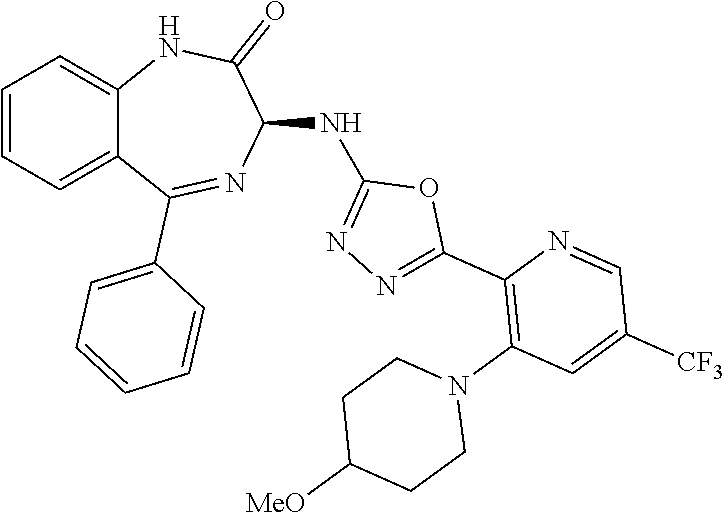
Example 268 was prepared using a procedure similar to that used to prepare Example 160 where 4-methoxypiperidine and ethyl 3-chloro-5-(trifluoromethyl)picolinate were used in place of morpholine and methyl 5-bromo-3-fluoropicolinate, respectively. ESI-MS m/z: 578.2 [M+H]+.

Example 269 was prepared using a procedure similar to that used to prepare Example 160 where 4-fluoropiperidine and ethyl 3-chloro-5-(trifluoromethyl)picolinate were used in place of morpholine and methyl 5-bromo-3-fluoropicolinate, respectively. ESI-MS m/z: 566.2 [M+H]+.

Example 270 was prepared using a procedure similar to that used to prepare Example 245 where 5,6,7,8-tetrahydro-[1,2,4]triazolo[1,5-a]pyrazine was used in place of (R)-3-methylmorpholine. ESI-MS m/z: 519.2 [M+H]+. 1H NMR (300 MHz, DMSO-d6) δ 3.68 (q, J=4.6 Hz, 2H), 4.30 (t, J=5.4 Hz, 2H), 4.59 (d, J=2.6 Hz, 2H), 5.13 (s, 1H), 7.12-7.74 (m, 10H), 7.96 (s, 1H), 8.08 (dd, J=7.7, 1.9 Hz, 1H), 8.41 (dd, J=4.8, 1.9 Hz, 1H), 9.17 (s, 1H).

Example 271 was prepared using a procedure similar to that used to prepare Example 160 where 3-methoxyazetidine and ethyl 3-chloro-5-(trifluoromethyl)picolinate were used in place of morpholine and methyl 5-bromo-3-fluoropicolinate, respectively. ESI MS m/z=550.1830 [M+H]+.


In an oven-dried vial, methyl 2-methyl-5-bromothiazole-4-carboxylate (0.5 g, 2.12 mmol) was dissolved in morpholine (4 ml, 46.4 mmol) and sealed. The reaction was heated to 60° C. and stirred overnight. The reaction mixture was concentrated, removing excess morpholine. The crude product was added to a silica gel column and was eluted with ethyl acetate/

Example 272 was prepared using a procedure similar to that used to prepare Example 152 where methyl 2-methyl-5-morpholinothiazole-4-carboxylate was used in place of ethyl 2-morpholino-4-(trifluoromethyl)benzoate. ESI MS m/z=502.2 [M+H]+.

Example 273 was prepared using a procedure similar to that used to prepare Example 20 where 4-(1H-1,2,4-triazol-1-yl)benzoic acid was used in place of 5-chlorofuran-2-carboxylic acid. ESI MS m/z=463.2 [M+H]+. 1H NMR (400 MHz, DMSO-d6) δ 5.18-5.20 (d, J=8.0, 1H), 7.27-7.29 (m, 1H), 7.31-7.35 (m, 2H), 7.37-7.45 (m, 2H), 7.47-7.51 (m, 3H), 7.53-7.56 (m, 1H), 7.66-7.70 (m, 2H), 7.71-7.99 (m, 2H), 8.00-8.09 (m, 1H), 9.22-9.24 (m, 1H), 9.42 (s, 1H), 11.00 (s, 1H).

Example 274 was prepared using a procedure similar to that used to prepare Example 245 where azetidine-3-carbonitrile was used in place of (R)-3-methylmorpholine. ESI-MS m/z: 477.2 [M+H]+. 1H NMR (300 MHz, Methanol-d4) δ 3.69 (tt, J=8.9, 6.0 Hz, 1H), 4.22 (ddd, J=8.4, 6.2, 1.5 Hz, 2H), 4.35 (td, J=8.8, 2.4 Hz, 2H), 5.30 (s, 1H), 6.95 (dd, J=7.7, 4.9 Hz, 1H), 7.23-7.72 (m, 10H), 7.98 (dd, J=7.7, 1.8 Hz, 1H), 8.32 (dd, J=4.9, 1.8 Hz, 1H), 8.52 (s, 2H).

Example 275 was prepared using a procedure similar to that used to prepare Example 160 where 3-oxa-8-azabicyclo[3.2.1]octane and ethyl 2-chloro-6-(trifluoromethyl)nicotinate were used in place of morpholine and methyl 5-bromo-3-fluoropicolinate, respectively. ESI-MS m/z: 576.3 [M+H]+.

Example 276 was prepared using a procedure similar to that used to prepare Example 160 where 3-oxa-8-azabicyclo[3.2.1]octane and ethyl 2-chloro-6-(trifluoromethyl)nicotinate were used in place of morpholine and methyl 5-bromo-3-fluoropicolinate, respectively. ESI-MS m/z: 576.3 [M+H]+.

Example 277 was prepared using a procedure similar to that used to prepare Example 160 where (R)-2-methylmorpholine and ethyl 3-chloro-5-(trifluoromethyl)picolinate were used in place of morpholine and methyl 5-bromo-3-fluoropicolinate, respectively. ESI-MS m/z: 564.3 [M+H]+.

Example 278 was prepared using a procedure similar to that used to prepare Example 160 where (S)-2-methylmorpholine and ethyl 3-chloro-5-(trifluoromethyl)picolinate were used in place of morpholine and methyl 5-bromo-3-fluoropicolinate, respectively. ESI-MS m/z: 564.3 [M+H]+.

Example 279 was prepared using a procedure similar to that used to prepare Example 160 where 3-oxa-8-azabicyclo[3.2.1]octane and methyl 2-chloro-6-methylnicotinate were used in place of morpholine and methy5-bromo-3-fluoropicolinate, respectively. ESI-MS m/z: 522.3 [M+H]+. 1H NMR (400 MHz, DMSO-d6) δ 1.62-1.81 (m, 2H), 1.90 (dd, J=7.2, 4.8 Hz, 2H), 2.41 (s, 3H), 3.00 (dt, J=12.6, 2.0 Hz, 2H), 3.28 (s, 2H), 4.18-4.38 (m, 2H), 5.15 (d, J=8.5 Hz, 1H), 6.85 (d, J=7.7 Hz, 1H), 7.29 (td, J=7.4, 1.2 Hz, 1H), 7.36 (dd, J=7.7, 1.4 Hz, 1H), 7.44-7.58 (m, 5H), 7.68 (ddd, J=8.6, 7.2, 1.7 Hz, 1H), 7.74 (d, J=7.7 Hz, 1H), 9.10 (d, J=8.7 Hz, 1H), 10.99 (s, 1H).

Example 280 was prepared using a procedure similar to that used to prepare Example 160 where 8-oxa-3-azabicyclo[3.2.1]octane and methyl 2-chloro-6-methylnicotinate were used in place of morpholine and methy5-bromo-3-fluoropicolinate, respectively. ESI-MS m/z: 522.3 [M+H]+. 1H NMR (400 MHz, DMSO-d6) δ 1.77 (m, 4H), 2.39 (s, 3H), 3.44-3.53 (d, 2H), 3.70-3.81 (m, 2H), 3.94-4.08 (d, 2H), 5.15 (d, 1H), 6.83 (d, 1H), 7.32 (d, 3H), 7.41-7.60 (m, 5H), 7.67 (m, 1H), 7.79 (d, 1H), 9.10 (d, 1H), 10.98 (s, 1H).

Example 281 was prepared using a procedure similar to that used to prepare Example 151 where 2-(8-oxa-3-azabicyclo[3.2.1]octan-3-yl)-4-cyanobenzoic acid, which was prepared similarly to 4-cyano-2-morpholinobenzoic acid in Example 131, was used in place of 6-fluoro-2-morpholinonicotinic acid. ESI-MS m/z: 532.2 [M+H]+. 1H NMR (400 MHz, DMSO-d6) δ 1.60-1.82 (m, 2H), 1.95-2.11 (m, 2H), 2.80-2.99 (m, 4H), 4.19-4.35 (m, 2H), 5.18 (d, J=8.6 Hz, 1H), 7.26-7.74 (m, 12H), 9.27 (dd, J=8.5, 1.6 Hz, 1H), 11.00 (s, 1H).


A solution of the ethyl 3-chloro-5-(trifluoromethyl)picolinate (1 g, 4.0 mmol), pyridin-4-ylboronic acid (583 mg, 4.7 mmol), Pd(dppf)Cl2·DCM (1.8 g, 2.2 mol) and Na2CO3 (848 mg, 8.0 mol) in DMF (5 mL) was stirred for 1 hour at 130° C. It was purified by reverse phase C18 column chromatography (MeCN/H2O) to give ethyl 5-(trifluoromethyl)-[3,4′-bipyridine]-2-carboxylate as a white solid (513 mg, 43%). ESI-MS m/z: 297.0 [M+H]+.

Example 282 was prepared using a procedure similar to that used to prepare Example 152 where ethyl 5-(trifluoromethyl)-[3,4′-bipyridine]-2-carboxylate was used in place of ethyl 2-morpholino-4-(trifluoromethyl)benzoate. ESI-MS m/z: 542.2 [M+H]+. 1H NMR (300 MHz, DMSO-d6) δ 5.07 (d, J=7.8 Hz, 1H), 7.21-7.36 (m, 3H), 7.37-7.58 (m, 6H), 7.65 (m, 1H), 8.31-8.38 (m, 1H), 8.55-8.63 (m, 2H), 9.21 (m, 1H), 9.42 (d, J=8.4 Hz, 1H), 10.93 (s, 1H).

Example 283 was prepared using a procedure similar to that used to prepare Example 20 where 2-(1H-pyrazol-1-yl)benzoic acid was used in place of 5-chlorofuran-2-carboxylic acid. ESI-MS m/z: 462.4 [M+H]+. 1H NMR (400 MHz, DMSO-d6) δ 4.89 (d, J=8.6 Hz, 1H), 6.13-6.19 (m, 1H), 7.24-7.78 (m, 13H), 7.81-7.91 (m, 1H), 7.95-8.05 (m, 1H), 8.91 (d, J=8.6 Hz, 1H), 10.94 (s, 1H).

Example 284 was prepared using a procedure similar to that used to prepare Example 159 where ethyl 2-(cis-2,6-dimethylmorpholino)-4-fluorobenzoate was used in place of ethyl 4-fluoro-2-morpholinobenzoate. ESI-MS m/z: 527.2 [M+H]+.

Example 285 was prepared using a procedure similar to that used to prepare Example 151 where (R)-4-cyano-2-(3-methylmorpholino)benzoic acid, which was prepared similarly to 4-cyano-2-morpholinobenzoic acid in Example 131, was used in place of 6-fluoro-2-morpholinonicotinic acid. ESI-MS m/z: 520.6 [M+H]+.

Example 286 was prepared using a procedure similar to that used to prepare Example 160 where (R)-3-methylmorpholine and methyl 2-chloro-6-methylnicotinate were used in place of morpholine and methy5-bromo-3-fluoropicolinate, respectively. ESI-MS m/z: 510.2 [M+H]+. 1H NMR (400 MHz, DMSO-d6) δ 0.99-1.01 (m, 3H), 2.50-2.51 (m, 3H), 3.03-3.07 (m, 1H), 3.22-3.26 (m, 1H), 3.33-3.46 (m, 1H), 3.50-3.53 (m, 1H), 3.57-3.69 (m, 1H), 3.73-3.78 (m, 2H), 5.14-5.16 (d, J=8.0, 1H), 6.89-6.91 (d, J=8.0, 1H), 7.26-7.36 (m, 3H), 7.44-7.55 (m, 5H), 7.65-7.70 (m, 1H), 7.82-7.84 (m, 1H), 9.08-9.11 (d, J=12.0, 1H), 10.98 (s, 1H).

Example 287 was prepared using a procedure similar to that used to prepare Example 20 where quinuclidine-4-carboxylic acid was used in place of 5-chlorofuran-2-carboxylic acid. ESI-MS m/z: 390.1 [M+H]+. H NMR (300 MHz, DMSO-d6) δ 1.69 (m, 6H), 2.76-2.88 (m, 6H), 5.03 (d, J=8.7 Hz, 1H), 7.19-7.37 (m, 3H), 7.38-7.59 (m, 5H), 7.65 (m, 1H), 8.72 (d, J=8.7 Hz, 1H), 10.88 (s, 1H).

Example 288 was prepared using a procedure similar to that used to prepare Example 159 where ethyl 2-(8-oxa-3-azabicyclo[3.2.1]octan-3-yl)-4-fluorobenzoate was used in place of ethyl 4-fluoro-2-morpholinobenzoate. ESI-MS m/z: 525.2 [M+H]+.

Example 289 was prepared using a procedure similar to that used to prepare Example 151 where 2-(3-oxa-8-azabicyclo[3.2.1]octan-8-yl)-4-cyanobenzoic acid, which was prepared similarly to 4-cyano-2-morpholinobenzoic acid in Example 131, was used in place of 6-fluoro-2-morpholinonicotinic acid. ESI-MS m/z: 532.3 [M+H]+. 1H NMR (400 MHz, DMSO-d6) δ 1.82-1.85 (m, 4H), 3.45-3.48 (m, 2H), 3.69-3.80 (m, 4H), 5.15-5.17 (m, 1H), 7.26-7.33 (m, 2H), 4.53-4.54 (m, 1H), 7.35-7.44 (m, 3H), 7.46-7.55 (m, 6H), 7.65-7.74 (m, 2H), 9.24-9.26 (d, J=8.0, 1H), 10.97 (s, 1H).

Example 290 was prepared using a procedure similar to that used to prepare Example 162 where 8-oxa-3-azabicyclo[3.2.1]octane was used in place of morpholine. ESI-MS m/z: 551.6 [M+H]+. 1H NMR (400 MHz, DMSO-d6) δ 1.69 (m, 4H), 3.22 (d, J=12.9 Hz, 2H), 3.67 (m, 2H), 4.35 (s, 2H), 5.15 (d, J=6.9 Hz, 1H), 7.26 (m, 1H), 7.34 (d, J=8.2 Hz, 2H), 7.48 (m, 5H), 7.65 (m, 1H), 8.66 (s, 1H), 9.24 (d, J=7.9 Hz, 1H), 10.98 (s, 1H).

Example 291 was prepared using a procedure similar to that used to prepare Example 20 where 3-cyano-1H-indole-6-carboxylic acid was used in place of 5-chlorofuran-2-carboxylic acid. ESI-MS m/z: 460.1 [M+H]+. 1H NMR (300 MHz, DMSO-d6) δ 5.19 (d, J=8.6 Hz, 1H), 7.24-7.89 (m, 11H), 7.96-8.03 (m, 1H), 8.44 (s, 1H), 9.16 (d, J=8.6 Hz, 1H), 11.02 (s, 1H), 12.52 (s, 1H).

Example 292 was prepared using a procedure similar to that used to prepare Example 272. ESI-MS m/z: 489.1 [M+H]+.

Example 293 was prepared using a procedure similar to that used to prepare Example 282. ESI-MS m/z: 505.1 [M+H]+. 1H NMR (300 MHz, DMSO-d6) δ 0.92 (m, 2H), 1.10 (m, 2H), 2.90-3.00 (m, 1H), 5.20-5.23 (d, J=7.8 Hz, 1H), 7.25-7.37 (m, 3H), 7.37-7.56 (m, 5H), 7.65 (m, 1H), 7.82 (s, 1H), 8.89 (s, 1H), 9.41 (d, J=8.4 Hz, 1H), 10.98 (s, 1H).

Example 294 was prepared using a procedure similar to that used to prepare Example 160 where (R)-3-methylmorpholine and ethyl 3-chloro-5-(trifluoromethyl)picolinate were used in place of morpholine and methyl 5-bromo-3-fluoropicolinate, respectively. ESI-MS m/z: 564.4 [M+H]+. 1H NMR (300 MHz, DMSO-d6) δ 0.80 (d, J=6.3 Hz, 3H), 2.71-2.83 (m, 2H), 3.35 (s, 2H), 3.50 (m, 1H), 3.58-3.68 (m, 1H), 3.78 (m, 2H), 5.20 (d, J=8.3 Hz, 1H), 7.22-7.38 (m, 3H), 7.40-7.58 (m, 5H), 7.61-7.75 (m, 1H), 8.04 (d, J=1.9 Hz, 1H), 8.45 (s, 0.29H), 8.72-8.78 (m, 1H), 9.37 (d, J=8.5 Hz, 1H), 10.97 (s, 1H).

Example 295 was prepared using a procedure similar to that used to prepare Example 160 where methyl 2-chloro-6-methoxynicotinate was used in place of methy5-bromo-3-fluoropicolinate. ESI-MS m/z: 512.2 [M+H]+. 1H NMR (300 MHz, DMSO-d6) δ 3.11-3.27 (m, 4H), 3.62 (s, 4H), 3.87 (s, 3H), 5.13 (d, J=8.6 Hz, 1H), 6.40 (d, J=8.4 Hz, 1H), 7.18-7.40 (m, 3H), 7.40-7.58 (m, 5H), 7.61-7.74 (m, 1H), 7.83 (d, J=8.3 Hz, 1H), 9.00 (d, J=8.7 Hz, 1H), 10.88 (s, 1H).

Example 296 was prepared using a procedure similar to that used to prepare Example 160 where 1-methylpiperazin-2-one and ethyl 3-chloro-5-(trifluoromethyl)picolinate were used in place of morpholine and methyl 5-bromo-3-fluoropicolinate, respectively. ESI-MS m/z: 577.3 [M+H]+. 1H NMR (300 MHz, DMSO-d6) δ 2.86 (s, 3H), 3.34 (d, J=4.6 Hz, 2H), 3.44 (m, 2H), 3.78 (s, 2H), 5.19 (d, J=8.2 Hz, 1H), 7.22-7.39 (m, 3H), 7.40-7.57 (m, 5H), 7.61-7.71 (m, 1H), 7.93 (d, J=1.9 Hz, 1H), 8.66-8.78 (m, 1H), 9.39 (d, J=8.4 Hz, 1H), 10.97 (s, 1H).

Example 297 was prepared using a procedure similar to that used to prepare Example 151. ESI-MS m/z: 552.2 [M+H]+. 1H NMR (300 MHz, DMSO-d6) δ 1.18 (s, 6H), 3.25 (d, J=5.2 Hz, 2H), 4.66 (s, 1H), 5.20 (d, J=8.3 Hz, 1H), 7.20-7.40 (m, 3H), 7.40-7.62 (m, 6H), 7.67 (ddd, J=8.5, 7.1, 1.7 Hz, 1H), 7.92 (t, J=5.2 Hz, 1H), 8.21 (dd, J=1.8, 0.8 Hz, 1H), 9.48 (d, J=8.4 Hz, 1H), 10.99 (s, 1H).


A solution of 1H-benzo[d]imidazole-2-carboxylic acid (500 mg, 3.086 mmol), 1-bromo-2-methoxyethane (852 mg, 6.17 mmol) and CS2CO3 (3.02 g, 9.258 mmol) in DMF (5 mL) was stirred for 3 hours at 60° C. It was diluted with water, extracted with EA (×3), washed with brine (×2), the organic layer was dried, concentrated to give 750 mg (crude) of desired compound as yellow oil, which was used directly in the next step. ESI-MS m/z: 279.3 [M+H]+.

Example 298 was prepared using a procedure similar to that used to prepare Example 152 where 2-methoxyethyl 1-(2-methoxyethyl)-1H-benzo[d]imidazole-2-carboxylate was used in place of ethyl 2-morpholino-4-(trifluoromethyl)benzoate. ESI-MS m/z: 494.4 [M+H]+. 1H NMR (300 MHz, DMSO-d6) δ 3.16 (s, 3H), 3.72 (m, 2H), 4.85 (m, 2H), 5.23 (d, J=7.5 Hz, 1H), 7.23-7.42 (m, 5H), 7.43-7.61 (m, 3H), 7.64-7.82 (m, 3H), 9.47-9.64 (m, 1H), 11.01 (s, 1H).

Example 299 was prepared using a procedure similar to that used to prepare Example 151 where 3-(8-oxa-3-azabicyclo[3.2.1]octan-3-yl)-5-fluoropicolinic acid, which was prepared similarly to 5-fluoro-3-morpholinopicolinic acid in Example 136, was used in place of 6-fluoro-2-morpholinonicotinic acid. ESI-MS m/z: 526.5 [M+H]+. 1H NMR (300 MHz, DMSO-d6) δ 1.71 (m, 2H), 1.92-2.11 (m, 2H), 2.94 (m, 4H), 4.28 (s, 2H), 5.17 (d, 1H), 7.17-7.78 (m, 10H), 8.30 (m, 1H), 9.19 (d, 1H), 10.96 (s, 1H).


To a stirred solution of methyl 4-bromo-2-hydroxybenzoate (1.5 g, 6.49 mmol), KI (108 mg, 0.65 mmol) and K2CO3 (2.69 g, 19.47 mmol) in DMF (30 mL) was added 1-bromo-2-methyloethane (902 mg, 6.49 mmol). The mixture was heated to 80° C. overnight and water was added (150 mL). The mixture was extracted with EA (150 mL×3) and the combined organic phase was washed with water, brine and dried over anhydrous Na2SO4 and concentrated. The residue was purified by silica gel chromatography (PE/EA=5/1) to give the desired compound as a yellow solid (1.7 g, 90%). ESI-MS m/z: 289.1 [M+H]+.

To a stirred solution of the compound from step a (1.7 g, 5.88 mmol) and Zn(CN)2 (1.36 g, 11.76 mmol) in DMF (30 mL) was added Pd(PPh3)4 (1.36 g, 1.18 mmol). The mixture was heated to 120° C. for 2 hours under N2 Atmosphere. The mixture was cooled to rt and sat FeSO4 solution was added. The mixture was extracted with EA (100 mL×3) and the combined organic phase was washed with water, brine and dried over anhydrous Na2SO4 and concentrated. The residuer was purified by gel chromatography to give the title compound as a white solid (1.2 g, 78%). ESI-MS m/z: 263.0 [M+H]+.

Example 300 was prepared using a procedure similar to that used to prepare Example 152 where methyl 4-cyano-2-(2-methoxyethoxy)benzoate was used in place of ethyl 2-morpholino-4-(trifluoromethyl)benzoate. ESI-MS m/z: 495.2 [M+H]+. 1H NMR (300 MHz, DMSO-d6) δ 3.27 (s, 3H), 3.67 (dd, J=5.5, 3.7 Hz, 2H), 4.28 (dd, J=5.5, 3.8 Hz, 2H), 5.17 (d, J=8.0 Hz, 1H), 7.18-7.59 (m, 9H), 7.58-7.77 (m, 2H), 7.87 (d, J=8.0 Hz, 1H), 9.20 (d, J=8.4 Hz, 1H), 10.97 (s, 1H).

Example 301 was prepared using a procedure similar to that used to prepare Example 151 where (R)-5-cyano-3-(3-methylmorpholino)picolinic acid, which was prepared similarly to 5-cyano-3-morpholinopicolinic acid in Example 140, in place of 6-fluoro-2-morpholinonicotinic acid. ESI-MS m/z: 521.4 [M+H]+. 1H NMR (300 MHz, DMSO-d6) δ 0.81 (d, J=6.3 Hz, 3H), 2.65-2.76 (m, 1H), 3.40-3.51 (m, 3H), 3.54-3.68 (m, 1H), 3.78 (m, 2H), 5.20 (d, J=8.3 Hz, 1H), 7.23-7.38 (m, 3H), 7.41-7.58 (m, 5H), 7.67 (m, 1H), 8.26 (d, J=1.8 Hz, 1H), 8.78 (d, J=1.7 Hz, 1H), 9.41 (d, J=8.5 Hz, 1H), 10.98 (s, 1H).

Example 302 was prepared using a procedure similar to that used to prepare Example 136 where dimethylamine and ethyl 3-chloro-5-(trifluoromethyl)picolinate were used in place of morpholine and

Example 303 was prepared using a procedure similar to that used to prepare Example 136 where 3-aminopropanenitrile and ethyl 3-chloro-5-(trifluoromethyl)picolinate were used in place of morpholine and

Example 304 was prepared using a procedure similar to that used to prepare Example 151 where 3-(8-oxa-3-azabicyclo[3.2.1]octan-3-yl)-5-cyanopicolinic acid, which was prepared similarly to 5-cyano-3-morpholinopicolinic acid in Example 140, in place of 6-fluoro-2-morpholinonicotinic acid. ESI-MS m/z: 533.4 [M+H]+. 1H NMR (400 MHz, DMSO-d6) δ 1.71 (s, 2H), 2.07-2.11 (m, 2H), 2.94-3.05 (m, 4H), 4.30 (s, 2H), 5.19-5.21 (d, J=8.0, 1H), 7.26-7.36 (m, 3H), 7.44-7.55 (m, 5H), 7.65-7.69 (m, 1H), 8.11 (s, 1H), 8.68-8.69 (d, J=4.0, 1H), 9.40-9.42 (d, J=8.0, 1H), 11.00 (s, 1H).

Example 305 was prepared using a procedure similar to that used to prepare Example 136 where 2-methoxyethan-1-amine and ethyl 3-chloro-5-(trifluoromethyl)picolinate were used in place of morpholine and

Example 306 was prepared using a procedure similar to that used to prepare Example 298 where 1H-imidazole-2-carboxylic acid was used in place of 1H-benzo[d]imidazole-2-carboxylic acid. ESI-MS m/z: 444.3 [M+H]+. 1H NMR (300 MHz, DMSO-d6) δ 3.20 (s, 3H), 3.63 (m, 2H), 4.54 (m, 2H), 5.15 (d, J=8.4 Hz, 1H), 7.10 (d, J=1.1 Hz, 1H), 7.21-7.38 (m, 2H), 7.40-7.57 (m, 5H), 7.67 (m, 1H), 9.29 (d, J=8.5 Hz, 1H), 10.98 (s, 1H).

Example 307 was prepared using a procedure similar to that used to prepare Example 136 where methylamine and ethyl 3-chloro-5-(trifluoromethyl)picolinate were used in place of morpholine and

Example 308 was prepared using a procedure similar to that used to prepare Example 136 where 2-methoxy-N-methylethan-1-amine and ethyl 3-chloro-5-(trifluoromethyl)picolinate were used in place of morpholine and


A solution of methyl 2-bromo-4-cyanobenzoate (480 mg, 2.0 mmol), thiophen-3-ylboronic acid (307 mg, 2.4 mmol), Pd(dppf)Cl2 (146 mg, 0.2 mmol) and K2CO3 (552 mg, 4.0 mmol) in dioxane (10 mL) and H2O (2 mL) was stirred for 1 hour at 80° C. Extracted with EA (3×), dried Na2SO4, and filtered to give desired compound as a brown solid (389 mg, 80%). ESI-MS m/z: no signal.

Example 309 was prepared using a procedure similar to that used to prepare Example 152 where methyl 4-cyano-2-(thiophen-3-yl)benzoate was used in place of ethyl 2-morpholino-4-(trifluoromethyl)benzoate. ESI-MS m/z: 503.3 [M+H]+. 1H NMR (300 MHz, DMSO-d6) δ 4.96 (m, 1H), 6.98-7.07 (m, 1H), 7.24-7.80 (m, 1H), 7.90-8.06 (m, 3H), 9.11 (m, 1H), 10.96 (s, 1H).

Example 310 was prepared using a procedure similar to that used to prepare Example 152 where ethyl 1-(2-methoxyethyl)-1H-pyrazole-5-carboxylate was used in place of ethyl 2-morpholino-4-(trifluoromethyl)benzoate. ESI-MS m/z: 444.3 [M+H]+. 1H NMR (300 MHz, DMSO-d6) δ 3.16 (s, 3H), 3.69 (m, 2H), 4.67 (m, 2H), 5.15 (d, J=8.4 Hz, 1H), 6.73 (d, J=2.0 Hz, 1H), 7.20-7.39 (m, 3H), 7.41-7.59 (m, 5H), 7.59-7.73 (m, 2H), 9.27 (d, J=8.4 Hz, 1H), 11.00 (s, 1H).


A solution of 5-bromo-3-fluoropicolinic acid (1.0 g, 4.57 mmol) was dissolved in DMF (15 mL) and BocNHNH2 (1.2 g, 9.14 mmol) was added. HATU (1.8 g, 4.80 mmol) and Et3N (5 mL) was added. The mixture was stirred at rt for 1 hour. Water (20 mL) was added and the mixture was extracted with EA (25 mL×3). The combined organic phase was dried over anhydrous Na2SO4 and concentrated. The residue was purified by silica gel chromatography (PE/EA=3/1) to give the desired product as a white solid (1.3 g, 83%).

A solution of the compound from step a (1.3 g, 3.78 mmol), morpholine (658 mg, 7.56 mmol) and K2CO3 (1.3 g, 9.45 mmol) in DMSO (10 mL) was stirred for overnight at 100° C. It was diluted with H2O, and extracted with EA (×3) and washed with brine (×2). The organic layers was combined and concentrated to give 1.2 g (81%) white product. ESI-MS m/z: 401.2 [M+H]+.

A solution of the compound from step b (500 mg, 1.25 mmol) and ethynyltrimethylsilane (368 mg, 3.75 mmol) in i-Pr2NH (6 mL) was added Pd(PPh3)2Cl2 (88 mg, 0.13 mmol) and CuI (24 mg, 0.13 mmol). The mixture was heated to 80° C. for 3 hours and then cooled to r.t. It was filtered and concentrated, then purified by reverse phase C18 column chromatography (MeCN/H2O) to give the desired product as a yellow solid (451 mg, 86%). ESI-MS m/z: 419.4 [M+H]+.

A solution of the compound from step c (451 mg, 1.08 mmol) and K2CO3 (298 mg, 2.16 mmol) in MeOH (10 mL) was stirred at rt for 1 hour. It was purified by Silica gel column (PE/EA=3:1-1:1) to give tert-butyl 2-(5-ethynyl-3-morpholinopicolinoyl)hydrazine-1-carboxylate as a yellow solid (348 mg, 93%). ESI-MS m/z: 347.3 [M+H]+.

Example 311 was prepared using a procedure similar to that used to prepare Example 151 where tert-butyl 2-(5-ethynyl-3-morpholinopicolinoyl)hydrazine-1-carboxylate was used in place of 6-fluoro-2-morpholinonicotinohydrazide. ESI-MS m/z: 506.4 [M+H]+. 1H NMR (300 MHz, DMSO-d6) δ 2.99 (d, 4H), 3.70 (d, 4H), 4.61 (s, 1H), 5.19 (d, 1H), 7.16-7.39 (m, 3H), 7.39-7.60 (m, 4H), 7.59-7.73 (m, 2H), 8.41 (d, 1H), 9.28 (d, J=8.6 Hz, 1H), 10.97 (s, 1H).


A solution of 5-bromo-3-fluoropicolinic acid (4.0 g, 18.26 mmol) and H2SO4 (10 mL) in EtOH (25 mL) was heated to 80° C. for overnight and then cooled to rt. It was concentrated, diluted with H2O, and extracted with EA (×3) and washed with brine (×2). The organic layers was combined and concentrated to give desired compound as yellow oil (4.45 g, 95%). ESI-MS m/z: 247.8 [M+H]+.
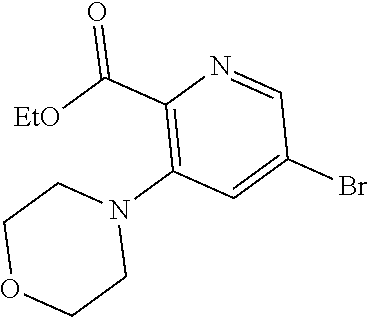
A solution of the compound from step a (4.45 g, 18.02 mmol) and K2CO3 (7.46 g, 54.06 mmol) in morpholine (20 mL) was stirred at rt for 1 hour. It was concentrated, diluted with H2O, and extracted with EA (×3) and washed with brine (×2). The organic layers was combined and concentrated, then purified by silica gel column (PE/EA=5:1) to give desired compound as a yellow solid (4.79 g, 85%). ESI-MS m/z: 315.2 [M+H]+.

A solution of the compound from step b (1.5 g, 3.18 mmol), cyclohexenylboronic acid (481 mg, 3.82 mmol), K2CO3 (878 mg, 6.36 mmol) and Pd(PPh3)4 (367 mg, 0.318 mmol) in DMF (8 mL) was stirred for overnight. It was filtered and purified by Prep-HPLC (MeCN/H2O) to give ethyl 5-(cyclohex-1-en-1-yl)-3-morpholinopicolinate as a yellow oil (440 mg, 44%). ESI-MS m/z: 317.3 [M+H]+.

Example 312 was prepared using a procedure similar to that used to prepare Example 152 where ethyl 5-(cyclohex-1-en-1-yl)-3-morpholinopicolinate was used in place of ethyl 2-morpholino-4-(trifluoromethyl)benzoate. ESI-MS m/z: 562.3 [M+H]+. 1H NMR (300 MHz, DMSO-d6) δ 1.51-1.67 (m, 2H), 1.67-1.84 (m, 2H), 2.22 (s, 2H), 2.43 (s, 2H), 2.84-3.13 (m, 4H), 3.70 (d, 4H), 5.18 (d, 1H), 6.36-6.51 (m, 1H), 7.23-7.40 (m, 3H), 7.41-7.57 (m, 6H), 7.67 (m, 1H), 8.41 (d, 1H), 9.15 (d, 1H), 10.95 (s, 1H).


A solution of ethyl 5-(cyclohex-1-en-1-yl)-3-morpholinopicolinate from Example 312 step c (460 mg, 1.45 mmol) and Pd—C (100 mg) in 10 mL MeOH was stirred at room temperature for 3 hrs under H2. Pd/C was filtered off and the filtrate was concentrated to afford ethyl 5-cyclohexyl-3-morpholinopicolinate as yellow oil (500 mg). ESI-MS m/z: 319.3 [M+H]+.

Example 313 was prepared using a procedure similar to that used to prepare Example 152 where ethyl 5-cyclohexyl-3-morpholinopicolinate was used in place of ethyl 2-morpholino-4-(trifluoromethyl)benzoate. ESI-MS m/z: 564.3 [M+H]+. 1H NMR (300 MHz, DMSO-d6) δ 1.39 (m, 5H), 1.76 (m, 5H), 2.52-2.71 (m, 1H), 2.97 (s, 4H), 3.69 (s, 4H), 5.17 (d, J=8.6 Hz, 1H), 7.32 (dd, J=18.4, 7.8 Hz, 3H), 7.40-7.61 (m, 6H), 7.67 (t, J=7.5 Hz, 1H), 8.23 (d, J=1.7 Hz, 1H), 9.14 (d, J=8.6 Hz, 1H), 10.96 (s, 1H).


A solution of the compound methyl 5-bromo-3-morpholinopicolinate from Example 160 step a (800 mg, 2.55 mmol), pyrrolidine (362 mg, 5.1 mmol), CuI (242 mg, 1.3 mmol), L-Proline (147 mg, 1.3 mmol) and K2CO3 (704 mg, 5.1 mmol) in DMSO (6 mL) was stirred at rt for 2 hours. It was filtered and then purified by Prep-HPLC (MeCN/H2O) to give ethyl 3-morpholino-5-(pyrrolidin-1-yl)picolinate as a yellow oil (376 mg, 48%). ESI-MS m/z: 306.2 [M+H]+.

Example 314 was prepared using a procedure similar to that used to prepare Example 152 where ethyl 3-morpholino-5-(pyrrolidin-1-yl)picolinate was used in place of ethyl 2-morpholino-4-(trifluoromethyl)benzoate. ESI-MS m/z: 551.4 [M+H]+. 1H NMR (400 MHz, DMSO-d6) δ 1.87-2.10 (m, 4H), 2.79-3.14 (m, 4H), 3.25-3.52 (m, 4H), 3.70 (m, 4H), 5.16 (d, 1H), 6.52 (d, 1H), 7.24-7.32 (m, 1H), 7.36 (m, 2H), 7.42-7.59 (m, 5H), 7.68 (m, 1H), 7.73 (d, 1H), 8.94 (d, 1H), 10.96 (s, 1H).

Example 315 was prepared using a procedure similar to that used to prepare Example 309 where 5-(4,4,5,5-tetramethyl-1,3,2-dioxaborolan-2-yl)pyridin-2(1H)-one was used in place of thiophen-3-ylboronic acid. ESI-MS m/z: 528.4 [M+H]+. 1H NMR (400 MHz, DMSO-d6) δ 3.47 (s, 3H), 5.12 (d, J=8.3 Hz, 1H), 6.34 (d, J=9.3 Hz, 1H), 7.23-7.40 (m, 4H), 7.50 (m, 5H), 7.67 (m, 1H), 7.90 (d, J=2.6 Hz, 1H), 7.99 (d, J=4.0 Hz, 3H), 9.27 (d, J=8.4 Hz, 1H), 10.97 (s, 1H).


A solution of 3-bromoisoquinolin-4-amine (980 mg, 4.4 mmol), Cs2CO3 (4.3 g, 13.2 mmol), 1-bromo-2-(2-bromoethoxy) ethane (1.5 g, 6.7 mmol) in DMA (20 mL) was stirred at 120° C. overnight. Then H2O (20 mL) was added to the mixture and it was extracted with EA (×3). The organic layer was dried and purified by reverse phase C18 column chromatography (MeCN/H2O) to give desired compound as brown solid (500 mg, 39%). ESI-MS m/z: 293.2 [M+H]+.

A solution of the compound from step a (470 mg, 1.6 mmol), Pd(dppf)Cl2 (200 mg, 0.245 mmol) and TEA (2 mL) in MeOH (10 mL). The solution was stirred for overnight at 100° C. in CO(g) under 20 atm. The solid was filtered out. The filtrate was concentrated under vacuum, and was purified by reverse phase C18 column chromatography (MeCN/H2O) to give methyl 4-morpholinoisoquinoline-3-carboxylate as black solid (1.0 g). ESI-MS m/z: 273.3 [M+H]+.

Example 316 was prepared using a procedure similar to that used to prepare Example 152 where methyl 4-morpholinoisoquinoline-3-carboxylate was used in place of ethyl 2-morpholino-4-(trifluoromethyl)benzoate. ESI-MS m/z: 532.4 [M+H]+. 1H NMR (300 MHz, DMSO-d6) δ 3.02 (d, J=6.0 Hz, 4H), 3.78 (t, J=4.5 Hz, 4H), 5.22 (d, J=8.6 Hz, 1H), 7.22-7.60 (m, 8H), 7.68 (ddd, J=8.4, 7.1, 1.7 Hz, 1H), 7.87 (dddd, J=32.0, 8.0, 6.9, 1.2 Hz, 2H), 8.18-8.30 (m, 1H), 8.37 (d, J=8.3 Hz, 1H), 9.21 (d, J=9.6 Hz, 2H), 10.99 (s, 1H).


A solution of methyl 4-amino-2-fluorobenzoate (1.0 g, 5.9 mmol) and K2CO3 (1.6 g, 11.8 mmol) in morpholine (4 mL) was heated to 100° C. for overnight and then cooled to r.t. Water (10 mL) was added and the mixture was extracted with EA (10 mL×3). The combined organic phase was dried over anhydrous Na2SO4 and concentrated. The residue was chromatographied (silica, PE:EA=2:1) to give desired compound as a pink solid (990 mg, 71%). ESI-MS m/z: 237.2 [M+H]+.

A solution of the compound from step a (990 mg, 4.2 mmol) and Cs2CO3 (2.05 g, 6.3 mmol) in DMF (5 mL) was added 1,4-dibromobutane (898 mg, 4.2 mmol). The mixture was heated to 80° C. for 24 hours and then cooled to rt. Water (10 mL) was added and the mixture was extracted with EA (10 mL×3). The combined organic phase was washed with water (20 mL) and brine (20 mL). It was then dried over anhydrous Na2SO4 and concentrated. The residue was chromatographed (silica, PE:EA=5:1) to give methyl 2-morpholino-4-(pyrrolidin-1-yl)benzoate as a pink solid (200 mg, 16%). ESI-MS m/z: 291.3 [M+H]+.

Example 317 was prepared using a procedure similar to that used to prepare Example 152 where methyl 2-morpholino-4-(pyrrolidin-1-yl)benzoate was used in place of ethyl 2-morpholino-4-(trifluoromethyl)benzoate. ESI-MS m/z: 550.3 [M+H]+. 1H NMR (300 MHz, DMSO-d6) δ 1.91-2.01 (m, 4H), 2.88 (m, 4H), 3.24-3.30 (m, 4H), 3.68 (m, 4H), 5.12 (d, J=8.9 Hz, 1H), 6.15 (d, J=2.2 Hz, 1H), 6.29 (m, 1H), 7.24-7.41 (m, 3H), 7.41-7.57 (m, 6H), 7.66 (m, 1H), 8.80 (d, J=8.9 Hz, 1H), 10.94 (s, 1H).


A solution of 6-chloro-3-fluoropicolinic acid (525 mg, 3.0 mmol) and H2SO4 (1 mL) in EtOH (20 mL) was stirred for 2 hours at 80° C. Then it was adjusted PH to 8˜9, extracted with EA (3×), dried Na2SO4, filtered and concentrated to give desired compound as a white solid (610 mg, 100%). ESI-MS m/z: 204.2 [M+H]+.

A solution of compound from step a (406 mg, 2.0 mmol), cyclopropylboronic acid (860 mg, 10.0 mmol), Pd(dppf)Cl2 (146 mg, 0.2 mmol) and Cs2CO3 (978 mg, 3.0 mmol) in dioxane (20 mL) was heated to 120° C. for 2 hours. Then it was poured into water and extracted with EA (3×) to give desired crude compound as brown oil. (1 g). ESI-MS m/z: 209.9 [M+H]+.

A solution of compound from step b (1 g, crude) in morpholine (30 mL) was stirred for 3 hours at 110° C. The solvents were removed and extracted with EA (3×) to give desired crude ethyl 6-cyclopropyl-3-morpholinopicolinate as brown oil. (1.2 g). ESI-MS m/z: 277.3 [M+H]+.

Example 318 was prepared using a procedure similar to that used to prepare Example 152 where ethyl 6-cyclopropyl-3-morpholinopicolinate was used in place of ethyl 2-morpholino-4-(trifluoromethyl)benzoate. ESI-MS m/z: 522.4 [M+H]+. 1H NMR (300 MHz, Methanol-d4) δ 1.01 (d, J=5.8 Hz, 4H), 2.14 (m, 1H), 3.08 (m, 4H), 3.86 (m, 4H), 5.39 (s, 1H), 7.26-7.79 (m, 11H).

Example 319 was prepared using a procedure similar to that used to prepare Example 309 where furan-3-ylboronic acid was used in place of thiophen-3-ylboronic acid. ESI-MS m/z: 487.3 [M+H]+. 1H NMR (400 MHz, DMSO-d6) δ 5.09 (d, J=8.4 Hz, 1H), 6.37-6.60 (m, 1H), 7.23-7.41 (m, 3H), 7.42-7.58 (m, 5H), 7.61-7.75 (m, 2H), 7.88-8.02 (m, 3H), 8.08 (d, J=1.5 Hz, 1H), 9.19 (d, J=8.4 Hz, 1H), 10.98 (s, 1H).

Example 320 was prepared using a procedure similar to that used to prepare Example 309 where (3,5-dimethylisoxazol-4-yl)boronic acid was used in place of thiophen-3-ylboronic acid. ESI-MS m/z: 516.2 [M+H]+. 1H NMR (400 MHz, DMSO-d6) δ 1.91 (d, J=3.2 Hz, 3H), 2.17 (s, 3H), 5.08 (d, J=8.1 Hz, 1H), 7.22-7.37 (m, 3H), 7.41-7.60 (m, 5H), 7.60-7.71 (m, 1H), 7.98 (d, J=1.7 Hz, 1H), 8.02-8.15 (m, 2H), 9.33 (d, J=8.4 Hz, 1H), 10.98 (s, 1H).

Example 321 was prepared using a procedure similar to that used to prepare Example 169 where methyl 3-(8-oxa-3-azabicyclo[3.2.1]octan-3-yl)-5-bromopicolinate, prepared similarly to methyl 5-bromo-3-morpholinopicolinate in Example 160, was used in place of methyl 5-bromo-3-morpholinopicolinate. ESI-MS m/z: 548.2 [M+H]+. 1H NMR (300 MHz, DMSO-d6) δ 1.18 (s, 2H), 1.6 (s, 2H), 2.15 (d, 1H), 4.25-5.15 (m, 3H), 7.14-8.27 (m, 11H), 9.15 (d, 1H), 11.15 (d, 1H).

Example 322 was prepared using a procedure similar to that used to prepare Example 316 where 2-bromoquinolin-3-amine was used in place of 3-bromoisoquinolin-4-amine. ESI-MS m/z: 532.2 [M+H]+. 1H NMR (300 MHz, DMSO-d6) δ 2.94-3.12 (m, 4H), 3.74 (m, 4H), 5.22 (d, J=7.9 Hz, 1H), 7.27 (m, 1H), 7.32-7.40 (m, 2H), 7.41-7.58 (m, 5H), 7.66 (m, 3H), 7.97 (m, 2H), 8.07 (s, 1H), 9.33 (d, J=8.5 Hz, 1H), 10.89 (s, 1H).


A solution of methyl 5-bromo-3-morpholinothiophene-2-carboxylate, prepared in Example 182 step a, (900 mg, 2.9 mmol) in THF/H2O (10 mL/3 mL) was added NaOH (1.18 mg, 29.4 mmol). The mixture was heated to 50° C. overnight. The mixture was cooled to room temperature and purified by reverse phase C18 column chromatography (MeCN/H2O) to give the desired compound as a yellow oil (400 mg, 47%). ESI-MS m/z: 291.8 [M+H]+.

A solution of the compound from step a (400 mg, 1.37 mmol) and BocNHNH2 (362.1 mg, 2.74 mmol) in DMF (5 mL) was added HATU (1.04 g, 2.74 mmol) and DIPEA (0.5 mL). The mixture was stirred at room temperature for 1 hour. Water (5 mL) was added and the mixture was extracted with EA (20 mL×3). The combined organic phase was dried over anhydrous Na2SO4 and concentrated. The residue was purified by silicagel chromatography (PE/EA=10/1) to give the desired compound as a yellow oil (230 mg, 41%). ESI-MS m/z: 408.1 [M+H]+.

Under N2 atmosphere the compound from step b (230 mg, 0.57 mmol) was dissolved in DMF (4 mL) and Pd(PP3)4 (131 mg, 0.11 mmol) and Zn(CN)2 (131 mg, 1.13 mmol) was added. The mixture was heated to 120° C. for 2 hours. FeSO4 solution (20 mL) was added and the mixture was extracted with EA (20 mL×3). The combined organic phase was washed with water, dried over anhydrous Na2SO4 and concentrated. The residue was purified by silica gel chromatography (PE/EA=5/1) to give tert-butyl 2-(5-cyano-3-morpholinothiophene-2-carbonyl)hydrazine-1-carboxylate as a yellow oil (128 mg, 64%). ESI-MS m/z: 353.1 [M+H]+.

Example 323 was prepared using a procedure similar to that used to prepare Example 151 where tert-butyl 2-(5-cyano-3-morpholinothiophene-2-carbonyl)hydrazine-1-carboxylate was used in place of 6-fluoro-2-morpholinonicotinohydrazide. ESI-MS m/z: 512.2 [M+H]+. 1H NMR (400 MHz, DMSO-d6) δ 3.02-3.12 (m, 4H), 3.61-3.71 (m, 4H), 5.13 (d, J=8.3 Hz, 1H), 7.21-7.39 (m, 3H), 7.39-7.60 (m, 5H), 7.67 (ddd, J=8.5, 7.0, 1.8 Hz, 1H), 7.92 (s, 1H), 9.36 (d, J=8.4 Hz, 1H), 10.99 (s, 1H).


A solution of 6-chloro-3-fluoropicolinic acid (1.40 g, 8 mmol), tert-butyl hydrazinecarboxylate (1.32 g, 10 mmol), DIPEA (3 mL) and HATU (3.80 g, 10 mmol) in DMF (50 mL) was stirred for 0.5 hours at 25° C. Then it was quenched with H2O, extracted with EA (3×), dried Na2SO4, filtered and purified by reverse phase C18 column chromatography (MeCN/H2O) to give desired compound as a white solid (1.74 g, 75%). ESI-MS m/z: 600.9 [2M+Na]+.

A solution of compound from step a (725 mg, 2.5 mmol), Zn(CN)2 (580 mg, 5 mmol) and Pd(PPh3)4 (580 mg, 0.5 mmol) in DMA (20 mL) was heated to 140° C. for 1 hour in the microwave. The mixture was filtered, extracted with EA (3×), the solvents were removed and purified by reverse phase C18 column chromatography (MeCN/H2O) to give desired product as yellow solid. (224 mg, 32%). ESI-MS m/z: 302.9 [M+H]+.

A solution of compound from step b (224 mg, 0.8 mmol) in morpholine (10 mL) was stirred for 1 hour at 80° C. The solvents were removed and purified by reverse phase C18 column chromatography (MeCN/H2O) to give tert-butyl 2-(6-cyano-3-morpholinopicolinoyl)hydrazine-1-carboxylate as yellow solid. (208 mg, 75%). ESI-MS m/z: 348.3 [M+H]+.

Example 324 was prepared using a procedure similar to that used to prepare Example 151 where tert-butyl 2-(6-cyano-3-morpholinopicolinoyl)hydrazine-1-carboxylate was used in place of 6-fluoro-2-morpholinonicotinohydrazide. ESI-MS m/z: 507.3 [M+H]+. H NMR (300 MHz, DMSO-d6) δ 3.08 (m, 4H), 3.70 (m, 4H), 5.18 (s, 1H), 7.20-7.58 (m, 8H), 7.67 (m, 2H), 8.01 (d, J=8.6 Hz, 1H), 9.34-9.42 (m, 1H), 10.90 (s, 1H).

Example 325 was prepared using a procedure similar to that used to prepare Example 151 where 5-cyano-3-morpholinopicolinic acid, prepared in Example 140, was used in place of 6-fluoro-2-morpholinonicotinic acid. ESI-MS m/z: 507.2 [M+H]+.

Example 326 was prepared using a procedure similar to that used to prepare Example 151 where (R)-5-cyano-3-(2-methylmorpholino)picolinic acid, which was prepared similarly to 5-cyano-3-morpholinopicolinic acid in Example 140, was used in place of 6-fluoro-2-morpholinonicotinic acid. ESI-MS m/z: 521.5 [M+H]+. 1H NMR (400 MHz, DMSO-d6) δ 1.08 (d, 3H), δ 2.54-2.62 (d, 1H), 2.83 (m, 1H), 3.18 (m, 2H), 3.57-3.74 (m, 2H), 3.74-3.89 (m, 1H), 5.21 (d, 1H), 7.25-7.42 (m, 3H), 7.43-7.59 (m, 5H), 7.69 (m, 1H), 8.13 (d, 1H), 8.72 (d, 1H), 9.43 (d, 1H), 11.00 (s, 1H).

Example 327 was prepared using a procedure similar to that used to prepare Example 160 where 1-methylpiperazine and ethyl 3-chloro-5-(trifluoromethyl)picolinate were used in place of morpholine and methyl 5-bromo-3-fluoropicolinate, respectively. ESI-MS m/z: 563.2 [M+H]+. 1H NMR (400 MHz, DMSO-d6) δ 2.19 (s, 3H), 2.49-2.50 (m, 4H), 3.05 (s, 4H), 5.19-5.21 (d, J=8.0, 1H), 7.28-7.37 (m, 8H), 7.44-7.54 (m, 1H), 7.66-7.85 (m, 1H), 8.65 (s, 1H), 9.35-9.37 (d, J=8.0, 1H), 10.99 (s, 1H).

Example 328 was prepared using a procedure similar to that used to prepare Example 160 where piperidin-4-ol and ethyl 3-chloro-5-(trifluoromethyl)picolinate were used in place of morpholine and methyl 5-bromo-3-fluoropicolinate, respectively. ESI-MS m/z: 564.2 [M+H]+. 1H NMR (400 MHz, DMSO-d6) δ 1.54-1.61 (m, 2H), 1.79-1.82 (m, 2H), 2.82-2.87 (m, 2H), 3.21-3.24 (m, 2H), 3.60-3.65 (m, 1H), 4.66-4.67 (d, J=4.0, 1H), 5.19-5.21 (d, J=4.0, 1H), 7.26-7.30 (m, 1H), 7.34-7.37 (m, 2H), 7.44-7.55 (m, 5H), 7.65-7.66 (m, 1H), 7.67-7.69 (m, 1H), 8.61 (s, 1H), 9.31-9.33 (d, J=8.0, 1H), 10.97 (s, 1H).

Example 329 was prepared using a procedure similar to that used to prepare Example 151 where (S)-5-cyano-3-(2-methylmorpholino)picolinic acid, which was prepared similarly to 5-cyano-3-morpholinopicolinic acid in Example 140, was used in place of 6-fluoro-2-morpholinonicotinic acid. ESI-MS m/z: 521.4 [M+H]+. 1H NMR (300 MHz, DMSO-d6) δ 1.08 (d, 3H), 2.54-2.64 (m, 1H), 2.71-2.93 (m, 1H), 3.19 (m, 2H), 3.61-3.91 (m, 3H), 5.22 (d, 1H), 7.22-7.41 (m, 3H), 7.43-7.61 (m, 5H), 7.69 (m, 1H), 8.13 (d, 1H), 8.72 (d, 1H), 9.43 (d, 1H), 11.00 (s, 1H).


To a stirred solution of the ethyl 2-amino-5-methylthiophene-3-carboxylate (2.0 g, 10.8 mmol) in DMA (20 mL) was added 1-bromo-2-(2-bromoethoxy) ethane (5.42 g, 27.5 mmol), Cs2CO3 (11.4 g, 35 mmol) at rt. The mixture was refluxed overnight at 80° C. The mixture was cooled to rt, and then poured into water and extracted with EA (3*100 ml). The organic layer was dried over Na2SO4. The residue was purified by silica gel chromatography (PE/EA=4/1) to give the ethyl 5-methyl-2-morpholinothiophene-3-carboxylate as a white solid (700 mg, 28%). ESI-MS m/z: 256.2 [M+H]+.

Example 330 was prepared using a procedure similar to that used to prepare Example 152 where ethyl 5-methyl-2-morpholinothiophene-3-carboxylate was used in place of ethyl 2-morpholino-4-(trifluoromethyl)benzoate. ESI-MS m/z: 501.0 [M+H]+. 1H NMR (300 MHz, DMSO-d6) δ 2.38 (3H, d), 2.97 (4H, dd), 3.32 (4H, m), 5.12 (1H, d), 6.90 (1H, d), 7.44 (9H, m), 8.96 (1H, d), 10.96 (1H, s).


A solution of the compound ethyl 3-chloro-5-(trifluoromethyl)picolinate (3.8 g, 15 mmol) and PMBNH2 (4.94 g, 36 mol) in DMSO (50 mL) was stirred for 18 hours at 110° C. It was purified by reverse phase C18 column chromatography (MeCN/H2O) to give desired compound as a light yellow solid (1.4 g, 27%).

A solution of the compound from step a (1.06 g, 3 mmol) and TFA (5 mL) in DCM (20 mL) was stirred for 1 hour at rt. The crude product was purified by reverse phase C18 column chromatography (MeCN/H2O) to give desired compound as a light yellow solid (585 mg, 83%). ESI-MS m/z: 235.2 [M+H]+.

A solution of the compound from step b (421 mg, 1.8 mmol), TMSCN (1.78 g, 18 mmol) and (CH2O)n (540 mg, 18 mmol) in MeCN (15 mL) was stirred for 18 hours at 90° C. The crude product was purified by reverse phase C18 column chromatography (MeCN/H2O) to ethyl 3-((cyanomethyl)amino)-5-(trifluoromethyl)picolinate as a brown oil. (328 mg, 67%). ESI-MS m/z: 274.2 [M+H]+.

Example 331 was prepared using a procedure similar to that used to prepare Example 152 where ethyl 3-((cyanomethyl)amino)-5-(trifluoromethyl)picolinate was used in place of ethyl 2-morpholino-4-(trifluoromethyl)benzoate. ESI-MS m/z: 519.4 [M+H]+. H NMR (300 MHz, DMSO-d6) δ 4.76 (d, J=6.4 Hz, 2H), 5.23 (s, 1H), 7.19-7.61 (m, 8H), 7.63-7.83 (m, 2H), 8.03 (m, 1H), 8.46 (m, 1H), 9.56 (s, 1H), 10.96 (s, 1H).


A solution of tert-butyl 2-(5-bromo-3-morpholinopicolinoyl)hydrazine-1-carboxylate, prepared in Example 311 step b, (2.0 g, 6.0 mmol) was dissolved in DMSO (20 mL), then morpholine (1.04 g, 12.0 mmol) and K2CO3 (2.48 g, 18.0 mmol) was added. The mixture was stirred at rt overnight. It was concentrated, diluted with H2O, and extracted with EA (×3) and washed with brine (×2). The organic layers was combined and concentrated, then purified by reverse phase C18 column chromatography (MeCN/H2O) to give desired compound as a light gray solid (1.96 g, 82%). ESI-MS m/z: 401.1 [M+H]+.

A solution of the compound from step a (700 mg, 1.8 mmol) was dissolved in 1-methylpyrrolidin-2-one (6 mL), then NaSCH3 (245 mg, 3.5 mmol) and K2CO3 (725 mg, 5.3 mmol) was added. The mixture was stirred at r.t. for overnight. Water (10 mL) was added and purified by reverse phase C18 column chromatography (MeCN/H2O) to give the desired product as a brown solid (515 mg, 80%). ESI-MS m/z: 369.1 [M+H]+.

A solution of the compound from step b (495 mg, 1.4 mmol) and Oxone (1.22 g, 2.0 mmol) in MeOH (3 mL), acetone (3 mL) and H2O (3 mL) was stirred for three hours at rt. It was concentrated, and extracted with EA (×3) and washed with brine (×2). The organic layers were combined and concentrated to give 254 mg (47%) of tert-butyl 2-(5-(methylsulfonyl)-3-morpholinopicolinoyl)hydrazine-1-carboxylate as a yellow product. ESI-MS m/z: 401.2 [M+H]+.

Example 332 was prepared using a procedure similar to that used to prepare Example 151 where tert-butyl 2-(5-(methylsulfonyl)-3-morpholinopicolinoyl)hydrazine-1-carboxylate was used in place of 6-fluoro-2-morpholinonicotinohydrazide. ESI-MS m/z: 560.5 [M+H]+. 1H NMR (400 MHz, DMSO-d6) δ 3.09 (s, 4H), 3.39 (s, 3H), 3.75 (s, 4H), 5.22 (d, 1H), 7.29 (d, 1H), 7.33-7.40 (m, 2H), 7.41-7.60 (m, 5H), 7.63-7.75 (m, 1H), 7.98 (d, 1H), 8.76 (d, 1H), 9.44 (d, 1H), 10.99 (s, 1H).

Example 333 was prepared using a procedure similar to that used to prepare Example 151 where 3-(3-oxa-8-azabicyclo[3.2.1]octan-8-yl)-5-cyanopicolinic acid, which was prepared similarly to 5-cyano-3-morpholinopicolinic acid in Example 140, was used in place of 6-fluoro-2-morpholinonicotinic acid. ESI-MS m/z: 533.5 [M+H]+. 1H NMR (400 MHz, DMSO-d6) δ 1.86 (s, 4H), 3.49 (m, 2H), 3.80 (m, 2H), 3.84-3.97 (d, 2H), 5.21 (d, 1H), 7.23-7.40 (m, 3H), 7.40-7.60 (m, 5H), 7.68 (m, 1H), 8.04 (d, 1H), 8.58 (d, 1H), 9.39 (d, 1H), 11.00 (s, 1H).

Example 334 was prepared using a procedure similar to that used to prepare Example 272 where methyl 4-bromo-1,2,5-thiadiazole-3-carboxylate was used in place of methyl 2-methyl-5-bromothiazole-4-carboxylate. ESI-MS m/z: 560.5 [M+H]+.


A solution of ethyl 5-amino-2-methylthiazole-4-carboxylate (1.7 g, 9.0 mmol), 1-bromo-2-methoxyethane (1.2 g, 9.0 mmol) and Cs2CO3 (4.4 g, 13.5 mmol) in DMF (10 mL) was heated to 50° C. for 7 hours and then cooled to r.t. The crude product was purified by reverse phase C18 column chromatography (MeCN/H2O) to give ethyl 5-((2-methoxyethyl)amino)-2-methylthiazole-4-carboxylate as an orange oil (850 mg, 3.48 mmol, 39%). ESI-MS m/z: 245.2 [M+H]+.

Example 335 was prepared using a procedure similar to that used to prepare Example 152 where ethyl 5-((2-methoxyethyl)amino)-2-methylthiazole-4-carboxylate was used in place of ethyl 2-morpholino-4-(trifluoromethyl)benzoate. ESI-MS m/z: 490.3 [M+H]+. 1H NMR (300 MHz, DMSO-d6) δ 2.52 (s, 3H), 3.27 (s, 3H), 3.38 (d, J=5.4 Hz, 2H), 3.52 (m, 2H), 5.11 (d, J=8.7 Hz, 1H), 6.84 (m, 1H), 7.22-7.37 (m, 3H), 7.40-7.58 (m, 5H), 7.67 (m, 1H), 8.89 (d, J=8.7 Hz, 1H), 10.95 (s, 1H).


In an oven-dried vial, methyl 5-bromothiazole-4-carboxylate (200 mg, 0.90 mmol) was dissolved in MeCN (2.4 mL). Morpholine (87 uL, 0.99 mmol) and DBU (0.2 mL, 1.35 mmol) were added to the vial sequentially. The vial was sealed and heated to 80° C. for 5 hours. Cool the vial to room temperature and quench with water. Extract aqueous layer (3×) with EtOAc. The organic layer was dried with Na2SO4, filtered and concentrated. The crude product was purified on silica gel (hexane/EtOAc: 0% to 80%), affording methyl 5-morpholinothiazole-4-carboxylate (120 mg, 58%) as a white solid. ESI MS m/z=229.1 [M+H]+.

Example 336 was prepared using a procedure similar to that used to prepare Example 152 where methyl 5-morpholinothiazole-4-carboxylate was used in place of ethyl 2-morpholino-4-(trifluoromethyl)benzoate. ESI MS m/z=488.1537 [M+H]+.

Example 337 was prepared using a procedure similar to that used to prepare Example 272 where ethyl 5-bromooxazole-4-carboxylate was used in place of methyl 2-methyl-5-bromothiazole-4-carboxylate. ESI MS m/z=486.2 [M+H]+.


To an oven-dried vial, methyl 5-morpholinothiazole-4-carboxylate, prepared in Example 336, (247 mg, 1.08 mmol) was dissolved in MeCN (5.4 mL). NBS (208 mg, 1.17 mmol) was added to the vial in one portion at room temperature. The reaction was allowed to stir at room temperature until the starting material was consumed. The reaction mixture was concentrated and purified on silica gel (hexane/EtOAc: 0% to 80%), affording methyl 2-bromo-5-morpholinothiazole-4-carboxylate (256 mg, 77%) as a white solid. ESI MS m/z=309.0 [M+H]+.

To a vial, add methyl 2-bromo-5-morpholinothiazole-4-carboxylate (212 mg, 0.69 mmol), cyclopropylboronic acid (65 mg, 0.76 mmol), K2CO3 (286 mg, 2.07 mmol) and Pd(PPh3)4 (40 mg, 0.04 mmol). The vial was sealed and evacuated with nitrogen. Toluene (2.9 mL) and water (0.6 mL) were added to the vial with a syringe. The reaction mixture was heated to 80° C. and stirred at that temperature for 20 hours. The vial was cooled to room temperature and quenched with water. The aqueous layer was extracted (3×) with EtOAc. The organic layer was dried with NaSO4, filtered and concentrated. The crude product was added to a silica gel column and was eluted with ethyl acetate/

Example 338 was prepared using a procedure similar to that used to prepare Example 152 where methyl 2-cyclopropyl-5-morpholinothiazole-4-carboxylate was used in place of ethyl 2-morpholino-4-(trifluoromethyl)benzoate. ESI MS m/z=528.4 [M+H]+. 1H NMR (300 MHz, DMSO-d6) δ 0.72-1.00 (m, 2H), 1.08 (m, 2H), 2.33 (m, 1H), 2.82-3.16 (m, 4H), 3.54-3.90 (m, 4H), 5.14 (d, J=8.3 Hz, 1H), 7.22-7.41 (m, 3H), 7.41-7.60 (m, 5H), 7.67 (m, 1H), 9.07 (d, J=8.4 Hz, 1H), 10.97 (s, 1H).

Example 339 was prepared using a procedure similar to that used to prepare Example 272 where ethyl 5-bromo-2-(trifluoromethyl)thiazole-4-carboxylate was used in place of methyl 2-methyl-5-bromothiazole-4-carboxylate. ESI-MS m/z: 556.1 [M+H]+.

Example 340 was prepared using a procedure similar to that used to prepare Example 338 where phenylboronic acid was used in place of cyclopropylboronic acid. ESI MS m/z=564.1823 [M+H]+.


To an oven-dried vial, methyl 2-bromo-5-chlorothiazole-4-carboxylate (200 mg, 0.78 mmol) and Pd(Ph3P)4 (90 mg, 0.08 mmol) were added. The vial was sealed and evacuated and refilled with nitrogen (3×). To the sealed vial, THF (3.9 mL) and pyridin-2-ylzinc(II) bromide (1.9 mL, 0.94 mmol) were added sequentially. The vial was heated to 65° C. overnight. The reaction mixture was allowed to cool and then diluted with water and EtOAc. The aqueous layer was extracted twice with EtOAc. The organic layer was dried with Na2SO4, filtered and concentrated. The crude product was added to a silica gel column and was eluted with ethyl acetate/

Example 341 was prepared using a procedure similar to that used to prepare Example 272 where methyl 5-chloro-2-(pyridin-2-yl)thiazole-4-carboxylate was used in place of methyl 2-methyl-5-bromothiazole-4-carboxylate. ESI MS m/z=565.3 [M+H]+.


To a vial, add methyl 2-bromo-5-chlorothiazole-4-carboxylate (200 mg, 0.78 mmol), (2-methoxyphenyl)boronic acid (142 mg, 0.94 mmol), Pd(Ph3P)4 (90 mg, 0.08 mmol) and K2CO3 (323 mg, 2.34 mmol). The vial was sealed and evacuated with nitrogen (3×). Toluene (3.2 mL) and water (650 μL) were added to the sealed vial. The vial was heated to 80° C. and stirred overnight. The reaction mixture was diluted with water and EtOAc. The aqueous layer was extracted twice with EtOAc. The organic layer was dried with Na2SO4, filtered and concentrated. The crude product was added to a silica gel column and was eluted with ethyl acetate/

Example 342 was prepared using a procedure similar to that used to prepare Example 272 where methyl 5-chloro-2-(2-methoxyphenyl)thiazole-4-carboxylate was used in place of methyl 2-methyl-5-bromothiazole-4-carboxylate. ESI MS m/z=594.3 [M+H]+.

Example 343 was prepared using a procedure similar to that used to prepare Example 152 where ethyl 2-methylthiazole-4-carboxylate was used in place of ethyl 2-morpholino-4-(trifluoromethyl)benzoate. ESI MS m/z=417.1 [M+H]+.


To an oven-dried vial, ethyl 2-methylthiazole-4-carboxylate (1.0 g, 5.84 mmol) was dissolved in DMF (29 mL) open to air to give a yellow solution. 1,3,5-trichloro-1,3,5-triazinane-2,4,6-trione (1.1 g, 4.67 mmol) was added to the solution and stirred overnight at room temperature. The reaction mixture was diluted with water and extracted with EtOAc. The organic layer was dried with NaSO4, filtered and concentrated. The crude product was added to a silica gel column and was eluted with ethyl acetate/

Example 344 was prepared using a procedure similar to that used to prepare Example 152 where ethyl 5-chloro-2-methylthiazole-4-carboxylate was used in place of ethyl 2-morpholino-4-(trifluoromethyl)benzoate. ESI MS m/z=451.1 [M+H]+.


To an oven-dried vial, methyl 5-bromo-2-methylthiazole-4-carboxylate (600 mg, 2.54 mmol), 2-(3,6-dihydro-2H-pyran-4-yl)-4,4,5,5-tetramethyl-1,3,2-dioxaborolane (587 mg, 2.80 mmol), K3PO4·H2O (1.5 g, 6.61 mmol), and SPhos Pd G3 (66 mg, 0.08 mmol) were dissolved in DMF (4.4 ml) and water (436 μl) under nitrogen to give a yellow suspension. The resulting mixture was heated at 100° C. for 24 hours. The reaction mixture was cooled to room temperature and diluted with EtOAc. The aqueous layer was extracted with EtOAc (2×10 mL). The organic layer was dried with Na2SO4, filtered and concentrated. The crude product was added to a silica gel column and was eluted with ethyl acetate/

Example 345 was prepared using a procedure similar to that used to prepare Example 152 where methyl 5-(3,6-dihydro-2H-pyran-4-yl)-2-methylthiazole-4-carboxylate was used in place of ethyl 2-morpholino-4-(trifluoromethyl)benzoate. ESI MS m/z=499.2 [M+H]+.

To a round-bottomed flask, (S)-3-((5-(5-(3,6-dihydro-2H-pyran-4-yl)-2-methylthiazol-4-yl)-1,3,4-oxadiazol-2-yl)amino)-5-phenyl-1,3-dihydro-2H-benzo[e][1,4]diazepin-2-one (Example 345) (23 mg, 0.05 mmol) was dissolved in MeOH (2 mL) to give a clear solution. Palladium on carbon (5 mg, 0.05 mmol) was added to the reaction mixture in one portion. The flask was sealed and evacuated with a hydrogen balloon. The reaction was stirred under hydrogen overnight. The reaction mixture was filtered through celite, washed with EtOAc, and concentrated, affording (S)-3-((5-(2-methyl-5-(tetrahydro-2H-pyran-4-yl)thiazol-4-yl)-1,3,4-oxadiazol-2-yl)amino)-5-phenyl-1,3-dihydro-2H-benzo[e][1,4]diazepin-2-one (17 mg, 74% yield) as a white solid. ESI MS m/z=501.2 [M+H]+.

Example 347 was prepared using a procedure similar to that used to prepare Example 345 where methyl 5-bromothiazole-4-carboxylate was used in place of methyl 5-bromo-2-methylthiazole-4-carboxylate. ESI MS m/z=485.1 [M+H]+.


In an oven-dried round-bottomed flask, potassium iodide (706 mg, 4.25 mmol), potassium carbonate (588 mg, 4.25 mmol), and methyl 3-aminofuran-2-carboxylate (300 mg, 2.13 mmol) were dissolved in DMA (6.0 mL) under nitrogen to give a clear suspension. The flask was sealed and 1-bromo-2-(2-bromoethoxy)ethane (542 mg, 2.34 mmol) was added to the reaction mixture via syringe. The flask was heated to 120° C. and stirred overnight. The flask was cooled to room temperature and diluted with water. The aqueous layer was extracted with DCM. The organic layer was dried with Na2SO4, filtered and concentrated. The crude product was added to a silica gel column and was eluted with ethyl acetate/

Example 348 was prepared using a procedure similar to that used to prepare Example 152 where methyl 3-morpholinofuran-2-carboxylate was used in place of ethyl 2-morpholino-4-(trifluoromethyl)benzoate. ESI MS m/z=471.2 [M+H]+.


In a round-bottomed flask fit with condenser, 1-phenyl-1H-pyrazole-5-carboxylic acid (1 g, 5.31 mmol) was dissolved in methanol (13 mL). The flask was cooled to 0° C. and SOCl2 (1.2 mL, 16.47 mmol) was added dropwise. The flask was warmed to 60° C. and stirred overnight. The flask was cooled to room temperature and quenched with water. The aqueous layer was basified with saturated NaHCO3 and extracted with EtOAc. The organic layer was dried with Na2SO4, filtered and concentrated. Methyl 1-phenyl-1H-pyrazole-5-carboxylate (0.93 g, 87% yield) was isolated as a white solid. ESI MS m/z=203.1 [M+H]+.

Example 349 was prepared using a procedure similar to that used to prepare Example 152 where methyl 1-phenyl-1H-pyrazole-5-carboxylate was used in place of ethyl 2-morpholino-4-(trifluoromethyl)benzoate. ESI MS m/z=462.2 [M+H]+.


In a round-bottomed flask fit with condenser, 1-phenyl-1H-pyrazole-3-carboxylic acid (0.25 g, 1.33 mmol) was dissolved in methanol (6 mL). The flask was cooled to 0° C. and trimethylsilyldiazomethane (2.7 mL, 5.32 mmol, 2M) was added dropwise to the flask. The flask was warmed to room temperature and stirred for two hours. The reaction mixture was concentrated and taken up in EtOAc and water. The aqueous layer was extracted with EtOAc (3×). The organic layer was dried with NaSO4, filtered and concentrated. The crude product was added to a silica gel column and was eluted with ethyl acetate/

Example 350 was prepared using a procedure similar to that used to prepare Example 152 where methyl 1-phenyl-1H-pyrazole-3-carboxylate was used in place of ethyl 2-morpholino-4-(trifluoromethyl)benzoate. ESI MS m/z=462.2 [M+H]+.

Example 351 was prepared using a procedure similar to that used to prepare Example 152 where ethyl 2-morpholinothiazole-4-carboxylate was used in place of ethyl 2-morpholino-4-(trifluoromethyl)benzoate. ESI MS m/z=488.2 [M+H]+.

Example 352 was prepared using a procedure similar to that used to prepare Example 20 where 2-iodobenzoic acid was used in place of 5-chlorofuran-2-carboxylic acid. ESI MS m/z=522.0 [M+H]+.

Example 353 was prepared using a procedure similar to that used to prepare Example 345 where 3-((5-(2-iodophenyl)-1,3,4-oxadiazol-2-yl)amino)-5-phenyl-1,3-dihydro-2H-benzo[e][1,4]diazepin-2-one was used in place of methyl 5-bromo-2-methylthiazole-4-carboxylate. ESI MS m/z=478.2 [M+H]+.

Example 354 was prepared using a procedure similar to that used to prepare Example 346 where 3-((5-(2-(3,6-dihydro-2H-pyran-4-yl)phenyl)-1,3,4-oxadiazol-2-yl)amino)-5-phenyl-1,3-dihydro-2H-benzo[e][1,4]diazepin-2-one was used in place of (S)-3-((5-(5-(3,6-dihydro-2H-pyran-4-yl)-2-methylthiazol-4-yl)-1,3,4-oxadiazol-2-yl)amino)-5-phenyl-1,3-dihydro-2H-benzo[e][1,4]diazepin-2-one. ESI MS m/z=480.3 [M+H]+.


A solution of 2-amino-3-fluorobenzonitrile (25 g, 0.18 mol) in THF (400 mL) was added dropwise PhMgBr (120 mL, 3 M) at 0° C. under N2 over 30 min. The reaction mixture was stirred for 2 hrs at rt. Then HCl/H2O (400 mL, 6 M) was added and the reaction mixture was stirred O/N at room temperature. LCMS showed that the reaction was complete. The organic layer was removed, the residue phase was extracted with EA (×3). The combined organic layers was washed with brine, dried over Na2SO4 and purified by silica gel chromatography (PE/EA=1/0-10/1) to give the desired compound as a yellow solid (31.5 g, 78%). ESI-MS m/z: 216.0 [M+H]+.

3-amino-9-fluoro-5-phenyl-1,3-dihydro-2H-benzo[e][1,4]diazepin-2-one was prepared using a procedure similar to that used to prepare (Z)-3-amino-5-phenyl-1H-benzo[e][1,4]diazepin-2(3H)-one in Example 1 where (2-amino-3-fluorophenyl)(phenyl)methanone was used in place of 2-benzoylaniline. ESI-MS m/z: 270.1 [M+H]+.

Example 355 was prepared using a procedure similar to that used to prepare Example 21 where 3-amino-9-fluoro-5-phenyl-1,3-dihydro-2H-benzo[e][1,4]diazepin-2-one and 2-morpholinobenzohydrazide were used in place of (Z)-3-amino-5-phenyl-1H-benzo[e][1,4]diazepin-2(3H)-one and tetrahydro-2H-pyran-4-carbohydrazide, respectively. ESI-MS m/z: 499.4 [M+H]+. 1H NMR (300 MHz, DMSO-d6) δ 2.83-2.93 (m, 4H), 3.69 (dd, J=5.4, 3.4 Hz, 4H), 5.15-5.24 (m, 1H), 7.11-7.18 (m, 3H), 7.25-7.32 (m, 1H), 7.40-7.72 (m, 8H), 9.02 (d, J=7.9 Hz, 1H), 10.92 (t, J=13.9 Hz, 1H).
Example 355 (300 mg, 0.60 mmol) was purified by Chiral Separation to give the product 355a as a light yellow solid (102 mg, 33%) and 355b as an a light yellow solid (103 mg, 35%).

ESI-MS m/z: 499.0 [M+H]+. 1H NMR (300 MHz, DMSO-d6) δ 2.88 (dd, J=5.6, 3.5 Hz, 4H), 3.70 (dd, J=5.6, 3.5 Hz, 4H), 5.25 (d, J=8.7 Hz, 1H), 7.07-7.24 (m, 3H), 7.30-7.37 (m, 1H), 7.41-7.72 (m, 8H), 9.13 (d, J=8.7 Hz, 1H), 10.96 (s, 1H).

ESI-MS m/z: 499.1 [M+H]+. 1H NMR (300 MHz, DMSO-d6) δ 2.83-2.93 (m, 4H), 3.65-3.75 (m, 4H), 5.25 (d, J=8.6 Hz, 1H), 7.07-7.24 (m, 3H), 7.30-7.37 (m, 1H), 7.41-7.72 (m, 8H), 9.13 (d, J=8.7 Hz, 1H), 10.96 (s, 1H).

Example 355 was prepared using a procedure similar to that used to prepare Example 355 where 4-morpholinobenzohydrazide was used in place of 2-morpholinobenzohydrazide. ESI-MS m/z: 499.4 [M+H]+. 1H NMR (300 MHz, DMSO-d6) δ 3.23 (t, J=4.9 Hz, 4H), 3.74 (dd, J=6.1, 3.6 Hz, 4H), 5.21 (d, J=8.5 Hz, 1H), 7.01-7.13 (m, 2H), 7.18 (dd, J=8.0, 1.3 Hz, 1H), 7.32 (td, J=8.0, 4.9 Hz, 1H), 7.40-7.72 (m, 8H), 8.96 (d, J=8.6 Hz, 1H), 10.93 (s, 1H).

Examples 357 and 358 were prepared using a procedure similar to that used to prepare Example 355 where 2-morpholinonicotinohydrazide was used in place of 2-morpholinobenzohydrazide, followed by chiral separation.
Example 357: ESI-MS m/z: 500.2 [M+H]+. 1H NMR (300 MHz, DMSO-d6) δ 3.15 (d, J=5.0 Hz, 4H), 3.68 (d, J=4.9 Hz, 4H), 5.25 (d, J=8.5 Hz, 1H), 6.99-7.09 (m, 1H), 7.18 (d, J=8.0 Hz, 1H), 7.26-7.40 (m, 1H), 7.48-7.65 (m, 6H), 7.97 (d, J=7.5 Hz, 1H), 8.35 (d, J=4.7 Hz, 1H), 9.19 (d, J=8.5 Hz, 1H), 10.96 (s, 1H). Example 358: ESI-MS m/z: 500.2 [M+H]+. 1H NMR (300 MHz, DMSO-d6) δ 3.14 (s, 4H), 3.69 (d, J=6.5 Hz, 4H), 5.25 (d, J=8.4 Hz, 1H), 6.98-7.09 (m, 1H), 7.18 (d, J=8.0 Hz, 1H), 7.33 (q, J=7.2 Hz, 1H), 7.45-7.65 (m, 6H), 7.97 (d, J=7.5 Hz, 1H), 8.35 (d, J=5.3 Hz, 1H), 9.20 (d, J=8.5 Hz, 1H), 10.96 (s, 1H).

Examples 359 and 360 were prepared using a procedure similar to that used to prepare Example 355 where 3-morpholino-5-(trifluoromethyl)picolinohydrazide was used in place of 2-morpholinobenzohydrazide, followed by chiral separation.
Example 359: ESI-MS m/z: 568.4 [M+H]+. 1H NMR (300 MHz, DMSO-d6) δ 3.07 (dd, J=5.7, 3.2 Hz, 4H), 3.61-3.77 (m, 4H), 5.30 (d, J=8.2 Hz, 1H), 7.19 (d, J=7.9 Hz, 1H), 7.30-7.37 (m, 1H), 7.41-7.75 (m, 6H), 7.89 (s, 1H), 8.69 (s, 1H), 9.43 (d, J=8.4 Hz, 1H), 10.90 (s, 1H). Example 360: ESI-MS m/z: 568.4 [M+H]+. 1H NMR (300 MHz, DMSO-d6) δ 3.02-3.12 (m, 4H), 3.72 (dd, J=5.9, 3.2 Hz, 4H), 5.29 (d, J=8.3 Hz, 1H), 7.19 (dd, J=7.9, 1.4 Hz, 1H), 7.30-7.37 (m, 1H), 7.41-7.70 (m, 6H), 7.89 (s, 1H), 8.69 (s, 1H), 9.43 (d, J=8.5 Hz, 1H), 10.92 (s, 1H).

Example 361 was prepared using a procedure similar to that used to prepare Example 325, except that (S)-3-amino-9-fluoro-5-phenyl-1,3-dihydro-2H-benzo[e][1,4]diazepin-2-one was used in place of (S)-3-amino-5-phenyl-1,3-dihydro-2H-benzo[e][1,4]diazepin-2-one (A). The (S)-3-amino-9)-fluoro-5-phenyl-1,3-dihydro-2H-benzo[e][1,4]diazepin-2-one was prepared in a similar way as (S)-3-amino-5-phenyl-1,3-dihydro-2H-benzo[e][1,4]diazepin-2-one (A). ESI-MS m/z: 525.3 [M+H]+. 1H NMR (300 MHz, DMSO-d6) δ 3.03 (s, 4H), 3.72-3.80 (m, 4H), 5.23-5.31 (m, 1H), 7.18-7.20 (m, 1H), 7.30-7.37 (m, 1H), 7.45-7.66 (m, 6H), 8.13-8.14 (m, 1H), 8.73 (m, 1H), 9.41-9.49 (m, 1H), 10.96 (s, 1H).

Example 355 was prepared using a procedure similar to that used to prepare Example 355 where 2-amino-3-chlorobenzonitrile were used in place of 2-amino-3-fluorobenzonitrile. ESI-MS m/z: 499.4 [M+H]+. 1H NMR (300 MHz, DMSO-d6) δ 2.83-2.93 (m, 4H), 3.62-3.77 (m, 4H), 5.18 (d, J=8.5 Hz, 1H), 7.07-7.22 (m, 2H), 7.33 (d, J=4.6 Hz, 2H), 7.41-7.61 (m, 6H), 7.67 (dd, J=7.7, 1.6 Hz, 1H), 7.85 (q, J=4.2 Hz, 1H), 9.13 (d, J=8.7 Hz, 1H), 10.64 (s, 1H).

Example 363 was prepared using a procedure similar to that used to prepare Example 86 where 4-fluorobenzoyl isothiocyanate was used in place of benzoyl isothiocyanate. ESI-MS m/z: 413.3 [M+H]+. 1H NMR (300 MHz, DMSO-d6) δ 5.19 (d, J=8.8 Hz, 1H), 7.15-7.72 (m, 12H), 7.79-7.93 (m, 2H), 10.97 (s, 1H), 12.26 (s, 1H).


A solution of the 1-(2-oxo-5-phenyl-2,3-dihydro-1H-benzo[e][1,4]diazepin-3-yl)thiourea from Example 90 step a (1.2 g, 3.9 mol) and MeI (577 mg, 4.1 mmol) in MeOH (20 mL) was refluxed for 1 hour. It was concentrated to give 1.4 g (crude) of desired compound as orange solid, which was used directly in the next step. ESI-MS m/z: 325.0 [M+H]+.

A solution of the compound from step a (150 mg, 0.463 mmol), 4-(1H-pyrazol-1-yl)benzohydrazide (103 mg, 0.51 mmol) in pyridine (5 mL) was refluxed for 1 hour in an oil bath. The crude product was purified by Prep-HPLC (MeCN/H2O) to give the title compound as a white solid (27 mg, 13%). ESI-MS m/z: 461.4 [M+H]+. 1H NMR (300 MHz, DMSO-d6) δ 5.21 (d, J=8.8 Hz, 1H), 6.55 (m, 1H), 7.22-7.58 (m, 9H), 7.57-7.82 (m, 2H), 7.90 (m, 4H), 8.51 (d, J=2.5 Hz, 1H), 10.97 (s, 1H), 12.40 (s, 1H).

Example 365 was prepared using a procedure similar to that used to prepare Example 364 where 4-cyanobenzohydrazide was used in place of 4-(1H-pyrazol-1-yl)benzohydrazide. ESI-MS m/z: 420.3 [M+H]+. 1H NMR (300 MHz, DMSO-d6) δ 5.21 (d, J=8.6 Hz, 1H), 7.20-7.37 (m, 3H), 7.38-7.55 (m, 5H), 7.66 (m, 2H), 7.84 (d, J=8.3 Hz, 2H), 7.93-8.08 (m, 2H), 10.97 (s, 1H), 12.66 (s, 1H).

Example 366 was prepared using a procedure similar to that used to prepare Example 364 where isonicotinohydrazide was used in place of 4-(1H-pyrazol-1-yl)benzohydrazide. ESI-MS m/z: 396.3 [M+H]+. 1H NMR (300 MHz, DMSO-d6) δ 5.23 (d, J=8.6 Hz, 1H), 7.20-7.54 (m, 8H), 7.57-7.84 (m, 4H), 8.51-8.69 (m, 2H), 10.98 (d, J=11.8 Hz, 1H), 12.62 (s, 1H).

Example 367 was prepared using a procedure similar to that used to prepare Example 364 where 2-morpholinobenzohydrazide was used in place of 4-(1H-pyrazol-1-yl)benzohydrazide. ESI-MS m/z: 480.4 [M+H]+. 1H NMR (300 MHz, DMSO-d6) δ 2.77 (m, 4H), 3.62 (s, 4H), 5.21 (d, J=8.8 Hz, 1H), 7.10 (s, 2H), 7.21-7.29 (m, 2H), 7.29-7.36 (m, 2H), 7.46 (m, 5H), 7.59-7.68 (m, 2H), 10.89 (s, 1H), 12.80 (s, 1H).

Example 368 was prepared using a procedure similar to that used to prepare Example 84 where 4-(2-azidoacetyl)benzonitrile was used in place of 2-azido-1-phenylethanone. ESI-MS m/z: 410.1 [M+H]+. 1H NMR (400 MHz, DMSO-d6) δ 5.20 (s, 1H), 7.25-7.28 (m, 1H), 7.33-7.35 (m, 2H), 7.43-7.49 (m, 6H), 7.51-7.55 (m, 3H), 7.64-7.86 (m, 2H), 9.00 (s, 1H), 10.95 (s, 1H).

Example 369 was prepared using a procedure similar to that used to prepare Example 84 where 2-azido-1-(4-fluorophenyl)ethan-1-one was used in place of 2-azido-1-phenylethanone. ESI-MS m/z: 413.1 [M+H]+. 1H NMR (400 MHz, DMSO-d6) δ 5.17-5.19 (d, J=8.0, 1H), 7.10-7.14 (m, 1H), 7.19-7.26 (m, 3H), 7.27-7.36 (m, 3H), 7.44-7.49 (m, 2H), 7.51-7.57 (m, 7H), 7.65-7.69 (m, 1H), 8.70-8.73 (m, 1H), 10.95 (s, 1H).

Example 370 was prepared using a procedure similar to that used to prepare Example 84 where 2-azido-1-(4-bromophenyl)ethan-1-one was used in place of 2-azido-1-phenylethanone. ESI-MS m/z: 475.0 [M+H]+. 1H NMR (400 MHz, DMSO-d6) δ 5.17-5.19 (d, J=8.0 Hz, 1H), 7.25-7.29 (m, 2H), 7.33-7.35 (m, 2H), 7.44-7.49 (m, 7H), 7.51-7.59 (m, 2H), 7.61-7.68 (m, 1H), 8.75-8.77 (d, J=8.0 Hz, 1H), 10.93 (s, 1H).

Example 371 was prepared using a procedure similar to that used to prepare Example 95 where 2-chloro-5-phenylpyrimidine was used in place of 3-chloro-6-phenylpyridazine. ESI-MS m/z: 406.3 [M+H]+. 1H NMR (300 MHz, DMSO-d6) δ 5.56 (d, J=7.6 Hz, 1H), 7.30 (m, 2H), 7.47 (m, 10H), 7.62-7.77 (m, 2H), 7.95 (s, 1H), 8.20 (d, J=7.7 Hz, 1H), 8.37 (s, 1H), 10.95 (s, 1H).

Example 372 was prepared using a procedure similar to that used to prepare Example 86 where cyclopropanecarbonyl isothiocyanate was used in place of benzoyl isothiocyanate. ESI-MS m/z: 359.3 [M+H]+. 1H NMR (300 MHz, DMSO-d6) δ 0.77 (d, J=35.3 Hz, 4H), 1.77 (m, 1H), 5.03 (d, J=9.0 Hz, 1H), 7.19-7.37 (m, 3H), 7.39-7.55 (m, 5H), 7.63 (m, 1H), 8.19 (s, 1H), 10.86 (s, 1H).

Example 373 was prepared using a procedure similar to that used to prepare Example 95 where 2-chloro-5-(4-fluorophenyl)pyrazine was used in place of 3-chloro-6-phenylpyridazine. ESI-MS m/z: 424.3 [M+H]+. 1H NMR (300 MHz, DMSO-d6) δ 5.52 (d, J=7.7 Hz, 1H), 7.27 (m, 3H), 7.33-7.41 (m, 2H), 7.42-7.60 (m, 5H), 7.67 (m, 1H), 7.90-8.03 (m, 2H), 8.30-8.46 (m, 2H), 8.48-8.58 (m, 1H), 10.76-11.18 (m, 1H).

Example 374 was prepared using a procedure similar to that used to prepare Example 95 where 3-chloro-6-(4-fluorophenyl)pyridazine was used in place of 3-chloro-6-phenylpyridazine. ESI-MS m/z: 424.3 [M+H]+. 1H NMR (300 MHz, DMSO-d6) δ 5.64 (d, J=6.2 Hz, 1H), 7.23-7.40 (m, 5H), 7.41-7.61 (m, 6H), 7.68 (m, 1H), 7.94-8.18 (m, 3H), 8.79 (s, 1H), 11.02 (s, 1H).

Example 375 was prepared using a procedure similar to that used to prepare Example 95 where 3-chloro-6-(pyridin-4-yl)pyridazine was used in place of 3-chloro-6-phenylpyridazine. ESI-MS m/z: 407.3 [M+H]+. 1H NMR (300 MHz, DMSO-d6) δ 5.73 (d, J=7.5 Hz, 1H), 7.24-7.43 (m, 4H), 7.43-7.62 (m, 5H), 7.69 (m, 1H), 7.93-8.02 (m, 2H), 8.06 (d, J=9.4 Hz, 1H), 8.38 (d, J=7.6 Hz, 1H), 8.62-8.72 (m, 2H), 10.93 (s, 1H).

Example 376 was prepared using a procedure similar to that used to prepare Example 95 where 3-chloro-6-(4-methoxyphenyl)pyridazine was used in place of 3-chloro-6-phenylpyridazine. ESI-MS m/z: 436.4 [M+H]+. 1H NMR (300 MHz, DMSO-d6) δ 3.79 (s, 3H), 5.68 (d, J=7.8 Hz, 1H), 6.96-7.07 (m, 2H), 7.28 (m, 2H), 7.36 (m, 2H), 7.43-7.53 (m, 4H), 7.67 (m, 1H), 7.83-7.95 (m, 3H), 8.03 (d, J=7.9 Hz, 1H), 8.44 (s, 1H), 10.92 (s, 1H).

Example 377 was prepared using a procedure similar to that used to prepare Example 95 where 4-(6-chloropyridazin-3-yl)benzonitrile was used in place of 3-chloro-6-phenylpyridazine. ESI-MS m/z: 431.4 [M+H]+. 1H NMR (400 MHz, DMSO-d6) δ 5.74 (d, J=7.4 Hz, 1H), 7.27-7.43 (m, 4H), 7.44-7.59 (m, 5H), 7.66-7.75 (m, 1H), 7.92-8.01 (m, 2H), 8.03-8.12 (m, 1H), 8.16-8.26 (m, 2H), 8.37 (d, J=7.4 Hz, 1H), 10.96 (s, 1H).

Example 378 was prepared using a procedure similar to that used to prepare Example 95 where 4-(2-(6-chloropyridazin-3-yl)phenyl)morpholine was used in place of 3-chloro-6-phenylpyridazine. ESI-MS m/z: 491.1 [M+H]+. 1H NMR (400 MHz, DMSO-d6) δ 2.66-2.84 (m, 4H), 3.49-3.66 (m, 4H), 5.70 (m, 1H), 7.07-7.19 (m, 2H), 7.19-7.31 (m, 2H), 7.35 (m, 3H), 7.43-7.57 (m, 6H), 7.67 (m, 1H), 7.96 (m, 1H), 8.08 (d, J=7.9 Hz, 1H), 10.68 (s, 1H).


A solution of aniline (4.65 g, 50 mmol) in DCE (100 mL) was stirred for 10 minutes at 0° C. Then BCl3 (55 ml, 55 mmol, 1M in DCM) was added slowly before it was stirred for 30 minutes at 0° C. 2-fluorobenzonitrile (12 g, 100 mmol) and AlCl3 (7.38 g, 55 mmol) were added and the mixture was heated to 80° C. overnight. Solid was filtered out and the filtrate was concentrated under vacuum, it was diluted with water (100 mL) and extracted with EA (3×100 mL). The organic phase was concentrated under vacuum. The crude product was used directly in the next step. ESI-MS m/z: 215.1 [M+H]+.

A solution of the compound from step a (8.79 g, 41.8 mmol) in HCl (60 mL) was stirred for 40 minutes at 0° C. The solution was heated up to 80° C. for an hour. The crude product was purified by Flash (MeCN/H2O) to give desired compound as a yellow solid (2.3 g, 27%). ESI-MS m/z: 216.1 [M+H]+.

A solution of (COCl)2 (1.85 g, 14.2 mmol) was added dropwise to 2-(1H-benzo[d][1,2,3]triazol-1-yl)-2-(benzyloxycarbonylamino)acetic acid, prepared in Example 1 step a, (3.6 g, 11 mmol) and DMF (0.5 mL) in THF (100 mL) at 0° C. and stirred for 1 h, then (2-aminophenyl)(2-fluorophenyl)methanone (1.08 g, 5.0 mmol) and NMM (1.01 g, 10.0 mmol) was added to the mixture at 0° C. and stirred for 1 h at rt. Filtered and NH3·H2O (7N) in MeOH (50 mL) was added and stirred for 2 h, extracted with EA (100 mL×3), washed with aq.NaOH (1N, 200 mL), dried (Na2SO4), concentrated and dissolved by HOAc (50 mL), then NH4OAc (4.37 g, 31.0 mmol) was added and stirred for 18 h at rt. The solvents were removed and it was adjusted PH to 9˜10, washed with Et2O (50 mL) to afford the desired compound as an off-white solid (940 mg, 47%). ESI-MS m/z: 404.1 [M+H]+.

The compound from step c (940 mg, 2.3 mmol) was dissolved in HBr/HOAc (3 mL) and stirred for 30 min at 70° C. The reaction mixture was cooled at 0° C. and Et2O (30 mL) was added, filtered to afford the desired compound as a yellow solid (142 mg, 23%). ESI-MS m/z: 270.1 [M+H]+.

A solution of the compound from step d (142 mg, 0.53 mmol), TEA (1 mL) and TCDI (140 mg, 0.79 mmol) in DMF (20 mL) and stirred for 1 h at 25° C. Then 4-fluorobenzohydrazide (120 mg, 0.78 mmol) and EDCI (764 mg, 4 mmol) was added to the mixture and stirred for 2 h at 60° C. The mixture was cooled to 0° C. and H2O (60 mL) was added. Solid was collected and purified by Prep-HPLC (MeCN/H2O) to afford the title compound as a light yellow solid (21 mg, 9%). ESI-MS m/z: 432.3 [M+H]+. 1H NMR (300 MHz, DMSO-d6) δ 5.17 (d, J=8.6 Hz, 1H), 7.15-7.48 (m, 7H), 7.50-7.71 (m, 3H), 7.80-7.94 (m, 2H), 9.17 (d, J=8.6 Hz, 1H), 11.08 (s, 1H).

Example 380 was prepared using a procedure similar to that used to prepare Example 379 where 3-fluorobenzonitrile was used in place of 2-fluorobenzonitrile. ESI-MS m/z: 432.1 [M+H]+. 1H NMR (300 MHz, DMSO-d6) δ 5.18 (d, J=8.3 Hz, 1H), 7.22-7.48 (m, 8H), 7.49-7.58 (m, 1H), 7.70 (t, J=7.4 Hz, 1H), 7.81-7.96 (m, 2H), 9.18 (d, J=8.4 Hz, 1H), 11.06 (s, 1H).

Example 381 was prepared using a procedure similar to that used to prepare Example 379 where isophthalonitrile was used in place of 2-fluorobenzonitrile. ESI-MS m/z: 439.3 [M+H]+. 1H NMR (300 MHz, DMSO-d6) δ 5.18 (d, J=8.3 Hz, 1H), 7.22-7.48 (m, 8H), 7.49-7.58 (m, 1H), 7.70 (t, J=7.4 Hz, 1H), 7.81-7.96 (m, 2H), 9.18 (d, J=8.4 Hz, 1H), 11.06 (s, 1H).

Example 382 was prepared using a procedure similar to that used to prepare Example 379 where 4-fluorobenzonitrile was used in place of 2-fluorobenzonitrile. ESI-MS m/z: 432.3 [M+H]+. 1H NMR (300 MHz, DMSO-d6) δ 5.16 (d, J=8.5 Hz, 1H), 7.24-7.50 (m, 7H), 7.51-7.64 (m, 2H), 7.70 (m, 1H), 7.82-7.95 (m, 2H), 9.16 (d, J=8.5 Hz, 1H), 11.02 (s, 1H).


A solution of methyl 2-aminothiophene-3-carboxylate (6.0 g, 38.4 mmol) was dissolved in DMA (40 mL), then 1-bromo-2-(2-bromoethoxy)ethane (26.5 g, 115 mmol) and Cs2CO3 (37.5 g, 115.0 mmol) was added. The mixture was stirred at 80° C. for 5 hours. It was diluted with H2O, and extracted with EA (×3) and washed with brine (×2). The organic layers was combined and concentrated, then purified by reverse phase C18 column chromatography (MeCN/H2O) to give desired compound as brown liquid (8.0 g). ESI MS m/z=227.9 [M+H]+.

A solution of iodosobenzene diacetate (4.83 g, 15 mmol) was added to the compound from step a (1.14 g, 5 mmol), TMSCF3 (2.13 g, 15 mmol) and KF (870 mg) in DMSO (40 mL) was stirred for 0.5 hour at r.t. It was quenched by H2O (50 mL) and extracted with DCM (3×), dried Na2SO4, filtered to give crude methyl 2-morpholino-5-(trifluoromethyl)thiophene-3-carboxylate as a brown oil. (5 g). ESI MS m/z=296.2 [M+H]+.

Example 404 was prepared using a procedure similar to that used to prepare Example 152 where methyl 2-morpholino-5-(trifluoromethyl)thiophene-3-carboxylate was used in place of ethyl 2-morpholino-4-(trifluoromethyl)benzoate. ESI MS m/z=555.4 [M+H]+. 1H NMR (300 MHz, DMSO-d6) δ 3.11-3.21 (m, 4H), 3.67-3.77 (m, 4H), 5.12 (d, J=8.5 Hz, 1H), 7.20-7.38 (m, 3H), 7.38-7.58 (m, 5H), 7.59-7.72 (m, 2H), 9.06 (d, J=8.6 Hz, 1H), 10.97 (s, 1H).


A solution of methyl 2-morpholinothiophene-3-carboxylate, from 383 step a, (5.0 g, 22 mmol), HBr (2 mL) and DMSO (2 mL) in EA (4 mL) was stirred at rt for 1 hour. The resulting solution was diluted with water and extracted with EA (×3). The organic phase was concentrated and purified by reverse phase C18 column chromatography (MeCN/H2O) to give the desired product as a brown solid (1.6 g, 24%). ESI MS m/z=306.2 [M+H]+.

A solution of the compound from step a (488 mg, 1.6 mmol), cyclopropylboronic acid (276 mg, 3.2 mmol), Pd(OAc)2 (72 mg, 0.32 mmol), Pcy3·HBF4 (118 mg, 0.32 mmol) and K3PO4 (680 mg, 3.2 mmol) in H2O (2 mL) and toluene (10 mL) was stirred for one hour at 100° C. It was concentrated, and diluted with EA. The solid was filtered out. The filtrate was washed with brine (×2). The organic layers was combined and concentrated and purified by reverse phase C18 column chromatography (MeCN/H2O) to give methyl 5-cyclopropyl-2-morpholinothiophene-3-carboxylate as brown oil 660 mg. ESI MS m/z=268.3 [M+H]+.

Example 384 was prepared using a procedure similar to that used to prepare Example 152 where methyl 5-cyclopropyl-2-morpholinothiophene-3-carboxylate was used in place of ethyl 2-morpholino-4-(trifluoromethyl)benzoate. ESI MS m/z=527.2 [M+H]+. 1H NMR (300 MHz, DMSO-d6) δ 0.60-0.75 (m, 2H), 0.84-1.02 (m, 2H), 2.01-2.16 (ddt, J=13.3, 8.5, 4.8 Hz, 1H), 2.93-3.02 (m, 4H), 3.65-3.74 (m, 4H), 5.08-5.18 (d, J=8.6 Hz, 1H), 6.86-6.93 (d, J=0.9 Hz, 1H), 7.23-7.40 (m, 3H), 7.41-7.60 (m, 5H), 7.62-7.74 (ddd, J=8.5, 7.0, 1.8 Hz, 1H), 8.92-9.01 (d, J=8.6 Hz, 1H), 10.95-11.02 (s, 1H).


A solution of ethyl 2-bromo-5-morpholinothiazole-4-carboxylate (10.0 g, 42.6 mmol) and morpholine (4.076 g, 46.86 mmol) was dissolved in MeCN (100 mL), and then DBU (9.712 g, 63.9 mmol) was added. The mixture was stirred at 80° C. for 1 hour. It was concentrated, and purified by silica gel column with PE:EA=1:1 to give the target compound as a yellow green solid (6.17 g, 60%). ESI MS m/z=243.2 [M+H]+.

A solution of the compound from step a (6.17 g, 25.51 mmol) and NBS (4.9 g, 27.55 mmol) was dissolved in MeCN (100 mL), the mixture was stirred at RT for 1 hour. It was concentrated, and purified by silica gel chromatography with PE:EA=3:1 to give ethyl 2-bromo-5-morpholinothiazole-4-carboxylate as a light yellow solid (7.53 g, 92%). ESI MS m/z=320.9 [M+H]+.

To a stirred solution of the ethyl 2-bromo-5-morpholinothiazole-4-carboxylate (300 mg, 0.97 mmol) and ZnEt2 (229 mg, 1.87 mmol) in THF (10 mL) was added Pd(PPh3)4 (30 mg, 0.010 mmol) under the nitrogen. The mixture was refluxed overnight and then concentrated. The reaction mixture was poured into saturated ice water extracted with EA (3*100 ml). The organic layer was dried over Na2SO4. The residue was purified by flash chromatography (MeCN/H2O) to give ethyl 2-ethyl-5-morpholinothiazole-4-carboxylate as a yellow solid (320 mg). ESI MS m/z=271.2 [M+H]+.

Example 385 was prepared using a procedure similar to that used to prepare Example 152 where ethyl 2-ethyl-5-morpholinothiazole-4-carboxylate was used in place of ethyl 2-morpholino-4-(trifluoromethyl)benzoate. ESI MS m/z=548.2 [M+H]+. 1H NMR (300 MHz, DMSO-d6) δ 1.30 (3H, t), 2.95 (2H, t), 3.07 (4H, m), 3.72 (4H, dd), 5.15 (1H, d), 7.34 (3H, m), 7.52 (5H, m), 7.68 (1H, m), 9.07 (1H, d), 10.96 (1H, s).


Cyclobutylzinc(II) bromide (7.6 mL, 3.8 mmol) was dropwised to a solution of ethyl 2-bromo-5-morpholinothiazole-4-carboxylate, prepared in Example 385, (1 g, 3.1 mmol) and Pd(PPh3)4 (361 mg, 0.031 mmol) in THF (10 mL) at 0° C. under N2. The mixture was stirred for 16 hours at reflux. The solution was quenched with water, concentrated, extracted with EA (×3). The organic layers were combined, dried, concentrated. The crude product was purified by silica gel chromatography (PE-EA) to give ethyl 2-cyclobutyl-5-morpholinothiazole-4-carboxylate as yellow oil (740 mg, 81%). ESI MS m/z=297.3 [M+H]+.

Example 387 was prepared using a procedure similar to that used to prepare Example 152 where ethyl 2-cyclobutyl-5-morpholinothiazole-4-carboxylate was used in place of ethyl 2-morpholino-4-(trifluoromethyl)benzoate. ESI MS m/z=542.4 [M+H]+. 1H NMR (400 MHz, DMSO-d6) δ 1.89 (m, 1H), 1.97-2.07 (m, 1H), 2.20-2.31 (m, 2H), 2.38 (m, 2H), 3.07 (m, 4H), 3.66-3.75 (m, 4H), 3.75-3.83 (m, 1H), 5.15 (d, J=8.6 Hz, 1H), 7.25-7.40 (m, 3H), 7.51 (m, 5H), 7.68 (m, 1H), 9.07 (d, J=8.7 Hz, 1H), 10.88-11.03 (m, 1H).

Example 388 was prepared using a procedure similar to that used to prepare Example 338 where 3-pyridylboronic acid was used in place of cyclopropylboronic acid. ESI MS m/z=565.3 [M+H]+. 1H NMR (400 MHz, DMSO-d6) δ 3.19-3.21 (m, 4H), 3.74-3.76 (m, 4H), 5.15-5.17 (d, J=8.0, 1H), 7.27-7.37 (m, 5H), 7.45-7.57 (m, 6H), 7.66-7.69 (m, 1H), 8.21-8.24 (m, 1H), 8.65-8.67 (m, 1H), 9.06-9.77 (m, 1H), 9.18-9.20 (m, 1H), 10.98 (s, 1H).


A solution of ethyl 2-bromo-5-morpholinothiazole-4-carboxylate, prepared in Example 385, (1.0 g, 3.10 mmol), (5-fluoropyridin-2-yl) zinc (II) bromide (1488 mg, 6.20 mmol), Pd (PPh3)4 (340 mg, 0.31 mmol) in THF (25 mL) was stirred at 65° C. for 5 hrs. Then H2O (20 mL) was added to the mixture and extracted with EA (×3). The organic layer was dried and purified by reverse phase C18 column chromatography to give ethyl 2-(5-fluoropyridin-2-yl)-5-morpholinothiazole-4-carboxylate as yellow solid (110 mg, 11%).

Example 389 was prepared using a procedure similar to that used to prepare Example 152 where ethyl 2-(5-fluoropyridin-2-yl)-5-morpholinothiazole-4-carboxylate was used in place of ethyl 2-morpholino-4-(trifluoromethyl)benzoate. ESI MS m/z=583.2 [M+H]+. 1H NMR (400 MHz, DMSO-d6) δ 3.32-3.34 (m, 4H), 3.74-3.75 (m, 4H), 5.16-5.18 (d, J=8.0, 1H), 7.27-7.29 (m, 1H), 7.31-7.37 (m, 2H), 7.46-7.54 (m, 5H), 7.67-7.69 (m, 1H), 7.93-7.94 (m, 1H), 8.07-8.11 (m, 1H), 8.65-8.66 (m, 1H), 9.17-9.18 (d, J=8.0, 1H), 10.99 (s, 1H).


A solution of ethyl 2-bromo-5-morpholinothiazole-4-carboxylate, prepared in Example 385, (700 mg, 2.18 mmol), 6-(trifluoromethyl)pyridin-3-ylboronic acid (460 mg, 2.40 mmol), Pd(dppf)Cl2 (320 mg, 0.43 mmol) and Cs2CO3 (1.42 g, 4.37 mmol) was stirred for 2 hrs at 90° C. in DMF (30 mL). It was purified by silica gel chromatography (PE:EA=5:1) to give ethyl 5-morpholino-2-(6-(trifluoromethyl)pyridin-3-yl)thiazole-4-carboxylate as a yellow solid (460 mg, 54%). ESI MS m/z=388.2 [M+H]+.

Example 390 was prepared using a procedure similar to that used to prepare Example 152 where ethyl 5-morpholino-2-(6-(trifluoromethyl)pyridin-3-yl)thiazole-4-carboxylate was used in place of ethyl 2-morpholino-4-(trifluoromethyl)benzoate. ESI MS m/z=633.4 [M+H]+. 1H NMR (300 MHz, DMSO-d6) δ 3.26 (d, J=4.6 Hz, 4H), 3.77 (t, J=4.3 Hz, 4H), 5.18 (d, J=8.5 Hz, 1H), 7.34 (m, J=18.2, 7.8 Hz, 3H), 7.43-7.58 (m, 5H), 7.63-7.75 (m, 1H), 8.06 (d, J=8.3 Hz, 1H), 8.45-8.53 (m, 1H), 9.19-9.27 (m, 2H), 10.99 (s, 1H).


To a vial, add ethyl 5-bromo-2-(trifluoromethyl)thiazole-4-carboxylate (516 mg, 1.70 mmol), K2CO3 (352 mg, 2.55 mmol) and Pd(Ph3P)4 (392 mg, 0.34 mmol). Evacuate and refill with N2 and seal. Add toluene (8 mL), ethanol (8 mL) and water (4 mL) via syringe. Add (E)-2-(3-methoxyprop-1-en-1-yl)-4,4,5,5-tetramethyl-1,3,2-dioxaborolane (0.432 mL, 2.036 mmol) via syringe. Heat vial to 80° C. and stir overnight. Dilute with water and extract with EtOAc (3×). Dry, filter and concentrate the organic layer. The crude product was added to a silica gel column and was eluted with ethyl acetate/

To a oven dried vial, add ethyl (E)-4-(3-methoxyprop-1-en-1-yl)-2-(trifluoromethyl)thiazole-5-carboxylate (264 mg, 0.894 mmol) and DCM (12.8 mL). Cool to −10° C. Diethylzinc (4.5 mL, 4.47 mmol) and diiodomethane (0.721 mL, 8.94 mmol), sequentially. Allow reaction mixture to warm to room temperature and stir for 2 days. Add diethylzinc (4.5 mL, 4.47 mmol) and diiodomethane (0.72 mL, 8.94 mmol) at 0° C. Allow reaction mixture to warm to room temperature and stir for 3 days. After ˜5 days, the reaction mixture was quenched with 10% HCl aq. and extracted with DCM (3×). Dry, filter and concentrate the organic layer. The crude product was added to a silica gel column and was eluted with ethyl acetate/

Examples 394 and 395 was prepared using a procedure similar to that used to prepare Example 21 where ethyl 4-(2-(methoxymethyl)cyclopropyl)-2-(trifluoromethyl)thiazole-5-carboxylate was converted to it's corresponding hydrazide, similar to that described in Example 152 step b, and was used in place of tetrahydro-2H-pyran-4-carbohydrazide. The racemic mixture was purified by chiral separation to give the desired compound as a mixture of trans isomers with respect to the cyclopropane. (Column=YMC CHIRAL Cellulose-SB, 250*20 mm (5 uM); Mobile Phase=50% EtOH/50% hexanes; Flow rate=20 mL/min). ESI MS m/z=555.1 [M+H]+.


A solution of ethyl 2-bromo-5-morpholinothiazole-4-carboxylate, prepared in Example 385, (1.0 g, 3.13 mmol), 1-methyl-1H-pyrazol-4-ylboronic acid (976 mg, 4.69 mmol), Cs2CO3 (863 mg, 6.25 mmol) and Pd(dppf)Cl2 (511 mg, 0.63 mmol) was dissolved in DMF (20 mL), then the mixture was stirred at 90° C. overnight. It was concentrated, and purified by silica gel chromatography with PE:EA=1:1 to obtain ethyl 2-(1-methyl-1H-pyrazol-4-yl)-5-morpholinothiazole-4-carboxylate as a light yellow solid (211 mg, 21%). ESI MS m/z=323.3 [M+H]+.

Example 399 was prepared using a procedure similar to that used to prepare Example 152 where ethyl 2-(1-methyl-1H-pyrazol-4-yl)-5-morpholinothiazole-4-carboxylate was used in place of ethyl 2-morpholino-4-(trifluoromethyl)benzoate. ESI MS m/z=568.5 [M+H]+. 1H NMR (300 MHz, DMSO-d6) δ 3.17-3.02 (m, 4H), 3.77-3.67 (m, 4H), 3.91 (s, 3H), 5.16 (d, 1H), 7.40-7.23 (m, 3H), 7.59-7.40 (m, 5H), 7.69 (m, 1H), 7.87 (d, 1H), 8.29 (s, 1H), 9.13 (d, 1H), 10.98 (s, 1H).

Example 400 was prepared using a procedure similar to that used to prepare Example 21 where ethyl 2-bromo-5-morpholinothiazole-4-carboxylate was converted to the corresponding hydrazide, similar to that described in Example 152 step b, and used in place of tetrahydro-2H-pyran-4-carbohydrazide. ESI MS m/z=568.3 [M+H]+. 1H NMR (400 MHz, DMSO-d6) δ 3.13 (m, 4H), 3.71 (d, 4H), 5.15 (d, 1H), 7.28 (m, 1H), 7.41-7.32 (m, 2H), 7.59-7.42 (m, 5H), 7.68 (m, 1H), 9.16 (d, 1H), 10.97 (s, 1H).


NaH (360 mg, 0.015 mol) was added to the solution of ethyl 3-amino-1H-pyrazole-4-carboxylate (2 g, 0.013 mol) in MeCN (30 mL) at 0° C. The mixture was stirred for 20 minutes at 0° C. Bromoethane (1.67 g, 0.015 mol) was added and the mixture was stirred overnight. The solution was quenched with water, concentrated. The crude product was purified via silica gel chromatoraphy (DCM-MeOH) to give the mixture as yellow oil (1.25 g, 53%). ESI MS m/z=184.3 [M+H]+.

A solution of the mixture from step 1 (1.25 g, 6.8 mmol), 1-bromo-2-(2-bromoethoxy)ethane (3.1 g, 13.6 mmol), Cs2CO3 (4.44 g, 13.6 mmol) in DMA (20 mL) was stirred overnight at 100° C. The mixture was diluted with water, extracted with EA (×3). The organic layers were combined and washed with brine (×2), dried and concentrated. The residue was purified by reverse phase C18 column chromatography (MeCN/H2O) to give ethyl 1-ethyl-3-morpholino-1H-pyrazole-4-carboxylate as white solid (580 mg, 34%). ESI MS m/z=254.3 [M+H]+.

Example 401 was prepared using a procedure similar to that used to prepare Example 152 where ethyl 1-ethyl-3-morpholino-1H-pyrazole-4-carboxylate was used in place of ethyl 2-morpholino-4-(trifluoromethyl)benzoate. ESI MS m/z=499.4 [M+H]+. 1H NMR (400 MHz, DMSO-d6) δ 1.36 (m, 3H), 3.17 (d, J=5.3 Hz, 4H), 3.61-3.74 (m, 4H), 4.07 (m, 2H), 5.07-5.14 (m, 1H), 7.32 (m, 3H), 7.50 (m, 5H), 7.68 (m, 1H), 8.09 (d, J=2.3 Hz, 1H), 8.91 (m, 1H), 10.98 (s, 1H).

Example 402 was prepared using a procedure similar to that used to prepare Example 401 where 1-bromo-2-methoxyethane was used in place of bromoethane. ESI MS m/z=529.5 [M+H]+. 1H NMR (400 MHz, DMSO-d6) δ 3.17 (m, 4H), 3.25 (s, 3H), 3.67 (m, 6H), 4.20 (m, 2H), 5.10 (d, J=8.7 Hz, 1H), 7.25-7.39 (m, 3H), 7.42-7.58 (m, 5H), 7.68 (m, 1H), 8.04 (s, 1H), 8.91 (d, J=8.7 Hz, 1H), 10.96 (s, 1H).


A solution of 3-amino-1-isopropyl-1H-pyrazole-4-carboxylic acid (1 g, 6 mmol) and H2SO4 (2 mL) in EtOH (5 mL) was refluxed for 5 hours. The solution was concentrated, adjusted pH=8 with saturated aqueous Na2CO3, extracted with EA (×3). The organic layers were combined, dried, concentrated to give desired 1.09 g (crude) as orange oil, that was used directly in the next step. ESI MS m/z=198.3 [M+H]+.

A solution of the compound from step a (1.09 g, 5.5 mmol), 1-bromo-2-(2-bromoethoxy)ethane (2.5 g, 11 mmol) and Cs2CO3 (3.6 g, 11 mmol) in DMA (10 mL) was stirred overnight at 100° C. The solution was diluted with water, extracted with EA (×3), washed with brine (×2). The organic layer was dried, concentrated. The residue was purified via silica gel chromatography (PE-EA) to give ethyl 1-isopropyl-3-morpholino-1H-pyrazole-4-carboxylate as orange oil (1 g, 67%). ESI MS m/z=268.4 [M+H]+.

Example 403 was prepared using a procedure similar to that used to prepare Example 152 where ethyl 1-isopropyl-3-morpholino-1H-pyrazole-4-carboxylate was used in place of ethyl 2-morpholino-4-(trifluoromethyl)benzoate. ESI MS m/z=513.4 [M+H]+. 1H NMR (400 MHz, DMSO-d6) δ 1.41 (d, J=6.6 Hz, 6H), 3.10-3.19 (m, 4H), 3.67 (m, 4H), 4.43 (m, 1H), 5.10 (d, J=8.7 Hz, 1H), 7.25-7.37 (m, 3H), 7.43-7.56 (m, 5H), 7.67 (m, 1H), 8.07 (s, 1H), 8.87 (d, J=8.7 Hz, 1H), 10.96 (s, 1H).


A solution of the ethyl 3-aminofuro [2,3-b] pyridine-2-carboxylate (500 mg, 2.42 mmol) in DMF (10 mL) was added NaH (387 mg, 9.68 mmol). It was stirred at rt for 10 mins and then the 1-bromo-2-(2-bromoethoxy)ethane (1.67 g, 7.28 mmol) was added. The solution was stirred at rt for 2 hours. Then H2O (20 mL) was added to the mixture and extracted with EA (×3). The organic layer was dried and purified by reverse phase C18 column chromatography to give ethyl 3-morpholinofuro[2,3-b]pyridine-2-carboxylate as yellow solid (310 mg, 46%). ESI MS m/z=276.9 [M+H]+.

Example 404 was prepared using a procedure similar to that used to prepare Example 152 where ethyl 3-morpholinofuro[2,3-b]pyridine-2-carboxylate was used in place of ethyl 2-morpholino-4-(trifluoromethyl)benzoate. ESI MS m/z=522.2 [M+H]+. 1H NMR (400 MHz, DMSO-d6) δ 3.36-3.39 (m, 4H), 3.73-3.76 (m, 4H), 5.18-5.20 (d, J=8.0, 1H), 7.27-7.31 (m, 1H), 7.36-7.38 (m, 2H), 7.40-7.43 (m, 1H), 7.45-7.49 (m, 2H), 7.52-7.56 (m, 3H), 7.67-7.71 (m, 1H), 8.42-8.46 (m, 2H), 9.39-9.41 (d, J=8.0, 1H), 11.02 (s, 1H).


A solution of ethyl 2-bromo-5-morpholinothiazole-4-carboxylate, prepared in Example 385, (700 mg, 2.19 mmol), cyclohexenylboronic acid (303 mg, 2.41 mmol), K2CO3 (604 mg, 4.38 mmol) and Pd(dppf)Cl2 (160 mg, 0.219 mmol) was dissolved in DMF (5 mL), then the mixture was stirred at 100° C. overnight. It was concentrated, and purified by silica gel chromatography with PE:EA=5:1 to obtain a yellow oil (571 mg, 81%). ESI MS m/z=322.6 [M+H]+.

A solution of the compound from step a (700 mg, 2.19 mmol), cyclohexenylboronic acid (303 mg, 2.41 mmol), K2CO3 (604 mg, 4.38 mmol) and Pd(dppf)Cl2 (160 mg, 0.22 mmol) was dissolved in DMF (5 mL), then the mixture was stirred at 100° C. overnight. It was concentrated, and purified by silica gel column with PE:EA=5:1 to obtain ethyl 2-cyclohexyl-5-morpholinothiazole-4-carboxylate as a yellow oil (571 mg, 81%). ESI MS m/z=324.6 [M+H]+.

Example 405 was prepared using a procedure similar to that used to prepare Example 152 where ethyl 2-cyclohexyl-5-morpholinothiazole-4-carboxylate was used in place of ethyl 2-morpholino-4-(trifluoromethyl)benzoate. ESI MS m/z=570.5 [M+H]+. 1H NMR (300 MHz, DMSO-d6) δ 1.55-1.16 (m, 5H), 1.90-1.63 (m, 3H), 2.04 (d, 2H), 3.15-3.00 (m, 4H), 3.82-3.61 (m, 4H), 5.15 (d, 1H), 7.43-7.23 (m, 3H), 7.62-7.43 (m, 5H), 7.68 (m, 1H), 9.08 (d, 1H), 10.97 (s, 1H).


A solution of the compound from step a (2.0 g, 6.25 mmol), ethynyltrimethylsilane (1420 mg, 12.50 mmol), Pd (PPh3) Cl2 (439 mg, 0.62 mmol), PPh3 (3.28 g, 12.50 mmol) and TEA (5 mL) in THF (50 mL) was stirred at rt for 20 mins. Then CuI (2.4 g, 12.50 mmol) was added to the solution and stirred at 65° C. for 2 hours. Then H2O (20 mL) was added to the mixture and extracted with EA (×3). The organic layer was dried and purified by reverse phase C18 column chromatography to give desired compound as yellow oil (1.25 g, 59%). ESI MS m/z=339.0 [M+H]+.

A solution of the compound from step a (1.25 g, 3.70 mmol), LiOH (444 mg, 18.49 mmol) in H2O (10 mL), THF (10 mL) was stirred at rt for 5 hours and the solution was adjusted pH value to 10. It was purified by reverse phase C18 column chromatography to give the desired compound as yellow solid (580 mg, 66%). ESI MS m/z=238.9 [M+H]+.

Example 406 was prepared using a procedure similar to that used to prepare Example 151 where 2-ethynyl-5-morpholinothiazole-4-carboxylic acid was used in place of 6-fluoro-2-morpholinonicotinic acid. ESI MS m/z=512.1 [M+H]+. 1H NMR (400 MHz, DMSO-d6) δ 3.17-3.20 (m, 4H), 3.71-3.73 (m, 4H), 4.91 (s, 1H), 5.14-5.16 (d, J=8.0, 1H), 7.26-7.28 (m, 1H), 7.30-7.36 (m, 2H), 7.45-7.48 (m, 2H), 7.51-7.55 (m, 3H), 7.65-7.69 (m, 1H), 9.17-9.19 (d, J=8.0, 1H), 10.97 (s, 1H).


To a stirring solution of ethyl 2-bromo-5-morpholinothiazole-4-carboxylate, prepared in Example 385, (400 mg, 1.25 mmol) in toluene (10 mL) was added tributyl(1-ethoxyvinyl)stannane (905 mg, 2.5 mmol) and Pd(PPh3)4 (40 mg, 0.001 mmol) at rt under the nitrogen. The mixture was refluxed for 2.5 hours at 110° C. under the nitrogen and then concentrated. The reaction mixture was poured into water and extracted with EA (3*100 ml). The organic was dried over Na2SO4. The residue was purified by silica gel chromatography (PE/EA=3/1) to give the desired compound as a white solid (300 mg, 77%). ESI MS m/z=313.2 [M+H]+.

The solution of compound from step a (300 mg, 0.96 mmol) was added to the HCl (5 mL) in the dioxane (8 ml) at r.t. The resulting solution was stirred at rt for 5 hrs. The reaction mixture was poured into saturated NaHCO3 liquid and extracted with EA (3*100 mL). The organic layer was dried over Na2SO4 and purified to give the desired compound product as a white solid (150 mg, 54%). ESI MS m/z=285.4 [M+H]+.

To a stirring solution of the BAST (2 mL, 1.04 mmol) in DCM (5 mL) was added compound from step b (150 mg, 0.52 mmol) at rt. The resulting solution was stirred at rt for 3 days. During the period, additional BAST (5 mL) was added. The reaction mixture was poured into ice water and extracted with DCM (3*100 mL). The organic layer was dried over Na2SO4 and purified by silica gel chromatography (PE/EA=1/1) to give ethyl 2-(1,1-difluoroethyl)-5-morpholinothiazole-4-carboxylate as a yellow solid (160 mg, 100%). ESI MS m/z=307.1 [M+H]+.

Example 407 was prepared using a procedure similar to that used to prepare Example 152 where ethyl 2-(1,1-difluoroethyl)-5-morpholinothiazole-4-carboxylate was used in place of ethyl 2-morpholino-4-(trifluoromethyl)benzoate. ESI MS m/z=552.2 [M+H]+. 1H NMR (300 MHz, DMSO-d6) δ 1.24 (1H, s), 2.12 (3H, t), 3.20 (4H, m), 3.74 (4H, m), 5.15 (1H, d), 7.32 (3H, m), 7.50 (5H, m), 7.67 (1H, m), 9.20 (1H, d), 10.98 (1H, s).


A solution of 6-methoxyquinoline-4-carboxylic acid (500 mg, 2.46 mmol) and H2SO4 (2 mL) in EtOH (10 mL) was stirred at 80° C. for 2 hours. Then H2O (20 mL) was added to the mixture and extracted with EA (×3). The organic layer was washed with NaHCO3, brine and dried over Na2SO4 to give ethyl 6-methoxyquinoline-4-carboxylate as yellow solid (450 mg, 79%). ESI MS m/z=231.9 [M+H]+.

Example 408 was prepared using a procedure similar to that used to prepare Example 152 where ethyl 6-methoxyquinoline-4-carboxylate was used in place of ethyl 2-morpholino-4-(trifluoromethyl)benzoate. ESI MS m/z=477.1 [M+H]+. 1H NMR (400 MHz, DMSO-d6) δ 3.91 (s, 3H), 5.26 (s, 1H), 7.29-7.32 (m, 1H), 7.37-7.39 (m, 2H), 7.45-7.49 (m, 2H), 7.51-7.54 (m, 4H), 7.68-7.72 (m, 1H), 7.85-7.86 (m, 1H), 8.04-8.06 (m, 1H), 8.56-8.57 (m, 1H), 8.91-8.93 (m, 1H), 9.52 (m, 1H), 10.93-10.94 (s, 1H).


A solution of 6-bromoquinoline-4-carboxylic acid (500 mg, 2.0 mmol), EtOH (10 mL) and H2SO4 (2 mL) was stirred for 4 hours at 80° C. It was diluted with H2O, and extracted with EA (×3) and washed with brine (×2). The organic layers was combined and concentrated to give a brown solid product (420 mg, 75%) that was used without further purification. ESI MS m/z=280.2 [M+H]+.

A solution of from step a (767 mg, 2.75 mmol), potassium trifluoro(methoxymethyl)borate (1.25 g, 8.25 mmol), Pd(OAc)2 (123 mg, 0.55 mmol), RuPhos (513 mg, 1.1 mmol), and Cs2CO3 (2.68 g, 8.25 mmol) was dissolved in degassed CPME (4.0 mL) and H2O (1.0 mL), then the mixture was stirred at 100° C. overnight under N2. It was concentrated, and purified by silica gel chromatography with PE:EA=5:1 to obtain ethyl 6-(methoxymethyl)quinoline-4-carboxylate as an orange oil (206 mg, 30%). ESI MS m/z=245.5 [M+H]+.

Example 409 was prepared using a procedure similar to that used to prepare Example 152 where ethyl 6-(methoxymethyl)quinoline-4-carboxylate was used in place of ethyl 2-morpholino-4-(trifluoromethyl)benzoate. ESI MS m/z=491.4 [M+H]+. 1H NMR (300 MHz, DMSO-d6) δ 3.33 (s, 3H), 4.67 (s, 2H), 5.28 (d, 1H), 7.28-7.44 (m, 2H), 7.44-7.60 (m, 6H), 7.71 (m, 1H), 7.82-7.90 (m, 2H), 8.13 (d, 1H), 9.01-9.14 (m, 2H), 9.54 (d, 1H), 11.06 (s, 1H).

Example 410 was prepared using a procedure similar to that used to prepare Example 152 where ethyl 5-methoxypyrazolo[1,5-a]pyridine-3-carboxylate was used in place of ethyl 2-morpholino-4-(trifluoromethyl)benzoate. ESI MS m/z=466.2 [M+H]+. 1H NMR (300 MHz, DMSO-d6) δ 3.92 (s, 3H), 5.16 (d, J=8.7 Hz, 1H), 6.80 (dd, J=7.6, 2.7 Hz, 1H), 7.29 (t, J=7.6 Hz, 1H), 7.33-7.40 (m, 3H), 7.44-7.58 (m, 5H), 7.66-7.70 (m, 1H), 8.33 (s, 1H), 8.73 (d, J=7.6 Hz, 1H), 8.94 (d, J=8.7 Hz, 1H), 11.01 (s, 1H).


A solution of methyl 4-bromopyrazolo[1,5-a]pyridine-3-carboxylate (500 mg, 1.97 mmol), potassium trifluoro(2-methoxyethyl)borate (490 mg, 1.28 mmol), RuPhos (734 mg, 1.58 mmol), Pd(OAc)2 (177 mg, 0.79 mmol) and Cs2CO3 (1.92 g, 5.91 mmol) in CPME (8 mL) and water (2 mL) was stirred for 5 hours at 100° C. under N2. The mixture was diluted with water, extracted with EA (×3), the organic layer was dried, concentrated. The crude product was purified via silica gel chromatography (PE-EA) to give desired compound as yellow solid (140 mg, 30%). ESI MS m/z=235.3 [M+H]+.

Example 411 was prepared using a procedure similar to that used to prepare Example 152 where methyl 4-(2-methoxyethyl)pyrazolo[1,5-a]pyridine-3-carboxylate was used in place of ethyl 2-morpholino-4-(trifluoromethyl)benzoate. ESI MS m/z=494.4 [M+H]+. 1H NMR (400 MHz, DMSO-d6) δ 3.15 (s, 2H), 3.41 (m, 2H), 3.47 (m, 2H), 5.16 (d, J=8.6 Hz, 1H), 7.06 (m, 1H), 7.26-7.34 (m, 2H), 7.36 (m, 2H), 7.43-7.63 (m, 5H), 7.68 (m, 1H), 8.36 (s, 1H), 8.74 (m, 1H), 8.94-9.06 (m, 1H), 10.99 (s, 1H).


Pd(dppf)Cl2 (0.7 g, 2.15 mmol) was added to the ethyl 3-chloro-5-(trifluoromethyl)picolinate (1.64 g, 6.47 mmol), Cs2CO3 (2.7 g, 8.6 mmol) and (E)-3-methoxyprop-1-enylboronic acid (0.5 g, 4.3 mmol) in DMF (30 mL) at rt under N2. The mixture was stirred for 2 hours at 100° C. The solution was diluted with EA, washed by brine. The organic phase was dried over anhydrous Na2SO4 and concentrated. The crude product was purified via silica gel chromatography (PE-EA) to give desired compound as yellow solid (0.53 g, 43%). ESI MS m/z=290.0 [M+H]+.

A solution of the compound from step a (300 mg, 1.0 mmol) and NH2NH2·H2O (2 mL) in EtOH (5 mL) was refluxed for 2 hours. The crude product was purified by reverse phase C18 column chromatography (MeCN/H2O) to give a mixture of A and B as a yellow solid (20% of the olefin was reduced as A) (200 mg, 70%). A ESI MS m/z=276.3 [M+H]+. B ESI MS m/z=278.3 [M+H]+.

Examples 412 and 413 were prepared using a procedure similar to that used to prepare Example 152 where (E)-3-(3-methoxyprop-1-en-1-yl)-5-(trifluoromethyl)picolinohydrazide and 3-(3-methoxypropyl)-5-(trifluoromethyl)picolinohydrazide were used in place of 2-morpholino-4-(trifluoromethyl)benzohydrazide. Example 418 ESI MS m/z=535.4 [M+H]+. 1H NMR (400 MHz, DMSO-d6) δ 3.32 (s, 3H), 4.11 (m, 2H), 5.22 (d, J=8.4 Hz, 1H), 6.75 (m, 1H), 7.27-7.33 (m, 1H), 7.36 (m, 2H), 7.44-7.50 (m, 2H), 7.50-7.63 (m, 4H), 7.69 (m, 1H), 8.57 (d, J=2.1 Hz, 1H), 8.95-9.10 (m, 1H), 9.50 (d, J=8.4 Hz, 1H), 11.01 (s, 1H). Example 419 ESI MS m/z=537.1 [M+H]+. 1H NMR (400 MHz, DMSO-d6) δ 1.72-1.96 (m, 2H), 3.11-3.25 (m, 4H), 3.33 (s, 3H), 5.22 (d, J=7.9 Hz, 1H), 7.25-7.32 (m, 1H), 7.33-7.41 (m, 2H), 7.43-7.50 (m, 2H), 7.50-7.60 (m, 3H), 7.68 (m, 1H), 8.27 (d, J=2.1 Hz, 1H), 8.88-9.10 (m, 1H), 9.47 (d, J=8.4 Hz, 1H), 10.99 (s, 1H).


The compound 3-fluoro-5-(trifluoromethyl)picolinic acid (2.0 g, 9.56 mmol) was dissolved in DMF (8 mL) and BocNHNH2 (2.5 g, 19.12 mmol) was added, and then DIPEA (2.5 g, 19.12 mmol) and HATU (3.8 g, 10.04 mmol) were added. The mixture was stirred at rt for 1 hour. Water (30 mL) was added and the mixture was extracted with EA (50 mL×3). The combined organic phase was dried over anhydrous Na2SO4 and concentrated. The residue was purified by reverse phase C18 column chromatography to give the desired product as a yellow solid (2.0 g, 65%).

A solution of tert-butyl 2-(3-fluoro-5-(trifluoromethyl) picolinoyl)hydrazinecarboxylate, prepared in step a, (400 mg, 1.24 mmol) and 1-methoxy-2-methylpropan-2-amine (191 mg, 1.8 mmol) was dissolved in DMSO (10 mL). The mixture was stirred at 100° C. for 4 hours. Water (10 mL) was added and it was purified by reverse phase C18 column chromatography (MeCN/H2O) to give the desired product as a yellow solid (340 mg, 68%). ESI MS m/z=406.6 [M+H]+.

A solution of the compound from step b (340 mg, 0.84 mmol) and ZnBr2 (371 mg, 1.67 mmol) in DCM (10 mL) was stirred for one hour at RT. It was concentrated, diluted with 150 ml of EA and washed with water (×3). The organic layer was concentrated to give 1.65 g as a yellow oil. It was purified by reverse phase C18 column chromatography (MeCN/H2O) to give 200 mg of 3-((1-methoxy-2-methylpropan-2-yl)amino)-5-(trifluoromethyl)picolinohydrazide. ESI MS m/z=306.5 [M+H]+.

Example 414 was prepared using a procedure similar to that used to prepare Example 152 where 3-((1-methoxy-2-methylpropan-2-yl)amino)-5-(trifluoromethyl)picolinohydrazide was used in place of 2-morpholino-4-(trifluoromethyl)benzohydrazide. ESI MS m/z=566.5 [M+H]+. 1H NMR (300 MHz, DMSO-d6) δ 1.29-1.47 (s, 6H), 3.30-3.32 (s, 3H), 3.43-3.53 (s, 2H), 5.18-5.26 (d, J=8.2 Hz, 1H), 7.27-7.42 (m, 3H), 7.45-7.64 (m, 5H), 7.66-7.77 (m, 2H), 8.00-8.09 (s, 1H), 8.23-8.33 (d, J=1.7 Hz, 1H), 9.48-9.57 (d, J=8.4 Hz, 1H), 10.96-11.11 (s, 1H).

Example 415 was prepared using a procedure similar to that used to prepare Example 414 where 1-(methoxymethyl)cyclopropan-1-amine was used in place of 1-methoxy-2-methylpropan-2-amine. ESI MS m/z=564.2 [M+H]+. 1H NMR (300 MHz, DMSO-d6) δ 2.38 (3H, d), 2.97 (4H, dd), 3.69 (4H, t), 5.12 (1H, d), 6.90 (1H, d), 7.41 (3H, m), 7.67 (5H, m), 8.96 (1H, d), 10.96 (1H, s).

Example 416 was prepared using a procedure similar to that used to prepare Example 414 where 2-methoxy-2-methylpropan-1-amine was used in place of 1-methoxy-2-methylpropan-2-amine. ESI MS m/z=555.4 [M+H]+. 1H NMR (300 MHz, DMSO-d6) δ 1.18 (s, 6H), 3.09 (s, 2H), 3.34 (d, J=4.7 Hz, 2H), 5.19 (d, J=8.4 Hz, 1H), 7.21-7.59 (m, 9H), 7.60-7.85 (m, 2H), 8.22 (d, J=1.8 Hz, 1H), 9.49 (d, J=8.4 Hz, 1H), 10.99 (s, 1H).

Examples 417 and 418 were prepared using a procedure similar to that used to prepare Example 414 where (cis)-2-aminocyclobutanol hydrochloride was used in place of 1-methoxy-2-methylpropan-2-amine. The crude product was purified by reverse phase C18 column chromatography and Prep-HPLC to give 417 as a yellow solid, 14 mg) and 418 as a yellow solid, 14 mg). Example 417 ESI MS m/z=550.4 [M+H]+. 1H NMR (300 MHz, DMSO-d6) δ 1.60-1.82 (m, 1H), 1.91 (m, 1H), 2.16 (d, 2H), 4.19 (s, 1H), 4.46 (s, 1H), 5.22 (d, 1H), 5.51 (d, 1H), 7.26-7.34 (m, 2H), 7.38 (m, 2H), 7.43-7.61 (m, 5H), 7.69 (m, 1H), 8.21-8.38 (m, 2H), 9.49 (d, 1H), 11.02 (s, 1H). Example 418 ESI MS m/z=550.4 [M+H]+. 1H NMR (300 MHz, DMSO-d6) δ 1.72 (m, 1H), 1.91 (m, 1H), 2.05-2.27 (m, 2H), 4.20 (s, 1H), 4.46 (s, 1H), 5.22 (d, 1H), 5.51 (d, 1H), 7.25-7.34 (m, 1H), 7.34-7.43 (m, 1H), 7.43-7.62 (m, 7H), 7.70 (m, 1H), 8.13-8.55 (m, 2H), 9.50 (d, 1H), 11.00 (s, 1H).

Example 419 was prepared using a procedure similar to that used to prepare Example 414 where (S)-(tetrahydrofuran-2-yl)methanamine was used in place of 1-methoxy-2-methylpropan-2-amine. ESI MS m/z=564.2 [M+H]+. 1H NMR (400 MHz, DMSO-d6) δ 1.60-1.64 (m, 1H), 1.81-1.88 (m, 2H), 1.97-2.01 (m, 1H), 3.33-3.37 (m, 1H), 3.51-3.54 (m, 1H), 3.65-3.70 (m, 1H), 3.75-3.80 (m, 1H), 4.06-4.09 (m, 1H), 5.20-5.22 (d, J=8.0, 1H), 7.27-7.29 (m, 3H), 7.32-7.38 (m, 5H), 7.45-7.49 (m, 1H), 7.51-7.54 (m, 1H), 7.61-7.86 (m, 1H), 8.25 (s, 1H), 9.51-9.54 (d, J=12.0, 1H), 10.99 (s, 1H).

Example 420 was prepared using a procedure similar to that used to prepare Example 414 where (R)-(tetrahydrofuran-2-yl)methanamine was used in place of 1-methoxy-2-methylpropan-2-amine. ESI MS m/z=564.3 [M+H]+. 1H NMR (400 MHz, DMSO-d6) δ 1.60-1.64 (m, 1H), 1.81-1.88 (m, 2H), 1.97-2.01 (m, 1H), 3.34-3.37 (m, 1H), 3.52-3.55 (m, 1H), 3.65-3.70 (m, 1H), 3.74-3.79 (m, 1H), 4.06-4.09 (m, 1H), 5.20-5.22 (d, J=8.0, 1H), 7.27-7.29 (m, 3H), 7.32-7.38 (m, 5H), 7.45-7.50 (m, 1H), 7.52-7.54 (m, 1H), 7.61-7.86 (m, 1H), 8.26 (s, 1H), 9.51-9.53 (d, J=8.0, 1H), 11.02 (s, 1H).

Example 421 was prepared using a procedure similar to that used to prepare Example 414 where furan-2-ylmethanamine was used in place of 1-methoxy-2-methylpropan-2-amine. ESI MS m/z=560.2 [M+H]+. 1H NMR (400 MHz, DMSO-d6) δ 4.66-4.68 (d, J=8.0, 1H), 5.18-5.20 (d, J=8.0, 1H), 6.40-6.42 (m, 2H), 7.25-7.28 (m, 3H), 7.30-7.36 (m, 5H), 7.43-7.70 (m, 3H), 7.99-7.02 (m, 1H), 8.30 (s, 1H), 9.51-9.54 (d, J=12.0, 1H), 11.01 (s, 1H).
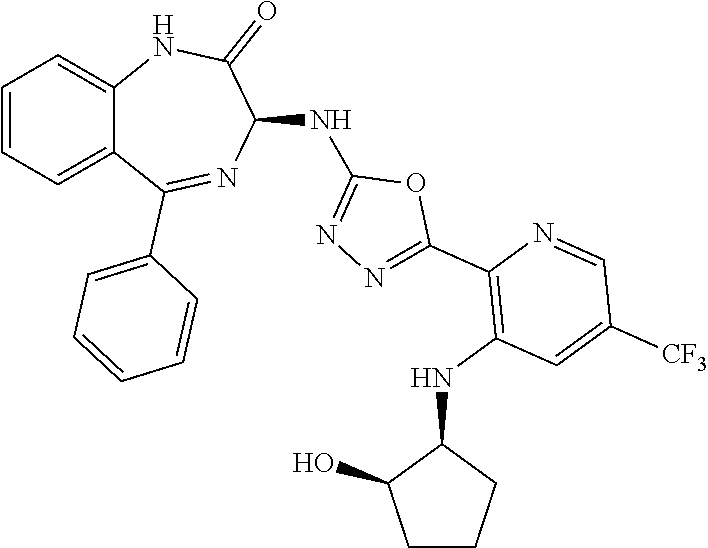
Example 422 was prepared using a procedure similar to that used to prepare Example 414 where (1R,2S)-2-aminocyclopentan-1-ol was used in place of 1-methoxy-2-methylpropan-2-amine. ESI MS m/z=564.4 [M+H]+. 1H NMR (300 MHz, DMSO-d6) δ 1.37-1.94 (m, 5H), 1.99-2.16 (m, 1H), 3.84-4.00 (m, 1H), 4.06-4.18 (dt, J=7.6, 3.6 Hz, 1H), 4.94-5.03 (d, J=4.5 Hz, 1H), 5.16-5.25 (d, J=8.4 Hz, 1H), 7.23-7.44 (m, 3H), 7.41-7.61 (m, 6H), 7.63-7.75 (ddd, J=8.3, 7.1, 1.7 Hz, 1H), 8.03-8.12 (d, J=7.4 Hz, 1H), 8.18-8.25 (m, 1H), 9.43-9.52 (d, J=8.5 Hz, 1H), 10.99-11.05 (s, 1H).

Example 423 was prepared using a procedure similar to that used to prepare Example 414 where (1S,2R)-2-aminocyclopentan-1-ol was used in place of 1-methoxy-2-methylpropan-2-amine. ESI MS m/z=564.4 [M+H]+. 1H NMR (300 MHz, DMSO-d6) δ 1.40-1.70 (m, 3H), 1.74-1.80 (s, 1H), 1.80-1.87 (s, 1H), 2.03-2.13 (m, 1H), 3.86-3.97 (t, J=6.3 Hz, 1H), 4.07-4.16 (d, J=5.4 Hz, 1H), 4.94-5.03 (d, J=4.5 Hz, 1H), 5.16-5.25 (d, J=8.4 Hz, 1H), 7.24-7.42 (m, 3H), 7.42-7.61 (m, 6H), 7.63-7.76 (ddd, J=8.6, 7.0, 1.7 Hz, 1H), 8.04-8.13 (d, J=7.5 Hz, 1H), 8.18-8.25 (d, J=1.7 Hz, 1H), 9.42-9.51 (d, J=8.4 Hz, 1H), 10.98-11.04 (s, 1H).

Example 424 was prepared using a procedure similar to that used to prepare Example 414 where 3-methyltetrahydrofuran-3-amine was used in place of 1-methoxy-2-methylpropan-2-amine. ESI MS m/z=564.2 [M+H]+. H NMR (400 MHz, DMSO-d6) δ 1.54 (s, 3H), 2.08 (m, 1H), 2.26 (m, 1H), 3.68 (d, J=9.3 Hz, 1H), 3.82 (m, 1H), 3.94 (m, 2H), 5.20 (d, J=8.3 Hz, 1H), 7.25-7.40 (m, 3H), 7.43-7.63 (m, 6H), 7.69 (m, 1H), 8.10 (s, 1H), 8.32 (d, J=1.8 Hz, 1H), 9.58 (d, J=8.4 Hz, 1H), 11.02 (s, 1H).


(E)-ethyl 2-cyano-3-ethoxyacrylate (1.37 g, 8.1 mmol) in THF (10 mL) was dropwised to the solution of 3-hydrazinylpyridine dihydrochloride (1.5 g, 8.2 mmol) and NaOEt-EtOH (10.5 g, 32.4 mmol) at 0° C. The mixture was stirred for 90 minutes at 0° C. 4 M HCl in 1,4-dioxane (8.1 mL, 32.4 mmol) was added and the solution was refluxed for 2 hours. The solution was concentrated, adjusted pH=10-13 with 1 M NaOH, extracted with EA (×3). The organic layers were combined, dried and concentrated. The crude product was purified by reverse phase C18 column chromatography (MeCN/H2O) to give desired compound as an orange solid (360 mg, 19%). ESI MS m/z=233.3 [M+H]+. 1H NMR (300 MHz, DMSO-d6) δ 1.31 (m, 3H), 4.27 (m, 2H), 5.80 (s, 2H), 7.51 (m, 1H), 8.20 (m, 1H), 8.48 (m, 1H), 8.88 (s, 1H), 9.07 (d, J=2.6 Hz, 1H).

NaH (88 mg, 2.21 mmol) was added to the solution of the compound from step a (340 mg, 1.47 mmol) in DMF (10 mL) at 0° C. The mixture was stirred for 40 minutes at 0° C. 1-bromo-2-(2-bromoethoxy)ethane (674 mg, 2.93 mmol) was added and then the solution was stirred for 3 hours at rt. The solution was quenched with water, extracted with EA (×3), washed with brine (×2). The organic layer was dried, concentrated. The residue was purified via silica gel chromatoraphy (PE-EA) to give ethyl 3-morpholino-1-(pyridin-3-yl)-1H-pyrazole-4-carboxylate as yellow solid (180 mg, 41%). ESI MS m/z=303.3 [M+H]+.

Example 425 was prepared using a procedure similar to that used to prepare Example 152 where ethyl 3-morpholino-1-(pyridin-3-yl)-1H-pyrazole-4-carboxylate was used in place of ethyl 2-morpholino-4-(trifluoromethyl)benzoate. ESI MS m/z=548.4 [M+H]+. 1H NMR (400 MHz, DMSO-d6) δ 3.25-3.34 (m, 4H), 3.72 (m, 4H), 5.14 (d, J=8.6 Hz, 1H), 7.26-7.44 (m, 3H), 7.45-7.62 (m, 6H), 7.69 (m, 1H), 8.26 (m, 1H), 8.52 (m, 1H), 8.97 (s, 1H), 9.03-9.17 (m, 2H), 10.99 (s, 1H).


A solution of methyl 1H-indole-7-carboxylate (1 g, 5.71 mmol) in DMF (30 mL) was added NaH (274 mg, 6.86 mmol) at 0° C. After stirring for 45 minutes, 1-bromo-2-methoxyethane (946 mg, 6.86 mmol) was added and stirred for 16 hours at rt. It was quenched with water, extracted with EA (×3), washed with brine (×2). The organic layer was dried, and concentrated to give the crude methyl 1-(2-methoxyethyl)-1H-indole-7-carboxylate as a yellow oil (680 mg, 51%). ESI MS m/z=233.9 [M+H]+.

Example 426 was prepared using a procedure similar to that used to prepare Example 152 where methyl 1-(2-methoxyethyl)-1H-indole-7-carboxylate was used in place of ethyl 2-morpholino-4-(trifluoromethyl)benzoate. ESI MS m/z=493.4 [M+H]+. 1H NMR (300 MHz, DMSO-d6) δ 3.08 (s, 3H), 3.37 (d, J=5.2 Hz, 2H), 4.54 (t, J=5.3 Hz, 2H), 5.20 (d, J=8.6 Hz, 1H), 6.61 (d, J=3.2 Hz, 1H), 7.19 (t, J=7.6 Hz, 1H), 7.26-7.33 (m, 1H), 7.34-7.57 (m, 9H), 7.69 (m, J=8.4, 7.1, 1.7 Hz, 1H), 7.80 (m, J=7.9, 1.2 Hz, 1H), 9.14 (d, J=8.6 Hz, 1H), 11.01 (s, 1H).


A solution of the compound from ethyl 2-bromo-5-morpholinothiazole-4-carboxylate, prepared in Example 385, (750 mg, 2.34 mmol), 2-fluorophenylboronic acid (530 mg, 3.51 mmol), Pd (dppf) Cl2 (188 mg, 0.23 mmol) and Cs2CO3 (1395 mg, 4.68 mmol) in DMF (10 mL) was stirred at 80° C. for 4 hrs. Then H2O (20 mL) was added to the mixture and extracted with EA (×3). The organic layer was dried and purified by reverse phase C18 column chromatography to give ethyl 2-(2-fluorophenyl)-5-morpholinothiazole-4-carboxylate as yellow oil (680 mg, 87%). ESI MS m/z=358.5 [M+H]+.

Example 427 was prepared using a procedure similar to that used to prepare Example 152 where ethyl 2-(2-fluorophenyl)-5-morpholinothiazole-4-carboxylate was used in place of ethyl 2-morpholino-4-(trifluoromethyl)benzoate. ESI MS m/z=582.3 [M+H]+. 1H NMR (400 MHz, DMSO-d6) δ 3.21-3.23 (m, 4H), 3.73-3.75 (m, 4H), 5.16-5.18 (d, J=8.0, 1H), 7.34-7.39 (m, 11H), 7.46-7.53 (m, 1H), 8.10-8.20 (m, 1H), 9.16-9.18 (d, J=8.0, 1H), 10.99 (s, 1H).

Example 428 was prepared using a procedure similar to that used to prepare Example 390 where 4-fluorophenylboronic acid was used in place of 6-(trifluoromethyl)pyridin-3-ylboronic acid. ESI MS m/z=582.2 [M+H]+. 1H NMR (400 MHz, DMSO-d6) δ 3.16-3.18 (m, 4H), 3.73-3.75 (m, 4H), 5.15-5.17 (d, J=8.0, 1H), 7.34-7.38 (m, 5H), 7.46-7.48 (m, 6H), 7.51-7.53 (m, 1H), 7.90-7.94 (m, 2H), 9.15-9.17 (d, J=8.0, 1H), 10.99 (s, 1H).

Example 429 was prepared using a procedure similar to that used to prepare Example 390 where 4-pyridylboronic acid was used in place of 6-(trifluoromethyl)pyridin-3-ylboronic acid. ESI MS m/z=565.2 [M+H]+. 1H NMR (400 MHz, DMSO-d6) δ 3.23-3.26 (m, 4H), 3.75-3.76 (m, 4H), 5.16-5.19 (d, J=12.0, 1H), 7.35-7.38 (m, 1H), 7.47-7.50 (m, 2H), 7.52-7.54 (m, 5H), 7.80 (m, 1H), 7.82 (m, 2H), 8.70-8.72 (m, 2H), 9.20-9.30 (m, 1H), 10.99 (s, 1H).


NaH (421 mg, 0.011 mol) was added to the solution of ethyl 3-amino-1H-pyrazole-4-carboxylate (1.25 g, 0.009 mol) in DMF (5 mL) at 0° C. The mixture was stirred for 1 hour at 0° C. Bromocyclobutane (2.16 g, 0.016 mol) was added and the mixture was stirred overnight at 50° C. The solution was quenched with water, extracted with EA (×3), washed with brine (×2), the organic layer was dried, concentrated. The crude product was purified via silica gel chromatography (PE-EA) to give desired compound as colourless oil (600 mg, 33%). ESI MS m/z=210.3 [M+H]+. 1H NMR (400 MHz, DMSO-d6) δ 1.24 (m, 3H), 1.73 (m, 2H), 2.27 (m, 2H), 2.34-2.50 (m, 2H), 4.16 (m, 2H), 4.61 (m, 1H), 5.38 (s, 2H), 7.95 (s, 1H).

A solution of the compound from step a (600 mg, 2.87 mmol), 1-bromo-2-(2-bromoethoxy)ethane (1.32 g, 5.74 mmol), Cs2CO3 (1.87 g, 5.74 mmol) in DMA (10 mL) was stirred overnight at 100° C. The mixture was diluted with water, extracted with EA (×3). The organic layers were combined and washed with brine (×2), dried and concentrated. The residue was purified via silica gel chromatography (PE-EA) to give ethyl 1-cyclobutyl-3-morpholino-1H-pyrazole-4-carboxylate as yellow oil (590 mg, 74%). ESI MS m/z=280.3 [M+H]+.

Example 430 was prepared using a procedure similar to that used to prepare Example 152 where ethyl 1-cyclobutyl-3-morpholino-1H-pyrazole-4-carboxylate was used in place of ethyl 2-morpholino-4-(trifluoromethyl)benzoate. ESI MS m/z=525.5 [M+H]+. 1H NMR (400 MHz, DMSO-d6) δ 1.75 (m, 2H), 2.28-2.37 (m, 2H), 2.42-2.48 (m, 2H), 3.13-3.21 (m, 4H), 3.67 (m, 4H), 4.79 (m, 1H), 5.10 (d, J=8.7 Hz, 1H), 7.25-7.31 (m, 1H), 7.32-7.37 (m, 2H), 7.44-7.56 (m, 5H), 7.67 (m, 1H), 8.13 (s, 1H), 8.89 (d, J=8.7 Hz, 1H), 10.96 (s, 1H).

Example 431 was prepared using a procedure similar to that used to prepare Example 430 where 2-hydrazinylpyridine dihydrochloride was used in place of 3-hydrazinylpyridine dihydrochloride. ESI MS m/z=548.3 [M+H]+. 1H NMR (300 MHz, DMSO-d6) δ 3.32-3.40 (m, 4H), 5.14 (d, J=8.5 Hz, 1H), 7.24-7.39 (m, 4H), 7.42-7.57 (m, 5H), 7.67 (m, 1H), 7.84 (m, 1H), 8.00 (m, 1H), 8.45-8.51 (m, 1H), 8.79 (s, 1H), 9.02 (d, J=8.5 Hz, 1H), 10.98 (s, 1H).


A solution of the compound 4-iodo-tetrahydro-2H-pyran (3.18 g, 15 mmol) was added to ethyl 3-methyl-1H-pyrazole-5-carboxylate (770 mg, 5 mmol) and Cs2CO3 in DMF (30 mL) was stirred for 18 hours at 60° C. It was quenched by H2O (50 mL) and extracted with EA (3×), dried Na2SO4, filtered and purified by reverse phase C18 column chromatography (MeCN/H2O) to give ethyl 3-methyl-1-(tetrahydro-2H-pyran-4-yl)-1H-pyrazole-5-carboxylate as a brown oil. (143 mg, 12%).

Example 432 was prepared using a procedure similar to that used to prepare Example 152 where ethyl 3-methyl-1-(tetrahydro-2H-pyran-4-yl)-1H-pyrazole-5-carboxylate was used in place of ethyl 2-morpholino-4-(trifluoromethyl)benzoate. ESI MS m/z=484.2 [M+H]+. H NMR (300 MHz, Methanol-d4) δ 1.88-2.02 (m, 2H), 2.14-2.35 (m, 5H), 3.58 (m, 2H), 4.08 (m, 2H), 5.19-5.36 (m, 2H), 6.63 (s, 1H), 7.25-7.62 (m, 8H), 7.68 (m, 1H).


A solution of ethyl 3-chloroquinoxaline-2-carboxylate (500 mg, 2.12 mmol) in morpholine (5 mL was stirred for 1 hour at 100° C. It was diluted with water, extracted with EA (×3), washed with brine (×2). The organic layer was dried and concentrated to give 450 mg (crude) of desired compound as yellow oil, which was used directly in the next step without further purification. ESI MS m/z=287.5 [M+H]+.

Example 433 was prepared using a procedure similar to that used to prepare Example 152 where ethyl 3-morpholinoquinoxaline-2-carboxylate was used in place of ethyl 2-morpholino-4-(trifluoromethyl)benzoate. ESI MS m/z=533.4 [M+H]+. 1H NMR (300 MHz, DMSO-d6) δ 3.33-3.49 (m, 4H), 3.76 (t, J=4.6 Hz, 4H), 5.25 (d, J=8.4 Hz, 1H), 7.25-7.43 (m, 3H), 7.44-7.63 (m, 5H), 7.63-7.77 (m, 2H), 7.77-7.91 (m, 2H), 7.98-8.06 (m, 1H), 9.54 (d, J=8.5 Hz, 1H), 11.02 (s, 1H).


A solution of the compound 2-chloroquinoline-3-carboxylic acid (414 mg, 2 mmol) in MeOH (20 mL) and H2SO4 (1 mL) was stirred for 2 hours at 60° C. It was quenched by H2O (30 mL) at 0° C. and adjusted pH to 8˜9, extracted with EA (3×), dried Na2SO4, filtered to give desired compound as a yellow solid (354 mg, 80%). ESI MS m/z=222.2 [M+H]+.

A solution of the compound from step a (1.06 g, 3 mmol) in morpholine (20 mL) was stirred for 1 hour at 100° C. Extracted with EA (3×), dried Na2SO4, filtered to give desired compound as a light yellow solid (326 mg, 75%). ESI MS m/z=273.3 [M+H]+.

Example 434 was prepared using a procedure similar to that used to prepare Example 152 where methyl 2-morpholinoquinoline-3-carboxylate was used in place of ethyl 2-morpholino-4-(trifluoromethyl)benzoate. ESI MS m/z=532.3 [M+H]+. H NMR (300 MHz, DMSO-d6) δ 3.12-3.30 (m, 4H), 3.73 (m, 4H), 5.18 (d, J=8.5 Hz, 1H), 7.21-7.59 (m, 9H), 7.60-7.80 (m, 3H), 7.94 (d, J=8.0 Hz, 1H), 8.58 (s, 1H), 9.24 (d, J=8.7 Hz, 1H), 10.98 (s, 1H).


6-bromoquinoline-4-carboxylic acid (502 mg, 2.0 mmol), tert-butyl hydrazinecarboxylate (528 mg, 4.0 mmol), HATU (836 mg, 2.2 mmol), DIPEA (774 mg, 6.0 mmol) in DMF (5 mL) was stirred for 6 hours at rt. The solution was quenched with water, extracted with EA (×3), washed with brine (×2), the organic layer was dried, concentrated. The crude product was purified via silica gel chromatography (PE-EA) to give the desired compound as yellow solid (680 mg, 93%). ESI MS m/z=367.9 [M+H]+.

A solution of the compound from step a (680 mg, 1.86 mmol), Zn(CN)2 (432 mg, 3.72 mmol), Pd(PPh3)4 (215 mg, 0.18 mmol) in DMF (5 mL) was stirred for 2 hours at 120° C. The mixture was diluted with water, extracted with EA (×3). The organic layers were combined and washed with brine (×2), dried and concentrated. The residue was purified via silica gel chromatography (PE-EA) to give tert-butyl 2-(6-cyanoquinoline-4-carbonyl)hydrazine-1-carboxylate as yellow oil (435 mg, 75%). ESI MS m/z=313.0 [M+H]+.

Example 435 was prepared using a procedure similar to that used to prepare Example 151 where tert-butyl 2-(6-cyanoquinoline-4-carbonyl)hydrazine-1-carboxylate was used in place of tert-butyl 2-(6-fluoro-2-morpholinonicotinoyl)hydrazine-1-carboxylate. ESI MS m/z=472.3 [M+H]+. 1H NMR (300 MHz, DMSO-d6) δ 5.26-5.29 (d, J=9.0 Hz, 1H), 7.28-7.39 (m, 3H), 7.44-7.56 (m, 5H), 7.67-7.72 (m, 1H), 8.01-8.03 (m, 1H), 8.17-8.20 (m, 1H), 8.28-8.31 (m, 1H), 9.24-9.26 (d, J=6.0 Hz, 1H), 9.61-9.66 (m, 2H), 11.06 (s, 1H).

Example 436 was prepared using a procedure similar to that used to prepare Example 420 where trans-4-methoxytetrahydrofuran-3-amine was used in place of 1-methoxy-2-methylpropan-2-amine. ESI MS m/z=580.1 [M+H]+. 1H NMR (300 MHz, DMSO-d6) δ 3.35 (3H, s), 3.69 (2H, m), 3.88 (2H, m), 4.05 (1H, dd), 4.33 (1H, d), 5.20 (1H, d), 7.32 (3H, m), 7.51 (5H, m), 7.67 (2H, d), 7.80 (1H, d), 8.35 (1H, d), 9.58 (1H, d), 11.02 (1H, s).


To a stirring solution of ethyl 2-bromo-5-morpholinothiazole-4-carboxylate, prepared in Example 385, (400 mg, 1.25 mmol) in toluene (10 mL) was added tributyl(1-ethoxyvinyl)stannane (905 mg, 2.5 mmol) and Pd(PPh3)4 (40 mg, 0.001 mmol) at rt under the nitrogen. The mixture was refluxed for 2.5 hours at 110° C. under the nitrogen and then concentrated. The reaction mixture was poured into water and extracted with EA (3×100 mL). The organic was dried over Na2SO4. The residue was purified by silica gel chromatography (PE/EA=3/1) to give the desired compound as a white solid (300 mg, 77%). ESI MS m/z=313.2 [M+H]+.

The solution of compound from step a (300 mg, 0.96 mmol) was added to the HCl (5 mL) in the dioxane (8 mL) at rt. The resulting solution was stirred at rt for 5 hrs. The reaction mixture was poured into saturated NaHCO3 liquid and extracted with EA (3×100 mL). The organic layer was dried over Na2SO4 and purified to give the desired compound product as a white solid (150 mg, 55%). ESI MS m/z=285.4 [M+H]+.

To a stirred solution of the compound from step b (200 mg, 0.7 mmol) in THF (6 mL) was added MeMgCl (0.27 ml, 0.77 mmol). The mixture was stirred at rt for 2.5 hours under the nitrogen and then concentrated. The reaction mixture was poured into ice water and extracted with EA (3×60 mL). The organic layer was dried over Na2SO4 and purified by reverse phase C18 column chromatography (ACN/H2O=1/5) to give the desired compound as a off white solid (175 mg, 83%). ESI MS m/z=301.1 [M+H]+.

Example 437 was prepared using a procedure similar to that used to prepare Example 152 where ethyl 2-(2-hydroxypropan-2-yl)-5-morpholinothiazole-4-carboxylate was used in place of ethyl 2-morpholino-4-(trifluoromethyl)benzoate. ESI MS m/z=456.2 [M+H]+. 1H NMR (300 MHz, DMSO-d6) δ 1.48 (4H, s), 3.02 (3H, d), 3.67 (3H, d), 5.12 (1H, s), 7.32 (2H, d), 7.49 (5H, d), 8.35 (1H, d).


NaH (61.5 mg, 1.54 mol) was added to the solution of

Example 438 was prepared using a procedure similar to that used to prepare Example 152 where ethyl 4-(2-methoxyethyl)-4,5,6,7-tetrahydropyrazolo[1,5-a]pyrimidine-3-carboxylate was used in place of ethyl 2-morpholino-4-(trifluoromethyl)benzoate. ESI MS m/z=499.5 [M+H]+. 1H NMR (400 MHz, DMSO-d6) δ 2.03 (m, 2H), 3.18 (s, 3H), 3.37 (s, 2H), 3.41 (m, 2H), 3.79 (m, 2H), 4.02 (m, 2H), 5.09 (d, J=8.7 Hz, 1H), 7.24-7.32 (m, 1H), 7.34 (m, 2H), 7.43-7.58 (m, 6H), 7.67 (m, 1H), 8.76 (d, J=8.7 Hz, 1H), 10.95 (s, 1H).


3-Azabicyclo[3.1.0]hexan-6-ol (220 mg, 1.62 mmol) was dissolved in THF (5 mL) and K2CO3 (289.8 mg, 2.1 mmol) was added. CbzCl (360 mg, 2.1 mmol) was then added and the mixture was stirred at rt overnight. Water was added and the mixture was extracted with EA. The combined organic phase was dried over anhydrous Na2SO4 and concentrated. The residue was purified by silica gel chromatography (PE:EA=10:1) to give the desired product as a white solid (250 mg, 66%). ESI MS m/z=234.2 [M+H]+.

The compound from step a (250 mg, 1.07 mmol) was dissolved in DCM (8 mL) and cooled with ice bath. The proton sponge (689 mg, 3.21 mmol) was added and then trimethyloxonium tetrafluoroborate (238 mg, 1.6 mmol) was added. The mixture was warmed to rt and stirred overnight. Water was added and the mixture was extracted with EA. The combined organic phase was dried over anhydrous Na2SO4 and concentrated. The residue was purified by Prep-TLC (PE:EA=2:1) to give the desired product as a yellow oil (121 mg, 46%) and the starting material (50 mg, 0.21 mmol). ESI MS m/z=248.3 [M+H]+.

The compound from step b (121 mg, 0.49 mmol) was dissolved in MeOH (10 mL) and Pd/C (20 mg) was added. The mixture was exchanged with H2 three times and then stirred overnight. The mixture was filtered and the filtrate was concentrated to give 6-methoxy-3-azabicyclo[3.1.0]hexane as a white solid (30 mg, 55%). There was no signal on LCMS of the product.

Example 439 was prepared using a procedure similar to that used to prepare Example 414 where 6-methoxy-3-azabicyclo[3.1.0]hexane was used in place of 1-methoxy-2-methylpropan-2-amine. ESI MS m/z=576.5 [M+H]+. 1H NMR (300 MHz, DMSO-d6) S 1H NMR (300 MHz, DMSO-d6) δ 3.24 (s, 3H), 3.26-3.31 (m, 2H), 5.20 (d, J=8.4 Hz, 1H), 7.18-7.40 (m, 3H), 7.40-7.61 (m, 6H), 7.68 (t, J=7.9 Hz, 1H), 8.37 (s, 1H), 9.26 (d, J=8.5 Hz, 1H), 11.00 (s, 1H).


A solution of ethyl 3-amino-1H-pyrazole-4-carboxylate (1.55 g, 0.01 mol), 2-bromo-5-(trifluoromethyl)pyridine (2.25 g, 0.01 mol), Cs2CO3 (6.52 g, 0.02 mol) in DMF (20 mL) was stirred for 1 hour at 100° C. The mixture was diluted with water, extracted with EA (×3). The organic layers were combined and washed with brine (×2), dried, concentrated. The crude product was purified via silica gel chromatography (PE-EA) to give desired compound as yellow solid (1.95 g, 65%). ESI MS m/z=301.2 [M+H]+. 1H NMR (300 MHz, DMSO-d6) δ 1.31 (m, 3H), 4.14-4.40 (m, 2H), 5.96 (d, J=4.0 Hz, 2H), 7.86 (m, 1H), 8.36 (m, 1H), 8.74 (d, J=3.7 Hz, 1H), 8.83 (d, J=2.8 Hz, 1H).

NaH (360 mg, 0.015 mol) was added to the solution of the compound from step a (1.95 g, 6.5 mmol) and 1-bromo-2-(2-bromoethoxy)ethane (1.645 g, 7.2 mmol) in DMF (20 mL) at 0° C. The mixture was stirred overnight at r.t. The mixture was quenched with water, extracted with EA (×3). The organic layers were combined and washed with brine (×2), dried and concentrated. The crude product was purified via silica gel chromatography (PE-EA) to give desired compound as yellow solid (350 mg, 15%). ESI MS m/z=371.2 [M+H]+.

Example 440 was prepared using a procedure similar to that used to prepare Example 152 where ethyl 3-morpholino-1-(5-(trifluoromethyl)pyridin-2-yl)-1H-pyrazole-4-carboxylate was used in place of ethyl 2-morpholino-4-(trifluoromethyl)benzoate. ESI MS m/z=616.4 [M+H]+. 1H NMR (300 MHz, DMSO-d6) δ 3.39 (m, 4H), 3.67-3.85 (m, 4H), 5.16 (d, J=8.5 Hz, 1H), 7.25-7.40 (m, 3H), 7.45-7.62 (m, 5H), 7.65-7.73 (m, 1H), 8.01 (d, J=8.7 Hz, 1H), 8.41 (m, 1H), 8.87 (s, 1H), 8.88-8.96 (m, 1H), 9.10 (d, J=8.5 Hz, 1H), 11.01 (s, 1H).

Example 441 was prepared using a procedure similar to that used to prepare Example 435 where 5-bromopyrazolo[1,5-a]pyridine-3-carboxylic acid was used in place of 6-bromoquinoline-4-carboxylic acid. ESI MS m/z=461.3 [M+H]+. 1H NMR (300 MHz, DMSO-d6) δ 5.18-5.20 (d, J=6.0 Hz, 1H), 7.27-7.39 (m, 1H), 7.43-7.46 (m, 2H), 7.49-7.54 (m, 6H), 7.66-7.71 (m, 1H), 8.64-8.70 (m, 2H), 9.01-9.11 (m, 2H), 10.70 (s, 1H). 5-bromopyrazolo[1,5-a]pyridine-3-carboxylic acid.


A 2M solution of trimethylaluminum in hexanes (23 mL, 44.40 mmol) was added to a mixture of N,O-dimethylhydroxylamine hydrochloride (4.3 g, 44.40 mmol) in DCM (30 mL) and the reaction was stirred at 0° C. for 40 mins. A solution of 3-morpholino-5-(trifluoromethyl)picolinic acid (9 g, 29.60 mmol) in DCM (20 mL) was added and the reaction mixture was stirred at 40° C. for 2 hours. After cooling to r.t., the mixture was carefully quenched with 1N HCl and diluted with DCM. After 30 min stirring layers were separated and the organic layers were washed with brine, dried over anhydrous Na2SO4 and concentrated to give the desired compound as a yellow solid (9 g, 95%). ESI MS m/z=320.3 [M+H]+.

A solution of the (3 M) MeMgCl (10.3 mL, 31 mmol) in hexane was dropwised to the compound from step a (9 g, 28.20 mmol) in THF at 0° C. under N2. It was stirred for 2 hours at 0° C. The mixture was diluted with EA and quenched with sat. NH4Cl, the organic layers were washed with brine, dried over anhydrous Na2SO4 and concentrated to give the desired compound as a yellow oil (7.2 g, 93%). ESI MS m/z=275.2 [M+H]+.

HBr—AcOH was added to a solution of the compound from step b (7.20 g, 26.3 mmol) in AcOH (20 mL), Then pyridinium tribromide (9.20 g, 28.9 mmol) was added at rt. It was stirred for 2 hours at rt and filtered. The solid was washed with AcOH and partitioned between EA/sat NaHCO3, the organic layers were washed with brine, dried over anhydrous Na2SO4 and concentrated to give the desired compound as a yellow solid (6.1 g, 66%). ESI MS m/z=355.1 [M+H]+.

A solution of the compound from step 3 (3 g, 8.52 mmol), NaN3 (0.61 g, 9.38 mmol) in acetone/H2O=2/1 (15 mL) was stirred for 1 hour at rt. The mixture was diluted with EA, washed by brine. The organic phase was dried over anhydrous Na2SO4 and concentrated to 10 ml in EA. It was used for next step directly. ESI MS m/z=316.1 [M+H]+.

TCDI (1.97 g, 11.08 mmol) was added to a solution of the compound (Z)-3-amino-5-phenyl-1H-benzo[e][1,4]diazepin-2(3H)-one (2.14 g, 8.52 mmol) in DCM (10 mL). It was stirred for 20 mins. The mixture was diluted with DCM, washed by brine. The organic phase was dried over anhydrous Na2SO4 and concentrated to give the isothiocyanate intermediate. A solution of the compound from step d in EA was added to the isothiocyanate and PPh3 (2.70 g, 10.20 mmol) in dioxane under N2. The mixture was stirred at 90° C. for 40 mins then at rt overnight. The solvents were removed and purified by reverse phase C18 column chromatography (MeCN/H2O) to give desired compound as yellow solid. (230 mg, 4%). ESI MS m/z=583.4 [M+H]+.

EDCI (260 mg, 1.37 mmol) was added to a solution of the compound from step e (230 mg, 0.34 mmol) in DMF. It was stirred for 5 hours at 90° C. The crude product was purified by Prep-HPLC (MeCN/H2O) to give desired compound as yellow solid (70 mg, 38%). ESI MS m/z=549.4 [M+H]+.

The compound from step f (70 mg, 0.13 mmol) was purified by Prep-Chiral-HPLC to give the title compound 442 (21 mg, 29%) as yellow solid and 443 (22 mg, 31%) as yellow solid. Example 442 ESI MS m/z=549.4 [M+H]+. 1H NMR (400 MHz, DMSO-d6) δ 2.94 (m, 4H), 3.77 (m, 4H), 5.26 (d, J=8.5 Hz, 1H), 7.25-7.31 (m, 1H), 7.34 (m, 2H), 7.42-7.60 (m, 5H), 7.67 (m, 1H), 7.84 (d, J=2.1 Hz, 2H), 8.58-8.71 (m, 1H), 9.20 (d, J=8.6 Hz, 1H), 10.93 (s, 1H). Example 443 ESI MS m/z=549.4 [M+H]+. 1H NMR (400 MHz, DMSO-d6) δ 2.94 (m, 4H), 3.77 (m, 4H), 5.26 (d, J=8.5 Hz, 1H), 7.23-7.32 (m, 1H), 7.34 (m, 2H), 7.41-7.58 (m, 5H), 7.67 (m, 1H), 7.84 (d, J=2.0 Hz, 2H), 8.63 (m, 1H), 9.20 (d, J=8.6 Hz, 1H), 10.93 (s, 1H).


A solution of ethyl 3-amino-1H-pyrazole-4-carboxylate (1.55 g, 0.01 mol), 5-fluoro-2-(trifluoromethyl)pyridine (1.65 g, 0.01 mol), Cs2CO3 (4.89 g, 0.015 mol) in DMF (8 mL) was stirred for 1 hour at 100° C. The mixture was diluted with water, extracted with EA (×3). The organic layers were combined and washed with brine (×2), dried, concentrated. The crude product was purified via silica gel chromatography (PE-EA) to give the mixture of desired compounds as a yellow solid (1.04 g, 35%). ESI MS m/z=301.1 [M+H]+.

NaH (168 mg, 4.2 mmol) was added to the solution of the compound from step a (1.04 g, 3.5 mmol) and 1-bromo-2-(2-bromoethoxy)ethane (966 mg, 4.2 mmol) in DMF (20 mL) at 0° C. The mixture was stirred overnight. The mixture was quenched with water, extracted with EA (×3). The organic layers were combined and washed with brine (×2), dried, concentrated. The crude product was purified via silica gel chromatography (PE-EA) to give the mixture of desired compounds as a white solid (280 mg, 22%). ESI MS m/z=371.2 [M+H]+.

Examples 444 and 445 were prepared using a procedure similar to that used to prepare Example 152 where ethyl 3-morpholino-1-(6-(trifluoromethyl)pyridin-3-yl)-1H-pyrazole-4-carboxylate and ethyl 5-morpholino-1-(6-(trifluoromethyl)pyridin-3-yl)-1H-pyrazole-4-carboxylate were used in place of ethyl 2-morpholino-4-(trifluoromethyl)benzoate. The isomers were separated by prep HPLC (MeCN/H2O/0.1% FA). Example 444 ESI MS m/z=616.5 [M+H]+. 1H NMR (300 MHz, DMSO-d6) δ 3.31 (m, 4H), 3.74 (m, 4H), 5.16 (d, J=8.5 Hz, 1H), 7.25-7.42 (m, 3H), 7.51 (m, J 5H), 7.65-7.74 (m, 1H), 8.07 (d, J=8.7 Hz, 1H), 8.51 (m, 1H), 9.09-9.16 (m, 2H), 9.32 (d, J=2.5 Hz, 1H), 11.00 (s, 1H). Example 445 ESI MS m/z=616.5 [M+H]+. 1H NMR (300 MHz, DMSO-d6) δ 3.14 (m, 4H), 3.59 (m, 4H), 5.17 (d, J=8.4 Hz, 1H), 7.26-7.41 (m, 3H), 7.44-7.61 (m, 5H), 7.64-7.73 (m, 1H), 8.11-8.20 (m, 2H), 8.50 (m, 1H), 9.12-9.21 (m, 2H), 11.01 (s, 1H).


NaH (1.6 g, 0.04 mol) was added to the solution of ethyl 3-amino-1H-pyrazole-4-carboxylate (3.10 g, 0.02 mol) in DMF (25 mL) at 0° C. Then (bromomethyl)cyclopropane (2.68 g, 0.02 mol) was added. The mixture was stirred for 3 hours at rt. The solution was quenched with water, extracted with EA (×3), washed with brine (×2), the organic layer was dried, concentrated. The crude product was purified via silica gel chromatography (PE-EA) to give desired compound as a yellow oil (1.81 g, 43%). ESI MS m/z=209.9 [M+H]+.

A solution of the compound from step a (1.81 g, 8.66 mmol), 1-bromo-2-(2-bromoethoxy)ethane (6.0 g, 25.98 mmol) and Cs2CO3 (5.64 g, 17.32 mmol) in DMA (20 mL) was stirred for 4 hours at 100° C. The mixture was diluted with water, extracted with EA (×3). The organic layers were combined and washed with brine (×2), dried, and concentrated. The residue was purified via silica gel chromatography (PE-EA) to give desired compound as off-white solid (1.08 g, 45%). ESI MS m/z=280.0 [M+H]+.

A solution of the compound from step b (1.08 g, 3.87 mmol) and NH2NH2·H2O (10 mL) in EtOH (20 mL) was refluxed for 3 hours. The crude product was purified by Prep-HPLC (MeCN/H2O) to give desired compound as yellow oil (810 mg, 79%). ESI MS m/z=260.0 [M+H]+.

A solution of (Z)-3-amino-5-phenyl-1H-benzo[e][1,4]diazepin-2(3H)-one (753 mg, 3.0 mmol), and di (1H-imidazol-1-yl)methanethione (1.6 g, 9.0 mmol) in DMF (10 mL) was stirred for 1 hour at 0° C. and the compound from step c (810 mg, 3.05 mmol) was added to the solution and stirred at rt for 2 hours. The residue was purified by Prep-HPLC (MeCN/H2O) to give desired compound as a yellow solid (950 mg, 57%). ESI MS m/z=559.3 [M+H]+.

EDCI (980 mg, 5.10 mmol) was added to the solution of the compound from step d (950 mg, 1.70 mmol) in DMF (5 mL). The mixture was stirred at 60° C. for 2 hours. The mixture was diluted with water, extracted with DCM (×3). The organic layers were combined and dried, concentrated. The residue was then purified by preparative TLC (EA) and Prep-HPLC (MeCN/H2O/0.1% FA) to give the desired compound as a yellow solid (500 mg, 56%). ESI MS m/z=525.3 [M+H]+.

The compound from step e (500 mg, 0.95 mmol) was separated by chiral-HPLC to give 446 as a off-white solid (101 mg) and 447 as a yellow solid (162 mg). Example 446: ESI MS m/z=525.5 [M+H]+. 1H NMR (300 MHz, DMSO-d6) δ 0.35-0.39 (m, 2H), 0.51-0.57 (m, 2H), 1.24-1.28 (m, 1H), 3.17-3.18 (m, 4H), 3.66-3.67 (m, 4H), 3.89-3.91 (m, 2H), 5.08-5.11 (d, J=9.0 Hz, 1H), 7.26-7.36 (m, 3H), 7.44-7.54 (m, 5H), 7.65-7.70 (m, 1H), 8.10 (s, 1H), 8.88-8.91 (d, J=9.0 Hz, 1H), 10.96 (s, 1H). Example 447: ESI MS m/z=525.4 [M+H]+. 1H NMR (300 MHz, DMSO-d6) δ 0.36-0.38 (m, 2H), 0.52-0.55 (m, 2H), 1.08-1.40 (m, 1H), 3.17-3.18 (m, 4H), 3.66-3.68 (m, 4H), 3.89-3.91 (m, 2H), 5.08-5.11 (d, J=9.0 Hz, 1H), 7.28 (m, 3H), 7.33-7.36 (m, 5H), 7.46-7.52 (m, 1H), 8.10 (s, 1H), 8.88-8.91 (d, J=9.0 Hz, 1H), 10.96 (s, 1H).

Example 448 was prepared using a procedure similar to that used to prepare Example 448 where 2,5-difluoropyridine was used in place of 2-bromo-5-(trifluoromethyl)pyridine. ESI MS m/z=566.3 [M+H]+. 1H NMR (400 MHz, DMSO-d6) δ 3.31 (m, 4H), 3.73 (m, 4H), 5.14 (d, J=8.0 Hz, 1H), 7.25-7.38 (m, 3H), 7.42-7.61 (m, 5H), 7.68 (m, 1H), 7.89 (m, 1H), 7.97 (m, 1H), 8.52 (d, J=2.9 Hz, 1H), 8.74 (s, 1H), 9.06 (d, J=8.6 Hz, 1H).


A solution of ethyl 5-bromopyrazolo[1,5-a]pyridine-3-carboxylate (1.0 g, 3.73 mmol), methylboronic acid (448 mg, 7.46 mmol), Pd(dppf)Cl2 (545 mg, 0.746 mmol) and Cs2CO3 (2.42 g, 7.46 mmol) was dissolved in DMF (5.0 mL), then the mixture was stirred at 100° C. for two hours. It was concentrated, and purified by silica gel chromatography with PE:EA=5:1 to obtain the desired compound as an orange solid (589 mg, 77%). ESI MS m/z=204.5 [M+H]+.

A solution of the compound from step a (434 mg, 2.13 mmol), BPO (515 mg, 2.13 mmol), and NBS (398 mg, 2.24 mmol) was dissolved in CCl4 (6 mL) at rt, then the mixture was stirred at 78° C. for one hour. After completion, the mixture was quenched with water, and extracted with EA (20 mL×2), the organic layer was combined, washed with water, saturated solution of NaHCO3 (15 mL) and brine (15 mL) in turn, then dried with anhydrous Na2SO4 and concentrated to obtain a yellow solid (415 mg, 69%) that was used without further purification. ESI MS m/z=282.3 [M+H]+.

A mixture of NaH (96 mg, 3.99 mmol) in MeOH (5 mL) was stirred at 0° C. for 5 minutes, then the compound from step b (375 mg, 1.33 mmol) was added to the mixture. It was heated to 50° C. for one hour. After completion, the mixture was poured into ice-water solution of glacial acetic acid, and extracted with EA (25 mL×2), the organic layer was combined, washed with brine (15 mL), then dried with anhydrous Na2SO4 and concentrated to obtain methyl 5-(methoxymethyl)pyrazolo[1,5-a]pyridine-3-carboxylate as a light yellow solid that was used without further purification. ESI MS m/z=220.5 [M+H]+.

Example 449 was prepared using a procedure similar to that used to prepare Example 152 where methyl 5-(methoxymethyl)pyrazolo[1,5-a]pyridine-3-carboxylate was used in place of ethyl 2-morpholino-4-(trifluoromethyl)benzoate. ESI MS m/z=480.3 [M+H]+. 1H NMR (400 MHz, DMSO-d6) δ 3.38 (s, 3H), 4.56 (s, 2H), 5.17 (d, 1H), 7.04 (m, 1H), 7.25-7.33 (m, 1H), 7.37 (m, 2H), 7.42-7.58 (m, 5H), 7.69 (m, 1H), 7.95-8.04 (m, 1H), 8.42 (s, 1H), 8.84 (d, 1H), 8.98 (d, 1H), 10.90 (s, 1H).


A solution of ethyl 3-chloro-5-(trifluoromethyl)pyridine-2-carboxylate (700 mg, 2.76 mmol), 2-[(E)-2-ethoxyethenyl]-4,4,5,5-tetramethyl-1,3,2-dioxaborolane (545 mg, 2.75 mmol), Pd(dppf)Cl2 (197 mg, 0.27 mmol) and Cs2CO3 (2.7 g, 8.29 mmol) in 1,4-dioxane (15 mL) and water (5 mL) was stirred for 1 hour at 80° C. The reaction was then diluted by the addition of water. The resulting solution was extracted with EA. The crude product was purified by reverse phase C18 column chromatography to give the desired compound (550 mg, 69%) as off-white oil. ESI MS m/z=290.1 [M+H]+.

A solution of compound from step a (400 mg, 1.38 mmol), HCl-dioxane (2 mL, 4N) in dioxane (2 mL) was stirred for 2 hours at rt. The reaction was then quenched by the addition of NaHCO3 and extracted with of DCM. The organic layers combined and dried over anhydrous sodium sulfate and concentrated under vacuum to give the desired compound (388 mg, 107%) as a yellow oil that was used without further purification. ESI MS m/z=262.0 [M+H]+.

A solution of compound from step b (380 mg, 1.45 mmol) in THF (6 mL) was added BH3·THF (2.9 mL, 2.9 mmol) dropwise at 0° C. It was stirred for 30 min at 0° C. The reaction was then quenched by the addition of water and extracted with DCM. The organic layers combined and concentrated under vacuum. The organic layer was purified by silica gel column to give the desired compound 160 mg as off-white oil. ESI MS m/z=264.1 [M+H]+.

A solution of compound from step c (160 mg, 0.61 mmol), NH2NH2·H2O (2 mL) in EtOH (2 mL) was stirred for 1 hour at 80° C. The reaction was then washed by the addition of water and extracted with of DCM. The organic layers combined and concentrated under vacuum to give 3-(2-hydroxyethyl)-5-(trifluoromethyl)picolinohydrazide (100 mg, 66%) as off-white oil. ESI MS m/z=250.0 [M+H]+.

Example 450 was prepared using a procedure similar to that used to prepare Example 21 where 3-(2-hydroxyethyl)-5-(trifluoromethyl)picolinohydrazide was used in place of tetrahydro-2H-pyran-4-carbohydrazide. ESI MS m/z=509.2 [M+H]+. 1H NMR (400 MHz, DMSO-d6) δ 3.30 (d, J=6.1 Hz, 2H), 3.70 (q, J=5.8, 5.8, 5.6 Hz, 2H), 4.69 (t, J=5.3, 5.3 Hz, 1H), 5.21 (d, J=6.5 Hz, 1H), 7.23-7.41 (m, 3H), 7.43-7.59 (m, 5H), 7.63-7.79 (m, 1H), 8.25 (d, J=2.2 Hz, 1H), 8.92-9.05 (m, 1H), 9.38-9.56 (m, 1H), 10.98 (s, 1H).

Example 451 was prepared using a procedure similar to that used in Example 339 where (R)-1-methoxypropan-2-amine was used in place of morpholine. ESI MS m/z=558.2 [M+H]+.

Example 452 was prepared using a procedure similar to that used in Example 339 where (S)-2-methoxypropan-1-amine was used in place of morpholine. ESI MS m/z=558.2 [M+H]+.


Example 453 step a was prepared using a procedure similar to that used to prepare Example 345 where ethyl 5-bromo-2-(trifluoromethyl)thiazole-4-carboxylate was used in place of methyl 5-bromo-2-methylthiazole-4-carboxylate.

Example 453 step b was prepared using a procedure similar to that used to prepare Example 152 where ethyl 5-(3,6-dihydro-2H-pyran-4-yl)-2-(trifluoromethyl)thiazole-4-carboxylate was used in place of ethyl 2-morpholino-4-(trifluoromethyl)benzoate. ESI MS m/z=553.1 [M+H]+.


To a oven-dried round-bottomed flask, 2,2,3,3,3-pentafluoropropanamide (2 g, 12.27 mmol) was dissolved in THF (29.9 mL) under nitrogen to give a color solution. Lawesson's reagent (2.98 g, 7.36 mmol) was added to the reaction mixture. Stir reaction vessel at 80° C. overnight. The reaction mixture was cooled and ethyl 3-bromo-2-oxopropanoate (1.92 mL, 15.33 mmol) was added. The flask was again heated to 80° C. and stirred overnight. The mixture was poured into water and the aqueous layer was extracted with EtOAc. The organic layer was dried, filtered and concentrated. The crude product was added to a silica gel column and was eluted with ethyl acetate/

A solution of ethyl 2-(perfluoroethyl)thiazole-4-carboxylate (1.29 g, 4.69 mmol) in THF (10.7 mL) was added to LDA (2.93 mL, 5.86 mmol) in THF (32.0 mL) at −78° C. under N2. The mixture was stirred for 45 minutes at same temperature. To this, a solution of 1,2-dibromotetrachloroethane (2.29 g, 7.03 mmol) in THF (10.7 mL) was dropwised and warmed to room temperature over 2 hours. The reaction was quenched with saturated ammonium chloride solution. Water was added and the mixture was extracted with ethyl acetate (3×). The organic layer was combined, dried and concentrated. The crude product was added to a silica gel column and was eluted with ethyl acetate/

Example 454 was prepared using a procedure similar to that used to prepare Example 272 where ethyl 5-bromo-2-(perfluoroethyl)thiazole-4-carboxylate was used in place of methyl 2-methyl-5-bromothiazole-4-carboxylate. ESI-MS m/z: 606.1 [M+H]+.


To a cold (−78° C.) solution of ethyl 5-morpholinothiazole-4-carboxylate (0.5 g, 2.06 mmol) in THF (5.2 mL) was added n-BuLi (1.29 mL, 2.06 mmol) dropwise. The reaction was stirred for 15 minutes and cyclobutanone (0.15 mL, 2.06 mmol) was added via syringe. The reaction was stirred for 1 hour and was then quenched by the addition of saturated aqueous bicarbonate solution. The cold bath was removed and the reaction was warmed to room temperature. Ethyl acetate was added and the layers were separated. The aqueous layer was extracted with additional ethyl acetate (2×). The combined organics were dried with anhydrous sodium sulfate, filtered and concentrated under reduced pressure to give the crude title compound. The crude product was added to a silica gel column and was eluted with ethyl acetate/

Example 455 was prepared using a procedure similar to that used to prepare Example 152 where ethyl 2-(1-hydroxycyclobutyl)-5-morpholinothiazole-4-carboxylate was used in place of ethyl 2-morpholino-4-(trifluoromethyl)benzoate. ESI MS m/z=558.2 [M+H]+.

Example 456 was prepared using a procedure similar to that used to prepare Example 21 where ethyl (R)-5-(2-(methoxymethyl)pyrrolidin-1-yl)-2-(trifluoromethyl)thiazole-4-carboxylate, which was prepared similarly to ethyl 5-morpholino-2-(trifluoromethyl)thiazole-4-carboxylate in Example 339, was converted to the corresponding hydrazide and used in of tetrahydro-2H-pyran-4-carbohydrazide. The racemic mixture was purified by chiral separation. (Column=YMC CHIRAL Cellulose-SB, 250*20 mm (5 uM); Mobile Phase=50% iPrOH/50% hexanes; Flow rate=20 mL/min). ESI MS m/z=584.2 [M+H]+.

Example 457 was prepared using a procedure similar to that used to prepare Example 21 where ethyl (S)-5-(2-(methoxymethyl)pyrrolidin-1-yl)-2-(trifluoromethyl)thiazole-4-carboxylate, which was prepared similarly to ethyl 5-morpholino-2-(trifluoromethyl)thiazole-4-carboxylate in Example 339, was converted to the corresponding hydrazide and used in place of tetrahydro-2H-pyran-4-carbohydrazide. The racemic mixture was purified by chiral separation. (Column=YMC CHIRAL Cellulose-SB, 250*20 mm (5 uM); Mobile Phase=50% iPrOH/50% hexanes; Flow rate=20 mL/min). ESI MS m/z=584.2 [M+H]+.


Example 458 step a was prepared using a procedure similar to that used to prepare Example 454 where 1-fluorocyclobutane-1-carboxamide was used in place of 2,2,3,3,3-pentafluoropropanamide to give ethyl 2-(1-fluorocyclobutyl)thiazole-4-carboxylate.

Ethyl 2-(1-fluorocyclobutyl)thiazole-4-carboxylate (230 mg, 1.0 mmol) was taken up in MeOH (2 mL) and 1M NaOH (2 mL) and stirred at room temperature for 30 mins. The reaction mixture was concentrated and the aqueous layer was extracted 3× with EtOAc. The organic layer was dried, filtered and concentrated. 2-(1-fluorocyclobutyl)thiazole-4-carboxylic acid (197 mg, 98% yield) was isolated as a white solid.
A solution of 2-(1-fluorocyclobutyl)thiazole-4-carboxylic acid (197 mg, 0.98 mmol) in Tetrahydrofuran (11.5 mL) was cooled to −78° C. under argon and treated with a n-butyllithium (1.29 mL, 2.06 mmol). The reaction mixture was left to warm to room temperature over 15 minutes, then cooled again to −78° C. A solution of bromine (55 μL, 1.08 mmol) in hexane (0.5 mL) was added. The reaction mixture was left to warm to room temperature, then quenched by addition of 1N HCl. The mixture was extracted three times with methylene chloride, and the combined organic layers were dried over sodium sulphate and evaporated. The crude product was added to a silica gel column and was eluted with methanol/

To a vial, 5-bromo-2-(1-fluorocyclobutyl)thiazole-4-carboxylic acid (218 mg, 0.78 mmol), HATU (355 mg, 0.93 mmol) and tert-butyl hydrazinecarboxylate (123 mg, 0.93 mmol) was dissolved in DMF (7.2 mL) open to air to give a yellow solution. DIPEA (272 μL, 1.56 mmol) was added to the reaction mixture in one portion. Stir at room temperature for 2 hours. Cocentrate reaction mixture and load crude reaction mixture on to silica gel plug. The crude product was added to a silica gel column and was eluted with ethyl acetate/

To a oven-dried vial, tert-butyl 2-(5-bromo-2-(1-fluorocyclobutyl)thiazole-4-carbonyl)hydrazine-1-carboxylate (270 mg, 0.69 mmol) was dissolved in morpholine (1370 μL) open to air to give a color suspension. K2CO3 (189 mg, 1.37 mmol) was added to the reaction mixture. Stir at 80° C. for 3 hours. Filtered and washed with DCM and concentrate the organic layer. The crude product was added to a silica gel column and was eluted with ethyl acetate/

A solution of tert-butyl 2-(2-(1-fluorocyclobutyl)-5-morpholinothiazole-4-carbonyl)hydrazine-1-carboxylate (198 mg, 0.49 mmol) and hydrochloric acid, 37% (1.12 mL) in EtOH (11.2 mL) was stirred at room temperature for 1 hour. It was adjusted to pH=7-8 with saturated aqueous NaHCO3. Extract with DCM (3×). Dry and concentrate organic layer. The crude product was added to a silica gel column and was eluted with methanol/

Example 458 was prepared using a procedure similar to that used to prepare Example 21 where 2-(1-ethoxycyclobutyl)-5-morpholinothiazole-4-carbohydrazide was used in place of tetrahydro-2H-pyran-4-carbohydrazide. The racemic mixture was purified by chiral separation. (Column=YMC CHIRAL Cellulose-SB, 250*20 mm (5 uM); Mobile Phase=50% i-PrOH/50% hexanes; Flow rate=20 mL/min). ESI MS m/z=586.2 [M+H]+.


To a oven-dried vial, tert-butyl 2-(5-bromo-2-(2-fluoropropan-2-yl)thiazole-4-carbonyl)hydrazine-1-carboxylate (166 mg, 0.43 mmol) was dissolved in Morpholine (0.87 mL) open to air to give a yellow suspension. K2CO3 (120 mg, 0.87 mmol) was added to the reaction mixture and allowed to stir at 90° C. for four hours. The reaction mixture was filtered and washed with DCM. The filtrate was concentrated. The crude product was added to a silica gel column and was eluted with ethyl acetate/

To a vial, tert-butyl 2-(5-morpholino-2-(2-morpholinopropan-2-yl)thiazole-4-carbonyl)hydrazine-1-carboxylate (180 mg, 0.395 mmol) was taken up in DCM (0.6 mL) and TFA (0.6 mL). Stir reaction at room temperature for 1 hour. Reaction mixture was concentrated and taken up in DCM and sat. aq. NaHCO3 (aq). The aqueous layer was extracted with DCM (2×). The organic layer was dried, filtered and concentrated. 5-morpholino-2-(2-morpholinopropan-2-yl)thiazole-4-carbohydrazide (135 mg, 96% yield) was taken forward without purification.

Example 459 was prepared using a procedure similar to that used to prepare Example 21 where 5-morpholino-2-(2-morpholinopropan-2-yl)thiazole-4-carbohydrazide was used in place of tetrahydro-2H-pyran-4-carbohydrazide. The racemic mixture was purified by chiral separation. (Column=YMC CHIRAL Cellulose-SB, 250*20 mm (5 uM); Mobile Phase=50% i-PrOH/50% hexanes; Flow rate=20 mL/min). ESI MS m/z=528.2 [M-C4H9NO]+.

Example 460 step a was prepared using a procedure similar to 458 where 1-(trifluoromethyl)cyclopropane-1-carboxamide was used in place of 1-fluorocyclobutane-1-carboxamide. The racemic mixture was purified by chiral separation. (Column=YMC CHIRAL Cellulose-SB, 250*20 mm (5 uM); Mobile Phase=50% EtOH/50% hexanes; Flow rate=20 mL/min). ESI MS m/z=596.2 [M+H]+.


An oven dried vial was charged with methyl 5-bromo-3-morpholinopicolinate (340 mg, 1.13 mmol), cesium fluoride (858 mg, 5.65 mmol), and copper (I) iodide (1402 mg, 11.29 mmol). The vial was purged with nitrogen gas, then NMP (20 mL) was added via syringe. To this mixture was added (difluoromethyl)trimethylsilane (1402 mg, 11.29 mmol). The reaction mixture was heated at 120° C. for 24 hours. After cooling to rt, the reaction mixture was filtered through a pad of silica gel and washed with EtOAc (50 mL). The filtrate was concentrated and purified by RP-HPLC (30-95% MeCN:water) to provide methyl 5-(difluoromethyl)-3-morpholinopicolinate (30 mg, 10% yield) as a yellow oil. ESI MS m/z=273.1 [M+H]+.

Example 461 was prepared using a procedure similar to that used to prepare Example 152 where methyl 5-(difluoromethyl)-3-morpholinopicolinate was used in place of ethyl 2-morpholino-4-(trifluoromethyl)benzoate. ESI MS m/z=596.2 [M+H]+.


An oven dried vial was charged with 3,5-dichloropyridazine (100 mg, 0.67 mmol), phenylboronic acid (82 mg, 0.671 mmol), potassium fluoride (97 mg, 1.68 mmol), palladium acetate (8 mg, 0.034 mmol), and Q-Phos (24 mg, 0.034 mmol). The vial was purged with nitrogen gas, then toluene (5 mL) and water (1.2 mL) were added via syringe. The reaction mixture was heated at 70° C. for 22 hours. After cooling to rt, the reaction mixture was diluted with EtOAc (4 mL). The reaction mixture was filtered through a pad of celite and concentrated. The residue was purified on silica gel (0-100% EtOAc:hexanes) to provide 3-chloro-5-phenylpyridazine (110 mg, 86% yield) as a tan solid. ESI MS m/z=191.1 [M+H]+.

An oven dried vial was charged with 3-chloro-5-phenylpyridazine (80 mg, 0.420 mmol), 3-amino-5-phenyl-1,3-dihydro-2H-benzo[e][1,4]diazepin-2-one (158 mg, 0.629 mmol), potassium tert-butoxide (141 mg, 1.259 mmol), SPhos (17 mg, 0.042 mmol), and SPhos-palladium G3 (33 mg, 0.042 mmol). The vial was purged with nitrogen gas, then tert-butanol was added (10 mL). The reaction mixture was heated at 60° C. for 90 min. After cooling to rt, the reaction mixture was filtered through a pad of silica gel and concentrated. The residue was purified on silica gel (0-10% MeOH:DCM) to provide the product as a tan solid (25 mg, 15% yield). ESI MS m/z=406.1 [M+H]+.


An oven dried vial was charged with 3,5-dichloropyridazine (115 mg, 0.772 mmol). The vial was purged with nitrogen gas, then MeCN (5 mL) was added via syringe. Morpholine (0.22 mL, 2.57 mmol) was added dropwise at 0° C. The reaction mixture was stirred at rt for 1 h, then concentrated. The residue was purified by RP-HPLC (60-100% MeCN:water) to provide 4-(6-chloropyridazin-4-yl)morpholine as a yellow oil (115 mg, 75% yield). ESI MS m/z=200.2 [M+H]+.

An oven dried vial was charged with 4-(6-chloropyridazin-4-yl)morpholine (120 mg, 0.601 mmol), 3-amino-5-phenyl-1,3-dihydro-2H-benzo[e][1,4]diazepin-2-one (76 mg, 0.301 mmol), potassium tert-butoxide (101 mg, 0.902 mmol), and SPhos-palladium G3 (12 mg, 0.015 mmol). The vial was purged with nitrogen gas, then tert-butanol was added (5 mL). The reaction mixture was heated at 80° C. for 20 hours. After cooling to rt, the reaction mixture was filtered through a pad of silica gel and concentrated. The residue was purified by RP-HPLC (30-100% MeCN:water) to provide the product as a tan solid (20 mg, 16% yield). ESI MS m/z=415.1 [M+H]+.

Example 464 was prepared using a procedure similar to that used to Example 160 where (R)-tetrahydrofuran-3-amine and ethyl 3-chloro-5-(trifluoromethyl)picolinate were used in place of morpholine and methyl 5-bromo-3-fluoropicolinate, respectively. ESI MS m/z=550.1 M+H]+.

Example 465 was prepared using a procedure similar to that used to prepare Example 430 where ethyl 5-amino-3-methylisothiazole-4-carboxylate was used in place of ethyl 3-amino-1-cyclobutyl-1H-pyrazole-4-carboxylate. ESI MS m/z=502.1 [M+H]+.

Example 466 was prepared using a procedure similar to that used to Example 160 where 2-oxa-5-azabicyclo[4.1.0]heptane and ethyl 3-chloro-5-(trifluoromethyl)picolinate were used in place of morpholine and methyl 5-bromo-3-fluoropicolinate, respectively. ESI MS m/z=562.1 [M+H]+.

Example 467 was prepared using a procedure similar to that used to Example 160 where 2-(trifluoromethyl)morpholine and ethyl 3-chloro-5-(trifluoromethyl)picolinate were used in place of morpholine and methyl 5-bromo-3-fluoropicolinate, respectively. ESI MS m/z=618.1 [M+H]+.

Example 468 was prepared using a procedure similar to that used to Example 160 where 3,4-dihydro-2H-benzo[b][1,4]oxazine and ethyl 3-chloro-5-(trifluoromethyl)picolinate were used in place of morpholine and methyl 5-bromo-3-fluoropicolinate, respectively. ESI MS m/z=598.1 [M+H]+.

Example 469 was prepared using a procedure similar to that used to Example 160 where oxetan-3-amine and ethyl 3-chloro-5-(trifluoromethyl)picolinate were used in place of morpholine and methyl 5-bromo-3-fluoropicolinate, respectively. ESI MS m/z=536.1 [M+H]+.

Example 470 was prepared using a procedure similar to that used to Example 160 where (S)-tetrahydrofuran-3-amine and ethyl 3-chloro-5-(trifluoromethyl)picolinate were used in place of morpholine and methyl 5-bromo-3-fluoropicolinate, respectively. ESI MS m/z=550.1 [M+H]+.

Example 471 was prepared using a procedure similar to that used to prepare Example 430 where ethyl 2-aminothiophene-3-carboxylate was used in place of ethyl 3-amino-1-cyclobutyl-1H-pyrazole-4-carboxylate. ESI MS m/z=487.1 [M+H]+.

Example 472 was prepared using a procedure similar to that used to prepare Example 471 where 1-bromo-2-methoxyethane was used in place of 1-bromo-2-(2-bromoethoxy)ethane. ESI MS m/z=475.1 [M+H]+.

Example 473 was prepared using a procedure similar to that used in Example 339 where 2-methoxyethan-1-amine was used in place of morpholine. ESI MS m/z=544.1 [M+H]+.

Example 474 was prepared using a procedure similar to that used in Example 339 where (R)-tetrahydrofuran-3-amine was used in place of morpholine. ESI MS m/z=556.1 [M+H]+.

Example 475 was prepared using a procedure similar to that used in Example 339 where oxetan-3-ylmethanamine was used in place of morpholine. ESI MS m/z=556.1 [M+H]+.


To an 8 mL vial 4-fluoro-2-hydroxybenzonitrile (150 mg, 1.094 mmol) was dissolved in acetone (2188 μL). To the solution was added ethyl 2-bromoacetate (121 μL, 1.094 mmol) followed by potassium carbonate (151 mg, 1.094 mmol). The vial was sealed with electrical tape and heated to 40° C. for 12 h. The reaction was allowed to cool to room temperature and water (2 mL) and EtOAc (2 mL) were added. The organic layer was separated and the aqueous layer was washed with EtOAc (2×2 mL). The combined organic layer was dried over MgSO4 and concentrated. The crude reaction mixture was purified by silica gel chromatography (80:20 Hex/EtOAc). The desired product, ethyl 3-amino-6-fluorobenzofuran-2-carboxylate, was obtained as a white solid (186 mg, 76% yield).

Example 476 was prepared using a procedure similar to that used to prepare Example 430 where ethyl 3-amino-6-fluorobenzofuran-2-carboxylate was used in place of ethyl 3-amino-1-cyclobutyl-1H-pyrazole-4-carboxylate. ESI MS m/z=539.2 [M+H]+.

Example 477 was prepared using a procedure similar to that used to prepare Example 476 where 2-fluoro-6-hydroxybenzonitrile was used in place of 4-fluoro-2-hydroxybenzonitrile. ESI MS m/z=539.2 [M+H]+.

Example 478 was prepared using a procedure similar to 458 where 1-methylcyclobutane-1-carboxamide was used in place of 1-fluorocyclobutane-1-carboxamide. The racemic mixture was purified by chiral separation. (Column=YMC CHIRAL Cellulose-SB, 250*20 mm (5 uM); Mobile Phase=50% EtOH/50% hexanes; Flow rate=20 mL/min). ESI MS m/z=556.3 [M+H]+.


To an nitrogen-sparged solution of methyl methyl 5-bromo-2-methylthiazole-4-carboxylate (0.5 g, 2.012 mmol), (E)-2-(3-methoxyprop-1-en-1-yl)-4,4,5,5-tetramethyl-1,3,2-dioxaborolane (1.068 ml, 5.03 mmol), and potassium phosphate (1.525 g, 7.04 mmol) in dry THF (20 mL) was added tetrakis(triphenylphosphine)palladium(0) (0.470 g, 0.402 mmol). After an additional 2 min sparging, the mixture was stirred at 66° C. for 16 h at which time it was diluted with water (20 mL) and extracted 3× with ethyl acetate. The combined organics were washed with brine, dried over anhydrous MgSO4, filtered, and concentrated in vacuo. The resulting residue was flash chromatographed on silica gel to afford methyl (E)-5-(3-methoxyprop-1-en-1-yl)-2-methylthiazole-4-carboxylate (310.1 mg, 1.364 mmol, 67.8% yield) (

An oven dried 20 mL vial was charged with methyl (E)-5-(3-methoxyprop-1-en-1-yl)-2-methylthiazole-4-carboxylate (257 mg, 1.131 mmol), palladium on carbon (120 mg, 0.113 mmol) and anhydrous MeOH (11.308 mL). The flask was then purged with hydrogen and then stirred under hydrogen atm at rt overnight. The solvent was evaporated and the crude residue filtered through a plug of silica gel using 1:1 EtOAc:hexanes as the eluent. Then the crude residue was purified through column chromatography to yield methyl 5-(3-methoxypropyl)-2-methylthiazole-4-carboxylate (195.1 mg, 0.851 mmol, 75% yield) as a colorless oil.

Example 479 was prepared using a procedure similar to that used to prepare Example 152 where methyl 5-(3-methoxypropyl)-2-methylthiazole-4-carboxylate was used in place of ethyl 2-morpholino-4-(trifluoromethyl)benzoate. ESI MS m/z=489.2 [M+H]+.


Et2Zn (1 M in Hexane) (10.4 mL, 10.4 mmol) was added to the PH-ETA-A1-770-1 (0.3 g, 1.04 mmol) at 0° C., then CH2I2 (5.6 g, 20.8 mmol) was added under N2. The mixture was stirred for 1 day at rt. The reaction mixture was quenched with saturated aqueous ammonium chloride solution and extracted with EtOAc. The organic layer was washed with brine, dried over sodium sulfate and concentrated. The crude product was purified by silica gel chromatography (PE-EA) and chiral-Prep-HPLC to give desired compound as yellow oil (0.23 g, 73%). ESI MS m/z=304.3 [M+H]+.

A solution of the compound from step a (230 mg, 0.76 mmol) and NH2NH2·H2O (2 mL) in EtOH (5 mL) was stirred for 1 hour at r.t. The crude product was purified by Flash-Prep-HPLC (MeCN/H2O) to give desired mixture of compounds as a yellow oil (150 mg, 68%). The mixture was separated by chiral-Prep-HPLC to give A (67 mg, 45%) and B (70 mg, 47%). A: ESI MS m/z=290.3 [M+H]+. B: ESI MS m/z=290.3 [M+H]+.

Examples 480 and 481 (with hydrazide A from step b), and 482 and 483 (with hydrazide B from step b), were prepared using a procedure similar to that used to prepare Example 21 where hydrazide A and hydrazide B were used in place of tetrahydro-2H-pyran-4-carbohydrazide. Compounds 481 and 482 were separated by chiral-Prep-HPLC. Compounds 483 and 484 were separated by chiral-Prep-HPLC. Example 480: ESI MS m/z=549.5 [M+H]+. 1H NMR (300 MHz, DMSO-d6) δ 1.05 (m, 1H), 1.19 (m, 1H), 1.58 (m, 1H), 2.90 (m, 1H), 3.23 (s, 3H), 3.28 (d, J=6.5 Hz, 1H), 3.46 (m, 1H), 5.22 (d, J=8.2 Hz, 1H), 7.24-7.42 (m, 3H), 7.41-7.61 (m, 5H), 7.68 (m, 1H), 7.83-7.93 (m, 1H), 8.83-9.04 (m, 1H), 9.44 (d, J=8.4 Hz, 1H), 11.00 (s, 1H). Example 481: ESI MS m/z=549.4 [M+H]+. 1H NMR (300 MHz, DMSO-d6) δ 1.05 (m, 1H), 1.13-1.28 (m, 1H), 1.51-1.67 (m, 1H), 2.90 (m, 1H), 3.23 (s, 3H), 3.26-3.31 (m, 1H), 3.46 (m, 1H), 5.22 (d, J=8.3 Hz, 1H), 7.24-7.41 (m, 3H), 7.42-7.60 (m, 5H), 7.68 (m, 1H), 7.88 (d, J=2.2 Hz, 1H), 8.84-9.08 (m, 1H), 9.44 (d, J=8.3 Hz, 1H), 11.00 (s, 1H). Example 482: ESI MS m/z=549.4 [M+H]+. 1H NMR (300 MHz, DMSO-d6) δ 1.05 (m, 1H), 1.13-1.27 (m, 1H), 1.50-1.67 (m, 1H), 2.89 (m, 1H), 3.23 (s, 3H), 3.25-3.31 (m, 1H), 3.45 (m, 1H), 5.22 (d, J=8.4 Hz, 1H), 7.25-7.40 (m, 3H), 7.43-7.58 (m, 5H), 7.68 (m, 1H), 7.82-7.94 (m, 1H), 8.91 (m, 1H), 9.45 (d, J=8.4 Hz, 1H), 11.01 (s, 1H). Example 483: ESI MS m/z=549.5 [M+H]+. 1H NMR (300 MHz, DMSO-d6) δ 0.98-1.10 (m, 1H), 1.19 (m, 1H), 1.50-1.65 (m, 1H), 2.90 (m, 1H), 3.23 (s, 3H), 3.28 (m, 1H), 3.45 (m, 1H), 5.22 (d, J=8.4 Hz, 1H), 7.24-7.40 (m, 3H), 7.42-7.58 (m, 5H), 7.68 (m, 1H), 7.84-7.89 (m, 1H), 8.91 (m, 1H), 9.45 (d, J=8.4 Hz, 1H), 11.00 (s, 1H).


A solution of ethyl 2-(trifluoromethyl)thiazole-4-carboxylate (1.3 g, 5.78 mmol) in THF (5 mL) was dropwised to the solution of LDA (5.8 mL, 11.56 mmol) in THF (10 mL) at −78° C. under N2. The mixture was stirred for 45 minutes at same temperature. To this, a solution of 1,2-dibromo-1,1,2,2-tetrachloroethane (5.58 g, 17.34 mmol) in THF (5 mL) was dropwised and warmed to room temperature, stirred for 2 hours. The reaction was quenched with saturated ammonium chloride solution. Water was added and the mixture was extracted with EA (×3). The organic layer was combined, dried and concentrated. The residue was purified via silica gel chromatography (petroleum ether-ethyl acetate) to give the desired compound as yellow oil (900 mg, 51%). ESI MS m/z=549.5 [M+H]+.

A solution of the compound from step a (800 mg, 2.64 mmol), 2-oxa-5-aza-bicyclo[4.1.0]heptane hydrochloride (535 mg, 3.96 mmol) and DIPEA (0.8 mL) in DMSO (4 mL) was stirred overnight at 80° C. It was extracted with EA (25 mL×2), combined the organic layer, and dried with anhydrous Na2SO4, then concentrated and purified by silica gel column to give the mixture of enantiomers as an orange oil (443 mg, 52%). The mixture was purified by chiral-Prep-HPLC to give A (200 mg, 42%) and B (210 mg, 44%). ESI MS m/z=549.5 [M+H]+.

Examples 484 and 485 (with ester A from step b), and 486 and 487 (with ester B from step b), were prepared using a procedure similar to that used to prepare Examples 480, 481, 482, and 483. Example 484: ESI MS m/z=568.4 [M+H]+. 1H NMR (300 MHz, DMSO-d6) δ 0.81 (m, 2H), 2.94 (m, 2H), 3.56-3.83 (m, 3H), 3.88 (m, 1H), 5.15 (d, 1H), 7.13-7.41 (m, 3H), 7.41-7.61 (m, 5H), 7.61-7.83 (m, 1H), 9.14 (d, 1H), 10.97 (s, 1H). Example 485: ESI MS m/z=568.4 [M+H]+. 1H NMR (300 MHz, DMSO-d6) δ 0.82 (s, 2H), 2.92 (m, 2H), 3.57-4.02 (m, 4H), 5.15 (d, 1H), 7.32 (m, 3H), 7.51 (m, 5H), 7.67 (m, 1H), 9.14 (d, 1H), 10.97 (s, 1H). Example 486: ESI MS m/z=568.4 [M+H]+. 1H NMR (300 MHz, DMSO-d6) δ 0.73-0.92 (m, 2H), 2.92 (m, 2H), 3.64 (m, 1H), 3.67-3.82 (m, 2H), 3.89 (m, 1H), 5.15 (d, 1H), 7.19-7.39 (m, 3H), 7.39-7.59 (m, 5H), 7.68 (m, 1H), 9.14 (d, 1H), 10.97 (s, 1H). Example 487: ESI MS m/z=568.4 [M+H]+. 1H NMR (300 MHz, DMSO-d6) δ 0.82 (m, 2H), 2.93 (m, 2H), 3.65 (m, 1H), 3.68-3.81 (m, 2H), 3.89 (m, 1H), 5.15 (d, 1H), 7.14-7.40 (m, 3H), 7.40-7.59 (m, 5H), 7.68 (m, 1H), 9.14 (d, 1H), 10.97 (s, 1H).


To a stirred solution of the ethyl 3-amino-1H-pyrazole-4-carboxylate (4 g, 0.025 mol) in DMF (50 mL) was added Cs2CO3 (8.2 g, 0.025 mol) and 1,1,1-trifluoro-2-iodoethane (10.5 g, 0.055 mol) at rt. The mixture was stirred at 70° C. over the night and then concentrated. The reaction mixture was filtered and the filtrate was poured into water and extracted with EA (3×150 mL). The organic layer was dried over Na2SO4. The residue was purified via silica gel chromatography (petroleum ether-ethyl acetate) to give the desired compound as a yellow solid (2.5 g, 44%). ESI MS m/z=238.2 [M+H]+.

To a stirred solution of the compound from step 1 (2.5 g, 0.011 mol) in the DMA (30 mL) was added to 1-bromo-2-(2-bromoethoxy) ethane (5.82 g, 0.025 mol) and Cs2CO3 (5.5 g, 0.017 mol) at rt. The resulting solution was stirred at 100° C. for 6 hours and then concentrated. The reaction mixture was poured into water and extracted with EA (3×150 ml). The organic layer was dried over Na2SO4. The residue was purified via silica gel chromatography (petroleum ether-ethyl acetate) to give the desired product as a yellow solid (700 mg, 21%). ESI MS m/z=308.4 [M+H]+.

To a stirring solution of the compound from step 2 (700 mg, 3.74 mmol) in EtOH (5 mL) was added NH2NH2H2O (4 mL) at rt. The resulting solution was stirred at rt for 5 hours. The reaction mixture was purified by reverse phase C18 column chromatography (MeCN:H2O) (MeCN/H2O) to give the desired product as a yellow solid (300 mg, 27%). ESI MS m/z=294.1 [M+H]+.

Examples 488 and 489 were prepared using a procedure similar to that used to prepare Example 21 where 3-morpholino-1-(2,2,2-trifluoroethyl)-1H-pyrazole-4-carbohydrazide was used in place of tetrahydro-2H-pyran-4-carbohydrazide. Examples 488 and 489 were separated by chiral-Prep-HPLC. Example 488: ESI MS m/z=553.0 [M+H]+. 1H NMR (300 MHz, DMSO-d6) δ 3.12-3.23 (dd, J=6.1, 3.4 Hz, 4H), 3.61-3.82 (m, 4H), 5.00-5.23 (m, 3H), 7.26-7.39 (m, 3H), 7.39-7.59 (m, 5H), 7.64-7.76 (m, J=8.5, 7.0, 1.8 Hz, 1H), 8.16-8.32 (s, 1H), 8.93-9.12 (d, J=8.7 Hz, 1H), 10.90-11.12 (s, 1H). Example 489: ESI MS m/z=553.0 [M+H]+. 1H NMR (300 MHz, DMSO-d6) δ3.10-3.26 (dd, J=6.1, 3.4 Hz, 4H), 3.61-3.78 (m, 4H), 5.00-5.18 (dd, J=8.8, 3.4 Hz, 3H), 7.13-7.38 (m, 3H), 7.39-7.62 (m, 5H), 7.65-7.76 (m, J=8.5, 7.0, 1.8 Hz, 1H), 8.16-8.29 (s, 1H), 8.95-9.10 (d, J=8.6 Hz, 1H), 10.83-11.10 (s, 1H).
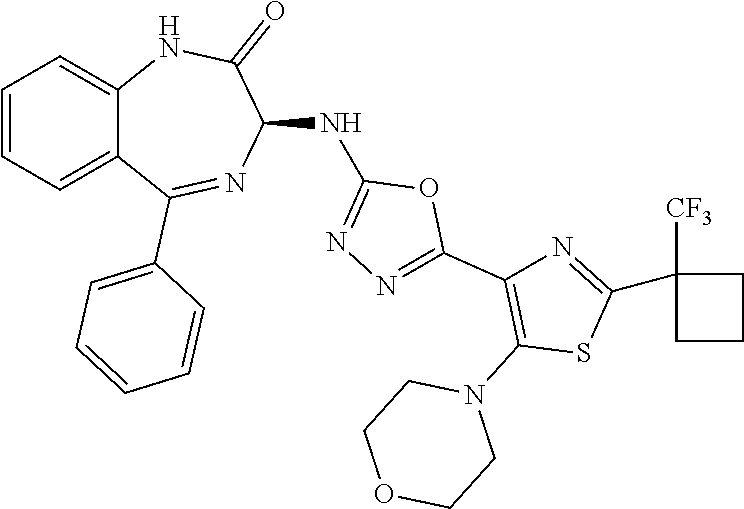
Example 490 was prepared using a procedure similar to 458 where 1-(trifluoromethyl)cyclobutane-1-carboxamide was used in place of 1-fluorocyclobutane-1-carboxamide. The racemic mixture was purified by chiral separation. (Column=YMC CHIRAL Cellulose-SB, 250*20 mm (5 uM); Mobile Phase=50% EtOH/50% hexanes; Flow rate=20 mL/min). ESI MS m/z=610.2 [M+H]+.

Example 491 was prepared using a procedure similar to 430 where bromocyclopentane was used in place of bromocyclobutane. ESI MS m/z=539.5 [M+H]+. 1H NMR (300 MHz, DMSO-d6) δ 1.55-1.69 (m, 2H), 1.77 (m, 2H), 1.84-1.96 (m, 2H), 1.96-2.10 (m, 2H), 3.02-3.26 (m, 4H), 3.66 (m, 4H), 4.63 (m, 1H), 5.10 (d, J=8.7 Hz, 1H), 7.23-7.39 (m, 3H), 7.41-7.58 (m, 5H), 7.67 (m, 1H), 8.06 (s, 1H), 8.85 (d, J=8.7 Hz, 1H), 10.96 (s, 1H).

Example 492 was prepared using a procedure similar to 458 where MeOH was used in place of EtOH in step e. The racemic mixture was purified by chiral separation. (Column=YMC CHIRAL Cellulose-SB, 250*20 mm (5 uM); Mobile Phase=50% EtOH/50% hexanes; Flow rate=20 mL/min). ESI MS m/z=572.2 [M+H]+.

Example 493 was prepared using a procedure similar to that used to prepare Example 21 where ethyl (R)-5-((5-oxopyrrolidin-3-yl)amino)-2-(trifluoromethyl)thiazole-4-carboxylate, which was prepared similarly to ethyl 5-morpholino-2-(trifluoromethyl)thiazole-4-carboxylate in Example 339, was converted to the corresponding hydrazide and used in place of tetrahydro-2H-pyran-4-carbohydrazide. The racemic mixture was purified by chiral separation. (Column=YMC CHIRAL Cellulose-SB, 250*20 mm (5 uM); Mobile Phase=50% iPrOH/50% hexanes; Flow rate=20 mL/min). ESI MS m/z=569.1 [M+H]+. 1H NMR (300 MHz, DMSO-d6) δ 2.33 (dd, J=16.7, 5.3 Hz, 1H), 2.69 (dd, J=16.7, 7.9 Hz, 1H), 3.28 (dd, J=10.2, 4.5 Hz, 1H), 3.70 (dd, J=10.1, 7.0 Hz, 1H), 4.23 (q, J=6.1, 6.1, 6.0 Hz, 1H), 5.15 (d, J=8.4 Hz, 1H), 7.24-7.39 (m, 3H), 7.42-7.58 (m, 5H), 7.68 (ddd, J=8.4, 7.0, 1.8 Hz, 1H), 7.81 (s, 1H), 9.15 (d, J=8.6 Hz, 1H), 10.95 (s, 1H).

Example 494 was prepared using a procedure similar to that used to prepare Example 21 where ethyl (R)-5-((2-oxopyrrolidin-3-yl)amino)-2-(trifluoromethyl)thiazole-4-carboxylate, which was prepared similarly to ethyl 5-morpholino-2-(trifluoromethyl)thiazole-4-carboxylate in Example 339, was converted to the corresponding hydrazide and used in place of tetrahydro-2H-pyran-4-carbohydrazide. The racemic mixture was purified by chiral separation. (Column=YMC CHIRAL Cellulose-SB, 250*20 mm (5 uM); Mobile Phase=50% iPrOH/50% hexanes; Flow rate=20 mL/min). ESI MS m/z=569.1 [M+H]+. 1H NMR (300 MHz, DMSO-d6) δ 2.03 (dq, J=12.2, 9.6, 9.6, 9.6 Hz, 1H), 2.62 (dt, J=12.6, 6.6, 6.6 Hz, 1H), 3.30 (d, J=3.4 Hz, 2H), 4.26 (t, J=9.3, 9.3 Hz, 1H), 5.16 (d, J=8.4 Hz, 1H), 7.19-7.43 (m, 3H), 7.40-7.76 (m, 7H), 8.21 (s, 1H), 9.14 (d, J=8.5 Hz, 1H), 10.98 (s, 1H).


A solution of ethyl 5-bromo-2-(trifluoromethyl)thiazole-4-carboxylate (500 mg, 1.65 mmol), LiOH (198 mg, 8.25 mmol) in THF (5 mL) and H2O (2 mL) was stirred for 1 hour at RT. It was adjusted pH value to 4 with 3 N HCl and purified by Flash (MeCN/H2O) to give the desired acid as yellow solid (410 mg, 90.3%). The acid (410 mg, 1.49 mmol), K2CO3 (411 mg, 2.98 mmol), BnBr (507 mg, 2.98 mmol) in DMF (5 mL) was stirred for 1 hour at RT and purified by Flash (MeCN/H2O) to give the desired compound as yellow solid (505 mg, 92.8%). The compound had no signal on LCMS.

A solution of the compound from step 1 (580 mg, 1.59 mmol), morpholin-3-one (481 mg, 4.76 mmol), Pd2(dba)3 (164 mg, 0.15 mmol), Xantphos (184 mg, 0.31 mmol), Cs2CO3 (1.03 g, 3.18 mmol) in 1,4-dioxane (10 mL) was stirred at 100° C. for 2 hours. The solution was concentrated and purified by TLC give the desired product as yellow solid (140 mg, 22.81%). ESI MS m/z=409.1 [M+H]+.

A solution of the compound from step 2 (140 mg, 0.36 mmol), Pd/C (50 mg) in MeOH (10 mL) under H2 was stirred at RT for 2 hours. The solid was filtered out and concentrated to give 5-(3-oxomorpholino)-2-(trifluoromethyl)thiazole-4-carboxylic acid as yellow solid (70 mg, 65.69%). ESI MS m/z=297.2 [M+H]+.

A solution of the compound from step 3 (70 mg, 0.23 mmol), tert-butyl hydrazinecarboxylate (62 mg, 0.46 mmol), HATU (131 mg, 0.34 mmol), DIPEA (0.5 mL) in DMF (2 mL) was stirred at RT for 2 hours. The solution was purified by Flash (MeCN/H2O) to give the desired product as yellow oil (50 mg, 53.02%). ESI MS m/z=354.9 [M-t-Bu]+.

A solution of the compound from step 4 (50 mg, 0.12 mmol), TFA (2 mL) in DCM (16 mL) was stirred at RT for 1 hour. The solution was adjusted pH value to 10 with Sat. NaHCO3 solution and purified by Flash (MeCN/H2O) to give 5-(3-oxomorpholino)-2-(trifluoromethyl)thiazole-4-carbohydrazide as yellow solid (25 mg, 67.56%). ESI MS m/z=310.5 [M+H]+.

Example 495 was prepared using a procedure similar to that used to prepare Example 21 where 5-(3-oxomorpholino)-2-(trifluoromethyl)thiazole-4-carbohydrazide was used in place of tetrahydro-2H-pyran-4-carbohydrazide. The racemic mixture was purified by chiral separation. (Column=YMC CHIRAL Cellulose-SB, 250*20 mm (5 uM); Mobile Phase=50% iPrOH/50% hexanes; Flow rate=20 mL/min). ESI MS m/z=570.1 [M+H]+. 1H NMR (300 MHz, DMSO-d6) δ 3.82-3.84 (m, 2H), 3.99-4.03 (m, 2H), 4.32 (s, 2H), 5.16-5.19 (d, J=9.0 Hz, 1H), 7.27-7.36 (m, 3H), 7.43-7.53 (m, 5H), 7.64-7.67 (m, 1H), 9.43-9.46 (d, J=9.0 Hz, 1H), 10.98 (s, 1H).

Example 496 was prepared using a procedure similar to that used to prepare Example 430 where 1-bromo-2-methoxyethane was used in place of 1-bromo-2-(2-bromoethoxy)ethane. ESI MS m/z=513.4 [M+H]+. 1H NMR (400 MHz, DMSO-d6) δ 1.65-1.84 (m, 2H), 2.31 (m, 2H), 2.40-2.48 (m, 2H), 3.27 (s, 3H), 3.39 (m, 2H), 3.51 (m, 2H), 4.72 (m, 1H), 5.10 (d, J=8.6 Hz, 1H), 5.40 (s, 1H), 7.24-7.31 (m, 1H), 7.32-7.38 (m, 2H), 7.43-7.57 (m, 5H), 7.67 (m, 1H), 7.99 (s, 1H), 8.85 (d, J=8.7 Hz, 1H), 10.97 (s, 1H).

Example 497 was prepared using a procedure similar to 458 where 3,3,3-trifluoro-2,2-dimethylpropanamide was used in place of 1-fluorocyclobutane-1-carboxamide. The racemic mixture was purified by chiral separation. (Column=YMC CHIRAL Cellulose-SB, 250*20 mm (5 uM); Mobile Phase=50% EtOH/50% hexanes; Flow rate=20 mL/min). ESI MS m/z=598.2 [M+H]+.

Example 498 was prepared using a procedure similar to 458 where 3,3,3-trifluoro-2,2-dimethylpropanamide and 2-methoxyethan-1-amine were used in place of 1-fluorocyclobutane-1-carboxamide and morpholine, respectively. The racemic mixture was purified by chiral separation. (Column=YMC CHIRAL Cellulose-SB, 250*20 mm (5 uM); Mobile Phase=50% EtOH/50% hexanes; Flow rate=20 mL/min). ESI MS m/z=586.2 [M+H]+.

Example 499 was prepared using a procedure similar to that used to prepare Example 21 where ethyl (R)-5-((tetrahydro-2H-pyran-3-yl)amino)-2-(trifluoromethyl)thiazole-4-carboxylate, which was prepared similarly to ethyl 5-morpholino-2-(trifluoromethyl)thiazole-4-carboxylate in Example 339, was converted to the corresponding hydrazide and used in place of tetrahydro-2H-pyran-4-carbohydrazide. The racemic mixture was purified by chiral separation. (Column=YMC CHIRAL Cellulose-SB, 250*20 mm (5 uM); Mobile Phase=50% iPrOH/50% hexanes; Flow rate=20 mL/min). ESI MS m/z=570.1 [M+H]+.


Assays
Methods for RSV-A Assay
| TABLE 2 |
| Summary of Activities for RSV-A |
| Human | Human | ||||
| RSV-A | RSV-A | ||||
| (“Long” | (“Long” | ||||
| strain) | CC50 | strain) | CC50 | ||
| Example | EC50 | ATPlite | Example | EC50 | ATPlite |
| 1 | C | A | 2 | C | A |
| 3 | C | A | 4 | C | A |
| 5 | C | A | 6 | C | A |
| 7a | B | A | 7b | C | B |
| 8 | C | A | 9 | C | A |
| 10a | B | A | 10b | C | C |
| 11 | B | A | 12 | B | A |
| 13 | A | A | 14 | A | B |
| 15 | B | A | 16 | B | A |
| 17 | C | A | 18 | C | A |
| 19 | C | A | 20 | C | A |
| 21 | C | A | 22 | C | A |
| 23 | C | A | 24 | B | — |
| 25 | C | A | 26 | C | A |
| 27 | C | A | 28 | C | A |
| 29 | C | A | 30 | C | A |
| 31 | B | A | 32 | B | A |
| 33 | C | A | 34 | B | A |
| 35 | C | A | 36 | B | B |
| 37 | C | A | 38 | C | A |
| 39 | C | A | 40 | C | A |
| 41 | C | A | 42 | B | A |
| 43 | C | A | 44 | C | A |
| 45 | C | A | 46 | C | A |
| 47 | C | A | 48 | C | A |
| 49 | C | A | 50 | C | A |
| 51 | B | A | 52 | A | A |
| 53 | B | A | 54 | A | A |
| 55 | A | A | 56 | C | — |
| 57 | C | A | 58 | C | A |
| 59 | C | A | 60 | C | A |
| 61 | B | A | 62 | C | A |
| 63 | C | A | 64 | C | A |
| 65 | C | A | 66 | B | A |
| 67 | C | A | 68 | C | A |
| 69 | C | A | 70 | C | A |
| 71 | C | A | 72 | C | A |
| 73 | C | A | 74 | C | A |
| 75 | C | A | 76 | C | A |
| 77 | B | A | 78 | C | — |
| 79 | C | A | 80 | C | A |
| 81 | C | A | 82 | B | A |
| 83 | C | A | 84 | C | B |
| 85 | C | — | 86 | C | A |
| 87 | C | B | 88 | C | B |
| 89 | C | B | 90 | C | C |
| 91 | C | — | 92 | C | B |
| 93 | C | B | 94 | C | B |
| 95 | B | — | 96 | C | B |
| 97 | C | A | 98 | C | A |
| 99 | C | B | 100 | C | B |
| 101 | C | B | 102 | C | — |
| 103 | C | B | 104 | C | B |
| 105 | C | A | 106 | C | C |
| 107 | C | — | 108 | C | — |
| 109 | C | — | 110 | C | — |
| 111 | C | — | 112 | C | — |
| 113 | B | — | 114 | C | — |
| 115 | A | — | 116 | C | — |
| 117 | C | — | 118 | C | — |
| 119 | B | — | 120 | A | — |
| 121 | C | — | 122 | C | — |
| 123 | A | — | 124a | A | — |
| 124b | C | — | 125a | A | — |
| 125b | C | — | 126a | A | — |
| 126b | C | — | 127 | A | — |
| 128 | B | — | 129 | A | — |
| 130 | B | — | 131 | A | — |
| 132 | A | — | 133 | B | — |
| 134 | C | — | 135 | C | — |
| 136 | A | — | 137 | C | — |
| 138 | A | — | 139 | A | — |
| 140 | A | — | 141 | C | — |
| 142 | B | — | 143 | A | — |
| 144 | A | — | 145 | B | — |
| 146 | C | — | 147 | C | — |
| 148 | C | — | 149 | B | — |
| 150 | A | — | 151 | A | — |
| 152 | A | — | 153 | A | — |
| 154 | A | — | 155 | A | — |
| 156 | C | — | 157 | A | — |
| 158 | A | — | 159 | A | — |
| 160 | A | — | 161 | C | — |
| 162 | A | — | 163 | C | — |
| 164 | A | — | 165 | B | — |
| 166 | C | — | 167 | A | — |
| 168 | A | — | 169 | A | — |
| 170 | C | — | 171 | C | — |
| 172 | C | — | 173 | C | — |
| 174 | A | — | 175 | A | — |
| 176 | A | — | 177 | C | — |
| 178 | B | — | 179 | A | — |
| 180 | A | — | 181 | A | — |
| 182 | A | — | 183 | A | — |
| 184 | B | — | 185 | C | — |
| 186 | C | — | 187 | B | — |
| 188 | C | — | 189 | C | — |
| 190 | C | — | 191 | C | — |
| 192 | C | — | 193 | C | — |
| 194 | C | — | 195 | C | — |
| 196 | C | — | 197 | C | — |
| 198 | C | — | 199 | C | — |
| 200 | B | — | 201 | C | — |
| 202 | C | — | 203 | C | — |
| 204 | C | — | 205 | C | — |
| 206 | C | — | 207 | C | — |
| 208 | C | — | 209 | C | — |
| 210 | C | — | 211 | C | — |
| 212 | C | — | 213 | C | — |
| 214 | C | — | 215 | C | — |
| 216 | B | — | 217 | B | — |
| 218 | C | — | 219 | C | — |
| 220 | C | — | 221 | C | — |
| 222 | C | — | 223 | C | — |
| 224 | C | — | 225 | C | — |
| 226 | C | — | 227 | C | — |
| 228 | C | — | 229 | C | — |
| 230 | C | — | 231 | A | — |
| 232 | C | — | 233 | C | — |
| 234 | C | — | 235 | C | — |
| 236 | C | — | 237 | C | — |
| 238 | C | — | 239 | C | — |
| 240 | C | — | 241 | C | — |
| 242 | A | — | 243 | C | — |
| 244 | C | — | 245 | A | — |
| 246 | C | — | 247 | C | — |
| 248 | C | — | 249 | C | — |
| 250 | A | — | 251 | A | — |
| 252 | A | — | 253 | A | — |
| 254 | C | — | 255 | C | — |
| 256 | C | — | 257 | C | — |
| 258 | C | — | 259 | C | — |
| 260 | C | — | 261 | C | — |
| 262 | C | — | 263 | B | — |
| 264 | C | — | 265 | C | — |
| 266 | B | — | 267 | C | — |
| 268 | C | — | 269 | C | — |
| 270 | C | — | 271 | C | — |
| 272 | A | — | 273 | B | — |
| 274 | C | — | 275 | C | — |
| 276 | B | — | 277 | A | — |
| 278 | A | — | 279 | A | — |
| 280 | A | — | 281 | A | — |
| 282 | C | — | 283 | C | — |
| 284 | C | — | 285 | A | — |
| 286 | A | — | 287 | C | — |
| 288 | B | — | 289 | A | — |
| 290 | C | — | 291 | C | — |
| 292 | A | — | 293 | C | — |
| 294 | A | — | 295 | A | — |
| 296 | C | — | 297 | A | — |
| 298 | C | — | 299 | A | — |
| 300 | A | — | 301 | A | — |
| 302 | C | — | 303 | A | — |
| 304 | A | — | 305 | A | — |
| 306 | C | — | 307 | C | — |
| 308 | C | — | 309 | C | — |
| 310 | C | — | 311 | A | — |
| 312 | B | — | 313 | A | — |
| 314 | A | — | 315 | C | — |
| 316 | C | — | 317 | A | — |
| 318 | A | — | 319 | C | — |
| 320 | C | — | 321 | A | — |
| 322 | A | — | 323 | A | — |
| 324 | A | — | 325 | A | — |
| 326 | B | — | 327 | B | — |
| 328 | C | — | 329 | A | — |
| 330 | A | — | 331 | C | — |
| 332 | C | — | 333 | B | — |
| 334 | A | — | 335 | A | — |
| 336 | A | — | 337 | A | — |
| 338 | A | — | 339 | A | — |
| 340 | A | — | 341 | A | — |
| 342 | A | — | 343 | C | — |
| 344 | C | — | 345 | A | — |
| 346 | A | — | 347 | A | — |
| 348 | A | — | 349 | C | — |
| 350 | B | — | 351 | B | — |
| 352 | — | — | 353 | C | — |
| 354 | C | — | 355a | A | — |
| 355b | C | — | 356 | B | — |
| 357 | C | — | 358 | A | — |
| 359 | A | — | 360 | A | — |
| 361 | A | — | 362 | C | — |
| 363 | C | — | 364 | A | — |
| 365 | B | — | 366 | C | — |
| 367 | C | — | 368 | B | — |
| 369 | C | — | 370 | C | — |
| 371 | C | — | 372 | C | — |
| 373 | C | — | 374 | C | — |
| 375 | C | — | 376 | C | — |
| 377 | A | — | 378 | C | — |
| 379 | C | — | 380 | B | — |
| 381 | C | — | 382 | C | — |
| 383 | A | — | 384 | A | — |
| 385 | A | — | 387 | A | — |
| 388 | A | — | 389 | A | — |
| 390 | A | — | 393 | — | — |
| 394 | C | — | 395 | C | — |
| 396 | C | — | 399 | A | — |
| 400 | A | — | 401 | A | — |
| 402 | A | — | 403 | A | — |
| 404 | A | — | 405 | A | — |
| 406 | A | — | 407 | A | — |
| 408 | C | — | 409 | C | — |
| 410 | C | — | 411 | C | — |
| 412 | C | — | 413 | C | — |
| 414 | C | — | 415 | C | — |
| 416 | C | — | 417 | C | — |
| 418 | C | — | 419 | B | — |
| 420 | A | — | 421 | C | — |
| 422 | B | — | 423 | B | — |
| 424 | C | — | 425 | A | — |
| 426 | C | — | 427 | A | — |
| 428 | A | — | 429 | A | — |
| 430 | A | — | 431 | A | — |
| 432 | C | — | 433 | A | — |
| 434 | A | — | 435 | C | — |
| 436 | A | — | 437 | A | — |
| 438 | B | — | 439 | C | — |
| 440 | B | — | 441 | C | — |
| 442 | A | — | 443 | C | — |
| 444 | A | — | 445 | B | — |
| 446 | A | — | 447 | B | — |
| 448 | A | — | 449 | C | — |
| 450 | C | — | 451 | B | — |
| 452 | A | — | 453 | A | — |
| 454 | A | — | 455 | A | — |
| 456 | C | — | 457 | C | — |
| 458 | A | — | 459 | A | — |
| 460 | A | — | 461 | A | — |
| 462 | C | — | 463 | C | — |
| 464 | A | — | 465 | B | — |
| 466 | A | — | 467 | A | — |
| 468 | C | — | 469 | A | — |
| 470 | C | — | 471 | A | — |
| 472 | C | — | 473 | A | — |
| 474 | A | — | 475 | B | — |
| 476 | B | — | 477 | A | — |
| 478 | A | — | 479 | C | — |
| 480 | C | — | 481 | C | — |
| 482 | C | — | 483 | C | — |
| 484 | A | — | 485 | C | — |
| 486 | C | — | 487 | C | — |
| 488 | A | — | 489 | C | — |
| 490 | A | — | |||
Methods for RSV-B Assay
| TABLE 3 |
| Summary of Activities for RSV-B |
| Human RSV-B | Human RSV-B | ||||
| Example | EC50 | Example | EC50 | ||
| 7a | C | 95 | C | ||
| 108 | C | 120 | B | ||
| 123 | B | 124 | A | ||
| 125 | B | 127 | A | ||
| 129 | A | 131 | A | ||
| 136 | A | 139 | A | ||
| 144 | A | 153 | A | ||
| 155 | A | 158 | A | ||
| 160 | A | 168 | A | ||
| 169 | A | 175 | B | ||
| 179 | A | 224 | A | ||
| 242 | A | 245 | B | ||
| 250 | A | 251 | A | ||
| 252 | A | 253 | A | ||
| 263 | B | 268 | B | ||
| 269 | B | 272 | A | ||
| 276 | C | 277 | A | ||
| 278 | A | 300 | A | ||
| 303 | A | 304 | A | ||
| 322 | A | 334 | A | ||
| 336 | A | 338 | A | ||
| 339 | A | 340 | A | ||
| 341 | A | 351 | B | ||
| 355a | A | 358 | A | ||
| 364 | B | 377 | A | ||
| 385 | A | 387 | A | ||
| 388 | A | 403 | A | ||
| 407 | A | 429 | A | ||
Methods for Combination Testing
| TABLE 4 |
| Drug Concentration Scheme |
| Ex. 253 | AZ-27 | GS-5806 | ALS-8112 | Palivizumab | Ribavirin | ||
| [μM] | [μM] | [nM] | [μM] | [μM] | [μM] | ||
| Top | 0.100 | 0.020 | 0.975 | 3.750 | 0.520 | 12.000 |
| 0.077 | 0.015 | 0.750 | 2.885 | 0.400 | 9.231 | |
| 0.059 | 0.012 | 0.577 | 2.219 | 0.308 | 7.101 | |
| 0.046 | 0.009 | 0.444 | 1.707 | 0.237 | 5.462 | |
| 0.035 | 0.007 | 0.341 | 1.313 | 0.182 | 4.202 | |
| 0.027 | 0.005 | 0.263 | 1.010 | 0.140 | 3.232 | |
| Bottom | 0.021 | 0.004 | 0.202 | 0.777 | 0.108 | 2.486 |
| 0 | 0 | 0 | 0 | 0 | 0 | |
| TABLE 5 |
| Combination Index Values |
| Avg. Combination Index (Cl) at |
| Compounds | EC50 | EC75 | EC90 | EC95 | Avg. |
| Example 253 + Example 253 | 0.8 | 0.8 | 0.9 | 0.9 | 0.9 |
| Example 253 + ALS-8112 | 0.7 | 0.6 | 0.5 | 0.4 | 0.6 |
| Example 253 + AZ-27 | 0.8 | 0.6 | 0.5 | 0.4 | 0.6 |
| Example 253 + GS5806 | 0.9 | 0.7 | 0.6 | 0.5 | 0.7 |
| Example 253 + Ribavirin | 0.9 | 1.0 | 1.1 | 1.2 | 1.0 |
| Example 253 + Palivizumab | 0.8 | 0.8 | 0.7 | 0.6 | 0.7 |
| Cl < 0.9 = synergy | |||||
| Cl > 1.1 = antagonism | |||||
| Cl 0.9-1.1 = additivity | |||||
Claims (4)

Priority Applications (1)
| Application Number | Priority Date | Filing Date | Title |
|---|---|---|---|
| US17/094,029 US12268694B2 (en) | 2017-09-29 | 2020-11-10 | Combination pharmaceutical agents as RSV inhibitors |
Applications Claiming Priority (4)
| Application Number | Priority Date | Filing Date | Title |
|---|---|---|---|
| US201762566160P | 2017-09-29 | 2017-09-29 | |
| US201762566159P | 2017-09-29 | 2017-09-29 | |
| US16/145,768 US10881666B2 (en) | 2017-09-29 | 2018-09-28 | Combination pharmaceutical agents as RSV inhibitors |
| US17/094,029 US12268694B2 (en) | 2017-09-29 | 2020-11-10 | Combination pharmaceutical agents as RSV inhibitors |
Related Parent Applications (1)
| Application Number | Title | Priority Date | Filing Date |
|---|---|---|---|
| US16/145,768 Division US10881666B2 (en) | 2017-09-29 | 2018-09-28 | Combination pharmaceutical agents as RSV inhibitors |
Publications (2)
| Publication Number | Publication Date |
|---|---|
| US20220323460A1 US20220323460A1 (en) | 2022-10-13 |
| US12268694B2 true US12268694B2 (en) | 2025-04-08 |
Family
ID=65903295
Family Applications (2)
| Application Number | Title | Priority Date | Filing Date |
|---|---|---|---|
| US16/145,768 Active US10881666B2 (en) | 2017-09-29 | 2018-09-28 | Combination pharmaceutical agents as RSV inhibitors |
| US17/094,029 Active 2041-12-26 US12268694B2 (en) | 2017-09-29 | 2020-11-10 | Combination pharmaceutical agents as RSV inhibitors |
Family Applications Before (1)
| Application Number | Title | Priority Date | Filing Date |
|---|---|---|---|
| US16/145,768 Active US10881666B2 (en) | 2017-09-29 | 2018-09-28 | Combination pharmaceutical agents as RSV inhibitors |
Country Status (12)
| Country | Link |
|---|---|
| US (2) | US10881666B2 (en) |
| EP (1) | EP3687543B1 (en) |
| JP (1) | JP7198811B2 (en) |
| KR (1) | KR102645995B1 (en) |
| CN (1) | CN111386118B (en) |
| AU (1) | AU2018339068B2 (en) |
| BR (1) | BR112020006334A2 (en) |
| CA (1) | CA3077309A1 (en) |
| MX (1) | MX2020004084A (en) |
| TW (1) | TWI794297B (en) |
| WO (1) | WO2019067864A1 (en) |
| ZA (1) | ZA202002139B (en) |
Families Citing this family (27)
| Publication number | Priority date | Publication date | Assignee | Title |
|---|---|---|---|---|
| MY197231A (en) | 2015-07-22 | 2023-06-06 | Enanta Pharm Inc | Benzodiazepine derivatives as rsv inhibitors |
| WO2018152413A1 (en) | 2017-02-16 | 2018-08-23 | Enanta Pharmaceuticals, Inc. | Processes for the preparation of benzodiazepine derivatives |
| WO2018226801A1 (en) | 2017-06-07 | 2018-12-13 | Enanta Pharmaceuticals, Inc. | Aryldiazepine derivatives as rsv inhibitors |
| WO2019006295A1 (en) | 2017-06-30 | 2019-01-03 | Enanta Pharmaceuticals, Inc. | Heterocyclic compounds as rsv inhibitors |
| US10851115B2 (en) | 2017-06-30 | 2020-12-01 | Enanta Pharmaceuticals, Inc. | Heterocyclic compounds as RSV inhibitors |
| CN111386118B (en) | 2017-09-29 | 2023-05-09 | 英安塔制药有限公司 | Combination pharmaceutical agents as RSV inhibitors |
| WO2019094920A1 (en) | 2017-11-13 | 2019-05-16 | Enanta Pharmaceuticals, Inc. | Azepin-2-one derivatives as rsv inhibitors |
| WO2019199908A1 (en) | 2018-04-11 | 2019-10-17 | Enanta Pharmaceuticals, Inc. | Heterocyclic compounds as rsv inhibitors |
| WO2020190935A1 (en) | 2019-03-18 | 2020-09-24 | Enanta Pharmaceuticals, Inc. | Benzodiazepine derivatives as rsv inhibitors |
| US11179400B2 (en) | 2019-04-09 | 2021-11-23 | Enanta Pharmaceuticals, Inc. | Heterocyclic compounds as RSV inhibitors |
| US10689374B1 (en) * | 2019-07-12 | 2020-06-23 | United Arab Emirates University | Pyrimidine-thiazolidinone derivatives |
| PH12022550783A1 (en) * | 2019-10-04 | 2023-07-31 | Enanta Pharm Inc | Antiviral heterocyclic compounds |
| US11505558B1 (en) | 2019-10-04 | 2022-11-22 | Enanta Pharmaceuticals, Inc. | Antiviral heterocyclic compounds |
| UY39032A (en) | 2020-01-24 | 2021-07-30 | Enanta Pharm Inc | HETEROCYCLIC COMPOUNDS AS ANTIVIRAL AGENTS |
| WO2022010882A1 (en) * | 2020-07-07 | 2022-01-13 | Enanta Pharmaceuticals, Inc, | Dihydroquinoxaline and dihydropyridopyrazine derivatives as rsv inhibitors |
| CN111978312B (en) * | 2020-09-18 | 2023-05-05 | 黄淮学院 | 5-aryl-1, 3, 4-thiadiazole/1, 3, 4-oxadiazole-2-amine compound, and preparation method and application thereof |
| WO2022086840A1 (en) | 2020-10-19 | 2022-04-28 | Enanta Pharmaceuticals, Inc. | Heterocyclic compounds as anti-viral agents |
| MX2023009961A (en) | 2021-02-26 | 2023-09-05 | Enanta Pharm Inc | Antiviral heterocyclic compounds. |
| US12612412B2 (en) | 2021-02-26 | 2026-04-28 | Enanta Pharmaceuticals, Inc. | Antiviral heterocyclic compounds |
| CN114014856B (en) * | 2021-11-26 | 2023-12-22 | 嘉兴安谛康生物科技有限公司 | Imidazopyridine Derivatives as Antiviral Agents for Respiratory Syncytial Virus |
| CN114426496A (en) * | 2022-01-13 | 2022-05-03 | 山东莱福科技发展有限公司 | A kind of preparation method of benzophenone pharmaceutical intermediate |
| WO2023175185A1 (en) | 2022-03-17 | 2023-09-21 | Forx Therapeutics Ag | 2,4-dioxo-1,4-dihydroquinazoline derivatives as parg inhibitors for the treatment of cancer |
| AR129003A1 (en) | 2022-04-07 | 2024-07-03 | Enanta Pharm Inc | HETEROCYCLIC ANTIVIRAL COMPOUNDS |
| WO2023211997A1 (en) | 2022-04-27 | 2023-11-02 | Enanta Pharmaceuticals, Inc. | Antiviral compounds |
| US12569473B2 (en) * | 2022-07-05 | 2026-03-10 | 60 Degrees Pharmaceuticals, Inc. | Methods to treat respiratory infection utilizing castanospermine analogs |
| WO2024174953A1 (en) * | 2023-02-21 | 2024-08-29 | 苏州隆博泰药业有限公司 | Benzimidazole derivative and medical use thereof |
| CN122477200A (en) * | 2023-11-07 | 2026-07-28 | 英安塔制药有限公司 | Crystalline form of anti-RSV agents |
Citations (67)
| Publication number | Priority date | Publication date | Assignee | Title |
|---|---|---|---|---|
| US4010153A (en) | 1973-07-30 | 1977-03-01 | Crc Compagnia Di Ricerca Chimica S.A. | Preparation of chiral 1,4-benzodiazepin-2-one-derivatives by reaction of (s)-α-amino acid chloride hydrochlorides etc. |
| US4511510A (en) | 1977-10-18 | 1985-04-16 | Ravizza S.P.A. | Process for preparing a 7-chloro-5-(2-chlorophenyl)-benzodiazepinone |
| EP0167919A2 (en) | 1984-06-26 | 1986-01-15 | Merck & Co. Inc. | Benzodiazepine derivatives and pharmaceutical compositions containing them |
| US4988692A (en) | 1985-12-29 | 1991-01-29 | Roussel Uclaf | 2,4-dioxo-5-phenyl-2,3,4,5-tetrahydro-1H-1,5-benzodiazepines |
| WO1993008175A1 (en) | 1991-10-24 | 1993-04-29 | Glaxo Group Limited | Benzodiazepine derivatives as antagonists of gastrin and/or cholecystokinin |
| WO1994026718A1 (en) | 1993-05-13 | 1994-11-24 | Yoshitomi Pharmaceutical Industries, Ltd. | 3-aminoazepine compound and pharmaceutical use thereof |
| US5571809A (en) | 1989-04-20 | 1996-11-05 | Boehringer Ingelheim Pharmaceuticals, Inc. | The treatment of HIV-1 infection using certain pyridodiazepines |
| US5637697A (en) | 1992-01-21 | 1997-06-10 | Glaxo Spa | 1,5-benzodiazepine derivatives and their use in medicine |
| US5646140A (en) | 1993-04-15 | 1997-07-08 | Glaxo Wellcome Inc. | 1,5-benzodiazepine derivatives having CCK antagonistic or agonistic activity |
| US5681833A (en) | 1992-03-24 | 1997-10-28 | Merck, Sharp & Dohme Ltd. | Benzodiazepine derivatives |
| WO2004026843A1 (en) | 2002-09-20 | 2004-04-01 | Arrow Therapeutics Limited | Benzodiazepine derivatives and pharmaceutical compositions containing them |
| WO2004106310A1 (en) | 2003-05-30 | 2004-12-09 | Aston University | Novel 3-substituted-1,4-benzodiazepines |
| WO2005042530A1 (en) | 2003-10-30 | 2005-05-12 | Boehringer Ingelheim (Canada) Ltd. | Rsv polymerase inhibitors |
| WO2005089769A1 (en) | 2004-03-19 | 2005-09-29 | Arrow Therapeutics Limited | Pharmaceutical composition comprising a benzodiazepine derivative and an inhibit or of the rsv fusion protein |
| WO2005090319A1 (en) | 2004-03-19 | 2005-09-29 | Arrow Therapeutics Limited | Process for preparing benzodiazepines |
| US20060083741A1 (en) | 2004-10-08 | 2006-04-20 | Hoffman Rebecca S | Treatment of respiratory syncytial virus (RSV) infection |
| WO2006081389A1 (en) | 2005-01-25 | 2006-08-03 | Synta Pharmaceuticals Corp. | Thiophene compounds for inflammation and immune-related uses |
| US20070185096A1 (en) | 2004-03-19 | 2007-08-09 | Novartis Pharmaceuticals Corporation | Pharmaceutical composition comprising a benzodiazepine derivative and an inhibitor of the rsv fusion protein |
| US20080139536A1 (en) | 2004-03-19 | 2008-06-12 | Novartis Pharmaceuticals Corporation | Benzodiazepines for Treating or Preventing Rsv Infection |
| US20090274655A1 (en) | 2006-11-17 | 2009-11-05 | Richard Martin Grimes | 2-carboxy thiophene derivatives as anti viral agents |
| WO2010103306A1 (en) | 2009-03-10 | 2010-09-16 | Astrazeneca Uk Limited | Benzimidazole derivatives and their use as antivaral agents |
| WO2011005842A1 (en) | 2009-07-09 | 2011-01-13 | Gilead Sciences, Inc. | Anti-rsv compounds |
| WO2011151651A1 (en) | 2010-06-03 | 2011-12-08 | Arrow Therapeutics Limited | Benzodiazepine compounds useful for the treatment of hepatitis c |
| WO2012012776A1 (en) | 2010-07-22 | 2012-01-26 | Gilead Sciences, Inc. | Methods and compounds for treating paramyxoviridae virus infections |
| WO2012068622A1 (en) | 2010-11-26 | 2012-05-31 | Biota Scientific Management Pty Ltd | Compounds for treating respiratory syncytial virus infections |
| WO2012080451A1 (en) | 2010-12-16 | 2012-06-21 | Janssen R&D Ireland | Imidazopyridines as respiratory syncytial virus antiviral agents |
| WO2012080450A1 (en) | 2010-12-16 | 2012-06-21 | Janssen R&D Ireland | Azaindoles as respiratory syncytial virus antiviral agents |
| WO2012080446A1 (en) | 2010-12-16 | 2012-06-21 | Janssen R&D Ireland | Benzimidazole respiratory syncytial virus inhibitors |
| WO2012080447A1 (en) | 2010-12-16 | 2012-06-21 | Janssen R&D Ireland | Indoles as respiratory syncytial virus antiviral agents |
| WO2012080449A1 (en) | 2010-12-16 | 2012-06-21 | Janssen R&D Ireland | Azabenzimidazoles as respiratory syncytial virus antiviral agents |
| US20120245151A1 (en) | 2011-03-22 | 2012-09-27 | Bristol-Myers Squibb Company | Bisfluoroalkyl-1,4-benzodiazepinone compounds |
| WO2013096681A1 (en) | 2011-12-22 | 2013-06-27 | Gilead Sciences, Inc. | Pyrazolo[1,5-a]pyrimidines as antiviral agents |
| WO2013186334A1 (en) | 2012-06-15 | 2013-12-19 | Janssen R&D Ireland | 1,3-dihydro-2h-benzimidazol-2-one derivatives substituted with benzimidazoles as respiratory syncytial virus antiviral agents |
| WO2013186332A1 (en) | 2012-06-15 | 2013-12-19 | Janssen R&D Ireland | 4 - substituted 1, 3 - dihydro - 2h - benzimidazol - 2 - one derivatives substituted with benzimidazoles as respiratory syncytial virus antiviral agents |
| US20140038947A1 (en) | 1999-04-30 | 2014-02-06 | The Regents Of The University Of Michigan | Therapeutic applications of pro-apoptotic benzodiazepines |
| WO2014031784A1 (en) | 2012-08-23 | 2014-02-27 | Alios Biopharma, Inc. | Compounds for the treatment of paramoxyvirus viral infections |
| WO2014047369A1 (en) | 2012-09-21 | 2014-03-27 | Bristol-Myers Squibb Company | Substituted 1,5-benzodiazepinone compounds |
| WO2014060411A1 (en) | 2012-10-16 | 2014-04-24 | Janssen R&D Ireland | Rsv antiviral compounds |
| WO2014125444A1 (en) | 2013-02-15 | 2014-08-21 | Glaxosmithkline Intellectual Property Development Limited | Heterocyclic amides as kinase inhibitors |
| WO2014184350A1 (en) | 2013-05-17 | 2014-11-20 | Janssen R&D Ireland | Sulphamoylpyrrolamide derivatives and the use thereof as medicaments for the treatment of hepatitis b |
| WO2014209983A1 (en) | 2013-06-26 | 2014-12-31 | Alios Biopharma, Inc. | Substituted nucleosides, nucleotides and analogs thereof |
| WO2015026792A1 (en) | 2013-08-21 | 2015-02-26 | Alios Biopharma, Inc. | Antiviral compounds |
| WO2015110446A1 (en) | 2014-01-24 | 2015-07-30 | F. Hoffmann-La Roche Ag | Process for the preparation of n-[(3-aminooxetan-3-yl)methyl]-2-(1,1-dioxo-3,5-dihydro-1,4-benzothiazepin-4-yl)-6-methyl-quinazolin-4-amine |
| US20150218111A1 (en) | 2012-09-21 | 2015-08-06 | Bristol-Myers Squibb Company | Fluoroalkyl-1,4-benzodiazepinone compounds |
| US20150231152A1 (en) | 2012-09-21 | 2015-08-20 | Bristol-Myers Squibb Company | Fluoroalkyl and fluorocycloalkyl 1,4-benzodiazepinone compounds |
| US20150299210A1 (en) | 2009-11-05 | 2015-10-22 | Glaxosmithkline Llc | Benzodiazepine Bromodomain Inhibitor |
| WO2016018697A1 (en) | 2014-07-28 | 2016-02-04 | Gilead Sciences, Inc. | Thieno [3,2-d] pyrimidine, furo [3,2,d] pyrimidine, and pyrrolo [3,2-d] pyrimidines useful for treating respiratory syncitial virus infections |
| WO2016022464A1 (en) | 2014-08-05 | 2016-02-11 | Alios Biopharma, Inc. | Combination therapy for treating a paramyxovirus |
| WO2016055791A1 (en) | 2014-10-10 | 2016-04-14 | Pulmocide Limited | Novel 5,6-dihydro-4H-benzo[b]thieno-[2,3-d]azepine derivative |
| WO2016097761A1 (en) | 2014-12-18 | 2016-06-23 | Pulmocide Limited | 4,5-dihydro-6h-thieno[3,2-d]benzazepine derivatives and their use to treat respiratory syncytial virus (rsv) infections |
| US20160244460A1 (en) | 2015-02-25 | 2016-08-25 | Alios Biopharma, Inc. | Antiviral compounds |
| WO2016166546A1 (en) | 2015-04-16 | 2016-10-20 | The University Of Durham | An antimicrobial compound |
| US20170022221A1 (en) | 2015-07-22 | 2017-01-26 | Enanta Pharmaceuticals, Inc. | Benzodiazepine derivatives as rsv inhibitors |
| WO2017123884A1 (en) | 2016-01-15 | 2017-07-20 | Enanta Pharmaceuticals, Inc. | Heterocyclic compounds as rsv inhibitors |
| US20170226127A1 (en) | 2016-02-05 | 2017-08-10 | Denali Therapeutics Inc. | Compounds, compositions and methods |
| WO2017175000A1 (en) | 2016-04-08 | 2017-10-12 | Pulmocide Limited | Compounds |
| US20180193352A1 (en) | 2017-01-06 | 2018-07-12 | Enanta Pharmaceuticals, Inc. | Heteroaryldiazepine derivatives as rsv inhibitors |
| US20180237425A1 (en) | 2017-02-16 | 2018-08-23 | Enanta Pharmaceuticals, Inc. | Processes for the preparation of benzodiazepine derivatives |
| US20180354912A1 (en) | 2017-06-07 | 2018-12-13 | Enanta Pharmaceuticals, Inc. | Aryldiazepine derivatives as rsv inhibitors |
| US20190002478A1 (en) | 2017-06-30 | 2019-01-03 | Enanta Pharmaceuticals, Inc. | Heterocyclic compounds as rsv inhibitors |
| US20190002479A1 (en) | 2017-06-30 | 2019-01-03 | Enanta Pharmaceuticals, Inc. | Heterocyclic compounds as rsv inhibitors |
| US20190152968A1 (en) | 2017-11-13 | 2019-05-23 | Enanta Pharmaceuticals, Inc. | Azepin-2-one derivatives as rsv inhibitors |
| US20190177283A1 (en) | 2017-11-13 | 2019-06-13 | Enanta Pharmaceuticals, Inc. | Processes for the resolution of benzodiazepin-2-one and benzoazepin-2-one derivatives |
| US20190192535A1 (en) | 2017-09-29 | 2019-06-27 | Enanta Pharmaceuticals, Inc. | Combination pharmaceutical agents as rsv inhibitors |
| US20190315766A1 (en) | 2018-04-11 | 2019-10-17 | Enanta Pharmaceuticals, Inc. | Heterocyclic compounds as rsv inhibitors |
| US20220356189A1 (en) | 2019-10-04 | 2022-11-10 | Enanta Pharmaceuticals, Inc. | Antiviral heterocyclic compounds |
| US11912695B2 (en) | 2019-03-18 | 2024-02-27 | Enanta Pharmaceuticals, Inc. | Benzodiazepine derivatives as RSV inhibitors |
Family Cites Families (9)
| Publication number | Priority date | Publication date | Assignee | Title |
|---|---|---|---|---|
| ATE435222T1 (en) | 2003-12-18 | 2009-07-15 | Tibotec Pharm Ltd | AMINOBENZIMIDAZOLES AND BENZIMIDAZOLES AS INHIBITORS OF REPLICATION OF RESPIRATORY SYNCYTIAL VIRUS |
| AU2006260969B2 (en) | 2005-06-20 | 2011-11-17 | Janssen Sciences Ireland Uc | 1- ( 2-amino-3- (substituted alkyl)-3H-benzimidazolylmethyl) -3-substituted-1,3-dihydro-benzoimidazol-2-ones with activity on respiratory syncytial virus |
| CN102958933B (en) | 2010-06-24 | 2016-02-03 | 吉里德科学公司 | Pyrazolo[1,5-A]pyrimidines as antiviral agents |
| JP2014530225A (en) | 2011-10-11 | 2014-11-17 | エフ.ホフマン−ラ ロシュアーゲーF.Hoffmann−La Roche Aktiengesellschaft | Compounds for the treatment and prevention of respiratory syncytial virus diseases |
| EA027855B1 (en) | 2012-04-17 | 2017-09-29 | Гайлид Сайэнсиз, Инк. | Compounds and methods for antiviral treatment |
| WO2013186995A1 (en) | 2012-06-14 | 2013-12-19 | ソニー株式会社 | Information processing device, information processing method, and information processing program |
| CA2873920C (en) | 2012-06-15 | 2021-07-20 | Janssen R&D Ireland | 1,3-dihydro-2h-benzimidazol-2-one derivatives substituted with heterocycles as respiratory syncytial virus antiviral agents |
| JP2015519387A (en) | 2012-06-15 | 2015-07-09 | ヤンセン・アールアンドデイ・アイルランド | Novel 4-substituted 1,3-dihydro-2H-benzimidazol-2-one derivatives substituted by heterocycles as RS virus antiviral agents |
| BR112015000392A2 (en) | 2012-07-10 | 2017-06-27 | Hoffmann La Roche | new indoles for the treatment and prophylaxis of respiratory syncytial virus infection |
-
2018
- 2018-09-28 CN CN201880076451.XA patent/CN111386118B/en not_active Expired - Fee Related
- 2018-09-28 AU AU2018339068A patent/AU2018339068B2/en not_active Ceased
- 2018-09-28 MX MX2020004084A patent/MX2020004084A/en unknown
- 2018-09-28 KR KR1020207011858A patent/KR102645995B1/en active Active
- 2018-09-28 CA CA3077309A patent/CA3077309A1/en active Pending
- 2018-09-28 JP JP2020518057A patent/JP7198811B2/en active Active
- 2018-09-28 BR BR112020006334-7A patent/BR112020006334A2/en not_active IP Right Cessation
- 2018-09-28 EP EP18862419.1A patent/EP3687543B1/en active Active
- 2018-09-28 US US16/145,768 patent/US10881666B2/en active Active
- 2018-09-28 WO PCT/US2018/053361 patent/WO2019067864A1/en not_active Ceased
- 2018-10-01 TW TW107134652A patent/TWI794297B/en not_active IP Right Cessation
-
2020
- 2020-05-04 ZA ZA2020/02139A patent/ZA202002139B/en unknown
- 2020-11-10 US US17/094,029 patent/US12268694B2/en active Active
Patent Citations (96)
| Publication number | Priority date | Publication date | Assignee | Title |
|---|---|---|---|---|
| US4010153A (en) | 1973-07-30 | 1977-03-01 | Crc Compagnia Di Ricerca Chimica S.A. | Preparation of chiral 1,4-benzodiazepin-2-one-derivatives by reaction of (s)-α-amino acid chloride hydrochlorides etc. |
| US4511510A (en) | 1977-10-18 | 1985-04-16 | Ravizza S.P.A. | Process for preparing a 7-chloro-5-(2-chlorophenyl)-benzodiazepinone |
| EP0167919A2 (en) | 1984-06-26 | 1986-01-15 | Merck & Co. Inc. | Benzodiazepine derivatives and pharmaceutical compositions containing them |
| US4988692A (en) | 1985-12-29 | 1991-01-29 | Roussel Uclaf | 2,4-dioxo-5-phenyl-2,3,4,5-tetrahydro-1H-1,5-benzodiazepines |
| US5571809A (en) | 1989-04-20 | 1996-11-05 | Boehringer Ingelheim Pharmaceuticals, Inc. | The treatment of HIV-1 infection using certain pyridodiazepines |
| WO1993008175A1 (en) | 1991-10-24 | 1993-04-29 | Glaxo Group Limited | Benzodiazepine derivatives as antagonists of gastrin and/or cholecystokinin |
| US5637697A (en) | 1992-01-21 | 1997-06-10 | Glaxo Spa | 1,5-benzodiazepine derivatives and their use in medicine |
| US5681833A (en) | 1992-03-24 | 1997-10-28 | Merck, Sharp & Dohme Ltd. | Benzodiazepine derivatives |
| US5646140A (en) | 1993-04-15 | 1997-07-08 | Glaxo Wellcome Inc. | 1,5-benzodiazepine derivatives having CCK antagonistic or agonistic activity |
| EP0703222A1 (en) | 1993-05-13 | 1996-03-27 | Yoshitomi Pharmaceutical Industries, Ltd. | 3-aminoazepine compound and pharmaceutical use thereof |
| WO1994026718A1 (en) | 1993-05-13 | 1994-11-24 | Yoshitomi Pharmaceutical Industries, Ltd. | 3-aminoazepine compound and pharmaceutical use thereof |
| US20140038947A1 (en) | 1999-04-30 | 2014-02-06 | The Regents Of The University Of Michigan | Therapeutic applications of pro-apoptotic benzodiazepines |
| US20060040923A1 (en) | 2002-09-20 | 2006-02-23 | Malcolm Carter | Benzodiazepine derivatives and pharmaceutical compositions containing them |
| WO2004026843A1 (en) | 2002-09-20 | 2004-04-01 | Arrow Therapeutics Limited | Benzodiazepine derivatives and pharmaceutical compositions containing them |
| US20100015063A1 (en) | 2002-09-20 | 2010-01-21 | Arrow Therapeutics Limited | Benzodiazepine Derivatives and Pharmaceutical Compositions Containing Them |
| US7582624B2 (en) | 2002-09-20 | 2009-09-01 | Arrow Therapeutics Limited | Benzodiazepine derivatives and pharmaceutical compositions containing them |
| WO2004106310A1 (en) | 2003-05-30 | 2004-12-09 | Aston University | Novel 3-substituted-1,4-benzodiazepines |
| US20070185094A1 (en) | 2003-05-30 | 2007-08-09 | Aston University | Novel 3-substitued-1,4-benzodiazepines |
| WO2005042530A1 (en) | 2003-10-30 | 2005-05-12 | Boehringer Ingelheim (Canada) Ltd. | Rsv polymerase inhibitors |
| US20070142403A1 (en) | 2004-03-19 | 2007-06-21 | Novartis Pharmaceuticala Corporation | Pharmaceutical composition comprising a benzodiazepine derivative and an inhibitor of the rsv fusion protein |
| US20070185096A1 (en) | 2004-03-19 | 2007-08-09 | Novartis Pharmaceuticals Corporation | Pharmaceutical composition comprising a benzodiazepine derivative and an inhibitor of the rsv fusion protein |
| US20070293482A1 (en) | 2004-03-19 | 2007-12-20 | Novartis Pharmaceuticals Corporation | Process for Preparing Benzodiazepines |
| US20080139536A1 (en) | 2004-03-19 | 2008-06-12 | Novartis Pharmaceuticals Corporation | Benzodiazepines for Treating or Preventing Rsv Infection |
| WO2005090319A1 (en) | 2004-03-19 | 2005-09-29 | Arrow Therapeutics Limited | Process for preparing benzodiazepines |
| WO2005089769A1 (en) | 2004-03-19 | 2005-09-29 | Arrow Therapeutics Limited | Pharmaceutical composition comprising a benzodiazepine derivative and an inhibit or of the rsv fusion protein |
| US20060083741A1 (en) | 2004-10-08 | 2006-04-20 | Hoffman Rebecca S | Treatment of respiratory syncytial virus (RSV) infection |
| WO2006081389A1 (en) | 2005-01-25 | 2006-08-03 | Synta Pharmaceuticals Corp. | Thiophene compounds for inflammation and immune-related uses |
| US20090274655A1 (en) | 2006-11-17 | 2009-11-05 | Richard Martin Grimes | 2-carboxy thiophene derivatives as anti viral agents |
| WO2010103306A1 (en) | 2009-03-10 | 2010-09-16 | Astrazeneca Uk Limited | Benzimidazole derivatives and their use as antivaral agents |
| US20120196846A1 (en) | 2009-07-09 | 2012-08-02 | Gilead Sciences, Inc. | Anti-rsv compounds |
| US8999969B2 (en) | 2009-07-09 | 2015-04-07 | Gilead Sciences, Inc. | Anti-RSV compounds |
| WO2011005842A1 (en) | 2009-07-09 | 2011-01-13 | Gilead Sciences, Inc. | Anti-rsv compounds |
| US20150299210A1 (en) | 2009-11-05 | 2015-10-22 | Glaxosmithkline Llc | Benzodiazepine Bromodomain Inhibitor |
| WO2011151651A1 (en) | 2010-06-03 | 2011-12-08 | Arrow Therapeutics Limited | Benzodiazepine compounds useful for the treatment of hepatitis c |
| WO2012012776A1 (en) | 2010-07-22 | 2012-01-26 | Gilead Sciences, Inc. | Methods and compounds for treating paramyxoviridae virus infections |
| WO2012068622A1 (en) | 2010-11-26 | 2012-05-31 | Biota Scientific Management Pty Ltd | Compounds for treating respiratory syncytial virus infections |
| WO2012080451A1 (en) | 2010-12-16 | 2012-06-21 | Janssen R&D Ireland | Imidazopyridines as respiratory syncytial virus antiviral agents |
| WO2012080449A1 (en) | 2010-12-16 | 2012-06-21 | Janssen R&D Ireland | Azabenzimidazoles as respiratory syncytial virus antiviral agents |
| WO2012080447A1 (en) | 2010-12-16 | 2012-06-21 | Janssen R&D Ireland | Indoles as respiratory syncytial virus antiviral agents |
| WO2012080446A1 (en) | 2010-12-16 | 2012-06-21 | Janssen R&D Ireland | Benzimidazole respiratory syncytial virus inhibitors |
| WO2012080450A1 (en) | 2010-12-16 | 2012-06-21 | Janssen R&D Ireland | Azaindoles as respiratory syncytial virus antiviral agents |
| US20120245151A1 (en) | 2011-03-22 | 2012-09-27 | Bristol-Myers Squibb Company | Bisfluoroalkyl-1,4-benzodiazepinone compounds |
| US20140100365A1 (en) | 2011-03-22 | 2014-04-10 | Bristol-Myers Squibb Company | Bisfluoroalkyl-1,4-benzodiazepinone compounds |
| WO2013096681A1 (en) | 2011-12-22 | 2013-06-27 | Gilead Sciences, Inc. | Pyrazolo[1,5-a]pyrimidines as antiviral agents |
| WO2013186334A1 (en) | 2012-06-15 | 2013-12-19 | Janssen R&D Ireland | 1,3-dihydro-2h-benzimidazol-2-one derivatives substituted with benzimidazoles as respiratory syncytial virus antiviral agents |
| WO2013186332A1 (en) | 2012-06-15 | 2013-12-19 | Janssen R&D Ireland | 4 - substituted 1, 3 - dihydro - 2h - benzimidazol - 2 - one derivatives substituted with benzimidazoles as respiratory syncytial virus antiviral agents |
| WO2014031784A1 (en) | 2012-08-23 | 2014-02-27 | Alios Biopharma, Inc. | Compounds for the treatment of paramoxyvirus viral infections |
| WO2014047369A1 (en) | 2012-09-21 | 2014-03-27 | Bristol-Myers Squibb Company | Substituted 1,5-benzodiazepinone compounds |
| US20150218111A1 (en) | 2012-09-21 | 2015-08-06 | Bristol-Myers Squibb Company | Fluoroalkyl-1,4-benzodiazepinone compounds |
| US20150231152A1 (en) | 2012-09-21 | 2015-08-20 | Bristol-Myers Squibb Company | Fluoroalkyl and fluorocycloalkyl 1,4-benzodiazepinone compounds |
| WO2014060411A1 (en) | 2012-10-16 | 2014-04-24 | Janssen R&D Ireland | Rsv antiviral compounds |
| US9617289B2 (en) | 2012-10-16 | 2017-04-11 | Janssen Sciences Ireland Uc | RSV antiviral compounds |
| WO2014125444A1 (en) | 2013-02-15 | 2014-08-21 | Glaxosmithkline Intellectual Property Development Limited | Heterocyclic amides as kinase inhibitors |
| WO2014184350A1 (en) | 2013-05-17 | 2014-11-20 | Janssen R&D Ireland | Sulphamoylpyrrolamide derivatives and the use thereof as medicaments for the treatment of hepatitis b |
| WO2014209983A1 (en) | 2013-06-26 | 2014-12-31 | Alios Biopharma, Inc. | Substituted nucleosides, nucleotides and analogs thereof |
| US20150065504A1 (en) | 2013-08-21 | 2015-03-05 | Alios Biopharma, Inc. | Antiviral compounds |
| WO2015026792A1 (en) | 2013-08-21 | 2015-02-26 | Alios Biopharma, Inc. | Antiviral compounds |
| WO2015110446A1 (en) | 2014-01-24 | 2015-07-30 | F. Hoffmann-La Roche Ag | Process for the preparation of n-[(3-aminooxetan-3-yl)methyl]-2-(1,1-dioxo-3,5-dihydro-1,4-benzothiazepin-4-yl)-6-methyl-quinazolin-4-amine |
| WO2016018697A1 (en) | 2014-07-28 | 2016-02-04 | Gilead Sciences, Inc. | Thieno [3,2-d] pyrimidine, furo [3,2,d] pyrimidine, and pyrrolo [3,2-d] pyrimidines useful for treating respiratory syncitial virus infections |
| WO2016022464A1 (en) | 2014-08-05 | 2016-02-11 | Alios Biopharma, Inc. | Combination therapy for treating a paramyxovirus |
| WO2016055792A1 (en) | 2014-10-10 | 2016-04-14 | Pulmocide Limited | Novel 5,6-dihydro-4h-benzo[b]thieno-[2,3-d]azepine derivatives |
| US9732098B2 (en) | 2014-10-10 | 2017-08-15 | Pulmocide Limited | 5,6-dihydro-4H-benzo[b]thieno-[2,3-d]azepine derivative |
| US20170355717A1 (en) | 2014-10-10 | 2017-12-14 | Pulmocide Limited | Novel 5,6-dihydro-4h-benzo[b]thieno-[2,3-d]azepine derivatives |
| US20170305935A1 (en) | 2014-10-10 | 2017-10-26 | Simon Fraser Hunt | Novel 5,6-dihydro-4H-benzo[b]thieno-[2,3-d]azepine derivative |
| WO2016055791A1 (en) | 2014-10-10 | 2016-04-14 | Pulmocide Limited | Novel 5,6-dihydro-4H-benzo[b]thieno-[2,3-d]azepine derivative |
| WO2016097761A1 (en) | 2014-12-18 | 2016-06-23 | Pulmocide Limited | 4,5-dihydro-6h-thieno[3,2-d]benzazepine derivatives and their use to treat respiratory syncytial virus (rsv) infections |
| US20160244460A1 (en) | 2015-02-25 | 2016-08-25 | Alios Biopharma, Inc. | Antiviral compounds |
| WO2016138158A1 (en) | 2015-02-25 | 2016-09-01 | Alios Biopharma, Inc. | Antiviral compounds |
| WO2016166546A1 (en) | 2015-04-16 | 2016-10-20 | The University Of Durham | An antimicrobial compound |
| US20230087410A1 (en) | 2015-07-22 | 2023-03-23 | Enanta Pharmaceuticals, Inc. | Benzodiazepine derivatives as rsv inhibitors |
| US20180258102A1 (en) | 2015-07-22 | 2018-09-13 | Enanta Pharmaceuticals, Inc. | Benzodiazepine derivatives as rsv inhibitors |
| US10570153B2 (en) | 2015-07-22 | 2020-02-25 | Enanta Pharmaceuticals, Inc. | Benzodiazepine derivatives as RSV inhibitors |
| US10865215B2 (en) | 2015-07-22 | 2020-12-15 | Enanta Pharmaceuticals, Inc. | Benzodiazepine derivatives as RSV inhibitors |
| WO2017015449A1 (en) | 2015-07-22 | 2017-01-26 | Enanta Pharmaceuticals, Inc. | Benzodiazepine derivatives as rsv inhibitors |
| US20170022221A1 (en) | 2015-07-22 | 2017-01-26 | Enanta Pharmaceuticals, Inc. | Benzodiazepine derivatives as rsv inhibitors |
| US11390631B1 (en) | 2015-07-22 | 2022-07-19 | Enanta Pharmaceuticals, Inc. | Benzodiazepine derivatives as RSV inhibitors |
| US9957281B2 (en) | 2015-07-22 | 2018-05-01 | Enanta Pharmaceuticals, Inc. | Benzodiazepine derivatives as RSV inhibitors |
| US20170226129A1 (en) | 2016-01-15 | 2017-08-10 | Enanta Pharmaceuticals, Inc. | Heterocyclic compounds as rsv inhibitors |
| WO2017123884A1 (en) | 2016-01-15 | 2017-07-20 | Enanta Pharmaceuticals, Inc. | Heterocyclic compounds as rsv inhibitors |
| US20190040084A1 (en) | 2016-01-15 | 2019-02-07 | Enanta Pharmaceuticals, Inc. | Heterocyclic compounds as rsv inhibitors |
| US20170226127A1 (en) | 2016-02-05 | 2017-08-10 | Denali Therapeutics Inc. | Compounds, compositions and methods |
| WO2017175000A1 (en) | 2016-04-08 | 2017-10-12 | Pulmocide Limited | Compounds |
| US20190092791A1 (en) | 2016-04-08 | 2019-03-28 | Pulmocide Limited | Compounds |
| US20180193352A1 (en) | 2017-01-06 | 2018-07-12 | Enanta Pharmaceuticals, Inc. | Heteroaryldiazepine derivatives as rsv inhibitors |
| US10398706B2 (en) | 2017-01-06 | 2019-09-03 | Enanta Pharmaceuticals, Inc. | Heteroaryldiazepine derivatives as RSV inhibitors |
| US10358441B2 (en) | 2017-02-16 | 2019-07-23 | Enanta Pharmaceuticals, Inc. | Processes for the preparation of benzodiazepine derivatives |
| US20180237425A1 (en) | 2017-02-16 | 2018-08-23 | Enanta Pharmaceuticals, Inc. | Processes for the preparation of benzodiazepine derivatives |
| US20180354912A1 (en) | 2017-06-07 | 2018-12-13 | Enanta Pharmaceuticals, Inc. | Aryldiazepine derivatives as rsv inhibitors |
| US20190002479A1 (en) | 2017-06-30 | 2019-01-03 | Enanta Pharmaceuticals, Inc. | Heterocyclic compounds as rsv inhibitors |
| US20190002478A1 (en) | 2017-06-30 | 2019-01-03 | Enanta Pharmaceuticals, Inc. | Heterocyclic compounds as rsv inhibitors |
| US20190192535A1 (en) | 2017-09-29 | 2019-06-27 | Enanta Pharmaceuticals, Inc. | Combination pharmaceutical agents as rsv inhibitors |
| US20190177283A1 (en) | 2017-11-13 | 2019-06-13 | Enanta Pharmaceuticals, Inc. | Processes for the resolution of benzodiazepin-2-one and benzoazepin-2-one derivatives |
| US20190152968A1 (en) | 2017-11-13 | 2019-05-23 | Enanta Pharmaceuticals, Inc. | Azepin-2-one derivatives as rsv inhibitors |
| US20190315766A1 (en) | 2018-04-11 | 2019-10-17 | Enanta Pharmaceuticals, Inc. | Heterocyclic compounds as rsv inhibitors |
| US11912695B2 (en) | 2019-03-18 | 2024-02-27 | Enanta Pharmaceuticals, Inc. | Benzodiazepine derivatives as RSV inhibitors |
| US20220356189A1 (en) | 2019-10-04 | 2022-11-10 | Enanta Pharmaceuticals, Inc. | Antiviral heterocyclic compounds |
Non-Patent Citations (50)
| Title |
|---|
| "4-(2-Hydroxyethoxy)-3-methoxy-N-[3,3,3-1-22 trifluoro-2-[7-(4-fluorophenyl)-3-[2-(methylamino )ethyl]-2,3-dihydrofuro[2,3-c]pyridin-5-yl]-2-methylpropyl]benzamide", Pubmed Compound Record for CID 139332032, U.S. National Library of Medicine, Nov. 2, 2019, https:l/pubchem.ncbi.nlm.nih.gov/compound/139332032). |
| "N-[(2R)-2-[3-(Aminomethyl)-7-(4-fluorophenyl)-1-22 3-methyl-2H-furo[2,3-c]pyridin-5-yl]-3,3,3-trifluoro-2-hydroxypropyl]-4-(2-hydroxyethoxy)-3-methoxybenzamide", Pubmed Compound Record for CID 117924934, U.S. National Library of Medicine, Feb. 23, 2016, https://pubchem.ncbi.nlm.nih.gov/compound/117924934. |
| Albright, et al., (Document No. 129:54301) retrieved from STN; entered in STN on Jun. 17, 1998. |
| Albright, et al., (Document No. 130:153583) retrieved from STN; entered in STN on Feb. 16, 1999. |
| Andrzej, et al., (Document No. 144:274313) retrieved from STN; entered in STN on Mar. 3, 2006. |
| Aquino, C. J. et al., "Discovery of 1,5-Benzodiazepines with Peripheral Cholecystokinin (CCK-A) Receptor Agonist Activity. 1. Optimization of the Agonist Trigger", J. Med. Chem., 39, 1996, 562-569. |
| Armstrong, et al., "An Efficient Asymmetric Synthesis of (R)-3-Amino-2,3,4,5-tetrahydro-1 H-[1 ]benzazepine-2-one", Tetrahedron Letters, 35(20), 1994, 3239-3242. |
| Bond, S. et al., "1,2,3,9b-Tetrahydro-5H-imidazo[2,1-a]isoindol-5-ones as a new class of respiratory syncytial virus (RSV) fusion inhibitors. Part 2: Identification of BTA9881 as a preclinical candidate", Bioorg & Med Chem Lett, 25, 2015, 976-981. |
| Carter, M. C. et al., "1,4-Benzodiazepines as Inhibitors of Respiratory Syncytial Virus", Journal of Medicinal Chemistry, vol. 49, Mar. 9, 2006, 2311-2319. |
| Chapman, J. et al., "RSV604, a Novel Inhibitor of Respiratory Syncytial Virus Replication", Antimicrobial Agents and Chemotherapy, vol. 51, No. 9, 2007, 3346-3353. |
| Chapman, Joanna et al., "R5V604, a Novel Inhibitor of Respiratory Syncytial Virus Replication", Antimicrobial Agents and Chemotherapy, vol. 51, No. 9, 2007, 3346-3353. |
| Fernandez, H. et al., "Ribavirin: A Clinical Overview", Euro J. Epidemiology, 2(1), Mar. 1, 1986, 1-14. |
| Fordyce, et al., "Discovery of novel benzothienoazepine derivatives as potent inhibitors of respiratory syncytial virus," Bloorganic & Medicinal Chemistry Letters, 27:2201-2206,2017. |
| Fordyce, et al., "Discovery of novel benzothienoazepine derivatives as potent inhibitors of respiratory syncytial virus", Bioorganic & Medicinal Chemistry Letters, 27, 2017, 2201-2206. |
| Heeney, et al., (Document No. 153:359062) retreved from STN; entered in STN on Sep. 2, 2010. |
| Heeney, et al., (Document No. 153:359062) retrieved from STN; entered in STN on Sep. 2, 2010. |
| Henderson, E. A. et al., "1,4-Benzodiazepines as Inhibitors of Respiratory Syncytial Virus. The Identification of a Clinical Candidate", Journal of Medicinal Chemistry, vol. 50, Mar. 7, 2007, 1685-1692. |
| Karmakar, et al. "Crystallization-Induced Dynamic Resolution toward the Synthesis of (S)-7-Amino-5H,7H-dibenzo[b,d]-azepin-6-one: An Important Scaffold for y-Secretase Inhibitors", Organic Process Research & Development, 20, 2016, 1717-1720. |
| Karmakar, et al., "Crystallization-Induced Dynamic Resolution toward the Synthesis of (S)-7-Amino-5H,7H-dibenzo[b,d]-azepin-6-one: An Important Scaffold for γ-Secretase Inhibitors", Organic Process Research & Development, 20, 2016, 1717-1720. |
| Lattmann, E. et al., "In vivo Evaluation of Substituted 3-Amino-1,4-benzodiazepines as Anti-depressant, Anxiolytic and Antinociceptive Agents", Arzneimittelforschung, 59(2), doi: 10.1055/s-0031-1296366, 2009, 61-71. |
| Lee, et al., (Document No. 140:69941) retrieved from STN; entered in STN on Jul. 8, 2003. |
| Mackman, R. L. et al., "Discovery of an Oral Respiratory Syncytial Virus (RSV) Fusion Inhibitor (GS-5806) and Clinical Proof of Concept in a Human RSV Challenge Study", J. Med. Chem., 58, 2015, 1630-1643. |
| Mayo Clinic Staff, Respiratory syncytial virus (RSV) [online], retrieved from internet on Jun. 25, 2017.; URL http://www.mayoclinic.org/diseases-condiitons/respiratory-syncytial-virus/basics/prevention. |
| Offel, M. et al., "Synthesis of Substituted 3-Anilino-5-phenyl-1,3-dihydro-2H-, 4-benzodiazepine-2-ones and their Evaluation as Cholecystokinin-Ligands", Archiv Der Pharmazie, vol. 339, No. 4, Apr. 1, 2006, 163-173. |
| Offel, M. et al., "Synthesis of Substituted 3-Anilino-5-phenyl-l,3-dihydro-2H-l, 4-benzodiazepine-2-ones and their Evaluation as Cholecystokinin-Ligands", Archiv Der Pharmazie, vol. 339, No. 4, Apr. 1, 2006, 163-173. |
| Olszewska et al. Expert Opin. Emerg. Drugs, (2009), 14(2), p. 207-217. |
| Olszewska, W. et al., "Emerging drugs for respiratory syncytial virus infection", Expert Opin. Emerg. Drugs, 14(2), 2009, 207-217. |
| Peesapati, et al., (Document No. 120:244848) retrieved from STN; entered in STN on May 14, 1994. |
| Perron et al. Antimicrobial Agents and Chemotherapy, (2016), 60(3), p. 1264-1273. |
| Perron, M. et al., "GS-5806 Inhibits a Broad Range of Respiratory Syncytial Virus Clinical Isolates by Blocking the Virus-Cell Fusion Process", Antimicrobial Agents and Chemotherapy, 60(3), 2016, 1264-1273. |
| PUBCHEM-CID: 10595203, p. 3, Fig, Oct. 25, 2006, 1-9. |
| Reider, et al., "Metalated Allylaminosilane: A New, Practical Reagent for Stereoselective a-Hydroxyallylation of Aldehydes to Erythro-1,2-diol Skeletons", J. Org. Chem, 52, 1987, 957. |
| Setoi, H. et al., "Preparation of heterocyclylbenzamide derivatives as vasopressin antagonists", Document No. 131:116236, retrieved from STN; entered in STN on Aug. 6, 1999, Aug. 6, 1999. |
| Stein, D. S. et al., "Oral ribavirin treatment of influenza A and B", Antimicrobial Agents and Chemotherapy, 31(8), URL:http://dx.doi.org/l0.ll28/AAC.31.8.l285>, Aug. 1987, 1285-1287. |
| STN Registry database entry: CAS RN 1348594-72-8 (Entered STN: Dec. 4, 2011). |
| STN Registry database entry: CAS RN 1348849-53-5 (Entered STN: Dec. 5, 2011) (Year: 2011). |
| STN Registry database entry: CAS RN 1348849-53-5 (Entered STN: Dec. 5, 2011). |
| STN Registry database entry: CAS RN 1348924-24-2 (Entered STN: Dec. 5, 2011). |
| STN Registry database entry: CAS RN 1349463-13-3 (Entered STN: Dec. 6, 2011). |
| STN Registry database entry: CAS RN 1349533-81-8 (Entered STN: Dec. 6, 2011) (Year: 2011). |
| STN Registry database entry: CAS RN 1349749-23-0 (Entered STN: Dec. 6, 2011). |
| STN Registry database entry: CAS RN 1350148-32-1 (Entered STN: Dec. 7, 2011) (Year: 2011). |
| STN Registry database entry: CAS RN 1350148-32-1 (Entered STN: Dec. 7, 2011). |
| Sudo, K. et al., "YM-53403, a unique anti-respiratory syncytial virus agent with a novel mechanism of action", Antiviral Research, 2005, vol. 65, 2005, 125-131. |
| Sudo, Kenji et al., "YM-53403, a unique anti-respiratory syncytial virus agent with a novel mechanism of action" Antiviral Research, 2005, vol. 65, 2005, 125-131. |
| Wang, et al., (Document No. 160:385666) retrieved from STN; entered in STN on Feb. 27, 2014. |
| Wang, G. et al., "Discovery of 4′-Chloromethyl-2′-deoxy-3′,5′-di-O-isobutyryl-2′-fluorocytidine (ALS-8176), A First-in-Class RSV Polymerase Inhibitor for Treatment of Human Respiratory Syncytial Virus Infection", J. Med. Chem. 58, 2015, 1862-1878. |
| Xiong, et al., (Document No. 160:101182) retrieved from STN; entered in STN on Nov. 12, 2013. |
| Xiong, H. , "Discovery of a Potent Respiratory Syncytial Virus RNA Polymerase Inhibitor", Bioorganic & Medicinal Chemistry Letters, 23, 2013, 6789-6793. |
| Zheng, et al., (Document No. 161 :399872) retrieved from STN; entered in STN on Jul. 23, 2014. |
Also Published As
| Publication number | Publication date |
|---|---|
| US20220323460A1 (en) | 2022-10-13 |
| JP2020536069A (en) | 2020-12-10 |
| EP3687543B1 (en) | 2024-03-20 |
| TWI794297B (en) | 2023-03-01 |
| JP7198811B2 (en) | 2023-01-04 |
| KR20200087132A (en) | 2020-07-20 |
| US20190192535A1 (en) | 2019-06-27 |
| US10881666B2 (en) | 2021-01-05 |
| WO2019067864A1 (en) | 2019-04-04 |
| CN111386118A (en) | 2020-07-07 |
| KR102645995B1 (en) | 2024-03-11 |
| CA3077309A1 (en) | 2019-04-04 |
| MX2020004084A (en) | 2020-07-29 |
| ZA202002139B (en) | 2024-02-28 |
| EP3687543A1 (en) | 2020-08-05 |
| BR112020006334A2 (en) | 2020-09-24 |
| CN111386118B (en) | 2023-05-09 |
| EP3687543A4 (en) | 2021-06-23 |
| AU2018339068A1 (en) | 2020-05-07 |
| AU2018339068B2 (en) | 2022-12-15 |
| TW201919640A (en) | 2019-06-01 |
Similar Documents
| Publication | Publication Date | Title |
|---|---|---|
| US12297209B2 (en) | Benzodiazepine derivatives as RSV inhibitors | |
| US10881666B2 (en) | Combination pharmaceutical agents as RSV inhibitors | |
| HK1251484B (en) | Benzodiazepine derivatives as rsv inhibitors | |
| BR112018001296B1 (en) | RSV INHIBITOR BENZODIAZEPINE DERIVATIVE COMPOUNDS, COMPOSITIONS CONTAINING THE SAME AND USE THEREOF TO TREAT OR PREVENT RSV INFECTION | |
| HK40032651A (en) | Combinations of pharmaceutical agents as rsv inhibitors | |
| HK40032651B (en) | Combinations of pharmaceutical agents as rsv inhibitors |
Legal Events
| Date | Code | Title | Description |
|---|---|---|---|
| FEPP | Fee payment procedure |
Free format text: ENTITY STATUS SET TO UNDISCOUNTED (ORIGINAL EVENT CODE: BIG.); ENTITY STATUS OF PATENT OWNER: LARGE ENTITY |
|
| STPP | Information on status: patent application and granting procedure in general |
Free format text: DOCKETED NEW CASE - READY FOR EXAMINATION |
|
| STPP | Information on status: patent application and granting procedure in general |
Free format text: NON FINAL ACTION MAILED |
|
| STPP | Information on status: patent application and granting procedure in general |
Free format text: RESPONSE TO NON-FINAL OFFICE ACTION ENTERED AND FORWARDED TO EXAMINER |
|
| STPP | Information on status: patent application and granting procedure in general |
Free format text: NON FINAL ACTION MAILED |
|
| STPP | Information on status: patent application and granting procedure in general |
Free format text: RESPONSE TO NON-FINAL OFFICE ACTION ENTERED AND FORWARDED TO EXAMINER |
|
| STPP | Information on status: patent application and granting procedure in general |
Free format text: NOTICE OF ALLOWANCE MAILED -- APPLICATION RECEIVED IN OFFICE OF PUBLICATIONS |
|
| STPP | Information on status: patent application and granting procedure in general |
Free format text: PUBLICATIONS -- ISSUE FEE PAYMENT RECEIVED |
|
| STPP | Information on status: patent application and granting procedure in general |
Free format text: PUBLICATIONS -- ISSUE FEE PAYMENT VERIFIED |
|
| STCF | Information on status: patent grant |
Free format text: PATENTED CASE |