US12268498B2 - Systems and methods for quantitative diagnosis of anemia - Google Patents
Systems and methods for quantitative diagnosis of anemia Download PDFInfo
- Publication number
- US12268498B2 US12268498B2 US17/291,215 US201917291215A US12268498B2 US 12268498 B2 US12268498 B2 US 12268498B2 US 201917291215 A US201917291215 A US 201917291215A US 12268498 B2 US12268498 B2 US 12268498B2
- Authority
- US
- United States
- Prior art keywords
- hgb
- regions
- interest
- image
- user
- Prior art date
- Legal status (The legal status is an assumption and is not a legal conclusion. Google has not performed a legal analysis and makes no representation as to the accuracy of the status listed.)
- Active, expires
Links
Images




Classifications
-
- A—HUMAN NECESSITIES
- A61—MEDICAL OR VETERINARY SCIENCE; HYGIENE
- A61B—DIAGNOSIS; SURGERY; IDENTIFICATION
- A61B5/00—Measuring for diagnostic purposes; Identification of persons
- A61B5/145—Measuring characteristics of blood in vivo, e.g. gas concentration or pH-value ; Measuring characteristics of body fluids or tissues, e.g. interstitial fluid or cerebral tissue
- A61B5/1455—Measuring characteristics of blood in vivo, e.g. gas concentration or pH-value ; Measuring characteristics of body fluids or tissues, e.g. interstitial fluid or cerebral tissue using optical sensors, e.g. spectral photometrical oximeters
-
- A—HUMAN NECESSITIES
- A61—MEDICAL OR VETERINARY SCIENCE; HYGIENE
- A61B—DIAGNOSIS; SURGERY; IDENTIFICATION
- A61B5/00—Measuring for diagnostic purposes; Identification of persons
- A61B5/103—Measuring devices for testing the shape, pattern, colour, size or movement of the body or parts thereof, for diagnostic purposes
- A61B5/1032—Determining colour of tissue for diagnostic purposes
-
- A—HUMAN NECESSITIES
- A61—MEDICAL OR VETERINARY SCIENCE; HYGIENE
- A61B—DIAGNOSIS; SURGERY; IDENTIFICATION
- A61B5/00—Measuring for diagnostic purposes; Identification of persons
- A61B5/145—Measuring characteristics of blood in vivo, e.g. gas concentration or pH-value ; Measuring characteristics of body fluids or tissues, e.g. interstitial fluid or cerebral tissue
- A61B5/14535—Measuring characteristics of blood in vivo, e.g. gas concentration or pH-value ; Measuring characteristics of body fluids or tissues, e.g. interstitial fluid or cerebral tissue for measuring haematocrit
-
- A—HUMAN NECESSITIES
- A61—MEDICAL OR VETERINARY SCIENCE; HYGIENE
- A61B—DIAGNOSIS; SURGERY; IDENTIFICATION
- A61B5/00—Measuring for diagnostic purposes; Identification of persons
- A61B5/44—Detecting, measuring or recording for evaluating the integumentary system, e.g. skin, hair or nails
- A61B5/449—Nail evaluation, e.g. for nail disorder diagnosis
-
- A—HUMAN NECESSITIES
- A61—MEDICAL OR VETERINARY SCIENCE; HYGIENE
- A61B—DIAGNOSIS; SURGERY; IDENTIFICATION
- A61B5/00—Measuring for diagnostic purposes; Identification of persons
- A61B5/68—Arrangements of detecting, measuring or recording means, e.g. sensors, in relation to patient
- A61B5/6887—Arrangements of detecting, measuring or recording means, e.g. sensors, in relation to patient mounted on external non-worn devices, e.g. non-medical devices
- A61B5/6898—Portable consumer electronic devices, e.g. music players, telephones, tablet computers
-
- A—HUMAN NECESSITIES
- A61—MEDICAL OR VETERINARY SCIENCE; HYGIENE
- A61B—DIAGNOSIS; SURGERY; IDENTIFICATION
- A61B5/00—Measuring for diagnostic purposes; Identification of persons
- A61B5/74—Details of notification to user or communication with user or patient; User input means
- A61B5/742—Details of notification to user or communication with user or patient; User input means using visual displays
- A61B5/7435—Displaying user selection data, e.g. icons in a graphical user interface
-
- A—HUMAN NECESSITIES
- A61—MEDICAL OR VETERINARY SCIENCE; HYGIENE
- A61B—DIAGNOSIS; SURGERY; IDENTIFICATION
- A61B5/00—Measuring for diagnostic purposes; Identification of persons
- A61B5/74—Details of notification to user or communication with user or patient; User input means
- A61B5/7475—User input or interface means, e.g. keyboard, pointing device, joystick
- A61B5/748—Selection of a region of interest, e.g. using a graphics tablet
-
- G—PHYSICS
- G06—COMPUTING OR CALCULATING; COUNTING
- G06T—IMAGE DATA PROCESSING OR GENERATION, IN GENERAL
- G06T7/00—Image analysis
- G06T7/10—Segmentation; Edge detection
- G06T7/11—Region-based segmentation
-
- G—PHYSICS
- G06—COMPUTING OR CALCULATING; COUNTING
- G06T—IMAGE DATA PROCESSING OR GENERATION, IN GENERAL
- G06T7/00—Image analysis
- G06T7/90—Determination of colour characteristics
-
- H—ELECTRICITY
- H04—ELECTRIC COMMUNICATION TECHNIQUE
- H04N—PICTORIAL COMMUNICATION, e.g. TELEVISION
- H04N23/00—Cameras or camera modules comprising electronic image sensors; Control thereof
- H04N23/70—Circuitry for compensating brightness variation in the scene
- H04N23/74—Circuitry for compensating brightness variation in the scene by influencing the scene brightness using illuminating means
-
- A—HUMAN NECESSITIES
- A61—MEDICAL OR VETERINARY SCIENCE; HYGIENE
- A61B—DIAGNOSIS; SURGERY; IDENTIFICATION
- A61B2560/00—Constructional details of operational features of apparatus; Accessories for medical measuring apparatus
- A61B2560/02—Operational features
- A61B2560/0223—Operational features of calibration, e.g. protocols for calibrating sensors
-
- A—HUMAN NECESSITIES
- A61—MEDICAL OR VETERINARY SCIENCE; HYGIENE
- A61B—DIAGNOSIS; SURGERY; IDENTIFICATION
- A61B2576/00—Medical imaging apparatus involving image processing or analysis
- A61B2576/02—Medical imaging apparatus involving image processing or analysis specially adapted for a particular organ or body part
-
- A—HUMAN NECESSITIES
- A61—MEDICAL OR VETERINARY SCIENCE; HYGIENE
- A61B—DIAGNOSIS; SURGERY; IDENTIFICATION
- A61B5/00—Measuring for diagnostic purposes; Identification of persons
- A61B5/145—Measuring characteristics of blood in vivo, e.g. gas concentration or pH-value ; Measuring characteristics of body fluids or tissues, e.g. interstitial fluid or cerebral tissue
- A61B5/14546—Measuring characteristics of blood in vivo, e.g. gas concentration or pH-value ; Measuring characteristics of body fluids or tissues, e.g. interstitial fluid or cerebral tissue for measuring analytes not otherwise provided for, e.g. ions, cytochromes
-
- G—PHYSICS
- G06—COMPUTING OR CALCULATING; COUNTING
- G06T—IMAGE DATA PROCESSING OR GENERATION, IN GENERAL
- G06T2200/00—Indexing scheme for image data processing or generation, in general
- G06T2200/24—Indexing scheme for image data processing or generation, in general involving graphical user interfaces [GUIs]
-
- G—PHYSICS
- G06—COMPUTING OR CALCULATING; COUNTING
- G06T—IMAGE DATA PROCESSING OR GENERATION, IN GENERAL
- G06T2207/00—Indexing scheme for image analysis or image enhancement
- G06T2207/10—Image acquisition modality
- G06T2207/10141—Special mode during image acquisition
- G06T2207/10152—Varying illumination
-
- G—PHYSICS
- G06—COMPUTING OR CALCULATING; COUNTING
- G06T—IMAGE DATA PROCESSING OR GENERATION, IN GENERAL
- G06T2207/00—Indexing scheme for image analysis or image enhancement
- G06T2207/20—Special algorithmic details
- G06T2207/20081—Training; Learning
-
- G—PHYSICS
- G06—COMPUTING OR CALCULATING; COUNTING
- G06T—IMAGE DATA PROCESSING OR GENERATION, IN GENERAL
- G06T2207/00—Indexing scheme for image analysis or image enhancement
- G06T2207/30—Subject of image; Context of image processing
- G06T2207/30004—Biomedical image processing
- G06T2207/30101—Blood vessel; Artery; Vein; Vascular
- G06T2207/30104—Vascular flow; Blood flow; Perfusion
Definitions
- smartphone-based technologies have the potential to change how healthcare is delivered by enabling remote diagnoses, these technologies have yet to effectively replace other, invasive techniques, including blood-based testing, which remains a major cornerstone of disease diagnosis in modern medicine.
- smartphone-based technologies require smartphone attachments (purchased separately from the smartphone, along with an app). While such attachments may allow for remote diagnosis and analysis by a smartphone, the additional cost and complexity of multi-part systems may prevent broader adoption of these potentially disruptive technologies.
- a first aspect of the disclosure includes a system for analyzing an image for estimating hemoglobin levels.
- the system comprising at least one processor configured to receive an image of one or more fingernail beds of a user from a camera with a flash functionality activated.
- the processor is further configured to receive an indication of one or more regions of interest on the image, the one or more regions of interest at least partially including the one or more fingernail beds.
- the processor is further configured to quantitatively analyze pallor of the one or more fingernail beds in the one or more regions of interest to determine the user's approximate hemoglobin (Hgb) level by determining pixel intensity for each of the one or more regions of interest.
- Hgb hemoglobin
- Quantitatively analyzing the pallor of fingernail beds further includes averaging pixel intensity from color channels across each of the one or more regions of interest. Quantitatively analyzing the pallor of fingernail beds further includes transforming the average pixel intensity from the color channels into a value that correlates with the user's approximate Hgb level. The processor is further configured to output for display the user's approximate Hgb level.
- the at least one processor is further configured to receive the indication of the one or more regions of interest via input by the user and automatically display a visual indication of the one or more regions of interest.
- the input by the user comprises the user tapping the image to indicate the one or more regions of interest.
- the visual indication of the one or more regions of interest comprise one or more boxes encompassing each of the one or more regions of interest.
- the one or more regions of interest include an area of approximately 10 mm 2 .
- the one or more regions of interest consist of one or more portions of the one or more fingernail beds.
- the at least one processor is further configured to receive the indication of the one or more regions of interest automatically from a third-party computing system.
- the at least one processor is further configured to receive the indication of the one or more regions of interest automatically from a remote server.
- the at least one processor is further configured to determine the one or more regions of interest automatically.
- the at least one processor determines the one or more regions of interest via a machine learning algorithm.
- the system receives the image of the one or more fingernail beds of the user and quantitatively analyzes the pallor of the one or more fingernail beds in the one or more regions of interest without the use of external hardware physically coupled to the system.
- the determining pixel intensity for each of the one or more regions of interest comprises extracting color data from the image.
- the transforming the average pixel intensity from the color channels into the value that correlates to the user's approximate Hgb level comprises determining metadata associated with the image and the camera and adjusting the value based on the metadata.
- the at least one processor is further configured to exclude areas including leukonychia and/or camera flash reflection from the one or more regions of interest.
- the transforming the average pixel intensity from the color channels into the value that correlates to the user's approximate Hgb level comprises using linear regression to correct for variations in the average pixel intensity.
- the user's approximate Hgb level is an approximate complete blood count (CBC) Hgb level.
- the at least one processor is configured to save the user's approximate Hgb level in a text file.
- the quantitatively analyzing the pallor of the one or more fingernail beds in the one or more regions of interest to determine the user's approximate Hgb level comprises excluding pixel intensity values outside of a particular range.
- the camera is on a mobile device and the at least one processor is further configured to access the camera and automatically activate flash functionality associated with the camera to take the image of one or more fingernail beds of the user.
- FIG. 1 is a flowchart of a method to determine the user's approximate hemoglobin (Hgb) level from an image of the user's fingernail beds suitable for implementing the several embodiments of the disclosure.
- Hgb hemoglobin
- FIGS. 2 A- 2 B illustrates an image of the user's fingernail beds with fingernail irregularities and a quality control process to exclude pixel values corresponding to the fingernail bed irregularities.
- FIGS. 3 A- 3 C illustrate measures of the accuracy of the hemoglobin image analysis algorithm.
- FIG. 4 illustrates a diagnosis profile of the hemoglobin measurement.
- FIG. 5 illustrates a comparison of the image analysis hemoglobin levels to complete blood count (CBC) measurements of hemoglobin levels.
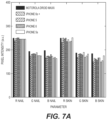
- FIG. 7 A- 7 B illustrate variability of color values of fingernails and skin color across different smartphones.
- FIG. 9 illustrates an improvement in accuracy in measured hemoglobin levels by adding a personalized calibration to the hemoglobin image analysis algorithm.
- FIGS. 10 A- 10 B illustrate the effect of skin tone and background lighting on the error in measured hemoglobin levels.
- FIGS. 11 A-D illustrate comparisons of accuracy of hemoglobin measurements by hematologists as compared to the hemoglobin image analysis algorithm.
- FIG. 13 is a flowchart of a mobile application for implementing the hemoglobin image analysis algorithm.
- pallor is associated with anemia
- image analysis algorithms to enable a noninvasive, accurate quantitative smartphone app for detecting anemia.
- quality control software is implemented to minimize the impact of common fingernail irregularities (e.g. leukonychia and camera flash reflection) on Hgb level measurement. For example, color values outside of an expected color range may be filtered from the patient-sourced photos.
- a clinical assessment of this smartphone-based technology using blood samples and smartphone fingernail images of patients with anemia of different etiologies as well as healthy subjects was conducted.
- a user downloads an app onto their smartphone, takes a photo of his/her fingernail beds, and instantaneously receives an accurate Hgb level which is displayed directly onto the smartphone screen by the app.
- fingernails, conjunctiva, and palmar creases do not contain melanocytes (melanin producing skin cells), the primary source of color of these anatomical features is blood Hgb 18.
- fingernails are straightforward for a user to self-image, unlike conjunctiva, and also have low person-to-person size and shape variability, unlike palmar creases.
- This system has the capacity to serve as a noninvasive anemia self-screening tool for use by the general population or at risk populations.
- This noninvasive approach represents a greater degree of accuracy than reported accuracy levels of existing invasive POC anemia screening methods.
- receiver operating characteristic analysis revealed that this test achieves a strong diagnostic performance with an area under the curve of 0.88 ( FIG.
- the smartphone anemia app is agnostic to potential sources of interference and variability, including skin tone and background lighting conditions.
- Use of fingernail beds as the imaging area is ideal due to the fact that fingernail beds contain minimal amounts of melanin compared to other parts of the skin, enabling this technique insensitive to subject skin tone.
- images were converted into the CIELab color space, a commonly used color quantification system that quantifies color as perceived by the human eye.
- the L* value in this color space has been shown to serve as a linear indicator of skin tone.
- Use of the camera flash resulted in the most accurate Hgb level measurement, likely due to the normalization of background lighting conditions provided by the camera flash ( FIGS. 6 A- 6 D ).
- RGB pixel intensity values of the subject's fingernail beds and a control patch of skin were found to be similar between images taken with smartphones made from different manufacturers and models ( FIG.
- the app outperforms clinical hematologists' ability to measure Hgb levels via physical examination.
- Clinical hematologists US Board certified physicians who specialize in the clinical care of patient with blood disorders, were asked to measure Hgb levels in patients via inspection of images of fingernails.
- physician bias associated with physical examination of patients e.g. prior knowledge of the patient's medical history
- the physicians reviewed the same images of the patients' fingernails as the app. This approach better compares the diagnostic capabilities of physicians and the app.
- hematologists estimated blood Hgb levels to within ⁇ 4.6 g/dL of the CBC Hgb level ( FIG. 11 A ). Note that this degree of accuracy represents nearly the entire physiologic Hgb level range tested.
- the app was then tested on the dataset of 50 patient images and measured Hgb to within ⁇ 1.0 g/dL of CBC Hgb levels ( FIG. 11 B ).
- Optimizing sensitivity is of paramount importance for a screening tool, due to the ability to correctly identify a high percentage of anemia cases even if this negatively impacts specificity.
- the app requires the user to simply obtain a fingernail image, which can then be analyzed with an on-board smartphone app that comprises an image analysis algorithm to output the Hgb level measurement or be transmitted remotely to another device (e.g. laptop, desktop computer, cloud-based server with the algorithm embedded into their systems) for remote analysis, the results of which can be immediately transmitted back to the user.
- another device e.g. laptop, desktop computer, cloud-based server with the algorithm embedded into their systems
- either type of system can recommend confirmatory Hgb level testing with a CBC, allowing any false positives to avoid unnecessary treatment.
- this noninvasive, inexpensive, patient-operated Hgb measurement algorithm allows those at risk of anemia to monitor their conditions using only the native hardware included with their own smartphone.
- this system has the potential to fundamentally alter the management of patients with chronic anemia.
- a patient may take images of their fingernail beds and enter their CBC-measured Hgb levels that were obtained as part of their regular outpatient clinical care. Results suggest that these images and Hgb levels may be used to “teach” the smartphone phone to develop a “calibration” personalized and tailored to each individual patient.
- these patients such as those with genetic causes of anemia or cancer undergoing chemotherapy, may experience rapid, life-threatening, precipitous drops in Hgb and require constant monitoring to determine their need for transfusions.
- a uniform bias adjustment factor may also added to address the inherent variability in fingernail measurement.
- Two distinct use models and algorithms may be used for this Hgb measurement method: 1) as a noninvasive, smartphone-based, quantitative Hgb level diagnostic requiring calibration with patient-specific CBC Hgb levels that enables chronic anemia patients to self-monitor their Hgb levels, and 2) as a noninvasive, smartphone-based anemia screening test that does not require calibration with CBC Hgb levels.
- an entire study population (337 subjects) is randomly split into a “discovery” group (237 subjects) and a “testing” group (100 subjects).
- the discovery group is used to establish the relationship between image parameters and Hgb levels via robust multi-linear regression, much like the calibration phase of the personalized calibration study.
- the testing group analogous to the testing phase of the personalized calibration study, of 100 subjects was used to validate the resultant algorithm. Validation was performed by applying the smartphone algorithm to each testing image and comparing the algorithm generated Hgb result with the CBC Hgb result (i.e. determining the residual of the algorithm-based method).
- Hgb level measurements were then compared to the CBC Hgb levels obtained at the same time to assess accuracy.
- the personalized calibration occurred over a total of 8 weeks.
- Hemoglobin measurement from images of fingernails Images are taken of 50 subjects' fingernails from the previously described clinical study. These subjects' ages ranged from 1 to 62 years old. Hematologists (M.D. physicians who specialize in clinical hematology and are trained and Board Certified in the U.S.A.) were instructed to analyze each image and measure Hgb levels. For comparison, images were loaded into the app, and the Hgb measurement protocol was performed on these images. It is important to note that these images were not used in the development of the underlying image analysis algorithm.
- the one or more regions of interest at least partially including the one or more fingernail beds.
- a user of the mobile application may manually specify the regions of interest.
- the mobile application may automatically determine the regions of interest.
- the process continues through a quantitative analysis of the pallor of the one or more fingernail beds in the one or more regions of interest to determine the user's approximate hemoglobin (Hgb) level. Specifically, the process includes determining pixel intensity (e.g., color) for each of the one or more regions of interest.
- a smartphone image analysis system into a smartphone app enables noninvasive, patient-operated measurement of blood hemoglobin (Hgb) levels and anemia detection using only patient-sourced photos and the native hardware of the smartphone itself.
- a patient may simply downloads the app onto their smartphone, open the app, obtain a smartphone photo of his/her fingernail beds, and without the need for any blood sampling or additional smartphone attachments or external calibration tools, quantitatively measures blood Hgb levels.
- the patient first takes an image of their fingernails, and is then prompted by the app to tap on the screen to select the regions of interest corresponding to the nailbeds, and a result is then displayed on the smartphone screen. As shown in FIG.
- FIG. 3 A-C illustrate measures of the accuracy of the image analysis algorithm.
- the smartphone-based image analysis algorithm accurately measures Hgb levels.
- the solid line represents the ideal result where smartphone Hgb level is equal to the CBC Hgb level whereas the dashed line represents the actual data fit.
- Inset images illustrate example patient-sourced photos that were used to calculate Hgb level measurements. As shown in FIG.
- FIG. 5 illustrates a comparison of the image analysis hemoglobin levels to complete blood count (CBC) measurements of hemoglobin levels.
- CBC complete blood count
- FIG. 7 A-B illustrate variability of color values across different smartphones.
- the image analysis algorithm is camera-agnostic.
- RGB values of both fingernails and the skin of within a sample image taken with ten different models of smartphones remain consistent.
- FIG. 7 B there was no statistically significant difference between two different smartphone models developed by the same manufacturer (P>0.05).
- Bland-Altman analysis shows negligible experimental bias in the data.
- a random effects model is used to statistically confirm consistency of average Hgb level measurement error between individual subjects.
- the average error (solid black line) indicates the Hgb measurement of the smartphone app is negligibly biased.
- the solid horizontal lines represent 95% limits of agreement (0.92 g/dL).
- a home screen may appear with four options: 1) Instructions, 2) Perform Test, 3) Purchase Tests and 4) Results Log.
- the home screen may include additional, fewer, or different options.
- the user instructions may instruct, align, and capture simultaneously four fingernails in four separate region of interest frames.
- a prompt on the screen may ask “Is the image focused, are fingernails centered in frames?” (or the like).
- the user may select either “Yes, process result” or “No, go back and re-capture image” (or a like prompt).
- the pixel intensity from color channels across each of the one or more regions of interest may then be averaged.
- pixel intensity values outside a particular range may be excluded.
- the system may transform the average pixel intensity by determining metadata (e.g., camera settings) associated with the image and the mobile device and adjusting the value based on the metadata. In some embodiments, the system may transform the average pixel intensity by using linear regression to correct for variations in the average pixel intensity.
- metadata e.g., camera settings
- the processing unit 920 may be configured to execute program code encoded in tangible, computer-readable media.
- Tangible, computer-readable media refers to any media that is capable of providing data that causes the computing device 900 (i.e., a machine) to operate in a particular fashion.
- Various computer-readable media may be utilized to provide instructions to the processing unit 920 for execution.
- Example tangible, computer-readable media may include, but is not limited to, volatile media, non-volatile media, removable media and non-removable media implemented in any method or technology for storage of information such as computer readable instructions, data structures, program modules or other data.
- System memory 930 , removable storage 940 , and non-removable storage 950 are all examples of tangible, computer storage media.
- the processing unit 920 may execute program code stored in the system memory 930 .
- the bus may carry data to the system memory 930 , from which the processing unit 920 receives and executes instructions.
- the data received by the system memory 930 may optionally be stored on the removable storage 940 or the non-removable storage 950 before or after execution by the processing unit 920 .
- Embodiments of the methods and systems may be described herein with reference to block diagrams and flowchart illustrations of methods, systems, apparatuses and computer program products. It will be understood that each block of the block diagrams and flowchart illustrations, and combinations of blocks in the block diagrams and flowchart illustrations, respectively, can be implemented by computer program instructions. These computer program instructions may be loaded onto a general purpose computer, special purpose computer, or other programmable data processing apparatus to produce a machine, such that the instructions which execute on the computer or other programmable data processing apparatus create a means for implementing the functions specified in the flowchart block or blocks.
Landscapes
- Health & Medical Sciences (AREA)
- Life Sciences & Earth Sciences (AREA)
- Engineering & Computer Science (AREA)
- Physics & Mathematics (AREA)
- General Health & Medical Sciences (AREA)
- Public Health (AREA)
- Biophysics (AREA)
- Pathology (AREA)
- Biomedical Technology (AREA)
- Heart & Thoracic Surgery (AREA)
- Medical Informatics (AREA)
- Molecular Biology (AREA)
- Surgery (AREA)
- Animal Behavior & Ethology (AREA)
- Veterinary Medicine (AREA)
- Computer Vision & Pattern Recognition (AREA)
- Theoretical Computer Science (AREA)
- Optics & Photonics (AREA)
- General Physics & Mathematics (AREA)
- Multimedia (AREA)
- Spectroscopy & Molecular Physics (AREA)
- Dermatology (AREA)
- Oral & Maxillofacial Surgery (AREA)
- Dentistry (AREA)
- Human Computer Interaction (AREA)
- Signal Processing (AREA)
- Measuring And Recording Apparatus For Diagnosis (AREA)
- Investigating Or Analysing Biological Materials (AREA)
Abstract
Description
HemoglobinResult=C+P1*W1+P2*W2+ . . . Pn*Wn Equation 1:
Where: C=constant, W=weights determined via robust multi linear regression, and P=skin color data, fingernail color data, and image metadata parameters.
-
- 1. A method comprising: a method as shown and described herein.
- 2. The method of example 1, comprising each and every novel feature or combination of features shown and described herein.
- 3. A device as shown and described herein.
- 4. The device of example 3, comprising each and every novel feature or combination of features shown or described herein.
Claims (19)
Priority Applications (1)
| Application Number | Priority Date | Filing Date | Title |
|---|---|---|---|
| US17/291,215 US12268498B2 (en) | 2018-11-05 | 2019-11-05 | Systems and methods for quantitative diagnosis of anemia |
Applications Claiming Priority (3)
| Application Number | Priority Date | Filing Date | Title |
|---|---|---|---|
| US201862755930P | 2018-11-05 | 2018-11-05 | |
| US17/291,215 US12268498B2 (en) | 2018-11-05 | 2019-11-05 | Systems and methods for quantitative diagnosis of anemia |
| PCT/US2019/059742 WO2020096999A1 (en) | 2018-11-05 | 2019-11-05 | Systems and methods for quantitative diagnosis of anemia |
Related Parent Applications (1)
| Application Number | Title | Priority Date | Filing Date |
|---|---|---|---|
| PCT/US2019/059742 A-371-Of-International WO2020096999A1 (en) | 2018-11-05 | 2019-11-05 | Systems and methods for quantitative diagnosis of anemia |
Related Child Applications (1)
| Application Number | Title | Priority Date | Filing Date |
|---|---|---|---|
| US19/053,985 Continuation US20250185953A1 (en) | 2018-11-05 | 2025-02-14 | Systems and methods for quantitative diagnosis of anemia |
Publications (2)
| Publication Number | Publication Date |
|---|---|
| US20210361195A1 US20210361195A1 (en) | 2021-11-25 |
| US12268498B2 true US12268498B2 (en) | 2025-04-08 |
Family
ID=70612167
Family Applications (2)
| Application Number | Title | Priority Date | Filing Date |
|---|---|---|---|
| US17/291,215 Active 2041-10-02 US12268498B2 (en) | 2018-11-05 | 2019-11-05 | Systems and methods for quantitative diagnosis of anemia |
| US19/053,985 Pending US20250185953A1 (en) | 2018-11-05 | 2025-02-14 | Systems and methods for quantitative diagnosis of anemia |
Family Applications After (1)
| Application Number | Title | Priority Date | Filing Date |
|---|---|---|---|
| US19/053,985 Pending US20250185953A1 (en) | 2018-11-05 | 2025-02-14 | Systems and methods for quantitative diagnosis of anemia |
Country Status (2)
| Country | Link |
|---|---|
| US (2) | US12268498B2 (en) |
| WO (1) | WO2020096999A1 (en) |
Cited By (1)
| Publication number | Priority date | Publication date | Assignee | Title |
|---|---|---|---|---|
| US12518385B1 (en) * | 2025-02-27 | 2026-01-06 | Belle Torus Corporation | Compute system with nail ailment diagnostic mechanism and method of operation thereof |
Families Citing this family (6)
| Publication number | Priority date | Publication date | Assignee | Title |
|---|---|---|---|---|
| KR20230062570A (en) * | 2020-08-23 | 2023-05-09 | 마이-오어 다이에그노스틱스 엘티디. | Devices and methods for determining hemoglobin levels |
| US12462938B2 (en) | 2020-10-06 | 2025-11-04 | Hoffmann-La Roche Inc. | Machine-learning model for generating hemophilia pertinent predictions using sensor data |
| US11138734B1 (en) * | 2021-02-19 | 2021-10-05 | Vr Media Technology, Inc. | Hyperspectral facial analysis system and method for personalized health scoring |
| WO2023022131A1 (en) * | 2021-08-20 | 2023-02-23 | シチズン時計株式会社 | Determination device, determination method, and determination program |
| CN114938952B (en) * | 2022-06-27 | 2024-07-02 | 中国科学院重庆绿色智能技术研究院 | Hemoglobin concentration prediction method based on priori causal model |
| WO2025137373A1 (en) * | 2023-12-19 | 2025-06-26 | Cellarity, Inc. | Disease detection systems and methods |
Citations (11)
| Publication number | Priority date | Publication date | Assignee | Title |
|---|---|---|---|---|
| US6104939A (en) | 1995-10-23 | 2000-08-15 | Cytometrics, Inc. | Method and apparatus for reflected imaging analysis |
| US20030002722A1 (en) | 2001-04-05 | 2003-01-02 | Jay Gregory D. | Non-invasive determination of blood components |
| US20070255115A1 (en) * | 2006-04-27 | 2007-11-01 | Anglin Richard L Jr | Remote diagnostic & treatment system |
| US20090267893A1 (en) * | 2008-04-23 | 2009-10-29 | Kddi Corporation | Terminal device |
| US20110082711A1 (en) * | 2009-10-06 | 2011-04-07 | Masimo Laboratories, Inc. | Personal digital assistant or organizer for monitoring glucose levels |
| US20120265041A1 (en) * | 2011-04-15 | 2012-10-18 | Hiroshi Yamaguchi | Electronic endoscope system and method for controlling the same |
| US20150044098A1 (en) | 2012-01-30 | 2015-02-12 | Scanadu Incorporated | Hyperspectral imaging systems, units, and methods |
| US20160089062A1 (en) * | 2014-09-30 | 2016-03-31 | Yudaya R. Sivathanu | Method and a mobile app for use with a mobile device to accurately quantify blood hemoglobin in mammals |
| US20170311871A1 (en) * | 2014-11-19 | 2017-11-02 | Shiseido Company, Ltd. | Skin spot evaluation apparatus, skin spot evaluation method and program |
| US20180012365A1 (en) | 2015-03-20 | 2018-01-11 | Ventana Medical Systems, Inc. | System and method for image segmentation |
| US20180125610A1 (en) * | 2016-11-04 | 2018-05-10 | Align Technology, Inc. | Methods and apparatuses for dental images |
-
2019
- 2019-11-05 WO PCT/US2019/059742 patent/WO2020096999A1/en not_active Ceased
- 2019-11-05 US US17/291,215 patent/US12268498B2/en active Active
-
2025
- 2025-02-14 US US19/053,985 patent/US20250185953A1/en active Pending
Patent Citations (11)
| Publication number | Priority date | Publication date | Assignee | Title |
|---|---|---|---|---|
| US6104939A (en) | 1995-10-23 | 2000-08-15 | Cytometrics, Inc. | Method and apparatus for reflected imaging analysis |
| US20030002722A1 (en) | 2001-04-05 | 2003-01-02 | Jay Gregory D. | Non-invasive determination of blood components |
| US20070255115A1 (en) * | 2006-04-27 | 2007-11-01 | Anglin Richard L Jr | Remote diagnostic & treatment system |
| US20090267893A1 (en) * | 2008-04-23 | 2009-10-29 | Kddi Corporation | Terminal device |
| US20110082711A1 (en) * | 2009-10-06 | 2011-04-07 | Masimo Laboratories, Inc. | Personal digital assistant or organizer for monitoring glucose levels |
| US20120265041A1 (en) * | 2011-04-15 | 2012-10-18 | Hiroshi Yamaguchi | Electronic endoscope system and method for controlling the same |
| US20150044098A1 (en) | 2012-01-30 | 2015-02-12 | Scanadu Incorporated | Hyperspectral imaging systems, units, and methods |
| US20160089062A1 (en) * | 2014-09-30 | 2016-03-31 | Yudaya R. Sivathanu | Method and a mobile app for use with a mobile device to accurately quantify blood hemoglobin in mammals |
| US20170311871A1 (en) * | 2014-11-19 | 2017-11-02 | Shiseido Company, Ltd. | Skin spot evaluation apparatus, skin spot evaluation method and program |
| US20180012365A1 (en) | 2015-03-20 | 2018-01-11 | Ventana Medical Systems, Inc. | System and method for image segmentation |
| US20180125610A1 (en) * | 2016-11-04 | 2018-05-10 | Align Technology, Inc. | Methods and apparatuses for dental images |
Non-Patent Citations (5)
| Title |
|---|
| Indi, T. and Gunge, Y. "Early Stage Disease Diagnosis System Using Human Nail Image Processing." International Journal of Information Technology and Computer Science. 8. 30-35. (Year: 2016). * |
| International Preliminary Report on Patentability issued for Application No. PCT/US2019/059742, dated May 20, 2021. |
| International Search Report and Written Opinion for International Application No. PCT/US2019/059742 dated Jan. 21, 2020. |
| Sanguina, "Over the counter Development" Oct. 10, 2019, 1 page. |
| Wang, E.J., Li, W., Hawkins, D., Gernsheimer, T., et al. HemaApp: Noninvasive Blood Screening of Hemoglobin Using Smartphone Cameras. Proceedings of the 2016 ACM International Joint Conference on Pervasive and Ubiquitous Computing (UbiComp '16) (Year: 2016). * |
Cited By (1)
| Publication number | Priority date | Publication date | Assignee | Title |
|---|---|---|---|---|
| US12518385B1 (en) * | 2025-02-27 | 2026-01-06 | Belle Torus Corporation | Compute system with nail ailment diagnostic mechanism and method of operation thereof |
Also Published As
| Publication number | Publication date |
|---|---|
| WO2020096999A1 (en) | 2020-05-14 |
| US20250185953A1 (en) | 2025-06-12 |
| WO2020096999A9 (en) | 2020-06-11 |
| US20210361195A1 (en) | 2021-11-25 |
Similar Documents
| Publication | Publication Date | Title |
|---|---|---|
| US20250185953A1 (en) | Systems and methods for quantitative diagnosis of anemia | |
| Attia et al. | Prospective evaluation of smartwatch-enabled detection of left ventricular dysfunction | |
| Collings et al. | Non-invasive detection of anaemia using digital photographs of the conjunctiva | |
| Poplin et al. | Prediction of cardiovascular risk factors from retinal fundus photographs via deep learning | |
| Keel et al. | Feasibility and patient acceptability of a novel artificial intelligence-based screening model for diabetic retinopathy at endocrinology outpatient services: a pilot study | |
| Outlaw et al. | Smartphone screening for neonatal jaundice via ambient-subtracted sclera chromaticity | |
| Silva et al. | Real-time ultrawide field image evaluation of retinopathy in a diabetes telemedicine program | |
| US20230029766A1 (en) | Registering hue and/or color for non-invasive tissue surface analysis | |
| Meshkin et al. | Effectiveness of a telemedicine program for triage and diagnosis of emergent ophthalmic conditions | |
| US20260038666A1 (en) | Techniques for image-based examination of dialysis access sites | |
| Jones et al. | Framingham ten-year general cardiovascular disease risk: agreement between BMI-based and cholesterol-based estimates in a South Asian convenience sample | |
| Tan et al. | Remote Photoplethysmography Technology for Blood Pressure and Hemoglobin Level Assessment in the Preoperative Assessment Setting: Algorithm Development Study | |
| Phattraprayoon et al. | Feasibility study of texture-based machine learning approach for early detection of neonatal jaundice | |
| Long et al. | EfficientNetB0-Based end-to-end diagnostic system for diabetic retinopathy grading and macular edema detection | |
| Channa Basappa et al. | Validation of ToucHb, a non-invasive haemoglobin estimation: effective for normal ranges, needs improvement for anaemia detection | |
| Padron-Monedero et al. | Smoking and survival in male breast cancer patients | |
| Peng et al. | Validity of web‐based self‐assessment of pubertal development against pediatrician assessments | |
| Zhang et al. | Evaluating imaging repeatability of fully self-service fundus photography within a community-based eye disease screening setting | |
| Kakihara et al. | Macular deep capillary plexus ischemia as a biomarker for identifying referable diabetic retinopathy | |
| Shen et al. | Development and validation of neonatal jaundice detection using smartphone application | |
| ES2982234T3 (en) | Systems and procedures for aggregating automatically generated laboratory test results | |
| Rajendran et al. | Image analysis using smartphones for medical applications: A survey | |
| da Silva et al. | Successive blood pressure measurements to evaluate suspected and treated hypertension | |
| US20240055128A1 (en) | Information processing apparatus, information processing method, and information processing program | |
| Feˈli et al. | Development and validation of prediction models for diabetic retinopathy in type 2 diabetes patients |
Legal Events
| Date | Code | Title | Description |
|---|---|---|---|
| FEPP | Fee payment procedure |
Free format text: ENTITY STATUS SET TO UNDISCOUNTED (ORIGINAL EVENT CODE: BIG.); ENTITY STATUS OF PATENT OWNER: SMALL ENTITY |
|
| FEPP | Fee payment procedure |
Free format text: ENTITY STATUS SET TO SMALL (ORIGINAL EVENT CODE: SMAL); ENTITY STATUS OF PATENT OWNER: SMALL ENTITY |
|
| STPP | Information on status: patent application and granting procedure in general |
Free format text: DOCKETED NEW CASE - READY FOR EXAMINATION |
|
| STPP | Information on status: patent application and granting procedure in general |
Free format text: NON FINAL ACTION MAILED |
|
| STPP | Information on status: patent application and granting procedure in general |
Free format text: RESPONSE TO NON-FINAL OFFICE ACTION ENTERED AND FORWARDED TO EXAMINER |
|
| STPP | Information on status: patent application and granting procedure in general |
Free format text: FINAL REJECTION MAILED |
|
| AS | Assignment |
Owner name: SANGUINA, INC., DELAWARE Free format text: CHANGE OF NAME;ASSIGNOR:SANGUINA, LLC;REEL/FRAME:069047/0469 Effective date: 20191118 |
|
| STPP | Information on status: patent application and granting procedure in general |
Free format text: RESPONSE AFTER FINAL ACTION FORWARDED TO EXAMINER |
|
| STPP | Information on status: patent application and granting procedure in general |
Free format text: ADVISORY ACTION MAILED |
|
| STPP | Information on status: patent application and granting procedure in general |
Free format text: DOCKETED NEW CASE - READY FOR EXAMINATION |
|
| STPP | Information on status: patent application and granting procedure in general |
Free format text: NOTICE OF ALLOWANCE MAILED -- APPLICATION RECEIVED IN OFFICE OF PUBLICATIONS |
|
| STPP | Information on status: patent application and granting procedure in general |
Free format text: PUBLICATIONS -- ISSUE FEE PAYMENT VERIFIED |
|
| STCF | Information on status: patent grant |
Free format text: PATENTED CASE |