US12267816B2 - Communication control device, communication device, and communication control method - Google Patents
Communication control device, communication device, and communication control method Download PDFInfo
- Publication number
- US12267816B2 US12267816B2 US17/639,572 US202017639572A US12267816B2 US 12267816 B2 US12267816 B2 US 12267816B2 US 202017639572 A US202017639572 A US 202017639572A US 12267816 B2 US12267816 B2 US 12267816B2
- Authority
- US
- United States
- Prior art keywords
- communication
- communication control
- control device
- base station
- information
- Prior art date
- Legal status (The legal status is an assumption and is not a legal conclusion. Google has not performed a legal analysis and makes no representation as to the accuracy of the status listed.)
- Active, expires
Links
Images




Classifications
-
- H—ELECTRICITY
- H04—ELECTRIC COMMUNICATION TECHNIQUE
- H04W—WIRELESS COMMUNICATION NETWORKS
- H04W72/00—Local resource management
- H04W72/04—Wireless resource allocation
- H04W72/044—Wireless resource allocation based on the type of the allocated resource
- H04W72/0446—Resources in time domain, e.g. slots or frames
-
- H—ELECTRICITY
- H04—ELECTRIC COMMUNICATION TECHNIQUE
- H04W—WIRELESS COMMUNICATION NETWORKS
- H04W72/00—Local resource management
- H04W72/50—Allocation or scheduling criteria for wireless resources
- H04W72/54—Allocation or scheduling criteria for wireless resources based on quality criteria
- H04W72/541—Allocation or scheduling criteria for wireless resources based on quality criteria using the level of interference
-
- H—ELECTRICITY
- H04—ELECTRIC COMMUNICATION TECHNIQUE
- H04W—WIRELESS COMMUNICATION NETWORKS
- H04W72/00—Local resource management
- H04W72/50—Allocation or scheduling criteria for wireless resources
- H04W72/56—Allocation or scheduling criteria for wireless resources based on priority criteria
-
- H—ELECTRICITY
- H04—ELECTRIC COMMUNICATION TECHNIQUE
- H04W—WIRELESS COMMUNICATION NETWORKS
- H04W74/00—Wireless channel access
- H04W74/02—Hybrid access
-
- H—ELECTRICITY
- H04—ELECTRIC COMMUNICATION TECHNIQUE
- H04B—TRANSMISSION
- H04B7/00—Radio transmission systems, i.e. using radiation field
- H04B7/14—Relay systems
- H04B7/15—Active relay systems
- H04B7/185—Space-based or airborne stations; Stations for satellite systems
- H04B7/18502—Airborne stations
- H04B7/18504—Aircraft used as relay or high altitude atmospheric platform
-
- H—ELECTRICITY
- H04—ELECTRIC COMMUNICATION TECHNIQUE
- H04W—WIRELESS COMMUNICATION NETWORKS
- H04W16/00—Network planning, e.g. coverage or traffic planning tools; Network deployment, e.g. resource partitioning or cells structures
- H04W16/14—Spectrum sharing arrangements between different networks
-
- H—ELECTRICITY
- H04—ELECTRIC COMMUNICATION TECHNIQUE
- H04W—WIRELESS COMMUNICATION NETWORKS
- H04W56/00—Synchronisation arrangements
- H04W56/001—Synchronization between nodes
-
- H—ELECTRICITY
- H04—ELECTRIC COMMUNICATION TECHNIQUE
- H04W—WIRELESS COMMUNICATION NETWORKS
- H04W74/00—Wireless channel access
- H04W74/08—Non-scheduled access, e.g. ALOHA
- H04W74/0808—Non-scheduled access, e.g. ALOHA using carrier sensing, e.g. carrier sense multiple access [CSMA]
-
- H—ELECTRICITY
- H04—ELECTRIC COMMUNICATION TECHNIQUE
- H04W—WIRELESS COMMUNICATION NETWORKS
- H04W88/00—Devices specially adapted for wireless communication networks, e.g. terminals, base stations or access point devices
- H04W88/12—Access point controller devices
Definitions
- the present disclosure relates to a communication control device, a communication device, and a communication control method.
- radio resources are available for allocation to radio systems (radio devices). Individual radio bands are already used by incumbent radio systems (radio devices), making it difficult to newly allocate radio resources to the radio systems. In view of this, in recent years, more effective use of radio resources by utilization of cognitive radio technology has started to attract attention. In the cognitive radio technology, radio resources are worked out by using temporally and spatially unused radio spectrum (white space) of an incumbent radio system.
- Non Patent Literature 15 “Comments of Qualcomm Incorporated”, GN Docket No. 14-177 (Sep. 10, 2018)
- the cognitive radio technology is expected to be used in various frequency bands.
- the cognitive radio technology is expected to be also used in a newly available unlicensed band.
- radio systems of various, that is, mutually different standards are expected to start operating in the unlicensed band all at once. This might cause a conflict between different types of systems, and there is a possibility that effective use of radio resources will not be achieved only by management using the cognitive radio technology performed by a communication management device, of the secondary use of spectrum of a communication device under management.
- the present disclosure proposes a communication control device, a communication device, and a communication control method capable of achieving an effective use of radio resources.
- a communication control device includes: an acquisition unit that acquires information regarding one or more communication devices; a determination unit that determines a medium reservation scheme for the one or more communication devices to share a predetermined channel based on the acquired information; and a notification unit that notifies the communication device of the determined medium reservation scheme.
- FIG. 1 is a diagram illustrating an example of allocation of an interference margin to each of communication devices constituting a secondary system.
- FIG. 2 is a diagram illustrating a synchronized medium reservation window.
- FIG. 3 is a diagram illustrating a hierarchical structure in CBRS.
- FIG. 4 is a diagram illustrating CBRS bands.
- FIG. 5 is a diagram illustrating a configuration example of a communication system according to an embodiment of the present disclosure.
- FIG. 6 is a diagram illustrating a model in which communication control devices are arranged in a distributed manner.
- FIG. 7 is a diagram illustrating a model in which one communication control device centrally controls a plurality of communication control devices.
- FIG. 8 is a diagram illustrating a configuration example of a radio wave utilization device according to an embodiment of the present disclosure.
- FIG. 9 is a diagram illustrating a configuration example of a management device according to an embodiment of the present disclosure.
- FIG. 10 is a diagram illustrating a configuration example of a terminal device according to an embodiment of the present disclosure.
- FIG. 11 is a diagram illustrating a configuration example of a base station device according to an embodiment of the present disclosure.
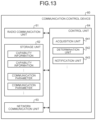
- FIG. 13 is a diagram illustrating a configuration example of a communication control device according to an embodiment of the present disclosure.
- FIG. 14 is a diagram illustrating an example of an interference model assumed in an embodiment of the present disclosure.
- FIG. 15 is a diagram illustrating another example of an interference model assumed in an embodiment of the present disclosure.
- FIG. 16 is a diagram illustrating an interference margin simultaneous allocation type primary system protection method.
- FIG. 17 is a diagram illustrating a state in which a residual interference margin occurs.
- FIG. 18 is a diagram illustrating an interference margin sequential allocation type primary system protection method.
- FIG. 19 is a sequence diagram illustrating a registration procedure.
- FIG. 20 is a sequence diagram illustrating an available spectrum query procedure.
- FIG. 21 is a sequence diagram illustrating a spectrum grant procedure.
- FIG. 23 is a sequence diagram illustrating a spectrum use notification/heartbeat procedure.
- FIG. 24 is a sequence diagram illustrating a management information exchange procedure.
- FIG. 25 is a sequence diagram illustrating an example of an operation related to a grant.
- FIG. 26 is a diagram illustrating specific processing contents of a periodic process.
- FIG. 27 is a diagram illustrating an example of a mutual interference group.
- FIG. 28 is a diagram illustrating another example of the mutual interference group.
- FIG. 29 is a diagram illustrating a configuration example of a synchronization frame.
- FIG. 30 is a diagram illustrating a configuration example of a CCA period.
- FIG. 31 is a diagram illustrating a specific calculation example of the number of medium reservation slots.
- FIG. 32 is a diagram illustrating a specific calculation example of the number of medium reservation slots.
- FIG. 33 is a diagram illustrating an example of an allocated slot in the examples of FIGS. 31 and 32 .
- FIG. 34 is a diagram illustrating a state in which a reserved slot is provided at the head of a slot allocated to an incumbent communication device.
- FIG. 35 is a diagram illustrating a configuration example of a synchronized medium reservation slot.
- FIG. 36 is a sequence diagram illustrating an operation related to medium reservation.
- FIG. 37 is a sequence diagram illustrating an operation related to medium reservation in a case where a medium reservation coordinator is present.
- a plurality of components having substantially the same functional configuration will be distinguished by attaching different numbers or alphabets after the same reference numerals.
- a plurality of configurations having substantially the same functional configuration is distinguished as necessary, such as communication control devices 60 1 and 60 2 .
- a plurality of configurations having substantially the same functional configuration is distinguished as necessary, such as communication systems 2 A and 2 B.
- only the same reference numeral is given.
- the communication control devices 60 1 and 60 2 they are simply referred to as a communication control device 60 .
- a communication system 2 when there is no need to distinguish between the communication systems 2 A and 2 B in particular, they are simply referred to as a communication system 2 .
- radio resources are worked out by utilizing temporally and spatially unused radio spectrum (white space) of the incumbent radio system (for example, by using dynamic spectrum sharing referred to as Dynamic Spectrum Access (DSA)).
- DSA Dynamic Spectrum Access
- CBRS citizens Broadband Radio Service
- the cognitive radio technology contributes not merely to dynamic spectrum sharing but also to improvement of spectrum use efficiency by a radio system.
- ETSI EN 303 387 and IEEE 802.19.1-2014 define a technology of inter-radio system coexistence technology using unused radio spectrum.
- NRA National Regulatory Authority
- a “system” represents a set of a plurality of components (devices, modules (components), and the like). At this time, it would not matter whether or not all the components are in the same housing.
- each of a plurality of devices housed in separate housings and connected via a network or the like, and one device in which a plurality of modules is housed in one housing is a “system” in each case. That is, a radio system such as a primary system and a secondary system may each be configured by a plurality of devices or may be configured by one device.
- a communication control device controls communication of the secondary system so as not to give fatal interference to the primary system.
- the communication control device is a device that manages communication and the like of the communication device.
- the communication control device is a system for managing radio resources (for example, spectrum), such as a geo-location database (GLDB) and a spectrum access system (SAS).
- the communication control device corresponds to the communication control device 60 described below.
- the communication control device 60 will be described in detail below.
- the primary system is, for example, a system (for example, incumbent systems) that preferentially uses a predetermined frequency band over other systems including the secondary system.
- the secondary system is, for example, a system that performs secondary use (for example, dynamic spectrum sharing) of a frequency band used by the primary system.
- Each of the primary system and the secondary system may include a plurality of communication devices or may include one communication device.
- the communication control device allocates an interference tolerance to one or a plurality of communication devices constituting the secondary system such that interference aggregation of the one or a plurality of communication devices toward the primary system would not exceed an interference tolerance (also referred to as an interference margin) of the primary system.
- the interference tolerance may be an interference amount preliminarily determined by an operator of the primary system, a public organization that manages radio waves, or the like.
- the interference margin refers to the interference tolerance.
- interference aggregation may be referred to as aggregated interfering power.
- FIG. 1 is a diagram illustrating an example of allocation of an interference margin to each of communication devices constituting a secondary system.
- a communication system 1 is the primary system, while a communication system 2 is the secondary system.
- the communication system 1 includes a radio wave utilization device 10 1 and the like.
- the communication system 2 includes base station devices 40 1 , 40 2 , 40 3 , and the like.
- the example of FIG. 1 is a case where the communication system 1 includes only one radio wave utilization device 10 , the communication system 1 may include a plurality of radio wave utilization devices 10 .
- FIG. 1 is a diagram illustrating an example of allocation of an interference margin to each of communication devices constituting a secondary system.
- a communication system 1 is the primary system
- a communication system 2 is the secondary system.
- the communication system 1 includes a radio wave utilization device 10 1 and the like.
- the communication system 2 includes base station devices 40 1 , 40 2 , 40 3 , and the like.
- the example of FIG. 1 is a case where
- the communication system 2 includes three base station devices 40 , the number of base station devices 40 included in the communication system 2 may be less than or more than three.
- the radio communication device included in the communication system 2 does not necessarily have to be a base station device.
- FIG. 1 illustrates only one primary system (the communication system 1 in the example of FIG. 1 ) and only one secondary system (the communication system 2 in the example of FIG. 1 ), the primary system and the secondary system may each be provided in plurality.
- Each of the radio wave utilization device 10 1 and the base station devices 40 1 , 40 2 , and 40 3 can transmit and receive radio waves.
- the interference amount acceptable by the radio wave utilization device 10 1 is I accept .
- interference amounts given to predetermined protection points of the communication system 1 (primary system) by the base station devices 40 1 , 40 2 , and 40 3 are interference amounts I 1 , I 2 , and I 3 , respectively.
- the protection point is a point of reference regarding interference calculation for protection of the communication system 1 .
- the communication control device allocates the interference margin I accept to the plurality of base station devices 40 such that interference aggregation to a predetermined protection point of the communication system 1 (receiving interference amount I 1 +I 2 +I 3 illustrated in FIG. 1 ) would not exceed the interference margin I accept .
- the communication control device allocates the interference margin I accept to each of the base station devices 40 such that the interference amounts I 1 , I 2 , and I 3 become I accept /3, individually.
- the communication control device allocates the interference margin I accept to each base station device 40 such that the interference amounts I 1 , I 2 , and I 3 become I accept /3 or less, individually. Note that the method of allocating the interference margin is not limited to this example.
- the communication control device calculates the maximum transmission power acceptable for each of the base station devices 40 (hereinafter, referred to as maximum allowable transmission power) based on the interference amount that is allocated (hereinafter, referred to as an allocated interference amount). For example, the communication control device calculates the maximum allowable transmission power of each of the base station devices 40 by calculating back from the allocated interference amount based on the propagation loss, the antenna gain, and the like. Subsequently, the communication control device notifies each of the base station devices 40 of information of the calculated maximum allowable transmission power.
- Non Patent Literature 14 the FCC has announced that the 5,925-7,125 MHz frequency band is to be newly opened for unlicensed use.
- CEPT SE 45 has been examining shared use in the frequency band of 5,925-6,425 MHz.
- an issue of coexistence with a wireless LAN (WLAN) operated in a 5 GHz band has been discussed at standardization of Licensed Assisted Access (LAA) using LTE in 3GPP.
- LAA Licensed Assisted Access
- NR-U NR unlicensed
- 5G NR 5G NR
- 6 GHz band that is expected to be newly opened in the future is a “greenfield”, leading to a possibility that various different radio systems are to be simultaneously started to operate at the opening of the 6 GHz band as an unlicensed band.
- LBT Listen Before Talk
- the FCC proposes introduction of a system referred to as automated frequency coordination (AFC) for the purpose of assisting secondary use of spectrum.
- AFC automated frequency coordination
- Non Patent Literatures 15 and 16 describe synchronization between heterogeneous radio systems.
- FIG. 2 is a diagram illustrating a synchronized medium reservation window. This makes it possible to set a periodic medium reservation period and reserve use of a medium by an access point or a client until the start of the next medium reservation period.
- an example of the medium is a frequency band.
- this can be achieved by controlling a receiver to transmit an active reception detection signal (also referred to as an active reception indication signal) detectable by a neighboring transmitter.
- an active slot (access slot) in the medium reservation window has flexibility such as random, deterministic, or partially random.
- Non Patent Literature 15 does not disclose these determination methods.
- a communication device such as an access point or a client terminal has no knowledge of information regarding a neighboring communication device. Therefore, it is difficult to improve the spectrum efficiency by applying the technology illustrated in FIG. 2 to the communication device. That is, in an environment in which heterogeneous radio systems coexist in an identical frequency band, all communication devices have to use the conventionally used Listen Before Talk (LBT), which could inevitably result in the shared use of the frequency band with low spectrum use efficiency.
- LBT Listen Before Talk
- the communication control device acquires information regarding a plurality of communication devices using a predetermined frequency band (for example, a predetermined unlicensed band). For example, the communication control device acquires information indicating whether the communication devices are capable of synchronization.
- a predetermined frequency band for example, a predetermined unlicensed band
- the communication control device determines a medium reservation scheme for the plurality of communication devices to share a predetermined frequency band. For example, in a case where there is a communication device that cannot be synchronized with another communication device among the plurality of communication devices, the asynchronous channel access scheme (for example, LBT) is determined as the medium reservation scheme.
- the synchronous channel access scheme for example, a medium reservation scheme using the above-described medium reservation window
- the medium reservation scheme for example, a medium reservation scheme using the above-described medium reservation window
- the communication control device notifies the communication device of the determined medium reservation scheme.
- the communication device uses a predetermined frequency band in the notified medium reservation scheme.
- the present embodiment assumes that the primary system (for example, the communication system 1 ) and the secondary system (for example, the communication system 2 ) are in a dynamic spectrum sharing environment.
- the primary system for example, the communication system 1
- the secondary system for example, the communication system 2
- CBRS citizens Broadband Radio Service
- FCC United States Federal Communications Commission
- the communication system 1 and the communication system 2 of the present embodiment are not limited to systems in the CBRS.
- FIG. 3 is a diagram illustrating a hierarchical structure in the CBRS.
- each of users in a frequency band is classified into one of three groups.
- This group is referred to as a “tier”.
- the three groups are defined as a hierarchical structure constituted with an Incumbent Tier, a Priority Access Tier, and a General Authorized Access Tier.
- the Priority Access Tier is located above the General Authorized Access Tier
- the Incumbent Tier is located above the Priority Access Tier.
- a system (incumbent system) located in the Incumbent Tier is a primary system
- systems located in the General Authorized Access Tier and the Priority Access Tier are secondary systems.
- the Incumbent Tier is a group of incumbent users of a shared frequency band.
- the incumbent users defined in the CBRS include: the Department of Defense (DOD), fixed satellite service operators, and Grandfathered Wireless Broadband Licensees (GWBL).
- the Incumbent Tier is not required to avoid or suppress interference to lower priority tiers, namely, the Priority Access Tier and the General Authorized Access Tier (GAA Tier).
- the Incumbent Tier is protected against the interference from the Priority Access Tier and the General Authorized Access Tier (GAA Tier). That is, the user of the “Incumbent Tier” can use the frequency band without considering the presence of other groups.
- the Priority Access Tier is a group of users having a license referred to as a Priority Access License (PAL).
- PAL Priority Access License
- the Priority Access Tier is required to avoid or suppress interference to a higher priority tier, namely, the Incumbent Tier, but is not required to avoid or suppress interference to the lower priority tier, namely, the General Authorized Access Tier (GAA Tier).
- GAA Tier General Authorized Access Tier
- the Priority Access Tier is not protected against the interference from the higher priority tier, namely, the Incumbent Tier, but is protected against the interference from the lower priority tier, namely, the General Authorized Access Tier (GAA Tier).
- the hierarchical structure is not limited to these definitions.
- the CBRS typically is supposed to have a three-tier structure, but may have a two-tier structure. Typical examples of this include two-tier structures such as Licensed Shared Access (LSA) and TV band White Space (TVWS).
- LSA has employed a structure equivalent to a combination of the Incumbent Tier and the Priority Access Tier.
- TVWS has employed a structure equivalent to a combination of the Incumbent Tier and the General Authorized Access Tier (GAA Tier).
- GAA Tier General Authorized Access Tier
- FIG. 4 is a diagram illustrating CBRS bands.
- the primary system is a military radar system, an incumbent radio system (referred to as a grandfathered wireless system), or a fixed satellite service (space-to-earth).
- the military radar system is typically an in-ship radar.
- the secondary system is a radio network system including base stations and terminals referred to as a Citizens Broadband Radio Service Device (CBSD) and an End User Device (EUD).
- CBSD Citizens Broadband Radio Service Device
- EUD End User Device
- the secondary system is further prioritized into levels, namely, as a Priority Access License (PAL) for which a shared band can be licensed and a General Authorized Access (GAA) equivalent to unlicensed access.
- PAL Priority Access License
- the Tier 1 illustrated in FIG. 4 corresponds to the Incumbent Tier illustrated in FIG. 3 .
- the Tier 2 illustrated in FIG. 4 corresponds to the Priority Access Tier illustrated in FIG. 3 .
- the Tier 3 illustrated in FIG. 4 corresponds to
- a radio system included in the Priority Access Tier may be regarded as a primary system
- a system included in a General Authorized Access Tier (GAA Tier) may be regarded as a secondary system.
- the primary system (communication system 1 ) of the present embodiment is not limited to the example illustrated in FIG. 4 .
- Other types of radio system may be used as the primary system (communication system 1 ).
- the primary system may be a television broadcasting system such as a Digital Video Broadcasting-Terrestrial (DVB-T) system.
- the primary system may be a radio system called a Fixed System (FS).
- FS Fixed System
- spectrum sharing in other frequency bands may be used. Typical examples of this include LSA and TV band white space (TVWS).
- the primary system may be a cellular communication system such as Long Term Evolution (LTE) or New Radio (NR).
- the primary system may also be an aeronautical radio system such as an Aeronautical Radio Navigation Service (ARNS). Note that the primary system is not limited to the above radio system, and may be other types of radio system.
- LTE Long Term Evolution
- NR New Radio
- the primary system may also be an aeronautical radio system such as an Aeronautical Radio Navigation Service (ARNS
- an unused radio spectrum (white space) used by the communication system 2 is not limited to the radio wave of the Federal use band (3.55-3.70 GHz).
- the communication system 2 may use a radio wave in a frequency band different from the Federal use band (3.55-3.70 GHz) as an unused radio spectrum.
- the primary system communication system 1
- the communication system 2 may be a system that uses a TV white space as an unused radio spectrum.
- the TV white space refers to a frequency band that is not currently used by the television broadcasting system among frequency channels allocated to the television broadcasting system (primary system). At this time, the TV white space may be a channel that is not currently used according to the area.
- the relationship between the communication system 1 and the communication system 2 is not limited to the spectrum sharing relationship in which the communication system 1 is a primary system and the communication system 2 is a secondary system.
- the relationship between the communication system 1 and the communication system 2 may be a network coexistence relationship between the same or different radio systems using the same spectrum.
- an incumbent system using a target band is referred to as a primary system
- a system of a secondary user is referred to as a secondary system.
- these systems may be replaced with a system with different terms.
- a macro cell in HetNet may be defined as a primary system
- a small cell or a relay station may be defined as a secondary system.
- the base station may be defined as a primary system
- a relay UE or a vehicle UE implementing D2D or V2X present in its coverage may be defined as a secondary system.
- the base station is not limited to a fixed type, and may be a portable/mobile type.
- the communication control device provided by the present invention may be included in a base station, a relay station, a relay UE, or the like.
- frequency may be replaced with other terms.
- frequency may be replaced with terms such as “resource”, “resource block”, “resource element”, “channel”, “component carrier”, “Bandwidth Part (BWP)”, “carrier”, “subcarrier”, and “beam”, or terms having similar meanings.
- the communication system 1000 includes a communication system 1 and a communication system 2 .
- the communication system 1 (first radio system) is a radio communication system that conducts radio communication using a predetermined frequency band (primary use).
- the communication system 2 (second radio system) is a radio communication system that conducts radio communication by performing secondary use of a frequency band used by the communication system 1 .
- the communication system 2 is a radio communication system that performs dynamic spectrum sharing of an unused radio spectrum of the communication system 1 .
- the communication system 2 provides a radio service to a user or a device owned by the user by utilizing a predetermined radio access technology.
- the communication systems 1 and 2 may be cellular communication systems such as wideband code division multiple access (W-CDMA), code division multiple access 2000 (cdma2000), LTE, NR, and the like.
- W-CDMA wideband code division multiple access
- cdma2000 code division multiple access 2000
- LTE Long Term Evolution
- NR Long Term Evolution
- LTE-A LTE-advanced pro
- EUTRA evolved universal terrestrial radio access
- NR shall include new radio access technology (NRAT) and further EUTRA (FEUTRA).
- the NR is a radio access technology (RAT) as next generation (fifth generation) following LTE.
- the NR is a radio access technology that can support various use cases including enhanced mobile broadband (eMBB), massive machine type communications (mMTC), and Ultra-Reliable and Low Latency Communications (URLLC).
- eMBB enhanced mobile broadband
- mMTC massive machine type communications
- URLLC Ultra-Reliable and Low Latency Communications
- the communication systems 1 and 2 are not limited to the cellular communication systems.
- the communication system 2 may be other radio communication systems such as a wireless local area network (wireless LAN) system, a television broadcasting system, an aeronautical radio system, or a space radio communication system.
- wireless LAN wireless local area network
- television broadcasting system an aeronautical radio system
- aeronautical radio system or a space radio communication system.
- the communication system 1 is a primary system, and the communication system 2 is a secondary system.
- the communication system 1 and the communication system 2 may each be provided in plurality.
- the example of FIG. 1 is a case where the communication system 1 includes one radio wave utilization device 10 (radio wave utilization device 10 1 illustrated in FIG. 1 ), the communication system 1 may include a plurality of radio wave utilization devices 10 as described above.
- the configuration of the radio wave utilization device 10 may be the same as or different from the configuration of a base station device 40 or a terminal device 30 described below.
- the communication system 1000 typically includes the following entities.
- the entities working as the communication devices are assumed to be the radio wave utilization device 10 , the base station device 40 , and an intermediate device 50 .
- the entities working as the communication devices are not limited to these devices, and may be other communication devices (for example, a management device 20 , the terminal device 30 , and the communication control device 60 ).
- an external device to be described below may be regarded as a part of the communication system 1000 .
- the external device need not be a part of the communication system 1000 .
- the terminal device 30 may be regarded as an external device.
- FIG. 5 is a diagram illustrating a configuration example of the communication system 1000 according to an embodiment of the present disclosure.
- the communication system 1000 includes the communication system 1 and the communication system 2 .
- the device in the figure can also be considered as a device in a logical sense. That is, parts of the device in the drawing may be partially actualized by a virtual machine (VM), a container, a docker, or the like, and they may be implemented on physically the same hardware.
- VM virtual machine
- the communication system 1 includes the radio wave utilization device 10 and the management device 20 .
- the communication system 1 includes the radio wave utilization devices 10 1 and 10 2 and the management device 20 that manages the radio wave utilization devices 10 1 and 10 2 .
- the communication system 1 does not necessarily have to include the management device 20 .
- the communication system 1 may include a plurality of radio wave utilization devices 10 or may include only one radio wave utilization device.
- each of the radio wave utilization devices 10 1 and 10 2 can be regarded as one communication system 1 .
- the communication system 2 includes the terminal device 30 , the base station device 40 , the intermediate device 50 , and the communication control device 60 .
- the communication system 2 is described as a communication system 2 A and a communication system 2 B.
- the communication system 2 A includes a communication system 2 a 1 , a communication system 2 a 2 , and a communication system 2 a 3 .
- the communication system 2 a 1 includes a terminal device 30 1 and a base station device 40 1 ; the communication system 2 a 2 includes a terminal device 30 2 , base station devices 40 2 to 40 3 , and an intermediate device 50 1 ; and the communication system 2 a 3 includes terminal devices 30 2 to 30 4 , base station devices 40 4 to 40 5 , and an intermediate device 50 2 .
- the communication system 2 B includes a terminal device 30 5 and a base station device 40 6 .
- the communication system 2 does not necessarily have to include the communication control device 60 .
- each of the communication system 2 a 2 and the communication system 2 a 3 having an external communication control device 60 may be regarded as one communication system 2 .
- the communication system 2 does not necessarily have to include the intermediate device 50 .
- the communication system 2 a 1 without the intermediate device 50 may be regarded as one communication system 2 .
- the communication systems 1 and 2 provide radio services to a user or a device possessed by the user.
- the radio communication device is a device having a function of radio communication.
- the radio communication device corresponds to the radio wave utilization device 10 , the base station device 40 , and the terminal device 30 .
- the intermediate device 50 and the communication control device 60 may have a wireless communication function.
- the intermediate device 50 and the communication control device 60 can also be regarded as radio communication devices.
- a radio communication device may be simply referred to as a communication device.
- the communication device is not limited to a radio communication device, and for example, a device capable of wired communication alone and not equipped with a wireless communication function can also be regarded as a communication device.
- the concept of the “communication device” includes not only a portable mobile device (for example, a terminal device) such as a mobile terminal but also a device installed in a structure or a mobile body.
- the structure or a mobile body itself may be regarded as a communication device.
- the concept of the communication device includes not only a terminal device but also a base station device and a relay device.
- the communication device is a type of processing device and information processing device.
- the description of the “communication device” in the following description can be appropriately rephrased as a “transmission device” or a “reception device”.
- the concept of “communication” shall include “broadcasting”.
- the description of the “communication device” can be appropriately rephrased as a “broadcasting device”.
- the description of the “communication device” may be appropriately rephrased as a “transmission device” or a “reception device”.
- the communication system 2 may include a plurality of the terminal devices 30 , a plurality of the base station devices 40 , a plurality of the communication control devices 60 , and a plurality of the intermediate devices 50 .
- the communication system 2 includes terminal devices 30 1 , 30 2 , 30 3 , 30 4 , 30 5 , and the like, as the terminal device 30 .
- the communication system 2 includes base station devices 40 1 , 40 2 , 40 3 , 40 4 , 40 5 , 40 6 , and the like, as the base station device 40 .
- the communication system 2 includes communication control devices 60 1 , 60 2 , and the like, as the communication control device 60 .
- a radio communication device may be referred to as a radio system.
- each of the terminal devices 30 1 to 30 5 is one radio system.
- each of the radio wave utilization device 10 and the base station devices 40 1 to 40 6 is one radio system.
- the communication system 1 is referred to as a first radio system.
- each of one or a plurality of radio wave utilization devices 10 included in the communication system 1 may be regarded as the first radio system.
- each of one or a plurality of base station devices 40 included in the communication system 2 is referred to as a second radio system.
- the communication system 2 itself may be regarded as a second radio system, or each of one or the plurality of terminal devices 30 included in the communication system 2 may be regarded as a second radio system.
- each of the intermediate devices 50 or each of the communication control devices 60 may be regarded as the second radio system.
- the radio system may be one system including a plurality of communication devices including at least one radio communication device.
- a system including one or a plurality of base station devices 40 and one or a plurality of terminal devices 30 under the base station devices 40 may be regarded as one radio system.
- the communication system 1 and the communication system 2 can each be regarded as one radio system.
- a communication system including a plurality of communication devices including at least one radio communication device may be referred to as a radio communication system or simply as a communication system.
- one system including a plurality of communication devices including one radio communication device may be regarded as the first radio system or the second radio system.
- a system represents a set of a plurality of components (devices, modules (components), or the like). At this time, all the components constituting the system may be or need not be in the same housing.
- a plurality of devices housed in separate housings and connected by wired and/or wireless connection is defined as one system.
- one device having a plurality of modules housed in one housing is also one system.
- the radio wave utilization device 10 is a radio communication device constituting the communication system 1 (primary system).
- the radio wave utilization device 10 may be a radio wave emission device such as a radar or a reflected wave reception device.
- the primary system is, for example, a military radar system, an incumbent system (for example, a television broadcasting system or an incumbent cellular communication system), or a fixed satellite service system.
- the radio wave utilization device 10 is an in-ship radar, for example.
- the radio wave utilization device 10 is a broadcasting station (broadcasting station as a facility) such as a broadcasting relay station, for example.
- the radio wave utilization device 10 is a parabolic antenna that receives radio waves from an artificial satellite, for example. Note that the radio wave utilization device 10 is not limited to these devices.
- the radio wave utilization device 10 may be a base station device.
- the radio wave utilization device 10 may be capable of communicating with other communication devices using a radio access technology.
- the radio access technology used by the radio wave utilization device 10 may be a cellular communication technology or a wireless LAN technology.
- the radio access technology used by the base station device 40 is not limited thereto, and may be other radio access technologies.
- the radio access technology used by the radio wave utilization device 10 may be a low power wide area (LPWA) communication technology.
- the LPWA communication is communication conforming to the LPWA standard. Examples of the LPWA standard include ELTRES, ZETA, SIGFOX, LoRaWAN, and NB-IoT.
- the LPWA standard is not to be limited thereto, and may be other LPWA standards.
- the radio communication used by the radio wave utilization device 10 may be radio communication using millimeter waves.
- the radio communication used by the radio wave utilization device 10 may be radio communication using radio waves or wireless communication (optical wireless communication) using infrared rays or visible light.
- the configuration of the radio wave utilization device 10 may be similar to the configuration of the terminal device 30 or the base station device 40 described below.
- the management device 20 is a device that manages the radio wave utilization device 10 .
- the management device 20 is a server or a database owned by an operator or an administrator of the communication system 1 .
- the management device 20 may be a server or a database owned by a public organization.
- the management device 20 may be a database (for example, a regulatory database) managed and operated by a national or regional radio administration agency.
- the regulatory database include Universal Licensing System (ULS) operated by Federal Communications Commissions (FCC).
- the management device 20 may be a device that manages a radio network.
- the management device 20 may be a device that functions as a Mobility Management Entity (MME), an Access and Mobility Management Function (AMF), or Session Management Function (SMF).
- MME Mobility Management Entity
- AMF Access and Mobility Management Function
- SMF Session Management Function
- the management device 20 may be a network manager that integrally controls the radio wave utilization device 10 in the network, for example.
- the radio wave utilization device 10 may have the function of the management device 20 .
- the radio wave utilization device 10 can be regarded as the management device 20 .
- the management device 20 may have a function of a communication control device.
- the management device 20 can be regarded as the communication control device 60 .
- the terminal device 30 is a communication device having a communication function.
- the terminal device 30 is typically a communication device such as a smartphone.
- the terminal device 30 may be a user terminal such as a mobile phone, a smart device (smartphone or tablet), a wearable terminal, an Internet of Things (IoT) device, a personal digital assistant (PDA), or a personal computer.
- the terminal device 30 may be a business camera equipped with a communication function, or may be a motorcycle, a moving relay vehicle, or the like on which a communication device such as a field pickup unit (FPU) is mounted.
- the terminal device 30 may be a machine to machine (M2M) device or an internet of things (IoT) device.
- M2M machine to machine
- IoT internet of things
- the terminal device may also be referred to as User Equipment, User Terminal, User Station, Mobile Terminal, Mobile Station, or the like.
- the terminal device 30 may also be referred to as terms such as MTC UE, NB-IoT UE, or Cat.M UE, for example.
- the terminal device 30 may be capable of sidelink communication with another terminal device 30 .
- the terminal device 30 may be able to use an automatic retransmission technology such as hybrid automatic repeat request (Hybrid ARQ (HARQ)).
- the radio communication (including sidelink communication) used by the terminal device 30 may be radio communication using radio waves or wireless communication (optical wireless communication) using infrared rays or visible light.
- the terminal device 30 may be a mobile device.
- the mobile device is a movable radio communication device.
- the terminal device 30 may be a radio communication device installed on a mobile body, or may be the mobile body itself.
- the terminal device 30 may be a vehicle that moves on a road, such as an automobile, a bus, a truck, or a motorbike, or may be a radio communication device mounted on the vehicle.
- the mobile body may be a mobile terminal, or may be a mobile body that moves on land (on the ground in a narrow sense), in the ground, on water, or under water.
- the mobile body may be a mobile body that moves inside the atmosphere, such as a drone or a helicopter, or may be a mobile body that moves outside the atmosphere, such as an artificial satellite.
- the terminal device 30 may perform communication while being simultaneously connected to a plurality of base station devices or a plurality of cells. For example, when one base station device supports a communication area via a plurality of cells (for example, pCell and sCell), it is possible to bundle the plurality of cells and communicate between the base station device 40 and the terminal device 30 by using a carrier aggregation (CA) technology, a dual connectivity (DC) technology, or a multi-connectivity (MC) technology. Alternatively, the terminal device 30 and the plurality of base station devices 40 can communicate with each other by a Coordinated Multi-Point Transmission and Reception (CoMP) technology via cells of different base station devices 40 .
- CA carrier aggregation
- DC dual connectivity
- MC multi-connectivity
- CoMP Coordinated Multi-Point Transmission and Reception
- the terminal device 30 does not need to be used by a person.
- the terminal device 30 may be a sensor installed in a machine or a building of a factory, such as a sensor used for communication referred to as machine type communication (MTC).
- MTC machine type communication
- the terminal device 30 may be a machine to machine (M2M) device or an internet of things (IoT) device.
- the terminal device 30 may be a device having a relay communication function as represented by Device-to-Device (D2D) and Vehicle-to-everything (V2X).
- the terminal device 30 may be a device referred to as Customer Premises Equipment (CPE) used in a radio backhaul or the like.
- CPE Customer Premises Equipment
- the terminal device 30 may be a radio communication device installed on a mobile body, or may be the mobile body itself.
- the base station device 40 (second radio system) is a radio communication device that performs radio communication with the terminal device 30 or other communication devices (other base station devices 40 or other intermediate devices 50 ).
- the base station device 40 is a type of communication device.
- the base station device 40 is, for example, a device corresponding to a radio base station (also referred to as Base Station, Node B, eNB, gNB, etc.) or a radio access point. When the base station device 40 is a radio access point, the base station device 40 may be referred to as non-3GPP access.
- the base station device 40 may be a radio relay station (also referred to as a Relay Node).
- the base station device 40 may be an on-road base station device such as a Road Side Unit (RSU).
- RSU Road Side Unit
- the base station device 40 may be an optical link device referred to as a Remote Radio Head (RRH). Furthermore, the base station device 40 may be a receiving station device such as a field pickup unit (FPU). In addition, the base station device 40 may be an Integrated Access and Backhaul (IAB) donor node or an IAB relay node that provides a radio access channel and a radio backhaul channel by using time division multiplexing, frequency division multiplexing, or space division multiplexing.
- IAB Integrated Access and Backhaul
- the radio access technology used by the base station device 40 may be a cellular communication technology or a wireless LAN technology.
- the radio access technology used by the base station device 40 is not limited thereto, and may be other radio access technologies.
- the radio access technology used by the base station device 40 may be a low power wide area (LPWA) communication technology.
- the LPWA communication is communication conforming to the LPWA standard. Examples of the LPWA standard include ELTRES, ZETA, SIGFOX, LoRaWAN, and NB-IoT.
- the LPWA standard is not to be limited thereto, and may be other LPWA standards.
- the radio communication used by the base station device 40 may be radio communication using millimeter waves.
- the radio communication used by the base station device 40 may be radio communication using radio waves or wireless communication (optical wireless communication) using infrared rays or visible light.
- a base station of a radio communication system may be referred to as a base station device.
- the radio access technology used by the base station device 40 may be a cellular communication technology or a wireless LAN technology.
- the radio access technology used by the base station device 40 is not limited thereto, and may be other radio access technologies.
- the radio communication used by the base station device 40 may be radio communication using radio waves or wireless communication (optical wireless communication) using infrared rays or visible light.
- the base station device 40 is not necessarily to be fixed, and may be installed in a moving object such as an automobile. Furthermore, the base station device 40 does not necessarily need to exist on the ground.
- the communication device function may be provided on an object existing in the air or space, such as an aircraft, a drone, a helicopter, or a satellite, or on an object existing on the sea or under the sea, such as a ship or a submarine. In such a case, the base station device 40 can perform radio communication with another fixedly installed communication device.
- the concept of the base station device includes not only a donor base station but also a relay base station (also referred to as a relay station or a relay station device).
- the concept of a base station also includes an access point.
- a base station conceptually includes not only a structure having a function of a base station but also a device installed in the structure.
- Examples of the structure include a building such as an office building, a house, a steel tower, a station facility, an airport facility, a port facility, or a stadium.
- a structure conceptually includes not only buildings but also non-building structures such as tunnels, bridges, dams, fences, and steel columns, as well as facilities such as cranes, gates, and windmills.
- a structure conceptually includes not only land-based (ground-based, in a narrow sense) structures or underground structures but also structures on the water, such as a jetty and a mega-float, and underwater structures such as an ocean observation facility.
- the base station device 40 may be a donor station or a relay station.
- the base station device 40 is a relay station
- the device on which the base station device 40 is mounted there is no limitation regarding the device on which the base station device 40 is mounted as long as the function of relay is satisfied.
- the base station device 40 may be mounted on a terminal device such as a smartphone, may be mounted on an automobile or a human-powered vehicle, may be mounted on a balloon, an airplane, or a drone, or on a home appliance such as a television, a game machine, an air conditioner, a refrigerator, or a lighting fixture.
- these devices themselves may be regarded as the base station device 40 .
- the base station device 40 may be a fixed station or a mobile station.
- the mobile station is a radio communication device (for example, a base station device) configured to be movable.
- the base station device 40 may be a device installed on a mobile body, or may be the mobile body itself.
- a relay station device having mobility can be regarded as the base station device 40 as a mobile station.
- a device designed to have mobility such as a vehicle, a drone, or a smartphone, and having a function of a base station device (at least a part of the function of a base station device) also corresponds to the base station device 40 as a mobile station.
- the mobile body may be a mobile terminal such as a smartphone or a mobile phone.
- the mobile body may be a mobile body that moves on the land (ground in a narrow sense) (for example, a vehicle such as an automobile, a bicycle, a bus, a truck, a motorbike, a train, or a linear motor car), or a mobile body (for example, subway) that moves under the ground (for example, through a tunnel).
- a vehicle such as an automobile, a bicycle, a bus, a truck, a motorbike, a train, or a linear motor car
- a mobile body for example, subway
- the mobile body may be a mobile body that moves on the water (for example, a ship such as a passenger ship, a cargo ship, and a hovercraft), or a mobile body that moves underwater (for example, a submersible ship such as a submersible boat, a submarine, or an unmanned submarine).
- a ship such as a passenger ship, a cargo ship, and a hovercraft
- a mobile body that moves underwater for example, a submersible ship such as a submersible boat, a submarine, or an unmanned submarine.
- the mobile body may be a mobile body that moves in the atmosphere (for example, an aircraft (also referred to as an aerial vehicle) such as an airplane, an airship, or a drone), or may be a mobile body that moves outside the atmosphere (for example, an artificial astronomical object such as an artificial satellite, a spaceship, a space station, or a spacecraft).
- an aircraft also referred to as an aerial vehicle
- an artificial astronomical object such as an artificial satellite, a spaceship, a space station, or a spacecraft.
- a mobile body moving outside the atmosphere can be rephrased as a space mobile body.
- the base station device 40 may be a terrestrial base station device (ground station device) installed on the ground.
- the base station device 40 may be a base station device arranged in a structure on the ground, or may be a base station device installed in a mobile body moving on the ground.
- the base station device 40 may be an antenna installed in a structure such as a building and a signal processing device connected to the antenna.
- the base station device 40 may be a structure or a mobile body itself.
- the “ground” represents not only a land (ground in a narrow sense) but also a ground or terrestrial in a broad sense including underground, above-water, and underwater.
- the base station device 40 is not limited to the terrestrial base station device.
- the base station device 40 may be a non-terrestrial base station device (non-terrestrial station device) capable of floating in the air or space.
- the base station device 40 may be an aircraft station device or a satellite station device.
- unmanned aerial vehicle also includes an unmanned aircraft system (UAS) and a tethered UAS.
- UAS unmanned aircraft system
- the concept of unmanned aerial vehicles also includes a Lighter-than-Air (LTA) unmanned aircraft system (UAS) and a Heavier-than-Air (HTA) unmanned aircraft system (UAS).
- LTA Lighter-than-Air
- HTA Heavier-than-Air
- Other concepts of unmanned aerial vehicles also include High Altitude Platforms (HAPs) unmanned aircraft system (UAS).
- HAPs High Altitude Platforms
- the satellite station device is a radio communication device capable of floating outside the atmosphere.
- the satellite station device may be a device mounted on a space mobile body such as an artificial satellite, or may be a space mobile body itself.
- the satellite serving as the satellite station device may be any of a low earth orbiting (LEO) satellite, a medium earth orbiting (MEO) satellite, a geostationary earth orbiting (GEO) satellite, or a highly elliptical orbiting (HEO) satellite.
- the satellite station device may be a device mounted on a low earth orbiting satellite, a medium earth orbiting satellite, a geostationary earth orbiting satellite, or a highly elliptical orbiting satellite.
- the base station device 40 may be a relay station device.
- the relay station device is an aeronautical station or an earth station, for example.
- the relay station device can be regarded as a type of the above-described relay device.
- the aeronautical station is a radio station installed on the ground or a mobile body moving on the ground in order to communicate with an aircraft station device.
- the earth station is a radio station located on the earth (including air) in order to communicate with the satellite station device.
- the earth station may be a large earth station or a small earth station such as a very small aperture terminal (VSAT).
- VSAT very small aperture terminal
- the earth station may be a VSAT control earth station (also referred to as a master station or a HUB station) or may be a VSAT earth station (also referred to as a slave station).
- the earth station may be a radio station installed in a mobile body moving on the ground. Examples of an earth station mounted on a ship include Earth Stations on board Vessels (ESV).
- the earth station may include an aircraft earth station that is installed in an aircraft (including a helicopter) and that communicates with a satellite station.
- the earth station may include an aeronautical earth station that is installed on a mobile body moving on the ground and that communicates with the aircraft earth station via a satellite station.
- the relay station device may be a mobile radio station that communicates with a satellite station or an aircraft station.
- the coverage of the base station device 40 may be large such as a macro cell or small such as a pico cell. Needless to say, the coverage of the base station device 40 may be extremely small such as a femto cell. Furthermore, the base station device 40 may have a beamforming capability. In this case, the base station device 40 may form a cell or a service area for each beam.
- the base station device 40 can be utilized, operated, and/or managed by various entities. Assumable examples of the base station device 40 include: a mobile network operator (MNO), a mobile virtual network operator (MVNO), a mobile virtual network enabler (MVNE), a neutral host network (NHN) operator, an enterprise, an educational institution (incorporated educational institutions, boards of education of local governments, and the like), a real estate (building, apartment, etc.) administrator, or an individual. Note that the subject of use, operation, and/or management of the base station device 40 is not limited thereto.
- MNO mobile network operator
- MVNO mobile virtual network operator
- MVNE mobile virtual network enabler
- NHS neutral host network
- the base station device 40 may be installed and/or operated by one business operator, or may be installed and/or operated by one individual. Note that the installation/operation subject of the base station device 40 is not limited thereto.
- the base station device 40 may be installed and operated by a plurality of business operators or a plurality of individuals in cooperation.
- the base station device 40 may be a shared facility used by a plurality of business operators or a plurality of individuals. In this case, installation and/or operation of the facility may be performed by a third party different from the user.
- the base station device 40 operated by business operators is typically connected to the Internet via a core network. Furthermore, operation management and maintenance of the base station device 40 is performed by a function referred to as Operation, Administration & Maintenance (OA & M).
- the communication system 2 can include a network manager that integrally controls the base station device 40 in the network, for example.
- the serving cell may include a Primary Secondary Cell or Primary SCG Cell (PSCell). That is, in a case where dual connectivity is provided to the UE, the PSCell and the sCell(s) provided by a secondary node (SN) are referred to as Secondary Cell Group (SCG).
- PSCell Primary Secondary Cell or Primary SCG Cell
- SCG Secondary Cell Group
- One downlink component carrier and one uplink component carrier may be associated with one cell.
- the system bandwidth corresponding to one cell may be divided into a plurality of bandwidth parts (BWPs).
- BWPs bandwidth parts
- one or a plurality of BWPs may be configured for the UE, and one BWP may be used for the UE as an active BWP.
- radio resources for example, a frequency band, a numerology (subcarrier spacing), and a slot format (slot configuration)
- one base station device 40 may provide a plurality of cells.
- the intermediate device 50 is a device that communicates with the communication control device 60 substituting (representing) one or a plurality of communication devices (for example, the base station device 40 ).
- the intermediate device 50 is a proxy device (proxy system).
- the intermediate device 50 is also a type of communication device.
- the intermediate device 50 may be a domain proxy (DP) defined in Non Patent Literature 2 and the like.
- the DP refers to an entity that communicates with a communication control device such as SAS instead of each of a plurality of CBSDs, or an entity that communicates with a communication control device such as SAS instead of a network including a plurality of CBSDs.
- the intermediate device 50 is not limited to the DP defined in Non Patent Literature 2 as long as it has a function of communicating with the communication control device 60 substituting (representing) one or a plurality of communication devices.
- a network manager that integrally controls the base station device 40 in the network may be regarded as the intermediate device 50 .
- the proxy system may include one device or a plurality of devices.
- Communication between the intermediate device 50 and the base station device 40 may be wired communication or wireless communication.
- the communication between the intermediate device 50 and the communication control device 60 may be wired communication or wireless communication.
- the communication device substituted (or represented) by the intermediate device 50 is not limited to the base station device 40 , and may be the terminal device 30 , for example.
- one or a plurality of communication devices (for example, one or a plurality of base station devices 40 ) substituted (or represented) by the intermediate device 50 will sometimes be referred to as subordinate communication devices (for example, the subordinate base station device 40 ).
- the communication control device 60 is a device that manages the base station device 40 .
- the communication control device 60 is a device that controls radio communication of the base station device 40 .
- the communication control device 60 is a device that determines communication parameters (also referred to as operational parameters) to be used by the base station device 40 and gives permission or an instruction to the base station device 40 .
- the communication control device 60 may be a network manager that integrally controls radio devices within the network.
- the communication control device 60 may be a control device such as a Spectrum Manager/Coexistence Manager that performs radio wave interference control between radio devices.
- a registered location secure server (RLSS) defined in IEEE 802.11-2016 can also work as the communication control device 60 .
- a database database server, device, and system
- GLDB geo-location database
- SAS spectrum access system
- the communication control device 60 may be a device constituting a core network.
- the core network CN is, for example, an evolved packet core (EPC) or a 5G core network (5GC).
- EPC evolved packet core
- 5GC 5G core network
- the communication control device 60 may be a device having a function as a mobility management entity (MME), for example.
- MME mobility management entity
- the communication control device 60 may be a device having a function as an access and mobility management function (AMF) or a session management function (SMF), for example.
- AMF access and mobility management function
- SMF session management function
- the communication control device 60 does not necessarily have to be a device constituting a core network.
- the communication control device 60 may be a device having a function as a radio network controller (RNC).
- RNC radio network controller
- the communication control device 60 may have a function of a gateway.
- the communication control device 60 may be a device having a function as a serving gateway (S-GW) or a packet data network gateway (P-GW).
- S-GW serving gateway
- P-GW packet data network gateway
- the communication control device 60 may be a device having a function as a user plane function (UPF).
- the communication control device 60 may be an SMF, a PCF, a UDM, or the like.
- the core network CN may include an SMF, a PCF, a UDM, and the like.
- the communication control device 60 does not necessarily have to be a device constituting the core network.
- the core network is a core network of Wideband Code Division Multiple Access (W-CDMA) or Code Division Multiple Access 2000 (cdma2000).
- the communication control device 60 may be a device that functions as a radio network controller (RNC).
- RNC radio network controller
- the communication control device 60 may be connected to each of the plurality of base station devices 40 .
- an N2 reference point exists between the AMF and the NG-RAN, and the AMF and the NG-RAN are logically connected to each other via an NG interface.
- the communication control device 60 manages communication of the base station device 40 .
- the communication control device 60 may manage the location of the terminal device 30 for each terminal device 30 in units of areas (for example, tracking areas or RAN notification areas) including a plurality of cells.
- the communication control device 60 may grasp and manage, for each terminal device 30 , which base station device 40 (or which cell) the terminal device is connected to, in which base station device 40 (or which cell) the terminal device 30 exists in the communication area, and the like.
- the communication control device 60 has the base station device 40 as a control target, but the communication control device 60 may also control the terminal device 30 under the base station device 40 . Furthermore, the communication control device 60 may control a plurality of secondary systems. In this case, the communication system 2 can be regarded as a system including the plurality of secondary systems.
- FIG. 6 is a diagram illustrating a model in which the communication control devices 60 are arranged in a distributed manner.
- the plurality of communication control devices 60 exchanges information of their managed base station devices 40 with each other, and performs allocation of necessary spectrum and calculation of interference control.
- the communication control devices 60 may be master-slave devices.
- FIG. 7 is a diagram illustrating a model (referred to as a master-slave model) in which one communication control device centrally controls a plurality of communication control devices.
- the communication control device 606 is a master communication control device, while the communication control devices 606 and 607 are slave communication control devices.
- the master communication control device can integrally control the plurality of slave communication control devices to collectively make a decision.
- the master communication control device can also perform delegation, discarding, and the like of the decision-making authority to each of the slave communication control devices for the purpose of load balancing and the like.
- the communication control device 60 can also acquire necessary information from entities other than the base station device 40 , the terminal device 30 , and the intermediate device 50 for achieving its functions.
- the communication control device 60 can acquire information necessary for protection, such as location information of the primary system, from a database (regulatory database) managed and operated by a national or regional radio administration agency, for example.
- a database responsible for managing the regulatory database
- ULS Universal Licensing System
- Other examples of information necessary for protection can include information such as Out-of-Band Emission (OOBE) limit, Adjacent Channel Leakage Ratio (ACLR), Adjacent Channel Selectivity, fading margin, and/or protection ratio (PR), for example.
- OOBE Out-of-Band Emission
- ACLR Adjacent Channel Leakage Ratio
- PR protection ratio
- the communication control device 60 acquires radio wave sensing information from a radio wave sensing system installed and operated for the purpose of radio wave detection in the primary system.
- the communication control device 60 can acquire radio wave detection information of the primary system from a radio wave sensing system such as an Environmental Sensing Capability (ESC) in CBRS of the United States.
- ESC Environmental Sensing Capability
- the communication control device 60 may acquire radio wave detection information of the primary system from the communication device or the terminal.
- FIG. 8 is a diagram illustrating a configuration example of the radio wave utilization device 10 according to an embodiment of the present disclosure.
- the radio wave utilization device 10 performs primary use of a predetermined frequency band.
- the radio wave utilization device 10 is a communication device (radio system) that performs radio communication with other radio communication device(s).
- the radio wave utilization device 10 can be regarded as a type of communication device.
- the radio wave utilization device 10 may be a radio wave emission device or a reflected wave reception device.
- the radio wave utilization device 10 is a type of information processing device.
- the radio wave utilization device 10 includes a processing unit 11 , a storage unit 12 , and a control unit 13 . Note that the configuration illustrated in FIG. 8 is a functional configuration, and the hardware configuration may be different from this. Furthermore, the functions of the radio wave utilization device 10 may be implemented in a distributed manner in a plurality of physically separated configurations.
- the processing unit 11 is a processing unit for utilizing a radio wave in a predetermined frequency band.
- the processing unit 11 is a signal processing unit that performs various processes for outputting and receiving a radio wave in a predetermined frequency band.
- the radio wave utilization device 10 works as a radio communication device
- the processing unit 11 may be a radio communication interface that performs radio communication with other communication device(s).
- the other communication devices include not only communication devices that perform cellular communication and the like but also transmission devices that transmit broadcast waves, such as television broadcasting, and reception devices that receive broadcast waves.
- the storage unit 12 is a data readable/writable storage device such as dynamic random access memory (DRAM), static random access memory (SRAM), a flash drive, or a hard disk.
- DRAM dynamic random access memory
- SRAM static random access memory
- flash drive or a hard disk.
- the storage unit 12 functions as a storage means in the radio wave utilization device 10 .
- the control unit 13 is a controller that controls individual components of the radio wave utilization device 10 .
- the control unit 13 is actualized by a processor such as a central processing unit (CPU) or a micro processing unit (MPU), for example.
- the control unit 13 is actualized by execution of various programs stored in the storage device inside the radio wave utilization device 10 by the processor using random access memory (RAM) or the like as a work area.
- the control unit 13 may be actualized by an integrated circuit such as an application specific integrated circuit (ASIC) or a field programmable gate array (FPGA).
- ASIC application specific integrated circuit
- FPGA field programmable gate array
- the CPU, MPU, ASIC, and FPGA can all be regarded as controllers.
- the radio wave utilization device 10 may have a function as the management device 20 .
- the control unit 13 may have individual functional blocks included in the control unit of the management device 20 .
- FIG. 9 is a diagram illustrating a configuration example of the management device 20 according to an embodiment of the present disclosure.
- the management device 20 is a device that manages the radio wave utilization device 10 .
- the management device 20 may be a device that manages radio wave output of the radio wave utilization device 10 , or may be a device that manages information such as an installation mode and a management subject of the radio wave utilization device 10 .
- the management device 20 is a type of information processing device.
- the management device 20 includes a communication unit 21 , a storage unit 22 , and a control unit 23 . Note that the configuration illustrated in FIG. 8 is a functional configuration, and the hardware configuration may be different from this. Furthermore, the functions of the management device 20 may be implemented in a distributed manner in a plurality of physically separated configurations.
- the communication unit 21 is a communication interface for communicating with other devices.
- the communication unit 21 may be a network interface or a device connection interface.
- the communication unit 21 may be a local area network (LAN) interface such as a network interface card (NIC), or may be a universal serial bus (USB) interface including a USB host controller, a USB port, and the like.
- LAN local area network
- NIC network interface card
- USB universal serial bus
- the communication unit 21 may be a wired interface or a wireless interface.
- the communication unit 21 functions as a communication means of the management device 20 .
- the communication unit 21 communicates with the radio wave utilization device 10 under the control of the control unit 23 .
- the storage unit 22 is a data readable/writable storage device such as DRAM, SRAM, a flash drive, and a hard disk.
- the storage unit 22 functions as a storage means in the management device 20 .
- the storage unit 22 stores the first identifier and the like. The first identifier will be described below.
- the control unit 23 is a controller that controls individual parts of the management device 20 .
- the control unit 23 is actualized by a processor such as a CPU or an MPU, for example.
- the control unit 23 is actualized by the processor executing various programs stored in the storage device inside the management device 20 using RAM or the like as a work area.
- the control unit 23 may be actualized by an integrated circuit such as an ASIC or an FPGA.
- the CPU, MPU, ASIC, and FPGA can all be regarded as controllers.
- FIG. 10 is a diagram illustrating a configuration example of the terminal device 30 according to an embodiment of the present disclosure.
- the terminal device 30 is a communication device (radio system) that performs radio communication with the base station device 40 and/or the communication control device 60 .
- the terminal device 30 is a type of information processing device.
- the terminal device 30 includes a radio communication unit 31 , a storage unit 32 , an input/output unit 33 , and a control unit 34 .
- a radio communication unit 31 receives radio signals from a radio station.
- a storage unit 32 stores data and data.
- an input/output unit 33 receives data from the terminal device 30 .
- a control unit 34 controls the terminal device 30 .
- the configuration illustrated in FIG. 10 is a functional configuration, and the hardware configuration may be different from this.
- the functions of the terminal device 30 may be implemented in a distributed manner in a plurality of physically separated configurations.
- the radio communication unit 31 includes a reception processing unit 311 , a transmission processing unit 312 , and an antenna 313 .
- the radio communication unit 31 may include a plurality of the reception processing units 311 , a plurality of the transmission processing units 312 , and a plurality of the antennas 313 .
- individual portions of the radio communication unit 31 can be configured separately for each of the radio access methods.
- the reception processing unit 311 and the transmission processing unit 312 may be individually configured depending on LTE and NR.
- the configurations of the reception processing unit 311 and the transmission processing unit 312 are similar to those of a reception processing unit 411 and a transmission processing unit 412 of the base station device 40 .
- the storage unit 32 is a data readable/writable storage device such as DRAM, SRAM, a flash drive, and a hard disk.
- the storage unit 32 functions as a storage means in the terminal device 30 .
- the control unit 34 is a controller that controls individual parts of the terminal device 30 .
- the control unit 34 is actualized by a processor such as a CPU or an MPU, for example.
- the control unit 34 is actualized by a processor executing various programs stored in a storage device inside the terminal device 30 using RAM or the like as a work area.
- the control unit 34 may be actualized by an integrated circuit such as an ASIC or an FPGA.
- the CPU, MPU, ASIC, and FPGA can all be regarded as controllers.
- the control unit 34 may include individual functional blocks included in the control unit of the base station device 40 .
- the control unit 34 includes an acquisition unit 341 and a reservation unit 342 .
- Individual blocks (the acquisition unit 341 to the reservation unit 342 ) constituting the control unit 34 are functional blocks individually indicating functions of the control unit 34 .
- These functional blocks may be software blocks or hardware blocks.
- each of the functional blocks described above may be one software module actualized by software (including a microprogram) or one circuit block on a semiconductor chip (die). Needless to say, each of the functional blocks may be formed as one processor or one integrated circuit.
- the functional block may be configured by using any method. Note that the control unit 34 may be configured in a functional unit different from the above-described functional block.
- FIG. 11 is a diagram illustrating a configuration example of the base station device 40 according to an embodiment of the present disclosure.
- the base station device 40 is a communication device (radio system) that performs radio communication with the terminal device 30 under the control of the communication control device 60 .
- the base station device 40 is a type of information processing device.
- the base station device 40 includes a radio communication unit 41 , a storage unit 42 , a network communication unit 43 , and a control unit 44 .
- a radio communication unit 41 receives radio signals from the base station device 40 and a wireless local area network.
- a storage unit 42 stores data and data.
- a network communication unit 43 receives data from the base station device 40 and a wireless local area network.
- a control unit 44 controls the base station device 40 .
- FIG. 11 is a functional configuration, and the hardware configuration may be different from this.
- the functions of the base station device 40 may be implemented in a distributed manner in a plurality of physically separated devices.
- the radio communication unit 41 is a radio communication interface that performs radio communication with other communication devices (for example, the terminal device 30 , the communication control device 60 , the intermediate device 50 , and another base station device 40 ).
- the radio communication unit 41 operates under the control of the control unit 44 .
- the radio communication unit 41 may support a plurality of radio access methods.
- the radio communication unit 41 may support both NR and LTE.
- the radio communication unit 41 may support other cellular communication methods such as W-CDMA and cdma2000.
- the radio communication unit 41 may support the wireless LAN communication method in addition to the cellular communication method. Needless to say, the radio communication unit 41 may be configured to support a single radio access method.
- the radio communication unit 41 includes a reception processing unit 411 , a transmission processing unit 412 , and an antenna 413 .
- the radio communication unit 41 may include a plurality of the reception processing units 411 , a plurality of the transmission processing units 412 , and a plurality of the antennas 413 .
- individual portions of the radio communication unit 41 can be configured separately for each of the radio access methods. For example, if the base station device 40 is compatible with NR and LTE, the reception processing unit 411 and the transmission processing unit 412 may be configured separately for NR and LTE.
- the reception processing unit 411 processes an uplink signal received via the antenna 413 .
- the reception processing unit 411 includes a radio receiver 411 a , a demultiplexer 411 b , a demodulator 411 c , and a decoder 411 d.
- the radio receiver 411 a performs processes on the uplink signal, such as down-conversion, removal of unnecessary frequency components, amplification level control, orthogonal demodulation, conversion to digital signal, removal of guard interval, and frequency domain signal extraction using fast Fourier transform.
- the radio access method of the base station device 40 is a cellular communication method such as LTE.
- the demultiplexer 411 b demultiplexes an uplink channel such as a physical uplink shared channel (PUSCH) or a physical uplink control channel (PUCCH) and an uplink reference signal from the signal output from the radio receiver 411 a .
- PUSCH physical uplink shared channel
- PUCCH physical uplink control channel
- the demodulator 411 c demodulates the received signal.
- the modulation scheme used by the demodulator 411 c may be multi-valued quadrature amplitude modulation (QAM) such as 16 QAM, 64 QAM, or 256 QAM.
- the decoder 411 d performs a decoding process on the demodulated coded bits of the uplink channel.
- the decoded uplink data and uplink control information are output to the control unit 44 .
- the transmission processing unit 412 performs transmission processing of downlink control information and downlink data.
- the transmission processing unit 412 includes a coder 412 a , a modulator 412 b , a multiplexer 412 c , and a radio transmitter 412 d.
- the coder 412 a encodes the downlink control information and the downlink data input from the control unit 44 by using a coding method such as block coding, convolutional coding, or turbo coding.
- the modulator 412 b modulates the coded bits output from the coder 412 a by a predetermined modulation scheme such as BPSK, QPSK, 16 QAM, 64 QAM, or 256 QAM.
- the multiplexer 412 c multiplexes the modulation symbol of each of channels and the downlink reference signal and allocates the multiplexed signals on a predetermined resource element.
- the radio transmitter 412 d performs various types of signal processing on the signal from the multiplexer 412 c .
- the radio transmitter 412 d performs processes such as conversion to the time domain using fast Fourier transform, addition of a guard interval, generation of a baseband digital signal, conversion to an analog signal, quadrature modulation, upconvert, removal of extra frequency components, and power amplification.
- the signal generated by the transmission processing unit 412 is transmitted from the antenna 413 .
- the storage unit 42 is a data readable/writable storage device such as DRAM, SRAM, a flash drive, and a hard disk.
- the storage unit 42 functions as a storage means in the base station device 40 .
- the storage unit 42 stores desired transmission power information, operational parameters, resource holding information, and the like.
- the desired transmission power information is information regarding transmission power required by the base station device 40 for information regarding transmission power necessary for transmission of radio waves, to the communication control device 60 .
- the operational parameter is information (for example, the setting information) related to the radio transmission operation of the base station device 40 .
- the operational parameter is information regarding the maximum value of the transmission power (maximum allowable transmission power) allowed for the base station device 40 .
- the operational parameter is not limited to the information of the maximum allowable transmission power.
- the resource holding information is information related to holding of radio resources of the base station device 40 .
- the resource holding information is information of radio resources currently usable by the base station device 40 .
- the resource holding information is information regarding a holding amount of the interference margin allocated from the communication control device 60 to the base station device 40 .
- the information regarding the holding amount may be information in units of resource blocks described below. That is, the resource holding information may be information regarding the resource block held by the base station device 40 (for example, the resource block holding amount).
- the network communication unit 43 is a communication interface for communicating with other devices (for example, the communication control device 60 , the intermediate device 50 , and other base station devices 40 ).
- An example of the network communication unit 43 is a local area network (LAN) interface such as a Network Interface Card (NIC).
- the network communication unit 43 may be a universal serial bus (USB) interface including a USB host controller, a USB port, and the like.
- the network communication unit 43 may be a wired interface or a wireless interface.
- the network communication unit 43 functions as a network communication means of the base station device 40 .
- the network communication unit 43 communicates with other devices under the control of the control unit 44
- the control unit 44 is a controller that controls individual components of the base station device 40 .
- the control unit 44 is actualized by a processor such as a central processing unit (CPU) or a micro processing unit (MPU), for example.
- the control unit 44 is actualized by execution of various programs stored in the storage device inside the base station device 40 by the processor using random access memory (RAM) or the like as a work area.
- the control unit 44 may be actualized by an integrated circuit such as an application specific integrated circuit (ASIC) or a field programmable gate array (FPGA).
- ASIC application specific integrated circuit
- FPGA field programmable gate array
- the CPU, MPU, ASIC, and FPGA can all be regarded as controllers.
- the control unit 44 includes an acquisition unit 441 , a determination unit 442 , and a notification unit 443 .
- Individual blocks (the acquisition unit 441 to the notification unit 443 ) constituting the control unit 44 are functional blocks individually indicating functions of the control unit 44 .
- These functional blocks may be software blocks or hardware blocks.
- each of the functional blocks described above may be one software module actualized by software (including a microprogram) or one circuit block on a semiconductor chip (die). Needless to say, each of the functional blocks may be formed as one processor or one integrated circuit.
- the functional block may be configured by using any method. Note that the control unit 44 may be configured in a functional unit different from the above-described functional block.
- control unit 34 of the terminal device 30 may include individual functional blocks (the acquisition unit 441 to the notification unit 443 ) included in the control unit 44 of the base station device 40 .
- the description of the “base station device 40 ” in the following description can be appropriately replaced with the “terminal device 30 ”.
- description of “control unit 44 ”, “acquisition unit 441 ”, “determination unit 442 ”, and “notification unit 443 ” in the following description can also be replaced with “control unit 34 ” as appropriate.
- FIG. 12 is a diagram illustrating a configuration example of the intermediate device 50 according to an embodiment of the present disclosure.
- the intermediate device 50 is a communication device that communicates with the base station device 40 and the communication control device 60 .
- the intermediate device 50 is a type of information processing device.
- the radio communication unit 51 is a radio communication interface that performs radio communication with other communication devices (for example, the base station device 40 , the terminal device 30 , the communication control device 60 , and another intermediate device 50 ).
- the radio communication unit 51 operates under the control of the control unit 54 .
- the radio communication unit 51 may support one or a plurality of radio access methods.
- the radio communication unit 51 supports both NR and LTE.
- the radio communication unit 51 may support other radio access methods such as W-CDMA and cdma2000.
- the configuration of the radio communication unit 51 is similar to that of the radio communication unit 41 of the base station device 40 .
- the storage unit 52 is a data readable/writable storage device such as DRAM, SRAM, a flash drive, and a hard disk.
- the storage unit 52 functions as a storage means in the intermediate device 50 .
- the storage unit 52 may store specific information, communication parameters, and the like of each of the subordinate base station devices 40 (alternatively, the terminal device 30 further subordinate to the subordinate base station device 40 ).
- the network communication unit 53 is a communication interface for communicating with other devices (for example, the base station device 40 , the communication control device 60 , and another intermediate device 50 ).
- the network communication unit 53 is a LAN interface such as an NIC.
- the network communication unit 53 may be a USB interface including a USB host controller, a USB port, and the like.
- the network communication unit 53 may be a wired interface or a wireless interface.
- the network communication unit 53 functions as a network communication means of the intermediate device 50 .
- the network communication unit 53 communicates with other devices under the control of the control unit 54 .
- the control unit 54 is a controller that controls individual parts of the intermediate device 50 .
- the control unit 54 is actualized by a processor such as a CPU or an MPU, for example.
- the control unit 54 is actualized by the processor executing various programs stored in the storage device inside the intermediate device 50 using RAM or the like as a work area.
- the control unit 54 may be actualized by an integrated circuit such as an ASIC or an FPGA.
- the CPU, MPU, ASIC, and FPGA can all be regarded as controllers.
- the control unit 54 includes an acquisition unit 541 , a determination unit 542 , and a notification unit 543 .
- Individual blocks (the acquisition unit 541 to the notification unit 543 ) constituting the control unit 54 are functional blocks individually indicating functions of the control unit 54 .
- These functional blocks may be software blocks or hardware blocks.
- each of the functional blocks described above may be one software module actualized by software (including a microprogram) or one circuit block on a semiconductor chip (die). Needless to say, each of the functional blocks may be formed as one processor or one integrated circuit.
- the functional block may be configured by using any method.
- the control unit 54 may be configured in a functional unit different from the above-described functional block. The operation of individual blocks constituting the control unit 54 will be described below.
- control unit 54 The operations of individual blocks (the acquisition unit 541 to the notification unit 543 ) constituting the control unit 54 may be the same as the operations of individual blocks (the acquisition unit 441 to the notification unit 443 ) constituting the control unit 44 of the base station device 40 .
- the description of the “intermediate device 50 ” in the following description can be appropriately replaced with the “base station device 40 ”.
- description of “control unit 54 ”, “acquisition unit 541 ”, “determination unit 542 ”, and “notification unit 543 ” in the following description can be replaced with “control unit 44 ”, “acquisition unit 441 ”, “determination unit 442 ”, and “notification unit 443 ” as appropriate.
- the communication control device 60 is a device that controls radio communication of the base station device 40 .
- the communication control device 60 may control radio communication of the terminal device 30 via the base station device 40 or directly.
- the communication control device 60 is a type of information processing device.
- FIG. 13 is a diagram illustrating a configuration example of the communication control device 60 according to an embodiment of the present disclosure.
- the communication control device 60 includes a radio communication unit 61 , a storage unit 62 , a network communication unit 63 , and a control unit 64 .
- the configuration illustrated in FIG. 13 is a functional configuration, and the hardware configuration may be different from this.
- the functions of the communication control device 60 may be implemented in a distributed manner in a plurality of physically separated configurations.
- the communication control device 60 may be constituted with a plurality of server devices.
- the radio communication unit 61 is a radio communication interface that performs radio communication with other communication devices (for example, the base station device 40 , the terminal device 30 , the intermediate device 50 , and other communication control device(s) 60 ).
- the radio communication unit 61 operates under the control of the control unit 64 .
- the radio communication unit 61 may support one or a plurality of radio access methods.
- the radio communication unit 61 supports both NR and LTE.
- the radio communication unit 61 may support other radio access methods such as W-CDMA and cdma2000.
- the configuration of the radio communication unit 61 is similar to that of the radio communication unit 41 of the base station device 40 .
- the storage unit 62 is a data readable/writable storage device such as DRAM, SRAM, a flash drive, and a hard disk.
- the storage unit 62 functions as a storage means in the base station device 40 .
- the storage unit 62 stores operational parameters of each of the plurality of base station devices 40 constituting the communication system 2 .
- the storage unit 62 may store the resource holding information of each of the plurality of base station devices 40 constituting the communication system 2 .
- the resource holding information is information regarding holding of the radio resource of the base station device 40 .
- the network communication unit 63 is a communication interface for communicating with other devices (for example, the base station device 40 , the intermediate device 50 , and other communication control device(s) 60 ).
- the network communication unit 63 may be a network interface or a device connection interface.
- the network communication unit 63 may be a local area network (LAN) interface such as a Network Interface Card (NIC).
- LAN local area network
- NIC Network Interface Card
- the network communication unit 63 may be a universal serial bus (USB) interface including a USB host controller, a USB port, and the like.
- the network communication unit 63 may be a wired interface or a wireless interface.
- the network communication unit 63 functions as a communication means in the communication control device 60 . Under the control of the control unit 64 , the network communication unit 63 communicates with the base station device 40 , the terminal device 30 , and the intermediate device 50 .
- the control unit 64 is a controller that controls individual parts of the communication control device 60 .
- the control unit 64 is actualized by a processor such as a CPU or an MPU, for example.
- the control unit 64 is actualized by a processor executing various programs stored in a storage device inside the communication control device 60 using RAM or the like as a work area.
- the control unit 64 may be actualized by an integrated circuit such as an ASIC or an FPGA.
- the CPU, MPU, ASIC, and FPGA can all be regarded as controllers.
- the control unit 64 includes an acquisition unit 641 , a determination unit 642 , and a notification unit 643 .
- Individual blocks (the acquisition unit 641 to the notification unit 643 ) constituting the control unit 64 are functional blocks individually indicating functions of the control unit 64 .
- These functional blocks may be software blocks or hardware blocks.
- each of the functional blocks described above may be one software module actualized by software (including a microprogram) or one circuit block on a semiconductor chip (die). Needless to say, each of the functional blocks may be formed as one processor or one integrated circuit.
- the functional block may be configured by using any method.
- the control unit 64 may be configured in a functional unit different from the above-described functional block. The operation of individual blocks constituting the control unit 64 will be described below.
- control unit 44 of the base station device 40 may include individual functional blocks (the acquisition unit 641 to the notification unit 643 ) included in the control unit 64 of the communication control device 60 .
- the description of the “communication control device 60 ” in the following description can be appropriately replaced with the “base station device 40 ”.
- description of “control unit 64 ”, “acquisition unit 641 ”, “determination unit 642 ”, and “notification unit 643 ” in the following description can also be replaced with “control unit 44 ”, “acquisition unit 441 ”, “determination unit 442 ”, and “notification unit 443 ” as appropriate.
- FIG. 14 is a diagram illustrating an example of an interference model assumed in an embodiment of the present disclosure. Note that the description of the base station device 40 in the following description can be replaced with a word indicating another communication device having a wireless communication function.
- the interference model illustrated in FIG. 14 is applied in a case where the primary system has a service area, for example.
- the communication system primary system
- the communication system is a radio communication system having a service area.
- This service area is to be a protection area of the communication system 1 , for example.
- a plurality of interference calculation points of reference (hereinafter, referred to as an interference calculation point or a protection point) is set in the protection area.
- the protection point is set by an operator of the communication system 1 , a public organization that manages radio waves, or the like (hereinafter, referred to as an administrator), for example.
- the administrator may divide the protection area into a grid-like shape and set the center of a predetermined grid as the protection point.
- the protection point can be determined by any method.
- the protection point may be set not only in the horizontal direction but also in the vertical direction. That is, the protection points may be arranged three-dimensionally.
- a three-dimensionally arranged protection point that is, a protection point under an assumption of a three-dimensional space, rather than in a protection point under an assumption of a horizontal plane
- a spatial protection point may be referred to as a spatial protection point.
- FIG. 14 illustrates interference given to a protection point by a plurality of base station devices 40 constituting the communication system 2 (secondary system).
- the communication control device 60 of the communication system 2 controls the transmission power of the plurality of base station devices 40 such that the aggregate interference at each protection point does not exceed a set interference margin.
- FIG. 15 is a diagram illustrating another example of an interference model assumed in an embodiment of the present disclosure.
- the interference model illustrated in FIG. 15 is applied in a case where the primary system performs only reception, for example.
- the communication system 1 primary system
- the communication system 1 includes a reception antenna as the radio wave utilization device 10 2 .
- the radio wave utilization device 10 2 is a reception antenna of a satellite ground station, for example.
- the communication control device 60 of the communication system 2 sets the position of the reception antenna as a protection point, and controls the transmission power of the plurality of base station devices 40 such that the aggregate interference at the point does not exceed an interference margin.
- the primary system protection method can be classified into the following two types, for example.
- An example of the interference margin simultaneous allocation type primary system protection method is a method disclosed in Non Patent Literature 3 (for example, a calculation method of the maximum allowable EIRP), for example.
- an example of the interference margin sequential allocation type primary system protection method is a sequential allocation process (referred to as Iterative Allocation Process (IAP)) disclosed in Non Patent Literature 6, for example.
- IAP Iterative Allocation Process
- the “interference margin simultaneous allocation type” primary system protection method and the “interference margin sequential allocation type” primary system protection method will be described. Note that the description of the base station device 40 in the following description can be replaced with a word indicating another communication device having a wireless communication function.
- FIG. 16 is a diagram illustrating an interference margin simultaneous allocation type primary system protection method.
- the communication control device 60 calculates the maximum allowable transmission power of the secondary system using a “value uniquely obtained by positional relationship between the protection point of reference regarding the primary system and the secondary system” as a reference value.
- an allowable interference threshold of the primary system is represented by I accept . This threshold may be an actual threshold, or may be a value set assuming a certain margin (for example, a protection ratio) from the actual threshold in consideration of a calculation error and an interference variation.
- interference control represents determination of transmission power (EIRP, Conducted Power+Antenna gain, and the like) of a radio device so as not to exceed an allowable interference threshold.
- EIRP transmission power
- Conducted Power+Antenna gain and the like
- the interference margin is “allocated” based on the number of base station devices 40 registered in the communication control device 60 .
- the total number of base station devices 40 is five. Therefore, the acceptable interference amount being I accept /5 is allocated to each of the base station devices 40 . Since the base station device 40 cannot self recognize the allocation amount, the base station device 40 recognizes the allocation amount through the communication control device or acquires transmission power determined based on the allocation amount. The communication control device cannot recognize the number of radio devices managed by other communication control devices. Therefore, by exchanging information with each other, the communication control device can recognize the total number of devices and can allocate the acceptable interference amount. For example, an acceptable interference amount of 3I accept /5 is allocated in the communication control device 60 1 .
- FIG. 17 is a diagram illustrating a state in which a residual interference margin occurs.
- FIG. 17 illustrates a total interference set in each of the two communication control devices 60 (communication control devices 60 3 and 60 4 .
- FIG. 17 illustrates an interference amount (interference amount) given to a predetermined protection point of the communication system 1 by a plurality of base station devices 40 (base station devices 40 7 to 40 11 ) under the management of the two communication control devices 60 .
- An interference amount obtained by subtracting the interference amount of the base station device 40 from the total interference of each of the two communication control devices 60 is the residual interference margin.
- an excessive interference amount is referred to as the residual interference margin.
- the residual interference margin can be rephrased as a residual interference amount.
- FIG. 18 is a diagram illustrating an interference margin sequential allocation type primary system protection method.
- each of the plurality of base station devices 40 stores the desired transmission power information in the storage unit 42 .
- the desired transmission power information is information regarding transmission power required by the base station device 40 for information regarding transmission power necessary for transmission of radio waves, to the communication control device 60 .
- the base station devices 4012 to 4015 hold desired transmission power information A to D, respectively.
- the communication control device 60 allocates the interference amounts A to D to the base station devices 4012 to 4015 based on the desired transmission power information A to D, respectively.
- a registration procedure is a procedure of registering a device parameter related to the base station device 40 to the communication control device 60 .
- the registration procedure is started when one or more communication systems including the base station device 40 or the plurality of base station devices 40 notify the communication control device 60 of a registration request including the device parameter.
- the registration request may be transmitted by a communication system (for example, a proxy system such as the intermediate device 50 ) substituting (representing) one or a plurality of base station devices 40 .
- the communication system that substitutes (represents) the plurality of base station devices 40 is assumed to be the intermediate device 50 .
- a word of the intermediate device 50 in the following description can be replaced with a word indicating a communication system that substitutes (represents) other communication devices such as a proxy system.
- the description of the base station device 40 can also be replaced with a word indicating other communication devices having a wireless communication function.
- the device parameter refers to the following information, for example.
- information other than these may be handled as device parameters.
- the information specific to the communication device includes information by which the base station device 40 can be specified, information regarding hardware of the base station device 40 , and the like.
- the information can include a serial number, a product model number, and the like.
- the information by which the base station device 40 can be specified indicates communication device user information, a communication device serial number, and the like.
- assumable communication device user information can include user ID, call sign, and the like.
- the user ID may be independently generated by the communication device user or may be issued in advance by the communication control device 60 .
- the information regarding the hardware of the base station device 40 can include, for example, transmission power class information, manufacturer information, and the like.
- the transmission power class information can include one of two types of defined classes, namely, Category A and Category B.
- 3GPP TS 36.104 and TS 38.104 define some classes of eNodeB and gNodeB, and these can also be used as the information.
- the information regarding the software of the base station device 40 can include, for example, version information, a build number, and the like regarding an execution program in which processing necessary for interaction with the communication control device 60 is described.
- the information may include version information, a build number, and the like of software for operating as the base station device 40 .
- the location information is typically information by which the geographical position of the base station device 40 can be specified.
- the location information is coordinate information acquired by a positioning function represented by a global positioning system (GPS), Beidou, a Quasi-Zenith Satellite System (QZSS), Galileo, or an assisted global positioning system (A-GPS).
- GPS global positioning system
- QZSS Quasi-Zenith Satellite System
- Galileo Galileo
- A-GPS assisted global positioning system
- the location information can include information regarding latitude, longitude, altitude, and positioning error.
- the location information may be location information registered in an information management device managed by a National Regulatory Authority (NRA) or its agency.
- NUA National Regulatory Authority
- it is allowable to use coordinates of an X axis, a Y axis, and a Z axis having its origin in a specific geographical position.
- coordinate information like this can be added with an identifier indicating outdoor/indoor.
- the location information may be information indicating an area in which the base station device 40 is located. For example, it is allowable to use information defined by the government, such as a postal code and a postal address. Furthermore, for example, the area may be indicated by a set of three or more geographic coordinates. The information indicating these regions may be provided together with the coordinate information.
- information indicating a floor of a building may be added to the location information.
- a floor of a building may be added to the location information.
- information indicating a further closed space inside the building such as a room number and a room name in the building, for example.
- the positioning function is desirably provided in the base station device 40 .
- the positioning function may be used by the installer. In such a case, the location information measured by the installer is to be desirably written in the base station device 40 .
- the antenna information is typically information indicating performance, a configuration, and the like of an antenna included in the base station device 40 .
- the antenna information can include information such as an antenna installation height, a tilt angle (Downtilt), a horizontal direction (Azimuth), an aim (Boresight), an antenna peak gain, and an antenna model.
- the antenna information can also include information regarding a formable beam. For example, it is allowable to include information such as a beamwidth, a beam pattern, and an analog/digital beamforming capability.
- the antenna information can also include information related to performance and a configuration of Multiple Input Multiple Output (MIMO) communication. For example, information such as the number of antenna elements and the maximum number of spatial streams can be included.
- MIMO Multiple Input Multiple Output
- the antenna information can include codebook information to be used, weight matrix information (a unitary matrix obtained by singular value decomposition (SVD), eigen value decomposition (EVD), block diagonalization (BD), or the like, a zero-forcing (ZF) matrix, or a minimum mean square error (MMSE) matrix), and the like.
- MLD Maximum Likelihood Detection
- MLD Maximum Likelihood Detection
- the antenna information may include Zenith of Direction, Departure (ZoD).
- the ZoD is a type of radio wave arrival angle.
- the ZoD may be estimated by another base station device 40 based on the radio wave radiated from the antenna of the base station device 40 .
- the base station device 40 may be a terminal device that operates as a base station or an access point, a device that performs D2D communication, a moving relay base station, or the like.
- the ZoD can be estimated by a radio wave arrival direction estimation technology such as Multiple Signal Classification (MUSIC) or Estimation of Signal Propagation via Rotation Invariance Techniques (ESPRIT). This information can be used as measurement information by the communication control device 60 .
- MUSIC Multiple Signal Classification
- ESPRIT Rotation Invariance Techniques
- the wireless interface information is typically information indicating a wireless interface technology included in the base station device 40 .
- the wireless interface information includes identifier information indicating a technology used in GSM (registered trademark), CDMA2000, UMTS, E-UTRA, 5G NR, or technologies used in further next generation cellular system, derivative technologies based on LTE such as MulteFire or LTE-Unlicensed (LTE-U), or standard technologies such as a Metropolitan Area Network (MAN) such as WiMAX or WiMAX2+, or a wireless LAN based on IEEE 802.11.
- MAN Metropolitan Area Network
- WiMAX Wireless LAN
- the wireless interface information can also include frequency band information supported by the base station device 40 .
- the information can be expressed by: one or more combinations of the upper limit frequency and the lower limit frequency; one or more combinations of the center frequency and the bandwidth, one or more 3GPP Operating Band numbers, and the like.
- the frequency band information supported by the base station device 40 can further include capability information regarding carrier aggregation (CA) or channel bonding. For example, combinable band information or the like can be included.
- CA carrier aggregation
- the carrier aggregation can also include information regarding a band to be used as a primary component carrier (PCC) or a secondary component carrier (SCC). Also, the number of CCs that can be aggregated at the same time can be included.
- the frequency band information supported by the base station device 40 may also include information indicating radio wave utilization priority such as PAL and GAA.
- the wireless interface information can also include modulation scheme information supported by the base station device 40 .
- the wireless interface information can include information indicating a primary modulation scheme such as frequency shift keying (FSK), n-value phase shift keying (PSK) (n is 2, 4, 8, or the like), or n-value quadrature amplitude modulation (QAM) (n is 4, 16, 64, 256, or the like), or information indicating a secondary modulation scheme such as orthogonal frequency division multiplexing (OFDM), DFT spread OFDM (DFT-s-OFDM), or Filter Bank Multi Carrier (FBMC).
- FSK frequency shift keying
- PSK phase shift keying
- QAM n-value quadrature amplitude modulation
- OFDM orthogonal frequency division multiplexing
- DFT-s-OFDM DFT spread OFDM
- FBMC Filter Bank Multi Carrier
- the wireless interface information can also include information related to an error correction code.
- the information can include capabilities regarding a turbo code, a low density parity check (LDPC) code, and a polar code, and coding rate information to be applied.
- LDPC low density parity check
- the modulation scheme information and the information related to the error correction code can also be expressed by a Modulation and Coding Scheme (MCS) index as another aspect.
- MCS Modulation and Coding Scheme
- the wireless interface information can also include information indicating functions specific to each of radio technologies supported by the base station device 40 .
- TM transmission mode
- information having two or more modes with respect to a specific function can be included in the wireless interface information as in the TM described above.
- the base station device 40 supports a function that is not essential in the specification even in the absence of two or more modes, information indicating this function can also be included.
- the wireless interface information can also include radio access method (radio access technology (RAT)) information supported by the base station device 40 .
- the wireless interface information can include: information indicating an orthogonal multiple access (OMA) scheme such as time division multiple access (TDMA), frequency division multiple access (FDMA), or orthogonal frequency division multiple access (OFDMA); information indicating a non-orthogonal multiple access (NOMA) scheme such as Power Division Multiple Access (PDMA) which is represented by techniques implemented by combining Superposition Coding (SPC) and Successive Interference Canceller (SIC), Code Division Multiple Access (CDMA), Sparse Code Multiple Access (SCMA), Interleaver Division Multiple Access (IDMA), and Spatial Division Multiple Access (SDMA); and information indicating opportunistic access schemes such as Carrier Sense Multiple Access/Collision Avoidance (CSMA/CA) and Carrier Sense Multiple Access/Collision Detection (CSMA/CD).
- OMA orthogonal multiple access
- FDMA frequency division multiple access
- OFDMA
- the wireless interface information can also include information regarding a duplex mode supported by the base station device 40 .
- a duplex mode supported by the base station device 40 .
- FDD frequency division duplex
- TDD time division duplex
- FD full duplex
- TDD Frame Configuration information used/supported by the base station device 40 can be added.
- information regarding the duplex mode may be included for each frequency band indicated by the frequency band information.
- the wireless interface information can also include information related to a transmission diversity method supported by the base station device 40 .
- information related to a transmission diversity method supported by the base station device 40 For example, space time coding (STC) or the like may also be included.
- STC space time coding
- the wireless interface information can also include guard band information.
- information related to a standard guard band size can be included.
- information regarding a guard band size desired by the base station device 40 may be included.
- the legal information typically corresponds to information related to regulations that the base station device 40 must comply with, which are defined by radio administration agencies in different countries and regions or equivalent organizations, authentication information acquired by the base station device 40 , and the like.
- the information regarding the regulation typically includes, for example, upper limit value information of out-of-band emission, information regarding a blocking characteristic of the receiver, and the like.
- the authentication information can include, for example, type approval information (FCC ID, Technical Standard Conformance Certificate, and the like), legal/regulatory information (for example, FCC regulation number, ETSI Harmonized Standard number, and the like) to be a standard for authentication acquisition, and the like.
- information related to a numerical value may be substituted by information defined in the specification of the wireless interface technology.
- the upper limit value of the out-of-band emission may be derived for application by using an Adjacent Channel Leakage Ratio (ACLR) instead of the upper limit value information of the out-of-band emission.
- ACLR Adjacent Channel Leakage Ratio
- the ACLR itself may be used as necessary.
- adjacent channel selectivity (ACS) may be used instead of the blocking characteristic.
- ACS adjacent channel selectivity
- these may be used in combination, or an adjacent channel interference ratio (ACIR) may be used.
- the term “communication device” in the above description may be replaced with a term “terminal device” or an equivalent term for application.
- a parameter specific to the “terminal device” that is not described above may also be handled as a required parameter in the registration procedure.
- An example of this is a user equipment (UE) category defined in 3GPP.
- FIG. 19 is a sequence diagram illustrating a registration procedure.
- One or more communication systems including the base station device 40 or a plurality of the base station devices 40 generate a registration request message using the device parameter (step S 11 ), and then notify the communication control device 60 of the registration request message (step S 12 ).
- the generation and/or notification of the message may be performed by the intermediate device 50 .
- the device parameter includes installer information
- falsification prevention processing or the like may be performed on the registration request by using this information.
- a part or all of the information included in the registration request may be subjected to an encryption process.
- the encryption target include security sensitive information such as location information.
- the installer may directly write the location information into the communication control device 60 , for example.
- the communication control device 60 After receiving the registration request, the communication control device 60 performs a registration process regarding the base station device 40 (step S 13 ), and returns a registration response according to a processing result (step S 14 ).
- the communication control device 60 records the information to the storage unit 42 and notifies normal completion. Otherwise, the communication control device 60 notifies a registration failure.
- the communication control device 60 may assign an ID to each communication device and may notify the communication device of the ID information by enclosing the ID information at the time of response.
- one or more communication systems including the base station device 40 or a plurality of the base station devices 40 , or an operator (for example, a mobile network operator or an individual) or an installer thereof performs correction or the like of the registration request, and attempts the registration procedure until normal completion of the registration.
- an operator for example, a mobile network operator or an individual
- an installer thereof performs correction or the like of the registration request, and attempts the registration procedure until normal completion of the registration.
- the registration procedure is sometimes executed a plurality of times. Specifically, for example, when the location information is changed beyond a predetermined standard due to movement of the device, accuracy improvement, or the like, the registration procedure can be executed again.
- the predetermined standard is typically defined by a legal system. For example, in 47C.F.R Part 15, the Mode II personal/portable white space device is required to access the database again when the location information changes by 100 meters or more.
- the available spectrum query procedure is a procedure used by the base station device 40 or the intermediate device 50 to make a query about information regarding the available spectrum to the communication control device 60 .
- the procedure is started when the base station device 40 or the intermediate device 50 notifies the communication control device 60 of a query request including information by which the base station device 40 (or the base station device 40 under the intermediate device 50 ) can be specified.
- the description of the “base station device 40 ” can be replaced with a word indicating another communication device having a wireless communication function.
- the description of “intermediate device 50 ” can also be replaced with a word indicating a communication system that substitutes (represents) another communication device, such as a proxy system.
- the available spectrum information is information indicating a spectrum that can be safely provided as a secondary use without giving fatal interference to the primary system at the position of the base station device 40 (or the base station device 40 under the intermediate device 50 ).
- the base station device 40 is installed in a secondary use prohibited area such as an exclusion zone in order to protect the primary system using the frequency channel F1
- the frequency channel F1 is not notified as an available channel to the base station device 40 .
- the frequency channel would not be notified as an available channel in some cases.
- the available spectrum information there can also be frequency channels not to be notified as available channels because of conditions other than the primary system protection requirements of Example 2. Specifically, for example, in order to avoid interference that can occur between the base station devices 40 in advance, a frequency channel being used by another base station device 40 existing in the neighborhood of the base station device 40 (or the base station device 40 under the intermediate device 50 ) might not be notified as an available channel in some cases.
- the communication control device 60 may transmit, as recommended frequency information, information regarding a frequency at which no interference occurs between the base station devices 40 , separately from the available spectrum described in Examples 1 and 2.
- the available spectrum information referred to in Example 1 or Example 2 may be, for example, information of an available channel described in Non Patent Literature 13.
- the recommended frequency information may be information regarding a recommended channel described in Non Patent Literature 13. Note that the recommended frequency information can be regarded as a type of available spectrum.
- the spectrum same as that of the primary system or the neighboring base station device 40 can be notified as an available channel.
- the maximum allowable transmission power information is included in the available spectrum information.
- the maximum allowable transmission power is typically expressed by Equivalent Isotropic Radiated Power (EIRP).
- EIRP Equivalent Isotropic Radiated Power
- the present invention is not necessarily limited to this, and may be provided by a combination of conducted power and antenna gain, for example. It is also allowable to include a feeder loss. Furthermore, the antenna gain may have an allowable peak gain set for each spatial direction.
- Examples of assumable information by which the base station device 40 can be specified include information specific to the communication device registered at the time of the registration procedure, and the ID information described above (details of the registration process).
- the query request can also include query requirement information.
- the query requirement information can include, for example, information indicating a frequency band availability of which is desired to be obtained.
- transmission power information can be included.
- the base station device 40 or the intermediate device 50 can include the transmission power information when it is desired to know only the spectrum information likely to be available for utilization of desired transmission power.
- the query requirement information does not necessarily need to be included.
- the query request can also include a measurement report.
- the measurement report includes a result of measurement performed by the base station device 40 and/or the terminal device 30 .
- the report can include not only raw data but also processed information, for example. For example, it is possible to use standardized metrics represented by Reference Signal Received Power (RSRP), Reference Signal Strength Indicator (RSSI), and Reference Signal Received Quality (RSRQ).
- RSRP Reference Signal Received Power
- RSSI Reference Signal Strength Indicator
- RSSQ Reference Signal Received Quality
- FIG. 20 is a sequence diagram illustrating an available spectrum query procedure.
- the base station device 40 or the intermediate device 50 generates a query request including information by which the base station device 40 (or the base station device 40 under the intermediate device 50 ) can be specified (step S 21 ) and notifies the communication control device 60 of the query request (step S 22 ).
- the communication control device 60 may derive the maximum allowable transmission power information.
- P MaxTx(dBm) is maximum allowable transmission power
- I Th(dBm) is allowable interference power
- d is a distance between the reference point and the base station device 40
- PL(d) (dB) is a propagation loss at the distance d.
- the antenna gain in the transceiver is not explicitly indicated in the mathematical expression, the antenna gain may be included according to a method of expressing the maximum allowable transmission power (EIRP, conducted power, etc.) or a point of reference of the reception power (antenna input point, antenna output point, and the like).
- a safety margin or the like for compensating for variation due to fading may also be included.
- feeder loss and the like may be taken in consideration as necessary.
- the above mathematical expression is described based on the assumption that the single base station device 40 is an interference source.
- a correction value may be added.
- the correction value can be determined based on three types (Fixed/Predetermined, Flexible, and Flexible Minimized) of interference margin methods disclosed in Non Patent Literature 3.
- the available spectrum can be evaluated by a method different from the above-described method. Specifically, in an exemplary case where it is assumed that desired transmission power indicated by transmission power information is used and when an estimated interference amount is less than the allowable interference power in the primary system or its protection zone, it is determined that the frequency channel is available, and the base station device 40 (or the intermediate device 50 ) is notified of the frequency channel.
- the band use condition is calculated based on the other system related information
- the present disclosure is not limited to such an example.
- the available spectrum information may be derived based on only the position-related information and the height-related information.
- the available spectrum information may also be derived based on only the position-related information and the height-related information.
- the evaluation of the available spectrum does not necessarily need to be performed after reception of the query request.
- the communication control device 60 may proactively perform the procedure without any query request.
- the communication control device 60 may create an REM or a lookup table exemplified in Method 2 or an information table similar thereto.
- the radio wave utilization priority such as PAL or GAA may also be evaluated.
- the registered device parameter or the query requirement includes information regarding the radio wave utilization priority, it is allowable to determine whether the spectrum is available based on the priority, and may make a notification.
- the base station device referred to as Cluster List in Non Patent Literature 2
- evaluation may be performed based on the information.
- the communication control device 60 After the evaluation of the available spectrum is completed, the communication control device 60 notifies the base station device 40 (or the intermediate device 50 ) of the evaluation result (step S 24 ).
- the base station device 40 may select a desired communication parameter by using the evaluation result received from the communication control device 60 .
- the description of the “base station device 40 ” can be replaced with a word indicating another communication device having a wireless communication function.
- the description of “intermediate device 50 ” can also be replaced with a word indicating a communication system that substitutes (represents) another communication device, such as a proxy system.
- the designation method is a request method in which the base station device 40 designates at least a frequency band desired to be used and the maximum transmission power as desired communication parameters and requests the communication control device 60 to permit operation based on the desired communication parameters.
- the parameters are not necessarily limited to these parameters, and parameters specific to the wireless interface technology (such as a modulation scheme and a duplex mode) may be designated.
- information indicating radio wave utilization priority such as PAL and GAA may be included in the parameter.
- the flexible method is a request method in which the base station device 40 designates only a requirement regarding a communication parameter and requests the communication control device 60 to designate a communication parameter that can achieve secondary use grant while satisfying the requirement.
- a requirement for a communication parameter can include bandwidth or a desired maximum transmission power or a desired minimum transmission power.
- the parameters are not necessarily limited to these parameters, and parameters specific to the wireless interface technology (such as a modulation scheme and a duplex mode) may be designated. Specifically, for example, one or more parameters of TDD Frame Configurations may be selected in advance and notified.
- a measurement report may be included in the request.
- the measurement report includes a result of measurement performed by the base station device 40 and/or the terminal device 30 .
- the report can include not only raw data but also processed information, for example. For example, it is possible to use standardized metrics represented by Reference Signal Received Power (RSRP), Reference Signal Strength Indicator (RSSI), and Reference Signal Received Quality (RSRQ).
- RSRP Reference Signal Received Power
- RSSI Reference Signal Strength Indicator
- RSSQ Reference Signal Received Quality
- FIG. 21 is a sequence diagram illustrating a spectrum grant procedure.
- One or more communication systems including the base station device 40 or the plurality of base station devices 40 generate a spectrum grant request including information by which the base station device 40 can be specified (step S 31 ) and notify the communication control device 60 of the request (step S 32 ).
- the generation and/or notification of the request may be performed by the intermediate device 50 .
- the communication control device 60 After acquiring the spectrum grant request, the communication control device 60 performs spectrum grant process based on the spectrum grant request method (step S 33 ). For example, using the methods described in Examples 1 to 3 of ⁇ 5-2. Available spectrum query procedure>, the communication control device 60 can perform the spectrum grant process in consideration of the existence of the primary system, the secondary use prohibited area thereof, and the base station device 40 in the neighborhood.
- the communication control device 60 may derive the maximum allowable transmission power information using the method described in Example 4 of ⁇ 5-2. Available spectrum query procedure>.
- the communication control device 60 calculates the maximum allowable transmission power by using allowable interference power information in the primary system or its protection zone, calculation reference point information of an interference power level experienced by the primary system, registration information of the base station device 40 , and a propagation loss estimation model.
- the communication control device 60 calculates the maximum allowable transmission power by the following Formula (2). P MaxTx(dBm) ⁇ I Th(dBm) +PL ( d ) (dB) (2)
- P MaxTx(dBm) is maximum allowable transmission power
- I Th(dBm) is allowable interference power
- d is a distance between the reference point and the base station device 40
- PL(d) (dB) is a propagation loss at the distance d.
- the antenna gain in the transceiver is not explicitly indicated in the mathematical expression, the mathematical expression may be transformed according to a method of expressing the maximum allowable transmission power (EIRP, conducted power, etc.) or a point of reference of the reception power (antenna input point, antenna output point, and the like).
- a safety margin or the like for compensating for variation due to fading may also be included.
- feeder loss and the like may be taken in consideration as necessary.
- the above mathematical expression is described based on the assumption that the single base station device 40 is an interference source.
- a correction value may be added.
- the correction value can be determined based on three types of methods (Fixed/Predetermined, Flexible, and Flexible Minimized) disclosed in Non Patent Literature 3.
- Various models can be used as the propagation loss estimation model.
- a model is designated for each application, it is desirable to use the designated model.
- a propagation loss model such as Extended Hata (eHATA) or Irregular Terrain Model (ITM) is adopted for each application.
- eHATA Extended Hata
- ITM Irregular Terrain Model
- the propagation loss model does not need to be limited thereto.
- the model when a model is not designated, the model may be selectively used as necessary.
- the model may be selectively used as necessary.
- the radio wave utilization priority such as PAL or GAA may also be evaluated.
- the registered device parameter or the query requirement includes information regarding the radio wave utilization priority, it is allowable to determine whether the spectrum is available based on the priority, and may make a notification.
- the base station device referred to as Cluster List in Non Patent Literature 2
- evaluation may be performed based on the information.
- the spectrum grant process does not necessarily have to be performed when the spectrum grant request is received.
- the communication control device 60 may proactively perform the spectrum grant process without any spectrum grant request.
- the spectrum grant determination process may be performed at regular intervals. In such a case, it is allowable to create the REM and the lookup table exemplified in Method 2 of ⁇ 5-2. Available spectrum query procedure> or an information table similar to these tables.
- the communication control device 60 After completion of the spectrum grant process, the communication control device 60 notifies the base station device 40 of the determination result (step S 34 ).
- the spectrum use notification/heartbeat is a procedure in which the base station device 40 or the intermediate device 50 notifies the communication control device 60 of the spectrum use based on the communication parameter allowed to be used in the spectrum grant procedure.
- the procedure is started when the base station device 40 or the intermediate device 50 has notified the communication control device 60 of a notification message including information by which the base station device 40 can be specified.
- the description of the “base station device 40 ” can be replaced with a word indicating another communication device having a wireless communication function.
- the description of “intermediate device 50 ” can also be replaced with a word indicating a communication system that substitutes (represents) another communication device, such as a proxy system.
- This procedure is desirably performed periodically until the use of the spectrum is rejected from the communication control device 60 .
- the base station device 40 may start or continue radio transmission. For example, when the state of the grant indicated Granted, the state of the grant transitions to Authorized as a result of the success of this procedure. In addition, when the state of the grant indicated Authorized, failure of this procedure causes the state of the grant to transition to Granted or Idole.
- the grant is authorization for radio transmission given by the communication control device 60 (for example, SAS) to the base station device 40 (for example, CBSD).
- the grant is described, for example, in Non Patent Literature 2.
- a signaling protocol between a database (SAS) and a base station (CBSD) for spectrum sharing of 3550-3700 MHz in the United States is standardized.
- the authorization for radio transmission given by SAS to CBSD is referred to as a “grant”.
- the operational parameters permitted in the grant are defined in two parameters, namely, maximum allowable equivalent isotropic radiated power (EIRP) and a frequency channel. That is, in order to perform radio transmission using a plurality of frequency channels, CBSD needs to acquire a plurality of grants from SAS.
- EIRP maximum allowable equivalent isotropic radiated power
- the grant has defined states indicating radio transmission permission states.
- Examples of the states indicating the radio transmission permission states include a Granted state and an Authorized state.
- FIG. 22 is a state transition diagram illustrating a radio transmission permission state.
- the Granted state indicates a state of holding a grant but being prohibited from performing radio transmission
- the Authorized state indicates a state in which radio transmission is permitted based on an operational parameter value defined in the grant.
- FIG. 23 is a sequence diagram illustrating a spectrum use notification/heartbeat procedure.
- One or more communication systems including the base station device 40 or the plurality of base station devices 40 generate a notification message including information by which the base station device 40 can be specified (step S 41 ) and notify the communication control device 60 of the message (step S 42 ).
- the generation and/or notification of the message may be performed by the intermediate device 50 .
- the communication control device 60 may determine whether the start/continuation of the radio transmission is permitted (step S 43 ).
- the determination method include confirmation of the spectrum use information of the primary system.
- the start/continuation permission or rejection of the radio transmission can be determined based on a change in the spectrum used by the primary system, a change in the status of spectrum used by the primary system with no steady use of radio waves (for example, in-ship radar), or the like.
- the communication control device 60 After the determination process is completed, the communication control device 60 notifies the base station device (or the intermediate device 50 ) of the determination result (step S 44 ).
- a communication parameter reconfiguration command may be issued from the communication control device 60 to the base station device 40 (or the intermediate device 50 ).
- the reconfiguration command can be executed in response to the spectrum use notification/heartbeat. For example, recommended communication parameter information can be provided.
- the various procedures do not necessarily need to be individually implemented as described below.
- the two different procedures may be implemented by substituting a third procedure with the roles of the two different procedures.
- the registration request and the available spectrum information query request may be integrally notified, for example.
- the spectrum grant procedure and the spectrum use notification/heartbeat may be integrally performed. It is of course allowable to set the number of combinations to three or more, not limited to these combinations.
- the above procedure may be separately performed.
- the expression of “acquiring information” or an expression equivalent thereto in the present embodiment does not necessarily mean that the information is acquired precisely following the procedure described above.
- the location information of the base station device 40 is used in the available spectrum evaluation process, it means it is not always necessary to use the information acquired in the registration procedure.
- the location information may be used. In other words, this means that the described parameters may be included in other procedures within the scope described in the present embodiment and within the scope of technical feasibility.
- information that can be included in the response from the communication control device 60 to the base station device 40 (or the intermediate device 50 ) described in the above procedure may be notified by push notification.
- available spectrum information, recommended communication parameter information, radio transmission continuation/refusal notification, and the like may be notified by push notification.
- the terminal device 30 has mobility. That is, the location information is dynamically updated. Depending on the legal system, when the change in the location information is a certain level or more, re-registration to the communication control device 60 would be required in some cases. Therefore, in an operation mode defined by the Office of Communication (Ofcom) (refer to Non Patent Literature 4), the following two types of communication parameters are defined.
- Ofcom Office of Communication
- the specific operational parameters are defined as “operational parameters unique to a specific slave White Space Device (WSD)” in the Non Patent Literature.
- the parameter is a communication parameter calculated by using the device parameter of the slave WSD corresponding to the terminal device 30 .
- the parameter is characterized by being calculated by a White Space Database (WSDB) using the location information of the slave WSD.
- WSDB White Space Database
- the generic operational parameters are defined as “operational parameters usable by any slave WSD located within the coverage area of a predetermined master WSD (corresponding to the base station device 40 )” in the Non Patent Literature.
- the parameter is characterized by being calculated by the WSDB without using the location information of the slave WSD.
- the information for the terminal device 30 can be provided from the base station device 40 by unicast/broadcast.
- a broadcast signal represented by Contact Verification Signal (CVS) defined in FCC rule Part 15 Subpart H can be used for providing the information.
- the information may be provided by a broadcast signal specific to a wireless interface.
- the information may be provided by using a physical broadcast channel (PBCH) or NR-PBCH used in LTE or 5G NR, for example.
- PBCH physical broadcast channel
- NR-PBCH used in LTE or 5G NR
- the communication device registration information is typically a device parameter of the base station device 40 to be registered in the communication control device 60 in the registration procedure. There is no need to exchange all the registered information. For example, there is no need to exchange information that might correspond to personal information. Furthermore, when the communication device registration information is exchanged, information that has undergone encryption or obfuscation may be exchanged. For example, information converted into a binary value or information signed using an electronic signature mechanism may be exchanged.
- the communication device communication parameter information is information related to a communication parameter currently used by the base station device 40 . It is desirable that the information includes at least information indicating the spectrum being used and the transmission power. The information may include other communication parameters.
- the area information is typically information indicating a predetermined geographical zone.
- the information can include zone information of various attributes in various modes.
- the information may include protection zone information of the base station device 40 to be a high priority secondary system such as PAL Protection Area (PPA) disclosed in Non Patent Literature 5.
- the area information in this case can be expressed by a set of three or more geolocation coordinates, for example.
- the information can be expressed by an ID indicating the information.
- the information may include information indicating the coverage of the base station device 40 , for example.
- the area information in this case can also be expressed by a set of three or more geolocation coordinates, for example.
- the information can also be expressed by information indicating a radius size when assuming a circle having its origin in the geographical location of the base station device 40 .
- the information can be expressed by an ID indicating the information.
- the area information can include information regarding an area section determined in advance by the government or the like. Specifically, for example, it is possible to indicate a certain region by indicating a postal address. Furthermore, for example, a license area or the like can be similarly expressed.
- the area information does not necessarily have to express a planar area, and may express a three-dimensional space.
- it may be expressed using a spatial coordinate system.
- information indicating a predetermined closed space such as a floor number, a floor, or a room number of a building, may be used.
- the ID designation method is a method of acquiring information corresponding to an ID assigned in advance to specify information managed by the communication control device 60 by using the ID.
- the communication control device 60 1 manages a base station device 40 with ID: AAA.
- the communication control device 60 2 designates the ID: AAA and makes an information acquisition request to the communication control device 60 1 .
- the communication control device 60 1 searches for information of ID: AAA, and notifies the registration information and the communication parameter information of the corresponding base station device 40 as a response.
- the period designation method in which a specific period is designated and information satisfying a predetermined condition can be exchanged during the period.
- Examples of the predetermined condition include the presence or absence of information update. For example, in a case where acquisition of communication device information in a specific period is designated by a request, registration information regarding the base station device 40 newly registered in the period, registration information of the base station device 40 whose communication parameter has been changed, and information regarding the communication parameter, can be notified as a response.
- Examples of the predetermined condition include whether the communication control device 60 has performed recording. For example, in a case where acquisition of the communication device information in a specific period is designated by the request, the registration information of the base station device 40 and the information of the communication parameter recorded by the communication control device 60 in the specific period can be notified as a response. Furthermore, the latest information in the period can be notified. Alternatively, the update history may be notified for each piece of information.
- the zone designation method is a method of designating a specific zone, and exchanging information belonging to the zone. For example, in a case where acquisition of communication device information in a specific zone is designated by a request, registration information regarding the base station device 40 installed in the zone and information regarding a communication parameter can be notified as a response.
- the dump method is a method of providing all information recorded by the communication control device 60 . At least information and area information regarding the base station device 40 are desirably provided by the dump method.
- All the above description of the information exchange between the communication control devices 60 is based on a pull method. That is, information exchange is performed in a mode in which information corresponding to the parameter designated in the request is given as a response, and can be implemented by the HTTP GET method as an example.
- the present invention is not limited to the pull method, and information may be actively provided to another communication control device 60 by a push method.
- the push method can be implemented by the HTTP POST method, as an example.
- the communication control device 60 may send a command and/or a request to each other.
- a specific example of this is reconfiguration of communication parameters of the base station device 40 .
- the communication control device 60 1 may request the communication control device 60 2 to change the communication parameter of the base station device 40 4 .
- Another example is reconfiguration of area information.
- the communication control device 60 1 may request the communication control device 60 2 to reconfigure the area information.
- the area information reconfiguration request may be made for various reasons.
- FIG. 25 is a sequence diagram illustrating an example of an operation related to a grant. Specifically, FIG. 25 is a sequence diagram illustrating an operation of the communication system 2 corresponding to procedures of ⁇ 5-3. Spectrum grant procedure> and ⁇ 5-4. Spectrum use notification/heartbeat>. Note that the operation flow illustrated in FIG. 25 is merely an example, and various changes are made depending on a state of the base station device 40 , the communication control device 60 , and the intermediate device 50 , or the like.
- FIG. 26 is a diagram illustrating specific processing contents of the periodic process.
- the communication control device 60 1 and the communication control device 60 2 perform information synchronization and primary system protection calculation. Note that the number of communication control devices 60 that perform periodic process (information synchronization or the like) may be more than two.
- each of the plurality of communication control devices 60 executes a periodic process (step S 71 ). First, each of the plurality of communication control devices 60 synchronizes information with the other communication control device(s) 60 (step S 71 a ). Subsequently, each of the plurality of communication control devices 60 performs primary system protection calculation (step S 71 b and step S 71 c ). At this time, the communication control device 60 may calculate an estimated value of an interference amount, a residual interference margin, or the like that can be individually given to the primary system by each communication node (for example, the base station device 40 ).
- the base station device 40 or the intermediate device 50 transmits a grant request to the communication control device 60 1 (step S 72 ).
- the base station device 40 or the intermediate device 50 adds, to the grant request, information regarding the use mode of spectrum resource (radio resource) allocated as a result of the grant request. For example, the base station device 40 or the intermediate device 50 adds information indicating “grant application and details” to the grant request.
- the acquisition unit 641 of the communication control device 60 1 acquires a grant request to which the use mode information is added.
- the communication control device 60 1 performs a process related to the spectrum resources (that is, a process related to grant) based on the use mode information (step S 73 ). For example, the communication control device 60 1 performs a grant determination process for allocating an available spectrum to the base station device 40 based on the use mode information.
- the communication control device 60 1 After allocating the spectrum, the communication control device 60 1 transmits a grant response to the base station device 40 or the intermediate device 50 .
- the communication control device 60 1 notifies the success of the grant request (Approve illustrated in FIG. 25 ) as the grant response (step S 74 ).
- the acquisition unit 441 of the base station device 40 or the acquisition unit 541 of the intermediate device 50 acquires the grant response from the communication control device 60 1 . Due to the success of the grant request, the grant state of the base station device 40 transitions from Idole to Granted as illustrated in FIG. 22 .
- the base station device 40 performs setting of individual parts based on the allocated grant.
- the base station device 40 or the intermediate device 50 transmits a heartbeat request to the communication control device 60 1 (step S 75 ).
- the acquisition unit 641 of the communication control device 60 1 acquires the transmitted heartbeat request.
- the communication control device 60 1 then transmits a heartbeat response.
- the communication control device 60 1 cannot approve the start of the radio transmission. Accordingly, the communication control device 60 1 transmits a radio transmission suspension instruction as a heartbeat response (step S 75 ).
- the base station device 40 or the intermediate device 50 continues to transmit the heartbeat request at the heartbeat interval notified from the communication control device 60 1 .
- the communication control device 60 1 continues to transmit the radio transmission suspension instruction as a heartbeat response until the next periodic process is completed (step S 76 ).
- each of the plurality of communication control devices 60 including the communication control device 60 1 executes the periodic process (step S 77 ). For example, as illustrated in FIG. 26 , each of the plurality of communication control devices 60 synchronizes information with the other communication control device(s) 60 (step S 77 a ). Subsequently, each of the plurality of communication control devices 60 performs primary system protection calculation (step S 77 b and step S 77 c ). This protection calculation is an example of interference calculation of the present embodiment.
- the base station device 40 or the intermediate device 50 transmits a heartbeat request to the communication control device 60 1 (step S 78 ).
- the acquisition unit 641 of the communication control device 60 1 acquires the transmitted heartbeat request.
- the communication control device 60 1 transmits the heartbeat response.
- the communication control device 60 1 can approve the start of the radio transmission of the base station device 40 that has transmitted the heartbeat request. Accordingly, the communication control device 60 1 transmits success (Authorize illustrated in FIG. 25 ) of the heartbeat response as the heartbeat response (step S 78 ).
- the grant state of the base station device 40 transitions from Granted to Authorized as illustrated in FIG. 22 .
- the base station device 40 performs radio communication by controlling the radio communication unit 41 based on the allocated grant.
- the state of the grant transitions according to the result of the heartbeat procedure.
- One purpose among various purposes defined in the heartbeat procedure is a radio wave suspension instruction of the base station device 40 at the time of use of the radio wave by incumbent systems (for example, in-ship radar) in a same band.
- the communication control device 60 when it is determined that an incumbent system such as the communication system 1 is using radio waves, the communication control device 60 must suspend radio waves of all the base station devices 40 that can cause interference within a predetermined time (for example, within 300 seconds).
- a predetermined time for example, within 300 seconds.
- push notification of the suspension instruction is assumed to be complicated in implementation, the communication control device 60 may issue the radio wave suspension instruction using a heartbeat response.
- a process for causing the base station device 40 to suspend the use of the spectrum resources which is executed by the communication control device 60 , is referred to as a “spectrum resource use suspension process” or a “grant suspension process”.
- the base station device 40 or the intermediate device 50 transmits a heartbeat request to the communication control device 60 1 (step S 80 ). Subsequently, the communication control device 60 1 acquires the transmitted heartbeat request. The communication control device 60 1 then determines whether a primary system such as the communication system 1 is using radio waves. When it is determined that the primary system is performing radio wave utilization related to a predetermined spectrum resource, the communication control device 60 1 transmits a radio transmission suspension instruction as a heartbeat response (step S 81 ). The base station device 40 suspends the transmission of the radio wave related to the predetermined spectrum resource. With this procedure, the grant state of the base station device 40 transitions from Authorized to Idle (or Granted) as illustrated in FIG. 22 . Alternatively, as illustrated in FIG. 22 , the grant state of the base station device 40 transitions from Granted to Idole.
- the medium reservation scheme is a reservation scheme for using radio resources such as a spectrum.
- the spectrum resource to be used is the available spectrum described in 5-2 and 5-3 in the case of a shared band.
- it is allowable to use a recommended frequency derived by the communication control device based on the above-described interference control method.
- the communication control device 60 acquires communication device-specific information (hereinafter, referred to as specific information) which is information specific to one or more communication devices (for example, the base station devices 40 ).
- specific information include ID information, installation location information, and wireless interface technical information regarding the communication device.
- the specific information may include capability information regarding the communication device other than these pieces of information.
- the specific information may include information regarding a radio access method used by the communication device and information regarding whether the communication device can be synchronized with another communication device.
- the communication control device 60 determines a medium reservation scheme based on the acquired specific information, and notifies the communication device (for example, the base station device 40 ) of information regarding the determined medium reservation scheme.
- the communication device executes medium reservation based on the notified medium reservation scheme.
- the present embodiment assumes, as a medium reservation scheme, a method in which a reception side (for example, the base station device 40 ) first transmits a dedicated signal to a transmission side (for example, the terminal device 30 ) for medium reservation, and the transmission side performs transmission when having heard the signal.
- a reception side for example, the base station device 40
- a transmission side for example, the terminal device 30
- the transmission side performs transmission when having heard the signal.
- the reception side may be the terminal device 30
- the transmission side may be the base station device 40 .
- examples of the assumed dedicated signal include a common waveform that does not depend on a wireless interface, a common preamble, and a common control signal.
- the communication device to which the information regarding the medium reservation scheme is notified from the communication control device 60 is the base station device 40 .
- the communication device to which the information regarding the medium reservation scheme is notified is not limited to the base station device 40 , and may be the intermediate device 50 or the terminal device 30 , for example.
- the description of “base station device 40 ” or “communication device” in the following description can be appropriately replaced with a description indicating a communication device (for example, intermediate device 50 or terminal device 30 ) other than the base station device 40 .
- a mutual interference group is assumed as the units of application for the medium reservation scheme.
- the communication control device 60 specifies a mutual interference group from among a plurality of communication devices (for example, a plurality of base station devices 40 ) and determines a medium reservation scheme for each specified group.
- the mutual interference group is a group of communication devices that can interfere with each other.
- FIG. 27 is a diagram illustrating an example of a mutual interference group.
- three circles centered on each of three base station devices indicate pieces of coverage of the three base station devices.
- the three base station devices correspond to a mutual interference group.
- Examples of the criteria for defining “overlapping” include the following (A1) to (A3). Note that the criteria for defining “overlapping” are not limited to the examples illustrated in (A1) to (A3) below.
- the communication control device 60 specifies a mutual interference group based on the above criteria and information (for example, communication device-specific information) acquired from each of the plurality of communication devices. There may be a plurality of mutual interference groups specified by the communication control device 60 .
- FIG. 28 is a diagram illustrating another example of the mutual interference group.
- FIG. 28 illustrates an example in which the radio wave coverage of the terminal device overlaps with a part of the coverage of the non-serving communication device.
- the communication control device 60 specifies a mutual interference group based on the criteria and information (for example, communication device-specific information) acquired from each of the plurality of communication devices. There may be a plurality of mutual interference groups specified by the communication control device 60 .
- the communication control device can regard the plurality of communication devices as communication devices that do not interfere with each other.
- the communication control device 60 determines a medium reservation scheme for a plurality of communication devices to share a predetermined channel based on information (for example, specific information) acquired from each of the plurality of communication devices. For example, the communication control device 60 determines a medium reservation scheme to be applied to each of the plurality of communication devices constituting the specified mutual interference group. When there is a plurality of specified mutual interference groups, the communication control device 60 determines the medium reservation scheme for each of the specified groups.
- the communication control device 60 determines the medium reservation scheme for each of the mutual interference groups, units of determination for the medium reservation scheme do not necessarily have to be the units of mutual interference groups.
- the communication control device 60 determines to adopt an asynchronous channel access scheme as the medium reservation scheme of the group.
- the asynchronous channel access scheme include the Listen Before Talk (LBT) scheme.
- examples of the “communication device that cannot be synchronized with another communication device” include the following (C1) to (C2). Note that the “communication device that cannot be synchronized with another communication device” is not limited to the following example.
- the communication control device 60 determines to adopt the synchronous channel access scheme as the medium reservation scheme of the group. For example, in a case where there is no communication device (for example, the base station device 40 ) satisfying (C1) and (C2) in the specified group, the communication control device 60 determines to use the synchronous channel access scheme as the medium reservation scheme in the group.
- the synchronous channel access scheme may be a scheme in which a plurality of communication devices shares a channel by using a synchronization frame, for example.
- the synchronization frame may include: a determination period used by a communication device for medium reservation; and a channel occupancy time allocated to the communication device for which medium reservation has been performed.
- the synchronization frame will be described in detail below.
- the following is a description of a case where the communication control device 60 adopts the synchronous channel access scheme as the medium reservation scheme of the predetermined group.
- the following description assumes that a plurality of communication devices performs medium reservation and radio wave use by using a synchronization frame.
- FIG. 29 is a diagram illustrating a configuration example of a synchronization frame.
- the example of FIG. 29 illustrates a frame working as a baseline (Baseline Frame in the drawing) and frame(s) subsequent to the baseline frame (Subsequent Frame(s) in the drawing), as synchronization frames.
- Each of the baseline frame and the subsequence frame is one synchronization frame.
- one synchronization frame includes a clear channel assessment (CCA) period, a channel occupancy time, and a muting period.
- CCA clear channel assessment
- the channel occupancy time is a channel occupancy time allocated to the communication device that has performed medium reservation.
- the muting period is a period during which the radio transmission until the next frame is suspended.
- the CCA period is a period used for medium reservation by the communication device. That is, the CCA period is, for example, a time for determining whether a predetermined communication device in the group may occupy the channel for a predetermined time (for example, a channel occupancy time in a frame). In the following description, the CCA period may be referred to as a determination period.
- FIG. 30 is a diagram illustrating a configuration example of the CCA period.
- One CCA period includes a plurality of medium reservation slots.
- one CCA period is divided by time division into K medium reservation slots.
- K is an arbitrary integer.
- the number described in each of the medium reservation slots is a slot number.
- the medium reservation slot may be referred to as a synchronized medium reservation slot.
- the medium reservation slot may be simply referred to as a slot.
- the division of the CCA period is not limited to time division.
- the CCA period may be divided by frequency division, code division, or spatial division into K medium reservation slots.
- the communication control device 60 determines a parameter required for synchronous channel access. Subsequently, the communication control device 60 notifies each of the plurality of communication devices in the group (for example, all the base station devices 40 in the group) of the determined parameter as the information regarding the medium reservation scheme.
- Examples of the parameters to be notified include the following (D1) to (D2). Note that the parameters are not limited to the examples illustrated in the following (D1) to (D2).
- the absolute reference time information is time information such as 1900 01-01T 00:00:00Z, for example
- the period information is time information expressed by msec, sec, minutes, hours, or the like, for example. Note that the case of Example 1 basically assumes that the CCA period arrives at a same period continuously.
- Assumable information by which the start time and the end time of the CCA period can be specified would be the start time of the baseline frame, various types of time information in the baseline frame, and information regarding the number of subsequent frames following the baseline frame.
- examples of assumable various types of time information in the baseline frame in the example of FIG. 29 include a start time t CCAstart,n of the CCA period, an end time t CCAend,n of the CCA period, a start time t COTstart,n of the channel occupancy time, and an end time t COTend,n of the channel occupancy time.
- the configuration of the baseline frame can be changed at regular intervals.
- the communication control device 60 can extend or shorten the CCA period at regular intervals.
- the communication control device 60 can extend or shorten the channel occupancy time at regular intervals.
- An example of the information regarding the medium reservation slot is allocation information of the medium reservation slot to each communication device in the group.
- the allocation information may be a slot number, for example.
- the communication control device 60 in the example of FIG. 30 allocates one of the K medium reservation slots to a predetermined communication device (for example, the base station device 40 ) in the group.
- the following description assumes that the communication control device 60 notifies the communication device of medium reservation slot allocation information as information regarding the medium reservation slot.
- the communication control device 60 determines a medium reservation slot to be allocated to each of the plurality of communication devices in a group. For example, the communication control device 60 determines allocation of the medium reservation slot to each of the plurality of communication devices in the group based on the interference relationship between the communication devices in the group. Subsequently, the communication control device 60 notifies each of the plurality of communication devices in the group of the determined allocation information as the information regarding the medium reservation scheme.
- the determination procedure includes the following steps 1 and 2.
- step 1 the communication control device 60 determines the number K of medium reservation slots. For example, the communication control device 60 determines the number K of medium reservation slots by the following procedure.
- the communication control device 60 specifies the number (M) of communication devices in the group, and specifies the number (N m,Interference ) of communication devices having an interference relationship for each of the plurality of communication devices in the group. Subsequently, the communication control device 60 determines the number K of medium reservation slots based on the following formula.
- ⁇ is an integer of 0 or more.
- the number ⁇ corresponds to a margin for “accommodating” a new communication device.
- +1 means counting the m-th communication device.
- FIGS. 31 and 32 are diagrams illustrating a specific calculation example of the number K of medium reservation slots.
- ⁇ is set to 0 to facilitate understanding.
- the communication control device 60 specifies that the number (M) of communication devices in the group is 8. Furthermore, the communication control device 60 specifies the number (N m,Interference ) of communication devices having an interference relationship for each of the eight communication devices in the group. In the example of FIG. 31 , communication devices connected by lines are in an interference relationship. The second column of the table illustrated in FIG. 32 indicates the number of communication devices having an interference relationship for each of the eight communication devices illustrated in FIG. 31 . By applying these to the above formula, the communication control device 60 can calculate the number K of medium reservation slots as 5.
- step 2 the communication control device 60 performs scheduling of the synchronized medium reservation slot for each communication device based on the determined K.
- the communication control device 60 determines slot allocation to each of the plurality of communication devices in the group based on the determined K. At this time, the communication control device 60 allocates different slots to the plurality of communication devices in the interference relationship in the group. Note that the communication control device 60 may allocate an identical slot to a plurality of communication devices not interfering with each other in the group.
- FIG. 33 is a diagram illustrating an example of an allocated slot in the examples of FIGS. 31 and 32 .
- the communication control device 60 allocates different slots to the plurality of communication devices in the interference relationship in the group. For example, while having an interference relationship with the communication devices B, E, F, and G, the communication device D has allocation of a slot different from the slots allocated to the communication devices B, E, F, and G.
- the communication control device 60 can allocate an identical slot to a plurality of communication devices not interfering with each other in the group.
- the communication device F is not in an interference relationship with the communication device B. Therefore, the communication control device 60 allocates the same slot as that of the communication device B to the communication device F.
- the reason for setting K as described above can be understood.
- a predetermined communication device in the group performs medium reservation by transmitting a dedicated signal in the slot allocated to the own communication device. For example, in a case where the medium reservation slot with slot number 3 is allocated to a predetermined communication device in the group, the predetermined communication device can achieve channel occupancy when there is no detection of transmission of the dedicated signal from another communication device in the medium reservation slots with slot numbers 0 to 2.
- the communication control device 60 may take the following measures (E1) to (E3) from the viewpoint of ensuring fairness in channel access opportunities.
- the communication control device 60 performs scheduling periodically or aperiodically.
- the communication control device 60 at least releases the allocation of the head slot in a certain period and allocates the head slot to another slot.
- the communication control device 60 may provide a determination period for the synchronized medium reservation slot information and change the allocation of the medium reservation slot at the determined period.
- the communication control device 60 may change the allocation of the medium reservation slot when there is a change in the available spectrum information capable of protecting a high-priority system in the frequency band.
- the communication control device 60 performs round-robin scheduling. For example, the communication control device 60 sequentially allocates the head slot to the plurality of communication devices in the group.
- the communication control device 60 performs scheduling based on the communication statuses of the communication devices in the group. For example, the communication control device 60 performs scheduling based on the proportional-fair rule (Proportional fairness). For example, the communication control device 60 may perform scheduling based on a ratio between an average and a maximum throughput in a certain period. Furthermore, the communication control device 60 may perform scheduling based on a ratio between an average and a maximum value of metrics (for example, capacity, mutual interference amount, and the like) other than the throughput.
- proportional-fair rule Proportional fairness
- the communication control device 60 may perform scheduling based on a ratio between an average and a maximum throughput in a certain period.
- the communication control device 60 may perform scheduling based on a ratio between an average and a maximum value of metrics (for example, capacity, mutual interference amount, and the like) other than the throughput.
- the communication control device 60 performs notification regarding the changed allocation information as the information regarding the medium reservation scheme.
- the communication control device 60 may acquire specific information of the new communication device and specify the mutual interference group to which the new communication device belongs based on the acquired specific information. The communication control device 60 may then allocate the medium reservation slot of the synchronization frame to be used in the specified mutual interference group.
- the communication control device 60 may not be able to allocate the medium reservation slot to the new communication device until the configuration of the synchronization frame or the medium reservation slot is changed next depending on an interference relationship between the new communication device and the incumbent other communication devices.
- the communication control device 60 sets ⁇ in the formula indicated in ⁇ 6-3-3. Allocation of medium reservation slots> to be greater than 0, for example, so that a new communication device can obtain a channel access opportunity at an early stage. That is, the communication control device 60 reserves, for the new communication device, a predetermined number (for example, about ⁇ ) of medium reservation slots not used by the incumbent communication devices. When having detected a new communication device, the communication control device 60 allocates the reserved medium reservation slot to the new communication device. This makes it possible to give a channel access opportunity to a new communication device at an early stage. In the following description, a medium reservation slot reserved for a new communication device will sometimes be referred to as a reserved slot.
- the communication control device 60 may provide the reserved slot at the head of the slot for the incumbent communication device.
- FIG. 34 is a diagram illustrating a state in which a reserved slot is provided at the head of a slot allocated to an incumbent communication device. With this configuration, a channel access opportunity can be given preferentially to a new communication device.
- a synchronization frame may be prepared for a new communication device.
- the communication control device 60 may prepare a synchronization frame in which a medium reservation slot is periodically allocated to none of incumbent communication devices for a new communication device.
- a frame reserved for a new communication device may be referred to as a reserved frame in the following description.
- the medium reservation slot included in the reserved frame may also be regarded as a reserved slot.
- the communication control device 60 may allow the new communication devices to randomly use the reserved slots.
- the communication control device 60 assumes a reserved slot frame including a plurality of consecutive reserved slots (for example, a reserved slot group including a consecutive reserved slots illustrated in FIG. 34 ).
- the communication control device 60 may allow the new communication devices to randomly use the reserved slots by assuming the reserved slot frame as a maximum contention window (CWmax).
- CWmax maximum contention window
- an interference relationship between new communication devices is assumed to be unknown.
- the communication control device 60 can reduce the possibility of mutual interference between new communication devices, which cannot be predicted at the present time. Furthermore, the communication control device 60 can maintain fairness of channel access opportunities between new communication devices.
- Autonomous Decision-Making is a decision-making topology in which an entity that makes a decision (decision-making entity) makes a decision independently from another decision-making entity.
- Centralized Decision-making is a decision-making topology in which a decision-making entity delegates decision-making to another decision-making entity.
- Distributed Decision-making is a decision-making topology in which a decision-making entity makes a decision in cooperation with another decision-making entity.
- each of the plurality of communication control devices 60 that performs autonomous decision-making executes the following process. Note that the processing described below is merely an example, and autonomous decision-making is not limited to the process described below.
- the communication control device 60 sets a reserved frame common among the plurality of communication control devices 60 (hereinafter, the frame is referred to as a common reserved frame).
- the communication control device 60 sets a common reserved slot among the plurality of communication control devices 60 (hereinafter, the slot is referred to as a common reserved slot).
- the common reserved frame can be rephrased as a common frame.
- the common reserved slot can also be rephrased as a common slot.
- the communication control device 60 acquires information regarding the communication device managed by another communication control device 60 . Thereafter, the communication control device 60 specifies an interference relationship with a communication device managed by the another communication control device.
- the communication control device 60 instructs a communication device determined to have an interference relationship with a communication device managed by the another communication control device to randomly use the common reserved frame or the common reserved slot.
- the method of random use of the common reserved frame or the common reserved slot may be similar to the method described in ⁇ 6-3-5. Reserved slot>.
- the communication control device 60 can avoid interference of the communication device under management regardless of the determination of other communication control devices.
- the plurality of communication control devices 60 can be divided into a master communication control device and a slave communication control device operating under the control of the master communication control device. Processes of the master communication control device and the slave communication control device will be described below. Note that the processes described below are merely an example, and the centralized decision-making is not limited to the processes described below.
- the master communication control device acquires information regarding the communication device under management from the slave communication control device. Subsequently, the master communication control device determines the medium reservation scheme based on the above-described method. The master communication control device then notifies the communication device of information regarding the determined medium reservation scheme via the slave communication control device, for example.
- the slave communication control device notifies the master communication control device of information on the communication device under management. Subsequently, the slave communication control device acquires, from the master communication control device, information regarding the medium reservation scheme determined by the master communication control device. The slave communication control device then notifies the communication device under management of the information regarding the medium reservation scheme.
- the plurality of communication devices can be centrally managed. This results in achievement of extremely high spectrum efficiency.
- each of the plurality of communication control devices 60 that performs distributed decision-making executes the following process. Note that the process described below is merely an example, and the distributed decision-making is not limited to the process described below.
- the communication control device 60 sets a reserved frame common among the plurality of communication control devices 60 (hereinafter, the frame is referred to as a common reserved frame).
- the communication control device 60 sets a common reserved slot among the plurality of communication control devices 60 (hereinafter, the slot is referred to as a common reserved slot).
- the common reserved frame may be rephrased as a common frame.
- the common reserved slot can also be rephrased as a common slot.
- the communication control device 60 acquires information regarding the communication device managed by another communication control device 60 . Thereafter, the communication control device 60 specifies an interference relationship with a communication device managed by the another communication control device.
- the communication control device 60 negotiates with the other communication control device 60 which communication device should change the information related to the medium reservation scheme for a pair of the communication device managed by the another communication control device 60 and the communication device under management determined to have an interference relationship with the communication device.
- the communication control device 60 instructs the communication device under management to randomly use the common reserved frame or the common reserved slot.
- the method of random use of the common reserved frame or the common reserved slot may be similar to the method described in ⁇ 6-3-5. Reserved slot>.
- the above-described “negotiation” (negotiation executed by the communication control device 60 with another communication control device 60 ) can be conducted by using the following assumable methods (F1) to (F3). Note that the negotiation method is not limited to the following example.
- the communication control device 60 performs unique determination based on a prescribed criterion For example, one or a plurality of communication control devices 60 among the plurality of communication control devices 60 that performs negotiation uses metrics such as spectrum use efficiency and channel access opportunity to calculate which of the communication devices is to be used to change the information regarding the medium reservation scheme for enhancement or improvement of the metric value. Based on the calculation result, the communication control device 60 determines which of the communication devices should be used to change the information regarding the medium reservation scheme.
- each communication device has its own performance requirement value
- the plurality of communication control devices 60 that negotiates with each other exchanges the information.
- the communication control device 60 then changes the information regarding the medium reservation scheme so as to approach the requirement value as much as possible.
- the present embodiment assumes that the communication device to which the information regarding the medium reservation scheme is notified from the communication control device 60 is the base station device 40 .
- the communication device to which the information regarding the medium reservation scheme is notified does not necessarily have to be the base station device 40 .
- the description of “base station device 40 ” or “communication device” in the following description can be appropriately replaced with a description indicating a communication device (for example, intermediate device 50 or terminal device 30 ) other than the base station device 40 .
- the base station device 40 can be classified into a base station device not having a function as the communication control device 60 and a base station device not having a function as the communication control device 60 .
- operation in individual cases will be described.
- the base station device 40 acquires information indicating a first medium reservation scheme determined by the communication control device 60 . Subsequently, the base station device 40 executes the medium reservation based on the acquired information indicating the first medium reservation scheme.
- the base station device 40 may generate information indicating a second medium reservation scheme based on the information indicating the first medium reservation scheme, and may notify surrounding communication devices (for example, the terminal devices 30 under management) of the information indicating the second medium reservation scheme.
- the second medium reservation scheme may be the scheme that further divide one or a plurality of medium reservation slots allocated to the base station device 40 and allocate the divided slot to the terminal devices 30 .
- FIG. 35 is a diagram illustrating a configuration example of a synchronized medium reservation slot.
- the synchronized medium reservation slot illustrated in FIG. 35 is a medium reservation slot allocated by the base station device 40 from the communication control device 60 .
- the base station device 40 performs scheduling of the terminal device 30 in the synchronized medium reservation slot.
- the base station device 40 performs synchronized medium reservation using a part of the synchronized medium reservation slots (communication device slot illustrated in FIG. 35 ) allocated from the communication control device 60 .
- the base station device 40 sets the remaining time of the synchronized medium reservation slot to a period for random reservation to the terminal device 30 (hereinafter, also referred to as a terminal synchronized medium reservation period).
- the terminal subslot illustrated in FIG. 35 is an example of the terminal synchronized medium reservation period.
- the base station device 40 then broadcasts information (terminal subslot information) regarding the terminal synchronized medium reservation period.
- the terminal device 30 uses a channel based on the broadcast information. For example, the terminal device 30 performs medium reservation by randomly using the terminal subslot, and then uses the channel based on the medium reservation. With this operation, the terminal device 30 can reduce the possibility of inter-terminal interference in a cell while avoiding inter-cell interference.
- the base station device 40 may perform fixed scheduling and notify the terminal device 30 of the allocated slot (subslot) information in the synchronized medium reservation slot.
- CPE Customer Premises Equipment
- the base station device 40 acquires specific information, that is, information specific to one or more communication devices in a predetermined range (for example, the base station device 40 in a predetermined range).
- the base station device 40 acquires, as the specific information, installation location information, wireless interface technical information, and the like of each of the base station devices 40 in a predetermined range.
- the base station device 40 determines the medium reservation scheme based on the acquired specific information.
- the base station device 40 may notify one or more communication devices in a predetermined range of information indicating the determined medium reservation scheme.
- the base station device 40 (one or more communication devices in a predetermined range) then performs the medium reservation based on the information indicating the determined medium reservation scheme.
- the base station device 40 may perform scheduling of the medium reservation slot similarly to the above-described communication control device 60 .
- one or more communication devices in the predetermined range may determine the second medium reservation scheme to be applied to the terminal device 30 under management, and may notify the terminal device 30 of the determined second medium reservation scheme. Additionally, the terminal device 30 may acquire information indicating the second medium reservation scheme notified from the communication device, and may perform the medium reservation based on the acquired information indicating the second medium reservation scheme. For example, the terminal device 30 may perform the medium reservation in a slot scheduled from the communication device.
- FIG. 36 is a sequence diagram illustrating an operation related to medium reservation.
- the operation related to the medium reservation will be described with reference to the sequence diagram illustrated in FIG. 36 .
- the communication control device 60 and the base station device 40 execute processes including a registration procedure (step S 101 ), a use spectrum information query procedure (step S 102 ), a spectrum grant procedure (step S 103 ), and a spectrum use notification/heartbeat (step S 104 ).
- the acquisition unit 641 of the communication control device 60 acquires, from the base station device 40 , specific information regarding the base station device 40 . Subsequently, the determination unit 642 of the communication control device 60 determines the information regarding the medium reservation scheme based on the acquired specific information.
- the notification unit 643 of the communication control device 60 notifies the base station device 40 of the information regarding the determined medium reservation scheme.
- the acquisition unit 441 of the base station device 40 acquires the information regarding the medium reservation scheme from the communication control device 60 .
- the information regarding the medium reservation scheme may be provided to the communication device through the spectrum grant procedure (step S 103 ) or the spectrum use notification/heartbeat (step S 104 ).
- the base station device 40 When having acquired the information regarding the medium reservation scheme, the base station device 40 starts a transmission process (step S 105 ). At this time, the base station device 40 transmits an authorization signal to the terminal device 30 using the medium reservation slot allocated from the communication control device 60 (step S 105 a ). The base station device 40 may transmit the authorization signal in broadband. Note that the authorization signal may be the dedicated signal described above. In addition, the authorization signal may include information (for example, terminal subslot information) related to the second medium reservation scheme.
- the acquisition unit 341 of the terminal device 30 detects the authorization signal (step S 106 ). Subsequently, the reservation unit 342 of the terminal device 30 performs medium reservation based on the information regarding the second medium reservation scheme (for example, terminal subslot information), and executes communication with the base station device 40 based on the medium reservation (step S 107 ).
- the second medium reservation scheme for example, terminal subslot information
- the medium reservation coordinator may be the management device 20 .
- the medium reservation coordinator may be regarded as a type of the communication control device 60 .
- FIG. 37 is a sequence diagram illustrating an operation related to medium reservation in a case where a medium reservation coordinator is present.
- a medium reservation coordinator is present.
- the communication control device 60 and the base station device 40 execute processes including a registration procedure (step S 201 ), a use spectrum information query procedure (step S 202 ), a spectrum grant procedure (step S 203 ), and a spectrum use notification/heartbeat (step S 204 ).
- the base station device 40 transmits a medium reservation information provision request to the medium reservation coordinator (step S 205 ).
- the medium reservation information provision request may include specific information regarding the base station device 40 .
- the medium reservation coordinator acquires specific information regarding the base station device 40 and determines information regarding the medium reservation scheme based on the acquired specific information.
- the medium reservation coordinator notifies the base station device 40 of information regarding the determined medium reservation scheme (step S 206 ).
- the acquisition unit 441 of the base station device 40 acquires the information regarding the medium reservation scheme from the medium reservation coordinator.
- the base station device 40 When having acquired the information regarding the medium reservation scheme, the base station device 40 starts a transmission process (step S 207 ). At this time, the base station device 40 transmits an authorization signal to the terminal device 30 by using the medium reservation slot allocated by the medium reservation coordinator (step S 207 a ). The base station device 40 may transmit the authorization signal in broadband. Note that the authorization signal may be the dedicated signal described above. In addition, the authorization signal may include information (for example, terminal subslot information) related to the second medium reservation scheme.
- the acquisition unit 341 of the terminal device 30 detects the authorization signal (step S 208 ). Subsequently, the reservation unit 342 of the terminal device 30 performs medium reservation based on the information regarding the second medium reservation scheme (for example, terminal subslot information), and executes communication with the base station device 40 based on the medium reservation (step S 209 ).
- the second medium reservation scheme for example, terminal subslot information
- the communication control device 60 of the present embodiment is not limited to the device described in the above-described embodiment.
- the communication control device 60 may be a device having a function other than controlling the base station device 40 that performs secondary use of a frequency band in which spectrum sharing is performed.
- the function of the communication control device 60 of the present embodiment may be provided in a network manager.
- the network manager may be, for example, a centralized base band unit (C-BBU) having a network configuration referred to as a centralized radio access network (C-RAN) or a device including the C-BBU.
- the function of the network manager may be provided in a base station (including an access point). These devices (such as a network manager) can also be regarded as communication control devices.
- the communication control device 60 is a device belonging to the communication system 2 , but does not necessarily have to be a device belonging to the communication system 2 .
- the communication control device 60 may be a device outside the communication system 2 .
- the communication control device 60 may indirectly control the base station device 40 via a device constituting the communication system 2 rather than directly controlling the base station device 40 .
- the communication control device 60 may manage the plurality of secondary systems. In this case, each of the secondary systems can be regarded as the second radio system.
- a primary system As general naming in spectrum sharing, an incumbent system using a target band is referred to as a primary system, and a secondary user is referred to as a secondary system.
- the primary system and the secondary system may be each replaced with different terms.
- a macro cell in a Heterogeneous Network (HetNET) may be defined as the primary system, and a small cell or a relay station may be defined as the secondary system.
- a base station may be defined as the primary system, and relay user equipment (Relay UE) or vehicle user equipment (Vehicle UE) that implements D2D or vehicle-to-everything (V2X) existing in the coverage may be defined as the secondary system.
- the base station is not limited to a fixed type, and may be a portable/mobile type.
- the interface between the entities may be either wired or wireless.
- the interface between the entities (communication device, communication control device, or terminal device) described in the present embodiment may be a wireless interface that does not depend on spectrum sharing.
- Examples of the wireless interface that does not depend on spectrum sharing include a wireless interface provided by a mobile network operator via a licensed band, wireless LAN communication using an incumbent unlicensed band, and the like.
- the control device that controls the radio wave utilization device 10 , the management device 20 , the terminal device 30 , the base station device 40 , the intermediate device 50 , or the communication control device 60 according to the present embodiment may be implemented by a dedicated computer system or a general-purpose computer system.
- a program for executing the above-described operations is stored in a computer-readable recording medium such as an optical disk, semiconductor memory, a magnetic tape, or a flexible disk and distributed.
- the program is installed on a computer and the above processes are executed to achieve the configuration of the control device.
- the control device may be a device (for example, a personal computer) outside the radio wave utilization device 10 , the management device 20 , the terminal device 30 , the base station device 40 , the intermediate device 50 , or the communication control device 60 .
- control device may be a device (for example, the control unit 13 , the control unit 23 , the control unit 34 , the control unit 44 , the control unit 54 , or the control unit 64 ) inside the radio wave utilization device 10 , the management device 20 , the terminal device 30 , the base station device 40 , the intermediate device 50 , or the communication control device 60 .
- a device for example, the control unit 13 , the control unit 23 , the control unit 34 , the control unit 44 , the control unit 54 , or the control unit 64 ) inside the radio wave utilization device 10 , the management device 20 , the terminal device 30 , the base station device 40 , the intermediate device 50 , or the communication control device 60 .
- the communication program may be stored in a disk device included in a server device on a network such as the Internet so as to be able to be downloaded to a computer, for example.
- the functions described above may be implemented by using operating system (OS) and application software in cooperation.
- the sections other than the OS may be stored in a medium for distribution, or the sections other than the OS may be stored in a server device so as to be downloaded to a computer, for example.
- each of the components of each of the illustrated devices is provided as a functional and conceptional illustration and thus does not necessarily have to be physically configured as illustrated. That is, the specific form of distribution/integration of each of the devices is not limited to those illustrated in the drawings, and all or a part thereof may be functionally or physically distributed or integrated into arbitrary units according to various loads and use conditions.
- the present embodiment can be implemented as any configuration constituting a device or a system, for example, a processor as a large scale integration (LSI) or the like, a module using a plurality of processors or the like, a unit using a plurality of modules or the like, and a set obtained by further adding other functions to the unit, or the like (that is, a configuration of a part of the device).
- LSI large scale integration
- a system represents a set of a plurality of components (devices, modules (components), or the like), and whether all the components are in the same housing would not be a big issue.
- a plurality of devices housed in separate housings and connected via a network or the like, and one device in which a plurality of modules is housed in one housing are both systems.
- the present embodiment can adopt a configuration of cloud computing in which one function is cooperatively shared and processed by a plurality of devices via a network.
- the communication control device 60 acquires information regarding a plurality of base station devices 40 using a predetermined frequency band (for example, a predetermined unlicensed band). Based on the acquired information, the communication control device 60 determines information regarding a medium reservation scheme for the plurality of base station devices 40 to share the predetermined frequency band. The communication control device 60 then notifies the base station device 40 of the information regarding the determined medium reservation scheme. The base station device 40 uses the predetermined frequency band based on the notified division related to the medium reservation scheme. This enables efficient medium reservation, leading to achievement of effective use of radio resources.
- a predetermined frequency band for example, a predetermined unlicensed band
- a communication control device comprising:
- the communication control device according to (10) or (11),
- the communication control device according to any one of (9) to (14),
- a communication device comprising:
- a communication device comprising:
- a communication control method comprising:
- a communication method including:
- a communication method including:
- a communication control program for causing a computer to function as:
- a communication control program for causing a computer to function as:
- a communication control program for causing a computer to function as:
Landscapes
- Engineering & Computer Science (AREA)
- Computer Networks & Wireless Communication (AREA)
- Signal Processing (AREA)
- Quality & Reliability (AREA)
- Mobile Radio Communication Systems (AREA)
Abstract
Description
- Non Patent Literature 1: WINNF-TS-0247-V1.2.0 CBRS Certified Professional Installer Accreditation Technical Specification.
- Non Patent Literature 2: WINNF-TS-0016-V1.2.3 Signaling Protocols and Procedures for Citizens Broadband Radio Service (CBRS): Spectrum Access System (SAS)—Citizens Broadband Radio Service Device (CBSD) Interface Technical Specification
- Non Patent Literature 3: ECC Report 186, Technical and operational requirements for the operation of white space devices under geo-location approach, CEPT ECC, 2013 January
- Non Patent Literature 4: White Space Database Provider (WSDB) Contract, available at https://www.ofcom.org.uk/_data/assets/pdf_file/0026/84077/white_space_database_contract_for_operational_use_of_wsds.pdf
- Non Patent Literature 5: WINNF-TS-0096-V1.3.1 Signaling Protocols and Procedures for Citizens Broadband Radio Service (CBRS): Spectrum Access System (SAS)—SAS Interface Technical Specification
- Non Patent Literature 6: WINNF-TS-0112-V1.7.0 Requirements for Commercial Operation in the U.S. 3550-3700 MHz Citizens Broadband Radio Service Band
- Non Patent Literature 7: IEEE Std 802.19.1aTM-2017 “Coexistence Methods for Geo-location Capable Devices Operating under General Authorization”
- Non Patent Literature 8: 47 C.F.R Part 96 Citizens Broadband Radio Service, https://www.ecfr.gov/cgi-bin/text-idx?node=pt47.5.96#se47.5.96
- Non Patent Literature 9: WINNF-TS-0245-V1.0.0 Operations for Citizens Broadband Radio Service (CBRS): Priority Access License (PAL) Database Technical Specification
- Non Patent Literature 10: WINNF-TS-0061-V1.5.0 Test and Certification for Citizens Broadband Radio Service (CBRS); Conformance and Performance Test Technical Specification; SAS as Unit Under Test (UUT)
- Non Patent Literature 11: WINNF-SSC-0008 Spectrum Sharing Committee Policy and Procedure Coordinated Periodic Activities Policy
- Non Patent Literature 12: ITU-R P.452-11, “Prediction procedure for the evaluation of microwave interference between stations on the surface of the Earth at frequencies above about 0.7 GHz”, https://www.itu.int/dms_pubrec/itu-r/rec/p/R-REC-P.452-11-200304-S!!PDF-E.pdf
- Non Patent Literature 13: WINNF-TR-2004-V1.0.0 Operations for Citizens Broadband Radio Service (CBRS); GAA Spectrum Coordination—
Approach 2 - Non Patent Literature 14: “ET Docket No. 18-295 In the Matter of Unlicensed Use of the 6 GHz Band, Notice of Proposed Rulemaking,” FCC, 2018.
- Non Patent Literature 16: “Comments of Qualcomm Incorporated”, ET Docket No. 18-295 (Feb. 15, 2019)
-
- 1. Introduction
- 1-1. Control of radio system for achieving spectrum sharing
- 1-2. Outline of present embodiment
- 1-3. Terms related to spectrum and sharing
- 2. Configuration of communication system
- 2-1. Overall configuration of communication system
- 2-2. Configuration of radio wave utilization device
- 2-3. Configuration of management device
- 2-4. Configuration of terminal device
- 2-5. Configuration of base station device
- 2-6. Configuration of intermediate device
- 2-7. Configuration of communication control device
- 3. Interference model
- 4. Primary system protection method
- 4-1. Interference margin simultaneous allocation type
- 4-2. Interference margin sequential allocation type
- 5. Description of various procedures
- 5-1. Registration procedure
- 5-2. Available spectrum query procedure
- 5-3. Spectrum grant procedure
- 5-4. Spectrum use notification/heartbeat
- 5-5. Supplement to various procedures
- 5-6. Various procedures related to terminal device
- 5-7. Procedure occurring between communication control devices
- 5-8. Representative operation flow
- 6. Operation related to medium reservation of communication control device
- 6-1. Units of application for medium reservation scheme
- 6-2. Determination criteria for medium reservation scheme
- 6-2-1. Determination criterion 1 (asynchronous channel access)
- 6-2-2. Determination criterion 2 (synchronous channel access)
- 6-3. Case of adopting synchronous channel access scheme
- 6-3-1. Configuration example of synchronization frame
- 6-3-2. Notification parameter
- 6-3-3. Allocation of medium reservation slots
- 6-3-4. Changing slot allocation
- 6-4. Decision-making
- 6-4-1. Autonomous decision-making
- 6-4-2. Centralized decision-making
- 6-4-3. Distributed decision-making
- 7. Operation related to medium reservation of base station device
- 7-1. Case having no function of communication control device
- 7-2. Case having function of communication control device
- 8. Operation related to medium reservation of terminal device
- 9. Sequence related to medium reservation
- 9-1. Operation related to medium reservation
- 9-2. Case where there is another entity that determines information
- 10. Modification
- 11. Conclusion
-
- Communication devices (for example, a radio wave utilization device, a base station device, or an intermediate device)
- Terminal device
- Management device (for example, communication control device)
-
- (1) Interference margin simultaneous allocation type
- (2) Interference margin sequential allocation type
-
- Information specific to communication device
- Location information
- Antenna information
- Wireless interface information
- Legal Information
- Installer information
P MaxTx(dBm) =I Th(dBm) +PL(d)(dB) (1)
-
- Designation method
- Flexible method
P MaxTx(dBm) −I Th(dBm) +PL(d)(dB) (2)
-
- Specific operational parameters
- Generic operational parameters
-
- Communication device registration information
- Communication device communication parameter information
- Area information
-
- ID designation method
- Period designation method
- Zone designation method
- Dump method
-
- (A1) Ratio between overlapping portion and non-overlapping portion in entire coverage
- (A2) Presence of any overlap (that is, the area of the overlapping portion >0 m2)
- (A3) Whether probability that the interference power value exceeds a predetermined interference threshold (location rate, time rate, etc.) exceeds a predetermined threshold probability in the overlapping portion
-
- (C1) Device not having, in terms of specifications of the wireless interface technology, a function of recognizing a synchronization signal transmitted from another communication device
- (C2) Device not having a mechanism of synchronization due to an external instruction
- When at least one communication device satisfying (C1) or (C2) is present in a specified group, the
communication control device 60 determines to use the asynchronous channel access scheme as the medium reservation scheme in the group.
<6-2-2. Determination Criterion 2 (Synchronous Channel Access)>
-
- (D1) Information regarding reference time
- (D2) Information regarding medium reservation slot
- Hereinafter, (D1) and (D2) will be individually described below.
(D1) Information Regarding Reference Time
-
- an acquisition unit that acquires information regarding one or more communication devices;
- a determination unit that determines a medium reservation scheme for the one or more communication devices to share a predetermined channel based on the acquired information; and
- a notification unit that notifies the communication device of the determined medium reservation scheme.
(2)
-
- wherein the medium reservation scheme is a scheme in which a communication device on a reception side transmits a dedicated signal to a communication device on a transmission side for reservation of use of the predetermined channel, and the communication device on the transmission side performs radio transmission when having received the dedicated signal.
(3)
- wherein the medium reservation scheme is a scheme in which a communication device on a reception side transmits a dedicated signal to a communication device on a transmission side for reservation of use of the predetermined channel, and the communication device on the transmission side performs radio transmission when having received the dedicated signal.
-
- wherein the determination unit specifies a group of communication devices having a possibility of interfering with each other from among a plurality of the communication devices, and determines the medium reservation scheme for each specified group.
(4)
- wherein the determination unit specifies a group of communication devices having a possibility of interfering with each other from among a plurality of the communication devices, and determines the medium reservation scheme for each specified group.
-
- wherein, when there is a communication device that cannot be synchronized with another communication device in the group, the determination unit determines to adopt an asynchronous channel access scheme as a medium reservation scheme for the group.
(5)
- wherein, when there is a communication device that cannot be synchronized with another communication device in the group, the determination unit determines to adopt an asynchronous channel access scheme as a medium reservation scheme for the group.
-
- wherein, when all communication devices in the group are communication devices capable of synchronization, the determination unit determines to adopt a synchronous channel access scheme as a medium reservation scheme for the group.
(6)
- wherein, when all communication devices in the group are communication devices capable of synchronization, the determination unit determines to adopt a synchronous channel access scheme as a medium reservation scheme for the group.
-
- wherein the synchronous channel access scheme is a scheme in which a plurality of communication devices shares a channel by using a synchronization frame including at least: a determination period used by the communication device for medium reservation; and a channel occupancy time to be allocated to the communication device that has performed medium reservation.
(7)
- wherein the synchronous channel access scheme is a scheme in which a plurality of communication devices shares a channel by using a synchronization frame including at least: a determination period used by the communication device for medium reservation; and a channel occupancy time to be allocated to the communication device that has performed medium reservation.
-
- wherein the notification unit notifies the communication devices in the group in which the synchronous channel access scheme is used of at least information regarding a reference time for synchronization.
(8)
- wherein the notification unit notifies the communication devices in the group in which the synchronous channel access scheme is used of at least information regarding a reference time for synchronization.
-
- wherein the notification unit notifies, as the information regarding the reference time, at least one of information regarding a start time of a baseline frame working as a synchronization reference, various types of time information in the baseline frame, or information regarding the number of frames following the baseline frame.
(9)
- wherein the notification unit notifies, as the information regarding the reference time, at least one of information regarding a start time of a baseline frame working as a synchronization reference, various types of time information in the baseline frame, or information regarding the number of frames following the baseline frame.
-
- wherein the notification unit notifies the communication device of information regarding a slot used for the medium reservation, the slot obtained by dividing the determination period by time division.
(10)
- wherein the notification unit notifies the communication device of information regarding a slot used for the medium reservation, the slot obtained by dividing the determination period by time division.
-
- wherein the determination unit determines the number of slots to be included in the determination period based on an interference relationship between the communication devices in the group, and determines slot allocation to each of the plurality of communication devices in the group based on information regarding the determined number of slots.
(11)
- wherein the determination unit determines the number of slots to be included in the determination period based on an interference relationship between the communication devices in the group, and determines slot allocation to each of the plurality of communication devices in the group based on information regarding the determined number of slots.
-
- wherein the determination unit allocates an identical slot to a plurality of communication devices that does not interfere with each other among the communication devices in the group.
(12)
- wherein the determination unit allocates an identical slot to a plurality of communication devices that does not interfere with each other among the communication devices in the group.
-
- wherein the determination period includes a plurality of the slots each having different priorities related to medium reservation, and
- the determination unit changes the allocation of the slots periodically or aperiodically.
(13)
-
- wherein the determination unit allocates the slot having the highest priority to the plurality of communication devices by using a round-robin method.
(14)
- wherein the determination unit allocates the slot having the highest priority to the plurality of communication devices by using a round-robin method.
-
- wherein the determination unit determines the allocation of the slots based on communication statuses of the communication devices in the group.
(15)
- wherein the determination unit determines the allocation of the slots based on communication statuses of the communication devices in the group.
-
- wherein a plurality of the slots included in the determination period includes a reserved slot left without being allocated to the communication device, and
- the determination unit allocates the reserved slot to a new communication device.
(16)
-
- wherein a plurality of the reserved slots is prepared, and
- the notification unit notifies the new communication device to randomly use the plurality of the reserved slots.
(17)
-
- wherein a plurality of the synchronization frames includes a common frame used in common with another communication control device,
- the determination unit allocates the common frame to a predetermined communication device having an interference relationship with a communication device managed by the another communication control device among one or more communication devices under management, and
- the notification unit notifies the predetermined communication device to randomly use a plurality of slots included in the common frame.
(18)
-
- an acquisition unit that acquires, from a communication control device, information regarding a first medium reservation scheme for sharing a predetermined channel with another communication device managed by the communication control device;
- a determination unit that determines a second medium reservation scheme for one or more communication devices under management to share the predetermined channel based on the acquired information; and
- a notification unit that notifies the communication device under management of the determined second medium reservation scheme.
(19)
-
- an acquisition unit that acquires, from a predetermined communication device, information regarding a medium reservation scheme for sharing a predetermined channel with another communication device managed by the predetermined communication device; and
- a reservation unit that reserves use of the predetermined channel based on the acquired information regarding the medium reservation scheme.
(20)
-
- acquiring information regarding one or more communication devices;
- determining a medium reservation scheme for the one or more communication devices to share a predetermined channel based on the acquired information; and
- notifying the communication device of the determined medium reservation scheme.
(21)
-
- acquiring, from a communication control device, information regarding a first medium reservation scheme for sharing a predetermined channel with another communication device managed by the communication control device;
- determining a second medium reservation scheme for one or more communication devices under management to share the predetermined channel based on the acquired information; and
- notifying the communication device under management of the determined second medium reservation scheme.
(22)
-
- acquiring, from a predetermined communication device, information regarding a medium reservation scheme for sharing a predetermined channel with another communication device managed by the predetermined communication device; and
- reserving use of the predetermined channel based on the acquired information regarding the medium reservation scheme.
(23)
-
- an acquisition unit that acquires information regarding one or more communication devices;
- a determination unit that determines a medium reservation scheme for the one or more communication devices to share a predetermined channel based on the acquired information; and
- a notification unit that notifies the communication device of the determined medium reservation scheme.
(24)
-
- an acquisition unit that acquires, from a communication control device, information regarding a first medium reservation scheme for sharing a predetermined channel with another communication device managed by the communication control device;
- a determination unit that determines a second medium reservation scheme for one or more communication devices under management to share the predetermined channel based on the acquired information; and
- a notification unit that notifies the communication device under management of the determined second medium reservation scheme.
(25)
-
- an acquisition unit that acquires, from a predetermined communication device, information regarding a medium reservation scheme for sharing a predetermined channel with another communication device managed by the predetermined communication device; and
- a reservation unit that reserves use of the predetermined channel based on the acquired information regarding the medium reservation scheme.
-
- 1, 2, 1000 COMMUNICATION SYSTEM
- 10 RADIO WAVE UTILIZATION DEVICE
- 20 MANAGEMENT DEVICE
- 30 TERMINAL DEVICE
- 40 BASE STATION DEVICE
- 50 INTERMEDIATE DEVICE
- 60 COMMUNICATION CONTROL DEVICE
- 11 PROCESSING UNIT
- 12, 22, 32, 42, 52, 62 STORAGE UNIT
- 13, 23, 34, 44, 54, 64 CONTROL UNIT
- 21 COMMUNICATION UNIT
- 31, 41, 51, 61 RADIO COMMUNICATION UNIT
- 33 INPUT/OUTPUT UNIT
- 43, 53, 63 NETWORK COMMUNICATION UNIT
- 311, 411 RECEPTION PROCESSING UNIT
- 312, 412 TRANSMISSION PROCESSING UNIT
- 313, 413 ANTENNA
- 341, 441, 541, 641 ACQUISITION UNIT
- 342 RESERVATION UNIT
- 442, 542, 642 DETERMINATION UNIT
- 443, 543, 643 NOTIFICATION UNIT
Claims (20)
Applications Claiming Priority (3)
| Application Number | Priority Date | Filing Date | Title |
|---|---|---|---|
| JP2019163921 | 2019-09-09 | ||
| JP2019-163921 | 2019-09-09 | ||
| PCT/JP2020/032876 WO2021049353A1 (en) | 2019-09-09 | 2020-08-31 | Communication control device, communication device, and communication control method |
Publications (2)
| Publication Number | Publication Date |
|---|---|
| US20220295481A1 US20220295481A1 (en) | 2022-09-15 |
| US12267816B2 true US12267816B2 (en) | 2025-04-01 |
Family
ID=74866928
Family Applications (1)
| Application Number | Title | Priority Date | Filing Date |
|---|---|---|---|
| US17/639,572 Active 2042-01-06 US12267816B2 (en) | 2019-09-09 | 2020-08-31 | Communication control device, communication device, and communication control method |
Country Status (4)
| Country | Link |
|---|---|
| US (1) | US12267816B2 (en) |
| EP (1) | EP4030805A4 (en) |
| JP (1) | JP7764762B2 (en) |
| WO (1) | WO2021049353A1 (en) |
Families Citing this family (3)
| Publication number | Priority date | Publication date | Assignee | Title |
|---|---|---|---|---|
| WO2018127424A1 (en) * | 2017-01-06 | 2018-07-12 | Sony Corporation | Wireless telecommunications apparatuses and methods |
| US11653218B2 (en) * | 2021-05-20 | 2023-05-16 | Charter Communications Operating, Llc. | 5G bandwidth part configuration method in CBRS fixed wireless access network |
| US20250301488A1 (en) * | 2022-04-29 | 2025-09-25 | Beijing Xiaomi Mobile Software Co., Ltd. | Method and apparatus for transmitting sidelink data, and readable storage medium |
Citations (5)
| Publication number | Priority date | Publication date | Assignee | Title |
|---|---|---|---|---|
| JP2005151525A (en) | 2003-10-24 | 2005-06-09 | Sony Corp | Wireless communication system, wireless communication apparatus, wireless communication method, and computer program |
| US20140369245A1 (en) * | 2013-06-14 | 2014-12-18 | Research In Motion Limited | Self-Contained Data Transfer Channel |
| US20170041801A1 (en) | 2014-04-17 | 2017-02-09 | Zte Corporation | Spectrum management method, device and system, and computer storage medium |
| US20190141713A1 (en) | 2017-02-14 | 2019-05-09 | Telefonaktiebolaget Lm Ericsson (Publ) | Cumulative interference allocation |
| US20210329580A1 (en) * | 2020-04-17 | 2021-10-21 | Electronics And Telecommunications Research Institute | Radio communication method for time-sensitive network, and apparatus therefor |
-
2020
- 2020-08-31 WO PCT/JP2020/032876 patent/WO2021049353A1/en not_active Ceased
- 2020-08-31 US US17/639,572 patent/US12267816B2/en active Active
- 2020-08-31 JP JP2021545227A patent/JP7764762B2/en active Active
- 2020-08-31 EP EP20863612.6A patent/EP4030805A4/en active Pending
Patent Citations (6)
| Publication number | Priority date | Publication date | Assignee | Title |
|---|---|---|---|---|
| JP2005151525A (en) | 2003-10-24 | 2005-06-09 | Sony Corp | Wireless communication system, wireless communication apparatus, wireless communication method, and computer program |
| US20070165589A1 (en) | 2003-10-24 | 2007-07-19 | Sony Corporation | Radio communication system, radio communication apparatus, radio communication method, and computer program |
| US20140369245A1 (en) * | 2013-06-14 | 2014-12-18 | Research In Motion Limited | Self-Contained Data Transfer Channel |
| US20170041801A1 (en) | 2014-04-17 | 2017-02-09 | Zte Corporation | Spectrum management method, device and system, and computer storage medium |
| US20190141713A1 (en) | 2017-02-14 | 2019-05-09 | Telefonaktiebolaget Lm Ericsson (Publ) | Cumulative interference allocation |
| US20210329580A1 (en) * | 2020-04-17 | 2021-10-21 | Electronics And Telecommunications Research Institute | Radio communication method for time-sensitive network, and apparatus therefor |
Non-Patent Citations (18)
Also Published As
| Publication number | Publication date |
|---|---|
| EP4030805A1 (en) | 2022-07-20 |
| JPWO2021049353A1 (en) | 2021-03-18 |
| US20220295481A1 (en) | 2022-09-15 |
| JP7764762B2 (en) | 2025-11-06 |
| EP4030805A4 (en) | 2022-11-02 |
| WO2021049353A1 (en) | 2021-03-18 |
Similar Documents
| Publication | Publication Date | Title |
|---|---|---|
| JP7415941B2 (en) | Communication control device, communication device, communication control method, and communication method | |
| US12356202B2 (en) | Information processing device, information processing method, and communication device | |
| US12356205B2 (en) | Communication control device, method of controlling communication, and communication system | |
| US12395944B2 (en) | Communication control device and communication control method | |
| JP7528924B2 (en) | Information processing device and information processing method | |
| US12167434B2 (en) | Information processor, information processing method, and communication apparatus | |
| US12143827B2 (en) | Communication control apparatus, communication apparatus, and proxy apparatus | |
| US12167249B2 (en) | Communication control device, a communication device, and a communication control method capable of realizing effective use of the radio wave resources | |
| US12550175B2 (en) | Communication control device, communication device, and communication control method | |
| US20220173944A1 (en) | Communication control apparatus, communication apparatus, and communication control method | |
| US12231932B2 (en) | Communication control device and communication control method | |
| US20220386248A1 (en) | Information processing device, information processing method, and communication device | |
| US12267816B2 (en) | Communication control device, communication device, and communication control method | |
| US20250240639A1 (en) | Communication control device, communication device, communication control method, and communication method |
Legal Events
| Date | Code | Title | Description |
|---|---|---|---|
| AS | Assignment |
Owner name: SONY GROUP CORPORATION, JAPAN Free format text: ASSIGNMENT OF ASSIGNORS INTEREST;ASSIGNOR:FURUICHI, SHO;REEL/FRAME:059140/0019 Effective date: 20220202 |
|
| FEPP | Fee payment procedure |
Free format text: ENTITY STATUS SET TO UNDISCOUNTED (ORIGINAL EVENT CODE: BIG.); ENTITY STATUS OF PATENT OWNER: LARGE ENTITY |
|
| STPP | Information on status: patent application and granting procedure in general |
Free format text: DOCKETED NEW CASE - READY FOR EXAMINATION |
|
| STPP | Information on status: patent application and granting procedure in general |
Free format text: NOTICE OF ALLOWANCE MAILED -- APPLICATION RECEIVED IN OFFICE OF PUBLICATIONS |
|
| STPP | Information on status: patent application and granting procedure in general |
Free format text: AWAITING TC RESP, ISSUE FEE PAYMENT VERIFIED |
|
| STPP | Information on status: patent application and granting procedure in general |
Free format text: PUBLICATIONS -- ISSUE FEE PAYMENT VERIFIED |
|
| STCF | Information on status: patent grant |
Free format text: PATENTED CASE |