US12267520B2 - Method, electronic device, storage medium, and recording medium for image encoding - Google Patents
Method, electronic device, storage medium, and recording medium for image encoding Download PDFInfo
- Publication number
- US12267520B2 US12267520B2 US18/280,000 US202218280000A US12267520B2 US 12267520 B2 US12267520 B2 US 12267520B2 US 202218280000 A US202218280000 A US 202218280000A US 12267520 B2 US12267520 B2 US 12267520B2
- Authority
- US
- United States
- Prior art keywords
- coding unit
- coding
- information
- image
- determining
- Prior art date
- Legal status (The legal status is an assumption and is not a legal conclusion. Google has not performed a legal analysis and makes no representation as to the accuracy of the status listed.)
- Active, expires
Links
- 238000000034 method Methods 0.000 title claims abstract description 137
- 239000013598 vector Substances 0.000 claims description 65
- 238000005192 partition Methods 0.000 claims description 24
- 238000013139 quantization Methods 0.000 claims description 18
- 230000015556 catabolic process Effects 0.000 abstract description 3
- 238000006731 degradation reaction Methods 0.000 abstract description 3
- 230000008569 process Effects 0.000 description 52
- 238000012545 processing Methods 0.000 description 16
- 238000010586 diagram Methods 0.000 description 14
- 238000003780 insertion Methods 0.000 description 8
- 230000037431 insertion Effects 0.000 description 8
- 238000004891 communication Methods 0.000 description 7
- 230000000694 effects Effects 0.000 description 7
- 238000001914 filtration Methods 0.000 description 5
- 230000007423 decrease Effects 0.000 description 4
- 208000037170 Delayed Emergence from Anesthesia Diseases 0.000 description 3
- 230000008859 change Effects 0.000 description 3
- 238000006073 displacement reaction Methods 0.000 description 3
- 230000006835 compression Effects 0.000 description 2
- 238000007906 compression Methods 0.000 description 2
- 238000007796 conventional method Methods 0.000 description 2
- 230000003203 everyday effect Effects 0.000 description 2
- 230000006870 function Effects 0.000 description 2
- 230000003287 optical effect Effects 0.000 description 2
- 238000005457 optimization Methods 0.000 description 2
- 230000011664 signaling Effects 0.000 description 2
- 230000003044 adaptive effect Effects 0.000 description 1
- 230000000903 blocking effect Effects 0.000 description 1
- 238000004422 calculation algorithm Methods 0.000 description 1
- 238000004364 calculation method Methods 0.000 description 1
- 230000000052 comparative effect Effects 0.000 description 1
- 230000006837 decompression Effects 0.000 description 1
- 230000001419 dependent effect Effects 0.000 description 1
- 238000009795 derivation Methods 0.000 description 1
- 238000005516 engineering process Methods 0.000 description 1
- 230000002093 peripheral effect Effects 0.000 description 1
- 230000000644 propagated effect Effects 0.000 description 1
- 238000010187 selection method Methods 0.000 description 1
- 230000009466 transformation Effects 0.000 description 1
Images




Classifications
-
- H—ELECTRICITY
- H04—ELECTRIC COMMUNICATION TECHNIQUE
- H04N—PICTORIAL COMMUNICATION, e.g. TELEVISION
- H04N19/00—Methods or arrangements for coding, decoding, compressing or decompressing digital video signals
- H04N19/10—Methods or arrangements for coding, decoding, compressing or decompressing digital video signals using adaptive coding
- H04N19/102—Methods or arrangements for coding, decoding, compressing or decompressing digital video signals using adaptive coding characterised by the element, parameter or selection affected or controlled by the adaptive coding
- H04N19/119—Adaptive subdivision aspects, e.g. subdivision of a picture into rectangular or non-rectangular coding blocks
-
- H—ELECTRICITY
- H04—ELECTRIC COMMUNICATION TECHNIQUE
- H04N—PICTORIAL COMMUNICATION, e.g. TELEVISION
- H04N19/00—Methods or arrangements for coding, decoding, compressing or decompressing digital video signals
- H04N19/10—Methods or arrangements for coding, decoding, compressing or decompressing digital video signals using adaptive coding
- H04N19/134—Methods or arrangements for coding, decoding, compressing or decompressing digital video signals using adaptive coding characterised by the element, parameter or criterion affecting or controlling the adaptive coding
- H04N19/136—Incoming video signal characteristics or properties
- H04N19/137—Motion inside a coding unit, e.g. average field, frame or block difference
- H04N19/139—Analysis of motion vectors, e.g. their magnitude, direction, variance or reliability
-
- H—ELECTRICITY
- H04—ELECTRIC COMMUNICATION TECHNIQUE
- H04N—PICTORIAL COMMUNICATION, e.g. TELEVISION
- H04N19/00—Methods or arrangements for coding, decoding, compressing or decompressing digital video signals
- H04N19/10—Methods or arrangements for coding, decoding, compressing or decompressing digital video signals using adaptive coding
- H04N19/134—Methods or arrangements for coding, decoding, compressing or decompressing digital video signals using adaptive coding characterised by the element, parameter or criterion affecting or controlling the adaptive coding
- H04N19/167—Position within a video image, e.g. region of interest [ROI]
-
- H—ELECTRICITY
- H04—ELECTRIC COMMUNICATION TECHNIQUE
- H04N—PICTORIAL COMMUNICATION, e.g. TELEVISION
- H04N19/00—Methods or arrangements for coding, decoding, compressing or decompressing digital video signals
- H04N19/10—Methods or arrangements for coding, decoding, compressing or decompressing digital video signals using adaptive coding
- H04N19/169—Methods or arrangements for coding, decoding, compressing or decompressing digital video signals using adaptive coding characterised by the coding unit, i.e. the structural portion or semantic portion of the video signal being the object or the subject of the adaptive coding
- H04N19/17—Methods or arrangements for coding, decoding, compressing or decompressing digital video signals using adaptive coding characterised by the coding unit, i.e. the structural portion or semantic portion of the video signal being the object or the subject of the adaptive coding the unit being an image region, e.g. an object
- H04N19/176—Methods or arrangements for coding, decoding, compressing or decompressing digital video signals using adaptive coding characterised by the coding unit, i.e. the structural portion or semantic portion of the video signal being the object or the subject of the adaptive coding the unit being an image region, e.g. an object the region being a block, e.g. a macroblock
-
- H—ELECTRICITY
- H04—ELECTRIC COMMUNICATION TECHNIQUE
- H04N—PICTORIAL COMMUNICATION, e.g. TELEVISION
- H04N19/00—Methods or arrangements for coding, decoding, compressing or decompressing digital video signals
- H04N19/40—Methods or arrangements for coding, decoding, compressing or decompressing digital video signals using video transcoding, i.e. partial or full decoding of a coded input stream followed by re-encoding of the decoded output stream
-
- H—ELECTRICITY
- H04—ELECTRIC COMMUNICATION TECHNIQUE
- H04N—PICTORIAL COMMUNICATION, e.g. TELEVISION
- H04N19/00—Methods or arrangements for coding, decoding, compressing or decompressing digital video signals
- H04N19/46—Embedding additional information in the video signal during the compression process
- H04N19/467—Embedding additional information in the video signal during the compression process characterised by the embedded information being invisible, e.g. watermarking
-
- H—ELECTRICITY
- H04—ELECTRIC COMMUNICATION TECHNIQUE
- H04N—PICTORIAL COMMUNICATION, e.g. TELEVISION
- H04N19/00—Methods or arrangements for coding, decoding, compressing or decompressing digital video signals
- H04N19/50—Methods or arrangements for coding, decoding, compressing or decompressing digital video signals using predictive coding
- H04N19/503—Methods or arrangements for coding, decoding, compressing or decompressing digital video signals using predictive coding involving temporal prediction
- H04N19/51—Motion estimation or motion compensation
- H04N19/513—Processing of motion vectors
-
- H—ELECTRICITY
- H04—ELECTRIC COMMUNICATION TECHNIQUE
- H04N—PICTORIAL COMMUNICATION, e.g. TELEVISION
- H04N19/00—Methods or arrangements for coding, decoding, compressing or decompressing digital video signals
- H04N19/50—Methods or arrangements for coding, decoding, compressing or decompressing digital video signals using predictive coding
- H04N19/503—Methods or arrangements for coding, decoding, compressing or decompressing digital video signals using predictive coding involving temporal prediction
- H04N19/51—Motion estimation or motion compensation
- H04N19/513—Processing of motion vectors
- H04N19/517—Processing of motion vectors by encoding
- H04N19/52—Processing of motion vectors by encoding by predictive encoding
-
- H—ELECTRICITY
- H04—ELECTRIC COMMUNICATION TECHNIQUE
- H04N—PICTORIAL COMMUNICATION, e.g. TELEVISION
- H04N21/00—Selective content distribution, e.g. interactive television or video on demand [VOD]
- H04N21/40—Client devices specifically adapted for the reception of or interaction with content, e.g. set-top-box [STB]; Operations thereof
- H04N21/43—Processing of content or additional data, e.g. demultiplexing additional data from a digital video stream; Elementary client operations, e.g. monitoring of home network or synchronising decoder's clock; Client middleware
- H04N21/44—Processing of video elementary streams, e.g. splicing a video clip retrieved from local storage with an incoming video stream or rendering scenes according to encoded video stream scene graphs
- H04N21/4402—Processing of video elementary streams, e.g. splicing a video clip retrieved from local storage with an incoming video stream or rendering scenes according to encoded video stream scene graphs involving reformatting operations of video signals for household redistribution, storage or real-time display
Definitions
- Embodiments of the present disclosure provide a solution for image encoding.
- a method for image encoding comprises: obtaining first coding information for a first coding unit in a first image, the first coding information indicating a scheme for encoding the first coding unit into a first bitstream of the first image; determining, based on a relative position relationship between a target region in a second image obtained from the first image and a second coding unit in the second image, a reuse mode for the second coding unit regarding the first coding information, the second coding unit corresponding to the first coding unit, the target region indicating a region in the second image that is different from the first image; determining second coding information for the second coding unit based on the reuse mode; and generating a second bitstream for the second image based on the second coding information.
- the reuse mode for the coding unit regarding the original coding information is determined based on the relative position relationship between the coding unit and the edited region, thereby the edited image is encoded based on the reuse of the original coding information.
- the computational complexity of transcoding can be effectively reduced and a degradation of coding performance and coding quality can be avoided.
- an electronic device comprises: a processor; and a memory coupled to the processor and having instructions stored thereon which, when executed by the processor, cause the electronic device to perform a method in accordance with the first aspect of the present disclosure.
- a non-transitory computer-readable storage medium storing instructions.
- the instructions cause a processor to perform a method in accordance with the first aspect of the present disclosure.
- a non-transitory computer-readable recording medium storing a bitstream of a video is proposed.
- the bitstream of the video is generated by a method in accordance with the first aspect of the present disclosure, wherein the method is performed by a video processing apparatus.
- FIG. 1 illustrates a block diagram that illustrates an example video coding system, in accordance with some embodiments of the present disclosure
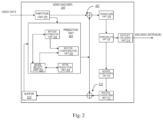
- FIG. 2 illustrates a block diagram that illustrates a first example video encoder, in accordance with some embodiments of the present disclosure
- FIG. 3 illustrates a block diagram that illustrates an example video decoder, in accordance with some embodiments of the present disclosure
- FIGS. 4 A and 4 B illustrate a comparative schematic diagram of adding a gray mask to a video, where FIG. 4 A illustrates an image to which only a watermark is inserted, and FIG. 4 B illustrates an image to which a watermark is inserted and a gray mask is added;
- FIG. 5 illustrates a schematic diagram of the conventional process of inserting a watermark
- FIG. 6 illustrates a schematic diagram of a conventional partition of logo insertion
- FIG. 7 illustrates a schematic diagram of a conventional transcoding of logo insertion
- FIG. 8 illustrates a schematic diagram of a conventional fast transcoding of watermark insertion in a discrete cosine transform (DCT) domain
- FIG. 9 illustrates a schematic diagram of watermark insertion according to some embodiments of the present disclosure.
- FIG. 10 illustrates a flowchart of fast transcoding of watermark insertion according to some embodiments of the present disclosure
- FIG. 11 illustrates a flowchart of a method for image encoding according to some embodiments of the present disclosure.
- FIG. 12 illustrates a block diagram of a computing device in which various embodiments of the present disclosure can be implemented.
- the motion estimation unit 204 may identify, in a syntax structure associated with the current video block, another video block and a motion vector difference (MVD).
- the motion vector difference indicates a difference between the motion vector of the current video block and the motion vector of the indicated video block.
- the video decoder 300 may use the motion vector of the indicated video block and the motion vector difference to determine the motion vector of the current video block.
- the original bitstream is decoded at first to obtain a video image (YUV), then a watermark is inserted into the decoded video image, and finally the video image is re-encoded to obtain a watermarked bitstream.
- YUV video image
- FIG. 5 This scheme requires re-encoding the video image after adding watermarks.
- the computational complexity is high.
- the fact that only the decoded reconstructed video image is available, and the original video image is not available there is no good quality reference during the re-encoding process.
- This scheme mainly comprises four steps, as shown in FIG. 6 .
- a part 1 affected by the logo refers to a region directly affected by the content of the logo region. Considering that the introduction of the logo changes the content of the logo part, if the information of the original bitstream is directly reused for the part 1 affected by the logo, there will be changes in the screen content.
- the solution is to use lossless encoding for intra slice(s) and re-encode inter slice(s), so as to ensure that the screen content is not affected by the logo part.
- a part 2 affected by the logo refers to a region affected by encoding dependency. Since a motion vector (MV) of the part 1 affected by the logo is changed compared with the MV in the original bitstream, the MV of the part 2 affected by the logo needs to be re-encoded to be the same as the MV in the original stream, so as to ensure that a part unaffected by the logo will not be affected.
- MV motion vector
- the input raw bitstream is partially decoded to the inverse quantization part to obtain data in a DCT domain.
- This data in the DCT domain is superimposed with data obtained by performing DCT on the logo, and then subsequent encoding work is carried out.
- the transcoding is performed in the DCT domain throughout this scheme, there are two aspects which may lead to error propagation.
- One of these two aspects is the inter prediction MC operation in the DCT domain.
- the motion compensation (MC) in the DCT domain and the MC operation in the pixel domain may not be exactly the same, there will be errors, and the entire prediction error will be propagated due to the inter prediction.
- Another aspect is the in-loop filtering in the encoding, such as deblocking.
- the filtering operations in the DCT domain and pixel domain may also not be exactly the same, so filtering in the DCT domain will generate errors and the errors will propagate. This scheme is not suitable for scenarios with high quality requirements.
- the embodiments of the present disclosure propose a fast transcoding method for situations where local or global adjustments (such as adding watermark locally or adding grayscale information) are required for the input image during the transcoding process.
- a position-based coding information reuse mode decision algorithm is proposed.
- the coding information reuse mode includes at least one of the following:
- the embodiments of the present disclosure propose two fast transcoding schemes, one for transcoding with only watermark being inserted and the other one for transcoding with watermark being inserted and mask being added.
- Method 1 A scheme for transcoding with only watermark being inserted
- Clause 22 The method of any of Clauses 1-21, wherein the target region indicates that, compared with the first image, the second image is added with at least one of the following regions: a watermark region, a mosaic region, or a gray mask region.
- the computing device 1200 includes a general-purpose computing device 1200 .
- the computing device 1200 may at least comprise one or more processors or processing units 1210 , a memory 1220 , a storage unit 1230 , one or more communication units 1240 , one or more input devices 1250 , and one or more output devices 1260 .
- the input device 1250 may receive video data as an input 1270 to be encoded.
- the video data may be processed, for example, by the video coding module 1225 , to generate an encoded bitstream.
- the encoded bitstream may be provided via the output device 1260 as an output 1280 .
- the input device 1250 may receive an encoded bitstream as the input 1270 .
- the encoded bitstream may be processed, for example, by the video coding module 1225 , to generate decoded video data.
- the decoded video data may be provided via the output device 1260 as the output 1280 .
Landscapes
- Engineering & Computer Science (AREA)
- Multimedia (AREA)
- Signal Processing (AREA)
- Compression Or Coding Systems Of Tv Signals (AREA)
Abstract
Description
-
- 1. The method of copying the bitstream for a region without watermark will inevitably introduce errors and the errors will propagate under the CABAC entropy encoding.
- 2. The method of copying the bitstream for a region without watermark is not applicable to a video processed with gray mask.
- 3. DCT domain transcoding may generate errors and the errors will propagate, which leads to a decrease in coding performance and subjective quality.
-
- 1) Mode #1: Full reuse mode (all coding information of a block is reused);
- 2) Mode #2: Partial reuse mode (a part of coding information of a block is reused, and some information can be flexibly changed);
- 3) Mode #3: Full non-reuse mode (coding information is required to be decided again).
- 1. For each coding unit (such as each macro block, each coding unit/coding block/prediction unit/prediction block/transform unit/transform block), the reuse mode of its coding information is determined based on its position.
- a. Furthermore, its motion information is utilized to comprehensively determine the reuse mode of its coding information.
- 2. For
Mode # 2, the reused information may comprise: a prediction mode (such as intra prediction or inter prediction), a coding mode (such as skip/merge/advanced motion vector prediction (AMVP)/intra/intra block copy (IBC)), a block partition, motion information (such as reference frame, motion vector, etc.), a quantization parameter a. Furthermore, non-reusable information may comprise residual information - 3. For
Mode # 2, the reused information may comprise: prediction mode (such as intra prediction or inter prediction), a part of coding modes (such as intra/IBC), block partition, a quantization parameter- a. Furthermore, non-reusable information may comprise motion information, a skip mode, and residual information
- i. For example, if it is the skip mode, a new decision needs to be made on whether to switch to a direct mode
- ii. For example, if it is the skip mode, a new decision needs to be made on whether to switch to a merge mode
- iii. For example, if it is the skip mode, a new decision needs to be made on whether to switch to an AMVP mode
- 1. Furthermore, motion information (such as an AMVP candidate index, a motion vector difference (MVD)) etc. need to be decided again
- iv. For example, if all coefficients of a residual block are zero coefficients (such as CBF=0), it is necessary to decide the residual coefficients again, including the setting of the coding block flag (CBF).
- a. Furthermore, non-reusable information may comprise motion information, a skip mode, and residual information
- 4. For
Mode # 2, the reused information may comprise: a prediction mode (such as intra prediction or inter prediction), a part of coding modes (such as intra/IBC, etc.), motion vector information, a block partition, a quantization parameter- a. Furthermore, non-reusable information may comprise MVD.
- i. For example, if a skip/direct mode is used for the current coding unit, it will be switched to an AMVP mode, and MVD will be changed to be a result of subtracting the motion vector prediction value (MVP) from its motion vector information.
- a. Furthermore, non-reusable information may comprise MVD.
- 5. If the motion information of the current coding unit points to a locally modified region (such as the region where watermark is added), the above-mentioned method corresponding to
Mode # 2 will take effect.- i. For example, if a predicted position of any pixel (such as the positions of four corners) in the current coding unit falls into the locally modified region, the above-mentioned method will take effect.
- ii. For example, if predicted positions of M pixels (such as the positions of the four corners) in the current coding unit fall into the locally modified region, and predicted positions of N pixels are outside the locally modified region, then the above-mentioned method will take effect.
- 6. If the current coding unit is adjacent to the locally modified region (such as the region where watermark is added) and the intra prediction mode is used for the current coding unit, the above-mentioned method corresponding to
Mode # 2 will take effect. - 7. For mode #3, all coding information needs to be decided again.
- a. Furthermore, if the current coding unit is in the locally modified region, the above-mentioned full non-reuse method takes effect
- b. Furthermore, if a predicted position of any pixel (such as the positions of four corners) in the current coding unit falls into the locally modified region, the above-mentioned method will take effect.
- c. Furthermore, if predicted positions of M pixels (such as the positions of the four corners) in the current coding unit fall into the locally modified region, and predicted positions of N pixels are outside the locally modified region, then the above-mentioned method will take effect.
-
- 1. Decoding a bitstream encoded according to H.264 and extracting coding information during the decoding process, the coding information comprising:
- a. a frame type, I/B/P, of each frame and whether it is an instantaneous decoding refresh (IDR) frame.
- b. QP(s) for each frame;
- c. direct_spatial_mv_pred of each inter frame;
- d. a weighted prediction mode and related coefficients for each inter frame.
- e. a prediction type of each MB (intra prediction/inter prediction);
- f. a partition scheme for each MB
- g. QP(s) for each MB;
- h. a CBF for each MB;
- i. an intra mode for each MB of intra prediction type and its sub_MB;
- j. a mode (skip/direct/inter), a reference frame and motion information (MV) for each MB of inter prediction type and its sub_MB.
- 1. Decoding a bitstream encoded according to H.264 and extracting coding information during the decoding process, the coding information comprising:
-
- 2. Transcode encoding is performed on the YUV_watermark. The data extracted in
step 1 is reused, and some highly complex computation processes are skipped. Each frame is encoded according to the following steps:- a. Skipping a decision-making process for frame type and reusing the frame type of the corresponding frame extracted during the decoding process.
- b. Skipping a frame-level rate control and reusing the QP of the corresponding frame extracted during the decoding process.
- c. For an inter frame, skipping a decision of direct_spatial_mv_pred, and reusing the direct_spatial_mv_pred of the corresponding frame extracted during the decoding process.
- d. For an inter frame, reusing the weighted prediction mode and related coefficients of the corresponding frame extracted during the decoding process, and generating the corresponding reference frame based thereon.
- e. Then, encoding MB according to the following steps for each MB:
- i. If the MB is an MB of the watermark region, it is handed over to the encoder for normal encoding.
- ii. If the MB is an MB in a non-watermark region, the processing steps are:
- 1. Skipping a decision of a type of the MB, and reusing the type (Intra/Inter) of the corresponding MB extracted during the decoding process.
- 2. Skipping the MB-level rate control, and reusing the QP of the corresponding MB extracted during the decoding process.
- 3. Skipping a decision of a quadtree partition of MB, and reusing the partition scheme and type (Intra/Inter) of the corresponding MB extracted during the decoding process.
- 4. Skipping a decision of intra mode for intra MB and its sub_MB, and reusing the intra mode of sub_MB of the corresponding MB extracted during the decoding process.
- 5. Skipping a decision of a mode for inter MB and reusing the mode of the corresponding MB extracted during the decoding process.
- 6. Skipping a decision for selecting a reference frame for inter MB and reusing the reference frame of the corresponding MB extracted during the decoding process.
- 7. Skipping an MV searching process for inter MB and its sub_MB, and reusing the MV of the corresponding MB and its sub_MB extracted during the decoding process.
- 8. If the MB is an inter block and the CBF is 0, it is necessary to determine whether the MV of this MB points to the watermark region. If the MV points to the watermark region, encoding the residual of the MB; otherwise, skipping the calculation of the CBF of this MB and reusing the CBF of the corresponding MB extracted during the decoding process.
- iii. If the MB is an MB in a region adjacent to the watermark, the MB is processed according to the following steps:
- 1. Skipping a decision of a type of the MB, and reusing the type (Intra/Inter) of the corresponding MB extracted during the decoding process.
- 2. Skipping an MB-level rate control, and reusing the QP of the corresponding MB extracted during the decoding process.
- 3. Skipping a decision of a quadtree partition of MB, and reusing the partition scheme and type (Intra/Inter) of the corresponding MB extracted during the decoding process.
- 4. Skipping a decision of intra mode for intra MB and its sub_MB, and reusing the intra mode of sub_MB of the corresponding MB extracted during the decoding process. Note that the pixel values in the watermark region are different from the YUV obtained by decoding the original bitstream. If the MB in a region adjacent to the watermark may use a pixel in the watermark region for intra prediction, if CBF is reused at this time, this may lead to mosaic phenomenon, so CBF is not reused.
- 5. Reencoding the watermark region will result in a difference between the MVP in an adjacent part of the watermark and the MVP in the original bitstream. If the encoding of the region is a skip mode or a direct mode, reusing this mode will cause aliasing, and the inconsistency of the MVP will propagate. To this end, in some embodiments of this disclosure, the skip mode and the direct mode are uniformly processed according to the inter mode, and CBF is not reused.
- 6. Skipping a decision for selecting a reference frame for inter MB and reusing the reference frame of the corresponding MB extracted during the decoding process.
- 7. Skipping an MV searching process for inter MB and its sub_MB, and reusing the MV of the corresponding MB and its sub_MB extracted during the decoding process.
- 3. In order to improve encoding efficiency, if an MB is previously encoded by using inter prediction and referring to the watermark region, the optimal prediction type may be selected for re-encoding through small region motion estimation and a comparison with intra prediction. if an MB is previously encoded by using intra prediction and referring to the watermark region, the intra prediction mode may be reselected and the encoding is performed. The optimal mode selection method is to minimize the rate distortion cost. Entropy encoding is performed, and watermarked H.264 bitstream is generated. The entropy encoding scheme may be selected voluntarily from context-adaptive variable-length coding (CAVLC)/CABAC.
- 2. Transcode encoding is performed on the YUV_watermark. The data extracted in
-
- 1. Decoding a bitstream of a video pre-encoded according to H.264 and extracting coding information during the decoding process, the coding information comprising:
- a. a frame type, I/B/P, of each frame and whether it is an instantaneous decoding refresh (IDR) frame.
- b. QP(s) for each frame;
- c. direct_spatial_mv_pred of each inter frame;
- d. a weighted prediction mode and related coefficients for each inter frame.
- e. a prediction type of each MB (intra prediction/inter prediction);
- f. a partition scheme for each MB
- g. QP(s) for each MB;
- h. a CBF for each MB;
- i. an intra mode for each MB of intra prediction type and its sub_MB;
- j. a mode (skip/direct/inter), a reference frame and MV for each MB of inter prediction type and its sub_MB.
- 1. Decoding a bitstream of a video pre-encoded according to H.264 and extracting coding information during the decoding process, the coding information comprising:
-
- 2. H.264 transcode encoding is performed on the YUV_watermark. The coding information extracted in
step 1 is reused, and some computation processes are skipped. Each frame is encoded according to the following steps:- a. Skipping a decision-making process for frame type and reusing the frame type of the corresponding frame extracted during the decoding process.
- b. Skipping a frame-level rate control and reusing the QP of the corresponding frame extracted during the decoding process.
- c. For an inter frame, skipping a decision of direct_spatial_mv_pred, and reusing the direct_spatial_mv_pred of the corresponding frame extracted during the decoding process.
- d. For an inter frame, reusing the weighted prediction mode and related coefficients of the corresponding frame extracted during the decoding process, and generating the corresponding reference frame based thereon.
- e. Then, encoding MB according to the following steps for each MB:
- i. If the MB is an MB of the watermark region, it is handed over to the encoder for normal encoding.
- ii. If the MB is an MB in a non-watermark region, the processing steps are:
- 1. Skipping a decision of a type of the MB, and reusing the type (Intra/Inter) of the corresponding MB extracted during the decoding process.
- 2. Skipping an MB-level rate control, and reusing the QP of the corresponding MB extracted during the decoding process.
- 3. Skipping a decision of a quadtree partition of MB, and reusing the partition scheme and type (Intra/Inter) of the corresponding MB extracted during the decoding process.
- 4. Skipping a decision of intra mode for intra MB and its sub_MB, and reusing the intra mode of sub_MB of the corresponding MB extracted during the decoding process.
- 5. Skipping a decision of a mode for inter MB and reusing the mode of the corresponding MB extracted during the decoding process.
- 6. Skipping a decision for selecting reference frame for inter MB and reusing the reference frame of the corresponding MB extracted during the decoding process.
- 7. Skipping an MV searching process for inter MB and its sub_MB, and reusing the MV of the corresponding MB and its sub_MB extracted during the decoding process.
- In addition, because the gray mask is known beforehand, the MV in the encoding may be used for detecting whether there is a significant change between the gray mask of the current block and the gray mask of the reference block, e.g., by calculating the sum of absolute differences (SAD) between the current block and the reference block to measure the amount of change. If the change is significant, further optimization may be performed on the existing MV, such as by searching for a motion vector in the vicinity of the starting point of the MV, so as to improve prediction efficiency.
- 8. Due to the case where the non-uniform gray mask is added to adjust the brightness of the picture, if CBF is reused at this time, the brightness of the picture will appear mottled, and the subjective quality deteriorates. Therefore, in order to prevent this situation from occurring, CBF is not reused.
- iii. If the MB is an MB in a region adjacent to the watermark, the MB is processed according to the following steps:
- 1. Skipping a decision of a type of the MB, and reusing the type (Intra/Inter) of the corresponding MB extracted during the decoding process.
- 2. Skipping an MB-level rate control, and reusing the QP of the corresponding MB extracted during the decoding process.
- 3. Skipping a decision of a quadtree partition of MB, and reusing the partition scheme and type (Intra/Inter) of the corresponding MB extracted during the decoding process.
- 4. Skipping a decision of intra mode for intra MB and its sub_MB, and reusing the intra mode of sub_MB of the corresponding MB extracted during the decoding process.
- 5. Uniformly processing the skip mode and the direct mode according to the inter mode, and CBF is not reused.
- 6. Skipping a decision for selecting a reference frame for inter MB and reusing the reference frame of the corresponding MB extracted during the decoding process.
- 7. Skipping an MV searching process for inter MB and its sub_MB, and reusing the MV of the corresponding MB and its sub_MB extracted during the decoding process.
- iv. In addition, for scenarios with higher requirements for transcoding quality, the following optimizations may be made:
- 1. When reusing the intra mode, if this mode is an angle mode, a small-scale refinement around the mode may be made.
- 2. The cost of reusing the MV is calculated. If the cost is greater than a specified threshold, a small-scale search around the MV is made to optimize this MV.
- 3. If the MV of the corresponding MB and its sub_MB extracted during the decoding process points to the watermark region, the cost of encoding this block with intra mode is calculated and a method (inter/intra) with less cost is selected.
- 3. Entropy encoding is performed, and watermarked H.264 bitstream is generated. The entropy encoding scheme may be selected voluntarily from CAVLC/CABAC.
- 2. H.264 transcode encoding is performed on the YUV_watermark. The coding information extracted in
-
- 1. The embodiments of the present disclosure are applicable to scenarios where multiple watermarks are inserted or mosaic (covering one or more regions) is added.
- 2. The embodiments of the present disclosure are applicable to transcoding scenarios where image quality is enhanced at the same resolution.
- 3. The embodiments of the present disclosure may be used for other video coding standards such as HEVC, VVC, VP-8, and AV1, etc.
- 4. The embodiments of the present disclosure may also be used for variable bitrate transcoding, canceling the reusing of QP and CBF, and adjusting QP based on the target bitrate.
-
- obtaining first coding information for a first coding unit in a first image, the first coding information indicating a scheme for encoding the first coding unit into a first bitstream of the first image;
- determining, based on a relative position relationship between a target region in a second image obtained from the first image and a second coding unit in the second image, a reuse mode for the second coding unit regarding the first coding information, the second coding unit corresponding to the first coding unit, the target region indicating a region in the second image that is different from the first image;
- determining second coding information for the second coding unit based on the reuse mode; and
- generating a second bitstream for the second image based on the second coding information.
-
- if the second coding unit is adjacent to the target region, determining that the first coding information is partially reused for the second coding information.
-
- if the second coding unit is spaced apart from the target region, determining the reuse mode based on motion information of the second coding unit.
-
- if the reference coding unit at least partially overlaps with an edited region in the reference image, determining that the first coding information is partially reused for the second coding information.
-
- if the reference coding unit at least partially overlaps with an edited region in the reference image, determining that the first coding information is partially reused for the second coding information.
-
- reusing, for the second coding information, at least one in a reusable information set of the first coding information, the reusable information set comprising a prediction mode, a block partition, and a quantization parameter.
-
- determining, based on the second coding unit, at least one of motion information or residual information for the second coding unit.
-
- obtaining a motion vector for the second coding unit by performing motion estimation on the second coding unit; and
- if the motion vector for the second coding unit is the same as a motion vector for the first coding unit, the first coding information indicates that the first coding unit is encoded into the first bitstream based on a skip mode, and the reference coding unit at least partially overlaps with an edited region in the reference image, setting a coding mode for the second coding unit to a direct mode or a merge mode.
-
- obtaining a motion vector for the second coding unit by performing motion estimation on the second coding unit; and
- if the motion vector for the second coding unit is different from a motion vector for the first coding unit, the first coding information indicates that the first coding unit is encoded into the first bitstream based on a skip mode, and the reference coding unit at least partially overlaps with an edited region in the reference image, setting a coding mode for the second coding unit to an advanced motion vector prediction (AMVP) mode.
-
- determining, based on the second coding unit, at least one of a motion vector difference (MVD) or an AMVP candidate index for the second coding unit.
-
- determining a residual coefficient for the second coding unit based on the motion vector for the second coding unit.
-
- determining an MVD for the second coding unit based on a motion vector for the first coding unit.
-
- if the first coding information indicates that the first coding unit is encoded into the first bitstream based on a skip mode or a direct mode, setting a coding mode for the second coding unit to an AMVP mode.
-
- determining an MVD for the second coding unit based on a motion vector and a motion vector prediction (MVP) for the second coding unit.
-
- determining residual information for the second coding unit based on the second coding unit and the reference coding unit.
-
- if the second coding unit is adjacent to the target region, and the first coding unit is encoded into the first bitstream based on an intra prediction mode, determining that the first coding information is partially reused for the second coding information.
-
- if the second coding unit is in the target region, determining that the first coding information is not reused for the second coding information.
-
- if the reference coding unit is in an edited region of the reference image, determining that the first coding information is not reused for the second coding information.
-
- if the second coding unit is spaced apart from the target region, determining that the first coding information is fully reused for the second coding information.
-
- a processor; and
- a memory coupled to the processor and having instructions stored thereon which, when executed by the processor, cause the electronic device to perform a method in accordance with any of Clauses 1-22.
Claims (20)
Applications Claiming Priority (3)
| Application Number | Priority Date | Filing Date | Title |
|---|---|---|---|
| CN2021078730 | 2021-03-02 | ||
| WOPCT/CN2021/078730 | 2021-03-02 | ||
| PCT/CN2022/078877 WO2022184110A1 (en) | 2021-03-02 | 2022-03-02 | Method for image coding, electronic device, storage medium and recording medium |
Publications (2)
| Publication Number | Publication Date |
|---|---|
| US20240146949A1 US20240146949A1 (en) | 2024-05-02 |
| US12267520B2 true US12267520B2 (en) | 2025-04-01 |
Family
ID=83154728
Family Applications (1)
| Application Number | Title | Priority Date | Filing Date |
|---|---|---|---|
| US18/280,000 Active 2042-03-24 US12267520B2 (en) | 2021-03-02 | 2022-03-02 | Method, electronic device, storage medium, and recording medium for image encoding |
Country Status (3)
| Country | Link |
|---|---|
| US (1) | US12267520B2 (en) |
| CN (1) | CN117529918A (en) |
| WO (1) | WO2022184110A1 (en) |
Families Citing this family (2)
| Publication number | Priority date | Publication date | Assignee | Title |
|---|---|---|---|---|
| CN113014926B (en) * | 2021-04-30 | 2023-04-07 | 北京汇钧科技有限公司 | Video transcoding method and device, electronic equipment and storage medium |
| CN115883835B (en) * | 2023-03-03 | 2023-04-28 | 腾讯科技(深圳)有限公司 | Video coding method, device, equipment and storage medium |
Citations (5)
| Publication number | Priority date | Publication date | Assignee | Title |
|---|---|---|---|---|
| US6621866B1 (en) | 2000-01-28 | 2003-09-16 | Thomson Licensing S.A. | Method for inserting a visual element into an MPEG bit stream |
| CN108769828A (en) | 2018-05-23 | 2018-11-06 | 深圳市网心科技有限公司 | Picture watermark adding method, electronic device and computer readable storage medium |
| CN111225277A (en) | 2018-11-27 | 2020-06-02 | 北京达佳互联信息技术有限公司 | Transcoding method, transcoding device and computer readable storage medium |
| CN111225211A (en) | 2018-11-27 | 2020-06-02 | 北京达佳互联信息技术有限公司 | Transcoding method, transcoding device and computer readable storage medium |
| CN111787319A (en) | 2020-07-22 | 2020-10-16 | 腾讯科技(深圳)有限公司 | A video information processing method, multimedia information processing method and device |
-
2022
- 2022-03-02 CN CN202280017579.5A patent/CN117529918A/en active Pending
- 2022-03-02 WO PCT/CN2022/078877 patent/WO2022184110A1/en not_active Ceased
- 2022-03-02 US US18/280,000 patent/US12267520B2/en active Active
Patent Citations (5)
| Publication number | Priority date | Publication date | Assignee | Title |
|---|---|---|---|---|
| US6621866B1 (en) | 2000-01-28 | 2003-09-16 | Thomson Licensing S.A. | Method for inserting a visual element into an MPEG bit stream |
| CN108769828A (en) | 2018-05-23 | 2018-11-06 | 深圳市网心科技有限公司 | Picture watermark adding method, electronic device and computer readable storage medium |
| CN111225277A (en) | 2018-11-27 | 2020-06-02 | 北京达佳互联信息技术有限公司 | Transcoding method, transcoding device and computer readable storage medium |
| CN111225211A (en) | 2018-11-27 | 2020-06-02 | 北京达佳互联信息技术有限公司 | Transcoding method, transcoding device and computer readable storage medium |
| CN111787319A (en) | 2020-07-22 | 2020-10-16 | 腾讯科技(深圳)有限公司 | A video information processing method, multimedia information processing method and device |
Non-Patent Citations (1)
| Title |
|---|
| International Search Report in PCT/CN2022/078877, mailed May 19, 2022, 3 pages. |
Also Published As
| Publication number | Publication date |
|---|---|
| US20240146949A1 (en) | 2024-05-02 |
| WO2022184110A1 (en) | 2022-09-09 |
| CN117529918A (en) | 2024-02-06 |
Similar Documents
| Publication | Publication Date | Title |
|---|---|---|
| CN117440169A (en) | Encoders, decoders and corresponding methods | |
| US20250274604A1 (en) | Extended template matching for video coding | |
| WO2023056895A1 (en) | Method, apparatus, and medium for video processing | |
| WO2022199469A1 (en) | Method, device, and medium for video processing | |
| US20240146949A1 (en) | Method, electronic device, storage medium, and recording medium for image encoding | |
| EP4037320A1 (en) | Boundary extension for video coding | |
| US12563201B2 (en) | Method, apparatus, and medium for video processing | |
| US20240364879A1 (en) | Method, apparatus, and medium for video processing | |
| US20240283979A1 (en) | Method, apparatus, and medium for video processing | |
| US20240380907A1 (en) | Method, apparatus, and medium for video processing | |
| WO2024131979A1 (en) | Method, apparatus, and medium for video processing | |
| WO2023198120A1 (en) | Method, apparatus, and medium for video processing | |
| US20240364898A1 (en) | Method, apparatus and medium for video processing | |
| WO2025162462A1 (en) | Method, apparatus, and medium for video processing | |
| WO2026017095A1 (en) | Method, apparatus, and medium for video processing | |
| WO2026017096A1 (en) | Method, apparatus, and medium for video processing | |
| WO2026021419A1 (en) | Method, apparatus, and medium for video processing | |
| US20240275993A1 (en) | Method, apparatus, and medium for video processing | |
| US20250254357A1 (en) | Method, apparatus, and medium for video processing | |
| WO2025162269A1 (en) | Method, apparatus, and medium for video processing | |
| WO2025076829A1 (en) | Method, apparatus, and medium for video processing | |
| US20250350757A1 (en) | Method, apparatus, and medium for video processing | |
| WO2026075920A1 (en) | Method, apparatus, and medium for video processing | |
| WO2025151768A1 (en) | Method, apparatus, and medium for video processing | |
| HK40117890A (en) | Image decoding method and apparatus, image encoding method and apparatus, and storage medium |
Legal Events
| Date | Code | Title | Description |
|---|---|---|---|
| FEPP | Fee payment procedure |
Free format text: ENTITY STATUS SET TO UNDISCOUNTED (ORIGINAL EVENT CODE: BIG.); ENTITY STATUS OF PATENT OWNER: LARGE ENTITY |
|
| STPP | Information on status: patent application and granting procedure in general |
Free format text: DOCKETED NEW CASE - READY FOR EXAMINATION |
|
| STPP | Information on status: patent application and granting procedure in general |
Free format text: NOTICE OF ALLOWANCE MAILED -- APPLICATION RECEIVED IN OFFICE OF PUBLICATIONS |
|
| AS | Assignment |
Owner name: BEIJING BYTEDANCE NETWORK TECHNOLOGY CO., LTD., CHINA Free format text: ASSIGNMENT OF ASSIGNORS INTEREST;ASSIGNOR:BEIJING ZITIAO NETWORK TECHNOLOGY CO., LTD.;REEL/FRAME:069510/0269 Effective date: 20240910 Owner name: BEIJING ZITIAO NETWORK TECHNOLOGY CO., LTD., CHINA Free format text: ASSIGNMENT OF ASSIGNORS INTEREST;ASSIGNOR:LI, XUEQING;REEL/FRAME:069488/0901 Effective date: 20230815 Owner name: BYTEDANCE INC., CALIFORNIA Free format text: ASSIGNMENT OF ASSIGNORS INTEREST;ASSIGNORS:ZHANG, LI;HE, YUWEN;REEL/FRAME:069488/0908 Effective date: 20230815 |
|
| AS | Assignment |
Owner name: BEIJING ZITIAO NETWORK TECHNOLOGY CO., LTD., CHINA Free format text: ASSIGNMENT OF ASSIGNORS INTEREST;ASSIGNOR:LI, XUEQING;REEL/FRAME:069950/0424 Effective date: 20230815 |
|
| STPP | Information on status: patent application and granting procedure in general |
Free format text: PUBLICATIONS -- ISSUE FEE PAYMENT VERIFIED |
|
| STCF | Information on status: patent grant |
Free format text: PATENTED CASE |