US12259679B2 - Developing cartridge including casing that has recessed portion and boss connecting two opposing walls of casing inside toner chamber, and image forming apparatus using the same - Google Patents

Developing cartridge including casing that has recessed portion and boss connecting two opposing walls of casing inside toner chamber, and image forming apparatus using the same Download PDF

Info

Publication number
US12259679B2
US12259679B2 US18/349,509 US202318349509A US12259679B2 US 12259679 B2 US12259679 B2 US 12259679B2 US 202318349509 A US202318349509 A US 202318349509A US 12259679 B2 US12259679 B2 US 12259679B2
Authority
US
United States
Prior art keywords
wall
developing cartridge
casing
end portion
cartridge according
Prior art date
Legal status (The legal status is an assumption and is not a legal conclusion. Google has not performed a legal analysis and makes no representation as to the accuracy of the status listed.)
Active
Application number
US18/349,509
Other versions
US20240027950A1 (en
Inventor
Koji Abe
Takuya AMAIKE
Current Assignee (The listed assignees may be inaccurate. Google has not performed a legal analysis and makes no representation or warranty as to the accuracy of the list.)
Brother Industries Ltd
Original Assignee
Brother Industries Ltd
Priority date (The priority date is an assumption and is not a legal conclusion. Google has not performed a legal analysis and makes no representation as to the accuracy of the date listed.)
Filing date
Publication date
Application filed by Brother Industries Ltd filed Critical Brother Industries Ltd
Assigned to BROTHER KOGYO KABUSHIKI KAISHA reassignment BROTHER KOGYO KABUSHIKI KAISHA ASSIGNMENT OF ASSIGNORS INTEREST (SEE DOCUMENT FOR DETAILS). Assignors: AMAIKE, TAKUYA, ABE, KOJI
Publication of US20240027950A1 publication Critical patent/US20240027950A1/en
Priority to US19/051,348 priority Critical patent/US20250244711A1/en
Application granted granted Critical
Publication of US12259679B2 publication Critical patent/US12259679B2/en
Active legal-status Critical Current
Anticipated expiration legal-status Critical

Links

Images

Classifications

    • GPHYSICS
    • G03PHOTOGRAPHY; CINEMATOGRAPHY; ANALOGOUS TECHNIQUES USING WAVES OTHER THAN OPTICAL WAVES; ELECTROGRAPHY; HOLOGRAPHY
    • G03GELECTROGRAPHY; ELECTROPHOTOGRAPHY; MAGNETOGRAPHY
    • G03G21/00Arrangements not provided for by groups G03G13/00 - G03G19/00, e.g. cleaning, elimination of residual charge
    • G03G21/16Mechanical means for facilitating the maintenance of the apparatus, e.g. modular arrangements
    • G03G21/1642Mechanical means for facilitating the maintenance of the apparatus, e.g. modular arrangements for connecting the different parts of the apparatus
    • G03G21/1647Mechanical connection means
    • GPHYSICS
    • G03PHOTOGRAPHY; CINEMATOGRAPHY; ANALOGOUS TECHNIQUES USING WAVES OTHER THAN OPTICAL WAVES; ELECTROGRAPHY; HOLOGRAPHY
    • G03GELECTROGRAPHY; ELECTROPHOTOGRAPHY; MAGNETOGRAPHY
    • G03G15/00Apparatus for electrographic processes using a charge pattern
    • G03G15/06Apparatus for electrographic processes using a charge pattern for developing
    • G03G15/08Apparatus for electrographic processes using a charge pattern for developing using a solid developer, e.g. powder developer
    • G03G15/0822Arrangements for preparing, mixing, supplying or dispensing developer
    • G03G15/0887Arrangements for conveying and conditioning developer in the developing unit, e.g. agitating, removing impurities or humidity
    • G03G15/0889Arrangements for conveying and conditioning developer in the developing unit, e.g. agitating, removing impurities or humidity for agitation or stirring
    • GPHYSICS
    • G03PHOTOGRAPHY; CINEMATOGRAPHY; ANALOGOUS TECHNIQUES USING WAVES OTHER THAN OPTICAL WAVES; ELECTROGRAPHY; HOLOGRAPHY
    • G03GELECTROGRAPHY; ELECTROPHOTOGRAPHY; MAGNETOGRAPHY
    • G03G21/00Arrangements not provided for by groups G03G13/00 - G03G19/00, e.g. cleaning, elimination of residual charge
    • G03G21/16Mechanical means for facilitating the maintenance of the apparatus, e.g. modular arrangements
    • G03G21/18Mechanical means for facilitating the maintenance of the apparatus, e.g. modular arrangements using a processing cartridge, whereby the process cartridge comprises at least two image processing means in a single unit
    • G03G21/1803Arrangements or disposition of the complete process cartridge or parts thereof
    • G03G21/1817Arrangements or disposition of the complete process cartridge or parts thereof having a submodular arrangement
    • G03G21/1821Arrangements or disposition of the complete process cartridge or parts thereof having a submodular arrangement means for connecting the different parts of the process cartridge, e.g. attachment, positioning of parts with each other, pressure/distance regulation
    • GPHYSICS
    • G03PHOTOGRAPHY; CINEMATOGRAPHY; ANALOGOUS TECHNIQUES USING WAVES OTHER THAN OPTICAL WAVES; ELECTROGRAPHY; HOLOGRAPHY
    • G03GELECTROGRAPHY; ELECTROPHOTOGRAPHY; MAGNETOGRAPHY
    • G03G2215/00Apparatus for electrophotographic processes
    • G03G2215/08Details of powder developing device not concerning the development directly
    • G03G2215/0802Arrangements for agitating or circulating developer material
    • G03G2215/0816Agitator type
    • GPHYSICS
    • G03PHOTOGRAPHY; CINEMATOGRAPHY; ANALOGOUS TECHNIQUES USING WAVES OTHER THAN OPTICAL WAVES; ELECTROGRAPHY; HOLOGRAPHY
    • G03GELECTROGRAPHY; ELECTROPHOTOGRAPHY; MAGNETOGRAPHY
    • G03G2221/00Processes not provided for by group G03G2215/00, e.g. cleaning or residual charge elimination
    • G03G2221/16Mechanical means for facilitating the maintenance of the apparatus, e.g. modular arrangements and complete machine concepts
    • G03G2221/1678Frame structures
    • G03G2221/1684Frame structures using extractable subframes, e.g. on rails or hinges

Definitions

  • a developing cartridge that includes a handle to enable a user to grab the same for replacement of the developing cartridge.
  • One of such conventional developing cartridges includes a handle that protrudes upward from a housing of the developing cartridge.
  • another conventional developing cartridge that enables a user to hold a housing storing toner therein, rather than to grab a handle protruding upward from the housing.
  • the housing has anti-slip portions each configured of a plurality of protrusions. The anti-slip portions are respectively provided at two opposing surfaces of the housing.
  • the user may encounter a difficulty in grabbing the housing if the housing is enlarged in size to accommodate a larger amount of toner therein, which may in turn hinder the user's exchanging task.
  • the developing cartridge becomes heavier in weight.
  • the user may be required to hold the housing with a greater force and the housing may be more prone to deformation. Deformation of the housing would possibly result in leakage of the toner accommodated in the housing.
  • the casing includes a recessed portion, a first wall, a second wall, and a first boss.
  • the recessed portion is recessed from an outer surface of the casing toward the developing roller.
  • the recessed portion is positioned at a center in the third direction of the another end portion of the casing in the second direction.
  • the first wall extends in the second direction and forms a part of the recessed portion.
  • the second wall faces the first wall in the first direction.
  • the second wall defines a part of the toner chamber.
  • the first boss is positioned inside the toner chamber. The first boss extends from the first wall to be connected to the second wall.
  • the toner capacity of the developing cartridge can be enlarged, and replacement of the developing cartridge relative to the drawer can be facilitated while deformation of the casing of the developing cartridge can be restrained.
  • FIG. 1 is a cross-sectional view of an image forming apparatus.
  • FIG. 2 is a schematic cross-sectional view illustrating a state where a drawer is pulled out from a main body of the image forming apparatus.
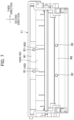
  • FIG. 3 is a cross-sectional view of a developing cartridge according to one embodiment of the disclosure.
  • FIG. 4 is a perspective view of the developing cartridge according to the embodiment.
  • FIG. 5 is a perspective view illustrating a positional relationship between a first boss and an agitator in the developing cartridge.
  • FIG. 6 is a plan view illustrating a positional relationship between the first boss and a film of the agitator in the developing cartridge.
  • FIG. 7 is a plan view illustrating a positional relationship between the first boss and a film of an agitator according to a modification to the embodiment.
  • an image forming apparatus 1 includes a main housing 10 and a process unit 20 .
  • the main housing 10 is depicted in a smaller size than an actual size thereof.
  • each developing cartridge 40 includes a casing 41 , a developing roller 42 , a supply roller 43 , a thickness-regulating blade 44 , an agitator 45 and a coupling 46 .
  • the coupling 46 is configured to receive a driving force from a motor (not shown) provided in the main housing 10 .
  • the coupling 46 is configured to transmit the driving force from the motor to the developing roller 42 and the agitator 45 .
  • the coupling 46 is provided at one side surface of the casing 41 at one side in the third direction where a toner injection hole F 14 (described later) is formed.
  • the holder 45 B is supported by the casing 41 so as to be rotatable about the second axis X 2 .
  • the film 45 A extends from the holder 45 B toward an inner peripheral surface of the casing 41 so as to make contact with the inner peripheral surface of the casing 41 .
  • the first frame F 1 is positioned on the one side in the first direction relative to the toner chamber 41 A.
  • the second frame F 2 is positioned on the other side in the first direction relative to the first frame F 1 .
  • the second frame F 2 and the first frame F 1 together form the toner chamber 41 A.
  • the first flame F 1 and the second flame F 2 are positioned opposite each other with respect to the toner chamber 41 A.
  • the first frame F 1 is welded to the second frame F 2 .
  • the first frame F 1 may be screw-fixed to the second frame F 2 .
  • the first frame F 1 has a length in the first direction that is greater than a length in the first direction of the second frame F 2 .
  • the first frame F 1 has a flat surface F 11 positioned at an end of the casing 41 at another side in the second direction.
  • the flat surface F 11 extends in the third direction to span between both ends of the first frame F 1 in the third direction.
  • the flat surface F 11 is a part of an outer surface F 15 of the first frame F 1 .
  • the first frame F 1 has a recessed portion F 12 that is recessed relative to the flat surface F 11 .
  • the recessed portion F 12 is positioned at a center in the third direction on the end of the first frame F 1 at the other side in the second direction.
  • the recessed portion F 12 is recessed from the outer surface F 15 of the first frame F 1 toward the developing roller 42 and toward the second frame F 2 . This configuration enables a user to insert his fingers into the recessed portion F 12 from the other side in the second direction as well as from the one side in the first direction.
  • the recessed portion F 12 is positioned to overlap with the toner chamber 41 A when viewed in the first direction.
  • the first frame F 1 includes a first wall W 1 , a third wall W 3 , a fifth wall W 5 , two first bosses B 1 , two second bosses B 2 , and a protrusion F 13 .
  • the first wall W 1 and the fifth wall W 5 constitute the recessed portion F 12 .
  • the first wall W 1 extends in the second direction and in the third direction.
  • the first wall W 1 mainly extends from the flat surface F 11 toward the one side in the second direction.
  • the first wall W 1 has a portion that slightly extends from the flat surface F 11 toward the other side in the second direction.
  • the protrusion F 13 protrudes from the end of the first wall W 1 at the other side in the second direction (upper end of the first wall W 1 in FIG. 3 ) to extend away from the toner chamber 41 A (the second flame F 2 ) in the first direction.
  • the protrusion F 13 has a length in the first direction that is smaller than a length of the fifth wall W 5 in the first direction.
  • the first wall W 1 has a first surface W 11 that defines a part of the recessed portion F 12 .
  • the fifth wall W 5 has a second surface W 51 that defines another part of the recessed portion F 12 .
  • the first surface W 11 and the second surface W 51 are flat surfaces.
  • the first surface W 11 extends in the second direction and in the third direction.
  • the second surface W 51 is positioned, relative to the first surface W 11 , on the one side in the second direction and on the one side in the first direction.
  • the second surface W 51 extends in the first direction and in the third direction.
  • the first bosses B 1 are positioned inside the toner chamber 41 A.
  • the first bosses B 1 are positioned on the other side in the second direction relative to the second axis X 2 .
  • the first frame F 1 has the toner injection hole F 14 for replenishing toner therethrough into the toner chamber 41 A. As illustrated in FIG. 5 , the toner injection hole F 14 is formed in a side wall of the first frame F 1 at the one side in the third direction. The first bosses B 1 are positioned to overlap with the toner injection hole F 14 when viewed in the third direction.
  • the third wall W 3 is positioned at the one side in the second direction relative to the first wall W 1 . Specifically, the third wall W 3 is positioned between the first axis X 1 and the second axis X 2 in the second direction.
  • the second bosses B 2 extend in the first direction from the third wall W 3 to the second frame F 2 , more specifically, to a fourth wall W 4 (described later) of the second frame F 2 .
  • Each second boss B 2 extends from the third wall W 3 toward the other side in the first direction, and is in contact with the fourth wall W 4 .
  • the second bosses B 2 are welded to the fourth wall W 4 .
  • the second frame F 2 includes the second wall W 2 , the fourth wall W 4 , a sixth wall W 6 , and an anti-slip portion F 21 .
  • the second wall W 2 faces the first wall W 1 in the first direction.
  • the second wall W 2 has an inner surface facing the toner chamber 41 A, and an outer surface W 21 opposite the inner surface in the first direction.
  • the outer surface W 21 is inclined with respect to the second direction such that the outer surface W 21 extends toward the one side in the first direction as extending toward the other side in the second direction. In other words, the outer surface W 21 is inclined relative to the second direction to approach the first wall W 1 as extending away from the developing roller 42 in the second direction.
  • the anti-slip portion F 21 is configured of a plurality of protruding portions F 22 .
  • the protruding portions F 22 protrude, from the outer surface W 21 of the second wall W 2 , in a direction away from the toner chamber 41 A.
  • the anti-slip portion F 21 can function to suppress the user's fingers from slipping off the second frame F 2 when the user holds the anti-slip portion F 21 .
  • the anti-slip portion F 21 is positioned to overlap with the recessed portion F 12 when viewed in the first direction.
  • the fourth wall W 4 faces the third wall W 3 in the first direction.
  • the holder 44 B of the thickness-regulating blade 44 is fixed to the fourth wall W 4 .
  • the sixth wall W 6 extends toward the first frame F 1 from an end of the second wall W 2 at the other side in the second direction.
  • the sixth wall W 6 is in contact with the first frame F 1 .
  • the first frame F 1 includes two of the above-described first bosses B 1 and two of the above-described second bosses B 2 , respectively.
  • the two first bosses B 1 are aligned with each other in the third direction with a space therebetween.
  • the two second bosses B 2 are aligned with each other in the third direction with a space therebetween.
  • the two first bosses B 1 are positioned between the two second bosses B 2 in the third direction.
  • the film 45 A of the agitator 45 has two recesses 45 C at positions corresponding to the two first bosses B 1 in the third direction. That is, the two recesses 45 C are provided one for each one of the two first bosses B 1 .
  • Each recess has such a size that the first boss B 1 can pass through the recess 45 C when the agitator 45 rotates.
  • the four developing cartridges 40 are aligned with one another in the first direction in a state where the four developing cartridges 40 are attached to the drawer 30 .
  • the four developing cartridges 40 are aligned in an order of the developing cartridges 40 Y, 40 C, and 40 K from the one side toward the other side in the first direction.
  • the recessed portion F 12 of the developing cartridge 40 K faces the second wall W 2 of the developing cartridge 40 C in the first direction.
  • the developing cartridge 40 K corresponds to a first developing cartridge of the disclosure
  • the developing cartridge 40 C corresponds to a second developing cartridge of the disclosure.
  • the recessed portion F 12 of the developing cartridge 40 C faces the second wall W 2 of the developing cartridge 40 M in the first direction.
  • the developing cartridge 40 M corresponds to the second developing cartridge of the disclosure.
  • the recessed portion F 12 of the developing cartridge 40 M faces the second wall W 2 of the developing cartridge 40 Y in the first direction.
  • the developing cartridge 40 Y corresponds to the second developing cartridge.
  • the recessed portion F 12 is provided at the casing 41 having the toner chamber 41 A.
  • the casing 41 can be enlarged in size in the second direction to increase a toner capacity, compared to a conventional developing cartridge whose housing is provided with a handle protruding therefrom in the second direction. Further, since a user can insert his fingers in the recessed portion F 12 to hold the casing 41 with a larger toner capacity, the user can easily exchange the developing cartridge 40 .
  • the first bosses B 1 extending from the first wall W 1 to the second wall W 2 can suppress deformation of the casing 41 , thereby restraining leakage of the toner stored in the casing 41 due to deformation of the casing 41 .
  • the film 45 A of the agitator 45 has the recesses 45 C at positions corresponding to the respective first bosses B 1 in the third direction. This configuration can restrain deformation of the film 45 A attributed to the contact of the film 45 A against the two first bosses B 1 while the agitator 45 is rotating.
  • the casing 41 further has the second bosses B 2 .
  • the first bosses B 1 and the second bosses B 2 can serve to further restrain deformation of the casing 41 .
  • the protrusion F 13 is further provided on the first wall W 1 of the recessed portion F 12 . This configuration can facilitate detachment of the developing cartridge 40 since a user can hook his fingers on the protrusion F 13 .
  • the anti-slip portion F 21 is positioned to overlap with the recessed portion F 12 when viewed in the first direction. With this configuration, when a user inserts his fingers in the recessed portion F 12 to hold the casing 41 , user's fingers may touch the anti-slip portion F 21 but the anti-slip portion F 21 can restrain slippage of his fingers. Detachment of the developing cartridge 40 can be further facilitated.
  • the outer surface W 21 of the second wall W 2 is inclined. This configuration can provide a space for insertion of user's fingers between the outer surface W 21 and an external member disposed on the other side of the developing cartridge 40 in the first direction. Accordingly, this configuration can facilitate detachment of the developing cartridge 40 .
  • the provision of the inclined outer surface W 21 enables the user to visually recognize the anti-slip portion F 21 with ease.
  • the recessed portion F 12 of the first developing cartridge (for example, the developing cartridge 40 K) faces the second wall W 2 of the second developing cartridge (for example, the developing cartridge 40 C) in the first direction.
  • the recessed portion F 12 of the first developing cartridge can restrain user's fingers from interfering with the first developing cartridge at the time of detachment of the second developing cartridge.
  • FIG. 7 illustrates an agitator 145 according to a modification to the embodiment.
  • the agitator 145 includes a film 145 A formed with a pair of slits 45 D, instead of the recesses 45 C.
  • portions of the film 145 A adjacent to the slits 145 D contact the first bosses B 1 during rotation of the agitator 145 .
  • the portions formed with the slits 145 D can elastically deform upon contact with the first bosses B 1 , thereby suppressing deformation of the entire film 145 A.
  • the first bosses B 1 may extend from the second wall W 2 to contact the first wall W 1 .
  • each first boss B 1 may be configured of: a first protruding portion protruding from the first wall W 1 ; and a second protruding portion protruding from the second wall W 2 to contact the first protruding portion.
  • the first bosses B 1 need not be welded.
  • the number of the first boss B 1 need not be two, but may be one or not less than three.

Landscapes

  • Physics & Mathematics (AREA)
  • General Physics & Mathematics (AREA)
  • Engineering & Computer Science (AREA)
  • Computer Vision & Pattern Recognition (AREA)
  • Dry Development In Electrophotography (AREA)
  • Electrophotography Configuration And Component (AREA)

Abstract

A developing cartridge is attachable to a drawer that is movable in a first direction relative to a main housing of an image forming apparatus. The developing cartridge includes: a casing having a toner chamber; and a developing roller positioned at one end of the casing in a second direction and rotatable about an axis extending in a third direction. The casing includes: a recessed portion recessed from an outer surface of the casing toward the developing roller; a first wall extending in the second direction; and a first boss positioned inside the toner chamber. The recessed portion is positioned at a center in the third direction of another end of the casing in the second direction. The first wall and the second wall form the toner chamber. The first boss extends from the first wall to be connected to the second wall.

Description

REFERENCE TO RELATED APPLICATIONS
This application claims priority from Japanese Patent Application No. 2022-117855 filed on Jul. 25, 2022. The entire content of the priority application is incorporated herein by reference.
BACKGROUND ART
There has been conventionally known a developing cartridge that includes a handle to enable a user to grab the same for replacement of the developing cartridge. One of such conventional developing cartridges includes a handle that protrudes upward from a housing of the developing cartridge. There has also been known another conventional developing cartridge that enables a user to hold a housing storing toner therein, rather than to grab a handle protruding upward from the housing. Specifically, in the developing cartridge, the housing has anti-slip portions each configured of a plurality of protrusions. The anti-slip portions are respectively provided at two opposing surfaces of the housing.
DESCRIPTION
However, in the above-described conventional configuration in which the user holds the housing, the user may encounter a difficulty in grabbing the housing if the housing is enlarged in size to accommodate a larger amount of toner therein, which may in turn hinder the user's exchanging task. Further, as a larger amount of toner is to be stored in the housing, the developing cartridge becomes heavier in weight. As such, the user may be required to hold the housing with a greater force and the housing may be more prone to deformation. Deformation of the housing would possibly result in leakage of the toner accommodated in the housing.
In view of the foregoing, it is an object of the present disclosure to provide a developing cartridge that can have a larger toner capacity, facilitate user's replacement task, and suppress deformation of the housing.
In order to attain the above and other object, according to one aspect, the present disclosure provides a developing cartridge attachable to a drawer of an image forming apparatus, the drawer being movable in a first direction relative to a main housing of the image forming apparatus. The developing cartridge includes a casing and a developing roller. The casing has a toner chamber configured to accommodate toner therein. The casing has one end portion and another end portion spaced apart from each other in a second direction, the one end portion of the casing being at one side in the second direction and the another end portion of the casing being at another side in the second direction. The developing roller is positioned at the one end portion of the casing in the second direction. The developing roller is rotatable about a first axis extending in a third direction. The casing includes a recessed portion, a first wall, a second wall, and a first boss. The recessed portion is recessed from an outer surface of the casing toward the developing roller. The recessed portion is positioned at a center in the third direction of the another end portion of the casing in the second direction. The first wall extends in the second direction and forms a part of the recessed portion. The second wall faces the first wall in the first direction. The second wall defines a part of the toner chamber. The first boss is positioned inside the toner chamber. The first boss extends from the first wall to be connected to the second wall.
With the above structure, the casing can be enlarged in size in the second direction to increase a toner capacity, compared to a conventional developing cartridge whose housing is provided with a handle protruding therefrom in the second direction. Further, since a user can insert his fingers in the recessed portion to hold the casing with a larger toner capacity, the user can easily exchange the developing cartridge. Further, even if the user grabs the first wall and the second wall with a greater force to hold the casing, the first boss extending from the first wall to the second wall can suppress deformation of the casing.
According to another aspect, the disclosure also provides an image forming apparatus including a main housing, the above-described developing cartridge, and a drawer to which the developing cartridge is attachable. The drawer is movable in the first direction between a first position at which the drawer is positioned inside the main housing and a second position at which the drawer is positioned outside the main housing.
With the above structure, the toner capacity of the developing cartridge can be enlarged, and replacement of the developing cartridge relative to the drawer can be facilitated while deformation of the casing of the developing cartridge can be restrained.
FIG. 1 is a cross-sectional view of an image forming apparatus.
FIG. 2 is a schematic cross-sectional view illustrating a state where a drawer is pulled out from a main body of the image forming apparatus.
FIG. 3 is a cross-sectional view of a developing cartridge according to one embodiment of the disclosure.
FIG. 4 is a perspective view of the developing cartridge according to the embodiment.
FIG. 5 is a perspective view illustrating a positional relationship between a first boss and an agitator in the developing cartridge.
FIG. 6 is a plan view illustrating a positional relationship between the first boss and a film of the agitator in the developing cartridge.
FIG. 7 is a plan view illustrating a positional relationship between the first boss and a film of an agitator according to a modification to the embodiment.
EMBODIMENT
Hereinafter, one embodiment of the present disclosure will be described with reference to accompanying drawings.
As illustrated in FIG. 1 , an image forming apparatus 1 includes a main housing 10 and a process unit 20. In FIG. 1 , as a matter of convenience, the main housing 10 is depicted in a smaller size than an actual size thereof.
In the present embodiment, a front-rear direction with respect to the main housing 10 will be referred to as “first direction”, an up-down direction orthogonal to the front-rear direction will be referred to as “second direction”, and a left-right direction orthogonal to both the front-rear direction and up-down direction will be referred to as “third direction” throughout the specification. Also, in the drawings, a direction indicated by an arrow with respect to each of the first to third directions represents one side in the corresponding direction. A direction opposite the direction indicated by each arrow presents another side in the corresponding direction.
The process unit 20 includes a drawer 30 and four developing cartridges 40.
The drawer 30 is movable in the first direction between a first position depicted in FIG. 1 and a second position depicted in FIG. 2 . When the drawer 30 is at the first position, the drawer 30 is positioned inside the main housing 10. When the drawer 30 is at the second position, the drawer 30 is pulled out from the main housing 10 to be positioned outside the main housing 10. The drawer 30 includes a drawer flame 31, four photosensitive drums 32, four chargers 33, and four cleaning rollers 34.
The four developing cartridges 40 respectively accommodate toner of mutually different colors. In this specification and accompanying drawings, Y, M, C and K (corresponding to the respective colors of yellow, magenta, cyan and black) will be appended to the reference numeral 40, as appropriate, when any of the developing cartridges 40 needs to be identified in association with the corresponding colors thereof. That is, a developing cartridge 40Y represents a developing cartridge 40 storing yellow toner therein, a developing cartridge 40M represents a developing cartridge 40 storing magenta toner therein, a developing cartridge 40C represents a developing cartridge 40 storing cyan toner therein, and a developing cartridge 40K represents a developing cartridge 40 storing black toner therein.
As illustrated in FIG. 2 , the developing cartridges 40 are configured to be attached to the drawer 30 in the second direction. Incidentally, the developing cartridges 40 need not be attachable to the drawer 30 in the second direction, but may be attachable in a direction slightly inclined with respect to the second direction.
As illustrated in FIGS. 3 and 4 , each developing cartridge 40 includes a casing 41, a developing roller 42, a supply roller 43, a thickness-regulating blade 44, an agitator 45 and a coupling 46.
The coupling 46 is configured to receive a driving force from a motor (not shown) provided in the main housing 10. The coupling 46 is configured to transmit the driving force from the motor to the developing roller 42 and the agitator 45. The coupling 46 is provided at one side surface of the casing 41 at one side in the third direction where a toner injection hole F14 (described later) is formed.
The developing roller 42 is configured to supply toner to the photosensitive drum 32. The developing roller 42 is rotatable about a first axis X1 extending in the third direction. The developing roller 42 is positioned at an end portion of the casing 41 at one side in the second direction.
The supply roller 43 is configured to supply toner to the developing roller 42. The thickness-regulating blade 44 is configured to regulate a thickness of a toner layer carried on the developing roller 42. The thickness-regulating blade 44 includes a blade 44A, and a holder 44B holding the blade 44A. The blade 44A has a distal end configured to make contact with the developing roller 42.
The agitator 45 is configured to agitate the toner accommodated in the casing 41. The agitator 45 is rotatable about a second axis X2 extending in the third direction. The agitator 45 includes a film 45A, and a holder 45B holding the film 45A.
The holder 45B is supported by the casing 41 so as to be rotatable about the second axis X2. The film 45A extends from the holder 45B toward an inner peripheral surface of the casing 41 so as to make contact with the inner peripheral surface of the casing 41.
The casing 41 has a toner chamber 41A configured to accommodate toner therein. The casing 41 includes a first frame F1, and a second frame F2.
The first frame F1 is positioned on the one side in the first direction relative to the toner chamber 41A. The second frame F2 is positioned on the other side in the first direction relative to the first frame F1. The second frame F2 and the first frame F1 together form the toner chamber 41A. The first flame F1 and the second flame F2 are positioned opposite each other with respect to the toner chamber 41A. The first frame F1 is welded to the second frame F2. Incidentally, the first frame F1 may be screw-fixed to the second frame F2.
The first frame F1 has a length in the first direction that is greater than a length in the first direction of the second frame F2. As illustrated in FIG. 4 , the first frame F1 has a flat surface F11 positioned at an end of the casing 41 at another side in the second direction. The flat surface F11 extends in the third direction to span between both ends of the first frame F1 in the third direction. The flat surface F11 is a part of an outer surface F15 of the first frame F1.
The first frame F1 has a recessed portion F12 that is recessed relative to the flat surface F11. The recessed portion F12 is positioned at a center in the third direction on the end of the first frame F1 at the other side in the second direction.
The recessed portion F12 is recessed from the outer surface F15 of the first frame F1 toward the developing roller 42 and toward the second frame F2. This configuration enables a user to insert his fingers into the recessed portion F12 from the other side in the second direction as well as from the one side in the first direction.
As illustrated in FIG. 3 , the recessed portion F12 is positioned to overlap with the toner chamber 41A when viewed in the first direction. The first frame F1 includes a first wall W1, a third wall W3, a fifth wall W5, two first bosses B1, two second bosses B2, and a protrusion F13.
The first wall W1 and the fifth wall W5 constitute the recessed portion F12. The first wall W1 extends in the second direction and in the third direction. The first wall W1 mainly extends from the flat surface F11 toward the one side in the second direction. The first wall W1 has a portion that slightly extends from the flat surface F11 toward the other side in the second direction.
The fifth wall W5 extends from an end of the first wall W1 at the one side in the second direction toward the one side in the first direction. In other words, the fifth wall W5 extends from the end of the first wall W1 at the one side in the second direction (a lower end of the first wall W1 in FIG. 3 ) to extend away from the toner chamber 41A (the second flame F2) in the first direction. The protrusion F13 protrudes toward the one side in the first direction from a portion of the first wall W1 that is spaced apart from the fifth wall W5 in the second direction. Specifically, the protrusion F13 extends toward the one side in the first direction from an end of the first wall W1 at the other side in the second direction. The protrusion F13 protrudes from the end of the first wall W1 at the other side in the second direction (upper end of the first wall W1 in FIG. 3 ) to extend away from the toner chamber 41A (the second flame F2) in the first direction. The protrusion F13 has a length in the first direction that is smaller than a length of the fifth wall W5 in the first direction.
The first wall W1 has a first surface W11 that defines a part of the recessed portion F12. The fifth wall W5 has a second surface W51 that defines another part of the recessed portion F12. The first surface W11 and the second surface W51 are flat surfaces. The first surface W11 extends in the second direction and in the third direction. The second surface W51 is positioned, relative to the first surface W11, on the one side in the second direction and on the one side in the first direction. The second surface W51 extends in the first direction and in the third direction.
The first surface W11 is exposed to an outside of the casing 41 in a direction orthogonal to the first wall W11. The second surface W51 is exposed to the outside of the casing 41 in a direction orthogonal to the second surface W51. In other words, the developing cartridge 40 has no portion within a projection of the first surface W11 in a direction orthogonal to the first surface W11 and away from the toner chamber 41A. Also, the developing cartridge 40 has no portion within a projection of the second surface W51 in a direction orthogonal to the second surface W51 and away from the toner chamber 41A.
The recessed portion F12 is spaced away from the second frame F2 in the first direction. The recessed portion F12 and the second frame F2 define a gap distance D therebetween in the first direction that is greater than a length (thickness) of the first wall W1 in the first direction. Specifically, the gap distance D (the distance between an end of the recessed portion F12 at the other side in the first direction and an end of the second frame F2 at the one side in the first direction) is longer than the length (thickness) of the first wall W1 in the first direction. Also, the gap distance D in the first direction is greater than a diameter of the developing roller 42. The gap distance D in the first direction is also greater than a diameter of the supply roller 43.
The first bosses B1 extend in the first direction from the first wall W1 to the second frame F2, more specifically, to a second wall W2 (described later) of the second frame F2. Each first boss B1 extends from the first wall W1 toward the other side in the first direction, and is in contact with the second wall W2 of the second frame F2. The first bosses B1 are welded to the second wall W2. Specifically, as illustrated in FIG. 5 , each first boss B1 is tapered to reduce its diameter toward the other side in the first direction as extending from the one side in the first direction.
The first bosses B1 are positioned inside the toner chamber 41A. The first bosses B1 are positioned on the other side in the second direction relative to the second axis X2.
The first frame F1 has the toner injection hole F14 for replenishing toner therethrough into the toner chamber 41A. As illustrated in FIG. 5 , the toner injection hole F14 is formed in a side wall of the first frame F1 at the one side in the third direction. The first bosses B1 are positioned to overlap with the toner injection hole F14 when viewed in the third direction.
The third wall W3 is positioned at the one side in the second direction relative to the first wall W1. Specifically, the third wall W3 is positioned between the first axis X1 and the second axis X2 in the second direction.
The second bosses B2 extend in the first direction from the third wall W3 to the second frame F2, more specifically, to a fourth wall W4 (described later) of the second frame F2. Each second boss B2 extends from the third wall W3 toward the other side in the first direction, and is in contact with the fourth wall W4. The second bosses B2 are welded to the fourth wall W4.
The second frame F2 includes the second wall W2, the fourth wall W4, a sixth wall W6, and an anti-slip portion F21.
The second wall W2 faces the first wall W1 in the first direction. The second wall W2 has an inner surface facing the toner chamber 41A, and an outer surface W21 opposite the inner surface in the first direction.
The outer surface W21 is inclined with respect to the second direction such that the outer surface W21 extends toward the one side in the first direction as extending toward the other side in the second direction. In other words, the outer surface W21 is inclined relative to the second direction to approach the first wall W1 as extending away from the developing roller 42 in the second direction. The anti-slip portion F21 is configured of a plurality of protruding portions F22. The protruding portions F22 protrude, from the outer surface W21 of the second wall W2, in a direction away from the toner chamber 41A. With the plurality of protruding portions F22, the anti-slip portion F21 can function to suppress the user's fingers from slipping off the second frame F2 when the user holds the anti-slip portion F21. As illustrated in FIG. 4 , the anti-slip portion F21 is positioned to overlap with the recessed portion F12 when viewed in the first direction.
The fourth wall W4 faces the third wall W3 in the first direction. The holder 44B of the thickness-regulating blade 44 is fixed to the fourth wall W4.
The sixth wall W6 extends toward the first frame F1 from an end of the second wall W2 at the other side in the second direction. The sixth wall W6 is in contact with the first frame F1.
As illustrated in FIG. 5 , the first frame F1 includes two of the above-described first bosses B1 and two of the above-described second bosses B2, respectively. The two first bosses B1 are aligned with each other in the third direction with a space therebetween. The two second bosses B2 are aligned with each other in the third direction with a space therebetween.
As illustrated in FIG. 6 , the two first bosses B1 are positioned between the two second bosses B2 in the third direction. As illustrated in FIGS. 5 and 6 , the film 45A of the agitator 45 has two recesses 45C at positions corresponding to the two first bosses B1 in the third direction. That is, the two recesses 45C are provided one for each one of the two first bosses B1. Each recess has such a size that the first boss B1 can pass through the recess 45C when the agitator 45 rotates.
As illustrated in FIG. 1 , the four developing cartridges 40 are aligned with one another in the first direction in a state where the four developing cartridges 40 are attached to the drawer 30. The four developing cartridges 40 are aligned in an order of the developing cartridges 40Y, 40C, and 40K from the one side toward the other side in the first direction.
In the state where the four developing cartridges 40 are attached to the drawer 30, the recessed portion F12 of the developing cartridge 40K faces the second wall W2 of the developing cartridge 40C in the first direction. In this case, the developing cartridge 40K corresponds to a first developing cartridge of the disclosure, and the developing cartridge 40C corresponds to a second developing cartridge of the disclosure.
Also, in the state where the four developing cartridges 40 are attached to the drawer the recessed portion F12 of the developing cartridge 40C faces the second wall W2 of the developing cartridge 40M in the first direction. In a case where the developing cartridge 40C is assumed to be the first developing cartridge of the disclosure, the developing cartridge 40M corresponds to the second developing cartridge of the disclosure. Still further, the recessed portion F12 of the developing cartridge 40M faces the second wall W2 of the developing cartridge 40Y in the first direction. In a case where the developing cartridge 40M is assumed to be the first developing cartridge of the disclosure, the developing cartridge 40Y corresponds to the second developing cartridge.
According to the configuration of the present embodiment, following technical advantages can be attained.
The recessed portion F12 is provided at the casing 41 having the toner chamber 41A. With this configuration, the casing 41 can be enlarged in size in the second direction to increase a toner capacity, compared to a conventional developing cartridge whose housing is provided with a handle protruding therefrom in the second direction. Further, since a user can insert his fingers in the recessed portion F12 to hold the casing 41 with a larger toner capacity, the user can easily exchange the developing cartridge 40. Further, even if the user grabs the first wall W1 and the second wall W2 with a greater force to hold the casing 41, the first bosses B1 extending from the first wall W1 to the second wall W2 can suppress deformation of the casing 41, thereby restraining leakage of the toner stored in the casing 41 due to deformation of the casing 41.
The film 45A of the agitator 45 has the recesses 45C at positions corresponding to the respective first bosses B1 in the third direction. This configuration can restrain deformation of the film 45A attributed to the contact of the film 45A against the two first bosses B1 while the agitator 45 is rotating.
The casing 41 further has the second bosses B2. The first bosses B1 and the second bosses B2 can serve to further restrain deformation of the casing 41.
The protrusion F13 is further provided on the first wall W1 of the recessed portion F12. This configuration can facilitate detachment of the developing cartridge 40 since a user can hook his fingers on the protrusion F13.
The anti-slip portion F21 is positioned to overlap with the recessed portion F12 when viewed in the first direction. With this configuration, when a user inserts his fingers in the recessed portion F12 to hold the casing 41, user's fingers may touch the anti-slip portion F21 but the anti-slip portion F21 can restrain slippage of his fingers. Detachment of the developing cartridge 40 can be further facilitated.
The outer surface W21 of the second wall W2 is inclined. This configuration can provide a space for insertion of user's fingers between the outer surface W21 and an external member disposed on the other side of the developing cartridge 40 in the first direction. Accordingly, this configuration can facilitate detachment of the developing cartridge 40. The provision of the inclined outer surface W21 enables the user to visually recognize the anti-slip portion F21 with ease.
The recessed portion F12 of the first developing cartridge (for example, the developing cartridge 40K) faces the second wall W2 of the second developing cartridge (for example, the developing cartridge 40C) in the first direction. The recessed portion F12 of the first developing cartridge can restrain user's fingers from interfering with the first developing cartridge at the time of detachment of the second developing cartridge.
<Modifications and Variations>
While the invention has been described in conjunction with various example structures outlined above and illustrated in the figures, various alternatives, modifications, variations, improvements, and/or substantial equivalents, whether known or that may be presently unforeseen, may become apparent to those having at least ordinary skill in the art. Accordingly, the example embodiments of the disclosure, as set forth above, are intended to be illustrative of the invention, and not limiting the invention. Various changes may be made without departing from the spirit and scope of the disclosure. Therefore, the disclosure is intended to embrace all known or later developed alternatives, modifications, variations, improvements, and/or substantial equivalents. Some specific examples of potential alternatives, modifications, or variations in the described invention are provided below:
As an example, FIG. 7 illustrates an agitator 145 according to a modification to the embodiment. The agitator 145 includes a film 145A formed with a pair of slits 45D, instead of the recesses 45C. In this modification, portions of the film 145A adjacent to the slits 145D contact the first bosses B1 during rotation of the agitator 145. However, the portions formed with the slits 145D can elastically deform upon contact with the first bosses B1, thereby suppressing deformation of the entire film 145A.
The first bosses B1 may extend from the second wall W2 to contact the first wall W1. Alternatively, each first boss B1 may be configured of: a first protruding portion protruding from the first wall W1; and a second protruding portion protruding from the second wall W2 to contact the first protruding portion. Still further, the first bosses B1 need not be welded. The number of the first boss B1 need not be two, but may be one or not less than three.
The second bosses B2 may extend from the fourth wall W4 to contact the third wall W3. Alternatively, the second boss B2 may be configured of: a third protruding portion protruding from the third wall W3; and a fourth protruding portion protruding from the fourth wall W4 to contact the third protruding portion. Further, the second bosses B2 need not be welded. The number of the second bosses B2 need not be two, but may be one or not less than three.
The protrusion F13 of the recessed portion F12 for receiving user's fingers may be arranged at a position apart from the end of the first wall W1 at the other side in the second direction.
The recessed portion F12 may open only toward the other side in the second direction, but may not open toward the one side in the first direction.
The gap distance D in the first direction between the recessed portion F12 and the second frame F2 may be shorter than the length (thickness) in the first direction of the first wall W1.
The anti-slip portion F21 of the embodiment includes the plurality of the protrusions F22. However, the anti-slip portion F21 may be a smooth flat surface without protrusions. In this case, a part of the outer surface W21 of the second wall W2 may be covered with a material having a high friction coefficient, or a seal or a film made of a material having a high friction coefficient in order to make the anti-slip portion F21 function as a stopper.
In the recessed portion F12, only a portion of the first surface W11 may be exposed to the outside of the casing 41 in a direction orthogonal to the first surface W11. Likewise, only a portion of the second surface W51 may be exposed to the outside of the casing 41 in a direction orthogonal to the second surface W51.
The image forming apparatus 1 need not include the drawer 30, and the developing cartridges 40 may be attachable directly to the main body 10.
The first direction may be the left-right direction or the up-down direction with respect to the main housing 10. The second direction may be any direction different from the direction in the described embodiment, provided that the second direction is orthogonal to the first direction. Likewise, the third direction may be any direction different from the direction in the described embodiment, provided that the third direction is orthogonal to the first direction and the second direction.
Further, the one side in the first direction need not be toward downstream side in a pulled-out direction of the drawer toward the second position (the direction in which the drawer 30 is withdrawn from the main housing 10). Rather, the one side in the first direction may be toward an upstream side in the pulled-out direction of the drawer.
The image forming apparatus of the disclosure need not be a printer, but may be a copying machine or a multifunction device.
The elements described in connection with the embodiment and modifications thereto may be combined as appropriate.
[Remarks]
The developing cartridge 40 is an example of a developing cartridge of the disclosure. The casing 41 is an example of a casing of the developing cartridge. The toner chamber 41A is an example of a toner chamber. The developing roller 42 is an example of a developing roller of the developing cartridge. The recessed portion F12 is an example of a recessed portion of the casing. The first wall W1 is an example of a first wall of the casing. The second wall W2 is an example of a second wall of the casing. The first boss B1 is an example of a first boss of the casing. The first frame F1 is an example of a first frame of the casing. The second frame F2 is an example of a second frame of the casing. The second boss B2 is an example of a second boss of the casing. The third wall W3 is an example of a third wall of the casing. The fourth wall W4 is an example of a fourth wall of the casing. The fifth wall W5 is an example of a fifth wall of the casing. The sixth wall W6 is an example of a sixth wall of the casing. The protrusion F13 is an example of a protrusion of the casing. The anti-slip portion F21 is an example of an anti-slip portion of the casing. The protrusions F22 are examples of a protrusions of the anti-slip portion. The outer surface W21 is an example of an outer surface of the second wall of the casing. The toner injection hole F14 is an example of a toner injection hole of the casing. The agitators 45, 145 are examples of an agitator of the developing cartridge. The films 45A, 145A are examples of a film of the agitator. The recess 45C is an example of a recess of the film of the agitator. The slit 145D is an example of a slit of the film of the agitator. The flat surface F11 is an example of a flat surface of the casing. The first surface W11 and second surface W51 are examples of a first surface and a second surface of the casing. The drawer 30 is an example of a drawer of an image forming apparatus of the disclosure. The main housing 10 is an example of a main housing of the image forming apparatus.

Claims (24)

What is claimed is:
1. A developing cartridge attachable to a drawer of an image forming apparatus, the drawer being movable in a first direction relative to a main housing of the image forming apparatus, the developing cartridge comprising:
a casing having a toner chamber configured to accommodate toner therein, the casing having one end portion and another end portion spaced apart from each other in a second direction, the one end portion of the casing being at one side in the second direction and the another end portion of the casing being at another side in the second direction; and
a developing roller positioned at the one end portion of the casing in the second direction, the developing roller being rotatable about a first axis extending in a third direction,
wherein the casing comprises:
a recessed portion recessed from an outer surface of the casing toward the developing roller, the recessed portion being positioned at a center in the third direction of the another end portion of the casing in the second direction;
a first wall extending in the second direction and forming a part of the recessed portion;
a second wall facing the first wall in the first direction, the second wall defining a part of the toner chamber; and
a boss positioned inside the toner chamber, the boss extending from the first wall to be connected to the second wall.
2. The developing cartridge according to claim 1,
wherein the casing comprises:
a first frame including the recessed portion and the first wall, the first frame being positioned at one side in the first direction relative to the toner chamber, and
a second frame including the second wall, the second frame being positioned at another side in the first direction relative to the first frame, the second frame defining the toner chamber in cooperation with the first frame.
3. The developing cartridge according to claim 2,
wherein the first frame and the second frame are positioned opposite each other with respect to the toner chamber in the first direction.
4. The developing cartridge according to claim 2,
wherein the second frame includes a contact wall extending toward the first frame from an end portion of the second wall at the another side in the second direction, the contact wall being in contact with the first frame.
5. The developing cartridge according to claim 2,
wherein the recessed portion is spaced away from the second frame in the first direction, the recessed portion enabling user's fingers to be inserted from the another side in the second direction and from the one side in the first direction relative to the recessed portion, and
wherein the recessed portion and the second frame define a gap distance therebetween in the first direction that is greater than a length in the first direction of the first wall.
6. The developing cartridge according to claim 1,
wherein the boss extends from the first wall to contact the second wall.
7. The developing cartridge according to claim 6,
wherein the boss is welded to the second wall.
8. The developing cartridge according to claim 1,
wherein the casing comprises a plurality of the bosses.
9. The developing cartridge according to claim 8,
wherein the plurality of the first bosses is aligned with one another in the third direction.
10. The developing cartridge according to claim 1, further comprising an agitator rotatable about a second axis extending in the third direction,
wherein the first-boss is positioned at the another side in the second direction relative to the second axis.
11. The developing cartridge according to claim 10,
wherein the agitator comprises a film configured to contact an inner surface of the casing, and
wherein the film has one of a recess and a slit at a position corresponding to the boss in the third direction.
12. The developing cartridge according to claim 1,
wherein the casing has a toner injection hole for replenishing toner therethrough into the toner chamber, and
wherein the boss is positioned to overlap with the toner injection hole when viewed in the third direction.
13. The developing cartridge according to claim 1,
wherein the casing further comprises:
a third wall positioned at the one side in the second direction relative to the first wall;
a fourth wall facing the third wall in the first direction; and
a second boss extending from the third wall to be connected to the fourth wall.
14. The developing cartridge according to claim 13,
wherein the casing includes a plurality of the first-bosses,
wherein the casing further includes two of the second bosses aligned with each other in the third direction, and
wherein the plurality of the first-bosses is positioned between the two second bosses in the third direction.
15. The developing cartridge according to claim 1,
wherein the first wall has one end portion and another end portion spaced apart from each other in the second direction, the one end portion of the first wall being at the one side in the second direction and the another end portion of the first wall being at the another side in the second direction, and
wherein the casing further comprises:
a connecting wall forming another part of the recessed portion, the connecting wall extending from the one end portion of the first wall in the second direction toward one side in the first direction; and
a protrusion protruding from the another end portion of the first wall in the second direction toward the one side in the first direction.
16. The developing cartridge according to claim 15,
wherein the connecting wall extends from the one end portion of the first wall in the second direction to extend away from the toner chamber in the first direction, and
wherein the protrusion protrudes from the another end portion of the first wall in the second direction to extend away from the toner chamber in the first direction.
17. The developing cartridge according to claim 1,
wherein the casing further comprises an anti-slip portion configured of a plurality of protrusions protruding from the second wall in a direction away from the toner chamber, and
wherein the anti-slip portion is positioned to overlap with the recessed portion when viewed in the first direction.
18. The developing cartridge according to claim 1,
wherein the second wall has an inner surface facing the toner chamber and an outer surface opposite the inner surface in the first direction, and
wherein the outer surface of the second wall is inclined to extend toward one side in the first direction as extending toward the another side in the second direction.
19. The developing cartridge according to claim 1,
wherein the recessed portion is positioned to overlap with the toner chamber when viewed in the first direction.
20. The developing cartridge according to claim 1,
wherein the casing has one end portion and another end portion spaced apart from each other in the third direction, the one end portion of the casing being at one side in the third direction and the another end portion of the casing being at another side in the third direction,
wherein the casing has a flat surface positioned at the another end portion of the casing in the second direction, the flat surface extending to span between the one end portion of the casing in the third direction and the another end portion of the casing in the third direction, and
wherein the recessed portion is recessed from the flat surface.
21. The developing cartridge according to claim 1,
wherein the casing has:
a first surface extending in the second direction; and
a second surface positioned at the one side in the second direction relative to the first surface and extending in the first direction, the first surface and the second surface forming the recessed portion,
wherein the first surface is exposed to an outside of the casing in a direction orthogonal to the first surface, and
wherein the second surface is exposed to the outside of the casing in a direction orthogonal to the second surface.
22. The developing cartridge according to claim 1,
wherein the second direction is orthogonal to the first direction, and
wherein the third direction is orthogonal to the first direction and the second direction.
23. An image forming apparatus comprising:
a main housing;
the developing cartridge according to claim 1; and
a drawer to which the developing cartridge is attachable, the drawer being movable in the first direction between a first position at which the drawer is positioned inside the main housing and a second position at which the drawer is positioned outside the main housing.
24. The image forming apparatus according to claim 23,
wherein a plurality of the developing cartridges is attachable to the drawer, the plurality of the developing cartridges comprising a first developing cartridge and a second developing cartridge, the second developing cartridge being positioned at one side in the first direction relative to the first developing cartridge when the first developing cartridge and the second developing cartridge are attached to the drawer, and
wherein the recessed portion of the first developing cartridge faces the second wall of the second developing cartridge in the first direction when the first developing cartridge and the second developing cartridge are attached to the drawer.
US18/349,509 2022-07-25 2023-07-10 Developing cartridge including casing that has recessed portion and boss connecting two opposing walls of casing inside toner chamber, and image forming apparatus using the same Active US12259679B2 (en)

Priority Applications (1)

Application Number Priority Date Filing Date Title
US19/051,348 US20250244711A1 (en) 2022-07-25 2025-02-12 Developing cartridge including casing that has recessed portion and boss connecting two opposing walls of casing inside toner chamber, and image forming apparatus using the same

Applications Claiming Priority (2)

Application Number Priority Date Filing Date Title
JP2022-117855 2022-07-25
JP2022117855A JP2024015643A (en) 2022-07-25 2022-07-25 Developer cartridge and image forming device

Related Child Applications (1)

Application Number Title Priority Date Filing Date
US19/051,348 Continuation US20250244711A1 (en) 2022-07-25 2025-02-12 Developing cartridge including casing that has recessed portion and boss connecting two opposing walls of casing inside toner chamber, and image forming apparatus using the same

Publications (2)

Publication Number Publication Date
US20240027950A1 US20240027950A1 (en) 2024-01-25
US12259679B2 true US12259679B2 (en) 2025-03-25

Family

ID=89577320

Family Applications (2)

Application Number Title Priority Date Filing Date
US18/349,509 Active US12259679B2 (en) 2022-07-25 2023-07-10 Developing cartridge including casing that has recessed portion and boss connecting two opposing walls of casing inside toner chamber, and image forming apparatus using the same
US19/051,348 Pending US20250244711A1 (en) 2022-07-25 2025-02-12 Developing cartridge including casing that has recessed portion and boss connecting two opposing walls of casing inside toner chamber, and image forming apparatus using the same

Family Applications After (1)

Application Number Title Priority Date Filing Date
US19/051,348 Pending US20250244711A1 (en) 2022-07-25 2025-02-12 Developing cartridge including casing that has recessed portion and boss connecting two opposing walls of casing inside toner chamber, and image forming apparatus using the same

Country Status (2)

Country Link
US (2) US12259679B2 (en)
JP (1) JP2024015643A (en)

Citations (4)

* Cited by examiner, † Cited by third party
Publication number Priority date Publication date Assignee Title
US20030123900A1 (en) * 2001-10-31 2003-07-03 Canon Kabushiki Kaisha Process cartridge remanufacturing method
US20060093399A1 (en) 2004-10-29 2006-05-04 Brother Kogyo Kabushiki Kaisha Process cartridge in image-forming device
JP2017116854A (en) 2015-12-25 2017-06-29 ブラザー工業株式会社 Developer cartridge
US20210173326A1 (en) * 2019-12-04 2021-06-10 Brother Kogyo Kabushiki Kaisha Developing cartridge capable of maintaining contacting pressure between developing roller and photosensitive drum regardless of residual amount of toner

Patent Citations (5)

* Cited by examiner, † Cited by third party
Publication number Priority date Publication date Assignee Title
US20030123900A1 (en) * 2001-10-31 2003-07-03 Canon Kabushiki Kaisha Process cartridge remanufacturing method
US20060093399A1 (en) 2004-10-29 2006-05-04 Brother Kogyo Kabushiki Kaisha Process cartridge in image-forming device
JP2006154744A (en) 2004-10-29 2006-06-15 Brother Ind Ltd Process cartridge and image forming apparatus
JP2017116854A (en) 2015-12-25 2017-06-29 ブラザー工業株式会社 Developer cartridge
US20210173326A1 (en) * 2019-12-04 2021-06-10 Brother Kogyo Kabushiki Kaisha Developing cartridge capable of maintaining contacting pressure between developing roller and photosensitive drum regardless of residual amount of toner

Also Published As

Publication number Publication date
JP2024015643A (en) 2024-02-06
US20240027950A1 (en) 2024-01-25
US20250244711A1 (en) 2025-07-31

Similar Documents

Publication Publication Date Title
KR100878377B1 (en) Developer supply container and image forming apparatus
JP5825009B2 (en) Detachable body and image forming apparatus
JP7119502B2 (en) developer cartridge
CN110320782A (en) Drum unit and drum assembly including drum unit
JP2022149151A (en) Driving device and image forming apparatus
JP5487163B2 (en) Rotation transmission structure, replacement unit, developer container, and image forming apparatus
US12259679B2 (en) Developing cartridge including casing that has recessed portion and boss connecting two opposing walls of casing inside toner chamber, and image forming apparatus using the same
US10527999B2 (en) Cartridge unit and image forming apparatus having features to prevent erroneous cartridge unit locking
US9348305B2 (en) Image forming apparatus with a cartridge that includes and image bearing member
JPH0635320A (en) Development device
EP3223082B1 (en) Developing device and image forming apparatus
JP2015152685A (en) image forming apparatus
JP7230527B2 (en) Toner container and image forming apparatus
JP2010224055A (en) Removable member-holding device and image forming apparatus
JP5509780B2 (en) Toner cartridge holding device and image forming apparatus
EP3534219B1 (en) Developing cartridge
JP5476757B2 (en) Detachable body holding device and image forming apparatus
JP2006126584A (en) Container support device, toner container mounting member, toner supply device, and image forming apparatus
JP7363460B2 (en) Drive transmission structure, developer container and image forming device
JP6173271B2 (en) Toner container and image forming apparatus
JP6165113B2 (en) Toner container and image forming apparatus
US11762313B2 (en) Developer storage container to reduce the number of molds and image forming apparatus
JP2018205519A (en) Cartridge unit
JP4842178B2 (en) Image forming apparatus
JP2019132910A (en) Toner conveyance device and image carrier unit

Legal Events

Date Code Title Description
AS Assignment

Owner name: BROTHER KOGYO KABUSHIKI KAISHA, JAPAN

Free format text: ASSIGNMENT OF ASSIGNORS INTEREST;ASSIGNORS:ABE, KOJI;AMAIKE, TAKUYA;SIGNING DATES FROM 20230704 TO 20230705;REEL/FRAME:064200/0764

FEPP Fee payment procedure

Free format text: ENTITY STATUS SET TO UNDISCOUNTED (ORIGINAL EVENT CODE: BIG.); ENTITY STATUS OF PATENT OWNER: LARGE ENTITY

STPP Information on status: patent application and granting procedure in general

Free format text: DOCKETED NEW CASE - READY FOR EXAMINATION

STPP Information on status: patent application and granting procedure in general

Free format text: NON FINAL ACTION MAILED

STPP Information on status: patent application and granting procedure in general

Free format text: RESPONSE TO NON-FINAL OFFICE ACTION ENTERED AND FORWARDED TO EXAMINER

STPP Information on status: patent application and granting procedure in general

Free format text: NOTICE OF ALLOWANCE MAILED -- APPLICATION RECEIVED IN OFFICE OF PUBLICATIONS

STPP Information on status: patent application and granting procedure in general

Free format text: PUBLICATIONS -- ISSUE FEE PAYMENT VERIFIED

STCF Information on status: patent grant

Free format text: PATENTED CASE