US12252473B2 - Preparation methods of quinolone compounds and intermediates thereof - Google Patents

Preparation methods of quinolone compounds and intermediates thereof Download PDF

Info

Publication number
US12252473B2
US12252473B2 US18/261,960 US202218261960A US12252473B2 US 12252473 B2 US12252473 B2 US 12252473B2 US 202218261960 A US202218261960 A US 202218261960A US 12252473 B2 US12252473 B2 US 12252473B2
Authority
US
United States
Prior art keywords
group
optionally substituted
alkyl
formula
compound
Prior art date
Legal status (The legal status is an assumption and is not a legal conclusion. Google has not performed a legal analysis and makes no representation as to the accuracy of the status listed.)
Active
Application number
US18/261,960
Other versions
US20240400522A1 (en
Inventor
Jie Lei
Zhongzhu Chen
Zhigang Xu
Dianyong Tang
Jiayu Xu
Haoyi ZHOU
Dandan XIA
Yao Liu
Yihua CAO
Jie Luo
Current Assignee (The listed assignees may be inaccurate. Google has not performed a legal analysis and makes no representation or warranty as to the accuracy of the list.)
Chongqing University of Arts and Sciences
Original Assignee
Chongqing University of Arts and Sciences
Priority date (The priority date is an assumption and is not a legal conclusion. Google has not performed a legal analysis and makes no representation as to the accuracy of the date listed.)
Filing date
Publication date
Application filed by Chongqing University of Arts and Sciences filed Critical Chongqing University of Arts and Sciences
Assigned to Chongqing University of Arts and Sciences reassignment Chongqing University of Arts and Sciences ASSIGNMENT OF ASSIGNORS INTEREST (SEE DOCUMENT FOR DETAILS). Assignors: CAO, Yihua, CHEN, Zhongzhu, LEI, Jie, LIU, YAO, LUO, JIE, TANG, Dianyong, XIA, Dandan, XU, JIAYU, Zhou, Haoyi, XU, ZHIGANG
Publication of US20240400522A1 publication Critical patent/US20240400522A1/en
Application granted granted Critical
Publication of US12252473B2 publication Critical patent/US12252473B2/en
Active legal-status Critical Current
Anticipated expiration legal-status Critical

Links

Classifications

    • CCHEMISTRY; METALLURGY
    • C07ORGANIC CHEMISTRY
    • C07DHETEROCYCLIC COMPOUNDS
    • C07D241/00Heterocyclic compounds containing 1,4-diazine or hydrogenated 1,4-diazine rings
    • C07D241/02Heterocyclic compounds containing 1,4-diazine or hydrogenated 1,4-diazine rings not condensed with other rings
    • C07D241/04Heterocyclic compounds containing 1,4-diazine or hydrogenated 1,4-diazine rings not condensed with other rings having no double bonds between ring members or between ring members and non-ring members
    • CCHEMISTRY; METALLURGY
    • C07ORGANIC CHEMISTRY
    • C07DHETEROCYCLIC COMPOUNDS
    • C07D215/00Heterocyclic compounds containing quinoline or hydrogenated quinoline ring systems
    • C07D215/02Heterocyclic compounds containing quinoline or hydrogenated quinoline ring systems having no bond between the ring nitrogen atom and a non-ring member or having only hydrogen atoms or carbon atoms directly attached to the ring nitrogen atom
    • C07D215/16Heterocyclic compounds containing quinoline or hydrogenated quinoline ring systems having no bond between the ring nitrogen atom and a non-ring member or having only hydrogen atoms or carbon atoms directly attached to the ring nitrogen atom with hetero atoms or with carbon atoms having three bonds to hetero atoms with at the most one bond to halogen, e.g. ester or nitrile radicals, directly attached to ring carbon atoms
    • C07D215/20Oxygen atoms
    • C07D215/22Oxygen atoms attached in position 2 or 4
    • C07D215/233Oxygen atoms attached in position 2 or 4 only one oxygen atom which is attached in position 4
    • CCHEMISTRY; METALLURGY
    • C07ORGANIC CHEMISTRY
    • C07DHETEROCYCLIC COMPOUNDS
    • C07D213/00Heterocyclic compounds containing six-membered rings, not condensed with other rings, with one nitrogen atom as the only ring hetero atom and three or more double bonds between ring members or between ring members and non-ring members
    • C07D213/02Heterocyclic compounds containing six-membered rings, not condensed with other rings, with one nitrogen atom as the only ring hetero atom and three or more double bonds between ring members or between ring members and non-ring members having three double bonds between ring members or between ring members and non-ring members
    • C07D213/04Heterocyclic compounds containing six-membered rings, not condensed with other rings, with one nitrogen atom as the only ring hetero atom and three or more double bonds between ring members or between ring members and non-ring members having three double bonds between ring members or between ring members and non-ring members having no bond between the ring nitrogen atom and a non-ring member or having only hydrogen or carbon atoms directly attached to the ring nitrogen atom
    • C07D213/60Heterocyclic compounds containing six-membered rings, not condensed with other rings, with one nitrogen atom as the only ring hetero atom and three or more double bonds between ring members or between ring members and non-ring members having three double bonds between ring members or between ring members and non-ring members having no bond between the ring nitrogen atom and a non-ring member or having only hydrogen or carbon atoms directly attached to the ring nitrogen atom with hetero atoms or with carbon atoms having three bonds to hetero atoms with at the most one bond to halogen, e.g. ester or nitrile radicals, directly attached to ring carbon atoms
    • C07D213/72Nitrogen atoms
    • C07D213/74Amino or imino radicals substituted by hydrocarbon or substituted hydrocarbon radicals
    • CCHEMISTRY; METALLURGY
    • C07ORGANIC CHEMISTRY
    • C07DHETEROCYCLIC COMPOUNDS
    • C07D215/00Heterocyclic compounds containing quinoline or hydrogenated quinoline ring systems
    • C07D215/02Heterocyclic compounds containing quinoline or hydrogenated quinoline ring systems having no bond between the ring nitrogen atom and a non-ring member or having only hydrogen atoms or carbon atoms directly attached to the ring nitrogen atom
    • C07D215/16Heterocyclic compounds containing quinoline or hydrogenated quinoline ring systems having no bond between the ring nitrogen atom and a non-ring member or having only hydrogen atoms or carbon atoms directly attached to the ring nitrogen atom with hetero atoms or with carbon atoms having three bonds to hetero atoms with at the most one bond to halogen, e.g. ester or nitrile radicals, directly attached to ring carbon atoms
    • C07D215/20Oxygen atoms
    • C07D215/24Oxygen atoms attached in position 8
    • C07D215/26Alcohols; Ethers thereof
    • CCHEMISTRY; METALLURGY
    • C07ORGANIC CHEMISTRY
    • C07DHETEROCYCLIC COMPOUNDS
    • C07D215/00Heterocyclic compounds containing quinoline or hydrogenated quinoline ring systems
    • C07D215/02Heterocyclic compounds containing quinoline or hydrogenated quinoline ring systems having no bond between the ring nitrogen atom and a non-ring member or having only hydrogen atoms or carbon atoms directly attached to the ring nitrogen atom
    • C07D215/16Heterocyclic compounds containing quinoline or hydrogenated quinoline ring systems having no bond between the ring nitrogen atom and a non-ring member or having only hydrogen atoms or carbon atoms directly attached to the ring nitrogen atom with hetero atoms or with carbon atoms having three bonds to hetero atoms with at the most one bond to halogen, e.g. ester or nitrile radicals, directly attached to ring carbon atoms
    • C07D215/20Oxygen atoms
    • C07D215/24Oxygen atoms attached in position 8
    • C07D215/26Alcohols; Ethers thereof
    • C07D215/28Alcohols; Ethers thereof with halogen atoms or nitro radicals in positions 5, 6 or 7
    • CCHEMISTRY; METALLURGY
    • C07ORGANIC CHEMISTRY
    • C07DHETEROCYCLIC COMPOUNDS
    • C07D215/00Heterocyclic compounds containing quinoline or hydrogenated quinoline ring systems
    • C07D215/02Heterocyclic compounds containing quinoline or hydrogenated quinoline ring systems having no bond between the ring nitrogen atom and a non-ring member or having only hydrogen atoms or carbon atoms directly attached to the ring nitrogen atom
    • C07D215/16Heterocyclic compounds containing quinoline or hydrogenated quinoline ring systems having no bond between the ring nitrogen atom and a non-ring member or having only hydrogen atoms or carbon atoms directly attached to the ring nitrogen atom with hetero atoms or with carbon atoms having three bonds to hetero atoms with at the most one bond to halogen, e.g. ester or nitrile radicals, directly attached to ring carbon atoms
    • C07D215/38Nitrogen atoms
    • CCHEMISTRY; METALLURGY
    • C07ORGANIC CHEMISTRY
    • C07DHETEROCYCLIC COMPOUNDS
    • C07D215/00Heterocyclic compounds containing quinoline or hydrogenated quinoline ring systems
    • C07D215/02Heterocyclic compounds containing quinoline or hydrogenated quinoline ring systems having no bond between the ring nitrogen atom and a non-ring member or having only hydrogen atoms or carbon atoms directly attached to the ring nitrogen atom
    • C07D215/16Heterocyclic compounds containing quinoline or hydrogenated quinoline ring systems having no bond between the ring nitrogen atom and a non-ring member or having only hydrogen atoms or carbon atoms directly attached to the ring nitrogen atom with hetero atoms or with carbon atoms having three bonds to hetero atoms with at the most one bond to halogen, e.g. ester or nitrile radicals, directly attached to ring carbon atoms
    • C07D215/48Carbon atoms having three bonds to hetero atoms with at the most one bond to halogen
    • CCHEMISTRY; METALLURGY
    • C07ORGANIC CHEMISTRY
    • C07DHETEROCYCLIC COMPOUNDS
    • C07D215/00Heterocyclic compounds containing quinoline or hydrogenated quinoline ring systems
    • C07D215/02Heterocyclic compounds containing quinoline or hydrogenated quinoline ring systems having no bond between the ring nitrogen atom and a non-ring member or having only hydrogen atoms or carbon atoms directly attached to the ring nitrogen atom
    • C07D215/16Heterocyclic compounds containing quinoline or hydrogenated quinoline ring systems having no bond between the ring nitrogen atom and a non-ring member or having only hydrogen atoms or carbon atoms directly attached to the ring nitrogen atom with hetero atoms or with carbon atoms having three bonds to hetero atoms with at the most one bond to halogen, e.g. ester or nitrile radicals, directly attached to ring carbon atoms
    • C07D215/48Carbon atoms having three bonds to hetero atoms with at the most one bond to halogen
    • C07D215/54Carbon atoms having three bonds to hetero atoms with at the most one bond to halogen attached in position 3
    • C07D215/56Carbon atoms having three bonds to hetero atoms with at the most one bond to halogen attached in position 3 with oxygen atoms in position 4
    • CCHEMISTRY; METALLURGY
    • C07ORGANIC CHEMISTRY
    • C07DHETEROCYCLIC COMPOUNDS
    • C07D221/00Heterocyclic compounds containing six-membered rings having one nitrogen atom as the only ring hetero atom, not provided for by groups C07D211/00 - C07D219/00
    • C07D221/02Heterocyclic compounds containing six-membered rings having one nitrogen atom as the only ring hetero atom, not provided for by groups C07D211/00 - C07D219/00 condensed with carbocyclic rings or ring systems
    • C07D221/04Ortho- or peri-condensed ring systems
    • CCHEMISTRY; METALLURGY
    • C07ORGANIC CHEMISTRY
    • C07DHETEROCYCLIC COMPOUNDS
    • C07D401/00Heterocyclic compounds containing two or more hetero rings, having nitrogen atoms as the only ring hetero atoms, at least one ring being a six-membered ring with only one nitrogen atom
    • C07D401/02Heterocyclic compounds containing two or more hetero rings, having nitrogen atoms as the only ring hetero atoms, at least one ring being a six-membered ring with only one nitrogen atom containing two hetero rings
    • C07D401/04Heterocyclic compounds containing two or more hetero rings, having nitrogen atoms as the only ring hetero atoms, at least one ring being a six-membered ring with only one nitrogen atom containing two hetero rings directly linked by a ring-member-to-ring-member bond
    • CCHEMISTRY; METALLURGY
    • C07ORGANIC CHEMISTRY
    • C07DHETEROCYCLIC COMPOUNDS
    • C07D455/00Heterocyclic compounds containing quinolizine ring systems, e.g. emetine alkaloids, protoberberine; Alkylenedioxy derivatives of dibenzo [a, g] quinolizines, e.g. berberine
    • C07D455/03Heterocyclic compounds containing quinolizine ring systems, e.g. emetine alkaloids, protoberberine; Alkylenedioxy derivatives of dibenzo [a, g] quinolizines, e.g. berberine containing quinolizine ring systems directly condensed with at least one six-membered carbocyclic ring, e.g. protoberberine; Alkylenedioxy derivatives of dibenzo [a, g] quinolizines, e.g. berberine
    • C07D455/04Heterocyclic compounds containing quinolizine ring systems, e.g. emetine alkaloids, protoberberine; Alkylenedioxy derivatives of dibenzo [a, g] quinolizines, e.g. berberine containing quinolizine ring systems directly condensed with at least one six-membered carbocyclic ring, e.g. protoberberine; Alkylenedioxy derivatives of dibenzo [a, g] quinolizines, e.g. berberine containing a quinolizine ring system condensed with only one six-membered carbocyclic ring, e.g. julolidine
    • CCHEMISTRY; METALLURGY
    • C07ORGANIC CHEMISTRY
    • C07DHETEROCYCLIC COMPOUNDS
    • C07D471/00Heterocyclic compounds containing nitrogen atoms as the only ring hetero atoms in the condensed system, at least one ring being a six-membered ring with one nitrogen atom, not provided for by groups C07D451/00 - C07D463/00
    • C07D471/02Heterocyclic compounds containing nitrogen atoms as the only ring hetero atoms in the condensed system, at least one ring being a six-membered ring with one nitrogen atom, not provided for by groups C07D451/00 - C07D463/00 in which the condensed system contains two hetero rings
    • C07D471/04Ortho-condensed systems
    • CCHEMISTRY; METALLURGY
    • C07ORGANIC CHEMISTRY
    • C07DHETEROCYCLIC COMPOUNDS
    • C07D471/00Heterocyclic compounds containing nitrogen atoms as the only ring hetero atoms in the condensed system, at least one ring being a six-membered ring with one nitrogen atom, not provided for by groups C07D451/00 - C07D463/00
    • C07D471/02Heterocyclic compounds containing nitrogen atoms as the only ring hetero atoms in the condensed system, at least one ring being a six-membered ring with one nitrogen atom, not provided for by groups C07D451/00 - C07D463/00 in which the condensed system contains two hetero rings
    • C07D471/06Peri-condensed systems
    • CCHEMISTRY; METALLURGY
    • C07ORGANIC CHEMISTRY
    • C07DHETEROCYCLIC COMPOUNDS
    • C07D491/00Heterocyclic compounds containing in the condensed ring system both one or more rings having oxygen atoms as the only ring hetero atoms and one or more rings having nitrogen atoms as the only ring hetero atoms, not provided for by groups C07D451/00 - C07D459/00, C07D463/00, C07D477/00 or C07D489/00
    • C07D491/02Heterocyclic compounds containing in the condensed ring system both one or more rings having oxygen atoms as the only ring hetero atoms and one or more rings having nitrogen atoms as the only ring hetero atoms, not provided for by groups C07D451/00 - C07D459/00, C07D463/00, C07D477/00 or C07D489/00 in which the condensed system contains two hetero rings
    • C07D491/04Ortho-condensed systems
    • C07D491/056Ortho-condensed systems with two or more oxygen atoms as ring hetero atoms in the oxygen-containing ring
    • CCHEMISTRY; METALLURGY
    • C07ORGANIC CHEMISTRY
    • C07DHETEROCYCLIC COMPOUNDS
    • C07D498/00Heterocyclic compounds containing in the condensed system at least one hetero ring having nitrogen and oxygen atoms as the only ring hetero atoms
    • C07D498/02Heterocyclic compounds containing in the condensed system at least one hetero ring having nitrogen and oxygen atoms as the only ring hetero atoms in which the condensed system contains two hetero rings
    • C07D498/04Ortho-condensed systems
    • CCHEMISTRY; METALLURGY
    • C07ORGANIC CHEMISTRY
    • C07DHETEROCYCLIC COMPOUNDS
    • C07D498/00Heterocyclic compounds containing in the condensed system at least one hetero ring having nitrogen and oxygen atoms as the only ring hetero atoms
    • C07D498/02Heterocyclic compounds containing in the condensed system at least one hetero ring having nitrogen and oxygen atoms as the only ring hetero atoms in which the condensed system contains two hetero rings
    • C07D498/06Peri-condensed systems
    • CCHEMISTRY; METALLURGY
    • C07ORGANIC CHEMISTRY
    • C07DHETEROCYCLIC COMPOUNDS
    • C07D513/00Heterocyclic compounds containing in the condensed system at least one hetero ring having nitrogen and sulfur atoms as the only ring hetero atoms, not provided for in groups C07D463/00, C07D477/00 or C07D499/00 - C07D507/00
    • C07D513/02Heterocyclic compounds containing in the condensed system at least one hetero ring having nitrogen and sulfur atoms as the only ring hetero atoms, not provided for in groups C07D463/00, C07D477/00 or C07D499/00 - C07D507/00 in which the condensed system contains two hetero rings
    • C07D513/06Peri-condensed systems
    • CCHEMISTRY; METALLURGY
    • C07ORGANIC CHEMISTRY
    • C07DHETEROCYCLIC COMPOUNDS
    • C07D519/00Heterocyclic compounds containing more than one system of two or more relevant hetero rings condensed among themselves or condensed with a common carbocyclic ring system not provided for in groups C07D453/00 or C07D455/00

Definitions

  • the present application relates to the field of pharmaceutical chemistry.
  • the present application relates to processes for the preparation of quinolone compounds and intermediates thereof, particularly quinolones and pharmaceutical intermediates of quinolones.
  • quinolones are widely used in antibacterial and anticancer therapy, and the treatment of cystic fibrosis, etc, and have many advantages, such as broad antibacterial spectrum, high pharmaceutical activity, low toxicity, and high efficacy.
  • the present application provides a process for the preparation of a compound of Formula I, comprising the steps of:
  • the present application provides a process for the preparation of a compound of Formula I, comprising the steps of:
  • the present application provides a process for the preparation of a compound of Formula II, comprising the steps of:
  • the present application provides a process for the preparation of a compound of Formula III, comprising the steps of:
  • the present application provides a process for the preparation of a compound of Formula IV, comprising the steps of:
  • the present application provides a process for the preparation of a compound of Formula I, comprising the steps of:
  • the base is selected from the group consisting of inorganic bases, organic bases, and combinations thereof.
  • the base is selected from primary amines.
  • the base is selected from the group consisting of potassium carbonate, cesium carbonate, sodium carbonate, sodium hydroxide, lithium tert-butoxide, sodium methoxide, sodium bicarbonate, sodium hydride, triethylamine, diisopropylamine, 1,8-diazabicyclo[5.4.0]undec-7-ene (DBU), 1,4-diazabicyclo[2.2.2]octane (DABCO), and combinations thereof.
  • DBU 1,8-diazabicyclo[5.4.0]undec-7-ene
  • DABCO 1,4-diazabicyclo[2.2.2]octane
  • the base is selected from the group consisting of potassium carbonate, cesium carbonate, sodium carbonate, and combinations thereof.
  • the reaction is carried out in a solvent.
  • the reaction is carried out in a solvent selected from the group consisting of methanol, ethanol, acetonitrile, toluene, water, N,N-dimethylformamide, xylene, nitrobenzene, trifluorotoluene, N-methylpyrrolidone, 1,2-dichloroethane, 1,4-dioxane, and combinations thereof.
  • a solvent selected from the group consisting of methanol, ethanol, acetonitrile, toluene, water, N,N-dimethylformamide, xylene, nitrobenzene, trifluorotoluene, N-methylpyrrolidone, 1,2-dichloroethane, 1,4-dioxane, and combinations thereof.
  • the reaction is carried out in a solvent selected from the group consisting of N,N-dimethylformamide, N-methylpyrrolidone, and a combination thereof.
  • the reaction is carried out at a temperature of 80° C.-200° C. (e.g., 80° C., 90° C., 100° C., 110° C., 120° C., 130° C., 140° C., 150° C., 160° C., 170° C., 180° C., 190° C., or 200° C.) or 100° C.-150° C.
  • 80° C.-200° C. e.g., 80° C., 90° C., 100° C., 110° C., 120° C., 130° C., 140° C., 150° C., 160° C., 170° C., 180° C., 190° C., or 200° C.
  • the present application provides a process for the preparation of a compound of Formula I, comprising the steps of:
  • the base in step i) is selected from the group consisting of inorganic bases, organic bases, and combinations thereof. In some embodiments, the base in step i) is selected from primary amines, preferably excess primary amines.
  • the base in step i) is selected from the group consisting of potassium carbonate, cesium carbonate, sodium carbonate, sodium hydroxide, lithium tert-butoxide, sodium methoxide, sodium bicarbonate, sodium hydride, triethylamine, diisopropylamine, 1,8-diazabicyclo[5.4.0]undec-7-ene, 1,4-diazabicyclo[2.2.2]octane, and combinations thereof.
  • the base in step i) is selected from the group consisting of lithium tert-butoxide, potassium carbonate, cesium carbonate, sodium carbonate, sodium bicarbonate, triethylamine, diisopropylamine, 1,8-diazabicyclo[5.4.0]undec-7-ene, and combinations thereof.
  • reaction of step i) is carried out in a first solvent.
  • the reaction of step i) is carried out in a first solvent selected from the group consisting of methanol, ethanol, acetonitrile, toluene, water, dimethyl sulfoxide, N,N-dimethylformamide, 1,4-dioxane, and combinations thereof.
  • a first solvent selected from the group consisting of methanol, ethanol, acetonitrile, toluene, water, dimethyl sulfoxide, N,N-dimethylformamide, 1,4-dioxane, and combinations thereof.
  • the base in step ii) is selected from the group consisting of potassium carbonate, cesium carbonate, sodium carbonate, sodium hydroxide, lithium tert-butoxide, sodium methoxide, sodium bicarbonate, sodium hydride, and combinations thereof.
  • the base in step ii) is selected from the group consisting of potassium carbonate, cesium carbonate, sodium carbonate, and combinations thereof.
  • reaction of step ii) is carried out in a second solvent, wherein the second solvent and the first solvent may be the same or different.
  • reaction of step ii) is carried out in a second solvent selected from the group consisting of N-methylpyrrolidone, N,N-dimethylformamide, and a combination thereof.
  • the reaction of step ii) is carried out at a temperature of 100° C.-200° C. (e.g., 100° C., 105° C., 110° C., 115° C., 120° C., 125° C., 130° C., 135° C., 140° C., 145° C., 150° C., 155° C., 160° C., 165° C., 170° C., 175° C., 180° C., 185° C., 190° C., 195° C., or 200° C.) or 100° C.-150° C.
  • 100° C.-200° C. e.g., 100° C., 105° C., 110° C., 115° C., 120° C., 125° C., 130° C., 135° C., 140° C., 145° C., 150° C., 155° C., 160° C., 165° C., 1
  • X is selected from CR 2 .
  • X is selected from N.
  • Z is selected from CR 4 .
  • Z is selected from N.
  • R 1 is independently selected from the group consisting of hydrogen, C 1-6 alkyl, C 1-6 alkoxy, halo, NO 2 , CN, optionally substituted amino, C 1-6 haloalkyl, C 6-12 aryl, and C 2-12 heteroaryl.
  • R 1 is independently selected from the group consisting of hydrogen, C 1-4 alkyl, C 1-4 alkoxy, halo, NO 2 , CN, optionally substituted amino, C 1-4 haloalkyl, C 6-10 aryl, and C 2-10 heteroaryl.
  • R 6 is independently selected from the group consisting of hydrogen, alkyl, and amino.
  • R 6 is independently selected from the group consisting of hydrogen, and alkyl.
  • R 6 is independently selected from the group consisting of hydrogen, methyl, methoxy, F, Cl, Br, I, NO 2 , CN, CF 3 , and amino.
  • R 1 is independently selected from the group consisting of hydrogen, methyl, and amino.
  • R 1 is independently selected from the group consisting of hydrogen, and methyl.
  • R 2 and R 3 are each independently selected from the group consisting of hydrogen, C 1-6 alkyl, C 1-6 alkoxy, halo, amino, NO 2 , CN, C 1-6 haloalkyl, C 6-12 aryl, and C 2-12 heteroaryl.
  • R 2 and R 3 are linked together to form a 3- to 12-membered ring, e.g., a 5- to 12-membered non-aromatic heterocycle.
  • R 2 and R 3 are each independently selected from the group consisting of hydrogen, C 1-4 alkyl, C 1-4 alkoxy, halo, amino, NO 2 , CN, C 1-4 haloalkyl, C 6-10 aryl, and C 2-10 heteroaryl.
  • R 2 and R 3 are linked together to form a 5- to 10-membered ring, e.g., a 5- to 10-membered non-aromatic heterocycle.
  • R 2 and R 3 are each independently selected from the group consisting of hydrogen, methyl, methoxy, F, Cl, Br, I, amino, NO 2 , CN, and CF 3 .
  • R 2 and R 3 are each independently selected from the group consisting of hydrogen, halo, and amino.
  • R 2 and R 3 are each independently selected from the group consisting of hydrogen, and halo.
  • R 2 and R 3 form a 5- to 7-membered non-aromatic heterocycle, such as 1,3-dioxole.
  • R 4 is independently selected from the group consisting of hydrogen, C 1-6 alkyl, C 1-6 alkoxy, halo, amino, NO 2 , CN, C 1-6 haloalkyl, C 6-12 aryl, and C 2-12 heteroaryl.
  • R 4 is independently selected from the group consisting of hydrogen, C 1-4 alkyl, C 1-4 alkoxy, halo, amino, NO 2 , CN, C 1-4 haloalkyl, C 6-10 aryl, and C 2-10 heteroaryl.
  • R 4 is independently selected from the group consisting of hydrogen, alkyl, alkoxy, halo, amino, and CN.
  • R 4 is independently selected from the group consisting of hydrogen, alkyl, alkoxy, halo, amino, and CN.
  • R 4 is independently selected from the group consisting of hydrogen, methyl, methoxy, F, Cl, Br, I, NH 2 , NO 2 , CN, and CF 3 .
  • R 4 is independently selected from the group consisting of hydrogen, methyl, methoxy, F, Cl, NH 2 , and CN.
  • R 4 is independently selected from the group consisting of hydrogen, methyl, methoxy, F, Cl, and CN.
  • R 4 is independently selected from halo or amino.
  • R 4 is independently selected from halo.
  • R 5 is independently selected from the group consisting of hydrogen; C 1-6 alkyl optionally substituted with OH or SH; 3- to 12-membered cycloalkyl optionally substituted with halo; C 6-12 aryl; and C 2-12 heteroaryl.
  • R 1 is independently selected from the group consisting of C 1-6 alkyl optionally substituted with OH or SH; 3- to 12-membered cycloalkyl optionally substituted with halo; C 6-12 aryl; and C 2-12 heteroaryl.
  • R 6 is independently selected from hydrogen; C 1-4 alkyl optionally substituted with OH or SH; 3- to 8-membered cycloalkyl optionally substituted with halo; C 6-10 aryl; and C 2-10 heteroaryl.
  • R 1 is independently selected from the group consisting of hydrogen; alkyl optionally substituted with OH or SH; and cycloalkyl optionally substituted with halo.
  • R 5 is independently selected from the group consisting of alkyl optionally substituted with OH or SH, and cycloalkyl optionally substituted with halo.
  • R 5 is independently selected from the group consisting of hydrogen, ethyl, cyclopropyl, fluorocyclopropyl, tert-butyl, —(CH 2 ) 2 OH, —(CH 2 ) 2 SH, —CH(CH 3 )CH 2 OH, and —CH(CH 3 )CH 2 SH.
  • R 5 is independently selected from the group consisting of ethyl, cyclopropyl, fluorocyclopropyl, tert-butyl, —(CH 2 ) 2 SH, and —CH(CH 3 )CH 2 OH.
  • R 5 is independently selected from the group consisting of ethyl, cyclopropyl, fluorocyclopropyl, and tert-butyl.
  • R 6 is independently selected from the group consisting of p-toluenesulfonyl and ethylsulfonyl.
  • the halo is selected from the group consisting of F, Cl, Br, and I.
  • At least one of R 2 and R 3 is halo.
  • R 3 is halo
  • the compound of Formula I is selected from the group consisting of:
  • the present application provides a process for the preparation of a compound of Formula II, comprising the steps of:
  • the oxidation is carried out in the presence of an oxidant selected from the group consisting of potassium permanganate, sodium chlorite/sulfamic acid, potassium peroxymonosulfate, trichloroisocyanuric acid/TEMPO, manganese dioxide, sodium hypochlorite, hydrogen peroxide, sodium bromate, and combinations thereof.
  • an oxidant selected from the group consisting of potassium permanganate, sodium chlorite/sulfamic acid, potassium peroxymonosulfate, trichloroisocyanuric acid/TEMPO, manganese dioxide, sodium hypochlorite, hydrogen peroxide, sodium bromate, and combinations thereof.
  • the compound of Formula II is selected from the group consisting of:
  • the present application provides a process for the preparation of a compound of Formula III, comprising the steps of
  • the optionally substituted nitrogen-containing heterocyclic compound is selected from nitrogen-containing heterocyclic compounds optionally substituted with one or more substituents selected from the group consisting of alkyl optionally substituted with NH 2 ; ⁇ N(alkoxy); alkoxy; cycloalkyl; hydroxy; and optionally substituted amino.
  • the optionally substituted nitrogen-containing heterocyclic compound is selected from the group consisting of piperidine, piperazine, tetrahydropyrrole, pyrrolomorpholine, pyrrolopiperidine, azaspiro[2.4]heptane, and azepane, each optionally substituted with one or more substituents selected from the group consisting of C 1-6 alkyl optionally substituted with NH 2 ; ⁇ N(C 1-6 alkoxy); C 1-6 alkoxy; 3- to 7-membered cycloalkyl; hydroxy; and NH 2 ; wherein said NH 2 is optionally substituted with one or more groups selected from C 1-6 alkyl.
  • R 7 is selected from the group consisting of N-heterocyclyl, heteroaryl, and aryl, each optionally substituted with one or more substituents selected from the group consisting of alkyl optionally substituted with NH 2 ; ⁇ N(alkoxy); alkoxy; cycloalkyl; hydroxy; alkylamido optionally substituted with alkyl; and optionally substituted amino.
  • R 7 is selected from the group consisting of 5- to 12-membered N-heterocyclyl, C 2-12 heteroaryl, and C 6-12 aryl, each optionally substituted with one or more substituents selected from the group consisting of C 1-6 alkyl optionally substituted with NH 2 ; ⁇ N(C 1-6 alkoxy); C 1-6 alkoxy; 3- to 7-membered cycloalkyl; hydroxy; C 1-6 alkylamido optionally substituted with C 1-6 alkyl; and NH 2 optionally substituted with one or more C 1-6 alkyl.
  • R 7 is selected from 5- to 12-membered N-heterocyclyl optionally substituted with one or more substituents selected from the group consisting of C 1-6 alkyl optionally substituted with NH 2 ; ⁇ N(C 1-6 alkoxy); 3- to 7-membered cycloalkyl; hydroxy; and NH 2 optionally substituted with one or more C 1-6 alkyl.
  • R 7 is selected from C 2-12 heteroaryl (e.g., pyridyl) optionally substituted with one or more substituents selected from the group consisting of C 1-6 alkyl; C 1-6 alkylamido optionally substituted with C 1-6 alkyl; and NH 2 optionally substituted with one or more C 1-6 alkyl.
  • C 2-12 heteroaryl e.g., pyridyl
  • substituents selected from the group consisting of C 1-6 alkyl; C 1-6 alkylamido optionally substituted with C 1-6 alkyl; and NH 2 optionally substituted with one or more C 1-6 alkyl.
  • the N-heterocyclyl is N-heterocycloalkyl.
  • R 7 is selected from the group consisting of:
  • the compound of Formula III is selected from the group consisting of:
  • the present application provides a process for the preparation of a compound of Formula IV, comprising the steps of:
  • R 4 is fluoro
  • R 5 is C 1-6 alkyl substituted with OH or SH.
  • R 6 is C 1-4 alkyl substituted with OH or SH.
  • R 5 is ethyl or isopropyl each substituted with OH or SH.
  • R 1 is C 1-6 alkyl.
  • R 1 is C 1-4 alkyl.
  • R 1 is ethyl or isopropyl.
  • sodium chlorite/sulfamic acid refers to an oxidant consisting of both sodium chlorite and sulfamic acid.
  • the range includes the endpoints thereof and all the individual integers and fractions within the range, and also includes each of narrower ranges therein formed by all the various possible combinations of those endpoints and internal integers and fractions, so as to form subgroups of larger groups of values within the stated range to the same extent as if each of those narrower ranges is explicitly described.
  • the expression that the reaction temperature is 80° C.-200° C.
  • reaction temperature may be, for example, 80° C., 90° C., 100° C., 110° C., 120° C., 130° C., 140° C., 150° C., 160° C., 170° C., 180° C., 190° C., or 200° C., etc., and ranges therebetween.
  • C 1 -C 12 or “C 1-12 ” means that this group may have 1, 2, 3, 4, 5, 6, 7, 8, 9, 10, 11, 12 carbon atoms.
  • alkoxy refers to —O-alkyl, wherein “alkyl” is defined as above, and examples of “alkoxy” include, but are not limited to, methoxy, ethoxy, n-propoxy, isopropoxy, n-butoxy, sec-butoxy, tert-butoxy, n-pentoxy, and isopentoxy. “Optionally substituted alkoxy” means that the alkyl group in the alkoxy group is substituted or unsubstituted.
  • alkynyl refers to a linear or branched unsaturated aliphatic hydrocarbon group having at least one triple bond consisting of carbon atoms and hydrogen atoms, such as C 2-6 alkynyl, C 2-4 alkynyl, C 2-3 alkynyl, and the like.
  • alkynyl groups include, but are not limited to, ethynyl (—C ⁇ CH), 1-propynyl (—C ⁇ C—CH 3 ), 2-propynyl (—CH 2 —C ⁇ CH), 1,3-butyldiynyl (—C ⁇ C—C ⁇ CH), and the like.
  • cycloalkyl refers to a fully saturated non-aromatic ring consisting of carbon atoms and hydrogen atoms, preferably comprising 1 or 2 rings.
  • the cycloalkyl group may be a monocyclic, fused polycyclic, bridged cyclic or spirocyclic structure.
  • Non-limiting examples of cycloalkyl include, but are not limited to, C 3-18 is cycloalkyl, C 3-16 cycloalkyl, C 3-12 cycloalkyl, C 3-10 cycloalkyl, C 3-8 cycloalkyl, C 3-7 cycloalkyl, C 3-6 cycloalkyl, etc., such as cyclopropyl, cyclobutyl, cyclopentyl, cyclohexyl, cycloheptyl, spiro[3.3]heptyl, norbornyl(bicyclo[2.2.1]heptyl), bicyclo[2.2.2]octyl, adamantyl, bicyclo[1.1.1]pent-1-yl, and the like.
  • heterocycloalkyl refers to a cyclic group that is fully saturated and may exist as a monocyclic, bridged cyclic or spirocyclic ring. Unless otherwise indicated, the heterocycle is typically a ring containing 1 to 5 (e.g., 1, 2, 3, 4, or 5) heteroatoms independently selected from sulfur, oxygen, and/or nitrogen.
  • 3-membered heterocycloalkyl examples include, but are not limited to, oxiranyl, thiiranyl, and aziridinyl; non-limiting examples of 4-membered heterocycloalkyl include, but are not limited to, azetidinyl, oxetanyl, and thietanyl: examples of 5-membered heterocycloalkyl include, but are not limited to, tetrahydrofuranyl, tetrahydrothienyl, pyrrolidinyl, isoxazolidinyl, oxazolidinyl, isothiazolidinyl, thiazolidinyl, imidazolidinyl, and tetrahydropyrazolyl; examples of 6-membered heterocycloalkyl include, but are not limited to, piperidinyl, tetrahydropyranyl, tetrahydrothiopyranyl, morpholinyl, piperazinyl, 1,4-
  • N-heterocycloalkyl refers to a group having the following structure:
  • heterocyclyl refers to a cyclic structure that may be saturated or partially unsaturated, and non-aromatic, wherein the cyclic structure contains at least one carbon and at least one heteroatom (e.g., 1, 2, 3, 4, or 5 heteroatoms) selected from the group consisting of O, N, and S, and examples of heterocyclyl include heterocycloalkyl, heterocycloalkenyl, and heterocycloalkynyl.
  • heteroatom e.g., 1, 2, 3, 4, or 5 heteroatoms
  • N-heterocyclyl refers to a group having the following structure:
  • nitrogen-containing heterocyclic compound refers to a compound comprising or consisting of a heterocyclic ring as defined above containing nitrogen as a ring-forming atom.
  • cycloalkenyl refers to a non-aromatic monocyclic or polycyclic ring system containing at least one carbon-carbon double bond.
  • the cycloalkenyl ring contains, for example, 3-10 ring atoms, 5 to 10 ring atoms, or 5 to 7 ring atoms.
  • suitable monocyclic cycloalkenyl include cyclo pentenyl, cyclohexenyl, cycloheptenyl, etc.
  • a non-limiting example of a suitable polycyclic cycloalkenyl is norbornenyl.
  • heterocycloalkenyl refers to a non-aromatic monocyclic or polycyclic ring system containing at least one carbon-carbon or carbon-nitrogen double bond and consisting solely of carbon and hydrogen atoms, wherein one or more ring atoms in the ring system are elements in addition to carbon.
  • 1, 2, 3, 4, or 5 ring atoms are each independently heteroatoms selected from the group consisting of nitrogen, oxygen, and sulfur. There are no adjacent oxygen and/or sulfur atoms in the ring system.
  • the heterocycloalkenyl ring contains, for example, 5 to 10 ring atoms, 5 to 8 ring atoms, 5 to 7 ring atoms, or 5 to 6 ring atoms.
  • heterocycloalkenyl root name means that at least one nitrogen, oxygen or sulfur atom is present as a ring atom, respectively.
  • suitable monocyclic azacycloalkenyl groups include 1,2,3,4-tetrahydropyridinyl, 1,2-dihydropyridyl, 1,4-dihydropyridyl, 1,2,3,6-tetrahydropyridinyl, 1,4,5,6-tetrahydropyrimidinyl, 2-pyrrolidinyl, 3-pyrrolidinyl, 2-imidazolinyl, 2-pyrazolinyl, and the like.
  • Non-limiting examples of suitable oxacycloalkenyl groups include 3,4-dihydro-2H-pyran, dihydrofuranyl, fluorodihydrofuranyl, and the like.
  • Non-limiting example of a suitable polycyclic oxacycloalkenyl group is 7-oxabicyclo[2.2.1]heptenyl.
  • cycloalkynyl refers to a non-aromatic monocyclic or polycyclic ring having at least one carbon-carbon triple bond and consisting solely of carbon and hydrogen atoms, for example a 4- to 15-membered, 5- to 15-membered, 6- to 10-membered, 7- to 10-membered or 8- to 10-membered ring, such as a 8- to 10-membered monocyclic ring or 12- to 15-membered bicyclic ring. It may comprise one or more fused or bridged rings.
  • the cycloalkynyl ring may be attached at any carbon atom, which results in a stable structure, and if substituted, it may be substituted at any suitable carbon atom, which results in a stable structure.
  • exemplary cycloalkynyl groups include cyclooctynyl, cyclononenyl, cyclodecenyl, 2-methylcyclooctynyl, and the like.
  • heterocycloalkynyl means that at least one carbon-carbon single bond in a heterocycloalkyl group is replaced with one carbon-carbon triple bond.
  • aryl refers to an aromatic ring or an aromatic or partially aromatic ring system consisting of a carbon atom and a hydrogen atom. It may be a monocyclic or polycyclic ring (e.g., two or more rings, such as bicyclic ring) where the rings are fused together or covalently linked.
  • Non-limiting examples of aryl include, but are not limited to, phenyl, naphthyl, anthracenyl, and 1,2,3,4-tetrahydronaphthyl, and the like.
  • the aryl group may be a monovalent group or a divalent group, i.e., an arylene group.
  • C 6 -C 18 aryl or “aromatic ring” refers to an aryl or aromatic ring as defined above having 6 to 18 carbon atoms (e.g., 6, 7, 8, 9, 10, 11, 12, 13, 14, 15, 16, 17 or 18 carbon atoms).
  • Heteroaryl or “heteroaromatic ring” refers to an aromatic cyclic group consisting of carbon atoms and at least one (e.g., 1 to 5, such as 1, 2, 3, 4, or 5) heteroatom selected from the group consisting of nitrogen, oxygen, and sulfur.
  • the heteroaryl group may be a monocyclic, bicyclic, tricyclic or tetracyclic ring system, which may comprise fused or bridged ring systems.
  • the nitrogen, carbon or sulphur atom in the heteroaryl group may be optionally oxidized, and the nitrogen atom may be optionally quaternized.
  • heteroaryl groups include, but are not limited to, azepinyl, acridinyl, benzimidazolyl, benzothiazolyl, benzindolyl, benzothiadiazolyl, benzonaphthofuranyl, benzoxazolyl, benzodioxolyl, benzodioxinyl, benzopyranyl, benzopyronyl, benzofuranyl, benzofuranonyl, benzothiophenyl, benzotriazolyl, benzo[4,6]imidazo[1,2-a]pyridinyl, carbazolyl, cinnolinyl, dibenzofuranyl, furanyl, thienyl, furanonyl, isothiazolyl, imidazolyl, indolyl, indazolyl, isoindolyl, indolinyl, isoindolinyl, indolizinyl, isoxazolyl,
  • C 2 -C 12 heteroaryl refers to an aromatic cyclic group having at least one heteroatom (e.g., 2, 3, 4, or 5 heteroatoms) selected from the group consisting of N, O, and S as a ring-forming atom in addition to 2 to 12 carbon atoms (e.g., 1, 2, 3, 3, 4, 4, 5, 6, 7, 8, 9, 10, 11, or 12 carbon atoms).
  • heteroatom e.g., 2, 3, 4, or 5 heteroatoms
  • carbocycle refers to an aromatic or non-aromatic (partially or fully saturated) carbocycle, such as C 3-7 carbocycle, C 5-7 carbocycle, C 5-12 carbocycle, C 5-10 monocyclic carbocycle, and the like.
  • carbocycle examples include cycloalkyl, cycloalkenyl, cycloalkynyl, and aryl, such as cyclopropane, cyclobutane, cyclopentane, cyclohexane, cycloheptane, cyclobutene, cyclopentene, cyclohexene, cycloheptene, cyclobutadiene, cyclopentadiene, cyclohexadiene, cycloheptadiene, or benzene ring.
  • cycloalkyl examples include cycloalkyl, cycloalkenyl, cycloalkynyl, and aryl, such as cyclopropane, cyclobutane, cyclopentane, cyclohexane, cycloheptane, cyclobutene, cyclopentene, cyclohexene, cycloheptene, cyclo
  • cyclic group such as a 3- to 12-membered cyclic group or a 3- to 12-membered ring, includes a C 3-12 carbocyclic ring, a 3- to 12-membered heterocyclic ring and a 6- to 12-membered aromatic ring or a 5- to 12-membered heteroaromatic ring.
  • the carbocyclic, heterocyclic, aromatic and heteroaromatic rings herein have the same definitions as above, and examples thereof include: pyrroline, pyrrolidine, imidazoline, imidazolidine, triazolidine, triazolidine, tetrazoline, tetrazolidine, pyrazoline, pyrazolidine, dihydropyridine, tetrahydropyridine, piperidine, dihydropyrazine, tetrahydropyrazine, piperazine, dihydropyrimidine, tetrahydropyrimidine, perhydropyrimidine, dihydropyridazine, tetrahydropyridazine, perhydropyridazine, dihydroazepine, tetrahydroazepine, perhydroazepine, dihydrodiazepine, tetrahydrodiazepine, perhydrodiazepine, dihydrofuran, tetrahydrofuran, di
  • optionally substituted amino refers to —NH 2 , mono- or di-substituted amino, and 5- to 7-membered cyclic amino, such as, an amino group optionally substituted with one or more substituents selected from C 1-6 alkyl (such as methyl).
  • primary amine refers to a compound formed by the substitution of one hydrogen in an ammonia molecule with a hydrocarbyl group R′′, wherein R′′ is optionally substituted alkyl, optionally substituted aryl, or optionally substituted heteroaryl as defined above.
  • R′′ is alkyl, haloalkyl, aryl, heteroaryl, alkylaryl, or alkylheteroaryl.
  • R′′ is C 1-6 alkyl, C 1-6 haloalkyl, C 6-12 aryl, C 2 -C 12 heteroaryl, C 1-6 alkyl C 6-12 aryl, or C 1-6 alkyl C 2 -C 12 heteroaryl.
  • R′′ is alkyl or haloalkyl.
  • R′′ is C 1-6 alkyl.
  • acyl refers to a group having the structure —C(O)R′′, wherein R′′ is as defined above.
  • R′′ is as defined above.
  • optionally substituted acyl means that the R′′ moiety in this group is substituted or unsubstituted.
  • sulfonyl refers to a group having the structure —SO 2 R′′, wherein R′′ is as defined above.
  • R′′ is as defined above.
  • optionally substituted sulfonyl means that the R′′ moiety in this group is substituted or unsubstituted.
  • alkylamido refers to a group having the formula —NHC(O)—Ri, wherein Ri is an alkyl group as defined above.
  • C 1-7 alkylamido refers to an alkylamido having 1 to 7 carbon atoms (excluding the carbon atom of the carbonyl).
  • optionally substituted alkylamido means that the NH moiety and/or the alkyl moiety in the alkylamido is optionally substituted. Examples of optionally substituted alkylamido include, but are not limited to, —N(alkyl)C(O)-Ri.
  • optionally substituted means that the group is unsubstituted or substituted with one or more (e.g., 1 to 4, 1 to 3, or 1 to 2) substituents.
  • substituents are individually and independently selected from one or more of halo, hydroxy, alkyl, haloalkyl, hydroxyalkyl, alkenyl, alkynyl, cycloalkyl, aryl, heteroaryl, heterocyclyl, alkoxy, aryloxy, heteroaryloxy, mercapto, alkylthio, arylthio, cyano, carbonyl, thiocarbonyl, alkylamido, 0-carbamoyl, N-carbamoyl, O-thiocarbamoyl, N-thiocarbamoyl, C-amido, N-amido, S-sulfinamido, N-sulfinamido, carboxyl, C-carboxy
  • substituents When a group is substituted with more than one substituent, the substituents may be the same or different, and any substituted functional group herein may be substituted at 1 to 4 different positions, and those 1 to 4 substituents may be each independently substituted at 1 to 4 positions.
  • the processes of the present disclosure may comprise, when necessary, steps for the protection and deprotection of certain groups, and that the commonly used protecting groups (e.g., protecting groups of hydroxy group, thiol group, and amino group), the principles for the selection of the protecting groups and the methods for deprotection are well known in the art.
  • protecting groups e.g., protecting groups of hydroxy group, thiol group, and amino group
  • the present application can realize a one-pot preparation of intermediates of quinolones without the need to isolate the intermediates, and directly obtain structurally complex molecules, which is more economically favourable and environmentally friendly.
  • the processes of the present disclosure have the advantages of short reaction steps, good selectivity and high yield, and the yields of the quinolone drugs or intermediates thereof obtained by the processes of the present disclosure are not less than 55%, not less than 60%, not less than 70%, or not less than 80%, and sometimes even 90% or more. Moreover, raw materials are cheap and easily available.
  • reaction solution was cooled to room temperature, and extracted with ethyl acetate for three times (15.0 mL each time).
  • organic phase was dried over anhydrous sodium sulfate, and then separated by column chromatography to give the target compound 1 in a yield of 67%.
  • Precursor compound 15 of ozenoxacin can be rapidly constructed in a yield of 73% with reference to the synthetic method of the compound 3 in Example 1.
  • Oxolinic acid 16 (yield: 69%) was finally isolated and obtained with reference to the synthetic method of the compound 3 in Example 1.

Landscapes

  • Chemical & Material Sciences (AREA)
  • Organic Chemistry (AREA)
  • Plural Heterocyclic Compounds (AREA)
  • Nitrogen Condensed Heterocyclic Rings (AREA)
  • Pharmaceuticals Containing Other Organic And Inorganic Compounds (AREA)

Abstract

The present application relates to processes for the preparation of quinolone compounds and intermediates thereof, particularly to processes for the preparation of quinolones and pharmaceutical intermediates of the quinolones. In particular, the present application provides a process for the preparation of a compound of Formula I, and a process for the synthesis of quinolone compounds using the compound of Formula I as an intermediate. The process for the preparation of the compound of Formula I comprises the steps of:
    • reacting a compound of Formula A with R5NH2 and R6Cl in the presence of a base to form the compound of Formula I,
Figure US12252473-20250318-C00001

Description

CROSS-REFERENCE TO RELATED APPLICATION
The present application claims the priority to and the benefit of Chinese Patent Application No. 202210437152.2 filed with the China National Intellectual Property Administration on Apr. 18, 2022, which is incorporated herein by reference in its entirety.
TECHNICAL FIELD
The present application relates to the field of pharmaceutical chemistry. In particular, the present application relates to processes for the preparation of quinolone compounds and intermediates thereof, particularly quinolones and pharmaceutical intermediates of quinolones.
BACKGROUND
As drug backbones, quinolones are widely used in antibacterial and anticancer therapy, and the treatment of cystic fibrosis, etc, and have many advantages, such as broad antibacterial spectrum, high pharmaceutical activity, low toxicity, and high efficacy.
Currently, there are three main processes for the synthesis of quinolone drugs:
    • (a) Condensation of aniline derivatives with diethyl ethoxymethylene malonate: allowing ortho-functionalization of the amine group under the condition of polyethyl phosphate or polyphosphoric acid, and then undergoing cyclization to obtain a key intermediate; functionalizing the nitrogen atom of the quinoline by an alkylation reaction to obtain quinolinones containing a substituent; and finally undergoing hydrolysis, acidification, and other steps to obtain the quinolones. Process (a) requires the use of more expensive EMME reaction starting materials, and during the cyclization using PPA and POCl3 in the second step, the selectivity of the reaction is not high enough, resulting in a low yield.
    • (b) Using ethyl benzoylacetate as a starting material, reacting ethyl benzoylacetate with triethyl orthoformate, and then subjecting the resultant compound to condensation with a fatty amine to form an enamine dicarbonyl compound; subjecting the enamine dicarbonyl compound to intramolecular nucleophilic substitution reaction under basic condition to obtain a cyclic intermediate, and then hydrolyzing the cyclic intermediate under HCl condition to obtain a quinolone intermediate. The starting material ethyl 2-fluorobenzoyl acetate in Process (b) is expensive, and the acetal reagent triethyl orthoformate is a pungent liquid, which has a low melting point and boiling point and is not easily stored.
    • (c) Using o-fluorobenzoic acid as a starting material, and after chloroformylation, coupling the acyl chloride with ethyl N,N-dimethylaminoacrylate to form enamine intermediates, and allowing amine substitution reaction between an amine and an enamine dicarbonyl compound; subjecting the resultant compound to intramolecular cyclization under a basic condition to obtain a precursor of quinolone, and then hydrolyzing the quinolone prodrug to obtain the target product. Although the starting material o-fluorobenzoic acid in process (c) is readily available, this process requires five steps to obtain the precursor of quinolone, and the operations are complicated.
Figure US12252473-20250318-C00002
Figure US12252473-20250318-C00003
Figure US12252473-20250318-C00004
It is of great practical significance to rapidly, simply, and efficiently construct quinolone drug molecules to meet the needs of patients.
SUMMARY
In a first aspect, the present application provides a process for the preparation of a compound of Formula I, comprising the steps of:
    • reacting a compound of Formula A with R5NH2 and R6Cl in the presence of a base to form the compound of Formula I,
Figure US12252473-20250318-C00005
    • wherein:
    • X is selected from the group consisting of CR2 and N;
    • Z is selected from the group consisting of CR4 and N;
    • R1 is independently selected from the group consisting of hydrogen, alkyl, alkoxy, halo, NO2, CN, optionally substituted amino, haloalkyl, aryl, and heteroaryl;
    • R2 and R3 are each independently selected from the group consisting of hydrogen, alkyl, alkoxy, halo, amino, NO2, CN, haloalkyl, aryl, and heteroaryl; or R2 and R3 are linked together to form a ring;
    • R4 is independently selected from the group consisting of hydrogen, alkyl, alkoxy, halo, amino, NO2, CN, haloalkyl, aryl, and heteroaryl;
    • R5 is independently selected from the group consisting of alkyl optionally substituted with OH or SH; cycloalkyl optionally substituted with halo; aryl; and heteroaryl; and
    • R6 is independently selected from sulfonyl.
In a second aspect, the present application provides a process for the preparation of a compound of Formula I, comprising the steps of:
    • i) reacting a compound of Formula A with R5NH2 and R6Cl in the presence of a base to form a compound of Formula B, and
    • ii) reacting the compound of Formula B in the presence of a base to form the compound of Formula I,
    • wherein the reaction of step ii) is carried out at a temperature higher than a reaction temperature of step i);
Figure US12252473-20250318-C00006
    • wherein:
    • X is selected from the group consisting of CR2 and N;
    • Z is selected from the group consisting of CR4 and N;
    • R1 is independently selected from the group consisting of hydrogen, alkyl, alkoxy, halo, NO2, CN, optionally substituted amino, haloalkyl, aryl, and heteroaryl;
    • R2 and R3 are each independently selected from the group consisting of hydrogen, alkyl, alkoxy, halo, amino, NO2, CN, haloalkyl, aryl, and heteroaryl; or R2 and R3 are linked together to form a ring;
    • R4 is independently selected from the group consisting of hydrogen, alkyl, alkoxy, halo, amino, NO2, CN, haloalkyl, aryl, and heteroaryl;
    • R5 is independently selected from the group consisting of alkyl optionally substituted with OH or SH; cycloalkyl optionally substituted with halo; aryl; and heteroaryl; and
    • R6 is independently selected from sulfonyl.
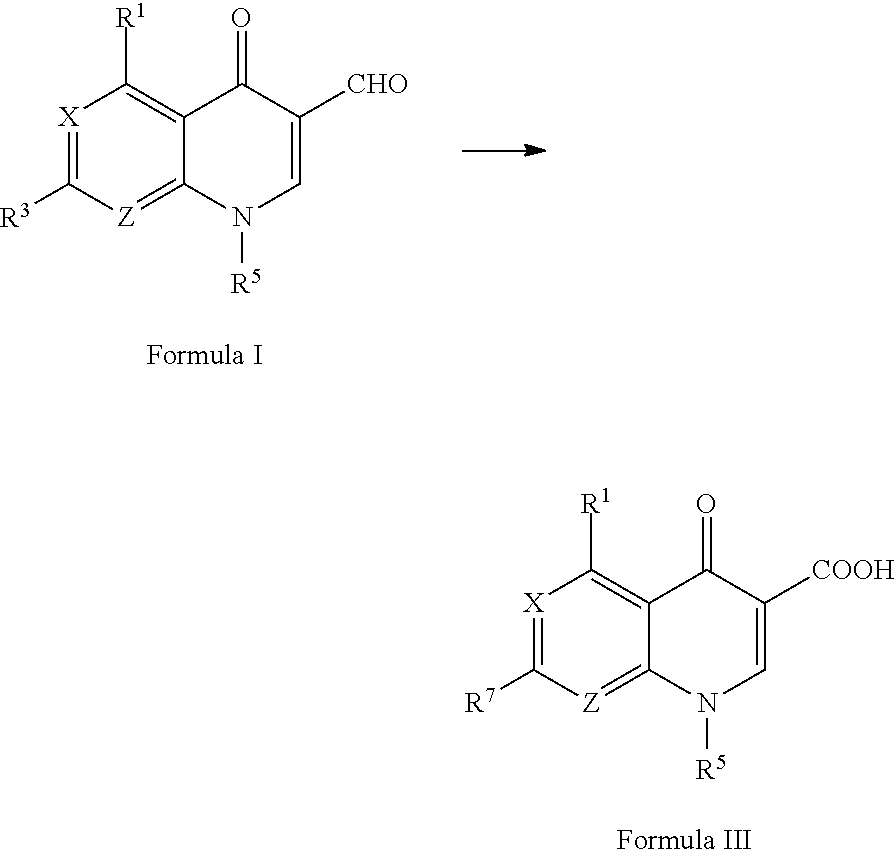
In a third aspect, the present application provides a process for the preparation of a compound of Formula II, comprising the steps of:
    • preparing a compound of Formula I according to the process of the first aspect or the process of the second aspect described above; and
    • oxidizing the compound of Formula I to generate the compound of Formula II,
Figure US12252473-20250318-C00007
    • wherein X, Z, R1, R2, R3, R4 and R5 in Formula II are as defined in Formula I.
In a fourth aspect, the present application provides a process for the preparation of a compound of Formula III, comprising the steps of:
    • preparing a compound of Formula II according to the process of the third aspect described above; and
    • reacting the compound of Formula II with an optionally substituted nitrogen-containing heterocyclic compound in the presence of a base to generate the compound of Formula III, or subjecting the compound of Formula II to a Stille coupling reaction to form the compound of Formula III,
Figure US12252473-20250318-C00008
    • wherein:
    • in Formula II, R2 and R3 do not form a ring, and R3 is halo;
    • in Formula III, X, Z, R1, R2, R4, and R5 are as defined in Formula II, and R7 is selected from the group consisting of optionally substituted N-heterocyclyl, optionally substituted heteroaryl, and optionally substituted aryl.
In a fifth aspect, the present application provides a process for the preparation of a compound of Formula IV, comprising the steps of:
    • preparing a compound of Formula II according to the process of the third aspect described above; and
    • reacting the compound of Formula II under a suitable condition to generate the compound of Formula IV,
Figure US12252473-20250318-C00009
    • wherein in Formula II, Z is CR4, R4 is halo or amino, and R6 is alkyl substituted with OH or SH;
    • wherein in Formula IV, X, R, R2 and R3 are as defined in Formula II, Y is O or S, and R1 is alkyl.
DETAILED DESCRIPTION
In a first aspect, the present application provides a process for the preparation of a compound of Formula I, comprising the steps of:
    • reacting a compound of Formula A with R5NH2 and R6Cl in the presence of a base to form the compound of Formula I,
Figure US12252473-20250318-C00010
    • wherein:
    • X is selected from the group consisting of CR2 and N;
    • Z is selected from the group consisting of CR4 and N;
    • R1 is independently selected from the group consisting of hydrogen, alkyl, alkoxy, halo, NO2, CN, optionally substituted amino, haloalkyl, aryl, and heteroaryl;
    • R2 and R3 are each independently selected from the group consisting of hydrogen, alkyl, alkoxy, halo, amino, N2, CN, haloalkyl, aryl, and heteroaryl; or R2 and R3 are linked together to form a ring;
    • R4 is independently selected from the group consisting of hydrogen, alkyl, alkoxy, halo, amino, NO2, CN, haloalkyl, aryl, and heteroaryl;
    • R5 is independently selected from the group consisting of alkyl optionally substituted with OH or SH; cycloalkyl optionally substituted with halo; aryl; and heteroaryl; and
    • R6 is independently selected from sulfonyl.
In some embodiments, the base is selected from the group consisting of inorganic bases, organic bases, and combinations thereof.
In some embodiments, the base is selected from primary amines.
In some embodiments, the base is selected from the group consisting of potassium carbonate, cesium carbonate, sodium carbonate, sodium hydroxide, lithium tert-butoxide, sodium methoxide, sodium bicarbonate, sodium hydride, triethylamine, diisopropylamine, 1,8-diazabicyclo[5.4.0]undec-7-ene (DBU), 1,4-diazabicyclo[2.2.2]octane (DABCO), and combinations thereof.
In some embodiments, the base is selected from the group consisting of potassium carbonate, cesium carbonate, sodium carbonate, and combinations thereof.
In some embodiments, the reaction is carried out in a solvent.
In some embodiments, the reaction is carried out in a solvent selected from the group consisting of methanol, ethanol, acetonitrile, toluene, water, N,N-dimethylformamide, xylene, nitrobenzene, trifluorotoluene, N-methylpyrrolidone, 1,2-dichloroethane, 1,4-dioxane, and combinations thereof.
In some embodiments, the reaction is carried out in a solvent selected from the group consisting of N,N-dimethylformamide, N-methylpyrrolidone, and a combination thereof.
In some embodiments, the reaction is carried out at a temperature of 80° C.-200° C. (e.g., 80° C., 90° C., 100° C., 110° C., 120° C., 130° C., 140° C., 150° C., 160° C., 170° C., 180° C., 190° C., or 200° C.) or 100° C.-150° C.
In a second aspect, the present application provides a process for the preparation of a compound of Formula I, comprising the steps of:
    • i) reacting a compound of Formula A with R5NH2 and R6Cl in the presence of a base to form a compound of Formula B, and
    • ii) reacting the compound of Formula B in the presence of a base to form the compound of Formula I,
    • wherein the reaction of step ii) is carried out at a temperature higher than a reaction temperature of step i);
Figure US12252473-20250318-C00011
    • wherein:
    • X is selected from the group consisting of CR2 and N;
    • Z is selected from the group consisting of CR4 and N;
    • R1 is independently selected from the group consisting of hydrogen, alkyl, alkoxy, halo, NO2, CN, optionally substituted amino, haloalkyl, aryl, and heteroaryl;
    • R2 and R3 are each independently selected from the group consisting of hydrogen, alkyl, alkoxy, halo, amino, NO2, CN, haloalkyl, aryl, and heteroaryl; or R2 and R3 are linked together to form a ring;
    • R4 is independently selected from the group consisting of hydrogen, alkyl, alkoxy, halo, amino, NO2, CN, haloalkyl, aryl, and heteroaryl;
    • R5 is independently selected from the group consisting of alkyl optionally substituted with OH or SH; cycloalkyl optionally substituted with halo; aryl; and heteroaryl; and
    • R6 is independently selected from sulfonyl.
In some embodiments, the base in step i) is selected from the group consisting of inorganic bases, organic bases, and combinations thereof. In some embodiments, the base in step i) is selected from primary amines, preferably excess primary amines.
In some embodiments, the base in step i) is selected from the group consisting of potassium carbonate, cesium carbonate, sodium carbonate, sodium hydroxide, lithium tert-butoxide, sodium methoxide, sodium bicarbonate, sodium hydride, triethylamine, diisopropylamine, 1,8-diazabicyclo[5.4.0]undec-7-ene, 1,4-diazabicyclo[2.2.2]octane, and combinations thereof.
In some embodiments, the base in step i) is selected from the group consisting of lithium tert-butoxide, potassium carbonate, cesium carbonate, sodium carbonate, sodium bicarbonate, triethylamine, diisopropylamine, 1,8-diazabicyclo[5.4.0]undec-7-ene, and combinations thereof.
In some embodiments, the reaction of step i) is carried out in a first solvent.
In some embodiments, the reaction of step i) is carried out in a first solvent selected from the group consisting of methanol, ethanol, acetonitrile, toluene, water, dimethyl sulfoxide, N,N-dimethylformamide, 1,4-dioxane, and combinations thereof.
In some embodiments, the reaction of step i) is carried out at a temperature ranging from room temperature to 150° C. (e.g., 20° C., 25° C., 30° C., 35° C., 40° C., 45° C., 50° C., 55° C., 60° C., 65° C., 70° C., 75° C., 80° C., 85° C., 90° C., 95° C., 100° C., 105° C., 110° C., 115° C., 120° C., 125° C., 130° C., 135° C., 140° C., 145° C., or 150° C.) or from room temperature to 100° C.
In some embodiments, the base in step ii) is selected from inorganic bases.
In some embodiments, the base in step ii) is selected from the group consisting of potassium carbonate, cesium carbonate, sodium carbonate, sodium hydroxide, lithium tert-butoxide, sodium methoxide, sodium bicarbonate, sodium hydride, and combinations thereof.
In some embodiments, the base in step ii) is selected from the group consisting of potassium carbonate, cesium carbonate, sodium carbonate, and combinations thereof.
In some embodiments, the reaction of step ii) is carried out in a second solvent, wherein the second solvent and the first solvent may be the same or different.
In some embodiments, the reaction of step ii) is carried out in a second solvent selected from the group consisting of xylene, nitrobenzene, trifluorotoluene, 1,2-dichloroethane, acetonitrile, toluene, dimethylsulfoxide, N,N-dimethylfomamide, 1,4-dioxane, N-methylpyrrolidone, and combinations thereof.
In some embodiments, the reaction of step ii) is carried out in a second solvent selected from the group consisting of N-methylpyrrolidone, N,N-dimethylformamide, and a combination thereof.
In some embodiments, the reaction of step ii) is carried out at a temperature of 100° C.-200° C. (e.g., 100° C., 105° C., 110° C., 115° C., 120° C., 125° C., 130° C., 135° C., 140° C., 145° C., 150° C., 155° C., 160° C., 165° C., 170° C., 175° C., 180° C., 185° C., 190° C., 195° C., or 200° C.) or 100° C.-150° C.
In some embodiments, X is selected from CR2.
In some embodiments, X is selected from N.
In some embodiments, Z is selected from CR4.
In some embodiments, Z is selected from N.
In some embodiments, R1 is independently selected from the group consisting of hydrogen, C1-6 alkyl, C1-6 alkoxy, halo, NO2, CN, optionally substituted amino, C1-6 haloalkyl, C6-12 aryl, and C2-12 heteroaryl.
In some embodiments, R1 is independently selected from the group consisting of hydrogen, C1-4 alkyl, C1-4 alkoxy, halo, NO2, CN, optionally substituted amino, C1-4 haloalkyl, C6-10 aryl, and C2-10 heteroaryl.
In some embodiments, R6 is independently selected from the group consisting of hydrogen, alkyl, and amino.
In some embodiments, R6 is independently selected from the group consisting of hydrogen, and alkyl.
In some embodiments, R6 is independently selected from the group consisting of hydrogen, methyl, methoxy, F, Cl, Br, I, NO2, CN, CF3, and amino.
In some embodiments, R1 is independently selected from the group consisting of hydrogen, methyl, and amino.
In some embodiments, R1 is independently selected from the group consisting of hydrogen, and methyl.
In some embodiments, R2 and R3 are each independently selected from the group consisting of hydrogen, C1-6 alkyl, C1-6 alkoxy, halo, amino, NO2, CN, C1-6 haloalkyl, C6-12 aryl, and C2-12 heteroaryl.
In some embodiments, R2 and R3 are linked together to form a 3- to 12-membered ring, e.g., a 5- to 12-membered non-aromatic heterocycle.
In some embodiments, R2 and R3 are each independently selected from the group consisting of hydrogen, C1-4 alkyl, C1-4 alkoxy, halo, amino, NO2, CN, C1-4 haloalkyl, C6-10 aryl, and C2-10 heteroaryl.
In some embodiments, R2 and R3 are linked together to form a 5- to 10-membered ring, e.g., a 5- to 10-membered non-aromatic heterocycle.
In some embodiments, R2 and R3 are each independently selected from the group consisting of hydrogen, methyl, methoxy, F, Cl, Br, I, amino, NO2, CN, and CF3.
In some embodiments, R2 and R3 are each independently selected from the group consisting of hydrogen, halo, and amino.
In some embodiments, R2 and R3 are each independently selected from the group consisting of hydrogen, and halo.
In some embodiments, R2 and R3 form a 5- to 7-membered non-aromatic heterocycle, such as 1,3-dioxole.
In some embodiments, R4 is independently selected from the group consisting of hydrogen, C1-6 alkyl, C1-6 alkoxy, halo, amino, NO2, CN, C1-6 haloalkyl, C6-12 aryl, and C2-12 heteroaryl.
In some embodiments, R4 is independently selected from the group consisting of hydrogen, C1-4 alkyl, C1-4 alkoxy, halo, amino, NO2, CN, C1-4 haloalkyl, C6-10 aryl, and C2-10 heteroaryl.
In some embodiments, R4 is independently selected from the group consisting of hydrogen, alkyl, alkoxy, halo, amino, and CN.
In some embodiments, R4 is independently selected from the group consisting of hydrogen, methyl, methoxy, F, Cl, Br, I, NH2, NO2, CN, and CF3.
In some embodiments, R4 is independently selected from the group consisting of hydrogen, methyl, methoxy, F, Cl, NH2, and CN.
In some embodiments, R4 is independently selected from the group consisting of hydrogen, methyl, methoxy, F, Cl, and CN.
In some embodiments, R4 is independently selected from halo or amino.
In some embodiments, R4 is independently selected from halo.
In some embodiments, R5 is independently selected from the group consisting of hydrogen; C1-6 alkyl optionally substituted with OH or SH; 3- to 12-membered cycloalkyl optionally substituted with halo; C6-12 aryl; and C2-12 heteroaryl.
In some embodiments, R1 is independently selected from the group consisting of C1-6 alkyl optionally substituted with OH or SH; 3- to 12-membered cycloalkyl optionally substituted with halo; C6-12 aryl; and C2-12 heteroaryl.
In some embodiments, R6 is independently selected from hydrogen; C1-4 alkyl optionally substituted with OH or SH; 3- to 8-membered cycloalkyl optionally substituted with halo; C6-10 aryl; and C2-10 heteroaryl.
In some embodiments, R1 is independently selected from the group consisting of hydrogen; alkyl optionally substituted with OH or SH; and cycloalkyl optionally substituted with halo.
In some embodiments, R5 is independently selected from the group consisting of alkyl optionally substituted with OH or SH, and cycloalkyl optionally substituted with halo.
In some embodiments, R5 is independently selected from the group consisting of hydrogen, ethyl, cyclopropyl, fluorocyclopropyl, tert-butyl, —(CH2)2OH, —(CH2)2SH, —CH(CH3)CH2OH, and —CH(CH3)CH2SH.
In some embodiments, R5 is independently selected from the group consisting of ethyl, cyclopropyl, fluorocyclopropyl, tert-butyl, —(CH2)2SH, and —CH(CH3)CH2OH.
In some embodiments, R5 is independently selected from the group consisting of ethyl, cyclopropyl, fluorocyclopropyl, and tert-butyl.
In some embodiments, R6 is independently selected from the group consisting of p-toluenesulfonyl and ethylsulfonyl.
In some embodiments, the halo is selected from the group consisting of F, Cl, Br, and I.
In some embodiments, at least one of R2 and R3 is halo.
In some embodiments, R3 is halo.
In some embodiments, the compound of Formula I is selected from the group consisting of:
Figure US12252473-20250318-C00012
Figure US12252473-20250318-C00013
Figure US12252473-20250318-C00014
In a third aspect, the present application provides a process for the preparation of a compound of Formula II, comprising the steps of:
    • preparing a compound of Formula I according to the process of the first aspect or the process of the second aspect described above; and
    • oxidizing the compound of Formula I to generate the compound of Formula II,
Figure US12252473-20250318-C00015
    • wherein X, Z, R1, R2, R3, R4 and R5 in Formula II are as defined in Formula I.
In some embodiments, the oxidation is carried out in the presence of an oxidant selected from the group consisting of potassium permanganate, sodium chlorite/sulfamic acid, potassium peroxymonosulfate, trichloroisocyanuric acid/TEMPO, manganese dioxide, sodium hypochlorite, hydrogen peroxide, sodium bromate, and combinations thereof.
In some embodiments, the compound of Formula II is selected from the group consisting of:
Figure US12252473-20250318-C00016
Figure US12252473-20250318-C00017
Figure US12252473-20250318-C00018
In a fourth aspect, the present application provides a process for the preparation of a compound of Formula III, comprising the steps of
    • preparing a compound of Formula II according to the process of the third aspect described above; and
    • reacting the compound of Formula II with an optionally substituted nitrogen-containing heterocyclic compound in the presence of a base to generate the compound of Formula III, or subjecting the compound of Formula II to a Stille coupling reaction to form the compound of Formula III,
Figure US12252473-20250318-C00019
    • wherein:
    • in Formula II, R2 and R3 do not form a ring, and R3 is halo; preferably R3 is bromo or chloro;
    • in Formula III, X, Z, R1, R2, R4, and R5 are as defined in Formula II, and R7 is selected from the group consisting of optionally substituted N-heterocyclyl, optionally substituted heteroaryl, and optionally substituted aryl. It will be appreciated by those skilled in the art that reacting a compound of Formula II with an optionally substituted nitrogen-containing heterocyclic compound in the presence of a base may produce a compound of Formula III wherein R6 is selected from optionally substituted N-heterocyclyl. When it is desired to prepare a compound of Formula III wherein R1 is selected from optionally substituted heteroaryl or optionally substituted aryl, the compound of Formula III wherein R7 is selected from optionally substituted heteroaryl or optionally substituted aryl may be generated by subjecting the compound of Formula II to a Stille coupling reaction.
In some embodiments, the optionally substituted nitrogen-containing heterocyclic compound is selected from nitrogen-containing heterocyclic compounds optionally substituted with one or more substituents selected from the group consisting of alkyl optionally substituted with NH2; ═N(alkoxy); alkoxy; cycloalkyl; hydroxy; and optionally substituted amino.
In some embodiments, the optionally substituted nitrogen-containing heterocyclic compound is selected from the group consisting of piperidine, piperazine, tetrahydropyrrole, pyrrolomorpholine, pyrrolopiperidine, azaspiro[2.4]heptane, and azepane, each optionally substituted with one or more substituents selected from the group consisting of C1-6 alkyl optionally substituted with NH2; ═N(C1-6 alkoxy); C1-6 alkoxy; 3- to 7-membered cycloalkyl; hydroxy; and NH2; wherein said NH2 is optionally substituted with one or more groups selected from C1-6 alkyl.
In some embodiments, R7 is selected from the group consisting of N-heterocyclyl, heteroaryl, and aryl, each optionally substituted with one or more substituents selected from the group consisting of alkyl optionally substituted with NH2; ═N(alkoxy); alkoxy; cycloalkyl; hydroxy; alkylamido optionally substituted with alkyl; and optionally substituted amino.
In some embodiments, R7 is selected from the group consisting of 5- to 12-membered N-heterocyclyl, C2-12 heteroaryl, and C6-12 aryl, each optionally substituted with one or more substituents selected from the group consisting of C1-6 alkyl optionally substituted with NH2; ═N(C1-6 alkoxy); C1-6 alkoxy; 3- to 7-membered cycloalkyl; hydroxy; C1-6 alkylamido optionally substituted with C1-6 alkyl; and NH2 optionally substituted with one or more C1-6 alkyl.
In some embodiments, R7 is selected from 5- to 12-membered N-heterocyclyl optionally substituted with one or more substituents selected from the group consisting of C1-6 alkyl optionally substituted with NH2; ═N(C1-6 alkoxy); 3- to 7-membered cycloalkyl; hydroxy; and NH2 optionally substituted with one or more C1-6 alkyl.
In some embodiments, R7 is selected from C2-12 heteroaryl (e.g., pyridyl) optionally substituted with one or more substituents selected from the group consisting of C1-6 alkyl; C1-6 alkylamido optionally substituted with C1-6 alkyl; and NH2 optionally substituted with one or more C1-6 alkyl.
In some embodiments, the N-heterocyclyl is N-heterocycloalkyl.
In some embodiments, R7 is selected from the group consisting of:
Figure US12252473-20250318-C00020
In some embodiments, the compound of Formula III is selected from the group consisting of:
Figure US12252473-20250318-C00021
Figure US12252473-20250318-C00022
Figure US12252473-20250318-C00023
Figure US12252473-20250318-C00024
In a fifth aspect, the present application provides a process for the preparation of a compound of Formula IV, comprising the steps of:
    • preparing a compound of Formula II according to the process of the third aspect described above; and
    • reacting the compound of Formula II under nucleophilic substitution conditions to generate the compound of Formula IV,
Figure US12252473-20250318-C00025
    • wherein in Formula II, Z is CR4, R4 is halo or amino, and R5 is alkyl substituted with OH or SH;
    • wherein in Formula IV, X, R, R2 and R3 are as defined in Formula II, Y is O or S, and R1 is alkyl.
In some embodiments, R4 is fluoro.
In some embodiments, R5 is C1-6 alkyl substituted with OH or SH.
In some embodiments, R6 is C1-4 alkyl substituted with OH or SH.
In some embodiments, R5 is ethyl or isopropyl each substituted with OH or SH.
In some embodiments, R1 is C1-6 alkyl.
In some embodiments, R1 is C1-4 alkyl.
In some embodiments, R1 is ethyl or isopropyl.
In some embodiments the compound of Formula IV is selected from the group consisting of:
Figure US12252473-20250318-C00026
It is to be understood that the above-mentioned embodiments may be combined to form a technical solution comprising the features of the combined embodiments without conflict. Such combined solutions are within the scope of the present disclosure.
Definitions
The following definitions and methods are provided to better define the present application and to guide those of ordinary skill in the art in the practice of the present application. Unless otherwise indicated, terms are to be understood in accordance with conventional usage of those of ordinary skill in the relevant field.
The term “comprise” and English variations thereof (such as comprises or comprising) should be understood in an open and non-exclusive sense, i.e. “including but not limited to”.
The term “optional” or “optionally” means that the subsequently described event or circumstance may or may not occur, and that the description includes instances where said event or circumstance occurs and instances where said event or circumstance does not occurs.
The oxidant “sodium chlorite/sulfamic acid” refers to an oxidant consisting of both sodium chlorite and sulfamic acid.
Where a range of numerical values is described herein, the range includes the endpoints thereof and all the individual integers and fractions within the range, and also includes each of narrower ranges therein formed by all the various possible combinations of those endpoints and internal integers and fractions, so as to form subgroups of larger groups of values within the stated range to the same extent as if each of those narrower ranges is explicitly described. For example, the expression that the reaction temperature is 80° C.-200° C. means that the reaction temperature may be, for example, 80° C., 90° C., 100° C., 110° C., 120° C., 130° C., 140° C., 150° C., 160° C., 170° C., 180° C., 190° C., or 200° C., etc., and ranges therebetween.
The numerical range herein indicating the number of carbon atoms refers to each of the integers within this given range. For example, “C1-C12” or “C1-12” means that this group may have 1, 2, 3, 4, 5, 6, 7, 8, 9, 10, 11, 12 carbon atoms.
The term “membered” refers to the number of skeleton atoms constituting the ring. For example, “3- to 12-membered” means that the number of skeleton atoms constituting the ring is 3, 4, 5, 6, 7, 8, 9, 10, 11, or 12.
The term “halo” or “halogen” itself or as a part of another substituent refers to fluorine (F), chlorine (Cl), bromine (Br) or iodine (I) atom.
The term “alkyl” refers to a linear or branched saturated hydrocarbon group. Examples of alkyl include C1-4 alkyl, C1-6 alkyl, C1-8 alkyl, C1-10 alkyl, C1-12 alkyl, and the like, such as methyl (Me), ethyl (Et), propyl (e.g., n-propyl and isopropyl), butyl (e.g., n-butyl, isobutyl, s-butyl, and t-butyl), pentyl (e.g., n-pentyl, isopentyl, and neopentyl), and the like. For example, the term “C1-6 alkyl” refers to an alkyl group containing 1 to 6 (e.g., 1, 2, 3, 4, 5, or 6) carbon atoms (such as methyl, ethyl, n-propyl, isopropyl, n-butyl, isobutyl, sec-butyl, tert-butyl, n-pentyl, 1-methylbutyl, 2-methylbutyl, 3-methylbutyl, neopentyl, hexyl, and 2-methylpentyl, and the like).
The term “alkoxy” refers to —O-alkyl, wherein “alkyl” is defined as above, and examples of “alkoxy” include, but are not limited to, methoxy, ethoxy, n-propoxy, isopropoxy, n-butoxy, sec-butoxy, tert-butoxy, n-pentoxy, and isopentoxy. “Optionally substituted alkoxy” means that the alkyl group in the alkoxy group is substituted or unsubstituted.
The term “alkenyl” refers to a linear or branched unsaturated aliphatic hydrocarbon group having at least one double bond consisting of carbon atoms and hydrogen atoms, such as C2-6 alkenyl, C2-4 alkenyl, and the like. Non-limiting examples of alkenyl groups include, but are not limited to, ethenyl, 1-propenyl, 2-propenyl, 1-butenyl, isobutenyl, 1,3-butadienyl, and the like. This term includes cis- and trans-isomers or mixtures of these isomers.
The term “alkynyl” refers to a linear or branched unsaturated aliphatic hydrocarbon group having at least one triple bond consisting of carbon atoms and hydrogen atoms, such as C2-6 alkynyl, C2-4 alkynyl, C2-3 alkynyl, and the like. Non-limiting examples of alkynyl groups include, but are not limited to, ethynyl (—C≡CH), 1-propynyl (—C≡C—CH3), 2-propynyl (—CH2—C≡CH), 1,3-butyldiynyl (—C≡C—C≡CH), and the like.
The term “cycloalkyl” refers to a fully saturated non-aromatic ring consisting of carbon atoms and hydrogen atoms, preferably comprising 1 or 2 rings. The cycloalkyl group may be a monocyclic, fused polycyclic, bridged cyclic or spirocyclic structure. Non-limiting examples of cycloalkyl include, but are not limited to, C3-18 is cycloalkyl, C3-16 cycloalkyl, C3-12 cycloalkyl, C3-10 cycloalkyl, C3-8 cycloalkyl, C3-7 cycloalkyl, C3-6 cycloalkyl, etc., such as cyclopropyl, cyclobutyl, cyclopentyl, cyclohexyl, cycloheptyl, spiro[3.3]heptyl, norbornyl(bicyclo[2.2.1]heptyl), bicyclo[2.2.2]octyl, adamantyl, bicyclo[1.1.1]pent-1-yl, and the like.
The term “heterocycloalkyl” refers to a cyclic group that is fully saturated and may exist as a monocyclic, bridged cyclic or spirocyclic ring. Unless otherwise indicated, the heterocycle is typically a ring containing 1 to 5 (e.g., 1, 2, 3, 4, or 5) heteroatoms independently selected from sulfur, oxygen, and/or nitrogen. Examples of 3-membered heterocycloalkyl include, but are not limited to, oxiranyl, thiiranyl, and aziridinyl; non-limiting examples of 4-membered heterocycloalkyl include, but are not limited to, azetidinyl, oxetanyl, and thietanyl: examples of 5-membered heterocycloalkyl include, but are not limited to, tetrahydrofuranyl, tetrahydrothienyl, pyrrolidinyl, isoxazolidinyl, oxazolidinyl, isothiazolidinyl, thiazolidinyl, imidazolidinyl, and tetrahydropyrazolyl; examples of 6-membered heterocycloalkyl include, but are not limited to, piperidinyl, tetrahydropyranyl, tetrahydrothiopyranyl, morpholinyl, piperazinyl, 1,4-thioxanyl, 1,4-dioxanyl, thiomorpholinyl, 1,3-dithianyl and 1,4-dithianyl; and examples of 7-membered heterocycloalkyl include, but are not limited to, azepanyl, oxepanyl, and thiepanyl.
The term “N-heterocycloalkyl” refers to a group having the following structure:
Figure US12252473-20250318-C00027
    • wherein ring A is a heterocycloalkyl ring as defined above comprising said nitrogen, i.e., a heterocycloalkyl comprising N as an attachment point.
Unless otherwise indicated, the term “heterocyclyl” or “heterocycle” refers to a cyclic structure that may be saturated or partially unsaturated, and non-aromatic, wherein the cyclic structure contains at least one carbon and at least one heteroatom (e.g., 1, 2, 3, 4, or 5 heteroatoms) selected from the group consisting of O, N, and S, and examples of heterocyclyl include heterocycloalkyl, heterocycloalkenyl, and heterocycloalkynyl.
The term “N-heterocyclyl” refers to a group having the following structure:
Figure US12252473-20250318-C00028
    • wherein ring B is a heterocyclyl ring as defined above comprising said nitrogen, namely, a heterocyclyl comprising N as an attachment point. 5- to 12-membered N-heterocyclyl is a heterocyclyl containing, for example, 5, 6, 7, 8, 9, 10, 11, or 12 ring-forming atoms. “Optionally substituted N-heterocyclyl” means that the heterocyclyl moiety in this group is substituted or unsubstituted.
The term “nitrogen-containing heterocyclic compound” refers to a compound comprising or consisting of a heterocyclic ring as defined above containing nitrogen as a ring-forming atom.
The term “cycloalkenyl” refers to a non-aromatic monocyclic or polycyclic ring system containing at least one carbon-carbon double bond. In some embodiments, the cycloalkenyl ring contains, for example, 3-10 ring atoms, 5 to 10 ring atoms, or 5 to 7 ring atoms. Non-limiting examples of suitable monocyclic cycloalkenyl include cyclo pentenyl, cyclohexenyl, cycloheptenyl, etc. A non-limiting example of a suitable polycyclic cycloalkenyl is norbornenyl.
The term “heterocycloalkenyl” refers to a non-aromatic monocyclic or polycyclic ring system containing at least one carbon-carbon or carbon-nitrogen double bond and consisting solely of carbon and hydrogen atoms, wherein one or more ring atoms in the ring system are elements in addition to carbon. For example, 1, 2, 3, 4, or 5 ring atoms are each independently heteroatoms selected from the group consisting of nitrogen, oxygen, and sulfur. There are no adjacent oxygen and/or sulfur atoms in the ring system. In some embodiments, the heterocycloalkenyl ring contains, for example, 5 to 10 ring atoms, 5 to 8 ring atoms, 5 to 7 ring atoms, or 5 to 6 ring atoms. The prefix “aza, oxa or thia” before the heterocycloalkenyl root name means that at least one nitrogen, oxygen or sulfur atom is present as a ring atom, respectively. Non-limiting examples of suitable monocyclic azacycloalkenyl groups include 1,2,3,4-tetrahydropyridinyl, 1,2-dihydropyridyl, 1,4-dihydropyridyl, 1,2,3,6-tetrahydropyridinyl, 1,4,5,6-tetrahydropyrimidinyl, 2-pyrrolidinyl, 3-pyrrolidinyl, 2-imidazolinyl, 2-pyrazolinyl, and the like. Non-limiting examples of suitable oxacycloalkenyl groups include 3,4-dihydro-2H-pyran, dihydrofuranyl, fluorodihydrofuranyl, and the like. Non-limiting example of a suitable polycyclic oxacycloalkenyl group is 7-oxabicyclo[2.2.1]heptenyl.
The term “cycloalkynyl” refers to a non-aromatic monocyclic or polycyclic ring having at least one carbon-carbon triple bond and consisting solely of carbon and hydrogen atoms, for example a 4- to 15-membered, 5- to 15-membered, 6- to 10-membered, 7- to 10-membered or 8- to 10-membered ring, such as a 8- to 10-membered monocyclic ring or 12- to 15-membered bicyclic ring. It may comprise one or more fused or bridged rings. Unless otherwise stated, the cycloalkynyl ring may be attached at any carbon atom, which results in a stable structure, and if substituted, it may be substituted at any suitable carbon atom, which results in a stable structure. Exemplary cycloalkynyl groups include cyclooctynyl, cyclononenyl, cyclodecenyl, 2-methylcyclooctynyl, and the like.
The term “heterocycloalkynyl” means that at least one carbon-carbon single bond in a heterocycloalkyl group is replaced with one carbon-carbon triple bond.
The term “aryl” or “aromatic ring” refers to an aromatic ring or an aromatic or partially aromatic ring system consisting of a carbon atom and a hydrogen atom. It may be a monocyclic or polycyclic ring (e.g., two or more rings, such as bicyclic ring) where the rings are fused together or covalently linked. Non-limiting examples of aryl include, but are not limited to, phenyl, naphthyl, anthracenyl, and 1,2,3,4-tetrahydronaphthyl, and the like. Depending on the structure, the aryl group may be a monovalent group or a divalent group, i.e., an arylene group.
The term “C6-C18 aryl” or “aromatic ring” refers to an aryl or aromatic ring as defined above having 6 to 18 carbon atoms (e.g., 6, 7, 8, 9, 10, 11, 12, 13, 14, 15, 16, 17 or 18 carbon atoms).
“Heteroaryl” or “heteroaromatic ring” refers to an aromatic cyclic group consisting of carbon atoms and at least one (e.g., 1 to 5, such as 1, 2, 3, 4, or 5) heteroatom selected from the group consisting of nitrogen, oxygen, and sulfur. The heteroaryl group may be a monocyclic, bicyclic, tricyclic or tetracyclic ring system, which may comprise fused or bridged ring systems. Moreover, the nitrogen, carbon or sulphur atom in the heteroaryl group may be optionally oxidized, and the nitrogen atom may be optionally quaternized. Examples of heteroaryl groups include, but are not limited to, azepinyl, acridinyl, benzimidazolyl, benzothiazolyl, benzindolyl, benzothiadiazolyl, benzonaphthofuranyl, benzoxazolyl, benzodioxolyl, benzodioxinyl, benzopyranyl, benzopyronyl, benzofuranyl, benzofuranonyl, benzothiophenyl, benzotriazolyl, benzo[4,6]imidazo[1,2-a]pyridinyl, carbazolyl, cinnolinyl, dibenzofuranyl, furanyl, thienyl, furanonyl, isothiazolyl, imidazolyl, indolyl, indazolyl, isoindolyl, indolinyl, isoindolinyl, indolizinyl, isoxazolyl, naphthyridinyl, oxadiazolyl, 2-oxoazepinyl, oxazolyl, oxiranyl, phenazinyl, phenothiazinyl, phenoxazinyl, 2,3-naphthyridinyl, pteridinyl, purinyl, pyrrolyl, pyrazolyl, pyridinyl, pyrazinyl, pyrimidinyl, pyridazinyl, quinazolinyl, quinoxalinyl, quinolyl, quinuclidinyl, isoquinolyl, thiazolyl, thiadiazolyl, triazolyl, tetrazolyl, triazinyl and thiophenyl.
The term “C2-C12 heteroaryl” refers to an aromatic cyclic group having at least one heteroatom (e.g., 2, 3, 4, or 5 heteroatoms) selected from the group consisting of N, O, and S as a ring-forming atom in addition to 2 to 12 carbon atoms (e.g., 1, 2, 3, 3, 4, 4, 5, 6, 7, 8, 9, 10, 11, or 12 carbon atoms).
The term “carbocycle” refers to an aromatic or non-aromatic (partially or fully saturated) carbocycle, such as C3-7 carbocycle, C5-7 carbocycle, C5-12 carbocycle, C5-10 monocyclic carbocycle, and the like. Examples of carbocycle include cycloalkyl, cycloalkenyl, cycloalkynyl, and aryl, such as cyclopropane, cyclobutane, cyclopentane, cyclohexane, cycloheptane, cyclobutene, cyclopentene, cyclohexene, cycloheptene, cyclobutadiene, cyclopentadiene, cyclohexadiene, cycloheptadiene, or benzene ring.
The term “cyclic group” or “ring”, such as a 3- to 12-membered cyclic group or a 3- to 12-membered ring, includes a C3-12 carbocyclic ring, a 3- to 12-membered heterocyclic ring and a 6- to 12-membered aromatic ring or a 5- to 12-membered heteroaromatic ring. The carbocyclic, heterocyclic, aromatic and heteroaromatic rings herein have the same definitions as above, and examples thereof include: pyrroline, pyrrolidine, imidazoline, imidazolidine, triazolidine, triazolidine, tetrazoline, tetrazolidine, pyrazoline, pyrazolidine, dihydropyridine, tetrahydropyridine, piperidine, dihydropyrazine, tetrahydropyrazine, piperazine, dihydropyrimidine, tetrahydropyrimidine, perhydropyrimidine, dihydropyridazine, tetrahydropyridazine, perhydropyridazine, dihydroazepine, tetrahydroazepine, perhydroazepine, dihydrodiazepine, tetrahydrodiazepine, perhydrodiazepine, dihydrofuran, tetrahydrofuran, dihydropyran, tetrahydropyran, dihydrooxepine, tetrahydrooxepine, perhydroxepine, dihydrothiophene, tetrahydrothiophene, dihydrothiopyran, tetrahydrothiopyran, dihydrothiepine, tetrahydrothiepine, perhydrothiepine, dihydrozole, tetrahydrozole (azolidine), dihydroisozole, tetrahydroisozole (isazolidine), dihydrothiazole, tetrahydrothiazole (thiazolidine), dihydroisothiazole, tetrahydroisothiazole (isothiazolidine), dihydrofurazan, tetrahydrofurazan, dihydrodiazole, tetrahydrodiazole (diazolidine), dihydrozine, tetrahydrozine, dihydrodiazine, tetrahydrodiazine, dihvdrooxazepine, tetrahydrooxazepine, perhydrooxazepine, dihydrooxadiazepine, tetrahydrooxadiazepine, perhydrooxadiazepine, dihydrothiadiazole, tetrahydrothiadiazole (thiadiazolidine), dihydrothiazine, tetrahydrothiazine, dihydrothiadiazine, tetrahydrothiadiazine, dihydrothiazepine, tetrahydrothiazepine, perhydrothiazepine, dihydrothiadiazepine, tetrahydrothiadiazepine, perhydrothiadiazepine, morpholine, thiomorpholine, thiazine, dioxolane, dioxane, dithiolane, dithiane, pyrrole, imidazole, triazole, tetrazole, pyrazole, pyridine, piperazine, pyrimidine, pyridazine, azepine, diazepine, furan, pyran, oxane, thiophene, thiopyran, thiane, azole, isozole, thiazole, isothiazole, furazan, diazole, zine, diazine, thiadiazole, thiazine, thiadiazine, thiazepine, or thiodiazepine rings.
In the present specification,
Figure US12252473-20250318-C00029

means the connection position.
The term “optionally substituted amino” refers to —NH2, mono- or di-substituted amino, and 5- to 7-membered cyclic amino, such as, an amino group optionally substituted with one or more substituents selected from C1-6 alkyl (such as methyl).
The term “primary amine” refers to a compound formed by the substitution of one hydrogen in an ammonia molecule with a hydrocarbyl group R″, wherein R″ is optionally substituted alkyl, optionally substituted aryl, or optionally substituted heteroaryl as defined above. In some embodiments, R″ is alkyl, haloalkyl, aryl, heteroaryl, alkylaryl, or alkylheteroaryl. In some embodiments, R″ is C1-6alkyl, C1-6 haloalkyl, C6-12 aryl, C2-C12 heteroaryl, C1-6 alkyl C6-12 aryl, or C1-6 alkyl C2-C12 heteroaryl. In some embodiments, R″ is alkyl or haloalkyl. In some embodiments, R″ is C1-6 alkyl.
The term “acyl” as used herein refers to a group having the structure —C(O)R″, wherein R″ is as defined above. The term “optionally substituted acyl” means that the R″ moiety in this group is substituted or unsubstituted.
The term “sulfonyl” as used herein refers to a group having the structure —SO2R″, wherein R″ is as defined above. The term “optionally substituted sulfonyl” means that the R″ moiety in this group is substituted or unsubstituted.
The term “alkylamido” as used herein refers to a group having the formula —NHC(O)—Ri, wherein Ri is an alkyl group as defined above. For example, C1-7 alkylamido refers to an alkylamido having 1 to 7 carbon atoms (excluding the carbon atom of the carbonyl). The term “optionally substituted alkylamido” means that the NH moiety and/or the alkyl moiety in the alkylamido is optionally substituted. Examples of optionally substituted alkylamido include, but are not limited to, —N(alkyl)C(O)-Ri.
The term “optionally substituted” means that the group is unsubstituted or substituted with one or more (e.g., 1 to 4, 1 to 3, or 1 to 2) substituents. When the group is substituted, the substituents are individually and independently selected from one or more of halo, hydroxy, alkyl, haloalkyl, hydroxyalkyl, alkenyl, alkynyl, cycloalkyl, aryl, heteroaryl, heterocyclyl, alkoxy, aryloxy, heteroaryloxy, mercapto, alkylthio, arylthio, cyano, carbonyl, thiocarbonyl, alkylamido, 0-carbamoyl, N-carbamoyl, O-thiocarbamoyl, N-thiocarbamoyl, C-amido, N-amido, S-sulfinamido, N-sulfinamido, carboxyl, C-carboxyl, O-carboxyl, isocyanato, cyanothio, isothiocyanato, nitro, ester group, silyl, trihalomethanesulfonyl, amino including mono- and di-substituted amino groups, protected derivatives thereof, and the like. These listed substituents may be further optionally substituted with alkyl or halo. Whenever a group is described as being “optionally substituted”, the group may be substituted with one of the above substituents.
When a group is substituted with more than one substituent, the substituents may be the same or different, and any substituted functional group herein may be substituted at 1 to 4 different positions, and those 1 to 4 substituents may be each independently substituted at 1 to 4 positions.
It is known to those skilled in the art that the processes of the present disclosure may comprise, when necessary, steps for the protection and deprotection of certain groups, and that the commonly used protecting groups (e.g., protecting groups of hydroxy group, thiol group, and amino group), the principles for the selection of the protecting groups and the methods for deprotection are well known in the art.
The inventions of the present application provide the following advantages:
The present application can realize a one-pot preparation of intermediates of quinolones without the need to isolate the intermediates, and directly obtain structurally complex molecules, which is more economically favourable and environmentally friendly.
In addition, the processes of the present disclosure have the advantages of short reaction steps, good selectivity and high yield, and the yields of the quinolone drugs or intermediates thereof obtained by the processes of the present disclosure are not less than 55%, not less than 60%, not less than 70%, or not less than 80%, and sometimes even 90% or more. Moreover, raw materials are cheap and easily available.
EXAMPLES
Specific embodiments of the present disclosure are described in further detail below in conjunction with the examples. The following examples are used for illustrative purposes only and are not intended to limit the scope of the present application.
Example 1 Synthesis of Ciprofloxacin and Grepafloxacin Analogs
Figure US12252473-20250318-C00030
The specific procedure for the synthesis of ciprofloxacin was as follows: 6,7-Difluoro-3-formylchromone (0.5 mmol), cyclopropylamine (1.2 mmol), p-toluenesulfonyl chloride (0.5 mmol) were firstly added in water (5.0 mL) in a 25 mL round bottom flask. After the reaction was performed at 100° C. for 5 h, the reaction was detected by thin layer chromatography. The reaction was completed when no 6,7-difluoro-3-formylchromone and p-toluenesulfonyl chloride remained. Then the reaction solution was cooled to room temperature, and extracted with ethyl acetate for three times (15.0 mL each time). The organic phase was dried over anhydrous sodium sulfate, and then separated by column chromatography to give the target compound 1 in a yield of 67%. 1H NMR (400 MHz, CDCl3) δ 11.16-10.86 (m, 1H), 9.05 (d, J=1.5 Hz, 1H), 8.07 (s, 1H), 7.63 (dt, J=8.4, 1.7 Hz, 2H), 7.23 (ddd, J=9.8, 8.4, 1.5 Hz, 1H), 7.18-7.07 (m, 1H), 3.00 (ddq, J=32.7, 7.6, 3.7 Hz, 1H), 2.46 (s, 3H), 1.05-0.91 (m, 2H), 0.92-0.79 (m, 2H). 13C NMR (101 MHz, CDCl3) δ 190.54, 189.16, 187.40, 186.74, 160.57, 151.98, 149.44, 147.71, 147.58, 146.22, 146.05, 141.48, 141.39, 131.78, 131.67, 130.42, 129.98, 129.94, 128.53, 118.34, 118.15, 117.95, 117.76, 113.43, 113.29, 113.23, 113.08, 110.39, 77.35, 77.24, 77.04, 76.72, 31.14, 30.99, 21.82, 21.81, 6.70, 6.61. HRMS (ESI) calcd for C20H18F2NO5S [M+H]+ 422.0868, found: 422.0871.
Compound 1 (0.2 mmol) was dissolved in dimethyl sulfoxide (DMSO), and then to the system was added sodium hydroxide (0.4 mmol). The reaction system was heated to 120° C. and reacted for 6 hours. The reaction was then detected by thin layer chromatography, and when no starting materials remained, the reaction solution was cooled to room temperature, and then extracted with ethyl acetate for three times (15 mL each time). The organic phase was dried over anhydrous sodium sulfate, and then separated by column chromatography to give the target compound 2 in a yield of 89%. 1H NMR (400 MHz, CDCl3) δ 10.36 (s, 1H), 8.43 (s, 1H), 8.27 (dd, J=10.1, 8.6 Hz, 1H), 7.80 (dd, J=11.2, 6.3 Hz, 1H), 3.49 (t, J=3.7 Hz, 1H), 1.40 (d, J=6.8 Hz, 2H), 1.25-1.14 (in, 2H). 13C NMR (101 MHz, CDCl3) δ 188.94, 175.36, 154.95, 154.81, 152.40, 152.25, 150.25, 150.12, 147.74, 147.60, 145.93, 138.16, 138.06, 126.17, 126.12, 126.09, 116.79, 115.09, 115.07, 114.91, 114.88, 106.35, 106.13, 99.98, 77.35, 77.24, 77.04, 76.86, 76.72, 76.54, 35.12, 8.24. HRMS (ESI) calcd for C13H10F2NO2[M+H]+ 250.0674, found: 250.0679.
Compound 2 (0.2 mmol) was dissolved in a mixture of 1,4-dioxane and H2O (3 mL, 2:1), and sodium hydroxide and potassium permanganate (0.4 mmol each) were weighed and added into the reaction solution. The reaction was stirred at room temperature for 7 hours, and then detected by thin layer chromatography. When no starting materials remained, the solvents were evaporated to dryness, and then the residue was separated by column chromatography to give the target compound 3 in a yield of 57%. The compound 3 (0.2 mmol), piperazine (0.22 mmol) and triethylamine (0.22 mmol) were dissolved in 5 mL DMSO. The reaction system was heated to 150° C. under microwave conditions, stirred for 0.5 h, and then detected by thin layer chromatography. When no starting materials remained, the reaction solution was cooled to room temperature. The reaction solution was finally recrystallized in methanol to obtain ciprofloxacin 4 in a yield of 63%. 1H NMR (400 MHz, D2O) δ 8.29 (s, 1H), 7.23 (d, J=7.1 Hz, 1H), 7.02 (d, J=12.9 Hz, 1H), 3.42 (d, J=33.8 Hz, 8H), 1.28 (d, J=6.5 Hz, 2H), 1.00 (s, 2H). 3C NMR (101 MHz, D2O) δ 175.28, 168.41, 154.31, 151.81, 147.84, 144.50, 144.40, 138.62, 118.20, 118.12, 110.39, 110.16, 106.25, 105.24, 46.18, 46.13, 43.09, 36.02, 7.40. HRMS (ESI) calcd for C17H19FN3O3[M+H]+ 322.1405, found: 322.1410.
In addition, the grepafloxacin analog 5 (yield: 72%) was isolated and obtained under the same conditions except that the piperazine was replaced with 2-methylpiperazine in this step. 1H NMR (400 MHz, DMSO-d6) δ 8.64 (s, 1H), 7.87 (d, J=13.3 Hz, 1H), 7.53 (d, J=7.4 Hz, 1H), 3.90-3.79 (m, 1H), 3.58 (s, 2H), 3.36 (s, 2H), 3.08 (s, 2H), 2.98 (d, J=8.7 Hz, 2H), 2.69 (s, 1H), 1.31 (d, J=6.8 Hz, 2H), 1.22-1.15 (m, 2H), 1.11 (d, J=6.3 Hz, 3H). 3C NMR (101 MHz, DMSO) δ 176.76, 176.73, 166.39, 154.62, 152.15, 148.37, 145.65, 145.55, 139.65, 118.94, 118.86, 111.51, 111.28, 107.14, 106.72, 106.68, 56.22, 50.48, 49.43, 44.90, 36.32, 18.85, 8.04, 8.01. HRMS (ESI) calcd for C18H20FN3O3[M+H]+ 346.1562, found: 346.1569.
Example 2 Synthesis of Norfloxacin and Pefloxacin
Figure US12252473-20250318-C00031
The specific procedure for the synthesis of norfloxacin was as follows:
To acetonitrile (5.0 mL) in a 25 mL round bottom flask were firstly added 6,7-difluoro-3-formylchromone (0.5 mmol), ethylamine (0.5 mmol), and p-toluenesulfonyl chloride (0.5 mmol), and then to the reaction system was added potassium carbonate (0.6 mmol). After the addition was completed, the reaction system was heated to 60° C., and reacted for 5 hours, and then detected by thin layer chromatography. When no 6,7-difluoro-3-phenylchromone remained, the reaction was completed (Intermediate 6 did not need to be isolated in this step). Potassium carbonate (0.6 mmol) was additionally added to the reaction system, and then the reaction system was heated to 120° C. and reacted for 8 hours. The reaction was monitored by thin layer chromatography. After completion of the reaction, the reaction solution was cooled to room temperature, and then extracted with ethyl acetate for three times (15 mL each time). The organic phase was dried over anhydrous sodium sulfate, and then separated by column chromatography to give the target compound 7 in a yield of 55%. 1H NMR (400 MHz, DMSO-d6) δ 10.14 (s, 1H), 8.64 (s, 1H), 8.21-8.02 (m, 2H), 4.43 (q, J=7.1 Hz, 2H), 1.37 (t, J=7.1 Hz, 3H). 13C NMR (101 MHz, DMSO-d6) δ 188.46, 174.58, 148.16, 137.02, 136.92, 126.74, 116.53, 114.05, 113.88, 108.23, 108.01, 49.25, 14.77. HRMS (ESI) calcd for C12H10F2NO2[M+H]+ 238.0647, found: 238.0652.
Compound 7 (0.2 mmol) was dissolved in water/DCM (3.0 mL, 1:2), and sulfamic acid/sodium chlorite (0.8 mmol each) were weighed and added into the reaction solution. The reaction was stirred at room temperature for 7 hours, and then detected by thin layer chromatography. When no starting materials remained, the solvents were evaporated to dryness, and then the residue was separated by column chromatography to give the target compound 8 in a yield of 57%. 1H NMR (400 MHz, DMSO-d6) δ 14.87 (s, 1H), 9.09 (s, 1H), 8.43-8.20 (m, 2H), 4.58 (q, J=6.9 Hz, 2H), 1.39 (dd, J=13.0, 6.1 Hz, 3H). 13C NMR (101 MHz, DMSO-d6) δ 176.91, 166.06, 156.00, 150.29, 137.36, 113.96, 108.45, 108.3, 108.22, 50.04, 14.98. HRMS (ESI) calcd for C12H10F2NO2[M+H]+ 238.0647, found: 238.0652.
Compound 8 (0.2 mmol), piperazine (0.22 mmol) and triethylamine (0.22 mmol) were dissolved in 5 mL DMSO. The reaction system was heated to 150° C. under microwave conditions, stirred for 0.5 h, and then detected by thin layer chromatography. When no starting materials remained, the reaction solution was cooled to room temperature. The reaction solution was finally recrystallized in methanol to obtain norfloxacin 9 in a yield of 59%. 1H NMR (400 MHz, DMSO-d6) δ 8.93 (s, 1H), 7.84 (d, J=13.5 Hz, 1H), 7.12 (d, J=7.3 Hz, 1H), 4.58 (q, J=7.0 Hz, 2H), 3.32-3.12 (m, 4H), 3.00-2.69 (m, 4H), 1.42 (t, J=7.1 Hz, 3H). 13C NMR (101 MHz, DMSO-d6) δ 176.54, 176.52, 166.61, 154.58, 152.10, 148.82, 146.53, 146.43, 137.66, 119.43, 119.36, 111.62, 111.40, 107.48, 105.93, 105.90, 51.29, 51.25, 49.47, 45.87, 14.79. HRMS (ESI) calcd for C16H19FN3O3[M+H]+ 254.0632, found: 320.1405.
In addition, pefloxacin 10 (yield: 66%) was isolated and obtained under the same conditions except that the piperazine was replaced with 2-methylpiperazine in the last reaction step. 1H NMR (400 MHz, DMSO-d6) δ 15.37 (s, 1H), 8.95 (s, 1H), 7.90 (d, J=13.4 Hz, 1H), 7.17 (d, J=7.2 Hz, 1H), 4.59 (q, J=6.9 Hz, 2H), 2.53 (s, 2H), 2.26 (s, 2H), 1.42 (t, J=7.0 Hz, 3H). 13C NMR (101 MHz, DMSO-d6) δ 176.62, 166.61, 154.28, 152.05, 148.98, 145.89, 137.67, 119.65, 111.73, 111.50, 107.51, 106.28, 54.76, 49.76, 49.51, 46.16, 14.84. HRMS (ESI) m/z calcd for C17H21FN3O3 + (M+H)+ 334.1561, found: 334.1563.
Example 3 Synthesis of Ivacaftor
Figure US12252473-20250318-C00032
Figure US12252473-20250318-C00033
The specific procedure for the synthesis of ivacaftor was as follows:
The key intermediate 11 (yield: 71%) was directly synthesized using the one-pot process in Example 2. 1H NMR (400 MHz, CDCl3) δ 10.37 (s, 1H), 8.66 (s, 1H), 8.56 (d, J=7.9 Hz, 1H), 7.92 (d, J=8.8 Hz, 1H), 7.64 (t, J=7.7 Hz, 1H), 7.42 (t, J=7.5 Hz, 1H), 1.84 (s, 9H). 3C NMR (101 MHz, CDCl3) δ 188.66, 175.52, 142.13, 138.40, 130.65, 129.94, 126.95, 124.28, 119.37, 115.09, 62.73, 29.83. HRMS (ESI) m/z calcd for C14H16NO2 + (M+H)+ 230.1176, found: 230.1177.
Compound 11 (0.2 mmol) was dissolved in a solution of 50% HCl/acetonitrile (5.0 mL), and stirred at 80° C. for 6 hours, and then the reaction was detected by thin layer chromatography. When no starting materials remained, the solvent was evaporated to dryness, and then the residue was isolated by column chromatography to give product 12 in a yield of 62%. Oxidation of the aldehyde group to carboxyl group under the oxidation conditions of Example 2 gave the target compound 13 in a yield of 66%. 1H NMR (400 MHz, DMSO-d6) δ 15.36 (s, 1H), 13.51 (s, 1H), 8.90 (s, 1H), 8.30 (dd, J=8.2, 1.5 Hz, 1H), 7.89 (dd, J=6.8, 1.6 Hz, 1H), 7.88-7.78 (m, 1H), 7.61 (td, J=7.4, 6.6, 1.3 Hz, 1H). 13C NMR (101 MHz, DMSO-d6) δ 178.79, 166.85, 145.62, 139.90, 134.41, 126.68, 125.51, 124.85, 120.13, 108.02, 40.64, 40.59, 40.43, 40.38, 40.17, 39.96, 39.75, 39.64, 39.54, 39.33. HRMS (ESI) m/z calcd for C14H15NO2 + (M+H)+ 190.0499, found: 190.0501.
Compound 13 (0.2 mmol), O-benzotriazole-tetramethyluronium hexafluorophosphate (HBTU, 0.24 mmol), triethylamine (0.6 mmol) were weighed and dissolved in 3.0 mL DMF, and then to the reaction system was added 2-amino-3,5-di-tert-butylphenol (0.2 mmol). The reaction was carried out at room temperature for 6 h, and then detected by thin layer chromatography. When no starting materials remained, the solvent was evaporated to dryness and then the residue was separated by column chromatography to give ivacaftor 14 in a yield of 89%. 1H NMR (400 MHz, DMSO-d6) δ 12.89 (s, 1H), 11.82 (s, 1H), 9.21 (s, 1H), 8.87 (s, 1H), 8.33 (d, J=8.1 Hz, 1H), 7.85-7.79 (in, 1H), 7.76 (d, J=8.2 Hz, 1H), 7.52 (t, J=7.5 Hz, 1H), 7.17 (s, 1H), 7.10 (s, 1H), 1.38 (s, 9H), 1.36 (s, 9H). 13C NMR (101 MHz, DMSO-d6) δ 176.85, 163.27, 153.73, 144.63, 139.61, 133.98, 133.39, 132.73, 131.96, 126.45, 126.03, 125.61, 124.22, 119.58, 116.40, 111.34, 49.06, 34.80, 34.44, 31.03, 29.88. HRMS (ESI) calcd for C24H28N2O3[M+H]+ 393.2173, found: 393.2171.
Example 4 Synthesis of a Precursor of Ozenoxacin
Figure US12252473-20250318-C00034
The specific procedure for the synthesis of the precursor of ozenoxacin was as follows:
Precursor compound 15 of ozenoxacin can be rapidly constructed in a yield of 73% with reference to the synthetic method of the compound 3 in Example 1. 1H NMR (400 MHz, DMSO-d6) δ 14.69 (s, 1H), 8.87 (s, 1H), 8.06 (d, J=8.6 Hz, 1H), 7.85 (d, J=8.6 Hz, 1H), 4.49-4.31 (in, 1H), 2.92 (s, 3H), 1.22 (d, J=6.3 Hz, 2H), 0.93 (s, 2H). 13C NMR (101 MHz, DMSO-d6)13C NMR (101 MHz, DMSO) δ 178.16, 165.79, 153.50, 143.18, 133.92, 131.06, 129.11, 126.60, 125.11, 108.50, 55.58, 42.10, 23.05, 10.82. HRMS (ESI) m/z calcd for C14H14BrNO3 + (M+H)+ 322.0073, found: 322.0076.
Example 5 Synthesis of Oxolinic Acid
Figure US12252473-20250318-C00035
The specific procedure for the synthesis of oxolinic acid was as follows:
Oxolinic acid 16 (yield: 69%) was finally isolated and obtained with reference to the synthetic method of the compound 3 in Example 1. 1H NMR (400 MHz, DMSO-d6) δ 15.70 (s, 1H), 8.90 (s, 1H), 7.62 (d, J=11.1 Hz, 2H), 6.30 (s, 2H), 4.54 (q, J=7.0 Hz, 2H), 1.38 (t, J=7.1 Hz, 3H). 13C NMR (101 MHz, DMSO-d6) δ 176.46, 166.79, 154.20, 147.57, 137.42, 121.88, 107.81, 103.74, 102.33, 97.71, 50.04, 15.09. HRMS (ESI) m/z calcd for C13H12NO5 + (M+H)+ 262.0710, found: 262.0719.
Example 6 Synthesis of N-ethylquinolinone 19 from N-tert-butylquinolinone 17
Figure US12252473-20250318-C00036
The specific procedure for the synthesis of N-ethylquinolinone 19 was as follows:
Compound 17 (yield: 71%) was synthesized with reference to the synthetic method of the compound 7 in Example 2. 1H NMR (400 MHz, CDCl3) δ 10.37 (s, 1H), 8.66 (s, 1H), 8.56 (d, J=7.9 Hz, 1H), 7.92 (d, J=8.8 Hz, 1H), 7.64 (t, J=7.7 Hz, 1H), 7.42 (t, J=7.5 Hz, 1H), 1.84 (s, 9H). 13C NMR (101 MHz, CDCl3) δ 188.66, 175.52, 142.13, 138.40, 130.65, 129.94, 126.95, 124.28, 119.37, 115.09, 62.73, 29.83. HRMS (ESI) m/z calcd for C14H16NO2 + (M+H)+ 230.1176, found: 230.1177.
Compound 17 (0.2 mmol) was dissolved in a solution of 50% HCl/MeCN (5.0 mL), and the reaction system was heated to 80° C., and performed for 6 hours, and then detected by thin layer chromatography. When no starting materials remained, the solvent was evaporated to dryness to give crude product 18. To the reaction system were added potassium carbonate (0.6 mmol), iodoethane (0.22 mmol), and DMF (3.0 mL), and then the reaction system was reacted at 100° C. for 3 hours. The reaction was then detected by thin layer chromatography. When no starting materials remained, the solvent was evaporated to dryness, and then the residue was separated by column chromatography to give compound 19 in a yield of 92%. 1H NMR (400 MHz, CDCl3) δ 10.43 (s, 1H), 8.56 (dd, J=8.0, 1.6 Hz, 1H), 8.35 (s, 1H), 7.90-7.68 (m, 1H), 7.57-7.46 (m, 2H), 4.31 (q, J=7.2 Hz, 2H), 1.58 (t, J=7.2 Hz, 3H). 13C NMR (101 MHz, CDCl3) δ 189.50, 176.96, 145.50, 139.12, 133.26, 129.70, 127.67, 125.72, 117.28, 116.12, 77.35, 77.23, 77.03, 76.78, 76.71, 54.75, 49.20, 14.56. HRMS (ESI) calcd for C12H12NO2[M+H]+202.0863, found: 202.0867.
While the present disclosure has been described in detail above with reference to the general description and specific embodiments, it will be apparent to those skilled in the art that some modifications and improvements can be made on the basis of the present disclosure. Accordingly, such modifications and improvements as made without departing from the spirit of the present disclosure fall within the protection scope claimed by the present application.

Claims (12)

The invention claimed is:
1. A process for the preparation of a compound of Formula I, comprising the steps of:
reacting a compound of Formula A with R5NH2 and R6Cl in the presence of a base to form the compound of Formula I,
Figure US12252473-20250318-C00037
wherein:
X is selected from the group consisting of CR2 and N;
Z is selected from the group consisting of CR4 and N;
R1 is independently selected from the group consisting of hydrogen, alkyl, alkoxy, halo, NO2, CN, optionally substituted amino, haloalkyl, aryl, and heteroaryl;
R2 and R3 are each independently selected from the group consisting of hydrogen, alkyl, alkoxy, halo, amino, NO2, CN, haloalkyl, aryl, and heteroaryl; or R2 and R3 are linked together to form a ring;
R4 is independently selected from the group consisting of hydrogen, alkyl, alkoxy, halo, amino, NO2, CN, haloalkyl, aryl, and heteroaryl;
R5 is independently selected from the group consisting of alkyl optionally substituted with OH or SH; cycloalkyl optionally substituted with halo; aryl; and heteroaryl; and
R6 is independently selected from sulfonyl.
2. The process according to claim 1, wherein:
the base is selected from the group consisting of inorganic bases, organic bases, and combinations thereof; or
the base is selected from primary amines; or
the base is selected from the group consisting of potassium carbonate, cesium carbonate, sodium carbonate, sodium hydroxide, lithium tert-butoxide, sodium methoxide, sodium bicarbonate, sodium hydride, triethylamine, diisopropylamine, 1,8-diazabicyclo[5.4.0]undec-7-ene, 1,4-diazabicyclo[2.2.2]octane, and combinations thereof; or
the base is selected from the group consisting of potassium carbonate, cesium carbonate, sodium carbonate, and combinations thereof; or
the reaction is carried out in a solvent; or
the reaction is carried out in a solvent selected from the group consisting of methanol, ethanol, acetonitrile, toluene, water, N,N-dimethylformamide, xylene, nitrobenzene, trifluorotoluene, N-methylpyrrolidone, 1,2-dichloroethane, 1,4-dioxane, and combinations thereof, or
the reaction is carried out in a solvent selected from the group consisting of N,N-dimethylformamide, N-methylpyrrolidone, and a combination thereof; or
the reaction is carried out at a temperature of 80° C.-200° C. or 100° C.-150° C.
3. A process for the preparation of a compound of Formula I, comprising the steps of:
i) reacting a compound of Formula A with R5NH2 and R6Cl in the presence of a base to form a compound of Formula B, and
ii) reacting the compound of Formula B in the presence of a base to form the compound of Formula I,
wherein the reaction of step ii) is carried out at a temperature higher than the reaction temperature of step i);
Figure US12252473-20250318-C00038
wherein:
X is selected from the group consisting of CR2 and N;
Z is selected from the group consisting of CR4 and N;
R1 is independently selected from the group consisting of hydrogen, alkyl, alkoxy, halo, NO2, CN, optionally substituted amino, haloalkyl, aryl, and heteroaryl;
R2 and R3 are each independently selected from the group consisting of hydrogen, alkyl, alkoxy, halo, amino, NO2, CN, haloalkyl, aryl, and heteroaryl; or R2 and R3 are linked together to form a ring;
R4 is independently selected from the group consisting of hydrogen, alkyl, alkoxy, halo, amino, NO2, CN, haloalkyl, aryl, and heteroaryl;
R5 is independently selected from the group consisting of alkyl optionally substituted with OH or SH; cycloalkyl optionally substituted with halo; aryl; and heteroaryl; and
R6 is independently selected from sulfonyl.
4. The process according to claim 3, wherein:
the base in step i) is selected from the group consisting of inorganic bases, organic bases, and combinations thereof; or
the base in step i) is selected from primary amines, preferably excess primary amines; or
the base in step i) is selected from the group consisting of potassium carbonate, cesium carbonate, sodium carbonate, sodium hydroxide, lithium tert-butoxide, sodium methoxide, sodium bicarbonate, sodium hydride, triethylamine, diisopropylamine, 1,8-diazabicyclo[5.4.0]undec-7-ene, 1,4-diazabicyclo[2.2.2]octane, and combinations thereof; or
the base in step i) is selected from the group consisting of lithium tert-butoxide, potassium carbonate, cesium carbonate, sodium carbonate, sodium bicarbonate, triethylamine, diisopropylamine, 1,8-diazabicyclo[5.4.0]undec-7-ene, and combinations thereof; or
the reaction of step i) is carried out in a first solvent; or
the reaction of step i) is carried out in a first solvent selected from the group consisting of methanol, ethanol, acetonitrile, toluene, water, dimethyl sulfoxide, N,N-dimethylformamide, 1,4-dioxane, and combinations thereof; or
the reaction of step i) is carried out at a temperature ranging from room temperature to 150° C., or from room temperature to 100° C.
5. The process according to claim 3, wherein:
the base in step ii) is selected from inorganic bases; or
the base in step ii) is selected from the group consisting of potassium carbonate, cesium carbonate, sodium carbonate, sodium hydroxide, lithium tert-butoxide, sodium methoxide, sodium bicarbonate, sodium hydride, and combinations thereof, or the base in step ii) is selected from the group consisting of potassium carbonate, cesium carbonate, sodium carbonate, and combinations thereof; or
the reaction of step ii) is carried out in a second solvent; or
the reaction of step ii) is carried out in a second solvent selected from the group consisting of xylene, nitrobenzene, trifluorotoluene, 1,2-dichloroethane, acetonitrile, toluene, dimethylsulfoxide, N,N-dimethylformamide, 1,4-dioxane, N-methylpyrrolidone, and combinations thereof; or
the reaction of step ii) is carried out in a second solvent selected from the group consisting of N-methylpyrrolidone, N,N-dimethylformamide, and a combination thereof; or
the reaction of step ii) is carried out at a temperature of 100° C.-200° C., or 100° C.-150° C.
6. The process according to claim 1, wherein:
R1 is independently selected from the group consisting of hydrogen, C1-6 alkyl, C1-6 alkoxy, halo, NO2, CN, optionally substituted amino, C1-6 haloalkyl, C6-12 aryl, and C2-12 heteroaryl; or
R1 is independently selected from the group consisting of hydrogen, C1-4 alkyl, C1-4 alkoxy, halo, NO2, CN, optionally substituted amino, C1-4 haloalkyl, C6-10 aryl, and C2-10 heteroaryl; or
R1 is independently selected from the group consisting of hydrogen, methyl, methoxy, F, Cl, Br, I, NO2, CN, CF3, and amino; or
R1 is independently selected from the group consisting of hydrogen, alkyl, and amino; or
R1 is independently selected from the group consisting of hydrogen, methyl, and amino; or
R2 and R3 are each independently selected from the group consisting of hydrogen, C1-6 alkyl, C1-6 alkoxy, halo, amino, NO2, CN, C1-6 haloalkyl, C6-12 aryl, and C2-12 heteroaryl; or R2 and R3 are linked together to form a 3- to 12-membered ring, e.g., a 5- to 12-membered non-aromatic heterocycle; or
R2 and R3 are each independently selected from the group consisting of hydrogen, C1-4 alkyl, C1-4 alkoxy, halo, amino, NO2, CN, C1-4 haloalkyl, C6-10 aryl, and C2-10 heteroaryl; or R2 and R3 are linked together to form a 5- to 10-membered ring, e.g., a 5- to 10-membered non-aromatic heterocycle; or
R2 and R3 are each independently selected from the group consisting of hydrogen, methyl, methoxy, F, Cl, Br, I, amino, NO2, CN, and CF3; or
R2 and R3 are each independently selected from the group consisting of hydrogen, halo, and amino; or
R2 and R3 are each independently selected from the group consisting of hydrogen, and halo; or
R2 and R3 form a 5- to 7-membered non-aromatic heterocycle, such as 1,3-dioxole; or
R4 is independently selected from the group consisting of hydrogen, C1-6 alkyl, C1-6 alkoxy, halo, amino, NO2, CN, C1-6 haloalkyl, C6-12 aryl, and C2-12 heteroaryl; or
R4 is independently selected from the group consisting of hydrogen, C1-4 alkyl, C1-4 alkoxy, halo, amino, NO2, CN, C1-4 haloalkyl, C6-10 aryl, and C2-10 heteroaryl; or
R4 is independently selected from the group consisting of hydrogen, methyl, methoxy, F, Cl, Br, I, NH2, NO2, CN, and CF3; or
R4 is independently selected from the group consisting of hydrogen, alkyl, alkoxy, halo, NH2, and CN; or
R4 is independently selected from the group consisting of hydrogen, methyl, methoxy, F, C1, NH2, and CN; or
R5 is independently selected from the group consisting of hydrogen; C1-6 alkyl optionally substituted with OH or SH; 3- to 12-membered cycloalkyl optionally substituted with halo; C6-12 aryl; and C2-12 heteroaryl; or
R5 is independently selected from the group consisting of C1-6 alkyl optionally substituted with OH or SH; 3- to 12-membered cycloalkyl optionally substituted with halo; C6-12 aryl; and C2-12 heteroaryl; or
R5 is independently selected from hydrogen; C1-4 alkyl optionally substituted with OH or SH; 3- to 8-membered cycloalkyl optionally substituted with halo; C6-10 aryl; and C2-10 heteroaryl; or
R5 is independently selected from the group consisting of hydrogen; alkyl optionally substituted with OH or SH; and cycloalkyl optionally substituted with halo; or
R5 is independently selected from the group consisting of alkyl optionally substituted with OH or SH; and cycloalkyl optionally substituted with halo; or
R5 is independently selected from the group consisting of hydrogen, ethyl, cyclopropyl, fluorocyclopropyl, tert-butyl, —(CH2)2OH, —(CH2)2SH, —CH(CH3)CH2OH, and —CH(CH3)CH2SH; or
R5 is independently selected from the group consisting of ethyl, cyclopropyl, fluorocyclopropyl, tert-butyl, —(CH2)2SH, and —CH(CH3)CH2OH; or
R6 is independently selected from the group consisting of p-toluenesulfonyl and ethylsulfonyl; or
the halo is selected from the group consisting of F, Cl, Br, and I; or
at least one of R2 and R3 is halo; or
R3 is halo; or
the compound of Formula I is selected from the group consisting of:
Figure US12252473-20250318-C00039
Figure US12252473-20250318-C00040
7. A process for the preparation of a compound of Formula II, comprising the steps of:
preparing a compound of Formula I according to the process of claim 1; and
oxidizing the compound of Formula I to generate the compound of Formula II,
Figure US12252473-20250318-C00041
wherein X, Z, R1, R2, R3, R4 and R5 in Formula II are as defined in Formula I.
8. The process according to claim 7, wherein the compound of Formula II is selected from the group consisting of:
Figure US12252473-20250318-C00042
Figure US12252473-20250318-C00043
9. A process for the preparation of a compound of Formula III, comprising the steps of:
preparing a compound of Formula I according to the process of claim 1;
oxidizing the compound of Formula I to generate a compound of Formula II; and
reacting the compound of Formula II with an optionally substituted nitrogen-containing heterocyclic compound in the presence of a base to generate the compound of Formula III, or subjecting the compound of Formula II to a Stille coupling reaction to form the compound of Formula III,
Figure US12252473-20250318-C00044
wherein:
in Formula II, R2 and R3 do not form a ring, and R3 is halo; and
in Formula III, X, Z, R1, R2, R4, and R5 are as defined in Formula II, and R7 is selected from the group consisting of optionally substituted N-heterocyclyl, optionally substituted heteroaryl, and optionally substituted aryl.
10. The process according to claim 9, wherein:
the optionally substituted nitrogen-containing heterocyclic compound is selected from nitrogen-containing heterocyclic compounds optionally substituted with one or more substituents selected from the group consisting of alkyl optionally substituted with NH2; ═N (alkoxy); alkoxy; cycloalkyl; hydroxy; and optionally substituted amino; or
the optionally substituted nitrogen-containing heterocyclic compound is selected from the group consisting of piperidine, piperazine, tetrahydropyrrole, pyrrolomorpholine, pyrrolopiperidine, azaspiro[2.4]heptane, and azepane, each optionally substituted with one or more substituents selected from the group consisting of C1-6 alkyl optionally substituted with NH2; ═N(C1-6 alkoxy); C1-6 alkoxy; 3- to 7-membered cycloalkyl; hydroxy; and NH2; wherein said NH2 is optionally substituted with one or more groups selected from C1-6 alkyl; or
R7 is selected from the group consisting of N-heterocyclyl, heteroaryl, and aryl, each optionally substituted with one or more substituents selected from the group consisting of alkyl optionally substituted with NH2; ═N(alkoxy); alkoxy; cycloalkyl; hydroxy; alkylamido optionally substituted with alkyl; and optionally substituted amino; or
R7 is selected from the group consisting of 5- to 12-membered N-heterocyclyl, C2-12 heteroaryl, and C6-12 aryl, each optionally substituted with one or more substituents selected from the group consisting of C1-6 alkyl optionally substituted with NH2; ═N(C1-6 alkoxy); C1-6 alkoxy; 3- to 7-membered cycloalkyl; hydroxy; C1-6 alkylamido optionally substituted with C1-6 alkyl; and NH2 optionally substituted with one or more C1-6 alkyl; or
R7 is selected from 5- to 12-membered N-heterocyclyl optionally substituted with one or more substituents selected from the group consisting of C1-6 alkyl optionally substituted with NH2; ═N(C1-6 alkoxy); 3- to 7-membered cycloalkyl; hydroxy; and NH2 optionally substituted with one or more C1-6 alkyl; or
R7 is selected from C2-12 heteroaryl optionally substituted with one or more substituents selected from the group consisting of C1-6 alkyl; C1-6 alkylamido optionally substituted with C1-6 alkyl; and NH2 optionally substituted with one or more C1-6 alkyl; or
the N-heterocyclyl is N-heterocycloalkyl; or
R7 is selected from the group consisting of:
Figure US12252473-20250318-C00045
11. The process according to claim 9, wherein:
the compound of Formula III is selected from the group consisting of:
Figure US12252473-20250318-C00046
Figure US12252473-20250318-C00047
Figure US12252473-20250318-C00048
Figure US12252473-20250318-C00049
12. A process for the preparation of a compound of Formula IV, comprising the steps of:
preparing a compound of Formula I according to the process of claim 1
oxidizing the compound of Formula I to generate a compound of Formula II; and
reacting the compound of Formula II under a suitable condition to generate the compound of Formula IV,
Figure US12252473-20250318-C00050
wherein in Formula II, Z is CR4, R4 is halo or amino, and R5 is alkyl substituted with OH or SH;
wherein in Formula IV, X, R1, R2 and R3 are as defined in Formula II, Y is O or S, and R′ is alkyl;
wherein:
optionally, R5 is C1-6 alkyl substituted with OH or SH; or
optionally, R5 is C1-4 alkyl substituted with OH or SH; or
optionally, R5 is ethyl or isopropyl each substituted with OH or SH; or
optionally, the compound of Formula IV is selected from the group consisting of:
Figure US12252473-20250318-C00051
US18/261,960 2022-04-18 2022-05-05 Preparation methods of quinolone compounds and intermediates thereof Active US12252473B2 (en)

Applications Claiming Priority (3)

Application Number Priority Date Filing Date Title
CN202210437152.2A CN114702443B (en) 2022-04-18 2022-04-18 Preparation methods of quinolone compounds and intermediates
CN202210437152.2 2022-04-18
PCT/CN2022/090989 WO2023201780A1 (en) 2022-04-18 2022-05-05 Method for preparing quinolone compound and intermediate thereof

Publications (2)

Publication Number Publication Date
US20240400522A1 US20240400522A1 (en) 2024-12-05
US12252473B2 true US12252473B2 (en) 2025-03-18

Family

ID=82175224

Family Applications (1)

Application Number Title Priority Date Filing Date
US18/261,960 Active US12252473B2 (en) 2022-04-18 2022-05-05 Preparation methods of quinolone compounds and intermediates thereof

Country Status (3)

Country Link
US (1) US12252473B2 (en)
CN (1) CN114702443B (en)
WO (1) WO2023201780A1 (en)

Families Citing this family (1)

* Cited by examiner, † Cited by third party
Publication number Priority date Publication date Assignee Title
CN119874514A (en) * 2023-10-18 2025-04-25 帕潘纳(北京)科技有限公司 Synthesis method of fluoroquinolone drug intermediate

Citations (2)

* Cited by examiner, † Cited by third party
Publication number Priority date Publication date Assignee Title
CN102040591A (en) 2009-10-15 2011-05-04 山东轩竹医药科技有限公司 7-phenyl quinolone compounds
CN105130892A (en) 2015-08-19 2015-12-09 海门慧聚药业有限公司 Preparation for marbofloxacin key intermediate

Family Cites Families (4)

* Cited by examiner, † Cited by third party
Publication number Priority date Publication date Assignee Title
AU2001258718A1 (en) * 2000-05-09 2001-11-20 Natco Pharma Limited An improved process for the preparation of quinolone derivatives
TWI362386B (en) * 2007-03-30 2012-04-21 Daiichi Sankyo Co Ltd A production method for the qunolon-carboxylic acid derivative
CN102212056A (en) * 2010-04-09 2011-10-12 山东轩竹医药科技有限公司 Novel bicyclo-carbostyril compounds
CN107602465A (en) * 2016-07-12 2018-01-19 重庆大学 A kind of carbostyril derivative and its application

Patent Citations (2)

* Cited by examiner, † Cited by third party
Publication number Priority date Publication date Assignee Title
CN102040591A (en) 2009-10-15 2011-05-04 山东轩竹医药科技有限公司 7-phenyl quinolone compounds
CN105130892A (en) 2015-08-19 2015-12-09 海门慧聚药业有限公司 Preparation for marbofloxacin key intermediate

Non-Patent Citations (2)

* Cited by examiner, † Cited by third party
Title
Iaroshenko et al., "Synthesis of 4-quinolones, benzopyran derivatives and other fused systems based on the domino ANRORC reactions of (ortho-fluoro)-3-benzoylchromones," RSC Adv. 5:28717-28724 (2015).
Zhang et al., "Efficient Synthesis of 7H-Chromeno[3,2-c]quinoline-5-ium Salts and Quinolin-4-ones through Acid-Promoted Cascade Reaction of 3-Formylchromones and Anilines," ChemistrySelect 7:e202104611, 6 pages (2022).

Also Published As

Publication number Publication date
CN114702443A (en) 2022-07-05
US20240400522A1 (en) 2024-12-05
CN114702443B (en) 2023-09-19
WO2023201780A1 (en) 2023-10-26

Similar Documents

Publication Publication Date Title
CA2802216C (en) Tetrahydrocarboline derivative and its use as an enpp2 inhibitor
CN115448923B (en) Pyrimidine-fused ring compound, preparation method and application thereof
JP5624762B2 (en) Novel pyrrolinone derivative and pharmaceutical composition containing the same
WO2014146490A1 (en) Cycloalkyl nitrile pyrazolo pyridones as janus kinase inhibitors
JP2017518350A (en) Aminopyran ring derivatives and compositions and uses thereof
JP6673218B2 (en) Dihydronaphthalene derivative
US20240254117A1 (en) Pyrimido-heterocyclic compounds, and preparation method therefor and use thereof
US12252473B2 (en) Preparation methods of quinolone compounds and intermediates thereof
US9416142B2 (en) Griseofulvin derivatives
EP1791539B2 (en) Process to prepare camptothecin derivatives
WO2025153047A1 (en) Camptothecin derivative and preparation method therefor and use thereof
US20210253613A1 (en) Phosphorus imidazoquinoline amine derivatives, pharmaceutical compositions and therapeutic methods thereof
TWI890929B (en) Pyrimidine compound as wee-1 inhibitor
WO2022171126A1 (en) Fused ring compound used as wee-1 inhibitor
CN114163446B (en) A kind of PDE4 inhibitor with quinolinone skeleton and its preparation method and application
CN111065636B (en) Condensed heteroaryl derivatives, their preparation and their use in medicine
HK40069406A (en) Kras g12c inhibitor and medical use thereof
WO2024220874A2 (en) Otub1 small-molecule binders and otub1-recruiting deubiquitinase-targeting chimeras (dubtacs)
KR20250170567A (en) Substituted acetylene compound derivatives and pharmaceutical uses thereof
CN117800894A (en) Saturated cyclic derivative, pharmaceutical composition containing same and medical application of saturated cyclic derivative
CN117659022A (en) Ureido-substituted pyridine compounds, pharmaceutical compositions containing them and their medicinal uses
JP2009529575A (en) Pyridine-containing large heterocyclic compounds as kinase inhibitors

Legal Events

Date Code Title Description
FEPP Fee payment procedure

Free format text: ENTITY STATUS SET TO UNDISCOUNTED (ORIGINAL EVENT CODE: BIG.); ENTITY STATUS OF PATENT OWNER: SMALL ENTITY

AS Assignment

Owner name: CHONGQING UNIVERSITY OF ARTS AND SCIENCES, CHINA

Free format text: ASSIGNMENT OF ASSIGNORS INTEREST;ASSIGNORS:LEI, JIE;CHEN, ZHONGZHU;XU, ZHIGANG;AND OTHERS;SIGNING DATES FROM 20230714 TO 20230717;REEL/FRAME:064353/0425

FEPP Fee payment procedure

Free format text: ENTITY STATUS SET TO SMALL (ORIGINAL EVENT CODE: SMAL); ENTITY STATUS OF PATENT OWNER: SMALL ENTITY

STPP Information on status: patent application and granting procedure in general

Free format text: NON FINAL ACTION MAILED

STPP Information on status: patent application and granting procedure in general

Free format text: RESPONSE TO NON-FINAL OFFICE ACTION ENTERED AND FORWARDED TO EXAMINER

STPP Information on status: patent application and granting procedure in general

Free format text: NOTICE OF ALLOWANCE MAILED -- APPLICATION RECEIVED IN OFFICE OF PUBLICATIONS

STPP Information on status: patent application and granting procedure in general

Free format text: PUBLICATIONS -- ISSUE FEE PAYMENT VERIFIED

STCF Information on status: patent grant

Free format text: PATENTED CASE