US12245209B2 - Downlink (DL) and uplink (UL) scheduling for transmission above 52.6 GHz - Google Patents
Downlink (DL) and uplink (UL) scheduling for transmission above 52.6 GHz Download PDFInfo
- Publication number
- US12245209B2 US12245209B2 US17/439,680 US202017439680A US12245209B2 US 12245209 B2 US12245209 B2 US 12245209B2 US 202017439680 A US202017439680 A US 202017439680A US 12245209 B2 US12245209 B2 US 12245209B2
- Authority
- US
- United States
- Prior art keywords
- riv
- rivs
- base station
- lrb
- dci
- Prior art date
- Legal status (The legal status is an assumption and is not a legal conclusion. Google has not performed a legal analysis and makes no representation as to the accuracy of the status listed.)
- Active
Links
- 230000005540 biological transmission Effects 0.000 title description 30
- 238000000034 method Methods 0.000 claims abstract description 53
- 238000004891 communication Methods 0.000 claims abstract description 36
- 230000004044 response Effects 0.000 claims abstract description 7
- 230000011664 signaling Effects 0.000 claims description 25
- 238000013468 resource allocation Methods 0.000 description 26
- 238000003860 storage Methods 0.000 description 20
- 230000007246 mechanism Effects 0.000 description 17
- 238000013507 mapping Methods 0.000 description 8
- 238000004364 calculation method Methods 0.000 description 7
- 230000008569 process Effects 0.000 description 6
- 230000001413 cellular effect Effects 0.000 description 5
- 230000036541 health Effects 0.000 description 5
- 238000012545 processing Methods 0.000 description 5
- 230000002776 aggregation Effects 0.000 description 4
- 238000004220 aggregation Methods 0.000 description 4
- 238000005516 engineering process Methods 0.000 description 4
- 230000006870 function Effects 0.000 description 4
- 238000013461 design Methods 0.000 description 3
- 238000005259 measurement Methods 0.000 description 3
- 230000009467 reduction Effects 0.000 description 3
- 238000013459 approach Methods 0.000 description 2
- 230000008901 benefit Effects 0.000 description 2
- 239000000872 buffer Substances 0.000 description 2
- 230000008859 change Effects 0.000 description 2
- 238000004590 computer program Methods 0.000 description 2
- 230000001276 controlling effect Effects 0.000 description 2
- 238000013503 de-identification Methods 0.000 description 2
- 238000010586 diagram Methods 0.000 description 2
- 238000004519 manufacturing process Methods 0.000 description 2
- 230000003287 optical effect Effects 0.000 description 2
- 238000012546 transfer Methods 0.000 description 2
- 230000004931 aggregating effect Effects 0.000 description 1
- 238000004458 analytical method Methods 0.000 description 1
- 238000013500 data storage Methods 0.000 description 1
- 230000001419 dependent effect Effects 0.000 description 1
- 229940079593 drug Drugs 0.000 description 1
- 239000003814 drug Substances 0.000 description 1
- 238000011156 evaluation Methods 0.000 description 1
- 230000007774 longterm Effects 0.000 description 1
- 238000012986 modification Methods 0.000 description 1
- 230000004048 modification Effects 0.000 description 1
- 238000005457 optimization Methods 0.000 description 1
- 238000002360 preparation method Methods 0.000 description 1
- 230000001105 regulatory effect Effects 0.000 description 1
- 238000001228 spectrum Methods 0.000 description 1
- 238000010408 sweeping Methods 0.000 description 1
Images




Classifications
-
- H—ELECTRICITY
- H04—ELECTRIC COMMUNICATION TECHNIQUE
- H04W—WIRELESS COMMUNICATION NETWORKS
- H04W72/00—Local resource management
- H04W72/04—Wireless resource allocation
- H04W72/044—Wireless resource allocation based on the type of the allocated resource
- H04W72/0453—Resources in frequency domain, e.g. a carrier in FDMA
-
- H—ELECTRICITY
- H04—ELECTRIC COMMUNICATION TECHNIQUE
- H04L—TRANSMISSION OF DIGITAL INFORMATION, e.g. TELEGRAPHIC COMMUNICATION
- H04L27/00—Modulated-carrier systems
- H04L27/26—Systems using multi-frequency codes
- H04L27/2601—Multicarrier modulation systems
- H04L27/2602—Signal structure
- H04L27/26025—Numerology, i.e. varying one or more of symbol duration, subcarrier spacing, Fourier transform size, sampling rate or down-clocking
-
- H—ELECTRICITY
- H04—ELECTRIC COMMUNICATION TECHNIQUE
- H04L—TRANSMISSION OF DIGITAL INFORMATION, e.g. TELEGRAPHIC COMMUNICATION
- H04L5/00—Arrangements affording multiple use of the transmission path
- H04L5/0001—Arrangements for dividing the transmission path
- H04L5/0003—Two-dimensional division
- H04L5/0005—Time-frequency
- H04L5/0007—Time-frequency the frequencies being orthogonal, e.g. OFDM(A) or DMT
-
- H—ELECTRICITY
- H04—ELECTRIC COMMUNICATION TECHNIQUE
- H04L—TRANSMISSION OF DIGITAL INFORMATION, e.g. TELEGRAPHIC COMMUNICATION
- H04L5/00—Arrangements affording multiple use of the transmission path
- H04L5/003—Arrangements for allocating sub-channels of the transmission path
-
- H—ELECTRICITY
- H04—ELECTRIC COMMUNICATION TECHNIQUE
- H04L—TRANSMISSION OF DIGITAL INFORMATION, e.g. TELEGRAPHIC COMMUNICATION
- H04L5/00—Arrangements affording multiple use of the transmission path
- H04L5/003—Arrangements for allocating sub-channels of the transmission path
- H04L5/0044—Allocation of payload; Allocation of data channels, e.g. PDSCH or PUSCH
-
- H—ELECTRICITY
- H04—ELECTRIC COMMUNICATION TECHNIQUE
- H04L—TRANSMISSION OF DIGITAL INFORMATION, e.g. TELEGRAPHIC COMMUNICATION
- H04L5/00—Arrangements affording multiple use of the transmission path
- H04L5/003—Arrangements for allocating sub-channels of the transmission path
- H04L5/0053—Allocation of signalling, i.e. of overhead other than pilot signals
-
- H—ELECTRICITY
- H04—ELECTRIC COMMUNICATION TECHNIQUE
- H04L—TRANSMISSION OF DIGITAL INFORMATION, e.g. TELEGRAPHIC COMMUNICATION
- H04L5/00—Arrangements affording multiple use of the transmission path
- H04L5/0091—Signalling for the administration of the divided path, e.g. signalling of configuration information
- H04L5/0094—Indication of how sub-channels of the path are allocated
-
- H—ELECTRICITY
- H04—ELECTRIC COMMUNICATION TECHNIQUE
- H04W—WIRELESS COMMUNICATION NETWORKS
- H04W72/00—Local resource management
- H04W72/02—Selection of wireless resources by user or terminal
-
- H—ELECTRICITY
- H04—ELECTRIC COMMUNICATION TECHNIQUE
- H04W—WIRELESS COMMUNICATION NETWORKS
- H04W72/00—Local resource management
- H04W72/20—Control channels or signalling for resource management
- H04W72/23—Control channels or signalling for resource management in the downlink direction of a wireless link, i.e. towards a terminal
-
- H—ELECTRICITY
- H04—ELECTRIC COMMUNICATION TECHNIQUE
- H04L—TRANSMISSION OF DIGITAL INFORMATION, e.g. TELEGRAPHIC COMMUNICATION
- H04L5/00—Arrangements affording multiple use of the transmission path
- H04L5/003—Arrangements for allocating sub-channels of the transmission path
- H04L5/0048—Allocation of pilot signals, i.e. of signals known to the receiver
-
- H—ELECTRICITY
- H04—ELECTRIC COMMUNICATION TECHNIQUE
- H04L—TRANSMISSION OF DIGITAL INFORMATION, e.g. TELEGRAPHIC COMMUNICATION
- H04L5/00—Arrangements affording multiple use of the transmission path
- H04L5/003—Arrangements for allocating sub-channels of the transmission path
- H04L5/0048—Allocation of pilot signals, i.e. of signals known to the receiver
- H04L5/0051—Allocation of pilot signals, i.e. of signals known to the receiver of dedicated pilots, i.e. pilots destined for a single user or terminal
Definitions
- the described aspects generally relate to downlink (DL) and uplink (UL) scheduling in transmission above 52.6 GHz.
- some aspects of this disclosure relate to designs for frequency domain resource allocation (FDRA) and/or time domain resource allocation (TDRA).
- FDRA frequency domain resource allocation
- TDRA time domain resource allocation
- a user equipment (UE) communicating with a base station (for example, an evolved Node B (eNB), a next generation Node B (gNB), etc.) over a communication link can use an uplink control channel to transmit control and measurement information to the base station and can use an uplink data channel to transmit data to the base station.
- the base station can use a downlink control channel to transmit control information to the UE indicating how to use resources on the uplink channel(s).
- Some aspects of this disclosure relate to apparatuses and methods for implementing downlink (DL) and uplink (UL) scheduling in transmission above 52.6 GHz, e.g., for 3rd Generation Partnership Project (3GPP) releases, such as release 17 (Rel-17).
- 3GPP 3rd Generation Partnership Project
- the base station includes a transceiver configured to communicate over a wireless network with a user equipment (UE) and a processor communicatively coupled to the transceiver.
- the processor determines that the communication between the base station and the UE is in a frequency range including one or more frequencies above 52.6 GHz.
- the processor disables a frequency domain resource assignment (FDRA), modifies a Resource Block Group (RBG) size, or modifies a Resource Indication Value (RIV) determination.
- FDRA frequency domain resource assignment
- RBG Resource Block Group
- RIV Resource Indication Value
- the processor generates a Downlink Channel Indicator (DCI) based at least on one or more of the disabled FDRA, the modified RBG size, or the modified RIV determination.
- the processor transmits, using the transceiver, the DCI to the UE.
- FDRA frequency domain resource assignment
- RBG Resource Block Group
- RIV Resource Indication Value
- the processor is configured to set a bit width associated with the FDRA to zero. In some examples, to modify the RBG size, the processor is configured to modify the RBG size to a value greater than 16. In some examples, to modify the RBG size, the processor is further configured to modify a Physical Resource Block (PRB) bundling size.
- PRB Physical Resource Block
- the processor is configured to:
- the processor is configured to determine a minimum Allocated Resource Block (LRB) value and subtract the minimum LRB value from one or more LRB values to generate one or more modified LRB values.
- the processor is further configured to determine one or more RIVs using the one or more modified LRB values and signal an RIV to the UE using the determined one or more RIVs.
- LRB Allocated Resource Block
- the processor is configured to determine a plurality of RIVs, choose one or more RIVs from the plurality of RIVs for signaling information other than a RIV to the UE, and signal the RIV to the UE using remaining ones from the plurality of RIVs.
- the method incudes, in response to determining, by a base station, that communication between the base station and a user equipment (UE) is in a frequency range including one or more frequencies above 52.6 GHz, disabling a frequency domain resource assignment (FDRA), modifying a Resource Block Group (RBG) size, or modifying a Resource Indication Value (RIV) determination.
- the method further includes generating, by the base station, a Downlink Channel Indicator (DCI) based at least on one or more of the disabled FDRA, the modified RBG size, or the modified RIV determination and transmitting, by the base station, the DCI to the UE.
- DCI Downlink Channel Indicator
- Some aspects of this disclosure relate to a non-transitory computer-readable medium storing instructions.
- the instructions When the instructions are executed by a processor of a base station, the instructions cause the processor to perform operations including, in response to determining that communication between the base station and a user equipment (UE) is in a frequency range including one or more frequencies above 52.6 GHz, disabling a frequency domain resource assignment (FDRA), modifying a Resource Block Group (RBG) size, or modifying a Resource Indication Value (RIV) determination.
- the operations further include generating, by the base station, a Downlink Channel Indicator (DCI) based at least on one or more of the disabled FDRA, the modified RBG size, or the modified RIV determination and transmitting, by the base station, the DCI to the UE.
- DCI Downlink Channel Indicator
- the UE includes a transceiver configured to wirelessly communicate with a base station and a processor communicatively coupled to the transceiver.
- the processor receives, using the transceiver, a Downlink Channel Indicator (DCI) from the base station in a frequency range above 52.6 GHz.
- the DCI is generated based at least one of a disabled frequency domain resource assignment (FDRA), a modified Resource Block Group (RBG) size modified, or a modified Resource Indication Value (RIV) determination.
- FDRA disabled frequency domain resource assignment
- RBG Resource Block Group
- RMV Resource Indication Value
- the DCI includes a FDRA field including a bit width set to zero. In some examples, the modified RBG size is set to a value greater than 16. In some examples, the DCI includes a RIV determined from a plurality of RIVs from which one or more RIVs are eliminated. In some examples, the DCI includes a RIV determined from a plurality of RIVs and the plurality of RIVs are determine based on a modified Allocated Resource Block (LRB) value. In some examples, the DCI includes a RIV determined from a plurality of RIVs from which one or more RIVs are used for signaling information other than the RIV to the UE.
- LRB modified Allocated Resource Block
- Some aspects of this disclosure relate to a method performed by a user equipment (UE).
- the method includes receiving a Downlink Channel Indicator (DCI) from a base station in a frequency range above 52.6 GHz.
- the DCI is generated based at least one of a disabled frequency domain resource assignment (FDRA), a modified Resource Block Group (RBG) size modified, or a modified Resource Indication Value (RIV) determination.
- the method further includes communicating with the base station using information associated with the DCI.
- Some aspects of this disclosure relate to a non-transitory computer-readable medium storing instructions.
- the instructions When the instructions are executed by a processor of a user equipment (UE), the instructions cause the processor to perform operations including receiving a Downlink Channel Indicator (DCI) from a base station in a frequency range above 52.6 GHz.
- the DCI is generated based at least one of a disabled frequency domain resource assignment (FDRA), a modified Resource Block Group (RBG) size modified, or a modified Resource Indication Value (RIV) determination.
- the operations further include communicating with the base station using information associated with the DCI.
- FIG. 1 illustrates an example system implementing designs for implementing downlink (DL) and uplink (UL) scheduling in transmission above 52.6 GHz, according to some aspects of the disclosure.
- FIG. 2 A illustrates one exemplary shared Transport Block (TB) and time and frequency resource allocation, according to some aspects of the disclosure.
- FIG. 2 B illustrates one exemplary shared Transport Block (TB) and time and frequency resource allocation for multiple Transmit Time Interval (multi-TTI) (multi-TTI) PUSCH transmission, according to some aspects of the disclosure.
- TB Transport Block
- multi-TTI Multiple Transmit Time Interval
- FIG. 3 illustrates one exemplary enhanced TDRA Table for multi-TTI PUSCH scheduling, according to some aspects of this disclosure.
- FIG. 4 illustrates an exemplary table for Resource Indication Value (RIV), according to some aspects of this disclosure.
- FIG. 5 illustrates another exemplary table for Resource Indication Value (RIV), according to some aspects of this disclosure.
- FIG. 6 illustrates a block diagram of an example system of an electronic device implementing mechanisms for downlink (DL) and uplink (UL) scheduling in transmission above 52.6 GHz, according to some aspects of the disclosure.
- FIG. 7 illustrates an example method 700 for a system (for example, base station) supporting mechanisms for downlink (DL) and uplink (UL) scheduling in transmission above 52.6 GHz, according to some aspects of the disclosure.
- a system for example, base station
- DL downlink
- UL uplink
- FIGS. 8 A- 8 C illustrate example methods 800 , 820 , and 840 , respectively, for a system (for example, base station) supporting mechanisms for modifying Resource Indication Value (RV) determination in transmission above 52.6 GHz, according to some aspects of the disclosure.
- a system for example, base station
- RV Resource Indication Value
- FIG. 9 is an example computer system for implementing some aspects or portion(s) thereof.
- Some aspects of this disclosure include apparatuses and methods for implementing downlink (DL) and uplink (UL) scheduling in transmission above 52.6 GHz for 3rd Generation Partnership Project (3GPP) releases, such as release 17 (Rel-17) other present/future 3GPP standards.
- 3GPP 3rd Generation Partnership Project
- FIG. 1 illustrates an example system 100 implementing designs for implementing downlink (DL) and uplink (UL) scheduling for communication above 52.6 GHz, according to some aspects of the disclosure.
- Example system 100 is provided for the purpose of illustration only and does not limit the disclosed aspects.
- System 100 may include, but is not limited to, network node (for example, a base station such as eNB, gNB, etc.) 101 and electronic device (for example, a UE) 105 .
- Electronic device 105 (hereinafter referred to as UE 105 ) can include an electronic device configured to operate based on a wide variety of wireless communication techniques. These techniques can include, but are not limited to, techniques based on 3rd Generation Partnership Project (3GPP) standards.
- 3GPP 3rd Generation Partnership Project
- UE 105 can include an electronic device configured to operate using a 3GPP release, such as Release 17 (Rel-17), or other present/future 3GPP standards.
- UE 105 can include, but is not limited to, wireless communication devices, smart phones, laptops, desktops, tablets, personal assistants, monitors, televisions, wearable devices, Internet of Things (IoTs), vehicle's communication devices, and the like.
- Network node 101 (herein referred to as base station) can include nodes configured to operate based on a wide variety of wireless communication techniques such as, but not limited to, techniques based on 3GPP standards.
- base station 101 can include nodes configured to operate using a 3GPP release, such as Rel-17, or other present/future 3GPP standards.
- UE 105 can be connected to and can be communicating with base station 101 using one or more communication links 107 .
- Some aspects of this disclosure are directed to new numerology or numerologies (e.g., p value in 3GPP Technical Specification (TS) 38.211) for operation in the frequency range above 52.6 GHz (e.g., one or more frequencies in the frequency range of between about 52.6 GHz and about 71 GHz). Some aspects of this disclosure are directed to addressing impact(s) on physical signals/channels in the frequency range above 52.6 GHz.
- new numerology or numerologies e.g., p value in 3GPP Technical Specification (TS) 38.211
- TS Technical Specification
- some aspects of this disclosure discuss time line related aspects adapted to each of the new numerologies, for example, bandwidth part (BWP) and beam switching times, Hybrid Automatic Repeat Request (Hybrid ARQ or HARQ) scheduling, UE processing, preparation and computation times for Physical Downlink Shared Channel (PDSCH), Physical Uplink Shared Channel (PUSCH)/Sounding Reference Signal (SRS) and Channel State Information (CSI), and the like.
- Some aspects of this disclosure can support up to 64 Signal Block Beam (SSB) beams for licensed and unlicensed operation in the frequency range above 52.6 GHz.
- SSB Signal Block Beam
- some aspects of this disclosure can use channel access mechanism(s) assuming beam based operation in order to comply with the regulatory requirements applicable to unlicensed spectrum for frequencies between 52.6 GHz and 71 GHz.
- Some aspects of this disclosure are directed to frequency domain scheduling enhancements/optimization for PDSCH/PUSCH, such as, but not limited to, supporting UL scheduling if frequency domain resource allocation with different granularity than FR1/2 (e.g., sub-Physical Resource Block (PRB), or more than one PRB) is supported.
- Some aspects of this disclosure are directed to time domain scheduling enhancements for PDSCH/PUSCH, such as, but not limited to, increasing a minimum time-domain scheduling unit to be larger than one symbol, supporting multi-PDSCH scheduled by one Downlink Control Information (DCI), supporting one Transport Block (TB) mapped to multiple slots (i.e., Transmit Time Interval (TTI) bundling), and the like.
- DCI Downlink Control Information
- TTI Transmit Time Interval
- Some aspects of this disclosure are directed to enhancements and/or alternatives to the scheduling request mechanism to reduce scheduling latency due to beam sweeping.
- the DL and UL scheduling can include time domain scheduling (e.g., using Time Domain Resource Assignment (TDRA) field) and/or frequency domain scheduling (e.g., using Frequency Domain Resource Assignment (FDRA) field).
- TDRA field can be sent using DCI for DL and/or UL scheduling.
- base station 101 can transmit TDRA field using DCI to UE 105 .
- the TDRA field can define a pointer to a row in a lookup table configured by Radio Resource Control (RRC) message(s) and/or other 3GPP methods.
- RRC Radio Resource Control
- time domain scheduling can based on a Mapping Type A or a Mapping Type B.
- the resource allocation can be slot based and can include DeModulation Reference Signal (DMRS) symbols in symbol 2 (or 3 ).
- DMRS DeModulation Reference Signal
- the resource allocation can be mini-slot based and include front loaded DMRS.
- the time domain resource allocation can indicate slot offsets. For example, K0 can be used for DL and K2 can be used for UL. Additionally, or alternatively, the time domain resource allocation can also indicate Starting Symbol within slot (S) and length (L). In one example in Rel-15, time domain resource allocation does not cross slot boundary.
- the time domain resource allocation can also be coded in a single number called the Start and Length Indicator Value (SLIV).
- SIV Start and Length Indicator Value
- FDRA field can also be sent in DCI (DL and UL) and can define resource block allocation.
- base station 101 can transmit FDRA field using DCI to UE 105 .
- FDRA field can be sent using one or more of Type 0 DCI (non-fallback DCI only) and Type 1 DCI (fallback and non-fallback DCI).
- Radio Resource Control RRC
- T0, T1 or dynamic switch e.g., MSB (most significant bit) indicates the type).
- a BWP indicator can be used that identifies specific BWP for resource allocation (which can be used for BWP switching).
- Resource Allocation Type specifies the way in which a scheduler allocates resource blocks for each transmission.
- DL/UL Resource Allocation Type 0 can use bitmap to indicate a set of allocated Resource Block Groups (RBG).
- RBG can be a set of contiguous Virtual Resource Blocks (VRBs).
- RBG size can be dependent on BWP size and, in some examples, BWP size is configurable.
- Table 5.1.2.2.1-1 (Nominal RBG size P) and Table 6.1.2.2.1-1 (Nominal RBG size P) of TS 38.214 can indicate the RBG size based on BWP size for Configuration 1 or Configuration 2.
- the resource is allocated to one or more consecutive RBs.
- a Resource Indicator Value (RIV) is used to allocate a set of Virtual Resource Blocks (VRBs).
- VRBs may be mapped to interleaved (distributed RA) or non-interleaved (localized RA) Physical Resource Blocks (PRBs).
- interleaved VRBs can be mapped using Resource Block Bundles, for example, using set of contiguous RBs within a BWP, which is different from precoding granularity.
- a Resource Indicator Value (RIV) is used to allocate a set of VRBs mapped to a set of contiguous PRBs.
- the DL and UL scheduling can be considered with slot aggregation.
- the time domain resource allocation is not allowed to cross the slot border.
- latency to align slot boundary can be increased.
- the repetitions in the next slots use the same time domain resource allocation as the transmission in the first slot.
- the number of repetitions can be provided by numberOfRepetitions-r16 if it is present in the corresponding TDRA table.
- numberOfRepetitions-r16 is ⁇ 1, 2, 3, 4, 7, 8, 12, 16 ⁇ (3 bits), same as repetition Type B. Otherwise the number of repetitions can be determined following Rel-15 procedure (pusch-AggregationFactor for DG and repK for CG).
- system 100 using ULLRC PUSCH Repetition Type B, can support PUSCH repetitions in one slot or across multiple consecutive slots.
- system 100 can support both dynamic grant (DG) and configured grant (CG) (Type 1 and Type 2).
- base station 101 can schedule PUSCH Repetition Type B by DCI formats 0_1/0_2, not DCI format 0_0.
- base station 101 (e.g., using DCI) can set and communicate TDRA to UE 105 .
- Base station 101 can define TDRA using S (starting symbol), L (length of each nominal repetition), and K (number of nominal repetitions).
- TDRA field in DCI or Type 1 CG configuration can indicate one of the entries in the TDRA table, which provides the values for S, L and K.
- the PUSCH transmission from UE 105 can occur within the time window of L*K symbols, starting from the indicated starting symbol.
- Each nominal repetition may be segmented into one or more actual repetitions, depending on the slot boundaries and the UL/DL directions of the symbols. If a “nominal” repetition goes across the slot boundary or DL/UL switching point, this “nominal” repetition can split into multiple PUSCH repetitions, with one PUSCH repetition in each UL period in a slot.
- ULLRC PUSCH Repetition Type B no DMRS sharing across multiple repetitions occurs, only PUSCH mapping type B is supported, and TBS is determined based on L.
- multi-TTI PUSCH transmission in Rel-15 includes repeat transmission in time to support URLLC or to ensure UL coverage.
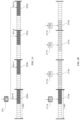
- FIG. 2 A illustrates one exemplary shared Transport Block (TB) and time and frequency resource allocation, according to some aspects of the disclosure.
- a Transport Block (TB) 201 can be scheduled for multiples slots 203 a - 203 d .
- mutli-TTI PUSCH transmission in Rel-16 NR-U can target to schedule multiple slots and/or mini-slots 213 a - 213 d with different Transport Block (TB) 211 a - 211 d using a single UL grant, as illustrated in FIG. 2 B .
- FIG. 2 B illustrates one exemplary shared Transport Block (TB) and time and frequency resource allocation for mutli-TTI PUSCH transmission, according to some aspects of the disclosure.
- the exemplary FIG. 2 B can result in higher efficiency and increased UL transmissions probability.
- Time-Domain RA of Table 1 at least supports continuous time domain resource assignment with Type A and Type B PUSCHs.
- Some aspects of this disclosure are directed to systems and methods to minimize the DCI overhead, for example, time domain resource allocation, frequency domain resource allocation, and the like.
- multi-TTI PUSCH scheduling in Rel-16 NR-U can support multi-TTI PUSCH scheduling using DCI format 0_1.
- the TDRA table configuration allows indicating single or multiple continuous PUSCHs in any slot of the multiple scheduled slots.
- the maximum number of PUSCH in a row can be 8, however, the aspects of this disclosure are not limited to this example.
- the number of NDI bits and RV bits in DCI format 0_1 can be determined based on the configured TDRA table. For example, 1 RV bit is used per PUSCH in case multiple PUSCHs are scheduled, one value of ⁇ 0.2 ⁇ . Alternatively. 2 RV bits are used for the PUSCH in case only a single PUSCH is scheduled.
- the legacy TDRA table is extended such that each row indicates multiple PUSCHs (continuous in time-domain).
- An exemplary enhanced TDRA Table 300 for multi-TTI PUSCH scheduling is illustrated in FIG. 3 .
- Column 301 of FIG. 3 illustrates TDRA index.
- Column 303 of FIG. 3 illustrates the K2 value.
- Column 305 of FIG. 3 illustrates SLIV.
- And column 307 of FIG. 3 illustrates mapping type.
- each PUSCH can have a separate SLIV and mapping type.
- the number of scheduled PUSCHs can be signaled by the number of indicated valid SLIVs in the row of the TDRA table signaled in DCI.
- Example PUSCH allocations 309 associated with each TRDA index is also illustrated in FIG. 3 .
- system 100 is configured to operate in the frequency range above 52.6 GHz.
- the range above 52.6 GHz can include a frequency range of between about 52.6 GHz and about 71 GHz.
- base station 101 and UE 105 can communicate using narrow beams due to the wavelength at the frequency range above 52.6 GHz.
- an scheduler may only have to transmit to a single (or a few) UE(s) especially in the downlink. Therefore, base station 101 does not need to send scheduling information for a lot of UEs.
- the granularity of the frequency domain resource allocation (FDRA) may be reduced for reduced overhead in the DCI.
- FDRA frequency domain resource allocation
- the scheduler is configured to perform the scheduling process.
- the scheduling process can include a process of allocating resources for transmitting data and can be performed by the network and UE can follow the schedule communicated by the network.
- the scheduler can be part of base station 101 . Additionally, or alternatively, the scheduler can be separate from base station 101 but be part of the network associated with base station 101 and be coupled to base station 101 .
- the aspects of this disclosure are not limited to these examples, and the scheduler can have other architectures.
- the scheduler can receive information such as, but not limited to, measurements (from UE 105 and/or the network).
- BSR Buffer Status Report
- QoS Quality of Service
- SR Scheduling Request
- subcarrier spacing can be increased.
- the increase in SCS can result in a reduction in the duration of a symbol.
- the reduction in the duration of the symbol (e.g., a slot) can result in an increase in the number of DCIs that need to be decoded within a specific time interval and the associated scheduling.
- system 100 of FIG. 1 can be configured to increase the minimum time-domain scheduling unit to be larger than one symbol, support multi-PDSCH scheduled by one DCI, and/or support one TB mapped to multiple slots (e.g., TTI bundling).
- the aspects of this disclosure provide methods and system for TDRA to support these schemes.
- the aspects of this disclosure provide TDRA methods and systems to factor using multiple beams for a specific UE for multi-TTI transmission.
- system 100 is configured to operate in the frequency range above 52.6 GHz.
- a single UE or a maximum of 2 UEs are within a beam and base station 101 can be configured to reduce FDRA granularity.
- base station 101 is configured to signal to UE 105 that there is only 1 UE per transmission. For example, base station 101 can signal to UE 105 that w % ben base station 101 transmits to UE 105 , the transmission is only for UE 105 . In this example, base station 101 does not signal FDRA. Therefore, UE 105 will not expect to receive FDRA and assumes that UE 105 is allocated the entire bandwidth. In some examples, base station 101 can indicate to UE 105 that FDRA bit width is 0. For example, base station 101 can use the FDRA field in DCI to indicate to UE 105 that FDRA bit width is 0.
- DCI can have different format.
- DCI format 0_0, format 0_1, format 0_2 e.g., URLLC based DCI format for Rel-16
- format 0_x can be used for scheduling of PUSCH in one cell.
- DCI format 1_0, format 1_1, format 1_2 e.g., URLLC based DCI format for Rel-16
- format 0_x can be used for scheduling of PDSCH in one cell.
- DCI can also include other formats such as format 2_0, format 2_1, format 2_2, or format 2_3.
- DCI can include FDRA field used for frequency domain resource assignment. As discussed above, base station 101 can disable the FDRA field in DCI.
- base station 101 can use the FDRA field in DCI to set FDRA bit width to 0. Therefore, base station 101 can indicate to UE 105 not to expect to receive FDRA and to assume that UE 105 is allocated the entire bandwidth.
- setting FDRA bit width to 0 is different than disabling TDRA and using RRC signaling only. Disabling the FDRA field (e.g., setting FDRA bit width to 0) can be UE specific and can be different for UL and DL.
- base station 101 can be configured to reduce FDRA granularity by modifying Resource Block Groups (RBG) size.
- RBG Resource Block Groups
- the RBG definition is specific to BWP size.
- the RBG definition is SCS specific and BWP size specific.
- the current values of RBG size are limited to a maximum of 16. For example, for BWP of 1 to 36, RBG size is 2 for Configuration 1 and is 4 for Configuration 4. For BWP of 37 to 72, RBG size is 4 for Configuration 1 and is 8 for Configuration 4. For BWP of 73 to 144, RBG size is 8 for Configuration 1 and is 16 for Configuration 4.
- RBG size is 16 for both Configuration 1 Configuration 4.
- Some aspects of this disclosure are configured to modify the values of the RBG size.
- the RBG size can be modified to have values more than 16 to reduce FDRA granularity.
- the Physical Resource Block (PRB) bundling size can be modified.
- base station 101 can be configured to reduce FDRA granularity by modifying Resource Indication value (RIV) determination (e.g., modifying RIV calculation).
- RIV Resource Indication value
- the DCI can include the RIV.
- base station 101 can be configured to, for Resource Allocation Type 1, modify RIV determination/calculation to use a minimum number of allocated RBs.
- the maximum RIV value can be reduced and the size of the FDRA field can be reduced.
- base station 101 can be configured to determine or estimate RIV based on one or more parameters.
- the parameters can include, but are not limited to, one or more of the number of Allocated Resource Blocks (LRBs), starting Allocated Resource Block, and the number of RBs within a Bandwidth Part (BWP).
- UE 105 can use the RIV to determine the starting Allocated Resource Block and the number of Allocated Resource Blocks.
- base station 101 can be configured to eliminate any RIVs that is less than or equal to an RIV-threshold.
- the RIV-threshold can include a maximum RIV associated with a minimum LRB (LRBmin).
- the base station can signal RIV in the DCI based on the remaining RIVs in the table. This can be a simple method for reducing the maximum RIV and reducing the size of the FDRA field.
- FIG. 4 illustrates an exemplary table 400 for RIV, according to some aspects of this disclosure.
- the maximum RIV associated with LRBmin of 5 is 52.
- base station 101 eliminates RIVs that are less than or equal to the RIV-threshold of 52. In other words, base station 101 transmits RIVs between 53 and 104, reducing 1 bit for transmitting RIV in this example, and therefore, reducing the size of the FDRA field.
- base station 101 eliminates RIVs associated with LRBs 1, 2, 3, 4, 13, and 14 (columns 401 and 403 of FIG. 4 .) In this example, base station 101 eliminates RIVs associated with LRBs less than LRBmin and also eliminates RIVs associated with LRBs 13 and 14 (which are LRBs greater than LRBmin.)
- RIVs are effectively mapped to a Resource Block Bundle (RBB of, for example, size LRBmin.)
- RB Resource Block Bundle
- LRActual LRBeff*LRBmin, where LRBeff is the number of Allocated Resource Blocks.
- no RIVs for any LRB size is eliminated.
- FIG. 5 illustrates an exemplary table 500 for RIV, according to some aspects of this disclosure.
- RIV is calculated as discussed above with respect to equations (1) and (2).
- the effective maximum RIV (RIVeffmax) is 46 (e.g., 5.5 bits) or 55 (e.g., 5.78 bits) compare to 104 (6.7 bits). In this example, no higher level LRB values are eliminated.
- System 600 can also include communication infrastructure 640 .
- Communication infrastructure 640 provides communication between, for example, processor 610 , one or more transceivers 620 , and memory 650 .
- communication infrastructure 640 may be a bus.
- Processor 610 together with instructions stored in memory 650 performs operations enabling system 600 of system 100 to implement mechanisms for downlink (DL) and uplink (UL) scheduling for transmission above 52.6 GHz, as described herein.
- one or more transmitters 620 may be coupled to antenna 660 .
- Antenna 660 may include one or more antennas that may be the same or different types.
- One or more transceivers 620 allow system 600 to communicate with other devices that may be wired and/or wireless.
- one or more transceivers 620 can include processors, controllers, radios, sockets, plugs, buffers, and like circuits/devices used for connecting to and communication on networks.
- one or more transceivers 620 include one or more circuits to connect to and communicate on wired and/or wireless networks.
- one or more transceivers 620 can include a cellular subsystem, a WLAN subsystem, and/or a BluetoothTM subsystem, each including its own radio transceiver and protocol(s) as will be understood by those skilled arts based on the discussion provided herein. In some implementations, one or more transceivers 620 can include more or fewer systems for communicating with other devices.
- one or more transceivers 620 can include one or more circuits (including a WLAN transceiver) to enable connection(s) and communication over WLAN networks such as, but not limited to, networks based on standards described in IEEE 802.11.
- one or more transceivers 620 can include one or more circuits (including a BluetoothTM transceiver) to enable connection(s) and communication based on, for example, BluetoothTM protocol, the BluetoothTM Low Energy protocol, or the BluetoothTM Low Energy Long Range protocol.
- transceiver 620 can include a BluetoothTM transceiver.
- one or more transceivers 620 can include one or more circuits (including a cellular transceiver) for connecting to and communicating on cellular networks.
- the cellular networks can include, but are not limited to, 3G/4G/5G networks such as Universal Mobile Telecommunications System (UMTS), Long-Term Evolution (LTE), and the like.
- UMTS Universal Mobile Telecommunications System
- LTE Long-Term Evolution
- one or more transceivers 220 can be configured to operate according to a 3GPP release, such as Rel-17, or other present/future 3GPP standards.
- processor 610 alone or in combination with computer instructions stored within memory 650 , and/or one or more transceiver 620 , implements the methods and mechanisms discussed in this disclosure.
- processor 610 alone or in combination with computer instructions stored within memory 650 , and/or one or more transceiver 620 , implements mechanisms for disabling or modifying FDRA field as discussed herein.
- processor 610 alone or in combination with computer instructions stored within memory 650 , and/or one or more transceiver 620 , implements mechanisms for modifying RIV determination/calculation to reducing the size of FDRA filed as discussed herein.
- processor 610 alone or in combination with computer instructions stored within memory 650 , and/or one or more transceiver 620 , implements mechanisms for TDRA methods for beam based Multi-TTI PD(U)SCH scheduling and beam based repetition Type-A/Type-B.
- FIG. 7 illustrates an example method 700 for a system (for example, base station) supporting mechanisms for downlink (DL) and uplink (UL) scheduling for communication above 52.6 GHz, according to some aspects of the disclosure.
- DL downlink
- UL uplink
- FIG. 7 may be described with regard to elements of FIGS. 1 , 4 , 5 , and 6 .
- Method 700 may represent the operation of an electronic device (for example, base station 101 of FIG. 1 ) implementing mechanisms for implementing downlink (DL) and uplink (UL) scheduling in transmission above 52.6 GHz.
- Method 700 may also be performed by system 600 of FIG. 6 and/or computer system 900 of FIG. 9 .
- method 700 is not limited to the specific aspects depicted in those figures and other systems may be used to perform the method as will be understood by those skilled in the art. It is to be appreciated that not all operations may be needed, and the operations may not be performed in the same order as shown in FIG. 7 .
- base station 101 is configured to determine that it is communicating with UE 105 in the frequency range above 52.6 GHz.
- a frequency domain resource assignment (FDRA) is disabled, a Resource Block Group (RBG) size is modified, and/or a Resource Indication Value (RIV) determination/calculation is modified.
- base station 101 can disable the FDRA field in DCI. For example, base station 101 can use the FDRA field in DCI to set FDRA bit width to 0 to indicate to UE 105 not to expect to receive FDRA and to assume that UE 105 is allocated the entire bandwidth.
- base station 101 can modify the values of the RBG size.
- base station 101 can modify the RBG size to have values more than 16 to reduce FDRA granularity.
- base station 101 can modify the maximum RBG size to have values more than 16.
- base station 101 can modify the Physical Resource Block (PRB) bundling size.
- PRB Physical Resource Block
- base station 101 can modify Resource Indication value (RIV) determination/calculation to use a minimum number of allocated RBs.
- RIV Resource Indication value
- the maximum RIV value can be reduced and the size of the FDRA field can be reduced.
- a Downlink Control Information is generated.
- base station 101 generates the DCI based at least on one or more of the disabled FDRA, the modified RBG size, and modified RIV determination.
- the DCI is transmitted to the UE.
- base station 101 transmits the DCI to UE 105 .
- Base station 101 and UE 105 can use the information associated with the DCI to communicate with each other.
- FIGS. 8 A- 8 C illustrate example methods 800 , 820 , and 840 , respectively, for a system (for example, base station) supporting mechanisms for modifying Resource Indication Value (RIV) determination for communication above 52.6 GHz, according to some aspects of the disclosure.
- FIGS. 8 A- 8 C may be described with regard to elements of FIGS. 1 , 4 , 5 , 6 , and 7 .
- Methods 800 , 820 , and 840 may represent the operation of an electronic device (for example, base station 101 of FIG. 1 ) implementing mechanisms for modifying RIV determination in above 52.6 GHz transmission.
- Methods 800 , 820 , and 840 may also be performed by system 600 of FIG.
- Method 800 of FIG. 8 A can be performed as part of steps 704 , 706 , and 708 of FIG. 7 for modifying RIV determination.
- RIVs are determined (e.g., calculated) or estimated based on one or more parameters.
- base station 101 can determine RIVs using, for example, equations (1) and (2) discussed above.
- the parameters used for determining RIV can include, but are not limited to, one or more of the number of Allocated Resource Blocks, starting Allocated Resource Block, and the number of RBs within a Bandwidth Part (BWP).
- BWP Bandwidth Part
- base station 101 can be configured to eliminate any RIVs that is less than or equal to an RIV-threshold.
- the RIV-threshold can include a maximum RIV associated with a minimum LRB (LRBmin).
- an RIV is signaled to the UE using the remaining RIVs in the table.
- the base station can signal the RIV in the DCI based on the remaining RIVs in the table.
- Method 820 of FIG. 8 B can be performed as part of steps 704 , 706 , and 708 of FIG. 7 for modifying RIV determination.
- base station 101 can be configured to determine or estimate RIV table for a smaller number of Allocated Resource Blocks.
- a minimum LRB is determined or assumed.
- base station 101 is configured to determine or assume the minimum LRB.
- the minimum LRB value is subtracted from the LRB values to generate modified LRB values.
- base station 101 can subtract the minimum LRB value from the LRB values before determining or estimating RIVs.
- RIVs are determined (e.g., calculated) or estimated using the modified LRB values.
- base station 101 can determine or estimate RIVs using the modified LRB values.
- an RIV is signaled to the UE using the determined RIVs.
- the base station can signal the RIV in the DCI based on the determined RIVs.
- Method 840 of FIG. 8 C can be performed as part of steps 704 , 706 , and 708 of FIG. 7 for modifying RIV determination.
- RIVs are determined (e.g., calculated) or estimated based on one or more parameters.
- base station 101 can determine RIVs using, for example, equations (1) and (2) discussed above.
- the parameters used for determining RIV can include, but are not limited to, one or more of the number of Allocated Resource Blocks, starting Allocated Resource Block, and the number of RBs within a Bandwidth Part (BWP).
- BWP Bandwidth Part
- one or more RIVs are chosen for signaling other information (information other than RIV) to the UE.
- base station 101 can be configured to choose any RIVs that is less than or equal to an RIV-threshold.
- the RIV-threshold can include a maximum RIV associated with a minimum LRB (LRBmin).
- Base station 101 can be configured to use the chosen RIVs (e.g., non-utilized RIV values) for signaling other information to UE 105 .
- the RIVs are chosen to use for signaling other information to UE 105 .
- an RIV is signaled to the UE using the remaining RIVs in the table.
- the base station can signal the RIV in the DCI based on the remaining RIVs in the table.
- some aspects of this disclosure are directed to TDRA systems and methods for beam based Multi-TTI PD(U)SCH scheduling and beam based repetition Type-A/Type-B.
- the TDRA table configuration can allow indicating a single PUSCH or multiple continuous PUSCHs in any slot of the multiple scheduled slots.
- the maximum number of PUSCH in a row can be 8 and TDRA can indicate K0/K2, SLIV, and/or Mapping Type.
- Some aspects of this disclosure are directed to beam-based multiple Transmit Time Interval (multi-TTI) PDSCH/PUSCH scheduling.
- base station 101 of FIG. 1 can be configured to generate the beam-based multi-TTI PDSCH/PUSCH scheduling and communicate the scheduling to UE 105 .
- the beam-based multi-TTI PDSCH/PUSCH scheduling can be used for communications between base station 101 and UE 105 .
- the beam-based multi-TTI PDSCH/PUSCH scheduling of this disclosure can allow for both uplink (UL) and downlink (DL) multi-TTI scheduling. Additionally, or alternatively, the beam-based multi-TTI PDSCH/PUSCH scheduling can allow for non-continuous transmission of PDSCH/PUSCH. For example, the beam-based multi-TTI PDSCH/PUSCH scheduling can be used to signal multiple K0/K2 values. In some examples, the beam-based multi-TTI PDSCH/PUSCH scheduling can be used to signal multiple SLIVs. In some examples, one SLIV can be used for each transmission.
- TDRA signaling can be used for the multi-TTI scheduling.
- TDRA signaling for the multi-TTI scheduling can be a preconfigured entry.
- TDRA signaling for the multi-TTI scheduling can be made up of multiple, separate TDRA entries.
- type of multi-TTI scheduling can be semi-statically preconfigured or dynamically selected.
- the multi-TTI PDSCH/PUSCH scheduling can be allowed to signal alternative beams for transmission by, for example, indicating different Transmission Configuration Indication (TCI) states for each transmission.
- TCIs states can be used to establish a Quasi Co-location (QCL) connection between target reference signals (RS) and source RS.
- base station 101 can use implicit signaling to signal the multi-TTI PDSCH/PUSCH scheduling to UE 105 .
- base station 101 can use rotating through beams in a specific order to implicitly signal multi-TTI PDSCH/PUSCH scheduling to UE 105 .
- base station 101 can use another explicit signaling to signal the multi-TTI PDSCH/PUSCH scheduling to UE 105 .
- base station 101 can list beams in order to explicitly signal multi-TTI PDSCH/PUSCH scheduling to UE 105 .
- base station 101 can use implicit signaling to signal the beam based repetition Type A and/or Type B to UE 105 .
- base station 101 can use rotating through beams in a specific order to implicitly signal beam based repetition Type A and/or Type B to UE 105 .
- references herein to “one aspect,” “aspects” “an example,” “examples,” or similar phrases, indicate that the aspect(s) described may include a particular feature, structure, or characteristic, but every aspect may not necessarily include the particular feature, structure, or characteristic. Moreover, such phrases are not necessarily referring to the same aspect. Further, when a particular feature, structure, or characteristic is described in connection with an aspect, it would be within the knowledge of persons skilled in the relevant art(s) to incorporate such feature, structure, or characteristic into other aspects whether or not explicitly mentioned or described herein.
- aspects of the present technology may include the gathering and use of data available from various sources, e.g., to improve or enhance functionality.
- this gathered data may include personal information data that uniquely identifies or can be used to contact or locate a specific person.
- personal information data can include demographic data, location-based data, telephone numbers, email addresses, Twitter ID's, home addresses, data or records relating to a user's health or level of fitness (e.g., vital signs measurements, medication information, exercise information), date of birth, or any other identifying or personal information.
- the present disclosure recognizes that the use of such personal information data, in the present technology, may be used to the benefit of users.
- the present disclosure contemplates that the entities responsible for the collection, analysis, disclosure, transfer, storage, or other use of such personal information data will comply with well-established privacy policies and/or privacy practices.
- such entities should implement and consistently use privacy policies and practices that are generally recognized as meeting or exceeding industry or governmental requirements for maintaining personal information data private and secure.
- Such policies should be easily accessible by users, and should be updated as the collection and/or use of data changes.
- Personal information from users should be collected for legitimate and reasonable uses of the entity and not shared or sold outside of those legitimate uses. Further, such collection/sharing should only occur after receiving the informed consent of the users. Additionally, such entities should consider taking any needed steps for safeguarding and securing access to such personal information data and ensuring that others with access to the personal information data adhere to their privacy policies and procedures.
- policies and practices should be adapted for the particular types of personal information data being collected and/or accessed and adapted to applicable laws and standards, including jurisdiction-specific considerations. For instance, in the US, collection of, or access to, certain health data may be governed by federal and/or state laws, such as the Health Insurance Portability and Accountability Act (HIPAA); whereas health data in other countries may be subject to other regulations and policies and should be handled accordingly. Hence different privacy practices should be maintained for different personal data types in each country.
- HIPAA Health Insurance Portability and Accountability Act
- the present disclosure also contemplates embodiments in which users selectively block the use of, or access to, personal information data. That is, the present disclosure contemplates that hardware and/or software elements can be provided to prevent or block access to such personal information data.
- the present technology may be configurable to allow users to selectively “opt in” or “opt out” of participation in the collection of personal information data, e.g., during registration for services or anytime thereafter.
- the present disclosure contemplates providing notifications relating to the access or use of personal information. For instance, a user may be notified upon downloading an app that their personal information data will be accessed and then reminded again just before personal information data is accessed by the app.
- personal information data should be managed and handled in a way to minimize risks of unintentional or unauthorized access or use. Risk can be minimized by limiting the collection of data and deleting data once it is no longer needed.
- data de-identification can be used to protect a user's privacy. De-identification may be facilitated, when appropriate, by removing specific identifiers (e.g., date of birth, etc.), controlling the amount or specificity of data stored (e.g., collecting location data a city level rather than at an address level), controlling how data is stored (e.g., aggregating data across users), and/or other methods.
- the present disclosure may broadly cover use of personal information data to implement one or more various disclosed embodiments, the present disclosure also contemplates that the various embodiments can also be implemented without the need for accessing such personal information data. That is, the various embodiments of the present technology are not rendered inoperable due to the lack of all or a portion of such personal information data.
Landscapes
- Engineering & Computer Science (AREA)
- Signal Processing (AREA)
- Computer Networks & Wireless Communication (AREA)
- Physics & Mathematics (AREA)
- Mathematical Physics (AREA)
- Mobile Radio Communication Systems (AREA)
Abstract
Description
| TABLE 1 |
| common fields for DCI format for |
| Multi-TTI PUSCH of Rel-16 NR-U |
| Identifier for DCI formats | ||
| Carrier indicator | ||
| Bandwidth part indicator | ||
| Modulation and coding scheme | ||
| TPC command for scheduled PUSCH | ||
| Precoding information and number of layers | ||
| Antenna ports | ||
| PTRS-DMRS association | ||
| beta_offset indicator | ||
| DMRS sequence initialization | ||
| HARQ process number | ||
| Time-Domain RA | ||
If(L RBs−1)≤[N BWP size/2] then RIV=N BWP size(L RBs−1)+RB start, (1)
Else RIV=N BWP size(N BWP size −L RBs+1)+(N BWP size−1-RB start). (2)
Claims (14)
Applications Claiming Priority (1)
| Application Number | Priority Date | Filing Date | Title |
|---|---|---|---|
| PCT/CN2020/121435 WO2022077422A1 (en) | 2020-10-16 | 2020-10-16 | Downlink (dl) and uplink (ul) scheduling for transmission above 52.6 ghz |
Related Parent Applications (1)
| Application Number | Title | Priority Date | Filing Date |
|---|---|---|---|
| PCT/CN2020/121435 A-371-Of-International WO2022077422A1 (en) | 2020-10-16 | 2020-10-16 | Downlink (dl) and uplink (ul) scheduling for transmission above 52.6 ghz |
Related Child Applications (1)
| Application Number | Title | Priority Date | Filing Date |
|---|---|---|---|
| US19/055,995 Continuation US20250193862A1 (en) | 2020-10-16 | 2025-02-18 | Downlink (dl) and uplink (ul) scheduling for transmission above 52.6 ghz |
Publications (2)
| Publication Number | Publication Date |
|---|---|
| US20230239846A1 US20230239846A1 (en) | 2023-07-27 |
| US12245209B2 true US12245209B2 (en) | 2025-03-04 |
Family
ID=81208720
Family Applications (2)
| Application Number | Title | Priority Date | Filing Date |
|---|---|---|---|
| US17/439,680 Active US12245209B2 (en) | 2020-10-16 | 2020-10-16 | Downlink (DL) and uplink (UL) scheduling for transmission above 52.6 GHz |
| US19/055,995 Pending US20250193862A1 (en) | 2020-10-16 | 2025-02-18 | Downlink (dl) and uplink (ul) scheduling for transmission above 52.6 ghz |
Family Applications After (1)
| Application Number | Title | Priority Date | Filing Date |
|---|---|---|---|
| US19/055,995 Pending US20250193862A1 (en) | 2020-10-16 | 2025-02-18 | Downlink (dl) and uplink (ul) scheduling for transmission above 52.6 ghz |
Country Status (5)
| Country | Link |
|---|---|
| US (2) | US12245209B2 (en) |
| EP (2) | EP4229955A4 (en) |
| JP (2) | JP7756712B2 (en) |
| CN (2) | CN116438874B (en) |
| WO (1) | WO2022077422A1 (en) |
Families Citing this family (6)
| Publication number | Priority date | Publication date | Assignee | Title |
|---|---|---|---|---|
| US11997028B2 (en) * | 2020-10-23 | 2024-05-28 | Qualcomm Incorporated | Techniques for interference mitigation with muting via inter-cell coordination |
| WO2022099536A1 (en) * | 2020-11-12 | 2022-05-19 | Qualcomm Incorporated | Indication of sub-physical resource block with frequency domain resource allocation field |
| JP7676559B2 (en) * | 2021-01-15 | 2025-05-14 | テレフオンアクチーボラゲット エルエム エリクソン(パブル) | NETWORK DEVICE, TERMINAL DEVICE, AND METHODS THEREIN |
| WO2022192442A1 (en) * | 2021-03-12 | 2022-09-15 | Intel Corporation | Time domain resource allocation for data transmissions |
| KR20230150591A (en) * | 2022-04-22 | 2023-10-31 | 삼성전자주식회사 | Method and apparatus for multiple physical shared channel scheduling in wireless communciation systems |
| US20240080128A1 (en) * | 2022-09-07 | 2024-03-07 | Qualcomm Incorporated | Adaptable resource allocation length |
Citations (19)
| Publication number | Priority date | Publication date | Assignee | Title |
|---|---|---|---|---|
| WO2016053450A1 (en) | 2014-10-03 | 2016-04-07 | Intel IP Corporation | Downlink control information (dci) design for lte devices |
| US20170048829A1 (en) * | 2014-04-21 | 2017-02-16 | Lg Electronics Inc. | Method for transmitting and receiving downlink control information in wireless communication system supporting device-to-device communication and device therefor |
| US20170105206A1 (en) | 2015-03-09 | 2017-04-13 | Telefonaktiebolaget Lm Ericsson (Publ) | Methods Using Downlink Control Information (DCI) for Sub-Subframe Control and Related Nodes and Terminals |
| CN109600835A (en) | 2017-09-30 | 2019-04-09 | 电信科学技术研究院 | Method, terminal and the network side equipment for determining resource allocation, indicating resource allocation |
| WO2019093823A1 (en) | 2017-11-09 | 2019-05-16 | 엘지전자 주식회사 | Method for transmitting/receiving data in wireless communication system, and apparatus therefor |
| WO2019138360A1 (en) | 2018-01-12 | 2019-07-18 | Telefonaktiebolaget Lm Ericsson (Publ) | Activation and deactivation of semi-persistent csi reporting |
| WO2019192408A1 (en) | 2018-04-04 | 2019-10-10 | 华为技术有限公司 | Communication method and apparatus |
| JP2020508612A (en) | 2017-07-23 | 2020-03-19 | エルジー エレクトロニクス インコーポレイティド | Method and apparatus for transmitting and receiving data in a wireless communication system |
| CN110945940A (en) | 2018-05-16 | 2020-03-31 | Lg电子株式会社 | Method and apparatus for transmitting and receiving data channels |
| WO2020081662A1 (en) | 2018-10-18 | 2020-04-23 | Intel Corporation | Resource allocation mechanism for single carrier waveform |
| CN111096018A (en) | 2017-08-02 | 2020-05-01 | 英特尔Ip公司 | Apparatus, system and method for reserving resources for enabling forward compatibility in New Radio (NR) networks |
| CN111434165A (en) | 2017-06-16 | 2020-07-17 | 苹果公司 | New Radio (NR) frequency domain resource allocation techniques |
| US10721038B2 (en) * | 2016-11-22 | 2020-07-21 | Samsung Electronics Co., Ltd. | Method and apparatus for channel estimation and data decoding in wireless communication system |
| WO2020164404A1 (en) | 2019-02-15 | 2020-08-20 | Huawei Technologies Co., Ltd. | Systems and methodsfor multicast resource allocation |
| CN111565461A (en) | 2019-02-14 | 2020-08-21 | 夏普株式会社 | Method performed by user equipment and user equipment |
| WO2020198746A1 (en) | 2019-03-28 | 2020-10-01 | Yunjung Yi | Power-saving active bwp |
| WO2020204682A1 (en) | 2019-03-30 | 2020-10-08 | 주식회사 윌러스표준기술연구소 | Resource allocation method for performing transmission in unlicensed band, and device using same |
| WO2020198947A1 (en) | 2019-03-29 | 2020-10-08 | Lenovo (Beijing) Limited | Apparatus and method of scheduling multi-tti transmissions |
| WO2021183035A1 (en) | 2020-03-13 | 2021-09-16 | Telefonaktiebolaget Lm Ericsson (Publ) | Multi-numerology frame structure for nr operation in mm-wave frequency bands |
Family Cites Families (3)
| Publication number | Priority date | Publication date | Assignee | Title |
|---|---|---|---|---|
| EP3697013A1 (en) * | 2019-02-14 | 2020-08-19 | Panasonic Intellectual Property Corporation of America | User equipment and system performing transmission and reception operations |
| US20200305191A1 (en) * | 2019-03-22 | 2020-09-24 | Electronics And Telecommunications Research Institute | Method and apparatus for transmitting and receiving signal in communication system supporting unlicensed band |
| US12200721B2 (en) * | 2019-04-11 | 2025-01-14 | Ntt Docomo, Inc. | User terminal and radio communication method |
-
2020
- 2020-10-16 JP JP2023521958A patent/JP7756712B2/en active Active
- 2020-10-16 CN CN202080106156.1A patent/CN116438874B/en active Active
- 2020-10-16 CN CN202410950104.2A patent/CN118660340A/en active Pending
- 2020-10-16 EP EP20957200.7A patent/EP4229955A4/en active Pending
- 2020-10-16 EP EP24187632.5A patent/EP4422135A3/en active Pending
- 2020-10-16 WO PCT/CN2020/121435 patent/WO2022077422A1/en not_active Ceased
- 2020-10-16 US US17/439,680 patent/US12245209B2/en active Active
-
2024
- 2024-07-17 JP JP2024114145A patent/JP2024147710A/en active Pending
-
2025
- 2025-02-18 US US19/055,995 patent/US20250193862A1/en active Pending
Patent Citations (27)
| Publication number | Priority date | Publication date | Assignee | Title |
|---|---|---|---|---|
| US20170048829A1 (en) * | 2014-04-21 | 2017-02-16 | Lg Electronics Inc. | Method for transmitting and receiving downlink control information in wireless communication system supporting device-to-device communication and device therefor |
| WO2016053450A1 (en) | 2014-10-03 | 2016-04-07 | Intel IP Corporation | Downlink control information (dci) design for lte devices |
| US20170105206A1 (en) | 2015-03-09 | 2017-04-13 | Telefonaktiebolaget Lm Ericsson (Publ) | Methods Using Downlink Control Information (DCI) for Sub-Subframe Control and Related Nodes and Terminals |
| US10721038B2 (en) * | 2016-11-22 | 2020-07-21 | Samsung Electronics Co., Ltd. | Method and apparatus for channel estimation and data decoding in wireless communication system |
| US12022474B2 (en) | 2017-06-16 | 2024-06-25 | Apple Inc. | Frequency domain resource allocation for downlink (DL) and uplink (UL) in new radio (NR) |
| CN111434165A (en) | 2017-06-16 | 2020-07-17 | 苹果公司 | New Radio (NR) frequency domain resource allocation techniques |
| US10721760B2 (en) | 2017-07-23 | 2020-07-21 | Lg Electronics Inc. | Method of transmitting and receiving data in wireless communication system and apparatus therefor |
| JP2020508612A (en) | 2017-07-23 | 2020-03-19 | エルジー エレクトロニクス インコーポレイティド | Method and apparatus for transmitting and receiving data in a wireless communication system |
| US10939501B2 (en) | 2017-08-02 | 2021-03-02 | Intel IP Corporation | Apparatus, system and method to implement reserved resources for forward compatibility in new radio (NR) networks |
| CN111096018A (en) | 2017-08-02 | 2020-05-01 | 英特尔Ip公司 | Apparatus, system and method for reserving resources for enabling forward compatibility in New Radio (NR) networks |
| CN109600835A (en) | 2017-09-30 | 2019-04-09 | 电信科学技术研究院 | Method, terminal and the network side equipment for determining resource allocation, indicating resource allocation |
| US20200267698A1 (en) | 2017-09-30 | 2020-08-20 | China Academy Of Telecommunications Technology | Resource allocation determination method, resource allocation indication method, user equipment and network device |
| WO2019093823A1 (en) | 2017-11-09 | 2019-05-16 | 엘지전자 주식회사 | Method for transmitting/receiving data in wireless communication system, and apparatus therefor |
| JP2020536400A (en) | 2018-01-12 | 2020-12-10 | テレフオンアクチーボラゲット エルエム エリクソン(パブル) | Activation and deactivation of semi-permanent CSI reporting |
| WO2019138360A1 (en) | 2018-01-12 | 2019-07-18 | Telefonaktiebolaget Lm Ericsson (Publ) | Activation and deactivation of semi-persistent csi reporting |
| WO2019192408A1 (en) | 2018-04-04 | 2019-10-10 | 华为技术有限公司 | Communication method and apparatus |
| US11399362B2 (en) | 2018-05-16 | 2022-07-26 | Lg Electronics Inc. | Method and apparatus for transmitting and receiving data channel |
| CN110945940A (en) | 2018-05-16 | 2020-03-31 | Lg电子株式会社 | Method and apparatus for transmitting and receiving data channels |
| WO2020081662A1 (en) | 2018-10-18 | 2020-04-23 | Intel Corporation | Resource allocation mechanism for single carrier waveform |
| CN111565461A (en) | 2019-02-14 | 2020-08-21 | 夏普株式会社 | Method performed by user equipment and user equipment |
| US12069002B2 (en) | 2019-02-14 | 2024-08-20 | Sharp Kabushiki Kaisha | Method executed by user equipment, and user equipment |
| WO2020164404A1 (en) | 2019-02-15 | 2020-08-20 | Huawei Technologies Co., Ltd. | Systems and methodsfor multicast resource allocation |
| WO2020198746A1 (en) | 2019-03-28 | 2020-10-01 | Yunjung Yi | Power-saving active bwp |
| WO2020198947A1 (en) | 2019-03-29 | 2020-10-08 | Lenovo (Beijing) Limited | Apparatus and method of scheduling multi-tti transmissions |
| WO2020204682A1 (en) | 2019-03-30 | 2020-10-08 | 주식회사 윌러스표준기술연구소 | Resource allocation method for performing transmission in unlicensed band, and device using same |
| US20220124698A1 (en) | 2019-03-30 | 2022-04-21 | Wilus Institute Of Standards And Technology Inc. | Resource allocation method for performing transmission in unlicensed band, and device using same |
| WO2021183035A1 (en) | 2020-03-13 | 2021-09-16 | Telefonaktiebolaget Lm Ericsson (Publ) | Multi-numerology frame structure for nr operation in mm-wave frequency bands |
Non-Patent Citations (17)
| Title |
|---|
| 3GPP TSG RAN WG1 #101, R1-2003961, CMCC, Discussion on required changes to NR for above 52.6GHZ, e-Meeting, May 25-Jun. 5, 2020; 3 pages. |
| 3GPP TSG RAN WG1 #103-e, R1-2008457, Apple Inc., A Discussion on Physical Layer Design for NR between 52.6GHz and 71 GHz, Oct. 26-Nov. 13, 2020; 32 pages. |
| 3GPP TSG RAN WG1 Meeting #90, R1-1712410, Catt, NR DL/UL frequency domain resource allocation, Prague, Czechia, Aug. 21-25, 2017; 4 pages. |
| 3rd Generation Partnership Project; Technical Specification Group Radio Access Network; NR; Physical channels and modulation (Release 16), Technical Specification 3GPP TS 38.211, V16.3.0 (Sep. 2020), 133 pages, Copyright 2020. |
| 3rd Generation Partnership Project; Technical Specification Group Radio Access Network; NR; Physical layer procedures for data (Release 16), Technical Specification 3GPP TS 38.214, V16.3.0 (Sep. 2020), 166 pages, Copyright 2020. |
| Ericsson, "HARQ and scheduling enhancements for NR-U," 3GPP TSG-RAN WG1 Meeting #98 Bis, Chongqing, China, Oct. 14-Oct. 21, 2019, R1-1910949; 18 pages. |
| Ericsson, "On NR operations in 52.6 to 71 GHz," 3GPP TSG RAN WG1 #102-e, R1-2007046, Aug. 17-28, 2020, 4 pages. |
| Ericsson, "On NR operations in 52.6 to 71 GHz," 3GPP TSG-RAN WG1 Meeting #102-e, e-Meeting, Aug. 17-28, 2020, R1-2005920; 37 pages. |
| Extended European Search Report directed to related European Application No. 24187632.5, mailed Oct. 9, 2024; 14 pages. |
| International Search Report and Written Opinion directed to related International Application No. PCT/CN2020/121435, dated Jul. 15, 2021, 7 pages. |
| Japanese Office Action Report and English Translation directed to Japanese Patent Application No. 2023-521958, dated Apr. 18, 2024; 9 pages. |
| Moderator (Huawei), "Email discussion/approval [102-e-NR-L1enh-URLLC-PDCCH enhancements-01] on remaining issues on DCI format design," 3GPP TSG RAN WG1 Meeting #102 e, E meeting, Aug. 17-28, 2020, R1 2xxxxxx; 21 pages. |
| Notice of Grant and Search Report directed to Chinese Application No. 202080106156.1, with English-language machine translation attached, mailed Dec. 13, 2024; 6 pages. |
| NTT Docomo, Inc., "HARQ enhancement for NR-U," 3GPP TSG RAN WG1 #99, Reno, USA, Nov. 18-22, 2019, R1-1912876; 9 pages. |
| Office Action and Search Report directed to related Chinese Application No. 202080106156.1, with English-language machine translation attached, mailed Aug. 16, 2024; 24 pages. |
| Samsung, "Design aspects for extending NR to up to 71 GHz," 3GPP TSG RAN WG1 #102-e, R1-2006136, Aug. 28, 2020 (Aug. 28, 2020), 8 pages. |
| Samsung, "Enhancements on configured grant for NR-U," 3GPP TSG RAN WG1 #100-e, e-Meeting, Feb. 24-Mar. 6, 2020, 5 pages. |
Also Published As
| Publication number | Publication date |
|---|---|
| CN116438874B (en) | 2025-02-14 |
| US20250193862A1 (en) | 2025-06-12 |
| JP7756712B2 (en) | 2025-10-20 |
| EP4422135A2 (en) | 2024-08-28 |
| EP4229955A1 (en) | 2023-08-23 |
| WO2022077422A1 (en) | 2022-04-21 |
| JP2024147710A (en) | 2024-10-16 |
| CN116438874A (en) | 2023-07-14 |
| CN118660340A (en) | 2024-09-17 |
| JP2023545797A (en) | 2023-10-31 |
| EP4229955A4 (en) | 2024-07-17 |
| EP4422135A3 (en) | 2024-11-06 |
| US20230239846A1 (en) | 2023-07-27 |
Similar Documents
| Publication | Publication Date | Title |
|---|---|---|
| US12245209B2 (en) | Downlink (DL) and uplink (UL) scheduling for transmission above 52.6 GHz | |
| US11930508B2 (en) | Downlink control information transmission method | |
| US20210352667A1 (en) | Frequency domain resource allocation techniques for full duplex communications | |
| JP6954841B2 (en) | User terminal and wireless base station | |
| EP3654716B1 (en) | Information transmission method and device | |
| CN106851744B (en) | Method and apparatus for wireless communication | |
| EP3334228B1 (en) | Resource allocation method and device | |
| US11395291B2 (en) | Allocating transmission resources in communication networks that provide low latency services | |
| US20200053820A1 (en) | Method and apparatus for generating mac pdu | |
| CN114007262B (en) | Communication method and device | |
| US20210337595A1 (en) | Request to send (rts)/clear to send (cts) frames and transmission rules | |
| CN115336367A (en) | Method and apparatus for determining channel access procedure in wireless communication system | |
| US20240146425A1 (en) | Cross link interference (cli) configuration and measurement | |
| US20230156674A1 (en) | Transmission of nominal repetitions of data over an unlicensed spectrum | |
| KR20240058991A (en) | Uplink data packet resource allocation method and user terminal | |
| CN108809591A (en) | Data processing method and device | |
| KR20240134207A (en) | Transmission across multiple time domain resources in wireless communication networks | |
| CN105874836B (en) | Method, device and system for controlling information processing | |
| WO2019049280A1 (en) | User terminal and radio communication method | |
| US20250233693A1 (en) | Wireless telecommunications apparatuses and methods | |
| WO2022027508A1 (en) | Resource scheduling method and communication apparatus | |
| WO2019053902A1 (en) | User terminal and radio communication method | |
| US12526101B2 (en) | Channel state information (CSI) for new radio (NR) side-links | |
| EP4686296A2 (en) | Method and device for sbfd-based communication in communication system | |
| EP3629649B1 (en) | Terminal device, network-side device, and communication system |
Legal Events
| Date | Code | Title | Description |
|---|---|---|---|
| FEPP | Fee payment procedure |
Free format text: ENTITY STATUS SET TO UNDISCOUNTED (ORIGINAL EVENT CODE: BIG.); ENTITY STATUS OF PATENT OWNER: LARGE ENTITY |
|
| AS | Assignment |
Owner name: APPLE INC., CALIFORNIA Free format text: ASSIGNMENT OF ASSIGNORS INTEREST;ASSIGNORS:ZHANG, DAWEI;SUN, HAITONG;NIU, HUANING;AND OTHERS;SIGNING DATES FROM 20211025 TO 20211026;REEL/FRAME:057950/0667 Owner name: APPLE INC., CALIFORNIA Free format text: ASSIGNMENT OF ASSIGNORS INTEREST;ASSIGNORS:ZHANG, DAWEI;SUN, HAITONG;NIU, HUANING;AND OTHERS;SIGNING DATES FROM 20211025 TO 20211026;REEL/FRAME:057950/0614 |
|
| STPP | Information on status: patent application and granting procedure in general |
Free format text: DOCKETED NEW CASE - READY FOR EXAMINATION |
|
| STPP | Information on status: patent application and granting procedure in general |
Free format text: NOTICE OF ALLOWANCE MAILED -- APPLICATION RECEIVED IN OFFICE OF PUBLICATIONS |
|
| ZAAB | Notice of allowance mailed |
Free format text: ORIGINAL CODE: MN/=. |
|
| STPP | Information on status: patent application and granting procedure in general |
Free format text: DOCKETED NEW CASE - READY FOR EXAMINATION |
|
| STPP | Information on status: patent application and granting procedure in general |
Free format text: NON FINAL ACTION MAILED |
|
| STPP | Information on status: patent application and granting procedure in general |
Free format text: RESPONSE TO NON-FINAL OFFICE ACTION ENTERED AND FORWARDED TO EXAMINER |
|
| STPP | Information on status: patent application and granting procedure in general |
Free format text: NOTICE OF ALLOWANCE MAILED -- APPLICATION RECEIVED IN OFFICE OF PUBLICATIONS |
|
| STPP | Information on status: patent application and granting procedure in general |
Free format text: AWAITING TC RESP., ISSUE FEE NOT PAID |
|
| STPP | Information on status: patent application and granting procedure in general |
Free format text: NOTICE OF ALLOWANCE MAILED -- APPLICATION RECEIVED IN OFFICE OF PUBLICATIONS |
|
| STPP | Information on status: patent application and granting procedure in general |
Free format text: AWAITING TC RESP, ISSUE FEE PAYMENT VERIFIED |
|
| STPP | Information on status: patent application and granting procedure in general |
Free format text: PUBLICATIONS -- ISSUE FEE PAYMENT VERIFIED |
|
| STCF | Information on status: patent grant |
Free format text: PATENTED CASE |
|
| CC | Certificate of correction |