US12235891B2 - Generating embeddings for text and image queries within a common embedding space for visual-text image searches - Google Patents
Generating embeddings for text and image queries within a common embedding space for visual-text image searches Download PDFInfo
- Publication number
- US12235891B2 US12235891B2 US17/809,503 US202217809503A US12235891B2 US 12235891 B2 US12235891 B2 US 12235891B2 US 202217809503 A US202217809503 A US 202217809503A US 12235891 B2 US12235891 B2 US 12235891B2
- Authority
- US
- United States
- Prior art keywords
- image
- search
- query
- text
- embedding
- Prior art date
- Legal status (The legal status is an assumption and is not a legal conclusion. Google has not performed a legal analysis and makes no representation as to the accuracy of the status listed.)
- Active, expires
Links
Images




Classifications
-
- G—PHYSICS
- G06—COMPUTING OR CALCULATING; COUNTING
- G06F—ELECTRIC DIGITAL DATA PROCESSING
- G06F16/00—Information retrieval; Database structures therefor; File system structures therefor
- G06F16/50—Information retrieval; Database structures therefor; File system structures therefor of still image data
- G06F16/53—Querying
- G06F16/535—Filtering based on additional data, e.g. user or group profiles
-
- G—PHYSICS
- G06—COMPUTING OR CALCULATING; COUNTING
- G06F—ELECTRIC DIGITAL DATA PROCESSING
- G06F16/00—Information retrieval; Database structures therefor; File system structures therefor
- G06F16/30—Information retrieval; Database structures therefor; File system structures therefor of unstructured textual data
- G06F16/33—Querying
- G06F16/3331—Query processing
- G06F16/3332—Query translation
- G06F16/3334—Selection or weighting of terms from queries, including natural language queries
-
- G—PHYSICS
- G06—COMPUTING OR CALCULATING; COUNTING
- G06F—ELECTRIC DIGITAL DATA PROCESSING
- G06F16/00—Information retrieval; Database structures therefor; File system structures therefor
- G06F16/50—Information retrieval; Database structures therefor; File system structures therefor of still image data
- G06F16/53—Querying
- G06F16/532—Query formulation, e.g. graphical querying
-
- G—PHYSICS
- G06—COMPUTING OR CALCULATING; COUNTING
- G06F—ELECTRIC DIGITAL DATA PROCESSING
- G06F16/00—Information retrieval; Database structures therefor; File system structures therefor
- G06F16/50—Information retrieval; Database structures therefor; File system structures therefor of still image data
- G06F16/58—Retrieval characterised by using metadata, e.g. metadata not derived from the content or metadata generated manually
Definitions
- a system implements search-driven editing using a large-scale visual corpus and one-click editing.
- the system incorporates multiple large-scale search engines for identifying digital images that are suitable for use in editing an input image.
- the system utilizes one or more search engines to perform textual-visual searches and/or sketch searches via common embedding spaces.
- the system utilizes powerful image-editing techniques—such as color transfer, tone transfer, or texture transfer—to modify the input image using attributes of the digital images retrieved via the search engine(s).
- image-editing techniques such as color transfer, tone transfer, or texture transfer
- FIG. 1 illustrates an example environment in which a search-based editing system operates in accordance with one or more embodiments
- FIG. 2 illustrates an overview diagram of the search-based editing system using image search results to modify an input digital image in accordance with one or more embodiments
- FIG. 3 illustrates a graphical user interface utilized by the search-based editing system to implement image search and image modification in accordance with one or more embodiments
- FIG. 4 illustrates a block diagram of architectural components of the search-based editing system in accordance with one or more embodiments
- FIG. 5 A illustrates an overview of performing a color transfer operation using an image harmonization neural network in accordance with one or more embodiments
- FIG. 5 B illustrates an example architecture of an image harmonization neural network utilized to perform a color transfer operation in accordance with one or more embodiments
- FIG. 6 illustrates the search-based editing system performing a segmentation operation using a detection-masking neural network in accordance with one or more embodiments
- FIG. 7 A illustrates the search-based editing system performing a texture transfer operation using a neural network in accordance with one or more embodiments
- FIG. 7 B illustrates the search-based editing system performing a whitening and coloring transformation color transfer operation using a neural network in accordance with one or more embodiments
- FIGS. 8 A- 8 C illustrate graphical representations reflecting the search-based editing system using image search results to modify an input digital image in accordance with one or more embodiments
- FIG. 9 illustrates a diagram for utilizing an embedding-based search engine to conduct an image search using a multi-modal search input that includes a text query and an image query in accordance with one or more embodiments
- FIGS. 10 A- 10 E each illustrate image search results retrieved in response to weighted combinations of a text query and an image query in accordance with one or more embodiments
- FIGS. 11 A- 11 B illustrate sketch queries having multiple inputs of various input modals in accordance with one or more embodiments
- FIGS. 12 A- 12 B each illustrate the search-based editing system utilizing a multi-modal embedding neural network to generate an input embedding for a sketch query in accordance with one or more embodiments;
- FIG. 13 illustrates image search results retrieved by the search-based editing system using a sketch query in accordance with one or more embodiments
- FIG. 14 illustrates image search results that include digital images for generating a composite image that corresponds to a sketch query in accordance with one or more embodiments
- FIG. 15 illustrates additional image search results that include digital images for generating a composite image that corresponds to a sketch query in accordance with one or more embodiments
- FIG. 16 illustrates an example schematic diagram of a search-based editing system in accordance with one or more embodiments
- FIG. 17 illustrates a flowchart of a series of acts for modifying an input digital image utilizing image search results in accordance with one or more embodiments
- the search-based editing system implements image search and image modification within a single framework.
- the search-based editing system receives an input digital image.
- the search-based editing system further conducts an image search and modifies the input digital image using the search results.
- the search-based editing system modifies the input digital image utilizing one or more attributes of a digital image from the search results.
- the search-based editing system conducts the image search using search input.
- the search-based editing system utilizes one or more search queries to identify and retrieve the digital images included in the search results.
- the search-based editing system utilizes search queries of various types in different embodiments. For example, in some implementations, the search-based editing system uses a text query, an image query, a sketch query, or a local query (e.g., a cropped region or a semantic region of a digital image) in retrieving the search results. In some instances, the search-based editing system utilizes a multi-modal search input in retrieving the search results.
- the search-based editing system generates input embeddings for a multi-modal search input within a common embedding space.
- the search-based editing system receives a multi-modal search input, such as a search input having a text query and an image query.
- the search-based editing system generates, within a common embedding space (e.g., a text-image embedding space) a text embedding for the text query and an image embedding for the image query.
- the search-based editing system further retrieves digital images to return as the search results using the embeddings within the common embedding space.
- the search-based editing system determines a weighted combination of the various components of the multi-modal search input (e.g., a weighted combination of the text query and the image query) and retrieves the search results using the weighted combination.
- the search-based editing system receives a multi-modal search input that includes multiple visual (e.g., sketch, brush, or image) and/or textual components that provide semantic and layout information to consider when conducting the image search.
- the search-based editing system further utilizes a multi-modal embedding neural network to generate an input embedding that represents the semantic and layout information from the multi-modal search input.
- the multi-modal embedding neural network determines segment-level semantic and layout information from the multi-modal search input and generates the input embedding based on this segment-level information.
- the search-based editing system utilizes the search results to modify the input digital image.
- the search-based editing system utilizes one or more attributes of a digital image from the search results to modify the input digital image.
- the search-based editing system utilizes a color, texture, or tone of a digital image from the search results to modify the input image.
- the search-based editing system combines an object portrayed in a digital image from the search results with the input digital image to generate a composite image.
- the search-based editing system utilizes one or more neural networks to modify the input digital image based on the search results.
- the search-based editing system implements the image search and image modification using a graphical user interface.
- the search-based editing system provides, for display on a client device, a graphical user interface that includes various interactive elements.
- the search-based editing system receives search input (e.g., various queries and/or input indicating a weight for combining the various queries) via interactions with the interactive elements.
- the search-based editing system receives user input for modifying the input digital image via the interactive elements.
- the search-based editing system provides options within a consolidated graphical user interface and performs the image search and modification based on interactions with those options.
- the search-based editing system provides a single option for a given image modification and performs the image modification in response to a selection of the single option.
- the search-based editing system provides several advantages over conventional system.
- conventional systems suffer from several technological shortcomings that result in inflexible and inefficient operation.
- conventional image editing systems often fail to operate efficiently. For example, many conventional systems require a significant amount of user interaction to modify a digital image. In particular, to perform a single modification, conventional systems may require a user to interact with multiple menus, sub-menus, and/or windows to select the proper tool, set the desired parameters for the tool, and utilize the tool to implement the modification. As conventional systems often fail to provide their own mean for retrieving a reference image, these systems further require user interactions with an additional application, browser window, or the like to initiate an image search, receive the search results, and select a desired reference image from the search results. Thus, many conventional systems may require users to constantly switch back-and-forth between a search engine application and an image editing application where a satisfactory reference image is not found immediately.
- the search-based editing system operates with improved flexibility when compared to conventional systems. For instance, the search-based editing system flexibly provides features for retrieving a reference image to use in modifying an input digital image. Indeed, by retrieving search results in response to a search input and modifying an input digital image using the search results, the search-based editing system flexibly bridges search and editing. Further, the search-based editing system provides more flexible search engines. For instance, the search-based editing system implements search engines that can retrieve search results in response to multi-modal search inputs, such as those providing spatial or other layout information for the image search (e.g., inputs including multiple brush, sketch, or image/crop components).
- the search-based editing system provides more flexible control over how components of a multi-modal search input are utilized in conducting an image search. Indeed, as previously indicated, some embodiments of the search-based editing system provide an option for selecting a weight to be used in combining the components of a multi-modal search input, such as a text query and an image query. Thus, the search-based editing system flexibly adapts to interactions with the option, potentially retrieving different search results in response to similar text and image query combinations.
- FIG. 1 illustrates a schematic diagram of an exemplary system 100 in which a search-based editing system 106 operates.
- the system 100 includes a server(s) 102 , a network 108 , and client devices 110 a - 110 n.
- FIG. 1 illustrates a particular arrangement of the server(s) 102 , the network 108 , and the client devices 110 a - 110 n , various additional arrangements are possible.
- the server(s) 102 , the network 108 , and the client devices 110 a - 110 n are communicatively coupled with each other either directly or indirectly (e.g., through the network 108 discussed in greater detail below in relation to FIG. 20 ).
- the server(s) 102 and the client devices 110 a - 110 n include one or more of a variety of computing devices (including one or more computing devices as discussed in greater detail with relation to FIG. 20 ).
- the system 100 includes the server(s) 102 .
- the server(s) 102 generates, stores, receives, and/or transmits data including digital images, search results, and modified digital images.
- the server(s) 102 comprises a data server.
- the server(s) 102 comprises a communication server or a web-hosting server.
- the image editing system 104 provides functionality by which a client device (e.g., a user of one of the client devices 110 a - 110 n ) generates, edits, manages, and/or stores digital images.
- a client device e.g., a user of one of the client devices 110 a - 110 n
- the image editing system 104 provides options that the client device may use to edit the digital image, store the digital image, and subsequently search for, access, and view the digital image.
- the image editing system 104 provides one or more options that the client device may use to replace pixels within the digital image.
- the client devices 110 a - 110 n include computing devices that can access, view, modify, store, and/or provide, for display, digital images.
- the client devices 110 a - 110 n include smartphones, tablets, desktop computers, laptop computers, head-mounted-display devices, or other electronic devices.
- the client devices 110 a - 110 n include one or more applications (e.g., the client application 112 ) that can access, view, modify, store, and/or provide, for display, digital images.
- the client application 112 includes a software application installed on the client devices 110 a - 110 n .
- the client application 112 includes a web browser or other application that accesses a software application hosted on the server(s) 102 (and supported by the image editing system 104 ).
- the search-based editing system 106 on the server(s) 102 supports the search-based editing system 106 on the client device 110 n .
- the search-based editing system 106 on the server(s) 102 learns parameters for a text search engine 114 , an image search engine 116 , and/or one or more models for modifying digital images.
- the search-based editing system 106 then, via the server(s) 102 , provides the text search engine 114 , the image search engine 116 , and/or the one or more models for modifying digital images to the client device 110 n .
- the client device 110 n obtains (e.g., downloads) text search engine 114 , the image search engine 116 , and/or the one or more models for modifying digital images with the learned parameters from the server(s) 102 .
- the search-based editing system 106 on the client device 110 n utilizes the text search engine 114 and/or the image search engine 116 to search for digital images independent from the server(s) 102 .
- the search-based editing system 106 on the client device 110 n utilizes the one or more models for modifying digital images to modify digital images (e.g., those digital images retrieved as part of the search results) independent of the server(s) 102 .
- the search-based editing system 106 is able to be implemented in whole, or in part, by the individual elements of the system 100 .
- FIG. 1 illustrates the search-based editing system 106 implemented with regard to the server(s) 102
- different components of the search-based editing system 106 are able to be implemented by a variety of devices within the system 100 .
- one or more (or all) components of the search-based editing system 106 are implemented by a different computing device (e.g., one of the client devices 110 a - 110 n ) or a separate server from the server(s) 102 hosting the image editing system 104 .
- the client devices 110 a - 110 n include the search-based editing system 106 .
- Example components of the search-based editing system 106 will be described below with regard to FIG. 16 .
- the search-based editing system 106 analyzes the search input 202 and provides image search results 208 including one or more digital images based on the analysis.
- the search-based editing system 106 utilizes the search input 202 to conduct an image search, retrieves the image search results 208 via the image search, and provides the image search results 208 to the client device 204 .
- the search-based editing system 106 operates on a computing device 200 (e.g., the server(s) 102 or one of the client devices 110 a - 110 n discussed above with reference to FIG. 1 ). Accordingly, in some embodiments, the search-based editing system 106 receives the search input 202 (as well as the input digital image 206 ) from the client device 204 at the computing device 200 and conducts the image search using the search input 202 in response.
- a local query includes a query involving one or more regions of the input digital image. For instance, in some cases, a local query includes a cropped region of the input digital image as outlined by a bounding box or a selected semantic region of the input digital image.
- the search-based editing system 106 provides image search results 320 for display within the graphical user interface 302 .
- the search-based editing system 106 conducts an image search using the search input and provides the one or more digital images retrieved via the image search for display.
- the search-based editing system 106 utilizes one of the digital images from the image search results 320 as a reference image 322 for modifying the input digital image 306 .
- the search-based editing system 106 determines to use, as the reference image 322 , a digital image that is selected from the image search results 320 via the graphical user interface 302 .
- the search-based editing system 106 provides the reference image 322 for display within the graphical user interface 302 separately from the image search results 320 to facilitate use of the reference image 322 in modifying the input digital image 306 .
- the search-based editing system 106 provides, for display within the graphical user interface 302 , a plurality of interactive elements for facilitating modification of the input digital image 306 using the reference image 322 .
- the search-based editing system 106 determines one or more editing operations to use in modifying the input digital image 306 based on interactions with the interactive elements.
- an editing operation includes an operation that modifies a digital image.
- an editing operation includes one or more actions that are performed to apply a modification to a digital image.
- an editing operation also includes parameters for the performed action(s).
- the search-based editing system 106 provides a selectable option 324 corresponding to a compositing operation, a selectable option 326 corresponding to a color transfer operation, a selectable option 328 corresponding to a tone transfer operation, a selectable option 330 corresponding to a texture transfer operation, and a selectable option 332 corresponding to a whitening and coloring transform (WCT) color transfer operation (e.g., an operation to transfer the color palette from a reference image to an input digital image).
- WCT whitening and coloring transform
- the search-based editing system 106 provides additional interactive elements (e.g., the selectable option 334 ) corresponding to additional editing operations.
- the search-based editing system 106 utilizes a consolidated graphical user interface to bridge image search and image modification.
- the search-based editing system 106 provides a graphical user interface that consolidates the display of search options, search results, editing options, and editing results. Accordingly, the search-based editing system 106 can initiate image search and image modification based on user interactions with a single graphical user interface. As such, the search-based editing system 106 provides improved efficiency when compared to conventional systems. In particular, the search-based editing system 106 reduces the user interactions typically required under conventional systems for image search and image modification.
- FIG. 4 illustrates a block diagram of architectural components of the search-based editing system 106 in accordance with one or more embodiments.
- FIG. 4 illustrates front-end components 402 and back-end components 404 .
- FIG. 4 further illustrates the search-based editing system 106 utilizing these components to receive search input, provide search results, receive editing input, and provide editing results in accordance with one or more embodiments.
- the front-end components 402 include search inputs 406 a - 406 f and editing options 408 a - 408 f .
- the search-based editing system 106 provides interactive elements corresponding to the search inputs 406 a - 406 f and editing options 408 a - 408 f for display within a graphical user interface. Further, the search-based editing system 106 determines which search inputs and editing options to use based on user interactions with the interactive elements.
- the front-end components 402 include the modified input digital image 410 .
- the search-based editing system 106 provides the modified input digital image 410 for display within the graphical user interface simultaneously with the interactive elements corresponding to the search inputs 406 a - 406 f and the editing options 408 a - 408 f.
- the back-end components 404 include search modals 412 a - 412 c .
- a search modal includes a type or classification of an image search.
- a search modal includes a process for conducting an image search that corresponds to a search input.
- a search modal includes, but is not limited to, a textual-visual search modal, a sketch search modal, or a local search modal.
- a segmentation mask includes an identification of pixels in an image that represent an object.
- a segmentation mask includes an image filter useful for partitioning a digital image into separate portions.
- a segmentation mask includes a filter that corresponds to a digital image (e.g., a foreground image) that identifies a portion of the digital image (i.e., pixels of the digital image) belonging to a foreground object and a portion of the digital image belonging to a background.
- a segmentation map includes a map of the digital image that has an indication for each pixel of whether the pixel is part of an object (e.g., foreground object) or not.
- the indication can comprise a binary indication (a 1 for pixels belonging to the object and a zero for pixels not belonging to the object).
- the indication can comprise a probability (e.g., a number between 1 and 0) that indicates the likelihood that a pixel belongs to the object. In such implementations, the closer the value is to 1, the more likely the pixel belongs to the foreground or object and vice versa.
- a neural network includes a type of machine learning model, which can be tuned (e.g., trained) based on inputs to approximate unknown functions used for generating the corresponding outputs.
- a neural network includes a model of interconnected artificial neurons (e.g., organized in layers) that communicate and learn to approximate complex functions and generate outputs based on a plurality of inputs provided to the model.
- a neural network includes one or more machine learning algorithms.
- a neural network includes an algorithm (or set of algorithms) that implements deep learning techniques that utilize a set of algorithms to model high-level abstractions in data.
- a neural network includes a convolutional neural network, a recurrent neural network (e.g., a long short-term memory neural network), a generative adversarial neural network, a graph neural network, or a multi-layer perceptron.
- a neural network includes a combination of neural networks or neural network components.
- the search-based editing system 106 utilizes, to implement the editing operation 416 d , one of the neural network models described in U.S. patent application Ser. No. 17/200,525 filed on Mar. 12, 2021, entitled GENERATING REFINED SEGMENTATION MASKS VIA METICULOUS OBJECT SEGMENTATION or U.S. patent application Ser. No. 17/589,114 filed on Jan. 31, 2022, entitled DETECTING DIGITAL OBJECTS AND GENERATING OBJECT MASKS ON DEVICE, the contents of which are expressly incorporated herein by reference in their entirety.
- Another embodiment of a neural network utilized to perform a segmentation operation will be discussed in more detail below.
- the search-based editing system 106 utilizes the text search engine 414 a and/or the image search engine 414 b to conduct an image search.
- the search-based editing system 106 utilizes the text search engine 414 a and/or the image search engine 414 b to search through a digital image database 418 .
- the search-based editing system 106 searches for, identifies, and retrieves one or more digital images from the digital image database 418 in accordance with the received search input.
- each digital image retrieved incorporates all features (e.g., semantic and/or layout features) requested via the search input.
- the search-based editing system 106 retrieves a digital image upon determining that it includes at least one of the features requested via the search input. As shown by FIG. 4 , the search-based editing system 106 provides the digital images retrieved via the text search engine 414 a and/or the image search engine 414 b for selection of a reference image (as indicated by the line 422 pointing toward the editing option 408 a ). Though FIG. 4 shows one digital image database, it should be understood that the search-based editing system 106 can access and/or maintain multiple digital image databases in various embodiments. Accordingly, the search-based editing system 106 can search through one or many digital image databases in response to receiving search input.
- the search-based editing system 106 generates and stores, within a segmentation mask database 424 , segmentation masks for the digital images of the digital image database 418 . Indeed, in one or more embodiments, the search-based editing system 106 generates one or more segmentation masks for each digital image stored in the digital image database 418 . In some cases, the search-based editing system 106 utilizes the editing operation 416 d to generate the segmentation masks. In some implementations, the search-based editing system 106 generates the segmentation masks off-line so that they are available for image editing.
- the back-end components 404 includes the editing operations 416 a - 416 f for modifying the input digital image.
- the search-based editing system 106 determines one or more of the editing operations 416 a - 416 f to use to modify the input digital image based on selections received from among the editing options 408 a - 408 f .
- the search-based editing system 106 utilizes the search input 406 a to implement one or more image editing operations. For instance, where the input digital image is utilized as the image query, the search-based editing system 106 utilizes one or more image editing operations to modify the image query (i.e., the input digital image).
- the search-based editing system 106 utilizes one or more of the editing operations 416 a - 416 f to generate the modified input digital image 410 .
- the search-based editing system 106 utilizes a neural network to implement one or more of the editing operations to modify an input digital image.
- FIGS. 5 A- 7 B each illustrate a neural network architecture used by the search-based editing system 106 to implement one or more editing operations in accordance with one or more embodiments.
- a neural network appearance encoder can include a neural network that extracts an appearance code (e.g., one or more latent features representing appearance) from a digital image, disentangled from the image's content.
- a neural network decoder can include a neural network that combines a content code and an appearance code to generate or a modified digital image depicting content corresponding to the content code having an appearance corresponding to the appearance code.
- the search-based editing system 106 utilizes an image harmonization neural network to modify the content of an input digital image to have the appearance of a reference image (e.g., transfer a color or tone of the reference image to the input digital image).
- the search-based editing system 106 receives an indication of user selection specifying an input digital image (or a portion of an input digital image) to use as a foreground within a final modified digital image, along with user selection specifying a reference image to use as a background within the final modified digital image.
- the input digital image comprises a background
- the reference image comprises a foreground of the modified output.
- embodiments of the neural network appearance encoder 514 include five layers.
- the neural network appearance encoder 514 includes a convolutional ConvBlock layer with a 7 ⁇ 7 kernel, in addition to four ConvBlock layers with 3 ⁇ 3 kernels, each with their own respective resolutions for input and output.
- FIG. 6 illustrates the search-based editing system 106 performing a segmentation operation using a detection-masking neural network in accordance with one or more embodiments. Indeed, several exemplary neural networks were provided above with reference to FIG. 4 . More detail regarding a neural network used for performing segmentation will now be provided.
- the search-based editing system 106 utilizes the segmentation operation to extract a digital object portrayed in a reference image. In some cases, however, search-based editing system 106 utilizes the segmentation operation to extract a digital object portrayed in an input digital image.
- FIG. 6 illustrates a detection-masking neural network 600 that comprises both an object detection machine learning model 608 (in the form of an object detection neural network) and an object segmentation machine learning model 610 (in the form of an object segmentation neural network).
- the detection-masking neural network 600 is an implementation of the on-device masking system described in U.S. patent application Ser. No. 17/589,114 discussed above with reference to FIG. 4 .
- the search-based editing system 106 Upon detecting the objects in the digital image 616 , the search-based editing system 106 generates segmentation masks for the detected objects. Generally, instead of utilizing coarse bounding boxes during object localization, the search-based editing system 106 generates segmentations masks that better define the boundaries of the object. The following paragraphs provide additional detail with respect to generating segmentation masks for detected objects in accordance with one or more embodiments.
- FIG. 6 illustrates the search-based editing system 106 utilizing the object segmentation machine learning model 610 to generate segmented objects in accordance with some embodiments.
- the search-based editing system 106 processes a detected object in a bounding box utilizing an object segmentation machine learning model 610 to generate a segmentation mask, such as segmentation mask 624 and segmentation mask 626 .
- the search-based editing system 106 utilizes the object detection machine learning model 608 itself to generate a segmentation mask of the detected object (e.g., segment the object for selection).
- the search-based editing system 106 receives user input 612 to determine objects for which to generate segmentation masks. For example, the search-based editing system 106 receives input from a user indicating a selection of one of the detected objects.
- the user input 612 includes a user tapping a portion of the graphical user interface of the client device 630 to select one or more of the detected objects.
- the search-based editing system 106 receives user input 612 of the user selecting bounding boxes 621 and 623 .
- the search-based editing system 106 utilizes the object segmentation machine learning model 610 to generate the segmentation masks for the aforementioned detected objects within the bounding boxes.
- the object segmentation machine learning model 610 corresponds to one or more deep neural networks or models that select an object based on bounding box parameters corresponding to the object within the digital image 616 .
- the object segmentation machine learning model 610 generates segmentation masks 624 and 626 for the detected man and bird.
- the search-based editing system 106 selects the object segmentation machine learning model 610 based on the object labels of the object identified by the object detection machine learning model 608 . Generally, based on identifying one or more classes of objects associated with the input bounding boxes, the search-based editing system 106 selects an object segmentation machine learning model tuned to generate segmentation masks for objects of the identified one or more classes. To illustrate, in some embodiments, based on determining that the class of one or more of the identified objects comprises a human or person, the search-based editing system 106 utilizes a special human object mask neural network to generate a segmentation mask such as segmentation mask 624 shown in FIG. 6 .
- the search-based editing system 106 receives the segmentation masks 624 and 626 as output from the object segmentation machine learning model 610 .
- the search-based editing system 106 also detects the objects shown in the digital image 616 on the client device 630 via the collective network, i.e., the detection-masking neural network 600 , in the same manner outlined above.
- the search-based editing system 106 via the detection-masking neural network 600 detects the woman, the man, and the bird within the digital image 616 .
- the search-based editing system 106 via the detection heads 604 utilizes the feature pyramids and feature maps to identify objects within the digital image 616 and based on user input 612 generates segmentation masks via the masking head 606 .
- FIG. 6 illustrates generating segmentation masks based on the user input 612
- the search-based editing system 106 generates segmentation masks without user input 612 .
- the search-based editing system 106 generates segmentation masks for all detected objects within the digital image 616 .
- the search-based editing system 106 generates a segmentation mask for the woman, the man, and the bird.
- FIG. 7 A illustrates the search-based editing system 106 performing a texture transfer operation using a neural network in accordance with one or more embodiments.
- the search-based editing system 106 performs the texture transfer operation by extracting a spatial code and a global code from a digital image (e.g., an input digital image) utilizing an encoder neural network of a global and spatial autoencoder.
- the search-based editing system 106 generates a spatial code and a global code from an additional digital image (e.g., a reference image).
- the search-based editing system 106 generates a modified input digital image by combining or otherwise manipulating latent codes in particular ways.
- the search-based editing system 106 utilizes a generator neural network to combine a spatial code (e.g., a spatial code from a first digital image) with a global code (e.g., a global code from a second digital image).
- a spatial code e.g., a spatial code from a first digital image
- a global code e.g., a global code from a second digital image.
- the search-based editing system 106 can generate a modified input digital image that depicts the style of a reference image with the geometric layout of an input digital image.
- a spatial feature includes a feature corresponding to the geometric layout of a digital image.
- the search-based editing system 106 can extract spatial features from a digital image to represent the geometric layout of the digital image—i.e., the spatial structure, the relative positioning, and/or the arrangement of various objects or portions of the digital image. Indeed, the search-based editing system 106 can extract a spatial code that includes multiple spatial features and that describes the geometric layout of a digital image as a whole.
- a spatial code includes a vector or a tensor of latent features that, though not necessarily discernable by a human observer, are interpretable by the global and spatial autoencoder to describe the geometric layout of a digital image.
- a global feature includes a feature corresponding to overall image properties or an overall appearance of a digital image.
- a global feature includes an aesthetic of a digital image including a texture, a style, an illumination, a color scheme, a shading, and/or a perspective of a digital image.
- the search-based editing system 106 can extract a global code that includes multiple global features and that describes the overall image properties or the overall appearance of a digital image as a whole.
- a global code includes a vector or a tensor of latent features that are not necessarily discernable by a human observer, but that are interpretable by the global and spatial autoencoder to describe the overall appearance of a digital image.
- FIG. 7 A illustrates extracting spatial codes and global codes and generating a modified input digital image 718 in accordance with one or more embodiments.
- the search-based editing system 106 utilizes a global and spatial autoencoder that includes the encoder neural network 706 and the generator neural network 716 to generate the modified input digital image 718 from the input digital image 702 and the reference image 704 .
- the search-based editing system 106 utilizes the encoder neural network 706 to extract a spatial code 708 and a global code 710 from the input digital image 702 .
- the search-based editing system 106 applies the encoder neural network 706 to the input digital image 702 to generate spatial features for the spatial code 708 and global features for the global code 710 .
- the search-based editing system 106 In addition to extracting spatial codes and global codes, the search-based editing system 106 generates the modified input digital image 718 by combining or otherwise modifying latent codes (e.g., the spatial and/or global code). For example, the search-based editing system 106 selects an extracted spatial code from one digital image (e.g., the input digital image 702 ) and an extracted global code from another digital image (e.g., the reference image 704 ) to combine together.
- latent codes e.g., the spatial and/or global code
- FIGS. 8 A- 8 C illustrate graphical representations reflecting the search-based editing system 106 using image search results to modify an input digital image in accordance with one or more embodiments.
- FIG. 8 A illustrates an input digital image 802 , reference images 806 selected from image search results, and modified input digital images 804 resulting from a texture transfer operation using the reference images 806 .
- FIG. 8 B illustrates an input digital image 812 , reference images 814 a - 814 c selected from image search results, and modified input digital images 816 a - 816 c resulting from a texture transfer operation.
- the search-based editing system 106 can successfully use image search results to modify an input digital mage via texture transfer (as well as other editing operations).
- FIG. 8 C illustrates an input digital image 822 and a reference image 824 selected from image search results.
- the input digital image 822 portrays a background scene and the reference image 824 portrays multiple foreground objects.
- the search-based editing system 106 generates a composite image 826 by combining one of the foreground objects from the reference image 824 with the background of the input digital image 822 (e.g., by inserting the foreground object into the input digital image 822 ).
- multi-modal search input includes search input having multiple components (e.g., multiple queries or query components) where at least two of the components are of a different input modal (e.g., a different type or class of search input).
- a multi-modal search input includes search input having a text query and an image query.
- a multi-modal search input includes a sketch query having multiple component inputs, such as a sketch input, a brush input, a text input, and/or an image input.
- the search-based editing system 106 generates text embeddings for text queries and image embeddings for image queries within a text-image embedding space in some cases.
- a common embedding space (as well as other embeddings discussed herein) further includes embeddings representing the digital images considered during the image search.
- FIGS. 9 - 10 illustrate diagrams for utilizing an embedding-based search engine to conduct an image search using a multi-modal search input that includes a text query and an image query in accordance with one or more embodiments.
- the text embedding 912 represents one or more textual features from the text query 904 (e.g., patent or latent features of the text query 904 , such as semantic information and/or layout information represented by the language, words, or structure of the text query 904 ).
- the search-based editing system 106 respectively utilizes, as the image embedding model 906 and the text embedding model 910 , the image encoder and the text encoder described in U.S. patent application Ser. No. 17/652,390 filed on Feb.
- the search-based editing system 106 generates the image embedding 908 and the text embedding 912 within a text-image embedding space 914 .
- a text-image embedding space includes a common embedding space for input embeddings that correspond to text queries and image queries (i.e., text embeddings and image embeddings, respectively). Accordingly, in some cases, the search-based editing system 106 positions the image embedding 908 and the text embedding 912 within the text-image embedding space 914 based on their respective image and text features.
- the search-based editing system 106 further receives a combination weight (e.g., via a user interaction with the slider 310 discussed above with reference to FIG. 3 ).
- a combination weight includes a weight to apply to at least one query when combining multiple queries.
- a combination weight includes a weight applied to at least one of an image query or a text query when combining the queries.
- the search-based editing system 106 provides, to a client device, a range of combination weights for combining the queries (e.g., via the slider 310 ). Thus, the search-based editing system 106 receives the combination weight that is selected from the range of combination weights.
- the weighted combinations 916 a - 916 d shown in FIG. 9 each include a combination of the visual features of the image query 902 and the textual features of the text query 904 .
- the positions of the weighted combinations 916 a - 916 b being closer to the image embedding 908 than the text embedding 912 indicate that they place higher emphasis on the visual features of the image query 902 .
- the positions of the weighted combinations 916 a - 916 b indicate that the search-based editing system 106 weighed the image query 902 higher than the text query 904 .
- the positions of the weighted combinations 916 c - 916 d being closer to the text embedding 912 than the image embedding 908 indicate that they place higher emphasis on the textual features of the text query 904 .
- the positions of the weighted combinations 916 c - 916 d indicate that the search-based editing system 106 weighed the text query 904 higher than the image query 902 .
- the search-based editing system 106 retrieves a digital image using the weighted combination of the image query 902 and the text query 904 .
- the search-based editing system 106 illustrates the digital images 918 a - 918 d retrieved using the weighted combinations 916 a - 916 d , respectively.
- the search-based editing system 106 retrieves a digital image (e.g., for provision to the client device that submitted the image query 902 and the text query 904 ) based on a proximity of the digital image to the location of the weighted combination within the text-image embedding space 914 . For instance, in some cases, the search-based editing system 106 retrieves the digital image 918 a rather than the digital image 918 d when using the weighted combination 916 a upon determining that the embedding for the digital image 918 a is closer to the location of the weighted combination 916 a.
- the search-based editing system 106 determines that a digital image has a higher similarity to a weighted combination if its embedding is closer to the weighted combination when compared to another embedding of another digital image. In other words, the search-based editing system 106 determines that the image elements of the digital image are more similar to the combination of visual and textual features represented by the weighted combination. Accordingly, where a weighted combination represents a higher emphasis on the image query 902 (or text query 904 ), the search-based editing system 106 determines that digital images having relatively closer embeddings to the weighted combination have a higher similarity to the image query 902 (or text query 904 ).
- the search-based editing system 106 retrieves a plurality of digital images in response to the image query 902 and the text query 904 . For instance, in some cases, the search-based editing system 106 determines to retrieve a specific number of digital images (e.g., as indicated by the box 316 discussed above with reference to FIG. 3 ). Accordingly, the search-based editing system 106 can retrieve that number of digital images based on their proximities to the weighted combination within the text-image embedding space 914 . In some cases, the search-based editing system 106 retrieves all digital images having embeddings that are within a threshold distance of the weighted combination within the text-image embedding space 914 .
- FIGS. 10 A- 10 E each illustrate graphical representations reflecting the effectiveness of the search-based editing system 106 in using weighted combinations of a text query 1004 and an image query 1006 to retrieve digital images in accordance with one or more embodiments. Discussing FIGS. 10 A- 10 E together, the search-based editing system 106 retrieves image search results 1008 a - 1008 e using weighted combinations determined based on received combination weights 1002 a - 1002 e , respectively.
- the combination weights 1002 a - 1002 e correspond to different emphases on the text query 1004 and the image query 1006 .
- the image search results 1008 a - 1008 e each include different digital images in accordance with the used combination weight. For instance, based on the combination weight 1002 a , the search-based editing system 106 determines a combination that excludes the image query 1006 . Accordingly, the search-based editing system 106 utilizes the combination (e.g., uses the text query 1004 ) to retrieve image search results 1008 a having digital images that correspond strongly to the text query 1004 .
- a multi-modal search input includes a sketch query having multiple component inputs of various input modals, such as a sketch input, a brush input, a text input, and/or an image input.
- FIGS. 11 A- 15 illustrate diagrams of the search-based editing system 106 utilizing a sketch query to retrieve image search results in accordance with one or more embodiments.
- the search-based editing system 106 receives a multi-modal search input by receiving a canvas that includes one or more sketch query components.
- a canvas includes a digital element that encompasses a sketch query.
- a canvas includes a graphical user interface element upon which sketch query components can be added or positioned.
- a canvas includes a blank canvas upon which one or more sketch query components can be added.
- a canvas includes a digital image or a portion of a digital image. Indeed, in some cases, the canvas itself is part of the sketch query.
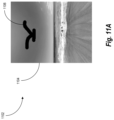
- FIGS. 11 A- 11 B illustrate sketch queries having multiple inputs of various input modals in accordance with one or more embodiments.
- FIG. 11 A illustrates a sketch query 1102 that includes an image input 1104 and a sketch input 1106 positioned on the image input 1104 .
- the image input 1104 is used as a canvas.
- the image input 1104 corresponds to an input digital image that is to be modified.
- the image input 1104 includes another digital image.
- the search-based editing system 106 enables other inputs to be positioned on the image input 1104 in response to user input (e.g., a user interaction with the switch 312 discussed above with reference to FIG. 3 ).
- the search-based editing system 106 receives the image input 1104 and receives additional user input that enables input of a sketch query. Accordingly, the search-based editing system 106 provides one or more selectable options (e.g., tools) for creating one or more other inputs positioned on the image input 1104 as part of the sketch query.
- selectable options e.g., tools
- FIG. 11 B illustrates a sketch query 1110 that includes a sketch input 1112 , brush inputs 1114 a - 1114 b , and text inputs 1116 a - 1116 b positioned on a blank canvas 1118 .
- the search-based editing system 106 provides a blank canvas for display on a graphical user interface (e.g., in response to a user interaction with the switch 312 ).
- the search-based editing system 106 further provides selectable options for creating one or more inputs positioned on the blank canvas.
- the search-based editing system 106 receives one or more user interactions with the blank canvas via the selectable options, the user interactions providing drawn or other inputs onto the blank canvas.
- the search-based editing system 106 receives a sketch query by receiving a canvas (e.g., a blank canvas or an image input) with one or more drawn or other inputs positioned on the canvas.
- a canvas e.g., a blank canvas or an image input
- a sketch query can include various types of visual input (e.g., sketch input, brush input, and/or image input) as well as other input (e.g., text input).
- FIGS. 11 A- 11 B show particular combinations of inputs for a sketch query, various other combinations are possible.
- the search-based editing system 106 receives various combinations of sketch input, brush input, text input, and/or image input as part of a sketch query in various embodiments.
- the search-based editing system 106 can receive a cropped region of a digital image as part of a sketch query (e.g., whether placed on a blank canvas or on another digital image).
- the search-based editing system 106 determines semantic and layout information from sketch input and/or image input (e.g., a digital image or a cropped region of a digital image). In some embodiments, the search-based editing system 106 further determines layout information from brush input and semantic information from text input. As an example, in some cases, the search-based editing system 106 determines semantic and spatial features from the sketch input 1112 of the sketch query 1110 , such as shape, scale, and location. The search-based editing system 106 further determines shape and location from the brush inputs 1114 a - 1114 b and semantic information from the text inputs 1116 a - 1116 b submitted in association with the brush inputs 1114 a - 1114 b.
- the search-based editing system 106 utilizes a multi-modal embedding neural network to generate an input embedding for a sketch query and utilizes the input embedding to retrieve image search results.
- FIGS. 12 A- 12 B each illustrate the search-based editing system 106 utilizing a multi-modal embedding neural network to generate an input embedding for a sketch query in accordance with one or more embodiments.
- a multi-modal embedding neural network includes a computer-implemented neural network that generates an input embedding for a multi-modal search input.
- a multi-modal embedding neural network includes a computer-implemented neural network that generates a unified input embedding that represents the various input modals of a multi-modal search input.
- a multi-modal embedding neural network generates a single input embedding that represents semantic information and/or layout information associated with a multi-modal search input.
- the search-based editing system 106 can utilize the multi-modal embedding neural network to generate input embeddings for other multi-modal search inputs, such as a multi-modal search input that includes a text query and an image query.
- the search-based editing system 106 provides a multi-modal search input 1220 to a multi-modal embedding neural network 1240 .
- the search-based editing system 106 provides the multi-modal search input 1220 to an encoder 1222 of the multi-modal embedding neural network 1240 .
- the multi-modal search input 1220 can include image input (including a crop of an image), brush input, sketch input, and/or text input (such as is represented in FIGS. 11 A- 11 B ).
- the multi-modal search input 1220 includes at least two of the above modals of inputs. Further, in some cases, the multi-modal search input 1220 includes a canvas.
- the multi-modal search input 1220 includes inputs on a blank canvas. In some embodiments, however, the multi-modal search input 1220 includes inputs on a digital image. In other words, the search-based editing system 106 utilizes the digital image as a canvas upon which to position other input. Accordingly, in some instances, the canvas is included as part of the multi-modal search input 1220 (e.g., providing semantic and/or layout information).
- the search-based editing system 106 utilizes the encoder 1222 to generate regional semantic embeddings 1224 and regional layout embeddings 1226 from the multi-modal search input 1220 .
- a regional embedding includes an embedding generated from a particular region of an input, such as a multi-modal search input.
- the search-based editing system 106 utilizes the encoder 1222 to generate the regional embeddings (i.e., the regional semantic embeddings 1224 and the regional layout embeddings 1226 ) from patches of the multi-modal search input 1220 .
- the search-based editing system 106 utilizes the encoder 1222 to generate the regional embeddings from semantic segments of the multi-modal search input 1220 (as will be discussed in more detail below with reference to FIG. 12 B ).
- the search-based editing system 106 By generating the regional semantic embeddings 1224 and the regional layout embeddings 1226 , the search-based editing system 106 separately encodes semantic information and layout information from the multi-modal search input 1220 . More particularly, the search-based editing system 106 separately encodes semantic information and layout information for distinct portions (e.g., patches or semantic segments) of the multi-modal search input 1220 .
- the search-based editing system 106 provides the regional semantic embeddings 1224 and the regional layout embeddings 1226 to a transformer neural network 1228 of the multi-modal embedding neural network 1240 . Further, the search-based editing system 106 provides positional information 1230 to the transformer neural network 1228 .
- positional information includes information regarding the positioning of one or more inputs of a multi-modal search input within an input space. For instance, in some cases, positional information includes information regarding the positioning of one or more inputs on a canvas of a multi-modal search input. As shown in FIG.
- FIG. 12 B illustrates the search-based editing system 106 utilizing a multi-modal embedding neural network that generates a unified embedding from semantic-level embeddings of a multi-modal search input in accordance with one or more embodiments.
- the search-based editing system 106 provides a multi-modal search input 1202 (e.g., a sketch query) to a multi-modal embedding neural network 1200 .
- the search-based editing system 106 utilizes the multi-modal embedding neural network 1200 to determine a plurality of segments 1204 (e.g., panoptic segments) of the multi-modal search input 1202 .
- the search-based editing system 106 utilizes a segmentation neural network of the multi-modal embedding neural network 1200 (e.g., one of the segmentation neural networks discussed above) to determine the segments 1204 .
- a segment-level embedding includes an embedding that corresponds to a segment (e.g., a panoptic segment) of a sketch query or digital image.
- a segment-level embedding includes an embedding that represents attributes or features of a corresponding segment of a sketch query or digital image.
- a segment-level embedding includes an embedding that represents semantic information and/or layout information associated with a corresponding segment of a sketch query or digital image.
- the search-based editing system 106 utilizes the multi-modal embedding neural network 1200 to generate a plurality of segment-level semantic embeddings 1206 (e.g., segment-level embeddings representing semantic information) and a plurality of segment-level layout embeddings 1208 (e.g., segment-level embeddings representing layout information) for the segments 1204 .
- the search-based editing system 106 generates, for each segment of the segments 1204 , one or more segment-level semantic embeddings and one or more segment-level layout embeddings.
- the search-based editing system 106 utilizes the text encoder and/or the image encoder described in U.S. patent application Ser. No. 17/652,390 to generate the segment-level semantic embeddings 1206 and the segment-level layout embeddings 1208 .
- the search-based editing system 106 utilizes a transformer neural network 1210 of the multi-modal embedding neural network 1200 to generate a semantic embedding 1212 and a layout embedding 1214 from the segment-level semantic embeddings 1206 and the segment-level layout embeddings 1208 .
- the search-based editing system 106 utilizes the transformer neural network 1210 to generate the semantic embedding 1212 from the segment-level semantic embeddings 1206 and generate the layout embedding 1214 from the segment-level layout embeddings 1208 .
- the search-based editing system 106 utilizes, as the transformer neural network 1210 , the vision transformer model described by Alexey Dosovitskiy et al., An Image is Worth 16 ⁇ 16 Words: Transformers for Image Recognition at Scale , ICLR, 2021, arXiv:2010.11929v2, which is incorporated herein by reference in its entirety.
- the search-based editing system 106 utilizes a convolutional neural network to generate the semantic embedding 1212 and the layout embedding 1214 .
- the search-based editing system 106 utilizes the multi-modal embedding neural network 1200 to generate a unified embedding 1216 from the semantic embedding 1212 and the layout embedding 1214 .
- the search-based editing system 106 combines (e.g., concatenates) the semantic embedding 1212 and the layout embedding 1214 to generate the unified embedding 1216 .
- the search-based editing system 106 determines a weighted combination to generates the unified embedding 1216 .
- the search-based editing system 106 varies the weighting that is applied for different multi-modal search inputs (e.g., based on user input).
- the search-based editing system 106 allows for control over the significance of the semantics or the layout of a multi-modal search input when conducting an image search.
- the search-based editing system 106 utilizes the unified embedding 1216 to retrieve image search results in response to the multi-modal search input 1202 .
- the search-based editing system 106 includes digital images in the image search results based on proximities of their corresponding embeddings to the input embedding within the embedding space.
- the search-based editing system 106 can provide the retrieved digital images to the client device that submitted the multi-modal search input 1202 .
- the search-based editing system 106 utilizes the semantic embedding 1212 and/or the layout embedding 1214 to retrieve image search results. As discussed above, however, combining those embeddings into a single input embedding allows for control over the emphasis placed on the represented semantic information and layout information.
- the search-based editing system 106 operates with improved flexibility when compared to many conventional systems. For instance, by utilizing a multi-modal embedding neural network to generate an input embedding for a multi-modal search input, the search-based editing system 106 can flexibly utilize search inputs having multiple input modals. In particular, the search-based editing system 106 can flexibly utilize search inputs having multiple visual inputs (e.g., image inputs, sketch inputs, and/or brush inputs) where conventional systems are typically limited to visual inputs of one type.
- visual inputs e.g., image inputs, sketch inputs, and/or brush inputs
- FIG. 13 illustrates image search results retrieved by the search-based editing system 106 using a sketch query in accordance with one or more embodiments.
- FIG. 13 illustrates image search results retrieved in response to the sketch query 1110 discussed above with reference to FIG. 11 B .
- the search-based editing system 106 retrieves the digital images 1302 a - 1302 c in response to receiving the sketch query 1110 (e.g., utilizing an input embedding generated from the sketch query 1110 .
- each of the digital images 1302 a - 1302 c incorporate the semantic information and the layout information associated with the sketch query 1110 .
- each of the digital images 1302 a - 1302 c includes a visual layout that corresponds to a visual layout of the sketch query 1110 .
- the search-based editing system 106 additionally or alternatively provides digital images that can be used to generate a composite image that incorporates the semantic information and the layout information associated with a multi-modal search input.
- FIG. 14 illustrates image search results that include digital images for generating a composite image that corresponds to a sketch query in accordance with one or more embodiments.
- FIG. 14 illustrates digital images 1402 a - 1402 f retrieved in response to receiving the sketch query 1110 .
- the digital images 1402 a - 1402 f differ from the digital images 1302 a - 1302 c of FIG. 13 in that they don't each incorporate all of the semantic and/or layout information of the sketch query 1110 alone.
- the search-based editing system 106 generates a composite image 1404 using the digital images 1402 a - 1402 f of the image search results.
- the search-based editing system 106 provides the digital images 1402 a - 1402 f to the client device that submitted the sketch query 1110 (e.g., for display on a graphical user interface).
- the search-based editing system 106 further receives a selection of several of the digital images 1402 a - 1402 f (e.g., the digital images 1402 a and 1402 e - 1402 f ).
- the search-based editing system 106 generates the composite image 1404 .
- the composite image 1404 includes a visual layout that corresponds to the visual layout of the sketch query 1110 .
- the search-based editing system 106 can utilize the composite image 1404 to conduct another search query. For example, in some cases, the search-based editing system 106 receives the composite image 1404 as search input and conducts another image search in response. The search-based editing system 106 can retrieve digital images that have a similar visual layout to the composite image 1404 and additionally or alternatively retrieve digital images that can be used to generate another composite image having a similar visual layout to the composite image 1404 . In some cases, the search-based editing system 106 further modifies the composite image 1404 (e.g., in response to user input). For instance, the search-based editing system 106 can modify the composite image 1404 to better blend its individual components.
- FIG. 15 also illustrates image search results that include digital images for generating a composite image that corresponds to a sketch query in accordance with one or more embodiments.
- FIG. 15 illustrates digital images 1502 a - 1502 b retrieved in response to receiving the sketch query 1102 , which includes the sketch input 1106 positioned on the image input 1104 .
- each of the digital images 1502 a - 1502 b incorporate semantic and/or layout information associated with the sketch input 1106 .
- each of the digital images 1502 a - 1502 b portray a digital object (e.g., a bird in flight) having a scale that generally corresponds to the sketch input 1106 of the sketch query 1102 .
- a digital object e.g., a bird in flight
- the search-based editing system 106 generates composite images 1504 a - 1504 b using the digital images 1502 a - 1502 b respectively.
- the search-based editing system 106 generates each of the composite images 1504 a - 1504 b by combining, respectively, each of the digital images 1502 a - 1502 b with the image input 1104 from the sketch query 1102 .
- the search-based editing system 106 extracts the digital object portrayed in the digital image 1502 a (e.g., the bird) and combines it with the image input 1104 .
- the search-based editing system 106 positions the digital object proximate to the position of the sketch input 1106 .
- FIG. 16 shows the search-based editing system 106 implemented by the computing device 1600 (e.g., the server(s) 102 and/or one of the client devices 110 a - 110 n discussed above with reference to FIG. 1 ). Additionally, the search-based editing system 106 is also part of the image editing system 104 .
- the computing device 1600 e.g., the server(s) 102 and/or one of the client devices 110 a - 110 n discussed above with reference to FIG. 1 .
- the search-based editing system 106 is also part of the image editing system 104 .
- the search-based editing system 106 includes, but is not limited to, a graphical user interface manager 1602 , a searching engine 1604 , an image modification engine 1606 , and data storage 1608 (which includes a text search engine 1610 , an image search engine 1612 , modification models 1614 , and digital images 1616 ).
- the search-based editing system 106 includes the graphical user interface manager 1602 .
- the graphical user interface manager 1602 causes the graphical user interface of a client device to display a plurality of interactive elements for providing search input and/or selections of editing operations. Further, in some embodiments, the graphical user interface manager 1602 causes the graphical user interface to display image search results and a modified input digital image that results from one or more selected editing operations. Accordingly, in some implementations, the graphical user interface manager 1602 provides a consolidated graphical user interface that simultaneously displays options and results generated based on the selections of those options.
- the search-based editing system 106 includes the searching engine 1604 .
- the searching engine 1604 utilizes a search engine to retrieve image search results in response to receiving search input.
- the searching engine 1604 utilizes an image search engine to retrieve digital images in response to receiving an image query.
- the searching engine 1604 utilizes a text search engine to retrieve digital images in response to receiving a text query.
- the searching engine 1604 utilizes an embedding-based search engine that generates an input embedding from the search input and retrieves digital images based on proximities of their corresponding embeddings to the input embedding.
- the search-based editing system 106 further includes the image modification engine 1606 .
- the image modification engine 1606 modifies an input digital image via one or more editing operations. For instance, in some cases, the image modification engine 1606 detects a selection of an interactive element display on a client device and performs the corresponding editing operation to modify an input digital image. In some implementations, the image modification engine 1606 utilizes one or more neural networks to perform the editing operation.
- Each of the components 1602 - 1616 of the search-based editing system 106 can include software, hardware, or both.
- the components 1602 - 1616 can include one or more instructions stored on a computer-readable storage medium and executable by processors of one or more computing devices, such as a client device or server device. When executed by the one or more processors, the computer-executable instructions of the search-based editing system 106 can cause the computing device(s) to perform the methods described herein.
- the components 1602 - 1616 can include hardware, such as a special-purpose processing device to perform a certain function or group of functions.
- the components 1602 - 1616 of the search-based editing system 106 can include a combination of computer-executable instructions and hardware.
- the components 1602 - 1616 of the search-based editing system 106 may be implemented in a suite of mobile device applications or “apps.”
- the search-based editing system 106 can comprise or operate in connection with digital software applications such as ADOBE® PHOTOSHOP®, ADOBE® INDESIGN®, or ADOBE® ILLUSTRATOR®.
- digital software applications such as ADOBE® PHOTOSHOP®, ADOBE® INDESIGN®, or ADOBE® ILLUSTRATOR®.
- ADOBE,” “PHOTOSHOP,” “INDESIGN,” and “ILLUSTRATOR” are either registered trademarks or trademarks of Adobe Inc. in the United States and/or other countries.
- FIGS. 1 - 16 the corresponding text, and the examples provide a number of different methods, systems, devices, and non-transitory computer-readable media of the search-based editing system 106 .
- FIGS. 17 - 19 may be performed with more or fewer acts. Further, the acts may be performed in different orders. Additionally, the acts described herein may be repeated or performed in parallel with one another or in parallel with different instances of the same or similar acts.
- FIG. 17 illustrates a flowchart of a series of acts 1700 for modifying an input digital image utilizing image search results in accordance with one or more embodiments.
- FIG. 17 illustrates acts according to one embodiment, alternative embodiments may omit, add to, reorder, and/or modify any of the acts shown in FIG. 17 .
- the acts of FIG. 17 are performed as part of a method.
- the acts of FIG. 17 are performed as part of a computer-implemented method.
- a non-transitory computer-readable medium can store instructions thereon that, when executed by at least one processor, cause the at least one processor to perform operations comprising the acts of FIG. 17 .
- a system performs the acts of FIG. 17 .
- a system includes at least one memory device comprising one or more search engines.
- the system further includes at least one processor configured to cause the system to perform the acts of FIG. 17 .
- the series of acts 1700 includes an act 1702 of receiving an input digital image and search input.
- the act 1702 involves receiving, from a client device, an input digital image and search input for conducting an image search.
- the series of acts 1700 also includes an act 1704 of retrieving image search results using the search input.
- the act 1704 involves retrieving, utilizing one or more search engines and the search input, image search results comprising a digital image for modifying the input digital image.
- retrieving, utilizing the one or more search engines, the image search results comprises retrieving the image search results utilizing a text search engine and an image search engine.
- retrieving the image search results comprising the digital image comprises retrieving a plurality of digital images as the image search results. Accordingly, in some cases, the search-based editing system 106 receives a selection of the digital image from the plurality of digital images for modifying the input digital image.
- the search-based editing system 106 determines, based on the search input, a search modal for conducting the image search; and determines at least one search engine from the one or more search engines that corresponds to the search modal. Accordingly, in some cases, retrieving the image search results utilizing the one or more search engines comprises retrieving the image search results utilizing the at least one search engine that corresponds to the search modal. In some instances, determining the search modal for conducting the image search comprises determining one of a textual-visual search modal, a sketch search modal, or a local search modal.
- retrieving the image search results comprising the digital image utilizing the one or more search engines and the search input comprises: generating, utilizing a search engine comprising a neural network, an input embedding for the search input; and retrieving the digital image by determining, utilizing the search engine, a proximity of an embedding for the digital image to the input embedding for the search input.
- receiving the search input for conducting the image search comprises receiving a plurality of search inputs; and generating the input embedding for the search input comprises generating a plurality of input embeddings for the plurality of search inputs within a common embedding space.
- the series of acts 1700 includes an act 1706 of modifying the input digital image using the image search results.
- the act 1706 involves modifying the input digital image utilizing the digital image from the image search results.
- the act 1706 includes a sub-act 1708 for determining an editing operation for the input digital image. Additionally, the act 1706 includes a sub-act 1710 for determining an image characteristic of the digital image that corresponds to the editing operation. The act 1706 further includes a sub-act 1712 for modifying the input digital image using the image characteristic via the editing operation.
- the search-based editing system 106 determines an editing operation for modifying the input digital image and determines one or more image characteristics of the digital image from the image search results that correspond to the editing operation. Accordingly, modifying the input digital image utilizing the digital image from the image search results comprises modifying the input digital image utilizing the one or more image characteristics via the editing operation.
- determining the editing operation comprises determining a compositing operation; and determining the one or more image characteristics of the digital image that correspond to the editing operation comprises extracting a digital object portrayed in the digital image from the image search results using a corresponding segmentation mask.
- the search-based editing system 106 receives an input digital image and search input for conducting an image search; retrieves, in response to receiving the search input, image search results comprising a digital image for modifying the input digital image utilizing at least one of a text search engine or an image search engine; determines an image characteristic of the digital image from the image search results to apply to the input digital image; and modifies the input digital image utilizing the image characteristic of the digital image.
Landscapes
- Engineering & Computer Science (AREA)
- Theoretical Computer Science (AREA)
- Physics & Mathematics (AREA)
- Data Mining & Analysis (AREA)
- Databases & Information Systems (AREA)
- General Engineering & Computer Science (AREA)
- General Physics & Mathematics (AREA)
- Mathematical Physics (AREA)
- Artificial Intelligence (AREA)
- Computational Linguistics (AREA)
- Library & Information Science (AREA)
- Processing Or Creating Images (AREA)
Abstract
Description
where Dc is a diagonal matrix with the eigenvalues of the covariance matrix fcfc T∈RC×C, and Ec is the corresponding orthogonal matrix of eigenvectors satisfying fcfc T=EcDcEc T.
where Ds is a diagonal matrix with the eigenvalues of the covariance matrix fsfs T∈RC×C, and Es is the corresponding orthogonal matrix of eigenvectors. The search-based
Claims (20)
Priority Applications (1)
| Application Number | Priority Date | Filing Date | Title |
|---|---|---|---|
| US17/809,503 US12235891B2 (en) | 2022-06-28 | 2022-06-28 | Generating embeddings for text and image queries within a common embedding space for visual-text image searches |
Applications Claiming Priority (1)
| Application Number | Priority Date | Filing Date | Title |
|---|---|---|---|
| US17/809,503 US12235891B2 (en) | 2022-06-28 | 2022-06-28 | Generating embeddings for text and image queries within a common embedding space for visual-text image searches |
Publications (2)
| Publication Number | Publication Date |
|---|---|
| US20230418861A1 US20230418861A1 (en) | 2023-12-28 |
| US12235891B2 true US12235891B2 (en) | 2025-02-25 |
Family
ID=89322920
Family Applications (1)
| Application Number | Title | Priority Date | Filing Date |
|---|---|---|---|
| US17/809,503 Active 2042-12-01 US12235891B2 (en) | 2022-06-28 | 2022-06-28 | Generating embeddings for text and image queries within a common embedding space for visual-text image searches |
Country Status (1)
| Country | Link |
|---|---|
| US (1) | US12235891B2 (en) |
Cited By (1)
| Publication number | Priority date | Publication date | Assignee | Title |
|---|---|---|---|---|
| US20250308091A1 (en) * | 2024-03-28 | 2025-10-02 | Lemon Inc. | Fast personalized image generation using a machine learning model |
Families Citing this family (9)
| Publication number | Priority date | Publication date | Assignee | Title |
|---|---|---|---|---|
| US20240152546A1 (en) * | 2022-11-04 | 2024-05-09 | Google Llc | Processing Diagrams as Search Input |
| US12254049B2 (en) | 2022-11-10 | 2025-03-18 | Snap Inc. | Searching augmented reality experiences using visual embeddings |
| US12271417B2 (en) * | 2023-04-24 | 2025-04-08 | Google Llc | Multi-image search |
| US12405996B2 (en) * | 2023-08-10 | 2025-09-02 | Quizlet, Inc. | Automatic suggestion of most informative images |
| US12481704B2 (en) * | 2023-11-15 | 2025-11-25 | Microsoft Technology Licensing, Llc | Ghosting for multimodal dialogs |
| US12488034B2 (en) * | 2024-03-07 | 2025-12-02 | Lemon Inc. | Searching editing components based on text using a machine learning model |
| US20250355929A1 (en) * | 2024-05-20 | 2025-11-20 | Microsoft Technology Licensing, Llc | Hybrid operating system search |
| CN121233766A (en) * | 2024-05-24 | 2025-12-30 | 众安在线财产保险股份有限公司 | Text processing methods, apparatuses, electronic devices, and storage media |
| CN119622013B (en) * | 2024-11-22 | 2025-10-31 | 重庆邮电大学 | Interactive image retrieval method based on multi-mode fusion |
Citations (25)
| Publication number | Priority date | Publication date | Assignee | Title |
|---|---|---|---|---|
| US5915250A (en) * | 1996-03-29 | 1999-06-22 | Virage, Inc. | Threshold-based comparison |
| US6181818B1 (en) | 1994-11-15 | 2001-01-30 | Canon Kabushiki Kaisha | Image retrieval method and apparatus |
| US6728752B1 (en) * | 1999-01-26 | 2004-04-27 | Xerox Corporation | System and method for information browsing using multi-modal features |
| US20040249774A1 (en) * | 1993-09-20 | 2004-12-09 | Caid William R. | Representation and retrieval of images using context vectors derived from image information elements |
| US20110072012A1 (en) * | 2009-09-18 | 2011-03-24 | Xerox Corporation | System and method for information seeking in a multimedia collection |
| US20140006385A1 (en) * | 2012-06-28 | 2014-01-02 | Bjoern-Ole Ebers | Image search refinement using facets |
| US20150296228A1 (en) * | 2014-04-14 | 2015-10-15 | David Mo Chen | Systems and Methods for Performing Multi-Modal Video Datastream Segmentation |
| WO2015178716A1 (en) | 2014-05-23 | 2015-11-26 | Samsung Electronics Co., Ltd. | Search method and device |
| US20170039723A1 (en) | 2015-08-04 | 2017-02-09 | Adobe Systems Incorporated | Image Object Segmentation Using Examples |
| US10192129B2 (en) | 2015-11-18 | 2019-01-29 | Adobe Systems Incorporated | Utilizing interactive deep learning to select objects in digital visual media |
| US20190130229A1 (en) | 2017-10-31 | 2019-05-02 | Adobe Inc. | Deep salient content neural networks for efficient digital object segmentation |
| US20200020108A1 (en) | 2018-07-13 | 2020-01-16 | Adobe Inc. | Automatic Trimap Generation and Image Segmentation |
| US20200334501A1 (en) | 2019-04-18 | 2020-10-22 | Adobe Inc | Robust training of large-scale object detectors with a noisy dataset |
| US20200356591A1 (en) | 2019-05-09 | 2020-11-12 | Microsoft Technology Licensing, Llc | Techniques for Modifying a Query Image |
| US20200380403A1 (en) * | 2019-05-30 | 2020-12-03 | Adobe Inc. | Visually Guided Machine-learning Language Model |
| US20200380027A1 (en) * | 2019-05-30 | 2020-12-03 | Adobe Inc. | Multi-Modal Differential Search with Real-Time Focus Adaptation |
| US20210027471A1 (en) | 2019-07-22 | 2021-01-28 | Adobe Inc. | Utilizing object attribute detection models to automatically select instances of detected objects in images |
| US10909166B1 (en) | 2017-11-03 | 2021-02-02 | Shutterstock, Inc. | Reverse search with manual composition |
| US11055566B1 (en) | 2020-03-12 | 2021-07-06 | Adobe Inc. | Utilizing a large-scale object detector to automatically select objects in digital images |
| US11073975B1 (en) | 2019-03-29 | 2021-07-27 | Shutterstock, Inc. | Synthetic image generation in response to user creation of image |
| US20210383584A1 (en) | 2020-06-05 | 2021-12-09 | Google Llc | Image manipulation by text instruction |
| US20220164548A1 (en) * | 2020-11-24 | 2022-05-26 | Openstream Inc. | System and Method for Temporal Attention Behavioral Analysis of Multi-Modal Conversations in a Question and Answer System |
| US20220237799A1 (en) | 2021-01-26 | 2022-07-28 | Adobe Inc. | Segmenting objects in digital images utilizing a multi-object segmentation model framework |
| US20230306087A1 (en) | 2022-03-24 | 2023-09-28 | Microsoft Technology Licensing, Llc | Method and system of retrieving multimodal assets |
| US20230377200A1 (en) * | 2022-01-25 | 2023-11-23 | Google Llc | Color Matching Items Using Augmented Reality |
-
2022
- 2022-06-28 US US17/809,503 patent/US12235891B2/en active Active
Patent Citations (25)
| Publication number | Priority date | Publication date | Assignee | Title |
|---|---|---|---|---|
| US20040249774A1 (en) * | 1993-09-20 | 2004-12-09 | Caid William R. | Representation and retrieval of images using context vectors derived from image information elements |
| US6181818B1 (en) | 1994-11-15 | 2001-01-30 | Canon Kabushiki Kaisha | Image retrieval method and apparatus |
| US5915250A (en) * | 1996-03-29 | 1999-06-22 | Virage, Inc. | Threshold-based comparison |
| US6728752B1 (en) * | 1999-01-26 | 2004-04-27 | Xerox Corporation | System and method for information browsing using multi-modal features |
| US20110072012A1 (en) * | 2009-09-18 | 2011-03-24 | Xerox Corporation | System and method for information seeking in a multimedia collection |
| US20140006385A1 (en) * | 2012-06-28 | 2014-01-02 | Bjoern-Ole Ebers | Image search refinement using facets |
| US20150296228A1 (en) * | 2014-04-14 | 2015-10-15 | David Mo Chen | Systems and Methods for Performing Multi-Modal Video Datastream Segmentation |
| WO2015178716A1 (en) | 2014-05-23 | 2015-11-26 | Samsung Electronics Co., Ltd. | Search method and device |
| US20170039723A1 (en) | 2015-08-04 | 2017-02-09 | Adobe Systems Incorporated | Image Object Segmentation Using Examples |
| US10192129B2 (en) | 2015-11-18 | 2019-01-29 | Adobe Systems Incorporated | Utilizing interactive deep learning to select objects in digital visual media |
| US20190130229A1 (en) | 2017-10-31 | 2019-05-02 | Adobe Inc. | Deep salient content neural networks for efficient digital object segmentation |
| US10909166B1 (en) | 2017-11-03 | 2021-02-02 | Shutterstock, Inc. | Reverse search with manual composition |
| US20200020108A1 (en) | 2018-07-13 | 2020-01-16 | Adobe Inc. | Automatic Trimap Generation and Image Segmentation |
| US11073975B1 (en) | 2019-03-29 | 2021-07-27 | Shutterstock, Inc. | Synthetic image generation in response to user creation of image |
| US20200334501A1 (en) | 2019-04-18 | 2020-10-22 | Adobe Inc | Robust training of large-scale object detectors with a noisy dataset |
| US20200356591A1 (en) | 2019-05-09 | 2020-11-12 | Microsoft Technology Licensing, Llc | Techniques for Modifying a Query Image |
| US20200380027A1 (en) * | 2019-05-30 | 2020-12-03 | Adobe Inc. | Multi-Modal Differential Search with Real-Time Focus Adaptation |
| US20200380403A1 (en) * | 2019-05-30 | 2020-12-03 | Adobe Inc. | Visually Guided Machine-learning Language Model |
| US20210027471A1 (en) | 2019-07-22 | 2021-01-28 | Adobe Inc. | Utilizing object attribute detection models to automatically select instances of detected objects in images |
| US11055566B1 (en) | 2020-03-12 | 2021-07-06 | Adobe Inc. | Utilizing a large-scale object detector to automatically select objects in digital images |
| US20210383584A1 (en) | 2020-06-05 | 2021-12-09 | Google Llc | Image manipulation by text instruction |
| US20220164548A1 (en) * | 2020-11-24 | 2022-05-26 | Openstream Inc. | System and Method for Temporal Attention Behavioral Analysis of Multi-Modal Conversations in a Question and Answer System |
| US20220237799A1 (en) | 2021-01-26 | 2022-07-28 | Adobe Inc. | Segmenting objects in digital images utilizing a multi-object segmentation model framework |
| US20230377200A1 (en) * | 2022-01-25 | 2023-11-23 | Google Llc | Color Matching Items Using Augmented Reality |
| US20230306087A1 (en) | 2022-03-24 | 2023-09-28 | Microsoft Technology Licensing, Llc | Method and system of retrieving multimodal assets |
Non-Patent Citations (44)
| Title |
|---|
| A. Krizhevsky, I. Sutskever, and G. E. Hinton. Imagenet classification with deep convolutional neural networks. In NIPS, 2012. |
| Aggarwal, Pranav, Zhe Lin, Baldo Faieta, and Saeid Motiian. "Multitask text-to-visual embedding with titles and clickthrough data." arXiv preprint arXiv:1905.13339 (2019). |
| Alexey Dosovitskiy et al., An Image is Worth 16×16 Words: Transformers for Image Recognition at Scale, ICLR, 2021, arXiv:2010.11929v2. |
| B. Wang, Y. Yu, and Y.-Q. Xu. Example-based image color and tone style enhancement. In ACM TOG (Proc. SIGGRAPH), vol. 30, p. 64. ACM, 2011. |
| D. Dowson and B. Landau. The fréchet distance between multivariate normal distributions. Journal of Multivariate Analysis, 12(3):450-455, 1982. |
| D. Pollard. A user's guide to measure theoretic probability, vol. 8. Cambridge University Press, 2002. |
| Dey, Sounak, Anjan Dutta, Suman K. Ghosh, Ernest Valveny, Josep Lladós, and Umapada Pal. "Aligning Salient Objects to Queries: A Multi-modal and Multi-object Image Retrieval Framework." In Asian Conference on Computer Vision, pp. 241-255. Springer, Cham, 2018. |
| E. Reinhard, M. Ashikhmin, B. Gooch, and P. Shirley. Color transfer between images. CG&A, 21(5):34-41, 2001. |
| F. Pitie and A. Kokaram. The linear monge-kantorovitch linear colour mapping for example- based colour transfer. In CVMP, 2007. |
| F. Pitie, A. C. Kokaram, and R. Dahyot. N-dimensional probability density function transfer and its application to color transfer. In ICCV, vol. 2, pp. 1434-1439, 2005. |
| Furuta, Ryosuke, Naoto Inoue, and Toshihiko Yamasaki. "Efficient and interactive spatial—semantic image retrieval." Multimedia Tools and Applications 78, No. 13 (2019): 18713-18733. |
| H.S. Faridul, T. Pouli, C. Chamaret, J. Stauder, A. Tremeau, E. Reinhard, et al. A survey of color mapping and its applications. In Eurographics, pp. 43-67, 2014. |
| J. C. Caicedo, A. Kapoor, and S. B. Kang. Collaborative personalization of image enhancement. In CVPR, pp. 249-256, 2011. |
| J. Deng, W. Dong, R. Socher, L.-J. Li, K. Li, and L. Fei-Fei. Imagenet: A large-scale hierarchical image database. In CVPR, pp. 248-255, 2009. |
| J. Yan, S. Lin, S. B. Kang, and X. Tang. A learning-to-rank approach for image color enhancement. In CVPR, pp. 2987-2994, 2014. |
| Jin Ma, Shanmin Pang, Bo Yang, Jihua Zhu, and Yaochen Li. "Spatial-content image search in complex scenes." In Proceedings of the IEEE/CVF Winter Conference on Applications of Computer Vision, pp. 2503-2511. 2020. |
| K. Dale, M. K. Johnson, K. Sunkavalli, W. Matusik, and H. Pfister. Image restoration using online photo collections. In ICCV, pp. 2217-2224, 2009. |
| Kilickaya, Mert, and Arnold WM Smeulders. "Structured Visual Search via Composition-aware Learning." In Proceedings of the IEEE/CVF Winter Conference on Applications of Computer Vision, pp. 1701-1710. 2021. |
| Long Mai, Hailin Jin, Zhe Lin, Chen Fang, Jonathan Brandt, and Feng Liu. "Spatial-semantic image search by visual feature synthesis." In Proceedings of the IEEE Conference on Computer Vision and Pattern Recognition, pp. 4718-4727. 2017. |
| M. Aubry, S. Paris, S. W. Hasinoff, J. Kautz, and F. Durand. Fast local laplacian filters: Theory and applications. ACM TOG, 33(5):167:1-167:14, Sep. 2014. |
| N. Bonneel, K. Sunkavalli, S. Paris, and H. Pfister. Example-based video color grading. ACM TOG (Proc. SIGGRAPH), 32(4):39:1-39:12, Jul. 2013. |
| Ning Xu et al., "Deep GrabCut for Object Selection," published Jul. 14, 2017. |
| Redmon, et al., You Only Look Once: Unified, Real-Time Object Detection, CVPR 2016. |
| Ren, et al., Faster r-cnn: Towards real-time object detection with region proposal networks, NIPS, 2015. |
| Ribeiro, Leo Sampaio Ferraz, Tu Bui, John Collomosse, and Moacir Ponti. "Scene Designer: a Unified Model for Scene Search and Synthesis from Sketch." In Proceedings of the IEEE/CVF International Conference on Computer Vision, pp. 2424-2433. 2021. |
| S. B. Kang, A. Kapoor, and D. Lischinski. Personalization of image enhancement. In CVPR, pp. 1799-1806, 2010. |
| S. Bae, S. Paris, and F. Durand. Two-scale tone management for photographic look. ACM TOG (Proc. SIGGRAPH), 25(3):637-645, Jul. 2006. |
| S. J. Hwang, A. Kapoor, and S. B. Kang. Context-based automatic local image enhancement. In ECCV, vol. 7572, pp. 569-582, 2012. |
| T. Pouli and E. Reinhard. Progressive color transfer for images of arbitrary dynamic range. Comp. & Graph., 35(1):67-80, 2011. |
| U.S. Appl. No. 17/809,494, filed Aug. 1, 2024, Notice of Allowance. |
| U.S. Appl. No. 17/809,494, filed Aug. 1, 2024, Office Action. |
| U.S. Appl. No. 17/809,494, filed Sep. 27, 2023, Office Action. |
| U.S. Appl. No. 17/809,781, filed Jan. 14, 2025, Office Action. |
| V. Bychkovsky, S. Paris, E. Chan, and F. Durand. Learning photographic global tonal adjustment with a database of input/output image pairs. In CVPR, pp. 97-104, 2011. |
| W. Xu and J. Mulligan. Performance evaluation of color correction approaches for automatic multi-view image and video stitching. In CVPR, pp. 263-270, 2010. |
| X. An and F. Pellacini. User-controllable color transfer. In CGF, vol. 29, pp. 263-271, 2010. |
| Y. Ha Cohen, E. Shechtman, D. B. Goldman, and D. Lischinski. Non-rigid dense correspondence with applications for image enhancement. In ACM TOG (Proc. SIGGRAPH), vol. 30, p. 70, 2011. |
| Y. Hwang, J.-Y. Lee, I. S. Kweon, and S. J. Kim. Color transfer using probabilistic moving least squares. In CVPR, 2014. |
| Y. Jia. Caffe: An open source convolutional architecture for fast feature embedding. http://caffe.berkeleyvision.org/, 2013. |
| Y. Liu, M. Cohen, M. Uyttendaele, and S. Rusinkiewicz. Autostyle: Automatic style transfer from image collections to users' images. In CGF, vol. 33, pp. 21-31, 2014. |
| Y. Shih, S. Paris, C. Barnes, W. T. Freeman, and F. Durand. Style transfer for headshot portraits. ACM TOG (Proc. SIGGRAPH), 33(4):148:1-148:14, Jul. 2014. |
| Y.-W. Tai, J. Jia, and C.-K. Tang. Soft color segmentation and its applications. PAMI, 29(9):1520-1537, 2007. |
| Yuan, Xin, Zhe Lin, Jason Kuen, Jianming Zhang, Yilin Wang, Michael Maire, Ajinkya Kale, and Baldo Faieta. "Multimodal Contrastive Training for Visual Representation Learning." In Proceedings of the IEEE/CVF Conference on Computer Vision and Pattern Recognition, pp. 6995-7004. 2021. |
| Z. Yan, H. Zhang, B. Wang, S. Paris, and Y. Yu. Automatic photo adjustment using deep neural networks. CoRR, abs/1412.7725, 2015. |
Cited By (1)
| Publication number | Priority date | Publication date | Assignee | Title |
|---|---|---|---|---|
| US20250308091A1 (en) * | 2024-03-28 | 2025-10-02 | Lemon Inc. | Fast personalized image generation using a machine learning model |
Also Published As
| Publication number | Publication date |
|---|---|
| US20230418861A1 (en) | 2023-12-28 |
Similar Documents
| Publication | Publication Date | Title |
|---|---|---|
| US12235891B2 (en) | Generating embeddings for text and image queries within a common embedding space for visual-text image searches | |
| US11797847B2 (en) | Selecting instances of detected objects in images utilizing object detection models | |
| US12395722B2 (en) | Removing distracting objects from digital images | |
| US11055566B1 (en) | Utilizing a large-scale object detector to automatically select objects in digital images | |
| US12288279B2 (en) | Modifying digital images via scene-based editing using image understanding facilitated by artificial intelligence | |
| AU2019200951B2 (en) | Selective and multi-query visual similarity search | |
| US12271983B2 (en) | Generating unified embeddings from multi-modal canvas inputs for image retrieval | |
| US12547658B2 (en) | Retrieving digital images in response to search queries for search-driven image editing | |
| US11392659B2 (en) | Utilizing machine learning models to generate experience driven search results based on digital canvas gesture inputs | |
| US12210800B2 (en) | Modifying digital images using combinations of direct interactions with the digital images and context-informing speech input | |
| US12045963B2 (en) | Detecting object relationships and editing digital images based on the object relationships | |
| US12597186B2 (en) | Synthesizing shadows in digital images utilizing diffusion models | |
| CN120086415A (en) | Leverage object attribute detection models to automatically select instances of detected objects in images | |
| US11531697B2 (en) | Identifying and providing digital images depicting human poses utilizing visual interactive content search and virtual mannequins | |
| US12536625B2 (en) | Dilating object masks to reduce artifacts during inpainting | |
| US12462519B2 (en) | Detecting shadows and corresponding objects in digital images | |
| US20240265692A1 (en) | Generating semantic scene graphs utilizing template graphs for digital image modification | |
| US20230325996A1 (en) | Generating composite images using user interface features for auto-compositing and composite-aware search | |
| US20240168617A1 (en) | Detecting and modifying object attributes | |
| US12347005B2 (en) | Generating and using behavioral policy graphs that assign behaviors to objects for digital image editing | |
| US12373920B2 (en) | Recommending objects for image composition using a geometry-and-lighting aware neural network | |
| US12361607B2 (en) | Generating digital images in new contexts while preserving color and composition using diffusion neural networks | |
| US12394020B2 (en) | Recommending objects for image composition using geometry-and-lighting aware search and efficient user interface workflows |
Legal Events
| Date | Code | Title | Description |
|---|---|---|---|
| AS | Assignment |
Owner name: ADOBE INC., CALIFORNIA Free format text: ASSIGNMENT OF ASSIGNORS INTEREST;ASSIGNORS:ZHANG, ZHIFEI;LIN, ZHE;SIGNING DATES FROM 20220624 TO 20220625;REEL/FRAME:060341/0692 |
|
| FEPP | Fee payment procedure |
Free format text: ENTITY STATUS SET TO UNDISCOUNTED (ORIGINAL EVENT CODE: BIG.); ENTITY STATUS OF PATENT OWNER: LARGE ENTITY |
|
| STPP | Information on status: patent application and granting procedure in general |
Free format text: DOCKETED NEW CASE - READY FOR EXAMINATION |
|
| STPP | Information on status: patent application and granting procedure in general |
Free format text: NON FINAL ACTION MAILED |
|
| STPP | Information on status: patent application and granting procedure in general |
Free format text: RESPONSE TO NON-FINAL OFFICE ACTION ENTERED AND FORWARDED TO EXAMINER |
|
| STPP | Information on status: patent application and granting procedure in general |
Free format text: FINAL REJECTION MAILED |
|
| STPP | Information on status: patent application and granting procedure in general |
Free format text: DOCKETED NEW CASE - READY FOR EXAMINATION |
|
| STPP | Information on status: patent application and granting procedure in general |
Free format text: NOTICE OF ALLOWANCE MAILED -- APPLICATION RECEIVED IN OFFICE OF PUBLICATIONS |
|
| STPP | Information on status: patent application and granting procedure in general |
Free format text: AWAITING TC RESP, ISSUE FEE PAYMENT RECEIVED |
|
| STPP | Information on status: patent application and granting procedure in general |
Free format text: PUBLICATIONS -- ISSUE FEE PAYMENT RECEIVED |
|
| STPP | Information on status: patent application and granting procedure in general |
Free format text: PUBLICATIONS -- ISSUE FEE PAYMENT VERIFIED |
|
| STCF | Information on status: patent grant |
Free format text: PATENTED CASE |