US12234217B2 - Method for preparing N-phenylpyrazole-1-carboxamides - Google Patents
Method for preparing N-phenylpyrazole-1-carboxamides Download PDFInfo
- Publication number
- US12234217B2 US12234217B2 US17/299,391 US201917299391A US12234217B2 US 12234217 B2 US12234217 B2 US 12234217B2 US 201917299391 A US201917299391 A US 201917299391A US 12234217 B2 US12234217 B2 US 12234217B2
- Authority
- US
- United States
- Prior art keywords
- formula
- compound
- reaction
- sulfonyl chloride
- reactor
- Prior art date
- Legal status (The legal status is an assumption and is not a legal conclusion. Google has not performed a legal analysis and makes no representation as to the accuracy of the status listed.)
- Active, expires
Links
Images


Classifications
-
- C—CHEMISTRY; METALLURGY
- C07—ORGANIC CHEMISTRY
- C07D—HETEROCYCLIC COMPOUNDS
- C07D401/00—Heterocyclic compounds containing two or more hetero rings, having nitrogen atoms as the only ring hetero atoms, at least one ring being a six-membered ring with only one nitrogen atom
- C07D401/02—Heterocyclic compounds containing two or more hetero rings, having nitrogen atoms as the only ring hetero atoms, at least one ring being a six-membered ring with only one nitrogen atom containing two hetero rings
- C07D401/04—Heterocyclic compounds containing two or more hetero rings, having nitrogen atoms as the only ring hetero atoms, at least one ring being a six-membered ring with only one nitrogen atom containing two hetero rings directly linked by a ring-member-to-ring-member bond
-
- C—CHEMISTRY; METALLURGY
- C07—ORGANIC CHEMISTRY
- C07D—HETEROCYCLIC COMPOUNDS
- C07D231/00—Heterocyclic compounds containing 1,2-diazole or hydrogenated 1,2-diazole rings
- C07D231/02—Heterocyclic compounds containing 1,2-diazole or hydrogenated 1,2-diazole rings not condensed with other rings
- C07D231/10—Heterocyclic compounds containing 1,2-diazole or hydrogenated 1,2-diazole rings not condensed with other rings having two or three double bonds between ring members or between ring members and non-ring members
- C07D231/14—Heterocyclic compounds containing 1,2-diazole or hydrogenated 1,2-diazole rings not condensed with other rings having two or three double bonds between ring members or between ring members and non-ring members with hetero atoms or with carbon atoms having three bonds to hetero atoms with at the most one bond to halogen, e.g. ester or nitrile radicals, directly attached to ring carbon atoms
Definitions
- This present disclosure relates to a method for preparing N-phenylpyrazole-1-carboxamides or N-pyridinylpyrazole-1-carboxamides by coupling carboxylic acids with anthranilamides in a continuous process.
- a and B are independently O or S;
- R 1 is H;
- R 2 is H, C 1 -C 6 alkyl, C 2 -C 6 alkoxycarbonyl or C 2 -C 6 alkylcarbonyl;
- R 3 is, inter alia, H or C 1 -C 6 alkyl;
- R 4 is, inter alia, H or C 1 -C 6 alkyl;
- R 5 is H, C 1 -C 6 alkyl or halogen;
- R 6 is H, C 1 -C 6 alkyl, C 1 -C 6 haloalkyl, halogen, CN, C 1 -C 4 alkoxy or C 1 -C 4 haloalkoxy;
- R 7 is, inter alia, a phenyl ring, a benzyl ring, a 5- or 6-membered heteroaromatic ring, a napththyl ring system, each ring or ring system optionally substituted with 1-3 substituent
- WO 2006/062978 discloses a method for preparing N-phenylpyrazole-1-carboxamides or N-pyridinylpyrazole-1-carboxamides by coupling carboxylic acids with anthranilamides. See also WO 2003/016283, WO 2004/011453, WO 2005/077934, WO 2007/144100, WO 2008/072745 and WO 2010/069502.
- FIG. 5 shows a schematic drawing of a reaction zone of the continuous process of the disclosure, said reaction zone including a series of two continuous stirred tank reactors (CSTRs) that provide a combination of a first reaction subzone within the first CSTR, wherein a mixture of a compound of Formula 2, a compound of Formula 3, a solvent and a base is introduced and wherein sulfonyl chloride, e.g. methanesulfonyl chloride (MSC), is introduced, and a second reaction subzone within the second CSTR, wherein the reaction of the mixture and the MSC is finished.
- CSTRs continuous stirred tank reactors
- FIG. 6 shows a schematic drawing of a reaction zone of the continuous process of the disclosure, said reaction zone including a combination of a plug flow reactor and a continuous stirred tank reactor that provide a first reaction subzone within the plug flow reactor, wherein a mixture of a compound of Formula 2, a compound of Formula 3, a solvent and a base is introduced, and wherein sulfonyl chloride, e.g. methanesulfonyl chloride (MSC) is introduced, and a second reaction subzone within the continuous stirred tank reactor wherein the reaction of the mixture and the MSC is finished.
- MSC methanesulfonyl chloride
- FIG. 8 shows a schematic drawing of an apparatus useful in a process of the present disclosure including a continuous stirred tank reactor combined with a solids concentrator (e.g. hydrocyclone) that allows removal of solids to a quench zone and recycling of reaction solution back to the continuous stirred tank reactor.
- a solids concentrator e.g. hydrocyclone
- compositions comprising, “comprising,” “includes,” “including,” “has,” “having” or any other variation thereof, are intended to cover a non-exclusive inclusion.
- a composition, process, method, article, or apparatus that comprises a list of elements is not necessarily limited to only those elements but may include other elements not expressly listed or inherent to such composition, process, method, article, or apparatus.
- “or” refers to an inclusive or and not to an exclusive or. For example, a condition A or B is satisfied by any one of the following: A is true (or present) and B is false (or not present), A is false (or not present) and B is true (or present), and both A and B are true (or present).
- Carbon-based radical refers to a monovalent molecular component including a carbon atom that connects the radical to the remainder of the chemical structure through a single bond. Carbon-based radicals can optionally include saturated, unsaturated and aromatic groups, chains, rings and ring systems, and heteroatoms. Although carbon-based radicals are not subject to any specific limit in size, in the context of the present disclosure they typically include 1 to 16 carbon atoms and 0 to 3 heteroatoms. Of note are carbon-based radicals selected from C 1 -C 6 alkyl, C 1 -C 4 haloalkyl and phenyl optionally substituted with 1-3 substituents selected from C 1 -C 3 alkyl, halogen and nitro.
- halogen either alone or in compound words such as “haloalkyl”, includes fluorine, chlorine, bromine or iodine. Further, when used in compound words such as “haloalkyl”, said alkyl may be partially or fully substituted with halogen atoms which may be the same or different. Examples of “haloalkyl” include F 3 C, ClCH 2 , BrCH 2 , CF 3 CH 2 and CF 3 CCl 2 .
- N-phenylpyrazole-1-carboxamides provides multiple advantages over the batch process that is practiced in WO 2006/062978.
- Running continuously allows for faster throughput for a given reactor and helps improve the safety of the process by minimizing the amounts of reactive chemicals that could lead to a runaway reaction. While not all processes can be run in a continuous mode, due to impurity formation or handling issues, for example, it was discovered that the process described herein can be run in a continuous process in high yields and without the formation of new impurities, which is significant to meet the current global pesticide registration needs.
- Embodiments of the disclosure may include the following.
- the method of the disclosure may be used to prepare compounds of Formula 1. Accordingly, the invention includes the following Embodiments.
- Embodiments of this invention can be combined in any manner, and the descriptions of variables in the embodiments pertain not only to the compounds of Formula 1 but also to the starting compounds and intermediate compounds useful for preparing the compounds of Formula 1, including compounds of Formulae 2, 3 and 4.
- embodiments of this invention including Embodiments M1 to M51 and C1 to C55 above as well as any other embodiments described herein, and any combination thereof, pertain to the compositions and methods of the present invention.
- Embodiments of the Invention include the method of any one of Embodiments M1 to M51, C1 to C55 and A1 to A16 used to prepare a compound of Formula 1 selected from the group consisting of:
- this disclosure relates to a method for preparing compounds of Formula 1 by coupling carboxylic acids of Formula 2 with anilines of Formula 3 using a sulfonyl chloride, typically in the presence of a base and a solvent.
- a pyrazolecarboxylic acid of Formula 2 an aniline of Formula 3 and a sulfonyl chloride are combined (i.e. contacted) in a continuous process to provide the corresponding N-phenylpyrazole-1-carboxamide of Formula 1.
- Suitable antisolvents may include any solvent capable of precipitating a compound of Formula 1.
- suitable antisolvents include water.
- the compound of Formula 1 may be isolated in an isolation step 130 from the liquid process components and water-soluble reaction byproducts by, for example, crystallization and/or filtration.
- FIG. 2 A simplified schematic drawing of a processing system 200 suitable for conducting the continuous process 100 illustrated in FIG. 1 is shown in FIG. 2 .
- the processing system 200 includes a series of three continuous stirred tank reactors (CSTRs) 210 , 220 , 230 .
- CSTRs continuous stirred tank reactors
- a CSTR is defined as a reactor wherein the contents of the reactor are generally well mixed (for example, by stirring, agitation, gassed mixing, or fluid impingement), but can range from “highly mixed”, where substantially no variations in chemical concentration and temperature can be observed in the reactor, to a level of mixedness approaching “nonmixed”, which means high variations in local concentration and temperatures may occur.
- the first CSTR 210 includes a batch mixing zone 211 where the compound of Formula 2, the compound of Formula 3, solvent and base are mixed.
- Compounds of Formula 2 and Formula 3 are generally solids and may be added as such by well-known powder addition methods such as from a hopper and/or via a metering screw feed. Alternatively, one or both may be dissolved in a solvent prior to introduction into the mixing zone.
- the batch mixture optionally may be heated if necessary to provide a solution wherein the base, compound of Formula 2, and compound of Formula 3 are all dissolved in the solvent.
- one or more of the base compound of Formula 2 and compound of Formula 3 remains as a solid suspended in the solvent, providing a slurry.
- the compound of Formula 1 may be continuously removed from the reaction zone, such as in a slurry in the solvent, and continuously charged into a third CSTR 230 that includes a quench zone 231 .
- the compound of Formula 1 may then be transferred to a separation device 240 , such as a centrifuge or continuous filter, and dried in a drying zone 250 , such as a continuous dryer.
- a wide range of equipment may be used to carry out the continuous reaction. This process may include the use of and is not limited to: continuous stirred tank reactors (CSTR), plug flow reactors (PFR), fluidized bed reactors, packed bed reactors, continuous crystallizers, static mixers, reactive distillation columns, and any combination of these thereof.
- CSTRs may be anything from a traditional agitated vessel to a pumping zone of a centrifugal pump.
- a plug flow reactor (PFR) may be as simple as flow through a pipe, or more complex, e.g., like a shell and tube exchanger or a plate and frame exchanger. In general, a PFR has distinct differences between inlet and outlet concentrations of the reactor.
- FIG. 4 shows a schematic drawing of an alternative charging system 400 suitable for powder mixing a compound of Formula 2, a compound of Formula 3, solvent and base for introduction into the reaction zone of a continuous process of this disclosure.
- base is introduced into a flow of solvent 401 through the process equipment followed by the downstream introduction of the compound of Formula 2 fed substantially continuously (e.g. from a metering screw feed) from a first solids hopper 410 into the solvent flow 401 .
- the compound of Formula 3 is fed from a second solids hopper 420 into the solvent flow 401 downstream of the first solids hopper 410 , prior to entry into the reaction zone 430 .
- sulfonyl chloride is fed into the solvent stream where it can react with the compound of Formula 2 to form an intermediate that reacts with the compound of Formula 3 to provide the compound of Formula 1.
- base may also be added at further points downstream in the solvent flow, as well as directly into the reaction zone 430 . From the reaction zone 430 , the compound of Formula 1 may then be transferred to a quench zone 440 .
- FIG. 6 shows a schematic drawing of a combination of a first reaction subzone 610 including a plug flow reactor 611 and a second reaction subzone 620 including a continuous stirred tank reactor 621 in the reaction zone 600 of a continuous process of this disclosure.
- the first reaction subzone 610 provides for mixing of the components of the process and at least partial conversion, while the second reaction subzone 620 can provide finishing conditions.
- transfer between the zones may allow for in-line monitoring (not shown in FIG. 5 , 6 , or 7 ) of the progress of the reaction and allow for adjustment of process parameters in the second subzone.
- FIG. 8 shows a schematic drawing of a continuous stirred tank reactor with a solids concentrator 820 (e.g. hydrocyclone) that allows preferential removal of solids (e.g. the compound of Formula 1) to the quench zone while sending a recycle stream 820 of reaction solution back to the continuous stirred tank reactor reaction zone 810 .
- This recycle loop may allow for running the reaction at lower reactant concentrations without the yield losses associated with running in dilute conditions, which can be advantageous for reaction selectivity, crystal formation, and slurry handling. It may also allow for in-line monitoring of the reaction.
- the sulfonyl chloride compound is used as a reactant to facilitate coupling of the carboxylic acid of Formula 2 with the aniline of Formula 3 to form the N-phenylpyrazole-1-carboxamide of Formula 1.
- the nominal mole ratio of the sulfonyl chloride to the Formula 2 compound is typically from about 1.0 to 2.5, or from about 1.1 to 1.4 when the cyclization side reaction described below occurs to no more than a small extent (i.e. 0-10%).
- Sulfonyl chlorides are generally of the formula R 8 S(O) 2 Cl (Formula 4) wherein R 8 is a carbon-based radical.
- R 8 is C 1 -C 4 alkyl, C 1 -C 2 haloalkyl, or phenyl optionally substituted with 1-3 substituents selected from the group consisting of halogen, C 1 -C 3 alkyl and nitro.
- Sulfonyl chloride compounds suitable for the present method because of their commercial availability include methanesulfonyl chloride (R 8 is CH 3 ), propanesulfonyl chloride (R 8 is (CH 2 ) 2 CH 3 ), benzenesulfonyl chloride (R 8 is Ph), and p-toluenesulfonyl chloride (R 8 is 4-CH 3 -Ph).
- methanesulfonyl chloride is used for reasons of lower cost, ease of addition and/or less waste.
- the sulfonyl chloride is combined with the pyrazolecarboxylic acid of Formula 2 and the aniline of Formula 3.
- the reactants can be combined in a variety of orders, such as combining the sulfonyl chloride with the carboxylic acid of Formula 2 to form a mixture and then combining the mixture with the aniline of Formula 3.
- the order of combination may include combining the carboxylic acid of Formula 2 with the aniline of Formula 3 to form a mixture and then combining the sulfonyl chloride with the mixture (e.g., adding the sulfonyl chloride to the mixture of the compounds of Formulae 2 and 3), because this order of addition allows convenient control of the coupling process.
- the rate of reaction is readily controlled by controlling the rate of addition of the sulfonyl chloride compound.
- one embodiment of the present method includes the sequential steps of (1) combining a carboxylic acid of Formula 2 and an aniline of Formula 3 to form a mixture, and (2) then combining the mixture with a sulfonyl chloride.
- the compound of Formula 1 is formed when the starting compounds of Formulae 2 and 3 and the sulfonyl chloride are contacted with each other in a combined liquid phase, in which each is at least partially soluble.
- the method is most satisfactorily conducted using a solvent in which the starting compounds have significant solubility.
- the method is conducted in a liquid phase including a solvent.
- the carboxylic acid of Formula 2 may have only slight solubility but its salt with added base may have more solubility in the solvent.
- Suitable solvents for this method include nitriles such as acetonitrile and propionitrile; esters such as methyl acetate, ethyl acetate, and butyl acetate; ketones such as acetone, methyl ethyl ketone (MEK), and methyl butyl ketone; haloalkanes such as dichloromethane and trichloromethane; ethers such as ethyl ether, methyl tert-butyl ether, tetrahydrofuran (THF), and p-dioxane; aromatic hydrocarbons such as benzene, toluene, chlorobenzene, and dichlorobenzene; tertiary amines such as trialkylamines, dialkylanilines, and optionally substituted pyridines; and mixtures of the foregoing.
- nitriles such as acetonitrile and propionitrile
- esters such
- the reaction of the present method generates hydrogen chloride as a byproduct, which would otherwise bind to basic centers on the compounds of Formulae 1, 2 and 3, the method is most satisfactorily conducted in the presence of at least one added base.
- the base may also facilitate constructive interaction of the carboxylic acid with the sulfonyl chloride compound and the aniline. Reaction of an added base with the carboxylic acid of Formula 2 forms a salt, which may have greater solubility than the carboxylic acid in the reaction medium.
- the base may be added at the same time, in alternation, or even after the addition of the sulfonyl chloride, the base is typically added before the addition of the sulfonyl chloride.
- Suitable bases include tertiary amines, including substituted pyridines.
- suitable bases include 2-picoline, 3-picoline, 2,6-lutidine, and pyridine.
- a suitable base is 3-picoline, as its salts with carboxylic acids of Formula 2 are often highly soluble in solvents such as acetonitrile.
- the features of the present method provide efficient production of the N-phenylpyrazole-1-carboxamide of Formula 1 while limiting the amounts of the carboxylic acid, the sulfonyl chloride and the aniline that are consumed during the formation of the N-phenylpyrazole-1-carboxamide and reducing waste.
- the present method allows convenient control of the coupling process and provides a method involving fewer and simpler operations as compared to previously known processes for producing N-phenylpyrazole-1-carboxamides such as Formula 1.
- the pyrazolecarboxylic acid of Formula 2, the amide of Formula 3, and a suitable base may be combined in a suitable solvent, followed by the addition of the sulfonyl chloride compound (either alone or mixed with a suitable solvent).
- the rates of introduction into and/or removal from the quench zone of the compound of Formula 1 may be substantially constant or variable (e.g. introduction and/or removal may be intermittent), but are balanced on average to reach a desired residence time in the quench zone.
- the rates of introduction and removal are not simultaneously zero during the continuous process.
- intermittent introduction and/or removal may be useful for coupling the continuous process to upstream or downstream batch processing equipment and/or steps (e.g. batch filtration).
- the average residence time in the quench zone may range from about 15 minutes to about 2 hours, such as two hours or less, one hour or less, 30 minutes or less, or 15 minutes or less.
- While quenching of the reaction is relatively rapid, in some embodiments, it may be desirable to have longer average residence times to provide reduced equipment fouling, improved interface with other processes, crystal properties that allow for more efficient recovery of the compound of Formula 1, or for other reasons. For example, it may be desirable to have a longer residence time in the quench zone to provide an average crystal size suitable for efficient filtering of the compound of Formula 1.
- the product N-phenylpyrazole-1-carboxamides of Formula 1 can be isolated from the reaction mixtures by methods known to those skilled in the art, including crystallization, filtration, and extraction. As shown in FIGS. 2 and 8 , isolation of the compound of Formula 1 as a solid can be accomplished with a wide variety of process equipment, including for example but not limitation, solids concentrators, centrifuges, hydrocyclones, continuous filters, dryers and the like. After isolation, the compound of Formula 1 may be further processed, such as for example but not limited to, washing with a solvent and/or water, recrystallization, conversion of a compound of cyclo-1, if present (see below), to the compound of Formula 1. The compound of Formula 1 can be combined with additional materials including other active ingredients and/or formulation adjuvants for use as insecticides.
- the cyclization side reaction converting the desired product of Formula 1 to the Formula cyclo-1 compound usually occurs to only a minor extent, if at all, in which cases the suitable ratios of sulfonyl chloride and base are sufficient to complete the coupling reaction.
- anthranilic acids of Formula 3 such as when R 2 is CN
- conditions of the reaction e.g., using sterically hindered substituted pyridines such as 2,6-lutidine as bases
- the conversion of the desired product of Formula 1 to the Formula cyclo-1 compound can occur to a more significant extent or can be the predominant reaction.
- the use of larger ratios of sulfonyl chloride and base can facilitate completion of the coupling reaction.
- the cyclization side reaction stoichiometrically consumes an equivalent of sulfonyl chloride in addition to the equivalent of sulfonyl chloride consumed in the coupling reaction.
- Completion of the coupling of the compound of Formula 2 and the compound of Formula 3 to form a compound of Formula 1 can be detected by analysis of the reaction mixture using any of a variety of methods that are generally known and available, including FTIR, HPLC and NMR.
- the analysis can be conducted by sampling the reaction mixture or portion thereof as it transits the reaction zone or a sampling loop.
- the ratio of the components of the mixture can be corrected by adjusting the amount of the appropriate component introduced to the reaction mixture by either adjusting the concentration of the component in the reaction flow or by adjusting the flow rate of its introduction.
- the rates of introduction of the compound of Formula 2, the compound of Formula 3, the sulfonyl chloride, and optional solvent and/or optional base (if present), and the rate of removal of the compound of Formula 1 from the reaction zone may be held substantially constant during the duration of a continuous process run.
- the rates of introduction and removal may be different when different compounds of Formula 1 are prepared.
- the reaction can be carried out usually at from ⁇ 20 to 120° C., or from 0 to 80° C., and the reaction time is usually from about 0.5 to about 48 hours, or from about 1 to about 24 hours. Representative halogenations are described in WO 2008/072745. Similarly, a compound of Formula 1 wherein R 2 is H can be treated with a halogenating agent to provide a compound of Formula 1 wherein R 2 is Cl or Br.
- Pyrazolecarboxylic acids of Formula 2 can be prepared using methods of heterocyclic synthesis known in the literature, including references found in the following compendia: Rodd's Chemistry of Chemistry of Carbon Compounds , Vol. IVa to IVI, S. Coffey editor, Elsevier Scientific Publishing, New York, 1973 ; Comprehensive Heterocyclic Chemistry , Vol. 1-7, A. R. Katritzky and C. W. Rees editors, Pergamon Press, New York, 1984 ; Comprehensive Heterocyclic Chemistry II, Vol. 1-9, A. R. Katritzky, C. W. Rees, and E. F.
- Pyrazolecarboxylic acids 2 can also be prepared by oxidation of the pyrazoline of Formula 18 to give the pyrazole of Formula 19 followed by hydrolysis to the carboxylic acid as shown in Scheme 7.
- the oxidizing agent can be hydrogen peroxide, organic peroxides, potassium persulfate, sodium persulfate, ammonium persulfate, potassium monopersulfate (e.g., Oxone®) or potassium permanganate.
- This oxidation can be carried out in the presence of a solvent, including an ether, such as tetrahydrofuran, p-dioxane and the like, an organic ester, such as ethyl acetate, dimethyl carbonate and the like, or a polar aprotic organic such as N,N-dimethylformamide, acetonitrile and the like.
- Halopyrazolines 18 wherein R 4 is Cl or Br can be prepared from pyrazolones of Formula 20 by treatment with an appropriate halogenating agent as shown in Scheme 8.
- Halogenating reagents that can be used include phosphorus oxyhalides, phosphorus trihalides, phosphorus pentahalides, thionyl chloride, dihalotrialkylphophoranes, dihalotriphenylphosphoranes, oxalyl chloride and phosgene.
- the halogenating reagents are phosphorus oxyhalides and phosphorus pentahalides.
- Typical solvents for this halogenation include halogenated alkanes, such as dichloromethane, chloroform, chlorobutane and the like, aromatic solvents, such as benzene, xylene, chlorobenzene and the like, ethers, such as tetrahydrofuran, p-dioxane, diethyl ether, and the like, and polar aprotic solvents such as acetonitrile, N,N-dimethylformamide, and the like.
- an organic base such as triethylamine, pyridine, N,N-dimethylaniline or the like, can be added. Addition of a catalyst, such as N,N-dimethylformamide, is also an option.
- compounds of Formula 18 wherein R 4 is halogen can be prepared by treating the corresponding compounds of Formula 18 wherein R 4 is a different halogen (e.g., Cl for making Formula 18 wherein R 4 is Br) or a sulfonate group such as methanesulfonate, benzenesulfonate or p-toluenesulfonate, with hydrogen bromide or hydrogen chloride, respectively.
- R 4 halogen or sulfonate substituent on the Formula 18 starting compound is replaced with Br or Cl from hydrogen bromide or hydrogen chloride, respectively.
- Starting compounds of Formula 18 wherein R 4 is Cl or Br can be prepared from corresponding compounds of Formula 20 as already described.
- Starting compounds of Formula 18 wherein R 4 is a sulfonate group can likewise be prepared from corresponding compounds of Formula 20 by standard methods such as treatment with a sulfonyl chloride (e.g., methanesulfonyl chloride, benzenesulfonyl chloride, or p-toluenesulfonyl chloride) and a base such as a tertiary amine (e.g., triethylamine) in a suitable solvent such as dichloromethane.
- a sulfonyl chloride e.g., methanesulfonyl chloride, benzenesulfonyl chloride, or p-toluenesulfonyl chloride
- a base such as a tertiary amine (e.g., triethylamine) in a suitable solvent such as dichloromethane.
- Pyrazolecarboxylic acids of Formula 2c wherein R 4 is OCHF 2 or OCH 2 CF 3 can be prepared by the method outlined in Scheme 9.
- the compound of Formula 20 is oxidized to the compound of Formula 21.
- the reaction conditions for this oxidation are as already described for the conversion of the compound of Formula 18 to the compound of Formula 19 in Scheme 7.
- the compound of Formula 21 can then be alkylated to form the compound of Formula 22 by contact with difluorocarbene, prepared in situ from CHClF 2 in the presence of a base.
- the compound of Formula 21 can also be alkylated to form the compound of Formula 24 by contact with an alkylating agent CF 3 CH 2 Lg in the presence of a base.
- the alkylation reaction is generally conducted in a solvent, which can include ethers, such as tetrahydrofuran or dioxane, and polar aprotic solvents, such as acetonitrile, N,N-dimethylformamide, and the like.
- the base can be selected from inorganic bases such as potassium carbonate, sodium hydroxide or sodium hydride.
- the reaction is conducted using potassium carbonate with N,N-dimethylformamide or acetonitrile as the solvent.
- Lg is a nucleofuge (i.e.
- the product of Formula 22 can be isolated by conventional techniques such as extraction.
- the esters can then be converted to the carboxylic acids of Formula 2c by the methods already described for the conversion of Formula 12 to Formula 2b in Scheme 4.
- a hydrazine compound of Formula 25 is contacted with a compound of Formula 26 (a fumarate ester or maleate ester or a mixture thereof may be used) in the presence of a base and a solvent.
- the base is typically a metal alkoxide salt, such as sodium methoxide, potassium methoxide, sodium ethoxide, potassium ethoxide, potassium tert-butoxide, lithium tert-butoxide, and the like.
- Polar protic and polar aprotic organic solvents can be used, such as alcohols, acetonitrile, tetrahydrofuran, N,N-dimethylformamide, dimethyl sulfoxide and the like.
- the solvents are alcohols such as methanol and ethanol.
- the alcohol corresponds to (i.e. be the same as that making up) the fumarate or maleate ester and the alkoxide base.
- the —CO 2 R function on the compound of Formula 20 may be hydrolyzed to —CO 2 H; for example, the presence of water in the reaction mixture can promote such hydrolysis. If the carboxylic acid (—CO 2 H) is formed, it can be converted back to —CO 2 R wherein R is C 1 -C 4 alkyl using esterification methods well known in the art.
- the desired product, a compound of Formula 20 can be isolated by methods known to those skilled in the art, such as crystallization, extraction or distillation.
- Compounds of Formula 2d wherein R 4 is C 1 -C 4 alkyl substituted with a 5- or 6-membered aromatic heterocycle substituted with Q can be prepared according to methods described in WO 2007/144100.
- Compounds of Formula 2e wherein R 4 is a C 1 -C 4 alkyl substituted with a tetrazole optionally substituted with one or more substituents independently selected from the group consisting of halogen, C 1 -C 6 alkyl, C 3 -C 6 cycloalkyl and C 1 -C 6 haloalkyl can be prepared according to methods described in WO 2010/069502.
- compounds of Formula 2e can be prepared, for example, by reacting pyrazolecarboxylic esters of Formula 27 in which Q, R 5 and R 6 have the meanings given above, R represents C 1 -C 4 alkyl and R 8 represents H or C 1 -C 3 alkyl, with an alkali metal hydroxide (for example sodium hydroxide or potassium hydroxide) in the presence of an inert diluent (for example dioxane/water or ethanol/water) followed by acidification.
- an alkali metal hydroxide for example sodium hydroxide or potassium hydroxide
- an inert diluent for example dioxane/water or ethanol/water
- Pyrazolecarboxylic esters of Formula 27 can be prepared, for example, by reacting pyrazolecarboxylic ester derivatives of Formula 28 in which Q, R, R 5 and R 6 have the meanings given above and Z represents chlorine, bromine, iodine, methylsulfonyl or toluenesulfonyl, with a tetrazole of Formula 29 in which Q has the meaning given above, in the presence of a base (for example sodium hydroxide, potassium carbonate, sodium carbonate, cesium carbonate, sodium methoxide, triethylamine or sodium hydride) in the presence of a solvent (for example tetrahydrofuran, toluene, acetone, acetonitrile, methanol, dimethylformamide or dioxane).
- a base for example sodium hydroxide, potassium carbonate, sodium carbonate, cesium carbonate, sodium methoxide, triethylamine or sodium hydride
- Tetrazoles of Formula 29 are known, commercially available, or can be prepared by known processes (cf., for example, WO2004/020445; William P. Norris, J. Org. Chem., 1962, 27 (9), 3248-3251; Henry C. Brown, Robert J. Kassal, J. Org. Chem., 1967, 32 (6), 1871-1873; Dennis P. Curran, Sabine Hadida, Sun-Young Kim, Tetrahedron, 1999, 55 (29), 8997-9006; L. D. Hansen, E. J. Baca, P. Scheiner, Journal of Heterocyclic Chemistry, 1970, 7, 991-996).
- compounds of Formula 28a can be prepared from compounds of Formula 28 wherein Z is H by bromination or chlorination using active halogen compounds such as N-chlorosuccinimide or N-Bromosuccinimide in the presence of a radical initiator such as benzoyl peroxide or AIBN.
- active halogen compounds such as N-chlorosuccinimide or N-Bromosuccinimide
- a radical initiator such as benzoyl peroxide or AIBN.
- Representative procedures are disclosed in WO 2016014463, WO 2012112946 and WO 2016023832.
- Compounds of Formula 2f can be prepared from compounds of Formula 28a wherein Z is halogen by treatment with an alkali metal hydroxide (for example sodium hydroxide or potassium hydroxide) in the presence of an inert diluent (for example dioxane/water or ethanol/water).
- an alkali metal hydroxide for example sodium hydroxide or potassium hydroxide
- pyrazolecarboxylic esters of Formula 28 can be prepared, for example, by reacting alcohol derivatives of Formula 30 in which R, R 5 , R 6 and R 8 have the meanings given above, with a sulfonyl chloride (for example methylsulfonyl chloride or toluenesulfonyl chloride) or a halogenating agent (for example thionyl chloride), if appropriate, in the presence of a solvent (for example dichloromethane) and, if appropriate, in the presence of a base (for example triethylamine or pyridine).
- a sulfonyl chloride for example methylsulfonyl chloride or toluenesulfonyl chloride
- a halogenating agent for example thionyl chloride
- Reactor 3 Material from Reactor 2 was pumped to Reactor 3 (Quench Zone) at an average rate of 1.55 g/min, and water was also pumped to Reactor 3 at an average of rate of 0.17-g/min.
- Reactor 3 was a 200-mL, jacketed, agitated vessel, where the temperature was maintained at 25° C. and the level at 100-mL.
- Product was taken out of reactor 3 at a continuous rate, where it was filtered. The recovered solids were washed with 5:1 acetonitrile:water, then with acetonitrile, and dried under nitrogen to afford the title compound as a light tan powder.
- Product purity was 98.8 wt % and yield was greater than 90%.
- Overall cake resistance was 7.0 ⁇ 10 8 ft/lb, compared with 15.9 ⁇ 10 8 ft/lb for a typical batch process.
- Reactor 2 is a 200-mL jacketed, agitated vessel, where the temperature was maintained at 25° C. and the level controlled at 200 mL. Material from Reactor 2 is pumped to Reactor 3 (Quench Zone) at an average rate of 1.55 g/min, and water is also pumped to Reactor 3 at an average of rate of 0.17-g/min. Reactor 3 is a 200-mL, jacketed, agitated vessel, where the temperature is maintained at 25° C. and the level at 50-mL. Product is taken out of reactor 3 at a continuous rate, where it is filtered. The recovered solids are washed with 5:1 acetonitrile:water, then with acetonitrile, and dried under nitrogen to afford the title compound as a light tan powder.
- Reactor 1 Reaction Zone 1
- Reactor 2 Reaction Zone 2
- Reactor 2 is a 200-mL jacketed, agitated vessel, where the temperature was maintained at 50° C. and the level controlled at 50 mL.
- Reactor 1 Reaction Zone
- Reactor 1 a 200-mL jacketed, agitated vessel at a rate of 1.4 g/min.
- methanesulfonyl chloride is pumped into Reactor 1 at a rate of 0.15 g/min.
- the volume level in Reactor 1 is controlled at 100 mL and the temperature is maintained at 25° C.
- the contents of Reactor 1 are fed into Reactor 2 (Quench Zone) at an average rate of 1.55 g/min, and water is also pumped to Reactor 2 at an average of rate of 0.17-g/min.
- Reactor 2 is a 200-mL, jacketed, agitated vessel, where the temperature is maintained at 10° C.
- the present disclosure also includes Table 2, which is constructed the same as Table 1 above, except that Formula 3a is replaced with Formula 3c shown below.
- the first entry in Table 2 is a compound of Formula 3c wherein R 1 is CH 3 , R 2 is C 1 and R 3 is H.
- the present disclosure also includes Tables 4 through 7, each of which is constructed the same as Table 3 above, except that the Header Row in Table 3 (i.e. Z is N and) is replaced with the respective Header Row shown below in Tables 4 through 7.
- the first entry in Table 4 is a compound of Formula 2 wherein Z is CR 7 , R 7 is H, R 4 is CF 3 .
- R 5 is F, and R 6 is H.
- Tables 5 through 7 are constructed similarly.
- Table Header row 4 Z is CR 7 , R 7 is H and 5 Z is CR 7 , R 7 is F and 6 Z is CR 7 , R 7 is Cl and 7 Z is CR 7 , R 7 is Br and
- Table 8 illustrates specific transformations to prepare compounds of Formula 1 according to a method of the present disclosure.
- the present disclosure also includes Tables 9 through 227, each of which is constructed the same as Table 8 above, except that the Header Row in Table 8 (i.e. X is O, Z is N, R 1 is CH 3 , R 2 is Cl, R 3 is H and) is replaced with the respective Header Row shown below in Tables 9 through 227.
- the first entry in Table 9 is a compound of Formula 1 wherein X is O, Z is N, R 1 is CH 3 , R 2 is Cl, R 3 is H, R 4 is CF 3 , R 5 is F, and R 6 is H.
- Tables 10 through 227 are constructed similarly.
- Table Header Row 9 X is O, Z is N, R 1 is CH 3 , R 2 is Cl, R 3 is Me and 10 X is O, Z is N, R 1 is CH 3 , R 2 is Cl, R 3 is Et and 11 X is O, Z is N, R 1 is CH 3 , R 2 is Cl, R 3 is i-Pr and 12 X is O, Z is N, R 1 is CH 3 , R 2 is Cl, R 3 is t-Bu and 13 X is O, Z is N, R 1 is CH 3 , R 2 is Cl, R 3 is n-Pr and 14 X is O, Z is N, R 1 is CH 3 , R 2 is Cl, R 3 is n-Bu and 15 X is O, Z is N, R 1 is CH 3 , R 2 is Cl, R 3 is s-Bu and 16 X is O, Z is N, R 1 is CH 3 , R 2 is Cl, R 3 is i-Bu and 17 X is O, Z is N, R 1 is CH
Landscapes
- Chemical & Material Sciences (AREA)
- Organic Chemistry (AREA)
- Plural Heterocyclic Compounds (AREA)
- Organic Low-Molecular-Weight Compounds And Preparation Thereof (AREA)
- Pharmaceuticals Containing Other Organic And Inorganic Compounds (AREA)
- Low-Molecular Organic Synthesis Reactions Using Catalysts (AREA)
- Agricultural Chemicals And Associated Chemicals (AREA)
Abstract

Description

wherein A and B are independently O or S; R1 is H; R2 is H, C1-C6 alkyl, C2-C6 alkoxycarbonyl or C2-C6 alkylcarbonyl; R3 is, inter alia, H or C1-C6 alkyl; R4 is, inter alia, H or C1-C6 alkyl; R5 is H, C1-C6 alkyl or halogen; R6 is H, C1-C6 alkyl, C1-C6 haloalkyl, halogen, CN, C1-C4 alkoxy or C1-C4 haloalkoxy; R7 is, inter alia, a phenyl ring, a benzyl ring, a 5- or 6-membered heteroaromatic ring, a napththyl ring system, each ring or ring system optionally substituted with 1-3 substituents; and R8 is, inter alia, H.

-
- wherein
- X is O or S;
- Z is CR7 or N;
- R1 is H, CH3, Cl or Br;
- R2 is H, Br, Cl or CN;
- R3 is H, C1-C4 alkyl or C4-C10 cycloalkylalkyl;
- R4 is Cl, Br, OCF2H, OCH2CF3; or C1-C4 alkyl optionally substituted with halogen; or C1-C4 alkyl substituted with Q;
- R5 is F, Cl or Br;
- R6 is H, F or C1;
- R7 is H, F, Cl or Br, and
- Q is a 5- or 6-membered aromatic heterocyclic ring optionally substituted with one or more substituents independently selected from the group consisting of halogen, C1-C6 alkyl, C3-C6 cycloalkyl and C1-C6 haloalkyl;
- including:
- combining (1) a carboxylic acid compound of Formula 2,

-
- wherein Z, R4, R1, R6, R7, and Q are as defined for the compound of
Formula 1 - (2) an aniline compound of Formula 3,
- wherein Z, R4, R1, R6, R7, and Q are as defined for the compound of

-
- wherein X, R1, R2 and R3 are as defined for the compound of
Formula 1; and - (3) a sulfonyl chloride to form the compound of
Formula 1; wherein the method includes a continuous process.
- wherein X, R1, R2 and R3 are as defined for the compound of

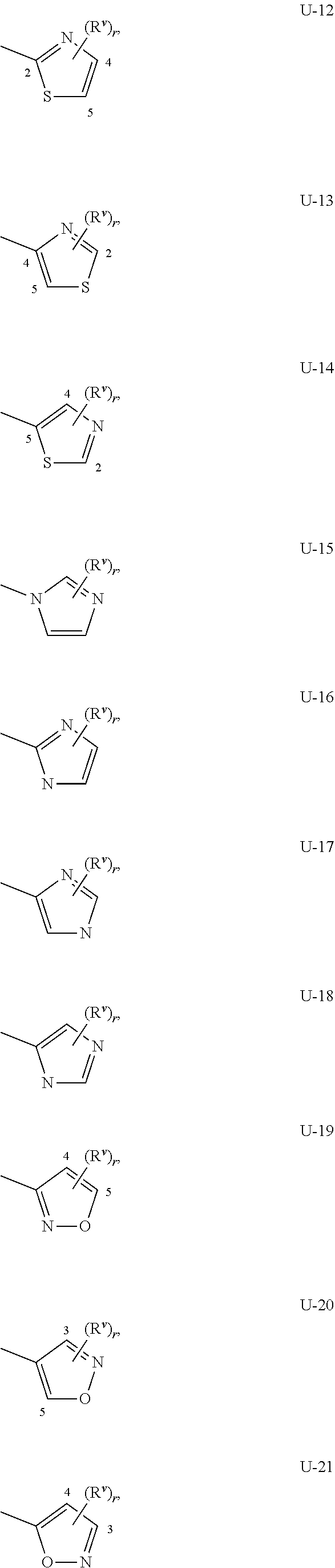


-
- Embodiment M1. The method including:
- (a) combining a compound of
Formula 2 with a compound ofFormula 3 and a sulfonyl chloride; and - (b) isolating the compound of
Formula 1, wherein the combining step (a) is conducted in a continuous process. - Embodiment M1a. The method of Embodiment M1 wherein combining a compound of
Formula 2 with a compound ofFormula 3 and a sulfonyl chloride may be done in the presence of a base and/or solvent. - Embodiment M2. The method of Embodiment M1 wherein in the combining step (a) the compound of
Formula 2, the compound ofFormula 3 and the sulfonyl chloride may be continuously charged into a reaction zone; and the isolating step (b) may include continuously removing the compound ofFormula 1 from the reaction zone after it is formed. - Embodiment M2a. The method of Embodiment M2 wherein an optional solvent and/or base may also be continuously charged into the reaction zone.
- Embodiment M3. The method of Embodiment M1 or Embodiment M2 wherein the rates of charging the compound of
Formula 2, the compound ofFormula 3 and the sulfonyl chloride and the rate of removal of the compound ofFormula 1 may be regulated to provide an average residence time in the reaction zone of two hours or less. - Embodiment M3a. The method of Embodiment M3 wherein optional solvent and/or base are continuously charged into the reaction zone and removed from the reaction zone and the rates are regulated to provide an average residence time in the reaction zone of two hours or less.
- Embodiment M4. The method of Embodiment M3 or Embodiment 3a wherein the average residence time in the reaction zone is about 15 minutes or less.
- Embodiment M5. The method of any of Embodiments M1 through M4 wherein at least a portion of the compound of
Formula 1 may be isolated from the process medium. - Embodiment M6. The method of any of Embodiments M1 through M5 wherein the isolating step may include (b1) quenching the reaction of the compounds of
Formulae Formula 1 and (b2) filtering the compound ofFormula 1 from the process medium. - Embodiment M7. The method of Embodiment M6 wherein the quenching step (b1) may be conducted by adding an antisolvent, such as water, to the reaction stream in a quenching zone.
- Embodiment M8. The method of Embodiment M7 wherein the added water may be characterized by a pH value that is neutral, acidic, or basic, or may be present sequentially at different pH values in a plurality of separate quenching zones.
- Embodiment M9. The method of any one of Embodiments M1 to M8 further includes drying the compound of
Formula 1. - Embodiment M10. The method of any one of Embodiments M1 to M9 wherein the combining step (a) may be conducted under atmospheric pressure in an inert atmosphere.
- Embodiment M11. The method of any one of Embodiments M1 to M10 wherein the reaction zone may include a single reactor vessel.
- Embodiment M12. The method of any of Embodiments M1 through M10 wherein the reaction zone includes a plurality of reaction subzones with an independent average residence time and temperature for each subzone.
- Embodiment M13. The method of M12 wherein the reaction zone includes a first reactor vessel and a second reactor vessel.
- Embodiment M14. The method of any one of Embodiments M1 to M13 wherein the reaction zone includes a plug flow reactor, a continual stirred tank reactor, or a combination thereof.
- Embodiment M15. The method of any one of Embodiments M1 to M14 wherein the molar ratio of the compound of
Formula 2 to the compound ofFormula 3 is from about 1.2:1 to about 1:1.2. - Embodiment M16. The method of Embodiment M15 wherein the molar ratio of the compound of
Formula 2 to the compound ofFormula 3 is from about 1:1 to about 1:1.2. - Embodiment M17. The method of Embodiment M15 wherein the molar ratio of the compound of
Formula 2 to the compound ofFormula 3 is about 1:1.1. - Embodiment M18. The method of any one of Embodiments M1 to M17 wherein the molar ratio of the sulfonyl chloride to the compound of
Formula 2 is at least about 1:1. - Embodiment M19. The method of Embodiment M18 wherein the molar ratio of the sulfonyl chloride to the compound of
Formula 2 is from about 1:1 to about 2.5:1. - Embodiment M20. The method of Embodiment M19 wherein the molar ratio of the sulfonyl chloride to the compound of
Formula 2 is from about 1.1:1 to about 1.4:1. - Embodiment M21. The method of any one of Embodiments M1 to M18 wherein when R2 is Br or Cl, then the molar ratio of the sulfonyl chloride to the compound of
Formula 2 is about 1.2:1. Embodiment M22. The method of any one of Embodiments M1 to M18 wherein when R2 is CN, then the molar ratio of the sulfonyl chloride to the compound ofFormula 2 is about 1.4:1. Embodiment M23. The method of any of Embodiments M1 to M22 wherein the sulfonyl chloride is of Formula 4
R8S(O)2Cl 4- wherein R8 is a carbon-based radical.
- Embodiment M24. The method of Embodiment M23 wherein R8 is C1-C4 alkyl, C1-C2 haloalkyl, or phenyl optionally substituted with 1-3 substituents selected from the group consisting of halogen, C1-C3 alkyl and nitro.
- Embodiment M25. The method of Embodiment M24 wherein R8 is C1-C2 alkyl, CF3, phenyl or 4-methylphenyl.
- Embodiment M26. The method of Embodiment M25 wherein R8 is C1-C2 alkyl, phenyl or 4-methylphenyl.
- Embodiment M27. The method of Embodiment M26 wherein R8 is CH3.
- Embodiment M28. The method of any one of Embodiments M1 to M27 wherein the carboxylic acid of
Formula 2, aniline ofFormula 3 and sulfonyl chloride are combined at a temperature is between about −70 and about 100° C. - Embodiment M29. The method of Embodiment M28 wherein the temperature is between about −20 and about 40° C.
- Embodiment M30. The method of Embodiment M26 wherein the temperature is between about −10 and about 30° C.
- Embodiment M31. The method of any one of Embodiments M1 to M30 wherein the carboxylic acid of
Formula 2 may be combined with the aniline ofFormula 3 to form a mixture, and then the mixture is combined with the sulfonyl chloride. - Embodiment M32. The method of any one of Embodiments M1 to M31 wherein a base may be combined with the compounds of
Formulae - Embodiment M33. The method of Embodiment M32 wherein a base may be combined with the mixture either before or after combining with the sulfonyl chloride.
- Embodiment M34. The method of Embodiment M33 wherein a base is combined with the compounds of
Formulae - Embodiment M35. The method of any of Embodiments M32 through M34 wherein the amount of the base is at least about 2 equivalents relative to the sulfonyl chloride.
- Embodiment M36. The method of Embodiment M35 wherein the amount of base is at least about 2.1 equivalents relative to the sulfonyl chloride. Embodiment M37. The method of Embodiment M36 wherein the amount of the base is from about 2.1 to 2.2 equivalents relative to the sulfonyl chloride.
- Embodiment M38. The method of any one of Embodiments M32 to M37 wherein the base is selected from tertiary amines, including optionally substituted pyridines).
- Embodiment M39. The method of Embodiment M38 wherein the base is selected from optionally substituted pyridines and mixtures thereof.
- Embodiment M40. The method of Embodiment M39 wherein the base is selected from 2-picoline, 3-picoline, 2,6-lutidine, pyridine and mixtures of the foregoing.
- Embodiment M41. The method of Embodiment M40 wherein the base is 3-picoline.
- Embodiment M42. The method of any one of Embodiments M1 to M41 wherein a solvent may be combined with the compounds of
Formulae - Embodiment M43. The method of Embodiment M42 wherein the solvent is combined with the compounds of
Formulae - Embodiment M44. The method of Embodiment M43 wherein a base is combined with the compounds of
Formulae - Embodiment M45. The method of Embodiment M43 wherein a base is combined with the compounds of
Formulae - Embodiment M47. The method of Embodiment M46 wherein the solvent is selected from tertiary amines (e.g., trialkylamines, dialkylanthranilamides, optionally substituted pyridines) and mixtures thereof.
- Embodiment M48. The method of Embodiment M46 wherein the solvent is selected from nitriles (e.g., acetonitrile, propionitrile), esters (e.g., methyl acetate, ethyl acetate, butyl acetate), ketones (e.g., acetone, methyl ethyl ketone, methyl butyl ketone, haloalkanes (e.g., dichloromethane, trichloromethane), ethers (e.g., ethyl ether, methyl tert-butyl ether, tetrahydrofuran, p-dioxane), aromatic hydrocarbons (e.g., benzene, toluene, chlorobenzene, dichlorobenzene), and mixtures thereof.
- Embodiment M49. The method of Embodiment M48 wherein the solvent is acetonitrile.
- Embodiment M50. The method of any one of Embodiments M1 to M49 further including treating a compound of
Formula 1 wherein R1 is H with a halogenating agent to provide a compound ofFormula 1 wherein R1 is Cl or Br. Embodiment M51. The method of any one of Embodiments M1 to M49 further including treating a compound ofFormula 1 wherein R2 is H with a halogenating agent to provide a compound ofFormula 1 wherein R2 is Cl or Br.
-
- Embodiment C1. The method of Embodiments M1 to M51 used to prepare compounds of
Formula 1
- Embodiment C1. The method of Embodiments M1 to M51 used to prepare compounds of

-
-
- wherein
- X is O or S;
- Z is CR7 or N;
- R1 is H, CH3, Cl or Br,
- R2 is H, Br, Cl or CN;
- R3 is H, C1-C4 alkyl or C4-C10 cycloalkylalkyl;
- R4 is Cl, Br, OCF2H, OCH2CF3; or C1-C4 alkyl optionally substituted with
- halogen; or C1-C4 alkyl substituted with Q;
- R5 is F, Cl or Br,
- R6 is H, F or C1;
- R7 is H, F, Cl or Br; and
- Q is a 5- or 6-membered aromatic heterocyclic ring optionally substituted with one or more substituents independently selected from the group consisting of halogen, C1-C6 alkyl, C3-C6 cycloalkyl and C1-C6 haloalkyl.
- Embodiment C2. The method of any one of Embodiments M1 to M51 wherein in the compound of
Formula 3, X is O. - Embodiment C3. The method of any one of Embodiments M1 to M51 wherein in the compound of
Formula 3, X is S. - Embodiment C4. The method of any one of Embodiments C1 to C3 wherein in the compound of
Formula 3, R1 is Cl. - Embodiment C5. The method of any one of Embodiments C1 to C3 wherein in the compound of
Formula 3, R1 is Br. - Embodiment C6. The method of any one of Embodiments C1 to C3 wherein in the compound of
Formula 3, R1 is H. - Embodiment C7. The method of any one of Embodiments C1 to C6 wherein in the compound of
Formula 3, R2 is Br or Cl. - Embodiment C8. The method of any one of Embodiments C1 to C6 wherein in the compound of
Formula 3, R2 is H. - Embodiment C9. The method of any one of Embodiments C1 to C6 wherein in the compound of
Formula 3, R2 is CN. - Embodiment C10. The method of any one of Embodiments C1 to C9 wherein in the compound of
Formula 3, R3 is C1-C4 alkyl. - Embodiment C11. The method of Embodiment C10 wherein R3 is methyl.
- Embodiment C12. The method of Embodiment C10 wherein R3 is, ethyl.
- Embodiment C13. The method of Embodiment C10 wherein R3 is isopropyl.
- Embodiment C14. The method of any one of Embodiments C1 to C9 wherein in the compound of
Formula 3, R3 is C4-C10 cycloalkylalkyl. - Embodiment C15. The method of Embodiment C14 wherein R3 is 1-(cyclopropyl)ethyl.
- Embodiment C16. The method of any one of Embodiments C1 to C15 wherein in the compound of
Formula 2, Z is N. - Embodiment C17. The method of any one of Embodiments C1 to C16 wherein in the compound of
Formula 2, R4 is Cl or Br. - Embodiment C18. The method of any one of Embodiments C1 to C16 wherein in the compound of
Formula 2, R4 is C1-C4 alkyl optionally substituted with halogen or C1-C4 alkyl substituted with Q. - Embodiment C19. The method of C18 wherein R4 is C1-C4 alkyl.
- Embodiment C20. The method of C19 wherein R4 is methyl.
- Embodiment C21. The method of C18 wherein R4 is C1-C4 alkyl substituted with halogen. Embodiment C22. The method of C21 wherein R4 is CF3.
- Embodiment C23. The method of C21 wherein R4 is CH2Br. Embodiment C24. The method of C18 wherein R4 is C1-C4 alkyl substituted with a 5-membered aromatic heterocycle optionally substituted with one or more substituents independently selected from the group consisting of halogen, C1-C6 alkyl, C3-C6 cycloalkyl and C1-C6 haloalkyl.
- Embodiment C25. The method of C24 wherein R4 is 5-(trifluoromethyl)-2H-tetrazol-2-ylmethyl.
- Embodiment C26. The method of any one of Embodiments C1 to C25 wherein in the compound of
Formula 2, R5 is Cl. - Embodiment C27. The method of any one of Embodiments C1 to C26 wherein in the compound of
Formula 2, R6 is H. - Embodiment C28. The method of any one of Embodiments C1 to C27 wherein in the compound of
Formula 2, R6 is Cl. - Embodiment C29. The method of C1 wherein in the compound of
Formula 1, X is O. - Embodiment C30. The method of C1 wherein in the compound of
Formula 1, X is S. - Embodiment C31. The method of any one of Embodiments C29 to C30 wherein in the compound of
Formula 1, R1 is Cl. - Embodiment C32. The method of any one of Embodiments C29 to C30 wherein in the compound of
Formula 1, R1 is Br. - Embodiment C33. The method of any one of Embodiments C29 to C30 wherein in the compound of
Formula 1, R1 is H. - Embodiment C34. The method of any one of Embodiments C29 to C33 wherein in the compound of
Formula 1, R2 is Br or Cl. - Embodiment C35. The method of any one of Embodiments C29 to C33 wherein in the compound of
Formula 1, R2 is H. - Embodiment C36. The method of any one of Embodiments C29 to C33 wherein in the compound of
Formula 1, R2 is CN. - Embodiment C37. The method of any one of Embodiments C29 to C36 wherein in the compound of
Formula 1, R3 is C4-C4 alkyl. - Embodiment C38. The method of Embodiment C37 wherein R3 is methyl.
- Embodiment C39. The method of Embodiment C37 wherein R3 is ethyl.
- Embodiment C40. The method of Embodiment C37 wherein R3 is isopropyl.
- Embodiment C41. The method of any one of Embodiments C29 to C36 wherein in the compound of
Formula 1, R3 is C4-C10 cycloalkylalkyl. - Embodiment C42. The method of Embodiment C41 wherein R3 is 1-(cyclopropyl)ethyl.
- Embodiment C43. The method of any one of Embodiments C29 to C42 wherein in the compound of
Formula 1, Z is N. - Embodiment C44. The method of any one of Embodiments C29 to C43 wherein in the compound of
Formula 1, R4 is Cl or Br. - Embodiment C45. The method of any one of Embodiments C29 to C43 wherein in the compound of
Formula 1, R4 is C1-C4 alkyl optionally substituted with halogen or C1-C4 alkyl substituted with a 5- or 6-membered aromatic heterocycle optionally substituted with C1-C2 haloalkyl. - Embodiment C46. The method of C45 wherein R4 is C1-C4 alkyl.
- Embodiment C47. The method of C46 wherein R4 is methyl.
- Embodiment C48. The method of C45 wherein R4 is C1-C4 alkyl substituted with halogen.
- Embodiment C49. The method of C48 wherein R4 is CF3.
- Embodiment C50. The method of C48 wherein R4 is CH2Br.
- Embodiment C51. The method of C45 wherein R4 is C1-C4 alkyl substituted with a 5-membered aromatic heterocycle optionally substituted with C1-C2 haloalkyl.
- Embodiment C52. The method of C51 wherein R4 is 5-(trifluoromethyl)-2H-tetrazol-2-ylmethyl.
- Embodiment C53. The method of any one of Embodiments C29 to C52 wherein in the compound of
Formula 1, R5 is Cl. - Embodiment C54. The method of any one of Embodiments C29 to C53 wherein in the compound of
Formula 1, R6 is H. - Embodiment C55. The method of any one of Embodiments C29 to C53 wherein in the compound of
Formula 1, R6 is Cl.
-
-
- Embodiment A1. The method of any one of Embodiments M1 to M51 including compounds of
Formula 3 wherein X is O; R1 is CH3; R2 is H, C1, Br or CN; and R3 is CH3 or CH2CH3. - Embodiment A2. The method of Embodiment A1 including compounds of
Formula 3 wherein X is O; R1 is CH3; R2 is Cl or CN; and R3 is CH3. - Embodiment A3. The method of Embodiment A1 including compounds of
Formula 3 wherein X is O; R1 is CH3; R2 is H or Br, and R3 is CH3 or CH2CH3. - Embodiment A4. The method of any one of Embodiments M1 to M51 including compounds of
Formula 3 wherein X is O or S; R1 is Cl; R2 is Cl; and R3 is CH(CH3)2. - Embodiment A5. The method of any one of Embodiments M1 to M51 including compounds of
Formula 3 wherein X is O; R1 is H or Br, R2 is Cl; and R3 is 1-(cyclopropyl)ethyl. - Embodiment A6. The method of any one of Embodiments M1 to M51 including compounds of
Formula 2 wherein Z is N; R4 is Br, R5 is Cl; and R6 is H or Cl. - Embodiment A7. The method of any one of Embodiments M1 to M51 including compounds of
Formula 2 wherein Z is N; R3 is CH3, CH2Br or 5-(trifluoromethyl)-2H-tetrazol-2-ylmethyl; R5 is Cl; and R6 is H. - Embodiment A8. The method of any one of Embodiments M1 to M51 including compounds of
Formula 1 wherein X is O; R1 is CH3; R2 is H, C1, Br or CN; and R3 is CH3 or CH2CH3. - Embodiment A9. The method of Embodiment A8 including compounds of
Formula 1 wherein X is O; R1 is CH3; R2 is Cl or CN; and R3 is CH3. - Embodiment A10. The method of Embodiment A8 including compounds of
Formula 1 wherein X is O; R1 is CH3; R2 is H or Br, and R3 is CH3 or CH2CH3. - Embodiment A11. The method of any one of Embodiments M1 to M51 including compounds of
Formula 1 wherein X is O or S; R1 is Cl; R2 is Cl; and R3 is CH(CH3)2. - Embodiment A12. The method of any one of Embodiments M1 to M51 including compounds of
Formula 1 wherein X is O; R1 is H or Br, R2 is Cl; and R3 is 1-(cyclopropyl)ethyl. - Embodiment A13. The method of any one of Embodiments M1 to M51 including compounds of
Formula 1 wherein Z is N; R4 is Br, R5 is Cl; and R6 is H or Cl. - Embodiment A14. The method of any one of Embodiments M1 to M51 including compounds of
Formula 1 wherein Z is N; R3 is CH3, CH2Br or 5-(trifluoromethyl)-2H-tetrazol-2-ylmethyl; R5 is Cl; and R6 is H. - Embodiment A15. The method of any one of Embodiments M1 to M51 including compounds of
Formula 1 wherein X is O; Z is N; R1 is CH3; R2 is H, C1, Br or CN; R3 is CH3 or CH2CH3; R4 is Br, R5 is Cl; and R6 is H. - Embodiment A16. The method of any one of Embodiments M1 to M51 including compounds of
Formula 1 wherein X is O or S; Z is N; R1 is Cl; R2 is Cl; R3 is CH3 or CH(CH3)2; R4 is Br; R5 is Cl; and R6 is H or Cl.
- Embodiment A1. The method of any one of Embodiments M1 to M51 including compounds of
- 3-bromo-N-[4-chloro-2-methyl-6-[(methylamino)carbonyl]phenyl]-1-(3-chloro-2-pyridinyl)-1H-pyrazole-5-carboxamide (also known as chlorantraniliprole),
- 3-bromo-1-(3-chloro-2-pyridinyl)-N-[4-cyano-2-methyl-6-[(methylamino)carbonyl]phenyl]-1H-pyrazole-5-carboxamide (also known as cyantraniliprole),
- 1-(3-chloro-2-pyridinyl)-N-[4-cyano-2-methyl-6-[(methylamino)carbonyl]phenyl]-3-[[5-(trifluoromethyl)-2H-tetrazol-2-yl]methyl]-1H-pyrazole-5-carboxamide (also known as tetraniliprole), and
- 3-bromo-N-[2-bromo-4-chloro-6-[[(1-cyclopropylethyl]amino]carbonyl]phenyl-1-(3-chloro-2-pyridinyl)-1H-pyrazole-5-carboxamide (also known as cyclaniliprole).

Thus, in the present method a pyrazolecarboxylic acid of

In these cases, it is often advantageous to convert the Formula cyclo-1 compound back to the amide of

Reaction of a pyrazole of Formula 6 with a 2-halopyridine of Formula 7 affords good yields of the 1-pyridinylpyrazole of Formula 8 with good specificity for the desired regiochemistry. Metallation of the compound of Formula 8 with lithium diisopropylamide (LDA) followed by quenching of the lithium salt with carbon dioxide affords the 1-(2-pyridinyl)pyrazolecarboxylic acid of Formula 2a. For a leading reference to this method see PCT Patent Publication WO 03/015519.


Pyrazoles of Formula 13 can be condensed with aryl iodides using methods such as those reported by A. Klapars, J. C. Antilla, X. Huang and S. L. Buchwald, J. Am. Chem. Soc. 152001, 123, 7727-7729, or with aryl boronic acids using methods such as those reported by P. Y. S. Lam, C. G. Clark, S. Saubern, J. Adams, M. P. Winters, D. M. T. Chan and A. Combs, Tetrahedron Len. 1998, 39, 2941-2944. The resulting adducts of Formula 15 can be oxidized with oxidizing agents such as potassium permanganate to afford the pyrazolecarboxylic acids of Formula 2b.


The oxidizing agent can be hydrogen peroxide, organic peroxides, potassium persulfate, sodium persulfate, ammonium persulfate, potassium monopersulfate (e.g., Oxone®) or potassium permanganate. This oxidation can be carried out in the presence of a solvent, including an ether, such as tetrahydrofuran, p-dioxane and the like, an organic ester, such as ethyl acetate, dimethyl carbonate and the like, or a polar aprotic organic such as N,N-dimethylformamide, acetonitrile and the like.

Halogenating reagents that can be used include phosphorus oxyhalides, phosphorus trihalides, phosphorus pentahalides, thionyl chloride, dihalotrialkylphophoranes, dihalotriphenylphosphoranes, oxalyl chloride and phosgene. In various embodiments, the halogenating reagents are phosphorus oxyhalides and phosphorus pentahalides. Typical solvents for this halogenation include halogenated alkanes, such as dichloromethane, chloroform, chlorobutane and the like, aromatic solvents, such as benzene, xylene, chlorobenzene and the like, ethers, such as tetrahydrofuran, p-dioxane, diethyl ether, and the like, and polar aprotic solvents such as acetonitrile, N,N-dimethylformamide, and the like. Optionally, an organic base, such as triethylamine, pyridine, N,N-dimethylaniline or the like, can be added. Addition of a catalyst, such as N,N-dimethylformamide, is also an option.

In this method, instead of being halogenated as shown in Scheme 8, the compound of Formula 20 is oxidized to the compound of Formula 21. The reaction conditions for this oxidation are as already described for the conversion of the compound of Formula 18 to the compound of Formula 19 in Scheme 7. The compound of Formula 21 can then be alkylated to form the compound of Formula 22 by contact with difluorocarbene, prepared in situ from CHClF2 in the presence of a base. The compound of Formula 21 can also be alkylated to form the compound of Formula 24 by contact with an alkylating agent CF3CH2Lg in the presence of a base. The alkylation reaction is generally conducted in a solvent, which can include ethers, such as tetrahydrofuran or dioxane, and polar aprotic solvents, such as acetonitrile, N,N-dimethylformamide, and the like. The base can be selected from inorganic bases such as potassium carbonate, sodium hydroxide or sodium hydride. In various embodiments, the reaction is conducted using potassium carbonate with N,N-dimethylformamide or acetonitrile as the solvent. In the alkylating agent CF3CH2Lg, Lg is a nucleofuge (i.e. leaving group) such as halogen (e.g., Br, I), OS(O)2CH3 (methanesulfonate), OS(O)2CF3, OS(O)2Ph-p-CH3 (p-toluenesulfonate), and the like. The product of Formula 22 can be isolated by conventional techniques such as extraction. The esters can then be converted to the carboxylic acids of Formula 2c by the methods already described for the conversion of Formula 12 to Formula 2b in Scheme 4.

In this method, a hydrazine compound of Formula 25 is contacted with a compound of Formula 26 (a fumarate ester or maleate ester or a mixture thereof may be used) in the presence of a base and a solvent. The base is typically a metal alkoxide salt, such as sodium methoxide, potassium methoxide, sodium ethoxide, potassium ethoxide, potassium tert-butoxide, lithium tert-butoxide, and the like. Polar protic and polar aprotic organic solvents can be used, such as alcohols, acetonitrile, tetrahydrofuran, N,N-dimethylformamide, dimethyl sulfoxide and the like. In various embodiments, the solvents are alcohols such as methanol and ethanol. In other embodiments, the alcohol corresponds to (i.e. be the same as that making up) the fumarate or maleate ester and the alkoxide base. Depending on the reaction conditions and the means of isolation, the —CO2R function on the compound of Formula 20 may be hydrolyzed to —CO2H; for example, the presence of water in the reaction mixture can promote such hydrolysis. If the carboxylic acid (—CO2H) is formed, it can be converted back to —CO2R wherein R is C1-C4 alkyl using esterification methods well known in the art. The desired product, a compound of Formula 20, can be isolated by methods known to those skilled in the art, such as crystallization, extraction or distillation.


Isatins of Formula 37 are available from aniline derivatives of Formula 36 following literature procedures such as F. D. Popp, Adv. Heterocycl. Chem. 1975, 18, 1-58 and J. F. M. Da Silva et al., Journal of the Brazilian Chemical Society 2001, 12(3), 273-324. Oxidation of isatin 30 with hydrogen peroxide generally affords good yields of the corresponding isatoic anhydride 28 (G. Reissenweber and D. Mangold, Angew. Chem. Int. Ed Engl. 1980, 19, 222-223).

The halogenation reaction can be carried out using many reagents and procedures known in the literature. Suitable reagents include the elemental halogens (chlorine, bromine, or iodine), “positive-halogen” reagents such as trichloroisocyanuric acid, N-chlorosuccinimide (NCS), N-bromosuccinimide (NBS) or N-iodosuccinimide (NIS), and halogenating reagents such as the mixtures including hydrogen peroxide and a hydrogen halide. The halogen at the 5-position of isatins of Formula 37 wherein R2 is Cl, Br or I can be displaced by cyanide using methods known in the literature. These methods include the use of a cyanide salt, usually employing a metal compound, and often in the presence of a ligand such as a substituted phosphine or a substituted bisphosphinoalkane. Suitable methods include those employing compounds of palladium such as those described by P. E. Maligres et al., Tetrahedron Letters 1999, 40, 8193-8195, and by M. Beller et al., Chem. Eur. J. 2003, 9(8), 1828-1836; those employing compounds of copper such as those described by S. L. Buchwald in J. Am. Chem. Soc. 2003, 125, 2890-2891; and those employing compounds of nickel such as those described in European Patent 384392, and by K. Sasaki in Bull. Chem. Soc. Japan 2004, 77, 1013-1019, and by R. K. Arvela and N. E. Leadbeater in J. Org. Chem. 2003, 68, 9122-9125. One versed in the art will appreciate that when R1 is Cl, R2 of Formula 27 may be Br or I to obtain selectivity in the cyanation (i.e. displacement of halogen by cyanide).

Typical reduction procedures involve reduction with hydrogen in the presence of a metal catalyst such as palladium on carbon or platinum oxide in hydroxylic solvents such as ethanol and isopropanol. The reduction can also be conducted in the presence of zinc in acetic acid. These methods for reducing nitro groups are well documented in the chemical literature. Many methods for interconversion of carboxylic acids, esters, and amides are also well documented in the chemical literature.

Suitable methods and procedures are known in the literature and are similar to those described for the halogenations and cyanide displacements shown in Scheme 13. One skilled in the art will recognize that the halogenation and cyanation can also be carried out at other stages in the preparation of anilines of


| TABLE 1 |
 |
| R1 | R2 | R3 | R1 | R2 | R3 | R1 | R2 | R3 |
| CH3 | Cl | H | CH3 | CN | H | Cl | CN | H |
| CH3 | Cl | Me | CH3 | CN | Me | Cl | CN | Me |
| CH3 | Cl | Et | CH3 | CN | Et | Cl | CN | Et |
| CH3 | Cl | i-Pr | CH3 | CN | i-Pr | Cl | CN | i-Pr |
| CH3 | Cl | t-Bu | CH3 | CN | t-Bu | Cl | CN | t-Bu |
| CH3 | Cl | n-Pr | CH3 | CN | n-Pr | Cl | CN | n-Pr |
| CH3 | Cl | n-Bu | CH3 | CN | n-Bu | Cl | CN | n-Bu |
| CH3 | Cl | s-Bu | CH3 | CN | s-Bu | Cl | CN | s-Bu |
| CH3 | Cl | i-Bu | CH3 | CN | i-Bu | Cl | CN | i-Bu |
| CH3 | Cl | CH2-c-Pr | CH3 | CN | CH2-c-Pr | Cl | CN | CH2-c-Pr |
| CH3 | Cl | CH(Me)- | CH3 | CN | CH(Me)- | Cl | CN | CH(Me)- |
| c-Pr | c-Pr | c-Pr | ||||||
| CH3 | Br | H | Cl | Cl | H | Br | Cl | H |
| CH3 | Br | Me | Cl | Cl | Me | Br | Cl | Me |
| CH3 | Br | Et | Cl | Cl | Et | Br | Cl | Et |
| CH3 | Br | i-Pr | Cl | Cl | i-Pr | Br | Cl | i-Pr |
| CH3 | Br | t-Bu | Cl | Cl | t-Bu | Br | Cl | t-Bu |
| CH3 | Br | n-Pr | Cl | Cl | n-Pr | Br | Cl | n-Pr |
| CH3 | Br | n-Bu | Cl | Cl | n-Bu | Br | Cl | n-Bu |
| CH3 | Br | s-Bu | Cl | Cl | s-Bu | Br | Cl | s-Bu |
| CH3 | Br | i-Bu | Cl | Cl | i-Bu | Br | Cl | i-Bu |
| CH3 | Br | CH2-c-Pr | Cl | Cl | CH2-c-Pr | Br | Cl | CH2-c-Pr |
| CH3 | Br | CH(Me)- | Cl | Cl | CH(Me)- | Br | Cl | CH(Me)- |
| c-Pr | c-Pr | c-Pr | ||||||
| CH3 | H | H | Cl | Br | H | Br | H | H |
| CH3 | H | Me | Cl | Br | Me | Br | H | Me |
| CH3 | H | Et | Cl | Br | Et | Br | H | Et |
| CH3 | H | i-Pr | Cl | Br | i-Pr | Br | H | i-Pr |
| CH3 | H | t-Bu | Cl | Br | t-Bu | Br | H | t-Bu |
| CH3 | H | n-Pr | Cl | Br | n-Pr | Br | H | n-Pr |
| CH3 | H | n-Bu | Cl | Br | n-Bu | Br | H | n-Bu |
| CH3 | H | s-Bu | Cl | Br | s-Bu | Br | H | s-Bu |
| CH3 | H | i-Bu | Cl | Br | i-Bu | Br | H | i-Bu |
| CH3 | H | CH2-c-Pr | Cl | Br | CH2-c-Pr | Br | H | CH2-c-Pr |
| CH3 | H | CH(Me)- | Cl | Br | CH(Me)- | Br | H | CH(Me)- |
| c-Pr | c-Pr | c-Pr | ||||||
| H | Cl | H | H | Cl | t-Bu | H | Cl | s-Bu |
| H | Cl | Me | H | Cl | n-Pr | H | Cl | i-Bu |
| H | Cl | Et | H | Cl | n-Bu | H | Cl | CH2-c-Pr |
| H | Cl | i-Pr | H | Cl | CH(Me)- | |||
| c-Pr | ||||||||

| TABLE 3 |
 |
| wherein Z is N and |
| R4 | R5 | R6 | R4 | R5 | R6 | R4 | R5 | R6 |
| CF3 | F | H | Br | F | H | CF2CF2CF3 | F | H |
| CF3 | F | F | Br | F | F | CF2CF2CF3 | F | F |
| CF3 | F | Cl | Br | F | Cl | CF2CF2CF3 | F | Cl |
| CF3 | Cl | H | Br | Cl | H | CF2CF2CF3 | Cl | H |
| CF3 | Cl | F | Br | Cl | F | CF2CF2CF3 | Cl | F |
| CF3 | Cl | Cl | Br | Cl | Cl | CF2CF2CF3 | Cl | Cl |
| CF3 | Br | H | Br | Br | H | CF2CF2CF3 | Br | H |
| CF3 | Br | F | Br | Br | F | CF2CF2CF3 | Br | F |
| CF3 | Br | Cl | Br | Br | Cl | CF2CF2CF3 | Br | Cl |
| CF3 | F | H | Cl | F | H | CH2CF3 | F | H |
| CF3 | F | F | Cl | F | F | CH2CF3 | F | F |
| CF3 | F | Cl | Cl | F | Cl | CH2CF3 | F | Cl |
| CF3 | Cl | H | Cl | Cl | H | CH2CF3 | Cl | H |
| CH3 | Cl | F | Cl | Cl | F | CH2CF3 | Cl | F |
| CH3 | Cl | Cl | Cl | Cl | Cl | CH2CF3 | Cl | Cl |
| CH3 | Br | H | Cl | Br | H | CH2CF3 | Br | H |
| CH3 | Br | F | Cl | Br | F | CH2CF3 | Br | F |
| CH3 | Br | Cl | Cl | Br | Cl | CH2CF3 | Br | Cl |
| CHF2 | F | H | OCF2H | F | H | CCl2CF3 | F | H |
| CHF2 | F | F | OCF2H | F | F | CCl2CF3 | F | F |
| CHF2 | F | Cl | OCF2H | F | Cl | CCl2CF3 | F | Cl |
| CHF2 | Cl | H | OCF2H | Cl | H | CCl2CF3 | Cl | H |
| CHF2 | Cl | F | OCF2H | Cl | F | CCl2CF3 | Cl | F |
| CHF2 | Cl | Cl | OCF2H | Cl | Cl | CCl2CF3 | Cl | Cl |
| CHF2 | Br | H | OCF2H | Br | H | CCl2CF3 | Br | H |
| CHF2 | Br | F | OCF2H | Br | F | CCl2CF3 | Br | F |
| CHF2 | Br | Cl | OCF2H | Br | Cl | CCl2CF3 | Br | Cl |
| CH2F | F | H | OCH2CF3 | F | H | CH2(2H-tetrazol-2-yl) | F | H |
| CH2F | F | F | OCH2CF3 | F | F | CH2(2H-tetrazol-2-yl) | F | F |
| CH2F | F | Cl | OCH2CF3 | F | Cl | CH2(2H-tetrazol-2-yl) | F | Cl |
| CH2F | Cl | H | OCH2CF3 | Cl | H | CH2(2H-tetrazol-2-yl) | Cl | H |
| CH2F | Cl | F | OCH2CF3 | Cl | F | CH2(2H-tetrazol-2-yl) | Cl | F |
| CH2F | Cl | Cl | OCH2CF3 | Cl | Cl | CH2(2H-tetrazol-2-yl) | Cl | Cl |
| CH2F | Br | H | OCH2CF3 | Br | H | CH2(2H-tetrazol-2-yl) | Br | H |
| CH2F | Br | F | OCH2CF3 | Br | F | CH2(2H-tetrazol-2-yl) | Br | F |
| CH2F | Br | Cl | OCH2CF3 | Br | Cl | CH2(2H-tetrazol-2-yl) | Br | Cl |
| CH2Br | F | H | CF2CF3 | F | H | CH2(5-CF3-2H-tetrazol-2-yl) | F | H |
| CH2Br | F | F | CF2CF3 | F | F | CH2(5-CF3-2H-tetrazol-2-yl) | F | F |
| CH2Br | F | Cl | CF2CF3 | F | Cl | CH2(5-CF3-2H-tetrazol-2-yl) | F | Cl |
| CH2Br | Cl | H | CF2CF3 | Cl | H | CH2(5-CF3-2H-tetrazol-2-yl) | Cl | H |
| CH2Br | Cl | F | CF2CF3 | Cl | F | CH2(5-CF3-2H-tetrazol-2-yl)) | Cl | F |
| CH2Br | Cl | Cl | CF2CF3 | Cl | Cl | CH2(5-CF3-2H-tetrazol-2-yl) | Cl | Cl |
| CH2Br | Br | H | CF2CF3 | Br | H | CH2(5-CF3-2H-tetrazol-2-yl) | Br | H |
| CH2Br | Br | F | CF2CF3 | Br | F | CH2(5-CF3-2H-tetrazol-2-yl) | Br | F |
| CH2Br | Br | Cl | CF2CF3 | Br | Cl | CH2(5-CF3-2H-tetrazol-2-yl) | Br | Cl |
| Table | Header row | ||
| 4 | Z is CR7, R7 is H and | ||
| 5 | Z is CR7, R7 is F and | ||
| 6 | Z is CR7, R7 is Cl and | ||
| 7 | Z is CR7, R7 is Br and | ||
| TABLE 8 |
 |
| wherein |
| X is O, Z is N, R1 is CH3, R2 is Cl, R3 is H and |
| R4 | R5 | R6 | R4 | R5 | R6 | R4 | R5 | R6 |
| CF3 | F | H | Br | F | H | CF2CF2CF3 | F | H |
| CF3 | F | F | Br | F | F | CF2CF2CF3 | F | F |
| CF3 | F | Cl | Br | F | Cl | CF2CF2CF3 | F | Cl |
| CF3 | Cl | H | Br | Cl | H | CF2CF2CF3 | Cl | H |
| CF3 | Cl | F | Br | Cl | F | CF2CF2CF3 | Cl | F |
| CF3 | Cl | Cl | Br | Cl | Cl | CF2CF2CF3 | Cl | Cl |
| CF3 | Br | H | Br | Br | H | CF2CF2CF3 | Br | H |
| CF3 | Br | F | Br | Br | F | CF2CF2CF3 | Br | F |
| CF3 | Br | Cl | Br | Br | Cl | CF2CF2CF3 | Br | Cl |
| CF3 | F | H | Cl | F | H | CH2CF3 | F | H |
| CF3 | F | F | Cl | F | F | CH2CF3 | F | F |
| CF3 | F | Cl | Cl | F | Cl | CH2CF3 | F | Cl |
| CF3 | Cl | H | Cl | Cl | H | CH2CF3 | Cl | H |
| CF3 | Cl | F | Cl | Cl | F | CH2CF3 | Cl | F |
| CF3 | Cl | Cl | Cl | Cl | Cl | CH2CF3 | Cl | Cl |
| CF3 | Br | H | Cl | Br | H | CH2CF3 | Br | H |
| CF3 | Br | F | Cl | Br | F | CH2CF3 | Br | F |
| CF3 | Br | Cl | Cl | Br | Cl | CH2CF3 | Br | Cl |
| CHF2 | F | H | OCF2H | F | H | CCl2CF3 | F | H |
| CHF2 | F | F | OCF2H | F | F | CCl2CF3 | F | F |
| CHF2 | F | Cl | OCF2H | F | Cl | CCl2CF3 | F | Cl |
| CHF2 | Cl | H | OCF2H | Cl | H | CCl2CF3 | Cl | H |
| CHF2 | Cl | F | OCF2H | Cl | F | CCl2CF3 | Cl | F |
| CHF2 | Cl | Cl | OCF2H | Cl | Cl | CCl2CF3 | Cl | Cl |
| CHF2 | Br | H | OCF2H | Br | H | CCl2CF3 | Br | H |
| CHF2 | Br | F | OCF2H | Br | F | CCl2CF3 | Br | F |
| CHF2 | Br | Cl | OCF2H | Br | Cl | CCl2CF3 | Br | Cl |
| CH2F | F | H | OCH2CF3 | F | H | CH2(2H-tetrazol-2-yl) | F | H |
| CH2F | F | F | OCH2CF3 | F | F | CH2(2H-tetrazol-2-yl) | F | F |
| CH2F | F | Cl | OCH2CF3 | F | Cl | CH2(2H-tetrazol-2-yl) | F | Cl |
| CH2F | Cl | H | OCH2CF3 | Cl | H | CH2(2H-tetrazol-2-yl) | Cl | H |
| CH2F | Cl | F | OCH2CF3 | Cl | F | CH2(2H-tetrazol-2-yl) | Cl | F |
| CH2F | Cl | Cl | OCH2CF3 | Cl | Cl | CH2(2H-tetrazol-2-y1) | Cl | Cl |
| CH2F | Br | H | OCH2CF3 | Br | H | CH2(2H-tetrazol-2-yl) | Br | H |
| CH2F | Br | F | OCH2CF3 | Br | F | CH2(2H-tetrazol-2-yl) | Br | F |
| CH2F | Br | Cl | OCH2CF3 | Br | Cl | CH2(2H-tetrazol-2-yl) | Br | Cl |
| CH2Br | F | H | CF2CF3 | F | H | CH2(5-CF3-2H-tetrazol-2-yl) | F | H |
| CH2Br | F | F | CF2CF3 | F | F | CH2(5-CF3-2H-tetrazol-2-yl) | F | F |
| CH2Br | F | Cl | CF2CF3 | F | Cl | CH2(5-CF3-2H-tetrazol-2-yl) | F | Cl |
| CH2Br | Cl | H | CF2CF3 | Cl | H | CH2(5-CF3-2H-tetrazol-2-yl) | Cl | H |
| CH2Br | Cl | F | CF2CF3 | Cl | F | CH2(5-CF3-2H-tetrazol-2-yl)) | Cl | F |
| CH2Br | Cl | Cl | CF2CF3 | Cl | Cl | CH2(5-CF3-2H-tetrazol-2-yl) | Cl | Cl |
| CH2Br | Br | H | CF2CF3 | Br | H | CH2(5-CF3-2H-tetrazol-2-yl) | Br | H |
| CH2Br | Br | F | CF2CF3 | Br | F | CH2(5-CF3-2H-tetrazol-2-yl) | Br | F |
| CH2Br | Br | Cl | CF2CF3 | Br | Cl | CH2(5-CF3-2H-tetrazol-2-yl) | Br | Cl |
| Table | Header Row |
| 9 | X is O, | Z is N, | R1 is CH3, | R2 is Cl, | R3 is Me | and |
| 10 | X is O, | Z is N, | R1 is CH3, | R2 is Cl, | R3 is Et | and |
| 11 | X is O, | Z is N, | R1 is CH3, | R2 is Cl, | R3 is i-Pr | and |
| 12 | X is O, | Z is N, | R1 is CH3, | R2 is Cl, | R3 is t-Bu | and |
| 13 | X is O, | Z is N, | R1 is CH3, | R2 is Cl, | R3 is n-Pr | and |
| 14 | X is O, | Z is N, | R1 is CH3, | R2 is Cl, | R3 is n-Bu | and |
| 15 | X is O, | Z is N, | R1 is CH3, | R2 is Cl, | R3 is s-Bu | and |
| 16 | X is O, | Z is N, | R1 is CH3, | R2 is Cl, | R3 is i-Bu | and |
| 17 | X is O, | Z is N, | R1 is CH3, | R2 is Cl, | R3 is CH2-c-Pr | and |
| 18 | X is O, | Z is N, | R1 is CH3, | R2 is Cl, | R3 is CH(Me)-c-Pr | and |
| 19 | X is O, | Z is N, | R1 is CH3, | R2 is Br, | R3 is H | and |
| 20 | X is O, | Z is N, | R1 is CH3, | R2 is Br, | R3 is Me | and |
| 21 | X is O, | Z is N, | R1 is CH3, | R2 is Br, | R3 is Et | and |
| 22 | X is O, | Z is N, | R1 is CH3, | R2 is Br, | R3 is i-Pr | and |
| 23 | X is O, | Z is N, | R1 is CH3, | R2 is Br, | R3 is t-Bu | and |
| 24 | X is O, | Z is N, | R1 is CH3, | R2 is Br, | R3 is n-Pr | and |
| 25 | X is O, | Z is N, | R1 is CH3, | R2 is Br, | R3 is n-Bu | and |
| 26 | X is O, | Z is N, | R1 is CH3, | R2 is Br, | R3 is s-Bu | and |
| 27 | X is O, | Z is N, | R1 is CH3, | R2 is Br, | R3 is i-Bu | and |
| 28 | X is O, | Z is N, | R1 is CH3, | R2 is Br, | R3 is CH2-c-Pr | and |
| 29 | X is O, | Z is N, | R1 is CH3, | R2 is Br, | R3 is CH(Me)-c-Pr | and |
| 30 | X is O, | Z is N, | R1 is CH3, | R2 is H, | R3 is H | and |
| 31 | X is O, | Z is N, | R1 is CH3, | R2 is H, | R3 is Me | and |
| 32 | X is O, | Z is N, | R1 is CH3, | R2 is H, | R3 is Et | and |
| 33 | X is O, | Z is N, | R1 is CH3, | R2 is H, | R3 is i-Pr | and |
| 34 | X is O, | Z is N, | R1 is CH3, | R2 is H, | R3 is t-Bu | and |
| 35 | X is O, | Z is N, | R1 is CH3, | R2 is H, | R3 is n-Pr | and |
| 36 | X is O, | Z is N, | R1 is CH3, | R2 is H, | R3 is n-Bu | and |
| 37 | X is O, | Z is N, | R1 is CH3, | R2 is H, | R3 is s-Bu | and |
| 38 | X is O, | Z is N, | R1 is CH3, | R2 is H, | R3 is i-Bu | and |
| 39 | X is O, | Z is N, | R1 is CH3, | R2 is H, | R3 is CH2-c-Pr | and |
| 40 | X is O, | Z is N, | R1 is CH3, | R2 is H, | R3 is CH(Me)-c-Pr | and |
| 41 | X is O, | Z is N, | R1 is CH3, | R2 is Cl, | R3 is H | and |
| 42 | X is O, | Z is N, | R1 is CH3, | R2 is Cl, | R3 is Me | and |
| 43 | X is O, | Z is N, | R1 is CH3, | R2 is Cl, | R3 is Et | and |
| 44 | X is O, | Z is N, | R1 is H, | R2 is Cl, | R3 is i-Pr | and |
| 45 | X is O, | Z is N, | R1 is H, | R2 is Cl, | R3 is t-Bu | and |
| 46 | X is O, | Z is N, | R1 is H, | R2 is Cl, | R3 is n-Pr | and |
| 47 | X is O, | Z is N, | R1 is H, | R2 is Cl, | R3 is n-Bu | and |
| 48 | X is O, | Z is N, | R1 is H, | R2 is Cl, | R3 is s-Bu | and |
| 49 | X is O, | Z is N, | R1 is H, | R2 is Cl, | R3 is i-Bu | and |
| 50 | X is O, | Z is N, | R1 is H, | R2 is Cl, | R3 is CH2-c-Pr | and |
| 51 | X is O, | Z is N, | R1 is H, | R2 is Cl, | R3 is CH(Me)-c-Pr | and |
| 52 | X is O, | Z is N, | R1 is CH3, | R2 is CN, | R3 is H | and |
| 53 | X is O, | Z is N, | R1 is CH3, | R2 is CN, | R3 is Me | and |
| 54 | X is O, | Z is N, | R1 is CH3, | R2 is CN, | R3 is Et | and |
| 55 | X is O, | Z is N, | R1 is CH3, | R2 is CN, | R3 is i-Pr | and |
| 56 | X is O, | Z is N, | R1 is CH3, | R2 is CN, | R3 is t-Bu | and |
| 57 | X is O, | Z is N, | R1 is CH3, | R2 is CN, | R3 is n-Pr | and |
| 58 | X is O, | Z is N, | R1 is CH3, | R2 is CN, | R3 is n-Bu | and |
| 59 | X is O, | Z is N, | R1 is CH3, | R2 is CN, | R3 is s-Bu | and |
| 60 | X is O, | Z is N, | R1 is CH3, | R2 is CN, | R3 is i-Bu | and |
| 61 | X is O, | Z is N, | R1 is CH3, | R2 is CN, | R3 is CH2-c-Pr | and |
| 62 | X is O, | Z is N, | R1 is CH3, | R2 is CN, | R3 is CH(Me)-c-Pr | and |
| 63 | X is O, | Z is N, | R1 is Cl, | R2 is Cl, | R3 is H | and |
| 64 | X is O, | Z is N, | R1 is Cl, | R2 is Cl, | R3 is Me | and |
| 65 | X is O, | Z is N, | R1 is Cl, | R2 is Cl, | R3 is Et | and |
| 66 | X is O, | Z is N, | R1 is Cl, | R2 is Cl, | R3 is i-Pr | and |
| 67 | X is O, | Z is N, | R1 is Cl, | R2 is Cl, | R3 is t-Bu | and |
| 68 | X is O, | Z is N, | R1 is Cl, | R2 is Cl, | R3 is n-Pr | and |
| 69 | X is O, | Z is N, | R1 is Cl, | R2 is Cl, | R3 is n-Bu | and |
| 70 | X is O, | Z is N, | R1 is Cl, | R2 is Cl, | R3 is s-Bu | and |
| 71 | X is O, | Z is N, | R1 is Cl, | R2 is Cl, | R3 is i-Bu | and |
| 72 | X is O, | Z is N, | R1 is Cl, | R2 is Cl, | R3 is CH2-c-Pr | and |
| 73 | X is O, | Z is N, | R1 is Cl, | R2 is Cl, | R3 is CH(Me)-c-Pr | and |
| 74 | X is O, | Z is N, | R1 is Cl, | R2 is Br, | R3 is H | and |
| 75 | X is O, | Z is N, | R1 is Cl, | R2 is Br, | R3 is Me | and |
| 76 | X is O, | Z is N, | R1 is Cl, | R2 is Br, | R3 is Et | and |
| 77 | X is O, | Z is N, | R1 is Cl, | R2 is Br, | R3 is i-Pr | and |
| 78 | X is O, | Z is N, | R1 is Cl, | R2 is Br, | R3 is t-Bu | and |
| 79 | X is O, | Z is N, | R1 is Cl, | R2 is Br, | R3 is n-Pr | and |
| 80 | X is O, | Z is N, | R1 is Cl, | R2 is Br, | R3 is n-Bu | and |
| 81 | X is O, | Z is N, | R1 is Cl, | R2 is Br, | R3 is s-Bu | and |
| 82 | X is O, | Z is N, | R1 is Cl, | R2 is Br, | R3 is i-Bu | and |
| 83 | X is O, | Z is N, | R1 is Cl, | R2 is Br, | R3 is CH2-c-Pr | and |
| 84 | X is O, | Z is N, | R1 is Cl, | R2 is Br, | R3 is CH(Me)-c-Pr | and |
| 85 | X is O, | Z is N, | R1 is Cl, | R2 is CN, | R3 is H | and |
| 86 | X is O, | Z is N, | R1 is Cl, | R2 is CN, | R3 is Me | and |
| 87 | X is O, | Z is N, | R1 is Cl, | R2 is CN, | R3 is Et | and |
| 88 | X is O, | Z is N, | R1 is Cl, | R2 is CN, | R3 is i-Pr | and |
| 89 | X is O, | Z is N, | R1 is Cl, | R2 is CN, | R3 is t-Bu | and |
| 90 | X is O, | Z is N, | R1 is Cl, | R2 is CN, | R3 is n-Pr | and |
| 91 | X is O, | Z is N, | R1 is Cl, | R2 is CN, | R3 is n-Bu | and |
| 92 | X is O, | Z is N, | R1 is Cl, | R2 is CN, | R3 is s-Bu | and |
| 93 | Xis O, | Z is N, | R1 is Cl, | R2 is CN, | R3 is i-Bu | and |
| 94 | X is O, | Z is N, | R1 is Cl, | R2 is CN, | R3 is CH2-c-Pr | and |
| 95 | X is O, | Z is N, | R1 is Cl, | R2 is CN, | R3 is CH(Me)-c-Pr | and |
| 96 | X is O, | Z is N, | R1 is Br, | R2 is Cl, | R3 is H | and |
| 97 | X is O, | Z is N, | R1 is Br, | R2 is Cl, | R3 is Me | and |
| 98 | X is O, | Z is N, | R1 is Br, | R2 is Cl, | R3 is Et | and |
| 99 | X is O, | Z is N, | R1 is Br, | R2 is Cl, | R3 is i-Pr | and |
| 100 | X is O, | Z is N, | R1 is Br, | R2 is Cl, | R3 is t-Bu | and |
| 101 | X is O, | Z is N, | R1 is Br, | R2 is Cl, | R3 is n-Pr | and |
| 102 | X is O, | Z is N, | R1 is Br, | R2 is Cl, | R3 is n-Bu | and |
| 103 | X is O, | Z is N, | R1 is Br, | R2 is Cl, | R3 is s-Bu | and |
| 104 | X is O, | Z is N, | R1 is Br, | R2 is Cl, | R3 is i-Bu | and |
| 105 | X is O, | Z is N, | R1 is Br, | R2 is Cl, | R3 is CH2-c-Pr | and |
| 106 | X is O, | Z is N, | R1 is Br, | R2 is Cl, | R3 is CH(Me)-c-Pr | and |
| 107 | X is O, | Z is N, | R1 is Br, | R2 is H, | R3 is H | and |
| 108 | X is O, | Z is N, | R1 is Br, | R2 is H, | R3 is Me | and |
| 109 | X is O, | Z is N, | R1 is Br, | R2 is H, | R3 is Et | and |
| 110 | X is O, | Z is N, | R1 is Br, | R2 is H, | R3 is i-Pr | and |
| 111 | X is O, | Z is N, | R1 is Br, | R2 is H, | R3 is t-Bu | and |
| 112 | X is O, | Z is N, | R1 is Br, | R2 is H, | R3 is n-Pr | and |
| 113 | X is O, | Z is N, | R1 is Br, | R2 is H, | R3 is n-Bu | and |
| 114 | X is O, | Z is N, | R1 is Br, | R2 is H, | R3 is s-Bu | and |
| 115 | X is O, | Z is N, | R1 is Br, | R2 is H, | R3 is i-Bu | and |
| 116 | X is O, | Z is N, | R1 is Br, | R2 is H, | R3 is CH2-c-Pr | and |
| 117 | X is O, | Z is N, | R1 is Br, | R2 is H, | R3 is CH(Me)-c-Pr | and |
| 118 | X is S, | Z is N, | R1 is CH3, | R2 is Cl, | R3 is H | and |
| 119 | X is S, | Z is N, | R1 is CH3, | R2 is Cl, | R3 is Me | and |
| 120 | X is S, | Z is N, | R1 is CH3, | R2 is Cl, | R3 is Et | and |
| 121 | X is S, | Z is N, | R1 is CH3, | R2 is Cl, | R3 is i-Pr | and |
| 122 | X is S, | Z is N, | R1 is CH3, | R2 is Cl, | R3 is t-Bu | and |
| 123 | X is S, | Z is N, | R1 is CH3, | R2 is Cl, | R3 is n-Pr | and |
| 124 | X is S, | Z is N, | R1 is CH3, | R2 is Cl, | R3 is n-Bu | and |
| 125 | X is S, | Z is N, | R1 is CH3, | R2 is Cl, | R3 is s-Bu | and |
| 126 | X is S, | Z is N, | R1 is CH3, | R2 is Cl, | R3 is i-Bu | and |
| 127 | X is S, | Z is N, | R1 is CH3, | R2 is Cl, | R3 is CH2-c-Pr | and |
| 128 | X is S, | Z is N, | R1 is CH3, | R2 is Cl, | R3 is CH(Me)-c-Pr | and |
| 129 | X is S, | Z is N, | R1 is CH3, | R2 is Br, | R3 is H | and |
| 130 | X is S, | Z is N, | R1 is CH3, | R2 is Br, | R3 is Me | and |
| 131 | X is S, | Z is N, | R1 is CH3, | R2 is Br, | R3 is Et | and |
| 132 | X is S, | Z is N, | R1 is CH3, | R2 is Br, | R3 is i-Pr | and |
| 133 | X is S, | Z is N, | R1 is CH3, | R2 is Br, | R3 is t-Bu | and |
| 134 | X is S, | Z is N, | R1 is CH3, | R2 is Br, | R3 is n-Pr | and |
| 135 | X is S, | Z is N, | R1 is CH3, | R2 is Br, | R3 is n-Bu | and |
| 136 | X is S, | Z is N, | R1 is CH3, | R2 is Br, | R3 is s-Bu | and |
| 137 | X is S, | Z is N, | R1 is CH3, | R2 is Br, | R3 is i-Bu | and |
| 138 | X is S, | Z is N, | R1 is CH3, | R2 is Br, | R3 is CH2-c-Pr | and |
| 139 | X is S, | Z is N, | R1 is CH3, | R2 is Br, | R3 is CH(Me)-c-Pr | and |
| 140 | X is S, | Z is N, | R1 is CH3, | R2 is H, | R3 is H | and |
| 141 | X is S, | Z is N, | R1 is CH3, | R2 is H, | R3 is Me | and |
| 142 | X is S, | Z is N, | R1 is CH3, | R2 is H, | R3 is Et | and |
| 143 | X is S, | Z is N, | R1 is CH3, | R2 is H, | R3 is i-Pr | and |
| 144 | X is S, | Z is N, | R1 is CH3, | R2 is H, | R3 is t-Bu | and |
| 145 | X is S, | Z is N, | R1 is CH3, | R2 is H, | R3 is n-Pr | and |
| 146 | X is S, | Z is N, | R1 is CH3, | R2 is H, | R3 is n-Bu | and |
| 147 | X is S, | Z is N, | R1 is CH3, | R2 is H, | R3 is s-Bu | and |
| 148 | X is S, | Z is N, | R1 is CH3, | R2 is H, | R3 is i-Bu | and |
| 149 | X is S, | Z is N, | R1 is CH3, | R2 is H, | R3 is CH2-c-Pr | and |
| 150 | X is S, | Z is N, | R1 is CH3, | R2 is H, | R3 is CH(Me)-c-Pr | and |
| 151 | X is S, | Z is N, | R1 is CH3, | R2 is Cl, | R3 is H | and |
| 152 | X is S, | Z is N, | R1 is CH3, | R2 is Cl, | R3 is Me | and |
| 153 | X is S, | Z is N, | R1 is CH3, | R2 is Cl, | R3 is Et | and |
| 154 | X is S, | Z is N, | R1 is H, | R2 is Cl, | R3 is i-Pr | and |
| 155 | X is S, | Z is N, | R1 is H, | R2 is Cl, | R3 is t-Bu | and |
| 156 | X is S, | Z is N, | R1 is H, | R2 is Cl, | R3 is n-Pr | and |
| 157 | X is S, | Z is N, | R1 is H, | R2 is Cl, | R3 is n-Bu | and |
| 158 | X is S, | Z is N, | R1 is H, | R2 is Cl, | R3 is s-Bu | and |
| 159 | X is S, | Z is N, | R1 is H, | R2 is Cl, | R3 is i-Bu | and |
| 160 | X is S, | Z is N, | R1 is H, | R2 is Cl, | R3 is CH2-c-Pr | and |
| 161 | X is S, | Z is N, | R1 is H, | R2 is Cl, | R3 is CH(Me)-c-Pr | and |
| 162 | X is S, | Z is N, | R1 is CH3, | R2 is CN, | R3 is H | and |
| 163 | X is S, | Z is N, | R1 is CH3, | R2 is CN, | R3 is Me | and |
| 164 | X is S, | Z is N, | R1 is CH3, | R2 is CN, | R3 is Et | and |
| 165 | X is S, | Z is N, | R1 is CH3, | R2 is CN, | R3 is i-Pr | and |
| 166 | X is S, | Z is N, | R1 is CH3, | R2 is CN, | R3 is t-Bu | and |
| 167 | X is S, | Z is N, | R1 is CH3, | R2 is CN, | R3 is n-Pr | and |
| 168 | X is S, | Z is N, | R1 is CH3, | R2 is CN, | R3 is n-Bu | and |
| 169 | X is S, | Z is N, | R1 is CH3, | R2 is CN, | R3 is s-Bu | and |
| 170 | X is S, | Z is N, | R1 is CH3, | R2 is CN, | R3 is i-Bu | and |
| 171 | X is S, | Z is N, | R1 is CH3, | R2 is CN, | R3 is CH2-c-Pr | and |
| 172 | X is S, | Z is N, | R1 is CH3, | R2 is CN, | R3 is CH(Me)-c-Pr | and |
| 173 | X is S, | Z is N, | R1 is Cl, | R2 is Cl, | R3 is H | and |
| 174 | X is S, | Z is N, | R1 is Cl, | R2 is Cl, | R3 is Me | and |
| 175 | X is S, | Z is N, | R1 is Cl, | R2 is Cl, | R3 is Et | and |
| 176 | X is S, | Z is N, | R1 is Cl, | R2 is Cl, | R3 is i-Pr | and |
| 177 | X is S, | Z is N, | R1 is Cl, | R2 is Cl, | R3 is t-Bu | and |
| 178 | X is S, | Z is N, | R1 is Cl, | R2 is Cl, | R3 is n-Pr | and |
| 179 | X is S, | Z is N, | R1 is Cl, | R2 is Cl, | R3 is n-Bu | and |
| 180 | X is S, | Z is N, | R1 is Cl, | R2 is Cl, | R3 is s-Bu | and |
| 181 | X is S, | Z is N, | R1 is Cl, | R2 is Cl, | R3 is i-Bu | and |
| 182 | X is S, | Z is N, | R1 is Cl, | R2 is Cl, | R3 is CH2-c-Pr | and |
| 183 | X is S, | Z is N, | R1 is Cl, | R2 is Cl, | R3 is CH(Me)-c-Pr | and |
| 184 | X is S, | Z is N, | R1 is Cl, | R2 is Br, | R3 is H | and |
| 185 | X is S, | Z is N, | R1 is Cl, | R2 is Br, | R3 is Me | and |
| 186 | X is S, | Z is N, | R1 is Cl, | R2 is Br, | R3 is Et | and |
| 187 | X is S, | Z is N, | R1 is Cl, | R2 is Br, | R3 is i-Pr | and |
| 188 | X is S, | Z is N, | R1 is Cl, | R2 is Br, | R3 is t-Bu | and |
| 189 | X is S, | Z is N, | R1 is Cl, | R2 is Br, | R3 is n-Pr | and |
| 190 | X is S, | Z is N, | R1 is Cl, | R2 is Br, | R3 is n-Bu | and |
| 191 | X is S, | Z is N, | R1 is Cl, | R2 is Br, | R3 is s-Bu | and |
| 192 | X is S, | Z is N, | R1 is Cl, | R2 is Br, | R3 is i-Bu | and |
| 193 | X is S, | Z is N, | R1 is Cl, | R2 is Br, | R3 is CH2-c-Pr | and |
| 194 | X is S, | Z is N, | R1 is Cl, | R2 is Br, | R3 is CH(Me)-c-Pr | and |
| 195 | X is S, | Z is N, | R1 is Cl, | R2 is CN, | R3 is H | and |
| 196 | X is S, | Z is N, | R1 is Cl, | R2 is CN, | R3 is Me | and |
| 197 | X is S, | Z is N, | R1 is Cl, | R2 is CN, | R3 is Et | and |
| 198 | X is S, | Z is N, | R1 is Cl, | R2 is CN, | R3 is i-Pr | and |
| 199 | X is S, | Z is N, | R1 is Cl, | R2 is CN, | R3 is t-Bu | and |
| 201 | X is S, | Z is N, | R1 is Cl, | R2 is CN, | R3 is n-Pr | and |
| 202 | X is S, | Z is N, | R1 is Cl, | R2 is CN, | R3 is n-Bu | and |
| 203 | X is S, | Z is N, | R1 is Cl, | R2 is CN, | R3 is s-Bu | and |
| 204 | X is S, | Z is N, | R1 is Cl, | R2 is CN, | R3 is CH2-c-Pr | and |
| 205 | X is S, | Z is N, | R1 is Cl, | R2 is CN, | R3 is CH(Me)-c-Pr | and |
| 206 | X is S, | Z is N, | R1 is Br, | R2 is Cl, | R3 is H | and |
| 207 | X is S, | Z is N, | R1 is Br, | R2 is Cl, | R3 is Me | and |
| 208 | X is S, | Z is N, | R1 is Br, | R2 is Cl, | R3 is Et | and |
| 209 | X is S, | Z is N, | R1 is Br, | R2 is Cl, | R3 is i-Pr | and |
| 210 | X is S, | Z is N, | R1 is Br, | R2 is Cl, | R3 is t-Bu | and |
| 211 | X is S, | Z is N, | R1 is Br, | R2 is Cl, | R3 is n-Pr | and |
| 212 | X is S, | Z is N, | R1 is Br, | R2 is Cl, | R3 is n-Bu | and |
| 213 | X is S, | Z is N, | R1 is Br, | R2 is Cl, | R3 is s-Bu | and |
| 214 | X is S, | Z is N, | R1 is Br, | R2 is Cl, | R3 is i-Bu | and |
| 215 | X is S, | Z is N, | R1 is Br, | R2 is Cl, | R3 is CH2-c-Pr | and |
| 216 | X is S, | Z is N, | R1 is Br, | R2 is Cl, | R3 is CH(Me)-c-Pr | and |
| 217 | X is S, | Z is N, | R1 is Br, | R2 is H, | R3 is H | and |
| 218 | X is S, | Z is N, | R1 is Br, | R2 is H, | R3 is Me | and |
| 219 | X is S, | Z is N, | R1 is Br, | R2 is H, | R3 is Et | and |
| 220 | X is S, | Z is N, | R1 is Br, | R2 is H, | R3 is i-Pr | and |
| 221 | X is S, | Z is N, | R1 is Br, | R2 is H, | R3 is t-Bu | and |
| 222 | X is S, | Z is N, | R1 is Br, | R2 is H, | R3 is n-Pr | and |
| 223 | X is S, | Z is N, | R1 is Br, | R2 is H, | R3 is n-Bu | and |
| 224 | X is S, | Z is N, | R1 is Br, | R2 is H, | R3 is s-Bu | and |
| 225 | X is S, | Z is N, | R1 is Br, | R2 is H, | R3 is i-Bu | and |
| 226 | X is S, | Z is N, | R1 is Br, | R2 is H, | R3 is CH2-c-Pr | and |
| 227 | X is S, | Z is N, | R1 is Br, | R2 is H, | R3 is CH(Me)-c-Pr | |
Claims (19)


R8S(O)2Cl 4
Priority Applications (1)
| Application Number | Priority Date | Filing Date | Title |
|---|---|---|---|
| US17/299,391 US12234217B2 (en) | 2018-12-03 | 2019-11-22 | Method for preparing N-phenylpyrazole-1-carboxamides |
Applications Claiming Priority (3)
| Application Number | Priority Date | Filing Date | Title |
|---|---|---|---|
| US201862774436P | 2018-12-03 | 2018-12-03 | |
| US17/299,391 US12234217B2 (en) | 2018-12-03 | 2019-11-22 | Method for preparing N-phenylpyrazole-1-carboxamides |
| PCT/US2019/062778 WO2020117493A1 (en) | 2018-12-03 | 2019-11-22 | Method for preparing n-phenylpyrazole-1-carboxamides |
Publications (2)
| Publication Number | Publication Date |
|---|---|
| US20220056007A1 US20220056007A1 (en) | 2022-02-24 |
| US12234217B2 true US12234217B2 (en) | 2025-02-25 |
Family
ID=69646029
Family Applications (1)
| Application Number | Title | Priority Date | Filing Date |
|---|---|---|---|
| US17/299,391 Active 2041-12-24 US12234217B2 (en) | 2018-12-03 | 2019-11-22 | Method for preparing N-phenylpyrazole-1-carboxamides |
Country Status (14)
| Country | Link |
|---|---|
| US (1) | US12234217B2 (en) |
| EP (1) | EP3891131A1 (en) |
| JP (2) | JP7601768B2 (en) |
| KR (1) | KR20210099079A (en) |
| CN (1) | CN113382984B (en) |
| AU (1) | AU2019392221B2 (en) |
| EA (1) | EA202191554A1 (en) |
| IL (1) | IL283331B2 (en) |
| MA (1) | MA54396A (en) |
| MX (1) | MX2021006530A (en) |
| SG (1) | SG11202105058TA (en) |
| TW (1) | TWI832933B (en) |
| WO (1) | WO2020117493A1 (en) |
| ZA (1) | ZA202103433B (en) |
Families Citing this family (5)
| Publication number | Priority date | Publication date | Assignee | Title |
|---|---|---|---|---|
| CN115335368B (en) * | 2020-03-25 | 2024-08-16 | 石原产业株式会社 | Method for producing intermediate for producing cycloartemia amide |
| TW202219046A (en) * | 2020-07-23 | 2022-05-16 | 美商富曼西公司 | Improved chlorantraniliprole process through use of a crystal intermediate |
| TW202219045A (en) * | 2020-07-23 | 2022-05-16 | 美商富曼西公司 | A composition and method for preparing n-phenylpyrazole-1-carboxamides |
| CN113549051B (en) * | 2021-07-22 | 2022-08-16 | 山东省农药科学研究院 | Synthesis method of bisamide insecticide |
| EP4380363A1 (en) | 2021-08-05 | 2024-06-12 | Syngenta Crop Protection AG | Method for controlling diamide resistant pests & compounds therefor |
Citations (21)
| Publication number | Priority date | Publication date | Assignee | Title |
|---|---|---|---|---|
| WO2003016283A1 (en) | 2001-08-13 | 2003-02-27 | E.I. Du Pont De Nemours And Company | Substituted dihydro 3-halo-1h-pyrazole-5-carboxylates their preparation and use |
| WO2003015518A1 (en) | 2001-08-13 | 2003-02-27 | E.I. Du Pont De Nemours And Company | Method for controlling particular insect pests by applying anthranilamide compounds |
| WO2004011453A2 (en) | 2002-07-31 | 2004-02-05 | E.I. Du Pont De Nemours And Company | Method for preparing 3-halo-4,5-dihydro-1h-pyrazoles |
| WO2005077934A1 (en) | 2004-02-18 | 2005-08-25 | Ishihara Sangyo Kaisha, Ltd. | Anthranilamides, process for the production thereof, and pest controllers containing the same |
| WO2006062978A1 (en) | 2004-12-07 | 2006-06-15 | E.I. Dupont De Nemours And Company | Method for preparing n-phenylpyrazole-1-carboxamides |
| WO2007144100A1 (en) | 2006-06-13 | 2007-12-21 | Bayer Cropscience Ag | Anthranilic acid diamide derivative with hetero-aromatic and hetero-cyclic substituents |
| WO2008072745A1 (en) | 2006-12-15 | 2008-06-19 | Ishihara Sangyo Kaisha, Ltd. | Process for production of anthranilamide compound |
| US20100137374A1 (en) * | 2007-06-27 | 2010-06-03 | E.I. Dupont De Nemours And Company | Solid formulations of carboxamide arthropodicides |
| WO2010069502A2 (en) | 2008-12-18 | 2010-06-24 | Bayer Cropscience Ag | Tetrazole substituted anthranilic acid amides as pesticides |
| US8034968B2 (en) * | 2007-06-29 | 2011-10-11 | E. I. Du Pont De Nemours And Company | Process for preparing 2-amino-5-cyanobenzoic acid derivatives |
| US8217179B2 (en) * | 2008-04-01 | 2012-07-10 | Sinochem Corporation | Preparation method of phenylcarboxamides |
| US8242279B2 (en) * | 2008-03-05 | 2012-08-14 | E. I. Du Pont De Nemours And Company | Process for preparing 2-amino-5-cyanobenzoic acid derivatives |
| US8247570B2 (en) * | 2007-12-19 | 2012-08-21 | E. I. Du Pont De Nemours And Company | Process for preparing 2-amino-5-cyanobenzoic acid derivatives |
| CN103130770A (en) * | 2013-01-25 | 2013-06-05 | 青岛科技大学 | 3,5-dihalothiobenzamide insecticides |
| CN103601718A (en) * | 2013-12-05 | 2014-02-26 | 江西天人生态股份有限公司 | A class of o-formylaminobenzamide derivatives based on Yu Niding receptor and its preparation method and use |
| US8748630B2 (en) * | 2006-12-06 | 2014-06-10 | E I Du Pont De Nemours And Company | Process for preparing 2-amino-5-cyanobenzoic acid derivatives |
| US9162973B2 (en) * | 2011-01-28 | 2015-10-20 | E I Du Pont De Nemours And Company | Method for preparing 2-aminobenzamide derivatives |
| WO2015162260A1 (en) | 2014-04-25 | 2015-10-29 | Basf Se | Process for preparing anthranilamide esters and derivatives |
| US9301529B2 (en) * | 2014-05-07 | 2016-04-05 | Zhaoqing Zhenge Biological Technology Co., Ltd | Polysubstituted pyridyl pyrazolecarboxamide and preparation method and use thereof |
| US9332756B2 (en) * | 2006-01-05 | 2016-05-10 | E I Du Pont De Nemours And Company | Liquid formulations of carboxamide arthropodicides |
| US20230286939A1 (en) * | 2020-07-23 | 2023-09-14 | Fmc Corporation | Improved chlorantraniliprole process through use of a crystal intermediate |
Family Cites Families (8)
| Publication number | Priority date | Publication date | Assignee | Title |
|---|---|---|---|---|
| CA2010159A1 (en) | 1989-02-21 | 1990-08-21 | James J. Maul | Cyanation of haloaromatics utilizing catalysts generated in situ starting with nic1 or nic1 6h 0 |
| US5872550A (en) | 1997-06-09 | 1999-02-16 | Raytheon Company | Compressible coaxial interconnection with integrated environmental seal |
| AR036872A1 (en) | 2001-08-13 | 2004-10-13 | Du Pont | ANTRANILAMIDE COMPOSITE, COMPOSITION THAT INCLUDES IT AND METHOD FOR CONTROLLING AN INVERTEBRATE PEST |
| TW200406152A (en) | 2002-08-30 | 2004-05-01 | Syngenta Participations Ag | 4-(3,3-Dihalo-allyloxy) phenol derivatives having pesticidal properties |
| EP1546160A1 (en) | 2002-10-04 | 2005-06-29 | E.I. du Pont de Nemours and Company | Anthranilamide insecticides |
| JP2014510055A (en) | 2011-02-18 | 2014-04-24 | アラーガン インコーポレイテッド | Substituted 6,7-dialkoxy-3-isoquinolinol derivatives as phosphodiesterase 10 (PDE10A) inhibitors |
| US9353090B2 (en) | 2014-07-22 | 2016-05-31 | Boehringer Ingelheim International Gmbh | Heterocyclic carboxylic acids as activators of soluble guanylate cyclase |
| WO2016023832A1 (en) | 2014-08-11 | 2016-02-18 | Hydra Biosciences, Inc. | Thieno- and furo[2,3-d]pyrimidine-2,4[1h,3h]-dione derivatives as trpc5 modulators for the treatment of neuropsychiatric disorders |
-
2019
- 2019-11-22 EA EA202191554A patent/EA202191554A1/en unknown
- 2019-11-22 US US17/299,391 patent/US12234217B2/en active Active
- 2019-11-22 WO PCT/US2019/062778 patent/WO2020117493A1/en not_active Ceased
- 2019-12-03 KR KR1020217020583A patent/KR20210099079A/en not_active Ceased
- 2019-12-03 MX MX2021006530A patent/MX2021006530A/en unknown
- 2019-12-03 IL IL283331A patent/IL283331B2/en unknown
- 2019-12-03 MA MA054396A patent/MA54396A/en unknown
- 2019-12-03 AU AU2019392221A patent/AU2019392221B2/en active Active
- 2019-12-03 EP EP19853276.4A patent/EP3891131A1/en active Pending
- 2019-12-03 JP JP2021531526A patent/JP7601768B2/en active Active
- 2019-12-03 CN CN201980091158.5A patent/CN113382984B/en active Active
- 2019-12-03 TW TW108144000A patent/TWI832933B/en active
- 2019-12-03 SG SG11202105058TA patent/SG11202105058TA/en unknown
-
2021
- 2021-05-20 ZA ZA2021/03433A patent/ZA202103433B/en unknown
-
2024
- 2024-09-13 JP JP2024158739A patent/JP2024170632A/en active Pending
Patent Citations (22)
| Publication number | Priority date | Publication date | Assignee | Title |
|---|---|---|---|---|
| WO2003015518A1 (en) | 2001-08-13 | 2003-02-27 | E.I. Du Pont De Nemours And Company | Method for controlling particular insect pests by applying anthranilamide compounds |
| WO2003016283A1 (en) | 2001-08-13 | 2003-02-27 | E.I. Du Pont De Nemours And Company | Substituted dihydro 3-halo-1h-pyrazole-5-carboxylates their preparation and use |
| WO2004011453A2 (en) | 2002-07-31 | 2004-02-05 | E.I. Du Pont De Nemours And Company | Method for preparing 3-halo-4,5-dihydro-1h-pyrazoles |
| WO2005077934A1 (en) | 2004-02-18 | 2005-08-25 | Ishihara Sangyo Kaisha, Ltd. | Anthranilamides, process for the production thereof, and pest controllers containing the same |
| WO2006062978A1 (en) | 2004-12-07 | 2006-06-15 | E.I. Dupont De Nemours And Company | Method for preparing n-phenylpyrazole-1-carboxamides |
| US7528260B2 (en) * | 2004-12-07 | 2009-05-05 | E. I. Du Pont De Nemours And Company | Method for preparing N-phenylpyrazole-1-carboxamides |
| US9332756B2 (en) * | 2006-01-05 | 2016-05-10 | E I Du Pont De Nemours And Company | Liquid formulations of carboxamide arthropodicides |
| WO2007144100A1 (en) | 2006-06-13 | 2007-12-21 | Bayer Cropscience Ag | Anthranilic acid diamide derivative with hetero-aromatic and hetero-cyclic substituents |
| US8748630B2 (en) * | 2006-12-06 | 2014-06-10 | E I Du Pont De Nemours And Company | Process for preparing 2-amino-5-cyanobenzoic acid derivatives |
| WO2008072745A1 (en) | 2006-12-15 | 2008-06-19 | Ishihara Sangyo Kaisha, Ltd. | Process for production of anthranilamide compound |
| US20100137374A1 (en) * | 2007-06-27 | 2010-06-03 | E.I. Dupont De Nemours And Company | Solid formulations of carboxamide arthropodicides |
| US8034968B2 (en) * | 2007-06-29 | 2011-10-11 | E. I. Du Pont De Nemours And Company | Process for preparing 2-amino-5-cyanobenzoic acid derivatives |
| US8247570B2 (en) * | 2007-12-19 | 2012-08-21 | E. I. Du Pont De Nemours And Company | Process for preparing 2-amino-5-cyanobenzoic acid derivatives |
| US8242279B2 (en) * | 2008-03-05 | 2012-08-14 | E. I. Du Pont De Nemours And Company | Process for preparing 2-amino-5-cyanobenzoic acid derivatives |
| US8217179B2 (en) * | 2008-04-01 | 2012-07-10 | Sinochem Corporation | Preparation method of phenylcarboxamides |
| WO2010069502A2 (en) | 2008-12-18 | 2010-06-24 | Bayer Cropscience Ag | Tetrazole substituted anthranilic acid amides as pesticides |
| US9162973B2 (en) * | 2011-01-28 | 2015-10-20 | E I Du Pont De Nemours And Company | Method for preparing 2-aminobenzamide derivatives |
| CN103130770A (en) * | 2013-01-25 | 2013-06-05 | 青岛科技大学 | 3,5-dihalothiobenzamide insecticides |
| CN103601718A (en) * | 2013-12-05 | 2014-02-26 | 江西天人生态股份有限公司 | A class of o-formylaminobenzamide derivatives based on Yu Niding receptor and its preparation method and use |
| WO2015162260A1 (en) | 2014-04-25 | 2015-10-29 | Basf Se | Process for preparing anthranilamide esters and derivatives |
| US9301529B2 (en) * | 2014-05-07 | 2016-04-05 | Zhaoqing Zhenge Biological Technology Co., Ltd | Polysubstituted pyridyl pyrazolecarboxamide and preparation method and use thereof |
| US20230286939A1 (en) * | 2020-07-23 | 2023-09-14 | Fmc Corporation | Improved chlorantraniliprole process through use of a crystal intermediate |
Non-Patent Citations (1)
| Title |
|---|
| International Search Report of corresponding PCT/US2019/062778 application mailed Jun. 11, 2020. |
Also Published As
| Publication number | Publication date |
|---|---|
| JP2024170632A (en) | 2024-12-10 |
| WO2020117493A1 (en) | 2020-06-11 |
| TWI832933B (en) | 2024-02-21 |
| TW202039442A (en) | 2020-11-01 |
| EA202191554A1 (en) | 2021-09-02 |
| AU2019392221B2 (en) | 2025-06-26 |
| JP7601768B2 (en) | 2024-12-17 |
| US20220056007A1 (en) | 2022-02-24 |
| WO2020117493A8 (en) | 2020-07-02 |
| SG11202105058TA (en) | 2021-06-29 |
| KR20210099079A (en) | 2021-08-11 |
| IL283331A (en) | 2021-07-29 |
| AU2019392221A1 (en) | 2021-06-03 |
| ZA202103433B (en) | 2024-09-25 |
| MA54396A (en) | 2021-10-13 |
| EP3891131A1 (en) | 2021-10-13 |
| IL283331B2 (en) | 2025-06-01 |
| MX2021006530A (en) | 2021-09-21 |
| CN113382984B (en) | 2025-03-14 |
| JP2022513703A (en) | 2022-02-09 |
| IL283331B1 (en) | 2025-02-01 |
| CN113382984A (en) | 2021-09-10 |
| BR112021010772A2 (en) | 2021-08-31 |
Similar Documents
| Publication | Publication Date | Title |
|---|---|---|
| US12234217B2 (en) | Method for preparing N-phenylpyrazole-1-carboxamides | |
| US7528260B2 (en) | Method for preparing N-phenylpyrazole-1-carboxamides | |
| AU2008343227B2 (en) | Process for preparing 2-amino-5-cyanobenzoic acid derivatives | |
| KR20000062284A (en) | Nitrogen containing heteroaromatics as factor Xa inhibitors | |
| CN111217759A (en) | A kind of compound and preparation method thereof | |
| CN106488908A (en) | The method for preparing 3 (3 chlorine 1H pyrazoles, 1 base) pyridine | |
| CN106470976A (en) | The method of preparation 3 (3 chlorine 1H pyrazoles 1 base) pyridine | |
| TW201625633A (en) | Synthesis of COPANLISIB and its dihydrochloride | |
| WO2013086935A1 (en) | Method for synthesizing 1-(2-fluorobenzyl)-1h-pyrazolo[3,4-b]pyridin-3-formamidine hydrochloride | |
| CN105102421B (en) | Process for the preparation of amides from hindered anilines containing perhaloalkyl groups | |
| CN109053558A (en) | A kind of synthetic method of N- heterocyclic amide derivative | |
| CN106699647A (en) | Preparation method of 2-chloro-5-chloromethylpyridine | |
| EA047418B1 (en) | METHOD FOR PRODUCING N-PHENYLPYRAZOLE-1-CARBOXAMIDES | |
| JP5619761B2 (en) | 2-[(1-Cyanopropyl) carbamoyl] -5-chloromethylnicotinic acid and its use in the production of imidazolinone herbicides | |
| BR112021010772B1 (en) | METHOD FOR PREPARING A COMPOUND OF FORMULA 1 | |
| Maham et al. | Copper iodide nanoparticles-catalysed cyanation of aryl halides using non-toxic K4 [Fe (CN) 6] in the presence of 1, 2-bis (5-tetrazolyl) benzene as an efficient ligand | |
| CN114805360B (en) | A kind of preparation method of temozolomide | |
| CN111057058A (en) | Method for preparing 1H- [1,2,3] -triazolo [4,5-c ] quinoline compound | |
| Rizk | Simple and convenient procedures for the synthesis of novel heterocyclic compounds containing 1-phenyl-3-pyridylpyrazole moiety | |
| US10221128B2 (en) | Intermediate of preparing high-purity sulfonamide compound | |
| AU604255B2 (en) | Improved process for making N-cyanomethylarylcarboxamides | |
| CN115894378A (en) | Method for synthesizing imidazole derivative by cyclizing methyl ketone, benzylamine and ammonium iodide through [2+ 1] | |
| Dzvinchuk et al. | Synthesis of Methyl 6-Aryl-5-(1H-benzimidazol-2-yl)-2-methylnicotinates. |
Legal Events
| Date | Code | Title | Description |
|---|---|---|---|
| FEPP | Fee payment procedure |
Free format text: ENTITY STATUS SET TO UNDISCOUNTED (ORIGINAL EVENT CODE: BIG.); ENTITY STATUS OF PATENT OWNER: LARGE ENTITY |
|
| STPP | Information on status: patent application and granting procedure in general |
Free format text: APPLICATION UNDERGOING PREEXAM PROCESSING |
|
| AS | Assignment |
Owner name: FMC AGRO SINGAPORE PTE. LTD., SINGAPORE Free format text: ASSIGNMENT OF ASSIGNORS INTEREST;ASSIGNOR:BOOTH, STEVEN T.;REEL/FRAME:058974/0072 Effective date: 20200218 Owner name: FMC CORPORATION, PENNSYLVANIA Free format text: ASSIGNMENT OF ASSIGNORS INTEREST;ASSIGNOR:BOOTH, STEVEN T.;REEL/FRAME:058974/0072 Effective date: 20200218 |
|
| STPP | Information on status: patent application and granting procedure in general |
Free format text: DOCKETED NEW CASE - READY FOR EXAMINATION |
|
| STPP | Information on status: patent application and granting procedure in general |
Free format text: NON FINAL ACTION MAILED |
|
| AS | Assignment |
Owner name: FMC IP TECHNOLOGY GMBH, SWITZERLAND Free format text: ASSIGNMENT OF ASSIGNORS INTEREST;ASSIGNOR:FMC AGRO SINGAPORE PTE. LTD.;REEL/FRAME:067639/0738 Effective date: 20240501 Owner name: FMC IP TECHNOLOGY GMBH, SWITZERLAND Free format text: ASSIGNMENT OF ASSIGNOR'S INTEREST;ASSIGNOR:FMC AGRO SINGAPORE PTE. LTD.;REEL/FRAME:067639/0738 Effective date: 20240501 |
|
| STPP | Information on status: patent application and granting procedure in general |
Free format text: RESPONSE TO NON-FINAL OFFICE ACTION ENTERED AND FORWARDED TO EXAMINER |
|
| STPP | Information on status: patent application and granting procedure in general |
Free format text: FINAL REJECTION MAILED |
|
| STPP | Information on status: patent application and granting procedure in general |
Free format text: DOCKETED NEW CASE - READY FOR EXAMINATION |
|
| STPP | Information on status: patent application and granting procedure in general |
Free format text: NOTICE OF ALLOWANCE MAILED -- APPLICATION RECEIVED IN OFFICE OF PUBLICATIONS |
|
| STPP | Information on status: patent application and granting procedure in general |
Free format text: NOTICE OF ALLOWANCE MAILED -- APPLICATION RECEIVED IN OFFICE OF PUBLICATIONS |
|
| STPP | Information on status: patent application and granting procedure in general |
Free format text: PUBLICATIONS -- ISSUE FEE PAYMENT VERIFIED |
|
| STCF | Information on status: patent grant |
Free format text: PATENTED CASE |
|
| AS | Assignment |
Owner name: FMC IP TECHNOLOGY GMBH, SWITZERLAND Free format text: CHANGE OF ADDRESS;ASSIGNOR:FMC IP TECHNOLOGY GMBH;REEL/FRAME:072892/0066 Effective date: 20250616 |