US12230446B2 - Dielectric material, multilayer ceramic electronic device, and manufacturing method of multilayer ceramic electronic device - Google Patents

Dielectric material, multilayer ceramic electronic device, and manufacturing method of multilayer ceramic electronic device Download PDF

Info

Publication number
US12230446B2
US12230446B2 US18/162,588 US202318162588A US12230446B2 US 12230446 B2 US12230446 B2 US 12230446B2 US 202318162588 A US202318162588 A US 202318162588A US 12230446 B2 US12230446 B2 US 12230446B2
Authority
US
United States
Prior art keywords
titanium
respect
zirconium
europium
barium
Prior art date
Legal status (The legal status is an assumption and is not a legal conclusion. Google has not performed a legal analysis and makes no representation as to the accuracy of the status listed.)
Active, expires
Application number
US18/162,588
Other versions
US20230274885A1 (en
Inventor
Kana TAMURA
Koichiro Morita
Current Assignee (The listed assignees may be inaccurate. Google has not performed a legal analysis and makes no representation or warranty as to the accuracy of the list.)
Taiyo Yuden Co Ltd
Original Assignee
Taiyo Yuden Co Ltd
Priority date (The priority date is an assumption and is not a legal conclusion. Google has not performed a legal analysis and makes no representation as to the accuracy of the date listed.)
Filing date
Publication date
Application filed by Taiyo Yuden Co Ltd filed Critical Taiyo Yuden Co Ltd
Assigned to TAIYO YUDEN CO., LTD. reassignment TAIYO YUDEN CO., LTD. ASSIGNMENT OF ASSIGNORS INTEREST (SEE DOCUMENT FOR DETAILS). Assignors: MORITA, KOICHIRO, TAMURA, KANA
Publication of US20230274885A1 publication Critical patent/US20230274885A1/en
Application granted granted Critical
Publication of US12230446B2 publication Critical patent/US12230446B2/en
Active legal-status Critical Current
Adjusted expiration legal-status Critical

Links

Images

Classifications

    • CCHEMISTRY; METALLURGY
    • C04CEMENTS; CONCRETE; ARTIFICIAL STONE; CERAMICS; REFRACTORIES
    • C04BLIME, MAGNESIA; SLAG; CEMENTS; COMPOSITIONS THEREOF, e.g. MORTARS, CONCRETE OR LIKE BUILDING MATERIALS; ARTIFICIAL STONE; CERAMICS; REFRACTORIES; TREATMENT OF NATURAL STONE
    • C04B35/00Shaped ceramic products characterised by their composition; Ceramics compositions; Processing powders of inorganic compounds preparatory to the manufacturing of ceramic products
    • C04B35/01Shaped ceramic products characterised by their composition; Ceramics compositions; Processing powders of inorganic compounds preparatory to the manufacturing of ceramic products based on oxide ceramics
    • C04B35/46Shaped ceramic products characterised by their composition; Ceramics compositions; Processing powders of inorganic compounds preparatory to the manufacturing of ceramic products based on oxide ceramics based on titanium oxides or titanates
    • C04B35/462Shaped ceramic products characterised by their composition; Ceramics compositions; Processing powders of inorganic compounds preparatory to the manufacturing of ceramic products based on oxide ceramics based on titanium oxides or titanates based on titanates
    • C04B35/465Shaped ceramic products characterised by their composition; Ceramics compositions; Processing powders of inorganic compounds preparatory to the manufacturing of ceramic products based on oxide ceramics based on titanium oxides or titanates based on titanates based on alkaline earth metal titanates
    • C04B35/468Shaped ceramic products characterised by their composition; Ceramics compositions; Processing powders of inorganic compounds preparatory to the manufacturing of ceramic products based on oxide ceramics based on titanium oxides or titanates based on titanates based on alkaline earth metal titanates based on barium titanates
    • C04B35/4682Shaped ceramic products characterised by their composition; Ceramics compositions; Processing powders of inorganic compounds preparatory to the manufacturing of ceramic products based on oxide ceramics based on titanium oxides or titanates based on titanates based on alkaline earth metal titanates based on barium titanates based on BaTiO3 perovskite phase
    • CCHEMISTRY; METALLURGY
    • C04CEMENTS; CONCRETE; ARTIFICIAL STONE; CERAMICS; REFRACTORIES
    • C04BLIME, MAGNESIA; SLAG; CEMENTS; COMPOSITIONS THEREOF, e.g. MORTARS, CONCRETE OR LIKE BUILDING MATERIALS; ARTIFICIAL STONE; CERAMICS; REFRACTORIES; TREATMENT OF NATURAL STONE
    • C04B35/00Shaped ceramic products characterised by their composition; Ceramics compositions; Processing powders of inorganic compounds preparatory to the manufacturing of ceramic products
    • C04B35/01Shaped ceramic products characterised by their composition; Ceramics compositions; Processing powders of inorganic compounds preparatory to the manufacturing of ceramic products based on oxide ceramics
    • C04B35/48Shaped ceramic products characterised by their composition; Ceramics compositions; Processing powders of inorganic compounds preparatory to the manufacturing of ceramic products based on oxide ceramics based on zirconium or hafnium oxides, zirconates, zircon or hafnates
    • C04B35/49Shaped ceramic products characterised by their composition; Ceramics compositions; Processing powders of inorganic compounds preparatory to the manufacturing of ceramic products based on oxide ceramics based on zirconium or hafnium oxides, zirconates, zircon or hafnates containing also titanium oxides or titanates
    • CCHEMISTRY; METALLURGY
    • C04CEMENTS; CONCRETE; ARTIFICIAL STONE; CERAMICS; REFRACTORIES
    • C04BLIME, MAGNESIA; SLAG; CEMENTS; COMPOSITIONS THEREOF, e.g. MORTARS, CONCRETE OR LIKE BUILDING MATERIALS; ARTIFICIAL STONE; CERAMICS; REFRACTORIES; TREATMENT OF NATURAL STONE
    • C04B35/00Shaped ceramic products characterised by their composition; Ceramics compositions; Processing powders of inorganic compounds preparatory to the manufacturing of ceramic products
    • C04B35/622Forming processes; Processing powders of inorganic compounds preparatory to the manufacturing of ceramic products
    • CCHEMISTRY; METALLURGY
    • C04CEMENTS; CONCRETE; ARTIFICIAL STONE; CERAMICS; REFRACTORIES
    • C04BLIME, MAGNESIA; SLAG; CEMENTS; COMPOSITIONS THEREOF, e.g. MORTARS, CONCRETE OR LIKE BUILDING MATERIALS; ARTIFICIAL STONE; CERAMICS; REFRACTORIES; TREATMENT OF NATURAL STONE
    • C04B35/00Shaped ceramic products characterised by their composition; Ceramics compositions; Processing powders of inorganic compounds preparatory to the manufacturing of ceramic products
    • C04B35/622Forming processes; Processing powders of inorganic compounds preparatory to the manufacturing of ceramic products
    • C04B35/626Preparing or treating the powders individually or as batches ; preparing or treating macroscopic reinforcing agents for ceramic products, e.g. fibres; mechanical aspects section B
    • C04B35/628Coating the powders or the macroscopic reinforcing agents
    • C04B35/62802Powder coating materials
    • C04B35/62805Oxide ceramics
    • C04B35/62815Rare earth metal oxides
    • HELECTRICITY
    • H01ELECTRIC ELEMENTS
    • H01BCABLES; CONDUCTORS; INSULATORS; SELECTION OF MATERIALS FOR THEIR CONDUCTIVE, INSULATING OR DIELECTRIC PROPERTIES
    • H01B3/00Insulators or insulating bodies characterised by the insulating materials; Selection of materials for their insulating or dielectric properties
    • H01B3/02Insulators or insulating bodies characterised by the insulating materials; Selection of materials for their insulating or dielectric properties mainly consisting of inorganic substances
    • H01B3/12Insulators or insulating bodies characterised by the insulating materials; Selection of materials for their insulating or dielectric properties mainly consisting of inorganic substances ceramics
    • HELECTRICITY
    • H01ELECTRIC ELEMENTS
    • H01GCAPACITORS; CAPACITORS, RECTIFIERS, DETECTORS, SWITCHING DEVICES, LIGHT-SENSITIVE OR TEMPERATURE-SENSITIVE DEVICES OF THE ELECTROLYTIC TYPE
    • H01G4/00Fixed capacitors; Processes of their manufacture
    • H01G4/002Details
    • H01G4/005Electrodes
    • H01G4/008Selection of materials
    • HELECTRICITY
    • H01ELECTRIC ELEMENTS
    • H01GCAPACITORS; CAPACITORS, RECTIFIERS, DETECTORS, SWITCHING DEVICES, LIGHT-SENSITIVE OR TEMPERATURE-SENSITIVE DEVICES OF THE ELECTROLYTIC TYPE
    • H01G4/00Fixed capacitors; Processes of their manufacture
    • H01G4/002Details
    • H01G4/005Electrodes
    • H01G4/012Form of non-self-supporting electrodes
    • HELECTRICITY
    • H01ELECTRIC ELEMENTS
    • H01GCAPACITORS; CAPACITORS, RECTIFIERS, DETECTORS, SWITCHING DEVICES, LIGHT-SENSITIVE OR TEMPERATURE-SENSITIVE DEVICES OF THE ELECTROLYTIC TYPE
    • H01G4/00Fixed capacitors; Processes of their manufacture
    • H01G4/002Details
    • H01G4/018Dielectrics
    • H01G4/06Solid dielectrics
    • H01G4/08Inorganic dielectrics
    • H01G4/12Ceramic dielectrics
    • H01G4/1209Ceramic dielectrics characterised by the ceramic dielectric material
    • H01G4/1218Ceramic dielectrics characterised by the ceramic dielectric material based on titanium oxides or titanates
    • H01G4/1227Ceramic dielectrics characterised by the ceramic dielectric material based on titanium oxides or titanates based on alkaline earth titanates
    • HELECTRICITY
    • H01ELECTRIC ELEMENTS
    • H01GCAPACITORS; CAPACITORS, RECTIFIERS, DETECTORS, SWITCHING DEVICES, LIGHT-SENSITIVE OR TEMPERATURE-SENSITIVE DEVICES OF THE ELECTROLYTIC TYPE
    • H01G4/00Fixed capacitors; Processes of their manufacture
    • H01G4/002Details
    • H01G4/018Dielectrics
    • H01G4/06Solid dielectrics
    • H01G4/08Inorganic dielectrics
    • H01G4/12Ceramic dielectrics
    • H01G4/1209Ceramic dielectrics characterised by the ceramic dielectric material
    • H01G4/1236Ceramic dielectrics characterised by the ceramic dielectric material based on zirconium oxides or zirconates
    • H01G4/1245Ceramic dielectrics characterised by the ceramic dielectric material based on zirconium oxides or zirconates containing also titanates
    • HELECTRICITY
    • H01ELECTRIC ELEMENTS
    • H01GCAPACITORS; CAPACITORS, RECTIFIERS, DETECTORS, SWITCHING DEVICES, LIGHT-SENSITIVE OR TEMPERATURE-SENSITIVE DEVICES OF THE ELECTROLYTIC TYPE
    • H01G4/00Fixed capacitors; Processes of their manufacture
    • H01G4/30Stacked capacitors
    • CCHEMISTRY; METALLURGY
    • C04CEMENTS; CONCRETE; ARTIFICIAL STONE; CERAMICS; REFRACTORIES
    • C04BLIME, MAGNESIA; SLAG; CEMENTS; COMPOSITIONS THEREOF, e.g. MORTARS, CONCRETE OR LIKE BUILDING MATERIALS; ARTIFICIAL STONE; CERAMICS; REFRACTORIES; TREATMENT OF NATURAL STONE
    • C04B2235/00Aspects relating to ceramic starting mixtures or sintered ceramic products
    • C04B2235/02Composition of constituents of the starting material or of secondary phases of the final product
    • C04B2235/30Constituents and secondary phases not being of a fibrous nature
    • C04B2235/32Metal oxides, mixed metal oxides, or oxide-forming salts thereof, e.g. carbonates, nitrates, (oxy)hydroxides, chlorides
    • C04B2235/3205Alkaline earth oxides or oxide forming salts thereof, e.g. beryllium oxide
    • C04B2235/3206Magnesium oxides or oxide-forming salts thereof
    • CCHEMISTRY; METALLURGY
    • C04CEMENTS; CONCRETE; ARTIFICIAL STONE; CERAMICS; REFRACTORIES
    • C04BLIME, MAGNESIA; SLAG; CEMENTS; COMPOSITIONS THEREOF, e.g. MORTARS, CONCRETE OR LIKE BUILDING MATERIALS; ARTIFICIAL STONE; CERAMICS; REFRACTORIES; TREATMENT OF NATURAL STONE
    • C04B2235/00Aspects relating to ceramic starting mixtures or sintered ceramic products
    • C04B2235/02Composition of constituents of the starting material or of secondary phases of the final product
    • C04B2235/30Constituents and secondary phases not being of a fibrous nature
    • C04B2235/32Metal oxides, mixed metal oxides, or oxide-forming salts thereof, e.g. carbonates, nitrates, (oxy)hydroxides, chlorides
    • C04B2235/3205Alkaline earth oxides or oxide forming salts thereof, e.g. beryllium oxide
    • C04B2235/3215Barium oxides or oxide-forming salts thereof
    • CCHEMISTRY; METALLURGY
    • C04CEMENTS; CONCRETE; ARTIFICIAL STONE; CERAMICS; REFRACTORIES
    • C04BLIME, MAGNESIA; SLAG; CEMENTS; COMPOSITIONS THEREOF, e.g. MORTARS, CONCRETE OR LIKE BUILDING MATERIALS; ARTIFICIAL STONE; CERAMICS; REFRACTORIES; TREATMENT OF NATURAL STONE
    • C04B2235/00Aspects relating to ceramic starting mixtures or sintered ceramic products
    • C04B2235/02Composition of constituents of the starting material or of secondary phases of the final product
    • C04B2235/30Constituents and secondary phases not being of a fibrous nature
    • C04B2235/32Metal oxides, mixed metal oxides, or oxide-forming salts thereof, e.g. carbonates, nitrates, (oxy)hydroxides, chlorides
    • C04B2235/3224Rare earth oxide or oxide forming salts thereof, e.g. scandium oxide
    • CCHEMISTRY; METALLURGY
    • C04CEMENTS; CONCRETE; ARTIFICIAL STONE; CERAMICS; REFRACTORIES
    • C04BLIME, MAGNESIA; SLAG; CEMENTS; COMPOSITIONS THEREOF, e.g. MORTARS, CONCRETE OR LIKE BUILDING MATERIALS; ARTIFICIAL STONE; CERAMICS; REFRACTORIES; TREATMENT OF NATURAL STONE
    • C04B2235/00Aspects relating to ceramic starting mixtures or sintered ceramic products
    • C04B2235/02Composition of constituents of the starting material or of secondary phases of the final product
    • C04B2235/30Constituents and secondary phases not being of a fibrous nature
    • C04B2235/32Metal oxides, mixed metal oxides, or oxide-forming salts thereof, e.g. carbonates, nitrates, (oxy)hydroxides, chlorides
    • C04B2235/3224Rare earth oxide or oxide forming salts thereof, e.g. scandium oxide
    • C04B2235/3227Lanthanum oxide or oxide-forming salts thereof
    • CCHEMISTRY; METALLURGY
    • C04CEMENTS; CONCRETE; ARTIFICIAL STONE; CERAMICS; REFRACTORIES
    • C04BLIME, MAGNESIA; SLAG; CEMENTS; COMPOSITIONS THEREOF, e.g. MORTARS, CONCRETE OR LIKE BUILDING MATERIALS; ARTIFICIAL STONE; CERAMICS; REFRACTORIES; TREATMENT OF NATURAL STONE
    • C04B2235/00Aspects relating to ceramic starting mixtures or sintered ceramic products
    • C04B2235/02Composition of constituents of the starting material or of secondary phases of the final product
    • C04B2235/30Constituents and secondary phases not being of a fibrous nature
    • C04B2235/32Metal oxides, mixed metal oxides, or oxide-forming salts thereof, e.g. carbonates, nitrates, (oxy)hydroxides, chlorides
    • C04B2235/3231Refractory metal oxides, their mixed metal oxides, or oxide-forming salts thereof
    • C04B2235/3244Zirconium oxides, zirconates, hafnium oxides, hafnates, or oxide-forming salts thereof
    • CCHEMISTRY; METALLURGY
    • C04CEMENTS; CONCRETE; ARTIFICIAL STONE; CERAMICS; REFRACTORIES
    • C04BLIME, MAGNESIA; SLAG; CEMENTS; COMPOSITIONS THEREOF, e.g. MORTARS, CONCRETE OR LIKE BUILDING MATERIALS; ARTIFICIAL STONE; CERAMICS; REFRACTORIES; TREATMENT OF NATURAL STONE
    • C04B2235/00Aspects relating to ceramic starting mixtures or sintered ceramic products
    • C04B2235/02Composition of constituents of the starting material or of secondary phases of the final product
    • C04B2235/30Constituents and secondary phases not being of a fibrous nature
    • C04B2235/32Metal oxides, mixed metal oxides, or oxide-forming salts thereof, e.g. carbonates, nitrates, (oxy)hydroxides, chlorides
    • C04B2235/3262Manganese oxides, manganates, rhenium oxides or oxide-forming salts thereof, e.g. MnO
    • CCHEMISTRY; METALLURGY
    • C04CEMENTS; CONCRETE; ARTIFICIAL STONE; CERAMICS; REFRACTORIES
    • C04BLIME, MAGNESIA; SLAG; CEMENTS; COMPOSITIONS THEREOF, e.g. MORTARS, CONCRETE OR LIKE BUILDING MATERIALS; ARTIFICIAL STONE; CERAMICS; REFRACTORIES; TREATMENT OF NATURAL STONE
    • C04B2235/00Aspects relating to ceramic starting mixtures or sintered ceramic products
    • C04B2235/02Composition of constituents of the starting material or of secondary phases of the final product
    • C04B2235/30Constituents and secondary phases not being of a fibrous nature
    • C04B2235/34Non-metal oxides, non-metal mixed oxides, or salts thereof that form the non-metal oxides upon heating, e.g. carbonates, nitrates, (oxy)hydroxides, chlorides
    • C04B2235/3418Silicon oxide, silicic acids or oxide forming salts thereof, e.g. silica sol, fused silica, silica fume, cristobalite, quartz or flint
    • CCHEMISTRY; METALLURGY
    • C04CEMENTS; CONCRETE; ARTIFICIAL STONE; CERAMICS; REFRACTORIES
    • C04BLIME, MAGNESIA; SLAG; CEMENTS; COMPOSITIONS THEREOF, e.g. MORTARS, CONCRETE OR LIKE BUILDING MATERIALS; ARTIFICIAL STONE; CERAMICS; REFRACTORIES; TREATMENT OF NATURAL STONE
    • C04B2235/00Aspects relating to ceramic starting mixtures or sintered ceramic products
    • C04B2235/65Aspects relating to heat treatments of ceramic bodies such as green ceramics or pre-sintered ceramics, e.g. burning, sintering or melting processes
    • C04B2235/656Aspects relating to heat treatments of ceramic bodies such as green ceramics or pre-sintered ceramics, e.g. burning, sintering or melting processes characterised by specific heating conditions during heat treatment
    • C04B2235/6562Heating rate
    • CCHEMISTRY; METALLURGY
    • C04CEMENTS; CONCRETE; ARTIFICIAL STONE; CERAMICS; REFRACTORIES
    • C04BLIME, MAGNESIA; SLAG; CEMENTS; COMPOSITIONS THEREOF, e.g. MORTARS, CONCRETE OR LIKE BUILDING MATERIALS; ARTIFICIAL STONE; CERAMICS; REFRACTORIES; TREATMENT OF NATURAL STONE
    • C04B2235/00Aspects relating to ceramic starting mixtures or sintered ceramic products
    • C04B2235/65Aspects relating to heat treatments of ceramic bodies such as green ceramics or pre-sintered ceramics, e.g. burning, sintering or melting processes
    • C04B2235/658Atmosphere during thermal treatment
    • C04B2235/6583Oxygen containing atmosphere, e.g. with changing oxygen pressures
    • C04B2235/6584Oxygen containing atmosphere, e.g. with changing oxygen pressures at an oxygen percentage below that of air
    • CCHEMISTRY; METALLURGY
    • C04CEMENTS; CONCRETE; ARTIFICIAL STONE; CERAMICS; REFRACTORIES
    • C04BLIME, MAGNESIA; SLAG; CEMENTS; COMPOSITIONS THEREOF, e.g. MORTARS, CONCRETE OR LIKE BUILDING MATERIALS; ARTIFICIAL STONE; CERAMICS; REFRACTORIES; TREATMENT OF NATURAL STONE
    • C04B2235/00Aspects relating to ceramic starting mixtures or sintered ceramic products
    • C04B2235/65Aspects relating to heat treatments of ceramic bodies such as green ceramics or pre-sintered ceramics, e.g. burning, sintering or melting processes
    • C04B2235/66Specific sintering techniques, e.g. centrifugal sintering
    • C04B2235/661Multi-step sintering
    • C04B2235/662Annealing after sintering
    • C04B2235/663Oxidative annealing
    • CCHEMISTRY; METALLURGY
    • C04CEMENTS; CONCRETE; ARTIFICIAL STONE; CERAMICS; REFRACTORIES
    • C04BLIME, MAGNESIA; SLAG; CEMENTS; COMPOSITIONS THEREOF, e.g. MORTARS, CONCRETE OR LIKE BUILDING MATERIALS; ARTIFICIAL STONE; CERAMICS; REFRACTORIES; TREATMENT OF NATURAL STONE
    • C04B2235/00Aspects relating to ceramic starting mixtures or sintered ceramic products
    • C04B2235/70Aspects relating to sintered or melt-casted ceramic products
    • C04B2235/74Physical characteristics
    • C04B2235/76Crystal structural characteristics, e.g. symmetry
    • C04B2235/765Tetragonal symmetry
    • CCHEMISTRY; METALLURGY
    • C04CEMENTS; CONCRETE; ARTIFICIAL STONE; CERAMICS; REFRACTORIES
    • C04BLIME, MAGNESIA; SLAG; CEMENTS; COMPOSITIONS THEREOF, e.g. MORTARS, CONCRETE OR LIKE BUILDING MATERIALS; ARTIFICIAL STONE; CERAMICS; REFRACTORIES; TREATMENT OF NATURAL STONE
    • C04B2235/00Aspects relating to ceramic starting mixtures or sintered ceramic products
    • C04B2235/70Aspects relating to sintered or melt-casted ceramic products
    • C04B2235/74Physical characteristics
    • C04B2235/76Crystal structural characteristics, e.g. symmetry
    • C04B2235/768Perovskite structure ABO3
    • CCHEMISTRY; METALLURGY
    • C04CEMENTS; CONCRETE; ARTIFICIAL STONE; CERAMICS; REFRACTORIES
    • C04BLIME, MAGNESIA; SLAG; CEMENTS; COMPOSITIONS THEREOF, e.g. MORTARS, CONCRETE OR LIKE BUILDING MATERIALS; ARTIFICIAL STONE; CERAMICS; REFRACTORIES; TREATMENT OF NATURAL STONE
    • C04B2235/00Aspects relating to ceramic starting mixtures or sintered ceramic products
    • C04B2235/70Aspects relating to sintered or melt-casted ceramic products
    • C04B2235/74Physical characteristics
    • C04B2235/78Grain sizes and shapes, product microstructures, e.g. acicular grains, equiaxed grains, platelet-structures
    • C04B2235/785Submicron sized grains, i.e. from 0,1 to 1 micron
    • HELECTRICITY
    • H01ELECTRIC ELEMENTS
    • H01GCAPACITORS; CAPACITORS, RECTIFIERS, DETECTORS, SWITCHING DEVICES, LIGHT-SENSITIVE OR TEMPERATURE-SENSITIVE DEVICES OF THE ELECTROLYTIC TYPE
    • H01G4/00Fixed capacitors; Processes of their manufacture
    • H01G4/002Details
    • H01G4/018Dielectrics
    • H01G4/06Solid dielectrics
    • H01G4/08Inorganic dielectrics
    • H01G4/12Ceramic dielectrics
    • H01G4/1209Ceramic dielectrics characterised by the ceramic dielectric material
    • HELECTRICITY
    • H01ELECTRIC ELEMENTS
    • H01GCAPACITORS; CAPACITORS, RECTIFIERS, DETECTORS, SWITCHING DEVICES, LIGHT-SENSITIVE OR TEMPERATURE-SENSITIVE DEVICES OF THE ELECTROLYTIC TYPE
    • H01G4/00Fixed capacitors; Processes of their manufacture
    • H01G4/002Details
    • H01G4/018Dielectrics
    • H01G4/06Solid dielectrics
    • H01G4/08Inorganic dielectrics
    • H01G4/12Ceramic dielectrics
    • H01G4/1209Ceramic dielectrics characterised by the ceramic dielectric material
    • H01G4/1218Ceramic dielectrics characterised by the ceramic dielectric material based on titanium oxides or titanates
    • HELECTRICITY
    • H01ELECTRIC ELEMENTS
    • H01GCAPACITORS; CAPACITORS, RECTIFIERS, DETECTORS, SWITCHING DEVICES, LIGHT-SENSITIVE OR TEMPERATURE-SENSITIVE DEVICES OF THE ELECTROLYTIC TYPE
    • H01G4/00Fixed capacitors; Processes of their manufacture
    • H01G4/002Details
    • H01G4/018Dielectrics
    • H01G4/06Solid dielectrics
    • H01G4/08Inorganic dielectrics
    • H01G4/12Ceramic dielectrics
    • H01G4/1209Ceramic dielectrics characterised by the ceramic dielectric material
    • H01G4/1236Ceramic dielectrics characterised by the ceramic dielectric material based on zirconium oxides or zirconates

Definitions

  • a certain aspect of the present disclosure relates to a dielectric material, a multilayer ceramic electronic device, and a manufacturing method of the multilayer ceramic electronic device.
  • Multilayer ceramic capacitors are used to eliminate noise in high-frequency communication systems typified by mobile phones. Multilayer ceramic capacitors are also used in electronic circuits (high-reliability applications) that affect human life, such as in-vehicle electronic control devices. Since multilayer ceramic capacitors are required to have high reliability, techniques for improving the reliability have been disclosed (for example, see Japanese Patent Application Publication No. 2002-265265, Japanese Patent Application Publication No. 2019-131438 and Japanese Patent Application Publication No. 2009-35431).
  • a dielectric material a dielectric material including: a base material containing barium zirconate titanate as a main component, containing zirconium in an amount of 4 at % or more and 30 at % or less with respect to titanium and zirconium, and having an atomic concentration ratio of barium to titanium and zirconium of 1 or more and 1.1 or less; and a subcomponent containing 2 at % or more and 4 at % or less of europium with respect to titanium of the barium zirconate titanate.
  • a multilayer ceramic electronic device including: a plurality of dielectric layers, each of which contains a base material containing barium zirconate titanate as a main component, containing zirconium in an amount of 4 at % or more and 30 at % or less with respect to titanium and zirconium, and having an atomic concentration ratio of barium to titanium and zirconium of 1 or more and 1.1 or less, and a subcomponent which contains 2 at % or more and 4 at % or less of europium with respect to the titanium of the barium zirconate titanate; a plurality of internal electrode layers each of which is sandwiched by each two of the plurality of dielectric layers; and external electrodes that are provided on side faces of the plurality of dielectric layers and the plurality of internal electrode layers, and are electrically connected to the plurality of internal electrode layers.
  • a manufacturing method of a multilayer ceramic electronic device including: forming a ceramic green sheet by mixing a base material containing barium zirconate titanate as a main component, containing zirconium in an amount of 4 at % or more and 30 at % or less with respect to titanium and zirconium, and having an atomic concentration ratio of barium to titanium and zirconium of 1 or more and 1.1 or less, and a subcomponent which contains 2 at % or more and 4 at % or less of europium with respect to the titanium of the barium zirconate titanate; forming an internal electrode pattern on the ceramic green sheet; forming a stack by stacking a plurality of stack units each of which has a structure in which the internal electrode pattern is formed on the ceramic green sheet; and firing the stack so that a plurality of dielectric layers and a plurality of internal electrodes.
  • FIG. 1 is a partial cross-sectional perspective view of a multilayer ceramic capacitor
  • FIG. 2 is a cross-sectional view taken along line A-A in FIG. 1 ;
  • FIG. 3 is a cross-sectional view taken along line B-B in FIG. 1 ;
  • FIG. 4 A schematically illustrates a core-shell grain
  • FIG. 4 B schematically illustrates a cross section of a dielectric layer
  • FIG. 5 is a flowchart of a method of manufacturing a multilayer ceramic capacitor.
  • FIG. 6 schematically illustrates a SEM image of cross section of dielectric layers and internal electrode layers in a capacity section of Example 1;
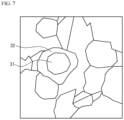
  • FIG. 7 schematically illustrates a TEM image of a dielectric layer in a capacity section.
  • barium zirconate titanate (BaTi (1-x) Zr x O 3 ) for the dielectric material of multilayer ceramic capacitors.
  • Barium titanate zirconate is a material obtained by substituting Zr 4+ for Ti 4+ in BaTiO 3 , and has high resistance to reduction, suppresses generation of oxygen vacancies, and suppresses deterioration of insulation resistance.
  • barium zirconate titanate has the property of being prone to grain growth. Excessive grain growth deteriorates the capacity-temperature characteristics and the high-temperature load life, making it difficult to use barium zirconate titanate for high-reliability applications.
  • FIG. 1 illustrates a perspective view of a multilayer ceramic capacitor 100 in accordance with an embodiment, in which a cross section of a part of the multilayer ceramic capacitor 100 is illustrated.
  • FIG. 2 is a cross-sectional view taken along line A-A in FIG. 1 .
  • FIG. 3 is a cross-sectional view taken along line B-B in FIG. 1 .
  • the multilayer ceramic capacitor 100 includes a multilayer chip 10 having a rectangular parallelepiped shape, and external electrodes 20 a and 20 b that are respectively provided on two edge faces of the multilayer chip 10 facing each other.
  • each of the external electrodes 20 a and 20 b extends to the top face and the bottom face in the stack direction and the two side faces of the multilayer chip 10 . However, the external electrodes 20 a and 20 b are spaced from each other.
  • the multilayer chip 10 has a structure designed to have dielectric layers 11 and internal electrode layers 12 alternately stacked.
  • the dielectric layer 11 contains a ceramic material acting as a dielectric material. End edges of the internal electrode layers 12 are alternately exposed to a first edge face of the multilayer chip 10 and a second edge face of the multilayer chip 10 that is different from the first edge face.
  • the external electrode 20 a is provided on the first edge face.
  • the external electrode 20 b is provided on the second edge face.
  • the internal electrode layers 12 are alternately electrically connected to the external electrode 20 a and the external electrode 20 b .
  • the multilayer ceramic capacitor 100 has a structure in which a plurality of the dielectric layers 11 is stacked with the internal electrode layers 12 interposed therebetween.
  • the outermost layers in the stack direction are the internal electrode layers 12 , and cover layers 13 cover the top face and the bottom face of the multilayer structure.
  • the cover layer 13 is mainly composed of a ceramic material.
  • the cover layer 13 may or may not necessarily have the same composition as the dielectric layer 11 . It should be noted that the structure is not limited to that illustrated in FIG. 1 to FIG. 3 as long as the internal electrode layers 12 are exposed on two different surfaces and electrically connected to different external electrodes.
  • the multilayer ceramic capacitor 100 may have a length of 0.25 mm, a width of 0.125 mm, and a height of 0.125 mm.
  • the multilayer ceramic capacitor 100 may have a length of 0.4 mm, a width of 0.2 mm, and a height of 0.2 mm.
  • the multilayer ceramic capacitor 100 may have a length of 0.6 mm, a width of 0.3 mm, and a height of 0.3 mm.
  • the multilayer ceramic capacitor 100 may have a length of 1.0 mm, a width of 0.5 mm, and a height of 0.5 mm.
  • the multilayer ceramic capacitor 100 may have a length of 3.2 mm, a width of 1.6 mm, and a height of 1.6 mm.
  • the multilayer ceramic capacitor 100 may have a length of 4.5 mm, a width of 3.2 mm, and a height of 2.5 mm.
  • the size of the multilayer ceramic capacitor 100 is not limited to the above sizes.
  • the internal electrode layer 12 is mainly composed of a base metal such as nickel (Ni), copper (Cu), or tin (Sn).
  • the internal electrode layer 12 may be composed of a noble metal such as platinum (Pt), palladium (Pd), silver (Ag), or gold (Au) or alloy including one or more of them.
  • the thickness of the internal electrode layer 12 is, for example, 0.1 ⁇ m or more and 3 ⁇ m or less, 0.1 ⁇ m or more and 1 ⁇ m or less, or 0.1 ⁇ m or more and 0.5 ⁇ m or less.
  • the dielectric layer 11 is a dielectric material.
  • the dielectric layer 11 is mainly composed of a ceramic material having a perovskite structure expressed by a general formula ABO 3 .
  • the perovskite structure includes ABO 3- ⁇ having an off-stoichiometric composition.
  • BaTiO 3 barium titanate
  • the dielectric layers 11 include a subcomponent including europium. Details of the subcomponent will be described later.
  • the thickness of the dielectric layer 11 is, for example, 0.2 ⁇ m or more and 10 ⁇ m or less, 0.2 ⁇ m or more and 5 ⁇ m or less, or 0.2 ⁇ m or more and 2 m or less.
  • the section where the internal electrode layer 12 connected to the external electrode 20 a faces the internal electrode layer 12 connected to the external electrode 20 b is a section where capacity is generated in the multilayer ceramic capacitor 100 .
  • this section is referred to as a capacity section 14 . That is, the capacity section 14 is a section where two adjacent internal electrode layers 12 connected to different external electrodes face each other.
  • the section where the internal electrode layers 12 connected to the external electrode 20 a face each other with no internal electrode layer 12 connected to the external electrode 20 b interposed therebetween is referred to as an end margin 15 .
  • the section where the internal electrode layers 12 connected to the external electrode 20 b face each other with no internal electrode layer 12 connected to the external electrode 20 a interposed therebetween is also the end margin 15 . That is, the end margin 15 is a section where the internal electrode layers 12 connected to one of the external electrodes face each other with no internal electrode layer 12 connected to the other of the external electrodes interposed therebetween.
  • the end margin 15 is a section where no capacity is generated.
  • the section from each of the two side faces of the multilayer chip 10 to the internal electrode layers 12 is referred to as a side margin 16 . That is, the side margin 16 is a section that covers each of the edges, extending toward the respective side faces of the multilayer structure, of the stacked internal electrode layers 12 .
  • the side margin 16 is a section where no capacity is generated.
  • barium zirconate titanate (BaTi (1-x) Zr x O 3 ) has high reduction resistance, suppresses the generation of oxygen vacancies, and suppresses the deterioration of insulation resistance.
  • barium zirconate titanate has the property of being prone to grain growth. Excessive grain growth deteriorates the capacity-temperature characteristics and the high-temperature load life, making it difficult to use barium zirconate titanate for high-reliability applications. Therefore, the multilayer ceramic capacitor 100 according to the present embodiment has a configuration capable of achieving both a long life and excellent capacity-temperature characteristics.
  • Barium zirconate titanate has a form in which barium titanate is doped with zirconium.
  • the lattice constant of barium titanate crystals having a perovskite structure represented by the general formula ABO 3 is expanded.
  • Certain rare earth elements which are the key of lifetime such as holmium (Ho), dysprosium (Dy), and yttrium (Y) dissolve more in the Ti site (B site) than in the Ba site (A site), resulting in an excess of acceptors. Therefore, the improving of the lifetime is limited.
  • the present inventors have investigated rare earth elements with a large ionic radius that are easily substituted and solid-solved in the Ba site of barium titanate. As a result, the present inventors have found that the life is improved by about one order of magnitude compared to the rare earth element such as holmium, dysprosium, and yttrium. The reason why the addition of europium improves the lifetime is not completely clear.
  • Europium is stable at 2 and 3 valences. The valence of europium fluctuates between 2 and 3.
  • Europium has the largest ionic radius in the rare earth elements which are stable under divalence condition. Therefore, europium is selectively substituted and solid-solved at the Ba site due to the ionic radius.
  • Rare earth elements other than europium are stable at trivalence and unstable at divalence.
  • Table 1 shows the ionic radii of the six coordination of each rare earth element.
  • the source of Table 1 is “RD Shannon, Acta Crystallogr., A32, 751 (1976)”.
  • the amount of europium in barium zirconate titanate, which is the main component of the dielectric layer 11 , with respect to titanium (the amount of europium (at %) when titanium is 100 at %) is small, a sufficient long lifetime may not be necessarily achieved. Therefore, in the present embodiment, a lower limit is set for the amount of europium with respect to titanium.
  • the amount of europium with respect to titanium is set to 2 at % or more.
  • the amount of europium with respect to titanium is preferably 2 at % or more, more preferably 3 at % or more.
  • the dielectric layer 11 of the capacity section 14 when the amount of europium in barium zirconate titanate, which is the main component of the dielectric layer 11 , is large with respect to titanium, the dielectric layer 11 may become a semiconductor and a long life may not be necessarily obtained. Therefore, in the present embodiment, an upper limit is set for the amount of europium with respect to titanium. Specifically, in the dielectric layer 11 of the capacity section 14 , the amount of europium with respect to titanium is set to 4 at % or less. The amount of europium with respect to titanium is preferably 4 at % or less, more preferably 3 at % or less.
  • x in (BaTi (1-x) Zr x O 3 ) is small, sufficient reduction resistance may not be necessarily obtained and many oxygen vacancies may be generated. Therefore, in the present embodiment, a lower limit is set for “x”. Specifically, “x” is set to 0.04 or more. In other words, in the barium zirconate titanate, zirconium should be 4 at % or more with respect to titanium and zirconium. In barium titanate zirconate, zirconium is preferably 9 at % or more, more preferably 14 at % or more, with respect to titanium and zirconium.
  • an upper limit is set for “x”. Specifically, “x” is set to 0.30 or less. In other words, in barium zirconate titanate, zirconium should be 30 at % or less with respect to titanium and zirconium. In barium titanate zirconate, zirconium is preferably 30 at % or less, more preferably 20 at % or less, with respect to titanium and zirconium.
  • an upper limit is set for the atomic concentration ratio of barium with respect to titanium and zirconium.
  • the atomic concentration ratio of barium with respect to titanium and zirconium is set to 1.1 or less.
  • the atomic concentration ratio of barium to titanium and zirconium is preferably 1.1 or less, more preferably 1.08 or less.
  • a lower limit is set for the atomic concentration ratio of barium with respect to titanium and zirconium.
  • the atomic concentration ratio of barium with respect to titanium and zirconium is set to 1.0 or more.
  • the atomic concentration ratio of barium with respect to titanium and zirconium is preferably 1.0 or more, more preferably 1.03 or more.
  • the dielectric layer 11 in the capacity section 14 of the multilayer ceramic capacitor 100 when at least a part of dielectric crystals containing the base material and subcomponents has a core-shell structure, the dielectric layer 11 in the capacity section 14 has a high dielectric constant, excellent temperature characteristics, and a stable microstructure.
  • Magnesium is a typical additive that makes up the shell. However, magnesium is a simple acceptor whose valence does not fluctuate, and dissolves in barium zirconate titanate of the dielectric layer 11 to form oxygen vacancies, which limits the reliability.
  • the dielectric layer 11 of the capacity section 14 at least a part of the dielectric crystals containing the base material and the subcomponents has a core-shell structure having a core portion containing barium zirconate titanate as a main component, and a shell portion to which zirconium diffuses.
  • the main component of the shell portion is barium zirconate titanate.
  • a core-shell grain 30 includes a substantially spherical core portion 31 and a shell portion 32 that surrounds and covers the core portion 31 .
  • the core portion 31 is a crystal portion in which the additive compound is not solid-dissolved or the amount of the additive compound in solid-solution is small.
  • the shell portion 32 is a crystal portion in which the additive compound is dissolved and has a concentration of the additive compound higher than that of the core portion 31 .
  • the zirconium concentration in the shell portion 32 is preferably higher than the zirconium concentration in the core portion 31 .
  • FIG. 4 B is a schematic cross-sectional view of the dielectric layer 11 .
  • the dielectric layer 11 comprises a plurality of dielectric crystals 17 of the main component ceramic. At least a part of these dielectric crystals 17 are the core-shell grains 30 described in FIG. 4 A .
  • the core portion 31 By covering the core portion 31 with the shell portion 32 having high zirconium concentration and high reduction resistance, it is possible to obtain a highly reliable material having a stable structure while maintaining a high dielectric constant.
  • the europium concentration in the shell portion 32 tends to be higher than the europium concentration in the core portion 31 .
  • the average grain size of the dielectric crystals 17 in the dielectric layer 11 in the capacity section 14 is preferably 200 nm or more and 400 nm or less.
  • the average grain size of the dielectric crystals 17 in the dielectric layer 11 in the capacity section 14 is preferably 250 nm or more, more preferably 300 nm or more.
  • the average grain size of the dielectric crystals 17 in the dielectric layer 11 of the capacity section 14 is preferably 375 nm or less, more preferably 350 nm or less.
  • the average grain size is obtained by measuring the unidirectional diameters (Feret diameters) of 100 grains constituting the dielectric layer 11 using a 40,000-fold SEM photograph of the dielectric layer 11 , and calculating the average value.
  • the ratio of divalent europium is preferably 21% or more, preferably 26% or more, with respect to the total europium (total of divalent europium and trivalent europium).
  • the amount of divalent europium with respect to the total of europium is 80% or less. It is more preferable that the amount is 70% or less. It is still more preferable that the amount is 59% or less.
  • the amount of the rare earth element other than europium added to the dielectric layer 11 of the capacity section 14 is too large, the life improvement effect of europium may be weakened, and sufficient life may not be necessarily obtained. Therefore, it is preferable to set an upper limit for the amount of rare earth elements other than europium.
  • the atomic concentration of the rare earth element other than europium is preferably lower than the atomic concentration of europium.
  • the total atomic concentration of the multiple types of the rare earth elements is preferably lower than the atomic concentration of europium.
  • Silicon has the function of lowering the sintering temperature of barium zirconate titanate.
  • the amount of silicon is small, sintering may be suppressed. Therefore, in the barium titanate zirconate, it is preferable that the amount of silicon is 1 at % or more with respect to titanium and zirconium.
  • the amount of silicon is preferably 1.5 at % or less with respect to titanium and zirconium.
  • the amount of magnesium is preferably 0.5 at % or more with respect to titanium and zirconium.
  • the amount of magnesium is preferably 1.5 at % or less with respect to titanium and zirconium.
  • the dielectric layer 11 in the capacity section 14 contains barium zirconate titanate as a main component, contains zirconium in an amount of 4 at % or more and 30 at % or less with respect to titanium and zirconium. Moreover, the dielectric layer 11 in the capacity section 14 contains a base material in which an atomic concentration ratio of barium with respect to the titanium and zirconium is 1 or more and 1.1 or less. Moreover, the dielectric layer 11 in the capacity section 14 contains a subcomponent containing 2 at % or more and 4 at % or less of europium with respect to the titanium of barium zirconate titanate. Therefore, it is possible to achieve both the long life and excellent capacity-temperature characteristics.
  • FIG. 5 is a flowchart of the manufacturing method of the multilayer ceramic capacitor 100 .
  • a dielectric material for forming the dielectric layer 11 is prepared.
  • the A site element and the B site element contained in the dielectric layer 11 are contained in the dielectric layer 11 typically in the form of a sintered compact of ABO 3 particles.
  • BaTiO 3 is a tetragonal compound having a perovskite structure, and exhibits high dielectric constant.
  • This BaTiO 3 can be obtained typically by reacting a titanium raw material such as titanium dioxide with a barium raw material such as barium carbonate to synthesize barium titanate.
  • Various methods have been known as a synthesizing method of ceramic constituting the dielectric layer 11 .
  • the solid phase method, the sol-gel method, the hydrothermal method, and the like are known. Any one of the above methods can be employed in the present embodiment.
  • Additive compound is added to the resulting ceramic powder in accordance with purposes.
  • the additive compound may be an oxide of magnesium, manganese, vanadium (V), chromium (Cr) or europium, or an oxide of cobalt (Co), nickel, lithium (Li), boron (B), sodium (Na), potassium (K) or Si (silicon), or glass. If necessary, an oxide of a rare earth element other than europium may be added.
  • the rare earth element is such as scandium (Sc), yttrium, lanthanum (La), cerium (Ce), praseodymium (Pr), neodymium (Nd), promethium (Pm), samarium (Sm), gadolinium (Gd), terbium (Tb), dysprosium, holmium, erbium (Er), thulium (Tm), ytterbium (Yb), or lutetium (Lu).
  • a ceramic raw material powder is wet-mixed with a compound containing an additive compound, dried and pulverized to prepare a ceramic material.
  • the ceramic material obtained as described above may be pulverized to adjust the particle size, or combined with a classification process to adjust the particle size.
  • a dielectric material is obtained by the above steps.
  • This dielectric material contains a base material containing barium zirconate titanate as a main component, containing zirconium in an amount of 4 at % or more and 30 at % or less with respect to titanium and zirconium, and having an atomic concentration ratio of barium to titanium and zirconium of 1 or more and 1.1 or less.
  • the dielectric material includes a subcomponent containing 2 at % or more and 4 at % or less of europium with respect to titanium of barium zirconate titanate. The based material and the subcomponent are randomly mixed with each other.
  • a binder such as polyvinyl butyral (PVB) resin, an organic solvent such as ethanol or toluene, and a plasticizer are added to the resulting dielectric material and wet-blended.
  • a strip-shaped ceramic green sheet with a thickness of, for example, 0.5 ⁇ m or more is painted on a base material by, for example, a die coater method or a doctor blade method, and then dried.
  • an internal electrode layer pattern is formed on the surface of the ceramic green sheet by printing a metal conductive paste for forming the internal electrode with use of screen printing or gravure printing.
  • the metal conductive paste for forming the internal electrode contains an organic binder.
  • a plurality of internal electrode layer patterns are alternately exposed to a pair of external electrodes.
  • Ceramic particles are added as a co-material to the metal conductive paste.
  • the main component of the ceramic particles is not particularly limited, but is preferably the same as the main component ceramic of the dielectric layer 11 .
  • BaTiO 3 of which an average grain size is 50 nm or less may be evenly dispersed.
  • the ceramic green sheet on which the internal electrode layer pattern is printed is stamped into a predetermined size, and a predetermined number (for example, 100 to 1000) of stamped ceramic green sheets are stacked while the base material is peeled so that the internal electrode layers 12 and the dielectric layers 11 are alternated with each other and the end edges of the internal electrode layers 12 are alternately exposed to both edge faces in the length direction of the dielectric layer so as to be alternately led out to a pair of external electrodes of different polarizations.
  • Cover sheets to be the cover layers 13 are crimped on the upper face and the lower face of the stacked ceramic green sheets in the stacking direction. And, the resulting multilayer structure is cut into a predetermined chip size (for example, 1.0 mm ⁇ 0.5 mm).
  • the binder is removed from the resulting ceramic multilayer structure in N 2 atmosphere. After that, Ni paste to be the base layer of the external electrodes 20 a and 20 b is painted by a dipping method.
  • the resulting ceramic multilayer structure is fired in a reducing atmosphere with an oxygen partial pressure of 10 ⁇ 12 to 10 ⁇ 9 MPa in a temperature range of 1160° C. to 1280° C. for 5 minutes to 10 hours.
  • the rate of temperature rise is set to a slow rate of about 10° C./h, diffusion of the rare earth element and zirconium is promoted in the dielectric material barium titanate, and solid solution grains are formed.
  • the dielectric constant tends to be low and the sintering stability and capacity-temperature characteristics tend to be poor. Therefore, in the present embodiment, it is preferable to suppress diffusion of zirconium and form a core-shell structure with a large concentration gradient of zirconium by setting the heating rate to 6000° C./h or more and 10000° C./h or less.
  • the firing conditions such as the particle size of the barium titanate powder in the dielectric material, the firing temperature, and the firing time, the average grain size of the dielectric crystals 17 in the dielectric layer 11 in the capacity section 14 obtained after firing can be adjusted.
  • heat treatment may be performed in a mixed gas of N 2 and water vapor at about 1000° C. or in the air at 500° C. to 700° C. to the extent that the internal electrode layers 12 are not oxidized. This step is called a re-oxidation process.
  • metal layers such as Cu, Ni, Sn or the like may be formed on the base layers of the external electrodes 20 a and 20 b by plating. With the processes, the multilayer ceramic capacitor 100 is fabricated.
  • barium titanate zirconate is the main component, zirconium is contained in an amount of 4 at % or more and 30 at % or less with respect to titanium and zirconium, and the atomic concentration ratio of barium to titanium and zirconium is 1 or more and 1.1 or less and a subcomponent containing 2 at % or more and 4 at % or less of europium with respect to titanium of barium zirconate titanate are mixed, and the ceramic green sheet is fired to fabricate the multilayer ceramic capacitor 100 achieve a long life and excellent capacity temperature.
  • each of the above-described embodiments describes a multilayer ceramic capacitor as an example of a multilayer ceramic electronic component, it is not limited to this.
  • the configurations of the above embodiments can also be applied to other multilayer ceramic electronic devices such as varistors and thermistors.
  • the multilayer ceramic capacitors in accordance with the embodiment were made. And, property of the multilayer ceramic capacitors was measured.
  • Example 1 Barium zirconate titanate with a particle size of 200 nm, rare earth oxides, various auxiliary additives, and an organic solvent were weighed so as to have a predetermined ratio, and mixed and pulverized with ⁇ 1 mm zirconia beads.
  • “x” of barium zirconate titanate (BaTi (1-x) Zr x O 3 ) was set to 0.30.
  • An oxide of europium was used as the rare earth oxide, and the amount of europium was set to 3 at % with respect to titanium of barium zirconate titanate.
  • the amount of silicon was set to 1 at % with respect to titanium of barium zirconate titanate.
  • the amount of manganese was set to 0.65 at % with respect to titanium of barium zirconate titanate.
  • the amount of magnesium was set to 1.5 at % with respect to titanium of barium zirconate titanate.
  • the atomic concentration ratio (A/B ratio) of barium to titanium and zirconium was set to 1.100.
  • Example 2 “x” of barium zirconate titanate (BaTi (1-x) Zr x O 3 ) was set to 0.30.
  • An oxide of europium was used as the rare earth oxide, and the amount of europium was set to 2 at % with respect to titanium of barium zirconate titanate.
  • the amount of silicon was set to 1 at % with respect to titanium of barium zirconate titanate.
  • the amount of manganese was set to 0.65 at % with respect to titanium of barium zirconate titanate.
  • the amount of magnesium was set to 1.5 at % with respect to titanium of barium zirconate titanate.
  • the atomic concentration ratio (A/B ratio) of barium to titanium and zirconium was set to 1.090.
  • Example 3 “x” of barium zirconate titanate (BaTi (1-x) Zr x O 3 ) was set to 0.20.
  • An oxide of europium was used as the rare earth oxide, and the amount of europium was set to 3 at % with respect to titanium of barium zirconate titanate.
  • the amount of silicon was set to 1.5 at % with respect to titanium of barium zirconate titanate.
  • the amount of manganese was set to 0.65 at % with respect to titanium of barium zirconate titanate.
  • the amount of magnesium was set to 1 at % with respect to titanium of barium zirconate titanate.
  • the atomic concentration ratio (A/B ratio) of barium to titanium and zirconium was set to 1.080.
  • Example 4 “x” of barium zirconate titanate (BaTi (1-x) Zr x O 3 ) was set to 0.20.
  • An oxide of europium was used as the rare earth oxide, and the amount of europium was set to 3 at % with respect to titanium of barium zirconate titanate.
  • the amount of silicon was set to 1 at % with respect to titanium of barium zirconate titanate.
  • the amount of manganese was set to 0.65 at % with respect to titanium of barium zirconate titanate.
  • the amount of magnesium was set to 1 at % with respect to titanium of barium zirconate titanate.
  • the atomic concentration ratio (A/B ratio) of barium to titanium and zirconium was set to 1.060.
  • Example 5 “x” of barium zirconate titanate (BaTi (1-x) Zr x O 3 ) was set to 0.20.
  • An oxide of europium was used as the rare earth oxide, and the amount of europium was set to 2 at % with respect to titanium of barium zirconate titanate.
  • the amount of silicon was set to 1 at % with respect to titanium of barium zirconate titanate.
  • the amount of manganese was set to 0.65 at % with respect to titanium of barium zirconate titanate.
  • the amount of magnesium was set to 1 at % with respect to titanium of barium zirconate titanate.
  • the atomic concentration ratio (A/B ratio) of barium to titanium and zirconium was set to 1.060.
  • Example 6 “x” of barium zirconate titanate (BaTi (1-x) Zr x O 3 ) was set to 0.14.
  • An oxide of europium was used as the rare earth oxide, and the amount of europium was set to 3 at % with respect to titanium of barium zirconate titanate.
  • the amount of silicon was set to 1.5 at % with respect to titanium of barium zirconate titanate.
  • the amount of manganese was set to 0.65 at % with respect to titanium of barium zirconate titanate.
  • the amount of magnesium was set to 1 at % with respect to titanium of barium zirconate titanate.
  • the atomic concentration ratio (A/B ratio) of barium to titanium and zirconium was set to 1.006.
  • Example 7 “x” of barium zirconate titanate (BaTi (1-x) Zr x O 3 ) was set to 0.10.
  • An oxide of europium was used as the rare earth oxide, and the amount of europium was set to 3 at % with respect to titanium of barium zirconate titanate.
  • the amount of silicon was set to 1.5 at % with respect to titanium of barium zirconate titanate.
  • the amount of manganese was set to 0.65 at % with respect to titanium of barium zirconate titanate.
  • the amount of magnesium was set to 1 at % with respect to titanium of barium zirconate titanate.
  • the atomic concentration ratio (A/B ratio) of barium to titanium and zirconium was set to 1.003.
  • Example 8 “x” of barium zirconate titanate (BaTi (1-x) Zr x O 3 ) was set to 0.10.
  • An oxide of europium was used as the rare earth oxide, and the amount of europium was set to 2 at % with respect to titanium of barium zirconate titanate.
  • the amount of silicon was set to 1 at % with respect to titanium of barium zirconate titanate.
  • the amount of manganese was set to 0.65 at % with respect to titanium of barium zirconate titanate.
  • the amount of magnesium was set to 1 at % with respect to titanium of barium zirconate titanate.
  • the atomic concentration ratio (A/B ratio) of barium to titanium and zirconium was set to 1.003.
  • Example 9 “x” of barium zirconate titanate (BaTi (1-x) Zr x O 3 ) was set to 0.09.
  • An oxide of europium was used as the rare earth oxide, and the amount of europium was set to 3 at % with respect to titanium of barium zirconate titanate.
  • the amount of silicon was set to 1.5 at % with respect to titanium of barium zirconate titanate.
  • the amount of manganese was set to 0.65 at % with respect to titanium of barium zirconate titanate.
  • the amount of magnesium was set to 1 at % with respect to titanium of barium zirconate titanate.
  • the atomic concentration ratio (A/B ratio) of barium to titanium and zirconium was set to 1.004.
  • Example 10 “x” of barium zirconate titanate (BaTi (1-x) Zr x O 3 ) was set to 0.09.
  • An oxide of europium was used as the rare earth oxide, and the amount of europium was set to 2.5 at % with respect to titanium of barium zirconate titanate.
  • the amount of silicon was set to 1.5 at % with respect to titanium of barium zirconate titanate.
  • the amount of manganese was set to 0.65 at % with respect to titanium of barium zirconate titanate.
  • the amount of magnesium was set to 1 at % with respect to titanium of barium zirconate titanate.
  • the atomic concentration ratio (A/B ratio) of barium to titanium and zirconium was set to 1.005.
  • Example 11 “x” of barium zirconate titanate (BaTi (1-x) Zr x O 3 ) was set to 0.09.
  • An oxide of europium was used as the rare earth oxide, and the amount of europium was set to 2 at % with respect to titanium of barium zirconate titanate.
  • the amount of silicon was set to 1.5 at % with respect to titanium of barium zirconate titanate.
  • the amount of manganese was set to 0.65 at % with respect to titanium of barium zirconate titanate.
  • the amount of magnesium was set to 1 at % with respect to titanium of barium zirconate titanate.
  • the atomic concentration ratio (A/B ratio) of barium to titanium and zirconium was set to 1.006.
  • Example 12 “x” of barium zirconate titanate (BaTi (1-x) Zr x O 3 ) was set to 0.04.
  • An oxide of europium was used as the rare earth oxide, and the amount of europium was set to 3 at % with respect to titanium of barium zirconate titanate.
  • the amount of silicon was set to 1.5 at % with respect to titanium of barium zirconate titanate.
  • the amount of manganese was set to 0.65 at % with respect to titanium of barium zirconate titanate.
  • the amount of magnesium was set to 1 at % with respect to titanium of barium zirconate titanate.
  • the atomic concentration ratio (A/B ratio) of barium to titanium and zirconium was set to 1.004.
  • Example 13 “x” of barium zirconate titanate (BaTi (1-x) Zr x O 3 ) was set to 0.04.
  • An oxide of europium was used as the rare earth oxide, and the amount of europium was set to 2.5 at % with respect to titanium of barium zirconate titanate.
  • the amount of silicon was set to 1.5 at % with respect to titanium of barium zirconate titanate.
  • the amount of manganese was set to 0.65 at % with respect to titanium of barium zirconate titanate.
  • the amount of magnesium was set to 1 at % with respect to titanium of barium zirconate titanate.
  • the atomic concentration ratio (A/B ratio) of barium to titanium and zirconium was set to 1.002.
  • Example 14 “x” of barium zirconate titanate (BaTi (1-x) Zr x O 3 ) was set to 0.04.
  • An oxide of europium was used as the rare earth oxide, and the amount of europium was set to 2.5 at % with respect to titanium of barium zirconate titanate.
  • the amount of silicon was set to 1.5 at % with respect to titanium of barium zirconate titanate.
  • the amount of manganese was set to 0.65 at % with respect to titanium of barium zirconate titanate.
  • the amount of magnesium was set to 1 at % with respect to titanium of barium zirconate titanate.
  • the atomic concentration ratio (A/B ratio) of barium to titanium and zirconium was set to 1.005.
  • Example 15 “x” of barium zirconate titanate (BaTi (1-x) Zr x O 3 ) was set to 0.04.
  • An oxide of europium was used as the rare earth oxide, and the amount of europium was set to 2 at % with respect to titanium of barium zirconate titanate.
  • the amount of silicon was set to 1.5 at % with respect to titanium of barium zirconate titanate.
  • the amount of manganese was set to 0.65 at % with respect to titanium of barium zirconate titanate.
  • the amount of magnesium was set to 0.75 at % with respect to titanium of barium zirconate titanate.
  • the atomic concentration ratio (A/B ratio) of barium to titanium and zirconium was set to 1.006.
  • Example 16 “x” of barium zirconate titanate (BaTi (1-x) Zr x O 3 ) was set to 0.14.
  • An oxide of europium was used as the rare earth oxide, and the amount of europium was set to 4 at % with respect to titanium of barium zirconate titanate.
  • the amount of silicon was set to 1.5 at % with respect to titanium of barium zirconate titanate.
  • the amount of manganese was set to 0.65 at % with respect to titanium of barium zirconate titanate.
  • the amount of magnesium was set to 1 at % with respect to titanium of barium zirconate titanate.
  • the atomic concentration ratio (A/B ratio) of barium to titanium and zirconium was set to 1.003.
  • Example 17 “x” of barium zirconate titanate (BaTi (1-x) Zr x O 3 ) was set to 0.14.
  • An oxide of europium was used as the rare earth oxide, and the amount of europium was set to 3 at % with respect to titanium of barium zirconate titanate.
  • the amount of silicon was set to 1.5 at % with respect to titanium of barium zirconate titanate.
  • the amount of manganese was set to 0.65 at % with respect to titanium of barium zirconate titanate.
  • the amount of magnesium was set to 10.75 at % with respect to titanium of barium zirconate titanate.
  • the atomic concentration ratio (A/B ratio) of barium to titanium and zirconium was set to 1.004.
  • Example 18 “x” of barium zirconate titanate (BaTi (1-x) Zr x O 3 ) was set to 0.14.
  • An oxide of europium was used as the rare earth oxide, and the amount of europium was set to 3 at % with respect to titanium of barium zirconate titanate.
  • the amount of silicon was set to 1.5 at % with respect to titanium of barium zirconate titanate.
  • the amount of manganese was set to 0.65 at % with respect to titanium of barium zirconate titanate.
  • the amount of magnesium was set to 1 at % with respect to titanium of barium zirconate titanate.
  • the atomic concentration ratio (A/B ratio) of barium to titanium and zirconium was set to 1.003.
  • Example 19 “x” of barium zirconate titanate (BaTi (1-x) Zr x O 3 ) was set to 0.14.
  • An oxide of europium was used as the rare earth oxide, and the amount of europium was set to 2.5 at % with respect to titanium of barium zirconate titanate.
  • the amount of silicon was set to 1.25 at % with respect to titanium of barium zirconate titanate.
  • the amount of manganese was set to 0.65 at % with respect to titanium of barium zirconate titanate.
  • the amount of magnesium was set to 1 at % with respect to titanium of barium zirconate titanate.
  • the atomic concentration ratio (A/B ratio) of barium to titanium and zirconium was set to 1.003.
  • Example 20 “x” of barium zirconate titanate (BaTi (1-x) Zr x O 3 ) was set to 0.14.
  • An oxide of europium was used as the rare earth oxide, and the amount of europium was set to 2.5 at % with respect to titanium of barium zirconate titanate.
  • the amount of silicon was set to 1.5 at % with respect to titanium of barium zirconate titanate.
  • the amount of manganese was set to 0.65 at % with respect to titanium of barium zirconate titanate.
  • the amount of magnesium was set to 1 at % with respect to titanium of barium zirconate titanate.
  • the atomic concentration ratio (A/B ratio) of barium to titanium and zirconium was set to 1.005.
  • Example 21 “x” of barium zirconate titanate (BaTi (1-x) Zr x O 3 ) was set to 0.14.
  • An oxide of europium was used as the rare earth oxide, and the amount of europium was set to 2 at % with respect to titanium of barium zirconate titanate.
  • the amount of silicon was set to 1 at % with respect to titanium of barium zirconate titanate.
  • the amount of manganese was set to 0.65 at % with respect to titanium of barium zirconate titanate.
  • the amount of magnesium was set to 1 at % with respect to titanium of barium zirconate titanate.
  • the atomic concentration ratio (A/B ratio) of barium to titanium and zirconium was set to 1.002.
  • Example 22 “x” of barium zirconate titanate (BaTi (1-x) Zr x O 3 ) was set to 0.14.
  • An oxide of europium was used as the rare earth oxide, and the amount of europium was set to 2 at % with respect to titanium of barium zirconate titanate.
  • the amount of silicon was set to 1.5 at % with respect to titanium of barium zirconate titanate.
  • the amount of manganese was set to 0.65 at % with respect to titanium of barium zirconate titanate.
  • the amount of magnesium was set to 1 at % with respect to titanium of barium zirconate titanate.
  • the atomic concentration ratio (A/B ratio) of barium to titanium and zirconium was set to 1.006.
  • Comparative Example 1 “x” of barium zirconate titanate (BaTi (1-x) Zr x O 3 ) was set to 0.35.
  • An oxide of europium was used as the rare earth oxide, and the amount of europium was set to 3 at % with respect to titanium of barium zirconate titanate.
  • the amount of silicon was set to 1 at % with respect to titanium of barium zirconate titanate.
  • the amount of manganese was set to 0.65 at % with respect to titanium of barium zirconate titanate.
  • the amount of magnesium was set to 1.5 at % with respect to titanium of barium zirconate titanate.
  • the atomic concentration ratio (A/B ratio) of barium to titanium and zirconium was set to 1.100.
  • Comparative Example 2 “x” of barium zirconate titanate (BaTi (1-x) Zr x O 3 ) was set to 0.02.
  • An oxide of europium was used as the rare earth oxide, and the amount of europium was set to 2 at % with respect to titanium of barium zirconate titanate.
  • the amount of silicon was set to 1.5 at % with respect to titanium of barium zirconate titanate.
  • the amount of manganese was set to 0.65 at % with respect to titanium of barium zirconate titanate.
  • the amount of magnesium was set to 1 at % with respect to titanium of barium zirconate titanate.
  • the atomic concentration ratio (A/B ratio) of barium to titanium and zirconium was set to 1.000.
  • Comparative Example 3 “x” of barium zirconate titanate (BaTi (1-x) Zr x O 3 ) was set to 0.14.
  • An oxide of dysprosium (Dy) was used as the rare earth oxide, and the amount of dysprosium was set to 2 at % with respect to titanium of barium zirconate titanate.
  • the amount of silicon was set to 1.5 at % with respect to titanium of barium zirconate titanate.
  • the amount of manganese was set to 0.65 at % with respect to titanium of barium zirconate titanate.
  • the amount of magnesium was set to 1 at % with respect to titanium of barium zirconate titanate.
  • the atomic concentration ratio (A/B ratio) of barium to titanium and zirconium was set to 0.999.
  • Comparative Example 4 “x” of barium zirconate titanate (BaTi (1-x) Zr x O 3 ) was set to 0.14.
  • An oxide of dysprosium was used as the rare earth oxide, and the amount of dysprosium was set to 2 at % with respect to titanium of barium zirconate titanate.
  • the amount of silicon was set to 1.5 at % with respect to titanium of barium zirconate titanate.
  • the amount of manganese was set to 0.65 at % with respect to titanium of barium zirconate titanate.
  • the amount of magnesium was set to 0 at % with respect to titanium of barium zirconate titanate.
  • the atomic concentration ratio (A/B ratio) of barium to titanium and zirconium was set to 1.000.
  • Comparative Example 5 “x” of barium zirconate titanate (BaTi (1-x) Zr x O 3 ) was set to 0.14.
  • An oxide of gadolinium (Gd) was used as the rare earth oxide, and the amount of gadolinium was set to 2 at % with respect to titanium of barium zirconate titanate.
  • the amount of silicon was set to 1.5 at % with respect to titanium of barium zirconate titanate.
  • the amount of manganese was set to 0.65 at % with respect to titanium of barium zirconate titanate.
  • the amount of magnesium was set to 1 at % with respect to titanium of barium zirconate titanate.
  • the atomic concentration ratio (A/B ratio) of barium to titanium and zirconium was set to 1.001.
  • Comparative Example 6 “x” of barium zirconate titanate (BaTi (1-x) Zr x O 3 ) was set to 0.14.
  • An oxide of gadolinium was used as the rare earth oxide, and the amount of gadolinium was set to 2 at % with respect to titanium of barium zirconate titanate.
  • the amount of silicon was set to 1.5 at % with respect to titanium of barium zirconate titanate.
  • the amount of manganese was set to 0.65 at % with respect to titanium of barium zirconate titanate.
  • the amount of magnesium was set to 0 at % with respect to titanium of barium zirconate titanate.
  • the atomic concentration ratio (A/B ratio) of barium to titanium and zirconium was set to 1.001.
  • Comparative Example 7 “x” of barium zirconate titanate (BaTi (1-x) Zr x O 3 ) was set to 0.14.
  • An oxide of lanthanum (La) was used as the rare earth oxide, and the amount of lanthanum was set to 2 at % with respect to titanium of barium zirconate titanate.
  • the amount of silicon was set to 1.5 at % with respect to titanium of barium zirconate titanate.
  • the amount of manganese was set to 0.65 at % with respect to titanium of barium zirconate titanate.
  • the amount of magnesium was set to 1 at % with respect to titanium of barium zirconate titanate.
  • the atomic concentration ratio (A/B ratio) of barium to titanium and zirconium was set to 0.993.
  • Comparative Example 8 “x” of barium zirconate titanate (BaTi (1-x) Zr x O 3 ) was set to 0.14.
  • An oxide of lanthanum was used as the rare earth oxide, and the amount of lanthanum was set to 2 at % with respect to titanium of barium zirconate titanate.
  • the amount of silicon was set to 1.5 at % with respect to titanium of barium zirconate titanate.
  • the amount of manganese was set to 0.65 at % with respect to titanium of barium zirconate titanate.
  • the amount of magnesium was set to 0 at % with respect to titanium of barium zirconate titanate.
  • the atomic concentration ratio (A/B ratio) of barium to titanium and zirconium was set to 0.993.
  • Comparative Example 9 “x” of barium zirconate titanate (BaTi (1-x) Zr x O 3 ) was set to 0.14.
  • An oxide of holmium (Ho) was used as the rare earth oxide, and the amount of holmium was set to 2 at % with respect to titanium of barium zirconate titanate.
  • the amount of silicon was set to 1.5 at % with respect to titanium of barium zirconate titanate.
  • the amount of manganese was set to 0.65 at % with respect to titanium of barium zirconate titanate.
  • the amount of magnesium was set to 1 at % with respect to titanium of barium zirconate titanate.
  • the atomic concentration ratio (A/B ratio) of barium to titanium and zirconium was set to 1.000.
  • Comparative Example 10 “x” of barium zirconate titanate (BaTi (1-x) Zr x O 3 ) was set to 0.14.
  • An oxide of holmium was used as the rare earth oxide, and the amount of holmium was set to 2 at % with respect to titanium of barium zirconate titanate.
  • the amount of silicon was set to 1.5 at % with respect to titanium of barium zirconate titanate.
  • the amount of manganese was set to 0.65 at % with respect to titanium of barium zirconate titanate.
  • the amount of magnesium was set to 0 at % with respect to titanium of barium zirconate titanate.
  • the atomic concentration ratio (A/B ratio) of barium to titanium and zirconium was set to 1.000.
  • Comparative Example 11 “x” of barium zirconate titanate (BaTi (1-x) Zr x O 3 ) was set to 0.14.
  • An oxide of europium was used as the rare earth oxide, and the amount of europium was set to 1 at % with respect to titanium of barium zirconate titanate.
  • the amount of silicon was set to 1 at % with respect to titanium of barium zirconate titanate.
  • the amount of manganese was set to 0.65 at % with respect to titanium of barium zirconate titanate.
  • the amount of magnesium was set to 1 at % with respect to titanium of barium zirconate titanate.
  • the atomic concentration ratio (A/B ratio) of barium to titanium and zirconium was set to 1.000.
  • a ceramic green sheet was coated with a slurry obtained by adding a binder, an internal electrode pattern was printed with nickel paste, stacked, and cut into a 1005 shape.
  • a 1005-shaped ceramic stack was produced.
  • the ceramic stack was heated to 1230° C. at a temperature elevation rate of 6000° C./h, and high-speed firing was performed.
  • the thickness of the dielectric layer after firing was 2.0 m.
  • the average grain size was adjusted by the amount of titanium (x), the amount of silicon, the amount of magnesium, and the A/B ratio contained in each example and comparative example. When the amount of titanium and the amount of silicon are large, the average grain size tends to be large, and when the amount of magnesium and the A/B ratio are large, the average grain size tends to be small.
  • Example 1 Average grain size
  • Example 2 Average grain size
  • the average grain size of Example 5 was 350 nm.
  • the average grain size of Example 6 was 290 nm.
  • the average grain size of Example 7 was 330 nm.
  • the average grain size of Example 8 was 320 nm.
  • the average grain size of Example 9 was 320 nm.
  • the average grain size of Example 10 was 340 nm.
  • the average grain size of Example 11 was 350 nm.
  • the average grain size of Example 12 was 240 nm.
  • the average grain size of Example 13 was 280 nm.
  • the average grain size of Example 14 was 260 nm.
  • the average grain size of Example 15 was 260 nm.
  • the average grain size of Example 16 was 280 nm.
  • the average grain size of Example 17 was 350 nm.
  • the average grain size of Example 18 was 320 nm.
  • the average grain size of Example 19 was 320 nm.
  • the average grain size of Example 20 was 340 nm.
  • the average grain size of Example 21 was 330 nm.
  • the average grain size of Example 22 was 380 nm.
  • the average grain size of Comparative Example 1 was 450 nm.
  • the average grain size of Comparative Example 2 was 300 nm.
  • the average grain size of Comparative Example 3 was 270 nm.
  • the average grain size of Comparative Example 4 was 480 nm.
  • the average grain size of Comparative Example 5 was 320 nm.
  • the average grain size of Comparative Example 6 was 500 nm.
  • the average grain size of Comparative Example 7 was 320 nm.
  • the average grain size of Comparative Example 8 was 450 nm.
  • the average grain size of Comparative Example 9 was 320 nm.
  • the average grain size of Comparative Example 10 was 460 nm.
  • the average grain size of Comparative Example 11 was 350 nm.
  • the dielectric constant was measured under the conditions of 1 Vrms and 1 kHz.
  • the temperature characteristic of dielectric constant (TCC) was measured in the range from ⁇ 55° C. to 125° C. under conditions of 0.2 Vrms and 1 kHz.
  • TCC temperature characteristic of dielectric constant
  • the X7T characteristics (capacity change rate based on 25° C. from ⁇ 55° C. to 125° C. is +22% to ⁇ 33%) were satisfied, the X7T characteristics were judged to be good “o”. When the X7T characteristics were not satisfied, the X7T characteristics were judged to be bad “ ⁇ ”. When a life value was 4000 minutes or more, it was judged that a sufficiently long life was achieved. When the life value was 10000 minutes or more, it was judged that a particularly long life was achieved. When the X7T characteristic was judged as good and the life value was 4000 min or more, the overall judgment was given as “good”.
  • the dielectric layers of the capacity section includes a base material containing barium zirconate titanate as a main component, containing zirconium in an amount of 4 at % or more and 30 at % or less with respect to titanium and zirconium, and having an atomic concentration ratio of barium to titanium and zirconium of 1 or more and 1.1 or less, and a subcomponent containing 2 at % or more and 4 at % or less of europium with respect to titanium of the barium zirconate titanate.
  • Comparative Example 1 did not satisfy the X7T characteristics. It is thought that this was because the amount of zirconium was large and the diffusion of barium zirconate titanate progressed, making it difficult to control grain growth. Comparative Example 2 satisfied the X7T characteristics, but had a short life value. It is thought that this was because the amount of zirconium was small and many oxygen defects were generated.
  • FIG. 6 is a schematic diagram of a SEM image of a cross section of the dielectric layer 11 of the capacity section 14 of Example 18. As shown in FIG. 6 , the average grain size of the dielectric crystals was 200 nm or more and 400 nm or less, and abnormal grain growth was suppressed.
  • FIG. 7 is a schematic diagram of a TEM (Transmission Electron Microscope) image of the dielectric layer in the capacity section of Example 18. As shown in FIG. 7 , the core portion 31 and the shell portion 32 covering the core portion 31 were confirmed in the dielectric layer in the capacity section after firing.
  • TEM Transmission Electron Microscope

Landscapes

  • Engineering & Computer Science (AREA)
  • Chemical & Material Sciences (AREA)
  • Power Engineering (AREA)
  • Ceramic Engineering (AREA)
  • Manufacturing & Machinery (AREA)
  • Microelectronics & Electronic Packaging (AREA)
  • Materials Engineering (AREA)
  • Inorganic Chemistry (AREA)
  • Structural Engineering (AREA)
  • Organic Chemistry (AREA)
  • Composite Materials (AREA)
  • Ceramic Capacitors (AREA)
  • Fixed Capacitors And Capacitor Manufacturing Machines (AREA)

Abstract

A dielectric material includes a base material containing barium zirconate titanate as a main component, containing zirconium in an amount of 4 at % or more and 30 at % or less with respect to titanium and zirconium, and having an atomic concentration ratio of barium to titanium and zirconium of 1 or more and 1.1 or less, and a subcomponent containing 2 at % or more and 4 at % or less of europium with respect to titanium of the barium zirconate titanate.

Description

CROSS-REFERENCE TO RELATED APPLICATION
This application is based upon and claims the benefit of priority of the prior Japanese Patent Application No. 2022-027484, filed on Feb. 25, 2022, the entire contents of which are incorporated herein by reference.
FIELD
A certain aspect of the present disclosure relates to a dielectric material, a multilayer ceramic electronic device, and a manufacturing method of the multilayer ceramic electronic device.
BACKGROUND
Multilayer ceramic capacitors are used to eliminate noise in high-frequency communication systems typified by mobile phones. Multilayer ceramic capacitors are also used in electronic circuits (high-reliability applications) that affect human life, such as in-vehicle electronic control devices. Since multilayer ceramic capacitors are required to have high reliability, techniques for improving the reliability have been disclosed (for example, see Japanese Patent Application Publication No. 2002-265265, Japanese Patent Application Publication No. 2019-131438 and Japanese Patent Application Publication No. 2009-35431).
SUMMARY OF THE INVENTION
According to a first aspect of the embodiments, there is provided a dielectric material a dielectric material including: a base material containing barium zirconate titanate as a main component, containing zirconium in an amount of 4 at % or more and 30 at % or less with respect to titanium and zirconium, and having an atomic concentration ratio of barium to titanium and zirconium of 1 or more and 1.1 or less; and a subcomponent containing 2 at % or more and 4 at % or less of europium with respect to titanium of the barium zirconate titanate.
According to a second aspect of the embodiments, there is provided a multilayer ceramic electronic device including: a plurality of dielectric layers, each of which contains a base material containing barium zirconate titanate as a main component, containing zirconium in an amount of 4 at % or more and 30 at % or less with respect to titanium and zirconium, and having an atomic concentration ratio of barium to titanium and zirconium of 1 or more and 1.1 or less, and a subcomponent which contains 2 at % or more and 4 at % or less of europium with respect to the titanium of the barium zirconate titanate; a plurality of internal electrode layers each of which is sandwiched by each two of the plurality of dielectric layers; and external electrodes that are provided on side faces of the plurality of dielectric layers and the plurality of internal electrode layers, and are electrically connected to the plurality of internal electrode layers.
According to a third aspect of the embodiments, there is provided a manufacturing method of a multilayer ceramic electronic device including: forming a ceramic green sheet by mixing a base material containing barium zirconate titanate as a main component, containing zirconium in an amount of 4 at % or more and 30 at % or less with respect to titanium and zirconium, and having an atomic concentration ratio of barium to titanium and zirconium of 1 or more and 1.1 or less, and a subcomponent which contains 2 at % or more and 4 at % or less of europium with respect to the titanium of the barium zirconate titanate; forming an internal electrode pattern on the ceramic green sheet; forming a stack by stacking a plurality of stack units each of which has a structure in which the internal electrode pattern is formed on the ceramic green sheet; and firing the stack so that a plurality of dielectric layers and a plurality of internal electrodes.
BRIEF DESCRIPTION OF THE DRAWINGS
FIG. 1 is a partial cross-sectional perspective view of a multilayer ceramic capacitor;
FIG. 2 is a cross-sectional view taken along line A-A in FIG. 1 ;
FIG. 3 is a cross-sectional view taken along line B-B in FIG. 1 ;
FIG. 4A schematically illustrates a core-shell grain;
FIG. 4B schematically illustrates a cross section of a dielectric layer;
FIG. 5 is a flowchart of a method of manufacturing a multilayer ceramic capacitor; and
FIG. 6 schematically illustrates a SEM image of cross section of dielectric layers and internal electrode layers in a capacity section of Example 1; and
FIG. 7 schematically illustrates a TEM image of a dielectric layer in a capacity section.
DETAILED DESCRIPTION
It is conceivable to use barium zirconate titanate (BaTi(1-x)ZrxO3) for the dielectric material of multilayer ceramic capacitors. Barium titanate zirconate is a material obtained by substituting Zr4+ for Ti4+ in BaTiO3, and has high resistance to reduction, suppresses generation of oxygen vacancies, and suppresses deterioration of insulation resistance. However, barium zirconate titanate has the property of being prone to grain growth. Excessive grain growth deteriorates the capacity-temperature characteristics and the high-temperature load life, making it difficult to use barium zirconate titanate for high-reliability applications.
Hereinafter, an exemplary embodiment will be described with reference to the accompanying drawings.
EXEMPLARY EMBODIMENT
FIG. 1 illustrates a perspective view of a multilayer ceramic capacitor 100 in accordance with an embodiment, in which a cross section of a part of the multilayer ceramic capacitor 100 is illustrated. FIG. 2 is a cross-sectional view taken along line A-A in FIG. 1 . FIG. 3 is a cross-sectional view taken along line B-B in FIG. 1 . As illustrated in FIG. 1 to FIG. 3 , the multilayer ceramic capacitor 100 includes a multilayer chip 10 having a rectangular parallelepiped shape, and external electrodes 20 a and 20 b that are respectively provided on two edge faces of the multilayer chip 10 facing each other. Among four faces other than the two edge faces of the multilayer chip 10, two faces other than the top face and the bottom face in the stack direction are referred to as side faces. Each of the external electrodes 20 a and 20 b extends to the top face and the bottom face in the stack direction and the two side faces of the multilayer chip 10. However, the external electrodes 20 a and 20 b are spaced from each other.
The multilayer chip 10 has a structure designed to have dielectric layers 11 and internal electrode layers 12 alternately stacked. The dielectric layer 11 contains a ceramic material acting as a dielectric material. End edges of the internal electrode layers 12 are alternately exposed to a first edge face of the multilayer chip 10 and a second edge face of the multilayer chip 10 that is different from the first edge face. The external electrode 20 a is provided on the first edge face. The external electrode 20 b is provided on the second edge face. Thus, the internal electrode layers 12 are alternately electrically connected to the external electrode 20 a and the external electrode 20 b. Accordingly, the multilayer ceramic capacitor 100 has a structure in which a plurality of the dielectric layers 11 is stacked with the internal electrode layers 12 interposed therebetween. In the multilayer structure of the dielectric layers 11 and the internal electrode layers 12, the outermost layers in the stack direction are the internal electrode layers 12, and cover layers 13 cover the top face and the bottom face of the multilayer structure. The cover layer 13 is mainly composed of a ceramic material. For example, the cover layer 13 may or may not necessarily have the same composition as the dielectric layer 11. It should be noted that the structure is not limited to that illustrated in FIG. 1 to FIG. 3 as long as the internal electrode layers 12 are exposed on two different surfaces and electrically connected to different external electrodes.
For example, the multilayer ceramic capacitor 100 may have a length of 0.25 mm, a width of 0.125 mm, and a height of 0.125 mm. The multilayer ceramic capacitor 100 may have a length of 0.4 mm, a width of 0.2 mm, and a height of 0.2 mm. The multilayer ceramic capacitor 100 may have a length of 0.6 mm, a width of 0.3 mm, and a height of 0.3 mm. The multilayer ceramic capacitor 100 may have a length of 1.0 mm, a width of 0.5 mm, and a height of 0.5 mm. The multilayer ceramic capacitor 100 may have a length of 3.2 mm, a width of 1.6 mm, and a height of 1.6 mm. The multilayer ceramic capacitor 100 may have a length of 4.5 mm, a width of 3.2 mm, and a height of 2.5 mm. However, the size of the multilayer ceramic capacitor 100 is not limited to the above sizes.
The internal electrode layer 12 is mainly composed of a base metal such as nickel (Ni), copper (Cu), or tin (Sn). The internal electrode layer 12 may be composed of a noble metal such as platinum (Pt), palladium (Pd), silver (Ag), or gold (Au) or alloy including one or more of them. The thickness of the internal electrode layer 12 is, for example, 0.1 μm or more and 3 μm or less, 0.1 μm or more and 1 μm or less, or 0.1 μm or more and 0.5 μm or less.
The dielectric layer 11 is a dielectric material. The dielectric layer 11 is mainly composed of a ceramic material having a perovskite structure expressed by a general formula ABO3. The perovskite structure includes ABO3-α having an off-stoichiometric composition. In the embodiment BaTiO3 (barium titanate) is used as the ceramic material. For example, in the dielectric layers 11, 90 at % or more of barium titanium zirconate titanate is includes. Moreover, the dielectric layers 11 include a subcomponent including europium. Details of the subcomponent will be described later. The thickness of the dielectric layer 11 is, for example, 0.2 μm or more and 10 μm or less, 0.2 μm or more and 5 μm or less, or 0.2 μm or more and 2 m or less.
As illustrated in FIG. 2 , the section where the internal electrode layer 12 connected to the external electrode 20 a faces the internal electrode layer 12 connected to the external electrode 20 b is a section where capacity is generated in the multilayer ceramic capacitor 100. Thus, this section is referred to as a capacity section 14. That is, the capacity section 14 is a section where two adjacent internal electrode layers 12 connected to different external electrodes face each other.
The section where the internal electrode layers 12 connected to the external electrode 20 a face each other with no internal electrode layer 12 connected to the external electrode 20 b interposed therebetween is referred to as an end margin 15. The section where the internal electrode layers 12 connected to the external electrode 20 b face each other with no internal electrode layer 12 connected to the external electrode 20 a interposed therebetween is also the end margin 15. That is, the end margin 15 is a section where the internal electrode layers 12 connected to one of the external electrodes face each other with no internal electrode layer 12 connected to the other of the external electrodes interposed therebetween. The end margin 15 is a section where no capacity is generated.
As illustrated in FIG. 3 , in the multilayer chip 10, the section from each of the two side faces of the multilayer chip 10 to the internal electrode layers 12 is referred to as a side margin 16. That is, the side margin 16 is a section that covers each of the edges, extending toward the respective side faces of the multilayer structure, of the stacked internal electrode layers 12. The side margin 16 is a section where no capacity is generated.
Here, barium zirconate titanate (BaTi(1-x)ZrxO3) has high reduction resistance, suppresses the generation of oxygen vacancies, and suppresses the deterioration of insulation resistance. However, barium zirconate titanate has the property of being prone to grain growth. Excessive grain growth deteriorates the capacity-temperature characteristics and the high-temperature load life, making it difficult to use barium zirconate titanate for high-reliability applications. Therefore, the multilayer ceramic capacitor 100 according to the present embodiment has a configuration capable of achieving both a long life and excellent capacity-temperature characteristics.
Barium zirconate titanate has a form in which barium titanate is doped with zirconium. The lattice constant of barium titanate crystals having a perovskite structure represented by the general formula ABO3 is expanded. Certain rare earth elements which are the key of lifetime such as holmium (Ho), dysprosium (Dy), and yttrium (Y) dissolve more in the Ti site (B site) than in the Ba site (A site), resulting in an excess of acceptors. Therefore, the improving of the lifetime is limited.
Therefore, the present inventors have investigated rare earth elements with a large ionic radius that are easily substituted and solid-solved in the Ba site of barium titanate. As a result, the present inventors have found that the life is improved by about one order of magnitude compared to the rare earth element such as holmium, dysprosium, and yttrium. The reason why the addition of europium improves the lifetime is not completely clear. Europium is stable at 2 and 3 valences. The valence of europium fluctuates between 2 and 3. Europium has the largest ionic radius in the rare earth elements which are stable under divalence condition. Therefore, europium is selectively substituted and solid-solved at the Ba site due to the ionic radius. Rare earth elements other than europium are stable at trivalence and unstable at divalence.
Table 1 shows the ionic radii of the six coordination of each rare earth element. The source of Table 1 is “RD Shannon, Acta Crystallogr., A32, 751 (1976)”.
TABLE 1
IONIC RADIUS(Å)
COORDINATION COORDINATION
VALENCE NUMBER IS 6 NUMBER IS 12
Ba +2 1.610
Ti +4 0.605
Eu +2 1.170
Dy +2 1.070
La +3 1.032
Tm +2 1.030
Yb +2 1.020
Ce +3 1.010
Pr +3 0.990
Nd +3 0.983
Pm +3 0.970
Sm +3 0.958
Eu +3 0.947
Gd +3 0.938
Tb +3 0.923
Dy +3 0.912
Ho +3 0.901
Y +3 0.900
Er +3 0.890
Tm +3 0.880
Yb +3 0.868
Lu +3 0.861
Sc +3 0.745
In the dielectric layer 11 of the capacity section 14, when the amount of europium in barium zirconate titanate, which is the main component of the dielectric layer 11, with respect to titanium (the amount of europium (at %) when titanium is 100 at %) is small, a sufficient long lifetime may not be necessarily achieved. Therefore, in the present embodiment, a lower limit is set for the amount of europium with respect to titanium. Specifically, in the dielectric layer 11 of the capacity section 14, the amount of europium with respect to titanium is set to 2 at % or more. The amount of europium with respect to titanium is preferably 2 at % or more, more preferably 3 at % or more.
On the other hand, in the dielectric layer 11 of the capacity section 14, when the amount of europium in barium zirconate titanate, which is the main component of the dielectric layer 11, is large with respect to titanium, the dielectric layer 11 may become a semiconductor and a long life may not be necessarily obtained. Therefore, in the present embodiment, an upper limit is set for the amount of europium with respect to titanium. Specifically, in the dielectric layer 11 of the capacity section 14, the amount of europium with respect to titanium is set to 4 at % or less. The amount of europium with respect to titanium is preferably 4 at % or less, more preferably 3 at % or less.
Next, when “x” in (BaTi(1-x)ZrxO3) is small, sufficient reduction resistance may not be necessarily obtained and many oxygen vacancies may be generated. Therefore, in the present embodiment, a lower limit is set for “x”. Specifically, “x” is set to 0.04 or more. In other words, in the barium zirconate titanate, zirconium should be 4 at % or more with respect to titanium and zirconium. In barium titanate zirconate, zirconium is preferably 9 at % or more, more preferably 14 at % or more, with respect to titanium and zirconium.
On the other hand, when “x” is large, the diffusion of barium zirconate titanate proceeds and grain growth control may become difficult. Therefore, in the present embodiment, an upper limit is set for “x”. Specifically, “x” is set to 0.30 or less. In other words, in barium zirconate titanate, zirconium should be 30 at % or less with respect to titanium and zirconium. In barium titanate zirconate, zirconium is preferably 30 at % or less, more preferably 20 at % or less, with respect to titanium and zirconium.
Next, in barium titanate zirconate, when Ba/(Ti+Zr) (atomic concentration ratio of barium with respect to titanium and zirconium) is large, diffusion of barium zirconate titanate may be suppressed, making sintering difficult. Therefore, in the present embodiment, an upper limit is set for the atomic concentration ratio of barium with respect to titanium and zirconium. Specifically, the atomic concentration ratio of barium with respect to titanium and zirconium is set to 1.1 or less. The atomic concentration ratio of barium to titanium and zirconium is preferably 1.1 or less, more preferably 1.08 or less.
On the other hand, in barium titanate zirconate, when the atomic concentration ratio of barium with respect to titanium and zirconium is small, the diffusion of barium zirconate titanate may proceed, making it difficult to control grain growth. Therefore, in the present embodiment, a lower limit is set for the atomic concentration ratio of barium with respect to titanium and zirconium. Specifically, the atomic concentration ratio of barium with respect to titanium and zirconium is set to 1.0 or more. The atomic concentration ratio of barium with respect to titanium and zirconium is preferably 1.0 or more, more preferably 1.03 or more.
In the dielectric layer 11 in the capacity section 14 of the multilayer ceramic capacitor 100, when at least a part of dielectric crystals containing the base material and subcomponents has a core-shell structure, the dielectric layer 11 in the capacity section 14 has a high dielectric constant, excellent temperature characteristics, and a stable microstructure.
Magnesium is a typical additive that makes up the shell. However, magnesium is a simple acceptor whose valence does not fluctuate, and dissolves in barium zirconate titanate of the dielectric layer 11 to form oxygen vacancies, which limits the reliability.
Therefore, in the present embodiment, in the dielectric layer 11 of the capacity section 14, at least a part of the dielectric crystals containing the base material and the subcomponents has a core-shell structure having a core portion containing barium zirconate titanate as a main component, and a shell portion to which zirconium diffuses. The main component of the shell portion is barium zirconate titanate.
As illustrated in FIG. 4A, a core-shell grain 30 includes a substantially spherical core portion 31 and a shell portion 32 that surrounds and covers the core portion 31. The core portion 31 is a crystal portion in which the additive compound is not solid-dissolved or the amount of the additive compound in solid-solution is small. The shell portion 32 is a crystal portion in which the additive compound is dissolved and has a concentration of the additive compound higher than that of the core portion 31. In the present embodiment, the zirconium concentration in the shell portion 32 is preferably higher than the zirconium concentration in the core portion 31.
FIG. 4B is a schematic cross-sectional view of the dielectric layer 11. As illustrated in FIG. 4B, the dielectric layer 11 comprises a plurality of dielectric crystals 17 of the main component ceramic. At least a part of these dielectric crystals 17 are the core-shell grains 30 described in FIG. 4A. By covering the core portion 31 with the shell portion 32 having high zirconium concentration and high reduction resistance, it is possible to obtain a highly reliable material having a stable structure while maintaining a high dielectric constant.
The europium concentration in the shell portion 32 tends to be higher than the europium concentration in the core portion 31.
In the dielectric layer 11, when the average grain size of the dielectric crystals 17 is too small or too large, the rate of change in capacity will increase and X7T characteristics may not be necessarily achieved in the multilayer ceramic capacitor 100. Therefore, in the present embodiment, a lower limit and an upper limit are set for the average grain size of the dielectric crystals 17 in the dielectric layer 11 in the capacity section 14. Specifically, the average grain size of the dielectric crystals 17 in the dielectric layer 11 in the capacity section 14 is preferably 200 nm or more and 400 nm or less. The average grain size of the dielectric crystals 17 in the dielectric layer 11 in the capacity section 14 is preferably 250 nm or more, more preferably 300 nm or more. On the other hand, the average grain size of the dielectric crystals 17 in the dielectric layer 11 of the capacity section 14 is preferably 375 nm or less, more preferably 350 nm or less. The average grain size is obtained by measuring the unidirectional diameters (Feret diameters) of 100 grains constituting the dielectric layer 11 using a 40,000-fold SEM photograph of the dielectric layer 11, and calculating the average value.
When the amount of divalent europium in the europium added to the dielectric layer 11 of the capacity section 14 is small, there is a risk that a sufficiently long life may not be necessarily obtained. Therefore, it is preferable to set a lower limit on the amount of divalent europium in the europium in the dielectric layer 11 of the capacity section 14. For example, in the dielectric layer 11 of the capacity section 14, the ratio of divalent europium is preferably 21% or more, preferably 26% or more, with respect to the total europium (total of divalent europium and trivalent europium).
In order to increase the ratio of divalent europium, it is required to reduce a large amount of trivalent europium. However, grain growth may occur in the dielectric layer 11 during the reduction of much trivalent europium in the annealing step for reduction to divalent europium. Grain growth may shorten the life of the dielectric layer 11. Therefore, when grain growth occurs in the dielectric layer 11, the life-reducing effect due to the grain growth may cancel out the life-improving effect of the valence of europium. In this case, due to the grain growth, the internal electrode layer 12 may not necessarily maintain the structure thereof, and short may occur. Therefore, it is preferable to set an upper limit on the amount of divalent europium in the europium in the dielectric layer 11 of the capacity section 14. For example, in the dielectric layer 11 of the capacity section 14, it is preferable that the amount of divalent europium with respect to the total of europium is 80% or less. It is more preferable that the amount is 70% or less. It is still more preferable that the amount is 59% or less.
Next, when the amount of the rare earth element other than europium added to the dielectric layer 11 of the capacity section 14 is too large, the life improvement effect of europium may be weakened, and sufficient life may not be necessarily obtained. Therefore, it is preferable to set an upper limit for the amount of rare earth elements other than europium. Specifically, in the dielectric layer 11 of the capacity section 14, the atomic concentration of the rare earth element other than europium is preferably lower than the atomic concentration of europium. When there are multiple types of rare earth elements other than europium, the total atomic concentration of the multiple types of the rare earth elements is preferably lower than the atomic concentration of europium.
Silicon has the function of lowering the sintering temperature of barium zirconate titanate. When the amount of silicon is small, sintering may be suppressed. Therefore, in the barium titanate zirconate, it is preferable that the amount of silicon is 1 at % or more with respect to titanium and zirconium.
When the amount of silicon is large, grain growth of barium zirconate titanate will proceed, and there is a risk that sufficient life may not be necessarily obtained. Therefore, in the barium titanate zirconate, the amount of silicon is preferably 1.5 at % or less with respect to titanium and zirconium.
In addition to acting as an acceptor as described above, magnesium also has the effect of suppressing the grain growth of barium zirconate titanate. Therefore, in the barium titanate zirconate, the amount of magnesium is preferably 0.5 at % or more with respect to titanium and zirconium.
When the amount of magnesium is large, grain growth may proceed and sufficient life may not be necessarily obtained. Therefore, in the barium titanate zirconate, the amount of magnesium is preferably 1.5 at % or less with respect to titanium and zirconium.
As described above, according to the present embodiment, the dielectric layer 11 in the capacity section 14 contains barium zirconate titanate as a main component, contains zirconium in an amount of 4 at % or more and 30 at % or less with respect to titanium and zirconium. Moreover, the dielectric layer 11 in the capacity section 14 contains a base material in which an atomic concentration ratio of barium with respect to the titanium and zirconium is 1 or more and 1.1 or less. Moreover, the dielectric layer 11 in the capacity section 14 contains a subcomponent containing 2 at % or more and 4 at % or less of europium with respect to the titanium of barium zirconate titanate. Therefore, it is possible to achieve both the long life and excellent capacity-temperature characteristics.
Next, the manufacturing method of the multilayer ceramic capacitor 100 will be described. FIG. 5 is a flowchart of the manufacturing method of the multilayer ceramic capacitor 100.
[Making of Raw Material Powder]
A dielectric material for forming the dielectric layer 11 is prepared. The A site element and the B site element contained in the dielectric layer 11 are contained in the dielectric layer 11 typically in the form of a sintered compact of ABO3 particles. For example, BaTiO3 is a tetragonal compound having a perovskite structure, and exhibits high dielectric constant. This BaTiO3 can be obtained typically by reacting a titanium raw material such as titanium dioxide with a barium raw material such as barium carbonate to synthesize barium titanate. Various methods have been known as a synthesizing method of ceramic constituting the dielectric layer 11. For example, the solid phase method, the sol-gel method, the hydrothermal method, and the like are known. Any one of the above methods can be employed in the present embodiment.
Additive compound is added to the resulting ceramic powder in accordance with purposes. The additive compound may be an oxide of magnesium, manganese, vanadium (V), chromium (Cr) or europium, or an oxide of cobalt (Co), nickel, lithium (Li), boron (B), sodium (Na), potassium (K) or Si (silicon), or glass. If necessary, an oxide of a rare earth element other than europium may be added. The rare earth element is such as scandium (Sc), yttrium, lanthanum (La), cerium (Ce), praseodymium (Pr), neodymium (Nd), promethium (Pm), samarium (Sm), gadolinium (Gd), terbium (Tb), dysprosium, holmium, erbium (Er), thulium (Tm), ytterbium (Yb), or lutetium (Lu).
For example, a ceramic raw material powder is wet-mixed with a compound containing an additive compound, dried and pulverized to prepare a ceramic material. For example, the ceramic material obtained as described above may be pulverized to adjust the particle size, or combined with a classification process to adjust the particle size. A dielectric material is obtained by the above steps. This dielectric material contains a base material containing barium zirconate titanate as a main component, containing zirconium in an amount of 4 at % or more and 30 at % or less with respect to titanium and zirconium, and having an atomic concentration ratio of barium to titanium and zirconium of 1 or more and 1.1 or less. And, the dielectric material includes a subcomponent containing 2 at % or more and 4 at % or less of europium with respect to titanium of barium zirconate titanate. The based material and the subcomponent are randomly mixed with each other.
[Coating Process]
Next, a binder such as polyvinyl butyral (PVB) resin, an organic solvent such as ethanol or toluene, and a plasticizer are added to the resulting dielectric material and wet-blended. With use of the resulting slurry, a strip-shaped ceramic green sheet with a thickness of, for example, 0.5 μm or more is painted on a base material by, for example, a die coater method or a doctor blade method, and then dried.
[Forming of Internal Electrode]
Next, an internal electrode layer pattern is formed on the surface of the ceramic green sheet by printing a metal conductive paste for forming the internal electrode with use of screen printing or gravure printing. The metal conductive paste for forming the internal electrode contains an organic binder. A plurality of internal electrode layer patterns are alternately exposed to a pair of external electrodes. Ceramic particles are added as a co-material to the metal conductive paste. The main component of the ceramic particles is not particularly limited, but is preferably the same as the main component ceramic of the dielectric layer 11. For example, BaTiO3 of which an average grain size is 50 nm or less may be evenly dispersed.
[Crimping Process]
After that, the ceramic green sheet on which the internal electrode layer pattern is printed is stamped into a predetermined size, and a predetermined number (for example, 100 to 1000) of stamped ceramic green sheets are stacked while the base material is peeled so that the internal electrode layers 12 and the dielectric layers 11 are alternated with each other and the end edges of the internal electrode layers 12 are alternately exposed to both edge faces in the length direction of the dielectric layer so as to be alternately led out to a pair of external electrodes of different polarizations. Cover sheets to be the cover layers 13 are crimped on the upper face and the lower face of the stacked ceramic green sheets in the stacking direction. And, the resulting multilayer structure is cut into a predetermined chip size (for example, 1.0 mm×0.5 mm).
[Firing Process]
The binder is removed from the resulting ceramic multilayer structure in N2 atmosphere. After that, Ni paste to be the base layer of the external electrodes 20 a and 20 b is painted by a dipping method. The resulting ceramic multilayer structure is fired in a reducing atmosphere with an oxygen partial pressure of 10−12 to 10−9 MPa in a temperature range of 1160° C. to 1280° C. for 5 minutes to 10 hours.
It should be noted that when the rate of temperature rise is set to a slow rate of about 10° C./h, diffusion of the rare earth element and zirconium is promoted in the dielectric material barium titanate, and solid solution grains are formed. In this case, although a long life can be obtained, the dielectric constant tends to be low and the sintering stability and capacity-temperature characteristics tend to be poor. Therefore, in the present embodiment, it is preferable to suppress diffusion of zirconium and form a core-shell structure with a large concentration gradient of zirconium by setting the heating rate to 6000° C./h or more and 10000° C./h or less.
In addition, by adjusting the firing conditions such as the particle size of the barium titanate powder in the dielectric material, the firing temperature, and the firing time, the average grain size of the dielectric crystals 17 in the dielectric layer 11 in the capacity section 14 obtained after firing can be adjusted.
[Re-Oxidation Process]
In order to return oxygen to the barium titanate, which is the partially reduced main phase of the dielectric layer 11 fired in a reducing atmosphere, heat treatment may be performed in a mixed gas of N2 and water vapor at about 1000° C. or in the air at 500° C. to 700° C. to the extent that the internal electrode layers 12 are not oxidized. This step is called a re-oxidation process.
[Plating Process]
After that, metal layers such as Cu, Ni, Sn or the like may be formed on the base layers of the external electrodes 20 a and 20 b by plating. With the processes, the multilayer ceramic capacitor 100 is fabricated.
According to the manufacturing method according to the present embodiment, barium titanate zirconate is the main component, zirconium is contained in an amount of 4 at % or more and 30 at % or less with respect to titanium and zirconium, and the atomic concentration ratio of barium to titanium and zirconium is 1 or more and 1.1 or less and a subcomponent containing 2 at % or more and 4 at % or less of europium with respect to titanium of barium zirconate titanate are mixed, and the ceramic green sheet is fired to fabricate the multilayer ceramic capacitor 100 achieve a long life and excellent capacity temperature.
In addition, although each of the above-described embodiments describes a multilayer ceramic capacitor as an example of a multilayer ceramic electronic component, it is not limited to this. For example, the configurations of the above embodiments can also be applied to other multilayer ceramic electronic devices such as varistors and thermistors.
Examples
The multilayer ceramic capacitors in accordance with the embodiment were made. And, property of the multilayer ceramic capacitors was measured.
(Example 1) Barium zirconate titanate with a particle size of 200 nm, rare earth oxides, various auxiliary additives, and an organic solvent were weighed so as to have a predetermined ratio, and mixed and pulverized with ϕ1 mm zirconia beads.
“x” of barium zirconate titanate (BaTi(1-x)ZrxO3) was set to 0.30. An oxide of europium was used as the rare earth oxide, and the amount of europium was set to 3 at % with respect to titanium of barium zirconate titanate. The amount of silicon was set to 1 at % with respect to titanium of barium zirconate titanate. The amount of manganese was set to 0.65 at % with respect to titanium of barium zirconate titanate. The amount of magnesium was set to 1.5 at % with respect to titanium of barium zirconate titanate. The atomic concentration ratio (A/B ratio) of barium to titanium and zirconium was set to 1.100.
(Example 2) In Example 2, “x” of barium zirconate titanate (BaTi(1-x)ZrxO3) was set to 0.30. An oxide of europium was used as the rare earth oxide, and the amount of europium was set to 2 at % with respect to titanium of barium zirconate titanate. The amount of silicon was set to 1 at % with respect to titanium of barium zirconate titanate. The amount of manganese was set to 0.65 at % with respect to titanium of barium zirconate titanate. The amount of magnesium was set to 1.5 at % with respect to titanium of barium zirconate titanate. The atomic concentration ratio (A/B ratio) of barium to titanium and zirconium was set to 1.090.
(Example 3) In Example 3, “x” of barium zirconate titanate (BaTi(1-x)ZrxO3) was set to 0.20. An oxide of europium was used as the rare earth oxide, and the amount of europium was set to 3 at % with respect to titanium of barium zirconate titanate. The amount of silicon was set to 1.5 at % with respect to titanium of barium zirconate titanate. The amount of manganese was set to 0.65 at % with respect to titanium of barium zirconate titanate. The amount of magnesium was set to 1 at % with respect to titanium of barium zirconate titanate. The atomic concentration ratio (A/B ratio) of barium to titanium and zirconium was set to 1.080.
(Example 4) In Example 4, “x” of barium zirconate titanate (BaTi(1-x)ZrxO3) was set to 0.20. An oxide of europium was used as the rare earth oxide, and the amount of europium was set to 3 at % with respect to titanium of barium zirconate titanate. The amount of silicon was set to 1 at % with respect to titanium of barium zirconate titanate. The amount of manganese was set to 0.65 at % with respect to titanium of barium zirconate titanate. The amount of magnesium was set to 1 at % with respect to titanium of barium zirconate titanate. The atomic concentration ratio (A/B ratio) of barium to titanium and zirconium was set to 1.060.
(Example 5) In Example 5, “x” of barium zirconate titanate (BaTi(1-x)ZrxO3) was set to 0.20. An oxide of europium was used as the rare earth oxide, and the amount of europium was set to 2 at % with respect to titanium of barium zirconate titanate. The amount of silicon was set to 1 at % with respect to titanium of barium zirconate titanate. The amount of manganese was set to 0.65 at % with respect to titanium of barium zirconate titanate. The amount of magnesium was set to 1 at % with respect to titanium of barium zirconate titanate. The atomic concentration ratio (A/B ratio) of barium to titanium and zirconium was set to 1.060.
(Example 6) In Example 6, “x” of barium zirconate titanate (BaTi(1-x)ZrxO3) was set to 0.14. An oxide of europium was used as the rare earth oxide, and the amount of europium was set to 3 at % with respect to titanium of barium zirconate titanate. The amount of silicon was set to 1.5 at % with respect to titanium of barium zirconate titanate. The amount of manganese was set to 0.65 at % with respect to titanium of barium zirconate titanate. The amount of magnesium was set to 1 at % with respect to titanium of barium zirconate titanate. The atomic concentration ratio (A/B ratio) of barium to titanium and zirconium was set to 1.006.
(Example 7) In Example 7, “x” of barium zirconate titanate (BaTi(1-x)ZrxO3) was set to 0.10. An oxide of europium was used as the rare earth oxide, and the amount of europium was set to 3 at % with respect to titanium of barium zirconate titanate. The amount of silicon was set to 1.5 at % with respect to titanium of barium zirconate titanate. The amount of manganese was set to 0.65 at % with respect to titanium of barium zirconate titanate. The amount of magnesium was set to 1 at % with respect to titanium of barium zirconate titanate. The atomic concentration ratio (A/B ratio) of barium to titanium and zirconium was set to 1.003.
(Example 8) In Example 8, “x” of barium zirconate titanate (BaTi(1-x)ZrxO3) was set to 0.10. An oxide of europium was used as the rare earth oxide, and the amount of europium was set to 2 at % with respect to titanium of barium zirconate titanate. The amount of silicon was set to 1 at % with respect to titanium of barium zirconate titanate. The amount of manganese was set to 0.65 at % with respect to titanium of barium zirconate titanate. The amount of magnesium was set to 1 at % with respect to titanium of barium zirconate titanate. The atomic concentration ratio (A/B ratio) of barium to titanium and zirconium was set to 1.003.
(Example 9) In Example 9, “x” of barium zirconate titanate (BaTi(1-x)ZrxO3) was set to 0.09. An oxide of europium was used as the rare earth oxide, and the amount of europium was set to 3 at % with respect to titanium of barium zirconate titanate. The amount of silicon was set to 1.5 at % with respect to titanium of barium zirconate titanate. The amount of manganese was set to 0.65 at % with respect to titanium of barium zirconate titanate. The amount of magnesium was set to 1 at % with respect to titanium of barium zirconate titanate. The atomic concentration ratio (A/B ratio) of barium to titanium and zirconium was set to 1.004.
(Example 10) In Example 10, “x” of barium zirconate titanate (BaTi(1-x)ZrxO3) was set to 0.09. An oxide of europium was used as the rare earth oxide, and the amount of europium was set to 2.5 at % with respect to titanium of barium zirconate titanate. The amount of silicon was set to 1.5 at % with respect to titanium of barium zirconate titanate. The amount of manganese was set to 0.65 at % with respect to titanium of barium zirconate titanate. The amount of magnesium was set to 1 at % with respect to titanium of barium zirconate titanate. The atomic concentration ratio (A/B ratio) of barium to titanium and zirconium was set to 1.005.
(Example 11) In Example 11, “x” of barium zirconate titanate (BaTi(1-x)ZrxO3) was set to 0.09. An oxide of europium was used as the rare earth oxide, and the amount of europium was set to 2 at % with respect to titanium of barium zirconate titanate. The amount of silicon was set to 1.5 at % with respect to titanium of barium zirconate titanate. The amount of manganese was set to 0.65 at % with respect to titanium of barium zirconate titanate. The amount of magnesium was set to 1 at % with respect to titanium of barium zirconate titanate. The atomic concentration ratio (A/B ratio) of barium to titanium and zirconium was set to 1.006.
(Example 12) In Example 12, “x” of barium zirconate titanate (BaTi(1-x)ZrxO3) was set to 0.04. An oxide of europium was used as the rare earth oxide, and the amount of europium was set to 3 at % with respect to titanium of barium zirconate titanate. The amount of silicon was set to 1.5 at % with respect to titanium of barium zirconate titanate. The amount of manganese was set to 0.65 at % with respect to titanium of barium zirconate titanate. The amount of magnesium was set to 1 at % with respect to titanium of barium zirconate titanate. The atomic concentration ratio (A/B ratio) of barium to titanium and zirconium was set to 1.004.
(Example 13) In Example 13, “x” of barium zirconate titanate (BaTi(1-x)ZrxO3) was set to 0.04. An oxide of europium was used as the rare earth oxide, and the amount of europium was set to 2.5 at % with respect to titanium of barium zirconate titanate. The amount of silicon was set to 1.5 at % with respect to titanium of barium zirconate titanate. The amount of manganese was set to 0.65 at % with respect to titanium of barium zirconate titanate. The amount of magnesium was set to 1 at % with respect to titanium of barium zirconate titanate. The atomic concentration ratio (A/B ratio) of barium to titanium and zirconium was set to 1.002.
(Example 14) In Example 14, “x” of barium zirconate titanate (BaTi(1-x)ZrxO3) was set to 0.04. An oxide of europium was used as the rare earth oxide, and the amount of europium was set to 2.5 at % with respect to titanium of barium zirconate titanate. The amount of silicon was set to 1.5 at % with respect to titanium of barium zirconate titanate. The amount of manganese was set to 0.65 at % with respect to titanium of barium zirconate titanate. The amount of magnesium was set to 1 at % with respect to titanium of barium zirconate titanate. The atomic concentration ratio (A/B ratio) of barium to titanium and zirconium was set to 1.005.
(Example 15) In Example 15, “x” of barium zirconate titanate (BaTi(1-x)ZrxO3) was set to 0.04. An oxide of europium was used as the rare earth oxide, and the amount of europium was set to 2 at % with respect to titanium of barium zirconate titanate. The amount of silicon was set to 1.5 at % with respect to titanium of barium zirconate titanate. The amount of manganese was set to 0.65 at % with respect to titanium of barium zirconate titanate. The amount of magnesium was set to 0.75 at % with respect to titanium of barium zirconate titanate. The atomic concentration ratio (A/B ratio) of barium to titanium and zirconium was set to 1.006.
(Example 16) In Example 16, “x” of barium zirconate titanate (BaTi(1-x)ZrxO3) was set to 0.14. An oxide of europium was used as the rare earth oxide, and the amount of europium was set to 4 at % with respect to titanium of barium zirconate titanate. The amount of silicon was set to 1.5 at % with respect to titanium of barium zirconate titanate. The amount of manganese was set to 0.65 at % with respect to titanium of barium zirconate titanate. The amount of magnesium was set to 1 at % with respect to titanium of barium zirconate titanate. The atomic concentration ratio (A/B ratio) of barium to titanium and zirconium was set to 1.003.
(Example 17) In Example 17, “x” of barium zirconate titanate (BaTi(1-x)ZrxO3) was set to 0.14. An oxide of europium was used as the rare earth oxide, and the amount of europium was set to 3 at % with respect to titanium of barium zirconate titanate. The amount of silicon was set to 1.5 at % with respect to titanium of barium zirconate titanate. The amount of manganese was set to 0.65 at % with respect to titanium of barium zirconate titanate. The amount of magnesium was set to 10.75 at % with respect to titanium of barium zirconate titanate. The atomic concentration ratio (A/B ratio) of barium to titanium and zirconium was set to 1.004.
(Example 18) In Example 18, “x” of barium zirconate titanate (BaTi(1-x)ZrxO3) was set to 0.14. An oxide of europium was used as the rare earth oxide, and the amount of europium was set to 3 at % with respect to titanium of barium zirconate titanate. The amount of silicon was set to 1.5 at % with respect to titanium of barium zirconate titanate. The amount of manganese was set to 0.65 at % with respect to titanium of barium zirconate titanate. The amount of magnesium was set to 1 at % with respect to titanium of barium zirconate titanate. The atomic concentration ratio (A/B ratio) of barium to titanium and zirconium was set to 1.003.
(Example 19) In Example 19, “x” of barium zirconate titanate (BaTi(1-x)ZrxO3) was set to 0.14. An oxide of europium was used as the rare earth oxide, and the amount of europium was set to 2.5 at % with respect to titanium of barium zirconate titanate. The amount of silicon was set to 1.25 at % with respect to titanium of barium zirconate titanate. The amount of manganese was set to 0.65 at % with respect to titanium of barium zirconate titanate. The amount of magnesium was set to 1 at % with respect to titanium of barium zirconate titanate. The atomic concentration ratio (A/B ratio) of barium to titanium and zirconium was set to 1.003.
(Example 20) In Example 20, “x” of barium zirconate titanate (BaTi(1-x)ZrxO3) was set to 0.14. An oxide of europium was used as the rare earth oxide, and the amount of europium was set to 2.5 at % with respect to titanium of barium zirconate titanate. The amount of silicon was set to 1.5 at % with respect to titanium of barium zirconate titanate. The amount of manganese was set to 0.65 at % with respect to titanium of barium zirconate titanate. The amount of magnesium was set to 1 at % with respect to titanium of barium zirconate titanate. The atomic concentration ratio (A/B ratio) of barium to titanium and zirconium was set to 1.005.
(Example 21) In Example 21, “x” of barium zirconate titanate (BaTi(1-x)ZrxO3) was set to 0.14. An oxide of europium was used as the rare earth oxide, and the amount of europium was set to 2 at % with respect to titanium of barium zirconate titanate. The amount of silicon was set to 1 at % with respect to titanium of barium zirconate titanate. The amount of manganese was set to 0.65 at % with respect to titanium of barium zirconate titanate. The amount of magnesium was set to 1 at % with respect to titanium of barium zirconate titanate. The atomic concentration ratio (A/B ratio) of barium to titanium and zirconium was set to 1.002.
(Example 22) In Example 22, “x” of barium zirconate titanate (BaTi(1-x)ZrxO3) was set to 0.14. An oxide of europium was used as the rare earth oxide, and the amount of europium was set to 2 at % with respect to titanium of barium zirconate titanate. The amount of silicon was set to 1.5 at % with respect to titanium of barium zirconate titanate. The amount of manganese was set to 0.65 at % with respect to titanium of barium zirconate titanate. The amount of magnesium was set to 1 at % with respect to titanium of barium zirconate titanate. The atomic concentration ratio (A/B ratio) of barium to titanium and zirconium was set to 1.006.
(Comparative Example 1) In Comparative Example 1, “x” of barium zirconate titanate (BaTi(1-x)ZrxO3) was set to 0.35. An oxide of europium was used as the rare earth oxide, and the amount of europium was set to 3 at % with respect to titanium of barium zirconate titanate. The amount of silicon was set to 1 at % with respect to titanium of barium zirconate titanate. The amount of manganese was set to 0.65 at % with respect to titanium of barium zirconate titanate. The amount of magnesium was set to 1.5 at % with respect to titanium of barium zirconate titanate. The atomic concentration ratio (A/B ratio) of barium to titanium and zirconium was set to 1.100.
(Comparative Example 2) In Comparative Example 2, “x” of barium zirconate titanate (BaTi(1-x)ZrxO3) was set to 0.02. An oxide of europium was used as the rare earth oxide, and the amount of europium was set to 2 at % with respect to titanium of barium zirconate titanate. The amount of silicon was set to 1.5 at % with respect to titanium of barium zirconate titanate. The amount of manganese was set to 0.65 at % with respect to titanium of barium zirconate titanate. The amount of magnesium was set to 1 at % with respect to titanium of barium zirconate titanate. The atomic concentration ratio (A/B ratio) of barium to titanium and zirconium was set to 1.000.
(Comparative Example 3) In Comparative Example 3, “x” of barium zirconate titanate (BaTi(1-x)ZrxO3) was set to 0.14. An oxide of dysprosium (Dy) was used as the rare earth oxide, and the amount of dysprosium was set to 2 at % with respect to titanium of barium zirconate titanate. The amount of silicon was set to 1.5 at % with respect to titanium of barium zirconate titanate. The amount of manganese was set to 0.65 at % with respect to titanium of barium zirconate titanate. The amount of magnesium was set to 1 at % with respect to titanium of barium zirconate titanate. The atomic concentration ratio (A/B ratio) of barium to titanium and zirconium was set to 0.999.
(Comparative Example 4) In Comparative Example 4, “x” of barium zirconate titanate (BaTi(1-x)ZrxO3) was set to 0.14. An oxide of dysprosium was used as the rare earth oxide, and the amount of dysprosium was set to 2 at % with respect to titanium of barium zirconate titanate. The amount of silicon was set to 1.5 at % with respect to titanium of barium zirconate titanate. The amount of manganese was set to 0.65 at % with respect to titanium of barium zirconate titanate. The amount of magnesium was set to 0 at % with respect to titanium of barium zirconate titanate. The atomic concentration ratio (A/B ratio) of barium to titanium and zirconium was set to 1.000.
(Comparative Example 5) In Comparative Example 5, “x” of barium zirconate titanate (BaTi(1-x)ZrxO3) was set to 0.14. An oxide of gadolinium (Gd) was used as the rare earth oxide, and the amount of gadolinium was set to 2 at % with respect to titanium of barium zirconate titanate. The amount of silicon was set to 1.5 at % with respect to titanium of barium zirconate titanate. The amount of manganese was set to 0.65 at % with respect to titanium of barium zirconate titanate. The amount of magnesium was set to 1 at % with respect to titanium of barium zirconate titanate. The atomic concentration ratio (A/B ratio) of barium to titanium and zirconium was set to 1.001.
(Comparative Example 6) In Comparative Example 6, “x” of barium zirconate titanate (BaTi(1-x)ZrxO3) was set to 0.14. An oxide of gadolinium was used as the rare earth oxide, and the amount of gadolinium was set to 2 at % with respect to titanium of barium zirconate titanate. The amount of silicon was set to 1.5 at % with respect to titanium of barium zirconate titanate. The amount of manganese was set to 0.65 at % with respect to titanium of barium zirconate titanate. The amount of magnesium was set to 0 at % with respect to titanium of barium zirconate titanate. The atomic concentration ratio (A/B ratio) of barium to titanium and zirconium was set to 1.001.
(Comparative Example 7) In Comparative Example 7, “x” of barium zirconate titanate (BaTi(1-x)ZrxO3) was set to 0.14. An oxide of lanthanum (La) was used as the rare earth oxide, and the amount of lanthanum was set to 2 at % with respect to titanium of barium zirconate titanate. The amount of silicon was set to 1.5 at % with respect to titanium of barium zirconate titanate. The amount of manganese was set to 0.65 at % with respect to titanium of barium zirconate titanate. The amount of magnesium was set to 1 at % with respect to titanium of barium zirconate titanate. The atomic concentration ratio (A/B ratio) of barium to titanium and zirconium was set to 0.993.
(Comparative Example 8) In Comparative Example 8, “x” of barium zirconate titanate (BaTi(1-x)ZrxO3) was set to 0.14. An oxide of lanthanum was used as the rare earth oxide, and the amount of lanthanum was set to 2 at % with respect to titanium of barium zirconate titanate. The amount of silicon was set to 1.5 at % with respect to titanium of barium zirconate titanate. The amount of manganese was set to 0.65 at % with respect to titanium of barium zirconate titanate. The amount of magnesium was set to 0 at % with respect to titanium of barium zirconate titanate. The atomic concentration ratio (A/B ratio) of barium to titanium and zirconium was set to 0.993.
(Comparative Example 9) In Comparative Example 9, “x” of barium zirconate titanate (BaTi(1-x)ZrxO3) was set to 0.14. An oxide of holmium (Ho) was used as the rare earth oxide, and the amount of holmium was set to 2 at % with respect to titanium of barium zirconate titanate. The amount of silicon was set to 1.5 at % with respect to titanium of barium zirconate titanate. The amount of manganese was set to 0.65 at % with respect to titanium of barium zirconate titanate. The amount of magnesium was set to 1 at % with respect to titanium of barium zirconate titanate. The atomic concentration ratio (A/B ratio) of barium to titanium and zirconium was set to 1.000.
(Comparative Example 10) In Comparative Example 10, “x” of barium zirconate titanate (BaTi(1-x)ZrxO3) was set to 0.14. An oxide of holmium was used as the rare earth oxide, and the amount of holmium was set to 2 at % with respect to titanium of barium zirconate titanate. The amount of silicon was set to 1.5 at % with respect to titanium of barium zirconate titanate. The amount of manganese was set to 0.65 at % with respect to titanium of barium zirconate titanate. The amount of magnesium was set to 0 at % with respect to titanium of barium zirconate titanate. The atomic concentration ratio (A/B ratio) of barium to titanium and zirconium was set to 1.000.
(Comparative Example 11) In Comparative Example 11, “x” of barium zirconate titanate (BaTi(1-x)ZrxO3) was set to 0.14. An oxide of europium was used as the rare earth oxide, and the amount of europium was set to 1 at % with respect to titanium of barium zirconate titanate. The amount of silicon was set to 1 at % with respect to titanium of barium zirconate titanate. The amount of manganese was set to 0.65 at % with respect to titanium of barium zirconate titanate. The amount of magnesium was set to 1 at % with respect to titanium of barium zirconate titanate. The atomic concentration ratio (A/B ratio) of barium to titanium and zirconium was set to 1.000.
For each of Examples 1 to 22 and Comparative Examples 1 to 11, a ceramic green sheet was coated with a slurry obtained by adding a binder, an internal electrode pattern was printed with nickel paste, stacked, and cut into a 1005 shape. Thus, a 1005-shaped ceramic stack was produced. The ceramic stack was heated to 1230° C. at a temperature elevation rate of 6000° C./h, and high-speed firing was performed. The thickness of the dielectric layer after firing was 2.0 m. The average grain size was adjusted by the amount of titanium (x), the amount of silicon, the amount of magnesium, and the A/B ratio contained in each example and comparative example. When the amount of titanium and the amount of silicon are large, the average grain size tends to be large, and when the amount of magnesium and the A/B ratio are large, the average grain size tends to be small.
(Average grain size) For each of Examples 1 to 22 and Comparative Examples 1 to 11, the average grain size of dielectric crystals in the dielectric layer of the capacity section was measured. The average grain size of the dielectric crystal was measured from the SEM image of the cross section along the stacking direction. The average particle size of Example 1 was 390 nm. The average grain size of Example 2 was 400 nm. The average grain size of Example 3 was 360 nm. The average grain size of Example 4 was 340 nm. The average grain size of Example 5 was 350 nm. The average grain size of Example 6 was 290 nm. The average grain size of Example 7 was 330 nm. The average grain size of Example 8 was 320 nm. The average grain size of Example 9 was 320 nm. The average grain size of Example 10 was 340 nm. The average grain size of Example 11 was 350 nm. The average grain size of Example 12 was 240 nm. The average grain size of Example 13 was 280 nm. The average grain size of Example 14 was 260 nm. The average grain size of Example 15 was 260 nm. The average grain size of Example 16 was 280 nm. The average grain size of Example 17 was 350 nm. The average grain size of Example 18 was 320 nm. The average grain size of Example 19 was 320 nm. The average grain size of Example 20 was 340 nm. The average grain size of Example 21 was 330 nm. The average grain size of Example 22 was 380 nm. The average grain size of Comparative Example 1 was 450 nm. The average grain size of Comparative Example 2 was 300 nm. The average grain size of Comparative Example 3 was 270 nm. The average grain size of Comparative Example 4 was 480 nm. The average grain size of Comparative Example 5 was 320 nm. The average grain size of Comparative Example 6 was 500 nm. The average grain size of Comparative Example 7 was 320 nm. The average grain size of Comparative Example 8 was 450 nm. The average grain size of Comparative Example 9 was 320 nm. The average grain size of Comparative Example 10 was 460 nm. The average grain size of Comparative Example 11 was 350 nm.
(characteristic test) The dielectric constant was measured under the conditions of 1 Vrms and 1 kHz. The temperature characteristic of dielectric constant (TCC) was measured in the range from −55° C. to 125° C. under conditions of 0.2 Vrms and 1 kHz. For the accelerated life, tests were performed at 140° C. and a high temperature and high electric field of 50 V/μm until all 10 samples failed, and the average time was taken as the life value.
When the X7T characteristics (capacity change rate based on 25° C. from −55° C. to 125° C. is +22% to −33%) were satisfied, the X7T characteristics were judged to be good “o”. When the X7T characteristics were not satisfied, the X7T characteristics were judged to be bad “×”. When a life value was 4000 minutes or more, it was judged that a sufficiently long life was achieved. When the life value was 10000 minutes or more, it was judged that a particularly long life was achieved. When the X7T characteristic was judged as good and the life value was 4000 min or more, the overall judgment was given as “good”. When the X7T characteristic was judged as bad or the life value was less than 4000 min, the overall judgment was given as bad “x”. When the X7T characteristics was judged as good and the life value was 10000 min or more, the overall judgement was given as very good “double circle”. Table 2 to Table 5 show the results.
For Examples 1 to 15, the overall judgment was good “o” or very good “double circle”. It is thought that this was because the dielectric layers of the capacity section includes a base material containing barium zirconate titanate as a main component, containing zirconium in an amount of 4 at % or more and 30 at % or less with respect to titanium and zirconium, and having an atomic concentration ratio of barium to titanium and zirconium of 1 or more and 1.1 or less, and a subcomponent containing 2 at % or more and 4 at % or less of europium with respect to titanium of the barium zirconate titanate.
On the other hand, Comparative Example 1 did not satisfy the X7T characteristics. It is thought that this was because the amount of zirconium was large and the diffusion of barium zirconate titanate progressed, making it difficult to control grain growth. Comparative Example 2 satisfied the X7T characteristics, but had a short life value. It is thought that this was because the amount of zirconium was small and many oxygen defects were generated.
Note that when “x” was 0.14 or more, the life value was 10000 min or more. Therefore, it can be seen that “x” is preferably 0.14 or more. From the dielectric constant results of Examples 3 to 15 and Comparative Example 1, it can be seen that “x” is preferably 0.20 or less in order to maintain a high dielectric constant.
From the results of Examples 16 to 22, it can be seen that when the average grain size of the dielectric crystals is in the range of 200 nm or more and 400 nm or less, the X7T characteristics are satisfied and a life value of 10000 min or more is obtained.
From the results of Comparative Examples 3 to 10, sufficient life values could not be obtained under conditions where other rare earth elements were added instead of europium. On the other hand, from the results of Examples 21 and 22, it can be seen that sufficient life values can be obtained if the same amount of europium is used.
In Comparative Example 11, a sufficient life value was not obtained. It is thought that this was because the amount of europium with respect to titanium was small.
Note that FIG. 6 is a schematic diagram of a SEM image of a cross section of the dielectric layer 11 of the capacity section 14 of Example 18. As shown in FIG. 6 , the average grain size of the dielectric crystals was 200 nm or more and 400 nm or less, and abnormal grain growth was suppressed. FIG. 7 is a schematic diagram of a TEM (Transmission Electron Microscope) image of the dielectric layer in the capacity section of Example 18. As shown in FIG. 7 , the core portion 31 and the shell portion 32 covering the core portion 31 were confirmed in the dielectric layer in the capacity section after firing.
TABLE 2
SUB-
RARE EARTH COMPONENT
BaTi(1−x)ZrxO3 AMOUNT Si Mn Mg Ba/
x TYPE (at %) (at %) (at %) (at %) (Ti + Zr)
COMPARATIVE 0.35 Eu 3 1 0.65 1.5 1.100
EXAMPLE 1
EXAMPLE 1 0.30 Eu 3 1 0.65 1.5 1.100
EXAMPLE 2 0.30 Eu 2 1 0.65 1.5 1.090
EXAMPLE 3 0.20 Eu 3 1.5 0.65 1 1.080
EXAMPLE 4 0.20 Eu 3 1 0.65 1 1.060
EXAMPLE 5 0.20 Eu 2 1 0.65 1 1.060
EXAMPLE 6 0.14 Eu 3 1.5 0.65 1 1.006
EXAMPLE 7 0.10 Eu 3 1.5 0.65 1 1.003
EXAMPLE 8 0.10 Eu 2 1 0.65 1 1.003
EXAMPLE 9 0.09 Eu 3 1.5 0.65 1 1.004
EXAMPLE 10 0.09 Eu 2.5 1.5 0.65 1 1.005
EXAMPLE 11 0.09 Eu 2 1.5 0.65 1 1.006
EXAMPLE 12 0.04 Eu 3 1.5 0.65 1 1.004
EXAMPLE 13 0.04 Eu 2.5 1.5 0.65 1 1.002
EXAMPLE 14 0.04 Eu 2.5 1.5 0.65 1 1.005
EXAMPLE 15 0.04 Eu 2 1.5 0.65 0.75 1.006
COMPARATIVE 0.02 Eu 2 1.5 0.65 1 1.000
EXAMPLE 2
TABLE 3
SUB-
RARE EARTH COMPONENT
BaTi(1−x)ZrxO3 AMOUNT Si Mn Mg Ba/
X TYPE (at %) (at %) (at %) (at %) (Ti + Zr)
EXAMPLE 16 0.14 Eu 4 1.5 0.65 1 1.003
EXAMPLE 17 0.14 Eu 3 1.5 0.65 0.75 1.004
EXAMPLE 18 0.14 Eu 3 1.5 0.65 1 1.003
EXAMPLE 19 0.14 Eu 2.5 1.25 0.65 1 1.003
EXAMPLE 20 0.14 Eu 2.5 1.5 0.65 1 1.005
EXAMPLE 21 0.14 Eu 2 1 0.65 1 1.002
EXAMPLE 22 0.14 Eu 2 1.5 0.65 1 1.006
COMPARATIVE 0.14 Dy 2 1.5 0.65 1 0.999
EXAMPLE 3
COMPARATIVE 0.14 Dy 2 1.5 0.65 0 1.000
EXAMPLE 4
COMPARATIVE 0.14 Gd 2 1.5 0.65 1 1.001
EXAMPLE 5
COMPARATIVE 0.14 Gd 2 1.5 0.65 0 1.001
EXAMPLE 6
COMPARATIVE 0.14 La 2 1.5 0.65 1 0.993
EXAMPLE 7
COMPARATIVE 0.14 La 2 1.5 0.65 0 0.993
EXAMPLE 8
COMPARATIVE 0.14 Ho 2 1.5 0.65 1 1.000
EXAMPLE 9
COMPARATIVE 0.14 Ho 2 1.5 0.65 0 1.000
EXAMPLE 10
COMPARATIVE 0.14 Eu 1 1 0.65 1 1.000
EXAMPLE 11
TABLE 4
AVERAGE PROPERTY
GRAIN DIELECTRIC HALT OVERALL
SIZE (nm) CONSTANT (min) X7T JUDGE
COMPARATIVE 450 900 64000 X X
EXAMPLE 1
EXAMPLE 1 390 850 50400
EXAMPLE 2 400 980 44400
EXAMPLE 3 360 1200 29900
EXAMPLE 4 340 1100 31000
EXAMPLE 5 350 1300 26300
EXAMPLE 6 290 1200 19000
EXAMPLE 7 330 1400 9400
EXAMPLE 8 320 1300 8300
EXAMPLE 9 320 1350 8700
EXAMPLE 10 340 1460 5100
EXAMPLE 11 350 1300 4500
EXAMPLE 12 240 1650 6500
EXAMPLE 13 280 2440 4400
EXAMPLE 14 260 1860 4100
EXAMPLE 15 260 1640 4000
COMPARATIVE 300 2000 2000 X
EXAMPLE 2
TABLE 5
AVERAGE PROPERTY
GRAIN DIELECTRIC HALT OVERALL
SIZE (nm) CONSTANT (min) X7T JUDGE
EXAMPLE 16 280 1100 28000
EXAMPLE 17 350 1320 10900
EXAMPLE 18 320 1330 18100
EXAMPLE 19 320 1340 17000
EXAMPLE 20 340 1400 11600
EXAMPLE 21 330 1360 15900
EXAMPLE 22 380 1520 9200
COMPARATIVE 270 1800 200 X
EXAMPLE 3
COMPARATIVE 480 5530 20 X X
EXAMPLE 4
COMPARATIVE 320 2170 200 X X
EXAMPLE 5
COMPARATIVE 500 5440 160 X X
EXAMPLE 6
COMPARATIVE 320 1990 0 X X
EXAMPLE 7
COMPARATIVE 450 5500 0 X X
EXAMPLE 8
COMPARATIVE 320 2000 200 X X
EXAMPLE 9
COMPARATIVE 460 5000 20 X X
EXAMPLE 10
COMPARATIVE 350 2360 800 X X
EXAMPLE 11
Although the embodiments of the present invention have been described in detail, it is to be understood that the various change, substitutions, and alterations could be made hereto without departing from the spirit and scope of the invention.

Claims (15)

What is claimed is:
1. A dielectric material comprising:
a base material containing barium zirconate titanate as a main component, containing zirconium in an amount of 4 at % or more and 30 at % or less with respect to titanium and zirconium, and having an atomic concentration ratio of barium to titanium and zirconium of 1 or more and 1.1 or less; and
a subcomponent containing 2 at % or more and 4 at % or less of europium with respect to titanium of the barium zirconate titanate.
2. The dielectric material as claimed in claim 1, wherein the base material contains zirconium in an amount of 14 at % or more with respect to titanium and zirconium in the barium titanate zirconate.
3. The dielectric material as claimed in claim 1, wherein the base material contains 20 at % or less of zirconium with respect to titanium and zirconium in the barium titanate zirconate.
4. The dielectric material claimed in claim 1,
wherein dielectric crystals each of which contains the base material and the subcomponent, and has a core-shell structure, and
wherein an average grain size of the dielectric crystals is 200 nm or more and 400 nm or less.
5. The dielectric material claimed in claim 1,
wherein the subcomponent includes divalent europium and trivalent europium, and
wherein a ratio of the divalent europium to the total of the divalent europium and the trivalent europium is 21% or more.
6. The dielectric material as claimed in claim 1,
wherein the subcomponent includes divalent europium and trivalent europium, and
wherein a ratio of the divalent europium to the total of the divalent europium and the trivalent europium is 80% or less.
7. A multilayer ceramic electronic device comprising:
a plurality of dielectric layers, each of which contains a base material containing barium zirconate titanate as a main component, containing zirconium in an amount of 4 at % or more and 30 at % or less with respect to titanium and zirconium, and having an atomic concentration ratio of barium to titanium and zirconium of 1 or more and 1.1 or less, and a subcomponent which contains 2 at % or more and 4 at % or less of europium with respect to the titanium of the barium zirconate titanate;
a plurality of internal electrode layers each of which is sandwiched by each two of the plurality of dielectric layers; and
external electrodes that are provided on side faces of the plurality of dielectric layers and the plurality of internal electrode layers, and are electrically connected to the plurality of internal electrode layers.
8. The multilayer ceramic electronic device as claimed in claim 7, wherein the base material contains zirconium in an amount of 14 at % or more with respect to titanium and zirconium in the barium titanate zirconate.
9. The multilayer ceramic electronic device as claimed in claim 7, wherein the base material contains 20 at % or less of zirconium with respect to titanium and zirconium in the barium titanate zirconate.
10. The multilayer ceramic electronic device claimed in claim 7,
wherein each of the plurality of dielectric layers contains dielectric crystals, each of which contains the base material and the subcomponent and has a core-shell structure, and
wherein an average grain size of the dielectric crystals is 200 nm or more and 400 nm or less.
11. The multilayer ceramic electronic device claimed in claim 7,
wherein the subcomponent includes divalent europium and trivalent europium, and
wherein a ratio of the divalent europium to the total of the divalent europium and the trivalent europium is 21% or more.
12. The multilayer ceramic electronic device as claimed in claim 7,
wherein the subcomponent includes divalent europium and trivalent europium, and
wherein a ratio of the divalent europium to the total of the divalent europium and the trivalent europium is 80% or less.
13. The multilayer ceramic electronic device as claimed in claim 7, wherein the multilayer ceramic electronic device satisfies X7T characteristic.
14. A manufacturing method of a multilayer ceramic electronic device comprising:
forming a ceramic green sheet by mixing a base material containing barium zirconate titanate as a main component, containing zirconium in an amount of 4 at % or more and 30 at % or less with respect to titanium and zirconium, and having an atomic concentration ratio of barium to titanium and zirconium of 1 or more and 1.1 or less, and a subcomponent which contains 2 at % or more and 4 at % or less of europium with respect to the titanium of the barium zirconate titanate;
forming an internal electrode pattern on the ceramic green sheet;
forming a stack by stacking a plurality of stack units each of which has a structure in which the internal electrode pattern is formed on the ceramic green sheet; and
firing the stack so as to form a plurality of dielectric layers and a plurality of internal electrodes.
15. The method as claimed in claim 14, wherein the firing is performed at a temperature increase rate of 6000° C./h or more.
US18/162,588 2022-02-25 2023-01-31 Dielectric material, multilayer ceramic electronic device, and manufacturing method of multilayer ceramic electronic device Active 2043-05-29 US12230446B2 (en)

Applications Claiming Priority (2)

Application Number Priority Date Filing Date Title
JP2022-027484 2022-02-25
JP2022027484A JP2023123968A (en) 2022-02-25 2022-02-25 Dielectric composition, laminated ceramic electronic component, and method for producing laminated ceramic electronic component

Publications (2)

Publication Number Publication Date
US20230274885A1 US20230274885A1 (en) 2023-08-31
US12230446B2 true US12230446B2 (en) 2025-02-18

Family

ID=87726724

Family Applications (1)

Application Number Title Priority Date Filing Date
US18/162,588 Active 2043-05-29 US12230446B2 (en) 2022-02-25 2023-01-31 Dielectric material, multilayer ceramic electronic device, and manufacturing method of multilayer ceramic electronic device

Country Status (4)

Country Link
US (1) US12230446B2 (en)
JP (1) JP2023123968A (en)
KR (1) KR20230127904A (en)
CN (1) CN116666109A (en)

Families Citing this family (1)

* Cited by examiner, † Cited by third party
Publication number Priority date Publication date Assignee Title
KR20240102406A (en) * 2022-12-26 2024-07-03 삼성전기주식회사 Multilayer electronic component

Citations (8)

* Cited by examiner, † Cited by third party
Publication number Priority date Publication date Assignee Title
JP2002265265A (en) 2001-03-08 2002-09-18 Taiyo Yuden Co Ltd Dielectric porcelain composition and porcelain capacitor
JP2009035431A (en) 2007-07-31 2009-02-19 Taiyo Yuden Co Ltd Dielectric porcelain, manufacturing method thereof, and multilayer ceramic capacitor using the same
US20190237254A1 (en) 2018-01-31 2019-08-01 Tdk Corporation Dielectric ceramic composition and multilayer ceramic capacitor
US20210383973A1 (en) * 2020-06-05 2021-12-09 Taiyo Yuden Co., Ltd. Multilayer ceramic capacitor and dielectric material
US20220223346A1 (en) * 2021-01-13 2022-07-14 Taiyo Yuden Co., Ltd. Dielectric material, ceramic electronic device, manufacturing method of dielectric material, and manufacturing method of ceramic electronic device
US20220415576A1 (en) * 2021-06-25 2022-12-29 Taiyo Yuden Co., Ltd. Dielectric body, multilayer ceramic capacitor, manufacturing method of dielectric body, and manufacturing method of multilayer ceramic capacitor
US20230207203A1 (en) * 2021-12-29 2023-06-29 Samsung Electro-Mechanics Co., Ltd. Multilayer capacitor
US20240266113A1 (en) * 2023-02-03 2024-08-08 Taiyo Yuden Co., Ltd. Dielectric material and multilayer ceramic electronic device

Family Cites Families (2)

* Cited by examiner, † Cited by third party
Publication number Priority date Publication date Assignee Title
JPS61188811A (en) * 1985-02-18 1986-08-22 松下電器産業株式会社 High dielectric ceramic composition
JP4797693B2 (en) * 2006-02-27 2011-10-19 株式会社村田製作所 Dielectric ceramic composition and multilayer ceramic capacitor using the same

Patent Citations (11)

* Cited by examiner, † Cited by third party
Publication number Priority date Publication date Assignee Title
JP2002265265A (en) 2001-03-08 2002-09-18 Taiyo Yuden Co Ltd Dielectric porcelain composition and porcelain capacitor
US20020177519A1 (en) 2001-03-08 2002-11-28 Taiyo Yuden Co., Ltd. Dielectric ceramic composition and ceramic capacitor
JP2009035431A (en) 2007-07-31 2009-02-19 Taiyo Yuden Co Ltd Dielectric porcelain, manufacturing method thereof, and multilayer ceramic capacitor using the same
US20190237254A1 (en) 2018-01-31 2019-08-01 Tdk Corporation Dielectric ceramic composition and multilayer ceramic capacitor
JP2019131438A (en) 2018-01-31 2019-08-08 Tdk株式会社 Dielectric ceramic composition and laminated ceramic capacitor
US20210383973A1 (en) * 2020-06-05 2021-12-09 Taiyo Yuden Co., Ltd. Multilayer ceramic capacitor and dielectric material
US20220223346A1 (en) * 2021-01-13 2022-07-14 Taiyo Yuden Co., Ltd. Dielectric material, ceramic electronic device, manufacturing method of dielectric material, and manufacturing method of ceramic electronic device
US20220415576A1 (en) * 2021-06-25 2022-12-29 Taiyo Yuden Co., Ltd. Dielectric body, multilayer ceramic capacitor, manufacturing method of dielectric body, and manufacturing method of multilayer ceramic capacitor
US20240249883A1 (en) * 2021-06-25 2024-07-25 Taiyo Yuden Co., Ltd. Dielectric body, multilayer ceramic capacitor, manufacturing method of dielectric body, and manufacturing method of multilayer ceramic capacitor
US20230207203A1 (en) * 2021-12-29 2023-06-29 Samsung Electro-Mechanics Co., Ltd. Multilayer capacitor
US20240266113A1 (en) * 2023-02-03 2024-08-08 Taiyo Yuden Co., Ltd. Dielectric material and multilayer ceramic electronic device

Also Published As

Publication number Publication date
KR20230127904A (en) 2023-09-01
US20230274885A1 (en) 2023-08-31
JP2023123968A (en) 2023-09-06
CN116666109A (en) 2023-08-29

Similar Documents

Publication Publication Date Title
JP7441120B2 (en) Multilayer ceramic capacitors and dielectric materials
US11569041B2 (en) Multilayer ceramic capacitor having controlled concentration of rare earth element
JP7649598B2 (en) Dielectric, multilayer ceramic capacitor, method for manufacturing dielectric, and method for manufacturing multilayer ceramic capacitor
US12080482B2 (en) Ceramic electronic device including a rare earth element solid-solved in barium titanate of dielectric layers
JP7591411B2 (en) Dielectric and Ceramic Electronic Components
JP7338963B2 (en) Multilayer ceramic capacitors and ceramic raw material powders
US20230250024A1 (en) Dielectric material, multilayer ceramic electronic device, manufacturing method of dielectric material, and manufacturing method of multilayer ceramic electronic device
US12191086B2 (en) Multilayer ceramic electronic device and manufacturing method of the same
US12230446B2 (en) Dielectric material, multilayer ceramic electronic device, and manufacturing method of multilayer ceramic electronic device
US20240266113A1 (en) Dielectric material and multilayer ceramic electronic device
US12437922B2 (en) Multilayer ceramic electronic device and manufacturing method of the same
US11834379B2 (en) Ceramic raw material powder, multilayer ceramic capacitor and manufacturing method of multilayer ceramic capacitor

Legal Events

Date Code Title Description
AS Assignment

Owner name: TAIYO YUDEN CO., LTD., JAPAN

Free format text: ASSIGNMENT OF ASSIGNORS INTEREST;ASSIGNORS:TAMURA, KANA;MORITA, KOICHIRO;REEL/FRAME:062553/0530

Effective date: 20230118

FEPP Fee payment procedure

Free format text: ENTITY STATUS SET TO UNDISCOUNTED (ORIGINAL EVENT CODE: BIG.); ENTITY STATUS OF PATENT OWNER: LARGE ENTITY

STPP Information on status: patent application and granting procedure in general

Free format text: DOCKETED NEW CASE - READY FOR EXAMINATION

STPP Information on status: patent application and granting procedure in general

Free format text: NOTICE OF ALLOWANCE MAILED -- APPLICATION RECEIVED IN OFFICE OF PUBLICATIONS

ZAAB Notice of allowance mailed

Free format text: ORIGINAL CODE: MN/=.

STPP Information on status: patent application and granting procedure in general

Free format text: AWAITING TC RESP., ISSUE FEE NOT PAID

STPP Information on status: patent application and granting procedure in general

Free format text: NOTICE OF ALLOWANCE MAILED -- APPLICATION RECEIVED IN OFFICE OF PUBLICATIONS

STPP Information on status: patent application and granting procedure in general

Free format text: PUBLICATIONS -- ISSUE FEE PAYMENT VERIFIED

STCF Information on status: patent grant

Free format text: PATENTED CASE