US12228620B2 - Magnetic sensor element and device having improved accuracy under high magnetic fields - Google Patents
Magnetic sensor element and device having improved accuracy under high magnetic fields Download PDFInfo
- Publication number
- US12228620B2 US12228620B2 US17/998,984 US202117998984A US12228620B2 US 12228620 B2 US12228620 B2 US 12228620B2 US 202117998984 A US202117998984 A US 202117998984A US 12228620 B2 US12228620 B2 US 12228620B2
- Authority
- US
- United States
- Prior art keywords
- sensing
- magnetization
- layer
- magnetic
- sensor element
- Prior art date
- Legal status (The legal status is an assumption and is not a legal conclusion. Google has not performed a legal analysis and makes no representation as to the accuracy of the status listed.)
- Active, expires
Links
Images


Classifications
-
- G—PHYSICS
- G01—MEASURING; TESTING
- G01R—MEASURING ELECTRIC VARIABLES; MEASURING MAGNETIC VARIABLES
- G01R33/00—Arrangements or instruments for measuring magnetic variables
- G01R33/0017—Means for compensating offset magnetic fields or the magnetic flux to be measured; Means for generating calibration magnetic fields
-
- G—PHYSICS
- G01—MEASURING; TESTING
- G01R—MEASURING ELECTRIC VARIABLES; MEASURING MAGNETIC VARIABLES
- G01R33/00—Arrangements or instruments for measuring magnetic variables
- G01R33/02—Measuring direction or magnitude of magnetic fields or magnetic flux
- G01R33/06—Measuring direction or magnitude of magnetic fields or magnetic flux using galvano-magnetic devices
- G01R33/09—Magnetoresistive devices
- G01R33/098—Magnetoresistive devices comprising tunnel junctions, e.g. tunnel magnetoresistance sensors
-
- G—PHYSICS
- G01—MEASURING; TESTING
- G01R—MEASURING ELECTRIC VARIABLES; MEASURING MAGNETIC VARIABLES
- G01R33/00—Arrangements or instruments for measuring magnetic variables
- G01R33/12—Measuring magnetic properties of articles or specimens of solids or fluids
- G01R33/1215—Measuring magnetisation; Particular magnetometers therefor
Definitions
- the disclosure relates to a magnetic angular sensor element and to a magnetic angular sensor device comprising a plurality of the magnetic angular sensor element for detecting a magnetic field angle over a 360° range of measurement of a plane.
- Magnetic tunnel junction (MTJ) based magnetic angular sensors provide a high sensitivity, wide range of their output resistance, better integration into CMOS process and many other attractable features compared to the competing technologies existing on the market.
- Such magnetic angular sensors require a specific MTJ typically comprising two magnetically different ferromagnetic layers separated by a dielectric tunneling barrier.
- One of the ferromagnetic layers (sensing layer) is magnetically soft and is easily aligned by an external magnetic field, the other one is magnetically rigid (reference layer) with a pinned direction of its magnetization.
- Tunnel magnetoresistance (TMR) effect is employed to sense the relative angle between the magnetization of the sensing layer and the magnetization of the reference layer, and thus to measure a direction of an external magnetic field.
- Change of the relative angle between the sensing layer and the reference layer magnetization can be determined by measuring a change of the electrical conductivity through the MTJ stack.
- the conductivity of a MTJ stack follows a cosine function of the relative angle between net magnetization direction in the sensing and reference layers.
- magnetization of the reference layer usually lies in-plane (in the plane of the reference layer), while magnetic state of the sensing layer can be different. Due to this functional dependence, two MTJ stacks with 90° shifted pinning direction of their reference layers are enough to make a 2D magnetic field angle sensor.
- FIG. 1 shows a single-branch sensing circuit 10 comprising a magnetic sensor element 20 .
- the magnetic sensor element 20 can comprise one or several electrically connected MTJ pillars fabricated from an MTJ stack, all having the same pinning direction of reference layer.
- Each MTJ stack comprises (not shown) a tunnel barrier layer sandwiched between a reference layer, a sensing layer.
- the sensing layer magnetization 230 is oriented in the direction of the external magnetic field 60 .
- the orientation of the reference layer magnetization 210 remains unchanged.
- the direction of the external magnetic field 60 can thus be measured by passing a sensing current in the magnetic sensor element 20 and measuring voltage difference (V out ⁇ V in ) being proportional to the resistance R of the magnetic sensor element 20 .
- the reference layer magnetization 210 should be insensible to the external magnetic field within the working range of the sensor while the sensing layer magnetization 230 should be perfectly soft and thus should be magnetized exactly along the direction of the external magnetic field 60 .
- the sensing layer magnetization has a finite magnetic anisotropy and the sensing layer magnetization can be subjected to finite stray field from the reference layer.
- This causes angular errors in the alignment of the sensing layer magnetization in the external magnetic field 60 and thus, in the expected resistance R of the magnetic sensor element for a given angle of magnetic field 60 .
- These angular errors limit operational margin of the sensor at low magnitudes of the external magnetic field, since the angular error increases when lowering the magnitude of the external magnetic field 60 .
- the reference layer has finite magnetic stiffness and therefore its magnetization can be deflected (even only slightly) by the external magnetic field. This also produces angular errors in the alignment of the reference layer magnetization. These angular errors increase with the magnitude of the external magnetic field and therefore limit the high-field operation margin of the magnetic sensor element.
- FIG. 2 reports the variation of the total angular error AE T as a function of the magnitude of an external magnetic field H ext .
- the total angular error AE T corresponds to a difference between the measured relative angle between the direction of the sensing layer magnetization and reference layer magnetization when an external magnetic field is applied and an “ideal” relative angle, i.e., when the sensing layer magnetization is completely aligned in the direction of the external magnetic field, and when the reference layer magnetization is not deflected by the external magnetic field.
- the variation of the total angular error AE T corresponds to the sum of the angular error AE S in sensing layer orientation due to anisotropy in sensing layer, bias field etc., and angular error AE R in reference layer magnetization orientation due to finite reference layer pinning strength.
- FIG. 3 shows an alternative sensing circuit 30 comprising two magnetic sensor elements 20 arranged in a half-bridge configuration.
- the half-bridge circuit 30 produces an output voltage V out that is a fraction of its input voltage V in .
- One of the two magnetic sensor elements 20 has a reference layer magnetization 210 that is pinned in a direction opposed the reference layer magnetization 210 of the other magnetic sensor element 20 .
- the reference layer magnetization 210 in the two magnetic sensor elements 20 can be deflected towards the direction of an applied external magnetic field 60 (shown by the curved arrow in FIG. 3 ).
- the deflection causes the reference layer magnetization 210 to be more parallel to the sensing layer magnetization 230 and tends to decrease the resistance in each of the two magnetic sensor elements 20 .
- the half-bridge sensing circuit 30 configuration results in a lower relative change in the voltage divider ratio V out /V in than the relative change of resistance in each magnetic sensor elements 20 measured separately. This is achieved due to the opposed direction of the pinned reference layer magnetization 210 in the two magnetic sensor elements 20 .
- the half-bridge sensing circuit 30 of FIG. 3 allows for partial compensation of the angular error AE R (thus of the total angular error AE T ) due to the deflection of the reference layer magnetization 210 .
- FIG. 4 compares the variation of the total angular error AE T as a function of the magnitude H ext of an external magnetic field, calculated for the single-branch sensing circuit 10 of FIG. 1 (line with triangles) and for the half-bridge sensing circuit 30 of FIG. 3 (single line). The calculations were made for different magnitudes of anisotropy strength in sensing layer (Hua), and for different pinning field strength (Hud) in the reference layer.
- the half-bridge sensing circuit 30 shows lower total angular error AE T compared to the single-branch sensing circuit 10 of FIG. 1 .
- a first factor concerns the in-plane transversal (a direction perpendicular to the pinning field direction of the reference layer) magnetic susceptibility ⁇ R of the reference layer that is asymmetrical with respect to the external magnetic field sign for a given magnetic field angle.
- FIGS. 5 a and 5 b represent the external magnetic field H ext having a longitudinal component H long corresponding to a projection along the direction of the pinning field H pin (of the antiferromagnetic layer exchange coupling the reference layer) and a transversal component H trans corresponding to a projection along a direction perpendicular to the one of the pinning field H pin .
- FIG. 6 reports the deviation in degree of the reference layer magnetization 210 relative to its pinned orientation, as a function of the orientation of the external magnetic field H ext for the half-bridge sensing circuit 30 of FIG. 3 .
- the deviation is shown for the magnetic sensor element 20 of the top branch (curve A) where the pinned reference layer magnetization 210 (pinning field H pin ) is parallel to the longitudinal component H long ( FIG. 5 a ) and for the magnetic sensor element 20 of the bottom branch (curve B) where the pinned reference layer magnetization 210 (pinning field H pin ) is antiparallel to the longitudinal component H long ( FIG. 5 b ).
- the orientation angle of the external magnetic field H ext shown in FIG. 5 is indicated by the dotted line in FIG. 6 . It corresponds to a deviation of the reference layer magnetization 210 of about 5° for the magnetic sensor element 20 of the top branch (curve A) and about 7° for the magnetic sensor element 20 of the bottom branch (curve B).
- the reference magnetic susceptibility ⁇ R decreases when the external magnetic field H ext has a longitudinal component H long which is parallel to the pinning field H pin of the antiferromagnetic layer (see FIG. 5 a ). This is due to the pinning field H pin and the longitudinal component H long of the external field H ext adding up, making the reference layer magnetization more difficult to deviate towards the transversal component H trans of the external field H ext . Conversely, the reference magnetic susceptibility ⁇ R increases when the external magnetic field H ext has a longitudinal component H long which is antiparallel to the pinning field H pin of the antiferromagnetic layer (see FIG. 5 b ). In this configuration, the longitudinal component H long of the external field H ext is subtracted from the pinning field H pin , thus reducing the stiffness of the reference layer magnetization.
- the first factor is related to unequal deviations of reference layers 210 directions in presence of external magnetic field 60 .
- One sensing element 20 of those two shown on FIG. 3 for which the longitudinal component of the external magnetic field 60 is more antiparallel to the pinning direction of its reference layer 210 , have stronger deviation than the other one.
- a second factor concerns the relative change of resistance in the two magnetic sensor elements 20 .
- a change of the resistance per one degree is dependent on the relative angle ⁇ between the sensing layer and the reference layer (see FIG. 3 ).
- the rate of change in resistance R with the angle ⁇ is given by equation 1:
- FIG. 7 reports the variation of the resistance with the angle ⁇ R/ ⁇ as a function of the orientation of the reference layer magnetization 210 relative to the sensing layer magnetization 230 for different TMR magnitudes (defined as 100%*(Rap ⁇ Rp)/Rp, where Rap is electrical resistance of sensing element 20 when sensing layer 230 is antiparallel to reference layer 210 , and Rp is the corresponding resistance for their parallel configuration), in the half-bridge sensing circuit 30 of FIG. 3 .
- the variation of the resistance is reported for a resistance R ap of the sensing elements 20 forming a half bridge circuit 30 of FIG. 3 and having values of 1.1 k ⁇ , 1.3 k ⁇ and 2.0 k ⁇ .
- An angle ⁇ decreasing below 90° corresponds to the sensing layer magnetization 230 approaching an orientation parallel to the reference layer magnetization 210 .
- An angle ⁇ increasing above 90° corresponds to the sensing layer magnetization approaching an orientation antiparallel to the reference layer magnetization 210 .
- the effect of the relative change of resistance R in the two branches is more important when the magnetic sensor element 20 has a higher TMR.
- FIG. 7 further shows that, for a given orientation of the external magnetic field H ext , the magnetic sensor element 20 where the sensing layer magnetization 230 is oriented closer to an antiparallel orientation to the reference layer magnetization 210 will have higher deviation of the reference layer magnetization 210 and, at the same time, higher change of the resistance per one degree of angular deviation.
- the higher the TMR and the softer the reference layer the smaller the compensational effect of half-bridge circuit configuration and the higher the angular errors at high external magnetic fields.
- JP2011027633 discloses a magnetic having first and second MR elements, which respectively contain a magnetization fixed layer, an intervention layer, and a magnetization free layer, in order, to represent magnetic variation, being opposite to each other, under signal magnetic field.
- the magnetization fixed layer of the first and second MR elements has synthetic structure that contains a pinned layer, a coupling layer, and a pinned layer coupled to the pinned layer in an antiferromagnetic manner, in the order starting from the intervention layer.
- the total magnetic moment of the pinned layer is equal to or larger than the total magnetic moment of the pinned layer; and the total magnetic moment of the pinned layer is larger than that of the pinned layer.
- the present disclosure concerns a magnetic angular sensor element destined to sense an external magnetic field, comprising a magnetic tunnel junction containing a ferromagnetic pinned layer having a pinned magnetization, a ferromagnetic sensing layer, and a tunnel magnetoresistance spacer layer; the ferromagnetic sensing layer comprising a first sensing layer being in direct contact with the spacer layer and having a first sensing magnetization, a second sensing layer having a second sense magnetization, and a metallic spacer between the first sensing layer and the second sensing layer; wherein the metallic spacer is configured to provide an antiferromagnetic coupling between the first sensing magnetization and the second sensing magnetization such that the first sensing magnetization is oriented substantially antiparallel to the second sensing magnetization; the second sensing magnetization being larger than the first sensing magnetization, such that the second sensing magnetization is oriented in accordance with the direction of the external magnetic field, and wherein, the second sensing layer comprises a plurality of second sensing sub
- the present disclosure further concerns a magnetic angular sensor device comprising a plurality of the magnetic sensor element; wherein the magnetic sensor elements are arranged in a half-bridge or full bridge configuration.
- the magnetic angular sensor element disclosed herein in the half-bridge circuit (or a full-bridge circuit) improved compensation of the angular error AE T compared to known arrangement of the magnetic angular sensor element, not only at low magnitudes of the external magnetic field 60 but also at high magnitudes of the external magnetic field 60
- FIG. 1 shows a single-branch sensing circuit comprising a plurality of electrically connected MTJ pillars fabricated from an MTJ film stack. All MTJ pillars share the same pinning direction of their reference layer.
- FIG. 2 reports the variation of the total angular error as a function of the magnitude of an external magnetic field
- FIG. 3 shows a sensing circuit comprising two MTJ sensing circuits arranged in a half-bridge configuration
- FIG. 4 compares the variation of the total angular error as a function of the magnitude of an external magnetic field, calculated for the single-branch (SB) sensing circuit of FIG. 1 and for the half-bridge (HB) sensing circuit of FIG. 3 ;
- FIGS. 5 a and 5 b represent a longitudinal component and a transversal component of the external magnetic field
- FIG. 6 reports the deviation of the reference layer magnetization relative to its pinned orientation as a function of the orientation of the external magnetic field for the half-bridge sensing circuit of FIG. 3 ;
- FIG. 7 reports the variation of the derivative of the resistance with the angle as a function of the orientation of the reference layer magnetization relative to the sensing layer magnetization for different TMR
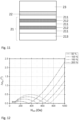
- FIG. 8 shows a magnetic angular sensor element, according to an embodiment
- FIG. 9 shows total angular error as a function of the magnitude of the external magnetic field for several values of the pinning field strength
- FIG. 10 shows total angular error as a function of the magnitude of the external magnetic field for several values of TMR in MTJ stack
- FIG. 11 is a partial view of a magnetic sensor element showing a ferromagnetic pinned layer, a tunnel magnetoresistance barrier layer, and a sensing layer for an example embodiment of the disclosure.
- FIG. 12 shows the dependence of angular error ⁇ H on the external magnetic field H ext for different TMR magnitudes for the magnetic sensor element in the configuration of FIG. 11 .
- FIG. 8 shows a magnetic angular sensor element 20 destined to sense an external magnetic field (H ext ) 60 , according to an embodiment.
- the magnetic sensor element 20 comprises a magnetic tunnel junction containing a ferromagnetic pinned layer 21 having a pinned magnetization 210 , a ferromagnetic sensing layer 23 , and a tunnel magnetoresistance barrier layer 22 , between the ferromagnetic pinned layer 21 and the ferromagnetic sensing layer 23 .
- the ferromagnetic sensing layer 23 comprises a first sensing layer 23 a being in direct contact with the barrier layer 22 and having a first sensing magnetization 230 a , a second sensing layer 23 b having a second sense magnetization 230 b , and a metallic spacer 24 between the first sensing layer 23 a and the second sensing layer 23 b.
- the metallic spacer 24 is configured to provide an antiferromagnetic coupling between the first sensing magnetization 230 a and the second sensing magnetization 230 b such that the first sensing magnetization 230 a is oriented substantially antiparallel to the second sensing magnetization 230 b.
- the second sensing magnetization 230 b is larger than the first sensing magnetization 230 a , such that the second sensing magnetization 230 b is oriented in accordance with the direction of the external magnetic field 60 .
- the present invention further pertains to a magnetic angular sensor device comprising a plurality of the magnetic sensor element 20 .
- the magnetic sensor elements 20 are arranged in a half-bridge circuit 30 , as represented in FIG. 3 .
- the magnetic sensor elements 20 can also be arranged in a full bridge configuration.
- the external magnetic field H ext When the external magnetic field H ext is applied in a direction that is close to an antiparallel orientation with respect to the pinned direction of the reference layer magnetization 210 , a higher deviation of the reference layer magnetization 210 occurs (first factor). However, the first sensing layer magnetization 230 a is oriented close to a parallel orientation with respect to the pinned direction of the reference layer magnetization 210 , reducing the resistance variation per one degree of the reference layer deviation (second factor). The deviation of the reference layer magnetization 210 is thus at least partially compensated by a decrease of the angular variation of the resistance R.
- Using the magnetic angular sensor element 20 in the half-bridge circuit 30 (or a full-bridge circuit) improves the compensation of the angular error AE T compared to known arrangement of the magnetic angular sensor element, not only at low magnitudes of the external magnetic field 60 but also at high magnitudes of the external magnetic field 60 .
- the second sensing layer 23 b comprises a plurality of second sensing sublayers 231 , each second sensing sublayer 231 having a second sensing sub-magnetization 2310 amounting to said second sensing magnetization 230 b .
- Two adjacent second sensing sublayers 231 are separated from by a non-magnetic layer 232 being configured to provide a magnetic coupling between the two adjacent second sensing sublayers 231 .
- the non-magnetic layer 232 is configured to provide a magnetic coupling such that the second sensing magnetization 230 b is oriented in a direction opposed to the one of the first sensing magnetization 230 a.
- the magnetic coupling is such that the second sensing sub-magnetization 2310 of one of the second sensing sublayers 231 is oriented substantially parallel to the one of the adjacent second sensing sublayer 231 .
- the non-magnetic layer 232 is configured to have a strength (a minimal required strength) of the magnetic coupling such that there is no reversal of the second sensing sub-magnetization 2310 within the second sensing sublayer 231 for an amplitude of the external magnetic field 60 up to 1200 Oe (95493 A/m).
- the antiferromagnetic coupling of the metallic spacer 24 is a RKKY coupling having an exchange coupling of 0.3 mJ/m 2 or greater.
- the first sensing magnetization 230 a has a thickness of 1.5 nm or greater.
- a RKKY coupling having an exchange coupling of 0.3 mJ/m 2 or greater is enough to stabilize the first sensing layer 23 a and second sensing layer 23 b in the antiferromagnetic configuration for an external magnetic field H ext that is below 1200 Oe (95493 A/m).
- the layers order as shown in FIG. 8 is inverted. Such configuration corresponds to a so-called top-pinned MTJ stack.
- FIG. 9 shows the angular error in the orientation of the pinned reference layer magnetization 210 as a function of the magnitude of the external magnetic field H ext for several values of the pinning field H pin (pinning strength) and for the magnetic sensor elements 20 having a TMR of 50%.
- FIG. 10 shows total angular error as a function of the magnitude of the external magnetic field H ext for several values of TMR in the magnetic sensor elements 20 and for a pinning field H pin of 4 kOe (318 A/m).
- the optimum can be found numerically and/or optimized by adequate designing of the magnetic sensor element 20 .
- the strength of the antiferromagnetic coupling (the magnitude of the pinning field H pin ) should be high enough to keep the reference layer magnetization 210 rigid when submitted to the external magnetic field H ext .
- FIG. 11 is a partial view of the magnetic sensor element 20 according to yet another embodiment, showing the ferromagnetic pinned layer 21 , the tunnel magnetoresistance barrier layer 22 and the sensing layer 23 .
- the pinned layer 21 comprises a synthetic antiferromagnet (SAF) structure, i.e., a magnetic multilayer comprising comprises ferromagnetic pinned sublayers separated by non-magnetic sublayers.
- SAF synthetic antiferromagnet
- FIG. 11 the magnetic sensor element 20 is represented comprising three ferromagnetic pinned sublayers 211 separated by two non-magnetic sublayer 212 , however the magnetic sensor element 20 can have at least two ferromagnetic pinned sublayers 211 separated by and non-magnetic sublayer 212 .
- the ferromagnetic layer farthest from the tunnel barrier layer 22 is pinned by an antiferromagnet 213 while the other ferromagnetic layers are coupled to the neighbouring ferromagnetic layers by an RKKY coupling mechanism through the non-magnetic layers separating them.
- the RKKY coupling is essentially antiferromagnetic.
- FIG. 12 shows the dependence of angular error ⁇ H on the external magnetic field H ext for different TMR magnitudes for the magnetic sensor element 20 in the configuration of FIG. 11 .
- calculations were performed assuming an exchange pinning of 0.66 mJ/m 2 and the RKKY coupling of ⁇ 0.66 mJ/m 2 for the ferromagnetic layers farthest from the tunnel barrier layer 22 (in the bottom part of the stack).
- the SAF configuration of the pinned layer 21 can provide the same improved compensation effect of the angular error as for the configuration shown in FIG. 8 .
- the improved compensation effect can be obtained for the RKKY exchange coupling being antiferromagnetic and having an absolute magnitude of 0.4 mJ/m 2 or greater.
Landscapes
- Physics & Mathematics (AREA)
- Condensed Matter Physics & Semiconductors (AREA)
- General Physics & Mathematics (AREA)
- Measuring Magnetic Variables (AREA)
- Hall/Mr Elements (AREA)
Abstract
Description
-
- 10 magnetic angular sensor device, sensing circuit
- 20 magnetic angular sensor element, MTJ
- 21 ferromagnetic pinned layer
- 210 reference layer magnetization, pinned magnetization
- 211 ferromagnetic pinned sublayer
- 212 non-magnetic sublayer
- 213 antiferromagnet
- 22 barrier layer
- 23 ferromagnetic sensing layer
- 23 a first sensing layer
- 230 sensing layer magnetization
- 230 a first sensing magnetization
- 23 b second sensing layer
- 230 b second sensing magnetization
- 24 metallic spacer
- 231 second sensing sublayer
- 2310 second sensing sub-magnetization
- 232 non-magnetic layer
- 30 sensing circuit
- 60 external magnetic field
- AET total angular error
- AER angular error in reference layer orientation
- AES angular error in sensing layer orientation
- Hext magnitude of an external magnetic field
- Hlong longitudinal component
- Hpin pinning field
- Htrans transversal component
- R resistance
- Rap resistance when the sensing and reference layer magnetization are antiparallel
- Vin input voltage
- Vout output voltage
- θ angle
- χR magnetic susceptibility of the reference layer
- χtrans transversal magnetic susceptibility
Claims (8)
Applications Claiming Priority (4)
| Application Number | Priority Date | Filing Date | Title |
|---|---|---|---|
| EP20315252 | 2020-05-20 | ||
| EP20315252.5A EP3913386B1 (en) | 2020-05-20 | 2020-05-20 | Magnetic sensor element and device having improved accuracy under high magnetic fields |
| EP20315252.5 | 2020-05-20 | ||
| PCT/IB2021/053951 WO2021234504A1 (en) | 2020-05-20 | 2021-05-10 | Magnetic sensor element and device having improved accuracy under high magnetic fields |
Publications (2)
| Publication Number | Publication Date |
|---|---|
| US20230213597A1 US20230213597A1 (en) | 2023-07-06 |
| US12228620B2 true US12228620B2 (en) | 2025-02-18 |
Family
ID=71452171
Family Applications (1)
| Application Number | Title | Priority Date | Filing Date |
|---|---|---|---|
| US17/998,984 Active 2041-10-24 US12228620B2 (en) | 2020-05-20 | 2021-05-10 | Magnetic sensor element and device having improved accuracy under high magnetic fields |
Country Status (5)
| Country | Link |
|---|---|
| US (1) | US12228620B2 (en) |
| EP (1) | EP3913386B1 (en) |
| JP (1) | JP2023526003A (en) |
| KR (1) | KR102844286B1 (en) |
| WO (1) | WO2021234504A1 (en) |
Families Citing this family (1)
| Publication number | Priority date | Publication date | Assignee | Title |
|---|---|---|---|---|
| US12310101B2 (en) * | 2020-12-23 | 2025-05-20 | Intel Corporation | Gate dielectrics for complementary metal oxide semiconductors transistors and methods of fabrication |
Citations (6)
| Publication number | Priority date | Publication date | Assignee | Title |
|---|---|---|---|---|
| JP2011027633A (en) | 2009-07-28 | 2011-02-10 | Tdk Corp | Magnetic sensor and manufacturing method thereof |
| US20110068786A1 (en) * | 2009-09-18 | 2011-03-24 | Tdk Corporation | Magnetic sensor and manufacturing method thereof |
| US20140145792A1 (en) | 2012-11-27 | 2014-05-29 | Headway Technologies, Inc. | Free Layer with Out-of-Plane Anisotropy for Magnetic Device Applications |
| US20140242418A1 (en) | 2012-04-20 | 2014-08-28 | Alexander Mikhailovich Shukh | Scalable Magnetoresistive Element |
| US20190051822A1 (en) | 2017-08-10 | 2019-02-14 | Commissariat A L'energie Atomique Et Aux Energies Alternatives | Synthetic antiferromagnetic layer, magnetic tunnel junction and spintronic device using said synthetic antiferromagnetic layer |
| US10620279B2 (en) * | 2017-05-19 | 2020-04-14 | Allegro Microsystems, Llc | Magnetoresistance element with increased operational range |
Family Cites Families (7)
| Publication number | Priority date | Publication date | Assignee | Title |
|---|---|---|---|---|
| JP2008010590A (en) * | 2006-06-28 | 2008-01-17 | Toshiba Corp | Magnetoresistive element and magnetic memory |
| JP2008166524A (en) * | 2006-12-28 | 2008-07-17 | Alps Electric Co Ltd | Tunnel type magnetic sensor |
| WO2008102499A1 (en) * | 2007-02-23 | 2008-08-28 | Nec Corporation | Magnetic substance device, and magnetic random access memory |
| KR101224100B1 (en) * | 2009-09-10 | 2013-01-18 | 대상 주식회사 | Process for producing curry in form of granules having high dispersibility |
| TWI468715B (en) * | 2012-10-22 | 2015-01-11 | 財團法人工業技術研究院 | Magnetic field sensor for sensing an external magnetic field |
| JP2015213125A (en) * | 2014-05-02 | 2015-11-26 | 日本放送協会 | Spin injection magnetization reversal element |
| JP6121943B2 (en) * | 2014-05-16 | 2017-04-26 | 株式会社東芝 | Magnetic head and magnetic recording / reproducing apparatus |
-
2020
- 2020-05-20 EP EP20315252.5A patent/EP3913386B1/en active Active
-
2021
- 2021-05-10 KR KR1020227039540A patent/KR102844286B1/en active Active
- 2021-05-10 WO PCT/IB2021/053951 patent/WO2021234504A1/en not_active Ceased
- 2021-05-10 US US17/998,984 patent/US12228620B2/en active Active
- 2021-05-10 JP JP2022568458A patent/JP2023526003A/en active Pending
Patent Citations (6)
| Publication number | Priority date | Publication date | Assignee | Title |
|---|---|---|---|---|
| JP2011027633A (en) | 2009-07-28 | 2011-02-10 | Tdk Corp | Magnetic sensor and manufacturing method thereof |
| US20110068786A1 (en) * | 2009-09-18 | 2011-03-24 | Tdk Corporation | Magnetic sensor and manufacturing method thereof |
| US20140242418A1 (en) | 2012-04-20 | 2014-08-28 | Alexander Mikhailovich Shukh | Scalable Magnetoresistive Element |
| US20140145792A1 (en) | 2012-11-27 | 2014-05-29 | Headway Technologies, Inc. | Free Layer with Out-of-Plane Anisotropy for Magnetic Device Applications |
| US10620279B2 (en) * | 2017-05-19 | 2020-04-14 | Allegro Microsystems, Llc | Magnetoresistance element with increased operational range |
| US20190051822A1 (en) | 2017-08-10 | 2019-02-14 | Commissariat A L'energie Atomique Et Aux Energies Alternatives | Synthetic antiferromagnetic layer, magnetic tunnel junction and spintronic device using said synthetic antiferromagnetic layer |
Non-Patent Citations (3)
| Title |
|---|
| European Search Report issued in Application No. EP20315252 dated Nov. 9, 2020. |
| International Search Report issued in Application No. PCT/IB2021/053951 dated Jul. 28, 2021. |
| Written Opinion for PCT/IB2021/053951 dated Jul. 28, 2021. |
Also Published As
| Publication number | Publication date |
|---|---|
| US20230213597A1 (en) | 2023-07-06 |
| JP2023526003A (en) | 2023-06-20 |
| KR102844286B1 (en) | 2025-08-08 |
| EP3913386B1 (en) | 2026-02-11 |
| KR20230013027A (en) | 2023-01-26 |
| EP3913386A1 (en) | 2021-11-24 |
| WO2021234504A1 (en) | 2021-11-25 |
Similar Documents
| Publication | Publication Date | Title |
|---|---|---|
| US11085952B2 (en) | Current sensor using modulation of or change of sensitivity of magnetoresistance elements | |
| US10935612B2 (en) | Current sensor having multiple sensitivity ranges | |
| US12265139B2 (en) | Magneto-resistive element and magnetic sensor | |
| EP3637123B1 (en) | Magnetic field sensor that corrects for the effect of a stray magnetic field using one or more magnetoresistance elements, each having a reference layer with the same magnetic direction | |
| US7394240B2 (en) | Current sensor | |
| US11156478B2 (en) | Magnetic sensor | |
| US7394247B1 (en) | Magnetic field angle sensor with GMR or MTJ elements | |
| US9465056B2 (en) | Current sensor with temperature-compensated magnetic tunnel junction bridge | |
| US7737678B2 (en) | Magnetic sensor and current sensor | |
| US11860250B2 (en) | Magnetic angular sensor device for sensing high magnetic fields with low angular error | |
| EP3531153B1 (en) | Spin valve with bias alignment | |
| US10557726B2 (en) | Systems and methods for reducing angle error for magnetic field angle sensors | |
| EP2700968A1 (en) | Single-chip reference full-bridge magnetic field sensor | |
| US20100001723A1 (en) | Bridge type sensor with tunable characteristic | |
| EP3913386B1 (en) | Magnetic sensor element and device having improved accuracy under high magnetic fields | |
| WO2015125699A1 (en) | Magnetic sensor | |
| US11579213B2 (en) | Magnetic sensor | |
| EP3667347B1 (en) | Magnetoresistive-based sensing circuit for two-dimensional sensing of high magnetic fields | |
| JP6881413B2 (en) | Magnetic sensor |
Legal Events
| Date | Code | Title | Description |
|---|---|---|---|
| FEPP | Fee payment procedure |
Free format text: ENTITY STATUS SET TO UNDISCOUNTED (ORIGINAL EVENT CODE: BIG.); ENTITY STATUS OF PATENT OWNER: LARGE ENTITY |
|
| FEPP | Fee payment procedure |
Free format text: ENTITY STATUS SET TO SMALL (ORIGINAL EVENT CODE: SMAL); ENTITY STATUS OF PATENT OWNER: LARGE ENTITY |
|
| STPP | Information on status: patent application and granting procedure in general |
Free format text: DOCKETED NEW CASE - READY FOR EXAMINATION |
|
| AS | Assignment |
Owner name: CROCUS TECHNOLOGY SA, FRANCE Free format text: ASSIGNMENT OF ASSIGNORS INTEREST;ASSIGNORS:TIMOPHEEV, ANDREY;CHILDRESS, JEFFREY;STRELKOV, NIKITA;REEL/FRAME:065027/0750 Effective date: 20230828 |
|
| AS | Assignment |
Owner name: CROCUS TECHNOLOGY SA, FRANCE Free format text: CORRECTIVE ASSIGNMENT TO CORRECT THE RECEIVING PARTY ADDRESS PREVIOUSLY RECORDED ON REEL 065027 FRAME 0750. ASSIGNOR(S) HEREBY CONFIRMS THE ASSIGNMENT;ASSIGNORS:TIMOPHEEV, ANDREY;CHILDRESS, JEFFREY;STRELKOV, NIKITA;REEL/FRAME:065331/0001 Effective date: 20230828 |
|
| AS | Assignment |
Owner name: ALLEGRO MICROSYSTEMS, LLC, NEW HAMPSHIRE Free format text: ASSIGNMENT OF ASSIGNORS INTEREST;ASSIGNOR:CROCUS TECHNOLOGY SA;REEL/FRAME:066350/0729 Effective date: 20240101 Owner name: ALLEGRO MICROSYSTEMS, LLC, NEW HAMPSHIRE Free format text: ASSIGNMENT OF ASSIGNORS INTEREST;ASSIGNOR:CROCUS TECHNOLOGY SA;REEL/FRAME:066350/0669 Effective date: 20240101 |
|
| FEPP | Fee payment procedure |
Free format text: ENTITY STATUS SET TO UNDISCOUNTED (ORIGINAL EVENT CODE: BIG.); ENTITY STATUS OF PATENT OWNER: LARGE ENTITY |
|
| STPP | Information on status: patent application and granting procedure in general |
Free format text: EX PARTE QUAYLE ACTION MAILED |
|
| STPP | Information on status: patent application and granting procedure in general |
Free format text: RESPONSE TO EX PARTE QUAYLE ACTION ENTERED AND FORWARDED TO EXAMINER |
|
| STPP | Information on status: patent application and granting procedure in general |
Free format text: NOTICE OF ALLOWANCE MAILED -- APPLICATION RECEIVED IN OFFICE OF PUBLICATIONS |
|
| STPP | Information on status: patent application and granting procedure in general |
Free format text: PUBLICATIONS -- ISSUE FEE PAYMENT RECEIVED |
|
| STPP | Information on status: patent application and granting procedure in general |
Free format text: PUBLICATIONS -- ISSUE FEE PAYMENT VERIFIED |
|
| STCF | Information on status: patent grant |
Free format text: PATENTED CASE |