US12227498B2 - Heterocyclic amine derivative and pharmaceutical composition comprising same - Google Patents

Heterocyclic amine derivative and pharmaceutical composition comprising same Download PDF

Info

Publication number
US12227498B2
US12227498B2 US17/269,325 US201917269325A US12227498B2 US 12227498 B2 US12227498 B2 US 12227498B2 US 201917269325 A US201917269325 A US 201917269325A US 12227498 B2 US12227498 B2 US 12227498B2
Authority
US
United States
Prior art keywords
amino
pyridin
methylthiazol
piperidin
prop
Prior art date
Legal status (The legal status is an assumption and is not a legal conclusion. Google has not performed a legal analysis and makes no representation as to the accuracy of the status listed.)
Active, expires
Application number
US17/269,325
Other versions
US20220064155A1 (en
Inventor
Wol Young Kim
Yeon Im Lee
Youn Jung Yoon
Joon Seok Park
Deok Ki Eom
Keuk-Chan BANG
JaeHyun JUNG
Current Assignee (The listed assignees may be inaccurate. Google has not performed a legal analysis and makes no representation or warranty as to the accuracy of the list.)
Daewoong Pharmaceutical Co Ltd
Original Assignee
Daewoong Pharmaceutical Co Ltd
Priority date (The priority date is an assumption and is not a legal conclusion. Google has not performed a legal analysis and makes no representation as to the accuracy of the date listed.)
Filing date
Publication date
Application filed by Daewoong Pharmaceutical Co Ltd filed Critical Daewoong Pharmaceutical Co Ltd
Priority claimed from PCT/KR2019/010894 external-priority patent/WO2020045941A1/en
Assigned to DAEWOONG PHARMACEUTICAL CO., LTD. reassignment DAEWOONG PHARMACEUTICAL CO., LTD. ASSIGNMENT OF ASSIGNORS INTEREST (SEE DOCUMENT FOR DETAILS). Assignors: BANG, KEUK CHAN, EOM, Deok Ki, JUNG, JAEHYUN, KIM, WOL YOUNG, LEE, YEON IM, PARK, JOON SEOK, YOON, YOUN JUNG
Publication of US20220064155A1 publication Critical patent/US20220064155A1/en
Application granted granted Critical
Publication of US12227498B2 publication Critical patent/US12227498B2/en
Active legal-status Critical Current
Adjusted expiration legal-status Critical

Links

Classifications

    • CCHEMISTRY; METALLURGY
    • C07ORGANIC CHEMISTRY
    • C07DHETEROCYCLIC COMPOUNDS
    • C07D417/00Heterocyclic compounds containing two or more hetero rings, at least one ring having nitrogen and sulfur atoms as the only ring hetero atoms, not provided for by group C07D415/00
    • C07D417/14Heterocyclic compounds containing two or more hetero rings, at least one ring having nitrogen and sulfur atoms as the only ring hetero atoms, not provided for by group C07D415/00 containing three or more hetero rings
    • AHUMAN NECESSITIES
    • A61MEDICAL OR VETERINARY SCIENCE; HYGIENE
    • A61KPREPARATIONS FOR MEDICAL, DENTAL OR TOILETRY PURPOSES
    • A61K31/00Medicinal preparations containing organic active ingredients
    • A61K31/33Heterocyclic compounds
    • A61K31/395Heterocyclic compounds having nitrogen as a ring hetero atom, e.g. guanethidine or rifamycins
    • A61K31/435Heterocyclic compounds having nitrogen as a ring hetero atom, e.g. guanethidine or rifamycins having six-membered rings with one nitrogen as the only ring hetero atom
    • A61K31/44Non condensed pyridines; Hydrogenated derivatives thereof
    • A61K31/4427Non condensed pyridines; Hydrogenated derivatives thereof containing further heterocyclic ring systems
    • AHUMAN NECESSITIES
    • A61MEDICAL OR VETERINARY SCIENCE; HYGIENE
    • A61KPREPARATIONS FOR MEDICAL, DENTAL OR TOILETRY PURPOSES
    • A61K31/00Medicinal preparations containing organic active ingredients
    • A61K31/33Heterocyclic compounds
    • A61K31/395Heterocyclic compounds having nitrogen as a ring hetero atom, e.g. guanethidine or rifamycins
    • A61K31/435Heterocyclic compounds having nitrogen as a ring hetero atom, e.g. guanethidine or rifamycins having six-membered rings with one nitrogen as the only ring hetero atom
    • A61K31/44Non condensed pyridines; Hydrogenated derivatives thereof
    • A61K31/445Non condensed piperidines, e.g. piperocaine
    • A61K31/4523Non condensed piperidines, e.g. piperocaine containing further heterocyclic ring systems
    • AHUMAN NECESSITIES
    • A61MEDICAL OR VETERINARY SCIENCE; HYGIENE
    • A61KPREPARATIONS FOR MEDICAL, DENTAL OR TOILETRY PURPOSES
    • A61K31/00Medicinal preparations containing organic active ingredients
    • A61K31/33Heterocyclic compounds
    • A61K31/395Heterocyclic compounds having nitrogen as a ring hetero atom, e.g. guanethidine or rifamycins
    • A61K31/495Heterocyclic compounds having nitrogen as a ring hetero atom, e.g. guanethidine or rifamycins having six-membered rings with two or more nitrogen atoms as the only ring heteroatoms, e.g. piperazine or tetrazines
    • A61K31/496Non-condensed piperazines containing further heterocyclic rings, e.g. rifampin, thiothixene or sparfloxacin
    • AHUMAN NECESSITIES
    • A61MEDICAL OR VETERINARY SCIENCE; HYGIENE
    • A61KPREPARATIONS FOR MEDICAL, DENTAL OR TOILETRY PURPOSES
    • A61K31/00Medicinal preparations containing organic active ingredients
    • A61K31/33Heterocyclic compounds
    • A61K31/395Heterocyclic compounds having nitrogen as a ring hetero atom, e.g. guanethidine or rifamycins
    • A61K31/495Heterocyclic compounds having nitrogen as a ring hetero atom, e.g. guanethidine or rifamycins having six-membered rings with two or more nitrogen atoms as the only ring heteroatoms, e.g. piperazine or tetrazines
    • A61K31/505Pyrimidines; Hydrogenated pyrimidines, e.g. trimethoprim
    • A61K31/506Pyrimidines; Hydrogenated pyrimidines, e.g. trimethoprim not condensed and containing further heterocyclic rings
    • AHUMAN NECESSITIES
    • A61MEDICAL OR VETERINARY SCIENCE; HYGIENE
    • A61PSPECIFIC THERAPEUTIC ACTIVITY OF CHEMICAL COMPOUNDS OR MEDICINAL PREPARATIONS
    • A61P35/00Antineoplastic agents
    • AHUMAN NECESSITIES
    • A61MEDICAL OR VETERINARY SCIENCE; HYGIENE
    • A61PSPECIFIC THERAPEUTIC ACTIVITY OF CHEMICAL COMPOUNDS OR MEDICINAL PREPARATIONS
    • A61P37/00Drugs for immunological or allergic disorders
    • CCHEMISTRY; METALLURGY
    • C07ORGANIC CHEMISTRY
    • C07DHETEROCYCLIC COMPOUNDS
    • C07D401/00Heterocyclic compounds containing two or more hetero rings, having nitrogen atoms as the only ring hetero atoms, at least one ring being a six-membered ring with only one nitrogen atom
    • C07D401/14Heterocyclic compounds containing two or more hetero rings, having nitrogen atoms as the only ring hetero atoms, at least one ring being a six-membered ring with only one nitrogen atom containing three or more hetero rings
    • CCHEMISTRY; METALLURGY
    • C07ORGANIC CHEMISTRY
    • C07DHETEROCYCLIC COMPOUNDS
    • C07D403/00Heterocyclic compounds containing two or more hetero rings, having nitrogen atoms as the only ring hetero atoms, not provided for by group C07D401/00
    • C07D403/14Heterocyclic compounds containing two or more hetero rings, having nitrogen atoms as the only ring hetero atoms, not provided for by group C07D401/00 containing three or more hetero rings
    • CCHEMISTRY; METALLURGY
    • C07ORGANIC CHEMISTRY
    • C07DHETEROCYCLIC COMPOUNDS
    • C07D413/00Heterocyclic compounds containing two or more hetero rings, at least one ring having nitrogen and oxygen atoms as the only ring hetero atoms
    • C07D413/02Heterocyclic compounds containing two or more hetero rings, at least one ring having nitrogen and oxygen atoms as the only ring hetero atoms containing two hetero rings
    • C07D413/04Heterocyclic compounds containing two or more hetero rings, at least one ring having nitrogen and oxygen atoms as the only ring hetero atoms containing two hetero rings directly linked by a ring-member-to-ring-member bond
    • CCHEMISTRY; METALLURGY
    • C07ORGANIC CHEMISTRY
    • C07DHETEROCYCLIC COMPOUNDS
    • C07D417/00Heterocyclic compounds containing two or more hetero rings, at least one ring having nitrogen and sulfur atoms as the only ring hetero atoms, not provided for by group C07D415/00
    • C07D417/02Heterocyclic compounds containing two or more hetero rings, at least one ring having nitrogen and sulfur atoms as the only ring hetero atoms, not provided for by group C07D415/00 containing two hetero rings
    • C07D417/12Heterocyclic compounds containing two or more hetero rings, at least one ring having nitrogen and sulfur atoms as the only ring hetero atoms, not provided for by group C07D415/00 containing two hetero rings linked by a chain containing hetero atoms as chain links
    • CCHEMISTRY; METALLURGY
    • C07ORGANIC CHEMISTRY
    • C07DHETEROCYCLIC COMPOUNDS
    • C07D471/00Heterocyclic compounds containing nitrogen atoms as the only ring hetero atoms in the condensed system, at least one ring being a six-membered ring with one nitrogen atom, not provided for by groups C07D451/00 - C07D463/00
    • C07D471/02Heterocyclic compounds containing nitrogen atoms as the only ring hetero atoms in the condensed system, at least one ring being a six-membered ring with one nitrogen atom, not provided for by groups C07D451/00 - C07D463/00 in which the condensed system contains two hetero rings
    • C07D471/04Ortho-condensed systems
    • CCHEMISTRY; METALLURGY
    • C07ORGANIC CHEMISTRY
    • C07DHETEROCYCLIC COMPOUNDS
    • C07D487/00Heterocyclic compounds containing nitrogen atoms as the only ring hetero atoms in the condensed system, not provided for by groups C07D451/00 - C07D477/00
    • C07D487/02Heterocyclic compounds containing nitrogen atoms as the only ring hetero atoms in the condensed system, not provided for by groups C07D451/00 - C07D477/00 in which the condensed system contains two hetero rings
    • C07D487/04Ortho-condensed systems

Definitions

  • the present disclosure relates to a novel heterocyclic amine useful as BTK (Bruton's Tyrosine Kinase) inhibitor and a pharmaceutical composition comprising the same.
  • BTK Brun's Tyrosine Kinase
  • ITK Interleukin-2 Tyrosine Kinase
  • BTK Bruton's Tyrosine Kinase
  • Tec tyrosine kinase expressed in hepatocellular carcinoma
  • RLK Resting Lymphocyte Kinase
  • BMX Benone-Marrow tyrosine kinase gene on chromosome X
  • ITK is expressed not only in T cells but also in NK cells and mast cells, and plays an important role in T-cell proliferation and production of important cytokines such as IL-2, IL-4, IL-5, IL-10, IL-13 and IL-17 (Schaeffer et al. Nat. Immune 2001, 2, 1183; Fowell et al. Immunity, 1999, 11, 399).
  • T cells are activated by TCR signaling, and the activated T cells produce inflammatory cytokine and activate B cells and macrophages, causing autoimmune diseases such as RA (Sahu N. et al. Curr Top Med Chem. 2009, 9, 690).
  • Th17/Treg Previously, it was known that T cells are activated into Th1 cells to induce RA diseases, but recently, it has been reported that not only Th17/Treg but also Th1 cells act as a pathogenesis of RA (J Leipe J. et al. Arthritis Rheum. 2010, 62, 2876).
  • the ITK has been previously developed as an immunotherapeutic drug target such as asthma, but no ITK has been developed as a therapeutic for RA (Lo H. Y Expert Opin Ther Pat. 2010, 20, 459).
  • ITK has been reported to regulate the development of Th17 and Treg cells via ITK ⁇ / ⁇ mice, and it has ample potential as a therapeutic target for RA (Gomez-Rodriguez J. et al. J. Exp. Med. 2014, 211, 529).
  • BTK acts as a regulator of early B-cell development as well as of mature B-cell activation, signaling and survival.
  • the B-cell is signaled by a B cell receptor (BCR) that recognizes an antigen attached to the surface of an antigen-presenting cell and is activated into a mature antibody-producing cell.
  • BCR B cell receptor
  • aberrant signaling via BCR leads to abnormal B-cell proliferation and the formation of pathologic autoantibodies, and thereby can induce cancer, autoimmune and/or inflammatory diseases.
  • signaling via BCR may be blocked when BTK is deficient.
  • inhibition of BTK can block B-cell mediated disease processes, and the use of BTK inhibitors may be a useful approach for the treatment of B-cell mediated diseases.
  • BTK can be expressed by other cells that may be associated with disease besides B-cells.
  • BTK is important components for Fc-gamma signaling in bone marrow cells, and is expressed by mast cells.
  • BTK-deficient bone marrow-induced mast cells exhibit impaired antigen-induced degranulation, and inhibition of BTK activity is known to be useful for treating pathological mast cell responses such as allergy and asthma (Iwaki et al. J. Biol Chem. 2005 280:40261).
  • monocytes from XLA patients, in which BTK activity is absent decreases in TNF alpha production following stimulation and thus TNF alpha-mediated inflammation could be inhibited by BTF inhibitors (see, Horwood et al., J. Exp. Med. 197:1603, 2003).
  • WO 2008/039218 discloses 4-aminopyrazolo[3,4-d]pyrimidinylpiperidine derivatives
  • WO2015/061247 discloses hetero compounds such as pyridine, pyrimidine, pyrazine and pyridazine
  • WO2014/055934 discloses pyrimidinyl phenyl acrylamide derivatives.
  • WO2005/066335 discloses aminobenzimidazoles
  • WO2005/056785 discloses pyridones
  • WO2002/050071 discloses aminothiazole derivatives
  • WO2014/036016 discloses benzimidazole derivatives.
  • the present inventors has found that a compound having a chemical structure different from BTK, ITK inhibitors reported so far has excellent BTK and ITK dual-activity inhibitory effect, thereby completing the present disclosure.
  • the compounds belonging to the present disclosure mainly have BTK and ITK inhibitory activity on their own, but do not exclude a possibility of exhibiting a pharmacological action as an efficacious agent by a special body environment or by products of metabolic process, after absorption into the body.
  • B is thiazole, pyrazole, pyridine, or pyrimidine ring, and
  • L is a bond, methylene, or —O—.
  • R 2 is cyano; methyl; phenyl; pyridinyl; morpholino; piperazinyl substituted with methyl; piperazinyl substituted with ethyl; piperazinyl substituted with 2-cyanoethyl; piperazinyl substituted with 3-aminopropyl; piperazinyl substituted with 2-methoxyethyl; piperazinyl substituted with —CO-(methyl); unsubstituted piperidinyl; or piperidinyl substituted with methyl.
  • Y is a bond, —O—, —NH—, or —N(methyl)-.
  • R 3 is —CH 2 CH 2 Cl, —CH ⁇ CH 2 , —CH ⁇ CHCH 3 , —CH ⁇ CHCl, —C ⁇ CH, or —C ⁇ CCH 3 .
  • Chemical Formula 1-1 the compound represented by Chemical Formula 1-1:
  • Chemical Formula 1 is represented by the following Chemical Formula 1-2:
  • Chemical Formula 1 is represented by the following Chemical Formula 1-3:
  • Chemical Formula 1 is represented by the following Chemical Formula 1-4:
  • the compounds of the present disclosure may exist in the form of salts, especially pharmaceutically acceptable salts.
  • salts commonly used in the art, such as acid addition salts formed by pharmaceutically acceptable free acids can be used without limitation.
  • pharmaceutically acceptable salt refers to any organic or inorganic addition salt of the compound represented by Chemical Formula 1, whose concentration is relatively non-toxic and harmless to a patient and activates effectively and whose side effects do not degrade the beneficial efficacy of the above compound.
  • an organic acid and an inorganic acid can be used.
  • the inorganic acids include hydrochloric acid, phosphoric acid, sulfuric acid, nitric acid, tartaric acid and the like.
  • the organic acids include methanesulfonic acid, p-toluenesulfonic acid, acetic acid, trifluoroacetic acid, maleic acid, succinic acid, oxalic acid, benzoic acid, tartaric acid, fumaric acid, mandelic acid, propionic acid, citric acid, lactic acid, glycollic acid, gluconic acid, galacturonic acid, glutamic acid, glutaric acid, glucuronic acid, aspartic acid, ascorbic acid, carbonic acid, vanillic acid, hydroiodic acid and the like, but are not limited thereto.
  • the salt may be a hydrochloride salt.
  • a pharmaceutically acceptable metal salt can be obtained by a conventional method using a base.
  • the compound represented by Chemical Formula 1 is dissolved in an excessive amount of an alkali metal hydroxide or an alkaline earth metal hydroxide solution, the non-soluble salt is filtered, and then the filtrate is evaporated and dried to obtain a pharmaceutically acceptable metal salt.
  • a pharmaceutically unacceptable salt or solvate of the compound of Chemical Formula 1 may be used as an intermediate when preparing the compound of Chemical Formula 1, or the pharmaceutically acceptable salt or the solvate thereof.
  • the compound represented by Chemical Formula 1 according to the present disclosure includes not only pharmaceutically acceptable salts thereof, but also solvates such as hydrates that can be prepared therefrom, and includes all possible stereoisomers, without being limited thereto.
  • the solvate and the stereoisomer of the compound represented by Chemical Formula 1 may be prepared from the compound of Chemical Formula 1 using common methods known in the art.
  • the compound represented by Chemical Formula 1 according to the present disclosure may be prepared either in a crystalline form or in a non-crystalline form, and when the compound of Chemical Formula 1 is prepared in a crystalline form, it may be optionally hydrated or solvated.
  • the compound represented by Chemical Formula 1 may not only include a stoichiometric hydrate, but also include a compound containing various amounts of water.
  • the solvate of the compound represented by Chemical Formula 1 according to the present disclosure includes both stoichiometric solvates and non-stoichiometric solvates.
  • the compound represented by Chemical Formula 1 may be prepared, for example, through Reaction Formula 1 below.
  • Step 1-1 is a step of reacting the compound represented by Chemical Formula 1-1 and the compound represented by Chemical Formula 1-2 to prepare the compound represented by Chemical Formula 1-3.
  • the reaction is an amine substitution reaction
  • the reaction is preferably carried out in the presence of a palladium catalyst and a base
  • the reaction is preferably carried out in the presence of a base.
  • Step 1-2 is a step of reacting the compound represented by Chemical Formula 1-3 and the compound represented by Chemical Formula 1-4 to prepare the compound represented by Chemical Formula 1-5.
  • the reaction is an amine substitution reaction, which is preferably carried out in the presence of a palladium catalyst and a base.
  • Step 1-3 is a step of removing a protecting group (BOC; tert-butyloxycarbonyl protecting group) from the compound represented by Chemical Formula 1-5 to prepare the compound represented by Chemical Formula 1-6.
  • the reaction is preferably carried out under acidic conditions capable of removing the protecting group.
  • Step 1-4 is a step of reacting the compound represented by Chemical Formula 1-6 with the compound represented by Chemical Formula 1-7 to prepare the compound represented by Chemical Formula 1.
  • the reaction is an amidation reaction, which is preferably carried out in the presence of a base.
  • reaction Scheme 1 a reaction for protecting with a protecting group and a reaction for removing the protecting group may be added depending on each substituent.
  • the compound represented by Chemical Formula 1 when L is methylene and A is not C 1-4 alkyl, the compound represented by Chemical Formula 1 may be prepared, for example, through Reaction Scheme 2 below.
  • Step 2-1 is a step of reacting the compound represented by Chemical Formula 2-1 and the compound represented by Chemical Formula 1-2 to prepare the compound represented by Chemical Formula 2-2.
  • the reaction is an amine substitution reaction
  • the reaction is preferably carried out in the presence of a palladium catalyst and a base
  • the reaction is preferably carried out in the presence of a base.
  • Step 2-2 is a step of reacting the compound represented by Chemical Formula 2-2 and the compound represented by Chemical Formula 2-3 to prepare the compound represented by Chemical Formula 2-4.
  • the reaction is an amidation reaction, which is preferably carried out in the presence of an amidating reagent.
  • Step 2-3 is a step of reacting the compound represented by Chemical Formula 2-4 and the compound represented by Chemical Formula 1-4 to prepare the compound represented by Chemical Formula 2-5.
  • the reaction is an amine substitution reaction, which is preferably carried out in the presence of a palladium catalyst and a base.
  • Step 2-4 is a step of removing the protecting group (BOC) from the compound represented by Chemical Formula 2-5 and reducing ketone to prepare the compound represented by Chemical Formula 2-6.
  • the reaction is preferably carried out under acidic conditions.
  • Step 2-5 is a step of reacting the compound represented by Chemical Formula 2-6 with the compound represented by Chemical Formula 1-7 to prepare the compound represented by Chemical Formula 1.
  • the reaction is an amidation reaction, which is preferably carried out in the presence of a base.
  • reaction Scheme 2 a reaction for protecting with a protecting group and a reaction for removing the protecting group may be added depending on each substituent.
  • the compound in which A is C 1-4 alkyl can be prepared using the same method as in step 1-1 and step 1-2 of Reaction Scheme 1, except that in step 1-1 of Reaction Scheme 1, the compound represented by
  • a pharmaceutical composition for preventing or treating autoimmune diseases or cancer diseases which is effective for ITK and BTK inhibitory actions, comprising the compound represented by Chemical Formula 1, or a pharmaceutically acceptable salt, hydrate, solvate or isomer thereof as an active ingredient.
  • the autoimmune diseases include rheumatoid arthritis, systemic lupus erythematosus, childhood diabetes, psoriasis, aphthous stomatitis, chronic thyroiditis, acquired aplastic anemia, primary cirrhosis, ulcerative colitis, Behcet's disease, Crohn's disease, Silicosis, asbestosis, Sjogren's syndrome, Guillain-Barre syndrome, dermatomyositis, polymyositis, multiple sclerosis, autoimmune hemolytic anemia, autoimmune encephalomyelitis, myasthenia gravis, Graves thyroid hyperplasia, nodular polyarteritis, ankylosing spondylitis, fibrositis, temporal arteritis, Wilson's disease, or Fanconi syndrome, and
  • prevention refers to any act to delay or inhibit occurrence, spread or recurrence of the above-mentioned diseases by administration of the composition of the present disclosure
  • treatment refers to any act to improve or change the symptoms of the above diseases for the better by administration of the composition of the present disclosure.
  • compositions according to the present disclosure can be formulated in types for oral or parenteral administrations according to a standard pharmaceutical practice. These formulations may contain additives such as pharmaceutically acceptable carrier, adjuvant or diluent in addition to the active ingredient.
  • Suitable carriers include, for example, physiological saline, polyethylene glycol, ethanol, vegetable oil, and isopropyl myristate and the like.
  • Diluents include, for example, lactose, dextrose, sucrose, mannitol, sorbitol, cellulose and/or glycine and the like. but are not limited thereto.
  • the compounds of the present disclosure can be dissolved in oils, propylene glycol or other solvents commonly used in the preparation of injection solutions.
  • the compounds of the present disclosure can be formulated in ointments or creams for topical application.
  • a preferred dose of the compound of the present disclosure may be varied according to the condition and weight of a patient, the severity of a disease, the type of a drug, and the route and duration of administration, but it may be suitably selected by those skilled in the art.
  • the compound of the present disclosure may be administrated daily at a dose of 0.0001 to 100 mg/kg (body weight), and preferably 0.001 to 100 mg/kg (body weight).
  • the administration may be performed once a day or in divided doses each day through an oral or parenteral route.
  • the pharmaceutical composition may contain the compound of the present disclosure in an amount of 0.001 to 99% by weight, preferably 0.01 to 60% by weight.
  • the pharmaceutical composition according to the present disclosure may be administered to mammals such as a rat, a mouse, a domestic animal, a human, through various routes.
  • the administration may be carried out through all possible methods, for example, oral, rectal, intravenous, intramuscular, subcutaneous, intra-endometrial, intracerebroventricular injection.
  • the compound represented by Chemical Formula 1 according to the present disclosure or a pharmaceutically acceptable salt, hydrate, solvate or isomer thereof can be usefully used for the prevention or treatment of autoimmune diseases or cancers.
  • Step 1-1 Preparation of (2,6-dichloropyridin-4-yl) (morpholino) methanone
  • 2,6-Dichloroisonicotinic acid (10.0 g, 1.0 eq) was dissolved in dimethylformamide (100.0 mL), and then 1,1-carbonyldiimidazole (1.0 g, 1.2 eq) was added thereto. The mixture was stirred at room temperature (25 ⁇ 30° C.) for 1 hour under nitrogen gas, and then morpholine (5.4 mL, 1.2 eq) was added and stirred at the same temperature for 2 hours to complete the reaction. Ethyl acetate (200.0 mL) and water (200.0 mL) were added thereto, followed by extraction, and the aqueous layer was re-extracted three times using ethyl acetate (200.0 mL).
  • Step 1-2 Preparation of 4-((2,6-dichloropyridin-4-yl) methyl) morpholine
  • step 1-1 The intermediate (10.0 g, 1.0 eq) obtained in step 1-1 was dissolved in dichloromethane (100.0 mL), and then cooled to 0 to 10° C. under nitrogen gas. 1M borane-tetrahydrofuran (115.0 mL, 3.0 eq) was slowly added dropwise. The mixture was stirred at room temperature for 12 hours to complete the reaction. The reaction solution was cooled to 0 to 10° C. and then 6N-hydrochloric acid aqueous solution (256.0 mL, 20.0 eq) was slowly added dropwise, and then stirred at the same temperature for 1 hour.
  • Step 1-3 Preparation of tert-butyl 3-((6-chloro-4-(morpholinomethyl) pyridin-2-yl) amino) piperidine-1-carboxylate
  • Step 1-4 Preparation of tert-butyl 3-((6-((5-methylthiazol-2-yl) amino)-4-(morpholinomethyl) pyridin-2-yl) amino) piperidine-1-carboxylate
  • step 1-3 The intermediate (730.0 mg, 1.0 eq) obtained in step 1-3 was dissolved in 1,4-dioxane (14.0 mL). Palladium acetate (40.0 mg, 0.1 eq), Xantphos (204.7 mg, 0.2 eq), 5-methylthio-2-amine (203.6 mg, 1.0 eq), and cesium carbonate (1.7 g, 3.0 eq) were sequentially added. The mixture was reacted in a microwave reactor at 150° C. for 30 minutes. Ethyl acetate (10.0 mL) and water (10.0 mL) were added, and the resulting solid was filtered to give the title compound (424.9 mg, yield 65.4%). After cooling to 30° C.
  • Step 1-5 Preparation of N 2 -(5-methylthiazol-2-yl)-4-(morpholinomethyl)-N 6 -(piperidin-3-yl) pyridin-2,6-diamine
  • step 1-4 The intermediate (500.0 mg, 1.0 eq) obtained in step 1-4 was dissolved in dichloromethane (10.0 mL), and then cooled to 0 to 10° C. Trifluoroacetic acid (1.6 mL, 20.0 eq) was slowly added dropwise, and then stirred for 1 hour. After adjusting the pH to 9-12 using 12N-sodium hydroxide aqueous solution, the separated dichloromethane layer was dried over anhydrous sodium sulfate and then concentrated under reduced pressure. Ethyl acetate (10.0 mL) was added to the resulting residue to form crystals for 30 minutes. The crystals were filtered and dried to give the title compound (357.5 mg, yield: 90.0%).
  • Step 1-6 Preparation of 1-(3-((6-((5-methylthiazol-2-yl) amino)-4-(morpholinomethyl) pyridin-2-yl) amino) piperidin-1-yl) prop-2-en-1-one
  • Step 8-1 Preparation of methyl 6-((1-(tert-butoxycarbonyl) pyrrolidin-3-yl) amino)-2-chloropyrimidine-4-carboxylate
  • Step 8-2 Preparation of tert-butyl 3-((2-chloro-6-(morpholin-4-carbonyl) pyrimidin-4-yl) amino) pyrrolidine-1-carboxylate
  • Step 8-3 Preparation of tert-butyl 3-((2-((5-methylthiazol-2-yl) amino)-6-(morpholine-4-carbonyl) pyrimidin-4-yl) amino) pyrrolidine-1-carboxylate
  • step 8-2 After tert-butyl 3-((2-chloro-6-(morpholin-4-carbonyl) pyrimidin-4-yl) amino) pyrrolidine-1-carboxylate (450.0 mg, 1.0 eq) obtained in step 8-2 was dissolved in 1,4-dioxane (10.0 mL), palladium acetate (0.1 eq), 4,5-bis (diphenylphosphino)-9,9-dimethylxanthene (0.2 eq), cesium carbonate (3.0 eq), 2-amino-5-methylthiazole (1.2 eq) were added thereto, and reacted in a microwave reactor (160° C., 30 min).
  • Step 8-4 Preparation of N 2 -(5-methylthiazol-2-yl)-6-(morpholinomethyl)-N 4 -(pyrrolidin-3-yl) pyrimidine-2,4-diamine
  • step 8-3 After tert-butyl 3-((2-((5-methylthiazol-2-yl) amino)-6-(morpholin-4-carbonyl) pyrimidin-4-yl) amino) pyrrolidine-1-carboxylate (250.0 mg, 1.0 eq) obtained in step 8-3 was dissolved in tetrahydrofuran (10.0 mL), 0.9M borane-tetrahydrofuran solution (5.0 eq) was added thereto, and stirred at 50° C. for 5 hours. The reaction solution was cooled to 0° C., and then 6N aqueous hydrochloric acid solution (5.0 eq) was added and then stirred at 50° C. for 12 hours.
  • reaction solution was again cooled to 0° C., and then the pH was adjusted to 12 using 12N sodium hydroxide aqueous solution, and then extracted with dichloromethane (200.0 mL) and water (200.0 mL). The separated organic layer was dried over anhydrous sodium sulfate and then concentrated under reduced pressure to give the title compound (40.0 mg, yield: 20.9%).
  • Step 8-5 Preparation of 1-(3-((2-((5-methylthiazol-2-yl) amino)-6-(morpholinomethyl) pyrimidin-4-yl) amino) pyrrolidin-1-yl) prop-2-en-1-one
  • N 2 -(5-methylthiazol-2-yl)-6-(morpholinomethyl)-N 4 -(pyrrolidin-3-yl) pyrimidine-2,4-diamine 50.0 mg, 1.0 eq obtained in step 8-4 was dissolved in tetrahydrofuran (1.6 mL) and water (0.4 mL), sodium bicarbonate (3.0 eq) and acryloyl chloride (1.1 eq) were added thereto, and stirred at 0° C. for 30 minutes. Upon completion of the reaction, water (50.0 mL) and ethyl acetate (50.0 mL) were added thereto, followed by extraction.
  • Step 10-1 Preparation of tert-butyl 3-((6-chloro-4-(morpholinomethyl) pyridin-2-yl) oxy) pyrrolidine-1-carboxylate
  • Step 10-2 Preparation of (1-(3-((6-((5-methylthiazol-2-yl) amino)-4-(morpholinomethyl) pyridin-2-yl) oxy) pyrrolidin-1-yl) prop-2-en-1-one
  • Step 13-1 Preparation of (R)—N 2 -(5-methylthiazol-2-yl)-4-(morpholinomethyl)-N 6 -(piperidin-3-yl) pyridine-2,6-diamine
  • Step 13-2 Preparation of (R)-1-(3-((6-((5-methylthiazol-2-yl) amino)-4-(morpholinomethyl) pyridin-2-yl) amino) piperidin-1-yl) but-2-yn-1-one
  • Example 17 Preparation of 1-(3-((4-((5-methylthiazol-2-yl) amino)-6-(morpholinomethyl) pyrimidin-2-yl) amino) piperidin-1-yl) prop-2-en-1-one
  • Step 20-1 Preparation of 1-((2,6-dichloropyridin-4-yl) methyl) piperazine
  • Step 20-2 Preparation of 1-(4-((2,6-dichloropyridin-4-yl) methyl) piperazin-1-yl) ethan-1-one
  • Step 20-3 Preparation of(S)-1-(3-((4-((4-acetylpiperazin-1-yl) methyl)-6-(5-methylthiazol-2-yl) amino) pyridin-2-yl) amino) piperidin-1-yl) prop-2-en-1-one
  • the title compound (50.0 mg, yield: 45.0%) was obtained in the same manner as in Example 1, except that the intermediate obtained in step 20-2 of Example 20 was used instead of the intermediate obtained in step 1-2 of Example 1, and tert-butyl(S)-3-aminopiperidine-1-carboxylate was used instead of tert-butyl 3-aminopiperidine-1-carboxylate in steps 1-3.
  • Step 21-1 Preparation of methyl(S)-6-((1-(tert-butoxycarbonyl) piperidin-3-yl) amino)-2-chloropyrimidine-4-carboxylate
  • Step 21-2 Preparation of tert-butyl(S)-3-((2-chloro-6-(morpholine-4-carbonyl) pyrimidin-4-yl) amino) piperidine-1-carboxylate
  • Step 21-3 Preparation of tert-butyl 3-((2-((5-methylthiazol-2-yl) amino)-6-(morpholine-4-carbonyl) pyrimidin-4-yl) amino) piperidine-1-carboxylate
  • Step 21-4 Preparation of(S)—N 2 -(5-methylthiazol-2-yl)-6-(morpholinomethyl)-N 4 -(piperidin-3-yl) pyrimidine-2,4-diamine
  • reaction solution was again cooled to 0° C., and then the pH was adjusted to 12 using 12N aqueous sodium hydroxide solution, and extracted with dichloromethane (200.0 mL) and water (200.0 mL). The separated organic layer was dried over anhydrous sodium sulfate and then concentrated under reduced pressure to give the title compound (270.0 mg, yield: 69.8%).
  • Step 21-5 Preparation of(S)-1-(3-((4-((5-methylthiazol-2-yl) amino)-6-(morpholinomethyl) pyrimidin-2-yl) amino) piperidin-1-yl) prop-2-en-1-one
  • Step 22-1 Preparation of 1-((2,6-dichloropyridin-4-yl) methyl)-4-(2-methoxyethyl) piperazine
  • Step 22-2 Preparation of(S)-1-(3-((4-((4-(2-methoxyethyl) piperazin-1-yl) methyl)-6-(5-methylthiazol-2-yl) amino) pyridin-2-yl) amino) piperidin-1-yl) prop-2-en-1-one
  • Example 2 The title compound (15.0 mg, yield: 68.0%) was obtained in the same manner as in Example 1, except that the intermediate obtained in step 22-1 of Example 22 was used instead of the intermediate obtained in step 1-2 of Example 1, and tert-butyl(S)-3-aminopiperidine-1-carboxylate was used instead of tert-butyl 3-aminopiperidine-1-carboxylate in step 1-3.
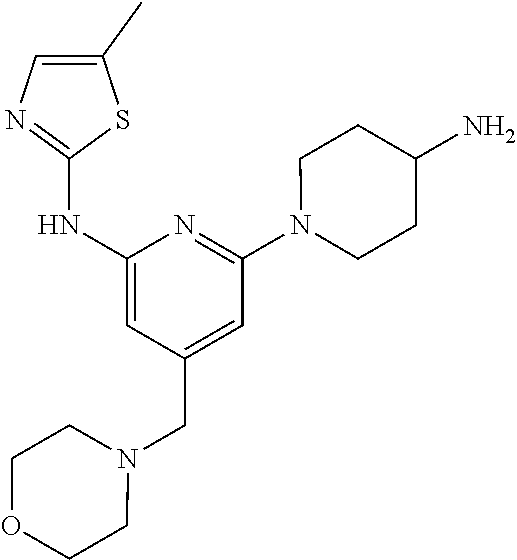
  • Step 27-1 Preparation of tert-butyl (1-(6-chloro-4-(morpholinomethyl) pyridin-2-yl) piperidin-4-yl) carbamate
  • Step 27-2 Preparation of tert-butyl (1-(6-((5-methylthiazol-2-yl) amino)-4-(morpholinomethyl) pyridin-2-yl) piperidin-4-yl) carbamate
  • Step 27-3 Preparation of N-(6-(4-aminopepyridin-1-yl)-4-(morpholinomethyl) pyridin-2-yl)-5-methylthiazol-2-amine
  • step 27-2 tert-butyl (1-(6-((5-methylthiazol-2-yl) amino)-4-(morpholinomethyl) pyridin-2-yl) piperidin-4-yl) carbamate (0.1 g, 0.2 mmol) obtained in step 27-2 was dissolved in dichloromethane (11 mL), trifluoroacetic acid (229 mg, 3.0 mmol) was added thereto, and then stirred at 20° C. for 2 hours. Upon completion of the reaction, 1N sodium hydroxide solution was added to adjust the pH to 7, diluted with ethyl acetate, and washed with brine. The organic layers were collected, dried over anhydrous sodium sulfate, filtered, and concentrated under reduced pressure to give the title compound (195 mg, yield: 100%).
  • Step 27-4 Preparation of N-(1-(6-((5-methylthiazol-2-yl) amino)-4-(morpholinomethyl) pyridin-2-yl) piperidin-4-yl) acrylamide
  • N-(6-(4-aminopepyridin-1-yl)-4-(morpholinomethyl) pyridin-2-yl)-5-methylthiazol-2-amine (0.1 g, 0.2 mmol) obtained in step 27-3 was dissolved in tetrahydrofuran (6 mL) and water (2 mL), and then cooled to 0° C., and sodium bicarbonate (0.08 g, 1.0 mmol) was added thereto. Acryloyl chloride (0.02 mL, 0.3 mmol) was slowly added to the reaction solution, and then stirred at 0° C. for 10 minutes.
  • Example 28 Preparation of 1-(6-(6-((5-methylthiazol-2-yl) amino)-4-(morpholinomethyl) pyridin-2-yl) octahydro-1H-pyrrolo[2,3-c]pyridin-1-yl) prop-2-en-1-one
  • Step 33-1 Preparation of tert-butyl 4-((2,6-dichloropyridin-4-yl) oxy) piperidine-1-carboxylate
  • Step 33-2 Preparation of 2,6-dichloro-4-(piperidin-4-yloxy) pyridine
  • Step 33-3 Preparation of 2,6-dichloro-4-((1-methylpiperidin-4-yl) oxy) pyridine
  • step 33-2 2,6-dichloro-4-(piperidin-4-yloxy) pyridine (2.4 g, 1.0 eq) obtained in step 33-2 was dissolved in methanol (50.0 mL) and dichloromethane (50.0 mL), formaldehyde solution (1.0 eq), acetic acid (0.1 eq), and sodium triacetoxyborohydride (2.0 eq) were added thereto and reacted at room temperature for 30 minutes. Upon completion of the reaction, water (500.0 mL) and dichloromethane (500.0 mL) were added thereto, followed by extraction. The separated organic layer was dried over anhydrous sodium sulfate and then concentrated under reduced pressure to give the title compound (5.1 g, yield: 89.8%).
  • Step 33-4 Preparation of tert-butyl(S)-3-((6-chloro-4-((1-methylpiperidin-4-yl) oxy) pyridin-2-yl) amino) piperidine-1-carboxylate
  • step 33-3 2,6-dichloro-4-((1-methylpiperidin-4-yl) oxy) pyridine (2.0 g, 1.0 eq) obtained in step 33-3 was dissolved in 1,4-dioxane (20.0 mL), palladium acetate (0.1 eq), 4,5-bis (diphenylphosphino)-9,9-dimethylxanthene (0.2 eq), cesium carbonate (3.0 eq), and 2-amino-5-methylthiazole (1.2 eq) were added thereto and reacted in a microwave reactor (150° C., 30 min).
  • Step 33-5 Preparation of tert-butyl(S)-3-((4-((1-methylpiperidin-4-yl) oxy)-6-((5-methylthiazol-2-yl) amino) pyridin-2-yl) amino) piperidine-1-carboxylate
  • Step 33-6 Preparation of(S)-4-((1-methylpiperidin-4-yl) oxy)-N 2 -(5-methylthiazol-2-yl)-N 6 -(piperidin-3-yl) pyridin-2,6-diamine
  • reaction solution Upon completion of the reaction, the reaction solution was cooled at 0° C., and then the pH was adjusted to 8 ⁇ 9 using saturated sodium bicarbonate aqueous solution, and water (100.0 mL) and ethyl acetate (100.0 mL) were added thereto, followed by extraction. The separated organic layer was dried over anhydrous sodium sulfate and then concentrated under reduced pressure to give the title compound (150.0 mg, yield: 62.5%).
  • Step 33-7 Preparation of(S)-1-(3-((4-((1-methylpiperidin-4-yl) oxy)-6-((5-methylthiazol-2-yl) amino) pyridin-2-yl) amino) piperidin-1-yl) prop-2-en-1-one
  • Step 34-1 Preparation of 3-(4-((2,6-dichloropyridin-4-yl) methyl) piperazin-1-yl) propanenitrile
  • Step 34-2 Preparation of t-butyl(S)-3-((4-((4-(2-cyanoethyl) piperazin-1-yl) methyl)-6-((5-methylthiazol-2-yl) amino) pyridin-2-yl) amino) piperidine-1-carboxylate
  • the title compound (400 mg, yield: 76.0%) was obtained in the same manner as in steps 1-3 and 1-4 of Example 1, except that the intermediate obtained in step 34-1 was used instead of the intermediate obtained in step 1-3 of Example 1, and t-butyl(S)-3-aminopiperidine-1-carboxylate was used instead of t-butyl 3-aminopiperidine-1-carboxylate.
  • Step 34-3 Preparation of(S)-3-(4-((2-((5-methylthiazol-2-yl) amino)-6-(piperidin-3-ylamino) pyridin-4-yl) methyl) piperazine-1-yl) propanenitrile
  • Step 34-4 Preparation of(S)-3-(4-((2-((1-acryloylpiperidin-3-yl) amino)-6-((5-methylthiazol-2-yl) amino) pyridin-4-yl) methyl) piperazin-1-yl) propanenitrile
  • Step 36-1 Preparation of 2,6-dichloro-4-(pyridin-3-ylmethyl) pyridine
  • Step 36-2 Preparation of tert-butyl(S)-3-((6-chloro-4-(pyridin-3-ylmethyl) pyridin-2-yl) amino) piperidine-1-carboxylate
  • step 36-1 2,6-dichloro-4-(pyridin-3-ylmethyl) pyridine (1.7 g, 7.1 mmol) obtained in step 36-1 was dissolved in 1,4-dioxane (24 mL), tert-butyl(S)-3-aminopiperidine-1-carboxylate (1.6 g, 7.8 mmol), palladium acetate (0.2 g, 0.7 mmol), Xantphos (0.8 g, 1.4 mmol) and sodium carbonate (2.3 g, 21.3 mmol) were sequentially added thereto, and then stirred at reflux at 100° C. for 12 hours. Upon completion of the reaction, the reaction mixture was filtered through celite, concentrated under reduced pressure, and purified by column chromatography (ethyl acetate 100%) to give the title compound (280 mg, yield: 15%).
  • Step 36-3 Preparation of tert-butyl 3-((6-((5-methylthiazol-2-yl) amino)-4-(pyridin-3-ylmethyl) pyridin-2-yl) amino) piperidine-1-carboxylate
  • Step 36-4 Preparation of N 2 -(5-methylthiazol-2-yl)-N 6 -(piperidin-3-yl)-4-(pyridin-3-ylmethyl) pyridin-2,6-diamine
  • Step 36-5 Preparation of(S)-1-(3-((6-((5-methylthiazol-2-yl) amino)-4-(pyridin-3-ylmethyl) pyridin-2-yl) amino) piperidin-1-yl) prop-2-en-1-one
  • N 2 -(5-methylthiazol-2-yl)-N 6 -(piperidin-3-yl)-4-(pyridin-3-ylmethyl) pyridin-2,6-diamine (0.2 g, 0.4 mmol) obtained in step 36-4 was dissolved in tetrahydrofuran (6 mL) and water (2 mL), and then cooled to 0° C., and sodium bicarbonate (0.1 g, 1.1 mmol) was added thereto.
  • Acryloyl chloride (0.05 mL, 0.6 mmol) was slowly added to the reaction solution, and then stirred at 0° C. for 10 minutes.
  • Step 44-1 Preparation of 4-((2-chloro-6-methylpyridin-4-yl) methyl) morpholine
  • Step 44-2 Preparation of 5-methyl-N-(6-methyl-4-(morpholinomethyl) pyridin-2-yl) thiazol-2-amine
  • Step 45-1 Preparation of(S)-1-(3-((6-((5-methylthiazol-2-yl) amino)-4-(morpholinomethyl) pyridin-2-yl) amino) piperidin-1-yl) prop-2-en-1-one hydrochloride
  • Step 45-2 Preparation of(S)-3-chloro-1-(3-((6-((5-methylthiazol-2-yl) amino)-4-(morpholinomethyl) pyridin-2-yl) amino) piperidin-1-yl) propan-1-one
  • step 45-1 The material obtained in step 45-1 was stored at ⁇ 20° C. for 7 months.
  • the material produced during the storage process was separated by column using a mixed solvent of methylene chloride and methanol in a ratio of 15:1 to give the title compound (30.0 mg, yield: 5%).
  • step 45-1 The material obtained in step 45-1 was stored at ⁇ 20° C. for 7 months.
  • the material produced during the storage process was separated by column using a mixed solvent of methylene chloride and methanol in a ratio of 15:1 to give the title compound (3.0 mg, yield: 0.5%).
  • Step 48-1 Preparation of tert-butyl(S)-3-((6-((1H-pyrazol-3-yl) amino)-4-(morpholinomethyl) pyridin-2-yl) amino) piperidine-1-carboxylate
  • Step 48-2 Preparation of(S)-4-(morpholinomethyl)-N 2 -(piperidin-3-yl)-N 6 -(1H-pyrazol-3-yl) pyridin-2,6-diamine
  • Step 48-3 Preparation of(S)-1-(3-(6-(1H-pyrazol-3-ylamino)-4-(morpholinomethyl) pyridin-2-ylamino) piperidin-1-yl) prop-2-en-1-one
  • Step 49-1 Preparation of tert-butyl(S)-3-((4-(morpholinomethyl)-6-((5-(trifluoromethyl) thiazol-2-yl) amino) pyridin-2-yl) amino) piperidine-1-carboxylate
  • Step 49-2 Preparation of(S)-4-(morpholinomethyl)-N 2 -(piperidin-3-yl)-N 6 -(5-(trifluoromethyl) thiazol-2-yl) pyridin-2,6-diamine
  • Step 49-3 Preparation of(S)-1-(3-(4-(morpholinomethyl)-6-(5-(trifluoromethyl) thiazol-2-ylamino) pyridin-2-ylamino) piperidin-1-yl) prop-2-en-1-one
  • Step 52-1 Preparation of (2,6-dichloro-3-fluoropyridin-4-yl) (morpholino) methanone
  • Step 52-2 Preparation of 4-((2,6-dichloro-3-fluoropyridin-4-yl) methyl) morpholine
  • step 52-1 The intermediate (500.0 mg, 1.0 eq) obtained in step 52-1 was dissolved in dichloromethane (20.0 mL), and then stirred at room temperature (25 to 30° C.). 0.9M borane-tetrahydrofuran (6.0 mL, 3.0 eq) was slowly added dropwise. The mixture was stirred at room temperature for 12 hours to complete the reaction. The reaction solution was cooled to 0 to 10° C., and then 6N-hydrochloric acid aqueous solution (39.0 mL, 20.0 eq) was slowly added dropwise and then stirred at the same temperature for 1 hour.
  • Step 52-3 Preparation of tert-butyl(S)-3-((6-chloro-3-fluoro-4-(morpholinomethyl) pyridin-2-yl) amino) piperidine-1-carboxylate
  • Step 52-4 Preparation of tert-butyl(S)-3-((3-fluoro-6-((5-methylthiazol-2-yl) amino)-4-(morpholinomethyl) pyridin-2-yl) amino) piperidine-1-carboxylate
  • step 52-3 The intermediate (100.0 mg, 1.0 eq) obtained in step 52-3 was dissolved in 1,4-dioxane (2.0 mL). Palladium acetate (5.1 mg, 0.1 eq), Xantphos (24.3 mg, 0.2 eq), 5-methylthiano-2-amine (24.0 mg, 1.0 eq), and cesium carbonate (205.8 g, 3.0 eq) were sequentially added thereto. The mixture was reacted in a microwave reactor at 150° C. for 30 minutes. After cooling to 30° C. or less, water (10.0 mL) and ethyl acetate (10.0 mL) were added, and then the layers were separated.
  • Step 52-5 Preparation of(S)-3-fluoro-N 6 -(5-methylthiazol-2-yl)-4-(morpholinomethyl)-N 2 -(piperidin-3-yl) pyridin-2,6-diamine
  • step 52-4 After the intermediate (80.0 mg, 1.0 eq) obtained in step 52-4 was dissolved in ethyl acetate (10.0 mL), 6N-hydrochloric acid aqueous solution (0.6 mL, 20.0 eq) was slowly added dropwise thereto, and then stirred for 2 hours. After adjusting the pH to 9 ⁇ 12 using 12N-sodium hydroxide aqueous solution, the separated dichloromethane layer was dried over anhydrous sodium sulfate and then concentrated under reduced pressure. Ethyl acetate (10.0 mL) was added to the resulting residue and crystals were produced for 30 minutes. The crystals were filtered and then dried to give the title compound (60.5 mg, yield: 99.9%).
  • Step 52-6 Preparation of(S)-1-(3-(3-fluoro-6-(5-methylthiazol-2-ylamino)-4-(morpholinomethyl) pyridin-2-ylamino) piperidin-1-yl) prop-2-en-1-one
  • Example 54 Preparation of(S)-1-(3-(4-(morpholinomethyl)-6-(pyrimidin-2-ylamino) pyridin-2-ylamino) piperidin-1-yl) prop-2-en-1-one
  • the inhibitory activities against BTK were evaluated using ‘ADP-GloTM+BTK Kinase enzyme system’ kit (Promega Corporation).
  • 10 ⁇ l of BTK enzyme prepared so as to have a final concentration of 1 ng/ ⁇ l was mixed with 5 ⁇ l of compounds having a final concentration of 1 uM in the case of evaluating a single concentration of compound and a concentration of 1000, 300, 100, 30, 10, 3, 1, 0.3, 0.1 and 0.03 nM in the case of IC 50 evaluation, and then reacted at room temperature for 15 minutes.
  • the inhibitory activity against ITK was evaluated using ‘ADP-GloTM+ITK Kinase enzyme system’ kit (Promega Corporation).
  • 10 ⁇ l of ITK enzyme prepared so as to have a final concentration of 0.4 ng/ ⁇ l was mixed with 5 ⁇ l of compounds having a final concentration of 1 uM in the case of evaluating a single concentration of compound and a concentration of 1000, 300, 100, 30, 10, 3, 1, 0.3, 0.1 and 0.03 nM in the case of IC 50 evaluation, and then reacted at room temperature for 15 minutes.

Landscapes

  • Chemical & Material Sciences (AREA)
  • Organic Chemistry (AREA)
  • Health & Medical Sciences (AREA)
  • Veterinary Medicine (AREA)
  • Medicinal Chemistry (AREA)
  • Pharmacology & Pharmacy (AREA)
  • Life Sciences & Earth Sciences (AREA)
  • Animal Behavior & Ethology (AREA)
  • General Health & Medical Sciences (AREA)
  • Public Health (AREA)
  • Epidemiology (AREA)
  • Chemical Kinetics & Catalysis (AREA)
  • General Chemical & Material Sciences (AREA)
  • Nuclear Medicine, Radiotherapy & Molecular Imaging (AREA)
  • Engineering & Computer Science (AREA)
  • Bioinformatics & Cheminformatics (AREA)
  • Immunology (AREA)
  • Pharmaceuticals Containing Other Organic And Inorganic Compounds (AREA)
  • Plural Heterocyclic Compounds (AREA)
  • Nitrogen Condensed Heterocyclic Rings (AREA)

Abstract

The present disclosure relates to a novel heterocyclic amine derivative represented by the following Chemical Formula 1 and a pharmaceutical composition comprising the same, and the compound according to the present disclosure can be usefully used for the prevention or treatment of autoimmune diseases or cancers.
Figure US12227498-20250218-C00001
    • wherein, in Chemical Formula 1, R1, R2, X1, X2, L, Y, A and B are the same as defined in the specification.

Description

TECHNICAL FIELD Cross-Reference to Related Application(s)
This application is a National Stage Entry of International Application PCT/KR2019/010894 filed on Aug. 27, 2019, which claims the benefit of Korean Patent Application No. 10-2018-0100359 filed on Aug. 27, 2018 and Korean Patent Application No. 10-2019-0104641 filed on Aug. 26, 2019 with the Korean Intellectual Property Office, each of which is incorporated herein by reference in their entireties.
The present disclosure relates to a novel heterocyclic amine useful as BTK (Bruton's Tyrosine Kinase) inhibitor and a pharmaceutical composition comprising the same.
Background of Art
ITK (Interleukin-2 Tyrosine Kinase) and BTK (Bruton's Tyrosine Kinase) are a type of tyrosine kinase, together with Tec (tyrosine kinase expressed in hepatocellular carcinoma), RLK (Resting Lymphocyte Kinase) and BMX (Bone-Marrow tyrosine kinase gene on chromosome X), which that does not have a TEC family receptor and acts on various immune responses.
ITK is expressed not only in T cells but also in NK cells and mast cells, and plays an important role in T-cell proliferation and production of important cytokines such as IL-2, IL-4, IL-5, IL-10, IL-13 and IL-17 (Schaeffer et al. Nat. Immune 2001, 2, 1183; Fowell et al. Immunity, 1999, 11, 399). T cells are activated by TCR signaling, and the activated T cells produce inflammatory cytokine and activate B cells and macrophages, causing autoimmune diseases such as RA (Sahu N. et al. Curr Top Med Chem. 2009, 9, 690). Previously, it was known that T cells are activated into Th1 cells to induce RA diseases, but recently, it has been reported that not only Th17/Treg but also Th1 cells act as a pathogenesis of RA (J Leipe J. et al. Arthritis Rheum. 2010, 62, 2876). In addition, the ITK has been previously developed as an immunotherapeutic drug target such as asthma, but no ITK has been developed as a therapeutic for RA (Lo H. Y Expert Opin Ther Pat. 2010, 20, 459). Recently, however, it has been reported to regulate the development of Th17 and Treg cells via ITK−/−mice, and it has ample potential as a therapeutic target for RA (Gomez-Rodriguez J. et al. J. Exp. Med. 2014, 211, 529).
In a study using the ITK inhibitor PRN694, a study on the reduction of TNF-α, which is a representative inflammatory cytokine of RA diseases, have been reported, confirming the possibility of development as a therapeutic agent by regulating Th17 expression via ITK inhibition (Zhong Y. et al. THE JOURNAL OF BIOLOGICAL CHEMISTRY 2015, 290, 5960).
BTK acts as a regulator of early B-cell development as well as of mature B-cell activation, signaling and survival. The B-cell is signaled by a B cell receptor (BCR) that recognizes an antigen attached to the surface of an antigen-presenting cell and is activated into a mature antibody-producing cell. However, aberrant signaling via BCR leads to abnormal B-cell proliferation and the formation of pathologic autoantibodies, and thereby can induce cancer, autoimmune and/or inflammatory diseases. Thus, in the abnormal B-cell proliferation, signaling via BCR may be blocked when BTK is deficient. Thus, inhibition of BTK can block B-cell mediated disease processes, and the use of BTK inhibitors may be a useful approach for the treatment of B-cell mediated diseases.
Furthermore, BTK can be expressed by other cells that may be associated with disease besides B-cells. For example, BTK is important components for Fc-gamma signaling in bone marrow cells, and is expressed by mast cells. Specifically, BTK-deficient bone marrow-induced mast cells exhibit impaired antigen-induced degranulation, and inhibition of BTK activity is known to be useful for treating pathological mast cell responses such as allergy and asthma (Iwaki et al. J. Biol Chem. 2005 280:40261). In addition, it is known that monocytes from XLA patients, in which BTK activity is absent, decreases in TNF alpha production following stimulation and thus TNF alpha-mediated inflammation could be inhibited by BTF inhibitors (see, Horwood et al., J. Exp. Med. 197:1603, 2003).
At present, there has been no case where it has been developed as a substance that dually inhibits BTK and ITK. However, as the BTK inhibitor, WO 2008/039218 discloses 4-aminopyrazolo[3,4-d]pyrimidinylpiperidine derivatives, and WO2015/061247 discloses hetero compounds such as pyridine, pyrimidine, pyrazine and pyridazine, and WO2014/055934 discloses pyrimidinyl phenyl acrylamide derivatives. As the ITK inhibitor, WO2005/066335 discloses aminobenzimidazoles, WO2005/056785 discloses pyridones, WO2002/050071 discloses aminothiazole derivatives, and recently, WO2014/036016 discloses benzimidazole derivatives.
In view of the above, as a result of studying novel compounds, the present inventors has found that a compound having a chemical structure different from BTK, ITK inhibitors reported so far has excellent BTK and ITK dual-activity inhibitory effect, thereby completing the present disclosure. The compounds belonging to the present disclosure mainly have BTK and ITK inhibitory activity on their own, but do not exclude a possibility of exhibiting a pharmacological action as an efficacious agent by a special body environment or by products of metabolic process, after absorption into the body.
DETAILED DESCRIPTION OF THE INVENTION Technical Problem
It is one object of the present disclosure to provide a novel heterocyclic amine derivative useful as a BTK inhibitor, and a pharmaceutical composition comprising the same.
Technical Solution
In order to achieve the above objects, there is provided a compound represented by the following Chemical Formula 1, or a pharmaceutically acceptable salt thereof:
Figure US12227498-20250218-C00002
    • wherein, in Chemical Formula 1,
    • B is a 5-membered or 6-membered heterocycle containing 1 to 3 heteroatoms each independently selected from the group consisting of N, O and S, provided that the 5-membered or 6-membered heterocycle includes at least one N,
    • R1 is hydrogen, halogen, C1-4 alkyl, or C1-4 haloalkyl,
    • X1 and X2 are each independently N, or CR′,
      • wherein R′ is hydrogen or halogen,
    • L is a bond, C1-4 alkylene, or —O—,
    • R2 is cyano; C1-4 alkyl; C6-10 aryl; pyridinyl; morpholino; piperazinyl; or piperidinyl,
      • wherein, the piperazinyl and the piperidinyl are each independently, unsubstituted, or substituted with C1-4 alkyl, C1-4 alkyl substituted with cyano, C1-4 alkyl substituted with amino, C1-4 alkyl substituted with C1-4 alkoxy, or —CO—(C1-4 alkyl),
    • Y is a bond, —O—, —NH—, or —N(C1-4 alkyl)-,
    • A is C1-4 alkyl,
Figure US12227498-20250218-C00003
    • wherein R3 is C1-4 alkyl, C1-4 haloalkyl, C2-4 alkenyl, C2-4 haloalkenyl, C2-4 alkynyl, or C2-4 haloalkynyl.
Preferably, B is thiazole, pyrazole, pyridine, or pyrimidine ring, and
    • R1 is hydrogen, chloro, methyl, or trifluoromethyl.
Preferably,
    • both X1 and X2 are CH;
    • one of X1 and X2 is CF and the other is CH; or
    • one of X1 and X2 is N and the other is CH.
More preferably,
    • both X1 and X2 are CH, or
    • X1 is CH and X2 is CF; or
    • X1 is CH and X2 is N; or
    • X1 is N and X2 is CH.
Preferably, L is a bond, methylene, or —O—.
Preferably, R2 is cyano; methyl; phenyl; pyridinyl; morpholino; piperazinyl substituted with methyl; piperazinyl substituted with ethyl; piperazinyl substituted with 2-cyanoethyl; piperazinyl substituted with 3-aminopropyl; piperazinyl substituted with 2-methoxyethyl; piperazinyl substituted with —CO-(methyl); unsubstituted piperidinyl; or piperidinyl substituted with methyl.
Preferably, Y is a bond, —O—, —NH—, or —N(methyl)-.
Preferably, R3 is —CH2CH2Cl, —CH═CH2, —CH═CHCH3, —CH═CHCl, —C≡CH, or —C≡CCH3.
Preferably, the compound represented by Chemical Formula 1 is represented by the following Chemical Formula 1-1:
Figure US12227498-20250218-C00004
    • wherein, in Chemical Formula 1-1,
    • R1 is hydrogen, C1-4 alkyl, or C1-4 haloalkyl,
    • X1 and X2 are each independently N, or CR′,
      • wherein R′ is hydrogen or halogen,
    • L is a bond, C1-4 alkylene, or —O—,
    • R2 is cyano; C1-4 alkyl; C6-10 aryl; pyridinyl; morpholino; piperazinyl; or piperidinyl,
      • wherein the piperazinyl and the piperidinyl are each independently, unsubstituted, or substituted with C1-4 alkyl, C1-4 alkyl substituted with cyano, C1-4 alkyl substituted with amino, C1-4 alkyl substituted with C1-4 alkoxy, or —CO—(C1-4 alkyl),
    • Y is a bond, —O—, —NH—, or —N(C1-4 alkyl)-,
    • A is C1-4 alkyl,
Figure US12227498-20250218-C00005
    • wherein, R3 is C1-4 haloalkyl, C2-4 alkenyl, C2-4 haloalkenyl, or C2-4 alkynyl.
Preferably, in Chemical Formula 1-1,
    • R1 is C1-4 alkyl,
    • X1 and X2 are each independently N or CH,
    • L is a bond, C1-4 alkylene, or —O—,
    • R2 is cyano; C1-4 alkyl; C6-10 aryl; pyridinyl; morpholino; piperazinyl; or piperidinyl,
      • wherein, the piperazinyl and the piperidinyl are each independently, unsubstituted, or substituted with C1-4 alkyl, C1-4 alkyl substituted with cyano, C1-4 alkyl substituted with C1-4 alkoxy, or —CO—(C1-4 alkyl),
    • Y is a bond, —O—, —NH—, or —N(C1-4 alkyl)-,
Figure US12227498-20250218-C00006
    • wherein, R3 is C2-4 alkenyl, or C2-4 alkynyl.
Also preferably, the compound represented by Chemical Formula 1 is represented by the following Chemical Formula 1-2:
Figure US12227498-20250218-C00007
    • wherein, in Chemical Formula 1-2,
    • R1 is hydrogen, or halogen,
    • X1 and X2 are each independently N, or CH,
    • L is C1-4 alkylene,
    • R2 is morpholino,
    • Y is —NH—,
    • A is
Figure US12227498-20250218-C00008
      • wherein, R3 is C2-4 alkenyl.
Further, preferably, the compound represented by Chemical Formula 1 is represented by the following Chemical Formula 1-3:
Figure US12227498-20250218-C00009
    • wherein, in Chemical Formula 1-3,
    • X1 and X2 are each independently N or CH,
    • L is C1-4 alkylene,
    • R2 is morpholino,
    • Y is —NH—,
Figure US12227498-20250218-C00010
    • A is
      • wherein, R3 is C2-4 alkenyl.
Further, preferably, the compound represented by Chemical Formula 1 is represented by the following Chemical Formula 1-4:
Figure US12227498-20250218-C00011
    • wherein, in Chemical Formula 1-4,
    • X1 and X2 are each independently N or CH,
    • L is C1-4 alkylene,
    • R2 is morpholino,
    • Y is —NH—,
    • A is
Figure US12227498-20250218-C00012
      • wherein, R3 is C2-4 alkenyl.
In addition, the compounds of the present disclosure may exist in the form of salts, especially pharmaceutically acceptable salts. As salts, salts commonly used in the art, such as acid addition salts formed by pharmaceutically acceptable free acids can be used without limitation. The term “pharmaceutically acceptable salt” as used herein refers to any organic or inorganic addition salt of the compound represented by Chemical Formula 1, whose concentration is relatively non-toxic and harmless to a patient and activates effectively and whose side effects do not degrade the beneficial efficacy of the above compound.
As the free acid, an organic acid and an inorganic acid can be used. Examples of the inorganic acids include hydrochloric acid, phosphoric acid, sulfuric acid, nitric acid, tartaric acid and the like. Examples of the organic acids include methanesulfonic acid, p-toluenesulfonic acid, acetic acid, trifluoroacetic acid, maleic acid, succinic acid, oxalic acid, benzoic acid, tartaric acid, fumaric acid, mandelic acid, propionic acid, citric acid, lactic acid, glycollic acid, gluconic acid, galacturonic acid, glutamic acid, glutaric acid, glucuronic acid, aspartic acid, ascorbic acid, carbonic acid, vanillic acid, hydroiodic acid and the like, but are not limited thereto. Preferably, the salt may be a hydrochloride salt.
Further, a pharmaceutically acceptable metal salt can be obtained by a conventional method using a base. For example, the compound represented by Chemical Formula 1 is dissolved in an excessive amount of an alkali metal hydroxide or an alkaline earth metal hydroxide solution, the non-soluble salt is filtered, and then the filtrate is evaporated and dried to obtain a pharmaceutically acceptable metal salt. At this time, it is particularly preferable to prepare a sodium salt, a potassium salt or a calcium salt as the metal salt.
In addition, a pharmaceutically unacceptable salt or solvate of the compound of Chemical Formula 1 may be used as an intermediate when preparing the compound of Chemical Formula 1, or the pharmaceutically acceptable salt or the solvate thereof.
Further, the compound represented by Chemical Formula 1 according to the present disclosure includes not only pharmaceutically acceptable salts thereof, but also solvates such as hydrates that can be prepared therefrom, and includes all possible stereoisomers, without being limited thereto. The solvate and the stereoisomer of the compound represented by Chemical Formula 1 may be prepared from the compound of Chemical Formula 1 using common methods known in the art.
Further, the compound represented by Chemical Formula 1 according to the present disclosure may be prepared either in a crystalline form or in a non-crystalline form, and when the compound of Chemical Formula 1 is prepared in a crystalline form, it may be optionally hydrated or solvated. In the present disclosure, the compound represented by Chemical Formula 1 may not only include a stoichiometric hydrate, but also include a compound containing various amounts of water. The solvate of the compound represented by Chemical Formula 1 according to the present disclosure includes both stoichiometric solvates and non-stoichiometric solvates.
Representative examples of the compound represented by Chemical Formula 1 or a pharmaceutically acceptable salt thereof are as follows:
  • 1) 1-(3-((6-((5-methylthiazol-2-yl) amino)-4-(morpholinomethyl) pyridin-2-yl) amino) piperidin-1-yl) prop-2-en-1-one,
  • 2) 1-(3-((6-((5-methylthiazol-2-yl) amino)-4-(morpholinomethyl) pyridin-2-yl) amino) pyrrolidin-1-yl) prop-2-en-1-one,
  • 3) 1-(4-((6-((5-methylthiazol-2-yl) amino)-4-(morpholinomethyl) pyridin-2-yl) amino) piperidin-1-yl) prop-2-en-1-one,
  • 4) (R)-1-(3-((6-((5-methylthiazol-2-yl) amino)-4-(morpholinomethyl) pyridin-2-yl) amino) piperidin-1-yl) prop-2-en-1-one,
  • 5) (S)-1-(3-((6-((5-methylthiazol-2-yl) amino)-4-(morpholinomethyl) pyridin-2-yl) amino) piperidin-1-yl) prop-2-en-1-one,
  • 6) (R)-1-(3-((6-((5-methylthiazol-2-yl) amino)-4-(morpholinomethyl) pyridin-2-yl) amino) pyrrolidin-1-yl) prop-2-en-1-one,
  • 7) (S)-1-(3-((6-((5-methylthiazol-2-yl) amino)-4-(morpholinomethyl) pyridin-2-yl) amino) pyrrolidin-1-yl) prop-2-en-1-one,
  • 8) 1-(3-((2-((5-methylthiazol-2-yl) amino)-6-(morpholinomethyl) pyrimidin-4-yl) amino) pyrrolidin-1-yl) prop-2-en-1-one,
  • 9) (E)-1-(3-((2-((5-methylthiazol-2-yl) amino)-6-(morpholinomethyl) pyrimidin-4-yl) amino) pyrrolidin-1-yl) but-2-en-1-one,
  • 10) 1-(3-((6-((5-methylthiazol-2-yl) amino)-4-(morpholinomethyl) pyridin-2-yl) oxy) pyrrolidin-1-yl) prop-2-en-1-one,
  • 11) 1-(4-((6-((5-methylthiazol-2-yl) amino)-4-(morpholinomethyl) pyridin-2-yl) oxy) piperidin-1-yl) prop-2-en-1-one,
  • 12) 1-(3-((6-((5-methylthiazol-2-yl) amino)-4-(morpholinomethyl) pyridin-2-yl) oxy) piperidin-1-yl) prop-2-en-1-one,
  • 13) (R)-1-(3-((6-((5-methylthiazol-2-yl) amino)-4-(morpholinomethyl) pyridin-2-yl) amino) piperidin-1-yl) but-2-yn-1-one,
  • 14) 1-(3-((6-((5-methylthiazol-2-yl) amino)-4-(morpholinomethyl) pyridin-2-yl) amino) pyrrolidin-1-yl) but-2-yn-1-one,
  • 15) (S)-1-(3-((6-((5-methylthiazol-2-yl) amino)-4-(morpholinomethyl) pyridin-2-yl) oxy) piperidin-1-yl) prop-2-en-1-one,
  • 16) (R)-1-(3-((6-((5-methylthiazol-2-yl) amino)-4-(morpholinomethyl) pyridin-2-yl) oxy) piperidin-1-yl) prop-2-en-1-one,
  • 17) 1-(3-((4-((5-methylthiazol-2-yl) amino)-6-(morpholinomethyl) pyrimidin-2-yl) amino) piperidin-1-yl) prop-2-en-1-one,
  • 18) (S)-1-(3-((6-((5-methylthiazol-2-yl) amino)-4-(morpholinomethyl) pyridin-2-yl) amino) piperidin-1-yl) but-2-yn-1-one,
  • 19) 1-(4-((6-((5-methylthiazol-2-yl) amino)-4-(morpholinomethyl) pyridin-2-yl) amino) piperidin-1-yl) but-2-yn-1-one,
  • 20) (S)-1-(3-((4-((4-acetylpiperazin-1-yl) methyl)-6-(5-methylthiazol-2-yl) amino) pyridin-2-yl) amino) piperidin-1-yl) prop-2-en-1-one,
  • 21) (S)-1-(3-((4-((5-methylthiazol-2-yl) amino)-6-(morpholinomethyl) pyrimidin-2-yl) amino) piperidin-1-yl) prop-2-en-1-one,
  • 22) (S)-1-(3-((4-((4-(2-methoxyethyl) piperazin-1-yl) methyl)-6-(5-methylthiazol-2-yl) amino) pyridin-2-yl) amino) piperidin-1-yl) prop-2-en-1-one,
  • 23) (S)-1-(3-((4-((5-methylthiazol-2-yl) amino)-6-(morpholinomethyl) pyrimidin-2-yl) amino) piperidin-1-yl) but-2-yn-1-one,
  • 24) (S)-1-(3-((4-((5-methylthiazol-2-yl) amino)-6-(morpholinomethyl) pyrimidin-2-yl) amino) pyrrolidin-1-yl) prop-2-en-1-one,
  • 25) (R)-1-(3-((4-((5-methylthiazol-2-yl) amino)-6-(morpholinomethyl) pyrimidin-2-yl) amino) piperidin-1-yl) prop-2-en-1-one,
  • 26) (S)-1-(3-(methyl (6-((5-methylthiazol-2-yl) amino)-4-(morpholinomethyl) pyridin-2-yl) amino) piperidin-1-yl) prop-2-en-1-one,
  • 27) N-(1-(6-((5-methylthiazol-2-yl) amino)-4-(morpholinomethyl) pyridin-2-yl) piperidin-4-yl) acrylamide,
  • 28) 1-(6-(6-((5-methylthiazol-2-yl) amino)-4-(morpholinomethyl) pyridin-2-yl) octahydro-1H-pyrrolo[2,3-c]pyridin-1-yl) prop-2-en-1-one,
  • 29) 1-(6-(6-((5-methylthiazol-2-yl) amino)-4-(morpholinomethyl) pyridin-2-yl) octahydro-1H-pyrrolo[2,3-c]pyridin-1-yl) but-2-yn-1-one,
  • 30) 1-(6-((6-((5-methylthiazol-2-yl) amino)-4-(morpholinomethyl) pyridin-2-yl) amino)-2-azaspiro[3.3] heptan-2-yl) prop-2-en-1-one,
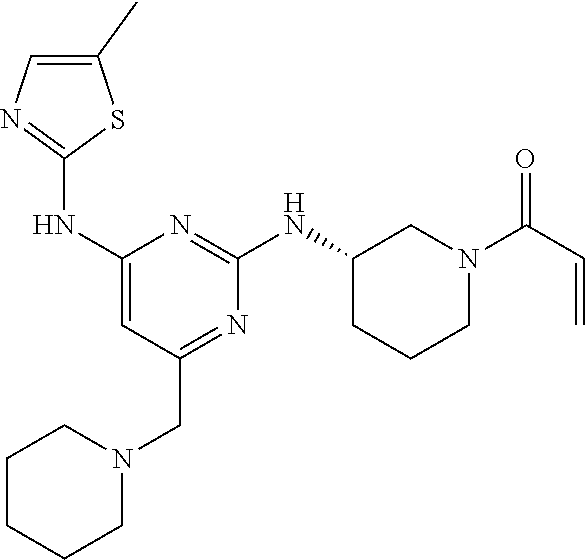
  • 31) (S)-1-(3-((4-((5-methylthiazol-2-yl) amino)-6-(piperidin-1-ylmethyl) pyrimidin-2-yl) amino) piperidin-1-yl) prop-2-en-1-one,
  • 32) (S)-1-(3-((4-((4-ethylpiperazin-1-yl) methyl)-6-(5-methylthiazol-2-yl) amino) pyrimidin-2-yl) amino) piperidin-1-yl) prop-2-en-1-one,
  • 33) (S)-1-(3-((4-((1-methylpiperidin-4-yl) oxy)-6-((5-methylthiazol-2-yl) amino) pyridin-2-yl) amino) piperidin-1-yl) prop-2-en-1-one,
  • 34) (S)-3-(4-((2-((1-acryloylpiperidin-3-yl) amino)-6-((5-methylthiazol-2-yl) amino) pyridin-4-yl) methyl) piperazin-1-yl) propanenitrile,
  • 35) (S)-1-(3-((4-methyl-6-((5-methylthiazol-2-yl) amino) pyridin-2-yl) amino) piperidin-1-yl) prop-2-en-1-one,
  • 36) (S)-1-(3-((6-((5-methylthiazol-2-yl) amino)-4-(pyridin-3-ylmethyl) pyridin-2-yl) amino) piperidin-1-yl) prop-2-en-1-one,
  • 37) (S)-1-(3-((6-((5-methylthiazol-2-yl) amino)-4-(pyridin-2-ylmethyl) pyridin-2-yl) amino) piperidin-1-yl) prop-2-en-1-one,
  • 38) (S)-2-((1-acryloylpiperidin-3-yl) amino)-6-(5-methylthiazol-2-yl) amino) isonicotinonitrile,
  • 39) (S)-1-(3-((6-((5-methylthiazol-2-yl) amino)-4-phenylpyridin-2-yl) amino) piperidin-1-yl) prop-2-en-1-one,
  • 40) (S)-1-(3-((4-((1-methylpiperidin-4-yl) oxy)-6-((5-methylthiazol-2-yl) amino) pyridin-2-yl) amino) piperidin-1-yl) prop-2-yn-1-one,
  • 41) (S)-1-(3-((4-((1-methylpiperidin-4-yl) oxy)-6-((5-methylthiazol-2-yl) amino) pyridin-2-yl) amino) piperidin-1-yl) but-2-yn-1-one,
  • 42) (S)-1-(3-((4-((4-ethylpiperazin-1-yl) methyl)-6-((5-methylthiazol-2-yl) amino) pyridin-2-yl) amino) piperidin-1-yl) prop-2-en-1-one,
  • 43) (S)-1-(3-((4-((4-methylpiperazin-1-yl) methyl)-6-(5-methylthiazol-2-yl) amino) pyridin-2-yl) amino) piperidin-1-yl) prop-2-en-1-one, 44) 5-methyl-N-(6-methyl-4-(morpholinomethyl) pyridin-2-yl) thiazol-2-amine,
  • 45) (S)-3-chloro-1-(3-((6-((5-methylthiazol-2-yl) amino)-4-(morpholinomethyl) pyridin-2-yl) amino) piperidin-1-yl) propan-1-one,
  • 46) (S,E)-3-chloro-1-(3-(6-(5-methylthiazol-2-ylamino)-4-(morpholinomethyl) pyridin-2-ylamino) piperidin-1-yl) prop-2-en-1-one,
  • 47) (S)-1-(3-(4-((4-(3-aminopropyl) piperazin-1-yl) methyl)-6-(5-methylthiazol-2-ylamino) pyridin-2-ylamino) piperidin-1-yl) prop-2-en-1-one,
  • 48) (S)-1-(3-(6-(1H-pyrazol-3-ylamino)-4-(morpholinomethyl) pyridin-2-ylamino) piperidin-1-yl) prop-2-en-1-one,
  • 49) (S)-1-(3-(4-(morpholinomethyl)-6-(5-(trifluoromethyl) thiazol-2-ylamino) pyridin-2-ylamino) piperidin-1-yl) prop-2-en-1-one,
  • 50) (S)-1-(3-(6-(5-chloro-1H-pyrazol-3-ylamino)-4-(morpholinomethyl) pyridin-2-ylamino) piperidin-1-yl) prop-2-en-1-one,
  • 51) (S)-1-(3-(4-(morpholinomethyl)-6-(thiazol-2-ylamino) pyridin-2-ylamino) piperidin-1-yl) prop-2-en-1-one,
  • 52) (S)-1-(3-(3-fluoro-6-(5-methylthiazol-2-ylamino)-4-(morpholinomethyl) pyridin-2-ylamino) piperidin-1-yl) prop-2-en-1-one,
  • 53) (S)-1-(3-(4-(morpholinomethyl)-6-(pyridin-2-ylamino) pyridin-2-ylamino) piperidin-1-yl) prop-2-en-1-one, and
  • 54) (S)-1-(3-(4-(morpholinomethyl)-6-(pyrimidin-2-ylamino) pyridin-2-ylamino) piperidin-1-yl) prop-2-en-1-one.
In addition, according to the present disclosure, when A is not C1-4 alkyl, the compound represented by Chemical Formula 1 may be prepared, for example, through Reaction Formula 1 below.
Figure US12227498-20250218-C00013
In Reaction Scheme 1, A′ is
Figure US12227498-20250218-C00014

A″ is
Figure US12227498-20250218-C00015

and the rest are as defined above.
Step 1-1 is a step of reacting the compound represented by Chemical Formula 1-1 and the compound represented by Chemical Formula 1-2 to prepare the compound represented by Chemical Formula 1-3. When the reaction is an amine substitution reaction, the reaction is preferably carried out in the presence of a palladium catalyst and a base, and when the reaction is a solvolysis reaction of an alkyl chloride due to a secondary alcohol, the reaction is preferably carried out in the presence of a base.
Step 1-2 is a step of reacting the compound represented by Chemical Formula 1-3 and the compound represented by Chemical Formula 1-4 to prepare the compound represented by Chemical Formula 1-5. The reaction is an amine substitution reaction, which is preferably carried out in the presence of a palladium catalyst and a base.
Step 1-3 is a step of removing a protecting group (BOC; tert-butyloxycarbonyl protecting group) from the compound represented by Chemical Formula 1-5 to prepare the compound represented by Chemical Formula 1-6. The reaction is preferably carried out under acidic conditions capable of removing the protecting group.
Step 1-4 is a step of reacting the compound represented by Chemical Formula 1-6 with the compound represented by Chemical Formula 1-7 to prepare the compound represented by Chemical Formula 1. The reaction is an amidation reaction, which is preferably carried out in the presence of a base.
Further, in Reaction Scheme 1, a reaction for protecting with a protecting group and a reaction for removing the protecting group may be added depending on each substituent.
According to another embodiment of the present disclosure, in the compound represented by Chemical Formula 1, when L is methylene and A is not C1-4 alkyl, the compound represented by Chemical Formula 1 may be prepared, for example, through Reaction Scheme 2 below.
Figure US12227498-20250218-C00016
In Reaction Scheme 2, the definition of each substituent is the same as defined above.
Step 2-1 is a step of reacting the compound represented by Chemical Formula 2-1 and the compound represented by Chemical Formula 1-2 to prepare the compound represented by Chemical Formula 2-2. When the reaction is an amine substitution reaction, the reaction is preferably carried out in the presence of a palladium catalyst and a base, and when the reaction is a solvolysis reaction of an alkyl chloride due to a secondary alcohol, the reaction is preferably carried out in the presence of a base.
Step 2-2 is a step of reacting the compound represented by Chemical Formula 2-2 and the compound represented by Chemical Formula 2-3 to prepare the compound represented by Chemical Formula 2-4. The reaction is an amidation reaction, which is preferably carried out in the presence of an amidating reagent.
Step 2-3 is a step of reacting the compound represented by Chemical Formula 2-4 and the compound represented by Chemical Formula 1-4 to prepare the compound represented by Chemical Formula 2-5. The reaction is an amine substitution reaction, which is preferably carried out in the presence of a palladium catalyst and a base.
Step 2-4 is a step of removing the protecting group (BOC) from the compound represented by Chemical Formula 2-5 and reducing ketone to prepare the compound represented by Chemical Formula 2-6. The reaction is preferably carried out under acidic conditions.
Step 2-5 is a step of reacting the compound represented by Chemical Formula 2-6 with the compound represented by Chemical Formula 1-7 to prepare the compound represented by Chemical Formula 1. The reaction is an amidation reaction, which is preferably carried out in the presence of a base.
Further, in Reaction Scheme 2, a reaction for protecting with a protecting group and a reaction for removing the protecting group may be added depending on each substituent.
In addition, according to the present disclosure, in the compound represented by Chemical Formula 1, the compound in which A is C1-4 alkyl can be prepared using the same method as in step 1-1 and step 1-2 of Reaction Scheme 1, except that in step 1-1 of Reaction Scheme 1, the compound represented by
Figure US12227498-20250218-C00017

is used instead of the compound represented by Chemical Formula 1-2.
The production method of each step described above can be more embodied in Examples described hereinafter.
According to a further embodiment of the present disclosure, there is provided a pharmaceutical composition for preventing or treating autoimmune diseases or cancer diseases, which is effective for ITK and BTK inhibitory actions, comprising the compound represented by Chemical Formula 1, or a pharmaceutically acceptable salt, hydrate, solvate or isomer thereof as an active ingredient.
In this case, the autoimmune diseases include rheumatoid arthritis, systemic lupus erythematosus, childhood diabetes, psoriasis, aphthous stomatitis, chronic thyroiditis, acquired aplastic anemia, primary cirrhosis, ulcerative colitis, Behcet's disease, Crohn's disease, Silicosis, asbestosis, Sjogren's syndrome, Guillain-Barre syndrome, dermatomyositis, polymyositis, multiple sclerosis, autoimmune hemolytic anemia, autoimmune encephalomyelitis, myasthenia gravis, Graves thyroid hyperplasia, nodular polyarteritis, ankylosing spondylitis, fibrositis, temporal arteritis, Wilson's disease, or Fanconi syndrome, and
    • the cancer may be blood cancer, extranodal marginal zone B-cell lymphoma, glioblastoma, lymphoplasmacytic lymphoma, acute myelogenous leukemia, macroglobulinemia, B cell lymphoma, chronic lymphocytic leukemia, follicular lymphoma, non-hodgkin lymphoma, diffuse large B cell lymphoma, hairy cell leukemia, mantle cell lymphoma, glioblastoma, bladder cancer, pancreatic cancer, ovarian cancer, colorectal cancer, renal cancer, gastric cancer, transitional cell carcinoma, carcinoid tumor, breast cancer, non-small cell lung cancer, or multiple myeloma.
As used herein, the term “prevention” refers to any act to delay or inhibit occurrence, spread or recurrence of the above-mentioned diseases by administration of the composition of the present disclosure, and “treatment” refers to any act to improve or change the symptoms of the above diseases for the better by administration of the composition of the present disclosure.
The pharmaceutical composition according to the present disclosure can be formulated in types for oral or parenteral administrations according to a standard pharmaceutical practice. These formulations may contain additives such as pharmaceutically acceptable carrier, adjuvant or diluent in addition to the active ingredient.
Suitable carriers include, for example, physiological saline, polyethylene glycol, ethanol, vegetable oil, and isopropyl myristate and the like. Diluents include, for example, lactose, dextrose, sucrose, mannitol, sorbitol, cellulose and/or glycine and the like. but are not limited thereto. Further, the compounds of the present disclosure can be dissolved in oils, propylene glycol or other solvents commonly used in the preparation of injection solutions. Furthermore, the compounds of the present disclosure can be formulated in ointments or creams for topical application.
A preferred dose of the compound of the present disclosure may be varied according to the condition and weight of a patient, the severity of a disease, the type of a drug, and the route and duration of administration, but it may be suitably selected by those skilled in the art. In order to achieve the desirable effects, however, the compound of the present disclosure may be administrated daily at a dose of 0.0001 to 100 mg/kg (body weight), and preferably 0.001 to 100 mg/kg (body weight). The administration may be performed once a day or in divided doses each day through an oral or parenteral route.
Depending on the method of administration, the pharmaceutical composition may contain the compound of the present disclosure in an amount of 0.001 to 99% by weight, preferably 0.01 to 60% by weight.
The pharmaceutical composition according to the present disclosure may be administered to mammals such as a rat, a mouse, a domestic animal, a human, through various routes. The administration may be carried out through all possible methods, for example, oral, rectal, intravenous, intramuscular, subcutaneous, intra-endometrial, intracerebroventricular injection.
Advantageous Effects
The compound represented by Chemical Formula 1 according to the present disclosure or a pharmaceutically acceptable salt, hydrate, solvate or isomer thereof can be usefully used for the prevention or treatment of autoimmune diseases or cancers.
DETAILED DESCRIPTION OF THE EMBODIMENTS
Below, the present disclosure will be described in more detail by way of examples. However, these examples are provided for illustrative purposes only, and should not be construed as limiting the scope of the present disclosure to these examples.
Example 1: Preparation of 1-(3-((6-((5-methylthiazol-2-yl) amino)-4-(morpholinomethyl) pyridin-2-yl) amino) piperidin-1-yl) prop-2-en-1-one Step 1-1: Preparation of (2,6-dichloropyridin-4-yl) (morpholino) methanone
Figure US12227498-20250218-C00018
2,6-Dichloroisonicotinic acid (10.0 g, 1.0 eq) was dissolved in dimethylformamide (100.0 mL), and then 1,1-carbonyldiimidazole (1.0 g, 1.2 eq) was added thereto. The mixture was stirred at room temperature (25˜30° C.) for 1 hour under nitrogen gas, and then morpholine (5.4 mL, 1.2 eq) was added and stirred at the same temperature for 2 hours to complete the reaction. Ethyl acetate (200.0 mL) and water (200.0 mL) were added thereto, followed by extraction, and the aqueous layer was re-extracted three times using ethyl acetate (200.0 mL). The ethyl acetate layer was dried over anhydrous sodium sulfate and then concentrated under reduced pressure. The resulting residue was purified by column chromatography (ethyl acetate:hexane=1:5) to give the title compound (13.0 g, yield: 93.0%).
Step 1-2: Preparation of 4-((2,6-dichloropyridin-4-yl) methyl) morpholine
Figure US12227498-20250218-C00019
The intermediate (10.0 g, 1.0 eq) obtained in step 1-1 was dissolved in dichloromethane (100.0 mL), and then cooled to 0 to 10° C. under nitrogen gas. 1M borane-tetrahydrofuran (115.0 mL, 3.0 eq) was slowly added dropwise. The mixture was stirred at room temperature for 12 hours to complete the reaction. The reaction solution was cooled to 0 to 10° C. and then 6N-hydrochloric acid aqueous solution (256.0 mL, 20.0 eq) was slowly added dropwise, and then stirred at the same temperature for 1 hour. After adjusting the pH to 9˜12 using 10N-sodium hydroxide aqueous solution, extraction was performed twice with dichloromethane. The dichloromethane layer was separated, dried over anhydrous sodium sulfate, and then concentrated under reduced pressure. The resulting residue was purified by column chromatography (ethyl acetate:hexane=1:1) to give the title compound (8.1 g, yield: 90.0%).
Step 1-3: Preparation of tert-butyl 3-((6-chloro-4-(morpholinomethyl) pyridin-2-yl) amino) piperidine-1-carboxylate
Figure US12227498-20250218-C00020
After 1,4-dioxane (10.0 mL) was added to the intermediate (1.0 g, 1.0 eq) obtained in step 1-2 and dissolved, tris (dibenzylideneacetone) dipalladium (0) (465.8 mg, 0.2 eq) and Xantphos (1.5 g, 0.4 eq) were added thereto. Tert-butyl 3-aminopiperidine-1-carboxylate (780.0 μl, 1.0 eq) was added, and then sodium carbonate (1.3 g, 3.0 eq) was added, and the mixture was refluxed for 12 hours to complete the reaction. After cooling to 30° C. or less, water (20.0 mL) and ethyl acetate (20.0 mL) were added, and then the layers were separated. The ethyl acetate layer was dried over anhydrous sodium sulfate and then concentrated under reduced pressure. The resulting residue was purified by column chromatography (ethyl acetate:hexane=1:1) to give the title compound (900.0 mg, yield: 54.1%).
Step 1-4: Preparation of tert-butyl 3-((6-((5-methylthiazol-2-yl) amino)-4-(morpholinomethyl) pyridin-2-yl) amino) piperidine-1-carboxylate
Figure US12227498-20250218-C00021
The intermediate (730.0 mg, 1.0 eq) obtained in step 1-3 was dissolved in 1,4-dioxane (14.0 mL). Palladium acetate (40.0 mg, 0.1 eq), Xantphos (204.7 mg, 0.2 eq), 5-methylthio-2-amine (203.6 mg, 1.0 eq), and cesium carbonate (1.7 g, 3.0 eq) were sequentially added. The mixture was reacted in a microwave reactor at 150° C. for 30 minutes. Ethyl acetate (10.0 mL) and water (10.0 mL) were added, and the resulting solid was filtered to give the title compound (424.9 mg, yield 65.4%). After cooling to 30° C. or less, water (15.0 mL) and ethyl acetate (15.0 mL) were added thereto, followed by layer separation. The ethyl acetate layer was dried over anhydrous sodium sulfate and then concentrated under reduced pressure. The resulting residue was purified by column chromatography (EA 100%) to give the title compound (564.0 mg, yield: 65.0%).
Step 1-5: Preparation of N2-(5-methylthiazol-2-yl)-4-(morpholinomethyl)-N6-(piperidin-3-yl) pyridin-2,6-diamine
Figure US12227498-20250218-C00022
The intermediate (500.0 mg, 1.0 eq) obtained in step 1-4 was dissolved in dichloromethane (10.0 mL), and then cooled to 0 to 10° C. Trifluoroacetic acid (1.6 mL, 20.0 eq) was slowly added dropwise, and then stirred for 1 hour. After adjusting the pH to 9-12 using 12N-sodium hydroxide aqueous solution, the separated dichloromethane layer was dried over anhydrous sodium sulfate and then concentrated under reduced pressure. Ethyl acetate (10.0 mL) was added to the resulting residue to form crystals for 30 minutes. The crystals were filtered and dried to give the title compound (357.5 mg, yield: 90.0%).
Step 1-6: Preparation of 1-(3-((6-((5-methylthiazol-2-yl) amino)-4-(morpholinomethyl) pyridin-2-yl) amino) piperidin-1-yl) prop-2-en-1-one
Figure US12227498-20250218-C00023
After the intermediate (350.0 mg, 1.0 eq) obtained in step 1-5 was dissolved in tetrahydrofuran (7.0 mL), water (7.0 mL) was added and sodium bicarbonate (226.8 mg, 3.0 eq) was added, and then cooled to 0 to 10° C. Acryloyl chloride (73.1 μl, 1.0 eq) was slowly added dropwise, and then stirred for 30 minutes to complete the reaction. The layers were separated with dichloromethane, dried over anhydrous sodium sulfate and concentrated under reduced pressure. The resulting residue was purified by column chromatography (dichloromethane:methanol=15:1) to give the title compound (318.0 mg, yield: 80.0%).
1H NMR (500 MHZ, DMSO): 10.5 (s, 1H), 6.94 (s, 1H), 6.86-6.80 (q, 1H), 6.50-6.49 (d, 1H), 6.10-6.07 (d, 1H), 6.04 (s, 1H), 5.94 (s, 1H), 5.66-5.64 (d, 1H), 4.38-4.36 (m, 1H), 4.18-4.16 (m, 1H), 4.08-4.06 (m, 1H), 3.55 (m, 4H), 3.21 (s, 3H), 2.88-2.83 (m, 2H), 2.32 (m, 4H), 2.28 (s, 3H), 2.03 (m, 2H), 1.30 (m, 2H)
Example 2: Preparation of 1-(3-((6-((5-methylthiazol-2-yl) amino)-4-(morpholinomethyl) pyridin-2-yl) amino) pyrrolidin-1-yl) prop-2-en-1-one
Figure US12227498-20250218-C00024
The title compound (15.0 mg, yield: 23.0%) was obtained in the same manner as in Example 1, except that in steps 1-3 of Example 1, tert-butyl 3-aminopyrrolidine-1-carboxylate was used instead of tert-butyl 3-aminopiperidine-1-carboxylate.
1H NMR (500 MHZ, DMSO): 10.58-10.57 (m, 1H), 6.94 (s, 1H), 6.83-6.75 (m, 1H), 6.63-6.48 (m, 1H), 6.14-6.10 (m, 1H), 6.08 (s, 1H), 5.99-5.98 (m, 1H), 5.67-5.59 (m, 1H), 4.65-4.50 (m, 1H), 3.99-3.97 (m, 0.5H), 3.70-3.66 (m, 1.5H), 3.55 (m, 4H), 3.48 (m, 1H), 3.35 (m, 1H), 3.22 (s, 2H), 2.34-2.32 (m, 4H), 2.26-2.24 (d, 3H), 2.25 (m, 1H), 1.95-1.85 (m, 1H)
Example 3: Preparation of 1-(4-((6-((5-methylthiazol-2-yl) amino)-4-(morpholinomethyl) pyridin-2-yl) amino) piperidin-1-yl) prop-2-en-1-one
Figure US12227498-20250218-C00025
The title compound (8.0 mg, yield: 53.0%) was obtained in the same manner as in Example 1, except that in step 1-3 of Example 1, tert-butyl 4-aminopiperidine-1-carboxylate was used instead of tert-butyl 3-aminopiperidine-1-carboxylate.
1H NMR (500 MHZ, DMSO): 10.54 (s, 1H), 6.94 (s, 1H), 6.93-6.83 (m, 1H), 6.51-6.49 (d, 1H), 6.10 (d, 1H), 6.07 (s, 1H), 5.94 (s, 1H), 5.66-5.64 (d, 1H), 4.38-4.36 (m, 1H), 4.16 (m, 1H), 4.08-4.02 (m, 1H), 3.56 (m, 4H), 3.21 (s, 2H), 2.85 (m, 1H), 2.61 (m, 1H), 2.34-2.33 (m, 4H), 2.28 (s, 3H), 2.0 (m, 2H), 1.30-1.21 (m, 2H)
Example 4: Preparation of (R)-1-(3-((6-((5-methylthiazol-2-yl) amino)-4-(morpholinomethyl) pyridin-2-yl) amino) piperidin-1-yl) prop-2-en-1-one
Figure US12227498-20250218-C00026
The title compound (10.0 mg, yield: 53.0%) was obtained in the same manner as in Example 1, except that in steps 1-3 of Example 1, tert-butyl (R)-3-aminopiperidine-1-carboxylate was used instead of tert-butyl 3-aminopiperidine-1-carboxylate.
1H NMR (500 MHZ, DMSO): 10.55-10.50 (m, 1H), 6.91-6.90 (m, 1H), 6.90-6.78 (m, 0.5H), 6.47-6.56 (m, 1.5H), 6.06-5.96 (m, 3H), 5.65-5.67 (m, 0.5H), 5.42-5.40 (m, 0.5H), 4.42-4.40 (m, 0.5H), 4.10-4.0 (m, 1H), 3.90-3.87 (m, 1.5H), 3.56 (m, 4H), 3.20 (s, 2H), 3.14-3.10 (m, 1H), 2.68-2.63 (m, 0.5H), 2.32 (m, 4H), 2.19 (s, 3H), 1.90-2.0 (m, 1H), 1.80 (m, 1H), 1.50-1.40 (m, 2.5H)
Example 5: Preparation of(S)-1-(3-((6-((5-methylthiazol-2-yl) amino)-4-(morpholinomethyl) pyridin-2-yl) amino) piperidin-1-yl) prop-2-en-1-one
Figure US12227498-20250218-C00027
The title compound (13.0 mg, yield: 63.0%) was obtained in the same manner as in Example 1, except that in steps 1-3 of Example 1, tert-butyl(S)-3-aminopiperidine-1-carboxylate was used instead of tert-butyl 3-aminopiperidine-1-carboxylate.
1H NMR (500 MHZ, DMSO): 10.57 (m, 1H), 6.91-6.90 (m, 1H), 6.80-6.85 (m, 0.5H), 6.70-6.40 (m, 1.5H), 6.10-5.96 (m, 3H), 5.65-5.63 (d, 0.5H), 5.42-5.40 (d, 0.5H), 4.42-4.40 (m, 0.5H), 4.10-4.0 (m, 1H), 3.90-3.87 (m, 1.5H), 3.56 (m, 4H), 3.20 (s, 2H), 3.14-3.10 (m, 1H), 2.68-2.63 (m, 0.5H), 2.32 (m, 4H), 2.19 (s, 3H), 1.90-2.0 (m, 1H), 1.80 (m, 1H), 1.50-1.40 (m, 2.5H)
Example 6: Preparation of (R)-1-(3-((6-((5-methylthiazol-2-yl) amino)-4-(morpholinomethyl) pyridin-2-yl) amino) pyrrolidin-1-yl) prop-2-en-1-one
Figure US12227498-20250218-C00028
The title compound (10.0 mg, yield: 58.0%) was obtained in the same manner as in Example 1, except that in step 1-3 of Example 1, tert-butyl (R) 3-aminopyrrolidine-1-carboxylate was used instead of tert-butyl 3-aminopiperidine-1-carboxylate.
1H NMR (500 MHZ, DMSO): 10.7 (m, 1H), 6.94 (s, 1H), 6.83-6.75 (m, 1H), 6.63-6.47 (m, 1H), 6.14-6.10 (m, 2H), 6.09-3.08 (m, 1H), 5.67-5.59 (m, 1H), 4.67-4.50 (1H), 3.97-3.96 (m, 0.5H), 3.70 (m, 1.5H), 3.55-3.54 (m, 4H), 3.40 (m, 1H), 3.38 (m, 1H), 3.22 (s, 2H), 2.32 (m, 4H), 2.26-2.24 (d, 3H), 2.20 (m, 1H), 1.95-1.80 (m, 1H)
Example 7: Preparation of(S)-1-(3-((6-((5-methylthiazol-2-yl) amino)-4-(morpholinomethyl) pyridin-2-yl) amino) pyrrolidin-1-yl) prop-2-en-1-one
Figure US12227498-20250218-C00029
The title compound (15.0 mg, yield: 63.0%) was obtained in the same manner as in Example 1, except that in step 1-3 of Example 1, tert-butyl(S) 3-aminopyrrolidine-1-carboxylate was used instead of tert-butyl 3-aminopiperidine-1-carboxylate.
1H NMR (500 MHZ, DMSO): 10.7 (m, 1H), 6.94 (s, 1H), 6.83-6.75 (m, 1H), 6.63-6.47 (m, 1H), 6.14-6.10 (m, 2H), 6.09-3.08 (m, 1H), 5.67-5.59 (m, 1H), 4.67-4.50 (1H), 3.97-3.96 (m, 0.5H), 3.70 (m, 1.5H), 3.55-3.54 (m, 4H), 3.40 (m, 1H), 3.38 (m, 1H), 3.22 (s, 2H), 2.32 (m, 4H), 2.26-2.24 (d, 3H), 2.20 (m, 1H), 1.95-1.80 (m, 1H)
Example 8: Preparation of 1-(3-((2-((5-methylthiazol-2-yl) amino)-6-(morpholinomethyl) pyrimidin-4-yl) amino) pyrrolidin-1-yl) prop-2-en-1-one Step 8-1: Preparation of methyl 6-((1-(tert-butoxycarbonyl) pyrrolidin-3-yl) amino)-2-chloropyrimidine-4-carboxylate
Figure US12227498-20250218-C00030
After methyl 2,4-dichloropyrimidine-6-carboxylate (500 mg, 1.0 eq) was dissolved in tetrahydrofuran (10.0 mL), diisopropylethylamine (1.5 eq) and tert-butyl 3-aminopyrrolidine-1-carboxylate (1.5 eq) were added thereto and then stirred at 80° C. for 1 hour. Upon completion of the reaction, the mixture was cooled to 30° C. or less, water (100.0 mL) and dichloromethane (100.0 mL) were added thereto, followed by extraction. The separated organic layer was dried over anhydrous sodium sulfate and then concentrated under reduced pressure. The resulting residue was purified by column chromatography (ethyl acetate:hexane=1:1) to give the title compound (640.0 mg, yield: 74.0%).
Step 8-2: Preparation of tert-butyl 3-((2-chloro-6-(morpholin-4-carbonyl) pyrimidin-4-yl) amino) pyrrolidine-1-carboxylate
Figure US12227498-20250218-C00031
After methyl 6-((1-tert-butoxycarbonyl) pyrrolidin-3-yl) amino)-2-chloropyrimidine-4-carboxylate (640.0 mg, 1.0 eq) obtained in step 8-1 was dissolved in tetrahydrofuran (10.0 mL), 1,5,7-triazabicyclo[4,4,0] dec-5-ene (0.3 eq) and morpholine (1.2 eq) were added thereto, and stirred at 60° C. for 3 hours. Upon completion of the reaction, water (200.0 mL) and dichloromethane (200.0 mL) were added thereto, followed by extraction. The separated organic layer was dried over sodium hydroxide and then concentrated under reduced pressure. The resulting residue was purified by column chromatography (ethyl acetate:methanol=9:1) to give the title compound (470.0 mg, yield: 63.7%).
Step 8-3: Preparation of tert-butyl 3-((2-((5-methylthiazol-2-yl) amino)-6-(morpholine-4-carbonyl) pyrimidin-4-yl) amino) pyrrolidine-1-carboxylate
Figure US12227498-20250218-C00032
After tert-butyl 3-((2-chloro-6-(morpholin-4-carbonyl) pyrimidin-4-yl) amino) pyrrolidine-1-carboxylate (450.0 mg, 1.0 eq) obtained in step 8-2 was dissolved in 1,4-dioxane (10.0 mL), palladium acetate (0.1 eq), 4,5-bis (diphenylphosphino)-9,9-dimethylxanthene (0.2 eq), cesium carbonate (3.0 eq), 2-amino-5-methylthiazole (1.2 eq) were added thereto, and reacted in a microwave reactor (160° C., 30 min). Upon completion of the reaction, water (200.0 mL) and ethyl acetate (200.0 mL) were added thereto, followed by extraction. The separated organic layer was dried over anhydrous sodium sulfate and then concentrated under reduced pressure. The resulting residue was purified by column chromatography (ethyl acetate:methanol=9:1) to give the title compound (410.0 mg, yield: 76.6%).
Step 8-4: Preparation of N2-(5-methylthiazol-2-yl)-6-(morpholinomethyl)-N4-(pyrrolidin-3-yl) pyrimidine-2,4-diamine
Figure US12227498-20250218-C00033
After tert-butyl 3-((2-((5-methylthiazol-2-yl) amino)-6-(morpholin-4-carbonyl) pyrimidin-4-yl) amino) pyrrolidine-1-carboxylate (250.0 mg, 1.0 eq) obtained in step 8-3 was dissolved in tetrahydrofuran (10.0 mL), 0.9M borane-tetrahydrofuran solution (5.0 eq) was added thereto, and stirred at 50° C. for 5 hours. The reaction solution was cooled to 0° C., and then 6N aqueous hydrochloric acid solution (5.0 eq) was added and then stirred at 50° C. for 12 hours. The reaction solution was again cooled to 0° C., and then the pH was adjusted to 12 using 12N sodium hydroxide aqueous solution, and then extracted with dichloromethane (200.0 mL) and water (200.0 mL). The separated organic layer was dried over anhydrous sodium sulfate and then concentrated under reduced pressure to give the title compound (40.0 mg, yield: 20.9%).
Step 8-5: Preparation of 1-(3-((2-((5-methylthiazol-2-yl) amino)-6-(morpholinomethyl) pyrimidin-4-yl) amino) pyrrolidin-1-yl) prop-2-en-1-one
Figure US12227498-20250218-C00034
After N2-(5-methylthiazol-2-yl)-6-(morpholinomethyl)-N4-(pyrrolidin-3-yl) pyrimidine-2,4-diamine (50.0 mg, 1.0 eq) obtained in step 8-4 was dissolved in tetrahydrofuran (1.6 mL) and water (0.4 mL), sodium bicarbonate (3.0 eq) and acryloyl chloride (1.1 eq) were added thereto, and stirred at 0° C. for 30 minutes. Upon completion of the reaction, water (50.0 mL) and ethyl acetate (50.0 mL) were added thereto, followed by extraction. The separated organic layer was dried over anhydrous sodium sulfate and then concentrated under reduced pressure. The resulting residue was purified by column chromatography (ethyl acetate:methanol=3:1) to give the title compound (7.0 mg, yield: 12.2%).
1H NMR (500 MHZ, CDCl3): 6.95 (s, 1H), 6.40-6.46 (m, 3H), 6.18 (s, 1H), 5.69-5.74 (m, 1H), 3.91-4.10 (m, 1H), 3.76 (s, 2H), 3.50-3.75 (m, 8H), 2.46-2.56 (m, 6H), 2.36 (s, 3H)
Example 9: Preparation of (E)-1-(3-((2-((5-methylthiazol-2-yl) amino)-6-(morpholinomethyl) pyrimidin-4-yl) amino) pyrrolidin-1-yl) but-2-en-1-one
Figure US12227498-20250218-C00035
The title compound (5.0 mg, yield: 8.5%) was obtained in the same manner as in Example 8, except that in step 8-5 of Example 8, crotonyl chloride was used instead of acryloyl chloride.
1H NMR (500 MHZ, CDCl3): 6.94-7.00 (m, 3H), 6.18 (s, 1H), 6.13-6.16 (m, 2H), 4.3 (s, 1H), 3.75 (s, 2H), 3.61-3.73 (m, 8H), 2.56 (s, 4H), 2.29-2.36 (m, 5H), 1.86-1.91 (m, 3H)
Example 10: Preparation of 1-(3-((6-((5-methylthiazol-2-yl) amino)-4-(morpholinomethyl) pyridin-2-yl) oxy) pyrrolidin-1-yl) prop-2-en-1-one Step 10-1: Preparation of tert-butyl 3-((6-chloro-4-(morpholinomethyl) pyridin-2-yl) oxy) pyrrolidine-1-carboxylate
Figure US12227498-20250218-C00036
After tert-butyl 3-hydroxypyrrolidine-1-carboxylate (2.0 g. 1.0 eq) was dissolved in dimethylformamide (10.0 ml), potassium t-butoxide (1.4 g. 1.5 eq) was added thereto and stirred for 30 minutes. The intermediate (2.0 g, 1.0 eq) obtained in step 1-2 of Example 1 was added, and then the mixture was stirred at 60 to 80° C. for 4 hours. After cooling to 30° C. or less, water (40.0 mL) and ethyl acetate (40.0 mL) were added, and then the layers were separated. The ethyl acetate layer was dried over anhydrous sodium sulfate and then concentrated under reduced pressure. The resulting residue was purified by column chromatography (ethyl acetate:hexane=1:5) to give the title compound (1.8 g, yield: 55.3%).
Step 10-2: Preparation of (1-(3-((6-((5-methylthiazol-2-yl) amino)-4-(morpholinomethyl) pyridin-2-yl) oxy) pyrrolidin-1-yl) prop-2-en-1-one
Figure US12227498-20250218-C00037
The title compound (13.2 mg, yield 65.5%) was obtained in the same manner as in Example 1, except that the intermediate obtained in step 10-1 was used instead of the intermediate obtained in step 1-3 of Example 1.
1H NMR (500 MHZ, DMSO): 10.18 (s, 1H), 6.62 (m, 1H), 6.53 (s, 1H), 6.04 (m, 1H), 5.65 (s, 1H), 5.58 (m, 1H), 5.20 (s, 1H), 4.44 (s, 2H), 3.99 (m, 1H), 3.71 (m, 2H), 3.57 (m, 4H), 3.50-3.49 (m, 2H), 2.42 (m, 4H), 2.04 (m, 2H)
Example 11: Preparation of 1-(4-((6-((5-methylthiazol-2-yl) amino)-4-(morpholinomethyl) pyridin-2-yl) oxy) piperidin-1-yl) prop-2-en-1-one
Figure US12227498-20250218-C00038
The title compound (8.5 mg, yield: 65.0%) was obtained in the same manner as in Example 10, except that in step 10-1 of Example 10, tert-butyl 4-hydroxypiperidine-1-carboxylate was used instead of tert-butyl 3-hydroxypyrrolidine-1-carboxylate.
1H NMR (500 MHZ, DMSO): 10.9 (s, 1H), 7.00 (s, 1H), 6.86-6.80 (m, 1H), 6.53 (s, 1H), 6.20 (s, 1H), 6.11-6.08 (d, 1H), 5.68-5.65 (d, 1H), 5.36-5.32 (m, 1H), 4.03 (m, 1.5H), 3.90 (m, 1.5H), 3.50 (m, 4H), 3.45 (m, 2H), 3.40 (s, 2H), 2.34 (m, 4H), 2.31 (s, 3H), 2.08-2.06 (m, 2H), 1.61-1.59 (m, 2H)
Example 12: Preparation of 1-(3-((6-((5-methylthiazol-2-yl) amino)-4-(morpholinomethyl) pyridin-2-yl) oxy) piperidin-1-yl) prop-2-en-1-one
Figure US12227498-20250218-C00039
The title compound (9.5 mg, yield: 63.0%) was obtained in the same manner as in Example 10, except that in step 10-1 of Example 10, tert-butyl 3-hydroxypiperidine-1-carboxylate was used instead of tert-butyl 3-hydroxypyrrolidine-1-carboxylate.
1H NMR (500 MHZ, DMSO): 10.994-10.92 (m, 1H), 7.00-6.99 (m, 1H), 6.95-6.85 (m, 0.5H), 6.53 (s, 1H), 6.60-6.5 (m, 0.5H), 6.15-6.13 (m, 1H), 6.10-5.96 (m, 1H), 5.74 (d, 0.5H), 5.43-5.45 (d, 0.5H), 5.25-5.15 (m, 1H), 4.01-3.95 (m, 0.5H), 3.90-3.75 (m, 2H), 3.70 (m, 0.5H), 3.55 (m, 4H), 3.40 (s, 2H), 2.34 (m, 4H), 2.37-2.20 (s, 3H), 2.09-2.04 (m, 1.5H), 1.97-1.78 (m, 2.5H), 1.50 (m, 1H)
Example 13: Preparation of (R)-1-(3-((6-((5-methylthiazol-2-yl) amino)-4-(morpholinomethyl) pyridin-2-yl) amino) piperidin-1-yl) but-2-yn-1-one Step 13-1: Preparation of (R)—N2-(5-methylthiazol-2-yl)-4-(morpholinomethyl)-N6-(piperidin-3-yl) pyridine-2,6-diamine
Figure US12227498-20250218-C00040
The title compound (150.0 mg, yield: 75.0%) was obtained in the same manner as in steps 1-3, 1-4, and 1-5 of Example 1, except that in steps 1-3 of Example 1, tert-butyl (R)-3-aminopiperidine-1-carboxylate was used instead of tert-butyl 3-aminopiperidine-1-carboxylate.
Step 13-2: Preparation of (R)-1-(3-((6-((5-methylthiazol-2-yl) amino)-4-(morpholinomethyl) pyridin-2-yl) amino) piperidin-1-yl) but-2-yn-1-one
Figure US12227498-20250218-C00041
After 2-butynoic acid (21.6 mg, 1.0 eq) was dissolved in dimethylamide (1.0 mL), 1-[bis (dimethylamino) methylene]-1H-1,2,3-triazolo[4,5-b]pyridinium 3-oxidehexafluorophosphate (97.3 mg, 1.0 eq) was added thereto, and then stirred for 30 minutes. The intermediate (100.0 mg. 1.0 eq) obtained in step 13-1 was added and triethylamine (53.5 μl. 1.5 eq) was added, and then stirred for 1 hour. Water (1.0 mL) and ethyl acetate (1.0 mL) were added, and then the layers were separated. The ethyl acetate layer was dried over anhydrous sodium sulfate and then concentrated under reduced pressure. The resulting residue was purified by column chromatography (dichloromethane:methanol=10:1) to give the title compound (64.0 mg, yield: 55.0%).
1H NMR (500 MHZ, DMSO): 10.59-10.58 (d, 1H), 6.95-6.94 (m, 1H), 6.84-6.79 (m, 1H), 6.10 (m, 1H), 5.99-5.97 (m, 1H), 4.57-4.56 (m, 1H), 3.85-3.65 (m, 2H), 3.55 (m, 4H), 3.45-3.35 (m, 4H), 3.20 (s, 2H), 3.30 (m, 4H), 2.26 (s, 3H), 2.25-2.15 (m, 2H), 2.0 (d, 3H)
Example 14: Preparation of 1-(3-((6-((5-methylthiazol-2-yl) amino)-4-(morpholinomethyl) pyridin-2-yl) amino) pyrrolidin-1-yl) but-2-yn-1-one
Figure US12227498-20250218-C00042
The title compound (58.6 mg, yield: 50.0%) was obtained in the same manner as in Example 13, except that in step 13-1 of Example 13, tert-butyl 3-aminopyrrolidine-1-carboxylate was used instead of tert-butyl (R)-3-aminopiperidine-1-carboxylate.
1H NMR (500 MHZ, CDCl3): 7.03 (s, 1H), 6.11 (s, 1H), 5.96 (s, 1H), 4.56-4.54 (d, 1H), 4.42-4.40 (d, 1H), 3.73-3.71 (m, 4H), 3.33 (s, 2H), 3.30 (m, 1H), 2.93 (m, 1H), 2.45 (m, 4H), 2.38 (s, 3H), 1.47-1.40 (m, 1H)
Example 15: Preparation of(S)-1-(3-((6-((5-methylthiazol-2-yl) amino)-4-(morpholinomethyl) pyridin-2-yl) oxy) piperidin-1-yl) prop-2-en-1-one
Figure US12227498-20250218-C00043
The title compound (496.0 mg, yield: 50.0%) was obtained in the same manner as in Example 10, except that in step 10-1 of Example 10, tert-butyl(S) 3-hydroxypiperidine-1-carboxylate was used instead of tert-butyl 3-hydroxypyrrolidine-1-carboxylate.
1H NMR (500 MHZ, DMSO): 10.95 (m, 1H), 6.99-6.98 (m, 1H), 6.75-6.85 (m, 0.5H), 6.50 (s, 1H), 6.4-6.5 (m, 0.5H), 5.74-5.65 (d, 1H), 6.45-6.43 (d, 1H), 5.24-5.15 (m, 1H), 4.02-4.00 (m, 0.5H), 3.82-3.81 (m, 2H), 3.78 (m, 0.5H), 3.55 (m, 4H), 3.50 (m, 0.5H), 3.15-3.14 (d, 2H), 2.32 (m, 4H), 2.27-2.24 (d, 3H), 2.06-1.96 (m, 1.5H), 1.78-1.72 (m, 2.5H), 1.51 (m, 1H)
Example 16: Preparation of (R)-1-(3-((6-((5-methylthiazol-2-yl) amino)-4-(morpholinomethyl) pyridin-2-yl) oxy) piperidin-1-yl) prop-2-en-1-one
Figure US12227498-20250218-C00044
The title compound (15.0 mg, yield: 55.0%) was obtained in the same manner as in Example 10, except that in step 10-1 of Example 10, tert-butyl (R) 3-hydroxypiperidine-1-carboxylate was used instead of tert-butyl 3-hydroxypyrrolidine-1-carboxylate.
1H NMR (500 MHZ, DMSO): 10.95 (m, 1H), 6.99-6.98 (m, 1H), 6.75-6.85 (m, 0.5H), 6.50 (s, 1H), 6.4-6.5 (m, 0.5H), 5.74-5.65 (d, 1H), 6.45-6.43 (d, 1H), 5.24-5.15 (m, 1H), 4.09-4.00 (m, 0.5H), 3.82-3.81 (m, 2H), 3.78 (m, 0.5H), 3.56 (m, 4H), 3.50 (m, 0.5H), 3.15-3.14 (d, 2H), 2.32 (m, 4H), 2.27-2.25 (d, 3H), 2.04 (m, 1.5H), 1.87-1.72 (m, 2.5H), 1.51 (m, 1H)
Example 17: Preparation of 1-(3-((4-((5-methylthiazol-2-yl) amino)-6-(morpholinomethyl) pyrimidin-2-yl) amino) piperidin-1-yl) prop-2-en-1-one
Figure US12227498-20250218-C00045
The title compound (10.0 mg, yield: 17.5%) was obtained in the same manner as in Example 8, except that in step 8-1 of Example 8, 3-amino-1-tert-butoxy-carbonylpiperidine was used instead of tert-butyl 3-aminopyrrolidine-1-carboxylate.
1H NMR (500 MHZ, CDCl3): 7.25 (s, 1H), 6.56-6.65 (m, 1H), 6.25-6.39 (m, 2H), 5.53 (s, 0.5H), 5.22 (s, 0.5H), 4.26 (s, 1H), 4.09 (s, 1H), 3.77 (s, 4H), 3.72 (s, 0.5H), 3.27-3.37 (m, 4.5H), 2.54 (s, 4H), 2.40 (s, 3H), 2.14 (s, 1H), 1.85 (s, 1H), 1.66-1.67 (m, 2H)
Example 18: Preparation of(S)-1-(3-((6-((5-methylthiazol-2-yl) amino)-4-(morpholinomethyl) pyridin-2-yl) amino) piperidin-1-yl) but-2-yn-1-one
Figure US12227498-20250218-C00046
The title compound (12.1 mg, yield: 68.0%) was obtained in the same manner as in Example 13, except that in step 13-1 of Example 13, tert-butyl(S)-3-aminopiperidine-1-carboxylate was used instead of tert-butyl (R)-3-aminopiperidine-1-carboxylate.
1H NMR (500 MHZ, DMSO): 10.18 (s, 1H), 6.53 (s, 1H), 5.87 (s, 1H), 5.85 (s, 1H), 4.44 (s, 2H), 3.71-3.47 (m, 8H), 2.78 (m, 1H), 2.42 (m, 4H), 2.30 (s, 3H), 1.87-1.58 (m, 4H), 1.80 (s, 3H)
Example 19: Preparation of 1-(4-((6-((5-methylthiazol-2-yl) amino)-4-(morpholinomethyl) pyridin-2-yl) amino) piperidin-1-yl) but-2-yn-1-one
Figure US12227498-20250218-C00047
The title compound (8.5 mg. yield: 53.0%) was obtained in the same manner as in Example 13, except that in step 13-1 of Example 13, tert-butyl 4-aminopiperidine-1-carboxylate was used instead of tert-butyl (R)-3-aminopiperidine-1-carboxylate.
1H NMR (500 MHZ, DMSO): 10.18 (s, 1H), 6.53 (s, 1H), 5.87 (s, 1H), 5.80 (s, 1H), 4.44 (s, 2H), 3.59-3.49 (m, 8H), 2.68 (m, 1H), 2.42 (m, 4H), 2.30 (s, 3H), 1.97-1.72 (m, 4H), 1.80 (s, 3H)
Example 20: Preparation of(S)-1-(3-((4-((4-acetylpiperazin-1-yl) methyl)-6-(5-methylthiazol-2-yl) amino) pyridin-2-yl) amino) piperidin-1-yl) prop-2-en-1-one Step 20-1: Preparation of 1-((2,6-dichloropyridin-4-yl) methyl) piperazine
Figure US12227498-20250218-C00048
The title compound (11.0 mg, yield: 86.0%) was obtained in the same manner as in steps 1-1 and 1-2 of Example 1, except that in step 1-1 of Example 1, tert-butyl piperazine-1-carboxylate was used instead of morpholine.
Step 20-2: Preparation of 1-(4-((2,6-dichloropyridin-4-yl) methyl) piperazin-1-yl) ethan-1-one
Figure US12227498-20250218-C00049
The intermediate (1.0 g. 1.0 eq) obtained in step 20-1 was dissolved in tetrahydrofuran (10.0 mL), and then triethylamine (1.1 mL, 2.0 eq) was added thereto. Acetyl chloride (434.6 μl, 1.5 eq) was added thereto and stirred for 6 hours. After concentration, ethyl acetate (10.0 mL) and water (10.0 mL) were added, and then the layers were separated. The ethyl acetate layer was dried over anhydrous sodium sulfate and then concentrated under reduced pressure. The resulting residue was purified by column chromatography (dichloromethane:methanol=10:1) to give the title compound (1.0 g, yield: 85.5%).
Step 20-3: Preparation of(S)-1-(3-((4-((4-acetylpiperazin-1-yl) methyl)-6-(5-methylthiazol-2-yl) amino) pyridin-2-yl) amino) piperidin-1-yl) prop-2-en-1-one
Figure US12227498-20250218-C00050
The title compound (50.0 mg, yield: 45.0%) was obtained in the same manner as in Example 1, except that the intermediate obtained in step 20-2 of Example 20 was used instead of the intermediate obtained in step 1-2 of Example 1, and tert-butyl(S)-3-aminopiperidine-1-carboxylate was used instead of tert-butyl 3-aminopiperidine-1-carboxylate in steps 1-3.
1H NMR (500 MHZ, DMSO): 10.55 (m, 1H), 6.91-6.90 (m, 1H), 6.85-6.75 (m, 0.5H), 6.57-6.48 (m, 1.5H), 6.06-6.04 (m, 1.5H), 5.99-5.96 (m, 1.5H), 5.65-5.63 (m, 0.5H), 5.43-5.41 (m, 0.5H), 4.43-4.40 (m, 0.5H), 4.14-4.10 (m, 1H), 3.98-3.88 (1.5H), 3.40 (m, 4H), 3.24 (s, 2H), 3.15-3.11 (m, 2H), 2.67 (m, 0.5H), 2.33-2.27 (m, 4H), 2.19 (s, 3H), 1.96 (d, 3H), 1.79 (m, 1H), 1.54-1.44 (m, 2.5H)
Example 21: Preparation of(S)-1-(3-((4-((5-methylthiazol-2-yl) amino)-6-(morpholinomethyl) pyrimidin-2-yl) amino) piperidin-1-yl) prop-2-en-1-one Step 21-1: Preparation of methyl(S)-6-((1-(tert-butoxycarbonyl) piperidin-3-yl) amino)-2-chloropyrimidine-4-carboxylate
Figure US12227498-20250218-C00051
After methyl 2,4-dichloropyrimidine-6-carboxylate (5.0 g, 1.0 eq) was dissolved in tetrahydrofuran (100.0 mL), diisopropylethylamine (1.2 eq) and tert-butyl(S)-3-aminopiperidine-1-carboxylate (1.2 eq) were added thereto, and stirred at 80° C. for 1 hour. Upon completion of the reaction, the mixture was cooled to 30° C. or less, water (500.0 mL) and dichloromethane (500.0 mL) were added thereto, followed by extraction. The separated organic layer was dried over anhydrous sodium sulfate and then concentrated under reduced pressure. The resulting residue was purified by column chromatography (ethyl acetate:hexane=1:3) to give the title compound (1.7 g, yield: 19.3%).
Step 21-2: Preparation of tert-butyl(S)-3-((2-chloro-6-(morpholine-4-carbonyl) pyrimidin-4-yl) amino) piperidine-1-carboxylate
Figure US12227498-20250218-C00052
After methyl(S)-6-((1-(tert-butoxycarbonyl) piperidin-3-yl) amino)-2-chloropyrimidine-4-carboxylate (1.7 g, 1.0 eq) obtained in step 21-1 was dissolved in tetrahydrofuran (20.0 mL), 1,5,7-triazabicyclo[4,4,0] dec-5-ene (0.3 eq) and morpholine (1.2 eq) were added thereto and stirred at room temperature for 3 hours. Upon completion of the reaction, water (200.0 mL) and dichloromethane (200.0 mL) were added thereto, followed by extraction. The separated organic layer was dried over anhydrous sodium sulfate and then concentrated under reduced pressure. The resulting residue was purified by column chromatography (ethyl acetate:methanol=19:1) to give the title compound (970.0 mg, yield: 55.7%).
Step 21-3: Preparation of tert-butyl 3-((2-((5-methylthiazol-2-yl) amino)-6-(morpholine-4-carbonyl) pyrimidin-4-yl) amino) piperidine-1-carboxylate
Figure US12227498-20250218-C00053
After tert-butyl(S)-3-((2-chloro-6-(morpholin-4-carbonyl) pyrimidin-4-yl) amino) piperidine-1-carboxylate (950.0 mg, 1.0 eq) obtained in step 21-2 was dissolved in 1,4-dioxane (10.0 mL), palladium acetate (0.1 eq), 4,5-bis (diphenylphosphino)-9,9-dimethylxanthene (0.2 eq), cesium carbonate (3.0 eq) and 2-amino-5-methylthiazole (1.2 eq) were added thereto and reacted in a microwave reactor (160° C., 30 min). Upon completion of the reaction, water (100.0 mL) and ethyl acetate (100.0 mL) were added thereto, followed by extraction. The separated organic layer was dried over anhydrous sodium sulfate and then concentrated under reduced pressure. The resulting residue was purified by column chromatography (ethyl acetate:methanol=19:1) to give the title compound (900.0 mg, yield: 80.0%).
Step 21-4: Preparation of(S)—N2-(5-methylthiazol-2-yl)-6-(morpholinomethyl)-N4-(piperidin-3-yl) pyrimidine-2,4-diamine
Figure US12227498-20250218-C00054
After tert-butyl 3-((2-((5-methylthiazol-2-yl) amino)-6-(morpholine-4-carbonyl) pyrimidin-4-yl) amino) piperidine-1-carboxylate (500.0 mg, 1.0 eq) obtained in step 21-3 was dissolved in tetrahydrofuran (10.0 mL), 0.9M borane-tetrahydrofuran solution (3.0 eq) was added thereto and stirred at 50° C. for 5 hours. The reaction solution was cooled to 0° C., and then 6N aqueous hydrochloric acid solution (5.0 eq) was added and then stirred at 50° C. for 12 hours. The reaction solution was again cooled to 0° C., and then the pH was adjusted to 12 using 12N aqueous sodium hydroxide solution, and extracted with dichloromethane (200.0 mL) and water (200.0 mL). The separated organic layer was dried over anhydrous sodium sulfate and then concentrated under reduced pressure to give the title compound (270.0 mg, yield: 69.8%).
Step 21-5: Preparation of(S)-1-(3-((4-((5-methylthiazol-2-yl) amino)-6-(morpholinomethyl) pyrimidin-2-yl) amino) piperidin-1-yl) prop-2-en-1-one
Figure US12227498-20250218-C00055
After(S)—N2-(5-methylthiazol-2-yl)-6-(morpholinomethyl)-N4-(piperidin-3-yl) pyrimidine-2,4-diamine (270.0 mg, 1.0 eq) obtained in steps 21-4 was dissolved in tetrahydrofuran (4.0 mL) and water (1.0 mL), sodium bicarbonate (3.0 eq) and acryloyl chloride (1.2 eq) were added thereto and stirred at 0° C. for 30 minutes. Upon completion of the reaction, water (100.0 mL) and dichloromethane (100.0 mL) were added thereto, followed by extraction. The separated organic layer was dried over anhydrous sodium sulfate and then concentrated under reduced pressure. The resulting residue was purified by column chromatography (ethyl acetate:methanol=5:1) to give the title compound (45.0 mg, yield: 14.6%).
1H NMR (500 MHZ, CDCl3): 7.17 (s, 1H), 6.57-6.61 (m, 1H), 6.25-6.42 (m, 2H), 5.53 (s, 1H), 4.25 (s, 1H), 4.10 (s, 1H), 3.77 (s, 4H), 3.72 (s, 0.5H), 3.30-3.37 (m, 4.5H), 2.54 (s, 4H), 2.40 (s, 3H), 2.15 (s, 1H), 1.85 (s, 1H), 1.66-1.67 (m, 2H)
Example 22: Preparation of(S)-1-(3-((4-((4-(2-methoxyethyl) piperazin-1-yl) methyl)-6-(5-methylthiazol-2-yl) amino) pyridin-2-yl) amino) piperidin-1-yl) prop-2-en-1-one Step 22-1: Preparation of 1-((2,6-dichloropyridin-4-yl) methyl)-4-(2-methoxyethyl) piperazine
Figure US12227498-20250218-C00056
After the intermediate (1.0 g, 1.0 eq) obtained in step 20-1 of Example 20 was dissolved in tetrahydrofuran (10.0 mL), triethylamine (1.1 mL, 2.0 eq) was added thereto. 1-Bromo-2-methoxyethane (572.0 μl, 1.5 eq) was added and stirred for 6 hours. After concentration, ethyl acetate (10.0 mL) and water (10.0 mL) were added, and then the layers were separated. The ethyl acetate layer was dried over anhydrous sodium sulfate and then concentrated under reduced pressure. The resulting residue was purified by column chromatography (dichloromethane:methanol=10:1) to give the title compound (711.1 mg, yield: 60.0%).
Step 22-2: Preparation of(S)-1-(3-((4-((4-(2-methoxyethyl) piperazin-1-yl) methyl)-6-(5-methylthiazol-2-yl) amino) pyridin-2-yl) amino) piperidin-1-yl) prop-2-en-1-one
Figure US12227498-20250218-C00057
The title compound (15.0 mg, yield: 68.0%) was obtained in the same manner as in Example 1, except that the intermediate obtained in step 22-1 of Example 22 was used instead of the intermediate obtained in step 1-2 of Example 1, and tert-butyl(S)-3-aminopiperidine-1-carboxylate was used instead of tert-butyl 3-aminopiperidine-1-carboxylate in step 1-3.
1H NMR (500 MHZ, CDCl3): 10.50 (m, 1H), 7.04-7.02 (m, 1.5H), 6.60 (m, 0.5H), 6.44-6.49 (m, 1H), 6.33-3.18 (m, 3H), 5.50-5.48 (m, 0.5H), 5.80 (m, 0.5H), 4.52-4.05 (m, 2H), 4.0-3.70 (m, 2H), 3.47 (s, 2H), 3.36 (s, 3H), 2.74-2.52 (m, 13H), 2.35 (s, 3H), 2.12-2.01 (m, 1H), 1.83 (m, 1H), 1.67 (m, 2H)
Example 23: Preparation of(S)-1-(3-((4-((5-methylthiazol-2-yl) amino)-6-(morpholinomethyl) pyrimidin-2-yl) amino) piperidin-1-yl) but-2-yn-1-one
Figure US12227498-20250218-C00058
The title compound (25.0 mg, yield 10.7%) was obtained in the same manner as in Example 21, except that in steps 21-5 of Example 21, but-2-ynoyl chloride was used instead of acryloyl chloride.
1H NMR (500 MHZ, CDCl3): 7.17 (d, 1H), 6.34 (d, 1H), 5.30 (s, 1H), 4.32-4.36 (m, 1H), 4.22 (s, 1H), 4.01 (s, 1H), 3.78 (s, 4H), 3.41-3.45 (m, 1H), 3.39 (d, 2H), 3.36 (s, 1H), 2.54 (s, 4H), 2.45 (s, 3H), 2.17 (s, 1H), 2.04 (s, 3H), 1.62-1.72 (m, 3H)
Example 24: Preparation of(S)-1-(3-((4-((5-methylthiazol-2-yl) amino)-6-(morpholinomethyl) pyrimidin-2-yl) amino) pyrrolidin-1-yl) prop-2-en-1-one
Figure US12227498-20250218-C00059
The title compound (15.0 mg, yield: 10.1%) was obtained in the same manner as in Example 21, except that in step 21-1 of Example 21, tert-butyl(S)-3-aminopyrrolidine-1-carboxylate was used instead of tert-butyl(S)-3-aminopiperidine-1-carboxylate.
1H NMR (500 MHZ, CDCl3): 11.4 (s, 1H), 7.21 (s, 1H), 6.38-6.47 (m, 2H), 5.66-5.72 (m, 1H), 5.34 (s, 1H), 4.75-4.80 (m, 1H), 3.91 (d, 0.5H), 3.68-3.77 (m, 8H), 3.51 (d, 0.5H), 3.38 (d, 2H), 2.54 (s, 4H), 2.43 (d, 3H), 2.17-2.26 (m, 1H), 1.96-2.03 (m, 1H).
Example 25: Preparation of (R)-1-(3-((4-((5-methylthiazol-2-yl) amino)-6-(morpholinomethyl) pyrimidin-2-yl) amino) piperidin-1-yl) prop-2-en-1-one
Figure US12227498-20250218-C00060
The title compound (7.0 mg, yield: 6.2%) was obtained in the same manner as in Example 21, except that in step 21-1 of Example 21, tert-butyl (R)-3-aminopiperidine-1-carboxylate was used instead of tert-butyl(S)-3-aminopiperidine-1-carboxylate.
1H NMR (500 MHZ, CDCl3): 7.10 (s, 1H), 6.50-6.61 (m, 2H), 6.28-6.31 (m, 3H), 4.40 (s, 1H), 4.20 (s, 1H), 4.01 (s, 1H), 3.77 (s, 4H), 3.30-3.36 (m, 4H), 2.53 (s, 2H), 2.37 (s, 3H), 1.84 (s, 2H), 1.70 (m, 4H)
Example 26: Preparation of(S)-1-(3-(methyl (6-((5-methylthiazol-2-yl) amino)-4-(morpholinomethyl) pyridin-2-yl) amino) piperidin-1-yl) prop-2-en-1-one
Figure US12227498-20250218-C00061
The title compound (145.0 mg, yield: 60.0%) was obtained in the same manner as in Example 1, except that in steps 1-3 of Example 1, tert-butyl(S)-3-(methylamino) piperidine-1-carboxylate was used instead of tert-butyl 3-aminopiperidine-1-carboxylate.
1H NMR (500 MHZ, DMSO): 10.62-10.60 (m, 1H), 6.92 (s, 1H), 6.91-6.81 (m, 0.5H), 6.66 (m, 0.5H), 6.22 (s, 1H), 6.09-5.99 (m, 2H), 5.66-5.64 (m, 0.5H), 5.50-5.48 (m 0.5H), 4.9 (m, 0.5H), 4.8 (m, 0.5H), 4.49-4.40 (m, 1H), 4.08-3.92 (m, 1H), 3.56 (m, 4H), 3.30 (s, 2H), 3.25-3.22 (m, 0.5H), 2.86 (s, 3H), 2.99-2.96 (m, 0.5H), 2.80-2.77 (m, 0.5H), 2.59-2.54 (m, 0.5H), 2.34 (m, 4H), 2.18 (s, 3H), 1.83-1.77 (m, 3H), 1.50 (m, 1H)
Example 27: Preparation of N-(1-(6-((5-methylthiazol-2-yl) amino)-4-(morpholinomethyl) pyridin-2-yl) piperidin-4-yl) acrylamide Step 27-1: Preparation of tert-butyl (1-(6-chloro-4-(morpholinomethyl) pyridin-2-yl) piperidin-4-yl) carbamate
Figure US12227498-20250218-C00062
After 4-((2,6-dichloropyridin-4-yl) methyl) morpholine (1.0 g, 3.8 mmol) was dissolved in N,N-dimethylformamide (8 mL), tert-butyl piperidin-4-ylcarbamate (0.9 g, 3.8 mmol) and cesium carbonate (1.3 g, 3.8 mmol) were added thereto, and then the mixture was stirred at reflux at 80° C. for 12 hours. Upon completion of the reaction, the reaction mixture was diluted with ethyl acetate and washed with brine. The organic layer was collected, dried over anhydrous sodium sulfate, filtered, concentrated under reduced pressure, and purified by column chromatography (hexane/ethyl acetate=1/1) to give the title compound (580 mg, yield: 35%).
Step 27-2: Preparation of tert-butyl (1-(6-((5-methylthiazol-2-yl) amino)-4-(morpholinomethyl) pyridin-2-yl) piperidin-4-yl) carbamate
Figure US12227498-20250218-C00063
After tert-butyl (1-(6-chloro-4-(morpholinomethyl) pyridin-2-yl) piperidin-4-yl) carbamate (0.5 g, 1.3 mmol) obtained in step 27-1 was dissolved in 1,4-dioxane (9 mL), 5-methylthiazol-2-amine (0.2 g, 1.4 mmol), palladium acetate (0.06 g, 0.3 mmol), Xantphos (0.3 g, 0.5 mmol) and cesium carbonate (1.2 g, 3.8 mmol) were sequentially added thereto and then reacted in a microwave reactor at 150° C. for 1 hour. Upon completion of the reaction, the reaction mixture was filtered through celite, concentrated under reduced pressure, and then purified by column chromatography (dichloromethane/methanol=9/1) to give the title compound (106 mg, yield: 17%).
Step 27-3: Preparation of N-(6-(4-aminopepyridin-1-yl)-4-(morpholinomethyl) pyridin-2-yl)-5-methylthiazol-2-amine
Figure US12227498-20250218-C00064
After tert-butyl (1-(6-((5-methylthiazol-2-yl) amino)-4-(morpholinomethyl) pyridin-2-yl) piperidin-4-yl) carbamate (0.1 g, 0.2 mmol) obtained in step 27-2 was dissolved in dichloromethane (11 mL), trifluoroacetic acid (229 mg, 3.0 mmol) was added thereto, and then stirred at 20° C. for 2 hours. Upon completion of the reaction, 1N sodium hydroxide solution was added to adjust the pH to 7, diluted with ethyl acetate, and washed with brine. The organic layers were collected, dried over anhydrous sodium sulfate, filtered, and concentrated under reduced pressure to give the title compound (195 mg, yield: 100%).
Step 27-4: Preparation of N-(1-(6-((5-methylthiazol-2-yl) amino)-4-(morpholinomethyl) pyridin-2-yl) piperidin-4-yl) acrylamide
Figure US12227498-20250218-C00065
N-(6-(4-aminopepyridin-1-yl)-4-(morpholinomethyl) pyridin-2-yl)-5-methylthiazol-2-amine (0.1 g, 0.2 mmol) obtained in step 27-3 was dissolved in tetrahydrofuran (6 mL) and water (2 mL), and then cooled to 0° C., and sodium bicarbonate (0.08 g, 1.0 mmol) was added thereto. Acryloyl chloride (0.02 mL, 0.3 mmol) was slowly added to the reaction solution, and then stirred at 0° C. for 10 minutes. Upon completion of the reaction, the reaction mixture was diluted with ethyl acetate, washed with brine, concentrated under reduced pressure, and purified by column chromatography (dichloromethane/methanol=9/1) to give the title compound (33 mg, yield: 37%).
1H NMR (500 MHZ, CDCl3): 7.02 (s, 1H), 6.30-6.32 (m, 1H), 6.15-6.20 (m, 1H), 6.01-6.10 (m, 1H), 5.60-5.62 (m, 1H), 5.41-5.45 (m, 1H), 4.35-4.38 (m, 2H), 4.15-4.20 (m, 1H), 3.78 (s, 4H), 3.38 (s, 2H), 3.07-3.12 (m, 2H), 2.45 (s, 4H), 2.37 (s, 3H), 2.10-2.12 (m, 2H), 1.50-1.60 (m, 2H).
Example 28: Preparation of 1-(6-(6-((5-methylthiazol-2-yl) amino)-4-(morpholinomethyl) pyridin-2-yl) octahydro-1H-pyrrolo[2,3-c]pyridin-1-yl) prop-2-en-1-one
Figure US12227498-20250218-C00066
The title compound (7 mg, yield 19%) was obtained in the same manner as in Example 27, except that in step 27-1 of Example 27, tert-butyl octahydro-1H-pyrrolo[2,3-c] pyridin-1-carboxylate was used instead of tert-butyl piperidin-4-ylcarbamate.
1H NMR (500 MHZ, CDCl3): 6.97 (s, 1H), 6.40-6.47 (m, 2H), 6.07-6.20 (m, 2H), 5.67-5.71 (m, 1H), 4.32-4.42 (m, 2H), 4.05-4.15 (m, 2H), 3.70 (s, 4H), 3.58-3.62 (m, 2H), 3.50 (s, 2H), 3.32 (s, 2H), 2.95-3.05 (m, 2H), 2.50-2.52 (m, 1H), 2.47 (s, 4H), 2.37 (s, 3H), 1.85-1.90 (m, 1H).
Example 29: Preparation of 1-(6-(6-((5-methylthiazol-2-yl) amino)-4-(morpholinomethyl) pyridin-2-yl) octahydro-1H-pyrrolo[2,3-c]pyridin-1-yl) but-2-yn-1-one
Figure US12227498-20250218-C00067
The title compound (12 mg, yield: 15%) was obtained in the same manner as in Example 27, except that in step 27-1 of Example 27, tert-butyl octahydroxy-1H-pyrrolo[2,3-c] pyridin-1-carboxylate was used instead of tert-butyl piperidin-4-ylcarbamate, and in step 27-4, but-2-ynoyl chloride was used instead of acryloyl chloride.
1H NMR (500 MHZ, CDCl3): 6.98 (s, 1H), 6.06-6.10 (m, 2H), 4.20-4.25 (m, 2H), 3.67 (s, 3H), 3.60-3.65 (m, 2H), 3.41-3.50 (m, 2H), 3.31-3.37 (m, 2H), 2.95-3.05 (m, 2H), 2.39-2.50 (m, 4H), 2.38 (s, 3H), 2.27-2.35 (m, 2H), 1.87-1.95 (m, 4H), 1.75-1.87 (m, 2H).
Example 30: Preparation of 1-(6-((6-((5-methylthiazol-2-yl) amino)-4-(morpholinomethyl) pyridin-2-yl) amino)-2-azaspiro[3.3] heptan-2-yl) prop-2-en-1-one
Figure US12227498-20250218-C00068
The title compound (5 mg, yield 11%) was obtained in the same manner as in Example 1, except that in step 1-3 of Example 1, tert-butyl 6-amino-2-azaspiro[3.3] heptane-2-carboxylate was used instead of tert-butyl 3-aminopiperidine-1-carboxylate.
1H NMR (500 MHZ, CDCl3): 6.95 (s, 1H), 6.40-6.46 (m, 2H), 6.25-6.30 (m, 1H), 6.18 (m, 1H), 5.69-5.74 (m, 1H), 3.82 (s, 2H), 3.72-3.77 (m, 2H), 3.65-3.70 (m, 2H), 3.10-3.12 (m, 1H), 2.39-2.50 (m, 4H), 2.36 (s, 3H), 1.87-1.95 (m, 4H), 1.85-1.87 (m, 2H), 1.60-1.62 (m, 2H).
Example 31: Preparation of(S)-1-(3-((4-((5-methylthiazol-2-yl) amino)-6-(piperidin-1-ylmethyl) pyrimidin-2-yl) amino) piperidin-1-yl) prop-2-en-1-one
Figure US12227498-20250218-C00069
The title compound (1.0 mg, yield: 1.5%) was obtained in the same manner as in Example 21, except that in step 21-2 of Example 21, piperidine was used instead of morpholine.
1H NMR (500 MHZ, CDCl3): 7.05 (s, 1H), 6.50-6.63 (m, 2H), 6.21-6.28 (m, 2H), 5.70 (s, 0.5H), 5.54 (s, 0.5H), 4.50-4.70 (m, 1H), 4.20-4.40 (m, 4H), 3.31 (s, 2H), 3.20-3.30 (m, 4H), 2.36 (s, 3H), 1.33-1.72 (m, 10H)
Example 32: Preparation of(S)-1-(3-((4-((4-ethylpiperazin-1-yl) methyl)-6-(5-methylthiazol-2-yl) amino) pyrimidin-2-yl) amino) piperidin-1-yl) prop-2-en-1-one
Figure US12227498-20250218-C00070
The title compound (0.5 mg, yield: 1.1%) was obtained in the same manner as in Example 21, except that in step 21-2 of Example 21, 1-ethylpiperazine was used instead of morpholine.
1H NMR (500 MHZ, CDCl3): 7.06 (s, 1H), 6.50-6.63 (m, 1H), 6.19-6.28 (m, 2H), 5.71 (s, 0.5H), 5.54 (s, 0.5H), 4.20-4.44 (m, 1H), 3.51-3.60 (m, 1H), 3.37 (s, 2H), 3.27-3.32 (m, 1H), 2.52-2.57 (m, 4H), 2.41-2.46 (m, 4H), 2.36 (s, 3H), 1.66-1.84 (m, 8H), 1.08 (t, 3H)
Example 33: Preparation of(S)-1-(3-((4-((1-methylpiperidin-4-yl) oxy)-6-((5-methylthiazol-2-yl) amino) pyridin-2-yl) amino) piperidin-1-yl) prop-2-en-1-one Step 33-1: Preparation of tert-butyl 4-((2,6-dichloropyridin-4-yl) oxy) piperidine-1-carboxylate
Figure US12227498-20250218-C00071
After 1-(tert-butoxycarbonyl)-4-hydroxypiperidine (5.5 g, 1.0 eq) was dissolved in dimethylformamide (50.0 mL), 60% sodium hydride (3.0 eq) was added and reacted at 0° C. for 10 minutes, then 2,4,6-trichloropyridine (1.0 eq) was added and reacted for 30 minutes. Upon completion of the reaction, water (500.0 mL) and ethyl acetate (500.0 mL) were added thereto, followed by extraction. The separated organic layer was dried over anhydrous sodium sulfate and then concentrated under reduced pressure. The resulting residue was purified by column chromatography (ethyl acetate:hexane=1:5) to give the title compound (5.1 g, yield: 53.7%).
Step 33-2: Preparation of 2,6-dichloro-4-(piperidin-4-yloxy) pyridine
Figure US12227498-20250218-C00072
To tert-butyl 4-((2,6-dichloropyridin-4-yl) oxy) piperidine-1-carboxylate (5.0 g, 1.0 eq) obtained in step 33-1,4M hydrochloric acid-dioxane solution (50.0 mL) was added and reacted at room temperature for 30 minutes. Upon completion of the reaction, the reaction solution was cooled at 0° C., and then the pH was adjusted to 12 using 12N sodium hydroxide aqueous solution, and water (250 mL) and ethyl acetate (500.0 mL) were added thereto, followed by extraction. The separated organic layer was dried over anhydrous sodium sulfate and then concentrated under reduced pressure to give the title compound (2.4 g, yield: 68.2%).
Step 33-3: Preparation of 2,6-dichloro-4-((1-methylpiperidin-4-yl) oxy) pyridine
Figure US12227498-20250218-C00073
After 2,6-dichloro-4-(piperidin-4-yloxy) pyridine (2.4 g, 1.0 eq) obtained in step 33-2 was dissolved in methanol (50.0 mL) and dichloromethane (50.0 mL), formaldehyde solution (1.0 eq), acetic acid (0.1 eq), and sodium triacetoxyborohydride (2.0 eq) were added thereto and reacted at room temperature for 30 minutes. Upon completion of the reaction, water (500.0 mL) and dichloromethane (500.0 mL) were added thereto, followed by extraction. The separated organic layer was dried over anhydrous sodium sulfate and then concentrated under reduced pressure to give the title compound (5.1 g, yield: 89.8%).
Step 33-4: Preparation of tert-butyl(S)-3-((6-chloro-4-((1-methylpiperidin-4-yl) oxy) pyridin-2-yl) amino) piperidine-1-carboxylate
Figure US12227498-20250218-C00074
After 2,6-dichloro-4-((1-methylpiperidin-4-yl) oxy) pyridine (2.0 g, 1.0 eq) obtained in step 33-3 was dissolved in 1,4-dioxane (20.0 mL), palladium acetate (0.1 eq), 4,5-bis (diphenylphosphino)-9,9-dimethylxanthene (0.2 eq), cesium carbonate (3.0 eq), and 2-amino-5-methylthiazole (1.2 eq) were added thereto and reacted in a microwave reactor (150° C., 30 min). Upon completion of the reaction, water (250.0 mL) and dichloromethane (250.0 mL) were added thereto, followed by extraction. The separated organic layer was dried over anhydrous sodium sulfate and then concentrated under reduced pressure. The resulting residue was purified by column chromatography (ethyl acetate:methanol=1:1) to give the title compound (900.0 mg, yield: 27.7%).
Step 33-5: Preparation of tert-butyl(S)-3-((4-((1-methylpiperidin-4-yl) oxy)-6-((5-methylthiazol-2-yl) amino) pyridin-2-yl) amino) piperidine-1-carboxylate
Figure US12227498-20250218-C00075
After tert-butyl(S)-3-((6-chloro-4-((1-methylpiperidin-4-yl) oxy) pyridin-2-yl) amino) piperidine-1-carboxylate (900.0 mg, 1.0 eq) obtained in step 33-4 was dissolved in 1,4-dioxane (20.0 ml), palladium acetate (0.1 eq), 4,5-bis (diphenylphosphino)-9,9-dimethylxanthene (0.2 eq), cesium carbonate (3.0 eq), and 2-amino-5-methylthiazole (1.1 eq) were added thereto, and reacted in a microwave reactor (160° C., 2 hr). Upon completion of the reaction, water (250.0 mL) and ethyl acetate (250.0 mL) were added thereto, followed by extraction. The separated organic layer was dried over anhydrous sodium sulfate and then concentrated under reduced pressure. The resulting residue was purified by column chromatography (ethyl acetate:methanol=1:1) to give the title compound (300.0 mg, yield: 28.3%).
Step 33-6: Preparation of(S)-4-((1-methylpiperidin-4-yl) oxy)-N2-(5-methylthiazol-2-yl)-N6-(piperidin-3-yl) pyridin-2,6-diamine
Figure US12227498-20250218-C00076
To tert-butyl(S)-3-((4-((1-methylpiperidin-4-yl) oxy)-6-((5-methylthiazol-2-yl) amino) pyridin-2-yl) amino) piperidine-1-carboxylate (300.0 mg, 1.0 eq) obtained in steps 33-5, 1.25M hydrochloric acid-methanol solution (5.0 mL) was added and reacted at 50° C. for 12 hours. Upon completion of the reaction, the reaction solution was cooled at 0° C., and then the pH was adjusted to 8˜9 using saturated sodium bicarbonate aqueous solution, and water (100.0 mL) and ethyl acetate (100.0 mL) were added thereto, followed by extraction. The separated organic layer was dried over anhydrous sodium sulfate and then concentrated under reduced pressure to give the title compound (150.0 mg, yield: 62.5%).
Step 33-7: Preparation of(S)-1-(3-((4-((1-methylpiperidin-4-yl) oxy)-6-((5-methylthiazol-2-yl) amino) pyridin-2-yl) amino) piperidin-1-yl) prop-2-en-1-one
Figure US12227498-20250218-C00077
After(S)-4-((1-methylpiperidin-4-yl) oxy)-N2-(5-methylthiazol-2-yl)-N6-(piperidin-3-yl) pyridin-2,6-diamine (130.0 mg, 1.0 eq) obtained in steps 33-6 was dissolved in tetrahydrofuran (2.4 mL) and water (0.6 mL), sodium bicarbonate (3.0 eq) and acryloyl chloride (1.2 eq) were added and reacted at room temperature for 1 hour. Upon completion of the reaction, water (100.0 mL) and dichloromethane (100.0 mL) were added thereto, followed by extraction. The separated organic layer was dried over anhydrous sodium sulfate and then concentrated under reduced pressure. The resulting residue was purified by column chromatography (ethyl acetate:methanol=1:1) to give the title compound (1.0 mg, yield: 0.7%).
1H NMR (500 MHZ, CDCl3): 6.99 (s, 1H), 6.60-6.65 (m, 0.5H), 6.46-6.51 (m, 0.5H), 6.32 (d, 0.5H), 6.24 (d, 0.5H), 5.71 (s, 1H), 5.53-5.59 (m, 1H), 5.40 (d, 2H), 4.46 (s, 0.5H), 4.31 (s, 2H), 4.29 (s, 0.5H), 3.93 (d, 1H), 3.86 (s, 0.5H), 3.71 (s, 0.5H), 3.48 (s, 1H), 3.37-3.39 (m, 1H), 2.69 (s, 2H), 2.34 (s, 3H), 2.30 (s, 5H), 2.11 (s, 1H), 2.00 (s, 2H), 1.81 (s, 3H), 1.65 (s, 2H)
Example 34: Preparation of(S)-3-(4-((2-((1-acryloylpiperidin-3-yl) amino)-6-((5-methylthiazol-2-yl) amino) pyridin-4-yl) methyl) piperazin-1-yl) propanenitrile Step 34-1: Preparation of 3-(4-((2,6-dichloropyridin-4-yl) methyl) piperazin-1-yl) propanenitrile
Figure US12227498-20250218-C00078
The title compound (7.1 g, yield: 57.2%) was obtained in the same manner as in steps 1-1 and 1-2 of Example 1, except that in step 1-1 of Example 1, 3-(piperazin-1-yl) propanenitrile was used instead of morpholine.
Step 34-2: Preparation of t-butyl(S)-3-((4-((4-(2-cyanoethyl) piperazin-1-yl) methyl)-6-((5-methylthiazol-2-yl) amino) pyridin-2-yl) amino) piperidine-1-carboxylate
Figure US12227498-20250218-C00079
The title compound (400 mg, yield: 76.0%) was obtained in the same manner as in steps 1-3 and 1-4 of Example 1, except that the intermediate obtained in step 34-1 was used instead of the intermediate obtained in step 1-3 of Example 1, and t-butyl(S)-3-aminopiperidine-1-carboxylate was used instead of t-butyl 3-aminopiperidine-1-carboxylate.
Step 34-3: Preparation of(S)-3-(4-((2-((5-methylthiazol-2-yl) amino)-6-(piperidin-3-ylamino) pyridin-4-yl) methyl) piperazine-1-yl) propanenitrile
Figure US12227498-20250218-C00080
After tert-butyl(S)-3-((4-((4-(2-cyanoethyl) piperazin-1-yl) methyl)-6-((5-methylthiazol-2-yl) amino) pyridin-2-yl) amino) piperidine-1-carboxylate (100.0 mg, 1.0 eq) obtained in step 34-2 was dissolved in dichloromethane (10.0 mL), trifluoroacetic acid (141.5 μL, 10.0 eq) was added thereto at room temperature, and the reactant was allowed to react at room temperature for 2 hours. The reaction mixture was neutralized with 2.0M aqueous sodium hydroxide solution and then extracted with dichloromethane. The separated organic layer was dried over anhydrous sodium sulfate and then concentrated under reduced pressure. The resulting residue was purified by column chromatography to give 65.0 mg (yield: 77.6%) of the title compound as a brown solid.
Step 34-4: Preparation of(S)-3-(4-((2-((1-acryloylpiperidin-3-yl) amino)-6-((5-methylthiazol-2-yl) amino) pyridin-4-yl) methyl) piperazin-1-yl) propanenitrile
Figure US12227498-20250218-C00081
After(S)-3-(4-((2-((5-methylthiazol-2-yl) amino)-6-(piperidin-3-ylamino) pyridin-4-yl) methyl) piperazine-1-yl) propanenitrile (65.0 mg, 1.0 eq) obtained in step 34-3 was dissolved in tetrahydrofuran (5.0 mL) and water (1.0 mL), sodium hydrogen carbonate (24.8 mg, 2.0 eq) was added at room temperature, and reacted for 30 minutes. Acryloyl chloride (24.0 μL, 2.0 eq) was added to the mixture at room temperature. The reactant was allowed to react at room temperature for 10 minutes, then methanol was added, and water and ethyl acetate were added thereto, followed by extraction. The separated organic layer was dried over anhydrous sodium sulfate and then concentrated under reduced pressure. The resulting residue was purified by column chromatography to give 25.0 mg (yield: 34.1%) of the title compound as a brown solid.
1H NMR (500 MHZ, MeOD): 6.89 (d, 1H), 6.84-6.79 (m, 1H), 6.55-6.50 (m, 1H), 6.20-6.03 (m, 2H), 5.47 (d, 1H), 4.61 (d, 1H), 4.38-4.30 (m, 1H), 4.29-4.18 (m, 1H), 4.09-3.97 (m, 2H), 3.34 (s, 3H), 2.83 (t, 1H), 2.61-4.24 (m, 14H), 2.19-2.11 (m, 1H), 1.97-1.88 (m, 1H), 1.71-1.55 (m, 1H).
Example 35: Preparation of(S)-1-(3-((4-methyl-6-((5-methylthiazol-2-yl) amino) pyridin-2-yl) amino) piperidin-1-yl) prop-2-en-1-one
Figure US12227498-20250218-C00082
The title compound (15 mg, yield: 21%) was obtained in the same manner as in Example 1, except that in steps 1-3 of Example 1, 2,6-dichloro-4-methylpyridine was used instead of 4-((2,6-dichloropyridin-4-yl) methyl) morpholine.
1H NMR (500 MHZ, CDCl3): 6.94-6.98 (m, 1H), 6.45-6.50 (m, 1H), 6.20-6.25 (m, 1H), 5.97-6.00 (m, 1H), 5.75-5.85 (m, 1H), 5.47-5.51 (m, 1H), 4.22-4.40 (m, 2H), 3.78-3.96 (m, 2H), 3.70-3.72 (m, 1H), 3.27-3.40 (m, 2H), 2.36 (s, 3H), 2.21 (s, 3H), 1.85-1.90 (m, 1H), 1.75-1.80 (m, 1H).
Example 36: Preparation of(S)-1-(3-((6-((5-methylthiazol-2-yl) amino)-4-(pyridin-3-ylmethyl) pyridin-2-yl) amino) piperidin-1-yl) prop-2-en-1-one Step 36-1: Preparation of 2,6-dichloro-4-(pyridin-3-ylmethyl) pyridine
Figure US12227498-20250218-C00083
After (2,6-dichloropyridin-4-yl) boronic acid (0.5 g, 2.6 mmol) was dissolved in 1,4-dioxane (13 mL) and water (1.6 mL), 3-(bromomethyl) pyridine hydrogen bromide (0.7 g, 1.6 mmol), potassium carbonate (1.8 g, 13.0 mmol), [1,1′-bis (diphenylphosphino) ferrocene] dichloropalladium (II) (0.1 g, 0.2 mmol) were sequentially added thereto, and then the mixture was stirred at reflux at 110° C. for 2 hours. Upon completion of the reaction, the reaction mixture was concentrated under reduced pressure and purified by column chromatography (hexane/ethyl acetate=1/1) to give the title compound (420 mg, yield: 67%).
Step 36-2: Preparation of tert-butyl(S)-3-((6-chloro-4-(pyridin-3-ylmethyl) pyridin-2-yl) amino) piperidine-1-carboxylate
Figure US12227498-20250218-C00084
After 2,6-dichloro-4-(pyridin-3-ylmethyl) pyridine (1.7 g, 7.1 mmol) obtained in step 36-1 was dissolved in 1,4-dioxane (24 mL), tert-butyl(S)-3-aminopiperidine-1-carboxylate (1.6 g, 7.8 mmol), palladium acetate (0.2 g, 0.7 mmol), Xantphos (0.8 g, 1.4 mmol) and sodium carbonate (2.3 g, 21.3 mmol) were sequentially added thereto, and then stirred at reflux at 100° C. for 12 hours. Upon completion of the reaction, the reaction mixture was filtered through celite, concentrated under reduced pressure, and purified by column chromatography (ethyl acetate 100%) to give the title compound (280 mg, yield: 15%).
Step 36-3: Preparation of tert-butyl 3-((6-((5-methylthiazol-2-yl) amino)-4-(pyridin-3-ylmethyl) pyridin-2-yl) amino) piperidine-1-carboxylate
Figure US12227498-20250218-C00085
After tert-butyl(S)-3-((6-chloro-4-(pyridin-3-ylmethyl) pyridin-2-yl) amino) piperidine-1-carboxylate (0.4 g, 2.3 mmol) obtained in step 36-2 was dissolved in 1,4-dioxane (6 mL), 5-methylthiazol-2-amine (0.1 g, 2.6 mmol), palladium acetate (0.02 g, 0.2 mmol), Xantphos (0.1 g, 0.5 mmol) and cesium carbonate (0.9 g, 7.0 mmol) were sequentially added thereto and reacted in a microwave reactor at 150° C. for 1 hour. Upon completion of the reaction, the reaction mixture was filtered through celite, concentrated under reduced pressure, and purified by column chromatography (dichloromethane/methanol=9/1) to give the title compound (360 mg, yield: 84%).
Step 36-4: Preparation of N2-(5-methylthiazol-2-yl)-N6-(piperidin-3-yl)-4-(pyridin-3-ylmethyl) pyridin-2,6-diamine
Figure US12227498-20250218-C00086
After tert-butyl 3-((6-((5-methylthiazol-2-yl) amino)-4-(pyridin-3-ylmethyl) pyridin-2-yl) amino) piperidine-1-carboxylate (0.2 g, 0.3 mmol) obtained in step 36-3 was dissolved in dichloromethane (2 mL), trifluoroacetic acid (0.5 mL, 6.6 mmol) was added thereto, and then stirred at 20° C. for 2 hours. Upon completion of the reaction, 1N sodium hydroxide solution was added to adjust the pH to 7, diluted with ethyl acetate, and washed with brine. The organic layer was collected, dried over anhydrous sodium sulfate, filtered, and concentrated under reduced pressure to give the title compound (180 mg, yield: 100%).
Step 36-5: Preparation of(S)-1-(3-((6-((5-methylthiazol-2-yl) amino)-4-(pyridin-3-ylmethyl) pyridin-2-yl) amino) piperidin-1-yl) prop-2-en-1-one
Figure US12227498-20250218-C00087
N2-(5-methylthiazol-2-yl)-N6-(piperidin-3-yl)-4-(pyridin-3-ylmethyl) pyridin-2,6-diamine (0.2 g, 0.4 mmol) obtained in step 36-4 was dissolved in tetrahydrofuran (6 mL) and water (2 mL), and then cooled to 0° C., and sodium bicarbonate (0.1 g, 1.1 mmol) was added thereto. Acryloyl chloride (0.05 mL, 0.6 mmol) was slowly added to the reaction solution, and then stirred at 0° C. for 10 minutes. Upon completion of the reaction, the reaction mixture was diluted with ethyl acetate, washed with brine, concentrated under reduced pressure, and purified by column chromatography (dichloromethane/methanol=9/1) to give the title compound (19 mg, yield: 25%).
1H NMR (500 MHZ, CDCl3): 8.49 (m, 2H), 7.45-7.48 (m, 1H), 7.20-7.25 (m, 1H), 6.78 (s, 1H), 6.40-6.59 (m, 1H), 6.18-6.30 (m, 1H), 5.50-5.85 (m, 3H), 4.34-4.48 (m, 1H), 4.15-4.30 (m, 2H), 4.85-4.89 (m, 1H), 3.83 (s 2H), 3.31-3.70 (m, 3H), 2.32 (s, 3H), 2.10-2.15 (m, 1H), 1.80-1.85 (m, 1H).
Example 37: Preparation of(S)-1-(3-((6-((5-methylthiazol-2-yl) amino)-4-(pyridin-2-ylmethyl) pyridin-2-yl) amino) piperidin-1-yl) prop-2-en-1-one
Figure US12227498-20250218-C00088
The title compound (11 mg, yield: 22%) was obtained in the same manner as in Example 36, except that in step 36-1 of Example 36, 2-(bromomethyl) pyridine hydrogen bromide was used instead of 3-(bromomethyl) pyridine hydrogen bromide.
1H NMR (500 MHZ, CDCl3): 8.55 (m, 1H), 7.59-7.61 (m, 1H), 7.27-7.35 (m, 2H), 6.90-6.95 (s, 1H), 6.45-6.55 (m, 1H), 6.20-6.25 (m, 1H), 5.95-6.00 (m, 1H), 5.85-5.90 (m, 1H), 5.42-5.48 (m, 1H), 4.18-4.30 (m, 2H), 3.92 (s, 2H), 3.85-3.90 (m, 1H), 3.35-3.40 (m, 2H), 2.37 (s, 3H), 2.01-2.10 (m, 1H), 1.85-1.90 (m, 1H).
Example 38: Preparation of(S)-2-((1-acryloylpiperidin-3-yl) amino)-6-(5-methylthiazol-2-yl) amino) isonicotinonitrile
Figure US12227498-20250218-C00089
The title compound (11 mg, yield: 22%) was obtained in the same manner as in Example 1, except that in step 1-3 of Example 1, 2,6-dichloroisonicotinonitrile was used instead of 4-((2,6-dichloropyridin-4-yl) methyl) morpholine.
1H NMR (500 MHZ, CDCl3): 6.95-7.02 (m, 1H), 6.20-6.45 (m, 3H), 5.50-5.75 (m, 1H), 4.95-5.05 (m, 1H), 4.17-4.28 (m, 1H), 3.80-4.10 (m, 1H), 3.50-3.78 (m, 3H), 2.37 (s, 3H), 2.10-2.15 (m, 1H), 1.80-1.87 (m, 1H).
Example 39: Preparation of(S)-1-(3-((6-((5-methylthiazol-2-yl) amino)-4-phenylpyridin-2-yl) amino) piperidin-1-yl) prop-2-en-1-one
Figure US12227498-20250218-C00090
The title compound (10 mg, yield: 22%) was obtained in the same manner as in Example 1, except that in step 1-3 of Example 1, 2,6-dichloro-4-phenylpyridine was used instead of 4-((2,6-dichloropyridin-4-yl) methyl) morpholine.
1H NMR (500 MHZ, CDCl3): 7.52-7.60 (m, 2H), 7.35-7.50 (m, 3H), 6.95-7.02 (s, 1H), 6.42-6.50 (m, 1H), 6.17-6.37 (m, 3H), 5.42-5.50 (m, 1H), 4.42-4.50 (m, 1H), 4.28-4.33 (m, 1H), 3.89-3.95 (m, 1H), 3.33-3.50 (m, 2H), 2.30 (s, 3H), 2.05-2.15 (m, 2H), 1.81-1.90 (m, 2H).
Example 40: Preparation of(S)-1-(3-((4-((1-methylpiperidin-4-yl) oxy)-6-((5-methylthiazol-2-yl) amino) pyridin-2-yl) amino) piperidin-1-yl) prop-2-yn-1-one
Figure US12227498-20250218-C00091
The title compound (10.0 mg, yield: 8.9%) was obtained in the same manner as in Example 33, except that in step 33-7 of Example 33, propioloyl chloride was used instead of acryloyl chloride.
1H NMR (500 MHZ, CDCl3): 7.40 (s, 1H), 6.97 (s, 1H), 5.74 (d, 1H), 5.55 (d, 1H), 4.31-4.40 (m, 2H), 4.16-4.21 (m, 1H), 4.24 (d, 1H), 3.82-3.87 (m, 1H), 2.67 (s, 2H), 2.35 (t, 3H), 2.30 (s, 6H), 1.94-1.99 (m, 3H), 1.83-1.89 (m, 4H), 1.65-1.74 (m, 3H)
Example 41: Preparation of(S)-1-(3-((4-((1-methylpiperidin-4-yl) oxy)-6-((5-methylthiazol-2-yl) amino) pyridin-2-yl) amino) piperidin-1-yl) but-2-yn-1-one
Figure US12227498-20250218-C00092
The title compound (40.0 mg, yield: 34.4%) was obtained in the same manner as in Example 33, except that in step 33-7 of Example 33, but-2-ynoyl chloride was used instead of acryloyl chloride.
1H NMR (500 MHZ, CDCl3): 10.4 (s, 1H), 6.99 (s, 1H), 5.73 (s, 0.5H), 5.71 (s, 0.5H), 5.55 (d, 0.5H), 5.53 (d, 0.5H), 4.35-4.49 (m, 1H), 4.28-4.29 (m, 1H), 4.24 (d, 1H), 3.82-3.86 (m, 1H), 3.33-3.47 (m, 2H), 2.70 (s, 2H), 2.38 (d, 3H), 2.30 (s, 3H), 2.21-2.26 (m, 3H), 2.09-2.13 (m, 1H), 2.00 (s, 2H), 1.80-1.83 (m, 2H), 1.78 (s, 3H), 1.61-1.67 (m, 2H)
Example 42: Preparation of(S)-1-(3-((4-((4-ethylpiperazin-1-yl) methyl)-6-((5-methylthiazol-2-yl) amino) pyridin-2-yl) amino) piperidin-1-yl) prop-2-en-1-one
Figure US12227498-20250218-C00093
The title compound (50.0 mg, yield: 25.0%) was obtained in the same manner as in Example 22, except that in step 22-1 of Example 22, iodoethane was used instead of 1-bromo-2-methoxyethane.
1H NMR (500 MHZ, MeOH): 6.89-6.88 (m, 1H), 6.85-6.45 (m, 1H), 6.20-6.02 (m, 3H), 5.80 (m, 0.5H), 5.45 (m, 0.5H), 4.60 (m, 0.5H), 4.4-4.2 (m, 1H), 4.15-4.00 (1.5H), 3.40 (s, 2H), 2.82-2.80 (m, 2H), 2.50 (m, 7H), 2.40 (m, 2H), 2.27 (s, 3H), 2.20-2.10 (m, 1H), 1.92-1.80 (m, 1H), 1.66-1.59 (m, 3H), 1.10-1.07 (t, 3H)
Example 43: Preparation of(S)-1-(3-((4-((4-methylpiperazin-1-yl) methyl)-6-(5-methylthiazol-2-yl) amino) pyridin-2-yl) amino) piperidin-1-yl) prop-2-en-1-one
Figure US12227498-20250218-C00094
The title compound (61.0 mg, yield: 21.0%) was obtained in the same manner as in Example 22, except that in step 22-1 of Example 22, iodomethane was used instead of 1-bromo-2-methoxyethane.
1H NMR (500 MHZ, DMSO): 10.53-10.49 (m, 1H), 6.91 (m, 1H), 6.80-6.70 (m, 0.5H), 6.54-6.46 (m, 1.5H), 6.07-5.95 (m, 3H), 5.65-5.63 (m, 0.5H), 5.42-5.40 (m, 0.5H), 4.40-4.50 (m, 0.5H), 4.20-4.00 (m, 1H), 3.90-3.87 (m, 1.5H), 3.26 (s, 2H), 3.12-3.08 (m, 1H), 2.66-2.61 (m, 0.5H), 2.41-2.31 (m, 4H), 2.19 (s, 3H), 2.13 (s, 3H), 2.06-1.97 (m, 3H), 1.81 (m, 1.5H) 1.81 (m, 1H), 1.54-1.44 (m, 2H)
Example 44: Preparation of 5-methyl-N-(6-methyl-4-(morpholinomethyl) pyridin-2-yl) thiazol-2-amine Step 44-1: Preparation of 4-((2-chloro-6-methylpyridin-4-yl) methyl) morpholine
Figure US12227498-20250218-C00095
The title compound (112.0 mg, yield: 46%) was obtained in the same manner as in step 1-1, except that in step 1-1 of Example 1, 2-chloro-6-methylisonicotinic acid was used instead of 2,6-dichloroisonicotinic acid.
Step 44-2: Preparation of 5-methyl-N-(6-methyl-4-(morpholinomethyl) pyridin-2-yl) thiazol-2-amine
Figure US12227498-20250218-C00096
The title compound (55.0 mg, yield: 54%) was obtained in the same manner as in Step 1-2 of Example 1 by using the intermediate obtained in step 44-1.
1H NMR (500 MHZ, CDCl3): 7.10 (s, 1H), 6.72 (s, 1H), 6.67 (s, 1H), 3.74-3.73 (m, 4H), 3.43 (s, 2H), 2.51 (s, 3H), 2.46 (m, 4H), 2.41 (s, 3H)
Example 45: Preparation of(S)-3-chloro-1-(3-((6-((5-methylthiazol-2-yl) amino)-4-(morpholinomethyl) pyridin-2-yl) amino) piperidin-1-yl) propan-1-one Step 45-1: Preparation of(S)-1-(3-((6-((5-methylthiazol-2-yl) amino)-4-(morpholinomethyl) pyridin-2-yl) amino) piperidin-1-yl) prop-2-en-1-one hydrochloride
Figure US12227498-20250218-C00097
10.0 g of(S)-1-(3-((6-((5-methylthiazol-2-yl) amino)-4-(morpholinomethyl) pyridin-2-yl) amino) piperidin-1-yl) prop-2-en-1-one as the material of Example 5 was dissolved in 200.0 ml of ethyl acetate, 3 equivalents of 1N-hydrochloric acid dissolved in ethyl acetate was added thereto. The mixture was stirred at room temperature for 1 hour, filtered, and then dried under reduced pressure for 12 hours at room temperature to give(S)-1-(3-((6-((5-methylthiazol-2-yl) amino)-4-(morpholinomethyl) pyridin-2-yl) amino) piperidine-1-yl) prop-2-en-1-one hydrochloride (11.6 g. yield: 85%).
Step 45-2: Preparation of(S)-3-chloro-1-(3-((6-((5-methylthiazol-2-yl) amino)-4-(morpholinomethyl) pyridin-2-yl) amino) piperidin-1-yl) propan-1-one
Figure US12227498-20250218-C00098
The material obtained in step 45-1 was stored at −20° C. for 7 months. The material produced during the storage process was separated by column using a mixed solvent of methylene chloride and methanol in a ratio of 15:1 to give the title compound (30.0 mg, yield: 5%).
1H NMR (500 MHZ, CDCl3): 7.03-7.0 (d, 1H), 6.17-6.12 (d, 1H), 5.98 (s, 1H), 4.38-4.30 (m, 1H), 4.20-4.11 (m, 2H), 3.88-3.86 (m, 1H), 3.75-3.70 (m, 4H), 3.68-3.56 (m, 1H), 3.43-3.39 (m, 1H), 3.34 (s, 2H), 2.91-2.80 (m, 1H), 2.80-2.71 (m, 1H), 2.62-2.45 (m, 1H), 2.37 (m, 4H), 2.12 (s, 3H), 2.12-2.11 (m, 1H), 2.10-2.12 (m, 1H), 1.90-1.80 (m, 2H)
Example 46: Preparation of (S,E)-3-chloro-1-(3-(6-(5-methylthiazol-2-ylamino)-4-(morpholinomethyl) pyridin-2-ylamino) piperidin-1-yl) prop-2-en-1-one
Figure US12227498-20250218-C00099
The material obtained in step 45-1 was stored at −20° C. for 7 months. The material produced during the storage process was separated by column using a mixed solvent of methylene chloride and methanol in a ratio of 15:1 to give the title compound (3.0 mg, yield: 0.5%).
1H NMR (500 MHZ, CDCl3): 6.99 (s, 1H), 6.70-6.60 (m, 1H), 6.4-6.2 (m, 2H), 5.8-5.5 (m, 1H), 3.9-3.8 (m, 2H), 3.8-3.7 (m, 4H), 3.6-3.7 (m, 1H), 3.49 (s, 2H), 3.39-3.41 (m, 2H), 2.52 (m, 4H), 2.33 (s, 3H), 1.85-1.82 (m, 2H), 1.68-1.60 (m, 2H)
Example 47: Preparation of(S)-1-(3-(4-((4-(3-aminopropyl) piperazin-1-yl) methyl)-6-(5-methylthiazol-2-vlamino) pyridin-2-vlamino) piperidin-1-yl) prop-2-en-1-one
Figure US12227498-20250218-C00100
After(S)-3-(4-((2-((1-acryloylpiperidin-3-yl) amino)-6-((5-methylthiazol-2-yl) amino) pyridin-4-yl) methyl) piperazin-1-yl) propanenitrile (35.0 mg, 1.0 eq) as the material of Example 34 was dissolved in methanol (5.0 mL), 10% palladium/carbon was added thereto at room temperature, and reacted for 5 minutes. Then, the reaction mixture was filtered with methanol using celite. The separated solution was concentrated under reduced pressure and purified by column chromatography to obtain the title compound (4.0 mg, yield: 12.1%) as a brown solid.
1H NMR (500 MHZ, MeOD): 6.57 (s, 1H), 6.53-6.50 (m, 1.5H), 6.08-5.98 (m, 2.5H), 5.67-5.61 (m, 0.5H), 5.42-5.38 (m, 0.5H), 4.48-4.29 (m, 0.5H), 4.20-4.06 (m, 1H), 3.98-3.90 (m, 1.5H), 3.29 (s, 2H), 3.17-3.11 (m, 1H), 2.65-2.62 (m, 2.5H), 2.40-2.36 (m, 6H), 2.23 (s, 3H), 2.06-1.99 (m, 3H), 1.80-1.79 (m, 2.5H), 1.77 (m, 2H) 1.54-1.40 (m, 2H)
Example 48: Preparation of(S)-1-(3-(6-(1H-pyrazol-3-ylamino)-4-(morpholinomethyl) pyridin-2-ylamino) piperidin-1-yl) prop-2-en-1-one Step 48-1: Preparation of tert-butyl(S)-3-((6-((1H-pyrazol-3-yl) amino)-4-(morpholinomethyl) pyridin-2-yl) amino) piperidine-1-carboxylate
Figure US12227498-20250218-C00101
After(S)-tert-butyl 3-((6-((5-methylthiazol-2-yl) amino)-4-(morpholinomethyl) pyridin-2-yl) amino) piperidin-1-carboxylate (41.0 mg, 1.0 eq) was dissolved in 1,4-dioxane (2.0 mL), tris (dibenzylideneacetone) dipalladium (0) (9.2 mg, 0.1 eq) and (+)-2,2′-bis (diphenylphosphino)-1,1′-binaphthalene (12.5 mg, 0.2 eq) were added thereto. 1H-pyrazol-3-amine (8.3 mg, 1.0 eq) was added and then cesium carbonate (97.7 mg, 3.0 eq) was sequentially added. The mixture was reacted in a microwave reactor at 130° C. for 30 minutes. After cooling to 30° C. or less, water (10.0 mL) and ethyl acetate (10.0 mL) were added, and then the layers were separated. The ethyl acetate layer was dried over anhydrous sodium sulfate and then concentrated under reduced pressure. The resulting residue was purified by column chromatography (ethyl acetate:hexane=1:1) to give the title compound (50.2 mg, yield: 99.8%).
Step 48-2: Preparation of(S)-4-(morpholinomethyl)-N2-(piperidin-3-yl)-N6-(1H-pyrazol-3-yl) pyridin-2,6-diamine
Figure US12227498-20250218-C00102
After the intermediate (50.0 mg, 1.0 eq) obtained in step 48-1 was dissolved in ethyl acetate (10.0 mL), 6N-hydrochloric acid aqueous solution (0.4 mL, 20.0 eq) was slowly added dropwise, and then stirred for 2 hours. After adjusting the pH to 9˜12 using 12N-sodium hydroxide aqueous solution, the separated dichloromethane layer was dried over anhydrous sodium sulfate and then concentrated under reduced pressure. The resulting residue was purified by column chromatography (dichloromethane:methanol=10:1) to give the title compound (34.2 mg, yield: 87.9%).
Step 48-3: Preparation of(S)-1-(3-(6-(1H-pyrazol-3-ylamino)-4-(morpholinomethyl) pyridin-2-ylamino) piperidin-1-yl) prop-2-en-1-one
Figure US12227498-20250218-C00103
After the intermediate (20.0 mg, 1.0 eq) obtained in step 48-2 was dissolved in tetrahydrofuran (2.0 mL), water (1.0 mL) was added and sodium bicarbonate (14.1 mg, 3.0 eq) was added, and then cooled to 0 to 10° C. Acryloyl chloride (5.6 μl, 1.0 eq) was slowly added dropwise, and then stirred for 30 minutes to complete the reaction. The layers were separated with dichloromethane, and then dried over anhydrous sodium sulfate and concentrated under reduced pressure. The resulting residue was purified by column chromatography (dichloromethane:methanol=15:1) to give the title compound (5.7 mg, yield: 15.4%).
1H NMR (500 MHZ, MeOD): 7.76 (d, 1H), 6.54 (d, 1H), 6.17-6.13 (m, 1H), 6.06 (s, 2H), 6.02-5.92 (m, 1H), 5.50-5.25 (m, 1H), 3.83-3.74 (m, 4H), 3.64 (s, 2H), 2.65-2.27 (m, 4H), 2.12-2.07 (m, 1H), 1.73 (m, 1H), 1.65-1.48 (m, 2H), 1.43-1.20 (m, 5H)
Example 49: Preparation of(S)-1-(3-(4-(morpholinomethyl)-6-(5-(trifluoromethyl) thiazol-2-ylamino) pyridin-2-ylamino) piperidin-1-yl) prop-2-en-1-one Step 49-1: Preparation of tert-butyl(S)-3-((4-(morpholinomethyl)-6-((5-(trifluoromethyl) thiazol-2-yl) amino) pyridin-2-yl) amino) piperidine-1-carboxylate
Figure US12227498-20250218-C00104
After(S)-tert-butyl 3-((6-((5-methylthiazol-2-yl) amino)-4-(morpholinomethyl) pyridin-2-yl) amino) piperidin-1-carboxylate (200.0 mg, 1.0 eq) was dissolved in 1,4-dioxane (2.0 mL), palladium acetate (11.9 mg, 0.1 eq) and Xantphos (56.7 mg, 0.2 eq) were added thereto. 5-(Trifluoromethyl) thiazol-2-amine (81.8 mg, 1.0 eq) and cesium carbonate (476.0 mg, 3.0 eq) was sequentially added. The reactant was allowed to react in a microwave reactor at 150° C. for 1 hour. After cooling to 30° C. or less, water (10.0 mL) and ethyl acetate (10.0 mL) were added, and then the layers were separated. The ethyl acetate layer was dried over anhydrous sodium sulfate and then concentrated under reduced pressure. The resulting residue was purified by column chromatography (ethyl acetate:hexane=1:1) to give the title compound (68.2 mg, yield: 25.8%).
Step 49-2: Preparation of(S)-4-(morpholinomethyl)-N2-(piperidin-3-yl)-N6-(5-(trifluoromethyl) thiazol-2-yl) pyridin-2,6-diamine
Figure US12227498-20250218-C00105
After the intermediate (50.0 mg, 1.0 eq) obtained in step 48-1 was dissolved in acetate (10.0 mL), 6N-hydrochloric acid aqueous solution (0.4 mL, 20.0 eq) was slowly added dropwise, and then stirred for 2 hours. After adjusting the pH to 9˜12 using 12N-sodium hydroxide aqueous solution, the separated dichloromethane layer was dried over anhydrous sodium sulfate and then concentrated under reduced pressure. The resulting residue was purified by column chromatography (dichloromethane:methanol=10:1) to give the title compound (27.0 mg, yield: 44.3%).
Step 49-3: Preparation of(S)-1-(3-(4-(morpholinomethyl)-6-(5-(trifluoromethyl) thiazol-2-ylamino) pyridin-2-ylamino) piperidin-1-yl) prop-2-en-1-one
Figure US12227498-20250218-C00106
After the intermediate (20.0 mg, 1.0 eq) obtained in step 49-2 was dissolved in tetrahydrofuran (2.0 mL), water (1.0 mL) was added and sodium bicarbonate (17.2 mg, 3.0 eq) was added, and then cooled to 0 to 10° C. Acryloyl chloride (4.8 μl, 1.0 eq) was slowly added dropwise, and then stirred for 30 minutes to complete the reaction. The layers were separated, then dried over anhydrous sodium sulfate and concentrated under reduced pressure. The resulting residue was purified by column chromatography (dichloromethane:methanol=15:1) to give the title compound (3.6 mg, yield: 16.0%).
1H NMR (500 MHZ, MeOD): 7.66 (d, 1H), 6.83-6.72 (m, 0.5H), 6.55-6.44 (m, 0.5H), 6.23 (d, 1H), 6.16 (d, 1H), 6.05 (d, 0.5H), 5.73 (d, 0.5H), 5.48 (d, 0.5H), 4.54 (d, 0.5H), 4.43-4.14 (m, 1H), 4.03-3.93 (m, 1.5H), 3.75-3.62 (m, 4H), 3.38 (s, 2H), 3.27-3.18 (m, 1H), 2.86 (t, 0.5H), 2.53-2.38 (m, 4H), 2.28-2.12 (m, 1H), 1.96-1.83 (m, 1H), 1.72-1.49 (m, 2.5H), 1.38-1.23 (m, 1.5H)
Example 50: Preparation of(S)-1-(3-(6-(5-chloro-1H-pyrazol-3-ylamino)-4-(morpholinomethyl) pyridin-2-ylamino) piperidin-1-yl) prop-2-en-1-one
Figure US12227498-20250218-C00107
The title compound (14.0 mg, yield: 7.7%) was obtained in the same manner as in Example 48, except that in step 48-1,5-chloro-1H-pyrazol-3-amine was used instead of 1H-pyrazol-3-amine.
1H NMR (500 MHz, MeOD): 6.16-6.14 (m, 1H), 6.13-6.11 (m, 1H), 6.06 (s, 2H), 6.03-6.02 (m, 1H), 5.52-5.50 (m, 1H), 3.73-3.70 (m, 4H), 3.62 (s, 2H), 2.60-2.15 (m, 4H), 2.32-2.06 (m, 1H), 1.72-1.65 (m, 1H), 1.65-1.50 (m, 2H), 1.44-1.25 (m, 5H)
Example 51: Preparation of(S)-1-(3-(4-(morpholinomethyl)-6-(thiazol-2-ylamino) pyridin-2-ylamino) piperidin-1-yl) prop-2-en-1-one
Figure US12227498-20250218-C00108
The title compound (3.2 mg, yield: 21.1%) was obtained in the same manner as in Example 49, except that in step 49-1, thiazol-2-amine was used instead of 5-(trifluoromethyl) thiazol-2-amine.
1H NMR (500 MHZ, MeOD): 6.68-6.53 (d, 1H), 6.38-6.30 (d, 2H), 6.17-6.05 (m, 2H), 5.89-5.83 (d, 1H), 5.47-5.43 (m, 0.5H), 5.37-5.32 (m, 0.5H), 3.94-3.87 (m, 1H), 3.80-3.66 (m, 2H), 3.63-3.48 (m, 2H), 2.58-2.16 (m, 4H), 2.08-1.73 (m, 4H), 1.65-1.55 (m, 2H), 1.41-1.33 (m, 4H)
Example 52: Preparation of(S)-1-(3-(3-fluoro-6-(5-methylthiazol-2-ylamino)-4-(morpholinomethyl) pyridin-2-ylamino) piperidin-1-yl) prop-2-en-1-one Step 52-1: Preparation of (2,6-dichloro-3-fluoropyridin-4-yl) (morpholino) methanone
Figure US12227498-20250218-C00109
After 2,6-dichloro-3-fluoronicotinic acid (500.0 mg, 1.0 eq) was dissolved in tetrahydrofuran (15.0 mL), 1,1-carbonyldiimidazole (463.3 mg, 1.2 eq) was added thereto. The mixture was stirred at room temperature (25˜30° C.) for 1 hour under nitrogen gas, and then morpholine (0.2 mL, 1.2 eq) was added and stirred at the same temperature for 2 hours to complete the reaction. Ethyl acetate (50.0 mL) and water (50.0 mL) were added thereto, followed by extraction, and the aqueous layer was re-extracted three times using ethyl acetate (50.0 mL). The ethyl acetate layer was dried over anhydrous sodium sulfate and then concentrated under reduced pressure. The resulting residue was purified by column chromatography (ethyl acetate:hexane=1:5) to give the title compound (581.0 mg, 87.5%).
Step 52-2: Preparation of 4-((2,6-dichloro-3-fluoropyridin-4-yl) methyl) morpholine
Figure US12227498-20250218-C00110
The intermediate (500.0 mg, 1.0 eq) obtained in step 52-1 was dissolved in dichloromethane (20.0 mL), and then stirred at room temperature (25 to 30° C.). 0.9M borane-tetrahydrofuran (6.0 mL, 3.0 eq) was slowly added dropwise. The mixture was stirred at room temperature for 12 hours to complete the reaction. The reaction solution was cooled to 0 to 10° C., and then 6N-hydrochloric acid aqueous solution (39.0 mL, 20.0 eq) was slowly added dropwise and then stirred at the same temperature for 1 hour. After adjusting the pH to 9 to 12 using 6N-sodium hydroxide aqueous solution, the mixture was extracted twice with dichloromethane. The dichloromethane layer was separated, dried over anhydrous sodium sulfate, and then concentrated under reduced pressure. The resulting residue was purified by column chromatography (ethyl acetate:hexane=1:1) to give the title compound (430.2 mg, yield: 85.9%).
Step 52-3: Preparation of tert-butyl(S)-3-((6-chloro-3-fluoro-4-(morpholinomethyl) pyridin-2-yl) amino) piperidine-1-carboxylate
Figure US12227498-20250218-C00111
To the intermediate (100.0 mg, 1.0 eq) obtained in step 52-2, 1,4-dioxane (2.0 mL) was added and dissolved, and then palladium acetate (9.3 mg, 0.1 eq) and Xantphos (43.4 mg, 0.2 eq) were added thereto. Tert-butyl(S)-3-aminopiperidine-1-carboxylate (75.5 mg, 1.0 eq) was added, and then cesium carbonate (325.8 mg, 3.0 eq) was sequentially added. The mixture was reacted in a microwave reactor at 140° C. for 30 minutes. After cooling to 30° C. or less, water (10.0 mL) and ethyl acetate (10.0 mL) were added, and then the layers were separated. The ethyl acetate layer was dried over anhydrous sodium sulfate and then concentrated under reduced pressure. The resulting residue was purified by column chromatography (ethyl acetate:hexane=1:1) to give the title compound (144.0 mg, yield: 89.4%).
Step 52-4: Preparation of tert-butyl(S)-3-((3-fluoro-6-((5-methylthiazol-2-yl) amino)-4-(morpholinomethyl) pyridin-2-yl) amino) piperidine-1-carboxylate
Figure US12227498-20250218-C00112
The intermediate (100.0 mg, 1.0 eq) obtained in step 52-3 was dissolved in 1,4-dioxane (2.0 mL). Palladium acetate (5.1 mg, 0.1 eq), Xantphos (24.3 mg, 0.2 eq), 5-methylthiano-2-amine (24.0 mg, 1.0 eq), and cesium carbonate (205.8 g, 3.0 eq) were sequentially added thereto. The mixture was reacted in a microwave reactor at 150° C. for 30 minutes. After cooling to 30° C. or less, water (10.0 mL) and ethyl acetate (10.0 mL) were added, and then the layers were separated. The ethyl acetate layer was dried over anhydrous sodium sulfate and then concentrated under reduced pressure. The resulting residue was purified by column chromatography (ethyl acetate:hexane=1:1) to give the title compound (86.2 mg, yield: 81.8%).
Step 52-5: Preparation of(S)-3-fluoro-N6-(5-methylthiazol-2-yl)-4-(morpholinomethyl)-N2-(piperidin-3-yl) pyridin-2,6-diamine
Figure US12227498-20250218-C00113
After the intermediate (80.0 mg, 1.0 eq) obtained in step 52-4 was dissolved in ethyl acetate (10.0 mL), 6N-hydrochloric acid aqueous solution (0.6 mL, 20.0 eq) was slowly added dropwise thereto, and then stirred for 2 hours. After adjusting the pH to 9˜12 using 12N-sodium hydroxide aqueous solution, the separated dichloromethane layer was dried over anhydrous sodium sulfate and then concentrated under reduced pressure. Ethyl acetate (10.0 mL) was added to the resulting residue and crystals were produced for 30 minutes. The crystals were filtered and then dried to give the title compound (60.5 mg, yield: 99.9%).
Step 52-6: Preparation of(S)-1-(3-(3-fluoro-6-(5-methylthiazol-2-ylamino)-4-(morpholinomethyl) pyridin-2-ylamino) piperidin-1-yl) prop-2-en-1-one
Figure US12227498-20250218-C00114
After the intermediate (50.0 mg, 1.0 eq) obtained in step 52-5 was dissolved in tetrahydrofuran (4.0 mL), water (1.0 mL) was added and sodium bicarbonate (31.0 mg, 3.0 eq) was added, and then cooled to 0 to 10° C. Acryloyl chloride (9.9 μl, 1.0 eq) was slowly added dropwise, and then stirred for 30 minutes to complete the reaction. The layers were separated with dichloromethane, dried over anhydrous sodium sulfate and concentrated under reduced pressure. The resulting residue was purified by column chromatography (dichloromethane:methanol=15:1) to give the title compound (26.5 mg, yield: 46.8%).
1H NMR (500 MHZ, MeOD): 6.88-6.80 (m, 1H), 6.65 (m, 1H), 6.21-6.15 (m, 1H), 5.68 (d, 1H), 5.37-5.28 (m, 1H), 3.72-3.65 (m, 4H), 3.53-3.48 (s, 3H), 2.76-2.69 (m, 2H), 2.52-2.42 (m, 4H), 2.28-2.14 (m, 3H), 2.12-1.98 (m, 2H), 1.66-1.53 (m, 4H)
Example 53: Preparation of(S)-1-(3-(4-(morpholinomethyl)-6-(pyridin-2-ylamino) pyridin-2-ylamino) piperidin-1-yl) prop-2-en-1-one
Figure US12227498-20250218-C00115
The title compound (11.0 mg, yield: 31.0%) was obtained in the same manner as in Example 48, except that in step 48-1, pyridin-2-amine was used instead of 1H-pyrazol-3-amine.
1H NMR (500 MHZ, MeOD): 8.50-8.45 (t, 2H), 7.51 (d, 1H), 6.80-6.75 (m, 1H), 6.70-6.62 (m, 0.5H), 6.24-6.16 (m, 1.5H), 6.14-6.08 (d, 0.5H), 5.77-5.51 (m, 0.5H), 4.03-3.92 (m, 1H), 3.91-3.77 (m, 2H), 3.74-3.65 (m, 4H), 3.42-3.37 (m, 3H), 3.26-3.18 (m, 0.5H), 2.81-2.74 (m, 0.5H), 2.54-2.40 (m, 4H), 2.12-1.98 (m, 1H), 1.89-1.81 (m, 1H)
Example 54: Preparation of(S)-1-(3-(4-(morpholinomethyl)-6-(pyrimidin-2-ylamino) pyridin-2-ylamino) piperidin-1-yl) prop-2-en-1-one
Figure US12227498-20250218-C00116
The title compound (24.2 mg, 24.3%) was obtained in the same manner as in Example 1, except that in step 48-1, pyrimidine-2-amine was used instead of 1H-pyrazol-3-amine.
1H NMR (500 MHZ, MeOD): 8.15-8.10 (m, 1H), 7.80 (d, 1H), 7.62-7.56 (m, 1H), 6.86-6.80 (m, 1H), 6.58-6.45 (m, 1.5H), 6.24-6.19 (m, 0.5H), 6.09 (m, 1H), 6.06-6.00 (m, 0.5H), 5.79-5.73 (m, 0.5H), 4.01-3.80 (m, 4H) 3.73-3.65 (m, 4H), 3.36 (s, 2H), 2.52-2.41 (m, 4H), 2.14-2.304 (m, 1H), 1.94-1.86 (m, 2H), 1.73-1.56 (m, 2H)
Experimental Example: Inhibitory Activity Against BTK and ITK
Inhibitory activities against BTK and ITK were measured for the compounds prepared in the above Examples as follows.
The inhibitory activities against BTK were evaluated using ‘ADP-Glo™+BTK Kinase enzyme system’ kit (Promega Corporation). In a white 96-well plate, 10 μl of BTK enzyme prepared so as to have a final concentration of 1 ng/μl was mixed with 5 μl of compounds having a final concentration of 1 uM in the case of evaluating a single concentration of compound and a concentration of 1000, 300, 100, 30, 10, 3, 1, 0.3, 0.1 and 0.03 nM in the case of IC50 evaluation, and then reacted at room temperature for 15 minutes. 5 μl of substrate and 5 μl of ATP prepared so as to have a final concentration of 10 UM were added to the plate on which reactions were completed, and then allowed to react at 30° C. for 1 hour. All wells of the plate were treated with 25 μl of ADP-Glo™ reagent and allowed to react at 30° C. for 40 minutes. After that, all wells were treated with 50 μl of kinase detection buffer, and then reacted at 30° C. for 30 minutes under light shielding conditions. For the plate on which all reactions were completed, luminescence was measured and the results were calculated. Evaluation was carried out in duplicate, and negative control and positive control were calculated depending on whether or not the enzyme was added without treatment of the compound. The IC50 was calculated based on the calculated values.
The inhibitory activity against ITK was evaluated using ‘ADP-Glo™+ITK Kinase enzyme system’ kit (Promega Corporation). In a white 96-well plate, 10 μl of ITK enzyme prepared so as to have a final concentration of 0.4 ng/μl was mixed with 5 μl of compounds having a final concentration of 1 uM in the case of evaluating a single concentration of compound and a concentration of 1000, 300, 100, 30, 10, 3, 1, 0.3, 0.1 and 0.03 nM in the case of IC50 evaluation, and then reacted at room temperature for 15 minutes. To the plate on which reactions were completed, 5 μl of substrate and 5 μl of ATP prepared so as to have a final concentration of 25 μl were added and then allowed to react at 30° C. for 1 hour. All wells of the plate were treated with 25 μl of ADP-Glo™ reagent and then allowed to react at 30° C. for 40 minutes. After that, all wells were treated with 50 μl of kinase detection buffer, and then allowed to react at 30° C. for 30 minutes under light shielding conditions. For the plate on which all reactions were completed, luminescence was measured and the results were calculated. Evaluation was carried out in duplicate, and negative control and positive control were calculated depending on whether or not the enzyme was added without treatment of the compound. The IC50 was calculated based on the calculated values. The results are shown in Table 1 below.
TABLE 1
Inhibitory activity
Example ITK IC50 BTK IC50
No. (nM) (nM)
1 4.1 4.7
2 2.6 3.1
3 9.1 10.3
4 1.6 0.4
5 >200 151.6
6 36.0 27.7
7 3.5 3.6
8 71.7 72.5
9 >1000 >1000
10 >40 2.4
11 7.8 8.5
12 2 2
13 >200 >200
14 49.1 3.3
15 47.3 2.3
16 >1000 1.1
17 1.9 1.5
18 50.5 5.2
19 200.0 875.3
20 1.1 1.1
21 1.9 1.3
22 1.0 1.2
23 200.0 36.6
24 2.3 2.2
25 ~1000 ~1000
26 17.7 2.2
27 43.8 85.2
28 31.7 8.8
29 50.4 18.5
30 47.0 67.1
31 15.6 8.8
32 5.6 3
33 3.9 1.8
34 1.7 1.1
35 13.4 2.1
36 1.8 3.9
37 1.9 3.2
38 2.6 1.6
39 4.8 7.5
40 10.8 10.3
41 128.0 9.5
42 2.2 2.5
43 2.1 1.6
44 ~1000 >1000
45 91.6 30.8
46 31.8 5.2
47 9.0 6.1
48 ~1000 ~1000
49 3.0 2.0
50 ~1000 ~1000
51 ~1000 ~1000
52 ~1000 ~1000
53 42.8 7.7
54 ~1000 ~1000

Claims (18)

The invention claimed is:
1. A compound represented by the following Chemical Formula 1, or a pharmaceutically acceptable salt thereof:
Figure US12227498-20250218-C00117
wherein, in Chemical Formula 1,
B is a 5-membered or 6-membered heterocycle containing 1 to 3 heteroatoms each independently selected from the group consisting of N, O and S, provided that the 5-membered or 6-membered heterocycle includes at least one N,
R1 is hydrogen, halogen, C1-4 alkyl, or C1-4 haloalkyl,
X1 and X2 are each CH,
L is C1-4 alkylene or —O—,
R2 is pyridinyl; morpholino; piperazinyl; or piperidinyl,
wherein, the piperazinyl and the piperidinyl are each independently unsubstituted or substituted with C1-4 alkyl, C1-4 alkyl substituted with cyano, C1-4 alkyl substituted with amino, C1-4 alkyl substituted with C1-4 alkoxy, or —CO—(C1-4 alkyl),
Y is —O—, —NH—, or —N(C1-4 alkyl)-, and
A is
Figure US12227498-20250218-C00118
wherein R3 is C1-4 alkyl, C1-4 haloalkyl, C2-4 alkenyl, C2-4 haloalkenyl, C2-4 alkynyl, or C2-4 haloalkynyl.
2. The compound or a pharmaceutically acceptable salt thereof according to claim 1, wherein B is a thiazole, pyrazole, pyridine, or pyrimidine ring, and R1 is hydrogen, chloro, methyl, or trifluoromethyl.
3. The compound or a pharmaceutically acceptable salt thereof according to claim 1, wherein L is methylene or —O—.
4. The compound or a pharmaceutically acceptable salt thereof according to claim 1, wherein R2 is pyridinyl; morpholino; piperazinyl substituted with methyl; piperazinyl substituted with ethyl; piperazinyl substituted with 2-cyanoethyl; piperazinyl substituted with 3-aminopropyl; piperazinyl substituted with 2-methoxyethyl; piperazinyl substituted with —CO-(methyl); unsubstituted piperidinyl; or piperidinyl substituted with methyl.
5. The compound or a pharmaceutically acceptable salt thereof according to claim 1, wherein Y is —O—, —NH—, or —N(methyl)-.
6. The compound or a pharmaceutically acceptable salt thereof according to claim 1, wherein R3 is —CH2CH2Cl, —CH═CH2, —CH═CHCH3, —CH═CHCl, —C≡CH, or —C≡CCH3.
7. The compound or a pharmaceutically acceptable salt thereof according to claim 1, wherein the compound represented by Chemical Formula 1 is represented by the following Chemical Formula 1-1:
Figure US12227498-20250218-C00119
wherein, in Chemical Formula 1-1,
R1 is hydrogen, C1-4 alkyl, or C1-4 haloalkyl,
X1 and X2 are each CH,
L is C1-4 alkylene or —O—,
R2 is pyridinyl; morpholino; piperazinyl; or piperidinyl,
wherein the piperazinyl and piperidinyl are each independently unsubstituted or substituted with C1-4 alkyl, C1-4 alkyl substituted with cyano, C1-4 alkyl substituted with amino, C1-4 alkyl substituted with C1-4 alkoxy, or —CO—(C1-4 alkyl),
Y is —O—, —NH—, or —N(C1-4 alkyl)-, and
A is
Figure US12227498-20250218-C00120
wherein R3 is C1-4 haloalkyl, C2-4 alkenyl, C2-4 haloalkenyl, or C2-4 alkynyl,
or a pharmaceutically acceptable salt thereof.
8. The compound or a pharmaceutically acceptable salt thereof according to claim 7, wherein
R1 is C1-4 alkyl,
X1 and X2 are each CH,
L is C1-4 alkylene or —O—,
R2 is pyridinyl; morpholino; piperazinyl; or piperidinyl,
wherein the piperazinyl and piperidinyl are each independently unsubstituted or substituted with C1-4 alkyl, C1-4 alkyl substituted with cyano, C1-4 alkyl substituted with C1-4 alkoxy, or —CO—(C1-4 alkyl),
Y is —O—, —NH—, or —N(C1-4 alkyl)-, and
A is
Figure US12227498-20250218-C00121
wherein R3 is C2-4 alkenyl, or C2-4 alkynyl.
9. The compound or a pharmaceutically acceptable salt thereof according to claim 1, wherein the compound represented by Chemical Formula 1 is represented by the following Chemical Formula 1-2:
Figure US12227498-20250218-C00122
wherein, in Chemical Formula 1-2,
R1 is hydrogen or halogen,
X1 and X2 are each CH,
L is C1-4 alkylene,
R2 is morpholino,
Y is —NH—,
A is
Figure US12227498-20250218-C00123
wherein R3 is C2-4 alkenyl,
or a pharmaceutically acceptable salt thereof.
10. The compound or a pharmaceutically acceptable salt thereof according to claim 1, wherein the compound represented by Chemical Formula 1 is represented by the following Chemical Formula 1-3:
Figure US12227498-20250218-C00124
wherein, in Chemical Formula 1-3,
X1 and X2 are each CH,
L is C1-4 alkylene,
R2 is morpholino,
Y is —NH—,
A is
Figure US12227498-20250218-C00125
wherein R3 is C2-4 alkenyl,
or a pharmaceutically acceptable salt thereof.
11. The compound or a pharmaceutically acceptable salt thereof according to claim 1, wherein the compound represented by Chemical Formula 1 is represented by the following Chemical Formula 1-4:
Figure US12227498-20250218-C00126
wherein, in Chemical Formula 1-4,
X1 and X2 are each CH,
L is C1-4 alkylene,
R2 is morpholino,
Y is —NH—,
A is
Figure US12227498-20250218-C00127
wherein R3 is C2-4 alkenyl,
or a pharmaceutically acceptable salt thereof.
12. A compound selected from the group consisting of:
1) 1-(3-((6-((5-methylthiazol-2-yl) amino)-4-(morpholinomethyl) pyridin-2-yl) amino) piperidin-1-yl) prop-2-en-1-one,
2) 1-(3-((6-((5-methylthiazol-2-yl) amino)-4-(morpholinomethyl) pyridin-2-yl) amino) pyrrolidin-1-yl) prop-2-en-1-one,
3) 1-(4-((6-((5-methylthiazol-2-yl) amino)-4-(morpholinomethyl) pyridin-2-yl) amino) piperidin-1-yl) prop-2-en-1-one,
4) (R)-1-(3-((6-((5-methylthiazol-2-yl) amino)-4-(morpholinomethyl) pyridin-2-yl) amino) piperidin-1-yl) prop-2-en-1-one,
5) (S)-1-(3-((6-((5-methylthiazol-2-yl) amino)-4-(morpholinomethyl) pyridin-2-yl) amino) piperidin-1-yl) prop-2-en-1-one,
6) (R)-1-(3-((6-((5-methylthiazol-2-yl) amino)-4-(morpholinomethyl) pyridin-2-yl) amino) pyrrolidin-1-yl) prop-2-en-1-one,
7) (S)-1-(3-((6-((5-methylthiazol-2-yl) amino)-4-(morpholinomethyl) pyridin-2-yl) amino) pyrrolidin-1-yl) prop-2-en-1-one,
10) 1-(3-((6-((5-methylthiazol-2-yl) amino)-4-(morpholinomethyl) pyridin-2-yl) oxy) pyrrolidin-1-yl) prop-2-en-1-one,
11) 1-(4-((6-((5-methylthiazol-2-yl) amino)-4-(morpholinomethyl) pyridin-2-yl) oxy) piperidin-1-yl) prop-2-en-1-one,
12) 1-(3-((6-((5-methylthiazol-2-yl) amino)-4-(morpholinomethyl) pyridin-2-yl) oxy) piperidin-1-yl) prop-2-en-1-one,
13) (R)-1-(3-((6-((5-methylthiazol-2-yl) amino)-4-(morpholinomethyl) pyridin-2-yl) amino) piperidin-1-yl) but-2-yn-1-one,
14) 1-(3-((6-((5-methylthiazol-2-yl) amino)-4-(morpholinomethyl) pyridin-2-yl) amino) pyrrolidin-1-yl) but-2-yn-1-one,
15) (S)-1-(3-((6-((5-methylthiazol-2-yl) amino)-4-(morpholinomethyl) pyridin-2-yl) oxy) piperidin-1-yl) prop-2-en-1-one,
18) (S)-1-(3-((6-((5-methylthiazol-2-yl) amino)-4-(morpholinomethyl) pyridin-2-yl) amino) piperidin-1-yl) but-2-yn-1-one,
19) 1-(4-((6-((5-methylthiazol-2-yl) amino)-4-(morpholinomethyl) pyridin-2-yl) amino) piperidin-1-yl) but-2-yn-1-one,
20) (S)-1-(3-((4-((4-acetylpiperazin-1-yl) methyl)-6-(5-methylthiazol-2-yl) amino) pyridin-2-yl) amino) piperidin-1-yl) prop-2-en-1-one,
26) (S)-1-(3-(methyl (6-((5-methylthiazol-2-yl) amino)-4-(morpholinomethyl) pyridin-2-yl) amino) piperidin-1-yl) prop-2-en-1-one,
30) 1-(6-((6-((5-methylthiazol-2-yl) amino)-4-(morpholinomethyl) pyridin-2-yl) amino)-2-azaspiro[3.3] heptan-2-yl) prop-2-en-1-one,
33) (S)-1-(3-((4-((1-methylpiperidin-4-yl) oxy)-6-((5-methylthiazol-2-yl) amino) pyridin-2-yl) amino) piperidin-1-yl) prop-2-en-1-one,
34) (S)-3-(4-((2-((1-acryloylpiperidin-3-yl) amino)-6-((5-methylthiazol-2-yl) amino) pyridin-4-yl) methyl) piperazin-1-yl) propanenitrile,
36) (S)-1-(3-((6-((5-methylthiazol-2-yl) amino)-4-(pyridin-3-ylmethyl) pyridin-2-yl) amino) piperidin-1-yl) prop-2-en-1-one,
37) (S)-1-(3-((6-((5-methylthiazol-2-yl) amino)-4-(pyridin-2-ylmethyl) pyridin-2-yl) amino) piperidin-1-yl) prop-2-en-1-one,
40) (S)-1-(3-((4-((1-methylpiperidin-4-yl) oxy)-6-((5-methylthiazol-2-yl) amino) pyridin-2-yl) amino) piperidin-1-yl) prop-2-yn-1-one,
41) (S)-1-(3-((4-((1-methylpiperidin-4-yl) oxy)-6-((5-methylthiazol-2-yl) amino) pyridin-2-yl) amino) piperidin-1-yl) but-2-yn-1-one,
42) (S)-1-(3-((4-((4-ethylpiperazin-1-yl) methyl)-6-((5-methylthiazol-2-yl) amino) pyridin-2-yl) amino) piperidin-1-yl) prop-2-en-1-one,
43) (S)-1-(3-((4-((4-methylpiperazin-1-yl) methyl)-6-(5-methylthiazol-2-yl) amino) pyridin-2-yl) amino) piperidin-1-yl) prop-2-en-1-one,
45) (S)-3-chloro-1-(3-((6-((5-methylthiazol-2-yl) amino)-4-(morpholinomethyl) pyridin-2-yl) amino) piperidin-1-yl) propan-1-one,
46) (S,E)-3-chloro-1-(3-(6-(5-methylthiazol-2-ylamino)-4-(morpholinomethyl) pyridin-2-ylamino) piperidin-1-yl) prop-2-en-1-one,
47) (S)-1-(3-(4-((4-(3-aminopropyl) piperazin-1-yl) methyl)-6-(5-methylthiazol-2-ylamino) pyridin-2-ylamino) piperidin-1-yl) prop-2-en-1-one,
49) (S)-1-(3-(4-(morpholinomethyl)-6-(5-(trifluoromethyl) thiazol-2-ylamino) pyridin-2-ylamino) piperidin-1-yl) prop-2-en-1-one,
53) (S)-1-(3-(4-(morpholinomethyl)-6-(pyridin-2-ylamino) pyridin-2-ylamino) piperidin-1-yl) prop-2-en-1-one,
and pharmaceutically acceptable salts of any of the foregoing.
13. A pharmaceutical composition comprising the compound according to claim 1 or a pharmaceutically acceptable salt thereof as an active ingredient and one or more pharmaceutically acceptable carriers or diluents.
14. A compound represented by the following Chemical Formula 1, or a pharmaceutically acceptable salt thereof:
Figure US12227498-20250218-C00128
wherein, in Chemical Formula 1,
B is a thiazole ring,
R1 is C1-4 alkyl,
X1 and X2 are CH,
L is methylene,
R2 is morpholino; piperazinyl substituted with ethyl; or unsubstituted piperidinyl,
Y is —O— or —NH—, and
A is
Figure US12227498-20250218-C00129
wherein R3 is C2-4 alkenyl or C2-4 alkynyl.
15. A compound or a pharmaceutically acceptable salt thereof, wherein the compound is:
1) 1-(3-((6-((5-methylthiazol-2-yl) amino)-4-(morpholinomethyl) pyridin-2-yl) amino) piperidin-1-yl) prop-2-en-1-one.
16. A pharmaceutical composition comprising the compound according to claim 12 or a pharmaceutically acceptable salt thereof as an active ingredient and one or more pharmaceutically acceptable carriers or diluents.
17. A pharmaceutical composition comprising the compound according to claim 14 or a pharmaceutically acceptable salt thereof as an active ingredient and one or more pharmaceutically acceptable carriers or diluents.
18. A pharmaceutical composition comprising the compound according to claim 15 or a pharmaceutically acceptable salt thereof as an active ingredient and one or more pharmaceutically acceptable carriers or diluents.
US17/269,325 2018-08-27 2019-08-27 Heterocyclic amine derivative and pharmaceutical composition comprising same Active 2041-09-20 US12227498B2 (en)

Applications Claiming Priority (5)

Application Number Priority Date Filing Date Title
KR20180100359 2018-08-27
KR10-2018-0100359 2018-08-27
KR1020190104641A KR102328682B1 (en) 2018-08-27 2019-08-26 Novel heterocyclicamine derivatives and pharmaceutical composition comprising the same
KR10-2019-0104641 2019-08-26
PCT/KR2019/010894 WO2020045941A1 (en) 2018-08-27 2019-08-27 Novel heterocyclic amine derivative and pharmaceutical composition comprising same

Publications (2)

Publication Number Publication Date
US20220064155A1 US20220064155A1 (en) 2022-03-03
US12227498B2 true US12227498B2 (en) 2025-02-18

Family

ID=69802542

Family Applications (1)

Application Number Title Priority Date Filing Date
US17/269,325 Active 2041-09-20 US12227498B2 (en) 2018-08-27 2019-08-27 Heterocyclic amine derivative and pharmaceutical composition comprising same

Country Status (21)

Country Link
US (1) US12227498B2 (en)
EP (2) EP4643954A2 (en)
JP (1) JP7162741B2 (en)
KR (1) KR102328682B1 (en)
CN (1) CN112638910B (en)
AU (1) AU2019331328B2 (en)
BR (2) BR112021003652B1 (en)
CA (1) CA3108856C (en)
CL (1) CL2021000421A1 (en)
CO (1) CO2021001849A2 (en)
DO (1) DOP2021000030A (en)
EC (1) ECSP21011232A (en)
MA (1) MA53507A (en)
MX (1) MX2021002188A (en)
MY (1) MY205156A (en)
PE (2) PE20251890A1 (en)
PH (1) PH12021550329A1 (en)
RU (1) RU2760184C1 (en)
SA (1) SA521421262B1 (en)
SG (1) SG11202101451QA (en)
TN (1) TN2021000025A1 (en)

Cited By (1)

* Cited by examiner, † Cited by third party
Publication number Priority date Publication date Assignee Title
US20230094404A1 (en) * 2020-02-26 2023-03-30 Daewoong Pharmaceutical Co., Ltd. Method for preparation of heterocyclicamine derivatives

Families Citing this family (4)

* Cited by examiner, † Cited by third party
Publication number Priority date Publication date Assignee Title
KR102328682B1 (en) 2018-08-27 2021-11-18 주식회사 대웅제약 Novel heterocyclicamine derivatives and pharmaceutical composition comprising the same
CN114401722A (en) * 2019-07-19 2022-04-26 布里奇恩生物科学公司 Inhibitors of tyrosine kinases
KR20210124569A (en) * 2020-04-03 2021-10-15 주식회사 하임바이오 Novel compound for treating cancer and composition comprising the same
CN114605404B (en) * 2022-03-23 2024-01-05 合肥美诺医药有限公司 Novel thiazole-containing compound, intermediate and application thereof

Citations (52)

* Cited by examiner, † Cited by third party
Publication number Priority date Publication date Assignee Title
JPS55154971A (en) 1979-05-18 1980-12-02 Ciba Geigy Ag Pyrimidine compound* its manufacture* pharmaceutic medicine containing same and its therapeutic use
JPH02264775A (en) 1989-02-24 1990-10-29 Bayer Ag Sulfonylated azinyliminoheteroazole, preparation and intermediate thereof, and use thereof as herbicide
EP1103545A1 (en) 1999-11-29 2001-05-30 F. Hoffmann-La Roche Ag 2-(3,5-Bis-trifluoromethyl-phenyl)-N-methyl-N-(6-morpholin-4-yl-4-o-tolyl-pyridin-3-yl)-isobutyramide
WO2002022602A2 (en) 2000-09-15 2002-03-21 Vertex Pharmaceuticals Incorporated Triazole compounds useful as protein kinase inhibitors
WO2002045652A2 (en) 2000-12-04 2002-06-13 Merck & Co., Inc. Tyrosine kinase inhibitors
WO2002050071A1 (en) 2000-12-21 2002-06-27 Bristol-Myers Squibb Company Thiazolyl inhibitors of tec family tyrosine kinases
US20020147203A1 (en) 1999-09-10 2002-10-10 Merck & Co., Inc. Tyrosine kinase inhibitors
WO2005056785A2 (en) 2003-12-05 2005-06-23 Vertex Pharmaceuticals, Inc. Crystal structure of interleukin-2 tyrosine kinase (itk) and binding pockets thereof
WO2005066335A1 (en) 2003-12-30 2005-07-21 Boehringer Ingelheim Pharmaceuticals, Inc. Crystal structure of the interleukin-2-inducible cell kinase (itk) kinase domain
EP1664025A1 (en) 2003-09-13 2006-06-07 AstraZeneca AB Pyrrol derivatives with antibacterial activity
WO2006124874A2 (en) 2005-05-12 2006-11-23 Kalypsys, Inc. Inhibitors of b-raf kinase
US20070225271A1 (en) 2006-03-27 2007-09-27 Alfred Binggeli Pyrimidine, quinazoline, pteridine and triazine derivatives
WO2008039218A2 (en) 2006-09-22 2008-04-03 Pharmacyclics, Inc. Inhibitors of bruton's tyrosine kinase
WO2008060366A2 (en) 2006-09-30 2008-05-22 Tk Holdings, Inc. Gas generant compositions
WO2009015254A1 (en) 2007-07-25 2009-01-29 Bristol-Myers Squibb Company Triazine kinase inhibitors
WO2010144359A1 (en) 2009-06-08 2010-12-16 Abraxis Bioscience, Llc Triazine derivatives and their therapeutical applications
US7897600B2 (en) 2008-12-16 2011-03-01 Eli Lilly And Company Amino pyrazole compound
WO2011034907A2 (en) 2009-09-16 2011-03-24 Avila Therapeutics, Inc. Protein kinase conjugates and inhibitors
WO2011110575A1 (en) 2010-03-11 2011-09-15 Glaxo Group Limited Derivatives of 2-[2-(benzo- or pyrido-) thiazolylamino]-6-aminopyridine, useful in the treatment of respiratoric, allergic or inflammatory diseases
US20110230476A1 (en) 2009-09-09 2011-09-22 Avila Therapeutics, Inc. Pi3 kinase inhibitors and uses thereof
WO2012035055A1 (en) 2010-09-17 2012-03-22 Glaxo Group Limited Novel compounds
CN102482277A (en) 2009-05-05 2012-05-30 达纳-法伯癌症研究所有限公司 Egfr inhibitors and methods of treating disorders
WO2012115479A2 (en) 2011-02-25 2012-08-30 Yuhan Corporation Diaminopyrimidine derivatives and processes for the preparation thereof
CL2012001627A1 (en) 2009-12-17 2012-10-05 Merck Sharp & Dohme Compounds derived from 1,3-thiazole-phenylaminopyrimidines, inhibitors of syk; pharmaceutical composition; and its use for the treatment of rheumatoid arthritis and cancer.
WO2013050438A1 (en) 2011-10-06 2013-04-11 Bayer Pharma Aktiengesellschaft Substituted benzylindazoles for use as bub1 kinase inhibitors in the treatment of hyperproliferative diseases.
CA2853975A1 (en) 2011-11-03 2013-05-10 F. Hoffmann-La Roche Ag Heteroaryl pyridone and aza-pyridone compounds as inhibitors of btk activity
WO2013102431A1 (en) 2012-01-06 2013-07-11 Agios Pharmaceuticals, Inc. Therapeutically active compounds and their methods of use
WO2014036016A1 (en) 2012-08-31 2014-03-06 Principia Biopharma Inc. Benzimidazole derivatives as itk inhibitors
WO2014048065A1 (en) 2012-09-28 2014-04-03 Merck Sharp & Dohme Corp. Triazolyl derivatives as syk inhibitors
WO2014055934A2 (en) 2012-10-04 2014-04-10 University Of Utah Research Foundation Substituted n-(3-(pyrimidin-4-yl)phenyl)acrylamide analogs as tyrosine receptor kinase btk inhibitors
WO2014177524A1 (en) 2013-05-01 2014-11-06 F. Hoffmann-La Roche Ag C-linked heterocycloalkyl substituted pyrimidines and their uses
WO2014181137A1 (en) 2013-05-10 2014-11-13 Karus Therapeutics Ltd Novel histone deacetylase inhibitors
RU2536584C2 (en) 2008-06-27 2014-12-27 Авила Терапьютикс, Инк. Heteroaryl compounds and using them
WO2015025197A1 (en) 2013-08-22 2015-02-26 Jubilant Biosys Limited Substituted pyrimidine compounds, compositions and medicinal applications thereof
WO2015061247A2 (en) 2013-10-21 2015-04-30 Merck Patent Gmbh Heteroaryl compounds as btk inhibitors and uses thereof
CN104628657A (en) 2013-11-06 2015-05-20 韩冰 Class of compounds for treating ischemic brain damage and purpose thereof
WO2015108861A1 (en) 2014-01-14 2015-07-23 Millennium Pharmaceuticals, Inc. Heteroaryls and uses thereof
WO2016001341A1 (en) 2014-07-03 2016-01-07 F. Hoffmann-La Roche Ag Sulfonylaminopyridine compounds, compositions and methods of use
WO2016065138A1 (en) 2014-10-22 2016-04-28 Dana-Farber Cancer Institute, Inc. Thiazolyl-containing compounds for treating proliferative diseases
WO2016105582A1 (en) 2014-12-24 2016-06-30 Nunn Philip A Compositions for ileo-jejunal drug delivery
WO2016177347A1 (en) 2015-05-07 2016-11-10 Teligene Ltd Heterocyclic compounds as idh2 inhibitors
WO2018088780A1 (en) 2016-11-08 2018-05-17 Daewoong Pharmaceutical Co., Ltd. Novel pyrrolopyrimidine derivatives and pharmaceutical composition comprising the same
WO2019074275A1 (en) 2017-10-11 2019-04-18 주식회사 대웅제약 Novel phenylpyridine derivative and pharmaceutical composition containing same
KR20190104641A (en) 2010-10-15 2019-09-10 스와겔로크 컴패니 Push to connect conduit fitting with ferrule
WO2020045941A1 (en) 2018-08-27 2020-03-05 주식회사 대웅제약 Novel heterocyclic amine derivative and pharmaceutical composition comprising same
KR20200024111A (en) 2018-08-27 2020-03-06 주식회사 대웅제약 Novel heterocyclicamine derivatives and pharmaceutical composition comprising the same
WO2020123675A1 (en) 2018-12-11 2020-06-18 Duke University Compositions and methods for the treatment of cancer
WO2020127200A1 (en) 2018-12-17 2020-06-25 Tolremo Therapeutics Ag Heterocyclic derivatives, pharmaceutical compositions and their use in the treatment, amelioration or prevention of cancer
WO2021172922A1 (en) 2020-02-26 2021-09-02 주식회사 대웅제약 Method for preparation of heterocyclicamine derivatives
WO2022071772A1 (en) 2020-09-29 2022-04-07 (주)메디톡스 Protein kinase inhibitor and use thereof
US11339167B2 (en) 2017-12-28 2022-05-24 Daewoong Pharmaceutical Co., Ltd. Substituted piperidines as kinase inhibitors
WO2022199599A1 (en) 2021-03-23 2022-09-29 凯复(苏州)生物医药有限公司 Acryloyl-substituted compound, pharmaceutical composition containing same, and use thereof

Patent Citations (92)

* Cited by examiner, † Cited by third party
Publication number Priority date Publication date Assignee Title
JPS55154971A (en) 1979-05-18 1980-12-02 Ciba Geigy Ag Pyrimidine compound* its manufacture* pharmaceutic medicine containing same and its therapeutic use
JPH02264775A (en) 1989-02-24 1990-10-29 Bayer Ag Sulfonylated azinyliminoheteroazole, preparation and intermediate thereof, and use thereof as herbicide
US20020147203A1 (en) 1999-09-10 2002-10-10 Merck & Co., Inc. Tyrosine kinase inhibitors
US20030064996A1 (en) 1999-09-10 2003-04-03 Bilodeau Mark T. Tyrosine kinase inhibitors
JP2003509342A (en) 1999-09-10 2003-03-11 メルク エンド カムパニー インコーポレーテッド Tyrosine kinase inhibitor
EP1103545A1 (en) 1999-11-29 2001-05-30 F. Hoffmann-La Roche Ag 2-(3,5-Bis-trifluoromethyl-phenyl)-N-methyl-N-(6-morpholin-4-yl-4-o-tolyl-pyridin-3-yl)-isobutyramide
WO2002022603A1 (en) 2000-09-15 2002-03-21 Vertex Pharmaceuticals Incorporated Pyrazole compounds useful as protein kinase inhibitors
WO2002022602A2 (en) 2000-09-15 2002-03-21 Vertex Pharmaceuticals Incorporated Triazole compounds useful as protein kinase inhibitors
CN1469874A (en) 2000-09-15 2004-01-21 ��̩��˹ҩ��ɷ����޹�˾ Pyrazole compounds useful as protein kinase inhibitors
CN1469875A (en) 2000-09-15 2004-01-21 ��̩��˹ҩ��ɷ����޹�˾ Pyrazole compounds useful as protein kinase inhibitors
US20120071657A1 (en) 2000-09-15 2012-03-22 Vertex Pharmaceuticals Incorporated Triazole compounds useful as protein kinase inhibitors
US20020137755A1 (en) 2000-12-04 2002-09-26 Bilodeau Mark T. Tyrosine kinase inhibitors
WO2002045652A2 (en) 2000-12-04 2002-06-13 Merck & Co., Inc. Tyrosine kinase inhibitors
US20040063720A1 (en) 2000-12-04 2004-04-01 Merck & Co., Inc. Tyrosine kinase inhibitors
JP2004524282A (en) 2000-12-04 2004-08-12 メルク エンド カムパニー インコーポレーテッド Tyrosine kinase inhibitor
WO2002050071A1 (en) 2000-12-21 2002-06-27 Bristol-Myers Squibb Company Thiazolyl inhibitors of tec family tyrosine kinases
EP1664025A1 (en) 2003-09-13 2006-06-07 AstraZeneca AB Pyrrol derivatives with antibacterial activity
WO2005056785A2 (en) 2003-12-05 2005-06-23 Vertex Pharmaceuticals, Inc. Crystal structure of interleukin-2 tyrosine kinase (itk) and binding pockets thereof
WO2005066335A1 (en) 2003-12-30 2005-07-21 Boehringer Ingelheim Pharmaceuticals, Inc. Crystal structure of the interleukin-2-inducible cell kinase (itk) kinase domain
WO2006124874A2 (en) 2005-05-12 2006-11-23 Kalypsys, Inc. Inhibitors of b-raf kinase
US20070225271A1 (en) 2006-03-27 2007-09-27 Alfred Binggeli Pyrimidine, quinazoline, pteridine and triazine derivatives
WO2008039218A2 (en) 2006-09-22 2008-04-03 Pharmacyclics, Inc. Inhibitors of bruton's tyrosine kinase
WO2008060366A2 (en) 2006-09-30 2008-05-22 Tk Holdings, Inc. Gas generant compositions
WO2009015254A1 (en) 2007-07-25 2009-01-29 Bristol-Myers Squibb Company Triazine kinase inhibitors
RU2536584C2 (en) 2008-06-27 2014-12-27 Авила Терапьютикс, Инк. Heteroaryl compounds and using them
US9987276B2 (en) 2008-06-27 2018-06-05 Celgene Car Llc Substituted 2,4-diaminopyrimidines as kinase inhibitors
US7897600B2 (en) 2008-12-16 2011-03-01 Eli Lilly And Company Amino pyrazole compound
CN102482277A (en) 2009-05-05 2012-05-30 达纳-法伯癌症研究所有限公司 Egfr inhibitors and methods of treating disorders
WO2010144359A1 (en) 2009-06-08 2010-12-16 Abraxis Bioscience, Llc Triazine derivatives and their therapeutical applications
CN102573483A (en) 2009-06-08 2012-07-11 加利福尼亚资本权益有限责任公司 Triazine derivatives and their therapeutical applications
US20120172361A1 (en) 2009-06-08 2012-07-05 California Capital Equity, Llc Triazine derivatives and their therapeutical applications
KR20120034726A (en) 2009-06-08 2012-04-12 아브락시스 바이오사이언스, 엘엘씨 Triazine derivatives and their therapeutical applications
US20110230476A1 (en) 2009-09-09 2011-09-22 Avila Therapeutics, Inc. Pi3 kinase inhibitors and uses thereof
US20110117073A1 (en) 2009-09-16 2011-05-19 Avila Therapeutics, Inc. Protein Kinase Conjugates and Inhibitors
WO2011034907A2 (en) 2009-09-16 2011-03-24 Avila Therapeutics, Inc. Protein kinase conjugates and inhibitors
KR20120093220A (en) 2009-09-16 2012-08-22 아빌라 테라퓨틱스, 인크. Protein kinase conjugates and inhibitors
CN105063001A (en) 2009-09-16 2015-11-18 新基阿维罗米克斯研究公司 Protein kinase complex, pharmaceutical composition containing the same and use thereof
CN102713618A (en) 2009-09-16 2012-10-03 阿维拉制药公司 Protein Kinase Complexes and Inhibitors
US20170174691A1 (en) 2009-09-16 2017-06-22 Celgene Avilomics Research, Inc. Protein Kinase Conjugates and Inhibitors
US20120277192A1 (en) 2009-12-17 2012-11-01 Altman Michael D Aminopyrimidines as syk inhibitors
CL2012001627A1 (en) 2009-12-17 2012-10-05 Merck Sharp & Dohme Compounds derived from 1,3-thiazole-phenylaminopyrimidines, inhibitors of syk; pharmaceutical composition; and its use for the treatment of rheumatoid arthritis and cancer.
US20140243290A1 (en) 2009-12-17 2014-08-28 Michael D. Altman Aminopyrimidines as SYK Inhibitors
WO2011110575A1 (en) 2010-03-11 2011-09-15 Glaxo Group Limited Derivatives of 2-[2-(benzo- or pyrido-) thiazolylamino]-6-aminopyridine, useful in the treatment of respiratoric, allergic or inflammatory diseases
WO2012035055A1 (en) 2010-09-17 2012-03-22 Glaxo Group Limited Novel compounds
KR20190104641A (en) 2010-10-15 2019-09-10 스와겔로크 컴패니 Push to connect conduit fitting with ferrule
WO2012115479A2 (en) 2011-02-25 2012-08-30 Yuhan Corporation Diaminopyrimidine derivatives and processes for the preparation thereof
WO2013050438A1 (en) 2011-10-06 2013-04-11 Bayer Pharma Aktiengesellschaft Substituted benzylindazoles for use as bub1 kinase inhibitors in the treatment of hyperproliferative diseases.
CA2853975A1 (en) 2011-11-03 2013-05-10 F. Hoffmann-La Roche Ag Heteroaryl pyridone and aza-pyridone compounds as inhibitors of btk activity
EA201490858A1 (en) 2011-11-03 2014-08-29 Ф.Хоффманн-Ля Рош Аг Heteroarylpyridone and Aza-Pyridone Compounds as Bruton Thyrosine Kinase Inhibitors
KR20140113712A (en) 2012-01-06 2014-09-24 아지오스 파마슈티컬스 아이엔씨. Therapeutically active compounds and their methods of use
US20200079755A1 (en) 2012-01-06 2020-03-12 Agios Pharmaceuticals, Inc. Therapeutically active compounds and their methods of use
US20130190287A1 (en) 2012-01-06 2013-07-25 Agios Pharmaceuticals, Inc. Therapeutically active compounds and their methods of use
WO2013102431A1 (en) 2012-01-06 2013-07-11 Agios Pharmaceuticals, Inc. Therapeutically active compounds and their methods of use
WO2014036016A1 (en) 2012-08-31 2014-03-06 Principia Biopharma Inc. Benzimidazole derivatives as itk inhibitors
WO2014048065A1 (en) 2012-09-28 2014-04-03 Merck Sharp & Dohme Corp. Triazolyl derivatives as syk inhibitors
WO2014055934A2 (en) 2012-10-04 2014-04-10 University Of Utah Research Foundation Substituted n-(3-(pyrimidin-4-yl)phenyl)acrylamide analogs as tyrosine receptor kinase btk inhibitors
KR20160002850A (en) 2013-05-01 2016-01-08 에프. 호프만-라 로슈 아게 C-linked heterocycloalkyl substituted pyrimidines and their uses
WO2014177524A1 (en) 2013-05-01 2014-11-06 F. Hoffmann-La Roche Ag C-linked heterocycloalkyl substituted pyrimidines and their uses
US20160046608A1 (en) 2013-05-01 2016-02-18 Genentech, Inc. C-Linked Heterocycloaklyl Substituted Pyrimidines and their uses
WO2014181137A1 (en) 2013-05-10 2014-11-13 Karus Therapeutics Ltd Novel histone deacetylase inhibitors
WO2015025197A1 (en) 2013-08-22 2015-02-26 Jubilant Biosys Limited Substituted pyrimidine compounds, compositions and medicinal applications thereof
WO2015061247A2 (en) 2013-10-21 2015-04-30 Merck Patent Gmbh Heteroaryl compounds as btk inhibitors and uses thereof
CN104628657A (en) 2013-11-06 2015-05-20 韩冰 Class of compounds for treating ischemic brain damage and purpose thereof
CN105916503A (en) 2014-01-14 2016-08-31 米伦纽姆医药公司 Heteroaryls and uses thereof
KR20160122736A (en) 2014-01-14 2016-10-24 밀레니엄 파머슈티컬스 인코퍼레이티드 Heteroaryls and uses thereof
JP2017503813A (en) 2014-01-14 2017-02-02 ミレニアム ファーマシューティカルズ, インコーポレイテッドMillennium Pharmaceuticals, Inc. Heteroaryls and their use
US20170073326A1 (en) 2014-01-14 2017-03-16 Millennium Pharmaceuticals, Inc. Heteroaryls and uses thereof
EA201691421A1 (en) 2014-01-14 2017-05-31 Милленниум Фармасьютикалз, Инк. HETEROARILES AND THEIR APPLICATION
US20180118762A1 (en) 2014-01-14 2018-05-03 Millennium Pharmaceuticals, Inc. Heteroaryls and uses thereof
US20150225422A1 (en) 2014-01-14 2015-08-13 Millennium Pharmaceuticals, Inc. Heteroaryls and uses thereof
WO2015108861A1 (en) 2014-01-14 2015-07-23 Millennium Pharmaceuticals, Inc. Heteroaryls and uses thereof
WO2016001341A1 (en) 2014-07-03 2016-01-07 F. Hoffmann-La Roche Ag Sulfonylaminopyridine compounds, compositions and methods of use
US20170233411A1 (en) 2014-10-22 2017-08-17 Dana-Farber Cancer Institute, Inc. Thiazolyl-containing compounds for treating proliferative diseases
WO2016065138A1 (en) 2014-10-22 2016-04-28 Dana-Farber Cancer Institute, Inc. Thiazolyl-containing compounds for treating proliferative diseases
WO2016105582A1 (en) 2014-12-24 2016-06-30 Nunn Philip A Compositions for ileo-jejunal drug delivery
WO2016177347A1 (en) 2015-05-07 2016-11-10 Teligene Ltd Heterocyclic compounds as idh2 inhibitors
WO2018088780A1 (en) 2016-11-08 2018-05-17 Daewoong Pharmaceutical Co., Ltd. Novel pyrrolopyrimidine derivatives and pharmaceutical composition comprising the same
US20200223821A1 (en) 2017-10-11 2020-07-16 Daewoong Pharmaceutical Co., Ltd. Novel Phenylpyridine Derivative and Pharmaceutical Composition Comprising the Same
US11149019B2 (en) 2017-10-11 2021-10-19 Daewoong Pharmaceutical Co., Ltd. Phenylpyridine derivative and pharmaceutical composition comprising the same
WO2019074275A1 (en) 2017-10-11 2019-04-18 주식회사 대웅제약 Novel phenylpyridine derivative and pharmaceutical composition containing same
KR20190040773A (en) 2017-10-11 2019-04-19 주식회사 대웅제약 Novel phenyl pyridine derivatives and pharmaceutical composition comprising the same
US11339167B2 (en) 2017-12-28 2022-05-24 Daewoong Pharmaceutical Co., Ltd. Substituted piperidines as kinase inhibitors
CN112638910A (en) 2018-08-27 2021-04-09 株式会社大熊制药 Novel heterocyclic amine derivatives and pharmaceutical compositions comprising the same
WO2020045941A1 (en) 2018-08-27 2020-03-05 주식회사 대웅제약 Novel heterocyclic amine derivative and pharmaceutical composition comprising same
EP3845530A1 (en) 2018-08-27 2021-07-07 Daewoong Pharmaceutical Co., Ltd. Novel heterocyclic amine derivative and pharmaceutical composition comprising same
KR20200024111A (en) 2018-08-27 2020-03-06 주식회사 대웅제약 Novel heterocyclicamine derivatives and pharmaceutical composition comprising the same
WO2020123675A1 (en) 2018-12-11 2020-06-18 Duke University Compositions and methods for the treatment of cancer
WO2020127200A1 (en) 2018-12-17 2020-06-25 Tolremo Therapeutics Ag Heterocyclic derivatives, pharmaceutical compositions and their use in the treatment, amelioration or prevention of cancer
WO2021172922A1 (en) 2020-02-26 2021-09-02 주식회사 대웅제약 Method for preparation of heterocyclicamine derivatives
US20230094404A1 (en) 2020-02-26 2023-03-30 Daewoong Pharmaceutical Co., Ltd. Method for preparation of heterocyclicamine derivatives
WO2022071772A1 (en) 2020-09-29 2022-04-07 (주)메디톡스 Protein kinase inhibitor and use thereof
WO2022199599A1 (en) 2021-03-23 2022-09-29 凯复(苏州)生物医药有限公司 Acryloyl-substituted compound, pharmaceutical composition containing same, and use thereof

Non-Patent Citations (74)

* Cited by examiner, † Cited by third party
Title
Alder et al., "Identification of a Novel and Selective Series of Itk Inhibitors via a Template-Hopping Strategy", ACS Med. Chem. Lett, vol. 4, 2013, pp. 948-952.
Bertrand et al., "Flazasulfuron: Alcoholysis, Chemical Hydrolysis, and Degradation on Various Minerals", J. Agric. Food Chem, vol. 51, 2003, pp. 7717-7721.
Bugatti et al., "B Cells in Rheumatoid Arthritis: From Pathogenic Players to Disease Biomarkers" Biomed Res Int. (2014) 2014:681678, 15 pages.
CAS Registry No. 1380832-77-8; STN Entry Date: Jul. 3, 2012; 1-[3-[4-methyl-6-(2-yridinylamino )-2-pyrimidinyl]-1-pyrrolidinyl]-ethanone. 1 page.
CAS Registry No. 1380832-77-8; STN Entry Date: Jul. 3, 2012; 1-[3-[4-methyl-6-(2-yridinylamino)-2-pyrimidinyl]-1-pyrrolidinyl]-ethanone.
CAS Registry No. 1380850-66-7; STN Entry Date: Jul. 3, 2012; 1-[3-[4-methyl-6-[(6-methyl-2-pyrid inyl)am ino ]-2-pyrim id inyl]-1-ethanone. 1 page.
CAS Registry No. 1380850-66-7; STN Entry Date: Jul. 3, 2012; 1-[3-[4-methyl-6-[(6-methyl-2-pyridinyl)amino]-2-pyrimidinyl]-1-ethanone.
CAS Registry No. 1380946-82-6; STN Entry Date: Jul. 4, 2012; 1-[3-[4-methyl-6-[(6-methyl-2-pyrid inyl)am ino ]-2-pyrim id inyl]-1-ethanone. 1 page.
CAS Registry No. 1380946-82-6; STN Entry Date: Jul. 4, 2012; 1-[3-[4-methyl-6-[(6-methyl-2-pyridinyl)amino]-2-pyrimidinyl]-1-ethanone.
CAS Registry No. 1380963-03-0; STN Entry Date: Jul. 4, 2012; 1-[3-[4-methyl-6-[(3-methyl-2-pyrid inyl)am ino ]-2-pyrim id inyl]-1-ethanone. 1 page.
CAS Registry No. 1380963-03-0; STN Entry Date: Jul. 4, 2012; 1-[3-[4-methyl-6-[(3-methyl-2-pyridinyl)amino]-2-pyrimidinyl]-1-ethanone.
CAS Registry No. 1380963-14-3; STN Entry Date: Jul. 4, 2012; 1-[3-[4-methyl-6-[(5-methyl-3-isoxazolyl)am ino ]-2-pyrim id inyl]-1-ethanone. 1 page.
CAS Registry No. 1380963-14-3; STN Entry Date: Jul. 4, 2012; 1-[3-[4-methyl-6-[(5-methyl-3-isoxazolyl)amino]-2-pyrimidinyl]-1-ethanone.
CAS Registry No. 1380968-78-4; STN Entry Date: Jul. 4, 2012; 1-[3-[4-methyl-6-[(3-methyl-2-pyrid inyl)am ino ]-2-pyrim id inyl]-1-ethanone. 1 page.
CAS Registry No. 1380968-78-4; STN Entry Date: Jul. 4, 2012; 1-[3-[4-methyl-6-[(3-methyl-2-pyridinyl)amino]-2-pyrimidinyl]-1-ethanone.
CAS Registry No. 1381015-39-9; STN Entry Date: Jul. 4, 2012; 1-[3-[4-[(5-ethyl-1 , 3 , 4-th iad iazol-2-yl)amino ]-6-methyl-2-pyrim id inyl]-1-pyrrolid i nyl]-ethanone. 1 page.
CAS Registry No. 1381015-39-9; STN Entry Date: Jul. 4, 2012; 1-[3-[4-[(5-ethyl-1,3,4-thiadiazol-2-yl)amino]-6-methyl-2-pyrimidinyl]-1-pyrrolidinyl]-ethanone.
CAS Registry No. 1381039-22-0; STN Entry Date: Jul. 4, 2012; 1-[3-[4-methyl-6-(2- pyrim id inylam ino )-2-pyrimid inyl]-1-piperid inyl]-ethanone. 1 page.
CAS Registry No. 1381039-22-0; STN Entry Date: Jul. 4, 2012; 1-[3-[4-methyl-6-(2-pyrimidinylamino)-2-pyrimidinyl]-1-piperidinyl]-ethanone.
CAS Registry No. 1381084-36-1; STN Entry Date: Jul. 4, 2012; 1-[3-[4-methyl-6-(2-pyrimidinylamino )-2-pyrimidinyl]-1-pyrrolidinyl]-ethanone. 1 page.
CAS Registry No. 1381084-36-1; STN Entry Date: Jul. 4, 2012; 1-[3-[4-methyl-6-(2-pyrimidinylamino)-2-pyrimidinyl]-1-pyrrolidinyl]-ethanone.
CAS Registry No. 1381087-34-8; STN Entry Date: Jul. 4, 2012; 1-[3-[4-methyl-6-(1 ,3,4-thiadiazol-2-ylamino)-2-pyrimidinyl]-1-ethanone. 1 page.
CAS Registry No. 1381087-34-8; STN Entry Date: Jul. 4, 2012; 1-[3-[4-methyl-6-(1,3,4-thiadiazol-2-ylamino)-2-pyrimidinyl]-1-ethanone.
CAS Registry No. 1381108-65-1; STN Entry Date: Jul. 4, 2012; 1-[3-[4-methyl-6-(2-pyrid inylam ino )-2-pyrimid inyl]-1-piperid inyl]-ethanone. 1 page.
CAS Registry No. 1381108-65-1; STN Entry Date: Jul. 4, 2012; 1-[3-[4-methyl-6-(2-pyridinylamino)-2-pyrimidinyl]-1-piperidinyl]-ethanone.
CAS Registry No. 1381110-02-6; STN Entry Date: Jul. 4, 2012; 1-[3-[4-methyl-6-(2-pyrazi nylamino)-2-pyrim id inyl]-1-pyrro lid inyl]-ethanone. 1 page.
CAS Registry No. 1381110-02-6; STN Entry Date: Jul. 4, 2012; 1-[3-[4-methyl-6-(2-pyrazinylamino)-2-pyrimidinyl]-1-pyrrolidinyl]-ethanone.
CAS Registry No. 2060313-11-1; STN Entry Date: Jan. 27, 2017; 1-[3-[4- methyl-6-[(4-methyl-2-th iazolyl)amino ]-2-pyrimid inyl]-1-piperid inyl]-ethanone. 1 page.
CAS Registry No. 2060313-11-1; STN Entry Date: Jan. 27, 2017; 1-[3-[4-methyl-6-[(4-methyl-2-thiazolyl)amino]-2-pyrimidinyl]-1-piperidinyl]-ethanone.
CAS Registry No. 2060394-15-0; STN Entry Date: Jan. 27, 2017; 1-[3-[4-methyl-6-[( 4-methyl-2-th iazolyl)amino ]-2-pyrimid inyl]-1-pyrrolid inyl]-ethanone. 1 page.
CAS Registry No. 2060394-15-0; STN Entry Date: Jan. 27, 2017; 1-[3-[4-methyl-6-[(4-methyl-2-thiazolyl)amino]-2-pyrimidinyl]-1-pyrrolidinyl]-ethanone.
CAS Registry No. 2125584-76-9; STN Entry Date: Sep. 6, 2017; 1-[3-[4-methyl-6-(2-pyrazinylamino )-2-pyrimidinyl]-1-piperidinyl]-2-propen-1-one. 1 page.
CAS Registry No. 2125584-76-9; STN Entry Date: Sep. 6, 2017; 1-[3-[4-methyl-6-(2-pyrazinylamino)-2-pyrimidinyl]-1-piperidinyl]-2-propen-1-one.
CAS Registry No. 2215529-68-1; STN Entry Date: Apr. 19, 2018; 1-[3-[4-methyl- 6-[ (5-methyl-2-th iazolyl)am ino ]-2-pyrim id inyl]-1-ethanone. 1 page.
CAS Registry No. 2215529-68-1; STN Entry Date: Apr. 19, 2018; 1-[3-[4-methyl-6-[(5-methyl-2-thiazolyl)amino]-2-pyrimidinyl]-1-pyrrolidinyl]-ethanone.
CAS Registry No. 2216847-73-1; STN Entry Date: Apr. 22, 2018; 1-[3-[4-methyl- 6-(2-th iazo lylamino )-2-pyrim id inyl]-1-piperid inyl]-ethanone. 1 page.
CAS Registry No. 2216847-73-1; STN Entry Date: Apr. 22, 2018; 1-[3-[4-methyl-6-(2-thiazolylamino)-2-pyrimidinyl]-1-piperidinyl]-ethanone.
CAS Registry No. 2217211-96-4; STN Entry Date: Apr. 22, 2018; 1-[3-[4-methyl- 6-(2-th iazo lylamino )-2-pyrim id inyl]-1-pyrro lid i nyl]-ethanone. 1 page.
CAS Registry No. 2217211-96-4; STN Entry Date: Apr. 22, 2018; 1-[3-[4-methyl-6-(2-thiazolylamino)-2-pyrimidinyl]-1-pyrrolidinyl]-ethanone.
CAS Registry No. 2217212-09-2; STN Entry Date: Apr. 22, 2018; 1-[3-[4-methyl- 6-[ (5-methyl-2-th iazolyl)am ino ]-2-pyrim id inyl]-1-piperid inyl]-ethanone. 1 page.
CAS Registry No. 2217212-09-2; STN Entry Date: Apr. 22, 2018; 1-[3-[4-methyl-6-[(5-methyl-2-thiazolyl)amino]-2-pyrimidinyl]-1-piperidinyl]-ethanone.
Couderchet et al., "Pigments as Biomarkers of Exposure to the Vineyard Herbicide Flazasulfuron in Freshwater Algae", Ecotoxicology and Environmental Safety, vol. 55, 2003, pp. 271-277.
Das, J. et al. "Discovery and SAR of 2-amino-5-(thioaryl) Thiazoles as Potent and Selective ITK inhibitors." Bioorganic& Medicinal Chemistry Letters 16, No. 14 (2006): 3706-3712.
Examiner's Report in CA Application No. 3,108,856 dated Apr. 1, 2022, 4 pages.
Extended European Search Report in EP Application No. 19855534.4 dated Mar. 25, 2022, 8 pages.
Extended European Search Report mailed on Feb. 9, 2024, for EP Application No. 21761001.3, 7 pages.
Fowell et al., "Impaired NFATc Translocation and Failure of Th2 Development in Itk-Deficient CD4+ T Cells", Immunity, vol. 11, Oct. 1999, pp. 399-409.
Gomez-Rodriguez et al., "Itk-mediated Integration of T Cell Receptor and Cytokine Signaling Regulates the Balance Between Th17 and Regulatory T Cells", The Journal of Experimental Medicine, vol. 211, No. 3, Feb. 17, 2014, pp. 529-543.
Harling et al., "Discovery of Novel Irreversible Inhibitors of Interleukin (IL)-2-inducible Tyrosine Kinase (Itk) by Targeting Cysteine 442 in the ATP Pocket", The Journal of Biological Chemistry, vol. 288 (39), Sep. 27, 2013, pp. 28195-28206.
Ho Yin Lo, "Itk Inhibitors: a Patent Review", Expert Opinion on Therapeutic Patents, vol. 20, Issue 4, 2010, pp. 459-469.
Horwood et al., "Bruton's Tyrosine Kinase is Required for Lipopolysaccharide-induced Tumor Necrosis Factor α Production", The Journal of Experimental Medicine, vol. 197, No. 12, Jun. 16, 2003, pp. 1603-1611.
International Search Report and Written Opinion in International Application No. PCT/KR2021/002440 dated Jun. 4, 2021, 13 pages.
Iwaki et al., "Btk Plays a Crucial Role in the Amplification of Fc∈ RI-mediated Mast Cell Activation by Kit", The Journal of Biological Chemistry, vol. 280, No. 48, Dec. 2, 2005, pp. 40261-40270.
Leipe et al., "Role of Th17 Cells in Human Autoimmune Arthritis", Arthritis & Rheumatism, vol. 62, No. 10, Oct. 2010, pp. 2876-2885.
Office Action in AU Application No. 2019331328 dated Dec. 17, 2021, 8 pages.
Office Action in BR Application No. 1120210036520 dated Nov. 4, 2021, 10 pages.
Office Action in CL Application No. 421-2021 dated Feb. 14, 2022.
Office Action in CN Application No. 201980056437.8 dated May 4, 2023, 16 pages.
Office Action in JP Application No. 2021-534102 dated Mar. 29, 2022, 9 pages.
Office Action in Korean Application No. KR1020210025655 dated Jan. 16, 2023, 5 pages.
Office Action in KR Application No. 10-2019-0104641 dated Sep. 16, 2021, 8 pages.
Office Action in KZ Application No. 2021/0179.1 dated May 2, 2022, 6 pages.
Sahu et al., ITK Inhibitors in Inflammation and Immune-Mediated Disorders, Current Topics in Medicinal Chemistry, vol. 9, 2009, pp. 690-703.
Schaeffer et al., "Mutation of Tec Family Kinases Alters T Helper Cell Differentiation", Nature Immunology, vol. 2, No. 12, Dec. 2001, pp. 1183-1188.
Search Report and Written Opinion in PCT/KR2019/010894 dated Dec. 9, 2019, 12 pages.
Search Report and Written Opinion in SG Application No. 11202101451Q dated Dec. 27, 2021, 10 pages.
Shinde et al., "Synthesis of Novel Substituted 4,6-Dimethoxy-N-phenyl-1,3,5-triazin-2-amine Derivatives and Their Antibacterial and Antifungal Activities", Asian Journal of Chemistry, vol. 27, No. 11, 2015, pp. 4130-4134.
Takayama et al., "Profiling of Chiral and Achiral Carboxylic Acid Metabolomics: Synthesis and Evaluation of Triazine-type Chiral Derivatization Reagents for Carboxylic Acids by LC-ESI-MS/MS and the Application to Saliva of Healthy Volunteers and Diabetic Patients", Anal Bioanal Chem, vol. 407, 2015, pp. 1003-1014.
Trani et al., "Design, Synthesis and Structure-activity Relationships of a Novel Class of Sulfonylpyridine Inhibitors of Interleukin-2 Inducible T-cell Kinase (ITK)", Bioorganic & Medicinal Chemistry Letters, vol. 24, 2014, pp. 5818-5823.
Viira et al., "Design, Discovery, Modeling, Synthesis, and Biological Evaluation of Novel and Small, Low Toxicity s-triazine Derivatives as HIV-1 Non-nucleoside Reverse Transcriptase Inhibitors", Bioorganic & Medicinal Chemistry 24, 2016, pp. 2519-2529.
Vinod et al., "Development of an Efficient, Scalable Route for the Preparation of a Novel Insulin-Like Growth Factor-1 Receptor Modulator", Organic Process Research & Development, vol. 16, 2012, pp. 1416-1421.
Written Opinion of the Intellectual Property Office of Singapore mailed on May 15, 2023, for SG Application No. 11202101451Q, 8 pages.
Zhang et al., "Palladium-catalyzed Cross-coupling of Electron-deficient Heteroaromatic Amines With Heteroaryl Halides", Synthetic Communications, vol. 43, 2013, pp. 456-463.
Zhong et al., "Targeting Interleukin-2-inducible T-cell Kinase (ITK) and Resting Lymphocyte Kinase (RLK) Using a Novel Covalent Inhibitor PRN694", The Journal of Biological Chemistry, vol. 290, No. 10, Mar. 6, 2015, pp. 5960-5978.

Cited By (1)

* Cited by examiner, † Cited by third party
Publication number Priority date Publication date Assignee Title
US20230094404A1 (en) * 2020-02-26 2023-03-30 Daewoong Pharmaceutical Co., Ltd. Method for preparation of heterocyclicamine derivatives

Also Published As

Publication number Publication date
BR122022001938B1 (en) 2022-04-19
NZ772789A (en) 2024-09-27
JP7162741B2 (en) 2022-10-28
ECSP21011232A (en) 2021-03-31
JP2021534256A (en) 2021-12-09
SG11202101451QA (en) 2021-03-30
CL2021000421A1 (en) 2021-07-23
EP3845530A1 (en) 2021-07-07
TN2021000025A1 (en) 2022-10-03
MA53507A (en) 2022-04-27
CO2021001849A2 (en) 2021-02-26
PE20251890A1 (en) 2025-07-25
AU2019331328A1 (en) 2021-03-11
CA3108856C (en) 2023-05-16
DOP2021000030A (en) 2021-05-31
KR20200024111A (en) 2020-03-06
US20220064155A1 (en) 2022-03-03
BR112021003652B1 (en) 2022-04-26
CN112638910B (en) 2024-06-11
AU2019331328B2 (en) 2022-03-17
RU2760184C1 (en) 2021-11-22
SA521421262B1 (en) 2024-02-29
MY205156A (en) 2024-10-04
CA3108856A1 (en) 2020-03-05
EP3845530A4 (en) 2022-04-27
EP4643954A2 (en) 2025-11-05
KR102328682B1 (en) 2021-11-18
BR112021003652A2 (en) 2021-05-18
CN112638910A (en) 2021-04-09
MX2021002188A (en) 2021-05-14
PE20210417A1 (en) 2021-03-04
PH12021550329A1 (en) 2021-10-04

Similar Documents

Publication Publication Date Title
US12227498B2 (en) Heterocyclic amine derivative and pharmaceutical composition comprising same
US11390618B2 (en) Inhibitors of cyclin-dependent kinases
CA2947338C (en) Multi-fluoro-substituted compound as bruton's tyrosine kinase (btk) inhibitor
US12152021B2 (en) Heteroaryl derivative, method for producing same, and pharmaceutical composition comprising same as effective component
AU2016275716B2 (en) 2-(pyrazolopyridin-3-yl)pyrimidine derivatives as JAK inhibitors
KR101697982B1 (en) Novel pyrimidine and pyridine compounds and their usage
CN103732067A (en) Compounds,compositions and therapeutic uses thereof
US20160297815A1 (en) 7-azaindole or 4,7-diazaindole derivatives as ikk epsilon and tbk1 inhibitor and pharmaceutical composition comprising same
US20230339936A1 (en) Compound having kinase inhibitory activity
US20240336593A1 (en) Compound Having Antitumor Activity And Use Thereof
CN105884695A (en) Heterocyclic derivate tyrosine kinase inhibitor
US12157730B2 (en) Heteroaryl derivative, method for producing same, and pharmaceutical composition comprising same as effective component
KR101854117B1 (en) CML Therapeutic Agents with Reduced Drug-Resistance and Side-effect Comprising 1,6-Disubstituted Indole Compounds
CN118922188A (en) Pyrimidine and methods of use thereof
HK40040031A (en) Novel heterocyclic amine derivative and pharmaceutical composition comprising same
HK40040031B (en) Novel heterocyclic amine derivative and pharmaceutical composition comprising same
US11180496B2 (en) 1H-pyrazolopyridine derivative and pharmaceutical composition comprising the same
KR101577430B1 (en) piperidine-3,5-dicarboxamide derivatives and pharmaceutical composition for anti cancer containing the same as an active ingredient
RU2780103C1 (en) Antiviral remedies for treatment and prevention of hiv infection
CN120676947A (en) Compounds and compositions useful as MK2 kinase degrading agents
EA045845B1 (en) ANTIVIRAL DRUGS FOR TREATMENT AND PREVENTION OF HIV INFECTION

Legal Events

Date Code Title Description
FEPP Fee payment procedure

Free format text: ENTITY STATUS SET TO UNDISCOUNTED (ORIGINAL EVENT CODE: BIG.); ENTITY STATUS OF PATENT OWNER: LARGE ENTITY

AS Assignment

Owner name: DAEWOONG PHARMACEUTICAL CO., LTD., KOREA, REPUBLIC OF

Free format text: ASSIGNMENT OF ASSIGNORS INTEREST;ASSIGNORS:KIM, WOL YOUNG;LEE, YEON IM;YOON, YOUN JUNG;AND OTHERS;REEL/FRAME:056196/0185

Effective date: 20201216

STPP Information on status: patent application and granting procedure in general

Free format text: DOCKETED NEW CASE - READY FOR EXAMINATION

STPP Information on status: patent application and granting procedure in general

Free format text: NON FINAL ACTION MAILED

STPP Information on status: patent application and granting procedure in general

Free format text: RESPONSE TO NON-FINAL OFFICE ACTION ENTERED AND FORWARDED TO EXAMINER

STPP Information on status: patent application and granting procedure in general

Free format text: NON FINAL ACTION MAILED

STPP Information on status: patent application and granting procedure in general

Free format text: RESPONSE TO NON-FINAL OFFICE ACTION ENTERED AND FORWARDED TO EXAMINER

STPP Information on status: patent application and granting procedure in general

Free format text: NOTICE OF ALLOWANCE MAILED -- APPLICATION RECEIVED IN OFFICE OF PUBLICATIONS

STPP Information on status: patent application and granting procedure in general

Free format text: NOTICE OF ALLOWANCE MAILED -- APPLICATION RECEIVED IN OFFICE OF PUBLICATIONS

STPP Information on status: patent application and granting procedure in general

Free format text: PUBLICATIONS -- ISSUE FEE PAYMENT VERIFIED

STCF Information on status: patent grant

Free format text: PATENTED CASE

CC Certificate of correction