US12227489B2 - Dichlorophenol HSD17B13 inhibitors and uses thereof - Google Patents
Dichlorophenol HSD17B13 inhibitors and uses thereof Download PDFInfo
- Publication number
- US12227489B2 US12227489B2 US18/479,578 US202318479578A US12227489B2 US 12227489 B2 US12227489 B2 US 12227489B2 US 202318479578 A US202318479578 A US 202318479578A US 12227489 B2 US12227489 B2 US 12227489B2
- Authority
- US
- United States
- Prior art keywords
- alkyl
- compound
- heterocycloalkyl
- pharmaceutically acceptable
- oxo
- Prior art date
- Legal status (The legal status is an assumption and is not a legal conclusion. Google has not performed a legal analysis and makes no representation as to the accuracy of the status listed.)
- Active
Links
Classifications
-
- A—HUMAN NECESSITIES
- A61—MEDICAL OR VETERINARY SCIENCE; HYGIENE
- A61K—PREPARATIONS FOR MEDICAL, DENTAL OR TOILETRY PURPOSES
- A61K31/00—Medicinal preparations containing organic active ingredients
- A61K31/33—Heterocyclic compounds
- A61K31/395—Heterocyclic compounds having nitrogen as a ring hetero atom, e.g. guanethidine or rifamycins
- A61K31/495—Heterocyclic compounds having nitrogen as a ring hetero atom, e.g. guanethidine or rifamycins having six-membered rings with two or more nitrogen atoms as the only ring heteroatoms, e.g. piperazine or tetrazines
- A61K31/505—Pyrimidines; Hydrogenated pyrimidines, e.g. trimethoprim
- A61K31/517—Pyrimidines; Hydrogenated pyrimidines, e.g. trimethoprim ortho- or peri-condensed with carbocyclic ring systems, e.g. quinazoline, perimidine
-
- A—HUMAN NECESSITIES
- A61—MEDICAL OR VETERINARY SCIENCE; HYGIENE
- A61P—SPECIFIC THERAPEUTIC ACTIVITY OF CHEMICAL COMPOUNDS OR MEDICINAL PREPARATIONS
- A61P1/00—Drugs for disorders of the alimentary tract or the digestive system
- A61P1/16—Drugs for disorders of the alimentary tract or the digestive system for liver or gallbladder disorders, e.g. hepatoprotective agents, cholagogues, litholytics
-
- A—HUMAN NECESSITIES
- A61—MEDICAL OR VETERINARY SCIENCE; HYGIENE
- A61P—SPECIFIC THERAPEUTIC ACTIVITY OF CHEMICAL COMPOUNDS OR MEDICINAL PREPARATIONS
- A61P3/00—Drugs for disorders of the metabolism
-
- A—HUMAN NECESSITIES
- A61—MEDICAL OR VETERINARY SCIENCE; HYGIENE
- A61P—SPECIFIC THERAPEUTIC ACTIVITY OF CHEMICAL COMPOUNDS OR MEDICINAL PREPARATIONS
- A61P9/00—Drugs for disorders of the cardiovascular system
-
- C—CHEMISTRY; METALLURGY
- C07—ORGANIC CHEMISTRY
- C07C—ACYCLIC OR CARBOCYCLIC COMPOUNDS
- C07C233/00—Carboxylic acid amides
- C07C233/57—Carboxylic acid amides having carbon atoms of carboxamide groups bound to carbon atoms of rings other than six-membered aromatic rings
- C07C233/60—Carboxylic acid amides having carbon atoms of carboxamide groups bound to carbon atoms of rings other than six-membered aromatic rings having the nitrogen atom of at least one of the carboxamide groups bound to a carbon atom of a hydrocarbon radical substituted by singly-bound oxygen atoms
-
- C—CHEMISTRY; METALLURGY
- C07—ORGANIC CHEMISTRY
- C07C—ACYCLIC OR CARBOCYCLIC COMPOUNDS
- C07C235/00—Carboxylic acid amides, the carbon skeleton of the acid part being further substituted by oxygen atoms
- C07C235/42—Carboxylic acid amides, the carbon skeleton of the acid part being further substituted by oxygen atoms having carbon atoms of carboxamide groups bound to carbon atoms of six-membered aromatic rings and singly-bound oxygen atoms bound to the same carbon skeleton
- C07C235/44—Carboxylic acid amides, the carbon skeleton of the acid part being further substituted by oxygen atoms having carbon atoms of carboxamide groups bound to carbon atoms of six-membered aromatic rings and singly-bound oxygen atoms bound to the same carbon skeleton with carbon atoms of carboxamide groups and singly-bound oxygen atoms bound to carbon atoms of the same non-condensed six-membered aromatic ring
- C07C235/48—Carboxylic acid amides, the carbon skeleton of the acid part being further substituted by oxygen atoms having carbon atoms of carboxamide groups bound to carbon atoms of six-membered aromatic rings and singly-bound oxygen atoms bound to the same carbon skeleton with carbon atoms of carboxamide groups and singly-bound oxygen atoms bound to carbon atoms of the same non-condensed six-membered aromatic ring having the nitrogen atom of at least one of the carboxamide groups bound to an acyclic carbon atom of a hydrocarbon radical substituted by singly-bound oxygen atoms
-
- C—CHEMISTRY; METALLURGY
- C07—ORGANIC CHEMISTRY
- C07C—ACYCLIC OR CARBOCYCLIC COMPOUNDS
- C07C235/00—Carboxylic acid amides, the carbon skeleton of the acid part being further substituted by oxygen atoms
- C07C235/42—Carboxylic acid amides, the carbon skeleton of the acid part being further substituted by oxygen atoms having carbon atoms of carboxamide groups bound to carbon atoms of six-membered aromatic rings and singly-bound oxygen atoms bound to the same carbon skeleton
- C07C235/44—Carboxylic acid amides, the carbon skeleton of the acid part being further substituted by oxygen atoms having carbon atoms of carboxamide groups bound to carbon atoms of six-membered aromatic rings and singly-bound oxygen atoms bound to the same carbon skeleton with carbon atoms of carboxamide groups and singly-bound oxygen atoms bound to carbon atoms of the same non-condensed six-membered aromatic ring
- C07C235/56—Carboxylic acid amides, the carbon skeleton of the acid part being further substituted by oxygen atoms having carbon atoms of carboxamide groups bound to carbon atoms of six-membered aromatic rings and singly-bound oxygen atoms bound to the same carbon skeleton with carbon atoms of carboxamide groups and singly-bound oxygen atoms bound to carbon atoms of the same non-condensed six-membered aromatic ring having the nitrogen atom of at least one of the carboxamide groups bound to a carbon atom of a six-membered aromatic ring
-
- C—CHEMISTRY; METALLURGY
- C07—ORGANIC CHEMISTRY
- C07C—ACYCLIC OR CARBOCYCLIC COMPOUNDS
- C07C237/00—Carboxylic acid amides, the carbon skeleton of the acid part being further substituted by amino groups
- C07C237/52—Carboxylic acid amides, the carbon skeleton of the acid part being further substituted by amino groups having the nitrogen atom of at least one of the carboxamide groups further acylated
-
- C—CHEMISTRY; METALLURGY
- C07—ORGANIC CHEMISTRY
- C07D—HETEROCYCLIC COMPOUNDS
- C07D207/00—Heterocyclic compounds containing five-membered rings not condensed with other rings, with one nitrogen atom as the only ring hetero atom
- C07D207/02—Heterocyclic compounds containing five-membered rings not condensed with other rings, with one nitrogen atom as the only ring hetero atom with only hydrogen or carbon atoms directly attached to the ring nitrogen atom
- C07D207/04—Heterocyclic compounds containing five-membered rings not condensed with other rings, with one nitrogen atom as the only ring hetero atom with only hydrogen or carbon atoms directly attached to the ring nitrogen atom having no double bonds between ring members or between ring members and non-ring members
- C07D207/10—Heterocyclic compounds containing five-membered rings not condensed with other rings, with one nitrogen atom as the only ring hetero atom with only hydrogen or carbon atoms directly attached to the ring nitrogen atom having no double bonds between ring members or between ring members and non-ring members with hetero atoms or with carbon atoms having three bonds to hetero atoms with at the most one bond to halogen, e.g. ester or nitrile radicals, directly attached to ring carbon atoms
- C07D207/16—Carbon atoms having three bonds to hetero atoms with at the most one bond to halogen, e.g. ester or nitrile radicals
-
- C—CHEMISTRY; METALLURGY
- C07—ORGANIC CHEMISTRY
- C07D—HETEROCYCLIC COMPOUNDS
- C07D213/00—Heterocyclic compounds containing six-membered rings, not condensed with other rings, with one nitrogen atom as the only ring hetero atom and three or more double bonds between ring members or between ring members and non-ring members
- C07D213/02—Heterocyclic compounds containing six-membered rings, not condensed with other rings, with one nitrogen atom as the only ring hetero atom and three or more double bonds between ring members or between ring members and non-ring members having three double bonds between ring members or between ring members and non-ring members
- C07D213/04—Heterocyclic compounds containing six-membered rings, not condensed with other rings, with one nitrogen atom as the only ring hetero atom and three or more double bonds between ring members or between ring members and non-ring members having three double bonds between ring members or between ring members and non-ring members having no bond between the ring nitrogen atom and a non-ring member or having only hydrogen or carbon atoms directly attached to the ring nitrogen atom
- C07D213/60—Heterocyclic compounds containing six-membered rings, not condensed with other rings, with one nitrogen atom as the only ring hetero atom and three or more double bonds between ring members or between ring members and non-ring members having three double bonds between ring members or between ring members and non-ring members having no bond between the ring nitrogen atom and a non-ring member or having only hydrogen or carbon atoms directly attached to the ring nitrogen atom with hetero atoms or with carbon atoms having three bonds to hetero atoms with at the most one bond to halogen, e.g. ester or nitrile radicals, directly attached to ring carbon atoms
- C07D213/78—Carbon atoms having three bonds to hetero atoms, with at the most one bond to halogen, e.g. ester or nitrile radicals
- C07D213/81—Amides; Imides
-
- C—CHEMISTRY; METALLURGY
- C07—ORGANIC CHEMISTRY
- C07D—HETEROCYCLIC COMPOUNDS
- C07D239/00—Heterocyclic compounds containing 1,3-diazine or hydrogenated 1,3-diazine rings
- C07D239/70—Heterocyclic compounds containing 1,3-diazine or hydrogenated 1,3-diazine rings condensed with carbocyclic rings or ring systems
- C07D239/72—Quinazolines; Hydrogenated quinazolines
- C07D239/86—Quinazolines; Hydrogenated quinazolines with hetero atoms directly attached in position 4
- C07D239/88—Oxygen atoms
-
- C—CHEMISTRY; METALLURGY
- C07—ORGANIC CHEMISTRY
- C07D—HETEROCYCLIC COMPOUNDS
- C07D239/00—Heterocyclic compounds containing 1,3-diazine or hydrogenated 1,3-diazine rings
- C07D239/70—Heterocyclic compounds containing 1,3-diazine or hydrogenated 1,3-diazine rings condensed with carbocyclic rings or ring systems
- C07D239/72—Quinazolines; Hydrogenated quinazolines
- C07D239/86—Quinazolines; Hydrogenated quinazolines with hetero atoms directly attached in position 4
- C07D239/88—Oxygen atoms
- C07D239/90—Oxygen atoms with acyclic radicals attached in position 2 or 3
-
- C—CHEMISTRY; METALLURGY
- C07—ORGANIC CHEMISTRY
- C07D—HETEROCYCLIC COMPOUNDS
- C07D239/00—Heterocyclic compounds containing 1,3-diazine or hydrogenated 1,3-diazine rings
- C07D239/70—Heterocyclic compounds containing 1,3-diazine or hydrogenated 1,3-diazine rings condensed with carbocyclic rings or ring systems
- C07D239/72—Quinazolines; Hydrogenated quinazolines
- C07D239/86—Quinazolines; Hydrogenated quinazolines with hetero atoms directly attached in position 4
- C07D239/88—Oxygen atoms
- C07D239/91—Oxygen atoms with aryl or aralkyl radicals attached in position 2 or 3
-
- C—CHEMISTRY; METALLURGY
- C07—ORGANIC CHEMISTRY
- C07D—HETEROCYCLIC COMPOUNDS
- C07D239/00—Heterocyclic compounds containing 1,3-diazine or hydrogenated 1,3-diazine rings
- C07D239/70—Heterocyclic compounds containing 1,3-diazine or hydrogenated 1,3-diazine rings condensed with carbocyclic rings or ring systems
- C07D239/72—Quinazolines; Hydrogenated quinazolines
- C07D239/86—Quinazolines; Hydrogenated quinazolines with hetero atoms directly attached in position 4
- C07D239/94—Nitrogen atoms
-
- C—CHEMISTRY; METALLURGY
- C07—ORGANIC CHEMISTRY
- C07D—HETEROCYCLIC COMPOUNDS
- C07D239/00—Heterocyclic compounds containing 1,3-diazine or hydrogenated 1,3-diazine rings
- C07D239/70—Heterocyclic compounds containing 1,3-diazine or hydrogenated 1,3-diazine rings condensed with carbocyclic rings or ring systems
- C07D239/72—Quinazolines; Hydrogenated quinazolines
- C07D239/95—Quinazolines; Hydrogenated quinazolines with hetero atoms directly attached in positions 2 and 4
- C07D239/96—Two oxygen atoms
-
- C—CHEMISTRY; METALLURGY
- C07—ORGANIC CHEMISTRY
- C07D—HETEROCYCLIC COMPOUNDS
- C07D275/00—Heterocyclic compounds containing 1,2-thiazole or hydrogenated 1,2-thiazole rings
- C07D275/02—Heterocyclic compounds containing 1,2-thiazole or hydrogenated 1,2-thiazole rings not condensed with other rings
- C07D275/03—Heterocyclic compounds containing 1,2-thiazole or hydrogenated 1,2-thiazole rings not condensed with other rings with hetero atoms or with carbon atoms having three bonds to hetero atoms with at the most one bond to halogen, e.g. ester or nitrile radicals, directly attached to ring carbon atoms
-
- C—CHEMISTRY; METALLURGY
- C07—ORGANIC CHEMISTRY
- C07D—HETEROCYCLIC COMPOUNDS
- C07D277/00—Heterocyclic compounds containing 1,3-thiazole or hydrogenated 1,3-thiazole rings
- C07D277/02—Heterocyclic compounds containing 1,3-thiazole or hydrogenated 1,3-thiazole rings not condensed with other rings
- C07D277/20—Heterocyclic compounds containing 1,3-thiazole or hydrogenated 1,3-thiazole rings not condensed with other rings having two or three double bonds between ring members or between ring members and non-ring members
- C07D277/32—Heterocyclic compounds containing 1,3-thiazole or hydrogenated 1,3-thiazole rings not condensed with other rings having two or three double bonds between ring members or between ring members and non-ring members with hetero atoms or with carbon atoms having three bonds to hetero atoms with at the most one bond to halogen, e.g. ester or nitrile radicals, directly attached to ring carbon atoms
- C07D277/56—Carbon atoms having three bonds to hetero atoms with at the most one bond to halogen
-
- C—CHEMISTRY; METALLURGY
- C07—ORGANIC CHEMISTRY
- C07D—HETEROCYCLIC COMPOUNDS
- C07D333/00—Heterocyclic compounds containing five-membered rings having one sulfur atom as the only ring hetero atom
- C07D333/02—Heterocyclic compounds containing five-membered rings having one sulfur atom as the only ring hetero atom not condensed with other rings
- C07D333/04—Heterocyclic compounds containing five-membered rings having one sulfur atom as the only ring hetero atom not condensed with other rings not substituted on the ring sulphur atom
- C07D333/26—Heterocyclic compounds containing five-membered rings having one sulfur atom as the only ring hetero atom not condensed with other rings not substituted on the ring sulphur atom with hetero atoms or with carbon atoms having three bonds to hetero atoms with at the most one bond to halogen, e.g. ester or nitrile radicals, directly attached to ring carbon atoms
- C07D333/38—Carbon atoms having three bonds to hetero atoms with at the most one bond to halogen, e.g. ester or nitrile radicals
-
- C—CHEMISTRY; METALLURGY
- C07—ORGANIC CHEMISTRY
- C07D—HETEROCYCLIC COMPOUNDS
- C07D401/00—Heterocyclic compounds containing two or more hetero rings, having nitrogen atoms as the only ring hetero atoms, at least one ring being a six-membered ring with only one nitrogen atom
- C07D401/02—Heterocyclic compounds containing two or more hetero rings, having nitrogen atoms as the only ring hetero atoms, at least one ring being a six-membered ring with only one nitrogen atom containing two hetero rings
- C07D401/06—Heterocyclic compounds containing two or more hetero rings, having nitrogen atoms as the only ring hetero atoms, at least one ring being a six-membered ring with only one nitrogen atom containing two hetero rings linked by a carbon chain containing only aliphatic carbon atoms
-
- C—CHEMISTRY; METALLURGY
- C07—ORGANIC CHEMISTRY
- C07D—HETEROCYCLIC COMPOUNDS
- C07D401/00—Heterocyclic compounds containing two or more hetero rings, having nitrogen atoms as the only ring hetero atoms, at least one ring being a six-membered ring with only one nitrogen atom
- C07D401/02—Heterocyclic compounds containing two or more hetero rings, having nitrogen atoms as the only ring hetero atoms, at least one ring being a six-membered ring with only one nitrogen atom containing two hetero rings
- C07D401/10—Heterocyclic compounds containing two or more hetero rings, having nitrogen atoms as the only ring hetero atoms, at least one ring being a six-membered ring with only one nitrogen atom containing two hetero rings linked by a carbon chain containing aromatic rings
-
- C—CHEMISTRY; METALLURGY
- C07—ORGANIC CHEMISTRY
- C07D—HETEROCYCLIC COMPOUNDS
- C07D401/00—Heterocyclic compounds containing two or more hetero rings, having nitrogen atoms as the only ring hetero atoms, at least one ring being a six-membered ring with only one nitrogen atom
- C07D401/02—Heterocyclic compounds containing two or more hetero rings, having nitrogen atoms as the only ring hetero atoms, at least one ring being a six-membered ring with only one nitrogen atom containing two hetero rings
- C07D401/12—Heterocyclic compounds containing two or more hetero rings, having nitrogen atoms as the only ring hetero atoms, at least one ring being a six-membered ring with only one nitrogen atom containing two hetero rings linked by a chain containing hetero atoms as chain links
-
- C—CHEMISTRY; METALLURGY
- C07—ORGANIC CHEMISTRY
- C07D—HETEROCYCLIC COMPOUNDS
- C07D401/00—Heterocyclic compounds containing two or more hetero rings, having nitrogen atoms as the only ring hetero atoms, at least one ring being a six-membered ring with only one nitrogen atom
- C07D401/14—Heterocyclic compounds containing two or more hetero rings, having nitrogen atoms as the only ring hetero atoms, at least one ring being a six-membered ring with only one nitrogen atom containing three or more hetero rings
-
- C—CHEMISTRY; METALLURGY
- C07—ORGANIC CHEMISTRY
- C07D—HETEROCYCLIC COMPOUNDS
- C07D403/00—Heterocyclic compounds containing two or more hetero rings, having nitrogen atoms as the only ring hetero atoms, not provided for by group C07D401/00
- C07D403/02—Heterocyclic compounds containing two or more hetero rings, having nitrogen atoms as the only ring hetero atoms, not provided for by group C07D401/00 containing two hetero rings
- C07D403/06—Heterocyclic compounds containing two or more hetero rings, having nitrogen atoms as the only ring hetero atoms, not provided for by group C07D401/00 containing two hetero rings linked by a carbon chain containing only aliphatic carbon atoms
-
- C—CHEMISTRY; METALLURGY
- C07—ORGANIC CHEMISTRY
- C07D—HETEROCYCLIC COMPOUNDS
- C07D403/00—Heterocyclic compounds containing two or more hetero rings, having nitrogen atoms as the only ring hetero atoms, not provided for by group C07D401/00
- C07D403/02—Heterocyclic compounds containing two or more hetero rings, having nitrogen atoms as the only ring hetero atoms, not provided for by group C07D401/00 containing two hetero rings
- C07D403/10—Heterocyclic compounds containing two or more hetero rings, having nitrogen atoms as the only ring hetero atoms, not provided for by group C07D401/00 containing two hetero rings linked by a carbon chain containing aromatic rings
-
- C—CHEMISTRY; METALLURGY
- C07—ORGANIC CHEMISTRY
- C07D—HETEROCYCLIC COMPOUNDS
- C07D413/00—Heterocyclic compounds containing two or more hetero rings, at least one ring having nitrogen and oxygen atoms as the only ring hetero atoms
- C07D413/02—Heterocyclic compounds containing two or more hetero rings, at least one ring having nitrogen and oxygen atoms as the only ring hetero atoms containing two hetero rings
- C07D413/06—Heterocyclic compounds containing two or more hetero rings, at least one ring having nitrogen and oxygen atoms as the only ring hetero atoms containing two hetero rings linked by a carbon chain containing only aliphatic carbon atoms
-
- C—CHEMISTRY; METALLURGY
- C07—ORGANIC CHEMISTRY
- C07D—HETEROCYCLIC COMPOUNDS
- C07D417/00—Heterocyclic compounds containing two or more hetero rings, at least one ring having nitrogen and sulfur atoms as the only ring hetero atoms, not provided for by group C07D415/00
- C07D417/02—Heterocyclic compounds containing two or more hetero rings, at least one ring having nitrogen and sulfur atoms as the only ring hetero atoms, not provided for by group C07D415/00 containing two hetero rings
- C07D417/06—Heterocyclic compounds containing two or more hetero rings, at least one ring having nitrogen and sulfur atoms as the only ring hetero atoms, not provided for by group C07D415/00 containing two hetero rings linked by a carbon chain containing only aliphatic carbon atoms
-
- C—CHEMISTRY; METALLURGY
- C07—ORGANIC CHEMISTRY
- C07D—HETEROCYCLIC COMPOUNDS
- C07D417/00—Heterocyclic compounds containing two or more hetero rings, at least one ring having nitrogen and sulfur atoms as the only ring hetero atoms, not provided for by group C07D415/00
- C07D417/02—Heterocyclic compounds containing two or more hetero rings, at least one ring having nitrogen and sulfur atoms as the only ring hetero atoms, not provided for by group C07D415/00 containing two hetero rings
- C07D417/12—Heterocyclic compounds containing two or more hetero rings, at least one ring having nitrogen and sulfur atoms as the only ring hetero atoms, not provided for by group C07D415/00 containing two hetero rings linked by a chain containing hetero atoms as chain links
-
- C—CHEMISTRY; METALLURGY
- C07—ORGANIC CHEMISTRY
- C07D—HETEROCYCLIC COMPOUNDS
- C07D417/00—Heterocyclic compounds containing two or more hetero rings, at least one ring having nitrogen and sulfur atoms as the only ring hetero atoms, not provided for by group C07D415/00
- C07D417/14—Heterocyclic compounds containing two or more hetero rings, at least one ring having nitrogen and sulfur atoms as the only ring hetero atoms, not provided for by group C07D415/00 containing three or more hetero rings
-
- C—CHEMISTRY; METALLURGY
- C07—ORGANIC CHEMISTRY
- C07D—HETEROCYCLIC COMPOUNDS
- C07D471/00—Heterocyclic compounds containing nitrogen atoms as the only ring hetero atoms in the condensed system, at least one ring being a six-membered ring with one nitrogen atom, not provided for by groups C07D451/00 - C07D463/00
- C07D471/02—Heterocyclic compounds containing nitrogen atoms as the only ring hetero atoms in the condensed system, at least one ring being a six-membered ring with one nitrogen atom, not provided for by groups C07D451/00 - C07D463/00 in which the condensed system contains two hetero rings
- C07D471/04—Ortho-condensed systems
-
- C—CHEMISTRY; METALLURGY
- C07—ORGANIC CHEMISTRY
- C07D—HETEROCYCLIC COMPOUNDS
- C07D487/00—Heterocyclic compounds containing nitrogen atoms as the only ring hetero atoms in the condensed system, not provided for by groups C07D451/00 - C07D477/00
- C07D487/02—Heterocyclic compounds containing nitrogen atoms as the only ring hetero atoms in the condensed system, not provided for by groups C07D451/00 - C07D477/00 in which the condensed system contains two hetero rings
- C07D487/04—Ortho-condensed systems
-
- C—CHEMISTRY; METALLURGY
- C07—ORGANIC CHEMISTRY
- C07D—HETEROCYCLIC COMPOUNDS
- C07D495/00—Heterocyclic compounds containing in the condensed system at least one hetero ring having sulfur atoms as the only ring hetero atoms
- C07D495/02—Heterocyclic compounds containing in the condensed system at least one hetero ring having sulfur atoms as the only ring hetero atoms in which the condensed system contains two hetero rings
- C07D495/04—Ortho-condensed systems
-
- C—CHEMISTRY; METALLURGY
- C07—ORGANIC CHEMISTRY
- C07B—GENERAL METHODS OF ORGANIC CHEMISTRY; APPARATUS THEREFOR
- C07B2200/00—Indexing scheme relating to specific properties of organic compounds
- C07B2200/05—Isotopically modified compounds, e.g. labelled
Definitions
- Nonalcoholic fatty liver diseases including NASH (nonalcoholic steatohepatitis) are considered to be hepatic manifestations of the metabolic syndrome and are characterized by the accumulation of triglycerides in the liver of patients without a history of excessive alcohol consumption.
- NAFLD nonalcoholic steatohepatitis
- the majority of patients with NAFLD are obese or morbidly obese and have accompanying insulin resistance.
- the incidence of NAFLD/NASH has been rapidly increasing worldwide consistent with the increased prevalence of obesity, and it is currently the most common chronic liver disease.
- NAFLD is classified into simple steatosis, in which only hepatic steatosis is observed, and NASH, in which intralobular inflammation and ballooning degeneration of hepatocytes is observed along with hepatic steatosis.
- the proportion of patients with NAFLD who have NASH is still not clear but might range from 20-40%.
- NASH is a progressive disease and may lead to liver cirrhosis and hepatocellular carcinoma. Twenty percent of NASH patients are reported to develop cirrhosis, and 30-40% of patients with NASH cirrhosis experience liver-related death. Recently, NASH has become the third most common indication for liver transplantation in the United States.
- the principal treatment for NAFLD/NASH is lifestyle modification by diet and exercise.
- pharmacological therapy is indispensable because obese patients with NAFLD often have difficulty maintaining improved lifestyles.
- HSD17Bs 17 ⁇ -Hydroxysteroid dehydrogenases
- HSD17Bs 17 ⁇ -Hydroxysteroid dehydrogenases
- Some HSD17Bs enzymes also play key roles in cholesterol and fatty acid metabolism.
- HSD17B13 hydroxysteroid 170-dehydrogenase 13
- LD liver-specific lipid droplet
- HSD17B13 expression is markedly upregulated in patients and mice with non-alcoholic fatty liver disease (NAFLD). Hepatic overexpression of HSD17B13 promotes lipid accumulation in the liver.
- HSD17B13 could also have potential as a biomarker of chronic liver disease, such as alcoholic liver disease (ALD), non-alcoholic fatty liver disease (NAFLD) (for example: steatosis, nonalcoholic steatohepatitis (NASH), NASH-fibrosis, or cirrhosis), steatohepatitis, and liver cancer.
- ALD alcoholic liver disease
- NAFLD non-alcoholic fatty liver disease
- NASH-fibrosis for example: steatosis, nonalcoholic steatohepatitis (NASH), NASH-fibrosis, or cirrhosis
- steatohepatitis and liver cancer.
- kits for reducing expression or activity of HSD17B13 in a subject in need thereof are provided herein. Also, provided herein are methods, compounds, and compositions comprising HSD17B13 specific inhibitors, which can be useful in reducing the morbidity of HSD17B13-related diseases or conditions in a subject in need thereof. Such methods, compounds, and compositions can be useful, for example, to treat, prevent, delay or ameliorate liver disease, metabolic disease, or cardiovascular disease.
- composition comprising a compound disclosed herein, or a pharmaceutically acceptable salt, solvate, or stereoisomer thereof, and a pharmaceutically acceptable carrier.
- Also disclosed herein is a method of treating a disease in a subject in need thereof, the method comprising administering a pharmaceutically effective amount of a compound disclosed herein, or a pharmaceutically acceptable salt, solvate, or stereoisomer thereof, or a pharmaceutical composition disclosed herein.
- the disease is a liver disease, a metabolic disease, or a cardiovascular disease.
- the disease is NAFLD.
- the disease is NASH.
- the disease is drug induced liver injury (DILI).
- the disease is associated with HSD17B13.
- the diseases is alcoholic liver disease.
- the disease is cirrhosis.
- the disease is decompensated portal hypertension.
- the disease is cholestatic liver disease.
- oxo refers to ⁇ O.
- Carboxyl refers to —COOH.
- Alkyl refers to a straight-chain, or branched-chain saturated hydrocarbon monoradical having from one to about ten carbon atoms, more preferably one to six carbon atoms. Examples include, but are not limited to methyl, ethyl, n-propyl, isopropyl, 2-methyl-1-propyl, 2-methyl-2-propyl, 2-methyl-1-butyl, 3-methyl-1-butyl, 2-methyl-3-butyl, 2,2-dimethyl-1-propyl, 2-methyl-1-pentyl, 3-methyl-1-pentyl, 4-methyl-1-pentyl, 2-methyl-2-pentyl, 3-methyl-2-pentyl, 4-methyl-2-pentyl, 2,2-dimethyl-1-butyl, 3,3-dimethyl-1-butyl, 2-ethyl-1-butyl, n-butyl, isobutyl, sec-butyl, t-butyl, n-pentyl, isopen
- a numerical range such as “C 1 -C 6 alkyl” or “C 1-6 alkyl”, means that the alkyl group may consist of 1 carbon atom, 2 carbon atoms, 3 carbon atoms, 4 carbon atoms, 5 carbon atoms or 6 carbon atoms, although the present definition also covers the occurrence of the term “alkyl” where no numerical range is designated.
- the alkyl is a C 1-10 alkyl.
- the alkyl is a C 1-6 alkyl.
- the alkyl is a C 1-5 alkyl.
- the alkyl is a C 1-4 alkyl.
- the alkyl is a C 1-3 alkyl.
- an alkyl group may be optionally substituted, for example, with oxo, halogen, amino, nitrile, nitro, hydroxyl, haloalkyl, alkoxy, carboxyl, carboxylate, aryl, cycloalkyl, heterocycloalkyl, heteroaryl, and the like.
- the alkyl is optionally substituted with oxo, halogen, —CN, —COOH, —COOMe, —OH, —OMe, —NH 2 , or —NO 2 .
- the alkyl is optionally substituted with halogen, —CN, —OH, or —OMe.
- the alkyl is optionally substituted with halogen.
- Alkenyl refers to a straight-chain, or branched-chain hydrocarbon monoradical having one or more carbon-carbon double-bonds and having from two to about ten carbon atoms, more preferably two to about six carbon atoms.
- the group may be in either the cis or trans conformation about the double bond(s), and should be understood to include both isomers. Examples include, but are not limited to ethenyl (—CH ⁇ CH 2 ), 1-propenyl (—CH 2 CH ⁇ CH 2 ), isopropenyl [—C(CH 3 ) ⁇ CH 2 ], butenyl, 1,3-butadienyl and the like.
- a numerical range such as “C 2 -C 6 alkenyl” or “C 2-6 alkenyl”, means that the alkenyl group may consist of 2 carbon atoms, 3 carbon atoms, 4 carbon atoms, 5 carbon atoms or 6 carbon atoms, although the present definition also covers the occurrence of the term “alkenyl” where no numerical range is designated.
- an alkenyl group may be optionally substituted, for example, with oxo, halogen, amino, nitrile, nitro, hydroxyl, haloalkyl, alkoxy, carboxyl, carboxylate, aryl, cycloalkyl, heterocycloalkyl, heteroaryl, and the like.
- the alkenyl is optionally substituted with oxo, halogen, —CN, —COOH, —COOMe, —OH, —OMe, —NH 2 , or —NO 2 .
- the alkenyl is optionally substituted with halogen, —CN, —OH, or —OMe.
- the alkenyl is optionally substituted with halogen.
- Alkynyl refers to a straight-chain or branched-chain hydrocarbon monoradical having one or more carbon-carbon triple-bonds and having from two to about ten carbon atoms, more preferably from two to about six carbon atoms. Examples include, but are not limited to ethynyl, 2-propynyl, 2-butynyl, 1,3-butadiynyl and the like.
- an alkynyl group may be optionally substituted, for example, with oxo, halogen, amino, nitrile, nitro, hydroxyl, haloalkyl, alkoxy, carboxyl, carboxylate, aryl, cycloalkyl, heterocycloalkyl, heteroaryl, and the like.
- the alkynyl is optionally substituted with oxo, halogen, —CN, —COOH, COOMe, —OH, —OMe, —NH 2 , or —NO 2 .
- the alkynyl is optionally substituted with halogen, —CN, —OH, or —OMe.
- the alkynyl is optionally substituted with halogen.
- Alkylene refers to a straight or branched divalent hydrocarbon chain. Unless stated otherwise specifically in the specification, an alkylene group may be optionally substituted, for example, with oxo, halogen, amino, nitrile, nitro, hydroxyl, haloalkyl, alkoxy, carboxyl, carboxylate, aryl, cycloalkyl, heterocycloalkyl, heteroaryl, and the like. In some embodiments, the alkylene is optionally substituted with oxo, halogen, —CN, —COOH, COOMe, —OH, —OMe, —NH 2 , or —NO 2 . In some embodiments, the alkylene is optionally substituted with halogen, —CN, —OH, or —OMe. In some embodiments, the alkylene is optionally substituted with halogen.
- Alkoxy refers to a radical of the formula —OR a where R a is an alkyl radical as defined. Unless stated otherwise specifically in the specification, an alkoxy group may be optionally substituted, for example, with oxo, halogen, amino, nitrile, nitro, hydroxyl, haloalkyl, alkoxy, carboxyl, carboxylate, aryl, cycloalkyl, heterocycloalkyl, heteroaryl, and the like. In some embodiments, the alkoxy is optionally substituted with halogen, —CN, —COOH, COOMe, —OH, —OMe, —NH 2 , or —NO 2 . In some embodiments, the alkoxy is optionally substituted with halogen, —CN, —OH, or —OMe. In some embodiments, the alkoxy is optionally substituted with halogen.
- Aryl refers to a radical derived from a hydrocarbon ring system comprising 6 to 30 carbon atoms and at least one aromatic ring.
- the aryl radical may be a monocyclic, bicyclic, tricyclic or tetracyclic ring system, which may include fused (when fused with a cycloalkyl or heterocycloalkyl ring, the aryl is bonded through an aromatic ring atom) or bridged ring systems.
- the aryl is a 6- to 10-membered aryl.
- the aryl is a 6-membered aryl (phenyl).
- Aryl radicals include, but are not limited to, aryl radicals derived from the hydrocarbon ring systems of anthrylene, naphthylene, phenanthrylene, anthracene, azulene, benzene, chrysene, fluoranthene, fluorene, as-indacene, s-indacene, indane, indene, naphthalene, phenalene, phenanthrene, pleiadene, pyrene, and triphenylene.
- an aryl may be optionally substituted, for example, with halogen, amino, nitrile, nitro, hydroxyl, alkyl, alkenyl, alkynyl, haloalkyl, alkoxy, carboxyl, carboxylate, aryl, cycloalkyl, heterocycloalkyl, heteroaryl, and the like.
- the aryl is optionally substituted with halogen, methyl, ethyl, —CN, —COOH, COOMe, —CF 3 , —OH, —OMe, —NH 2 , or —NO 2 .
- the aryl is optionally substituted with halogen, methyl, ethyl, —CN, —CF 3 , —OH, or —OMe. In some embodiments, the aryl is optionally substituted with halogen.
- Cycloalkyl refers to a partially or fully saturated, monocyclic or polycyclic carbocyclic ring, which may include fused (when fused with an aryl or a heteroaryl ring, the cycloalkyl is bonded through a non-aromatic ring atom) or bridged ring systems. In some embodiments, the cycloalkyl is fully saturated.
- Representative cycloalkyls include, but are not limited to, cycloalkyls having from three to fifteen carbon atoms (C 3 -C 15 cycloalkyl or C 3 -C 15 cycloalkenyl), from three to ten carbon atoms (C 3 -C 10 cycloalkyl or C 3 -C 10 cycloalkenyl), from three to eight carbon atoms (C 3 -C 8 cycloalkyl or C 3 -C 8 cycloalkenyl), from three to six carbon atoms (C 3 -C 6 cycloalkyl or C 3 -C 6 cycloalkenyl), from three to five carbon atoms (C 3 -C 5 cycloalkyl or C 3 -C 5 cycloalkenyl), or three to four carbon atoms (C 3 -C 4 cycloalkyl or C 3 -C 4 cycloalkenyl).
- the cycloalkyl is a 3- to 10-membered cycloalkyl or a 3- to 10-membered cycloalkenyl. In some embodiments, the cycloalkyl is a 3- to 6-membered cycloalkyl or a 3- to 6-membered cycloalkenyl. In some embodiments, the cycloalkyl is a 5- to 6-membered cycloalkyl or a 5- to 6-membered cycloalkenyl.
- Monocyclic cycloalkyls include, for example, cyclopropyl, cyclobutyl, cyclopentyl, cyclohexyl, cycloheptyl, and cyclooctyl.
- Polycyclic cycloalkyls include, for example, adamantyl, norbornyl, decalinyl, bicyclo[3.3.0]octane, bicyclo[4.3.0]nonane, cis-decalin, trans-decalin, bicyclo[2.1.1]hexane, bicyclo[2.2.1]heptane, bicyclo[2.2.2]octane, bicyclo[3.2.2]nonane, and bicyclo[3.3.2]decane, and 7,7-dimethyl-bicyclo[2.2.1]heptanyl.
- Partially saturated cycloalkyls include, for example cyclopentenyl, cyclohexenyl, cycloheptenyl, and cyclooctenyl.
- a cycloalkyl is optionally substituted, for example, with oxo, halogen, amino, nitrile, nitro, hydroxyl, alkyl, alkenyl, alkynyl, haloalkyl, alkoxy, carboxyl, carboxylate, aryl, cycloalkyl, heterocycloalkyl, heteroaryl, and the like.
- a cycloalkyl is optionally substituted with oxo, halogen, methyl, ethyl, —CN, —COOH, COOMe, —CF 3 , —OH, —OMe, —NH 2 , or —NO 2 .
- a cycloalkyl is optionally substituted with oxo, halogen, methyl, ethyl, —CN, —CF 3 , —OH, or —OMe.
- the cycloalkyl is optionally substituted with halogen.
- Halo or “halogen” refers to bromo, chloro, fluoro or iodo. In some embodiments, halogen is fluoro or chloro. In some embodiments, halogen is fluoro.
- Haloalkyl refers to an alkyl radical, as defined above, that is substituted by one or more halo radicals, as defined above, e.g., trifluoromethyl, difluoromethyl, fluoromethyl, trichloromethyl, 2,2,2-trifluoroethyl, 1,2-difluoroethyl, 3-bromo-2-fluoropropyl, 1,2-dibromoethyl, and the like.
- “Hydroxyalkyl” refers to an alkyl radical, as defined above, that is substituted by one or more hydroxyls. In some embodiments, the alkyl is substituted with one hydroxyl. In some embodiments, the alkyl is substituted with one, two, or three hydroxyls. Hydroxyalkyl include, for example, hydroxymethyl, hydroxyethyl, hydroxypropyl, hydroxybutyl, or hydroxypentyl. In some embodiments, the hydroxyalkyl is hydroxymethyl.
- Aminoalkyl refers to an alkyl radical, as defined above, that is substituted by one or more amines. In some embodiments, the alkyl is substituted with one amine. In some embodiments, the alkyl is substituted with one, two, or three amines. Aminoalkyl include, for example, aminomethyl, aminoethyl, aminopropyl, aminobutyl, or aminopentyl. In some embodiments, the aminoalkyl is aminomethyl.
- Deuteroalkyl refers to an alkyl radical, as defined above, that is substituted by one or more deuteriums. In some embodiments, the alkyl is substituted with one deuterium. In some embodiments, the alkyl is substituted with one, two, or three deuteriums. In some embodiments, the alkyl is substituted with one, two, three, four, five, or six deuteriums. Deuteroalkyl include, for example, CD 3 , CH 2 D, CHD 2 , CH 2 CD 3 , CD 2 CD 3 , CHDCD 3 , CH 2 CH 2 D, or CH 2 CHD 2 . In some embodiments, the deuteroalkyl is CD 3 .
- Heteroalkyl refers to an alkyl group in which one or more skeletal atoms of the alkyl are selected from an atom other than carbon, e.g., oxygen, nitrogen (e.g., —NH—, —N(alkyl)-), sulfur, phosphorus, or combinations thereof.
- a heteroalkyl is attached to the rest of the molecule at a carbon atom of the heteroalkyl.
- a heteroalkyl is a C 1 -C 6 heteroalkyl wherein the heteroalkyl is comprised of 1 to 6 carbon atoms and one or more atoms other than carbon, e.g., oxygen, nitrogen (e.g.
- heteroalkyl is attached to the rest of the molecule at a carbon atom of the heteroalkyl.
- heteroalkyl are, for example, —CH 2 OCH 3 , —CH 2 CH 2 OCH 3 , —CH 2 CH 2 OCH 2 CH 2 OCH 3 , —CH(CH 3 )OCH 3 , —CH 2 NHCH 3 , —CH 2 N(CH 3 ) 2 , —CH 2 CH 2 NHCH 3 , or —CH 2 CH 2 N(CH 3 ) 2 .
- a heteroalkyl is optionally substituted for example, with oxo, halogen, amino, nitrile, nitro, hydroxyl, alkyl, alkenyl, alkynyl, haloalkyl, alkoxy, aryl, cycloalkyl, heterocycloalkyl, heteroaryl, and the like.
- a heteroalkyl is optionally substituted with oxo, halogen, methyl, ethyl, —CN, —CF 3 , —OH, —OMe, —NH 2 , or —NO 2 .
- a heteroalkyl is optionally substituted with oxo, halogen, methyl, ethyl, —CN, —CF 3 , —OH, or —OMe. In some embodiments, the heteroalkyl is optionally substituted with halogen.
- Heterocycloalkyl refers to a 3- to 24-membered partially or fully saturated ring radical comprising 2 to 23 carbon atoms and from one to 8 heteroatoms selected from the group consisting of nitrogen, oxygen, phosphorous and sulfur. In some embodiments, the heterocycloalkyl is fully saturated. In some embodiments, the heterocycloalkyl comprises one to three heteroatoms selected from the group consisting of nitrogen, oxygen, and sulfur. In some embodiments, the heterocycloalkyl comprises one to three heteroatoms selected from the group consisting of nitrogen and oxygen. In some embodiments, the heterocycloalkyl comprises one to three nitrogens. In some embodiments, the heterocycloalkyl comprises one or two nitrogens.
- the heterocycloalkyl comprises one nitrogen. In some embodiments, the heterocycloalkyl comprises one nitrogen and one oxygen.
- the heterocycloalkyl radical may be a monocyclic, bicyclic, tricyclic or tetracyclic ring system, which may include fused (when fused with an aryl or a heteroaryl ring, the heterocycloalkyl is bonded through a non-aromatic ring atom) or bridged ring systems; and the nitrogen, carbon, or sulfur atoms in the heterocycloalkyl radical may be optionally oxidized; the nitrogen atom may be optionally quaternized.
- heterocycloalkyls include, but are not limited to, heterocycloalkyls having from two to fifteen carbon atoms (C 2 -C 15 heterocycloalkyl or C 2 -C 15 heterocycloalkenyl), from two to ten carbon atoms (C 2 -C 10 heterocycloalkyl or C 2 -C 10 heterocycloalkenyl), from two to eight carbon atoms (C 2 -C 8 heterocycloalkyl or C 2 -C 8 heterocycloalkenyl), from two to seven carbon atoms (C 2 -C 7 heterocycloalkyl or C 2 -C 7 heterocycloalkenyl), from two to six carbon atoms (C 2 -C 6 heterocycloalkyl or C 2 -C 7 heterocycloalkenyl), from two to five carbon atoms (C 2 -C 5 heterocycloalkyl or C 2 -C 5 heterocycloalkenyl), or two to four carbon atoms (C 2 -C
- heterocycloalkyl radicals include, but are not limited to, aziridinyl, azetidinyl, oxetanyl, dioxolanyl, thienyl[1,3]dithianyl, decahydroisoquinolyl, imidazolinyl, imidazolidinyl, isothiazolidinyl, isoxazolidinyl, morpholinyl, octahydroindolyl, octahydroisoindolyl, 2-oxopiperazinyl, 2-oxopiperidinyl, 2-oxopyrrolidinyl, oxazolidinyl, piperidinyl, piperazinyl, 4-piperidonyl, pyrrolidinyl, pyrazolidinyl, quinuclidinyl, thiazolidinyl, tetrahydrofuryl, trithianyl, tetrahydropyrany
- heterocycloalkyl also includes all ring forms of the carbohydrates, including but not limited to the monosaccharides, the disaccharides and the oligosaccharides. Unless otherwise noted, heterocycloalkyls have from 2 to 10 carbons in the ring. It is understood that when referring to the number of carbon atoms in a heterocycloalkyl, the number of carbon atoms in the heterocycloalkyl is not the same as the total number of atoms (including the heteroatoms) that make up the heterocycloalkyl (i.e. skeletal atoms of the heterocycloalkyl ring). In some embodiments, the heterocycloalkyl is a 3- to 8-membered heterocycloalkyl.
- the heterocycloalkyl is a 3- to 7-membered heterocycloalkyl. In some embodiments, the heterocycloalkyl is a 3- to 6-membered heterocycloalkyl. In some embodiments, the heterocycloalkyl is a 4- to 6-membered heterocycloalkyl. In some embodiments, the heterocycloalkyl is a 5- to 6-membered heterocycloalkyl. In some embodiments, the heterocycloalkyl is a 3- to 8-membered heterocycloalkenyl. In some embodiments, the heterocycloalkyl is a 3- to 7-membered heterocycloalkenyl.
- the heterocycloalkyl is a 3- to 6-membered heterocycloalkenyl. In some embodiments, the heterocycloalkyl is a 4- to 6-membered heterocycloalkenyl. In some embodiments, the heterocycloalkyl is a 5- to 6-membered heterocycloalkenyl.
- a heterocycloalkyl may be optionally substituted as described below, for example, with oxo, halogen, amino, nitrile, nitro, hydroxyl, alkyl, alkenyl, alkynyl, haloalkyl, alkoxy, carboxyl, carboxylate, aryl, cycloalkyl, heterocycloalkyl, heteroaryl, and the like.
- the heterocycloalkyl is optionally substituted with oxo, halogen, methyl, ethyl, —CN, —COOH, COOMe, —CF 3 , —OH, —OMe, —NH 2 , or —NO 2 .
- the heterocycloalkyl is optionally substituted with halogen, methyl, ethyl, —CN, —CF 3 , —OH, or —OMe. In some embodiments, the heterocycloalkyl is optionally substituted with halogen.
- Heteroaryl refers to a 5- to 14-membered ring system radical comprising one to thirteen carbon atoms, one to six heteroatoms selected from the group consisting of nitrogen, oxygen, phosphorous, and sulfur, and at least one aromatic ring.
- the heteroaryl comprises one to three heteroatoms selected from the group consisting of nitrogen, oxygen, and sulfur.
- the heteroaryl comprises one to three heteroatoms selected from the group consisting of nitrogen and oxygen.
- the heteroaryl comprises one to three nitrogens.
- the heteroaryl comprises one or two nitrogens.
- the heteroaryl comprises one nitrogen.
- the heteroaryl radical may be a monocyclic, bicyclic, tricyclic or tetracyclic ring system, which may include fused (when fused with a cycloalkyl or heterocycloalkyl ring, the heteroaryl is bonded through an aromatic ring atom) or bridged ring systems; and the nitrogen, carbon or sulfur atoms in the heteroaryl radical may be optionally oxidized; the nitrogen atom may be optionally quaternized.
- the heteroaryl is a 5- to 10-membered heteroaryl.
- the heteroaryl is a 5- to 6-membered heteroaryl.
- the heteroaryl is a 6-membered heteroaryl.
- the heteroaryl is a 5-membered heteroaryl.
- examples include, but are not limited to, azepinyl, acridinyl, benzimidazolyl, benzothiazolyl, benzindolyl, benzodioxolyl, benzofuranyl, benzooxazolyl, benzothiazolyl, benzothiadiazolyl, benzo[b][1,4]dioxepinyl, 1,4-benzodioxanyl, benzonaphthofuranyl, benzoxazolyl, benzodioxolyl, benzodioxinyl, benzopyranyl, benzopyranonyl, benzofuranyl, benzofuranonyl, benzothienyl (benzothiophenyl), benzotriazolyl, benzo[4,6]imidazo[1,2-a]pyridinyl, carbazolyl, cinnolinyl,
- a heteroaryl may be optionally substituted, for example, with halogen, amino, nitrile, nitro, hydroxyl, alkyl, alkenyl, alkynyl, haloalkyl, alkoxy, carboxyl, carboxylate, aryl, cycloalkyl, heterocycloalkyl, heteroaryl, and the like.
- the heteroaryl is optionally substituted with halogen, methyl, ethyl, —CN, —COOH, COOMe, —CF 3 , —OH, —OMe, —NH 2 , or —NO 2 .
- the heteroaryl is optionally substituted with halogen, methyl, ethyl, —CN, —CF 3 , —OH, or —OMe. In some embodiments, the heteroaryl is optionally substituted with halogen.
- an optionally substituted group may be un-substituted (e.g., —CH 2 CH 3 ), fully substituted (e.g., —CF 2 CF 3 ), mono-substituted (e.g., —CH 2 CH 2 F) or substituted at a level anywhere in-between fully substituted and mono-substituted (e.g., —CH 2 CHF 2 , —CH 2 CF 3 , —CF 2 CH 3 , —CFHCHF 2 , etc.).
- any substituents described should generally be understood as having a maximum molecular weight of about 1,000 daltons, and more typically, up to about 500 daltons.
- an “effective amount” or “therapeutically effective amount” refers to an amount of a compound administered to a mammalian subject, either as a single dose or as part of a series of doses, which is effective to produce a desired therapeutic effect.
- Treatment of an individual (e.g. a mammal, such as a human) or a cell is any type of intervention used in an attempt to alter the natural course of the individual or cell.
- treatment includes administration of a pharmaceutical composition, subsequent to the initiation of a pathologic event or contact with an etiologic agent and includes stabilization of the condition (e.g., condition does not worsen) or alleviation of the condition.
- treatment also includes prophylactic treatment (e.g., administration of a composition described herein when an individual is suspected to be suffering from a liver disease, e.g., NAFLD).
- “Synergy” or “synergize” refers to an effect of a combination that is greater than additive of the effects of each component alone at the same doses.
- HSD17B13 means hydroxysteroid 17-beta dehydrogenase 13 and refers to any nucleic acid of HSD17B13.
- HSD17B13 includes a DNA sequence encoding HSD17B13, an RNA sequence transcribed from DNA encoding HSD17B13 (including genomic DNA comprising introns and exons).
- HSD17B13 can also refer to any amino acid sequence of HSD17B13 (may include secondary or tertiary structures of the protein molecule), encoded by a DNA sequence and/or RNA sequence. The target may be referred to in either upper or lower case.
- liver disease is NAFLD.
- the compound is not
- the compound is not
- the compound is not
- the compound is not
- the compound is of Formula (Ia):
- Y is N.
- Y is CR 1 .
- the compound is of Formula (Ib):
- the compound is of Formula (Ic):
- one Z is CR 1 and one Z is N.
- each Z is CR 1 .
- the compound is of Formula (Id):
- R 1 is hydrogen, deuterium, halogen, C 1 -C 6 alkyl, C 1 -C 6 haloalkyl, or C 1 -C 6 deuteroalkyl.
- R 1 is hydrogen, deuterium, halogen, or C 1 -C 6 alkyl.
- R 1 is hydrogen, deuterium, or C 1 -C 6 alkyl. In some embodiments of a compound of Formula (I), (Ia)-(Id), or a pharmaceutically acceptable salt, solvate, or stereoisomer thereof, R 1 is hydrogen.
- L is —O—, —C( ⁇ O)NR 3 —, —C( ⁇ O)C(R 4 ) 2 —, or —C(R 4 ) 2 C( ⁇ O)—.
- L is —C( ⁇ O)C(R 4 ) 2 — or —C(R 4 ) 2 C( ⁇ O)—.
- L is —O—. In some embodiments of a compound of Formula (I), (Ia)-(Id), or a pharmaceutically acceptable salt, solvate, or stereoisomer thereof, L is —NR 3 C( ⁇ O)— or —C( ⁇ O)NR 3 —. In some embodiments of a compound of Formula (I), (Ia)-(Id), or a pharmaceutically acceptable salt, solvate, or stereoisomer thereof, L is —C( ⁇ O)NR 3 —.
- R 3 is hydrogen or C 1 -C 6 alkyl. In some embodiments of a compound of Formula (I), (Ia)-(Id), or a pharmaceutically acceptable salt, solvate, or stereoisomer thereof, R 3 is hydrogen.
- Ring A is a 3- to 10-membered ring optionally comprising 1-4 heteroatoms selected from the group consisting of O, S, N, P, and B. In some embodiments of a compound of Formula (I), (Ia)-(Id), or a pharmaceutically acceptable salt, solvate, or stereoisomer thereof, Ring A is a 3- to 10-membered ring optionally comprising 1-4 heteroatoms selected from the group consisting of O, S, or N.
- Ring A is a 3- to 6-membered ring optionally comprising 1-4 heteroatoms selected from the group consisting of O, S, or N.
- Ring A is a 8- to 12-membered bicyclic ring optionally comprising 1-4 heteroatoms selected from the group consisting of O, S, or N.
- Ring A is a 8- to 10-membered bicyclic ring optionally comprising 1-4 heteroatoms selected from the group consisting of O, S, or N.
- Ring A is phenyl or a 5- or 6-membered heteroaryl.
- Ring A is a 5-membered heteroaryl. In some embodiments of a compound of Formula (I), (Ia)-(Id), or a pharmaceutically acceptable salt, solvate, or stereoisomer thereof, Ring A is a 6-membered heteroaryl.
- Ring A is thiophene, thiazole, isothiazole, oxazole, isoxazole, phenyl, pyridine, or pyrimidine. In some embodiments of a compound of Formula (I), (Ia)-(Id), or a pharmaceutically acceptable salt, solvate, or stereoisomer thereof, Ring A is thiazole, isothiazole, oxazole, isoxazole, phenyl, pyridine, or pyrimidine.
- Ring A is thiophene, oxazole, isoxazole, phenyl, pyridine, or pyrimidine. In some embodiments of a compound of Formula (I), (Ia)-(Id), or a pharmaceutically acceptable salt, solvate, or stereoisomer thereof, Ring A is oxazole, isoxazole, phenyl, pyridine, or pyrimidine.
- Ring A is not thiophene. In some embodiments of a compound of Formula (I), (Ia)-(Id), or a pharmaceutically acceptable salt, solvate, or stereoisomer thereof, Ring A is not thiazole or isothiazole. In some embodiments of a compound of Formula (I), (Ia)-(Id), or a pharmaceutically acceptable salt, solvate, or stereoisomer thereof, Ring A is not thiazole.
- Ring A is not isothiazole. In some embodiments of a compound of Formula (I), (Ia)-(Id), or a pharmaceutically acceptable salt, solvate, or stereoisomer thereof, Ring A is thiophene. In some embodiments of a compound of Formula (I), (Ia)-(Id), or a pharmaceutically acceptable salt, solvate, or stereoisomer thereof, Ring A is thiazole or isothiazole.
- Ring A is oxazole or isoxazole. In some embodiments of a compound of Formula (I), (Ia)-(Id), or a pharmaceutically acceptable salt, solvate, or stereoisomer thereof, Ring A is phenyl. In some embodiments of a compound of Formula (I), (Ia)-(Id), or a pharmaceutically acceptable salt, solvate, or stereoisomer thereof, Ring A is pyridine.
- Ring A is dihydroquinazoline, isoindoline, or 2,3-dihydrobenzooxazepine.
- n′ is 0-4 and n′′ is 0-2.
- n′ is 0-4 and n′′ is 0-2.
- n′ is 0-4 and n′′ is 0-2.
- R 5a , R 5b , R 5c , and R 5d are independently hydrogen, deuterium, halogen, —CN, —OH, —OR a , —SH, —SR a , —NR c R d , C 1 -C 6 alkyl, C 1 -C 6 haloalkyl, or C 1 -C 6 deuteroalkyl.
- R 5a , R 5b , and R 5d are independently hydrogen, deuterium, halogen, —CN, —OH, —OR a , —SH, —SR a , —NR c R d , C 1 -C 6 alkyl, C 1 -C 6 haloalkyl, or C 1 -C 6 deuteroalkyl.
- R 5a is deuterium, halogen, —CN, —OH, —OR a , —SH, —SR a , —NR c R d , C 1 -C 6 alkyl, C 1 -C 6 haloalkyl, or C 1 -C 6 deuteroalkyl; and R 5b , R 5c , and R 5d are independently hydrogen, deuterium, halogen, —CN, —OH, —OR a , —SH, —SR a , —NR c R d , C 1 -C 6 alkyl, C 1 -C 6 haloalkyl, or C 1 -C 6 deuteroalkyl.
- R 5a is deuterium, halogen, C 1 -C 6 alkyl, C 1 -C 6 haloalkyl, or C 1 -C 6 deuteroalkyl; and R 5a , R 5c , and R 5d are independently hydrogen, deuterium, halogen, C 1 -C 6 alkyl, C 1 -C 6 haloalkyl, or C 1 -C 6 deuteroalkyl.
- R 5b is deuterium, halogen, —CN, —OH, —OR a , —NR c R d , C 1 -C 6 alkyl, C 1 -C 6 haloalkyl, or C 1 -C 6 deuteroalkyl; and R 5a , R 5c , and R 5d are independently hydrogen, deuterium, halogen, —CN, —OH, —SH, —SR a , —OR a , —NR c R d , C 1 -C 6 alkyl, C 1 -C 6 haloalkyl, or C 1 -C 6 deuteroalkyl.
- R 5b is deuterium, halogen, C 1 -C 6 alkyl, C 1 -C 6 haloalkyl, or C 1 -C 6 deuteroalkyl
- R 5a , R 5c , and R 5d are independently hydrogen, deuterium, halogen, C 1 -C 6 alkyl, C 1 -C 6 haloalkyl, or C 1 -C 6 deuteroalkyl.
- R 5c is deuterium, halogen, —CN, —OH, —OR a , —NR c R d , C 1 -C 6 alkyl, C 1 -C 6 haloalkyl, or C 1 -C 6 deuteroalkyl; and R 5a , R 5b , and R 5d are independently hydrogen, deuterium, halogen, —CN, —OH, —OR a , —SH, —SR a , —NR c R d , C 1 -C 6 alkyl, C 1 -C 6 haloalkyl, or C 1 -C 6 deuteroalkyl.
- a compound of Formula (I), (Ia)-(Id), or a pharmaceutically acceptable salt, solvate, or stereoisomer thereof wherein R 5c is deuterium, halogen, C 1 -C 6 alkyl, C 1 -C 6 haloalkyl, or C 1 -C 6 deuteroalkyl; and R 5a , R 5b , and R 5d are independently hydrogen, deuterium, halogen, C 1 -C 6 alkyl, C 1 -C 6 haloalkyl, or C 1 -C 6 deuteroalkyl.
- R 5d is deuterium, halogen, —CN, —OH, —OR a , —NR c R d , C 1 -C 6 alkyl, C 1 -C 6 haloalkyl, or C 1 -C 6 deuteroalkyl; and R 5a , R 5b , and R 5c are independently hydrogen, deuterium, halogen, —CN, —OH, —OR a , —NR c R d , C 1 -C 6 alkyl, C 1 -C 6 haloalkyl, or C 1 -C 6 deuteroalkyl.
- R 5d is deuterium, halogen, C 1 -C 6 alkyl, C 1 -C 6 haloalkyl, or C 1 -C 6 deuteroalkyl
- R 5a , R 5b , and R 5c are independently hydrogen, deuterium, halogen, C 1 -C 6 alkyl, C 1 -C 6 haloalkyl, or C 1 -C 6 deuteroalkyl.
- R 5c is deuterium, halogen, —CN, —OH, —OR a , —NR c R d , C 1 -C 6 alkyl, C 1 -C 6 haloalkyl, or C 1 -C 6 deuteroalkyl
- R 5d is deuterium, halogen, —CN, —OH, —OR a , —NR c R d , C 1 -C 6 alkyl, C 1 -C 6 haloalkyl, or C 1 -C 6 deuteroalkyl
- R 5a and R 5b are independently hydrogen, deuterium, halogen, —CN, —OH, —OR a , —SH, —SR a , —NR c R d , C 1 -C 6 alky
- R 5c is deuterium, halogen, C 1 -C 6 alkyl, C 1 -C 6 haloalkyl, or C 1 -C 6 deuteroalkyl
- R 5d is deuterium, halogen, C 1 -C 6 alkyl, C 1 -C 6 haloalkyl, or C 1 -C 6 deuteroalkyl
- R 5a and R 5b are independently hydrogen, deuterium, halogen, C 1 -C 6 alkyl, C 1 -C 6 haloalkyl, or C 1 -C 6 deuteroalkyl.
- each R 5 is independently hydrogen, deuterium, halogen, C 1 -C 6 alkyl, C 1 -C 6 haloalkyl, or C 1 -C 6 deuteroalkyl; or two R 5 on the same atom are taken together to form an oxo.
- each R 5 is independently hydrogen, deuterium, halogen, or C 1 -C 6 alkyl; or two R 5 on the same atom are taken together to form an oxo.
- each R 5 is independently hydrogen, halogen, or C 1 -C 6 alkyl; or two R 5 on the same atom are taken together to form an oxo.
- each R 5 is independently hydrogen, deuterium, halogen, C 1 -C 6 alkyl, C 1 -C 6 haloalkyl, or C 1 -C 6 deuteroalkyl; or two R 5 on the same atom are taken together to form an oxo.
- each R 5 is independently hydrogen, C 1 -C 6 alkyl, C 1 -C 6 haloalkyl, or C 1 -C 6 deuteroalkyl; or two R 5 on the same atom are taken together to form an oxo.
- n is 0-5. In some embodiments of a compound of Formula (I), (Ia)-(Id), or a pharmaceutically acceptable salt, solvate, or stereoisomer thereof, n is 0-4. In some embodiments of a compound of Formula (I), (Ia)-(Id), or a pharmaceutically acceptable salt, solvate, or stereoisomer thereof, n is 0-3. In some embodiments of a compound of Formula (I), (Ia)-(Id), or a pharmaceutically acceptable salt, solvate, or stereoisomer thereof, n is 0-2.
- n is 0 or 1. In some embodiments of a compound of Formula (I), (Ia)-(Id), or a pharmaceutically acceptable salt, solvate, or stereoisomer thereof, n is 0. In some embodiments of a compound of Formula (I), (Ia)-(Id), or a pharmaceutically acceptable salt, solvate, or stereoisomer thereof, n is 1. In some embodiments of a compound of Formula (I), (Ia)-(Id), or a pharmaceutically acceptable salt, solvate, or stereoisomer thereof, n is 2.
- n is 3. In some embodiments of a compound of Formula (I), (Ia)-(Id), or a pharmaceutically acceptable salt, solvate, or stereoisomer thereof, n is 4. In some embodiments of a compound of Formula (I), (Ia)-(Id), or a pharmaceutically acceptable salt, solvate, or stereoisomer thereof, n is 5. In some embodiments of a compound of Formula (I), (Ia)-(Id), or a pharmaceutically acceptable salt, solvate, or stereoisomer thereof, n is 6.
- n′ is 0-3. In some embodiments of a compound of Formula (I), (Ia)-(Id), or a pharmaceutically acceptable salt, solvate, or stereoisomer thereof, n′ is 0-2. In some embodiments of a compound of Formula (I), (Ia)-(Id), or a pharmaceutically acceptable salt, solvate, or stereoisomer thereof, n′ is 0 or 1. In some embodiments of a compound of Formula (I), (Ia)-(Id), or a pharmaceutically acceptable salt, solvate, or stereoisomer thereof, n′ is 0.
- n′ is 1. In some embodiments of a compound of Formula (I), (Ia)-(Id), or a pharmaceutically acceptable salt, solvate, or stereoisomer thereof, n′ is 2. In some embodiments of a compound of Formula (I), (Ia)-(Id), or a pharmaceutically acceptable salt, solvate, or stereoisomer thereof, n′ is 3. In some embodiments of a compound of Formula (I), (Ia)-(Id), or a pharmaceutically acceptable salt, solvate, or stereoisomer thereof, n′ is 4.
- n′′ is 0 or 1. In some embodiments of a compound of Formula (I), (Ia)-(Id), or a pharmaceutically acceptable salt, solvate, or stereoisomer thereof, n′′ is 0. In some embodiments of a compound of Formula (I), (Ia)-(Id), or a pharmaceutically acceptable salt, solvate, or stereoisomer thereof, n′′ is 1. In some embodiments of a compound of Formula (I), (Ia)-(Id), or a pharmaceutically acceptable salt, solvate, or stereoisomer thereof, n′′ is 2.
- R A is —C( ⁇ O)NR 10 R 11 .
- R 11 is hydrogen or C 1 -C 6 alkyl. In some embodiments of a compound of Formula (I), (Ia)-(Id), or a pharmaceutically acceptable salt, solvate, or stereoisomer thereof, R 11 is hydrogen.
- R 10 is C 1 -C 10 alkyl, C 1 -C 10 haloalkyl, C 1 -C 10 deuteroalkyl, C 1 -C 10 hydroxyalkyl, C 1 -C 10 aminoalkyl, C 1 -C 10 heteroalkyl, C 1 -C 6 alkyl(cycloalkyl), C 1 -C 6 alkyl(heterocycloalkyl), C 1 -C 6 alkyl(aryl), or C 1 -C 6 alkyl(heteroaryl); wherein each alkyl, cycloalkyl, heterocycloalkyl, aryl, and heteroaryl is optionally and independently substituted with one or more R 10a .
- R 10 is C 1 -C 10 alkyl optionally substituted with one or more R 10a .
- R 10 is C 1 -C 6 alkyl(cycloalkyl), C 1 -C 6 alkyl(heterocycloalkyl), C 1 -C 6 alkyl(aryl), or C 1 -C 6 alkyl(heteroaryl); wherein each alkyl, cycloalkyl, heterocycloalkyl, aryl, and heteroaryl is optionally and independently substituted with one or more R 10a .
- R 10 is C 1 -C 6 alkyl(aryl) or C 1 -C 6 alkyl(heteroaryl); wherein each alkyl, aryl, and heteroaryl is optionally and independently substituted with one or more R 10a .
- R 10 is C 1 -C 6 alkyl(aryl) wherein the aryl is optionally substituted with one or more R 10a .
- each R 10a is independently deuterium, halogen, —CN, —OH, —OR a , —NR c R d , —C( ⁇ O)R a , —C( ⁇ O)OR b , —C( ⁇ O)NR c R d , C 1 -C 6 alkyl, C 1 -C 6 haloalkyl, C 1 -C 6 deuteroalkyl, C 1 -C 6 hydroxyalkyl, C 1 -C 6 aminoalkyl, C 1 -C 6 heteroalkyl, cycloalkyl, heterocycloalkyl, aryl, or heteroaryl; wherein each alkyl, cycloalkyl, heterocycloalkyl, aryl, and heteroaryl is optionally and independently substituted with one or more R 10b
- each R 10a is independently deuterium, halogen, —CN, —OH, —OR a , —NR c R d , C 1 -C 6 alkyl, C 1 -C 6 haloalkyl, C 1 -C 6 deuteroalkyl, C 1 -C 6 hydroxyalkyl, C 1 -C 6 aminoalkyl, or C 1 -C 6 heteroalkyl; wherein each alkyl is optionally and independently substituted with one or more R 10b .
- each R 10a is independently deuterium, halogen, —OH, —OR a , C 1 -C 6 alkyl, C 1 -C 6 haloalkyl, or C 1 -C 6 deuteroalkyl; wherein each alkyl is optionally and independently substituted with one or more R 10b .
- each R 10a is independently deuterium, halogen, —OH, —OR a , C 1 -C 6 alkyl, C 1 -C 6 haloalkyl, or C 1 -C 6 deuteroalkyl.
- each R 10a is independently deuterium, halogen, —OR a , C 1 -C 6 alkyl, or C 1 -C 6 haloalkyl.
- R A IS C 4 -C 10 alkyl optionally substituted with one or more R Aa .
- each R Aa are independently deuterium, halogen, —CN, —OH, —OR a , —NR c R d , —C( ⁇ O)R a , —C( ⁇ O)OR b , —C( ⁇ O)NR c R d , cycloalkyl, heterocycloalkyl, aryl, or heteroaryl; wherein each cycloalkyl, heterocycloalkyl, aryl, and heteroaryl is optionally and independently substituted with one or more R Aaa ; or two R Aa on the same atom are taken together to form an oxo.
- each R Aa are independently deuterium, halogen, —CN, —OH, —OR a , —NR c R d , cycloalkyl, or heterocycloalkyl; wherein each cycloalkyl and heterocycloalkyl is optionally and independently substituted with one or more R Aaa .
- each R Aa are independently deuterium, halogen, —CN, —OH, —OR a , or —NR c R d .
- R A is —(C(R 12 ) 2 ) p cycloalkyl, —(C(R 12 ) 2 ) p heterocycloalkyl, —(C(R 12 ) 2 ) p aryl, or —(C(R 12 ) 2 ) p heteroaryl; wherein the cycloalkyl, heterocycloalkyl, aryl, and heteroaryl is optionally and independently substituted with one or more R Ab .
- R A is —(C(R 12 ) 2 ) p aryl or —(C(R 12 ) 2 ) p heteroaryl; wherein the aryl and heteroaryl is optionally and independently substituted with one or more R Ab .
- R A is —(C(R 12 ) 2 ) p aryl; wherein the aryl is optionally and independently substituted with one or more R Ab .
- each R 12 is independently hydrogen, deuterium, halogen, or C 1 -C 6 alkyl; or two R 12 on the same carbon are taken together to form a cycloalkyl or a heterocycloalkyl.
- each R 12 is hydrogen or two R 12 on the same carbon are taken together to form a cycloalkyl.
- each R 12 is hydrogen.
- two R 12 on the same carbon are taken together to form a cycloalkyl.
- two R 12 on adjacent carbon are taken together to form a cycloalkyl.
- each R Ab are independently deuterium, halogen, —CN, —OH, —OR a , —C( ⁇ O)R a , —C( ⁇ O)OR b , —C( ⁇ O)NR c R d , C 1 -C 6 alkyl, C 1 -C 6 haloalkyl, C 1 -C 6 deuteroalkyl, C 1 -C 6 hydroxyalkyl, C 1 -C 6 aminoalkyl, C 1 -C 6 heteroalkyl, cycloalkyl, heterocycloalkyl, aryl, or heteroaryl; wherein each alkyl, cycloalkyl, heterocycloalkyl, aryl, and heteroaryl is optionally and independently substituted with one or more R Aaa ; or two R Ab on the same
- each R Ab are independently deuterium, halogen, —CN, —OH, —OR a , C 1 -C 6 alkyl, C 1 -C 6 haloalkyl, C 1 -C 6 deuteroalkyl, C 1 -C 6 hydroxyalkyl, C 1 -C 6 aminoalkyl, C 1 -C 6 heteroalkyl, cycloalkyl, or heterocycloalkyl; wherein each alkyl, cycloalkyl, and heterocycloalkyl is optionally and independently substituted with one or more R Aaa .
- each R A b are independently deuterium, halogen, —CN, —OH, —OW, C 1 -C 6 alkyl, C 1 -C 6 haloalkyl, or C 1 -C 6 deuteroalkyl; wherein each alkyl is optionally and independently substituted with one or more R Aaa .
- each R Aaa is independently deuterium, halogen, —CN, —OH, —OR a , —C( ⁇ O)R a , —C( ⁇ O)OR b , —C( ⁇ O)NR c R d , C 1 -C 6 alkyl, C 1 -C 6 haloalkyl, C 1 -C 6 deuteroalkyl, C 1 -C 6 hydroxyalkyl, C 1 -C 6 aminoalkyl, or C 1 -C 6 heteroalkyl.
- each R Aaa is independently deuterium, halogen, —CN, —OH, —OR a , C 1 -C 6 alkyl, C 1 -C 6 haloalkyl, or C 1 -C 6 deuteroalkyl.
- p is 1-3. In some embodiments of a compound of Formula (I), (Ia)-(Id), or a pharmaceutically acceptable salt, solvate, or stereoisomer thereof, p is 1 or 2. In some embodiments of a compound of Formula (I), (Ia)-(Id), or a pharmaceutically acceptable salt, solvate, or stereoisomer thereof, p is 1. In some embodiments of a compound of Formula (I), (Ia)-(Id), or a pharmaceutically acceptable salt, solvate, or stereoisomer thereof, p is 2. In some embodiments of a compound of Formula (I), (Ia)-(Id), or a pharmaceutically acceptable salt, solvate, or stereoisomer thereof, p is 3.
- each R a is independently C 1 -C 6 alkyl, C 1 -C 6 haloalkyl, C 1 -C 6 deuteroalkyl, C 1 -C 6 hydroxyalkyl, C 1 -C 6 aminoalkyl, C 1 -C 6 heteroalkyl, cycloalkyl, heterocycloalkyl, aryl, or heteroaryl; wherein each alkyl, cycloalkyl, heterocycloalkyl, aryl, and heteroaryl is independently optionally substituted with one or more oxo, deuterium, halogen, —CN, —OH, —OCH 3 , —S( ⁇ O)CH 3 , —S( ⁇ O) 2 CH 3 , —S( ⁇ O) 2 NH 2 , —S( ⁇ O) 2 NHCH 3 , —S( ⁇ O) 2 N(CH 3 ) 2 , —NH 2 , —NHCH
- each R a is independently C 1 -C 6 alkyl, C 1 -C 6 haloalkyl, cycloalkyl, or heterocycloalkyl; wherein each alkyl, cycloalkyl, and heterocycloalkyl is independently optionally substituted with one or more oxo, deuterium, halogen, —CN, —OH, —OCH 3 , —S( ⁇ O)CH 3 , —S( ⁇ O) 2 CH 3 , —S( ⁇ O) 2 NH 2 , —S( ⁇ O) 2 NHCH 3 , —S( ⁇ O) 2 N(CH 3 ) 2 , —NH 2 , —NHCH 3 , —N(CH 3 ) 2 , —C( ⁇ O)CH 3 , —C( ⁇ O)OH, —C( ⁇ O)OCH 3 , C 1 -C 6 alkyl, C 1 -C 6 alkyl, C 1 -C 6 alky
- each R a is independently C 1 -C 6 alkyl, C 1 -C 6 haloalkyl, cycloalkyl, or heterocycloalkyl. In some embodiments of a compound disclosed herein, each R a is independently C 1 -C 6 alkyl or C 1 -C 6 haloalkyl. In some embodiments of a compound disclosed herein, each R a is independently C 1 -C 6 alkyl.
- each R b is independently hydrogen, C 1 -C 6 alkyl, C 1 -C 6 haloalkyl, C 1 -C 6 deuteroalkyl, C 1 -C 6 hydroxyalkyl, C 1 -C 6 aminoalkyl, C 1 -C 6 heteroalkyl, cycloalkyl, heterocycloalkyl, aryl, or heteroaryl; wherein each alkyl, cycloalkyl, heterocycloalkyl, aryl, and heteroaryl is independently optionally substituted with one or more oxo, deuterium, halogen, —CN, —OH, —OCH 3 , —S( ⁇ O)CH 3 , —S( ⁇ O) 2 CH 3 , —S( ⁇ O) 2 NH 2 , —S( ⁇ O) 2 NHCH 3 , —S( ⁇ O) 2 N(CH 3 ) 2 , —NH 2 , —CH
- each R b is independently hydrogen, C 1 -C 6 alkyl, C 1 -C 6 haloalkyl, cycloalkyl, or heterocycloalkyl; wherein each alkyl, cycloalkyl, and heterocycloalkyl is independently optionally substituted with one or more oxo, deuterium, halogen, —CN, —OH, —OCH 3 , —S( ⁇ O)CH 3 , —S( ⁇ O) 2 CH 3 , —S( ⁇ O) 2 NH 2 , —S( ⁇ O) 2 NHCH 3 , —S( ⁇ O) 2 N(CH 3 ) 2 , —NH 2 , —NHCH 3 , —N(CH 3 ) 2 , —C( ⁇ O)CH 3 , —C( ⁇ O)OH, —C( ⁇ O)OCH 3 , C 1 -C 6 alkyl, C 1 -C
- each R b is independently hydrogen, C 1 -C 6 alkyl, C 1 -C 6 haloalkyl, cycloalkyl, or heterocycloalkyl. In some embodiments of a compound disclosed herein, each R b is independently hydrogen, C 1 -C 6 alkyl, or C 1 -C 6 haloalkyl. In some embodiments of a compound disclosed herein, each R b is independently hydrogen or C 1 -C 6 alkyl.
- each R c and R d are independently hydrogen, C 1 -C 6 alkyl, C 1 -C 6 haloalkyl, C 1 -C 6 deuteroalkyl, C 1 -C 6 hydroxyalkyl, C 1 -C 6 aminoalkyl, C 1 -C 6 heteroalkyl, cycloalkyl, heterocycloalkyl, aryl, or heteroaryl; wherein each alkyl, cycloalkyl, heterocycloalkyl, aryl, and heteroaryl is independently optionally substituted with one or more oxo, deuterium, halogen, —CN, —OH, —OCH 3 , —S( ⁇ O)CH 3 , —S( ⁇ O) 2 CH 3 , —S( ⁇ O) 2 NH 2 , —S( ⁇ O) 2 NHCH 3 , —S( ⁇ O) 2 N(CH 3 ) 2 , —NH 2
- each R c and R d are independently hydrogen, C 1 -C 6 alkyl, C 1 -C 6 haloalkyl, cycloalkyl, or heterocycloalkyl; wherein each alkyl, cycloalkyl, and heterocycloalkyl is independently optionally substituted with one or more oxo, deuterium, halogen, —CN, —OH, —OCH 3 , —S( ⁇ O)CH 3 , —S( ⁇ O) 2 CH 3 , —S( ⁇ O) 2 NH 2 , —S( ⁇ O) 2 NHCH 3 , —S( ⁇ O) 2 N(CH 3 ) 2 , —NH 2 , —NHCH 3 , —N(CH 3 ) 2 , —C( ⁇ O)CH 3 , —C( ⁇ O)OH, —C( ⁇ O)OCH 3 , C 1 -C 6 alkyl, C
- each R c and R d are independently hydrogen, C 1 -C 6 alkyl, C 1 -C 6 haloalkyl, cycloalkyl, or heterocycloalkyl. In some embodiments of a compound disclosed herein, each R c and R d are independently hydrogen, C 1 -C 6 alkyl, or C 1 -C 6 haloalkyl. In some embodiments of a compound disclosed herein, each R c and R d are independently hydrogen or C 1 -C 6 alkyl.
- R c and R d are taken together with the atom to which they are attached to form a heterocycloalkyl optionally substituted with one or more oxo, deuterium, halogen, —CN, —OH, —OCH 3 , —NH 2 , —NHCH 3 , —N(CH 3 ) 2 , —C( ⁇ O)CH 3 , —C( ⁇ O)OH, —C( ⁇ O)OCH 3 , C 1 -C 6 alkyl, C 1 -C 6 haloalkyl, C 1 -C 6 deuteroalkyl, C 1 -C 6 hydroxyalkyl, C 1 -C 6 aminoalkyl, or C 1 -C 6 heteroalkyl.
- each R A , R Aa , R Ab , R 10 , R 10a , R 11 , R a , R b , R c , R d , and the heterocycloalkyl formed when R c and R d are taken together is independently substituted with one, two, three, or four substituents as defined herein.
- each R A , R Aa , R Ab , R 10 , R 10a , R 11 , R a , R b , R c , R d , and the heterocycloalkyl formed when R c and R d are taken together is independently substituted with one, two, or three substituents as defined herein.
- each R A , R Aa R Ab , R 10 , R 10a , R 11 , R a , R b , R c , R d , and the heterocycloalkyl formed when R c and R d are taken together is independently substituted with one or two substituents as defined herein.
- each R A , R Aa , R Ab , R 10 , R 10a , R 11 , R a , R b , R c , R d , and the heterocycloalkyl formed when R c and R d are taken together is independently substituted with one substituent as defined herein.
- Described herein is a compound of Formula (I), or a pharmaceutically acceptable salt, solvate, or stereoisomer thereof, selected from a compound in Table 1.
- the compounds described herein exist as geometric isomers. In some embodiments, the compounds described herein possess one or more double bonds. The compounds presented herein include all cis, trans, syn, anti,
- Z isomers as well as the corresponding mixtures thereof. In some situations, the compounds described herein possess one or more chiral centers and each center exists in the R configuration, or S configuration. The compounds described herein include all diastereomeric, enantiomeric, and epimeric forms as well as the corresponding mixtures thereof.
- mixtures of enantiomers and/or diastereoisomers, resulting from a single preparative step, combination, or interconversion are useful for the applications described herein.
- the compounds described herein are prepared as their individual stereoisomers by reacting a racemic mixture of the compound with an optically active resolving agent to form a pair of diastereoisomeric compounds, separating the diastereomers and recovering the optically pure enantiomers.
- dissociable complexes are preferred.
- the diastereomers have distinct physical properties (e.g., melting points, boiling points, solubilities, reactivity, etc.) and are separated by taking advantage of these dissimilarities.
- the diastereomers are separated by chiral chromatography, or preferably, by separation/resolution techniques based upon differences in solubility.
- the optically pure enantiomer is then recovered, along with the resolving agent, by any practical means that would not result in racemization.
- the compounds described herein exist in their isotopically-labeled forms.
- the methods disclosed herein include methods of treating diseases by administering such isotopically-labeled compounds.
- the methods disclosed herein include methods of treating diseases by administering such isotopically-labeled compounds as pharmaceutical compositions.
- the compounds disclosed herein include isotopically-labeled compounds, which are identical to those recited herein, but for the fact that one or more atoms are replaced by an atom having an atomic mass or mass number different from the atomic mass or mass number usually found in nature.
- isotopes examples include isotopes of hydrogen, carbon, nitrogen, oxygen, phosphorous, sulfur, fluorine and chloride, such as 2 H, 3 H, 13 C, 14 C, 15 N, 18 O, 17 O, 31 P, 32 P, 35 S, 18 F, and 36 Cl, respectively.
- Compounds described herein, and the pharmaceutically acceptable salts, solvates, or stereoisomers thereof which contain the aforementioned isotopes and/or other isotopes of other atoms are within the scope of this invention.
- Certain isotopically-labeled compounds for example those into which radioactive isotopes such as 3 H and 14 C are incorporated, are useful in drug and/or substrate tissue distribution assays.
- Tritiated, i.e., 3 H and carbon-14, i.e., 14 C, isotopes are particularly preferred for their ease of preparation and detectability. Further, substitution with heavy isotopes such as deuterium, i.e., 2H, produces certain therapeutic advantages resulting from greater metabolic stability, for example increased in vivo half-life or reduced dosage requirements.
- the compounds described herein are labeled by other means, including, but not limited to, the use of chromophores or fluorescent moieties, bioluminescent labels, or chemiluminescent labels.
- the labeled compounds described herein are used for measuring in vitro and in vivo binding of unlabeled HSD17B13 inhibitors.
- the compounds described herein exist as their pharmaceutically acceptable salts.
- the methods disclosed herein include methods of treating diseases by administering such pharmaceutically acceptable salts.
- the methods disclosed herein include methods of treating diseases by administering such pharmaceutically acceptable salts as pharmaceutical compositions.
- the compounds described herein possess acidic or basic groups and therefore react with any of a number of inorganic or organic bases, and inorganic and organic acids, to form a pharmaceutically acceptable salt.
- these salts are prepared in situ during the final isolation and purification of the compounds disclosed herein, or a solvate, or stereoisomer thereof, or by separately reacting a purified compound in its free form with a suitable acid or base, and isolating the salt thus formed.
- Examples of pharmaceutically acceptable salts include those salts prepared by reaction of the compounds described herein with a mineral, organic acid or inorganic base, such salts including, acetate, acrylate, adipate, alginate, aspartate, benzoate, benzenesulfonate, bisulfate, bisulfite, bromide, butyrate, butyn-1,4-dioate, camphorate, camphorsulfonate, caproate, caprylate, chlorobenzoate, chloride, citrate, cyclopentanepropionate, decanoate, digluconate, dihydrogenphosphate, dinitrobenzoate, dodecylsulfate, ethanesulfonate, formate, fumarate, glucoheptanoate, glycerophosphate, glycolate, hemisulfate, heptanoate, hexanoate, hexyne-1,6-dioate, hydroxybenzo
- the compounds described herein can be prepared as pharmaceutically acceptable salts formed by reacting the free base form of the compound with a pharmaceutically acceptable inorganic or organic acid, including, but not limited to, inorganic acids such as hydrochloric acid, hydrobromic acid, sulfuric acid, nitric acid, phosphoric acid metaphosphoric acid, and the like; and organic acids such as acetic acid, propionic acid, hexanoic acid, cyclopentanepropionic acid, glycolic acid, pyruvic acid, lactic acid, malonic acid, succinic acid, malic acid, maleic acid, fumaric acid, p-toluenesulfonic acid, tartaric acid, trifluoroacetic acid, citric acid, benzoic acid, 3-(4-hydroxybenzoyl)benzoic acid, cinnamic acid, mandelic acid, arylsulfonic acid, methanesulfonic acid, ethanesulfonic acid, 1,2-ethaned
- other acids such as oxalic, while not in themselves pharmaceutically acceptable, are employed in the preparation of salts useful as intermediates in obtaining the compounds disclosed herein, solvate, or stereoisomer thereof and their pharmaceutically acceptable acid addition salts.
- those compounds described herein which comprise a free acid group react with a suitable base, such as the hydroxide, carbonate, bicarbonate, sulfate, of a pharmaceutically acceptable metal cation, with ammonia, or with a pharmaceutically acceptable organic primary, secondary, tertiary, or quaternary amine.
- a suitable base such as the hydroxide, carbonate, bicarbonate, sulfate, of a pharmaceutically acceptable metal cation, with ammonia, or with a pharmaceutically acceptable organic primary, secondary, tertiary, or quaternary amine.
- Representative salts include the alkali or alkaline earth salts, like lithium, sodium, potassium, calcium, and magnesium, and aluminum salts and the like.
- bases include sodium hydroxide, potassium hydroxide, choline hydroxide, sodium carbonate, N + (C 1-4 alkyl) 4 , and the like.
- Organic amines useful for the formation of base addition salts include ethylamine, diethylamine, ethylenediamine, ethanolamine, diethanolamine, piperazine and the like. It should be understood that the compounds described herein also include the quaternization of any basic nitrogen-containing groups they contain. In some embodiments, water or oil-soluble or dispersible products are obtained by such quaternization.
- the compounds described herein exist as solvates.
- the invention provides for methods of treating diseases by administering such solvates.
- the invention further provides for methods of treating diseases by administering such solvates as pharmaceutical compositions.
- Solvates contain either stoichiometric or non-stoichiometric amounts of a solvent, and, in some embodiments, are formed during the process of crystallization with pharmaceutically acceptable solvents such as water, ethanol, and the like. Hydrates are formed when the solvent is water, or alcoholates are formed when the solvent is alcohol. Solvates of the compounds described herein can be conveniently prepared or formed during the processes described herein. By way of example only, hydrates of the compounds described herein can be conveniently prepared by recrystallization from an aqueous/organic solvent mixture, using organic solvents including, but not limited to, dioxane, tetrahydrofuran or methanol.
- the compounds provided herein can exist in unsolvated as well as solvated forms. In general, the solvated forms are considered equivalent to the unsolvated forms for the purposes of the compounds and methods provided herein.
- Tautomers are compounds that are interconvertible by migration of a hydrogen atom, accompanied by a switch of a single bond and adjacent double bond. In bonding arrangements where tautomerization is possible, a chemical equilibrium of the tautomers will exist. All tautomeric forms of the compounds disclosed herein are contemplated. The exact ratio of the tautomers depends on several factors, including temperature, solvent, and pH.
- HSD17B13 expression or activity which can be useful for treating, preventing, or ameliorating a disease associated with HSD17B13 in a subject in need thereof, such as NAFLD or NASH, by administration of a compound that targets HSD17B13, or a pharmaceutically acceptable salt, solvate, or stereoisomer thereof.
- the cell is a hepatocyte cell.
- the cell is in the liver.
- the cell is in the liver of a subject who has, or is at risk of having a disease, disorder, condition, symptom, or physiological marker associated with a liver disease, metabolic disease, or cardiovascular disease or disorder.
- the cells are the adipocytes or monocytes from a subject who has or is at risk of having a disease.
- the cells are the lymphocytes from a subject who has or is at risk of having a disease.
- the liver disease, metabolic disease, or cardiovascular disease or disorder is metabolic syndrome, fatty liver disease, chronic liver disease, liver cirrhosis, hepatic steatosis, steatohepatitis, nonalcoholic fatty liver disease (NAFLD), alcoholic liver disease, nonalcoholic steatohepatitis (NASH), fulminant Wilson's disease, rapidly fibrosing hepatitis C viral injury, and decompensated portal vein hypertension.
- the liver disease, metabolic disease, or cardiovascular disease or disorder is NASH.
- the liver disease, metabolic disease, or cardiovascular disease or disorder is cholestatic liver disease.
- the liver disease is primary biliary cirrhosis or primary sclerosing cholangitis.
- kits for treating, preventing, delaying the onset, slowing the progression, or ameliorating one or more diseases, disorders, conditions, symptoms, or physiological markers associated with HSD17B13 comprising administering to a subject in need thereof a compound disclosed herein, or a pharmaceutically acceptable salt, solvate, or stereoisomer thereof.
- the subject in need thereof is identified as having, or at risk of having, the disease, disorder, condition, symptom or physiological marker.
- the liver disease, metabolic disease, or cardiovascular disease or disorder is metabolic syndrome, liver disease, fatty liver disease, chronic liver disease, liver cirrhosis, hepatic steatosis, steatohepatitis, alcoholic liver disease, nonalcoholic fatty liver disease (NAFLD), and nonalcoholic steatohepatitis (NASH).
- the liver disease, metabolic disease, or cardiovascular disease or disorder is NASH.
- hepatic steatosis a subject in need thereof comprising administering to the subject a compound disclosed herein, or a pharmaceutically acceptable salt, solvate, or stereoisomer thereof.
- the compound disclosed herein, or a pharmaceutically acceptable salt, solvate, or stereoisomer thereof is provided for use in reducing, improving, or regulating hepatic steatosis in the individual.
- the compound disclosed herein, or a pharmaceutically acceptable salt, solvate, or stereoisomer thereof is provided for use in reducing, improving, or regulating liver fibrosis in the individual. In some embodiments, the compound disclosed herein, or a pharmaceutically acceptable salt, solvate, or stereoisomer thereof, is provided for use in reducing, improving, or regulating triglyceride synthesis in the individual. In some embodiments, the compound disclosed herein, or a pharmaceutically acceptable salt, solvate, or stereoisomer thereof, is provided for use in reducing, improving, or regulating lipid levels in the individual.
- the compound disclosed herein, or a pharmaceutically acceptable salt, solvate, or stereoisomer thereof is provided for use in reducing, improving, or regulating hepatic lipids in the individual. In some embodiments, the compound disclosed herein, or a pharmaceutically acceptable salt, solvate, or stereoisomer thereof, is provided for use in reducing, improving, or regulating ALT levels in the individual. In some embodiments, the compound disclosed herein, or a pharmaceutically acceptable salt, solvate, or stereoisomer thereof, is provided for use in reducing, improving, or regulating NAFLD Activity Score in the individual.
- the compound disclosed herein, or a pharmaceutically acceptable salt, solvate, or stereoisomer thereof is provided for use in reducing, improving, or regulating cholesterol levels in the individual. In some embodiments, the compound disclosed herein, or a pharmaceutically acceptable salt, solvate, or stereoisomer thereof, is provided for use in reducing, improving, or regulating triglyceride levels in the individual. In some embodiments, the subject is identified as having, or at risk of having a disease, disorder, condition, symptom, or physiological marker associated with a liver disease, metabolic disease, or cardiovascular disease or disorder.
- the liver disease, metabolic disease, or cardiovascular disease or disorder is metabolic syndrome, liver disease, fatty liver disease, chronic liver disease, liver cirrhosis, hepatic steatosis, steatohepatitis, nonalcoholic fatty liver disease (NAFLD), and nonalcoholic steatohepatitis (NASH).
- the liver disease, metabolic disease, or cardiovascular disease or disorder is NASH.
- the liver injury is steatohepatitis.
- methods for treating, preventing, or delaying onset drug induced steatohepatitis DILI
- the liver injury is steatohepatitis.
- methods for treating, preventing, or delaying onset drug induced steatohepatitis DISH
- the subject in need thereof is receiving chemotherapy for treating cancer.
- the subject in need thereof is receiving a treatment for a cardiovascular disease.
- the subject in need thereof is receiving treatment for a psychiatric disease/condition.
- the subject in need thereof is receiving treatment for pain.
- the subject in need thereof is receiving treatment for arthritis.
- the chemotherapy is tamoxifen, toremifene, irinotecan, methotrexate, fluorouracil (5-FU), or any combination thereof.
- the subject in need thereof is receiving amiodarone, perhexiline, propranolol, or any combination thereof.
- the subject in need thereof is receiving amitriptyline, clozapine, or any combination thereof.
- the subject in need thereof is receiving methotrexate, pirprofen, or any combinations thereof.
- compositions containing the compound(s) described herein are administered for prophylactic and/or therapeutic treatments.
- the compositions are administered to a patient already suffering from a disease or condition, in an amount sufficient to cure or at least partially arrest at least one of the symptoms of the disease or condition. Amounts effective for this use depend on the severity and course of the disease or condition, previous therapy, the patient's health status, weight, and response to the drugs, and the judgment of the treating physician. Therapeutically effective amounts are optionally determined by methods including, but not limited to, a dose escalation and/or dose ranging clinical trial.
- compositions containing the compounds described herein are administered to a patient susceptible to or otherwise at risk of a particular disease, disorder or condition. Such an amount is defined to be a “prophylactically effective amount or dose.”
- a patient susceptible to or otherwise at risk of a particular disease, disorder or condition is defined to be a “prophylactically effective amount or dose.”
- dose a pharmaceutically effective amount or dose.
- the precise amounts also depend on the patient's state of health, weight, and the like.
- effective amounts for this use will depend on the severity and course of the disease, disorder or condition, previous therapy, the patient's health status and response to the drugs, and the judgment of the treating physician.
- prophylactic treatments include administering to a mammal, who previously experienced at least one symptom of or risk factor for the disease being treated and is currently in remission, a pharmaceutical composition comprising a compound described herein, or a pharmaceutically acceptable salt thereof, in order to prevent a return of the symptoms of the disease or condition.
- prophylactic treatments include administering to a mammal having patatin-like phospholipase domain-containing 3 (PNPLA3) polymorphism, a pharmaceutical composition comprising a compound described herein, or a pharmaceutically acceptable salt thereof, in order to prevent liver damages.
- PNPLA3 patatin-like phospholipase domain-containing 3
- PNPLA3 patatin-like phospholipase domain-containing 3
- the I148M variant represents a major determinant of progression of alcohol related steatohepatitis to cirrhosis, and to influence fibrogenesis and related clinical outcomes in chronic hepatitis C virus hepatitis, and possibly chronic hepatitis B virus hepatitis, hereditary hemochromatosis and primary sclerosing cholangitis.
- PNPLA3 polymorphism is used to predict liver disease progression.
- the administration of the compounds are administered chronically, that is, for an extended period of time, including throughout the duration of the patient's life in order to ameliorate or otherwise control or limit the symptoms of the patient's disease or condition.
- the dose of drug being administered is temporarily reduced or temporarily suspended for a certain length of time (i.e., a “drug holiday”).
- the length of the drug holiday is between 2 days and 1 year, including by way of example only, 2 days, 3 days, 4 days, 5 days, 6 days, 7 days, 10 days, 12 days, 15 days, 20 days, 28 days, or more than 28 days.
- the dose reduction during a drug holiday is, by way of example only, by 10%-100%, including by way of example only 10%, 15%, 20%, 25%, 30%, 35%, 40%, 45%, 50%, 55%, 60%, 65%, 70%, 75%, 80%, 85%, 90%, 95%, and 100%.
- a maintenance dose is administered if necessary.
- the dosage or the frequency of administration, or both is reduced, as a function of the symptoms, to a level at which the improved disease, disorder or condition is retained.
- the patient requires intermittent or daily treatment on a long-term basis upon any recurrence of symptoms.
- the amount of a given agent that corresponds to such an amount varies depending upon factors such as the particular compound, disease condition and its severity, the identity (e.g., weight, sex) of the subject or host in need of treatment, but nevertheless is determined according to the particular circumstances surrounding the case, including, e.g., the specific agent being administered, the route of administration, the condition being treated, and the subject or host being treated.
- doses employed for adult human treatment are typically in the range of 0.01 mg-5000 mg per day. In one aspect, doses employed for adult human treatment are from about 1 mg to about 1000 mg per day. In one embodiment, the desired dose is conveniently presented in a single dose or in divided doses administered simultaneously or at appropriate intervals, for example as two, three, four or more sub-doses per day.
- the daily dosages appropriate for the compound described herein, or a pharmaceutically acceptable salt thereof are from about 0.01 to about 50 mg/kg per body weight. In some embodiments, the daily dosage or the amount of active in the dosage form are lower or higher than the ranges indicated herein, based on a number of variables in regard to an individual treatment regime. In various embodiments, the daily and unit dosages are altered depending on a number of variables including, but not limited to, the activity of the compound used, the disease or condition to be treated, the mode of administration, the requirements of the individual subject, the severity of the disease or condition being treated, and the judgment of the practitioner.
- Toxicity and therapeutic efficacy of such therapeutic regimens are determined by standard pharmaceutical procedures in cell cultures or experimental animals, including, but not limited to, the determination of the LD 10 and the ED 90 .
- the dose ratio between the toxic and therapeutic effects is the therapeutic index and it is expressed as the ratio between LD 50 and ED 50 .
- the data obtained from cell culture assays and animal studies are used in formulating the therapeutically effective daily dosage range and/or the therapeutically effective unit dosage amount for use in mammals, including humans.
- the daily dosage amount of the compounds described herein lies within a range of circulating concentrations that include the ED 50 with minimal toxicity.
- the daily dosage range and/or the unit dosage amount varies within this range depending upon the dosage form employed and the route of administration utilized.
- the effective amount of the compound described herein, or a pharmaceutically acceptable salt thereof is: (a) systemically administered to the mammal; and/or (b) administered orally to the mammal; and/or (c) intravenously administered to the mammal; and/or (d) administered by injection to the mammal; and/or (e) administered topically to the mammal; and/or (f) administered non-systemically or locally to the mammal.
- any of the aforementioned aspects are further embodiments comprising single administrations of the effective amount of the compound, including further embodiments in which (i) the compound is administered once a day; or (ii) the compound is administered to the mammal multiple times over the span of one day.
- any of the aforementioned aspects are further embodiments comprising multiple administrations of the effective amount of the compound, including further embodiments in which (i) the compound is administered continuously or intermittently: as in a single dose; (ii) the time between multiple administrations is every 6 hours; (iii) the compound is administered to the mammal every 8 hours; (iv) the compound is administered to the subject every 12 hours; (v) the compound is administered to the subject every 24 hours.
- the method comprises a drug holiday, wherein the administration of the compound is temporarily suspended or the dose of the compound being administered is temporarily reduced; at the end of the drug holiday, dosing of the compound is resumed.
- the length of the drug holiday varies from 2 days to 1 year.
- Suitable routes of administration include, but are not limited to, oral, intravenous, rectal, aerosol, parenteral, ophthalmic, pulmonary, transmucosal, transdermal, vaginal, otic, nasal, and topical administration.
- parenteral delivery includes intramuscular, subcutaneous, intravenous, intramedullary injections, as well as intrathecal, direct intraventricular, intraperitoneal, intralymphatic, and intranasal injections.
- a compound as described herein is administered in a local rather than systemic manner, for example, via injection of the compound directly into an organ, often in a depot preparation or sustained release formulation.
- long acting formulations are administered by implantation (for example subcutaneously or intramuscularly) or by intramuscular injection.
- the drug is delivered in a targeted drug delivery system, for example, in a liposome coated with organ specific antibody.
- the liposomes are targeted to and taken up selectively by the organ.
- the compound as described herein is provided in the form of a rapid release formulation, in the form of an extended release formulation, or in the form of an intermediate release formulation.
- the compound described herein is administered topically.
- the compounds described herein are administered to a subject in need thereof, either alone or in combination with pharmaceutically acceptable carriers, excipients or diluents, in a pharmaceutical composition, according to standard pharmaceutical practice.
- the compounds of this invention may be administered to animals.
- the compounds can be administered orally or parenterally, including the intravenous, intramuscular, intraperitoneal, subcutaneous, rectal and topical routes of administration.
- compositions comprising a compound described herein, or a pharmaceutically acceptable salt, solvate, or stereoisomer thereof, and at least one pharmaceutically acceptable excipient.
- Pharmaceutical compositions are formulated in a conventional manner using one or more pharmaceutically acceptable excipients that facilitate processing of the active compounds into preparations that can be used pharmaceutically. Proper formulation is dependent upon the route of administration chosen.
- a summary of pharmaceutical compositions described herein can be found, for example, in Remington: The Science and Practice of Pharmacy, Nineteenth Ed (Easton, Pa.: Mack Publishing Company, 1995); Hoover, John E., Remington's Pharmaceutical Sciences, Mack Publishing Co., Easton, Pennsylvania 1975; Liberman, H. A.
- the pharmaceutically acceptable excipient is selected from carriers, binders, filling agents, suspending agents, flavoring agents, sweetening agents, disintegrating agents, dispersing agents, surfactants, lubricants, colorants, diluents, solubilizers, moistening agents, plasticizers, stabilizers, penetration enhancers, wetting agents, anti-foaming agents, antioxidants, preservatives, and any combinations thereof.
- compositions described herein are administered to a subject by appropriate administration routes, including, but not limited to, oral, parenteral (e.g., intravenous, subcutaneous, intramuscular), intranasal, buccal, topical, rectal, or transdermal administration routes.
- parenteral e.g., intravenous, subcutaneous, intramuscular
- intranasal e.g., buccal
- topical e.g., rectal, or transdermal administration routes.
- the pharmaceutical formulations described herein include, but are not limited to, aqueous liquid dispersions, liquids, gels, syrups, elixirs, slurries, suspensions, self-emulsifying dispersions, solid solutions, liposomal dispersions, aerosols, solid oral dosage forms, powders, immediate release formulations, controlled release formulations, fast melt formulations, tablets, capsules, pills, powders, dragees, effervescent formulations, lyophilized formulations, delayed release formulations, extended release formulations, pulsatile release formulations, multiparticulate formulations, and mixed immediate and controlled release formulations.
- compositions including compounds described herein, or a pharmaceutically acceptable salt, solvate, or stereoisomer thereof are manufactured in a conventional manner, such as, by way of example only, by means of conventional mixing, dissolving, granulating, dragee-making, levigating, emulsifying, encapsulating, entrapping, or compression processes.
- compositions for oral use are obtained by mixing one or more solid excipient with one or more of the compounds described herein, optionally grinding the resulting mixture, and processing the mixture of granules, after adding suitable auxiliaries, if desired, to obtain tablets or dragee cores.
- Suitable excipients include, for example, fillers such as sugars, including lactose, sucrose, mannitol, or sorbitol; cellulose preparations such as, for example, maize starch, wheat starch, rice starch, potato starch, gelatin, gum tragacanth, methylcellulose, microcrystalline cellulose, hydroxypropylmethylcellulose, sodium carboxymethylcellulose; or others such as polyvinylpyrrolidone (PVP or povidone) or calcium phosphate.
- disintegrating agents are added, such as the cross-linked croscarmellose sodium, polyvinylpyrrolidone, agar, or alginic acid or a salt thereof such as sodium alginate.
- dyestuffs or pigments are added to the tablets or dragee coatings for identification or to characterize different combinations of active compound doses.
- compositions that are administered orally include push-fit capsules made of gelatin, as well as soft, sealed capsules made of gelatin and a plasticizer, such as glycerol or sorbitol.
- the push-fit capsules contain the active ingredients in admixture with filler such as lactose, binders such as starches, and/or lubricants such as talc or magnesium stearate and, optionally, stabilizers.
- suitable liquids such as fatty oils, liquid paraffin, or liquid polyethylene glycols. In some embodiments, stabilizers are added.
- compositions for parental use are formulated as infusions or injections.
- the pharmaceutical composition suitable for injection or infusion includes sterile aqueous solutions, or dispersions, or sterile powders comprising a compound described herein, or a pharmaceutically acceptable salt, solvate, or stereoisomer thereof.
- the pharmaceutical composition comprises a liquid carrier.
- the liquid carrier is a solvent or liquid dispersion medium comprising, for example, water, saline, ethanol, a polyol (for example, glycerol, propylene glycol, liquid polyethylene glycols, and the like), vegetable oils, nontoxic glyceryl esters, and any combinations thereof.
- the pharmaceutical compositions further comprise a preservative to prevent growth of microorganisms.
- Disclosed herein are method of treating a liver disease, metabolic disease, or cardiovascular disease using a compound disclosed herein, or a pharmaceutically acceptable salt, solvate, or stereoisomer thereof, in combination with an additional therapeutic agent.
- the additional therapeutic agent is used for the treatment of diabetes or diabetes related disorder or conditions.
- the additional therapeutic agent comprises a statin, an insulin sensitizing drug, an insulin secretagogue, an alpha-glucosidase inhibitor, a GLP agonist, a GIP agonist, a THR beta agonist, a PDE inhibitor, a DPP-4 inhibitor (such as sitagliptin, vildagliptin, saxagliptin, linagliptin, anaglptin, teneligliptin, alogliptin, gemiglptin, or dutoglpitin), a catecholamine (such as epinephrine, norepinephrine, or dopamine), peroxisome proliferator-activated receptor (PPAR)-gamma agonist (e.g., a thiazolidinedione (TZD) [such as pioglitazone, rosiglitazone, rivoglitazone, or troglitazone], aleglitazar,
- statin is a HMG-CoA reductase inhibitor.
- additional therapeutic agents include fish oil, fibrate, vitamins such as niacin, retinoic acid (e.g., 9 cis-retinoic acid), nicotinamide ribonucleoside or its analogs thereof, or combinations thereof.
- additional therapeutic agents include ACC inhibitors, FGF19 and FGF21 mimics, CCR2/CCR5 antagonists, or combinations thereof.
- the additional therapeutic agent is vivitrol.
- the additional therapeutic agent is a statin such as a HMG-CoA reductase inhibitor, fish oil, fibrate, niacin or a combination thereof.
- the additional therapeutic agent is a dyslipidemia drug that prevent lipid absorption such as orlistat.
- the additional therapeutic agent is a vitamin such as retinoic acid or tocopheryl acetate for the treatment of diabetes and diabetes related disorder or condition such as lowering elevated body weight and/or lowering elevated blood glucose from food intake.
- the additional therapeutic agent is a glucose-lowering agent. In some embodiments, the additional therapeutic agent is an anti-obesity agent. In some embodiments, the additional therapeutic agent is selected from among a peroxisome proliferator activated receptor (PPAR) agonist (gamma, dual, or pan), a dipeptidyl peptidase (IV) inhibitor, a glucagon-like peptide-1 (GLP-I) analog, insulin or an insulin analog, an insulin secretagogue, a sodium glucose co-transporter 2 (SGLT2) inhibitor, a glucophage, a human amylin analog, a biguanide, an alpha-glucosidase inhibitor, a meglitinide, a thiazolidinedione, and sulfonylurea.
- PPAR peroxisome proliferator activated receptor
- IV dipeptidyl peptidase
- GLP-I glucagon-like peptide-1
- SGLT2 sodium glucose co
- the additional therapeutic agent is metformin, sitagliptin, saxaglitpin, repaglinide, nateglinide, exenatide, liraglutide, insulin lispro, insulin aspart, insulin glargine, insulin detemir, insulin isophane, and glucagon-like peptide 1, or any combination thereof.
- the additional therapeutic agent is a lipid-lowering agent.
- the additional therapeutic agent is an antioxidant, corticosteroid such as budesonide, anti-tumor necrosis factor (TNF), or a combination thereof.
- corticosteroid such as budesonide, anti-tumor necrosis factor (TNF), or a combination thereof.
- the additional therapeutic agent is administered at the same time as the compound disclosed herein. In some embodiments, the additional therapeutic agent and the compound disclosed herein are administered sequentially. In some embodiments, the additional therapeutic agent is administered less frequently than the compound disclosed herein. In some embodiments, the additional therapeutic agent is administered more frequently than the compound disclosed herein. In some embodiments, the additional therapeutic agent is administered prior than the administration of the compound disclosed herein. In some embodiments, the additional therapeutic agent is administered after the administration of the compound disclosed herein.
- Step 2 Synthesis of tert-butyl (3-benzyl-4-oxo-3,4-dihydroquinazolin-5-yl)carbamate
- Step 4 Synthesis of N-(3-benzyl-4-oxo-3,4-dihydroquinazolin-5-yl)-3,5-dichloro-4-hydroxybenzamide
- Step 3 Synthesis of 3,5-dichloro-4-hydroxy-N-(4-oxo-3-(2-(trifluoromethoxy)benzyl)-3,4-dihydroquinazolin-5-yl)benzamide
- Step 3 Synthesis of 3,5-dichloro-N-(3-(cyclopropylmethyl)-4-oxo-3,4-dihydroquinazolin-5-yl)-4-hydroxybenzamide
- Step 1 synthesis of 3-[(2-methoxypyridin-4-yl)methyl]-5-nitro-3,4-dihydroquinazolin-4-one
- reaction mass was cooled to ambient temperature and concentrated under vacuum to get crude product, crude was diluted with ethyl acetate (100 mL) and stirred for 5 minutes, the solid was collected through filtration and dried under vacuum to afford 3-[(2-methoxypyridin-4-yl)methyl]-5-nitro-3,4-dihydroquinazolin-4-one (680 mg, 40%) as an off-white solid.
- Step 2 synthesis of 5-amino-3-((2-methoxypyridin-4-yl)methyl) quinazolin-4(3H)-one
- reaction mass was filtered through celite pad and washed with MeOH (10 mL), filtrate was concentrated under vacuum to give crude residue that was purified by flash column chromatography to afford 5-amino-3-[(2-methoxypyridin-4-yl)methyl]-3,4-dihydroquinazolin-4-one (600 mg, 98%) as an off-white solid.
- LCMS (ES) m/z calcd. for C15H14N4O2, 282.1; found 283 (M+1H).
- Step 3 Synthesis of 3,5-dichloro-4-hydroxy-N-(3-((2-hydroxypyridin-4-yl)methyl)-4-oxo-3,4-dihydroquinazolin-5-yl)benzamide
- Step 2 Synthesis of 5-nitro-3-(1-phenyl cyclo propyl) quinazolin-4(3H)-one
- Step 3 synthesis of 5-amino-3-(1-phenylcyclopropyl) quinazolin-4(3H)-one
- Step 4 3,5-dichloro-4-hydroxy-N-(4-oxo-3-(1-phenylcyclopropyl)-3,4-dihydro quinazolin-5-yl)benzamide
- Step 4 4,6-dichloro-N- ⁇ 3-[(3-fluorophenyl)methyl]-4-oxo-3,4-dihydroquinazolin-5-yl ⁇ -5-methoxypyridine-2-carboxamide
- Step 5 4,6-dichloro-N- ⁇ 3-[(3-fluorophenyl)methyl]-4-oxo-3,4-dihydroquinazolin-5-yl ⁇ -5-hydroxypyridine-2-carboxamide
- Step 1 synthesis of methyl 4-(3,5-dichloro-4-hydroxybenzamido) thiazole-5-carboxylate
- reaction mass was cooled to room temperature and added ice cold water (20 ml), filtered and dried under vacuum to afford methyl 4-(3,5-dichloro-4-hydroxybenzamido)thiazole-5-carboxylate (800 mg, 60%) as yellow solid, LCMS (ES) m/z calcd, For C12H8Cl2N2O4S, 345.96; found, 347 (M+H).
- Step 2 synthesis of 4-(3,5-dichloro-4-hydroxybenzamido)thiazole-5-carboxylic acid
- reaction mixture was cooled to ambient temperature and quenched with water (10 mL) and Extracted with Ethyl acetate (10 mL ⁇ 2) and washed with Brine (10 mL) and collect the organic layer, dried over sodium sulphate and filtered concentrated under vacuum to result in crude product which was purified by reverse phase prep-HPLC. Pure fractions were collected and concentrated to afford pure 4-(3,5-dichloro-4-hydroxybenzamido)-N-(2-fluorobenzyl)thiazole-5-carboxamide (30.0 mg, 16%) an off white solid.
- Step 1 Synthesis of methyl 5-(3,5-dichloro-4-methoxybenzamido)thiazole-4-carboxylate
- Example A Estrone Detection Assay for Evaluation of HSD17 ⁇ 13 Activity and Identification of Inhibitors
- the liquid chromatography/mass spectrometry (LC/MS) estrone detection assay monitors the conversion of estradiol to estrone by HSD17B13.
- This assay was undertaken in a 96wp format (Eppendorf deep well Plate 96/500) in an 80 ⁇ l reaction volume containing: 4 ⁇ M of Estradiol (E2; Cayman; Ser. No. 10/006,315), 6 mM NAD + (Sigma; #N0623) and 30 nM HSD17B13 enzyme (in-house; E. coli expressed His-tagged, purified, soluble protein) in a reaction containing 1M potassium phosphate buffer pH 7.4, with 0.5% vehicle (DMSO).
- DMSO liquid chromatography/mass spectrometry
- Non-linear regression was performed using a four-parameter logistic model and GraphPad Prism software (GraphPad Software, La Jolla, CA). All assessments were undertaken in duplicate evaluations and pooled during extraction process and subsequently injected as duplicates for LC-MS/MS analysis.
Landscapes
- Chemical & Material Sciences (AREA)
- Organic Chemistry (AREA)
- Health & Medical Sciences (AREA)
- Pharmacology & Pharmacy (AREA)
- Veterinary Medicine (AREA)
- Public Health (AREA)
- General Health & Medical Sciences (AREA)
- Animal Behavior & Ethology (AREA)
- Medicinal Chemistry (AREA)
- Life Sciences & Earth Sciences (AREA)
- Chemical Kinetics & Catalysis (AREA)
- Nuclear Medicine, Radiotherapy & Molecular Imaging (AREA)
- General Chemical & Material Sciences (AREA)
- Bioinformatics & Cheminformatics (AREA)
- Engineering & Computer Science (AREA)
- Gastroenterology & Hepatology (AREA)
- Diabetes (AREA)
- Epidemiology (AREA)
- Hematology (AREA)
- Obesity (AREA)
- Cardiology (AREA)
- Heart & Thoracic Surgery (AREA)
- Pharmaceuticals Containing Other Organic And Inorganic Compounds (AREA)
- Harvester Elements (AREA)
- Organic Low-Molecular-Weight Compounds And Preparation Thereof (AREA)
- Plural Heterocyclic Compounds (AREA)
Abstract
Description

wherein:
-
- Ring B is

-
- Y is N or CR1;
- each Z is independently N or CR1;
- each R1 are independently hydrogen, deuterium, halogen, —CN, —OH, —ORa, —NRcRd, C1-C6alkyl, C1-C6haloalkyl, or C1-C6deuteroalkyl;
- L is —O—, —C(═O)NR3—, —NR3C(═O)—, —C(═O)C(R4)2—, or —C(R4)2C(═O)—;
- R3 is hydrogen, C1-C6alkyl, C1-C6haloalkyl, or C1-C6deuteroalkyl;
- each R4 is independently hydrogen, deuterium, halogen, C1-C6alkyl, C1-C6haloalkyl, or C1-C6deuteroalkyl;
- Ring A is a 3- to 12-membered ring optionally comprising 1-4 heteroatoms selected from the group consisting of O, S, N, P, and B;
- each R5 is independently hydrogen, deuterium, halogen, —CN, —OH, —ORa, —SH, —SRa, —NRcRd, C1-C6alkyl, C1-C6haloalkyl, or C1-C6deuteroalkyl;
- or two R5 on the same atom are taken together to form an oxo;
- n is 0-6;
- RA is:
- (a) —C(═O)NR10R11; or
- (b) C4-C10alkyl optionally substituted with one or more RAa; or
- (c) —(C(R12)2)pcycloalkyl, —(C(R12)2)pheterocycloalkyl, —(C(R12)2)paryl, or —(C(R12)2)pheteroaryl; wherein the cycloalkyl, heterocycloalkyl, aryl, and heteroaryl is optionally and independently substituted with one or more RAb;
- R10 and R11 are independently hydrogen, C1-C10alkyl, C1-C10haloalkyl, C1-C10deuteroalkyl, C1-C10hydroxyalkyl, C1-C10aminoalkyl, C1-C10heteroalkyl, C2-C10alkenyl, C2-C10alkynyl, cycloalkyl, heterocycloalkyl, aryl, heteroaryl, C1-C6alkyl(cycloalkyl), C1-C6alkyl(heterocycloalkyl), C1-C6alkyl(aryl), or C1-C6alkyl(heteroaryl); wherein each alkyl, alkenyl, alkynyl, cycloalkyl, heterocycloalkyl, aryl, and heteroaryl is optionally and independently substituted with one or more R10a;
- each R10a is independently deuterium, halogen, —CN, —NO2, —OH, —ORa, —OC(═O)Ra, —OC(═O)ORb, —OC(═O)NRcRd, —SH, —SRa, —S(═O)Ra, —S(═O)2Ra, —S(═O)2NRcRd, —NRcRd, —NRbC(═O)NRcRd, —NRbC(═O)Ra, —NRbC(═O)ORb, —NHS(═O)2Ra, —C(═O)Ra, —C(═O)C(═O)Ra, —C(═O)ORb, —C(═O)NRcRd, —C(═O)C(═O)NRcRd, C1-C6alkyl, C1-C6haloalkyl, C1-C6deuteroalkyl, C1-C6hydroxyalkyl, C1-C6aminoalkyl, C1-C6heteroalkyl, C2-C6alkenyl, C2-C6alkynyl, cycloalkyl, heterocycloalkyl, aryl, or heteroaryl; wherein each alkyl, alkenyl, alkynyl, cycloalkyl, heterocycloalkyl, aryl, and heteroaryl is optionally and independently substituted with one or more R10b;
- or two R10a on the same atom are taken together to form an oxo;
- each R10b is independently deuterium, halogen, —CN, —NO2, —OH, —ORa, —OC(═O)Ra, —OC(═O)ORb, —OC(═O)NRcRd, —SH, —SRa, —S(═O)Ra, —S(═O)2Ra, —S(═O)2NRcRd, —NRcRd, —NRbC(═O)NRcRd, —NRbC(═O)Ra, —NRbC(═O)ORb, —NHS(═O)2Ra, —C(═O)Ra, —C(═O)C(═O)Ra, —C(═O)ORb, —C(═O)NRcRd, —C(═O)C(═O)NRcRd, C1-C6alkyl, C1-C6haloalkyl, C1-C6deuteroalkyl, C1-C6hydroxyalkyl, C1-C6aminoalkyl, C1-C6heteroalkyl, C2-C6alkenyl, C2-C6alkynyl, cycloalkyl, heterocycloalkyl, aryl, or heteroaryl;
- or two R10b on the same atom are taken together to form an oxo;
- each RAa are independently deuterium, halogen, —CN, —NO2, —OH, —ORa, —OC(═O)Ra, —OC(═O)ORb, —OC(═O)NRcRd, —SH, —SRa, —S(═O)Ra, —S(═O)2Ra, —S(═O)2NRcRd, —NRcRd, —NRbC(═O)NRcRd, —NRbC(═O)Ra, —NRbC(═O)ORb, —NHS(═O)2Ra, —C(═O)Ra, —C(═O)C(═O)Ra, —C(═O)ORb, —C(═O)NRcRd, —C(═O)C(═O)NRcRd, C2-C6alkenyl, C2-C6alkynyl, cycloalkyl, heterocycloalkyl, aryl, or heteroaryl; wherein each alkenyl, alkynyl, cycloalkyl, heterocycloalkyl, aryl, and heteroaryl is optionally and independently substituted with one or more RAaa;
- or two RAa on the same atom are taken together to form an oxo;
- each RAb are independently deuterium, halogen, —CN, —NO2, —OH, —ORa, —OC(═O)Ra, —OC(═O)ORb, —OC(═O)NRcRd, —SH, —SRa, —S(═O)Ra, —S(═O)2Ra, —S(═O)2NRcRd, —NRcRd, —NRbC(═O)NRcRd, —NRbC(═O)Ra, —NRbC(═O)ORb, —NHS(═O)2Ra, —C(═O)Ra, —C(═O)C(═O)Ra, —C(═O)ORb, —C(═O)NRcRd, —C(═O)C(═O)NRcRd, C1-C6alkyl, C1-C6haloalkyl, C1-C6deuteroalkyl, C1-C6hydroxyalkyl, C1-C6aminoalkyl, C1-C6heteroalkyl, C2-C6alkenyl, C2-C6alkynyl, cycloalkyl, heterocycloalkyl, aryl, or heteroaryl; wherein each alkyl, alkenyl, alkynyl, cycloalkyl, heterocycloalkyl, aryl, and heteroaryl is optionally and independently substituted with one or more RAaa;
- or two RAb on the same atom are taken together to form an oxo;
- each RAaa is independently deuterium, halogen, —CN, —NO2, —OH, —ORa, —OC(═O)Ra, —OC(═O)ORb, —OC(═O)NRcRd, —SH, —SRa, —S(═O)Ra, —S(═O)2Ra, —S(═O)2NRcRd, —NRcRd, —NRbC(═O)NRcRd, —NRbC(═O)Ra, —NRbC(═O)ORb, —NHS(═O)2Ra, —C(═O)Ra, —C(═O)C(═O)Ra, —C(═O)ORb, —C(═O)NRcRd, —C(═O)C(═O)NRcRd, C1-C6alkyl, C1-C6haloalkyl, C1-C6deuteroalkyl, C1-C6hydroxyalkyl, C1-C6aminoalkyl, C1-C6heteroalkyl, C2-C6alkenyl, C2-C6alkynyl, cycloalkyl, heterocycloalkyl, aryl, or heteroaryl;
- each R12 is independently hydrogen, deuterium, halogen, C1-C6alkyl, C1-C6haloalkyl, C1-C6deuteroalkyl, cycloalkyl, heterocycloalkyl, aryl, or heteroaryl;
- or two R12 on the same carbon are taken together to form a cycloalkyl or a heterocycloalkyl; wherein the cycloalkyl and heterocycloalkyl is optionally substituted with deuterium, halogen, —OH, —OCH3, —NH2, —NHCH3, —N(CH3)2, C1-C6alkyl, C1-C6haloalkyl, or C1-C6deuteroalkyl;
- or two R12 on adjacent carbon are taken together to form a cycloalkyl optionally substituted with deuterium, halogen, —OH, —OCH3, —NH2, —NHCH3, —N(CH3)2, C1-C6alkyl, C1-C6haloalkyl, or C1-C6deuteroalkyl;
- p is 1-4;
- each Ra is independently C1-C6alkyl, C1-C6haloalkyl, C1-C6deuteroalkyl, C1-C6hydroxyalkyl, C1-C6aminoalkyl, C1-C6heteroalkyl, C2-C6alkenyl, C2-C6alkynyl, cycloalkyl, heterocycloalkyl, aryl, heteroaryl, C1-C6alkyl(cycloalkyl), C1-C6alkyl(heterocycloalkyl), C1-C6alkyl(aryl), or C1-C6alkyl(heteroaryl); wherein each alkyl, alkenyl, alkynyl, cycloalkyl, heterocycloalkyl, aryl, and heteroaryl is independently optionally substituted with one or more oxo, deuterium, halogen, —CN, —OH, —OCH3, —S(═O)CH3, —S(═O)2CH3, —S(═O)2NH2, —S(═O)2NHCH3, —S(═O)2N(CH3)2, —NH2, —NHCH3, —N(CH3)2, —C(═O)CH3, —C(═O)OH, —C(═O)OCH3, C1-C6alkyl, C1-C6haloalkyl, C1-C6deuteroalkyl, C1-C6hydroxyalkyl, C1-C6aminoalkyl, or C1-C6heteroalkyl;
- each Rb is independently hydrogen, C1-C6alkyl, C1-C6haloalkyl, C1-C6deuteroalkyl, C1-C6hydroxyalkyl, C1-C6aminoalkyl, C1-C6heteroalkyl, C2-C6alkenyl, C2-C6alkynyl, cycloalkyl, heterocycloalkyl, aryl, heteroaryl, C1-C6alkyl(cycloalkyl), C1-C6alkyl(heterocycloalkyl), C1-C6alkyl(aryl), or C1-C6alkyl(heteroaryl); wherein each alkyl, alkenyl, alkynyl, cycloalkyl, heterocycloalkyl, aryl, and heteroaryl is independently optionally substituted with one or more oxo, deuterium, halogen, —CN, —OH, —OCH3, —S(═O)CH3, —S(═O)2CH3, —S(═O)2NH2, —S(═O)2NHCH3, —S(═O)2N(CH3)2, —NH2, —NHCH3, —N(CH3)2, —C(═O)CH3, —C(═O)OH, —C(═O)OCH3, C1-C6alkyl, C1-C6haloalkyl, C1-C6deuteroalkyl, C1-C6hydroxyalkyl, C1-C6aminoalkyl, or C1-C6heteroalkyl; and
- each Rc and Rd are independently hydrogen, C1-C6alkyl, C1-C6haloalkyl, C1-C6deuteroalkyl, C1-C6hydroxyalkyl, C1-C6aminoalkyl, C1-C6heteroalkyl, C2-C6alkenyl, C2-C6alkynyl, cycloalkyl, heterocycloalkyl, aryl, heteroaryl, C1-C6alkyl(cycloalkyl), C1-C6alkyl(heterocycloalkyl), C1-C6alkyl(aryl), or C1-C6alkyl(heteroaryl); wherein each alkyl, alkenyl, alkynyl, cycloalkyl, heterocycloalkyl, aryl, and heteroaryl is independently optionally substituted with one or more oxo, deuterium, halogen, —CN, —OH, —OCH3, —S(═O)CH3, —S(═O)2CH3, —S(═O)2NH2, —S(═O)2NHCH3, —S(═O)2N(CH3)2, —NH2, —NHCH3, —N(CH3)2, —C(═O)CH3, —C(═O)OH, —C(═O)OCH3, C1-C6alkyl, C1-C6haloalkyl, C1-C6deuteroalkyl, C1-C6hydroxyalkyl, C1-C6aminoalkyl, or C1-C6heteroalkyl;
- or Rc and Rd are taken together with the atom to which they are attached to form a heterocycloalkyl optionally substituted with one or more oxo, deuterium, halogen, —CN, —OH, —OCH3, —S(═O)CH3, —S(═O)2CH3, —S(═O)2NH2, —S(═O)2NHCH3, —S(═O)2N(CH3)2, —NH2, —NHCH3, —N(CH3)2, —C(═O)CH3, —C(═O)OH, —C(═O)OCH3, C1-C6alkyl, C1-C6haloalkyl, C1-C6deuteroalkyl, C1-C6hydroxyalkyl, C1-C6aminoalkyl, or C1-C6heteroalkyl; provided that the compound is not


wherein:
-
- Ring B is

-
- Y is N or CR1;
- each Z is independently N or CR1;
- each R1 are independently hydrogen, deuterium, halogen, —CN, —OH, —ORa, —NRcRd, C1-C6alkyl, C1-C6haloalkyl, or C1-C6deuteroalkyl;
- L is —O—, —C(═O)NR3—, —NR3C(═O)—, —C(═O)C(R4)2—, or —C(R4)2C(═O)—;
- R3 is hydrogen, C1-C6alkyl, C1-C6haloalkyl, or C1-C6deuteroalkyl;
- each R4 is independently hydrogen, deuterium, halogen, C1-C6alkyl, C1-C6haloalkyl, or C1-C6deuteroalkyl;
- Ring A is a 3- to 12-membered ring optionally comprising 1-4 heteroatoms selected from the group consisting of O, S, N, P, and B;
- each R5 is independently hydrogen, deuterium, halogen, —CN, —OH, —ORa, —SH, —SRa, —NRcRd, C1-C6alkyl, C1-C6haloalkyl, or C1-C6deuteroalkyl;
- or two R5 on the same atom are taken together to form an oxo;
- n is 0-6;
- RA is:
- (a) —C(═O)NR10R11; or
- (b) C4-C10alkyl optionally substituted with one or more RAa; or
- (c) —(C(R12)2)pcycloalkyl, —(C(R12)2)pheterocycloalkyl, —(C(R12)2)paryl, or —(C(R12)2)pheteroaryl; wherein the cycloalkyl, heterocycloalkyl, aryl, and heteroaryl is optionally and independently substituted with one or more RAb;
- R10 and R11 are independently hydrogen, C1-C10alkyl, C1-C10haloalkyl, C1-C10deuteroalkyl, C1-C10hydroxyalkyl, C1-C10aminoalkyl, C1-C10heteroalkyl, C2-C10alkenyl, C2-C10alkynyl, cycloalkyl, heterocycloalkyl, aryl, heteroaryl, C1-C6alkyl(cycloalkyl), C1-C6alkyl(heterocycloalkyl), C1-C6alkyl(aryl), or C1-C6alkyl(heteroaryl); wherein each alkyl, alkenyl, alkynyl, cycloalkyl, heterocycloalkyl, aryl, and heteroaryl is optionally and independently substituted with one or more R10a;
- each R10a is independently deuterium, halogen, —CN, —NO2, —OH, —ORa, —OC(═O)Ra, —OC(═O)ORb, —OC(═O)NRcRd, —SH, —SRa, —S(═O)Ra, —S(═O)2Ra, —S(═O)2NRcRd, —NRcRd, —NRbC(═O)NRcRd, —NRbC(═O)Ra, —NRbC(═O)ORb, —NHS(═O)2Ra, —C(═O)Ra, —C(═O)C(═O)Ra, —C(═O)ORb, —C(═O)NRcRd, —C(═O)C(═O)NRcRd, C1-C6alkyl, C1-C6haloalkyl, C1-C6deuteroalkyl, C1-C6hydroxyalkyl, C1-C6aminoalkyl, C1-C6heteroalkyl, C2-C6alkenyl, C2-C6alkynyl, cycloalkyl, heterocycloalkyl, aryl, or heteroaryl; wherein each alkyl, alkenyl, alkynyl, cycloalkyl, heterocycloalkyl, aryl, and heteroaryl is optionally and independently substituted with one or more R10b;
- or two R10a on the same atom are taken together to form an oxo;
- each R10b is independently deuterium, halogen, —CN, —NO2, —OH, —ORa, —OC(═O)Ra, —OC(═O)ORb, —OC(═O)NRcRd, —SH, —SRa, —S(═O)Ra, —S(═O)2Ra, —S(═O)2NRcRd, —NRcRd, —NRbC(═O)NRcRd, —NRbC(═O)Ra, —NRbC(═O)ORb, —NHS(═O)2Ra, —C(═O)Ra, —C(═O)C(═O)Ra, —C(═O)ORb, —C(═O)NRcRd, —C(═O)C(═O)NRcRd, C1-C6alkyl, C1-C6haloalkyl, C1-C6deuteroalkyl, C1-C6hydroxyalkyl, C1-C6aminoalkyl, C1-C6heteroalkyl, C2-C6alkenyl, C2-C6alkynyl, cycloalkyl, heterocycloalkyl, aryl, or heteroaryl;
- or two R10b on the same atom are taken together to form an oxo;
- each RAa are independently deuterium, halogen, —CN, —NO2, —OH, —ORa, —OC(═O)Ra, —OC(═O)ORb, —OC(═O)NRcRd, —SH, —SRa, —S(═O)Ra, —S(═O)2Ra, —S(═O)2NRcRd, —NRcRd, —NRbC(═O)NRcRd, —NRbC(═O)Ra, —NRbC(═O)ORb, —NHS(═O)2Ra, —C(═O)Ra, —C(═O)C(═O)Ra, —C(═O)ORb, —C(═O)NRcRd, —C(═O)C(═O)NRcRd, C2-C6alkenyl, C2-C6alkynyl, cycloalkyl, heterocycloalkyl, aryl, or heteroaryl; wherein each alkenyl, alkynyl, cycloalkyl, heterocycloalkyl, aryl, and heteroaryl is optionally and independently substituted with one or more RAaa;
- or two RAa on the same atom are taken together to form an oxo;
- each RAb are independently deuterium, halogen, —CN, —NO2, —OH, —ORa, —OC(═O)Ra, —OC(═O)ORb, —OC(═O)NRcRd, —SH, —SRa, —S(═O)Ra, —S(═O)2Ra, —S(═O)2NRcRd, —NRcRd, —NRbC(═O)NRcRd, —NRbC(═O)Ra, —NRbC(═O)ORb, —NHS(═O)2Ra, —C(═O)Ra, —C(═O)C(═O)Ra, —C(═O)ORb, —C(═O)NRcRd, —C(═O)C(═O)NRcRd, C1-C6alkyl, C1-C6haloalkyl, C1-C6deuteroalkyl, C1-C6hydroxyalkyl, C1-C6aminoalkyl, C1-C6heteroalkyl, C2-C6alkenyl, C2-C6alkynyl, cycloalkyl, heterocycloalkyl, aryl, or heteroaryl; wherein each alkyl, alkenyl, alkynyl, cycloalkyl, heterocycloalkyl, aryl, and heteroaryl is optionally and independently substituted with one or more RAaa;
- or two RAb on the same atom are taken together to form an oxo;
- each RAaa is independently deuterium, halogen, —CN, —NO2, —OH, —ORa, —OC(═O)Ra, —OC(═O)ORb, —OC(═O)NRcRd, —SH, —SRa, —S(═O)Ra, —S(═O)2Ra, —S(═O)2NRcRd, —NRcRd, —NRbC(═O)NRcRd, —NRbC(═O)Ra, —NRbC(═O)ORb, —NHS(═O)2Ra, —C(═O)Ra, —C(═O)C(═O)Ra, —C(═O)ORb, —C(═O)NRcRd, —C(═O)C(═O)NRcRd, C1-C6alkyl, C1-C6haloalkyl, C1-C6deuteroalkyl, C1-C6hydroxyalkyl, C1-C6aminoalkyl, C1-C6heteroalkyl, C2-C6alkenyl, C2-C6alkynyl, cycloalkyl, heterocycloalkyl, aryl, or heteroaryl;
- each R12 is independently hydrogen, deuterium, halogen, C1-C6alkyl, C1-C6haloalkyl, C1-C6deuteroalkyl, cycloalkyl, heterocycloalkyl, aryl, or heteroaryl;
- or two R12 on the same carbon are taken together to form a cycloalkyl or a heterocycloalkyl; wherein the cycloalkyl and heterocycloalkyl is optionally substituted with deuterium, halogen, —OH, —OCH3, —NH2, —NHCH3, —N(CH3)2, C1-C6alkyl, C1-C6haloalkyl, or C1-C6deuteroalkyl;
- or two R12 on adjacent carbon are taken together to form a cycloalkyl optionally substituted with deuterium, halogen, —OH, —OCH3, —NH2, —NHCH3, —N(CH3)2, C1-C6alkyl, C1-C6haloalkyl, or C1-C6deuteroalkyl;
- p is 1-4;
- each Ra is independently C1-C6alkyl, C1-C6haloalkyl, C1-C6deuteroalkyl, C1-C6hydroxyalkyl, C1-C6aminoalkyl, C1-C6heteroalkyl, C2-C6alkenyl, C2-C6alkynyl, cycloalkyl, heterocycloalkyl, aryl, heteroaryl, C1-C6alkyl(cycloalkyl), C1-C6alkyl(heterocycloalkyl), C1-C6alkyl(aryl), or C1-C6alkyl(heteroaryl); wherein each alkyl, alkenyl, alkynyl, cycloalkyl, heterocycloalkyl, aryl, and heteroaryl is independently optionally substituted with one or more oxo, deuterium, halogen, —CN, —OH, —OCH3, —S(═O)CH3, —S(═O)2CH3, —S(═O)2NH2, —S(═O)2NHCH3, —S(═O)2N(CH3)2, —NH2, —NHCH3, —N(CH3)2, —C(═O)CH3, —C(═O)OH, —C(═O)OCH3, C1-C6alkyl, C1-C6haloalkyl, C1-C6deuteroalkyl, C1-C6hydroxyalkyl, C1-C6aminoalkyl, or C1-C6heteroalkyl;
- each Rb is independently hydrogen, C1-C6alkyl, C1-C6haloalkyl, C1-C6deuteroalkyl, C1-C6hydroxyalkyl, C1-C6aminoalkyl, C1-C6heteroalkyl, C2-C6alkenyl, C2-C6alkynyl, cycloalkyl, heterocycloalkyl, aryl, heteroaryl, C1-C6alkyl(cycloalkyl), C1-C6alkyl(heterocycloalkyl), C1-C6alkyl(aryl), or C1-C6alkyl(heteroaryl); wherein each alkyl, alkenyl, alkynyl, cycloalkyl, heterocycloalkyl, aryl, and heteroaryl is independently optionally substituted with one or more oxo, deuterium, halogen, —CN, —OH, —OCH3, —S(═O)CH3, —S(═O)2CH3, —S(═O)2NH2, —S(═O)2NHCH3, —S(═O)2N(CH3)2, —NH2, —NHCH3, —N(CH3)2, —C(═O)CH3, —C(═O)OH, —C(═O)OCH3, C1-C6alkyl, C1-C6haloalkyl, C1-C6deuteroalkyl, C1-C6hydroxyalkyl, C1-C6aminoalkyl, or C1-C6heteroalkyl; and
- each Rc and Rd are independently hydrogen, C1-C6alkyl, C1-C6haloalkyl, C1-C6deuteroalkyl, C1-C6hydroxyalkyl, C1-C6aminoalkyl, C1-C6heteroalkyl, C2-C6alkenyl, C2-C6alkynyl, cycloalkyl, heterocycloalkyl, aryl, heteroaryl, C1-C6alkyl(cycloalkyl), C1-C6alkyl(heterocycloalkyl), C1-C6alkyl(aryl), or C1-C6alkyl(heteroaryl); wherein each alkyl, alkenyl, alkynyl, cycloalkyl, heterocycloalkyl, aryl, and heteroaryl is independently optionally substituted with one or more oxo, deuterium, halogen, —CN, —OH, —OCH3, —S(═Oi)CH3, —S(═O)2CH3, —S(═O)2NH2, —S(═O)2NHCH3, —S(═O)2N(CH3)2, —NH2, —NHCH3, —N(CH3)2, —C(═O)CH3, —C(═O)OH, —C(═O)OCH3, C1-C6alkyl, C1-C6haloalkyl, C1-C6deuteroalkyl, C1-C6hydroxyalkyl, C1-C6aminoalkyl, or C1-C6heteroalkyl;
- or Rc and Rd are taken together with the atom to which they are attached to form a heterocycloalkyl optionally substituted with one or more oxo, deuterium, halogen, —CN, —OH, —OCH3, —S(═O)CH3, —S(═O)2CH3, —S(═O)2NH2, —S(═O)2NHCH3, —S(═O)2N(CH3)2, —NH2, —NHCH3, —N(CH3)2, —C(═O)CH3, —C(═O)OH, —C(═O)OCH3, C1-C6alkyl, C1-C6haloalkyl, C1-C6deuteroalkyl, C1-C6hydroxyalkyl, C1-C6aminoalkyl, or C1-C6heteroalkyl; provided that the compound is not


wherein:
-
- Ring B is

-
- Y is N or CR1;
- each Z is independently N or CR1;
- each R1 are independently hydrogen, deuterium, halogen, —CN, —OH, —ORa, —NRcRd, C1-C6alkyl, C1-C6haloalkyl, or C1-C6deuteroalkyl;
- L is —O—, —C(═O)NR3—, —NR3C(═O)—, —C(═O)C(R4)2—, or —C(R4)2C(═O)—;
- R3 is hydrogen, C1-C6alkyl, C1-C6haloalkyl, or C1-C6deuteroalkyl;
- each R4 is independently hydrogen, deuterium, halogen, C1-C6alkyl, C1-C6haloalkyl, or C1-C6deuteroalkyl;
- Ring A is a 3- to 12-membered ring optionally comprising 1-4 heteroatoms selected from the group consisting of O, S, N, P, and B;
- each R5 is independently hydrogen, deuterium, halogen, —CN, —OH, —ORa, —NRcRd, C1-C6alkyl, C1-C6haloalkyl, or C1-C6deuteroalkyl;
- or two R5 on the same atom are taken together to form an oxo;
- n is 0-6;
- RA is:
- (a) —C(═O)NR10R11; or
- (b) C4-C10alkyl optionally substituted with one or more RAa; or
- (c) —(C(R12)2)pcycloalkyl, —(C(R12)2)pheterocycloalkyl, —(C(R12)2)paryl, or —(C(R12)2)pheteroaryl; wherein the cycloalkyl, heterocycloalkyl, aryl, and heteroaryl is optionally and independently substituted with one or more RAb;
- R10 and R11 are independently hydrogen, C1-C10alkyl, C1-C10haloalkyl, C1-C10deuteroalkyl, C1-C10hydroxyalkyl, C1-C10aminoalkyl, C1-C10heteroalkyl, C2-C10alkenyl, C2-C10alkynyl, cycloalkyl, heterocycloalkyl, aryl, heteroaryl, C1-C6alkyl(cycloalkyl), C1-C6alkyl(heterocycloalkyl), C1-C6alkyl(aryl), or C1-C6alkyl(heteroaryl); wherein each alkyl, alkenyl, alkynyl, cycloalkyl, heterocycloalkyl, aryl, and heteroaryl is optionally and independently substituted with one or more R10a;
- each R10a is independently deuterium, halogen, —CN, —NO2, —OH, —ORa, —OC(═O)Ra, —OC(═O)ORb, —OC(═O)NRcRd, —SH, —SRa, —S(═O)Ra, —S(═O)2Ra, —S(═O)2NRcRd, —NRcRd, —NRbC(═O)NRcRd, —NRbC(═O)Ra, —NRbC(═O)ORb, —NHS(═O)2Ra, —C(═O)Ra, —C(═O)C(═O)Ra, —C(═O)ORb, —C(═O)NRcRd, —C(═O)C(═O)NRcRd, C1-C6alkyl, C1-C6haloalkyl, C1-C6deuteroalkyl, C1-C6hydroxyalkyl, C1-C6aminoalkyl, C1-C6heteroalkyl, C2-C6alkenyl, C2-C6alkynyl, cycloalkyl, heterocycloalkyl, aryl, or heteroaryl; wherein each alkyl, alkenyl, alkynyl, cycloalkyl, heterocycloalkyl, aryl, and heteroaryl is optionally and independently substituted with one or more R10b;
- or two R10a on the same atom are taken together to form an oxo;
- each R10b is independently deuterium, halogen, —CN, —NO2, —OH, —ORa, —OC(═O)Ra, —OC(═O)ORb, —OC(═O)NRcRd, —SH, —SRa, —S(═O)Ra, —S(═O)2Ra, —S(═O)2NRcRd, —NRcRd, —NRbC(═O)NRcRd, —NRbC(═O)Ra, —NRbC(═O)ORb, —NHS(═O)2Ra, —C(═O)Ra, —C(═O)C(═O)Ra, —C(═O)ORb, —C(═O)NRcRd, —C(═O)C(═O)NRcRd, C1-C6alkyl, C1-C6haloalkyl, C1-C6deuteroalkyl, C1-C6hydroxyalkyl, C1-C6aminoalkyl, C1-C6heteroalkyl, C2-C6alkenyl, C2-C6alkynyl, cycloalkyl, heterocycloalkyl, aryl, or heteroaryl;
- or two R10b on the same atom are taken together to form an oxo;
- each RAa are independently deuterium, halogen, —CN, —NO2, —OH, —ORa, —OC(═O)Ra, —OC(═O)ORb, —OC(═O)NRcRd, —SH, —SRa, —S(═O)Ra, —S(═O)2Ra, —S(═O)2NRcRd, —NRcRd, —NRbC(═O)NRcRd, —NRbC(═O)Ra, —NRbC(═O)ORb, —NHS(═O)2Ra, —C(═O)Ra, —C(═O)C(═O)Ra, —C(═O)ORb, —C(═O)NRcRd, —C(═O)C(═O)NRcRd, C2-C6alkenyl, C2-C6alkynyl, cycloalkyl, heterocycloalkyl, aryl, or heteroaryl; wherein each alkenyl, alkynyl, cycloalkyl, heterocycloalkyl, aryl, and heteroaryl is optionally and independently substituted with one or more RAaa;
- or two RAa on the same atom are taken together to form an oxo;
- each RAb are independently deuterium, halogen, —CN, —NO2, —OH, —ORa, —OC(═O)Ra, —OC(═O)ORb, —OC(═O)NRcRd, —SH, —SRa, —S(═O)Ra, —S(═O)2Ra, —S(═O)2NRcRd, —NRcRd, —NRbC(═O)NRcRd, —NRbC(═O)Ra, —NRbC(═O)ORb, —NHS(═O)2Ra, —C(═O)Ra, —C(═O)C(═O)Ra, —C(═O)ORb, —C(═O)NRcRd, —C(═O)C(═O)NRcRd, C1-C6alkyl, C1-C6haloalkyl, C1-C6deuteroalkyl, C1-C6hydroxyalkyl, C1-C6aminoalkyl, C1-C6heteroalkyl, C2-C6alkenyl, C2-C6alkynyl, cycloalkyl, heterocycloalkyl, aryl, or heteroaryl; wherein each alkyl, alkenyl, alkynyl, cycloalkyl, heterocycloalkyl, aryl, and heteroaryl is optionally and independently substituted with one or more RAaa;
- or two RAb on the same atom are taken together to form an oxo;
- each RAaa is independently deuterium, halogen, —CN, —NO2, —OH, —ORa, —OC(═O)Ra, —OC(═O)ORb, —OC(═O)NRcRd, —SH, —SRa, —S(═O)Ra, —S(═O)2Ra, —S(═O)2NRcRd, —NRcRd, —NRbC(═O)NRcRd, —NRbC(═O)Ra, —NRbC(═O)ORb, —NHS(═O)2Ra, —C(═O)Ra, —C(═O)C(═O)Ra, —C(═O)ORb, —C(═O)NRcRd, —C(═O)C(═O)NRcRd, C1-C6alkyl, C1-C6haloalkyl, C1-C6deuteroalkyl, C1-C6hydroxyalkyl, C1-C6aminoalkyl, C1-C6heteroalkyl, C2-C6alkenyl, C2-C6alkynyl, cycloalkyl, heterocycloalkyl, aryl, or heteroaryl;
- each R12 is independently hydrogen, deuterium, halogen, C1-C6alkyl, C1-C6haloalkyl, or C1-C6deuteroalkyl;
- or two R12 on the same carbon are taken together to form a cycloalkyl or a heterocycloalkyl; wherein the cycloalkyl and heterocycloalkyl is optionally substituted with deuterium, halogen, —OH, —OCH3, —NH2, —NHCH3, —N(CH3)2, C1-C6alkyl, C1-C6haloalkyl, or C1-C6deuteroalkyl;
- p is 1-4;
- each Ra is independently C1-C6alkyl, C1-C6haloalkyl, C1-C6deuteroalkyl, C1-C6hydroxyalkyl, C1-C6aminoalkyl, C1-C6heteroalkyl, C2-C6alkenyl, C2-C6alkynyl, cycloalkyl, heterocycloalkyl, aryl, heteroaryl, C1-C6alkyl(cycloalkyl), C1-C6alkyl(heterocycloalkyl), C1-C6alkyl(aryl), or C1-C6alkyl(heteroaryl); wherein each alkyl, alkenyl, alkynyl, cycloalkyl, heterocycloalkyl, aryl, and heteroaryl is independently optionally substituted with one or more oxo, deuterium, halogen, —CN, —OH, —OCH3, —S(═O)CH3, —S(═O)2CH3, —S(═O)2NH2, —S(═O)2NHCH3, —S(═O)2N(CH3)2, —NH2, —NHCH3, —N(CH3)2, —C(═O)CH3, —C(═O)OH, —C(═O)OCH3, C1-C6alkyl, C1-C6haloalkyl, C1-C6deuteroalkyl, C1-C6hydroxyalkyl, C1-C6aminoalkyl, or C1-C6heteroalkyl;
- each Rb is independently hydrogen, C1-C6alkyl, C1-C6haloalkyl, C1-C6deuteroalkyl, C1-C6hydroxyalkyl, C1-C6aminoalkyl, C1-C6heteroalkyl, C2-C6alkenyl, C2-C6alkynyl, cycloalkyl, heterocycloalkyl, aryl, heteroaryl, C1-C6alkyl(cycloalkyl), C1-C6alkyl(heterocycloalkyl), C1-C6alkyl(aryl), or C1-C6alkyl(heteroaryl); wherein each alkyl, alkenyl, alkynyl, cycloalkyl, heterocycloalkyl, aryl, and heteroaryl is independently optionally substituted with one or more oxo, deuterium, halogen, —CN, —OH, —OCH3, —S(═O)CH3, —S(═O)2CH3, —S(═O)2NH2, —S(═O)2NHCH3, —S(═O)2N(CH3)2, —NH2, —NHCH3, —N(CH3)2, —C(═O)CH3, —C(═O)OH, —C(═O)OCH3, C1-C6alkyl, C1-C6haloalkyl, C1-C6deuteroalkyl, C1-C6hydroxyalkyl, C1-C6aminoalkyl, or C1-C6heteroalkyl; and
- each Rc and Rd are independently hydrogen, C1-C6alkyl, C1-C6haloalkyl, C1-C6deuteroalkyl, C1-C6hydroxyalkyl, C1-C6aminoalkyl, C1-C6heteroalkyl, C2-C6alkenyl, C2-C6alkynyl, cycloalkyl, heterocycloalkyl, aryl, heteroaryl, C1-C6alkyl(cycloalkyl), C1-C6alkyl(heterocycloalkyl), C1-C6alkyl(aryl), or C1-C6alkyl(heteroaryl); wherein each alkyl, alkenyl, alkynyl, cycloalkyl, heterocycloalkyl, aryl, and heteroaryl is independently optionally substituted with one or more oxo, deuterium, halogen, —CN, —OH, —OCH3, —S(═O)CH3, —S(═O)2CH3, —S(═O)2NH2, —S(═O)2NHCH3, —S(═O)2N(CH3)2, —NH2, —NHCH3, —N(CH3)2, —C(═O)CH3, —C(═O)OH, —C(═O)OCH3, C1-C6alkyl, C1-C6haloalkyl, C1-C6deuteroalkyl, C1-C6hydroxyalkyl, C1-C6aminoalkyl, or C1-C6heteroalkyl;
- or Rc and Rd are taken together with the atom to which they are attached to form a heterocycloalkyl optionally substituted with one or more oxo, deuterium, halogen, —CN, —OH, —OCH3, —S(═O)CH3, —S(═O)2CH3, —S(═O)2NH2, —S(═O)2NHCH3, —S(═O)2N(CH3)2, —NH2, —NHCH3, —N(CH3)2, —C(═O)CH3, —C(═O)OH, —C(═O)OCH3, C1-C6alkyl, C1-C6haloalkyl, C1-C6deuteroalkyl, C1-C6hydroxyalkyl, C1-C6aminoalkyl, or C1-C6heteroalkyl; provided that the compound is not


wherein:
-
- Ring B is

-
- Y is N or CR1;
- each Z is independently N or CR1;
- each R1 are independently hydrogen, deuterium, halogen, —CN, —OH, —ORa, —NRcRd, C1-C6alkyl, C1-C6haloalkyl, or C1-C6deuteroalkyl;
- L is —O—, —C(═O)NR3—, —C(═O)C(R4)2—, or —C(R4)2C(═O)—;
- R3 is hydrogen, C1-C6alkyl, C1-C6haloalkyl, or C1-C6deuteroalkyl;
- each R4 is independently hydrogen, deuterium, halogen, C1-C6alkyl, C1-C6haloalkyl, or C1-C6deuteroalkyl;
- Ring A is a 3- to 12-membered ring optionally comprising 1-4 heteroatoms selected from the group consisting of O, S, N, P, and B;
- each R5 is independently hydrogen, deuterium, halogen, —CN, —OH, —ORa, —SH, —SRa, —NRcRd, C1-C6alkyl, C1-C6haloalkyl, or C1-C6deuteroalkyl;
- or two R5 on the same atom are taken together to form an oxo;
- n is 0-6;
- RA is:
- (a) —C(═O)NR10R11; or
- (b) C4-C10alkyl optionally substituted with one or more RAa; or
- (c) —(C(R12)2)pcycloalkyl, —(C(R12)2)pheterocycloalkyl, —(C(R12)2)paryl, or —(C(R12)2)pheteroaryl; wherein the cycloalkyl, heterocycloalkyl, aryl, and heteroaryl is optionally and independently substituted with one or more RAb;
- R10 and R11 are independently hydrogen, C1-C10alkyl, C1-C10haloalkyl, C1-C10deuteroalkyl, C1-C10hydroxyalkyl, C1-C10aminoalkyl, C1-C10heteroalkyl, C2-C10alkenyl, C2-C10alkynyl, cycloalkyl, heterocycloalkyl, aryl, heteroaryl, C1-C6alkyl(cycloalkyl), C1-C6alkyl(heterocycloalkyl), C1-C6alkyl(aryl), or C1-C6alkyl(heteroaryl); wherein each alkyl, alkenyl, alkynyl, cycloalkyl, heterocycloalkyl, aryl, and heteroaryl is optionally and independently substituted with one or more R10a;
- each R10a is independently deuterium, halogen, —CN, —NO2, —OH, —ORa, —OC(═O)Ra, —OC(═O)ORb, —OC(═O)NRcRd, —SH, —SRa, —S(═O)Ra, —S(═O)2Ra, —S(═O)2NRcRd, —NRcRd, —NRbC(═O)NRcRd, —NRbC(═O)Ra, —NRbC(═O)ORb, —NHS(═O)2Ra, —C(═O)Ra, —C(═O)C(═O)Ra, —C(═O)ORb, —C(═O)NRcRd, —C(═O)C(═O)NRcRd, C1-C6alkyl, C1-C6haloalkyl, C1-C6deuteroalkyl, C1-C6hydroxyalkyl, C1-C6aminoalkyl, C1-C6heteroalkyl, C2-C6alkenyl, C2-C6alkynyl, cycloalkyl, heterocycloalkyl, aryl, or heteroaryl; wherein each alkyl, alkenyl, alkynyl, cycloalkyl, heterocycloalkyl, aryl, and heteroaryl is optionally and independently substituted with one or more R10b;
- or two R10a on the same atom are taken together to form an oxo;
- each R10b is independently deuterium, halogen, —CN, —NO2, —OH, —ORa, —OC(═O)Ra, —OC(═O)ORb, —OC(═O)NRcRd, —SH, —SRa, —S(═O)Ra, —S(═O)2Ra, —S(═O)2NRcRd, —NRcRd, —NRbC(═O)NRcRd, —NRbC(═O)Ra, —NRbC(═O)ORb, —NHS(═O)2Ra, —C(═O)Ra, —C(═O)C(═O)Ra, —C(═O)ORb, —C(═O)NRcRd, —C(═O)C(═O)NRcRd, C1-C6alkyl, C1-C6haloalkyl, C1-C6deuteroalkyl, C1-C6hydroxyalkyl, C1-C6aminoalkyl, C1-C6heteroalkyl, C2-C6alkenyl, C2-C6alkynyl, cycloalkyl, heterocycloalkyl, aryl, or heteroaryl;
- or two R10b on the same atom are taken together to form an oxo;
- each RAa are independently deuterium, halogen, —CN, —NO2, —OH, —ORa, —OC(═O)Ra, —OC(═O)ORb, —OC(═O)NRcRd, —SH, —SRa, —S(═O)Ra, —S(═O)2Ra, —S(═O)2NRcRd, —NRcRd, —NRbC(═O)NRcRd, —NRbC(═O)Ra, —NRbC(═O)ORb, —NHS(═O)2Ra, —C(═O)Ra, —C(═O)C(═O)Ra, —C(═O)ORb, —C(═O)NRcRd, —C(═O)C(═O)NRcRd, C2-C6alkenyl, C2-C6alkynyl, cycloalkyl, heterocycloalkyl, aryl, or heteroaryl; wherein each alkenyl, alkynyl, cycloalkyl, heterocycloalkyl, aryl, and heteroaryl is optionally and independently substituted with one or more RAaa;
- or two RAa on the same atom are taken together to form an oxo;
- each RAb are independently deuterium, halogen, —CN, —NO2, —OH, —ORa, —OC(═O)Ra, —OC(═O)ORb, —OC(═O)NRcRd, —SH, —SRa, —S(═O)Ra, —S(═O)2Ra, —S(═O)2NRcRd, —NRcRd, —NRbC(═O)NRcRd, —NRbC(═O)Ra, —NRbC(═O)ORb, —NHS(═O)2Ra, —C(═O)Ra, —C(═O)C(═O)Ra, —C(═O)ORb, —C(═O)NRcRd, —C(═O)C(═O)NRcRd, C1-C6alkyl, C1-C6haloalkyl, C1-C6deuteroalkyl, C1-C6hydroxyalkyl, C1-C6aminoalkyl, C1-C6heteroalkyl, C2-C6alkenyl, C2-C6alkynyl, cycloalkyl, heterocycloalkyl, aryl, or heteroaryl; wherein each alkyl, alkenyl, alkynyl, cycloalkyl, heterocycloalkyl, aryl, and heteroaryl is optionally and independently substituted with one or more RAaa;
- or two RAb on the same atom are taken together to form an oxo;
- each RAaa is independently deuterium, halogen, —CN, —NO2, —OH, —ORa, —OC(═O)Ra, —OC(═O)ORb, —OC(═O)NRcRd, —SH, —SRa, —S(═O)Ra, —S(═O)2Ra, —S(═O)2NRcRd, —NRcRd, —NRbC(═O)NRcRd, —NRbC(═O)Ra, —NRbC(═O)ORb, —NHS(═O)2Ra, —C(═O)Ra, —C(═O)C(═O)Ra, —C(═O)ORb, —C(═O)NRcRd, —C(═O)C(═O)NRcRd, C1-C6alkyl, C1-C6haloalkyl, C1-C6deuteroalkyl, C1-C6hydroxyalkyl, C1-C6aminoalkyl, C1-C6heteroalkyl, C2-C6alkenyl, C2-C6alkynyl, cycloalkyl, heterocycloalkyl, aryl, or heteroaryl;
- each R12 is independently hydrogen, deuterium, halogen, C1-C6alkyl, C1-C6haloalkyl, C1-C6deuteroalkyl, cycloalkyl, heterocycloalkyl, aryl, or heteroaryl;
- or two R12 on the same carbon are taken together to form a cycloalkyl or a heterocycloalkyl; wherein the cycloalkyl and heterocycloalkyl is optionally substituted with deuterium, halogen, —OH, —OCH3, —NH2, —NHCH3, —N(CH3)2, C1-C6alkyl, C1-C6haloalkyl, or C1-C6deuteroalkyl;
- or two R12 on adjacent carbon are taken together to form a cycloalkyl optionally substituted with deuterium, halogen, —OH, —OCH3, —NH2, —NHCH3, —N(CH3)2, C1-C6alkyl, C1-C6haloalkyl, or C1-C6deuteroalkyl;
- p is 1-4;
- each Ra is independently C1-C6alkyl, C1-C6haloalkyl, C1-C6deuteroalkyl, C1-C6hydroxyalkyl, C1-C6aminoalkyl, C1-C6heteroalkyl, C2-C6alkenyl, C2-C6alkynyl, cycloalkyl, heterocycloalkyl, aryl, heteroaryl, C1-C6alkyl(cycloalkyl), C1-C6alkyl(heterocycloalkyl), C1-C6alkyl(aryl), or C1-C6alkyl(heteroaryl); wherein each alkyl, alkenyl, alkynyl, cycloalkyl, heterocycloalkyl, aryl, and heteroaryl is independently optionally substituted with one or more oxo, deuterium, halogen, —CN, —OH, —OCH3, —S(═O)CH3, —S(═O)2CH3, —S(═O)2NH2, —S(═O)2NHCH3, —S(═O)2N(CH3)2, —NH2, —NHCH3, —N(CH3)2, —C(═O)CH3, —C(═O)OH, —C(═O)OCH3, C1-C6alkyl, C1-C6haloalkyl, C1-C6deuteroalkyl, C1-C6hydroxyalkyl, C1-C6aminoalkyl, or C1-C6heteroalkyl;
- each Rb is independently hydrogen, C1-C6alkyl, C1-C6haloalkyl, C1-C6deuteroalkyl, C1-C6hydroxyalkyl, C1-C6aminoalkyl, C1-C6heteroalkyl, C2-C6alkenyl, C2-C6alkynyl, cycloalkyl, heterocycloalkyl, aryl, heteroaryl, C1-C6alkyl(cycloalkyl), C1-C6alkyl(heterocycloalkyl), C1-C6alkyl(aryl), or C1-C6alkyl(heteroaryl); wherein each alkyl, alkenyl, alkynyl, cycloalkyl, heterocycloalkyl, aryl, and heteroaryl is independently optionally substituted with one or more oxo, deuterium, halogen, —CN, —OH, —OCH3, —S(═O)CH3, —S(═O)2CH3, —S(═O)2NH2, —S(═O)2NHCH3, —S(═O)2N(CH3)2, —NH2, —NHCH3, —N(CH3)2, —C(═O)CH3, —C(═O)OH, —C(═O)OCH3, C1-C6alkyl, C1-C6haloalkyl, C1-C6deuteroalkyl, C1-C6hydroxyalkyl, C1-C6aminoalkyl, or C1-C6heteroalkyl; and
- each Rc and Rd are independently hydrogen, C1-C6alkyl, C1-C6haloalkyl, C1-C6deuteroalkyl, C1-C6hydroxyalkyl, C1-C6aminoalkyl, C1-C6heteroalkyl, C2-C6alkenyl, C2-C6alkynyl, cycloalkyl, heterocycloalkyl, aryl, heteroaryl, C1-C6alkyl(cycloalkyl), C1-C6alkyl(heterocycloalkyl), C1-C6alkyl(aryl), or C1-C6alkyl(heteroaryl); wherein each alkyl, alkenyl, alkynyl, cycloalkyl, heterocycloalkyl, aryl, and heteroaryl is independently optionally substituted with one or more oxo, deuterium, halogen, —CN, —OH, —OCH3, —S(═O)CH3, —S(═O)2CH3, —S(═O)2NH2, —S(═O)2NHCH3, —S(═O)2N(CH3)2, —NH2, —NHCH3, —N(CH3)2, —C(═O)CH3, —C(═O)OH, —C(═O)OCH3, C1-C6alkyl, C1-C6haloalkyl, C1-C6deuteroalkyl, C1-C6hydroxyalkyl, C1-C6aminoalkyl, or C1-C6heteroalkyl;
- or Rc and Rd are taken together with the atom to which they are attached to form a heterocycloalkyl optionally substituted with one or more oxo, deuterium, halogen, —CN, —OH, —OCH3, —S(═O)CH3, —S(═O)2CH3, —S(═O)2NH2, —S(═O)2NHCH3, —S(═O)2N(CH3)2, —NH2, —NHCH3, —N(CH3)2, —C(═O)CH3, —C(═O)OH, —C(═O)OCH3, C1-C6alkyl, C1-C6haloalkyl, C1-C6deuteroalkyl, C1-C6hydroxyalkyl, C1-C6aminoalkyl, or C1-C6heteroalkyl; provided that the compound is not


wherein:
-
- Ring B is

-
- Y is N or CR1;
- each Z is independently N or CR1;
- each R1 are independently hydrogen, deuterium, halogen, —CN, —OH, —ORa, —NRcRd, C1-C6alkyl, C1-C6haloalkyl, or C1-C6deuteroalkyl;
- L is —O—, —C(═O)NR3—, —C(═O)C(R4)2—, or —C(R4)2C(═O)—;
- R3 is hydrogen, C1-C6alkyl, C1-C6haloalkyl, or C1-C6deuteroalkyl;
- each R4 is independently hydrogen, deuterium, halogen, C1-C6alkyl, C1-C6haloalkyl, or C1-C6deuteroalkyl;
- Ring A is a 3- to 12-membered ring optionally comprising 1-4 heteroatoms selected from the group consisting of O, S, N, P, and B;
- each R5 is independently hydrogen, deuterium, halogen, —CN, —OH, —ORa, —NRcRd, C1-C6alkyl, C1-C6haloalkyl, or C1-C6deuteroalkyl;
- or two R5 on the same atom are taken together to form an oxo;
- n is 0-6;
- RA is:
- (a) —C(═O)NR10R11; or
- (b) C4-C10alkyl optionally substituted with one or more RAa; or
- (c) —(C(R12)2)pcycloalkyl, —(C(R12)2)pheterocycloalkyl, —(C(R12)2)paryl, or —(C(R12)2)pheteroaryl; wherein the cycloalkyl, heterocycloalkyl, aryl, and heteroaryl is optionally and independently substituted with one or more RAb;
- R10 and R11 are independently hydrogen, C1-C10alkyl, C1-C10haloalkyl, C1-C10deuteroalkyl, C1-C10hydroxyalkyl, C1-C10aminoalkyl, C1-C10heteroalkyl, C2-C10alkenyl, C2-C10alkynyl, cycloalkyl, heterocycloalkyl, aryl, heteroaryl, C1-C6alkyl(cycloalkyl), C1-C6alkyl(heterocycloalkyl), C1-C6alkyl(aryl), or C1-C6alkyl(heteroaryl); wherein each alkyl, alkenyl, alkynyl, cycloalkyl, heterocycloalkyl, aryl, and heteroaryl is optionally and independently substituted with one or more R10a;
- each R10a is independently deuterium, halogen, —CN, —NO2, —OH, —ORa, —OC(═O)Ra, —OC(═O)ORb, —OC(═O)NRcRd, —SH, —SRa, —S(═O)Ra, —S(═O)2Ra, —S(═O)2NRcRd, —NRcRd, —NRbC(═O)NRcRd, —NRbC(═O)Ra, —NRbC(═O)ORb, —NHS(═O)2Ra, —C(═O)Ra, —C(═O)C(═O)Ra, —C(═O)ORb, —C(═O)NRcRd, —C(═O)C(═O)NRcRd, C1-C6alkyl, C1-C6haloalkyl, C1-C6deuteroalkyl, C1-C6hydroxyalkyl, C1-C6aminoalkyl, C1-C6heteroalkyl, C2-C6alkenyl, C2-C6alkynyl, cycloalkyl, heterocycloalkyl, aryl, or heteroaryl; wherein each alkyl, alkenyl, alkynyl, cycloalkyl, heterocycloalkyl, aryl, and heteroaryl is optionally and independently substituted with one or more R10b;
- or two R10a on the same atom are taken together to form an oxo;
- each R10b is independently deuterium, halogen, —CN, —NO2, —OH, —ORa, —OC(═O)Ra, —OC(═O)ORb, —OC(═O)NRcRd, —SH, —SRa, —S(═O)Ra, —S(═O)2Ra, —S(═O)2NRcRd, —NRcRd, —NRbC(═O)NRcRd, —NRbC(═O)Ra, —NRbC(═O)ORb, —NHS(═O)2Ra, —C(═O)Ra, —C(═O)C(═O)Ra, —C(═O)ORb, —C(═O)NRcRd, —C(═O)C(═O)NRcRd, C1-C6alkyl, C1-C6haloalkyl, C1-C6deuteroalkyl, C1-C6hydroxyalkyl, C1-C6aminoalkyl, C1-C6heteroalkyl, C2-C6alkenyl, C2-C6alkynyl, cycloalkyl, heterocycloalkyl, aryl, or heteroaryl;
- or two R10b on the same atom are taken together to form an oxo;
- each RAa are independently deuterium, halogen, —CN, —NO2, —OH, —ORa, —OC(═O)Ra, —OC(═O)ORb, —OC(═O)NRcRd, —SH, —SRa, —S(═O)Ra, —S(═O)2Ra, —S(═O)2NRcRd, —NRcRd, —NRbC(═O)NRcRd, —NRbC(═O)Ra, —NRbC(═O)ORb, —NHS(═O)2Ra, —C(═O)Ra, —C(═O)C(═O)Ra, —C(═O)ORb, —C(═O)NRcRd, —C(═O)C(═O)NRcRd, C2-C6alkenyl, C2-C6alkynyl, cycloalkyl, heterocycloalkyl, aryl, or heteroaryl; wherein each alkenyl, alkynyl, cycloalkyl, heterocycloalkyl, aryl, and heteroaryl is optionally and independently substituted with one or more RAaa;
- or two RAa on the same atom are taken together to form an oxo;
- each RAb are independently deuterium, halogen, —CN, —NO2, —OH, —ORa, —OC(═O)Ra, —OC(═O)ORb, —OC(═O)NRcRd, —SH, —SRa, —S(═O)Ra, —S(═O)2Ra, —S(═O)2NRcRd, —NRcRd, —NRbC(═O)NRcRd, —NRbC(═O)Ra, —NRbC(═O)ORb, —NHS(═O)2Ra, —C(═O)Ra, —C(═O)C(═O)Ra, —C(═O)ORb, —C(═O)NRcRd, —C(═O)C(═O)NRcRd, C1-C6alkyl, C1-C6haloalkyl, C1-C6deuteroalkyl, C1-C6hydroxyalkyl, C1-C6aminoalkyl, C1-C6heteroalkyl, C2-C6alkenyl, C2-C6alkynyl, cycloalkyl, heterocycloalkyl, aryl, or heteroaryl; wherein each alkyl, alkenyl, alkynyl, cycloalkyl, heterocycloalkyl, aryl, and heteroaryl is optionally and independently substituted with one or more RAaa;
- or two RAb on the same atom are taken together to form an oxo;
- each RAaa is independently deuterium, halogen, —CN, —NO2, —OH, —ORa, —OC(═O)Ra, —OC(═O)ORb, —OC(═O)NRcRd, —SH, —SRa, —S(═O)Ra, —S(═O)2Ra, —S(═O)2NRcRd, —NRcRd, —NRbC(═O)NRcRd, —NRbC(═O)Ra, —NRbC(═O)ORb, —NHS(═O)2Ra, —C(═O)Ra, —C(═O)C(═O)Ra, —C(═O)ORb, —C(═O)NRcRd, —C(═O)C(═O)NRcRd, C1-C6alkyl, C1-C6haloalkyl, C1-C6deuteroalkyl, C1-C6hydroxyalkyl, C1-C6aminoalkyl, C1-C6heteroalkyl, C2-C6alkenyl, C2-C6alkynyl, cycloalkyl, heterocycloalkyl, aryl, or heteroaryl;
- each R12 is independently hydrogen, deuterium, halogen, C1-C6alkyl, C1-C6haloalkyl, or C1-C6deuteroalkyl;
- or two R12 on the same carbon are taken together to form a cycloalkyl or a heterocycloalkyl; wherein the cycloalkyl and heterocycloalkyl is optionally substituted with deuterium, halogen, —OH, —OCH3, —NH2, —NHCH3, —N(CH3)2, C1-C6alkyl, C1-C6haloalkyl, or C1-C6deuteroalkyl;
- p is 1-4;
- each Ra is independently C1-C6alkyl, C1-C6haloalkyl, C1-C6deuteroalkyl, C1-C6hydroxyalkyl, C1-C6aminoalkyl, C1-C6heteroalkyl, C2-C6alkenyl, C2-C6alkynyl, cycloalkyl, heterocycloalkyl, aryl, heteroaryl, C1-C6alkyl(cycloalkyl), C1-C6alkyl(heterocycloalkyl), C1-C6alkyl(aryl), or C1-C6alkyl(heteroaryl); wherein each alkyl, alkenyl, alkynyl, cycloalkyl, heterocycloalkyl, aryl, and heteroaryl is independently optionally substituted with one or more oxo, deuterium, halogen, —CN, —OH, —OCH3, —S(═O)CH3, —S(═O)2CH3, —S(═O)2NH2, —S(═O)2NHCH3, —S(═O)2N(CH3)2, —NH2, —NHCH3, —N(CH3)2, —C(═O)CH3, —C(═O)OH, —C(═O)OCH3, C1-C6alkyl, C1-C6haloalkyl, C1-C6deuteroalkyl, C1-C6hydroxyalkyl, C1-C6aminoalkyl, or C1-C6heteroalkyl;
- each Rb is independently hydrogen, C1-C6alkyl, C1-C6haloalkyl, C1-C6deuteroalkyl, C1-C6hydroxyalkyl, C1-C6aminoalkyl, C1-C6heteroalkyl, C2-C6alkenyl, C2-C6alkynyl, cycloalkyl, heterocycloalkyl, aryl, heteroaryl, C1-C6alkyl(cycloalkyl), C1-C6alkyl(heterocycloalkyl), C1-C6alkyl(aryl), or C1-C6alkyl(heteroaryl); wherein each alkyl, alkenyl, alkynyl, cycloalkyl, heterocycloalkyl, aryl, and heteroaryl is independently optionally substituted with one or more oxo, deuterium, halogen, —CN, —OH, —OCH3, —S(═O)CH3, —S(═O)2CH3, —S(═O)2NH2, —S(═O)2NHCH3, —S(═O)2N(CH3)2, —NH2, —NHCH3, —N(CH3)2, —C(═O)CH3, —C(═O)OH, —C(═O)OCH3, C1-C6alkyl, C1-C6haloalkyl, C1-C6deuteroalkyl, C1-C6hydroxyalkyl, C1-C6aminoalkyl, or C1-C6heteroalkyl; and
- each Rc and Rd are independently hydrogen, C1-C6alkyl, C1-C6haloalkyl, C1-C6deuteroalkyl, C1-C6hydroxyalkyl, C1-C6aminoalkyl, C1-C6heteroalkyl, C2-C6alkenyl, C2-C6alkynyl, cycloalkyl, heterocycloalkyl, aryl, heteroaryl, C1-C6alkyl(cycloalkyl), C1-C6alkyl(heterocycloalkyl), C1-C6alkyl(aryl), or C1-C6alkyl(heteroaryl); wherein each alkyl, alkenyl, alkynyl, cycloalkyl, heterocycloalkyl, aryl, and heteroaryl is independently optionally substituted with one or more oxo, deuterium, halogen, —CN, —OH, —OCH3, —S(═O)CH3, —S(═O)2CH3, —S(═O)2NH2, —S(═O)2NHCH3, —S(═O)2N(CH3)2, —NH2, —NHCH3, —N(CH3)2, —C(═O)CH3, —C(═O)OH, —C(═O)OCH3, C1-C6alkyl, C1-C6haloalkyl, C1-C6deuteroalkyl, C1-C6hydroxyalkyl, C1-C6aminoalkyl, or C1-C6heteroalkyl;
- or Rc and Rd are taken together with the atom to which they are attached to form a heterocycloalkyl optionally substituted with one or more oxo, deuterium, halogen, —CN, —OH, —OCH3, —S(═O)CH3, —S(═O)2CH3, —S(═O)2NH2, —S(═O)2NHCH3, —S(═O)2N(CH3)2, —NH2, —NHCH3, —N(CH3)2, —C(═O)CH3, —C(═O)OH, —C(═O)OCH3, C1-C6alkyl, C1-C6haloalkyl, C1-C6deuteroalkyl, C1-C6hydroxyalkyl, C1-C6aminoalkyl, or C1-C6heteroalkyl; provided that the compound is not


In some embodiments of a compound of Formula (I), or a pharmaceutically acceptable salt, solvate, or stereoisomer thereof, the compound is not

In some embodiments of a compound of Formula (I), or a pharmaceutically acceptable salt, solvate, or stereoisomer thereof, the compound is not


wherein n′ is 0-4 and n″ is 0-2.

wherein n′ is 0-4 and n″ is 0-2. In some embodiments of a compound of Formula (I), (Ia)-(Id), or a pharmaceutically acceptable salt, solvate, or stereoisomer thereof,


wherein R5a, R5b, R5c, and R5d are independently hydrogen, deuterium, halogen, —CN, —OH, —ORa, —SH, —SRa, —NRcRd, C1-C6alkyl, C1-C6haloalkyl, or C1-C6deuteroalkyl.

wherein R5a, R5b, and R5d are independently hydrogen, deuterium, halogen, —CN, —OH, —ORa, —SH, —SRa, —NRcRd, C1-C6alkyl, C1-C6haloalkyl, or C1-C6deuteroalkyl.

In some embodiments of a compound of Formula (I), (Ia)-(Id), or a pharmaceutically acceptable salt, solvate, or stereoisomer thereof,

In some embodiments of a compound of Formula (I), (Ia)-(Id), or a pharmaceutically acceptable salt, solvate, or stereoisomer thereof,

| TABLE 1 |
| Exemplary compounds |
| Ex. | Structure | Name |
| 1 |  | N-(3-benzyl-4-oxo-3,4- dihydroquinazolin-5-yl)-3,5- dichloro-4-hydroxybenzamide |
| 2 |  | 3,5-dichloro-4-hydroxy-N-(4- oxo-3-(2- (trifluoromethoxy)benzyl)-3,4- dihydroquinazolin-5- yl)benzamide |
| 3 |  | 3,5-dichloro-N-(3- (cyclopropylmethyl)-4-oxo-3,4- dihydroquinazolin-5-yl)-4- hydroxybenzamide |
| 4 |  | 3,5-dichloro-4-hydroxy-N-(4- oxo-3-((2-oxo-1,2- dihydropyridin-4-yl)methyl)-3,4- dihydroquinazolin-5- yl)benzamide |
| 5 |  | 3,5-dichloro-4-hydroxy-N-(3-(2- methoxybenzyl)-4-oxo-3,4- dihydroquinazolin-5- yl)benzamide |
| 6 |  | 3,5-dichloro-4-hydroxy-N-(4- oxo-3-(4- (trifluoromethyl)benzyl)-3,4- dihydroquinazolin-5- yl)benzamide |
| 7 |  | 3,5-dichloro-N-(3-(4- fluorobenzyl)-4-oxo-3,4- dihydroquinazolin-5-yl)-4- hydroxybenzamide |
| 8 |  | 3,5-dichloro-4-hydroxy-N-(4- oxo-3-(4- (trifluoromethoxy)benzyl)-3,4- dihydroquinazolin-5- yl)benzamide |
| 9 |  | 3,5-dichloro-N-(3-(2- fluorobenzyl)-4-oxo-3,4- dihydroquinazolin-5-yl)-4- hydroxybenzamide |
| 10 |  | 3,5-dichloro-4-hydroxy-N-(4- oxo-3-(3- (trifluoromethoxy)benzyl)-3,4- dihydroquinazolin-5- yl)benzamide |
| 11 |  | 3,5-dichloro-4-hydroxy-N-(4- oxo-3-(3- (trifluoromethyl)benzyl)-3,4- dihydroquinazolin-5- yl)benzamide |
| 12 |  | (S)-3,5-dichloro-N-(3-(1-(3- fluorophenyl)ethyl)-4-oxo-3,4- dihydroquinazolin-5-yl)-4- hydroxybenzamide |
| 13 |  | 3,5-dichloro-N-(3-((3- fluoropyridin-4-yl)methyl)-4- oxo-3,4-dihydroquinazolin-5- yl)-4-hydroxybenzamide |
| 14 |  | N-(3-((1,3,4-thiadiazol-2- yl)methyl)-4-oxo-3,4- dihydroquinazolin-5-yl)-3,5- dichloro-4-hydroxybenzamide |
| 15 |  | 3,5-dichloro-4-hydroxy-N-(3- (oxazol-4-ylmethyl)-4-oxo-3,4- dihydroquinazolin-5- yl)benzamide |
| 16 |  | 3,5-dichloro-N-(3-(3- fluorobenzyl)-4-oxo-3,4- dihydroquinazolin-5-yl)-4- hydroxybenzamide |
| 17 |  | 3,5-dichloro-4-hydroxy-N-(4- oxo-3-(pyridin-4-ylmethyl)-3,4- dihydroquinazolin-5- yl)benzamide |
| 18 |  | 3,5-dichloro-4-hydroxy-N-(4- oxo-3-(2- (trifluoromethyl)benzyl)-3,4- dihydroquinazolin-5- yl)benzamide |
| 19 |  | 3,5-dichloro-4-hydroxy-N-(4- oxo-3-((6- (trifluoromethyl)pyridin-3- yl)methyl)-3,4- dihydroquinazolin-5- yl)benzamide |
| 20 |  | 3,5-dichloro-4-hydroxy-N-(4- oxo-3-(1-phenylcyclopropyl)- 3,4-dihydroquinazolin-5- yl)benzamide |
| 21 |  | 3,5-dichloro-N-(3-(1-(2- fluorophenyl)cyclopropyl)-4- oxo-3,4-dihydroquinazolin-5- yl)-4-hydroxybenzamide |
| 22 |  | 4,6-dichloro-N-(3-(3- fluorobenzyl)-4-oxo-3,4- dihydroquinazolin-5-yl)-5- hydroxypicolinamide |
| 23 |  | 4,6-dichloro-5-hydroxy-N-(4- oxo-3-(2- (trifluoromethoxy)benzyl)-3,4- dihydroquinazolin-5- yl)picolinamide |
| 24 |  | 4-(3,5-dichloro-4- hydroxybenzamido)-N-(2- fluorobenzyl)thiazole-5- carboxamide |
| 25 |  | 4-(3,5-dichloro-4- hydroxybenzamido)-N-(2- (trifluoromethyl)phenethyl) thiazole-5-carboxamide |
| 26 |  | 4-(3,5-dichloro-4- hydroxybenzamido)-N-(2- (trifluoromethyl)benzyl)thiazole- 5-carboxamide |
| 27 |  | 4-(3,5-dichloro-4- hydroxybenzamido)-N-(2- (trifluoromethoxy)benzyl)thiazole- 5-carboxamide |
| 28 |  | 4-(3,5-dichloro-4- hydroxybenzamido)-N-(2,4- difluorobenzyl)thiazole-5- carboxamide |
| 29 |  | 4-(3,5-dichloro-4- hydroxybenzamido)-N-(1-(4- fluorophenyl)cyclopropyl)thiazole- 5-carboxamide |
| 30 |  | 4-(3,5-dichloro-4- hydroxybenzamido)-N-((4,4- difluorocyclohexyl)methyl) thiazole-5-carboxamide |
| 31 |  | 5-(3,5-dichloro-4- hydroxybenzamido)-N-(2- fluorobenzyl)-3- methylisothiazole-4- carboxamide |
| 32 |  | 5-(3,5-dichloro-4- hydroxybenzamido)-N-(2- (trifluoromethoxy)benzyl)thiazole- 4-carboxamide |
| 33 |  | 5-(3,5-dichloro-4- hydroxybenzamido)-N-(2- fluorobenzyl)thiazole-4- carboxamide |
| 34 |  | 5-(3,5-dichloro-4- hydroxybenzamido)-N-(3- fluorobenzyl)thiazole-4- carboxamide |
| 35 |  | 3-(3,5-dichloro-4- hydroxybenzamido)-N-(2- methoxyphenethyl)thiophene-2- carboxamide |
| 36 |  | 3,5-dichloro-4-hydroxy-N-(3-(2- methoxyphenethyl)-4-oxo-3,4- dihydroquinazolin-5- yl)benzamide |
| 37 |  | 5-chloro-3-(3,5-dichloro-4- hydroxybenzamido)-N-(2- (trifluoromethoxy)benzyl) thiophene-2-carboxamide |
| 38 |  | 5-chloro-2-(3,5-dichloro-4- hydroxybenzamido)-N-(2- (trifluoromethoxy)phenethyl) thiophene-3-carboxamide |
| 39 |  | N-(3-((1,3,4-thiadiazol-2- yl)methyl)-4-oxo-3,4- dihydroquinazolin-5-yl)-3,5- dichloro-4-hydroxybenzamide |
| 40 |  | 4,6-dichloro-5-hydroxy-N-(4- oxo-3-(3- (trifluoromethyl)benzyl)-3,4- dihydroquinazolin-5- yl)picolinamide |
| 41 |  | 4,6-dichloro-N-{3-[(1S)-1-(3- fluorophenyl)ethyl]-4-oxo-3,4- dihydroquinazolin-5-yl}-5- hydroxypyridine-2-carboxamide |
| 42 |  | 4,6-dichloro-N-{3-[(4- fluorophenyl)methyl]-4-oxo-3,4- dihydroquinazolin-5-yl}-5- hydroxypyridine-2-carboxamide |
| 43 |  | 4,6-dichloro-5-hydroxy-N-(4- oxo-3-(2- (trifluoromethyl)benzyl)-3,4- dihydroquinazolin-5- yl)picolinamide |
| 44 |  | 4,6-dichloro-N-(3-(2- fluorobenzyl)-4-oxo-3,4- dihydroquinazolin-5-yl)-5- hydroxypicolinamide |
| 45 |  | 3,5-dichloro-4-hydroxy-N-(3-(4- (4-methylpiperazin-1-yl)benzyl)- 4-oxo-3,4-dihydroquinazolin-5- yl)benzamide |
| 47 |  | (R)-3,5-dichloro-N-(3-(1-(3- fluorophenyl)ethyl)-4-oxo-3,4- dihydroquinazolin-5-yl)-4- hydroxybenzamide |
| 48 |  | 3,5-dichloro-N-(3-(3- cyanobenzyl)-4-oxo-3,4- dihydroquinazolin-5-yl)-4- hydroxybenzamide |
| 49 |  | 4,6-dichloro-5-hydroxy-N-(4- oxo-3-(3- (trifluoromethoxy)benzyl)-3,4- dihydroquinazolin-5- yl)picolinamide |
| 50 |  | 4,6-dichloro-5-hydroxy-N-(4- oxo-3-(4- (trifluoromethoxy)benzyl)-3,4- dihydroquinazolin-5- yl)picolinamide |
| 51 |  | 3,5-dichloro-4-hydroxy-N-(3-(2- (methylsulfonyl) benzyl)-4-oxo- 3,4-dihydroquinazolin-5- yl)benzamide. |
| 52 |  | N-(3-((1-(tert-butyl)-1H-pyrazol- 3-yl)methyl)-4-oxo-3,4- dihydroquinazolin-5-yl)-3,5- dichloro-4-hydroxybenzamide |
| 53 |  | 3,5-dichloro-N-(3-(2- cyanobenzyl)-4-oxo-3,4- dihydroquinazolin-5-yl)-4- hydroxybenzamide |
| 54 |  | 3,5-dichloro-N-[4-({[2- (difluoromethoxy) phenyl]methyl}amino)quinazolin- 5-yl]-4-hydroxybenzamide |
| 56 |  | 3,5-dichloro-4-hydroxy-N-{3- [(1-methyl-1H-pyrazol-3- yl)methyl]-4-oxo-3,4- dihydroquinazolin-5- yl}benzamide |
| 57 |  | 3,5-dichloro-N-(3-(3,3- dimethylbutyl)-4-oxo-3,4- dihydroquinazolin-5-yl)-4- hydroxybenzamide |
| 58 |  | 3,5-dichloro-4-hydroxy-N-(3-(4- (2-hydroxyethoxy)benzyl)-4- oxo-3,4-dihydroquinazolin-5- yl)benzamide |
| 59 |  | 3,5-dichloro-4-hydroxy-N-(3-(4- (methylsulfonyl)benzyl)-4-oxo- 3,4-dihydroquinazolin-5- yl)benzamide |
| 60 |  | 3,5-dichloro-4-hydroxy-N-(3-(3- (methylsulfonyl)benzyl)-4-oxo- 3,4-dihydroquinazolin-5- yl)benzamide. |
| 61 |  | 4,6-dichloro-N-(3-(3,3- dimethylbutyl)-4-oxo-3,4- dihydroquinazolin-5-yl)-5- hydroxypicolinamide |
| 62 |  | N-(3-((1-(tert-butyl)-1H-pyrazol- 3-yl)methyl)-4-oxo-3,4- dihydroquinazolin-5-yl)-4,6- dichloro-5-hydroxypicolinamide |
| 63 |  | 3,5-dichloro-N-(3-(4-(1,1- dioxidothiomorpholino)benzyl)- 4-oxo-3,4-dihydroquinazolin-5- yl)-4-hydroxybenzamide |
| 64 |  | 3,5-dichloro-4-hydroxy-N-(2- methyl-4-oxo-3-(2- (trifluoromethoxy)benzyl)-3,4- dihydroquinazolin-5- yl)benzamide |
| 65 |  | 2,4-dichloro-3-hydroxy-N-(4- oxo-3-(3- (trifluoromethoxy)benzyl)-3,4- dihydroquinazolin-5- yl)benzamide |
| 66 |  | 4,6-dichloro-N-(3-(2- cyanobenzyl)-4-oxo-3,4- dihydroquinazolin-5-yl)-5- hydroxypicolinamide |
| 67 |  | N-(3-((1H-indazol-3-yl)methyl)- 4-oxo-3,4-dihydroquinazolin-5- yl)-3,5-dichloro-4- hydroxybenzamide |
| 68 |  | 3-chloro-5-cyano-4-hydroxy-N- (4-oxo-3-(3- (trifluoromethyl)benzyl)-3,4- dihydroquinazolin-5- yl)benzamide |
| 69 |  | 3-(3,5-dichloro-4- hydroxybenzamido)-N-(2- (trifluoromethoxy)benzyl) picolinamide |
| 70 |  | 3,5-dichloro-4-hydroxy-N-(4- oxo-3-(2- (trifluoromethoxy)benzyl)-2- (trifluoromethyl)-3,4- dihydroquinazolin-5- yl)benzamide |
| 71 |  | 3,5-dichloro-N-(2-((3,3- dimethylbutyl)carbamoyl)phenyl)- 4-hydroxybenzamide |
| 72 |  | 4,6-dichloro-N-(3-(1-(2- fluorophenyl)cyclopropyl)-4- oxo-3,4-dihydroquinazolin-5- yl)-5-hydroxypicolinamide |
| 73 |  | 3-(3,5-dichloro-4- hydroxybenzamido)-N-(2- (trifluoromethoxy)benzyl) isonicotinamide |
| 74 |  | 3,5-dichloro-4-hydroxy-N-(4- oxo-3-(1-(2- (trifluoromethoxy)phenyl)ethyl)- 3,4-dihydroquinazolin-5- yl)benzamide |
| 75 |  | 3,5-dichloro-4-hydroxy-N-(4- oxo-3-((3- (trifluoromethyl)pyridin-2- yl)methyl)-3,4- dihydroquinazolin-5- yl)benzamide |
| 76 |  | 3,5-dichloro-N-(3-((1-(2- fluorophenyl)-1H-pyrazol-3- yl)methyl)-4-oxo-3,4- dihydroquinazolin-5-yl)-4- hydroxybenzamide |
| 77 |  | 3,5-dichloro-4-hydroxy-N-(4- oxo-3-((1-phenyl-1H-pyrazol-3- yl)methyl)-3,4- dihydroquinazolin-5- yl)benzamide |
| 78 |  | N-(3-benzhydryl-4-oxo-3,4- dihydroquinazolin-5-yl)-3,5- dichloro-4-hydroxybenzamide |
| 79 | 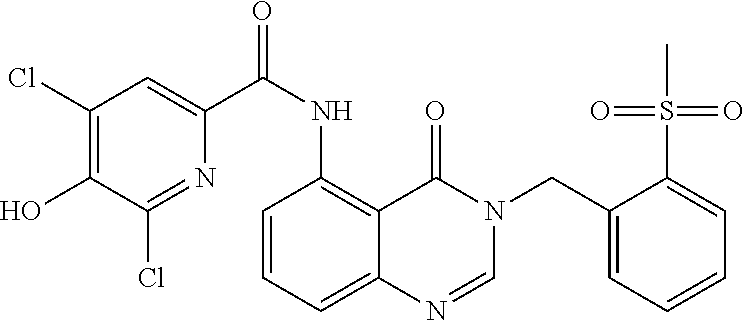 | 4,6-dichloro-5-hydroxy-N-(3-(2- (methylsulfonyl)benzyl)-4-oxo- 3,4-dihydroquinazolin-5- yl)picolinamide |
| 80 |  | 3,5-dichloro-4-hydroxy-N-(4- oxo-3-(pyridin-3-ylmethyl)-3,4- dihydroquinazolin-5- yl)benzamide |
| 81 |  | 3,5-dichloro-N-(8-chloro-4-oxo- 3-(2-(trifluoromethoxy)benzyl)- 3,4-dihydroquinazolin-5-yl)-4- hydroxybenzamide |
| 82 |  | 3,5-dichloro-4-hydroxy-N-(4- oxo-3-((2- (trifluoromethyl)pyridin-3- yl)methyl)-3,4- dihydroquinazolin-5- yl)benzamide |
| 83 |  | 3,5-dichloro-N-(3-(2-(1,1- dioxidothiomorpholino)benzyl)- 4-oxo-3,4-dihydroquinazolin-5- yl)-4-hydroxybenzamide |
| 84 |  | 3,5-dichloro-4-hydroxy-N-(3-(2- morpholinobenzyl)-4-oxo-3,4- dihydroquinazolin-5- yl)benzamide |
| 85 |  | 3,5-dichloro-N-(4-(2- (dimethylamino)ethoxy)-2-((2- (trifluoromethoxy)benzyl) carbamoyl)phenyl)-4- hydroxybenzamide |
| 86 |  | 3,5-dichloro-4-hydroxy-N-(4-(2- hydroxyethoxy)-2-((2- (trifluoromethoxy)benzyl) carbamoyl)phenyl)benzamide |
| 87 |  | 3,5-dichloro-4-hydroxy-N-(4- oxo-3-((2- (trifluoromethoxy)pyridin-3- yl)methyl)-3,4- dihydroquinazolin-5- yl)benzamide |
| 88 |  | 3,5-dichloro-4-hydroxy-N-(8- methyl-4-oxo-3-(2- (trifluoromethoxy)benzyl)-3,4- dihydroquinazolin-5- yl)benzamide |
| 89 |  | 3,5-dichloro-N-(2,8-dimethyl-4- oxo-3-(2- (trifluoromethoxy)benzyl)-3,4- dihydroquinazolin-5-yl)-4- hydroxybenzamide |
| 90 |  | 4,6-dichloro-N-(8-chloro-4-oxo- 3-(2-(trifluoromethoxy)benzyl)- 3,4-dihydroquinazolin-5-yl)-5- hydroxypicolinamide |
| 91 |  | 4,6-dichloro-5-hydroxy-N-(8- methyl-4-oxo-3-(2- (trifluoromethoxy)benzyl)-3,4- dihydroquinazolin-5- yl)picolinamide |
| 92 |  | 3,5-dichloro-4-hydroxy-N-(4- oxo-3-(2- (trifluoromethoxy)benzyl)-3,4- dihydropyrido[2,3-d]pyrimidin- 5-yl)benzamide |
| 93 |  | 3,5-dichloro-4-hydroxy-N-(1- methyl-2,4-dioxo-3-(2- (trifluoromethoxy)benzyl)- 1,2,3,4-tetrahydroquinazolin-5- yl)benzamide |
| 94 |  | 3,5-dichloro-4-hydroxy-N-(6- methyl-4-oxo-3-(2- (trifluoromethoxy)benzyl)-3,4- dihydroquinazolin-5- yl)benzamide |
| 95 |  | 3,5-dichloro-N-(2,4-dioxo-3-(2- (trifluoromethoxy)benzyl)- 1,2,3,4-tetrahydropyrido[2,3- d]pyrimidin-5-yl)-4- hydroxybenzamide |
| 96 |  | 3,5-dichloro-4-hydroxy-N-(2- methyl-4-oxo-3-(2- (trifluoromethoxy)benzyl)-3,4- dihydropyrido[2,3-d]pyrimidin- 5-yl)benzamide |
| 97 |  | N-(3-benzyl-4-oxo-3,4- dihydrothieno[2,3-d]pyrimidin- 5-yl)-3,5-dichloro-4- hydroxybenzamide |
| 98 |  | N-(3-benzyl-4-oxo-3,4- dihydrothieno[2,3-d]pyrimidin- 5-yl)-4,6-dichloro-5- hydroxypicolinamide |
| 99 |  | N-(5-benzyl-1-methyl-4-oxo- 4,5-dihydro-1H-pyrazolo[3,4- d]pyrimidin-3-yl)-3,5-dichloro- 4-hydroxybenzamide |
| 100 |  | 3,5-dichloro-4-hydroxy-N-(4- oxo-3-(pyrazolo[1,5-a]pyridin-3- ylmethyl)-3,4- dihydroquinazolin-5- yl)benzamide |
| 101 |  | 4,6-dichloro-5-hydroxy-N-(4- oxo-3-(2-phenylcyclopropyl)-2- (trifluoromethyl)-3,4- dihydroquinazolin-5- yl)picolinamide |
| 102 |  | Rac-3,5-dichloro-4-hydroxy-N- (4-oxo-3-((1R,2S)-2- phenylcyclopropyl)-3,4- dihydroquinazolin-5- yl)benzamide |
| trans Racemic | ||
| 103 |  | 3,5-dichloro-4-hydroxy-N-(4- oxo-3-(2- (trifluoromethoxy)benzyl)-3,4- dihydrothieno[2,3-d]pyrimidin- 5-yl)benzamide |
| 104 |  | 4,6-dichloro-5-hydroxy-N-(4- oxo-3-(2- (trifluoromethoxy)benzyl)-3,4- dihydrothieno[2,3-d]pyrimidin- 5-yl)picolinamide |
| 105 |  | 3,5-dichloro-4-hydroxy-N-(3-(2- (1-methyl-1H-pyrazol-3- yl)benzyl)-4-oxo-3,4- dihydroquinazolin-5- yl)benzamide |
| 106 |  | 3,5-dichloro-4-hydroxy-N-(4- oxo-3-(2-sulfamoylbenzyl)-3,4- dihydroquinazolin-5- yl)benzamide |
| 107 |  | N-(5-benzyl-1-methyl-4-oxo- 4,5-dihydro-1H-pyrazolo[3,4- d]pyrimidin-3-yl)-4,6-dichloro- 5-hydroxypicolinamide |
| 108 |  | 4,6-dichloro-5-hydroxy-N-(4- oxo-3-((1R,2S)-2- phenylcyclopropyl)-3,4- dihydroquinazolin-5- yl)picolinamide TFA Salt |
| 109 |  | 4,6-dichloro-5-hydroxy-N-(4- oxo-3-((1S,2R)-2- phenylcyclopropyl)-3,4- dihydroquinazolin-5- yl)picolinamide |
| 110 |  | 4,6-dichloro-5-hydroxy-N-(4- oxo-3-(2-(pyridin-2-yl)benzyl)- 3,4-dihydroquinazolin-5- yl)picolinamide |
| 111 |  | 3,5-dichloro-4-hydroxy-N-(4- oxo-3-(2-(pyridin-2-yl)benzyl)- 3,4-dihydroquinazolin-5- yl)benzamide |
| 112 |  | 3,5-dichloro-4-hydroxy-N-(8- methyl-4-oxo-3-(2- (trifluoromethoxy)benzyl)-2- (trifluoromethyl)-3,4- dihydroquinazolin-5- yl)benzamide |
| 113 |  | 4,6-dichloro-5-hydroxy-N-(1- methyl-2,4-dioxo-3-(2- (trifluoromethoxy)benzyl)- 1,2,3,4-tetrahydroquinazolin-5- yl)picolinamide |
| 114 |  | 5-(4,6-dichloro-5- hydroxypicolinamido)-N-(2- fluorobenzyl)-3- methylisothiazole-4- carboxamide |
| 115 |  | (S)-5-(4,6-dichloro-5- hydroxypicolinamido)-N-(1-(2- fluorophenyl)ethyl)-3- methylisothiazole-4- carboxamide |
| 116 |  | 3,5-dichloro-4-hydroxy-N-(4- oxo-3-(2-phenylcyclopropyl)-2- (trifluoromethyl)-3,4- dihydroquinazolin-5- yl)benzamide |
| 117 |  | 3,5-dichloro-4-hydroxy-N-(3- ((1-methyl-1H-indazol-3- yl)methyl)-4-oxo-3,4- dihydroquinazolin-5- yl)benzamide |
| 118 |  | 3,5-dichloro-4-hydroxy-N-(1- methyl-4-oxo-5-(2- (trifluoromethoxy)benzyl)-4,5- dihydro-1H-pyrazolo[3,4- d]pyrimidin-3-yl)benzamide |
| 119 |  | 4,6-dichloro-5-hydroxy-N-(1- methyl-4-oxo-5-(2- (trifluoromethoxy)benzyl)-4,5- dihydro-1H-pyrazolo[3,4- d]pyrimidin-3-yl)picolinamide |
| 120 |  | 1-(4,6-dichloro-5- hydroxypicolinoyl)-N-(2- (trifluoromethoxy)benzyl) piperidine-2-carboxamide |
| 121 |  | 3,5-dichloro-4-hydroxy-N-(4- oxo-3-((1S,2R)-2- phenylcyclobutyl)-3,4- dihydroquinazolin-5- yl)benzamide |
| 122 |  | 3,5-dichloro-N-(3-((2- chloropyridin-3-yl) methyl)-4- oxo-3,4-dihydroquinazolin-5- yl)-4-hydroxybenzamide |
| 123 |  | 3,5-dichloro-4-hydroxy-N-(3-(2- morpholino-1-phenylethyl)-4- oxo-3,4-dihydroquinazolin-5- yl)benzamide |
| 124 |  | 3,5-dichloro-4-hydroxy-N-(4- oxo-3-(2- (trifluoromethoxy)benzyl)-3,4- dihydropyrido[4,3-d]pyrimidin- 5-yl)benzamide |
| 125 |  | 5-(3,5-dichloro-4- hydroxybenzamido)-N-(2- (trifluoromethoxy)benzyl)-2- (trifluoromethyl)thiazole-4- carboxamide |
| 126 |  | (S)-5-(3,5-dichloro-4- hydroxybenzamido)-N-(1-(2- fluorophenyl)ethyl)-3- methylisothiazole-4- carboxamide |
| 127 |  | 1-(4,6-dichloro-5- hydroxypicolinoyl)-N-(2- (trifluoromethoxy)benzyl) pyrrolidine-2-carboxamide |
| 128 |  | 1-(3,5-dichloro-4- hydroxybenzoyl)-N-(2- (trifluoromethoxy)benzyl) pyrrolidine-2-carboxamide |
| 129 |  | 4,6-dichloro-N-{3-[(2- chloropyridin-3-yl)methyl]-4. oxo-3,4-dihydroquinazolin-5- yl}-5-hydroxypyridine-2- carboxamide |
| 130 |  | 3,5-dichloro-N-{3-[(3- fluoropyridin-2-yl)methyl]-4- oxo-3,4-dihydroquinazolin-5- yl}-4-hydroxybenzamide |
| 131 |  | 4,6-dichloro-5-hydroxy-N-(6- methyl-4-oxo-3-{[2- (trifluoromethoxy)phenyl]methyl}- 3,4-dihydroquinazolin-5- yl)pyridine-2-carboxamide |
| 132 |  | 3,5-dichloro-N-(8-fluoro-4-oxo- 3-{[2-(trifluoromethoxy) phenyl]methyl}-3,4- dihydroquinazolin-5-yl)-4- hydroxybenzamide |
| 133 |  | 4,6-dichloro-N-(8-fluoro-4-oxo- 3-{[2-(trifluoromethoxy) phenyl]methyl}-3,4- dihydroquinazolin-5-yl)-5- hydroxypyridine-2-carboxamide |
| 134 |  | 4,6-dichloro-5-hydroxy-N-[2- ({[2-(trifluoromethoxy) phenyl]methyl} carbamoyl)cyclopentyl] pyridine-2-carboxamide |
| 137 |  | 3,5-dichloro-N-{3-[(2- fluoropyridin-3-yl)methyl]-4- oxo-3,4-dihydroquinazolin-5- yl}-4-hydroxybenzamide |
| 138 |  | 4,6-dichloro-N-{3-[(2- fluoropyridin-3-yl)methyl]-4- oxo-3,4-dihydroquinazolin-5- yl}-5-hydroxypyridine-2- carboxamide |
| 140 |  | 4,6-dichloro-N-(3-((3- fluoropyridin-2-yl)methyl)-4- oxo-3,4-dihydroquinazolin-5- yl)-5-hydroxypicolinamide |
| 141 |  | 4,6-dichloro-N-(2,8-dimethyl-4- oxo-3-(2- (trifluoromethoxy)benzyl)-3,4- dihydroquinazolin-5-yl)-5- hydroxypicolinamide |
| 142 |  | 3,5-dichloro-N-(2,8-dimethyl-4- oxo-3-((2- (trifluoromethyl)pyridin-3- yl)methyl)-3,4- dihydroquinazolin-5-yl)-4- hydroxybenzamide |
| 143 |  | 3,5-dichloro-N-(3-((3- chloropyridin-2-yl)methyl)-4- oxo-3,4-dihydroquinazolin-5- yl)-4-hydroxybenzamide |
| 144 |  | 4,6-dichloro-5-hydroxy-N-((1S, 2S)-2-((2-(trifluoromethoxy) benzyl)carbamoyl) cyclohexyl)picolinamide |
| 145 |  | 4,6-dichloro-5-hydroxy-N-((1R, 2R)-2-((2-(trifluoromethoxy) benzyl)carbamoyl) cyclohexyl)picolinamide |
| 146 |  | 3,5-dichloro-N-(2,8-dimethyl-4- oxo-3-((3- (trifluoromethyl)pyridin-2- yl)methyl)-3,4- dihydroquinazolin-5-yl)-4- hydroxybenzamide |
| 147 |  | 4,6-dichloro-N-(2,8-dimethyl-4- oxo-3-((2- (trifluoromethyl)pyridin-3- yl)methyl)-3,4- dihydroquinazolin-5-yl)-5- hydroxypicolinamide |
| 148 |  | 4,6-dichloro-N-(3-((3- chloropyridin-2-yl)methyl)-4- oxo-3,4-dihydroquinazolin-5- yl)-5-hydroxypicolinamide |
| 149 |  | 3,5-dichloro-N-(2- (difluoromethyl)-8-methyl-4- oxo-3-(2- (trifluoromethoxy)benzyl)-3,4- dihydroquinazolin-5-yl)-4- hydroxybenzamide |
| 150 |  | 4,6-dichloro-N-(8-fluoro-2- methyl-4-oxo-3-(2- (trifluoromethoxy)benzyl)-3,4- dihydroquinazolin-5-yl)-5- hydroxypicolinamide |
| 151 |  | 3,5-dichloro-N-(2,8-dimethyl-4- oxo-3-(2- (trifluoromethyl)benzyl)-3,4- dihydroquinazolin-5-yl)-4- hydroxybenzamide |
| 152 |  | 3,5-dichloro-N-(2- (fluoromethyl)-8-methyl-4-oxo- 3-(2-(trifluoromethoxy)benzyl)- 3,4-dihydroquinazolin-5-yl)-4- hydroxybenzamide |
| 153 |  | 4,6-dichloro-N-(2,8-dimethyl-4- oxo-3-((3- (trifluoromethyl)pyridin-2- yl)methyl)-3,4- dihydroquinazolin-5-yl)-5- hydroxypicolinamide |
| 154 |  | 3,5-dichloro-N-(8-fluoro-2- methyl-4-oxo-3-((3- (trifluoromethyl)pyridin-2- yl)methyl)-3,4- dihydroquinazolin-5-yl)-4- hydroxybenzamide |
| 155 |  | 4,6-dichloro-N-(8-fluoro-2- methyl-4-oxo-3-((3- (trifluoromethyl)pyridin-2- yl)methyl)-3,4- dihydroquinazolin-5-yl)-5- hydroxypicolinamide |
| 156 |  | 3,5-dichloro-N-(8-chloro-2- methyl-4-oxo-3-(2- (trifluoromethyl)benzyl)-3,4- dihydroquinazolin-5-yl)-4- hydroxybenzamide |
| 157 |  | 3,5-dichloro-N-(8-fluoro-2- methyl-4-oxo-3-(1-(2- (trifluoromethoxy)phenyl)ethyl)- 3,4-dihydroquinazolin-5-yl)-4- hydroxybenzamide |
| 158 |  | 3,5-dichloro-N-(8-fluoro-2- methyl-4-oxo-3-(2- (trifluoromethyl)benzyl)-3,4- dihydroquinazolin-5-yl)-4- hydroxybenzamide |
| 159 |  | 4,6-dichloro-N-(8-fluoro-2- methyl-4-oxo-3-(2- (trifluoromethyl)benzyl)-3,4- dihydroquinazolin-5-yl)-5- hydroxypicolinamide |
| 160 |  | 4,6-dichloro-N-(2- (difluoromethyl)-8-methyl-4- oxo-3-(2- (trifluoromethoxy)benzyl)-3,4- dihydroquinazolin-5-yl)-5- hydroxypicolinamide |
| 161 |  | 3,5-dichloro-N-(2,8-dimethyl-3- ((1-methyl-1H-indazol-3- yl)methyl)-4-oxo-3,4- dihydroquinazolin-5-yl)-4- hydroxybenzamide |
| 162 |  | 4,6-dichloro-N-(2,8-dimethyl-3- ((1-methyl-1H-indazol-3- yl)methyl)-4-oxo-3,4- dihydroquinazolin-5-yl)-5- hydroxypicolinamide |
| 163 |  | 4,6-dichloro-N-(2,8-dimethyl-4- oxo-3-(2- (trifluoromethyl)benzyl)-3,4- dihydroquinazolin-5-yl)-5- hydroxypicolinamide |
| 164 |  | 3,5-dichloro-N-(2- (difluoromethyl)-8-methyl-4- oxo-3-((3- (trifluoromethyl)pyridin-2- yl)methyl)-3,4- dihydroquinazolin-5-yl)-4- hydroxybenzamide |
| 165 |  | 4,6-dichloro-N-(8-chloro-2- methyl-4-oxo-3-((3- (trifluoromethyl)pyridin-2- yl)methyl)-3,4- dihydroquinazolin-5-yl)-5- hydroxypicolinamide |
| 166 |  | 3,5-dichloro-N-(8-chloro-2- methyl-4-oxo-3-((3- (trifluoromethyl)pyridin-2- yl)methyl)-3,4- dihydrjoquinazolin-5-yl)-4- hydroxybenzamide |
| 167 |  | 3,5-dichloro-N-(2- (difluoromethyl)-8-methyl-4- oxo-3-(2- (trifluoromethyl)benzyl)-3,4- dihydroquinazolin-5-yl)-4- hydroxybenzamide |
| 168 |  | 3,5-dichloro-N-(8-fluoro-2- methyl-4-oxo-3-(2- (trifluoromethoxy)benzyl)-3,4- dihydroquinazolin-5-yl)-4- hydroxybenzamide |
| 169 |  | 3,5-dichloro-4-hydroxy-N-(8- methyl-2-(methyl-d3)-4-oxo-3- (2-(trifluoromethoxy)benzyl)- 3,4-dihydroquinazolin-5- yl)benzamide |
| 170 |  | 4,6-dichloro-N-(8-chloro-2- methyl-4-oxo-3-(2- (trifluoromethyl)benzyl)-3,4- dihydroquinazolin-5-yl)-5- hydroxypicolinamide |
| 171 |  | 3,5-dichloro-N-(8-fluoro-2- (methyl-d3)-4-oxo-3-(2- (trifluoromethyl)benzyl)-3,4- dihydroquinazolin-5-yl)-4- hydroxybenzamide |
| 172 |  | 3,5-dichloro-N-(3-((3- chloropyridin-2-yl)methyl)-2,8- dimethyl-4-oxo-3,4- dihydroquinazolin-5-yl)-4- hydroxybenzamide |
| 173 |  | (S)-3,5-dichloro-N-(8-fluoro-2- methyl-4-oxo-3-(1-(2- (trifluoromethoxy)phenyl)ethyl)- 3,4-dihydroquinazolin-5-yl)-4- hydroxybenzamide |
| 174 |  | (R)-3,5-dichloro-N-(8-fluoro-2- methyl-4-oxo-3-(1-(2- (trifluoromethoxy)phenyl)ethyl)- 3,4-dihydroquinazolin-5-yl)-4- hydroxybenzamide |
| 175 |  | rac-4,6-dichloro-5-hydroxy-N- (4-oxo-3-((1R,2S)-2- phenylcyclobutyl)-3,4- dihydroquinazolin-5- yl)picolinamide |
| 176 |  | 4,6-dichloro-5-hydroxy-N-(8- methyl-2-(methyl-d3)-4-oxo-3- (2-(trifluoromethoxy)benzyl)- 3,4-dihydroquinazolin-5- yl)picolinamide |
| 177 |  | 4,6-dichloro-N-(2- (difluoromethyl)-8-methyl-4- oxo-3-((3- (trifluoromethyl)pyridin-2- yl)methyl)-3,4- dihydroquinazolin-5-yl)-5- hydroxypicolinamide |
| 178 |  | 4,6-dichloro-N-(3-((3- chloropyridin-2-yl)methyl)-2,8- dimethyl-4-oxo-3,4- dihydroquinazolin-5-yl)-5- hydroxypicolinamide |
| 179 |  | 3,5-dichloro-4-hydroxy-N-(8- methyl-2-(methyl-d3)-4-oxo-3- (2-(trifluoromethyl)benzyl)-3,4- dihydroquinazolin-5- yl)benzamide |
| 180 |  | 4,6-dichloro-5-hydroxy-N-(8- methyl-2-(methyl-d3)-4-oxo-3- (2-(trifluoromethyl)benzyl)-3,4- dihydroquinazolin-5- yl)picolinamide |
| 181 |  | 4,6-dichloro-N-(2- (difluoromethyl)-8-methyl-4- oxo-3-(2- (trifluoromethyl)benzyl)-3,4- dihydroquinazolin-5-yl)-5- hydroxypicolinamide |
| 182 |  | 5-(3,5-dichloro-4- hydroxybenzamido)-N-(2- (trifluoromethyl)benzyl)thiazole- 4-carboxamide |
| 183 |  | 3,5-dichloro-N-(3-((3- fluoropyridin-2-yl)methyl)-2,8- dimethyl-4-oxo-3,4- dihydroquinazolin-5-yl)-4- hydroxybenzamide |
| 184 |  | 4,6-dichloro-N-(8-fluoro-2- (methyl-d3)-4-oxo-3-(2- (trifluoromethyl)benzyl)-3,4- dihydroquinazolin-5-yl)-5- hydroxypicolinamide |
| 185 |  | 5-(3,5-dichloro-4- hydroxybenzamido)-N-(2- (trifluoromethyl)benzyl)thiazole- 4-carboxamide |
| 186 |  | 3,5-dichloro-N-(2- (fluoromethyl)-8-methyl-4-oxo- 3-(2-(trifluoromethyl)benzyl)- 3,4-dihydroquinazolin-5-yl)-4- hydroxybenzamide |
| 187 |  | 5-(4,6-dichloro-5- hydroxypicolinamido)-N-((1- methyl-1H-indazol-3- yl)methyl)thiazole-4- carboxamide |
| 188 |  | 5-(3,5-dichloro-4- hydroxybenzamido)-N-((1- methyl-1H-indazol-3- yl)methyl)thiazole-4- carboxamide |
| 189 |  | 5-(4,6-dichloro-5- hydroxypicolinamido)-N-(3- fluorobenzyl)thiazole-4- carboxamide |
| 190 |  | 3,5-dichloro-N-(8-fluoro-2- methyl-3-((1-methyl-1H- indazol-3-yl)methyl)-4-oxo-3,4- dihydroquinazolin-5-yl)-4- hydroxybenzamide |
| 191 |  | 5-(4,6-dichloro-5- hydroxypicolinamido)-N-(2- (trifluoromethoxy)benzyl) thiazole-4-carboxamide |
| 192 |  | 5-(4,6-dichloro-5- hydroxypicolinamido)-N-(2- (trifluoromethyl)benzyl)thiazole- 4-carboxamide |
| 193 |  | 5-(4,6-dichloro-5- hydroxypicolinamido)-N-((6- (trifluoromethyl)pyridin-2- yl)methyl)thiazole-4- carboxamide |
| 194 |  | 4,6-dichloro-N-(8-fluoro-2- methyl-3-((1-methyl-1H- indazol-3-yl)methyl)-4-oxo-3,4- dihydroquinazolin-5-yl)-5- hydroxypicolinamide |
| 195 |  | 4,6-dichloro-N-(3-((3- fluoropyridin-2-yl)methyl)-2,8- dimethyl-4-oxo-3,4- dihydroquinazolin-5-yl)-5- hydroxypicolinamide |
| 196 |  | 5-(4,6-dichloro-5- hydroxypicolinamido)-N-((3- (trifluoromethyl)pyridin-2- yl)methyl)thiazole-4- carboxamide |
| 197 |  | 3,5-dichloro-N-(8-fluoro-2- methyl-4-oxo-3-((6- (trifluoromethyl)pyridin-2- yl)methyl)-3,4- dihydroquinazolin-5-yl)-4- hydroxybenzamide |
| 198 |  | 5-(3,5-dichloro-4- hydroxybenzamido)-N-((6- (trifluoromethyl)pyridin-2- yl)methyl)thiazole-4- carboxamide |
| 199 |  | 3,5-dichloro-N-(2,8-dimethyl-4- oxo-3-((6- (trifluoromethyl)pyridin-2- yl)methyl)-3,4- dihydroquinazolin-5-yl)-4- hydroxybenzamide |
| 200 |  | 3,5-dichloro-N-(2,8-dimethyl-4- oxo-3-((2- (trifluoromethyl)phenyl)methyl- d2)-3,4-dihydroquinazolin-5-yl)- 4-hydroxybenzamide |
| 201 |  | 4,6-dichloro-N-(2,8-dimethyl-4- oxo-3-{[2- (trifluoromethyl)phenyl](2H2) methyl}-3,4-dihydroquinazolin-5- yl)-5-hydroxypyridine-2- carboxamide |
| 202 |  | 4,6-dichloro-N-(2,8-dimethyl-4- oxo-3-((1R,2S)-2- phenylcyclobutyl)-3,4- dihydroquinazolin-5-yl)-5- hydroxypicolinamide |
| 203 |  | 3,5-dichloro-N-(2,8-dimethyl-4- oxo-3-((1R,2S)-2- phenylcyclobutyl)-3,4- dihydroquinazolin-5-yl)-4- hydroxybenzamide |
| 204 |  | 3,5-dichloro-N-(8-fluoro-4-oxo- 3-(2-(trifluoromethyl) benzyl)- 3,4-dihydroquinazolin-5-yl)-4- hydroxybenzamide |
| 205 |  | 4,6-dichloro-N-(2,8-dimethyl-4- oxo-3-((6- (trifluoromethyl)pyridin-2- yl)methyl)-3,4- dihydroquinazolin-5-yl)-5- hydroxypicolinamide |
| 206 |  | 4,6-dichloro-N-(8-fluoro-4-oxo- 3-(2-(trifluoromethyl)benzyl)- 3,4-dihydroquinazolin-5-yl)-5- hydroxypicolinamide |
| 207 |  | 4,6-dichloro-N-(8-fluoro-2- methyl-4-oxo-3-((1S,2R)-2- phenylcyclobutyl)-3,4- dihydroquinazolin-5-yl)-5- hydroxypicolinamide |
Further Forms of Compounds Disclosed Herein
Isomers/Stereoisomers


| Ex. | Spectral data |
| 5 | LCMS (ES) m/z calcd. For C23H17Cl2N3O4, 469.06; found, 470.1 (M + H); 1H NMR (400 |
| MHz, DMSO-d6 δ 12.96(s, 1H), 11.16 (s, 1H), 8.67 (d, J = 8 Hz, 1H), 8.49 (s, 1H), 7.87-7.81 | |
| (m, 3H), 7.41 (d, J = 8 Hz, 1H), 7.29 (t, J = 7.6 Hz, 1H), 7.16 (d, J = 7.6 Hz, 1H), 7.03 (d, J = 8.4 | |
| Hz, 1H), 6.90 (t, J = 7.2 Hz, 1H), 5.17 (s, 2H), 3.83 (s, 3H). | |
| 6 | LCMS (ES) m/z calcd. for C24H16Cl2F3N3O3, 507.04; found, 508.0 (M + H); 1H NMR |
| (400 MHz, DMSO-d6) δ 12.48 (s, 1H), 8.74 (d, J = 8.4 Hz, 1H), 8.56 (s, 1H), 7.78-7.70 (m, | |
| 3H), 7.63 (s, 1H), 7.57 (d, J = 8 Hz, 2H), 7.29 (d, J = 8 Hz, 1H), 7.06 (s, 1H), 5.35 (s, 2H). | |
| 7 | LCMS (ES) m/z calcd. for C22H14Cl2FN3O3, 457.04; found, 458.1 (M + H); 1H NMR (400 |
| MHz, DMSO-d6) δ 12.91 (s, 1H), 11.17 (s, 1H), 8.68 (d, J = 8.4 Hz, 1H), 8.61 (s, 1H), 7.88- | |
| 7.82 (m, 3H), 7.47-7.40 (m, 3H), 7.20-7.15 (m, 2H), 5.24 (s, 2H). | |
| 8 | LCMS (ES) m/z calcd. for C23H14Cl2F3N3O4, 523.03; found, 524.0 (M + H); 1H NMR |
| (400 MHz, DMSO-d6) δ 12.90 (s, 1H), 11.17 (s, 1H), 8.71 (d, J = 7.6 Hz, 1H), 8.64 (s, 1H), | |
| 7.90-7.85 (m, 3H), 7.54 (d, J = 8.8 Hz, 2H), 7.44 (d, J = 7.6 Hz, 1H), 7.37 (d, J = 8 Hz, 2H), | |
| 5.32 (s, 2H). | |
| 9 | LCMS (ES): m/z calcd. for C22H14Cl2FN3O3 457.04; found, 458.1 (M + H); 1H NMR (400 |
| MHz, DMSO d6): δ 12.89 (s, 1H), 11.15 (s, 1H), 8.69 (d, J = 7.6 Hz, 1H), 8.59 (s, 1H), 7.89- | |
| 7.85 (m, 3H), 7.45-7.33 (m, 3H), 7.27-7.17 (m, 2H) and 5.33 (s, 2H). | |
| 10 | LCMS (ES) m/z calcd. For C23H14Cl2F3N3O4, 523.03; found 523.8 (M + H); 1H NMR (400 |
| MHz, DMSO-d6): δ 12.90 (s, 1H), 11.17 (br, 1H), 8.64-8.69 (m, 2H), 7.87-7.82 (m, 3H), | |
| 7.48-7.38 (m, 3H), 7.31 (d, J = 7.6 Hz, 1H), 5.29 (s, 2H). | |
| 11 | LCMS (ES) m/z calcd. C23H14Cl2F3N3O3, 507.04; found, 508.0 (M + H); 1H NMR (400 |
| MHz, DMSO d6) δ 12.75 (s, 1H), 11.20 (s, 1H), 8.73 (d, J = 8.4 Hz, 1H), 8.67 (s, 1H), 7.88- | |
| 7.81 (m, 4H), 7.70 (t, J = 8.0 Hz, 2H), 7.61(t, J = 7.6 Hz, 1H), 7.39 (d, J = 7.6 Hz, 1H), 5.36 | |
| (s, 2H). | |
| 12 | LCMS (ES) m/z calcd. C23H16Cl2FN3O3, 471.06; found, 472.0 (M + H); 1H NMR (400 |
| MHz, DMSO d6) δ 12.98 (s, 1H), 11.16 (s, 1H), 8.72 (d, J = 8.0 Hz, 1H), 8.46 (s, 1H), 7.86 (t, | |
| J = 8.0 Hz, 3H), 7.46-7.41 (m, 2H), 7.34 (d, J = 10.4 Hz, 1H), 7.26 (d, J = 7.6 Hz, 1H), 7.19- | |
| 7.15 (m, 1H), 6.23-6.18 (m, 1H), 1.89 (d, J = 7.2 Hz, 3H). | |
| 13 | LCMS (ES) m/z calcd. for C21H13Cl2FN4O3, 458.03; found, 459.0, (M + H). 1H NMR (400 |
| MHz, DMSO-d6) δ 12.74 (s, 1H), 11.22 (s, 1H), 8.67 (d, J = 8.0 Hz, 1H), 8.58 (d, J = 2.4 Hz, | |
| 2H), 8.36 (d, J = 4.8 Hz, 1H), 7.91-7.83 (m, 3H), 7.43 (d, J = 7.6 Hz, 1H), 7.31 (t, J = 6.4 Hz, | |
| 1H), 5.35 (s, 2H). | |
| 14 | LCMS (ES) m/z calcd. For C18H11Cl2N5O3S, 447.0; found, 448.0 (M + H); 1H NMR (400 |
| MHz, DMSO-d6): δ 12.77 (s, 1H), 11.25 (br, 1H), 9.62 (s, 1 H), 8.72 (d, J = 8.4 Hz, 1 H), 8.67 | |
| (s, 1 H), 7.88-7.92 (m, 3 H), 7.47 (d, J = 7.6 Hz, 1H), 5.79 (s, 2H). | |
| 15 | LCMS (ES) m/z calcd. For C19H12Cl2N4O4, 430.02; found, 431.02 (M + H); 1H NMR (400 |
| MHz, DMSO-d6): δ 12.86 (s, 1H), 11.17 (br, 1H), 8.70 (d, J = 8 Hz, 1 H), 8.54 (s, 1 H), 8.35 | |
| (s, 1 H), 8.17 (s, 1H), 7.88-7.82 (m, 2 H), 7.40 (d, J = 8.4 Hz, 1H), 5.19 (s, 2 H). | |
| 16 | LCMS (ES) m/z calcd. C22H14Cl2FN3O3, 457.04; found, 458.1[M + H] +; 1H NMR (400 |
| MHz, DMSO-d6) δ 12.89 (s, 1H), 11.1 (s, 1H), 8.68 (d, J = 7.6 Hz, 1H), 8.60 (s, 1H), 7.88- | |
| 7.82 (m, 3H), 7.41-7.37 (m, 2H), 7.25 (d, J = 9.6 Hz, 2H), 7.15-7.10 (m, 1H), 5.27 (s, 2H). | |
| 17 | LCMS (ES) m/z calcd. C23H15Cl2F3N4O5, 554.04; found, 439.0 [M + H] +; 1H NMR (400 |
| MHz, DMSO-d6) δ11.14 (s, 1H), 8.72 (d, J = 8.0 Hz, 1H), 8.59 (t, J = 4.0 Hz, 3H), 7.91-7.87 | |
| (m, 3H), 7.48-7.43 (m, 3H), 5.36(s, 2H). | |
| 18 | LCMS (ES) m/z calcd. for C23H14Cl2F3N3O3 507.2; found, 508.1 (M + H); 1H NMR (400 |
| MHz, DMSO d6): δ 12.9 (s, 1H), 11.13 (br, 1H), 8.72-8.70 (m, 1H), 8.57 (s, 1H), 8.92- | |
| 7.81 (m, 4H), 7.63-7.59 (m, 1H), 7.55-7.48 (m, 2H), 7.15 (d, J = 7.6 Hz, 1H), 5.48 (s, 2H). | |
| 19 | LCMS (ES) m/z calcd. for C22H13Cl2F3N4O3, 508.03; found 509.0 (M + H); 1H-NMR (400 |
| MHz, DMSO-d6): δ 12.83 (s, 1H), 11.15 (br, 1H), 8.89 (s, 1H), 8.71 (s, 1H), 8.68 (s, 1H), | |
| 8.10 (dd, J = 1.6 Hz, 1H), 7.91-7.85 (m, 4H), 7.46-7.44 (m, 1H), 5.42 (s, 2H). | |


| Ex. | Spectral data |
| 25 | LCMS(ES) m/z, calcd for C20H14Cl2F3N3O3S, 503.31; found 504 (M + H): 1H NMR |
| (400 MHz, DMSO-d6) δ: 10.97(s, 1H), 9.11 (s, 1H), 8.43-8.40 (m, 1H), 7.95 (s, 2H), | |
| 7.50 (d, J = 8.4 Hz, 2H), 7.58-7.54 (m, 1H), 7.61 (d, J = 8.4 Hz, 1H), 7.40-7.37 (m, 1H), | |
| 3.47-3.42 (m, 2H), 2.94 (t, J = 7.6 Hz, 2H). | |
| 26 | LCMS (ES) m/z calcd. For C19H12Cl2F3N3O3S, 488.9; found, 489.9 (M + 1). 1H |
| NMR (400 MHz, DMSO d6) δ: 11.03 (br, 1H), 10.92 (s, 1H), 9.13 (s, 1H), 8.77-8.74 | |
| (m, 1H), 7.93 (s, 2 H), 7.66 (d, J = 7.2 Hz, 1H), 7.56-7.51 (m, 2 H), 7.45-7.43 (m, 1 H), | |
| 4.54 (s, 2 H). | |
| 27 | LCMS (ES) m/z calcd. for C19H12Cl2F3N3O4S, 504.99; found, 505.9 (M + H), 1H |
| NMR (400 MHz, DMSO-d6) δ 10.97 (s, 2H), 9.15 (s, 1H), 8.72 (t, J = 5.6 Hz, 1H), 7.96 | |
| (s, 2H), 7.46 (d, J = 7.6 Hz, 1H), 7.40-7.36 (m, 1H), 7.32-7.27 (m, 2H), 4.47 (d, J = 6.0 | |
| Hz, 2H). | |
| 28 | LCMS (ES) m/z calcd. for C18H11Cl2F2N3O3S, 456.99; found, 457.9 (M + H), 1H |
| NMR (400 MHz, DMSO-d6) δ; 11.0 (s, 1H), 10.93 (s, 1H), 9.14 (s, 1H), 8.69 (t, J = | |
| 7.6 Hz, 1H), 7.94 (s, 2H), 7.44-7.38 (m, 1H), 7.15-6.98 (m, 2H), 4.39 (d, J = 5.6 Hz, | |
| 2H). | |
| 29 | LCMS (ES) m/z calcd. for C20H14Cl2FN3O3S, 466.31; found 466.0 [M + H] +. |
| 1HNMR (400 MHz, DMSO-d6): δ 11.03 (s, 1 H), 10.94 (s, 1 H), 9.11 (s, 1 H), 8.94 (s, | |
| 1 H), 7.99 (s, 2 H), 7.21-7.25 (m, 2 H), 7.06 (t, J = 8.8 Hz, 2 H), 1.14 (d, J = 3.2 Hz, 4 | |
| H). | |
| 30 | LCMS (ES) m/z calcd. for C18H17Cl2F2N3O3S, 464.31; found, 466.0 (M + H), |
| 1H NMR (400 MHz, DMSO-d6) δ 11.03 (s, 1H), 10.96 (s, 1H), 9.12 (s, 1H), 8.28-8.25 | |
| (m, 1H), 7.99 (s, 2H), 3.10-3.07 (m, 2H), 1.93-1.91 (m, 2H), 1.72-1.57 (m, 5H) and | |
| 1.17-1.08 (m, 2H). | |


| Ex. | Spectral data |
| 33 | LCMS (ES) m/z calcd. For C18H12Cl2FN3O3S, 439.0; found, 440.0 (M + H). 1HNMR |
| (400 MHz, DMSO-d6) δ 12.38 (s, 1H), 11.41 (s, 1H), 9.21 (s, 1H), 8.73 (s, 1H), 7.84 | |
| (s, 2H), 7.38-7.31 (m, 2H), 7.21-7.17 (m, 2H), 4.60 (d, J = 7.6 Hz, 2H). | |
| 34 | LCMS (ES) m/z calcd. For C18H12Cl2FN3O3S, 439.0; found, 439.0 (M − H). |
| HNMR (400 MHz, DMSO-d6) δ 12.40 (s, 1H), 11.30 (s, 1H), 9.32 (t, J = 6.2 Hz, 1H), | |
| 8.73 (s, 1H), 7.84 (s, 2H), 7.41-7.35 (m, 1H), 7.21-7.15 (m, 2H), 7.10-7.05 (m, 1H), | |
| 4.55 (d, J = 6.4 Hz, 2H). | |
| 35 | LCMS (ES) m/z calcd. for C21H18Cl2N2O4S, 464.0; found, 464.9 (M + H). |
| 1H NMR (400 MHz, DMSO-d6) δ 12.09 (s, 1H), 11.10 (s, 1H), 8.40 (s, 1H), 7.99 (d, | |
| J = 5.2 Hz, 1H), 7.75 (m, 3H), 7.11-7.18 (m, 2H), 6.93 (d, J = 8 Hz, 1H), 6.83 (t, J = 7 Hz, | |
| 1H), 3.77 (s, 3H), 3.45 (d, J = 5.2 Hz, 2H), 2.81 (m, 2H). | |
| 36 | LCMS (ES) m/z calcd. for C24H19Cl2N3O4, 483.08; found, 482.1 (M − H). |
| NMR (400 MHz, DMSO-d6) δ 13.01 (s, 1H), 11.20 (bs, 1H), 8.68 (d, J = 7.6 Hz, 1H), | |
| 7.98 (s, 1H), 7.88 (s, 2H), 7.78 (t, J = 16.8 Hz, 1H), 7.31 (d, J = 8 Hz, 1H), 7.17 (t, J = 14.8 | |
| Hz, 1H), 7.09 (d, J = 6.8 Hz, 1H), 6.88 (d, J = 8 Hz, 1H), 6.81 (t, J = 14.4 Hz, 1H), 4.24 (t, | |
| J = 12.8 Hz, 2H), 3.55 (s, 3H), 3.02 (t, J = 12.4 Hz, 2H). | |
| 37 | LCMS (ES) m/z calcd. for C20H12Cl3F3N2O4S, 537.9; found, 538.8 (M + H). |
| 1H NMR (400 MHz, DMSO-d6): δ 13.09 (s, 1H), 11.31 (bs, 1H), 9.04 (t, J = 6.0 Hz, | |
| 1H), 7.81 (s, 2H), 7.65 (s, 1H), 7.49-7.38 (m, 4H), 4.60 (d, J = 5.6 Hz, 2H). | |
| 38 | LCMS (ES) m/z calcd. for C21H14Cl3F3N2O4S, 551.97; found, 553.0. |
| 1H NMR (400 MHz, DMSO-d6): δ 13.19 (s, 1H), 11.33 (s, 1H), 8.66 (t, J = 5.2 Hz, | |
| 1H), 7.80 (s, 2H), 7.54 (s, 1H), 7.46 (t, J = 9.6 Hz, 1H), 7.39-7.32 (m, 3H), 3.54 (d, J = | |
| 6.8 Hz, 2H), 2.96 (t, J = 7.2 Hz, 2H). | |
| 39 | LCMS (ES) m/z calcd. for C18H11Cl2N5O3S, 447.0; found, 448.0. |
| 1H NMR (400 MHz, DMSO-d6) δ 12.77 (s, 1H), 11.25 (bs, 1H), 9.62 (s, 1 H), 8.72 (d, | |
| J = 8.4 Hz, 1 H), 8.67 (s, 1 H), 7.88-7.92 (m, 3 H), 7.47 (d, J = 7.6 Hz, 1H), 5.79 (s, 2 | |
| H). | |
| 40 | LCMS (ES): m/z calcd. For C22H13Cl2F3N4O3, 508.03; found, 509.0 (M + H). |
| 1H NMR (400 MHz, DMSO-d6): δ 13.35 (bs, 1H), 8.83 (d, J = 8.0 Hz, 1H), 8.65 (s, | |
| 1H), 7.98 (bs, 1H), 7.89 (s, 1H), 7.84-7.79 (m, 1H), 7.73-7.68 (m, 2H), 7.63-7.59 (m, | |
| 1H), 7.38 (d, J = 8.0 Hz, 1H), 5.32 (s, 2H). | |
| 41 | LCMS (ES): m/z calcd. For C22H15Cl2FN4O3, 472.05; found, 471.0 (M − H). |
| 1H NMR (400 MHz, DMSO-d6): δ 13.60 (s, 1H), 8.85 (d, J = 7.6 Hz, 1H), 8.45 (s, 1H), | |
| 8.14 (s, 1H), 7.87-7.83 (m, 1H), 7.46-7.40 (m, 2H), 7.36-7.34 (m, 1H), 7.27 (d, J = 7.6 | |
| Hz, 1H), 7.20-7.14 (m, 1H), 6.17 (q, J = 7.2 Hz, 1H), 1.90 (d, J = 7.2 Hz, 3H). | |
| 42 | LCMS (ES): m/z calcd. For C21H13Cl2FN4O3, 458.03; found, 459.0 (M + H), |
| 1H NMR (400 MHz, DMSO-d6): δ 13.56 (s, 1H), 8.84 (d, J = 7.6 Hz, 1H), 8.61 (s, 1H), | |
| 8.13 (s, 1H), 7.87-7.83 (m, 1H), 7.51-7.48 (m, 2H), 7.42 (d, J = 7.6 Hz, 1H), 7.23-7.18 | |
| (m, 2H), 5.24 (s, 2H). | |
| 43 | LCMS (ES): m/z calcd. For C22H13Cl2F3N4O3, 508.03; found, 509.0 (M + H). |
| 1H NMR (400 MHz, DMSO-d6) δ 13.42 (s, 1H), 8.83 (d, J = 8.0 Hz, 1H), 8.53 (s, 1H), | |
| 8.08 (s, 1H), 7.89-7.85 (m, 1H), 7.81 (d, J = 8.0 Hz, 1H), 7.61-7.57 (m, 1H), 7.53-7.49 | |
| (m, 1H), 7.46 (d, J = 7.6 Hz, 1H), 7.12 (d, J = 8.0 Hz, 1H), 5.43 (s, 2H). | |
| 44 | LCMS (ES): m/z calcd. For C21H13Cl2FN4O3, 458.03; found 459.0 (M + H). |
| 1HNMR (400 MHz, DMSO-d6): δ 13.46 (s, 1H), 8.81 (d, J = 8.0 Hz, 1H), 8.54 (s, 1H), | |
| 8.06 (s, 1H), 7.85-7.81 (m, 1H), 7.41-7.34 (m, 3H), 7.23-7.17 (m, 2H), 5.27 (s, 2H). | |
| 45 | LCMS (ES): m/z calcd. For C27H25Cl2N5O3 537.13; found, 538.1 (M + H). |
| 1H NMR (400 MHz, DMSO-d6): δ 12.58 (s, 1H), 8.73 (d, J = 7.6, Hz, 1H), 8.52 (s, 1H), | |
| 7.74-7.70 (m, 1H), 7.64 (s, 2H), 7.28-7.23 (m, 3H), 6.89 (d, J = 8.8 Hz, 2H), 5.12 (s, | |
| 2H), 3.36 (s, 3H hidden underneath DMSO-d6 moisture peak), 3.09-3.06 (m, 2H), 2.48 | |
| (m, 2H hidden underneath DMSO-d6 solvent peak), 2.43-2.40 (m, 2H), 2.17 (s, 2H). | |
| 47 | LCMS (ES): m/z calcd. For C23H16Cl2FN3O3, 471.05; found, 472 (M − 1). |
| 1H NMR (400 MHz, DMSO d6): δ 12.99 (s, 1H), 11.17 (s, 1H), 8.72 (d, J = 8.0 Hz, | |
| 1H), 8.46 (s, 1H), 7.93 (s, 2H), 7.86 (t, J = 8.4 Hz, 1H), 7.46-7.41 (m, 2H), 7.34 (d, J = | |
| 10.4 Hz, 1H), 7.26 (d, J = 8.0 Hz, 1H), 7.19-7.15 (m, 1H), 6.22-6.20 (m, 1H), | |
| 1.88 (d, J = 4.0 Hz, 3H). | |
| 48 | LCMS (ES) m/z calcd. for C23H14Cl2N4O3, 464.04; found, 465.0 (M + H). |
| 1H NMR (400 MHz, DMSO d6): 12.82 (s, 1H), 11.09 (bs, 1H), 8.63 (d, J = 7.2 Hz, | |
| 1H), 8.56 (s, 1H), 7.86-7.77 (m, 4H), 7.73-7.67 (m, 2H), 7.52 (t, J = 8.0 Hz, 1H), 7.37 | |
| (d, J = 8.0 Hz, 1H), 5.25 (s, 2H). | |
| 49 | LCMS (ES) m/z calcd. for C22H13Cl2F3N4O4; 524.03; found, 525.0 (M + H). |
| 1H NMR (400 MHz, DMSO-d6); δ 13.54 (s, 1H), 8.84-8.82 (m, 1H), 8.64 (s, 1H), 8.12 | |
| (s, 1H), 7.85 (t, J = 8.0 Hz, 1H), 7.6-7.4 (m, 4H), 7.33-7.32 (m, 1H), 5.29 (s, 2H). | |
| 50 | LCMS (ES) m/z calcd. For C22H13Cl2F3N4O4, 524.03; found 525.0 (M + H1H NMR |
| (400 MHz, DMSO-d6): δ 13.46 (s, 1H), 8.81 (d, J = 8.4 Hz, 2H), 8.59 (s, 2H), 8.07 (s, | |
| 2H), 7.82 (t, J = 7.8 Hz, 1H), 7.52 (d, J = 8 Hz, 1H), 7.40-7.34 (m, 2H), 5.26 (s, 2H). | |
| 51 | LCMS (ES) m/z calcd. for C23H17Cl2N305S; 518.4; found, 519.9 (M + H). |
| 1H NMR (400 MHz, DMSO-d6); δ 12.74 (s, 1H), 11.08 (bs, 1H), 8.65 (d, J = 7.6 Hz, | |
| 1H), 8.60 (s, 1H), 7.94-7.97 (m, 1H), 7.83 (t, J = 8.0 Hz, 1H), 7.75 (s, 2H), 7.50-7.60 | |
| (m, 2H), 7.42 (d, J = 7.6 Hz, 1H), 7.13 (d, J = 7.6 Hz, 1H), 5.61 (s, 2H), 3.44 (s, 3H). | |
| 52 | LCMS (ES) m/z calcd. for C23H21Cl2N5O3, 485.13; found, 486.1 (M + H), 99.44% at |
| 245 nm. | |
| 1H NMR (400 MHz, DMSO-d6); δ 12.85 (bs, 1H), 8.73 (d, J = 8.0 Hz, 1H), 8.48 (s, 1H), | |
| 7.83-7.80 (m, 3H), 7.78-7.70 (m, 1H), 7.38 (d, J = 8.0 Hz, 1H), 6.22 (d, J = 2.4 Hz, 1H), | |
| 5.246 (s, 2H), 1.49 (s, 9H). | |
| 53 | LCMS (ES) m/z calcd. For C23H14Cl2N4O3, 464.0; found, 465.0 (M + H). 1H NMR |
| (400 MHz, DMSO-d6); δ 12.81 (s, 1H), 11.14 (bs, 1H), 8.70 (d, J = 8.0, 1H), 8.64 (s, | |
| 1H), 7.92-7.87 (m, 4H), 7.69-7.65 (m, 1H), 7.54-7.50 (m, 1H), 7.47 (d, J = 8.0 Hz, | |
| 1H), 7.40 (d, J = 7.6 Hz, 1H), 5.46 (s, 2H). | |
| 54 | LCMS (ES) m/z calcd.: C24H18Cl2F2N4O3, 504.06; found, 505.0 (M + H). |
| 1H NMR (400 MHz, DMSO-d6); δ 10.71 (s, 1H), 8.58 (s, 1H), 7.98 (t, J = 8.0 Hz, | |
| 1H), 7.52 (d, J = 8.0 Hz, 1H), 7.44-7.37 (m, 4H), 7.30 (t, J = 8.0 Hz, 4H), 7.09, 6.97 | |
| (2s, 1H), 5.28 (s, 2H), 3.3 (s, 3H) at (solvent region). | |
| 56 | LCMS (ES) m/z calcd. for C20H15Cl2N5O3, 443.06; found, 444.1 (M + H). 1H NMR |
| (400 MHz, DMSO-d6); δ 12.96 (s, 1H), 11.17 (s, 1H), 8.69 (d, J = 7.6 Hz, 1H), 8.5 (s, | |
| 1H), 7.89 (s, 1H), 7.86 (m, 1H), 7.62 (d, 1H), 7.41 (d, J = 7.6 Hz, 1H), 6.24 (d, J = 2.4 | |
| Hz, 2H), 5.2 (s, 2H), 3.74 (s, 3H). | |
| 57 | LCMS (ES) m/z calcd. for C21H21Cl2N3O3; 434.32 found, 434.1 (M + H). 1H NMR |
| (400 MHz, DMSO-d6); δ 13.12 (s, 1H), 11.15 (bs, 1H), 8.68 (d, J = 8 Hz, 1H), 8.51 (s, | |
| 1H), 7.94 (s, 2H), 7.84 (t, J = 8 Hz, 1H), 7.41 (d, J = 8 Hz, 1H), 4.08-4.04 (m, 2H), | |
| 1.66-1.62 (m, 2H) and 1.01-0.97 (m, 9H). | |
| 58 | LCMS (ES)m/z calcd. For C24H19Cl2N3O5, 499.07; found, 498.1 (M − 1). 1H NMR |
| (400 MHz, DMSO-d6); δ 12.97 (bs, 1H), 11.15 (bs, 1H), 8.71 (d, J = 8.4 Hz, 1H), 8.61 | |
| (s, 1H), 7.91 (s, 2H), 7.85 (t, J = 8.4 Hz, 1H), 7.42-7.35 (m, 3H), 6.93 (d, J = 8.4 Hz, | |
| 2H), 5.20 (s, 2H), 4.80 (t, J = 5.6 Hz, 1H), 3.95 (t, J = 5.2 Hz, 2H), 3.70-3.66 (m, 2H). | |
| 59 | LCMS (ES) m/z calcd. For C23H17Cl2N3O5S, 517.03; found, 516.0 (M − 1). 1H NMR |
| (400 MHz, DMSO-d6); δ 12.84 (s, 1H), 11.17 (bs, 1H), 8.71 (d, J = 8.0 Hz, 1H), 8.64 | |
| (s, 1H), 7.93-7.86 (m, 5H), 7.64 (d, J = 8.4, Hz, 2H), 7.45 (d, J = 7.6 Hz, 1H), 5.40 (s, | |
| 2H), 3.19 (s, 3H). Purity 98.2% at 245 nm. | |
| 60 | LCMS (ES) m/z calcd. for C23H17Cl2N3O5S, 517.03; found 518.0 (M + H), 98.02% |
| at 254 nm. | |
| 1H NMR (400 MHz, DMSO-d6); δ 12.88 (s, 1H), 11.17 (bs, 1H), 8.72-8.70 (m, 2H), | |
| 8.02 (s, 1H), 7.90-7.85 (m, 4H), 7.74 (d, J = 8.0 Hz, 1H), 7.65 (t, J = 7.6 Hz, 1H), 7.45 | |
| (d, J = 8.0 Hz, 1H), 5.39 (s, 2H), 3.21 (s, 3H). | |
| 61 | LCMS (ES)-m/z calcd. for C20H20Cl2N4O3, 434.09; found, 435.1 (M + H). 1H NMR |
| (400 MHz, DMSO-d6) δ 13.72 (s, 1H), 8.83 (d, J = 8 Hz, 1H), 8.47 (s, 1H), 8.13 (s, 1H), | |
| 7.84 (t, 1H), 7.40(d, = 7.8 Hz, 1H), 4.07-4.02 (m, 2H), 1.66-1.62 (m, 2H), 1.01 (s, | |
| 9H). | |
| 62 | LCMS (ES) m/z calcd. for C22H20Cl2N6O3 486.10; found, 487.1 (M + H). 1H NMR |
| (400 MHz, DMSO-d6) δ13.5 (s, 1H), 8.8 (d, J = 8.4 Hz, 1H), 8.4 (s, 1H), 8.1 (s, 1H), | |
| 7.8 (t, J = 8.4 Hz, 1H), 7.7 (d, J = 2.4 Hz, 1H), 7.4 (d, J = 7.6 Hz, 1H), 6.2 (d, J = 2.4 | |
| Hz, 1H), 5.2 (s, 2H), 1.5 (s, 9H). | |
| 63 | LCMS (ES) m/z calcd. For C26H22Cl2N4O5S, 572.07; found 573.0 (M + H). |
| 1H NMR (400 MHz, DMSO-d6): δ 13.01 (s, 1H), 11.17 (s, 1H), 8.70 (d, J = 8 Hz, | |
| 1H), 8.62 (s, 1H), 7.93 (s, 2H), 7.85 (t, J = 8.2 Hz, 1H), 7.42 (d, J = 8 Hz, 1H), 7.34 (d, | |
| J = 8.8 Hz, 2H), 7.02 (d, J = 8.8 Hz, 2H), 5.18 (s, 2H), 3.76 (s, 4H), 3.08 (s, 4H). | |
| 64 | LCMS (ES) m/z calcd. for C24H16Cl2F3N3O4; 537.05; found, 538.0 (M + H). |
| 1H NMR (400 MHz, DMSO-d6) δ: 12.8 (s, 1H), 11.13 (s, 1H), 8.67 (d, J = 7.6 Hz, | |
| 1H), 7.8-7.9 (m, 3H), 7.3-7.4 (m, 4H), 7.13 (d, J = 7.6 Hz, 1H), 5.46 (s, 2H), 3.35 (s, | |
| 3H). | |
| 65 | LCMS (ES) m/z calcd. For C23H14F2N4O3, 523.03; found 524.0 (M + H). |
| 1H NMR (400 MHz, DMSO-d6): δ 12.39 (bs, 1H), 10.54 (s, 1H), 8.74 (d, J = 8 Hz, 1H), | |
| 8.52 (s, 1H), 7.92 (t, J = 8 Hz, 1H), 7.52-7.43 (m, 3H), 7.40-7.32 (m, 2H), 7.27 (d, | |
| J = 6.8 Hz, 1H), 7.16 (d, J = 8 Hz, 1H), 5.26 (s, 2H). | |
| 66 | LCMS (ES) m/z calcd. For C22H13Cl2N5O3, 465.04; found 466.0 (M + H). |
| 1H NMR (400 MHz, DMSO-d6): δ 13.40 (s, 1H), 8.77 (d, J = 7.6 Hz, 1H), 8.57 (s, 1H), | |
| 8.18 (s, 1H), 8.06-7.81 (m, 2H), 7.66-7.62 (m, 1H), 7.50-7.37 (m, 3H), 5.38 (s, 2H). | |
| 67 | LCMS (ES) m/z calcd. For C23H15Cl2N5O3, 479.06; found, 480.1 (M + H). 1H NMR |
| (400 MHz, DMSO-d6) δ 13.01 (s, 1H), 12.98 (s, 1H), 8.68 (d, J = 8.0 Hz, 1H), 8.62 (s, | |
| 1H), 7.93 (d, J = 8.0 Hz, 1H), 7.88 (s, 2H), 7.85-7.81 (m, 1H), 7.50 (d, J = 8.4 Hz, 1H), | |
| 7.41 (d, J = 8.4 Hz, 1H), 7.37-7.33 (m, 1H), 7.16-7.12 (m, 1H), 5.62 (s, 2H). | |
| 68 | LCMS (ES): m/z calcd. For C24H14ClF3N4O3, 498.07; found, 499.0 (M + H). |
| 1H NMR (400 MHz, DMSO-d6): δ 12.85 (s, 1H), 8.67-8.66 (m, 2H), 8.12 (d, J = 2.0 | |
| Hz, 1H), 8.07 (d, J = 2.0 Hz, 1H), 7.87-7.83 (m, 2H), 7.68-7.66 (m, 2H), 7.60-7.56 (m, | |
| 1H), 7.42 (d, J = 7.6 Hz, 1H), 5.34 (s, 2H). | |
| 69 | LCMS (ES) m/z calcd. C21H14Cl2F3N3O4, 499.0; found, 498.0 (M − H). |
| 1H NMR (400 MHz, DMSO-d6) δ 13.0 (s, 1H), 11.17 (s, 1H), 9.82 (t, J = 8.0 Hz, 1H), | |
| 9.08-9.06 (m, 1H), 8.43-8.41 (m, 1H), 7.92 (s, 2H), 7.72-7.69 (m, 1H), 7.44-7.37 (m, | |
| 4H), 4.64 (d, J = 8.0 Hz, 2H). | |
| 70 | LCMS (ES) m/z calcd. For C24H13Cl2F6N3O4, 591.08; found 591.9 (M + H). 1H |
| NMR (400 MHz, DMSO-d6): 1H NMR (400 MHz, DMSO-d6): δ 12.15 (bs, 1H), | |
| 11.18 (s, 1H), 8.86 (d, J = 8 Hz, 1H), 8.03 (t, J = 8.4 Hz, 1H), 7.82 (s, 2H), 7.65 (d, | |
| J = 7.6 Hz, 1H), 7.46-7.42 (m, 2H), 7.34-7.27 (m, 2H), 5.45 (d, J = 23.6 Hz, 2H). | |
| 71 | LCMS (ES) m/z calcd. For C20H22Cl2N2O3, 408.1; found 409.2 (M + H). |
| 1H NMR (400 MHz, DMSO-d6): δ 12.39 (s, 1H), 11.07 (s, 1H), 8.77 (d, J = 5.2 Hz, | |
| 1H), 8.48 (d, J = 8 Hz, 1H), 7.86 (s, 2H), 7.79 (d, J = 7.2 Hz, 1H), 7.54 (t, J = 7.2 Hz, | |
| 1H), 7.20 (t, J = 7.2 Hz, 1H), 3.40-3.41 (m, 2H), 1.51-1.47 (m, 2H), 0.948 (s, 9H). | |
| 72 | LCMS (ES) m/z calcd. For C22H13Cl2N5O3, 484.05; found 485.1 (M + H). |
| 1H NMR (400 MHz, DMSO-d6): δ 13.61 (s, 1H), 8.77 (d, J = 7.6 Hz, 1H), 8.624 | |
| (d, J = 3.2 Hz, 1H), 8.10 (s, 1H), 7.83-7.81 (m, 2H), 7.39-7.37 (m, 2H), 7.21 (m, | |
| 2H), 1.68 (s, 2H), 1.56 (s, 2H). | |
| 73 | LCMS (ES) m/z calcd. for C21H14Cl2F3N3O4, 499.03; found 500.0 (M + H). 1H NMR |
| (400 MHz, DMSO-d6) δ 11.35 (s, 1H), 11.08 (s, 1H), 9.41 (t, J = 5.6 Hz, 1H), 9.33 (s, | |
| 1H), 8.52 (d, J = 4.8 Hz, 1H), 7.73 (d, J = 4.8 Hz, 2H), 7.53 (d, J = 7.2 Hz, 1H), 7.43- | |
| 7.39 (m, 1H), 7.35-7.30 (m, 3H), 4.55 (d, J = 5.6 Hz, 2H). | |
| 74 | LCMS (ES) m/z C24H16Cl2F3N3O4, calcd 537.05; found 536.0 (M − H). 1HNMR (400 |
| MHz, DMSO-d6); δ 12.91 (s, 1H), 11.16 (s, 1H), 8.69 (d, J = 8.0 Hz, 1H), 8.46 (s, 1H), | |
| 7.90-7.80 (m, 3H), 7.56-7.53(m, 2H), 7.40-7.35 (m, 3H), 6.22-6.18 (m, 1H), 1.87-1.86 | |
| (m, 3H). | |
| 75 | LCMS (ES): m/z calcd. for C22H13ClF4N4O3; 508.03 found 509.0, (M + H). |
| 1H NMR (400 MHz, DMSO-d6): δ 12.81 (s, 1H), 11.12 (s, 1H), 8.70-8.68(m, 2H), | |
| 8.57 (s, 1H), 8.28(d, J = 8 Hz, 1H), 7.91-7.84 (m, 3H), 7.59-7.56 (m, 1H), 7.48(d, J = 8 | |
| Hz, 1H) and 5.60 (s, 2H). | |
| 76 | LCMS (ES)m/z calcd. For C25H16Cl2FN5O3 |
| 523.06; found, 524.1 (M + H), 1H NMR (400 MHz, DMSO-d6) δ 13.0 (s, 1H), 11.14 | |
| (s, 1H), 8.7 (d, J = 8.4 Hz, 1H), 8.61 (s, 2H), 7.95 (s, 2H), 7.89-7.83 (m, 2H), 7.67 (d, | |
| J = 7.6 Hz, 2H), 7.54-7.48 (m, 1H), 7.43 (d, J = 8.0 Hz, 1H), 7.13 (t, J = 10.0 Hz, 1H), | |
| 5.23 (s, 2H). | |
| 77 | LCMS (ES) m/z calcd. For C25H17Cl2N5O3; 505.07; found, 506.1 (M + H). |
| 1H NMR (400 MHz, DMSO-d6) δ 12.96 (s, 1H), 11.15 (s, 1H), 8.71 (d, J = 7.6 Hz, 1H), | |
| 8.63 (s, 1H), 8.48-8.44 (m, 1H), 7.92-7.85 (m, 2H), 7.76 (d, J = 7.6 Hz, 3H), 7.49-7.44 | |
| (m, 3H), 7.29 (t, J = 7.6 Hz, 1H), 6.59 (d, J = 2.4 Hz, 1H), 5.37 (s, 2H). | |
| 78 | LCMS (ES) m/z calcd. For C28H19Cl2N3O3, 515.08; found 516.0 (M + H), |
| 1H NMR (400 MHz, DMSO-d6): δ 12.81 (s, 1H), 11.16 (s, 1H), 8.72 (d, J = 7.6, 1H), | |
| 8.1 (s, 1H), 7.90-7.87 (m, 3H), 7.46-7.38 (m, 8H), 7.32-7.30 (m, 4H). | |
| 79 | LCMS (ES) m/z calcd. C22H16Cl2N4O5S, 518.02; found, 519.0 (M + 1). |
| 1H NMR (400 MHz, DMSO d6) δ 13.3 (s, 1H), 8.83 (d, J = 8.0 Hz, 1H), 8.65 (s, 1H), | |
| 8.02-8.05 (s, 2H), 7.88 (bs, 1H), 7.59-7.67 (m, 2H), 7.48 (d, J = 7.2 Hz, 1H), 7.19 (d, J = | |
| 6 Hz, 1H), 5.63 (s, 2H), 3.56 (s, 3H). | |
| 80 | LCMS (ES) m/z calcd. for C21H14Cl2N4O3, 440.04; found, 441.1 (M + H); |
| 1H NMR (400 MHz, DMSO-d6) δ 12.87 (s, 1H), 8.68-8.65 (m, 3H), 8.50-8.46 (m, | |
| 1H), 7.92-7.79 (m, 4H), 7.41-7.35 (m, 2H), 5.28 (s, 2H). | |
| 81 | LCMS (ES) m/z calcd. for C23H13Cl3F3N3O4; 556.9 found 558.0, (M + H); 1H NMR |
| (400 MHz, DMSO-d6) δ 12.83 (s, 1H), 11.21 (s, 1H), 8.71-8.68 (m, 2 H), 8.04 (d, J = | |
| 8.8 Hz, 1H), 7.86 (s, 2H), 7.52-7.32 (m, 4H), 5.36 (s, 2 H). | |
| 82 | LCMS (ES) m/z calcd. for C22H13Cl2F3N4O3, 508.03; found, 509.0 (M + H). |
| 1H NMR (400 MHz, DMSO d6): 12.77 (s, 1H), 11.13 (s, 1H), 8.72-8.66 (m, 2H), 8.60 | |
| (s, 1H), 7.92-7.88 (m, 1H), 7.84 (s, 2H), 7.74-7.63 (m, 2H), 7.5-7.48 (m, 1H), 5.50 (s, | |
| 2H). | |
| 83 | LCMS (ES) m/z, C26H22Cl2N4O5S, Cacld, 572.07, found; 571.1 (M − H). |
| 1HNMR (400 MHz, DMSO-d6); δ 12.99 (s, 1H), 11.15 (bs, 1H), 8.72 (d, J = 8.0 Hz, | |
| 1H), 8.52 (s, 1H), 7.90-7.85 (m, 3H), 7.45 (d, J = 7.2 Hz, 1H), 7.38-7.30 (m, 2H), 7.14- | |
| 7.13 (m, 2H), 5.40 (s, 2H), 3.37 (bs, 4H), 3.25 (bs, 4H). | |
| 84 | LCMS (ES) m/z calcd. For C26H22Cl2N4O4 |
| 524.1; found, 525.1 (M + 1). 1H NMR (400 MHz, DMSO-d6) δ 13.0 (s, 1H), 11.15 | |
| (s, 1H), 8.7 (d, J = 8.4 Hz, 1H), 8.54 (s, 1H), 7.89-7.84 (m, 3H), 7.44 (d, J = 8.0 Hz, | |
| 1H), 7.33-7.31 (m, 2H), 7.11-7.10 (m, 2H), 5.36 (s, 2H), 3.78 (bs, 4H), 2.91 (bs, 4H). | |
| 85 | LCMS (ES) m/z calcd. for. C26H24Cl2F3N3O5, 585.10; found 584.10 [M − H]; 1H |
| NMR (400 MHz, DMSO-d6) δ 11.93 (s, 1H), 10.21 (bs, 1H), 9.36 (bs, 1H), 8.28 (d, J = | |
| 8.8 Hz, 1H), 7.8 (bs, 2H), 7.30-7.52 (m, 5H), 7.19 (d, J = 8.8 Hz, 1H), 4.55 (d, J = | |
| 8.8 Hz, 2H), 4.43(m, 2H), 3.52 (m, 2H), 2.88 (s, 6H). | |
| 86 | LCMS (ES) m/z calcd. for C24H19Cl2F3N2O6, 558.06; found, 557.0 (M − H). |
| 1H NMR (400 MHz, DMSO d6): δ 11.78 (s, 1H), 9.28 (s, 1H), 8.18 (d, J = 9.2 Hz, | |
| 1H), 8.12 (s, 1H), 8.04 (s, 2H), 7.51 (d, J = 7.6 Hz, 1H), 7.42-7.31 (m, 4H), 7.21 (d, J = | |
| 8.8 Hz, 1H), 4.89 (s, 1H), 4.56 (d, J = 5.6 Hz, 2H), 4.07 (t, J = 4.8 Hz, 2H), 3.75 (s, | |
| 2H). | |
| 87 | LCMS (ES) m/z calcd. for C22H13Cl2F3N4O4, 524.03; found, 525.1 (M + H). 1H |
| NMR (400 MHz, DMSO-d6); δ 12.79 (s, 1H), 11.16 (bs, 1H), 8.68 (d, J = 8 Hz, 1H), | |
| 8.59 (s, 1H), 8.27 (d, J = 4 Hz, 1H) 7.92 (d, J = 8 Hz, 1H), 7.85 (t, J = 8 Hz, 3H), 7.44- | |
| 7.37 (m, 2H), 5.28 (s, 2H). | |
| 88 | LCMS (ES) m/z calcd. for C24H16Cl2F3N3O4, 537.05; found, 538.1 (M + H). 1H |
| NMR (400 MHz, DMSO-d6) δ, 12.86 (s, 1H), 11.13 (s, 1H), 8.62 (d, J = 7.2 Hz, 2H), | |
| 7.86 (s, 2H), 7.76 (d, J = 8.4 Hz, 1H), 7.50-7.42 (m, 2H), 7.39-7.34 (m, 2H), 5.36 (s, | |
| 2H), 3.45 (s, 3H*) [3 methyl proton merged with DMSO solvent peak.]. | |
| 89 | LCMS (ES) m/z calcd. for C25H18Cl2F3N3O4, 551.06; found 552.10 (M + H). 1H |
| NMR (400 MHz, DMSO-d6) δ, 12.86 (s, 1H), 11.11 (s, 1H), 8.62 (d, J = 7.2 Hz, 2H), | |
| 7.86 (s, 2H), 7.76 (d, J = 8.4 Hz, 1H), 7.50-7.42 (m, 2H), 7.39-7.34 (m, 2H) 5.36 (s, | |
| 2H), 3.45 (s, 3H*) [6 methyl proton merged with DMSO solvent peak.]. | |
| 90 | LCMS (ES) m/z calcd. for C22H12Cl3F3N4O4, 557.99; found 559.01 (M + H). 1H |
| NMR (400 MHz, DMSO-d6) δ, 13.41 (s, 1H), 11.12(s, 1H*) hydroxyl proton peak 8.80 | |
| (d, J = 9.2 Hz, 1H), 8.66 (s, 1H), 8.02 (t, J = 12.0 Hz, 2H), 7.43-7.34 (m, 4H), 5.31 (s, | |
| 2H). | |
| 91 | LCMS (ES) m/z calcd. for C23H15Cl2F3N4O4, 538.04; found 539.01 (M + H). 1H |
| NMR (400 MHz, DMSO-d6) δ, 13.45 (s, 1H), 8.74(d, J = 8.4 Hz, 1H), 8.58 (s, 1H), 8.09 | |
| (s, 1H), 7.74 (d, J = 8.8 Hz, 1H), 7.49-7.42 (m, 2H), 7.39-7.32 (m, 2H), 5.33 (s, 2H) | |
| 3.44(s, 3H*) [3 methyl proton merged with DMSO solvent peak.]. | |
| 92 | LCMS (ES) m/z calcd. for C22H13Cl2F3N4O4, 524.03; found, 525.1 (M + H). 1H |
| NMR (400 MHz, DMSO-d6); δ 12.96 (s, 1H), 11.31 (bs, 1H), 8.86 (d, J = 6 Hz, 1H), | |
| 8.79 (s, 1H), 8.54 (d, J = 5.6 Hz, 1H) 7.88 (s, 2H), 7.50-7.35 (m, 4H), 5.36 (s, 2H). | |
| 93 | LCMS (ES)m/z calcd. For C24H16Cl2F3N3O5 553.04; found, 554.0 (M + H). 1H NMR |
| (400 MHz, DMSO-d6) δ12.9 (s, 1H), 11.1 (s, 1H), 8.54 (d, J = 8 Hz, 1H), 7.88 (s, 2H), | |
| 7.85-7.81 (m, 1H), 7.44-7.30 (m, 4H), 7.29-7.23 (m, 1H), 5.27 (s, 2H), 3.56 (s, 3 H). | |
| 94 | LCMS (ES) m/z calcd. for C24H16Cl2F3N3O4, 537.05; found, 538.1 (M + H). 1H |
| NMR (400 MHz, DMSO-d6) δ 10.91 (s, 1H), 10.39 (s, 1H), 8.45 (s, 1H), 7.97 (s, 2H), | |
| 7.75 (d, J = 8.8 Hz, 1H), 7.57 (d, J = 8.4 Hz, 1H), 7.43-7.29 (m, 3H), 7.17 (d, J = 7.2 Hz, | |
| 1H), 5.20 (s, 2H), 2.22 (s, 3H). | |
| 95 | LCMS (ES) m/z calcd. For C22H13Cl2F3N4O5, 540.02; found 541.0 (M + H). Purity: |
| 99.27% at 240 nm. | |
| 1H NMR (400 MHz, DMSO-d6): δ 12.70 (s, 1H), 12.28 (s, 1H), 11.33 (s, 2H), 8.51 (d, | |
| J = 5.6 Hz, 1H), 8.28 (d, J = 6 Hz, 1H), 7.84 (s, 2H), 7.39-7.35 (m, 3H), 5.16 (s, 2H). | |
| 96 | LCMS (ES): m/z calcd. for C23H15Cl2F3N4O4; 538.04 found, 539.1 (M + H). |
| 1H NMR (400 MHz, DMSO-d6): δ 12.98 (s, 1H), 11.33 (s, 1H), 8.86 (d, J = 5.6 Hz, | |
| 1H), 8.52 (d, J = 5.6 Hz, 1H), 7.94-7.84 (m, 2H), 7.49-7.48 (m, 2H), 7.38-7.33 (m, 1H), | |
| 7.21-7.20 (m, 1H), 5.46 (s, 2H), 2.55 (s, 3H). | |
| 97 | LCMS (ES) m/z calcd. C20H13Cl2N3O3S, 445.01; found, 446.0 (M + H). |
| 1H NMR (400 MHz, DMSO d6) δ 11.13 (s, 1H), 10.60 (s, 1H), 8.70 (s, 1H), 7.87 (d, J = | |
| 7.2 Hz, 1H), 7.83 (s, 2H), 7.37 (d, J = 4.4 Hz, 5H), 5.29 (s, 2H). | |
| 98 | LCMS (ES) m/z calcd. C19H12Cl2N4O3S, 446.00; found, 446.8 (M + H). |
| 1H NMR (400 MHz, DMSO d6) δ11.4 (s, 1H), 8.67 (s, 1H), 8.10 (s, 1H), 7.99 (s, 1H), | |
| 7.37 (d, J = 5.6 Hz, 5H), 5.30 (s, 2H). | |
| 99 | LCMS (ES) m/z calcd. For C20H15Cl2N5O3, 443.06; found 443.8 (M + H). |
| 1H NMR (400 MHz, DMSO-d6): δ 11.01 (s, 1H), 10.49 (s, 1H), 8.61 (s, 1H), 7.98 (s, | |
| 2H), 7.36-7.28 (m, 5H), 5.13 (s, 2H), 3.89 (s, 3H). | |
| 100 | LCMS (ES)m/z calcd. For C23H15Cl2N5O3; 479.06; found, 480.1 (M + H). |
| 1H NMR (400 MHz, DMSO-d6) δ 13.09 (s, 1H), 8.75 (s, 1 H), 8.67-8.62 (m, 2 H), 8.19 | |
| (s, 1 H), 8.05 (d, J = 9.6 Hz, 1H), 7.94 (s, 2 H), 7.82-7.79 (m, 1 H), 7.37 (d, J = 8 Hz, | |
| 1H), 7.31-7.28 (m, 1H), 6.95-6.90 (m, 1 H), 6.51 (s, 1 H), 5.40 (s, 2 H). | |
| 101 | LCMS (ES) m/z calcd. For C24H15Cl2F3N4O3, 535.30; found 535.1 (M + H). 1H |
| NMR (400 MHz, DMSO-d6): δ 13.46 (s, 1H), 8.97 (d, J = 8.4 Hz, 1H), 8.14 (s, 1H), | |
| 7.91 (t, J = 8 Hz, 1H), 7.51-7.46 (m, 2H), 7.33-7.25 (m, 3H), 3.15 (s, 2H), 2.58 (s, 2H), | |
| 1.78 (d, J = 6.4, 1H), 1.61 (s, 1H). | |
| 102 | LCMS (ES) m/z calcd. for C24H17Cl2N3O3; 465.06; found, 465.9 (M + H). |
| 1H NMR (400 MHz, DMSO-d6) δ: 13.23 (s, 1H), 11.17 (s, 1H), 8.72 (d, J = 7.6 Hz, | |
| 1H), 8.43 (s, 1H), 7.98 (s, 2H), 7.85 (t, J = 8.4 Hz, 1H), 7.4-7.5(m, 3H), 7.35 (t, J = 7.6 | |
| Hz, 2H), 7.27 (t, J = 7.2 Hz, 1H), 3.35 (m, 2H), 1.6-1.8 (m, 2H). | |
| 103 | LCMS (ES) m/z calcd. C21H12Cl2F3N3O4S, 528.99; found, 530.1(M + H). |
| 1H NMR (400 MHz, DMSO d6) δ 11.12 (s, 1H), 10.53 (s, 1H), 8.63 (s, 1H), 7.87 (s, | |
| 1H), 7.81 (s, 2H), 7.49-7.42 (m, 2H), 7.377 (t, J = 7.6 Hz, 1H), 7.27 (d, J = 6.8 Hz, | |
| 1H), 5.36 (s, 2H). | |
| 104 | LCMS (ES) m/z calcd. C20H11Cl2F3N4O4S, 529.98; found, 531.0 (M + H). |
| 1H NMR (400 MHz, DMSO d6) δ11.37 (s, 1H), 8.60 (s, 1H), 8.07 (s, 1H), 7.99 (s, 1H), | |
| 7.48-7.43 (m, 2H), 7.39 (m, 1H), 7.26-7.24 (m, 1H), 5.36 (s, 2H). | |
| 105 | LCMS (ES) m/z calcd. for C26H19Cl2N5O3; 519.0 found, 520.2 (M + H). |
| 1H NMR (400 MHz, DMSO d6); δ 12.81 (s, 1H), 11.17 (bs, 1H), 8.68-8.67 (m, 1H), | |
| 8.31 (s, 1H), 7.84-7.82 (m, 3H), 7.49-7.34 (m, 5H), 7.24-7.22 (m, 1H), 6.36 (s, 1H), | |
| 5.07 (s, 2H), 3.82 (s, 3H). | |
| 106 | LCMS (ES) m/z calcd. for C22H16Cl2N4O5S, 518.3; found, 519.1 (M + H). 1H NMR |
| (400 MHz, DMSO d6); δ 12.92 (s, 1H), 8.72 (d, J = 8.0 Hz, 1H), 8.44 (s, 1H), 8.00 (s, | |
| 1H), 7.98-7.92 (m, 1H), 7.91-7.89 (m, 1H), 7.71-7.65 (m, 2H), 7.51-7.49 (m, 3H), | |
| 7.04-7.01 (m, 1H), 5.68 (s, 2H), 5.52 (s, 2H). | |
| 107 | LCMS (ES) m/z calcd. for C19H14Cl2N603 444; found, 445.2 (M + H). 1H NMR (400 |
| MHz, DMSO d6); δ 10.05 (bs, 1H), 8.57 (s, 1H), 7.79 (bs, 1H), 7.35-7.29 (m, 5H), | |
| 5.18 (s, 2H), 3.84 (s, 3H). | |
| 108 | LCMS (ES) m/z calcd. For C23H16Cl2N4O3, 466.0; found, 467.1 (M + H). |
| 1H NMR (400 MHz, DMSO-d6) 8; 13.32 (s, 1H), 8.51 (d, J = 8.0 Hz, 1H), 8.31 (s, | |
| 1H), 8.18-8.15 (m, 2H), 7.76-7.21 (m, 1H), 7.57 (d, J = 8.0 Hz, 2H), 7.32-7.22 (m, | |
| 3H), 2.92-2.90 (m, 2 H), 1.72-1.70 (m, 1H), 1.63-1.61 (m, 1H). | |
| 109 | LCMS (ES) m/z calcd. For C23H16Cl2N4O3, 466.06; found, 467.2 (M + H). |
| 1H NMR (400 MHz, DMSO-d6) δ; 13.34 (s, 1H), 8.61 (d, J = 8.0 Hz, 1H), 8.33 (s, | |
| 1H), 8.1 (bs, 1H), 7.78-7.72 (m, 2H), 7.59-7.58 (m, 2H), 7.34-7.24 (m, 4H), 2.93-2.92 | |
| (m, 2H), 1.76-1.10 (m, 1H), 1.66-1.61 (m, 1H). | |
| 110 | LCMS (ES) m/z calcd. For C26H17Cl2N5O3, 517.0; found 518.1 (M + H), 1H NMR |
| (400 MHz, DMSO-d6): δ 13.45 (s, 1H), 8.80 (d, J = 7.6 Hz, 1H), 8.70-8.69 (m, 1H), | |
| 8.33 (s, 1H), 8.10 (s, 1H), 7.96-7.94 (m, 1H), 7.82 (t, 1H), 7.73-7.71 (m, 1H), 7.51- | |
| 7.48 (m, 1H), 7.44-7.39 (m, 4H), 7.38-7.19 (m, 1H), 5.37 (s, 2H). | |
| 111 | LCMS (ES) m/z calcd. For C27H18Cl2N4O3, 516.0; found 517.1 (M + H), 1H NMR |
| (400 MHz, DMSO-d6); δ 12.86 (s, 1H), 11.10 (bs, 1H) 8.68-8.66 (m, 2H), 8.37 (s, | |
| 1H), 7.93.7.90 (m, 1H), 7.84-7.81 (m, 2H), 7.66-7.64 (m, 1H), 7.50-7.48 (m, 1H), | |
| 7.42-7.21 (m, 3H), 7.19-7.06 (m, 1H), 7.06 (s, 1H), 6.93 (s, 1H) 5.41 (s, 2H). | |
| 112 | LCMS (ES) m/z calcd. For C25H15Cl2F6N3O4, 605.03; found 604.1 (M − H), 1H NMR |
| (400 MHz, DMSO-d6); δ 12.46 (s, 1H), 11.18 (bs, 1H) 8.77 (d, J = 8.8 Hz, 1H), 7.92 | |
| (d, J = 8.8 Hz, 1H), 7.83 (s, 2H), 7.46-7.43 (m, 2H), 7.33-7.24 (m, 2H), 5.40 (s, 2H), | |
| 2.68 (s, 3H). | |
| 113 | LCMS (ES) m/z calcd. for C23H15Cl2F3N4O5, 554.04; found 553.0 (M − H). |
| 1H NMR (400 MHz, DMSO-d6): δ 13.55 (s, 1H), 8.65 (d, 8 Hz, 1H), 8.08 (s, 1H), 7.80 | |
| (t, J = 8.8 Hz, 1H), 7.38 (s, 2H), 7.29 (s, 2H), 7.23-7.21 (m, 1H), 5.24 (s, 2H), 3.54 (s, | |
| 3H). | |
| 114 | LCMS (ES): m/z calcd. For C18H13Cl2FN4O3S, 454.01; found 455.1 (M + H). |
| 1H NMR (400 MHz, DMSO-d6): δ 12.32 (s, 1H), 8.37 (m, 1H), 8.10 (s, 1H), 7.46 (m, | |
| 1H), 7.35-7.33 (m, 1H), 7.24-7.18 (m, 3H), 4.62 (d, J = 5.6 Hz, 2H), 2.62 (s, 3 H). | |
| 115 | LCMS (ES): m/z calcd. For C19H15Cl2FN4O3S, 468.02; found 469.1 (M + H). |
| 1H NMR (400 MHz, DMSO-d6): δ 11.91 (s, 1H), 8.38 (d, J = 7.2 Hz, 1H), 8.11 (s, 1H), | |
| 7.54 (t, J = 8 Hz, 1H), 7.33-7.21 (m, 1H), 7.23-7.18 (m, 3H), 5.45 (m, 1H), 2.59 (m, | |
| 3H), 1.54-1.53 (m, 3H). | |
| 116 | LCMS (ES): m/z calcd. For C25H16Cl2F3N3O3, 533.05; found 532.1 (M − H). |
| 1H NMR (400 MHz, DMSO-d6): δ 12.85 (bs, 1H), 11.23 (s, 1H), 8.83 (d, J = 8.4 Hz, | |
| 1H), 7.97 (s, 2H), 7.93 (t, J = 8 Hz, 1H), 7.52 (d, J = 8 Hz, 1H), 7.38-7.23 (m, 5H), 3.18- | |
| 3.17 (m, 1H), 2.65-2.48 (m, 1H), 1.84-1.79 (m, 1H), 1.68-1.62 (m, 1H). | |
| 117 | LCMS (ES): m/z calcd. For C24H17Cl2N5O3, 493.07; found 492.1 (M − H). |
| 1H NMR (400 MHz, DMSO-d6): δ 13.01 (s, 1H), 11.16 (s, 1H), 8.70 (d, J = 8 Hz, 1H), | |
| 8.65 (s, 1H), 7.97 (d, J = 8.4 Hz, 1H), 7.88-7.81 (m, 3H), 7.63 (d, J = 8.4 Hz, 1H), 7.44- | |
| 7.39 (m, 2H), 7.20 (t, J = 7.6 Hz, 1H), 5.63 (m, 2H), 3.94 (s, 3H). | |
| 118 | LCMS (ES): m/z calcd. For C21H14Cl2F3N5O4, 527.04; found 528.1 (M + H). |
| 1H NMR (400 MHz, DMSO-d6): δ 11.00 (s, 1H), 10.47 (s, 1H), 8.53 (s, 1H), 7.93 (s, | |
| 2H), 7.41-7.32 (m, 3H), 7.13 (d, 6.8 Hz, 1 H), 5.18 (s, 2H), 3.88 (s, 3 H). | |
| 119 | LCMS (ES): m/z calcd. For C20H13Cl2F3N6O4, 528.03; found 529.1 (M + H). 1H |
| NMR (400 MHz, DMSO-d6): δ 10.08 (s, 1H), 8.50 (s, 1H), 7.84 (s, 1H), 7.47-7.40 (m, | |
| 2H), 7.37-7.33 (m, 1H), 7.20-7.17 (m, 2 H), 5.25 (s, 2H), 3.92 (s, 3 H). | |
| 120 | LCMS (ES): m/z calcd. For C20H18Cl2F3N3O4, 491.06; found 490.1 (M − H); 1H |
| NMR (400 MHz, DMSO-d6): δ 11.34 (s, 1H), 8.10 (bs, 1H), 7.62 (s, 1H), 7.43-7.33 | |
| (m, 4H), 5.1-4.69 (bs, 1H), 4.47-4.37 (m, 2H), 3.00 (s, 1H), 2.09 (m, 2H), 1.63-161 m, | |
| 3 H), 1.47-1.43 (m, 2H); Purity: 98.16% at 240 nm. | |
| 121 | LCMS (ES) m/z calcd. C25H19Cl2N3O3, 479.08; found, 479.8(M + 1); 1H NMR (400 |
| MHz, DMSO d6) δ 12.94 (s, 1H), 11.13 (s, 1H), 8.75 (s, 1H), 8.79 (d, J = 7.6 Hz, 1H), | |
| 7.89 (s, 2H), 7.82-7.86 (m, 1H), 7.41 (d, J = 8.0 Hz, 1H), 7.29-7.37 (m, 4H), 7.20-7.23 | |
| (m, 1H), 5.33 (q, J = 9.2 Hz, 1H), 4.20 (q, J = 9.2 Hz, 1H), 2.35-2.6 (m, 3H), 1.94-2.03 | |
| (m, 1H). | |
| 122 | LCMS (ES) m/z calcd. C21H13Cl3N4O3, 474.01; found, 475.0 (M + 1); 1H NMR (400 |
| MHz, DMSO d6) δ 12.79 (s, 1H), 11.3 (s, 1H), 8.71 (d, J = 7.6 Hz, 1H), 8.59 (s, 1H), | |
| 8.37-8.39 (m, 1H), 7.84-7.90 (m, 3H), 7.7 (dd, J1 = 1.6 Hz, J1 = 6.0 Hz, 1H), 7.39-7.47 | |
| (m, 2H), 5.33 (s, 2H). | |
| 123 | LCMS (ES) m/z calcd. C27H24Cl2N4O4, 538.12; found, 539.1 (M + H). |
| 1H NMR (400 MHz, CDCl3) δ 12.89 (s, 1H), 8.90 (d, J = 8.4 Hz, 1H), 8.14 (s, 1H), | |
| 8.04 (s, 2H), 7.83-7.79 (m, 1H), 7.49-7.41 (m, 5H), 6.53-6.50 (m, 1H), 3.97-3.91 (m, | |
| 1H), 3.85 (bs, 4H), 3.62-3.57 (m, 1H), 3.20 (s, 2H), 3.04 (bs, 2H), 2.37-2.34 (m, 1H). | |
| 124 | LCMS (ES) m/z calcd. C22H13Cl2F3N4O4, 524.03; found, 525.0 (M + H). |
| 1H NMR (400 MHz, DMSO d6) δ 8.76 (s, 1H), 8.52 (d, J = 5.6 Hz, 1H), 8.18 (bs, 1H), | |
| 8.04 (s, 2H), 7.66 (bs, 1H), 7.51-7.48 (m, 1H), 7.47-7.39 (m, 2H), 7.37 (d, J = 5.6 Hz, | |
| 1H), 5.29 (s, 2H). | |
| 125 | LCMS (ES) m/z calcd. C20H11Cl2F6N3O4S, 572.98; found, 572.0 (M − H); 1H NMR |
| (400 MHz, DMSO d6) δ 12.58 (s, 1H), 11.4 (bs, 1H), 9.42 (bs, 1H), 7.85 (s, 2H), 7.38- | |
| 7.36 (m, 4H), 4.60 (d, J = 6.4 Hz, 2H). | |
| 126 | LCMS (ES) m/z calcd. C20H16Cl2FN3O3S, 467.03; found, 468.0 (M + H); 1H NMR |
| (400 MHz, DMSO d6) δ 11.75 (s, 1H), 8.71 (bs, 1H), 7.96 (bs, 2H), 7.47-7.44 (m, 1H), | |
| 7.32-7.28 (m, 1H), 7.21-7.17 (m, 2H), 5.42-5.40 (m, 1H), 2.95 (s, 3H), 1.52 (bs, 3H). | |
| 127 | LCMS (ES) m/z calcd. C19H16Cl2F3N3O4, 477.05; found, 478.1 (M + H); 1H NMR |
| (400 MHz, DMSO d6 at 90° C.) δ 8.15 (bs, 1H), 7.79 (bs, 1H), 7.39-7.27 (m, 4H), 4.75- | |
| 4.69 (m, 1H), 4.33 (bs, 2H), 3.77 (bs, 2H), 2.05 (bs, 1H), 1.94-1.89 (m, 3H). | |
| 128 | LCMS (ES) m/z calcd. C20H17Cl2F3N2O4, 476.05; found, 477.1 (M + H); 1H NMR |
| (400 MHz, DMSO d6 at 90° C.) δ 10.26 (s, 1H), 8.18 (bs, 1H), 7.49 (bs, 2H), 7.40-7.29 | |
| (m, 4H), 4.51-4.58 (m, 1H), 4.41-4.30 (m, 2H), 3.65-3.52 (m, 2H), 2.25-2.19 (m, 1H), | |
| 1.99-1.89 (m, 3H). | |
| 129 | LCMS (ES) m/z calcd. For C20H12Cl3N5O3 475.00; found 476.0 (M + H), 1H NMR |
| (400 MHz, DMSO-d6): δ 13.46 (s, 1H), 8.84 (d, J = 8 Hz, 1H), 8.58 (s, 1H), 8.38-8.37 | |
| (m, 1H), 8.12 (s, 1H), 7.87 (t, J = 8.4 Hz, 1H), 7.75 (t, J = 7.6 Hz, 1H), 7.47-7.40 (m, | |
| 2H), 5.31 (s, 2H) | |
| 130 | LCMS (ES) m/z calcd. For C21H13Cl2FN4O3, 458.03; found 459.1 (M + H), |
| 1H NMR (400 MHz, DMSO-d6): δ 12.74 (s, 1H), 11.21 (s, 1H), 8.69 (d, J = 8.4 Hz, | |
| 1H), 8.54 (s, 1H), 8.28 (s, 1H), 7.87-7.77 (m, 4H), 7.43 (d, J = 8 Hz, 2H), 5.47 (s, 2H). | |
| 131 | LCMS (ES) m/z calcd. for C23H15Cl2F3N4O4, 538.04; found 539.0 (M + H); |
| 1H NMR (400 MHz, DMSO-d6): δ 11.24 (s, 1H), 8.45 (s, 1H), 8.06 (s, 1H), 7.78 (d, J = | |
| 8.4 Hz, 1H), 7.56 (d, J = 8.4 Hz, 1H), 7.46-7.39 (m, 2H), 7.36-7.32 (m, 1H), 7.22- | |
| 7.20 (m, 1H), 5.25 (s, 2H), 2.25 (s, 3H); | |
| 132 | LCMS (ES): m/z calcd. for C23H13Cl2F4N3O4, 541.02; found, 542.1 (M + H); 1H NMR |
| (400 MHz, DMSO-d6): δ 12.59 (s, 1H), 11.16 (s, 1H), 8.64 (s, 2H), 7.84-7.77 (m, 3H), | |
| 7.46-7.35 (m, 4H), 5.34 (s, 2H) | |
| 133 | LCMS (ES) m/z calcd. for C22H12Cl2F4N4O4, 542.02; found, 543.0 (M + H). 1H NMR |
| (400 MHz, DMSO-d6): δ 13.28 (s, 1H), 8.80-8.77 (m, 1H), 8.60 (s, 1H), 8.08 (s, 1H), | |
| 7.77 (t, J = 9.6 Hz, 1H), 7.48-7.38 (m, 4H), 5.32 (s, 2H) | |
| 134 | LCMS (ES): m/z calcd, For C20H18Cl2F3N3O4, 491.06; found, 492.1 (M + H). |
| 1H NMR (400 MHz, DMSO-d6): δ 11.57 (bs, 1H), 8.34-8.32 (m, 2H), 7.92 (s, 1H), 7.36- | |
| 7.27 (m, 3H), 7.19-7.15 (m, 1H), 4.45-4.23 (m, 3H), 2.87-2.81 (m, 1H), 2.00-1.91 (m, | |
| 2H), 1.75-1.60 (m, 4H) | |
| 137 | LCMS (ES): m/z calcd. for. C21H13Cl2FN4O3, 572.0; found 459.1 (M + H); 1H NMR |
| (400 MHz, DMSO-d6): δ 12.72 (s, 1H), 11.09 (bs, 1H), 8.62 (d, J = 8.0 Hz, 1H), 8.52 (s, | |
| 1H), 8.11 (d, J = 8.0 Hz, 1H), 7.88-7.74 (m, 4H), 7.37 (d. J = 8.0 Hz, 1H), 7.26-7.3 (m, | |
| 1H), 5.27 (s, 2H) | |
| 138 | LCMS (ES): m/z calcd. for. C20H12Cl2FN5O3, 459.03; found 460.1 (M + H); 1H NMR |
| (400 MHz, DMSO-d6): δ 13.49 (s, 1H), 8.83-8.81 (m, 1H), 8.59 (s, 1H), 8.18-8.22 (m, | |
| 1H),, 8.12 (s, 1H), 7.97-7.95 (m, 1H), 7.88-7.84 (m, 1H), 7.44 (d. J = 7.6 Hz, 1H), 7.38- | |
| 7.34 (m, 1H), 5.28 (s, 2H) | |
| 140 | LCMS (ES): m/z calcd. For C20H12Cl2FN5O3, 459.03; found 460.1 (M + H). 1H NMR |
| (400 MHz, DMSO-d6): δ 13.39 (s, 1H), 8.81 (d, J = 8 Hz, 1H), 8.52 (s, 2H), 8.29 (d, J = | |
| 4.8 Hz, 1H), 8.08 (s, 1H), 7.87-7.77 (m, 2H), 7.44-7.40 (m, 2H), 5.45 (s, 2H) | |
| 141 | LCMS (ES): m/z calcd. For C24H17Cl2F3N4O4, 552.06; found, 553.0 (M + H). 1H NMR |
| (400 MHz, DMSO-d6): δ 13.43 (s, 1H), 8.72 (d, J = 8 Hz, 1H), 8.09 (s, 1H), 7.73 (d, J = | |
| 8.4 Hz, 1H), 7.48-7.45 (m, 2H), 7.37-7.33 (m, 1H), 7.07 (d, J = 7.6 Hz, 1H), 5.45 (s, | |
| 2H), 2.45 (s, 6H) | |
| 142 | LCMS (ES): m/z calcd. For C24H17Cl2F3N4O3, 536.06; found 537.1 [M + H]. 1HNMR |
| (400 MHz, DMSO-d6): δ 12.75 (s, 1H), 11.1 (s, 1H), 8.6-8.67 (m, 1H), 8.59 (d, J = 8.4 | |
| Hz, 1H), 7.85-7.83 (m, 2H), 7.76 (d, J = 8.4 Hz, 1H), 7.65-7.63 (m, 2H), 5.57 (s, 2H). | |
| 2.36 (s, 6H) | |
| 143 | LCMS (ES): m/z calcd. For C21H13Cl3N4O3, 474.01; found 475.0 (M + H). 1H NMR |
| (400 MHz, DMSO-d6): δ 12.46 (bs, 1H), 8.74 (d, J = 8.4 Hz, 1H), 8.45 (s, 1H), 8.38 (d, | |
| J = 4.4 Hz, 1H), 8.01 (d, J = 8.4 Hz, 1H), 7.78 (t, J = 8 Hz, 1H), 7.60 (s, 2H), 7.38 (t, J = | |
| 5.2 Hz, 1H), 7.33 (d, J = 8 Hz, 1H), 5.49 (s, 2H) | |
| 144 | LCMS (ES): m/z calcd. For C21H20Cl2F3N3O4, 505.08; found, 506.1 (M + H). 1H |
| NMR (400 MHz, DMSO-d6): δ 11.65 (s, 1H), 8.19-8.13 (m, 2H), 7.19 (s, 1H), 7.24-7.18 | |
| (m, 3H), 6.81-6.77 (m, 1H), 4.40-4.35 (m, 1H), 4.15-4.09 (m, 1H), 3.96-3.94 (m, 1H), | |
| 1.86-1.71 (m, 2H), 1.71 (bs, 2H) 1.53-1.50 (m, 1H), 1.39-1.30 (m, 2H), 1.24-1.18 (m, | |
| 2H). | |
| 145 | LCMS (ES): m/z calcd. For C21H20Cl2F3N3O4, 505.08; found, 506.1 (M + H), 1H NMR |
| (400 MHz, DMSO-d6): δ 11.88 (s, 2H), 8.44 (t, J = 5.6 Hz, 1H), 8.15 (d, J = 8.4 Hz, 1H), | |
| 7.94 (s, 1H), 7.33-7.25 (m, 3H), 7.18-6.93 (m, 1H), 4.30 (d, J = 4 Hz, 2H), 4.28-4.13 | |
| (m, 1H), 2.80-2.65 (m, 1H), 2.05-2.01 (m, 1H), 2.00-1.87 (m, 1H), 1.80-1.50 (m, | |
| 3H), 1.48-1.39 (m, 1H), 1.22 (s, 1H). | |
| 146 | LCMS (ES): m/z calcd. For C24H17Cl2F3N4O3, 536.06; found, 537.1 (M + H), 98.67% |
| at 240 nm. 1H NMR (400 MHz, DMSO-d6): δ 12.80 (s, 1H), 11 (bs, 1H), 8.68 (d, J = 4.4 | |
| Hz, 1H), 8.55 (d, J = 8 Hz, 1H), 8.28 (d, J = 7.6 Hz, 1H), 7.82 (s, 2H), 7.73 (d, J = 12 | |
| Hz, 1H), 7.59-7.56 (m, 1H), 5.66 (s, 2H), 2.55 (s, 6H). | |
| 147 | LCMS (ES): m/z calcd. For C23H16Cl2F3N5O3, 537.06; found, 538.1 (M + H). 1H NMR |
| (400 MHz, DMSO-d6): δ 13.30 (s, 1H), 8.71-8.69 (m, 2H), 8.03 (s, 1H), 7.71 (d, J = | |
| 8.4 Hz, 1H), 7.62-7.60 (m, 2H), 5.52 (s, 2H), 2.65-2.48 (m, 6H) | |
| 148 | LCMS (ES): m/z calcd. For C20H12Cl3N5O3 475.1; found 476.1 (M + H), |
| 1H NMR (400 MHz, DMSO-d6): δ 13.40 (s, 1H), 8.83 (d, J = 8 Hz, 1H), 8.48 (s, 1H), | |
| 8.38 (d, J = 3.2 Hz, 1H), 8.09 (s, 1H), 8.03 (d, J = 6.8 Hz, 1H), 7.86 (t, J = 8.4 Hz, 1H), | |
| 7.43 (m, 1H), 7.38 (t, J = 4.8 Hz, 1H), 5.48 (s, 2H) | |
| 149 | LCMS (ES): m/z calcd. For C25H16Cl2F5N3O4, 587.04; found, 588.0 (M + H). 1H NMR |
| (400 MHz, DMSO d6): δ 12.58 (s, 1H), 11.15 (s, 1H), 8.72 (d, J = 8 Hz, 1H), 7.88-7.83 | |
| (m, 3H), 7.44-7.37(m, 2H), 7.31-7.27 (m, 1H), 7.18-7.05 (m, 2H), 5.46 (s, 2H), 2.55 (s, | |
| 3H) | |
| 150 | LCMS (ES): m/z calcd. For C23H14Cl2F4N4O4, 556.03; found, 557.1 (M + H), 1H NMR |
| (400 MHz, DMSO-d6) δ 13.24 (s, 1H), 8.78-8.74 (m, 1H), 8.06 (s, 1H), 7.75 (t, J = 9.6 | |
| Hz, 1H), 7.40 (t, J = 4.8 Hz, 2H), 7.35-7.30 (m, 1H), 7.14-7.12 (m, 1H), 5.42 (s, 2H), | |
| 2.44 (s, 3H) | |
| 151 | LCMS (ES) m/z calcd. for C25H18Cl2F3N3O3, 535.07; found, 536.01 (M + H). 1H NMR |
| (400 MHz, DMSO-d6) δ 12.81 (s, 1H), 8.59 (d, J = 8.4 Hz, 1H), 7.86 (d, J = 6.4 Hz, 3H), | |
| 7.76 (d, J = 8.4 Hz, 1H), 7.60-7.54 (m, 2H), 7.05 (d, J = 7.6 Hz, 1H), 5.55 (s, 2H), 2.67 | |
| (s, 6H) | |
| 152 | LCMS (ES) m/z calcd. C25H17Cl2F4N3O4, 569.05; found, 570.0 (M + 1); 1H NMR (400 |
| MHz, DMSO-d6) δ 12.71 (s, 1H), 11.13 (s, 1H), 8.64 (d, J = 8.4 Hz, 1H), 7.82 (s, 1H), | |
| 7.79 (d, J = 8.8 Hz, 1H), 7.41-7.43 (m, 2H), 7.26-7.30 (m, 1H), 7.09 (d, J = 8.0 Hz, 2H), | |
| 5.54 (d, J = 48.0 Hz, 2H), 5.40 (s, 2H), 2.65 (s, 3H) | |
| 153 | LCMS (ES) m/z calcd. For C23H16Cl2F3N5O3, 537.06; found, 538.0 (M + H), 1H NMR |
| (400 MHz, DMSO-d6) δ 13.02 (s, 1H), 8.68-8.66 (m, 2H), 8.26 (d, J = 8 Hz, 1H), | |
| 7.78 (s, 1H), 7.62 (d, J = 8.4 Hz, 1H), 7.57-7.54 (m, 1H), 5.61 (s, 2H), 2.48 (s, 6H) | |
| 154 | LCMS (ES) m/z calcd. For C23H14Cl2F4N4O3, 540.04; found 541.1 (M + H), 1H NMR |
| (400 MHz, DMSO-d6): δ 12.51 (s, 1H), 11.12 (s, 1H), 8.67 (d, J = 4.4 Hz, 1H), 8.58- | |
| 8.55 (m, 1H), 8.27 (d, J = 8.0 Hz, 1H), 7.80-7.73 (m, 3H), 7.58-7.55 (m, 1H), 5.64 (s, | |
| 2H), 2.65 (s, 3H) | |
| 155 | LCMS (ES): m/z calcd. For C22H13Cl2F4N5O3, 541.03; found 542.1 (M + H). 1H NMR |
| (400 MHz, DMSO-d6): δ 13.27 (s, 1H), 8.76-8.69 (m, 2H), 8.29 (d, J = 7.6 Hz, 1H), | |
| 8.09 (s, 1H), 7.79-7.76 (m, 1H), 7.60-7.57 (m, 1H), 5.65 (s, 2H), 2.67 (s, 3H) | |
| 156 | LCMS (ES): m/z calcd. For C24H15Cl3F3N3O3, 555.01; found 556.0 (M + H). 1H NMR |
| (400 MHz, DMSO-d6): δ 12.65 (s, 1H), 8.68 (d, J = 9.2 Hz, 1H), 7.98 (d, J = 9.2 Hz, | |
| 1H), 7.84 (d, J = 7.6 Hz, 1H), 7.73 (s, 1H), 7.60-7.50 (m, 3H), 7.14 (d, J = 7.6 Hz, 1H), | |
| 5.51 (s, 2H), 2.48 (s, 3H) | |
| 157 | LCMS (ES): m/z calcd. For C24H15Cl3F3N3O3, 569.05; found 568.1 (M − H); 1H NMR |
| (400 MHz, DMSO-d6): δ 12.63 (s, 1H), 11.16 (s, 1H), 8.56-8.53 (m, 1H), 7.89-7.87 (m, | |
| 1H), 7.74-7.68 (m, 3H), 7.51-7.47 (m, 2H), 7.32 (s, 1H), 6.15 (s, 1H), 2.69-2.55 (m, 4H) | |
| 158 | LCMS (ES): m/z calcd. For C24H15Cl2F4N3O3, 539.04; found 540.1 (M + H); 1H NMR |
| (400 MHz, DMSO-d6): 812.55 (s, 1H), 11.09 (s, 1H), 8.63-8.60 (m, 1H), 7.85-7.76 (m, | |
| 4H), 7.60-7.50 (m, 2H), 7.14-7.12 (d, J = 8 Hz, 1H), 5.52 (s, 2H), 2.48 (s, 3H) | |
| 159 | LCMS (ES): m/z calcd. For C23H14Cl2F4N4O3, 540.04; found 541.1 (M + H); 1H NMR |
| (400 MHz, DMSO-d6): δ 13.24 (s, 1H), 8.78-8.75 (m, 1H), 8.09 (s, 1H), 7.84 (d, J = 7.2 | |
| Hz, 1H), 7.79-7.74 (m, 1H), 7.60-7.50 (m, 2H), 7.13-7.11 (d, J = 8 Hz, 1H), 5.51 (s, 2H), | |
| 2.48 (s, 3H) | |
| 160 | LCMS (ES): m/z calcd. For C24H15Cl2F5N4O4, 588.04; found 589.1 (M + H); 1H NMR |
| (400 MHz, DMSO-d6): δ 13.26 (s, 1H), 8.87 (d, J = 8 Hz, 1H), 8.09 (s, 1H), 7.86 (d, J = | |
| 8.8 Hz, 1H), 7.44-7.43 (m, 2H), 7.32-7.28 (m, 1H), 7.16-7.03 (m, 2H), 5.45 (s, 2H), 2.57 | |
| (s, 3H) | |
| 161 | LCMS (ES): m/z calcd. For C26H21Cl2N5O3, 521.10; found 522.2 (M + H); 1H NMR |
| (400 MHz, DMSO-d6): δ 13.03 (s, 1H), 11.19 (s, 1H), 8.57 (m, 1H), 8.00 (m, 1H), 7.91 | |
| (s, 2H), 7.71 (d, J = 7.6 Hz, 1H) 7.61 (m, 1H), 7.42 (m, 1H), 7.20 (m, 1H), 5.73 (s, 2H), | |
| 3.97 (s, 3H), 2.83 (s, 3H), 3H merged in solvent peak. | |
| 162 | LCMS (ES): m/z calcd. For C25H20Cl2N6O3, 522.10; found 523.2 (M + H); 1H NMR |
| (400 MHz, DMSO-d6): δ 13.60 (s, 1H), 8.67 (d, J = 8.4 Hz, 1H), 8.11 (m, 2H), 7.67 (d, | |
| J = 8.4 Hz, 1H), 7.60 (d, J = 8.2 Hz, 1H), 7.41 (m, 1H), 7.16-7.13 (m, 1H), 5.67 (s, 2H), | |
| 3.96 (s, 3H), 2.82 (s, 3H), 2.45 (s, 3H) | |
| 163 | LCMS (ES): m/z calcd. For C24H17Cl2F3N4O3, 536.06; found 537.1 (M + H); 1H NMR |
| (400 MHz, DMSO-d6): δ 13.16 (s, 1H), 8.74 (d, J = 8.4 Hz, 1H), 7.92 (s, 1H), 7.86 (d, J = | |
| 7.6 Hz, 1H), 7.70 (d, J = 8.4 Hz, 1H), 7.61 (t, J = 7.4 Hz, 1H), 7.54 (t, J = 7.6 Hz, 1H), | |
| 7.03 (d, J = 7.6 Hz, 1H), 5.54 (s, 2H), 2.50 (s, 6H) | |
| 164 | LCMS (ES): m/z calcd. For C24H15Cl2F5N4O3, 572.04; found, 573.0 (M + H); 1H NMR |
| (400 MHz, DMSO-d6): δ 12.53 (s, 1H), 11.12 (s, 1H), 8.71-8.65 (m, 2H), 8.28 (d, J = | |
| 7.6 Hz, 1H), 7.88-7.82 (m, 2H), 7.58-7.55 (m, 1H), 7.16 (t, J = 52 Hz, 2H), 5.70 (s, | |
| 2H), 2.58 (s, 3H) | |
| 165 | LCMS (ES): m/z calcd. For C22H13Cl3F3N5O3, 557.00; found 558.01 (M + H); 1H |
| NMR (400 MHz, DMSO-d6): δ 13.41 (s, 1H), 8.74 (d, J = 8.8 Hz, 1H), 8.67 (d, J = 5.2 | |
| Hz, 1H), 8.27 (d, J = 7.6 Hz, 1H), 8.05-7.97 (m, 2H), 7.57 (t, J = 7.6 Hz, 1H), 5.62 (s, | |
| 2H), 2.65 (s, 3H) | |
| 166 | LCMS (ES): m/z calcd. For C23H14Cl3F3N4O3, 556.01; found, 557.0 (M + H); 1H NMR |
| (400 MHz, DMSO-d6): δ 12.77 (s, 1H), 11.15 (s, 1H), 8.69-8.61 (m, 2H), 8.29 (d, J = | |
| 7.6 Hz, 1H), 8.02 (d, J = 8.8 Hz, 1H), 7.83 (s, 2H), 7.60-7.57 (m, 1H), 5.66 (s, 2H), 2.61 | |
| (s, 3H) | |
| 167 | LCMS (ES): m/z calcd. For C25H16Cl2F5N3O3, 571.0; found, 572.0 (M + H); 1H NMR |
| (400 MHz, DMSO-d6): δ 12.53 (s, 1H), 11.12 (s, 1H), 8.70 (d, J = 8.8 Hz, 1H), 7.87- | |
| 7.79 (m, 4H), 7.55-7.46 (m, 2H), 7.26 (t, J = 55 Hz, 1H), 7.09 (d, J = 8 Hz, 1H), 5.52 (s, | |
| 2H), 2.65 (s, 3H) | |
| 168 | LCMS (ES): m/z calcd. For C24H15Cl2F4N3O4 555.0; found, 556.1 (M + H); 1H NMR |
| (400 MHz, DMSO-d6): δ 12.61 (s, 1H), 11.15 (s, 1H), 8.63-8.59 (m, 1H), 7.84 (s, 2H), | |
| 7.77 (t, J = 8.0 Hz, 1H), 7.40 (d, J = 4.4 Hz, 2H), 7.34-7.30 (m, 1H), 7.16 (d, J = 7.6 Hz, | |
| 1H), 5.44 (s, 2H), 2.51 (s, 3H) | |
| 169 | LCMS (ES): m/z calcd. For C25H15D3Cl2F3N3O4, 554.08; found, 555.2 (M + H); 1H |
| NMR (400 MHz, DMSO-d6): δ 12.87 (s, 1H), 11.09 (s, 1H), 8.58 (d, J = 8 Hz, 1H), 7.86 | |
| (s, 2H), 7.73 (d, J = 8.8 Hz, 1H), 7.48-7.47 (m, 2H), 7.36-7.32 (m, 1H), 7.11 (d, J = 8.6 | |
| Hz, 1H), 5.46 (s, 2H), 2.51 (s, 3H) | |
| 170 | LCMS (ES): m/z calcd. For C23H14Cl3F3N4O3, 556.01; found, 557.0 (M + H); 1H NMR |
| (400 MHz, DMSO-d6): δ 13.45 (s, 1H), 8.80 (d, J = 8.8 Hz, 1H), 8.11 (s, 1H), 8.02 (d, J = | |
| 9.2 Hz, 1H), 7.86 (d, J = 7.2 Hz, 1H), 7.62-7.54 (m, 2H), 7.15 (d, J = 7.6 Hz, 1H), | |
| 5.53 (s, 2H), 2.48 (s, 3H) | |
| 171 | LCMS (ES): m/z calcd. For C24H12D3Cl2F4N3O3, 542.06; found, 543.1 (M + H); 1H |
| NMR (400 MHz, DMSO-d6 δ 12.55 (s, 1H), 11.13 (s, 1H), 8.63-8.60 (m, 1H), 7.85-7.76 | |
| (m, 3H), 7.60-7.50 (m, 2H), 7.13(d, J = 8.0 Hz, 2H), 5.52 (s, 2H) | |
| 172 | LCMS (ES): m/z calcd. For C23H17Cl3N4O3, 502.04; found 503.1 (M + H); 1H NMR |
| (400 MHz, DMSO-d6) δ 12.77 (s, 1H), 11.08 (s, 1H), 8.53 (d, J = 8.0 Hz, 1H), 8.36 (d, | |
| J = 4.4 Hz, 1H), 8.03-8.01 (m, 1H), 7.82 (d, J = 8 Hz, 2H), 7.70 (d, J = 8 Hz, 1H), 7.40- | |
| 7.37 (m, 1H), 5.58 (s, 2H), 2.52 (s, 6H) | |
| 173 | LCMS (ES): m/z calcd. For C25H17Cl2F4N3O4, 569.05; found 570.1 (M + H); 1H NMR |
| (400 MHz, DMSO-d6) δ 12.62 (s, 1H), 11.16 (s, 1H), 8.53-8.50 (m, 1H), 7.87-7.84 (m, | |
| 1H), 7.71-7.66 (m, 3H), 7.48-7.43 (m, 2H), 7.30 (s, 1H), 6.11 (bs, 1H), 2.67-2.65 (m, | |
| 3H), 1.95 (d, J = 6.8, 3H) | |
| 174 | LCMS (ES): m/z calcd. For C25H17Cl2F4N3O4, 569.05; found 570.1 (M + H); 1H NMR |
| (400 MHz, DMSO-d6) δ 12.64 (s, 1H), 11.15 (bs, 1H), 8.54 (dd, J1 = 4.0 Hz, J2 = 9.2 | |
| Hz, 1H), 7.88 (t, J = 4.4 Hz, 1H), 7.74 (s, 3H), 7.51-7.46 (m, 2H), 7.31 (t, J = 4.0 Hz, | |
| 1H), 6.15 (bs, 1H), 2.70 (s, 3H), 1.97 (d, J = 4.0 Hz, 3H) | |
| 175 | LCMS (ES): m/z calcd. For C24H18Cl2N4O3, 480.08; found 481.1[M + H]; 1H NMR |
| (400 MHz, DMSO-d6): δ 13.54 (s, 1H), 8.80 (d. J = 8.0 Hz, 1H), 8.71 (s, 1H), 8.11 (s, | |
| 1H),, 7.81 (t, J = 8.4 Hz, 1H), 7.05-7.40 (m, 6H), 5.28-5.36 (m, 1H), 4.15-4.22 (m, 1H), | |
| 2.3-2.5 (m, 3H), 1.9-2.0 (m, 1H) | |
| 176 | LCMS (ES)m/z calcd. For C24H14D3Cl2F3N4O4 555.08; found, 556.2 (M + H); 1H |
| NMR (400 MHz, DMSO-d6) δ 13.37 (s, 1H), 8.70 (d, J = 8.0, 1H), 8.04 (s, 1H), 7.70 (d, | |
| J = 8.4 Hz, 1H), 7.45 (d, J = 4.8 Hz, 2H), 7.34-7.30 (m, 1H), 7.04 (d, J = 8.0 Hz, 1H), | |
| 5.43 (s, 2H). *Methyl protons 3H are merging with DMSO-d6 peak. | |
| 177 | LCMS (ES) m/z calcd. for C23H14Cl2F5N5O3, 573.04; found, 574.2 (M + H); 1H NMR |
| (400 MHz, DMSO-d6) δ 13.26 (s, 1H), 8.82 (d, J = 8.4 Hz, 1H), 8.63 (d, J = 4.4 Hz, 1H), | |
| 8.26 (d, J = 7.6, 1H), 8.07 (s, 1H), 7.83 (d, J = 8.8 Hz, 1H), 7.56-7.53 (m, 1H), 7.12 (t, | |
| J = 52 Hz, 1 H), 5.66 (s, 2H), 2.55 (s, 3H) | |
| 178 | LCMS (ES) m/z calcd. for C22H16Cl3N5O3, 503.03; found 504.2 (M + H); 1H NMR |
| (400 MHz, DMSO-d6) δ 13.37 (s, 1H), 8.68 (d, J = 8.4 Hz, 1H), 8.40-8.38 (m, 1H), 8.09- | |
| 8.03 (m, 2H), 7.71 (d, J = 8.4 Hz, 1H), 7.42-7.39 (m, 1H), 5.59 (s, 2H), 2.53 (s, 6H) | |
| 179 | LCMS (ES) m/z calcd. For C25H15D3Cl2F3N3O3 is 538.09; found, 539.2 (M + H); 1H |
| NMR (400 MHz, DMSO-d6) δ 12.82 (s, 1H), 11.10 (s, 1H), 8.60 (d, J = 8.4 Hz, 1H), | |
| 7.87-7.86 (m, 3H), 7.77-7.75 (m, 1H), 7.62-7.52 (m, 2H), 7.06 (d, J = 7.6 Hz, 1H), 5.55 | |
| (s, 2H), 2.33 (s, 3H) | |
| 180 | LCMS (ES) m/z calcd. For C24H14D3Cl2F3N4O3 is 539.08; found, 540.2 (M + H); 1H |
| NMR (400 MHz, DMSO-d6) δ 13.39 (s, 1H), 8.71 (d, J = 8.4 Hz, 1H), 8.07 (s, 1H), 7.84 | |
| (d, J = 7.2 Hz, 1H), 7.72 (d, J = 8.8 Hz, 1H), 7.61-7.50 (m, 2H), 7.02 (d, J = 7.6 Hz, 1H), | |
| 5.52 (s, 2H), 2.46 (s, 3H) | |
| 181 | LCMS (ES) m/z calcd. for C24H15Cl2F5N4O3, 572.04; found, 573.2 (M + H); 1H NMR |
| (400 MHz, DMSO d6) δ 13.12 (s, 1H), 8.88 (d, J = 8.8 Hz, 1H), 8.0-7.9 (m, 1H), 7.82 | |
| (d, J = 8.8 Hz, 1H), 7.58-7.48 (m, 2 H), 7.11 (t, J = 55 Hz, 1H), 7.07 (d, J = 8.8 Hz, | |
| 2H), 5.55 (s, 1H), 2.68 (s, 3H) | |
| 182 | LCMS (ES) m/z calcd. C19H12Cl2F3N3O3S, 488.99; found, 488.1(M − 1); 1H NMR |
| (400 MHz, DMSO d6) δ 12.14 (s, 1H), 9.23 (s, 1H), 8.69 (s, 1H), 7.76-7.64 (m, 4H), | |
| 7.53-7.46 (m, 2H), 4.75 (d, J = 6.0 Hz, 2H) | |
| 183 | LCMS (ES) m/z calcd. For C23H17Cl2FN4O3, 486.07; found 487.2 (M + H); 1H NMR |
| (400 MHz, DMSO-d6): δ 12.76 (s, 1H), 8.54 (d, J = 8.4 Hz, 1H), 8.29 (d, J = 4.8 Hz, | |
| 1H), 7.83-7.79 (m, 3H), 7.71 (d, J = 8.4 Hz, 1H), 7.45-7.43 (m, 1H), 5.59 (s, 2H), 2.55 | |
| (s, 3H), 2.43 (s, 3H) [buried under DMSO peak] | |
| 184 | LCMS (ES) m/z calcd. C23H11D3Cl2F4N4O3, 543.0; found, 543.1(M + 1); 1H NMR |
| (400 MHz, DMSO d6) δ 12.81 (s, 1H), 8.81 (dd, J1 = 4.8 Hz, J2 = 9.6 Hz, 1H), 7.86 (d, | |
| J = 7.6 Hz, 1H), 7.75 (s, 1H), 7.69 (t, J = 9.6 Hz, 1H), 7.63-7.52 (m, 2H), 7.11 (d, J = | |
| 7.6 Hz, 1H), 5.53 (s, 2H) | |
| 185 | LCMS (ES) m/z calcd. C19H12Cl2F3N3O3S, 488.99; found, 488.1(M − 1); 1H NMR |
| (400 MHz, DMSO d6) δ 12.14 (s, 1H), 9.23 (s, 1H), 8.69 (s, 1H), 7.76-7.64 (m, 4H), | |
| 7.53-7.46 (m, 2H), 4.75 (d, J = 6.0 Hz, 2H) | |
| 186 | LCMS (ES) m/z calcd. for. C25H17Cl2F4N3O3, 553.06; found 554.2 (M + H); 1H NMR |
| (400 MHz, DMSO-d6) δ 12.68 (s, 1H), 11.10 (s, 1H), 8.67 (d, J = 8.4 Hz, 1H), 7.79-7.89 | |
| (m, 4H), 7.49-7.58 (m, 2H), 7.08 (d, J = 7.2 Hz, 1H), 5.59 (s, 2H), 5.50 (d, J = 16.4 Hz, | |
| 2H) 2.61 (s, 3H) | |
| 187 | LCMS (ES) m/z calcd. C19H14Cl2N603S 476.02; found 475.2 (M − H); 1H NMR (400 |
| MHz, DMSO-d6): δ 12.83 (s, 1H), 9.05 (t, J = 6 Hz, 1H), 8.72 (s, 1H), 8.13 (s, 1H), 7.93 | |
| (d, J = 8 Hz, 1H), 7.59 (d, J = 8.8 Hz, 1H), 7.40-7.36 (m, 1H), 7.13-7.08 (m, 1H), 4.88 | |
| (d, J = 6 Hz, 2H), 4.01 (s, 3H) | |
| 188 | LCMS (ES) m/z calcd. C19H14Cl2N5O3S 475.03; found 475.0 (M − H), 1H NMR (400 |
| MHz, DMSO-d6): δ 12.45 (s, 1H), 11.34 (bs, 1H), 9.21 (t, J = 6 Hz, 1H), 8.69 (s, 1H), | |
| 7.89 (d, J = 8.0 Hz, 1H), 7.84 (s, 2H), 7.56 (d, J = 8.8 Hz, 1H), 7.36 (t, J = 8 Hz, 1H), | |
| 7.18 (s, 1H), 7.10-7.06 (m, 1H), 4.85 (d, J = 6 Hz, 2H), 3.98 (s, 3H) | |
| 189 | LCMS (ES) m/z calcd. for C17H11Cl2FN4O3S 439.99; found, 441.1 (M + H), 1H NMR |
| (400 MHz, DMSO-d6) δ 12.78 (s, 1H), 9.20 (s, 1H), 8.74 (s, 1H), 8.14 (s, 1H), 7.39-7.35 | |
| (m, 1H), 7.20-7.14 (m, 3 H), 4.56 (d, J = 5.6 Hz, 2H) | |
| 190 | LCMS (ES) m/z calcd. For C25H18Cl2FN5O3, 525.08; found 526.2 (M + H); 1H NMR |
| (400 MHz, DMSO-d6): δ 12.76 (s, 1H), 11.21 (s, 1H), 8.62 (dd, J1 = 4.4 Hz, J2 = 4.4 Hz, | |
| 1H), 8.02 (d, J = 8 Hz, 1H), 7.91 (s, 2H), 7.75 (t, J = 10 Hz, 1H), 7.63-7.61 (m, 1H), | |
| 7.45-7.42 (m, 1H), 7.23-7.19 (m, 1H), 5.73 (s, 2H), 3.98 (s, 3H), 2.85 (s, 3H) | |
| 191 | LCMS (ES) m/z calcd, For C18H11Cl2F3N4O4S, 505.98; found, 507.0 (M + H). 1H |
| NMR (400 MHz, DMSO-d6) δ 12.73 (s, 1H), 9.15 (t, J = 6.2, 1H), 8.74 (s, 1H), 8.12 (s, | |
| 1H), 7.41-7.35 (m, 4H), 4.58 (d, J = 6.4 Hz, 2H) | |
| 192 | LCMS (ES) m/z calcd. C18H11Cl2F3N4O3S, 489.99; found, 489.1 (M − 1); 1H NMR |
| (400 MHz, DMSO d6) δ 12.44 (s, 1H), 9.06 (t, J = 6.0 Hz, 1H), 8.67 (s, 1H), 7.90 (s, | |
| 1H), 7.75 (d, J = 8.0 Hz, 1H), 7.65 (d, J = 7.6 Hz, 1H), 7.53-7.46 (m, 2H), 4.73 (d, J = | |
| 4.0 Hz, 2H) | |
| 193 | LCMS (ES) m/z calcd. for C17H10Cl2F3N5O3S, 490.98; found, 490.1 (M − H); 1H NMR |
| (400 MHz, DMSO-d6): δ 12.54 (s, 1H), 9.21 (t, J = 6 Hz, 1H), 8.69 (s, 1H), 8.05 (t, J = | |
| 8 Hz, 1H), 7.96 (s, 1H), 7.78 (d, J = 7.6 Hz, 1H), 7.64 (d, J = 7.6 Hz, 1H), 4.69 (d, J = | |
| 5.6 Hz, 2H) | |
| 194 | LCMS (ES) m/z calcd. For C24H17Cl2FN6O3, 526.07; found 525.2 (M − H); 1H NMR |
| (400 MHz, DMSO-d6): δ 13.45 (s, 1H), 8.76-8.73 (m, 1H), 8.14-8.10 (m, 2H), 7.72 (t, | |
| J = 8 Hz, 1H), 7.61 (d, J = 8 Hz, 1H), 7.42 (t, J = 6.8 Hz, 1H), 7.18 (t, J = 7.6 Hz, 1H), | |
| 5.70 (s, 2H), 3.99 (s, 3H), 2.86 (s, 3H) | |
| 195 | LCMS (ES) m/z calcd. For C22H16Cl2FN5O3, 487.06; found 488.2 [M + H], 1HNMR |
| (400 MHz, DMSO-d6): δ 13.35 (s, 1H), 8.68 (d, J = 8.4 Hz, 1H), 8.29 (d, J = 4.4 Hz, | |
| 1H), 8.07 (s, 1H), 7.82 (t, J = 9 Hz, 1H), 7.70 (d, J = 8.4 Hz, 1H), 7.46-7.42 (m, 1H), 5.58 | |
| (s, 2H), 2.59 (s, 3H), 2.35 (s, 3H) | |
| 196 | LCMS (ES) m/z calcd. For C17H10Cl2F3N5O3S, 490.98; found 492.1 [M + H], 1H |
| NMR (400 MHz, DMSO-d6): δ 12.66 (s, 1H), 8.95 (t, J = 5.4 Hz, 1H), 8.85 (d, J = 4.8 | |
| Hz, 1H), 8.74 (s, 1H), 8.23 (d, J = 7.6 Hz, 1H), 8.08 (s, 1H), 7.60-7.57 (m, 1H), 4.87 (d, | |
| J = 5.2 Hz, 2H) | |
| 197 | LCMS (ES) m/z calcd. for C23H14Cl2F4N4O3, 540.04; found, 541.1 (M + H), 1H NMR |
| (400 MHz, DMSO-d6) δ 12.53 (s, 1H), 11.14 (s, 1H), 8.62-8.59 (m, 1H), 8.13 (t, J = | |
| 15.9 Hz, 1H), 7.90-7.75 (m, 5H), 5.61 (s, 2H), 2.63 (s, 3H) | |
| 198 | LCMS (ES) m/z calcd. For C18H11Cl2F3N4O3S is 489.99; found, 489.0 (M + H), 1H |
| NMR (400 MHz, DMSO-d6) δ 12.31 (s, 1H), 11.33 (bs, 1H), 9.36 (t, J = 5.6 Hz, 1H), | |
| 8.75 (s, 1H), 8.07 (t, J = 8 Hz, 1H), 7.82-7.79 (m, 3H), 7.68 (d, J = 8 Hz, 1H), 4.73 (d, J = | |
| 6 Hz, 2H) | |
| 199 | LCMS (ES): m/z C24H17Cl2F3N4O3 calcd. for 536.06; found, 537.1 (M + H). 1H NMR |
| (400 MHz, DMSO-d6): 12.77 (s, 1H), 11.10 (bs, 1H), 8.54 (d, J = 8.4, 1H), 8.09 (t, J = | |
| 7.6 Hz, 1H), 7.83-7.81 (m, 3H), 7.76 (d, J = 8 Hz, 1H), 7.70 (d, J = 8.4 Hz, 1H), 5.57 | |
| (s, 2H), 2.60 (s, 3H) 2.48* (s, 3H) (merged with DMSO peak) | |
| 200 | LCMS (ES): m/z calcd. for C25H16D2Cl2F3N3O3, 537.08; found, 538.1 (M + H). 1H |
| NMR (400 MHz, DMSO-d6): δ 12.82 (s, 1H), 11.08 (bs, 1H), 8.60 (d, J = 8.4 Hz, 1H), | |
| 7.87 (m, 3H), 7.75 (d, J = 8.4 Hz, 1H), 7.62-7.52 (m, 2H), 7.06 (d, J = 7.6 Hz, 1H), 2.52* | |
| (s, 3H), 2.48* (s, 3H) (*merged with DMSO peak) | |
| 201 | LCMS (ES) - m/z calcd. for C24H15D2Cl2F3N4O3 is 538.08; found, 539.4 (M + H); 1H |
| NMR (400 MHz, DMSO-d6): δ 13.39 (s, 1H), 8.71 (d, J = 8.4 Hz, 1H), 8.07 (s, 1H), 7.85 | |
| (d, J = 7.2 Hz, 1H), 7.72 (d, J = 8.4 Hz, 1H), 7.61-7.57 (m, 1H), 7.54-7.50 (m, 1H), 7.02 | |
| (d, J = 7.6 Hz, 1H), 2.48 (s, 3H), 2.45 (s, 3H) | |
| 202 | LCMS (ES): m/z calcd. for C26H22Cl2N4O3, 508.11; found 509.1 (M + H); 1H NMR |
| (400 MHz, DMSO-d6): δ 13.69 (s, 1H), 8.66 (d, J = 8.4 Hz, 1H), 8.12 (s, 1H), 7.65 (d, J = | |
| 8.4 Hz, 1H), 7.35-7.30 (m, 4H) 7.24-7.20 (m, 1H), 4.97-4.79 (m, 2H), 2.42 (s, 6H), | |
| 2.38-2.31 (m, 3H), 2.07-1.96 (m, 1H) | |
| 203 | LCMS (ES): m/z calcd. for C27H23Cl2N3O3, 507.11; found 508.2 (M + H); 1H NMR |
| (400 MHz, DMSO-d6): δ 13.00 (s, 1H), 11.09 (bs, 1H), 8.52 (d, J = 8.4 Hz, 1H), 7.95 | |
| (s, 2H), 7.64 (d, J = 8.4 Hz, 1H), 7.36-7.30 (m, 4 H), 7.24-7.21 (m, 1H), 5.0-4.93 (m, | |
| 1H), 4.81-4.74 (m, 1H), 3.27-3.20 (m, 1H), 2.40-2.25 (m, 8H), 2.09-1.90 (m, 1H) | |
| 204 | LCMS (ES): m/z calcd. for C23H13Cl2F4N3O3, 525.03; found, 524.1 (M − H); 1H NMR |
| (400 MHz, DMSO-d6): δ 12.51 (s, 1H), 11.08 (bs, 1H), 8.66-8.63 (m, 2H), 7.83-7.78 | |
| (m, 4H), 7.60-7.49 (m, 2H), 7.17 (d, J = 7.2 Hz, 1H), 5.46 (s, 2H) | |
| 205 | LCMS (ES): m/z calcd. for C23H16Cl2F3N5O3, 537.06; found, 538.1 (M + H); 1H NMR |
| (400 MHz, DMSO d6): δ 13.33 (s, 1H), 8.67 (d, J = 8.4 Hz, 1H), 8.12-8.05 (m, 2H), | |
| 7.83 (d, J = 8 Hz, 1H), 7.75 (d, J = 8 Hz, 1H), 7.69 (d, J = 8.8 Hz, 1H), 5.54 (s, 2H), | |
| 2.59 (s, 3H), 2.48* (s, 3H), (* merged with DMSO peak) | |
| 206 | LCMS (ES): m/z calcd. for C22H12Cl2F4N4O3 is 526.02; found 527.0 (M + H); 1H |
| NMR (400 MHz, DMSO-d6): δ 13.23 (s, 1H), 8.81-8.78 (m, 1H), 8.60 (s, 1H), 8.08 (s, | |
| 1H), 7.82-7.77 (m, 2H), 7.61-7.57 (m, 1H), 7.53-7.49 (m, 1H), 7.17 (d, J = 7.6 Hz, 1H), | |
| 5.44 (s, 2H) | |
| 207 | LCMS (ES): m/z calcd. For C25H19Cl2FN4O3, 512.08; found 513.1 (M + H); 1H NMR |
| (400 MHz, DMSO-d6) δ 13.54 (s, 1H), 8.72-8.68 (m, 2H), 8.12 (s, 1H), 7.70-7.65 (m, | |
| 1H), 7.35-7.28 (m, 3H), 7.22-7.19 (m, 1H), 4.95-4.90 (m, 1H), 4.81-4.76 (m, 1H), 2.36 | |
| (s, 3H), 2.33-2.25 (m, 2H), 2.01-1.96 (m, 2H) | |
| TABLE 2 |
| IC50 with Estradiol |
| Ex. | IC50 with Estradiol | |
| 1 | B | |
| 2 | A | |
| 3 | B | |
| 4 | D | |
| 5 | B | |
| 6 | A | |
| 7 | B | |
| 8 | B | |
| 9 | B | |
| 10 | A | |
| 11 | A | |
| 12 | A | |
| 13 | C | |
| 14 | D | |
| 15 | C | |
| 16 | B | |
| 17 | D | |
| 18 | A | |
| 19 | B | |
| 20 | D | |
| 21 | A | |
| 22 | A | |
| 23 | B | |
| 24 | D | |
| 25 | B | |
| 26 | B | |
| 27 | B | |
| 28 | D | |
| 29 | B | |
| 30 | C | |
| 31 | B | |
| 32 | A | |
| 33 | B | |
| 34 | A | |
| 35 | A | |
| 36 | B | |
| 37 | A | |
| 38 | B | |
| 39 | D | |
| 40 | B | |
| 41 | A | |
| 42 | B | |
| 43 | A | |
| 44 | A | |
| 45 | D | |
| 47 | A | |
| 48 | B | |
| 49 | B | |
| 50 | B | |
| 51 | B | |
| 52 | C | |
| 53 | A | |
| 54 | D | |
| 56 | C | |
| 57 | B | |
| 58 | B | |
| 59 | D | |
| 60 | C | |
| 61 | B | |
| 62 | B | |
| 63 | B | |
| 64 | A | |
| 65 | D | |
| 66 | B | |
| 67 | A | |
| 68 | B | |
| 69 | B | |
| 70 | B | |
| 71 | B | |
| 72 | B | |
| 73 | B | |
| 74 | B | |
| 75 | A | |
| 76 | A | |
| 77 | B | |
| 78 | A | |
| 79 | C | |
| 80 | C | |
| 81 | A | |
| 82 | A | |
| 83 | D | |
| 84 | A | |
| 85 | E | |
| 86 | B | |
| 87 | B | |
| 88 | A | |
| 89 | A | |
| 90 | B | |
| 91 | B | |
| 92 | B | |
| 93 | A | |
| 94 | B | |
| 95 | B | |
| 96 | A | |
| 97 | B | |
| 98 | B | |
| 99 | D | |
| 100 | B | |
| 101 | D | |
| 102 | D | |
| 103 | B | |
| 104 | B | |
| 105 | B | |
| 106 | E | |
| 107 | C | |
| 108 | C | |
| 109 | D | |
| 110 | B | |
| 112 | B | |
| 113 | B | |
| 114 | B | |
| 115 | B | |
| 116 | B | |
| 117 | A | |
| 118 | C | |
| 119 | B | |
| 120 | D | |
| 121 | B | |
| 122 | B | |
| 123 | B | |
| 124 | D | |
| 125 | B | |
| 126 | A | |
| 127 | E | |
| 128 | E | |
| 129 | B | |
| 130 | B | |
| 131 | B | |
| 132 | A | |
| 133 | B | |
| 134 | C | |
| 137 | B | |
| 138 | B | |
| 140 | B | |
| 141 | A | |
| 142 | B | |
| 143 | A | |
| 144 | E | |
| 145 | D | |
| 146 | A | |
| 147 | B | |
| 148 | B | |
| 149 | A | |
| 150 | A | |
| 151 | A | |
| 152 | C | |
| 153 | B | |
| 154 | A | |
| 155 | B | |
| 156 | A | |
| 157 | B | |
| 158 | A | |
| 159 | B | |
| 160 | A | |
| 162 | B | |
| 163 | B | |
| 164 | B | |
| 165 | B | |
| 166 | B | |
| 167 | A | |
| 168 | A | |
| 169 | A | |
| 170 | B | |
| 171 | B | |
| 172 | B | |
| 173 | B | |
| 174 | B | |
| 175 | B | |
| 176 | A | |
| 177 | B | |
| 178 | C | |
| 179 | A | |
| 180 | B | |
| 181 | B | |
| 182 | A | |
| 183 | B | |
| 184 | B | |
| 185 | A | |
| 186 | A | |
| 187 | B | |
| 188 | A | |
| 189 | B | |
| 190 | A | |
| 191 | A | |
| 192 | B | |
| 193 | C | |
| 194 | B | |
| 195 | D | |
| 196 | B | |
| 197 | C | |
| 198 | C | |
| 199 | C | |
| 200 | A | |
| 201 | B | |
| 202 | B | |
| 203 | A | |
| 204 | A | |
| 205 | C | |
| 206 | A | |
| 207 | B | |
| A is less than or equal to 0.1 μM; | ||
| B is more than 0.1 μM and less than or equal to 0.5 μM; | ||
| C is more than 0.5 μM and less than or equal to 1.0 μM; | ||
| D is more than 1.0 μM and less than or equal to 10 μM; | ||
| E is more than 10 μM; | ||
| NT—not tested | ||
Claims (28)


Priority Applications (2)
| Application Number | Priority Date | Filing Date | Title |
|---|---|---|---|
| US18/479,578 US12227489B2 (en) | 2020-11-13 | 2023-10-02 | Dichlorophenol HSD17B13 inhibitors and uses thereof |
| US19/013,234 US20250376457A1 (en) | 2020-11-13 | 2025-01-08 | Dichlorophenol hsd17b13 inhibitors and uses thereof |
Applications Claiming Priority (7)
| Application Number | Priority Date | Filing Date | Title |
|---|---|---|---|
| US202063113555P | 2020-11-13 | 2020-11-13 | |
| US202063113557P | 2020-11-13 | 2020-11-13 | |
| US202163170855P | 2021-04-05 | 2021-04-05 | |
| US202163225282P | 2021-07-23 | 2021-07-23 | |
| PCT/US2021/058978 WO2022103960A1 (en) | 2020-11-13 | 2021-11-11 | Dichlorophenol hsd17b13 inhibitors and uses thereof |
| US18/315,138 US11827619B2 (en) | 2020-11-13 | 2023-05-10 | Dichlorophenol HSD17B13 inhibitors and uses thereof |
| US18/479,578 US12227489B2 (en) | 2020-11-13 | 2023-10-02 | Dichlorophenol HSD17B13 inhibitors and uses thereof |
Related Parent Applications (1)
| Application Number | Title | Priority Date | Filing Date |
|---|---|---|---|
| US18/315,138 Continuation US11827619B2 (en) | 2020-11-13 | 2023-05-10 | Dichlorophenol HSD17B13 inhibitors and uses thereof |
Related Child Applications (1)
| Application Number | Title | Priority Date | Filing Date |
|---|---|---|---|
| US19/013,234 Continuation US20250376457A1 (en) | 2020-11-13 | 2025-01-08 | Dichlorophenol hsd17b13 inhibitors and uses thereof |
Publications (2)
| Publication Number | Publication Date |
|---|---|
| US20240150314A1 US20240150314A1 (en) | 2024-05-09 |
| US12227489B2 true US12227489B2 (en) | 2025-02-18 |
Family
ID=81602609
Family Applications (3)
| Application Number | Title | Priority Date | Filing Date |
|---|---|---|---|
| US18/315,138 Active US11827619B2 (en) | 2020-11-13 | 2023-05-10 | Dichlorophenol HSD17B13 inhibitors and uses thereof |
| US18/479,578 Active US12227489B2 (en) | 2020-11-13 | 2023-10-02 | Dichlorophenol HSD17B13 inhibitors and uses thereof |
| US19/013,234 Pending US20250376457A1 (en) | 2020-11-13 | 2025-01-08 | Dichlorophenol hsd17b13 inhibitors and uses thereof |
Family Applications Before (1)
| Application Number | Title | Priority Date | Filing Date |
|---|---|---|---|
| US18/315,138 Active US11827619B2 (en) | 2020-11-13 | 2023-05-10 | Dichlorophenol HSD17B13 inhibitors and uses thereof |
Family Applications After (1)
| Application Number | Title | Priority Date | Filing Date |
|---|---|---|---|
| US19/013,234 Pending US20250376457A1 (en) | 2020-11-13 | 2025-01-08 | Dichlorophenol hsd17b13 inhibitors and uses thereof |
Country Status (11)
| Country | Link |
|---|---|
| US (3) | US11827619B2 (en) |
| EP (1) | EP4244210A4 (en) |
| JP (1) | JP7605984B2 (en) |
| KR (1) | KR102852264B1 (en) |
| CN (1) | CN116670118B (en) |
| AU (1) | AU2021377248B2 (en) |
| CA (1) | CA3198024A1 (en) |
| IL (1) | IL302764A (en) |
| MX (1) | MX2023005550A (en) |
| TW (1) | TWI893238B (en) |
| WO (1) | WO2022103960A1 (en) |
Families Citing this family (5)
| Publication number | Priority date | Publication date | Assignee | Title |
|---|---|---|---|---|
| EP4244210A4 (en) | 2020-11-13 | 2024-10-30 | Inipharm, Inc. | HSD17B13 DICHLOROPHENOL INHIBITORS AND USES THEREOF |
| US12617772B2 (en) | 2021-04-05 | 2026-05-05 | Inipharm, Inc. | Hydroxypyridine HSD17B13 inhibitors and uses thereof |
| AU2023213627A1 (en) * | 2022-01-26 | 2024-08-15 | Inipharm, Inc. | 2-substituted thiazole hsd17b13 inhibitors and uses thereof |
| EP4514782B1 (en) | 2022-05-19 | 2025-09-10 | Astrazeneca AB | Amido heteroaromatic compounds useful in the treatment of liver diseases |
| WO2025024682A1 (en) * | 2023-07-26 | 2025-01-30 | Inipharm, Inc. | Methods of using dichlorophenol hsd17b13 inhibitors |
Citations (41)
| Publication number | Priority date | Publication date | Assignee | Title |
|---|---|---|---|---|
| US2694711A (en) | 1952-12-02 | 1954-11-16 | American Cyanamid Co | Quinazolone antimalarial compounds |
| WO1997022619A2 (en) | 1995-12-20 | 1997-06-26 | Vertex Pharmaceuticals Incorporated | INHIBITORS OF INTERLEUKIN-1β CONVERTING ENZYME |
| US6143777A (en) | 1996-10-15 | 2000-11-07 | Merck Patent Gesellschaft Mit Beschrankter Haftung | Aminothiophene carboxylic acid amides and the use thereof as phosphodiesterase inhibitors |
| WO2006008545A2 (en) | 2004-07-22 | 2006-01-26 | Astex Therapeutics Limited | Thiazole and isothiazole derivatives as protein kinase inhibitors |
| US20060217426A1 (en) | 2003-03-27 | 2006-09-28 | Kirin Beer Kabushiki Kaisha | Compound inhibiting in vivo phosphorous transport and medicine containing the same |
| WO2007000655A2 (en) | 2005-06-28 | 2007-01-04 | Orchid Research Laboratories Limited | Novel pyrazolopyrimidinone derivatives |
| WO2007003934A2 (en) | 2005-07-04 | 2007-01-11 | Sterix Limited | 17beta-hydr0xyster0id dehydrogenase type 3 (17beta-hsd3 ) inhibitors |
| US20070010537A1 (en) | 2004-08-20 | 2007-01-11 | Kazumasa Hamamura | Fused pyramidine derivative and use thereof |
| WO2007022258A1 (en) | 2005-08-17 | 2007-02-22 | Schering Corporation | Novel high affinity thiophene-based and furan-based kinase ligands |
| WO2008039489A2 (en) | 2006-09-26 | 2008-04-03 | Celgene Corporation | 5-substituted quinazolinone derivatives as antitumor agents |
| US20080255161A1 (en) | 2007-04-11 | 2008-10-16 | Dmitry Koltun | 3-HYDROQUINAZOLIN-4-ONE DERIVATIVES FOR USE AS STEAROYL CoA DESATURASE INHIBITORS |
| WO2011154327A1 (en) | 2010-06-09 | 2011-12-15 | F. Hoffmann-La Roche Ag | Nitrogen containing heteroaryl compounds |
| US20120165330A1 (en) | 2010-12-22 | 2012-06-28 | Sirtris Pharmaceuticals, Inc. | Quinazolinone and related analogs as sirtuin modulators |
| CN103288771A (en) | 2012-02-29 | 2013-09-11 | 中国中化股份有限公司 | Isothiazole compound and use thereof as fungicide |
| US20150119426A1 (en) | 2012-05-04 | 2015-04-30 | The United States Of America, As Represented By The Secretary, Dept. Of Health & Human Services | Modulators of the relaxin receptor 1 |
| CN105524053A (en) | 2014-10-19 | 2016-04-27 | 广东东阳光药业有限公司 | Benzothiophene tetrahydride compound |
| WO2016081522A1 (en) | 2014-11-17 | 2016-05-26 | Rhode Island Hospital | Nanomaterial compositions, synthesis, and assembly |
| US20170096435A1 (en) | 2015-09-30 | 2017-04-06 | Quartet Medicine, Inc. | Sepiapterin reductase inhibitors |
| WO2017121388A1 (en) | 2016-01-14 | 2017-07-20 | 康朴生物医药技术(上海)有限公司 | Quinazolinone derivative, preparation method therefor, pharmaceutical composition, and applications |
| KR20170092126A (en) | 2016-02-02 | 2017-08-10 | 부산대학교 산학협력단 | New Thiophene Compound or Pharmaceutically Acceptable Salt Thereof Having Activation on PPAR, FXR and AMPK, and Medical Use Thereof |
| WO2018034883A1 (en) | 2016-08-15 | 2018-02-22 | Eli Lilly And Company | Condensed thiophene derivatives useful as napi-iib inhibitors |
| WO2018204775A1 (en) | 2017-05-05 | 2018-11-08 | Hepanova, Inc. | Amino-aryl-benzamide compounds and methods of use thereof |
| WO2019154956A1 (en) | 2018-02-08 | 2019-08-15 | Enyo Pharma | Non-fused thiophene derivatives and their uses |
| WO2019183329A1 (en) | 2018-03-21 | 2019-09-26 | Ionis Pharmaceuticals, Inc. | Modulation of hsd17b13 expression |
| US20190330124A1 (en) | 2013-01-14 | 2019-10-31 | Deuterx, Llc | 3-(5-substituted-4-oxoquinazolin-3(4h)-yl)-3-deutero-piperidine-2,6-dione derivatives and compositions comprising and methods of using the same |
| WO2020041741A1 (en) | 2018-08-24 | 2020-02-27 | Terns, Inc. | Thyroid hormone receptor beta agonist compounds |
| WO2021003295A1 (en) | 2019-07-02 | 2021-01-07 | Regeneron Pharmaceuticals, Inc. | Modulators of hsd17b13 and methods of use thereof |
| WO2022020714A1 (en) | 2020-07-24 | 2022-01-27 | Inipharm, Inc. | Thiophene hsd17b13 inhibitors and uses thereof |
| WO2022020730A1 (en) | 2020-07-24 | 2022-01-27 | Inipharm, Inc. | Quinazolinone hsd17b13 inhibitors and uses thereof |
| WO2022029210A1 (en) | 2020-08-05 | 2022-02-10 | Enyo Pharma | Thiophen compounds for use in the treatment of renal fibrosis |
| WO2022040324A1 (en) | 2020-08-18 | 2022-02-24 | Metrea Biosciences, Inc. | COMPOUNDS AND METHODS OF MODULATING 17β-ΗYDROXYSTEROID DEHYDROGENASE TYPE 13 |
| WO2022072512A1 (en) | 2020-09-30 | 2022-04-07 | Metacrine, Inc. | Hsd17b13 inhibitors and uses thereof |
| WO2022072517A1 (en) | 2020-09-30 | 2022-04-07 | Metacrine, Inc. | Hsd17b13 inhibitors and uses thereof |
| WO2022072491A1 (en) | 2020-09-30 | 2022-04-07 | Metacrine, Inc. | Hsd17b13 inhibitors and uses thereof |
| WO2022103960A1 (en) | 2020-11-13 | 2022-05-19 | Inipharm, Inc. | Dichlorophenol hsd17b13 inhibitors and uses thereof |
| WO2022216627A1 (en) | 2021-04-05 | 2022-10-13 | Inipharm, Inc. | Thiazole/isothiazole hsd17b13 inhibitors and uses thereof |
| WO2022216626A1 (en) | 2021-04-05 | 2022-10-13 | Inipharm, Inc. | Hydroxypyridine hsd17b13 inhibitors and uses thereof |
| WO2023023310A1 (en) | 2021-08-20 | 2023-02-23 | Enanta Pharmaceuticals, Inc. | 17-beta-hydroxysteroid dehydrogenase type 13 inhibitors and methods of use thereof |
| WO2023146897A1 (en) | 2022-01-26 | 2023-08-03 | Inipharm, Inc. | 2-substituted thiazole hsd17b13 inhibitors and uses thereof |
| WO2023237504A1 (en) | 2022-06-09 | 2023-12-14 | Boehringer Ingelheim International Gmbh | Hsd17b13 inhibitors |
| US20230416802A1 (en) | 2020-11-06 | 2023-12-28 | Inipharm, Inc. | Specific substrates and products of hsd17b13 as markers of liver disease and biomarkers for liver disease treatment |
Family Cites Families (2)
| Publication number | Priority date | Publication date | Assignee | Title |
|---|---|---|---|---|
| US6008217A (en) * | 1995-12-20 | 1999-12-28 | Vertex Pharmaceuticals Incorporated | Inhibitors of interleukin-1β converting enzyme |
| US20230150940A1 (en) * | 2020-04-18 | 2023-05-18 | Inipharm, Inc. | Hsd17b13 inhibitors and uses thereof |
-
2021
- 2021-11-11 EP EP21892809.1A patent/EP4244210A4/en active Pending
- 2021-11-11 TW TW110142108A patent/TWI893238B/en active
- 2021-11-11 KR KR1020237019074A patent/KR102852264B1/en active Active
- 2021-11-11 AU AU2021377248A patent/AU2021377248B2/en active Active
- 2021-11-11 CA CA3198024A patent/CA3198024A1/en active Pending
- 2021-11-11 IL IL302764A patent/IL302764A/en unknown
- 2021-11-11 CN CN202180090470.XA patent/CN116670118B/en active Active
- 2021-11-11 MX MX2023005550A patent/MX2023005550A/en unknown
- 2021-11-11 JP JP2023528356A patent/JP7605984B2/en active Active
- 2021-11-11 WO PCT/US2021/058978 patent/WO2022103960A1/en not_active Ceased
-
2023
- 2023-05-10 US US18/315,138 patent/US11827619B2/en active Active
- 2023-10-02 US US18/479,578 patent/US12227489B2/en active Active
-
2025
- 2025-01-08 US US19/013,234 patent/US20250376457A1/en active Pending
Patent Citations (48)
| Publication number | Priority date | Publication date | Assignee | Title |
|---|---|---|---|---|
| US2694711A (en) | 1952-12-02 | 1954-11-16 | American Cyanamid Co | Quinazolone antimalarial compounds |
| WO1997022619A2 (en) | 1995-12-20 | 1997-06-26 | Vertex Pharmaceuticals Incorporated | INHIBITORS OF INTERLEUKIN-1β CONVERTING ENZYME |
| US6143777A (en) | 1996-10-15 | 2000-11-07 | Merck Patent Gesellschaft Mit Beschrankter Haftung | Aminothiophene carboxylic acid amides and the use thereof as phosphodiesterase inhibitors |
| US20060217426A1 (en) | 2003-03-27 | 2006-09-28 | Kirin Beer Kabushiki Kaisha | Compound inhibiting in vivo phosphorous transport and medicine containing the same |
| WO2006008545A2 (en) | 2004-07-22 | 2006-01-26 | Astex Therapeutics Limited | Thiazole and isothiazole derivatives as protein kinase inhibitors |
| US20070010537A1 (en) | 2004-08-20 | 2007-01-11 | Kazumasa Hamamura | Fused pyramidine derivative and use thereof |
| WO2007000655A2 (en) | 2005-06-28 | 2007-01-04 | Orchid Research Laboratories Limited | Novel pyrazolopyrimidinone derivatives |
| US20090023710A1 (en) | 2005-07-04 | 2009-01-22 | Nigel Vicker | Compound |
| WO2007003934A2 (en) | 2005-07-04 | 2007-01-11 | Sterix Limited | 17beta-hydr0xyster0id dehydrogenase type 3 (17beta-hsd3 ) inhibitors |
| WO2007022258A1 (en) | 2005-08-17 | 2007-02-22 | Schering Corporation | Novel high affinity thiophene-based and furan-based kinase ligands |
| WO2008039489A2 (en) | 2006-09-26 | 2008-04-03 | Celgene Corporation | 5-substituted quinazolinone derivatives as antitumor agents |
| US20080255161A1 (en) | 2007-04-11 | 2008-10-16 | Dmitry Koltun | 3-HYDROQUINAZOLIN-4-ONE DERIVATIVES FOR USE AS STEAROYL CoA DESATURASE INHIBITORS |
| WO2008127615A1 (en) | 2007-04-11 | 2008-10-23 | Cv Therapeutics Inc | 3-HYDROQUINAZOLIN-4-ONE DERIVATIVES FOR USE AS STEAROYL CoA DESATURASE INHIBITORS |
| WO2011154327A1 (en) | 2010-06-09 | 2011-12-15 | F. Hoffmann-La Roche Ag | Nitrogen containing heteroaryl compounds |
| US20120165330A1 (en) | 2010-12-22 | 2012-06-28 | Sirtris Pharmaceuticals, Inc. | Quinazolinone and related analogs as sirtuin modulators |
| CN103288771A (en) | 2012-02-29 | 2013-09-11 | 中国中化股份有限公司 | Isothiazole compound and use thereof as fungicide |
| US20150119426A1 (en) | 2012-05-04 | 2015-04-30 | The United States Of America, As Represented By The Secretary, Dept. Of Health & Human Services | Modulators of the relaxin receptor 1 |
| US20190330124A1 (en) | 2013-01-14 | 2019-10-31 | Deuterx, Llc | 3-(5-substituted-4-oxoquinazolin-3(4h)-yl)-3-deutero-piperidine-2,6-dione derivatives and compositions comprising and methods of using the same |
| CN105524053A (en) | 2014-10-19 | 2016-04-27 | 广东东阳光药业有限公司 | Benzothiophene tetrahydride compound |
| WO2016081522A1 (en) | 2014-11-17 | 2016-05-26 | Rhode Island Hospital | Nanomaterial compositions, synthesis, and assembly |
| US20170096435A1 (en) | 2015-09-30 | 2017-04-06 | Quartet Medicine, Inc. | Sepiapterin reductase inhibitors |
| WO2017121388A1 (en) | 2016-01-14 | 2017-07-20 | 康朴生物医药技术(上海)有限公司 | Quinazolinone derivative, preparation method therefor, pharmaceutical composition, and applications |
| KR20170092126A (en) | 2016-02-02 | 2017-08-10 | 부산대학교 산학협력단 | New Thiophene Compound or Pharmaceutically Acceptable Salt Thereof Having Activation on PPAR, FXR and AMPK, and Medical Use Thereof |
| WO2018034883A1 (en) | 2016-08-15 | 2018-02-22 | Eli Lilly And Company | Condensed thiophene derivatives useful as napi-iib inhibitors |
| WO2018204775A1 (en) | 2017-05-05 | 2018-11-08 | Hepanova, Inc. | Amino-aryl-benzamide compounds and methods of use thereof |
| WO2019154956A1 (en) | 2018-02-08 | 2019-08-15 | Enyo Pharma | Non-fused thiophene derivatives and their uses |
| WO2019183329A1 (en) | 2018-03-21 | 2019-09-26 | Ionis Pharmaceuticals, Inc. | Modulation of hsd17b13 expression |
| WO2020041741A1 (en) | 2018-08-24 | 2020-02-27 | Terns, Inc. | Thyroid hormone receptor beta agonist compounds |
| WO2021003295A1 (en) | 2019-07-02 | 2021-01-07 | Regeneron Pharmaceuticals, Inc. | Modulators of hsd17b13 and methods of use thereof |
| US20230278978A1 (en) | 2020-07-24 | 2023-09-07 | Inipharm, Inc. | Thiophene hsd17b13 inhibitors and uses thereof |
| WO2022020714A1 (en) | 2020-07-24 | 2022-01-27 | Inipharm, Inc. | Thiophene hsd17b13 inhibitors and uses thereof |
| WO2022020730A1 (en) | 2020-07-24 | 2022-01-27 | Inipharm, Inc. | Quinazolinone hsd17b13 inhibitors and uses thereof |
| US20230286923A1 (en) | 2020-07-24 | 2023-09-14 | Inipharm, Inc. | Quinazolinone hsd17b13 inhibitors and uses thereof |
| WO2022029210A1 (en) | 2020-08-05 | 2022-02-10 | Enyo Pharma | Thiophen compounds for use in the treatment of renal fibrosis |
| WO2022040324A1 (en) | 2020-08-18 | 2022-02-24 | Metrea Biosciences, Inc. | COMPOUNDS AND METHODS OF MODULATING 17β-ΗYDROXYSTEROID DEHYDROGENASE TYPE 13 |
| WO2022072512A1 (en) | 2020-09-30 | 2022-04-07 | Metacrine, Inc. | Hsd17b13 inhibitors and uses thereof |
| WO2022072491A1 (en) | 2020-09-30 | 2022-04-07 | Metacrine, Inc. | Hsd17b13 inhibitors and uses thereof |
| WO2022072517A1 (en) | 2020-09-30 | 2022-04-07 | Metacrine, Inc. | Hsd17b13 inhibitors and uses thereof |
| US20230416802A1 (en) | 2020-11-06 | 2023-12-28 | Inipharm, Inc. | Specific substrates and products of hsd17b13 as markers of liver disease and biomarkers for liver disease treatment |
| WO2022103960A1 (en) | 2020-11-13 | 2022-05-19 | Inipharm, Inc. | Dichlorophenol hsd17b13 inhibitors and uses thereof |
| US11827619B2 (en) | 2020-11-13 | 2023-11-28 | Inipharm, Inc. | Dichlorophenol HSD17B13 inhibitors and uses thereof |
| WO2022216627A1 (en) | 2021-04-05 | 2022-10-13 | Inipharm, Inc. | Thiazole/isothiazole hsd17b13 inhibitors and uses thereof |
| WO2022216626A1 (en) | 2021-04-05 | 2022-10-13 | Inipharm, Inc. | Hydroxypyridine hsd17b13 inhibitors and uses thereof |
| US20240208929A1 (en) | 2021-04-05 | 2024-06-27 | Inipharm, Inc. | Hydroxypyridine hsd17b13 inhibitors and uses thereof |
| US20240208959A1 (en) | 2021-04-05 | 2024-06-27 | Inipharm, Inc. | Thiazole/isothiazole hsd17b13 inhibitors and uses thereof |
| WO2023023310A1 (en) | 2021-08-20 | 2023-02-23 | Enanta Pharmaceuticals, Inc. | 17-beta-hydroxysteroid dehydrogenase type 13 inhibitors and methods of use thereof |
| WO2023146897A1 (en) | 2022-01-26 | 2023-08-03 | Inipharm, Inc. | 2-substituted thiazole hsd17b13 inhibitors and uses thereof |
| WO2023237504A1 (en) | 2022-06-09 | 2023-12-14 | Boehringer Ingelheim International Gmbh | Hsd17b13 inhibitors |
Non-Patent Citations (50)
| Title |
|---|
| Beach et al. Structure of nidulin. J. Org. Chem. 26:1339-40 (1961). |
| Bolon. Oxidative substitution on halophenols. J. Org. Chem. 38(9):1741-2 (1973). |
| CAS Registry No. 1301072-73-0; STN Entry Date: May 26, 2011; 2-[(3-Chloro-4,5-dimethoxybenzoyl)amino]-N-cyclopropyl-3-thiophenecarboxamide. |
| CAS Registry No. 1347715-76-7; STN Entry Date: Dec. 2, 2011; 3,5-dichloro-4-hydroxy-N-[2-[[(1-methylethyl)amino]carbonyl]-4-phenoxyphenyl]-benzamide. |
| CAS Registry No. 1349612-23-2; STN Entry Date: Dec. 6, 2011; 3-[[[(1S,9S)-9-[(3,5-dichloro-4-hydroxybenzoyl)amino]octahydro-6,10-dioxo-6H-pyridazino[1,2-a][1,2]diazepin-1-yl]carbonyl]amino]-4-oxo-butanoic acid Whole document. |
| CAS Registry No. 1552614-71-7; STN Entry Date: Feb. 23, 2014; N-(3,5-dichloro-4-hydroxyphenyl)-1-(2-methylpropyl)-cyclopentanecarboxamide. |
| CAS Registry No. 1555050-09-3; STN Entry Date: Feb. 25, 2014; N-(3,5-dichloro-4-hydroxyphenyl)-4-(1,1-dimethylethyl)-1,2,3-thiadiazole-5-carboxamide. |
| CAS Registry No. 1797791-87-7; STN Entry Date: Jul. 9, 2015; 2-[(3-Chloro-4-ethoxy-5-methoxybenzoyl)amino]-N-cyclopropyl-3-thiophenecarboxamide. |
| CAS Registry No. 1927122-50-6; STN Entry Date: Jun. 8, 2016; N-(3,5-dichloro-4-hydroxyphenyl)-3-(1,1-dimethylethyl)-1H-1,2,4-triazole-5-carboxamide. |
| CAS Registry No. 2330771-94-1; STN Entry Date: Jun. 12, 2019; N-(3,5-dichloro-4-hydroxyphenyl)-2-(1,1-dimethylethyl)-4-quinolinecarboxamide. |
| CAS Registry No. 2330772-10-4; STN Entry Date: Jun. 12, 2019; 6-bromo-N-(3,5-dichloro-4-hydroxyphenyl)-2-(1,1-dimethylethyl)-4-quinolinecarboxamide. |
| CAS Registry No. 2330848-81-0; STN Entry Date: Jun. 12, 2019; N-(3,5-dichloro-4-hydroxyphenyl)-4-(1,1-dimethylethyl)-benzamide. |
| CAS Registry No. 2334810-01-2; STN Entry Date: Jun. 16, 2019; 8-bromo-N-(3,5-dichloro-4-hydroxyphenyl)-2-(1,1-dimethylethyl)-4-quinolinecarboxamide. |
| CAS Registry No. 2338353-08-3; STN Entry Date: Jun. 18, 2019; 8-chloro-N-(3,5-dichloro-4-hydroxyphenyl)-2-(1,1-dimethylethyl)-4-quinolinecarboxamide. |
| CAS Registry No. 2341653-65-2; STN Entry Date: Jun. 20, 2019; N-(3,5-dichloro-4-hydroxyphenyl)-2-(1,1-dimethylethyl)-2,3-dihydro-1,3-dioxo-1H-isoindole-5-carboxamide. |
| CAS Registry No. 2341653-72-1; STN Entry Date: Jun. 20, 2019; N-(3,5-dichloro-4-hydroxyphenyl)-2,3-dihydro-2-(1-methylpropyl)-1,3-dioxo-1H-isoindole-5-carboxamide. |
| CAS Registry No. 2343097-82-3; STN Entry Date: Jun. 23, 2019; N-(3,5-dichloro-4-hydroxyphenyl)-2-(1,1-dimethylethyl)-6-methyl-4-quinolinecarboxamide. |
| CAS Registry No. 2343990-73-6; STN Entry Date: Jun. 24, 2019; N-(3,5-dichloro-4-hydroxyphenyl)-2-(1,1-dimethylethyl)-6-fluoro-4-quinolinecarboxamide. |
| CAS Registry No. 2343990-76-9; STN Entry Date: Jun. 24, 2019; 6-chloro-N-(3,5-dichloro-4-hydroxyphenyl)-2-(1,1-dimethylethyl)-4-quinolinecarboxamide. |
| CAS Registry No. 2346009-72-9; STN Entry Date: Jun. 26, 2019; N-(3,5-dichloro-4-hydroxyphenyl)-1-(1,1-dimethylethyl)-5-oxo-3-pyrrolidinecarboxamide. |
| CAS Registry No. 2346679-45-4; STN Entry Date: Jun. 27, 2019; N-(3,5-dichloro-4-hydroxyphenyl)-2-(1,1-dimethylethyl)-8-methyl-4-quinolinecarboxamide. |
| CAS Registry No. 2348246-36-4; STN Entry Date: Jun. 28, 2019; N-(3,5-dichloro-4-hydroxyphenyl)-1-(1,1-dimethylethyl)-3-methyl-1H-Pyrazolo[3,4-b]pyridine-5-carboxamide. |
| CAS Registry No. 2401147-72-4; STN Entry Date: Jan. 7, 2020; N-(3,5-dichloro-4-hydroxyphenyl)-4-(1,1-dimethylethyl)-1H-Imidazole-5-carboxamide. |
| CAS Registry No. 2435276-99-4; STN Entry Date: Jun. 26, 2020; N-(3,5-dichloro-4-hydroxyphenyl)-1-(1,1-dimethylethyl)-5-methyl-1H-Pyrazole-3-carboxamide. |
| CAS Registry No. 847754-49-8; STN Entry Date: Apr. 1, 2005; 3,5-dichloro-4-hydroxy-N-[4-(1-methylpropyl)phenyl]-benzamide. |
| CAS Registry No. 880862-54-4; STN Entry Date: Apr. 18, 2006; 2-[(3,5-Dichloro-4-methoxybenzoyl)amino]-4,5,6,7-tetrahydro-N-[(tetrahydro-2-furanyl)methyl]benzo[b]thiophene-3-carboxamide. |
| CAS Registry No. 880862-64-6; STN Entry Date: Apr. 18, 2006; 2-[(3,5-Dichloro-4-methoxybenzoyl)amino]-5,6-dihydro-N-(2-phenylethyl)-4H-cyclopenta[b]thiophene-3-carboxamide. |
| CAS Registry No. 880864-93-7; STN Entry Date: Apr. 18, 2006; 2-[(4-Butoxy-3,5-dichlorobenzoyl)amino]-5,6-dihydro-N-(2-phenylethyl)-4H-cyclopenta[b]thiophene-3-carboxamide. |
| CAS Registry No. 880867-58-3; STN Entry Date: Apr. 18, 2006; 2-[[3,5-Dichloro-4-(hexyloxy)benzoyl]amino]-N-(3-ethoxypropyl)-4,5,6,7-tetrahydrobenzo[b]thiophene-3-carboxamide. |
| CAS Registry No. 880868-41-7; STN Entry Date: Apr. 18, 2006; 2-[[3,5-Dichloro-4-(heptyloxy)benzoyl]amino]-N-(3-ethoxypropyl)-5,6-dihydro-4H-cyclopenta[b]thiophene-3-carboxamide. |
| CAS Registry No. 882395-05-3; STN Entry Date: May 1, 2006; 2-[(3-Chloro-4-methoxybenzoyl)amino]-5,6-dihydro-N-(3-pyridinylmethyl)-4H-cyclopenta[b]thiophene-3-carboxamide. |
| CAS Registry No. 890962-86-4; STN Entry Date: Jul. 7, 2006; N-(3,5-Dichloro-4-hydroxyphenyl)-2,3-dihydro-2-(2-methylpropyl)-1,3-dioxo-1H-isoindole-5-carboxamide. |
| CAS Registry No. 926767-04-6; STN Entry Date: Mar. 18, 2007; 2-[(3-Chloro-4,5-dimethoxybenzoyl)amino]-4,5,6,7-tetrahydro-N-(phenylmethyl)benzo[b]thiophene-3-carboxamide. |
| Chao et al., Substituted isoquinolines and quinazolines as potential antiinflammatory agents. Synthesis and biological evaluation of inhibitors of tumor necrosis factor alpha. J Med Chem. 42(19):3860-3873 (1999). |
| Co-pending U.S. Appl. No. 18/553,829, inventors Odingo; Joshua et al., filed Oct. 3, 2023. |
| Co-pending U.S. Appl. No. 18/553,831, inventors Odingo; Joshua et al., filed Oct. 3, 2023. |
| Kim et al., Efficient solid-phase synthesis of 2,4-disubstituted 5-carbamoyl-thiazole derivatives using a traceless support. Tetrahedron 71(21):3367-3377 (2015). |
| Kralova et al. Inhibition of photosynthetic electron transport by some anilides of 2-alkylpyridine-4-carboxylic acids in spinach chloroplasts. Chemical Papers 52(1):52-55 (1998). |
| Lipnicka et al., New amides of 5-acylamino-3-methyl-4-isothiazolecarboxylic acid and their immunotropic activity. Arch Pharm (Weinheim) 338(7):322-328 (2005). |
| Machon et al., Synthesis and properties of 3-methyl-5-benzamidoisothiazole-4-carboxylic acid derivatives. Dissertationes Pharmaceuticae et Pharmacologicae 21(4):325-335 (1969). |
| PCT/US2021/042960 International Search Report and Written Opinion dated Sep. 20, 2021. |
| PCT/US2021/042999 International Search Report and Written Opinion dated Sep. 30, 2021. |
| PCT/US2021/058978 International Search Report and Written Opinion dated Dec. 23, 2021. |
| PCT/US2022/023350 International Search Report and Written Opinion dated Jun. 28, 2022. |
| PCT/US2022/023351 International Search Report and Written Opinion dated Jun. 15, 2022. |
| PCT/US2023/011520 International Search Report and Written Opinion dated Mar. 31, 2023. |
| Regiec et al., New isothiazole derivatives: synthesis, reactivity, physicochemical properties and pharmacological activity. Arch Pharm (Weinheim) 339(7):401-413 (2006). |
| Su et al., Comparative proteomic study reveals 17β-HSD13 as a pathogenic protein in nonalcoholic fatty liver disease. PNAS USA 11(31):11437-11442 (2014). |
| Thamm et al. Discovery of a Novel Potent and Selective HSD17B13 Inhibitor, BI-3231, a Well-Characterized Chemical Probe Available for Open Science. J Med Chem 66(4):2832-2850 (2023). |
| U.S. Appl. No. 18/315,138 Office Action dated Aug. 11, 2023. |
Also Published As
| Publication number | Publication date |
|---|---|
| CN116670118A (en) | 2023-08-29 |
| TW202233585A (en) | 2022-09-01 |
| US20230278981A1 (en) | 2023-09-07 |
| WO2022103960A1 (en) | 2022-05-19 |
| KR20230119124A (en) | 2023-08-16 |
| MX2023005550A (en) | 2023-07-18 |
| US20250376457A1 (en) | 2025-12-11 |
| TWI893238B (en) | 2025-08-11 |
| IL302764A (en) | 2023-07-01 |
| AU2021377248A1 (en) | 2023-06-22 |
| EP4244210A4 (en) | 2024-10-30 |
| JP7605984B2 (en) | 2024-12-24 |
| CN116670118B (en) | 2026-02-06 |
| KR102852264B1 (en) | 2025-08-29 |
| US20240150314A1 (en) | 2024-05-09 |
| AU2021377248B2 (en) | 2025-12-18 |
| US11827619B2 (en) | 2023-11-28 |
| JP2023549494A (en) | 2023-11-27 |
| EP4244210A1 (en) | 2023-09-20 |
| CA3198024A1 (en) | 2022-05-19 |
| AU2021377248A9 (en) | 2024-05-02 |
Similar Documents
| Publication | Publication Date | Title |
|---|---|---|
| US11827619B2 (en) | Dichlorophenol HSD17B13 inhibitors and uses thereof | |
| US20230286923A1 (en) | Quinazolinone hsd17b13 inhibitors and uses thereof | |
| US20230150940A1 (en) | Hsd17b13 inhibitors and uses thereof | |
| US20250100993A1 (en) | 2-substituted thiazole hsd17b13 inhibitors and uses thereof | |
| US20230278978A1 (en) | Thiophene hsd17b13 inhibitors and uses thereof | |
| US20240208959A1 (en) | Thiazole/isothiazole hsd17b13 inhibitors and uses thereof | |
| US12617772B2 (en) | Hydroxypyridine HSD17B13 inhibitors and uses thereof | |
| US20200338084A1 (en) | Inhibitors of low molecular weight protein tyrosine phosphatase (lmptp) and uses thereof | |
| WO2025024682A1 (en) | Methods of using dichlorophenol hsd17b13 inhibitors | |
| WO2026064458A1 (en) | Hsd17b13 inhibitors and uses thereof |
Legal Events
| Date | Code | Title | Description |
|---|---|---|---|
| FEPP | Fee payment procedure |
Free format text: ENTITY STATUS SET TO UNDISCOUNTED (ORIGINAL EVENT CODE: BIG.); ENTITY STATUS OF PATENT OWNER: SMALL ENTITY |
|
| AS | Assignment |
Owner name: INIPHARM, INC., CALIFORNIA Free format text: ASSIGNMENT OF ASSIGNORS INTEREST;ASSIGNOR:JUBILANT BIOSYS LIMITED;REEL/FRAME:065127/0627 Effective date: 20211129 Owner name: JUBILANT BIOSYS LIMITED, INDIA Free format text: ASSIGNMENT OF ASSIGNORS INTEREST;ASSIGNORS:TANTRY, SUBRAMANYAM JANARDHAN;DURAISWAMY, ATHISAYAMANI JEYARAJ;REEL/FRAME:065127/0621 Effective date: 20211126 Owner name: INIPHARM, INC., CALIFORNIA Free format text: ASSIGNMENT OF ASSIGNORS INTEREST;ASSIGNORS:ANANDAN, SAMPATH KUMAR;ODINGO, JOSHUA;HSU, HEATHER KAY WEBB;AND OTHERS;SIGNING DATES FROM 20211122 TO 20211202;REEL/FRAME:065127/0562 |
|
| FEPP | Fee payment procedure |
Free format text: ENTITY STATUS SET TO SMALL (ORIGINAL EVENT CODE: SMAL); ENTITY STATUS OF PATENT OWNER: SMALL ENTITY |
|
| STPP | Information on status: patent application and granting procedure in general |
Free format text: DOCKETED NEW CASE - READY FOR EXAMINATION |
|
| STPP | Information on status: patent application and granting procedure in general |
Free format text: NON FINAL ACTION MAILED |
|
| STPP | Information on status: patent application and granting procedure in general |
Free format text: RESPONSE TO NON-FINAL OFFICE ACTION ENTERED AND FORWARDED TO EXAMINER |
|
| STPP | Information on status: patent application and granting procedure in general |
Free format text: NOTICE OF ALLOWANCE MAILED -- APPLICATION RECEIVED IN OFFICE OF PUBLICATIONS |
|
| STPP | Information on status: patent application and granting procedure in general |
Free format text: NOTICE OF ALLOWANCE MAILED -- APPLICATION RECEIVED IN OFFICE OF PUBLICATIONS |
|
| STPP | Information on status: patent application and granting procedure in general |
Free format text: PUBLICATIONS -- ISSUE FEE PAYMENT VERIFIED |
|
| STCF | Information on status: patent grant |
Free format text: PATENTED CASE |
|
| CC | Certificate of correction |