US12227002B2 - Electronic tag mounts for printer media supply rolls - Google Patents

Electronic tag mounts for printer media supply rolls Download PDF

Info

Publication number
US12227002B2
US12227002B2 US17/894,807 US202217894807A US12227002B2 US 12227002 B2 US12227002 B2 US 12227002B2 US 202217894807 A US202217894807 A US 202217894807A US 12227002 B2 US12227002 B2 US 12227002B2
Authority
US
United States
Prior art keywords
core
wall
tag
tag mount
mount
Prior art date
Legal status (The legal status is an assumption and is not a legal conclusion. Google has not performed a legal analysis and makes no representation as to the accuracy of the status listed.)
Active, expires
Application number
US17/894,807
Other versions
US20240066897A1 (en
Inventor
Miroslav Vuckovic
Annika Matas Alonzo
Current Assignee (The listed assignees may be inaccurate. Google has not performed a legal analysis and makes no representation or warranty as to the accuracy of the list.)
Zebra Technologies Corp
Original Assignee
Zebra Technologies Corp
Priority date (The priority date is an assumption and is not a legal conclusion. Google has not performed a legal analysis and makes no representation as to the accuracy of the date listed.)
Filing date
Publication date
Application filed by Zebra Technologies Corp filed Critical Zebra Technologies Corp
Priority to US17/894,807 priority Critical patent/US12227002B2/en
Assigned to ZEBRA TECHNOLOGIES CORPORATION reassignment ZEBRA TECHNOLOGIES CORPORATION ASSIGNMENT OF ASSIGNORS INTEREST (SEE DOCUMENT FOR DETAILS). Assignors: VUCKOVIC, MIROSLAV, MATAS ALONZO, Annika
Priority to PCT/US2023/028224 priority patent/WO2024044003A1/en
Publication of US20240066897A1 publication Critical patent/US20240066897A1/en
Priority to US19/052,214 priority patent/US20250178365A1/en
Application granted granted Critical
Publication of US12227002B2 publication Critical patent/US12227002B2/en
Active legal-status Critical Current
Adjusted expiration legal-status Critical

Links

Images

Classifications

    • BPERFORMING OPERATIONS; TRANSPORTING
    • B41PRINTING; LINING MACHINES; TYPEWRITERS; STAMPS
    • B41JTYPEWRITERS; SELECTIVE PRINTING MECHANISMS, i.e. MECHANISMS PRINTING OTHERWISE THAN FROM A FORME; CORRECTION OF TYPOGRAPHICAL ERRORS
    • B41J15/00Devices or arrangements of selective printing mechanisms, e.g. ink-jet printers or thermal printers, specially adapted for supporting or handling copy material in continuous form, e.g. webs
    • B41J15/04Supporting, feeding, or guiding devices; Mountings for web rolls or spindles
    • B41J15/044Cassettes or cartridges containing continuous copy material, tape, for setting into printing devices
    • BPERFORMING OPERATIONS; TRANSPORTING
    • B41PRINTING; LINING MACHINES; TYPEWRITERS; STAMPS
    • B41JTYPEWRITERS; SELECTIVE PRINTING MECHANISMS, i.e. MECHANISMS PRINTING OTHERWISE THAN FROM A FORME; CORRECTION OF TYPOGRAPHICAL ERRORS
    • B41J15/00Devices or arrangements of selective printing mechanisms, e.g. ink-jet printers or thermal printers, specially adapted for supporting or handling copy material in continuous form, e.g. webs
    • B41J15/04Supporting, feeding, or guiding devices; Mountings for web rolls or spindles
    • B41J15/042Supporting, feeding, or guiding devices; Mountings for web rolls or spindles for loading rolled-up continuous copy material into printers, e.g. for replacing a used-up paper roll; Point-of-sale printers with openable casings allowing access to the rolled-up continuous copy material

Definitions

  • Media supplies for printers can include rolls of labels, receipt paper, or the like.
  • a given printer may accommodate multiple distinct media supplies at different times, e.g., different label widths, and the like. Configuring the printer for each media supply may require time-consuming manual setup by an operator of the printer.
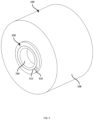
  • FIG. 1 is an isometric view of a media supply roll.
  • FIG. 2 is an isometric view of an inner side of a tag mount.
  • FIG. 3 is an exploded isometric view of the tag mount of FIG. 2 and a media supply roll.
  • FIG. 4 is an assembled view of the tag mount of FIG. 2 and a media supply roll.
  • FIG. 5 is an exploded isometric view of another tag mount and a media supply roll.
  • FIG. 6 is a cross section of an exploded isometric view of the tag mount a media supply roll of FIG. 5 .
  • FIG. 7 is an assembled view of the tag mount and media supply roll of FIG. 5 .
  • FIG. 8 is an exploded isometric view of a further tag mount and a media supply roll.
  • FIG. 9 is a cross section of an exploded isometric view of the tag mount a media supply roll of FIG. 8 .
  • FIG. 10 is an assembled view of the tag mount and media supply roll of FIG. 8 .
  • FIG. 11 is a cross section of another example tag mount.
  • FIG. 12 is a cross section of a further example tag mount.
  • Examples disclosed herein are directed to a tag mount for a media supply roll having a hollow cylindrical core
  • the tag mount including: a tag mount body including: (i) an inner wall configured to face the core, the inner wall having a retaining element to engage with the core and affix the tag mount body to the core, (ii) an outer wall opposite the inner wall, and (iii) a carrier surface, distinct from the retaining surface, the carrier surface defined on one of the inner wall and the outer wall; an antenna affixed to the carrier surface; and an integrated circuit coupled with the antenna and configured to store an attribute corresponding to the media supply roll.
  • Additional examples disclosed herein are directed to a system, comprising: a media supply including a core supporting a web of print media; and a tag mount body including: (i) an inner wall configured to face the core, the inner wall having a retaining element to engage with the core and affix the tag mount body to the core, (ii) an outer wall opposite the inner wall, and (iii) a carrier surface, distinct from the retaining surface, the carrier surface defined on one of the inner wall and the outer wall; an antenna affixed to the carrier surface; and an integrated circuit coupled with the antenna and configured to store an attribute corresponding to the media supply roll.
  • FIG. 1 illustrates a media supply 100 for a printer, such as a table-top printer (e.g., used to print labels, receipts, or the like).
  • the media supply 100 includes a hollow cylindrical core 104 , on which is wound a web 108 of paper, labels mounted on a paper or polymer backing, or the like.
  • the media supply 100 can be installed in a printer, e.g., by mounting the core 104 on opposing spindles in the printer, such that the core is supported to allow rotation of the media supply 100 about an axis 112 .
  • the web 108 can be unspooled by rotation of the media supply 100 , e.g., driven by a nip formed in the printer by a platen roller and a print head (e.g., a thermal print head, such as an array of individually controllable thermal elements or dots).
  • a print head e.g., a thermal print head, such as an array of individually controllable thermal elements or dots.
  • the core 104 can be a tube of cardboard, paperboard, or the like. Various other materials can also be used to manufacture the core 104 .
  • the core 104 includes an inner surface 116 defining a cylindrical channel through the core 104 .
  • the inner surface 116 and therefore the channel, are substantially parallel to the axis 112 .
  • the core 104 also includes a pair of opposing end surfaces, of which one end surface 120 is visible in FIG. 1 .
  • the core 104 further includes an outer surface, on which the web 108 is mounted. As the web 108 is present in FIG. 1 , the outer surface is not visible.
  • the properties of the web 108 can vary across different media supplies, and some printers are compatible with media supplies having webs 108 with differing properties.
  • some printers can accommodate a media supply with a printable width “W” of two inches, four inches, or six inches (a wide variety of other printable widths are also contemplated).
  • some printers can accommodate a media supply 100 carrying thermally-sensitive media that is compatible with direct thermal printing, as well as a media supply 100 carrying media compatible with thermal transfer printing, in which a ribbon cartridge in the printer supplies ribbon to the above-mentioned nip along with the media from the media supply 100 , to transfer pigment from the ribbon to the media.
  • a further property that varies between media supplies 100 is a length or total quantity (e.g., expressed as a number of labels on the web 108 ).
  • media supplies 100 can also be continuous (e.g., a web 108 consisting of continuous media such as receipt paper), or non-continuous (e.g., a web 108 consisting of discrete labels separated by gaps or marks).
  • media supplies 100 can impose distinct sensing requirements on the printer.
  • the printer can include one or more optical sensors in the media path between the media supply 100 and the above-mentioned nip.
  • the optical sensors can be operated in one configuration when the web 108 includes discrete labels or other sections divided by gaps (e.g., translucent portions of a polymer web where paper or other material has been removed), and in a different configuration when the web 108 includes discrete labels or other sections divided by colored marks (e.g., black bars separating labels).
  • gaps e.g., translucent portions of a polymer web where paper or other material has been removed
  • colored marks e.g., black bars separating labels
  • a configuration of the printer may require adjustment. Such adjustments may involve manual adjustment, e.g., by an operator of the printer.
  • tag mount devices that can be affixed to the media supply 100 , and that carry an integrated circuit and a wireless antenna, e.g., in the form of a radio frequency identification (RFID) tag.
  • RFID radio frequency identification
  • the tag mount 200 includes a body 202 having an inner wall 204 , and an opposite outer wall (not visible in FIG. 2 ).
  • the inner wall 204 is referred to as “inner” because it is configured to face towards the core 104 when the tag mount 200 is assembled to the media supply 100 .
  • the inner wall 204 includes a retaining surface to engage with the core 104 , and affix the tag mount body 202 to the core 104 .
  • the inner wall 204 includes a plurality of tabs 208 extending inwards, such that the tabs 208 are substantially parallel to the axis 112 when the tag mount 200 is assembled to the media supply 100 .
  • the tabs 208 can also be referred to as retaining elements.
  • the inner wall 204 includes six tabs 208 in this example, but in other examples the inner wall 204 can include a smaller or greater number of tabs 208 .
  • the tabs 208 are wedge-shaped in this example, but can have also various other configurations.
  • the body 202 is annular in the illustrated example, and includes an opening 212 therethrough, configured to align with the channel of the core 104 mentioned in connection with FIG. 1 .
  • the tabs 208 are disposed adjacent to the opening 212 , to align the tabs 208 with the end 120 of the core 104 .
  • the tabs 208 form the retaining surface mentioned above. That is, the surfaces of each tab 208 are configured to engage with the core 104 of the media supply 100 to affix the body 202 to the core 104 .
  • a modified core 104 a can be provided prior to installation of the tag mount 200 , e.g., by pressing a plurality of slots 300 into the end 120 of the core 104 .
  • Installing the tag mount 200 includes pressing the tag mount into the core 104 , such that the tabs 208 press-fit into the slots 300 .
  • the number and arrangement of slots 300 pressed into the end 120 of the core therefore is equal to the number and arrangement of tabs 208 on the inner surface 204 .
  • the core 104 can be manufactured with the slots 300 therein, e.g., prior to application of the web 108 , but such a modification to the manufacturing process is not necessary.
  • the slots 300 can be pressed into the core 104 after the web 108 is applied, e.g., by an entity other than the manufacturer(s) of the media supply 100 .
  • the tabs 208 themselves may be used to form the slots 300 during assembly of the tag mount 200 to the core 104 .
  • the media supply 100 can be pressed onto a die configured to press the slots 300 into the core, prior to installation of the tag mount 200 .
  • FIG. 3 also illustrates an outer wall 304 of the tag mount body 202 .
  • the outer wall 304 is a continuous surface, or a set of contiguous surfaces facing away from the core 104 .
  • the tag mount 200 also includes a carrier surface 308 , which in the illustrated example is on the outer wall 304 .
  • the carrier surface 308 in this example, is recessed relative to the other surfaces of the outer wall 304 , but in other examples the carrier surface 308 can be a region of a single planar surface (e.g., not recessed relative to other surfaces of the outer wall 304 ).
  • the inner wall 204 and the outer wall 304 are substantially perpendicular to the axis 112 of the core 104 , when the tag mount 200 is assembled to the core 104 .
  • the carrier surface is distinct from the retaining surface (provided by the tabs 208 in this example), but can be on either the inner wall 204 or the outer wall 304 in other examples.
  • the carrier surface 308 is configured to carry a wireless antenna 312 , such as the antenna of an RFID tag (illustrated in dashed lines to distinguish visually from the edges of the tag mount body 202 ).
  • the carrier surface 308 also carries, in this example, an integrated circuit 316 coupled to the antenna 312 and configured to store one or more attributes of the media supply 100 .
  • Example attributes 320 are shown in FIG. 3 , including a type of the media (e.g., continuous vs.
  • the attributes 320 can also include a unique identifier of the circuit 316 itself, for example.
  • the antenna 312 is illustrated as an annular antenna in this example, but it will be understood that a wide variety of other antenna structures can also be employed.
  • the antenna 312 and the circuit 316 are configured, in response to an interrogation signal from an RFID reader (e.g., deployed inside a printer), to return some or all of the data stored at the circuit 316 (e.g., the attributes 320 ).
  • the printer can therefore automatically obtain media attributes, and select configuration settings (e.g., previously stored at the printer) corresponding to those media attributes.
  • the printer can also write data back to the circuit 316 . For example, upon completing a print job, the printer can write an updated “count” value (e.g., 199 in the illustrated example) to the circuit 316 , such that future retrievals of the attributes 320 by the printer or another printer provide an accurate count of available media on the supply 100 .
  • an updated “count” value e.g., 199 in the illustrated example
  • FIG. 4 illustrates the tag mount 200 affixed to the media supply 100 .
  • the tabs 208 are inserted into the slots 300 , such that the remainder of the inner wall 204 is flush against the end 120 of the core 104 and the web 108 .
  • the antenna 312 and the circuit 316 face outwards from the core 104 , to facilitate read and/or write access to an RFID reader or other suitable wireless communications assembly within the printer.
  • the antenna 312 and/or the circuit 316 can be embedded within the tag mount body 202 .
  • FIG. 5 illustrates another example tag mount 500 , including a body 504 with an outer wall 508 including a carrier surface for carrying the antenna 312 .
  • the outer wall 508 has a single continuous, planar surface, and the carrier surface is a portion of that planar surface, rather than being recessed as in the embodiment of FIGS. 2 - 4 .
  • the body 504 is annular, with an opening 510 therethrough configured to align with the channel of a modified core 104 b .
  • the core 104 b in particular, can include an outer portion 512 and an inner portion 516 with different inner diameters, as will be discussed below in greater detail.
  • the media supply 100 is shown in cross section, revealing that the portion 512 of the core 104 b has a greater inner diameter “D 1 ” than the diameter “D 2 ” of the portion 516 .
  • material can be removed from the core 104 b in the portion 512 to enlarge the inner diameter of the portion 512 .
  • the tag mount 500 includes an inner wall 600 , which in turn includes a sleeve 604 extending therefrom substantially parallel to the axis 112 of the core 104 b .
  • the outer surface 608 of the sleeve is the retaining surface of the tag mount 500 .
  • the outer diameter of the sleeve 604 (i.e., measured to the retaining surface 608 ) is substantially equal to D 1 .
  • pressing the tag mount 500 into the core 104 b press-fits the sleeve 604 into the portion 512 of the core 104 b.
  • FIG. 7 illustrates the tag mount 500 following assembly to the core 104 b .
  • the sleeve 604 is received entirely within the channel defined by the core 104 b , and the remainder of the inner wall 600 is flush against the end of the core 104 b and the web 108 .
  • the antenna 312 and the circuit 316 face outwards from the core 104 , to facilitate read and/or write access to an RFID reader as mentioned above.
  • the antenna 312 can be placed elsewhere, such as on an inner surface 700 of the sleeve 604 (i.e. the carrier surface can be on the sleeve 604 of the inner wall 600 , rather than on the outer wall 508 ).
  • FIG. 8 illustrates a further example tag mount 800 having a cylindrical body 802 , in which an inner wall 804 and an outer wall 808 are substantially parallel to the axis 112 .
  • the entirety of the inner wall 804 in this example, is the retaining surface, as the body 802 is configured to be inserted into the portion 512 of the core 104 b , e.g., to press-fit the inner wall 804 against the interior of the core 104 b .
  • the carrier surface is a region of the outer wall 808 , and carries an antenna 812 and integrated circuit 816 . As noted earlier, the antenna 812 need not be annular in other examples.
  • FIG. 9 illustrates a cross-sectional view of the tag mount 800 installed in the core 104 b .
  • the tag mount 800 fits entirely within the channel defined by the core 104 b in this example. In other examples, however, a portion of the tag mount 800 can protrude from the channel when installed.
  • FIG. 10 illustrates an assembled view of the tag mount 800 and the media supply 100 .
  • FIG. 11 illustrates a cross-sectional view of a further example tag mount.
  • a core 1104 can include an indentation, e.g., an annular channel 1108 , cut into an inner surface 1112 thereof (e.g., extending continuously around the inner surface 1112 ), adjacent to one end of the core 1104 .
  • a tag mount 1116 can include an inner wall 1120 from which a sleeve 1124 extends, including a retaining element in the form of a ridge 1128 with a complementary shape to that of the channel 1108 .
  • the ridge 1128 configures the tag mount 1116 to be snap-fitted into the core 1104 .
  • the sleeve 1124 can include a channel and the inner surface 1112 of the core 1104 can include the ridge.
  • An antenna and chip can be supported on an outer wall 1132 of the tag mount 1116 , or on the inner wall 1120 .
  • an auxiliary cap 1136 can be included with the tag mount 1116 , e.g., in a kit with the tag mount 1116 .
  • the cap 1136 need not include an antenna or chip, but can be press-fit, snap-fit, or otherwise affixed to the core 1104 at the end opposite the tag mount 1116 , to provide a consistent cosmetic appearance at both ends of the core 1104 .
  • a cap 1136 can also be included with any other example tag mount described herein.
  • FIG. 12 illustrates a further tag mount 1200 in cross section.
  • the tag mount 1200 includes an outer wall 1204 and an inner wall 1208 .
  • the retaining element of the tag mount 1200 is a portion of the surface of the inner wall 1208 , which can be affixed to a core 1212 by an adhesive 1216 , e.g., a continuous ring of adhesive surrounding the hollow channel extending through the core 1212 .
  • the inner wall 1208 can include a sleeve extending therefrom and carrying the adhesive on a retaining surface.
  • a includes . . . a”, “contains . . . a” does not, without more constraints, preclude the existence of additional identical elements in the process, method, article, or apparatus that comprises, has, includes, contains the element.
  • the terms “a” and “an” are defined as one or more unless explicitly stated otherwise herein.
  • the terms “substantially”, “essentially”, “approximately”, “about” or any other version thereof, are defined as being close to as understood by one of ordinary skill in the art, and in one non-limiting embodiment the term is defined to be within 10%, in another embodiment within 5%, in another embodiment within 1% and in another embodiment within 0.5%.
  • the term “coupled” as used herein is defined as connected, although not necessarily directly and not necessarily mechanically.
  • a device or structure that is “configured” in a certain way is configured in at least that way, but may also be configured in ways that are not listed.
  • processors such as microprocessors, digital signal processors, customized processors and field programmable gate arrays (FPGAs) and unique stored program instructions (including both software and firmware) that control the one or more processors to implement, in conjunction with certain non-processor circuits, some, most, or all of the functions of the method and/or apparatus described herein.
  • processors or “processing devices”
  • FPGAs field programmable gate arrays
  • unique stored program instructions including both software and firmware
  • some or all functions could be implemented by a state machine that has no stored program instructions, or in one or more application specific integrated circuits (ASICs), in which each function or some combinations of certain of the functions are implemented as custom logic.
  • ASICs application specific integrated circuits
  • an embodiment can be implemented as a computer-readable storage medium having computer readable code stored thereon for programming a computer (e.g., comprising a processor) to perform a method as described and claimed herein.
  • Examples of such computer-readable storage mediums include, but are not limited to, a hard disk, a CD-ROM, an optical storage device, a magnetic storage device, a ROM (Read Only Memory), a PROM (Programmable Read Only Memory), an EPROM (Erasable Programmable Read Only Memory), an EEPROM (Electrically Erasable Programmable Read Only Memory) and a Flash memory.

Landscapes

  • Storage Of Web-Like Or Filamentary Materials (AREA)

Abstract

A tag mount for a media supply roll having a hollow cylindrical core includes: a tag mount body including: (i) an inner wall configured to face the core, the inner wall having a retaining surface to engage with the core and affix the tag mount body to the core, (ii) an outer wall opposite the inner wall, and (iii) a carrier surface, distinct from the retaining surface, the carrier surface defined on one of the inner wall and the outer wall; an antenna affixed to the carrier surface; and an integrated circuit coupled with the antenna and configured to store an attribute corresponding to the media supply roll.

Description

BACKGROUND
Media supplies for printers can include rolls of labels, receipt paper, or the like. A given printer may accommodate multiple distinct media supplies at different times, e.g., different label widths, and the like. Configuring the printer for each media supply may require time-consuming manual setup by an operator of the printer.
BRIEF DESCRIPTION OF THE SEVERAL VIEWS OF THE DRAWINGS
The accompanying figures, where like reference numerals refer to identical or functionally similar elements throughout the separate views, together with the detailed description below, are incorporated in and form part of the specification, and serve to further illustrate embodiments of concepts that include the claimed invention, and explain various principles and advantages of those embodiments.
FIG. 1 is an isometric view of a media supply roll.
FIG. 2 is an isometric view of an inner side of a tag mount.
FIG. 3 is an exploded isometric view of the tag mount of FIG. 2 and a media supply roll.
FIG. 4 is an assembled view of the tag mount of FIG. 2 and a media supply roll.
FIG. 5 is an exploded isometric view of another tag mount and a media supply roll.
FIG. 6 is a cross section of an exploded isometric view of the tag mount a media supply roll of FIG. 5 .
FIG. 7 is an assembled view of the tag mount and media supply roll of FIG. 5 .
FIG. 8 is an exploded isometric view of a further tag mount and a media supply roll.
FIG. 9 is a cross section of an exploded isometric view of the tag mount a media supply roll of FIG. 8 .
FIG. 10 is an assembled view of the tag mount and media supply roll of FIG. 8 .
FIG. 11 is a cross section of another example tag mount.
FIG. 12 is a cross section of a further example tag mount.
Skilled artisans will appreciate that elements in the figures are illustrated for simplicity and clarity and have not necessarily been drawn to scale. For example, the dimensions of some of the elements in the figures may be exaggerated relative to other elements to help to improve understanding of embodiments of the present invention.
The apparatus and method components have been represented where appropriate by conventional symbols in the drawings, showing only those specific details that are pertinent to understanding the embodiments of the present invention so as not to obscure the disclosure with details that will be readily apparent to those of ordinary skill in the art having the benefit of the description herein.
DETAILED DESCRIPTION
Examples disclosed herein are directed to a tag mount for a media supply roll having a hollow cylindrical core, the tag mount including: a tag mount body including: (i) an inner wall configured to face the core, the inner wall having a retaining element to engage with the core and affix the tag mount body to the core, (ii) an outer wall opposite the inner wall, and (iii) a carrier surface, distinct from the retaining surface, the carrier surface defined on one of the inner wall and the outer wall; an antenna affixed to the carrier surface; and an integrated circuit coupled with the antenna and configured to store an attribute corresponding to the media supply roll.
Additional examples disclosed herein are directed to a system, comprising: a media supply including a core supporting a web of print media; and a tag mount body including: (i) an inner wall configured to face the core, the inner wall having a retaining element to engage with the core and affix the tag mount body to the core, (ii) an outer wall opposite the inner wall, and (iii) a carrier surface, distinct from the retaining surface, the carrier surface defined on one of the inner wall and the outer wall; an antenna affixed to the carrier surface; and an integrated circuit coupled with the antenna and configured to store an attribute corresponding to the media supply roll.
FIG. 1 illustrates a media supply 100 for a printer, such as a table-top printer (e.g., used to print labels, receipts, or the like). The media supply 100 includes a hollow cylindrical core 104, on which is wound a web 108 of paper, labels mounted on a paper or polymer backing, or the like. The media supply 100 can be installed in a printer, e.g., by mounting the core 104 on opposing spindles in the printer, such that the core is supported to allow rotation of the media supply 100 about an axis 112. The web 108 can be unspooled by rotation of the media supply 100, e.g., driven by a nip formed in the printer by a platen roller and a print head (e.g., a thermal print head, such as an array of individually controllable thermal elements or dots).
The core 104 can be a tube of cardboard, paperboard, or the like. Various other materials can also be used to manufacture the core 104. In general, the core 104 includes an inner surface 116 defining a cylindrical channel through the core 104. The inner surface 116, and therefore the channel, are substantially parallel to the axis 112. The core 104 also includes a pair of opposing end surfaces, of which one end surface 120 is visible in FIG. 1 . The core 104 further includes an outer surface, on which the web 108 is mounted. As the web 108 is present in FIG. 1 , the outer surface is not visible.
The properties of the web 108 can vary across different media supplies, and some printers are compatible with media supplies having webs 108 with differing properties. For example, some printers can accommodate a media supply with a printable width “W” of two inches, four inches, or six inches (a wide variety of other printable widths are also contemplated). Further, some printers can accommodate a media supply 100 carrying thermally-sensitive media that is compatible with direct thermal printing, as well as a media supply 100 carrying media compatible with thermal transfer printing, in which a ribbon cartridge in the printer supplies ribbon to the above-mentioned nip along with the media from the media supply 100, to transfer pigment from the ribbon to the media.
A further property that varies between media supplies 100 is a length or total quantity (e.g., expressed as a number of labels on the web 108). In some cases, media supplies 100 can also be continuous (e.g., a web 108 consisting of continuous media such as receipt paper), or non-continuous (e.g., a web 108 consisting of discrete labels separated by gaps or marks). In further cases, media supplies 100 can impose distinct sensing requirements on the printer. For example, the printer can include one or more optical sensors in the media path between the media supply 100 and the above-mentioned nip. The optical sensors can be operated in one configuration when the web 108 includes discrete labels or other sections divided by gaps (e.g., translucent portions of a polymer web where paper or other material has been removed), and in a different configuration when the web 108 includes discrete labels or other sections divided by colored marks (e.g., black bars separating labels).
To make use of the media supply 100, therefore, a configuration of the printer may require adjustment. Such adjustments may involve manual adjustment, e.g., by an operator of the printer. To alleviate the need to make manual adjustments, while also avoiding or reducing the need to modify manufacturing processes for media supplies 100, described below are tag mount devices that can be affixed to the media supply 100, and that carry an integrated circuit and a wireless antenna, e.g., in the form of a radio frequency identification (RFID) tag. Once affixed to the media supply 100, the tag supported on the tag mount can be read, e.g., by an RFID reader in the printer, to extract properties of the media supply 100. Such extraction then enables the printer to automatically update relevant configuration settings to make use of the media supply 100.
Turning to FIG. 2 , an example tag mount 200 is shown in isolation. The tag mount 200 includes a body 202 having an inner wall 204, and an opposite outer wall (not visible in FIG. 2 ). The inner wall 204 is referred to as “inner” because it is configured to face towards the core 104 when the tag mount 200 is assembled to the media supply 100. The inner wall 204 includes a retaining surface to engage with the core 104, and affix the tag mount body 202 to the core 104. In this example, the inner wall 204 includes a plurality of tabs 208 extending inwards, such that the tabs 208 are substantially parallel to the axis 112 when the tag mount 200 is assembled to the media supply 100. The tabs 208, and any retaining surface or set of retaining surfaces more generally, can also be referred to as retaining elements. The inner wall 204 includes six tabs 208 in this example, but in other examples the inner wall 204 can include a smaller or greater number of tabs 208. The tabs 208 are wedge-shaped in this example, but can have also various other configurations. The body 202 is annular in the illustrated example, and includes an opening 212 therethrough, configured to align with the channel of the core 104 mentioned in connection with FIG. 1 . The tabs 208 are disposed adjacent to the opening 212, to align the tabs 208 with the end 120 of the core 104.
The tabs 208 form the retaining surface mentioned above. That is, the surfaces of each tab 208 are configured to engage with the core 104 of the media supply 100 to affix the body 202 to the core 104. In particular, as shown in FIG. 3 , a modified core 104 a can be provided prior to installation of the tag mount 200, e.g., by pressing a plurality of slots 300 into the end 120 of the core 104. Installing the tag mount 200 includes pressing the tag mount into the core 104, such that the tabs 208 press-fit into the slots 300. The number and arrangement of slots 300 pressed into the end 120 of the core therefore is equal to the number and arrangement of tabs 208 on the inner surface 204.
The retaining surfaces defined by the tabs 208 therefore affixes the tag body 202 to the core 104, and the media supply 100 can then be installed into a printer for use. As will be apparent, the core 104 can be manufactured with the slots 300 therein, e.g., prior to application of the web 108, but such a modification to the manufacturing process is not necessary. In other examples, the slots 300 can be pressed into the core 104 after the web 108 is applied, e.g., by an entity other than the manufacturer(s) of the media supply 100. For example, depending on the hardness of the material used in the core 104, the tabs 208 themselves may be used to form the slots 300 during assembly of the tag mount 200 to the core 104. In other examples, the media supply 100 can be pressed onto a die configured to press the slots 300 into the core, prior to installation of the tag mount 200.
FIG. 3 also illustrates an outer wall 304 of the tag mount body 202. As seen in FIG. 3 , the outer wall 304 is a continuous surface, or a set of contiguous surfaces facing away from the core 104. The tag mount 200 also includes a carrier surface 308, which in the illustrated example is on the outer wall 304. The carrier surface 308, in this example, is recessed relative to the other surfaces of the outer wall 304, but in other examples the carrier surface 308 can be a region of a single planar surface (e.g., not recessed relative to other surfaces of the outer wall 304). As seen in FIG. 3 , the inner wall 204 and the outer wall 304 are substantially perpendicular to the axis 112 of the core 104, when the tag mount 200 is assembled to the core 104.
The carrier surface is distinct from the retaining surface (provided by the tabs 208 in this example), but can be on either the inner wall 204 or the outer wall 304 in other examples. The carrier surface 308 is configured to carry a wireless antenna 312, such as the antenna of an RFID tag (illustrated in dashed lines to distinguish visually from the edges of the tag mount body 202). The carrier surface 308 also carries, in this example, an integrated circuit 316 coupled to the antenna 312 and configured to store one or more attributes of the media supply 100. Example attributes 320 are shown in FIG. 3 , including a type of the media (e.g., continuous vs. non-continuous), a count of discrete media sections such as labels, a print method (e.g., direct thermal vs. thermal transfer), and a printable width of the media. The attributes 320 can also include a unique identifier of the circuit 316 itself, for example. The antenna 312 is illustrated as an annular antenna in this example, but it will be understood that a wide variety of other antenna structures can also be employed.
As will be apparent, the antenna 312 and the circuit 316 are configured, in response to an interrogation signal from an RFID reader (e.g., deployed inside a printer), to return some or all of the data stored at the circuit 316 (e.g., the attributes 320). The printer can therefore automatically obtain media attributes, and select configuration settings (e.g., previously stored at the printer) corresponding to those media attributes. In some examples, the printer can also write data back to the circuit 316. For example, upon completing a print job, the printer can write an updated “count” value (e.g., 199 in the illustrated example) to the circuit 316, such that future retrievals of the attributes 320 by the printer or another printer provide an accurate count of available media on the supply 100.
FIG. 4 illustrates the tag mount 200 affixed to the media supply 100. In particular, the tabs 208 are inserted into the slots 300, such that the remainder of the inner wall 204 is flush against the end 120 of the core 104 and the web 108. The antenna 312 and the circuit 316 face outwards from the core 104, to facilitate read and/or write access to an RFID reader or other suitable wireless communications assembly within the printer. In other examples, the antenna 312 and/or the circuit 316 can be embedded within the tag mount body 202.
FIG. 5 illustrates another example tag mount 500, including a body 504 with an outer wall 508 including a carrier surface for carrying the antenna 312. As seen in FIG. 5 , the outer wall 508 has a single continuous, planar surface, and the carrier surface is a portion of that planar surface, rather than being recessed as in the embodiment of FIGS. 2-4 . The body 504 is annular, with an opening 510 therethrough configured to align with the channel of a modified core 104 b. The core 104 b, in particular, can include an outer portion 512 and an inner portion 516 with different inner diameters, as will be discussed below in greater detail.
Turning to FIG. 6 , the media supply 100 is shown in cross section, revealing that the portion 512 of the core 104 b has a greater inner diameter “D1” than the diameter “D2” of the portion 516. For example, material can be removed from the core 104 b in the portion 512 to enlarge the inner diameter of the portion 512. The tag mount 500 includes an inner wall 600, which in turn includes a sleeve 604 extending therefrom substantially parallel to the axis 112 of the core 104 b. The outer surface 608 of the sleeve is the retaining surface of the tag mount 500. In particular, the outer diameter of the sleeve 604 (i.e., measured to the retaining surface 608) is substantially equal to D1. Thus, pressing the tag mount 500 into the core 104 b press-fits the sleeve 604 into the portion 512 of the core 104 b.
FIG. 7 illustrates the tag mount 500 following assembly to the core 104 b. In particular, the sleeve 604 is received entirely within the channel defined by the core 104 b, and the remainder of the inner wall 600 is flush against the end of the core 104 b and the web 108. The antenna 312 and the circuit 316 face outwards from the core 104, to facilitate read and/or write access to an RFID reader as mentioned above. In other examples, the antenna 312 can be placed elsewhere, such as on an inner surface 700 of the sleeve 604 (i.e. the carrier surface can be on the sleeve 604 of the inner wall 600, rather than on the outer wall 508).
FIG. 8 illustrates a further example tag mount 800 having a cylindrical body 802, in which an inner wall 804 and an outer wall 808 are substantially parallel to the axis 112. The entirety of the inner wall 804, in this example, is the retaining surface, as the body 802 is configured to be inserted into the portion 512 of the core 104 b, e.g., to press-fit the inner wall 804 against the interior of the core 104 b. The carrier surface is a region of the outer wall 808, and carries an antenna 812 and integrated circuit 816. As noted earlier, the antenna 812 need not be annular in other examples.
FIG. 9 illustrates a cross-sectional view of the tag mount 800 installed in the core 104 b. As shown in FIG. 9 , the tag mount 800 fits entirely within the channel defined by the core 104 b in this example. In other examples, however, a portion of the tag mount 800 can protrude from the channel when installed. FIG. 10 illustrates an assembled view of the tag mount 800 and the media supply 100.
FIG. 11 illustrates a cross-sectional view of a further example tag mount. As shown in FIG. 11 , a core 1104 can include an indentation, e.g., an annular channel 1108, cut into an inner surface 1112 thereof (e.g., extending continuously around the inner surface 1112), adjacent to one end of the core 1104. A tag mount 1116 can include an inner wall 1120 from which a sleeve 1124 extends, including a retaining element in the form of a ridge 1128 with a complementary shape to that of the channel 1108. The ridge 1128 configures the tag mount 1116 to be snap-fitted into the core 1104. In other examples, the sleeve 1124 can include a channel and the inner surface 1112 of the core 1104 can include the ridge. An antenna and chip can be supported on an outer wall 1132 of the tag mount 1116, or on the inner wall 1120.
As also shown in FIG. 11 , an auxiliary cap 1136 can be included with the tag mount 1116, e.g., in a kit with the tag mount 1116. The cap 1136 need not include an antenna or chip, but can be press-fit, snap-fit, or otherwise affixed to the core 1104 at the end opposite the tag mount 1116, to provide a consistent cosmetic appearance at both ends of the core 1104. A cap 1136 can also be included with any other example tag mount described herein.
FIG. 12 illustrates a further tag mount 1200 in cross section. The tag mount 1200 includes an outer wall 1204 and an inner wall 1208. The retaining element of the tag mount 1200 is a portion of the surface of the inner wall 1208, which can be affixed to a core 1212 by an adhesive 1216, e.g., a continuous ring of adhesive surrounding the hollow channel extending through the core 1212. In some examples, the inner wall 1208 can include a sleeve extending therefrom and carrying the adhesive on a retaining surface.
In the foregoing specification, specific embodiments have been described. However, one of ordinary skill in the art appreciates that various modifications and changes can be made without departing from the scope of the invention as set forth in the claims below. Accordingly, the specification and figures are to be regarded in an illustrative rather than a restrictive sense, and all such modifications are intended to be included within the scope of present teachings.
The benefits, advantages, solutions to problems, and any element(s) that may cause any benefit, advantage, or solution to occur or become more pronounced are not to be construed as a critical, required, or essential features or elements of any or all the claims. The invention is defined solely by the appended claims including any amendments made during the pendency of this application and all equivalents of those claims as issued.
Moreover in this document, relational terms such as first and second, top and bottom, and the like may be used solely to distinguish one entity or action from another entity or action without necessarily requiring or implying any actual such relationship or order between such entities or actions. The terms “comprises,” “comprising,” “has”, “having,” “includes”, “including,” “contains”, “containing” or any other variation thereof, are intended to cover a non-exclusive inclusion, such that a process, method, article, or apparatus that comprises, has, includes, contains a list of elements does not include only those elements but may include other elements not expressly listed or inherent to such process, method, article, or apparatus. An element proceeded by “comprises . . . a”, “has . . . a”, “includes . . . a”, “contains . . . a” does not, without more constraints, preclude the existence of additional identical elements in the process, method, article, or apparatus that comprises, has, includes, contains the element. The terms “a” and “an” are defined as one or more unless explicitly stated otherwise herein. The terms “substantially”, “essentially”, “approximately”, “about” or any other version thereof, are defined as being close to as understood by one of ordinary skill in the art, and in one non-limiting embodiment the term is defined to be within 10%, in another embodiment within 5%, in another embodiment within 1% and in another embodiment within 0.5%. The term “coupled” as used herein is defined as connected, although not necessarily directly and not necessarily mechanically. A device or structure that is “configured” in a certain way is configured in at least that way, but may also be configured in ways that are not listed.
Certain expressions may be employed herein to list combinations of elements. Examples of such expressions include: “at least one of A, B, and C”; “one or more of A, B, and C”; “at least one of A, B, or C”; “one or more of A, B, or C”. Unless expressly indicated otherwise, the above expressions encompass any combination of A and/or B and/or C.
It will be appreciated that some embodiments may be comprised of one or more specialized processors (or “processing devices”) such as microprocessors, digital signal processors, customized processors and field programmable gate arrays (FPGAs) and unique stored program instructions (including both software and firmware) that control the one or more processors to implement, in conjunction with certain non-processor circuits, some, most, or all of the functions of the method and/or apparatus described herein. Alternatively, some or all functions could be implemented by a state machine that has no stored program instructions, or in one or more application specific integrated circuits (ASICs), in which each function or some combinations of certain of the functions are implemented as custom logic. Of course, a combination of the two approaches could be used.
Moreover, an embodiment can be implemented as a computer-readable storage medium having computer readable code stored thereon for programming a computer (e.g., comprising a processor) to perform a method as described and claimed herein. Examples of such computer-readable storage mediums include, but are not limited to, a hard disk, a CD-ROM, an optical storage device, a magnetic storage device, a ROM (Read Only Memory), a PROM (Programmable Read Only Memory), an EPROM (Erasable Programmable Read Only Memory), an EEPROM (Electrically Erasable Programmable Read Only Memory) and a Flash memory. Further, it is expected that one of ordinary skill, notwithstanding possibly significant effort and many design choices motivated by, for example, available time, current technology, and economic considerations, when guided by the concepts and principles disclosed herein will be readily capable of generating such software instructions and programs and ICs with minimal experimentation.
The Abstract of the Disclosure is provided to allow the reader to quickly ascertain the nature of the technical disclosure. It is submitted with the understanding that it will not be used to interpret or limit the scope or meaning of the claims. In addition, in the foregoing Detailed Description, it can be seen that various features are grouped together in various embodiments for the purpose of streamlining the disclosure. This method of disclosure is not to be interpreted as reflecting an intention that the claimed embodiments require more features than are expressly recited in each claim. Rather, as the following claims reflect, inventive subject matter lies in less than all features of a single disclosed embodiment. Thus the following claims are hereby incorporated into the Detailed Description, with each claim standing on its own as a separately claimed subject matter.

Claims (20)

The invention claimed is:
1. A tag mount for a media supply roll having a hollow cylindrical core, the tag mount comprising:
a tag mount body including:
(i) an inner wall configured to face the core, the inner wall having a retaining element to engage with the core and affix the tag mount body to the core,
(ii) an outer wall opposite the inner wall, and
(iii) a carrier surface, distinct from the retaining element, the carrier surface defined on one of the inner wall and the outer wall;
an antenna affixed to the carrier surface; and
an integrated circuit coupled with the antenna and configured to store an attribute corresponding to the media supply roll.
2. The tag mount of claim 1, wherein the antenna and the integrated circuit form a radio frequency identification (RFID) tag.
3. The tag mount of claim 2, wherein the RFID tag is configured, in response to interrogation by an RFID reader of a printer in which the media supply roll is installed, to transmit the attribute corresponding to the media supply roll.
4. The tag mount of claim 3, wherein the RFID tag is configured to:
store a supply count;
receive an updated supply count from the printer; and
update the stored supply count.
5. The tag mount of claim 1, wherein the attribute includes at least one of:
a type of media on the media supply roll;
a print method compatible with the media; and
a print width of the media.
6. The tag mount of claim 1, wherein the inner wall and the outer wall are substantially perpendicular to an axis of rotation of the core.
7. The tag mount of claim 6, wherein the retaining element includes a plurality of tabs extending from the inner wall substantially parallel to the axis of rotation, the tabs configured for insertion into respective slots defined in an end of the core.
8. The tag mount of claim 7, wherein the body is annular, and includes an opening therethrough configured to align with a channel extending through the core; and
wherein the carrier surface is an annular surface on the outer wall.
9. The tag mount of claim 6, wherein the inner wall includes a sleeve extending substantially parallel to the axis of rotation, the sleeve defining the retaining element and configured for insertion into a channel extending through the core.
10. The tag mount of claim 6, wherein the carrier surface is defined on the outer wall.
11. The tag mount of claim 1, wherein the inner wall and the outer wall are substantially parallel to an axis of rotation of the core.
12. The tag mount of claim 11, wherein the body is cylindrical, and configured for insertion into a hollow channel extending through the core; and
wherein the retaining element of the inner wall is configured to engage with a surface of a channel extending through the core.
13. The tag mount of claim 1, wherein the retaining element includes a ridge configured to engage with a corresponding channel of the core to snap the tag mount onto the core.
14. A system, comprising:
a media supply including a core supporting a web of print media; and
a tag mount body including:
(i) an inner wall configured to face the core, the inner wall having a retaining element to engage with the core and affix the tag mount body to the core,
(ii) an outer wall opposite the inner wall, and
(iii) a carrier surface, distinct from the retaining element, the carrier surface defined on one of the inner wall and the outer wall;
an antenna affixed to the carrier surface; and
an integrated circuit coupled with the antenna and configured to store an attribute corresponding to the media supply roll.
15. The system of claim 14, wherein the inner wall and the outer wall are substantially perpendicular to an axis of rotation of the core.
16. The system of claim 15, wherein the retaining element includes a plurality of tabs extending from the inner wall substantially parallel to the axis of rotation, the tabs configured for insertion into respective slots defined in an end of the core.
17. The system of claim 16, wherein the core includes a plurality of slots pressed into an end of the core, for receiving the tabs.
18. The system of claim 14, wherein the inner wall includes a sleeve extending substantially parallel to the axis of rotation, the sleeve defining the retaining element and configured for insertion into a channel extending through the core.
19. The system of claim 18, wherein the channel includes a first portion for receiving the sleeve, and a second portion; and wherein an inner diameter of the first portion is larger than an inner diameter of the second portion.
20. The system of claim 14, wherein the core includes a channel, and wherein the retaining element includes a ridge configured to engage with the channel to snap the tag mount onto the core.
US17/894,807 2022-08-24 2022-08-24 Electronic tag mounts for printer media supply rolls Active 2043-03-11 US12227002B2 (en)

Priority Applications (3)

Application Number Priority Date Filing Date Title
US17/894,807 US12227002B2 (en) 2022-08-24 2022-08-24 Electronic tag mounts for printer media supply rolls
PCT/US2023/028224 WO2024044003A1 (en) 2022-08-24 2023-07-20 Electronic tag mounts for printer media supply rolls
US19/052,214 US20250178365A1 (en) 2022-08-24 2025-02-12 Electronic Tag Mounts for Printer Media Supply Rolls

Applications Claiming Priority (1)

Application Number Priority Date Filing Date Title
US17/894,807 US12227002B2 (en) 2022-08-24 2022-08-24 Electronic tag mounts for printer media supply rolls

Related Child Applications (1)

Application Number Title Priority Date Filing Date
US19/052,214 Continuation US20250178365A1 (en) 2022-08-24 2025-02-12 Electronic Tag Mounts for Printer Media Supply Rolls

Publications (2)

Publication Number Publication Date
US20240066897A1 US20240066897A1 (en) 2024-02-29
US12227002B2 true US12227002B2 (en) 2025-02-18

Family

ID=90000317

Family Applications (2)

Application Number Title Priority Date Filing Date
US17/894,807 Active 2043-03-11 US12227002B2 (en) 2022-08-24 2022-08-24 Electronic tag mounts for printer media supply rolls
US19/052,214 Pending US20250178365A1 (en) 2022-08-24 2025-02-12 Electronic Tag Mounts for Printer Media Supply Rolls

Family Applications After (1)

Application Number Title Priority Date Filing Date
US19/052,214 Pending US20250178365A1 (en) 2022-08-24 2025-02-12 Electronic Tag Mounts for Printer Media Supply Rolls

Country Status (2)

Country Link
US (2) US12227002B2 (en)
WO (1) WO2024044003A1 (en)

Citations (4)

* Cited by examiner, † Cited by third party
Publication number Priority date Publication date Assignee Title
JP2007261769A (en) 2006-03-29 2007-10-11 Seiko Epson Corp Roll paper support member and roll paper unit
JP2008143139A (en) * 2006-12-13 2008-06-26 Tohoku Ricoh Co Ltd Plate-making apparatus and stencil printer
US20130216292A1 (en) 2012-02-20 2013-08-22 Casio Computer Co., Ltd. Roll tape and printer
US20170080724A1 (en) * 2014-05-29 2017-03-23 Dai Nippon Printing Co., Ltd. Bobbin for thermal transfer sheet or image-receiving sheet, assembly of bobbin and sheet, and thermal transfer printer

Patent Citations (4)

* Cited by examiner, † Cited by third party
Publication number Priority date Publication date Assignee Title
JP2007261769A (en) 2006-03-29 2007-10-11 Seiko Epson Corp Roll paper support member and roll paper unit
JP2008143139A (en) * 2006-12-13 2008-06-26 Tohoku Ricoh Co Ltd Plate-making apparatus and stencil printer
US20130216292A1 (en) 2012-02-20 2013-08-22 Casio Computer Co., Ltd. Roll tape and printer
US20170080724A1 (en) * 2014-05-29 2017-03-23 Dai Nippon Printing Co., Ltd. Bobbin for thermal transfer sheet or image-receiving sheet, assembly of bobbin and sheet, and thermal transfer printer

Non-Patent Citations (1)

* Cited by examiner, † Cited by third party
Title
International Search Report and Written Opinion for International Application No. PCT/US2023/28224 mailed on Oct. 27, 2023.

Also Published As

Publication number Publication date
US20250178365A1 (en) 2025-06-05
WO2024044003A1 (en) 2024-02-29
US20240066897A1 (en) 2024-02-29

Similar Documents

Publication Publication Date Title
US6280544B1 (en) RF tag application system
US20070286660A1 (en) Systems and Methods for Providing a Media Located on a Spool and/or a Cartridge Where the Media Includes a Wireless Communication Device Attached Thereto
JP4600742B2 (en) Print head and tag label producing apparatus
US6726144B2 (en) Ribbon core and spindle
US8870478B2 (en) Media processing system and associated spindle
JP5565639B2 (en) Roll tape and printing device
EP4382302B1 (en) Printing apparatus
EP4382303B1 (en) Printing apparatus
US12227002B2 (en) Electronic tag mounts for printer media supply rolls
JPWO2006033393A1 (en) Tape cassette
AU2004242834A1 (en) Winding tube
EP2158559B1 (en) A system for processing media units and an associated media roll
CN101093550B (en) Printer
JP2007261769A (en) Roll paper support member and roll paper unit
US20080315997A1 (en) Tag tape, tag tape roll, RFID circuit element cartridge, and tag label producing apparatus
JP2017095283A (en) Sheet issuing device and sheet roll holding part
US20240067492A1 (en) Media Processing Device Drive Mechanisms for Selectable Media Types
US9033488B2 (en) Easy load printer media spindle
JP2004309860A (en) Consumables and consumables manufacturing equipment
US20250091374A1 (en) Printing device and control method for printing device
JP7225921B2 (en) Thermal transfer sheet ribbon and bobbin
JP2025187832A (en) printing device
CN112357694A (en) Mark plate, mark plate rolling device and mark number printing method

Legal Events

Date Code Title Description
FEPP Fee payment procedure

Free format text: ENTITY STATUS SET TO UNDISCOUNTED (ORIGINAL EVENT CODE: BIG.); ENTITY STATUS OF PATENT OWNER: LARGE ENTITY

AS Assignment

Owner name: ZEBRA TECHNOLOGIES CORPORATION, ILLINOIS

Free format text: ASSIGNMENT OF ASSIGNORS INTEREST;ASSIGNORS:VUCKOVIC, MIROSLAV;MATAS ALONZO, ANNIKA;SIGNING DATES FROM 20220819 TO 20220823;REEL/FRAME:061180/0901

STPP Information on status: patent application and granting procedure in general

Free format text: DOCKETED NEW CASE - READY FOR EXAMINATION

STPP Information on status: patent application and granting procedure in general

Free format text: NON FINAL ACTION MAILED

STPP Information on status: patent application and granting procedure in general

Free format text: RESPONSE TO NON-FINAL OFFICE ACTION ENTERED AND FORWARDED TO EXAMINER

STPP Information on status: patent application and granting procedure in general

Free format text: NOTICE OF ALLOWANCE MAILED -- APPLICATION RECEIVED IN OFFICE OF PUBLICATIONS

STPP Information on status: patent application and granting procedure in general

Free format text: PUBLICATIONS -- ISSUE FEE PAYMENT VERIFIED

STCF Information on status: patent grant

Free format text: PATENTED CASE