US12225548B2 - Method and apparatus for allocating resources for an enhanced physical hybrid automatic repeat request indicator channel - Google Patents
Method and apparatus for allocating resources for an enhanced physical hybrid automatic repeat request indicator channel Download PDFInfo
- Publication number
- US12225548B2 US12225548B2 US17/897,790 US202217897790A US12225548B2 US 12225548 B2 US12225548 B2 US 12225548B2 US 202217897790 A US202217897790 A US 202217897790A US 12225548 B2 US12225548 B2 US 12225548B2
- Authority
- US
- United States
- Prior art keywords
- bits
- phich
- sequence
- wtru
- processor
- Prior art date
- Legal status (The legal status is an assumption and is not a legal conclusion. Google has not performed a legal analysis and makes no representation as to the accuracy of the status listed.)
- Active
Links
Images




Classifications
-
- H—ELECTRICITY
- H04—ELECTRIC COMMUNICATION TECHNIQUE
- H04B—TRANSMISSION
- H04B7/00—Radio transmission systems, i.e. using radiation field
- H04B7/24—Radio transmission systems, i.e. using radiation field for communication between two or more posts
- H04B7/26—Radio transmission systems, i.e. using radiation field for communication between two or more posts at least one of which is mobile
- H04B7/2612—Arrangements for wireless medium access control, e.g. by allocating physical layer transmission capacity
-
- H—ELECTRICITY
- H04—ELECTRIC COMMUNICATION TECHNIQUE
- H04W—WIRELESS COMMUNICATION NETWORKS
- H04W72/00—Local resource management
- H04W72/20—Control channels or signalling for resource management
- H04W72/23—Control channels or signalling for resource management in the downlink direction of a wireless link, i.e. towards a terminal
-
- H—ELECTRICITY
- H04—ELECTRIC COMMUNICATION TECHNIQUE
- H04J—MULTIPLEX COMMUNICATION
- H04J11/00—Orthogonal multiplex systems, e.g. using WALSH codes
-
- H—ELECTRICITY
- H04—ELECTRIC COMMUNICATION TECHNIQUE
- H04L—TRANSMISSION OF DIGITAL INFORMATION, e.g. TELEGRAPHIC COMMUNICATION
- H04L1/00—Arrangements for detecting or preventing errors in the information received
- H04L1/12—Arrangements for detecting or preventing errors in the information received by using return channel
- H04L1/16—Arrangements for detecting or preventing errors in the information received by using return channel in which the return channel carries supervisory signals, e.g. repetition request signals
- H04L1/1607—Details of the supervisory signal
- H04L1/1671—Details of the supervisory signal the supervisory signal being transmitted together with control information
-
- H—ELECTRICITY
- H04—ELECTRIC COMMUNICATION TECHNIQUE
- H04L—TRANSMISSION OF DIGITAL INFORMATION, e.g. TELEGRAPHIC COMMUNICATION
- H04L1/00—Arrangements for detecting or preventing errors in the information received
- H04L1/12—Arrangements for detecting or preventing errors in the information received by using return channel
- H04L1/16—Arrangements for detecting or preventing errors in the information received by using return channel in which the return channel carries supervisory signals, e.g. repetition request signals
- H04L1/18—Automatic repetition systems, e.g. Van Duuren systems
-
- H—ELECTRICITY
- H04—ELECTRIC COMMUNICATION TECHNIQUE
- H04L—TRANSMISSION OF DIGITAL INFORMATION, e.g. TELEGRAPHIC COMMUNICATION
- H04L1/00—Arrangements for detecting or preventing errors in the information received
- H04L1/12—Arrangements for detecting or preventing errors in the information received by using return channel
- H04L1/16—Arrangements for detecting or preventing errors in the information received by using return channel in which the return channel carries supervisory signals, e.g. repetition request signals
- H04L1/18—Automatic repetition systems, e.g. Van Duuren systems
- H04L1/1812—Hybrid protocols; Hybrid automatic repeat request [HARQ]
-
- H—ELECTRICITY
- H04—ELECTRIC COMMUNICATION TECHNIQUE
- H04L—TRANSMISSION OF DIGITAL INFORMATION, e.g. TELEGRAPHIC COMMUNICATION
- H04L1/00—Arrangements for detecting or preventing errors in the information received
- H04L1/12—Arrangements for detecting or preventing errors in the information received by using return channel
- H04L1/16—Arrangements for detecting or preventing errors in the information received by using return channel in which the return channel carries supervisory signals, e.g. repetition request signals
- H04L1/18—Automatic repetition systems, e.g. Van Duuren systems
- H04L1/1829—Arrangements specially adapted for the receiver end
- H04L1/1858—Transmission or retransmission of more than one copy of acknowledgement message
-
- H—ELECTRICITY
- H04—ELECTRIC COMMUNICATION TECHNIQUE
- H04L—TRANSMISSION OF DIGITAL INFORMATION, e.g. TELEGRAPHIC COMMUNICATION
- H04L1/00—Arrangements for detecting or preventing errors in the information received
- H04L1/12—Arrangements for detecting or preventing errors in the information received by using return channel
- H04L1/16—Arrangements for detecting or preventing errors in the information received by using return channel in which the return channel carries supervisory signals, e.g. repetition request signals
- H04L1/18—Automatic repetition systems, e.g. Van Duuren systems
- H04L1/1829—Arrangements specially adapted for the receiver end
- H04L1/1861—Physical mapping arrangements
-
- H—ELECTRICITY
- H04—ELECTRIC COMMUNICATION TECHNIQUE
- H04L—TRANSMISSION OF DIGITAL INFORMATION, e.g. TELEGRAPHIC COMMUNICATION
- H04L5/00—Arrangements affording multiple use of the transmission path
- H04L5/003—Arrangements for allocating sub-channels of the transmission path
- H04L5/0053—Allocation of signalling, i.e. of overhead other than pilot signals
- H04L5/0055—Physical resource allocation for ACK/NACK
-
- H—ELECTRICITY
- H04—ELECTRIC COMMUNICATION TECHNIQUE
- H04W—WIRELESS COMMUNICATION NETWORKS
- H04W72/00—Local resource management
- H04W72/04—Wireless resource allocation
- H04W72/044—Wireless resource allocation based on the type of the allocated resource
- H04W72/0446—Resources in time domain, e.g. slots or frames
Definitions
- the uplink of a Long Term Evolution (LTE) system supports two modes of hybrid automatic repeat request (HARQ) operations: adaptive and non-adaptive HARQ.
- HARQ hybrid automatic repeat request
- the retransmission request is sent on a physical HARQ indicator channel (PHICH) through the transmission of a negative acknowledgment (NACK) signal.
- NACK negative acknowledgment
- adaptive HARQ which is activated by transmitting an acknowledgment (ACK) signal on the PHICH, according to the previous transmissions and depending on the resource scheduling of other users in the system, both the format and the frequency location of retransmissions are signaled by the physical downlink control channel (PDCCH) while overriding the PHICH.
- PDCCH physical downlink control channel
- E-PHICH enhanced physical hybrid automatic repeat request
- E-PDCCH enhanced physical downlink control channel
- the E-PDCCH may be defined by at least one of enhanced resource element groups (eREGs) and enhanced control channel elements (eCCEs).
- eREGs enhanced resource element groups
- eCCEs enhanced control channel elements
- Each eCCE may be formed by grouping a plurality of eREGs.
- Each eREG may contain at least one resource element (RE).
- a subset of eREGs may be allocated as E-PHICH resources.
- E-PDCCH physical resource block (PRB) pairs may be selected as a resource for the E-PHICH.
- An indication of the number of the eCCEs may be broadcast to a wireless transmit/receive unit (WTRU).
- WTRU wireless transmit/receive unit
- FIG. 1 A shows an example communications system in which one or more disclosed embodiments may be implemented
- FIG. 1 B shows an example wireless transmit/receive unit (WTRU) that may be used within the communications system shown in FIG. 1 A ;
- WTRU wireless transmit/receive unit
- FIG. 1 C shows an example radio access network and an example core network that may be used within the communications system shown in FIG. 1 A ;
- FIG. 2 shows physical control format indicator channel (PCFICH) and physical hybrid automatic repeat request (HARQ) indicator channel (PHICH) resource element group (REG) allocation according to a physical cell identifier (PCI);
- PCFICH physical control format indicator channel
- HARQ physical hybrid automatic repeat request indicator channel
- PHICH physical hybrid automatic repeat request indicator channel
- REG resource element group allocation according to a physical cell identifier
- FIG. 3 shows an orthogonal sequence according to a sequence index and a spreading factor
- FIG. 4 shows HARQ indicator (HI) code words with a repetition factor of 3;
- FIG. 5 shows HI code words with a repetition factor of 4.
- FIGS. 6 and 7 show evolved PHICH (E-PHICH) signal construction
- FIGS. 8 A and 8 B show localized and distributed resource block allocation for E-PHICH
- FIG. 9 shows implicit resource block allocation for E-PHICH using an offset with respect to the E-PDCCH
- FIG. 10 shows E-PHICH resource mapping for two different reference symbol configurations
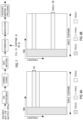
- FIG. 11 shows available REGs for E-PHICH transmission within a single resource block (RB).
- FIG. 12 shows an example of REG mapping with interleaving and cyclic shift.
- FIG. 1 A shows an example communications system 100 in which one or more disclosed embodiments may be implemented.
- the communications system 100 may be a multiple access system that provides content, such as voice, data, video, messaging, broadcast, and the like, to multiple wireless users.
- the communications system 100 may enable multiple wireless users to access such content through the sharing of system resources, including wireless bandwidth.
- the communications systems 100 may employ one or more channel access methods, such as code division multiple access (CDMA), time division multiple access (TDMA), frequency division multiple access (FDMA), orthogonal FDMA (OFDMA), single-carrier FDMA (SC-FDMA), and the like.
- CDMA code division multiple access
- TDMA time division multiple access
- FDMA frequency division multiple access
- OFDMA orthogonal FDMA
- SC-FDMA single-carrier FDMA
- the communications system 100 may include wireless transmit/receive units (WTRUs) 102 a , 102 b , 102 c , 102 d , a radio access network (RAN) 104 , a core network 106 , a public switched telephone network (PSTN) 108 , the Internet 110 , and other networks 112 , though it will be appreciated that the disclosed embodiments contemplate any number of WTRUs, base stations, networks, and/or network elements.
- Each of the WTRUs 102 a , 102 b , 102 c , 102 d may be any type of device configured to operate and/or communicate in a wireless environment.
- the WTRUs 102 a , 102 b , 102 c , 102 d may be configured to transmit and/or receive wireless signals and may include user equipment (UE), a mobile station, a fixed or mobile subscriber unit, a pager, a cellular telephone, a personal digital assistant (PDA), a smartphone, a laptop, a netbook, a personal computer, a wireless sensor, consumer electronics, and the like.
- UE user equipment
- PDA personal digital assistant
- smartphone a laptop
- netbook a personal computer
- a wireless sensor consumer electronics, and the like.
- the communications systems 100 may also include a base station 114 a and a base station 114 b .
- Each of the base stations 114 a , 114 b may be any type of device configured to wirelessly interface with at least one of the WTRUs 102 a , 102 b , 102 c , 102 d to facilitate access to one or more communication networks, such as the core network 106 , the Internet 110 , and/or the other networks 112 .
- the base stations 114 a , 114 b may be a base transceiver station (BTS), a Node-B, an evolved Node-B (eNB), a home Node-B (HNB), a home eNB (HeNB), a site controller, an access point (AP), a wireless router, and the like. While the base stations 114 a , 114 b are each depicted as a single element, it will be appreciated that the base stations 114 a , 114 b may include any number of interconnected base stations and/or network elements.
- the base station 114 a may be part of the RAN 104 , which may also include other base stations and/or network elements (not shown), such as a base station controller (BSC), a radio network controller (RNC), relay nodes, and the like.
- the base station 114 a and/or the base station 114 b may be configured to transmit and/or receive wireless signals within a particular geographic region, which may be referred to as a cell (not shown).
- the cell may further be divided into cell sectors.
- the cell associated with the base station 114 a may be divided into three sectors.
- the base station 114 a may include three transceivers, i.e., one for each sector of the cell.
- the base station 114 a may employ multiple-input multiple-output (MIMO) technology and, therefore, may utilize multiple transceivers for each sector of the cell.
- MIMO multiple-input multiple-output
- the base stations 114 a , 114 b may communicate with one or more of the WTRUs 102 a , 102 b , 102 c , 102 d over an air interface 116 , which may be any suitable wireless communication link, (e.g., radio frequency (RF), microwave, infrared (IR), ultraviolet (UV), visible light, and the like).
- the air interface 116 may be established using any suitable radio access technology (RAT).
- RAT radio access technology
- the communications system 100 may be a multiple access system and may employ one or more channel access schemes, such as CDMA, TDMA, FDMA, OFDMA, SC-FDMA, and the like.
- the base station 114 a in the RAN 104 and the WTRUs 102 a , 102 b , 102 c may implement a radio technology such as universal mobile telecommunications system (UMTS) terrestrial radio access (UTRA), which may establish the air interface 116 using wideband CDMA (WCDMA).
- WCDMA may include communication protocols such as high-speed packet access (HSPA) and/or evolved HSPA (HSPA+).
- HSPA may include high-speed downlink packet access (HSDPA) and/or high-speed uplink packet access (HSUPA).
- the base station 114 a and the WTRUs 102 a , 102 b , 102 c may implement a radio technology such as evolved UTRA (E-UTRA), which may establish the air interface 116 using long term evolution (LTE) and/or LTE-advanced (LTE-A).
- E-UTRA evolved UTRA
- LTE long term evolution
- LTE-A LTE-advanced
- the base station 114 a and the WTRUs 102 a , 102 b , 102 c may implement radio technologies such as IEEE 802.16 (i.e., worldwide interoperability for microwave access (WiMAX)), CDMA2000, CDMA2000 1 ⁇ , CDMA2000 evolution-data optimized (EV-DO), Interim Standard 2000 (IS-2000), Interim Standard 95 (IS-95), Interim Standard 856 (IS-856), global system for mobile communications (GSM), enhanced data rates for GSM evolution (EDGE), GSM/EDGE RAN (GERAN), and the like.
- IEEE 802.16 i.e., worldwide interoperability for microwave access (WiMAX)
- the base station 114 b in FIG. 1 A may be a wireless router, HNB, HeNB, or AP, for example, and may utilize any suitable RAT for facilitating wireless connectivity in a localized area, such as a place of business, a home, a vehicle, a campus, and the like.
- the base station 114 b and the WTRUs 102 c , 102 d may implement a radio technology such as IEEE 802.11 to establish a wireless local area network (WLAN).
- the base station 114 b and the WTRUs 102 c , 102 d may implement a radio technology such as IEEE 802.15 to establish a wireless personal area network (WPAN).
- WPAN wireless personal area network
- the base station 114 b and the WTRUs 102 c , 102 d may utilize a cellular-based RAT, (e.g., WCDMA, CDMA2000, GSM, LTE, LTE-A, and the like), to establish a picocell or femtocell.
- a cellular-based RAT e.g., WCDMA, CDMA2000, GSM, LTE, LTE-A, and the like
- WCDMA Wideband Code Division Multiple Access
- CDMA2000 Code Division Multiple Access 2000
- GSM Global System for Mobile communications
- LTE Long Term Evolution
- LTE-A Long Term Evolution-A
- the RAN 104 may be in communication with the core network 106 , which may be any type of network configured to provide voice, data, applications, and/or voice over Internet protocol (VoIP) services to one or more of the WTRUs 102 a , 102 b , 102 c , 102 d .
- the core network 106 may provide call control, billing services, mobile location-based services, pre-paid calling, Internet connectivity, video distribution, and the like, and/or perform high-level security functions, such as user authentication.
- the RAN 104 and/or the core network 106 may be in direct or indirect communication with other RANs that employ the same RAT as the RAN 104 or a different RAT.
- the core network 106 may also be in communication with another RAN (not shown) employing a GSM radio technology.
- the core network 106 may also serve as a gateway for the WTRUs 102 a , 102 b , 102 c , 102 d to access the PSTN 108 , the Internet 110 , and/or other networks 112 .
- the PSTN 108 may include circuit-switched telephone networks that provide plain old telephone service (POTS).
- POTS plain old telephone service
- the Internet 110 may include a global system of interconnected computer networks and devices that use common communication protocols, such as the transmission control protocol (TCP), user datagram protocol (UDP) and the Internet protocol (IP) in the TCP/IP suite.
- the networks 112 may include wired or wireless communications networks owned and/or operated by other service providers.
- the networks 112 may include another core network connected to one or more RANs, which may employ the same RAT as the RAN 104 or a different RAT.
- the WTRUs 102 a , 102 b , 102 c , 102 d in the communications system 100 may include multi-mode capabilities, i.e., the WTRUs 102 a , 102 b , 102 c , 102 d may include multiple transceivers for communicating with different wireless networks over different wireless links.
- the WTRU 102 c shown in FIG. 1 A may be configured to communicate with the base station 114 a , which may employ a cellular-based radio technology, and with the base station 114 b , which may employ an IEEE 802 radio technology.
- FIG. 1 B shows an example WTRU 102 that may be used within the communications system 100 shown in FIG. 1 A .
- the WTRU 102 may include a processor 118 , a transceiver 120 , a transmit/receive element, (e.g., an antenna), 122 , a speaker/microphone 124 , a keypad 126 , a display/touchpad 128 , a non-removable memory 130 , a removable memory 132 , a power source 134 , a global positioning system (GPS) chipset 136 , and peripherals 138 .
- GPS global positioning system
- the processor 118 may be a general purpose processor, a special purpose processor, a conventional processor, a digital signal processor (DSP), a microprocessor, one or more microprocessors in association with a DSP core, a controller, a microcontroller, an application specific integrated circuit (ASIC), a field programmable gate array (FPGA) circuit, an integrated circuit (IC), a state machine, and the like.
- the processor 118 may perform signal coding, data processing, power control, input/output processing, and/or any other functionality that enables the WTRU 102 to operate in a wireless environment.
- the processor 118 may be coupled to the transceiver 120 , which may be coupled to the transmit/receive element 122 . While FIG. 1 B depicts the processor 118 and the transceiver 120 as separate components, the processor 118 and the transceiver 120 may be integrated together in an electronic package or chip.
- the transmit/receive element 122 may be configured to transmit signals to, or receive signals from, a base station (e.g., the base station 114 a ) over the air interface 116 .
- a base station e.g., the base station 114 a
- the transmit/receive element 122 may be an antenna configured to transmit and/or receive RF signals.
- the transmit/receive element 122 may be an emitter/detector configured to transmit and/or receive IR, UV, or visible light signals, for example.
- the transmit/receive element 122 may be configured to transmit and receive both RF and light signals.
- the transmit/receive element 122 may be configured to transmit and/or receive any combination of wireless signals.
- the WTRU 102 may include any number of transmit/receive elements 122 . More specifically, the WTRU 102 may employ MIMO technology. Thus, in one embodiment, the WTRU 102 may include two or more transmit/receive elements 122 , (e.g., multiple antennas), for transmitting and receiving wireless signals over the air interface 116 .
- the transceiver 120 may be configured to modulate the signals that are to be transmitted by the transmit/receive element 122 and to demodulate the signals that are received by the transmit/receive element 122 .
- the WTRU 102 may have multi-mode capabilities.
- the transceiver 120 may include multiple transceivers for enabling the WTRU 102 to communicate via multiple RATs, such as UTRA and IEEE 802.11, for example.
- the processor 118 of the WTRU 102 may be coupled to, and may receive user input data from, the speaker/microphone 124 , the keypad 126 , and/or the display/touchpad 128 (e.g., a liquid crystal display (LCD) display unit or organic light-emitting diode (OLED) display unit).
- the processor 118 may also output user data to the speaker/microphone 124 , the keypad 126 , and/or the display/touchpad 128 .
- the processor 118 may access information from, and store data in, any type of suitable memory, such as the non-removable memory 130 and/or the removable memory 132 .
- the non-removable memory 130 may include random-access memory (RAM), read-only memory (ROM), a hard disk, or any other type of memory storage device.
- the removable memory 132 may include a subscriber identity module (SIM) card, a memory stick, a secure digital (SD) memory card, and the like.
- SIM subscriber identity module
- SD secure digital
- the processor 118 may access information from, and store data in, memory that is not physically located on the WTRU 102 , such as on a server or a home computer (not shown).
- the processor 118 may receive power from the power source 134 , and may be configured to distribute and/or control the power to the other components in the WTRU 102 .
- the power source 134 may be any suitable device for powering the WTRU 102 .
- the power source 134 may include one or more dry cell batteries (e.g., nickel-cadmium (NiCd), nickel-zinc (NiZn), nickel metal hydride (NiMH), lithium-ion (Li-ion), and the like), solar cells, fuel cells, and the like.
- the processor 118 may also be coupled to the GPS chipset 136 , which may be configured to provide location information (e.g., longitude and latitude) regarding the current location of the WTRU 102 .
- location information e.g., longitude and latitude
- the WTRU 102 may receive location information over the air interface 116 from a base station, (e.g., base stations 114 a , 114 b ), and/or determine its location based on the timing of the signals being received from two or more nearby base stations.
- the WTRU 102 may acquire location information by way of any suitable location-determination method while remaining consistent with an embodiment.
- the processor 118 may further be coupled to other peripherals 138 , which may include one or more software and/or hardware modules that provide additional features, functionality and/or wired or wireless connectivity.
- the peripherals 138 may include an accelerometer, an e-compass, a satellite transceiver, a digital camera (for photographs or video), a universal serial bus (USB) port, a vibration device, a television transceiver, a hands free headset, a Bluetooth® module, a frequency modulated (FM) radio unit, a digital music player, a media player, a video game player module, an Internet browser, and the like.
- the peripherals 138 may include an accelerometer, an e-compass, a satellite transceiver, a digital camera (for photographs or video), a universal serial bus (USB) port, a vibration device, a television transceiver, a hands free headset, a Bluetooth® module, a frequency modulated (FM) radio unit, a digital music player, a media player, a video game
- FIG. 1 C shows an example RAN 104 and an example core network 106 that may be used within the communications system 100 shown in FIG. 1 A .
- the RAN 104 may employ an E-UTRA radio technology to communicate with the WTRUs 102 a , 102 b , 102 c over the air interface 116 .
- the RAN 104 may also be in communication with the core network 106 .
- the RAN 104 may include eNBs 140 a , 140 b , 140 c , though it will be appreciated that the RAN 104 may include any number of eNBs while remaining consistent with an embodiment.
- the eNBs 140 a , 140 b , 140 c may each include one or more transceivers for communicating with the WTRUs 102 a , 102 b , 102 c over the air interface 116 .
- the eNBs 140 a , 140 b , 140 c may implement MIMO technology.
- the eNB 140 a for example, may use multiple antennas to transmit wireless signals to, and receive wireless signals from, the WTRU 102 a.
- Each of the eNBs 140 a , 140 b , 140 c may be associated with a particular cell (not shown) and may be configured to handle radio resource management decisions, handover decisions, scheduling of users in the uplink and/or downlink, and the like. As shown in FIG. 1 C , the eNBs 140 a , 140 b , 140 c may communicate with one another over an X2 interface.
- the core network 106 shown in FIG. 1 C may include a mobility management entity (MME) 142 , a serving gateway 144 , and a packet data network (PDN) gateway 146 . While each of the foregoing elements are depicted as part of the core network 106 , it will be appreciated that any one of these elements may be owned and/or operated by an entity other than the core network operator.
- MME mobility management entity
- PDN packet data network
- the MME 142 may be connected to each of the eNBs 140 a , 140 b , 140 c in the RAN 104 via an S1 interface and may serve as a control node.
- the MME 142 may be responsible for authenticating users of the WTRUs 102 a , 102 b , 102 c , bearer activation/deactivation, selecting a particular serving gateway during an initial attach of the WTRUs 102 a , 102 b , 102 c , and the like.
- the MME 142 may also provide a control plane function for switching between the RAN 104 and other RANs (not shown) that employ other radio technologies, such as GSM or WCDMA.
- the serving gateway 144 may be connected to each of the eNBs 140 a , 140 b , 140 c in the RAN 104 via the S1 interface.
- the serving gateway 144 may generally route and forward user data packets to/from the WTRUs 102 a , 102 b , 102 c .
- the serving gateway 144 may also perform other functions, such as anchoring user planes during inter-eNB handovers, triggering paging when downlink data is available for the WTRUs 102 a , 102 b , 102 c , managing and storing contexts of the WTRUs 102 a , 102 b , 102 c , and the like.
- the serving gateway 144 may also be connected to the PDN gateway 146 , which may provide the WTRUs 102 a , 102 b , 102 c with access to packet-switched networks, such as the Internet 110 , to facilitate communications between the WTRUs 102 a , 102 b , 102 c and IP-enabled devices.
- the PDN gateway 146 may provide the WTRUs 102 a , 102 b , 102 c with access to packet-switched networks, such as the Internet 110 , to facilitate communications between the WTRUs 102 a , 102 b , 102 c and IP-enabled devices.
- the core network 106 may facilitate communications with other networks.
- the core network 106 may provide the WTRUs 102 a , 102 b , 102 c with access to circuit-switched networks, such as the PSTN 108 , to facilitate communications between the WTRUs 102 a , 102 b , 102 c and traditional land-line communications devices.
- the core network 106 may include, or may communicate with, an IP gateway, (e.g., an IP multimedia subsystem (IMS) server), that serves as an interface between the core network 106 and the PSTN 108 .
- the core network 106 may provide the WTRUs 102 a , 102 b , 102 c with access to the networks 112 , which may include other wired or wireless networks that are owned and/or operated by other service providers.
- a PHICH may be used to transmit an ACK signal or a NACK signal corresponding to a physical uplink shared channel (PUSCH) transmitted in an uplink subframe.
- PUSCH physical uplink shared channel
- a PHICH may be transmitted in a distributed manner across the system bandwidth and orthogonal frequency division multiplexing (OFDM) symbols within a downlink control channel.
- the number of OFDM symbols may be defined as the PHICH duration and may be configurable via higher layer signaling.
- the PHICH resource position may vary according to the PHICH duration.
- FIG. 2 shows PCFICH and PHICH resource element group (REG) allocation according to a physical cell identifier (PCI), (e.g., 40 resource blocks (RBs)).
- PCI physical cell identifier
- a PHICH group may contain multiple PHICHs with orthogonal sequences.
- the PHICH for a WTRU may be defined dynamically with resource information in an uplink grant, such as by a lowest physical resource block (PRB) index (I PRB RA lowest index ) and a demodulation reference signal (DM-RS) cyclic shift (n DMRS ), where PRB RA may denote the PRBs granted for PUSCH transmission. Therefore, a two index pair (PHICH group index: n PHICH group , PHICH sequence index: n PHICH seq ) may indicate the PHICH resource for a specific WTRU. In the PHICH index pair (n PHICH group ,n PHICH seq ), each index may be defined as follows:
- N PHICH group ⁇ ⁇ N g ( N ⁇ DL RB 8 ) ⁇ 2 ⁇ ⁇ N g ( N ⁇ DL RB 8 ) ⁇ , Equation ⁇ ( 3 )
- N g is 2-bits of information transmitted via the physical broadcasting channel (PBCH), and the information is within
- LTE Long Term Evolution
- E-PDCCH evolved PDCCH
- the E-PDCCH may start at the first symbol of the subframe, (i.e., symbol #0), which may imply that there is no control region dedicated to the PDCCH and/or PHICH transmission in the subframe.
- LTE-A LTE-Advanced
- CRS cell-specific reference signal
- WTRU wireless transmit/receive unit
- the PHICH may support uplink data retransmissions during a non-adaptive synchronous HARQ operation.
- a new mechanism may be required as an alternative to PHICH for the HARQ ACK/NACK transmission in the downlink.
- This mode of HARQ operation may be relevant for semi-persistent scheduling (SPS) where the WTRU relies on the PHICH to receive the ACKs in the absence of an uplink grant.
- SPS semi-persistent scheduling
- a new physical channel, the enhanced PHICH (E-PHICH), may be configured to transmit an HARQ ACK/NACK in response to an uplink shared channel (UL-SCH) transmission.
- a WTRU may receive ACKs on an E-PHICH channel, which is transmitted on a legacy LTE physical downlink shared channel (PDSCH) region.
- PDSCH physical downlink shared channel
- the repetition factor may be a predefined number.
- the repetition factor may be different according to the system parameters including cyclic prefix (CP) length, in which an extended CP may have a larger repetition factor, since a larger cell range needs to be covered, or duplex mode, whereby time division duplex (TDD) may have a larger repetition factor than frequency division duplex (FDD).
- CP cyclic prefix
- TDD time division duplex
- FDD frequency division duplex
- the repetition factor may be cell-specific and configured by a broadcasting channel, (e.g., master information block (MIB), system information block (SIB)).
- MIB master information block
- SIB system information block
- the repetition factor may depend on the channel condition of the WTRU to which the E-PHICH is intended. To obtain a robust E-PHICH design for the WTRUs at the cell edge, the repetition factor may be increased.
- An E-PHICH may be used to transmit multiple ACK/NACK information bits according to the repetition factor. For example, if repetition factor 3 is used, one ACK/NACK information bit may be transmitted per E-PHICH.
- two ACK/NACK information bits may be transmitted per E-PHICH as shown in FIG. 5 .
- FIG. 6 One example of the overall E-PHICH signal construction scheme is shown in FIG. 6 .
- a positive ACK may encoded as a binary ‘1’ and a NACK as a binary ‘0’.
- the HARQ ACK/NACK bit may be repeated followed by binary phase shift keying (BPSK) or quadrature phase shift keying (QPSK) modulation, resulting in a single HARQ ACK/NACK modulation symbol.
- the modulation symbols from multiple WTRUs may be code multiplexed using orthogonal codes such as Walsh codes or discrete Fourier transform (DFT) codes, (e.g., a Walsh code of length 4), to form an E-PHICH group.
- the combined signal may be scrambled with a unique cell-specific (i.e., cell ID), subframe-specific, and/or resource block (RB)-specific scrambling sequence to randomize the inter-cell interference, followed by resource mapping and precoding operations.
- BPSK binary phase shift keying
- FIG. 7 An alternative E-PHICH signal construction scheme is shown in FIG. 7 .
- a cyclic redundancy check (CRC) may be attached to the entire payload of ACK/NACK information bits for multiple users. Then, the bits may be channel encoded with a tail-biting convolutional code or turbo code and rate matched to fit the amount of resources assigned for E-PHICH transmission.
- the sequence of bits may be scrambled by a cell-specific, subframe-specific, and/or RB-specific scrambling sequence to randomize inter-cell interference, followed by modulation, precoding, and mapping to REs.
- the E-PHICH region may contain a number of localized or distributed RBs. Using distributed RBs may exploit frequency diversity for better coverage. Two non-limiting examples of resource block mapping for E-PHICH are shown in FIGS. 8 A and 8 B .
- the WTRU may determine the E-PHICH region according to localized allocation or distributed allocation.
- the starting RB location and the number of RBs allocated to the E-PHICH transmission in the case of localized E-PHICH resource allocation may be indicated, as shown in FIG. 8 A .
- a bitmap may be signaled which indicates the RBs or resource block groups (RBGs) allocated for E-PHICH transmission, as shown in FIG. 8 B .
- the RBs that carry the E-PHICH may be determined using a pre-defined offset with respect to the E-PDCCH region as shown in FIG. 9 .
- the E-PDCCH region may be the E-PDCCH common search space, which may be configured in a cell-specific manner via broadcasting channels, (e.g., MIB, SIB-x), or a fixed location according to cell identity (cell-ID) and/or subframe number.
- broadcasting channels e.g., MIB, SIB-x
- cell-ID cell identity
- E-PHICH resources may be multiplexed on all physical resource blocks (PRBs) configured for E-PDCCH resources.
- E-PHICH resources may be multiplexed on the PRBs configured for either the E-PDCCH common search space or the E-PDCCH WTRU-specific search space.
- E-PHICH resources may be multiplexed on a subset of PRBs configured for E-PDCCH resources. The subset may be predefined as the first PRB and may be indicated to a WTRU via broadcasting channels, (e.g., MIB, SIB-x), together with a number of E-PHICH groups.
- broadcasting channels e.g., MIB, SIB-x
- a set of N VRB E-PHICH virtual resource blocks may be configured for potential E-PHICH transmission by higher layers using resource allocation types 0, 1 or 2.
- the VRB to PRB mapping may be configured by higher layers.
- Resource blocks for the E-PHICH may be indicated in an implicit manner within the resource blocks configured for the E-PDCCH resources. For example, N ePDCCH PRB pairs may be allocated for the E-PDCCH in a subframe and a subset of E-PDCCH PRB pairs N ePHICH may be used for the E-PHICH. The subset of E-PDCCH PRB pairs for the E-PHICH resource allocation may be selected.
- a predefined PRB pair among the E-PDCCH resources may be used. For example, the PRB pairs having the lowest and highest index become the E-PHICH resources. Higher layer signaling may be used to indicate which E-PDCCH resources may be used for the E-PHICH transmission. An E-PHICH specific scrambling sequence may be used for the E-PHICH resource detection.
- a WTRU configured to monitor the E-PDCCH may receive the configuration information for the E-PDCCH reception and determine which PRB pairs are configured for E-PDCCH reception. Among the PRB pairs for the E-PDCCH, the WTRU may determine the scrambling sequences of the E-PDCCH PRB pairs and, on a condition that the WTRU detects PRB pairs scrambled with E-PHICH specific scrambling sequences, the WTRU may assume that the PRB pairs are not used for E-PDCCH transmission and be considered as E-PHICH resources.
- the PRB pairs configured for the E-PHICH may be used for the E-PHICH transmission, and not multiplexed with the E-PDCCH.
- the PRB pairs configured for the E-PHICH may be used for both the E-PHICH and the E-PDCCH transmission.
- a partial resource within a PBR pair may be used as an E-PHICH resource.
- the E-PDCCH resource may be defined with an enhanced resource element group (eREG) and/or an enhanced control channel element (eCCE), where an eCCE may be formed by grouping multiple eREGs.
- the eREG may contain one or more resource elements (REs).
- the E-PDCCH resources i.e., N ePDCCH PRB pairs
- N ePDCCH PRB pairs may be split into N eCCE eCCEs.
- a subset of the eCCEs may be defined as E-PHICH resources.
- the E-PDCCH resources may form an E-PDCCH common search space.
- the number of eCCEs used for the E-PHICH may be indicated to a WTRU via broadcasting, (e.g., MIB, SIB-x), dedicated signaling, or dynamic indication in each subframe.
- the eCCEs for the E-PHICH may be configured with a predefined eCCE number.
- a WTRU configured to monitor the E-PDCCH may consider the eCCE used for the E-PHICH as non-E-PDCCH resources, so that the WTRU may assume that these resources are rate-matched for E-PDCCH reception.
- the eCCEs for the E-PHICH may be configured via higher layer signaling.
- the eCCEs for the E-PHICH may be indicated in each subframe by explicit signaling.
- E-PDCCH eREGs may be defined as E-PHICH resources.
- the E-PDCCH eREGs may be configured within a E-PDCCH common search space. For example, if N eREG is defined within E-PDCCH resources based on N ePDCCH PRB pairs, a subset of eREGs may be defined as E-PHICH resources and the remaining eREGs are used for the E-PDCCH.
- the number of eREGs used for the E-PHICH may be indicated to a WTRU via broadcasting, dedicated signaling, or dynamic indication. Alternatively, predefined eREG numbers are used for the E-PHICH and the eREG numbers may be defined according to the number of PRB pairs configured for the E-PDCCH.
- E-PDCCH resource sets may be defined and one or more PRB pairs may be used per E-PDCCH resource set.
- the E-PHICH resource may be located in one of the E-PDCCH resource sets.
- the multiple E-PDCCH resource sets may be defined such that all WTRU-specific search spaces may be partially or fully located in a primary E-PDCCH resource set, and a secondary E-PDCCH resource set may or may not be configured for a WTRU.
- the E-PHICH resource may be defined within the primary E-PDCCH resource set.
- the E-PDCCH resource set may be configured as either a localized E-PDCCH or a distributed E-PDCCH, and the E-PHICH resource may be defined within E-PDCCH resource set configured for distributed E-PDCCH.
- the WTRU may receive an E-PHICH configuration as part of the system information transmitted on the physical broadcast channel (PBCH) and/or semi-statically through higher layers, (e.g., system information blocks (SIBs)).
- the E-PHICH configuration may indicate the number of E-PHICH resources or E-PHICH groups configured in the cell, the modulation and coding scheme, the precoder index used for precoding of WTRU-specific reference symbols and E-PHICH information, the antenna ports assigned for E-PHICH transmission, (i.e., demodulation reference signal (DM-RS) antenna port), the number of antenna ports transmitting the cell-specific reference symbols, the boosting value for the reference symbols, (e.g., cell-specific reference symbols), or the repetition factor, (i.e., number of resource element groups used for E-PHICH transmission).
- DM-RS demodulation reference signal
- the one information bit which was originally designed to indicate the PHICH duration (e.g., the number of OFDM symbols used for PHICH transmissions), together with the two bits assigned to indicate the number of PHICH groups configured in the cell, (e.g., the number of resources reserved in the control region for PHICH transmission as a fraction of the downlink bandwidth), may be used to explicitly signal the configuration parameters for E-PHICH transmission.
- the WTRU may receive partial information regarding the configuration parameters from physical channels (e.g., PBCH) and the rest of the parameters through higher layer signaling (e.g., MAC, RRC).
- the WTRU may blindly process the E-PDCCH under different E-PHICH configuration hypotheses. As the outcome of the blind processing, whenever one of the hypotheses holds true, the WTRU may be able to gain knowledge regarding the exact resources used for E-PHICH transmissions.
- the WTRU may implicitly derive some of the configuration parameters for the E-PHICH from the E-PDCCH configuration. For example, when the WTRU has been assigned a specific DM-RS antenna port for E-PDCCH transmission, the WTRU may assume that the same DM-RS antenna port has been used for E-PHICH transmission. Similarly, whenever the WTRU has the knowledge regarding the aggregation level used for E-PDCCH transmission, the WTRU may assume that the repetition factor used for the E-PHICH transmission is the same as the aggregation level used for the E-PDCCH. This method may obviate the need for additional signaling to indicate some of the E-PHICH configuration parameters.
- each E-PHICH group may be mapped to multiple E-PHICH resource element groups (pREGs) within a resource block.
- the number of pREGs used for transmission of a single E-PHICH group may depend on the repetition coding used for range extension.
- Each pREG may include multiple REs (subcarriers) within the resource block allocated for E-PHICH transmission.
- the pREG may be the same as the eREG defined for E-PDCCH distributed transmission.
- the pREG index may be mapped onto a WTRU-specific antenna port.
- the antenna port number may be one of antenna ports p ⁇ 107,108,109,110 ⁇ .
- the mapping rule between the pREG index and a WTRU-specific antenna number may be predefined.
- the antenna port p ⁇ 107,108,109,110 ⁇ may have the same reference signal patterns and/or sequence as an antenna port p ⁇ 7,8,9,10 ⁇ .
- the number of REs per pREG may be the same, irrespective of the number of available REs in a PRB-pair for E-PHICH and/or E-PDCCH transmission.
- the number of available REs for E-PHICH and/or E-PDCCH transmission may be smaller than the subframe not containing any CSI-RS assuming that the RE occupied by CSI-RS, and zero-power CSI-RS may not be used for E-PHICH and/or E-PDCCH transmission.
- PRBs are shared for E-PHICH and E-PDCCH transmission, the eREG for the E-PDCCH may be defined within the remaining REs after allocating REs for the pREG in a PRB-pair.
- 100 REs may remain for the E-PDCCH.
- 100 REs may be divided into N eREGs, where N may be one of ⁇ 8, 12, 16, 24, or 36 ⁇ .
- N may be a fixed number such as 16.
- the number of REs for a pREG may be fixed (e.g., 4 REs) while the number of REs for an eREG may vary according to the available number of REs for the E-PDCCH in a PRB-pair (e.g., 6 REs in subframe n, and 8 REs in subframe n+1).
- the number of REs per pREG may vary according the number of available REs in a PRB-pair for E-PHICH and/or E-PDCCH transmission. In this case, the number of REs for a pREG may be the same as that for an eREG in a PRB-pair. If PRBs are shared for E-PHICH and E-PDCCH transmission, a subset of the eREGs may be used for pREGs definition.
- the 120 REs may be divided into NREGs and 5 REGs may be used as pREGs, the rest may be used for eREGs, where N may be one of ⁇ 8, 12, 16, 24, or 36 ⁇ .
- the subset of REGs may be selected in a predefined manner.
- the REs located in OFDM symbols containing WTRU-specific REs may be used for pREGs and the rest of the REs may be used for E-PDCCH resources.
- the WTRU may assume that a pREG is composed of four consecutively available REs in one OFDM symbol in a PRB-pair configured for potential E-PHICH transmission counted in ascending order of subcarriers.
- the WTRU may further assume that an RE is unavailable with respect to mapping the E-PHICH if the RE is used for the transmission of cell-specific reference signals. If the cell-specific reference signals are configured to be transmitted only on antenna port 0, the WTRU may assume that REs for transmission of cell-specific reference signals on antenna port 1 are unavailable for a pREG.
- the WTRU may assume that all eight REs corresponding to the eight-port CSI-RS configuration are unavailable for a pREG.
- CSI-RS channel state information reference symbols
- the number of REGs available within a PRB-pair may vary. For example, in the case of an REG with a length of four, as shown in FIG. 10 , when a PRB-pair is configured to carry the WTRU-specific reference symbols and the cell-specific reference symbols are turned off, the maximum number of available REGs within a subframe in the absence of CSI-RS is 38, as indicated in FIG. 11 . Thus, for a given subframe, there may be three REGs per OFDM symbol for those OFDM symbols that do not carry the reference signals, while the number of REGs in those OFDM symbols that carry reference signals is limited to two. Alternatively, as shown in FIG. 10 , when a RB is configured to carry the cell-specific reference symbols, the maximum number of available REGs within a subframe is slightly lower (36), due to the higher overhead of the reference symbols, as indicated in FIG. 11 .
- the number of REGs within an RB available for E-PHICH transmission may vary according to the size of the PDCCH region.
- the number of REGs for an E-PHICH transmission within a PRB-pair in the presence of a legacy PDCCH region is shown in FIG. 11 .
- the total number of available REGs within a subframe may also be a function of the number of RBs allocated to E-PHICH and/or E-PDCCH transmission.
- the REGs can be shared for both E-PHICH and E-PDCCH transmission.
- the WTRU may extract and decode the E-PHICH from a dedicated region for control transmission, and then may extract and decode the E-PDCCH while skipping REGs used for E-PHICH.
- the sequence may be interleaved to achieve diversity gain and/or cyclically shifted to randomize inter-cell interference.
- the pattern of cyclic shift of the REGs within a subframe may be a function of the cell ID, the subframe-number, and/or the RB index.
- FIG. 12 shows an example of REG mapping with interleaving and cyclic shift, whereby one E-PHICH group is mapped on three REGs.
- the REGs carrying a single E-PHICH group may be distributed across both the time and frequency domains to maximize both time and frequency diversity gains.
- Examples of computer-readable storage media include, but are not limited to, a read only memory (ROM), a random access memory (RAM), a register, a cache memory, a semiconductor memory device, a magnetic media, (e.g., an internal hard disc or a removable disc), a magneto-optical media, and an optical media such as a compact disc (CD) or a digital versatile disc (DVD).
- ROM read only memory
- RAM random access memory
- register e.g., a hard disc or a removable disc
- a magnetic media e.g., an internal hard disc or a removable disc
- magneto-optical media e.g., an optical disk (CD) or a digital versatile disc (DVD).
- CD compact disc
- DVD digital versatile disc
- a processor in association with software may be used to implement a radio frequency transceiver for use in a WTRU, UE, terminal, base station, Node-B, eNB, HNB, HeNB, AP, RNC, wireless router or
Landscapes
- Engineering & Computer Science (AREA)
- Signal Processing (AREA)
- Computer Networks & Wireless Communication (AREA)
- Mobile Radio Communication Systems (AREA)
- Detection And Prevention Of Errors In Transmission (AREA)
Abstract
Description
where NPHICH group may denote the number of the PHICH group available in the system with following definition:
where Ng is 2-bits of information transmitted via the physical broadcasting channel (PBCH), and the information is within
The orthogonal sequence according to the spreading factor is shown in
Claims (18)
Priority Applications (2)
| Application Number | Priority Date | Filing Date | Title |
|---|---|---|---|
| US17/897,790 US12225548B2 (en) | 2011-09-30 | 2022-08-29 | Method and apparatus for allocating resources for an enhanced physical hybrid automatic repeat request indicator channel |
| US19/009,589 US20250142580A1 (en) | 2011-09-30 | 2025-01-03 | Method and apparatus for allocating resources for an enhanced physical hybrid automatic repeat request indicator channel |
Applications Claiming Priority (6)
| Application Number | Priority Date | Filing Date | Title |
|---|---|---|---|
| US201161541732P | 2011-09-30 | 2011-09-30 | |
| US201261682024P | 2012-08-10 | 2012-08-10 | |
| US13/630,357 US9408202B2 (en) | 2011-09-30 | 2012-09-28 | Method and apparatus for allocating resources for an enhanced physical hybrid automatic repeat request indicator channel |
| US15/225,246 US10743297B2 (en) | 2011-09-30 | 2016-08-01 | Method and apparatus for allocating resources for an enhanced physical hybrid automatic repeat request indicator channel |
| US16/804,711 US11432275B2 (en) | 2011-09-30 | 2020-02-28 | Method and apparatus for allocating resources for an enhanced physical hybrid automatic repeat request indicator channel |
| US17/897,790 US12225548B2 (en) | 2011-09-30 | 2022-08-29 | Method and apparatus for allocating resources for an enhanced physical hybrid automatic repeat request indicator channel |
Related Parent Applications (1)
| Application Number | Title | Priority Date | Filing Date |
|---|---|---|---|
| US16/804,711 Continuation US11432275B2 (en) | 2011-09-30 | 2020-02-28 | Method and apparatus for allocating resources for an enhanced physical hybrid automatic repeat request indicator channel |
Related Child Applications (1)
| Application Number | Title | Priority Date | Filing Date |
|---|---|---|---|
| US19/009,589 Continuation US20250142580A1 (en) | 2011-09-30 | 2025-01-03 | Method and apparatus for allocating resources for an enhanced physical hybrid automatic repeat request indicator channel |
Publications (2)
| Publication Number | Publication Date |
|---|---|
| US20220417912A1 US20220417912A1 (en) | 2022-12-29 |
| US12225548B2 true US12225548B2 (en) | 2025-02-11 |
Family
ID=47040802
Family Applications (6)
| Application Number | Title | Priority Date | Filing Date |
|---|---|---|---|
| US13/623,343 Abandoned US20130083746A1 (en) | 2011-09-30 | 2012-09-20 | Method and apparatus for allocating resources for an enhanced physical hybrid automatic repeat request indicator channel |
| US13/630,357 Active 2034-02-13 US9408202B2 (en) | 2011-09-30 | 2012-09-28 | Method and apparatus for allocating resources for an enhanced physical hybrid automatic repeat request indicator channel |
| US15/225,246 Active US10743297B2 (en) | 2011-09-30 | 2016-08-01 | Method and apparatus for allocating resources for an enhanced physical hybrid automatic repeat request indicator channel |
| US16/804,711 Active US11432275B2 (en) | 2011-09-30 | 2020-02-28 | Method and apparatus for allocating resources for an enhanced physical hybrid automatic repeat request indicator channel |
| US17/897,790 Active US12225548B2 (en) | 2011-09-30 | 2022-08-29 | Method and apparatus for allocating resources for an enhanced physical hybrid automatic repeat request indicator channel |
| US19/009,589 Pending US20250142580A1 (en) | 2011-09-30 | 2025-01-03 | Method and apparatus for allocating resources for an enhanced physical hybrid automatic repeat request indicator channel |
Family Applications Before (4)
| Application Number | Title | Priority Date | Filing Date |
|---|---|---|---|
| US13/623,343 Abandoned US20130083746A1 (en) | 2011-09-30 | 2012-09-20 | Method and apparatus for allocating resources for an enhanced physical hybrid automatic repeat request indicator channel |
| US13/630,357 Active 2034-02-13 US9408202B2 (en) | 2011-09-30 | 2012-09-28 | Method and apparatus for allocating resources for an enhanced physical hybrid automatic repeat request indicator channel |
| US15/225,246 Active US10743297B2 (en) | 2011-09-30 | 2016-08-01 | Method and apparatus for allocating resources for an enhanced physical hybrid automatic repeat request indicator channel |
| US16/804,711 Active US11432275B2 (en) | 2011-09-30 | 2020-02-28 | Method and apparatus for allocating resources for an enhanced physical hybrid automatic repeat request indicator channel |
Family Applications After (1)
| Application Number | Title | Priority Date | Filing Date |
|---|---|---|---|
| US19/009,589 Pending US20250142580A1 (en) | 2011-09-30 | 2025-01-03 | Method and apparatus for allocating resources for an enhanced physical hybrid automatic repeat request indicator channel |
Country Status (7)
| Country | Link |
|---|---|
| US (6) | US20130083746A1 (en) |
| EP (2) | EP2761801A1 (en) |
| JP (5) | JP5976117B2 (en) |
| KR (1) | KR101976148B1 (en) |
| CN (2) | CN107437979B (en) |
| TW (3) | TWI813880B (en) |
| WO (1) | WO2013048892A1 (en) |
Families Citing this family (42)
| Publication number | Priority date | Publication date | Assignee | Title |
|---|---|---|---|---|
| EP2103017B1 (en) | 2007-03-29 | 2014-01-08 | LG Electronics Inc. | Method of transmitting sounding reference signal in wireless communication system |
| US8767634B2 (en) | 2007-08-14 | 2014-07-01 | Lg Electronics Inc. | Method for acquiring resource region information for PHICH and method of receiving PDCCH |
| KR101405974B1 (en) | 2007-08-16 | 2014-06-27 | 엘지전자 주식회사 | Methods for transmitting codewords in multiple input multiple output system |
| KR101507785B1 (en) | 2007-08-16 | 2015-04-03 | 엘지전자 주식회사 | A method for transmitting channel quality information in a MIMO (Multiple Input Multiple Output) system |
| US20130083746A1 (en) * | 2011-09-30 | 2013-04-04 | Interdigital Patent Holdings, Inc. | Method and apparatus for allocating resources for an enhanced physical hybrid automatic repeat request indicator channel |
| US9654266B2 (en) * | 2011-11-03 | 2017-05-16 | Lg Electronics Inc. | Method for transreceiving downlink control information in wireless access system and apparatus for same |
| EP2779495B1 (en) | 2011-11-13 | 2021-03-24 | LG Electronics Inc. | Method and apparatus for transmitting control information in wireless communication system |
| US20140355451A1 (en) * | 2011-12-07 | 2014-12-04 | Lg Electronics Inc. | Method for monitoring a downlink control channel, and wireless device |
| US9137781B2 (en) | 2012-01-06 | 2015-09-15 | Industrial Technology Research Institute | Method of handling hybrid automatic repeat request resources in wireless communication system |
| US9107214B2 (en) * | 2012-01-06 | 2015-08-11 | Industrial Technology Research Institute | Method of handling hybrid automatic repeat request acknowledgement responses in wireless communication system |
| CN104067667A (en) * | 2012-01-23 | 2014-09-24 | 英特尔公司 | Network-assisted user association and offloading techniques for integrated multi-RAT heterogeneous networks |
| KR20130091280A (en) | 2012-02-07 | 2013-08-16 | 삼성전자주식회사 | Method and apparatus for data transmission in network supporting comp |
| EP2822339B1 (en) * | 2012-02-28 | 2017-08-23 | LG Electronics Inc. | Method and apparatus for allocating resources in wireless communication system |
| US9215058B2 (en) | 2012-03-06 | 2015-12-15 | Blackberry Limited | Enhanced PHICH transmission for LTE-advanced |
| CN104272642B (en) | 2012-03-19 | 2018-02-02 | 瑞典爱立信有限公司 | Method and user equipment for receiving downlink control information |
| US9198181B2 (en) | 2012-03-19 | 2015-11-24 | Blackberry Limited | Enhanced common downlink control channels |
| KR20150035500A (en) * | 2012-06-25 | 2015-04-06 | 엘지전자 주식회사 | Method for transmitting enhanced control channel in a wireless communication system, and apparatus therefor |
| CN103858500B (en) | 2012-09-29 | 2018-02-06 | 华为技术有限公司 | Control information sending method, receiving method and device |
| CN103781177B (en) * | 2012-10-19 | 2018-10-30 | 株式会社Ntt都科摩 | A kind of information transferring method, device and base station |
| EP3267733B1 (en) * | 2012-11-01 | 2019-08-07 | Huawei Technologies Co., Ltd. | Method and apparatus for determining control channel search space |
| CN103795510A (en) * | 2012-11-02 | 2014-05-14 | 北京三星通信技术研究有限公司 | Method and device for transmitting HARQ instruction information |
| CN104365050B (en) * | 2013-05-21 | 2018-02-06 | 华为终端有限公司 | Hybrid automatic repeat request indication information transmission method and device |
| CN105556883A (en) * | 2013-09-18 | 2016-05-04 | 日电(中国)有限公司 | Method and apparatus for coverage enhancement in wireless communication system |
| CN104811283A (en) * | 2014-01-23 | 2015-07-29 | 夏普株式会社 | Physical uplink channel configuration method, base station and user equipment |
| WO2015172364A1 (en) | 2014-05-15 | 2015-11-19 | 华为技术有限公司 | Base station, user equipment and communication signal transmitting and receiving method |
| CN104468030B (en) * | 2014-08-26 | 2018-06-05 | 上海华为技术有限公司 | A kind of data transmission method, user equipment and base station |
| US20180007585A1 (en) * | 2015-01-28 | 2018-01-04 | Ntt Docomo, Inc. | User terminal and radio communication method |
| US11382082B2 (en) | 2015-09-25 | 2022-07-05 | Sony Corporation | Wireless telecommunications |
| RU2714374C1 (en) * | 2016-04-12 | 2020-02-14 | Телефонактиеболагет Лм Эрикссон (Пабл) | Transmitting and receiving system information in parts |
| KR102670788B1 (en) * | 2016-09-28 | 2024-05-30 | 아이디에이씨 홀딩스, 인크. | 5g nr data delivery for flexible radio services |
| MX2019008490A (en) | 2017-01-18 | 2019-09-18 | Guangdong Oppo Mobile Telecommunications Corp Ltd | Method for transmitting downlink control information, terminal device and network device. |
| WO2018173225A1 (en) * | 2017-03-23 | 2018-09-27 | 富士通株式会社 | Terminal device, base station device, wireless communication system and wireless communication method |
| WO2018187931A1 (en) * | 2017-04-11 | 2018-10-18 | Oppo广东移动通信有限公司 | Downlink control channel configuration method, network device, and terminal |
| CN110603773A (en) | 2017-05-03 | 2019-12-20 | Idac控股公司 | Beam-based PDCCH transmission within NR |
| US10405308B2 (en) * | 2017-08-11 | 2019-09-03 | At&T Intellectual Property I, L.P. | Facilitating forward-compatible receivers in wireless communications systems |
| CN116455542A (en) * | 2017-11-14 | 2023-07-18 | Idac控股公司 | Method for Physical Downlink Control Channel (PDCCH) candidate determination |
| WO2019095330A1 (en) * | 2017-11-17 | 2019-05-23 | Zte Corporation | Predetermined master information block coding |
| EP3738261B1 (en) | 2018-01-10 | 2023-04-12 | InterDigital Patent Holdings, Inc. | Channel access methods and listen-before-talk solutions for new radio operation in unlicensed bands |
| US11533146B2 (en) | 2018-01-10 | 2022-12-20 | Idac Holdings, Inc. | Methods for identifying resources of a new radio physical downlink control channel which have been preempted by ultra-reliable low latency communication |
| CN118540038A (en) | 2018-08-08 | 2024-08-23 | 交互数字专利控股公司 | Reliability enhancement in downlink communications |
| KR102810873B1 (en) | 2018-09-26 | 2025-05-22 | 인터디지탈 패튼 홀딩스, 인크 | Burst transmission method and device |
| US11792779B2 (en) * | 2021-04-27 | 2023-10-17 | Qualcomm Incorporated | Techniques for beam switching in wireless communications systems |
Citations (110)
| Publication number | Priority date | Publication date | Assignee | Title |
|---|---|---|---|---|
| US20030076783A1 (en) | 2001-10-19 | 2003-04-24 | Arnab Das | Adaptive hybrid retransmission method for wireless communications |
| US20070049320A1 (en) | 2005-08-24 | 2007-03-01 | Ntt Docomo, Inc. | Transmission power control method, and mobile communication system |
| US20070133458A1 (en) * | 2005-10-07 | 2007-06-14 | Interdigital Technology Corporation | Method and system for providing control information for supporting high speed downlink and uplink |
| US20070136633A1 (en) * | 2005-12-08 | 2007-06-14 | Electronics And Telecommunications Research Institute | Codeword automatic repeat request/decoding method and transmission/reception apparatus using feedback information |
| US20070245205A1 (en) * | 2006-02-24 | 2007-10-18 | Samsung Electronics Co., Ltd. | Automatic Repeat reQuest (ARQ) apparatus and method of Multiple Input Multiple Output (MIMO) system |
| US20080259891A1 (en) * | 2007-04-17 | 2008-10-23 | Telefonaktiebolaget Lm Ericsson (Publ) | Multiple packet source acknowledgement |
| US20090022110A1 (en) | 2007-07-20 | 2009-01-22 | Tarik Muharemovic | Transmission of Multiple Information Elements in Multiple Channels |
| US20090055703A1 (en) | 2007-08-21 | 2009-02-26 | Samsung Electronics Co., Ltd. | Apparatus and method for transmitting/receiving the hybrid-arq ack/nack signal in mobile communication system |
| US20090088148A1 (en) * | 2007-09-28 | 2009-04-02 | Lg Electronics Inc. | Wireless communication system for monitoring physical downlink control channel |
| US20090103562A1 (en) * | 2007-09-26 | 2009-04-23 | Nokia Corporation | Signaling limitation of multiple payload sizes for resource assignments |
| US20090129317A1 (en) * | 2007-10-02 | 2009-05-21 | Nokia Siemens Networks Oy | ACK/NACK DTX detection |
| US20090143072A1 (en) | 2007-10-30 | 2009-06-04 | Qualcomm Incorporated | Control arrangement and method for communicating paging messages in a wireless communication system |
| US20090161618A1 (en) | 2007-12-20 | 2009-06-25 | Telefonaktiebolaget Lm Ericsson (Publ) | Method and arrangement in a telecommunication system |
| US20090197630A1 (en) | 2008-02-04 | 2009-08-06 | Ahn Seung Jin | Method of controlling transmit power of uplink channel |
| US20090204866A1 (en) * | 2006-04-19 | 2009-08-13 | Tetsuya Mishuku | Data transmission control method and transmitter apparatus |
| US20090201904A1 (en) | 2008-01-28 | 2009-08-13 | Lg Electronics Inc. | Method for allocating physical hybrid automatic repeat request indicator channel |
| US20090207793A1 (en) * | 2008-02-15 | 2009-08-20 | Zukang Shen | ACKNAK Repetition Schemes in Wireless Networks |
| US20090241002A1 (en) * | 2008-03-20 | 2009-09-24 | Samsung Electronics Co., Ltd. | Method and apparatus for selecting retransmission mode in a mimo communication system |
| US20090257449A1 (en) | 2008-03-31 | 2009-10-15 | Qualcomm Incorporated | Methods of reliably sending control signal |
| US20090259909A1 (en) | 2008-04-15 | 2009-10-15 | Qualcomm Incorporated | Physical harq indicator channel (phich) resource assignment signaling in a wireless communication environment |
| US20090268693A1 (en) | 2008-04-25 | 2009-10-29 | Nokia Corporation | Signaling part of semi-persistent configuration via downlink control channel |
| US20090285160A1 (en) | 2008-05-15 | 2009-11-19 | Jung-Fu Cheng | Increasing reliability of hybrid automatic repeat request protocol |
| CN101610586A (en) | 2008-06-18 | 2009-12-23 | 中兴通讯股份有限公司 | Resource Mapping Method of Control Channel in Orthogonal Frequency Division Multiplexing System |
| US20100074202A1 (en) | 2008-09-19 | 2010-03-25 | Sun Jung Park | Method for transmitting and receiving signals in consideration of time alignment timer and user equipment for the same |
| US20100115367A1 (en) | 2008-11-06 | 2010-05-06 | Chia-Chun Hsu | Method and apparatus for improving uplink transmission of transmission time interval bundling in a wireless communication system |
| WO2010053984A2 (en) | 2008-11-04 | 2010-05-14 | Nortel Networks Limited | Providing a downlink control structure in a first carrier to indicate control information in a second, different carrier |
| US20100157927A1 (en) | 2007-06-22 | 2010-06-24 | Mitsubishi Electric Corporation | Communications method, base station, and mobile terminal |
| US20100165847A1 (en) | 2008-12-30 | 2010-07-01 | Matthias Kamuf | Method and Apparatus for Robust Transmission of Control Information in a Wireless Communication Network |
| US20100177649A1 (en) * | 2007-03-19 | 2010-07-15 | Ntt Docomo, Inc. | Base station apparatus, user equipment, and method used in mobile communication system |
| US20100182972A1 (en) * | 2009-01-21 | 2010-07-22 | Hitachi, Ltd. | Wireless communication system, mobile station , and base station |
| WO2010090950A1 (en) | 2009-02-03 | 2010-08-12 | Motorola, Inc. | Physical layer acknowledgement signaling resource allocation in wireless communication systems |
| US20100208629A1 (en) * | 2008-03-16 | 2010-08-19 | Joon Kui Ahn | Method of performing hybrid automatic repeat request (harq) in wireless communication system |
| US20100246455A1 (en) | 2009-03-24 | 2010-09-30 | Motorola, Inc. | PHICH Resource Signaling in a Wireless Communication System |
| US20100254327A1 (en) | 2009-03-13 | 2010-10-07 | Mcbeath Sean | Harq process number management for downlink carrier aggregation |
| CN101868033A (en) | 2009-04-20 | 2010-10-20 | 大唐移动通信设备有限公司 | Method and device for controlling downlink subframe and transmitting data of trunk link |
| WO2010124242A2 (en) | 2009-04-23 | 2010-10-28 | Qualcomm Incorporated | Method and apparatus for multicarrier control in a wireless communication system |
| US20100291937A1 (en) | 2009-05-15 | 2010-11-18 | Yang Hu | Resource selection for transmission of multiple ack/nack on pucch channel |
| US20100296459A1 (en) * | 2007-05-01 | 2010-11-25 | Ntt Docomo, Inc. | Base station apparatus and communication control method |
| US20100309865A1 (en) * | 2009-06-05 | 2010-12-09 | Fujitsu Limited | Terminal device and base station device |
| US20100322291A1 (en) | 2009-06-19 | 2010-12-23 | Nokia Corporation | Control Signaling for Multiple Carrier High Speed Uplink Packet Access in Radio Frequency Communication Systems |
| US20100322165A1 (en) | 2007-10-04 | 2010-12-23 | Hee Chul Yoo | Method of data transmission using harq |
| US20100331037A1 (en) | 2009-06-24 | 2010-12-30 | Yu-Chih Jen | Method and Related Communication Device for Enhancing Power Control Mechanism |
| WO2011002218A2 (en) | 2009-06-30 | 2011-01-06 | Lg Electronics Inc. | Flexible allocation of control signal resources |
| US20110007673A1 (en) * | 2008-03-16 | 2011-01-13 | Joon Kui Ahn | Method and Apparatus for Acquiring Resource Allocation of Control Channel |
| US20110013615A1 (en) * | 2009-07-20 | 2011-01-20 | Lg Electronics Inc. | Method and apparatus for transmitting uplink control information |
| US20110026544A1 (en) * | 2009-07-30 | 2011-02-03 | Stmicroelectronics S.R.L. | Signals communication apparatus |
| US20110044261A1 (en) * | 2009-08-21 | 2011-02-24 | Zhijun Cai | System and method for channel timing offset |
| US20110064164A1 (en) | 2008-08-12 | 2011-03-17 | Dong Youn Seo | Apparatus And Method For Transceiving Downlink Control Information |
| US20110070845A1 (en) * | 2009-09-11 | 2011-03-24 | Qualcomm Incorporated | Multiple carrier indication and downlink control information interaction |
| US20110075624A1 (en) * | 2009-09-28 | 2011-03-31 | Samsung Electronics Co., Ltd. | Extending physical downlink control channels |
| US20110081939A1 (en) * | 2009-10-05 | 2011-04-07 | Qualcomm Incorporated | Component carrier power control in multi-carrier wireless network |
| US20110083066A1 (en) * | 2007-09-28 | 2011-04-07 | Lg Electronics Inc. | Method for detecting control information in wireless communication system |
| US20110096745A1 (en) | 2008-10-30 | 2011-04-28 | Joon Kui Ahn | Method of transmitting signal in wireless communication system and apparatus thereof |
| US20110110444A1 (en) * | 2009-11-06 | 2011-05-12 | Lg Electronics Inc. | Method of resource block (rb) bundling |
| US20110110337A1 (en) * | 2009-11-09 | 2011-05-12 | Stephen Grant | Control signal aggregation in a multi-carrier wcdma system |
| US20110116465A1 (en) * | 2008-05-02 | 2011-05-19 | Ntt Docomo, Inc. | Base station apparatus, user equipment and method in mobile communication system |
| US20110122846A1 (en) * | 2008-07-07 | 2011-05-26 | Dong-Sheng Yu | Uplink control signal design for wireless system |
| US20110128879A1 (en) * | 2008-05-27 | 2011-06-02 | Byeong Geol Cheon | Method and device for transmitting uplink signal including data and control information via uplink channel |
| US20110170496A1 (en) | 2010-01-11 | 2011-07-14 | Research In Motion Limited | Control Channel Interference Management and Extended PDCCH for Heterogeneous Network |
| US20110194443A1 (en) | 2010-01-11 | 2011-08-11 | Yingyang Li | Method for feeding back ack/nack for downlink data transmission in radio communication system |
| US20110194524A1 (en) | 2008-10-08 | 2011-08-11 | Leo Hedlund | Method and Apparatus for Selecting Control Channel Elements for Physical Downlink Control Channel |
| US20110194501A1 (en) * | 2008-10-15 | 2011-08-11 | Lg Electronics Inc. | Communications method and device in a multi-carrier system |
| US20110205995A1 (en) | 2008-10-28 | 2011-08-25 | Nokia Corporation | Physical downlink control channel configuration for extended bandwidth systems |
| US20110206014A1 (en) | 2010-02-22 | 2011-08-25 | Lg Electronics Inc. | Apparatus and method of transmitting ack/nack information and apparatus and method of receiving ack/nack information |
| US20110211522A1 (en) | 2008-10-31 | 2011-09-01 | Jae Hoon Chung | Method and Apparatus for Performing HARQ Process in Wireless Communication System |
| US20110211489A1 (en) * | 2008-11-03 | 2011-09-01 | Jae Hoon Chung | Communication Method and Apparatus in Multi-Carrier System |
| US20110223924A1 (en) * | 2008-09-17 | 2011-09-15 | Panasonic Corporation | Semi-persistent scheduled resource release procedure in a mobile communication network |
| US20110228863A1 (en) * | 2010-03-22 | 2011-09-22 | Samsung Electronics Co., Ltd. | Multiplexing control and data information from a user equipment in a physical data channel |
| US20110239072A1 (en) * | 2010-03-26 | 2011-09-29 | Zhijun Cai | Method and apparatus for semi-persistent scheduling activation detection |
| US20110243090A1 (en) * | 2008-12-15 | 2011-10-06 | Nokia Corporation | Downlink control and physical hybrid arq indicator channel (phich) configuration for extended bandwidth system |
| US20110249633A1 (en) | 2010-04-07 | 2011-10-13 | Samsung Electronics Co., Ltd. | Method of transmitting and receiving control information based on spatial-multiplexing gain |
| US20110268062A1 (en) | 2010-04-29 | 2011-11-03 | Samsung Electronics Co., Ltd. | Resource mapping method and apparatus of ofdm system |
| US20110305214A1 (en) | 2010-06-09 | 2011-12-15 | Samsung Electronics Co. Ltd. | Apparatus and method for capability negotiation for hybrid automatic repeat request parameter in broadband wireless communication system |
| US20120039220A1 (en) | 2010-08-16 | 2012-02-16 | Qualcomm Incorporated | Interleaving for relay physical downlink control channel (r-pdcch) |
| US20120044882A1 (en) * | 2010-08-17 | 2012-02-23 | Dongcheol Kim | Apparatus and method for transmitting a power headroom report in a wireless communication system supporting multi-carriers |
| US20120051305A1 (en) * | 2009-04-14 | 2012-03-01 | Zte Corporation | Method for Realizing Hybrid Automatic Retransmission Based on Persistent Scheduling |
| US20120083283A1 (en) | 2010-10-04 | 2012-04-05 | Nokia Siemens Networks Oy | Feedback mapping for D2D control signals |
| US20120120868A1 (en) | 2009-07-26 | 2012-05-17 | Lg Electronics Inc. | Apparatus for transmitting and receiving control information and system information for repeaters and method thereof |
| US20120120908A1 (en) | 2009-07-26 | 2012-05-17 | Joon Kui Ahn | Method and apparatus for receiving reception acknowledgement in wireless communication system |
| US20120147840A1 (en) | 2008-12-31 | 2012-06-14 | Mediatek Inc. | Method for boosting downlink transmission to mobile station and system utilizing the same |
| US20120163305A1 (en) | 2010-12-28 | 2012-06-28 | Motorola Mobility, Inc. | Energy-saving base station and method |
| US20120230258A1 (en) * | 2009-11-02 | 2012-09-13 | Ntt Docomo, Inc. | Radio communication control method, base station apparatus and mobile terminal apparatus |
| US20120250663A1 (en) * | 2009-11-17 | 2012-10-04 | Seung Hee Han | Method and Device for Performing HARQ in a Multiple Antenna System |
| US20120275320A1 (en) | 2011-04-29 | 2012-11-01 | Pradeep Iyer | Signal strength aware band steering |
| US20120275409A1 (en) * | 2009-11-18 | 2012-11-01 | Lg Electronics Inc. | Method and apparatus for performing harq in a wireless communication system |
| US20120282936A1 (en) | 2011-05-02 | 2012-11-08 | Research In Motion Limited | Methods of PDCCH Capacity Enhancement in LTE Systems |
| US20120320846A1 (en) | 2011-06-15 | 2012-12-20 | Samsung Electronics Co., Ltd. | Extension of physical downlink control signaling in a communication system |
| US20120320848A1 (en) | 2011-06-17 | 2012-12-20 | Texas Instruments Incorporated | Hybrid automatic repeat request acknowledge resource allocation for enhanced physical downlink control channel |
| US20120327894A1 (en) * | 2011-06-27 | 2012-12-27 | Joakim Axmon | Cellular Communication System Support for Limited Bandwidth Communication Devices |
| US20130003672A1 (en) * | 2011-07-01 | 2013-01-03 | Esmael Dinan | Control Channels in Multicarrier OFDM Transmission |
| US20130003663A1 (en) | 2011-06-30 | 2013-01-03 | Research In Motion Limited | Transmit Downlink Control Information With Higher Order Modulation |
| US20130003673A1 (en) | 2011-07-01 | 2013-01-03 | Esmael Dinan | Hybrid Automatic Repeat Request in Multicarrier Systems |
| US20130010587A1 (en) * | 2010-10-04 | 2013-01-10 | Telefonaktiebolaget L M Ericsson (Publ) | Methods and Arrangements in a Telecommunication System |
| US20130039272A1 (en) | 2011-08-10 | 2013-02-14 | Industrial Technology Research Institute | Method for data transmission and base station and user equipment using the same |
| US20130039299A1 (en) * | 2011-08-11 | 2013-02-14 | Samsung Electronics Co., Ltd. | Extension of physical downlink control channels in a communication system |
| US20130044692A1 (en) | 2011-08-15 | 2013-02-21 | Motorola Mobility, Inc. | Reference signal for a control channel in wireless communication network |
| US20130051269A1 (en) * | 2010-04-06 | 2013-02-28 | Sharp Kabushiki Kaisha | Mobile station apparatus, radio communication method and integrated circuit |
| US20130064216A1 (en) | 2011-09-12 | 2013-03-14 | Research In Motion Limited | DMRS Association and Signaling for Enhanced PDCCH in LTE Systems |
| US20130083736A1 (en) | 2011-09-29 | 2013-04-04 | Sharp Laboratories Of America, Inc. | Devices for reconfiguring a subframe allocation |
| US20130091401A1 (en) * | 2007-04-30 | 2013-04-11 | Interdigital Technology Corporation | Feedback signaling error detection and checking in mimo wireless communication systems |
| US20130176981A1 (en) * | 2010-11-05 | 2013-07-11 | Research In Motion Limited | Harq soft bit buffer partitioning for carrier aggregation |
| US20130201926A1 (en) | 2011-08-11 | 2013-08-08 | Samsung Electronics Co., Ltd. | System and method for physical downlink control and hybrid-arq indicator channels in lte-a systems |
| US8520542B2 (en) | 2010-02-12 | 2013-08-27 | Mediatek Inc. | Uplink power control message design in wireless OFDMA systems |
| US20130238954A1 (en) * | 2010-11-17 | 2013-09-12 | Lg Electronics Inc. | Method for transmitting uplink control information in a wireless access system and terminal for same |
| US8909060B2 (en) | 2009-02-04 | 2014-12-09 | Nec Corporation | Optical communication system and optical communication method |
| US8917605B2 (en) | 2009-11-19 | 2014-12-23 | Interdigital Patent Holdings, Inc. | Component carrier activation/deactivation in multi-carrier systems |
| US9055576B2 (en) | 2009-10-08 | 2015-06-09 | Qualcomm Incorporated | Uplink resource allocation for LTE advanced |
| US20160127106A1 (en) | 2013-06-21 | 2016-05-05 | Sharp Kabushiki Kaisha | Terminal device, base station, communication system, and communication method |
| US11432275B2 (en) * | 2011-09-30 | 2022-08-30 | Interdigital Patent Holdings, Inc. | Method and apparatus for allocating resources for an enhanced physical hybrid automatic repeat request indicator channel |
| US11824597B2 (en) * | 2011-01-11 | 2023-11-21 | Texas Instruments Incorporated | Robust mode for power line communications |
-
2012
- 2012-09-20 US US13/623,343 patent/US20130083746A1/en not_active Abandoned
- 2012-09-21 CN CN201710647873.5A patent/CN107437979B/en active Active
- 2012-09-21 TW TW109116764A patent/TWI813880B/en active
- 2012-09-21 KR KR1020147011338A patent/KR101976148B1/en active Active
- 2012-09-21 EP EP12773449.9A patent/EP2761801A1/en not_active Withdrawn
- 2012-09-21 WO PCT/US2012/056526 patent/WO2013048892A1/en not_active Ceased
- 2012-09-21 EP EP18199575.4A patent/EP3447954A1/en not_active Ceased
- 2012-09-21 TW TW101134610A patent/TWI712284B/en active
- 2012-09-21 TW TW111143281A patent/TWI827357B/en active
- 2012-09-21 CN CN201280044698.6A patent/CN103828282A/en active Pending
- 2012-09-21 JP JP2014533619A patent/JP5976117B2/en active Active
- 2012-09-28 US US13/630,357 patent/US9408202B2/en active Active
-
2016
- 2016-07-19 JP JP2016141205A patent/JP2016208531A/en active Pending
- 2016-08-01 US US15/225,246 patent/US10743297B2/en active Active
-
2018
- 2018-01-10 JP JP2018001850A patent/JP6643369B2/en active Active
-
2020
- 2020-01-06 JP JP2020000077A patent/JP7088967B2/en active Active
- 2020-02-28 US US16/804,711 patent/US11432275B2/en active Active
-
2022
- 2022-02-14 JP JP2022020683A patent/JP2022065084A/en not_active Ceased
- 2022-08-29 US US17/897,790 patent/US12225548B2/en active Active
-
2025
- 2025-01-03 US US19/009,589 patent/US20250142580A1/en active Pending
Patent Citations (114)
| Publication number | Priority date | Publication date | Assignee | Title |
|---|---|---|---|---|
| US20030076783A1 (en) | 2001-10-19 | 2003-04-24 | Arnab Das | Adaptive hybrid retransmission method for wireless communications |
| US20070049320A1 (en) | 2005-08-24 | 2007-03-01 | Ntt Docomo, Inc. | Transmission power control method, and mobile communication system |
| US20070133458A1 (en) * | 2005-10-07 | 2007-06-14 | Interdigital Technology Corporation | Method and system for providing control information for supporting high speed downlink and uplink |
| US20070136633A1 (en) * | 2005-12-08 | 2007-06-14 | Electronics And Telecommunications Research Institute | Codeword automatic repeat request/decoding method and transmission/reception apparatus using feedback information |
| US20070245205A1 (en) * | 2006-02-24 | 2007-10-18 | Samsung Electronics Co., Ltd. | Automatic Repeat reQuest (ARQ) apparatus and method of Multiple Input Multiple Output (MIMO) system |
| US20090204866A1 (en) * | 2006-04-19 | 2009-08-13 | Tetsuya Mishuku | Data transmission control method and transmitter apparatus |
| US20100177649A1 (en) * | 2007-03-19 | 2010-07-15 | Ntt Docomo, Inc. | Base station apparatus, user equipment, and method used in mobile communication system |
| US20080259891A1 (en) * | 2007-04-17 | 2008-10-23 | Telefonaktiebolaget Lm Ericsson (Publ) | Multiple packet source acknowledgement |
| US20130091401A1 (en) * | 2007-04-30 | 2013-04-11 | Interdigital Technology Corporation | Feedback signaling error detection and checking in mimo wireless communication systems |
| US20100296459A1 (en) * | 2007-05-01 | 2010-11-25 | Ntt Docomo, Inc. | Base station apparatus and communication control method |
| US20100157927A1 (en) | 2007-06-22 | 2010-06-24 | Mitsubishi Electric Corporation | Communications method, base station, and mobile terminal |
| US20090022110A1 (en) | 2007-07-20 | 2009-01-22 | Tarik Muharemovic | Transmission of Multiple Information Elements in Multiple Channels |
| US20090055703A1 (en) | 2007-08-21 | 2009-02-26 | Samsung Electronics Co., Ltd. | Apparatus and method for transmitting/receiving the hybrid-arq ack/nack signal in mobile communication system |
| US20090103562A1 (en) * | 2007-09-26 | 2009-04-23 | Nokia Corporation | Signaling limitation of multiple payload sizes for resource assignments |
| US20110083066A1 (en) * | 2007-09-28 | 2011-04-07 | Lg Electronics Inc. | Method for detecting control information in wireless communication system |
| US20090088148A1 (en) * | 2007-09-28 | 2009-04-02 | Lg Electronics Inc. | Wireless communication system for monitoring physical downlink control channel |
| US20090129317A1 (en) * | 2007-10-02 | 2009-05-21 | Nokia Siemens Networks Oy | ACK/NACK DTX detection |
| US20100322165A1 (en) | 2007-10-04 | 2010-12-23 | Hee Chul Yoo | Method of data transmission using harq |
| US20090143072A1 (en) | 2007-10-30 | 2009-06-04 | Qualcomm Incorporated | Control arrangement and method for communicating paging messages in a wireless communication system |
| US20090161618A1 (en) | 2007-12-20 | 2009-06-25 | Telefonaktiebolaget Lm Ericsson (Publ) | Method and arrangement in a telecommunication system |
| US20090201904A1 (en) | 2008-01-28 | 2009-08-13 | Lg Electronics Inc. | Method for allocating physical hybrid automatic repeat request indicator channel |
| US20090197630A1 (en) | 2008-02-04 | 2009-08-06 | Ahn Seung Jin | Method of controlling transmit power of uplink channel |
| US20090207793A1 (en) * | 2008-02-15 | 2009-08-20 | Zukang Shen | ACKNAK Repetition Schemes in Wireless Networks |
| US20110007673A1 (en) * | 2008-03-16 | 2011-01-13 | Joon Kui Ahn | Method and Apparatus for Acquiring Resource Allocation of Control Channel |
| US20110261729A1 (en) | 2008-03-16 | 2011-10-27 | Joon Kui Ahn | Method of performing hybrid automatic repeat request (harq) in wireless communication system |
| US20100208629A1 (en) * | 2008-03-16 | 2010-08-19 | Joon Kui Ahn | Method of performing hybrid automatic repeat request (harq) in wireless communication system |
| US20090241002A1 (en) * | 2008-03-20 | 2009-09-24 | Samsung Electronics Co., Ltd. | Method and apparatus for selecting retransmission mode in a mimo communication system |
| US20090257449A1 (en) | 2008-03-31 | 2009-10-15 | Qualcomm Incorporated | Methods of reliably sending control signal |
| US20090259909A1 (en) | 2008-04-15 | 2009-10-15 | Qualcomm Incorporated | Physical harq indicator channel (phich) resource assignment signaling in a wireless communication environment |
| US20090268693A1 (en) | 2008-04-25 | 2009-10-29 | Nokia Corporation | Signaling part of semi-persistent configuration via downlink control channel |
| US20110116465A1 (en) * | 2008-05-02 | 2011-05-19 | Ntt Docomo, Inc. | Base station apparatus, user equipment and method in mobile communication system |
| US20090285160A1 (en) | 2008-05-15 | 2009-11-19 | Jung-Fu Cheng | Increasing reliability of hybrid automatic repeat request protocol |
| US20110128879A1 (en) * | 2008-05-27 | 2011-06-02 | Byeong Geol Cheon | Method and device for transmitting uplink signal including data and control information via uplink channel |
| CN101610586A (en) | 2008-06-18 | 2009-12-23 | 中兴通讯股份有限公司 | Resource Mapping Method of Control Channel in Orthogonal Frequency Division Multiplexing System |
| US20110122846A1 (en) * | 2008-07-07 | 2011-05-26 | Dong-Sheng Yu | Uplink control signal design for wireless system |
| US20110064164A1 (en) | 2008-08-12 | 2011-03-17 | Dong Youn Seo | Apparatus And Method For Transceiving Downlink Control Information |
| US20110223924A1 (en) * | 2008-09-17 | 2011-09-15 | Panasonic Corporation | Semi-persistent scheduled resource release procedure in a mobile communication network |
| US20100074202A1 (en) | 2008-09-19 | 2010-03-25 | Sun Jung Park | Method for transmitting and receiving signals in consideration of time alignment timer and user equipment for the same |
| US20110194524A1 (en) | 2008-10-08 | 2011-08-11 | Leo Hedlund | Method and Apparatus for Selecting Control Channel Elements for Physical Downlink Control Channel |
| US20110194501A1 (en) * | 2008-10-15 | 2011-08-11 | Lg Electronics Inc. | Communications method and device in a multi-carrier system |
| US20110205995A1 (en) | 2008-10-28 | 2011-08-25 | Nokia Corporation | Physical downlink control channel configuration for extended bandwidth systems |
| US20110096745A1 (en) | 2008-10-30 | 2011-04-28 | Joon Kui Ahn | Method of transmitting signal in wireless communication system and apparatus thereof |
| US20110211522A1 (en) | 2008-10-31 | 2011-09-01 | Jae Hoon Chung | Method and Apparatus for Performing HARQ Process in Wireless Communication System |
| US8867430B2 (en) | 2008-10-31 | 2014-10-21 | Lg Electronics Inc. | Method and apparatus for performing HARQ process in wireless communication system |
| US20110211489A1 (en) * | 2008-11-03 | 2011-09-01 | Jae Hoon Chung | Communication Method and Apparatus in Multi-Carrier System |
| WO2010053984A2 (en) | 2008-11-04 | 2010-05-14 | Nortel Networks Limited | Providing a downlink control structure in a first carrier to indicate control information in a second, different carrier |
| US20100115367A1 (en) | 2008-11-06 | 2010-05-06 | Chia-Chun Hsu | Method and apparatus for improving uplink transmission of transmission time interval bundling in a wireless communication system |
| US20110243090A1 (en) * | 2008-12-15 | 2011-10-06 | Nokia Corporation | Downlink control and physical hybrid arq indicator channel (phich) configuration for extended bandwidth system |
| US20100165847A1 (en) | 2008-12-30 | 2010-07-01 | Matthias Kamuf | Method and Apparatus for Robust Transmission of Control Information in a Wireless Communication Network |
| US20120147840A1 (en) | 2008-12-31 | 2012-06-14 | Mediatek Inc. | Method for boosting downlink transmission to mobile station and system utilizing the same |
| US20100182972A1 (en) * | 2009-01-21 | 2010-07-22 | Hitachi, Ltd. | Wireless communication system, mobile station , and base station |
| WO2010090950A1 (en) | 2009-02-03 | 2010-08-12 | Motorola, Inc. | Physical layer acknowledgement signaling resource allocation in wireless communication systems |
| US8909060B2 (en) | 2009-02-04 | 2014-12-09 | Nec Corporation | Optical communication system and optical communication method |
| US20100254327A1 (en) | 2009-03-13 | 2010-10-07 | Mcbeath Sean | Harq process number management for downlink carrier aggregation |
| US20100246455A1 (en) | 2009-03-24 | 2010-09-30 | Motorola, Inc. | PHICH Resource Signaling in a Wireless Communication System |
| US20120051305A1 (en) * | 2009-04-14 | 2012-03-01 | Zte Corporation | Method for Realizing Hybrid Automatic Retransmission Based on Persistent Scheduling |
| CN101868033A (en) | 2009-04-20 | 2010-10-20 | 大唐移动通信设备有限公司 | Method and device for controlling downlink subframe and transmitting data of trunk link |
| WO2010124242A2 (en) | 2009-04-23 | 2010-10-28 | Qualcomm Incorporated | Method and apparatus for multicarrier control in a wireless communication system |
| US20100291937A1 (en) | 2009-05-15 | 2010-11-18 | Yang Hu | Resource selection for transmission of multiple ack/nack on pucch channel |
| US20100309865A1 (en) * | 2009-06-05 | 2010-12-09 | Fujitsu Limited | Terminal device and base station device |
| US20100322291A1 (en) | 2009-06-19 | 2010-12-23 | Nokia Corporation | Control Signaling for Multiple Carrier High Speed Uplink Packet Access in Radio Frequency Communication Systems |
| US20100331037A1 (en) | 2009-06-24 | 2010-12-30 | Yu-Chih Jen | Method and Related Communication Device for Enhancing Power Control Mechanism |
| WO2011002218A2 (en) | 2009-06-30 | 2011-01-06 | Lg Electronics Inc. | Flexible allocation of control signal resources |
| US20110013615A1 (en) * | 2009-07-20 | 2011-01-20 | Lg Electronics Inc. | Method and apparatus for transmitting uplink control information |
| US20120120908A1 (en) | 2009-07-26 | 2012-05-17 | Joon Kui Ahn | Method and apparatus for receiving reception acknowledgement in wireless communication system |
| US20120120868A1 (en) | 2009-07-26 | 2012-05-17 | Lg Electronics Inc. | Apparatus for transmitting and receiving control information and system information for repeaters and method thereof |
| US20110026544A1 (en) * | 2009-07-30 | 2011-02-03 | Stmicroelectronics S.R.L. | Signals communication apparatus |
| US20110044261A1 (en) * | 2009-08-21 | 2011-02-24 | Zhijun Cai | System and method for channel timing offset |
| US20110070845A1 (en) * | 2009-09-11 | 2011-03-24 | Qualcomm Incorporated | Multiple carrier indication and downlink control information interaction |
| WO2011037439A2 (en) | 2009-09-28 | 2011-03-31 | Samsung Electronics Co., Ltd. | Extending physical downlink control channels |
| US20110075624A1 (en) * | 2009-09-28 | 2011-03-31 | Samsung Electronics Co., Ltd. | Extending physical downlink control channels |
| US20110081939A1 (en) * | 2009-10-05 | 2011-04-07 | Qualcomm Incorporated | Component carrier power control in multi-carrier wireless network |
| US9055576B2 (en) | 2009-10-08 | 2015-06-09 | Qualcomm Incorporated | Uplink resource allocation for LTE advanced |
| US20120230258A1 (en) * | 2009-11-02 | 2012-09-13 | Ntt Docomo, Inc. | Radio communication control method, base station apparatus and mobile terminal apparatus |
| US20110110444A1 (en) * | 2009-11-06 | 2011-05-12 | Lg Electronics Inc. | Method of resource block (rb) bundling |
| US20110110337A1 (en) * | 2009-11-09 | 2011-05-12 | Stephen Grant | Control signal aggregation in a multi-carrier wcdma system |
| US20120250663A1 (en) * | 2009-11-17 | 2012-10-04 | Seung Hee Han | Method and Device for Performing HARQ in a Multiple Antenna System |
| US20120275409A1 (en) * | 2009-11-18 | 2012-11-01 | Lg Electronics Inc. | Method and apparatus for performing harq in a wireless communication system |
| US8917605B2 (en) | 2009-11-19 | 2014-12-23 | Interdigital Patent Holdings, Inc. | Component carrier activation/deactivation in multi-carrier systems |
| US20110194443A1 (en) | 2010-01-11 | 2011-08-11 | Yingyang Li | Method for feeding back ack/nack for downlink data transmission in radio communication system |
| US20110170496A1 (en) | 2010-01-11 | 2011-07-14 | Research In Motion Limited | Control Channel Interference Management and Extended PDCCH for Heterogeneous Network |
| US8520542B2 (en) | 2010-02-12 | 2013-08-27 | Mediatek Inc. | Uplink power control message design in wireless OFDMA systems |
| US20110206014A1 (en) | 2010-02-22 | 2011-08-25 | Lg Electronics Inc. | Apparatus and method of transmitting ack/nack information and apparatus and method of receiving ack/nack information |
| US20110228863A1 (en) * | 2010-03-22 | 2011-09-22 | Samsung Electronics Co., Ltd. | Multiplexing control and data information from a user equipment in a physical data channel |
| US20110239072A1 (en) * | 2010-03-26 | 2011-09-29 | Zhijun Cai | Method and apparatus for semi-persistent scheduling activation detection |
| US20130051269A1 (en) * | 2010-04-06 | 2013-02-28 | Sharp Kabushiki Kaisha | Mobile station apparatus, radio communication method and integrated circuit |
| US20110249633A1 (en) | 2010-04-07 | 2011-10-13 | Samsung Electronics Co., Ltd. | Method of transmitting and receiving control information based on spatial-multiplexing gain |
| US20110268062A1 (en) | 2010-04-29 | 2011-11-03 | Samsung Electronics Co., Ltd. | Resource mapping method and apparatus of ofdm system |
| US20110305214A1 (en) | 2010-06-09 | 2011-12-15 | Samsung Electronics Co. Ltd. | Apparatus and method for capability negotiation for hybrid automatic repeat request parameter in broadband wireless communication system |
| US20120039220A1 (en) | 2010-08-16 | 2012-02-16 | Qualcomm Incorporated | Interleaving for relay physical downlink control channel (r-pdcch) |
| US20120044882A1 (en) * | 2010-08-17 | 2012-02-23 | Dongcheol Kim | Apparatus and method for transmitting a power headroom report in a wireless communication system supporting multi-carriers |
| US20130010587A1 (en) * | 2010-10-04 | 2013-01-10 | Telefonaktiebolaget L M Ericsson (Publ) | Methods and Arrangements in a Telecommunication System |
| US20120083283A1 (en) | 2010-10-04 | 2012-04-05 | Nokia Siemens Networks Oy | Feedback mapping for D2D control signals |
| US20130176981A1 (en) * | 2010-11-05 | 2013-07-11 | Research In Motion Limited | Harq soft bit buffer partitioning for carrier aggregation |
| US20130238954A1 (en) * | 2010-11-17 | 2013-09-12 | Lg Electronics Inc. | Method for transmitting uplink control information in a wireless access system and terminal for same |
| US20120163305A1 (en) | 2010-12-28 | 2012-06-28 | Motorola Mobility, Inc. | Energy-saving base station and method |
| US11824597B2 (en) * | 2011-01-11 | 2023-11-21 | Texas Instruments Incorporated | Robust mode for power line communications |
| US20120275320A1 (en) | 2011-04-29 | 2012-11-01 | Pradeep Iyer | Signal strength aware band steering |
| US20120282936A1 (en) | 2011-05-02 | 2012-11-08 | Research In Motion Limited | Methods of PDCCH Capacity Enhancement in LTE Systems |
| US8923201B2 (en) | 2011-06-15 | 2014-12-30 | Samsung Electronics Co., Ltd. | Extension of physical downlink control signaling in a communication system |
| US20120320846A1 (en) | 2011-06-15 | 2012-12-20 | Samsung Electronics Co., Ltd. | Extension of physical downlink control signaling in a communication system |
| US20120320848A1 (en) | 2011-06-17 | 2012-12-20 | Texas Instruments Incorporated | Hybrid automatic repeat request acknowledge resource allocation for enhanced physical downlink control channel |
| US20120327894A1 (en) * | 2011-06-27 | 2012-12-27 | Joakim Axmon | Cellular Communication System Support for Limited Bandwidth Communication Devices |
| US20130003663A1 (en) | 2011-06-30 | 2013-01-03 | Research In Motion Limited | Transmit Downlink Control Information With Higher Order Modulation |
| US20130003673A1 (en) | 2011-07-01 | 2013-01-03 | Esmael Dinan | Hybrid Automatic Repeat Request in Multicarrier Systems |
| US20130003672A1 (en) * | 2011-07-01 | 2013-01-03 | Esmael Dinan | Control Channels in Multicarrier OFDM Transmission |
| US20130039272A1 (en) | 2011-08-10 | 2013-02-14 | Industrial Technology Research Institute | Method for data transmission and base station and user equipment using the same |
| US20130201926A1 (en) | 2011-08-11 | 2013-08-08 | Samsung Electronics Co., Ltd. | System and method for physical downlink control and hybrid-arq indicator channels in lte-a systems |
| US20130039299A1 (en) * | 2011-08-11 | 2013-02-14 | Samsung Electronics Co., Ltd. | Extension of physical downlink control channels in a communication system |
| US20130044692A1 (en) | 2011-08-15 | 2013-02-21 | Motorola Mobility, Inc. | Reference signal for a control channel in wireless communication network |
| US20130064216A1 (en) | 2011-09-12 | 2013-03-14 | Research In Motion Limited | DMRS Association and Signaling for Enhanced PDCCH in LTE Systems |
| US20130083736A1 (en) | 2011-09-29 | 2013-04-04 | Sharp Laboratories Of America, Inc. | Devices for reconfiguring a subframe allocation |
| US11432275B2 (en) * | 2011-09-30 | 2022-08-30 | Interdigital Patent Holdings, Inc. | Method and apparatus for allocating resources for an enhanced physical hybrid automatic repeat request indicator channel |
| US20160127106A1 (en) | 2013-06-21 | 2016-05-05 | Sharp Kabushiki Kaisha | Terminal device, base station, communication system, and communication method |
Non-Patent Citations (27)
Also Published As
| Publication number | Publication date |
|---|---|
| JP2018088684A (en) | 2018-06-07 |
| EP3447954A1 (en) | 2019-02-27 |
| US20160345303A1 (en) | 2016-11-24 |
| US20220417912A1 (en) | 2022-12-29 |
| US9408202B2 (en) | 2016-08-02 |
| WO2013048892A1 (en) | 2013-04-04 |
| TWI712284B (en) | 2020-12-01 |
| TW202103464A (en) | 2021-01-16 |
| US10743297B2 (en) | 2020-08-11 |
| US11432275B2 (en) | 2022-08-30 |
| US20130083746A1 (en) | 2013-04-04 |
| TW202315353A (en) | 2023-04-01 |
| TWI813880B (en) | 2023-09-01 |
| US20250142580A1 (en) | 2025-05-01 |
| JP2016208531A (en) | 2016-12-08 |
| CN107437979A (en) | 2017-12-05 |
| CN103828282A (en) | 2014-05-28 |
| JP6643369B2 (en) | 2020-02-12 |
| EP2761801A1 (en) | 2014-08-06 |
| JP7088967B2 (en) | 2022-06-21 |
| KR101976148B1 (en) | 2019-05-09 |
| JP2014529275A (en) | 2014-10-30 |
| JP2020065288A (en) | 2020-04-23 |
| CN107437979B (en) | 2020-10-16 |
| US20200205136A1 (en) | 2020-06-25 |
| TWI827357B (en) | 2023-12-21 |
| JP5976117B2 (en) | 2016-08-23 |
| TW201320649A (en) | 2013-05-16 |
| KR20140070634A (en) | 2014-06-10 |
| JP2022065084A (en) | 2022-04-26 |
| US20130083750A1 (en) | 2013-04-04 |
Similar Documents
| Publication | Publication Date | Title |
|---|---|---|
| US12225548B2 (en) | Method and apparatus for allocating resources for an enhanced physical hybrid automatic repeat request indicator channel | |
| US12160873B2 (en) | Monitoring for transmissions on a physical downlink control channel (PDCCH) in a wireless network | |
| TWI628933B (en) | Methods and systems for transmititng uplink control information | |
| EP3619855B1 (en) | Methods, systems, and apparatus for transmitting uplink control information | |
| US8867478B2 (en) | Method and apparatus for channel resource mapping in carrier aggregation | |
| US20110205981A1 (en) | Multiplexing uplink l1/l2 control and data | |
| KR20120002549A (en) | Method and apparatus for multicarrier control in wireless communication system | |
| WO2013172543A1 (en) | Method for allocating uplink control channel for downlink data acknowledgement in wireless communication system and device therefor | |
| HK40005193A (en) | Method and apparatus for allocating resources for an enhanced physical hybrid automatic repeat request indicator channel |
Legal Events
| Date | Code | Title | Description |
|---|---|---|---|
| FEPP | Fee payment procedure |
Free format text: ENTITY STATUS SET TO UNDISCOUNTED (ORIGINAL EVENT CODE: BIG.); ENTITY STATUS OF PATENT OWNER: LARGE ENTITY |
|
| STPP | Information on status: patent application and granting procedure in general |
Free format text: DOCKETED NEW CASE - READY FOR EXAMINATION |
|
| STPP | Information on status: patent application and granting procedure in general |
Free format text: RESPONSE TO NON-FINAL OFFICE ACTION ENTERED AND FORWARDED TO EXAMINER |
|
| STPP | Information on status: patent application and granting procedure in general |
Free format text: FINAL REJECTION MAILED |
|
| STPP | Information on status: patent application and granting procedure in general |
Free format text: DOCKETED NEW CASE - READY FOR EXAMINATION |
|
| STPP | Information on status: patent application and granting procedure in general |
Free format text: NON FINAL ACTION MAILED |
|
| STPP | Information on status: patent application and granting procedure in general |
Free format text: RESPONSE TO NON-FINAL OFFICE ACTION ENTERED AND FORWARDED TO EXAMINER |
|
| STPP | Information on status: patent application and granting procedure in general |
Free format text: NOTICE OF ALLOWANCE MAILED -- APPLICATION RECEIVED IN OFFICE OF PUBLICATIONS |
|
| ZAAB | Notice of allowance mailed |
Free format text: ORIGINAL CODE: MN/=. |
|
| STPP | Information on status: patent application and granting procedure in general |
Free format text: PUBLICATIONS -- ISSUE FEE PAYMENT RECEIVED |
|
| STPP | Information on status: patent application and granting procedure in general |
Free format text: PUBLICATIONS -- ISSUE FEE PAYMENT VERIFIED |
|
| STCF | Information on status: patent grant |
Free format text: PATENTED CASE |