US12224649B1 - Modular electric motor assembly - Google Patents
Modular electric motor assembly Download PDFInfo
- Publication number
- US12224649B1 US12224649B1 US18/739,195 US202418739195A US12224649B1 US 12224649 B1 US12224649 B1 US 12224649B1 US 202418739195 A US202418739195 A US 202418739195A US 12224649 B1 US12224649 B1 US 12224649B1
- Authority
- US
- United States
- Prior art keywords
- motors
- adjacent
- gear
- electric
- gears
- Prior art date
- Legal status (The legal status is an assumption and is not a legal conclusion. Google has not performed a legal analysis and makes no representation as to the accuracy of the status listed.)
- Active
Links
Images


Classifications
-
- H—ELECTRICITY
- H02—GENERATION; CONVERSION OR DISTRIBUTION OF ELECTRIC POWER
- H02K—DYNAMO-ELECTRIC MACHINES
- H02K16/00—Machines with more than one rotor or stator
-
- B—PERFORMING OPERATIONS; TRANSPORTING
- B60—VEHICLES IN GENERAL
- B60K—ARRANGEMENT OR MOUNTING OF PROPULSION UNITS OR OF TRANSMISSIONS IN VEHICLES; ARRANGEMENT OR MOUNTING OF PLURAL DIVERSE PRIME-MOVERS IN VEHICLES; AUXILIARY DRIVES FOR VEHICLES; INSTRUMENTATION OR DASHBOARDS FOR VEHICLES; ARRANGEMENTS IN CONNECTION WITH COOLING, AIR INTAKE, GAS EXHAUST OR FUEL SUPPLY OF PROPULSION UNITS IN VEHICLES
- B60K1/00—Arrangement or mounting of electrical propulsion units
- B60K1/02—Arrangement or mounting of electrical propulsion units comprising more than one electric motor
-
- B—PERFORMING OPERATIONS; TRANSPORTING
- B60—VEHICLES IN GENERAL
- B60K—ARRANGEMENT OR MOUNTING OF PROPULSION UNITS OR OF TRANSMISSIONS IN VEHICLES; ARRANGEMENT OR MOUNTING OF PLURAL DIVERSE PRIME-MOVERS IN VEHICLES; AUXILIARY DRIVES FOR VEHICLES; INSTRUMENTATION OR DASHBOARDS FOR VEHICLES; ARRANGEMENTS IN CONNECTION WITH COOLING, AIR INTAKE, GAS EXHAUST OR FUEL SUPPLY OF PROPULSION UNITS IN VEHICLES
- B60K17/00—Arrangement or mounting of transmissions in vehicles
- B60K17/02—Arrangement or mounting of transmissions in vehicles characterised by arrangement, location, or kind of clutch
-
- B—PERFORMING OPERATIONS; TRANSPORTING
- B60—VEHICLES IN GENERAL
- B60L—PROPULSION OF ELECTRICALLY-PROPELLED VEHICLES; SUPPLYING ELECTRIC POWER FOR AUXILIARY EQUIPMENT OF ELECTRICALLY-PROPELLED VEHICLES; ELECTRODYNAMIC BRAKE SYSTEMS FOR VEHICLES IN GENERAL; MAGNETIC SUSPENSION OR LEVITATION FOR VEHICLES; MONITORING OPERATING VARIABLES OF ELECTRICALLY-PROPELLED VEHICLES; ELECTRIC SAFETY DEVICES FOR ELECTRICALLY-PROPELLED VEHICLES
- B60L15/00—Methods, circuits, or devices for controlling the traction-motor speed of electrically-propelled vehicles
- B60L15/20—Methods, circuits, or devices for controlling the traction-motor speed of electrically-propelled vehicles for control of the vehicle or its driving motor to achieve a desired performance, e.g. speed, torque, programmed variation of speed
-
- B—PERFORMING OPERATIONS; TRANSPORTING
- B60—VEHICLES IN GENERAL
- B60L—PROPULSION OF ELECTRICALLY-PROPELLED VEHICLES; SUPPLYING ELECTRIC POWER FOR AUXILIARY EQUIPMENT OF ELECTRICALLY-PROPELLED VEHICLES; ELECTRODYNAMIC BRAKE SYSTEMS FOR VEHICLES IN GENERAL; MAGNETIC SUSPENSION OR LEVITATION FOR VEHICLES; MONITORING OPERATING VARIABLES OF ELECTRICALLY-PROPELLED VEHICLES; ELECTRIC SAFETY DEVICES FOR ELECTRICALLY-PROPELLED VEHICLES
- B60L50/00—Electric propulsion with power supplied within the vehicle
- B60L50/50—Electric propulsion with power supplied within the vehicle using propulsion power supplied by batteries or fuel cells
- B60L50/60—Electric propulsion with power supplied within the vehicle using propulsion power supplied by batteries or fuel cells using power supplied by batteries
-
- F—MECHANICAL ENGINEERING; LIGHTING; HEATING; WEAPONS; BLASTING
- F16—ENGINEERING ELEMENTS AND UNITS; GENERAL MEASURES FOR PRODUCING AND MAINTAINING EFFECTIVE FUNCTIONING OF MACHINES OR INSTALLATIONS; THERMAL INSULATION IN GENERAL
- F16H—GEARING
- F16H1/00—Toothed gearings for conveying rotary motion
- F16H1/02—Toothed gearings for conveying rotary motion without gears having orbital motion
- F16H1/20—Toothed gearings for conveying rotary motion without gears having orbital motion involving more than two intermeshing members
- F16H1/22—Toothed gearings for conveying rotary motion without gears having orbital motion involving more than two intermeshing members with a plurality of driving or driven shafts; with arrangements for dividing torque between two or more intermediate shafts
-
- F—MECHANICAL ENGINEERING; LIGHTING; HEATING; WEAPONS; BLASTING
- F16—ENGINEERING ELEMENTS AND UNITS; GENERAL MEASURES FOR PRODUCING AND MAINTAINING EFFECTIVE FUNCTIONING OF MACHINES OR INSTALLATIONS; THERMAL INSULATION IN GENERAL
- F16H—GEARING
- F16H3/00—Toothed gearings for conveying rotary motion with variable gear ratio or for reversing rotary motion
- F16H3/44—Toothed gearings for conveying rotary motion with variable gear ratio or for reversing rotary motion using gears having orbital motion
- F16H3/46—Gearings having only two central gears, connected by orbital gears
- F16H3/48—Gearings having only two central gears, connected by orbital gears with single orbital gears or pairs of rigidly-connected orbital gears
- F16H3/52—Gearings having only two central gears, connected by orbital gears with single orbital gears or pairs of rigidly-connected orbital gears comprising orbital spur gears
- F16H3/54—Gearings having only two central gears, connected by orbital gears with single orbital gears or pairs of rigidly-connected orbital gears comprising orbital spur gears one of the central gears being internally toothed and the other externally toothed
-
- F—MECHANICAL ENGINEERING; LIGHTING; HEATING; WEAPONS; BLASTING
- F16—ENGINEERING ELEMENTS AND UNITS; GENERAL MEASURES FOR PRODUCING AND MAINTAINING EFFECTIVE FUNCTIONING OF MACHINES OR INSTALLATIONS; THERMAL INSULATION IN GENERAL
- F16H—GEARING
- F16H37/00—Combinations of mechanical gearings, not provided for in groups F16H1/00 - F16H35/00
- F16H37/02—Combinations of mechanical gearings, not provided for in groups F16H1/00 - F16H35/00 comprising essentially only toothed or friction gearings
- F16H37/06—Combinations of mechanical gearings, not provided for in groups F16H1/00 - F16H35/00 comprising essentially only toothed or friction gearings with a plurality of driving or driven shafts; with arrangements for dividing torque between two or more intermediate shafts
- F16H37/065—Combinations of mechanical gearings, not provided for in groups F16H1/00 - F16H35/00 comprising essentially only toothed or friction gearings with a plurality of driving or driven shafts; with arrangements for dividing torque between two or more intermediate shafts with a plurality of driving or driven shafts
-
- F—MECHANICAL ENGINEERING; LIGHTING; HEATING; WEAPONS; BLASTING
- F16—ENGINEERING ELEMENTS AND UNITS; GENERAL MEASURES FOR PRODUCING AND MAINTAINING EFFECTIVE FUNCTIONING OF MACHINES OR INSTALLATIONS; THERMAL INSULATION IN GENERAL
- F16H—GEARING
- F16H57/00—General details of gearing
- F16H57/02—Gearboxes; Mounting gearing therein
- F16H57/021—Shaft support structures, e.g. partition walls, bearing eyes, casing walls or covers with bearings
-
- H—ELECTRICITY
- H02—GENERATION; CONVERSION OR DISTRIBUTION OF ELECTRIC POWER
- H02K—DYNAMO-ELECTRIC MACHINES
- H02K24/00—Machines adapted for the instantaneous transmission or reception of the angular displacement of rotating parts, e.g. synchro, selsyn
-
- H—ELECTRICITY
- H02—GENERATION; CONVERSION OR DISTRIBUTION OF ELECTRIC POWER
- H02K—DYNAMO-ELECTRIC MACHINES
- H02K7/00—Arrangements for handling mechanical energy structurally associated with dynamo-electric machines, e.g. structural association with mechanical driving motors or auxiliary dynamo-electric machines
- H02K7/10—Structural association with clutches, brakes, gears, pulleys or mechanical starters
- H02K7/108—Structural association with clutches, brakes, gears, pulleys or mechanical starters with friction clutches
-
- H—ELECTRICITY
- H02—GENERATION; CONVERSION OR DISTRIBUTION OF ELECTRIC POWER
- H02K—DYNAMO-ELECTRIC MACHINES
- H02K7/00—Arrangements for handling mechanical energy structurally associated with dynamo-electric machines, e.g. structural association with mechanical driving motors or auxiliary dynamo-electric machines
- H02K7/10—Structural association with clutches, brakes, gears, pulleys or mechanical starters
- H02K7/11—Structural association with clutches, brakes, gears, pulleys or mechanical starters with dynamo-electric clutches
-
- H—ELECTRICITY
- H02—GENERATION; CONVERSION OR DISTRIBUTION OF ELECTRIC POWER
- H02K—DYNAMO-ELECTRIC MACHINES
- H02K7/00—Arrangements for handling mechanical energy structurally associated with dynamo-electric machines, e.g. structural association with mechanical driving motors or auxiliary dynamo-electric machines
- H02K7/10—Structural association with clutches, brakes, gears, pulleys or mechanical starters
- H02K7/116—Structural association with clutches, brakes, gears, pulleys or mechanical starters with gears
-
- H—ELECTRICITY
- H02—GENERATION; CONVERSION OR DISTRIBUTION OF ELECTRIC POWER
- H02K—DYNAMO-ELECTRIC MACHINES
- H02K9/00—Arrangements for cooling or ventilating
- H02K9/19—Arrangements for cooling or ventilating for machines with closed casing and closed-circuit cooling using a liquid cooling medium, e.g. oil
-
- F—MECHANICAL ENGINEERING; LIGHTING; HEATING; WEAPONS; BLASTING
- F16—ENGINEERING ELEMENTS AND UNITS; GENERAL MEASURES FOR PRODUCING AND MAINTAINING EFFECTIVE FUNCTIONING OF MACHINES OR INSTALLATIONS; THERMAL INSULATION IN GENERAL
- F16H—GEARING
- F16H57/00—General details of gearing
- F16H57/02—Gearboxes; Mounting gearing therein
- F16H2057/02034—Gearboxes combined or connected with electric machines
-
- F—MECHANICAL ENGINEERING; LIGHTING; HEATING; WEAPONS; BLASTING
- F16—ENGINEERING ELEMENTS AND UNITS; GENERAL MEASURES FOR PRODUCING AND MAINTAINING EFFECTIVE FUNCTIONING OF MACHINES OR INSTALLATIONS; THERMAL INSULATION IN GENERAL
- F16H—GEARING
- F16H57/00—General details of gearing
- F16H57/02—Gearboxes; Mounting gearing therein
- F16H2057/02039—Gearboxes for particular applications
- F16H2057/02043—Gearboxes for particular applications for vehicle transmissions
- F16H2057/02052—Axle units; Transfer casings for four wheel drive
-
- F—MECHANICAL ENGINEERING; LIGHTING; HEATING; WEAPONS; BLASTING
- F16—ENGINEERING ELEMENTS AND UNITS; GENERAL MEASURES FOR PRODUCING AND MAINTAINING EFFECTIVE FUNCTIONING OF MACHINES OR INSTALLATIONS; THERMAL INSULATION IN GENERAL
- F16H—GEARING
- F16H2200/00—Transmissions for multiple ratios
- F16H2200/0021—Transmissions for multiple ratios specially adapted for electric vehicles
-
- F—MECHANICAL ENGINEERING; LIGHTING; HEATING; WEAPONS; BLASTING
- F16—ENGINEERING ELEMENTS AND UNITS; GENERAL MEASURES FOR PRODUCING AND MAINTAINING EFFECTIVE FUNCTIONING OF MACHINES OR INSTALLATIONS; THERMAL INSULATION IN GENERAL
- F16H—GEARING
- F16H2200/00—Transmissions for multiple ratios
- F16H2200/20—Transmissions using gears with orbital motion
- F16H2200/2002—Transmissions using gears with orbital motion characterised by the number of sets of orbital gears
- F16H2200/2005—Transmissions using gears with orbital motion characterised by the number of sets of orbital gears with one sets of orbital gears
-
- F—MECHANICAL ENGINEERING; LIGHTING; HEATING; WEAPONS; BLASTING
- F16—ENGINEERING ELEMENTS AND UNITS; GENERAL MEASURES FOR PRODUCING AND MAINTAINING EFFECTIVE FUNCTIONING OF MACHINES OR INSTALLATIONS; THERMAL INSULATION IN GENERAL
- F16H—GEARING
- F16H3/00—Toothed gearings for conveying rotary motion with variable gear ratio or for reversing rotary motion
- F16H3/44—Toothed gearings for conveying rotary motion with variable gear ratio or for reversing rotary motion using gears having orbital motion
- F16H3/72—Toothed gearings for conveying rotary motion with variable gear ratio or for reversing rotary motion using gears having orbital motion with a secondary drive, e.g. regulating motor, in order to vary speed continuously
- F16H3/724—Toothed gearings for conveying rotary motion with variable gear ratio or for reversing rotary motion using gears having orbital motion with a secondary drive, e.g. regulating motor, in order to vary speed continuously using externally powered electric machines
-
- H—ELECTRICITY
- H02—GENERATION; CONVERSION OR DISTRIBUTION OF ELECTRIC POWER
- H02K—DYNAMO-ELECTRIC MACHINES
- H02K2213/00—Specific aspects, not otherwise provided for and not covered by codes H02K2201/00 - H02K2211/00
- H02K2213/09—Machines characterised by the presence of elements which are subject to variation, e.g. adjustable bearings, reconfigurable windings, variable pitch ventilators
-
- H—ELECTRICITY
- H02—GENERATION; CONVERSION OR DISTRIBUTION OF ELECTRIC POWER
- H02K—DYNAMO-ELECTRIC MACHINES
- H02K2213/00—Specific aspects, not otherwise provided for and not covered by codes H02K2201/00 - H02K2211/00
- H02K2213/12—Machines characterised by the modularity of some components
Definitions
- Electric drive systems that can match or exceed the performance of internal combustion (IC) engines are critical to the success and adoption of EVs.
- EVs require electric drive systems that are energy efficient and can be produced and repaired in a cost efficient manner. In particular, the efficiency of electric drive systems is crucial for enabling EVs to travel for long distances without the need for the EVs' batteries to be recharged.
- Electric drive systems can implement electric motor assemblies to supply the torque and rotational frequency needs of EVs. Conventional electric motor assemblies typically consist of a single electric motor driving a gear set.
- Conventional electric motor assemblies used in EVs suffer from several shortcomings.
- conventional electric motor assemblies are expensive to produce, implement, and repair.
- the peak power rating of electric motors used in EVs can exceed 400 kW, depending on the weight and use of the EV.
- Producing or purchasing electric motors of such size can be expensive.
- electronic components compatible with large motors can be more rare and expensive compared to those compatible with smaller motors, leading to higher costs for implementing the electric motor within an EV.
- a component of the motor fails, the entire motor may need to be replaced. Even if the entire motor does not need to be replaced, the size of the motor may require handling by multiple technicians during repair.
- conventional electric motor assemblies are not versatile—the torque and power are locked in to the design.
- a conventional electric motor assembly that is built for one EV cannot be easily modified to work with other EVs without significant expense or reconfiguration.
- a conventional electric motor assembly that is built for a particular use environment cannot be easily modified for optimal use in another environment posing different torque needs without significant expense or reconfiguration.
- conventional electric motor assemblies are not dynamically configurable (i.e., they cannot be adapted in real-time to be better suited to meet a particular torque demand).
- the electric motor in a conventional electric motor assembly is typically chosen to meet the maximum torque and power needs of a device (e.g., an EV) implementing the electric motor assembly.
- a device e.g., an EV
- conventional electric motors operate at varying efficiencies depending on torque and RPM, with efficiency typically declining at torques that are a small percentage of a motor's continuous output torque (i.e., the torque the electric motor is capable of producing indefinitely without causing overheating, given a particular RPM). This is especially true at high RPM.
- conventional drivelines typically include multiple stages of gear reduction between an electric motor and an axle. This can increase the complexity and number of components along the driveline between the electric motor and the axle.
- FIG. 1 shows an electric vehicle (EV) according to aspects of the disclosure.
- FIG. 2 A shows a perspective view of an electric drive unit according to aspects of the disclosure.
- FIG. 2 B shows an exploded perspective view of the electric drive unit shown in FIG. 2 A according to aspects of the disclosure.
- FIG. 3 A shows a perspective view of an electric motor assembly according to aspects of the disclosure.
- FIG. 3 B shows an exploded perspective view of the electric motor assembly shown in FIG. 3 A according to aspects of the disclosure.
- FIG. 3 C shows a gear assembly according to aspects of the disclosure.
- FIG. 4 shows a diagram of a drive system according to aspects of the disclosure.
- FIG. 5 shows a diagram of a drive system according to aspects of the disclosure.
- FIG. 6 shows a graph of motor efficiency as a function of output torque and RPM for an electric motor.
- FIG. 7 shows a diagram of a method according to aspects of the disclosure.
- FIG. 8 A shows a perspective view of an electric motor assembly according to aspects of the disclosure.
- FIG. 8 B shows a perspective view of an electric motor assembly according to aspects of the disclosure.
- FIG. 9 A shows a gear and clutch according to aspects of the disclosure.
- FIG. 9 B shows a section view of the gear and clutch shown in FIG. 9 A , taken along the line 9 B- 9 B, according to aspects of the disclosure.
- FIG. 10 shows a diagram of a drive system according to aspects of the disclosure.
- FIG. 11 shows a diagram of a drive system according to aspects of the disclosure.
- FIG. 12 shows an exemplary computer system by which aspects, or portions thereof, can be implemented as computer-readable code, according to some aspects.
- the electric motor assembly provides a novel construction over conventional electric motor assemblies, as will be described. This construction may provide several benefits.
- the electric motor assembly allows the electric motor assembly to potentially be less expensive to produce, implement, and repair.
- the use of a plurality of smaller electric motors in place of a single, larger electric motor can allow for less expensive motors to be produced and/or purchased at higher volumes, reducing production and/or purchasing costs.
- a wider variety of less expensive power electronic components are available for use with smaller electric motors, reducing costs of implementing electric motors within the electric motor assembly/electric drive system. If a motor within the assembly fails, it can be replaced at a cheaper cost.
- the smaller size of the motors allows a single technician to handle and repair the motor assembly.
- the electric motor assembly can have higher power-to-weight ratios, due to the smaller size of the electric motors implemented within the electric motor assembly (see discussion above regarding operating RPM).
- the smaller diameters of the motor rotors used in the electric motor assembly can enable the electric motors to operate at higher RPM and generate more power for a given amount of magnetics (materials/mass) compared to a larger motor, while having approximately the same torque-to-weight ratio as the larger motor. Accordingly, a plurality of smaller motors can collectively provide the same power output as a single, larger motor while potentially weighing less than the larger motor.
- the electric motor assembly can have operational redundancy. Failure of a single electric motor of a plurality of electric motors does not necessarily result in the loss of function of the entire electric motor assembly, since the remaining electric motors of the plurality of electric motors can continue to operate. Thus, the operability of the electric drive system can be maintained through a motor failure.
- the difference between the peak and continuous power rating of the electric motor assembly can be smaller than for a conventional electric motor assembly.
- a plurality of smaller electric motors produces less heat buildup than a single, larger electric motor. This is at least because the plurality of electric motors has a larger surface area, allowing for quicker dissipation of heat into surrounding materials (e.g., a housing, air, etc.).
- the electric motor assembly can be versatile.
- the use of a plurality of smaller electric motors in place of a single, larger electric motor can provide a single component that can be used in multiple EVs or types of EVs.
- one or more of the plurality of electric motors can be removed based on the torque needs of the type of EV (e.g., an electric motorcycle can implement an electric motor assembly with fewer motors installed than an electric truck).
- one or more of the plurality of electric motors can be removed based on the torque needs associated with a use environment (e.g., an electric car that operates primarily in a mountainous area can implement an electric motor assembly with more motors installed than an electric car that operates primarily in a flat region).
- the electric motor assembly can be easily reconfigured depending on the type and/or use environment of an EV since the electric motor assembly is designed to accommodate the attachment, detachment, and omission of individual electric motors.
- the electric motor assembly can be dynamically configurable (i.e., it can be adapted in real-time to be better suited to meet a particular torque demand).
- Conventional electric motors operate at varying efficiencies depending on torque and RPM, with efficiency typically declining at torques that are a small percentage of the motor's continuous output torque, particularly at high RPM.
- the continuous and peak output torque of the electric motor assembly at a given RPM can be adjusted by selectively activating or deactivating one or more motors. Therefore, the electric motor assembly's output torque as a percentage of the continuous output torque of its activated motors can be dynamically adjusted to ensure that the output torque is achieved at a higher efficiency.
- the electric motor assembly can provide for gear reduction as part of the mechanical integration of a plurality of electric motors.
- an output gear (coupled to an output shaft configured to transmit a torque to an external component) of the electric motor assembly can have more teeth than adjacent gears driven by electric motors. This can cause gear reduction between the adjacent gears and the output gear, eliminating at least one stage of gear reduction on a driveline between the electric motor assembly and an axle. This can reduce the complexity and number of components along the driveline between the electric motor assembly and the axle.
- a central electric motor can be at a lower gear ratio relative to peripheral motors
- the central electric motor coupled to the output gear need not be in field weakening at high vehicle speeds when the electric motor assembly is implemented in an EV.
- the electric motor coupled to the output gear can output a lower RPM to achieve the same axle RPMs as the conventional EV.
- a stage of gear reduction can occur within the electric motor assembly before the output gear rather than along the drivetrain between the electric motor coupled to the output gear and the axle. Accordingly, losses, increased heat generation, and associated reductions in efficiency of a drive system related to field weakening can be avoided.
- the efficiency and range of an EV can be increased by implementing the electric motor assembly of the present disclosure, particularly at high speeds.
- an electric motor assembly can include at least: a housing including a plurality of cavities; a gear assembly, the gear assembly including: an output gear coupled to an output shaft, and adjacent gears coupled to the output gear; the electric motor assembly further including: a plurality of electric motors at least partially within the plurality of cavities, the plurality of electric motors including: a first electric motor coupled to the output gear, and adjacent electric motors coupled to the adjacent gears; the electric motor assembly further including: a controller to activate and deactivate one or a pair of motors of the plurality of electric motors.
- an electric drive system can include at least: an electric motor assembly, the electric motor assembly including: a gear assembly including an output gear and one or more gears coupled to the output gear, the output gear being coupled to an output shaft, and a plurality of electric motors, each of the plurality of electric motors coupled to a gear of the gear assembly; the electric drive system further including: a control system to activate and deactivate one or more motors of the plurality of electric motors; an energy storage system coupled to the electric motor assembly; and a power demand system to communicate a torque need to the control system to activate or deactivate the one or more motors.
- a method can include at least: installing an electric motor assembly in an electric drive unit, the electric motor assembly including: a housing including a plurality of cavities; a gear assembly, the gear assembly including: an output gear coupled to an output shaft, and adjacent gears coupled to the output gear; the electric motor assembly further including: a plurality of electric motors at least partially within the plurality of cavities, the plurality of electric motors including: a first electric motor coupled to the output gear, and adjacent electric motors coupled to the adjacent gears; the electric motor assembly further including: a controller to activate and deactivate one or a pair of motors of the plurality of electric motors.
- a vehicle can include at least: an electric motor assembly, the electric motor assembly including: a housing including a plurality of cavities; a gear assembly, the gear assembly including: an output gear coupled to an output shaft, and adjacent gears coupled to the output gear; the electric motor assembly further including: a plurality of electric motors at least partially within the plurality of cavities, the plurality of electric motors including: a first electric motor coupled to the output gear, and adjacent electric motors coupled to the adjacent gears; the electric motor assembly further including: a controller to activate and deactivate one or a pair of motors of the plurality of electric motors.
- an electric motor assembly can include at least: a housing including a plurality of cavities; a gear assembly including: a sun gear, planetary gears rotatably fixed relative to the housing and coupled to the sun gear, a ring gear comprising gear teeth on both an inner and outer side, the planetary gears enmeshed with the gear teeth on the inner side of the ring gear, and outer adjacent gears enmeshed with the gear teeth on the outer side of the ring gear; the electric motor assembly further including: a plurality of electric motors at least partially within the plurality of cavities, the plurality of electric motors including: a first electric motor coupled to the sun gear, and outer adjacent electric motors coupled to the outer adjacent gears; the electric motor assembly further including: a controller to activate and deactivate one or more motors of the plurality of electric motors.
- a vehicle can include at least: an electric drive system including: an electric motor assembly including: a gear assembly including a ring gear and a plurality of adjacent gears coupled to the ring gear, the ring gear being coupled to a drive plate to transmit torque to an external component, the plurality of adjacent gears including inner adjacent gears coupled to the ring gear inside a perimeter of the ring gear and one or more outer adjacent gears coupled to the ring gear outside a perimeter of the ring gear, the electric motor assembly further including a plurality of electric motors, each of the plurality of electric motors coupled to a gear of the gear assembly; the electric drive system further including: a control system to activate and deactivate one or more motors of the plurality of electric motors; an energy storage system coupled to the electric motor assembly; and a power demand system to communicate a torque need to the control system to activate or deactivate the one or more motors, wherein the control system is configured to activate and deactivate the one or more motors based on the torque need such that a number of
- an electric motor assembly can include at least: a housing including a plurality of cavities; a gear assembly including: an output gear coupled to a rotatable output shaft configured to transfer a torque to an external component, and a plurality of adjacent gears coupled to the output gear and to a plurality of rotatable adjacent shafts; the electric motor assembly further including: a plurality of electric motors at least partially within the plurality of cavities, each of the plurality of electric motors coupled to an adjacent gear of the plurality of adjacent gears via a rotatable adjacent shaft of the plurality of rotatable adjacent shafts; a controller to activate and deactivate one or more motors of the plurality of electric motors; and a plurality of clutches to mechanically engage and disengage the plurality of electric motors from the plurality of adjacent gears, each of the plurality of clutches selectively securing an adjacent gear of the plurality of adjacent gears relative to a rotatable adjacent shaft of the plurality of rotatable adjacent shafts.
- a vehicle can include at least: an electric drive system including: an electric motor assembly including: a gear assembly including an output gear and one or more adjacent gears coupled to the output gear, the output gear being coupled to a rotatable output shaft and the one or more adjacent gears being coupled to one or more rotatable adjacent shafts, the electric motor assembly further including: a plurality of electric motors including: one or more adjacent electric motors, each of the one or more adjacent electric motors coupled to an adjacent gear of the one or more adjacent gears via a rotatable adjacent shaft of the one or more rotatable adjacent shafts, the electric motor assembly further including: one or more clutches to mechanically engage and disengage the one or more adjacent electric motors from the one or more adjacent gears, each of the one or more clutches selectively securing an adjacent gear of the one or more adjacent gears relative to a rotatable adjacent shaft of the one or more rotatable adjacent shafts; the electric drive system further including: a control system to activate and deactivate one or more
- FIG. 1 shows a vehicle 100 according to aspects of the disclosure.
- Vehicle 100 can be an EV (i.e., vehicle 100 can be propelled using at least one electric motor). While FIG. 1 shows vehicle 100 as an electric car, vehicle 100 can be any electric vehicle, such as a truck, an airplane, a boat, a 4-wheeler, a motorcycle, etc.
- vehicle 100 can include a drive unit 102 to propel vehicle 100 , such as first drive unit 102 a and second drive unit 102 b .
- first and second drive units 102 a/b can be electric axles (eAxles).
- first drive unit 102 a can be disposed toward the front of vehicle 100 and second drive unit 102 b can be disposed toward the rear of the vehicle 100 .
- vehicle 100 can also alternatively include a single drive unit 102 disposed toward either the front or rear of vehicle 100 , or additional drive units 102 .
- vehicle 100 can include any number of drive units 102 to propel vehicle 100 .
- Vehicle 100 can further include energy storage system 104 to supply power to drive units 102 . Accordingly, energy storage system 104 can be coupled to drive units 102 .
- energy storage system 104 can include a battery or collection of batteries. In aspects, the battery or collection of batteries can be rechargeable electric vehicle batter (ies).
- FIG. 2 A shows a drive unit 102 according to aspects of the disclosure.
- Drive unit 102 can be an electric drive unit (i.e., drive unit 102 can include an electric motor used to provide a torque for a device). More specifically, drive unit 102 can be an eAxle. As shown in FIG. 2 A , drive unit 102 can include a motor assembly 202 , an example of which is described in more detail with respect to FIGS. 3 A- 3 B and 8 A- 8 B . Drive unit 102 can further include a housing 204 to house the components of drive unit 102 . Drive unit 102 can further include a shaft 206 to output a torque produced by motor assembly 202 . While not shown in FIG.
- drive unit 102 can include at least one inverter to control the operation of motor assembly 202 by manipulating electric currents provided to motor assembly 202 .
- the inverter can convert a current from direct current (DC) to alternating current (AC) and adjust the frequency of the alternating current to control the output speed of motor assembly 202 .
- FIG. 2 B shows an exploded view of electric drive unit 102 according to aspects of the disclosure.
- motor assembly 202 can be attachable to and detachable from housing 204 (shown as a first housing 204 a and a second housing 204 b in FIG. 2 B ).
- Motor assembly 202 can be attached to housing 204 using attachment element 208 .
- Attachment element 208 can be a fixture configured to attach to both motor assembly 202 and housing 204 .
- Motor assembly 202 can include alignment elements 210 that can be received by alignment apertures 212 on attachment element 208 .
- motor assembly 202 can include affixment apertures 214 to receive bolts or screws used to secure attachment element 208 to motor assembly 202 . Attachment element 208 can then be secured to housing 204 using similar means.
- Drive unit 102 can further include a gear assembly 216 to receive and control a torque produced by motor assembly 202 .
- Gear assembly 216 can transfer a torque from motor assembly 202 to shaft 206 , altering gear ratios within gear assembly 216 to control the torque and rotational frequency supplied to shaft 206 .
- gear assembly 216 can be a two-speed gear assembly. In other aspects, gear assembly 216 can be a single speed gear assembly.
- FIGS. 2 A- 2 B show motor assembly 202 in a drive unit 102 for use in an EV
- motor assembly 202 can be used in any device requiring the production of a torque.
- motor assembly 202 can be interchangeable with a conventional motor assembly (i.e., a conventional motor assembly can be attached to drive unit 102 in place of motor assembly 202 ).
- motor assembly 202 can include multiple motors, as discussed with respect to FIGS. 3 A- 3 B .
- FIG. 3 A shows a motor assembly 202 according to aspects of the disclosure.
- motor assembly 202 can include a main housing 302 , a first end cap 304 , a layer 305 , and a second end cap 306 to house motors within motor assembly.
- Main housing 302 , first end cap 304 , layer 305 , and second end cap 306 can collectively form a housing 307 .
- First end cap 304 can include an aperture 308 allowing an output shaft 310 to pass therethrough.
- Output shaft 310 can transfer a torque to external gear assemblies, such as gear assembly 216 shown in FIG. 2 B .
- FIG. 3 B shows an exploded view of motor assembly 202 according to aspects of the disclosure.
- motor assembly 202 can include a drive assembly 312 to generate a torque.
- Drive assembly 312 can include a support plate 314 to which components of drive assembly 312 can be attached.
- a gear assembly 316 can be attached to support plate 314 .
- Gear assembly 316 can include gears 318 .
- FIG. 3 B shows seven gears 318 a - 318 g .
- Gear 318 a of gear assembly 316 can be an output gear coupled to output shaft 310 .
- Gears 318 b - 318 g can be adjacent gears coupled to gear 318 a (gears 318 b - 318 g are sequentially labeled in a clockwise direction starting with gear 318 b at the top of gear assembly 316 ). That gears 318 b - 318 g are adjacent can mean that gears 318 b - 318 g are in a common gear assembly with gear 318 a .
- gears 318 b - 318 g are adjacent can include cases in which gears 318 b - 318 g are both directly or indirectly coupled to gear 318 a .
- gears 318 b - 318 g can be directly coupled to gear 318 a , for example, by each of gears 318 b - 318 g being in contact and enmeshed with gear 318 a .
- at least one of gears 318 b - 318 g can be indirectly coupled to gear 318 a , for example, by being coupled to gear 318 a without being in contact or enmeshed with gear 318 a .
- gears are “coupled” to gear 318 a can mean that rotation of one of gears 318 b - 318 g contributes to rotation of gear 318 a , either directly or via another gear.
- gears 318 b - 318 g if one of gears 318 b - 318 g is directly coupled to gear 318 a , it cannot be directly coupled to another of gears 318 b - 318 g that is in turn directly coupled to gear 318 a (e.g., gear 318 b cannot be directly coupled to gear 318 c in FIG. 3 B ).
- gear 318 a can be a central gear (i.e., arranged between at least two of gears 318 b - 318 g ).
- at least two of gears 318 b - 318 g can be peripheral gears arranged around gear 318 a.
- gear assembly 316 can include fewer or additional adjacent gears, such as 1, . . . , n adjacent gears, where n is a positive integer. Further, the number of adjacent gears can be an even number. Particularly, the adjacent gears can be pairs of gears, each gear of a pair of gears arranged on opposite sides of gear 318 a , for example, like gear 318 b and gear 318 e in FIG. 3 B .
- the reference to gears 318 b - 318 g in this disclosure should be understood to include aspects in which there are fewer or more than six adjacent gears.
- Gears 318 can form any suitable gear ratios for providing the output torques required of motor assembly 202 .
- gears 318 b - 318 g can each form the same gear ratio with gear 318 a .
- gears 318 b - 318 g can each form a gear ratio of approximately 1:1 with gear 318 a .
- gears 318 b - 318 g can form varying gear ratios with gear 318 a .
- At least one of gears 318 b - 318 g or any adjacent gears 318 described herein can form a gear ratio of greater than 1 with gear 318 a (i.e., an adjacent gear has fewer teeth than gear 318 a and makes more than 1 full turn for every full turn of gear 318 a ) to provide for gear reduction between adjacent gears 318 and gear 318 a .
- each of adjacent gears 318 directly coupled to gear 318 a can form a gear ratio of greater than 1 with gear 318 a .
- all adjacent gears 318 can form a gear ratio of greater than 1 with gear 318 a.
- Drive assembly 312 can further include motors 322 , such as motors 322 a - 322 g , to rotate gears 318 a - 318 g .
- FIG. 3 B shows seven motors 322 a - 322 g corresponding to gears 318 a - 318 g .
- motors 322 can be permanent magnet motors.
- motors 322 can be induction motors.
- motor 322 a can be a permanent magnet motor while motors 322 b - 322 g can be induction motors.
- motors 322 can be AC electric motors.
- motors 322 can be three-phase induction AC electric motors.
- motors 322 can be three-phase synchronous AC electric motors.
- Motor 322 a can be coupled to gear 318 a via output shaft 310 .
- Motors 322 b - 322 g can be adjacent motors coupled to gears 318 b - 318 g via shafts 320 (motors 322 b - 322 g are sequentially labeled in a clockwise direction starting with motor 322 b corresponding to gear 318 b ). That motors 322 b - 322 g are adjacent can mean that motors 322 b - 322 g are coupled via shafts 320 to gears that are in a common gear assembly with gear 318 a .
- motor 322 a can be a central motor (i.e., arranged between at least two of motors 322 b - 322 g ). In such aspects, at least two of motors 322 b - 322 g can be peripheral motors arranged around motor 322 a . Motors 322 b - 322 g can turn each of gears 318 b - 318 g in a direction that contributes to the turning of gear 318 a in a particular direction.
- motors 322 b - 322 g can turn gears 318 b - 318 g in one direction (e.g., clockwise) while motor 322 a can turn gear 318 a in the opposite direction (e.g., counterclockwise).
- drive assembly 312 can include fewer or additional adjacent motors, such as 1, . . . , n adjacent motors, where n is a positive integer. Further, the number of adjacent motors can be an even number. Particularly, the adjacent motors can be pairs of motors, each motor of a pair of motors arranged on opposite sides of motor 322 a , for example, like motor 322 d and motor 322 g . The inclusion of multiple motors 322 b - 322 g can increase operational redundancy of motor assembly 202 .
- motors 322 b - 322 g in this disclosure should be understood to include aspects in which there are fewer or more than six adjacent motors.
- a motor 322 can be coupled to each of gears 318 , as shown in FIG. 3 B .
- drive assembly 312 can include a larger number of gears 318 than motors 322 .
- Motors 322 can be conventional electric motors.
- motors 322 can each include a stator and a rotor contained within a housing.
- the housing of a motor can include at least one coolant channel for a non-direct or direct contact cooling fluid, e.g., a dielectric oil, to flow.
- a non-direct or direct contact cooling fluid e.g., a dielectric oil
- housing 307 can include a cooling system for all of motors 322 , as described below.
- While the principles of the present disclosure are discussed with regard to motors 322 that can be used in an electric vehicle, the principles of the present disclosure can be apply to motors 322 having any specifications.
- the principles of the present disclosure can apply to motors 322 having any continuous power rating, peak power rating, continuous torque rating, and peak torque rating.
- motors 322 can be substantially similar.
- motors 322 can have substantially the same continuous power rating, peak power rating, continuous torque rating, and peak torque rating.
- the specifications of motors 322 can vary among motors 322 .
- motors 322 b - 322 g can have substantially the same continuous power rating, peak power rating, continuous torque rating, and peak torque rating while motor 322 a can have a different power rating, peak power rating, continuous torque rating, and/or peak torque rating.
- At least two of motors 322 b - 322 g can have different continuous power ratings, peak power ratings, continuous torque ratings, and/or peak torque ratings while motor 322 a can have a different or the same power rating, peak power rating, continuous torque rating, and/or peak torque rating as at least one of motors 322 b - 322 g .
- the gear ratios of each of gears 318 b - 318 g with gear 318 a can be selected based on the specifications of each of motors 322 to optimize the torque and RPM output of motor assembly 202 .
- one or more motors 322 can be activated or deactivated based on a torque need and individual specifications of motors 322 (i.e., to optimize the efficiency of motor assembly 202 at a given torque and RPM output).
- motors 322 having various continuous torque ratings can provide a means of more precisely adjusting the continuous torque output of an activated combination of motors of motor assembly 202 at a given RPM. This can provide increased control over the percentage of the continuous output torque a required output torque comprises at a given RPM, which can enable motor assembly 202 to more precisely target percentages that correspond to maximum efficiencies.
- main housing 302 can include cavities 324 , such as cavities 324 a - 324 g , to receive motors 322 a - 322 g .
- FIG. 3 B shows seven cavities 324 a - 324 g corresponding to motors 322 a - 322 g .
- Cavity 324 a can receive motor 322 a coupled to gear 318 a .
- Cavities 324 b - 324 g can be adjacent cavities that receive motors 322 b - 322 g (cavities 324 b - 324 g are sequentially labeled in a clockwise direction starting with cavity 324 b corresponding to motor 322 b ).
- That cavities 324 b - 324 g are adjacent can mean that cavities 324 b - 324 g receive motors that are coupled via shafts 320 to gears that are in a common gear assembly with gear 318 a .
- cavity 324 a can be a central cavity (i.e., arranged between at least two of cavities 324 b - 324 g ).
- at least two of cavities 324 b - 324 g can be peripheral cavities arranged around cavity 324 a.
- FIG. 3 B shows six cavities 324 b - 324 g receiving six motors 322 b - 322 g
- main housing 302 can include fewer or additional adjacent cavities, such as 1, . . . , n adjacent cavities, where n is a positive integer.
- the number of adjacent cavities can be an even number.
- the adjacent cavities can be pairs of cavities, each cavity of a pair of cavities arranged on opposite sides of cavity 324 a , for example, like cavity 324 b and cavity 324 c .
- the reference to cavities 324 b - 324 g in this disclosure should be understood to include aspects in which there are fewer or more than six adjacent cavities.
- main housing 302 can include a cavity 324 for each motor 322 (i.e., the same number of cavities 324 as motors 322 within motor assembly 202 ). In other aspects, main housing 302 can include a larger number of cavities 324 than the number of motors 322 included in motor assembly 202 . In aspects, cavities 324 can be substantially the same size. In other aspects, cavities 324 can be sized differently, for example, to accommodate different sized motors 322 .
- a motor 322 inserted into a cavity 324 can be at least partially within the cavity 324 .
- main housing 302 including cavities 324 can form a unitary structure for receiving motors 322 .
- FIG. 3 B shows main housing 302 having a circular cross section, the cross section main housing 302 can be ovular or polygonal, such as rectangular, hexagonal, octagonal, etc., without interfering with the function of motor assembly 202 .
- motor assembly 202 can further include a first printed circuit board (PCB) 326 .
- First PCB 326 can include controllers for driving motors 322 , as described in more detail below.
- first PCB 326 can include at least one inverter for controlling motors 322 .
- first PCB 326 can include an inverter connected to each of motors 322 .
- First PCB 326 can be positioned between main housing 302 and layer 305 such that it abuts motors 322 . Controllers on first PCB 326 can connect to terminals on motors 322 .
- motor assembly 202 can include a second PCB 328 including additional components, such as circuitry for receiving and supplying power to motors 322 from connectors 334 , described below.
- second PCB 328 can be positioned between layer 305 and second end cap 306 .
- first PCB 326 and second PCB 328 can be combined and can be positioned between main housing 302 and layer 305 .
- layer 305 can include channels 330 .
- Channels 330 can be cooling channels configured to circulate a cooling fluid.
- the cooling fluid can be a dielectric fluid, for example, a dielectric oil.
- the cooling fluid can enter and exit channels 330 through nozzles 332 .
- the cooling fluid can contact first PCB 326 and/or second PCB 328 and motors 322 to cool components disposed on first PCB 326 and/or second PCB 328 and components disposed within motors 322 .
- First PCB 326 and/or second PCB 328 being positioned between layer 305 /channels 330 and motors 322 can secure the benefit of a single cooling feature (e.g., channels 330 for transporting cooling fluid) being used to cool various electronic components within motor assembly 202 .
- a single cooling feature e.g., channels 330 for transporting cooling fluid
- multiple motors 322 within motor assembly 202 can improve the efficiency of motor assembly 202 's cooling features. For example, as compared to a single large motor, multiple smaller motors 322 can provide greater access (for cooling) to components within the multiple smaller motors 322 that generate heat (e.g., the rotors and stators), since the components of a smaller motor can be nearer to exterior surfaces of a housing of the smaller motor. Therefore, a cooling fluid (e.g., dielectric oil) can flow nearer to heat-generating components and better absorb and transfer heat out of motor assembly 202 .
- a cooling fluid e.g., dielectric oil
- second end cap 306 can include connectors 334 .
- Connectors 334 can communicatively couple motor assembly 202 to various components or systems within vehicle 100 , for example, energy storage system 104 and/or a power demand system as described below.
- First end cap 304 can be detachable from support plate 314 and/or main housing 302 .
- Support plate 314 can be detachable from main housing 302 .
- First PCB 326 , layer 305 , second PCB 328 , and second end cap 306 can be detachable from main housing 302 and one another. Each of these components can be detached by removing fasteners 336 , as shown in FIG. 3 B .
- motor assembly 202 can be easily disassembled to gain access to drive assembly 312 for the configuration and/or repair of drive assembly 312 .
- motors 322 can each be detachable from its corresponding gear 318 and from support plate 314 . Individual motors 322 can be easily removed and serviced or replaced. Further, individual gears 318 can be easily removed and serviced or replaced.
- each of motors 322 can allow a single technician to handle and repair motor assembly 202 .
- one of motors 322 can be removed and inspected by a single technician, as it can weigh about 8-12 kg.
- an electric motor with a peak power rating of about 400 kW for use in an EV can weigh 50 kg or more.
- a technician can open motor assembly 202 , remove a gear 318 from a motor 322 , detach the motor 322 from support plate 314 , and repair or replace the motor 322 .
- the technician can remove or add motors 322 to configure motor assembly 202 to operate in a particular environment (e.g., a flat region requiring less torque and fewer motors 322 within motor assembly 202 ).
- FIG. 4 shows a diagram of a drive system 400 according to aspects of the disclosure.
- Drive system 400 can include energy storage system 104 , motor assembly 202 , a control system 402 , and a power demand system 406 .
- Power demand system 406 can be integrated within a device implementing motor assembly 202 , such as vehicle 100 .
- Power demand system 406 can determine a torque need to be requested from motor assembly 202 .
- the torque need can be based on a particular speed, or RPM, a user of an EV is desiring to produce at a given resistance (i.e., a particular RPM output can result from a particular torque output applied to a given resistance).
- the torque need can be based on a user operation of the EV, which can in turn be based on an environment in which the EV is operating. For example, when the EV is operating on a hill, a user may apply more force to an accelerator of the EV to maintain the constant speed of the EV while traveling up the hill.
- Power demand system 406 can determine, based on the user's action, that an increased torque must be requested from motor assembly 202 .
- power demand system 406 can determine the torque need based on monitoring features of the environment (e.g., forces acting on the vehicle, speed limit signs, the radius of a turn in the road, position calculated by a GPS along with data, for example, speed limit data, associated with the position, etc.). Once power demand system 406 has determined the torque need, power demand system 406 can communicate the torque need to control system 402 , which can request motor assembly 202 produce the torque need as an output torque. Power demand system 406 can communicate the torque need to control system 402 at any interval to communicate changes in the torque need. Energy storage system 104 can provide power to motor assembly 202 to meet the torque need communicated to control system 402 by power demand system 406 .
- power demand system 406 can determine the torque need based on monitoring features of the environment (e.g., forces acting on the vehicle, speed limit signs, the radius of a turn in the road, position calculated by a GPS along with data, for example, speed limit data, associated with the position, etc.). Once power demand system 406 has determined the torque
- power demand system 406 can include one or more computer processors and/or sensors within the device implementing motor assembly 202 .
- power demand system 406 can include one or more microprocessors (MPUs), microcontrollers (MCUs), and/or systems-on-chip (SoCs).
- MPUs microprocessors
- MCUs microcontrollers
- SoCs systems-on-chip
- power demand system can include one or more sensors, for example, an accelerator pedal position sensor, one or more accelerometers and/or force sensors, one or more image sensors, a GPS, etc.
- the one or more computer processors can be configured to receive outputs of the one or more sensors, calculate a torque need based on the outputs, and communicate the torque need to control system 402 .
- the one or more computer processors can be communicatively coupled to memory of the power demand system 406 and can be configured to perform the above operations, for example, by implementing software instructions stored on the memory.
- the memory of power demand system 406 can include dynamic random access memory (DRAM), low-power dynamic random access memory (LPDRAM), NOR flash memory, NAND flash memory, embedded MultiMediaCard (eMMC), universal flash storage (UFS), and/or non-volatile memory express (NVMe) memory.
- DRAM dynamic random access memory
- LPDRAM low-power dynamic random access memory
- NOR flash memory NAND flash memory
- eMMC embedded MultiMediaCard
- UFS universal flash storage
- NVMe non-volatile memory express
- control system 402 can be bodily integrated with motor assembly 202 , for example, by being integrated into first PCB 326 and/or second PCB 328 .
- control system 402 can be distinct from but communicatively coupled to motor assembly 202 , or can be partially bodily integrated with motor assembly 202 and partially distinct from but communicatively coupled to motor assembly 202 .
- Control system 402 can include one or more computer processors (e.g., one or more MPUs, MCUs, and/or SoCs) configured to receive the torque need from power demand system 406 and instruct motor assembly 202 to produce the torque need as an output torque, for example, via one or more motor controllers, as described herein.
- control system 402 can selectively activate or deactivate one or more motors 322 within motor assembly 202 .
- control system 402 can activate one or motors 322 if the torque need increases, and deactivate one or more motors 322 if the torque need decreases.
- motor assembly can include any number of motors up to motor 322 n .
- control system 402 can selectively activate, deactivate, and control motors 322 individually.
- control system 402 can selectively activate, deactivate, and control motors 322 in pairs.
- control system 402 can deactivate pairs of motors that are arranged on opposite sides of motor 322 a , such as motors 322 b and 322 e shown in FIG. 3 B . Activating or deactivating motors in opposing pairs can maintain mechanical balance within motor assembly 202 during operation.
- activated pairs of motors 322 can be rotated among motors 322 based on motor usage (e.g., total input or output power).
- control system 402 can be configured to track usage of each of motors 322 such that a pairs of motors 322 can deactivated and another pair of motors 322 can be activated based on motor usage. This method can be utilized even if motors 322 are not activated or deactivated in pairs. In this way, control system 402 can maintain approximate equivalency of usage among motors 322 . Accordingly, the lifetime of motors 322 can be extended and the frequency of servicing motor assembly 202 to address failure of over-utilized motors can be reduced.
- control system 402 can activate or deactivate one or more motors 322 to reach a maximally efficient number of motors 322 for outputting the torque need.
- the maximally efficient number of motors 322 can be a number of motors that causes the torque need to comprise a percentage of the continuous output torque (of the number of active motors 322 collectively) that corresponds to a maximum possible operating efficiency for motor assembly 202 .
- the determination of operating efficiency for specific torque and RPM outputs of an electric motor is discussed below in more detail with respect to FIG. 6 .
- the maximally efficient number of motors 322 can be calculated by control system 402 based on at least one of a continuous power rating, peak power rating, continuous torque rating, peak torque rating, or service factor of each of motors 322 (e.g., by comparing the torque need to a cumulative continuous or peak torque rating of various numbers of motors 322 and selecting the number that most efficiently produces the torque need).
- the maximally efficient number of motors 322 can be a number of motors 322 that causes the torque need to be between about 60 percent and about 100 percent of the cumulative continuous torque rating of the number of motors 322 .
- the maximally efficient number of motors 322 can be calculated by control system 402 based on data on at least one of continuous output torque or peak output torque of motors 322 at a given RPM at which motor assembly 202 is operating (e.g., by comparing the torque need to a cumulative continuous or peak output torque of various numbers of motors 322 and selecting the number that most efficiently produces the torque need, accounting for the variation in continuous output torque caused by changes in RPM output).
- the maximally efficient number of motors 322 can be a number of motors 322 that causes the torque need to be between about 60 percent and about 100 percent of the cumulative continuous output torque of the number of motors 322 at the current RPM output.
- the maximally efficient number of motors 322 can be calculated by control system 402 based on a temperature of individual motors 322 within motor assembly 202 (e.g., the maximally efficient number of motors can be increased if the temperature of a motor 322 rises above a threshold level).
- the maximally efficient number of motors 322 can be the minimum number of motors 322 required to continuously output the torque need. As noted above, in aspects, this number can depend on RPM output.
- calculating the maximally efficient number of motors 322 can include calculating a maximally efficient number of pairs of motors 322 , such that activating the maximally efficient number of motors 322 does not cause mechanical imbalance by activating an unpaired motor 322 .
- control system 402 can drive each of motors 322 a - 322 g in a direction that contributes to the turning of gear 318 a in a particular direction.
- control system 402 can drive each of motors 322 b - 322 g in an opposite direction to motor 322 a .
- control system 402 can drive motors 322 b - 322 g clockwise while driving motor 322 a counterclockwise, or vice-versa.
- Control system 402 can communicate with motors 322 via controllers 404 , such as controllers 404 a - 404 n .
- controllers 404 can be 3-phase motor controllers.
- controllers 404 can each include an inverter.
- controllers can be variable-frequency drive (VFD) controllers.
- VFD variable-frequency drive
- controllers 404 can control motors 322 via field-oriented control (FOC).
- controllers 404 can control motors 322 via direct torque control (DTC) or V/Hz control.
- controllers 404 can be bodily integrated with motors 322 .
- controllers 404 can be distinct from but communicatively coupled to motors 322 , for example, by being integrated within first PCB 326 and/or second PCB 328 . As shown in FIG. 4 , control system 402 can include a controller 404 per motor 322 . Controllers 404 can activate, deactivate, and control individual motors of motors 322 based on the torque need.
- FIG. 5 shows a diagram of a drive system 500 according to aspects of the disclosure.
- Drive system 500 can be substantially the same as drive system 400 .
- drive system 500 can include a single controller 404 per pair of motors within motors 322 .
- drive system 500 can include a single controller 404 a controlling motor 322 a .
- drive system 500 can include a single controller 404 b controlling both of motors 322 b and 322 c .
- Drive system 500 can likewise include a single controller 404 c controlling both of motors 322 c and 322 f .
- Drive system 500 can include any number of controllers 404 up to controller 404 n , and, as noted above, motor assembly 202 can include any number of pairs of motors, with the final pair of motors being represented by 322 d and 322 n .
- Each of the pairs of motors can be controlled by a controller 404 .
- the pairs of motors controlled by controllers 404 can be two motors arranged on opposite sides of motor 322 a , like motors 322 b and 322 e shown in FIG. 3 B .
- the pairs of motors controlled by controllers 404 can be two motors arranged in any other configuration, such as side by side, like motors 322 b and 322 c shown in FIG. 3 B .
- the configuration of FIG. 5 can be advantageous when motors 322 b - 322 n are controlled in pairs.
- the configuration of FIG. 5 can reduce the number of components required while maintaining the functionality of activating or deactivating motors 322 b - 322 n in pairs based on the torque need.
- FIG. 6 shows a graph of motor efficiency as a function of output torque and RPM for an electric motor.
- Motor efficiency is defined as the percentage of electrical input power that is converted to mechanical output power.
- the electric motor of FIG. 6 has a continuous power rating of about 150 kW. While the scale and shape of FIG. 6 depends on the specifications of the electric motor (e.g., continuous power rating, peak power rating, etc.), FIG. 6 illustrates the relationship between torque (Nm), speed (RPM), and efficiency for electric motors. In particular, FIG. 6 shows that efficiency decreases at lower loads (i.e., at output torques that represent a smaller percentage of the electric motor's continuous output torque for a given RPM). For example, FIG. 6 shows that at 8,000 RPM, the electric motor operates at an efficiency of about 90% when providing 50 Nm of torque. However, the electric motor operates at an efficiency of about 82% when providing 12 Nm of torque at the same RPM.
- this torque and RPM represents the approximate requirements of propelling an EV at 60 MPH on a flat road (e.g., a highway).
- motor assembly 202 can provide a means for dynamically adjusting the peak and continuous output torque at a given RPM.
- the plurality of electric motors of motor assembly 202 can each be activated or deactivated based on a torque needed to achieve a particular RPM. For example, if FIG. 6 represents motor assembly 202 with all motors 322 operating, deactivating one or more motors 322 to reduce the continuous output torque of motor assembly 202 at a given RPM can cause the torque need to comprise a higher percentage of the continuous output torque of motor assembly 202 (i.e., of the continuous output torque of active motors 322 collectively). This can effectively compress the graph of FIG. 6 along the y-axis for motor assembly 202 . Accordingly, the efficiency of motor assembly 202 can be improved when providing the torque need. As a result, the range of an EV implementing motor assembly 202 can be increased.
- motor assembly 202 can operate at an efficiency of about 92% when operating with a single motor (e.g., motor 322 a ).
- a single motor e.g., motor 322 a
- motor 322 a by itself can provide a continuous output torque of about 24 Nm at 8,000 RPM, and therefore 12 Nm comprises about 50% of the continuous output torque of motor assembly 202 operating in such a configuration at 8,000 RPM. This is a higher percentage of the continuous output torque of motor assembly 202 than when additional motors 322 are activated, resulting in increased efficiency.
- This increased efficiency is not only compared to motor assembly 202 with more motors 322 activated; it also represents an increased efficiency as compared to a single, large electric motor having similar specifications as motor assembly 202 with all motors 322 activated, such single, large electric motors being conventionally provided in electric motor assemblies.
- an electric motor operating at about 75% overall efficiency would require a battery to provide 13.3 kW of power (not including the 12V parasitic loss and battery loss). Therefore, an 80 kWh battery could provide about 6 hours of operation. At 60 MPH, this corresponds to about 360 miles of range.
- Motor assembly 202 operating with only motor 322 a activated, yielding an overall efficiency of 90%, would require a battery to provide 11.1 kW of power (not including the 12V parasitic loss and battery loss). Therefore, an 80 kWh battery could provide about 7.2 hours of operation. At 60 MPH, this corresponds to about 435 miles of range, a 20% improvement. Alternatively, a 20% smaller battery would be needed to travel the same range.
- control system 402 can activate the number of motors 322 that, at the RPM output, causes the output torque to comprise a percentage of the continuous output torque of the active number of motors 322 that corresponds to a maximum possible operating efficiency for motor assembly 202 .
- FIG. 7 shows a diagram of a method 700 according to aspects of the disclosure.
- the electric drive unit of method 700 can be first or second drive unit 102 a or 102 b .
- the method 700 can include step 702 .
- Step 702 can include installing an electric motor assembly in an electric drive unit, the electric motor assembly including: a housing including a plurality of cavities; a gear assembly, the gear assembly including: an output gear coupled to an output shaft, and adjacent gears coupled to the output gear; the electric motor assembly further including: a plurality of electric motors at least partially within the plurality of cavities, the plurality of electric motors including: a first electric motor coupled to the output gear, and adjacent electric motors coupled to the adjacent gears; the electric motor assembly further including: a controller to activate and deactivate one or a pair of motors of the plurality of electric motors.
- the housing can be main housing 302 .
- the plurality of cavities can be cavities 324 a - 324 g .
- the gear assembly can be gear assembly 316 .
- the adjacent gears can be gears 318 b - 318 g .
- the output gear can be gear 318 a .
- the adjacent gears can be either directly or indirectly coupled to gear 318 a , as described with respect to FIG. 3 B .
- the plurality of electric motors can be motors 322 .
- the adjacent electric motors can be motors 322 b - 322 g .
- the first electric motor can be motor 322 a .
- the controller can be any one of controllers 404 .
- the electric drive unit of step 702 can be installed on a vehicle.
- the vehicle can be an electric vehicle.
- the vehicle can be vehicle 100 .
- the plurality of cavities of method 700 can include peripheral cavities arranged around a central cavity.
- the peripheral cavities can be cavities 324 b - 324 g and the central cavity can be cavity 324 a .
- the adjacent electric motors of method 700 can be an even number of electric motors.
- the electric motor assembly of method 700 can further include a cooling feature configured to simultaneously cool at least one motor of the plurality of electric motors and a printed circuit board (PCB) connected to the at least one motor.
- the cooling feature can be one or more of cooling channels 330 and the PCB can be first PCB 326 and/or second PCB 328 .
- method 700 can further include selecting a number of electric motors to be included in the plurality of cavities based on a use environment.
- the electric motor assembly installed in the electric drive unit of method 700 can be motor assembly 202 described with respect to FIG. 3 A- 3 C or motor assembly 202 described with respect to FIGS. 8 A- 8 B .
- FIG. 8 A shows an electric motor assembly 202 according to aspects of the disclosure.
- motor assembly 202 can include additional gears in gear assembly 316 to increase the amount of torque motor assembly 202 can provide.
- motor assembly 202 can include a gear assembly 316 configured to provide more space for additional adjacent motors 322 to be coupled to an output gear.
- additional gears of gear assembly 316 shown in FIG. 8 A can include gears 318 h - 318 j and ring gear 802 .
- the “output gear” can be ring gear 802 rather than gear 318 a .
- ring gear 802 can be coupled to a rotatable output shaft (e.g., via a drive plate) to transmit a torque to an external component (e.g., an axle).
- Gear 318 a can be coupled to a shaft 808 that can spin without engaging an external component and/or that can be anchored in a bearing.
- ring gear 802 can include gear teeth on both an inner side 804 a and outer side 804 b.
- gear 318 a can be a sun gear.
- gears 318 h - 318 j can be planetary gears.
- gears 318 h - 318 j can be rotatably fixed relative to main housing 302 . That is, gears 318 h - 318 j can rotate around the center axis of their associated shafts 320 , but do not translate relative to main housing 302 (or housing 307 ) such that they move around shaft 808 .
- shafts 320 supporting gears 318 h - 318 j can be fixed to a plate 805 that is secured to support plate 314 (e.g., via screws or bolts).
- gears 318 h - 318 j can be coupled to their associated shafts 320 via needle bearings which allow them to rotate on their associated shafts 320 .
- associated shafts 320 supporting gears 318 h - 318 j can be rotatably coupled relative to plate 805 , support plate 314 , and/or main housing 302 such that the shafts 320 rotate while gears 318 h - 318 j are secured relative to their associated shafts 320 .
- gears 318 h - 318 j do not have any associated motors 322 . Instead, they free spin to transmit a torque from gear 318 a , which is coupled to motor 322 a , to ring gear 802 .
- gears 318 h - 318 j can be coupled, via their associated shafts 320 , to additional motors 322 positioned at least partially within additional cavities 324 of main housing 302 .
- gears 318 a and 318 h - 318 j can be inner adjacent gears.
- Gears 318 a and 318 h - 318 j can be “inner” adjacent gears in that they can be interior to inner side 804 a of ring gear 802 .
- Inner side 804 a can face toward gear 318 a and shaft 808 .
- Ring gear 802 can be coupled to gears 318 h - 318 j .
- gears 318 h - 318 j can contact and be enmeshed with inner side 804 a .
- gears 318 h - 318 j can be directly coupled to gear 318 a and/or ring gear 802 . While FIG.
- gear assembly 316 can include any number of gears 318 h - 318 j (e.g., planetary gears), for example, two, four, five, or six.
- gears 318 h - 318 j e.g., planetary gears
- gears 318 b - 318 g can be outer adjacent gears coupled to ring gear 802 .
- Gears 318 b - 318 g can be “outer” adjacent gears in that they can be exterior to outer side 804 b of ring gear 802 .
- Outer side 804 b can face away from gear 318 a and shaft 808 .
- gears 318 b - 318 g can contact and be enmeshed with outer side 804 b .
- gears 318 a - 318 j can be referred to as adjacent gears, since they are in a common gear assembly 316 with ring gear 802 (the output gear).
- motor(s) 322 coupled to gears 318 a can be referred to as “inner” adjacent motors 322
- motors 322 coupled to gears 318 b - 318 g can be referred to as “outer” adjacent motors 322
- inner adjacent motors 322 can include shafts 320 that lie along axes positioned inside the perimeter of ring gear 802
- outer adjacent motors 322 can include shafts 320 that lic along axes positioned outside the perimeter of ring gear 802 .
- motors 322 coupled to gears 318 a - 318 j can be referred to as adjacent motors, as noted herein, since they are coupled to gears that are in a common gear assembly 316 with ring gear 802 .
- motor 322 a can still be a central motor and gear 322 a can still be a central gear.
- outer adjacent motors 322 can be an even number of motors 322 .
- motor assembly 202 can include two, four, six, eight, 10, 12, or 14, etc., outer adjacent motors 322 .
- motor assembly 202 includes more than six outer adjacent motors 322 .
- an inner adjacent gear e.g., gear 318 a
- an outer adjacent gear can form a second gear ratio with ring gear 802 .
- Any gear ratio can be selected to ensure that motors 322 will be driven at various speeds to maximize performance and efficiency, achieve gear reduction, avoid field weakening, etc.
- all outer adjacent gears 318 b - 318 g can form the same gear ratio with ring gear 802 .
- the first gear ratio can be lower than the second gear ratio.
- gear 318 a e.g., a sun gear
- gear 318 a can form a gear ratio of 4:1 with ring gear 802 (gear 318 a turns four times for each single turn of ring gear 802 )
- one or more outer adjacent gears 318 b - 318 g can form a gear ratio of 8:1 with ring gear 802 (the outer adjacent gear turns eight times for each single turn of ring gear 802 ).
- gear ratios and any values for the first and second gear ratios can be selected.
- motor 322 a coupled to gear 318 a will run at half the speed of outer adjacent motors 322 coupled to the one or more outer adjacent gears 318 b - 318 g .
- the first gear ratio being lower than the second gear ratio can avoid or reduce field weakening of motor 322 a , since motor 322 a will run at a reduced speed compared to outer adjacent motors 322 . Avoiding or reducing field weakening in motor 322 a can benefit efficiency since, in aspects, motor 322 a may be activated for greater periods of time than other motors 322 of motor assembly 202 .
- motor assembly 202 can include additional ring gears coupled to additional gears, and shafts positioned outside the additional ring gears, coupled to additional motors.
- motor assembly 202 can include an additional ring gear coupled to gears 318 b - 318 g on the additional ring gear's inner side and additional gears coupled to the outer side of the additional ring gear. In this way, the continuous and peak output torque of motor assembly 202 can be increased.
- Motors 322 of the motor assembly 202 shown in FIG. 8 A can be selectively controlled as described with respect to FIGS. 3 A- 3 B and FIGS. 4 - 5 .
- deactivated motors 322 can be free-spun due to the engagement of their associated gears 318 with one another (either directly or indirectly). For example, if motor 322 b is deactivated while motor 322 a remains activated, motor 322 b 's shaft 320 can remain statically coupled to gear 318 b , which can be rotated by its coupling to gear 318 a . This can rotate motor 322 b 's shaft 320 .
- motors 322 can include permanent magnets in their rotors, this can produce substantial back electric and magnetic fields (back EMF)—which can cause motor assembly 202 to require field weakening to produce high RPMs—and can cause mechanical degradation of internal motor components caused by continual spinning. Additionally the required torque to turn deactivated motors 322 can cause losses.
- back EMF back electric and magnetic fields
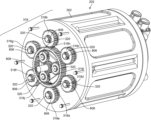
- FIG. 8 B shows an electric motor assembly 202 according to aspects of the disclosure.
- motor assembly 202 can include clutches 806 to mechanically engage and disengage motors 322 from adjacent gears 318 b - 318 g (and 318 h - 318 j if motor assembly 202 includes motors 322 associated with gears 318 h - 318 j ).
- each of clutches 806 can selectively secure an adjacent gear 318 relative to a shaft 320 . When the clutch 806 is engaged, the adjacent gear 318 is secured relative to shaft 320 . When the clutch 806 is disengaged, the adjacent gear 318 can rotate freely relative to shaft 320 .
- Clutches 806 can include a variety of types of clutches, including but not limited to hydraulic/pneumatic clutches, electromagnetic clutches, and sprag clutches.
- hydraulic/pneumatic clutches can include hydraulically or pneumatically operated clutch packs, as described with respect to FIGS. 9 A- 9 B .
- clutches 806 can each include a hydraulically or pneumatically operated clutch pack.
- clutches 806 can be electromagnetic clutches.
- clutches 806 can be sprag clutches.
- clutches 806 can be implemented with gears 318 b - 318 g shown in FIGS. 3 B- 3 C .
- FIG. 8 B shows clutches 806 implemented with all gears 318 b - 318 g
- clutches 806 can be implemented with only a subset of gears 318 b - 318 g .
- a clutch 806 can be implemented with gear 318 a to allow gear 318 a to selectively free spin on shaft 808 , for example, if motor 322 a is not activated.
- motors 322 b - 322 g coupled to gears 318 b - 318 g can be induction motors. This can eliminate problems otherwise caused by back EMF produced by spinning permanent magnets within motors 322 b - 322 g.
- FIGS. 9 A- 9 B show an example clutch 806 for use with a gear 318 according to aspects of the disclosure.
- Clutch 806 shown in FIGS. 9 A- 9 B can include a hydraulically or pneumatically operated clutch pack.
- Clutch 806 shown in FIGS. 9 A- 9 B is exemplary and is not intended to limit clutches 806 described herein to any particular type of clutch.
- a clutch 806 can include a hub 902 secured relative to shaft 320 via key 904 , which is situated in a keyway formed by shaft 320 and hub 902 .
- Clutch 806 can also include a drive disk 906 coupled to hub 902 .
- Drive disk 906 can be secured relative to hub 902 (e.g., via gear teeth) and can rotate with shaft 320 and hub 902 .
- Clutch 806 can also include a friction disk 908 coupled to gear 318 .
- Friction disk 908 can be secured relative to gear 318 via protrusions 910 , which fit into slots 912 of gear 318 or another component statically coupled to gear 318 .
- Clutch 806 can be actuated such that drive disk 906 and friction disk 908 are selectively pressed against one another, causing static friction between drive disk 906 and friction disk 908 to secure gear 318 relative to shaft 320 via friction disk 908 , drive disk 906 , and hub 902 .
- clutch 806 can include a plurality of drive disks 906 and a plurality of friction disks 908 .
- Drive disks 906 and friction disks 908 can form a clutch pack.
- the clutch pack can be operated via an inlet 914 which can receive a gas or liquid.
- the gas can be pressurized air and/or other gases
- the liquid can be pressurized water or oil.
- Inlet 914 can be positioned on a support 916 , which can be a hollow cylinder or block through which shaft 320 runs.
- Support 916 can be statically coupled to main housing 302 , in some cases via support plate 314 , such that support 916 does not rotate relative to main housing 302 .
- a control valve 918 can control the release of a pressurized gas or liquid into inlet 914 .
- a pressurized gas or liquid released into inlet 914 can force drive disks 906 and friction disks 908 to contract along the axis of shaft 320 , causing them to lock together to transmit a torque between shaft 320 and gear 318 .
- FIG. 10 shows a drive system 1000 according to aspects of the disclosure.
- Drive system 1000 can include energy storage system 104 , control system 402 , and power demand system as described with respect to FIGS. 4 - 5 .
- Drive system 1000 can include motor assembly 202 as described with respect to FIGS. 3 A- 3 C or FIGS. 8 A- 9 B .
- control system 402 can additionally include controllers 1010 to control respective clutches 806 .
- controllers 1010 can include electrically operated control valves.
- controllers 1010 can include control valves 918 of each clutch 806 , which can be electrically operated.
- the control valves 918 can receive signals from one or more computer processors of control system 402 instructing the control valves 918 to open or close, or otherwise regulate the pressure of a fluid passing through control valves 918 .
- control system 402 can be configured to: activate and deactivate one or more motors 322 based on a torque need received from power demand system 406 such that a number of simultaneously activated motors 322 depends on the torque need; and mechanically engage or disengage, by operating a clutch 806 , an activated or deactivated adjacent motor 322 to or from an adjacent gear 318 in response to the activated or deactivated adjacent motor 322 having been activated or deactivated, respectively.
- control system 402 can be configured to: mechanically engage and disengage one or more adjacent electric motors 322 to and from one or more adjacent gears 318 based on a torque need received from power demand system 406 such that a number of simultaneously mechanically engaged motors 322 depends on the torque need; and activate or deactivate a mechanically engaged or disengaged adjacent motor 322 in response to the mechanically engaged or disengaged adjacent motor 322 having been mechanically engaged or disengaged, respectively.
- control system 402 can be configured to send signals to an adjacent motor 322 and its associated clutch 806 simultaneously to both activate or deactivate the adjacent motor 322 and mechanically engage or disengage the adjacent motor 322 from an adjacent gear 318 , respectively.
- control system 402 can be configured to mechanically disengage an adjacent motor 322 from an adjacent gear 318 based on a torque need, deactivate the adjacent motor 322 , reactivate the adjacent motor 322 based on a change in the torque need, and then mechanically reengage the adjacent motor 322 to the adjacent gear 318 .
- control system 402 can be configured to deactivate an adjacent motor 322 based on a torque need, mechanically disengage the adjacent motor 322 from an adjacent gear 318 , reactivate the adjacent motor 322 based on a change in the torque need, and then mechanically reengage the adjacent motor 322 to the adjacent gear 318 .
- control system 402 may be configured to mechanically engage or disengage an adjacent electric motor 322 to or from an adjacent gear 318 in conjunction with the adjacent electric motor 322 being activated or deactivated, respectively, using a variety of methods.
- adjacent motors 322 can be both electrically and mechanically disengaged when they are not required to meet a torque need, and/or when their operation decreases the efficiency of motor assembly 202 in producing an output torque at a given RPM.
- Mechanical disengagement reduces or avoids inefficiencies caused by back EMF produced by spinning deactivated motors 322 . Additionally, mechanical degradation of internal motor components can be reduced or avoided.
- control system 402 can be configured to seamlessly reintegrate a previously deactivated and mechanically disengaged adjacent motor 322 with gear assembly 316 .
- control system 402 can be configured to activate the adjacent motor 322 and control, via a controller 404 , the rotational velocity of its shaft 320 to match the rotational velocity of the adjacent gear 318 coupled to its shaft 320 and rotating within gear assembly 316 (but disengaged by the previous operation of an associated clutch 806 ).
- control system 402 can be configured to engage the associated clutch 806 to secure the adjacent gear 318 relative to shaft 320 .
- Control system 402 can be configured as described herein using any known method of computer programming.
- control system 402 can include one or more computer processors (e.g., one or more MPUs, MCUs, and/or SoCs) and memory having software instructions stored thereon.
- processors e.g., one or more MPUs, MCUs, and/or SoCs
- memory having software instructions stored thereon.
- the one or more computer processors can be communicatively coupled to the memory and can be configured to perform operations specified in the software instructions, for example: receiving a torque need from power demand system 406 , calculating a required and/or maximally efficient number of motors 322 to meet the torque need as described herein, selecting motors 322 to activate/deactivate and mechanically engage/disengage, and sending instructions via controllers 404 / 1010 to the selected motors 322 and their associated clutches 806 to perform activation/deactivation and mechanical engagement/disengagement.
- the memory of control system 402 can include dynamic random access memory (DRAM), low-power dynamic random access memory (LPDRAM), NOR flash memory, NAND flash memory, embedded MultiMediaCard (eMMC), universal flash storage (UFS), and/or non-volatile memory express (NVMe) memory.
- DRAM dynamic random access memory
- LPDRAM low-power dynamic random access memory
- NOR flash memory NAND flash memory
- eMMC embedded MultiMediaCard
- UFS universal flash storage
- NVMe non-volatile memory express
- FIG. 11 shows a drive system 1100 according to aspects of the disclosure.
- FIG. 11 shows single controllers 404 and 1010 being used for multiple motors 322 and clutches 806 , analogous to FIG. 5 .
- a single controller 404 can be used to control two adjacent motors 322
- a single controller 1010 can be used to control two clutches 806 . This can be advantageous for activating/deactivating and mechanically engaging/disengaging adjacent motors 322 and associated clutches 806 in pairs to maintain mechanical balance within gear assembly 316 , as discussed herein.
- the configurations of drive systems 1000 and 1100 shown in FIGS. 10 - 11 are not intended to limit the specific number of adjacent motors 322 that a single controller 404 controls, or the number of clutches 806 that a single controller 1010 controls.
- a single controller 404 can control any number 1, . . . , n of adjacent motors 322 intended to be operated together (i.e., driven at the same speed and deactivated/activated simultaneously) and a single controller 1010 can control any number 1, . . . , n of clutches 806 intended to be operated together (i.e., engaged/disengaged simultaneously), where n is a positive integer.
- a hybrid of the drive systems 1000 and 1100 of FIGS. 10 - 11 is contemplated, in which a single controller 404 is used to control two adjacent motors 322 , but two separate controllers 1010 are used to control clutches 806 associated with the same two adjacent motors 322 .
- motor assembly 202 described with respect to FIGS. 3 A- 3 C or FIGS. 8 B- 11 can implement a novel resolver configuration.
- a resolver is a device that measures the angular position and angular speed of a motor 322 's shaft 320 .
- the data produced by the resolver is used in the control of the motor 322 , since a motor controller can implement data on current operating conditions to accurately adjust torque and/or RPM.
- each motor 322 requires a separate resolver.
- the novel resolver configuration can include a single resolver used for multiple motors 322 .
- this can be accomplished, for example, by using a single resolver for multiple adjacent motors 322 b - 322 g that are in sync (i.e., their associated shafts 320 rotate at the same speed and are simultaneously at the same angular displacement with respect to an initial angular position).
- mechanically disengaged motors 322 can fall out of sync with other mechanically engaged motors 322 .
- motor assembly 202 including clutches 806 can still include a single resolver per multiple motors 322 .
- motor assembly 202 can include a single resolver for a pair of adjacent motors 322 .
- motor assembly 202 can include a single resolver for any number of adjacent motors 322 .
- the use of a single resolver per multiple motors 322 can be achieved by control system 402 performing a resolverless calculation that considers feedback produced by permanent magnets within motors 322 .
- a deactivated adjacent motor 322 When a deactivated adjacent motor 322 is mechanically disengaged from an adjacent gear 318 as described herein, its shaft 320 will continue to rotate at a substantially reduced rate and/or for a short time due to angular momentum of the shaft 320 /adjacent gear 318 and friction between the shaft 320 and the adjacent gear 318 . As the shaft 320 rotates, the permanent magnets of the adjacent motor 322 's rotor will produce back EMF.
- control system 402 can receive this back EMF and calculate, based on data and/or the waveform related to the back EMF, how much the shaft 320 has rotated since going out of sync with another adjacent motor 322 that is coupled to a resolver. Control system 402 can use the results of this calculation, in association with data from the resolver coupled to the other adjacent motor 322 , to obtain shaft angular position and angular speed data necessary to control both adjacent motors 322 . In aspects, control system 402 can do this for any number of adjacent motors 322 , using a single resolver coupled to one of the adjacent motors 322 .
- FIG. 12 shows an exemplary computer system 1200 by which aspects, or portions thereof, can be implemented as computer-readable code, according to some aspects.
- aspects of the processes discussed herein can be implemented by computer system 1200 using hardware, software, firmware, tangible computer readable media having instructions stored thereon, or a combination thereof and can be implemented by one or more computer systems or other processing systems.
- programmable logic can execute on a commercially available processing platform or a special purpose device.
- programmable logic can execute on a commercially available processing platform or a special purpose device.
- computer system configurations including multi-core multiprocessor systems, minicomputers, and mainframe computers, computer linked or clustered with distributed functions, as well as pervasive or miniature computers that can be embedded into virtually any device.
- processor devices can be a single processor, a plurality of processors, or combinations thereof.
- processor devices can have one or more processor “cores.”
- Processor device 1204 can be a special purpose or a general-purpose processor device. As will be appreciated by persons skilled in the relevant art, processor device 1204 can also be a single processor in a multi-core/multiprocessor system, such system operating alone, or in a cluster of computing devices operating in a cluster or server farm. Processor device 1204 is connected to a communication infrastructure 1206 , for example, a bus, message queue, network, or multi-core message-passing scheme.
- Computer system 1200 also comprises a main memory 1208 , for example, random access memory (RAM), and can also comprise a secondary memory 1210 .
- Secondary memory 1210 can comprise, for example, a hard disk drive 1212 , or removable storage drive 1214 .
- Removable storage drive 1214 can comprise a floppy disk drive, a magnetic tape drive, an optical disk drive, a flash memory, a Universal Serial Bus (USB) drive, or the like.
- the removable storage drive 1214 reads from and/or writes to a removable storage unit 1218 in a well-known manner.
- Removable storage unit 1218 can comprise a floppy disk, magnetic tape, optical disk, etc. which is read by and written to by removable storage drive 1214 .
- removable storage unit 1218 comprises a computer usable storage medium having stored therein computer software and/or data.
- Computer system 1200 (optionally) comprises a display interface 1202 (which can comprise input and output devices such as keyboards, touchscreens, buttons etc.) that forwards graphics, text, and other data from communication infrastructure 1206 (or from a frame buffer not shown) for display on a display unit 1203 .
- display interface 1202 which can comprise input and output devices such as keyboards, touchscreens, buttons etc.
- secondary memory 1210 can comprise other similar means for allowing computer programs or other instructions to be loaded into computer system 1200 .
- Such means can comprise, for example, a removable storage unit 1222 and an interface 1220 .
- Examples of such means can comprise a program cartridge and cartridge interface (such as that found in video game devices), a removable memory chip (such as an EPROM, or PROM) and associated socket, and other removable storage units 1222 and interfaces 1220 which allow software and data to be transferred from the removable storage unit 1222 to computer system 1200 .
- Computer system 1200 can also comprise a communications interface 1224 .
- Communications interface 1224 allows software and data to be transferred between computer system 1200 and external devices.
- Communications interface 1224 can comprise a modem, a network interface (such as an Ethernet card), a communication port, a PCMCIA slot and card, or the like.
- Software and data transferred via communications interface 1224 can be in the form of signals, which can be electronic, electromagnetic, optical, or other signals capable of being received by communications interface 1224 . These signals can be provided to communications interface 1224 via a communications path 1226 .
- Communications path 1226 carries signals and can be implemented using wire or cable, fiber optics, a phone line, a cellular phone link, an RF link or other communication channels.
- Computer program medium and “computer usable medium” are used to generally refer to media such as removable storage unit 1218 , removable storage unit 1222 , and a hard disk installed in hard disk drive 1212 .
- Computer program medium and computer usable medium can also refer to memories, such as main memory 1208 and secondary memory 1210 , which can be memory semiconductors (for example, DRAMs, etc.).
- Computer programs are stored in main memory 1208 and/or secondary memory 1210 . Computer programs can also be received via communications interface 1224 . Such computer programs, when executed, enable computer system 1200 to implement the aspects as discussed herein. In particular, the computer programs, when executed, enable processor device 1204 to implement the processes of the aspects discussed here. Accordingly, such computer programs represent controllers of the computer system 1200 . Where the aspects are implemented using software, the software can be stored in a computer program product and loaded into computer system 1200 using removable storage drive 1214 , interface 1220 , and hard disk drive 1212 , or communications interface 1224 .
- aspects described herein also can be directed to computer program products comprising software stored on any computer useable medium. Such software, when executed in one or more data processing device, causes a data processing device(s) to operate as described herein. Aspects described herein can employ any computer useable or readable medium. Examples of computer useable mediums comprise, but are not limited to, primary storage devices (for example, any type of random access memory), secondary storage devices (for example, hard drives, floppy disks, CD ROMS, ZIP disks, tapes, magnetic storage devices, and optical storage devices, MEMS, nanotechnological storage device, etc.).
- primary storage devices for example, any type of random access memory
- secondary storage devices for example, hard drives, floppy disks, CD ROMS, ZIP disks, tapes, magnetic storage devices, and optical storage devices, MEMS, nanotechnological storage device, etc.
- the term “about” or “substantially” or “approximately” as used herein means the value of a given quantity that can vary based on a particular technology. Based on the particular technology, the term “about” or “substantially” or “approximately” can indicate a value of a given quantity that varies within, for example, 0.1-10% of the value (e.g., ⁇ 0.1%, ⁇ 1%, ⁇ 2%, ⁇ 5%, or ⁇ 10% of the value).
Landscapes
- Engineering & Computer Science (AREA)
- Power Engineering (AREA)
- Mechanical Engineering (AREA)
- General Engineering & Computer Science (AREA)
- Transportation (AREA)
- Chemical & Material Sciences (AREA)
- Combustion & Propulsion (AREA)
- Life Sciences & Earth Sciences (AREA)
- Sustainable Development (AREA)
- Sustainable Energy (AREA)
- Connection Of Motors, Electrical Generators, Mechanical Devices, And The Like (AREA)
- Electric Propulsion And Braking For Vehicles (AREA)
Abstract
An electric motor assembly is disclosed. The electric motor assembly can include a plurality of electric motors coupled to a common gear assembly. Individual motors within the electric motor assembly can be dynamically controlled to increase motor efficiency at a given torque and RPM output.
Description
This application is a continuation-in-part of U.S. patent application Ser. No. 18/451,745, filed Aug. 17, 2023 and titled “Modular Electric Motor Assembly,” the disclosure of which is incorporated by reference herein in its entirety.
Aspects relate to electric motors and implementations within an axle of an electric vehicle (EV).
The move towards clean energy is prompting interest, research, and development in the area of EVs, and specifically, systems used to propel EVs. Electric drive systems that can match or exceed the performance of internal combustion (IC) engines are critical to the success and adoption of EVs. EVs require electric drive systems that are energy efficient and can be produced and repaired in a cost efficient manner. In particular, the efficiency of electric drive systems is crucial for enabling EVs to travel for long distances without the need for the EVs' batteries to be recharged. Electric drive systems can implement electric motor assemblies to supply the torque and rotational frequency needs of EVs. Conventional electric motor assemblies typically consist of a single electric motor driving a gear set.
Conventional electric motor assemblies used in EVs suffer from several shortcomings. First, conventional electric motor assemblies are expensive to produce, implement, and repair. The peak power rating of electric motors used in EVs can exceed 400 kW, depending on the weight and use of the EV. Producing or purchasing electric motors of such size can be expensive. Additionally, electronic components compatible with large motors can be more rare and expensive compared to those compatible with smaller motors, leading to higher costs for implementing the electric motor within an EV. Further, if a component of the motor fails, the entire motor may need to be replaced. Even if the entire motor does not need to be replaced, the size of the motor may require handling by multiple technicians during repair.
Second, conventional electric motor assemblies have upper RPM operational limits based on the centrifugal forces that are applied to the rotor assemblies. The centrifugal force is directly related to the diameter and mass of the rotating assembly. This effectively limits the power-to-weight ratio because power is directly related to the operating RPM (output power=output torque×RPM). The upper operational speed can be increased by employing exotic materials but this comes at a cost.
Third, conventional electric motor assemblies do not have operational redundancy. Failure of the electric motor in a conventional electric motor assembly typically results in the loss of function of the entirety or large portions of the electric drive system, making the system inoperable.
Fourth, conventional electric motor assemblies often suffer from a significant difference between peak and continuous power rating. The power the electric motor can produce continuously is significantly less than the power the electric motor can produce instantaneously, due to overheating of the stator assembly (magnets) when the motor is run at peak power for an extended time.
Fifth, conventional electric motor assemblies are not versatile—the torque and power are locked in to the design. Thus, a conventional electric motor assembly that is built for one EV cannot be easily modified to work with other EVs without significant expense or reconfiguration. Further, a conventional electric motor assembly that is built for a particular use environment cannot be easily modified for optimal use in another environment posing different torque needs without significant expense or reconfiguration.
Sixth, conventional electric motor assemblies are not dynamically configurable (i.e., they cannot be adapted in real-time to be better suited to meet a particular torque demand). The electric motor in a conventional electric motor assembly is typically chosen to meet the maximum torque and power needs of a device (e.g., an EV) implementing the electric motor assembly. However, conventional electric motors operate at varying efficiencies depending on torque and RPM, with efficiency typically declining at torques that are a small percentage of a motor's continuous output torque (i.e., the torque the electric motor is capable of producing indefinitely without causing overheating, given a particular RPM). This is especially true at high RPM. The efficiency of a conventional electric motor assembly implementing a single electric motor will therefore vary significantly depending on the torque and RPM demand placed on the electric motor. Conventional electric motor assemblies do not have a means of configuring the electric motor assembly in real-time to more efficiently provide the torque/power need. Accordingly, EV's implementing conventional electric motor assemblies will run less than peak efficiency at many operating points which results in decreased range for a given battery capacity.
Seventh, conventional drivelines typically include multiple stages of gear reduction between an electric motor and an axle. This can increase the complexity and number of components along the driveline between the electric motor and the axle.
Eighth, conventional permanent magnet electric motor assemblies and control systems often implement field weakening to achieve higher RPMs. For an electric motor assembly implemented in an EV, field weakening can be required at high vehicle speeds. However, field weakening introduces losses and increases heat generation, and can reduce the overall efficiency of a drive system.
Thus, improved electric motor assemblies are needed to overcome one or more of the aforementioned shortcomings and to provide improved and more adaptable electric motor assemblies.
The accompanying drawings, which are incorporated herein and form a part of the specification, illustrate aspects of the present disclosure and, together with the description, further serve to explain the principles of the disclosure and to enable a person skilled in the pertinent art to make and use the disclosure.
Aspects disclosed herein provide a novel electric motor assembly. The electric motor assembly provides a novel construction over conventional electric motor assemblies, as will be described. This construction may provide several benefits.
First, it allows the electric motor assembly to potentially be less expensive to produce, implement, and repair. For example, the use of a plurality of smaller electric motors in place of a single, larger electric motor can allow for less expensive motors to be produced and/or purchased at higher volumes, reducing production and/or purchasing costs. Further, a wider variety of less expensive power electronic components are available for use with smaller electric motors, reducing costs of implementing electric motors within the electric motor assembly/electric drive system. If a motor within the assembly fails, it can be replaced at a cheaper cost. Additionally, the smaller size of the motors allows a single technician to handle and repair the motor assembly.
Second, the electric motor assembly can have higher power-to-weight ratios, due to the smaller size of the electric motors implemented within the electric motor assembly (see discussion above regarding operating RPM). The smaller diameters of the motor rotors used in the electric motor assembly can enable the electric motors to operate at higher RPM and generate more power for a given amount of magnetics (materials/mass) compared to a larger motor, while having approximately the same torque-to-weight ratio as the larger motor. Accordingly, a plurality of smaller motors can collectively provide the same power output as a single, larger motor while potentially weighing less than the larger motor.
Third, the electric motor assembly can have operational redundancy. Failure of a single electric motor of a plurality of electric motors does not necessarily result in the loss of function of the entire electric motor assembly, since the remaining electric motors of the plurality of electric motors can continue to operate. Thus, the operability of the electric drive system can be maintained through a motor failure.
Fourth, the difference between the peak and continuous power rating of the electric motor assembly can be smaller than for a conventional electric motor assembly. Given the same output power, a plurality of smaller electric motors produces less heat buildup than a single, larger electric motor. This is at least because the plurality of electric motors has a larger surface area, allowing for quicker dissipation of heat into surrounding materials (e.g., a housing, air, etc.).
Fifth, the electric motor assembly can be versatile. The use of a plurality of smaller electric motors in place of a single, larger electric motor can provide a single component that can be used in multiple EVs or types of EVs. For example, one or more of the plurality of electric motors can be removed based on the torque needs of the type of EV (e.g., an electric motorcycle can implement an electric motor assembly with fewer motors installed than an electric truck). Further, one or more of the plurality of electric motors can be removed based on the torque needs associated with a use environment (e.g., an electric car that operates primarily in a mountainous area can implement an electric motor assembly with more motors installed than an electric car that operates primarily in a flat region). The electric motor assembly can be easily reconfigured depending on the type and/or use environment of an EV since the electric motor assembly is designed to accommodate the attachment, detachment, and omission of individual electric motors.
Sixth, the electric motor assembly can be dynamically configurable (i.e., it can be adapted in real-time to be better suited to meet a particular torque demand). Conventional electric motors operate at varying efficiencies depending on torque and RPM, with efficiency typically declining at torques that are a small percentage of the motor's continuous output torque, particularly at high RPM. Accordingly, in an electric motor assembly in which a plurality of smaller motors replace a single, larger motor, the continuous and peak output torque of the electric motor assembly at a given RPM can be adjusted by selectively activating or deactivating one or more motors. Therefore, the electric motor assembly's output torque as a percentage of the continuous output torque of its activated motors can be dynamically adjusted to ensure that the output torque is achieved at a higher efficiency. Additionally, since smaller motors can produce higher RPM more efficiently, as noted above, the efficiency of the motor assembly at low loads and high RPM can be improved. Operation at low loads and high RPM is an inefficient operating domain for an electric motor assembly implementing a single, large motor.
Seventh, the electric motor assembly can provide for gear reduction as part of the mechanical integration of a plurality of electric motors. For example, an output gear (coupled to an output shaft configured to transmit a torque to an external component) of the electric motor assembly can have more teeth than adjacent gears driven by electric motors. This can cause gear reduction between the adjacent gears and the output gear, eliminating at least one stage of gear reduction on a driveline between the electric motor assembly and an axle. This can reduce the complexity and number of components along the driveline between the electric motor assembly and the axle.
Eighth, because a central electric motor can be at a lower gear ratio relative to peripheral motors, the central electric motor coupled to the output gear need not be in field weakening at high vehicle speeds when the electric motor assembly is implemented in an EV. Instead, as compared to an electric motor of a conventional EV, the electric motor coupled to the output gear can output a lower RPM to achieve the same axle RPMs as the conventional EV. This is because a stage of gear reduction can occur within the electric motor assembly before the output gear rather than along the drivetrain between the electric motor coupled to the output gear and the axle. Accordingly, losses, increased heat generation, and associated reductions in efficiency of a drive system related to field weakening can be avoided. The efficiency and range of an EV can be increased by implementing the electric motor assembly of the present disclosure, particularly at high speeds.
In aspects, an electric motor assembly can include at least: a housing including a plurality of cavities; a gear assembly, the gear assembly including: an output gear coupled to an output shaft, and adjacent gears coupled to the output gear; the electric motor assembly further including: a plurality of electric motors at least partially within the plurality of cavities, the plurality of electric motors including: a first electric motor coupled to the output gear, and adjacent electric motors coupled to the adjacent gears; the electric motor assembly further including: a controller to activate and deactivate one or a pair of motors of the plurality of electric motors.
In aspects, an electric drive system can include at least: an electric motor assembly, the electric motor assembly including: a gear assembly including an output gear and one or more gears coupled to the output gear, the output gear being coupled to an output shaft, and a plurality of electric motors, each of the plurality of electric motors coupled to a gear of the gear assembly; the electric drive system further including: a control system to activate and deactivate one or more motors of the plurality of electric motors; an energy storage system coupled to the electric motor assembly; and a power demand system to communicate a torque need to the control system to activate or deactivate the one or more motors.
In aspects, a method can include at least: installing an electric motor assembly in an electric drive unit, the electric motor assembly including: a housing including a plurality of cavities; a gear assembly, the gear assembly including: an output gear coupled to an output shaft, and adjacent gears coupled to the output gear; the electric motor assembly further including: a plurality of electric motors at least partially within the plurality of cavities, the plurality of electric motors including: a first electric motor coupled to the output gear, and adjacent electric motors coupled to the adjacent gears; the electric motor assembly further including: a controller to activate and deactivate one or a pair of motors of the plurality of electric motors.
In aspects, a vehicle can include at least: an electric motor assembly, the electric motor assembly including: a housing including a plurality of cavities; a gear assembly, the gear assembly including: an output gear coupled to an output shaft, and adjacent gears coupled to the output gear; the electric motor assembly further including: a plurality of electric motors at least partially within the plurality of cavities, the plurality of electric motors including: a first electric motor coupled to the output gear, and adjacent electric motors coupled to the adjacent gears; the electric motor assembly further including: a controller to activate and deactivate one or a pair of motors of the plurality of electric motors.
In aspects, an electric motor assembly can include at least: a housing including a plurality of cavities; a gear assembly including: a sun gear, planetary gears rotatably fixed relative to the housing and coupled to the sun gear, a ring gear comprising gear teeth on both an inner and outer side, the planetary gears enmeshed with the gear teeth on the inner side of the ring gear, and outer adjacent gears enmeshed with the gear teeth on the outer side of the ring gear; the electric motor assembly further including: a plurality of electric motors at least partially within the plurality of cavities, the plurality of electric motors including: a first electric motor coupled to the sun gear, and outer adjacent electric motors coupled to the outer adjacent gears; the electric motor assembly further including: a controller to activate and deactivate one or more motors of the plurality of electric motors.
In aspects, a vehicle can include at least: an electric drive system including: an electric motor assembly including: a gear assembly including a ring gear and a plurality of adjacent gears coupled to the ring gear, the ring gear being coupled to a drive plate to transmit torque to an external component, the plurality of adjacent gears including inner adjacent gears coupled to the ring gear inside a perimeter of the ring gear and one or more outer adjacent gears coupled to the ring gear outside a perimeter of the ring gear, the electric motor assembly further including a plurality of electric motors, each of the plurality of electric motors coupled to a gear of the gear assembly; the electric drive system further including: a control system to activate and deactivate one or more motors of the plurality of electric motors; an energy storage system coupled to the electric motor assembly; and a power demand system to communicate a torque need to the control system to activate or deactivate the one or more motors, wherein the control system is configured to activate and deactivate the one or more motors based on the torque need such that a number of simultaneously activated motors of the plurality of electric motors depends on the torque need.
In aspects, an electric motor assembly can include at least: a housing including a plurality of cavities; a gear assembly including: an output gear coupled to a rotatable output shaft configured to transfer a torque to an external component, and a plurality of adjacent gears coupled to the output gear and to a plurality of rotatable adjacent shafts; the electric motor assembly further including: a plurality of electric motors at least partially within the plurality of cavities, each of the plurality of electric motors coupled to an adjacent gear of the plurality of adjacent gears via a rotatable adjacent shaft of the plurality of rotatable adjacent shafts; a controller to activate and deactivate one or more motors of the plurality of electric motors; and a plurality of clutches to mechanically engage and disengage the plurality of electric motors from the plurality of adjacent gears, each of the plurality of clutches selectively securing an adjacent gear of the plurality of adjacent gears relative to a rotatable adjacent shaft of the plurality of rotatable adjacent shafts.
In aspects, a vehicle can include at least: an electric drive system including: an electric motor assembly including: a gear assembly including an output gear and one or more adjacent gears coupled to the output gear, the output gear being coupled to a rotatable output shaft and the one or more adjacent gears being coupled to one or more rotatable adjacent shafts, the electric motor assembly further including: a plurality of electric motors including: one or more adjacent electric motors, each of the one or more adjacent electric motors coupled to an adjacent gear of the one or more adjacent gears via a rotatable adjacent shaft of the one or more rotatable adjacent shafts, the electric motor assembly further including: one or more clutches to mechanically engage and disengage the one or more adjacent electric motors from the one or more adjacent gears, each of the one or more clutches selectively securing an adjacent gear of the one or more adjacent gears relative to a rotatable adjacent shaft of the one or more rotatable adjacent shafts; the electric drive system further including: a control system to activate and deactivate one or more motors of the plurality of electric motors and to operate the one or more clutches; an energy storage system coupled to the electric motor assembly; and a power demand system to communicate a torque need to the control system to activate or deactivate the one or more motors, the control system being configured to: activate and deactivate the one or more motors based on the torque need such that a number of simultaneously activated motors of the plurality of electric motors depends on the torque need, and mechanically disengage, by operating a clutch of the one or more clutches, a deactivated adjacent electric motor from an adjacent gear in conjunction with the deactivated adjacent electric motor being deactivated.
The following aspects are described in sufficient detail to enable those skilled in the art to make and use the disclosure. It is to be understood that other aspects are evident based on the present disclosure, and that system, process, or mechanical changes may be made without departing from the scope of an aspect of the present disclosure.
In the following description, numerous specific details are given to provide a thorough understanding of the disclosure. However, it will be apparent that the disclosure may be practiced without these specific details. In order to avoid obscuring aspects of the present disclosure, some configurations and process steps are not disclosed in detail.
The drawings showing aspects of the system and its components are semi-diagrammatic, and not to scale. Some of the dimensions are for the clarity of presentation and are shown exaggerated in the drawing figures. Similarly, although the views in the drawings are for case of description and generally show similar orientations, this depiction in the figures is arbitrary for the most part. Generally, the disclosure may be operated in any orientation.
While FIGS. 2A-2B show motor assembly 202 in a drive unit 102 for use in an EV, motor assembly 202 can be used in any device requiring the production of a torque. Further, motor assembly 202 can be interchangeable with a conventional motor assembly (i.e., a conventional motor assembly can be attached to drive unit 102 in place of motor assembly 202). However, unlike conventional motor assemblies, motor assembly 202 can include multiple motors, as discussed with respect to FIGS. 3A-3B .
In aspects, gear 318 a can be a central gear (i.e., arranged between at least two of gears 318 b-318 g). In such aspects, at least two of gears 318 b-318 g can be peripheral gears arranged around gear 318 a.
While FIG. 3B shows six gears 318 b-318 g coupled to gear 318 a, this is exemplary and gear assembly 316 can include fewer or additional adjacent gears, such as 1, . . . , n adjacent gears, where n is a positive integer. Further, the number of adjacent gears can be an even number. Particularly, the adjacent gears can be pairs of gears, each gear of a pair of gears arranged on opposite sides of gear 318 a, for example, like gear 318 b and gear 318 e in FIG. 3B . The reference to gears 318 b-318 g in this disclosure should be understood to include aspects in which there are fewer or more than six adjacent gears.
While FIG. 3B shows six motors 322 b-322 g coupled to six gears 318 b-318 g that are in turn coupled to gear 318 a, this is exemplary and drive assembly 312 can include fewer or additional adjacent motors, such as 1, . . . , n adjacent motors, where n is a positive integer. Further, the number of adjacent motors can be an even number. Particularly, the adjacent motors can be pairs of motors, each motor of a pair of motors arranged on opposite sides of motor 322 a, for example, like motor 322 d and motor 322 g. The inclusion of multiple motors 322 b-322 g can increase operational redundancy of motor assembly 202. For example, upon failure of a portion of motors 322, operability of motor assembly 202 can be maintained. The reference to motors 322 b-322 g in this disclosure should be understood to include aspects in which there are fewer or more than six adjacent motors. In aspects, a motor 322 can be coupled to each of gears 318, as shown in FIG. 3B . In other aspects, drive assembly 312 can include a larger number of gears 318 than motors 322.
Motors 322 can be conventional electric motors. For example, motors 322 can each include a stator and a rotor contained within a housing. Additionally, in aspects, the housing of a motor can include at least one coolant channel for a non-direct or direct contact cooling fluid, e.g., a dielectric oil, to flow. Each motor 322 including a cooling system can increase the continuous power rating of motor assembly 202. Additionally or alternatively, housing 307 can include a cooling system for all of motors 322, as described below.
While the principles of the present disclosure are discussed with regard to motors 322 that can be used in an electric vehicle, the principles of the present disclosure can be apply to motors 322 having any specifications. For example, the principles of the present disclosure can apply to motors 322 having any continuous power rating, peak power rating, continuous torque rating, and peak torque rating.
In aspects, motors 322 can be substantially similar. For example, in aspects, motors 322 can have substantially the same continuous power rating, peak power rating, continuous torque rating, and peak torque rating. In other aspects, the specifications of motors 322 can vary among motors 322. For example, in such aspects, motors 322 b-322 g can have substantially the same continuous power rating, peak power rating, continuous torque rating, and peak torque rating while motor 322 a can have a different power rating, peak power rating, continuous torque rating, and/or peak torque rating. In aspects, it may be advantageous to separately configure motor 322 a to have different specifications from motors 322 b-322 g, as motor 322 a can operate alone at low torque needs. Additionally, in such aspects, at least two of motors 322 b-322 g can have different continuous power ratings, peak power ratings, continuous torque ratings, and/or peak torque ratings while motor 322 a can have a different or the same power rating, peak power rating, continuous torque rating, and/or peak torque rating as at least one of motors 322 b-322 g. In aspects in which the specifications of motors can 322 vary among motors 322, the gear ratios of each of gears 318 b-318 g with gear 318 a can be selected based on the specifications of each of motors 322 to optimize the torque and RPM output of motor assembly 202. Further, in such aspects, one or more motors 322 can be activated or deactivated based on a torque need and individual specifications of motors 322 (i.e., to optimize the efficiency of motor assembly 202 at a given torque and RPM output). For example, motors 322 having various continuous torque ratings can provide a means of more precisely adjusting the continuous torque output of an activated combination of motors of motor assembly 202 at a given RPM. This can provide increased control over the percentage of the continuous output torque a required output torque comprises at a given RPM, which can enable motor assembly 202 to more precisely target percentages that correspond to maximum efficiencies.
As shown in FIG. 3B , main housing 302 can include cavities 324, such as cavities 324 a-324 g, to receive motors 322 a-322 g. FIG. 3B shows seven cavities 324 a-324 g corresponding to motors 322 a-322 g. Cavity 324 a can receive motor 322 a coupled to gear 318 a. Cavities 324 b-324 g can be adjacent cavities that receive motors 322 b-322 g (cavities 324 b-324 g are sequentially labeled in a clockwise direction starting with cavity 324 b corresponding to motor 322 b). That cavities 324 b-324 g are adjacent can mean that cavities 324 b-324 g receive motors that are coupled via shafts 320 to gears that are in a common gear assembly with gear 318 a. In aspects, cavity 324 a can be a central cavity (i.e., arranged between at least two of cavities 324 b-324 g). In such aspects, at least two of cavities 324 b-324 g can be peripheral cavities arranged around cavity 324 a.
While FIG. 3B shows six cavities 324 b-324 g receiving six motors 322 b-322 g, this is exemplary and main housing 302 can include fewer or additional adjacent cavities, such as 1, . . . , n adjacent cavities, where n is a positive integer. Further, the number of adjacent cavities can be an even number. Particularly, the adjacent cavities can be pairs of cavities, each cavity of a pair of cavities arranged on opposite sides of cavity 324 a, for example, like cavity 324 b and cavity 324 c. The reference to cavities 324 b-324 g in this disclosure should be understood to include aspects in which there are fewer or more than six adjacent cavities. In aspects, main housing 302 can include a cavity 324 for each motor 322 (i.e., the same number of cavities 324 as motors 322 within motor assembly 202). In other aspects, main housing 302 can include a larger number of cavities 324 than the number of motors 322 included in motor assembly 202. In aspects, cavities 324 can be substantially the same size. In other aspects, cavities 324 can be sized differently, for example, to accommodate different sized motors 322.
A motor 322 inserted into a cavity 324 can be at least partially within the cavity 324. For example, only a part or none of the motor 322 can be visible when the motor is inserted into the cavity 324. Accordingly, motors 322 a-322 g can be at least partially within cavities 324 a-324 g when motor assembly 202 is assembled. In aspects, main housing 302 including cavities 324 can form a unitary structure for receiving motors 322. While FIG. 3B shows main housing 302 having a circular cross section, the cross section main housing 302 can be ovular or polygonal, such as rectangular, hexagonal, octagonal, etc., without interfering with the function of motor assembly 202.
As shown in FIG. 3B , motor assembly 202 can further include a first printed circuit board (PCB) 326. First PCB 326 can include controllers for driving motors 322, as described in more detail below. For example, first PCB 326 can include at least one inverter for controlling motors 322. In aspects, first PCB 326 can include an inverter connected to each of motors 322. First PCB 326 can be positioned between main housing 302 and layer 305 such that it abuts motors 322. Controllers on first PCB 326 can connect to terminals on motors 322. In aspects, motor assembly 202 can include a second PCB 328 including additional components, such as circuitry for receiving and supplying power to motors 322 from connectors 334, described below. In aspects, second PCB 328 can be positioned between layer 305 and second end cap 306. In other aspects, first PCB 326 and second PCB 328 can be combined and can be positioned between main housing 302 and layer 305.
As shown in FIG. 3B , layer 305 can include channels 330. Channels 330 can be cooling channels configured to circulate a cooling fluid. In aspects, the cooling fluid can be a dielectric fluid, for example, a dielectric oil. The cooling fluid can enter and exit channels 330 through nozzles 332. The cooling fluid can contact first PCB 326 and/or second PCB 328 and motors 322 to cool components disposed on first PCB 326 and/or second PCB 328 and components disposed within motors 322. First PCB 326 and/or second PCB 328 being positioned between layer 305/channels 330 and motors 322 can secure the benefit of a single cooling feature (e.g., channels 330 for transporting cooling fluid) being used to cool various electronic components within motor assembly 202.
Additionally, the inclusion of multiple motors 322 within motor assembly 202 can improve the efficiency of motor assembly 202's cooling features. For example, as compared to a single large motor, multiple smaller motors 322 can provide greater access (for cooling) to components within the multiple smaller motors 322 that generate heat (e.g., the rotors and stators), since the components of a smaller motor can be nearer to exterior surfaces of a housing of the smaller motor. Therefore, a cooling fluid (e.g., dielectric oil) can flow nearer to heat-generating components and better absorb and transfer heat out of motor assembly 202.
As shown in FIG. 3B , second end cap 306 can include connectors 334. Connectors 334 can communicatively couple motor assembly 202 to various components or systems within vehicle 100, for example, energy storage system 104 and/or a power demand system as described below.
The size and weight of each of motors 322 can allow a single technician to handle and repair motor assembly 202. For example, in aspects, one of motors 322 can be removed and inspected by a single technician, as it can weigh about 8-12 kg. In comparison, an electric motor with a peak power rating of about 400 kW for use in an EV can weigh 50 kg or more. A technician can open motor assembly 202, remove a gear 318 from a motor 322, detach the motor 322 from support plate 314, and repair or replace the motor 322. Alternatively, the technician can remove or add motors 322 to configure motor assembly 202 to operate in a particular environment (e.g., a flat region requiring less torque and fewer motors 322 within motor assembly 202).
In aspects, power demand system 406 can include one or more computer processors and/or sensors within the device implementing motor assembly 202. For example, power demand system 406 can include one or more microprocessors (MPUs), microcontrollers (MCUs), and/or systems-on-chip (SoCs). Additionally, power demand system can include one or more sensors, for example, an accelerator pedal position sensor, one or more accelerometers and/or force sensors, one or more image sensors, a GPS, etc. The one or more computer processors can be configured to receive outputs of the one or more sensors, calculate a torque need based on the outputs, and communicate the torque need to control system 402. The one or more computer processors can be communicatively coupled to memory of the power demand system 406 and can be configured to perform the above operations, for example, by implementing software instructions stored on the memory. The memory of power demand system 406 can include dynamic random access memory (DRAM), low-power dynamic random access memory (LPDRAM), NOR flash memory, NAND flash memory, embedded MultiMediaCard (eMMC), universal flash storage (UFS), and/or non-volatile memory express (NVMe) memory.
In aspects, control system 402 can be bodily integrated with motor assembly 202, for example, by being integrated into first PCB 326 and/or second PCB 328. In other aspects, control system 402 can be distinct from but communicatively coupled to motor assembly 202, or can be partially bodily integrated with motor assembly 202 and partially distinct from but communicatively coupled to motor assembly 202. Control system 402 can include one or more computer processors (e.g., one or more MPUs, MCUs, and/or SoCs) configured to receive the torque need from power demand system 406 and instruct motor assembly 202 to produce the torque need as an output torque, for example, via one or more motor controllers, as described herein.
Based on the torque need, control system 402 can selectively activate or deactivate one or more motors 322 within motor assembly 202. For example, control system 402 can activate one or motors 322 if the torque need increases, and deactivate one or more motors 322 if the torque need decreases. As shown in FIG. 4 , motor assembly can include any number of motors up to motor 322 n. In aspects, control system 402 can selectively activate, deactivate, and control motors 322 individually. In aspects, control system 402 can selectively activate, deactivate, and control motors 322 in pairs. For example, based on power demand system 406 determining that motor assembly 202 is required to output a decreased torque, control system 402 can deactivate pairs of motors that are arranged on opposite sides of motor 322 a, such as motors 322 b and 322 e shown in FIG. 3B . Activating or deactivating motors in opposing pairs can maintain mechanical balance within motor assembly 202 during operation.
In aspects, activated pairs of motors 322 can be rotated among motors 322 based on motor usage (e.g., total input or output power). For example, in aspects, control system 402 can be configured to track usage of each of motors 322 such that a pairs of motors 322 can deactivated and another pair of motors 322 can be activated based on motor usage. This method can be utilized even if motors 322 are not activated or deactivated in pairs. In this way, control system 402 can maintain approximate equivalency of usage among motors 322. Accordingly, the lifetime of motors 322 can be extended and the frequency of servicing motor assembly 202 to address failure of over-utilized motors can be reduced.
In aspects, control system 402 can activate or deactivate one or more motors 322 to reach a maximally efficient number of motors 322 for outputting the torque need. For example, the maximally efficient number of motors 322 can be a number of motors that causes the torque need to comprise a percentage of the continuous output torque (of the number of active motors 322 collectively) that corresponds to a maximum possible operating efficiency for motor assembly 202. The determination of operating efficiency for specific torque and RPM outputs of an electric motor is discussed below in more detail with respect to FIG. 6 .
In aspects, the maximally efficient number of motors 322 can be calculated by control system 402 based on at least one of a continuous power rating, peak power rating, continuous torque rating, peak torque rating, or service factor of each of motors 322 (e.g., by comparing the torque need to a cumulative continuous or peak torque rating of various numbers of motors 322 and selecting the number that most efficiently produces the torque need). For example, in aspects, the maximally efficient number of motors 322 can be a number of motors 322 that causes the torque need to be between about 60 percent and about 100 percent of the cumulative continuous torque rating of the number of motors 322.
Additionally or alternatively, the maximally efficient number of motors 322 can be calculated by control system 402 based on data on at least one of continuous output torque or peak output torque of motors 322 at a given RPM at which motor assembly 202 is operating (e.g., by comparing the torque need to a cumulative continuous or peak output torque of various numbers of motors 322 and selecting the number that most efficiently produces the torque need, accounting for the variation in continuous output torque caused by changes in RPM output). For example, in aspects, the maximally efficient number of motors 322 can be a number of motors 322 that causes the torque need to be between about 60 percent and about 100 percent of the cumulative continuous output torque of the number of motors 322 at the current RPM output.
Additionally or alternatively, the maximally efficient number of motors 322 can be calculated by control system 402 based on a temperature of individual motors 322 within motor assembly 202 (e.g., the maximally efficient number of motors can be increased if the temperature of a motor 322 rises above a threshold level).
In aspects, the maximally efficient number of motors 322 can be the minimum number of motors 322 required to continuously output the torque need. As noted above, in aspects, this number can depend on RPM output.
In aspects, calculating the maximally efficient number of motors 322 can include calculating a maximally efficient number of pairs of motors 322, such that activating the maximally efficient number of motors 322 does not cause mechanical imbalance by activating an unpaired motor 322.
With reference to FIG. 3B , control system 402 can drive each of motors 322 a-322 g in a direction that contributes to the turning of gear 318 a in a particular direction. For example, in aspects in which gears 318 b-318 g are each directly coupled to gear 318 a, control system 402 can drive each of motors 322 b-322 g in an opposite direction to motor 322 a. For example, control system 402 can drive motors 322 b-322 g clockwise while driving motor 322 a counterclockwise, or vice-versa.
The configuration of FIG. 5 can be advantageous when motors 322 b-322 n are controlled in pairs. For example, the configuration of FIG. 5 can reduce the number of components required while maintaining the functionality of activating or deactivating motors 322 b-322 n in pairs based on the torque need.
The electric motor of FIG. 6 has a continuous power rating of about 150 kW. While the scale and shape of FIG. 6 depends on the specifications of the electric motor (e.g., continuous power rating, peak power rating, etc.), FIG. 6 illustrates the relationship between torque (Nm), speed (RPM), and efficiency for electric motors. In particular, FIG. 6 shows that efficiency decreases at lower loads (i.e., at output torques that represent a smaller percentage of the electric motor's continuous output torque for a given RPM). For example, FIG. 6 shows that at 8,000 RPM, the electric motor operates at an efficiency of about 90% when providing 50 Nm of torque. However, the electric motor operates at an efficiency of about 82% when providing 12 Nm of torque at the same RPM. Using an inverter with an efficiency of 92% at low loads to operate the electric motor therefore yields an overall efficiency of about 75% at 12 Nm of torque and 8,000 RPM. In aspects, this torque and RPM represents the approximate requirements of propelling an EV at 60 MPH on a flat road (e.g., a highway).
However, as noted above, motor assembly 202 can provide a means for dynamically adjusting the peak and continuous output torque at a given RPM. Specifically, the plurality of electric motors of motor assembly 202 can each be activated or deactivated based on a torque needed to achieve a particular RPM. For example, if FIG. 6 represents motor assembly 202 with all motors 322 operating, deactivating one or more motors 322 to reduce the continuous output torque of motor assembly 202 at a given RPM can cause the torque need to comprise a higher percentage of the continuous output torque of motor assembly 202 (i.e., of the continuous output torque of active motors 322 collectively). This can effectively compress the graph of FIG. 6 along the y-axis for motor assembly 202. Accordingly, the efficiency of motor assembly 202 can be improved when providing the torque need. As a result, the range of an EV implementing motor assembly 202 can be increased.
For example, providing 12 Nm of output torque at 8,000 RPM, motor assembly 202 can operate at an efficiency of about 92% when operating with a single motor (e.g., motor 322 a). Using an inverter with an efficiency of 98% at medium loads to operate motor 322 a yields an overall efficiency of about 90%. Motor 322 a by itself can provide a continuous output torque of about 24 Nm at 8,000 RPM, and therefore 12 Nm comprises about 50% of the continuous output torque of motor assembly 202 operating in such a configuration at 8,000 RPM. This is a higher percentage of the continuous output torque of motor assembly 202 than when additional motors 322 are activated, resulting in increased efficiency. This increased efficiency is not only compared to motor assembly 202 with more motors 322 activated; it also represents an increased efficiency as compared to a single, large electric motor having similar specifications as motor assembly 202 with all motors 322 activated, such single, large electric motors being conventionally provided in electric motor assemblies.
In the first case above, an electric motor operating at about 75% overall efficiency would require a battery to provide 13.3 kW of power (not including the 12V parasitic loss and battery loss). Therefore, an 80 kWh battery could provide about 6 hours of operation. At 60 MPH, this corresponds to about 360 miles of range. Motor assembly 202 operating with only motor 322 a activated, yielding an overall efficiency of 90%, would require a battery to provide 11.1 kW of power (not including the 12V parasitic loss and battery loss). Therefore, an 80 kWh battery could provide about 7.2 hours of operation. At 60 MPH, this corresponds to about 435 miles of range, a 20% improvement. Alternatively, a 20% smaller battery would be needed to travel the same range.
While the example of all but motor 322 a of motor assembly 202 being deactivated is provided, it should be understood that similar increases in efficiency can be achieved by activating whatever number of motors 322 corresponds to a maximally efficient configuration for a given torque and RPM output. That is, control system 402 can activate the number of motors 322 that, at the RPM output, causes the output torque to comprise a percentage of the continuous output torque of the active number of motors 322 that corresponds to a maximum possible operating efficiency for motor assembly 202.
Step 702 can include installing an electric motor assembly in an electric drive unit, the electric motor assembly including: a housing including a plurality of cavities; a gear assembly, the gear assembly including: an output gear coupled to an output shaft, and adjacent gears coupled to the output gear; the electric motor assembly further including: a plurality of electric motors at least partially within the plurality of cavities, the plurality of electric motors including: a first electric motor coupled to the output gear, and adjacent electric motors coupled to the adjacent gears; the electric motor assembly further including: a controller to activate and deactivate one or a pair of motors of the plurality of electric motors. In aspects, the housing can be main housing 302. In aspects, the plurality of cavities can be cavities 324 a-324 g. In aspects, the gear assembly can be gear assembly 316. In aspects, the adjacent gears can be gears 318 b-318 g. In aspects, the output gear can be gear 318 a. The adjacent gears can be either directly or indirectly coupled to gear 318 a, as described with respect to FIG. 3B . In aspects, the plurality of electric motors can be motors 322. In aspects, the adjacent electric motors can be motors 322 b-322 g. In aspects, the first electric motor can be motor 322 a. In aspects, the controller can be any one of controllers 404.
In aspects, the electric drive unit of step 702 can be installed on a vehicle. In aspects, the vehicle can be an electric vehicle. In aspects, the vehicle can be vehicle 100.
In aspects, the plurality of cavities of method 700 can include peripheral cavities arranged around a central cavity. In aspects, the peripheral cavities can be cavities 324 b-324 g and the central cavity can be cavity 324 a. In aspects, the adjacent electric motors of method 700 can be an even number of electric motors. In aspects, the electric motor assembly of method 700 can further include a cooling feature configured to simultaneously cool at least one motor of the plurality of electric motors and a printed circuit board (PCB) connected to the at least one motor. In aspects, the cooling feature can be one or more of cooling channels 330 and the PCB can be first PCB 326 and/or second PCB 328. In aspects, method 700 can further include selecting a number of electric motors to be included in the plurality of cavities based on a use environment.
In aspects, the electric motor assembly installed in the electric drive unit of method 700 can be motor assembly 202 described with respect to FIG. 3A-3C or motor assembly 202 described with respect to FIGS. 8A-8B .
In aspects, ring gear 802 can include gear teeth on both an inner side 804 a and outer side 804 b.
In aspects according to FIG. 8A , gear 318 a can be a sun gear. In aspects, gears 318 h-318 j can be planetary gears. In aspects, gears 318 h-318 j can be rotatably fixed relative to main housing 302. That is, gears 318 h-318 j can rotate around the center axis of their associated shafts 320, but do not translate relative to main housing 302 (or housing 307) such that they move around shaft 808. In aspects, shafts 320 supporting gears 318 h-318 j can be fixed to a plate 805 that is secured to support plate 314 (e.g., via screws or bolts). In aspects, gears 318 h-318 j can be coupled to their associated shafts 320 via needle bearings which allow them to rotate on their associated shafts 320. In aspects, associated shafts 320 supporting gears 318 h-318 j can be rotatably coupled relative to plate 805, support plate 314, and/or main housing 302 such that the shafts 320 rotate while gears 318 h-318 j are secured relative to their associated shafts 320.
In aspects, gears 318 h-318 j do not have any associated motors 322. Instead, they free spin to transmit a torque from gear 318 a, which is coupled to motor 322 a, to ring gear 802.
In aspects, gears 318 h-318 j can be coupled, via their associated shafts 320, to additional motors 322 positioned at least partially within additional cavities 324 of main housing 302.
In aspects, gears 318 a and 318 h-318 j can be inner adjacent gears. Gears 318 a and 318 h-318 j can be “inner” adjacent gears in that they can be interior to inner side 804 a of ring gear 802. Inner side 804 a can face toward gear 318 a and shaft 808. Ring gear 802 can be coupled to gears 318 h-318 j. For example, in aspects, gears 318 h-318 j can contact and be enmeshed with inner side 804 a. In aspects, gears 318 h-318 j can be directly coupled to gear 318 a and/or ring gear 802. While FIG. 8A shows three gears 318 h-318 j, in aspects, gear assembly 316 can include any number of gears 318 h-318 j (e.g., planetary gears), for example, two, four, five, or six.
In aspects, gears 318 b-318 g can be outer adjacent gears coupled to ring gear 802. Gears 318 b-318 g can be “outer” adjacent gears in that they can be exterior to outer side 804 b of ring gear 802. Outer side 804 b can face away from gear 318 a and shaft 808. In aspects, gears 318 b-318 g can contact and be enmeshed with outer side 804 b. Collectively, gears 318 a-318 j can be referred to as adjacent gears, since they are in a common gear assembly 316 with ring gear 802 (the output gear).
With respect to the aspects according to FIG. 8A-8B , motor(s) 322 coupled to gears 318 a (and 318 h-318 j, if any), can be referred to as “inner” adjacent motors 322, and motors 322 coupled to gears 318 b-318 g can be referred to as “outer” adjacent motors 322. In aspects, inner adjacent motors 322 can include shafts 320 that lie along axes positioned inside the perimeter of ring gear 802. In aspects, outer adjacent motors 322 can include shafts 320 that lic along axes positioned outside the perimeter of ring gear 802. Collectively, motors 322 coupled to gears 318 a-318 j can be referred to as adjacent motors, as noted herein, since they are coupled to gears that are in a common gear assembly 316 with ring gear 802. In aspects, motor 322 a can still be a central motor and gear 322 a can still be a central gear.
In aspects, the outer adjacent motors 322 can be an even number of motors 322. For example, motor assembly 202 can include two, four, six, eight, 10, 12, or 14, etc., outer adjacent motors 322.
Because of ring gear 802's increased diameter relative to gear 318 a of FIG. 3B , a greater number of outer adjacent motors 322 can be included in motor assembly 202, since there is space for additional motors 322 and outer adjacent gears that are enmeshed with ring gear 802. Accordingly, in aspects, motor assembly 202 includes more than six outer adjacent motors 322.
Additionally, the configuration shown in FIG. 8A allows for multiple gear ratios between inner adjacent gears 318 a, 318 h-318 j and ring gear 802 and between outer adjacent gears 318 b-318 g and ring gear 802. For example, in aspects, an inner adjacent gear (e.g., gear 318 a) can form a first gear ratio with ring gear 802, while an outer adjacent gear can form a second gear ratio with ring gear 802. This can provide multiple layers of configurability for motor assembly 202. Any gear ratio can be selected to ensure that motors 322 will be driven at various speeds to maximize performance and efficiency, achieve gear reduction, avoid field weakening, etc. In aspects, all outer adjacent gears 318 b-318 g can form the same gear ratio with ring gear 802.
In aspects, the first gear ratio can be lower than the second gear ratio. For example, gear 318 a (e.g., a sun gear) can form a gear ratio of 4:1 with ring gear 802 (gear 318 a turns four times for each single turn of ring gear 802), while one or more outer adjacent gears 318 b-318 g can form a gear ratio of 8:1 with ring gear 802 (the outer adjacent gear turns eight times for each single turn of ring gear 802). These are example gear ratios and any values for the first and second gear ratios can be selected. In this example, motor 322 a coupled to gear 318 a will run at half the speed of outer adjacent motors 322 coupled to the one or more outer adjacent gears 318 b-318 g. The first gear ratio being lower than the second gear ratio can avoid or reduce field weakening of motor 322 a, since motor 322 a will run at a reduced speed compared to outer adjacent motors 322. Avoiding or reducing field weakening in motor 322 a can benefit efficiency since, in aspects, motor 322 a may be activated for greater periods of time than other motors 322 of motor assembly 202.
In aspects, motor assembly 202 can include additional ring gears coupled to additional gears, and shafts positioned outside the additional ring gears, coupled to additional motors. For example, in aspects, motor assembly 202 can include an additional ring gear coupled to gears 318 b-318 g on the additional ring gear's inner side and additional gears coupled to the outer side of the additional ring gear. In this way, the continuous and peak output torque of motor assembly 202 can be increased.
Motors 322 of the motor assembly 202 shown in FIG. 8A can be selectively controlled as described with respect to FIGS. 3A-3B and FIGS. 4-5 .
In aspects of motor assembly 202 shown in FIGS. 3A-3C and 8A , deactivated motors 322 can be free-spun due to the engagement of their associated gears 318 with one another (either directly or indirectly). For example, if motor 322 b is deactivated while motor 322 a remains activated, motor 322 b's shaft 320 can remain statically coupled to gear 318 b, which can be rotated by its coupling to gear 318 a. This can rotate motor 322 b's shaft 320. Because motors 322 can include permanent magnets in their rotors, this can produce substantial back electric and magnetic fields (back EMF)—which can cause motor assembly 202 to require field weakening to produce high RPMs—and can cause mechanical degradation of internal motor components caused by continual spinning. Additionally the required torque to turn deactivated motors 322 can cause losses.
While shown on aspects of motor assembly 202 including gears 318 h-318 j and ring gear 802, clutches 806 can be implemented with gears 318 b-318 g shown in FIGS. 3B-3C . Further, while FIG. 8B shows clutches 806 implemented with all gears 318 b-318 g, in aspects, clutches 806 can be implemented with only a subset of gears 318 b-318 g. Additionally, in aspects, a clutch 806 can be implemented with gear 318 a to allow gear 318 a to selectively free spin on shaft 808, for example, if motor 322 a is not activated.
In aspects, rather than implementing clutches 806 with gears 318 b-318 g, motors 322 b-322 g coupled to gears 318 b-318 g can be induction motors. This can eliminate problems otherwise caused by back EMF produced by spinning permanent magnets within motors 322 b-322 g.
As shown in FIG. 9B , clutch 806 can include a plurality of drive disks 906 and a plurality of friction disks 908. Drive disks 906 and friction disks 908 can form a clutch pack. The clutch pack can be operated via an inlet 914 which can receive a gas or liquid. In aspects, the gas can be pressurized air and/or other gases, and the liquid can be pressurized water or oil.
In aspects, control system 402 can be configured to: activate and deactivate one or more motors 322 based on a torque need received from power demand system 406 such that a number of simultaneously activated motors 322 depends on the torque need; and mechanically engage or disengage, by operating a clutch 806, an activated or deactivated adjacent motor 322 to or from an adjacent gear 318 in response to the activated or deactivated adjacent motor 322 having been activated or deactivated, respectively. In aspects, alternatively or additionally, control system 402 can be configured to: mechanically engage and disengage one or more adjacent electric motors 322 to and from one or more adjacent gears 318 based on a torque need received from power demand system 406 such that a number of simultaneously mechanically engaged motors 322 depends on the torque need; and activate or deactivate a mechanically engaged or disengaged adjacent motor 322 in response to the mechanically engaged or disengaged adjacent motor 322 having been mechanically engaged or disengaged, respectively. In aspects, alternatively or additionally, control system 402 can be configured to send signals to an adjacent motor 322 and its associated clutch 806 simultaneously to both activate or deactivate the adjacent motor 322 and mechanically engage or disengage the adjacent motor 322 from an adjacent gear 318, respectively.
In aspects, control system 402 can be configured to mechanically disengage an adjacent motor 322 from an adjacent gear 318 based on a torque need, deactivate the adjacent motor 322, reactivate the adjacent motor 322 based on a change in the torque need, and then mechanically reengage the adjacent motor 322 to the adjacent gear 318. In aspects, control system 402 can be configured to deactivate an adjacent motor 322 based on a torque need, mechanically disengage the adjacent motor 322 from an adjacent gear 318, reactivate the adjacent motor 322 based on a change in the torque need, and then mechanically reengage the adjacent motor 322 to the adjacent gear 318.
Accordingly, control system 402 may be configured to mechanically engage or disengage an adjacent electric motor 322 to or from an adjacent gear 318 in conjunction with the adjacent electric motor 322 being activated or deactivated, respectively, using a variety of methods. Using any of the above methods, adjacent motors 322 can be both electrically and mechanically disengaged when they are not required to meet a torque need, and/or when their operation decreases the efficiency of motor assembly 202 in producing an output torque at a given RPM. Mechanical disengagement reduces or avoids inefficiencies caused by back EMF produced by spinning deactivated motors 322. Additionally, mechanical degradation of internal motor components can be reduced or avoided.
In aspects, control system 402 can be configured to seamlessly reintegrate a previously deactivated and mechanically disengaged adjacent motor 322 with gear assembly 316. For example, control system 402 can be configured to activate the adjacent motor 322 and control, via a controller 404, the rotational velocity of its shaft 320 to match the rotational velocity of the adjacent gear 318 coupled to its shaft 320 and rotating within gear assembly 316 (but disengaged by the previous operation of an associated clutch 806). Then, once the rotational velocity of shaft 320 matches the rotational velocity of the adjacent gear 318, within certain tolerances (e.g., ±10%, 5%, 2%, or 1%), control system 402 can be configured to engage the associated clutch 806 to secure the adjacent gear 318 relative to shaft 320.
The configurations of drive systems 1000 and 1100 shown in FIGS. 10-11 are not intended to limit the specific number of adjacent motors 322 that a single controller 404 controls, or the number of clutches 806 that a single controller 1010 controls. For example, a single controller 404 can control any number 1, . . . , n of adjacent motors 322 intended to be operated together (i.e., driven at the same speed and deactivated/activated simultaneously) and a single controller 1010 can control any number 1, . . . , n of clutches 806 intended to be operated together (i.e., engaged/disengaged simultaneously), where n is a positive integer. Additionally, in aspects, a hybrid of the drive systems 1000 and 1100 of FIGS. 10-11 is contemplated, in which a single controller 404 is used to control two adjacent motors 322, but two separate controllers 1010 are used to control clutches 806 associated with the same two adjacent motors 322.
In aspects, motor assembly 202 described with respect to FIGS. 3A-3C or FIGS. 8B-11 can implement a novel resolver configuration. A resolver is a device that measures the angular position and angular speed of a motor 322's shaft 320. The data produced by the resolver is used in the control of the motor 322, since a motor controller can implement data on current operating conditions to accurately adjust torque and/or RPM. Typically, each motor 322 requires a separate resolver.
The novel resolver configuration can include a single resolver used for multiple motors 322. In aspects of motor assembly 202 not including clutches 806, this can be accomplished, for example, by using a single resolver for multiple adjacent motors 322 b-322 g that are in sync (i.e., their associated shafts 320 rotate at the same speed and are simultaneously at the same angular displacement with respect to an initial angular position). However, in the aspects of motor assembly 202 including clutches 806, mechanically disengaged motors 322 can fall out of sync with other mechanically engaged motors 322.
However, in aspects, motor assembly 202 including clutches 806 can still include a single resolver per multiple motors 322. For example, motor assembly 202 can include a single resolver for a pair of adjacent motors 322. In aspects, motor assembly 202 can include a single resolver for any number of adjacent motors 322.
In aspects, the use of a single resolver per multiple motors 322 can be achieved by control system 402 performing a resolverless calculation that considers feedback produced by permanent magnets within motors 322. When a deactivated adjacent motor 322 is mechanically disengaged from an adjacent gear 318 as described herein, its shaft 320 will continue to rotate at a substantially reduced rate and/or for a short time due to angular momentum of the shaft 320/adjacent gear 318 and friction between the shaft 320 and the adjacent gear 318. As the shaft 320 rotates, the permanent magnets of the adjacent motor 322's rotor will produce back EMF. In aspects, control system 402 can receive this back EMF and calculate, based on data and/or the waveform related to the back EMF, how much the shaft 320 has rotated since going out of sync with another adjacent motor 322 that is coupled to a resolver. Control system 402 can use the results of this calculation, in association with data from the resolver coupled to the other adjacent motor 322, to obtain shaft angular position and angular speed data necessary to control both adjacent motors 322. In aspects, control system 402 can do this for any number of adjacent motors 322, using a single resolver coupled to one of the adjacent motors 322.
If programmable logic is used, such logic can execute on a commercially available processing platform or a special purpose device. One of ordinary skill in the art can appreciate that aspects of the disclosed subject matter can be practiced with various computer system configurations, including multi-core multiprocessor systems, minicomputers, and mainframe computers, computer linked or clustered with distributed functions, as well as pervasive or miniature computers that can be embedded into virtually any device.
For instance, at least one processor device and a memory can be used to implement the above-described aspects. A processor device can be a single processor, a plurality of processors, or combinations thereof. Processor devices can have one or more processor “cores.”
Various aspects described herein can be implemented in terms of this example computer system 1200. After reading this description, it will become apparent to a person skilled in the relevant art how to implement one or more of the aspects using other computer systems and/or computer architectures. Although operations can be described as a sequential process, some of the operations can in fact be performed in parallel, concurrently, and/or in a distributed environment, and with program code stored locally or remotely for access by single or multi-processor machines. In addition, in some aspects the order of operations can be rearranged without departing from the spirit of the disclosed subject matter.
Computer system 1200 (optionally) comprises a display interface 1202 (which can comprise input and output devices such as keyboards, touchscreens, buttons etc.) that forwards graphics, text, and other data from communication infrastructure 1206 (or from a frame buffer not shown) for display on a display unit 1203.
In additional and/or alternative implementations, secondary memory 1210 can comprise other similar means for allowing computer programs or other instructions to be loaded into computer system 1200. Such means can comprise, for example, a removable storage unit 1222 and an interface 1220. Examples of such means can comprise a program cartridge and cartridge interface (such as that found in video game devices), a removable memory chip (such as an EPROM, or PROM) and associated socket, and other removable storage units 1222 and interfaces 1220 which allow software and data to be transferred from the removable storage unit 1222 to computer system 1200.
In this document, the terms “computer program medium” and “computer usable medium” are used to generally refer to media such as removable storage unit 1218, removable storage unit 1222, and a hard disk installed in hard disk drive 1212. Computer program medium and computer usable medium can also refer to memories, such as main memory 1208 and secondary memory 1210, which can be memory semiconductors (for example, DRAMs, etc.).
Computer programs (also called computer control logic) are stored in main memory 1208 and/or secondary memory 1210. Computer programs can also be received via communications interface 1224. Such computer programs, when executed, enable computer system 1200 to implement the aspects as discussed herein. In particular, the computer programs, when executed, enable processor device 1204 to implement the processes of the aspects discussed here. Accordingly, such computer programs represent controllers of the computer system 1200. Where the aspects are implemented using software, the software can be stored in a computer program product and loaded into computer system 1200 using removable storage drive 1214, interface 1220, and hard disk drive 1212, or communications interface 1224.
Aspects described herein also can be directed to computer program products comprising software stored on any computer useable medium. Such software, when executed in one or more data processing device, causes a data processing device(s) to operate as described herein. Aspects described herein can employ any computer useable or readable medium. Examples of computer useable mediums comprise, but are not limited to, primary storage devices (for example, any type of random access memory), secondary storage devices (for example, hard drives, floppy disks, CD ROMS, ZIP disks, tapes, magnetic storage devices, and optical storage devices, MEMS, nanotechnological storage device, etc.).
It is to be appreciated that the Detailed Description section, and not the Summary and Abstract sections, is intended to be used to interpret the claims. The Summary and Abstract sections may set forth one or more but not all exemplary aspects of the present disclosure as contemplated by the inventor(s), and thus, are not intended to limit the present disclosure and the appended claims in any way.
The present disclosure has been described above with the aid of functional building blocks illustrating the implementation of specified functions and relationships thereof. The boundaries of these functional building blocks have been arbitrarily defined herein for the convenience of the description. Alternate boundaries can be defined so long as the specified functions and relationships thereof are appropriately performed.
The term “about” or “substantially” or “approximately” as used herein means the value of a given quantity that can vary based on a particular technology. Based on the particular technology, the term “about” or “substantially” or “approximately” can indicate a value of a given quantity that varies within, for example, 0.1-10% of the value (e.g., ±0.1%, ±1%, ±2%, ±5%, or ±10% of the value).
The foregoing description of the specific aspects will so fully reveal the general nature of the disclosure that others can, by applying knowledge within the skill of the art, readily modify and/or adapt for various applications such specific aspects, without undue experimentation, without departing from the general concept of the present disclosure. Therefore, such adaptations and modifications are intended to be within the meaning and range of equivalents of the disclosed aspects, based on the teaching and guidance presented herein. It is to be understood that the phraseology or terminology herein is for the purpose of description and not of limitation, such that the terminology or phraseology of the present specification is to be interpreted by the skilled artisan in light of the teachings and guidance.
The breadth and scope of the present disclosure should not be limited by any of the above-described exemplary aspects, but should be defined only in accordance with the following claims and their equivalents.
The claims in the instant application are different than those of the parent application or other related applications. The Applicant therefore rescinds any disclaimer of claim scope made in the parent application or any predecessor application in relation to the instant application. The Examiner is therefore advised that any such previous disclaimer and the cited references that it was made to avoid, may need to be revisited. Further, the Examiner is also reminded that any disclaimer made in the instant application should not be read into or against the parent application.
Claims (22)
1. An electric motor assembly comprising:
a housing comprising a plurality of cavities;
a gear assembly comprising:
a sun gear,
planetary gears rotatably fixed relative to the housing and coupled to the sun gear,
a ring gear comprising gear teeth on both an inner and outer side, the planetary gears enmeshed with the gear teeth on the inner side of the ring gear, and
outer adjacent gears enmeshed with the gear teeth on the outer side of the ring gear;
a plurality of electric motors at least partially within the plurality of cavities, the plurality of electric motors comprising:
a first electric motor coupled to the sun gear, and
outer adjacent electric motors coupled to the outer adjacent gears; and
a controller to activate and deactivate one or more motors of the plurality of electric motors.
2. The electric motor assembly of claim 1 , wherein the plurality of cavities comprises peripheral cavities arranged around a central cavity, the first electric motor being at least partially within the central cavity.
3. The electric motor assembly of claim 1 , wherein the outer adjacent electric motors are an even number of electric motors.
4. The electric motor assembly of claim 1 , wherein the sun gear forms a first gear ratio with the ring gear and the outer adjacent gears form a second gear ratio with the ring gear, the first gear ratio being lower than the second gear ratio.
5. The electric motor assembly of claim 1 , wherein the planetary gears are an even number of gears.
6. A vehicle comprising:
an electric drive system comprising:
an electric motor assembly comprising:
a gear assembly comprising a ring gear and a plurality of adjacent gears coupled to the ring gear, the ring gear being coupled to a drive plate to transmit a torque to an external component, the plurality of adjacent gears comprising inner adjacent gears coupled to the ring gear inside a perimeter of the ring gear and one or more outer adjacent gears coupled to the ring gear outside a perimeter of the ring gear, and
a plurality of electric motors, each of the plurality of electric motors coupled to an adjacent gear of the plurality of adjacent gears;
a control system to activate and deactivate one or more motors of the plurality of electric motors;
an energy storage system coupled to the electric motor assembly; and
a power demand system to communicate a torque need to the control system to activate or deactivate the one or more motors,
wherein the control system is configured to activate and deactivate the one or more motors based on the torque need such that a number of simultaneously activated motors of the plurality of electric motors depends on the torque need.
7. The vehicle of claim 6 , wherein the electric motor assembly further comprises a housing comprising a plurality of cavities.
8. The vehicle of claim 7 , wherein the plurality of electric motors is at least partially within the plurality of cavities.
9. The vehicle of claim 8 , wherein the plurality of electric motors comprises:
a first electric motor coupled to an inner adjacent gear, and
a plurality of outer adjacent electric motors coupled to outer adjacent gears of the one or more outer adjacent gears.
10. The vehicle of claim 9 , wherein the plurality of cavities comprises peripheral cavities arranged around a central cavity, the first electric motor being at least partially within the central cavity.
11. The vehicle of claim 9 , wherein the plurality of outer adjacent electric motors is an even number of electric motors.
12. The vehicle of claim 6 , wherein the number of simultaneously activated motors of the plurality of electric motors is a maximally efficient number of motors, given the torque need.
13. An electric motor assembly, comprising:
a housing comprising a plurality of cavities;
a gear assembly, comprising:
an output gear coupled to a rotatable output shaft configured to transfer a torque to an external component, and
a plurality of adjacent gears coupled to the output gear and to a plurality of rotatable adjacent shafts;
a plurality of electric motors at least partially within the plurality of cavities, each of the plurality of electric motors coupled to an adjacent gear of the plurality of adjacent gears via a rotatable adjacent shaft of the plurality of rotatable adjacent shafts;
a controller to activate and deactivate one or more motors of the plurality of electric motors; and
a plurality of clutches to mechanically engage and disengage the plurality of electric motors from the plurality of adjacent gears, each of the plurality of clutches selectively securing an adjacent gear of the plurality of adjacent gears relative to a rotatable adjacent shaft of the plurality of rotatable adjacent shafts.
14. The electric motor assembly of claim 13 , wherein each of the plurality of clutches comprises a hydraulically or pneumatically operated clutch pack.
15. The electric motor assembly of claim 13 , wherein the plurality of clutches comprises electromagnetic clutches.
16. The electric motor assembly of claim 13 , wherein the plurality of clutches comprises sprag clutches.
17. The electric motor assembly of claim 13 , further comprising a single resolver per multiple motors of the plurality of electric motors.
18. A vehicle comprising:
an electric drive system comprising:
an electric motor assembly comprising:
a gear assembly comprising an output gear and one or more adjacent gears coupled to the output gear, the output gear being coupled to a rotatable output shaft and the one or more adjacent gears being coupled to one or more rotatable adjacent shafts,
a plurality of electric motors comprising:
one or more adjacent electric motors, each of the one or more adjacent electric motors coupled to an adjacent gear of the one or more adjacent gears via a rotatable adjacent shaft of the one or more rotatable adjacent shafts, and
one or more clutches to mechanically engage and disengage the one or more adjacent electric motors from the one or more adjacent gears, each of the one or more clutches selectively securing an adjacent gear of the one or more adjacent gears relative to a rotatable adjacent shaft of the one or more rotatable adjacent shafts;
a control system to activate and deactivate one or more motors of the plurality of electric motors and to operate the one or more clutches;
an energy storage system coupled to the electric motor assembly; and
a power demand system to communicate a torque need to the control system to activate or deactivate the one or more motors,
the control system being configured to:
activate and deactivate the one or more motors based on the torque need such that a number of simultaneously activated motors of the plurality of electric motors depends on the torque need, and
mechanically disengage, by operating a clutch of the one or more clutches, a deactivated adjacent electric motor of the one or more adjacent electric motors from an adjacent gear of the one or more adjacent gears in conjunction with the deactivated adjacent electric motor being deactivated.
19. The vehicle of claim 18 , wherein each of the one or more clutches comprises a hydraulically or pneumatically operated clutch pack.
20. The vehicle of claim 18 , wherein the one or more clutches are electromagnetic clutches.
21. The vehicle of claim 18 , wherein the one or more clutches are sprag clutches.
22. The vehicle of claim 18 , wherein the electric motor assembly further comprises a single resolver per multiple motors of the plurality of electric motors.
Priority Applications (4)
| Application Number | Priority Date | Filing Date | Title |
|---|---|---|---|
| US18/739,195 US12224649B1 (en) | 2023-08-17 | 2024-06-10 | Modular electric motor assembly |
| PCT/US2024/038672 WO2025038244A1 (en) | 2023-08-17 | 2024-07-19 | Modular electric motor assembly |
| IL326567A IL326567A (en) | 2023-08-17 | 2024-07-19 | Modular electric motor assembly |
| US18/990,548 US20250202316A1 (en) | 2023-08-17 | 2024-12-20 | Modular electric motor assembly |
Applications Claiming Priority (2)
| Application Number | Priority Date | Filing Date | Title |
|---|---|---|---|
| US18/451,745 US12009729B1 (en) | 2023-08-17 | 2023-08-17 | Modular electric motor assembly |
| US18/739,195 US12224649B1 (en) | 2023-08-17 | 2024-06-10 | Modular electric motor assembly |
Related Parent Applications (1)
| Application Number | Title | Priority Date | Filing Date |
|---|---|---|---|
| US18/451,745 Continuation-In-Part US12009729B1 (en) | 2023-08-17 | 2023-08-17 | Modular electric motor assembly |
Related Child Applications (1)
| Application Number | Title | Priority Date | Filing Date |
|---|---|---|---|
| US18/990,548 Continuation US20250202316A1 (en) | 2023-08-17 | 2024-12-20 | Modular electric motor assembly |
Publications (1)
| Publication Number | Publication Date |
|---|---|
| US12224649B1 true US12224649B1 (en) | 2025-02-11 |
Family
ID=92295975
Family Applications (2)
| Application Number | Title | Priority Date | Filing Date |
|---|---|---|---|
| US18/739,195 Active US12224649B1 (en) | 2023-08-17 | 2024-06-10 | Modular electric motor assembly |
| US18/990,548 Pending US20250202316A1 (en) | 2023-08-17 | 2024-12-20 | Modular electric motor assembly |
Family Applications After (1)
| Application Number | Title | Priority Date | Filing Date |
|---|---|---|---|
| US18/990,548 Pending US20250202316A1 (en) | 2023-08-17 | 2024-12-20 | Modular electric motor assembly |
Country Status (3)
| Country | Link |
|---|---|
| US (2) | US12224649B1 (en) |
| IL (1) | IL326567A (en) |
| WO (1) | WO2025038244A1 (en) |
Citations (10)
| Publication number | Priority date | Publication date | Assignee | Title |
|---|---|---|---|---|
| US4691119A (en) | 1985-06-20 | 1987-09-01 | Westinghouse Electric Corp. | Permanent magnet alternator power generation system |
| US5463914A (en) | 1994-02-02 | 1995-11-07 | Tyan; Li Yng | Multi-function energy saving power transmission mechanism |
| US20040077447A1 (en) | 2002-08-07 | 2004-04-22 | Redfern Daniel J. | Internal spur gear drive |
| US20130175953A1 (en) * | 2011-12-16 | 2013-07-11 | Carl William Astley | Sequential pulse firing of multiple motors in an flywheel array |
| US20200212755A1 (en) | 2017-07-28 | 2020-07-02 | Nidec Corporation | Motor |
| US20210039796A1 (en) | 2019-08-06 | 2021-02-11 | Subaru Corporation | Redundant propulsion device and electric aircraft |
| US20210129664A1 (en) | 2017-08-16 | 2021-05-06 | Allison Transmission, Inc. | Axle assembly for frame rail vehicles |
| US20220074475A1 (en) | 2019-12-02 | 2022-03-10 | American Axle & Manufacturing, Inc. | Electric drive module with transmission having parallel twin gear pairs sharing load to a final drive gear |
| US20220219520A1 (en) | 2021-01-14 | 2022-07-14 | Zf Friedrichshafen Ag | Drive Device for an Electrically Driven Vehicle |
| US11472544B2 (en) | 2020-03-04 | 2022-10-18 | Textron Innovations Inc. | Electric drive system line replaceable unit with integrated collective actuation |
-
2024
- 2024-06-10 US US18/739,195 patent/US12224649B1/en active Active
- 2024-07-19 IL IL326567A patent/IL326567A/en unknown
- 2024-07-19 WO PCT/US2024/038672 patent/WO2025038244A1/en active Pending
- 2024-12-20 US US18/990,548 patent/US20250202316A1/en active Pending
Patent Citations (10)
| Publication number | Priority date | Publication date | Assignee | Title |
|---|---|---|---|---|
| US4691119A (en) | 1985-06-20 | 1987-09-01 | Westinghouse Electric Corp. | Permanent magnet alternator power generation system |
| US5463914A (en) | 1994-02-02 | 1995-11-07 | Tyan; Li Yng | Multi-function energy saving power transmission mechanism |
| US20040077447A1 (en) | 2002-08-07 | 2004-04-22 | Redfern Daniel J. | Internal spur gear drive |
| US20130175953A1 (en) * | 2011-12-16 | 2013-07-11 | Carl William Astley | Sequential pulse firing of multiple motors in an flywheel array |
| US20200212755A1 (en) | 2017-07-28 | 2020-07-02 | Nidec Corporation | Motor |
| US20210129664A1 (en) | 2017-08-16 | 2021-05-06 | Allison Transmission, Inc. | Axle assembly for frame rail vehicles |
| US20210039796A1 (en) | 2019-08-06 | 2021-02-11 | Subaru Corporation | Redundant propulsion device and electric aircraft |
| US20220074475A1 (en) | 2019-12-02 | 2022-03-10 | American Axle & Manufacturing, Inc. | Electric drive module with transmission having parallel twin gear pairs sharing load to a final drive gear |
| US11472544B2 (en) | 2020-03-04 | 2022-10-18 | Textron Innovations Inc. | Electric drive system line replaceable unit with integrated collective actuation |
| US20220219520A1 (en) | 2021-01-14 | 2022-07-14 | Zf Friedrichshafen Ag | Drive Device for an Electrically Driven Vehicle |
Non-Patent Citations (3)
| Title |
|---|
| Allision Transmission Holdings Inc.; "Allison Transmission Expands eGen Power e-Axle Portfolio to Address Wide Range of Vehicle Applications and Markets"; Allison's eGen Power 100S to Serve Medium and Tandem-Axle Heavy-Duty Vehicles while 130D Serves Outside North America Markets; https://www.allisontransmission.com/en-gb/company/news-article/2021/09/01/allison-transmission-expands-egen-power-e-axle-portfolio-to-address-wide-range-of-vehicle-applications-and-markets; Indianapolis, Aug. 31, 2021; 2 pages. |
| International Search Report and Written Opinion of the Inernational Searching Authority directed to Application No. PCT/US2024/038672, mailed Dec. 13, 2024; 14 pages. |
| Mike Jeffries; "How to Determine Your Motor's Actual Load"; Mader electric, inc.; Motors & Pump Repairs in Sarasota, FL; https://www.maderelectricinc.com/blog/how-to-determine-your-motors-actual-load; Jul. 10, 2017; 7 pages. |
Also Published As
| Publication number | Publication date |
|---|---|
| US20250202316A1 (en) | 2025-06-19 |
| WO2025038244A1 (en) | 2025-02-20 |
| IL326567A (en) | 2026-04-01 |
Similar Documents
| Publication | Publication Date | Title |
|---|---|---|
| EP3527410B1 (en) | Coaxial multi-motor drive system and vehicle provided with same | |
| CN103237706B (en) | Hybrid electric vehicle | |
| Cheng et al. | The study of the operation modes and control strategies of an advanced electromechanical converter for automobiles | |
| CN101516709A (en) | Power system | |
| CN102570709A (en) | Transmission member including an electric motor having an integrated differential | |
| CN102386734A (en) | Permanent magnet synchronous motor for extended range electric automobile | |
| CN115257328B (en) | An electric drive system | |
| CN100592603C (en) | Axial Radial-Axial Radial Flux Structure Compound Permanent Magnet Motor | |
| CN105314052A (en) | A driving device for electric vehicles | |
| CN104626953A (en) | Integrated electric power system used for electric vehicle | |
| US20250202316A1 (en) | Modular electric motor assembly | |
| CN206004505U (en) | A kind of wheel hub motor and electric automobile | |
| US12009729B1 (en) | Modular electric motor assembly | |
| US9597965B2 (en) | Clutch-type electric generator for automobile axles | |
| CN106787436B (en) | Flywheel type generator | |
| CN212472977U (en) | New energy automobile and electric drive axle system thereof | |
| CN203289255U (en) | Direct-current variable speed motor automatic clutch device | |
| CN210062657U (en) | Wheel hub motor cooling system for electric automobile | |
| CN211281246U (en) | Integrated flywheel and self-balancing vehicle | |
| CN202210723U (en) | Permanent magnet super-energy power motor integrating drawing, variable frequency, speed adjustment, alternative and direct currents for vehicles and ships | |
| CN102340206A (en) | AC (Alternating Current) and DC (Direct Current) integrated permanent-magnet super-energy power motor integrating functions of dragging, frequency converting and speed regulating for vehicles and ships | |
| CN202405932U (en) | Modularized single dry-type disc type clutch motor assembly for hybrid power vehicle | |
| CN203496677U (en) | Radial parallel type multi-motor drive device | |
| CN201472135U (en) | Disk-type motor hybrid power assembly | |
| CN204696885U (en) | Multi-rotor permanent magnet synchronous motor |
Legal Events
| Date | Code | Title | Description |
|---|---|---|---|
| FEPP | Fee payment procedure |
Free format text: ENTITY STATUS SET TO UNDISCOUNTED (ORIGINAL EVENT CODE: BIG.); ENTITY STATUS OF PATENT OWNER: SMALL ENTITY |
|
| FEPP | Fee payment procedure |
Free format text: ENTITY STATUS SET TO SMALL (ORIGINAL EVENT CODE: SMAL); ENTITY STATUS OF PATENT OWNER: SMALL ENTITY |
|
| STCF | Information on status: patent grant |
Free format text: PATENTED CASE |