US12222964B2 - Database processing using hybrid key-value tables - Google Patents
Database processing using hybrid key-value tables Download PDFInfo
- Publication number
- US12222964B2 US12222964B2 US17/661,162 US202217661162A US12222964B2 US 12222964 B2 US12222964 B2 US 12222964B2 US 202217661162 A US202217661162 A US 202217661162A US 12222964 B2 US12222964 B2 US 12222964B2
- Authority
- US
- United States
- Prior art keywords
- range
- database
- data
- granules
- key
- Prior art date
- Legal status (The legal status is an assumption and is not a legal conclusion. Google has not performed a legal analysis and makes no representation as to the accuracy of the status listed.)
- Active, expires
Links
Images




Classifications
-
- G—PHYSICS
- G06—COMPUTING OR CALCULATING; COUNTING
- G06F—ELECTRIC DIGITAL DATA PROCESSING
- G06F16/00—Information retrieval; Database structures therefor; File system structures therefor
- G06F16/20—Information retrieval; Database structures therefor; File system structures therefor of structured data, e.g. relational data
- G06F16/27—Replication, distribution or synchronisation of data between databases or within a distributed database system; Distributed database system architectures therefor
- G06F16/278—Data partitioning, e.g. horizontal or vertical partitioning
-
- G—PHYSICS
- G06—COMPUTING OR CALCULATING; COUNTING
- G06F—ELECTRIC DIGITAL DATA PROCESSING
- G06F16/00—Information retrieval; Database structures therefor; File system structures therefor
- G06F16/20—Information retrieval; Database structures therefor; File system structures therefor of structured data, e.g. relational data
- G06F16/28—Databases characterised by their database models, e.g. relational or object models
- G06F16/283—Multi-dimensional databases or data warehouses, e.g. MOLAP or ROLAP
-
- G—PHYSICS
- G06—COMPUTING OR CALCULATING; COUNTING
- G06F—ELECTRIC DIGITAL DATA PROCESSING
- G06F16/00—Information retrieval; Database structures therefor; File system structures therefor
- G06F16/20—Information retrieval; Database structures therefor; File system structures therefor of structured data, e.g. relational data
- G06F16/22—Indexing; Data structures therefor; Storage structures
- G06F16/2282—Tablespace storage structures; Management thereof
-
- G—PHYSICS
- G06—COMPUTING OR CALCULATING; COUNTING
- G06F—ELECTRIC DIGITAL DATA PROCESSING
- G06F16/00—Information retrieval; Database structures therefor; File system structures therefor
- G06F16/20—Information retrieval; Database structures therefor; File system structures therefor of structured data, e.g. relational data
- G06F16/24—Querying
- G06F16/245—Query processing
- G06F16/2455—Query execution
- G06F16/24553—Query execution of query operations
- G06F16/24554—Unary operations; Data partitioning operations
-
- G—PHYSICS
- G06—COMPUTING OR CALCULATING; COUNTING
- G06F—ELECTRIC DIGITAL DATA PROCESSING
- G06F16/00—Information retrieval; Database structures therefor; File system structures therefor
- G06F16/20—Information retrieval; Database structures therefor; File system structures therefor of structured data, e.g. relational data
- G06F16/24—Querying
- G06F16/245—Query processing
- G06F16/2458—Special types of queries, e.g. statistical queries, fuzzy queries or distributed queries
- G06F16/2477—Temporal data queries
-
- G—PHYSICS
- G06—COMPUTING OR CALCULATING; COUNTING
- G06F—ELECTRIC DIGITAL DATA PROCESSING
- G06F16/00—Information retrieval; Database structures therefor; File system structures therefor
- G06F16/20—Information retrieval; Database structures therefor; File system structures therefor of structured data, e.g. relational data
- G06F16/27—Replication, distribution or synchronisation of data between databases or within a distributed database system; Distributed database system architectures therefor
-
- G—PHYSICS
- G06—COMPUTING OR CALCULATING; COUNTING
- G06F—ELECTRIC DIGITAL DATA PROCESSING
- G06F16/00—Information retrieval; Database structures therefor; File system structures therefor
- G06F16/20—Information retrieval; Database structures therefor; File system structures therefor of structured data, e.g. relational data
- G06F16/28—Databases characterised by their database models, e.g. relational or object models
- G06F16/289—Object oriented databases
Definitions
- Embodiments of the disclosure relate generally to a network-based database system or a cloud data platform and, more specifically, to processing database operations and more specifically to performing database processing of large database requests.
- Cloud-based data warehouses and other database systems and platforms sometimes provide support for transactional processing that enable such systems to perform operations that are not available through the built-in, system-defined functions.
- transactional processing of the data can rapidly grow, and it can be difficult to compact the data in a secure manner that does not affect accuracy or integrity of the data.
- FIG. 1 illustrates an example computing environment that includes a network-based database system in communication with a cloud storage platform, in accordance with some embodiments of the present disclosure.
- FIG. 2 is a block diagram illustrating components of a compute service manager, in accordance with some embodiments of the present disclosure.
- FIG. 3 is a block diagram illustrating components of an execution platform, in accordance with some embodiments of the present disclosure.
- FIG. 4 is a computing environment conceptually illustrating an example software architecture for managing and executing concurrent transactions on a database system, in accordance with some embodiments of the present disclosure.
- FIG. 5 is a flow diagram of method for implementing database transactions, in accordance with some embodiments of the present disclosure.
- FIG. 6 is a flow diagram illustrating operations of a database system in performing a method, in accordance with some example embodiments.
- FIG. 7 is a flow diagram illustrating operations of a database system in performing a method, in accordance with some example embodiments.
- FIG. 8 shows an example hybrid database architecture, in accordance with some example embodiments.
- FIGS. 9 A and 9 B show example blob data, according to some example embodiments.
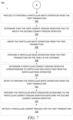
- FIG. 10 shows a flow diagram of a method for performing large reads on a hybrid database, according to some example embodiments.
- FIG. 11 illustrates a diagrammatic representation of a machine in the form of a computer system within which a set of instructions may be executed for causing the machine to perform any one or more of the methodologies discussed herein, in accordance with some embodiments of the present disclosure.
- OLTP Online Transactional Processing
- existing database systems can employ varying approaches including Online Transactional Processing (OLTP) techniques.
- OLTP refers to a category of data processing that involves transaction-oriented tasks.
- OLTP involves inserting, updating, and/or deleting varying amounts of data in a given database.
- OLTP can deal with large numbers of transactions by a large number of users.
- an OLTP database can be implemented as a key-value database in which the data is managed as key-value pairs (e.g., FoundationDB).
- key-value pairs e.g., FoundationDB
- a database system provides concurrency control and isolation for executing a series of query statements (e.g., Structured Query Language (SQL) statements) within a transaction against a linearizable storage.
- SQL Structured Query Language
- the database system herein employs a concurrency control mechanism that is a combination of a multi-version concurrency control for read operations (MVCC) and locking for write operations.
- MVCC multi-version concurrency control for read operations
- the database system implements a targeted isolation level (e.g., snapshot isolation), where each statement can execute against a different snapshot of a database, and write locks are held until a transaction commit.
- the database system implements a two-level transaction hierarchy, where a top-level transaction corresponds to a SQL transaction, and a nested transaction corresponds to a SQL statement within the parent SQL transaction.
- a given nested transaction can perform read and write operations, and can perform a rollback and restart execution zero or more times before succeeding.
- write operations can become visible, and write locks held by each contained statement can be released.
- embodiments of the database system address deadlock detection and resolution for databases.
- the database system avoids false positives where only transactions involved in a deadlock will be aborted. This is helpful for users to find deadlocks in their application code so that deadlocks can be fixed.
- the database system implements embodiments of distributed deadlock detection without a centralized transaction manager. In an example, this is desirable for distributed databases, where each transaction is executed by a separate job, so that the coordination among different jobs/nodes are minimized.
- the online analytical processing database is a data structure or data warehouse configured for a relatively small number of complex transactions. OLAP queries are often complex and involve aggregations. For OLAP database systems, the emphasis can be the response time as an effectiveness measure for completing the complex queries.
- OLAP data is stored in object storage (e.g., blob storage).
- object storage e.g., blob storage.
- the OLAP database can be configured as a multidimensional database that has one or more hierarchies or formula-based relationships of data within each dimension. Aggregation or consolidation of data in the OLAP database involves computing all of these data relationships for one or more dimensions.
- a database user can issue a large analytical read request (e.g., an OLAP-style query), against an OLTP database.
- a large analytical read request e.g., an OLAP-style query
- a user of a OLTP database most often performs point lookups against the OLTP database or other types of singular transactions, however the user may seek to perform a analytic-style query from time to time. Due to the configuration of OLTP databases, a large read can significantly degrade performance of the OLTP database and in some cases, a large read can often knock the OLTP database off-line.
- a hybrid system 230 implements a blob manager system and one or more blob worker systems to convert key-value data into blob data, which can provide an efficient response to a large analytical-style read request when the requests are received.
- the blob manager is configured to split the key-value data (e.g. OLTP data, Foundation DB data) into range granules, or chunks of data that cover data ranges (e.g., 10 MB chunk for records from A to B, another 10 MB chunk for records from C to F, and so on).
- the blob workers are configured to replicate the chunks from key-value store to blob storage (e.g., S3).
- the blob workers replicate the chunks as two types of files, including (1) a snapshot file, and (2) a delta file.
- the snapshot file comprises all key-value pairs of a specific key-value storage device version (e.g., FoundationDB version, at a certain time).
- the delta files cover a range of time, and specify what changes occurred during the range of time, where each change has a time stamp.
- the delta files are streamed from the OLTP servers via change feeds and buffered in memory.
- a blob worker may write a delta file to blob storage after accumulating a set amount of buffered mutations for a given range granules (e.g., accumulate 500 KB mutations).
- the snapshots and the deltas can function together to enable reconstruction of the chunk, as in a Log Structure Merge (LSM) tree.
- LSM Log Structure Merge
- the hybrid system 230 activates the blob manager and blob workers to generate a list of pointers of what files need to be retrieved using the snapshot and delta files. That is, instead of reading the rows directly, the pointer data (e.g., snapshot file, deltas) is sent to the client (e.g., to the clients execution nodes) and the client-side performs the actual processing of the read request to reconstruct the requested rows using a plurality of nodes to greatly speed up response performance. Additionally, to obtain faster performance, the client can activate more execution nodes.
- an analytical-style read e.g., large read
- the client can activate more execution nodes.
- the hybrid system 230 is configured to receive a given read request and determine whether the read request should be performed directly on the key-value data store (e.g., the OLTP database) or should be handled by the blob manager and blob workers. As an example, if the read is small (e.g., point reads of OLTP data, reads smaller than a preconfigured size), the hybrid system 230 then performs the read directly on the key-value data store (e.g., Foundation Database).
- the key-value data store e.g., the OLTP database
- the hybrid system 230 performs the read directly on the key-value data store (e.g., Foundation Database).
- the hybrid system 230 activates the blob manager and blob workers to manage the read via sending the pointer data that comprises the snapshots and deltas to the client so that the data for the read can be retrieved from blob storage and processed using the clients execution nodes.
- large reads are discussed here as an example as a read type that triggers the blob system, in some example embodiments, any complex read request can trigger the blob system.
- Examples of complex read requests include: analytical style reads (e.g., OLAP style reads, requiring multiple dimensions of data for computation of the result, aggregations of data in different columns), reads that involve more than a preconfigured size of data (e.g., data size limits, such as more than 10 MB, more than 10 GB), reads that involve more than a preconfigured number of data units (e.g., data unit size limit, such as reading all rows (row units) of a large table, reading more than a pre-configured limit of rows, reading from more than a preconfigured set limit of different tables (table unit limit), reading more than a set number of columns (column unit limit)reading from more than a preconfigured limit of storage buckets or blobs (object store limit), and combinations thereof, such as: the limit is exceeded if it is a read on more than 10 GB of data or a read of an entire table or is a read of more than a pre-set maximum of rows).
- analytical style reads
- the hybrid system 230 can be re-configured with different types of new reads that encounter problems on the OLTP data. For example, if a user issues a new type of read request against the OLTP data (e.g., read having a unique complex join or data aggregation) that is not deemed as a complex read request, but nevertheless causes issue on the OLTP system, then the hybrid system 230 is updated to store and identify the given new type of read request and deem it as a complex read which initiates the blob system, in accordance with some example embodiments. In this way, large reads can be handled by a OLTP database as fast as they can be handled using a OLAP database. Additionally, due to the structure of the pointer data that is passed to the client, it is not more computationally expensive to run large reads against older archived data.
- a new type of read request against the OLTP data e.g., read having a unique complex join or data aggregation
- the hybrid system 230 is updated to store and
- FIG. 1 illustrates an example computing environment 100 that includes a database system in the example form of a network-based database system 102 , in accordance with some embodiments of the present disclosure.
- a computing environment 100 that includes a database system in the example form of a network-based database system 102 , in accordance with some embodiments of the present disclosure.
- various functional components that are not germane to conveying an understanding of the inventive subject matter have been omitted from FIG. 1 .
- the computing environment may comprise another type of network-based database system or a cloud data platform.
- the computing environment 100 comprises the network-based database system 102 in communication with a cloud storage platform 104 (e.g., AWS® S3, Microsoft Azure Blob Storage®, or Google Cloud Storage), and a credential store provider 106 .
- the network-based database system 102 is a network-based system used for reporting and analysis of integrated data from one or more disparate sources including one or more storage locations within the cloud storage platform 104 .
- the cloud storage platform 104 comprises a plurality of computing machines and provides on-demand computer system resources such as data storage and computing power to the network-based database system 102 .
- the network-based database system 102 comprises a compute service manager 108 , an execution platform 110 , and one or more metadata databases 112 .
- the network-based database system 102 hosts and provides data reporting and analysis services to multiple client accounts.
- the compute service manager 108 coordinates and manages operations of the network-based database system 102 .
- the compute service manager 108 also performs query optimization and compilation as well as managing clusters of computing services that provide compute resources (also referred to as “virtual warehouses”, or “virtual databases” that can provide OLAP or OLTP database processing).
- the compute service manager 108 can support any number of client accounts such as end users providing data storage and retrieval requests, system administrators managing the systems and methods described herein, and other components/devices that interact with compute service manager 108 .
- the compute service manager 108 is also in communication with a client device 114 .
- the client device 114 corresponds to a user of one of the multiple client accounts supported by the network-based database system 102 .
- a user may utilize the client device 114 to submit data storage, retrieval, and analysis requests to the compute service manager 108 .
- the compute service manager 108 is also coupled to one or more metadata databases 112 that store metadata pertaining to various functions and aspects associated with the network-based database system 102 and its users.
- a metadata database 112 may include a summary of data stored in remote data storage systems as well as data available from a local cache.
- a metadata database 112 may include information regarding how data is organized in remote data storage systems (e.g., the cloud storage platform 104 ) and the local caches. Information stored by a metadata database 112 allows systems and services to determine whether a piece of data needs to be accessed without loading or accessing the actual data from a storage device.
- a metadata database 112 can store one or more credential objects 115 .
- a credential object 115 indicates one or more security credentials to be retrieved from a remote credential store.
- the credential store provider 106 maintains multiple remote credential stores 118 - 1 to 118 -N. Each of the remote credential stores 118 - 1 to 118 -N may be associated with a user account and may be used to store security credentials associated with the user account.
- a credential object 115 can indicate one of more security credentials to be retrieved by the compute service manager 108 from one of the remote credential stores 118 - 1 to 118 -N (e.g., for use in accessing data stored by the storage platform 104 ).
- the compute service manager 108 is further coupled to the execution platform 110 , which provides multiple computing resources that execute various data storage and data retrieval tasks.
- the execution platform 110 is coupled to storage platform 104 of the cloud storage platform 104 .
- the storage platform 104 comprises multiple data storage devices, including, for example, blob storage device 120 (e.g., storing data in a micro-partition format of an OLAP database), range-based blob storage device 121 (e.g., storing blob of data, each blob corresponding to a range granule), and key-value storage device 122 (e.g., storing key-value pair data of a OLTP database).
- blob storage device 120 e.g., storing data in a micro-partition format of an OLAP database
- range-based blob storage device 121 e.g., storing blob of data, each blob corresponding to a range granule
- key-value storage device 122 e.g
- key-value data (e.g., OLTP data) is replicated from the key-value storage device 122 to the blob storage device 120 , as discussed in application Ser. No. 17/249,598, titled “Aggregate and Transactional Networked Database Query Processing,” filed on Dec. 14, 2020, which is hereby incorporated in its entirety.
- the data storage devices of the storage platform 104 are cloud-based storage devices located in one or more geographic locations.
- the data storage devices may be part of a public cloud infrastructure or a private cloud infrastructure.
- the data storage devices may be hard disk drives (HDDs), solid state drives (SSDs), storage clusters, Amazon S3TM storage systems, key-value storage devices (e.g., Foundation Database), or any other data storage technology.
- the cloud storage platform 104 may include distributed file systems (such as Hadoop Distributed File Systems (HDFS)), object storage systems, and the like.
- HDFS Hadoop Distributed File Systems
- the storage platform 104 includes clock service 130 which can be contacted to fetch a number that will be greater than any number previously returned, such as one that correlates to the current time.
- Clock service 130 is discussed further herein below with respect to embodiments of the subject system.
- the execution platform 110 comprises a plurality of compute nodes.
- a set of processes on a compute node executes a query plan compiled by the compute service manager 108 .
- the set of processes can include: a first process to execute the query plan; a second process to monitor and delete cache files (e.g., micro-partitions) using a least recently used (LRU) policy and implement an out of memory (OOM) error mitigation process; a third process that extracts health information from process logs and status to send back to the compute service manager 108 ; a fourth process to establish communication with the compute service manager 108 after a system boot; and a fifth process to handle all communication with a compute cluster for a given job provided by the compute service manager 108 and to communicate information back to the compute service manager 108 and other compute nodes of the execution platform 110 .
- cache files e.g., micro-partitions
- OOM out of memory
- communication links between elements of the computing environment 100 are implemented via one or more data communication networks. These data communication networks may utilize any communication protocol and any type of communication medium. In some embodiments, the data communication networks are a combination of two or more data communication networks (or sub-Networks) coupled to one another. In alternative embodiments, these communication links are implemented using any type of communication medium and any communication protocol.
- the compute service manager 108 , metadata database(s) 112 , execution platform 110 , and storage platform 104 are shown in FIG. 1 as individual discrete components. However, each of the compute service manager 108 , metadata database(s) 112 , execution platform 110 , and storage platform 104 may be implemented as a distributed system (e.g., distributed across multiple systems/platforms at multiple geographic locations). Additionally, each of the compute service manager 108 , metadata database(s) 112 , execution platform 110 , and storage platform 104 can be scaled up or down (independently of one another) depending on changes to the requests received and the changing needs of the network-based database system 102 . Thus, in the described embodiments, the network-based database system 102 is dynamic and supports regular changes to meet the current data processing needs.
- the network-based database system 102 processes multiple jobs determined by the compute service manager 108 . These jobs are scheduled and managed by the compute service manager 108 to determine when and how to execute the job. For example, the compute service manager 108 may divide the job into multiple discrete tasks (or transactions as discussed further herein) and may determine what data is needed to execute each of the multiple discrete tasks. The compute service manager 108 may assign each of the multiple discrete tasks to one or more nodes of the execution platform 110 to process the task. The compute service manager 108 may determine what data is needed to process a task and further determine which nodes within the execution platform 110 are best suited to process the task. Some nodes may have already cached the data needed to process the task and, therefore, be a good candidate for processing the task.
- Metadata stored in a metadata database 112 assists the compute service manager 108 in determining which nodes in the execution platform 110 have already cached at least a portion of the data needed to process the task.
- One or more nodes in the execution platform 110 process the task using data cached by the nodes and, if necessary, data retrieved from the cloud storage platform 104 . It is desirable to retrieve as much data as possible from caches within the execution platform 110 because the retrieval speed is typically much faster than retrieving data from the cloud storage platform 104 .
- the computing environment 100 separates the execution platform 110 from the storage platform 104 .
- the processing resources and cache resources in the execution platform 110 operate independently of the data storage devices in the cloud storage platform 104 (e.g., independently of blob storage device 120 ).
- the computing resources and cache resources are not restricted to specific data storage devices. Instead, all computing resources and all cache resources may retrieve data from, and store data to, any of the data storage resources in the cloud storage platform 104 .
- FIG. 2 is a block diagram illustrating components of the compute service manager 108 , in accordance with some embodiments of the present disclosure.
- the compute service manager 108 includes an access manager 202 and a credential management system 204 coupled to an access metadata database 206 , which is an example of the metadata database(s) 112 .
- Access manager 202 handles authentication and authorization tasks for the systems described herein.
- the credential management system 204 facilitates use of remote stored credentials (e.g., credentials stored in one of the remote credential stores 118 - 1 to 118 -N) to access external resources such as data resources in a remote storage device.
- remote stored credentials e.g., credentials stored in one of the remote credential stores 118 - 1 to 118 -N
- the remote storage devices may also be referred to as “persistent storage devices” or “shared storage devices.”
- the credential management system 204 may create and maintain remote credential store definitions and credential objects (e.g., in the access metadata database 206 ).
- a remote credential store definition identifies a remote credential store (e.g., one or more of the remote credential stores 118 - 1 to 118 -N) and includes access information to access security credentials from the remote credential store.
- a credential object identifies one or more security credentials using non-sensitive information (e.g., text strings) that are to be retrieved from a remote credential store for use in accessing an external resource.
- the credential management system 204 and access manager 202 use information stored in the access metadata database 206 (e.g., a credential object and a credential store definition) to retrieve security credentials used to access the external resource from a remote credential store.
- information stored in the access metadata database 206 e.g., a credential object and a credential store definition
- a request processing service 208 manages received data storage requests and data retrieval requests (e.g., jobs to be performed on database data). For example, the request processing service 208 may determine the data to process a received query (e.g., a data storage request or data retrieval request). The data may be stored in a cache within the execution platform 110 or in a data storage device in storage platform 104 .
- a management console service 210 supports access to various systems and processes by administrators and other system managers. Additionally, the management console service 210 may receive a request to execute a job and monitor the workload on the system.
- the compute service manager 108 also includes a job compiler 212 , a job optimizer 214 and a job executor 216 .
- the job compiler 212 parses a job into multiple discrete tasks and generates the execution code for each of the multiple discrete tasks.
- the job optimizer 214 determines the best method to execute the multiple discrete tasks based on the data that needs to be processed.
- the job optimizer 214 also handles various data pruning operations and other data optimization techniques to improve the speed and efficiency of executing the job.
- the job executor 216 executes the execution code for jobs received from a queue or determined by the compute service manager 108 .
- a job scheduler and coordinator 218 sends received jobs to the appropriate services or systems for compilation, optimization, and dispatch to the execution platform 110 .
- jobs may be prioritized and then processed in that prioritized order.
- the job scheduler and coordinator 218 determines a priority for internal jobs that are scheduled by the compute service manager 108 with other “outside” jobs such as user queries that may be scheduled by other systems in the database (e.g., the storage platform 104 ) but may utilize the same processing resources in the execution platform 110 .
- the job scheduler and coordinator 218 identifies or assigns particular nodes in the execution platform 110 to process particular tasks.
- a virtual database manager 220 manages the operation of multiple virtual databases implemented in the execution platform 110 . For example, the virtual database manager 220 may generate query plans for executing received queries.
- the compute service manager 108 includes a configuration and metadata manager 222 , which manages the information related to the data stored in the remote data storage devices and in the local buffers (e.g., the buffers in execution platform 110 ).
- the configuration and metadata manager 222 uses metadata to determine which data files, micro-partition files, need to be accessed to retrieve data for processing a particular task or job. Further details of micro-partitions is discussed in U.S. Pat. No. 10,817,540, which is hereby incorporated in its entirely.
- a monitor and workload analyzer 224 oversee processes performed by the compute service manager 108 and manages the distribution of tasks (e.g., workload) across the virtual databases and execution nodes in the execution platform 110 .
- the monitor and workload analyzer 224 also redistributes tasks, as needed, based on changing workloads throughout the network-based database system 102 and may further redistribute tasks based on a user (e.g., “external”) query workload that may also be processed by the execution platform 110 .
- the configuration and metadata manager 222 and the monitor and workload analyzer 224 are coupled to a data storage device 226 .
- Data storage device 226 in FIG. 2 represents any data storage device within the network-based database system 102 .
- data storage device 226 may represent buffers in execution platform 110 , storage devices in storage platform 104 , or any other storage device.
- the compute service manager 108 validates all communication from an execution platform (e.g., the execution platform 110 ) to validate that the content and context of that communication are consistent with the task(s) known to be assigned to the execution platform. For example, an instance of the execution platform executing a query A should not be allowed to request access to data-source D (e.g., data storage device 226 ) that is not relevant to query A.
- an execution platform e.g., the execution platform 110
- data-source D e.g., data storage device 226
- a given execution node e.g., execution node 302 - 1 may need to communicate with another execution node (e.g., execution node 302 - 2 ), and should be disallowed from communicating with a third execution node (e.g., execution node 312 - 1 ) and any such illicit communication can be recorded (e.g., in a log or other location).
- the information stored on a given execution node is restricted to data relevant to the current query and any other data is unusable, rendered so by destruction or encryption where the key is unavailable.
- FIG. 3 is a block diagram illustrating components of the execution platform 110 , in accordance with some embodiments of the present disclosure.
- the execution platform 110 includes multiple virtual database, including virtual database 1 , virtual database 2 , and virtual database n.
- Each virtual database includes multiple execution nodes that each include a data cache and a processor.
- the virtual database can execute multiple tasks in parallel by using the multiple execution nodes.
- the execution platform 110 can add new virtual database and drop existing virtual database in real-time based on the current processing needs of the systems and users. This flexibility allows the execution platform 110 to quickly deploy large amounts of computing resources when needed without being forced to continue paying for those computing resources when they are no longer needed. All virtual databases can access data from any data storage device (e.g., any storage device in cloud storage platform 104 ).
- each virtual database shown in FIG. 3 includes three execution nodes, a particular virtual database may include any number of execution nodes. Further, the number of execution nodes in a virtual warehouse is dynamic, such that new execution nodes are created when additional demand is present, and existing execution nodes are deleted when they are no longer necessary.
- Each virtual database is capable of accessing any of the data storage devices of the storage platform 104 , shown in FIG. 1 .
- the virtual databases are not necessarily assigned to a specific data storage device and, instead, can access data from any of the data storage devices within the cloud storage platform 104 .
- each of the execution nodes shown in FIG. 3 can access data from any of the data storage devices in the storage platform 104 .
- a particular virtual database or a particular execution node may be temporarily assigned to a specific data storage device, but the virtual database or execution node may later access data from any other data storage device.
- virtual database 1 includes three execution nodes 302 - 1 , 302 - 2 , and 302 -N.
- Execution node 302 - 1 includes a cache 304 - 1 and a processor 306 - 1 .
- Execution node 302 - 2 includes a cache 304 - 2 and a processor 306 - 2 .
- Execution node 302 -N includes a cache 304 -N and a processor 306 -N.
- Each execution node 302 - 1 , 302 - 2 , and 302 -N is associated with processing one or more data storage and/or data retrieval tasks.
- a virtual database may handle data storage and data retrieval tasks associated with an internal service, such as a clustering service, a materialized view refresh service, a file compaction service, a storage procedure service, or a file upgrade service.
- a particular virtual database may handle data storage and data retrieval tasks associated with a particular data storage system or a particular category of data.
- virtual database 2 includes three execution nodes 312 - 1 , 312 - 2 , and 312 -N.
- Execution node 312 - 1 includes a cache 314 - 1 and a processor 316 - 1 .
- Execution node 312 - 2 includes a cache 314 - 2 and a processor 316 - 2 .
- Execution node 312 -N includes a cache 314 -N and a processor 316 -N.
- virtual database 3 includes three execution nodes 322 - 1 , 322 - 2 , and 322 -N.
- Execution node 322 - 1 includes a cache 324 - 1 and a processor 326 - 1 .
- Execution node 322 - 2 includes a cache 324 - 2 and a processor 326 - 2 .
- Execution node 322 -N includes a cache 324 -N and a processor 326 -N.
- the execution nodes shown in FIG. 3 are stateless with respect to the data being cached by the execution nodes. For example, these execution nodes do not store or otherwise maintain state information about the execution node or the data being cached by a particular execution node. Thus, in the event of an execution node failure, the failed node can be transparently replaced by another node. Since there is no state information associated with the failed execution node, the new (replacement) execution node can easily replace the failed node without concern for recreating a particular state.
- the execution nodes shown in FIG. 3 each includes one data cache and one processor
- alternative embodiments may include execution nodes containing any number of processors and any number of caches.
- the caches may vary in size among the different execution nodes.
- the caches shown in FIG. 3 store, in the local execution node, data that was retrieved from one or more data storage devices in cloud storage platform 104 .
- the caches reduce or eliminate the bottleneck problems occurring in platforms that consistently retrieve data from remote storage systems. Instead of repeatedly accessing data from the remote storage devices, the systems and methods described herein access data from the caches in the execution nodes, which is significantly faster and avoids the bottleneck problem discussed above.
- the caches are implemented using high-speed memory devices that provide fast access to the cached data. Each cache can store data from any of the storage devices in the cloud storage platform 104 .
- the cache resources and computing resources may vary between different execution nodes. For example, one execution node may contain significant computing resources and minimal cache resources, making the execution node useful for tasks that require significant computing resources. Another execution node may contain significant cache resources and minimal computing resources, making this execution node useful for tasks that require caching of large amounts of data. Yet another execution node may contain cache resources providing faster input-output operations, useful for tasks that require fast scanning of large amounts of data. In some embodiments, the cache resources and computing resources associated with a particular execution node are determined when the execution node is created, based on the expected tasks to be performed by the execution node.
- the cache resources and computing resources associated with a particular execution node may change over time based on changing tasks performed by the execution node. For example, an execution node may be assigned more processing resources if the tasks performed by the execution node become more processor-intensive. Similarly, an execution node may be assigned more cache resources if the tasks performed by the execution node require a larger cache capacity.
- virtual databases 1 , 2 , and n are associated with the same execution platform 110 , the virtual databases may be implemented using multiple computing systems at multiple geographic locations.
- virtual database 1 can be implemented by a computing system at a first geographic location, while virtual databases 2 and n are implemented by another computing system at a second geographic location.
- these different computing systems are cloud-based computing systems maintained by one or more different entities.
- each virtual database is shown in FIG. 3 as having multiple execution nodes.
- the multiple execution nodes associated with each virtual database may be implemented using multiple computing systems at multiple geographic locations.
- an instance of virtual database 1 implements execution nodes 302 - 1 and 302 - 2 on one computing platform at a geographic location and implements execution node 302 -N at a different computing platform at another geographic location.
- Selecting particular computing systems to implement an execution node may depend on various factors, such as the level of resources needed for a particular execution node (e.g., processing resource requirements and cache requirements), the resources available at particular computing systems, communication capabilities of networks within a geographic location or between geographic locations, and which computing systems are already implementing other execution nodes in the virtual database.
- Execution platform 110 is also fault tolerant. For example, if one virtual database fails, that virtual database is quickly replaced with a different virtual database at a different geographic location.
- a particular execution platform 110 may include any number of virtual databases. Additionally, the number of virtual warehouses in a particular execution platform is dynamic, such that new virtual warehouses are created when additional processing and/or caching resources are needed. Similarly, existing virtual databases may be deleted when the resources associated with the virtual warehouse are no longer necessary.
- the virtual databases may operate on the same data in cloud storage platform 104 , but each virtual database has its own execution nodes with independent processing and caching resources.
- This configuration allows requests on different virtual warehouses to be processed independently and with no interference between the requests.
- This independent processing combined with the ability to dynamically add and remove virtual databases, supports the addition of new processing capacity for new users without impacting the performance observed by the existing users.
- FIG. 4 is a computing environment 400 conceptually illustrating an example software architecture for managing and executing concurrent transactions on a database system (e.g., the network-based database system 102 ), which can be performed by a given execution node of the execution platform 110 , in accordance with some embodiments of the present disclosure.
- a process flow is performed by a transaction manager that is configured to manage and execute transactions as described further herein.
- the transaction manager 440 is included in the compute service manager 108 .
- the transaction manager 440 receives a job 410 that may be divided into one or more discrete transactions 420 - 425 , e.g., transaction 0, transaction 1, transaction 2, transaction 3, and so forth through transaction (n).
- each transaction includes one or more tasks or operations (e.g., read operation, write operation, database statement, user defined function, and the like) to perform.
- the transaction manager 440 receives the job at 450 and determines transactions at 452 that may be carried out to execute the job 410 .
- the transaction manager 440 is configured to determine the one or more discrete transactions, such as transaction 0, transaction 1, transaction 2, transaction 3, and so forth, based on applicable rules and/or parameters.
- the transaction manager 440 assigns transactions at 454 .
- the transaction manager 440 is configured to concurrently process multiple jobs that can be performed by the execution platform 110 .
- the transaction manager 440 can receive a second job 430 or a third job 435 , each of which include respective discrete transactions that are to be performed on the execution platform 110 .
- Each of the transactions may be executed concurrently by the execution platform 110 in which different operations are performed (e.g., a respective read operation or write operation are executed from each of the transactions by the execution platform 110 ).
- the job 410 is carried out by the transaction manager 440 which can perform the responsibilities of a query manager (e.g., processing query statements and operations, and the like).
- the transaction manager 440 may have multiple threads, including, for example, transaction manager threads 442 A, 442 B, 442 C, and so forth.
- the transaction manager 440 may assign the job 410 , including the multiple discrete transactions, to a particular virtual database of the execution platform 110 . Based on this assignment, the transaction manager 440 can send the job 410 , including the multiple discrete transactions, to the assigned virtual database for execution. Alternatively, the transaction manager 440 can send a subset of the transactions included in the job 410 for execution by the execution platform 110 .
- the transaction manager 440 can perform operations to process transactions (e.g., OLTP) that may be executing concurrently, while handling conflicts and avoiding starvation of resources. Further, as described further herein, the transaction manager 440 handles conflicts between multiple transactions and concurrency issues that can arise when multiple transactions are executing in parallel on the execution platform 110 . As further shown, the execution platform 110 communicates with the storage platform 104 , which provides a distributed database (e.g., Foundation Database (FDB), and the like), where data can be read and written in connection with performing the transactions.
- FDB Foundation Database
- the transaction manager 440 schedules and manages the execution of transactions on behalf of a client account.
- the transaction manager 440 may schedule any arbitrary SQL query included in a given transaction.
- the transaction manager 440 may assume a role to schedule the job 410 as if it is the client account rather than as an internal account or other special account.
- the transaction manager 440 may embody the role of, for example, an account administrator or a role having the (smallest) scope necessary to complete the job 410 .
- the transaction manager 440 embodies the role that owns the object that is the target of the job 410 (e.g., for a cluster, the table being clustered is the target).
- the transaction manager 440 determines transactions at 452 and assigns transactions at 454 that are to be performed to fully execute the job 410 . In an embodiment, the transaction manager 440 assigns ordering constraints to any number of the one or more discrete transactions, where applicable. Depending on the constraints of the job 410 , the transaction manager 440 may determine that one or more of multiple discrete transactions are to be serialized and executed in a particular order.
- the transaction manager 440 generates a report indicating when the job 410 is scheduled to be executed and how much computing resources are estimated to be tied up executing the job 410 .
- the transaction manager 440 may alert a client account when the job 410 is being executed.
- the database system provides concurrency control and isolation for executing transactions against (e.g., a series of SQL Statements within a SQL Transaction) against linearizable storage (e.g., a linearizable key-value store, NoSQL database, an OLAP database or data warehouse).
- a transaction as referred to herein includes a group of operations executed atomically. In an example, such transactions may include read and write operations but can also include operations such as increment, decrement, compare-and-swap, and the like.
- linearizable storage may include any type of distributed database (e.g., Apache HBase).
- the transaction manager 440 utilizes a linearizable storage, provided by the storage platform 104 , for managing and processing transactions as described herein.
- the transaction manager 440 implements a read committed model for performing transactions.
- a read committed model can refer to a model that ensures that all read operations performed in a given transaction sees a consistent snapshot of the database (e.g., reading a last set of committed values that existed when the read operation commenced), and the transaction itself successfully commits only if no updates that the transaction has made results in write-write conflicts with any concurrent transactions.
- the transaction manager 440 implements a two-level transaction hierarchy, where a top-level transaction corresponds to a SQL transaction, and a nested transaction corresponds to a SQL statement within the parent SQL transaction.
- a given nested transaction can perform operations, such as reads and writes, and can perform a rollback and restart execution zero or more times before succeeding.
- write operations can become visible, and write locks held by each contained statement can be released.
- a transaction manager e.g., transaction manager 440
- MVCC multi-version concurrency control for read operations
- the subject system provides techniques for read committed isolation where each statement may execute against a different snapshot of the database (e.g., the storage platform 104 ), with write locks held until transaction commit.
- the linearizable storage as described herein enables each operation to execute atomically between invocation and response.
- a linearizable key-value store ensures that operations execute in an atomic manner consistent with a “real-time” ordering of those operations e.g., when operation A completes before operation B begins, operation B should take effect after operation A.
- a first write operation to a row in the table takes effect before a second write or read operation to the same row in the table if the second operation was issued after the first completed.
- linearizable storage such as a linearizable database, including, for example, NoSQL systems, and the like.
- a given NoSQL database refers to a database that stores data in a format other than a tabular format, and can store data differently than in relational tables.
- Uber's Schemaless is an example of building linearizable Key-Value storage via having a “key” and “value” column in a relational table.
- Other examples of linearizable databases are: HBase, RocksDB, TiKV, Redis, Etcd.
- optimizations provided by the subject system include utilizing restricted transactional capabilities offered by some embodiments of storage platform 104 , such as FoundationDB, that can be leveraged to enable a more efficient transaction implementation. For example, in a write(/lock/delete) protocol, a write operation is performed, and then a read operation is done to check for (1) any write operation that happened before the write request was submitted (2) any other write operation was submitted concurrently with the write operation that was serialized before.
- a write(/lock/delete) protocol a write operation is performed, and then a read operation is done to check for (1) any write operation that happened before the write request was submitted (2) any other write operation was submitted concurrently with the write operation that was serialized before.
- a “read version” refers to a “version” or state of the database that corresponds to when a last operation was successfully committed to the database.
- strict serializability makes a “real-time” ordering and atomicity promise about single operations
- strict serializability makes a “real-time” ordering and atomicity promise about groups of operations.
- the group of operations is submitted incrementally over time, with a terminal “commit” command being issued.
- the strictly serializable storage platform may employ techniques such as pessimistic lock-based exclusion or an optimistic validation phase to enable this functionality.
- the group of operations is referred to as a transaction as mentioned herein.
- the subject system can impose restrictions on the transaction, such as the number, size, or duration of the operations, and always reject transactions that exceed these limits.
- read operations may be optimized in the following manner.
- the Transaction ID is set to be the same as the first statement's read timestamp, then instead of reading [X.0, X.inf], the subject system can read [X.0, X.readTimestamp]. Consequently, this approach can make read operations for old or frequently written data more efficient.
- the subject system implements a two-level transaction hierarchy, where the top-level transaction corresponds to a SQL Transaction, and the nested transaction (referred to as a “StatementContext”) corresponds to a SQL statement within the parent SQL Transaction.
- a given StatementContext performs read and write operations and may be instructed to perform a rollback and restart execution zero or more times before succeeding.
- transactions control the collective visibility of all write operations from successful statements. Upon transaction commit, all write operations become visible, and all write locks held by each contained statement are released.
- each object key is associated with a stamp that uniquely identifies a single execution attempt of a statement, which can be by appending a three-part tuple of (Transaction ID, statementNumber, restartCount).
- the higher order component is the transaction identifier assigned to the SQL-level transaction.
- the statementNumber identifies the SQL statement within the SQL-level BEGIN/COMMIT block.
- the restart count tracks which statement restart attempt generated this write operations.
- a StatementContext is instantiated with this stamp, and applies it to all writes performed through the StatementContext instance.
- each execution of a statement is given a three-part identifier consisting of the statement's readTimestamp (RTS) and the current values of statementNumber (SN) and restartCount (RC).
- RTS readTimestamp
- SN current values of statementNumber
- RC restartCount
- the transaction manager employs a Transaction Status Table (TST) to keep track of committed and aborted transactions.
- TST is a persistent hashmap that maps Transaction ID to its metadata, most notably a list of finalized statement numbers and their final restart count, and the commit outcome including the transaction's commit timestamp (CTS). Transactions that are in progress do not exist in the Transaction Status Table.
- CTS commit timestamp
- the TST can be stored in the storage platform 104 , or within memory or cache of the execution platform 110 .
- the following discussion relates to a read protocol that is utilized by the transaction manager 440 .
- the transaction manager 440 uses a read committed transaction isolation level, and each statement may be run with a different read timestamp.
- the read request for a given key is implemented by executing a linearizable storage read call for all keys with X as their prefix.
- the call returns versions of X with their stamps and values.
- the read method returns either the latest version of X made by a transaction that committed before the SQL statement started or which was written by the most recent statement of the transaction itself that was not canceled (if any).
- the following discussion relates to a write protocol that is utilized by the transaction manager 440 .
- the write protocol checks both for WW (write-write) conflicts and WW deadlocks.
- the following example describes a single transaction and no conflicts. Assume that object X initially has a stamp of TXN1.0.0 and was committed at timestamp 10. In the following example, it should be understood that the following transactional steps described further below can be done within one transaction, and collectively committed. On failure, or upon exceeding the limitations of the underlying transactional system, the execution can fall back to issuing the operations individually as described in further detail below.
- the constructor obtains a read timestamp from the linearizable storage of 15 by contacting the clock service 130 .
- the clock service 130 is a component of the storage platform 104 which can be contacted to fetch a number that will be greater than any number previously returned, such as one that correlates to the current time.
- clock service 130 is provided separately and is independently contactable from the linearizable storage, or can be integrated into the linearizable storage such that the clock value may be inserted into a written value. The latter operation will be referred to as a timestamped write.
- S1 does a linearizable storage write for X.TXN2.1.0 with a value of 100 // The next step is for S1 to check for WW (write-write) conflicts by checking whether there is // another transaction that has updated X between the RTS and S1's write.
- S1 issues the range read [X.0, X.inf] to obtain the set all versions of X and their stamps The read returns [X.TXN1.0.0, X.TXN2.1.0].
- S1 looks up TXN1 in the Transaction Status Table, finds a commit timestamp of 10. 10 is earlier than our read timestamp of 15, so it is not a conflict.
- each row (object) updated uses two separate linearizable storage transactions:
- the object (X.Stamp, Value) will be left in the database (e.g., the storage platform 104 ).
- the object is left to serve as a write lock.
- all tentative writes for an object X will form a queue of write locks.
- (5) and (6) illustrate the cases where previously left write locks allow subsequent statements or restarts of a statement to recognize that they already hold the lock that they wish to take.
- a write-write conflict which is also understood as overwriting uncommitted data, refers to a computational anomaly associated with interleaved execution of transactions.
- stamps are omitted. Assume that before either T1 or T2 starts that object X has a value of 500, a stamp of TXN1.0.0, and a CTN of 10.
- the following discussion relates to a delete protocol utilized by the transaction manager 440 .
- delete operations are implemented as a write of a sentinel tombstone value; otherwise, delete operations employ the same protocol as write operations.
- a read operation determines that the most recently committed key is a tombstone, it considers that key to be non-existent.
- the following discussion relates to a lock protocol utilized by the transaction manager 440 .
- the transaction manager API offers StatementContext::lock(Key), which allows rows to be locked without writing a value to them.
- the implementation of lock( ) follows the write protocol, except that it writes a special sentinel value to indicate the absence of a value (distinct from SQL NULL).
- a SELECT . . . FOR UPDATE statement may also be forced to restart several times before the statement finishes successfully. Once it does, subsequent statements in the transaction will recognize the existence of this key as an indication that they hold the lock (in accordance with cases (5) and (6) above). All reads can ignore the key as a write.
- the following discussion relates to determining whether to commit, abort, or restart a given transaction which can be determined by the transaction manager 440 .
- a transaction is committed, and all of its writes made visible, by inserting its Transaction ID into the Transaction Status Table.
- the commit timestamp is filled in by the clock service 130 or directly by the distributed database (e.g., FoundationDB), such that it is higher than any previously assigned read or commit timestamps. All writes are completed before a statement may be finalized, and all statements are finalized before the transaction may be committed.
- a transaction is aborted by inserting its Transaction ID into the Transaction Status Table, with its transaction outcome set as aborted.
- the list of finalized statements and their restart counts will be reset to an empty list.
- the insertion into the Transaction Status Table will make the abort outcome visible to all conflicting transactions, and all writes performed by finalized statements may be proactively or lazily removed from the database (e.g., the storage platform 104 ).
- the following discussion relates to an API (e.g., the transaction manager API as referred to below) that can be utilized (e.g., by a given client device) to send commands and requests to the transaction manager 440 .
- an API e.g., the transaction manager API as referred to below
- can be utilized e.g., by a given client device to send commands and requests to the transaction manager 440 .
- a SQL transaction contains a sequence of one or more SQL statements. Each SQL statement is executed as a nested transaction, as implemented by the transaction manager StatementContext class. Each transaction manager statement itself is executed as one or more database transactions.
- the transaction manager API is divided into two parts: 1) the data layer, which provides a read and write API to the transaction execution processes; and 2) the transaction layer, which provides, to the compute service manager 108 , an API to orchestrate the transaction lifecycle.
- transactions operate at a READ COMMITTED isolation level and implement MVCC on top of the distributed database (e.g., storage platform 104 ) to avoid taking any read locks.
- an instance of the StatementContext class will be created to execute this SQL statement.
- the constructor contacts the linearizable storage transaction manager to begin a linearizable storage transaction and obtain a linearizable storage STN which is then stored in the readTimestamp variable.
- the Update operation then executes across any number of execution nodes, all using the same StatementContext instance.
- a function rangeRead( ) will be used to scan the base table, or an index on Dept, for the tuples to update.
- a series of write( ) calls will be made to update the salary of all matching employees.
- a call to finalize( ) will return CONFLICT if the statement encountered any conflicts during its execution, to indicate that re-execution is needed.
- the key to restarts making progress is that the first execution of the statement will have the side effect of, in effect, setting write locks on the objects being updated. This ensures that when the statement is re-executed the necessary writes locks have already been obtained and the statement will generally (but not always).
- a statement when a statement fails to finalize due to conflicts, it instead writes its conflict set into the database (e.g., the storage platform 104 ).
- conflict sets may be read by all other transactions, allowing them to detect a cycle in the waits-for graph, indicating that they're involved in a deadlock.
- a deadlock can refer to a situation where two or more transactions are waiting for one another to give up locks.
- deadlocks can be handled by deadlock detection or prevention in some embodiments.
- the following discussion relates to example mechanisms for handling deadlocks utilizing distributed approaches that do not require a centralized deadlock handling component or implementation.
- a particular execution node, (e.g., execution node 302 - 1 and the like) in the execution platform 110 can perform at least some of the following operations described below.
- Deadlock detection A basic idea of deadlock detection is to detect a deadlock after the deadlock occurs such that that a particular transaction can be aborted. This can be done by finding cycles in a wait-for graph. Depending on how deadlock detection is performed, deadlock detection can be classified as:
- the database system implements a distributed database (e.g., storage platform 104 ) for executing distributed transactions, and utilizes locking for concurrency control where any deadlocks are handled in a distributed manner by a particular execution node executing a particular transaction (e.g., execution node 302 - 1 and the like).
- a distributed database e.g., storage platform 104
- locking for concurrency control where any deadlocks are handled in a distributed manner by a particular execution node executing a particular transaction (e.g., execution node 302 - 1 and the like).
- the database system provides the following:
- the following discussion describes a deadlock detection and resolution protocol for the database system to meet the two aforementioned requirements.
- the database system performs deadlock detection on the wait-for graph and only aborts a transaction if it finds a cycle in the graph.
- each transaction e.g., executing on a given execution node
- the database system implements a deadlock detection algorithm that is deterministic so that all transactions can unanimously agree on which transactions to abort.
- transaction and “statement” are used interchangeably because it is assumed that statements of a transaction will be executed serially, e.g., one at a time.
- the database system utilizes a deadlock detection and resolution protocol that enables transactions to store their wait-for information into a dedicated table in a distributed database (e.g., storage platform 104 ).
- a transaction waiting for conflicting transactions can periodically run a deterministic deadlock detection algorithm. If a transaction determines that it is a victim in a deadlock, the transaction can abort itself so that other transactions can proceed.
- the execution platform 110 can provide deadlock handling logic 480 (e.g., deadlock handling logic 1 to deadlock handling logic N, which can correspond respectively to each transaction 420 to transaction 425 ) which implements the deadlock detection and resolution protocol mentioned herein, and is provided or utilized by each given execution node that is currently executing a given transaction(s).
- deadlock handling logic can be provided to a corresponding transaction (or statement within a transaction) for deadlock detection and resolution as described further herein.
- wait-for information of transactions is stored in a wait-for table in the distributed database (e.g., storage platform 104 ).
- the wait-for table includes a set of key-value pairs where both keys and values are transaction IDs.
- a key-value pair ⁇ Ti, Tj> means that Ti is currently waiting for Tj, e.g., there is an edge Ti ⁇ Tj in the wait-for graph.
- each transaction Ti reports Ti ⁇ Tj only if Tj is the oldest conflicting transaction that Ti is waiting for (a transaction's age is determined by its transaction ID, e.g., a younger (e.g., newer) transaction will have a larger transaction ID).
- the compute service manager 108 further comprises a blob system 470 to manage large or complex reads that are issued against a key-value database (e.g., OLTP database, key-value storage device 122 ).
- the blob system 470 comprises a blob manager 472 to assign and manage blob data using a plurality of blob workers 474 , as discussed in further detail below with reference to FIGS. 8 - 10 .
- the blob system 470 and sub-components are hosted on the compute service manager 108 to manage embodiments where the key-value database or OLTP database is hosted locally within the network-based database system 102 .
- the blob system 470 can be hosted in other places, such as remotely on a storage platform 104 (e.g., in the key-value storage device 122 hosted on storage platform 104 ).
- FIG. 5 is a flow diagram illustrating operations of a database system in performing a method, in accordance with some embodiments of the present disclosure.
- the method 500 may be embodied in computer-readable instructions for execution by one or more hardware components (e.g., one or more processors) such that the operations of the method 500 may be performed by components of network-based database system 102 , such as components of the compute service manager 108 or a node in the execution platform 110 . Accordingly, the method 500 is described below, by way of example with reference thereto. However, it shall be appreciated that the method 500 may be deployed on various other hardware configurations and is not intended to be limited to deployment within the network-based database system 102 .
- the transaction manager 440 receives a first transaction that is to be executed on linearizable storage.
- the transaction manager 440 assigns a first read version to the first transaction.
- the first read version indicates a first version of the linearizable storage.
- a read timestamp can be retrieved from a clock service (e.g., the clock service 130 ), and a transaction identifier can be assigned to the first transaction where the transaction identifier corresponds to a read start time.
- the transaction manager 440 performs a read operation from the first transaction on a table in a database.
- the transaction manager 440 determines a first commit version identifier corresponding to first data resulting from the read operation.
- the transaction manager 440 determines whether a particular write operation is included in the first transaction. If the particular write operation is to be performed with the first transaction, then the transaction manager 440 proceeds to perform a method as described below in FIG. 7 .
- the transaction manager 440 determines that a particular write operation is absent from the first transaction, at operation 512 , the transaction manager 440 proceeds to execute a different transaction (along with forgoing performance of a commit process for the first transaction), which is described, in an example, in FIG. 6 below. It is appreciated that due to the concurrency of transactions that are performed, the operations described further below in FIG. 6 can be executed at any time during the operations described in FIG. 5 above.
- FIG. 6 is flow diagram illustrating operations of a database system in performing a method, in accordance with some embodiments of the present disclosure.
- the method 600 may be embodied in computer-readable instructions for execution by one or more hardware components (e.g., one or more processors) such that the operations of the method 600 may be performed by components of network-based database system 102 , such as components of the compute service manager 108 or a node in the execution platform 110 . Accordingly, the method 600 is described below, by way of example with reference thereto. However, it shall be appreciated that the method 600 may be deployed on various other hardware configurations and is not intended to be limited to deployment within the network-based database system 102 .
- hardware components e.g., one or more processors
- the method 600 can be performed in conjunction with the method 500 as discussed above.
- the method 600 can be performed after the operations of the method 500 or performed substantially concurrently with the method 500 .
- the transaction manager 440 receives a second transaction to be executed on linearizable storage.
- the transaction manager 440 assigns the second transaction a second read version that indicates a second version of the linearizable storage.
- the transaction manager 440 performs a second read operation from the second transaction on the table in the database.
- the transaction manager 440 performs a second write operation from the second transaction on the table in the database.
- the transaction manager 440 determines a particular commit version identifier corresponding to second data results from the second read operation.
- the transaction manager 440 completes the write operation in response to the particular commit version identifier being equivalent to the first commit version identifier.
- the transaction manager 440 assigns a second commit version identifier to second data stored to the table from the write operation, the second commit version identifier corresponding to a second version of data in the table.
- the second commit version identifier is different than the first commit version identifier.
- the transaction manager 440 initiates a commit process for the second transaction.
- FIG. 7 is a flow diagram illustrating operations of a database system in performing a method, in accordance with some embodiments of the present disclosure.
- the method 700 may be embodied in computer-readable instructions for execution by one or more hardware components (e.g., one or more processors) such that the operations of the method 700 may be performed by components of network-based database system 102 , such as components of the compute service manager 108 or a node in the execution platform 110 . Accordingly, the method 700 is described below, by way of example with reference thereto. However, it shall be appreciated that the method 700 may be deployed on various other hardware configurations and is not intended to be limited to deployment within the network-based database system 102 .
- hardware components e.g., one or more processors
- the method 700 can be performed in conjunction with the method 500 and the method 600 as discussed above.
- the method 700 can be performed after the operations of the method 500 or the method 600 (or performed substantially concurrently therewith either method).
- the transaction manager 440 proceeds to perform a particular write operation from the first transaction.
- the transaction manager 440 determines that the first commit version identifier fails to match the second commit version identifier.
- the transaction manager 440 aborts the particular write operation from the first transaction.
- the transaction manager 440 performs a particular read operation from the first transaction on the table in the database.
- the transaction manager 440 determines a particular commit version identifier corresponding to particular data resulting from the particular read operation.
- the transaction manager 440 retry to perform the particular write operation from the first transaction.
- the transaction manager 440 perform the particular write operation in response to the particular commit version identifier matching the second commit version identifier.
- the transaction manager 440 initiates a particular commit process for the first transaction.
- FIG. 8 shows an example hybrid database system 800 , in accordance with some example embodiments.
- the analytical style data e.g., OLAP data
- the blob storage device 120 e.g., partitions of data are stored in blob storage device 120
- metadata storage to track the partition data (e.g., metadata databases 112 , key-value storage 122 having key-value based metadata to track the partitions)
- compute service manager 105 and the execution platform e.g., execution nodes, FIG. 3
- analytical style queries e.g., OLAP queries
- the range-based blob storage device 121 operates in a hybrid OLTP system 805 that can function as a OLTP database for small transactions (e.g., point lookups) and provide results for large reads (e.g., OLTP style reads) using the range-based blob storage device 121 , where the execution platform 110 (e.g., a plurality of compute instances instantized on the client side) receives pointer data for the large reads from the blob system 470 , and the execution platform 110 then performs the read request by pulling data from the range-based blob storage device 121 .
- the execution platform 110 e.g., a plurality of compute instances instantized on the client side
- the range-based blob storage device 121 is configured differently than the blob storage device 120 in that range-based blob storage device 121 is kept transactionally consistent with the transactional OLTP data in the key-value storage device 122 .
- the range-based blob storage device 121 further different than the blob storage device 120 in that is strictly range partitioned to provide large reads against OLTP data.
- the compute service manager 108 To write data using the hybrid database system 800 , the compute service manager 108 first compiles a SQL statement (e.g., a query received from client device 114 ), and the execution platform uses the SQL statement to convert the query into key-value transactions that can be issued against the key-value storage device 122 .
- the key-value storage device 122 commits the transactions and then streams the data to the range-based blob storage device 121 after committed.
- the blob system 470 is configured to dynamically divide the keyspace of the key-value storage device 122 database into range granules, which are then batch written to the range-based blob storage device 121 .
- the hybrid system 230 receives a query and determines whether the query should be completed directly against the key-value storage device 122 or should be handled using the blob system 470 .
- the threshold analysis of whether to handle directly on the KV table or to use the blob system can be configured per different data requirements of an organization implementing the hybrid database system 800 . For instance, if the query is a read request that requires reading more than a specified limit of data (e.g., more than 10 MB of data, more than a gigabyte of OLTP data, etc.) then the blob system 470 is used, whereas if less than the specified limit, the query is completed by the execution platform 110 directly on the key-value storage device 122 .
- a specified limit of data e.g., more than 10 MB of data, more than a gigabyte of OLTP data, etc.
- threshold limits can be implemented, such as a maximum number of rows, query complexity (e.g., large aggregations), and so on.
- the compute service manager dispatches range granules used by the query to the execution platform 110 .
- the execution platform 110 determines which blob files (snapshot and deltas) are associated with each range granule received from the compute service manager 108 .
- the blob system 470 determines which blob files are necessary to read a range granule at a specific version and returns, to the execution platform 110 , the necessary blob files as a list of pointers so that the execution node cluster can retrieve the files and perform the read from the range-based blob storage device 121 .
- the blob system 470 writes KV data to the range-based blob storage device 121 in batches, and as such, when a given large read is received, there may be relevant data that is not yet written to the range-based blob storage device 121 .
- the blob system in addition to the list of pointers sent by the key-value storage device 122 to the execution platform 110 for a given read request, the blob system further provides, to the execution platform 110 , all of the changes to a given range granule that have not yet been written to blob storage.
- the blob manager 472 is configured to manage distributing range granules to the blob workers 474 .
- the blob manager 472 balances the number of ranges each blob worker is responsible for, and the amount of write traffic each blob worker is handling in aggregate.
- the write traffic is estimated by the amount of time it took to rewrite the previous snapshot file for the range.
- when a given blob worker has written 6 MB of data to a range it will notify the blob manager 472 that a new snapshot file is needed for the range.
- the given blob worker will go notify the blob manager that a new snapshot is to be written.
- a blob worker once a blob worker knows it needs to rewrite a range, it will query the key-value database of key-value storage device 122 to determine the size of the range. If the range is larger than a set amount (e.g., 15 MB) it will ask the key-value storage device 122 to split the range into 10 MB chunks, keeping the two chunks as equal in size as possible. If the range is smaller than 5 MB, the blob worker will query the ranges before and after the range and merge the range with the smaller of the two options, potentially splitting the merged range if it is larger than 15 MB.
- a set amount e.g. 15 MB
- each of the blob workers are responsible for updating and querying range granules assigned to them by the blob manager 472 .
- a blob worker will consume mutations from the range feed, and buffer them in memory, ordered by version.
- a blob worker will periodically flush the buffer to create a delta file for the granule which can also be compacted into a snapshot after a set amount of delta files (e.g., flush a new delta file for the granule every 500 KB of new mutations, and compact into a snapshot file every 10 delta files).
- a given portion of a read request is sent to the blob worker which owns the associated range granule.
- the blob worker ensures it has consumed all of the mutations through the read version of the request. It then returns the file pointers (snapshot and deltas) plus any required mutations which have not been written to a blob file yet.
- the client is returned a list of pointers, and the client starts with the snapshot file, then applies the mutations from delta files and memory to produce the final read result.
- FIGS. 9 A and 9 B show example blob data, according to some example embodiments.
- FIG. 9 A shows a data structure (e.g., KV data, OLTP database data) at a first time 905 and a second time 910 , where changes have been made to the data as indicated by the increase in granule size between the “Jane” record and the “Scott” record.
- the client e.g., execution nodes of the client
- the client receives blob data, including all of the filenames and mutations necessary to reconstruct the rows from blob storage.
- the response provide to the client is a list of chunks, where each chunk contains the information needed to reconstruct the rows for each blob granule. These chunks are given in a vector, ordered by key, because the client's keyRange may not correspond to blob granule boundaries.
- the information of a given granule include: (1) the key range of the granule, (2) the snapshot file (e.g., snapshot file 915 ), zero or more delta files (e.g., delta file 920 ), and (3) any in-memory delta data of data not yet written to blob.
- the delta file 920 is a list of mutations (e.g., log) in the range granule (e.g., list of changes made to any data between the Jane and Scott records) that occurred after the snapshot file 915 file was created.
- the snapshot and delta files implement a columnar file format (e.g., flat-buffers file format).
- FIG. 10 shows a flow diagram of a method 1000 for performing large reads on a hybrid database, according to some example embodiments.
- the transaction manager 440 writes KV data to the key-value data store device 122 .
- the blob system 470 transmits (e.g., replicates) the key-value data to blob storage, such as the range-based blob storage device 121 .
- the hybrid system 230 receives a read request on the KV database.
- the hybrid system 230 determines whether the received read is a complex request (e.g., a large read on OLTP data, a complex analytical OLAP-style read with multiple aggregations, a read that reads more than a preset limit of data, such as 1 gigabyte).
- a complex request e.g., a large read on OLTP data, a complex analytical OLAP-style read with multiple aggregations, a read that reads more than a preset limit of data, such as 1 gigabyte).
- the hybrid system 230 determines that the read request is not a large request (e.g., not a large read, not a complex analytical-style request)
- the hybrid system 230 completes the query against the key-value data store (e.g., key-value storage device 122 ) without using the blob system to provider results at operation 1035 .
- the hybrid system 230 determines that the read request is a complex request (e.g., a large read of OLTP data), then the hybrid system determines that the request should be handled by the blob system 470 and the method 1000 proceeds to operation 1020 , operation 1025 , and operation 1030 .
- a complex request e.g., a large read of OLTP data
- the blob system 470 generates blob pointer data, such as snapshot files and delta files for row reconstruction.
- the blob system 470 transmits the blob pointer data to execution nodes (e.g., execution nodes, a cluster of compute instances activated by a client).
- execution nodes e.g., execution nodes, a cluster of compute instances activated by a client.
- the execution platform 110 e.g., compute instances or execution nodes of the client
- reconstructs the rows of the read request For example, at operation 1030 a plurality of execution nodes operate in parallel to reconstruct the rows using the snapshot and delta files.
- the read results are provided (e.g., on a display device) or otherwise stored by the client.
- FIG. 11 illustrates a diagrammatic representation of a machine 1100 in the form of a computer system within which a set of instructions may be executed for causing the machine 1100 to perform any one or more of the methodologies discussed herein, according to an example embodiment.
- FIG. 11 shows a diagrammatic representation of the machine 1100 in the example form of a computer system, within which instructions 1116 (e.g., software, a program, an application, an applet, an app, or other executable code) for causing the machine 1100 to perform any one or more of the methodologies discussed herein may be executed.
- the instructions 1116 may cause the machine 1100 to execute any one or more operations of method 1000 .
- the instructions 1116 may cause the machine 1100 to implement portions of the data flows illustrated in at least FIG. 10 .
- the instructions 1116 transform a general, non-programmed machine into a particular machine 1100 (e.g., the compute service manager 108 or a node in the execution platform 110 ) that is specially configured to carry out any one of the described and illustrated functions in the manner described herein.
- the machine 1100 operates as a standalone device or may be coupled (e.g., networked) to other machines.
- the machine 1100 may operate in the capacity of a server machine or a client machine in a server-client network environment, or as a peer machine in a peer-to-peer (or distributed) network environment.
- the machine 1100 may comprise, but not be limited to, a server computer, a client computer, a personal computer (PC), a tablet computer, a laptop computer, a netbook, a smart phone, a mobile device, a network router, a network switch, a network bridge, or any machine capable of executing the instructions 1116 , sequentially or otherwise, that specify actions to be taken by the machine 1100 .
- the term “machine” shall also be taken to include a collection of machines 1100 that individually or jointly execute the instructions 1116 to perform any one or more of the methodologies discussed herein.
- the machine 1100 includes processors 1110 , memory 1130 , and input/output (I/O) components 1150 configured to communicate with each other such as via a bus 1102 .
- the processors 1110 e.g., a central processing unit (CPU), a reduced instruction set computing (RISC) processor, a complex instruction set computing (CISC) processor, a graphics processing unit (GPU), a digital signal processor (DSP), an application-specific integrated circuit (ASIC), a radio-frequency integrated circuit (RFIC), another processor, or any suitable combination thereof
- the processors 1110 may include, for example, a processor 1112 and a processor 1114 that may execute the instructions 1116 .
- processor is intended to include multi-core processors 1110 that may comprise two or more independent processors (sometimes referred to as “cores”) that may execute instructions 1116 contemporaneously.
- FIG. 11 shows multiple processors 1110
- the machine 1100 may include a single processor with a single core, a single processor with multiple cores (e.g., a multi-core processor), multiple processors with a single core, multiple processors with multiple cores, or any combination thereof.
- the memory 1130 may include a main memory 1132 , a static memory 1134 , and a storage unit 1136 , all accessible to the processors 1110 such as via the bus 1102 .
- the main memory 1132 , the static memory 1134 , and the storage unit 1136 store the instructions 1116 embodying any one or more of the methodologies or functions described herein.
- the instructions 1116 may also reside, completely or partially, within the main memory 1132 , within the static memory 1134 , within machine storage medium 1138 of the storage unit 1136 , within at least one of the processors 1110 (e.g., within the processor's cache memory), or any suitable combination thereof, during execution thereof by the machine 1100 .
- the I/O components 1150 include components to receive input, provide output, produce output, transmit information, exchange information, capture measurements, and so on.
- the specific I/O components 1150 that are included in a particular machine 1100 will depend on the type of machine. For example, portable machines such as mobile phones will likely include a touch input device or other such input mechanisms, while a headless server machine will likely not include such a touch input device. It will be appreciated that the I/O components 1150 may include many other components that are not shown in FIG. 11 .
- the I/O components 1150 are grouped according to functionality merely for simplifying the following discussion and the grouping is in no way limiting. In various example embodiments, the I/O components 1150 may include output components 1152 and input components 1154 .
- the output components 1152 may include visual components (e.g., a display such as a plasma display panel (PDP), a light emitting diode (LED) display, a liquid crystal display (LCD), a projector, or a cathode ray tube (CRT)), acoustic components (e.g., speakers), other signal generators, and so forth.
- visual components e.g., a display such as a plasma display panel (PDP), a light emitting diode (LED) display, a liquid crystal display (LCD), a projector, or a cathode ray tube (CRT)
- acoustic components e.g., speakers
- the input components 1154 may include alphanumeric input components (e.g., a keyboard, a touch screen configured to receive alphanumeric input, a photo-optical keyboard, or other alphanumeric input components), point-based input components (e.g., a mouse, a touchpad, a trackball, a joystick, a motion sensor, or another pointing instrument), tactile input components (e.g., a physical button, a touch screen that provides location and/or force of touches or touch gestures, or other tactile input components), audio input components (e.g., a microphone), and the like.
- alphanumeric input components e.g., a keyboard, a touch screen configured to receive alphanumeric input, a photo-optical keyboard, or other alphanumeric input components
- point-based input components e.g., a mouse, a touchpad, a trackball, a joystick, a motion sensor, or another pointing instrument
- tactile input components e.g., a physical button,
- the I/O components 1150 may include communication components 1164 operable to couple the machine 1100 to a network 1180 or devices 1170 via a coupling 1182 and a coupling 1172 , respectively.
- the communication components 1164 may include a network interface component or another suitable device to interface with the network 1180 .
- the communication components 1164 may include wired communication components, wireless communication components, cellular communication components, and other communication components to provide communication via other modalities.
- the devices 1170 may be another machine or any of a wide variety of peripheral devices (e.g., a peripheral device coupled via a universal serial bus (USB)).
- USB universal serial bus
- the machine 1100 may correspond to any one of the compute service manager 108 or the execution platform 110 , and the devices 1170 may include the client device 114 or any other computing device described herein as being in communication with the network-based database system 102 or the cloud storage platform 104 .
- the various memories may store one or more sets of instructions 1116 and data structures (e.g., software) embodying or utilized by any one or more of the methodologies or functions described herein. These instructions 1116 , when executed by the processor(s) 1110 , cause various operations to implement the disclosed embodiments.
- Described implementations of the subject matter can include one or more features, alone or in combination as illustrated below by way of example.
- Example 1 A method for processing data on a distributed database: storing, by one or more processors of a machine, key-value data in a transactional database of the distributed database, the key-value data being stored in a key-value pair format in the transactional database; splitting, on the transactional database, the key-value data into range granules indexed by range; replicating the range granules to a range-based object storage database of the distributed database, the range granules being stored in an object format in the range-based object storage database; receiving a read request on the transactional database; determining that the read request is a read of the key-value data that exceeds a size limit; and in response to the read request exceeding the size limit for the key-value data, identifying the range granules in the range-based object storage that correspond to data requested in the read request, and transmitting a list of object data of the identified range granules to a plurality of execution nodes to process the read request.
- Example 2 The method of example 1, further comprising: receiving, by the plurality of execution nodes, the list of object data for the range granules in the range-based object storage database.
- Example 3 The method of any of examples 1 or 2, wherein the list of object data comprises a snapshot file of one or more of the range granules, the snapshot file comprising a state of one or more of the range granules at a point in time.
- Example 4 The method of any of examples 1-3, wherein the list of object data comprises a delta file of the one or more range granules, the delta file comprising a plurality of changes made to the one or more range granules after the point in time of the snapshot file.
- Example 5 The method of any of examples 1-4, further comprising: receiving, from the range-based object storage database, the range granules that correspond to the list of object data using the plurality of executions nodes; and generate, by the plurality of nodes, results data according to the read request.
- Example 6 The method of any of examples 1-5, wherein the plurality of nodes concurrently generate the results data using the range granules received from the range-based object storage database.
- Example 7 The method of any of examples 1-6, further comprising receiving a transactional query on the transactional database.
- Example 8 The method of any of examples 1-7, further comprising processing the read request on the key-value data in the transactional database.
- Example 9 The method of any of examples 1-8, wherein the transactional database comprises a key-value store database.
- Example 10 The method of any of examples 1-9, wherein the transactional database comprises an Online Transaction Processing (OLTP) database.
- OTP Online Transaction Processing
- Example 11 The method of any of examples 1-10, wherein the range-based object storage database comprises a blob storage database that stores the range granules as blobs.
- Example 12 The method of any of examples 1-11, wherein the plurality of execution nodes comprise compute instances managed by an end-user of the distributed database.
- Example 13 The method of any of examples 1-12, wherein the distributed database further comprises an object storage database in which data that is stored in each object store of the object store database is arranged into a partitions.
- Example 14 The method of any of examples 1-13, wherein the size limit is a data size limit, and the read request involves a portion of the key-value data that exceeds the data size limit.
- Example 15 The method of any of examples 1-14, wherein the size limit is a data unit size limit of data units used to store the key-value data, and wherein the read request involves a portion of the key-value data that exceeds the data store unit size limit.
- Example 16 A system comprising: one or more processors of a machine; and memory-storing instructions that, when executed by the one or more processors, cause the machine to perform operations comprising to perform and of the methods of examples 1-16.
- Example 17 A machine-readable storage device embodying instructions that, when executed by a machine, cause the machine to perform operations comprising to perform and of the methods of examples 1-16.
- machine-storage medium As used herein, the terms “machine-storage medium,” “device-storage medium,” and “computer-storage medium” mean the same thing and may be used interchangeably in this disclosure.
- the terms refer to a single or multiple non-transitory storage devices and/or non-transitory media (e.g., a centralized or distributed database, and/or associated caches and servers) that store executable instructions and/or data.
- the terms shall accordingly be taken to include, but not be limited to, solid-state memories, and optical and magnetic media, including memory internal or external to processors.
- machine-storage media examples include non-volatile memory, including by way of example semiconductor memory devices, e.g., erasable programmable read-only memory (EPROM), electrically erasable programmable read-only memory (EEPROM), field-programmable gate arrays (FPGAs), and flash memory devices; magnetic disks such as internal hard disks and removable disks; magneto-optical disks; and CD-ROM and DVD-ROM disks.
- semiconductor memory devices e.g., erasable programmable read-only memory (EPROM), electrically erasable programmable read-only memory (EEPROM), field-programmable gate arrays (FPGAs), and flash memory devices
- magnetic disks such as internal hard disks and removable disks
- magneto-optical disks magneto-optical disks
- CD-ROM and DVD-ROM disks examples include CD-ROM and DVD-ROM disks.
- one or more portions of the network 1180 may be an ad hoc network, an intranet, an extranet, a virtual private network (VPN), a local-area network (LAN), a wireless LAN (WLAN), a wide-area network (WAN), a wireless WAN (WWAN), a metropolitan-area network (MAN), the Internet, a portion of the Internet, a portion of the public switched telephone network (PSTN), a plain old telephone service (POTS) network, a cellular telephone network, a wireless network, a Wi-Fi® network, another type of network, or a combination of two or more such networks.
- VPN virtual private network
- LAN local-area network
- WLAN wireless LAN
- WAN wide-area network
- WWAN wireless WAN
- MAN metropolitan-area network
- PSTN public switched telephone network
- POTS plain old telephone service
- the network 1180 or a portion of the network 1180 may include a wireless or cellular network
- the coupling 1182 may be a Code Division Multiple Access (CDMA) connection, a Global System for Mobile communications (GSM) connection, or another type of cellular or wireless coupling.
- CDMA Code Division Multiple Access
- GSM Global System for Mobile communications
- the coupling 1182 may implement any of a variety of types of data transfer technology, such as Single Carrier Radio Transmission Technology (1 ⁇ RTT), Evolution-Data Optimized (EVDO) technology, General Packet Radio Service (GPRS) technology, Enhanced Data rates for GSM Evolution (EDGE) technology, third Generation Partnership Project (3GPP) including 3G, fourth generation wireless (4G) networks, Universal Mobile Telecommunications System (UMTS), High-Speed Packet Access (HSPA), Worldwide Interoperability for Microwave Access (WiMAX), Long Term Evolution (LTE) standard, others defined by various standard-setting organizations, other long-range protocols, or other data transfer technology.
- RTT Single Carrier Radio Transmission Technology
- GPRS General Packet Radio Service
- EDGE Enhanced Data rates for GSM Evolution
- 3GPP Third Generation Partnership Project
- 4G fourth generation wireless (4G) networks
- Universal Mobile Telecommunications System (UMTS) Universal Mobile Telecommunications System
- HSPA High-Speed Packet Access
- WiMAX Worldwide Interoperability for Microwave Access
- the instructions 1116 may be transmitted or received over the network 1180 using a transmission medium via a network interface device (e.g., a network interface component included in the communication components 1164 ) and utilizing any one of a number of well-known transfer protocols (e.g., hypertext transfer protocol (HTTP)). Similarly, the instructions 1116 may be transmitted or received using a transmission medium via the coupling 1172 (e.g., a peer-to-peer coupling) to the devices 1170 .
- the terms “transmission medium” and “signal medium” mean the same thing and may be used interchangeably in this disclosure.
- transmission medium and “signal medium” shall be taken to include any intangible medium that is capable of storing, encoding, or carrying the instructions 1116 for execution by the machine 1100 , and include digital or analog communications signals or other intangible media to facilitate communication of such software.
- transmission medium and “signal medium” shall be taken to include any form of modulated data signal, carrier wave, and so forth.
- modulated data signal means a signal that has one or more of its characteristics set or changed in such a manner as to encode information in the signal.
- machine-readable medium means the same thing and may be used interchangeably in this disclosure.
- the terms are defined to include both machine-storage media and transmission media.
- the terms include both storage devices/media and carrier waves/modulated data signals.
- the various operations of example methods described herein may be performed, at least partially, by one or more processors that are temporarily configured (e.g., by software) or permanently configured to perform the relevant operations.
- the methods described herein may be at least partially processor-implemented.
- at least some of the operations of the method 500 may be performed by one or more processors.
- the performance of certain of the operations may be distributed among the one or more processors, not only residing within a single machine, but also deployed across a number of machines.
- the processor or processors may be located in a single location (e.g., within a home environment, an office environment, or a server farm), while in other embodiments the processors may be distributed across a number of locations.
- inventive subject matter may be referred to herein, individually and/or collectively, by the term “invention” merely for convenience and without intending to voluntarily limit the scope of this application to any single invention or inventive concept if more than one is in fact disclosed.
- inventive concept merely for convenience and without intending to voluntarily limit the scope of this application to any single invention or inventive concept if more than one is in fact disclosed.
- inventive subject matter is intended to cover any and all adaptations or variations of various embodiments. Combinations of the above embodiments, and other embodiments not specifically described herein, will be apparent, to those of skill in the art, upon reviewing the above description.
- the terms “a” or “an” are used, as is common in patent documents, to include one or more than one, independent of any other instances or usages of “at least one” or “one or more.”
- the term “or” is used to refer to a nonexclusive or, such that “A or B” includes “A but not B,” “B but not A,” and “A and B,” unless otherwise indicated.
Landscapes
- Engineering & Computer Science (AREA)
- Databases & Information Systems (AREA)
- Theoretical Computer Science (AREA)
- Physics & Mathematics (AREA)
- General Engineering & Computer Science (AREA)
- General Physics & Mathematics (AREA)
- Data Mining & Analysis (AREA)
- Software Systems (AREA)
- Computational Linguistics (AREA)
- Computing Systems (AREA)
- Fuzzy Systems (AREA)
- Mathematical Physics (AREA)
- Probability & Statistics with Applications (AREA)
- Information Retrieval, Db Structures And Fs Structures Therefor (AREA)
Abstract
Description
-
- T1 starts statement S1
- S1 starts a FoundationDB Transaction, and uses its Read Version as the Read Timestamp
- S1 wishes to write object X, so it first reads object X as of the Read Timestamp
- Finding no conflicts, S1 writes X, using a timestamped operation to embed the commit timestamp in the key and setting IsCommitEmbedded.
- S1 sets a read conflict range on the FoundationDB transaction for all keys with a prefix of X
- S1 writes a transaction status entry for ID, directly setting it to committed.
- T1 commits the FoundationDB Transaction.
- If the transaction commits, then there were no concurrent conflicting transactions.
- If the transaction is aborted, then there was a concurrency conflicting transaction for one of the writes that were done. None of S1's writes, nor the transaction status entry will be persisted. S1 now restarts in the slow path.
| { |
| S1 does a linearizable storage write for X.TXN2.1.0 with a value of 100 |
| // The next step is for S1 to check for WW (write-write) conflicts by |
| checking whether there is |
| // another transaction that has updated X between the RTS and S1's |
| write. |
| S1 issues the range read [X.0, X.inf] to obtain the set all versions of X |
| and their stamps |
| The read returns [X.TXN1.0.0, X.TXN2.1.0]. |
| S1 looks up TXN1 in the Transaction Status Table, finds a commit |
| timestamp of 10. |
| 10 is earlier than our read timestamp of 15, so it is not a conflict. |
| S1 ignores [X.TXN2.1.0] as it belongs to S1 |
| // Assume for now, there were no conflicts detected |
| S1 finalizes, and records (statement number=1, restart count=0) into the |
| transaction |
| status table for TXN2 |
| } |
T2 commits. This will cause the Transaction Status Table record to be updated in linearizable storage to reflect that TXN2 is now committed and its commit timestamp of 20.
-
- 1) The first linearizable storage transaction of T inserts a new version of the object with its key X suffixed with three-part suffix (T.ID, T.statementNumber, T.restartCount).
- 2) The second linearizable storage transaction issues a range read with the prefix “X.” to obtain the SCT (set of conflicting transactions). The result set is a list of committed or active transactions that wrote (or are writing) new versions of X.
-
- 1) SCT is empty in which case T is trivially allowed to proceed.
- 2) SCT is not empty, but for all Ti in SCT, Ti has committed before T's read timestamp, and thus are not WW (write-write) conflicts. T may proceed.
- 3) SCT is not empty; for all Ti in SCT, Ti is committed; and there exists a Ti in SCT, such that its CTN is greater than T's read timestamp. T is permitted to restart without delay.
- 4) SCT is not empty, and for one or more Ti in SCT, Ti has not yet committed or aborted. T waits for all transactions in SCT to complete before restarting the current statement.
- 5) SCT is not empty, and for one or more Ti in SCT, Ti.TransactionID is the same as our own transaction ID, and Ti.StatementCount is less than our current statement count. This means that currently the lock is held, as a previous statement took it and successfully finished its execution. T may proceed.
- 6) SCT is not empty, and for one or more Ti in SCT, TI.TransactionID is the same as our own transaction ID, Ti.StatementCount is the same as our own StatementCount, and Ti.RestartCount is less than our own restart count. This is a lock from a previous execution of our own transaction, thus T holds the lock on this row, and T may proceed.
-
- T1 starts and gets a read timestamp of 15
- T2 starts and gets a read timestamp of 20
- T2 writes (key=X.T2, value=100)
- T2 issues a linearizable storage read with range [X.0, X. Inf]. The set SCT will be empty so T2 continues
- T1 writes (key=X.T1, value=50)
- T1 issues a linearizable storage read with range [X.0, X. Inf]. The set SCT will contain T2 so T1 must restart
- T2 successfully commits. T1's CTN for X will be >20. Assume it is 21
- After waiting until T2 either commits or aborts, T1 restarts the statement with a read TS>21.
-
- Update emp.Salary=emp.Salary*1.1 where emp.Dept=“shoe”;
-
- T1 starts S1 with
timestamp 10 - T2 starts S2 with timestamp 20
- T3 starts S3 with timestamp 30
- S1 writes X
- S2 writes Y
- S3 writes Z
- S1 writes Y, and notes the conflict with T2
- S2 writes Z, and notes the conflict with T3
- S3 writes X, and notes the conflict with T1
- T1 starts S1 with
-
- Online detection: whenever a transaction wishes to acquire a lock, it adds an edge to the wait-for graph. The transaction is aborted if this new edge will cause a cycle.
- Offline detection: the system periodically collects the pending lock requests from all transactions to construct a wait-for graph and perform cycle detection.
Deadlock prevention: A basic idea of deadlock prevention is to enforce some restrictions on locking so that deadlocks can never happen. Example techniques include: - Timeout: a transaction is assumed to be involved in a deadlock if its lock request cannot be granted after a certain time period, e.g., 5 seconds.
- Non-blocking 2PL: whenever a conflict happens, a transaction is aborted immediately.
- Wait-die: when a transaction Ti requests a lock that is held by Tj, Ti is only allowed to wait if Ti is older than Tj. Otherwise Ti is aborted immediately.
- Wound-wait: when a transaction Ti requests a lock that is held by Tj, Tj is aborted if Ti has a higher priority than Tj. Otherwise, Ti will wait.
-
- No false deadlocks: Deadlocks generally represent some bugs in the user's application code. By providing accurate and informative deadlock information, embodiments of the database system enables a user to fix these deadlocks.
- Distributed/decentralized deadlock handling:
transaction manager 440 is designed for executing distributed transactions in the cloud. In an embodiment, thetransaction manager 440 creates one job (with one or more execution node workers) to execute a transaction. It can be desirable that each transaction handles deadlocks independently without requiring a centralized transaction manager.
Claims (24)
Priority Applications (2)
| Application Number | Priority Date | Filing Date | Title |
|---|---|---|---|
| US17/661,162 US12222964B2 (en) | 2022-04-28 | 2022-04-28 | Database processing using hybrid key-value tables |
| US19/003,298 US20260119528A1 (en) | 2022-04-28 | 2024-12-27 | Processing analytical queries on hybrid key-value databases using range granules |
Applications Claiming Priority (1)
| Application Number | Priority Date | Filing Date | Title |
|---|---|---|---|
| US17/661,162 US12222964B2 (en) | 2022-04-28 | 2022-04-28 | Database processing using hybrid key-value tables |
Related Child Applications (1)
| Application Number | Title | Priority Date | Filing Date |
|---|---|---|---|
| US19/003,298 Continuation US20260119528A1 (en) | 2022-04-28 | 2024-12-27 | Processing analytical queries on hybrid key-value databases using range granules |
Publications (2)
| Publication Number | Publication Date |
|---|---|
| US20230350921A1 US20230350921A1 (en) | 2023-11-02 |
| US12222964B2 true US12222964B2 (en) | 2025-02-11 |
Family
ID=88512214
Family Applications (2)
| Application Number | Title | Priority Date | Filing Date |
|---|---|---|---|
| US17/661,162 Active 2042-04-28 US12222964B2 (en) | 2022-04-28 | 2022-04-28 | Database processing using hybrid key-value tables |
| US19/003,298 Pending US20260119528A1 (en) | 2022-04-28 | 2024-12-27 | Processing analytical queries on hybrid key-value databases using range granules |
Family Applications After (1)
| Application Number | Title | Priority Date | Filing Date |
|---|---|---|---|
| US19/003,298 Pending US20260119528A1 (en) | 2022-04-28 | 2024-12-27 | Processing analytical queries on hybrid key-value databases using range granules |
Country Status (1)
| Country | Link |
|---|---|
| US (2) | US12222964B2 (en) |
Families Citing this family (2)
| Publication number | Priority date | Publication date | Assignee | Title |
|---|---|---|---|---|
| US12197339B2 (en) * | 2022-06-14 | 2025-01-14 | Micron Technology, Inc. | Hold-aside buffer for uncommitted write transactions in a log structured key-value database |
| US20250321833A1 (en) * | 2024-04-15 | 2025-10-16 | Snowflake Inc. | Backup and restore for a hybrid transactional and analytical processing (htap) database |
Citations (16)
| Publication number | Priority date | Publication date | Assignee | Title |
|---|---|---|---|---|
| US9922075B2 (en) * | 2011-09-19 | 2018-03-20 | New Technology/Enterprise Ltd. | Scalable distributed transaction processing system |
| US20180365106A1 (en) * | 2017-06-16 | 2018-12-20 | Microsoft Technology Licensing, Llc | Distributed data object management system |
| US20200192888A1 (en) * | 2018-12-17 | 2020-06-18 | Sap Se | Distributed trust data storage system |
| US10754562B2 (en) * | 2017-07-07 | 2020-08-25 | Sap Se | Key value based block device |
| US10817540B2 (en) | 2016-09-02 | 2020-10-27 | Snowflake Inc. | Incremental clustering maintenance of a table |
| US20210064604A1 (en) * | 2019-08-28 | 2021-03-04 | Sparta | Method, apparatus, and computer readable medium for generating an audit trail of an electronic data record |
| US11003689B2 (en) * | 2015-06-19 | 2021-05-11 | Sap Se | Distributed database transaction protocol |
| US11010383B2 (en) * | 2017-10-31 | 2021-05-18 | Sap Se | Hierarchy rearrange operator |
| US20210216515A1 (en) * | 2020-01-14 | 2021-07-15 | Alibaba Group Holding Limited | Efficient large column values storage in columnar databases |
| US20210216498A1 (en) * | 2020-01-14 | 2021-07-15 | Alibaba Group Holding Limited | Intelligent merging for efficient updates in columnar databases |
| US11288252B2 (en) * | 2015-01-29 | 2022-03-29 | Hewlett Packard Enterprise Development Lp | Transactional key-value store |
| US11343314B1 (en) * | 2018-04-30 | 2022-05-24 | Amazon Technologies, Inc. | Stream-based logging for distributed storage systems |
| US20220188325A1 (en) | 2020-12-14 | 2022-06-16 | Snowflake Inc. | Aggregate and transactional networked database query processing |
| US20220318223A1 (en) * | 2021-03-31 | 2022-10-06 | Microsoft Technology Licensing, Llc | Rowgroup consolidation with global delta accumulation and versioning in distributed systems |
| US11663187B2 (en) * | 2018-03-09 | 2023-05-30 | Microsoft Technology Licensing, Llc | Key-value store system |
| US11741073B2 (en) * | 2021-06-01 | 2023-08-29 | Alibaba Singapore Holding Private Limited | Granularly timestamped concurrency control for key-value store |
-
2022
- 2022-04-28 US US17/661,162 patent/US12222964B2/en active Active
-
2024
- 2024-12-27 US US19/003,298 patent/US20260119528A1/en active Pending
Patent Citations (16)
| Publication number | Priority date | Publication date | Assignee | Title |
|---|---|---|---|---|
| US9922075B2 (en) * | 2011-09-19 | 2018-03-20 | New Technology/Enterprise Ltd. | Scalable distributed transaction processing system |
| US11288252B2 (en) * | 2015-01-29 | 2022-03-29 | Hewlett Packard Enterprise Development Lp | Transactional key-value store |
| US11003689B2 (en) * | 2015-06-19 | 2021-05-11 | Sap Se | Distributed database transaction protocol |
| US10817540B2 (en) | 2016-09-02 | 2020-10-27 | Snowflake Inc. | Incremental clustering maintenance of a table |
| US20180365106A1 (en) * | 2017-06-16 | 2018-12-20 | Microsoft Technology Licensing, Llc | Distributed data object management system |
| US10754562B2 (en) * | 2017-07-07 | 2020-08-25 | Sap Se | Key value based block device |
| US11010383B2 (en) * | 2017-10-31 | 2021-05-18 | Sap Se | Hierarchy rearrange operator |
| US11663187B2 (en) * | 2018-03-09 | 2023-05-30 | Microsoft Technology Licensing, Llc | Key-value store system |
| US11343314B1 (en) * | 2018-04-30 | 2022-05-24 | Amazon Technologies, Inc. | Stream-based logging for distributed storage systems |
| US20200192888A1 (en) * | 2018-12-17 | 2020-06-18 | Sap Se | Distributed trust data storage system |
| US20210064604A1 (en) * | 2019-08-28 | 2021-03-04 | Sparta | Method, apparatus, and computer readable medium for generating an audit trail of an electronic data record |
| US20210216515A1 (en) * | 2020-01-14 | 2021-07-15 | Alibaba Group Holding Limited | Efficient large column values storage in columnar databases |
| US20210216498A1 (en) * | 2020-01-14 | 2021-07-15 | Alibaba Group Holding Limited | Intelligent merging for efficient updates in columnar databases |
| US20220188325A1 (en) | 2020-12-14 | 2022-06-16 | Snowflake Inc. | Aggregate and transactional networked database query processing |
| US20220318223A1 (en) * | 2021-03-31 | 2022-10-06 | Microsoft Technology Licensing, Llc | Rowgroup consolidation with global delta accumulation and versioning in distributed systems |
| US11741073B2 (en) * | 2021-06-01 | 2023-08-29 | Alibaba Singapore Holding Private Limited | Granularly timestamped concurrency control for key-value store |
Also Published As
| Publication number | Publication date |
|---|---|
| US20260119528A1 (en) | 2026-04-30 |
| US20230350921A1 (en) | 2023-11-02 |
Similar Documents
| Publication | Publication Date | Title |
|---|---|---|
| US11899648B2 (en) | Concurrency control for transactions in database systems | |
| US11809916B2 (en) | Deadlock detection in distributed databases | |
| US11003689B2 (en) | Distributed database transaction protocol | |
| US12222960B2 (en) | Scalable compaction for a distributed database | |
| US11514080B1 (en) | Cross domain transactions | |
| US12468673B2 (en) | Schema evolution support in hybrid transactional/analytical processing (HTAP) workloads | |
| US12135697B2 (en) | Schema evolution for key columnar data into row-organized sequences | |
| US11921708B1 (en) | Distributed execution of transactional queries | |
| US11709818B2 (en) | Managing concurrent transactions in database systems | |
| US20260119528A1 (en) | Processing analytical queries on hybrid key-value databases using range granules | |
| US12443618B2 (en) | Columnar cache in hybrid transactional/analytical processing (HTAP) workloads | |
| US12056114B2 (en) | Long-lived statements optimizations in a database system | |
| US12314267B2 (en) | Automated tracking of oldest running statement in distributed MVCC databases | |
| US12007990B1 (en) | Deferred constraints support in distributed database systems | |
| US20240176775A1 (en) | Datastore workload isolation | |
| US12135700B1 (en) | Scan-based merge for analytical query processing in HTAP systems using delete vectors | |
| US20250321833A1 (en) | Backup and restore for a hybrid transactional and analytical processing (htap) database | |
| US12468685B2 (en) | Optimizations to read and write transactions for large values in distributed databases |
Legal Events
| Date | Code | Title | Description |
|---|---|---|---|
| FEPP | Fee payment procedure |
Free format text: ENTITY STATUS SET TO UNDISCOUNTED (ORIGINAL EVENT CODE: BIG.); ENTITY STATUS OF PATENT OWNER: LARGE ENTITY |
|
| AS | Assignment |
Owner name: SNOWFLAKE INC., MONTANA Free format text: ASSIGNMENT OF ASSIGNORS INTEREST;ASSIGNORS:SLOCUM, JOSHUA;TSCHANNEN, EVAN J.;SIGNING DATES FROM 20220506 TO 20220519;REEL/FRAME:060146/0554 |
|
| STPP | Information on status: patent application and granting procedure in general |
Free format text: NON FINAL ACTION MAILED |
|
| STPP | Information on status: patent application and granting procedure in general |
Free format text: RESPONSE TO NON-FINAL OFFICE ACTION ENTERED AND FORWARDED TO EXAMINER |
|
| STPP | Information on status: patent application and granting procedure in general |
Free format text: FINAL REJECTION MAILED |
|
| STPP | Information on status: patent application and granting procedure in general |
Free format text: RESPONSE AFTER FINAL ACTION FORWARDED TO EXAMINER |
|
| STPP | Information on status: patent application and granting procedure in general |
Free format text: ADVISORY ACTION MAILED |
|
| STPP | Information on status: patent application and granting procedure in general |
Free format text: DOCKETED NEW CASE - READY FOR EXAMINATION |
|
| STPP | Information on status: patent application and granting procedure in general |
Free format text: NOTICE OF ALLOWANCE MAILED -- APPLICATION RECEIVED IN OFFICE OF PUBLICATIONS |
|
| ZAAB | Notice of allowance mailed |
Free format text: ORIGINAL CODE: MN/=. |
|
| STPP | Information on status: patent application and granting procedure in general |
Free format text: PUBLICATIONS -- ISSUE FEE PAYMENT RECEIVED |
|
| STPP | Information on status: patent application and granting procedure in general |
Free format text: PUBLICATIONS -- ISSUE FEE PAYMENT VERIFIED |
|
| STCF | Information on status: patent grant |
Free format text: PATENTED CASE |