US12222441B2 - TDM FMCW radar apparatus and signal processing method of apparatus - Google Patents

TDM FMCW radar apparatus and signal processing method of apparatus Download PDF

Info

Publication number
US12222441B2
US12222441B2 US17/584,348 US202217584348A US12222441B2 US 12222441 B2 US12222441 B2 US 12222441B2 US 202217584348 A US202217584348 A US 202217584348A US 12222441 B2 US12222441 B2 US 12222441B2
Authority
US
United States
Prior art keywords
doppler
frequency
chirp
signal
chirps
Prior art date
Legal status (The legal status is an assumption and is not a legal conclusion. Google has not performed a legal analysis and makes no representation as to the accuracy of the status listed.)
Active, expires
Application number
US17/584,348
Other versions
US20230066386A1 (en
Inventor
Yong Jae Kim
Jeong Min Choi
Current Assignee (The listed assignees may be inaccurate. Google has not performed a legal analysis and makes no representation or warranty as to the accuracy of the list.)
Smart Radar System Inc
Original Assignee
Smart Radar System Inc
Priority date (The priority date is an assumption and is not a legal conclusion. Google has not performed a legal analysis and makes no representation as to the accuracy of the date listed.)
Filing date
Publication date
Application filed by Smart Radar System Inc filed Critical Smart Radar System Inc
Assigned to SMART RADAR SYSTEM, INC. reassignment SMART RADAR SYSTEM, INC. ASSIGNMENT OF ASSIGNORS INTEREST (SEE DOCUMENT FOR DETAILS). Assignors: CHOI, JEONG MIN, KIM, YONG JAE
Publication of US20230066386A1 publication Critical patent/US20230066386A1/en
Application granted granted Critical
Publication of US12222441B2 publication Critical patent/US12222441B2/en
Active legal-status Critical Current
Adjusted expiration legal-status Critical

Links

Images

Classifications

    • GPHYSICS
    • G01MEASURING; TESTING
    • G01SRADIO DIRECTION-FINDING; RADIO NAVIGATION; DETERMINING DISTANCE OR VELOCITY BY USE OF RADIO WAVES; LOCATING OR PRESENCE-DETECTING BY USE OF THE REFLECTION OR RERADIATION OF RADIO WAVES; ANALOGOUS ARRANGEMENTS USING OTHER WAVES
    • G01S7/00Details of systems according to groups G01S13/00, G01S15/00, G01S17/00
    • G01S7/02Details of systems according to groups G01S13/00, G01S15/00, G01S17/00 of systems according to group G01S13/00
    • G01S7/40Means for monitoring or calibrating
    • G01S7/4052Means for monitoring or calibrating by simulation of echoes
    • G01S7/4056Means for monitoring or calibrating by simulation of echoes specially adapted to FMCW
    • GPHYSICS
    • G01MEASURING; TESTING
    • G01SRADIO DIRECTION-FINDING; RADIO NAVIGATION; DETERMINING DISTANCE OR VELOCITY BY USE OF RADIO WAVES; LOCATING OR PRESENCE-DETECTING BY USE OF THE REFLECTION OR RERADIATION OF RADIO WAVES; ANALOGOUS ARRANGEMENTS USING OTHER WAVES
    • G01S13/00Systems using the reflection or reradiation of radio waves, e.g. radar systems; Analogous systems using reflection or reradiation of waves whose nature or wavelength is irrelevant or unspecified
    • G01S13/02Systems using reflection of radio waves, e.g. primary radar systems; Analogous systems
    • G01S13/06Systems determining position data of a target
    • G01S13/08Systems for measuring distance only
    • G01S13/32Systems for measuring distance only using transmission of continuous waves, whether amplitude-, frequency-, or phase-modulated, or unmodulated
    • G01S13/34Systems for measuring distance only using transmission of continuous waves, whether amplitude-, frequency-, or phase-modulated, or unmodulated using transmission of continuous, frequency-modulated waves while heterodyning the received signal, or a signal derived therefrom, with a locally-generated signal related to the contemporaneously transmitted signal
    • G01S13/343Systems for measuring distance only using transmission of continuous waves, whether amplitude-, frequency-, or phase-modulated, or unmodulated using transmission of continuous, frequency-modulated waves while heterodyning the received signal, or a signal derived therefrom, with a locally-generated signal related to the contemporaneously transmitted signal using sawtooth modulation
    • GPHYSICS
    • G01MEASURING; TESTING
    • G01SRADIO DIRECTION-FINDING; RADIO NAVIGATION; DETERMINING DISTANCE OR VELOCITY BY USE OF RADIO WAVES; LOCATING OR PRESENCE-DETECTING BY USE OF THE REFLECTION OR RERADIATION OF RADIO WAVES; ANALOGOUS ARRANGEMENTS USING OTHER WAVES
    • G01S13/00Systems using the reflection or reradiation of radio waves, e.g. radar systems; Analogous systems using reflection or reradiation of waves whose nature or wavelength is irrelevant or unspecified
    • G01S13/02Systems using reflection of radio waves, e.g. primary radar systems; Analogous systems
    • G01S13/06Systems determining position data of a target
    • G01S13/42Simultaneous measurement of distance and other co-ordinates
    • GPHYSICS
    • G01MEASURING; TESTING
    • G01SRADIO DIRECTION-FINDING; RADIO NAVIGATION; DETERMINING DISTANCE OR VELOCITY BY USE OF RADIO WAVES; LOCATING OR PRESENCE-DETECTING BY USE OF THE REFLECTION OR RERADIATION OF RADIO WAVES; ANALOGOUS ARRANGEMENTS USING OTHER WAVES
    • G01S13/00Systems using the reflection or reradiation of radio waves, e.g. radar systems; Analogous systems using reflection or reradiation of waves whose nature or wavelength is irrelevant or unspecified
    • G01S13/02Systems using reflection of radio waves, e.g. primary radar systems; Analogous systems
    • G01S13/50Systems of measurement based on relative movement of target
    • G01S13/58Velocity or trajectory determination systems; Sense-of-movement determination systems
    • G01S13/583Velocity or trajectory determination systems; Sense-of-movement determination systems using transmission of continuous unmodulated waves, amplitude-, frequency-, or phase-modulated waves and based upon the Doppler effect resulting from movement of targets
    • GPHYSICS
    • G01MEASURING; TESTING
    • G01SRADIO DIRECTION-FINDING; RADIO NAVIGATION; DETERMINING DISTANCE OR VELOCITY BY USE OF RADIO WAVES; LOCATING OR PRESENCE-DETECTING BY USE OF THE REFLECTION OR RERADIATION OF RADIO WAVES; ANALOGOUS ARRANGEMENTS USING OTHER WAVES
    • G01S13/00Systems using the reflection or reradiation of radio waves, e.g. radar systems; Analogous systems using reflection or reradiation of waves whose nature or wavelength is irrelevant or unspecified
    • G01S13/02Systems using reflection of radio waves, e.g. primary radar systems; Analogous systems
    • G01S13/50Systems of measurement based on relative movement of target
    • G01S13/58Velocity or trajectory determination systems; Sense-of-movement determination systems
    • G01S13/583Velocity or trajectory determination systems; Sense-of-movement determination systems using transmission of continuous unmodulated waves, amplitude-, frequency-, or phase-modulated waves and based upon the Doppler effect resulting from movement of targets
    • G01S13/584Velocity or trajectory determination systems; Sense-of-movement determination systems using transmission of continuous unmodulated waves, amplitude-, frequency-, or phase-modulated waves and based upon the Doppler effect resulting from movement of targets adapted for simultaneous range and velocity measurements

Definitions

  • a signal processing technique for a time-division-multiplexed (TDM) frequency modulated continuous wave (FMCW) radar apparatus is disclosed.
  • a multiple-input-multiple-output (MIMO) frequency modulated continuous wave (FMCW) radar apparatus achieves improved angle resolution at low cost using multiple transmitting antennas and multiple receiving antennas.
  • a time-division-multiplexed (TDM) MIMO radar apparatus distinguishes a transmission waveform signal at the receiving antenna using a time-division multiplexing (TDM) scheme.
  • FIG. 1 illustrates an antenna array, which is composed of TX transmitting antennas and RX receiving antennas, in an exemplary FMCW radar apparatus.
  • the TX transmitting antennas sequentially transmit an FMCW radar waveform signal, and each transmitted FMCW radar waveform signal is reflected by a target and simultaneously received by the RX receiving antennas.
  • the transmitting antennas and the receiving antennas are generally linearly arranged at equal intervals, but may also be non-linearly arranged at non-uniform intervals.
  • a jth receiving antenna receives a signal transmitted by an ith transmitting antenna
  • substantially the same signal as a signal in a case in which a virtual antenna is positioned at a position of (i, j) may be acquired.
  • FIG. 2 is a diagram illustrating an example of range-Doppler processing for estimating a range and a velocity from a TDM FMCW radar signal.
  • the range-Doppler processing is equally performed for all virtual antennas.
  • the range-Doppler processing as illustrated in FIG. 2 may be performed for each of N TX ⁇ N RX virtual antennas.
  • a receiving antenna RX 1 receives all reflected waves reflected from one or more targets like other receiving antennas.
  • a phase difference between a signal transmitted from the transmitting antenna and a signal received at the receiving antenna depends on a range from the transmitting antenna to the receiving antenna via the target.
  • a frequency difference between transmitting and receiving signals is referred to as a beat frequency, and this beat frequency may be estimated from a position of a peak, that is, an FFT index, of output coefficients of a range fast Fourier transform (FFT). Since the beat frequency has a one-to-one correspondence with the range to the target, the range to the target may be estimated by estimating the beat frequency.
  • a signal of a virtual antenna at a position of (0, 1) that is, a virtual antenna in a case in which a 1st receiving antenna receives a signal transmitted by a 0th transmitting antenna will be described as an example.
  • range FFT processors 210 - 1 to 210 -N LOOP perform intra-chirp processing.
  • a difference between a transmission signal transmitted in a first chirp loop of a frame from a transmitting antenna TX 0 and a signal that is reflected by a target and received by a receiving antenna RX 1 is sampled, transformed into a frequency domain by the range FFT processor 210 - 1 in units of chirps, and stored for each coefficient in a buffer 230 - 1 .
  • a difference between a transmission signal transmitted in a second chirp loop of the frame from the transmitting antenna TX 0 and a signal that is reflected by the target and received by the receiving antenna RX 1 is sampled, transformed into a frequency domain by the range FFT processor 210 - 2 in units of chirps, and stored for each coefficient in a buffer 230 - 2 .
  • a difference between a transmission signal transmitted in a last chirp loop of the frame from the transmitting antenna TX 0 and a signal that is reflected by the target and received by the receiving antenna RX 1 is sampled, transformed into a frequency domain by the range FFT processor 230 -N LOOP in units of chirps, and stored for each coefficient in a buffer 230 -N LOOP .
  • the beat frequency may be estimated through a process of finding a position of a peak, which is a shaded portion in the drawing, among coefficients stored in the buffer, and from this, a range to the target may be obtained.
  • range migration results in a change in a phase of the FMCW radar signal, and the degree of phase change is determined by a radial speed of the target. Accordingly, the radial speed of the target may be estimated by observing the phase change over time. As the total time for observing the phase change increases, even a small phase change may be detected, so that a radial speed resolution is improved. On the other hand, as an interval for observing the phase change is reduced, a faster change may be detected, so that a limit of a detectable radial speed is increased.
  • a 2-dimensional spectral estimation scheme such as a two-dimensional (2D)-FFT or 2D-multiple signal classification (MUSIC) is applied to a range-Doppler matrix.
  • a range-angle matrix is obtained from the MIMO antenna array, and at this point, a dimension of an angle is increased as much as a size of a virtual array.
  • each of Doppler FFT processors 250 - 1 to 250 -M performs inter-chirp processing.
  • Each of the Doppler FFT processors 250 - 1 to 250 -M receives as many output coefficients as the number of the range FFT processors 210 -N LOOP , that is, N LOOP output coefficients corresponding to the same frequency, performs FFT on the output coefficients, and stores the transformed coefficients in a 2D buffer 270 .
  • the number of the output coefficients of the range FFT processors 210 - 1 to 210 -N LOOP that is, M Doppler FFT processors 250 - 1 to 250 -M are provided.
  • the buffer 270 stores range-Doppler spectrum values obtained through a range FFT and a Doppler FFT.
  • a Doppler frequency may be determined by identifying a position of a peak, for example, a shaded portion in the drawing, from the Doppler FFT output spectrum stored in the buffer 270 , and the radial speed of the target may be obtained from the Doppler frequency.
  • the Doppler FFT is applied to signals captured from the same TX-RX channel or virtual antenna. Signals received from different channels have different initial phases due to physical positions of the transmitting and receiving antennas respectively corresponding to the channels and an angle at which the target is positioned. Thus, a TDM FMCW system should always use only a signal obtained from the same channel as a Doppler FFT input thereof in order to purely observe only a phase change according to a time change.
  • sampling should be performed at least twice during one period according to the Nyquist sampling theory. This means that the phase difference between the samples should be within ⁇ . That is, in order to normally estimate the radial speed of the target, the following conditions should be satisfied,
  • Equation (1) Equation (1) may be expressed as follows,
  • a maximum value of a measurable radial speed in an aliasing-free condition decreases in proportion to the number of the transmitting antennas.
  • the maximum measurable radial speed is merely about +/ ⁇ 7.3 km/h.
  • FIG. 3 illustrates velocity spectra that may be estimated from a Doppler FFT output spectrum.
  • the velocity spectra estimated from the Doppler FFT output spectrum include an observable spectrum and an aliased spectrum, and the velocity obtained from these may include a true velocity and a measured velocity, and thus a Doppler ambiguity problem arises.
  • the degree of freedom of the antenna design is extremely limited, the related art is difficult to be applied to a sparse array, and problems such as antenna coupling and reduced angle resolution follow.
  • the antennas are designed to satisfy the above design conditions, since the minimum time interval for measuring the phase rotation is T chirp , the maximum estimable radial speed does not exceed a physical limit of Equation 2.
  • a method in which sub-frames having two or more different T chirp are concatenated and used is disclosed in another related art paper (Wojtkiewicz, Andrzej, et al. “Two-dimensional signal processing in FMCW radars.” disclosed at Proc. XXKKTOiUE (1997):475-480).
  • one frame is composed of several sub-frames.
  • One sub-frame is structurally identical to a frame of the conventional TDM FMCW signal.
  • two or more sub-frames are used in this method, there are disadvantages in that a frame length is too long and data throughput is high.
  • the following description relates to proposing a method of increasing a limit of a detectable radial speed of a target at a given number of transmitting antennas in a time-division-multiplexed (TDM) frequency modulated continuous wave (FMCW) radar apparatus.
  • TDM time-division-multiplexed
  • FMCW frequency modulated continuous wave
  • the following description also relates to increasing position resolution by increasing the number of transmitting antennas while increasing a detectable radial speed of a target in a TDM FMCW radar apparatus.
  • the following description also relates to solving a Doppler ambiguity problem in a TDM FMCW radar apparatus.
  • the following description also relates to solving a Doppler ambiguity problem while minimizing an increase in frame length in a TDM FMCW radar apparatus.
  • the following description also relates to solving a Doppler ambiguity problem while minimizing additional constraints in antenna design in a TDM FMCW radar apparatus.
  • a frame of a waveform signal transmitted from one transmitting antenna includes at least three consecutive chirps, which have different periods, for each chirp loop.
  • a Doppler frequency may be determined from phase difference values between the three consecutive chirps measured from an FMCW radar signal received at a receiving antenna.
  • the at least three consecutive chirps having different periods are configured to differ in at least one of an idle time between the chirps or a ramp time of the chirp.
  • the at least three consecutive chirps are configured such that a sum of an inter-chirp difference value of the idle time and an inter-chirp difference value of the ramp time is limited by a target maximum detection rate of the target.
  • a true value of a Doppler frequency may be determined from a phase difference between the chirps measured from at least three consecutive chirp signals having a period different from a measured value.
  • a Doppler frequency of an aliased spectrum, at which a theoretically calculated phase difference has the most similar value to the measured phase difference may be determined as a true Doppler frequency.
  • a search range for the Doppler frequencies of the aliased spectrum may be determined by a ratio of the maximum Doppler frequency of the target to be detected and the maximum Doppler frequency obtained from a range-Doppler spectrum.
  • FIG. 1 illustrates an antenna array, which is composed of TX transmitting antennas and RX receiving antennas, in an exemplary frequency modulated continuous wave (FMCW) radar apparatus.
  • FMCW frequency modulated continuous wave
  • FIG. 2 is a diagram illustrating an example of range-Doppler processing for estimating a range and a radial velocity from a time-division-multiplexed (TDM) FMCW radar signal.
  • TDM time-division-multiplexed
  • FIG. 3 illustrates velocity spectra that may be estimated from a Doppler fast Fourier transform (FFT) output spectrum.
  • FFT Doppler fast Fourier transform
  • FIG. 4 is a flowchart illustrating a configuration of a signal processing method of a TDM FMCW radar apparatus according to an embodiment.
  • FIG. 5 is a flowchart illustrating a configuration of a spectrum analysis operation according to an embodiment.
  • FIG. 6 illustrates a typical frame structure of a radar waveform in the TDM FMCW radar apparatus according to an embodiment.
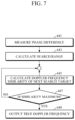
  • FIG. 7 is a flowchart illustrating a configuration of a Doppler frequency determination operation according to an embodiment.
  • FIG. 8 illustrates a process of obtaining a range-Doppler spectrum by performing range-Doppler processing in a typical TDM FMCW radar apparatus.
  • FIG. 9 is a block diagram illustrating a configuration of the TDM FMCW radar apparatus according to an embodiment.
  • FIG. 10 is a block diagram of a configuration of a spectrum analyzer according to an embodiment.
  • FIG. 11 is a block diagram illustrating a configuration of a Doppler frequency determiner according to an embodiment.
  • a frame of a waveform signal transmitted from one transmitting antenna includes at least three consecutive chirps, which have different periods, for each chirp loop.
  • a Doppler frequency may be determined from phase difference values between the three consecutive chirps measured from an FMCW radar signal received at a receiving antenna.
  • FIG. 4 is a flowchart illustrating a configuration of a signal processing method of a TDM FMCW radar apparatus according to an embodiment.
  • the signal processing method of the TDM FMCW radar apparatus includes a wireless transmission operation 410 , a wireless reception operation 420 , a spectrum analysis operation 430 , and a Doppler frequency determination operation 440 .
  • the proposed invention describes a case of the TDM FMCW radar apparatus composed of an array of N TX transmitting antennas and N RX receiving antennas.
  • the wireless transmission operation 410 is performed at each transmitting antenna
  • the wireless reception operation 420 is performed at each receiving antenna
  • the spectrum analysis operation 430 and the Doppler frequency determination operation 440 may be performed at all virtual antennas.
  • the radar apparatus transmits an FMCW radar waveform signal through the transmitting antenna.
  • the FMCW radar waveform signal transmitted by the radar apparatus at least three consecutive chirps have different periods for each chirp loop.
  • the expression that three consecutive chirps have different periods includes cases in which two out of three have the same period and the remaining one has a different value, or all three have different values.
  • FIG. 6 illustrates a typical frame structure of a radar waveform in the TDM FMCW radar apparatus according to an embodiment.
  • a frame is a unit of spectrum analysis, and the number of chirp loops included in one frame is expressed herein as N LOOP .
  • FIG. 6 illustrates only two chirp loops as a part of one frame.
  • T loop is a length of the chirp loop.
  • the chirp loop is a period required for all transmitting antennas to transmit a signal once.
  • Each frame is composed of one or more chirp loops, and each of the chirp loops is composed of one or more chirps.
  • the number of the chirps per chirp loop is expressed as N TX .
  • the number of the chirps per chirp loop is generally equal to the number of transmitting antennas.
  • FIG. 6 An upper right end of FIG. 6 illustrates a waveform signal of one chirp period of the radar waveform signal.
  • the frequency sweep rate a, the chirp start frequency f 0 , and the sampling delay T ADC are assumed to be the same for all chirps.
  • a delay component between a transmitting antenna TX(p) used to transmit the pth chirp and a qth receiving antenna is expressed as ⁇ TX(p),q
  • a value of ⁇ TX(p),q is determined by azimuth and elevation of a target, and a relative position of a virtual antenna specified by TX(p) and q from an antenna reference point in space.
  • each of chirp loops of an FMCW radar waveform signal transmitted by the radar apparatus to which the signal processing method according to an embodiment is applied includes at least N TX +2 chirps.
  • the N TX chirps are valid chirps for estimating a beat frequency and a Doppler frequency, and information that determines the Doppler frequency may be acquired from at least three consecutive chirps from an N TX th chirp.
  • the proposed invention is not limited thereto, and the three consecutive chirps in the chirp loop may be positioned at a beginning portion or an intermediate portion of the chirp loop.
  • the position or contents of the three consecutive chirps may be different for each FMCW radar waveform signal transmitted by the transmitting antennas.
  • the radar apparatus receives an FMCW radar waveform signal reflected by the target using the receiving antenna, demodulates a baseband FMCW radar signal, samples a difference signal between the baseband FMCW radar signal and the transmitted signal, and transforms the sampled signal into a digital signal and outputs the same.
  • the radar apparatus determines and outputs a beat frequency and a Doppler frequency from the signal output in the wireless reception operation 420 .
  • the N TX transmitting antennas sequentially transmit the FMCW radar waveform signal, and each transmitted FMCW radar waveform signal is reflected by the target and received by the N RX receiving antennas.
  • a signal processing circuit of the radar apparatus processes the radar waveform signal for each receiving antenna.
  • the signal processing circuit of the radar apparatus processes the waveform signal in units of chirps in the same time slot in the loops received at one receiving antenna.
  • the signal processing circuit of the radar apparatus measures phase differences between at least three consecutive chirps having different periods received at the receiving antenna and determines and outputs a true Doppler frequency from measured values and the Doppler frequency output in the spectrum analysis operation. This will be described in detail below.
  • the at least three consecutive chirps are configured to differ in at least one of an idle time between the chirps or a ramp time of the chirp. Accordingly, phase components generated due to a Doppler frequency f d may be observed at different time intervals so that more information may be obtained.
  • the idle time between the chirps corresponds to T idle
  • the ramp time of the chirp corresponds to T ramp .
  • the three consecutive chirps in the chirp loop may be configured such that a first chirp differs in ramp time, a last chirp differs in idle time, and an intermediate chirp differs in both ramp time and idle time.
  • intermediate chirps may all be configured to differ in both ramp time and idle time.
  • positions of the chirps which differ in idle time or ramp time, may be the beginning, intermediate, or end of the loop, and the position or content may be different for each wireless transmitter.
  • FIG. 5 is a flowchart illustrating a configuration of the spectrum analysis operation according to an embodiment.
  • the spectrum analysis operation may include a range FFT processing operation 431 , a Doppler fast Fourier transform (FFT) processing operation 433 , a range estimation operation 435 , and a Doppler estimation operation 437 .
  • FFT Doppler fast Fourier transform
  • the signal processing circuit of the radar apparatus transforms the digital signal output in the wireless reception operation 420 into a frequency-domain signal in units of chirps and outputs the same.
  • an FFT is selected as an example in the illustrated embodiment, it is understood that the proposed invention encompasses various known transforms for frequency-domain transformation.
  • the signal processing circuit of the radar apparatus transforms again the same frequency components of the frequency-domain signal output in the range FFT processing operation 431 into a frequency-domain signal and outputs the same.
  • the signal processing circuit of the radar apparatus performs inter-chirp processing by performing FFT after collecting FFT coefficients by frequency, that is, by an FFT index.
  • the transformed FFT coefficients are stored in a memory.
  • the values stored in the memory are range-Doppler spectrum values obtained through a range FFT and a Doppler FFT.
  • the signal processing circuit of the radar apparatus determines and outputs a beat frequency from the signal output in the range FFT processing operation 431 .
  • the signal processing circuit of the radar apparatus may search for a position of a peak in the spectrum output in the range FFT processing operation 431 , that is, an index storing a maximum value, to identify a beat frequency, and calculate a range to the target using the beat frequency.
  • the signal processing circuit of the radar apparatus determines and outputs a Doppler frequency from the signal output and stored in the Doppler FFT processing operation 433 .
  • the signal processing circuit of the radar apparatus may determine the Doppler frequency by identifying a position of an array that stores a peak value in the range-Doppler spectrum.
  • a true value of the Doppler frequency may be determined from a phase difference between the chirps measured from at least three consecutive chirp signals having a period different from a measured value.
  • a Doppler frequency of the aliased spectrum, at which a theoretically calculated phase difference has the most similar value to the measured phase difference may be determined as a true Doppler frequency.
  • the true Doppler frequency is spaced apart from the measured Doppler frequency by an integer multiple of a width of the aliased spectrum.
  • the phase difference of the at least three consecutive chirp signals having different periods is calculated from the Doppler frequency of the aliased spectrum that may be a candidate, and the Doppler frequency whose phase difference is most similar to the actually measured phase difference may be estimated as the true Doppler frequency.
  • FIG. 8 illustrates a process of obtaining a range-Doppler spectrum by performing range-Doppler processing in a typical TDM FMCW radar apparatus. Even in the proposed invention, range-Doppler processing is performed in a manner similar to that shown in FIG. 2 , and description is made with reference to the qth receiving antenna as an example.
  • a signal processing procedure as illustrated in FIG. 2 is performed at each receiving channel for all TX(p)
  • a total of N TX range-Doppler spectra may be obtained as shown in FIG. 8 . As indicated by gray in FIG.
  • Equation 4 the phase differences between the consecutive chirps are determined by an idle time T idle and a ramp Time T ramp .
  • T idle idle time
  • T ramp ramp Time
  • Equation 5 k is an arbitrary integer and k is estimated to determine the actual Doppler frequency f d,true .
  • FIG. 7 is a flowchart illustrating a configuration of the Doppler frequency determination operation according to an embodiment.
  • the Doppler frequency determination operation may include a phase difference measurement operation 441 , a search range calculation operation 443 , and Doppler-frequencies-with-maximum-similarity search operations 445 , 447 , and 449 .
  • phase difference measurement operation 441 the signal processing circuit of the radar apparatus measures phase differences between at least three consecutive chirp signals having different periods included in the chirp loop. These phase difference values may be measured by detecting a start point and an end point of each of the chirps and measuring a time difference between the end points of the consecutive chirps. A measurement vector as shown below may be generated from the measured phase differences by using the phase differences between the chirps obtained in Equation 4,
  • the signal processing circuit of the radar apparatus determines a search range of the Doppler frequency of the aliased spectrum by a ratio of a maximum Doppler frequency of the target to be detected and a maximum Doppler frequency obtained from the range-Doppler spectrum.
  • Equation 5 a value of k may be referred to as an index of the Doppler frequencies present on the aliased spectrum.
  • index of the Doppler frequencies present on the aliased spectrum There are countless aliased spectra, and thus, appropriately limiting the range thereof is important in terms of the possibility that the proposed invention may be actually applied.
  • the maximum Doppler frequency of the target may be expressed as follows,
  • Equation 4 a minimum measurable time difference is ⁇ T ramp + ⁇ T idle .
  • At least three consecutive chirps are configured such that the sum of ⁇ T ramp and ⁇ T idle , that is, an inter-chirp difference value of the idle time and an inter-chirp difference value of the ramp time is limited by a maximum moving velocity of the target.
  • ⁇ T ramp and ⁇ T idle are appropriately adjusted to satisfy the relationship of Equation 8.
  • Equation 5 a peak due to the aliasing phenomenon occurs at intervals of 2f d,max on the Doppler spectrum.
  • an integer which is greater than or equal to a ratio of Equations 7 and 2f d,max but is smallest, is determined as the maximum value of k.
  • 2f d,max,target is the maximum Doppler frequency to be detected
  • 2f d,max is the maximum Doppler frequency that may be measured through the Doppler processing, that is, a Doppler FFT. That is, k that maximizes Re ⁇ w(k) H x ⁇ is identified while changing k from ⁇ k MAX to k MAX within a range of 2f d,max,target from a Doppler frequency of 2f d,measured , which is primarily measured through the Doppler processing. (H: Hermitian)
  • the signal processing circuit of the radar apparatus determines and outputs the Doppler frequency, at which a theoretically calculated phase difference is most similar to the measured phase difference, among the Doppler frequencies of the aliased spectrum.
  • a phase difference between at least three consecutive chirp signals having different periods included in the chirp loop is theoretically calculated, and a similarity value between the theoretically calculated value and the measured value measured in the phase difference measurement operation 441 is calculated (operation 445 ).
  • the Doppler frequency with the maximum value among the calculated similarity values is retrieved ( 447 ), and the retrieved Doppler frequency is output as the true Doppler frequency ( 449 ).
  • Equation 5 Since k, which has the highest degree of similarity between the theoretical value of Equation 10 and the measured value of Equation 6, is the solution, k that maximizes Re ⁇ w(k) H x ⁇ is identified by changing k within an appropriate range, and the actual Doppler frequency is calculated by substituting the estimation result into Equation 5.
  • a frame of a waveform signal transmitted from one transmitting antenna includes at least three consecutive chirps, which have different periods, for each chirp loop.
  • a Doppler frequency may be determined from phase difference values between the three consecutive chirps measured from an FMCW radar signal received at a receiving antenna.
  • FIG. 9 is a block diagram illustrating a configuration of the TDM FMCW radar apparatus according to an embodiment.
  • the TDM FMCW radar apparatus includes a wireless transmitter 610 , a wireless receiver 630 , a spectrum analyzer 650 , and a Doppler frequency determiner 670 .
  • N TX wireless transmitters, N RX wireless receivers, and N TX *N RX spectrum analyzers are included. That is, since the spectrum analyzer must be provided for each virtual antenna, the N TX spectrum analyzers are connected to each wireless receiver.
  • the wireless transmitter 610 transmits an FMCW radar waveform signal through a transmitting antenna.
  • the FMCW radar waveform signal transmitted by the wireless transmitter 610 at least three consecutive chirps have different periods for each chirp loop.
  • the expression that three consecutive chirps have different periods includes cases in which two out of three have the same period and the remaining one has a different value, or all three have different values.
  • the chirp loop of the FMCW radar waveform signal transmitted by the wireless transmitter 610 includes at least N TX +2 chirps.
  • the N TX chirps are valid chirps for estimating a beat frequency and a Doppler frequency, and information that determines the Doppler frequency may be acquired from at least three consecutive chirps from an N TX th chirp.
  • the proposed invention is not limited thereto, and the three consecutive chirps in the chirp loop may be positioned at a beginning portion or an intermediate portion of the chirp loop.
  • the position or contents of the three consecutive chirps may be different for each FMCW radar waveform signal transmitted by the transmitting antennas.
  • the wireless receiver 630 receives an FMCW radar waveform signal reflected by the target using a receiving antenna, demodulates a baseband FMCW radar signal, samples a difference signal between the baseband FMCW radar signal and the transmitted signal, and transforms the sampled signal into a digital signal and outputs the same.
  • the transmitting antennas and the receiving antennas are generally linearly arranged at equal intervals, but may also be non-linearly arranged at non-uniform intervals.
  • the spectrum analyzer 650 determines and outputs a beat frequency and a Doppler frequency from the signal output from the wireless receiver 630 .
  • the N TX transmitting antennas sequentially transmit the FMCW radar waveform signal, and each transmitted FMCW radar waveform signal is reflected by the target and received by the N RX wireless receivers.
  • Each spectrum analyzer 650 processes the chirps of a period corresponding to the wireless transmitter 610 allocated thereto among the chirps output from the wireless receiver 630 .
  • the spectrum analyzer 650 - 1 may be allocated to process first chirps of the N TX chirps that are repeated for each chirp loop, and the spectrum analyzer 650 - 2 may be allocated to process second chirps of the N TX chirps that are repeated for each chirp loop.
  • the Doppler frequency determiner 670 measures values of phase differences between at least three consecutive chirps having different periods received by the wireless receiver 630 and determines and outputs a true Doppler frequency from the measured values and the Doppler frequency output in the spectrum analysis operation. This will be described in detail below.
  • the at least three consecutive chirps are configured to differ in at least one of an idle time between the chirps or a ramp time of the chirp. Accordingly, phase components generated due to a Doppler frequency f d may be observed at different time intervals so that more information may be obtained.
  • the idle time between the chirps corresponds to T idle
  • the ramp time of the chirp corresponds to T ramp .
  • the three consecutive chirps having different periods may be configured such that a first chirp differs in ramp time, a last chirp differs in idle time, and an intermediate chirp differs in both ramp time and idle time.
  • intermediate chirps may all be configured to differ in both ramp time and idle time.
  • positions of the chirps which differ in idle time or ramp time, may be the beginning, intermediate, or end of the loop, and the position or content may be different for each wireless transmitter.
  • FIG. 10 is a block diagram of a configuration of the spectrum analyzer according to an embodiment.
  • the spectrum analyzer 650 includes a range FFT processor 651 , a range estimator 652 , a Doppler FFT processor 655 , and a Doppler estimator 654 .
  • the range FFT processor 651 transforms the digital signal output from the wireless receiver 630 into a frequency-domain signal in units of chirps and outputs the same. Although an FFT is selected as an example in the illustrated embodiment, it is understood that the proposed invention encompasses various known transforms for frequency-domain transformation.
  • the range FFT processor 651 performs FFT on a beat frequency signal of the chirp transmitted by the antenna allocated thereto among the chirps, which are present in a first chirp loop of the digital signal output by the wireless receiver 630 connected thereto, and stores the transformed signal in a range FFT buffer 653 , and performs FFT on a beat frequency signal of the chirp, which is transmitted by the same antenna, in the next chirp loop and stores the transformed signal in the range FFT buffer 653 .
  • the range FFT processor 651 processes the FFT by as many times as the number of chirp loops, that is, N LOOP times, and the range FFT buffer 653 has a size capable of storing at least N LOOP FFT coefficient sets.
  • the embodiment illustrated in FIG. 10 adopts a structure in which one range FFT processor 651 is provided for each virtual antenna, and performs FFT on the beat frequency signal from the signal, which is received by the receiving antenna, for each chirp loop, and outputs a result, and the result is accumulated and stored in the range FFT buffer 653 . Accordingly, the range FFT processor 651 should have a speed at which a single Fourier operation may be fully processed within a period of at least one chirp loop.
  • the range estimator 652 determines and outputs a beat frequency from the signal output from the range FFT processor 651 .
  • the range estimator 652 may search for a position of a peak, that is, an index storing the maximum value in the spectrum stored in the range FFT buffer 653 , to identify the beat frequency, and calculate a range to the target from the beat frequency.
  • the Doppler FFT processor 655 transforms the same frequency components of the frequency-domain signal output from the range FFT processor 651 into a frequency-domain signal again and outputs the same.
  • the Doppler FFT processor 655 performs inter-chirp processing by performing FFT after collecting FFT coefficients, which are stored in the range FFT buffer 653 , by frequency, that is, by an FFT index.
  • the transformed FFT coefficients are stored in a Doppler FFT buffer 657 .
  • the Doppler FFT processor 655 includes as many FFT transformers as the number of Fourier coefficients stored in the range FFT buffer 653 .
  • a structure of repeatedly executing one Fourier transformer may be employed.
  • the Doppler FFT processor 655 receives N LOOP output coefficients of the same frequency corresponding to the number N LOOP of the chirp loops, performs FFT on the output coefficients, and stores the transformed output coefficients in the Doppler FFT buffer 657 .
  • the values stored in the Doppler FFT buffer 657 are range-Doppler spectrum values obtained through a range FFT and a Doppler FFT.
  • the Doppler estimator 654 determines and outputs a Doppler frequency from the signal output from the Doppler FFT processor 655 .
  • the Doppler estimator 654 may determine the Doppler frequency by identifying a position of an array that stores a peak value from the range-Doppler spectrum stored in the Doppler FFT buffer 657
  • a true value of the Doppler frequency may be determined from a phase difference between the chirps measured from at least three consecutive chirp signals having a period different from a measured value.
  • a Doppler frequency of the aliased spectrum, at which a theoretically calculated phase difference has the most similar value to the measured phase difference may be determined as a true Doppler frequency.
  • the Doppler frequency determiner 670 may measure a phase difference between the chirps from the three consecutive chirp signals output from the wireless receiver 630 in FIG. 6 , receive the plurality of Doppler frequencies calculated by the Doppler estimator 654 , and determine and output the Doppler frequency, at which a measured phase difference is closest to a theoretically calculated value, from among the plurality of Doppler frequencies, as a true value. Since these have been previously described with reference to FIG. 8 , detailed descriptions thereof will be omitted.
  • FIG. 11 is a block diagram illustrating a configuration of the Doppler frequency determiner according to an embodiment.
  • the Doppler frequency determiner includes a phase difference measurer 671 , a search range calculator 673 , and a Doppler frequency searcher 675 .
  • the phase difference measurer 671 measures the phase difference expressed by Equation 4, that is, the phase difference between the three consecutive chirps. These phase difference values may be measured by detecting a start point and an end point of each of the chirps and measuring a time difference between the end points of the consecutive chirps.
  • the search range calculator 673 determines a search range of the Doppler frequency of the aliased spectrum by a ratio of the maximum Doppler frequency of the target to be detected and the maximum Doppler frequency obtained from the range-Doppler spectrum.
  • the Doppler frequency searcher 675 determines and outputs the Doppler frequency, at which a theoretically calculated phase difference value is most similar to a measured phase difference value, from among the Doppler frequencies of the aliased spectrum corresponding to the search range calculated by the search range calculator 673 .
  • a phase difference between at least three consecutive chirp signals having different periods included in the chirp loop is theoretically calculated, and a similarity value between the theoretically calculated value and the measured value measured by the phase difference measurer 671 is calculated.
  • the Doppler frequency with the maximum value among the calculated similarity values is retrieved and output as the true Doppler frequency.
  • FIG. 11 The operation of the configuration of FIG. 11 has been described in the method invention described with reference to FIG. 7 , and thus detailed description thereof will be omitted.
  • the proposed invention it is possible to overcome the existing limit of a detectable radial speed of a target in a TDM FMCW radar apparatus. Furthermore, according to the proposed invention, it is possible to increase a position resolution by increasing the number of transmitting antennas in a TDM FMCW radar apparatus. Furthermore, it is possible to solve a Doppler ambiguity problem while minimizing constraints in an antenna design in a TDM FMCW radar apparatus. Alternatively, according to the proposed invention, it is possible to solve a Doppler ambiguity problem without increasing a frame length in a TDM FMCW radar apparatus.

Landscapes

  • Engineering & Computer Science (AREA)
  • Radar, Positioning & Navigation (AREA)
  • Remote Sensing (AREA)
  • Computer Networks & Wireless Communication (AREA)
  • Physics & Mathematics (AREA)
  • General Physics & Mathematics (AREA)
  • Radar Systems Or Details Thereof (AREA)

Abstract

A method and structure for solving a Doppler ambiguity problem in a time-division-multiplexed (TDM) frequency modulated continuous wave (FMCW) radar apparatus are proposed. In a frame of a waveform signal transmitted by one transmitting antenna in the TDM FMCW radar apparatus, at least three consecutive chirps having different periods are included for each chirp loop. A Doppler frequency may be determined from phase difference values between the three consecutive chirps measured from an FMCW radar signal received at a receiving antenna. The at least three consecutive chirps having different periods are configured to differ in at least one of an idle time between the chirps or a ramp time of the chirp.

Description

CROSS-REFERENCE TO RELATED APPLICATION(S)
This application claims priority from Korean Patent Application No. 10-2021-0117236, filed on Sep. 2, 2021, in the Korean Intellectual Property Office, the disclosure of which is incorporated herein by reference in its entirety.
BACKGROUND 1. Field
A signal processing technique for a time-division-multiplexed (TDM) frequency modulated continuous wave (FMCW) radar apparatus is disclosed.
2. Description of Related Art
A multiple-input-multiple-output (MIMO) frequency modulated continuous wave (FMCW) radar apparatus achieves improved angle resolution at low cost using multiple transmitting antennas and multiple receiving antennas. A time-division-multiplexed (TDM) MIMO radar apparatus distinguishes a transmission waveform signal at the receiving antenna using a time-division multiplexing (TDM) scheme.
<Description of FIG. 1 >
FIG. 1 illustrates an antenna array, which is composed of TX transmitting antennas and RX receiving antennas, in an exemplary FMCW radar apparatus. In the exemplary TDM FMCW radar apparatus, the TX transmitting antennas sequentially transmit an FMCW radar waveform signal, and each transmitted FMCW radar waveform signal is reflected by a target and simultaneously received by the RX receiving antennas. The transmitting antennas and the receiving antennas are generally linearly arranged at equal intervals, but may also be non-linearly arranged at non-uniform intervals. As illustrated in the drawing, when a jth receiving antenna receives a signal transmitted by an ith transmitting antenna, substantially the same signal as a signal in a case in which a virtual antenna is positioned at a position of (i, j) may be acquired.
<Description of FIG. 2 >
FIG. 2 is a diagram illustrating an example of range-Doppler processing for estimating a range and a velocity from a TDM FMCW radar signal. In the TDM FMCW radar apparatus, one frame is composed of NC chirps which are repeatedly transmitted NLoop times in a TDM scheme from the NTX transmitting antennas. That is, NC=NTX×NLoop. As illustrated in the drawing, the range-Doppler processing is equally performed for all virtual antennas. For example, in the TDM FMCW radar apparatus having an array composed of NTX transmitting antennas and NRX receiving antennas, the range-Doppler processing as illustrated in FIG. 2 may be performed for each of NTX×NRX virtual antennas.
As illustrated in the drawing, when the transmitting antennas sequentially transmit an FMCW radar waveform signal, a receiving antenna RX1 receives all reflected waves reflected from one or more targets like other receiving antennas. A phase difference between a signal transmitted from the transmitting antenna and a signal received at the receiving antenna depends on a range from the transmitting antenna to the receiving antenna via the target. A frequency difference between transmitting and receiving signals is referred to as a beat frequency, and this beat frequency may be estimated from a position of a peak, that is, an FFT index, of output coefficients of a range fast Fourier transform (FFT). Since the beat frequency has a one-to-one correspondence with the range to the target, the range to the target may be estimated by estimating the beat frequency.
In FIG. 2 , a signal of a virtual antenna at a position of (0, 1), that is, a virtual antenna in a case in which a 1st receiving antenna receives a signal transmitted by a 0th transmitting antenna will be described as an example. First, range FFT processors 210-1 to 210-NLOOP perform intra-chirp processing.
A difference between a transmission signal transmitted in a first chirp loop of a frame from a transmitting antenna TX0 and a signal that is reflected by a target and received by a receiving antenna RX1 is sampled, transformed into a frequency domain by the range FFT processor 210-1 in units of chirps, and stored for each coefficient in a buffer 230-1. A difference between a transmission signal transmitted in a second chirp loop of the frame from the transmitting antenna TX0 and a signal that is reflected by the target and received by the receiving antenna RX1 is sampled, transformed into a frequency domain by the range FFT processor 210-2 in units of chirps, and stored for each coefficient in a buffer 230-2. A difference between a transmission signal transmitted in a last chirp loop of the frame from the transmitting antenna TX0 and a signal that is reflected by the target and received by the receiving antenna RX1 is sampled, transformed into a frequency domain by the range FFT processor 230-NLOOP in units of chirps, and stored for each coefficient in a buffer 230-NLOOP. The beat frequency may be estimated through a process of finding a position of a peak, which is a shaded portion in the drawing, among coefficients stored in the buffer, and from this, a range to the target may be obtained.
Meanwhile, when the target moves, a range between the radar apparatus and the target varies with time, and which is referred to as range migration. The range migration results in a change in a phase of the FMCW radar signal, and the degree of phase change is determined by a radial speed of the target. Accordingly, the radial speed of the target may be estimated by observing the phase change over time. As the total time for observing the phase change increases, even a small phase change may be detected, so that a radial speed resolution is improved. On the other hand, as an interval for observing the phase change is reduced, a faster change may be detected, so that a limit of a detectable radial speed is increased.
In order to estimate the range and the radial speed of the target from the signal received from one virtual antenna, a 2-dimensional spectral estimation scheme such as a two-dimensional (2D)-FFT or 2D-multiple signal classification (MUSIC) is applied to a range-Doppler matrix. A range-angle matrix is obtained from the MIMO antenna array, and at this point, a dimension of an angle is increased as much as a size of a virtual array.
In the example of FIG. 2 , each of Doppler FFT processors 250-1 to 250-M performs inter-chirp processing. Each of the Doppler FFT processors 250-1 to 250-M receives as many output coefficients as the number of the range FFT processors 210-NLOOP, that is, NLOOP output coefficients corresponding to the same frequency, performs FFT on the output coefficients, and stores the transformed coefficients in a 2D buffer 270. As many as the number of the output coefficients of the range FFT processors 210-1 to 210-NLOOP, that is, M Doppler FFT processors 250-1 to 250-M are provided. The buffer 270 stores range-Doppler spectrum values obtained through a range FFT and a Doppler FFT. A Doppler frequency may be determined by identifying a position of a peak, for example, a shaded portion in the drawing, from the Doppler FFT output spectrum stored in the buffer 270, and the radial speed of the target may be obtained from the Doppler frequency.
The Doppler FFT is applied to signals captured from the same TX-RX channel or virtual antenna. Signals received from different channels have different initial phases due to physical positions of the transmitting and receiving antennas respectively corresponding to the channels and an angle at which the target is positioned. Thus, a TDM FMCW system should always use only a signal obtained from the same channel as a Doppler FFT input thereof in order to purely observe only a phase change according to a time change.
In the TDM FMCW system, when a length of one chirp is expressed as Tchirp, a time difference between input samples of the Doppler FFT becomes Tloop=Tchirp×TTX, because radio waves are transmitted sequentially from the NTX transmitting antennas. At this point, when a range change rate due to a movement of the target, that is, the radial speed, is expressed as vr, the Doppler frequency is given as fd=2vr/λ. Here, λ refers to a length of one wavelength. At this point, when a phase difference between the input samples of the Doppler FFT is expressed as Δφ, a relationship of Δφ=2πfdTloop is established.
In order to estimate a spectrum without having an aliasing phenomenon, sampling should be performed at least twice during one period according to the Nyquist sampling theory. This means that the phase difference between the samples should be within ±π. That is, in order to normally estimate the radial speed of the target, the following conditions should be satisfied,
|2πf d T loop|<π.  [Equation 1]
Since Tloop is always a positive number, by using a relationship of fd=2vr/λ, Equation (1) may be expressed as follows,
"\[LeftBracketingBar]" v r "\[RightBracketingBar]" < λ 4 T loop . [ Equation 2 ]
That is, in the TDM FMCW, as the number of the transmitting antennas increases, Tloop increases, and thus a maximum value of a measurable radial speed in an aliasing-free condition decreases in proportion to the number of the transmitting antennas. For example, in a case of a 77 GHz radar system in which there are 12 transmitting antennas and a length of one chirp is 40 ms, the maximum measurable radial speed is merely about +/−7.3 km/h.
FIG. 3 illustrates velocity spectra that may be estimated from a Doppler FFT output spectrum. As illustrated in the drawing, the velocity spectra estimated from the Doppler FFT output spectrum include an observable spectrum and an aliased spectrum, and the velocity obtained from these may include a true velocity and a measured velocity, and thus a Doppler ambiguity problem arises. Thus, as illustrated in FIG. 3 , it is difficult to accurately estimate the radial speed of the target due to the aliasing phenomenon when the target moves beyond a maximum measurable radial speed limit as in the example of FIG. 3 . Since incorrectly estimating the radial speed of the target has a decisive effect on an error in estimating the angle of the target, such a Doppler ambiguity problem must be solved.
A method for solving such a problem has been disclosed in the related art (Roos, Fabian, et al. “Enhancement of Doppler unambiguity for chirp-sequence modulated TDM MIMO radars.” disclosed at the 2018 IEEE MTT-S International Conference on Microwaves for Intelligent Mobility (ICMIM). IEEE, 2018, or Schmid, Christian M., et al. “Motion compensation and efficient array design for TDMAN FMCW MIMO radar systems.” disclosed at the 2012 6th European Conference on Antennas and Propagation (EUCAP). IEEE, 2012). These papers have proposed an antenna arrangement of a particular structure in order to separate phase rotation due to the Doppler effect, and phase rotation components that are determined by a position of a target and a position of a virtual antenna. These methods primarily estimate a radial speed of the target on a range-Doppler spectrum, and estimate the radial speed of the target again using information about a phase change between the virtual antennas. However, such a method must design antennas to form a spatially long uniform virtual array in which transmitting antennas or receiving antennas are arranged at equal intervals of 0.5 times a wavelength. Otherwise, the antennas must be designed so that a significant number of virtual array elements overlap spatially. That is, since the degree of freedom of the antenna design is extremely limited, the related art is difficult to be applied to a sparse array, and problems such as antenna coupling and reduced angle resolution follow. In addition, even though the antennas are designed to satisfy the above design conditions, since the minimum time interval for measuring the phase rotation is Tchirp, the maximum estimable radial speed does not exceed a physical limit of Equation 2.
A method in which sub-frames having two or more different Tchirp are concatenated and used is disclosed in another related art paper (Wojtkiewicz, Andrzej, et al. “Two-dimensional signal processing in FMCW radars.” disclosed at Proc. XXKKTOiUE (1997):475-480). Here, one frame is composed of several sub-frames. One sub-frame is structurally identical to a frame of the conventional TDM FMCW signal. However, since two or more sub-frames are used in this method, there are disadvantages in that a frame length is too long and data throughput is high. In addition, it is difficult to maximize a signal processing gain because a difference in start time between the sub-frames is large and thus signal coherency is lowered, and it is difficult to properly associate targets detected in each sub-frame when a range of the target is greatly changed due to range migration between the sub-frames.
In order to solve the range migration problem and the coherency problem of the above-described paper, a method of performing interleaving on a time axis by adding a frequency deviation between sub-frames is proposed in still another related art paper (Kronauge, Matthias, and Hermann Rohling. “New chirp sequence radar waveform.” disclosed at IEEE Transactions on Aerospace and Electronic Systems 50.4 (2014): 2870-2877). However, this method is also difficult to be used in practice because a frame length becomes too long as in the related art paper described above, even so, this method may be restrictively used only when a sampling rate is very low.
SUMMARY
This summary is provided to introduce a selection of concepts in a simplified form that is further described below in the Detailed Description. This summary is not intended to identify key features or essential features of the claimed subject matter, nor is it intended to be used as an aid in determining the scope of the claimed subject matter.
The following description relates to proposing a method of increasing a limit of a detectable radial speed of a target at a given number of transmitting antennas in a time-division-multiplexed (TDM) frequency modulated continuous wave (FMCW) radar apparatus.
The following description also relates to increasing position resolution by increasing the number of transmitting antennas while increasing a detectable radial speed of a target in a TDM FMCW radar apparatus.
The following description also relates to solving a Doppler ambiguity problem in a TDM FMCW radar apparatus.
The following description also relates to solving a Doppler ambiguity problem while minimizing an increase in frame length in a TDM FMCW radar apparatus.
The following description also relates to solving a Doppler ambiguity problem while minimizing additional constraints in antenna design in a TDM FMCW radar apparatus.
In one general aspect, in a TDM FMCW radar apparatus, a frame of a waveform signal transmitted from one transmitting antenna includes at least three consecutive chirps, which have different periods, for each chirp loop. A Doppler frequency may be determined from phase difference values between the three consecutive chirps measured from an FMCW radar signal received at a receiving antenna.
In an additional aspect, the at least three consecutive chirps having different periods are configured to differ in at least one of an idle time between the chirps or a ramp time of the chirp.
In an additional aspect, the at least three consecutive chirps are configured such that a sum of an inter-chirp difference value of the idle time and an inter-chirp difference value of the ramp time is limited by a target maximum detection rate of the target.
In an additional aspect, a true value of a Doppler frequency may be determined from a phase difference between the chirps measured from at least three consecutive chirp signals having a period different from a measured value. Specifically, a Doppler frequency of an aliased spectrum, at which a theoretically calculated phase difference has the most similar value to the measured phase difference may be determined as a true Doppler frequency.
In an additional aspect, a search range for the Doppler frequencies of the aliased spectrum may be determined by a ratio of the maximum Doppler frequency of the target to be detected and the maximum Doppler frequency obtained from a range-Doppler spectrum.
BRIEF DESCRIPTION OF THE DRAWINGS
FIG. 1 illustrates an antenna array, which is composed of TX transmitting antennas and RX receiving antennas, in an exemplary frequency modulated continuous wave (FMCW) radar apparatus.
FIG. 2 is a diagram illustrating an example of range-Doppler processing for estimating a range and a radial velocity from a time-division-multiplexed (TDM) FMCW radar signal.
FIG. 3 illustrates velocity spectra that may be estimated from a Doppler fast Fourier transform (FFT) output spectrum.
FIG. 4 is a flowchart illustrating a configuration of a signal processing method of a TDM FMCW radar apparatus according to an embodiment.
FIG. 5 is a flowchart illustrating a configuration of a spectrum analysis operation according to an embodiment.
FIG. 6 illustrates a typical frame structure of a radar waveform in the TDM FMCW radar apparatus according to an embodiment.
FIG. 7 is a flowchart illustrating a configuration of a Doppler frequency determination operation according to an embodiment.
FIG. 8 illustrates a process of obtaining a range-Doppler spectrum by performing range-Doppler processing in a typical TDM FMCW radar apparatus.
FIG. 9 is a block diagram illustrating a configuration of the TDM FMCW radar apparatus according to an embodiment.
FIG. 10 is a block diagram of a configuration of a spectrum analyzer according to an embodiment.
FIG. 11 is a block diagram illustrating a configuration of a Doppler frequency determiner according to an embodiment.
DETAILED DESCRIPTION
The foregoing and additional aspects of the present invention will be embodied through the following embodiments described with reference to the accompanying drawings. It should be understood that various combinations of components in each embodiment are possible unless otherwise specified or contradicted within the embodiment. It will be understood that words or terms used in the specification and claims should be interpreted as having a meaning that is consistent with their meaning in the context of the description and the technical idea of the proposed invention, based on the principle that an inventor is able to properly define the meaning of the words or terms to best explain the invention. Hereinafter, exemplary embodiments of the present invention will be described in detail with reference to the accompanying drawings.
<Description of Claim 1 of Invention>
According to one aspect, in a time-division-multiplexed (TDM) frequency modulated continuous wave (FMCW) radar apparatus, a frame of a waveform signal transmitted from one transmitting antenna includes at least three consecutive chirps, which have different periods, for each chirp loop. A Doppler frequency may be determined from phase difference values between the three consecutive chirps measured from an FMCW radar signal received at a receiving antenna.
FIG. 4 is a flowchart illustrating a configuration of a signal processing method of a TDM FMCW radar apparatus according to an embodiment. As illustrated in the drawing, the signal processing method of the TDM FMCW radar apparatus according to an embodiment includes a wireless transmission operation 410, a wireless reception operation 420, a spectrum analysis operation 430, and a Doppler frequency determination operation 440.
The proposed invention describes a case of the TDM FMCW radar apparatus composed of an array of NTX transmitting antennas and NRX receiving antennas. In this radar apparatus, the wireless transmission operation 410 is performed at each transmitting antenna, and the wireless reception operation 420 is performed at each receiving antenna, and the spectrum analysis operation 430 and the Doppler frequency determination operation 440 may be performed at all virtual antennas.
In the wireless transmission operation 410, the radar apparatus transmits an FMCW radar waveform signal through the transmitting antenna. According to an aspect, in the FMCW radar waveform signal transmitted by the radar apparatus, at least three consecutive chirps have different periods for each chirp loop. Here, the expression that three consecutive chirps have different periods includes cases in which two out of three have the same period and the remaining one has a different value, or all three have different values.
FIG. 6 illustrates a typical frame structure of a radar waveform in the TDM FMCW radar apparatus according to an embodiment. A frame is a unit of spectrum analysis, and the number of chirp loops included in one frame is expressed herein as NLOOP. FIG. 6 illustrates only two chirp loops as a part of one frame. In the drawing, Tloop is a length of the chirp loop. The chirp loop is a period required for all transmitting antennas to transmit a signal once. Each frame is composed of one or more chirp loops, and each of the chirp loops is composed of one or more chirps. Here, the number of the chirps per chirp loop is expressed as NTX. The number of the chirps per chirp loop is generally equal to the number of transmitting antennas. When a position index of the chirp in the chirp loop is expressed as p, p has a value in a range of 0<=p<=NTX−1.
An upper right end of FIG. 6 illustrates a waveform signal of one chirp period of the radar waveform signal. Here,
    • α: frequency sweep rate
    • Tidle,p: idle time of pth chirp
    • Tramp,p: length of frequency change section of pth chirp
    • Tchirp,p: chirp period of the pth chirp(=Tidle,p+Tramp,p)
    • TADC: sampling delay that is a time difference between time at which transmission of a chirp starts and time at which sampling starts
    • f0: chirp start frequency.
In the proposed invention, the frequency sweep rate a, the chirp start frequency f0, and the sampling delay TADC are assumed to be the same for all chirps. When a delay component between a transmitting antenna TX(p) used to transmit the pth chirp and a qth receiving antenna is expressed as τTX(p),q, a value of τTX(p),q is determined by azimuth and elevation of a target, and a relative position of a virtual antenna specified by TX(p) and q from an antenna reference point in space.
According to an aspect, unlike a general waveform signal illustrated in FIG. 6 , each of chirp loops of an FMCW radar waveform signal transmitted by the radar apparatus to which the signal processing method according to an embodiment is applied includes at least NTX+2 chirps. The NTX chirps are valid chirps for estimating a beat frequency and a Doppler frequency, and information that determines the Doppler frequency may be acquired from at least three consecutive chirps from an NTXth chirp. However, the proposed invention is not limited thereto, and the three consecutive chirps in the chirp loop may be positioned at a beginning portion or an intermediate portion of the chirp loop. Furthermore, the position or contents of the three consecutive chirps may be different for each FMCW radar waveform signal transmitted by the transmitting antennas.
In the wireless reception operation 420, the radar apparatus receives an FMCW radar waveform signal reflected by the target using the receiving antenna, demodulates a baseband FMCW radar signal, samples a difference signal between the baseband FMCW radar signal and the transmitted signal, and transforms the sampled signal into a digital signal and outputs the same.
In the spectrum analysis operation 430, the radar apparatus determines and outputs a beat frequency and a Doppler frequency from the signal output in the wireless reception operation 420. In one chirp loop, the NTX transmitting antennas sequentially transmit the FMCW radar waveform signal, and each transmitted FMCW radar waveform signal is reflected by the target and received by the NRX receiving antennas. In the spectrum analysis operation 430, a signal processing circuit of the radar apparatus processes the radar waveform signal for each receiving antenna. In addition, the signal processing circuit of the radar apparatus processes the waveform signal in units of chirps in the same time slot in the loops received at one receiving antenna.
In the Doppler frequency determination operation 440, the signal processing circuit of the radar apparatus measures phase differences between at least three consecutive chirps having different periods received at the receiving antenna and determines and outputs a true Doppler frequency from measured values and the Doppler frequency output in the spectrum analysis operation. This will be described in detail below.
<Description of Claim 2 of Invention>
According to an additional aspect of the proposed invention, the at least three consecutive chirps are configured to differ in at least one of an idle time between the chirps or a ramp time of the chirp. Accordingly, phase components generated due to a Doppler frequency fd may be observed at different time intervals so that more information may be obtained. Referring to an exemplary waveform in a dotted-line circle of FIG. 6 , the idle time between the chirps corresponds to Tidle, and the ramp time of the chirp corresponds to Tramp. In the example illustrated in the drawing, a period of the chirp may be expressed as Tchirp=Tidle+Tramp.
According to the proposed invention, the three consecutive chirps in the chirp loop may be configured such that a first chirp differs in ramp time, a last chirp differs in idle time, and an intermediate chirp differs in both ramp time and idle time. In the case of employing three or more consecutive chirps, intermediate chirps may all be configured to differ in both ramp time and idle time.
Similar to that described above, in the illustrated embodiment, in the FMCW radar waveform signal, positions of the chirps, which differ in idle time or ramp time, may be the beginning, intermediate, or end of the loop, and the position or content may be different for each wireless transmitter. As will be described below, it is possible to obtain additional information enabling one true Doppler frequency to be determined from among a plurality of Doppler frequencies, which are generated by an aliasing phenomenon, by varying an idle time Tidle between the chirps and a ramp time Tramp of the chirp.
<Description of Spectrum Analysis of Claim 4 and FIG. 5 >
FIG. 5 is a flowchart illustrating a configuration of the spectrum analysis operation according to an embodiment. As illustrated in the drawing, in an embodiment, the spectrum analysis operation may include a range FFT processing operation 431, a Doppler fast Fourier transform (FFT) processing operation 433, a range estimation operation 435, and a Doppler estimation operation 437.
In the range FFT processing operation 431, the signal processing circuit of the radar apparatus transforms the digital signal output in the wireless reception operation 420 into a frequency-domain signal in units of chirps and outputs the same. Although an FFT is selected as an example in the illustrated embodiment, it is understood that the proposed invention encompasses various known transforms for frequency-domain transformation.
In the Doppler FFT processing operation 433, the signal processing circuit of the radar apparatus transforms again the same frequency components of the frequency-domain signal output in the range FFT processing operation 431 into a frequency-domain signal and outputs the same. In the Doppler FFT processing operation 433, the signal processing circuit of the radar apparatus performs inter-chirp processing by performing FFT after collecting FFT coefficients by frequency, that is, by an FFT index. The transformed FFT coefficients are stored in a memory. The values stored in the memory are range-Doppler spectrum values obtained through a range FFT and a Doppler FFT.
In the range estimation operation 435, the signal processing circuit of the radar apparatus determines and outputs a beat frequency from the signal output in the range FFT processing operation 431. In the range estimation operation 435, the signal processing circuit of the radar apparatus may search for a position of a peak in the spectrum output in the range FFT processing operation 431, that is, an index storing a maximum value, to identify a beat frequency, and calculate a range to the target using the beat frequency.
In the Doppler search operation 435, the signal processing circuit of the radar apparatus determines and outputs a Doppler frequency from the signal output and stored in the Doppler FFT processing operation 433. In the Doppler search operation 435, the signal processing circuit of the radar apparatus may determine the Doppler frequency by identifying a position of an array that stores a peak value in the range-Doppler spectrum.
<Description of Claim 5 of Invention>
According to an additional aspect, a true value of the Doppler frequency may be determined from a phase difference between the chirps measured from at least three consecutive chirp signals having a period different from a measured value. Specifically, a Doppler frequency of the aliased spectrum, at which a theoretically calculated phase difference has the most similar value to the measured phase difference may be determined as a true Doppler frequency.
Due to the aliased spectrum, the true Doppler frequency is spaced apart from the measured Doppler frequency by an integer multiple of a width of the aliased spectrum. The phase difference of the at least three consecutive chirp signals having different periods is calculated from the Doppler frequency of the aliased spectrum that may be a candidate, and the Doppler frequency whose phase difference is most similar to the actually measured phase difference may be estimated as the true Doppler frequency.
<Description of FIG. 8 >
FIG. 8 illustrates a process of obtaining a range-Doppler spectrum by performing range-Doppler processing in a typical TDM FMCW radar apparatus. Even in the proposed invention, range-Doppler processing is performed in a manner similar to that shown in FIG. 2 , and description is made with reference to the qth receiving antenna as an example. When a signal processing procedure as illustrated in FIG. 2 is performed at each receiving channel for all TX(p), a total of NTX range-Doppler spectra may be obtained as shown in FIG. 8 . As indicated by gray in FIG. 8 , there is a peak in an arrangement corresponding to a range and a radial speed of the target on the range-Doppler spectrum, and a phase value at a peak in the range-Doppler spectrum obtained by a TX(p)→q link, that is, a virtual antenna in which a signal transmitted from a pth transmitting antenna is received by the qth receiving antenna is, ignoring noise, expressed as follows,
p,q=2π(f 0 +αT ADCTX(p),q+2πf di=0 p-1 T chirp,i +T idle,p).  [Equation 3]
Here, for three consecutive chirps p, p+1, and p+2,
    • when a relationship of τTX(p),qTX(p+1),qTX(p+2),q is satisfied,
    • phase differences between consecutive chirps may be expressed as follows,
[ Equation 4 ] Δ∅ 1 , 0 = p + 1 , q - p , q = 2 π f d ( T ramp , p + T idle , p + 1 ) + T idle , p + 2 - T idle , p + 1 Δ T idle Δ∅ 2 , 1 = p + 2 , q - p + 1 , q = 2 π f d ( T ramp , p + 1 + T idle , p + 2 ) Δ∅ 2 , 1 , 0 = Δ∅ 2 , 1 - Δ∅ 1 , 0 = 2 π f d ( T ramp , p + 1 + T ramp , p Δ T ramp + T idle , p + 2 + T idle , p + 1 Δ T idle ) .
It can be seen from Equation 4 that the phase differences between the consecutive chirps are determined by an idle time Tidle and a ramp Time Tramp. When all the chirps have the same idle time and ramp time as in the conventional TDM FMCW system, information obtainable from the phase differences between the chirps is limited to 2πfd(Tramp+Tidle).
As illustrated in FIG. 8 , in the Doppler processing at the receiving channel of each virtual antenna, signals received from the same transmitting antenna are input, and a time difference between the input samples is Tloop. When a Doppler frequency due to a movement of the target is expressed as fd, the minimum phase difference that may be observed by performing the Doppler processing is 2πfdTloop.
At this point, the maximum Doppler frequency measurable by Equation 1 may be expressed as fd=1/(2Tloop), and in a case of fd>|fd,max|, an error occurs in a radial speed estimation value due to an aliasing phenomenon as illustrated in FIG. 3 .
When the Doppler frequency estimated on the range-Doppler spectrum is expressed as fd,measured, and an actual Doppler frequency is expressed as fd,true, fd,true and fd,measured have a relationship as follows,
f d,true =f d,measured+2kf d,max.  [Equation 5]
In Equation 5, k is an arbitrary integer and k is estimated to determine the actual Doppler frequency fd,true.
FIG. 7 is a flowchart illustrating a configuration of the Doppler frequency determination operation according to an embodiment. As illustrated in the drawing, the Doppler frequency determination operation according to an embodiment may include a phase difference measurement operation 441, a search range calculation operation 443, and Doppler-frequencies-with-maximum- similarity search operations 445, 447, and 449.
In the phase difference measurement operation 441, the signal processing circuit of the radar apparatus measures phase differences between at least three consecutive chirp signals having different periods included in the chirp loop. These phase difference values may be measured by detecting a start point and an end point of each of the chirps and measuring a time difference between the end points of the consecutive chirps. A measurement vector as shown below may be generated from the measured phase differences by using the phase differences between the chirps obtained in Equation 4,
X = [ exp ( j Δ∅ 1 , 0 ) exp ( j Δ∅ 2 , 1 ) exp ( j Δ∅ 2 , 1 , 0 ) ] . [ Equation 6 ]
In the search range calculation operation 443, the signal processing circuit of the radar apparatus determines a search range of the Doppler frequency of the aliased spectrum by a ratio of a maximum Doppler frequency of the target to be detected and a maximum Doppler frequency obtained from the range-Doppler spectrum.
In Equation 5, a value of k may be referred to as an index of the Doppler frequencies present on the aliased spectrum. There are countless aliased spectra, and thus, appropriately limiting the range thereof is important in terms of the possibility that the proposed invention may be actually applied.
When a start frequency of the FMCW waveform is defined as f0 and the maximum moving velocity of the target is defined as vr,max,target, the maximum Doppler frequency of the target may be expressed as follows,
f d , max , target = 2 v r , max , target c f 0 , [ Equation 7 ]
(where, c is a wave velocity).
It can be seen from Equation 4 that a minimum measurable time difference is ΔTramp+ΔTidle. Thus, when ΔTramp+ΔTidle instead of Tloop is substituted in a conditional expression of Equation 1, and Equation 7 is substituted for fd of Equation 1, which are then rearranged, the following relational expression may be derived,
Δ T ramp + Δ T idle < C 4 f 0 v r , max , target . [ Equation 8 ]
As shown in Equation 8, in the proposed invention, at least three consecutive chirps are configured such that the sum of ΔTramp and ΔTidle, that is, an inter-chirp difference value of the idle time and an inter-chirp difference value of the ramp time is limited by a maximum moving velocity of the target. Thus, using the maximum detection rate determined by the system design requirements, one or both of ΔTramp and ΔTidle are appropriately adjusted to satisfy the relationship of Equation 8.
As shown in FIG. 3 and Equation 5, a peak due to the aliasing phenomenon occurs at intervals of 2fd,max on the Doppler spectrum. Thus, an integer, which is greater than or equal to a ratio of Equations 7 and 2fd,max but is smallest, is determined as the maximum value of k.
k MAX = f d , max , target 2 f d , max [ Equation 9 ]
where, 2fd,max,target is the maximum Doppler frequency to be detected, and 2fd,max is the maximum Doppler frequency that may be measured through the Doppler processing, that is, a Doppler FFT. That is, k that maximizes Re{w(k)Hx} is identified while changing k from −kMAX to kMAX within a range of 2fd,max,target from a Doppler frequency of 2fd,measured, which is primarily measured through the Doppler processing. (H: Hermitian)
In the Doppler-frequencies-with-maximum- similarity search operations 445, 447, and 449, the signal processing circuit of the radar apparatus determines and outputs the Doppler frequency, at which a theoretically calculated phase difference is most similar to the measured phase difference, among the Doppler frequencies of the aliased spectrum.
First, at a search target Doppler frequency, a phase difference between at least three consecutive chirp signals having different periods included in the chirp loop is theoretically calculated, and a similarity value between the theoretically calculated value and the measured value measured in the phase difference measurement operation 441 is calculated (operation 445). For all the Doppler frequencies, which are included in the aliased spectrum, within the search range, the Doppler frequency with the maximum value among the calculated similarity values is retrieved (447), and the retrieved Doppler frequency is output as the true Doppler frequency (449).
In order to compare the measured value with the theoretically calculated result, the theoretical value is defined as follows by using Equations 4 and 5,
[ Equation 10 ] W ( k ) = [ exp ( j 2 π f d , measured + 2 k "\[LeftBracketingBar]" f d , max "\[RightBracketingBar]" ) ( T ramp , p + T idle , p + 1 ) ) exp ( j 2 π f d , measured + 2 k "\[LeftBracketingBar]" f d , max "\[RightBracketingBar]" ) ( T ramp , p + 1 + T idle , p + 2 ) ) exp ( j 2 π f d , measured + 2 k "\[LeftBracketingBar]" f d , max "\[RightBracketingBar]" ) ( Δ T ramp + Δ T idle ) ) ] .
Since k, which has the highest degree of similarity between the theoretical value of Equation 10 and the measured value of Equation 6, is the solution, k that maximizes Re{w(k)Hx} is identified by changing k within an appropriate range, and the actual Doppler frequency is calculated by substituting the estimation result into Equation 5. Here, H is a Hermitian operator. Thereafter, from the Doppler frequency, a radial speed of the target is calculated using a relationship of vr,true=Δfd,true/2.
<Description of Invention of Apparatus>
<Description of Claim 7 of Invention>
According to one aspect, in a TDM FMCW radar apparatus, a frame of a waveform signal transmitted from one transmitting antenna includes at least three consecutive chirps, which have different periods, for each chirp loop. A Doppler frequency may be determined from phase difference values between the three consecutive chirps measured from an FMCW radar signal received at a receiving antenna.
FIG. 9 is a block diagram illustrating a configuration of the TDM FMCW radar apparatus according to an embodiment. As illustrated in the drawing, the TDM FMCW radar apparatus according to an embodiment includes a wireless transmitter 610, a wireless receiver 630, a spectrum analyzer 650, and a Doppler frequency determiner 670. In the illustrated embodiment, NTX wireless transmitters, NRX wireless receivers, and NTX*NRX spectrum analyzers are included. That is, since the spectrum analyzer must be provided for each virtual antenna, the NTX spectrum analyzers are connected to each wireless receiver. However, for simplicity of illustration, only one wireless transmitter 610, one wireless receiver 630, two spectrum analyzers 650-1 and 650-2, and two Doppler frequency determiners 670-1 and 670-2 are specified in the drawings.
The wireless transmitter 610 transmits an FMCW radar waveform signal through a transmitting antenna. According to an aspect, in the FMCW radar waveform signal transmitted by the wireless transmitter 610, at least three consecutive chirps have different periods for each chirp loop. Here, the expression that three consecutive chirps have different periods includes cases in which two out of three have the same period and the remaining one has a different value, or all three have different values.
According to an aspect, unlike a general waveform signal illustrated in FIG. 6 , the chirp loop of the FMCW radar waveform signal transmitted by the wireless transmitter 610 includes at least NTX+2 chirps. The NTX chirps are valid chirps for estimating a beat frequency and a Doppler frequency, and information that determines the Doppler frequency may be acquired from at least three consecutive chirps from an NTXth chirp. However, the proposed invention is not limited thereto, and the three consecutive chirps in the chirp loop may be positioned at a beginning portion or an intermediate portion of the chirp loop. Furthermore, the position or contents of the three consecutive chirps may be different for each FMCW radar waveform signal transmitted by the transmitting antennas.
The wireless receiver 630 receives an FMCW radar waveform signal reflected by the target using a receiving antenna, demodulates a baseband FMCW radar signal, samples a difference signal between the baseband FMCW radar signal and the transmitted signal, and transforms the sampled signal into a digital signal and outputs the same. The transmitting antennas and the receiving antennas are generally linearly arranged at equal intervals, but may also be non-linearly arranged at non-uniform intervals.
The spectrum analyzer 650 determines and outputs a beat frequency and a Doppler frequency from the signal output from the wireless receiver 630. In one chirp loop, the NTX transmitting antennas sequentially transmit the FMCW radar waveform signal, and each transmitted FMCW radar waveform signal is reflected by the target and received by the NRX wireless receivers. Each spectrum analyzer 650 processes the chirps of a period corresponding to the wireless transmitter 610 allocated thereto among the chirps output from the wireless receiver 630. For example, the spectrum analyzer 650-1 may be allocated to process first chirps of the NTX chirps that are repeated for each chirp loop, and the spectrum analyzer 650-2 may be allocated to process second chirps of the NTX chirps that are repeated for each chirp loop.
The Doppler frequency determiner 670 measures values of phase differences between at least three consecutive chirps having different periods received by the wireless receiver 630 and determines and outputs a true Doppler frequency from the measured values and the Doppler frequency output in the spectrum analysis operation. This will be described in detail below.
<Description of Claim 8 of Invention>
According to an additional aspect of the proposed invention, the at least three consecutive chirps are configured to differ in at least one of an idle time between the chirps or a ramp time of the chirp. Accordingly, phase components generated due to a Doppler frequency fd may be observed at different time intervals so that more information may be obtained. Referring to an exemplary waveform in a dotted-line circle of FIG. 6 , the idle time between the chirps corresponds to Tidle, and the ramp time of the chirp corresponds to Tramp. In the example illustrated in the drawing, a period of the chirp may be expressed as Tchirp=Tidle+Tramp.
According to the proposed invention, the three consecutive chirps having different periods may be configured such that a first chirp differs in ramp time, a last chirp differs in idle time, and an intermediate chirp differs in both ramp time and idle time. In the case of employing three or more consecutive chirps having different periods, intermediate chirps may all be configured to differ in both ramp time and idle time.
Similar to those described above, in the illustrated embodiment, in the FMCW radar waveform signal, positions of the chirps, which differ in idle time or ramp time, may be the beginning, intermediate, or end of the loop, and the position or content may be different for each wireless transmitter. As will be described below, it is possible to obtain additional information enabling a true Doppler frequency to be determined from among a plurality of Doppler frequencies, which are generated by an aliasing phenomenon, by varying an idle time Tidle between the chirps and a ramp time Tramp of the chirp.
<Description of Claim 10 of Invention>
FIG. 10 is a block diagram of a configuration of the spectrum analyzer according to an embodiment. As illustrated in the drawing, in an embodiment, the spectrum analyzer 650 includes a range FFT processor 651, a range estimator 652, a Doppler FFT processor 655, and a Doppler estimator 654.
The range FFT processor 651 transforms the digital signal output from the wireless receiver 630 into a frequency-domain signal in units of chirps and outputs the same. Although an FFT is selected as an example in the illustrated embodiment, it is understood that the proposed invention encompasses various known transforms for frequency-domain transformation. The range FFT processor 651 performs FFT on a beat frequency signal of the chirp transmitted by the antenna allocated thereto among the chirps, which are present in a first chirp loop of the digital signal output by the wireless receiver 630 connected thereto, and stores the transformed signal in a range FFT buffer 653, and performs FFT on a beat frequency signal of the chirp, which is transmitted by the same antenna, in the next chirp loop and stores the transformed signal in the range FFT buffer 653. Thus, in the illustrated embodiment, the range FFT processor 651 processes the FFT by as many times as the number of chirp loops, that is, NLOOP times, and the range FFT buffer 653 has a size capable of storing at least NLOOP FFT coefficient sets.
Although an example in which NLOOP range FFT processors 210 are present is illustrated in FIG. 2 , the embodiment illustrated in FIG. 10 adopts a structure in which one range FFT processor 651 is provided for each virtual antenna, and performs FFT on the beat frequency signal from the signal, which is received by the receiving antenna, for each chirp loop, and outputs a result, and the result is accumulated and stored in the range FFT buffer 653. Accordingly, the range FFT processor 651 should have a speed at which a single Fourier operation may be fully processed within a period of at least one chirp loop.
The range estimator 652 determines and outputs a beat frequency from the signal output from the range FFT processor 651. The range estimator 652 may search for a position of a peak, that is, an index storing the maximum value in the spectrum stored in the range FFT buffer 653, to identify the beat frequency, and calculate a range to the target from the beat frequency.
The Doppler FFT processor 655 transforms the same frequency components of the frequency-domain signal output from the range FFT processor 651 into a frequency-domain signal again and outputs the same. The Doppler FFT processor 655 performs inter-chirp processing by performing FFT after collecting FFT coefficients, which are stored in the range FFT buffer 653, by frequency, that is, by an FFT index. The transformed FFT coefficients are stored in a Doppler FFT buffer 657.
In one embodiment, the Doppler FFT processor 655 includes as many FFT transformers as the number of Fourier coefficients stored in the range FFT buffer 653. As another example, a structure of repeatedly executing one Fourier transformer may be employed.
The Doppler FFT processor 655 receives NLOOP output coefficients of the same frequency corresponding to the number NLOOP of the chirp loops, performs FFT on the output coefficients, and stores the transformed output coefficients in the Doppler FFT buffer 657. The values stored in the Doppler FFT buffer 657 are range-Doppler spectrum values obtained through a range FFT and a Doppler FFT.
The Doppler estimator 654 determines and outputs a Doppler frequency from the signal output from the Doppler FFT processor 655. The Doppler estimator 654 may determine the Doppler frequency by identifying a position of an array that stores a peak value from the range-Doppler spectrum stored in the Doppler FFT buffer 657
<Description of Claim 11 of Invention>
According to an additional aspect, a true value of the Doppler frequency may be determined from a phase difference between the chirps measured from at least three consecutive chirp signals having a period different from a measured value. Specifically, a Doppler frequency of the aliased spectrum, at which a theoretically calculated phase difference has the most similar value to the measured phase difference may be determined as a true Doppler frequency.
The Doppler frequency determiner 670 may measure a phase difference between the chirps from the three consecutive chirp signals output from the wireless receiver 630 in FIG. 6 , receive the plurality of Doppler frequencies calculated by the Doppler estimator 654, and determine and output the Doppler frequency, at which a measured phase difference is closest to a theoretically calculated value, from among the plurality of Doppler frequencies, as a true value. Since these have been previously described with reference to FIG. 8 , detailed descriptions thereof will be omitted.
FIG. 11 is a block diagram illustrating a configuration of the Doppler frequency determiner according to an embodiment. As illustrated in the drawing, the Doppler frequency determiner according to an embodiment includes a phase difference measurer 671, a search range calculator 673, and a Doppler frequency searcher 675.
The phase difference measurer 671 measures the phase difference expressed by Equation 4, that is, the phase difference between the three consecutive chirps. These phase difference values may be measured by detecting a start point and an end point of each of the chirps and measuring a time difference between the end points of the consecutive chirps.
The search range calculator 673 determines a search range of the Doppler frequency of the aliased spectrum by a ratio of the maximum Doppler frequency of the target to be detected and the maximum Doppler frequency obtained from the range-Doppler spectrum.
The Doppler frequency searcher 675 determines and outputs the Doppler frequency, at which a theoretically calculated phase difference value is most similar to a measured phase difference value, from among the Doppler frequencies of the aliased spectrum corresponding to the search range calculated by the search range calculator 673.
First, at a search target Doppler frequency, a phase difference between at least three consecutive chirp signals having different periods included in the chirp loop is theoretically calculated, and a similarity value between the theoretically calculated value and the measured value measured by the phase difference measurer 671 is calculated. For all the Doppler frequencies, which are included in the aliased spectrum, within the search range, the Doppler frequency with the maximum value among the calculated similarity values is retrieved and output as the true Doppler frequency.
The operation of the configuration of FIG. 11 has been described in the method invention described with reference to FIG. 7 , and thus detailed description thereof will be omitted.
According to the proposed invention, it is possible to overcome the existing limit of a detectable radial speed of a target in a TDM FMCW radar apparatus. Furthermore, according to the proposed invention, it is possible to increase a position resolution by increasing the number of transmitting antennas in a TDM FMCW radar apparatus. Furthermore, it is possible to solve a Doppler ambiguity problem while minimizing constraints in an antenna design in a TDM FMCW radar apparatus. Alternatively, according to the proposed invention, it is possible to solve a Doppler ambiguity problem without increasing a frame length in a TDM FMCW radar apparatus.
The present invention has been described above with reference to the embodiments referring to the accompanying drawings, but is not limited thereto. Rather, the present invention should be construed as encompassing various modifications that may be apparent to those skilled in the art. The appended claims are intended to cover such modifications.

Claims (12)

What is claimed is:
1. A signal processing method of a time-division-multiplexed (TDM) frequency modulated continuous wave (FMCW) radar apparatus, the method comprising:
a wireless transmission operation of transmitting an FMCW radar waveform signal configured such that at least three consecutive chirps included in a chirp loop of a radar signal have different periods;
a wireless reception operation of demodulating a baseband FMCW radar signal from an FMCW radar waveform signal reflected by a target, sampling a difference signal between the baseband FMCW radar signal and the transmitted signal, transforming the difference signal into a digital signal, and outputting the digital signal;
a spectrum analysis operation of determining and outputting a beat frequency and a Doppler frequency from the signal output in the wireless reception operation; and
a Doppler frequency determination operation of measuring phase differences between the at least three consecutive chirps having different periods, which are received in the wireless reception operation, and determining and outputting a true Doppler frequency from the measured phase differences and the Doppler frequency output in the spectrum analysis operation,
wherein the at least three consecutive chirps have a same frequency,
wherein both a ramp time and an idle time of a first chirp are same with a ramp time and an idle time of a last chirp, and
wherein both a ramp time and an idle time of an intermediate chirp are different from the ramp time and the idle time of both the first chirp and the last chirp.
2. The method of claim 1, wherein the FMCW radar waveform signal transmitted in the wireless transmission operation is configured such that the at least three consecutive chirps differ in at least one of an idle time between the chirps and a ramp time of the chirp.
3. The method of claim 2, wherein the at least three consecutive chirps are configured such that a sum of an inter-chirp difference value of the idle time and an inter-chirp difference value of the ramp time is limited by a maximum moving velocity of the target.
4. The method of claim 1, wherein the spectrum analysis operation includes:
a range fast Fourier transform (FFT) processing operation of transforming the digital signal output in the wireless reception operation into a frequency-domain signal in units of chirps and outputting the frequency-domain signal;
a Doppler FFT processing operation of transforming the same frequency components of the frequency-domain signal output in the range FFT processing operation into a frequency-domain signal again and outputting the frequency-domain signal;
a range estimation operation of determining and outputting a beat frequency from the signal output in the range FFT processing operation; and
a Doppler estimation operation of determining and outputting a Doppler frequency from the signal output in the Doppler FFT processing operation.
5. The method of claim 1, wherein in the Doppler frequency determination operation,
from at least three consecutive chirp signals output in the wireless reception operation, the phase differences between the chirps are measured, and the Doppler frequency at which theoretically calculated phase difference values have values most similar to the measured phase difference values is determined and output as a true Doppler frequency.
6. The method of claim 1, wherein the Doppler frequency determination operation includes:
a phase difference measurement operation of measuring phase differences between at least three consecutive chirp signals which have different periods and are included in the chirp loop;
a search range calculation operation of determining a search range of Doppler frequencies of an aliased spectrum by a ratio of a maximum Doppler frequency of the target to be detected and a maximum Doppler frequency obtained from a range-Doppler spectrum; and
a Doppler frequency search operation of determining and outputting a Doppler frequency at which a theoretically calculated phase difference value is most similar to a measured phase difference value, among the Doppler frequencies of the aliased spectrum.
7. A time-division-multiplexed (TDM) frequency modulated continuous wave (FMCW) radar apparatus, comprising:
a wireless transmitter configured to transmit an FMCW radar waveform signal configured such that at least three consecutive chirps included in a chirp loop of a radar signal have different periods;
a wireless receiver configured to demodulate a baseband FMCW radar signal from an FMCW radar waveform signal reflected by a target, sample a difference signal between the baseband FMCW radar signal and the transmitted signal, and transform the difference signal into a digital signal and output the digital signal;
a spectrum analyzer configured to determine and output a beat frequency and a Doppler frequency from the signal output from the wireless receiver; and
a Doppler frequency determiner configured to measure phase differences between the at least three consecutive chirps having different periods, which are received at the wireless receiver, and determine and output a true Doppler frequency from the measured phase differences and the Doppler frequency output from the spectrum analyzer,
wherein the at least three consecutive chirps have a same frequency,
wherein both a ramp time and an idle time of a first chirp are same with a ramp time and an idle time of a last chirp, and
wherein both a ramp time and an idle time of an intermediate chirp are different from the ramp time and the idle time of both the first chirp and the last chirp.
8. The TDM FMCW radar apparatus of claim 7, wherein the FMCW radar waveform signal transmitted from the wireless transmitter is configured such that the at least three consecutive chirps differ in at least one of an idle time between the chirps and a ramp time of the chirp.
9. The TDM FMCW radar apparatus of claim 8, wherein the at least three consecutive chirps are configured such that a sum of an inter-chirp difference value of the idle time and an inter-chirp difference value of the ramp time is limited by a maximum moving velocity of the target.
10. The TDM FMCW radar apparatus of claim 7, wherein the spectrum analyzer includes:
a range fast Fourier transform (FFT) processor configured to transform the digital signal output from the wireless receiver into a frequency-domain signal in units of chirps and output the frequency-domain signal;
a Doppler FFT processor configured to transform the same frequency components of the frequency-domain signal output from the range FFT processor into a frequency-domain signal again and output the frequency-domain signal;
a range estimator configured to determine and output a beat frequency from the signal output from the range FFT processor; and
a Doppler estimator configured to determine and output a Doppler frequency from the signal output from the Doppler FFT processor.
11. The TDM FMCW radar apparatus of claim 7, wherein the Doppler frequency determiner, from at least three consecutive chirp signals output from the wireless receiver, measures the phase differences between the chirps, and determines and outputs the Doppler frequency at which theoretically calculated phase difference values have values most similar to the measured phase difference values as a true Doppler frequency.
12. The TDM FMCW radar apparatus of claim 7, wherein the Doppler frequency determiner includes:
a phase difference measurer configured to measure phase differences between at least three consecutive chirp signals which have different periods and are included in the chirp loop;
a search range calculator configured to determine a search range of Doppler frequencies of an aliased spectrum by a ratio of a maximum Doppler frequency of the target to be detected and a maximum Doppler frequency obtained from a range-Doppler spectrum; and
a Doppler frequency searcher configured to determine and output a Doppler frequency at which a theoretically calculated phase difference value is most similar to a measured phase difference value, among the Doppler frequencies of the aliased spectrum.
US17/584,348 2021-09-02 2022-01-25 TDM FMCW radar apparatus and signal processing method of apparatus Active 2043-03-10 US12222441B2 (en)

Applications Claiming Priority (2)

Application Number Priority Date Filing Date Title
KR1020210117236A KR102832648B1 (en) 2021-09-02 2021-09-02 TDM FMCW Radar Apparatus and Signal Processing Method for the Apparatus
KR10-2021-0117236 2021-09-02

Publications (2)

Publication Number Publication Date
US20230066386A1 US20230066386A1 (en) 2023-03-02
US12222441B2 true US12222441B2 (en) 2025-02-11

Family

ID=85285494

Family Applications (1)

Application Number Title Priority Date Filing Date
US17/584,348 Active 2043-03-10 US12222441B2 (en) 2021-09-02 2022-01-25 TDM FMCW radar apparatus and signal processing method of apparatus

Country Status (3)

Country Link
US (1) US12222441B2 (en)
KR (1) KR102832648B1 (en)
CN (1) CN115754950A (en)

Families Citing this family (9)

* Cited by examiner, † Cited by third party
Publication number Priority date Publication date Assignee Title
US12235341B2 (en) * 2021-12-06 2025-02-25 Microsoft Technology Licensing, Llc Radar tracking with greater than range resolution precision
US12099110B2 (en) 2022-04-19 2024-09-24 Infineon Technologies Ag Radar system and method for performing direction of arrival estimation
US12228679B2 (en) 2022-04-27 2025-02-18 Infineon Technologies Ag Radar system and method for performing velocity estimation
US12189053B2 (en) * 2022-04-27 2025-01-07 Infineon Technologies Ag Radar system and method for performing range estimation
CN116679292B (en) * 2023-06-09 2025-11-14 惠州市德赛西威汽车电子股份有限公司 A radar, a radar channel separation method and apparatus
CN119986574A (en) * 2023-11-01 2025-05-13 加特兰微电子科技(上海)有限公司 Signal processing method, storage medium, radar chip and integrated circuit
CN117519474B (en) * 2023-11-06 2024-05-14 中国人民解放军陆军工程大学 A radar gesture feature acquisition method considering motion prior
CN120224245A (en) * 2023-12-26 2025-06-27 维沃移动通信有限公司 Measurement method, signal transmission method, device and equipment
CN120981734A (en) * 2024-01-22 2025-11-18 深圳引望智能技术有限公司 Signal transmission methods and devices, signal processing methods and devices, and radar systems

Citations (15)

* Cited by examiner, † Cited by third party
Publication number Priority date Publication date Assignee Title
US20140253365A1 (en) 2013-01-14 2014-09-11 Robert Bosch Gmbh Method for cyclically measuring distances and velocities of objects using an fmcw radar sensor
US20160131752A1 (en) * 2014-11-11 2016-05-12 Nxp, B.V. Mimo radar system
US20170219689A1 (en) * 2016-04-15 2017-08-03 Mediatek Inc. Radar Interference Mitigation Method And Apparatus
US9784828B2 (en) * 2014-08-27 2017-10-10 Texas Insturments Incorporated FMCW doppler processing algorithm for achieving CW performance
US20180175898A1 (en) * 2016-12-20 2018-06-21 Infineon Technologies Ag Rf transceiver with test capability
US20190154439A1 (en) * 2016-03-04 2019-05-23 May Patents Ltd. A Method and Apparatus for Cooperative Usage of Multiple Distance Meters
US20190339376A1 (en) * 2018-05-04 2019-11-07 GM Global Technology Operations LLC Differential phase-based detector
US20200241125A1 (en) * 2019-01-28 2020-07-30 Steradian Semiconductors Private Limited Method, Apparatus and Device for Determining a Velocity of an Object in a Time Switched MIMO Radar System
US20210181330A1 (en) * 2019-12-13 2021-06-17 Oculii Corp. Systems and methods for virtual doppler and/or aperture enhancement
US20210255303A1 (en) * 2020-02-13 2021-08-19 Nxp B.V. Radar apparatuses and methods involving determination of velocity of an object
US11366211B2 (en) * 2016-12-15 2022-06-21 Texas Instruments Incorporated Maximum measurable velocity in frequency modulated continuous wave (FMCW) radar
US20220334240A1 (en) * 2021-04-19 2022-10-20 Nxp B.V. Radar communications with disparate pulse repetition intervals
US11513187B2 (en) * 2018-05-07 2022-11-29 Arbe Robotics Ltd. FMCW automotive radar incorporating modified slow time processing of fine range-doppler data
US11693107B2 (en) * 2020-09-29 2023-07-04 Steradian Semiconductors Private Limited System, device and method for efficient MIMO radar
US11740345B2 (en) * 2019-03-06 2023-08-29 Texas Instruments Incorporated Dithering FMCW radar parameters to mitigate spurious signals

Family Cites Families (3)

* Cited by examiner, † Cited by third party
Publication number Priority date Publication date Assignee Title
KR102144668B1 (en) * 2013-11-05 2020-08-14 현대모비스 주식회사 Vechicle radar for discriminating false target using variable wave and method for discriminating false target using it
JP6945332B2 (en) * 2017-04-20 2021-10-06 株式会社デンソーテン Radar device and target detection method
JP7437649B2 (en) * 2019-11-18 2024-02-26 パナソニックIpマネジメント株式会社 radar equipment

Patent Citations (15)

* Cited by examiner, † Cited by third party
Publication number Priority date Publication date Assignee Title
US20140253365A1 (en) 2013-01-14 2014-09-11 Robert Bosch Gmbh Method for cyclically measuring distances and velocities of objects using an fmcw radar sensor
US9784828B2 (en) * 2014-08-27 2017-10-10 Texas Insturments Incorporated FMCW doppler processing algorithm for achieving CW performance
US20160131752A1 (en) * 2014-11-11 2016-05-12 Nxp, B.V. Mimo radar system
US20190154439A1 (en) * 2016-03-04 2019-05-23 May Patents Ltd. A Method and Apparatus for Cooperative Usage of Multiple Distance Meters
US20170219689A1 (en) * 2016-04-15 2017-08-03 Mediatek Inc. Radar Interference Mitigation Method And Apparatus
US11366211B2 (en) * 2016-12-15 2022-06-21 Texas Instruments Incorporated Maximum measurable velocity in frequency modulated continuous wave (FMCW) radar
US20180175898A1 (en) * 2016-12-20 2018-06-21 Infineon Technologies Ag Rf transceiver with test capability
US20190339376A1 (en) * 2018-05-04 2019-11-07 GM Global Technology Operations LLC Differential phase-based detector
US11513187B2 (en) * 2018-05-07 2022-11-29 Arbe Robotics Ltd. FMCW automotive radar incorporating modified slow time processing of fine range-doppler data
US20200241125A1 (en) * 2019-01-28 2020-07-30 Steradian Semiconductors Private Limited Method, Apparatus and Device for Determining a Velocity of an Object in a Time Switched MIMO Radar System
US11740345B2 (en) * 2019-03-06 2023-08-29 Texas Instruments Incorporated Dithering FMCW radar parameters to mitigate spurious signals
US20210181330A1 (en) * 2019-12-13 2021-06-17 Oculii Corp. Systems and methods for virtual doppler and/or aperture enhancement
US20210255303A1 (en) * 2020-02-13 2021-08-19 Nxp B.V. Radar apparatuses and methods involving determination of velocity of an object
US11693107B2 (en) * 2020-09-29 2023-07-04 Steradian Semiconductors Private Limited System, device and method for efficient MIMO radar
US20220334240A1 (en) * 2021-04-19 2022-10-20 Nxp B.V. Radar communications with disparate pulse repetition intervals

Non-Patent Citations (5)

* Cited by examiner, † Cited by third party
Title
Matthieas Kronauge and Hermann Rohling, "New chirp sequence radar waveform", IEEE Transactions on Aerospace and Electronic Systems 50.4 (2014); 2870-2877.
Roos, Fabian, et al. "Enhancement of Doppler Unambiguity for Chirp Sequence Modulated TDM MIMO Radars", 2018 IEEE MTT-S International Conference on Microwaves for Intelligent Mobility (ICMIM), IEEE, 2018.
Schmid, Christian M., et al., "Motion compensation and efficient array design for TDMAN FMCW MIMO radar systems", 2012 6th European conference on Antennas and Propagation (EUCAP), IEEE, 2012.
Sun, Shunqiao, et al., "MIMO radar for advanced driver-assistance systems and autonomous driving: Advantages and challenges." IEEE Signal Processing Magazine. 2020.
Wojtkiewicz, Andrzej, et al. "Two-dimensional signal processing in FMCW radars", Proc. XXKKTOiUE (1997). 475-480.

Also Published As

Publication number Publication date
KR102832648B1 (en) 2025-07-10
US20230066386A1 (en) 2023-03-02
KR20230034082A (en) 2023-03-09
CN115754950A (en) 2023-03-07

Similar Documents

Publication Publication Date Title
US12222441B2 (en) TDM FMCW radar apparatus and signal processing method of apparatus
EP3640675B1 (en) Estimating angle of a human target using millimeter-wave radar
CN111157981B (en) MIMO FMCW radar system
EP4191279A1 (en) Tdm fmcw radar apparatus and signal processing method of apparatus
JP6035165B2 (en) Radar equipment
EP3021132B1 (en) Mimo radar system
EP1970728B1 (en) DSSS radar, method implemented by radar and computer-readable storage medium
US20120313810A1 (en) Radar apparatus and method
CN101349752A (en) Device and method for estimating the number of arrival signals
US12270939B2 (en) Radar device
JP2009025159A (en) Radar equipment
US12313768B2 (en) Signal processing method and apparatus
US9568601B1 (en) Successive-MFCW modulation for ultra-fast narrowband radar
JP4769596B2 (en) Electronic scanning radar equipment
US20190025419A1 (en) Moving object detection system and moving object detection method
JP2010175457A (en) Radar apparatus
JP6567226B2 (en) Radar equipment
US20250035767A1 (en) Positioning system and vehicle including positioning system, and positioning method
Rahayu et al. Compressive signal processing for estimating range-velocity-AoA in FMCW radar applications
CN117092634A (en) Radar speed measurement defuzzification method, device and storage medium
US12332337B2 (en) Radar velocity measurement system and method and radar device thereof
HIDAYAT et al. Compressive Signal Processing for Estimating Range-Velocity-AoA in FMCW Radar Applications
Inaba Multiple target detection for stepped multiple‐frequency interrupted CW radar
CN115616499A (en) Radar apparatus and signal processing method thereof

Legal Events

Date Code Title Description
AS Assignment

Owner name: SMART RADAR SYSTEM, INC., KOREA, REPUBLIC OF

Free format text: ASSIGNMENT OF ASSIGNORS INTEREST;ASSIGNORS:KIM, YONG JAE;CHOI, JEONG MIN;REEL/FRAME:058766/0608

Effective date: 20220112

FEPP Fee payment procedure

Free format text: ENTITY STATUS SET TO UNDISCOUNTED (ORIGINAL EVENT CODE: BIG.); ENTITY STATUS OF PATENT OWNER: SMALL ENTITY

FEPP Fee payment procedure

Free format text: ENTITY STATUS SET TO SMALL (ORIGINAL EVENT CODE: SMAL); ENTITY STATUS OF PATENT OWNER: SMALL ENTITY

STPP Information on status: patent application and granting procedure in general

Free format text: DOCKETED NEW CASE - READY FOR EXAMINATION

STPP Information on status: patent application and granting procedure in general

Free format text: NON FINAL ACTION MAILED

STPP Information on status: patent application and granting procedure in general

Free format text: RESPONSE TO NON-FINAL OFFICE ACTION ENTERED AND FORWARDED TO EXAMINER

STPP Information on status: patent application and granting procedure in general

Free format text: NOTICE OF ALLOWANCE MAILED -- APPLICATION RECEIVED IN OFFICE OF PUBLICATIONS

ZAAB Notice of allowance mailed

Free format text: ORIGINAL CODE: MN/=.

STPP Information on status: patent application and granting procedure in general

Free format text: PUBLICATIONS -- ISSUE FEE PAYMENT RECEIVED

STPP Information on status: patent application and granting procedure in general

Free format text: PUBLICATIONS -- ISSUE FEE PAYMENT VERIFIED

STCF Information on status: patent grant

Free format text: PATENTED CASE