US12215268B2 - Dye compound-containing liquid crystal composition and device including the same - Google Patents

Dye compound-containing liquid crystal composition and device including the same Download PDF

Info

Publication number
US12215268B2
US12215268B2 US18/281,306 US202218281306A US12215268B2 US 12215268 B2 US12215268 B2 US 12215268B2 US 202218281306 A US202218281306 A US 202218281306A US 12215268 B2 US12215268 B2 US 12215268B2
Authority
US
United States
Prior art keywords
group
liquid crystal
substituted
crystal composition
mass
Prior art date
Legal status (The legal status is an assumption and is not a legal conclusion. Google has not performed a legal analysis and makes no representation as to the accuracy of the status listed.)
Active
Application number
US18/281,306
Other versions
US20240174925A1 (en
Inventor
Yuichi Inoue
Daiki Noro
Junichi Mamiya
Current Assignee (The listed assignees may be inaccurate. Google has not performed a legal analysis and makes no representation or warranty as to the accuracy of the list.)
DIC Corp
Original Assignee
DIC Corp
Priority date (The priority date is an assumption and is not a legal conclusion. Google has not performed a legal analysis and makes no representation as to the accuracy of the date listed.)
Filing date
Publication date
Application filed by DIC Corp filed Critical DIC Corp
Assigned to DIC CORPORATION reassignment DIC CORPORATION ASSIGNMENT OF ASSIGNORS INTEREST (SEE DOCUMENT FOR DETAILS). Assignors: MAMIYA, JUNICHI, NORO, DAIKI, INOUE, YUICHI
Publication of US20240174925A1 publication Critical patent/US20240174925A1/en
Application granted granted Critical
Publication of US12215268B2 publication Critical patent/US12215268B2/en
Active legal-status Critical Current
Anticipated expiration legal-status Critical

Links

Classifications

    • CCHEMISTRY; METALLURGY
    • C09DYES; PAINTS; POLISHES; NATURAL RESINS; ADHESIVES; COMPOSITIONS NOT OTHERWISE PROVIDED FOR; APPLICATIONS OF MATERIALS NOT OTHERWISE PROVIDED FOR
    • C09KMATERIALS FOR MISCELLANEOUS APPLICATIONS, NOT PROVIDED FOR ELSEWHERE
    • C09K19/00Liquid crystal materials
    • C09K19/04Liquid crystal materials characterised by the chemical structure of the liquid crystal components, e.g. by a specific unit
    • C09K19/06Non-steroidal liquid crystal compounds
    • C09K19/08Non-steroidal liquid crystal compounds containing at least two non-condensed rings
    • C09K19/10Non-steroidal liquid crystal compounds containing at least two non-condensed rings containing at least two benzene rings
    • C09K19/12Non-steroidal liquid crystal compounds containing at least two non-condensed rings containing at least two benzene rings at least two benzene rings directly linked, e.g. biphenyls
    • CCHEMISTRY; METALLURGY
    • C09DYES; PAINTS; POLISHES; NATURAL RESINS; ADHESIVES; COMPOSITIONS NOT OTHERWISE PROVIDED FOR; APPLICATIONS OF MATERIALS NOT OTHERWISE PROVIDED FOR
    • C09KMATERIALS FOR MISCELLANEOUS APPLICATIONS, NOT PROVIDED FOR ELSEWHERE
    • C09K19/00Liquid crystal materials
    • C09K19/04Liquid crystal materials characterised by the chemical structure of the liquid crystal components, e.g. by a specific unit
    • C09K19/06Non-steroidal liquid crystal compounds
    • C09K19/08Non-steroidal liquid crystal compounds containing at least two non-condensed rings
    • C09K19/10Non-steroidal liquid crystal compounds containing at least two non-condensed rings containing at least two benzene rings
    • C09K19/14Non-steroidal liquid crystal compounds containing at least two non-condensed rings containing at least two benzene rings linked by a carbon chain
    • CCHEMISTRY; METALLURGY
    • C09DYES; PAINTS; POLISHES; NATURAL RESINS; ADHESIVES; COMPOSITIONS NOT OTHERWISE PROVIDED FOR; APPLICATIONS OF MATERIALS NOT OTHERWISE PROVIDED FOR
    • C09KMATERIALS FOR MISCELLANEOUS APPLICATIONS, NOT PROVIDED FOR ELSEWHERE
    • C09K19/00Liquid crystal materials
    • C09K19/04Liquid crystal materials characterised by the chemical structure of the liquid crystal components, e.g. by a specific unit
    • C09K19/06Non-steroidal liquid crystal compounds
    • C09K19/08Non-steroidal liquid crystal compounds containing at least two non-condensed rings
    • C09K19/10Non-steroidal liquid crystal compounds containing at least two non-condensed rings containing at least two benzene rings
    • C09K19/14Non-steroidal liquid crystal compounds containing at least two non-condensed rings containing at least two benzene rings linked by a carbon chain
    • C09K19/16Non-steroidal liquid crystal compounds containing at least two non-condensed rings containing at least two benzene rings linked by a carbon chain the chain containing carbon-to-carbon double bonds, e.g. stilbenes
    • CCHEMISTRY; METALLURGY
    • C09DYES; PAINTS; POLISHES; NATURAL RESINS; ADHESIVES; COMPOSITIONS NOT OTHERWISE PROVIDED FOR; APPLICATIONS OF MATERIALS NOT OTHERWISE PROVIDED FOR
    • C09KMATERIALS FOR MISCELLANEOUS APPLICATIONS, NOT PROVIDED FOR ELSEWHERE
    • C09K19/00Liquid crystal materials
    • C09K19/04Liquid crystal materials characterised by the chemical structure of the liquid crystal components, e.g. by a specific unit
    • C09K19/06Non-steroidal liquid crystal compounds
    • C09K19/08Non-steroidal liquid crystal compounds containing at least two non-condensed rings
    • C09K19/10Non-steroidal liquid crystal compounds containing at least two non-condensed rings containing at least two benzene rings
    • C09K19/14Non-steroidal liquid crystal compounds containing at least two non-condensed rings containing at least two benzene rings linked by a carbon chain
    • C09K19/18Non-steroidal liquid crystal compounds containing at least two non-condensed rings containing at least two benzene rings linked by a carbon chain the chain containing carbon-to-carbon triple bonds, e.g. tolans
    • CCHEMISTRY; METALLURGY
    • C09DYES; PAINTS; POLISHES; NATURAL RESINS; ADHESIVES; COMPOSITIONS NOT OTHERWISE PROVIDED FOR; APPLICATIONS OF MATERIALS NOT OTHERWISE PROVIDED FOR
    • C09KMATERIALS FOR MISCELLANEOUS APPLICATIONS, NOT PROVIDED FOR ELSEWHERE
    • C09K19/00Liquid crystal materials
    • C09K19/04Liquid crystal materials characterised by the chemical structure of the liquid crystal components, e.g. by a specific unit
    • C09K19/06Non-steroidal liquid crystal compounds
    • C09K19/08Non-steroidal liquid crystal compounds containing at least two non-condensed rings
    • C09K19/10Non-steroidal liquid crystal compounds containing at least two non-condensed rings containing at least two benzene rings
    • C09K19/20Non-steroidal liquid crystal compounds containing at least two non-condensed rings containing at least two benzene rings linked by a chain containing carbon and oxygen atoms as chain links, e.g. esters or ethers
    • CCHEMISTRY; METALLURGY
    • C09DYES; PAINTS; POLISHES; NATURAL RESINS; ADHESIVES; COMPOSITIONS NOT OTHERWISE PROVIDED FOR; APPLICATIONS OF MATERIALS NOT OTHERWISE PROVIDED FOR
    • C09KMATERIALS FOR MISCELLANEOUS APPLICATIONS, NOT PROVIDED FOR ELSEWHERE
    • C09K19/00Liquid crystal materials
    • C09K19/04Liquid crystal materials characterised by the chemical structure of the liquid crystal components, e.g. by a specific unit
    • C09K19/06Non-steroidal liquid crystal compounds
    • C09K19/08Non-steroidal liquid crystal compounds containing at least two non-condensed rings
    • C09K19/10Non-steroidal liquid crystal compounds containing at least two non-condensed rings containing at least two benzene rings
    • C09K19/24Non-steroidal liquid crystal compounds containing at least two non-condensed rings containing at least two benzene rings linked by a chain containing nitrogen-to-nitrogen bonds
    • CCHEMISTRY; METALLURGY
    • C09DYES; PAINTS; POLISHES; NATURAL RESINS; ADHESIVES; COMPOSITIONS NOT OTHERWISE PROVIDED FOR; APPLICATIONS OF MATERIALS NOT OTHERWISE PROVIDED FOR
    • C09KMATERIALS FOR MISCELLANEOUS APPLICATIONS, NOT PROVIDED FOR ELSEWHERE
    • C09K19/00Liquid crystal materials
    • C09K19/04Liquid crystal materials characterised by the chemical structure of the liquid crystal components, e.g. by a specific unit
    • C09K19/06Non-steroidal liquid crystal compounds
    • C09K19/08Non-steroidal liquid crystal compounds containing at least two non-condensed rings
    • C09K19/30Non-steroidal liquid crystal compounds containing at least two non-condensed rings containing saturated or unsaturated non-aromatic rings, e.g. cyclohexane rings
    • CCHEMISTRY; METALLURGY
    • C09DYES; PAINTS; POLISHES; NATURAL RESINS; ADHESIVES; COMPOSITIONS NOT OTHERWISE PROVIDED FOR; APPLICATIONS OF MATERIALS NOT OTHERWISE PROVIDED FOR
    • C09KMATERIALS FOR MISCELLANEOUS APPLICATIONS, NOT PROVIDED FOR ELSEWHERE
    • C09K19/00Liquid crystal materials
    • C09K19/04Liquid crystal materials characterised by the chemical structure of the liquid crystal components, e.g. by a specific unit
    • C09K19/06Non-steroidal liquid crystal compounds
    • C09K19/08Non-steroidal liquid crystal compounds containing at least two non-condensed rings
    • C09K19/30Non-steroidal liquid crystal compounds containing at least two non-condensed rings containing saturated or unsaturated non-aromatic rings, e.g. cyclohexane rings
    • C09K19/3001Cyclohexane rings
    • CCHEMISTRY; METALLURGY
    • C09DYES; PAINTS; POLISHES; NATURAL RESINS; ADHESIVES; COMPOSITIONS NOT OTHERWISE PROVIDED FOR; APPLICATIONS OF MATERIALS NOT OTHERWISE PROVIDED FOR
    • C09KMATERIALS FOR MISCELLANEOUS APPLICATIONS, NOT PROVIDED FOR ELSEWHERE
    • C09K19/00Liquid crystal materials
    • C09K19/04Liquid crystal materials characterised by the chemical structure of the liquid crystal components, e.g. by a specific unit
    • C09K19/06Non-steroidal liquid crystal compounds
    • C09K19/32Non-steroidal liquid crystal compounds containing condensed ring systems, i.e. fused, bridged or spiro ring systems
    • CCHEMISTRY; METALLURGY
    • C09DYES; PAINTS; POLISHES; NATURAL RESINS; ADHESIVES; COMPOSITIONS NOT OTHERWISE PROVIDED FOR; APPLICATIONS OF MATERIALS NOT OTHERWISE PROVIDED FOR
    • C09KMATERIALS FOR MISCELLANEOUS APPLICATIONS, NOT PROVIDED FOR ELSEWHERE
    • C09K19/00Liquid crystal materials
    • C09K19/04Liquid crystal materials characterised by the chemical structure of the liquid crystal components, e.g. by a specific unit
    • C09K19/06Non-steroidal liquid crystal compounds
    • C09K19/34Non-steroidal liquid crystal compounds containing at least one heterocyclic ring
    • CCHEMISTRY; METALLURGY
    • C09DYES; PAINTS; POLISHES; NATURAL RESINS; ADHESIVES; COMPOSITIONS NOT OTHERWISE PROVIDED FOR; APPLICATIONS OF MATERIALS NOT OTHERWISE PROVIDED FOR
    • C09KMATERIALS FOR MISCELLANEOUS APPLICATIONS, NOT PROVIDED FOR ELSEWHERE
    • C09K19/00Liquid crystal materials
    • C09K19/04Liquid crystal materials characterised by the chemical structure of the liquid crystal components, e.g. by a specific unit
    • C09K19/06Non-steroidal liquid crystal compounds
    • C09K19/34Non-steroidal liquid crystal compounds containing at least one heterocyclic ring
    • C09K19/3441Non-steroidal liquid crystal compounds containing at least one heterocyclic ring having nitrogen as hetero atom
    • C09K19/345Non-steroidal liquid crystal compounds containing at least one heterocyclic ring having nitrogen as hetero atom the heterocyclic ring being a six-membered aromatic ring containing two nitrogen atoms
    • C09K19/3458Uncondensed pyrimidines
    • CCHEMISTRY; METALLURGY
    • C09DYES; PAINTS; POLISHES; NATURAL RESINS; ADHESIVES; COMPOSITIONS NOT OTHERWISE PROVIDED FOR; APPLICATIONS OF MATERIALS NOT OTHERWISE PROVIDED FOR
    • C09KMATERIALS FOR MISCELLANEOUS APPLICATIONS, NOT PROVIDED FOR ELSEWHERE
    • C09K19/00Liquid crystal materials
    • C09K19/04Liquid crystal materials characterised by the chemical structure of the liquid crystal components, e.g. by a specific unit
    • C09K19/42Mixtures of liquid crystal compounds covered by two or more of the preceding groups C09K19/06 - C09K19/40
    • CCHEMISTRY; METALLURGY
    • C09DYES; PAINTS; POLISHES; NATURAL RESINS; ADHESIVES; COMPOSITIONS NOT OTHERWISE PROVIDED FOR; APPLICATIONS OF MATERIALS NOT OTHERWISE PROVIDED FOR
    • C09KMATERIALS FOR MISCELLANEOUS APPLICATIONS, NOT PROVIDED FOR ELSEWHERE
    • C09K19/00Liquid crystal materials
    • C09K19/52Liquid crystal materials characterised by components which are not liquid crystals, e.g. additives with special physical aspect: solvents, solid particles
    • C09K19/54Additives having no specific mesophase characterised by their chemical composition
    • CCHEMISTRY; METALLURGY
    • C09DYES; PAINTS; POLISHES; NATURAL RESINS; ADHESIVES; COMPOSITIONS NOT OTHERWISE PROVIDED FOR; APPLICATIONS OF MATERIALS NOT OTHERWISE PROVIDED FOR
    • C09KMATERIALS FOR MISCELLANEOUS APPLICATIONS, NOT PROVIDED FOR ELSEWHERE
    • C09K19/00Liquid crystal materials
    • C09K19/52Liquid crystal materials characterised by components which are not liquid crystals, e.g. additives with special physical aspect: solvents, solid particles
    • C09K19/58Dopants or charge transfer agents
    • CCHEMISTRY; METALLURGY
    • C09DYES; PAINTS; POLISHES; NATURAL RESINS; ADHESIVES; COMPOSITIONS NOT OTHERWISE PROVIDED FOR; APPLICATIONS OF MATERIALS NOT OTHERWISE PROVIDED FOR
    • C09KMATERIALS FOR MISCELLANEOUS APPLICATIONS, NOT PROVIDED FOR ELSEWHERE
    • C09K19/00Liquid crystal materials
    • C09K19/52Liquid crystal materials characterised by components which are not liquid crystals, e.g. additives with special physical aspect: solvents, solid particles
    • C09K19/60Pleochroic dyes
    • GPHYSICS
    • G02OPTICS
    • G02FOPTICAL DEVICES OR ARRANGEMENTS FOR THE CONTROL OF LIGHT BY MODIFICATION OF THE OPTICAL PROPERTIES OF THE MEDIA OF THE ELEMENTS INVOLVED THEREIN; NON-LINEAR OPTICS; FREQUENCY-CHANGING OF LIGHT; OPTICAL LOGIC ELEMENTS; OPTICAL ANALOGUE/DIGITAL CONVERTERS
    • G02F1/00Devices or arrangements for the control of the intensity, colour, phase, polarisation or direction of light arriving from an independent light source, e.g. switching, gating or modulating; Non-linear optics
    • G02F1/01Devices or arrangements for the control of the intensity, colour, phase, polarisation or direction of light arriving from an independent light source, e.g. switching, gating or modulating; Non-linear optics for the control of the intensity, phase, polarisation or colour 
    • G02F1/13Devices or arrangements for the control of the intensity, colour, phase, polarisation or direction of light arriving from an independent light source, e.g. switching, gating or modulating; Non-linear optics for the control of the intensity, phase, polarisation or colour  based on liquid crystals, e.g. single liquid crystal display cells
    • CCHEMISTRY; METALLURGY
    • C09DYES; PAINTS; POLISHES; NATURAL RESINS; ADHESIVES; COMPOSITIONS NOT OTHERWISE PROVIDED FOR; APPLICATIONS OF MATERIALS NOT OTHERWISE PROVIDED FOR
    • C09KMATERIALS FOR MISCELLANEOUS APPLICATIONS, NOT PROVIDED FOR ELSEWHERE
    • C09K19/00Liquid crystal materials
    • C09K19/04Liquid crystal materials characterised by the chemical structure of the liquid crystal components, e.g. by a specific unit
    • C09K19/06Non-steroidal liquid crystal compounds
    • C09K19/08Non-steroidal liquid crystal compounds containing at least two non-condensed rings
    • C09K19/10Non-steroidal liquid crystal compounds containing at least two non-condensed rings containing at least two benzene rings
    • C09K19/12Non-steroidal liquid crystal compounds containing at least two non-condensed rings containing at least two benzene rings at least two benzene rings directly linked, e.g. biphenyls
    • C09K2019/121Compounds containing phenylene-1,4-diyl (-Ph-)
    • C09K2019/123Ph-Ph-Ph
    • CCHEMISTRY; METALLURGY
    • C09DYES; PAINTS; POLISHES; NATURAL RESINS; ADHESIVES; COMPOSITIONS NOT OTHERWISE PROVIDED FOR; APPLICATIONS OF MATERIALS NOT OTHERWISE PROVIDED FOR
    • C09KMATERIALS FOR MISCELLANEOUS APPLICATIONS, NOT PROVIDED FOR ELSEWHERE
    • C09K19/00Liquid crystal materials
    • C09K19/04Liquid crystal materials characterised by the chemical structure of the liquid crystal components, e.g. by a specific unit
    • C09K19/06Non-steroidal liquid crystal compounds
    • C09K19/08Non-steroidal liquid crystal compounds containing at least two non-condensed rings
    • C09K19/30Non-steroidal liquid crystal compounds containing at least two non-condensed rings containing saturated or unsaturated non-aromatic rings, e.g. cyclohexane rings
    • C09K19/3001Cyclohexane rings
    • C09K19/3003Compounds containing at least two rings in which the different rings are directly linked (covalent bond)
    • C09K2019/3004Cy-Cy
    • CCHEMISTRY; METALLURGY
    • C09DYES; PAINTS; POLISHES; NATURAL RESINS; ADHESIVES; COMPOSITIONS NOT OTHERWISE PROVIDED FOR; APPLICATIONS OF MATERIALS NOT OTHERWISE PROVIDED FOR
    • C09KMATERIALS FOR MISCELLANEOUS APPLICATIONS, NOT PROVIDED FOR ELSEWHERE
    • C09K19/00Liquid crystal materials
    • C09K19/04Liquid crystal materials characterised by the chemical structure of the liquid crystal components, e.g. by a specific unit
    • C09K19/06Non-steroidal liquid crystal compounds
    • C09K19/08Non-steroidal liquid crystal compounds containing at least two non-condensed rings
    • C09K19/30Non-steroidal liquid crystal compounds containing at least two non-condensed rings containing saturated or unsaturated non-aromatic rings, e.g. cyclohexane rings
    • C09K19/3001Cyclohexane rings
    • C09K19/3003Compounds containing at least two rings in which the different rings are directly linked (covalent bond)
    • C09K2019/3009Cy-Ph
    • CCHEMISTRY; METALLURGY
    • C09DYES; PAINTS; POLISHES; NATURAL RESINS; ADHESIVES; COMPOSITIONS NOT OTHERWISE PROVIDED FOR; APPLICATIONS OF MATERIALS NOT OTHERWISE PROVIDED FOR
    • C09KMATERIALS FOR MISCELLANEOUS APPLICATIONS, NOT PROVIDED FOR ELSEWHERE
    • C09K19/00Liquid crystal materials
    • C09K19/04Liquid crystal materials characterised by the chemical structure of the liquid crystal components, e.g. by a specific unit
    • C09K19/06Non-steroidal liquid crystal compounds
    • C09K19/08Non-steroidal liquid crystal compounds containing at least two non-condensed rings
    • C09K19/30Non-steroidal liquid crystal compounds containing at least two non-condensed rings containing saturated or unsaturated non-aromatic rings, e.g. cyclohexane rings
    • C09K19/3001Cyclohexane rings
    • C09K19/3003Compounds containing at least two rings in which the different rings are directly linked (covalent bond)
    • C09K2019/301Cy-Cy-Ph
    • CCHEMISTRY; METALLURGY
    • C09DYES; PAINTS; POLISHES; NATURAL RESINS; ADHESIVES; COMPOSITIONS NOT OTHERWISE PROVIDED FOR; APPLICATIONS OF MATERIALS NOT OTHERWISE PROVIDED FOR
    • C09KMATERIALS FOR MISCELLANEOUS APPLICATIONS, NOT PROVIDED FOR ELSEWHERE
    • C09K19/00Liquid crystal materials
    • C09K19/04Liquid crystal materials characterised by the chemical structure of the liquid crystal components, e.g. by a specific unit
    • C09K19/06Non-steroidal liquid crystal compounds
    • C09K19/08Non-steroidal liquid crystal compounds containing at least two non-condensed rings
    • C09K19/30Non-steroidal liquid crystal compounds containing at least two non-condensed rings containing saturated or unsaturated non-aromatic rings, e.g. cyclohexane rings
    • C09K19/3001Cyclohexane rings
    • C09K19/3003Compounds containing at least two rings in which the different rings are directly linked (covalent bond)
    • C09K2019/3016Cy-Ph-Ph

Definitions

  • the present invention relates to a dye compound-containing liquid crystal composition and a device including the composition.
  • Liquid crystal materials which are used in various display devices configured to display characters, pictures, and images and represented by TVs or smartphones, are also being put into practical use in terms of use as photochromic devices configured to control transmission of light.
  • guest-host (GH)-type liquid crystal compositions prepared by adding dye compounds to host liquid crystal compositions, the necessity of using a polarizing plate is eliminated, to thereby provide, at low costs, photochromic devices having high transmittance, which are considered as promising.
  • the GH-type liquid crystal compositions have been studied for a long time and attempts to develop liquid crystal display devices or photochromic devices having predetermined performance (for example, high contrast, high solubility for liquid crystal compositions and dye compounds, high light resistance, or high heat resistance) have been performed (Patent Literatures 1 to 4).
  • An object of the present invention is to provide a dye compound-containing liquid crystal composition that has high solubility and high solubility retention for the dye compound and has high light resistance, and a device including the composition.
  • the inventors of the present invention have found that use of a combination of one or two or more predetermined alkenyl compounds and a compound including a predetermined difluoro structure can achieve the above-described object and have accomplished the present invention.
  • a dye compound-containing liquid crystal composition according to the present invention includes:
  • a device according to the present invention includes the above-described dye compound-containing liquid crystal composition.
  • use of a combination of one or two or more predetermined alkenyl compounds and a compound including a predetermined difluoro structure can provide a dye compound-containing liquid crystal composition that has high solubility and high solubility retention for the dye compound and has high light resistance, and the dye compound-containing liquid crystal composition is useful for devices, in particular, photochromic devices.
  • a dye compound-containing liquid crystal composition according to the present invention in which deposition of the dye compound can be prevented even at a temperature as low as ⁇ 25° C. can be used in wide temperature ranges.
  • a dye compound-containing liquid crystal composition according to the present invention includes one or two or more alkenyl compounds represented by the following general formula (i).
  • R i1 represents an alkenyl group having 2 to 20 carbon atoms.
  • the alkenyl group having 2 to 20 carbon atoms is a linear, branched, or cyclic alkenyl group and is preferably a linear alkenyl group.
  • the number of carbon atoms is preferably 2 to 10, preferably 2 to 6.
  • one or two or more —CH 2 — may each independently be substituted with —O— and/or —CO—.
  • one or two or more —CH 2 —CH 2 — may each independently be substituted with —CH ⁇ CH— and/or —C ⁇ C—.
  • one or two or more hydrogen atoms may each independently be substituted with a halogen atom.
  • halogen atom examples include a fluorine atom, a chlorine atom, and a bromine atom.
  • R i1 in which, in the alkenyl group, one —CH 2 — is substituted with —O— can represent an alkenyloxy group having 2 to 19 carbon atoms.
  • the alkenyloxy group is a linear, branched, or cyclic alkenyloxy group and is preferably a linear alkenyloxy group.
  • the number of carbon atoms is preferably 2 to 10, preferably 2 to 6.
  • R i1 specific examples of the alkenyl group having 2 to 20 carbon atoms (including substituted groups) include groups represented by formulas (R i1 -1) to (R i1 -10).
  • the black dots represent points of attachment to the cyclic structure.
  • R i1 is, from the viewpoint of improving the solubility for the dye compound, preferably a linear alkenyl group having 2 to 6 carbon atoms.
  • R i2 represents an alkyl group having 1 to 20 carbon atoms.
  • the alkyl group having 1 to 20 carbon atoms is a linear, branched, or cyclic alkyl group and is preferably a linear alkyl group.
  • the number of carbon atoms is preferably 2 to 10, preferably 2 to 6.
  • one or two or more —CH 2 — may each independently be substituted with —O— and/or —CO—.
  • one or two or more —CH 2 —CH 2 — may each independently be substituted with —CH ⁇ CH— and/or —C ⁇ C—.
  • one or two or more hydrogen atoms may each independently be substituted with a halogen atom.
  • halogen atom examples include a fluorine atom, a chlorine atom, and a bromine atom.
  • R i2 in which, in the alkyl group, one —CH 2 — is substituted with —O— can represent an alkoxy group having 1 to 19 carbon atoms.
  • the alkoxy group is a linear, branched, or cyclic alkoxy group and is preferably a linear alkoxy group.
  • the number of carbon atoms is preferably 2 to 10, preferably 2 to 6.
  • R i2 in which, in the alkyl group, one or two or more —CH 2 —CH 2 — are substituted with —CH ⁇ CH— can represent an alkenyl group having 1 to 20 carbon atoms.
  • the alkenyl group is a linear, branched, or cyclic alkenyl group and is preferably a linear alkenyl group.
  • the number of carbon atoms is preferably 2 to 10, preferably 2 to 6.
  • R i2 in which, in the alkyl group, one or two or more —CH 2 —CH 2 — are substituted with —C ⁇ C— can represent an alkynyl group having 1 to 20 carbon atoms.
  • the alkynyl group is a linear, branched, or cyclic alkynyl group and is preferably a linear alkynyl group.
  • the number of carbon atoms is preferably 2 to 10, preferably 2 to 6.
  • R i2 in which, in the alkyl group, one —CH 2 — is substituted with —O— and one or two or more —CH 2 —CH 2 — are substituted with —CH ⁇ CH— can represent an alkenyloxy group having 1 to 19 carbon atoms.
  • the alkenyloxy group is a linear, branched, or cyclic alkenyloxy group and is preferably a linear alkenyloxy group.
  • the number of carbon atoms is preferably 2 to 10, preferably 2 to 6.
  • R i2 in which, in the alkyl group, one or two or more hydrogen atoms are substituted with halogen atoms can represent a halogenated alkyl group having 1 to 20 carbon atoms.
  • the halogenated alkyl group is a linear, branched, or cyclic halogenated alkyl group and is preferably a linear halogenated alkyl group.
  • the number of carbon atoms is preferably 2 to 10, preferably 2 to 6.
  • R i2 specific examples of the alkyl group having 1 to 20 carbon atoms (including substituted groups) include groups represented by formulas (R i2 -1) to (R i2 -31).
  • the black dots represent points of attachment to the cyclic structure.
  • R i2 is, from the viewpoint of providing high solubility and decreasing the viscosity of the dye compound-containing liquid crystal composition, preferably a linear alkyl group having 1 to 6 carbon atoms.
  • a i1 represents a group selected from the group consisting of the following group (a) and group (b):
  • one or two or more hydrogen atoms may each independently be substituted with a halogen atom.
  • halogen atom examples include a fluorine atom, a chlorine atom, a bromine atom, and an iodine atom.
  • a i1 preferably represents any one of the following formulas (A i1 -1) to (A i1 -2).
  • the white dots represent points of attachment to the 1,4-cyclohexylene group and the black dots represent points of attachment to the 1,4-phenylene group.
  • L i2 , L i3 , L i4 , and L i5 each independently represent a hydrogen atom or a halogen atom.
  • halogen atom examples include a fluorine atom, a chlorine atom, a bromine atom, and an iodine atom.
  • L i2 , L i3 , L i4 , and L i5 are all preferably hydrogen atoms.
  • the compound represented by the general formula (i) is preferably compounds represented by the following general formulas (i-1) to (i-2).
  • R i1 and R i2 respectively have the same meanings and preferred groups as R i1 and R i2 in the above-described general formula (i).
  • the compound represented by the general formula (i-1) is preferably compounds represented by the following structural formulas (i-1.1) to (i-1.8).
  • the compound represented by the general formula (i-2) is preferably compounds represented by the following structural formulas (i-2.1) to (i-2.2).
  • the number of compounds used in the dye compound-containing liquid crystal composition is 1 or 2 or more, preferably 1 to 5, preferably 1 to 4, preferably 1 to 3, preferably 1 to 2, preferably 1.
  • the lower limit value of the total content of the compounds represented by the general formula (i), the general formulas (i-1) to (i-2), the structural formulas (i-1.1) to (i-1.8), and the structural formulas (i-2.1) to (i-2.2) relative to 100 mass % of the dye compound-containing liquid crystal composition is preferably 1 mass % or more, preferably 5 mass % or more, preferably 10 mass % or more.
  • the upper limit value of the total content of the compounds represented by the general formula (i), the general formulas (i-1) to (i-2), the structural formulas (i-1.1) to (i-1.8), and the structural formulas (i-2.1) to (i-2.2) relative to 100 mass % of the dye compound-containing liquid crystal composition is preferably 35 mass % or less, preferably 30 mass % or less, preferably 25 mass % or less.
  • the total content of the compounds represented by the general formula (i), the general formulas (i-1) to (i-2), the structural formulas (i-1.1) to (i-1.8), and the structural formulas (i-2.1) to (i-2.2) relative to 100 mass % of the dye compound-containing liquid crystal composition is preferably 1 to 35 mass %, preferably 5 to 30 mass %, preferably 10 to 25 mass %.
  • the compounds represented by the general formula (i), the general formulas (i-1) to (i-2), the structural formulas (i-1.1) to (i-1.8), and the structural formulas (i-2.1) to (i-2.2) can be synthesized by publicly known synthesis methods.
  • a dye compound-containing liquid crystal composition according to the present invention includes one or two or more compounds represented by the following general formula (ii) and including a difluoro structure.
  • R ii1 represents an alkyl group having 1 to 20 carbon atoms.
  • the alkyl group having 1 to 20 carbon atoms is a linear, branched, or cyclic alkyl group and is preferably a linear alkyl group.
  • the number of carbon atoms is preferably 2 to 10, preferably 2 to 6.
  • one or two or more —CH 2 — may each independently be substituted with —O— and/or —CO—.
  • one or two or more —CH 2 —CH 2 — may each independently be substituted with —CH ⁇ CH— and/or —C ⁇ C—.
  • one or two or more hydrogen atoms may each independently be substituted with a halogen atom.
  • halogen atom examples include a fluorine atom, a chlorine atom, and a bromine atom.
  • R ii1 in which, in the alkyl group, one —CH 2 — is substituted with —O— can represent an alkoxy group having 1 to 19 carbon atoms.
  • the alkoxy group is a linear, branched, or cyclic alkoxy group and is preferably a linear alkoxy group.
  • the number of carbon atoms is preferably 2 to 10, preferably 2 to 6.
  • R ii1 in which, in the alkyl group, one or two or more —CH 2 —CH 2 — are substituted with —CH ⁇ CH— can represent an alkenyl group having 1 to 20 carbon atoms.
  • the alkenyl group is a linear, branched, or cyclic alkenyl group and is preferably a linear alkenyl group.
  • the number of carbon atoms is preferably 2 to 10, preferably 2 to 6.
  • R ii1 in which, in the alkyl group, one or two or more —CH 2 —CH 2 — is substituted with —C ⁇ C— can represent an alkynyl group having 1 to 20 carbon atoms.
  • the alkynyl group is a linear, branched, or cyclic alkynyl group and is preferably a linear alkynyl group.
  • the number of carbon atoms is preferably 2 to 10, preferably 2 to 6.
  • R ii1 in which, in the alkyl group, one —CH 2 — is substituted with —O— and one or two or more —CH 2 —CH 2 — are substituted with —CH ⁇ CH— can represent an alkenyloxy group having 1 to 19 carbon atoms.
  • the alkenyloxy group is a linear, branched, or cyclic alkenyloxy group and is preferably a linear alkenyloxy group.
  • the number of carbon atoms is preferably 2 to 10, preferably 2 to 6.
  • R ii1 in which, in the alkyl group, one or two or more hydrogen atoms are substituted with halogen atoms can represent a halogenated alkyl group having 1 to 20 carbon atoms.
  • the halogenated alkyl group is a linear, branched, or cyclic halogenated alkyl group and is preferably a linear halogenated alkyl group.
  • the number of carbon atoms is preferably 2 to 10, preferably 2 to 6.
  • R ii1 specific examples of the alkyl group having 1 to 20 carbon atoms (including substituted groups) include groups represented by formulas (R ii1 -1) to (R ii1 -31).
  • the black dots represent points of attachment to the cyclic structure.
  • R ii1 is, from the viewpoint of providing high solubility and decreasing the viscosity of the dye compound-containing liquid crystal composition, preferably a linear alkyl group having 1 to 6 carbon atoms or a linear alkenyl group having 1 to 6 carbon atoms.
  • a ii1 and A ii2 each independently represent a group selected from the group consisting of the following group (a) and group (b):
  • one or two or more hydrogen atoms may each independently be substituted with a halogen atom.
  • halogen atom examples include a fluorine atom, a chlorine atom, a bromine atom, and an iodine atom.
  • a ii1 and A ii2 preferably represent any one of the following formulas (A ii1/2 -1) to (A ii1/2 -2)
  • the white dots represent points of attachment to R ii1 or A ii1 and the black dots represent points of attachment to A ii2 or the (3F)-1,4-phenylene group.
  • the compound represented by the general formula (ii) is preferably compounds represented by the following general formulas (ii-1) to (ii-3).
  • R ii1 's each have the same meaning and preferred groups as R ii1 in the above-described general formula (ii).
  • the compound represented by the general formula (ii-1) is preferably compounds represented by the following structural formulas (ii-1.1) to (ii-1.4).
  • the compound represented by the general formula (ii-2) is preferably compounds represented by the following structural formulas (ii-2.1) to (ii-2.4).
  • the compound represented by the general formula (ii-3) is preferably compounds represented by the following structural formulas (ii-3.1) to (ii-3.4).
  • the number of compounds used in the dye compound-containing liquid crystal composition is 1 or 2 or more, preferably 1 to 5, preferably 1 to 4, preferably 1 to 3, preferably 1 to 2.
  • the lower limit value of the total content of the compounds represented by the general formula (ii), the general formulas (ii-1) to (ii-3), the structural formulas (ii-1.1) to (ii-1.4), the structural formulas (ii-2.1) to (ii-2.4), and the structural formulas (ii-3.1) to (ii-3.4) relative to 100 mass % of the dye compound-containing liquid crystal composition is preferably 1 mass % or more, preferably 5 mass % or more, preferably 10 mass % or more.
  • the upper limit value of the total content of the compounds represented by the general formula (ii), the general formulas (ii-1) to (ii-3), the structural formulas (ii-1.1) to (ii-1.4), the structural formulas (ii-2.1) to (ii-2.4), and the structural formulas (ii-3.1) to (ii-3.4) relative to 100 mass % of the dye compound-containing liquid crystal composition is preferably 30 mass % or less, preferably 25 mass % or less, preferably 20 mass % or less.
  • the total content of the compounds represented by the general formula (ii), the general formulas (ii-1) to (ii-3), the structural formulas (ii-1.1) to (ii-1.4), the structural formulas (ii-2.1) to (ii-2.4), and the structural formulas (ii-3.1) to (ii-3.4) relative to 100 mass % of the dye compound-containing liquid crystal composition is preferably 1 to 30 mass %, preferably 5 to 25 mass %, preferably 10 to 20 mass %.
  • the compounds represented by the general formula (ii), the general formulas (ii-1) to (ii-3), the structural formulas (ii-1.1) to (ii-1.4), the structural formulas (ii-2.1) to (ii-2.4), and the structural formulas (ii-3.1) to (ii-3.4) can be synthesized by publicly known synthesis methods.
  • a dye compound-containing liquid crystal composition according to the present invention may further include one or two or more compounds represented by the following general formula (iii) and including a trifluoro structure.
  • R iii1 represents an alkyl group having 1 to 20 carbon atoms.
  • the alkyl group having 1 to 20 carbon atoms is a linear, branched, or cyclic alkyl group and is preferably a linear alkyl group.
  • the number of carbon atoms is preferably 2 to 10, preferably 2 to 6.
  • one or two or more —CH 2 — may each independently be substituted with —O— and/or —CO—.
  • one or two or more —CH 2 —CH 2 — may each independently be substituted with —CH ⁇ CH— and/or —C ⁇ C—.
  • one or two or more hydrogen atoms may each independently be substituted with a halogen atom.
  • halogen atom examples include a fluorine atom, a chlorine atom, and a bromine atom.
  • R iii1 in which, in the alkyl group, one —CH 2 — is substituted with —O— can represent an alkoxy group having 1 to 19 carbon atoms.
  • the alkoxy group is a linear, branched, or cyclic alkoxy group and is preferably a linear alkoxy group.
  • the number of carbon atoms is preferably 2 to 10, preferably 2 to 6.
  • R iii1 in which, in the alkyl group, one or two or more —CH 2 —CH 2 — are substituted with —CH ⁇ CH— can represent an alkenyl group having 1 to 20 carbon atoms.
  • the alkenyl group is a linear, branched, or cyclic alkenyl group and is preferably a linear alkenyl group.
  • the number of carbon atoms is preferably 2 to 10, preferably 2 to 6.
  • R iii1 in which, in the alkyl group, one or two or more —CH 2 —CH 2 — are substituted with —C ⁇ C— can represent an alkynyl group having 1 to 20 carbon atoms.
  • the alkynyl group is a linear, branched, or cyclic alkynyl group and is preferably a linear alkynyl group.
  • the number of carbon atoms is preferably 2 to 10, preferably 2 to 6.
  • R iii1 in which, in the alkyl group, one —CH 2 — is substituted with —O— and one or two or more —CH 2 —CH 2 — are substituted with —CH ⁇ CH— can represent an alkenyloxy group having 1 to 19 carbon atoms.
  • the alkenyloxy group is a linear, branched, or cyclic alkenyloxy group and is preferably a linear alkenyloxy group.
  • the number of carbon atoms is preferably 2 to 10, preferably 2 to 6.
  • R iii1 in which, in the alkyl group, one or two or more hydrogen atoms are substituted with halogen atoms can represent a halogenated alkyl group having 1 to 20 carbon atoms.
  • the halogenated alkyl group is a linear, branched, or cyclic halogenated alkyl group and is preferably a linear halogenated alkyl group.
  • the number of carbon atoms is preferably 2 to 10, preferably 2 to 6.
  • R iii1 specific examples of the alkyl group having 1 to 20 carbon atoms (including substituted groups) include groups represented by formulas (R iii1 -1) to (R iii1 -31)
  • the black dots represent points of attachment to the cyclic structure.
  • R iii1 is, from the viewpoint of providing high solubility and decreasing the viscosity of the dye compound-containing liquid crystal composition, preferably a linear alkyl group having 1 to 6 carbon atoms.
  • a iii1 and A iii2 each independently represent a group selected from the group consisting of the following group (a) and group (b):
  • one or two or more hydrogen atoms may each independently be substituted with a halogen atom.
  • halogen atom examples include a fluorine atom, a chlorine atom, a bromine atom, and an iodine atom.
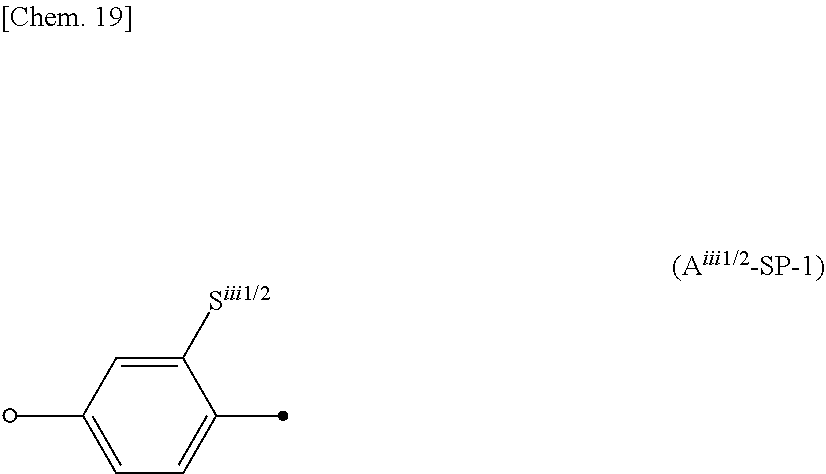
  • substitution positions of the halogen atom are preferably the positions in the following formula (A iii1/2 -SP-1).
  • S iii1/2 's each independently represent a halogen atom
  • the white dot represents the point of attachment to R iii1 or A iii1
  • the black dot represents the point of attachment to A iii2 or the (3F,5F)-1,4-phenylene group.
  • halogen atom examples include a fluorine atom, a chlorine atom, a bromine atom, and an iodine atom.
  • a iii1 and A iii2 preferably represent any one of the following formulas (A iii1/2 -1) to (A iii1/2 -3).
  • the white dots represent points of attachment to R iii1 or A iii1 and the black dots represent points of attachment to A iii2 or the (3F,5F)-1,4-phenylene group.
  • the compound represented by the general formula (iii) is preferably compounds represented by the following general formulas (iii-1) to (iii-5).
  • R iii1 's each have the same meaning and preferred groups as R iii1 in the above-described general formula (iii).
  • S iii1/2 's each independently represent a halogen atom.
  • halogen atom examples include a fluorine atom, a chlorine atom, a bromine atom, and an iodine atom.
  • the compound represented by the general formula (iii-1) is preferably a compound represented by the following structural formula (iii-1.1).
  • the compound represented by the general formula (iii-2) is preferably a compound represented by the following structural formula (iii-2.1).
  • the compound represented by the general formula (iii-3) is preferably a compound represented by the following structural formula (iii-3.1).
  • the compound represented by the general formula (iii-4) is preferably a compound represented by the following structural formula (iii-4.1).
  • the compound represented by the general formula (iii-5) is preferably a compound represented by the following structural formula (iii-5.1).
  • the number of compounds used in the dye compound-containing liquid crystal composition is 1 or 2 or more, preferably 1 to 5, preferably 1 to 4, preferably 1 to 3, preferably 1 to 2.
  • the lower limit value of the total content of the compounds represented by the general formula (iii), the general formulas (iii-1) to (iii-5), the structural formula (iii-1.1), the structural formula (iii-2.1), the structural formula (iii-3.1), the structural formula (iii-4.1), and the structural formula (iii-5.1) relative to 100 mass % of the dye compound-containing liquid crystal composition is preferably 1 mass % or more, preferably 5 mass % or more, preferably 10 mass % or more.
  • the upper limit value of the total content of the compounds represented by the general formula (iii), the general formulas (iii-1) to (iii-5), the structural formula (iii-1.1), the structural formula (iii-2.1), the structural formula (iii-3.1), the structural formula (iii-4.1), and the structural formula (iii-5.1) relative to 100 mass % of the dye compound-containing liquid crystal composition is preferably 35 mass % or less, preferably 30 mass % or less, preferably 25 mass % or less.
  • the total content of the compounds represented by the general formula (iii), the general formulas (iii-1) to (iii-5), the structural formula (iii-1.1), the structural formula (iii-2.1), the structural formula (iii-3.1), the structural formula (iii-4.1), and the structural formula (iii-5.1) relative to 100 mass % of the dye compound-containing liquid crystal composition is preferably 1 to 35 mass %, preferably 5 to 30 mass %, preferably 10 to 25 mass %.
  • the compounds represented by the general formula (iii), the general formulas (iii-1) to (iii-5), the structural formula (iii-1.1), the structural formula (iii-2.1), the structural formula (iii-3.1), the structural formula (iii-4.1), and the structural formula (iii-5.1) can be synthesized by publicly known synthesis methods.
  • a dye compound-containing liquid crystal composition according to the present invention may further include one or two or more compounds including a cyclohexane ring and a benzene ring and represented by the following general formula (iv).
  • R iv1 and R iv2 each independently represent an alkyl group having 1 to 20 carbon atoms.
  • the alkyl group having 1 to 20 carbon atoms is a linear, branched, or cyclic alkyl group and is preferably a linear alkyl group.
  • the number of carbon atoms is preferably 2 to 10, preferably 2 to 6.
  • one or two or more —CH 2 — may each independently be substituted with —O— and/or —CO—.
  • one or two or more —CH 2 —CH 2 — may each independently be substituted with —CH ⁇ CH— and/or —C ⁇ C—.
  • one or two or more hydrogen atoms may each independently be substituted with a halogen atom.
  • halogen atom examples include a fluorine atom, a chlorine atom, and a bromine atom.
  • R iv1 and R iv2 in which, in such an alkyl group, one —CH 2 — is substituted with —O— can represent an alkoxy group having 1 to 19 carbon atoms.
  • the alkoxy group is a linear, branched, or cyclic alkoxy group and is preferably a linear alkoxy group.
  • the number of carbon atoms is preferably 2 to 10, preferably 2 to 6.
  • R iv1 and R iv2 in which, in such an alkyl group, one or two or more —CH 2 —CH 2 — are substituted with —CH ⁇ CH— can represent an alkenyl group having 1 to 20 carbon atoms.
  • the alkenyl group is a linear, branched, or cyclic alkenyl group and is preferably a linear alkenyl group.
  • the number of carbon atoms is preferably 2 to 10, preferably 2 to 6.
  • R iv1 and R iv2 in which, in such an alkyl group, one or two or more —CH 2 —CH 2 — are substituted with —C ⁇ C— can represent an alkynyl group having 1 to 20 carbon atoms.
  • the alkynyl group is a linear, branched, or cyclic alkynyl group and is preferably a linear alkynyl group.
  • the number of carbon atoms is preferably 2 to 10, preferably 2 to 6.
  • R iv1 and R iv2 in which, in such an alkyl group, one —CH 2 — is substituted with —O— and one or two or more —CH 2 —CH 2 — are substituted with —CH ⁇ CH— can represent an alkenyloxy group having 1 to 19 carbon atoms.
  • the alkenyloxy group is a linear, branched, or cyclic alkenyloxy group and is preferably a linear alkenyloxy group.
  • the number of carbon atoms is preferably 2 to 10, preferably 2 to 6.
  • R iv1 and R iv2 in which, in such an alkyl group, one or two or more hydrogen atoms are substituted with halogen atoms can represent a halogenated alkyl group having 1 to 20 carbon atoms.
  • the halogenated alkyl group is a linear, branched, or cyclic halogenated alkyl group and is preferably a linear halogenated alkyl group.
  • the number of carbon atoms is preferably 2 to 10, preferably 2 to 6.
  • R iv1 and R iv2 specific examples of the alkyl group having 1 to 20 carbon atoms (including substituted groups) include groups represented by formulas (R iv1/2 -1) to (R iv1/2 -31).
  • R iv1 is, from the viewpoint of decreasing the viscosity of the dye compound-containing liquid crystal composition, preferably a linear alkyl group having 1 to 6 carbon atoms or a linear alkoxy group having 1 to 6 carbon atoms.
  • R iv2 is, from the viewpoint of increasing the refractive index anisotropy of the dye compound-containing liquid crystal composition, preferably a linear alkoxy group having 1 to 6 carbon atoms.
  • the compound represented by the general formula (iv) is preferably compounds represented by the following structural formulas (iv-1.1) to (iv-1.5).
  • the number of compounds used in the dye compound-containing liquid crystal composition is 1 or 2 or more, preferably 1 to 5, preferably 1 to 4, preferably 1 to 3, preferably 1 to 2.
  • the lower limit value of the total content of the compounds represented by the general formula (iv) and the structural formulas (iv-1.1) to (iv-1.5) relative to 100 mass % of the dye compound-containing liquid crystal composition is preferably 1 mass % or more, preferably 3 mass % or more, preferably 5 mass % or more.
  • the upper limit value of the total content of the compounds represented by the general formula (iv) and the structural formulas (iv-1.1) to (iv-1.5) relative to 100 mass % of the dye compound-containing liquid crystal composition is preferably 45 mass % or less, preferably 40 mass % or less, preferably 35 mass % or less.
  • the total content of the compounds represented by the general formula (iv) and the structural formulas (iv-1.1) to (iv-1.5) relative to 100 mass % of the dye compound-containing liquid crystal composition is preferably 1 to 45 mass %, preferably 3 to 40 mass %, preferably 5 to 35 mass %.
  • the compounds represented by the general formula (iv) and the structural formulas (iv-1.1) to (iv-1.5) can be synthesized by publicly known synthesis methods.
  • a dye compound-containing liquid crystal composition according to the present invention may include one or two or more liquid crystal compounds having a dielectric anisotropy at 25° C. that is positive (2 ⁇ ), what are called, P-type compounds represented by the following general formula (v).
  • the dielectric anisotropy (As) of a liquid crystal compound is a value determined by extrapolation of the measured value of the dielectric anisotropy of a composition prepared by adding the liquid crystal compound to a composition that is dielectrically substantially neutral at 25° C.
  • R v1 each independently represents an alkyl group having 1 to 20 carbon atoms.
  • the alkyl group having 1 to 20 carbon atoms is a linear, branched, or cyclic alkyl group and is preferably a linear alkyl group.
  • the number of carbon atoms is preferably 2 to 10, preferably 2 to 6.
  • one or two or more —CH 2 — may each independently be substituted with —O— and/or —CO—.
  • one or two or more —CH 2 —CH 2 — may each independently be substituted with —CH ⁇ CH— and/or —C ⁇ C—.
  • one or two or more hydrogen atoms may each independently be substituted with a halogen atom.
  • halogen atom examples include a fluorine atom, a chlorine atom, and a bromine atom.
  • R v1 in which, in the alkyl group, one —CH 2 — is substituted with —O— can represent an alkoxy group having 1 to 19 carbon atoms.
  • the alkoxy group is a linear, branched, or cyclic alkoxy group and is preferably a linear alkoxy group.
  • the number of carbon atoms is preferably 2 to 10, preferably 2 to 6.
  • R v1 in which, in the alkyl group, one or two or more —CH 2 —CH 2 — are substituted with —CH ⁇ CH— can represent an alkenyl group having 1 to 20 carbon atoms.
  • the alkenyl group is a linear, branched, or cyclic alkenyl group and is preferably a linear alkenyl group.
  • the number of carbon atoms is preferably 2 to 10, preferably 2 to 6.
  • R v1 in which, in the alkyl group, one or two or more —CH 2 —CH 2 — is substituted with —C ⁇ C— can represent an alkynyl group having 1 to 20 carbon atoms.
  • the alkynyl group is a linear, branched, or cyclic alkynyl group and is preferably a linear alkynyl group.
  • the number of carbon atoms is preferably 2 to 10, preferably 2 to 6.
  • R v1 in which, in the alkyl group, one —CH 2 — is substituted with —O— and one or two or more —CH 2 —CH 2 — are substituted with —CH ⁇ CH— can represent an alkenyloxy group having 1 to 19 carbon atoms.
  • the alkenyloxy group is a linear, branched, or cyclic alkenyloxy group and is preferably a linear alkenyloxy group.
  • the number of carbon atoms is preferably 2 to 10, preferably 2 to 6.
  • R v1 in which, in the alkyl group, one or two or more hydrogen atoms are substituted with halogen atoms can represent a halogenated alkyl group having 1 to 20 carbon atoms.
  • the halogenated alkyl group is a linear, branched, or cyclic halogenated alkyl group and is preferably a linear halogenated alkyl group.
  • the number of carbon atoms is preferably 2 to 10, preferably 2 to 6.
  • R v1 specific examples of the alkyl group having 1 to 20 carbon atoms (including substituted groups) include groups represented by formulas (R v1 -1) to (R v1 -31).
  • the black dots represent points of attachment to the cyclic structure.
  • R v1 is, from the viewpoint of decreasing the viscosity of the dye compound-containing liquid crystal composition, preferably a linear alkyl group having 1 to 6 carbon atoms.
  • R v2 preferably represents any one of a halogen atom, —CN, —OCN, and —C ⁇ CCN.
  • halogen atom examples include a fluorine atom, a chlorine atom, a bromine atom, and an iodine atom.
  • R v2 is, from the viewpoint of providing a dye compound-containing liquid crystal composition having high light resistance or high solubility, preferably a fluorine atom or —CN.
  • a v1 and A v2 each independently represent a group selected from the group consisting of the following group (a), group (b), and group (c):
  • one or two or more hydrogen atoms may each independently be substituted with a halogen atom.
  • halogen atom examples include a fluorine atom, a chlorine atom, a bromine atom, and an iodine atom.
  • the substitution position of the halogen atom is preferably any one of the positions in the following formulas (A v1/2 -SP-1) to (A v1/2 -SP-2).
  • S v1/2 is each independently represent a halogen atom
  • the white dots represent points of attachment to R v1 or Z v1
  • the black dots represent points of attachment to Z v1 or R v2 ,
  • halogen atom examples include a fluorine atom, a chlorine atom, a bromine atom, and an iodine atom.
  • a v1 and A v2 preferably represent any one of the following formulas (A v1/2 -1) to (A v1/2 -5)
  • Z v1 represents a single bond or an alkylene group having 1 to 20 carbon atoms.
  • the alkylene group is a linear, branched, or cyclic alkylene group and is preferably a linear alkylene group.
  • the number of carbon atoms is preferably 2 to 10, preferably 2 to 6.
  • one or two or more —CH 2 — may each independently be substituted with —O—, —CH(CH 3 )—, —CO—, and/or —CF 2 —.
  • one or two or more —CH 2 —CH 2 — may each independently be substituted with —CH ⁇ CH—, —CF ⁇ CH—, —CH ⁇ CF—, —CF ⁇ CF—, —CH ⁇ C(CH 3 )—, —C(CH 3 ) ⁇ CH—, —CH ⁇ N—, —N ⁇ CH—, —N ⁇ N—, and/or —C ⁇ C—.
  • alkylene group having 1 to 20 carbon atoms include groups represented by formulas (Z v1 -1) to (Z v1 -24).
  • the white dots represent points of attachment to A v1 or A v2 and the black dots represent points of attachment to A v2 ,
  • Z vi1 is, from the viewpoint of providing a dye compound-containing liquid crystal composition having high light resistance, preferably a single bond, —CO—O—, —O—CO—, or a linear alkylene group having 1 to 6 carbon atoms.
  • n v1 represents an integer of 1 to 3.
  • a v2 and Z v1 When a plurality of A v2 and Z v1 are present, they may be the same or different.
  • the compound represented by the general formula (v) is preferably compounds represented by the following general formulas (v-1) to (v-3). [Chem. 35] R v1 -A v1 -Z v1 -A v2 -R v2 (v-1) R v1 -A v1 -Z v1 -A v2 -Z v1-2 -A v2-2 -R v2 (v-2) R v1 -A v1 -Z v1 -A v2 -Z v1-2 -A v2-2 -Z v1-3 -A v2-3 -R v2 (v-3)
  • R v1 , R v2 , Z v1 , A v1 , and A v2 respectively have the same meanings and preferred groups as R v1 , R v2 , Z v1 , A v1 , and A v2 in the above-described general formula (v).
  • Z v1-2 and Z v1-3 each independently have the same meaning and preferred groups as Z v1 in the above-described general formula (v).
  • a v2-2 and A v2-3 each independently have the same meaning and preferred groups as A v1 in the above-described general formula (v).
  • the compound represented by the general formula (v-1) is preferably compounds represented by the following general formulas (v-1-1) to (v-1-10).
  • R v1 and R v2 respectively have the same meanings and preferred groups as R v1 and R v2 in the above-described general formula (v).
  • S v1/2 's each independently represent a halogen atom.
  • halogen atom examples include a fluorine atom, a chlorine atom, a bromine atom, and an iodine atom.
  • the compound represented by the general formula (v-1-1) is preferably compounds represented by the following structural formulas (v-1-1.1) to (v-1-1.4).
  • the compound represented by the general formula (v-1-2) is preferably a compound represented by the following structural formula (v-1-2.1).
  • the compound represented by the general formula (v-1-3) is preferably compounds represented by the following structural formulas (v-1-3.1) to (v-1-3.4).
  • the compound represented by the general formula (v-1-4) is preferably compounds represented by the following structural formulas (v-1-4.1) to (v-1-4.2).
  • the compound represented by the general formula (v-1-5) is preferably a compound represented by the following structural formula (v-1-5.1).
  • the compound represented by the general formula (v-1-6) is preferably compounds represented by the following structural formula (v-1-6.1) to structural formula (v-1-6.2).
  • the compound represented by the general formula (v-1-7) is preferably a compound represented by the following structural formula (v-1-7.1).
  • the compound represented by the general formula (v-1-8) is preferably a compound represented by the following structural formula (v-1-8.1).
  • the compound represented by the general formula (v-1-9) is preferably a compound represented by the following structural formula (v-1-9.1).
  • the compound represented by the general formula (v-1-10) is preferably a compound represented by the following structural formula (v-1-10.1).
  • the compound represented by the general formula (v-2) is preferably compounds represented by the following general formulas (v-2-1) to (v-2-5).
  • R v1 and R v2 respectively have the same meanings and preferred groups as R v1 and R v2 in the above-described general formula (v).
  • S v1/2 's each independently represent a halogen atom.
  • halogen atom examples include a fluorine atom, a chlorine atom, a bromine atom, and an iodine atom.
  • the compound represented by the general formula (v-2-1) is preferably a compound represented by the following structural formula (v-2-1.1).
  • the compound represented by the general formula (v-2-2) is preferably compounds represented by the following structural formulas (v-2-2.1) to (v-2-2.2).
  • the compound represented by the general formula (v-2-3) is preferably a compound represented by the following structural formula (v-2-3.1).
  • the compound represented by the general formula (v-2-4) is preferably compounds represented by the following structural formulas (v-2-4.1) to (v-2-4.2).
  • the compound represented by the general formula (v-2-5) is preferably a compound represented by the following structural formula (v-2-5.1).
  • the compound represented by the general formula (v-3) is preferably compounds represented by the following general formulas (v-3-1) to (v-3-2).
  • R v1 and R v2 respectively have the same meanings and preferred groups as R v1 and R v2 in the above-described general formula (v).
  • S v1/2 's each independently represent a halogen atom.
  • halogen atom examples include a fluorine atom, a chlorine atom, a bromine atom, and an iodine atom.
  • the compound represented by the general formula (v-3-1) is preferably compounds represented by the following structural formulas (v-3-1.1) to (v-3-1.2).
  • the compound represented by the general formula (v-3-1) is preferably compounds represented by the following structural formulas (v-3-2.1) to (v-3-2.2).
  • a liquid crystal composition according to the present invention may include one or two or more liquid crystal compounds having a dielectric anisotropy at 25° C. that is neutral ( ⁇ 2 ⁇ 2), what are called, np-type compounds represented by the following general formula (vi).
  • the dielectric anisotropy (As) of a liquid crystal compound is a value determined by extrapolation of the measured value of the dielectric anisotropy of a composition prepared by adding the liquid crystal compound to a composition that is dielectrically substantially neutral at 25° C.
  • R vi1 and R vi2 each independently represent an alkyl group having 1 to 20 carbon atoms.
  • the alkyl group having 1 to 20 carbon atoms is a linear, branched, or cyclic alkyl group and is preferably a linear alkyl group.
  • the number of carbon atoms is preferably 2 to 10, preferably 2 to 6.
  • one or two or more —CH 2 — may each independently be substituted with —O— and/or —CO—.
  • one or two or more —CH 2 —CH 2 — may each independently be substituted with —CH ⁇ CH— and/or —C ⁇ C—.
  • R vi1 and R vi2 in which, in such an alkyl group, one —CH 2 — is substituted with —O— can represent an alkoxy group having 1 to 19 carbon atoms.
  • the alkoxy group is a linear, branched, or cyclic alkoxy group and is preferably a linear alkoxy group.
  • the number of carbon atoms is preferably 2 to 10, preferably 2 to 6.
  • R vi1 and R vi2 in which, in such an alkyl group, one or two or more —CH 2 —CH 2 — are substituted with —CH ⁇ CH— can represent an alkenyl group having 1 to 20 carbon atoms.
  • the alkenyl group is a linear, branched, or cyclic alkenyl group and is preferably a linear alkenyl group.
  • the number of carbon atoms is preferably 2 to 10, preferably 2 to 6.
  • R vi1 and R vi2 in which, in such an alkyl group, one or two or more —CH 2 —CH 2 — are substituted with —C ⁇ C— can represent an alkynyl group having 1 to 20 carbon atoms.
  • the alkynyl group is a linear, branched, or cyclic alkynyl group and is preferably a linear alkynyl group.
  • the number of carbon atoms is preferably 2 to 10, preferably 2 to 6.
  • R vi1 and R vi2 in which, in such an alkyl group, one —CH 2 — is substituted with —O— and one or two or more —CH 2 —CH 2 — are substituted with —CH ⁇ CH— can represent an alkenyloxy group having 1 to 19 carbon atoms.
  • the alkenyloxy group is a linear, branched, or cyclic alkenyloxy group and is preferably a linear alkenyloxy group.
  • the number of carbon atoms is preferably 2 to 10, preferably 2 to 6.
  • R vi1 and R vi2 specific examples of the alkyl group having 1 to 20 carbon atoms (including substituted groups) include groups represented by formulas (R vi1/2 -1) to (R vi1/2 -26).
  • R vi1 and R vi2 are, from the viewpoint of improving the solubility and improving the light resistance of the dye compound-containing liquid crystal composition, preferably a linear alkyl group having 1 to 6 carbon atoms or a linear alkenyl group having 2 to 6 carbon atoms.
  • a vi1 and A vi2 each independently represent a group selected from the group consisting of the following group (a), group (b), and group (c):
  • one or two or more hydrogen atoms may each independently be substituted with an alkyl group having 1 to 6 carbon atoms.
  • the alkyl group having 1 to 6 carbon atoms is preferably a methyl group, an ethyl group, or an n-propyl group.
  • substitution position of the alkyl group having 1 to 6 carbon atoms is preferably the position in the following formula (A vi1/2 -SP-1)
  • S vi1/2 represents an alkyl group having 1 to 6 carbon atoms
  • the white dot represents the point of attachment to R vi1 or Z vi1
  • the black dot represents the point of attachment to Z vi1 or R vi2 .
  • the alkyl group having 1 to 6 carbon atoms is preferably a methyl group, an ethyl group, or an n-propyl group.
  • a vi1 and A vi2 preferably represent any one of the following formulas (A vi1/2 -1) to (A vi1/2 -3).
  • Z vi1 represents a single bond or an alkylene group having 1 to 20 carbon atoms.
  • the alkylene group is a linear, branched, or cyclic alkylene group and is preferably a linear alkylene group.
  • the number of carbon atoms is preferably 2 to 10, preferably 2 to 6.
  • one or two or more —CH 2 — may each independently be substituted with —O—, —CH(CH 3 )—, —CO—, and/or —CF 2 —.
  • one or two or more —CH 2 —CH 2 — may each independently be substituted with —CH ⁇ CH—, —CF ⁇ CH—, —CH ⁇ CF—, —CF ⁇ CF—, —CH ⁇ C(CH 3 )—, —C(CH 3 ) ⁇ CH—, —CH ⁇ N—, —N ⁇ CH—, —N ⁇ N—, and/or —C ⁇ C—.
  • alkylene group having 1 to 20 carbon atoms include groups represented by formulas (Z vi1 -1) to (Z vi1 -24).
  • the white dots represent points of attachment to the A vi1 or A vi2 and the black dots represent points of attachment to A vi2 .
  • Z vi1 is, from the viewpoint of improving the solubility and improving the light resistance of the dye compound-containing liquid crystal composition, preferably a single bond, —CO—O—, or —O—CO—.
  • n vi1 represents an integer of 1 to 3.
  • a vi2 and Z vi1 When a plurality of A vi2 and Z vi1 are present, they may be the same or different.
  • the compound represented by the general formula (vi) is preferably compounds represented by the following general formulas (vi-1) to (vi-3). [Chem. 61] R vi1 -A vi1 -Z vi1 -A vi2 -R vi2 (vi-1) R vi1 -A vi1 -Z vi1 -A vi2 -Z vi1-2 -A vi2-2 -R vi2 (vi-2) R vi1 -A vi1 -Z vi1 -A vi2 -Z vi1-2 -A vi2-2 -Z vi1-3 -A vi2-3 -R vi2 (vi-3)
  • R vi1 , R vi2 , Z vi1 , A vi1 , and A vi2 respectively have the same meanings and preferred groups as R vi1 , R vi2 , Z vi1 , A vi1 , and A vi2 in the above-described general formula (vi).
  • Z vi1-2 and Z vi1-3 each independently have the same meaning and preferred groups as Z vi1 in the above-described general formula (vi).
  • a vi2-2 and A vi2-3 each independently have the same meaning and preferred groups as A vi1 in the above-described general formula (vi).
  • the compound represented by the general formula (vi-1) is preferably compounds represented by the following general formulas (vi-1-1) to (vi-1-4).
  • R vi1 and R vi2 respectively have the same meanings and preferred groups as R vi1 and R vi2 in the above-described general formula (v).
  • S vi1/2 represents an alkyl group having 1 to 6 carbon atoms.
  • the alkyl group having 1 to 6 carbon atoms is preferably a methyl group, an ethyl group, or an n-propyl group.
  • the compound represented by the general formula (vi-1-1) is preferably compounds represented by the following structural formulas (vi-1-1.1) to (vi-1-1.8).
  • the compound represented by the general formula (vi-1-2) is preferably compounds represented by the following structural formulas (vi-1-2.1) to (vi-1-2.5).
  • the compound represented by the general formula (vi-1-3) is preferably a compound represented by the following structural formula (vi-1-3.1).
  • the compound represented by the general formula (vi-1-4) is preferably compounds represented by the following structural formulas (vi-1-4.1) to (vi-1-4.2).
  • the compound represented by the general formula (vi-2) is preferably compounds represented by the following general formulas (vi-2-1) to (vi-2-8).
  • R vi1 and R vi2 respectively have the same meanings and preferred groups as R vi1 and R vi2 in the above-described general formula (vi).
  • S vi1/2 represents an alkyl group having 1 to 6 carbon atoms.
  • the alkyl group having 1 to 6 carbon atoms is preferably a methyl group, an ethyl group, or an n-propyl group.
  • the compound represented by the general formula (vi-2-1) is preferably compounds represented by the following structural formulas (vi-2-1.1) to (vi-2-1.4).
  • the compound represented by the general formula (vi-2-2) is preferably compounds represented by the following structural formulas (vi-2-2.1) to (vi-2-2.5).
  • the compound represented by the general formula (vi-2-3) is preferably compounds represented by the following structural formulas (vi-2-3.1) to (vi-2-3.3).
  • the compound represented by the general formula (vi-2-4) is preferably compounds represented by the following structural formulas (vi-2-4.1) to (vi-2-4.2).
  • the compound represented by the general formula (vi-2-5) is preferably a compound represented by the following structural formula (vi-2-5.1).
  • the compound represented by the general formula (vi-2-6) is preferably a compound represented by the following structural formula (vi-2-6.1).
  • the compound represented by the general formula (vi-2-7) is preferably a compound represented by the following structural formula (vi-2-7.1).
  • the compound represented by the general formula (vi-2-8) is preferably compounds represented by the following structural formulas (vi-2-8.1) to (vi-2-8.5).
  • the compound represented by the general formula (vi-3) is preferably compounds represented by the following general formulas (vi-3-1) to (vi-3-2).
  • R vi1 and R vi2 respectively have the same meanings and preferred groups as R vi1 and R vi2 in the above-described general formula (v).
  • the compound represented by the general formula (vi-3-1) is preferably compounds represented by the following structural formulas (vi-3-1.1) to (vi-3-1.3).
  • the compound represented by the general formula (vi-3-2) is preferably compounds represented by the following structural formulas (vi-3-2.1) to (vi-3-2.2).
  • a liquid crystal composition according to the present invention includes one or two or more dye compounds.
  • Such a dye compound preferably has a maximum absorption in a range of preferably 350 to 700 nm, more preferably 400 to 650 nm.
  • the maximum absorption wavelength is measured in the following manner.
  • two 2 cm ⁇ 2 cm glass substrates including an ITO electrode and a homogeneous alignment film on the ITO electrode are used such that the ITO electrode layers are disposed inside of the cell to produce the cell adjusted, using plastic particles, so as to have a cell thickness of 10 ⁇ m and including an injection port.
  • the sample is injected and the injection port is sealed using a sealing material, to thereby produce a device.
  • a spectrometer manufactured by Otsuka Electronics Co., Ltd., “LCD-5200” is used, under conditions of 25° C. and no voltage application, to measure the produced device in terms of the absorption spectrum in the range of 350 to 750 nm, to thereby determine the maximum absorption wavelength of the dye compound.
  • the plurality of dye compounds are preferably different in the absorption wavelengths, which can provide a desired color such as black.
  • the dye compound is preferably a dichroic dye.
  • the dye compound is preferably selected from the group consisting of azo-based compounds, anthraquinone-based compounds, methine-based compounds, azomethine-based compounds, merocyanine-based compounds, quinone-based compounds, naphthoquinone-based compounds, tetrazine-based compounds, perylene-based compounds, terrylene-based compounds, quaterrylene-based compounds, higher rylene-based compounds, indigo-based compounds, dioxazine-based compounds, azulene-based compounds, pyrromethene-based compounds, spiropyran-based compounds, and diarylethene-based compounds.
  • Examples of the azo-based compounds include disazo-based compounds and trisazo-based compounds.
  • the dye compound examples include SI-486 (yellow, dichroic dye, azo-based compound), SI-426 (red, dichroic dye, azo-based compound), G-472 (blue, dichroic dye, azo-based compound), M-483 (dichroic dye, blue), and M-412 (dichroic dye, blue).
  • the number of dye compounds used in the dye compound-containing liquid crystal composition is 1 or 2 or more, preferably 1 to 5, preferably 1 to 4, preferably 1 to 3.
  • the lower limit value of the total content of the dye compound relative to 100 mass % of the dye compound-containing liquid crystal composition is preferably 0.1 mass % or more, preferably 0.5 mass % or more, preferably 1 mass % or more.
  • the upper limit value of the total content of the dye compound relative to 100 mass % of the dye compound-containing liquid crystal composition is preferably 20 mass % or less, preferably 15 mass % or less, preferably 10 mass % or less.
  • the total content of the dye compound relative to 100 mass % of the dye compound-containing liquid crystal composition is preferably 0.1 to 20 mass %, preferably 0.5 to 15 mass %, preferably 1 to 10 mass %.
  • the lower limit value of the amount of dye compound added relative to 100 parts by mass of the liquid crystal composition not including dye compounds or additives is preferably 0.1 parts by mass or more, preferably 0.5 parts by mass or more, preferably 1 part by mass or more.
  • the upper limit value of the amount of dye compound added relative to 100 parts by mass of the liquid crystal composition not including dye compounds or additives is preferably 20 parts by mass or less, preferably 15 parts by mass or less, preferably 10 parts by mass or less.
  • the amount of dye compound added relative to 100 parts by mass of the liquid crystal composition not including dye compounds or additives is preferably 0.1 to 20 parts by mass, preferably 0.5 to 15 parts by mass, preferably 1 to 10 parts by mass.
  • a dye compound-containing liquid crystal composition according to the present invention can be produced by, for example, mixing together compounds represented by the above-described general formulas (i) to (ii), a dye compound, and, as needed, the above-described other compounds and additives.
  • it can be produced by performing a step of mixing together the compounds represented by the above-described general formulas (i) to (ii) and, as needed, the above-described other compounds to thereby obtain a liquid crystal composition used for a dye compound-containing liquid crystal composition, and a step of mixing the liquid crystal composition used for the dye compound-containing liquid crystal composition, with a dye compound and, as needed, additives to thereby obtain the dye compound-containing liquid crystal composition.
  • it can be produced by performing a step of mixing, in an appropriate order, a liquid crystal compound constituting a liquid crystal composition used for the dye compound-containing liquid crystal composition, a dye compound, and, as needed, additives to thereby obtain the dye compound-containing liquid crystal composition.
  • additives examples include stabilizers, chiral dopants, antistatic agents, nematic liquid crystal, smectic liquid crystal, cholesteric liquid crystal, chiral dopants, and polymerizable compounds.
  • stabilizers examples include antioxidants, ultraviolet (UV) absorbents, light stabilizers, and infrared absorbents.
  • antioxidants examples include hydroquinone derivatives, nitrosamine-based polymerization inhibitors, and hindered phenol-based antioxidants.
  • examples include tert-butylhydroquinone, methylhydroquinone, products manufactured by Wako Pure Chemical Industries, Ltd. such as “Q-1300” and “Q-1301”, and products manufactured by BASF such as “IRGANOX1010”, “IRGANOX1035”, “IRGANOX1076”, “IRGANOX1098”, “IRGANOX1135”, “IRGANOX1330”, “IRGANOX1425”, “IRGANOX1520”, “IRGANOX1726”, “IRGANOX245”, “IRGANOX259”, “IRGANOX3114”, “IRGANOX3790”, “IRGANOX5057”, and “IRGANOX565”.
  • UV absorbents from the viewpoint of having high absorbency for ultraviolet rays at wavelengths of 370 nm or less and providing good liquid crystal displaying, preferred are absorbents having less absorbency for visible light at wavelengths of 400 nm or more.
  • examples include hindered phenol-based compounds, benzotriazole-based compounds, hydroxybenzophenone-based compounds, salicylic ester-based compounds, benzophenone-based compounds, cyanoacrylate-based compounds, nickel complex salt-based compounds, and triazine-based compounds.
  • hindered phenol-based compounds examples include 2,6-di-tert-butyl-p-cresol, pentaerythrityl-tetrakis[3-(3,5-di-tert-butyl-4-hydroxyphenyl)propionate], N,N′-hexamethylenebis(3,5-di-tert-butyl-4-hydroxy-hydrocinnamide), 1,3,5-trimethyl-2,4,6-tris(3,5-di-tert-butyl-4-hydroxybenzyl)benzene, and tris-(3,5-di-tert-butyl-4-hydroxybenzyl)-isocyanurate.
  • benzotriazole-based compounds examples include 2-(2′-hydroxy-5′-methylphenyl)benzotriazole, 2,2-methylenebis(4-(1,1,3,3-tetramethylbutyl)-6-(2H-benzotriazol-2-yl)phenol), 2,4-bis-(n-octylthio)-6-(4-hydroxy-3,5-di-tert-butylanilino)-1,3,5-triazine, triethylene glycol-bis[3-(3-tert-butyl-5-methyl-4-hydroxyphenyl)propionate], N,N′-hexamethylenebis(3,5-di-tert-butyl-4-hydroxy-hydrocinnamide), 1,3,5-trimethyl-2,4,6-tris(3,5-di-tert-butyl-4-hydroxybenzyl)benzene, 2-(2′-hydroxy-3′,5′-di-tert-butylphenyl)-5-chlorobenz
  • examples include products manufactured by BASF Japan Ltd. such as “TINUVIN109”, “TINUVIN171”, “TINUVIN326”, “TINUVIN327”, “TINUVIN328”, “TINUVIN770”, “TINUVIN900”, and “TINUVIN928”, and products manufactured by Chemipro Kasei Kaisha, Ltd. such as “KEMISORB 71”, “KEMISORB 73”, and “KEMISORB 74”.
  • the number of stabilizers used in the dye compound-containing liquid crystal composition is 1 or 2 or more, preferably 1 to 5, preferably 1 to 4, preferably 1 to 3, preferably 1 to 2.
  • the lower limit value of the total content of the stabilizer relative to 100 mass % of the dye compound-containing liquid crystal composition is preferably 0.01 mass % or more, preferably 0.05 mass % or more, preferably 0.1 mass % or more.
  • the upper limit value of the total content of the stabilizer relative to 100 mass % of the dye compound-containing liquid crystal composition is preferably 2.0 mass % or less, preferably 1.5 mass % or less, preferably 1.0 mass % or less.
  • the total content of the stabilizer relative to 100 mass % of the dye compound-containing liquid crystal composition is preferably 0.01 to 2.0 mass %, preferably 0.05 to 1.5 mass %, preferably 0.1 to 1.0 mass %.
  • the lower limit value of the amount of stabilizer added relative to 100 parts by mass of the liquid crystal composition not including dye compounds or additives is preferably 0.01 parts by mass or more, preferably 0.05 parts by mass or more, preferably 0.1 parts by mass or more.
  • the upper limit value of the amount of stabilizer added relative to 100 parts by mass of the liquid crystal composition not including dye compounds or additives is preferably 2.0 parts by mass or less, preferably 1.5 parts by mass or less, preferably 1.0 part by mass or less.
  • the amount of stabilizer added relative to 100 parts by mass of the liquid crystal composition not including dye compounds or additives is preferably 0.01 to 2.0 parts by mass, preferably 0.05 to 1.5 parts by mass, preferably 0.1 to 1.0 part by mass.
  • the dye compound-containing liquid crystal composition is produced so as to include a chiral dopant, helical twisting of the liquid crystal can be caused.
  • the chiral dopant may be right-handed or left-handed and such chiral dopants are appropriately selected in accordance with the configuration of the device.
  • chiral dopants used for the TN mode or the STN mode may be used.
  • Examples of the chiral dopant include “Chiral S-811 (compound represented by the following structural formula (CA-1))”.
  • the number of chiral dopants used in the dye compound-containing liquid crystal composition is 1 or 2 or more, preferably 1 to 5, preferably 1 to 4, preferably 1 to 3, preferably 1 to 2, preferably 1.
  • the lower limit value of the total content of the stabilizer relative to 100 mass % of the dye compound-containing liquid crystal composition is preferably 0.05 mass % or more, preferably 0.1 mass % or more, preferably 0.3 mass % or more, preferably 0.5 mass % or more.
  • the upper limit value of the total content of the stabilizer relative to 100 mass % of the dye compound-containing liquid crystal composition is preferably 5 mass % or less, preferably 3.0 mass % or less, preferably 2.0 mass % or less, preferably 1.5 mass % or less.
  • the total content of the stabilizer relative to 100 mass % of the dye compound-containing liquid crystal composition is preferably 0.05 to 5 mass %, preferably 0.1 to 3.0 mass %, preferably 0.3 to 2.0 mass %, preferably 0.5 to 1.5 mass %.
  • the lower limit value of the amount of chiral dopant added relative to 100 parts by mass of the liquid crystal composition not including dye compounds or additives is preferably 0.05 parts by mass or more, preferably 0.1 parts by mass or more, preferably 0.3 parts by mass or more, preferably 0.5 parts by mass or more.
  • the upper limit value of the amount of chiral dopant added relative to 100 parts by mass of the liquid crystal composition not including dye compounds or additives is preferably 5 parts by mass or less, preferably 3.0 parts by mass or less, preferably 2.0 parts by mass or less, preferably 1.5 parts by mass or less.
  • the amount of chiral dopant added relative to 100 parts by mass of the liquid crystal composition not including dye compounds or additives is preferably 0.05 to 5 parts by mass, preferably 0.1 to 3.0 parts by mass, preferably 0.3 to 2.0 parts by mass, preferably 0.5 to 1.5 parts by mass.
  • the content of the compound represented by the above-described general formula (i) and/or (ii) is preferably 10 mass % or more, preferably 10 to 20 mass %.
  • the total content of the compound represented by the general formula (i), the compound represented by the general formula (ii), and the compound represented by the general formula (iii) relative to 100 mass % of the dye compound-containing liquid crystal composition is preferably 20 mass % or more, preferably 25 to 65 mass %, preferably 30 to 60 mass %, preferably 35 to 55 mass %.
  • the total content of the compound represented by the general formula (i), the compound represented by the general formula (ii), and the compound represented by the general formula (iv) relative to 100 mass % of the dye compound-containing liquid crystal composition is preferably 20 mass % or more, preferably 25 to 75 mass %, preferably 30 to 70 mass %, preferably 35 to 65 mass %.
  • the liquid-crystal-phase upper limit temperature (T NI ) is a temperature at which the liquid crystal composition undergoes phase transition from the nematic phase to the isotropic phase.
  • T NI liquid-crystal-phase upper limit temperature of the liquid crystal composition used for a dye compound-containing liquid crystal composition according to the present invention
  • T NI is preferably 95° C. or more, preferably 100 to 150° C., preferably 100 to 130° C.
  • the liquid-crystal-phase lower limit temperature (T ⁇ N ) is a temperature at which the liquid crystal composition undergoes phase transition from another phase (glass, the smectic phase, or the crystal phase) to the nematic phase.
  • T ⁇ N liquid-crystal-phase lower limit temperature of the liquid crystal composition used for a dye compound-containing liquid crystal composition according to the present invention
  • T ⁇ N is preferably ⁇ 15° C. or less, preferably ⁇ 78 to ⁇ 20° C., preferably ⁇ 65 to ⁇ 25° C.
  • the refractive index anisotropy ( ⁇ n) at 25° C. and at 589 nm of the liquid crystal composition used for a dye compound-containing liquid crystal composition according to the present invention is preferably 0.05 or more, preferably 0.06 to 0.20, preferably 0.07 to 0.15, preferably 0.08 to 0.13.
  • the refractive index (n e ) in the long axis direction of liquid crystal molecules at 25° C. and at 589 nm is preferably 1.4 or more, preferably 1.45 to 1.65, preferably 1.50 to 1.63.
  • the refractive index (no) in the short axis direction of liquid crystal molecules at 25° C. and at 589 nm is preferably 1.3 or more, preferably 1.35 to 1.55, preferably 1.40 to 1.53.
  • an Abbe refractometer can be used to measure ne and no of the liquid crystal composition used for the dye compound-containing liquid crystal composition and ⁇ n can be calculated.
  • the dielectric anisotropy ( ⁇ ) at 25° C. is preferably positive (2 ⁇ ).
  • the dielectric anisotropy ( ⁇ ) at 25° C. is more specifically preferably 2.0 to 20.0, preferably 2.5 to 15.0, preferably 3.0 to 10.0, preferably 3.5 to 7.0, preferably 4.0 to 6.0.
  • the long-axis-direction dielectric constant ( ⁇ ⁇ ) of liquid crystal molecules at 25° C. is, preferably 5.0 or more, preferably 5.5 to 30.0, preferably 6.0 to 20.0, preferably 6.0 to 15.0, preferably 6.5 to 10.0.
  • the short-axis-direction dielectric constant ( ⁇ ⁇ ) of liquid crystal molecules at 25° C. is preferably 1.5 or more, preferably 2.0 to 7.0, preferably 2.5 to 5.0, preferably 2.5 to 4.0.
  • the rotational viscosity ( ⁇ 1 ) at 25° C. is preferably 100 to 180 mPa ⁇ s, preferably 105 to 175 mPa ⁇ s, preferably 110 to 170 mPa ⁇ s, preferably 115 to 165 mPa ⁇ s.
  • the elastic constant K 11 at 25° C. is preferably 1.0 to 30.0 pN, preferably 5.0 to 25.0 pN, preferably 10.0 to 20.0 pN.
  • the elastic constant K 22 at 25° C. is preferably 1.0 to 25.0 pN, preferably 3.0 to 20.0 pN, preferably 5.0 to 15.0 pN.
  • the elastic constant K 33 at 25° C. is preferably 1.0 to 35.0 pN, preferably 5.0 to 30.0 pN, preferably 10.0 to 25.0 pN.
  • Applications of the device are preferably photochromic devices.
  • the device preferably has a configuration in which a substrate including a first transparent electrode layer and a substrate including a second transparent electrode layer are disposed such that the substrates face each other and the transparent electrode layers are disposed inside, and the above-described liquid crystal composition is sandwiched between the substrates.
  • the transparent electrode layers are preferably ITO electrodes.
  • the substrates including the first and/or second transparent electrode layer may include, on such a transparent electrode layer, an alignment film.
  • the alignment film is preferably a homogeneous alignment film.
  • a chiral dopant can be added to the dye compound-containing liquid crystal composition, to thereby provide twisted alignment of the liquid crystal.
  • the twist of the liquid crystal molecules is, from the viewpoint of increasing the absorbance, preferably 180° or more, preferably 180 to 720°, preferably 270 to 540°, preferably 270 to 450°.
  • the twist of the liquid crystal molecules can also be adjusted by adjusting the angle of the alignment axis using positions of the substrate including the first transparent electrode layer and the substrate including the second transparent electrode layer.
  • the dye compound-containing liquid crystal composition has a helical pitch (p) of preferably 2 to 30 ⁇ m, preferably 5 to 20 ⁇ m.
  • a liquid crystal composition including a predetermined amount of chiral dopant is injected into a wedge liquid crystal cell including two substrates, having a cell thickness gradually changing, and rubbed antiparallel;
  • the d/p value which is a relation between the helical pitch (p) and the cell thickness (d), is preferably 0.1 to 2.2, preferably 0.5 to 1.5.
  • the d/p value which is the relation between the helical pitch (p) and the cell thickness (d) is preferably adjusted so as to be optimal in accordance with the twisted angle.
  • the optimal d/p value is in a range where alignment defects such as a reverse twist domain and a stripe domain do not occur.
  • Domains are preferably observed, for example, visually or microscopically and adjustments are preferably performed so as not to cause alignment defects.
  • the dye compound-containing liquid crystal composition preferably has a pretilt angle of 0.1 to 10°, preferably 0.5 to 5°.
  • the pretilt angle can be measured using an OPTIPRO manufactured by SHINTECH, Inc.
  • the spacing between the substrates is preferably 1 to 100 ⁇ m, preferably 1.5 to 30 ⁇ m, preferably 5 to 20 ⁇ m.
  • the spacing between the substrates can be adjusted using a spacer.
  • Examples of the spacer include glass particles, plastic particles, alumina particles, and photoresist materials.
  • a device according to the present invention may include, from the viewpoint of suppressing deterioration due to ultraviolet rays, an ultraviolet filtering film.
  • an ultraviolet (UV) filtering film that filters off light at wavelengths of 400 nm or less may be disposed on or bonded to the device.
  • a device may be used as a monolayer or a plurality of devices may be stacked and used as two layers or three or more layers.
  • devices having been subjected to antiparallel alignment treatment are preferably stacked such that the alignment treatment directions are orthogonal to each other at 90°.
  • the device can be produced in the following manner.
  • a sealant such as an epoxy-based thermosetting composition is applied except for an injection port; the substrate is bonded to a substrate including a second transparent electrode layer; the substrates are subsequently heated to thermally cure the sealant, to thereby produce an empty cell.
  • the dye compound-containing liquid crystal composition is sandwiched between the two substrates by, for example, the ordinary vacuum injection method or ODF method, to thereby produce a liquid crystal device.
  • an optical film such as a polarization axis may be further disposed at a predetermined angle.
  • compositions of Examples and Comparative Examples below contain compounds in ratios in Tables and the contents are described in “mass %”.
  • liquid crystal compositions used for the dye compound-containing liquid crystal compositions the following property values were measured.
  • liquid crystal compounds were mixed in the ratios, to thereby prepare liquid crystal compositions LC-1 to LC-11 used for dye compound-containing liquid crystal compositions and property values thereof were measured.
  • Tables 3 and 4 The results will be described in Tables 3 and 4.
  • LC1 to 11 were mixed with dye compounds, antioxidants, and a chiral dopant to achieve dissolution, to thereby prepare dye compound-containing liquid crystal compositions.
  • two 2 cm ⁇ 2 cm glass substrates including an ITO electrode and a homogeneous alignment film (AL1051) on the ITO electrode were used such that the ITO electrode layers were disposed inside of the cell and plastic particles were used to adjust the cell thickness to 10 ⁇ m, to produce the cell having an injection port.
  • the dye compound-containing liquid crystal compositions were injected and the injection ports were sealed with a sealing material, to thereby produce devices.
  • the produced devices were subjected to (light resistance test) and (solubility test). The results will be described in Tables 5 and 6.
  • the amounts of the dye compounds, the antioxidants, and the chiral dopant added are the amounts of them added relative to 100 parts by mass of the liquid crystal compositions.
  • the produced devices were stored in a thermostat at ⁇ 25° C. and whether or not deposition occurred was visually observed at intervals of 48 hours over 500 hours.
  • the evaluation grades are as follows.
  • the produced devices were irradiated with, using a “SUNTEST” from ATLAS under a condition of an output of 760 W, light having an illuminance of 100,000 Lux for 500 hours through an UV filtering film that filters off light having wavelengths of 400 nm or less, and changes in the coloration (degrees of deterioration) were visually observed.
  • the evaluation grades are as follows.
  • Examples 1 to 9 and Comparative Examples 1 to 2 have demonstrated that use of a combination of one or two or more predetermined alkenyl compounds and a compound including a predetermined difluoro structure provides a device that has high light resistance and has high solubility.
  • Examples 10 to 18 have demonstrated that the use even in combination with antioxidants and a chiral dopant also provides similar advantages.
  • Examples 1 to 7, Examples 8 to 9, Examples 10 to 16, and Examples 17 to 18 have demonstrated that a combination of, in addition to one or two or more predetermined alkenyl compounds and a compound including a predetermined difluoro structure, one or two or more compounds represented by the general formula (iii) and including a trifluoro structure and one or two or more compounds including a cyclohexane ring and a benzene ring and represented by the following general formula (iv) provides higher light resistance.
  • a liquid crystal composition according to the present invention can be applied to devices, in particular, photochromic devices.

Landscapes

  • Chemical & Material Sciences (AREA)
  • Crystallography & Structural Chemistry (AREA)
  • Engineering & Computer Science (AREA)
  • Materials Engineering (AREA)
  • Organic Chemistry (AREA)
  • Physics & Mathematics (AREA)
  • Nonlinear Science (AREA)
  • General Physics & Mathematics (AREA)
  • Optics & Photonics (AREA)
  • Liquid Crystal Substances (AREA)
  • Liquid Crystal (AREA)
  • Optical Filters (AREA)

Abstract

An object of the present invention is to provide a dye compound-containing liquid crystal composition that has high solubility and high solubility retention for the dye compound and has high light resistance and a device including the composition. The use of a combination of one or two or more predetermined alkenyl compounds and a compound including a predetermined difluoro structure can provide a dye compound-containing liquid crystal composition that has high solubility and high solubility retention for the dye compound and has high light resistance, and the dye compound-containing liquid crystal composition is useful for devices, in particular, photochromic devices.

Description

CROSS-REFERENCE TO RELATED APPLICATION
This application is a 371 application of an international PCT application serial no. PCT/JP2022/010457, filed on Mar. 10, 2022, which claims the priority benefit of Japan application JP2021-051440, filed on Mar. 25, 2021. The entirety of the above-mentioned patent application is hereby incorporated by reference herein and made a part of this specification.
TECHNICAL FIELD
The present invention relates to a dye compound-containing liquid crystal composition and a device including the composition.
BACKGROUND ART
Liquid crystal materials, which are used in various display devices configured to display characters, pictures, and images and represented by TVs or smartphones, are also being put into practical use in terms of use as photochromic devices configured to control transmission of light.
In particular, in the case of using “guest-host (GH)-type liquid crystal compositions” prepared by adding dye compounds to host liquid crystal compositions, the necessity of using a polarizing plate is eliminated, to thereby provide, at low costs, photochromic devices having high transmittance, which are considered as promising.
The GH-type liquid crystal compositions have been studied for a long time and attempts to develop liquid crystal display devices or photochromic devices having predetermined performance (for example, high contrast, high solubility for liquid crystal compositions and dye compounds, high light resistance, or high heat resistance) have been performed (Patent Literatures 1 to 4).
CITATION LIST Patent Literature
    • PTL 1: International Publication No. 2017/038616
    • PTL 2: Japanese Unexamined Patent Application Publication No. 2019-85581
    • PTL 3: International Publication No. 2018/078968
    • PTL 4: Japanese Unexamined Patent Application Publication (Translation of PCT Application) No. 2017-513975
SUMMARY OF INVENTION Technical Problem
However, for liquid crystal compositions containing dye compounds, higher performance (such as high contrast, high solubility for liquid crystal compositions and dye compounds, high light resistance, or high heat resistance) has been in demand and the inventions in PTLs 1 to 4 have room for further improvement.
An object of the present invention is to provide a dye compound-containing liquid crystal composition that has high solubility and high solubility retention for the dye compound and has high light resistance, and a device including the composition.
Solution to Problem
The inventors of the present invention have found that use of a combination of one or two or more predetermined alkenyl compounds and a compound including a predetermined difluoro structure can achieve the above-described object and have accomplished the present invention.
Features of the present invention that achieve the above-described object are as follows.
A dye compound-containing liquid crystal composition according to the present invention includes:
    • one or two or more compounds represented by a general formula (i) below:
Figure US12215268-20250204-C00001
    • (in the general formula (i),
    • Ri1 represents an alkenyl group having 2 to 20 carbon atoms,
    • in the alkenyl group, one or two or more —CH2— may each independently be substituted with —O— and/or —CO—,
    • in the alkenyl group, one or two or more —CH2—CH2— may each independently be substituted with —CH═CH— and/or —C≡C—,
    • in the alkenyl group, one or two or more hydrogen atoms may each independently be substituted with a halogen atom,
    • with the proviso that no direct bond between an oxygen atom and an oxygen atom is formed,
    • Ri2 represents an alkyl group having 1 to 20 carbon atoms,
    • in the alkyl group, one or two or more —CH2— may each independently be substituted with —O— and/or —CO—,
    • in the alkyl group, one or two or more —CH2—CH2— may each independently be substituted with —CH═CH— and/or —C≡C—,
    • in the alkyl group, one or two or more hydrogen atoms may each independently be substituted with a halogen atom,
    • with the proviso that no direct bond between an oxygen atom and an oxygen atom is formed,
    • Ai1 represents a group selected from the group consisting of a group (a) and a group (b) below:
    • (a) a 1,4-cyclohexylene group (in this group, one —CH2— or non-adjacent two or more —CH2— may be replaced by —O— and/or —S—), and
    • (b) a 1,4-phenylene group (in this group, one —CH═ or non-adjacent two or more —CH═ may be replaced by —N═),
    • in Ai1 above, one or two or more hydrogen atoms may each independently be substituted with a halogen atom, and
    • Li2, Li3, Li4, and Li5 each independently represent a hydrogen atom or a halogen atom);
    • one or two or more compounds represented by a general formula (ii) below:
Figure US12215268-20250204-C00002
    • (in the general formula (ii),
    • Rii1 represents an alkyl group having 1 to 20 carbon atoms,
    • in the alkyl group, one or two or more —CH2— may each independently be substituted with —O— and/or —CO—,
    • in the alkyl group, one or two or more —CH2—CH2— may each independently be substituted with —CH═CH— and/or —C≡C—,
    • in the alkyl group, one or two or more hydrogen atoms may each independently be substituted with a halogen atom,
    • with the proviso that no direct bond between an oxygen atom and an oxygen atom is formed,
    • Aii1 and Aii2 each independently represent a group selected from the group consisting of a group (a) and a group (b) below:
    • (a) a 1,4-cyclohexylene group (in this group, one —CH2— or non-adjacent two or more —CH2— may be replaced by —O— and/or —S—), and
    • (b) a 1,4-phenylene group (in this group, one —CH═ or non-adjacent two or more —CH═ may be replaced by —N═), and
    • in Aii1 and Aii2 above, one or two or more hydrogen atoms may each independently be substituted with a halogen atom); and
    • one or two or more dye compounds.
A device according to the present invention includes the above-described dye compound-containing liquid crystal composition.
Advantageous Effects of Invention
According to the present invention, use of a combination of one or two or more predetermined alkenyl compounds and a compound including a predetermined difluoro structure can provide a dye compound-containing liquid crystal composition that has high solubility and high solubility retention for the dye compound and has high light resistance, and the dye compound-containing liquid crystal composition is useful for devices, in particular, photochromic devices.
More specifically, a dye compound-containing liquid crystal composition according to the present invention in which deposition of the dye compound can be prevented even at a temperature as low as −25° C. can be used in wide temperature ranges.
Furthermore, it has high light resistance and undergoes less change in coloration.
Therefore, it can be applied to on-vehicle applications in which suitability to harsh environments is a priority, applications of mobile terminals such as smartphones and tablets, and applications of photochromic devices such as windowpanes, for example.
DESCRIPTION OF EMBODIMENTS
(Compound Represented by General Formula (i))
A dye compound-containing liquid crystal composition according to the present invention includes one or two or more alkenyl compounds represented by the following general formula (i).
Figure US12215268-20250204-C00003
In the general formula (i), Ri1 represents an alkenyl group having 2 to 20 carbon atoms.
The alkenyl group having 2 to 20 carbon atoms is a linear, branched, or cyclic alkenyl group and is preferably a linear alkenyl group.
In the alkenyl group having 2 to 20 carbon atoms, the number of carbon atoms is preferably 2 to 10, preferably 2 to 6.
In the alkenyl group, one or two or more —CH2— may each independently be substituted with —O— and/or —CO—.
In the alkenyl group, one or two or more —CH2—CH2— may each independently be substituted with —CH═CH— and/or —C≡C—.
In the alkenyl group, one or two or more hydrogen atoms may each independently be substituted with a halogen atom.
Examples of the halogen atom include a fluorine atom, a chlorine atom, and a bromine atom.
Note that, when the alkenyl group is substituted with a predetermined group, no direct bond between an oxygen atom and an oxygen atom is formed.
For example, Ri1 in which, in the alkenyl group, one —CH2— is substituted with —O— can represent an alkenyloxy group having 2 to 19 carbon atoms.
The alkenyloxy group is a linear, branched, or cyclic alkenyloxy group and is preferably a linear alkenyloxy group.
In the alkenyloxy group, the number of carbon atoms is preferably 2 to 10, preferably 2 to 6.
In Ri1, specific examples of the alkenyl group having 2 to 20 carbon atoms (including substituted groups) include groups represented by formulas (Ri1-1) to (Ri1-10).
Figure US12215268-20250204-C00004
In the formulas (Ri1-1) to (Ri1-10), the black dots represent points of attachment to the cyclic structure.
Note that Ri1 is, from the viewpoint of improving the solubility for the dye compound, preferably a linear alkenyl group having 2 to 6 carbon atoms.
In the general formula (i), Ri2 represents an alkyl group having 1 to 20 carbon atoms.
The alkyl group having 1 to 20 carbon atoms is a linear, branched, or cyclic alkyl group and is preferably a linear alkyl group.
In the alkyl group having 1 to 20 carbon atoms, the number of carbon atoms is preferably 2 to 10, preferably 2 to 6.
In the alkyl group, one or two or more —CH2— may each independently be substituted with —O— and/or —CO—.
In the alkyl group, one or two or more —CH2—CH2— may each independently be substituted with —CH═CH— and/or —C≡C—.
In the alkyl group, one or two or more hydrogen atoms may each independently be substituted with a halogen atom.
Examples of the halogen atom include a fluorine atom, a chlorine atom, and a bromine atom.
Note that, when the alkyl group is substituted with a predetermined group, no direct bond between an oxygen atom and an oxygen atom is formed.
For example, Ri2 in which, in the alkyl group, one —CH2— is substituted with —O— can represent an alkoxy group having 1 to 19 carbon atoms.
The alkoxy group is a linear, branched, or cyclic alkoxy group and is preferably a linear alkoxy group.
In the alkoxy group, the number of carbon atoms is preferably 2 to 10, preferably 2 to 6.
Ri2 in which, in the alkyl group, one or two or more —CH2—CH2— are substituted with —CH═CH— can represent an alkenyl group having 1 to 20 carbon atoms.
The alkenyl group is a linear, branched, or cyclic alkenyl group and is preferably a linear alkenyl group.
In the alkenyl group, the number of carbon atoms is preferably 2 to 10, preferably 2 to 6.
Ri2 in which, in the alkyl group, one or two or more —CH2—CH2— are substituted with —C≡C— can represent an alkynyl group having 1 to 20 carbon atoms.
The alkynyl group is a linear, branched, or cyclic alkynyl group and is preferably a linear alkynyl group.
In the alkynyl group, the number of carbon atoms is preferably 2 to 10, preferably 2 to 6.
Ri2 in which, in the alkyl group, one —CH2— is substituted with —O— and one or two or more —CH2—CH2— are substituted with —CH═CH— can represent an alkenyloxy group having 1 to 19 carbon atoms.
The alkenyloxy group is a linear, branched, or cyclic alkenyloxy group and is preferably a linear alkenyloxy group.
In the alkenyloxy group, the number of carbon atoms is preferably 2 to 10, preferably 2 to 6.
Ri2 in which, in the alkyl group, one or two or more hydrogen atoms are substituted with halogen atoms can represent a halogenated alkyl group having 1 to 20 carbon atoms.
The halogenated alkyl group is a linear, branched, or cyclic halogenated alkyl group and is preferably a linear halogenated alkyl group.
In the halogenated alkyl group, the number of carbon atoms is preferably 2 to 10, preferably 2 to 6.
In Ri2, specific examples of the alkyl group having 1 to 20 carbon atoms (including substituted groups) include groups represented by formulas (Ri2-1) to (Ri2-31).
Figure US12215268-20250204-C00005
Figure US12215268-20250204-C00006
In the formulas (Ri2-1) to (Ri2-31), the black dots represent points of attachment to the cyclic structure.
Note that Ri2 is, from the viewpoint of providing high solubility and decreasing the viscosity of the dye compound-containing liquid crystal composition, preferably a linear alkyl group having 1 to 6 carbon atoms.
In the general formula (i), Ai1 represents a group selected from the group consisting of the following group (a) and group (b):
    • (a) a 1,4-cyclohexylene group (in this group, one —CH2— or non-adjacent two or more —CH2— may be replaced by —O— and/or —S—), and
    • (b) a 1,4-phenylene group (in this group, one —CH═ or non-adjacent two or more —CH═ may be replaced by —N═).
In Ai1, one or two or more hydrogen atoms may each independently be substituted with a halogen atom.
Examples of the halogen atom include a fluorine atom, a chlorine atom, a bromine atom, and an iodine atom.
More specifically, Ai1 preferably represents any one of the following formulas (Ai1-1) to (Ai1-2).
Figure US12215268-20250204-C00007
In the formulas (Ai1-1) to (Ai1-2), the white dots represent points of attachment to the 1,4-cyclohexylene group and the black dots represent points of attachment to the 1,4-phenylene group.
In the general formula (i), Li2, Li3, Li4, and Li5 each independently represent a hydrogen atom or a halogen atom.
Examples of the halogen atom include a fluorine atom, a chlorine atom, a bromine atom, and an iodine atom.
From the viewpoint of providing a dye compound-containing liquid crystal composition having high light resistance, Li2, Li3, Li4, and Li5 are all preferably hydrogen atoms.
The compound represented by the general formula (i) is preferably compounds represented by the following general formulas (i-1) to (i-2).
Figure US12215268-20250204-C00008
In the general formulas (i-1) to (i-2), Ri1 and Ri2 respectively have the same meanings and preferred groups as Ri1 and Ri2 in the above-described general formula (i).
The compound represented by the general formula (i-1) is preferably compounds represented by the following structural formulas (i-1.1) to (i-1.8).
Figure US12215268-20250204-C00009
The compound represented by the general formula (i-2) is preferably compounds represented by the following structural formulas (i-2.1) to (i-2.2).
Figure US12215268-20250204-C00010
For the compounds represented by the general formula (i), the general formulas (i-1 to (i-2), the structural formulas (i-1.1) to (i-1.8), and the structural formulas (i-2.1) to (i-2.2), the number of compounds used in the dye compound-containing liquid crystal composition is 1 or 2 or more, preferably 1 to 5, preferably 1 to 4, preferably 1 to 3, preferably 1 to 2, preferably 1.
The lower limit value of the total content of the compounds represented by the general formula (i), the general formulas (i-1) to (i-2), the structural formulas (i-1.1) to (i-1.8), and the structural formulas (i-2.1) to (i-2.2) relative to 100 mass % of the dye compound-containing liquid crystal composition is preferably 1 mass % or more, preferably 5 mass % or more, preferably 10 mass % or more.
The upper limit value of the total content of the compounds represented by the general formula (i), the general formulas (i-1) to (i-2), the structural formulas (i-1.1) to (i-1.8), and the structural formulas (i-2.1) to (i-2.2) relative to 100 mass % of the dye compound-containing liquid crystal composition is preferably 35 mass % or less, preferably 30 mass % or less, preferably 25 mass % or less.
The total content of the compounds represented by the general formula (i), the general formulas (i-1) to (i-2), the structural formulas (i-1.1) to (i-1.8), and the structural formulas (i-2.1) to (i-2.2) relative to 100 mass % of the dye compound-containing liquid crystal composition is preferably 1 to 35 mass %, preferably 5 to 30 mass %, preferably 10 to 25 mass %.
The compounds represented by the general formula (i), the general formulas (i-1) to (i-2), the structural formulas (i-1.1) to (i-1.8), and the structural formulas (i-2.1) to (i-2.2) can be synthesized by publicly known synthesis methods.
(Compound Represented by General Formula (ii))
A dye compound-containing liquid crystal composition according to the present invention includes one or two or more compounds represented by the following general formula (ii) and including a difluoro structure.
Figure US12215268-20250204-C00011
In the general formula (ii), Rii1 represents an alkyl group having 1 to 20 carbon atoms.
The alkyl group having 1 to 20 carbon atoms is a linear, branched, or cyclic alkyl group and is preferably a linear alkyl group.
In the alkyl group having 1 to 20 carbon atoms, the number of carbon atoms is preferably 2 to 10, preferably 2 to 6.
In the alkyl group, one or two or more —CH2— may each independently be substituted with —O— and/or —CO—.
In the alkyl group, one or two or more —CH2—CH2— may each independently be substituted with —CH═CH— and/or —C≡C—.
In the alkyl group, one or two or more hydrogen atoms may each independently be substituted with a halogen atom.
Examples of the halogen atom include a fluorine atom, a chlorine atom, and a bromine atom.
Note that, when the alkyl group is substituted with a predetermined group, no direct bond between an oxygen atom and an oxygen atom is formed.
For example, Rii1 in which, in the alkyl group, one —CH2— is substituted with —O— can represent an alkoxy group having 1 to 19 carbon atoms.
The alkoxy group is a linear, branched, or cyclic alkoxy group and is preferably a linear alkoxy group.
In the alkoxy group, the number of carbon atoms is preferably 2 to 10, preferably 2 to 6.
Rii1 in which, in the alkyl group, one or two or more —CH2—CH2— are substituted with —CH═CH— can represent an alkenyl group having 1 to 20 carbon atoms.
The alkenyl group is a linear, branched, or cyclic alkenyl group and is preferably a linear alkenyl group.
In the alkenyl group, the number of carbon atoms is preferably 2 to 10, preferably 2 to 6.
Rii1 in which, in the alkyl group, one or two or more —CH2—CH2— is substituted with —C≡C— can represent an alkynyl group having 1 to 20 carbon atoms.
The alkynyl group is a linear, branched, or cyclic alkynyl group and is preferably a linear alkynyl group.
In the alkynyl group, the number of carbon atoms is preferably 2 to 10, preferably 2 to 6.
Rii1 in which, in the alkyl group, one —CH2— is substituted with —O— and one or two or more —CH2—CH2— are substituted with —CH═CH— can represent an alkenyloxy group having 1 to 19 carbon atoms.
The alkenyloxy group is a linear, branched, or cyclic alkenyloxy group and is preferably a linear alkenyloxy group.
In the alkenyloxy group, the number of carbon atoms is preferably 2 to 10, preferably 2 to 6.
Rii1 in which, in the alkyl group, one or two or more hydrogen atoms are substituted with halogen atoms can represent a halogenated alkyl group having 1 to 20 carbon atoms.
The halogenated alkyl group is a linear, branched, or cyclic halogenated alkyl group and is preferably a linear halogenated alkyl group.
In the halogenated alkyl group, the number of carbon atoms is preferably 2 to 10, preferably 2 to 6.
In Rii1, specific examples of the alkyl group having 1 to 20 carbon atoms (including substituted groups) include groups represented by formulas (Rii1-1) to (Rii1-31).
Figure US12215268-20250204-C00012
Figure US12215268-20250204-C00013
In the formulas (Rii1-1) to (Rii1-31), the black dots represent points of attachment to the cyclic structure.
Note that Rii1 is, from the viewpoint of providing high solubility and decreasing the viscosity of the dye compound-containing liquid crystal composition, preferably a linear alkyl group having 1 to 6 carbon atoms or a linear alkenyl group having 1 to 6 carbon atoms.
In the general formula (ii), Aii1 and Aii2 each independently represent a group selected from the group consisting of the following group (a) and group (b):
    • (a) a 1,4-cyclohexylene group (in this group, one —CH2— or non-adjacent two or more —CH2— may be replaced by —O— and/or —S—), and
    • (b) a 1,4-phenylene group (in this group, one —CH═ or non-adjacent two or more —CH═ may be replaced by —N═).
In Aii1 and Aii2, one or two or more hydrogen atoms may each independently be substituted with a halogen atom.
Examples of the halogen atom include a fluorine atom, a chlorine atom, a bromine atom, and an iodine atom.
More specifically, Aii1 and Aii2 preferably represent any one of the following formulas (Aii1/2-1) to (Aii1/2-2)
Figure US12215268-20250204-C00014
In the formulas (Aii1/2-1) to (Aii1/2-2), the white dots represent points of attachment to Rii1 or Aii1 and the black dots represent points of attachment to Aii2 or the (3F)-1,4-phenylene group.
The compound represented by the general formula (ii) is preferably compounds represented by the following general formulas (ii-1) to (ii-3).
Figure US12215268-20250204-C00015
In the general formula (ii-1) to the general formula (ii-3), Rii1's each have the same meaning and preferred groups as Rii1 in the above-described general formula (ii).
The compound represented by the general formula (ii-1) is preferably compounds represented by the following structural formulas (ii-1.1) to (ii-1.4).
Figure US12215268-20250204-C00016
The compound represented by the general formula (ii-2) is preferably compounds represented by the following structural formulas (ii-2.1) to (ii-2.4).
Figure US12215268-20250204-C00017
The compound represented by the general formula (ii-3) is preferably compounds represented by the following structural formulas (ii-3.1) to (ii-3.4).
Figure US12215268-20250204-C00018
For the compounds represented by the general formula (ii), the general formulas (ii-1) to (ii-3), the structural formulas (ii-1.1) to (ii-1.4), the structural formulas (ii-2.1) to (ii-2.4), and the structural formulas (ii-3.1) to (ii-3.4), the number of compounds used in the dye compound-containing liquid crystal composition is 1 or 2 or more, preferably 1 to 5, preferably 1 to 4, preferably 1 to 3, preferably 1 to 2.
The lower limit value of the total content of the compounds represented by the general formula (ii), the general formulas (ii-1) to (ii-3), the structural formulas (ii-1.1) to (ii-1.4), the structural formulas (ii-2.1) to (ii-2.4), and the structural formulas (ii-3.1) to (ii-3.4) relative to 100 mass % of the dye compound-containing liquid crystal composition is preferably 1 mass % or more, preferably 5 mass % or more, preferably 10 mass % or more.
The upper limit value of the total content of the compounds represented by the general formula (ii), the general formulas (ii-1) to (ii-3), the structural formulas (ii-1.1) to (ii-1.4), the structural formulas (ii-2.1) to (ii-2.4), and the structural formulas (ii-3.1) to (ii-3.4) relative to 100 mass % of the dye compound-containing liquid crystal composition is preferably 30 mass % or less, preferably 25 mass % or less, preferably 20 mass % or less.
The total content of the compounds represented by the general formula (ii), the general formulas (ii-1) to (ii-3), the structural formulas (ii-1.1) to (ii-1.4), the structural formulas (ii-2.1) to (ii-2.4), and the structural formulas (ii-3.1) to (ii-3.4) relative to 100 mass % of the dye compound-containing liquid crystal composition is preferably 1 to 30 mass %, preferably 5 to 25 mass %, preferably 10 to 20 mass %.
The compounds represented by the general formula (ii), the general formulas (ii-1) to (ii-3), the structural formulas (ii-1.1) to (ii-1.4), the structural formulas (ii-2.1) to (ii-2.4), and the structural formulas (ii-3.1) to (ii-3.4) can be synthesized by publicly known synthesis methods.
(Other Compounds)
(Compound Represented by General Formula (iii))
A dye compound-containing liquid crystal composition according to the present invention, from the viewpoint of further increasing the dielectric anisotropy of the dye compound-containing liquid crystal composition, may further include one or two or more compounds represented by the following general formula (iii) and including a trifluoro structure.
Figure US12215268-20250204-C00019
In the general formula (iii), Riii1 represents an alkyl group having 1 to 20 carbon atoms.
The alkyl group having 1 to 20 carbon atoms is a linear, branched, or cyclic alkyl group and is preferably a linear alkyl group.
In the alkyl group having 1 to 20 carbon atoms, the number of carbon atoms is preferably 2 to 10, preferably 2 to 6.
In the alkyl group, one or two or more —CH2— may each independently be substituted with —O— and/or —CO—.
In the alkyl group, one or two or more —CH2—CH2— may each independently be substituted with —CH═CH— and/or —C≡C—.
In the alkyl group, one or two or more hydrogen atoms may each independently be substituted with a halogen atom.
Examples of the halogen atom include a fluorine atom, a chlorine atom, and a bromine atom.
Note that, when the alkyl group is substituted with a predetermined group, no direct bond between an oxygen atom and an oxygen atom is formed.
For example, Riii1 in which, in the alkyl group, one —CH2— is substituted with —O— can represent an alkoxy group having 1 to 19 carbon atoms.
The alkoxy group is a linear, branched, or cyclic alkoxy group and is preferably a linear alkoxy group.
In the alkoxy group, the number of carbon atoms is preferably 2 to 10, preferably 2 to 6.
Riii1 in which, in the alkyl group, one or two or more —CH2—CH2— are substituted with —CH═CH— can represent an alkenyl group having 1 to 20 carbon atoms.
The alkenyl group is a linear, branched, or cyclic alkenyl group and is preferably a linear alkenyl group.
In the alkenyl group, the number of carbon atoms is preferably 2 to 10, preferably 2 to 6.
Riii1 in which, in the alkyl group, one or two or more —CH2—CH2— are substituted with —C≡C— can represent an alkynyl group having 1 to 20 carbon atoms.
The alkynyl group is a linear, branched, or cyclic alkynyl group and is preferably a linear alkynyl group.
In the alkynyl group, the number of carbon atoms is preferably 2 to 10, preferably 2 to 6.
Riii1 in which, in the alkyl group, one —CH2— is substituted with —O— and one or two or more —CH2—CH2— are substituted with —CH═CH— can represent an alkenyloxy group having 1 to 19 carbon atoms.
The alkenyloxy group is a linear, branched, or cyclic alkenyloxy group and is preferably a linear alkenyloxy group.
In the alkenyloxy group, the number of carbon atoms is preferably 2 to 10, preferably 2 to 6.
Riii1 in which, in the alkyl group, one or two or more hydrogen atoms are substituted with halogen atoms can represent a halogenated alkyl group having 1 to 20 carbon atoms.
The halogenated alkyl group is a linear, branched, or cyclic halogenated alkyl group and is preferably a linear halogenated alkyl group.
In the halogenated alkyl group, the number of carbon atoms is preferably 2 to 10, preferably 2 to 6.
In Riii1, specific examples of the alkyl group having 1 to 20 carbon atoms (including substituted groups) include groups represented by formulas (Riii1-1) to (Riii1-31)
Figure US12215268-20250204-C00020
Figure US12215268-20250204-C00021
In the formulas (Riii1-1) to (Riii1-31), the black dots represent points of attachment to the cyclic structure.
Note that Riii1 is, from the viewpoint of providing high solubility and decreasing the viscosity of the dye compound-containing liquid crystal composition, preferably a linear alkyl group having 1 to 6 carbon atoms.
In the general formula (iii), Aiii1 and Aiii2 each independently represent a group selected from the group consisting of the following group (a) and group (b):
    • (a) a 1,4-cyclohexylene group (in this group, one —CH2— or non-adjacent two or more —CH2— may be replaced by —O— and/or —S—), and
    • (b) a 1,4-phenylene group (in this group, one —CH═ or non-adjacent two or more —CH═ may be replaced by —N═).
In Aiii1 and Aiii2, one or two or more hydrogen atoms may each independently be substituted with a halogen atom.
Examples of the halogen atom include a fluorine atom, a chlorine atom, a bromine atom, and an iodine atom.
In Aiii1 and Aiii2, the substitution positions of the halogen atom are preferably the positions in the following formula (Aiii1/2-SP-1).
Figure US12215268-20250204-C00022
In the formula (Aiii1/2-SP-1), Siii1/2's each independently represent a halogen atom, the white dot represents the point of attachment to Riii1 or Aiii1, and the black dot represents the point of attachment to Aiii2 or the (3F,5F)-1,4-phenylene group.
Examples of the halogen atom include a fluorine atom, a chlorine atom, a bromine atom, and an iodine atom.
More specifically, Aiii1 and Aiii2 preferably represent any one of the following formulas (Aiii1/2-1) to (Aiii1/2-3).
Figure US12215268-20250204-C00023
In the formulas (Aiii1/2-1) to (Aiii1/2-3), the white dots represent points of attachment to Riii1 or Aiii1 and the black dots represent points of attachment to Aiii2 or the (3F,5F)-1,4-phenylene group.
The compound represented by the general formula (iii) is preferably compounds represented by the following general formulas (iii-1) to (iii-5).
Figure US12215268-20250204-C00024
In the general formulas (iii-1) to (iii-5), Riii1's each have the same meaning and preferred groups as Riii1 in the above-described general formula (iii).
In the general formulas (iii-1) to (iii-5), Siii1/2's each independently represent a halogen atom.
Examples of the halogen atom include a fluorine atom, a chlorine atom, a bromine atom, and an iodine atom.
The compound represented by the general formula (iii-1) is preferably a compound represented by the following structural formula (iii-1.1).
Figure US12215268-20250204-C00025
The compound represented by the general formula (iii-2) is preferably a compound represented by the following structural formula (iii-2.1).
Figure US12215268-20250204-C00026
The compound represented by the general formula (iii-3) is preferably a compound represented by the following structural formula (iii-3.1).
Figure US12215268-20250204-C00027
The compound represented by the general formula (iii-4) is preferably a compound represented by the following structural formula (iii-4.1).
Figure US12215268-20250204-C00028
The compound represented by the general formula (iii-5) is preferably a compound represented by the following structural formula (iii-5.1).
Figure US12215268-20250204-C00029
For the compounds represented by the general formula (iii), the general formulas (iii-1) to (iii-5), the structural formula (iii-1.1), the structural formula (iii-2.1), the structural formula (iii-3.1), the structural formula (iii-4.1), and the structural formula (iii-5.1), the number of compounds used in the dye compound-containing liquid crystal composition is 1 or 2 or more, preferably 1 to 5, preferably 1 to 4, preferably 1 to 3, preferably 1 to 2.
The lower limit value of the total content of the compounds represented by the general formula (iii), the general formulas (iii-1) to (iii-5), the structural formula (iii-1.1), the structural formula (iii-2.1), the structural formula (iii-3.1), the structural formula (iii-4.1), and the structural formula (iii-5.1) relative to 100 mass % of the dye compound-containing liquid crystal composition is preferably 1 mass % or more, preferably 5 mass % or more, preferably 10 mass % or more.
The upper limit value of the total content of the compounds represented by the general formula (iii), the general formulas (iii-1) to (iii-5), the structural formula (iii-1.1), the structural formula (iii-2.1), the structural formula (iii-3.1), the structural formula (iii-4.1), and the structural formula (iii-5.1) relative to 100 mass % of the dye compound-containing liquid crystal composition is preferably 35 mass % or less, preferably 30 mass % or less, preferably 25 mass % or less.
The total content of the compounds represented by the general formula (iii), the general formulas (iii-1) to (iii-5), the structural formula (iii-1.1), the structural formula (iii-2.1), the structural formula (iii-3.1), the structural formula (iii-4.1), and the structural formula (iii-5.1) relative to 100 mass % of the dye compound-containing liquid crystal composition is preferably 1 to 35 mass %, preferably 5 to 30 mass %, preferably 10 to 25 mass %.
The compounds represented by the general formula (iii), the general formulas (iii-1) to (iii-5), the structural formula (iii-1.1), the structural formula (iii-2.1), the structural formula (iii-3.1), the structural formula (iii-4.1), and the structural formula (iii-5.1) can be synthesized by publicly known synthesis methods.
(Compound Represented by General Formula (iv))
A dye compound-containing liquid crystal composition according to the present invention, from the viewpoint of decreasing the viscosity of the dye compound-containing liquid crystal composition, may further include one or two or more compounds including a cyclohexane ring and a benzene ring and represented by the following general formula (iv).
Figure US12215268-20250204-C00030

In the general formula (iv), Riv1 and Riv2 each independently represent an alkyl group having 1 to 20 carbon atoms.
The alkyl group having 1 to 20 carbon atoms is a linear, branched, or cyclic alkyl group and is preferably a linear alkyl group.
In the alkyl group having 1 to 20 carbon atoms, the number of carbon atoms is preferably 2 to 10, preferably 2 to 6.
In the alkyl group, one or two or more —CH2— may each independently be substituted with —O— and/or —CO—.
In the alkyl group, one or two or more —CH2—CH2— may each independently be substituted with —CH═CH— and/or —C≡C—.
In the alkyl group, one or two or more hydrogen atoms may each independently be substituted with a halogen atom.
Examples of the halogen atom include a fluorine atom, a chlorine atom, and a bromine atom.
Note that, when the alkyl group is substituted with a predetermined group, no direct bond between an oxygen atom and an oxygen atom is formed.
For example, Riv1 and Riv2 in which, in such an alkyl group, one —CH2— is substituted with —O— can represent an alkoxy group having 1 to 19 carbon atoms.
The alkoxy group is a linear, branched, or cyclic alkoxy group and is preferably a linear alkoxy group.
In the alkoxy group, the number of carbon atoms is preferably 2 to 10, preferably 2 to 6.
Riv1 and Riv2 in which, in such an alkyl group, one or two or more —CH2—CH2— are substituted with —CH═CH— can represent an alkenyl group having 1 to 20 carbon atoms.
The alkenyl group is a linear, branched, or cyclic alkenyl group and is preferably a linear alkenyl group.
In the alkenyl group, the number of carbon atoms is preferably 2 to 10, preferably 2 to 6.
Riv1 and Riv2 in which, in such an alkyl group, one or two or more —CH2—CH2— are substituted with —C≡C— can represent an alkynyl group having 1 to 20 carbon atoms.
The alkynyl group is a linear, branched, or cyclic alkynyl group and is preferably a linear alkynyl group.
In the alkynyl group, the number of carbon atoms is preferably 2 to 10, preferably 2 to 6.
Riv1 and Riv2 in which, in such an alkyl group, one —CH2— is substituted with —O— and one or two or more —CH2—CH2— are substituted with —CH═CH— can represent an alkenyloxy group having 1 to 19 carbon atoms.
The alkenyloxy group is a linear, branched, or cyclic alkenyloxy group and is preferably a linear alkenyloxy group.
In the alkenyloxy group, the number of carbon atoms is preferably 2 to 10, preferably 2 to 6.
Riv1 and Riv2 in which, in such an alkyl group, one or two or more hydrogen atoms are substituted with halogen atoms can represent a halogenated alkyl group having 1 to 20 carbon atoms.
The halogenated alkyl group is a linear, branched, or cyclic halogenated alkyl group and is preferably a linear halogenated alkyl group.
In the halogenated alkyl group, the number of carbon atoms is preferably 2 to 10, preferably 2 to 6.
In Riv1 and Riv2, specific examples of the alkyl group having 1 to 20 carbon atoms (including substituted groups) include groups represented by formulas (Riv1/2-1) to (Riv1/2-31).
Figure US12215268-20250204-C00031
Figure US12215268-20250204-C00032
In the formulas (Riv1/2-1) to (Riv1/2-31), the black dots represent points of attachment to the cyclic structures.
Note that Riv1 is, from the viewpoint of decreasing the viscosity of the dye compound-containing liquid crystal composition, preferably a linear alkyl group having 1 to 6 carbon atoms or a linear alkoxy group having 1 to 6 carbon atoms.
Riv2 is, from the viewpoint of increasing the refractive index anisotropy of the dye compound-containing liquid crystal composition, preferably a linear alkoxy group having 1 to 6 carbon atoms.
The compound represented by the general formula (iv) is preferably compounds represented by the following structural formulas (iv-1.1) to (iv-1.5).
Figure US12215268-20250204-C00033
For the compounds represented by the general formula (iv) and the structural formulas (iv-1.1) to (iv-1.5), the number of compounds used in the dye compound-containing liquid crystal composition is 1 or 2 or more, preferably 1 to 5, preferably 1 to 4, preferably 1 to 3, preferably 1 to 2.
The lower limit value of the total content of the compounds represented by the general formula (iv) and the structural formulas (iv-1.1) to (iv-1.5) relative to 100 mass % of the dye compound-containing liquid crystal composition is preferably 1 mass % or more, preferably 3 mass % or more, preferably 5 mass % or more.
The upper limit value of the total content of the compounds represented by the general formula (iv) and the structural formulas (iv-1.1) to (iv-1.5) relative to 100 mass % of the dye compound-containing liquid crystal composition is preferably 45 mass % or less, preferably 40 mass % or less, preferably 35 mass % or less.
The total content of the compounds represented by the general formula (iv) and the structural formulas (iv-1.1) to (iv-1.5) relative to 100 mass % of the dye compound-containing liquid crystal composition is preferably 1 to 45 mass %, preferably 3 to 40 mass %, preferably 5 to 35 mass %.
The compounds represented by the general formula (iv) and the structural formulas (iv-1.1) to (iv-1.5) can be synthesized by publicly known synthesis methods.
(Compound Represented by General Formula (v))
A dye compound-containing liquid crystal composition according to the present invention, from the viewpoint of performing liquid crystal driving at an appropriate voltage, may include one or two or more liquid crystal compounds having a dielectric anisotropy at 25° C. that is positive (2≤Δε), what are called, P-type compounds represented by the following general formula (v).
Note that the dielectric anisotropy (As) of a liquid crystal compound is a value determined by extrapolation of the measured value of the dielectric anisotropy of a composition prepared by adding the liquid crystal compound to a composition that is dielectrically substantially neutral at 25° C.
Figure US12215268-20250204-C00034
In the general formula (v), Rv1 each independently represents an alkyl group having 1 to 20 carbon atoms.
The alkyl group having 1 to 20 carbon atoms is a linear, branched, or cyclic alkyl group and is preferably a linear alkyl group.
In the alkyl group having 1 to 20 carbon atoms, the number of carbon atoms is preferably 2 to 10, preferably 2 to 6.
In the alkyl group, one or two or more —CH2— may each independently be substituted with —O— and/or —CO—.
In the alkyl group, one or two or more —CH2—CH2— may each independently be substituted with —CH═CH— and/or —C≡C—.
In the alkyl group, one or two or more hydrogen atoms may each independently be substituted with a halogen atom.
Examples of the halogen atom include a fluorine atom, a chlorine atom, and a bromine atom.
Note that, when the alkyl group is substituted with a predetermined group, no direct bond between an oxygen atom and an oxygen atom is formed.
For example, Rv1 in which, in the alkyl group, one —CH2— is substituted with —O— can represent an alkoxy group having 1 to 19 carbon atoms.
The alkoxy group is a linear, branched, or cyclic alkoxy group and is preferably a linear alkoxy group.
In the alkoxy group, the number of carbon atoms is preferably 2 to 10, preferably 2 to 6.
Rv1 in which, in the alkyl group, one or two or more —CH2—CH2— are substituted with —CH═CH— can represent an alkenyl group having 1 to 20 carbon atoms.
The alkenyl group is a linear, branched, or cyclic alkenyl group and is preferably a linear alkenyl group.
In the alkenyl group, the number of carbon atoms is preferably 2 to 10, preferably 2 to 6.
Rv1 in which, in the alkyl group, one or two or more —CH2—CH2— is substituted with —C≡C— can represent an alkynyl group having 1 to 20 carbon atoms.
The alkynyl group is a linear, branched, or cyclic alkynyl group and is preferably a linear alkynyl group.
In the alkynyl group, the number of carbon atoms is preferably 2 to 10, preferably 2 to 6.
Rv1 in which, in the alkyl group, one —CH2— is substituted with —O— and one or two or more —CH2—CH2— are substituted with —CH═CH— can represent an alkenyloxy group having 1 to 19 carbon atoms.
The alkenyloxy group is a linear, branched, or cyclic alkenyloxy group and is preferably a linear alkenyloxy group.
In the alkenyloxy group, the number of carbon atoms is preferably 2 to 10, preferably 2 to 6.
Rv1 in which, in the alkyl group, one or two or more hydrogen atoms are substituted with halogen atoms can represent a halogenated alkyl group having 1 to 20 carbon atoms.
The halogenated alkyl group is a linear, branched, or cyclic halogenated alkyl group and is preferably a linear halogenated alkyl group.
In the halogenated alkyl group, the number of carbon atoms is preferably 2 to 10, preferably 2 to 6.
In Rv1, specific examples of the alkyl group having 1 to 20 carbon atoms (including substituted groups) include groups represented by formulas (Rv1-1) to (Rv1-31).
Figure US12215268-20250204-C00035
Figure US12215268-20250204-C00036
In the formulas (Rv1-1) to (Rv1-31), the black dots represent points of attachment to the cyclic structure.
Note that Rv1 is, from the viewpoint of decreasing the viscosity of the dye compound-containing liquid crystal composition, preferably a linear alkyl group having 1 to 6 carbon atoms.
In the general formula (v), Rv2 preferably represents any one of a halogen atom, —CN, —OCN, and —C≡CCN.
Examples of the halogen atom include a fluorine atom, a chlorine atom, a bromine atom, and an iodine atom. Note that Rv2 is, from the viewpoint of providing a dye compound-containing liquid crystal composition having high light resistance or high solubility, preferably a fluorine atom or —CN.
In the general formula (v), Av1 and Av2 each independently represent a group selected from the group consisting of the following group (a), group (b), and group (c):
    • (a) a 1,4-cyclohexylene group (in this group, one —CH2— or non-adjacent two or more —CH2— may be replaced by —O— and/or —S—),
    • (b) a 1,4-phenylene group (in this group, one —CH═ or non-adjacent two or more —CH═ may be replaced by —N═), and
    • (c) a naphthalene-2,6-diyl group or decahydronaphthalene-2,6-diyl group (in the naphthalene-2,6-diyl group, one —CH═ or non-adjacent two or more —CH═ may be substituted with —N═).
In Av1 and Av2, one or two or more hydrogen atoms may each independently be substituted with a halogen atom.
Examples of the halogen atom include a fluorine atom, a chlorine atom, a bromine atom, and an iodine atom.
In Av1 and Av2, the substitution position of the halogen atom is preferably any one of the positions in the following formulas (Av1/2-SP-1) to (Av1/2-SP-2).
Figure US12215268-20250204-C00037
In the formulas (Av1/2-SP-1) to (Av1/2-SP-2), Sv1/2 is each independently represent a halogen atom, the white dots represent points of attachment to Rv1 or Zv1, and the black dots represent points of attachment to Zv1 or Rv2,
Examples of the halogen atom include a fluorine atom, a chlorine atom, a bromine atom, and an iodine atom.
More specifically, Av1 and Av2 preferably represent any one of the following formulas (Av1/2-1) to (Av1/2-5)
Figure US12215268-20250204-C00038
In the formulas (Av1/2-1) to (Av1/2-5), the white dots represent points of attachment to Rv1 or Zv1 and the black dots represent points of attachment to Zv1 or Rv2,
In the general formula (v), Zv1 represents a single bond or an alkylene group having 1 to 20 carbon atoms.
The alkylene group is a linear, branched, or cyclic alkylene group and is preferably a linear alkylene group.
In the alkylene group, the number of carbon atoms is preferably 2 to 10, preferably 2 to 6.
In the alkylene group, one or two or more —CH2— may each independently be substituted with —O—, —CH(CH3)—, —CO—, and/or —CF2—.
In the alkylene group, one or two or more —CH2—CH2— may each independently be substituted with —CH═CH—, —CF═CH—, —CH═CF—, —CF═CF—, —CH═C(CH3)—, —C(CH3)═CH—, —CH═N—, —N═CH—, —N═N—, and/or —C≡C—.
Note that, when the alkylene group is substituted with a predetermined group, no direct bond between an oxygen atom and an oxygen atom is formed.
Specific examples of the alkylene group having 1 to 20 carbon atoms (including substituted groups) include groups represented by formulas (Zv1-1) to (Zv1-24).
Figure US12215268-20250204-C00039
Figure US12215268-20250204-C00040
In the formulas (Zv1-1) to (Zv1-24), the white dots represent points of attachment to Av1 or Av2 and the black dots represent points of attachment to Av2,
Note that Zvi1 is, from the viewpoint of providing a dye compound-containing liquid crystal composition having high light resistance, preferably a single bond, —CO—O—, —O—CO—, or a linear alkylene group having 1 to 6 carbon atoms.
nv1 represents an integer of 1 to 3.
When a plurality of Av2 and Zv1 are present, they may be the same or different.
Note that, in the compound represented by the general formula (v), the compounds represented by the general formulas (ii) and (iii) (including more specific concepts) are excluded.
The compound represented by the general formula (v) is preferably compounds represented by the following general formulas (v-1) to (v-3).
[Chem. 35]
Rv1-Av1-Zv1-Av2-Rv2  (v-1)
Rv1-Av1-Zv1-Av2-Zv1-2-Av2-2-Rv2  (v-2)
Rv1-Av1-Zv1-Av2-Zv1-2-Av2-2-Zv1-3-Av2-3-Rv2  (v-3)
In the general formulas (v-1) to (v-3), Rv1, Rv2, Zv1, Av1, and Av2 respectively have the same meanings and preferred groups as Rv1, Rv2, Zv1, Av1, and Av2 in the above-described general formula (v).
In the general formulas (v-1) to (v-3), Zv1-2 and Zv1-3 each independently have the same meaning and preferred groups as Zv1 in the above-described general formula (v).
In the general formulas (v-1) to (v-3), Av2-2 and Av2-3 each independently have the same meaning and preferred groups as Av1 in the above-described general formula (v).
The compound represented by the general formula (v-1) is preferably compounds represented by the following general formulas (v-1-1) to (v-1-10).
Figure US12215268-20250204-C00041
In the general formulas (v-1-1) to (v-1-10), Rv1 and Rv2 respectively have the same meanings and preferred groups as Rv1 and Rv2 in the above-described general formula (v).
In the general formulas (v-1-1) to (v-1-10), Sv1/2's each independently represent a halogen atom.
Examples of the halogen atom include a fluorine atom, a chlorine atom, a bromine atom, and an iodine atom.
The compound represented by the general formula (v-1-1) is preferably compounds represented by the following structural formulas (v-1-1.1) to (v-1-1.4).
Figure US12215268-20250204-C00042
The compound represented by the general formula (v-1-2) is preferably a compound represented by the following structural formula (v-1-2.1).
Figure US12215268-20250204-C00043
The compound represented by the general formula (v-1-3) is preferably compounds represented by the following structural formulas (v-1-3.1) to (v-1-3.4).
Figure US12215268-20250204-C00044
The compound represented by the general formula (v-1-4) is preferably compounds represented by the following structural formulas (v-1-4.1) to (v-1-4.2).
Figure US12215268-20250204-C00045
The compound represented by the general formula (v-1-5) is preferably a compound represented by the following structural formula (v-1-5.1).
Figure US12215268-20250204-C00046
The compound represented by the general formula (v-1-6) is preferably compounds represented by the following structural formula (v-1-6.1) to structural formula (v-1-6.2).
Figure US12215268-20250204-C00047
The compound represented by the general formula (v-1-7) is preferably a compound represented by the following structural formula (v-1-7.1).
Figure US12215268-20250204-C00048
The compound represented by the general formula (v-1-8) is preferably a compound represented by the following structural formula (v-1-8.1).
Figure US12215268-20250204-C00049
The compound represented by the general formula (v-1-9) is preferably a compound represented by the following structural formula (v-1-9.1).
Figure US12215268-20250204-C00050
The compound represented by the general formula (v-1-10) is preferably a compound represented by the following structural formula (v-1-10.1).
Figure US12215268-20250204-C00051
The compound represented by the general formula (v-2) is preferably compounds represented by the following general formulas (v-2-1) to (v-2-5).
Figure US12215268-20250204-C00052
In the general formulas (v-2-1) to (v-2-5), Rv1 and Rv2 respectively have the same meanings and preferred groups as Rv1 and Rv2 in the above-described general formula (v).
In the general formulas (v-2-1) to (v-2-5), Sv1/2's each independently represent a halogen atom.
Examples of the halogen atom include a fluorine atom, a chlorine atom, a bromine atom, and an iodine atom.
The compound represented by the general formula (v-2-1) is preferably a compound represented by the following structural formula (v-2-1.1).
Figure US12215268-20250204-C00053
The compound represented by the general formula (v-2-2) is preferably compounds represented by the following structural formulas (v-2-2.1) to (v-2-2.2).
Figure US12215268-20250204-C00054
The compound represented by the general formula (v-2-3) is preferably a compound represented by the following structural formula (v-2-3.1).
Figure US12215268-20250204-C00055
The compound represented by the general formula (v-2-4) is preferably compounds represented by the following structural formulas (v-2-4.1) to (v-2-4.2).
Figure US12215268-20250204-C00056
The compound represented by the general formula (v-2-5) is preferably a compound represented by the following structural formula (v-2-5.1).
Figure US12215268-20250204-C00057
The compound represented by the general formula (v-3) is preferably compounds represented by the following general formulas (v-3-1) to (v-3-2).
Figure US12215268-20250204-C00058
In the general formulas (v-3-1) to (v-3-2), Rv1 and Rv2 respectively have the same meanings and preferred groups as Rv1 and Rv2 in the above-described general formula (v).
In the general formulas (v-3-1) to (v-3-2), Sv1/2's each independently represent a halogen atom.
Examples of the halogen atom include a fluorine atom, a chlorine atom, a bromine atom, and an iodine atom.
The compound represented by the general formula (v-3-1) is preferably compounds represented by the following structural formulas (v-3-1.1) to (v-3-1.2).
Figure US12215268-20250204-C00059
The compound represented by the general formula (v-3-1) is preferably compounds represented by the following structural formulas (v-3-2.1) to (v-3-2.2).
Figure US12215268-20250204-C00060
For the compounds represented by the general formula (v), the general formulas (v-1) to (v-3), the general formulas (v-1-1) to (v-1-10), the general formulas (v-2-1) to (v-2-5), the general formulas (v-3-1) to (v-3-2), the structural formulas (v-1-1.1) to (v-1-1.4), the structural formula (v-1-2.1), the structural formulas (v-1-3.1) to (v-1-3.4), the structural formulas (v-1-4.1) to (v-1-4.2), the structural formula (v-1-5.1), the structural formula (v-1-6.1) to the structural formula (v-1-6.2), the structural formula (v-1-7.1), the structural formula (v-1-8.1), the structural formula (v-1-9.1), the structural formula (v-1-10.1), the structural formula (v-2-1.1), the structural formulas (v-2-2.1) to (v-2-2.2), the structural formula (v-2-3.1), the structural formulas (v-2-4.1) to (v-2-4.2), the structural formula (v-2-5.1), the structural formulas (v-3-1.1) to (v-3-1.2), and the structural formulas (v-3-2.1) to (v-3-2.2), the number of compounds used in the dye compound-containing liquid crystal composition is 1 or 2 or more, preferably 1 to 6, preferably 1 to 5, preferably 1 to 4, preferably 1 to 3.
The lower limit value of the total content of the compounds represented by the general formula (v), the general formulas (v-1) to (v-3), the general formulas (v-1-1) to (v-1-10), the general formulas (v-2-1) to (v-2-5), the general formulas (v-3-1) to (v-3-2), the structural formulas (v-1-1.1) to (v-1-1.4), the structural formula (v-1-2.1), the structural formulas (v-1-3.1) to (v-1-3.4), the structural formulas (v-1-4.1) to (v-1-4.2), the structural formula (v-1-5.1), the structural formula (v-1-6.1) to the structural formula (v-1-6.2), the structural formula (v-1-7.1), the structural formula (v-1-8.1), the structural formula (v-1-9.1), the structural formula (v-1-10.1), the structural formula (v-2-1.1), the structural formulas (v-2-2.1) to (v-2-2.2), the structural formula (v-2-3.1), the structural formulas (v-2-4.1) to (v-2-4.2), the structural formula (v-2-5.1), the structural formulas (v-3-1.1) to (v-3-1.2), and the structural formulas (v-3-2.1) to (v-3-2.2) relative to 100 mass % of the dye compound-containing liquid crystal composition is preferably 1 mass % or more, preferably 3 mass % or more, preferably 5 mass % or more.
The upper limit value of the total content of the compounds represented by the general formula (v), the general formulas (v-1) to (v-3), the general formulas (v-1-1) to (v-1-10), the general formulas (v-2-1) to (v-2-5), the general formulas (v-3-1) to (v-3-2), the structural formulas (v-1-1.1) to (v-1-1.4), the structural formula (v-1-2.1), the structural formulas (v-1-3.1) to (v-1-3.4), the structural formulas (v-1-4.1) to (v-1-4.2), the structural formula (v-1-5.1), the structural formula (v-1-6.1) to the structural formula (v-1-6.2), the structural formula (v-1-7.1), the structural formula (v-1-8.1), the structural formula (v-1-9.1), the structural formula (v-1-10.1), the structural formula (v-2-1.1), the structural formulas (v-2-2.1) to (v-2-2.2), the structural formula (v-2-3.1), the structural formulas (v-2-4.1) to (v-2-4.2), the structural formula (v-2-5.1), the structural formulas (v-3-1.1) to (v-3-1.2), and the structural formulas (v-3-2.1) to (v-3-2.2) relative to 100 mass % of the dye compound-containing liquid crystal composition is preferably 50 mass % or less, preferably 45 mass % or less, preferably 40 mass % or less.
The total content of the compounds represented by the general formula (v), the general formulas (v-1) to (v-3), the general formulas (v-1-1) to (v-1-10), the general formulas (v-2-1) to (v-2-5), the general formulas (v-3-1) to (v-3-2), the structural formulas (v-1-1.1) to (v-1-1.4), the structural formula (v-1-2.1), the structural formulas (v-1-3.1) to (v-1-3.4), the structural formulas (v-1-4.1) to (v-1-4.2), the structural formula (v-1-5.1), the structural formula (v-1-6.1) to the structural formula (v-1-6.2), the structural formula (v-1-7.1), the structural formula (v-1-8.1), the structural formula (v-1-9.1), the structural formula (v-1-10.1), the structural formula (v-2-1.1), the structural formulas (v-2-2.1) to (v-2-2.2), the structural formula (v-2-3.1), the structural formulas (v-2-4.1) to (v-4-4.2), the structural formula (v-2-5.1), the structural formulas (v-3-1.1) to (v-3-1.2), and the structural formulas (v-3-2.1) to (v-3-2.2) relative to 100 mass % of the dye compound-containing liquid crystal composition is preferably 1 to 50 mass %, preferably 3 to 45 mass %, preferably 5 to 40 mass %.
The compounds represented by the general formula (v), the general formulas (v-1) to (v-3), the general formulas (v-1-1) to (v-1-10), the general formulas (v-2-1) to (v-2-4), the general formulas (v-3-1) to (v-3-2), the structural formulas (v-1-1.1) to (v-1-1.4), the structural formula (v-1-2.1), the structural formulas (v-1-3.1) to (v-1-3.4), the structural formulas (v-1-4.1) to (v-1-4.2), the structural formula (v-1-5.1), the structural formula (v-1-6.1) to the structural formula (v-1-6.2), the structural formula (v-1-7.1), the structural formula (v-1-8.1), the structural formula (v-1-9.1), the structural formula (v-1-10.1), the structural formula (v-2-1.1), the structural formulas (v-2-2.1) to (v-2-2.2), the structural formula (v-2-3.1), the structural formulas (v-2-4.1) to (v-2-4.2), the structural formulas (v-3-1.1) to (v-3-1.2), and the structural formulas (v-3-2.1) to (v-3-2.2) can be synthesized by publicly known synthesis methods.
(Compound Represented by General Formula (vi))
A liquid crystal composition according to the present invention, from the viewpoint of improving the solubility and improving the light resistance of the dye compound-containing liquid crystal composition, may include one or two or more liquid crystal compounds having a dielectric anisotropy at 25° C. that is neutral (−2<Δε<2), what are called, np-type compounds represented by the following general formula (vi).
Note that the dielectric anisotropy (As) of a liquid crystal compound is a value determined by extrapolation of the measured value of the dielectric anisotropy of a composition prepared by adding the liquid crystal compound to a composition that is dielectrically substantially neutral at 25° C.
Figure US12215268-20250204-C00061
In the general formula (vi), Rvi1 and Rvi2 each independently represent an alkyl group having 1 to 20 carbon atoms.
The alkyl group having 1 to 20 carbon atoms is a linear, branched, or cyclic alkyl group and is preferably a linear alkyl group.
In the alkyl group having 1 to 20 carbon atoms, the number of carbon atoms is preferably 2 to 10, preferably 2 to 6.
In the alkyl group, one or two or more —CH2— may each independently be substituted with —O— and/or —CO—.
In the alkyl group, one or two or more —CH2—CH2— may each independently be substituted with —CH═CH— and/or —C≡C—.
Note that, when the alkyl group is substituted with a predetermined group, no direct bond between an oxygen atom and an oxygen atom is formed.
For example, Rvi1 and Rvi2 in which, in such an alkyl group, one —CH2— is substituted with —O— can represent an alkoxy group having 1 to 19 carbon atoms.
The alkoxy group is a linear, branched, or cyclic alkoxy group and is preferably a linear alkoxy group.
In the alkoxy group, the number of carbon atoms is preferably 2 to 10, preferably 2 to 6.
Rvi1 and Rvi2 in which, in such an alkyl group, one or two or more —CH2—CH2— are substituted with —CH═CH— can represent an alkenyl group having 1 to 20 carbon atoms.
The alkenyl group is a linear, branched, or cyclic alkenyl group and is preferably a linear alkenyl group.
In the alkenyl group, the number of carbon atoms is preferably 2 to 10, preferably 2 to 6.
Rvi1 and Rvi2 in which, in such an alkyl group, one or two or more —CH2—CH2— are substituted with —C≡C— can represent an alkynyl group having 1 to 20 carbon atoms.
The alkynyl group is a linear, branched, or cyclic alkynyl group and is preferably a linear alkynyl group.
In the alkynyl group, the number of carbon atoms is preferably 2 to 10, preferably 2 to 6.
Rvi1 and Rvi2 in which, in such an alkyl group, one —CH2— is substituted with —O— and one or two or more —CH2—CH2— are substituted with —CH═CH— can represent an alkenyloxy group having 1 to 19 carbon atoms.
The alkenyloxy group is a linear, branched, or cyclic alkenyloxy group and is preferably a linear alkenyloxy group.
In the alkenyloxy group, the number of carbon atoms is preferably 2 to 10, preferably 2 to 6.
In Rvi1 and Rvi2, specific examples of the alkyl group having 1 to 20 carbon atoms (including substituted groups) include groups represented by formulas (Rvi1/2-1) to (Rvi1/2-26).
Figure US12215268-20250204-C00062
Figure US12215268-20250204-C00063
In the formulas (Rvi1/2-1) to (Rvi1/2-26), the black dots represent points of attachment to the cyclic structures.
Note that Rvi1 and Rvi2 are, from the viewpoint of improving the solubility and improving the light resistance of the dye compound-containing liquid crystal composition, preferably a linear alkyl group having 1 to 6 carbon atoms or a linear alkenyl group having 2 to 6 carbon atoms.
In the general formula (vi), Avi1 and Avi2 each independently represent a group selected from the group consisting of the following group (a), group (b), and group (c):
    • (a) a 1,4-cyclohexylene group (in this group, one —CH2— or non-adjacent two or more —CH2— may be replaced by —O— and/or —S—),
    • (b) a 1,4-phenylene group (in this group, one —CH═ or non-adjacent two or more —CH═ may be replaced by —N═), and
    • (c) a naphthalene-2,6-diyl group or decahydronaphthalene-2,6-diyl group (in the naphthalene-2,6-diyl group, one —CH═ or non-adjacent two or more —CH═ may be substituted with —N═).
In Avi1 and Avi2, one or two or more hydrogen atoms may each independently be substituted with an alkyl group having 1 to 6 carbon atoms.
The alkyl group having 1 to 6 carbon atoms is preferably a methyl group, an ethyl group, or an n-propyl group.
In Avi1 and Avi2, the substitution position of the alkyl group having 1 to 6 carbon atoms is preferably the position in the following formula (Avi1/2-SP-1)
Figure US12215268-20250204-C00064
In the formula (Avi1/2-SP-1), Svi1/2 represents an alkyl group having 1 to 6 carbon atoms, the white dot represents the point of attachment to Rvi1 or Zvi1, and the black dot represents the point of attachment to Zvi1 or Rvi2.
The alkyl group having 1 to 6 carbon atoms is preferably a methyl group, an ethyl group, or an n-propyl group.
More specifically, Avi1 and Avi2 preferably represent any one of the following formulas (Avi1/2-1) to (Avi1/2-3).
Figure US12215268-20250204-C00065
In the formulas (Avi1/2-1) to (Avi1/2-3), the white dots represent points of attachment to Rvi1 or Zvi1, and the black dots represent points of attachment to Zvi1 or Rvi2.
In the general formula (vi), Zvi1 represents a single bond or an alkylene group having 1 to 20 carbon atoms.
The alkylene group is a linear, branched, or cyclic alkylene group and is preferably a linear alkylene group.
In the alkylene group, the number of carbon atoms is preferably 2 to 10, preferably 2 to 6.
In the alkylene group, one or two or more —CH2— may each independently be substituted with —O—, —CH(CH3)—, —CO—, and/or —CF2—.
In the alkylene group, one or two or more —CH2—CH2— may each independently be substituted with —CH═CH—, —CF═CH—, —CH═CF—, —CF═CF—, —CH═C(CH3)—, —C(CH3)═CH—, —CH═N—, —N═CH—, —N═N—, and/or —C≡C—.
Note that, when the alkylene group is substituted with a predetermined group, no direct bond between an oxygen atom and an oxygen atom is formed.
Specific examples of the alkylene group having 1 to 20 carbon atoms (including substituted groups) include groups represented by formulas (Zvi1-1) to (Zvi1-24).
Figure US12215268-20250204-C00066
Figure US12215268-20250204-C00067
In the formulas (Zvi1-1) to (Zvi1-24), the white dots represent points of attachment to the Avi1 or Avi2 and the black dots represent points of attachment to Avi2.
Note that Zvi1 is, from the viewpoint of improving the solubility and improving the light resistance of the dye compound-containing liquid crystal composition, preferably a single bond, —CO—O—, or —O—CO—.
nvi1 represents an integer of 1 to 3.
When a plurality of Avi2 and Zvi1 are present, they may be the same or different.
Note that, in the compound represented by the general formula (vi), the compounds represented by the general formulas (i) and (iv) (including more specific concepts) are excluded.
The compound represented by the general formula (vi) is preferably compounds represented by the following general formulas (vi-1) to (vi-3).
[Chem. 61]
Rvi1-Avi1-Zvi1-Avi2-Rvi2  (vi-1)
Rvi1-Avi1-Zvi1-Avi2-Zvi1-2-Avi2-2-Rvi2  (vi-2)
Rvi1-Avi1-Zvi1-Avi2-Zvi1-2-Avi2-2-Zvi1-3-Avi2-3-Rvi2  (vi-3)
In the general formulas (vi-1) to (vi-3), Rvi1, Rvi2, Zvi1, Avi1, and Avi2 respectively have the same meanings and preferred groups as Rvi1, Rvi2, Zvi1, Avi1, and Avi2 in the above-described general formula (vi).
In the general formulas (vi-1) to (vi-3), Zvi1-2 and Zvi1-3 each independently have the same meaning and preferred groups as Zvi1 in the above-described general formula (vi).
In the general formulas (vi-1) to (vi-3), Avi2-2 and Avi2-3 each independently have the same meaning and preferred groups as Avi1 in the above-described general formula (vi).
The compound represented by the general formula (vi-1) is preferably compounds represented by the following general formulas (vi-1-1) to (vi-1-4).
Figure US12215268-20250204-C00068
In the general formulas (vi-1-1) to (vi-1-4), Rvi1 and Rvi2 respectively have the same meanings and preferred groups as Rvi1 and Rvi2 in the above-described general formula (v). In the general formulas (vi-1-1) to (vi-1-4), Svi1/2 represents an alkyl group having 1 to 6 carbon atoms.
The alkyl group having 1 to 6 carbon atoms is preferably a methyl group, an ethyl group, or an n-propyl group.
The compound represented by the general formula (vi-1-1) is preferably compounds represented by the following structural formulas (vi-1-1.1) to (vi-1-1.8).
Figure US12215268-20250204-C00069
The compound represented by the general formula (vi-1-2) is preferably compounds represented by the following structural formulas (vi-1-2.1) to (vi-1-2.5).
Figure US12215268-20250204-C00070
The compound represented by the general formula (vi-1-3) is preferably a compound represented by the following structural formula (vi-1-3.1).
Figure US12215268-20250204-C00071
The compound represented by the general formula (vi-1-4) is preferably compounds represented by the following structural formulas (vi-1-4.1) to (vi-1-4.2).
Figure US12215268-20250204-C00072
The compound represented by the general formula (vi-2) is preferably compounds represented by the following general formulas (vi-2-1) to (vi-2-8).
Figure US12215268-20250204-C00073
In the general formulas (vi-2-1) to (vi-2-8), Rvi1 and Rvi2 respectively have the same meanings and preferred groups as Rvi1 and Rvi2 in the above-described general formula (vi).
In the general formulas (vi-2-1) to (vi-2-8), Svi1/2 represents an alkyl group having 1 to 6 carbon atoms.
The alkyl group having 1 to 6 carbon atoms is preferably a methyl group, an ethyl group, or an n-propyl group.
The compound represented by the general formula (vi-2-1) is preferably compounds represented by the following structural formulas (vi-2-1.1) to (vi-2-1.4).
Figure US12215268-20250204-C00074
The compound represented by the general formula (vi-2-2) is preferably compounds represented by the following structural formulas (vi-2-2.1) to (vi-2-2.5).
Figure US12215268-20250204-C00075
The compound represented by the general formula (vi-2-3) is preferably compounds represented by the following structural formulas (vi-2-3.1) to (vi-2-3.3).
Figure US12215268-20250204-C00076
The compound represented by the general formula (vi-2-4) is preferably compounds represented by the following structural formulas (vi-2-4.1) to (vi-2-4.2).
Figure US12215268-20250204-C00077
The compound represented by the general formula (vi-2-5) is preferably a compound represented by the following structural formula (vi-2-5.1).
Figure US12215268-20250204-C00078
The compound represented by the general formula (vi-2-6) is preferably a compound represented by the following structural formula (vi-2-6.1).
Figure US12215268-20250204-C00079
The compound represented by the general formula (vi-2-7) is preferably a compound represented by the following structural formula (vi-2-7.1).
Figure US12215268-20250204-C00080
The compound represented by the general formula (vi-2-8) is preferably compounds represented by the following structural formulas (vi-2-8.1) to (vi-2-8.5).
Figure US12215268-20250204-C00081
The compound represented by the general formula (vi-3) is preferably compounds represented by the following general formulas (vi-3-1) to (vi-3-2).
Figure US12215268-20250204-C00082
In the general formulas (vi-3-1) to (vi-3-2), Rvi1 and Rvi2 respectively have the same meanings and preferred groups as Rvi1 and Rvi2 in the above-described general formula (v).
The compound represented by the general formula (vi-3-1) is preferably compounds represented by the following structural formulas (vi-3-1.1) to (vi-3-1.3).
Figure US12215268-20250204-C00083
The compound represented by the general formula (vi-3-2) is preferably compounds represented by the following structural formulas (vi-3-2.1) to (vi-3-2.2).
Figure US12215268-20250204-C00084
For the compounds represented by the general formula (vi), the general formulas (vi-1) to (vi-3), the general formulas (vi-1-1) to (vi-1-4), the general formulas (vi-2-1) to (vi-2-8), the general formulas (vi-3-1) to (vi-3-2), the structural formulas (vi-1-1.1) to (vi-1-1.8), the structural formulas (vi-1-2.1) to (vi-1-2.5), the structural formula (vi-1-3.1), the structural formulas (vi-1-4.1) to (vi-1-4.2), the structural formulas (vi-2-1.1) to (vi-2-1.4), the structural formulas (vi-2-2.1) to (vi-2-2.5), the structural formulas (vi-2-3.1) to (vi-2-3.3), the structural formulas (vi-2-4.1) to (vi-2-4.2), the structural formula (vi-2-5.1), the structural formula (vi-2-6.1), the structural formula (vi-2-7.1), the structural formulas (vi-2-8.1) to the structural formula (vi-2-8.2), the structural formulas (vi-3-1.1) to (vi-3-1.3), and the structural formulas (vi-3-2.1) to (vi-3-2.2), the number of compounds used in the liquid crystal composition is 1 or 2 or more, preferably 1 to 5, preferably 1 to 4, preferably 1 to 3, preferably 1 to 2.
The lower limit value of the total content of the compounds represented by the general formula (vi), the general formulas (vi-1) to (vi-3), the general formulas (vi-1-1) to (vi-1-4), the general formulas (vi-2-1) to (vi-2-8), the general formulas (vi-3-1) to (vi-3-2), the structural formulas (vi-1-1.1) to (vi-1-1.8), the structural formulas (vi-1-2.1) to (vi-1-2.5), the structural formula (vi-1-3.1), the structural formulas (vi-1-4.1) to (vi-1-4.2), the structural formulas (vi-2-1.1) to (vi-2-1.4), the structural formulas (vi-2-2.1) to (vi-2-2.5), the structural formulas (vi-2-3.1) to (vi-2-3.3), the structural formulas (vi-2-4.1) to (vi-2-4.2), the structural formula (vi-2-5.1), the structural formula (vi-2-6.1), the structural formula (vi-2-7.1), the structural formulas (vi-2-8.1) to the structural formula (vi-2-8.2), the structural formulas (vi-3-1.1) to (vi-3-1.3), and the structural formulas (vi-3-2.1) to (vi-3-2.2) relative to 100 mass % of the liquid crystal composition is preferably 1 mass % or more, preferably 3 mass % or more, preferably 5 mass % or more.
The upper limit value of the total content of the compounds represented by the general formula (vi), the general formulas (vi-1) to (vi-3), the general formulas (vi-1-1) to (vi-1-4), the general formulas (vi-2-1) to (vi-2-8), the general formulas (vi-3-1) to (vi-3-2), the structural formulas (vi-1-1.1) to (vi-1-1.8), the structural formulas (vi-1-2.1) to (vi-1-2.5), the structural formula (vi-1-3.1), the structural formulas (vi-1-4.1) to (vi-1-4.2), the structural formulas (vi-2-1.1) to (vi-2-1.4), the structural formulas (vi-2-2.1) to (vi-2-2.5), the structural formulas (vi-2-3.1) to (vi-2-3.3), the structural formulas (vi-2-4.1) to (vi-2-4.2), the structural formula (vi-2-5.1), the structural formula (vi-2-6.1), the structural formula (vi-2-7.1), the structural formula (vi-2-8.1) to the structural formula (vi-2-8.2), the structural formulas (vi-3-1.1) to (vi-3-1.3), and the structural formulas (vi-3-2.1) to (vi-3-2.2) relative to 100 mass % of the liquid crystal composition is preferably 50 mass % or less, preferably 45 mass % or less, preferably 40 mass % or less.
The total content of the compounds represented by the general formula (vi), the general formulas (vi-1) to (vi-3), the general formulas (vi-1-1) to (vi-1-4), the general formulas (vi-2-1) to (vi-2-8), the general formulas (vi-3-1) to (vi-3-2), the structural formulas (vi-1-1.1) to (vi-1-1.8), the structural formulas (vi-1-2.1) to (vi-1-2.5), the structural formula (vi-1-3.1), the structural formulas (vi-1-4.1) to (vi-1-4.2), the structural formulas (vi-2-1.1) to (vi-2-1.4), the structural formulas (vi-2-2.1) to (vi-2-2.5), the structural formulas (vi-2-3.1) to (vi-2-3.3), the structural formulas (vi-2-4.1) to (vi-2-4.2), the structural formula (vi-2-5.1), the structural formula (vi-2-6.1), the structural formula (vi-2-7.1), the structural formula (vi-2-8.1) to the structural formula (vi-2-8.2), the structural formulas (vi-3-1.1) to (vi-3-1.3), and the structural formulas (vi-3-2.1) to (vi-3-2.2) relative to 100 mass % of the liquid crystal composition is preferably 1 to 50 mass %, preferably 3 to 45 mass %, preferably 5 to 40 mass %.
The compounds represented by the general formula (vi), the general formulas (vi-1) to (vi-3), the general formulas (vi-1-1) to (vi-1-4), the general formulas (vi-2-1) to (vi-2-8), the general formulas (vi-3-1) to (vi-3-2), the structural formulas (vi-1-1.1) to (vi-1-1.8), the structural formulas (vi-1-2.1) to (vi-1-2.5), the structural formula (vi-1-3.1), the structural formulas (vi-1-4.1) to (vi-1-4.2), the structural formulas (vi-2-1.1) to (vi-2-1.4), the structural formulas (vi-2-2.1) to (vi-2-2.5), the structural formulas (vi-2-3.1) to (vi-2-3.3), the structural formulas (vi-2-4.1) to (vi-2-4.2), the structural formula (vi-2-5.1), the structural formula (vi-2-6.1), the structural formula (vi-2-7.1), the structural formulas (vi-2-8.1) to the structural formula (vi-2-8.2), the structural formulas (vi-3-1.1) to (vi-3-1.3), and the structural formulas (vi-3-2.1) to (vi-3-2.2) can be synthesized by publicly known synthesis methods.
(Dye Compound)
A liquid crystal composition according to the present invention includes one or two or more dye compounds.
Such a dye compound preferably has a maximum absorption in a range of preferably 350 to 700 nm, more preferably 400 to 650 nm.
The maximum absorption wavelength is measured in the following manner.
First, in 100 parts by mass of an appropriate liquid crystal composition in which the dye compound can dissolve, 1.0 part by mass of the dye compound is added and dissolved, to prepare a sample.
Subsequently, two 2 cm×2 cm glass substrates including an ITO electrode and a homogeneous alignment film on the ITO electrode are used such that the ITO electrode layers are disposed inside of the cell to produce the cell adjusted, using plastic particles, so as to have a cell thickness of 10 μm and including an injection port.
Into the cell, the sample is injected and the injection port is sealed using a sealing material, to thereby produce a device.
Subsequently, a spectrometer (manufactured by Otsuka Electronics Co., Ltd., “LCD-5200”) is used, under conditions of 25° C. and no voltage application, to measure the produced device in terms of the absorption spectrum in the range of 350 to 750 nm, to thereby determine the maximum absorption wavelength of the dye compound.
In the case of using a plurality of dye compounds, the plurality of dye compounds are preferably different in the absorption wavelengths, which can provide a desired color such as black.
The dye compound is preferably a dichroic dye.
The dye compound is preferably selected from the group consisting of azo-based compounds, anthraquinone-based compounds, methine-based compounds, azomethine-based compounds, merocyanine-based compounds, quinone-based compounds, naphthoquinone-based compounds, tetrazine-based compounds, perylene-based compounds, terrylene-based compounds, quaterrylene-based compounds, higher rylene-based compounds, indigo-based compounds, dioxazine-based compounds, azulene-based compounds, pyrromethene-based compounds, spiropyran-based compounds, and diarylethene-based compounds.
Examples of the azo-based compounds include disazo-based compounds and trisazo-based compounds.
Specific examples of the dye compound include SI-486 (yellow, dichroic dye, azo-based compound), SI-426 (red, dichroic dye, azo-based compound), G-472 (blue, dichroic dye, azo-based compound), M-483 (dichroic dye, blue), and M-412 (dichroic dye, blue).
The number of dye compounds used in the dye compound-containing liquid crystal composition is 1 or 2 or more, preferably 1 to 5, preferably 1 to 4, preferably 1 to 3.
The lower limit value of the total content of the dye compound relative to 100 mass % of the dye compound-containing liquid crystal composition is preferably 0.1 mass % or more, preferably 0.5 mass % or more, preferably 1 mass % or more.
The upper limit value of the total content of the dye compound relative to 100 mass % of the dye compound-containing liquid crystal composition is preferably 20 mass % or less, preferably 15 mass % or less, preferably 10 mass % or less.
The total content of the dye compound relative to 100 mass % of the dye compound-containing liquid crystal composition is preferably 0.1 to 20 mass %, preferably 0.5 to 15 mass %, preferably 1 to 10 mass %.
The lower limit value of the amount of dye compound added relative to 100 parts by mass of the liquid crystal composition not including dye compounds or additives is preferably 0.1 parts by mass or more, preferably 0.5 parts by mass or more, preferably 1 part by mass or more.
The upper limit value of the amount of dye compound added relative to 100 parts by mass of the liquid crystal composition not including dye compounds or additives is preferably 20 parts by mass or less, preferably 15 parts by mass or less, preferably 10 parts by mass or less.
The amount of dye compound added relative to 100 parts by mass of the liquid crystal composition not including dye compounds or additives is preferably 0.1 to 20 parts by mass, preferably 0.5 to 15 parts by mass, preferably 1 to 10 parts by mass.
(Dye Compound-Containing Liquid Crystal Composition)
A dye compound-containing liquid crystal composition according to the present invention can be produced by, for example, mixing together compounds represented by the above-described general formulas (i) to (ii), a dye compound, and, as needed, the above-described other compounds and additives.
More specifically, it can be produced by performing a step of mixing together the compounds represented by the above-described general formulas (i) to (ii) and, as needed, the above-described other compounds to thereby obtain a liquid crystal composition used for a dye compound-containing liquid crystal composition, and a step of mixing the liquid crystal composition used for the dye compound-containing liquid crystal composition, with a dye compound and, as needed, additives to thereby obtain the dye compound-containing liquid crystal composition.
Alternatively, it can be produced by performing a step of mixing, in an appropriate order, a liquid crystal compound constituting a liquid crystal composition used for the dye compound-containing liquid crystal composition, a dye compound, and, as needed, additives to thereby obtain the dye compound-containing liquid crystal composition.
Examples of the additives include stabilizers, chiral dopants, antistatic agents, nematic liquid crystal, smectic liquid crystal, cholesteric liquid crystal, chiral dopants, and polymerizable compounds.
Examples of the stabilizers include antioxidants, ultraviolet (UV) absorbents, light stabilizers, and infrared absorbents.
Examples of the antioxidants include hydroquinone derivatives, nitrosamine-based polymerization inhibitors, and hindered phenol-based antioxidants.
More specifically, examples include tert-butylhydroquinone, methylhydroquinone, products manufactured by Wako Pure Chemical Industries, Ltd. such as “Q-1300” and “Q-1301”, and products manufactured by BASF such as “IRGANOX1010”, “IRGANOX1035”, “IRGANOX1076”, “IRGANOX1098”, “IRGANOX1135”, “IRGANOX1330”, “IRGANOX1425”, “IRGANOX1520”, “IRGANOX1726”, “IRGANOX245”, “IRGANOX259”, “IRGANOX3114”, “IRGANOX3790”, “IRGANOX5057”, and “IRGANOX565”.
As the ultraviolet (UV) absorbents, from the viewpoint of having high absorbency for ultraviolet rays at wavelengths of 370 nm or less and providing good liquid crystal displaying, preferred are absorbents having less absorbency for visible light at wavelengths of 400 nm or more.
More specifically, examples include hindered phenol-based compounds, benzotriazole-based compounds, hydroxybenzophenone-based compounds, salicylic ester-based compounds, benzophenone-based compounds, cyanoacrylate-based compounds, nickel complex salt-based compounds, and triazine-based compounds.
Examples of the hindered phenol-based compounds include 2,6-di-tert-butyl-p-cresol, pentaerythrityl-tetrakis[3-(3,5-di-tert-butyl-4-hydroxyphenyl)propionate], N,N′-hexamethylenebis(3,5-di-tert-butyl-4-hydroxy-hydrocinnamide), 1,3,5-trimethyl-2,4,6-tris(3,5-di-tert-butyl-4-hydroxybenzyl)benzene, and tris-(3,5-di-tert-butyl-4-hydroxybenzyl)-isocyanurate.
Examples of the benzotriazole-based compounds include 2-(2′-hydroxy-5′-methylphenyl)benzotriazole, 2,2-methylenebis(4-(1,1,3,3-tetramethylbutyl)-6-(2H-benzotriazol-2-yl)phenol), 2,4-bis-(n-octylthio)-6-(4-hydroxy-3,5-di-tert-butylanilino)-1,3,5-triazine, triethylene glycol-bis[3-(3-tert-butyl-5-methyl-4-hydroxyphenyl)propionate], N,N′-hexamethylenebis(3,5-di-tert-butyl-4-hydroxy-hydrocinnamide), 1,3,5-trimethyl-2,4,6-tris(3,5-di-tert-butyl-4-hydroxybenzyl)benzene, 2-(2′-hydroxy-3′,5′-di-tert-butylphenyl)-5-chlorobenzotriazole, 2-(2′-hydroxy-3′,5-di-tert-amylphenyl)-5-chlorobenzotriazole, 2,6-di-tert-butyl-p-cresol, and pentaerythrityl-tetrakis[3-(3,5-di-tert-butyl-4-hydroxyphenyl)propionate].
More specifically, examples include products manufactured by BASF Japan Ltd. such as “TINUVIN109”, “TINUVIN171”, “TINUVIN326”, “TINUVIN327”, “TINUVIN328”, “TINUVIN770”, “TINUVIN900”, and “TINUVIN928”, and products manufactured by Chemipro Kasei Kaisha, Ltd. such as “KEMISORB 71”, “KEMISORB 73”, and “KEMISORB 74”.
The number of stabilizers used in the dye compound-containing liquid crystal composition is 1 or 2 or more, preferably 1 to 5, preferably 1 to 4, preferably 1 to 3, preferably 1 to 2.
In the case of using such a stabilizer, the lower limit value of the total content of the stabilizer relative to 100 mass % of the dye compound-containing liquid crystal composition is preferably 0.01 mass % or more, preferably 0.05 mass % or more, preferably 0.1 mass % or more.
In the case of using the stabilizer, the upper limit value of the total content of the stabilizer relative to 100 mass % of the dye compound-containing liquid crystal composition is preferably 2.0 mass % or less, preferably 1.5 mass % or less, preferably 1.0 mass % or less.
In the case of using the stabilizer, the total content of the stabilizer relative to 100 mass % of the dye compound-containing liquid crystal composition is preferably 0.01 to 2.0 mass %, preferably 0.05 to 1.5 mass %, preferably 0.1 to 1.0 mass %.
In the case of using the stabilizer, the lower limit value of the amount of stabilizer added relative to 100 parts by mass of the liquid crystal composition not including dye compounds or additives is preferably 0.01 parts by mass or more, preferably 0.05 parts by mass or more, preferably 0.1 parts by mass or more.
In the case of using the stabilizer, the upper limit value of the amount of stabilizer added relative to 100 parts by mass of the liquid crystal composition not including dye compounds or additives is preferably 2.0 parts by mass or less, preferably 1.5 parts by mass or less, preferably 1.0 part by mass or less.
In the case of using the stabilizer, the amount of stabilizer added relative to 100 parts by mass of the liquid crystal composition not including dye compounds or additives is preferably 0.01 to 2.0 parts by mass, preferably 0.05 to 1.5 parts by mass, preferably 0.1 to 1.0 part by mass.
When the dye compound-containing liquid crystal composition is produced so as to include a chiral dopant, helical twisting of the liquid crystal can be caused.
The chiral dopant may be right-handed or left-handed and such chiral dopants are appropriately selected in accordance with the configuration of the device.
As such chiral dopants, chiral dopants used for the TN mode or the STN mode may be used.
Examples of the chiral dopant include “Chiral S-811 (compound represented by the following structural formula (CA-1))”.
Figure US12215268-20250204-C00085
Note that, in the structural formula (CA-1), “*” represents an asymmetric center.
The number of chiral dopants used in the dye compound-containing liquid crystal composition is 1 or 2 or more, preferably 1 to 5, preferably 1 to 4, preferably 1 to 3, preferably 1 to 2, preferably 1.
In the case of using such a chiral dopant, the lower limit value of the total content of the stabilizer relative to 100 mass % of the dye compound-containing liquid crystal composition is preferably 0.05 mass % or more, preferably 0.1 mass % or more, preferably 0.3 mass % or more, preferably 0.5 mass % or more.
In the case of using the chiral dopant, the upper limit value of the total content of the stabilizer relative to 100 mass % of the dye compound-containing liquid crystal composition is preferably 5 mass % or less, preferably 3.0 mass % or less, preferably 2.0 mass % or less, preferably 1.5 mass % or less.
In the case of using the chiral dopant, the total content of the stabilizer relative to 100 mass % of the dye compound-containing liquid crystal composition is preferably 0.05 to 5 mass %, preferably 0.1 to 3.0 mass %, preferably 0.3 to 2.0 mass %, preferably 0.5 to 1.5 mass %.
In the case of using the chiral dopant, the lower limit value of the amount of chiral dopant added relative to 100 parts by mass of the liquid crystal composition not including dye compounds or additives is preferably 0.05 parts by mass or more, preferably 0.1 parts by mass or more, preferably 0.3 parts by mass or more, preferably 0.5 parts by mass or more.
In the case of using the chiral dopant, the upper limit value of the amount of chiral dopant added relative to 100 parts by mass of the liquid crystal composition not including dye compounds or additives is preferably 5 parts by mass or less, preferably 3.0 parts by mass or less, preferably 2.0 parts by mass or less, preferably 1.5 parts by mass or less.
In the case of using the chiral dopant, the amount of chiral dopant added relative to 100 parts by mass of the liquid crystal composition not including dye compounds or additives is preferably 0.05 to 5 parts by mass, preferably 0.1 to 3.0 parts by mass, preferably 0.3 to 2.0 parts by mass, preferably 0.5 to 1.5 parts by mass.
From the viewpoint of providing a dye compound-containing liquid crystal composition that has both of high light resistance and high solubility, the content of the compound represented by the above-described general formula (i) and/or (ii) is preferably 10 mass % or more, preferably 10 to 20 mass %.
Note that this content relation can also be applied to desired more specific concepts of the compound represented by the general formula (i) and/or the compound represented by the general formula (ii), and can also be applied to desired combinations of the compound represented by the general formula (i) and/or the compound represented by the general formula (ii) including more specific concepts.
From the viewpoint of providing a dye compound-containing liquid crystal composition that has both of high light resistance and high solubility, in the case of using the compound represented by the general formula (iii), the total content of the compound represented by the general formula (i), the compound represented by the general formula (ii), and the compound represented by the general formula (iii) relative to 100 mass % of the dye compound-containing liquid crystal composition is preferably 20 mass % or more, preferably 25 to 65 mass %, preferably 30 to 60 mass %, preferably 35 to 55 mass %.
Note that this content relation can also be applied to desired more specific concepts of the compound represented by the general formula (i), the compound represented by the general formula (ii), and/or the compound represented by the general formula (iii), and can also be applied to desired combinations of the compound represented by the general formula (i), the compound represented by the general formula (ii), and/or the compound represented by the general formula (iii) including more specific concepts.
From the viewpoint of providing a dye compound-containing liquid crystal composition that has both of high light resistance and high solubility, in the case of using the compound represented by the general formula (iv), the total content of the compound represented by the general formula (i), the compound represented by the general formula (ii), and the compound represented by the general formula (iv) relative to 100 mass % of the dye compound-containing liquid crystal composition is preferably 20 mass % or more, preferably 25 to 75 mass %, preferably 30 to 70 mass %, preferably 35 to 65 mass %.
Note that this content relation can also be applied to desired more specific concepts of the compound represented by the general formula (i), the compound represented by the general formula (ii), and/or the compound represented by the general formula (iv), and can also be applied to desired combinations of the compound represented by the general formula (i), the compound represented by the general formula (ii), and/or the compound represented by the general formula (iv) including more specific concepts.
The liquid-crystal-phase upper limit temperature (TNI) is a temperature at which the liquid crystal composition undergoes phase transition from the nematic phase to the isotropic phase.
For the liquid-crystal-phase upper limit temperature (TNI) of the liquid crystal composition used for a dye compound-containing liquid crystal composition according to the present invention, from the viewpoint that the higher the TNI, the higher the temperature at which the nematic phase can be maintained and the wider the driving temperature range, TNI is preferably 95° C. or more, preferably 100 to 150° C., preferably 100 to 130° C.
The liquid-crystal-phase lower limit temperature (T→N) is a temperature at which the liquid crystal composition undergoes phase transition from another phase (glass, the smectic phase, or the crystal phase) to the nematic phase.
For the liquid-crystal-phase lower limit temperature (T→N) of the liquid crystal composition used for a dye compound-containing liquid crystal composition according to the present invention, from the viewpoint that the lower the T→N, the lower the temperature at which the nematic phase can be maintained and hence the wider the driving temperature range, T→N is preferably −15° C. or less, preferably −78 to −20° C., preferably −65 to −25° C.
The refractive index anisotropy (Δn) at 25° C. and at 589 nm of the liquid crystal composition used for a dye compound-containing liquid crystal composition according to the present invention is preferably 0.05 or more, preferably 0.06 to 0.20, preferably 0.07 to 0.15, preferably 0.08 to 0.13.
For the liquid crystal composition used for a dye compound-containing liquid crystal composition according to the present invention, the refractive index (ne) in the long axis direction of liquid crystal molecules at 25° C. and at 589 nm is preferably 1.4 or more, preferably 1.45 to 1.65, preferably 1.50 to 1.63.
For the liquid crystal composition used for a dye compound-containing liquid crystal composition according to the present invention, the refractive index (no) in the short axis direction of liquid crystal molecules at 25° C. and at 589 nm is preferably 1.3 or more, preferably 1.35 to 1.55, preferably 1.40 to 1.53.
Note that an Abbe refractometer can be used to measure ne and no of the liquid crystal composition used for the dye compound-containing liquid crystal composition and Δn can be calculated.
For the liquid crystal composition used for a dye compound-containing liquid crystal composition according to the present invention, the dielectric anisotropy (Δε) at 25° C. is preferably positive (2≤Δε).
For the liquid crystal composition used for a dye compound-containing liquid crystal composition according to the present invention, the dielectric anisotropy (Δε) at 25° C. is more specifically preferably 2.0 to 20.0, preferably 2.5 to 15.0, preferably 3.0 to 10.0, preferably 3.5 to 7.0, preferably 4.0 to 6.0.
For the liquid crystal composition used for a dye compound-containing liquid crystal composition according to the present invention, the long-axis-direction dielectric constant (ε) of liquid crystal molecules at 25° C. is, preferably 5.0 or more, preferably 5.5 to 30.0, preferably 6.0 to 20.0, preferably 6.0 to 15.0, preferably 6.5 to 10.0.
For the liquid crystal composition used for a dye compound-containing liquid crystal composition according to the present invention, the short-axis-direction dielectric constant (ε) of liquid crystal molecules at 25° C. is preferably 1.5 or more, preferably 2.0 to 7.0, preferably 2.5 to 5.0, preferably 2.5 to 4.0.
For the liquid crystal composition used for a dye compound-containing liquid crystal composition according to the present invention, the rotational viscosity (γ1) at 25° C. is preferably 100 to 180 mPa·s, preferably 105 to 175 mPa·s, preferably 110 to 170 mPa·s, preferably 115 to 165 mPa·s.
For the liquid crystal composition used for a dye compound-containing liquid crystal composition according to the present invention, the elastic constant K11 at 25° C. is preferably 1.0 to 30.0 pN, preferably 5.0 to 25.0 pN, preferably 10.0 to 20.0 pN.
For the liquid crystal composition used for a dye compound-containing liquid crystal composition according to the present invention, the elastic constant K22 at 25° C. is preferably 1.0 to 25.0 pN, preferably 3.0 to 20.0 pN, preferably 5.0 to 15.0 pN.
For the liquid crystal composition used for a dye compound-containing liquid crystal composition according to the present invention, the elastic constant K33 at 25° C. is preferably 1.0 to 35.0 pN, preferably 5.0 to 30.0 pN, preferably 10.0 to 25.0 pN.
(Device)
Hereinafter, a device including the above-described dye compound-containing liquid crystal composition will be described.
Applications of the device are preferably photochromic devices.
The device preferably has a configuration in which a substrate including a first transparent electrode layer and a substrate including a second transparent electrode layer are disposed such that the substrates face each other and the transparent electrode layers are disposed inside, and the above-described liquid crystal composition is sandwiched between the substrates.
The transparent electrode layers are preferably ITO electrodes.
The substrates including the first and/or second transparent electrode layer may include, on such a transparent electrode layer, an alignment film.
The alignment film is preferably a homogeneous alignment film.
A chiral dopant can be added to the dye compound-containing liquid crystal composition, to thereby provide twisted alignment of the liquid crystal.
In the case of adding a chiral dopant, in the dye compound-containing liquid crystal composition, the twist of the liquid crystal molecules is, from the viewpoint of increasing the absorbance, preferably 180° or more, preferably 180 to 720°, preferably 270 to 540°, preferably 270 to 450°.
The twist of the liquid crystal molecules can also be adjusted by adjusting the angle of the alignment axis using positions of the substrate including the first transparent electrode layer and the substrate including the second transparent electrode layer.
In the case of adding a chiral dopant, the dye compound-containing liquid crystal composition has a helical pitch (p) of preferably 2 to 30 μm, preferably 5 to 20 μm.
For the helical pitch (p), a liquid crystal composition including a predetermined amount of chiral dopant is injected into a wedge liquid crystal cell including two substrates, having a cell thickness gradually changing, and rubbed antiparallel; the helical pitch (p) can be calculated from the inclination angle θ of the wedge liquid crystal cell (the inclination of the upper substrate) and the disclination line intervals L of the wedge liquid crystal cell measured using a length measuring machine or the like and p=2×L×tan θ.
The d/p value, which is a relation between the helical pitch (p) and the cell thickness (d), is preferably 0.1 to 2.2, preferably 0.5 to 1.5.
Specifically, the d/p value, which is the relation between the helical pitch (p) and the cell thickness (d), is preferably adjusted so as to be optimal in accordance with the twisted angle.
The optimal d/p value is in a range where alignment defects such as a reverse twist domain and a stripe domain do not occur.
Domains are preferably observed, for example, visually or microscopically and adjustments are preferably performed so as not to cause alignment defects.
In the device, the dye compound-containing liquid crystal composition preferably has a pretilt angle of 0.1 to 10°, preferably 0.5 to 5°.
The pretilt angle can be measured using an OPTIPRO manufactured by SHINTECH, Inc.
The spacing between the substrates (cell thickness) is preferably 1 to 100 μm, preferably 1.5 to 30 μm, preferably 5 to 20 μm.
The spacing between the substrates can be adjusted using a spacer.
Examples of the spacer include glass particles, plastic particles, alumina particles, and photoresist materials.
A device according to the present invention may include, from the viewpoint of suppressing deterioration due to ultraviolet rays, an ultraviolet filtering film.
For example, an ultraviolet (UV) filtering film that filters off light at wavelengths of 400 nm or less may be disposed on or bonded to the device.
For a device according to the present invention, a device may be used as a monolayer or a plurality of devices may be stacked and used as two layers or three or more layers.
In the case of using a plurality of devices stacked, from the viewpoint of improving the contrast, devices having been subjected to antiparallel alignment treatment are preferably stacked such that the alignment treatment directions are orthogonal to each other at 90°.
The device can be produced in the following manner.
For example, on a substrate including a first transparent electrode layer, a sealant such as an epoxy-based thermosetting composition is applied except for an injection port; the substrate is bonded to a substrate including a second transparent electrode layer; the substrates are subsequently heated to thermally cure the sealant, to thereby produce an empty cell.
Subsequently, in the cell, the dye compound-containing liquid crystal composition is sandwiched between the two substrates by, for example, the ordinary vacuum injection method or ODF method, to thereby produce a liquid crystal device.
In the case of further improving the contrast, in the device, an optical film such as a polarization axis may be further disposed at a predetermined angle.
EXAMPLES
Hereinafter, the present invention will be described further in detail with reference to Examples; however, the present invention is not limited to the following Examples at all.
The compositions of Examples and Comparative Examples below contain compounds in ratios in Tables and the contents are described in “mass %”.
The compounds are described using the following abbreviations. Note that compounds that can have the cis form or the trans form have the trans form unless otherwise specified.
<Cyclic Structure>
Figure US12215268-20250204-C00086

<Terminal Structure>
TABLE 1
Abbreviation Chemical structure
-n —CnH2n+1
n- CnH2n+1
—On —OCnH2n+1
nO— CnH2n+1O—
—F —F
—CN —CN
—V —CH═CH2
V— CH2═CH—
—2V —CH2—CH2—CH═CH2
V2— CH2═CH—CH2—CH2
—V1 —CH═CH—CH3
1V— CH3—CH═CH—
(Note that n's in the Table are natural numbers.)
<Linking Structure>
TABLE 2
Abbreviation Chemical structure
single bond
-n- —CnH2n
-E1- —C(═O)—O—
-E2- —O—C(═O)—

<Dye Compound>
    • SI-426: dichroic dye compound (azo-based) that takes on red coloration and has a maximum absorption wavelength of 414 nm
    • SI-486: dichroic dye compound (azo-based) that takes on yellow coloration and has a maximum absorption wavelength of 513 nm
    • G-472: dichroic dye compound (azo-based) that takes on blue coloration and has a maximum absorption wavelength of 636 nm
      <Antioxidant>
    • IRGANOX1076: hindered phenol-based antioxidant
      <Ultraviolet (UV) Absorbent>
    • KEMISORB71: benzotriazole-based compound
      <Properties of Liquid Crystal Compositions Used for Dye Compound-Containing Liquid Crystal Compositions>
For the liquid crystal compositions used for the dye compound-containing liquid crystal compositions, the following property values were measured.
    • TNI (° C.): temperature (upper limit temperature) of transition of such a liquid crystal composition from the nematic phase to the isotropic phase
    • T→N (° C.): temperature (lower limit temperature) of transition of the liquid crystal composition from another phase to the nematic phase
    • Δn: refractive index anisotropy of the liquid crystal composition at 25° C. and at 589 nm
    • ne: long-axis-direction refractive index of liquid crystal molecules of the liquid crystal composition at 25° C. and at 589 nm
    • no: short-axis-direction refractive index of liquid crystal molecules of the liquid crystal composition at 25° C. and at 589 nm
    • Δε: dielectric anisotropy of the liquid crystal composition at 25° C.
    • ε: long-axis-direction dielectric constant of liquid crystal molecules of the liquid crystal composition at 25° C.
    • ε: short-axis-direction dielectric constant of liquid crystal molecules of the liquid crystal composition at 25° C.
    • γ1 (mPa·s): rotational viscosity at 25° C.
    • K11 (pN): elastic constant K11 of the liquid crystal composition at 25° C.
    • K22 (pN): elastic constant K22 of the liquid crystal composition at 25° C.
    • K33 (pN): elastic constant K33 of the liquid crystal composition at 25° C.
Examples 1 to 18 and Comparative Examples 1 to 2
<Adjustment Preparation of Liquid Crystal Compositions Used for Dye Compound-Containing Liquid Crystal Compositions>
As described in Table 1, the liquid crystal compounds were mixed in the ratios, to thereby prepare liquid crystal compositions LC-1 to LC-11 used for dye compound-containing liquid crystal compositions and property values thereof were measured. The results will be described in Tables 3 and 4.
TABLE 3
Liquid crystal compound LC-1 LC-2 LC-3 LC-4 LC-5 LC-6 LC-7 LC-8 LC-9 LC-10 LC-11
V2-Cy-Cy-Ph-1 15
V-Cy-Cy-Ph-1 15 15 20 15 15 15 15 15 15
3-Cy-Cy-Ph3-F 14 14 15 14 14 10 14 14 14
V-Cy-Cy-Ph3-F 4
V2-Cy-Cy-Ph3-F 14
3-Cy-Ph-Ph35-F 15 15 15 12 15 15 15 15 15
2-Ph-Ph3-Ph35-F 8 5 11 8 8 8 8 8 8
3-Cy-Ph3-Ph35-F 15
3-Cy-Ph-O1 15 16 12
3-Cy-Ph-O2 12 12 16 12 12 12 12 12 12
3-Cy-Ph35-CN 10
5-Cy-E1-Ph3-F 8
3-Cy-Cy-E1-Ph3-F 5 5 5 5 5 5 5 5 5
3-Cy-2-Cy-E1-Ph3-F 7 5
4-Cy-2-Cy-E1-Ph3-F 6 5
2-Cy-Cy-Ph-Ph3-F 4 4 4 4 4 4 4 4 4 4
3-Cy-Cy-Ph-Ph3-F 4 4 4 4 4 4 4 4 4 4
3-Cy-Cy-V 15 15 15 15 27 15 15
3-Cy-Cy-Ph-1 5 4
3-Cy-Cy-Ph-3 7
3-Cy-Ph-Ph-1 5 8
3-Cy-Cy-E1-Ph-Cy-2 4 4 4 4 4 4 4 4 4 4 4
3-Cy-Cy-E1-Ph-Cy-4 4 4 4 4 4 4 4 4 4 4 4
3-Cy-Cy-2 15
3-Cy-Cy-V1 15
Total (mass %) 100 100 100 100 100 100 100 100 100 100 100
TABLE 4
Property value LC-1 LC-2 LC-3 LC-4 LC-5 LC-6 LC-7 LC-8 LC-9 LC-10 LC-11
TN| (° C.) 118.4 106.4 103.0 111.5 114.8 118.7 127.8 116.0 121.7 122.4 118.3
T→N (° C.) G-49 G-55 G-54 G-53 G-55 G-51 G-41 G-51 G-49 G-51 G-40
Δn 0.110 0.102 0.111 0.108 0.107 0.110 0.114 0.090 0.104 0.109 0.115
ne 1.602 1.594 1.610 1.604 1.601 1.606 1.610 1.579 1.597 1.604 1.611
no 1.492 1.492 1.499 1.496 1.494 1.496 1.496 1.489 1.493 1.495 1.496
Δε 4.9 3.8 3.4 4.9 5.3 4.7 4.6 5.4 4.9 4.7 4.9
ε|| 8.1 7.2 6.6 8.2 8.7 7.9 7.7 9.0 7.9 7.9 8.1
ε 3.2 3.4 3.2 3.3 3.4 3.2 3.0 3.7 3.0 3.2 3.2
γ1 (mPa · s) 139 145 133 127 136 134 161 139 123 155 136
K11 (pN) 14.7 12.9 14.1 13.3 13.8 14.6 17.3 13.6 14.5 15.7 15.6
K22 (pN) 8.6 7.7 7.9 7.6 8.1 8.1 9.5 8.0 8.7 8.7 8.4
K33 (pN) 19.5 18.0 17.2 16.8 18.9 19.6 21.4 19.4 19.6 19.6 17.7

<Production of Devices, Light Resistance Test, and Solubility Test>
As will be described in Tables 5 and 6, LC1 to 11 were mixed with dye compounds, antioxidants, and a chiral dopant to achieve dissolution, to thereby prepare dye compound-containing liquid crystal compositions. Subsequently, two 2 cm×2 cm glass substrates including an ITO electrode and a homogeneous alignment film (AL1051) on the ITO electrode were used such that the ITO electrode layers were disposed inside of the cell and plastic particles were used to adjust the cell thickness to 10 μm, to produce the cell having an injection port. To such cells, the dye compound-containing liquid crystal compositions were injected and the injection ports were sealed with a sealing material, to thereby produce devices. The produced devices were subjected to (light resistance test) and (solubility test). The results will be described in Tables 5 and 6.
Note that, in Tables 5 and 6, the amounts of the dye compounds, the antioxidants, and the chiral dopant added (parts by mass) are the amounts of them added relative to 100 parts by mass of the liquid crystal compositions.
(Solubility Test)
The produced devices were stored in a thermostat at −25° C. and whether or not deposition occurred was visually observed at intervals of 48 hours over 500 hours.
The evaluation grades are as follows.
    • A: no deposition was observed until after a lapse of 500 hours
    • B: deposition was observed after a lapse of 250 hours to less than 500 hours
    • C: deposition was observed after a lapse of 0 hours to less than 250 hours
      (Light Resistance Test)
The produced devices were irradiated with, using a “SUNTEST” from ATLAS under a condition of an output of 760 W, light having an illuminance of 100,000 Lux for 500 hours through an UV filtering film that filters off light having wavelengths of 400 nm or less, and changes in the coloration (degrees of deterioration) were visually observed.
The evaluation grades are as follows.
    • A: no changes in the coloration were observed until after a lapse of 500 hours
    • B: a change in the coloration was observed after a lapse of 250 hours to less than 500 hours
    • C: a change in the coloration was observed after a lapse of 0 hours to less than 250 hours
TABLE 5
Example Example Example Example Example Example
1 2 3 4 5 6
Liquid crystal composition LC-1 LC-2 LC-3 LC-4 LC-5 LC-6
Dye SI-426 1.0 1.0 1.0 1.0 1.0 1.0
compound SI-486 1.0 1.0 1.0 1.0 1.0 1.0
G-472 2.0 2.0 2.0 2.0 2.0 2.0
Specification Twist (*) 0 0 0 0 0 0
of device Helical
pitch (μm)
d/p
Pretilt 1.0 1.0 1.0 1.0 1.0 1.0
angle (*)
Light resistance test A A A A A A
Solubility test A A A A A A
Example Example Example Comparative Comparative
7 8 9 Example 1 Example 2
Liquid crystal composition LC-7 LC-8 LC-9 LC-10 LC-11
Dye SI-426 1.0 1.0 1.0 1.0 1.0
compound SI-486 1.0 1.0 1.0 1.0 1.0
G-472 2.0 2.0 2.0 2.0 2.0
Specification Twist (*) 0 0 0 0 0
of device Helical
pitch (μm)
d/p
Pretilt 1.0 1.0 1.0 1.0 1.0
angle (*)
Light resistance test A B B C A
Solubility test A A A A C
TABLE 6
Example Example Example Example Example Example Example Example Example
10 11 12 13 14 15 16 17 18
Liquid crystal composition LC-1 LC-2 LC-3 LC-4 LC-5 LC-6 LC-7 LC-8 LC-9
Dye compound SI-426 1.0 1.0 1.0 1.0 1.0 1.0 1.0 1.0 1.0
SI-486 1.0 1.0 1.0 1.0 1.0 1.0 1.0 1.0 1.0
G-472 2.0 2.0 2.0 2.0 2.0 2.0 2.0 2.0 2.0
Antioxidant IRGANOX1076 0.1 0.1 0.1 0.1 0.1 0.1 0.1 0.1 0.1
KEMISORB71 0.2 0.2 0.2 0.2 0.2 0.2 0.2 0.2 0.2
Chiral dopant Chiral S-811 0.8 0.8 0.8 0.8 0.8 0.8 0.8 0.8 0.8
Specification Twist (*) 360 360 360 360 360 360 360 360 360
of device Helical pitch (μm) 10 10 10 10 10 10 10 10 10
d/p 1.0 1.0 1.0 1.0 1.0 1.0 1.0 1.0 1.0
Pretilt angle (*) 1.0 1.0 1.0 1.0 1.0 1.0 1.0 1.0 1.0
Light resistance test A A A A A A A B B
Solubility test A A A A A A A A A
Examples 1 to 9 and Comparative Examples 1 to 2 have demonstrated that use of a combination of one or two or more predetermined alkenyl compounds and a compound including a predetermined difluoro structure provides a device that has high light resistance and has high solubility.
In addition, Examples 10 to 18 have demonstrated that the use even in combination with antioxidants and a chiral dopant also provides similar advantages.
Furthermore, Examples 1 to 7, Examples 8 to 9, Examples 10 to 16, and Examples 17 to 18 have demonstrated that a combination of, in addition to one or two or more predetermined alkenyl compounds and a compound including a predetermined difluoro structure, one or two or more compounds represented by the general formula (iii) and including a trifluoro structure and one or two or more compounds including a cyclohexane ring and a benzene ring and represented by the following general formula (iv) provides higher light resistance.
INDUSTRIAL APPLICABILITY
A liquid crystal composition according to the present invention can be applied to devices, in particular, photochromic devices.

Claims (9)

The invention claimed is:
1. A dye compound-containing liquid crystal composition comprising:
one or two or more compounds represented by structural formulas (i-1.1) to (i-1.8) below:
Figure US12215268-20250204-C00087
one or two or more compounds represented by structural formulas (ii-1.1) to (ii-1.4) below:
Figure US12215268-20250204-C00088
one or two or more compounds represented by a general formula (iv) below:
Figure US12215268-20250204-C00089
in the general formula (iv),
Riv1 and Riv2 each independently represent an alkyl group having 1 to 20 carbon atoms,
in the alkyl group, one or two or more —CH2— may each independently be substituted with —O— and/or —CO—,
in the alkyl group, one or two or more —CH2—CH2— may each independently be substituted with —CH═CH— and/or —C≡C—, and
in the alkyl group, one or two or more hydrogen atoms may each independently be substituted with a halogen atom,
with the proviso that no direct bond between an oxygen atom and an oxygen atom is formed; and
one or two or more dye compounds,
a total content of the compounds represented by the structural formulas (i-1.1) to (i-1.8) relative to 100 mass % of the dye compound-containing liquid crystal composition is 10 to 30 mass %,
a total content of the compounds represented by the structural formulas (ii-1.1) to (ii-1.4) relative to 100 mass % of the dye compound-containing liquid crystal composition is 10 to 20 mass %,
a total content of the compounds represented by the general formula (iv) relative to 100 mass % of the dye compound-containing liquid crystal composition is 12 mass % or more.
2. The dye compound-containing liquid crystal composition according to claim 1, further comprising:
one or two or more compounds represented by a general formula (iii) below,
Figure US12215268-20250204-C00090
in the general formula (iii),
Riii1 represents an alkyl group having 1 to 20 carbon atoms,
in the alkyl group, one or two or more —CH2— may each independently be substituted with —O— and/or —CO—,
in the alkyl group, one or two or more —CH2—CH2— may each independently be substituted with —CH═CH— and/or —C≡C—,
in the alkyl group, one or two or more hydrogen atoms may each independently be substituted with a halogen atom,
with the proviso that no direct bond between an oxygen atom and an oxygen atom is formed,
Aiii1 and Aiii2 each independently represent a group selected from the group consisting of a group (a) and a group (b) below:
(a) a 1,4-cyclohexylene group (in this group, one —CH2— or non-adjacent two or more —CH2— may be replaced by —O— and/or —S—), and
(b) a 1,4-phenylene group (in this group, one —CH═ or non-adjacent two or more —CH═ may be replaced by —N═), and
in Aiii1 and Aiii2 above, one or two or more hydrogen atoms may each independently be substituted with a halogen atom.
3. The dye compound-containing liquid crystal composition according to claim 1, further comprising:
one or two or more compounds represented by a general formula (v) below:
Figure US12215268-20250204-C00091
in the general formula (v),
Rv1 represents an alkyl group having 1 to 20 carbon atoms,
in the alkyl group, one or two or more —CH2— may each independently be substituted with —O— and/or —CO—,
in the alkyl group, one or two or more —CH2—CH2— may each independently be substituted with —CH═CH— and/or —C≡C—,
in the alkyl group, one or two or more hydrogen atoms may each independently be substituted with a halogen atom,
with the proviso that no direct bond between an oxygen atom and an oxygen atom is formed,
Rv2 represents a halogen atom, —CN, —OCN, or —C≡CCN,
Av1 and Av2 each independently represent a group selected from the group consisting of a group (a), a group (b), and a group (c) below:
(a) a 1,4-cyclohexylene group (in this group, one —CH2— or non-adjacent two or more —CH2— may be replaced by —O— and/or —S—),
(b) a 1,4-phenylene group (in this group, one —CH═ or non-adjacent two or more —CH═ may be replaced by —N═), and
(c) a naphthalene-2,6-diyl group or decahydronaphthalene-2,6-diyl group (in the naphthalene-2,6-diyl group, one —CH═ or non-adjacent two or more —CH═ may be substituted with —N═),
in Av1 and Av2 above, one or two or more hydrogen atoms may each independently be substituted with a halogen atom,
Zv1 represents a single bond or an alkylene group having 1 to 20 carbon atoms,
in the alkylene group, one or two or more —CH2— may each independently be substituted with —O—, —CH (CH3)—,—CO—, and/or —CF2—,
in the alkylene group, one or two or more —CH2—CH2— may each independently be substituted with —CH═CH—, —CF═CH—,—CH═CF—, —CF═CF—,—CH═C(CH3)—, —C(CH3)═CH—, —CH═N—, —N═CH—, —N═N—, and/or —C≡C—,
with the proviso that no direct bond between an oxygen atom and an oxygen atom is formed,
nv1 represents an integer of 1 to 3, and
when a plurality of Av2 and Zv1 are present, they may be the same or different,
with the proviso that compounds represented by the structural formulas (ii-1.1) to (ii-1.4) and the general formula (iii) are excluded.
4. The dye compound-containing liquid crystal composition according to claim 1, further comprising:
one or two or more compounds represented by a general formula (vi) below:
Figure US12215268-20250204-C00092
in the general formula (vi),
Rvi1 and Rvi2 each independently represent an alkyl group having 1 to 20 carbon atoms,
in the alkyl group, one or two or more —CH2— may each independently be substituted with —O— and/or —CO—,
in the alkyl group, one or two or more —CH2—CH2— may each independently be substituted with —CH═CH— and/or —C≡C—,
no direct bond between an oxygen atom and an oxygen atom is formed,
Avi1 and Avi2 each independently represent a group selected from the group consisting of a group (a), a group (b), and a group (c) below:
(a) a 1,4-cyclohexylene group (in this group, one —CH2— or non-adjacent two or more —CH2— may be replaced by —O— and/or —S—),
(b) a 1,4-phenylene group (in this group, one —CH═ or non-adjacent two or more —CH═ may be replaced by —N═), and
(c) a naphthalene-2,6-diyl group or decahydronaphthalene-2,6-diyl group (in the naphthalene-2,6-diyl group, one —CH═ or non-adjacent two or more —CH═ may be substituted with —N═),
in Avi1 and Avi2 above, one or two or more hydrogen atoms may each independently be substituted with an alkyl group having 1 to 6 carbon atoms,
Zvi1 represents a single bond or an alkylene group having 1 to 20 carbon atoms,
in the alkylene group, one or two or more —CH2— may each independently be substituted with —O—,—CH (CH3)—,—CO—, and/or —CF2—,
in the alkylene group, one or two or more —CH2—CH2— may each independently be substituted with —CH═CH—, —CF═CH—, —CH═CF—, —CF═CF—, —CH═C(CH3)—, —C(CH3)—CH—, —CH═N—, —N═CH—, —N═N—, and/or —C≡C—,
with the proviso that no direct bond between an oxygen atom and an oxygen atom is formed,
nvi1 represents an integer of 1 to 3, and
when a plurality of Avi2 and Zvi1 are present, they may be the same or different,
with the proviso that compounds represented by the structural formulas (i-1.1) to (i-1.8) and the general and formula (iv) are excluded.
5. The dye compound-containing liquid crystal composition according to claim 1, wherein the dye compounds have a maximum absorption in a range of 350 to 700 nm.
6. The dye compound-containing liquid crystal composition according to claim 5, wherein the dye compounds are dichroic dye compounds.
7. The dye compound-containing liquid crystal composition according to claim 1, further comprising a chiral dopant.
8. A device comprising the dye compound-containing liquid crystal composition according to claim 1.
9. The device according to claim 8, wherein the device is a photochromic device.
US18/281,306 2021-03-25 2022-03-10 Dye compound-containing liquid crystal composition and device including the same Active US12215268B2 (en)

Applications Claiming Priority (3)

Application Number Priority Date Filing Date Title
JP2021051440 2021-03-25
JP2021-051440 2021-03-25
PCT/JP2022/010457 WO2022202349A1 (en) 2021-03-25 2022-03-10 Liquid crystal composition containing dye compound, and element in which same is used

Publications (2)

Publication Number Publication Date
US20240174925A1 US20240174925A1 (en) 2024-05-30
US12215268B2 true US12215268B2 (en) 2025-02-04

Family

ID=83395637

Family Applications (1)

Application Number Title Priority Date Filing Date
US18/281,306 Active US12215268B2 (en) 2021-03-25 2022-03-10 Dye compound-containing liquid crystal composition and device including the same

Country Status (5)

Country Link
US (1) US12215268B2 (en)
JP (1) JP7371811B2 (en)
CN (1) CN116940654B (en)
TW (1) TWI904343B (en)
WO (1) WO2022202349A1 (en)

Families Citing this family (2)

* Cited by examiner, † Cited by third party
Publication number Priority date Publication date Assignee Title
CN116940654B (en) * 2021-03-25 2025-06-06 Dic株式会社 Liquid crystal composition containing pigment compound and element using same
CN119072654A (en) * 2023-03-31 2024-12-03 京东方科技集团股份有限公司 Liquid crystal display panel and manufacturing method thereof, display substrate and display device

Citations (11)

* Cited by examiner, † Cited by third party
Publication number Priority date Publication date Assignee Title
JP2002180050A (en) 2000-12-07 2002-06-26 Merck Patent Gmbh Liquid-crystalline medium
JP2003518154A (en) 1999-12-21 2003-06-03 メルク パテント ゲゼルシャフト ミット ベシュレンクテル ハフトング Liquid crystal medium
JP2007526931A (en) 2003-07-11 2007-09-20 メルク パテント ゲゼルシャフト ミット ベシュレンクテル ハフトング Liquid crystal medium containing monofluoroterphenyl compound
WO2017038616A1 (en) 2015-09-04 2017-03-09 Dic株式会社 Nematic liquid crystal composition and liquid crystal display element using same
JP2017513975A (en) 2014-04-11 2017-06-01 メルク パテント ゲゼルシャフト ミット ベシュレンクテル ハフツングMerck Patent Gesellschaft mit beschraenkter Haftung Liquid crystal material
JP2017165710A (en) 2016-03-10 2017-09-21 Jnc株式会社 Liquid crystalline compound having tercyclohexyl, liquid crystal composition, and liquid crystal display device
WO2018078968A1 (en) 2016-10-27 2018-05-03 Jnc株式会社 Liquid crystal composition for light control use, and liquid crystal light-controlling element
WO2018159303A1 (en) 2017-03-01 2018-09-07 Dic株式会社 Liquid crystal composition and liquid crystal display element
US20190153320A1 (en) * 2016-07-19 2019-05-23 Merck Patent Gmbh Liquid crystalline medium
WO2019243216A1 (en) 2018-06-20 2019-12-26 Merck Patent Gmbh Liquid crystalline medium
US20240174925A1 (en) * 2021-03-25 2024-05-30 Dic Corporation Dye compound-containing liquid crystal composition and device including the same

Family Cites Families (3)

* Cited by examiner, † Cited by third party
Publication number Priority date Publication date Assignee Title
WO2018193860A1 (en) * 2017-04-18 2018-10-25 Dic株式会社 Liquid crystal composition and liquid crystal display element
JP6671508B2 (en) * 2017-05-18 2020-03-25 Dic株式会社 Liquid crystal composition and liquid crystal display device using the same
CN112912467B (en) * 2019-02-01 2023-10-20 捷恩智株式会社 Liquid crystal composite, liquid crystal dimming element and dimming window

Patent Citations (22)

* Cited by examiner, † Cited by third party
Publication number Priority date Publication date Assignee Title
JP2003518154A (en) 1999-12-21 2003-06-03 メルク パテント ゲゼルシャフト ミット ベシュレンクテル ハフトング Liquid crystal medium
US7001646B2 (en) 1999-12-21 2006-02-21 Merck Patent Gmbh Liquid crystalline medium
JP2002180050A (en) 2000-12-07 2002-06-26 Merck Patent Gmbh Liquid-crystalline medium
US6613401B2 (en) 2000-12-07 2003-09-02 Merck Patent Gmbh Liquid-crystalline medium
JP2007526931A (en) 2003-07-11 2007-09-20 メルク パテント ゲゼルシャフト ミット ベシュレンクテル ハフトング Liquid crystal medium containing monofluoroterphenyl compound
US7390538B2 (en) 2003-07-11 2008-06-24 Merck Patent Gmbh Liquid-crystal medium containing monofluoroterphenyl compounds
JP2017513975A (en) 2014-04-11 2017-06-01 メルク パテント ゲゼルシャフト ミット ベシュレンクテル ハフツングMerck Patent Gesellschaft mit beschraenkter Haftung Liquid crystal material
US10260001B2 (en) 2014-04-11 2019-04-16 Merck Patent Gmbh Liquid crystal material
WO2017038616A1 (en) 2015-09-04 2017-03-09 Dic株式会社 Nematic liquid crystal composition and liquid crystal display element using same
US9994770B2 (en) 2016-03-10 2018-06-12 Jnc Corporation Liquid crystal compound having tercyclohexyl, liquid crystal composition and liquid crystal display device
JP2017165710A (en) 2016-03-10 2017-09-21 Jnc株式会社 Liquid crystalline compound having tercyclohexyl, liquid crystal composition, and liquid crystal display device
US20190153320A1 (en) * 2016-07-19 2019-05-23 Merck Patent Gmbh Liquid crystalline medium
JP2019527748A (en) 2016-07-19 2019-10-03 メルク・パテント・ゲゼルシヤフト・ミツト・ベシユレンクテル・ハフツングMerck Patent GmbH Liquid crystal media
US11168257B2 (en) 2016-07-19 2021-11-09 Merck Patent Gmbh Liquid crystalline medium
WO2018078968A1 (en) 2016-10-27 2018-05-03 Jnc株式会社 Liquid crystal composition for light control use, and liquid crystal light-controlling element
US20190256773A1 (en) 2016-10-27 2019-08-22 Jnc Corporation Liquid crystal composition for dimming and liquid crystal dimming device
WO2018159303A1 (en) 2017-03-01 2018-09-07 Dic株式会社 Liquid crystal composition and liquid crystal display element
JP2019085581A (en) 2017-03-01 2019-06-06 Dic株式会社 Liquid crystal composition and liquid crystal display element
CN110325621A (en) 2017-03-01 2019-10-11 Dic株式会社 Liquid crystal composition and liquid crystal display element
US11174431B2 (en) 2017-03-01 2021-11-16 Dic Corporation Liquid crystal composition and liquid crystal display device
WO2019243216A1 (en) 2018-06-20 2019-12-26 Merck Patent Gmbh Liquid crystalline medium
US20240174925A1 (en) * 2021-03-25 2024-05-30 Dic Corporation Dye compound-containing liquid crystal composition and device including the same

Also Published As

Publication number Publication date
JPWO2022202349A1 (en) 2022-09-29
CN116940654B (en) 2025-06-06
WO2022202349A1 (en) 2022-09-29
JP7371811B2 (en) 2023-10-31
TW202248402A (en) 2022-12-16
TWI904343B (en) 2025-11-11
US20240174925A1 (en) 2024-05-30
CN116940654A (en) 2023-10-24

Similar Documents

Publication Publication Date Title
JP7582348B2 (en) Liquid crystal composition and liquid crystal display device
US10040998B2 (en) Liquid crystal composition and application thereof
US7857991B2 (en) Dichroic dye composition, and liquid-crystal composition and liquid-crystal element including dichroic dye
US10913895B2 (en) Liquid crystal composition and liquid crystal display device
US9127200B2 (en) Liquid crystalline medium and liquid crystal display
US12215268B2 (en) Dye compound-containing liquid crystal composition and device including the same
US10287501B2 (en) Liquid crystal display element
US11851599B2 (en) Liquid crystal composition and liquid crystal display device thereof
KR20180050306A (en) Nematic liquid crystal composition and liquid crystal display element using the same
US11634640B2 (en) Liquid crystal composition and liquid crystal display device having same
US20250354062A1 (en) Liquid crystal dimming device
US20180142154A1 (en) Liquid crystal composition having good photostability and thermostability, and liquid crystal display element
US10005959B2 (en) Liquid crystal composition having negative dielectric anisotropy and display device thereof
JP6452017B1 (en) Liquid crystal composition and liquid crystal display element
US20240134232A1 (en) Liquid crystal light control apparatus, light control method for liquid crystal light control apparatus, and non-transitory computer readable medium storing liquid crystal light control program
US20190270934A1 (en) Liquid crystal composition and display device thereof
US20230287272A1 (en) Liquid crystal composition and liquid crystal device
CN116731725A (en) Liquid crystal composition, liquid crystal element, and light adjusting element
JP2025071951A (en) Liquid crystal elements, projectors and head-up displays
CN106635056B (en) Liquid-crystal composition and its display device
CN119585398A (en) Liquid crystal medium

Legal Events

Date Code Title Description
FEPP Fee payment procedure

Free format text: ENTITY STATUS SET TO UNDISCOUNTED (ORIGINAL EVENT CODE: BIG.); ENTITY STATUS OF PATENT OWNER: LARGE ENTITY

AS Assignment

Owner name: DIC CORPORATION, JAPAN

Free format text: ASSIGNMENT OF ASSIGNORS INTEREST;ASSIGNORS:INOUE, YUICHI;NORO, DAIKI;MAMIYA, JUNICHI;SIGNING DATES FROM 20230804 TO 20230807;REEL/FRAME:064866/0758

STPP Information on status: patent application and granting procedure in general

Free format text: DOCKETED NEW CASE - READY FOR EXAMINATION

STPP Information on status: patent application and granting procedure in general

Free format text: NON FINAL ACTION MAILED

STPP Information on status: patent application and granting procedure in general

Free format text: RESPONSE TO NON-FINAL OFFICE ACTION ENTERED AND FORWARDED TO EXAMINER

STPP Information on status: patent application and granting procedure in general

Free format text: NOTICE OF ALLOWANCE MAILED -- APPLICATION RECEIVED IN OFFICE OF PUBLICATIONS

ZAAB Notice of allowance mailed

Free format text: ORIGINAL CODE: MN/=.

STPP Information on status: patent application and granting procedure in general

Free format text: PUBLICATIONS -- ISSUE FEE PAYMENT RECEIVED

STPP Information on status: patent application and granting procedure in general

Free format text: PUBLICATIONS -- ISSUE FEE PAYMENT VERIFIED

STCF Information on status: patent grant

Free format text: PATENTED CASE