US12212778B2 - Method and apparatus for intra-prediction - Google Patents
Method and apparatus for intra-prediction Download PDFInfo
- Publication number
- US12212778B2 US12212778B2 US17/447,952 US202117447952A US12212778B2 US 12212778 B2 US12212778 B2 US 12212778B2 US 202117447952 A US202117447952 A US 202117447952A US 12212778 B2 US12212778 B2 US 12212778B2
- Authority
- US
- United States
- Prior art keywords
- reference line
- samples
- transform block
- value
- intra prediction
- Prior art date
- Legal status (The legal status is an assumption and is not a legal conclusion. Google has not performed a legal analysis and makes no representation as to the accuracy of the status listed.)
- Active, expires
Links
- 238000000034 method Methods 0.000 title claims abstract description 171
- 239000013074 reference sample Substances 0.000 claims description 106
- 239000000523 sample Substances 0.000 claims description 100
- 230000004044 response Effects 0.000 claims description 13
- 230000001419 dependent effect Effects 0.000 claims description 8
- 238000013139 quantization Methods 0.000 description 76
- 238000012545 processing Methods 0.000 description 64
- 230000008569 process Effects 0.000 description 50
- 238000000638 solvent extraction Methods 0.000 description 43
- OSWPMRLSEDHDFF-UHFFFAOYSA-N methyl salicylate Chemical compound COC(=O)C1=CC=CC=C1O OSWPMRLSEDHDFF-UHFFFAOYSA-N 0.000 description 38
- 241000023320 Luma <angiosperm> Species 0.000 description 35
- IESVDEZGAHUQJU-ZLBXKVHBSA-N 1-hexadecanoyl-2-(4Z,7Z,10Z,13Z,16Z,19Z-docosahexaenoyl)-sn-glycero-3-phosphocholine Chemical compound CCCCCCCCCCCCCCCC(=O)OC[C@H](COP([O-])(=O)OCC[N+](C)(C)C)OC(=O)CC\C=C/C\C=C/C\C=C/C\C=C/C\C=C/C\C=C/CC IESVDEZGAHUQJU-ZLBXKVHBSA-N 0.000 description 34
- 238000005192 partition Methods 0.000 description 34
- 230000006854 communication Effects 0.000 description 33
- 238000004891 communication Methods 0.000 description 33
- 239000013598 vector Substances 0.000 description 23
- 239000000872 buffer Substances 0.000 description 20
- 208000037170 Delayed Emergence from Anesthesia Diseases 0.000 description 19
- 230000006870 function Effects 0.000 description 19
- 238000010586 diagram Methods 0.000 description 16
- 230000005540 biological transmission Effects 0.000 description 15
- 238000001914 filtration Methods 0.000 description 14
- 238000003491 array Methods 0.000 description 11
- 230000006835 compression Effects 0.000 description 9
- 238000007906 compression Methods 0.000 description 9
- 230000000295 complement effect Effects 0.000 description 8
- 230000001360 synchronised effect Effects 0.000 description 7
- 238000004364 calculation method Methods 0.000 description 6
- 238000010187 selection method Methods 0.000 description 6
- 230000003044 adaptive effect Effects 0.000 description 5
- 238000004590 computer program Methods 0.000 description 5
- 238000013500 data storage Methods 0.000 description 5
- 238000009795 derivation Methods 0.000 description 5
- 239000011159 matrix material Substances 0.000 description 5
- 238000007781 pre-processing Methods 0.000 description 5
- 230000011664 signaling Effects 0.000 description 5
- 230000002123 temporal effect Effects 0.000 description 4
- 238000006243 chemical reaction Methods 0.000 description 3
- 238000010276 construction Methods 0.000 description 3
- 238000005516 engineering process Methods 0.000 description 3
- 238000009499 grossing Methods 0.000 description 3
- 230000004048 modification Effects 0.000 description 3
- 238000012986 modification Methods 0.000 description 3
- 230000003287 optical effect Effects 0.000 description 3
- 238000012805 post-processing Methods 0.000 description 3
- PXFBZOLANLWPMH-UHFFFAOYSA-N 16-Epiaffinine Natural products C1C(C2=CC=CC=C2N2)=C2C(=O)CC2C(=CC)CN(C)C1C2CO PXFBZOLANLWPMH-UHFFFAOYSA-N 0.000 description 2
- 241000271946 Bitis gabonica Species 0.000 description 2
- 101150114515 CTBS gene Proteins 0.000 description 2
- 230000009286 beneficial effect Effects 0.000 description 2
- 230000008901 benefit Effects 0.000 description 2
- 230000002146 bilateral effect Effects 0.000 description 2
- 238000004422 calculation algorithm Methods 0.000 description 2
- 238000012937 correction Methods 0.000 description 2
- 230000006837 decompression Effects 0.000 description 2
- 238000013461 design Methods 0.000 description 2
- 239000000835 fiber Substances 0.000 description 2
- 239000004973 liquid crystal related substance Substances 0.000 description 2
- 238000007620 mathematical function Methods 0.000 description 2
- 238000005070 sampling Methods 0.000 description 2
- 230000007727 signaling mechanism Effects 0.000 description 2
- 238000012546 transfer Methods 0.000 description 2
- 230000009466 transformation Effects 0.000 description 2
- 230000001131 transforming effect Effects 0.000 description 2
- 230000007704 transition Effects 0.000 description 2
- 238000009966 trimming Methods 0.000 description 2
- 101100134058 Caenorhabditis elegans nth-1 gene Proteins 0.000 description 1
- XUIMIQQOPSSXEZ-UHFFFAOYSA-N Silicon Chemical compound [Si] XUIMIQQOPSSXEZ-UHFFFAOYSA-N 0.000 description 1
- 230000003190 augmentative effect Effects 0.000 description 1
- 230000007175 bidirectional communication Effects 0.000 description 1
- 230000008859 change Effects 0.000 description 1
- 230000003247 decreasing effect Effects 0.000 description 1
- 238000011161 development Methods 0.000 description 1
- 230000018109 developmental process Effects 0.000 description 1
- 238000006073 displacement reaction Methods 0.000 description 1
- 230000000694 effects Effects 0.000 description 1
- 230000006872 improvement Effects 0.000 description 1
- 238000005457 optimization Methods 0.000 description 1
- 238000004806 packaging method and process Methods 0.000 description 1
- 230000002441 reversible effect Effects 0.000 description 1
- 230000011218 segmentation Effects 0.000 description 1
- 229910052710 silicon Inorganic materials 0.000 description 1
- 239000010703 silicon Substances 0.000 description 1
- 230000003068 static effect Effects 0.000 description 1
- 238000006467 substitution reaction Methods 0.000 description 1
- 230000000007 visual effect Effects 0.000 description 1
Images


Classifications
-
- H—ELECTRICITY
- H04—ELECTRIC COMMUNICATION TECHNIQUE
- H04N—PICTORIAL COMMUNICATION, e.g. TELEVISION
- H04N19/00—Methods or arrangements for coding, decoding, compressing or decompressing digital video signals
- H04N19/10—Methods or arrangements for coding, decoding, compressing or decompressing digital video signals using adaptive coding
- H04N19/102—Methods or arrangements for coding, decoding, compressing or decompressing digital video signals using adaptive coding characterised by the element, parameter or selection affected or controlled by the adaptive coding
- H04N19/103—Selection of coding mode or of prediction mode
- H04N19/105—Selection of the reference unit for prediction within a chosen coding or prediction mode, e.g. adaptive choice of position and number of pixels used for prediction
-
- H—ELECTRICITY
- H04—ELECTRIC COMMUNICATION TECHNIQUE
- H04N—PICTORIAL COMMUNICATION, e.g. TELEVISION
- H04N19/00—Methods or arrangements for coding, decoding, compressing or decompressing digital video signals
- H04N19/10—Methods or arrangements for coding, decoding, compressing or decompressing digital video signals using adaptive coding
- H04N19/102—Methods or arrangements for coding, decoding, compressing or decompressing digital video signals using adaptive coding characterised by the element, parameter or selection affected or controlled by the adaptive coding
- H04N19/103—Selection of coding mode or of prediction mode
- H04N19/11—Selection of coding mode or of prediction mode among a plurality of spatial predictive coding modes
-
- H—ELECTRICITY
- H04—ELECTRIC COMMUNICATION TECHNIQUE
- H04N—PICTORIAL COMMUNICATION, e.g. TELEVISION
- H04N19/00—Methods or arrangements for coding, decoding, compressing or decompressing digital video signals
- H04N19/10—Methods or arrangements for coding, decoding, compressing or decompressing digital video signals using adaptive coding
- H04N19/102—Methods or arrangements for coding, decoding, compressing or decompressing digital video signals using adaptive coding characterised by the element, parameter or selection affected or controlled by the adaptive coding
- H04N19/117—Filters, e.g. for pre-processing or post-processing
-
- H—ELECTRICITY
- H04—ELECTRIC COMMUNICATION TECHNIQUE
- H04N—PICTORIAL COMMUNICATION, e.g. TELEVISION
- H04N19/00—Methods or arrangements for coding, decoding, compressing or decompressing digital video signals
- H04N19/10—Methods or arrangements for coding, decoding, compressing or decompressing digital video signals using adaptive coding
- H04N19/134—Methods or arrangements for coding, decoding, compressing or decompressing digital video signals using adaptive coding characterised by the element, parameter or criterion affecting or controlling the adaptive coding
-
- H—ELECTRICITY
- H04—ELECTRIC COMMUNICATION TECHNIQUE
- H04N—PICTORIAL COMMUNICATION, e.g. TELEVISION
- H04N19/00—Methods or arrangements for coding, decoding, compressing or decompressing digital video signals
- H04N19/10—Methods or arrangements for coding, decoding, compressing or decompressing digital video signals using adaptive coding
- H04N19/134—Methods or arrangements for coding, decoding, compressing or decompressing digital video signals using adaptive coding characterised by the element, parameter or criterion affecting or controlling the adaptive coding
- H04N19/157—Assigned coding mode, i.e. the coding mode being predefined or preselected to be further used for selection of another element or parameter
-
- H—ELECTRICITY
- H04—ELECTRIC COMMUNICATION TECHNIQUE
- H04N—PICTORIAL COMMUNICATION, e.g. TELEVISION
- H04N19/00—Methods or arrangements for coding, decoding, compressing or decompressing digital video signals
- H04N19/10—Methods or arrangements for coding, decoding, compressing or decompressing digital video signals using adaptive coding
- H04N19/169—Methods or arrangements for coding, decoding, compressing or decompressing digital video signals using adaptive coding characterised by the coding unit, i.e. the structural portion or semantic portion of the video signal being the object or the subject of the adaptive coding
- H04N19/17—Methods or arrangements for coding, decoding, compressing or decompressing digital video signals using adaptive coding characterised by the coding unit, i.e. the structural portion or semantic portion of the video signal being the object or the subject of the adaptive coding the unit being an image region, e.g. an object
- H04N19/176—Methods or arrangements for coding, decoding, compressing or decompressing digital video signals using adaptive coding characterised by the coding unit, i.e. the structural portion or semantic portion of the video signal being the object or the subject of the adaptive coding the unit being an image region, e.g. an object the region being a block, e.g. a macroblock
-
- H—ELECTRICITY
- H04—ELECTRIC COMMUNICATION TECHNIQUE
- H04N—PICTORIAL COMMUNICATION, e.g. TELEVISION
- H04N19/00—Methods or arrangements for coding, decoding, compressing or decompressing digital video signals
- H04N19/50—Methods or arrangements for coding, decoding, compressing or decompressing digital video signals using predictive coding
- H04N19/593—Methods or arrangements for coding, decoding, compressing or decompressing digital video signals using predictive coding involving spatial prediction techniques
Definitions
- Embodiments of the present application generally relate to the field of picture processing and more particularly to intra prediction, and to method and apparatus for planar or DC mode used in intra-prediction, such as intra-subpartition or multi-reference line intra-prediction.
- Video coding (video encoding and decoding) is used in a wide range of digital video applications, for example broadcast digital TV, video transmission over internet and mobile networks, real-time conversational applications such as video chat, video conferencing, DVD and Blu-ray discs, video content acquisition and editing systems, and camcorders of security applications.
- digital video applications for example broadcast digital TV, video transmission over internet and mobile networks, real-time conversational applications such as video chat, video conferencing, DVD and Blu-ray discs, video content acquisition and editing systems, and camcorders of security applications.
- video data is generally compressed before being communicated across modern day telecommunications networks.
- the size of a video could also be an issue when the video is stored on a storage device because memory resources may be limited.
- Video compression devices often use software and/or hardware at the source to code the video data prior to transmission or storage, thereby decreasing the quantity of data needed to represent digital video images.
- the compressed data is then received at the destination by a video decompression device that decodes the video data.
- Embodiments of the present application provide apparatuses and methods for encoding and decoding according to the independent claims.
- This disclosure describes systems and embodiments to video encoding and decoding, and to a method and apparatus for intra prediction using a planar or DC mode.
- a method includes
- a method of intra prediction of DC intra prediction mode for a block comprises:
- the reference line in the application includes not only row of reference samples, but also column of reference samples.
- a row of reference samples is an example of a reference line.
- a column of reference samples is another example of a reference line.
- State-of-the-art video coding (e.g. Versatile Video Coding) comprises directional, DC and planar intra prediction modes that are signaled using the concept of most probable modes list (MPM) also known in the VVC specification draft as candidate intra prediction mode candModeList.
- MPM most probable modes list
- the present disclosure introduces a harmonization of MRL and non-directional intra prediction. The harmonization consists in aligning the reference samples sets with position of the top-left sample of transform block.
- only reference samples from a top reference line may be used to obtain the prediction samples.
- only reference samples from a left reference line may be used to obtain the prediction samples.
- both reference samples from a left reference line and reference samples from a top reference line may be used to obtain the prediction samples.
- the value of the intra prediction reference line index may be indicated by intra_luma_ref_idx.
- the obtaining the value of the intra prediction reference line index may comprise:
- MRL multi-reference line
- the method may further comprise:
- the value of the intra prediction reference line index may be 0, 1, or 2.
- the number of reference samples may correspond to the width of the transform block.
- the number of reference samples may correspond to the height of the transform block.
- the reference samples may form a contiguous interval or a contiguous distance within the reference line.
- the reference samples may be determined by specifying horizontal or vertical index, wherein each of the indices may be an integer value belonging to a range of integer values, wherein the indices may specify a horizontal coordinate (x′) or a vertical coordinate (y′) within the reference line, respectively.
- an offset may be the difference between vertical index of left-most reference sample and the vertical position of the top-left predicted sample of the left column of reference samples the transform block.
- an offset may be the difference between horizontal index of top-most reference sample and the horizontal position of the top-left predicted sample of the top row of reference samples of the transform block.
- the top-most reference sample of the reference line may be offset vertically to the position of the top left predicted sample of the transform block.
- the left-most reference sample of the reference line may be offset horizontally to the position of the top left predicted sample of the transform block.
- the value of the offset may be equal to the value of the intra prediction reference line index.
- the vertical position of the top-most reference sample of the reference line may be equal to the vertical position of the top left predicted sample of the transform block.
- the horizontal position of the left-most reference sample of the reference line may be equal to the horizontal position of the top left predicted sample of the transform block.
- a decoder comprises: one or more processors; and a non-transitory computer-readable storage medium coupled to the processors and storing programming for execution by the processors, wherein the programming, when executed by the processors, configures the decoder to carry out the method as described above.
- an encoder comprising: one or more processors; and a non-transitory computer-readable storage medium coupled to the processors and storing programming for execution by the processors, wherein the programming, when executed by the processors, configures the encoder to carry out the method as described above.
- an encoder comprises processing circuitry for carrying out the method as described above.
- a decoder comprises processing circuitry for carrying out the method as described above.
- a computer program product comprises a program code for performing the method as described above.
- a non-transitory computer-readable medium where the non-transitory computer-readable medium carries a program code which, when executed by a computer device, causes the computer device to perform the method as described above.
- an encoder in another aspect, includes an obtaining unit and a predicting unit.
- the obtaining unit configured to obtain a value of an intra prediction reference line index of a transform block.
- the predicting unit configured to obtain prediction samples of the transform block based on reference samples from a reference line, wherein the reference line is indexed by the value of the intra prediction reference line index.
- a decoder in yet another aspect, includes an obtaining unit and a predicting unit.
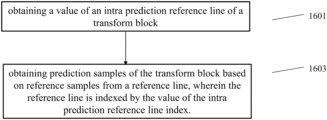
- the obtaining unit configured to obtain a value of an intra prediction reference line index of a transform block.
- the predicting unit configured to obtain prediction samples of the transform block based on reference samples from a reference line, wherein the reference line is indexed by the value of the intra prediction reference line index.
- only reference samples from a top reference line may be used to obtain the prediction samples.
- only reference samples from a left reference line may be used to obtain the prediction samples.
- both reference samples from a left reference line and reference samples from a top reference line may be used to obtain the prediction samples.
- the value of the intra prediction reference line index may be indicated by intra_luma_ref_idx.
- the obtaining unit may be configured to obtain the value of the intra prediction reference line index comprising:
- MRL multi-reference line
- the decoder may further comprise:
- an application unit configured to apply PDPC to the prediction samples when the value of the intra prediction reference line index is zero; or the application unit configured to skip applying PDPC to the prediction samples when the value of the intra prediction reference line index is non-zero.
- the value of the intra prediction reference line index may be 0, 1, or 2.
- the number of reference samples may correspond to the width of the transform block.
- the number of reference samples may correspond to the height of the transform block.
- the reference samples may form a contiguous interval or a contiguous distance within the reference line.
- the reference samples may be determined by specifying horizontal or vertical index, wherein each of the indices may be an integer value belonging to a range of integer values, wherein the indices may specify a horizontal coordinate (x′) or a vertical coordinate (y) within the reference line, respectively.
- an offset is the difference between vertical index of left-most reference sample and the vertical position of the top-left predicted sample of the left column of reference samples of the transform block.
- an offset is the difference between horizontal index of top-most reference sample and the horizontal position of the top-left predicted sample of the top row of reference samples of the transform block
- the top-most reference sample of the reference line may be offset vertically to the position of the top left predicted sample of the transform block.
- the left-most reference sample of the reference line may be offset horizontally to the position of the top left predicted sample of the transform block.
- the value of the offset may be equal to the value of the intra prediction reference line index.
- the vertical position of the topmost reference sample of the reference line may be equal to the vertical position of the top left predicted sample of the transform block.
- the horizontal position of the left-most reference sample of the reference line may be equal to the horizontal position of the top-left predicted sample of the transform block.
- the embodiments of the present disclosure introduce a harmonization of MRL and non-directional intra prediction (i.e. DC or Planar).
- the harmonization consists in aligning the reference samples from a reference line, which is indexed by the value of the intra prediction reference line index.
- FIG. 1 A is a block diagram showing an example of a video coding system according to an embodiment
- FIG. 1 B is a block diagram showing another example of a video coding system according to an embodiment
- FIG. 1 C is a block diagram showing an example of a mobile device according to an embodiment
- FIG. 2 is a block diagram showing an example of a video encoder according to an embodiment
- FIG. 3 is a block diagram showing an example structure of a video decoder according to an embodiment
- FIG. 4 is a block diagram illustrating an example of an encoding apparatus or a decoding apparatus
- FIG. 5 is a block diagram illustrating another example of an encoding apparatus or a decoding apparatus
- FIG. 6 is an illustration of two subpartitions split in ISP tool
- FIG. 7 is an illustration of four subpartitions split in ISP tool
- FIG. 8 is an illustration of multi-reference line intra prediction
- FIG. 9 illustrates a reference sample selection method for PLANAR intra prediction
- FIG. 10 illustrates another reference sample selection method for PLANAR intra prediction mode
- FIG. 11 illustrates yet another different reference sample selection method for PLANAR intra prediction mode
- FIG. 12 illustrates a reference sample selection method for DC intra prediction according to an embodiment
- FIG. 12 A- 12 C illustrate further different reference sample selection methods for DC intra prediction mode according to some embodiments
- FIG. 13 illustrate yet another different reference sample selection method for DC intra prediction mode according to an embodiment
- FIG. 14 illustrates a method according to an embodiment
- FIG. 15 illustrates an encoder according to an embodiment
- FIG. 16 illustrates a decoder according to an embodiment
- FIG. 17 is a block diagram showing an example structure of a content supply system which realizes a content delivery service
- FIG. 18 is a block diagram showing a structure of an example of a terminal device.
- identical reference signs refer to identical or at least functionally equivalent features if not explicitly specified otherwise.
- a disclosure in connection with a described method may also hold true for a corresponding device or system configured to perform the method and vice versa.
- a corresponding device may include one or a plurality of units, e.g. functional units, to perform the described one or plurality of method operations (e.g. one unit performing the one or plurality of operations, or a plurality of units each performing one or more of the plurality of operations), even if such one or more units are not explicitly described or illustrated in the figures.
- a specific apparatus is described based on one or a plurality of units, e.g.
- a corresponding method may include one operation to perform the functionality of the one or plurality of units (e.g. one operations performing the functionality of the one or plurality of units, or a plurality of operations each performing the functionality of one or more of the plurality of units), even if such one or plurality of operations are not explicitly described or illustrated in the figures. Further, it is understood that the features of the various exemplary embodiments and/or aspects described herein may be combined with each other, unless specifically noted otherwise.
- Video coding typically refers to the processing of a sequence of pictures, which form the video or video sequence. Instead of the term “picture” the term “frame” or “image” may be used as synonyms in the field of video coding.
- Video coding (or coding in general) comprises two parts video encoding and video decoding. Video encoding is performed at the source side, typically comprising processing (e.g. by compression) the original video pictures to reduce the amount of data required for representing the video pictures (for more efficient storage and/or transmission). Video decoding is performed at the destination side and typically comprises the inverse processing compared to the encoder to reconstruct the video pictures.
- Embodiments referring to “coding” of video pictures shall be understood to relate to “encoding” or “decoding” of video pictures or respective video sequences.
- the combination of the encoding part and the decoding part is also referred to as CODEC (Coding and Decoding).
- the original video pictures can be reconstructed, i.e. the reconstructed video pictures have the same quality as the original video pictures (assuming no transmission loss or other data loss during storage or transmission).
- further compression e.g. by quantization, is performed, to reduce the amount of data representing the video pictures, which cannot be completely reconstructed at the decoder, i.e. the quality of the reconstructed video pictures is lower or worse compared to the quality of the original video pictures.
- Video coding standards belong to the group of “lossy hybrid video codecs” (i.e. combine spatial and temporal prediction in the sample domain and 2D transform coding for applying quantization in the transform domain).
- Each picture of a video sequence is typically partitioned into a set of non-overlapping blocks and the coding is typically performed on a block level.
- the video is typically processed, i.e. encoded, on a block (video block) level, e.g.
- the encoder duplicates the decoder processing loop such that both will generate identical predictions (e.g. intra- and inter predictions) and/or re-constructions for processing, i.e. coding, the subsequent blocks.
- a video encoder 20 and a video decoder 30 are described based on FIGS. 1 to 3 .
- FIG. 1 A is a schematic block diagram illustrating an example coding system 10 , e.g. a video coding system that may utilize the embodiments described herein.
- Video encoder (or encoder) 20 and video decoder (or decoder) 30 of coding system 10 represent examples of devices that may be configured to perform embodiments in accordance with various examples described in the present application.
- the coding system 10 comprises a source device 12 configured to provide encoded picture data 21 e.g. to a destination device 14 for decoding the encoded picture data 13 .
- the source device 12 comprises an encoder 20 , and may additionally comprise a picture source 16 , a pre-processor (or pre-processing unit) 18 , e.g. a picture pre-processor, and a communication interface or communication unit 22 .
- a pre-processor or pre-processing unit 18
- a communication interface or communication unit 22 e.g. a picture pre-processor
- the picture source 16 may comprise or be any kind of picture capturing device, for example a camera for capturing a real-world picture, and/or any kind of a picture generating device, for example a computer-graphics processor for generating a computer animated picture, or any kind of other device for obtaining and/or providing a real-world picture, a computer generated picture (e.g. a screen content, a virtual reality (VR) picture) and/or any combination thereof (e.g. an augmented reality (AR) picture).
- the picture source may be any kind of memory or storage storing any of the aforementioned pictures.
- the picture or picture data 17 may also be referred to as raw picture or raw picture data.
- Pre-processor 18 is configured to receive the (raw) picture data 17 and to perform pre-processing on the picture data 17 to obtain a pre-processed picture 19 or pre-processed picture data 19 .
- Pre-processing performed by the pre-processor 18 may, e.g., comprise trimming, color format conversion (e.g. from RGB to YCbCr), color correction, or de-noising. It can be understood that the pre-processing unit 18 may be optional in some embodiments.
- the video encoder 20 is configured to receive the pre-processed picture data 19 and provide encoded picture data 21 (further details will be described below, e.g., based on FIG. 2 ).
- Communication interface 22 of the source device 12 may be configured to receive the encoded picture data 21 and to transmit the encoded picture data 21 (or any further processed version thereof) over communication channel 13 to another device, e.g. the destination device 14 or any other device, for storage or direct reconstruction.
- the destination device 14 comprises a decoder 30 (e.g. a video decoder), and may additionally comprise a communication interface or communication unit 28 , a post-processor 32 (or post-processing unit) and a display device 34 .
- a decoder 30 e.g. a video decoder
- the communication interface 28 of the destination device 14 is configured receive the encoded picture data 21 (or any further processed version thereof), e.g. directly from the source device 12 or from any other source, e.g. a storage device, e.g. an encoded picture data storage device, and provide the encoded picture data 21 to the decoder 30 .
- a storage device e.g. an encoded picture data storage device
- the communication interface 22 and the communication interface 28 may be configured to transmit or receive the encoded picture data 21 or encoded data 13 via a direct communication link between the source device 12 and the destination device 14 , e.g. a direct wired or wireless connection, or via any kind of network, e.g. a wired or wireless network or any combination thereof, or any kind of private and public network, or any kind of combination thereof.
- the communication interface 22 may be, e.g., configured to package the encoded picture data 21 into an appropriate format, e.g. packets, and/or process the encoded picture data using any kind of transmission encoding or processing for transmission over a communication link or communication network.
- the communication interface 28 may be, e.g., configured to receive the transmitted data and process the transmission data using any kind of corresponding transmission decoding or processing and/or de-packaging to obtain the encoded picture data 21 .
- Both, communication interface 22 and communication interface 28 may be configured as unidirectional communication interfaces as indicated by the arrow for the communication channel 13 in FIG. 1 A pointing from the source device 12 to the destination device 14 , or bi-directional communication interfaces, and may be configured, e.g. to send and receive messages, e.g. to set up a connection, to acknowledge and exchange any other information related to the communication link and/or data transmission, e.g. encoded picture data transmission.
- the decoder 30 is configured to receive the encoded picture data 21 and provide decoded picture data 31 or a decoded picture 31 (further details will be described below, e.g., based on FIG. 3 or FIG. 5 ).
- the post-processor 32 of destination device 14 is configured to post-process the decoded picture data 31 (also called reconstructed picture data), e.g. the decoded picture 31 , to obtain post-processed picture data 33 , e.g. a post-processed picture 33 .
- the post-processing performed by the post-processing unit 32 may comprise, e.g. color format conversion (e.g. from YCbCr to RGB), color correction, trimming, or re-sampling, or any other processing, e.g. for preparing the decoded picture data 31 for display, e.g. by display device 34 .
- the display device 34 of the destination device 14 is configured to receive the post-processed picture data 33 for displaying the picture, e.g. to a user or viewer.
- the display device 34 may be or comprise any kind of display for representing the reconstructed picture, e.g. an integrated or external display or monitor.
- the displays may, e.g. comprise liquid crystal displays (LCD), organic light emitting diodes (OLED) displays, plasma displays, projectors, micro LED displays, liquid crystal on silicon (LCoS), digital light processor (DLP) or any kind of other display.
- FIG. 1 A depicts the source device 12 and the destination device 14 as separate devices, embodiments of devices may also comprise both or both functionalities, the source device 12 or corresponding functionality and the destination device 14 or corresponding functionality. In such embodiments the source device 12 or corresponding functionality and the destination device 14 or corresponding functionality may be implemented using the same hardware and/or software or by separate hardware and/or software or any combination thereof.
- the encoder 20 e.g. a video encoder 20
- the decoder 30 e.g. a video decoder 30
- both encoder 20 and decoder 30 may be implemented via processing circuitry as shown in FIG. 1 B , such as one or more microprocessors, digital signal processors (DSPs), application-specific integrated circuits (ASICs), field-programmable gate arrays (FPGAs), discrete logic, hardware, video coding dedicated or any combinations thereof.
- the encoder 20 may be implemented via processing circuitry 46 to embody the various modules as discussed with respect to encoder 20 of FIG. 2 and/or any other encoder system or subsystem described herein.
- the decoder 30 may be implemented via processing circuitry 46 to embody the various modules as discussed with respect to decoder 30 of FIG. 3 and/or any other decoder system or subsystem described herein.
- the processing circuitry may be configured to perform the various operations as discussed later.
- a device may store instructions for the software in a suitable, non-transitory computer-readable storage medium and may execute the instructions in hardware using one or more processors to perform the embodiments of this disclosure.
- Either of video encoder 20 and video decoder 30 may be integrated as part of a combined encoder/decoder (CODEC) in a single device, for example, as shown in FIG. 1 B .
- CDEC combined encoder/decoder
- Source device 12 and destination device 14 may comprise any of a wide range of devices, including any kind of handheld or stationary devices, e.g. notebook or laptop computers, mobile phones, smart phones, tablets or tablet computers, cameras, desktop computers, set-top boxes, televisions, display devices, digital media players, video gaming consoles, video streaming devices (such as content services servers or content delivery servers), broadcast receiver device, broadcast transmitter device, or the like and may use no or any kind of operating system.
- the source device 12 and the destination device 14 may be equipped for wireless communication.
- the source device 12 and the destination device 14 may be wireless communication devices.
- video coding system 10 illustrated in FIG. 1 A is merely an example and the embodiments of the present application may apply to video coding settings (e.g., video encoding or video decoding) that do not necessarily include any data communication between the encoding and decoding devices.
- data is retrieved from a local memory, streamed over a network, or the like.
- a video encoding device may encode and store data to memory, and/or a video decoding device may retrieve and decode data from memory.
- the encoding and decoding is performed by devices that do not communicate with one another, but simply encode data to memory and/or retrieve and decode data from memory.
- FIG. 1 C shows a block diagram showing an example of a mobile device according to an embodiment.
- HEVC High-Efficiency Video Coding
- VVC Versatile Video coding
- JCT-VC Joint Collaboration Team on Video Coding
- VCEG ITU-T Video Coding Experts Group
- MPEG ISO/IEC Motion Picture Experts Group
- FIG. 2 shows a schematic block diagram of an example video encoder according to an embodiment.
- video encoder 20 comprises an input (or input interface) 201 , a residual calculation unit 204 , a transform processing unit 206 , a quantization unit 208 , an inverse quantization unit 210 , and inverse transform processing unit 212 , a reconstruction unit 214 , a loop filter unit 220 , a decoded picture buffer (DPB) 230 , a mode selection unit 260 , an entropy encoding unit 270 and an output (or output interface) 272 .
- the mode selection unit 260 may include an inter prediction unit 244 , an intra prediction unit 254 and a partitioning unit 262 .
- Inter prediction unit 244 may include a motion estimation unit and a motion compensation unit (not shown).
- a video encoder 20 as shown in FIG. 2 may also be referred to as hybrid video encoder or a video encoder according to a hybrid video codec.
- the residual calculation unit 204 , the transform processing unit 206 , the quantization unit 208 , the mode selection unit 260 may be referred to as forming a forward signal path of the encoder 20
- the inverse quantization unit 210 , the inverse transform processing unit 212 , the reconstruction unit 214 , the buffer 216 , the loop filter 220 , the decoded picture buffer (DPB) 230 , the inter prediction unit 244 and the intra-prediction unit 254 may be referred to as forming a backward signal path of the video encoder 20 , wherein the backward signal path of the video encoder 20 corresponds to the signal path of the decoder (see video decoder 30 in FIG. 3 ).
- the inverse quantization unit 210 , the inverse transform processing unit 212 , the reconstruction unit 214 , the loop filter 220 , the decoded picture buffer (DPB) 230 , the inter prediction unit 244 and the intra-prediction unit 254 are also referred to forming the “built-in decoder” of video encoder 20 .
- the encoder 20 may be configured to receive, e.g. via input 201 , a picture 17 (or picture data 17 ), e.g. picture of a sequence of pictures forming a video or video sequence.
- the received picture or picture data may also be a pre-processed picture 19 (or pre-processed picture data 19 ).
- the picture 17 may also be referred to as current picture or picture to be coded (in particular in video coding to distinguish the current picture from other pictures, e.g. previously encoded and/or decoded pictures of the same video sequence, i.e. the video sequence which also comprises the current picture).
- a (digital) picture is or can be regarded as a two-dimensional array or matrix of samples with intensity values.
- a sample in the array may also be referred to as pixel (short form of picture element) or a pel.
- the number of samples in horizontal and vertical direction (or axis) of the array or picture define the size and/or resolution of the picture.
- typically three color components are employed, i.e. the picture may be represented or include three sample arrays.
- RBG format or color space a picture comprises a corresponding red, green and blue sample array.
- each pixel is typically represented in a luminance and chrominance format or color space, e.g.
- YCbCr which comprises a luminance component indicated by Y (sometimes also L is used instead) and two chrominance components indicated by Cb and Cr.
- the luminance (or short luma) component Y represents the brightness or grey level intensity (e.g. like in a grey-scale picture), while the two chrominance (or short chroma) components Cb and Cr represent the chromaticity or color information components.
- a picture in YCbCr format comprises a luminance sample array of luminance sample values (Y), and two chrominance sample arrays of chrominance values (Cb and Cr).
- Pictures in RGB format may be converted or transformed into YCbCr format and vice versa, the process is also known as color transformation or conversion.
- a picture may comprise only a luminance sample array. Accordingly, a picture may be, for example, an array of luma samples in monochrome format or an array of luma samples and two corresponding arrays of chroma samples in 4:2:0, 4:2:2, and 4:4:4 colour format.
- Embodiments of the video encoder 20 may comprise a picture partitioning unit (not depicted in FIG. 2 ) configured to partition the picture 17 into a plurality of (typically non-overlapping) picture blocks 203 . These blocks may also be referred to as root blocks, macro blocks (H.264/AVC) or coding tree blocks (CTB) or coding tree units (CTU) (H.265/HEVC and VVC).
- the picture partitioning unit may be configured to use the same block size for all pictures of a video sequence and the corresponding grid defining the block size, or to change the block size between pictures or subsets or groups of pictures, and partition each picture into the corresponding blocks.
- the video encoder may be configured to receive directly a block 203 of the picture 17 , e.g. one, several or all blocks forming the picture 17 .
- the picture block 203 may also be referred to as current picture block or picture block to be coded.
- the picture block 203 again is or can be regarded as a two-dimensional array or matrix of samples with intensity values (sample values), although of smaller dimension than the picture 17 .
- the block 203 may comprise, e.g., one sample array (e.g. a luma array in case of a monochrome picture 17 , or a luma or chroma array in case of a color picture) or three sample arrays (e.g. a luma and two chroma arrays in case of a color picture 17 ) or any other number and/or kind of arrays depending on the color format applied.
- the number of samples in horizontal and vertical direction (or axis) of the block 203 define the size of block 203 .
- a block may, for example, an M ⁇ N (M-column by N-row) array of samples, or an M ⁇ N array of transform coefficients.
- Embodiments of the video encoder 20 as shown in FIG. 2 may be configured to encode the picture 17 block by block, e.g. the encoding and prediction is performed per block 203 .
- Embodiments of the video encoder 20 as shown in FIG. 2 may be further configured to partition and/or encode the picture by using slices (also referred to as video slices), wherein a picture may be partitioned into or encoded using one or more slices (typically non-overlapping), and each slice may comprise one or more blocks (e.g. CTUs).
- slices also referred to as video slices
- each slice may comprise one or more blocks (e.g. CTUs).
- Embodiments of the video encoder 20 as shown in FIG. 2 may be further configured to partition and/or encode the picture by using tile groups (also referred to as video tile groups) and/or tiles (also referred to as video tiles), wherein a picture may be partitioned into or encoded using one or more tile groups (typically non-overlapping), and each tile group may comprise, e.g. one or more blocks (e.g. CTUs) or one or more tiles, wherein each tile, e.g. may be of rectangular shape and may comprise one or more blocks (e.g. CTUs), e.g. complete or fractional blocks.
- tile groups also referred to as video tile groups
- tiles also referred to as video tiles
- each tile group may comprise, e.g. one or more blocks (e.g. CTUs) or one or more tiles, wherein each tile, e.g. may be of rectangular shape and may comprise one or more blocks (e.g. CTUs), e.g. complete or fractional blocks.
- the residual calculation unit 204 may be configured to calculate a residual block 205 (also referred to as residual 205 ) based on the picture block 203 and a prediction block 265 (further details about the prediction block 265 are provided later), e.g. by subtracting sample values of the prediction block 265 from sample values of the picture block 203 , sample by sample (pixel by pixel) to obtain the residual block 205 in the sample domain.
- a residual block 205 also referred to as residual 205
- a prediction block 265 further details about the prediction block 265 are provided later
- the transform processing unit 206 may be configured to apply a transform, e.g. a discrete cosine transform (DCT) or discrete sine transform (DST), on the sample values of the residual block 205 to obtain transform coefficients 207 in a transform domain.
- a transform e.g. a discrete cosine transform (DCT) or discrete sine transform (DST)
- DCT discrete cosine transform
- DST discrete sine transform
- the transform processing unit 206 may be configured to apply integer approximations of DCT/DST, such as the transforms specified for H.265/HEVC. Compared to an orthogonal DCT transform, such integer approximations are typically scaled by a certain factor. In order to preserve the norm of the residual block which is processed by forward and inverse transforms, additional scaling factors are applied as part of the transform process.
- the scaling factors are typically chosen based on certain constraints like scaling factors being a power of two for shift operations, bit depth of the transform coefficients, tradeoff between accuracy and implementation costs, etc. Specific scaling factors are, for example, specified for the inverse transform, e.g. by inverse transform processing unit 212 (and the corresponding inverse transform, e.g. by inverse transform processing unit 312 at video decoder 30 ) and corresponding scaling factors for the forward transform, e.g. by transform processing unit 206 , at an encoder 20 may be specified accordingly.
- Embodiments of the video encoder 20 may be configured to output transform parameters, e.g. a type of transform or transforms, e.g. directly or encoded or compressed via the entropy encoding unit 270 , so that, e.g., the video decoder 30 may receive and use the transform parameters for decoding.
- transform parameters e.g. a type of transform or transforms, e.g. directly or encoded or compressed via the entropy encoding unit 270 , so that, e.g., the video decoder 30 may receive and use the transform parameters for decoding.
- the quantization unit 208 may be configured to quantize the transform coefficients 207 to obtain quantized coefficients 209 , e.g. by applying scalar quantization or vector quantization.
- the quantized coefficients 209 may also be referred to as quantized transform coefficients 209 or quantized residual coefficients 209 .
- the quantization process may reduce the bit depth associated with some or all of the transform coefficients 207 .
- an n-bit transform coefficient may be rounded down to an m-bit Transform coefficient during quantization, where n is greater than m.
- the degree of quantization may be modified by adjusting a quantization parameter (QP).
- QP quantization parameter
- different scaling may be applied to achieve finer or coarser quantization. Smaller quantization step sizes correspond to finer quantization, whereas larger quantization step sizes correspond to coarser quantization.
- the applicable quantization step size may be indicated by a quantization parameter (QP).
- the quantization parameter may for example be an index to a predefined set of applicable quantization step sizes.
- small quantization parameters may correspond to fine quantization (small quantization step sizes) and large quantization parameters may correspond to coarse quantization (large quantization step sizes) or vice versa.
- the quantization may include division by a quantization step size and a corresponding and/or the inverse dequantization, e.g. by inverse quantization unit 210 , may include multiplication by the quantization step size.
- Embodiments according to some standards, e.g. HEVC may be configured to use a quantization parameter to determine the quantization step size.
- the quantization step size may be calculated based on a quantization parameter using a fixed point approximation of an equation including division.
- Additional scaling factors may be introduced for quantization and dequantization to restore the norm of the residual block, which might get modified because of the scaling used in the fixed point approximation of the equation for quantization step size and quantization parameter.
- the scaling of the inverse transform and dequantization might be combined.
- customized quantization tables may be used and signaled from an encoder to a decoder, e.g. in a bitstream.
- the quantization is a lossy operation, wherein the loss increases with increasing quantization step sizes.
- Embodiments of the video encoder 20 may be configured to output quantization parameters (QP), e.g. directly or encoded via the entropy encoding unit 270 , so that, e.g., the video decoder 30 may receive and apply the quantization parameters for decoding.
- QP quantization parameters
- the inverse quantization unit 210 is configured to apply the inverse quantization of the quantization unit 208 on the quantized coefficients to obtain dequantized coefficients 211 , e.g. by applying the inverse of the quantization scheme applied by the quantization unit 208 based on or using the same quantization step size as the quantization unit 208 .
- the dequantized coefficients 211 may also be referred to as dequantized residual coefficients 211 and correspond—although typically not identical to the transform coefficients due to the loss by quantization—to the transform coefficients 207 .
- the inverse transform processing unit 212 is configured to apply the inverse transform of the transform applied by the transform processing unit 206 , e.g. an inverse discrete cosine transform (DCT) or inverse discrete sine transform (DST) or other inverse transforms, to obtain a reconstructed residual block 213 (or corresponding dequantized coefficients 213 ) in the sample domain.
- the reconstructed residual block 213 may also be referred to as transform block 213 .
- the reconstruction unit 214 (e.g. adder or summer 214 ) is configured to add the transform block 213 (i.e. reconstructed residual block 213 ) to the prediction block 265 to obtain a reconstructed block 215 in the sample domain, e.g. by adding—sample by sample—the sample values of the reconstructed residual block 213 and the sample values of the prediction block 265 .
- the loop filter unit 220 (or short “loop filter” 220 ), is configured to filter the reconstructed block 215 to obtain a filtered block 221 , or in general, to filter reconstructed samples to obtain filtered samples.
- the loop filter unit is, e.g., configured to smooth pixel transitions, or otherwise improve the video quality.
- the loop filter unit 220 may comprise one or more loop filters such as a de-blocking filter, a sample-adaptive offset (SAO) filter or one or more other filters, e.g. a bilateral filter, an adaptive loop filter (ALF), a sharpening, a smoothing filter or a collaborative filter, or any combination thereof.
- the loop filter unit 220 is shown in FIG. 2 as being an in loop filter, in other configurations, the loop filter unit 220 may be implemented as a post loop filter.
- the filtered block 221 may also be referred to as filtered reconstructed block 221 .
- Embodiments of the video encoder 20 may be configured to output loop filter parameters (such as sample adaptive offset information), e.g. directly or encoded via the entropy encoding unit 270 , so that, e.g., a decoder 30 may receive and apply the same loop filter parameters or respective loop filters for decoding.
- loop filter parameters such as sample adaptive offset information
- the decoded picture buffer (DPB) 230 may be a memory that stores reference pictures, or in general reference picture data, for encoding video data by video encoder 20 .
- the DPB 230 may be formed by any of a variety of memory devices, such as dynamic random access memory (DRAM), including synchronous DRAM (SDRAM), magnetoresistive RAM (MRAM), resistive RAM (RRAM), or other types of memory devices.
- DRAM dynamic random access memory
- SDRAM synchronous DRAM
- MRAM magnetoresistive RAM
- RRAM resistive RAM
- the decoded picture buffer (DPB) 230 may be configured to store one or more filtered blocks 221 .
- the decoded picture buffer 230 may be further configured to store other previously filtered blocks, e.g. previously reconstructed and filtered blocks 221 , of the same current picture or of different pictures, e.g.
- the decoded picture buffer (DPB) 230 may be also configured to store one or more unfiltered reconstructed blocks 215 , or in general unfiltered reconstructed samples, e.g. if the reconstructed block 215 is not filtered by loop filter unit 220 , or any other further processed version of the reconstructed blocks or samples.
- the mode selection unit 260 comprises partitioning unit 262 , inter-prediction unit 244 and intra-prediction unit 254 , and is configured to receive or obtain original picture data, e.g. an original block 203 (current block of the current picture 17 ), and reconstructed picture data, e.g. filtered and/or unfiltered reconstructed samples or blocks of the same (current) picture and/or from one or a plurality of previously decoded pictures, e.g. from decoded picture buffer 230 or other buffers (e.g. line buffer, not shown).
- the reconstructed picture data is used as reference picture data for prediction, e.g. inter-prediction or intra-prediction, to obtain a prediction block 265 or predictor 265 .
- Mode selection unit 260 may be configured to determine or select a partitioning for a current block prediction mode (including no partitioning) and a prediction mode (e.g. an intra or inter prediction mode) and generate a corresponding prediction block 265 , which is used for the calculation of the residual block 205 and for the reconstruction of the reconstructed block 215 .
- a prediction mode e.g. an intra or inter prediction mode
- Embodiments of the mode selection unit 260 may be configured to select the partitioning and the prediction mode (e.g. from those supported by or available for mode selection unit 260 ), which provide the best match or in other words the minimum residual (minimum residual means better compression for transmission or storage), or a minimum signaling overhead (minimum signaling overhead means better compression for transmission or storage), or which considers or balances both.
- the mode selection unit 260 may be configured to determine the partitioning and prediction mode based on rate distortion optimization (RDO), i.e. select the prediction mode which provides a minimum rate distortion.
- RDO rate distortion optimization
- Terms like “best”, “minimum”, “optimum” etc. in this context do not necessarily refer to an overall “best”, “minimum”, “optimum”, etc. but may also refer to the fulfillment of a termination or selection criterion like a value exceeding or falling below a threshold or other constraints leading potentially to a “sub-optimum selection” but reducing complexity and processing time.
- the partitioning unit 262 may be configured to partition the block 203 into smaller block partitions or sub-blocks (which form again blocks), e.g. iteratively using quad-tree-partitioning (QT), binary partitioning (BT) or triple-tree-partitioning (TT) or any combination thereof, and to perform, e.g., the prediction for each of the block partitions or sub-blocks, wherein the mode selection comprises the selection of the tree-structure of the partitioned block 203 and the prediction modes are applied to each of the block partitions or sub-blocks.
- QT quad-tree-partitioning
- BT binary partitioning
- TT triple-tree-partitioning
- partitioning e.g. by partitioning unit 260
- prediction processing by inter-prediction unit 244 and intra-prediction unit 254
- the partitioning unit 262 may partition (or split) a current block 203 into smaller partitions, e.g. smaller blocks of square or rectangular size. These smaller blocks (which may also be referred to as sub-blocks) may be further partitioned into even smaller partitions.
- This is also referred to tree-partitioning or hierarchical tree-partitioning, wherein a root block, e.g. at root tree-level 0 (hierarchy-level 0, depth 0), may be recursively partitioned, e.g. partitioned into two or more blocks of a next lower tree-level, e.g.
- nodes at tree-level 1 (hierarchy-level 1, depth 1), wherein these blocks may be again partitioned into two or more blocks of a next lower level, e.g. tree-level 2 (hierarchy-level 2, depth 2), etc. until the partitioning is terminated, e.g. because a termination criterion is fulfilled, e.g. a maximum tree depth or minimum block size is reached.
- Blocks which are not further partitioned are also referred to as leaf-blocks or leaf nodes of the tree.
- a tree using partitioning into two partitions is referred to as binary-tree (BT)
- BT binary-tree
- TT ternary-tree
- QT quad-tree
- the term “block” as used herein may be a portion, in particular a square or rectangular portion, of a picture.
- the block may be or correspond to a coding tree unit (CTU), a coding unit (CU), prediction unit (PU), and transform unit (TU) and/or to the corresponding blocks, e.g. a coding tree block (CTB), a coding block (CB), a transform block (TB) or prediction block (PB).
- CTU coding tree unit
- CU coding unit
- PU prediction unit
- TU transform unit
- a coding tree block CB
- CB coding block
- TB transform block
- PB prediction block
- a coding tree unit may be or comprise a CTB of luma samples, two corresponding CTBs of chroma samples of a picture that has three sample arrays, or a CTB of samples of a monochrome picture or a picture that is coded using three separate colour planes and syntax structures used to code the samples.
- a coding tree block may be an N ⁇ N block of samples for some value of N such that the division of a component into CTBs is a partitioning.
- a coding unit may be or comprise a coding block of luma samples, two corresponding coding blocks of chroma samples of a picture that has three sample arrays, or a coding block of samples of a monochrome picture or a picture that is coded using three separate colour planes and syntax structures used to code the samples.
- a coding block may be an M ⁇ N block of samples for some values of M and N such that the division of a CTB into coding blocks is a partitioning.
- a coding tree unit may be split into CUs by using a quad-tree structure denoted as coding tree.
- the decision whether to code a picture area using inter-picture (temporal) or intra-picture (spatial) prediction is made at the CU level.
- Each CU can be further split into one, two or four PUs according to the PU splitting type. Inside one PU, the same prediction process is applied and the relevant information is transmitted to the decoder on a PU basis.
- a CU can be partitioned into transform units (TUs) according to another quadtree structure similar to the coding tree for the CU.
- a combined Quad-tree and binary tree (QTBT) partitioning is for example used to partition a coding block.
- a CU can have either a square or rectangular shape.
- a coding tree unit (CTU) is first partitioned by a quadtree structure.
- the quadtree leaf nodes are further partitioned by a binary tree or ternary (or triple) tree structure.
- the partitioning tree leaf nodes are called coding units (CUs), and that segmentation is used for prediction and transform processing without any further partitioning.
- CUs coding units
- multiple partition for example, triple tree partition may be used together with the QTBT block structure.
- the mode selection unit 260 of video encoder 20 may be configured to perform any combination of the partitioning embodiments described herein.
- the video encoder 20 is configured to determine or select the best or an optimum prediction mode from a set of (e.g. pre-determined) prediction modes.
- the set of prediction modes may comprise, e.g., intra-prediction modes and/or inter-prediction modes.
- the set of intra-prediction modes may comprise 35 different intra-prediction modes, e.g. non-directional modes like DC (or mean) mode and planar mode, or directional modes, e.g. as defined in HEVC, or may comprise 67 different intra-prediction modes, e.g. non-directional modes like DC (or mean) mode and planar mode, or directional modes, e.g. as defined for VVC.
- intra-prediction modes e.g. non-directional modes like DC (or mean) mode and planar mode
- directional modes e.g. as defined for VVC.
- the intra-prediction unit 254 is configured to use reconstructed samples of neighboring blocks of the same current picture to generate an intra-prediction block 265 according to an intra-prediction mode of the set of intra-prediction modes.
- the intra prediction unit 254 (or in general the mode selection unit 260 ) is further configured to output intra-prediction parameters (or in general information indicative of the selected intra prediction mode for the block) to the entropy encoding unit 270 in form of syntax elements 266 for inclusion into the encoded picture data 21 , so that, e.g., the video decoder 30 may receive and use the prediction parameters for decoding.
- the set of (or possible) inter-prediction modes depends on the available reference pictures (i.e. previous at least partially decoded pictures, e.g. stored in DBP 230 ) and other inter-prediction parameters, e.g. whether the whole reference picture or only a part, e.g. a search window area around the area of the current block, of the reference picture is used for searching for a best matching reference block, and/or e.g. whether pixel interpolation is applied, e.g. half/semi-pel and/or quarter-pel interpolation, or not.
- other inter-prediction parameters e.g. whether the whole reference picture or only a part, e.g. a search window area around the area of the current block, of the reference picture is used for searching for a best matching reference block, and/or e.g. whether pixel interpolation is applied, e.g. half/semi-pel and/or quarter-pel interpolation, or not.
- skip mode and/or direct mode may be applied.
- the inter prediction unit 244 may include a motion estimation (ME) unit and a motion compensation (MC) unit (both not shown in FIG. 2 ).
- the motion estimation unit may be configured to receive or obtain the picture block 203 (current picture block 203 of the current picture 17 ) and a decoded picture 231 , or at least one or a plurality of previously reconstructed blocks, e.g. reconstructed blocks of one or a plurality of other/different previously decoded pictures 231 , for motion estimation.
- a video sequence may comprise the current picture and the previously decoded pictures 231 , or in other words, the current picture and the previously decoded pictures 231 may be part of or form a sequence of pictures forming a video sequence.
- the encoder 20 may, e.g., be configured to select a reference block from a plurality of reference blocks of the same or different pictures of the plurality of other pictures and provide a reference picture (or reference picture index) and/or an offset (spatial offset) between the position (x, y coordinates) of the reference block and the position of the current block as inter prediction parameters to the motion estimation unit.
- This offset is also called motion vector (MV).
- the motion compensation unit is configured to obtain, e.g. receive, an inter prediction parameter and to perform inter prediction based on or using the inter prediction parameter to obtain an inter prediction block 265 .
- Motion compensation performed by the motion compensation unit, may involve fetching or generating the prediction block based on the motion/block vector determined by motion estimation, possibly performing interpolations to sub-pixel precision. Interpolation filtering may generate additional pixel samples from known pixel samples, thus potentially increasing the number of candidate prediction blocks that may be used to code a picture block.
- the motion compensation unit may locate the prediction block to which the motion vector points in one of the reference picture lists.
- the motion compensation unit may also generate syntax elements associated with the blocks and video slices for use by video decoder 30 in decoding the picture blocks of the video slice.
- syntax elements associated with the blocks and video slices for use by video decoder 30 in decoding the picture blocks of the video slice.
- tile groups and/or tiles and respective syntax elements may be generated or used.
- the entropy encoding unit 270 is configured to apply, for example, an entropy encoding algorithm or scheme (e.g. a variable length coding (VLC) scheme, an context adaptive VLC scheme (CAVLC), an arithmetic coding scheme, a binarization, a context adaptive binary arithmetic coding (CABAC), syntax-based context-adaptive binary arithmetic coding (SBAC), probability interval partitioning entropy (PIPE) coding or another entropy encoding methodology or technique) or bypass (no compression) on the quantized coefficients 209 , inter prediction parameters, intra prediction parameters, loop filter parameters and/or other syntax elements to obtain encoded picture data 21 which can be output via the output 272 , e.g.
- an entropy encoding algorithm or scheme e.g. a variable length coding (VLC) scheme, an context adaptive VLC scheme (CAVLC), an arithmetic coding scheme, a binarization, a context adaptive
- an encoded bitstream 21 in the form of an encoded bitstream 21 , so that, e.g., the video decoder 30 may receive and use the parameters for decoding.
- the encoded bitstream 21 may be transmitted to video decoder 30 , or stored in a memory for later transmission or retrieval by video decoder 30 .
- a non-transform based encoder 20 can quantize the residual signal directly without the transform processing unit 206 for certain blocks or frames.
- an encoder 20 can have the quantization unit 208 and the inverse quantization unit 210 combined into a single unit.
- FIG. 3 shows an example of a video decoder according to an embodiment.
- Video decoder 30 is configured to receive encoded picture data 21 (e.g. encoded bitstream), e.g. encoded by encoder 20 , to obtain a decoded picture 331 .
- the encoded picture data or bitstream comprises information for decoding the encoded picture data, e.g. data that represents picture blocks of an encoded video slice (and/or tile groups or tiles) and associated syntax elements.
- the decoder 30 comprises an entropy decoding unit 304 , an inverse quantization unit 310 , an inverse transform processing unit 312 , a reconstruction unit 314 (e.g. a summer), a loop filter 320 , a decoded picture buffer (DBP) 330 , a mode application unit 360 , an inter prediction unit 344 and an intra prediction unit 354 .
- Inter prediction unit 344 may be or include a motion compensation unit.
- Video decoder 30 may, in some examples, perform a decoding pass generally reciprocal to the encoding pass described with respect to video encoder 100 from FIG. 2 .
- the inverse quantization unit 210 the inverse transform processing unit 212 , the reconstruction unit 214 the loop filter 220 , the decoded picture buffer (DPB) 230 , the inter prediction unit 344 and the intra prediction unit 354 are also referred to as forming the “built-in decoder” of video encoder 20 .
- the inverse quantization unit 310 may be identical in function to the inverse quantization unit 110
- the inverse transform processing unit 312 may be identical in function to the inverse transform processing unit 212
- the reconstruction unit 314 may be identical in function to reconstruction unit 214
- the loop filter 320 may be identical in function to the loop filter 220
- the decoded picture buffer 330 may be identical in function to the decoded picture buffer 230 . Therefore, the explanations provided for the respective units and functions of the video 20 encoder apply correspondingly to the respective units and functions of the video decoder 30 .
- the entropy decoding unit 304 is configured to parse the bitstream 21 (or in general encoded picture data 21 ) and perform, for example, entropy decoding to the encoded picture data 21 to obtain, e.g., quantized coefficients 309 and/or decoded coding parameters (not shown in FIG. 3 ), e.g. any or all of inter prediction parameters (e.g. reference picture index and motion vector), intra prediction parameter (e.g. intra prediction mode or index), transform parameters, quantization parameters, loop filter parameters, and/or other syntax elements.
- Entropy decoding unit 304 may be configured to apply the decoding algorithms or schemes corresponding to the encoding schemes as described with regard to the entropy encoding unit 270 of the encoder 20 .
- Entropy decoding unit 304 may be further configured to provide inter prediction parameters, intra prediction parameter and/or other syntax elements to the mode application unit 360 and other parameters to other units of the decoder 30 .
- Video decoder 30 may receive the syntax elements at the video slice level and/or the video block level. In addition or as an alternative to slices and respective syntax elements, tile groups and/or tiles and respective syntax elements may be received and/or used.
- the inverse quantization unit 310 may be configured to receive quantization parameters (QP) (or in general information related to the inverse quantization) and quantized coefficients from the encoded picture data 21 (e.g. by parsing and/or decoding, e.g. by entropy decoding unit 304 ) and to apply based on the quantization parameters an inverse quantization on the decoded quantized coefficients 309 to obtain dequantized coefficients 311 , which may also be referred to as transform coefficients 311 .
- the inverse quantization process may include use of a quantization parameter determined by video encoder 20 for each video block in the video slice (or tile or tile group) to determine a degree of quantization and, likewise, a degree of inverse quantization that should be applied.
- Inverse transform processing unit 312 may be configured to receive dequantized coefficients 311 , also referred to as transform coefficients 311 , and to apply a transform to the dequantized coefficients 311 in order to obtain reconstructed residual blocks 213 in the sample domain.
- the reconstructed residual blocks 213 may also be referred to as transform blocks 313 .
- the transform may be an inverse transform, e.g., an inverse DCT, an inverse DST, an inverse integer transform, or a conceptually similar inverse transform process.
- the inverse transform processing unit 312 may be further configured to receive transform parameters or corresponding information from the encoded picture data 21 (e.g. by parsing and/or decoding, e.g. by entropy decoding unit 304 ) to determine the transform to be applied to the dequantized coefficients 311 .
- the reconstruction unit 314 (e.g. adder or summer 314 ) may be configured to add the reconstructed residual block 313 , to the prediction block 365 to obtain a reconstructed block 315 in the sample domain, e.g. by adding the sample values of the reconstructed residual block 313 and the sample values of the prediction block 365 .
- the loop filter unit 320 (either in the coding loop or after the coding loop) is configured to filter the reconstructed block 315 to obtain a filtered block 321 , e.g. to smooth pixel transitions, or otherwise improve the video quality.
- the loop filter unit 320 may comprise one or more loop filters such as a de-blocking filter, a sample-adaptive offset (SAO) filter or one or more other filters, e.g. a bilateral filter, an adaptive loop filter (ALF), a sharpening, a smoothing filters or a collaborative filters, or any combination thereof.
- the loop filter unit 320 is shown in FIG. 3 as being an in loop filter, in other configurations, the loop filter unit 320 may be implemented as a post loop filter.
- decoded video blocks 321 of a picture are then stored in decoded picture buffer 330 , which stores the decoded pictures 331 as reference pictures for subsequent motion compensation for other pictures and/or for output respectively display.
- the decoder 30 is configured to output the decoded picture 311 , e.g. via output 312 , for presentation or viewing to a user.
- the inter prediction unit 344 may be identical to the inter prediction unit 244 (in particular to the motion compensation unit) and the intra prediction unit 354 may be identical to the inter prediction unit 254 in function, and performs split or partitioning decisions and prediction based on the partitioning and/or prediction parameters or respective information received from the encoded picture data 21 (e.g. by parsing and/or decoding, e.g. by entropy decoding unit 304 ).
- Mode application unit 360 may be configured to perform the prediction (intra or inter prediction) per block based on reconstructed pictures, blocks or respective samples (filtered or unfiltered) to obtain the prediction block 365 .
- intra prediction unit 354 of mode application unit 360 is configured to generate prediction block 365 for a picture block of the current video slice based on a signaled intra prediction mode and data from previously decoded blocks of the current picture.
- inter prediction unit 344 e.g. motion compensation unit
- the prediction blocks may be produced from one of the reference pictures within one of the reference picture lists.
- Video decoder 30 may construct the reference frame lists, List 0 and List 1, using default construction techniques based on reference pictures stored in DPB 330 .
- the same or similar may be applied for or by embodiments using tile groups (e.g. video tile groups) and/or tiles (e.g. video tiles) in addition or alternatively to slices (e.g. video slices), e.g. a video may be coded using I, P or B tile groups and/or tiles.
- Mode application unit 360 is configured to determine the prediction information for a video block of the current video slice by parsing the motion vectors or related information and other syntax elements, and uses the prediction information to produce the prediction blocks for the current video block being decoded. For example, the mode application unit 360 uses some of the received syntax elements to determine a prediction mode (e.g., intra or inter prediction) used to code the video blocks of the video slice, an inter prediction slice type (e.g., B slice, P slice, or GPB slice), construction information for one or more of the reference picture lists for the slice, motion vectors for each inter encoded video block of the slice, inter prediction status for each inter coded video block of the slice, and other information to decode the video blocks in the current video slice.
- a prediction mode e.g., intra or inter prediction
- an inter prediction slice type e.g., B slice, P slice, or GPB slice
- construction information for one or more of the reference picture lists for the slice motion vectors for each inter encoded video block of the slice, inter prediction status for each
- tile groups e.g. video tile groups
- tiles e.g. video tiles
- slices e.g. video slices
- Embodiments of the video decoder 30 as shown in FIG. 3 may be configured to partition and/or decode the picture by using slices (also referred to as video slices), wherein a picture may be partitioned into or decoded using one or more slices (typically non-overlapping), and each slice may comprise one or more blocks (e.g. CTUs).
- slices also referred to as video slices
- each slice may comprise one or more blocks (e.g. CTUs).
- Embodiments of the video decoder 30 as shown in FIG. 3 may be configured to partition and/or decode the picture by using tile groups (also referred to as video tile groups) and/or tiles (also referred to as video tiles), wherein a picture may be partitioned into or decoded using one or more tile groups (typically non-overlapping), and each tile group may comprise, e.g. one or more blocks (e.g. CTUs) or one or more tiles, wherein each tile, e.g. may be of rectangular shape and may comprise one or more blocks (e.g. CTUs), e.g. complete or fractional blocks.
- tile groups also referred to as video tile groups
- tiles also referred to as video tiles
- each tile group may comprise, e.g. one or more blocks (e.g. CTUs) or one or more tiles, wherein each tile, e.g. may be of rectangular shape and may comprise one or more blocks (e.g. CTUs), e.g. complete or fractional blocks.
- the video decoder 30 can be used to decode the encoded picture data 21 .
- the decoder 30 can produce the output video stream without the loop filtering unit 320 .
- a non-transform based decoder 30 can inverse-quantize the residual signal directly without the inverse-transform processing unit 312 for certain blocks or frames.
- the video decoder 30 can have the inverse-quantization unit 310 and the inverse-transform processing unit 312 combined into a single unit.
- a processing result of a current step may be further processed and then output to the next step.
- a further operation such as Clip or shift, may be performed on the processing result of the interpolation filtering, motion vector derivation or loop filtering.
- the value of motion vector is constrained to a predefined range according to its representing bit. If the representing bit of motion vector is bitDepth, then the range is ⁇ 2 ⁇ circumflex over ( ) ⁇ (bitDepth ⁇ 1) ⁇ 2 ⁇ circumflex over ( ) ⁇ (bitDepth ⁇ 1) ⁇ 1, where “ ⁇ circumflex over ( ) ⁇ ” means exponentiation.
- bitDepth is set equal to 16
- the range is ⁇ 32768 ⁇ 32767
- bitDepth is set equal to 18
- the range is ⁇ 131072 ⁇ 131071.
- the value of the derived motion vector e.g. the MVs of four 4 ⁇ 4 sub-blocks within one 8 ⁇ 8 block
- the max difference between integer parts of the four 4 ⁇ 4 sub-block MVs is no more than N pixels, such as no more than 1 pixel.
- N pixels such as no more than 1 pixel.
- decimal numbers are stored as two's complement.
- the two's complement of ⁇ 32769 is 1,0111,1111,1111,1111 (17 bits), then the MSB is discarded, so the resulting two's complement is 0111,1111,1111,1111 (decimal number is 32767), which is same as the output by applying formula (1) and (2).
- the operations may be applied during the sum of mvp and mvd, as shown in formula (5) to (8).
- Clip3 ⁇ ( x , y , z ) ⁇ x ; z ⁇ x y ; z > y z ; otherwise
- FIG. 4 is a schematic diagram of a video coding device 400 according to an embodiment of the disclosure.
- the video coding device 400 is suitable for implementing the disclosed embodiments as described herein.
- the video coding device 400 may be a decoder such as video decoder 30 of FIG. 1 A or an encoder such as video encoder 20 of FIG. 1 A .
- the video coding device 400 comprises ingress ports 410 (or input ports 410 ) and receiver units (Rx) 420 for receiving data; a processor, logic unit, or central processing unit (CPU) 430 to process the data; transmitter units (Tx) 440 and egress ports 450 (or output ports 450 ) for transmitting the data; and a memory 460 for storing the data.
- the video coding device 400 may also comprise optical-to-electrical (OE) components and electrical-to-optical (EO) components coupled to the ingress ports 410 , the receiver units 420 , the transmitter units 440 , and the egress ports 450 for egress or ingress of optical or electrical signals.
- OE optical-to-electrical
- EO electrical-to-optical
- the processor 430 is implemented by hardware and software.
- the processor 430 may be implemented as one or more CPU chips, cores (e.g., as a multi-core processor), FPGAs, ASICs, and DSPs.
- the processor 430 is in communication with the ingress ports 410 , receiver units 420 , transmitter units 440 , egress ports 450 , and memory 460 .
- the processor 430 comprises a coding module 470 .
- the coding module 470 implements the disclosed embodiments described above. For instance, the coding module 470 implements, processes, prepares, or provides the various coding operations.
- the inclusion of the coding module 470 therefore provides a substantial improvement to the functionality of the video coding device 400 and effects a transformation of the video coding device 400 to a different state.
- the coding module 470 is implemented as instructions stored in the memory 460 and executed by the processor 430 .
- the memory 460 may comprise one or more disks, tape drives, and solid-state drives and may be used as an over-flow data storage device, to store programs when such programs are selected for execution, and to store instructions and data that are read during program execution.
- the memory 460 may be, for example, volatile and/or non-volatile and may be a read-only memory (ROM), random access memory (RAM), ternary content-addressable memory (TCAM), and/or static random-access memory (SRAM).
- FIG. 5 is a simplified block diagram of an apparatus 500 that may be used as either or both of the source device 12 and the destination device 14 from FIG. 1 according to an exemplary embodiment.
- a processor 502 in the apparatus 500 can be a central processing unit.
- the processor 502 can be any other type of device, or multiple devices, capable of manipulating or processing information now-existing or hereafter developed.
- the disclosed embodiments can be practiced with a single processor as shown, e.g., the processor 502 , advantages in speed and efficiency can be achieved using more than one processor.
- a memory 504 in the apparatus 500 can be a read only memory (ROM) device or a random access memory (RAM) device in an embodiment. Any other suitable type of storage device can be used as the memory 504 .
- the memory 504 can include code and data 506 that is accessed by the processor 502 using a bus 512 .
- the memory 504 can further include an operating system 508 and application programs 510 , the application programs 510 including at least one program that permits the processor 502 to perform the methods described here.
- the application programs 510 can include applications 1 through N, which further include a video coding application that performs the methods described here.
- the apparatus 500 can also include one or more output devices, such as a display 518 .
- the display 518 may be, in one example, a touch sensitive display that combines a display with a touch sensitive element that is operable to sense touch inputs.
- the display 518 can be coupled to the processor 502 via the bus 512 .
- the bus 512 of the apparatus 500 can be composed of multiple buses.
- the secondary storage 514 can be directly coupled to the other components of the apparatus 500 or can be accessed via a network and can comprise a single integrated unit such as a memory card or multiple units such as multiple memory cards.
- the apparatus 500 can thus be implemented in a wide variety of configurations.
- Encoded picture data 21 contain information about how a block prediction is performed by at the encoder (unit 254 ) and the decoder (unit 354 ).
- the syntax of the encoded picture data may comprise the following elements (Table 1):
- intra_luma_ref_idx[x0][y0] is not present it is inferred to be equal to 0.
- IntraLumaRefLineIdx[ x ][ y ] based on intra_luma_ref_idx[ x0 ][ y0 ]
- IntraLumaRefLineIdx[ x ][ y ] x x0 . . . x0 + cbWidth ⁇ 1
- y y0 . . . y0 + cbHeight ⁇ 1 0 0 1 1 2 3
- cbWidth corresponds to block width
- cbHeight corresponds to block height
- Predicted block is also referred to as coding block.
- intra_subpartitions_mode_flag[x0][y0] 1 specifies that the current intra coding unit is partitioned into NumIntraSubPartitions[x0][y0] rectangular transform block subpartitions.
- intra_subpartitions_mode_flag[x0][y0] 0 specifies that the current intra coding unit is not partitioned into rectangular transform block subpartitions.
- intra_subpartitions_split_flag[x0][y0] specifies whether the intra subpartitions split type is horizontal or vertical. When intra_subpartitions_split_flag[x0][y0] is not present, it is inferred as follows:
- intra_subpartitions_split_flag[x0][y0] is inferred to be equal to 0.
- IntraSubPartitionsSplitType specifies the type of split used for the current luma coding block as illustrated in Table 3. IntraSubPartitionsSplitType is derived as follows:
- NumIntraSubPartitions specifies the number of transform block subpartitions an intra luma coding block is divided into. NumIntraSubPartitions is derived as follows:
- intra_luma_mpm_flag[x0][y0] intra_luma_not_planar_flag[x0][y0]
- intra_luma_mpm_idx[x0][y0] and intra_luma_mpm_remainder[x0][y0] specify the intra prediction mode for luma samples.
- the array indices x0, y0 specify the location (x0, y0) of the top-left luma sample of the considered coding block relative to the top-left luma sample of the picture.
- intra_luma_mpm_flag[x0][y0] is equal to 1, the intra prediction mode is inferred from a neighbouring intra-predicted coding unit.
- intra_chroma_pred_mode[x0][y0] specifies the intra prediction mode for chroma samples (chroma component of the block).
- the array indices x0, y0 specify the location (x0, y0) of the top-left luma sample of the considered coding block relative to the top-left luma sample of the picture.
- ISP intra sub-partition
- the ISP tool divides luma intra-predicted blocks vertically or horizontally into 2 or 4 sub-partitions depending on the block size dimensions, as shown in Table 4.
- FIGS. 6 and 7 show examples of the two possibilities. All sub-partitions fulfill the condition of having at least 16 samples.
- a residual signal is generated by entropy decoding the coefficients sent by the encoder and then inverse quantizing and inverse transforming them. Then, the sub-partition is intra predicted and finally the corresponding reconstructed samples are obtained by adding the residual signal to the prediction signal. Therefore, the reconstructed values of each sub-partition will be available to generate the prediction of the next one, which will repeat the process and so on. All sub-partitions share the same intra mode.
- the first sub-partition to be processed is the one containing the top-left sample of the CU and then continuing downwards (horizontal split) or rightwards (vertical split).
- reference samples used to generate the sub-partitions prediction signals are only located at the left and above sides of the lines.
- the reverse processing order either starts with the sub-partition containing the bottom-left sample of the CU and continues upwards or starts with sub-partition containing the top-right sample of the CU and continues leftwards.
- intra prediction process could be described as follows.
- variable refIdx specifying the intra prediction reference line index is derived as follows:
- FIG. 8 shows positions of lines of reference samples that are used for intra prediction of a block.
- samples of the predicted block (“Block unit”) may be predicted using reference samples that are not adjacent to the predicted block, i.e. when the index of reference line is not equal to zero.
- a variable dcVal is derived as follows:
- the state of the art methods use directional intra prediction only when the index of reference line is non-zero, i.e. DC intra prediction mode and PLANAR intra prediction mode are disabled in this case.
- Version of the VVC draft specifies different coding of intra prediction mode.
- mpm flag is signaled only when “intra_luma_ref_idx” flag and “intra_subpartitions_mode_flag” flags are equal to zero (see Table 5).
- PDPC Position-dependent prediction combination. This process could be described as follows:
- nScale ((Log 2(nTbW)+Log 2(nTbH) ⁇ 2)>>2).
- predSamples[ x][y] clip1 Cmp ((refL[ x][y]*wL[x ]+refT[ x][y]*wT[y] ⁇ p [ ⁇ 1][ ⁇ 1]* wTL[x][y ]+(64 ⁇ wL[x] ⁇ wT[y]+wTL[x][y ])*predSamples[ x][y ]+32)>>6)
- the scope of the disclosure is in modification of PLANAR and DC intra prediction processes for the cases where reference samples are not adjacent to the block being predicted or a block to be predicted is further split (e.g. using ISP). Modifications include not only the process of prediction samples determination, but reference sample filtering and PDPC. Purpose of such modification is in the possibility to have a unified intra mode signaling mechanism for all the intra prediction tools.
- Disclosure proposes to modify processing of reference samples and introduce conditional switching of PDPC in cases when DC or PLANAR intra prediction modes are used and when reference samples are not adjacent to the block being predicted or when a predicted block is subject to further split (i.e. in case of ISP). Processing includes selection of the reference samples from the reconstructed samples in the top and left area (as shown in FIG. 6 ) and their filtering.
- the present disclosure is aimed at providing a possibility to have a single unified signaling mechanism to encode intra prediction mode.
- Exemplary unified signaling method of intra prediction mode coding is given in Table 6.
- PLANAR intra prediction mode is unable to operate when the index of reference line is non-zero.
- An embodiment of the disclosure shown in FIG. 9 discloses how this could be handled.
- Reference samples that are selected for PLANAR intra prediction mode are represented by hatch fill-ed squared. Assuming the position of the first top-left sample (denoted as “A”) equal to (0, 0), PLANAR intra prediction could be modified as follows:
- FIG. 10 discloses another method of selecting reference samples from the reference line for PLANAR intra prediction mode. This method could be described as follows.
- Another alternative embodiment consists in applying a special displacement for the two samples the values of which are used in bi-prediction as bottom-line sample value and right-side sample value, respectively.
- reference samples are selected from the reference line with a gap. Specification text for this embodiment could be as follows:
- FIGS. 12 - 12 C and FIG. 13 disclose how to perform intra prediction using DC mode when reference line index is nonzero. Sampling mechansism in this case is similar to the ones disclosed above for PLANAR intra prediction mode:
- a variable dcVal is derived as follows:
- the operation 1 described above comprises the selection of reference sample samples from the line and/or column of reference samples (such as a top reference sample line and/or a left reference sample column).
- reference sample samples such as a top reference sample line and/or a left reference sample column.
- index x′ The selection of reference samples from the top reference sample line is performed using index x′ and refIdx as follows: p[x ′ ⁇ refIdx][ ⁇ 1 ⁇ refIdx].
- Result of the selection process is the selected reference samples that are further used to determine the value of variable dcVal (DC value) as described above in operation 1.
- the operation 2 of intra predicting the block using the DC intra prediction mode described above uses the calculated the value of variable dcVal (DC value) in order to get the values of predicted samples (predSamples), i.e. samples of a block to be predicted.
- FIG. 12 A is similar to FIG. 12 in that the value of W is equal to the value of H. However, FIG. 12 A only shows three reference lines, i.e. three rows of reference samples and three columns of reference samples, respectively. These reference lines are above the top and to the left of the block to be predicted.
- FIGS. 12 B and 12 C are similar to FIG. 12 A , however these illustrate a case where W>H ( FIG. 12 B ) and W ⁇ H ( FIG. 12 C ). I.e. in both cases the block to be predicted is of rectangular shape.
- the reference samples used to predict the transform block are subset of reference samples of the reference line. It should be repeated, again that reference line should be understood to include not only a row of reference samples, but also a column of reference samples. A row of reference samples is an example of reference line. A column of a reference samples is another example of a reference line.
- the reference samples used to predict the transform block as shown in FIGS. 12 - 12 C, and 13 are contiguous, and no gap between them within the reference line, so that they form a contiguous interval or a contiguous distance. Each of the reference samples has horizontally or vertically adjacent to the neighbor samples that are also for intra prediction.
- the block is square.
- the width of the transform block (nTbW) is equal to the height of the transform block (nTbH).
- a variable dcVal is derived as follows:
- the value of the intra prediction reference line index is 3 in the example of FIG. 12 , and is 2 in the example of FIG. 12 A .
- the value of redIdx is 2, and nTbW is equal to nTbH. Therefore, top 3rd row of reference samples, and left 3rd column of reference samples are selected. Top 3rd row of reference samples and left 3rd column of reference samples are the reference lines indexed by the value of the intra prediction reference line index.
- the block is non-square.
- the width of the transform block (nTbW) is not equal to the height of the transform block (nTbH).
- a variable dcVal is derived as follows:
- the value of the intra prediction reference line index is 3 in the example of FIGS. 12 B and 12 C .
- the value of redIdx is 2, and nTbW is greater than nTbH. Therefore, only top 3rd row of reference samples is selected.
- Top 3rd row of reference samples is the reference line indexed by the value of the intra prediction reference line index.
- the number of reference samples corresponds to the width of the transform block.
- the left-most reference sample (i.e., p[0][ ⁇ idx ⁇ 1]) of the reference line is offset horizontally to the position (i.e., A) of the top-left predicted sample within the top row of reference samples of the transform block.
- the offset is the difference between vertical index (i.e., [ ⁇ idx ⁇ 1]) of left-most reference sample and the vertical position (i.e., A) of the top-left predicted sample of the left column of reference samples of the transform block.
- the offset is represented by the first index of matrix p, which is equal to 0.
- the horizontal position of the left-most reference sample (i.e., p[0][ ⁇ idx ⁇ 1]) of the reference line is equal to the horizontal position of the top-left predicted sample (i.e., A) of the transform block, and both are equal to 0.
- the value of redIdx is 2, and nTbH is greater than nTbW. Therefore, only left 3rd column of reference samples is selected.
- Left 3rd column of reference samples is the reference line indexed by the value of the intra prediction reference line index. The number of reference samples corresponds to the height of the transform block.
- the top-most reference sample (i.e., p[ ⁇ idx ⁇ 1][0]) of the reference line is offset vertically to the position (i.e., A) of the top-left predicted sample within the left column of reference samples of the transform block.
- the offset is the difference between horizontal index (i.e., [ ⁇ idx ⁇ 1]) of top-most reference sample and the horizontal position (i.e., A) of the top-left predicted sample of the top row of reference samples of the transform block.
- the offset is represented by the second index of matrix p, which is equal to the value of the intra prediction reference line index.
- the vertical position of the top-most reference sample (i.e., p [ ⁇ idx ⁇ 1][0]) of the reference line is equal to the vertical position of the top-left predicted sample (i.e., A) of the transform block, and both are equal to 0.
- Any other intra prediction mode (including DC intra prediction mode) comprises the following operations:
- Operation 1 is selection of the reference line and reference column based on the reference line index (refIdx). This index determines the offset between the left or top boundary of the predicted block and the column or row of reconstructed samples of the neighboring blocks that are further used to get the values of the predicted samples
- Operation 2 consists a determination of whether a reference sample filter is applied to the selected line and column of reference samples.
- These conditions comprise intra prediction mode, color index (cIdx), values of syntax elements that relate to the intra prediction process (e.g. shown in Table 1) as well as values of variables derived from the values of these elements, dimension of a block to be predicted. In case when ISP is performed these conditions additionally comprise the size of a block that was split into subblocks to which intra prediction process is applied.
- a reference sample filter is typically a FIR (finite impulse response) filter that has 3 coefficients defined as [12 1]/4.
- Operation 3 consists in selection of the reference samples from the selected column or line of reference samples. This selection consists in determination of the indices range that indicate what samples belonging to the selected line or column of reference samples would be further used to derive the values of predicted samples.
- Operation 4 consists in deriving predicted samples from the selected reference samples determined at step 3 .
- This derivation is mode-dependant and may comprise further subsampling, applying interpolation filtering or calculating a linear expression from the reference samples, where reference samples that are used to get the value of a predicted sample are determined depending on the position of the predicted sample within a predicted block.
- Another embodiment described herein disables intra reference samples smoothing when reference samples are not adjacent to the block being predicted, i.e. when the index of the referenced line of reference samples (signaled by “intra_luma_ref_idx”) is not equal to zero.
- Another embodiment consists in varying reference sample filter for PLANAR intra prediction mode with respect to the index of the referenced line of reference samples.
- Example filter selection is given in tables 7 and 8 .
- Another embodiment of the disclosure enables PLANAR and DC intra prediction modes to be used for intra prediction of sub-partitions when intra sub partition (ISP) flag is set to 1. It is proposed not to perform PDPC operation when ISP flag is set to 1.
- ISP intra sub partition
- Another embodiment discloses the case when chroma and luma components of a coded picture share the same spatial partitioning into blocks (i.e., when SINGLE_TREE partitioning mode is selected). In this case, two cases of applying PDPC conditionally are considered.
- ISP flag when ISP flag is set equal to 1, a block with predicted samples of luma component is split into luma subblocks, but the collocated chroma block (i.e. a collocated block with predicted samples of chroma component) is not split.
- PDPC is not applied to the luma subblocks, but PDPC is applied to the chroma block.
- the intra prediction reference line index when the intra prediction reference line index is nonzero, PDPC is not applied to the predicted luma block, but it is applied to the collocated chroma block and for prediction of the chroma block the intra prediction reference line index is not signaled but is inferred to zero.
- FIG. 14 illustrates a flow chart of a method of intra prediction of DC intra prediction mode for a block, comprising an operation 1601 of obtaining a value of an intra prediction reference line index of a transform block; and an operation 1603 of obtaining prediction samples of the transform block based on reference samples from a reference line, wherein the reference line is indexed by the value of the intra prediction reference line index.
- the method may comprise an operation 1602 of selecting a line of reference samples based on the value of the intra prediction reference line index, as the examples shown at FIGS. 9 - 13 .
- FIG. 15 illustrates an encoder according to an embodiment.
- Encoder 20 comprises: an obtaining unit 2001 configured to obtain a value of an intra prediction reference line index of a transform block; and a predicting unit 2003 configured to obtain prediction samples of the transform block based on reference samples from a reference line, wherein the reference line is indexed by the value of the intra prediction reference line index.
- the encoder 20 may include a selecting unit 2002 (not shown in FIG. 15 ), configured to select the line of reference samples based on the value of the intra prediction reference line index, as the examples shown at FIGS. 9 - 13 .
- FIG. 16 illustrates a decoder according to an embodiment.
- Decoder 30 comprises an obtaining unit ( 3001 ) configured to obtain a value of an intra prediction reference line index of a transform block; and a predicting unit ( 3003 ) configured to obtain prediction samples of the transform block based on reference samples from a reference line, wherein the reference line is indexed by the value of the intra prediction reference line index.
- the decoder 30 may include a selecting unit 3002 (not shown in FIG. 16 ), configured to select the line of reference samples based on the value of the intra prediction reference line index, as the examples shown at FIGS. 9 - 13 .
- a first aspect of a method of intra prediction of DC or planar intra prediction mode for a block comprising: when multi-reference line (MRL) prediction is enabled, intra predicting the block using the DC or planar intra prediction mode, comprising selection of reference samples from the line and/or column of reference samples (such as a (selected) top reference sample line and/or a (selected) left reference sample column).
- MRL multi-reference line
- a second aspect of a method according to the first aspect the method further comprising: conditionally applying position dependent prediction combination (such as PDPC) to the result of intra prediction.
- position dependent prediction combination such as PDPC
- a third aspect of a method according to the first and second aspect wherein the line and/or column of reference samples is indicated by refIdx (such as an intra prediction reference line index or a reference line index), or the line of reference samples is a single line indicated by a refIdx (such as a first refIdx) among the multi-reference line, or the single column is one column indicated by a refIdx (such as a second refIdx) of reference samples among the multi-reference columns.
- refIdx such as an intra prediction reference line index or a reference line index
- the line of reference samples is a single line indicated by a refIdx (such as a first refIdx) among the multi-reference line
- the single column is one column indicated by a refIdx (such as a second refIdx) of reference samples among the multi-reference columns.
- a first indication such as ISP flag
- a seventh aspect of a method wherein DC value (a variable dcVal) is derived from the line and/or column of reference samples (such as a left reference sample column) located to the left of the block to be predicted, a number of reference samples is selected from the reference line and/or column (such as the left reference sample column) to derive the DC value, wherein the number of reference samples corresponds to the width of the block or a number of reference samples equal to the height of the block.
- DC value a variable dcVal
- An eighth aspect of a method of any of the first to seventh aspects wherein DC value (a variable dcVal) is derived from the line of reference samples (such as top reference sample line(s)) located above of the block to be predicted, a plurality of reference samples is selected from the reference line (such as top reference sample line(s)) to derive the DC value, wherein the number of the plurality of reference samples is equal to the width of the block, or the number of the plurality of reference samples corresponds to the width of the block.
- DC value a variable dcVal
- a ninth aspect of a method of any of the first to eighth aspects wherein the selected reference samples form a contiguous interval or contiguous distance, i.e. each of the selected reference samples has horizontally or vertically adjacent neighbor samples that are also selected reference samples, and only two of the selected reference samples have one selected neighbor sample while other selected reference samples have at least 2 selected reference samples (such as neighbor samples).
- a tenth aspect of a method of any of the first to ninth aspects wherein the selected reference samples are determined by specifying horizontal or vertical indices, each of the index is an integer value belonging to a range of integer values, wherein the index specifies a horizontal coordinate (x′) or a vertical coordinate (y′) within the selected column or selected line of reference samples.
- DC value (a variable dcVal) is derived from the line of reference samples (such as left reference sample column(s)) located to the left of the block to be predicted, and the top-most selected reference sample is offset vertically to the position of the top-left predicted sample of the block.
- a twelfth aspect of a method of any of the first to eleventh aspects wherein the value of the offset corresponds to the intra prediction reference line index, the value of the offset is associated with the intra prediction reference line index, or the value of the offset is equal to the intra prediction reference line index.
- a thirteenth aspect of a method of any of the first to twelfth aspects wherein DC value (a variable dcVal) is derived from the line of reference samples (such as top reference sample line(s)) located above of the block to be predicted, and the left-most selected reference sample is offset horizontally to the position of the top-left predicted sample of the block.
- DC value a variable dcVal
- a fourteenth aspect of a method of any of the first to thirteenth aspects wherein the value of the offset corresponds to the intra prediction reference line index, the value of the offset is associated with the intra prediction reference line index, or the value of the offset is equal to the intra prediction reference line index.
- a fifteenth aspect of a method of any of the first to fourteenth aspects wherein DC value (a variable dcVal) is derived from the line of reference samples (such as left reference sample column(s)) located to the left of the block to be predicted, and vertical position (such as y of (x1, y)) of the top-most selected reference sample is equal to the vertical position (such as y of (x2, y)) of the top-left predicted sample of the block.
- DC value a variable dcVal
- a sixteenth aspect of a method of any of the first to fifteenth aspects wherein DC value (a variable dcVal) is derived from the line of reference samples (such as top reference sample line(s)) located above of the block to be predicted, and horizontal position (such as x of (x, y 1 )) of the left-most selected reference sample is equal to the horizontal position (such as x of (x, y2)) of the top-left predicted sample of the block.
- DC value a variable dcVal
- a second aspect of a method according to the first aspect further comprising:
- a third aspect of a method according to the first and second aspect wherein the line and/or column of reference samples is indicated by refIdx (such as an intra prediction reference line index or a reference line index), or the line of reference samples is a single line indicated by a refIdx (such as a first refIdx) among the multi-reference line, or the single column is one column indicated by a refIdx (such as a second refIdx) of reference samples among the multi-reference columns.
- refIdx such as an intra prediction reference line index or a reference line index
- the line of reference samples is a single line indicated by a refIdx (such as a first refIdx) among the multi-reference line
- the single column is one column indicated by a refIdx (such as a second refIdx) of reference samples among the multi-reference columns.
- a seventh aspect of a method wherein DC value (a variable dcVal) is derived from the line and/or column of reference samples (such as a left reference sample column) located to the left of the block to be predicted, a number of reference samples is selected from the reference line and/or column (such as the left reference sample column) to derive the DC value, wherein the number of reference samples corresponds to the width of the block or a number of reference samples equal to the height of the block.
- DC value a variable dcVal
- An eighth aspect of a method of any of the first to seventh aspects wherein DC value (a variable dcVal) is derived from the line of reference samples (such as top reference sample line(s)) located above of the block to be predicted, a plurality of reference samples is selected from the reference line (such as top reference sample line(s)) to derive the DC value, wherein the number of the plurality of reference samples is equal to the width of the block, or the number of the plurality of reference samples corresponds to the width of the block.
- DC value a variable dcVal
- a ninth aspect of a method of any of the first to eighth aspects wherein the selected reference samples form a contiguous interval or contiguous distance, i.e. each of the selected reference samples has horizontally or vertically adjacent neighbor samples that are also selected reference samples, and only two of the selected reference samples have one selected neighbor sample while other selected reference samples have at least 2 selected reference samples (such as neighbor samples).
- a tenth aspect of a method of any of the first to ninth aspects wherein the selected reference samples are determined by specifying horizontal or vertical indices, each of the index is an integer value belonging to a range of integer values, wherein the index specifies a horizontal coordinate (x′) or a vertical coordinate (y′) within the selected column or selected line of reference samples.
- DC value (a variable dcVal) is derived from the line of reference samples (such as left reference sample column(s)) located to the left of the block to be predicted, and the top-most selected reference sample is offset vertically to the position of the top-left predicted sample of the block.
- a twelfth aspect of a method of any of the first to eleventh aspects wherein the value of the offset corresponds to the intra prediction reference line index, the value of the offset is associated with the intra prediction reference line index, or the value of the offset is equal to the intra prediction reference line index.
- a thirteenth aspect of a method of any of the first to twelfth aspects wherein DC value (a variable dcVal) is derived from the line of reference samples (such as top reference sample line(s)) located above of the block to be predicted, and the left-most selected reference sample is offset horizontally to the position of the top-left predicted sample of the block.
- DC value a variable dcVal
- a fourteenth aspect of a method of any of the first to thirteenth aspects wherein the value of the offset corresponds to the intra prediction reference line index, the value of the offset is associated with the intra prediction reference line index, or the value of the offset is equal to the intra prediction reference line index.
- a fifteenth aspect of a method of any of the first to fourteenth aspects wherein DC value (a variable dcVal) is derived from the line of reference samples (such as left reference sample column(s)) located to the left of the block to be predicted, and vertical position (such as y of (x1, y)) of the top-most selected reference sample is equal to the vertical position (such as y of (x2, y)) of the top-left predicted sample of the block.
- DC value a variable dcVal
- a sixteenth aspect of a method of any of the first to fifteenth aspects wherein DC value (a variable dcVal) is derived from the line of reference samples (such as top reference sample line(s)) located above of the block to be predicted, and horizontal position (such as x of (x, y1)) of the left-most selected reference sample is equal to the horizontal position (such as x of (x, y2)) of the top-left predicted sample of the block.
- DC value a variable dcVal
- a second aspect of a method according to the first aspect further comprising: conditionally applying position dependent prediction combination (such as PDPC) to the result of intra prediction.
- position dependent prediction combination such as PDPC
- a third aspect of a method according to the first and second aspect wherein the line and/or column of reference samples is indicated by refIdx (such as an intra prediction reference line index or a reference line index), or the line of reference samples is a single line indicated by a refIdx (such as a first refIdx) among the multi-reference line, or the single column is one column indicated by a refIdx (such as a second refIdx) of reference samples among the multi-reference columns.
- refIdx such as an intra prediction reference line index or a reference line index
- the line of reference samples is a single line indicated by a refIdx (such as a first refIdx) among the multi-reference line
- the single column is one column indicated by a refIdx (such as a second refIdx) of reference samples among the multi-reference columns.
- a first indication such as ISP flag
- a seventh aspect of a method wherein DC value (a variable dcVal) is derived from the line and/or column of reference samples (such as a left reference sample column) located to the left of the block to be predicted, a number of reference samples is selected from the reference line and/or column (such as the left reference sample column) to derive the DC value, wherein the number of reference samples corresponds to the width of the block or a number of reference samples equal to the height of the block.
- DC value a variable dcVal
- An eighth aspect of a method of any of the first to seventh aspects wherein DC value (a variable dcVal) is derived from the line of reference samples (such as top reference sample line(s)) located above of the block to be predicted, a plurality of reference samples is selected from the reference line (such as top reference sample line(s)) to derive the DC value, wherein the number of the plurality of reference samples is equal to the width of the block, or the number of the plurality of reference samples corresponds to the width of the block.
- DC value a variable dcVal
- a ninth aspect of a method of any of the first to eighth aspects wherein the selected reference samples form a contiguous interval or contiguous distance, i.e. each of the selected reference samples has horizontally or vertically adjacent neighbor samples that are also selected reference samples, and only two of the selected reference samples have one selected neighbor sample while other selected reference samples have at least 2 selected reference samples (such as neighbor samples).
- a tenth aspect of a method of any of the first to ninth aspects wherein the selected reference samples are determined by specifying horizontal or vertical indices, each of the index is an integer value belonging to a range of integer values, wherein the index specifies a horizontal coordinate (x′) or a vertical coordinate (y′) within the selected column or selected line of reference samples.
- DC value (a variable dcVal) is derived from the line of reference samples (such as left reference sample column(s)) located to the left of the block to be predicted, and the top-most selected reference sample is offset vertically to the position of the top-left predicted sample of the block.
- a twelfth aspect of a method of any of the first to eleventh aspects wherein the value of the offset corresponds to the intra prediction reference line index, the value of the offset is associated with the intra prediction reference line index, or the value of the offset is equal to the intra prediction reference line index.
- a thirteenth aspect of a method of any of the first to twelfth aspects wherein DC value (a variable dcVal) is derived from the line of reference samples (such as top reference sample line(s)) located above of the block to be predicted, and the left-most selected reference sample is offset horizontally to the position of the top-left predicted sample of the block.
- DC value a variable dcVal
- a fourteenth aspect of a method of any of the first to thirteenth aspects wherein the value of the offset corresponds to the intra prediction reference line index, the value of the offset is associated with the intra prediction reference line index, or the value of the offset is equal to the intra prediction reference line index.
- a fifteenth aspect of a method of any of the first to fourteenth aspects wherein DC value (a variable dcVal) is derived from the line of reference samples (such as left reference sample column(s)) located to the left of the block to be predicted, and vertical position (such as y of (x1, y)) of the top-most selected reference sample is equal to the vertical position (such as y of (x2, y)) of the top-left predicted sample of the block.
- DC value a variable dcVal
- a sixteenth aspect of a method of any of the first to fifteenth aspects wherein DC value (a variable dcVal) is derived from the line of reference samples (such as top reference sample line(s)) located above of the block to be predicted, and horizontal position (such as x of (x, y1)) of the left-most selected reference sample is equal to the horizontal position (such as x of (x, y2)) of the top-left predicted sample of the block.
- DC value a variable dcVal
- the present disclosure further provides the following device and system aspects which combine for each aspect of methods of the previous three set of aspects as follows:
- An aspect of a decoder comprising: one or more processors; and a non-transitory computer-readable storage medium coupled to the processors and storing programming for execution by the processors, wherein the programming, when executed by the processors, configures the decoder to carry out the method according to any one of the first to sixteenth aspects of any one of the three sets of aspects listed above.
- An aspect of an encoder comprising: one or more processors; and a non-transitory computer-readable storage medium coupled to the processors and storing programming for execution by the processors, wherein the programming, when executed by the processors, configures the encoder to carry out the method according to any one of the first to sixteenth aspects of any one of the three sets of aspects listed above.
- An aspect of an encoder comprising processing circuitry for carrying out the method according to any one of the first to sixteenth aspects of any one of the three sets of aspects listed above.
- An aspect of a decoder ( 30 ) comprising processing circuitry for carrying out the method according to any one of the first to sixteenth aspects of any one of the three sets of aspects listed above.
- An aspect of a computer program product comprising a program code for performing the method according to any one of the first to sixteenth aspects of any one of the three sets of aspects listed above.
- An aspect of a decoder comprising: one or more processors; and a non-transitory computer-readable storage medium coupled to the processors and storing programming for execution by the processors, wherein the programming, when executed by the processors, configures the decoder to carry out the method according to any one of the first to sixteenth aspects of any one of the three sets of aspects listed above.
- An aspect of an encoder comprising: one or more processors; and a non-transitory computer-readable storage medium coupled to the processors and storing programming for execution by the processors, wherein the programming, when executed by the processors, configures the encoder to carry out the method according to any one of the first to sixteenth aspects of any one of the three sets of aspects listed above.
- State-of-the-art video coding (e.g. Versatile Video Coding) comprises directional, DC and planar intra prediction modes that are signalled using the concept of most probable modes list (MPM) also known in the VVC specification draft as candidate intra prediction mode candModeList.
- MPM most probable modes list
- candidate intra prediction mode candModeList When MRL is in use (reference line index is non-zero), it could occur that DC and Planar intra prediction modes use different positions of reference samples within the selected reference line.
- the embodiments of the present disclosure introduce a harmonization of MRL and non-directional intra prediction, i.e., DC or Planar.
- the harmonization consists in aligning the reference samples sets with position of the top-left sample of transform block.
- One of the rationales behind embodiments of the present disclosure is the unification of the MPM (most probable mode) list derivation that enables both DC and Planar mode be represented in the MPM list. This unification makes processing of modes signalled in MPM more regular by reducing the total number of conditional branches that is beneficial for both hardware and software implementations.
- FIG. 17 is a block diagram showing a content supply system 3100 for realizing content distribution service.
- This content supply system 3100 includes capture device 3102 , terminal device 3106 , and may include display 3126 .
- the capture device 3102 communicates with the terminal device 3106 over communication link 3104 .
- the communication link may include the communication channel 13 described above.
- the communication link 3104 includes but not limited to WIFI, Ethernet, Cable, wireless (3G/4G/5G), USB, or any kind of combination thereof, or the like.
- the capture device 3102 generates data, and may encode the data by the encoding method as shown in the above embodiments. Alternatively, the capture device 3102 may distribute the data to a streaming server (not shown in the Figures), and the server encodes the data and transmits the encoded data to the terminal device 3106 .
- the capture device 3102 includes but not limited to camera, smart phone or Pad, computer or laptop, video conference system, PDA, vehicle mounted device, or a combination of any of them, or the like.
- the capture device 3102 may include the source device 12 as described above.
- the video encoder 20 included in the capture device 3102 may actually perform video encoding processing.
- an audio encoder included in the capture device 3102 may actually perform audio encoding processing.
- the capture device 3102 distributes the encoded video and audio data by multiplexing them together.
- the encoded audio data and the encoded video data are not multiplexed.
- Capture device 3102 distributes the encoded audio data and the encoded video data to the terminal device 3106 separately.
- the terminal device 310 receives and reproduces the encoded data.
- the terminal device 3106 could be a device with data receiving and recovering capability, such as smart phone or Pad 3108 , computer or laptop 3110 , network video recorder (NVR)/digital video recorder (DVR) 3112 , TV 3114 , set top box (STB) 3116 , video conference system 3118 , video surveillance system 3120 , personal digital assistant (PDA) 3122 , vehicle mounted device 3124 , or a combination of any of them, or the like capable of decoding the above-mentioned encoded data.
- the terminal device 3106 may include the destination device 14 as described above.
- the encoded data includes video
- the video decoder 30 included in the terminal device is prioritized to perform video decoding.
- an audio decoder included in the terminal device is prioritized to perform audio decoding processing.
- the terminal device can feed the decoded data to its display.
- a terminal device equipped with no display for example, STB 3116 , video conference system 3118 , or video surveillance system 3120 , an external display 3126 is contacted therein to receive and show the decoded data.
- the picture encoding device or the picture decoding device can be used.
- FIG. 18 is a diagram showing a structure of an example of the terminal device 3106 .
- the protocol proceeding unit 3202 analyzes the transmission protocol of the stream.
- the protocol includes but not limited to Real Time Streaming Protocol (RTSP), Hyper Text Transfer Protocol (HTTP), HTTP Live streaming protocol (HLS), MPEG-DASH, Real-time Transport protocol (RTP), Real Time Messaging Protocol (RTMP), or any kind of combination thereof, or the like.
- stream file is generated.
- the file is outputted to a demultiplexing unit 3204 .
- the demultiplexing unit 3204 can separate the multiplexed data into the encoded audio data and the encoded video data.
- the encoded audio data and the encoded video data are not multiplexed. In this situation, the encoded data is transmitted to video decoder 3206 and audio decoder 3208 without through the demultiplexing unit 3204 .
- video elementary stream (ES), audio ES, and subtitle are generated.
- the video decoder 3206 which includes the video decoder 30 as explained in the above mentioned embodiments, decodes the video ES by the decoding method as shown in the above-mentioned embodiments to generate video frame, and feeds this data to the synchronous unit 3212 .
- the audio decoder 3208 decodes the audio ES to generate audio frame, and feeds this data to the synchronous unit 3212 .
- the video frame may store in a buffer (not shown in FIG. Y) before feeding it to the synchronous unit 3212 .
- the audio frame may store in a buffer (not shown in FIG. Y) before feeding it to the synchronous unit 3212 .
- the synchronous unit 3212 synchronizes the video frame and the audio frame, and supplies the video/audio to a video/audio display 3214 .
- the synchronous unit 3212 synchronizes the presentation of the video and audio information.
- Information may code in the syntax using time stamps concerning the presentation of coded audio and visual data and time stamps concerning the delivery of the data stream itself.
- the subtitle decoder 3210 decodes the subtitle, and synchronizes it with the video frame and the audio frame, and supplies the video/audio/subtitle to a video/audio/subtitle display 3216 .
- the present disclosure is not limited to the above-mentioned system, and either the picture encoding device or the picture decoding device in the above-mentioned embodiments can be incorporated into other system, for example, a car system.
- na When a relational operator is applied to a syntax element or variable that has been assigned the value “na” (not applicable), the value “na” is treated as a distinct value for the syntax element or variable. The value “na” is considered not to be equal to any other value.
- Clip1 Y (x) Clip3(0, (1 ⁇ BitDepth Y ) ⁇ 1, x)
- Clip1 C (x) Clip3(0, (1 ⁇ BitDepth C ) ⁇ 1, x)
- Clip3 ⁇ ( x , y , z ) ⁇ x ; z ⁇ x y ; z > y z ; otherwise Cos(x) the trigonometric cosine function operating on an argument x in units of radians.
- Floor(x) the largest integer less than or equal to x.
- the table below specifies the precedence of operations from highest to lowest; a higher position in the table indicates a higher precedence.
- n if( condition 0 ) statement 0 else if( condition 1 ) statement 1 ... else /* informative remark on remaining condition */ statement n may be described in the following manner: ... as follows / ... the following applies: - If condition 0, statement 0 - Otherwise, if condition 1, statement 1 - ... - Otherwise (informative remark on remaining condition), statement n
- statement n may be described in the following manner: ... as follows / ... the following applies: - If all of the following conditions are true, statement 0: - condition 0a - condition 0b - Otherwise, if one or more of the following conditions are true, statement 1: - condition la - condition lb - ... - Otherwise, statement n
- condition 0 statement 0 if( condition 1 ) statement 1 may be described in the following manner: When condition 0, statement 0 When condition 1, statement 1
- embodiments of the disclosure have been primarily described based on video coding, it should be noted that embodiments of the coding system 10 , encoder 20 and decoder 30 (and correspondingly the system 10 ) and the other embodiments described herein may also be configured for still picture processing or coding, i.e. the processing or coding of an individual picture independent of any preceding or consecutive picture as in video coding.
- inter-prediction units 244 (encoder) and 344 (decoder) may not be available in case the picture processing coding is limited to a single picture 17 . All other functionalities (also referred to as tools or technologies) of the video encoder 20 and video decoder 30 may equally be used for still picture processing, e.g.
- Embodiments, e.g. of the encoder 20 and the decoder 30 , and functions described herein, e.g. with reference to the encoder 20 and the decoder 30 may be implemented in hardware, software, firmware, or any combination thereof. If implemented in software, the functions may be stored on a computer-readable medium or transmitted over communication media as one or more instructions or code and executed by a hardware-based processing unit.
- Computer-readable media may include computer-readable storage media, which corresponds to a tangible medium such as data storage media, or communication media including any medium that facilitates transfer of a computer program from one place to another, e.g., according to a communication protocol.
- computer-readable media generally may correspond to (1) tangible computer-readable storage media which is non-transitory or (2) a communication medium such as a signal or carrier wave.
- Data storage media may be any available media that can be accessed by one or more computers or one or more processors to retrieve instructions, code and/or data structures for implementation of the embodiments described in this disclosure.
- a computer program product may include a computer-readable medium.
- such computer-readable storage media can comprise RAM, ROM, EEPROM, CD-ROM or other optical disk storage, magnetic disk storage, or other magnetic storage devices, flash memory, or any other medium that can be used to store desired program code in the form of instructions or data structures and that can be accessed by a computer.
- any connection is properly termed a computer-readable medium.
- a computer-readable medium For example, if instructions are transmitted from a website, server, or other remote source using a coaxial cable, fiber optic cable, twisted pair, digital subscriber line (DSL), or wireless technologies such as infrared, radio, and microwave, then the coaxial cable, fiber optic cable, twisted pair, DSL, or wireless technologies such as infrared, radio, and microwave are included in the definition of medium.
- DSL digital subscriber line
- Disk and disc includes compact disc (CD), laser disc, optical disc, digital versatile disc (DVD), floppy disk and Blu-ray disc, where disks usually reproduce data magnetically, while discs reproduce data optically with lasers. Combinations of the above should also be included within the scope of computer-readable media.
- processors such as one or more digital signal processors (DSPs), general purpose microprocessors, application specific integrated circuits (ASICs), field programmable logic arrays (FPGAs), or other equivalent integrated or discrete logic circuitry.
- DSPs digital signal processors
- ASICs application specific integrated circuits
- FPGAs field programmable logic arrays
- processors may refer to any of the foregoing structure or any other structure suitable for implementation of the embodiments described herein.
- the functionality described herein may be provided within dedicated hardware and/or software modules configured for encoding and decoding, or incorporated in a combined codec. Also, the embodiments could be fully implemented in one or more circuits or logic elements.
- the embodiments of this disclosure may be implemented in a wide variety of devices or apparatuses, including a wireless handset, an integrated circuit (IC) or a set of ICs (e.g., a chip set).
- IC integrated circuit
- a set of ICs e.g., a chip set.
- Various components, modules, or units are described in this disclosure to emphasize functional aspects of devices configured to perform the disclosed embodiments, but do not necessarily require realization by different hardware units. Rather, as described above, various units may be combined in a codec hardware unit or provided by a collection of interoperative hardware units, including one or more processors as described above, in conjunction with suitable software and/or firmware.
Landscapes
- Engineering & Computer Science (AREA)
- Multimedia (AREA)
- Signal Processing (AREA)
- Compression Or Coding Systems Of Tv Signals (AREA)
- Compression, Expansion, Code Conversion, And Decoders (AREA)
Abstract
Description
-
- selection of a reference sample filter based on the combination of intra prediction tools, comprising: ISP, or, multi-reference line prediction
- intra predicting a block
- conditionally applying PDPC to the result of intra prediction.
ux=(mvx+2bitDepth)% 2bitDepth (1)
mvx=(ux>=2bitDepth−1)?(ux−2bitDepth):uX (2)
uy=(mvy+2bitDepth)% 2bitDepth (3)
mvy=(uy>=2bitDepth−1)?(uy−2bitDepth):uy (4)
where mvx is a horizontal component of a motion vector of an image block or a sub-block, mvy is a vertical component of a motion vector of an image block or a sub-block, and ux and uy indicates an intermediate value;
ux=(mvpx+mvdx+2bitDepth)%2bitDepth (5)
mvx=(ux>=2bitDepth−1)?(ux−2bitdepth):ux (6)
uy=(mvpy+mvdy+2bitDepth)% 2bitDepth (7)
mvy=(uy>=2bitDepth−1)?(uy−2bitDepth):uy (8)
vx=Clip3(−2bitDepth−1,2bitDepth−1−1,vx)
vy=Clip3(−2bitDepth−1,2bitDepth−1−1,vy)
where vx is a horizontal component of a motion vector of an image block or a sub-block, vy is a vertical component of a motion vector of an image block or a sub-block; x, y and z respectively correspond to three input value of the MV clipping process, and the definition of function Clip3 is as follow:
| TABLE 1 |
| Exemplary syntax elements related to intra prediction of a block |
| . . . |
| if( treeType = = SINGLE TREE | | treeType = = DUAL_TREE_LUMA ) { | |
| if( ( y0 % CtbSizeY ) > 0 ) | |
| intra_luma_ref_idx[ x0 ][ y0 ] | ae(v) |
| if (intra_luma_ref_idx[ x0 ][ y0 ] = = 0 && | |
| ( cbWidth <= MaxTbSizeY | | cbHeight <= MaxTbSizeY ) && | |
| ( cbWidth * cbHeight > MinTbSizeY * MinTbSizeY )) | |
| intra_subpartitions_mode_flag[ x0 ][ y0 ] | ae(v) |
| if( intra_subpartitions_mode_flag[ x0 ][ y0 ] = = 1 && | |
| cbWidth <= MaxTbSizeY && cbHeight <= MaxTbSizeY ) | |
| intra_subpartitions_split_flag[ x0 ][ y0 ] | ae(v) |
| if( intra_luma_ref_idx[ x0 ][ y0 ] = = 0 && | |
| intra_subpartitions_mode_flag[ x0 ][ y0 ] = = 0 ) | |
| intra_luma_mpm_flag[ x0 ][ y0 ] | ae(v) |
| if( intra_luma_mpm_flag[ x0 ][ y0 ] { | |
| if( intra_luma_ref_idx[ x0 ][ y0 ] = = 0 ) | |
| intra_luma_not_planar_flag[ x0 ][ y0 ] | ae(v) |
| if( intra_luma_not_planar_flag[ x0 ][ y0 ] ) | |
| intra_luma_mpm_idx[ x0 ][ y0 ] | ae(v) |
| } else | |
| intra_luma_mpm_remainder[ x0 ][ y0 ] | ae(v) |
| } | |
| if( treeType = = SINGLE_TREE | | treeType = = DUAL_TREE_CHROMA ) | |
| intra_chroma_pred_mode[ x0 ][ y0 ] | ae(v) |
| } |
| . . . |
| TABLE 2 |
| Specification of IntraLumaRefLineIdx[ x ][ y ] based on |
| intra_luma_ref_idx[ x0 ][ y0 ] |
| IntraLumaRefLineIdx[ x ][ y ] | |||
| x = x0 . . . x0 + cbWidth − 1 | |||
| intra_luma_ref_idx[ x0 ][ y0 ] | y = y0 . . . y0 + cbHeight − 1 | ||
| 0 | 0 | ||
| 1 | 1 | ||
| 2 | 3 | ||
refIdx=(cIdx==0)? IntraLumaRefLineIdx[xTbCmp][yTbCmp]:0,
where cIdx is a variable indicating luma or chroma component of a predicted block. cIdx equal to 0 indicates luma component and cIdx equal to 1 or 2 indicates chroma components. In the description given further cbWidth corresponds to block width, cbHeight corresponds to block height, MaxTbSizeY corresponds to the threshold value, which could be defined as follows:
MaxTbLog 2SizeY=6,
MaxTbSizeY=1<<MaxTbLog 2SizeY
-
- Otherwise (cbWidth is greater than MaxTbSizeY), intra_subpartitions_split_flag[x0][y0] is inferred to be equal to 1.
-
- If intra_subpartitions_mode_flag[x0][y0] is equal to 0, IntraSubPartitionsSplitType is set equal to 0.
- Otherwise, the IntraSubPartitionsSplitType is set equal to 1+intrasubpartitions_split_flag[x0][y0].
| TABLE 3 |
| Name association to IntraSubPartitionsSplitType |
| IntraSubPartitionsSplitType | Name of |
||
| 0 | |
||
| 1 | |
||
| 2 | ISP_VER_SPLIT | ||
-
- If IntraSubPartitionsSplitType is equal to ISP_NO_SPLIT, NumIntraSubPartitions is set equal to 1.
- Otherwise, if one of the following conditions is true, NumIntraSubPartitions is set equal to 2:
- cbWidth is equal to 4 and cbHeight is equal to 8,
- cbWidth is equal to 8 and cbHeight is equal to 4.
- Otherwise, NumIntraSubPartitions is set equal to 4.
| TABLE 4 |
| Number of sub-partitions depending on the block size |
| Block Size | Number of Sub-Partitions | ||
| 4 × 4 | Not divided | ||
| 4 × 8 and 8 × 4 | 2 | ||
| All |
4 | ||
-
- a sample location (xTbCmp, yTbCmp) specifying the top-left sample of the current transform block relative to the top-left sample of the current picture,
- a variable predModeIntra specifying the intra prediction mode,
- a variable nTbW specifying the transform block width,
- a variable nTbH specifying the transform block height,
- a variable nCbW specifying the coding block width,
- a variable nCbH specifying the coding block height,
- a variable cIdx specifying the colour component of the current block.
-
- If IntraSubPartitionsSplitType is equal to ISP_NO_SPLIT or cIdx is not equal to 0, the following applies:
refW=nTbW*2
refH=nTbH*2 - Otherwise (IntraSubPartitionsSplitType is not equal to ISP_NO_SPLIT and cIdx is equal to 0), the following applies:
refW=nCbW*2
refH=nCbH*2
- If IntraSubPartitionsSplitType is equal to ISP_NO_SPLIT or cIdx is not equal to 0, the following applies:
-
- refIdx=(cIdx==0)? IntraLumaRefLinIdx[xTbCmp][yTbCmp]:0
-
- 1. The reference sample availability marking process is invoked with the sample location (xTbCmp, yTbCmp), the intra prediction reference line index refIdx, the reference sample width refW, the reference sample height refH, the colour component index cIdx as inputs, and the reference samples refUnfilt[x][y] with x=−1−refIdx, y=−1−refIdx . . . refH−1 and x=−refIdx . . . refW−1, y=−1−refIdx as output.
- 2. When at least one sample refUnfilt[x][y] with x=−1−refIdx, y=−1−refIdx . . . refH−1 and x=−refIdx . . . refW−1, y=−1−refIdx is marked as “not available for intra prediction”, the reference sample substitution process is invoked with the intra prediction reference line index refIdx, the reference sample width refW, the reference sample height refH, the reference samples refUnfilt[x][y] with x=−1−refIdx, y=−1−refIdx . . . refH−1 and x=−refIdx . . . refW−1, y=−1−refIdx, and the colour component index cIdx as inputs, and the modified reference samples refUnfilt[x][y] with x=−1−refIdx, y=−1−refIdx . . . refH−1 and x=−refIdx . . . refW−1, y=−1−refIdx as output.
- 3. The reference sample filtering process is invoked with the intra prediction reference line index refIdx, the transform block width nTbW and height nTbH, the reference sample width refW, the reference sample height refH, the unfiltered samples refUnfilt[x][y] with x=−1−refIdx, y=−1−refIdx . . . refH−1 and x=−refIdx . . . refW−1, y=−1−refIdx, and the colour component index cIdx as inputs, and the reference samples p[x][y] with x=−1−refIdx, y=−1−refIdx . . . refH−1 and x=−refIdx . . . refW−1, y=−1−refIdx as output.
-
- If predModeIntra is equal to INTRA_PLANAR, the corresponding intra prediction mode process is invoked with the transform block width nTbW, and the transform block height nTbH, and the reference sample array p as inputs, and the output is the predicted sample array predSamples.
- Otherwise, if predModeIntra is equal to INTRA_DC, the corresponding intra prediction mode process is invoked with the transform block width nTbW, the transform block height nTbH, the intra prediction reference line index refIdx, and the reference sample array p as inputs, and the output is the predicted sample array predSamples.
- Otherwise, if predModeIntra is equal to INTRA_LT_CCLM, INTRA_L_CCLM or INTRA_T_CCLM, the corresponding intra prediction mode process is invoked with the intra prediction mode predModeIntra, the sample location (xTbC, yTbC) set equal to (xTbCmp, yTbCmp), the transform block width nTbW and height nTbH, and the reference sample array p as inputs, and the output is the predicted sample array predSamples.
- Otherwise, the corresponding intra prediction mode process is invoked with the intra prediction mode predModeIntra, the intra prediction reference line index refIdx, the transform block width nTbW, the transform block height nTbH, the reference sample width refW, the reference sample height refH, the coding block width nCbW and height nCbH, the colour component index cIdx, and the reference sample array p as inputs, and the modified intra prediction mode predModeIntra and the predicted sample array predSamples as outputs.
-
- IntraSubPartitionsSplitType is equal to ISP_NO_SPLIT or cIdx is not equal to 0
- refIdx is equal to 0 or cIdx is not equal to 0
- One of the following conditions is true:
- predModeIntra is equal to INTRA_PLANAR
- predModeIntra is equal to INTRA_DC
- predModeIntra is equal to INTRA_ANGULAR18
- predModeIntra is equal to INTRA_ANGULAR50
- predModeIntra is less than or equal to INTRA_ANGULAR10
- predModeIntra is greater than or equal to INTRA_ANGULAR58
-
- a variable nTbW specifying the transform block width,
- a variable nTbH specifying the transform block height,
- the neighbouring samples p[x][y], with x=−1, y=−1 . . . nTbH and x=0 . . . nTbW, y=−1.
nW=Max(nTbW,2)
nH=Max(nThH,2)
predV[x][y]=((nH−1−y)*p[x][−1]+(y+1)*p[−1][nTbH])Log 2(nW)
predH[x][y]=((nW−1−x)*p[−1][y]+(x+1)*p[nTbW][−1])Log 2(nH)
predSamples[x][y]=(predV[x][y]+predH[x][y]+nW*nH)>>(Log 2(nW)+Log 2(nH)+1)
-
- a variable nTbW specifying the transform block width,
- a variable nTbH specifying the transform block height,
- the neighbouring samples p[x][y], with x=−1,y=−1 . . . nTbH−1 and x=0 . . . nTbW−1, y=−1.
-
- When nTbW is equal to nTbH:
dcVal=(Σx′=0 nTbW−1 p[x′][−1]+Σy′=0 nTbH−1 p[−1][y′]+nTbW)>>(Log 2(nTbW)+1) - When nTbW is greater than nTbH:
dcVal=(Σx′=0 nTbW−1 p[x′][−1]+(nTW>>1))>>Log 2(nTbW) - When nThW is less than nThH:
dcVal=(Σy′=0 nTbH−1 p[−1][y′]+(nTbH>>1)>>Log 2(nTbH)
- When nTbW is equal to nTbH:
predSamples[x][y]=dcVal, with x=0 . . . nTW−1,y=0 . . . nTH−1
| TABLE 5 |
| Coding of intra mode index as specified by coding unit syntax in VVC |
| specification |
| if( treeType = = SINGLE_TREE | | treeType = = DUAL_TREE_LUMA ) { | |
| if( ( y0 % CtbSizeY ) > 0 ) | |
| intra_luma_ref_idx[ x0 ][ y0 ] | ae(v) |
| if (intra_luma_ref_idx[ x0 ][ y0 ] = = 0 && | |
| ( cbWidth <= MaxTbSizeY | | cbHeight <= MaxTbSizeY ) && | |
| ( cbWidth * cbHeight > MinTbSizeY * MinTbSizeY )) | |
| intra_subpartitions_mode_flag[ x0 ][ y0 ] | ae(v) |
| if( intra_subpartitions_mode_flag[ x0 ][ y0 ] = = 1 && | |
| cbWidth <= MaxTbSizeY && cbHeight <= MaxTbSizeY ) | |
| intra_subpartitions_split_flag[ x0 ][ y0 ] | ae(v) |
| if( intra_luma_ref_idx[ x0 ][ y0 ] = = 0 && | |
| intra_subpartitions_mode_flag[ x0 ][ y0 ] = = 0) | |
| intra_luma_mpm_flag[ x0 ][ y0 ] | ae(v) |
| if( intra_luma_mpm_flag[ x0 ][ y0 ] ) | |
| intra_luma_mpm_idx[ x0 ][ y0 ] | ae(v) |
| else | |
| intra_luma_mpm_remainder[ x0 ][ y0 ] | ae(v) |
| } | |
| if( treeType = = SINGLE_TREE | | treeType = = DUAL_TREE_CHROMA ) | |
| intra_chroma_pred_mode[ x0 ][ y0 ] | ae(v) |
-
- the intra prediction mode predModeIntra,
- a variable nTbW specifying the transform block width,
- a variable nTbH specifying the transform block height,
- a variable refW specifying the reference samples width,
- a variable refH specifying the reference samples height,
- the predicted samples predSamples[x][y], with x=0 . . . nTbW−1, y=0 . . . nTbH−1,
- the neighbouring samples p[x][y], with x=−1, y=−1 . . . refH−1 and x=0 . . . refW−1, y=−1,
- a variable cIdx specifying the colour component of the current block.
-
- If cIdx is equal to 0, clip1Cmp is set equal to Clip1Y.
- Otherwise, clip1Cmp is set equal to Clip1Y.
mainRef[x]=p[x][−1]
sideRef[y]=p[−1][y]
-
- If predModeIntra is equal to INTRA_PLANAR or INTRA_DC, the following applies:
refL[x][y]=p[−1][y]
refT[x][y]=P[x][−1]
wT[y]=32>>((y<<1)>>nScale)
wL[x]=32>>((x<<1)>>nScale)
wTL[x][y]=(predModeIntra==INTRA_DC)? ((wL[x]>>4)+(wT[y]>>4)):0 - Otherwise, if predModeIntra is equal to INTRA_ANGULAR18 or INTRA_ANGULAR50, the following applies:
refL[x][y]=p[−1][y]
refT[x][y]=P[x][−1]
wT[y]=(predModeIntra==INTRA_ANGULAR18)?32>>((y<<1)>>nScale):0
wL[x]=(predModeIntra==INTRA_ANGULAR50)?32>>((x<<1)>>nScale):0
wTL[x][y]=(predModeIntra==INTRA_ANGULAR18)?wT[y]:wL[x] - Otherwise, if predModeIntra is equal to INTRA_ANGULAR2 or INTRA_ANGULAR66, the following applies:
refL[x][y]=p[−1][x+y+1]
refT[x][y]=p[x+y+1][−1]
wT[y]=(32>>1)>>((y<<1)>>nScale)
wL[x]=(32>>1)≥≥((x<<1)>>nScale)
wTL[x][y]=0 - Otherwise, if predModeIntra is less than or equal to INTRA_ANGULAR10, the following ordered operations apply:
- 1. The variables dXPos[y], dXFrac[y], dXInt[y] and dX[x][y] are derived as follows using invAngle as specified in clause 8.4.4.2.7 depending on intraPredMode:
dXPos[y]=((y+1)*invAngle+2)>>2
dXFrac[y]=dXPos[y] & 63
dXInt[y]=dXPos[y]>>6
dX[x][y]=x+dXInt[y] - 2. The variables refL[x][y], refT[x][y], wT[y], wL[x] and wTL[x][y] are derived as follows:
refL[x][y]=0
refT[x][y]=(dX[x][y]<refW−1)?mainRef[dX[x][y]+(dXFrac[y]>>5)]:0 wT[y]=(dX[x][y]<refW−1)?32>>((y<<1)>>nScale):0
wL[x]=0
wTL[x][y]=0
- 1. The variables dXPos[y], dXFrac[y], dXInt[y] and dX[x][y] are derived as follows using invAngle as specified in clause 8.4.4.2.7 depending on intraPredMode:
- Otherwise, if predModeIntra is greater than or equal to INTRA_ANGULAR58, the following ordered operations apply:
- 1. The variables dYPos[x], dYFrac[x], dYInt[x] and dY[x][y] are derived as follows using invAngle as specified in clause 8.4.4.2.7 depending on intraPredMode:
dYPos[x]=((x+1)*invAngle+2)>>2
dYFrac[x]=dYPos[x] & 63
dYInt[x]=dYPos[x]>>6
dY[x][y]=y+dYInt[x] - 2. The variables refL[x][y], refT[x][y], wT[y], wL[x] and wTL[x][y] are derived as follows:
refL[x][y]=(dY[x][y]<refH−1)?sideRef[dY[x][y]+(dYFrac[x]>>5)]:0
refT[x][y]=0
wT[y]=0
wL[x]=(dY[x][y]<refH−1)?32>>((x<<1)>>nScale):0
wTL[x][y]=0
- 1. The variables dYPos[x], dYFrac[x], dYInt[x] and dY[x][y] are derived as follows using invAngle as specified in clause 8.4.4.2.7 depending on intraPredMode:
- Otherwise, refL[x][y], refT[x][y], wT[y], wL[x] and wTL[x][y] are all set equal to 0.
- If predModeIntra is equal to INTRA_PLANAR or INTRA_DC, the following applies:
predSamples[x][y]=clip1Cmp((refL[x][y]*wL[x]+refT[x][y]*wT[y]−p[−1][−1]*wTL[x][y]+(64−wL[x]−wT[y]+wTL[x][y])*predSamples[x][y]+32)>>6)
| TABLE 6 |
| Exemplary unified coding of intra mode index. |
| if( treeType = = SINGLE_TREE | | treeType = = DUAL_TREE_LUMA ) { | |
| if( ( y0 % CtbSizeY ) > 0 ) | |
| intra_luma_ref_idx[ x0 ][ y0 ] | ae(v) |
| if (intra_luma_ref_idx[ x0 ][ y0 ] = = 0 && | |
| ( cbWidth <= MaxTbSizeY | | cbHeight <= MaxTbSizeY ) && | |
| ( cbWidth * cbHeight > MinTbSizeY * MinTbSizeY )) | |
| intra_subpartitions_mode_flag[ x0 ][ y0 ] | ae(v) |
| if( intra_subpartitions_mode_flag[ x0 ][ y0 ] = = 1 && | |
| cbWidth <= MaxTbSizeY && cbHeight <= MaxTbSizeY ) | |
| intra_subpartitions_split_flag[ x0 ][ y0 ] | ae(v) |
| intra_luma_mpm_flag[ x0 ][ y0 ] | ae(v) |
| if( intra_luma_mpm_flag[ x0 ][ y0 ] ) | |
| intra_luma_mpm_idx[ x0 ][ y0 ] | ae(v) |
| else | |
| intra_luma_mpm_remainder[ x0 ][ y0 ] | ae(v) |
| } | |
| if( treeType = = SINGLE_TREE | | treeType = = DUAL_TREE_CHROMA ) | |
| intra_chroma_pred_mode[ x0 ][ y0 ] | ae(v) |
-
- a variable refIdx specifying the intra prediction reference line index,
- a variable nTbW specifying the transform block width,
- a variable nTbH specifying the transform block height,
- the reference samples p[x][y], with x=−1−refIdx, y=−refIdx . . . nTbH and x=−refIdx . . . nTbW, y=−1−refIdx.
nW=Max(nTbW,2)
nH=Max(nThH,2)
pmdV[x][y]=((nH−1−y)*p[x][−1−refIdx]+(y+1)*p[−1−refIdx][nTbH])<<Log 2(nW)
pmdH[x][y]=((nW−1−x)*p[−1−refIdx][y]+(x+1)*p[nTbW][−1−refIdx])<<Log 2(nH)
pnrdSamples[x][y]=(pmdV[x][y]+pmdH[x][y]+nW*nH)>>(Log 2(nW)+Log 2(nH)+1)
-
- a variable refIdx specifying the intra prediction reference line index,
- a variable nTbW specifying the transform block width,
- a variable nTbH specifying the transform block height,
- the neighbouring samples p[x][y], with x=−1-refIdx, y=−1-refIdx . . . nTbH−refIdx and x=−refIdx . . . nTbW−refIdx, y=−1−refIdx.
nW=Max(nTbW,2)
nH=Max(nThH,2)
pmdV[x][y]=((nH−1−y)*p[x−refIdx][−1−refIdx]+(y+1)*p[−1−refIdx][nTbH−refIdx])<<Log 2(nW)
pmdH[x][y]=((nW−1−x)*p[−1−refIdx][y−refIdx]+(x+1)*p[nTW−refIdx][−1−refIdx])<<Log 2(nH)
predSamples[x][y]=(pmdV[x][y]+pmdH[x][y]+nW*nH)>>(Log 2(nW)+Log 2(nH)+1)
-
- a variable refIdx specifying the intra prediction reference line index,
- a variable nTbW specifying the transform block width,
- a variable nTbH specifying the transform block height,
- the neighbouring samples p[x][y], with x=−1−refIdx, y=−1−refIdx . . . nTbH−refIdx and x=−refIdx . . . nTbW−refIdx, y=−1−refIdx . . . .
nW=Max(nTbW,2)
nH=Max(nThH,2)
predV[x][y]=((nH−1−y)*p[x−refIdx][−1−refIdx]+(y+1)*p[−1−refIdx][nTbH])>>Log 2(nW)
predH[x][y]=((nW−1−x)*p[−1−refIdx][y−refIdx]+(x+1)*p[nTbW][−1−refIdx])<<Log 2(nH)
predSamples[x][y]=(pmdV[x][y]+pmdH[x][y]+nW*nH)>>(Log 2(nW)+Log 2(nH)+1)
-
- a variable nTbW specifying the transform block width,
- a variable nTbH specifying the transform block height,
- a variable refIdx specifying the intra prediction reference line index,
- the neighbouring samples p[x][y], with x=−1−refIdx, y=−1−refIdx . . . nTbH−refIdx−1 and x=−refIdx . . . nTbW−refIdx−1, y=−1−refIdx.
-
- When nTbW is equal to nTbH:
dcVal=(Σx′=0 nTbW−1 p[x′−refIdx][−1−refIdx]+Σy′=0 nTbH−1 p[−1−refIdx][y′−refIdx]+nTbW)>>(Log 2(nTbW)+1) - When nTbW is greater than nTbH:
dcVal=(Σx′=0 nTbW−1 p[x′−refIdx][−1−refIdx]+(nTbW>>1))>>Log 2(nTbW) - When nTbW is less than nTbH:
dcVal=(Σy′=0nTbH−1 p[−1−refIdx][y′−refIdx]+(nTbH>>1))>>Log 2(nTbH)
2. The prediction samples predSamples[x][y] are derived as follows:
predSamples[x][y]=dcVal, with x=0 . . . nTbW−1,y=0 . . . nTbH−1
- When nTbW is equal to nTbH:
x′=0 . . . nTbW
and
y′=0 . . . nTbH.
p[x′−refIdx][−1−refIdx].
p[−1−refIdx][y′−refIdx]
-
- a variable nTbW specifying the transform block width,
- a variable nTbH specifying the transform block height,
- a variable refIdx specifying the intra prediction reference line index,
- the neighbouring samples p[x][y], with x=−1−refIdx, y=0 . . . nTbH−1 and x=0 . . . nTbW−1, y=−1−refIdx.
-
- When nTbW is equal to nTbH:
dcVal=(Σx′=0 nTbW−1 p[x′][−1−refIdx]+Σy′=0 nTbH−1 p[−1−refIdx][y′]+nTbW)>>(Log 2(nTbW)+1)
- When nTbW is equal to nTbH:
-
- When nTbW is greater than nTbH (
FIG. 12B ):
dcVal=(Σx′=0 nTbW−1 p[x′][−1−redUdx]+(nTbH>>1))>>Log 2(nTbH) - When nTbW is less than nTbH (
FIG. 12C ):
dcVal=(Σy′=0 nTbH−1 p[−1−refIdx]+(nTbH>>1))>>Log 2(nTbH)
- When nTbW is greater than nTbH (
| TABLE 7 |
| Example filter selection with respect to the index of the |
| referenced line of reference samples |
| Distance to the predicted | |||
| block (samples) | Reference sampe filter selection | ||
| 0 | [ 1 2 1 ] if predicted block contain | ||
| not less than 256 samples, | |||
| [1] otherwise | |||
| Other values | [1] | ||
| TABLE 8 |
| Exemplary filter selection with respect to the index of the |
| referenced line of reference samples |
| Distance to the predicted | |||
| block (samples) | Reference sampe filter selection | ||
| 0 | [ 1 2 1 ] if predicted block contain | ||
| not less than 256 samples, | |||
| [1] otherwise | |||
| 1 | [ 1 2 1 ] if predicted block contain | ||
| not less than 128 samples, | |||
| [1] otherwise | |||
| 2 | [ 1 0 2 0 1 ] if predicted block contain | ||
| not less than 256 samples, | |||
| [1] otherwise | |||
| 3 | [ 1 0 2 0 1 ] if predicted block contain | ||
| not less than 128 samples, | |||
| [1 2 1] otherwise | |||
-
- For the case when ISP mode is on, an exemplary embodiment of how to process DC intra is as follows: calculate DC value for the reference sample of the whole block, and
- use the predicted DC value as and intra predictor for all the subblocks that belong to the block being predicted.
-
- subdividing the block into subblocks when ISP(intra_subpartitions) is enabled (e.g., using intra_subpartitions_mode_idx and intra_subpartitions_mode_flag); and
- intra predicting subblocks using the DC intra prediction mode.
-
- conditionally applying position dependent prediction combination (such as PDPC) to the result of intra prediction.
-
- splitting a luma component of the block to be predicted into luma subblocks, based on the value of a first indication (such as ISP flag);
the conditionally applying PDPC to the result of intra prediction, comprising: skipping applying PDPC for the luma subblocks, but applying PDPC for a collocated chroma block (i.e. a chroma component of the block to be predicted).
- splitting a luma component of the block to be predicted into luma subblocks, based on the value of a first indication (such as ISP flag);
-
- applying PDPC to a luma component of the block when the intra prediction reference line index is non zero;
- inferring the intra prediction reference line index to be zero when predicting a collocated chroma block and applying PDPC to a result of the collocated chroma block prediction (such as, a result of intra prediction of the collocated chroma block).
-
- applying PDPC to a luma component of the block when the intra prediction reference line index is non zero; inferring the intra prediction reference line index to be zero when predicting a collocated chroma block and applying PDPC to a result of the collocated chroma block prediction (such as, a result of intra prediction of the collocated chroma block).
-
- + Addition
- − Subtraction (as a two-argument operator) or negation (as a unary prefix operator)
- * Multiplication, including matrix multiplication
- xy Exponentiation. Specifies x to the power of y. In other contexts, such notation is used for superscripting not intended for interpretation as exponentiation.
- / Integer division with truncation of the result toward zero. For example, 7/4 and −7/−4 are truncated to 1 and −7/4 and 7/−4 are truncated to −1.
- ÷ Used to denote division in mathematical equations where no truncation or rounding is intended.
Used to denote division in mathematical equations where no truncation or rounding Y is intended.
The summation of f(i) with i taking all integer values from x up to and including y.
-
- x % y Modulus. Remainder of x divided by y, defined only for integers x and y with x>=0 and y>0.
Logical Operators
- x % y Modulus. Remainder of x divided by y, defined only for integers x and y with x>=0 and y>0.
-
- x && y Boolean logical “and” of x and y
- x∥y Boolean logical “or” of x and y
- ! Boolean logical “not”
- x? y:z If x is TRUE or not equal to 0, evaluates to the value of y; otherwise, evaluates to the value of z.
Relational Operators
-
- > Greater than
- >= Greater than or equal to
- < Less than
- <= Less than or equal to
- == Equal to
- != Not equal to
-
- & Bit-wise “and”. When operating on integer arguments, operates on a two's complement representation of the integer value. When operating on a binary argument that contains fewer bits than another argument, the shorter argument is extended by adding mom significant bits equal to 0.
- | Bit-wise “or”. When operating on integer arguments, operates on a two's complement representation of the integer value. When operating on a binary argument that contains fewer bits than another argument, the shorter argument is extended by adding mom significat bits equal to 0.
- {circumflex over ( )} Bit-wise “exclusive or”. When operating on integer arguments, operates on a two's complement representation of the integer value. When operating on a binary argument that contains fewer bits than another argument, the shorter argument is extended by adding mom significant bits equal to 0.
- x>>y Arithmetic right shift of a two's complement integer representation of x by y binary digits.
-
- x<<y Arithmetic left shift of a two's complement integer representation of x by y binary digits. This function is defined only for non-negative integer values of y. Bits shifted into the least significant bits (LSBs) as a result of the left shift have a value equal to 0.
Assignment Operators
- x<<y Arithmetic left shift of a two's complement integer representation of x by y binary digits. This function is defined only for non-negative integer values of y. Bits shifted into the least significant bits (LSBs) as a result of the left shift have a value equal to 0.
-
- = Assignment operator
- ++ Increment, i.e., x++ is equivalent to x=x+1; when used in an array index, evaluates to the value of the variable prior to the increment operation.
- −− Decrement, i.e., x−− is equivalent to x=x−1; when used in an array index, evaluates to the value of the variable prior to the decrement operation.
- +=Increment by amount specified, i.e., x+=3 is equivalent to x=x+3, and x+=(−3) is equivalent to x=x+(−3).
- −= Decrement by amount specified, i.e., x−=3 is equivalent to x=x−3, and x−=(−3) is equivalent to x=x−(−3).
Range Notation
-
- x=y . . . z x takes on integer values starting from y to z, inclusive, with x, y, and z being integer numbers and z being greater than y.
Mathematical Functions
- x=y . . . z x takes on integer values starting from y to z, inclusive, with x, y, and z being integer numbers and z being greater than y.
A sin(x) the trigonometric inverse sine function, operating on an argument x that is in the range of −1.0 to 1.0, inclusive, with an output value in the range of −π÷2 to π÷2, inclusive, in units of radians
A tan(x) the trigonometric inverse tangent function, operating on an argument x, with an output value in the range of −π÷2 to π÷2, inclusive, in units of radians
Ceil(x) the smallest integer greater than or equal to x.
Clip1Y(x)=Clip3(0, (1<<BitDepthY)−1, x)
Clip1C(x)=Clip3(0, (1<<BitDepthC)−1, x)
Cos(x) the trigonometric cosine function operating on an argument x in units of radians.
Floor(x) the largest integer less than or equal to x.
Ln(x) the natural logarithm of x (the base-e logarithm, where e is the natural logarithm base constant 2.718281828 . . . ).
Log 2(x) the base-2 logarithm of x.
Log 10(x) the base-10 logarithm of x.
Round(x)=Sign(x)*Floor(Abs(x)+0.5)
Sin(x) the trigonometric sine function operating on an argument x in units of radians
Sqrt(x)=√{square root over (x)}
Swap(x,y)=(y,x)
Tan(x) the trigonometric tangent function operating on an argument x in units of radians
Order of Operation Precedence
-
- Operations of a higher precedence are evaluated before any operation of a lower precedence.
- Operations of the same precedence are evaluated sequentially from left to right.
| TABLE |
| Operation precedence from highest (at top of table) to lowest |
| (at bottom of table) |
| operations (with operands x, y, and z) | |||
| “x++”, “x− −” | |||
| “!x”, “−x” (as a unary prefix operator) | |||
| “x * y”, “x/y”, “x ÷ y”, “ x/y”, “x % y” | |||
| “x + y”, “x − y” (as a two-argument operator), | |||
| | |||
| “x << y”, “x >> y” | |||
| “x < y”, “x <= y”, “x > y”, “x >= y” | |||
| “x = = y”, “x != y” | |||
| “x & y” | |||
| “x | y” | |||
| “x && y” | |||
| “x | | y” | |||
| “x ? y : z” | |||
| “x . . . y” | |||
| “x = y”, “x += y”, “x −= y” | |||
Text Description of Logical Operations
| if( condition 0 ) |
| |
| else if( condition 1 ) |
| |
| ... |
| else /* informative remark on remaining condition */ |
| statement n |
| may be described in the following manner: |
| ... as follows / ... the following applies: |
| - If |
| - Otherwise, if |
| - ... |
| - Otherwise (informative remark on remaining condition), statement n |
| if( condition 0a && condition 0b ) |
| |
| else if( condition la | | condition lb ) |
| |
| ... |
| else |
| statement n |
| may be described in the following manner: |
| ... as follows / ... the following applies: |
| - If all of the following conditions are true, statement 0: |
| - condition 0a |
| - condition 0b |
| - Otherwise, if one or more of the following conditions are true, statement 1: |
| - condition la |
| - condition lb |
| - ... |
| - Otherwise, statement n |
| if( condition 0 ) |
| |
| if( condition 1 ) |
| |
| may be described in the following manner: |
| When |
| When |
Claims (20)
dcVal=(Σx′=0 nTbW−1 p[x′][−1−refIdx]+
Σy′=0 nTbH−1 p[−1−refIdx][y′]+nTbW)>>(Log 2(nTbW)+1);
dcVal=(Σx′=0 nTbW−1 p[x′][−1−refIdx]+(nTbW>>1))>>Log 2(nTbW);
dcVal=(Σy′=0 nTbH−1 p[−1−refIdx][y′]+(nTbH>>1))>>Log 2(nTbH);
dcVal=(Σx′=0 nTbW−1 p[x′][−1−refIdx]+
Σy′=0 nTbH−1 p[−1−refIdx][y′]+nTbW)>>(Log 2(nTbW)+1);
dcVal=(Σx′=0 nTbW−1 p[x′][−1−refIdx]+(nTbW>>1))>>Log 2(nTbW);
dcVal=(Σy′=0 nTbH−1 p[−1−refIdx][y′]+(nTbH>>1))>>Log 2(nTbH);
dcVal=(Σx′=0 nTbW−1 p[x′][−1−refIdx]+
Σy′=0 nTbH−1 p[−1−refIdx][y′]+nTbW)>>(Log 2(nTbW)+1);
dcVal=(Σx′=0 nTbW−1 p[x′][−1−refIdx]+(nTbW>>1))>>Log 2(nTbW);
dcVal=(Σy′=0 nTbH−1 p[−1−refIdx][y′]+(nTbH>>1))>>Log 2(nTbH);
Priority Applications (1)
| Application Number | Priority Date | Filing Date | Title |
|---|---|---|---|
| US17/447,952 US12212778B2 (en) | 2019-03-21 | 2021-09-17 | Method and apparatus for intra-prediction |
Applications Claiming Priority (4)
| Application Number | Priority Date | Filing Date | Title |
|---|---|---|---|
| US201962822047P | 2019-03-21 | 2019-03-21 | |
| US201962832878P | 2019-04-11 | 2019-04-11 | |
| PCT/RU2020/050055 WO2020190179A1 (en) | 2019-03-21 | 2020-03-23 | Method and apparatus for intra-prediction |
| US17/447,952 US12212778B2 (en) | 2019-03-21 | 2021-09-17 | Method and apparatus for intra-prediction |
Related Parent Applications (1)
| Application Number | Title | Priority Date | Filing Date |
|---|---|---|---|
| PCT/RU2020/050055 Continuation WO2020190179A1 (en) | 2019-03-21 | 2020-03-23 | Method and apparatus for intra-prediction |
Publications (2)
| Publication Number | Publication Date |
|---|---|
| US20220007052A1 US20220007052A1 (en) | 2022-01-06 |
| US12212778B2 true US12212778B2 (en) | 2025-01-28 |
Family
ID=72521159
Family Applications (1)
| Application Number | Title | Priority Date | Filing Date |
|---|---|---|---|
| US17/447,952 Active 2040-12-19 US12212778B2 (en) | 2019-03-21 | 2021-09-17 | Method and apparatus for intra-prediction |
Country Status (12)
| Country | Link |
|---|---|
| US (1) | US12212778B2 (en) |
| EP (1) | EP3932056B1 (en) |
| JP (1) | JP7314300B2 (en) |
| KR (1) | KR102833728B1 (en) |
| CN (2) | CN114125468A (en) |
| AU (1) | AU2020240981B2 (en) |
| BR (1) | BR112021018515A2 (en) |
| CL (1) | CL2021002434A1 (en) |
| ES (1) | ES2987742T3 (en) |
| MX (1) | MX2021011369A (en) |
| PL (1) | PL3932056T3 (en) |
| WO (1) | WO2020190179A1 (en) |
Families Citing this family (10)
| Publication number | Priority date | Publication date | Assignee | Title |
|---|---|---|---|---|
| WO2020197152A1 (en) * | 2019-03-22 | 2020-10-01 | 엘지전자 주식회사 | Method and device for decoding image by using intra prediction mode candidate list in image coding system |
| US11277616B2 (en) * | 2019-06-20 | 2022-03-15 | Qualcomm Incorporated | DC intra mode prediction in video coding |
| US12047567B2 (en) * | 2021-01-26 | 2024-07-23 | Beijing Dajia Internet Information Technology Co., Ltd. | System and method for applying adaptive loop filter in video coding |
| US12069305B2 (en) * | 2021-04-16 | 2024-08-20 | Tencent America LLC | Low memory design for multiple reference line selection scheme |
| US12250401B2 (en) | 2021-06-30 | 2025-03-11 | Tencent America LLC | Harmonized design for offset based refinement and multiple reference line selection |
| WO2023055710A1 (en) * | 2021-09-28 | 2023-04-06 | Ofinno, Llc | Adaptive offset multiple reference line coding |
| EP4458015A4 (en) * | 2021-12-28 | 2026-01-07 | Guangdong Oppo Mobile Telecommunications Corp Ltd | INTRAPREDICTION WITH MULTI-REFERENCE LINES |
| WO2023200249A1 (en) * | 2022-04-12 | 2023-10-19 | 한국전자통신연구원 | Method, device, and recording medium for image encoding/decoding |
| WO2024005480A1 (en) * | 2022-06-29 | 2024-01-04 | 엘지전자 주식회사 | Image encoding/decoding method based on multiple reference lines, method for transmitting bitstream, and recording medium on which bitstream is stored |
| WO2025003557A1 (en) * | 2023-06-29 | 2025-01-02 | Nokia Technologies Oy | A method, an apparatus and a computer program product for video encoding and video decoding |
Citations (8)
| Publication number | Priority date | Publication date | Assignee | Title |
|---|---|---|---|---|
| US20170214940A1 (en) | 2011-06-09 | 2017-07-27 | Qualcomm Incorporated | Enhanced intra-prediction mode signaling for video coding using neighboring mode |
| WO2017190288A1 (en) * | 2016-05-04 | 2017-11-09 | Microsoft Technology Licensing, Llc | Intra-picture prediction using non-adjacent reference lines of sample values |
| WO2017222325A1 (en) | 2016-06-24 | 2017-12-28 | 주식회사 케이티 | Video signal processing method and device |
| US20180332284A1 (en) | 2017-05-09 | 2018-11-15 | Futurewei Technologies, Inc. | Intra-Prediction With Multiple Reference Lines |
| US10491893B1 (en) * | 2018-08-29 | 2019-11-26 | Tencent America LLC | Method and apparatus for multi-line intra prediction |
| WO2020145775A1 (en) | 2019-01-13 | 2020-07-16 | 엘지전자 주식회사 | Image coding method and device for carrying out mrl-based intra prediction |
| WO2020171632A1 (en) | 2019-02-20 | 2020-08-27 | 엘지전자 주식회사 | Mpm list-based intra prediction method and device |
| US20220167009A1 (en) * | 2019-03-12 | 2022-05-26 | Sharp Kabushiki Kaisha | Systems and methods for performing intra prediction coding in video coding |
-
2020
- 2020-03-23 JP JP2021556566A patent/JP7314300B2/en active Active
- 2020-03-23 WO PCT/RU2020/050055 patent/WO2020190179A1/en not_active Ceased
- 2020-03-23 CN CN202111228412.7A patent/CN114125468A/en active Pending
- 2020-03-23 ES ES20773813T patent/ES2987742T3/en active Active
- 2020-03-23 EP EP20773813.9A patent/EP3932056B1/en active Active
- 2020-03-23 MX MX2021011369A patent/MX2021011369A/en unknown
- 2020-03-23 KR KR1020217033168A patent/KR102833728B1/en active Active
- 2020-03-23 AU AU2020240981A patent/AU2020240981B2/en active Active
- 2020-03-23 BR BR112021018515A patent/BR112021018515A2/en unknown
- 2020-03-23 PL PL20773813.9T patent/PL3932056T3/en unknown
- 2020-03-23 CN CN202080022656.7A patent/CN113597761A/en active Pending
-
2021
- 2021-09-17 US US17/447,952 patent/US12212778B2/en active Active
- 2021-09-20 CL CL2021002434A patent/CL2021002434A1/en unknown
Patent Citations (9)
| Publication number | Priority date | Publication date | Assignee | Title |
|---|---|---|---|---|
| US20170214940A1 (en) | 2011-06-09 | 2017-07-27 | Qualcomm Incorporated | Enhanced intra-prediction mode signaling for video coding using neighboring mode |
| WO2017190288A1 (en) * | 2016-05-04 | 2017-11-09 | Microsoft Technology Licensing, Llc | Intra-picture prediction using non-adjacent reference lines of sample values |
| WO2017222325A1 (en) | 2016-06-24 | 2017-12-28 | 주식회사 케이티 | Video signal processing method and device |
| US20180332284A1 (en) | 2017-05-09 | 2018-11-15 | Futurewei Technologies, Inc. | Intra-Prediction With Multiple Reference Lines |
| WO2018205950A1 (en) | 2017-05-09 | 2018-11-15 | Huawei Technologies Co., Ltd. | Intra-prediction with multiple reference lines |
| US10491893B1 (en) * | 2018-08-29 | 2019-11-26 | Tencent America LLC | Method and apparatus for multi-line intra prediction |
| WO2020145775A1 (en) | 2019-01-13 | 2020-07-16 | 엘지전자 주식회사 | Image coding method and device for carrying out mrl-based intra prediction |
| WO2020171632A1 (en) | 2019-02-20 | 2020-08-27 | 엘지전자 주식회사 | Mpm list-based intra prediction method and device |
| US20220167009A1 (en) * | 2019-03-12 | 2022-05-26 | Sharp Kabushiki Kaisha | Systems and methods for performing intra prediction coding in video coding |
Non-Patent Citations (11)
| Title |
|---|
| Albrecht M et al: "Description of SOR, HOR and 360 video coding technology proposal by Fraunhofer HHI", 10. JVET Meeting; Apr. 10, 2018-Apr. 20, 2018; San Diego; (The Joint Video Exploration Team of 1S0/IEC JTC1/SC29/WG11 and ITU-T SG.16 ), No. JVET-J0014 Apr. 12, 2018 (Apr. 12, 2018), XP030248146, Retrieved from the Internet: URL:http://phenix.int-evry.fr/jvet/doc_end_user/documents/ 10_San%20Diego/wg11/JVET-J0014-v4.zipJVET-J0014-v4.docx [retrieved on Apr. 12, 2018]. |
| Benjamin Bross et al, "Versatile Video Coding (Draft 2)", Joint Video Experts Team (JVET) of ITU-T SG 16 WP 3 and ISO/IEC JTC 1/SC 29/WG 11, 11th Meeting: Ljubljana, SI, Jul. 10-18, 2018, Document: JVET-K1001-v6 (JVET-L0283-DraftT ext.docx), 141 pages. |
| Benjamin Bross et al., CE3: Multiple reference line intra prediction (Test 1.1.1, 1.1.2, 1.1.3 and 1.1.4). Joint Video Experts Team (JVET) of ITU-T SG 16 WP 3 and ISO/IEC JTC 1/SC 29/WG 11, 12th Meeting: Macao, CN, 3 Oct. 12, 2018, JVET-L0283-v2, 7 pages. |
| Benjamin Bross et al., CE3: Multiple reference line intra prediction (Test 5.4.1, 5.4.2, 5.4.3 and 5.4.4). Joint Video Experts Team (JVET) of ITU-T SG 16 WP 3 and ISO/IEC JTC 1/SC 29/WG 11, 11th Meeting: Ljubljana, SI, 10 Jul. 18, 2018, JVET-K0051-v1, 8 pages. |
| Benjamin Bross et al.,"Versatile Video Coding(Draft 4)", Joint Video Experts Team (JVET) of ITU-T SG 16 WP 3 and ISO/IEC JTC 1/SC 29/WG 11,13th Meeting: Marrakech, MA, Jan. 9-18, 2019, JVET-M1001-V5, total:287pages. |
| Benjamin Bross, Jianle Chen, and Shan Liu, Versatile Video Coding (Draft 4), Joint Video Experts Team (JVET) of ITU-T SG 16 WP 3 and ISO/IEC JTC 1/SC 29/WG 11, JVET-M1001 (version 7), 13th Meeting: Marrakech, MA, Mar. 17, 2019, pp. 87-97, 111-113, 115-116, 127-129. |
| F. Bossen et al, Non-CE3: On allowing non-MPM modes for ISP and non-zero reference line, Joint Video Experts Team (JVET)of ITU-T SG 16 WP 3 and ISO/IEC JTC 1/SC 29/WG 1114th Meeting: Geneva, CH, 19 Mar. 27, 2019, JVET-N0437_r1, JVET-N0437-VVC-WD-changes, 8 pages (two documents totally). |
| ITU-T H.264(Apr. 2017), Series H: Audiovisual and Multimedia Systems, Infrastructure of audiovisual services-Coding of moving video, Advanced video coding for generic audiovisual services, total 812 pages. |
| ITU-T H.265(Feb. 2018), Series H: Audiovisual and Multimedia Systems Infrastructure of audiovisual services-Coding of moving video, High efficiency video coding, total 692 pages. |
| Jiahao Li, et al., Multiple line-based intra prediction, Joint Video Exploration Team (JVET) of ITU-T SG 16 WP 3 and ISO/IEC JTC 1/SC 29/WG 11, JVET-C0071, JVET-C0071, May 2016, pp. 1-6. |
| Y-J Chang (ITRI) et al: "Arbitrary reference tier for intra directionalmodes", EPO Form 1703 01.91 TRI3. JVET Meeting; May 26, 2016-Jun. 1, 2016; Geneva; (The Joint Videoexploration Team of ISO/IEC JTC1/SC29/ WG11 and ITU-T SG.16 ), No. JVET-C0043 May 25, 2016 (May 25, 2016), XP030247156,Retrieved from the Internet: URL:http://phenix.int-evry.fr/jvet/doc_end_user/documents/3_Geneva/wg11/JVET-C0043-v2.zip JVET-C0043.doc [retrieved on May 25, 2016]. |
Also Published As
| Publication number | Publication date |
|---|---|
| NZ780730A (en) | 2023-10-27 |
| AU2020240981A1 (en) | 2021-10-28 |
| KR20210129729A (en) | 2021-10-28 |
| WO2020190179A1 (en) | 2020-09-24 |
| AU2020240981B2 (en) | 2025-07-24 |
| JP7314300B2 (en) | 2023-07-25 |
| ES2987742T3 (en) | 2024-11-18 |
| US20220007052A1 (en) | 2022-01-06 |
| EP3932056A4 (en) | 2022-08-03 |
| BR112021018515A2 (en) | 2021-11-23 |
| CA3138231A1 (en) | 2020-09-24 |
| MX2021011369A (en) | 2021-11-12 |
| CN114125468A (en) | 2022-03-01 |
| KR102833728B1 (en) | 2025-07-11 |
| EP3932056B1 (en) | 2024-07-31 |
| JP2022526304A (en) | 2022-05-24 |
| CL2021002434A1 (en) | 2022-04-29 |
| CN113597761A (en) | 2021-11-02 |
| PL3932056T3 (en) | 2024-10-28 |
| EP3932056A1 (en) | 2022-01-05 |
Similar Documents
| Publication | Publication Date | Title |
|---|---|---|
| US12581068B2 (en) | Encoder, a decoder and corresponding methods of intra prediction | |
| US12200201B2 (en) | Encoder, decoder and corresponding methods for intra prediction | |
| US12177434B2 (en) | Encoder, a decoder and corresponding methods harmonizing matrix-based intra prediction and secondary transform core selection | |
| US12212778B2 (en) | Method and apparatus for intra-prediction | |
| US12212760B2 (en) | Encoder, a decoder and corresponding methods related to intra prediction mode | |
| US20210409753A1 (en) | Method and apparatus for affine based inter prediction of chroma subblocks | |
| US20230047926A1 (en) | Method and apparatus for intra smoothing | |
| US12395677B2 (en) | Method and apparatus for chroma intra prediction in video coding | |
| US20250343946A1 (en) | Encoder, a decoder and corresponding methods using intra mode coding for intra prediction | |
| US11870977B2 (en) | Method and apparatus for division-free intra-prediction | |
| US12341965B2 (en) | Prediction combination for oblique directional intra prediction | |
| US12238274B2 (en) | Method and apparatus of reference sample interpolation filtering for directional intra prediction | |
| US12063388B2 (en) | Encoder, a decoder and corresponding methods of complexity reduction on intra prediction for the planar mode | |
| CA3138231C (en) | Method and apparatus for intra-prediction | |
| NZ780730B2 (en) | Method and apparatus for intra-prediction | |
| HK40056628B (en) | Method and apparatus for intra-prediction | |
| HK40056628A (en) | Method and apparatus for intra-prediction |
Legal Events
| Date | Code | Title | Description |
|---|---|---|---|
| FEPP | Fee payment procedure |
Free format text: ENTITY STATUS SET TO UNDISCOUNTED (ORIGINAL EVENT CODE: BIG.); ENTITY STATUS OF PATENT OWNER: LARGE ENTITY |
|
| STPP | Information on status: patent application and granting procedure in general |
Free format text: DOCKETED NEW CASE - READY FOR EXAMINATION |
|
| STPP | Information on status: patent application and granting procedure in general |
Free format text: NON FINAL ACTION MAILED |
|
| STPP | Information on status: patent application and granting procedure in general |
Free format text: RESPONSE TO NON-FINAL OFFICE ACTION ENTERED AND FORWARDED TO EXAMINER |
|
| STPP | Information on status: patent application and granting procedure in general |
Free format text: FINAL REJECTION MAILED |
|
| STPP | Information on status: patent application and granting procedure in general |
Free format text: ADVISORY ACTION MAILED |
|
| STPP | Information on status: patent application and granting procedure in general |
Free format text: DOCKETED NEW CASE - READY FOR EXAMINATION |
|
| STPP | Information on status: patent application and granting procedure in general |
Free format text: NON FINAL ACTION MAILED |
|
| STPP | Information on status: patent application and granting procedure in general |
Free format text: RESPONSE TO NON-FINAL OFFICE ACTION ENTERED AND FORWARDED TO EXAMINER |
|
| STPP | Information on status: patent application and granting procedure in general |
Free format text: NOTICE OF ALLOWANCE MAILED -- APPLICATION RECEIVED IN OFFICE OF PUBLICATIONS |
|
| ZAAB | Notice of allowance mailed |
Free format text: ORIGINAL CODE: MN/=. |
|
| AS | Assignment |
Owner name: HUAWEI TECHNOLOGIES CO., LTD., CHINA Free format text: ASSIGNMENT OF ASSIGNORS INTEREST;ASSIGNORS:FILIPPOV, ALEXEY KONSTANTINOVICH;RUFITSKIY, VASILY ALEXEEVICH;WANG, BIAO;AND OTHERS;SIGNING DATES FROM 20220215 TO 20241104;REEL/FRAME:069123/0337 |
|
| STPP | Information on status: patent application and granting procedure in general |
Free format text: NOTICE OF ALLOWANCE MAILED -- APPLICATION RECEIVED IN OFFICE OF PUBLICATIONS |
|
| STPP | Information on status: patent application and granting procedure in general |
Free format text: PUBLICATIONS -- ISSUE FEE PAYMENT VERIFIED |
|
| STCF | Information on status: patent grant |
Free format text: PATENTED CASE |