US12209108B2 - Method and means for an isolation of membrane-bound proteins from a biological sample, preferably processed plant seed meal - Google Patents
Method and means for an isolation of membrane-bound proteins from a biological sample, preferably processed plant seed meal Download PDFInfo
- Publication number
- US12209108B2 US12209108B2 US16/956,058 US201816956058A US12209108B2 US 12209108 B2 US12209108 B2 US 12209108B2 US 201816956058 A US201816956058 A US 201816956058A US 12209108 B2 US12209108 B2 US 12209108B2
- Authority
- US
- United States
- Prior art keywords
- meb
- extraction
- meal
- buffer
- membrane
- Prior art date
- Legal status (The legal status is an assumption and is not a legal conclusion. Google has not performed a legal analysis and makes no representation as to the accuracy of the status listed.)
- Active, expires
Links
- 235000012054 meals Nutrition 0.000 title claims abstract description 126
- 102000004169 proteins and genes Human genes 0.000 title claims abstract description 122
- 108090000623 proteins and genes Proteins 0.000 title claims abstract description 122
- 238000000034 method Methods 0.000 title claims abstract description 81
- 239000012528 membrane Substances 0.000 title claims abstract description 32
- 239000012472 biological sample Substances 0.000 title abstract description 6
- 238000002955 isolation Methods 0.000 title abstract description 5
- 239000003599 detergent Substances 0.000 claims abstract description 49
- 239000011536 extraction buffer Substances 0.000 claims abstract description 25
- 238000000605 extraction Methods 0.000 claims description 93
- PEDCQBHIVMGVHV-UHFFFAOYSA-N Glycerine Chemical compound OCC(O)CO PEDCQBHIVMGVHV-UHFFFAOYSA-N 0.000 claims description 66
- 230000009261 transgenic effect Effects 0.000 claims description 45
- PZBFGYYEXUXCOF-UHFFFAOYSA-N TCEP Chemical compound OC(=O)CCP(CCC(O)=O)CCC(O)=O PZBFGYYEXUXCOF-UHFFFAOYSA-N 0.000 claims description 43
- 239000003153 chemical reaction reagent Substances 0.000 claims description 42
- 230000003139 buffering effect Effects 0.000 claims description 30
- 238000011534 incubation Methods 0.000 claims description 24
- 239000003638 chemical reducing agent Substances 0.000 claims description 21
- 238000004458 analytical method Methods 0.000 claims description 16
- 239000000284 extract Substances 0.000 claims description 13
- 239000003795 chemical substances by application Substances 0.000 claims description 12
- 239000006228 supernatant Substances 0.000 claims description 10
- 229920001184 polypeptide Polymers 0.000 claims description 9
- 102000004196 processed proteins & peptides Human genes 0.000 claims description 9
- 108090000765 processed proteins & peptides Proteins 0.000 claims description 9
- 229910000162 sodium phosphate Inorganic materials 0.000 claims description 9
- 238000001262 western blot Methods 0.000 claims description 8
- JKMHFZQWWAIEOD-UHFFFAOYSA-N 2-[4-(2-hydroxyethyl)piperazin-1-yl]ethanesulfonic acid Chemical compound OCC[NH+]1CCN(CCS([O-])(=O)=O)CC1 JKMHFZQWWAIEOD-UHFFFAOYSA-N 0.000 claims description 6
- 239000007995 HEPES buffer Substances 0.000 claims description 6
- 229910000397 disodium phosphate Inorganic materials 0.000 claims description 6
- 238000012360 testing method Methods 0.000 claims description 6
- 238000001155 isoelectric focusing Methods 0.000 claims description 5
- 238000004949 mass spectrometry Methods 0.000 claims description 5
- 238000000926 separation method Methods 0.000 claims description 5
- 238000000227 grinding Methods 0.000 claims description 4
- 238000000409 membrane extraction Methods 0.000 claims description 4
- 238000001556 precipitation Methods 0.000 claims description 4
- 230000007928 solubilization Effects 0.000 claims description 4
- 238000005063 solubilization Methods 0.000 claims description 4
- 238000009987 spinning Methods 0.000 claims description 4
- 239000001488 sodium phosphate Substances 0.000 claims description 3
- 239000012064 sodium phosphate buffer Substances 0.000 claims description 3
- RYFMWSXOAZQYPI-UHFFFAOYSA-K trisodium phosphate Chemical compound [Na+].[Na+].[Na+].[O-]P([O-])([O-])=O RYFMWSXOAZQYPI-UHFFFAOYSA-K 0.000 claims description 3
- CURLTUGMZLYLDI-UHFFFAOYSA-N Carbon dioxide Chemical compound O=C=O CURLTUGMZLYLDI-UHFFFAOYSA-N 0.000 claims description 2
- 235000011089 carbon dioxide Nutrition 0.000 claims description 2
- 238000001816 cooling Methods 0.000 claims description 2
- 238000007865 diluting Methods 0.000 claims description 2
- 238000004445 quantitative analysis Methods 0.000 claims description 2
- 238000005303 weighing Methods 0.000 claims description 2
- 235000014698 Brassica juncea var multisecta Nutrition 0.000 abstract description 75
- 235000006008 Brassica napus var napus Nutrition 0.000 abstract description 75
- 240000000385 Brassica napus var. napus Species 0.000 abstract description 75
- 235000006618 Brassica rapa subsp oleifera Nutrition 0.000 abstract description 75
- 235000004977 Brassica sinapistrum Nutrition 0.000 abstract description 75
- 239000000872 buffer Substances 0.000 abstract description 69
- 241000196324 Embryophyta Species 0.000 abstract description 26
- 239000000463 material Substances 0.000 abstract description 2
- 239000000126 substance Substances 0.000 abstract description 2
- 239000000523 sample Substances 0.000 description 76
- 239000012139 lysis buffer Substances 0.000 description 48
- 108010052285 Membrane Proteins Proteins 0.000 description 14
- 230000000694 effects Effects 0.000 description 13
- 210000001519 tissue Anatomy 0.000 description 13
- FAPWRFPIFSIZLT-UHFFFAOYSA-M Sodium chloride Chemical compound [Na+].[Cl-] FAPWRFPIFSIZLT-UHFFFAOYSA-M 0.000 description 10
- DGVVWUTYPXICAM-UHFFFAOYSA-N β‐Mercaptoethanol Chemical compound OCCS DGVVWUTYPXICAM-UHFFFAOYSA-N 0.000 description 7
- HEMHJVSKTPXQMS-UHFFFAOYSA-M Sodium hydroxide Chemical compound [OH-].[Na+] HEMHJVSKTPXQMS-UHFFFAOYSA-M 0.000 description 6
- 239000000203 mixture Substances 0.000 description 6
- 235000019198 oils Nutrition 0.000 description 6
- 239000006172 buffering agent Substances 0.000 description 5
- 229960003964 deoxycholic acid Drugs 0.000 description 5
- 238000002360 preparation method Methods 0.000 description 5
- 239000011780 sodium chloride Substances 0.000 description 5
- FHHPUSMSKHSNKW-SMOYURAASA-M sodium deoxycholate Chemical compound [Na+].C([C@H]1CC2)[C@H](O)CC[C@]1(C)[C@@H]1[C@@H]2[C@@H]2CC[C@H]([C@@H](CCC([O-])=O)C)[C@@]2(C)[C@@H](O)C1 FHHPUSMSKHSNKW-SMOYURAASA-M 0.000 description 5
- 239000000243 solution Substances 0.000 description 5
- UMCMPZBLKLEWAF-BCTGSCMUSA-N 3-[(3-cholamidopropyl)dimethylammonio]propane-1-sulfonate Chemical compound C([C@H]1C[C@H]2O)[C@H](O)CC[C@]1(C)[C@@H]1[C@@H]2[C@@H]2CC[C@H]([C@@H](CCC(=O)NCCC[N+](C)(C)CCCS([O-])(=O)=O)C)[C@@]2(C)[C@@H](O)C1 UMCMPZBLKLEWAF-BCTGSCMUSA-N 0.000 description 4
- 239000008001 CAPS buffer Substances 0.000 description 4
- KCXVZYZYPLLWCC-UHFFFAOYSA-N EDTA Chemical compound OC(=O)CN(CC(O)=O)CCN(CC(O)=O)CC(O)=O KCXVZYZYPLLWCC-UHFFFAOYSA-N 0.000 description 4
- 102000018697 Membrane Proteins Human genes 0.000 description 4
- 239000012620 biological material Substances 0.000 description 4
- 230000001419 dependent effect Effects 0.000 description 4
- BNIILDVGGAEEIG-UHFFFAOYSA-L disodium hydrogen phosphate Chemical compound [Na+].[Na+].OP([O-])([O-])=O BNIILDVGGAEEIG-UHFFFAOYSA-L 0.000 description 4
- 235000019800 disodium phosphate Nutrition 0.000 description 4
- 238000002474 experimental method Methods 0.000 description 4
- 235000013305 food Nutrition 0.000 description 4
- 238000003018 immunoassay Methods 0.000 description 4
- 235000019799 monosodium phosphate Nutrition 0.000 description 4
- AJPJDKMHJJGVTQ-UHFFFAOYSA-M sodium dihydrogen phosphate Chemical compound [Na+].OP(O)([O-])=O AJPJDKMHJJGVTQ-UHFFFAOYSA-M 0.000 description 4
- QTBSBXVTEAMEQO-UHFFFAOYSA-N Acetic acid Chemical compound CC(O)=O QTBSBXVTEAMEQO-UHFFFAOYSA-N 0.000 description 3
- 235000011331 Brassica Nutrition 0.000 description 3
- 241000592344 Spermatophyta Species 0.000 description 3
- CZMRCDWAGMRECN-UGDNZRGBSA-N Sucrose Chemical compound O[C@H]1[C@H](O)[C@@H](CO)O[C@@]1(CO)O[C@@H]1[C@H](O)[C@@H](O)[C@H](O)[C@@H](CO)O1 CZMRCDWAGMRECN-UGDNZRGBSA-N 0.000 description 3
- 229930006000 Sucrose Natural products 0.000 description 3
- 238000004220 aggregation Methods 0.000 description 3
- 230000002776 aggregation Effects 0.000 description 3
- 210000004027 cell Anatomy 0.000 description 3
- 238000009472 formulation Methods 0.000 description 3
- 239000006166 lysate Substances 0.000 description 3
- 238000004519 manufacturing process Methods 0.000 description 3
- VLKZOEOYAKHREP-UHFFFAOYSA-N n-Hexane Chemical compound CCCCCC VLKZOEOYAKHREP-UHFFFAOYSA-N 0.000 description 3
- 239000004465 oilseed meal Substances 0.000 description 3
- 239000005720 sucrose Substances 0.000 description 3
- 240000002791 Brassica napus Species 0.000 description 2
- 235000011293 Brassica napus Nutrition 0.000 description 2
- 241000220243 Brassica sp. Species 0.000 description 2
- PVMPDMIKUVNOBD-CIUDSAMLSA-N Leu-Asp-Ser Chemical compound CC(C)C[C@H](N)C(=O)N[C@@H](CC(O)=O)C(=O)N[C@@H](CO)C(O)=O PVMPDMIKUVNOBD-CIUDSAMLSA-N 0.000 description 2
- FSVCELGFZIQNCK-UHFFFAOYSA-N N,N-bis(2-hydroxyethyl)glycine Chemical compound OCCN(CCO)CC(O)=O FSVCELGFZIQNCK-UHFFFAOYSA-N 0.000 description 2
- 108091005804 Peptidases Proteins 0.000 description 2
- 102000004160 Phosphoric Monoester Hydrolases Human genes 0.000 description 2
- 108090000608 Phosphoric Monoester Hydrolases Proteins 0.000 description 2
- 239000004365 Protease Substances 0.000 description 2
- 102100037486 Reverse transcriptase/ribonuclease H Human genes 0.000 description 2
- DBMJMQXJHONAFJ-UHFFFAOYSA-M Sodium laurylsulphate Chemical compound [Na+].CCCCCCCCCCCCOS([O-])(=O)=O DBMJMQXJHONAFJ-UHFFFAOYSA-M 0.000 description 2
- 239000007983 Tris buffer Substances 0.000 description 2
- 239000007864 aqueous solution Substances 0.000 description 2
- 239000011324 bead Substances 0.000 description 2
- 239000007998 bicine buffer Substances 0.000 description 2
- 239000006227 byproduct Substances 0.000 description 2
- 238000012512 characterization method Methods 0.000 description 2
- OEYIOHPDSNJKLS-UHFFFAOYSA-N choline Chemical compound C[N+](C)(C)CCO OEYIOHPDSNJKLS-UHFFFAOYSA-N 0.000 description 2
- 229960001231 choline Drugs 0.000 description 2
- DEFVIWRASFVYLL-UHFFFAOYSA-N ethylene glycol bis(2-aminoethyl)tetraacetic acid Chemical compound OC(=O)CN(CC(O)=O)CCOCCOCCN(CC(O)=O)CC(O)=O DEFVIWRASFVYLL-UHFFFAOYSA-N 0.000 description 2
- 239000003112 inhibitor Substances 0.000 description 2
- 239000011159 matrix material Substances 0.000 description 2
- 238000003825 pressing Methods 0.000 description 2
- 238000012545 processing Methods 0.000 description 2
- 238000000751 protein extraction Methods 0.000 description 2
- 150000003839 salts Chemical class 0.000 description 2
- 235000011008 sodium phosphates Nutrition 0.000 description 2
- LENZDBCJOHFCAS-UHFFFAOYSA-N tris Chemical compound OCC(N)(CO)CO LENZDBCJOHFCAS-UHFFFAOYSA-N 0.000 description 2
- 235000015112 vegetable and seed oil Nutrition 0.000 description 2
- XLYOFNOQVPJJNP-UHFFFAOYSA-N water Substances O XLYOFNOQVPJJNP-UHFFFAOYSA-N 0.000 description 2
- -1 10% to 20% Chemical compound 0.000 description 1
- BYHQTRFJOGIQAO-GOSISDBHSA-N 3-(4-bromophenyl)-8-[(2R)-2-hydroxypropyl]-1-[(3-methoxyphenyl)methyl]-1,3,8-triazaspiro[4.5]decan-2-one Chemical compound C[C@H](CN1CCC2(CC1)CN(C(=O)N2CC3=CC(=CC=C3)OC)C4=CC=C(C=C4)Br)O BYHQTRFJOGIQAO-GOSISDBHSA-N 0.000 description 1
- PBVAJRFEEOIAGW-UHFFFAOYSA-N 3-[bis(2-carboxyethyl)phosphanyl]propanoic acid;hydrochloride Chemical compound Cl.OC(=O)CCP(CCC(O)=O)CCC(O)=O PBVAJRFEEOIAGW-UHFFFAOYSA-N 0.000 description 1
- 241000219198 Brassica Species 0.000 description 1
- 238000002965 ELISA Methods 0.000 description 1
- 101710088172 HTH-type transcriptional regulator RipA Proteins 0.000 description 1
- 101710169959 Membrane protein 2 Proteins 0.000 description 1
- 108010026552 Proteome Proteins 0.000 description 1
- 239000012721 SDS lysis buffer Substances 0.000 description 1
- VSYMNDBTCKIDLT-UHFFFAOYSA-N [2-(carbamoyloxymethyl)-2-ethylbutyl] carbamate Chemical compound NC(=O)OCC(CC)(CC)COC(N)=O VSYMNDBTCKIDLT-UHFFFAOYSA-N 0.000 description 1
- 238000013019 agitation Methods 0.000 description 1
- 150000001337 aliphatic alkines Chemical class 0.000 description 1
- 239000012491 analyte Substances 0.000 description 1
- 239000008004 cell lysis buffer Substances 0.000 description 1
- 210000000170 cell membrane Anatomy 0.000 description 1
- 210000002421 cell wall Anatomy 0.000 description 1
- 238000013329 compounding Methods 0.000 description 1
- 238000010411 cooking Methods 0.000 description 1
- 239000000287 crude extract Substances 0.000 description 1
- 230000009089 cytolysis Effects 0.000 description 1
- 239000003398 denaturant Substances 0.000 description 1
- 230000003831 deregulation Effects 0.000 description 1
- 238000010790 dilution Methods 0.000 description 1
- 239000012895 dilution Substances 0.000 description 1
- 239000006185 dispersion Substances 0.000 description 1
- 230000001516 effect on protein Effects 0.000 description 1
- 238000003119 immunoblot Methods 0.000 description 1
- 238000002156 mixing Methods 0.000 description 1
- 230000007935 neutral effect Effects 0.000 description 1
- 238000006386 neutralization reaction Methods 0.000 description 1
- 210000003463 organelle Anatomy 0.000 description 1
- 108091005706 peripheral membrane proteins Proteins 0.000 description 1
- 239000000047 product Substances 0.000 description 1
- 238000000734 protein sequencing Methods 0.000 description 1
- 238000011002 quantification Methods 0.000 description 1
- 238000010814 radioimmunoprecipitation assay Methods 0.000 description 1
- 238000011084 recovery Methods 0.000 description 1
- 238000000638 solvent extraction Methods 0.000 description 1
- 229910001220 stainless steel Inorganic materials 0.000 description 1
- 239000010935 stainless steel Substances 0.000 description 1
- 238000012546 transfer Methods 0.000 description 1
- 108091005703 transmembrane proteins Proteins 0.000 description 1
- GPRLSGONYQIRFK-MNYXATJNSA-N triton Chemical compound [3H+] GPRLSGONYQIRFK-MNYXATJNSA-N 0.000 description 1
- 238000004879 turbidimetry Methods 0.000 description 1
Images



Classifications
-
- A—HUMAN NECESSITIES
- A23—FOODS OR FOODSTUFFS; TREATMENT THEREOF, NOT COVERED BY OTHER CLASSES
- A23J—PROTEIN COMPOSITIONS FOR FOODSTUFFS; WORKING-UP PROTEINS FOR FOODSTUFFS; PHOSPHATIDE COMPOSITIONS FOR FOODSTUFFS
- A23J1/00—Obtaining protein compositions for foodstuffs; Bulk opening of eggs and separation of yolks from whites
- A23J1/001—Obtaining protein compositions for foodstuffs; Bulk opening of eggs and separation of yolks from whites from waste materials, e.g. kitchen waste
- A23J1/005—Obtaining protein compositions for foodstuffs; Bulk opening of eggs and separation of yolks from whites from waste materials, e.g. kitchen waste from vegetable waste materials
-
- A—HUMAN NECESSITIES
- A23—FOODS OR FOODSTUFFS; TREATMENT THEREOF, NOT COVERED BY OTHER CLASSES
- A23J—PROTEIN COMPOSITIONS FOR FOODSTUFFS; WORKING-UP PROTEINS FOR FOODSTUFFS; PHOSPHATIDE COMPOSITIONS FOR FOODSTUFFS
- A23J1/00—Obtaining protein compositions for foodstuffs; Bulk opening of eggs and separation of yolks from whites
- A23J1/006—Obtaining protein compositions for foodstuffs; Bulk opening of eggs and separation of yolks from whites from vegetable materials
-
- A—HUMAN NECESSITIES
- A23—FOODS OR FOODSTUFFS; TREATMENT THEREOF, NOT COVERED BY OTHER CLASSES
- A23J—PROTEIN COMPOSITIONS FOR FOODSTUFFS; WORKING-UP PROTEINS FOR FOODSTUFFS; PHOSPHATIDE COMPOSITIONS FOR FOODSTUFFS
- A23J1/00—Obtaining protein compositions for foodstuffs; Bulk opening of eggs and separation of yolks from whites
- A23J1/006—Obtaining protein compositions for foodstuffs; Bulk opening of eggs and separation of yolks from whites from vegetable materials
- A23J1/007—Obtaining protein compositions for foodstuffs; Bulk opening of eggs and separation of yolks from whites from vegetable materials from leafy vegetables, e.g. alfalfa, clover, grass
-
- A—HUMAN NECESSITIES
- A23—FOODS OR FOODSTUFFS; TREATMENT THEREOF, NOT COVERED BY OTHER CLASSES
- A23J—PROTEIN COMPOSITIONS FOR FOODSTUFFS; WORKING-UP PROTEINS FOR FOODSTUFFS; PHOSPHATIDE COMPOSITIONS FOR FOODSTUFFS
- A23J1/00—Obtaining protein compositions for foodstuffs; Bulk opening of eggs and separation of yolks from whites
- A23J1/14—Obtaining protein compositions for foodstuffs; Bulk opening of eggs and separation of yolks from whites from leguminous or other vegetable seeds; from press-cake or oil-bearing seeds
-
- A—HUMAN NECESSITIES
- A23—FOODS OR FOODSTUFFS; TREATMENT THEREOF, NOT COVERED BY OTHER CLASSES
- A23J—PROTEIN COMPOSITIONS FOR FOODSTUFFS; WORKING-UP PROTEINS FOR FOODSTUFFS; PHOSPHATIDE COMPOSITIONS FOR FOODSTUFFS
- A23J3/00—Working-up of proteins for foodstuffs
- A23J3/14—Vegetable proteins
- A23J3/16—Vegetable proteins from soybean
-
- C—CHEMISTRY; METALLURGY
- C07—ORGANIC CHEMISTRY
- C07K—PEPTIDES
- C07K1/00—General methods for the preparation of peptides, i.e. processes for the organic chemical preparation of peptides or proteins of any length
- C07K1/14—Extraction; Separation; Purification
-
- C—CHEMISTRY; METALLURGY
- C07—ORGANIC CHEMISTRY
- C07K—PEPTIDES
- C07K1/00—General methods for the preparation of peptides, i.e. processes for the organic chemical preparation of peptides or proteins of any length
- C07K1/14—Extraction; Separation; Purification
- C07K1/145—Extraction; Separation; Purification by extraction or solubilisation
-
- C—CHEMISTRY; METALLURGY
- C07—ORGANIC CHEMISTRY
- C07K—PEPTIDES
- C07K1/00—General methods for the preparation of peptides, i.e. processes for the organic chemical preparation of peptides or proteins of any length
- C07K1/14—Extraction; Separation; Purification
- C07K1/36—Extraction; Separation; Purification by a combination of two or more processes of different types
Definitions
- grain meal e.g. meal derived from highly processed seed matrices of oil seed plants, for example from Brassica sp, like canola.
- the meal is a by-product of the oil extraction and can contain high quantities of proteins.
- the meal is highly processed by applying elevated temperature (cooking and toasting at 80-120° C.), pressure (pressing), and harsh chemical (hexane solvent extraction) conditions.
- elevated temperature cooking and toasting at 80-120° C.
- pressure pressing
- harsh chemical hexane solvent extraction
- Quantitative immunoassays are used to generate data critical to the deregulation of agricultural biotechnology products.
- One of the most important aspects of a validated immunoassay method is the extractability of the analyte from a given matrix. Achieving high extractability of proteins from canola meal is very challenging due to its highly processed characteristics. Additionally, the intractable nature of membrane-bound proteins has a compounding effect on the difficulty of extractability from canola meal.
- Standard extraction buffers are described for example in http://www.vbcf.ac.at/fileadmin/user_upload/ProTech/SW_Buffer_compatibility.pdf and in Example 5.
- Klockman et al. developed an extraction method that maximizes protein recovery without affecting the protein quality negatively (J. Agric. Food Chem., 1997, 45, 3867-3870). An isolation of proteins with an alkine dispersion solution comprising 0.4% NaOH at room temperature was described. Klockeman et. al. showed that extraction of proteins from canola meal is possible through agitation of the sample in the high pH NaOH solution at room temperature, followed by precipitation with acetic acid. While useful for downstream analysis of soluble canola proteins, this method did not lend itself to immediate and effective immunoassay analysis of proteins, specifically those that are membrane-bound.
- Gerzhiva et al. concluded that despite several attempts in the past to improve the extraction efficiency of proteins from canola meal, the alkaline extraction remains most effective. The authors then investigate the effect of pH, salt addition and zeta-potential/turbidimetry analysis on protein extraction from canola meal (Food Chemistry, 2016, 243-252). They conclude that pH has the strongest effect on protein extractability and a maximum extractability was obtained at pH12 at room temperature. At this high pH the extraction is insensitive to the salt condition and the ionic strength of the buffer.
- Gerzhiva et al as well as Klockman et al did not provide any method for the efficient extraction of membrane proteins from a biological sample, e.g. from plant meal.
- the present invention provides a method for the extraction of membrane-bound proteins from biological material comprising:
- the combination of a detergent and high pH was necessary to ensure high rate of extraction of membrane-bound proteins from highly processed plant seed matrices.
- the extraction can be performed at a warm temperature of more than 30° C. to allow solubility of the buffer components and preventing aggregation of the extracted membrane proteins.
- a very high protein extractability percentages can be achieved, e.g. up to 100%, allowing to successfully quantify levels of extracted proteins from high oil seed meal, e.g. from canola, or other highly processed plant seed matrices as well as other typical plant tissues for example seed, grain, leaf, root, or pollen.
- the method of the present invention is suitable for immediate analysis after a dilution to adjust or neutralize the pH for the analysis step, preferably without prior resuspension and/or solubilization of the sample.
- membrane protein or “membrane-bound protein” encompasses all proteins associated with biological membranes or matrices, including but not limited to proteins in membranes of a cell, like polypeptides e.g. in cell walls or membranes of organelles, including but not limited to proteins such as transmembrane and peripheral membrane proteins; the proteins can be attached by different means, as but not limited to proteins associated with seed matrices as well as other typical plant tissues, for example grain, leaf, root, or pollen.
- the method of the present invention and the buffer of the present invention allows to successfully extract insoluble and soluble proteins from other highly processed plant seed matrices as well as other typical plant tissues such as seed, grain, leaf, root, or pollen.
- membrane extraction buffer comprising high concentrations of detergent, e.g. 0.5% to 5%, at high pH, e.g. pH 10 to pH 12.0.
- membrane-bound proteins are effectively extracted and the resulting clarified extract is suited to immediate analysis, e.g. after the extracts are diluted to neutral pH before immunoblots.
- the extracted proteins can for example be analyzed by mass spectrometry, isoelectric focusing, 2D gel separation of proteins, proteome analysis or western blotting.
- the method of the invention comprises incubating the sample in an MEB buffer comprising a detergent content of 0.5 or 1.5% to 5%, more preferably, 1.5% to 3%, most preferred around 2%.
- concentration of the detergent depends on the temperature and the solubility of the detergent.
- the detergent and its content is selected depending on the exact temperature and pH used in the method of the invention.
- a soluble concentration of the detergent is used in the method of the invention.
- the method for the extraction of membrane-bound proteins from biological material comprises incubating the sample at in a lysis buffer of pH 10 to 12.5 comprising a soluble concentration of detergent at a level of 1.5% to 5%.
- the present invention relates to a method for the extraction of membrane-bound proteins from biological material comprising incubating the sample at an incubation temperature of 35° C. to 55° C. in a lysis buffer MEB of pH 10 to 12.5 comprising a soluble concentration of detergent at 0.5% to 5%.
- the detergent can be an ionic or non-ionic detergent, dependent on the protein and tissue type used in the sample.
- further detergents are TrintonX-100, NP40, C7bzO, CHAPS, Sodium Deoxycholate, LDS or SDS as described for example under http://www.vbcf.ac.at/fileadmin/user_upload/ProTech/SW_Buffer_compatibility.pdf
- TritonX-100 is used for example in lysis buffer at 0.5% to 3%.
- LysoFos Choline 12 is used for example in lysis buffer at 0.5 to 10%.
- NP40 is used for example in lysis buffer at 0.5% to 1%.
- C7Bzo is used for example in lysis buffer at 0.5% to 2%.
- CHAPS is used for example in lysis buffer at 0.5% to 2%.
- Sodium Deoxycholate is used for example in lysis buffer at 0.5% to 2%.
- SDS is used for example in lysis buffer at 0.5% to
- the detergent can be an ionic detergent, like SDS or LDS. It is known in the art that for example SDS is less soluble at high pH and low temperature than LDS. It was found that for temperatures of the method of the invention, LDS is well soluble. Thus, he method of the invention comprises incubating the sample in an MEB buffer comprising a detergent content of 1 to 3% LDS, for example, 1.5% to 2.5% LDS, e.g. around 2% LDS.
- the incubation temperature selected for the incubation in the method of the invention allows harsh extraction conditions, however, it is required that the proteins do not aggregate. Accordingly, the incubation is performed at a incubation temperature of more than 30° C., e.g. the incubation temperature is more than 35° C., e.g. 37° C. or more, 40° C. or more, 42° C. or more, 45° C. or more, 50° C. or more, 55° C. or more, however, less than 75° C., even more preferred less than 70° C., e.g. 65° C. or less, 60° C. or less, 55° C. or less, 50° C. or less, 47° C. or less, 45° C.
- the incubation temperature is more than 35° C., e.g. 37° C. or more, 40° C. or more, 42° C. or more, 45° C. or more, 50° C. or more, 55° C. or more, however, less than 75°
- the incubation of method of the invention can be performed between 35° C. to 55° C., or between 37° C. to 50° C. or between 40° C. to 47° C.
- the lysis buffer used during the incubation step of the method of the invention comprises a reducing agent.
- Reducing agents are well known in the art, for example, DTT (DLDithiothreitol; Clelands Reagenz), BME (beta-mercaptoethanol) or TCEP-HCL Tris (2-carboxyethyl)phosphine hydrochloride).
- DTT DLDithiothreitol; Clelands Reagenz
- BME beta-mercaptoethanol
- TCEP-HCL Tris (2-carboxyethyl)phosphine hydrochloride TCEP-HCL Tris (2-carboxyethyl)phosphine hydrochloride
- One reducing agent or a mixture of reducing agents can be used if resulting in the same reducing capacity as 5 mM to 100 mM TCEP-HCL.
- the reducing capacity is equivalent to the reducing capacity of e.g. 20 mM to 70 mM TCEP-HCL, 40 mM to 60 mM TCEP-HCL, e.g. around 50 mM TCEP-HCL.
- the MEB lysis buffer used in the incubation of the method of the present invention comprises for example 5 mM to 100 mM TCEP, e.g. 20 mM to 70 mM TCEP-HCL, 40 mM to 60 mM TCEP, e.g. around 50 mM TCEP.
- the MEB lysis buffer comprises e.g. 20 mM TCEP or more, 30 mM TCEP or more, 40 mM TCEP or more, and 100 mM TCEP or less, 80 mM TCEP or less, 70 mM TCEP or less, or 60 mM TCEP or less.
- the content of TCEP is around 50 mM.
- the MEB lysis buffer used in the method of the present invention can also comprises for example 30 to 120 nM DTT, e.g. 50 nM to 100 nM DTT.
- the MEB lysis buffer used in the method of the present invention can also comprises for example 1 to 5% BME, e.g. 2% to 4% BME.
- LDS as ionic detergent and TCEP as reducing agent at high pH, e.g. at approximately pH12.0, allowed a nearly complete extraction of membrane-bound proteins from canola meal.
- the performance of the extraction at a warm temperature supports to maintain solubility of the buffer components while preventing aggregation of the extracted membrane proteins.
- the membrane extraction buffer MEB can comprise an appropriate pH dependent buffering agent, or a salty solution, or an aqueous solution, e.g. water. Also, the buffering components may also be omitted.
- Standard buffering reagents for lysis buffer are for example, Tris-CL, HEPES, CAPS, or Sodium Phosphate buffer NaH2PO4/Na2HPO4.
- concentration of the buffering agents are: 5 to 300 mM Tris-CL, 20 to 40 mM HEPES, 10 to 40 mM Sodium phosphate (NaH2PO4/Na2HPO4), or 50 mM to 500 mM CAPS.
- the method of the invention can comprise incubation in a lysis buffer MEB that comprises or does not comprise a buffering agent.
- the buffer used in the incubation has a pH of between 10 to 12.5, e.g. between pH11 and pH12.5, e.g. around pH12
- the lysis buffer MEB comprises 5 to 300 mM Tris-CL, e.g. around 110 mM, around 150 mM, around 200 mM, or around 250 mM, e.g. less than 150 mM, for example 140 mM or less, e.g. 50 to 250 mM, 70 to 200 mM, 100 to 150 mM.
- the lysis buffer MEB used in the method of the invention comprises in one embodiment also a viscosity agent, for example glycerol or sucrose.
- a viscosity agent for example glycerol or sucrose.
- the lysis buffer MEB used in the method of the invention comprises 5% to 30% glycerol, preferably 10 to 25% glycerol, e.g. around 20% glycerol.
- the method of the present invention comprises incubation of the membrane protein comprising sample in a lysis buffer MEB
- the lysis buffer MEB comprises:
- the incubation during the method of the invention takes place for an appropriate period of time: if it is too short, the extraction efficiency a suffer, if it too long, the proteins by aggregate.
- the incubation time at the incubation temperature is for example be between 2 min and 180 min, e.g. between 5 min and 60 min, e.g. around 5, 10 or 15 min.
- the extraction is performed as single or a multiple sequential extraction, preferably the extraction is repeated three times or less, even more preferred the extraction takes place two times or less, most preferred only once.
- the method of the invention allows the efficient extraction of membrane-bound proteins from biological samples, e.g. plants or parts or fractions from plants, as seed, grain, leaf, root, or pollen or cell samples.
- the method of the invention allows in particular the efficient extraction from plant derived meal, e.g. from oil-seed plant meal, as meal from Brassica sp., as Brassica napus meal or canola meal, or from soy meal.
- plant derived meal e.g. from oil-seed plant meal, as meal from Brassica sp., as Brassica napus meal or canola meal, or from soy meal.
- a method for the production of Canola defatted meal is described in Donna M. Klockeman, Romeo Toledo, and Kevin A. Sims. Isolation and Characterization of Defatted Canola Meal Protein. (1997). J. Agric. Food Chem. 45:3867-3870.
- the content of the seed meal in the buffer may be 1% or more, e.g. 5% or more, 10% or more, 15% or more, 17% or more, 20% more, 25% or more, but less than 60%, e.g. 50%, 30%, 25% or less.
- the content of the meal in the method of the invention may be for example between 2% and 50%, e.g. between 5 and 40%, e.g. between 10% and 20%, or between 5% and 15%.
- the meal is derived e.g. form plant meal, as for example from meal from oil seed plants like brassica species, in particular canola.
- Meal like canola meal is the byproduct of the canola seed oil production.
- the proteins comprised in the sample are denatured.
- the production of seed meal e.g. high oil plants seed oil, for example from Canola seed, requires often the use of harsh process condition.
- the resulting meal comprises denatured proteins.
- the method of the present invention also comprises the use of a denatured protein sample, e.g. a sample in which most to all proteins are denatured. For example, at least 30% or 50% of the proteins are denaturated, or at least 60%, 70% or 90% or around 100%.
- Lysis buffer can also comprise a viscosity reagent.
- Standard viscosity reagents are Glycerol and Sucrose.
- the buffer used in the incubation step of the method of the invention can comprise 5% to 25% Glycerol, e.g. 10% to 20%, preferably around 20%.
- the meal extraction buffer (MEB) consists of 120 mM Tris, 20% glycerol, 2% LDS, and 50 mM TCEP at pH 12.0 at around 40° C.
- MEB meal extraction buffer
- the crude extract can then be clarified, e.g. by spinning and the supernatant is analyzed further.
- the resulting clarified extract of the method of the invention is suited to immediate analysis, e.g. by mass spectrometry, Isoelectric focusing, or 2D protein separation, Western blot.
- the method of the invention comprises a further step of spinning the sample, e.g. in a centrifuge, and transferring the supernatant to a new test tube, preferably, whereby the test tube is cooled.
- the method of the invention also relates to a method comprising the incubation of the sample as described above, clarifying the extract from the incubation and then analyzing the proteins extracted by ELISA, Western blotting, mass spectrometry, Isoelectric focusing, or 2D protein separation, protein sequencing.
- the method of the invention comprises in one embodiment, the following steps
- the method of the invention comprises in one embodiment, the following steps
- the method of the invention can then comprise the following further step: Performing a the quantitative analysis of the one or more polypeptides by applying one or more antibody specifically binding to a potentially membrane-bound polypeptide, wherein for example the polypeptide is a desaturase or elongase, preferably a transgenic desaturase or elongase.
- the present invention relates to a composition for extracting proteins.
- the novel meal extraction buffer (MEB) is herein identified to effectively extract the membrane bound proteins, e.g. from plant-derived meal.
- the present invention also relates to a novel lysis buffer MEB for the efficient extraction of membrane-bound proteins as described above for the method of the invention.
- the novel meal extraction buffer has a pH of between 10 to 12.5, e.g. between pH11 and pH12.5, e.g. around pH12
- the MEB lysis buffer comprises a detergent content of 0.5 or 1.5% to 5%, more preferably, 1.5% to 3%, most preferred of around 2%.
- concentration of the detergent depends on the temperature and the solubility of the detergent. Thus, the detergent and its content is selected depending on the exact temperature and pH used in the method of the invention. A soluble concentration of the detergent is used in the method of the invention.
- the detergent can be an ionic or non-ionic detergent, dependent on the protein and tissue type used in the sample.
- further detergents are TrintonX-100, NP40, C7bzO, CHAPS, Sodium Deoxycholate, LDS or SDS as described for example under http://www.vbcf.ac.atifileadmin/user_upload/ProTech/SW_Buffer_compatibility.pdf
- TritonX-100 is used for example in lysis buffer at 0.5% to 3%.
- LysoFos Choline 12 is used for example in lysis buffer MEB at 0.5 to 10%.
- NP40 is used for example in lysis buffer at 0.5% to 1%.
- C7Bzo is used for example in lysis buffer at 0.5% to 2%.
- CHAPS is used for example in lysis buffer at 0.5% to 2%.
- Sodium Deoxycholate is used for example in lysis buffer at 0.5% to 2%.
- SDS is used for example in lysis buffer at 0.5%
- the detergent can be an ionic detergent, like SDS or LDS. It is known in the art that for example SDS is less soluble at high pH and low temperature than LDS. It was found that for temperatures of the method of the invention, LDS is well soluble.
- the MEB buffer comprising a detergent content of 1 to 3% LDS, for example, 1.5% to 2.5% LDS, e.g. around 2% LDS.
- the MEB lysis buffer comprises for example one reducing agent or a mixture of reducing agents can be used if resulting in the same reducing capacity as 5 mM to 100 mM TCEP-HCL.
- the reducing capacity is equivalent to the reducing capacity of e.g. 20 mM to 70 mM TCEPHCL, 40 mM to 60 mM TCEP-HCL, e.g. around 50 mM TCEP-HCL.
- the MEB lysis buffer comprises in one embodiment 5 mM to 100 mM TCEP, e.g. 20 mM to 70 mM TCEP-HCL, 40 mM to 60 mM TCEP, e.g. around 50 mM TCEP.
- the MEB lysis buffer comprises e.g. 20 mM TCEP or more, 30 mM TCEP or more, 40 mM TCEP or more, and 100 mM TCEP or less, 80 mM TCEP or less, 70 mM TCEP or less, or 60 mM TCEP or less.
- the content of TCEP is around 50 mM.
- the MEB lysis buffer comprises for example 30 to 120 nM DTT, e.g. 50 nM to 100 nM DTT.
- the MEB lysis buffer can also comprises for example 1 to 5% BME, e.g. 2% to 4% BME.
- the membrane extraction buffer MEB comprise in one embodiment an appropriate pH dependent buffering agent, or a salty solution, or an aqueous solution, e.g. water. Also, the buffering components may also be omitted.
- Standard buffering reagents for lysis buffer are for example, Tris-CL, HEPES, CAPS, or Sodium Phosphate buffer NaH2PO4/Na2HPO4.
- concentration of the buffering agents are: 5 to 300 mM Tris-CL, 20 to 40 mM HEPES, 10 to 40 mM Sodium phosphate (NaH2PO4/Na2HPO4), or 50 mM to 500 mM CAPS.
- the lysis buffer MEB comprises in one embodiment also a viscosity agent, for example glycerol or sucrose.
- a viscosity agent for example glycerol or sucrose.
- the lysis buffer MEB comprises 5% to 30% glycerol, preferably 10 to 25% glycerol, e.g. around 20% glycerol.
- novel lysis buffer MEB comprises for example:
- the buffer MEB has a temperature that is more than 35° C., e.g. 37° C. or more, 40° C. or more, 42° C. or more, 45° C. or more, 50° C. or more, 55° C. or more, however, less than 75° C., even more preferred less than 70° C., e.g. 65° C. or less, 60° C. or less, 55° C. or less, 50° C. or less, 47° C. or less, 45° C. or less, 42° C. or less, e.g. around 35° C., around 37° C., around 40° C. or around 42° C. or around 45° C., or around 47° or around 50° C. or around 60° C. Accordingly, the temperature of the buffer is for example between 35° C. to 55° C., or between 37° C. to 50° C. or between 40° C. to 47° C.
- the lysis buffer MEB also comprises seed meal, e.g 1% or more, e.g. 5% or more, 10% or more, 15% or more, 17% or more, 20% more, 25% or more, but less than 60%, e.g. 50%, 30%, 25% or less.
- seed meal e.g 1% or more, e.g. 5% or more, 10% or more, 15% or more, 17% or more, 20% more, 25% or more, but less than 60%, e.g. 50%, 30%, 25% or less.
- the content of the meal in the method of the invention may be for example between 2% and 50%, e.g. between 5 and 40%, e.g. between 10% and 20%, or between 5% and 15%.
- the lysis buffer MEB comprises biological material, e.g. derived from plants or parts or fractions from plants, as seed, grain, leaf, root, or pollen or cell samples, e.g. oil-seed plant meal, as meal from Brassica sp., as Brassica napus meal or canola meal, or soy meal.
- biological material e.g. derived from plants or parts or fractions from plants, as seed, grain, leaf, root, or pollen or cell samples, e.g. oil-seed plant meal, as meal from Brassica sp., as Brassica napus meal or canola meal, or soy meal.
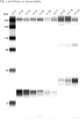
- FIG. 1 details the pH Effects on Extractability:
- Lane C1:1 molecular weight ladder
- Lanes C1:2-C1:7 standard curve generated with reference protein
- Lance C1:9 transgenic tissue expressing Protein 1 extracted at pH 8;
- Lane C1:15 transgenic tissue expressing Protein 1 extracted at pH 10
- Lane C1:21 transgenic tissue expressing Protein 1 extracted at pH 12.
- FIG. 2 details the Effects of Detergent and Reducing Agent on Extractability:
- Lane C1:1 molecular weight ladder
- Lanes C1:2-C1:7 standard curve generated with reference protein in complete MEB buffer
- Lane C1:8 wildtype canola meal sample extracted in complete MEB buffer
- Lane C1:9 transgenic canola meal sample extracted in complete MEB buffer
- Lanes C1:10-C1:15 standard curve generated with reference protein in MEB buffer lacking TCEP (reducing agent)
- Lane C1:16 wildtype canola meal sample extracted in MEB buffer lacking TCEP (reducing agent)
- Lane C1:17 transgenic canola meal sample extracted in MEB buffer lacking TCEP (reducing agent)
- Lanes C1:18-C1:23 standard curve generated with reference protein in MEB buffer lacking LDS (detergent)
- Lane C1:24 wildtype canola meal sample extracted in MEB buffer lacking LDS (detergent)
- Lane C1:25 transgenic canola meal sample extracted in MEB buffer lacking LDS (detergent).
- Extracted protein was quantified against corresponding standard curve.
- TCEP reducing agent
- LDS detergent
- Reducing agent in combination with detergent and extraction at pH 12 improves extraction of membrane proteins from meal. For example, 2.1-fold more Protein 1 was extracted when TCEP was included in extraction buffer compared to no TCEP.
- FIG. 3 details the effect of MEB on protein extractability (of membrane Protein 1).
- Transgenic and wildtype control canola samples were extracted in complete MEB buffer to evaluate effect of MEB on extractability of membrane protein.
- Transgenic sample was extracted three times and extractability was assessed as the percentage of protein extracted in the first extraction. Protein extracts were kept at 40C until all samples were ready to be analyzed.
- Lane C1:1 molecular weight ladder
- Lanes C1:2-C1:7 standard curve generated with reference protein in MEB buffer
- Lane C1:8 first extraction of transgenic canola meal sample S1 in MEB buffer
- Lane C1:9 second extraction of transgenic canola meal sample S1 in MEB buffer.
- Lane C1:10 third extraction of transgenic canola meal sample S1 in MEB buffer
- Lane C1:11 first extraction of new transgenic canola meal sample S2 in MEB buffer performed at the same time as the third extraction S1 sample
- Lane C1:12 first extraction of wildtype canola meal sample in MEB buffer performed at the same time as the third extraction S1 sample.
- FIG. 4 details the Effect of MEB on protein extractability (of membrane Protein 2).
- Three transgenic canola meal samples were extracted three times each in MEB. Most of the transgenic Protein 2 in all samples was extracted in the first extraction (100% extractability).
- Lane C 1 :1 molecular weight ladder
- Lanes C1:2-C1:7 standard curve generated with reference protein in MEB buffer
- Lane C1:8 first extraction of transgenic canola meal sample S1 in MEB buffer
- Lane C1:9 first extraction of transgenic canola meal sample S2 in MEB buffer
- Lane C1:10 first extraction of transgenic canola meal sample S3 in MEB buffer
- Lane C1:11 second extraction of transgenic canola meal sample S1 in MEB buffer
- Lane C1:12 second extraction of transgenic canola meal sample S2 in MEB buffer
- Lane C1:13 second extraction of transgenic canola meal sample S3 in MEB buffer
- Lane C1:14 third extraction of transgenic canola meal sample S1 in MEB buffer
- Lane C1:15 third extraction of transgenic canola meal sample S2 in MEB buffer
- Lane C1:16 third extraction of transgenic canola meal sample S3 in MEB buffer.
- FIG. 5 details the Effect of MEB on protein extractability (membrane Protein 3).
- Three transgenic canola meal samples were extracted three times each in MEB. Most of the transgenic Protein 2 in all samples was extracted in the first extraction (100% extractability).
- Lane C1:1 molecular weight ladder
- Lanes C1:2-C1:7 standard curve generated with reference protein in MEB buffer
- Lane C1:8 first extraction of transgenic canola meal sample S1 in MEB buffer
- Lane C1:9 second extraction of transgenic canola meal sample S1 in MEB buffer
- Lane C1:10 third extraction of transgenic canola meal sample S1 in MEB buffer
- Lane C1:11 first extraction of transgenic canola meal sample S2 in MEB buffer
- Lane C1:12 second extraction of transgenic canola meal sample S2 in MEB buffer
- Lane C1:13 third extraction of transgenic canola meal sample S2 in MEB buffer
- Lane C1:14 first extraction of transgenic canola meal sample S3 in MEB buffer
- Lane C1:15 second extraction of transgenic canola meal sample S3 in MEB buffer
- Lane C1:16 third extraction of transgenic canola meal sample S3 in MEB buffer.
- FIG. 6 details the Effect of MEB on protein extractability (soluble Protein 4).
- Three transgenic canola meal samples were extracted three times each in MEB. Most of the transgenic Protein 2 in all samples was extracted in the first extraction (100% extractability).
- Lane C1:1 molecular weight ladder
- Lanes C1:2-C1:7 standard curve generated with reference protein in MEB buffer
- Lane C1:8 first extraction of transgenic canola meal sample S1 in MEB buffer
- Lane C1:9 second extraction of transgenic canola meal sample S1 in MEB buffer
- Lane C1:10 third extraction of transgenic canola meal sample S1 in MEB buffer
- Lane C1:11 first extraction of transgenic canola meal sample S2 in MEB buffer
- Lane C1:12 second extraction of transgenic canola meal sample S2 in MEB buffer
- Lane C1:13 third extraction of transgenic canola meal sample S2 in MEB buffer
- Lane C1:14 first extraction of transgenic canola meal sample S3 in MEB buffer
- Lane C1:15 second extraction of transgenic canola meal sample S3 in MEB buffer
- Lane C1:16 third extraction of transgenic canola meal sample S3 in MEB buffer.
- Extraction buffer components 120 mM Tris, 20% glycerol, 2% LDS, and 50 mM TCEP at pH 12.0 were combined and final pH adjusted to approximately 12.0. The solution was warmed to 40° C. to improve solubility of LDS.
- Homogenized canola meal samples (10-50 mg) were extracted by combining an appropriate ratio of canola meal tissue to warm extraction buffer (for example 1:40-50 for included experiments) and a stainless-steel bead into a 2 mL screw cap tube. The tube containing the sample, extraction buffer, and bead were vigorously shaken for 2 minutes at 1200 rpm using a Geno/Grinder (SPEX Sample Prep, Metuchen, N.J.).
- the resulting sample lysate was incubated at 40° C. with vibration using an Eppendorf Thermomixer for 30 minutes. Following incubation, the lysate was centrifuged at 12,000 to 16,000 rcf for 5-15 minutes. The supernatant was aspirated and transferred to a new polyproylene tube. The supernatant was diluted as needed using extraction buffer (for example 24-fold to 60-fold for included experiments), then prepared for analysis using the ProteinSimple capillary western blot platform. Sample preparation was performed following the manufacturer's instructions provided with kit reagents. Primary antibodies specific to membrane-bound proteins 1, 2, and, 3 were utilized to detect their respective protein targets.
- Quantification of extracted protein was interpolated using a standard curve prepared by fortifying extraction buffer with homologously-expressed reference standard protein.
- the reference standards were diluted and prepared for analysis following the same procedure as the tissues samples.
- reducing agent TCEP
- LDS detergent
- the extractability of membrane-bound proteins and a soluble protein from canola meal was demonstrated by extracting three unique proteins 1, 2, and 3 using the general extraction and sample preparation procedure. The level of each protein was measured from three successive extractions of transgenic (containing proteins 1, 2, and 3) canola meal samples. Extractability of each protein was expressed as the measured concentration of the protein from the first extraction with respect to the sum of the measured concentrations from all three extractions.
- Cell Lysis Buffer 20 mM TrisCl pH 7.5, 150 mM NaCl, 1 mM EDTA, 1 mM EGTA, 1% Triton, Protease/phosphatase inhibitors cocktail
- SDS Lysis Buffer 50 mM TrisCl pH 8.1.10 mM EDTA, 1% SDS
- IP Lysis buffer 25 mM TrisCl pH 7.4, 150 mM NaCl, 1 mM EDTA, 1% NP40.5% glycerol
- Cellytic MT Bicine, unknown concentration, 150 mM NaCl, proprietary dialysable mild detergent
Landscapes
- Chemical & Material Sciences (AREA)
- Life Sciences & Earth Sciences (AREA)
- Biochemistry (AREA)
- Organic Chemistry (AREA)
- Polymers & Plastics (AREA)
- Food Science & Technology (AREA)
- Engineering & Computer Science (AREA)
- Health & Medical Sciences (AREA)
- Medicinal Chemistry (AREA)
- Molecular Biology (AREA)
- Proteomics, Peptides & Aminoacids (AREA)
- Genetics & Genomics (AREA)
- General Health & Medical Sciences (AREA)
- Biophysics (AREA)
- Analytical Chemistry (AREA)
- Nutrition Science (AREA)
- Peptides Or Proteins (AREA)
- Investigating Or Analysing Biological Materials (AREA)
- Enzymes And Modification Thereof (AREA)
Abstract
Description
-
- Incubating the sample at an incubation temperature of 35° C. to 55° C. in a buffering reagent of
pH 10 to 12.5, comprising a detergent at 0.5% to 3%.
- Incubating the sample at an incubation temperature of 35° C. to 55° C. in a buffering reagent of
-
- i. a buffering reagent at
pH 10 to 12.5, and a detergent content of 0.5% to 2.5%, or, - ii. a buffering reagent at
pH 10 to 12.5, and a detergent content of 0.5% to 3%, preferably LDS or SDS, and a viscosity agent, or, - iii. a buffering reagent at
pH 10 to 12.5, a LDS content of 1.5% to 2.5%, preferably around 2% LDS, and a viscosity agent, or, - iv. a buffering reagent at
pH 10 to 12.5, a LDS content of 1.5% to 2.5%, preferably around 2% LDS, and a reducing reagent, or, - v. a buffering reagent at
pH 10 to 12.5, a LDS content of 1.5% to 2.5%, preferably around 2% LDS, and a reducing reagent, and a viscosity agent, or, - vi. a buffering reagent at
pH 10 to 12.5, a LDS content of 1.5% to 2.5%, preferably around 2%, a reducing reagent 20 to 70 mM TCEP, preferably 50 mM, and a viscosity agent glycerol, preferably at 15 to 25%, or, - vii. a buffering reagent wherein the buffering reagent is 100 mM to 150 mM Tris-Cl, preferably 120 mM, at
pH 10 to 12.5, a LDS content of 1.5% to 2.5%, a reducing reagent 20 to 70 mM TCEP, preferably 50 mM, and 10% to 20% glycerol, or - viii. a buffering reagent, wherein the buffering reagent is around 120 mM Tris-CL, at around
pH 12, a LDS content of around 2%, and a reducing reagent around 50 mM TCEP, and around 20% glycerol.
- i. a buffering reagent at
-
- a. Grinding the sample,
- b. Cooling the sample, e.g. on dry ice
- c. Weighing the sample,
- d. Extracting polypeptides from the grinded and cooled sample by applying the extraction buffer MEB of the invention or the buffer MEB described for use in the method of the invention and incubating the sample at the incubation temperature of the invention, and
- e. Spinning the sample and transferring the supernatant to a new test tube, whereby the test tube is cooled.
-
- a. Providing plant meal,
- b. Adding the prewarmed extraction buffer MEB of the invention or the buffer MEB as described for use in the method of the invention to the plant material,
- c. Grinding the sample
- d. Incubate the sample at 30° C. to 45° C., preferably at around 40° C. for 1 to 15 min, preferably 2 to 5 min, more preferred for around 3 min,
- e. Centrifuge the sample and transfer the supernatant to a new container,
- f. Analyze the proteins in the supernatant, e.g. by western blotting, mass spectrometry, Isoelectric focusing, or 2D protein separation
-
- i. a buffering reagent at
pH 10 to 12.5, and a detergent content of 0.5% to 2.5%, or, - ii. a buffering reagent at
pH 10 to 12.5, and a detergent content of 0.5% to 3%, preferably LDS or SDS, and a viscosity agent, or, - iii. a buffering reagent at
pH 10 to 12.5, a LDS content of 1.5% to 2.5%, preferably around 2% LDS, and a viscosity agent, or, - iv. a buffering reagent at
pH 10 to 12.5, a LDS content of 1.5% to 2.5%, preferably around 2% LDS, and a reducing reagent, or, - v. a buffering reagent at
pH 10 to 12.5, a LDS content of 1.5% to 2.5%, preferably around 2% LDS, and a reducing reagent, and a viscosity agent, or, - vi. a buffering reagent at
pH 10 to 12.5, a LDS content of 1.5% to 2.5%, preferably around 2%, a reducing reagent 20 to 70 mM TCEP, preferably 50 mM, and a viscosity agent glycerol, preferably at 15 to 25%, or, - vii. a buffering reagent wherein the buffering reagent is 100 mM to 150 mM Tris-Cl, preferably 120 mM, at
pH 10 to 12.5, a LDS content of 1.5% to 2.5%, a reducing reagent 20 to 70 mM TCEP, preferably 50 mM, and 10% to 20% glycerol, or - viii. a buffering reagent, wherein the buffering reagent is around 120 mM Tris-CL, at around
pH 12, a LDS content of around 2%, and a reducing reagent around 50 mM TCEP, and around 20% glycerol.
- i. a buffering reagent at
- [1] Canola Council of Canada. Steps in Oil and Meal Processing. https://www.canolacouncil.org/oil-and-meal/what-is-canola/how-canola-is-processed/steps-inoil-and-meal-processing/#Pressing. (Accessed 8 Nov. 2017).
- [2] Donna M. Klockeman, Romeo Toledo, and Kevin A. Sims. Isolation and Characterization of Defatted Canola Meal Protein. (1997). J. Agric. Food Chem. 45:3867-3870.
Claims (24)
Applications Claiming Priority (4)
| Application Number | Priority Date | Filing Date | Title |
|---|---|---|---|
| EP17210241 | 2017-12-22 | ||
| EP17210241.0 | 2017-12-22 | ||
| EP17210241 | 2017-12-22 | ||
| PCT/EP2018/084551 WO2019121235A1 (en) | 2017-12-22 | 2018-12-12 | Method and means for an isolation of membrane-bound proteins from a biological sample, preferably processed plant seed meal |
Related Parent Applications (1)
| Application Number | Title | Priority Date | Filing Date |
|---|---|---|---|
| PCT/EP2018/084551 A-371-Of-International WO2019121235A1 (en) | 2017-12-22 | 2018-12-12 | Method and means for an isolation of membrane-bound proteins from a biological sample, preferably processed plant seed meal |
Related Child Applications (1)
| Application Number | Title | Priority Date | Filing Date |
|---|---|---|---|
| US19/027,544 Continuation US20250154196A1 (en) | 2017-12-22 | 2025-01-17 | Method and means for an isolation of membrane-bound proteins from a biological sample |
Publications (2)
| Publication Number | Publication Date |
|---|---|
| US20200369717A1 US20200369717A1 (en) | 2020-11-26 |
| US12209108B2 true US12209108B2 (en) | 2025-01-28 |
Family
ID=60990572
Family Applications (2)
| Application Number | Title | Priority Date | Filing Date |
|---|---|---|---|
| US16/956,058 Active 2040-04-08 US12209108B2 (en) | 2017-12-22 | 2018-12-12 | Method and means for an isolation of membrane-bound proteins from a biological sample, preferably processed plant seed meal |
| US19/027,544 Pending US20250154196A1 (en) | 2017-12-22 | 2025-01-17 | Method and means for an isolation of membrane-bound proteins from a biological sample |
Family Applications After (1)
| Application Number | Title | Priority Date | Filing Date |
|---|---|---|---|
| US19/027,544 Pending US20250154196A1 (en) | 2017-12-22 | 2025-01-17 | Method and means for an isolation of membrane-bound proteins from a biological sample |
Country Status (8)
| Country | Link |
|---|---|
| US (2) | US12209108B2 (en) |
| EP (1) | EP3727012A1 (en) |
| JP (1) | JP2021506896A (en) |
| CN (1) | CN111526722A (en) |
| AU (2) | AU2018391478B9 (en) |
| BR (1) | BR112020012490A2 (en) |
| CA (1) | CA3086291A1 (en) |
| WO (1) | WO2019121235A1 (en) |
Families Citing this family (1)
| Publication number | Priority date | Publication date | Assignee | Title |
|---|---|---|---|---|
| WO2024123508A1 (en) * | 2022-12-08 | 2024-06-13 | Dow Global Technologies Llc | Oilseed cakes protein extraction composition |
Citations (7)
| Publication number | Priority date | Publication date | Assignee | Title |
|---|---|---|---|---|
| WO2000032790A2 (en) * | 1998-12-03 | 2000-06-08 | E.I. Du Pont De Nemours And Company | Membrane-bound desaturases |
| US20030060607A1 (en) * | 2001-05-29 | 2003-03-27 | Diosady Levente Laszlo | Production of high-quality protein isolates from defatted meals of brassica seeds |
| US20060031959A1 (en) * | 1999-05-07 | 2006-02-09 | Falco Saverio C | Nucleic acid fragments encoding proteins involved in stress response |
| US20060117413A1 (en) * | 2003-06-30 | 2006-06-01 | United Soybean Board | Soybean selection system based on aec-resistance |
| US20060218669A1 (en) * | 2003-02-11 | 2006-09-28 | Lokesh Joshi | Sialylation of glycoproteins in plants |
| US20090123910A1 (en) * | 2007-11-14 | 2009-05-14 | Malick Adrien P | Method of efficient extraction of protein from cells |
| US20140024714A1 (en) | 2011-02-07 | 2014-01-23 | Commonwealth Scientific And Industrial Research Organisation | Artificial oil bodies |
Family Cites Families (3)
| Publication number | Priority date | Publication date | Assignee | Title |
|---|---|---|---|---|
| NZ578309A (en) * | 2007-01-30 | 2012-06-29 | Verenium Corp | Enzymes for the treatment of lignocellulosics, nucleic acids encoding them and methods for making and using them |
| US20080241320A1 (en) * | 2007-03-30 | 2008-10-02 | Dsm Ip Assets B.V. | Protective hydrocolloid for active ingredients |
| DE102007060599A1 (en) * | 2007-12-15 | 2009-06-18 | Merck Patent Gmbh | Process for the extraction of membrane proteins |
-
2018
- 2018-12-12 BR BR112020012490-7A patent/BR112020012490A2/en not_active Application Discontinuation
- 2018-12-12 CA CA3086291A patent/CA3086291A1/en active Pending
- 2018-12-12 US US16/956,058 patent/US12209108B2/en active Active
- 2018-12-12 JP JP2020534249A patent/JP2021506896A/en active Pending
- 2018-12-12 WO PCT/EP2018/084551 patent/WO2019121235A1/en not_active Ceased
- 2018-12-12 EP EP18815209.4A patent/EP3727012A1/en not_active Withdrawn
- 2018-12-12 AU AU2018391478A patent/AU2018391478B9/en active Active
- 2018-12-12 CN CN201880083019.3A patent/CN111526722A/en active Pending
-
2024
- 2024-12-19 AU AU2024278609A patent/AU2024278609A1/en active Pending
-
2025
- 2025-01-17 US US19/027,544 patent/US20250154196A1/en active Pending
Patent Citations (7)
| Publication number | Priority date | Publication date | Assignee | Title |
|---|---|---|---|---|
| WO2000032790A2 (en) * | 1998-12-03 | 2000-06-08 | E.I. Du Pont De Nemours And Company | Membrane-bound desaturases |
| US20060031959A1 (en) * | 1999-05-07 | 2006-02-09 | Falco Saverio C | Nucleic acid fragments encoding proteins involved in stress response |
| US20030060607A1 (en) * | 2001-05-29 | 2003-03-27 | Diosady Levente Laszlo | Production of high-quality protein isolates from defatted meals of brassica seeds |
| US20060218669A1 (en) * | 2003-02-11 | 2006-09-28 | Lokesh Joshi | Sialylation of glycoproteins in plants |
| US20060117413A1 (en) * | 2003-06-30 | 2006-06-01 | United Soybean Board | Soybean selection system based on aec-resistance |
| US20090123910A1 (en) * | 2007-11-14 | 2009-05-14 | Malick Adrien P | Method of efficient extraction of protein from cells |
| US20140024714A1 (en) | 2011-02-07 | 2014-01-23 | Commonwealth Scientific And Industrial Research Organisation | Artificial oil bodies |
Non-Patent Citations (8)
| Title |
|---|
| "Step in Oil and meal Processing", Canola Council of Canada, retrieved on Jul. 16, 2020, 3 pages. (Available at: https://www.canolacouncil.org/oil-and-meal/what-is-canola/how-canola-is-processed/steps-in-oil-and-meal-processing/#Pressing). |
| Bach, T. J. et al. Eur. J. Biochem. 154 : 103-111 (Year: 1986). * |
| Cesur et al., The Subcellular Localisation of the Human Papillomavirus (HPV) 16 E7 Protein in Cervical Cancer Cells and Its Perturbation by RNA Aptamers, Viruses, 7(7):3443-61 (2015). |
| European Search Report for EP Patent Application No. 17210241.0, Issued on Jun. 21, 2018, 4 pages. |
| Gerzhova, et al., "Study of total dry matter and protein extraction from canola meal as affected by the pH, salt addition and use of zeta-potential/turbidimetry analysis to optimize the extraction conditions", Food Chemistry, vol. 201, Jun. 15, 2016, pp. 243-252. |
| International Application No. PCT/EP2018/084551, International Search Report and Written Opinion, mailed Feb. 11, 2019. |
| Klockeman, et al., "Isolation and Characterization of Defatted Canola Meal Protein", Journal of Agricultural and Food Chemistry, vol. 45, Issue 10, Oct. 15, 1997, pp. 3867-3870. |
| Madduri, K. M. et al. Food and Chem. Toxicol. 50: 3776-3784 (Year: 2012). * |
Also Published As
| Publication number | Publication date |
|---|---|
| AU2018391478B2 (en) | 2024-09-26 |
| CA3086291A1 (en) | 2019-06-27 |
| AU2024278609A1 (en) | 2025-01-16 |
| EP3727012A1 (en) | 2020-10-28 |
| WO2019121235A1 (en) | 2019-06-27 |
| US20200369717A1 (en) | 2020-11-26 |
| AU2018391478B9 (en) | 2024-10-10 |
| US20250154196A1 (en) | 2025-05-15 |
| CN111526722A (en) | 2020-08-11 |
| BR112020012490A2 (en) | 2020-11-24 |
| JP2021506896A (en) | 2021-02-22 |
| AU2018391478A1 (en) | 2020-07-09 |
Similar Documents
| Publication | Publication Date | Title |
|---|---|---|
| Fiedler et al. | Characterization of grain-specific peptide markers for the detection of gluten by mass spectrometry | |
| Haraszi et al. | Analytical methods for detection of gluten in food—method developments in support of food labeling legislation | |
| US20250154196A1 (en) | Method and means for an isolation of membrane-bound proteins from a biological sample | |
| Jardin et al. | Quantitative proteomic analysis of bacterial enzymes released in cheese during ripening | |
| JP2022103148A (en) | Method of quantifying food allergen | |
| US12292447B2 (en) | LC-MS/MS-based methods for characterizing proteins | |
| Mak et al. | A proteomic approach to the identification and characterisation of protein composition in wheat germ | |
| Niedzwiecka et al. | A novel antibody-based enrichment and mass spectrometry approach for the detection of species-specific blood peptides in feed matrices | |
| CN101891799A (en) | A method for extraction, separation and identification of low molecular weight glutenin subunits | |
| Maltman et al. | Differential proteomic analysis of the endoplasmic reticulum from developing and germinating seeds of castor (Ricinus communis) identifies seed protein precursors as significant components of the endoplasmic reticulum | |
| Santos-Ballardo et al. | Expression of the acidic-subunit of amarantin, carrying the antihypertensive biopeptides VY, in cell suspension cultures of Nicotiana tabacum NT1 | |
| KR20080016564A (en) | Extraction of Proteins from Tissue-fixed Tissues | |
| DK2370452T3 (en) | PROCEDURE FOR EXTRACING PROTEINS FROM HUMAN TISSUE TESTS (FFPE) | |
| US20250034219A1 (en) | Compositions, methods and systems for phosphorylation of proteins in plants | |
| Nieuwoudt et al. | Optimised purification and characterisation of lipid transfer protein 1 (LTP1) and its lipid-bound isoform LTP1b from barley malt | |
| Suan Chua et al. | Plant protein extraction and identification from Eurycoma longifolia by gel electrophoresis and mass spectrometry | |
| Murawska et al. | Isolation of proteins from potato tubers | |
| Lee et al. | Proteomic identification of differentially expressed proteins in Arabidopsis mutant ntm1-D with disturbed cell division | |
| Ghosh et al. | Evaluation of protein extraction protocols and efficient solubilisation for enhanced proteomic analysis from phenolics rich, non-model recalcitrant wild crucifer Rorippa indica (L) | |
| Bromilow et al. | Results Chapter Three: Proteomic profiling to assess unintended effects of genetic modification on the wheat gluten proteome and distribution of coeliac toxic motifs | |
| Gregová et al. | PROTEIN EXTRACTION OF MAIZE (ZEA MAYS) FOR PROTEOMIC 2 –DE ANALYSIS | |
| Gavage | THESIS/THÈSE | |
| Miura et al. | Presence of lactoferrin in a bovine skim milk fraction with acid phosphatase activity | |
| Egidi | Processing and accumulation of low molecular Weight glutenin subunits in wheat endosperm | |
| Hansen et al. | Proteomic Characterization of Golgi Membranes Enriched from Arabidopsis Suspension Cell Cultures |
Legal Events
| Date | Code | Title | Description |
|---|---|---|---|
| AS | Assignment |
Owner name: BASF PLANT SCIENCE COMPANY GMBH, GERMANY Free format text: ASSIGNMENT OF ASSIGNORS INTEREST;ASSIGNOR:BASF PLANT SCIENCE LP;REEL/FRAME:052989/0131 Effective date: 20181130 Owner name: BASF PLANT SCIENCE LP, NORTH CAROLINA Free format text: ASSIGNMENT OF ASSIGNORS INTEREST;ASSIGNORS:XIA, MIN;SLESSAREVA, JANNA;WYRICK, MEGHAN K.;REEL/FRAME:052989/0094 Effective date: 20181112 |
|
| FEPP | Fee payment procedure |
Free format text: ENTITY STATUS SET TO UNDISCOUNTED (ORIGINAL EVENT CODE: BIG.); ENTITY STATUS OF PATENT OWNER: LARGE ENTITY |
|
| STPP | Information on status: patent application and granting procedure in general |
Free format text: DOCKETED NEW CASE - READY FOR EXAMINATION |
|
| STPP | Information on status: patent application and granting procedure in general |
Free format text: NON FINAL ACTION MAILED |
|
| STPP | Information on status: patent application and granting procedure in general |
Free format text: FINAL REJECTION MAILED |
|
| STPP | Information on status: patent application and granting procedure in general |
Free format text: NON FINAL ACTION MAILED |
|
| STPP | Information on status: patent application and granting procedure in general |
Free format text: RESPONSE TO NON-FINAL OFFICE ACTION ENTERED AND FORWARDED TO EXAMINER |
|
| STPP | Information on status: patent application and granting procedure in general |
Free format text: FINAL REJECTION MAILED |
|
| STPP | Information on status: patent application and granting procedure in general |
Free format text: RESPONSE AFTER FINAL ACTION FORWARDED TO EXAMINER |
|
| STPP | Information on status: patent application and granting procedure in general |
Free format text: NOTICE OF ALLOWANCE MAILED -- APPLICATION RECEIVED IN OFFICE OF PUBLICATIONS |
|
| STPP | Information on status: patent application and granting procedure in general |
Free format text: PUBLICATIONS -- ISSUE FEE PAYMENT RECEIVED |
|
| STPP | Information on status: patent application and granting procedure in general |
Free format text: PUBLICATIONS -- ISSUE FEE PAYMENT VERIFIED |
|
| STCF | Information on status: patent grant |
Free format text: PATENTED CASE |