US12209093B2 - Organic electroluminescent compound and organic electroluminescent device comprising the same - Google Patents
Organic electroluminescent compound and organic electroluminescent device comprising the same Download PDFInfo
- Publication number
- US12209093B2 US12209093B2 US17/175,142 US202117175142A US12209093B2 US 12209093 B2 US12209093 B2 US 12209093B2 US 202117175142 A US202117175142 A US 202117175142A US 12209093 B2 US12209093 B2 US 12209093B2
- Authority
- US
- United States
- Prior art keywords
- substituted
- unsubstituted
- organic electroluminescent
- membered
- alkyl
- Prior art date
- Legal status (The legal status is an assumption and is not a legal conclusion. Google has not performed a legal analysis and makes no representation as to the accuracy of the status listed.)
- Active, expires
Links
Classifications
-
- C—CHEMISTRY; METALLURGY
- C07—ORGANIC CHEMISTRY
- C07D—HETEROCYCLIC COMPOUNDS
- C07D491/00—Heterocyclic compounds containing in the condensed ring system both one or more rings having oxygen atoms as the only ring hetero atoms and one or more rings having nitrogen atoms as the only ring hetero atoms, not provided for by groups C07D451/00 - C07D459/00, C07D463/00, C07D477/00 or C07D489/00
- C07D491/02—Heterocyclic compounds containing in the condensed ring system both one or more rings having oxygen atoms as the only ring hetero atoms and one or more rings having nitrogen atoms as the only ring hetero atoms, not provided for by groups C07D451/00 - C07D459/00, C07D463/00, C07D477/00 or C07D489/00 in which the condensed system contains two hetero rings
- C07D491/06—Peri-condensed systems
-
- C—CHEMISTRY; METALLURGY
- C07—ORGANIC CHEMISTRY
- C07D—HETEROCYCLIC COMPOUNDS
- C07D491/00—Heterocyclic compounds containing in the condensed ring system both one or more rings having oxygen atoms as the only ring hetero atoms and one or more rings having nitrogen atoms as the only ring hetero atoms, not provided for by groups C07D451/00 - C07D459/00, C07D463/00, C07D477/00 or C07D489/00
- C07D491/02—Heterocyclic compounds containing in the condensed ring system both one or more rings having oxygen atoms as the only ring hetero atoms and one or more rings having nitrogen atoms as the only ring hetero atoms, not provided for by groups C07D451/00 - C07D459/00, C07D463/00, C07D477/00 or C07D489/00 in which the condensed system contains two hetero rings
- C07D491/04—Ortho-condensed systems
- C07D491/044—Ortho-condensed systems with only one oxygen atom as ring hetero atom in the oxygen-containing ring
- C07D491/052—Ortho-condensed systems with only one oxygen atom as ring hetero atom in the oxygen-containing ring the oxygen-containing ring being six-membered
-
- C—CHEMISTRY; METALLURGY
- C07—ORGANIC CHEMISTRY
- C07D—HETEROCYCLIC COMPOUNDS
- C07D493/00—Heterocyclic compounds containing oxygen atoms as the only ring hetero atoms in the condensed system
- C07D493/02—Heterocyclic compounds containing oxygen atoms as the only ring hetero atoms in the condensed system in which the condensed system contains two hetero rings
- C07D493/04—Ortho-condensed systems
-
- C—CHEMISTRY; METALLURGY
- C07—ORGANIC CHEMISTRY
- C07D—HETEROCYCLIC COMPOUNDS
- C07D493/00—Heterocyclic compounds containing oxygen atoms as the only ring hetero atoms in the condensed system
- C07D493/02—Heterocyclic compounds containing oxygen atoms as the only ring hetero atoms in the condensed system in which the condensed system contains two hetero rings
- C07D493/06—Peri-condensed systems
-
- C—CHEMISTRY; METALLURGY
- C07—ORGANIC CHEMISTRY
- C07D—HETEROCYCLIC COMPOUNDS
- C07D495/00—Heterocyclic compounds containing in the condensed system at least one hetero ring having sulfur atoms as the only ring hetero atoms
- C07D495/02—Heterocyclic compounds containing in the condensed system at least one hetero ring having sulfur atoms as the only ring hetero atoms in which the condensed system contains two hetero rings
- C07D495/04—Ortho-condensed systems
-
- C—CHEMISTRY; METALLURGY
- C07—ORGANIC CHEMISTRY
- C07D—HETEROCYCLIC COMPOUNDS
- C07D495/00—Heterocyclic compounds containing in the condensed system at least one hetero ring having sulfur atoms as the only ring hetero atoms
- C07D495/02—Heterocyclic compounds containing in the condensed system at least one hetero ring having sulfur atoms as the only ring hetero atoms in which the condensed system contains two hetero rings
- C07D495/06—Peri-condensed systems
-
- C—CHEMISTRY; METALLURGY
- C07—ORGANIC CHEMISTRY
- C07D—HETEROCYCLIC COMPOUNDS
- C07D519/00—Heterocyclic compounds containing more than one system of two or more relevant hetero rings condensed among themselves or condensed with a common carbocyclic ring system not provided for in groups C07D453/00 or C07D455/00
-
- C—CHEMISTRY; METALLURGY
- C09—DYES; PAINTS; POLISHES; NATURAL RESINS; ADHESIVES; COMPOSITIONS NOT OTHERWISE PROVIDED FOR; APPLICATIONS OF MATERIALS NOT OTHERWISE PROVIDED FOR
- C09K—MATERIALS FOR MISCELLANEOUS APPLICATIONS, NOT PROVIDED FOR ELSEWHERE
- C09K11/00—Luminescent materials, e.g. electroluminescent or chemiluminescent
- C09K11/06—Luminescent materials, e.g. electroluminescent or chemiluminescent containing organic luminescent materials
-
- H—ELECTRICITY
- H10—SEMICONDUCTOR DEVICES; ELECTRIC SOLID-STATE DEVICES NOT OTHERWISE PROVIDED FOR
- H10K—ORGANIC ELECTRIC SOLID-STATE DEVICES
- H10K50/00—Organic light-emitting devices
- H10K50/10—OLEDs or polymer light-emitting diodes [PLED]
- H10K50/11—OLEDs or polymer light-emitting diodes [PLED] characterised by the electroluminescent [EL] layers
- H10K50/12—OLEDs or polymer light-emitting diodes [PLED] characterised by the electroluminescent [EL] layers comprising dopants
-
- H—ELECTRICITY
- H10—SEMICONDUCTOR DEVICES; ELECTRIC SOLID-STATE DEVICES NOT OTHERWISE PROVIDED FOR
- H10K—ORGANIC ELECTRIC SOLID-STATE DEVICES
- H10K85/00—Organic materials used in the body or electrodes of devices covered by this subclass
- H10K85/30—Coordination compounds
- H10K85/341—Transition metal complexes, e.g. Ru(II)polypyridine complexes
- H10K85/342—Transition metal complexes, e.g. Ru(II)polypyridine complexes comprising iridium
-
- H—ELECTRICITY
- H10—SEMICONDUCTOR DEVICES; ELECTRIC SOLID-STATE DEVICES NOT OTHERWISE PROVIDED FOR
- H10K—ORGANIC ELECTRIC SOLID-STATE DEVICES
- H10K85/00—Organic materials used in the body or electrodes of devices covered by this subclass
- H10K85/60—Organic compounds having low molecular weight
- H10K85/615—Polycyclic condensed aromatic hydrocarbons, e.g. anthracene
-
- H—ELECTRICITY
- H10—SEMICONDUCTOR DEVICES; ELECTRIC SOLID-STATE DEVICES NOT OTHERWISE PROVIDED FOR
- H10K—ORGANIC ELECTRIC SOLID-STATE DEVICES
- H10K85/00—Organic materials used in the body or electrodes of devices covered by this subclass
- H10K85/60—Organic compounds having low molecular weight
- H10K85/631—Amine compounds having at least two aryl rest on at least one amine-nitrogen atom, e.g. triphenylamine
-
- H—ELECTRICITY
- H10—SEMICONDUCTOR DEVICES; ELECTRIC SOLID-STATE DEVICES NOT OTHERWISE PROVIDED FOR
- H10K—ORGANIC ELECTRIC SOLID-STATE DEVICES
- H10K85/00—Organic materials used in the body or electrodes of devices covered by this subclass
- H10K85/60—Organic compounds having low molecular weight
- H10K85/631—Amine compounds having at least two aryl rest on at least one amine-nitrogen atom, e.g. triphenylamine
- H10K85/633—Amine compounds having at least two aryl rest on at least one amine-nitrogen atom, e.g. triphenylamine comprising polycyclic condensed aromatic hydrocarbons as substituents on the nitrogen atom
-
- H—ELECTRICITY
- H10—SEMICONDUCTOR DEVICES; ELECTRIC SOLID-STATE DEVICES NOT OTHERWISE PROVIDED FOR
- H10K—ORGANIC ELECTRIC SOLID-STATE DEVICES
- H10K85/00—Organic materials used in the body or electrodes of devices covered by this subclass
- H10K85/60—Organic compounds having low molecular weight
- H10K85/631—Amine compounds having at least two aryl rest on at least one amine-nitrogen atom, e.g. triphenylamine
- H10K85/636—Amine compounds having at least two aryl rest on at least one amine-nitrogen atom, e.g. triphenylamine comprising heteroaromatic hydrocarbons as substituents on the nitrogen atom
-
- H—ELECTRICITY
- H10—SEMICONDUCTOR DEVICES; ELECTRIC SOLID-STATE DEVICES NOT OTHERWISE PROVIDED FOR
- H10K—ORGANIC ELECTRIC SOLID-STATE DEVICES
- H10K85/00—Organic materials used in the body or electrodes of devices covered by this subclass
- H10K85/60—Organic compounds having low molecular weight
- H10K85/649—Aromatic compounds comprising a hetero atom
- H10K85/654—Aromatic compounds comprising a hetero atom comprising only nitrogen as heteroatom
-
- H—ELECTRICITY
- H10—SEMICONDUCTOR DEVICES; ELECTRIC SOLID-STATE DEVICES NOT OTHERWISE PROVIDED FOR
- H10K—ORGANIC ELECTRIC SOLID-STATE DEVICES
- H10K85/00—Organic materials used in the body or electrodes of devices covered by this subclass
- H10K85/60—Organic compounds having low molecular weight
- H10K85/649—Aromatic compounds comprising a hetero atom
- H10K85/657—Polycyclic condensed heteroaromatic hydrocarbons
-
- H—ELECTRICITY
- H10—SEMICONDUCTOR DEVICES; ELECTRIC SOLID-STATE DEVICES NOT OTHERWISE PROVIDED FOR
- H10K—ORGANIC ELECTRIC SOLID-STATE DEVICES
- H10K85/00—Organic materials used in the body or electrodes of devices covered by this subclass
- H10K85/60—Organic compounds having low molecular weight
- H10K85/649—Aromatic compounds comprising a hetero atom
- H10K85/657—Polycyclic condensed heteroaromatic hydrocarbons
- H10K85/6572—Polycyclic condensed heteroaromatic hydrocarbons comprising only nitrogen in the heteroaromatic polycondensed ring system, e.g. phenanthroline or carbazole
-
- H—ELECTRICITY
- H10—SEMICONDUCTOR DEVICES; ELECTRIC SOLID-STATE DEVICES NOT OTHERWISE PROVIDED FOR
- H10K—ORGANIC ELECTRIC SOLID-STATE DEVICES
- H10K85/00—Organic materials used in the body or electrodes of devices covered by this subclass
- H10K85/60—Organic compounds having low molecular weight
- H10K85/649—Aromatic compounds comprising a hetero atom
- H10K85/657—Polycyclic condensed heteroaromatic hydrocarbons
- H10K85/6574—Polycyclic condensed heteroaromatic hydrocarbons comprising only oxygen in the heteroaromatic polycondensed ring system, e.g. cumarine dyes
-
- H—ELECTRICITY
- H10—SEMICONDUCTOR DEVICES; ELECTRIC SOLID-STATE DEVICES NOT OTHERWISE PROVIDED FOR
- H10K—ORGANIC ELECTRIC SOLID-STATE DEVICES
- H10K85/00—Organic materials used in the body or electrodes of devices covered by this subclass
- H10K85/60—Organic compounds having low molecular weight
- H10K85/649—Aromatic compounds comprising a hetero atom
- H10K85/657—Polycyclic condensed heteroaromatic hydrocarbons
- H10K85/6576—Polycyclic condensed heteroaromatic hydrocarbons comprising only sulfur in the heteroaromatic polycondensed ring system, e.g. benzothiophene
-
- C—CHEMISTRY; METALLURGY
- C09—DYES; PAINTS; POLISHES; NATURAL RESINS; ADHESIVES; COMPOSITIONS NOT OTHERWISE PROVIDED FOR; APPLICATIONS OF MATERIALS NOT OTHERWISE PROVIDED FOR
- C09K—MATERIALS FOR MISCELLANEOUS APPLICATIONS, NOT PROVIDED FOR ELSEWHERE
- C09K2211/00—Chemical nature of organic luminescent or tenebrescent compounds
- C09K2211/10—Non-macromolecular compounds
- C09K2211/1003—Carbocyclic compounds
- C09K2211/1011—Condensed systems
-
- C—CHEMISTRY; METALLURGY
- C09—DYES; PAINTS; POLISHES; NATURAL RESINS; ADHESIVES; COMPOSITIONS NOT OTHERWISE PROVIDED FOR; APPLICATIONS OF MATERIALS NOT OTHERWISE PROVIDED FOR
- C09K—MATERIALS FOR MISCELLANEOUS APPLICATIONS, NOT PROVIDED FOR ELSEWHERE
- C09K2211/00—Chemical nature of organic luminescent or tenebrescent compounds
- C09K2211/10—Non-macromolecular compounds
- C09K2211/1003—Carbocyclic compounds
- C09K2211/1014—Carbocyclic compounds bridged by heteroatoms, e.g. N, P, Si or B
-
- C—CHEMISTRY; METALLURGY
- C09—DYES; PAINTS; POLISHES; NATURAL RESINS; ADHESIVES; COMPOSITIONS NOT OTHERWISE PROVIDED FOR; APPLICATIONS OF MATERIALS NOT OTHERWISE PROVIDED FOR
- C09K—MATERIALS FOR MISCELLANEOUS APPLICATIONS, NOT PROVIDED FOR ELSEWHERE
- C09K2211/00—Chemical nature of organic luminescent or tenebrescent compounds
- C09K2211/10—Non-macromolecular compounds
- C09K2211/1018—Heterocyclic compounds
- C09K2211/1025—Heterocyclic compounds characterised by ligands
- C09K2211/1029—Heterocyclic compounds characterised by ligands containing one nitrogen atom as the heteroatom
- C09K2211/1033—Heterocyclic compounds characterised by ligands containing one nitrogen atom as the heteroatom with oxygen
-
- C—CHEMISTRY; METALLURGY
- C09—DYES; PAINTS; POLISHES; NATURAL RESINS; ADHESIVES; COMPOSITIONS NOT OTHERWISE PROVIDED FOR; APPLICATIONS OF MATERIALS NOT OTHERWISE PROVIDED FOR
- C09K—MATERIALS FOR MISCELLANEOUS APPLICATIONS, NOT PROVIDED FOR ELSEWHERE
- C09K2211/00—Chemical nature of organic luminescent or tenebrescent compounds
- C09K2211/10—Non-macromolecular compounds
- C09K2211/1018—Heterocyclic compounds
- C09K2211/1025—Heterocyclic compounds characterised by ligands
- C09K2211/1029—Heterocyclic compounds characterised by ligands containing one nitrogen atom as the heteroatom
- C09K2211/1037—Heterocyclic compounds characterised by ligands containing one nitrogen atom as the heteroatom with sulfur
-
- C—CHEMISTRY; METALLURGY
- C09—DYES; PAINTS; POLISHES; NATURAL RESINS; ADHESIVES; COMPOSITIONS NOT OTHERWISE PROVIDED FOR; APPLICATIONS OF MATERIALS NOT OTHERWISE PROVIDED FOR
- C09K—MATERIALS FOR MISCELLANEOUS APPLICATIONS, NOT PROVIDED FOR ELSEWHERE
- C09K2211/00—Chemical nature of organic luminescent or tenebrescent compounds
- C09K2211/10—Non-macromolecular compounds
- C09K2211/1018—Heterocyclic compounds
- C09K2211/1025—Heterocyclic compounds characterised by ligands
- C09K2211/1044—Heterocyclic compounds characterised by ligands containing two nitrogen atoms as heteroatoms
-
- C—CHEMISTRY; METALLURGY
- C09—DYES; PAINTS; POLISHES; NATURAL RESINS; ADHESIVES; COMPOSITIONS NOT OTHERWISE PROVIDED FOR; APPLICATIONS OF MATERIALS NOT OTHERWISE PROVIDED FOR
- C09K—MATERIALS FOR MISCELLANEOUS APPLICATIONS, NOT PROVIDED FOR ELSEWHERE
- C09K2211/00—Chemical nature of organic luminescent or tenebrescent compounds
- C09K2211/10—Non-macromolecular compounds
- C09K2211/1018—Heterocyclic compounds
- C09K2211/1025—Heterocyclic compounds characterised by ligands
- C09K2211/1044—Heterocyclic compounds characterised by ligands containing two nitrogen atoms as heteroatoms
- C09K2211/1048—Heterocyclic compounds characterised by ligands containing two nitrogen atoms as heteroatoms with oxygen
-
- C—CHEMISTRY; METALLURGY
- C09—DYES; PAINTS; POLISHES; NATURAL RESINS; ADHESIVES; COMPOSITIONS NOT OTHERWISE PROVIDED FOR; APPLICATIONS OF MATERIALS NOT OTHERWISE PROVIDED FOR
- C09K—MATERIALS FOR MISCELLANEOUS APPLICATIONS, NOT PROVIDED FOR ELSEWHERE
- C09K2211/00—Chemical nature of organic luminescent or tenebrescent compounds
- C09K2211/10—Non-macromolecular compounds
- C09K2211/1018—Heterocyclic compounds
- C09K2211/1025—Heterocyclic compounds characterised by ligands
- C09K2211/1044—Heterocyclic compounds characterised by ligands containing two nitrogen atoms as heteroatoms
- C09K2211/1051—Heterocyclic compounds characterised by ligands containing two nitrogen atoms as heteroatoms with sulfur
-
- C—CHEMISTRY; METALLURGY
- C09—DYES; PAINTS; POLISHES; NATURAL RESINS; ADHESIVES; COMPOSITIONS NOT OTHERWISE PROVIDED FOR; APPLICATIONS OF MATERIALS NOT OTHERWISE PROVIDED FOR
- C09K—MATERIALS FOR MISCELLANEOUS APPLICATIONS, NOT PROVIDED FOR ELSEWHERE
- C09K2211/00—Chemical nature of organic luminescent or tenebrescent compounds
- C09K2211/10—Non-macromolecular compounds
- C09K2211/1018—Heterocyclic compounds
- C09K2211/1025—Heterocyclic compounds characterised by ligands
- C09K2211/1059—Heterocyclic compounds characterised by ligands containing three nitrogen atoms as heteroatoms
-
- C—CHEMISTRY; METALLURGY
- C09—DYES; PAINTS; POLISHES; NATURAL RESINS; ADHESIVES; COMPOSITIONS NOT OTHERWISE PROVIDED FOR; APPLICATIONS OF MATERIALS NOT OTHERWISE PROVIDED FOR
- C09K—MATERIALS FOR MISCELLANEOUS APPLICATIONS, NOT PROVIDED FOR ELSEWHERE
- C09K2211/00—Chemical nature of organic luminescent or tenebrescent compounds
- C09K2211/10—Non-macromolecular compounds
- C09K2211/1018—Heterocyclic compounds
- C09K2211/1025—Heterocyclic compounds characterised by ligands
- C09K2211/1088—Heterocyclic compounds characterised by ligands containing oxygen as the only heteroatom
-
- C—CHEMISTRY; METALLURGY
- C09—DYES; PAINTS; POLISHES; NATURAL RESINS; ADHESIVES; COMPOSITIONS NOT OTHERWISE PROVIDED FOR; APPLICATIONS OF MATERIALS NOT OTHERWISE PROVIDED FOR
- C09K—MATERIALS FOR MISCELLANEOUS APPLICATIONS, NOT PROVIDED FOR ELSEWHERE
- C09K2211/00—Chemical nature of organic luminescent or tenebrescent compounds
- C09K2211/10—Non-macromolecular compounds
- C09K2211/1018—Heterocyclic compounds
- C09K2211/1025—Heterocyclic compounds characterised by ligands
- C09K2211/1092—Heterocyclic compounds characterised by ligands containing sulfur as the only heteroatom
-
- C—CHEMISTRY; METALLURGY
- C09—DYES; PAINTS; POLISHES; NATURAL RESINS; ADHESIVES; COMPOSITIONS NOT OTHERWISE PROVIDED FOR; APPLICATIONS OF MATERIALS NOT OTHERWISE PROVIDED FOR
- C09K—MATERIALS FOR MISCELLANEOUS APPLICATIONS, NOT PROVIDED FOR ELSEWHERE
- C09K2211/00—Chemical nature of organic luminescent or tenebrescent compounds
- C09K2211/10—Non-macromolecular compounds
- C09K2211/1018—Heterocyclic compounds
- C09K2211/1025—Heterocyclic compounds characterised by ligands
- C09K2211/1096—Heterocyclic compounds characterised by ligands containing other heteroatoms
-
- H—ELECTRICITY
- H10—SEMICONDUCTOR DEVICES; ELECTRIC SOLID-STATE DEVICES NOT OTHERWISE PROVIDED FOR
- H10K—ORGANIC ELECTRIC SOLID-STATE DEVICES
- H10K2101/00—Properties of the organic materials covered by group H10K85/00
- H10K2101/10—Triplet emission
-
- H—ELECTRICITY
- H10—SEMICONDUCTOR DEVICES; ELECTRIC SOLID-STATE DEVICES NOT OTHERWISE PROVIDED FOR
- H10K—ORGANIC ELECTRIC SOLID-STATE DEVICES
- H10K50/00—Organic light-emitting devices
- H10K50/10—OLEDs or polymer light-emitting diodes [PLED]
- H10K50/11—OLEDs or polymer light-emitting diodes [PLED] characterised by the electroluminescent [EL] layers
-
- H—ELECTRICITY
- H10—SEMICONDUCTOR DEVICES; ELECTRIC SOLID-STATE DEVICES NOT OTHERWISE PROVIDED FOR
- H10K—ORGANIC ELECTRIC SOLID-STATE DEVICES
- H10K50/00—Organic light-emitting devices
- H10K50/10—OLEDs or polymer light-emitting diodes [PLED]
- H10K50/14—Carrier transporting layers
- H10K50/15—Hole transporting layers
-
- H—ELECTRICITY
- H10—SEMICONDUCTOR DEVICES; ELECTRIC SOLID-STATE DEVICES NOT OTHERWISE PROVIDED FOR
- H10K—ORGANIC ELECTRIC SOLID-STATE DEVICES
- H10K50/00—Organic light-emitting devices
- H10K50/10—OLEDs or polymer light-emitting diodes [PLED]
- H10K50/14—Carrier transporting layers
- H10K50/16—Electron transporting layers
-
- H—ELECTRICITY
- H10—SEMICONDUCTOR DEVICES; ELECTRIC SOLID-STATE DEVICES NOT OTHERWISE PROVIDED FOR
- H10K—ORGANIC ELECTRIC SOLID-STATE DEVICES
- H10K50/00—Organic light-emitting devices
- H10K50/10—OLEDs or polymer light-emitting diodes [PLED]
- H10K50/17—Carrier injection layers
- H10K50/171—Electron injection layers
-
- H—ELECTRICITY
- H10—SEMICONDUCTOR DEVICES; ELECTRIC SOLID-STATE DEVICES NOT OTHERWISE PROVIDED FOR
- H10K—ORGANIC ELECTRIC SOLID-STATE DEVICES
- H10K50/00—Organic light-emitting devices
- H10K50/10—OLEDs or polymer light-emitting diodes [PLED]
- H10K50/18—Carrier blocking layers
Definitions
- the present disclosure relates to an organic electroluminescent compound and organic electroluminescent device comprising the same.
- the TPD/Alq 3 bilayer small molecule organic electroluminescent device (OLED) with green-emission which is constituted with a light-emitting layer and a charge transport layer, was first developed by Tang, et al., of Eastman Kodak in 1987. Thereafter, the studies on an OLED have been rapidly commercialized.
- Iridium(III) complexes have been widely known as phosphorescent light-emitting materials, including bis(2-(2-benzothienyl)-pyridinato-N,C-3′)iridium(acetylacetonate) [(acac)Ir(btp) 2 ], tris(2-phenylpyridine)iridium [Ir(ppy) 3 ] and bis(4,6-difluorophenylpyridinato-N,C2)picolinato iridium (Firpic) as red-, green-, and blue-emitting materials, respectively.
- CBP 4,4′-N,N′-dicarbazol-biphenyl
- BCP bathocuproine
- BAlq aluminum(III)bis(2-methyl-8-quinolinate)(4-phenylphenolate)
- the conventional materials provide good luminous characteristics, they have the following disadvantages: (1) Due to their low glass transition temperature and poor thermal stability, their degradation may occur during a high-temperature deposition process in a vacuum, and the lifespan of the device may be shortened. (2) The power efficiency of the OLED is given by [( ⁇ /voltage) ⁇ current efficiency], and the power efficiency is inversely proportional to the voltage. Although the OLED comprising phosphorescent host materials provides higher current efficiency (cd/A) than one comprising fluorescent materials, a significantly high driving voltage is necessary. Thus, there is no merit in terms of power efficiency (lm/W). (3) Also, the operational lifespan of the OLED is short, and it is still necessary to improve luminous efficiency.
- the object of the present disclosure is firstly, to provide an organic electroluminescent compound which is effective to produce an organic electroluminescent device having low driving voltage and/or high luminous efficiency, and secondly, to provide an organic electroluminescent device comprising the organic electroluminescent compound.
- an organic electroluminescent device having low driving voltage and/or high luminous efficiency can be prepared.
- the present disclosure relates to an organic electroluminescent compound represented by the formula 1, an organic electroluminescent material comprising the organic electroluminescent compound, and an organic electroluminescent device comprising the organic electroluminescent compound.
- organic electroluminescent compound in the present disclosure means a compound that may be used in an organic electroluminescent device, and may be comprised in any material layer constituting an organic electroluminescent device, as necessary.
- organic electroluminescent material means a material that may be used in an organic electroluminescent device, and may comprise at least one compound.
- the organic electroluminescent material may be comprised in any layer constituting an organic electroluminescent device, as necessary.
- the organic electroluminescent material may be a hole injection material, a hole transport material, a hole auxiliary material, a light-emitting auxiliary material, an electron blocking material, a light-emitting material (containing host and dopant materials), an electron buffer material, a hole blocking material, an electron transport material, or an electron injection material, etc.
- (C1-C30)alkyl is meant to be a linear or branched alkyl having 1 to 30 carbon atoms constituting the chain, in which the number of carbon atoms is preferably 1 to 20, and more preferably 1 to 10.
- the above alkyl may include methyl, ethyl, n-propyl, isopropyl, n-butyl, isobutyl, and tert-butyl, etc.
- the term “(C3-C30)cycloalkyl” is meant to be a mono- or polycyclic hydrocarbon having 3 to 30 ring backbone carbon atoms, in which the number of carbon atoms is preferably 3 to 20, and more preferably 3 to 7.
- cycloalkyl may include cyclopropyl, cyclobutyl, cyclopentyl, cyclohexyl, etc.
- (C6-C30)aryl(ene) is a monocyclic or fused ring radical derived from an aromatic hydrocarbon having 6 to 30 ring backbone carbon atoms, in which the number of the ring backbone carbon atoms is preferably 6 to 20, more preferably 6 to 15, may be partially saturated, and comprise a spiro structure.
- aryl specifically include phenyl, biphenyl, terphenyl, quaterphenyl, naphthyl, binaphthyl, phenylnaphthyl, naphthylphenyl, fluorenyl, phenylfluorenyl, dimethylfluorenyl, diphenylfluorenyl, benzofluorenyl, diphenylbenzofluorenyl, dibenzofluorenyl, phenanthrenyl, benzophenanthrenyl, phenylphenanthrenyl, anthracenyl, benzanthracenyl, indenyl, triphenylenyl, pyrenyl, tetracenyl, perylenyl, chrysenyl, benzochrysenyl, naphthacenyl, fluoranthenyl, benzofluoranthenyl, tolyl, xylyl, me
- the aryl may be o-tolyl, m-tolyl, p-tolyl, 2,3-xylyl, 3,4-xylyl, 2,5-xylyl, mesityl, o-cumenyl, m-cumenyl, p-cumenyl, p-t-butylphenyl, p-(2-phenylpropyl)phenyl, 4′-methylbiphenyl, 4′′-t-butyl-p-terphenyl-4-yl, o-biphenyl, m-biphenyl, p-biphenyl, o-terphenyl, m-terphenyl-4-yl, m-terphenyl-3-yl, m-terphenyl-2-yl, p-terphenyl-4-yl, p-terphenyl-3-yl, p-terphenyl-2-yl, p-terphenyl-4-
- heteroaryl specifically may include a monocyclic ring-type heteroaryl including furyl, thiophenyl, pyrrolyl, imidazolyl, pyrazolyl, thiazolyl, thiadiazolyl, isothiazolyl, isoxazolyl, oxazolyl, oxadiazolyl, triazinyl, tetrazinyl, triazolyl, tetrazolyl, furazanyl, pyridyl, pyrazinyl, pyrimidinyl, pyridazinyl, etc., and a fused ring-type heteroaryl including benzofuranyl, benzothiophenyl, isobenzofuranyl, dibenzofuranyl, dibenzothiophenyl, benzoimidazolyl, benzothiazolyl, benzoisothiazolyl, benzoisoxazolyl, benzoxazolyl, imidazopyridin
- Ortho position is a compound with substituents, which are adjacent to each other, e.g., at the 1 and 2 positions on benzene.
- Meta position is the next substitution position of the immediately adjacent substitution position, e.g., a compound with substituents at the 1 and 3 positions on benzene.
- Para position is the next substitution position of the meta position, e.g., a compound with substituents at the 1 and 4 positions on benzene.
- the number of atoms in the ring skeleton is 5 to 20; according to another embodiment of the present disclosure, the number of atoms in the ring skeleton is 5 to 15.
- the linked or fused ring may be, for example, a substituted or unsubstituted dibenzothiophene ring, a substituted or unsubstituted dibenzofuran ring, a substituted or unsubstituted naphthalene ring, a substituted or unsubstituted phenanthrene ring, a substituted or unsubstituted fluorene ring, a substituted or unsubstituted benzothiophene ring, a substituted or unsubstituted benzofuran ring, a substituted or unsubstituted indole ring, a substituted or unsubstituted indene ring, a substituted or unsubstituted benzene ring, or
- a 1 and A 2 each independently represent N-L 1 -Ar 1 , O, or S, for example, A 1 may be O or S, and A 2 may be N-L 1 -Ar 1 , O, or S.
- L a may be a single bond or a substituted or unsubstituted (C6-C30)arylene, preferably, a single bond or a substituted or unsubstituted (C6-C25)arylene, more preferably, a single bond or a substituted or unsubstituted (C6-C18)arylene.
- L a may be a single bond, or a substituted or unsubstituted phenylene, or a substituted or unsubstituted biphenylene.
- Ar a and Ar b each independently may be a substituted or unsubstituted (C6-C30)aryl or a substituted or unsubstituted (5- to 30-membered)heteroaryl, preferably a substituted or unsubstituted (C6-C25)aryl or a substituted or unsubstituted (5- to 25-membered)heteroaryl, more preferably a substituted or unsubstituted (C6-C18)aryl or a substituted or unsubstituted (5- to 18-membered)heteroaryl.
- Ar a and Ar b each independently may be a substituted or unsubstituted phenyl, a substituted or unsubstituted p-biphenyl, a substituted or unsubstituted m-biphenyl, a substituted or unsubstituted o-biphenyl, a substituted or unsubstituted naphthyl, a substituted or unsubstituted fluorenyl, or a substituted or unsubstituted carbazolyl.
- the organic electroluminescent compound of formula 1 may be represented by any one of the following formulas 2-1 to 2-6.
- L 1 may be a single bond, a substituted or unsubstituted (C6-C30)arylene, or a substituted or unsubstituted (5- to 30-membered)heteroarylene, preferably, a single bond, a substituted or unsubstituted (C6-C25)arylene, or a substituted or unsubstituted (5- to 25-membered)heteroarylene, more preferably, a single bond, a substituted or Unsubstituted (C6-C18)arylene, or a substituted or Unsubstituted (5- to 18-membered)heteroarylene.
- L 1 may be a single bond, or a substituted or unsubstituted phenylene, a substituted or unsubstituted naphthylene, a substituted or unsubstituted quinazolinylene, a substituted or unsubstituted quinoxalinylene, a Substituted or unsubstituted benzoquinazolinylene, a substituted or unsubstituted benzothienopyrimidylene, or a substituted or Unsubstituted benzofuropyrimidylene.
- Ar 1 may be a substituted or unsubstituted (C6-C30)aryl, a substituted or unsubstituted (3- to 30-membered)heteroaryl, or -L a -N—(Ar a )(Ar b ), preferably, a substituted or unsubstituted (C6-C25)aryl, a substituted or unsubstituted (5- to 30-membered)heteroaryl, a substituted or unsubstituted mono- or di-(C6-C30)arylamino, or a substituted or unsubstituted (C6-C30)aryl(5- to 30-membered)heteroarylamino, more preferably, a substituted or unsubstituted (C6-C18)aryl, (5- to 25-membered)heteroaryl unsubstituted or substituted with at least one substituted or unsubstituted (C6-
- Ar 1 may be a substituted or unsubstituted phenyl, a substituted or unsubstituted naphthyl, a substituted or unsubstituted p-biphenyl, a substituted or unsubstituted m-biphenyl, a substituted or unsubstituted triazinyl, a substituted or unsubstituted quinazolyl, a substituted or unsubstituted quinoxalinyl, a substituted or unsubstituted benzoquinazolyl, a substituted or unsubstituted benzothienopyrimidyl, or a substituted or unsubstituted benzofuropyrimidyl; or an amino substituted with at least one of a substituted or unsubstituted phenyl, a substituted or unsubstituted p-biphenyl, a substituted or unsubstituted m-
- L 1 may be a single bond, a substituted or unsubstituted (C6-C30)arylene, or a substituted or unsubstituted (5- to 30-membered)heteroarylene; and Ar 1 may be a substituted or unsubstituted (C6-C30)aryl or a substituted or unsubstituted (5- to 30-membered)heteroaryl, or a substituted or unsubstituted fused ring of (C5-C18) aliphatic ring and an (C6-C18) aromatic ring.
- X 1 to X 8 each independently may be N or CR 1 , preferably, all of X 1 to X 8 may be CR 1 .
- R 1 each independently may be hydrogen, a substituted or unsubstituted (C6-C30)aryl, or a substituted or unsubstituted (3- to 30-membered)heteroaryl; or -L a -N—(Ar a )(Ar b ), preferably, hydrogen, a substituted or unsubstituted (C6-C25)aryl, or a substituted or unsubstituted (5- to 25-membered)heteroaryl; or -L a -N—(Ar a )(Ar b ), in which L a may be a single bond or a substituted or unsubstituted (C6-C25)arylene, and Ar a and Ar b each independently may be a substituted or
- R 1 may be hydrogen, or a substituted or unsubstituted phenyl, a substituted or unsubstituted naphthyl, a substituted or unsubstituted triazinyl, a substituted or unsubstituted quinazolinyl, a substituted or unsubstituted quinoxalinyl, a substituted or unsubstituted benzoquinazolinyl, a substituted or unsubstituted benzothienopyrimidyl, or a substituted or unsubstituted benzofuropyrimidyl; or -L a -N—(Ar a )(Ar b ), in which L a may be a substituted or unsubstituted phenylene, and Ar a and Ar b each independently may be a substituted or unsubstituted phenyl, a substituted or unsubstituted p-bipheny
- X 1 to X 8 each independently represent, N or CR 1 , and when both of A 1 and A 2 are not N-L 1 -Ar 1 , at least one of X 1 to X 8 represent(s) CR 1 .
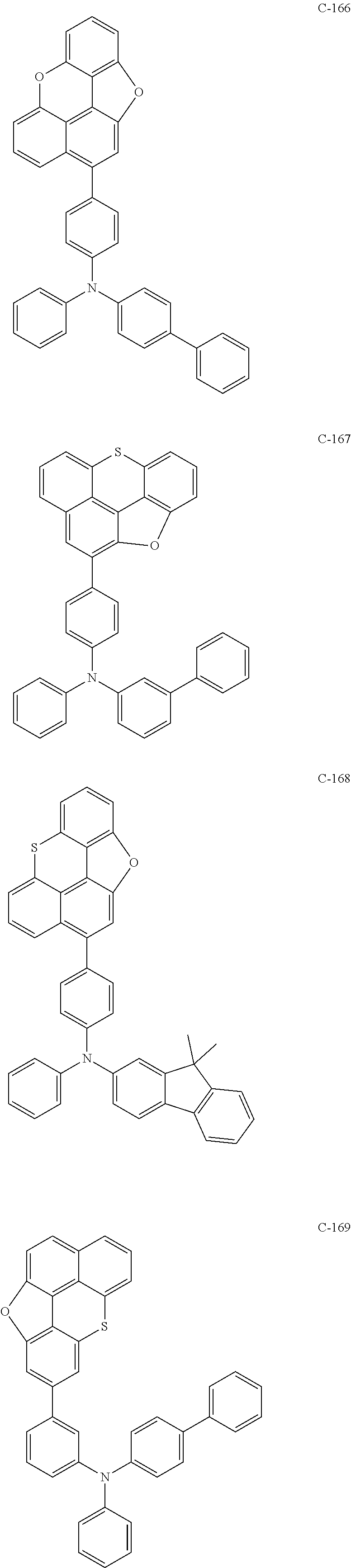
- organic electroluminescent compound represented by formula 1 above may be more specifically illustrated by the following compounds, but is not limited thereto,
- the organic electroluminescent compound represented by the formula 1 according to the present disclosure may be produced as represented by the following reaction schemes 1 to 8, but is not limited thereto; they may further be produced by a synthetic method known to a person skilled in the art.
- the organic electroluminescent material of the present disclosure may further include at least one host compound other than the organic electroluminescent compound of formula 1 above.
- the organic electroluminescent material may further include at least one dopant.
- the dopant comprised in the organic electroluminescent material of the present disclosure may be at least one phosphorescent or fluorescent dopant, preferably a phosphorescent dopant.
- the phosphorescent dopant material applied to the organic electroluminescent device of the present disclosure is not particularly limited, but may be preferably a metallated complex compound(s) of a metal atom(s) selected from iridium (Ir), osmium (Os), copper (Cu), and platinum (Pt), as necessary, more preferably an ortho-metallated complex compound(s) of a metal atom(s) selected from iridium (Ir), osmium (Os), copper (Cu), and platinum (Pt), as necessary, and even more preferably ortho-metallated iridium complex compound(s), as necessary.
- the dopant comprised may use the compound represented by the following formula 101, but is not limited thereto:
- the specific examples of the dopant compound include the following, but are not limited thereto.
- the organic electroluminescent device may comprise a first electrode; a second electrode; and at least one organic layer between the first and second electrodes.
- the compound represented by formula 1 of the present disclosure may be included in one or more layers constituting the organic electroluminescent device.
- the organic layer includes a light-emitting layer containing an organic electroluminescent compound according to the present disclosure.
- the light-emitting layer may include solely of the organic electroluminescent compound of the present disclosure or at least two species of the organic electroluminescent compound of the present disclosure, and may further comprise conventional materials included in the organic electroluminescent material.
- the organic layer may further comprise at least one layer selected from a hole injection layer, a hole transport layer, a hole auxiliary layer, a light-emitting auxiliary layer, an electron transport layer, an electron injection layer, an interlayer, a hole blocking layer, an electron blocking layer, and an electron buffer layer in addition to the light-emitting layer.
- Each layer may further consist of several layers.
- the organic layer may further comprise at least one compound(s) selected from the group consisting of an arylamine-based compound and a styrylarylamine-based compound, and further comprise at least one metal selected from the group consisting of metals of Group 1, metals of Group 2, transition metals of the 4 th period, transition metals of the 5 th period, lanthanides, and organic metals of the d-transition elements of the Periodic Table, or at least one complex compound comprising such a metal.
- An organic electroluminescent material may be used as light-emitting materials for a white organic light-emitting device.
- the white organic light-emitting device has suggested various structures such as a parallel side-by-side arrangement method, a stacking arrangement method, or color conversion material (CCM) method, etc., according to the arrangement of R (Red), G (Green), YG (yellowish green), or B (blue) light-emitting units.
- the organic electroluminescent material according to one embodiment may also be applied to the organic electroluminescent device comprising a QD (quantum dot).
- a hole injection layer, a hole transport layer, an electron blocking layer, or a combination thereof can be used between the anode and the light-emitting layer.
- the hole injection layer may be multi-layers in order to lower the hole injection barrier (or hole injection voltage) from the anode to the hole transport layer or the electron blocking layer, wherein each of the multi-layers may use two compounds simultaneously.
- the hole injection layer may be doped as a p-dopant.
- the electron blocking layer may be placed between the hole transport layer (or hole injection layer) and the light-emitting layer, and can confine the excitons within the light-emitting layer by blocking the overflow of electrons from the light-emitting layer to prevent a light-emitting leakage.
- the hole transport layer or the electron blocking layer may be multi-layers, and wherein each layer may use a plurality of compounds.
- An electron buffer layer, a hole blocking layer, an electron transport layer, an electron injection layer, or a combination thereof can be used between the light-emitting layer and the cathode.
- the electron buffer layer may be multi-layers in order to control the injection of the electron and improve the interfacial properties between the light-emitting layer and the electron injection layer, wherein each of the multi-layers may use two compounds simultaneously.
- the hole blocking layer or the electron transport layer may also be multi-layers, wherein each layer may use a plurality of compounds.
- the electron injection layer may be doped as an n-dopant.
- the light-emitting auxiliary layer may be placed between the anode and the light-emitting layer, or between the cathode and the light-emitting layer.
- the light-emitting auxiliary layer When the light-emitting auxiliary layer is placed between the anode and the light-emitting layer, it can be used for promoting the hole injection and/or the hole transport, or for preventing the overflow of electrons.
- the light-emitting auxiliary layer is placed between the cathode and the light-emitting layer, it can be used for promoting the electron injection and/or the electron transport, or for preventing the overflow of holes.
- the hole auxiliary layer may be placed between the hole transport layer (or hole injection layer) and the light-emitting layer, and may be effective to promote or block the hole transport rate (or the hole injection rate), thereby enabling the charge balance to be controlled.
- the hole transport layer which is further included, may be used as the hole auxiliary layer or the electron blocking layer.
- the light-emitting auxiliary layer, the hole auxiliary layer, or the electron blocking layer may have an effect of improving the efficiency and/or the lifespan of the organic electroluminescent device.
- a surface layer selected from a chalcogenide layer, a halogenated metal layer, and a metal oxide layer
- a surface layer selected from a chalcogenide layer, a halogenated metal layer, and a metal oxide layer
- a chalcogenide (including oxides) layer of silicon and aluminum is preferably placed on an anode surface of an electroluminescent medium layer
- a halogenated metal layer or a metal oxide layer is preferably placed on a cathode surface of an electroluminescent medium layer.
- the operation stability for the organic electroluminescent device may be obtained by the surface layer.
- the chalcogenide includes SiO X (1 ⁇ X ⁇ 2), AlO X (1 ⁇ X ⁇ 1.5), SiON, SiAlON, etc.;
- the halogenated metal includes LiF, MgF 2 , CaF 2 , a rare earth metal fluoride, etc.; and the metal oxide includes Cs 2 O, Li 2 O, MgO, SrO, BaO, CaO, etc.
- a mixed region of an electron transport compound and a reductive dopant, or a mixed region of a hole transport compound and an oxidative dopant may be placed on at least one surface of a pair of electrodes.
- the electron transport compound is reduced to an anion, and thus it becomes easier to inject and transport electrons from the mixed region to an electroluminescent medium.
- the hole transport compound is oxidized to a cation, and thus it becomes easier to inject and transport holes from the mixed region to the electroluminescent medium.
- the oxidative dopant includes various Lewis acids and acceptor compounds
- the reductive dopant includes alkali metals, alkali metal compounds, alkaline earth metals, rare-earth metals, and mixtures thereof.
- a reductive dopant layer may be employed as a charge generating layer to prepare an organic electroluminescent device having two or more light-emitting layers and emitting white light.
- dry film-forming methods such as vacuum evaporation, sputtering, plasma, ion plating methods, etc.
- wet film-forming methods such as ink jet printing, nozzle printing, slot coating, spin coating, dip coating, flow coating methods, etc.
- a thin film may be formed by dissolving or diffusing materials forming each layer into any suitable solvent such as ethanol, chloroform, tetrahydrofuran, dioxane, etc.
- the solvent may be any solvent where the materials forming each layer can be dissolved or diffused, and where there are no problems in film-formation capability.
- co-evaporation or mixture-evaporation may be used, but are not limited thereto.
- the co-deposition is a mixed deposition method in which two or more isomer materials are put into respective individual crucible sources and a current is applied to both cells simultaneously to evaporate the materials and to perform mixed deposition; and the mixed deposition is a mixed deposition method in which two or more isomer materials are mixed in one crucible source before deposition, and then a current is applied to one cell to evaporate the materials.
- the organic electroluminescent device of the present disclosure can be used for the manufacture of display devices such as smartphones, tablets, notebooks, PCs, TVs, or display devices for vehicles, or lighting devices such as outdoor or indoor lighting.
Landscapes
- Chemical & Material Sciences (AREA)
- Organic Chemistry (AREA)
- Engineering & Computer Science (AREA)
- Materials Engineering (AREA)
- Physics & Mathematics (AREA)
- Spectroscopy & Molecular Physics (AREA)
- Optics & Photonics (AREA)
- Inorganic Chemistry (AREA)
- Crystallography & Structural Chemistry (AREA)
- Electroluminescent Light Sources (AREA)
- Nitrogen Condensed Heterocyclic Rings (AREA)
- Heterocyclic Carbon Compounds Containing A Hetero Ring Having Oxygen Or Sulfur (AREA)
- Nitrogen And Oxygen Or Sulfur-Condensed Heterocyclic Ring Systems (AREA)
Abstract
Description

-
- A1 and A2 each independently represent, N-L1-Ar1, O, or S;
- X1 to X8 each independently represent, N or CR1;
- L1 represents a single bond, a substituted or unsubstituted (C6-C30)arylene, or a substituted or unsubstituted (3- to 30-membered)heteroarylene;
- Ar1 and R1 each independently represent, hydrogen, deuterium, halogen, cyano, a substituted or unsubstituted (C1-C30)alkyl, a substituted or unsubstituted (C6-C30)aryl, a substituted or unsubstituted (3- to 30-membered)heteroaryl, a substituted or unsubstituted (C3-C30)cycloalkyl, a substituted or unsubstituted (C1-C30)alkoxy, a substituted or unsubstituted tri(C1-C30)alkylsilyl, a substituted or unsubstituted di(C1-C30)alkyl(C6-C30)arylsilyl, a substituted or unsubstituted (C1-C30)alkyldi(C6-C30)arylsilyl, a substituted or unsubstituted tri(C6-C30)arylsilyl, a substituted or unsubstituted fused ring of (C3-C30) aliphatic ring and an (C6-C30) aromatic ring, or -La-N—(Ara)(Arb); or may be linked to the adjacent substituent to form a ring(s);
- La represents a single bond, a substituted or unsubstituted (C6-C30)arylene, or a substituted or unsubstituted (3- to 30-membered)heteroarylene; and
- Ara and Arb each independently represent, hydrogen, a substituted or unsubstituted (C1-C30)alkyl, a substituted or unsubstituted (C2-C30)alkenyl, a substituted or unsubstituted fused ring of (C3-C30) aliphatic ring and an (C6-C30) aromatic ring, a substituted or unsubstituted (C6-C30)aryl, or a substituted or unsubstituted (3- to 30-membered)heteroaryl;
- with the proviso that when at least one of A1 and A2 represent(s) N-L1-Ar1, X1 to X8 each independently represent, N or CR1, and when both of A1 and A2 are not N-L1-Ar1, at least one of X1 to X8 represent(s) CR1.

-
- A1 and A2 each independently represent, N-L1-Ar1, O, or S;
- X1 to X8 each independently represent, N or CR1;
- L1 represents a single bond, a substituted or unsubstituted (C6-C30)arylene, or a substituted or unsubstituted (3- to 30-membered)heteroarylene;
- Ar1 and R1 each independently represent, hydrogen, deuterium, halogen, cyano, a substituted or unsubstituted (C1-C30)alkyl, a substituted or unsubstituted (C6-C30)aryl, a substituted or unsubstituted (3- to 30-membered)heteroaryl, a substituted or unsubstituted (C3-C30)cycloalkyl, a substituted or unsubstituted (C1-C30)alkoxy, a substituted or unsubstituted tri(C1-C30)alkylsilyl, a substituted or unsubstituted di(C1-C30)alkyl(C6-C30)arylsilyl, a substituted or unsubstituted (C1-C30)alkyldi(C6-C30)arylsilyl, a substituted or unsubstituted tri(C6-C30)arylsilyl, a substituted or unsubstituted fused ring of (C3-C30) aliphatic ring and an (C6-C30) aromatic ring, or -La-N—(Ara)(Arb); or may be linked to the adjacent substituent to form a ring(s);
- La represents a single bond, a substituted or unsubstituted (C6-C30)arylene, or a substituted or unsubstituted (3- to 30-membered)heteroarylene; and
- Ara and Arb each independently represent, hydrogen, a substituted or unsubstituted (C1-C30)alkyl, a substituted or unsubstituted (C2-C30)alkenyl, a substituted or unsubstituted fused ring of (C3-C30) aliphatic ring and an (C6-C30) aromatic ring, a substituted or unsubstituted (C6-C30)aryl, or a substituted or unsubstituted (3- to 30-membered)heteroaryl;
- with the proviso that when at least one of A1 and A2 represent(s) N-L1-Ar1, X1 to X8 each independently represent, N or CR1, and when both of A1 and A2 are not N-L1-Ar1, at least one of X1 to X5 represent(s) CR1.

-
- X1 to X8, L1, and Ar1 each independently are as defined in the formula 1.




-
- in structures 1 and 2,
- R100 to R103 each independently represent, hydrogen, deuterium, halogen, (C1-C30)alkyl unsubstituted or substituted with halogen, a substituted or unsubstituted (C3-C30)cycloalkyl, a substituted or unsubstituted (C6-C30)aryl, cyano, a substituted or unsubstituted (C3-C30) heteroaryl, or a substituted or unsubstituted (C1-C30)alkoxy; or may be linked to the adjacent substituent to form a ring(s), e.g., a substituted or unsubstituted quinoline, a substituted or unsubstituted benzofuropyridine, a substituted or unsubstituted benzothienopyridine, a substituted or unsubstituted indenopyridine, a substituted or unsubstituted benzofuroquinoline, a substituted or unsubstituted benzothienoquinoline, or a substituted or unsubstituted indenoquinoline, together with pyridine;
- R104 to R107 each independently represent, hydrogen, deuterium, halogen, (C1-C30)alkyl unsubstituted or substituted with halogen, a substituted or unsubstituted (C3-C30)cycloalkyl, a substituted or unsubstituted (C6-C30)aryl, a substituted or unsubstituted (C3-C30)heteroaryl, cyano, or a substituted or unsubstituted (C1-C30)alkoxy; or may be linked to the adjacent substituent to form a ring(s), e.g., a substituted or unsubstituted naphthalene, a substituted or unsubstituted fluorene, a substituted or unsubstituted dibenzothiophene, a substituted or unsubstituted dibenzofuran, a substituted or unsubstituted indenopyridine, a substituted or unsubstituted benzofuropyridine, or a substituted or unsubstituted benzothienopyridine, together with benzene;
- R201 to R211 each independently represent, hydrogen, deuterium, halogen, (C1-C30)alkyl unsubstituted or substituted with halogen, a substituted or unsubstituted (C3-C30)cycloalkyl, or a substituted or unsubstituted (C6-C30)aryl; or may be linked to the adjacent substituent to form a ring(s); and
- s represents an integer of 1 to 3.


1. Synthesis of Compound A-2
| MW | M.P | |||
| Example 1 | 538.61 | 299° C. | ||

| MW | Tg | M.P | |||
| Example 2 | 538.61 | 82.57 | 200.3 | ||
| TABLE 1 | ||||
| Driving | Luminous | Light- | ||
| Voltage | Efficiency | Emitting | ||
| Host | (V) | (cd/A) | Color | |
| Comparative | CBP | 9.0 | 14.3 | Red |
| Example 1 | ||||
| Device Examples 1 | C-1 | 3.2 | 28.9 | Red |
| Device Examples 2 | C-3 | 3.9 | 34.3 | Red |
| TABLE 2 | |
| Hole Injection Layer/ Hole Transport Layer |
 |
| Light-Emitting Layer |
 |
 |
|
| Electron Transport Layer/ Electron Injection Layer |
 |
Claims (6)


Applications Claiming Priority (2)
| Application Number | Priority Date | Filing Date | Title |
|---|---|---|---|
| KR1020200018865A KR102918839B1 (en) | 2020-02-17 | 2020-02-17 | Organic electroluminescent compound and organic electroluminescent device comprising the same |
| KR10-2020-0018865 | 2020-02-17 |
Publications (2)
| Publication Number | Publication Date |
|---|---|
| US20210261560A1 US20210261560A1 (en) | 2021-08-26 |
| US12209093B2 true US12209093B2 (en) | 2025-01-28 |
Family
ID=77060904
Family Applications (1)
| Application Number | Title | Priority Date | Filing Date |
|---|---|---|---|
| US17/175,142 Active 2043-09-19 US12209093B2 (en) | 2020-02-17 | 2021-02-12 | Organic electroluminescent compound and organic electroluminescent device comprising the same |
Country Status (5)
| Country | Link |
|---|---|
| US (1) | US12209093B2 (en) |
| JP (2) | JP7807872B2 (en) |
| KR (1) | KR102918839B1 (en) |
| CN (1) | CN113264942A (en) |
| DE (1) | DE102021103267A1 (en) |
Families Citing this family (1)
| Publication number | Priority date | Publication date | Assignee | Title |
|---|---|---|---|---|
| KR102918839B1 (en) * | 2020-02-17 | 2026-01-28 | 듀폰스페셜티머터리얼스코리아 유한회사 | Organic electroluminescent compound and organic electroluminescent device comprising the same |
Citations (10)
| Publication number | Priority date | Publication date | Assignee | Title |
|---|---|---|---|---|
| CN106866498A (en) | 2017-02-23 | 2017-06-20 | 南京高光半导体材料有限公司 | Organic compound, organic electroluminescence device and its application |
| US20180022991A1 (en) * | 2015-02-12 | 2018-01-25 | Rohm And Haas Electronic Materials Korea Ltd. | Organic electroluminescent compounds and organic electroluminescent device comprising the same |
| US20200207713A1 (en) * | 2017-09-26 | 2020-07-02 | Rohm And Haas Electronic Materials Korea Ltd. | Organic electroluminescent compound and organic electroluminescent device comprising the same |
| US20210261560A1 (en) * | 2020-02-17 | 2021-08-26 | Rohm And Haas Electronic Materials Korea Ltd. | Organic electroluminescent compound and organic electroluminescent device comprising the same |
| US20220045281A1 (en) * | 2018-10-31 | 2022-02-10 | Rohm And Haas Electronic Materials Korea Ltd. | Organic electroluminescent compound and organic electroluminescent device comprising the same |
| US20220059777A1 (en) * | 2020-08-20 | 2022-02-24 | Rohm And Haas Electronic Materials Korea Ltd. | Plurality of host materials and organic electroluminescent device comprising the same |
| US20220089610A1 (en) * | 2018-12-27 | 2022-03-24 | Lt Materials Co., Ltd. | Polycyclic compound and organic light emitting device comprising same |
| KR20220060358A (en) * | 2020-11-04 | 2022-05-11 | 덕산네오룩스 주식회사 | Compound for organic electronic element, organic electronic element using the same, and an electronic device thereof |
| US20230126428A1 (en) * | 2019-07-15 | 2023-04-27 | Rohm And Haas Electronic Materials Korea Ltd. | Plurality of host materials and organic electroluminescent device comprising the same |
| US20230141435A1 (en) * | 2021-10-26 | 2023-05-11 | Rohm And Haas Electronic Materials Korea Ltd. | Plurality of host materials and organic electroluminescent device comprising the same |
Family Cites Families (8)
| Publication number | Priority date | Publication date | Assignee | Title |
|---|---|---|---|---|
| US10686498B2 (en) | 2015-03-31 | 2020-06-16 | Huawei Technologies Canada Co., Ltd. | Systems and methods for massive MIMO adaptation |
| KR102533792B1 (en) * | 2016-12-09 | 2023-05-19 | 롬엔드하스전자재료코리아유한회사 | Organic Electroluminescent Compound and Organic Electroluminescent Device Comprising the Same |
| TWI764984B (en) * | 2017-02-28 | 2022-05-21 | 南韓商羅門哈斯電子材料韓國公司 | Organic electroluminescent compound and organic electroluminescent device comprising the same |
| CN106977446A (en) * | 2017-03-29 | 2017-07-25 | 江苏三月光电科技有限公司 | It is a kind of using three benzo cycloheptene ketone as the compound of core and its application in OLED |
| KR102245910B1 (en) * | 2018-01-19 | 2021-04-30 | 롬엔드하스전자재료코리아유한회사 | Organic electroluminescent compound and organic electroluminescent device comprising the same |
| KR102240988B1 (en) * | 2018-02-22 | 2021-04-16 | 롬엔드하스전자재료코리아유한회사 | Organic electroluminescent compound and organic electroluminescent device comprising the same |
| CN120463694A (en) * | 2018-02-22 | 2025-08-12 | 杜邦特种材料韩国有限公司 | Organic electroluminescent compound and organic electroluminescent device containing the same |
| KR20190138378A (en) * | 2018-06-05 | 2019-12-13 | 롬엔드하스전자재료코리아유한회사 | Organic electroluminescent compound and organic electroluminescent device comprising the same |
-
2020
- 2020-02-17 KR KR1020200018865A patent/KR102918839B1/en active Active
-
2021
- 2021-02-05 CN CN202110161469.3A patent/CN113264942A/en active Pending
- 2021-02-08 JP JP2021018306A patent/JP7807872B2/en active Active
- 2021-02-11 DE DE102021103267.9A patent/DE102021103267A1/en active Pending
- 2021-02-12 US US17/175,142 patent/US12209093B2/en active Active
-
2025
- 2025-10-10 JP JP2025171977A patent/JP2026002875A/en active Pending
Patent Citations (10)
| Publication number | Priority date | Publication date | Assignee | Title |
|---|---|---|---|---|
| US20180022991A1 (en) * | 2015-02-12 | 2018-01-25 | Rohm And Haas Electronic Materials Korea Ltd. | Organic electroluminescent compounds and organic electroluminescent device comprising the same |
| CN106866498A (en) | 2017-02-23 | 2017-06-20 | 南京高光半导体材料有限公司 | Organic compound, organic electroluminescence device and its application |
| US20200207713A1 (en) * | 2017-09-26 | 2020-07-02 | Rohm And Haas Electronic Materials Korea Ltd. | Organic electroluminescent compound and organic electroluminescent device comprising the same |
| US20220045281A1 (en) * | 2018-10-31 | 2022-02-10 | Rohm And Haas Electronic Materials Korea Ltd. | Organic electroluminescent compound and organic electroluminescent device comprising the same |
| US20220089610A1 (en) * | 2018-12-27 | 2022-03-24 | Lt Materials Co., Ltd. | Polycyclic compound and organic light emitting device comprising same |
| US20230126428A1 (en) * | 2019-07-15 | 2023-04-27 | Rohm And Haas Electronic Materials Korea Ltd. | Plurality of host materials and organic electroluminescent device comprising the same |
| US20210261560A1 (en) * | 2020-02-17 | 2021-08-26 | Rohm And Haas Electronic Materials Korea Ltd. | Organic electroluminescent compound and organic electroluminescent device comprising the same |
| US20220059777A1 (en) * | 2020-08-20 | 2022-02-24 | Rohm And Haas Electronic Materials Korea Ltd. | Plurality of host materials and organic electroluminescent device comprising the same |
| KR20220060358A (en) * | 2020-11-04 | 2022-05-11 | 덕산네오룩스 주식회사 | Compound for organic electronic element, organic electronic element using the same, and an electronic device thereof |
| US20230141435A1 (en) * | 2021-10-26 | 2023-05-11 | Rohm And Haas Electronic Materials Korea Ltd. | Plurality of host materials and organic electroluminescent device comprising the same |
Non-Patent Citations (1)
| Title |
|---|
| Machine Translation of KR 20220060358, 2024 (Year: 2024). * |
Also Published As
| Publication number | Publication date |
|---|---|
| JP2021129110A (en) | 2021-09-02 |
| JP7807872B2 (en) | 2026-01-28 |
| JP2026002875A (en) | 2026-01-08 |
| KR20210104300A (en) | 2021-08-25 |
| CN113264942A (en) | 2021-08-17 |
| DE102021103267A1 (en) | 2021-08-19 |
| US20210261560A1 (en) | 2021-08-26 |
| KR102918839B1 (en) | 2026-01-28 |
Similar Documents
| Publication | Publication Date | Title |
|---|---|---|
| US11788000B2 (en) | Organic electroluminescent compound and organic electroluminescent device comprising the same | |
| US12610738B2 (en) | Organic electroluminescent compound and organic electroluminescent device comprising the same | |
| US12527219B2 (en) | Organic electroluminescent compound and organic electroluminescent device comprising the same | |
| US20220263031A1 (en) | Organic electroluminescent compound, a plurality of host materials, and organic electroluminescent device comprising the same | |
| US20220045281A1 (en) | Organic electroluminescent compound and organic electroluminescent device comprising the same | |
| US11725138B2 (en) | Organic electroluminescent compound and organic electroluminescent device comprising the same | |
| US11926591B2 (en) | Organic electroluminescent compound and organic electroluminescent device comprising the same | |
| US12004420B2 (en) | Organic electroluminescent compound and organic electroluminescent device comprising the same | |
| US20220231229A1 (en) | Organic electroluminescent compound, a plurality of host materials, and organic electroluminescent device comprising the same | |
| US12262633B2 (en) | Organic electroluminescent compound and organic electroluminescent device comprising the same | |
| US12588353B2 (en) | Plurality of host materials, organic electroluminescent compound and organic electroluminescent device comprising the same | |
| US11832515B2 (en) | Organic electroluminescent compound, organic electroluminescent material comprising the same, and organic electroluminescent device | |
| US20220173330A1 (en) | Organic electroluminescent compound and organic electroluminescent device comprising the same | |
| US12084446B2 (en) | Organic electroluminescent compound and organic electroluminescent device comprising the same | |
| US20250346608A1 (en) | Organic electroluminescent compound and organic electroluminescent device comprising the same | |
| US20250120316A1 (en) | Plurality of host materials and organic electroluminescent device comprising the same | |
| KR20210003041A (en) | Organic electroluminescent compound and organic electroluminescent device comprising the same | |
| US11653562B2 (en) | Organic electroluminescent compound and organic electroluminescent device comprising the same | |
| JP2026002875A (en) | Organic electroluminescent compounds and organic electroluminescent devices containing the same | |
| US12507588B2 (en) | Organic electroluminescent compound and organic electroluminescent device comprising the same | |
| US20240381767A1 (en) | Organic electroluminescent compound, organic electroluminescent material comprising the same, and organic electroluminescent device | |
| US20260040818A1 (en) | Plurality of host materials, organic electroluminescent compound, and organic electroluminescent device comprising the same | |
| US20240341178A1 (en) | Plurality of host materials, organic electroluminescent compound, and organic electroluminescent device comprising the same | |
| US12234219B2 (en) | Organic electroluminescent compound, a plurality of host materials, and organic electroluminescent device comprising the same | |
| US20230292611A1 (en) | Organic electroluminescent compound, a plurality of host materials, and organic electroluminescent device comprising the same |
Legal Events
| Date | Code | Title | Description |
|---|---|---|---|
| FEPP | Fee payment procedure |
Free format text: ENTITY STATUS SET TO UNDISCOUNTED (ORIGINAL EVENT CODE: BIG.); ENTITY STATUS OF PATENT OWNER: LARGE ENTITY |
|
| STPP | Information on status: patent application and granting procedure in general |
Free format text: DOCKETED NEW CASE - READY FOR EXAMINATION |
|
| STPP | Information on status: patent application and granting procedure in general |
Free format text: NON FINAL ACTION MAILED |
|
| STPP | Information on status: patent application and granting procedure in general |
Free format text: RESPONSE TO NON-FINAL OFFICE ACTION ENTERED AND FORWARDED TO EXAMINER |
|
| STPP | Information on status: patent application and granting procedure in general |
Free format text: NON FINAL ACTION MAILED |
|
| STPP | Information on status: patent application and granting procedure in general |
Free format text: RESPONSE TO NON-FINAL OFFICE ACTION ENTERED AND FORWARDED TO EXAMINER |
|
| STPP | Information on status: patent application and granting procedure in general |
Free format text: NOTICE OF ALLOWANCE MAILED -- APPLICATION RECEIVED IN OFFICE OF PUBLICATIONS |
|
| ZAAB | Notice of allowance mailed |
Free format text: ORIGINAL CODE: MN/=. |
|
| AS | Assignment |
Owner name: DUPONT SPECIALTY MATERIALS KOREA LTD, KOREA, REPUBLIC OF Free format text: CHANGE OF NAME;ASSIGNOR:ROHM & HAAS ELECTRONIC MATERIALS KOREA LTD;REEL/FRAME:069185/0438 Effective date: 20240320 |
|
| STPP | Information on status: patent application and granting procedure in general |
Free format text: PUBLICATIONS -- ISSUE FEE PAYMENT RECEIVED |
|
| AS | Assignment |
Owner name: ROHM AND HAAS ELECTRONIC MATERIALS KOREA LTD., KOREA, REPUBLIC OF Free format text: ASSIGNMENT OF ASSIGNORS INTEREST;ASSIGNORS:LEE, HYO-JUNG;KIM, YOUNG-KWANG;HONG, JIN-RI;REEL/FRAME:068942/0157 Effective date: 20201211 |
|
| STPP | Information on status: patent application and granting procedure in general |
Free format text: PUBLICATIONS -- ISSUE FEE PAYMENT VERIFIED |
|
| AS | Assignment |
Owner name: DUPONT SPECIALTY MATERIALS KOREA LTD., KOREA, REPUBLIC OF Free format text: CHANGE OF NAME;ASSIGNOR:ROHM AND HAAS ELECTRONIC MATERIALS KOREA LTD.;REEL/FRAME:069316/0857 Effective date: 20240927 |
|
| STCF | Information on status: patent grant |
Free format text: PATENTED CASE |