US12209092B2 - Inhibitors of GLI1 as therapeutic agents - Google Patents
Inhibitors of GLI1 as therapeutic agents Download PDFInfo
- Publication number
- US12209092B2 US12209092B2 US17/295,351 US201917295351A US12209092B2 US 12209092 B2 US12209092 B2 US 12209092B2 US 201917295351 A US201917295351 A US 201917295351A US 12209092 B2 US12209092 B2 US 12209092B2
- Authority
- US
- United States
- Prior art keywords
- tetrahydro
- chlorophenyl
- alkyl
- imidazo
- benzo
- Prior art date
- Legal status (The legal status is an assumption and is not a legal conclusion. Google has not performed a legal analysis and makes no representation as to the accuracy of the status listed.)
- Active, expires
Links
Classifications
-
- A—HUMAN NECESSITIES
- A61—MEDICAL OR VETERINARY SCIENCE; HYGIENE
- A61K—PREPARATIONS FOR MEDICAL, DENTAL OR TOILETRY PURPOSES
- A61K31/00—Medicinal preparations containing organic active ingredients
- A61K31/33—Heterocyclic compounds
- A61K31/395—Heterocyclic compounds having nitrogen as a ring hetero atom, e.g. guanethidine or rifamycins
- A61K31/435—Heterocyclic compounds having nitrogen as a ring hetero atom, e.g. guanethidine or rifamycins having six-membered rings with one nitrogen as the only ring hetero atom
- A61K31/4353—Heterocyclic compounds having nitrogen as a ring hetero atom, e.g. guanethidine or rifamycins having six-membered rings with one nitrogen as the only ring hetero atom ortho- or peri-condensed with heterocyclic ring systems
- A61K31/437—Heterocyclic compounds having nitrogen as a ring hetero atom, e.g. guanethidine or rifamycins having six-membered rings with one nitrogen as the only ring hetero atom ortho- or peri-condensed with heterocyclic ring systems the heterocyclic ring system containing a five-membered ring having nitrogen as a ring hetero atom, e.g. indolizine, beta-carboline
-
- A—HUMAN NECESSITIES
- A61—MEDICAL OR VETERINARY SCIENCE; HYGIENE
- A61P—SPECIFIC THERAPEUTIC ACTIVITY OF CHEMICAL COMPOUNDS OR MEDICINAL PREPARATIONS
- A61P25/00—Drugs for disorders of the nervous system
-
- A—HUMAN NECESSITIES
- A61—MEDICAL OR VETERINARY SCIENCE; HYGIENE
- A61P—SPECIFIC THERAPEUTIC ACTIVITY OF CHEMICAL COMPOUNDS OR MEDICINAL PREPARATIONS
- A61P35/00—Antineoplastic agents
-
- C—CHEMISTRY; METALLURGY
- C07—ORGANIC CHEMISTRY
- C07D—HETEROCYCLIC COMPOUNDS
- C07D401/00—Heterocyclic compounds containing two or more hetero rings, having nitrogen atoms as the only ring hetero atoms, at least one ring being a six-membered ring with only one nitrogen atom
- C07D401/02—Heterocyclic compounds containing two or more hetero rings, having nitrogen atoms as the only ring hetero atoms, at least one ring being a six-membered ring with only one nitrogen atom containing two hetero rings
- C07D401/04—Heterocyclic compounds containing two or more hetero rings, having nitrogen atoms as the only ring hetero atoms, at least one ring being a six-membered ring with only one nitrogen atom containing two hetero rings directly linked by a ring-member-to-ring-member bond
-
- C—CHEMISTRY; METALLURGY
- C07—ORGANIC CHEMISTRY
- C07D—HETEROCYCLIC COMPOUNDS
- C07D471/00—Heterocyclic compounds containing nitrogen atoms as the only ring hetero atoms in the condensed system, at least one ring being a six-membered ring with one nitrogen atom, not provided for by groups C07D451/00 - C07D463/00
- C07D471/02—Heterocyclic compounds containing nitrogen atoms as the only ring hetero atoms in the condensed system, at least one ring being a six-membered ring with one nitrogen atom, not provided for by groups C07D451/00 - C07D463/00 in which the condensed system contains two hetero rings
- C07D471/04—Ortho-condensed systems
-
- C—CHEMISTRY; METALLURGY
- C07—ORGANIC CHEMISTRY
- C07D—HETEROCYCLIC COMPOUNDS
- C07D471/00—Heterocyclic compounds containing nitrogen atoms as the only ring hetero atoms in the condensed system, at least one ring being a six-membered ring with one nitrogen atom, not provided for by groups C07D451/00 - C07D463/00
- C07D471/12—Heterocyclic compounds containing nitrogen atoms as the only ring hetero atoms in the condensed system, at least one ring being a six-membered ring with one nitrogen atom, not provided for by groups C07D451/00 - C07D463/00 in which the condensed system contains three hetero rings
- C07D471/18—Bridged systems
-
- C—CHEMISTRY; METALLURGY
- C07—ORGANIC CHEMISTRY
- C07D—HETEROCYCLIC COMPOUNDS
- C07D487/00—Heterocyclic compounds containing nitrogen atoms as the only ring hetero atoms in the condensed system, not provided for by groups C07D451/00 - C07D477/00
- C07D487/02—Heterocyclic compounds containing nitrogen atoms as the only ring hetero atoms in the condensed system, not provided for by groups C07D451/00 - C07D477/00 in which the condensed system contains two hetero rings
- C07D487/04—Ortho-condensed systems
-
- C—CHEMISTRY; METALLURGY
- C07—ORGANIC CHEMISTRY
- C07D—HETEROCYCLIC COMPOUNDS
- C07D519/00—Heterocyclic compounds containing more than one system of two or more relevant hetero rings condensed among themselves or condensed with a common carbocyclic ring system not provided for in groups C07D453/00 or C07D455/00
Definitions
- This disclosure relates to compounds, pharmaceutical compositions comprising them, and methods of using the compounds and compositions for treating diseases related to glioma-associated oncogene (Gli) expression. More particularly, this disclosure relates to bicyclic compounds and pharmaceutical compositions thereof, methods of inhibiting Gli expression with these compounds, and methods of treating diseases related to Gli expression.
- Gli glioma-associated oncogene
- Hedgehog (Hh) signaling pathway plays a critical role in the initiation, proliferation, invasion, and metastasis of a wide variety of cancers.
- the Hh pathway is also implicated in the regulation and maintenance of cancer stem cells (CSCs), providing a link between the Hh signaling in the regulation of normal stem cells and its role in CSCs maintenance.
- CSCs cancer stem cells
- disorders of myelination can produce significant impairment in sensory, motor and other types of functioning when nerve signals reach their targets slowly, asynchronously, intermittently, or not at all.
- disorders of myelination are also associated with progressive loss of the axons which further contributes to neurological impairment.
- Disorders of myelination can be demyelinating, as a result of removal or degradation of myelin already formed; or dysmyelinating, as a result of deficient or defective myelin development or maintenance.
- CNS central nervous system
- PNS peripheral nervous system
- MS multiple sclerosis
- PNS myelination disorders of CNS myelination
- MS multiple sclerosis
- PNS myelination disorders of PNS myelination
- Hh signaling is initiated by the binding of ligand namely Sonic Hedgehog (Shh), Indian Hedgehog (Ihh) or Desert Hedgehog (Dhh) to its receptor, Patched (Ptch).
- ligand namely Sonic Hedgehog (Shh), Indian Hedgehog (Ihh) or Desert Hedgehog (Dhh)
- Patched Ptch
- Canical Shh signaling is mediated by interactions of the Ptch with the G-protein coupled transmembrane co-receptor smoothened (Smo). Binding of Shh to Ptch relieves its inhibition of Smo and thereby activates the Gli family of proteins (also known as zinc finger transcription factors).
- Vertebrates have at least three distinct Gli proteins, Gli1, Gli2, and Gli3 (glioma-associated oncogene 1, 2, and 3).
- Gli proteins participate in the final step of the Hh/Gli signaling pathway, and they regulate several genes, including those that are related to cell cycle control and Hh/Gli signaling.
- Gli1 acts as a transcriptional activator
- Gli2 and Gli3 act as both activators and repressors.
- the proteins in Gli family share a highly conserved C 2 —H 2 zinc finger domain (having five zinc finger DNA-binding motifs) and recognize consensus Gli-selective sequences that regulate transcription.
- Gli1 expression is considered a sensitive readout for, and an indicator of the highest levels of Shh signaling.
- the disclosure provides novel Gli inhibitors useful for treating diseases related to Gli expression.
- one aspect of the disclosure provides a compound of formula (I):
- Another aspect of the disclosure provides a compound of formula (II):
- compositions including one or more compounds of the disclosure as described herein (e.g., compounds of formula (I) and/or (II)) and a pharmaceutically acceptable carrier, solvent, adjuvant or diluent.
- Another aspect of the disclosure provides a method of treating a neurological disorder, the method including administering to a subject in need of such treatment one or more compounds of the disclosure as described herein or a pharmaceutical composition of the disclosure as described herein.
- the neurological disorder is selected from multiple sclerosis, central pontine myelinolysis, acute disseminated encephalomyelitis, progressive multifocal leukoencephalopathy, subacute sclerosing panencephalitis, post-infectious encephalomyelitis, chronic inflammatory demyelinating polyneuropathy, Devic's disease, Balo's concentric sclerosis, the leukodystrophies, optic neuritis, transverse myelitis, cerebral palsy, spinal cord injury, age-associated myelin deficiency, Alzheimer's Disease, and acquired and inherited neuropathies in the peripheral nervous system.
- the neurological disorder is multiple sclerosis.
- the neurological disorder is Alzheimer's Disease.
- Another aspect of the disclosure provides a method of treating a non-CNS disease, the method including administering to a subject in need of such treatment one or more compounds of the disclosure as described herein or a pharmaceutical composition of the disclosure as described herein.
- the non-CNS disease is cancer.
- the cancer is characterized by elevated Gli1.
- the cancer is breast cancer, pancreatic cancer, colon cancer, lung cancer, rhabdomyosarcoma, basal-cell carcinoma, glioblastoma, medulloblastoma, leukemia, prostate cancer, skin cancer, lymphoma, esophageal cancer, ovarian cancer, thyroid cancer, osteosarcoma, liver cancer, multiple endocrine neoplasia, gastrointestinal cancer, or mesothelioma.
- the non-CNS disease is cystic kidney disease, chronic liver disease, Hepatitis, C, obstructive pulmonary disease, organ fibrosis (including, e.g., kidney fibrosis, cardiac fibrosis, and pulmonary fibrosis), or rheumatoid arthritis.
- Another aspect of the disclosure provides a method of inhibiting Gli1, the method including administering one or more compounds of the disclosure as described herein or a pharmaceutical composition of the disclosure as described herein.
- Another aspect of the disclosure provides a method of enhancing remeyelination, the method including administering one or more compounds of the disclosure as described herein or a pharmaceutical composition of the disclosure as described herein.
- the methods and compositions described herein can be configured by the person of ordinary skill in the art to meet the desired need.
- the disclosed materials and methods provide improvements in treatment of diseases or disorders associated with Gli1 and/or Gli2 expression.
- the inventors found that the compounds of the disclosure inhibit Gli1 and/or Gli2 with low- ⁇ M and sub- ⁇ M IC 50 .
- the compounds of the disclosure inhibit Gli1 and/or Gli2 at IC 50 of no more than 10 ⁇ M, or no more than 1 ⁇ M, or no more than 100 nM, or even no more than 10 nM.
- one aspect of the disclosure provides compounds of formula (I) as provided above.
- the compounds of formula (I) as otherwise described herein are those of isomer form (I-1).
- the compounds of formula (I) as otherwise described herein are those of isomer form (I-2).
- the compounds of formula (I) as otherwise described herein are those wherein m is 2. In one embodiment, the disclosure provides compounds of formula (I) as otherwise described herein where m is 2, and n is 1, e.g., the compounds of formula (I-3):
- the compounds of formula (I-3) as otherwise described herein are those of isomer form (I-4).
- the compounds of formula (I-3) as otherwise described herein are those of isomer form (I-5).
- the disclosure provides compounds of formula (I) as otherwise described herein where both m and n are 2, e.g., the compounds of formula (I-6):
- the compounds of formula (I) as otherwise described herein are those wherein m is 1. In one embodiment, the disclosure provides compounds of formula (I) as otherwise described herein where both m and n are 1. Such compounds are of formula (I-7):
- Another embodiment of the disclosure provides compounds of formula (I)-(I-7) as otherwise described herein where p is 0.
- the compounds of formula (I)-(I-7) as otherwise described herein are those wherein p is 1 or 2. In one embodiment, p is 1. In another embodiment p is 2. In one embodiment, the disclosure provides compounds as otherwise described herein where R 2 is C 1 -C 3 alkyl. In another embodiment, R 2 is ethyl or methyl. In another embodiment, R 2 is methyl.
- R 1 is selected from hydrogen, C 1 -C 3 alkyl, C 1 -C 3 haloalkyl, C 3 -C 6 cycloalkyl, heterocyclyl, hydroxy(C 1 -C 3 alkyl), alkoxy(C 1 -C 3 alkyl), —OH, and oxetanyl.
- R 1 is selected from hydrogen, C 1 -C 6 alkyl, C 1 -C 6 haloalkyl, C 3 -C 8 cycloalkyl, heterocyclyl, hydroxy(C 1 -C 6 alkyl), —OH, and oxetanyl.
- R 1 is hydrogen or C 1 -C 6 alkyl.
- R 1 is hydrogen or C 1 -C 4 alkyl.
- R 1 is hydrogen or C 1 -C 3 alkyl.
- R 1 is hydrogen, methyl, or ethyl.
- R 1 is hydrogen or methyl. In certain embodiments of the disclosure, R 1 is hydrogen. In certain embodiments of the disclosure, R 1 is methyl. In certain embodiments of the disclosure, R 1 is hydrogen, methyl, trifluoroethyl, hydroxyethyl, —OH, and oxetanyl. In certain embodiments of the disclosure, R 1 is hydrogen, C 1 -C 3 alkyl, C 1 -C 3 haloalkyl, hydroxy(C 1 -C 3 alkyl), —OH, and oxetanyl.
- One embodiment of the disclosure provides compounds of formula (I)-(I-7) as otherwise described herein where ring A represents an aryl optionally substituted with one or more R 3 or heteroaryl optionally substituted with one or more R 3 .
- the compounds of formula (I)-(I-7) as otherwise described herein are those where ring A represents phenyl optionally substituted with one or more R 3 or 6-membered heteroaryl optionally substituted with one or more R 3 .
- One embodiment of the disclosure provides compounds of formula (I)-(I-7) as otherwise described herein where ring A represents phenyl optionally substituted with one or more R 3 or pyridinyl optionally substituted with one or more R 3 .
- the compounds of formula (I)-(I-7) as otherwise described herein are those where ring A represents phenyl optionally substituted with one or more R 3 . In certain embodiments of the disclosure, ring A represents phenyl substituted with one or more R 3 . In certain embodiments of the disclosure, ring A represents phenyl optionally substituted with one R 3 .
- One embodiment of the disclosure provides compounds of formula (I)-(I-7) as otherwise described herein where ring A represents phenyl substituted with one R 3 .
- One embodiment of the disclosure provides compounds of formula (I)-(I-7) as otherwise described herein where ring A represents phenyl substituted with halogen (e.g., chloro or fluoro).
- halogen e.g., chloro or fluoro
- One embodiment of the disclosure provides compounds of formula (I)-(I-7) as otherwise described herein where ring A represents 2-chlorophenyl.
- Another embodiment of the disclosure provides compounds of formula (I)-(I-7) as otherwise described herein where ring A represents phenyl (i.e., unsubstituted phenyl).
- each R 3 is independently selected from halogen, C 1 -C 6 alkyl optionally substituted with one or more R 5 , C 1 -C 6 haloalkyl, —NH 2 , —NH(C 1 -C 6 alkyl), —N(C 1 -C 6 alkyl) 2 , —OH, C 1 -C 6 alkoxy, C 1 -C 6 haloalkoxy, hydroxy(C 1 -C 6 alkyl), hydroxy(C 1 -C 6 alkoxy), alkoxy(C 1 -C 6 alkyl), alkoxy(C 1 -C 6 alkoxy), amino(C 1 -C 6 alkyl), —SO 2 R 7 , cyclopropylethynyl, aryl optionally substituted with one or more R 6 , heteroaryl optionally substituted with one or more R 6 , heterocyclyl optionally substituted with one or
- each R 3 is independently selected from halogen, C 1 -C 6 alkyl optionally substituted with one or more R 5 , C 1 -C 6 haloalkyl, —NH 2 , —NH(C 1 -C 6 alkyl), —N(C 1 -C 6 alkyl) 2 , —OH, C 1 -C 6 alkoxy, C 1 -C 6 haloalkoxy, hydroxy(C 1 -C 6 alkyl), hydroxy(C 1 -C 6 alkoxy), alkoxy(C 1 -C 6 alkyl), alkoxy(C 1 -C 6 alkoxy), amino(C 1 -C 6 alkyl), —SO 2 R 7 , cyclopropylethynyl, aryl, heteroaryl, heterocyclyl, and C 3 -C 8 cycloalkyl.
- each R 3 is independently selected from halogen, C 1 -C 6 alkyl optionally substituted with one or more R 5 , C 1 -C 6 haloalkyl, —OH, C 1 -C 6 alkoxy, C 1 -C 6 haloalkoxy, hydroxy(C 1 -C 6 alkyl), hydroxy(C 1 -C 6 alkoxy), alkoxy(C 1 -C 6 alkyl), alkoxy(C 1 -C 6 alkoxy), amino(C 1 -C 6 alkyl), —SO 2 R 7 , cyclopropylethynyl, aryl, heteroaryl, heterocyclyl, and C 3 -C 8 cycloalkyl.
- each R 3 is independently selected from halogen, C 1 -C 6 alkyl optionally substituted with one or more R 5 , C 1 -C 6 haloalkyl, —NH 2 , —NH(C 1 -C 6 alkyl), —N(C 1 -C 6 alkyl) 2 , —OH, C 1 -C 6 alkoxy, C 1 -C 6 haloalkoxy, —SO 2 R 7 , cyclopropylethynyl, aryl, heteroaryl, heterocyclyl, and C 3 -C 8 cycloalkyl.
- each R 3 is independently selected from halogen, C 1 -C 6 alkyl optionally substituted with one or more R 5 , C 1 -C 6 haloalkyl, —OH, C 1 -C 6 alkoxy, C 1 -C 6 haloalkoxy, —SO 2 R 7 , cyclopropylethynyl, and heteroaryl.
- each R 3 is independently selected from halogen, C 1 -C 6 alkoxy, —SO 2 R 7 , cyclopropylethynyl, and heteroaryl.
- each R 3 is independently selected from halogen, C 1 -C 6 alkoxy, cyclopropylethynyl, and heteroaryl. In certain embodiments of the disclosure, each R 3 is independently selected from halogen, C 1 -C 6 alkoxy, and cyclopropylethynyl. In certain embodiments of the disclosure, the compounds as otherwise described herein are those wherein each R 3 is independently halogen.
- the compounds of formula (I) as otherwise described herein are those wherein m is 2, n is 1, p is 0, and ring A represents 2-chlorophenyl.
- Such compounds are of formula (I-8), (I-9), or (I-10):
- Another embodiment of the disclosure provides compounds of formula (I)-(I-10) as otherwise described herein where ring B and ring C form 1,2,3,4-tetrahydronaphthalenyl, chromanyl, 1,2,3,4-tetrahydroquinolinyl, 1,2,3,4-tetrahydroisoquinolinyl, 2,3-dihydro-1H-indenyl, 2,3-dihydrobenzofuranyl, indolinyl, 1,2,3,4-tetrahydroquinolinyl, or 1,2,3,4-tetrahydroisoquinolinyl, each optionally substituted with one or more R 4 .
- ring B and ring C form 1,2,3,4-tetrahydronaphthalenyl, chromanyl, 1,2,3,4-tetrahydroquinolinyl, or 1,2,3,4-tetrahydroisoquinolinyl, each optionally substituted with one or more R 4 .
- ring B and ring C form 1,2,3,4-tetrahydronaphthalenyl, 1,2,3,4-tetrahydroquinolinyl, or 1,2,3,4-tetrahydroisoquinolinyl, each optionally substituted with one or more R 4 .
- ring B and ring C form 1,2,3,4-tetrahydronaphthalenyl optionally substituted with one or more R 4 .
- each R 4 is independently selected from halogen, —CN, C 1 -C 6 alkyl optionally substituted with one or more R 5 , C 1 -C 6 haloalkyl, —NH 2 , —NH(C 1 -C 6 alkyl), —N(C 1 -C 6 alkyl) 2 , —OH, C 1 -C 6 alkoxy, C 1 -C 6 haloalkoxy, hydroxy(C 1 -C 6 alkyl), hydroxy(C 1 -C 6 alkoxy), alkoxy(C 1 -C 6 alkyl), alkoxy(C 1 -C 6 alkoxy), amino(C 1 -C 6 alkyl), —SO 2 R 7 , —SO 2 OR 7 , cyclopropylethynyl, aryl optionally substituted with one or more R 6 , heteroaryl optionally substituted with one or more R 6 ,
- each R 4 is independently selected from halogen, —CN, C 1 -C 6 alkyl optionally substituted with one or more R 5 , C 1 -C 6 haloalkyl, —NH 2 , —NH(C 1 -C 6 alkyl), —N(C 1 -C 6 alkyl) 2 , —OH, C 1 -C 6 alkoxy, C 1 -C 6 haloalkoxy, hydroxy(C 1 -C 6 alkyl), hydroxy(C 1 -C 6 alkoxy), alkoxy(C 1 -C 6 alkyl), alkoxy(C 1 -C 6 alkoxy), —SO 2 R 7 , cyclopropylethynyl, heteroaryl optionally substituted with one or more R 6 , heterocyclyl optionally substituted with one or more R 6 , C 3 -C 8 cycloalkyl optionally substituted with one or more R 6 , heteroaryloxy optional
- each R 4 is independently selected from halogen, —CN, C 1 -C 6 alkyl, C 1 -C 6 haloalkyl, —OH, C 1 -C 6 alkoxy, C 1 -C 6 haloalkoxy, hydroxy(C 1 -C 6 alkyl), hydroxy(C 1 -C 6 alkoxy), alkoxy(C 1 -C 6 alkyl), alkoxy(C 1 -C 6 alkoxy), —SO 2 R 7 , cyclopropylethynyl, heteroaryl optionally substituted with one or more R 6 , heterocyclyl optionally substituted with one or more R 6 , 2-hydroxy-3-methoxypropoxy, (2-methoxyethoxy)methyl, and 2-(3-(but-3-yn-1-yl)-3H-diazirin-3-yl)ethoxy; or two R 4 groups when attached to the same carbon atom form ⁇ O.
- each R 4 is independently selected from halogen, C 1 -C 6 alkyl, C 1 -C 6 haloalkyl, —OH, C 1 -C 6 alkoxy, C 1 -C 6 haloalkoxy, —SO 2 R 7 , cyclopropylethynyl, oxetanyl, imidazolyl optionally substituted with R 6 , and cyclopropyl.
- each R 4 is independently selected from halogen, C 1 -C 6 alkyl, —OH, C 1 -C 6 alkoxy, —SO 2 R 7 , cyclopropylethynyl, oxetanyl, imidazolyl optionally substituted with R 6 , and cyclopropyl.
- each R 4 is independently selected from halogen, C 1 -C 6 alkyl, —OH, C 1 -C 6 alkoxy, cyclopropylethynyl, oxetanyl, imidazolyl optionally substituted with methyl, and cyclopropyl.
- each R 4 is independently selected from halogen, —OH, and C 1 -C 6 alkoxy. In some embodiments of the disclosure, each R 4 is independently selected from halogen, methyl, —OH, methoxy, cyclopropylethynyl, oxetanyl, imidazolyl optionally substituted with methyl, and cyclopropyl. In certain embodiments of the disclosure, each R 4 is independently selected from halogen, methyl, —OH, and methoxy. In certain embodiments of the disclosure, the compounds as otherwise described herein are those wherein each R 4 is independently halogen. In certain embodiments of the disclosure, the compounds as otherwise described herein are those wherein each R 4 is independently chloro or fluoro. In certain embodiments of the disclosure, the compounds as otherwise described herein are those wherein each R 4 is independently chloro.
- Another aspect of the disclosure provides compounds of formula (II) as provided above.
- the compounds of formula (II) as otherwise described herein are those wherein t is 1, e.g., the compounds of formula (II-1):
- the compounds of formula (II) as otherwise described herein are those wherein t is 2.
- Such compounds are of formula (II-2):
- the disclosure provides compounds of formula (II-2) as otherwise described herein that are of formula (II-3):
- the compounds of formula (II-3) exist in different tautomeric forms, e.g., isomer form (II-4) and (II-5) shown below.
- the compounds of formula (II) as otherwise described herein are of isomer form (II-4):
- the compounds of formula (II) as otherwise described herein are those of isomer form (II-5).
- Another embodiment of the disclosure provides compounds of formula (II)-(II-5) as otherwise described herein where q is 0.
- the compounds of formula (II)-(II-5) as otherwise described herein are those wherein q is 1 or 2. In one embodiment, q is 1. In another embodiment q is 2. In one embodiment, the disclosure provides compounds as otherwise described herein where R 12 is C 1 -C 3 alkyl. In another embodiment, R 12 is ethyl or methyl. In another embodiment, R 12 is methyl.
- R 11 is selected from hydrogen, C 1 -C 3 alkyl, C 1 -C 3 haloalkyl, C 3 -C 6 cycloalkyl, heterocyclyl, hydroxy(C 1 -C 3 alkyl), alkoxy(C 1 -C 3 alkyl), —OH, and oxetanyl.
- R 11 is selected from hydrogen, C 1 -C 6 alkyl, C 1 -C 6 haloalkyl, C 3 -C 8 cycloalkyl, heterocyclyl, hydroxy(C 1 -C 6 alkyl), —OH, and oxetanyl.
- R 11 is hydrogen or C 1 -C 6 alkyl.
- R 11 is hydrogen or C 1 -C 4 alkyl.
- R 11 is hydrogen or C 1 -C 3 alkyl.
- R 11 is hydrogen, methyl, or ethyl.
- R 11 is hydrogen or methyl. In certain embodiments of the disclosure, R 11 is hydrogen. In certain embodiments of the disclosure, R 11 is methyl. In certain embodiments of the disclosure, R 11 is hydrogen, methyl, trifluoroethyl, hydroxyethyl, —OH, and oxetanyl. In certain embodiments of the disclosure, R 11 is hydrogen, C 1 -C 3 alkyl, C 1 -C 3 haloalkyl, hydroxy(C 1 -C 3 alkyl), —OH, and oxetanyl.
- One embodiment of the disclosure provides compounds of formula (II)-(II-5) as otherwise described herein where ring X represents an aryl optionally substituted with one or more R 13 or heteroaryl optionally substituted with one or more R 13 .
- the compounds of formula (II)-(II-5) as otherwise described herein are those where ring X represents phenyl optionally substituted with one or more R 13 or 6-membered heteroaryl optionally substituted with one or more R 13 .
- One embodiment of the disclosure provides compounds of formula (II)-(II-5) as otherwise described herein where ring X represents phenyl optionally substituted with one or more R 13 or pyridinyl optionally substituted with one or more R 13 .
- the compounds of formula (II)-(II-5) as otherwise described herein are those where ring X represents phenyl optionally substituted with one or more R 13 . In certain embodiments of the disclosure, ring X represents phenyl substituted with one or more R 13 . In certain embodiments of the disclosure, ring X represents phenyl optionally substituted with one R 13 .
- One embodiment of the disclosure provides compounds of formula (II)-(II-5) as otherwise described herein where ring X represents phenyl substituted with one R 13 .
- One embodiment of the disclosure provides compounds of formula (II)-(II-5) as otherwise described herein where ring X represents phenyl substituted with halogen (e.g., chloro or fluoro).
- halogen e.g., chloro or fluoro
- One embodiment of the disclosure provides compounds of formula (II)-(II-5) as otherwise described herein where ring X represents 2-chlorophenyl.
- Another embodiment of the disclosure provides compounds of formula (II)-(II-5) as otherwise described herein where ring X represents phenyl (i.e., unsubstituted phenyl).
- each R 13 is independently selected from halogen, C 1 -C 6 alkyl optionally substituted with one or more R 15 , C 1 -C 6 haloalkyl, —NH 2 , —NH(C 1 -C 6 alkyl), —N(C 1 -C 6 alkyl) 2 , —OH, C 1 -C 6 alkoxy, C 1 -C 6 haloalkoxy, hydroxy(C 1 -C 6 alkyl), hydroxy(C 1 -C 6 alkoxy), alkoxy(C 1 -C 6 alkyl), alkoxy(C 1 -C 6 alkoxy), amino(C 1 -C 6 alkyl), —SO 2 R 17 , cyclopropylethynyl, aryl optionally substituted with one or more R 16 , heteroaryl optionally substituted with one or more R 16 , heterocyclyl optionally substituted with one or
- each R 13 is independently selected from halogen, C 1 -C 6 alkyl optionally substituted with one or more R 15 , C 1 -C 6 haloalkyl, —NH 2 , —NH(C 1 -C 6 alkyl), —N(C 1 -C 6 alkyl) 2 , —OH, C 1 -C 6 alkoxy, C 1 -C 6 haloalkoxy, hydroxy(C 1 -C 6 alkyl), hydroxy(C 1 -C 6 alkoxy), alkoxy(C 1 -C 6 alkyl), alkoxy(C 1 -C 6 alkoxy), amino(C 1 -C 6 alkyl), —SO 2 R 17 , cyclopropylethynyl, aryl, heteroaryl, heterocyclyl, and C 3 -C 8 cycloalkyl.
- each R 13 is independently selected from halogen, C 1 -C 6 alkyl optionally substituted with one or more R 15 , C 1 -C 6 haloalkyl, —OH, C 1 -C 6 alkoxy, C 1 -C 6 haloalkoxy, hydroxy(C 1 -C 6 alkyl), hydroxy(C 1 -C 6 alkoxy), alkoxy(C 1 -C 6 alkyl), alkoxy(C 1 -C 6 alkoxy), amino(C 1 -C 6 alkyl), —SO 2 R 17 , cyclopropylethynyl, aryl, heteroaryl, heterocyclyl, and C 3 -C 8 cycloalkyl.
- each R 13 is independently selected from halogen, C 1 -C 6 alkyl optionally substituted with one or more R 15 , C 1 -C 6 haloalkyl, —NH 2 , —NH(C 1 -C 6 alkyl), —N(C 1 -C 6 alkyl) 2 , —OH, C 1 -C 6 alkoxy, C 1 -C 6 haloalkoxy, —SO 2 R 17 , cyclopropylethynyl, aryl, heteroaryl, heterocyclyl, and C 3 -C 8 cycloalkyl.
- each R 13 is independently selected from halogen, C 1 -C 6 alkyl optionally substituted with one or more R 15 , C 1 -C 6 haloalkyl, —OH, C 1 -C 6 alkoxy, C 1 -C 6 haloalkoxy, —SO 2 R 17 , cyclopropylethynyl, and heteroaryl.
- each R 13 is independently selected from halogen, C 1 -C 6 alkoxy, —SO 2 R 17 , cyclopropylethynyl, and heteroaryl.
- each R 13 is independently selected from halogen, C 1 -C 6 alkoxy, cyclopropylethynyl, and heteroaryl. In certain embodiments of the disclosure, each R 13 is independently selected from halogen, C 1 -C 6 alkoxy, and cyclopropylethynyl. In certain embodiments of the disclosure, the compounds as otherwise described herein are those wherein each R 13 is independently halogen.
- the compounds of formula (II) as otherwise described herein are those wherein t is 2, q is 0, and ring X represents 2-chlorophenyl. In certain embodiments, such compounds are of formula (II-5), (II-6), or (II-7):
- Another embodiment of the disclosure provides compounds of formula (II)-(II-7) as otherwise described herein where ring Y and ring Z form isoindolin-2-yl, 3,4-dihydroisoquinolin-2(1H)-yl, 3,4-dihydroquinolin-1(2H)-yl, benzo[2,3]morpholin-4-yl, 5,7-dihydro-6H-pyrrolo[3,4-b]pyridine-6-yl, 1,3-dihydro-2H-pyrrolo[3,4-c]pyridin-2-yl, 5,7-dihydro-6H-pyrrolo[3,4-b]pyrazine-6-yl, 5,7-dihydro-6H-pyrrolo[3,4-d]pyrimidin-6-yl, 5,6,7,8-tetrahydro-1,7-naphthyridin-7-yl, 5,6,7,8-tetrahydropyrido[3,4-b]
- the compounds as otherwise described herein are those wherein ring Y and ring Z form isoindolin-2-yl, 3,4-dihydroisoquinolin-2(1H)-yl, 3,4-dihydroquinolin-1(2H)-yl, 5,6,7,8-tetrahydro-1,7-naphthyridin-7-yl, 5,6,7,8-tetrahydropyrido[3,4-b]pyrazine-6-yl, 5,6,7,8-tetrahydroimidazo[1,2-a]pyrazin-7-yl, or 3,4,6,7-tetrahydro-5H-imidazo[4,5-c]pyridin-5-yl, each optionally substituted with one or more R 14 .
- the compounds as otherwise described herein are those wherein ring Y and ring Z form isoindolin-2-yl, 3,4-dihydroisoquinolin-2(1H)-yl, or 3,4-dihydroquinolin-1(2H)-yl, each optionally substituted with one or more R 14 .
- ring Y and ring Z form isoindolin-2-yl optionally substituted with one or more R 14 .
- ring Y and ring Z are unsubstituted.
- each R 14 is independently selected from halogen, —CN, C 1 -C 6 alkyl optionally substituted with one or more R 15 , C 1 -C 6 haloalkyl, —NH 2 , —NH(C 1 -C 6 alkyl), —N(C 1 -C 6 alkyl) 2 , —OH, C 1 -C 6 alkoxy, C 1 -C 6 haloalkoxy, hydroxy(C 1 -C 6 alkyl), hydroxy(C 1 -C 6 alkoxy), alkoxy(C 1 -C 6 alkyl), alkoxy(C 1 -C 6 alkoxy), amino(C 1 -C 6 alkyl), —SO 2 R 17 , —SO 2 OR 17 , cyclopropylethynyl, aryl optionally substituted with one or more R 16 , heteroaryl optionally substituted with one or more R 16 ,
- each R 14 is independently selected from halogen, —CN, C 1 -C 6 alkyl optionally substituted with one or more R 15 , C 1 -C 6 haloalkyl, —NH 2 , —NH(C 1 -C 6 alkyl), —N(C 1 -C 6 alkyl) 2 , —OH, C 1 -C 6 alkoxy, C 1 -C 6 haloalkoxy, hydroxy(C 1 -C 6 alkyl), hydroxy(C 1 -C 6 alkoxy), alkoxy(C 1 -C 6 alkyl), alkoxy(C 1 -C 6 alkoxy), —SO 2 R 17 , cyclopropylethynyl, heteroaryl optionally substituted with one or more R 16 , heterocyclyl optionally substituted with one or more R 16 , C 3 -C 8 cycloalkyl optionally substituted with one or more R 16 , heteroaryloxy optional
- each R 14 is independently selected from halogen, —CN, C 1 -C 6 alkyl, C 1 -C 6 haloalkyl, —OH, C 1 -C 6 alkoxy, C 1 -C 6 haloalkoxy, hydroxy(C 1 -C 6 alkyl), hydroxy(C 1 -C 6 alkoxy), alkoxy(C 1 -C 6 alkyl), alkoxy(C 1 -C 6 alkoxy), —SO 2 R 17 , cyclopropylethynyl, heteroaryl optionally substituted with one or more R 16 , heterocyclyl optionally substituted with one or more R 16 , 2-hydroxy-3-methoxypropoxy, (2-methoxyethoxy)methyl, and 2-(3-(but-3-yn-1-yl)-3H-diazirin-3-yl)ethoxy; or two R 14 groups when attached to the same carbon atom form ⁇ O.
- each R 14 is independently selected from halogen, C 1 -C 6 alkyl, C 1 -C 6 haloalkyl, —OH, C 1 -C 6 alkoxy, C 1 -C 6 haloalkoxy, —SO 2 R 17 , cyclopropylethynyl, oxetanyl, imidazolyl optionally substituted with R 16 , and cyclopropyl.
- each R 14 is independently selected from halogen, C 1 -C 6 alkyl, —OH, C 1 -C 6 alkoxy, —SO 2 R 17 , cyclopropylethynyl, oxetanyl, imidazolyl optionally substituted with R 16 , and cyclopropyl.
- each R 14 is independently selected from halogen, C 1 -C 6 alkyl, —OH, C 1 -C 6 alkoxy, cyclopropylethynyl, oxetanyl, imidazolyl optionally substituted with methyl, and cyclopropyl.
- each R 14 is independently selected from halogen, —OH, and C 1 -C 6 alkoxy. In certain embodiments of the disclosure, each R 14 is independently selected from halogen, methyl, —OH, methoxy, cyclopropylethynyl, oxetanyl, imidazolyl optionally substituted with methyl, and cyclopropyl. In certain embodiments of the disclosure, each R 14 is independently selected from halogen, methyl, —OH, and methoxy. In certain embodiments of the disclosure, the compounds as otherwise described herein are those wherein each R 14 is independently halogen. In certain embodiments of the disclosure, the compounds as otherwise described herein are those wherein each R 14 is independently chloro or fluoro. In certain embodiments of the disclosure, the compounds as otherwise described herein are those wherein each R 14 is independently chloro.
- the disclosure provides a method of inhibiting Gli1.
- Another aspect of the disclosure provides a method for enhancing remyelination in a subject.
- the disclosure provides a method for enhancing neuroprotection of a central nervous system (CNS) or peripheral nervous system (PNS) neuron in a subject.
- CNS central nervous system
- PNS peripheral nervous system
- Such methods include administering to a subject in need of such treatment an effective amount of one or more compounds of the disclosure as described herein (i.e., compounds of formula (I) or (II)) or a pharmaceutical composition of the disclosure as described herein.
- the subject has a neurological disorder characterized by myelin loss or myelin deficiency.
- Remyelination refers to the generation of new myelin sheaths. Remyelination can be monitored by methods which include direct determination of the state of myelin in the subject, e.g., one can measure white matter mass using magnetic resonance imaging (MRI), measure the thickness of myelin fibers using a magnetic resonance spectroscopy (MRS) brain scan, or any other direct measures known in the art (e.g., Positron-Emission Tomography (PET), Diffusion-Weighted Imaging (DW-1, or DW-MRI), Diffusion Tensor Imaging, Magnetization Transfer, etc.).
- MRI magnetic resonance imaging
- MRS magnetic resonance spectroscopy
- Treatment effectiveness can be also monitored by improvements in physiological parameters (such as visual evoked response (VER), brainstem auditory evoked response (BAER), and somatosensory evoked potential (SSEP)) and a positive change in neuropsychology (e.g., the status of various abilities such as memory, arithmetic, attention, judgment and reasoning). Certain tests for color blindness can also be helpful in tracking the treatment of demyelinating disorders on the eyes. Whitaker et al. (1995) Ann. Neurol. 38(4):635-632.
- physiological parameters such as visual evoked response (VER), brainstem auditory evoked response (BAER), and somatosensory evoked potential (SSEP)
- a positive change in neuropsychology e.g., the status of various abilities such as memory, arithmetic, attention, judgment and reasoning.
- the disclosure also provides methods of treating a neurological disorder.
- Such method includes administering to a subject in need of such treatment an effective amount of one or more compounds of the disclosure as described herein (i.e., compounds of formula (I) or (II)) or a pharmaceutical composition of the disclosure as described herein.
- the neurological disorder is characterized by myelin loss or myelin deficiency.
- neurological disorder characterized by myelin loss or myelin deficiency encompasses any disease associated with the destruction or removal of myelin, the fatty sheath surrounding and insulating nerve fibers, from nerves.
- Non-limiting examples of such disorders include, but are not limited to, multiple sclerosis (MS) (e.g., relapsing/remitting multiple sclerosis, secondary progressive multiple sclerosis, progressive relapsing multiple sclerosis, primary progressive multiple sclerosis, and acute fulminant multiple sclerosis), central pontine myelinolysis, acute disseminated encephalomyelitis, progressive multifocal leukoencephalopathy, subacute sclerosing panencephalitis, post-infectious encephalomyelitis, chronic inflammatory demyelinating polyneuropathy, Devic's disease, Balo's concentric sclerosis, the leukodystrophies (e.g., metachromatic leukodystrophy, Krabbe disease, adrenoleukodystrophy, Pelizaeus-Merzbacher disease, Canavan disease, childhood ataxia with central hypomyelination, Alexander disease, or refsum disease), optic neuritis, transverse
- the neurological disorder is selected from multiple sclerosis, central pontine myelinolysis, acute disseminated encephalomyelitis, progressive multifocal leukoencephalopathy, subacute sclerosing panencephalitis, post-infectious encephalomyelitis, chronic inflammatory demyelinating polyneuropathy, Devic's disease, Balo's concentric sclerosis, the leukodystrophies, optic neuritis, transverse myelitis, cerebral palsy, spinal cord injury, age-associated myelin deficiency, Alzheimer's Disease, and acquired and inherited neuropathies in the peripheral nervous system.
- the neurological disorder is multiple sclerosis.
- the neurological disorder is Alzheimer's Disease.
- the disclosure also provides methods of treating a non-CNS disease.
- Such method includes administering to a subject in need of such treatment an effective amount of one or more compounds of the disclosure as described herein (i.e., compounds of formula (I) or (II)) or a pharmaceutical composition of the disclosure as described herein.
- the non-CNS disease is cancer.
- the cancer is breast cancer, pancreatic cancer, colon cancer, lung cancer, rhabdomyosarcoma, basal-cell carcinoma, glioblastoma, medulloblastoma, leukemia, prostate cancer, skin cancer, lymphoma, esophageal cancer, ovarian cancer, thyroid cancer, osteosarcoma, liver cancer, multiple endocrine neoplasia, gastrointestinal cancer, or mesothelioma.
- a particularly suitable cancer is a solid tumor.
- solid tumors include, but are not limited to, carcinomas, sarcomas, and astrocytomas.
- the cancer is breast cancer, prostate cancer, lung cancer (e.g., small-cell lung carcinoma (SCLC) and non-small-cell lung carcinoma (NSCLC)), gastric cancer, colorectal cancer, cervical cancer, endometrial cancer, ovarian cancer, skin cancer (e.g., basal-cell skin cancer (BCC), squamous-cell skin cancer (SCC), and melanoma), pancreatic cancer, kidney cancer, adrenal gland cancer, sarcoma, thyroid cancer, cholangiocarcinoma, glioblastoma, astrocytoma, oligodendroglioma, high-grade glioma, malignant glioma, glioma, neuroblastoma, medulloblastoma, leukemia or lymphoma.
- SCLC small-cell
- Suitable cancers also include a hematological malignancy, such as leukemia or lymphoma.
- the cancer is acute myeloid leukemia (AML), chronic myeloid leukemia (CML), acute lymphoblastic leukemia (ALL), chronic lymphocytic leukemia (CLL), or lymphoma.
- the cancer is characterized by elevated Gli1.
- compounds and compositions of the invention are used to treat a cancer that is characterized by elevated Gli1.
- the cancer with elevated Gli1 is breast cancer, pancreatic cancer, colon cancer, lung cancer, rhabdomyosarcoma, leukemia, basal-cell carcinoma, glioblastoma, medulloblastoma, prostate cancer, skin cancer, lymphoma, esophageal cancer, ovarian cancer, thyroid cancer, osteosarcoma, liver cancer, multiple endocrine neoplasia, gastrointestinal cancer, or mesothelioma.
- the non-CNS disease is cystic kidney disease, chronic liver disease, Hepatitis, C, obstructive pulmonary disease, organ fibrosis (including, e.g., kidney fibrosis, cardiac fibrosis, and pulmonary fibrosis), or rheumatoid arthritis.
- At least a 5% e.g., at least 10%, at least 15%, at least 20%, at least 25%, at least 30%, at least 35%, at least 40%, at least 50%, at least 60%, at least 70% improvement in one or more symptoms of the disease or disorder of the disclosure as described herein is sufficient to classify the subject as responding to the method of treatment.
- the method also includes administering to a subject in need of such treatment an effective amount of one or more compounds of the disclosure as described herein (i.e., compounds of formula (I) or (II)) or a pharmaceutical composition of the disclosure as described herein and one or more secondary therapeutic agents.
- the secondary therapeutic agent is a Gli 1 inhibitor.
- Gli1 inhibitors suitable for use as secondary agents include, but are not limited to, GANT61, GANT58, genistein, epigallocatechin gallate (EGCG), zerumbone, zerumbone epoxide, staurosporinone, 6-hydroxystaurosporinone, arcyriaflavin C, 5,6-dihydroxyarcyriaflavin A, physalin F, physalin B, NMDA298-1, JK184, HPI-1, HPI-4, HPI-3, HPI-4, arsenic trioxide, polyunsaturated fatty acid (such as arachidonic acid), or a siRNA (e.g., siRNA having the sequence selected from the group consisting of GUCAUUAUCAAAUUUCUCCTT (SEQ ID NO: 1); AGAAGAAAAGAGUGGGCCCTT (SEQ ID NO: 2); UCCGGU
- the secondary therapeutic agent may be a Gli1-binding protein such as kinesin-like protein KIF7, together with serine/threonine-protein kinase (STK3649) or ZIC1.
- the secondary therapeutic agent may be an inhibitor for a different pathway or molecular target, such as BEZ235 (PI3K/mTOR dual inhibitor), LY294002 (PI3K inhibitor) or U0126 (MEK1/2 inhibitor).
- the secondary therapeutic agent may be any one of those described in Lung Cancer: Targets and Therapy (2016) 9: 35-43 (incorporated by reference herein).
- the secondary therapeutic agent is an agent that facilitates brain delivery.
- agents include, e.g., an implantable reservoir (Omaya reservoir), functionalized nanocarriers (e.g., nanoparticles coated with transferrin or transferrin receptor [TR] antibodies) and liposomes (e.g., liposomes coated with targeting molecules such as antibodies, Trojan Horses Liposomes [TELL]), antibodies (e.g., antibodies against transferrin receptor [TR] and insulin receptor [HIR], BBB transmigrating Llama single domain antibodies (sdAb)), chimeric peptides (e.g., Angiopeps derived from proteins expressing the Kunitz domain), low-density lipoprotein receptor related proteins 1 and 2 (LRP-1 and 2), diphtheria toxin receptor (DTR), mesenchyme stem cells, etc.
- the secondary therapeutic agent is an agent that limits demyelination or enhances remyelination.
- Some examples include, but are not limited to, Interferon Beta I a (Avonex), Interferon Beta Ib (Rebif), glatiramer acetate (Copaxone), mitoxantrone (Novantrone), azathiprine (Imuran), cyclophosphamide (Cytoxan or Neosar), cyclosporine (Sandimmune), ampyra, dimethyl fumarate (BG12), fmgolimod, methotrexate, Cladribine (Leustatin), methylprednisone (Depo-Medrol or Solu-Medrol), prednisone (Deltasone), prednisolone (Delta-Cortef), dexamethasone (Medrol or Decadron), adreno-corticotrophic hormone (ACTH), Corticotropin (Act
- the secondary therapeutic agent is an agent that causes upregulation and/or increases activity of Gli2 and/or Gli3.
- Some examples include, but are not limited to, Shh agonists and Protein Kinase A inhibitors (PKA inhibitors).
- PKA inhibitors Specific examples of useful Shh agonists and PKA inhibitors are provided, for example, in U.S. Pat. Nos. 6,767,888 and 6,683,192, incorporated by reference herein.
- PKA inhibitors may be purchased from commercial sources, such as Enzo Life Sciences (Farmingdale).
- the secondary therapeutic agent is an agonist of Smo
- Smo agonists include, for example, N-methyl-N′-(3-pyridinylbenzyl)-N′-(3-chlorobenzo[b]thiophene-2-carbonyl)-1,4-diaminocyclohexane (SAG), and those disclosed in International Patent Publication WO 2003/027234, PNAS (2002) 99(22):14071-14076, and/or Journal of Biology (2002) 1:10 (all incorporated by reference herein).
- agonists of Smo cause upregulation and/or activity of Gli2 and/or Gli3.
- agonists of Smo limit demyelination or enhance remyelination.
- the secondary therapeutic agent is an antagonist of Smo.
- Smo antagonists include, for example, cyclopamine, derivatives of cyclopamine, sonidegib, derivatives of sonidegib, vismodegib, and derivatives of vismodegib, and those described in Future Medicinal Chemistry (2019)11(6): 489-638 (incorporated by reference herein).
- antagonists of Smo can be used to treat cancer.
- the secondary therapeutic agent maybe a gene editing agent.
- gene editing agents include, but are not limited to, CRISPR (e.g., an RNA guide strand with an endonuclease that may be, but is not limited to a type I CRISPR endonuclease, a type II CRISPR endonuclease, a type III CRISPR endonuclease, a type IV CRISPR endonuclease, a type V CRISPR endonuclease, a type VI CRISPR endonuclease, CRISPR associated protein 9 (Cas9), Cpf1, CasX or CasY), zinc finger nucleases (ZFNs), transcription activator-like effector nucleases (TALENs), a NgAgo-based system, and meganucelases.
- CRISPR e.g., an RNA guide strand with an endonuclease that may be, but is not limited to a type
- the secondary therapeutic agent is an anti-proliferative agent.
- suitable secondary therapeutic agents include, but are not limited to, temozolomide, camptothecin, doxorubicin, daunorubicin, vincristine, paclitaxel, neocarzinostatin, calicheamicin, cisplatin, carboplatin, oxaliplatin, satraplatin, picoplatin, lurtotecan, annamycin, docetaxel, tamoxifen, epirubicin, methotrexate, vinblastin, vincristin, topotecan, prednisone, prednisolone, chloroquine, hydroxychloroquine, autophagy inhibitors, and abt-737.
- the compounds and compositions of the disclosure as described herein and the secondary therapeutic agents can be formulated as separate compositions that are given simultaneously or sequentially, or the therapeutic agents can be given as a single composition.
- the secondary therapeutic agent may be administered in an amount below its established half maximal inhibitory concentration (IC 50 ).
- the secondary therapeutic agent may be administered in an amount less than 1% of, e.g., less than 10%, or less than 25%, or less than 50%, or less than 75%, or even less than 90% of the inhibitory concentration (IC 50 ).
- compositions comprising one or more of compounds as described above with respect to formula (I)-(II) and an appropriate carrier, solvent, adjuvant, or diluent.
- carrier, solvent, adjuvant, or diluent will depend upon the desired use for the composition, and may range from being suitable or acceptable for veterinary uses to being suitable or acceptable for human use.
- the composition may optionally include one or more secondary therapeutic agents.
- the composition may include one or more secondary anticancer therapeutic agents.
- the compounds described herein may be administered singly, as mixtures of one or more compounds or in mixture or combination with other agents useful for treating such diseases and/or the symptoms associated with such diseases.
- the compounds may also be administered in mixture or in combination with agents useful to treat other disorders or maladies, such as steroids, membrane stabilizers, 5LO inhibitors, leukotriene synthesis and receptor inhibitors, inhibitors of IgE isotype switching or IgE synthesis, IgG isotype switching or IgG synthesis, ⁇ -agonists, tryptase inhibitors, aspirin, COX inhibitors, methotrexate, anti-TNF drugs, retuxin, PD4 inhibitors, p38 inhibitors, PDE4 inhibitors, and antihistamines, to name a few.
- the compounds may be administered in the form of compounds per se, or as pharmaceutical compositions comprising a compound.
- compositions comprising the compound(s) may be manufactured by means of conventional mixing, dissolving, granulating, dragee-making levigating, emulsifying, encapsulating, entrapping or lyophilization processes.
- the compositions may be formulated in conventional manner using one or more physiologically acceptable carriers, diluents, excipients or auxiliaries which facilitate processing of the compounds into preparations which can be used pharmaceutically.
- the compounds may be formulated in the pharmaceutical composition per se, or in the form of a hydrate, solvate, N-oxide or pharmaceutically acceptable salt, as previously described.
- such salts are more soluble in aqueous solutions than the corresponding free acids and bases, but salts having lower solubility than the corresponding free acids and bases may also be formed.
- compositions may take a form suitable for virtually any mode of administration, including, for example, topical, ocular, oral, buccal, systemic, nasal, injection, transdermal, rectal, vaginal, etc., or a form suitable for administration by inhalation or insufflation.
- the compound(s) may be formulated as solutions, gels, ointments, creams, suspensions, etc. as are well-known in the art.
- Systemic formulations include those designed for administration by injection, e.g., subcutaneous, intravenous, intramuscular, intrathecal or intraperitoneal injection, as well as those designed for transdermal, transmucosal oral or pulmonary administration.
- Useful injectable preparations include sterile suspensions, solutions or emulsions of the active compound(s) in aqueous or oily vehicles.
- the compositions may also contain formulating agents, such as suspending, stabilizing and/or dispersing agent.
- the formulations for injection may be presented in unit dosage form, e.g., in ampules or in multidose containers, and may contain added preservatives.
- the injectable formulation may be provided in powder form for reconstitution with a suitable vehicle, including but not limited to sterile pyrogen free water, buffer, dextrose solution, etc., before use.
- the active compound(s) may be dried by any art-known technique, such as lyophilization, and reconstituted prior to use.
- penetrants appropriate to the barrier to be permeated are used in the formulation.
- penetrants are known in the art.
- the pharmaceutical compositions may take the form of, for example, lozenges, tablets or capsules prepared by conventional means with pharmaceutically acceptable excipients such as binding agents (e.g., pregelatinised maize starch, polyvinylpyrrolidone or hydroxypropyl methylcellulose); fillers (e.g., lactose, microcrystalline cellulose or calcium hydrogen phosphate); lubricants (e.g., magnesium stearate, talc or silica); disintegrants (e.g., potato starch or sodium starch glycolate); or wetting agents (e.g., sodium lauryl sulfate).
- binding agents e.g., pregelatinised maize starch, polyvinylpyrrolidone or hydroxypropyl methylcellulose
- fillers e.g., lactose, microcrystalline cellulose or calcium hydrogen phosphate
- lubricants e.g., magnesium stearate, talc or silica
- disintegrants e.g
- Liquid preparations for oral administration may take the form of, for example, elixirs, solutions, syrups or suspensions, or they may be presented as a dry product for constitution with water or other suitable vehicle before use.
- Such liquid preparations may be prepared by conventional means with pharmaceutically acceptable additives such as suspending agents (e.g., sorbitol syrup, cellulose derivatives or hydrogenated edible fats); emulsifying agents (e.g., lecithin or acacia); non-aqueous vehicles (e.g., almond oil, oily esters, ethyl alcohol, CremophoreTM or fractionated vegetable oils); and preservatives (e.g., methyl or propyl-p-hydroxybenzoates or sorbic acid).
- the preparations may also contain buffer salts, preservatives, flavoring, coloring and sweetening agents as appropriate.
- Preparations for oral administration may be suitably formulated to give controlled release of the compound, as is well known.
- the compositions may take the form of tablets or lozenges formulated in conventional manner.
- the compound(s) may be formulated as solutions (for retention enemas) suppositories or ointments containing conventional suppository bases such as cocoa butter or other glycerides.
- the compound(s) can be conveniently delivered in the form of an aerosol spray from pressurized packs or a nebulizer with the use of a suitable propellant, e.g., dichlorodifluoromethane, trichlorofluoromethane, dichlorotetrafluoroethane, fluorocarbons, carbon dioxide or other suitable gas.
- a suitable propellant e.g., dichlorodifluoromethane, trichlorofluoromethane, dichlorotetrafluoroethane, fluorocarbons, carbon dioxide or other suitable gas.
- the dosage unit may be determined by providing a valve to deliver a metered amount.
- Capsules and cartridges for use in an inhaler or insufflator may be formulated containing a powder mix of the compound and a suitable powder base such as lactose or starch.
- the compound(s) may be formulated as a solution, emulsion, suspension, etc. suitable for administration to the eye.
- a variety of vehicles suitable for administering compounds to the eye are known in the art.
- the compound(s) can be formulated as a depot preparation for administration by implantation or intramuscular injection.
- the compound(s) may be formulated with suitable polymeric or hydrophobic materials (e.g., as an emulsion in an acceptable oil) or ion exchange resins, or as sparingly soluble derivatives, e.g., as a sparingly soluble salt.
- suitable polymeric or hydrophobic materials e.g., as an emulsion in an acceptable oil
- ion exchange resins e.g., as sparingly soluble derivatives, e.g., as a sparingly soluble salt.
- transdermal delivery systems manufactured as an adhesive disc or patch which slowly releases the compound(s) for percutaneous absorption may be used.
- permeation enhancers may be used to facilitate transdermal penetration of the compound(s).
- Liposomes and emulsions are well-known examples of delivery vehicles that may be used to deliver compound(s).
- Certain organic solvents such as dimethyl sulfoxide (DMSO) may also be employed, although usually at the cost of greater toxicity.
- DMSO dimethyl sulfoxide
- compositions may, if desired, be presented in a pack or dispenser device which may contain one or more unit dosage forms containing the compound(s).
- the pack may, for example, comprise metal or plastic foil, such as a blister pack.
- the pack or dispenser device may be accompanied by instructions for administration.
- the compound(s) described herein, or compositions thereof will generally be used in an amount effective to achieve the intended result, for example in an amount effective to treat or prevent the particular disease being treated.
- therapeutic benefit is meant eradication or amelioration of the underlying disorder being treated and/or eradication or amelioration of one or more of the symptoms associated with the underlying disorder such that the patient reports an improvement in feeling or condition, notwithstanding that the patient may still be afflicted with the underlying disorder.
- Therapeutic benefit also generally includes halting or slowing the progression of the disease, regardless of whether improvement is realized.
- the amount of compound(s) administered will depend upon a variety of factors, including, for example, the particular indication being treated, the mode of administration, whether the desired benefit is prophylactic or therapeutic, the severity of the indication being treated and the age and weight of the patient, the bioavailability of the particular compound(s) the conversation rate and efficiency into active drug compound under the selected route of administration, etc.
- Effective dosages may be estimated initially from in vitro activity and metabolism assays.
- an initial dosage of compound for use in animals may be formulated to achieve a circulating blood or serum concentration of the metabolite active compound that is at or above an IC 50 of the particular compound as measured in as in vitro assay.
- Calculating dosages to achieve such circulating blood or serum concentrations taking into account the bioavailability of the particular compound via the desired route of administration is well within the capabilities of skilled artisans.
- Initial dosages of compound can also be estimated from in vivo data, such as animal models.
- Animal models useful for testing the efficacy of the active metabolites to treat or prevent the various diseases described above are well-known in the art.
- Animal models suitable for testing the bioavailability and/or metabolism of compounds into active metabolites are also well-known. Ordinarily skilled artisans can routinely adapt such information to determine dosages of particular compounds suitable for human administration.
- Dosage amounts will typically be in the range of from about 0.0001 mg/kg/day, 0.001 mg/kg/day or 0.01 mg/kg/day to about 100 mg/kg/day, but may be higher or lower, depending upon, among other factors, the activity of the active compound, the bioavailability of the compound, its metabolism kinetics and other pharmacokinetic properties, the mode of administration and various other factors, discussed above. Dosage amount and interval may be adjusted individually to provide plasma levels of the compound(s) and/or active metabolite compound(s) which are sufficient to maintain therapeutic or prophylactic effect.
- the compounds may be administered once per week, several times per week (e.g., every other day), once per day or multiple times per day, depending upon, among other things, the mode of administration, the specific indication being treated and the judgment of the prescribing physician.
- the effective local concentration of compound(s) and/or active metabolite compound(s) may not be related to plasma concentration. Skilled artisans will be able to optimize effective dosages without undue experimentation.
- alkenyl as used herein, means a straight or branched chain hydrocarbon containing from 2 to 10 carbons, unless otherwise specified, and containing at least one carbon-carbon double bond.
- Representative examples of alkenyl include, but are not limited to, ethenyl, 2-propenyl, 2-methyl-2-propenyl, 3-butenyl, 4-pentenyl, 5-hexenyl, 2-heptenyl, 2-methyl-1-heptenyl, 3-decenyl, and 3,7-dimethylocta-2,6-dienyl.
- alkoxy as used herein, means an alkyl group, as defined herein, appended to the parent molecular moiety through an oxygen atom.
- Representative examples of alkoxy include, but are not limited to, methoxy, ethoxy, propoxy, 2-propoxy, butoxy, tert-butoxy, pentyloxy, and hexyloxy.
- alkyl as used herein, means a straight or branched chain hydrocarbon containing from 1 to 10 carbon atoms unless otherwise specified.
- Representative examples of alkyl include, but are not limited to, methyl, ethyl, n-propyl, iso-propyl, n-butyl, sec-butyl, iso-butyl, tert-butyl, n-pentyl, isopentyl, neopentyl, n-hexyl, 3-methylhexyl, 2,2-dimethylpentyl, 2,3-dimethylpentyl, n-heptyl, n-octyl, n-nonyl, and n-decyl.
- an “alkyl” group is a linking group between two other moieties, then it may also be a straight or branched chain; examples include, but are not limited to —CH 2 —, —CH 2 CH 2 —, —CH 2 CH 2 CHC(CH 3 )—, and —CH 2 CH(CH 2 CH 3 )CH 2 —.
- alkylene refers to a bivalent alkyl group.
- An “alkylene chain” is a polymethylene group, i.e., —(CH 2 ) n —, wherein n is a positive integer, preferably from one to six, from one to four, from one to three, from one to two, or from two to three.
- a substituted alkylene chain is a polymethylene group in which one or more methylene hydrogen atoms is replaced with a substituent. Suitable substituents include those described below for a substituted aliphatic group.
- An alkylene chain also may be substituted at one or more positions with an aliphatic group or a substituted aliphatic group.
- alkynyl as used herein, means a straight or branched chain hydrocarbon group containing from 2 to 10 carbon atoms and containing at least one carbon-carbon triple bond.
- Representative examples of alkynyl include, but are not limited, to acetylenyl, 1-propynyl, 2-propynyl, 3-butynyl, 2-pentynyl, and 1-butynyl.
- aryl means a phenyl (i.e., monocyclic aryl), or a bicyclic ring system containing at least one phenyl ring or an aromatic bicyclic ring containing only carbon atoms in the aromatic bicyclic ring system.
- the bicyclic aryl can be azulenyl, naphthyl, or a phenyl fused to a monocyclic cycloalkyl, a monocyclic cycloalkenyl, or a monocyclic heterocyclyl.
- the bicyclic aryl is attached to the parent molecular moiety through any carbon atom contained within the phenyl portion of the bicyclic system, or any carbon atom with the napthyl or azulenyl ring.
- the fused monocyclic cycloalkyl or monocyclic heterocyclyl portions of the bicyclic aryl are optionally substituted with one or two oxo and/or thioxo groups.
- bicyclic aryls include, but are not limited to, azulenyl, naphthyl, dihydroinden-1-yl, dihydroinden-2-yl, dihydroinden-3-yl, dihydroinden-4-yl, 2,3-dihydroindol-4-yl, 2,3-dihydroindol-5-yl, 2,3-dihydroindol-6-yl, 2,3-dihydroindol-7-yl, inden-1-yl, inden-2-yl, inden-3-yl, inden-4-yl, dihydronaphthalen-2-yl, dihydronaphthalen-3-yl, dihydronaphthalen-4-yl, dihydronaphthalen-1-yl, 5,6,7,8-tetrahydronaphthalen-1-yl, 5,6,7,8-tetrahydronaphthalen-2-yl, 2,3-dihydrobenz
- the bicyclic aryl is (i) naphthyl or (ii) a phenyl ring fused to either a 5 or 6 membered monocyclic cycloalkyl, a 5 or 6 membered monocyclic cycloalkenyl, or a 5 or 6 membered monocyclic heterocyclyl, wherein the fused cycloalkyl, cycloalkenyl, and heterocyclyl groups are optionally substituted with one or two groups which are independently oxo or thioxo.
- cyano and “nitrile” as used herein, mean a —CN group.
- cycloalkyl as used herein, means a monocyclic or a bicyclic cycloalkyl ring system.
- Monocyclic ring systems are cyclic hydrocarbon groups containing from 3 to 8 carbon atoms, where such groups can be saturated or unsaturated, but not aromatic. In certain embodiments, cycloalkyl groups are fully saturated. Examples of monocyclic cycloalkyls include cyclopropyl, cyclobutyl, cyclopentyl, cyclopentenyl, cyclohexyl, cyclohexenyl, cycloheptyl, and cyclooctyl.
- Bicyclic cycloalkyl ring systems are bridged monocyclic rings or fused bicyclic rings.
- Bridged monocyclic rings contain a monocyclic cycloalkyl ring where two non-adjacent carbon atoms of the monocyclic ring are linked by an alkylene bridge of between one and three additional carbon atoms (i.e., a bridging group of the form —(CH 2 ) w —, where w is 1, 2, or 3).
- bicyclic ring systems include, but are not limited to, bicyclo[3.1.1]heptane, bicyclo[2.2.1]heptane, bicyclo[2.2.2]octane, bicyclo[3.2.2]nonane, bicyclo[3.3.1]nonane, and bicyclo[4.2.1]nonane.
- Fused bicyclic cycloalkyl ring systems contain a monocyclic cycloalkyl ring fused to either a phenyl, a monocyclic cycloalkyl, a monocyclic cycloalkenyl, a monocyclic heterocyclyl, or a monocyclic heteroaryl.
- the bridged or fused bicyclic cycloalkyl is attached to the parent molecular moiety through any carbon atom contained within the monocyclic cycloalkyl ring.
- Cycloalkyl groups are optionally substituted with one or two groups which are independently oxo or thioxo.
- the fused bicyclic cycloalkyl is a 5 or 6 membered monocyclic cycloalkyl ring fused to either a phenyl ring, a 5 or 6 membered monocyclic cycloalkyl, a 5 or 6 membered monocyclic cycloalkenyl, a 5 or 6 membered monocyclic heterocyclyl, or a 5 or 6 membered monocyclic heteroaryl, wherein the fused bicyclic cycloalkyl is optionally substituted by one or two groups which are independently oxo or thioxo.
- halo or “halogen” as used herein, means —Cl, —Br, —I or —F.
- haloalkyl and “haloalkoxy” refer to an alkyl or alkoxy group, as the case may be, which is substituted with one or more halogen atoms.
- heteroaryl means a monocyclic heteroaryl or a bicyclic ring system containing at least one heteroaromatic ring.
- the monocyclic heteroaryl can be a 5 or 6 membered ring.
- the 5 membered ring consists of two double bonds and one, two, three or four nitrogen atoms and optionally one oxygen or sulfur atom.
- the 6 membered ring consists of three double bonds and one, two, three or four nitrogen atoms.
- the 5 or 6 membered heteroaryl is connected to the parent molecular moiety through any carbon atom or any nitrogen atom contained within the heteroaryl.
- monocyclic heteroaryl include, but are not limited to, furyl, imidazolyl, isoxazolyl, isothiazolyl, oxadiazolyl, oxazolyl, pyridinyl, pyridazinyl, pyrimidinyl, pyrazinyl, pyrazolyl, pyrrolyl, tetrazolyl, thiadiazolyl, thiazolyl, thienyl, triazolyl, and triazinyl.
- the bicyclic heteroaryl consists of a monocyclic heteroaryl fused to a phenyl, a monocyclic cycloalkyl, a monocyclic cycloalkenyl, a monocyclic heterocyclyl, or a monocyclic heteroaryl.
- the fused cycloalkyl or heterocyclyl portion of the bicyclic heteroaryl group is optionally substituted with one or two groups which are independently oxo or thioxo.
- the bicyclic heteroaryl contains a fused cycloalkyl, cycloalkenyl, or heterocyclyl ring
- the bicyclic heteroaryl group is connected to the parent molecular moiety through any carbon or nitrogen atom contained within the monocyclic heteroaryl portion of the bicyclic ring system.
- the bicyclic heteroaryl is a monocyclic heteroaryl fused to a benzo ring
- the bicyclic heteroaryl group is connected to the parent molecular moiety through any carbon atom or nitrogen atom within the bicyclic ring system.
- bicyclic heteroaryl include, but are not limited to, benzimidazolyl, benzofuranyl, benzothienyl, benzoxadiazolyl, benzoxathiadiazolyl, benzothiazolyl, cinnolinyl, 5,6-dihydroquinolin-2-yl, 5,6-dihydroisoquinolin-1-yl, furopyridinyl, indazolyl, indolyl, isoquinolinyl, naphthyridinyl, quinolinyl, purinyl, 5,6,7,8-tetrahydroquinolin-2-yl, 5,6,7,8-tetrahydroquinolin-3-yl, 5,6,7,8-tetrahydroquinolin-4-yl, 5,6,7,8-tetrahydroisoquinolin-1-yl, thienopyridinyl, 4,5,6,7-tetrahydrobenzo[c]
- the fused bicyclic heteroaryl is a 5 or 6 membered monocyclic heteroaryl ring fused to either a phenyl ring, a 5 or 6 membered monocyclic cycloalkyl, a 5 or 6 membered monocyclic cycloalkenyl, a 5 or 6 membered monocyclic heterocyclyl, or a 5 or 6 membered monocyclic heteroaryl, wherein the fused cycloalkyl, cycloalkenyl, and heterocyclyl groups are optionally substituted with one or two groups which are independently oxo or thioxo.
- heterocyclyl and “heterocycloalkyl” as used herein, mean a monocyclic heterocycle or a bicyclic heterocycle.
- the monocyclic heterocycle is a 3, 4, 5, 6 or 7 membered ring containing at least one heteroatom independently selected from the group consisting of O, N, and S where the ring is saturated or unsaturated, but not aromatic.
- the 3 or 4 membered ring contains 1 heteroatom selected from the group consisting of O, N and S.
- the 5 membered ring can contain zero or one double bond and one, two or three heteroatoms selected from the group consisting of O, N and S.
- the 6 or 7 membered ring contains zero, one or two double bonds and one, two or three heteroatoms selected from the group consisting of O, N and S.
- the monocyclic heterocycle is connected to the parent molecular moiety through any carbon atom or any nitrogen atom contained within the monocyclic heterocycle.
- monocyclic heterocycle include, but are not limited to, azetidinyl, azepanyl, aziridinyl, diazepanyl, 1,3-dioxanyl, 1,3-dioxolanyl, 1,3-dithiolanyl, 1,3-dithianyl, imidazolinyl, imidazolidinyl, isothiazolinyl, isothiazolidinyl, isoxazolinyl, isoxazolidinyl, morpholinyl, oxadiazolinyl, oxadiazolidinyl, oxazolinyl, oxazolidinyl, piperazinyl, piperidinyl, pyranyl, pyrazolinyl, pyrazolidinyl, pyrrolinyl, pyrrolidinyl, tetrahydrofuranyl, tetrahydrothienyl, thiadiazol
- the bicyclic heterocycle is a monocyclic heterocycle fused to either a phenyl, a monocyclic cycloalkyl, a monocyclic cycloalkenyl, a monocyclic heterocycle, or a monocyclic heteroaryl.
- the bicyclic heterocycle is connected to the parent molecular moiety through any carbon atom or any nitrogen atom contained within the monocyclic heterocycle portion of the bicyclic ring system.
- bicyclic heterocyclyls include, but are not limited to, 2,3-dihydrobenzofuran-2-yl, 2,3-dihydrobenzofuran-3-yl, indolin-1-yl, indolin-2-yl, indolin-3-yl, 2,3-dihydrobenzothien-2-yl, decahydroquinolinyl, decahydroisoquinolinyl, octahydro-1H-indolyl, and octahydrobenzofuranyl.
- Heterocyclyl groups are optionally substituted with one or two groups which are independently oxo or thioxo.
- the bicyclic heterocyclyl is a 5 or 6 membered monocyclic heterocyclyl ring fused to phenyl ring, a 5 or 6 membered monocyclic cycloalkyl, a 5 or 6 membered monocyclic cycloalkenyl, a 5 or 6 membered monocyclic heterocyclyl, or a 5 or 6 membered monocyclic heteroaryl, wherein the bicyclic heterocyclyl is optionally substituted by one or two groups which are independently oxo or thioxo.
- oxo as used herein means a ⁇ O group.
- saturated means the referenced chemical structure does not contain any multiple carbon-carbon bonds.
- a saturated cycloalkyl group as defined herein includes cyclohexyl, cyclopropyl, and the like.
- substituted means that a hydrogen radical of the designated moiety is replaced with the radical of a specified substituent, provided that the substitution results in a stable or chemically feasible compound.
- substituted when used in reference to a designated atom, means that attached to the atom is a hydrogen radical, which can be replaced with the radical of a suitable substituent.
- substituents refers to a number of substituents that equals from one to the maximum number of substituents possible based on the number of available bonding sites, provided that the above conditions of stability and chemical feasibility are met.
- an optionally substituted group may have a substituent at each substitutable position of the group, and the substituents may be either the same or different.
- the term “independently selected” means that the same or different values may be selected for multiple instances of a given variable in a single compound.
- thioxo as used herein means a ⁇ S group.
- unsaturated means the referenced chemical structure contains at least one multiple carbon-carbon bond, but is not aromatic.
- a unsaturated cycloalkyl group as defined herein includes cyclohexenyl, cyclopentenyl, cyclohexadienyl, and the like.
- “Pharmaceutically acceptable” refers to those compounds, materials, compositions, and/or dosage forms which are, within the scope of sound medical judgment, suitable for contact with the tissues of human beings and animals without excessive toxicity, irritation, allergic response, or other problems or complications commensurate with a reasonable benefit/risk ratio or which have otherwise been approved by the United States Food and Drug Administration as being acceptable for use in humans or domestic animals.
- “Pharmaceutically acceptable salt” refers to both acid and base addition salts.
- “Therapeutically effective amount” refers to that amount of a compound which, when administered to a subject, is sufficient to effect treatment for a disease or disorder described herein.
- the amount of a compound which constitutes a “therapeutically effective amount” will vary depending on the compound, the disorder and its severity, and the age of the subject to be treated, but can be determined routinely by one of ordinary skill in the art.
- Treating” or “treatment” as used herein covers the treatment of a disease or disorder described herein, in a subject, preferably a human, and includes:
- Subject refers to a warm blooded animal such as a mammal, preferably a human, or a human child, which is afflicted with, or has the potential to be afflicted with one or more diseases and disorders described herein.
- Compounds as described herein can be purified by any of the means known in the art, including chromatographic means, such as HPLC, preparative thin layer chromatography, flash column chromatography and ion exchange chromatography. Any suitable stationary phase can be used, including normal and reversed phases as well as ionic resins. Most typically the disclosed compounds are purified via silica gel and/or alumina chromatography. See, e.g., Introduction to Modern Liquid Chromatography, 2nd Edition, ed. L. R. Snyder and J. J. Kirkland, John Wiley and Sons, 1979; and Thin Layer Chromatography, ed E. Stahl, Springer-Verlag, New York, 1969.
- any of the processes for preparation of the subject compounds it may be necessary and/or desirable to protect sensitive or reactive groups on any of the molecules concerned. This may be achieved by means of conventional protecting groups as described in standard works, such as J. F. W. McOmie, “Protective Groups in Organic Chemistry,” Plenum Press, London and New York 1973, in T. W. Greene and P. G. M. Wuts, “Protective Groups in Organic Synthesis,” Third edition, Wiley, New York 1999, in “The Peptides”; Volume 3 (editors: E. Gross and J. Meienhofer), Academic Press, London and New York 1981, in “Methoden der organischen Chemie,” Houben-Weyl, 4.sup.th edition, Vol.
- Example 1-R (R)-5-(8-chloro-1,2,3,4-tetrahydronaphthalen-2-yl)-2-(2-chlorophenyl)-4,5,6,7-tetrahydro-3H-imidazo[4,5-c]pyridine (assumed) (5 mg, 20%) as a white solid (MS (ESI): mass calcd. for C 20 H 19 Cl 2 N 3 O 388.29, m/z found 387.8 [M+H] + .
- Example 14-1 8-chloro-2-(2-(2-chlorophenyl)-3,4,6,7-tetrahydro-5H-imidazo[4,5-c]pyridin-5-yl)-3,4-dihydronaphthalen-1(2H)-one
- Example 18-R 5-((R)-8-chloro-1,2,3,4-tetrahydronaphthalen-2-yl)-2-(2-chlorophenyl)-3-methyl-2,3,4,5,6,7-hexahydro-1H-imidazo[4,5-c]pyridine (30 mg, 15% yield) as white solid and
- Example 18-S 5-((S)-8-chloro-1,2,3,4-tetrahydronaphthalen-2-yl)-2-(2-chlorophenyl)-3-methyl-2,3,4,5,6,7-hexahydro-1H-imidazo[4,5-c]pyridine (40 mg, 20% yield) as white solid.
- Example 18-R MS (ESI): mass calcd. for C 23 H 23 C 12 N 3 411.13, m/z found 411.8 [M+H] + .
- Chiral HPLC (CS30_FR12.5.met) Rt 8.66 min.
- Example 18-S MS (ESI): mass calcd.
- Example 18 can be prepared as follows:
- Example 18-A 5-(8-chloro-1,2,3,4-tetrahydronaphthalen-2-yl)-2-(2-chlorophenyl)-1-methyl-4,5,6,7-tetrahydro-1H-imidazo[4,5-c]pyridine
- tert-butyl 2-(2-bromophenyl)-3,4,6,7-tetrahydro-5H-imidazo[4,5-c]pyridine-5-carboxylate (3.8 g, 10 mmol) was dissolved in HCl-Dioxane (10 mL, 40 mmol). The mixture was stirred at room temperature for 2 hours. The reaction was concentrated and the residue was dissolved in a solution of ethanol (20 mL) and water (5 mL). The pH was adjusted to 8.
- a second 25 mL flask was charged with 5-(6-bromo-1,2,3,4-tetrahydronaphthalen-2-yl)-2-(2-chlorophenyl)-4,5,6,7-tetrahydro-3H-imidazo[4,5-c]pyridine (222 mg, 0.5 mmol), 4-methyl-1H-imidazole (49 mg, 0.6 mmol) and K 3 PO 4 (212 mg, 1 mmol).
- the second flask was evacuated and backfilled with nitrogen for 3 times.
- the preheated catalyst solution was added to the second flask.
- the reaction mixture was heated to 120° C. for 15 hours.
- the reaction mixture was cooled and filtered through celite.
- Example 33 methyl 2-(2-(2-chlorophenyl)-5-(8-methoxy-1,2,3,4-tetrahydronaphthalen-2-yl)-4,5,6,7-tetrahydro-3H-imidazo[4,5-c]pyridin-3-yl)acetate
- Examples 187 and 188 8-chloro-2-(2-(2-chlorophenyl)-1-methyl-4,5,6,7-tetrahydro-1H-benzo[d]imidazol-6-yl)-1,2,3,4-tetrahydroisoquinoline and 8-chloro-2-(2-(2-chlorophenyl)-1-methyl-4,5,6,7-tetrahydro-1H-benzo[d]imidazol-5-yl)-1,2,3,4-tetrahydroisoquinoline
- reaction mixture was quenched by dropwise addition water (50 mL) at 0° C., diluted with water (200 mL) and extracted with ethyl acetate (300 mL ⁇ 3). The combined organic layers were washed with water 200 mL (100 mL ⁇ 2) and brine 200 mL, dried over Na 2 SO 4 , filtered and concentrated under reduced pressure to give a residue, which was purified by column chromatography (SiO 2 , petroleum ether:ethyl acetate (1:0 to 0:1)).
- Example 187-R (R)-8-chloro-2-(2-(2-chlorophenyl)-1-methyl-4,5,6,7-tetrahydro-1H-benzo[d]imidazol-6-yl)-1,2,3,4-tetrahydroisoquinoline
- Example 187-S (S)-8-chloro-2-(2-(2-chlorophenyl)-1-methyl-4,5,6,7-tetrahydro-1H-benzo[d]imidazol-6-yl)-1,2,3,4-tetrahydroisoquinoline, shown below.
- Example 188-R (R)-8-chloro-2-(2-(2-chlorophenyl)-1-methyl-4,5,6,7-tetrahydro-1H-benzo[d]imidazol-5-yl)-1,2,3,4-tetrahydroisoquinoline
- Example 188-S (S)-8-chloro-2-(2-(2-chlorophenyl)-1-methyl-4,5,6,7-tetrahydro-1H-benzo[d]imidazol-5-yl)-1,2,3,4-tetrahydroisoquinoline, shown below.
- Examples 189 and 190 6-(4-chloroisoindolin-2-yl)-2-(2-chlorophenyl)-1-methyl-4,5,6,7-tetrahydro-1H-benzo[d]imidazole and 5-(4-chloroisoindolin-2-yl)-2-(2-chlorophenyl)-1-methyl-4,5,6,7-tetrahydro-1H-benzo[d]imidazole
- Gli1-mediated transcriptional luciferase reporter assay was performed using Shh-LIGHT2 cells in order to evaluate the effects on activation and inhibition of Gli1-mediated transcription by the compounds of the disclosure. Brief assay procedure is provided below.
- Shh-LIGHT2 cells were harvested from about 80% confluent 10-cm dish using 0.25% Trypsin-EDTA solution. Medium was removed, and cells were washed with 5 mL DPBS and aspirated. Then, 1 mL 0.25% Trypsin-EDTA solution was added to a 10-cm dish. The dish was placed in the incubator for 1-3 minutes, or until cells have detached. 3 mL of cell growth medium (DMEM, 10% FBS, 1% PenStrep, 1% sodium pyruvate, and 1% GlutaMax) was added to the 10-cm dish, and the contents were transferred to a conical tube.
- DMEM 10% FBS, 1% PenStrep, 1% sodium pyruvate, and 1% GlutaMax
- Cell density was determined, and using the cell growth medium the volume of the suspension was adjusted to achieve a cell concentration of 3.2 ⁇ 10 5 cells/mL (8000 cells/25 ⁇ L).
- 25 ⁇ L of the Shh-LIGHT2 cell suspension was transferred to each well of a 384-well white-walled microplate (Corning #3570), and the cells were allowed to sit at room temperature for 30 minutes. The plates were incubated at 37° C./5% CO 2 overnight until they reached confluency on the second day.
- the cell assay plate was removed from incubator after cells reached confluency. The culture medium was then manually removed from the cell plates, and the plates were centrifuged at 200 rpm for 30 seconds.
- compounds 25 ⁇ L were added at semilog concentration (1.5 nM-30 ⁇ M final concentration with 0.5% DMSO) in the assay medium (DMEM, 2% FBS, 1% PenStrep, 1% sodium pyruvate, and 1% GlutaMax), then incubated for 30 minutes at 37° C./5% CO 2 . After 30 min incubation of antagonist, cells were stimulated with agonist (purmorphamine, 5 ⁇ L, 1.5 ⁇ M final), then incubate for 24 h at 37° C./5% CO 2 . In the case of angonist evaluation, cells were treated with the compounds in the absence of agonist, then incubated for 24 hr at 37° C./5% CO 2 .
- Luciferase assay After incubation, the cell assay plate was allowed to acclimate to room temperature. Then, 20 ⁇ L of Duo-Glo® Luciferase Reagent (Promega) was added to each well of cell assay plate. The plate was briefly spun down, mixed, and incubated for 30 minutes at room temperature. The cell plate was read using luminometer for firefly luminescence activity. Then, 20 ⁇ L of Duo-Glo® Step&Glo® Reagent (Promega) was added to each well of cell assay plate. The plate was briefly spun down, mixed, and incubated for 30 minutes at room temperature. The cell plate was read using luminometer for Renilla luminescence activity. Ratio of firefly: Renilla luminescence was calculated for each well. The compound well ratio was normalized to the ratio from a control well.
- IC 50 activity of 1-50 ⁇ M is labeled “+”
- IC 50 activity of 0.5-0.99 ⁇ M is labeled “++”
- IC 50 activity of 0.1-0.49 ⁇ M is labeled “+++”
- IC 50 activity of ⁇ 0.1 ⁇ M is labeled “++++”
- IC 50 activity of >50 ⁇ M is labeled “ ⁇ ”.
- exemplary embodiments of the disclosure include, but are not limited to the enumerated embodiments listed below, which can be combined in any number and in any combination that is not technically or logically inconsistent.
- Embodiment 1 provides a compound of the formula (I) as described above.
- Embodiment 2 provides the compound of embodiment 1, wherein m is 2, and n is 1.
- Embodiment 3 provides the compound of embodiment 1, wherein both m and n are 1.
- Embodiment 4 provides the compound of embodiment 1, wherein both m and n are 2.
- Embodiment 5 provides the compound of any of embodiments 1-4, wherein p is 0.
- Embodiment 6 provides the compound of any of embodiments 1-4, wherein p is 1 or 2.
- Embodiment 7 provides the compound of any of embodiments 1-4, wherein p is 1.
- Embodiment 8 provides the compound of embodiment 6 or 7, wherein R 2 is C 1 -C 3 alkyl.
- Embodiment 9 provides the compound of embodiment 6 or 7, wherein R 2 is methyl.
- Embodiment 10 provides the compound of any of embodiments 1-9, wherein R 1 is selected from hydrogen, C 1 -C 3 alkyl, C 1 -C 3 haloalkyl, C 3 -C 6 cycloalkyl, heterocyclyl, hydroxy(C 1 -C 3 alkyl), alkoxy(C 1 -C 3 alkyl), —OH, and oxetanyl.
- R 1 is selected from hydrogen, C 1 -C 3 alkyl, C 1 -C 3 haloalkyl, C 3 -C 6 cycloalkyl, heterocyclyl, hydroxy(C 1 -C 3 alkyl), alkoxy(C 1 -C 3 alkyl), —OH, and oxetanyl.
- Embodiment 11 provides the compound of any of embodiments 1-9, wherein R 1 is selected from hydrogen, C 1 -C 6 alkyl, C 1 -C 6 haloalkyl, C 3 -C 8 cycloalkyl, heterocyclyl, hydroxy(C 1 -C 6 alkyl), —OH, and oxetanyl.
- R 1 is selected from hydrogen, C 1 -C 6 alkyl, C 1 -C 6 haloalkyl, C 3 -C 8 cycloalkyl, heterocyclyl, hydroxy(C 1 -C 6 alkyl), —OH, and oxetanyl.
- Embodiment 12 provides the compound of any of embodiments 1-9, wherein R 1 is hydrogen or C 1 -C 6 alkyl.
- Embodiment 13 provides the compound of any of embodiments 1-9, wherein R 1 is hydrogen or methyl.
- Embodiment 14 provides the compound of any of embodiments 1-9, wherein R 1 is hydrogen.
- Embodiment 15 provides the compound of any of embodiments 1-9, wherein R 1 is methyl.
- Embodiment 16 provides the compound of any of embodiments 1-15, wherein ring A represents an aryl optionally substituted with one or more R 3 or heteroaryl optionally substituted with one or more R 3 .
- Embodiment 17 provides the compound of any of embodiments 1-15, wherein ring A represents phenyl optionally substituted with one or more R 3 or 6-membered heteroaryl optionally substituted with one or more R 3 .
- Embodiment 18 provides the compound of any of embodiments 1-15, wherein ring A represents phenyl optionally substituted with one or more R 3 or pyridinyl optionally substituted with one or more R 3 .
- Embodiment 19 provides the compound of any of embodiments 1-15, wherein ring A represents phenyl optionally substituted with one or more R 3 ; or wherein ring A represents phenyl substituted with one or more R 3 ; or wherein ring A represents phenyl optionally substituted with one R 3 ; or wherein ring A represents phenyl substituted with one R 3 .
- Embodiment 20 provides the compound of any of embodiments 1-15, wherein ring A represents phenyl.
- Embodiment 21 provides the compound of any of embodiments 1-20, wherein each R 3 is independently selected from halogen, C 1 -C 6 alkyl optionally substituted with one or more R 5 , C 1 -C 6 haloalkyl, —NH 2 , —NH(C 1 -C 6 alkyl), —N(C 1 -C 6 alkyl) 2 , —OH, C 1 -C 6 alkoxy, C 1 -C 6 haloalkoxy, hydroxy(C 1 -C 6 alkyl), hydroxy(C 1 -C 6 alkoxy), alkoxy(C 1 -C 6 alkyl), alkoxy(C 1 -C 6 alkoxy), amino(C 1 -C 6 alkyl), —SO 2 R 7 , cyclopropylethynyl, aryl optionally substituted with one or more R 6 , heteroaryl optionally substituted with one or more R 6 , heterocyclyl optionally substituted with one or
- Embodiment 22 provides the compound of any of embodiments 1-20, wherein each R 3 is independently selected from halogen, C 1 -C 6 alkyl optionally substituted with one or more R 5 , C 1 -C 6 haloalkyl, —NH 2 , —NH(C 1 -C 6 alkyl), —N(C 1 -C 6 alkyl) 2 , —OH, C 1 -C 6 alkoxy, C 1 -C 6 haloalkoxy, hydroxy(C 1 -C 6 alkyl), hydroxy(C 1 -C 6 alkoxy), alkoxy(C 1 -C 6 alkyl), alkoxy(C 1 -C 6 alkoxy), amino(C 1 -C 6 alkyl), —SO 2 R 7 , cyclopropylethynyl, aryl, heteroaryl, heterocyclyl, and C 3 -C 8 cycloalkyl.
- Embodiment 23 provides the compound of any of embodiments 1-20, wherein each R 3 is independently selected from halogen, C 1 -C 6 alkyl optionally substituted with one or more R 5 , C 1 -C 6 haloalkyl, —OH, C 1 -C 6 alkoxy, C 1 -C 6 haloalkoxy, hydroxy(C 1 -C 6 alkyl), hydroxy(C 1 -C 6 alkoxy), alkoxy(C 1 -C 6 alkyl), alkoxy(C 1 -C 6 alkoxy), amino(C 1 -C 6 alkyl), —SO 2 R 7 , cyclopropylethynyl, aryl, heteroaryl, heterocyclyl, and C 3 -C 8 cycloalkyl.
- Embodiment 24 provides the compound of any of embodiments 1-20, wherein each R 3 is independently selected from halogen, C 1 -C 6 alkyl optionally substituted with one or more R 5 , C 1 -C 6 haloalkyl, —NH 2 , —NH(C 1 -C 6 alkyl), —N(C 1 -C 6 alkyl) 2 , —OH, C 1 -C 6 alkoxy, C 1 -C 6 haloalkoxy, —SO 2 R 7 , cyclopropylethynyl, aryl, heteroaryl, heterocyclyl, and C 3 -C 8 cycloalkyl.
- Embodiment 25 provides the compound of any of embodiments 1-20, wherein each R 3 is independently selected from halogen, C 1 -C 6 alkyl optionally substituted with one or more R 5 , C 1 -C 6 haloalkyl, —OH, C 1 -C 6 alkoxy, C 1 -C 6 haloalkoxy, —SO 2 R 7 , cyclopropylethynyl, and heteroaryl.
- Embodiment 26 provides the compound of any of embodiments 1-20, wherein each R 3 is independently selected from halogen, C 1 -C 6 alkoxy, —SO 2 R 7 , cyclopropylethynyl, and heteroaryl.
- Embodiment 27 provides the compound of any of embodiments 1-20, wherein each R 3 is independently selected from halogen, C 1 -C 6 alkoxy, cyclopropylethynyl, and heteroaryl; or wherein each R 3 is independently selected from halogen, C 1 -C 6 alkoxy, and cyclopropylethynyl.
- Embodiment 28 provides the compound of any of embodiments 1-20, wherein each R 3 is independently halogen.
- Embodiment 29 provides the compound of any of embodiments 1-15, wherein ring A represents phenyl substituted with halogen (e.g., chloro or fluoro).
- halogen e.g., chloro or fluoro
- Embodiment 30 provides the compound of any of embodiments 1-15, wherein ring A represents 2-chlorophenyl.
- Embodiment 31 provides the compound of any of embodiments 1-30, wherein ring B and ring C form 1,2,3,4-tetrahydronaphthalenyl, chromanyl, 1,2,3,4-tetrahydroquinolinyl, 1,2,3,4-tetrahydroisoquinolinyl, 2,3-dihydro-1H-indenyl, 2,3-dihydrobenzofuranyl, indolinyl, 1,2,3,4-tetrahydroquinolinyl, or 1,2,3,4-tetrahydroisoquinolinyl, each optionally substituted with one or more R 4 .
- Embodiment 32 provides the compound of any of embodiments 1-30, wherein ring B and ring C form 1,2,3,4-tetrahydronaphthalenyl, chromanyl, 1,2,3,4-tetrahydroquinolinyl, or 1,2,3,4-tetrahydroisoquinolinyl, each optionally substituted with one or more R 4 .
- Embodiment 33 provides the compound of any of embodiments 1-30, wherein ring B and ring C form 1,2,3,4-tetrahydronaphthalenyl, 1,2,3,4-tetrahydroquinolinyl, or 1,2,3,4-tetrahydroisoquinolinyl, each optionally substituted with one or more R 4 .
- Embodiment 34 provides the compound of any of embodiments 1-30, wherein ring B and ring C form 1,2,3,4-tetrahydronaphthalenyl optionally substituted with one or more R 4 .
- Embodiment 35 provides the compound of any of embodiments 1-34, wherein each R 4 is independently selected from halogen, —CN, C 1 -C 6 alkyl optionally substituted with one or more R 5 , C 1 -C 6 haloalkyl, —NH 2 , —NH(C 1 -C 6 alkyl), —N(C 1 -C 6 alkyl) 2 , —OH, C 1 -C 6 alkoxy, C 1 -C 6 haloalkoxy, hydroxy(C 1 -C 6 alkyl), hydroxy(C 1 -C 6 alkoxy), alkoxy(C 1 -C 6 alkyl), alkoxy(C 1 -C 6 alkoxy), amino(C 1 -C 6 alkyl), —SO 2 R 7 , —SO 2 OR 7 , cyclopropylethynyl, aryl optionally substituted with one or more R 6 , heteroaryl optionally substituted with one or more R 6
- Embodiment 36 provides the compound of any of embodiments 1-34, wherein each R 4 is independently selected from halogen, —CN, C 1 -C 6 alkyl optionally substituted with one or more R 5 , C 1 -C 6 haloalkyl, —NH 2 , —NH(C 1 -C 6 alkyl), —N(C 1 -C 6 alkyl) 2 , —OH, C 1 -C 6 alkoxy, C 1 -C 6 haloalkoxy, hydroxy(C 1 -C 6 alkyl), hydroxy(C 1 -C 6 alkoxy), alkoxy(C 1 -C 6 alkyl), alkoxy(C 1 -C 6 alkoxy), —SO 2 R 7 , cyclopropylethynyl, heteroaryl optionally substituted with one or more R 6 , heterocyclyl optionally substituted with one or more R 6 , C 3 -C 8 cycloalkyl optionally substituted with one
- Embodiment 37 provides the compound of any of embodiments 1-34, wherein each R 4 is independently selected from halogen, —CN, C 1 -C 6 alkyl, C 1 -C 6 haloalkyl, —OH, C 1 -C 6 alkoxy, C 1 -C 6 haloalkoxy, hydroxy(C 1 -C 6 alkyl), hydroxy(C 1 -C 6 alkoxy), alkoxy(C 1 -C 6 alkyl), alkoxy(C 1 -C 6 alkoxy), —SO 2 R 7 , cyclopropylethynyl, heteroaryl optionally substituted with one or more R 6 , heterocyclyl optionally substituted with one or more R 6 , 2-hydroxy-3-methoxypropoxy, (2-methoxyethoxy)methyl, and 2-(3-(but-3-yn-1-yl)-3H-diazirin-3-yl)ethoxy; or two R 4 groups when attached to the same carbon
- Embodiment 38 provides the compound of any of embodiments 1-34, wherein each R 4 is independently selected from halogen, C 1 -C 6 alkyl, C 1 -C 6 haloalkyl, —OH, C 1 -C 6 alkoxy, C 1 -C 6 haloalkoxy, —SO 2 R 7 , cyclopropylethynyl, oxetanyl, imidazolyl optionally substituted with R 6 , and cyclopropyl.
- Embodiment 39 provides the compound of any of embodiments 1-34, wherein each R 4 is independently selected from halogen, C 1 -C 6 alkyl, —OH, C 1 -C 6 alkoxy, —SO 2 R 7 , cyclopropylethynyl, oxetanyl, imidazolyl optionally substituted with R 6 , and cyclopropyl.
- Embodiment 40 provides the compound of any of embodiments 1-34, wherein each R 4 is independently selected from halogen, C 1 -C 6 alkyl, —OH, C 1 -C 6 alkoxy, cyclopropylethynyl, oxetanyl, imidazolyl optionally substituted with methyl, and cyclopropyl; or wherein each R 4 is independently selected from halogen, —OH, and C 1 -C 6 alkoxy.
- Embodiment 41 provides the compound of any of embodiments 1-34, wherein each R 4 is independently selected from halogen, methyl, —OH, methoxy, cyclopropylethynyl, oxetanyl, imidazolyl optionally substituted with methyl, and cyclopropyl; or wherein each R 4 is independently selected from halogen, methyl, —OH, and methoxy.
- Embodiment 42 provides the compound of any of embodiments 1-34, wherein each R 4 is independently halogen.
- Embodiment 43 provides the compound of embodiment 1, which is selected from any one of Examples 1-183, or a pharmaceutically acceptable salt thereof.
- Embodiment 44 provides a compound of the formula (II) as described above.
- Embodiment 45 provides the compound of embodiment 44, wherein t is 2.
- Embodiment 46 provides the compound of embodiment 44, wherein t is 1.
- Embodiment 47 provides the compound of any of embodiments 44-46, wherein q is 0.
- Embodiment 48 provides the compound of any of embodiments 44-46, wherein q is 1 or 2.
- Embodiment 49 provides the compound of any of embodiments 44-46, wherein q is 1.
- Embodiment 50 provides the compound of embodiment 48 or 49, wherein R 12 is C 1 -C 3 alkyl.
- Embodiment 51 provides the compound of embodiment 48 or 49, wherein R 12 is methyl.
- Embodiment 52 provides the compound of any of embodiments 44-51, wherein R 11 is selected from hydrogen, C 1 -C 3 alkyl, C 1 -C 3 haloalkyl, C 3 -C 6 cycloalkyl, heterocyclyl, hydroxy(C 1 -C 3 alkyl), alkoxy(C 1 -C 3 alkyl), —OH, and oxetanyl.
- R 11 is selected from hydrogen, C 1 -C 3 alkyl, C 1 -C 3 haloalkyl, C 3 -C 6 cycloalkyl, heterocyclyl, hydroxy(C 1 -C 3 alkyl), alkoxy(C 1 -C 3 alkyl), —OH, and oxetanyl.
- Embodiment 53 provides the compound of any of embodiments 44-51, wherein R 11 is selected from 1 hydrogen, C 1 -C 6 alkyl, C 1 -C 6 haloalkyl, C 3 -C 8 cycloalkyl, heterocyclyl, hydroxy(C 1 -C 6 alkyl), —OH, and oxetanyl.
- Embodiment 54 provides the compound of any of embodiments 44-51, wherein R 11 is hydrogen or C 1 -C 6 alkyl.
- Embodiment 55 provides the compound of any of embodiments 44-51, wherein R 11 is hydrogen or methyl.
- Embodiment 56 provides the compound of any of embodiments 44-51, wherein R 11 is hydrogen.
- Embodiment 57 provides the compound of any of embodiments 44-51, wherein R 11 is methyl.
- Embodiment 58 provides the compound of any of embodiments 44-57, wherein ring X represents an aryl optionally substituted with one or more R 13 or heteroaryl optionally substituted with one or more R 13 .
- Embodiment 59 provides the compound of any of embodiments 44-57, wherein ring X represents phenyl optionally substituted with one or more R 13 or 6-membered heteroaryl optionally substituted with one or more R 13 .
- Embodiment 60 provides the compound of any of embodiments 44-57, wherein ring X represents phenyl optionally substituted with one or more R 13 or pyridinyl optionally substituted with one or more R 13 .
- Embodiment 61 provides the compound of any of embodiments 44-57, wherein ring X represents phenyl optionally substituted with one or more R 13 ; or wherein ring X represents phenyl substituted with one or more R 13 ; or wherein ring X represents phenyl optionally substituted with one R 13 ; or wherein ring X represents phenyl substituted with one R 13 .
- Embodiment 62 provides the compound of any of embodiments 44-57, wherein ring X represents phenyl.
- Embodiment 63 provides the compound of any of embodiments 44-62, wherein each R 13 is independently selected from halogen, C 1 -C 6 alkyl optionally substituted with one or more R 15 , C 1 -C 6 haloalkyl, —NH 2 , —NH(C 1 -C 6 alkyl), —N(C 1 -C 6 alkyl) 2 , —OH, C 1 -C 6 alkoxy, C 1 -C 6 haloalkoxy, hydroxy(C 1 -C 6 alkyl), hydroxy(C 1 -C 6 alkoxy), alkoxy(C 1 -C 6 alkyl), alkoxy(C 1 -C 6 alkoxy), amino(C 1 -C 6 alkyl), —SO 2 R 17 , cyclopropylethynyl, aryl optionally substituted with one or more R 16 , heteroaryl optionally substituted with one or more R 16 , heterocyclyl optionally substituted with
- Embodiment 64 provides the compound of any of embodiments 44-62, wherein each R 13 is independently selected from halogen, C 1 -C 6 alkyl optionally substituted with one or more R 15 , C 1 -C 6 haloalkyl, —NH 2 , —NH(C 1 -C 6 alkyl), —N(C 1 -C 6 alkyl) 2 , —OH, C 1 -C 6 alkoxy, C 1 -C 6 haloalkoxy, hydroxy(C 1 -C 6 alkyl), hydroxy(C 1 -C 6 alkoxy), alkoxy(C 1 -C 6 alkyl), alkoxy(C 1 -C 6 alkoxy), amino(C 1 -C 6 alkyl), —SO 2 R 17 , cyclopropylethynyl, aryl, heteroaryl, heterocyclyl, and C 3 -C 8 cycloalkyl.
- Embodiment 65 provides the compound of any of embodiments 44-62, wherein each R 13 is independently selected from halogen, C 1 -C 6 alkyl optionally substituted with one or more R 15 , C 1 -C 6 haloalkyl, —OH, C 1 -C 6 alkoxy, C 1 -C 6 haloalkoxy, hydroxy(C 1 -C 6 alkyl), hydroxy(C 1 -C 6 alkoxy), alkoxy(C 1 -C 6 alkyl), alkoxy(C 1 -C 6 alkoxy), amino(C 1 -C 6 alkyl), —SO 2 R 17 , cyclopropylethynyl, aryl, heteroaryl, heterocyclyl, and C 3 -C 8 cycloalkyl.
- Embodiment 66 provides the compound of any of embodiments 44-62, wherein each R 13 is independently selected from halogen, C 1 -C 6 alkyl optionally substituted with one or more R 15 , C 1 -C 6 haloalkyl, —NH 2 , —NH(C 1 -C 6 alkyl), —N(C 1 -C 6 alkyl) 2 , —OH, C 1 -C 6 alkoxy, C 1 -C 6 haloalkoxy, —SO 2 R 17 , cyclopropylethynyl, aryl, heteroaryl, heterocyclyl, and C 3 -C 8 cycloalkyl.
- Embodiment 67 provides the compound of any of embodiments 44-62, wherein each R 13 is independently selected from halogen, C 1 -C 6 alkyl optionally substituted with one or more R 15 , C 1 -C 6 haloalkyl, —OH, C 1 -C 6 alkoxy, C 1 -C 6 haloalkoxy, —SO 2 R 17 , cyclopropylethynyl, and heteroaryl.
- Embodiment 68 provides the compound of any of embodiments 44-62, wherein each R 13 is independently selected from halogen, C 1 -C 6 alkoxy, —SO 2 R 17 , cyclopropylethynyl, and heteroaryl.
- Embodiment 69 provides the compound of any of embodiments 44-62, wherein each R 13 is independently selected from halogen, C 1 -C 6 alkoxy, cyclopropylethynyl, and heteroaryl; or wherein each R 13 is independently selected from halogen, C 1 -C 6 alkoxy, and cyclopropylethynyl.
- Embodiment 70 provides the compound of any of embodiments 44-62, wherein each R 13 is independently halogen.
- Embodiment 71 provides the compound of any of embodiments 44-57, wherein ring X represents phenyl substituted with halogen (e.g., chloro or fluoro).
- halogen e.g., chloro or fluoro
- Embodiment 72 provides the compound of any of embodiments 44-57, wherein ring X represents 2-chlorophenyl.
- Embodiment 73 provides the compound of any of embodiments 44-72, wherein ring Y and ring Z form isoindolin-2-yl, 3,4-dihydroisoquinolin-2(1H)-yl, 3,4-dihydroquinolin-1(2H)-yl, benzo[2,3]morpholin-4-yl, 5,7-dihydro-6H-pyrrolo[3,4-b]pyridine-6-yl, 1,3-dihydro-2H-pyrrolo[3,4-c]pyridin-2-yl, 5,7-dihydro-6H-pyrrolo[3,4-b]pyrazine-6-yl, 5,7-dihydro-6H-pyrrolo[3,4-d]pyrimidin-6-yl, 5,6,7,8-tetrahydro-1,7-naphthyridin-7-yl, 5,6,7,8-tetrahydropyrido[3,4-b]pyrazine-6
- Embodiment 74 provides the compound of any of embodiments 44-72, wherein ring Y and ring Z form isoindolin-2-yl, 3,4-dihydroisoquinolin-2(1H)-yl, 3,4-dihydroquinolin-1(2H)-yl, 5,6,7,8-tetrahydro-1,7-naphthyridin-7-yl, 5,6,7,8-tetrahydropyrido[3,4-b]pyrazine-6-yl, 5,6,7,8-tetrahydroimidazo[1,2-a]pyrazin-7-yl, or 3,4,6,7-tetrahydro-5H-imidazo[4,5-c]pyridin-5-yl, each optionally substituted with one or more R 14 .
- Embodiment 75 provides the compound of any of embodiments 44-72, wherein ring Y and ring Z form isoindolin-2-yl, 3,4-dihydroisoquinolin-2(1H)-yl, or 3,4-dihydroquinolin-1(2H)-yl, each optionally substituted with one or more R 14 .
- Embodiment 76 provides the compound of any of embodiments 44-72, wherein ring Y and ring Z form isoindolin-2-yl optionally substituted with one or more R 14 .
- Embodiment 77 provides the compound of any of embodiments 44-72, wherein ring Y and ring Z are unsubstituted.
- Embodiment 78 provides the compound of any of embodiments 44-76, wherein each R 14 is independently selected from halogen, —CN, C 1 -C 6 alkyl optionally substituted with one or more R 15 , C 1 -C 6 haloalkyl, —NH 2 , —NH(C 1 -C 6 alkyl), —N(C 1 -C 6 alkyl) 2 , —OH, C 1 -C 6 alkoxy, C 1 -C 6 haloalkoxy, hydroxy(C 1 -C 6 alkyl), hydroxy(C 1 -C 6 alkoxy), alkoxy(C 1 -C 6 alkyl), alkoxy(C 1 -C 6 alkoxy), amino(C 1 -C 6 alkyl), —SO 2 R 17 , —SO 2 OR 17 , cyclopropylethynyl, aryl optionally substituted with one or more R 16 , heteroaryl optionally substituted with one or more R
- Embodiment 79 provides the compound of any of embodiments 44-76, wherein each R 14 is independently selected from halogen, —CN, C 1 -C 6 alkyl optionally substituted with one or more R 15 , C 1 -C 6 haloalkyl, —NH 2 , —NH(C 1 -C 6 alkyl), —N(C 1 -C 6 alkyl) 2 , —OH, C 1 -C 6 alkoxy, C 1 -C 6 haloalkoxy, hydroxy(C 1 -C 6 alkyl), hydroxy(C 1 -C 6 alkoxy), alkoxy(C 1 -C 6 alkyl), alkoxy(C 1 -C 6 alkoxy), —SO 2 R 17 , cyclopropylethynyl, heteroaryl optionally substituted with one or more R 16 , heterocyclyl optionally substituted with one or more R 16 , C 3 -C 8 cycloalkyl optionally substituted
- Embodiment 80 provides the compound of any of embodiments 44-76, wherein each R 14 is independently selected from halogen, —CN, C 1 -C 6 alkyl, C 1 -C 6 haloalkyl, —OH, C 1 -C 6 alkoxy, C 1 -C 6 haloalkoxy, hydroxy(C 1 -C 6 alkyl), hydroxy(C 1 -C 6 alkoxy), alkoxy(C 1 -C 6 alkyl), alkoxy(C 1 -C 6 alkoxy), —SO 2 R 17 , cyclopropylethynyl, heteroaryl optionally substituted with one or more R 16 , heterocyclyl optionally substituted with one or more R 16 , 2-hydroxy-3-methoxypropoxy, (2-methoxyethoxy)methyl, and 2-(3-(but-3-yn-1-yl)-3H-diazirin-3-yl)ethoxy; or two R 14 groups when attached to the same
- Embodiment 81 provides the compound of any of embodiments 44-76, wherein each R 14 is independently selected from halogen, C 1 -C 6 alkyl, C 1 -C 6 haloalkyl, —OH, C 1 -C 6 alkoxy, C 1 -C 6 haloalkoxy, —SO 2 R 17 , cyclopropylethynyl, oxetanyl, imidazolyl optionally substituted with R 16 , and cyclopropyl.
- Embodiment 82 provides the compound of any of embodiments 44-76, wherein each R 14 is independently selected from halogen, C 1 -C 6 alkyl, —OH, C 1 -C 6 alkoxy, —SO 2 R 17 , cyclopropylethynyl, oxetanyl, imidazolyl optionally substituted with R 16 , and cyclopropyl.
- Embodiment 83 provides the compound of any of embodiments 44-76, wherein each R 14 is independently selected from halogen, C 1 -C 6 alkyl, —OH, C 1 -C 6 alkoxy, cyclopropylethynyl, oxetanyl, imidazolyl optionally substituted with methyl, and cyclopropyl; or wherein each R 14 is independently selected from halogen, —OH, and C 1 -C 6 alkoxy.
- Embodiment 84 provides the compound of any of embodiments 44-76, wherein each R 14 is independently selected from halogen, methyl, —OH, methoxy, cyclopropylethynyl, oxetanyl, imidazolyl optionally substituted with methyl, and cyclopropyl; or wherein each R 14 is independently selected from halogen, methyl, —OH, and methoxy.
- Embodiment 85 provides the compound of any of embodiments 44-76, wherein each R 14 is independently halogen.
- Embodiment 86 provides the compound of embodiment 44, which is selected from any one of Examples 185-213, or a pharmaceutically acceptable salt thereof.
- Embodiment 87 provides a pharmaceutical composition comprising a compound according to any one of embodiments 1-86 and a pharmaceutically acceptable carrier, solvent, adjuvant or diluent.
- Embodiment 88 provides a method of treating neurological disorder, wherein the method comprising administering to a subject in need of such treatment one or more compounds according to any one of embodiments 1-86 or a pharmaceutical composition according to embodiment 87.
- Embodiment 89 provides the method of embodiment 88, wherein the neurological disorder is selected from multiple sclerosis, central pontine myelinolysis, acute disseminated encephalomyelitis, progressive multifocal leukoencephalopathy, subacute sclerosing panencephalitis, post-infectious encephalomyelitis, chronic inflammatory demyelinating polyneuropathy, Devic's disease, Balo's concentric sclerosis, the leukodystrophies, optic neuritis, transverse myelitis, cerebral palsy, spinal cord injury, age-associated myelin deficiency, Alzheimer's Disease, and acquired and inherited neuropathies in the peripheral nervous system.
- the neurological disorder is selected from multiple sclerosis, central pontine myelinolysis, acute disseminated encephalomyelitis, progressive multifocal leukoencephalopathy, subacute sclerosing panencephalitis, post-infectious encephalomyelitis, chronic
- Embodiment 90 provides the method of embodiment 88, wherein the neurological disorder is Multiple Sclerosis.
- Embodiment 91 provides the method of embodiment 88, wherein the neurological disorder is Alzheimer's Disease.
- Embodiment 92 provides a method of treating a non-CNS disease, the method comprising administering to a subject in need of such treatment one or more compounds according to any one of embodiments 1-86 or a pharmaceutical composition according to embodiment 87.
- Embodiment 93 provides the method of embodiment 92, wherein the non-CNS disease is cancer.
- Embodiment 94 provides the method of embodiment 93, wherein the cancer is characterized by elevated Gli1.
- Embodiment 95 provides the method of embodiment 93, wherein the cancer is breast cancer, pancreatic cancer, colon cancer, lung cancer, rhabdomyosarcoma, basal-cell carcinoma, glioblastoma, medulloblastoma, leukemia, prostate cancer, skin cancer, lymphoma, esophageal cancer, ovarian cancer, thyroid cancer, osteosarcoma, liver cancer, multiple endocrine neoplasia, gastrointestinal cancer, or mesothelioma.
- the cancer is breast cancer, pancreatic cancer, colon cancer, lung cancer, rhabdomyosarcoma, basal-cell carcinoma, glioblastoma, medulloblastoma, leukemia, prostate cancer, skin cancer, lymphoma, esophageal cancer, ovarian cancer, thyroid cancer, osteosarcoma, liver cancer, multiple endocrine neoplasia, gastrointestinal cancer, or mesothelioma.
- Embodiment 96 provides the method of embodiment 92, wherein the non-CNS disease is cystic kidney disease, chronic liver disease, Hepatitis, C, obstructive pulmonary disease, organ fibrosis, or rheumatoid arthritis.
- the non-CNS disease is cystic kidney disease, chronic liver disease, Hepatitis, C, obstructive pulmonary disease, organ fibrosis, or rheumatoid arthritis.
- Embodiment 97 provides a method of inhibiting Gli1, the method comprising administering one or more compounds according to any one of embodiments 1-86 or a pharmaceutical composition according to embodiment 87.
- Embodiment 98 provides a method for enhancing remeyelination, the method comprising administering to a subject in need of such treatment one or more compounds according to any one of embodiments 1-86 or a pharmaceutical composition according to embodiment 87.
Landscapes
- Chemical & Material Sciences (AREA)
- Organic Chemistry (AREA)
- Health & Medical Sciences (AREA)
- General Health & Medical Sciences (AREA)
- Veterinary Medicine (AREA)
- Public Health (AREA)
- Medicinal Chemistry (AREA)
- Pharmacology & Pharmacy (AREA)
- Life Sciences & Earth Sciences (AREA)
- Animal Behavior & Ethology (AREA)
- Nuclear Medicine, Radiotherapy & Molecular Imaging (AREA)
- General Chemical & Material Sciences (AREA)
- Chemical Kinetics & Catalysis (AREA)
- Engineering & Computer Science (AREA)
- Bioinformatics & Cheminformatics (AREA)
- Biomedical Technology (AREA)
- Neurology (AREA)
- Neurosurgery (AREA)
- Epidemiology (AREA)
- Pharmaceuticals Containing Other Organic And Inorganic Compounds (AREA)
- Nitrogen Condensed Heterocyclic Rings (AREA)
- Plural Heterocyclic Compounds (AREA)
- Nitrogen And Oxygen Or Sulfur-Condensed Heterocyclic Ring Systems (AREA)
Abstract
Description

-
- or a pharmaceutically acceptable salt thereof, wherein
- m is an integer 1 or 2;
- n is an integer 1 or 2;
- p is an integer 0, 1, or 2;
- R1 is selected from hydrogen, C1-C6 alkyl, C1-C6 haloalkyl, C3-C8 cycloalkyl, heterocyclyl, hydroxy(C1-C6 alkyl), alkoxy(C1-C6 alkyl), —OH, and oxetanyl;
- R2 is C1-C6 alkyl;
- ring A represents an aryl optionally substituted with one or more R3, heteroaryl optionally substituted with one or more R3, or C4-C8 cycloalkyl optionally substituted with one or more R3; and
- ring B and ring C form a bicyclic heteroaryl, bicyclic heterocyclyl, or bicyclic cycloalkyl moiety, each optionally substituted with one or more R4;
- wherein
- each R3 is independently selected from halogen, —NO2, —CN, C1-C6 alkyl optionally substituted with one or more R5, C1-C6 haloalkyl, —NH2, —NH(C1-C6 alkyl), —N(C1-C6 alkyl)2, —OH, C1-C6 alkoxy, C1-C6 haloalkoxy, hydroxy(C1-C6 alkyl), hydroxy(C1-C6 alkoxy), alkoxy(C1-C6 alkyl), alkoxy(C1-C6 alkoxy), amino(C1-C6 alkyl), —CONH2, —CONH(C1-C6 alkyl), —CON(C1-C6 alkyl)2, —CONH—OH, —CO2H, —CO2(C1-C6 alkyl), —SO2R7, —SO2OR7, —SO2N(R7)2, cyclopropylethynyl, aryl optionally substituted with one or more R6, heteroaryl optionally substituted with one or more R6, heterocyclyl optionally substituted with one or more R6, and C3-C8 cycloalkyl optionally substituted with one or more R6;
- each R4 is independently selected from halogen, —NO2, —CN, C1-C6 alkyl optionally substituted with one or more R5, C1-C6 haloalkyl, —NH2, —NH(C1-C6 alkyl), —N(C1-C6 alkyl)2, —OH, C1-C6 alkoxy, C1-C6 haloalkoxy, hydroxy(C1-C6 alkyl), hydroxy(C1-C6 alkoxy), alkoxy(C1-C6 alkyl), alkoxy(C1-C6 alkoxy), amino(C1-C6 alkyl), —CONH2, —CONH(C1-C6 alkyl), —CON(C1-C6 alkyl)2, —CONH—OH, —CO2H, —CO2(C1-C6 alkyl), —SO2R7, —SO2OR7, —SO2N(R7)2, cyclopropylethynyl, aryl optionally substituted with one or more R6, heteroaryl optionally substituted with one or more R6, heterocyclyl optionally substituted with one or more R6, C3-C8 cycloalkyl optionally substituted with one or more R6, aryloxy optionally substituted with one or more R6, heteroaryloxy optionally substituted with one or more R6, heterocyclyloxy optionally substituted with one or more R6, cycloalkyloxy optionally substituted with one or more R6, 2-hydroxy-3-methoxypropoxy, (2-methoxyethoxy)methyl, and 2-(3-(but-3-yn-1-yl)-3H-diazirin-3-yl)ethoxy; or two R4 groups when attached to the same carbon atom form ═O;
- each R5 is independently selected from the group consisting of halogen, —NO2, —CN, C1-C6 alkyl, C1-C6 haloalkyl, —OH, C1-C6 alkoxy, C1-C6 haloalkoxy, hydroxy(C1-C6 alkoxy), alkoxy(C1-C6 alkoxy), —SO2R7, —SO2OR7, and —SO2N(R7)2;
- each R6 is independently selected from the group consisting of halogen, —NO2, —CN, C1-C6 alkyl, C1-C6 haloalkyl, —OH, C1-C6 alkoxy, and C1-C6 haloalkoxy; and
- each R7 is independently selected from the group consisting of hydrogen, C1-C6 alkyl, phenyl, or tolyl.

-
- or a pharmaceutically acceptable salt thereof, wherein
- t is an integer 1 or 2;
- q is an integer 0, 1, or 2;
- R11 is selected from hydrogen, C1-C6 alkyl, C1-C6 haloalkyl, C3-C8 cycloalkyl, heterocyclyl, hydroxy(C1-C6 alkyl), alkoxy(C1-C6 alkyl), —OH, and oxetanyl;
- R12 is C1-C6 alkyl;
- ring X represents an aryl optionally substituted with one or more R13, heteroaryl optionally substituted with one or more R13, or C4-C8 cycloalkyl optionally substituted with one or more R13; and
- ring Y and ring Z form a bicyclic heteroaryl or bicyclic heterocyclyl moiety, each optionally substituted with one or more R14;
- wherein
- each R13 is independently selected from halogen, —NO2, —CN, C1-C6 alkyl optionally substituted with one or more R15, C1-C6 haloalkyl, —NH2, —NH(C1-C6 alkyl), —N(C1-C6 alkyl)2, —OH, C1-C6 alkoxy, C1-C6 haloalkoxy, hydroxy(C1-C6 alkyl), hydroxy(C1-C6 alkoxy), alkoxy(C1-C6 alkyl), alkoxy(C1-C6 alkoxy), amino(C1-C6 alkyl), —CONH2, —CONH(C1-C6 alkyl), —CON(C1-C6 alkyl)2, —CONH—OH, —CO2H, —CO2(C1-C6 alkyl), —SO2R17, —SO2OR17, —SO2N(R17)2, cyclopropylethynyl, aryl optionally substituted with one or more R16, heteroaryl optionally substituted with one or more R16, heterocyclyl optionally substituted with one or more R16, and C3-C8 cycloalkyl optionally substituted with one or more R16;
- each R14 is independently selected from halogen, —NO2, —CN, C1-C6 alkyl optionally substituted with one or more R15, C1-C6 haloalkyl, —NH2, —NH(C1-C6 alkyl), —N(C1-C6 alkyl)2, —OH, C1-C6 alkoxy, C1-C6 haloalkoxy, hydroxy(C1-C6 alkyl), hydroxy(C1-C6 alkoxy), alkoxy(C1-C6 alkyl), alkoxy(C1-C6 alkoxy), amino(C1-C6 alkyl), —CONH2, —CONH(C1-C6 alkyl), —CON(C1-C6 alkyl)2, —CONH—OH, —CO2H, —CO2(C1-C6 alkyl), —SO2R17, —SO2OR17, —SO2N(R17)2, cyclopropylethynyl, aryl optionally substituted with one or more R16, heteroaryl optionally substituted with one or more R16, heterocyclyl optionally substituted with one or more R16, C3-C8 cycloalkyl optionally substituted with one or more R16, aryloxy optionally substituted with one or more R16, heteroaryloxy optionally substituted with one or more R16, heterocyclyloxy optionally substituted with one or more R16, cycloalkyloxy optionally substituted with one or more R16, 2-hydroxy-3-methoxypropoxy, (2-methoxyethoxy)methyl, and 2-(3-(but-3-yn-1-yl)-3H-diazirin-3-yl)ethoxy; or two R14 groups when attached to the same carbon atom form ═O;
- each R15 is independently selected from the group consisting of halogen, —NO2, —CN, C1-C6 alkyl, C1-C6 haloalkyl, —OH, C1-C6 alkoxy, C1-C6 haloalkoxy, hydroxy(C1-C6 alkoxy), alkoxy(C1-C6 alkoxy), —SO2R17, —SO2OR17, and —SO2N(R17)2;
- each R16 is independently selected from the group consisting of halogen, —NO2, —CN, C1-C6 alkyl, C1-C6 haloalkyl, —OH, C1-C6 alkoxy, and C1-C6 haloalkoxy; and
- each R17 is independently selected from the group consisting of hydrogen, C1-C6 alkyl, phenyl, or tolyl.


In some embodiments, the compounds of formula (I-3) as otherwise described herein are those of isomer form (I-4).

In some embodiments, the compounds of formula (I-3) as otherwise described herein are those of isomer form (I-5).

In one embodiment, the disclosure provides compounds of formula (I) as otherwise described herein where both m and n are 2, e.g., the compounds of formula (I-6):


In one embodiment, the disclosure provides compounds of formula (II-2) as otherwise described herein that are of formula (II-3):


In some embodiments, the compounds of formula (II) as otherwise described herein are those of isomer form (II-5).


-
- i. inhibiting a disease or disorder, i.e., arresting its development;
- ii. relieving a disease or disorder, i.e., causing regression of the disorder;
- iii. slowing progression of the disorder; and/or
- iv. inhibiting, relieving, ameliorating, or slowing progression of one or more symptoms of the disease or disorder.
In certain embodiments, treating as used herein includes inhibiting a disease or disorder. In certain embodiments, treating as used herein includes inhibiting, relieving, ameliorating, or slowing progression of one or more symptoms of the disease or disorder.


| Ex. | ||
| No. | Chemical structure | Chemical name |
| 38 |
 |
2-(2-(2-chlorophenyl)-4,5,6,7-tetrahydro-1H- benzo[d]imidazol-6-yl)-1-propyl-1,2,3,4- tetrahydroisoquinoline |
| 39 |
 |
2-(2-chlorophenyl)-5-(chroman-4-yl)-4,5,6,7- tetrahydro-3H-imidazo[4,5-c]pyridine |
| 40 |
 |
2-(2-chlorophenyl)-6-(1,2,3,4- tetrahydronaphthalen-2-yl)-1,4,5,6,7,8- hexahydroimidazo[4,5-d]azepine |
| 41 |
 |
2-(2-chlorophenyl)-6-(2,3-dihydro-1H-inden-2- yl)-1,4,5,6,7,8-hexahydroimidazo[4,5- d]azepine |
| 42 |
 |
5-(7-chloro-1,2,3,4-tetrahydronaphthalen-2- yl)-2-(3-chlorophenyl)-4,5,6,7-tetrahydro-3H- imidazo[4,5-c]pyridine |
| 43 |
 |
5-(bicyclo[4.2.0]octa-1(6),2,4-trien-7-yl)-2-(2- chlorophenyl)-4,5,6,7-tetrahydro-3H- imidazo[4,5-c]pyridine |
| 44 |
 |
6-(7-chloro-1,2,3,4-tetrahydronaphthalen-2- yl)-2-(3-chlorophenyl)-1,4,5,6,7,8- hexahydroimidazo[4,5-d]azepine |
| 45 |
 |
7-(2-(2-fluorophenyl)-3,4,6,7-tetrahydro-5H- imidazo[4,5-c]pyridin-5-yl)-5,6,7,8- tetrahydroisoquinoline |
| 46 |
 |
7-(2-(2-chlorophenyl)-3,4,6,7-tetrahydro-5H- imidazo[4,5-c]pyridin-5-yl)-5,6,7,8- tetrahydroisoquinoline |
| 47 |
 |
7-(2-(2-chlorophenyl)-3,4,6,7-tetrahydro-5H- imidazo[4,5-c]pyridin-5-yl)-1-methyl-5,6,7,8- tetrahydroisoquinoline |
| 48 |
 |
7-(2-(2-chlorophenyl)-3,4,6,7-tetrahydro-5H- imidazo[4,5-c]pyridin-5-yl)-1-methyl-6,7- dihydroisoquinolin-8(5H)-one |
| 49 |
 |
7-(2-(2-chlorophenyl)-3,4,6,7-tetrahydro-5H- imidazo[4,5-c]pyridin-5-yl)-1-methyl-5,6,7,8- tetrahydroisoquinolin-8-ol |
| 50 |
 |
5-(7-chloro-1,2,3,4-tetrahydronaphthalen-2- yl)-2-(4-chloropyridin-3-yl)-4,5,6,7-tetrahydro- 3H-imidazo[4,5-c]pyridine |
| 51 |
 |
5-(7-fluoro-1,2,3,4-tetrahydronaphthalen-2-yl)- 2-(3-fluorophenyl)-4,5,6,7-tetrahydro-3H- imidazo[4,5-c]pyridine |
| 52 |
 |
5-(4-chloro-2,3-dihydrobenzofuran-3-yl)-2-(2- chlorophenyl)-4,5,6,7-tetrahydro-3H- imidazo[4,5-c]pyridine |
| 53 |
 |
2-(2-chlorophenyl)-5-(1,3,4,5- tetrahydrobenzo[c]oxepin-4-yl)-4,5,6,7- tetrahydro-3H-imidazo[4,5-c]pyridine |
| 54 |
 |
trans-6-chloro-3-(2-(2-chlorophenyl)-3,4,6,7- tetrahydro-5H-imidazo[4,5-c]pyridin-5- yl)chroman-4-ol |
| 55 |
 |
6-(2-(2-fluorophenyl)-3,4,6,7-tetrahydro-5H- imidazo[4,5-c]pyridin-5-yl)-5,6,7,8- tetrahydroquinoline |
| 56 |
 |
5-(5-chloro-1,2,3,4-tetrahydronaphthalen-2- yl)-2-(2-chlorophenyl)-1,4,5,6- tetrahydropyrrolo[3,4-d]imidazole |
| 57 |
 |
6-(2-(2-chlorophenyl)-3,4,6,7-tetrahydro-5H- imidazo[4,5-c]pyridin-5-yl)-5,6,7,8- tetrahydroquinoxaline |
| 58 |
 |
2-(2-chlorophenyl)-5-(1-methyl-4,5,6,7- tetrahydro-1H-benzo[d]imidazol-6-yl)-4,5,6,7- tetrahydro-3H-imidazo[4,5-c]pyridine |
| 59 |
 |
5-(cis-bicyclo[4.1.0]heptan-3-yl)-2-(3- chlorophenyl)-4,5,6,7-tetrahydro-3H- imidazo[4,5-c]pyridine |
| 60 |
 |
2-(2-chlorophenyl)-5-((1S,4S)-1,2,3,4- tetrahydro-1,4-methanonaphthalen-2-yl)- 4,5,6,7-tetrahydro-3H-imidazo[4,5-c]pyridine |
| 61 |
 |
5-(8-chloro-1,2,3,4-tetrahydronaphthalen-2- yl)-2-cyclohexyl-4,5,6,7-tetrahydro-3H- imidazo[4,5-c]pyridine |
| 62 |
 |
2-(bicyclo[1.1.1]pentan-1-yl)-5-(8-chloro- 1,2,3,4-tetrahydronaphthalen-2-yl)-4,5,6,7- tetrahydro-3H-imidazo[4,5-c]pyridine |
| 63 |
 |
2-(2-chlorophenyl)-5-((1S,4S)-1,2,3,4- tetrahydro-1,4-epoxynaphthalen-2-yl)-4,5,6,7- tetrahydro-3H-imidazo[4,5-c]pyridine |
| 64 |
 |
2-(2-chlorophenyl)-5-(5,7-difluoro-1,2,3,4- tetrahydronaphthalen-2-yl)-4,5,6,7-tetrahydro- 3H-imidazo[4,5-c]pyridine |
| 65 |
 |
2-(2-chlorophenyl)-5-(1,2,3,4-tetrahydro-1,4- methanonaphthalen-9-yl)-4,5,6,7-tetrahydro- 3H-imidazo[4,5-c]pyridine |
| 66 |
 |
3-fluoro-6-(2-(2-fluorophenyl)-3,4,6,7- tetrahydro-5H-imidazo[4,5-c]pyridin-5-yl)- 5,6,7,8-tetrahydroquinoline |
| 67 |
 |
5-(cis-bicyclo[3.1.0]hexan-3-yl)-2-(2- fluorophenyl)-4,5,6,7-tetrahydro-3H- imidazo[4,5-c]pyridine |
| 68 |
 |
2-(2-chlorophenyl)-5-(5,6,7,8- tetrahydroimidazo[1,2-a]pyridin-6-yl)-4,5,6,7- tetrahydro-3H-imidazo[4,5-c]pyridine |
| 69 |
 |
2-(2-chlorophenyl)-5-(5,6,7,8- tetrahydroimidazo[1,2-a]pyridin-7-yl)-4,5,6,7- tetrahydro-3H-imidazo[4,5-c]pyridine |
| 70 |
 |
5-(6-chloro-1,2,3,4-tetrahydronaphthalen-2- yl)-2-(2-fluorophenyl)-4,5,6,7-tetrahydro-3H- imidazo[4,5-c]pyridine |
| 71 |
 |
7-(2-(2-fluorophenyl)-3,4,6,7-tetrahydro-5H- imidazo[4,5-c]pyridin-5-yl)-5,6,7,8- tetrahydronaphthalene-2-carbonitrile |
| 72 |
 |
5-(6,7-difluoro-1,2,3,4-tetrahydronaphthalen- 2-yl)-2-(2-fluorophenyl)-4,5,6,7-tetrahydro-3H- imidazo[4,5-c]pyridine |
| 73 |
 |
5-(5,7-difluoro-1,2,3,4-tetrahydronaphthalen- 2-yl)-2-(2-fluorophenyl)-4,5,6,7-tetrahydro-3H- imidazo[4,5-c]pyridine |
| 74 |
 |
2-(2-chlorophenyl)-5-(1-methyl-4,5,6,7- tetrahydro-1H-benzo[d]imidazol-5-yl)-4,5,6,7- tetrahydro-3H-imidazo[4,5-c]pyridine |
| 75 |
 |
5-(8-chloro-2-methyl-1,2,3,4- tetrahydronaphthalen-2-yl)-2-(2- chlorophenyl)-4,5,6,7-tetrahydro-3H- imidazo[4,5-c]pyridine |
| 76 |
 |
5-((1R,5S)-bicyclo[3.1.0]hexan-6-yl)-2-(2- chlorophenyl)-4,5,6,7-tetrahydro-3H- imidazo[4,5-c]pyridine |
| 77 |
 |
5-(8-chloro-1,2,3,4-tetrahydronaphthalen-2- yl)-2-(3-chloropyridin-.2-yl)-4,5,6,7-tetrahydro- 3H-imidazo[4,5-c]pyndine |
| 78 |
 |
5-(8-chloro-1,2,3,4-tetrahydronaphthalen-2- yl)-2-(pyridin-2-yl)-4,5,6,7-tetrahydro-3H- imidazo[4,5-c]pyridine |
| 79 |
 |
6-(2-(2-fluorophenyl)-3,4,6,7-tetrahydro-5H- imidazo[4,5-c]pyridin-5-yl)-5,6,7,8- tetrahydroisoquinoline |
| 80 |
 |
6-(2-(2-chlorophenyl)-3,4,6,7-tetrahydro-5H- imidazo[4,5-c]pyridin-5-yl)-5,6,7,8- tetrahydroisoquinoline |
| 81 |
 |
4-chloro-6-(2-(2-chlorophenyl)-3,4,6,7- tetrahydro-5H-imidazo[4,5-c]pyridin-5-yl)- 5,6,7,8-tetrahydroisoquinoline |
| 82 |
 |
5-(2-(2-fluorophenyl)-3,4,6,7-tetrahydro-5H- imidazo[4,5-c]pyridin-5-yl)-2-methyl-4,5,6,7- tetrahydrobenzo[d]thiazole |
| 83 |
 |
2-(2-chlorophenyl)-5-(isochroman-4-yl)- 4,5,6,7-tetrahydro-3H-imidazo[4,5-c]pyridine |
| 84 |
 |
5-(8-chloro-1,2,3,4-tetrahydronaphthalen-2- yl)-2-(2-chlorophenyl)-4-propyl-4,5,6,7- tetrahydro-3H-imidazo[4,5-c]pyridine |
| 85 |
 |
trans-7-chloro-2-(2-(2-chlorophenyl)-3,4,6,7- tetrahydro-5H-imidazo[4,5-c]pyridin-5-yl)- 1,2,3,4-tetrahydronaphthalen-1-ol |
| 86 |
 |
cis-3-(2-(2-chlorophenyl)-3,4,6,7-tetrahydro- 5H-imidazo[4,5-c]pyridin-5-yl)-6- methoxychroman-4-ol |
| 87 |
 |
5-(4-chloro-2-methyl-2,3-dihydro-1H-inden-2- yl)-2-(2-chlorophenyl)-4,5,6,7-tetrahydro-3H- imidazo[4,5-c]pyridine |
| 88 |
 |
4-chloro-6-(2-(2-chlorophenyl)-3,4,6,7- tetrahydro-5H-imidazo[4,5-c]pyridin-5-yl)- 5,6,7,8-tetrahydroquinoline |
| 89 |
 |
3-chloro-6-(2-(2-chlorophenyl)-3,4,6,7- tetrahydro-5H-imidazo[4,5-c]pyridin-5-yl)- 5,6,7,8-tetrahydroquinoline |
| 90 |
 |
5-(8-chloro-1,2,3,4-tetrahydronaphthalen-2- yl)-2-(2-chlorophenyl)-4-methyl-4,5,6,7- tetrahydro-3H-imidazo[4,5-c]pyridine |
| 91 |
 |
5-(8-chloro-1,2,3,4-tetrahydronaphthalen-2- yl)-2-(2-chlorophenyl)-6-methyl-4,5,6,7- tetrahydro-3H-imidazo[4,5-c]pyridine |
| 92 |
 |
5-(8-chloro-1,2,3,4-tetrahydronaphthalen-2- yl)-2-(2-chlorophenyl)-4,4-dimethyl-4,5,6,7- tetrahydro-3H-imidazo[4,5-c]pyridine |
| 93 |
 |
5-(7-chloro-1,2,3,4-tetrahydronaphthalen-2- yl)-2-(2-chloro-6-methoxyphenyl)-4,5,6,7- tetrahydro-3H-imidazo[4,5-c]pyridine |
| 94 |
 |
2-(2-chloro-4-fluorophenyl)-5-(7-chloro-5- fluoro-1,2,3,4-tetrahydronaphthalen-2-yl)- 4,5,6,7-tetrahydro-3H-imidazo[4,5-c]pyridine |
| 95 |
 |
4-chloro-3-(2-(2-chlorophenyl)-3,4,6,7- tetrahydro-5H-imidazo[4,5-c]pyridin-5- yl)indolin-2-one |
| 96 |
 |
5-chloro-3-(2-(2-chlorophenyl)-3,4,6,7- tetrahydro-5H-imidazo[4,5-c]pyridin-5-yl)-3,4- dihydroquinolin-2(1H)-one |
| 97 |
 |
5-chloro-3-(2-(2-chlorophenyl)-3,4,6,7- tetrahydro-5H-imidazo[4,5-c]pyridin-5-yl)-1- methyl-3,4-dihydroquinolin-2(1H)-one |
| 98 |
 |
5-(8-chloro-7-(oxetan-3-yloxy)-1,2,3,4- tetrahydronaphthalen-2-yl)-2-(2- chlorophenyl)-4,5,6,7-tetrahydro-3H- imidazo[4,5-c]pyridine |
| 99 |
 |
trans-6-chloro-2-(2-(2-chlorophenyl)-3,4,6,7- tetrahydro-5H-imidazo[4,5-c]pyridin-5-yl)-2,3- dihydro-1H-inden-1-ol |
| 100 |
 |
6-chloro-2-(2-(2-chlorophenyl)-3,4,6,7- tetrahydro-5H-imidazo[4,5-c]pyridin-5-yl)-2,3- dihydro-1H-inden-1-one |
| 101 |
 |
cis-6-chloro-2-(2-(2-chlorophenyl)-3,4,6,7- tetrahydro-5H-imidazo[4,5-c]pyridin-5-yl)-2,3- dihydro-1H-inden-1-ol |
| 102 |
 |
2-(2-chloro-4-fluorophenyl)-5-(6,8-difluoro- 1,2,3,4-tetrahydronaphthalen-2-yl)-4,5,6,7- tetrahydro-3H-imidazo[4,5-c]pyridine |
| 103 |
 |
5-(7-chloro-1,2,3,4-tetrahydronaphthalen-2- 1-2-2-chloro-5-fluorophenyl)-4,5,6,7- tetrahydro-3H-imidazo[4,5-c]pyridine |
| 104 |
 |
2-(4-chloro-3-(5-(8-chloro-1,2,3,4- tetrahydronaphthalen-2-yl)-4,5,6,7-tetrahydro- 3H-imidazo[4,5-c]pyridin-2-yl)phenoxy)ethan- 1-ol |
| 105 |
 |
5-(7-chloro-1,2,3,4-tetrahydronaphthalen-2- yl)-2-(5-chloropyrimidin-4-yl)-4,5,6,7- tetrahydro-3H-imidazo[4,5-c]pyridine |
| 106 |
 |
5-(7-chloro-2,3-dihydro-1H-inden-1-yl)-2-(2- chlorophenyl)-4,5,6,7-tetrahydro-3H- imidazo[4,5-c]pyridine |
| 107 |
 |
2-(2-chlorophenyl)-5-(6,7-dichloro-1,2,3,4- tetrahydronaphthalen-2-yl)-4,5,6,7-tetrahydro- 3H-imidazo[4,5-c]pyridine |
| 108 |
 |
2-(2-chlorophenyl)-5-(5,8-dimethoxy-1,2,3,4- tetrahydronaphthalen-2-yl)-4,5,6,7-tetrahydro- 3H-imidazo[4,5-c]pyridine |
| 109 |
 |
5-(6-bromo-1,2,3,4-tetrahydronaphthalen-2- yl)-2-(2-chlorophenyl)-4,5,6,7-tetrahydro-3H- imidazo[4,5-c]pyridine |
| 110 |
 |
(3S,4S)-3-(2-(2-chlorophenyl)-3,4,6,7- tetrahydro-5H-imidazo[4,5-c]pyridin-5-yl)-6-(4- methyl-1H-imidazol-1-yl)chroman-4-ol |
| 111 |
 |
(R)-5-(6-chlorochroman-3-yl)-2-(5- chloropyridazin-4-yl)-4,5,6,7-tetrahydro-3H- imidazo[4,5-c]pyridine |
| 112 |
 |
(R)-2-(4-chloro-3-(5-(6-chlorochroman-3-yl)- 4,5,6,7-tetrahydro-3H-imidazo[4,5-c]pyridin-2- yl)-1H-pyrazol-1-yl)ethan-1-ol |
| 113 |
 |
5-(7-chloro-1,2,3,4-tetrahydronaphthalen-2- yl)-2-(2-chlorophenyl)-1,4,5,6- tetrahydropyrrolo[3,4-d]imidazole |
| 114 |
 |
5-(4-chloro-2,3-dihydro-1H-inden-2-yl)-2-(2- chlorophenyl)-1,4,5,6-tetrahydropyrrolo[3,4- d]imidazole |
| 115 |
 |
2-(2-chlorophenyl)-5-(1,3-dimethyl-4,5,6,7- tetrahydro-1H-indazol-5-yl)-4,5,6,7-tetrahydro- 3H-imidazo[4,5-c]pyridine |
| 116 |
 |
2-(5-(8-chloro-1,2,3,4-tetrahydronaphthalen- 2-yl)-2-(2-chlorophenyl)-4,5,6,7-tetrahydro- 1H-imidazo[4,5-c]pyridin-1-yl)ethan-1-ol |
| 117 |
 |
2-(2-chlorophenyl)-5-(4-methoxy-2,3-dihydro- 1H-inden-2-yl)-4,5,6,7-tetrahydro-3H- imidazo[4,5-c]pyridine |
| 118 |
 |
2-(2-chlorophenyl)-5-(5-methoxy-2,3-dihydro- 1H-inden-2-yl)-4,5,6,7-tetrahydro-3H- imidazo[4,5-c]pyridine |
| 119 |
 |
5-(8-chloro-1,2,3,4-tetrahydronaphthalen-2- yl)-2-(2-chlorophenyl)-4,5,6,7-tetrahydro-3H- imidazo[4,5-c]pyridin-3-o1 |
| 120 |
 |
5-(8-chloro-1,2,3,4-tetrahydronaphthalen-2- yl)-2-(2-chloro-4-fluorophenyl)-4,5,6,7- tetrahydro-3H-imidazo[4,5-c]pyridine |
| 121 |
 |
5-(8-chloro-1,2,3,4-tetrahydronaphthalen-2- yl)-2-(2,6-dichlorophenyl)-4,5,6,7-tetrahydro- 3H-imidazo[4,5-c]pyridine |
| 122 |
 |
2-(2-chlorophenyl)-5-(6-(oxetan-3-yl)-1,2,3,4- tetrahydronaphthalen-2-yl)-4,5,6,7-tetrahydro- 3H-imidazo[4,5-c]pyridine |
| 123 |
 |
2-(2-chlorophenyl)-5-(6-(cyclopropylethynyl)- 1,2,3,4-tetrahydronaphthalen-2-yl)-4,5,6,7- tetrahydro-3H-imidazol[4,5-c]pyridine |
| 124 |
 |
2-((7-(2-(2-chlorophenyl)-3,4,6,7-tetrahydro- 5H-imidazo[4,5-c]pyridin-5-yl)-5,6,7,8- tetrahydronaphthalen-2-yl)oxy)ethan-1-ol |
| 125 |
 |
2-((7-(2-(2-chlorophenyl)-3,4,6,7-tetrahydro- 5H-imidazo[4,5-c]pyridin-5-yl)-5,6,7,8- tetrahydronaphthalen-1-yl)oxy)ethan-1-ol |
| 126 |
 |
7-(2-(2-chlorophenyl)-3,4,6,7-tetrahydro-5H- imidazo[4,5-c]pyridin-5-yl)-5,6,7,8- tetrahydronaphthalene-2-carboxylic acid |
| 127 |
 |
3-(5-(8-chloro-1,2,3,4-tetrahydronaphthalen- 2-yl)-4,5,6,7-tetrahydro-3H-imidazo[4,5- c]pyridin-2-yl)benzoic acid |
| 128 |
 |
2-(2-chlorophenyl)-5-(7-(methylsulfonyl)- 1,2,3,4-tetrahydronaphthalen-2-yl)-4,5,6,7- tetrahydro-3H-imidazo[4,5-c]pyridine |
| 129 |
 |
5-(8-methoxy-1,2,3,4-tetrahydronaphthalen-2- yl)-2-(3-(methylsulfonyl)phenyl)-4,5,6,7- tetrahydro-3H-imidazo[4,5-c]pyridine |
| 130 |
 |
2-(2-(2-chlorophenyl)-5-(8-methoxy-1,2,3,4- tetrahydronaphthalen-2-yl)-4,5,6,7-tetrahydro- 3H-imidazo[4,5-c]pyridin-3-yl)ethan-1-ol |
| 131 |
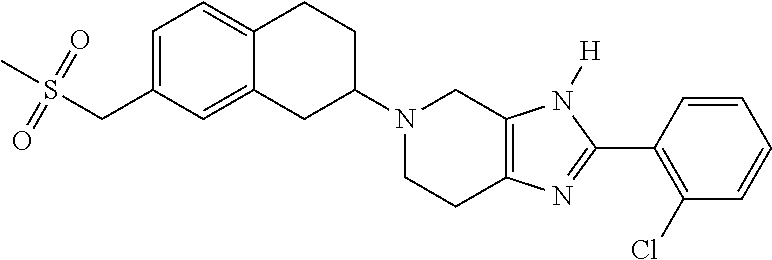 |
2-(2-chlorophenyl)-5-(7- ((methylsulfonyl)methyl)-1,2,3,4- tetrahydronaphthalen-2-yl)-4,5,6,7-tetrahydro- 3H-imidazo[4,5-c]pyridine |
| 132 |
 |
2-(2-chlorophenyl)-3-methyl-5-(7- ((methylsulfonyl)methyl)-1,2,3,4- tetrahydronaphthalen-2-yl)-4,5,6,7-tetrahydro- 3H-imidazo[4,5-c]pyridine |
| 133 |
 |
2-(2-chlorophenyl)-1-methyl-5-(7- ((methylsulfonyl)methyl)-1,2,3,4- tetrahydronaphthalen-2-yl)-4,5,6,7-tetrahydro- 1H-imidazo[4,5-c]pyridine |
| 134 |
 |
2-(2-chlorophenyl)-5-(7-(4-methyl-1H- imidazol-1-yl)-1,2,3,4-tetrahydronaphthalen-2- yl)-4,5,6,7-tetrahydro-3H-imidazo[4,5- c]pyridine |
| 135 |
 |
2-(2-chlorophenyl)-3-methyl-5-(7-(4-methyl- 1H-imidazol-1-yl)-1,2,3,4- tetrahydronaphthalen-2-yl)-4,5,6,7-tetrahydro- 3H-imidazo[4,5-c]pyridine |
| 136 |
 |
2-(2-chlorophenyl)-1-methyl-5-(7-(4-methyl- 1H-imidazol-1-yl)-1,2,3,4- tetrahydronaphthalen-2-yl)-4,5,6,7-tetrahydro- 1H-imidazo[4,5-c]pyridine |
| 137 |
 |
2-(2-chlorophenyl)-5-(7-(oxetan-3-yl)-1,2,3,4- tetrahydronaphthalen-2-yl)-4,5,6,7-tetrahydro- 3H-imidazo[4,5-c]pyridine |
| 138 |
 |
2-(2-chlorophenyl)-3-methyl-5-(7-(oxetan-3- yl)-1,2,3,4-tetrahydronaphthalen-2-yl)-4,5,6,7- tetrahydro-3H-imidazo[4,5-c]pyridine |
| 139 |
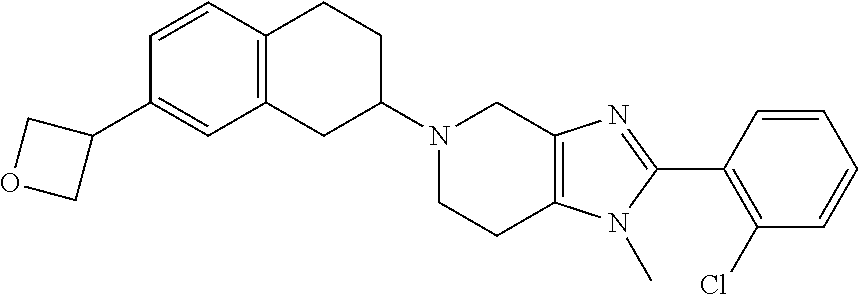 |
2-(2-chlorophenyl)-1-methyl-5-(7-(oxetan-3- yl)-1,2,3,4-tetrahydronaphthalen-2-yl)-4,5,6,7- tetrahydro-1H-imidazo[4,5-c]pyridine |
| 140 |
 |
2-(2-chlorophenyl)-5-(7-((2- methoxyethoxy)nethyl)-1,2,3,4- tetrahydronaphthalen-2-yl)-4,5,6,7-tetrahydro- 3H-imidazo[4,5-c]pyridine |
| 141 |
 |
2-(2-chlorophenyl)-5-(7-((2- methoxyethoxy)methyl)-1,2,3,4- tetrahydronaphthalen-2-yl)-3-methyl-4,5,6,7- tetrahydro-3H-imidazo[4,5-c]pyridine |
| 142 |
 |
2-(2-chlorophenyl)-5-(7-((2- methoxyethoxy)methyl)-1,2,3,4- tetrahydronaphthalen-2-yl)-1-methyl-4,5,6,7- tetrahydro-1H-imidazo[4,5-c]pyridine |
| 143 |
 |
2-(2-chlorophenyl)-5-(8-(4-methyl-1H- imidazol-1-yl)-1,2,3,4-tetrahydronaphthalen-2- yl)-4,5,6,7-tetrahydro-3H-imidazo[4,5- c]pyridine |
| 144 |
 |
2-(2-chlorophenyl)-3-methyl-5-(8-(4-methyl- 1H-imidazol-1-yl)-1,2,3,4- tetrahydronaphthalen-2-yl)-4,5,6,7-tetrahydro- 3H-imidazo[4,5-c]pyridine |
| 145 |
 |
2-(2-chlorophenyl)-1-methyl-5-(8-(4-methyl- 1H-imidazol-1-yl)-1,2,3,4- tetrahydronaphthalen-2-yl)-4,5,6,7-tetrahydro- 1H-imidazo[4,5-c]pyridine |
| 146 |
 |
2-(2-chlorophenyl)-5-(8-((2- methoxyethoxy)methyl)-1,2,3,4- tetrahydronaphthalen-2-yl)-4,5,6,7-tetrahydro- 3H-imidazo[4,5-c]pyridine |
| 147 |
 |
2-(2-chlorophenyl)-5-(8-((2- methoxyethoxy)methyl)-1,2,3,4- tetrahydronaphthalen-2-yl)-3-methyl-4,5,6,7- tetrahydro-3H-imidazo[4,5-c]pyridine |
| 148 |
 |
2-(2-chlorophenyl)-5-(8-((2- methoxyethoxy)methyl)-1,2,3,4- tetrahydronaphthalen-2-yl)-1-methyl-4,5,6,7- tetrahydro-1H-imidazo[4,5-c]pyridine |
| 149 |
 |
2-(2-chlorophenyl)-5-(8-(oxetan-3-yl)-1,2,3,4- tetrahydronaphthalen-2-yl)-4,5,6,7-tetrahydro- 3H-imidazo[4,5-c]pyridine |
| 150 |
 |
2-(2-chlorophenyl)-3-methyl-5-(8-(oxetan-3- yl)-1,2,3,4-tetrahydronaphthalen-2-yl)-4,5,6,7- tetrahydro-3H-imidazo[4,5-c]pyridine |
| 151 |
 |
2-(2-chlorophenyl)-1-methyl-5-(8-(oxetan-3- yl)-1,2,3,4-tetrahydronaphthalen-2-yl)-4,5,6,7- tetrahydro-1H-imidazo[4,5-c]pyridine |
| 152 |
 |
2-(2-chlorophenyl)-5-(8- ((methylsulfonyl)methyl)-1,2,3,4- tetrahydronaphthalen-2-yl)-4,5,6,7-tetrahydro- 3H-imidazo[4,5-c]pyridine |
| 153 |
 |
2-(2-chlorophenyl)-3-methyl-5-(8- ((methylsulfonyl)methyl)-1,2,3,4- tetrahydronaphthalen-2-yl)-4,6,6,7-tetrahydro- 3H-imidazo[4,5-c]pyridine |
| 154 |
 |
2-(2-chlorophenyl)-1-methyl-5-(8- ((methylsulfonyl)methyl)-1,2,3,4- tetrahydronaphthalen-2-yl)-4,6,6,7-tetrahydro- 1H-imidazo[4,5-c]pyridine |
| 155 |
 |
2-(2-chlorophenyl)-5-(8-(methylsulfonyl)- 1,2,3,4-tetrahydronaphthalen-2-yl)-4,6,6,7- tetrahydro-3H-imidazo[4,5-c]pyridine |
| 156 |
 |
2-(2-chlorophenyl)-3-methyl-5-(8- (methylsulfonyl)-1,2,3,4- tetrahydronaphthalen-2-yl)-4,6,6,7-tetrahydro- 3H-imidazo[4,5-c]pyridine |
| 157 |
 |
2-(2-chlorophenyl)-1-methyl-5-(8- (methylsulfonyl)-1,2,3,4- tetrahydronaphthalen-2-yl)-4,6,6,7-tetrahydro- 1H-imidazo[4,5-c]pyridine |
| 158 |
 |
2-(2-chlorophenyl)-5-(7-(cyclopropylethynyl)- 1,2,3,4-tetrahydronaphthalen-2-yl)-4,6,6,7- tetrahydro-3H-imidazo[4,5-c]pyridine |
| 159 |
 |
(2R)-1-((7-(2-(2-chlorophenyl)-3,4,6,7- tetrahydro-5H-1-imidazo[4,5-c]pyridin-5-yl)- 5,6,7,8-tetrahydronaphthalen-2-yl)oxy)-3- methoxypropan-2-ol |
| 160 |
 |
2,2′-((7-(2-(2-chlorophenyl)-3,4,6,7- tetrahydro-5H-imidazo[4,5-c]pyridin-5-yl)- 5,6,7,8-tetrahydronaphthalene-1,2- diyl)bis(oxy))bis(ethan-1-ol) |
| 161 |
 |
2-(2-chlorophenyl)-5-(8-cyclopropyl-1,2,3,4- tetrahydronaphthalen-2-yl)-3-methyl-4,5,6,7- tetrahydro-3H-imidazo[4,5-c]pyridine |
| 162 |
 |
2-(2-chlorophenyl)-5-(8-cyclopropyl-1,2,3,4- tetrahydronaphthalen-2-yl)-1-methyl-4,5,6,7- tetrahydro-1H-imidazo[4,5-c]pyridine |
| 163 |
 |
5-(7-chloro-1,2,3,4-tetrahydronaphthalen-2- yl)-2-(2-chloro-4-cyclopropylphenyl)-3-methyl- 4,5,6,7-tetrahydro-3H-imidazo[4,5-c]pyridine |
| 164 |
 |
5-(7-chloro-1,2,3,4-tetrahydronaphthalen-2- yl)-2-(2-chloro-4-cyclopropylphenyl)-1-methyl- 4,5,6,7-tetrahydro-1H-imidazo[4,5-c]pyridine |
| 165 |
 |
5-(7-chloro-1,2,3,4-tetrahydronaphthalen-2- yl)-2-(2-chloro-4-(cyclopropylethynyl)phenyl)- 4,5,6,7-tetrahydro-3H-imidazo[4,5-c]pyridine |
| 166 |
 |
(S)-5-(7-chloro-1,2,3,4-tetrahydronaphthalen- 2-yl)-2-(2-chloro-4- (cyclopropylethynyl)phenyl)-4,5,6,7- tetrahydro-3H-imidazo[4,5-c]pyridine |
| 167 |
 |
(R)-5-(7-chloro-1,2,3,4-tetrahydronaphthalen- 2-yl)-2-(2-chloro-4- (cyclopropylethynyl)phenyl)-4,5,6,7- tetrahydro-3H-imidazo[4,5-c]pyridine |
| 168 |
 |
5-(7-chloro-1,2,3,4-tetrahydronaphthalen-2- yl)-2-(2-chloro-4-(pyrimidin-2-yl)phenyl)-1- methyl-4,5,6,7-tetrahydro-1H-imidazo[4,5- c]pyridine |
| 169 |
 |
5-(7-chloro-1,2,3,4-tetrahydronaphthalen-2- yl)-2-(2-chloro-4-(1H-1,2,4-triazol-1- yl)phenyl)-4,5,6,7-tetrahydro-3H-imidazo[4,5- c]pyridine |
| 170 |
 |
5-(7-chloro-1,2,3,4-tetrahydronaphthalen-2- yl)-2-(2-chloro-4-(1H-1,2,4-triazol-1- yl)phenyl)-3-methyl-4,5,6,7-tetrahydro-3H- imidazo[4,5-c]pyridine |
| 171 |
 |
5-(7-chloro-1,2,3,4-tetrahydronaphthalen-2- yl)-2-(2-chloro-4-(1H-1,2,4-triazol-1- yl)phenyl)-1-methyl-4,5,6,7-tetrahydro-1H- imidazo[4,5-c]pyridine |
| 172 |
 |
2-(2-chloro-4-(1H-1,2,4-triazol-1-yl)phenyl)-5- (8-methoxy-1,2,3,4-tetrahydronaphthalen-2- yl)-1-methyl-4,5,6,7-tetrahydro-1H- imidazo[4,5-c]pyridine |
| 173 |
 |
5-(7-chloro-1,2,3,4-tetrahydronaphthalen-2- yl)-3-methyl-2-phenyl-4,5,6,7-tetrahydro-3H- imidazo[4,5-c]pyridine |
| 174 |
 |
2-((7-(3-methyl-2-phenyl-3,4,6,7-tetrahydro- 5H-imidazo[4,5-c]pyridin-5-yl)-5,6,7,8- tetrahydronaphthalen-2-yl)oxy)ethan-1-ol |
| 175 |
 |
2-(2-chlorophenyl)-5-(8-methoxy-1,2,3,4- tetrahydronaphthalen-2-yl)-3-(oxetan-3-yl)- 4,5,6,7-tetrahydro-3H-imidazo[4,5-c]pyridine |
| 176 |
 |
7-(2-(2-chlorophenyl)-3,4,6,7-tetrahydro-5H- imidazo[4,5-c]pyridin-5-yl)-2-methyl-5,6,7,8- tetrahydroquinoline |
| 177 |
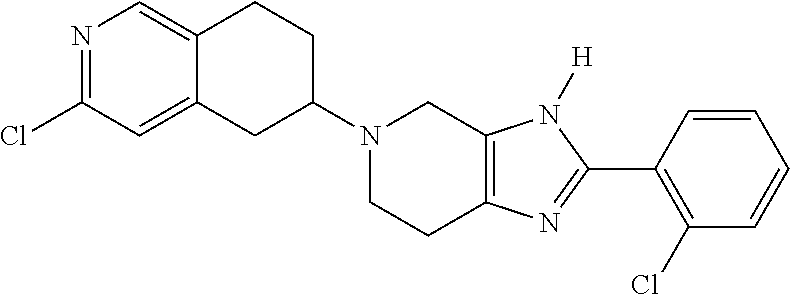 |
6-(2-(2-chlorophenyl)-3,4,6,7-tetrahydro-5H- imidazo[4,5-c]pyridin-5-yl)-3-methyl-5,6,7,8- tetrahydroisoquinoline |
| 178 |
 |
2-(2-(2-chlorophenyl)-5-(4-methoxy-5,6,7,8- tetrahydroquinolin-6-yl)-4,5,6,7-tetrahydro-3H- imidazo[4,5-c]pyridin-3-yl)ethan-1-ol |
| 179 |
 |
6-chloro-2-(2-(2-chlorophenyl)-3-methyl- 3,4,6,7-tetrahydro-5H-imidazo[4,5-c]pyridin-5- yl)-2,3-dihydro-1H-inden-1-ol |
| 180 |
 |
(S)-5-(7-(2-(3-(but-3-yn-1-yl)-3H-diazirin-3- yl)ethoxy)-1,2,3,4-tetrahydronaphthalen-2-yl)- 2-(2-chlorophenyl)-3-methyl-4,5,6,7- tetrahydro-3H-imidazo[4,5-c]pyridine |
| 181 |
 |
2-(2-chlorophenyl)-5-(8-methoxy-1,2,3,4- tetrahydronaphthalen-2-yl)-3-(2,2,2- trifluoroethyl)-4,5,6,7-tetrahydro-3H- imidazo[4,5-c]pyridine |
| 182 |
 |
5-(5-(2-(3-(but-3-yn-1-yl)-3H-diazirin-3- yl)ethoxy)-2,3-dihydro-1H-inden-2-yl)-2-(2- chlorophenyl)-3-methyl-4,5,6,7-tetrahydro-3H- imidazo[4,5-c]pyridine |
| 183 |
 |
N-(2-(2-(2-(2-((2-(2-(2-chlorophenyl)-3-methyl- 3,4,6,7-tetrahydro-5H-imidazo[4,5-c]pyridin-5- yl)-2,3-dihydro-1H-inden-4- yl)oxy)ethoxy)ethoxy)ethoxy)ethyl)-5- ((3aR,4R,6aS)-2-oxohexahydro-1H- thieno[3,4-d]imidazol-4-yl)pentanamide |
| 184 |
 |
2-(2-chlorophenyl)-9-(8-methoxy-1,2,3,4- tetrahydronaphthalen-2-yl)-3-methyl- 3,4,5,6,7,8-hexahydro-4,7- epiminocyclohepta[d]imidazole |


| Ex. | ||
| No. | Chemical structure | Chemical name |
| 191 |
 |
2-(2-(2-chlorophenyl)-4,5,6,7-tetrahydro- 1H-benzo[d]imidazol-6-yl)-6,8-dimethoxy- 1,2,3,4-tetrahydroisoquinoline |
| 192 |
 |
(2-(2-(2-chlorophenyl)-4,5,6,7-tetrahydro- 1H-benzo[d]imidazol-6-yl)-6-methoxy- 1,2,3,4-tetrahydroisoquinolin-1-yl)methanol |
| 193 |
 |
2-(2-chlorophenyl)-6-(5,7-dihydro-6H- pyrrolo[3,4-b]pyridin-6-yl)-4,5,6,7- tetrahydro-1H-benzo[d]imidazole |
| 194 |
 |
6-(3-chloro-5,7-dihydro-6H-pyrrolo[3,4- b]pyridin-6-yl)-2-(2-chlorophenyl)-4,5,6,7- tetrahydro-1H-benzo[d]imidazole |
| 195 |
 |
6-(2-(2-chlorophenyl)-4,5,6,7-tetrahydro- 1H-benzo[d]imidazol-6-yl)-5,6,7,8- tetrahydropyrido[3,4-b]pyrazine |
| 196 |
 |
5-(2-(2-chlorophenyl)-4,5,6,7-tetrahydro- 1H-benzo[d]imidazol-6-yl)-4,5,6,7- tetrahydro-3H-imidazo[4,5-c]pyridine |
| 197 |
 |
5-(2-(2-chlorophenyl)-1-methyl-4,5,6,7- tetrahydro-1H-benzo[d]imidazol-6-yl)- 4,5,6,7-tetrahydro-3H-imidazo[4,5- c]pyridine |
| 198 |
 |
5-(2-(2-chlorophenyl)-1-methyl-4,5,6,7- tetrahydro-1H-benzo[d]imidazol-5-yl)- 4,5,6,7-tetrahydro-3H-imidazo[4,5- c]pyridine |
| 199 |
 |
2-((2-(2-(2-chlorophenyl)-4,5,6,7- tetrahydro-1H-benzo[d]imidazol-6- yl)isoindolin-4-yl)oxy)ethan-1-ol |
| 200 |
 |
2-((2-(2-(2-chlorophenyl)-4,5,6,7- tetrahydro-1H-benzo[d]imidazol-6- isoindolin-5-yl)oxy)ethan-1-ol |
| 201 |
 |
7-(2-(2-chlorophenyl)-4,5,6,7-tetrahydro- 1H-benzo[d]imidazol-6-yl)-2-methyl- 5,6,7,8-tetrahydroimidazo[1,2-a]pyrazine |
| 202 |
 |
7-(2-(2-chlorophenyl)-1-methyl-4,5,6,7- tetrahydro-1H-benzo[d]imidazol-6-yl)-2- methyl-5,6,7,8-tetrahydroimidazo[1,2- a]pyrazine |
| 203 |
 |
7-(2-(2-chlorophenyl)-1-methyl-4,5,6,7- tetrahydro-1H-benzo[d]imidazol-5-yl)-2- methyl-5,6,7,8-tetrahydroimidazo[1,2- a]pyrazine |
| 204 |
 |
(2R)-1-((2-(2-(2-chlorophenyl)-1-methyl- 4,5,6,7-tetrahydro-1H-benzo[d]imidazol-5- yl)-1,2,3,4-tetrahydroisoquinolin-7-yl)oxy)- 3-methoxypropan-2-ol |
| 205 |
 |
7-chloro-2-(2-(2-chlorophenyl)-6-methyl- 4,5,6,7-tetrahydro-1H-benzo[d]imidazol-6- yl)-1,2,3,4-tetrahydroisoquinoline |
| 206 |
 |
2-chloro-6-(2-(2-chlorophenyl)-4,5,6,7- tetrahydro-1H-benzo[d]imidazo1-6-yl)-6,7- dihydro-5H-pyrrolo[3,4-b]pyrazine |
| 207 |
 |
6-(4-chloro-5,7-dihydro-6H-pyrrolo[3,4- b]pyridin-6-yl)-2-(2-chlorophenyl)-4,5,6,7- tetrahydro-1H-benzo[d]imidazole |
| 208 |
 |
2-(2-chlorophenyl)-6-(6-methyl-1,3- dihydro-2H-pyrrolo[3,4-c]pyridin-2-yl)- 4,5,6,7-tetrahydro-1H-benzo[d]imidazole |
| 209 |
 |
2-(2-chlorophenyl)-6-(4-methyl-1,3- dihydro-2H-pyrrolo[3,4-c]pyridin-2-yl)- 4,5,6,7-tetrahydro-1H-benzo[d]imidazole |
| 210 |
 |
6-(7-chloro-1,3-dihydro-2H-pyrrolo[3,4- c]pyridin-2-yl)-2-(2-chlorophenyl)-4,5,6,7- tetrahydro-1H-benzo[d]imidazole |
| 211 |
 |
6-(2-(2-chlorophenyl)-4,5,6,7-tetrahydro- 1H-benzo[d]imidazo1-6-yl)-6,7-dihydro-5H- pyrrolo[3,4-b]pyrazine |
| 212 |
 |
6-(2-(2-chlorophenyl)-4,5,6,7-tetrahydro- 1H-benzo[d]imidazol-6-yl)-2-methyl-6,7- dihydro-5H-pyrrolo[3,4-d]pyrimidine |
| 213 |
 |
6-(2-(2-chlorophenyl)-4,5,6,7-tetrahydro- 1H-benzo[d]imidazol-6-yl)-4-methyl-6,7- dihydro-5H-pyrrolo[3,4-d]pyrimidine |
| TABLE 1 | |||
| Gli1 IC50 | |||
| Ex. No. | firefly:Renilla ratio | firefly |
| 1 | +++ | ++++ |
| 1-R | +++ | +++ |
| 1-S | +++ | +++ |
| 185 | ++++ | ++++ |
| 185-S | ++++ | +++ |
| 2 | + | + |
| 42 | + | + |
| 3 | ++ | ++ |
| 43 | + | ± |
| 4 | + | ++ |
| 51 | + | + |
| 55 | + | + |
| 5 | + | + |
| 6 | + | + |
| 70 | + | + |
| 7 | + | + |
| 8 | + | + |
| 9 | + | ++ |
| 10 | +++ | +++ |
| 22 | +++ | ++ |
| 23 | ++++ | ++++ |
| 24 | ++++ | +++ |
| 106 | + | + |
| 25 | + | + |
| 26 | +++ | ++++ |
| 27 | ++++ | +++ |
| 109 | + | + |
| 28 | +++ | +++ |
| 29 | +++ | ++ |
| 30 | ++ | + |
| 31 | ++ | + |
| 32 | + | + |
| 72 | + | + |
| 73 | ± | ± |
| 77 | + | + |
| 78 | + | + |
| 11 | + | + |
| 12 | +++ | +++ |
| 13 | +++ | +++ |
| 14 | + | + |
| 14-1 | + | + |
| 15 | +++ | +++ |
| 16 | +++ | ++++ |
| 17 | + | ++ |
| 18 | + | + |
| 18-R | ++++ | ++++ |
| 18-S | +++ | +++ |
| 19 | +++ | +++ |
| 99 | + | + |
| 20 | + | + |
| 21 | ++ | ++ |
| 186 | ++++ | ++++ |
| 130 | + | + |
| 34 | +++ | +++ |
| 35 | + | + |
| 36 | ++ | + |
| 161 | +++ | +++ |
| 37 | ++++ | ++++ |
| 163 | ++++ | ++++ |
| 164 | +++ | +++ |
| 187 | ++++ | ++++ |
| 189 | ++++ | ++++ |
| 188 | ++++ | ++++ |
Claims (6)

Priority Applications (1)
| Application Number | Priority Date | Filing Date | Title |
|---|---|---|---|
| US17/295,351 US12209092B2 (en) | 2018-11-19 | 2019-11-19 | Inhibitors of GLI1 as therapeutic agents |
Applications Claiming Priority (3)
| Application Number | Priority Date | Filing Date | Title |
|---|---|---|---|
| US201862769510P | 2018-11-19 | 2018-11-19 | |
| US17/295,351 US12209092B2 (en) | 2018-11-19 | 2019-11-19 | Inhibitors of GLI1 as therapeutic agents |
| PCT/US2019/062263 WO2020106751A1 (en) | 2018-11-19 | 2019-11-19 | Inhinitors of gli1 as therapeutic agents |
Publications (2)
| Publication Number | Publication Date |
|---|---|
| US20220009935A1 US20220009935A1 (en) | 2022-01-13 |
| US12209092B2 true US12209092B2 (en) | 2025-01-28 |
Family
ID=68916569
Family Applications (1)
| Application Number | Title | Priority Date | Filing Date |
|---|---|---|---|
| US17/295,351 Active 2042-05-01 US12209092B2 (en) | 2018-11-19 | 2019-11-19 | Inhibitors of GLI1 as therapeutic agents |
Country Status (9)
| Country | Link |
|---|---|
| US (1) | US12209092B2 (en) |
| EP (1) | EP3883932B1 (en) |
| JP (1) | JP2022509152A (en) |
| KR (1) | KR20210105899A (en) |
| CN (1) | CN113316577A (en) |
| AU (1) | AU2019384733A1 (en) |
| CA (1) | CA3120614A1 (en) |
| IL (1) | IL283295A (en) |
| WO (1) | WO2020106751A1 (en) |
Families Citing this family (2)
| Publication number | Priority date | Publication date | Assignee | Title |
|---|---|---|---|---|
| WO2021229583A1 (en) * | 2020-05-14 | 2021-11-18 | Glixogen Therapeutics Ltd. | Fused pyrazole and imidazole based compounds and use thereof as gli1 inhibitors |
| CN121693501A (en) | 2023-08-09 | 2026-03-17 | 拜耳公司 | Pyridazin-4-yl oxadiazines as novel bactericides |
Citations (9)
| Publication number | Priority date | Publication date | Assignee | Title |
|---|---|---|---|---|
| SU1069387A1 (en) | 1982-07-01 | 1985-11-30 | Институт физико-органической химии и углехимии АН УССР | Dihydrochloride of 5-/beta-(n-anisil)-beta-oxyethyl/2-(3',4')-dimethoxyphenyl-1-methyl-4,5,6,7-tetrahydroimidazo/4,5-c/pyridine possessing spasmolytic effect |
| WO2003027234A2 (en) | 2001-09-26 | 2003-04-03 | Curis, Inc. | Small organic molecule regulators of cell proliferation |
| US6767888B1 (en) | 1997-06-27 | 2004-07-27 | Curis, Inc. | Neuroprotective methods and reagents |
| WO2013013190A1 (en) | 2011-07-21 | 2013-01-24 | The Regents Of The University Of California | Targeting gli proteins in human cancer by small molecules |
| WO2013112859A1 (en) | 2012-01-27 | 2013-08-01 | New York University | Method for enhancing remyelination using gli1 inhibitors |
| EP2635578B1 (en) | 2010-12-22 | 2015-12-16 | Hengrui (USA) Ltd. | 2-arylimidazo[1,2-b]pyridazine, 2-phenylimidazo[1,2-a]pyridine, and 2-phenylimidazo[1,2-a]pyrazine derivatives |
| US9611276B2 (en) | 2012-06-22 | 2017-04-04 | The Board Of Trustees Of The Leland Stanford Junior University | Imidazo bicyclic iminium compounds as antitumor agents |
| WO2017103670A1 (en) | 2015-12-14 | 2017-06-22 | Zenith Epigenetics Lid. | 1h-imidazo[4,5-b]pyridinyl and 2-oxo-2,3-dihydro-1h-imidazo[4,5-b]pyridinyl heterocyclic bet bromodomain inhibitors |
| JP2018531982A (en) | 2015-11-03 | 2018-11-01 | セラヴァンス バイオファーマ アール&ディー アイピー, エルエルシー | JAK kinase inhibitor compounds for the treatment of respiratory diseases |
-
2019
- 2019-11-19 WO PCT/US2019/062263 patent/WO2020106751A1/en not_active Ceased
- 2019-11-19 CN CN201980089373.1A patent/CN113316577A/en active Pending
- 2019-11-19 KR KR1020217018643A patent/KR20210105899A/en not_active Ceased
- 2019-11-19 CA CA3120614A patent/CA3120614A1/en active Pending
- 2019-11-19 AU AU2019384733A patent/AU2019384733A1/en not_active Abandoned
- 2019-11-19 JP JP2021528895A patent/JP2022509152A/en active Pending
- 2019-11-19 EP EP19821358.9A patent/EP3883932B1/en active Active
- 2019-11-19 US US17/295,351 patent/US12209092B2/en active Active
-
2021
- 2021-05-19 IL IL283295A patent/IL283295A/en unknown
Patent Citations (11)
| Publication number | Priority date | Publication date | Assignee | Title |
|---|---|---|---|---|
| SU1069387A1 (en) | 1982-07-01 | 1985-11-30 | Институт физико-органической химии и углехимии АН УССР | Dihydrochloride of 5-/beta-(n-anisil)-beta-oxyethyl/2-(3',4')-dimethoxyphenyl-1-methyl-4,5,6,7-tetrahydroimidazo/4,5-c/pyridine possessing spasmolytic effect |
| US6767888B1 (en) | 1997-06-27 | 2004-07-27 | Curis, Inc. | Neuroprotective methods and reagents |
| US6683192B2 (en) | 2000-03-30 | 2004-01-27 | Curis, Inc. | Small organic molecule regulators of cell proliferation |
| WO2003027234A2 (en) | 2001-09-26 | 2003-04-03 | Curis, Inc. | Small organic molecule regulators of cell proliferation |
| WO2003027234A3 (en) | 2001-09-26 | 2003-12-18 | Curis Inc | Small organic molecule regulators of cell proliferation |
| EP2635578B1 (en) | 2010-12-22 | 2015-12-16 | Hengrui (USA) Ltd. | 2-arylimidazo[1,2-b]pyridazine, 2-phenylimidazo[1,2-a]pyridine, and 2-phenylimidazo[1,2-a]pyrazine derivatives |
| WO2013013190A1 (en) | 2011-07-21 | 2013-01-24 | The Regents Of The University Of California | Targeting gli proteins in human cancer by small molecules |
| WO2013112859A1 (en) | 2012-01-27 | 2013-08-01 | New York University | Method for enhancing remyelination using gli1 inhibitors |
| US9611276B2 (en) | 2012-06-22 | 2017-04-04 | The Board Of Trustees Of The Leland Stanford Junior University | Imidazo bicyclic iminium compounds as antitumor agents |
| JP2018531982A (en) | 2015-11-03 | 2018-11-01 | セラヴァンス バイオファーマ アール&ディー アイピー, エルエルシー | JAK kinase inhibitor compounds for the treatment of respiratory diseases |
| WO2017103670A1 (en) | 2015-12-14 | 2017-06-22 | Zenith Epigenetics Lid. | 1h-imidazo[4,5-b]pyridinyl and 2-oxo-2,3-dihydro-1h-imidazo[4,5-b]pyridinyl heterocyclic bet bromodomain inhibitors |
Non-Patent Citations (18)
| Title |
|---|
| American Chemical Society REGISTRY(STN),Dec. 18, 2013,CAS1497613-40-7. |
| American Chemical Society Registry(STN),Jan. 30, 2017,CAS2061675-32-7. |
| American Chemical Society Registry(STN),Jun. 18, 2015,CAS1783051-04-6. |
| American Chemical Society Registry(STN),Jun. 18, 2015,CAS1783269-48-6. |
| American Chemical Society Registry(STN),Jun. 6, 2014,CAS1609747-11-6. |
| Chen et al, Beachy PA. Small molecule modulation of Smoothened activity. Proc Natl Acad Sci U S A. Oct. 29, 2002;99 (22):14071-6. doi: 10.1073/pnas. 182542899. Epub Oct. 21, 2002. PMID: 12391318; PMCID: PMC137838. |
| Espinosa-Bustos et al, State of the art of Smo antagonists for cancer therapy: advances in the target receptor and new ligand structures. Future Med Chem. Mar. 2019;11(6):617-638. doi: 10.4155/fmc-2018-0497. Epub Mar. 26, 2019. PMID: 30912670. |
| Frank-Kamenetsky et al. Small-molecule modulators of Hedgehog signaling: identification and characterization of Smoothened agonists and antagonists. J Biol 1, 10 (2002). https://doi.org/10.1186/1475-4924-1-10. |
| Hyman et al, "Small-molecule inhibitors reveal multiple strategies for Hedgehog pathway blockade", Proceedings of the National Academy of Sciences, vol. 106, No. 33, Aug. 18, 2009 (Aug. 18, 2009), p. 14132-14137, doi: 10.1073/pnas.0907134106. Epub Aug. 5, 2009. PMID: 19666565; PMCID: PMC2721821. |
| Lauth et al, "Inhibition of GLI-mediated transcription and tumor cell growth by small-molecule antagonists", Proceedings of the National Academy of Sciences, vol. 104, No. 20, May 15, 2007 (May 15, 2007), p. 8455-8460, DOI: 10.1073/pnas.0609699104. |
| Mastrangelo et al, Role and inhibition of GLI1 protein in cancer. Lung Cancer (Auckl). 2018;9:35-43. http://dx.doi.org/10.2147/LCTT.S124483. |
| Moshai et al. "Targeting the hedgehog-glioma-associated oncogene homolog pathway inhibits bleomycin-induced lung fibrosis in mice." Am J Respir Cell Mol Biol. Jul. 2014;51(1):11-25. doi: 10.1165/rcmb.2013-0154OC. PMID: 24450438. |
| Ohashi et al "Synthesis and evaluation of hedgehog signaling inhibitor with novel core system." Bioorganic & Medicinal Chemistry 23 (2015) 4777-4791, http://dx.doi.org/10.1016/j.bmc.2015.05.036. |
| PCT International Preliminary Report on Patentability for International Application No. PCT/US2019/062263, issued May 25, 2021, 6pp. |
| PCT International Search Report for International Application No. PCT/US2019/062263, mailed Feb. 4, 2020, 4pp. |
| PCT Written Opinion for International Application No. PCT/US2019/062263, mailed Feb. 4, 2020, 5pp. |
| Whitaker et al., Urinary myelin basic protein-like material as a correlate of the progression of multiple sclerosis. Ann Neurol. Oct. 1995; 38(4):625-32. doi: 10.1002/ana.410380411. PMID: 7574459. |
| Yutilov et al., "Synthesis and biological activity of N(5)-β-oxyethylspinaceamines", Pharmaceutical Chemistry Journal, vol. 23, No. 2, Feb. 1, 1989 (Feb. 1, 1989), p. 119-122, https://doi.org/10.1007/BF00764457. |
Also Published As
| Publication number | Publication date |
|---|---|
| JP2022509152A (en) | 2022-01-20 |
| EP3883932A1 (en) | 2021-09-29 |
| WO2020106751A8 (en) | 2021-07-01 |
| KR20210105899A (en) | 2021-08-27 |
| CA3120614A1 (en) | 2020-05-28 |
| WO2020106751A1 (en) | 2020-05-28 |
| AU2019384733A1 (en) | 2021-06-24 |
| IL283295A (en) | 2021-07-29 |
| US20220009935A1 (en) | 2022-01-13 |
| CN113316577A (en) | 2021-08-27 |
| EP3883932B1 (en) | 2023-03-29 |
Similar Documents
| Publication | Publication Date | Title |
|---|---|---|
| US20220380368A1 (en) | Spirocyclic androgen receptor protein degraders | |
| US9878992B2 (en) | GDF-8 inhibitors | |
| CA2766100C (en) | Pyrimidinones as pi3k inhibitors | |
| JP3457737B2 (en) | Tricyclic derivative, method for producing the same and pharmaceutical composition used for generating anticancer action in warm-blooded animals | |
| CA2919479C (en) | Syk inhibitors | |
| CA2710234C (en) | Polycyclic heteroaryl substituted triazoles useful as axl inhibitors | |
| CN102372711B (en) | Imidazo quinoline PI3K and mTOR (mammalian target of rapamycin) dual inhibitor | |
| JP6888006B2 (en) | Pyrazolo, pyrazolo, imidazole-pyrimidine and pyridine compounds that inhibit MNK1 and MNK2 | |
| AU2016243939A1 (en) | Heterocyclic compounds as LSD1 inhibitors | |
| BR112016029916B1 (en) | Compound or pharmaceutically acceptable salt thereof, respective uses, pharmaceutical composition and process for preparing compound or pharmaceutically acceptable salt thereof | |
| JP2016521273A (en) | Fused heterocyclic compounds as protein kinase inhibitors | |
| CA2915838A1 (en) | Bicyclic bromodomain inhibitors | |
| JP2018521025A (en) | Benzoxazinone derivatives and analogs thereof as modulators of TNF activity | |
| EP4233859A1 (en) | Inhibitors of kinase networks and uses thereof | |
| CN113330014B (en) | Polycyclic compounds that inhibit MNK1 and MNK2 | |
| AU2019339006B2 (en) | 1-isopropyl-3-methyl-8- (pyridin-3-yl) -1, 3-dihydro-2h-imidazo (4, 5-c) cinnolin-2-one as selective modulators of ataxia telangiectasia mutated (atm) kinase and uses thereof | |
| WO2014079364A1 (en) | Imidazolone derivatives, pharmaceutical compositions and uses thereof | |
| AU2018385724A1 (en) | Triazolobenzazepines as vasopressin V1a receptor antagonists | |
| EP3248968A1 (en) | Resorcinol derivative as hsp90 inhibitor | |
| AU2021311597A1 (en) | Compositions and methods for activating pyruvate kinase | |
| KR20140015157A (en) | Inhibitors of akt activity | |
| EP3883932B1 (en) | Inhibitors of gli1 as therapeutic agents | |
| CN117957230A (en) | RIP1 kinase inhibitors and uses thereof | |
| WO2020106755A1 (en) | Inhibitors of gli1 as therapeutic agents | |
| CN102372712B (en) | Imidazodiazine dual inhibitors of PI3K and mTOR |
Legal Events
| Date | Code | Title | Description |
|---|---|---|---|
| AS | Assignment |
Owner name: NEW YORK UNIVERSITY, NEW YORK Free format text: ASSIGNMENT OF ASSIGNORS INTEREST;ASSIGNORS:GREENLEE, WILLIAM J.;VAN DRIE, JOHN;HUANG, XINYAN;AND OTHERS;REEL/FRAME:056291/0943 Effective date: 20210518 Owner name: NEW YORK UNIVERSITY, NEW YORK Free format text: ASSIGNMENT OF ASSIGNORS INTEREST;ASSIGNOR:SHOHDY, NADIM;REEL/FRAME:056292/0250 Effective date: 20210519 |
|
| FEPP | Fee payment procedure |
Free format text: ENTITY STATUS SET TO UNDISCOUNTED (ORIGINAL EVENT CODE: BIG.); ENTITY STATUS OF PATENT OWNER: SMALL ENTITY |
|
| FEPP | Fee payment procedure |
Free format text: ENTITY STATUS SET TO SMALL (ORIGINAL EVENT CODE: SMAL); ENTITY STATUS OF PATENT OWNER: SMALL ENTITY |
|
| STPP | Information on status: patent application and granting procedure in general |
Free format text: DOCKETED NEW CASE - READY FOR EXAMINATION |
|
| STPP | Information on status: patent application and granting procedure in general |
Free format text: NON FINAL ACTION MAILED |
|
| STPP | Information on status: patent application and granting procedure in general |
Free format text: RESPONSE TO NON-FINAL OFFICE ACTION ENTERED AND FORWARDED TO EXAMINER |
|
| STPP | Information on status: patent application and granting procedure in general |
Free format text: NOTICE OF ALLOWANCE MAILED -- APPLICATION RECEIVED IN OFFICE OF PUBLICATIONS |
|
| STPP | Information on status: patent application and granting procedure in general |
Free format text: PUBLICATIONS -- ISSUE FEE PAYMENT VERIFIED |
|
| STCF | Information on status: patent grant |
Free format text: PATENTED CASE |