US12205357B2 - Learning ordinal representations for deep reinforcement learning based object localization - Google Patents
Learning ordinal representations for deep reinforcement learning based object localization Download PDFInfo
- Publication number
- US12205357B2 US12205357B2 US17/715,901 US202217715901A US12205357B2 US 12205357 B2 US12205357 B2 US 12205357B2 US 202217715901 A US202217715901 A US 202217715901A US 12205357 B2 US12205357 B2 US 12205357B2
- Authority
- US
- United States
- Prior art keywords
- ordinal
- embedding
- reward
- image
- agent
- Prior art date
- Legal status (The legal status is an assumption and is not a legal conclusion. Google has not performed a legal analysis and makes no representation as to the accuracy of the status listed.)
- Active, expires
Links
Images




Classifications
-
- G—PHYSICS
- G06—COMPUTING OR CALCULATING; COUNTING
- G06V—IMAGE OR VIDEO RECOGNITION OR UNDERSTANDING
- G06V10/00—Arrangements for image or video recognition or understanding
- G06V10/70—Arrangements for image or video recognition or understanding using pattern recognition or machine learning
- G06V10/77—Processing image or video features in feature spaces; using data integration or data reduction, e.g. principal component analysis [PCA] or independent component analysis [ICA] or self-organising maps [SOM]; Blind source separation
- G06V10/778—Active pattern-learning, e.g. online learning of image or video features
- G06V10/7784—Active pattern-learning, e.g. online learning of image or video features based on feedback from supervisors
- G06V10/7788—Active pattern-learning, e.g. online learning of image or video features based on feedback from supervisors the supervisor being a human, e.g. interactive learning with a human teacher
-
- G—PHYSICS
- G06—COMPUTING OR CALCULATING; COUNTING
- G06V—IMAGE OR VIDEO RECOGNITION OR UNDERSTANDING
- G06V10/00—Arrangements for image or video recognition or understanding
- G06V10/70—Arrangements for image or video recognition or understanding using pattern recognition or machine learning
- G06V10/82—Arrangements for image or video recognition or understanding using pattern recognition or machine learning using neural networks
-
- G—PHYSICS
- G06—COMPUTING OR CALCULATING; COUNTING
- G06V—IMAGE OR VIDEO RECOGNITION OR UNDERSTANDING
- G06V30/00—Character recognition; Recognising digital ink; Document-oriented image-based pattern recognition
- G06V30/10—Character recognition
- G06V30/19—Recognition using electronic means
- G06V30/191—Design or setup of recognition systems or techniques; Extraction of features in feature space; Clustering techniques; Blind source separation
- G06V30/19167—Active pattern learning
Definitions
- This disclosure relates generally to image processing and recognition. More particularly, it describes systems and methods for learning ordinal representations for deep reinforcement learning based object localization.
- any ambiguity on the class of target object in co-localization is avoided by designating the target object explicitly in the seed dataset.
- the algorithm works in a human-in-the-loop manner. In particular, when given an image dataset, a human starts annotating a few, and the reinforcement learning agent automatically labels the rest of them following human's guidance.
- Our inventive framework is motivated from common challenges of image data annotation in fiber sensing tasks, which is very time-consuming and laborious.
- our method can be applied to other data modalities/applications as well, such as images in digital pathology, object tracking in video, and temporal localization for sound event detection, etc.
- each image as an environment that an annotation agent can interact with by moving the bounding box.
- the learned localizing strategy shall be generalizable to the new environments (images).
- the reward is not given directly via IoU, but indirectly via distances on the learned latent representation.
- ordinal representation learning and deep reinforcement learning are jointly trained with mutual benefits.
- the representation learning model is trained on not only precisely annotated data, but also augmented data with perturbations.
- Existing representation learning methods do not directly yield more compact cluster on the correctly annotated data. Therefore, the reward can only be defined on the original data, not on its latent embedding.
- a latent embedding function is trained to preserve the ordinal relationship between a pair of imperfect annotations on the same image. In other words, the embedding of a bounding box with higher IoU will be closer to the embedding of ground truth bounding box than that of a box with lower IoU. As a result, the RL reward can be defined based on embedding distance.
- the box pairs are sampled when the RL agent is exploring the embedding space, so the ordinal embedding can be trained more efficiently.
- the supervision is customized. The model will learn to assign preference to a pair of better-annotated boxes at later stage of training.
- the embedding distance also provides a metric for assessing the quality of annotation.
- the well-annotated data falls into compact clusters in our ordinal embedding space. Therefore, they can be selected.
- the quality of annotations can be ranked according to the distance to the cluster centroids of filtered data.
- RL annotator works as follows.
- a human initiates the annotation process by labeling one or two target objects of interest.
- the annotation agent starts from looking at the whole image at a coarse resolution, and follows a top-down scheme to localize the objects in the rest of images by taking a sequence of recursive actions.
- the human can accept or reject the selected objects, and/or run the annotator again, until no new objects are found.
- FIG. 1 is a schematic diagram illustrating joint training framework of annotation agent and data representation according to aspects of the present disclosure
- FIG. 2 is a schematic flow diagram illustrating a model training process according to aspects of the present disclosure
- FIG. 3 is a schematic diagram illustrating application 1 —human guided automatic annotation of fiber sensing dataset(s) wherein well-annotated data can benefit downstream training of an event classifier according to aspects of the present disclosure
- FIG. 4 is a schematic diagram illustrating application 2 —worker quality assessment and improvement for crowdsourcing based images annotations platform wherein high quality annotation can be identified and low quality data can be corrected by the trained agent according to aspects of the present disclosure;
- FIG. 5 is a schematic diagram illustrating ordinal representation learning of embedding net and triplet loss according to aspects of the present disclosure
- FIG. 6 is a schematic diagram illustrating ordinal embedding based reward and action space according to aspects of the present disclosure
- FIG. 7 is a schematic diagram illustrating a complete recurrent neural network (RNN) based architecture of RL agent and ordinal representation learning according to aspects of the present disclosure
- FIG. 8 (A) , FIG. 8 (B) , and FIG. 8 (C) illustrate action sequence of RL agent and convergence of learning and plots of co-localization of digits 4 from cluttered background and the convergence of embedding distance to ground truth according to aspects of the present disclosure
- FIG. 9 is a dataset comparing fixed embedding vs training embedding during RL updates according to aspects of the present disclosure.
- FIG. 10 is a dataset showing agent trained and tested on digits 4, as well as other new digits 0-9 according to aspects of the present disclosure
- FIG. 11 is a schematic diagram showing RL-based query object localization having reward signal defined on an exemplary set rather than bounding boxes according to aspects of the present disclosure
- FIG. 12 is a schematic diagram showing an illustrative RoI encoder and projection head according to aspects of the present disclosure
- FIG. 13 (A) , and FIG. 13 (B) are datasets that illustrate: FIG. 13 (A) random sampling and anchor sampling on OrdAcc (%); and FIG. 13 (B) a comparison with and without sign for IoU reward on CorLoc (%) according to aspects of the present disclosure;
- FIG. 14 (A) , and FIG. 14 (B) are plots that illustrate comparison under different train set sizes according to aspects of the present disclosure
- FIG. 15 (A) , and FIG. 15 (B) are datasets that illustrate: FIG. 15 (A) CorLoc (%); and FIG. 15 (B) a comparison of four training strategies according to the anchor used according to aspects of the present disclosure;
- FIG. 16 is a dataset that illustrates performance on different digits according to the anchor used according to aspects of the present disclosure
- FIG. 17 is a plot showing before, after, and finetuning of adaption according to the anchor used according to aspects of the present disclosure
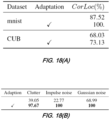
- FIG. 18 (A) , and FIG. 18 (B) are datasets that illustrate: FIG. 18 (A) performance of loose to tight annotated bounding box; and FIG. 18 (B) performance when transferring to other background according to aspects of the present disclosure; and
- FIG. 19 is a listing of an Algorithm I for training and reward localization agent according to the anchor used according to aspects of the present disclosure.
- FIG. 1 is a schematic diagram illustrating joint training framework of annotation agent and data representation according to aspects of the present disclosure.
- FIG. 2 is a schematic flow diagram illustrating a model training process according to aspects of the present disclosure.
- FIG. 3 is a schematic diagram illustrating application 1 —human guided automatic annotation of fiber sensing dataset(s) wherein well-annotated data can benefit downstream training of an event classifier according to aspects of the present disclosure.
- FIG. 4 is a schematic diagram illustrating application 2 —worker quality assessment and improvement for crowdsourcing based images annotations platform wherein high quality annotation can be identified and low quality data can be corrected by the trained agent according to aspects of the present disclosure.
- FIG. 8 (A) , FIG. 8 (B) , and FIG. 8 (C) illustrate action sequence of RL agent and convergence of learning and plots of co-localization of digits 4 from cluttered background and the convergence of embedding distance to ground truth according to aspects of the present disclosure.
- the figure demonstrates advantages of joint training in terms of final localization performance and shows that the agent trained on a co-localization task one digits to adapt to find new classes of common objects (0 ⁇ 3, 5 ⁇ 9), that is unseen in the training phase.
- Our inventive system and method jointly conduct ordinal representation learning and deep reinforcement learning, to overcome the shortage of high-quality annotated data.
- Our system and method can be applied broadly to fully supervised, weakly-supervised, and co-localization tasks.
- Our system and method employ the human-in-the-loop paradigm, which effectively utilizes a limited amount of high-quality, high confidence human annotated data, to identify and improve the quality of low-quality annotated data.
- our inventive system and method may benefit a number of applications namely, 1) as a tool to automatically annotate unlabeled dataset, in cost sensitive applications include but not limited to fiber sensing; 2) as a tool to enhance the interpretability of deep neural networks such as the class activation map (CAM) methods; 3) as a tool to assess the quality of annotation, and improve low-quality annotations on crowdsourcing platform; and 4) as a tool to localize multiple common target objects within the same image such as crops from satellite image in intelligent agriculture or cells from whole-slide image in digital pathology.
- CAM class activation map
- FIG. 9 is a dataset comparing fixed embedding vs training embedding during RL updates according to aspects of the present disclosure.
- FIG. 10 is a dataset showing agent trained and tested on digits 4, as well as other new digits 0-9 according to aspects of the present disclosure.
- RL reinforcement learning
- the queried object to localize may be novel, or the background environment may undergo substantial change, hindering the applicability of class-agnostic agents with fixed policy.
- reward signal is available, fine-tuning methods can effectively adapt agents to the new environment and yield improved performance. Different from standard RL settings, the reward signal is not available in our application during test-time, as the bounding box annotations are to be found by the localization agent on test images.
- an ordinal metric learning based framework for learning an implicitly transferable reward signal defined with a small exemplary set.
- An ordinal embedding network is pre-trained with data augmentation under a loss function designed to be relevant to the RL task.
- the reward signal allows explicit updates of the controller in the policy network with continual training during test-time.
- the agents can get exposed to the new environment more extensively with unlimited usage of test images. Informed by the exemplary set precisely, the agent is versatile to the change of localization target.
- FIG. 11 is a schematic diagram showing RL-based query object localization having reward signal defined on an exemplary set rather than bounding boxes according to aspects of the present disclosure.
- off-policy RL based object localization approaches have the advantage of being region-proposal free, with customized search paths to each image environment.
- the specificity of agent purely depends on the classes of bounding-boxes used in the reward. They can be made class-specific, but agent for each class would need to be trained separately.
- WSOL weakly supervised object localization
- a similar problem is image co-localization, where the task is to identify the common objects within a set of images.
- Co-localization approaches exploit the common characteristics across images to localize objects. Being unsupervised, co-localization approaches could suffer from ambiguity if there exist multiple common objects or parts, e.g., bird head and body, which may provide the unwanted common objects as output.
- IoU(b t ,g i ) denotes the Intersection-over-Union (IoU) between the current window b t and the corresponding ground-truth box g i
- IoU(b,g) area(b ⁇ g)/area(b ⁇ g).
- the image and box must be paired.
- annotated image-box pairs (I,g) may be scarce in both the training and testing phases.
- the reward signal in (??) is not transferable across training images, not to mention test image with potential domain shifts.
- a natural idea is to define the reward signal based on the distance between the cropped images by current window b t and the ground-truth window g. Given their M-dimensional representations b t and g produced by an embedding function ⁇ :R D 7 ⁇ R M from D-dimensional image feature vectors, a distance function d:R M ⁇ R M 7 ⁇ 8 0, + ⁇ ) return the embedding distance d(b t ,g). However, it may not decrease monotonically as the agent approaches to the ground-truth box g. As a result, the embedding distance based reward signal may be less effective than (??).
- the exemplary set E contains both image I and box g.
- box perturbation in which C is constructed by sampling box pairs around g.
- IoU-based partition scheme is more effective than random sampling. This can be viewed as a procedure to enhance the robustness of neural network against box perturbations and protect the special purpose of its usage on distinguishing reward increases or decreases.
- Pre-training with data augmentation can also make the downstream task of policy network training more efficient.
- trip ⁇ max( m+d ( f a ,f p ) ⁇ d ( f a ,f p ),0), (3) where f a is the “anchor” embedding. f p ,f n are the “positive” and “negative” embeddings with larger and smaller IoUs with ground truth box g, respectively.
- a good representation for defining reward may not necessarily be a good state representation at the same time—it may not contain enough information guiding the agent taking the right actions. suggests that adding a projection head between the representation and the contrastive loss substantially improves the quality of the learned representation.
- the network architecture is shown in FIG. 12 , in which an MLP projection head is attached after an (Region of Interest) RoI encoder.
- the RoI encoder extracts RoI feature s that will be used the state representation for localization.
- the projection head learns ordinal embedding b for computing reward.
- the localization is formulated as a Markov Decision Process (MDP) with raw pixels in each image as the Environment.
- MDP Markov Decision Process
- Ordinal embeddings are extracted from the image regions surrounded by the ground-truth boxes in E, by the pre-trained RoI encoder and projection head, and the prototype is computed as the mean vector.
- RNN recurrent neural network
- the agent is trained to select the actions to transform current bounding box at each step, by maximizing the total discounted reward.
- the agent takes pooled feature from the current box as State, while it also maintains an internal state within RNN, which encodes information from history observations.
- the Action set is defined with discrete actions facilitating a top-down search, including five scaling, eight translation transformations as in, plus one stay action.
- Test-time Adaptation During test-time, the agent has the option of further updating the policy network using the received reward from (4) with a as the prototype of the test exemplary set E test .
- the training batch is split into two group and a is computed on a small subset that does not overlap with the training images to localize, while during test adaptation, a becomes the prototype of the exemplary set.
- the full algorithm is outlined in Algorithm 1 which is illustratively shown in FIG. 19 .
- CorLoc Correct Localization
- FIG. 14 (A) , and FIG. 14 (B) are plots that illustrate comparison under different train set sizes according to aspects of the present disclosure.
- the first strategy is random sampling, where the pair of boxes are generated completely randomly.
- the other one is sampling by anchor, where we first generate dense anchors with variant scales, then divide them into 10 groups according to the IoU with ground-truth box. Each group has an interval of 0.1.
- the sampling is first on group level, i.e., sampling two groups. Then sample two boxes corresponding to each group. Thus, the sampled boxes can cover more cases compared to random sampling.
- the resulting OrdAcc of the two strategies is shown in FIG. 13 (A) .
- anchor sampling we can learn better ordinal embedding.
- Reward ⁇ +1, ⁇ 1 ⁇ , sign or not sign use Eq. 1 as reward to train the agent.
- FIG. 14 (A) and FIG. 14 (B) it can be seen that there is a large gap between this IoU reward and our Embed reward, especially when train set size is small. This is somewhat counter-intuitive as the ordinal reward is to approximate the property of IoU in embedding space, thus it should be less accurate than IoU as a reward.
- FIG. 15 (A) , and FIG. 15 (B) are datasets that illustrate: FIG. 15 (A) CorLoc (%); and FIG. 15 (B) a comparison of four training strategies according to the anchor used according to aspects of the present disclosure.
- FIG. 15 (B) shows the OrdAcc and CorLoc of four settings: “Self”, both embedding pretraining and agent training is using the ground-truth from this instance as anchor; “Proto”, both use the prototype of a subgroup containing this instance within a batch; “Shuffle self”, both use the ground-truth from another instance; “Shuffle proto”, both use the prototype of a subgroup without this instance within a batch.
- the RoI Encoder is trained with only loss trip .
- the whole train set can be seen as a single class. From the results, while the OrdAcc is lower than others for “Shuffle proto”, the CorLoc is the best with large margin. This phenomena suggests that this training strategy brings compactness to the train set, constructing an ordinal structure around the cluster. Note that the OrdAcc is computed using instance as anchor.
- Annotation collection plays an important role in building machine learning systems. It is one task that could benefit greatly from automation, especially in cost-sensitive applications. We aim to reduce the human labeling efforts, in terms of the number of annotate samples per class, number of annotate classes, and the level of accuracy required. Our approach enables objective evaluation and iterative refinement of data quality.
- FIG. 16 is a dataset that illustrates performance on different digits according to the anchor used according to aspects of the present disclosure
- FIG. 17 is a plot showing before, after, and finetuning of adaption according to the anchor used according to aspects of the present disclosure
- FIG. 18 (A) , and FIG. 18 (B) are datasets that illustrate: FIG. 18 (A) performance of loose to tight annotated bounding box; and FIG. 18 (B) performance when transferring to other background according to aspects of the present disclosure;
- FIG. 19 is a listing of an Algorithm I for training and reward localization agent according to the anchor used according to aspects of the present disclosure.
Landscapes
- Engineering & Computer Science (AREA)
- Theoretical Computer Science (AREA)
- Databases & Information Systems (AREA)
- Evolutionary Computation (AREA)
- Physics & Mathematics (AREA)
- Multimedia (AREA)
- General Physics & Mathematics (AREA)
- Computer Vision & Pattern Recognition (AREA)
- Health & Medical Sciences (AREA)
- Artificial Intelligence (AREA)
- Computing Systems (AREA)
- General Health & Medical Sciences (AREA)
- Medical Informatics (AREA)
- Software Systems (AREA)
- Image Analysis (AREA)
Abstract
Description
-
- Step 1: Identify a set of seed images. This can be acquired either from human experts, or a pre-selection heuristics, or a third-party dataset.
- Step 2: Pretrain the ordinal embedding. Given a seed dataset, pretrain by randomly perturb the ground truth bounding box at different levels. The levels of perturbation are denoted by parameter p. The ordinal embedding needs to satisfy the ordinal constraint locally for each pair of perturbed data augmented from the same image.
FIG. 5 is a schematic diagram illustrating ordinal representation learning of embedding net and triplet loss according to aspects of the present disclosure; - Step 3: Reinforcement Learning. Given an embedding function, the RL agents start from the whole image and recursively sample actions from a discrete action space.
FIG. 6 is a schematic diagram illustrating ordinal embedding based reward and action space according to aspects of the present disclosure. The reward of actions are calculated from the embedding distances. The policy network (action head) is jointly updated with the embedding network. The neural network architecture is detailed inFIG. 7 which is a schematic diagram illustrating a complete recurrent neural network (RNN) based architecture of RL agent and ordinal representation learning according to aspects of the present disclosure.
R=sign(IoU(b t ,g i)−IoU(b t−1 ,g i)), (1)
p j >p k ⇔∥b j −g∥<∥b k −g∥,∀j,k∈C, (2)

where fa is the “anchor” embedding. fp,fn are the “positive” and “negative” embeddings with larger and smaller IoUs with ground truth box g, respectively. Note that a good representation for defining reward may not necessarily be a good state representation at the same time—it may not contain enough information guiding the agent taking the right actions. suggests that adding a projection head between the representation and the contrastive loss substantially improves the quality of the learned representation.
R(s,s0)=∥b t −a∥−∥b t−1 −a∥, (4)
where a is the prototype embedding. Ordinal embeddings are extracted from the image regions surrounded by the ground-truth boxes in E, by the pre-trained RoI encoder and projection head, and the prototype is computed as the mean vector. Furthermore, we use policy gradient with recurrent neural network (RNN) (Mnih et al., 2014) rather than DeepQNetwork with a vector of history actions and states. Starting from the whole image pixels as input, the agent is trained to select the actions to transform current bounding box at each step, by maximizing the total discounted reward. The agent takes pooled feature from the current box as State, while it also maintains an internal state within RNN, which encodes information from history observations. The Action set is defined with discrete actions facilitating a top-down search, including five scaling, eight translation transformations as in, plus one stay action.
Claims (2)
Priority Applications (4)
| Application Number | Priority Date | Filing Date | Title |
|---|---|---|---|
| US17/715,901 US12205357B2 (en) | 2021-04-08 | 2022-04-07 | Learning ordinal representations for deep reinforcement learning based object localization |
| PCT/US2022/024118 WO2022217122A1 (en) | 2021-04-08 | 2022-04-08 | Learning ordinal representations for deep reinforcement learning based object localization |
| DE112022002037.7T DE112022002037T5 (en) | 2021-04-08 | 2022-04-08 | LEARNING ORDINAL REPRESENTATIONS FOR DEEP, REINFORCEMENT LEARNING BASED OBJECT LOCALIZATION |
| JP2023561700A JP2024514813A (en) | 2021-04-08 | 2022-04-08 | Learning ordinal representations for object localization based on deep reinforcement learning |
Applications Claiming Priority (4)
| Application Number | Priority Date | Filing Date | Title |
|---|---|---|---|
| US202163172171P | 2021-04-08 | 2021-04-08 | |
| US202163191403P | 2021-05-21 | 2021-05-21 | |
| US202163193916P | 2021-07-28 | 2021-07-28 | |
| US17/715,901 US12205357B2 (en) | 2021-04-08 | 2022-04-07 | Learning ordinal representations for deep reinforcement learning based object localization |
Publications (2)
| Publication Number | Publication Date |
|---|---|
| US20220327814A1 US20220327814A1 (en) | 2022-10-13 |
| US12205357B2 true US12205357B2 (en) | 2025-01-21 |
Family
ID=83510851
Family Applications (1)
| Application Number | Title | Priority Date | Filing Date |
|---|---|---|---|
| US17/715,901 Active 2043-08-19 US12205357B2 (en) | 2021-04-08 | 2022-04-07 | Learning ordinal representations for deep reinforcement learning based object localization |
Country Status (1)
| Country | Link |
|---|---|
| US (1) | US12205357B2 (en) |
Families Citing this family (3)
| Publication number | Priority date | Publication date | Assignee | Title |
|---|---|---|---|---|
| US12217137B1 (en) * | 2020-09-30 | 2025-02-04 | Amazon Technologies, Inc. | Meta-Q learning |
| CN115758902A (en) * | 2022-11-28 | 2023-03-07 | 北京卓翼智能科技有限公司 | Agent and method for carrying out autonomous decision based on behavior tree |
| CN116405111B (en) * | 2023-06-09 | 2023-08-15 | 山东科技大学 | Deep reinforcement learning-based auxiliary light data collection method for offshore unmanned aerial vehicle |
Citations (5)
| Publication number | Priority date | Publication date | Assignee | Title |
|---|---|---|---|---|
| US20110134128A1 (en) * | 2009-12-08 | 2011-06-09 | At&T Intellectual Property I, L.P. | Visualization and Representation of Data Clusters and Relations |
| US20190147621A1 (en) * | 2017-11-16 | 2019-05-16 | Nec Europe Ltd. | System and method for real-time large image homography processing |
| US20200410228A1 (en) * | 2019-06-28 | 2020-12-31 | Baidu Usa Llc | Systems and methods for fast training of more robust models against adversarial attacks |
| US20220292107A1 (en) * | 2021-02-26 | 2022-09-15 | International Business Machines Corporation | Quality assessment of extracted features from high-dimensional machine learning datasets |
| US11995522B2 (en) * | 2020-09-30 | 2024-05-28 | International Business Machines Corporation | Identifying similarity matrix for derived perceptions |
-
2022
- 2022-04-07 US US17/715,901 patent/US12205357B2/en active Active
Patent Citations (5)
| Publication number | Priority date | Publication date | Assignee | Title |
|---|---|---|---|---|
| US20110134128A1 (en) * | 2009-12-08 | 2011-06-09 | At&T Intellectual Property I, L.P. | Visualization and Representation of Data Clusters and Relations |
| US20190147621A1 (en) * | 2017-11-16 | 2019-05-16 | Nec Europe Ltd. | System and method for real-time large image homography processing |
| US20200410228A1 (en) * | 2019-06-28 | 2020-12-31 | Baidu Usa Llc | Systems and methods for fast training of more robust models against adversarial attacks |
| US11995522B2 (en) * | 2020-09-30 | 2024-05-28 | International Business Machines Corporation | Identifying similarity matrix for derived perceptions |
| US20220292107A1 (en) * | 2021-02-26 | 2022-09-15 | International Business Machines Corporation | Quality assessment of extracted features from high-dimensional machine learning datasets |
Also Published As
| Publication number | Publication date |
|---|---|
| US20220327814A1 (en) | 2022-10-13 |
Similar Documents
| Publication | Publication Date | Title |
|---|---|---|
| US20220327814A1 (en) | Learning ordinal representations for deep reinforcement learning based object localization | |
| Li et al. | Revisiting metric learning for few-shot image classification | |
| Zheng et al. | Adaptive boosting for domain adaptation: toward robust predictions in scene segmentation | |
| CN110956185A (en) | A method for detecting salient objects in images | |
| Wang et al. | Cost-effective object detection: Active sample mining with switchable selection criteria | |
| CN115292532B (en) | Remote sensing image domain adaptive retrieval method based on pseudo-label consistency learning | |
| CN111242064A (en) | Pedestrian re-identification method and system based on camera style migration and single marking | |
| Han et al. | Reference twice: A simple and unified baseline for few-shot instance segmentation | |
| CN113065409A (en) | Unsupervised pedestrian re-identification method based on camera distribution difference alignment constraint | |
| Xue et al. | Region comparison network for interpretable few-shot image classification | |
| WO2022217122A1 (en) | Learning ordinal representations for deep reinforcement learning based object localization | |
| Liang et al. | M2m-gan: Many-to-many generative adversarial transfer learning for person re-identification | |
| CN116561591B (en) | Training method for semantic feature extraction model of scientific and technological literature, feature extraction method and device | |
| Imbriaco et al. | Toward multilabel image retrieval for remote sensing | |
| CN119832325A (en) | Open set cross-domain hyperspectral classification method and system based on multi-mode and optimal transmission | |
| Zhang et al. | PMT-Net: Progressive multi-task network for one-shot person re-identification | |
| Dyballa et al. | A separability-based approach to quantifying generalization: which layer is best? | |
| CN107220663A (en) | A kind of image automatic annotation method classified based on semantic scene | |
| Tian et al. | Continual learning for SAR target incremental detection via predicted location probability representation and proposal selection | |
| CN108491865A (en) | A kind of more example multiple labeling sorting techniques based on metric learning | |
| CN119251605A (en) | An image classification method and system based on potential domain and category diversity | |
| CN116863186B (en) | Image classification method and system based on source domain-independent domain adaptation and active learning | |
| CN115983375B (en) | A transfer learning method and device based on domain pair association | |
| Niu et al. | Asymmetric propagation based batch mode active learning for image retrieval | |
| CN117809117A (en) | A medical image classification method for learning from positively labeled and unlabeled samples |
Legal Events
| Date | Code | Title | Description |
|---|---|---|---|
| AS | Assignment |
Owner name: NEC LABORATORIES AMERICA, INC., NEW JERSEY Free format text: ASSIGNMENT OF ASSIGNORS INTEREST;ASSIGNORS:HAN, SHAOBO;MIN, RENQIANG;LI, TINGFENG;REEL/FRAME:059537/0430 Effective date: 20220322 |
|
| FEPP | Fee payment procedure |
Free format text: ENTITY STATUS SET TO UNDISCOUNTED (ORIGINAL EVENT CODE: BIG.); ENTITY STATUS OF PATENT OWNER: LARGE ENTITY |
|
| STPP | Information on status: patent application and granting procedure in general |
Free format text: DOCKETED NEW CASE - READY FOR EXAMINATION |
|
| STPP | Information on status: patent application and granting procedure in general |
Free format text: NOTICE OF ALLOWANCE MAILED -- APPLICATION RECEIVED IN OFFICE OF PUBLICATIONS |
|
| ZAAB | Notice of allowance mailed |
Free format text: ORIGINAL CODE: MN/=. |
|
| AS | Assignment |
Owner name: NEC CORPORATION, JAPAN Free format text: ASSIGNMENT OF ASSIGNORS INTEREST;ASSIGNOR:NEC LABORATORIES AMERICA, INC.;REEL/FRAME:069540/0269 Effective date: 20241205 |
|
| STPP | Information on status: patent application and granting procedure in general |
Free format text: PUBLICATIONS -- ISSUE FEE PAYMENT RECEIVED |
|
| STPP | Information on status: patent application and granting procedure in general |
Free format text: PUBLICATIONS -- ISSUE FEE PAYMENT VERIFIED |
|
| STCF | Information on status: patent grant |
Free format text: PATENTED CASE |