US12204580B2 - Automated contact creation based on content communications - Google Patents
Automated contact creation based on content communications Download PDFInfo
- Publication number
- US12204580B2 US12204580B2 US16/457,225 US201916457225A US12204580B2 US 12204580 B2 US12204580 B2 US 12204580B2 US 201916457225 A US201916457225 A US 201916457225A US 12204580 B2 US12204580 B2 US 12204580B2
- Authority
- US
- United States
- Prior art keywords
- content item
- contact
- account
- related data
- control circuitry
- Prior art date
- Legal status (The legal status is an assumption and is not a legal conclusion. Google has not performed a legal analysis and makes no representation as to the accuracy of the status listed.)
- Active, expires
Links
Images




Classifications
-
- G—PHYSICS
- G06—COMPUTING OR CALCULATING; COUNTING
- G06F—ELECTRIC DIGITAL DATA PROCESSING
- G06F16/00—Information retrieval; Database structures therefor; File system structures therefor
- G06F16/30—Information retrieval; Database structures therefor; File system structures therefor of unstructured textual data
- G06F16/38—Retrieval characterised by using metadata, e.g. metadata not derived from the content or metadata generated manually
- G06F16/383—Retrieval characterised by using metadata, e.g. metadata not derived from the content or metadata generated manually using metadata automatically derived from the content
-
- G—PHYSICS
- G06—COMPUTING OR CALCULATING; COUNTING
- G06F—ELECTRIC DIGITAL DATA PROCESSING
- G06F16/00—Information retrieval; Database structures therefor; File system structures therefor
- G06F16/20—Information retrieval; Database structures therefor; File system structures therefor of structured data, e.g. relational data
- G06F16/23—Updating
- G06F16/2358—Change logging, detection, and notification
-
- H—ELECTRICITY
- H04—ELECTRIC COMMUNICATION TECHNIQUE
- H04L—TRANSMISSION OF DIGITAL INFORMATION, e.g. TELEGRAPHIC COMMUNICATION
- H04L51/00—User-to-user messaging in packet-switching networks, transmitted according to store-and-forward or real-time protocols, e.g. e-mail
- H04L51/42—Mailbox-related aspects, e.g. synchronisation of mailboxes
-
- H—ELECTRICITY
- H04—ELECTRIC COMMUNICATION TECHNIQUE
- H04L—TRANSMISSION OF DIGITAL INFORMATION, e.g. TELEGRAPHIC COMMUNICATION
- H04L51/00—User-to-user messaging in packet-switching networks, transmitted according to store-and-forward or real-time protocols, e.g. e-mail
- H04L51/56—Unified messaging, e.g. interactions between e-mail, instant messaging or converged IP messaging [CPM]
Definitions
- the present disclosure relates to management of contact databases and, more particularly, to systems and related processes for automatically creating, deleting, and/or updating contact entries based on content communications.
- a user receives, from a variety of sources via their smartphones or other computing devices, countless messages or other types of content communications, such as text messages, emails, phone calls, or the like, that potentially include or reference details regarding a person or that the user may wish to add as a contact in their contact database.
- the user is typically required to manually extract the contact-related information from the message and store the extracted information as a contact entry in their contact database or application.
- the user may wish to delete the contact entry from their contact database for a variety of reasons, such as, for instance, because the user no longer interacts with the person.
- the user is typically required to manually delete the contact entry from their contact database.
- the present disclosure provides systems and related methods that are able to automatically, without requiring manual user input, create and delete contact entries for a contact database, by analyzing content communications and/or other contextual information received via the user's account.
- the present disclosure provides a system for automated contact generation based on content communications.
- the system comprises a communication port, a rules database, a contact database, and control circuitry.
- the communication port is configured to receive, via a communication network, a content item communicated from a source account to a destination account.
- Example types of the content item include a calendar event notice, a mobile application message, a text message, an email message, a chat-based message, and/or a social-media-based message.
- Example types of the source account and/or the destination account include a telephone account, an email account, a chat account, a mobile application account, and/or a social media account.
- the rules database is configured to store a rule defining criteria for identifying contact-related data within the content item.
- the control circuitry is configured to retrieve the rule from the rules database and identify, based on the rule, the contact-related data within the content item.
- the control circuitry is configured to automatically extract the contact-related data from the content item, generate, based on the extracted contact-related data, a contact entry corresponding to the source account, and store, for the destination account, the contact entry in the contact database.
- control circuitry is configured to identify, based on the rule, contextual information in the content item, and add a context identifier to the contact entry based on the contextual information.
- the contextual information comprises an identifier of a service provider scheduled to provide a service
- the context identifier comprises an identifier of the service provider or of a type of the service.
- control circuitry is configured to identify, based on the rule, contextual information in the content item. Based on the contextual information, the control circuitry is configured to search a second source for additional contact-related data corresponding to the source account and store the additional contact-related data in the contact entry.
- the contextual information in some instances, comprises an identifier of a service provider, in which case the control circuitry may be configured to search the second source by searching a website of the service provider.
- the rule identifies one or more fields of the content item and one or more terms or phrases that signal presence of contact-related data.
- the control circuitry is configured to analyze the content item by searching the one or more fields of the content item for the one or more terms or phrases.
- the control circuitry in some aspects, is configured to store, in the rules database, content item type identifiers, content item fields for each of the content item type identifiers, and keywords or phrases for each of the content item fields.
- the control circuitry retrieves the rule from the rules database based on matching the content item to at least one of the content item type identifiers stored in the rules database, matching a field of the content item to at least one of the content item fields stored in the rules database, and/or matching a keyword or phrase in the content item to at least one of the keywords or phrases stored in the rules database.
- control circuitry is configured to determine a type of the content item, select one of a plurality of independently executable plugins that corresponds to the type of the content item, and activate the selected plugin to perform at least one of the retrieving of the rule, the identifying of the contact-related data, the extracting of the contact-related data, the generating the contact entry, or the storing the contact entry.
- the control circuitry in some instances, be further configured to receive, at a computing device, after the content item has been electronically communicated from the source account to the destination account, a message from the source account to the destination account, which the message comprising an email message, a text message, a chat message, and/or a telephone call.
- the control circuitry is configured to generate, for display via the computing device, the contact entry as an identifier of the source account.
- the present disclosure provides a system for automated contact deletion based on content communications.
- the system comprises a communication port and control circuitry.
- the communication port is configured to receive, via a communication network, a content item communicated from a source account to a destination account.
- Example types of the content item include a calendar event notice, a mobile application message, a text message, an email message, a chat-based message, and/or a social-media-based message.
- Example types of the source account and/or the destination account include a telephone account, an email account, a chat account, a mobile application account, and/or a social media account.
- the control circuitry is configured to generate, based on the content item, a contact deletion trigger defining a criterion for deleting a contact entry that identifies the source account and is stored for the destination account in a contact database. Based on the contact deletion trigger, the control circuitry determines whether the criterion for deleting the contact entry has been met. In response to determining that the criterion for deleting the contact entry has been met, the control circuitry is configured to automatically cause the contact entry to be deleted from the contact database.
- control circuitry is configured to, in response to determining that the criterion for deleting the contact entry has been met, automatically cause the contact entry to be deleted from a plurality of contact databases that are stored for the destination account in at least one of a cloud storage or a local computing device storage.
- control circuitry is configured to retrieve, from a rules database, a rule defining criteria for identifying contact deletion trigger-related data within the content item. Based on the rule, the control circuitry identifies the contact deletion trigger-related data within the content item, and the contact deletion trigger is generated based on the contact deletion trigger-related data identified within the content item.
- the rule identifies one or more fields of the content item and one or more terms or phrases that signal presence of contact deletion trigger-related data.
- the control circuitry is configured to identify the contact deletion trigger-related data within the content item by searching the one or more fields of the content item for the one or more terms or phrases.
- the control circuitry is configured to match, based on the content item, the source account to the contact entry that identifies the source account and is stored for the destination account in the contact database.
- the contact deletion trigger is a time-based trigger, and the control circuitry is configured to determine whether the criterion for deleting the contact entry has been met by determining whether a current time as reached a contact entry deletion time.
- the contact deletion trigger may be an action-based trigger, in which case the control circuitry may be configured to determine whether the criterion for deleting the contact entry has been met by determining whether an action has occurred.
- the control circuitry in yet another aspect, is configured to identify a date and/or a time within the content item. Based on the date and/or the time, the control circuitry is configured to generate, as the criterion for deleting the contact entry, a day and/or a time for deleting the contact entry.
- control circuitry may be configured to identify, based on the content item, a service to be provided by a service provider.
- the control circuitry may further be configured to determine whether the criterion for deleting the contact entry has been met by determining, based on a confirmation message, whether the service has been provided.
- the present disclosure provides a system for automatically updating a contact entry based on content communications.
- the system comprises a communication port, a rules database, a contact database, and control circuitry.
- the communication port is configured to receive, via a communication network, a content item communicated from a source account to a destination account.
- the rules database is configured to store a rule defining criteria for identifying contact-related data within the content item.
- the control circuitry is configured to: retrieve the rule from the rules database and, based on the rule, identify the contact-related data within the content item.
- the control circuitry In response to identifying the contact-related data within the content item, the control circuitry automatically searches, based on the contact-related data, the contact database for a contact entry that corresponds to the source account; determines whether the contact entry should be updated based on the contact related data; and in response to determining that the contact entry should be updated, updates the contact entry in the contact database based on the contact-related data.
- control circuitry is further configured to search, based on the contact-related data, an archived contact database for the contact entry that corresponds to the source account.
- the updating of the contact entry in the contact database comprises retrieving an item of data from the contact entry in the archived contact database and storing the retrieved item of data in the contact entry in the contact database.
- control circuitry is further configured to update the contact entry by overwriting one or more fields of the contact entry with at least a portion of the contact-related data.
- control circuitry is further configured to identify, based on the rule, contextual information in the content item and update the contact entry by adding a context identifier to the contact entry based on the contextual information.
- the contextual information in some examples, comprises an identifier of a service provider scheduled to provide a service, and wherein the context identifier comprises an identifier of the service provider or of a type of the service.
- control circuitry may be further configured to identify contextual information in the content item based on the rule. Based on the contextual information, the control circuitry searches a second source for additional contact-related data corresponding to the source account. The control circuitry then updates the contact entry by storing the additional contact-related data in the contact entry.
- the contextual information in such an example, may comprise an identifier of a service provider, in which case the control circuitry may be further configured to search the second source by searching a website of the service provider.
- the rule identifies one or more fields of the content item and one or more terms or phrases that signal presence of contact-related data
- the control circuitry is further configured to analyze the content item by searching the one or more fields of the content item for the one or more terms or phrases.
- the control circuitry may be further configured to store, in the rules database, content item type identifiers, content item fields for each of the content item type identifiers, and keywords or phrases for each of the content item fields.
- the control circuitry in such an example, may be further configured to retrieve the rule from the rules database based on matching the content item to at least one of the content item type identifiers stored in the rules database, matching a field of the content item to at least one of the content item fields stored in the rules database, or matching a keyword or phrase in the content item to at least one of the keywords or phrases stored in the rules database.
- control circuitry is further configured to determine a type of the content item; select one of a plurality of independently executable plugins that corresponds to the type of the content item; and activate the selected plugin to perform at least one of the retrieving of the rule, the identifying of the contact-related data, the searching of the contact database, the determining whether the contact entry should be updated, or the updating of the contact entry.
- FIG. 1 illustrates an overview of a scenario in which a contact entry is automatically created, in accordance with some embodiments of the disclosure
- FIG. 2 is an illustrative block diagram showing a system for automatically creating and/or deleting a contact entry, in accordance with some embodiments of the disclosure
- FIG. 3 is an illustrative block diagram showing additional details of the system of FIG. 2 , in accordance with some embodiments of the disclosure;
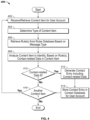
- FIG. 4 depicts an illustrative flowchart of a process for automatically creating a contact entry, in accordance with some embodiments of the disclosure
- FIG. 5 depicts an example data structure of a rules database, in accordance with some embodiments of the disclosure.
- FIG. 6 depicts an illustrative flowchart of a process for identifying contact-related data within a content item, in accordance with some embodiments of the disclosure
- FIG. 7 depicts an illustrative flowchart of a process for generating a contact entry based on items of contact-related data extracted from a content item, in accordance with some embodiments of the disclosure.
- FIG. 8 depicts an illustrative flowchart of a process for automatically deleting a contact entry based on a contact deletion trigger, in accordance with some embodiments of the disclosure.
- FIG. 1 illustrates an overview of a scenario in which a contact entry is automatically created, in accordance with some embodiments of the disclosure.
- a content item 102 or message which includes contact-related data 104 , is electronically received ( 106 ) from a source account at a destination account (neither shown in FIG. 1 ), accessible by way of electronic communication device 108 , such as a smartphone.
- Example types of the source account and/or the destination account include a telephone account, an email account, a chat account, a mobile application account, and/or a social media account.
- Example types of content item 102 include a calendar event notice, a mobile application message, a text message, an email message, a chat-based message, and/or a social-media-based message.
- device 108 detects and extracts ( 110 ) contact-related data 104 from content item 102 and generates and stores ( 112 ) a contact entry 114 in contact database 116 based on contact-related data 104 and/or other obtained or determined contextual information, as described in further detail below.
- device 108 receives ( 118 ) an incoming call 120 from the same contact that corresponds to stored contact entry 114 .
- Device 108 automatically retrieves ( 122 ) contact entry 114 from contact database 116 and displays ( 124 ) contact data, such as a contact identifier that identifies the source, based on the retrieved contact entry 114 , informing the receiver of the call that the caller is the source and not an unknown caller, thereby decreasing the chance that the user will ignore the call.
- contact data such as a contact identifier that identifies the source
- FIG. 2 shows an illustrative block diagram of system 200 for automatically creating and/or deleting contact entries based on content communications and/or context, in accordance with some embodiments of the disclosure.
- System 200 includes contact management engine 202 , a number of sources of messages or content items, and a number of databases.
- Example types of sources (sometimes referred to herein as source accounts) of messages or content items shown in system 200 include email server 204 , phone service 206 , short messaging system (SMS) and/or text service 208 , social media messaging and/or chat service 210 .
- SMS short messaging system
- Example types of databases shown in system 200 include rules database 212 and contacts database 214 .
- contact management engine 202 , rules database 212 , and/or contacts database 214 may be included within a server and/or within a computing device, such as a smartphone.
- Contact management engine 202 is communicatively coupled, for instance via one or more communication networks or wired or wireless communication paths, to email server 204 , phone service 206 , short messaging system (SMS) and/or text service 208 , social media messaging and/or chat service 210 , rules database 212 , and contacts database 214 .
- SMS short messaging system
- Each communication network described herein may be any type of communication network, such as the Internet, a mobile phone network, a mobile voice or data network (e.g., a 5G networks), a cable network, or any combination of two or more of such communication networks.
- Each communication network may include one or more communication paths, such as a satellite path, a fiber-optic path, a cable path, a path that supports Internet communications (e.g., IPTV), free-space connections (e.g., for broadcast or other wireless signals), or any other suitable wired or wireless communication path or combination of such paths.
- Contact management engine 202 includes plugins that correspond to the different types of content items that may be communicated by email server 204 , phone service 206 , short messaging system (SMS) and/or text service 208 , social media messaging and/or chat service 210 , respectively.
- contact management engine 202 includes email plugin 216 , phone plugin 218 , SMS/text plugin 220 , and social media messaging/chat plugin 222 .
- each plugin is configured to utilize rules stored in rules database 212 to automatically detect contact-related data included within content items received from their respective types of content item sources, generate a contact entry based on the contact-related data, and store the contact entry in contacts database 214 .
- contact management engine 202 is configured to automatically utilize rules stored in rules database 212 to identify contact deletion trigger-related data in content items received from their respective types of content item sources, generate and store in contacts database 214 a contact deletion trigger based on the contact deletion trigger-related data, and delete the contact entry from contacts database 214 when the contact deletion is triggered.
- FIG. 3 is an illustrative block diagram showing system 300 , which shows additional details of the system 200 of FIG. 2 , in accordance with some embodiments of the disclosure. Although FIG. 3 shows certain numbers of components, in various examples, system 300 may include fewer than the illustrated components and/or multiples of one or more illustrated components.
- System 300 includes server 302 , email server 304 , phone service 306 , SMS/text service 308 , social media messaging/chat service 310 , rules database 312 , contacts database 316 , and computing device 318 , each of which is communicatively coupled to communication network 314 , which may be the Internet or any other suitable network or group of networks.
- communication network 314 which may be the Internet or any other suitable network or group of networks.
- system 300 excludes server 302 and functionality that would otherwise be implemented by server 302 is instead implemented by other components of system 300 , such as computing device 318 .
- server 302 works in conjunction with computing device 318 to implement certain functionality described herein in a distributed or cooperative manner.
- Server 302 includes control circuitry 320 and I/O path 322 , and control circuitry 320 includes storage 324 and processing circuitry 326 .
- Computing device 318 which may be a personal computer, a laptop computer, a tablet computer, a smartphone, or any other type of computing device, includes control circuitry 328 , I/O path 330 , speaker 332 , display 334 , and user input interface 336 .
- Control circuitry 328 includes storage 338 and processing circuitry 340 .
- Control circuitry 320 and/or 328 may be based on any suitable processing circuitry such as processing circuitry 326 and/or 340 .
- processing circuitry should be understood to mean circuitry based on one or more microprocessors, microcontrollers, digital signal processors, programmable logic devices, field-programmable gate arrays (FPGAs), application-specific integrated circuits (ASICs), etc., and may include a multi-core processor (e.g., dual-core, quad-core, hexa-core, or any suitable number of cores). In some embodiments, processing circuitry may be distributed across multiple separate processors, for example, multiple of the same type of processors (e.g., two Intel Core i9 processors) or multiple different processors (e.g., an Intel Core i7 processor and an Intel Core i9 processor). In some embodiments, control circuitry 320 and/or control circuitry 328 are configured to implement a contact management engine, such as contact management engine 202 , and/or any plugins thereof, each of which is described above in connection with FIG. 2 .
- a contact management engine such as contact management engine 202 , and/or any plugins thereof,
- Each of storage 324 , storage 338 , and/or storages of other components of system 300 may be an electronic storage device.
- the phrase “electronic storage device” or “storage device” should be understood to mean any device for storing electronic data, computer software, or firmware, such as random-access memory, read-only memory, hard drives, optical drives, digital video disc (DVD) recorders, compact disc (CD) recorders, BLU-RAY disc (BD) recorders, BLU-RAY 3D disc recorders, digital video recorders (DVRs, sometimes called personal video recorders, or PVRs), solid state devices, quantum storage devices, gaming consoles, gaming media, or any other suitable fixed or removable storage devices, and/or any combination of the same.
- Each of storage 324 , storage 338 , and/or storages of other components of system 300 may be used to store various types of content, metadata, and or other types of data.
- Non-volatile memory may also be used (e.g., to launch a boot-up routine and other instructions).
- Cloud-based storage may be used to supplement storages 324 , 338 or instead of storages 324 , 338 .
- control circuitry 320 and/or 328 executes instructions for an application stored in memory (e.g., storage 324 and/or 338 ). Specifically, control circuitry 320 and/or 328 may be instructed by the application to perform the functions discussed herein.
- any action performed by control circuitry 320 and/or 328 may be based on instructions received from the application.
- the application may be implemented as software or a set of executable instructions that may be stored in storage 324 and/or 338 and executed by control circuitry 320 and/or 328 .
- the application may be a client/server application where only a client application resides on computing device 318 , and a server application resides on server 302 .
- the application may be implemented using any suitable architecture. For example, it may be a stand-alone application wholly implemented on computing device 318 . In such an approach, instructions for the application are stored locally (e.g., in storage 338 ), and data for use by the application is downloaded on a periodic basis (e.g., from an out-of-band feed, from an Internet resource, or using another suitable approach). Control circuitry 328 may retrieve instructions for the application from storage 338 and process the instructions to perform the functionality described herein. Based on the processed instructions, control circuitry 328 may determine what action to perform when input is received from user input interface 336 .
- instructions for the application are stored locally (e.g., in storage 338 ), and data for use by the application is downloaded on a periodic basis (e.g., from an out-of-band feed, from an Internet resource, or using another suitable approach).
- Control circuitry 328 may retrieve instructions for the application from storage 338 and process the instructions to perform the functionality described herein. Based on the processed instructions, control circuitry 328
- control circuitry 328 may include communication circuitry suitable for communicating with an application server (e.g., server 302 ) or other networks or servers.
- the instructions for carrying out the functionality described herein may be stored on the application server.
- Communication circuitry may include a cable modem, an Ethernet card, or a wireless modem for communication with other equipment, or any other suitable communication circuitry. Such communication may involve the Internet or any other suitable communication networks or paths (e.g., communication network 314 ).
- control circuitry 328 runs a web browser that interprets web pages provided by a remote server (e.g., server 302 ).
- the remote server may store the instructions for the application in a storage device.
- the remote server may process the stored instructions using circuitry (e.g., control circuitry 320 ) and/or generate displays.
- Computing device 318 may receive the displays generated by the remote server and may display the content of the displays locally via display 334 . This way, the processing of the instructions is performed remotely (e.g., by server 302 ) while the resulting displays, such as the display windows described elsewhere herein, are provided locally on computing device 318 .
- Computing device 318 may receive inputs from the user via input interface 336 and transmit those inputs to the remote server for processing and generating the corresponding displays.
- a user may send instructions to control circuitry 320 and/or 328 using user input interface 336 .
- User input interface 336 may be any suitable user interface, such as a remote control, trackball, keypad, keyboard, touchscreen, touchpad, stylus input, joystick, voice recognition interface, a gaming controller, or other user input interfaces.
- User input interface 336 may be integrated with or combined with display 334 , which may be a monitor, a television, a liquid crystal display (LCD), electronic ink display, or any other equipment suitable for displaying visual images.
- display 334 may be a monitor, a television, a liquid crystal display (LCD), electronic ink display, or any other equipment suitable for displaying visual images.
- Server 302 and computing device 318 may transmit and receive content and data via input/output (hereinafter “I/O”) path 322 and 330 , respectively.
- I/O path 322 and/or I/O path 330 may include a communication port configured to receive content items from one or more of email server 304 , phone service 306 , SMS/text service 308 , social media messaging/chat service 310 via communication network 314 , and/or to communicate contact-related data and the like among rules database 312 and/or contacts database 316 .
- Control circuitry 320 , 328 may be used to send and receive commands, requests, and other suitable data using I/O paths 322 , 330 .
- FIG. 4 depicts an illustrative flowchart of a process 400 for automatically creating a contact entry, which may be implemented by using system 200 and/or system 300 , in accordance with some embodiments of the disclosure.
- individual steps of process 400 may be implemented by one or more components of system 200 and/or system 300 .
- the present disclosure may describe certain steps of process 400 (and of other processes described herein) as being implemented by certain components of system 200 and/or system 300 , this is for purposes of illustration only, and it should be understood that other components of system 200 and/or system 300 may implement those steps instead.
- control circuitry 328 receives via communication port (e.g., I/O path 330 ) and communication network 314 , a content item communicated from a source account to a destination account. Additionally or alternatively, control circuitry 328 may retrieve the content item via communication network 314 from a cloud storage for the destination account.
- control circuitry 328 determines a type of the content item obtained at 402 , for instance, by determining a type of source account (e.g., email server 304 , phone service 306 , SMS/text service 308 , social media messaging/chat service 310 ) from which the content item was obtained.
- a type of source account e.g., email server 304 , phone service 306 , SMS/text service 308 , social media messaging/chat service 310
- control circuitry 328 retrieves one or more rules from rules database 312 , which is configured to store rules defining criteria for identifying contact-related data within content items.
- FIG. 5 depicts an example data structure 500 of rules database 312 , in accordance with some embodiments of the disclosure.
- the rules identify content item types 502 , one or more fields 504 of the types of content items, and one or more keyword terms and/or phrases 506 that, if present within a content item, signal presence of contact-related data within the content item.
- control circuitry 328 may be configured to analyze content items by searching the one or more fields 504 of the particular type 502 of content item for the one or more terms or phrases 506 .
- control circuitry 328 retrieves a rule from rules database 312 based on matching the content item received at 402 to at least one of the content item type identifiers 502 stored in the rules database, matching a field of the received content item to at least one of the content item fields 504 stored in the rules database, and/or matching a keyword or phrase in the received content item to at least one of the keywords or phrases 506 stored in the rules database.
- control circuitry 328 analyzes the content item received at 402 to identify, based on the rule(s) retrieved at 406 , any contact-related data that may be included within the content item.
- control circuitry 328 may be configured to determine a type of the content item ( 404 ), select one of multiple independently executable plugins (for instance, email plugin 216 , phone plugin 218 , SMS/text plugin 220 , and social media messaging/chat plugin 222 described in connection with FIG. 2 ) that corresponds to the type of the content item, and activate the selected plugin to retrieve the rule ( 406 ), identify and extract the contact-related data ( 410 ), generate ( 412 ) the contact entry, and/or store ( 414 ) the contact entry.
- multiple independently executable plugins for instance, email plugin 216 , phone plugin 218 , SMS/text plugin 220 , and social media messaging/chat plugin 222 described in connection with FIG. 2
- control circuitry 328 determines whether any contact-related data has been identified at 408 within the content item received at 402 . If control circuitry 328 determines that contact-related data has been identified at 408 within the content item received at 402 (“Yes” at 410 ), then at 412 control circuitry 328 generates a contact entry including and/or based on the identified contact-related data. In some examples, in response to identifying the contact-related data within the content item, control circuitry 328 may automatically extract the contact-related data from the content item, generate, based on the extracted contact-related data, a contact entry corresponding to the source account, and store, at 414 , for the destination account, the contact entry in contact database 316 .
- control circuitry 328 is configured to identify ( 408 ), based on the rule(s) retrieved at 406 , contextual information in the content item, and add a context identifier to the contact entry based on the contextual information.
- the contextual information may, for example, comprise an identifier of a service provider scheduled to provide a service, in which case the context identifier may include an identifier of the service provider or of a type of the service.
- control circuitry 328 may be configured to search a second source for additional contact-related data corresponding to the source account and store the additional contact-related data in the contact entry.
- control circuitry 328 may be configured to search the second source by searching a website of the service provider.
- control circuitry 328 is configured to update an already existing contact entry, if warranted based on contact-related data identified at 410 .
- control circuitry 328 may, in response to identifying the contact-related data within the content item at, 410 , automatically search, based on the contact-related data, contacts database 316 for the contact entry that corresponds to the source account; determine whether the contact entry should be updated based on the contact-related data (for example, if the contact-related data includes information not already included in the stored contact entry or information that supersedes information already included in the stored contact entry); and in response to determining that the contact entry should be updated, update the contact entry in contacts database 316 based on the contact-related data. Control circuitry 328 may, for instance, update the contact entry by overwriting one or more fields of the contact entry with at least a portion of the contact-related data.
- control circuitry 328 may be further configured to search, based on the contact-related data, an archived contact database (not expressly shown in the figures), such as a cloud-based archive and/or an archive locally stored on computing device 318 (for instance, in storage 338 ), for the contact entry that corresponds to the source account.
- an archived contact database such as a cloud-based archive and/or an archive locally stored on computing device 318 (for instance, in storage 338 ), for the contact entry that corresponds to the source account.
- the updating of the contact entry in the contact database may include retrieving an item of data (e.g., one or more data fields for the contact entry) from the contact entry in the archived contact database and storing the retrieved item of data in the contact entry in the contact database.
- FIG. 6 depicts an illustrative flowchart of process 600 for identifying contact-related data within a content item, in accordance with some embodiments of the disclosure.
- control circuitry 328 selects a field of a content item, such as a field 504 ( FIG. 5 ) of the content item received at 402 ( FIG. 4 ) for processing.
- control circuitry 328 selects a rule and/or sub-rule from rules database 312 , such as an example keyword or phrase 506 for which the content item is to be searched.
- control circuitry 328 determines whether the content item includes any contact-related data.
- control circuitry 328 determines whether rules database 312 includes another rule and/or sub-rule applicable to the content item type and/or field being processed. If control circuitry 328 determines that rules database 312 includes no other rule and/or sub-rule remains to be processed (“No” at 608 ), then control passes to 612 , at which control circuitry 328 determines whether the content item includes another field to be processed.
- control circuitry 328 determines that rules database 312 includes another rule and/or sub-rule to be processed (“Yes” at 608 ), then control passes back to 604 to select that rule/sub-rule for processing and control passes back to 606 . If, at 612 , control circuitry 328 determines that content item includes another field to be processed (“Yes” at 612 ), then control passes back to 602 to select that field for processing. If control circuitry 328 determines that content item includes no other field to be processed (“No” at 612 ), then control passes to 614 , which is described below.
- control circuitry 328 determines that the content item includes contact-related data (“Yes” at 606 )
- control circuitry 328 extracts and stores the identified contact-related data, and/or some derivative thereof, in contacts database 316 .
- control circuitry 328 searches contacts database 316 to determine whether any contact-related data has been stored for the content item.
- control circuitry 328 determines that contact-related data has been stored for the content item in contacts database 316 (“Yes” at 614 ), indicating that control was passed to 614 from 610 , then at 618 control circuitry 328 returns data indicating that contact-related data has been identified based on the content item and process 600 terminates. If, on the other hand, control circuitry 328 determines that no contact-related data has been stored in contacts database 316 for the content item (“No” at 614 ), indicating that control was passed to 614 from 612 , then at 616 control circuitry 328 returns data indicating that no contact-related data has been identified based on the content item and process 600 terminates.
- FIG. 7 depicts an illustrative flowchart of process 700 for generating a contact entry based on items of contact-related data extracted from a content item, in accordance with some embodiments of the disclosure.
- control circuitry 328 selects an item of content-related data, which may have been extracted from a content item at 610 ( FIG. 6 ).
- control circuitry 328 matches, for instance based on rules stored in rules database 312 , the item of content-related data, such as a contact name, to a corresponding contact entry field within which the item is to be stored.
- control circuitry 328 stores the item of contact-related data selected at 702 in contacts database 316 in the contact entry field matched at 704 .
- control circuitry 328 determines whether another item of contact-related data has been extracted from the content item and remains to be processed. If control circuitry 328 determines that an additional item of contact-related data has been extracted from the content item and remains to be processed (“Yes” at 708 ), then control passes back to 702 to process the additional item of content in the manner described above. If, on the other hand, control circuitry 328 determines that no additional item of contact-related data has been extracted from the content item that remains to be processed (“No” at 708 ), then process 700 terminates.
- control circuitry 328 is configured to automatically identify and extract contact deletion trigger-related data from a content item and generates a contact deletion trigger for a contact entry.
- control circuitry 328 may be configured to receive, via a communication port (e.g., I/O path 330 ) and communication network 314 , a content item communicated from a source account (e.g., from one or more of email server 304 , phone service 306 , SMS/text service 308 , and/or social media messaging/chat service 310 ) to a destination account (e.g., an account accessible via computing device 318 ).
- Control circuitry 328 generates, based on the content item, a contact deletion trigger defining a criterion for deleting a contact entry that identifies the source account and is stored for the destination account in contact database 316 .
- control circuitry 328 determines whether the criterion for deleting the contact entry has been met. In response to determining that the criterion for deleting the contact entry has been met, control circuitry 328 is configured to automatically cause the contact entry to be deleted from contact database 316 . In another example, control circuitry 328 is configured to, in response to determining that the criterion for deleting the contact entry has been met, automatically cause the contact entry to be deleted from a plurality of contact databases 316 that are stored for the destination account in at least one of a cloud storage or a local computing device storage.
- control circuitry 328 is configured to retrieve, from rules database 312 , a rule defining criteria for identifying contact deletion trigger-related data within the content item. Based on the rule, control circuitry 328 identifies the contact deletion trigger-related data within the content item, and the contact deletion trigger is generated based on the contact deletion trigger-related data identified within the content item.
- the rule identifies one or more fields (e.g., fields 504 ) of the content item and one or more terms or phrases (e.g., terms or phrases 506 ) the presence of which in a content item signals the presence of contact deletion trigger-related data.
- control circuitry 328 may identify the contact deletion trigger-related data within the content item by searching the one or more fields 504 of the content item for the one or more terms or phrases 506 .
- control circuitry 328 is configured to match, based on the content item, the source account to the contact entry that identifies the source account and is stored for the destination account in the contact database 316 .
- the contact deletion trigger is a time-based trigger
- the control circuitry is configured to determine whether the criterion for deleting the contact entry has been met by determining whether a current time as reached a contact entry deletion time.
- the contact deletion trigger may be an action-based trigger, in which case the control circuitry may be configured to determine whether the criterion for deleting the contact entry has been met by determining whether an action has occurred.
- control circuitry 328 may be configured to identify a date and/or a time within the content item. Then, based on the date and/or the time, control circuitry 328 generates, as the criterion for deleting the contact entry, a day and/or a time for deleting the contact entry.
- control circuitry 328 may be configured to identify, based on the content item, a service (e.g., a painting service, a transportation service, a package delivery service, a plumbing service, and/or the like) to be provided by a service provider.
- control circuitry 312 may be configured to determine whether the criterion for deleting the contact entry has been met by determining, based on a confirmation message, whether the service has been provided.
- FIG. 8 depicts an illustrative flowchart of process 800 for automatically deleting a contact entry based on a contact deletion trigger, in accordance with some embodiments of the disclosure.
- control circuitry 328 determines a type of the contact deletion trigger (e.g., a time-based deletion trigger or an action-based deletion trigger) that has been generated and/or stored in contacts database 316 for a particular contact entry. If control circuitry 328 determines that a time-based deletion trigger has been generated and/or stored in contacts database 316 for the contact entry (“Time” at 802 ), then control passes to 804 . If, on the other hand, control circuitry 328 determines that an action-based deletion trigger has been generated and/or stored in contacts database 316 for the contact entry (“Action” at 802 ), then control passes to 812 .
- a type of the contact deletion trigger e.g., a time-based deletion trigger or an action-based deletion trigger
- control circuitry 328 retrieves a deletion day and/or time, for instance, which may be stored in contacts database 316 as a criterion for deleting the contact entry.
- control circuitry 328 determines a current day and/or time, for instance, based on a computer clock (not shown in the figures).
- control circuitry 328 determines whether the deletion day and/or time have been met (e.g., whether the current day and/or time meets the deletion criterion day and/or time). If control circuitry 328 determines that the deletion day and/or time have been met (“Yes” at 808 ), then at 810 control circuitry 328 deletes the contact entry from contacts database 316 .
- control circuitry 328 determines that the deletion day and/or time have not been met (“No” at 808 ), then control passes back to 806 repeat the day and/or time check in the manner described above.
- the present disclosure discusses deleting contact entries, the disclosure is similarly applicable to archiving contact entries instead of or in addition to deleting contact entries.
- control circuitry 328 archives the contact entry at 810 , such as by moving the contact entry from contacts database 316 to an archive, which may be implemented by cloud-based storage (not separately shown in the figures) external to computing device 318 .
- control circuitry 328 retrieves a type of action which may be stored in contacts database 316 as a criterion for deleting the contact entry.
- control circuitry 328 determines whether the specified criterion action (e.g., delivery of a package) has occurred, for instance, based on whether a confirmation message has been received from a service provider. If control circuitry 328 determines that the specified action has occurred (“Yes” at 814 ), then at 810 control circuitry 328 deletes the contact entry from contacts database 316 . If, on the other hand, control circuitry 328 determines that the specified action has occurred (“No” at 814 ), then control passes back to 814 to repeat the action occurrence check in the manner described above.
- the specified criterion action e.g., delivery of a package
Landscapes
- Engineering & Computer Science (AREA)
- Theoretical Computer Science (AREA)
- Databases & Information Systems (AREA)
- Data Mining & Analysis (AREA)
- Physics & Mathematics (AREA)
- General Engineering & Computer Science (AREA)
- General Physics & Mathematics (AREA)
- Library & Information Science (AREA)
- Information Transfer Between Computers (AREA)
- Computer Networks & Wireless Communication (AREA)
- Signal Processing (AREA)
- Software Systems (AREA)
Abstract
Description
Claims (19)
Priority Applications (4)
| Application Number | Priority Date | Filing Date | Title |
|---|---|---|---|
| US16/457,225 US12204580B2 (en) | 2019-06-28 | 2019-06-28 | Automated contact creation based on content communications |
| PCT/US2020/039958 WO2020264399A1 (en) | 2019-06-28 | 2020-06-26 | Automated contact creation based on content communications |
| CA3104733A CA3104733A1 (en) | 2019-06-28 | 2020-06-26 | Automated contact creation based on content communications |
| US18/980,925 US20250315468A1 (en) | 2019-06-28 | 2024-12-13 | Automated contact creation based on content communications |
Applications Claiming Priority (1)
| Application Number | Priority Date | Filing Date | Title |
|---|---|---|---|
| US16/457,225 US12204580B2 (en) | 2019-06-28 | 2019-06-28 | Automated contact creation based on content communications |
Related Child Applications (1)
| Application Number | Title | Priority Date | Filing Date |
|---|---|---|---|
| US18/980,925 Continuation US20250315468A1 (en) | 2019-06-28 | 2024-12-13 | Automated contact creation based on content communications |
Publications (2)
| Publication Number | Publication Date |
|---|---|
| US20200409926A1 US20200409926A1 (en) | 2020-12-31 |
| US12204580B2 true US12204580B2 (en) | 2025-01-21 |
Family
ID=74043668
Family Applications (2)
| Application Number | Title | Priority Date | Filing Date |
|---|---|---|---|
| US16/457,225 Active 2041-03-08 US12204580B2 (en) | 2019-06-28 | 2019-06-28 | Automated contact creation based on content communications |
| US18/980,925 Pending US20250315468A1 (en) | 2019-06-28 | 2024-12-13 | Automated contact creation based on content communications |
Family Applications After (1)
| Application Number | Title | Priority Date | Filing Date |
|---|---|---|---|
| US18/980,925 Pending US20250315468A1 (en) | 2019-06-28 | 2024-12-13 | Automated contact creation based on content communications |
Country Status (1)
| Country | Link |
|---|---|
| US (2) | US12204580B2 (en) |
Families Citing this family (56)
| Publication number | Priority date | Publication date | Assignee | Title |
|---|---|---|---|---|
| US10095470B2 (en) | 2016-02-22 | 2018-10-09 | Sonos, Inc. | Audio response playback |
| US10264030B2 (en) | 2016-02-22 | 2019-04-16 | Sonos, Inc. | Networked microphone device control |
| US9811314B2 (en) | 2016-02-22 | 2017-11-07 | Sonos, Inc. | Metadata exchange involving a networked playback system and a networked microphone system |
| US9947316B2 (en) | 2016-02-22 | 2018-04-17 | Sonos, Inc. | Voice control of a media playback system |
| US9772817B2 (en) | 2016-02-22 | 2017-09-26 | Sonos, Inc. | Room-corrected voice detection |
| US9978390B2 (en) | 2016-06-09 | 2018-05-22 | Sonos, Inc. | Dynamic player selection for audio signal processing |
| US10134399B2 (en) | 2016-07-15 | 2018-11-20 | Sonos, Inc. | Contextualization of voice inputs |
| US10115400B2 (en) | 2016-08-05 | 2018-10-30 | Sonos, Inc. | Multiple voice services |
| US9942678B1 (en) | 2016-09-27 | 2018-04-10 | Sonos, Inc. | Audio playback settings for voice interaction |
| US10181323B2 (en) | 2016-10-19 | 2019-01-15 | Sonos, Inc. | Arbitration-based voice recognition |
| US11183181B2 (en) | 2017-03-27 | 2021-11-23 | Sonos, Inc. | Systems and methods of multiple voice services |
| US10475449B2 (en) | 2017-08-07 | 2019-11-12 | Sonos, Inc. | Wake-word detection suppression |
| US10048930B1 (en) | 2017-09-08 | 2018-08-14 | Sonos, Inc. | Dynamic computation of system response volume |
| US10446165B2 (en) | 2017-09-27 | 2019-10-15 | Sonos, Inc. | Robust short-time fourier transform acoustic echo cancellation during audio playback |
| US10051366B1 (en) | 2017-09-28 | 2018-08-14 | Sonos, Inc. | Three-dimensional beam forming with a microphone array |
| US10482868B2 (en) | 2017-09-28 | 2019-11-19 | Sonos, Inc. | Multi-channel acoustic echo cancellation |
| US10466962B2 (en) | 2017-09-29 | 2019-11-05 | Sonos, Inc. | Media playback system with voice assistance |
| US10880650B2 (en) | 2017-12-10 | 2020-12-29 | Sonos, Inc. | Network microphone devices with automatic do not disturb actuation capabilities |
| US10818290B2 (en) | 2017-12-11 | 2020-10-27 | Sonos, Inc. | Home graph |
| US11343614B2 (en) | 2018-01-31 | 2022-05-24 | Sonos, Inc. | Device designation of playback and network microphone device arrangements |
| US11175880B2 (en) | 2018-05-10 | 2021-11-16 | Sonos, Inc. | Systems and methods for voice-assisted media content selection |
| US10959029B2 (en) | 2018-05-25 | 2021-03-23 | Sonos, Inc. | Determining and adapting to changes in microphone performance of playback devices |
| US10681460B2 (en) | 2018-06-28 | 2020-06-09 | Sonos, Inc. | Systems and methods for associating playback devices with voice assistant services |
| US10461710B1 (en) | 2018-08-28 | 2019-10-29 | Sonos, Inc. | Media playback system with maximum volume setting |
| US11076035B2 (en) | 2018-08-28 | 2021-07-27 | Sonos, Inc. | Do not disturb feature for audio notifications |
| US10878811B2 (en) | 2018-09-14 | 2020-12-29 | Sonos, Inc. | Networked devices, systems, and methods for intelligently deactivating wake-word engines |
| US10587430B1 (en) | 2018-09-14 | 2020-03-10 | Sonos, Inc. | Networked devices, systems, and methods for associating playback devices based on sound codes |
| US11024331B2 (en) | 2018-09-21 | 2021-06-01 | Sonos, Inc. | Voice detection optimization using sound metadata |
| US10811015B2 (en) | 2018-09-25 | 2020-10-20 | Sonos, Inc. | Voice detection optimization based on selected voice assistant service |
| US11100923B2 (en) | 2018-09-28 | 2021-08-24 | Sonos, Inc. | Systems and methods for selective wake word detection using neural network models |
| US10692518B2 (en) | 2018-09-29 | 2020-06-23 | Sonos, Inc. | Linear filtering for noise-suppressed speech detection via multiple network microphone devices |
| US11899519B2 (en) | 2018-10-23 | 2024-02-13 | Sonos, Inc. | Multiple stage network microphone device with reduced power consumption and processing load |
| EP3654249A1 (en) | 2018-11-15 | 2020-05-20 | Snips | Dilated convolutions and gating for efficient keyword spotting |
| US11183183B2 (en) | 2018-12-07 | 2021-11-23 | Sonos, Inc. | Systems and methods of operating media playback systems having multiple voice assistant services |
| US11132989B2 (en) | 2018-12-13 | 2021-09-28 | Sonos, Inc. | Networked microphone devices, systems, and methods of localized arbitration |
| US10602268B1 (en) | 2018-12-20 | 2020-03-24 | Sonos, Inc. | Optimization of network microphone devices using noise classification |
| US10867604B2 (en) | 2019-02-08 | 2020-12-15 | Sonos, Inc. | Devices, systems, and methods for distributed voice processing |
| US11120794B2 (en) | 2019-05-03 | 2021-09-14 | Sonos, Inc. | Voice assistant persistence across multiple network microphone devices |
| US11200894B2 (en) | 2019-06-12 | 2021-12-14 | Sonos, Inc. | Network microphone device with command keyword eventing |
| US10871943B1 (en) | 2019-07-31 | 2020-12-22 | Sonos, Inc. | Noise classification for event detection |
| US11138969B2 (en) | 2019-07-31 | 2021-10-05 | Sonos, Inc. | Locally distributed keyword detection |
| US11189286B2 (en) | 2019-10-22 | 2021-11-30 | Sonos, Inc. | VAS toggle based on device orientation |
| US11200900B2 (en) | 2019-12-20 | 2021-12-14 | Sonos, Inc. | Offline voice control |
| US11562740B2 (en) | 2020-01-07 | 2023-01-24 | Sonos, Inc. | Voice verification for media playback |
| US11556307B2 (en) | 2020-01-31 | 2023-01-17 | Sonos, Inc. | Local voice data processing |
| US11308958B2 (en) | 2020-02-07 | 2022-04-19 | Sonos, Inc. | Localized wakeword verification |
| US11308962B2 (en) | 2020-05-20 | 2022-04-19 | Sonos, Inc. | Input detection windowing |
| US11482224B2 (en) | 2020-05-20 | 2022-10-25 | Sonos, Inc. | Command keywords with input detection windowing |
| US12387716B2 (en) | 2020-06-08 | 2025-08-12 | Sonos, Inc. | Wakewordless voice quickstarts |
| US11698771B2 (en) | 2020-08-25 | 2023-07-11 | Sonos, Inc. | Vocal guidance engines for playback devices |
| US12283269B2 (en) | 2020-10-16 | 2025-04-22 | Sonos, Inc. | Intent inference in audiovisual communication sessions |
| KR102875461B1 (en) * | 2020-11-09 | 2025-10-24 | 삼성전자주식회사 | Electronic device and method for managing contacts thereof |
| US11984123B2 (en) | 2020-11-12 | 2024-05-14 | Sonos, Inc. | Network device interaction by range |
| US12327556B2 (en) | 2021-09-30 | 2025-06-10 | Sonos, Inc. | Enabling and disabling microphones and voice assistants |
| WO2023056258A1 (en) | 2021-09-30 | 2023-04-06 | Sonos, Inc. | Conflict management for wake-word detection processes |
| US12327549B2 (en) | 2022-02-09 | 2025-06-10 | Sonos, Inc. | Gatekeeping for voice intent processing |
Citations (22)
| Publication number | Priority date | Publication date | Assignee | Title |
|---|---|---|---|---|
| US20040093317A1 (en) | 2002-11-07 | 2004-05-13 | Swan Joseph G. | Automated contact information sharing |
| US20060259551A1 (en) | 2005-05-12 | 2006-11-16 | Idalis Software | Detection of unsolicited electronic messages |
| US20100216442A1 (en) | 2009-02-20 | 2010-08-26 | Lg Electronics Inc. | Information update in a mobile communication terminal |
| US20120004015A1 (en) | 2009-03-29 | 2012-01-05 | Lg Electronics Inc. | Method and apparatus for providing enhanced address book with automatic contact management |
| US20120226704A1 (en) * | 2011-03-02 | 2012-09-06 | International Business Machines Corporation | Systems and methods for presenting electronic contact lists |
| US20140006970A1 (en) * | 2012-06-27 | 2014-01-02 | Brandon Casey | Automatic Contact Creation Based on User Interaction |
| US20140214895A1 (en) | 2013-01-31 | 2014-07-31 | Inplore | Systems and method for the privacy-maintaining strategic integration of public and multi-user personal electronic data and history |
| US20150081697A1 (en) * | 2013-09-13 | 2015-03-19 | International Business Machines Corporation | Interoperable social services |
| US20150089354A1 (en) * | 2013-02-10 | 2015-03-26 | Wixpress Ltd. | Third party application activity data collection |
| US20150100356A1 (en) * | 2013-10-09 | 2015-04-09 | RelateIQ, Inc. | Systems and methods for automatic generation of a relationship management system |
| US20150134389A1 (en) * | 2013-11-14 | 2015-05-14 | Salesforce.Com, Inc. | Systems and methods for automatic suggestions in a relationship management system |
| US20150287099A1 (en) * | 2014-04-07 | 2015-10-08 | Google Inc. | Method to compute the prominence score to phone numbers on web pages and automatically annotate/attach it to ads |
| US20150358447A1 (en) * | 2014-06-04 | 2015-12-10 | Google Inc. | Populating user contact entries |
| US20160099903A1 (en) | 2014-10-01 | 2016-04-07 | Dropbox, Inc. | Identifying communication participants to a recipient of a message |
| US20160099904A1 (en) * | 2014-10-02 | 2016-04-07 | Unify Gmbh & Co. Kg | Method, device and software product for filling an address field of an electronic message |
| US20170005954A1 (en) | 2015-06-30 | 2017-01-05 | Vonage Network Llc | System and method for communication management through analysis of recipient behavior and/or contact relationships |
| US20170124034A1 (en) | 2015-11-03 | 2017-05-04 | Commvault Systems, Inc. | Summarization of email on a client computing device based on content contribution to an email thread using classification and word frequency considerations |
| US20170169013A1 (en) * | 2015-12-11 | 2017-06-15 | Microsoft Technology Licensing, Llc | Personalizing Natural Language Understanding Systems |
| US20180131644A1 (en) | 2013-05-01 | 2018-05-10 | Pong Labs, Llc | Structured Communication Framework |
| US10489387B1 (en) * | 2018-05-24 | 2019-11-26 | People.ai, Inc. | Systems and methods for determining the shareability of values of node profiles |
| US20200125669A1 (en) * | 2018-10-17 | 2020-04-23 | Clari Inc. | Method for classifying and grouping users based on user activities |
| US20200211077A1 (en) * | 2018-12-28 | 2020-07-02 | Cdw Llc | Account manager virtual assistant using machine learning techniques |
Family Cites Families (2)
| Publication number | Priority date | Publication date | Assignee | Title |
|---|---|---|---|---|
| WO2015161284A1 (en) * | 2014-04-18 | 2015-10-22 | Personally, Inc. | Dynamic directory and content communication |
| WO2017168202A1 (en) * | 2016-03-27 | 2017-10-05 | Yogesh Chunilal Rathod | Identifying & storing followers, following users, viewers, users and connections for user |
-
2019
- 2019-06-28 US US16/457,225 patent/US12204580B2/en active Active
-
2024
- 2024-12-13 US US18/980,925 patent/US20250315468A1/en active Pending
Patent Citations (22)
| Publication number | Priority date | Publication date | Assignee | Title |
|---|---|---|---|---|
| US20040093317A1 (en) | 2002-11-07 | 2004-05-13 | Swan Joseph G. | Automated contact information sharing |
| US20060259551A1 (en) | 2005-05-12 | 2006-11-16 | Idalis Software | Detection of unsolicited electronic messages |
| US20100216442A1 (en) | 2009-02-20 | 2010-08-26 | Lg Electronics Inc. | Information update in a mobile communication terminal |
| US20120004015A1 (en) | 2009-03-29 | 2012-01-05 | Lg Electronics Inc. | Method and apparatus for providing enhanced address book with automatic contact management |
| US20120226704A1 (en) * | 2011-03-02 | 2012-09-06 | International Business Machines Corporation | Systems and methods for presenting electronic contact lists |
| US20140006970A1 (en) * | 2012-06-27 | 2014-01-02 | Brandon Casey | Automatic Contact Creation Based on User Interaction |
| US20140214895A1 (en) | 2013-01-31 | 2014-07-31 | Inplore | Systems and method for the privacy-maintaining strategic integration of public and multi-user personal electronic data and history |
| US20150089354A1 (en) * | 2013-02-10 | 2015-03-26 | Wixpress Ltd. | Third party application activity data collection |
| US20180131644A1 (en) | 2013-05-01 | 2018-05-10 | Pong Labs, Llc | Structured Communication Framework |
| US20150081697A1 (en) * | 2013-09-13 | 2015-03-19 | International Business Machines Corporation | Interoperable social services |
| US20150100356A1 (en) * | 2013-10-09 | 2015-04-09 | RelateIQ, Inc. | Systems and methods for automatic generation of a relationship management system |
| US20150134389A1 (en) * | 2013-11-14 | 2015-05-14 | Salesforce.Com, Inc. | Systems and methods for automatic suggestions in a relationship management system |
| US20150287099A1 (en) * | 2014-04-07 | 2015-10-08 | Google Inc. | Method to compute the prominence score to phone numbers on web pages and automatically annotate/attach it to ads |
| US20150358447A1 (en) * | 2014-06-04 | 2015-12-10 | Google Inc. | Populating user contact entries |
| US20160099903A1 (en) | 2014-10-01 | 2016-04-07 | Dropbox, Inc. | Identifying communication participants to a recipient of a message |
| US20160099904A1 (en) * | 2014-10-02 | 2016-04-07 | Unify Gmbh & Co. Kg | Method, device and software product for filling an address field of an electronic message |
| US20170005954A1 (en) | 2015-06-30 | 2017-01-05 | Vonage Network Llc | System and method for communication management through analysis of recipient behavior and/or contact relationships |
| US20170124034A1 (en) | 2015-11-03 | 2017-05-04 | Commvault Systems, Inc. | Summarization of email on a client computing device based on content contribution to an email thread using classification and word frequency considerations |
| US20170169013A1 (en) * | 2015-12-11 | 2017-06-15 | Microsoft Technology Licensing, Llc | Personalizing Natural Language Understanding Systems |
| US10489387B1 (en) * | 2018-05-24 | 2019-11-26 | People.ai, Inc. | Systems and methods for determining the shareability of values of node profiles |
| US20200125669A1 (en) * | 2018-10-17 | 2020-04-23 | Clari Inc. | Method for classifying and grouping users based on user activities |
| US20200211077A1 (en) * | 2018-12-28 | 2020-07-02 | Cdw Llc | Account manager virtual assistant using machine learning techniques |
Non-Patent Citations (3)
| Title |
|---|
| Amit Agarwal, "How to Extract Email Addresses from your Gmail Messages in Gmail," Internet article, May 26, 2016 retrieved from the Internet: URL:https://www.labnol.org/internet/extrac t-gmail-addresses/28037/ [retrieved on Aug. 12, 2020] pp. 1-4. |
| International Search Report and Written Opinion of PCT/US2020/039958 dated Aug. 25, 2020. |
| Mapilab: "How to create Outlook contacts automatically when sending or replying to email", Internet article, Aug. 10, 2015, Retrieved from the Internet: URL:https://www.mapilab.com/blog/create-ou tlook-contacts-automatically/ [retrieved on Aug. 12, 2020], pp. 1-5. |
Also Published As
| Publication number | Publication date |
|---|---|
| US20250315468A1 (en) | 2025-10-09 |
| US20200409926A1 (en) | 2020-12-31 |
Similar Documents
| Publication | Publication Date | Title |
|---|---|---|
| US20250315468A1 (en) | Automated contact creation based on content communications | |
| US11379529B2 (en) | Composing rich content messages | |
| US11238058B2 (en) | Search and retrieval of structured information cards | |
| US10142213B1 (en) | Techniques for providing event driven notifications | |
| US9954945B2 (en) | Associating contextual information with electronic communications | |
| US20200257421A1 (en) | Machine learning method of managing conversations in a messaging interface | |
| US11762934B2 (en) | Target web and social media messaging based on event signals | |
| US9282066B2 (en) | Targeted message response | |
| US12223352B2 (en) | Systems and methods for maintaining data objects to manage asynchronous workflows | |
| US20140059141A1 (en) | Electronic messaging system utilizing social classification rules | |
| US12335220B2 (en) | Techniques for supervising communications from multiple communication modalities | |
| US12265783B2 (en) | Systems and methods for multi-modal conversation summarization on a conversation platform | |
| US10296610B2 (en) | Associating a post with a goal | |
| US10673806B1 (en) | Automated contact updating based on content communications | |
| CN114726811A (en) | Method and device for processing session group in instant messaging application | |
| CA3104733A1 (en) | Automated contact creation based on content communications | |
| US12013909B2 (en) | Collaborative comment analysis and modification to content | |
| US10666607B1 (en) | Automated contact deletion based on content communications | |
| WO2023163694A1 (en) | System, method, and computer program for social platform information processing | |
| CN113407749A (en) | Picture index construction method and device, electronic equipment and storage medium | |
| KR102103015B1 (en) | Apparatus and operating method of instance messenger application | |
| US20240045741A1 (en) | Methods and systems for a three-tiered content notification system for a data exchange featuring non-homogenous data types | |
| US20110093502A1 (en) | Related contact and record recommendation for product design | |
| WO2020077009A1 (en) | Systems and methods for providing anticipatory search results for a query | |
| US20250048061A1 (en) | Selective communication transmission |
Legal Events
| Date | Code | Title | Description |
|---|---|---|---|
| FEPP | Fee payment procedure |
Free format text: ENTITY STATUS SET TO UNDISCOUNTED (ORIGINAL EVENT CODE: BIG.); ENTITY STATUS OF PATENT OWNER: LARGE ENTITY |
|
| AS | Assignment |
Owner name: ROVI GUIDES, INC., CALIFORNIA Free format text: ASSIGNMENT OF ASSIGNORS INTEREST;ASSIGNORS:SRINIVASAN, MADHUSUDHAN;PUNJA, DEVIPRASAD;REEL/FRAME:049771/0851 Effective date: 20190715 |
|
| AS | Assignment |
Owner name: HPS INVESTMENT PARTNERS, LLC, AS COLLATERAL AGENT, NEW YORK Free format text: SECURITY INTEREST;ASSIGNORS:ROVI SOLUTIONS CORPORATION;ROVI TECHNOLOGIES CORPORATION;ROVI GUIDES, INC.;AND OTHERS;REEL/FRAME:051143/0468 Effective date: 20191122 |
|
| AS | Assignment |
Owner name: MORGAN STANLEY SENIOR FUNDING, INC., AS COLLATERAL AGENT, MARYLAND Free format text: PATENT SECURITY AGREEMENT;ASSIGNORS:ROVI SOLUTIONS CORPORATION;ROVI TECHNOLOGIES CORPORATION;ROVI GUIDES, INC.;AND OTHERS;REEL/FRAME:051110/0006 Effective date: 20191122 |
|
| AS | Assignment |
Owner name: BANK OF AMERICA, N.A., NORTH CAROLINA Free format text: SECURITY INTEREST;ASSIGNORS:ROVI SOLUTIONS CORPORATION;ROVI TECHNOLOGIES CORPORATION;ROVI GUIDES, INC.;AND OTHERS;REEL/FRAME:053468/0001 Effective date: 20200601 |
|
| AS | Assignment |
Owner name: VEVEO, INC., CALIFORNIA Free format text: RELEASE BY SECURED PARTY;ASSIGNOR:HPS INVESTMENT PARTNERS, LLC;REEL/FRAME:053458/0749 Effective date: 20200601 Owner name: ROVI GUIDES, INC., CALIFORNIA Free format text: RELEASE BY SECURED PARTY;ASSIGNOR:HPS INVESTMENT PARTNERS, LLC;REEL/FRAME:053458/0749 Effective date: 20200601 Owner name: TIVO SOLUTIONS, INC., CALIFORNIA Free format text: RELEASE BY SECURED PARTY;ASSIGNOR:HPS INVESTMENT PARTNERS, LLC;REEL/FRAME:053458/0749 Effective date: 20200601 Owner name: ROVI SOLUTIONS CORPORATION, CALIFORNIA Free format text: RELEASE BY SECURED PARTY;ASSIGNOR:HPS INVESTMENT PARTNERS, LLC;REEL/FRAME:053458/0749 Effective date: 20200601 Owner name: ROVI TECHNOLOGIES CORPORATION, CALIFORNIA Free format text: RELEASE BY SECURED PARTY;ASSIGNOR:HPS INVESTMENT PARTNERS, LLC;REEL/FRAME:053458/0749 Effective date: 20200601 Owner name: TIVO SOLUTIONS, INC., CALIFORNIA Free format text: RELEASE BY SECURED PARTY;ASSIGNOR:MORGAN STANLEY SENIOR FUNDING, INC.;REEL/FRAME:053481/0790 Effective date: 20200601 Owner name: ROVI TECHNOLOGIES CORPORATION, CALIFORNIA Free format text: RELEASE BY SECURED PARTY;ASSIGNOR:MORGAN STANLEY SENIOR FUNDING, INC.;REEL/FRAME:053481/0790 Effective date: 20200601 Owner name: ROVI GUIDES, INC., CALIFORNIA Free format text: RELEASE BY SECURED PARTY;ASSIGNOR:MORGAN STANLEY SENIOR FUNDING, INC.;REEL/FRAME:053481/0790 Effective date: 20200601 Owner name: ROVI SOLUTIONS CORPORATION, CALIFORNIA Free format text: RELEASE BY SECURED PARTY;ASSIGNOR:MORGAN STANLEY SENIOR FUNDING, INC.;REEL/FRAME:053481/0790 Effective date: 20200601 Owner name: VEVEO, INC., CALIFORNIA Free format text: RELEASE BY SECURED PARTY;ASSIGNOR:MORGAN STANLEY SENIOR FUNDING, INC.;REEL/FRAME:053481/0790 Effective date: 20200601 |
|
| STPP | Information on status: patent application and granting procedure in general |
Free format text: NON FINAL ACTION MAILED |
|
| STPP | Information on status: patent application and granting procedure in general |
Free format text: RESPONSE TO NON-FINAL OFFICE ACTION ENTERED AND FORWARDED TO EXAMINER |
|
| STPP | Information on status: patent application and granting procedure in general |
Free format text: FINAL REJECTION MAILED |
|
| STPP | Information on status: patent application and granting procedure in general |
Free format text: DOCKETED NEW CASE - READY FOR EXAMINATION |
|
| STPP | Information on status: patent application and granting procedure in general |
Free format text: NON FINAL ACTION MAILED |
|
| STPP | Information on status: patent application and granting procedure in general |
Free format text: RESPONSE TO NON-FINAL OFFICE ACTION ENTERED AND FORWARDED TO EXAMINER |
|
| STPP | Information on status: patent application and granting procedure in general |
Free format text: FINAL REJECTION MAILED |
|
| STPP | Information on status: patent application and granting procedure in general |
Free format text: DOCKETED NEW CASE - READY FOR EXAMINATION |
|
| STPP | Information on status: patent application and granting procedure in general |
Free format text: NOTICE OF ALLOWANCE MAILED -- APPLICATION RECEIVED IN OFFICE OF PUBLICATIONS |
|
| ZAAB | Notice of allowance mailed |
Free format text: ORIGINAL CODE: MN/=. |
|
| AS | Assignment |
Owner name: ADEIA GUIDES INC., CALIFORNIA Free format text: CHANGE OF NAME;ASSIGNOR:ROVI GUIDES, INC.;REEL/FRAME:069106/0207 Effective date: 20220815 |
|
| STPP | Information on status: patent application and granting procedure in general |
Free format text: PUBLICATIONS -- ISSUE FEE PAYMENT RECEIVED |
|
| STPP | Information on status: patent application and granting procedure in general |
Free format text: PUBLICATIONS -- ISSUE FEE PAYMENT VERIFIED |
|
| STCF | Information on status: patent grant |
Free format text: PATENTED CASE |