US12203023B2 - Aromatic isothiocyanates - Google Patents
Aromatic isothiocyanates Download PDFInfo
- Publication number
- US12203023B2 US12203023B2 US18/284,204 US202218284204A US12203023B2 US 12203023 B2 US12203023 B2 US 12203023B2 US 202218284204 A US202218284204 A US 202218284204A US 12203023 B2 US12203023 B2 US 12203023B2
- Authority
- US
- United States
- Prior art keywords
- atoms
- denotes
- compounds
- alkyl
- fluorinated
- Prior art date
- Legal status (The legal status is an assumption and is not a legal conclusion. Google has not performed a legal analysis and makes no representation as to the accuracy of the status listed.)
- Active
Links
Classifications
-
- C—CHEMISTRY; METALLURGY
- C07—ORGANIC CHEMISTRY
- C07C—ACYCLIC OR CARBOCYCLIC COMPOUNDS
- C07C331/00—Derivatives of thiocyanic acid or of isothiocyanic acid
- C07C331/16—Isothiocyanates
- C07C331/28—Isothiocyanates having isothiocyanate groups bound to carbon atoms of six-membered aromatic rings
-
- C—CHEMISTRY; METALLURGY
- C09—DYES; PAINTS; POLISHES; NATURAL RESINS; ADHESIVES; COMPOSITIONS NOT OTHERWISE PROVIDED FOR; APPLICATIONS OF MATERIALS NOT OTHERWISE PROVIDED FOR
- C09K—MATERIALS FOR MISCELLANEOUS APPLICATIONS, NOT PROVIDED FOR ELSEWHERE
- C09K19/00—Liquid crystal materials
- C09K19/04—Liquid crystal materials characterised by the chemical structure of the liquid crystal components, e.g. by a specific unit
- C09K19/0403—Liquid crystal materials characterised by the chemical structure of the liquid crystal components, e.g. by a specific unit the structure containing one or more specific, optionally substituted ring or ring systems
-
- C—CHEMISTRY; METALLURGY
- C09—DYES; PAINTS; POLISHES; NATURAL RESINS; ADHESIVES; COMPOSITIONS NOT OTHERWISE PROVIDED FOR; APPLICATIONS OF MATERIALS NOT OTHERWISE PROVIDED FOR
- C09K—MATERIALS FOR MISCELLANEOUS APPLICATIONS, NOT PROVIDED FOR ELSEWHERE
- C09K19/00—Liquid crystal materials
- C09K19/04—Liquid crystal materials characterised by the chemical structure of the liquid crystal components, e.g. by a specific unit
-
- C—CHEMISTRY; METALLURGY
- C09—DYES; PAINTS; POLISHES; NATURAL RESINS; ADHESIVES; COMPOSITIONS NOT OTHERWISE PROVIDED FOR; APPLICATIONS OF MATERIALS NOT OTHERWISE PROVIDED FOR
- C09K—MATERIALS FOR MISCELLANEOUS APPLICATIONS, NOT PROVIDED FOR ELSEWHERE
- C09K19/00—Liquid crystal materials
- C09K19/04—Liquid crystal materials characterised by the chemical structure of the liquid crystal components, e.g. by a specific unit
- C09K19/06—Non-steroidal liquid crystal compounds
- C09K19/08—Non-steroidal liquid crystal compounds containing at least two non-condensed rings
- C09K19/10—Non-steroidal liquid crystal compounds containing at least two non-condensed rings containing at least two benzene rings
- C09K19/12—Non-steroidal liquid crystal compounds containing at least two non-condensed rings containing at least two benzene rings at least two benzene rings directly linked, e.g. biphenyls
-
- C—CHEMISTRY; METALLURGY
- C09—DYES; PAINTS; POLISHES; NATURAL RESINS; ADHESIVES; COMPOSITIONS NOT OTHERWISE PROVIDED FOR; APPLICATIONS OF MATERIALS NOT OTHERWISE PROVIDED FOR
- C09K—MATERIALS FOR MISCELLANEOUS APPLICATIONS, NOT PROVIDED FOR ELSEWHERE
- C09K19/00—Liquid crystal materials
- C09K19/04—Liquid crystal materials characterised by the chemical structure of the liquid crystal components, e.g. by a specific unit
- C09K19/06—Non-steroidal liquid crystal compounds
- C09K19/08—Non-steroidal liquid crystal compounds containing at least two non-condensed rings
- C09K19/10—Non-steroidal liquid crystal compounds containing at least two non-condensed rings containing at least two benzene rings
- C09K19/14—Non-steroidal liquid crystal compounds containing at least two non-condensed rings containing at least two benzene rings linked by a carbon chain
- C09K19/16—Non-steroidal liquid crystal compounds containing at least two non-condensed rings containing at least two benzene rings linked by a carbon chain the chain containing carbon-to-carbon double bonds, e.g. stilbenes
-
- C—CHEMISTRY; METALLURGY
- C09—DYES; PAINTS; POLISHES; NATURAL RESINS; ADHESIVES; COMPOSITIONS NOT OTHERWISE PROVIDED FOR; APPLICATIONS OF MATERIALS NOT OTHERWISE PROVIDED FOR
- C09K—MATERIALS FOR MISCELLANEOUS APPLICATIONS, NOT PROVIDED FOR ELSEWHERE
- C09K19/00—Liquid crystal materials
- C09K19/04—Liquid crystal materials characterised by the chemical structure of the liquid crystal components, e.g. by a specific unit
- C09K19/06—Non-steroidal liquid crystal compounds
- C09K19/08—Non-steroidal liquid crystal compounds containing at least two non-condensed rings
- C09K19/10—Non-steroidal liquid crystal compounds containing at least two non-condensed rings containing at least two benzene rings
- C09K19/14—Non-steroidal liquid crystal compounds containing at least two non-condensed rings containing at least two benzene rings linked by a carbon chain
- C09K19/18—Non-steroidal liquid crystal compounds containing at least two non-condensed rings containing at least two benzene rings linked by a carbon chain the chain containing carbon-to-carbon triple bonds, e.g. tolans
-
- C—CHEMISTRY; METALLURGY
- C09—DYES; PAINTS; POLISHES; NATURAL RESINS; ADHESIVES; COMPOSITIONS NOT OTHERWISE PROVIDED FOR; APPLICATIONS OF MATERIALS NOT OTHERWISE PROVIDED FOR
- C09K—MATERIALS FOR MISCELLANEOUS APPLICATIONS, NOT PROVIDED FOR ELSEWHERE
- C09K19/00—Liquid crystal materials
- C09K19/04—Liquid crystal materials characterised by the chemical structure of the liquid crystal components, e.g. by a specific unit
- C09K19/06—Non-steroidal liquid crystal compounds
- C09K19/08—Non-steroidal liquid crystal compounds containing at least two non-condensed rings
- C09K19/10—Non-steroidal liquid crystal compounds containing at least two non-condensed rings containing at least two benzene rings
- C09K19/20—Non-steroidal liquid crystal compounds containing at least two non-condensed rings containing at least two benzene rings linked by a chain containing carbon and oxygen atoms as chain links, e.g. esters or ethers
-
- C—CHEMISTRY; METALLURGY
- C09—DYES; PAINTS; POLISHES; NATURAL RESINS; ADHESIVES; COMPOSITIONS NOT OTHERWISE PROVIDED FOR; APPLICATIONS OF MATERIALS NOT OTHERWISE PROVIDED FOR
- C09K—MATERIALS FOR MISCELLANEOUS APPLICATIONS, NOT PROVIDED FOR ELSEWHERE
- C09K19/00—Liquid crystal materials
- C09K19/04—Liquid crystal materials characterised by the chemical structure of the liquid crystal components, e.g. by a specific unit
- C09K19/06—Non-steroidal liquid crystal compounds
- C09K19/08—Non-steroidal liquid crystal compounds containing at least two non-condensed rings
- C09K19/30—Non-steroidal liquid crystal compounds containing at least two non-condensed rings containing saturated or unsaturated non-aromatic rings, e.g. cyclohexane rings
- C09K19/3001—Cyclohexane rings
- C09K19/3003—Compounds containing at least two rings in which the different rings are directly linked (covalent bond)
-
- C—CHEMISTRY; METALLURGY
- C09—DYES; PAINTS; POLISHES; NATURAL RESINS; ADHESIVES; COMPOSITIONS NOT OTHERWISE PROVIDED FOR; APPLICATIONS OF MATERIALS NOT OTHERWISE PROVIDED FOR
- C09K—MATERIALS FOR MISCELLANEOUS APPLICATIONS, NOT PROVIDED FOR ELSEWHERE
- C09K19/00—Liquid crystal materials
- C09K19/04—Liquid crystal materials characterised by the chemical structure of the liquid crystal components, e.g. by a specific unit
- C09K19/06—Non-steroidal liquid crystal compounds
- C09K19/08—Non-steroidal liquid crystal compounds containing at least two non-condensed rings
- C09K19/30—Non-steroidal liquid crystal compounds containing at least two non-condensed rings containing saturated or unsaturated non-aromatic rings, e.g. cyclohexane rings
- C09K19/3001—Cyclohexane rings
- C09K19/3059—Cyclohexane rings in which at least two rings are linked by a carbon chain containing carbon to carbon triple bonds
-
- C—CHEMISTRY; METALLURGY
- C09—DYES; PAINTS; POLISHES; NATURAL RESINS; ADHESIVES; COMPOSITIONS NOT OTHERWISE PROVIDED FOR; APPLICATIONS OF MATERIALS NOT OTHERWISE PROVIDED FOR
- C09K—MATERIALS FOR MISCELLANEOUS APPLICATIONS, NOT PROVIDED FOR ELSEWHERE
- C09K19/00—Liquid crystal materials
- C09K19/04—Liquid crystal materials characterised by the chemical structure of the liquid crystal components, e.g. by a specific unit
- C09K19/06—Non-steroidal liquid crystal compounds
- C09K19/08—Non-steroidal liquid crystal compounds containing at least two non-condensed rings
- C09K19/30—Non-steroidal liquid crystal compounds containing at least two non-condensed rings containing saturated or unsaturated non-aromatic rings, e.g. cyclohexane rings
- C09K19/3001—Cyclohexane rings
- C09K19/3066—Cyclohexane rings in which the rings are linked by a chain containing carbon and oxygen atoms, e.g. esters or ethers
- C09K19/3068—Cyclohexane rings in which the rings are linked by a chain containing carbon and oxygen atoms, e.g. esters or ethers chain containing -COO- or -OCO- groups
-
- C—CHEMISTRY; METALLURGY
- C09—DYES; PAINTS; POLISHES; NATURAL RESINS; ADHESIVES; COMPOSITIONS NOT OTHERWISE PROVIDED FOR; APPLICATIONS OF MATERIALS NOT OTHERWISE PROVIDED FOR
- C09K—MATERIALS FOR MISCELLANEOUS APPLICATIONS, NOT PROVIDED FOR ELSEWHERE
- C09K19/00—Liquid crystal materials
- C09K19/04—Liquid crystal materials characterised by the chemical structure of the liquid crystal components, e.g. by a specific unit
- C09K19/06—Non-steroidal liquid crystal compounds
- C09K19/34—Non-steroidal liquid crystal compounds containing at least one heterocyclic ring
- C09K19/3402—Non-steroidal liquid crystal compounds containing at least one heterocyclic ring having oxygen as hetero atom
-
- C—CHEMISTRY; METALLURGY
- C09—DYES; PAINTS; POLISHES; NATURAL RESINS; ADHESIVES; COMPOSITIONS NOT OTHERWISE PROVIDED FOR; APPLICATIONS OF MATERIALS NOT OTHERWISE PROVIDED FOR
- C09K—MATERIALS FOR MISCELLANEOUS APPLICATIONS, NOT PROVIDED FOR ELSEWHERE
- C09K19/00—Liquid crystal materials
- C09K19/04—Liquid crystal materials characterised by the chemical structure of the liquid crystal components, e.g. by a specific unit
- C09K19/06—Non-steroidal liquid crystal compounds
- C09K19/34—Non-steroidal liquid crystal compounds containing at least one heterocyclic ring
- C09K19/3491—Non-steroidal liquid crystal compounds containing at least one heterocyclic ring having sulfur as hetero atom
-
- H—ELECTRICITY
- H01—ELECTRIC ELEMENTS
- H01Q—ANTENNAS, i.e. RADIO AERIALS
- H01Q21/00—Antenna arrays or systems
-
- H—ELECTRICITY
- H10—SEMICONDUCTOR DEVICES; ELECTRIC SOLID-STATE DEVICES NOT OTHERWISE PROVIDED FOR
- H10K—ORGANIC ELECTRIC SOLID-STATE DEVICES
- H10K85/00—Organic materials used in the body or electrodes of devices covered by this subclass
- H10K85/60—Organic compounds having low molecular weight
- H10K85/649—Aromatic compounds comprising a hetero atom
- H10K85/657—Polycyclic condensed heteroaromatic hydrocarbons
-
- C—CHEMISTRY; METALLURGY
- C09—DYES; PAINTS; POLISHES; NATURAL RESINS; ADHESIVES; COMPOSITIONS NOT OTHERWISE PROVIDED FOR; APPLICATIONS OF MATERIALS NOT OTHERWISE PROVIDED FOR
- C09K—MATERIALS FOR MISCELLANEOUS APPLICATIONS, NOT PROVIDED FOR ELSEWHERE
- C09K19/00—Liquid crystal materials
- C09K19/04—Liquid crystal materials characterised by the chemical structure of the liquid crystal components, e.g. by a specific unit
- C09K19/06—Non-steroidal liquid crystal compounds
- C09K19/08—Non-steroidal liquid crystal compounds containing at least two non-condensed rings
- C09K19/10—Non-steroidal liquid crystal compounds containing at least two non-condensed rings containing at least two benzene rings
- C09K19/12—Non-steroidal liquid crystal compounds containing at least two non-condensed rings containing at least two benzene rings at least two benzene rings directly linked, e.g. biphenyls
- C09K2019/121—Compounds containing phenylene-1,4-diyl (-Ph-)
- C09K2019/122—Ph-Ph
-
- C—CHEMISTRY; METALLURGY
- C09—DYES; PAINTS; POLISHES; NATURAL RESINS; ADHESIVES; COMPOSITIONS NOT OTHERWISE PROVIDED FOR; APPLICATIONS OF MATERIALS NOT OTHERWISE PROVIDED FOR
- C09K—MATERIALS FOR MISCELLANEOUS APPLICATIONS, NOT PROVIDED FOR ELSEWHERE
- C09K19/00—Liquid crystal materials
- C09K19/04—Liquid crystal materials characterised by the chemical structure of the liquid crystal components, e.g. by a specific unit
- C09K19/06—Non-steroidal liquid crystal compounds
- C09K19/08—Non-steroidal liquid crystal compounds containing at least two non-condensed rings
- C09K19/10—Non-steroidal liquid crystal compounds containing at least two non-condensed rings containing at least two benzene rings
- C09K19/12—Non-steroidal liquid crystal compounds containing at least two non-condensed rings containing at least two benzene rings at least two benzene rings directly linked, e.g. biphenyls
- C09K2019/121—Compounds containing phenylene-1,4-diyl (-Ph-)
- C09K2019/123—Ph-Ph-Ph
-
- C—CHEMISTRY; METALLURGY
- C09—DYES; PAINTS; POLISHES; NATURAL RESINS; ADHESIVES; COMPOSITIONS NOT OTHERWISE PROVIDED FOR; APPLICATIONS OF MATERIALS NOT OTHERWISE PROVIDED FOR
- C09K—MATERIALS FOR MISCELLANEOUS APPLICATIONS, NOT PROVIDED FOR ELSEWHERE
- C09K19/00—Liquid crystal materials
- C09K19/04—Liquid crystal materials characterised by the chemical structure of the liquid crystal components, e.g. by a specific unit
- C09K19/06—Non-steroidal liquid crystal compounds
- C09K19/08—Non-steroidal liquid crystal compounds containing at least two non-condensed rings
- C09K19/10—Non-steroidal liquid crystal compounds containing at least two non-condensed rings containing at least two benzene rings
- C09K19/12—Non-steroidal liquid crystal compounds containing at least two non-condensed rings containing at least two benzene rings at least two benzene rings directly linked, e.g. biphenyls
- C09K2019/121—Compounds containing phenylene-1,4-diyl (-Ph-)
- C09K2019/124—Ph-Ph-Ph-Ph
-
- C—CHEMISTRY; METALLURGY
- C09—DYES; PAINTS; POLISHES; NATURAL RESINS; ADHESIVES; COMPOSITIONS NOT OTHERWISE PROVIDED FOR; APPLICATIONS OF MATERIALS NOT OTHERWISE PROVIDED FOR
- C09K—MATERIALS FOR MISCELLANEOUS APPLICATIONS, NOT PROVIDED FOR ELSEWHERE
- C09K19/00—Liquid crystal materials
- C09K19/04—Liquid crystal materials characterised by the chemical structure of the liquid crystal components, e.g. by a specific unit
- C09K19/06—Non-steroidal liquid crystal compounds
- C09K19/08—Non-steroidal liquid crystal compounds containing at least two non-condensed rings
- C09K19/10—Non-steroidal liquid crystal compounds containing at least two non-condensed rings containing at least two benzene rings
- C09K19/14—Non-steroidal liquid crystal compounds containing at least two non-condensed rings containing at least two benzene rings linked by a carbon chain
- C09K19/16—Non-steroidal liquid crystal compounds containing at least two non-condensed rings containing at least two benzene rings linked by a carbon chain the chain containing carbon-to-carbon double bonds, e.g. stilbenes
- C09K2019/161—Ph-CH=CH-Ph
-
- C—CHEMISTRY; METALLURGY
- C09—DYES; PAINTS; POLISHES; NATURAL RESINS; ADHESIVES; COMPOSITIONS NOT OTHERWISE PROVIDED FOR; APPLICATIONS OF MATERIALS NOT OTHERWISE PROVIDED FOR
- C09K—MATERIALS FOR MISCELLANEOUS APPLICATIONS, NOT PROVIDED FOR ELSEWHERE
- C09K19/00—Liquid crystal materials
- C09K19/04—Liquid crystal materials characterised by the chemical structure of the liquid crystal components, e.g. by a specific unit
- C09K19/06—Non-steroidal liquid crystal compounds
- C09K19/08—Non-steroidal liquid crystal compounds containing at least two non-condensed rings
- C09K19/10—Non-steroidal liquid crystal compounds containing at least two non-condensed rings containing at least two benzene rings
- C09K19/14—Non-steroidal liquid crystal compounds containing at least two non-condensed rings containing at least two benzene rings linked by a carbon chain
- C09K19/18—Non-steroidal liquid crystal compounds containing at least two non-condensed rings containing at least two benzene rings linked by a carbon chain the chain containing carbon-to-carbon triple bonds, e.g. tolans
- C09K2019/181—Ph-C≡C-Ph
-
- C—CHEMISTRY; METALLURGY
- C09—DYES; PAINTS; POLISHES; NATURAL RESINS; ADHESIVES; COMPOSITIONS NOT OTHERWISE PROVIDED FOR; APPLICATIONS OF MATERIALS NOT OTHERWISE PROVIDED FOR
- C09K—MATERIALS FOR MISCELLANEOUS APPLICATIONS, NOT PROVIDED FOR ELSEWHERE
- C09K19/00—Liquid crystal materials
- C09K19/04—Liquid crystal materials characterised by the chemical structure of the liquid crystal components, e.g. by a specific unit
- C09K19/06—Non-steroidal liquid crystal compounds
- C09K19/08—Non-steroidal liquid crystal compounds containing at least two non-condensed rings
- C09K19/10—Non-steroidal liquid crystal compounds containing at least two non-condensed rings containing at least two benzene rings
- C09K19/14—Non-steroidal liquid crystal compounds containing at least two non-condensed rings containing at least two benzene rings linked by a carbon chain
- C09K19/18—Non-steroidal liquid crystal compounds containing at least two non-condensed rings containing at least two benzene rings linked by a carbon chain the chain containing carbon-to-carbon triple bonds, e.g. tolans
- C09K2019/183—Ph-Ph-C≡C-Ph
-
- C—CHEMISTRY; METALLURGY
- C09—DYES; PAINTS; POLISHES; NATURAL RESINS; ADHESIVES; COMPOSITIONS NOT OTHERWISE PROVIDED FOR; APPLICATIONS OF MATERIALS NOT OTHERWISE PROVIDED FOR
- C09K—MATERIALS FOR MISCELLANEOUS APPLICATIONS, NOT PROVIDED FOR ELSEWHERE
- C09K19/00—Liquid crystal materials
- C09K19/04—Liquid crystal materials characterised by the chemical structure of the liquid crystal components, e.g. by a specific unit
- C09K19/06—Non-steroidal liquid crystal compounds
- C09K19/08—Non-steroidal liquid crystal compounds containing at least two non-condensed rings
- C09K19/10—Non-steroidal liquid crystal compounds containing at least two non-condensed rings containing at least two benzene rings
- C09K19/14—Non-steroidal liquid crystal compounds containing at least two non-condensed rings containing at least two benzene rings linked by a carbon chain
- C09K19/18—Non-steroidal liquid crystal compounds containing at least two non-condensed rings containing at least two benzene rings linked by a carbon chain the chain containing carbon-to-carbon triple bonds, e.g. tolans
- C09K2019/188—Ph-C≡C-Ph-C≡C-Ph
-
- C—CHEMISTRY; METALLURGY
- C09—DYES; PAINTS; POLISHES; NATURAL RESINS; ADHESIVES; COMPOSITIONS NOT OTHERWISE PROVIDED FOR; APPLICATIONS OF MATERIALS NOT OTHERWISE PROVIDED FOR
- C09K—MATERIALS FOR MISCELLANEOUS APPLICATIONS, NOT PROVIDED FOR ELSEWHERE
- C09K19/00—Liquid crystal materials
- C09K19/04—Liquid crystal materials characterised by the chemical structure of the liquid crystal components, e.g. by a specific unit
- C09K19/06—Non-steroidal liquid crystal compounds
- C09K19/08—Non-steroidal liquid crystal compounds containing at least two non-condensed rings
- C09K19/30—Non-steroidal liquid crystal compounds containing at least two non-condensed rings containing saturated or unsaturated non-aromatic rings, e.g. cyclohexane rings
- C09K19/3001—Cyclohexane rings
- C09K19/3003—Compounds containing at least two rings in which the different rings are directly linked (covalent bond)
- C09K2019/3016—Cy-Ph-Ph
-
- C—CHEMISTRY; METALLURGY
- C09—DYES; PAINTS; POLISHES; NATURAL RESINS; ADHESIVES; COMPOSITIONS NOT OTHERWISE PROVIDED FOR; APPLICATIONS OF MATERIALS NOT OTHERWISE PROVIDED FOR
- C09K—MATERIALS FOR MISCELLANEOUS APPLICATIONS, NOT PROVIDED FOR ELSEWHERE
- C09K19/00—Liquid crystal materials
- C09K19/04—Liquid crystal materials characterised by the chemical structure of the liquid crystal components, e.g. by a specific unit
- C09K19/06—Non-steroidal liquid crystal compounds
- C09K19/08—Non-steroidal liquid crystal compounds containing at least two non-condensed rings
- C09K19/30—Non-steroidal liquid crystal compounds containing at least two non-condensed rings containing saturated or unsaturated non-aromatic rings, e.g. cyclohexane rings
- C09K19/3001—Cyclohexane rings
- C09K19/3003—Compounds containing at least two rings in which the different rings are directly linked (covalent bond)
- C09K2019/3021—Cy-Ph-Ph-Cy
-
- C—CHEMISTRY; METALLURGY
- C09—DYES; PAINTS; POLISHES; NATURAL RESINS; ADHESIVES; COMPOSITIONS NOT OTHERWISE PROVIDED FOR; APPLICATIONS OF MATERIALS NOT OTHERWISE PROVIDED FOR
- C09K—MATERIALS FOR MISCELLANEOUS APPLICATIONS, NOT PROVIDED FOR ELSEWHERE
- C09K19/00—Liquid crystal materials
- C09K19/04—Liquid crystal materials characterised by the chemical structure of the liquid crystal components, e.g. by a specific unit
- C09K19/06—Non-steroidal liquid crystal compounds
- C09K19/08—Non-steroidal liquid crystal compounds containing at least two non-condensed rings
- C09K19/30—Non-steroidal liquid crystal compounds containing at least two non-condensed rings containing saturated or unsaturated non-aromatic rings, e.g. cyclohexane rings
- C09K19/3001—Cyclohexane rings
- C09K19/3059—Cyclohexane rings in which at least two rings are linked by a carbon chain containing carbon to carbon triple bonds
- C09K2019/3062—Cy-C≡C-Ph
-
- C—CHEMISTRY; METALLURGY
- C09—DYES; PAINTS; POLISHES; NATURAL RESINS; ADHESIVES; COMPOSITIONS NOT OTHERWISE PROVIDED FOR; APPLICATIONS OF MATERIALS NOT OTHERWISE PROVIDED FOR
- C09K—MATERIALS FOR MISCELLANEOUS APPLICATIONS, NOT PROVIDED FOR ELSEWHERE
- C09K19/00—Liquid crystal materials
- C09K19/04—Liquid crystal materials characterised by the chemical structure of the liquid crystal components, e.g. by a specific unit
- C09K19/06—Non-steroidal liquid crystal compounds
- C09K19/08—Non-steroidal liquid crystal compounds containing at least two non-condensed rings
- C09K19/30—Non-steroidal liquid crystal compounds containing at least two non-condensed rings containing saturated or unsaturated non-aromatic rings, e.g. cyclohexane rings
- C09K19/3001—Cyclohexane rings
- C09K19/3059—Cyclohexane rings in which at least two rings are linked by a carbon chain containing carbon to carbon triple bonds
- C09K2019/3063—Cy-Ph-C≡C-Ph
-
- C—CHEMISTRY; METALLURGY
- C09—DYES; PAINTS; POLISHES; NATURAL RESINS; ADHESIVES; COMPOSITIONS NOT OTHERWISE PROVIDED FOR; APPLICATIONS OF MATERIALS NOT OTHERWISE PROVIDED FOR
- C09K—MATERIALS FOR MISCELLANEOUS APPLICATIONS, NOT PROVIDED FOR ELSEWHERE
- C09K19/00—Liquid crystal materials
- C09K19/04—Liquid crystal materials characterised by the chemical structure of the liquid crystal components, e.g. by a specific unit
- C09K19/06—Non-steroidal liquid crystal compounds
- C09K19/08—Non-steroidal liquid crystal compounds containing at least two non-condensed rings
- C09K19/30—Non-steroidal liquid crystal compounds containing at least two non-condensed rings containing saturated or unsaturated non-aromatic rings, e.g. cyclohexane rings
- C09K19/3001—Cyclohexane rings
- C09K19/3066—Cyclohexane rings in which the rings are linked by a chain containing carbon and oxygen atoms, e.g. esters or ethers
- C09K19/3068—Cyclohexane rings in which the rings are linked by a chain containing carbon and oxygen atoms, e.g. esters or ethers chain containing -COO- or -OCO- groups
- C09K2019/3077—Cy-Cy-COO-Ph
-
- C—CHEMISTRY; METALLURGY
- C09—DYES; PAINTS; POLISHES; NATURAL RESINS; ADHESIVES; COMPOSITIONS NOT OTHERWISE PROVIDED FOR; APPLICATIONS OF MATERIALS NOT OTHERWISE PROVIDED FOR
- C09K—MATERIALS FOR MISCELLANEOUS APPLICATIONS, NOT PROVIDED FOR ELSEWHERE
- C09K19/00—Liquid crystal materials
- C09K19/04—Liquid crystal materials characterised by the chemical structure of the liquid crystal components, e.g. by a specific unit
- C09K19/06—Non-steroidal liquid crystal compounds
- C09K19/34—Non-steroidal liquid crystal compounds containing at least one heterocyclic ring
- C09K19/3402—Non-steroidal liquid crystal compounds containing at least one heterocyclic ring having oxygen as hetero atom
- C09K2019/3422—Non-steroidal liquid crystal compounds containing at least one heterocyclic ring having oxygen as hetero atom the heterocyclic ring being a six-membered ring
-
- C—CHEMISTRY; METALLURGY
- C09—DYES; PAINTS; POLISHES; NATURAL RESINS; ADHESIVES; COMPOSITIONS NOT OTHERWISE PROVIDED FOR; APPLICATIONS OF MATERIALS NOT OTHERWISE PROVIDED FOR
- C09K—MATERIALS FOR MISCELLANEOUS APPLICATIONS, NOT PROVIDED FOR ELSEWHERE
- C09K2219/00—Aspects relating to the form of the liquid crystal [LC] material, or by the technical area in which LC material are used
- C09K2219/15—Aspects relating to the form of the liquid crystal [LC] material, or by the technical area in which LC material are used used as a medium, in which chemical reactions take place
Definitions
- Liquid-crystalline media have been used for many years in electro-optical displays (liquid crystal displays: LCDs) in order to display information. More recently, however, liquid-crystalline media have also been proposed for use in components for microwave technology, such as, for example, in DE 10 2004 029 429 A and in JP 2005-120208 (A).
- Fluorine atoms are commonly used in mesogenic compounds to introduce polarity. Especially in combination with a terminal NCS group high dielectric anisotropy values can be achieved in particular when an NCS group in the 1-position has two fluorine atoms in its ortho positions as the overall molecular dipole is the sum of all individual dipoles of a molecule's partial structures. On the other hand, a well-balanced compromise with respect to the number of fluorine atoms has to be found as fluorine substitution often has a negative influence in the nematic phase properties of a compound.
- compositions available for the use in microwave applications are still afflicted with several disadvantages. It is required to improve these media with respect to their general physical properties, the shelf life and the stability under operation in a device.
- An object of the present invention is to provide a compound for the use in liquid crystalline media with improved properties relevant for the application in the microwave range of the electromagnetic spectrum.
- a compound of formula GF defined below is provided and a liquid crystalline medium comprising the compound.
- the present invention relates to a compound of formula GF
- liquid crystal medium comprising one or more compounds of formula GF.
- liquid-crystalline media having excellent stability and at the same time a high dielectric anisotropy, suitably fast switching times, a suitable, nematic phase range, high tunability and low dielectric loss in the microwave range of the electromagnetic spectrum by using compounds of formula GF in liquid-crystalline media.
- the media according to the invention comprising the compound according to the invention are distinguished by an improved figure-of-merit ⁇ due to a higher tunability t and lower dielectric loss.
- the media according to the present invention are further distinguished by a high clearing temperature, a broad nematic phase range and excellent low-temperature stability (LTS). As a result, devices containing the media are operable under extreme temperature conditions.
- LTS low-temperature stability
- the media are further distinguished by high values of the dielectric anisotropy and low rotational viscosities.
- the threshold voltage i.e. the minimum voltage at which a device is switchable, is very low.
- a low operating voltage and low threshold voltage is desired in order to enable a device having improved switching characteristics and high energy efficiency.
- Low rotational viscosities enable fast switching of the devices according to the invention.
- a component and a device comprising said component, both operable in the microwave region of the electromagnetic spectrum.
- Preferred components are phase shifters, varactors, wireless and radio wave antenna arrays, matching circuits and adaptive filters.
- the medium according to the invention is likewise suitable for use in the infrared region of the electromagnetic spectrum.
- the invention thus further relates to the use of the medium defined above in the infrared region of the electromagnetic spectrum, preferably in the A-band, and/or B-band and/or C-band, for phase modulation of said infrared light.
- an optical component comprising the liquid crystal medium according to the invention sandwiched between a pair of substrates.
- the invention further relates to a device comprising the optical component according to the invention.
- Preferred devices are infrared imagers, wavelength selective switches, LCoS-SLM, LIDAR systems, wavelength-division multiplexing (WDM) systems, reconfigurable optical add-drop multiplexer (ROADM), and nonmechanical beam steering, e.g. steerable Electro Evanescent Optical Refraction (SEEOR) prism as published in the article P. McManamon, 2006, “Agile Nonmechanical Beam Steering,” Opt. Photon. News 17(3): 24-29.
- SEEOR steerable Electro Evanescent Optical Refraction
- an optical phase modulator comprising at least the steps of
- the optical component according to the invention is distinguished by excellent operational stability when exposed to the environment because of high clearing temperature, broad nematic phase range and excellent low-temperature stability (LTS) of the liquid crystal medium used therein. As a result, the component and devices containing the component are operable under extreme temperature conditions.
- LTS low-temperature stability
- the media used in the component according to the invention are distinguished by high values of the dielectric anisotropy and low rotational viscosities.
- the threshold voltage i.e. the minimum voltage at which a device is switchable, is very low.
- a low operating voltage and low threshold voltage is desired in order to enable a device having improved switching characteristics and high energy efficiency.
- Low rotational viscosities enable fast switching of the components and devices according to the invention.
- high-frequency technology means applications of electromagnetic radiation having frequencies in the range of from 1 MHz to 1 THz, preferably from 1 GHz to 500 GHz, more preferably 2 GHz to 300 GHz, particularly preferably from about 5 GHz to 150 GHz.
- infrared region of the electromagnetic spectrum is taken to mean the spectral region of electromagnetic radiation having a wavelength in the range of from 0.75 ⁇ m to 1000 ⁇ m.
- infrared A is taken to mean the spectral region of electromagnetic radiation having a wavelength in the range of from 0.75 am to 1.4 ⁇ m.
- infrared B is taken to mean the spectral region of electromagnetic radiation having a wavelength in the range of from 1.4 ⁇ m to 3 ⁇ m.
- infrared C is taken to mean the spectral region of electromagnetic radiation having a wavelength in the range of from 3 ⁇ m to 1000 ⁇ m.
- the optical component according to the invention operates at a wavelength in the range of from 750 nm to 2500 nm, in particular from 1530 nm to 1565 nm.
- a very preferred light source for applications according to the invention is an IR laser emitting light with a wavelength of 1.55 ⁇ m or an IR laser emitting light with a wavelength of 905 nm.
- halogen is F, Cl, Br or I, preferably F or Cl, particularly preferably F.
- alkyl is straight-chain or branched or cyclic and has 1 to 15 C atoms, is preferably straight-chain and has, unless indicated otherwise, 1, 2, 3, 4, 5, 6 or 7 C atoms and is accordingly preferably methyl, ethyl, n-propyl, n-butyl, n-pentyl, n-hexyl or n-heptyl.
- branched alkyl is preferably isopropyl, s-butyl, isobutyl, isopentyl, 2-methylbutyl, 2-methylhexyl or 2-ethylhexyl.
- cyclic alkyl is taken to mean straight-chain or branched alkyl or alkenyl having up to 12 C atoms, preferably alkyl having 1 to 7 C atoms, in which a group CH 2 is replaced with a carbocyclic ring having 3 to 5 C atoms, very preferably selected from the group consisting of cyclopropylalkyl, cyclobutylalkyl, cyclopentylalkyl and cyclopentenylalkyl.
- an alkoxy radical is straight-chain or branched and contains 1 to 15 C atoms. It is preferably straight-chain and has, unless indicated otherwise, 1, 2, 3, 4, 5, 6 or 7 C atoms and is accordingly preferably methoxy, ethoxy, n-propoxy, n-butoxy, n-pentoxy, n-hexoxy or n-heptoxy.
- an alkenyl radical is preferably an alkenyl radical having 2 to 15 C atoms, which is straight-chain or branched and contains at least one C ⁇ C double bond. It is preferably straight-chain and has 2 to 7 C atoms. Accordingly, it is preferably vinyl, prop-1- or -2-enyl, but-1-, -2- or -3-enyl, pent-1-, -2-, -3- or -4-enyl, hex-1-, -2-, -3-, -4- or -5-enyl, hept-1-, -2-, -3-, -4-, -5- or -6-enyl.
- the alkenyl radical can be in the form of E and/or Z isomer (trans/cis). In general, the respective E isomers are preferred. Of the alkenyl radicals, prop-2-enyl, but-2- and -3-enyl, and pent-3- and -4-enyl are particularly preferred.
- alkynyl is taken to mean an alkynyl radical having 2 to 15 C atoms, which is straight-chain or branched and contains at least one C ⁇ C triple bond.
- 1- and 2-propynyl and 1-, 2- and 3-butynyl are preferred.
- R F denotes a halogenated alkyl-, alkoxy-, alkenyl or alkenyloxy it can be branched or unbranched. Preferably it is unbranched, mono-poly or perfluorinated, preferably perfluorinated and has 1, 2, 3, 4, 5, 6 or 7 C atoms, in case of alkenyl 2, 3, 4, 5, 6 or 7 C atoms.
- R P preferably denotes CN, NCS, Cl, F, —(CH 2 ) n —CH ⁇ CF 2 , —(CH 2 ) n —CH ⁇ CHF, —(CH 2 ) n —CH ⁇ Cl 2 , —C n F 2n+1 , —(CF 2 ) n —CF 2 H, —(CH 2 ) n —CF 3 , —(CH 2 ) n —CHF 2 , —(CH 2 ) n CH 2 F, —CH ⁇ CF 2 , —O(CH 2 ) n —CH ⁇ CF 2 , —O(CH 2 ) n CHCl 2 , —OC n F 2n+1 , —O(CF 2 ) n —CF 2 H, —O(CH 2 ) n CF 3 , —O(CH 2 ) n —CHF 2 , —O(CF) n CH 2 F, —OC
- a structurally related compound with a trifluorvinyl substituent is shown in CN 105294526 A for use as a co-component in a medium for a display device.
- the compounds of the general formula GF are prepared by methods known per se, as described in the literature (for example in the standard works, such as Houben-Weyl, Methoden der organischen Chemie [Methods of Organic Chemistry], Georg-Thieme-Verlag, Stuttgart), to be precise under reaction conditions which are known and are suitable for said reactions. Use can be made here of variants which are known per se, but are not mentioned here in greater detail.
- the starting materials can also be formed in situ by not isolating them from the reaction mixture, but instead by immediately reacting them further into the compounds of the general formula GF.
- CN 105294526 A A similar synthesis towards structurally related compounds with a trifluorovinyl substituent is shown in CN 105294526 A in which compounds for use as a co-component in a medium for a display device are disclosed.
- Preferred reagents for the process according to the invention for the transformation of compounds of the formula N into compounds of the formula GF are carbon disulfide, thiophosgene, thiocarbonyl diimidazole, di-2-pyridyl thionocarbonate, bis(dimethylthiocarbamoyl) disulfide, dimethylthiocarbamoyl chloride and phenyl chlorothionoformate, very preferably thiophosgene.
- the compounds of formula GF are preferably selected from the group of compounds consisting of the formulae GF-1 to GF-5:
- X G1 and X G2 have the meanings given above for formula GF, and
- H atoms may be replaced by alkyl having 1 to 6 C atoms or F.
- Preferred compounds of the formulae GF-1 to GF-5 are selected from the following sub-formulae:
- R G has the meanings given above and preferably denotes straight chain or branched alkyl having 1 to 7 C atoms, in particular methyl, ethyl, n-propyl, n-butyl, n-pentyl, n-hexyl, n-heptyl or 2-methylbut-1-yl.
- the medium according to the invention comprises one or more compounds selected from the group of the formulae I, II and III:
- R L preferably denotes H.
- one or two groups R L preferably one group R L is different from H.
- the compounds of formula I are selected from the group of compounds of the formulae I-1 to I-5:
- the medium comprises one or more compounds selected from the compounds of the formula I-a and optionally one or more compounds selected from the compounds of the formula Cy-1
- the total amount of compounds of the formula I-1 and/or Cy-I in the medium according to the invention is less than 10%, more preferably less than 5%, and in particular less than 2%. Particularly preferably, the medium contains no compound of formula Cy-1.
- the media preferably comprise one or more compounds of formula I-1, which are preferably selected from the group of the compounds of the formulae I-1a to I-1d, preferably of formula I-1b:
- R 1 has the meaning indicated above for formula I and preferably denotes unfluorinated alkyl having 1 to 7 C atoms or unfluorinated alkenyl having 2 to 7 C atoms.
- the media preferably comprise one or more compounds of formula I-2, which are preferably selected from the group of the compounds of the formulae I-2a to I-2e, preferably of formula I-2c:
- R 1 has the meaning indicated above for formula I and preferably denotes unfluorinated alkyl having 1 to 7 C atoms or unfluorinated alkenyl having 2 to 7 C atoms.
- the media preferably comprise one or more compounds of formula I-3, which are preferably selected from the group of the compounds of the formulae I-3a to I-3d, particularly preferably of formula I-3b:
- R 1 has the meaning indicated above for formula I and preferably denotes unfluorinated alkyl having 1 to 7 C atoms or unfluorinated alkenyl having 2 to 7 C atoms.
- the media preferably comprise one or more compounds of formula I-4, which are preferably selected from the group of the compounds of the formulae I-4a to I-4e, particularly preferably of formula I-4b:
- R 1 has the meaning indicated above for formula I and preferably denotes unfluorinated alkyl having 1 to 7 C atoms or unfluorinated alkenyl having 2 to 7 C atoms.
- the media preferably comprise one or more compounds of formula I-5, which are preferably selected from the group of the compounds of the formulae I-5a to I-5d, particularly preferably of formula I-5b:
- R 1 has the meaning indicated above for formula I and preferably denotes unfluorinated alkyl having 1 to 7 C atoms or unfluorinated alkenyl having 2 to 7 C atoms.
- the media preferably comprise one or more compounds of formula II, which are preferably selected from the group of the compounds of the formulae II-1 to II-3, preferably selected from the group of the compounds of the formulae II-1 and II-2:
- the compounds of formula II-1 are preferably selected from the group of the compounds of the formulae II-1a to II-1e:
- the compounds of formula II-2 are preferably selected from the group of the compounds of the formulae II-2a and II-2b:
- the compounds of formula II-3 are preferably selected from the group of the compounds of the of formulae II-3a to II-3d:
- the compounds of formula III are preferably selected from the group of the compounds of the formulae III-1 to III-6, more preferably of the formulae selected from the group of the compounds of the formulae III-1, III-2, III-3 and III-4, and particularly preferably of formula III-1:
- the compounds of formula III-1 are preferably selected from the group of the compounds of the formulae III-1a to III-1j, more preferably selected from the group of the compounds of the formulae III-1a, III-1b, III-1g and III-1h, particularly preferably of formula III-1b and/or III-1h:
- the compounds of formula III-2 are preferably compounds of formula III-2a to III-21, very preferably III-2b and/or III-2j:
- the compounds of for III-5 are preferably selected from the compounds of formula III-5a:
- the media according to the invention comprise one or more compounds selected from the group of compounds of the formulae IIA-1-1 to IIA-1-12, very preferably IIA-1-1 or IIA-1-2:
- liquid-crystalline media according to the present invention in a certain embodiment, which may be the same or different from the previous preferred embodiments preferably comprise one or more compounds of formula IV,
- the compounds of formula IV are selected from the compounds of the formula IV-1
- R 41 and R 42 identically or differently, denote alkyl having 2, 3, 4, 5 or 6 C atoms.
- the liquid-crystal medium additionally comprises one or more compounds selected from the group of compounds of the formulae V, VI, VII, VIII and IX:
- the liquid-crystal medium comprises one or more compounds of the formula V, preferably selected from the group of the compounds of the formulae V-1 to V-3, preferably of the formulae V-1 and/or V-2 and/or V-3, preferably of the formulae V-1 and V-2:
- the compounds of the formula V-1 are preferably selected from the group of the compounds of the formulae V-1a to V-1d, preferably V-1c and V-1d
- the compounds of the formula V-2 are preferably selected from the group of the compounds of the formulae V-2a to V-2e and/or from the group of the compounds of the formulae V-2f and V-2g:
- the compounds of the formula V-3 are preferably compounds of the formula V-3a:
- the compounds of the formula V-1a are preferably selected from the group of the compounds of the formulae V-1a-1 and V-1a-2:
- the compounds of the formula V-1b are preferably compounds of the formula V-1b-1:
- the compounds of the formula V-1c are preferably selected from the group of the compounds of the formulae V-1c-1 to V-1c-4, particularly preferably selected from the group of the compounds of the formulae V-1c-1 and V-1c-2:
- the compounds of the formula V-1d are preferably selected from the group of the compounds of the formulae V-1d-1 and V-1d-2, particularly preferably the compound of the formula V-1d-2:
- the compounds of the formula V-2a are preferably selected from the group of the compounds of the formulae V-2a-1 and V-2a-2, particularly preferably the compounds of the formula V-2a-1:
- R 51 with R 52 in particular in the case of formula V-2a-1, are (C n H 2n+1 and C m H 2m+1 ), (C n H 2n+1 and O—C m H 2m+1 ), (CH 2 ⁇ CH—(CH 2 ) Z and C m H 2m+1 ), (CH 2 ⁇ CH—(CH 2 ) Z and O—C m H 2m+1 ) and (C n H 2n+1 and (CH 2 ) Z —CH ⁇ CH 2 ).
- Preferred compounds of the formula V-2b are the compounds of the formula V-2b-1:
- R 51 is, in particular, C n H 2n+1 and C m H 2m+1 .
- Preferred compounds of the formula V-2c are the compounds of the formula V-2c-1:
- (R 51 and R 52 ) is, in particular, (C n H 2n+1 and C m H 2m+1 ).
- Preferred compounds of the formula V-2d are the compounds of the formula V-2d-1:
- (R 51 and R 52 ) is, in particular, (C n H 2n+1 and C m H 2m+1 ).
- Preferred compounds of the formula V-2e are the compounds of the formula V-2e-1:
- (R 51 and R 52 ) is, in particular, (C n H 2n+1 and O—C m H 2m+1 ).
- Preferred compounds of the formula V-2f are the compounds of the formula V-2f-1:
- the preferred combinations of (R 51 and R 52 ) here are, in particular, (C n H 2n+1 and C m H 2m+1 ) and (C n H 2n+1 and O—C m H 2m+1 ), particularly preferably (C n H 2n+1 and C m H 2m+1 ).
- Preferred compounds of the formula V-2g are the compounds of the formula V-2g-1:
- the preferred combinations of (R 51 and R 52 ) here are, in particular, (C n H 2n+1 and C m H 2m+1 ) and (C n H 2n+1 and O—C m H 2m+1 ), particularly preferably (C n H 2n+1 and O—C m H 2m+1 ).
- the compounds of the formula VI are preferably selected from the group of the compounds of the formulae VI-1 to VI-5:
- the compounds of the formula VI-1 are preferably selected from the group of the compounds of the formulae VI-1a and VI-1b, more preferably selected from compounds of the formula VI-1a:
- the preferred combinations of (R 61 and R 62 ) here are, in particular, (C n H 2n+1 and C m H 2m+1 ) and (C n H 2n+1 and O—C m H 2m+1 ), in the case of formula VI-1a particularly preferably (C n H 2n+1 and C m H 2m+1 ) and in the case of formula VI-1b particularly preferably (C n H 2n+1 and O—C m H 2m+1 ).
- the compounds of the formula VI-3 are preferably selected from the compounds of the formula VI-3a to VI-3e:
- the compounds of the formula VI-4 are preferably selected from compounds of the formulae VI-4a to VI-4e:
- the compounds of the formula VI-5 are preferably selected from the compounds of the formulae VI-5a to VI-5d, preferably VI-5b:
- the compounds of the formula VII are preferably selected from the group of the compounds of the formulae VII-1 to VII-6:
- the compounds of the formula VII-1 are preferably selected from the group of the compounds of the formulae VII-1a to VII-1d:
- the compounds of the formula VII-2 are preferably selected from the group of the compounds of the formulae VII-2a and VII-2b, particularly preferably of the formula VII-2a:
- the preferred combinations of (R 71 and R 72 ) here are, in particular, (C n H 2n+1 and C m H 2m+1 ) and (C n H 2n+1 and O—C m H 2m+1 ), particularly preferably (C n H 2n+1 and C m H 2m+1 ).
- the compounds of the formula VII-3 are preferably compounds of the formula VII-3a:
- the preferred combinations of (R 71 and R 72 ) here are, in particular, (C n H 2n+1 and C m H 2m+1 ) and (C n H 2n+1 and O—C m H 2m+1 ), particularly preferably (C n H 2n+1 and C m H 2m+1 ).
- the compounds of the formula VII-4 are preferably compounds of the formula VII-4a:
- the preferred combinations of (R 71 and R 72 ) here are, in particular, (C n H 2n+1 and C m H 2m+1 ) and (C n H 2n+1 and O—C m H 2m+1 ), particularly preferably (C n H 2n+1 and C m H 2m+1 ).
- the compounds of the formula VII-5 are preferably selected from the group of the compounds of the formulae VII-5a and VII-5b, more preferably of the formula VII-5a:
- the preferred combinations of (R 71 and R 72 ) here are, in particular, (C n H 2n+1 and C m H 2m+1 ) and (C n H 2n+1 and O—C m H 2m+1 ), particularly preferably (C n H 2n+1 and C m H 2m+1 ).
- the compounds of the formula VII-6 are preferably selected from the group of the compounds of the formulae VII-6a and VII-6b:
- the preferred combinations of (R 71 and R 72 ) here are, in particular, (C n H 2n+1 and C m H 2m+1 ) and (C n H 2n+1 and O—C m H 2m+1 ), particularly preferably (C n H 2n+1 and C m H 2m+1 ).
- the compounds of the formula VII-7 are preferably selected from the group of the compounds of the formulae VII-7a to VII-7d:
- the compounds of the formula VIII are preferably selected from the group of the compounds of the formulae VIII-1 to VIII-3, more preferably these compounds of the formula VIII predominantly consist, even more preferably essentially consist and very particularly preferably completely consist thereof:
- the preferred combinations of (R 81 and R 82 ) here are, in particular, (C n H 2n+1 and C m H 2m+1 ) and (C n H 2n+1 and O—C m H 2m+1 ), particularly preferably (C n H 2n+1 and C m H 2m+1 ).
- the compounds of the formula VIII-1 are preferably selected from the group of the compounds of the formulae VIII-1a to VIII-1c:
- the preferred combinations of (R 81 and R 82 ) here are, in particular, (C n H 2n+1 and C m H 2m+1 ) and (C n H 2n+1 and O—C m H 2m+1 ), particularly preferably (C n H 2n+1 and C m H 2m+1 ).
- the compounds of the formula VIII-2 are preferably compounds of the formula VIII-2a:
- the preferred combinations of (R 81 and R 82 ) here are, in particular, (C n H 2n+1 and C m H 2m+1 ), (C n H 2n+1 and O—C m H 2m+1 ) and (CH 2 ⁇ CH—(CH 2 ) Z and C m H 2m+1 ), particularly preferably (C n H 2n+1 and C m H 2m+1 ).
- the compounds of the formula VIII-3 are preferably compounds of the formula VIII-3a:
- the preferred combinations of (R 81 and R 82 ) here are, in particular, (C n H 2n+1 and C m H 2m+1 ) and (C n H 2n+1 and O—C m H 2m+1 ).
- the compounds of the formula IX are preferably selected from the group of the compounds of the formulae IX-1 to IX-3:
- the preferred combinations of (R 91 and R 92 ) here are, in particular, (C n H 2n+1 and C m H 2m+1 ) and (C n H 2n+1 and O—C m H 2m+1 ).
- the compounds of the formula IX-1 are preferably selected from the group of the compounds of the formulae IX-1a to IX-1e:
- the compounds of the formula IX-2 are preferably selected from the group of the compounds of the formulae IX-2a and IX-2b:
- the preferred combination of (R 91 and R 92 ) here is, in particular, (C n H 2n+1 and C m H 2m+1 ).
- the compounds of the formula IX-3 are preferably compounds of the formulae IX-3a and IX-3b:
- the preferred combinations of (R 91 and R 92 ) here are, in particular, (C n H 2n+1 and C m H 2m+1 ) and (C n H 2n+1 and O—C m H 2m+1 ), particularly preferably (C n H 2n+1 and O—C m H 2m+1 ).
- the compounds of formula X are selected from the sub-formulae X-1 and X-2
- the media according to the invention comprise one or more compounds selected from the group of compounds of the formulae X-1-1 to X-1-9
- R 101 denotes alkyl having 1 to 7 C atoms.
- the medium according to the invention comprises one or more compounds of formula XI
- the compounds of formula XI are selected from the group of compounds of the formulae XI-1 to XI-24:
- the medium comprises one or more compounds of formula XII
- the compounds of formula XII are preferably selected from the compounds of the sub-formulae XII-1 to XII-11:
- the medium comprises a compound of formula XII-3, in which the occurring groups have the meanings given above and particularly preferably L 1 denotes H, X 1 , X 2 , X 3 and X 4 denote F and R 12 denotes alkyl having 1 to 7 C atoms.
- the medium according to the invention preferably comprises one or more compounds of the formula XIII
- the compounds of formula XIII are selected from the compounds of the formulae XIII-1 to XIII-20, very preferably from the compounds of the formulae XIII-1 to XIII-13:
- the medium according to the invention comprises one or more compounds of formula T
- liquid crystalline media according to the invention comprise one or more compounds selected from the group of compounds of the formulae T-1a to T-3b below:
- the media comprise one or more compounds selected from the compounds of the formulae T-1a and T-2a.
- Preferred compounds of formula T-1a are selected from the group of compounds of the following sub-formulae:
- Preferred compounds of formula T-2a are selected from the group of compounds of the following sub-formulae:
- Preferred compounds of formula T-3a are selected from the group of compounds of the following sub-formulae:
- the medium according to the invention comprises one or more compounds of formula T-1a-5.
- the medium according to the invention comprises one or more compounds of formula I, II, III, IV, V, VI, VII, VIII, IX, X in which the radical R 1 , R 2 , R 3 , R 41 , R 42 , R 51 , R 52 , R 61 , R 62 , R 71 , R 72 , R 81 , R 82 , R 91 , R 92 , R 101 , R 102 and R S , respectively, is a cyclic alkyl group.
- Very preferred compounds comprising a cyclic alkyl group are selected from the compounds of the formulae Cy-1 to Cy-14
- the medium according to the invention comprises a compound of formula N
- the compound of formula N is preferably selected from the group consisting of the formulae N-1, N-2 and N-3:
- Z N1 , Z N2 , X 1 , X 2 and n have the respective meanings given above for formula N.
- N-1, N-2 and N-3 preferably
- radical X 1 denotes H and the radical X 2 denotes F or Cl.
- radical X 1 denotes F or Cl and the radical X 2 denotes H.
- radicals X 1 and X 2 denote F or Cl, preferably both F.
- the compounds of the formulae N-1, N-2 and N-3 are preferably selected from the group consisting of the formulae N-1-1 to N-1-10, N-2-1 to N-2-10 and N-3-1 to N-3-10:
- the medium according to the invention comprises a compound of formula NI
- Z N1 , Z N2 , W, X 1 , X 2 and n have the respective meanings given in claim 1 for formula N.
- the compounds of formula NI are preferably selected from the compounds of the formulae NI-1 and NI-2
- Z N1 and Z N2 identically or differently, preferably denote —C ⁇ C— or a single bond.
- the compounds of formula NI-1 and NI-2 are selected from the compounds of the formulae NI-1-1 to NI-1-12 and NI-2-1 to NI-2-12
- Y 1 and Y 2 denote H, preferably both.
- both of Y 1 and Y 2 denote F.
- the medium according to the invention comprises one or more compounds of formula UI
- the compounds of formula UI are preferably selected from the group of compounds consisting of the formulae UI-1, UI-2 and UI-3:
- X U1 and X U2 have the meanings given above for formula UI, and where in formula UI-3 at least one of
- trans-1,4-cyclohexylene denotes trans-1,4-cyclohexylene, 1,4-cyclohexenylene, tetralin-2,6-diyl, tetralin-5,8-diyl, decalin-2,6-diyl, bicyclo[1.1.1]pentane-1,3-diyl, 4,4′-bicyclohexylene, bicyclo[2.2.2]octane-1,4-diyl, or spiro[3.3]heptane-2,6-diyl, in which one or two CH groups may be replaced by N, one or more non-adjacent CH 2 groups may be replaced by —O— and/or —S— and in which one or more H atoms may be replaced by L, wherein L, on each occurrence, identically or differently, denotes F, Cl, CN, SCN, SF 5 or straight-chain or branched, in each case optionally fluorin
- Preferred compounds of formula UI are selected from the following sub-formulae:
- the liquid crystal medium according to the invention preferably comprises one or more compounds of formula UI and additionally one or more compounds of the formula UII
- the compounds of the formula UII are selected from the compounds of the formulae UII-1, UII-2 and UII-3, preferably UII-1 and UII-2, in particular UII-1:
- the media according to the present invention comprise one or more chiral dopants.
- these chiral dopants have an absolute value of the helical twisting power (HTP) in the range of from 1 ⁇ m ⁇ 1 to 150 ⁇ m ⁇ 1 , preferably in the range of from 10 ⁇ m ⁇ 1 to 100 ⁇ m ⁇ 1 .
- HTP helical twisting power
- the media may comprise two or more chiral dopants, these may have opposite signs of their HTP-values. This condition is preferred for some specific embodiments, as it allows to compensate the chirality of the respective compounds to some degree and, thus, may be used to compensate various temperature dependent properties of the resulting media in the devices.
- the chiral dopants present in the media according to the instant application are mesogenic compounds and most preferably they exhibit a mesophase on their own.
- the medium comprises two or more chiral compounds which all have the same algebraic sign of the HTP.
- the temperature dependence of the HTP of the individual compounds may be high or low.
- the temperature dependence of the pitch of the medium can be compensated by mixing compounds having different temperature dependencies of the HTP in corresponding ratios.
- optically active component a multitude of chiral dopants, some of which are commercially available, is available to the person skilled in the art, such as, for example, cholesteryl nonanoate, R- and S-811, R- and S-1011, R- and S-2011, R- and S-3011, R- and S-4011, or CB15 (all Merck KGaA, Darmstadt).
- Particularly suitable dopants are compounds which contain one or more chiral groups and one or more mesogenic groups, or one or more aromatic or alicyclic groups which form a mesogenic group with the chiral group.
- Suitable chiral groups are, for example, chiral branched hydrocarbon radicals, chiral ethane diols, binaphthols or dioxolanes, furthermore mono- or polyvalent chiral groups selected from the group consisting of sugar derivatives, sugar alcohols, sugar acids, lactic acids, chiral substituted glycols, steroid derivatives, terpene derivatives, amino acids or sequences of a few, preferably 1-5, amino acids.
- Preferred chiral groups are sugar derivatives, such as glucose, mannose, galactose, fructose, arabinose and dextrose; sugar alcohols, such as, for example, sorbitol, mannitol, iditol, galactitol or anhydro derivatives thereof, in particular dianhydrohexitols, such as dianhydrosorbide (1,4:3,6-dianhydro-D-sorbide, isosorbide), dianhydromannitol (isosorbitol) or dianhydroiditol (isoiditol); sugar acids, such as, for example, gluconic acid, gulonic acid and ketogulonic acid; chiral substituted glycol radicals, such as, for example, mono- or oligoethylene or propylene glycols, in which one or more CH 2 groups are substituted by alkyl or alkoxy; amino acids, such as, for example, alanine, valine, phenyl
- the media according to the present invention preferably comprise chiral dopants which are selected from the group of known chiral dopants. Suitable chiral groups and mesogenic chiral compounds are described, for example, in DE 34 25 503, DE 35 34 777, DE 35 34 778, DE 35 34 779 and DE 35 34 780, DE 43 42 280, EP 01 038 941 and DE 195 41 820. Examples are also compounds listed in Table F below.
- Chiral compounds preferably used according to the present invention are selected from the group consisting of the formulae shown below.
- chiral dopants selected from the group consisting of compounds of the following formulae A-I to A-III and A-Ch:
- dopants selected from the group consisting of the compounds of the following formulae:
- Particularly preferred compounds of formula A are compounds of formula A-III.
- dopants are derivatives of the isosorbide, isomannitol or isoiditol of the following formula A-IV:
- the compounds of the formula A-IV are described in WO 98/00428.
- the compounds of the formula A-V are described in GB-A-2,328,207.
- Very particularly preferred dopants are chiral binaphthyl derivatives, as described in WO 02/94805, chiral binaphthol acetal derivatives, as described in WO 02/34739, chiral TADDOL derivatives, as described in WO 02/06265, and chiral dopants having at least one fluorinated bridging group and a terminal or central chiral group, as described in WO 02/06196 and WO 02/06195.
- the concentration of the one or more chiral dopant(s), in the LC medium is preferably in the range from 0.001% to 20%, preferably from 0.05% to 5%, more preferably from 0.1% to 2%, and, most preferably from 0.5% to 1.5%.
- concentration ranges apply in particular to the chiral dopant S-4011 or R-4011 (both from Merck KGaA) and for chiral dopants having the same or a similar HTP.
- S-4011 or R-4011 both from Merck KGaA
- these preferred concentrations have to be decreased, respectively increased proportionally according to the ratio of their HTP values relatively to that of S-4011.
- the pitch p of the LC media or host mixtures according to the invention is preferably in the range of from 5 to 50 ⁇ m, more preferably from 8 to 30 m and particularly preferably from 10 to 20 ⁇ m.
- the media according to the invention comprise a stabiliser selected from the group of compounds of the formulae ST-1 to ST-22.
- n preferably denotes 3.
- n preferably denotes 7.
- Very particularly preferred mixtures according to the invention comprise one or more stabilisers from the group of the compounds of the formulae ST-2a-1, ST-3a-1, ST-3b-1, ST-8-1, ST-9-1 and ST-12:
- the compounds of the formulae ST-1 to ST-12 are preferably each present in the liquid-crystal mixtures according to the invention in amounts of 0.005-0.5%, based on the mixture, very preferably in an amount of 100 ppm, 250 ppm, 500 ppm or 1000 ppm.
- the concentration correspondingly increases to 0.01-1% in the case of two compounds, based on the mixtures.
- the total proportion of the compounds of the formulae ST-1 to ST-18, based on the mixture according to the invention, should not exceed 2%.
- the total concentration of compounds of formula GF in the liquid-crystalline medium is 5% or 6% or more, preferably 7% or more, very preferably 8% or more and particularly preferably 10% or 12% or more.
- the liquid-crystalline media preferably comprise in total 2% to 50%, preferably 5% to 45%, more preferably 6% to 40% and particularly preferably 8% to 34% of compounds of formula GF.
- the liquid-crystalline media preferably comprise in total 51% to 100%, preferably 60% to 90%, more preferably 70% to 85% and particularly preferably 75% to 80% of compounds of formula GF.
- the compounds of the formulae GF are preferably selected from the compounds of the formulae GF-1, GF-3 and GF-4, more preferably selected from GF-1-3, GF-3-2 and GF-4-1, very preferably from GF-1-3, GF-3-2.
- the liquid-crystalline media comprise a compound of formula T, preferably in a total concentration in the range of from 5% to 35%, more preferably 6% to 30% and particularly preferably 7% to 25%, preferably selected from the formulae T-1a, T-2a and T-3a, very preferably selected from T-1a-5, T-2a-2, T-2a-4 and T-3a-2.
- the medium comprises one or more compounds of formula I, preferably of formula I-2 or I-3, in a total concentration in the range of from 1% to 30%, more preferably from 2% to 25%, very preferably 3% to 20% and particularly preferably from 5% to 15%.
- the medium comprises one or more compounds of formula II, preferably of formula II-1, in a total concentration of 2% to 35%, more preferably 3% to 30%, particularly preferably 5% to 25%.
- the medium comprises one or more compounds of formula IIA-1 in a total concentration of 5% to 25%, more preferably 8% to 20%, particularly preferably 12% to 17%.
- the medium comprises one or more compounds of formula II-1 in an total concentration of 30% or less, more preferably 25% or less, particularly preferably 22% or less.
- the medium comprises one or more compounds of formula III, preferably III-1 and/or III-2, more preferably III-1f and/or III-1b, and/or III-1h in a total concentration of 15% to 60% or 65% or 70%, more preferably 20% to 58%, particularly preferably 30% to 55% or 35% to 53%.
- the medium comprises one or more compounds of formula XII, preferably in a total concentration of 5% to 30%, more preferably 8% to 25%, particularly preferably 10% to 20%.
- the medium comprises one or more compounds of the formula GF and one or more compounds selected from the group consisting of the formulae I, II and/or IIA, III, XII, T, preferably in a total concentration of 90% or more, more preferably 95%, 96% or 97% or more, very preferably 98% or more and in particular 99% or more.
- the medium comprises one or more compounds of the formula GF and one or more compounds selected from the group consisting of the formulae I, II and/or IIA, III, XII, T in a total concentration in the range of from 40% to 90% and a total concentration of 10% or more of one or more compounds of the formula IV.
- the medium comprises one or more compounds of the formula GF and one or more compounds selected from the group consisting of the formulae I, II and/or IIA, III, XII and T in a total concentration in the range of from 40% to 70% and a total concentration of 30% or more of one or more compounds of the formula IV.
- the medium comprises one or more compounds of the formula GF and one or more compounds selected from the group consisting of the formulae I, II and/or IIA, III, XII and T in a total concentration in the range of from 40% to 60% and a total concentration of 40% or more of one or more compounds of the formula IV.
- the liquid-crystal media in accordance with the present invention preferably have a clearing point of 90° C. or more, more preferably 100° C. or more, more preferably 110° C. or more, more preferably 120° C. or more, more preferably 130° C. or more, particularly preferably 140° C. or more and very particularly preferably 150° C. or more.
- the liquid-crystal media in accordance with the present invention preferably have a clearing point of 160° C. or less, more preferably 140° C. or less, particularly preferably 120° C. or less, and very particularly preferably 100° C. or less.
- the nematic phase of the media according to the invention preferably extends at least from 0° C. or less to 90° C. or more. It is advantageous for the media according to the invention to exhibit even broader nematic phase ranges, preferably at least from ⁇ 10° C. or less to 120° C. or more, very preferably at least from ⁇ 20° C. or less to 140° C. or more and in particular at least from ⁇ 30° C. or less to 150° C. or more, very particularly preferably at least from ⁇ 40° C. or less to 170° C. or more.
- the ⁇ of the liquid-crystal medium according to the present invention is preferably 5 or more, more preferably 7 or more and very preferably 8 or more.
- the birefringence ( ⁇ n) of the liquid-crystal media according to the present invention is preferably 0.280 or more, more preferably 0.300 or more, even more preferably 0.320 or more, very preferably 0.330 or more and in particular 0.350 or more.
- the ⁇ n of the liquid-crystal media according to the present invention is preferably in the range from 0.200 to 0.900, more preferably in the range from 0.250 to 0.800, even more preferably in the range from 0.300 to 0.700 and very particularly preferably in the range from 0.350 to 0.600.
- the ⁇ n of the liquid-crystal media in accordance with the present invention is preferably 0.50 or more, more preferably 0.55 or more.
- the compounds of the formulae I to III in each case include dielectrically positive compounds having a dielectric anisotropy of greater than 3, dielectrically neutral compounds having a dielectric anisotropy of less than 3 and greater than ⁇ 1.5 and dielectrically negative compounds having a dielectric anisotropy of ⁇ 1.5 or less.
- the compounds of the formulae GF, I, II and III are preferably dielectrically positive.
- the optical component according to the invention is designed and configured as an optical phase modulator.
- the optical component according to the invention is designed and configured for use in a transparent device for phase modulation of IR radiation.
- the optical component according to the invention is designed and configured for use in a reflective device for phase modulation of IR radiation.
- a typical electro-optical modulator comprises conducting, infrared transmitting windows consisting for example of Ge, separated from one another by spacers and having a cell gap in the range of from 1 mm to 5 mm.
- a LIDAR scanning system as described in WO2018/156643 A1, including a laser configured to emit pulses of light at an operating wavelength in the infrared.
- the LIDAR scanning system includes a transmit reconfigurable-metasurface configured to reflect an incident pulse of light from the laser as an illumination beam pointing at a selected portion of a field of view, preferably a two dimensional field of view.
- the pointing of the illumination beam is responsive to a first selected holographic beam steering pattern implemented in the transmit reconfigurable-metasurface.
- the system further includes a receive reconfigurable-metasurface configured to reflect a return of the illumination beam from the selected portion of the field of view as a relay beam pointing at an optical detector.
- the pointing of the relay beam is responsive to a second selected holographic beam steering pattern implemented in the receiving reconfigurable metasurface.
- the system includes an optical detector comprising an array of detector pixels. Each detector pixel includes (i) a photodetector configured to detect light in the return of the illumination beam and (ii) a timing circuit configured to determine a time of flight of the detected light. The optical detector is also configured to output a detection signal indicative of the detected light and a time of flight of the detected light for each pixel of the array.
- the transmit reconfigurable-metasurface includes a plurality of dynamically adjustable high-Q dielectric resonators arranged on a surface of the reconfigurable-metasurface with inter-element spacing less than the operating wavelength of the laser, where the surface of the reconfigurable-metasurface includes a conducting surface, and the plurality of resonators have a corresponding plurality of adjustable reflection phases providing a dynamically adjustable reflected wave responsive to an incident wave, wherein the conducting surface and the plurality of resonators define a metasurface.
- Each of the plurality of dielectric resonators includes (i) a pair of regions having high refractive index; and (ii) an electrically-adjustable material disposed in a gap between the regions, wherein the electrically-adjustable material is a liquid crystal material as set forth above and below.
- a reflective spatial light modulator in particular an LCoS device including the liquid crystal material according to the invention, sandwiched between a transparent glass layer having a transparent electrode, a mirror mounted on a silicon CMOS backplane and PCB.
- the mirror is divided into a two-dimensional array of individually addressable pixels.
- Each pixel is individually drivable by a voltage signal to provide a local phase change to at least one polarization component of an optical signal, thereby providing a two-dimensional array of phase manipulating regions.
- Pre-alignment of the liquid crystal is provided by alignment layers.
- Said LCoS device is useful for the integration into optical devices.
- Preferred devices are a wavelength selective switch (WSS), LIDAR scanner, infrared scene projector, as well as other beam steering applications as shown in the article Micallef, F. (2019). Middle infrared beam-steering using liquid crystals for spatial light modulation (Doctoral thesis). https://doi.org/10.17863/CAM.39602 (https://www.repository.cam.ac.uk/handle/1810/292443).
- dielectrically positive describes compounds or components where ⁇ >3.0
- dielectrically neutral describes those where ⁇ 1.5 ⁇ 3.0
- dielectrically negative describes those where ⁇ 1.5.
- ⁇ is determined at a frequency of 1 kHz and at 20° C.
- the dielectric anisotropy of the respective compound is determined from the results of a solution of 10% of the respective individual compound in a nematic host mixture. If the solubility of the respective compound in the host mixture is less than 10%, the concentration is reduced to 5%.
- the capacitances of the test mixtures are determined both in a cell having homeotropic alignment and in a cell having homogeneous alignment. The cell thickness of both types of cells is approximately 20 ⁇ m.
- the voltage applied is a rectangular wave having a frequency of 1 kHz and an effective value of typically 0.5 V to 1.0 V, but it is always selected to be below the capacitive threshold of the respective test mixture.
- ⁇ is defined as ( ⁇ ⁇ ⁇ ⁇ ), while ⁇ ave. is ⁇ ⁇ +2 ⁇ ⁇ )/3.
- the host mixture used for the determination of physical constants of pure compounds by extrapolation is ZLI-4792 from Merck KGaA, Germany.
- the absolute values of the dielectric constants, the birefringence ( ⁇ n) and the rotational viscosity ( ⁇ 1 ) of the compounds are determined from the change in the respective values of the host mixture on addition of the compounds.
- the concentration in the host is 10% or in case of insufficient solubility 5%.
- the values are extrapolated to a concentration of 100% of the added compounds.
- Components having a nematic phase at the measurement temperature of 20° C. are measured as such, all others are treated like compounds.
- the expression threshold voltage in the present application refers to the optical threshold and is quoted for 10% relative contrast (V 10 ), and the expression saturation voltage refers to the optical saturation and is quoted for 90% relative contrast (V 90 ), in both cases unless expressly stated otherwise.
- the threshold voltages are determined using test cells produced at Merck KGaA, Germany.
- the test cells for the determination of ⁇ have a cell thickness of approximately 20 ⁇ m.
- the electrode is a circular ITO electrode having an area of 1.13 cm 2 and a guard ring.
- the orientation layers are SE-1211 from Nissan Chemicals, Japan, for homeotropic orientation ( ⁇ ⁇ ) and polyimide AL-1054 from Japan Synthetic Rubber, Japan, for homogeneous orientation ( ⁇ ⁇ ).
- the capacitances are determined using a Solatron 1260 frequency response analyser using a sine wave with a voltage of 0.3 V rms .
- the light used in the electro-optical measurements is white light.
- V 10 mid-grey (V 50 ) and saturation (V 90 ) voltages have been determined for 10%, 50% and 90% relative contrast, respectively.
- the liquid-crystalline media are investigated with respect to their properties in the microwave frequency range as described in A. Penirschke et al. “Cavity Perturbation Method for Characterization of Liquid Crystals up to 35 GHz”, 34 th European Microwave Conference—Amsterdam, pp. 545-548. Compare in this respect also A. Gaebler et al. “Direct Simulation of Material Permittivities . . . ”, 12MTC 2009—International Instrumentation and Measurement Technology Conference, Singapore, 2009 (IEEE), pp. 463-467, and DE 10 2004 029 429 A, in which a measurement method is likewise described in detail.
- the liquid crystal is introduced into a polytetrafluoroethylene (PTFE) or quartz capillary.
- the capillary has an inner diameter of 0.5 mm and an outer diameter of 0.78 mm.
- the effective length is 2.0 cm.
- the filled capillary is introduced into the centre of the cylindrical cavity with a resonance frequency of 19 GHz.
- This cavity has a length of 11.5 mm and a radius of 6 mm.
- the input signal (source) is then applied, and the frequency depending response of the cavity is recorded using a commercial vector network analyser (N5227A PNA Microwave Network Analyzer, Keysight Technologies Inc. USA. For other frequencies, the dimensions of the cavity are adapted correspondingly.
- the values for the components of the properties perpendicular and parallel to the director of the liquid crystal are obtained by alignment of the liquid crystal in a magnetic field.
- the magnetic field of a permanent magnet is used.
- the strength of the magnetic field is 0.35 tesla.
- Preferred components are phase shifters, varactors, wireless and radio wave antenna arrays, matching circuit adaptive filters and others.
- All mixtures according to the invention are nematic.
- the liquid-crystal media according to the invention preferably have nematic phases in preferred ranges given above.
- the expression have a nematic phase here means on the one hand that no smectic phase and no crystallisation are observed at low temperatures at the corresponding temperature and on the other hand that no clearing occurs on heating from the nematic phase.
- the clearing point is measured in capillaries by conventional methods.
- the investigation at low temperatures is carried out in a flow viscometer at the corresponding temperature and checked by storage of bulk samples:
- the storage stability in the bulk (LTS) of the media according to the invention at a given temperature T is determined by visual inspection.
- 2 g of the media of interest are filled into a closed glass vessel (bottle) of appropriate size placed in a refrigerator at a predetermined temperature.
- the bottles are checked at defined time intervals for the occurrence of smectic phases or crystallisation. For every material and at each temperature two bottles are stored. If crystallisation or the appearance of a smectic phase is observed in at least one of the two correspondent bottles the test is terminated and the time of the last inspection before the one at which the occurrence of a higher ordered phase is observed is recorded as the respective storage stability.
- the test is finally terminated after 1000 h, i.e an LTS value of 1000 h means that the mixture is stable at the given temperature for at least 1000 h.
- the liquid crystals employed preferably have a positive dielectric anisotropy. This is preferably 2 or more, preferably 4 or more, particularly preferably 6 or more and very particularly preferably 10 or more.
- the liquid-crystal media according to the invention are characterised by high anisotropy values in the microwave range.
- the birefringence at about 19 GHz is, for example, preferably 0.14 or more, particularly preferably 0.15 or more, particularly preferably 0.20 or more, particularly preferably 0.25 or more and very particularly preferably 0.30 or more.
- the birefringence is preferably 0.80 or less.
- the tunability ti of the medium according to the invention, measured at 20° C. and 19 GHz is 0.250 or more, preferably 0.300 or more, 0.310 or more, 0.320 or more, 0.330 or more, or 0.340 or more, very preferably 0.345 or more and in particular 0.350 or more.
- the material quality (i) of the preferred liquid-crystal materials is 6 or more, preferably 8 or more, preferably 10 or more, preferably 15 or more, preferably 17 or more, preferably 20 or more, particularly preferably 25 or more and very particularly preferably 30 or more.
- the preferred liquid-crystal materials have phase shifter qualities of 15°/dB or more, preferably 20°/dB or more, preferably 30°/dB or more, preferably 40°/dB or more, preferably 50°/dB or more, particularly preferably 80°/dB or more and very particularly preferably 100°/dB or more.
- liquid crystals having a negative value of the dielectric anisotropy can also advantageously be used.
- the liquid crystals employed are either individual substances or mixtures. They preferably have a nematic phase.
- the liquid-crystal media in accordance with the present invention may comprise further additives and chiral dopants in the usual concentrations.
- the total concentration of these further constituents is in the range from 0% to 10%, preferably 0.1% to 6%, based on the mixture as a whole.
- the concentrations of the individual compounds used are each preferably in the range from 0.1% to 3%.
- the concentration of these and similar additives is not taken into consideration when quoting the values and concentration ranges of the liquid-crystal components and liquid-crystal compounds of the liquid-crystal media in this application.
- the media according to the present invention comprise one or more chiral compounds as chiral dopants in order to adjust their cholesteric pitch.
- Their total concentration in the media according to the instant invention is preferably in the range 0.05% to 15%, more preferably from 1% to 10% and most preferably from 2% to 6%.
- the media according to the present invention may comprise further liquid crystal compounds in order to adjust the physical properties.
- Such compounds are known to the skilled person.
- Their concentration in the media according to the instant invention is preferably 0% to 30%, more preferably 0.1% to 20% and most preferably 1% to 15%.
- the liquid-crystal media according to the invention consist of a plurality of compounds, preferably 3 to 30, more preferably 4 to 20 and very preferably 4 to 16 compounds. These compounds are mixed in a conventional manner. In general, the desired amount of the compound used in the smaller amount is dissolved in the compound used in the larger amount. If the temperature is above the clearing point of the compound used in the higher concentration, it is particularly easy to observe completion of the dissolution process. It is, however, also possible to prepare the media in other conventional ways, for example using so-called pre-mixes, which can be, for example, homologous or eutectic mixtures of compounds, or using so-called “multibottle” systems, the constituents of which are themselves ready-to-use mixtures.
- pre-mixes which can be, for example, homologous or eutectic mixtures of compounds, or using so-called “multibottle” systems, the constituents of which are themselves ready-to-use mixtures.
- Branched lateral groups are numbered starting from the position next to the ring (1) where the longest chain is selected, the smaller number indicating the length of the branch and the superscript number in brackets indicates the position of the branch, for example:
- the medium according to the invention comprises one or more compounds selected from the compounds of Table C.
- Table D shows illustrative compounds which can be used as alternative stabilisers in the mesogenic media in accordance with the present invention.
- the total concentration of these and similar compounds in the media is preferably 5% or less.
- the mesogenic media comprise one or more compounds selected from the group of the compounds from Table D.
- Table E shows illustrative compounds which can preferably be used as chiral dopants in the mesogenic media in accordance with the present invention.
- the mesogenic media comprise one or more compounds selected from the group of the compounds of Table E.
- the mesogenic media in accordance with the present application preferably comprise two or more, preferably four or more, compounds selected from the group consisting of the compounds from the above tables.
- parts or percent data denote parts by weight or percent by weight.
- temperatures such as, for example, the melting point T(C,N), the transition from the smectic (S) to the nematic (N) phase T(S,N) and the clearing point T(N,I) or clp., are indicated in degrees Celsius (° C.). M.p. denotes melting point.
- Tg glass state
- C crystalline state
- N nematic phase
- S smectic phase
- I isotropic phase.
- threshold voltage for the present invention relates to the capacitive threshold (V 0 ), also called the Freedericksz threshold, unless explicitly indicated otherwise.
- the optical threshold can also be indicated for 10% relative contrast (V 10 ).
- the display used for measurement of the capacitive threshold voltage consists of two plane-parallel glass outer plates at a separation of 20 ⁇ m, which each have on the insides an electrode layer and an unrubbed polyimide alignment layer on top, which cause a homeotropic edge alignment of the liquid-crystal molecules.
- HTP denotes the helical twisting power of an optically active or chiral substance in an LC medium (in ⁇ m). Unless indicated otherwise, the HTP is measured in the commercially available nematic LC host mixture MLD-6260 (Merck KGaA) at a temperature of 20° C.
- the Clearing point is measured using the Mettler Thermosystem FP900.
- the optical anisotropy ( ⁇ n) is measured using an Abbe Refractometer H005 (Natrium-spectral lamp Na10 at 589 nm, 20° C.).
- the dielectric anisotropy ( ⁇ ) is measured using an LCRMeter E4980A/Agilent (G005) at 20° C. ( ⁇ -parallel-cells with JALS 2096-R1).
- the turn on voltage (V 0 ) is measured using an LCR-Meter E4980A/Agilent (G005) at 20° C. ( ⁇ -parallel-cells with JALS 2096-R1).
- the rotational viscosity (71) is measured using a TOYO LCM-2 (0002) at 20° C. (gamma 1 negative cells with JALS-2096-R 1).
- the elastic constant (K 1 , splay) is measured using an LCR-Meter E4980A/Agilent (G005) at 20° C. (E parallel-cells with JALS 2096-R1).
- K 3 The elastic constant (K 3 , bend) is measured using an LCR-Meter E4980A/Agilent (G005) at 20° C. ( ⁇ -parallel-cells with JALS 2096-R1).
- Step 1.1 4-[4-(4-Butylcyclohexyl)phenyl]-2,5-difluoro-aniline
- Bis(di-tert-butyl-(4-dimethylaminophenyl)phosphine)dichloropalladium(II) (0.8 mg, 0.001 mmol) is added to a mixture of [4-(4-butylcyclohexyl)phenyl]boronic acid (CAS 516510-90-0) (5.0 g, 19 mmol) and 4-bromo-2,5-difluoro-aniline (4.0 g, 19 mmol) in THE (30 ml) under argon atmosphere at 50° C.
- Aqueous sodium hydroxide (2 N) (14.0 ml, 29 mmol) is slowly added at reflux temperature, and the reaction mixture is heated at reflux temperature overnight.
- reaction mixture is allowed to cool to room temperature, quenched with dist. water and hydrochloric acid (2 N) and diluted with MTB ether.
- the aqueous phase is separated and extracted with MTB ether.
- the combined organic phases are washed with brine, dried (sodium sulfate) and concentrated in vacuo.
- the residue is purified by silica gel chromatography (solvent heptane/MTB ether) to give 4-[4-(4-butylcyclohexyl)phenyl]-2,5-difluoro-aniline as a brown solid.
- Step 1.2 1-[4-(4-Butylcyclohexyl)phenyl]-2,5-difluoro-4-isothiocyanato-benzene
- Step 2.1 4-[2-(4-Butylphenyl)ethynyl]-2,5-difluoro-aniline
- XPhos Pd G2 (40 mg, 0.05 mmol), XPhos (24 mg, 0.05 mmol) and copper(I) iodide (4.8 mg, 0.03 mmol) are added to a mixture of 1-butyl-4-ethynylbenzene (4.0 g, 25 mmol), 4-bromo-2,5-difluoro-aniline (5.0 g, 24 mmol) and diisopropylamine (60 ml) in THE (60 ml) under argon atmosphere slightly below the boiling point. The reaction mixture is heated at reflux temperature for 4 h.
- Step 2.2 1-[2-(4-Butylphenyl)ethynyl]-2,5-difluoro-4-isothiocyanato-benzene
- Step 3.1 4-[2-[4-(4-Butylphenyl)phenyl]ethynyl]-2,5-difluoro-aniline
- XPhos Pd G2 (26 mg, 0.03 mmol), XPhos (16 mg, 0.03 mmol) and copper(I) iodide (3.2 mg, 0.02 mmol) are added to a mixture of 1-butyl-4-(4-ethynylphenyl)benzene (CAS 136723-70-1) (3.9 g, 17 mmol), 4-bromo-2,5-difluoro-aniline (3.3 g, 16 mmol) and diisopropylamine (40 ml) in THE (40 ml) under argon atmosphere slightly below the boiling point. The reaction mixture is heated at reflux temperature overnight.
- Step 3.2 1-[2-[4-(4-Butylphenyl)phenyl]ethynyl]-2,5-difluoro-4-isothiocyanato-benzene
- Step 4.1 2-[4-[2-(4-Butylphenyl)ethynyl]phenyl]-4,4,5,5-tetramethyl-1,3,2-dioxaborolane
- XPhos Pd G2 (170 mg, 0.2 mmol), XPhos (100 mg, 0.2 mmol) and copper(I) iodide (20 mg, 0.1 mmol) are added to a mixture of 1-butyl-4-ethynylbenzene (18.0 g, 0.1 mol), 2-(4-bromophenyl)-4,4,5,5-tetramethyl-1,3,2-dioxaborolane (30.0 g, 0.1 mol) and diisopropylamine (250 ml) in THE (30 ml) under argon atmosphere at 55° C. The reaction mixture is heated at reflux temperature overnight. Then it is allowed to cool to room temperature, filtered and concentrated in vacuo.
- Step 4.2 4-[4-[2-(4-Butylphenyl)ethynyl]phenyl]-2,5-difluoro-aniline
- Pd(amphos)Cl 2 (6.0 mg, 9 ⁇ mol) is added to a mixture of 2-[4-[2-(4-butylphenyl)ethynyl]phenyl]-4,4,5,5-tetramethyl-1,3,2-dioxaborolane (3.2 g, 9 mmol) and 4-bromo-2,5-difluoro-aniline (1.8 g, 9 mmol) in ethylene glycol (20 ml) and THE (20 ml) under argon atmosphere at 60° C. Aqueous sodium hydroxide (2 N) (6.7 ml, 13 mmol) is slowly added at reflux temperature, and the reaction mixture is heated at reflux temperature overnight.
- Aqueous sodium hydroxide (2 N) (6.7 ml, 13 mmol) is slowly added at reflux temperature, and the reaction mixture is heated at reflux temperature overnight.
- Step 4.3 1-[4-[2-(4-Butylphenyl)ethynyl]phenyl]-2,5-difluoro-4-isothiocyanato-benzene
- Step 5.2 1,4-Difluoro-2-isothiocyanato-5-[4-[4-(trifluoromethoxy)phenyl]phenyl]benzene
- Comparative examples C1 to C4 and Mixture Examples M1 to M19 are prepared and investigated as described below.
- Mixture Example M1 shows that replacement of the compounds PTU-3-S and PTU-5-S of Comparative Example C1 with the compounds PTG(F)-3-S and PTG(F)-4-S according to the invention results in a significant increase of the material quality 11 from 30.9 to 34.0 due to a higher tunability.
- Mixture Example M2 shows that replacement of the compounds PTU-3-S and PTU-5-S in Comparative Example C2 with the compounds PTG(F)-3-S and PTG(F)-4-S according to the invention results in a significant increase of the material quality ⁇ due to both a higher tunability and a lower dielectric loss.
Landscapes
- Chemical & Material Sciences (AREA)
- Organic Chemistry (AREA)
- Engineering & Computer Science (AREA)
- Materials Engineering (AREA)
- Crystallography & Structural Chemistry (AREA)
- Physics & Mathematics (AREA)
- Spectroscopy & Molecular Physics (AREA)
- Organic Low-Molecular-Weight Compounds And Preparation Thereof (AREA)
- Liquid Crystal Substances (AREA)
Abstract

in which the occurring groups and parameters have the meanings defined in claim 1, to a liquid crystal medium comprising a compound of formula GF and to high-frequency components comprising these media, especially microwave components for high-frequency devices, such as devices for shifting the phase of microwaves, tunable filters, tunable metamaterial structures, and electronic beam steering antennas, e.g. phased array antennas.
Description

-
- in which
- RG denotes H, straight-chain or branched, non-fluorinated alkyl or alkoxy, each having 1 to 12 C atoms or straight-chain or branched non-fluorinated alkenyl having 2 to 12 C atoms, where one or more CH2-groups may be replaced by

-
-
- or denotes a group RP,
- RP denotes halogen, CN, NCS, RF—, RF—O— or RF—S—, wherein
- RF denotes fluorinated alkyl having 1 to 9 C atoms,
- ZG1, ZG2 identically or differently, denote —CH═CH—, —CF═CF—, —CH═CF—, —CF═CH—, —C≡C—, —C≡C≡C≡C— or a single bond,
- XG1, XG2, identically or differently, denote Cl or F, preferably F
-

and denote a radical selected from the following groups:
-
- a) the group consisting of 1,4-phenylene, 1,4-naphthylene, and 2,6-naphthylene, in which one or two CH groups may be replaced by N and in which one or more H atoms may be replaced by L,
- b) the group consisting of trans-1,4-cyclohexylene, 1,4-cyclohexenylene, tetralin-2,6-diyl, tetralin-5,8-diyl, decalin-2,6-diyl, bicyclo[1.1.1]pentane-1,3-diyl, 4,4′-bicyclohexylene, bicyclo[2.2.2]octane-1,4-diyl, and spiro[3.3]heptane-2,6-diyl, in which one or two CH groups may be replaced by N, one or more non-adjacent CH2 groups may be replaced by —O— and/or —S— and in which one or more H atoms may be replaced by L,
- c) the group consisting of thiophene-2,5-diyl, thieno[3,2-b]thiophene-2,5-diyl, selenophene-2,5-diyl, each of which may also be mono- or polysubstituted by L, L on each occurrence, identically or differently, denotes F, C, CN, SCN, SF5 or straight-chain or branched, in each case optionally fluorinated, alkyl, alkoxy, alkylcarbonyl, alkoxycarbonyl, alkylcarbonyloxy or alkoxycarbonyloxy each having 1 to 12 C atoms, and
- u is 0, 1 or 2,
- wherein at least one of

and is not trans-1,4-cyclohexylene.
-
- i) providing an optical component comprising first and second substrates facing each other and each having a surface, the first substrate comprising at least one first electrode, the second substrate comprising at least one second electrode, the component further comprising a liquid crystal layer sandwiched between the first and second substrates wherein the liquid crystal comprises one or more compounds selected from the compounds of formula GF indicated above;
- ii) receiving incident infrared light at a surface of said optical component;
- iii) applying a predetermined voltage to each of the individual electrodes formed on the first and second substrate in order to modulate a refractive index of the liquid crystal layer.
-
- a) providing a first substrate with a first electrode, optionally having a two dimensional array of individually electrically drivable cells;
- b) depositing a liquid crystal medium as set forth in claim 1 over the first substrate; and
- c) mounting a second substrate with a second electrode onto the liquid crystal material.

in which X and Y are leaving groups, or with CS2 to give the compounds of formula GF.


in which RG,

XG1 and XG2 have the meanings given above for formula GF, and
-
- XG1 and XG2 preferably denote F, RG preferably denotes straight chain or branched or cyclic alkyl or alkenyl having 1 to 7 C atoms, or fluorinated alkyl or fluorinated alkoxy having 1 to 7 C atoms.

preferably denotes 1 4-phenylene, in which one or two CH groups may be replaced by N and in which one or more H atoms may be replaced by L, and
-
- L denotes F, optionally fluorinated alkyl or optionally fluorinated alkoxy each having 1 to 6 C atoms.

and identically or differently, very preferably denote

-
- in which RL, on each occurrence, identically or differently, denotes H or alkyl having 1 to 6 C atoms,
- or denote

which one or more H atoms may be replaced by alkyl having 1 to 6 C atoms or F.

particularly preferably denotes,


particularly preferably denotes


in which RG has the meanings given above and preferably denotes straight chain or branched alkyl having 1 to 7 C atoms, in particular methyl, ethyl, n-propyl, n-butyl, n-pentyl, n-hexyl, n-heptyl or 2-methylbut-1-yl.

-
- in which
- R1 denotes H, non-fluorinated alkyl or non-fluorinated alkoxy having 1 to 17, preferably 2 to 10 C atoms, or non-fluorinated alkenyl, non-fluorinated alkenyloxy or non-fluorinated alkoxyalkyl having 2 to 15, preferably 3 to 10, C atoms, in which one or more CH2-groups may be replaced by

-
-
- preferably non-fluorinated alkyl or non-fluorinated alkenyl,
- n is 0, 1 or 2,
-

to

-
-
- on each occurrence, independently of one another, denote
-

-
-
-
- in which RL, on each occurrence, identically or differently, denotes H or alkyl having 1 to 6 C atoms, preferably H, methyl or ethyl, particularly preferably H,
- or
-
-

-
-
-
- in which one or more H atoms may be replaced by alkyl having 1 to 6 C atoms or F,
- and wherein
-
-

-
-
- alternatively denotes
-

-
-
- preferably
-

-
-
- and in case n=2, one of
-

-
-
- preferably denotes
-

-
-
- and the other preferably denotes
-

-
-
- or one of
-

-
-
- preferably denotes
-

-
-
- and
- the other preferably denotes
-

-
- preferably

-
-
- independently of one another, denote
-

-
- more preferably

-
- denotes


-
- denotes


-
- denotes

-
- R2 denotes H, unfluorinated alkyl or unfluorinated alkoxy having 1 to 17, preferably 2 to 10 C atoms, or unfluorinated alkenyl, unfluorinated alkenyloxy or unfluorinated alkoxyalkyl having 2 to 15, preferably 3 to 10, C atoms, in which one or more CH2-groups may be replaced by

-
-
- preferably unfluorinated alkyl or unfluorinated alkenyl,
- Z21 denotes trans-CH═CH—, trans-CF═CF— or —C≡C—, preferably —C≡C— or trans-CH═CH—, and
-

-
-
- independently of one another, denote
-

-
-
-
- in which RL, on each occurrence, identically or differently, denotes H or alkyl having 1 to 6 C atoms, preferably H, methyl or ethyl, particularly preferably H,
- or
-
-

-
-
-
- in which one or more H atoms may be replaced by alkyl having 1 to 6 C atoms or F,
-
- preferably
-

-
-
- independently of one another, denote
-

-
-
- preferably denotes
-

-
-
- preferably denotes
-

-
-
- more preferably
-

-
- R3 denotes H, unfluorinated alkyl or unfluorinated alkoxy having 1 to 17, preferably 2 to 10 C atoms, or unfluorinated alkenyl, unfluorinated alkenyloxy or unfluorinated alkoxyalkyl having 2 to 15, preferably 3 to 10, C atoms, in which one or more CH2-groups may be replaced by

-
-
- preferably unfluorinated alkyl or unfluorinated alkenyl,
- one of Z31 and Z32, preferably Z32; denotes trans-CH═CH—, trans-CF═CF— or —C≡C— and the other one, independently thereof, denotes —C≡C—, trans-CH═CH—, trans-CF═CF— or a single bond, preferably one of them, preferably Z32 denotes —C≡C— or trans-CH═CH— and the other denotes a single bond, and
-

-
- to

-
-
- independently of one another, denote
-

-
-
-
- in which RL, on each occurrence, identically or differently, denotes H or alkyl having 1 to 6 C atoms, preferably H, methyl or ethyl, particularly preferably H,
- or
-
-

-
-
-
- in which one or more H atoms may be replaced by alkyl having 1 to 6 C atoms or F,
- and wherein
-
-

alternatively denotes

-
- preferably

-
- to

-
-
- independently of one another, denote
-

-
- more preferably

-
- denotes

-
- denotes


-
- in particular


-
-
- denotes
-

-
-
- in particular
-

-
- and where the compounds of the formula GF are excluded form the compounds of the formulae I, II and III.

-
- in which
- L1, L2 and L3 on each occurrence, identically or differently, denote H or F, and the other groups have the respective meanings indicated above for formula I and
- preferably
- R1 denotes unfluorinated alkyl having 1 to 7 C atoms or unfluorinated alkenyl having 2 to 7 C atoms.

in which the occurring groups have the meanings given above for formula I-1. The total amount of compounds of the formula I-1 and/or Cy-I in the medium according to the invention is less than 10%, more preferably less than 5%, and in particular less than 2%. Particularly preferably, the medium contains no compound of formula Cy-1.

in which R1 has the meaning indicated above for formula I and preferably denotes unfluorinated alkyl having 1 to 7 C atoms or unfluorinated alkenyl having 2 to 7 C atoms.

in which R1 has the meaning indicated above for formula I and preferably denotes unfluorinated alkyl having 1 to 7 C atoms or unfluorinated alkenyl having 2 to 7 C atoms.

in which R1 has the meaning indicated above for formula I and preferably denotes unfluorinated alkyl having 1 to 7 C atoms or unfluorinated alkenyl having 2 to 7 C atoms.

in which R1 has the meaning indicated above for formula I and preferably denotes unfluorinated alkyl having 1 to 7 C atoms or unfluorinated alkenyl having 2 to 7 C atoms.

in which R1 has the meaning indicated above for formula I and preferably denotes unfluorinated alkyl having 1 to 7 C atoms or unfluorinated alkenyl having 2 to 7 C atoms.

in which the occurring groups have the meanings given under formula II above and
-
- preferably
- R2 denotes unfluorinated alkyl or alkoxy having 1 to 7 C atoms or unfluorinated alkenyl having 2 to 7 C atoms,
- and one of

-
- denotes

-
-
- and the other, independently denotes
-

-
-
-
- preferably
-
-

-
-
-
- most preferably
-
-

-
- and preferably R2 denotes CnH2n+1 or CH2═CH—(CH2)Z, and
- n denotes an integer in the range from 1 to 7, preferably in the range from 2 to 6 and particularly preferably 3 to 5, and
- z denotes 0, 1, 2, 3 or 4, preferably 0 or 2.

-
- in which
- R2 has the meaning indicated above and preferably denotes CnH2n+1 or CH2═CH—(CH2)Z, and
- n denotes an integer in the range from 1 to 7, preferably in the range from 2 to 6 and particularly preferably 3 to 5, and
- z denotes 0, 1, 2, 3 or 4, preferably 0 or 2.

-
- in which
- R2 has the meaning indicated above and preferably denotes CnH2n+1 or CH2═CH—(CH2)Z,
- n denotes an integer in the range from 1 to 7, preferably in the range from 2 to 6 and particularly preferably 3 to 5, and
- z denotes 0, 1, 2, 3 or 4, preferably 0 or 2.

-
- in which
- R2 has the meaning indicated above and preferably denotes CnH2n+1 or CH2═CH—(CH2)Z,
- n denotes an integer in the range from 1 to 7, preferably in the range from 2 to 6 and particularly preferably 3 to 5, and
- z denotes 0, 1, 2, 3 or 4, preferably 0 or 2.

-
- in which
- Z31 and Z32 independently of one another denote trans-CH═CH— or trans-CF═CF—, preferably trans-CH═CH—, and in formula III-6 alternatively one of Z31 and Z32 may denote —C≡C— and the other groups have the meaning given above under formula III,
- and preferably
- R3 denotes unfluorinated alkyl or alkoxy having 1 to 7 C atoms or unfluorinated alkenyl having 2 to 7 C atoms,
- and one of

-
- to

-
- preferably

-
- denotes

-
-
- very preferably
-

-
-
- and the others, independently of one another, denote
-

-
-
- preferably
-

-
-
- more preferably
-

-
- where

-
- alternatively denotes

-
- and preferably
- R3 denotes CnH2n+1 or CH2═CH—(CH2)Z,
- n denotes an integer in the range from 1 to 7, preferably in the range from 2 to 6 and particularly preferably 3 to 5, and
- z denotes 0, 1, 2, 3 or 4, preferably 0 or 2.

-
- in which
- R3 has the meaning indicated above and preferably denotes CnH2n+1 or CH2═CH—(CH2)Z,
- n denotes an integer in the range from 1 to 7, preferably in the range from 2 to 6 and particularly preferably 3 to 5, and
- z denotes 0, 1, 2, 3 or 4, preferably 0 or 2.


-
- in which
- R3 has the meaning indicated above and preferably denotes CnH2n+1 or CH2═CH—(CH2)Z,
- n denotes an integer in the range from 1 to 7, preferably in the range from 2 to 6 and particularly preferably 3 to 5, and
- z denotes 0, 1, 2, 3 or 4, preferably 0 or 2.

-
- R3 has the meaning indicated above for for III-5 and preferably denotes CnH2n+1, in which
- n denotes an integer in the range from 1 to 7, preferably in the range from 2 to 6.


-
- in which
- R1 denotes alkyl or alkenyl having up to 7 C atoms, preferably ethyl, n-propyl, n-butyl or n-pentyl, n-hexyl,
- RL on each occurrence, the same or differently, denotes alkyl or alkenyl having 1 to 5 C atoms, or cycloalkyl or cycloalkenyl each having 3 to 6 C atoms, preferably methyl, ethyl, n-propyl, n-butyl, isopropyl, cyclopropyl, cyclobutyl, cyclopentyl or cyclopent-1-enyl, very preferably ethyl,
- and from which the compounds of formula II-1 are excluded.

-
- in which

-
- denotes

-
- s is 0 or 1, preferably 1, and
- preferably

-
- denotes

-
- particularly preferably

-
- L4 denotes H or alkyl having 1 to 6 C atoms, cycloalkyl having 3 to 6 C atoms or cycloalkenyl having 4 to 6 C atoms, preferably CH3, C2H, n-C3H7, i-C3H7, cyclopropyl, cyclobutyl, cyclohexyl, cyclopent-1-enyl or cyclohex-1-enyl, and particularly preferably CH3, C2H5, cyclopropyl or cyclobutyl,
- X4 denotes H, alkyl having 1 to 3 C atoms or halogen, preferably H, F or Cl, more preferably H or F and very particularly preferably F,
- R41 to R44, independently of one another, denote unfluorinated alkyl or unfluorinated alkoxy, each having 1 to 15 C atoms, unfluorinated alkenyl, unfluorinated alkenyloxy or unfluorinated alkoxyalkyl, each having 2 to 15 C atoms, or cycloalkyl, alkylcycloalkyl, cycloalkenyl, alkylcycloalkenyl, alkylcycloalkyl-alkyl or alkylcycloalkenylalkyl, each having up to 15 C atoms, and alternatively one of R43 and R44 or both also denote H,
- preferably
- R41 and R42, independently of one another, denote unfluorinated alkyl or unfluorinated alkoxy, each having 1 to 7 C atoms, or unfluorinated alkenyl, unfluorinated alkenyloxy or unfluorinated alkoxyalkyl, each having 2 to 6 C atoms,
- particularly preferably
- R41 denotes unfluorinated alkyl having 1 to 7 C atoms or unfluorinated alkenyl, unfluorinated alkenyloxy or unfluorinated alkoxyalkyl, each having 2 to 6 C atoms, and
- particularly preferably
- R42 denotes unfluorinated alkyl or unfluorinated alkoxy, each having 1 to 7 C atoms, and
- preferably
- R43 and R44 denote H, unfluorinated alkyl having 1 to 5 C atoms, unfluorinated cycloalkyl or cycloalkenyl having 3 to 7 C atoms, unfluorinated alkylcyclohexyl or unfluorinated cyclohexylalkyl, each having 4 to 12 C atoms, or unfluorinated alkylcyclohexylalkyl having 5 to 15 C atoms, particularly preferably cyclopropyl, cyclobutyl or cyclohexyl, and very particularly preferably at least one of R43 and R44 denotes n-alkyl, particularly preferably methyl, ethyl or n-propyl, and the other denotes H or n-alkyl, particularly preferably H, methyl, ethyl or n-propyl.

in which R41 and R42, identically or differently, denote alkyl having 2, 3, 4, 5 or 6 C atoms.

-
- in which
- L51 denotes R51 or X51,
- L52 denotes R52 or X52,
- R51 and R52, independently of one another, denote H, unfluorinated alkyl or unfluorinated alkoxy having 1 to 17, preferably 2 to 10, C atoms or unfluorinated alkenyl, unfluorinated alkenyloxy or unfluorinated alkoxyalkyl having 2 to 15, preferably 3 to 10, C atoms, preferably alkyl or unfluorinated alkenyl,
- X51 and X52, independently of one another, denote H, F, Cl, —CN, SF5, fluorinated alkyl or fluorinated alkoxy having 1 to 7 C atoms or fluorinated alkenyl, fluorinated alkenyloxy or fluorinated alkoxyalkyl having 2 to 7 C atoms, preferably fluorinated alkoxy, fluorinated alkenyloxy, F or Cl, and

-
- to

-
-
- independently of one another, denote
-

-
-
-
- preferably
-
-

-
- L61 denotes R61 and, in the case where Z61 and/or Z62 denote trans-CH═CH— or trans-CF═CF—, alternatively also denotes X61,
- L62 denotes R62 and, in the case where Z61 and/or Z62 denote trans-CH═CH— or trans-CF═CF—, alternatively also denotes X62,
- R61 and R62, independently of one another, denote H, unfluorinated alkyl or unfluorinated alkoxy having 1 to 17, preferably 2 to 10, C atoms or unfluorinated alkenyl, unfluorinated alkenyloxy or unfluorinated alkoxyalkyl having 2 to 15, preferably 3 to 10, C atoms, preferably alkyl or unfluorinated alkenyl,
- X61 and X62, independently of one another, denote F or Cl, —CN, SF5, fluorinated alkyl or alkoxy having 1 to 7 C atoms or fluorinated alkenyl, alkenyloxy or alkoxyalkyl having 2 to 7 C atoms,
- one of
- Z61 and Z62 denotes trans-CH═CH—, trans-CF═CF— or —C≡C— and the other, independently thereof, denotes trans-CH═CH—, trans-CF═CF— or a single bond, preferably one of them denotes —C≡C— or trans-CH═CH— and the other denotes a single bond, and

-
- to

-
-
- independently of one another, denote
-

-
-
-
- preferably
-
-

-
- and
- x denotes 0 or 1;
- L71 denotes R71 or X71,
- L72 denotes R72 or X72,
- R71 and R72, independently of one another, denote H, unfluorinated alkyl or unfluorinated alkoxy having 1 to 17, preferably 2 to 10, C atoms or unfluorinated alkenyl, unfluorinated alkenyloxy or unfluorinated alkoxyalkyl having 2 to 15, preferably 3 to 10, C atoms, preferably alkyl or unfluorinated alkenyl,
- X71 and X72, independently of one another, denote H, F, Cl, —CN, —NCS, —SF5, fluorinated alkyl or fluorinated alkoxy having 1 to 7 C atoms or fluorinated alkenyl, unfluorinated or fluorinated alkenyloxy or unfluorinated or fluorinated alkoxyalkyl having 2 to 7 C atoms, preferably fluorinated alkoxy, fluorinated alkenyloxy, F or Cl, and
- Z71 to Z73, independently of one another, denote trans-CH═CH—, trans-CF═CF—, —C≡C— or a single bond, preferably one or more of them denote a single bond, particularly preferably all denote a single bond and

-
- to

-
-
- independently of one another, denote
-

-
-
- preferably
-

-
- R81 and R82, independently of one another, denote H, unfluorinated alkyl or alkoxy having 1 to 15, preferably 2 to 10, C atoms or unfluorinated alkenyl, alkenyloxy or alkoxyalkyl having 2 to 15, preferably 3 to 10, C atoms, preferably unfluorinated alkyl or alkenyl,
- one of
- Z81 and Z82 denotes trans-CH═CH—, trans-CF═CF— or —C≡C— and the other, independently thereof, denotes trans-CH═CH—, trans-CF═CF— or a single bond, preferably one of them denotes —C≡C— or trans-CH═CH— and the other denotes a single bond, and

-
- denotes

-
-
- independently of one another, denote
-

-
- L91 denotes R91 or X91,
- L92 denotes R92 or X92,
- R91 and R92, independently of one another, denote H, unfluorinated alkyl or alkoxy having 1 to 15, preferably 2 to 10, C atoms or unfluorinated alkenyl, alkenyloxy or alkoxyalkyl having 2 to 15, preferably 3 to 10, C atoms, preferably unfluorinated alkyl or alkenyl,
- X91 and X92, independently of one another, denote H, F, Cl, —CN, —NCS, —SF5, fluorinated alkyl or fluorinated alkoxy having 1 to 7 C atoms or fluorinated alkenyl, unfluorinated or fluorinated alkenyloxy or unfluorinated or fluorinated alkoxyalkyl having 2 to 7 C atoms, preferably fluorinated alkoxy, fluorinated alkenyloxy, F or Cl, and
- Z91 to Z93, independently of one another, denote trans-CH═CH—, trans-CF═CF—, —C≡C— or a single bond, preferably one or more of them denotes a single bond, and particularly preferably all denote a single bond,

-
- denotes


-
- to

-
-
- independently of one another, denote
-


-
- in which the occurring groups have the respective meanings indicated above for formula V and preferably
- R51 denotes unfluorinated alkyl having 1 to 7 C atoms or unfluorinated alkenyl having 2 to 7 C atoms,
- R52 denotes unfluorinated alkyl having 1 to 7 C atoms or unfluorinated alkenyl having 2 to 7 C atoms or unfluorinated alkoxy having 1 to 7 C atoms,
- X51 and X52, independently of one another, denote F, Cl, —OCF3, —CF3, —CN or —SF5, preferably F, Cl, —OCF3 or —CN.

-
- in which the parameters have the respective meanings indicated above for formula V-1 and in which
- Y51 and Y52, in each case independently of one another, denote H or F, and preferably
- R51 denotes alkyl or alkenyl, and
- X51 denotes F, Cl or —OCF3.

-
- where in each case the compounds of the formula V-2a are excluded from the compounds of the formulae V-2b and V-2c, the compounds of the formula V-2b are excluded from the compounds of the formula V-2c and the compounds of the formula V-2f are excluded from the compounds of the formula V-2g, and
- in which the parameters have the respective meanings indicated above for formula V-1 and in which
- Y51 and Y52, in each case independently of one another, denote H or F, and preferably
- Y51 and Y52 denotes H and the other denotes H or F, preferably likewise denotes H.

-
- in which the parameters have the respective meanings indicated above for formula V-1 and in which preferably
- X51 denotes F, Cl, preferably F,
- X52 denotes F, Cl or —OCF3, preferably —OCF3.

-
- in which
- R51 has the meaning indicated above and preferably denotes CnH2n+1, in which
- n denotes an integer in the range from 1 to 7, preferably in the range from 1 to 6 and particularly preferably 3 to 5.

-
- in which
- R51 has the meaning indicated above and preferably denotes CnH2n+1, in which
- n denotes an integer in the range from 1 to 7, preferably in the range from 1 to 6 and particularly preferably 3 to 5.

-
- in which
- R51 has the meaning indicated above and preferably denotes CnH2n+1, in which
- n denotes an integer in the range from 1 to 7, preferably in the range from 1 to 6 and particularly preferably 3 to 5.

-
- in which
- R51 has the meaning indicated above and preferably denotes CnH2n+1, in which
- n denotes an integer in the range from 1 to 7, preferably in the range from 1 to 6 and particularly preferably 3 to 5.

-
- in which
- R51 has the meaning indicated above and preferably denotes CnH2n+1 or CH2═CH—(CH2)Z, and
- R52 has the meaning indicated above and preferably denotes CmH2m+1 or O—CmH2m+1 or (CH2)Z—CH═CH2, and in which
- n and m, independently of one another, denote an integer in the range from 1 to 7, preferably in the range from 1 to 6 and particularly preferably 3 to 5, and
- z denotes 0, 1, 2, 3 or 4, preferably 0 or 2.

-
- in which
- R51 has the meaning indicated above and preferably denotes CnH2n+1 or CH2═CH—(CH2)Z, and
- R52 has the meaning indicated above and preferably denotes CmH2m+1 or O—CmH2m+1 or (CH2)Z—CH═CH2, and in which
- n and m, independently of one another, denote an integer in the range from 1 to 7, preferably in the range from 1 to 6 and particularly preferably 3 to 5, and
- z denotes 0, 1, 2, 3 or 4, preferably 0 or 2.

-
- in which
- R51 has the meaning indicated above and preferably denotes CnH2n+1 or CH2═CH—(CH2)Z, and
- R52 has the meaning indicated above and preferably denotes CmH2m+1 or O—CmH2m+1 or (CH2)Z—CH═CH2, and in which
- n and m, independently of one another, denote an integer in the range from 1 to 7, preferably in the range from 1 to 6 and particularly preferably 3 to 5, and
- z denotes 0, 1, 2, 3 or 4, preferably 0 or 2.

-
- in which
- R51 has the meaning indicated above and preferably denotes CnH2n+1 or CH2═CH—(CH2)Z, and
- R52 has the meaning indicated above and preferably denotes CmH2m+1 or O—CmH2m+1 or (CH2)Z—CH═CH2, and in which
- n and m, independently of one another, denote an integer in the range from 1 to 7, preferably in the range from 1 to 6 and particularly preferably 3 to 5, and
- z denotes 0, 1, 2, 3 or 4, preferably 0 or 2.

-
- in which
- R51 has the meaning indicated above and preferably denotes CnH2n+1 or CH2═CH—(CH2)Z, and
- R52 has the meaning indicated above and preferably denotes CmH2m+1 or O—CmH2m+1 or (CH2)Z—CH═CH2, and in which
- n and m, independently of one another, denote an integer in the range from 1 to 7, preferably in the range from 2 to 6 and particularly preferably 3 to 5, and
- z denotes 0, 1, 2, 3 or 4, preferably 0 or 2.

-
- in which
- R51 has the meaning indicated above and preferably denotes CnH2n+1 or CH2═CH—(CH2)Z, and
- R52 has the meaning indicated above and preferably denotes CmH2m+1 or O—CmH2m+1 or (CH2)Z—CH═CH2, and in which
- n and m, independently of one another, denote an integer in the range from 1 to 7, preferably in the range from 2 to 6 and particularly preferably 3 to 5, and
- z denotes 0, 1, 2, 3 or 4, preferably 0 or 2.

-
- in which
- R51 has the meaning indicated above and preferably denotes CnH2n+1 or CH2═CH—(CH2)Z, and
- R52 has the meaning indicated above and preferably denotes CmH2m+1 or O—CmH2m+1 or (CH2)Z—CH═CH2, and in which
- n and m, independently of one another, denote an integer in the range from 1 to 7, preferably in the range from 2 to 6 and particularly preferably 3 to 5, and
- z denotes 0, 1, 2, 3 or 4, preferably 0 or 2.

-
- in which
- Z61 and Z62 denote —C≡C—, trans-CH═CH— or trans-CF═CF—, preferably —C≡C— or trans-CH═CH—, and the other occurring groups and parameters have the meaning given above under formula VI,
- and preferably
- R61 and R62, independently of one another, denote H, unfluorinated alkyl or alkoxy having 1 to 7 C atoms or unfluorinated alkenyl having 2 to 7 C atoms,
- X62 denotes F, Cl, —OCF3 or —CN,

-
- in which
- R61 has the meaning indicated above and preferably denotes CnH2n+1 or CH2═CH—(CH2)Z, and
- R62 has the meaning indicated above and preferably denotes CmH2m+1 or O—CmH2m+1 or (CH2)Z—CH═CH2, and in which
- n and m, independently of one another, denote an integer in the range from 1 to 7, preferably in the range from 2 to 6 and particularly preferably 3 to 5, and
- z denotes 0, 1, 2, 3 or 4, preferably 0 or 2.

-
- in which the parameters have the meaning given above under formula VI-3 and preferably
- R61 has the meaning indicated above and preferably denotes CnH2n+1, in which
- n denotes an integer in the range from 1 to 7, preferably in the range from 1 to 5, and
- X62 denotes —F, —Cl, —OCF3, or —CN.

-
- in which the parameters have the meaning given above under formula VI-4 and preferably
- R61 has the meaning indicated above and preferably denotes CnH2n+1, in which
- n denotes an integer in the range from 1 to 7, preferably in the range from 1 to 5, and
- X62 denotes F, Cl, OCF3, or —CN.

-
- in which the parameters have the meaning given above under formula VI-5 and preferably
- R61 has the meaning indicated above and preferably denotes CnH2n+1, in which
- n denotes an integer in the range from 1 to 7, preferably in the range from 1 to 5, and
- X62 denotes —F, —Cl, —OCF3, or —CN, particularly preferably —OCF3.

-
- where the compounds of the formula VII-5 are excluded from the compounds of the formula VII-6, and
- in which the parameters have the respective meanings indicated above for formula VII, Y71, Y72, Y73 independently from one another, denote H or F,
- and preferably
- R71 denotes unfluorinated alkyl or alkoxy, each having 1 to 7 C atoms, or unfluorinated alkenyl having 2 to 7 C atoms,
- R72 denotes unfluorinated alkyl or alkoxy, each having 1 to 7 C atoms, or unfluorinated alkenyl having 2 to 7 C atoms,
- X72 denotes F, Cl; NCS or —OCF3, preferably F or NCS, and
- particularly preferably
- R71 has the meaning indicated above and preferably denotes CnH2n+1 or CH2═CH—(CH2)Z, and
- R72 has the meaning indicated above and preferably denotes CmH2m+1 or O—CmH2m+1 or (CH2)Z—CH═CH2, and in which
- n and m, independently of one another, denote an integer in the range from 1 to 7, preferably in the range from 2 to 6 and particularly preferably 3 to 5, and
- z denotes 0, 1, 2, 3 or 4, preferably 0 or 2.

-
- in which X72 has the meaning given above for formula VII-2 and
- R71 has the meaning indicated above and preferably denotes CnH2n+1, in which
- n denotes an integer in the range from 1 to 7, preferably in the range from 2 to 6 and particularly preferably 3 to 5, and
- z denotes 0, 1, 2, 3 or 4, preferably 0 or 2, and
- X72 preferably denotes F.

-
- in which
- R71 has the meaning indicated above and preferably denotes CnH2n+1 or CH2═CH—(CH2)Z, and
- R72 has the meaning indicated above and preferably denotes CmH2m+1 or O—CmH2m+1 or (CH2)Z—CH═CH2, and in which
- n and m, independently of one another, denote an integer in the range from 1 to 7, preferably in the range from 2 to 6 and particularly preferably 3 to 5, and
- z denotes 0, 1, 2, 3 or 4, preferably 0 or 2.

-
- in which
- R71 has the meaning indicated above and preferably denotes CnH2n+1 or CH2═CH—(CH2)Z, and
- R72 has the meaning indicated above and preferably denotes CmH2m+1 or O—CmH2m+1 or (CH2)Z—CH═CH2, and in which
- n and m, independently of one another, denote an integer in the range from 1 to 7, preferably in the range from 2 to 6 and particularly preferably 3 to 5, and
- z denotes 0, 1, 2, 3 or 4, preferably 0 or 2.

-
- in which
- R71 has the meaning indicated above and preferably denotes CnH2n+1 or CH2═CH—(CH2)Z, and
- R72 has the meaning indicated above and preferably denotes CmH2m+1 or O—CmH2m+1 or (CH2)Z—CH═CH2, and in which
- n and m, independently of one another, denote an integer in the range from 1 to 7, preferably in the range from 2 to 6 and particularly preferably 3 to 5, and
- z denotes 0, 1, 2, 3 or 4, preferably 0 or 2.

-
- in which
- R71 has the meaning indicated above and preferably denotes CnH2n+1 or CH2═CH—(CH2)Z, and
- R72 has the meaning indicated above and preferably denotes CmH2m+1 or O—CmH2m+1 or (CH2)Z—CH═CH2, and in which
- n and m, independently of one another, denote an integer in the range from 1 to 7, preferably in the range from 2 to 6 and particularly preferably 3 to 5, and
- z denotes 0, 1, 2, 3 or 4, preferably 0 or 2.

-
- in which
- R71 has the meaning indicated above and preferably denotes CnH2n+1 or CH2═CH—(CH2)Z, and
- R72 has the meaning indicated above and preferably denotes CmH2m+1 or O—CmH2m+1 or (CH2)Z—CH═CH2, and in which
- n and m, independently of one another, denote an integer in the range from 1 to 7, preferably in the range from 2 to 6 and particularly preferably 3 to 5, and
- z denotes 0, 1, 2, 3 or 4, preferably 0 or 2.

-
- in which
- R71 has the meaning indicated above and preferably denotes CnH2n+1 or CH2═CH—(CH2)Z,
- X72 denotes F, —OCF3 or —NCS,
- n denotes an integer in the range from 1 to 7, preferably in the range from 2 to 6 and particularly preferably 3 to 5, and
- z denotes 0, 1, 2, 3 or 4, preferably 0 or 2.

-
- in which
- one of
- Y81 and Y82 denotes H and the other denotes H or F, and
- R81 has the meaning indicated above and preferably denotes CnH2n+1 or CH2═CH—(CH2)Z, and
- R82 has the meaning indicated above and preferably denotes CmH2m+1 or O—CmH2m+1 or (CH2)Z—CH═CH2, and in which
- n and m, independently of one another, denote an integer in the range from 1 to 7, preferably in the range from 2 to 6 and particularly preferably 3 to 5, and
- z denotes 0, 1, 2, 3 or 4, preferably 0 or 2.

-
- in which
- R81 has the meaning indicated above and preferably denotes CnH2n+1 or CH2═CH—(CH2)Z, and
- R82 has the meaning indicated above and preferably denotes CmH2m+1 or O—CmH2m+1 or (CH2)Z—CH═CH2, and in which
- n and m, independently of one another, denote an integer in the range from 1 to 7, preferably in the range from 2 to 6 and particularly preferably 3 to 5, and
- z denotes 0, 1, 2, 3 or 4, preferably 0 or 2.

-
- in which
- R81 has the meaning indicated above and preferably denotes CnH2n+1 or CH2═CH—(CH2)Z, and
- R82 has the meaning indicated above and preferably denotes CmH2m+1 or O—CmH2m+1 or (CH2)Z—CH═CH2, and in which
- n and m, independently of one another, denote an integer in the range from 1 to 7, preferably in the range from 2 to 6 and particularly preferably 3 to 5, and
- z denotes 0, 1, 2, 3 or 4, preferably 0 or 2.

-
- in which
- R81 has the meaning indicated above and preferably denotes CnH2n+1 or CH2═CH—(CH2)Z, and
- R82 has the meaning indicated above and preferably denotes CmH2m+1 or O—CmH2m+1 or (CH2)Z—CH═CH2, and in which
- n and m, independently of one another, denote an integer in the range from 1 to 7, preferably in the range from 2 to 6 and particularly preferably 3 to 5, and
- z denotes 0, 1, 2, 3 or 4, preferably 0 or 2.

-
- in which the parameters have the respective meaning indicated above under formula IX and preferably
- one of

-
- to

-
-
- denotes
-

-
- and in which
- R91 has the meaning indicated above and preferably denotes CnH2n+1 or CH2═CH—(CH2)Z, and
- R92 has the meaning indicated above and preferably denotes CmH2m+1 or O—CmH2m+1 or (CH2)Z—CH═CH2, and in which
- n and m, independently of one another, denote an integer in the range from 1 to 7, preferably in the range from 2 to 6 and particularly preferably 3 to 5, and
- z denotes 0, 1, 2, 3 or 4, preferably 0 or 2.

-
- in which the parameters have the meaning given above and preferably
- R91 has the meaning indicated above and preferably denotes CnH2n+1, and
- n denotes an integer in the range from 0 to 15, preferably in the range from 1 to 7 and particularly preferably 1 to 5, and
- X92 preferably denotes F or Cl.

-
- in which
- R91 has the meaning indicated above and preferably denotes CnH2n+1 or CH2═CH—(CH2)Z, and
- R92 has the meaning indicated above and preferably denotes CmH2m+1 or O—CmH2m+1 or (CH2)Z—CH═CH2, and in which
- n and m, independently of one another, denote an integer in the range from 1 to 7, preferably in the range from 2 to 6 and particularly preferably 3 to 5, and
- z denotes 0, 1, 2, 3 or 4, preferably 0 or 2.

-
- in which
- R91 has the meaning indicated above and preferably denotes CnH2n+1 or CH2═CH—(CH2)Z, and
- R92 has the meaning indicated above and preferably denotes CmH2m+1 or O—CmH2m+1 or (CH2)Z—CH═CH2, and in which
- n and m, independently of one another, denote an integer in the range from 1 to 7, preferably in the range from 2 to 6 and particularly preferably 3 to 5, and
- z denotes 0, 1, 2, 3 or 4, preferably 0 or 2.

-
- in which
- R101 denotes H, alkyl or alkoxy having 1 to 15, preferably 2 to 10, C atoms or unfluorinated alkenyl, unfluorinated alkenyloxy or unfluorinated alkoxyalkyl having 2 to 15, preferably 3 to 10, C atoms, preferably alkyl or alkenyl,
- X101 denotes H, F, Cl, —CN, SF5, NCS, fluorinated alkyl or fluorinated alkoxy having 1 to 7 C atoms or fluorinated alkenyl, fluorinated alkenyloxy or fluorinated alkoxyalkyl having 2 to 7 C atoms, preferably fluorinated alkoxy, fluorinated alkenyloxy, F, Cl or NCS, particularly preferably NCS,
- Y101 denotes methyl, ethyl or Cl,
- Y102 denotes H, methyl, ethyl, F or Cl, preferably H or F,
- Z101, Z102 identically or differently, denote a single bond, —CH═CH—, —CF═CF— or —C≡C—,

-
- and

-
- independently of one another, denote

-
-
- preferably
-

-
- and where

-
- alternatively denotes

-
- and
- n is 0 or 1.

-
- in which the occurring groups and parameters have the meanings given above for formula X.


-
- in which
- RS denotes H, alkyl or alkoxy having 1 to 12 C atoms, or alkenyl, alkenyloxy or alkoxyalkyl having 2 to 12 C atoms, in which one or more CH2-groups may be replaced by

-
- and in which one or more H atoms may be replaced by F,

-
- and

-
- on each occurrence, independently of one another, denote

-
-
- in which RL, on each occurrence identically or differently, denotes H, Cl or straight-chain, branched or cyclic alkyl having 1 to 6 C atoms,
- LS1, LS2 identically or differently, denote H, Cl or F,
- RS1, RS2, identically or differently, denote H, alkyl or alkenyl, having up to 6 C atoms, or cyclopropyl, cyclobutyl, cyclopentenyl, or cyclopentyl,
- RTh1, RTh2 identically or differently, denote H, alkyl or alkenyl or alkoxy, having up to 6 C atoms, or cyclopropyl, cyclobutyl, cyclopentenyl or cyclopentyl,
- Z1, ZS2, ZS3 identically or differently, denote —CH═CH—, —CH═CF—, —CF═CH—, —CF═CF—, —C≡C—, or a single bond,
- a, b identically or differently, are 0 or 1.
-


-
- in which the occurring groups have the meanings given above for formula XI and preferably
- RS denotes alkyl or alkenyl having 2 to 6 C atoms, in which one or more CH2-groups may be replaced by or

-
- RS1 and RS2 identically or differently, denote H or alkyl having 1 to 6 C atoms, preferably H,
- RS3 denotes H, F or alkyl, having up to 6 C atoms, or cyclopropyl, preferably H, F or ethyl, very preferably H,
- LS1 and LS2 identically or differently, denote H or F, preferably F.

-
- in which
- R12 denotes H, alkyl or alkoxy having 1 to 12 C atoms, or alkenyl, alkenyloxy or alkoxyalkyl having 2 to 12 C atoms, in which one or more CH2-groups may be replaced by

-
- or denotes a group RP,
- RP denotes halogen, CN, NCS, RF, RF—O— or RF—S—, wherein
- RF denotes fluorinated alkyl or fluorinated alkenyl having up to 9 C atoms,
- Z121, Z122 identically or differently, denote —CH═CH—, —CF═CF—, —CH═CF—, —CF═CH—, —C≡C— or a single bond, preferably —C≡C— or a single bond,
- X1, X2,
- X3 and X4 identically or differently, denote Cl or F, preferably F,
- t is 0 or 1, and

-
-
- denote a radical selected from the following groups:
- a) the group consisting of 1,4-phenylene, 1,4-naphthylene, and 2,6-naphthylene, in which one or two CH groups may be replaced by N and in which one or more H atoms may be replaced by L, wherein tetrafluoro-1,4-phenylene is excluded,
- b) the group consisting of trans-1,4-cyclohexylene, 1,4-cyclohexenylene, bicyclo[1.1.1]pentane-1,3-diyl, 4,4′-bicyclohexylene, bicyclo[2.2.2]octane-1,4-diyl, spiro[3.3]heptane-2,6-diyl, in which one or more non-adjacent CH2 groups may be replaced by —O— and/or —S— and in which one or more H atoms may be replaced by F,
- c) the group consisting of thiophene-2,5-diyl, thieno[3,2-b]thiophene-2,5-diyl, selenophene-2,5-diyl, each of which may also be mono- or polysubstituted by L,
- L on each occurrence, identically or differently, denotes F, Cl, CN, SCN, SF5 or straight-chain or branched, in each case optionally fluorinated, alkyl, alkoxy, alkylcarbonyl, alkoxycarbonyl, alkyl-carbonyloxy or alkoxycarbonyloxy having 1 to 12 C atoms,
- and where the compounds of the formula XII are excluded from the compounds of the formulae III and III.
-


-
- in which
- L1, L2 and L3 identically or differently, denote H, F, Cl, methyl, ethyl, n-propyl, isopropyl, cyclopropyl, cyclobutyl, cyclopentyl or cyclopentenyl, and
- R12, X1, X2, X3 and X4 have the meanings given above for formula XII.

-
- in which
- R13 denotes H, alkyl or alkoxy having 1 to 12 C atoms, or alkenyl, alkenyloxy or alkoxyalkyl having 2 to 12 C atoms, in which one or more CH2-groups may be replaced by

or a group RP,
-
- RP denotes halogen, CN, NCS, RF, RF—O— or RF—S—, wherein
- RF denotes fluorinated alkyl or fluorinated alkenyl having up to 9 C atoms,
- Z131, Z132, Z133 identically or differently, denote —CH═CH—, —CF═CF—, —CH═CF—, —CF═CH—, —C≡C— or a single bond, preferably —C≡C— or a single bond,
- X1, X2 identically or differently, denote H, Cl, F, CH3 or C2H5, preferably H or F,
- Y1, Y2, Y3, Y4, identically or differently, denote H, F, Cl, or straight chain or branched or cyclic alkyl, alkenyl, alkoxy or alkenyloxy, each having up to 12 C atoms, where at least one of Y1, Y2, Y3 and Y4 is different from F,
- s is 0, 1 or 2, preferably 0 or 1,
- t is 0, 1 or 2, preferably 0 or 1, and
- s+t is 0, 1 or 2, preferably 0 or 1,

-
- denote a radical selected from the following groups:
- a) the group consisting of 1,4-phenylene, 1,4-naphthylene, and 2,6-naphthylene, in which one or two CH groups may be replaced by N and in which one or more H atoms may be replaced by L,
- b) the group consisting of trans-1,4-cyclohexylene, 1,4-cyclohexenylene, bicyclo[1.1.1]pentane-1,3-diyl, 4,4′-bicyclohexylene, bicyclo[2.2.2]octane-1,4-diyl, spiro[3.3]heptane-2,6-diyl, in which one or more non-adjacent CH2 groups may be replaced by —O— and/or —S— and in which one or more H atoms may be replaced by F,
- c) the group consisting of thiophene-2,5-diyl, thieno[3,2-b]thiophene-2,5-diyl, selenophene-2,5-diyl, each of which may also be mono- or polysubstituted by L,
- L on each occurrence, identically or differently, denotes F, C, CN, SCN, SF5 or straight-chain or branched, in each case optionally fluorinated, alkyl, alkoxy, alkylcarbonyl, alkoxycarbonyl, alkylcarbonyloxy or alkoxycarbonyloxy having 1 to 12 C atoms.


-
- in which the occurring groups have the meanings indicated above for formula XIII and its sub-formulae and preferably R13 denotes alkyl having 1 to 7 C atoms, Y1, Y2, Y3, and Y4, identically or differently, denote H, F, Cl, methyl, ethyl, n-propyl, isopropyl, cyclopropyl, cyclobutyl, cyclopentyl or cyclopentenyl, and more preferably Y1 and Y2 independently denote H or F, in particular H, and Y3 and Y4 very preferably denote H, and L1 and L2, identically or differently, very preferably denote H, F, methyl or ethyl, in particular H.

-
- in which
- RT denotes halogen, CN, NCS, RF, RF—O— or RF—S—, wherein
- RF denotes fluorinated alkyl or fluorinated alkenyl having up to 12 C atoms,

-
-
-
- on each occurrence, independently of one another, denote
-
-

-
- L4 and L5 identically or differently, denote F, Cl or straight-chain or branched or cyclic alkyl or alkenyl each having up to 12 C atoms;
- ZT3, ZT4 identically or differently, denote —CH═CH—, —CF═CF—, —CH═CF—, —CF═CH—, —C≡C— or a single bond, and
- t is 0 or 1.

-
- in which

have the meanings given above and
-
- n is 1, 2, 3, 4, 5, 6 or 7, preferably 1, 2, 3 or 4, particularly preferably 1.

-
- in which n is 1, 2, 3 or 4, preferably 1.

-
- in which n is 1, 2, 3 or 4, preferably 1.

-
- in which n is 1, 2, 3 or 4, preferably 1.


-
- in which
- RN denotes H, alkyl or alkoxy having 1 to 12 C atoms, or alkenyl, alkenyloxy or alkoxyalkyl having 2 to 12 C atoms, in which one or more CH2-groups may be replaced by

or denotes a group RP,
-
- RP denotes halogen, CN, NCS, RF, RF—O— or RF—S—, wherein
- RF denotes fluorinated alkyl having 1 to 9 C atoms or fluorinated alkenyl having 2 to 9 C atoms,
- ZN1 and ZN2 identically or differently, denote —CH═CH—, —CF═CF—, —CH═CF—, —CF═CH—, —C≡C— or a single bond, preferably —C≡C— or a single bond,
- W denotes N, C—F or C≡Cl,
- X1 and X2, identically or differently, denote H, Cl, F, methyl or ethyl,
- RP denotes halogen, CN, NCS, RF, RF—O— or RF—S—, wherein

-
-
- denote a radical selected from the following groups:
- a) the group consisting of 1,4-phenylene, 1,4-naphthylene, and 2,6-naphthylene, in which one or two CH groups may be replaced by N and in which one or more H atoms may be replaced by L,
- b) the group consisting of trans-1,4-cyclohexylene, 1,4-cyclohexenylene, bicyclo-[1.1.1]pentane-1,3-diyl, 4,4′-bicyclohexylene, bicyclo[2.2.2]octane-1,4-diyl or spiro[3.3]heptane-2,6-diyl, in which one or more non-adjacent CH2 groups may be replaced by —O— and/or —S— and in which one or more H atoms may be replaced by F,
- c) the group consisting of thiophene-2,5-diyl, thieno[3,2-b]thiophene-2,5-diyl or selenophene-2,5-diyl, each of which may also be mono- or polysubstituted by RL,
- L on each occurrence, identically or differently, denotes F, Cl, CN, SCN, SF5 or straight-chain or branched, in each case optionally fluorinated, alkyl, alkoxy, alkylcarbonyl, alkoxycarbonyl, alkylcarbonyloxy or alkoxycarbonyloxy having 1 to 12 C atoms, and
- n is 0, 1 or 2.
-

in which RN,

ZN1, ZN2, X1, X2 and n, have the respective meanings given above for formula N.

on each occurrence, identically or differently denote

-
- in which
- RL, on each occurrence, identically or differently, denotes H or alkyl having 1 to 6 C atoms, preferably H, methyl or ethyl, particularly preferably H, L denotes F or alkyl having 1 to 6 C atoms, and
- r is 0, 1, 2, 3, 4, 5 or 6, preferably 0 or 1,
- wherein

-
- alternatively denotes


-
- in which RN, X1 and X2 have the meanings given above and L, on each occurrence identically or differently denotes H, F, methyl, ethyl or cyclopropyl.

-
- in which
- RN,

ZN1, ZN2, W, X1, X2 and n, have the respective meanings given in claim 1 for formula N.

-
- in which RN, ZN1, ZN2,

and have the meanings given above for formula N, Y1 and Y2, identically or differently, denote H, F or Cl, and t is 0 or 1.

-
- independently of one another, preferably denote

-
- wherein

-
- alternatively denotes


-
- and
- L1 and L2, identically or differently, denote F, Cl or straight chain or branched or cyclic alkyl or alkenyl each having up to 12 C atoms.


-
- in which
- L1, L2 and L3 identically or differently, denote H, F, Cl, methyl, ethyl, n-propyl, isopropyl, cyclopropyl, cyclobutyl, cyclopentyl or cyclopentenyl, and
- RN, Y1 and Y2 have the meanings given above for formula N-1 and N-2, and in which very preferably the group

denotes


-
- in which
- RU denotes H, straight-chain or branched non-fluorinated alkyl having 1 to 12 C atoms or non-fluorinated alkenyl having 2 to 12 C atoms, in which one or more CH2-groups may be replaced by

or, where one or more non-adjacent CH2-groups may be replaced by O, or denotes a group RP,
-
- RP denotes halogen, CN, NCS, fluorinated alkyl, RF—O— or RF—S—, wherein
- RF denotes fluorinated alkyl or fluorinated alkenyl having up to 9 C atoms,
- ZU1 denotes —CH═CH—, —CF═CF—, —CH═CF—, —CF═CH—, —C≡C— or —C≡C≡C≡C—, preferably —CF═CF— or —C≡C—,
- XU1, XU2, identically or differently, denote Cl or F, preferably F.
- RP denotes halogen, CN, NCS, fluorinated alkyl, RF—O— or RF—S—, wherein

-
-
- denote a radical selected from the following groups:
- a) the group consisting of 1,4-phenylene, 1,4-naphthylene, and 2,6-naphthylene, in which one or two CH groups may be replaced by N and in which one or more H atoms may be replaced by L,
- b) the group consisting of trans-1,4-cyclohexylene, 1,4-cyclohexenylene, tetralin-2,6-diyl, tetralin-5,8-diyl, decalin-2,6-diyl, bicyclo[1.1.1]pentane-1,3-diyl, 4,4′-bicyclohexylene, bicyclo[2.2.2]octane-1,4-diyl, and spiro[3.3]heptane-2,6-diyl, in which one or two CH groups may be replaced by N, one or more non-adjacent CH2 groups may be replaced by —O— and/or —S— and in which one or more H atoms may be replaced by L,
- c) the group consisting of thiophene-2,5-diyl, thieno[3,2-b]thiophene-2,5-diyl, selenophene-2,5-diyl, each of which may also be mono- or polysubstituted by L, L on each occurrence, identically or differently, denotes F, Cl, CN, SCN, SF5 or straight-chain or branched, in each case optionally fluorinated, alkyl, alkoxy, alkylcarbonyl, alkoxycarbonyl, alkylcarbonyloxy or alkoxycarbonyloxy each having 1 to 12 C atoms,
- u is 0 or 1,
- v is 0 or 1,
- with the proviso that
-

and do not both denote optionally fluorinated 1,4-phenylene and where the compounds of the formula UI and its sub-formulae are excluded from the compounds of the formulae I, II and III.

in which RU,

XU1 and XU2 have the meanings given above for formula UI, and where in formula UI-3 at least one of

denotes trans-1,4-cyclohexylene, 1,4-cyclohexenylene, tetralin-2,6-diyl, tetralin-5,8-diyl, decalin-2,6-diyl, bicyclo[1.1.1]pentane-1,3-diyl, 4,4′-bicyclohexylene, bicyclo[2.2.2]octane-1,4-diyl, or spiro[3.3]heptane-2,6-diyl, in which one or two CH groups may be replaced by N, one or more non-adjacent CH2 groups may be replaced by —O— and/or —S— and in which one or more H atoms may be replaced by L, wherein L, on each occurrence, identically or differently, denotes F, Cl, CN, SCN, SF5 or straight-chain or branched, in each case optionally fluorinated, alkyl, alkoxy, alkylcarbonyl, alkoxycarbonyl, alkyl carbonyloxy or alkoxycarbonyloxy each having 1 to 12 C atoms,
-
- and preferably
- XU1 and XU2 denote F, RU preferably denotes straight chain or branched or cyclic alkyl or alkenyl having 1 to 7 C atoms, or fluorinated alkyl or fluorinated alkoxy having 1 to 7 C atoms, and

-
- identically or differently, preferably denote


-
- in which RL, on each occurrence, identically or differently, denotes H or alkyl having 1 to 6 C atoms,
- or denote

-
- in which one or more H atoms may be replaced by alkyl having 1 to 6 C atoms or F.

-
- very preferably denote


-
- preferably denotes

-
- more preferably

-
- very preferably

-
-
- in which
- RL denotes H or alkyl having 1 to 6 C atoms.
-

-
- in which RU has the meanings given above and preferably denotes straight chain or branched alkyl having 1 to 7 C atoms, in particular methyl, ethyl, n-propyl, n-butyl, n-pentyl, n-hexyl or n-heptyl.

-
- in which
- RU denotes H, straight-chain or branched alkyl having 1 to 12 C atoms or alkenyl having 2 to 12 C atoms, in which one or more CH2-groups may be replaced by

-
- where one or more non-adjacent CH2-groups may be replaced by O, or a group RP,
- RP denotes halogen, CN, NCS, RF—, RF—O— or RF—S—, wherein
- RF denotes fluorinated alkyl or fluorinated alkenyl having up to 9 C atoms,
- ZU1, ZU2 identically or differently, denote —CH═CH—, —CF═CF—, —CH═CF—, —CF═CH—, —C≡C—, —C≡C≡C≡C— or a single bond, preferably —CF═CF—, —C≡C— or a single bond, very preferably —C≡C— or a single bond,
- XU1, XU2, identically or differently, denote Cl or F, preferably F,

-
-
- denote a radical selected from the following groups:
- a) the group consisting of 1,4-phenylene, 1,4-naphthylene, and 2,6-naphthylene, in which one or two CH groups may be replaced by N and in which one or more H atoms may be replaced by L,
- b) the group consisting of trans-1,4-cyclohexylene, 1,4-cyclohexenylene, tetralin-2,6-diyl, tetralin-5,8-diyl, decalin-2,6-diyl, bicyclo[1.1.1]pentane-1,3-diyl, 4,4′-bicyclohexylene, bicyclo[2.2.2]octane-1,4-diyl, and spiro[3.3]heptane-2,6-diyl, in which one or two CH groups may be replaced by N, one or more non-adjacent CH2 groups may be replaced by —O— and/or —S— and in which one or more H atoms may be replaced by L,
- c) the group consisting of thiophene-2,5-diyl, thieno[3,2-b]thiophene-2,5-diyl, selenophene-2,5-diyl, each of which may also be mono- or polysubstituted by L,
- L on each occurrence, identically or differently, denotes F, Cl, CN, SCN, SF5 or straight-chain or branched, in each case optionally fluorinated, alkyl, alkoxy, alkylcarbonyl, alkoxycarbonyl, alkylcarbonyloxy or alkoxycarbonyloxy each having 1 to 12 C atoms, and
- u is 0, 1 or 2, preferably 1,
- where the compounds of formula UI are excluded from the compounds of formula UII, and where the compounds of the formula UII and its sub-formulae are excluded from the compounds of the formulae I, II, and III.
-

-
- in which the occurring groups have the meanings given above for formula UII and preferably

-
- identically or differently, denote

-
- XU1 and XU2 denote F, and RU preferably denotes straight chain or branched or cyclic alkyl or alkenyl having 1 to 7 C atoms, or fluorinated alkyl or fluorinated alkoxy having 1 to 7 C atoms.

-
- in which RU has the meanings given above and preferably denotes straight chain or branched alkyl having 1 to 7 C atoms, in particular methyl, ethyl, n-propyl, n-butyl, n-pentyl, n-hexyl or n-heptyl.

-
- in which
- Ra11, Ra12 and Rb12, independently of one another, denote alkyl having 1 to 15 C atoms, in which, in addition, one or more non-adjacent CH2 groups may each be replaced, independently of one another, by —C(Rz)═C(Rz)—, —C≡C—, —O—, —S—, —CO—, —CO—O—, —O—CO— or —O—CO—O— in such a way that O and/or S atoms are not linked directly to one another, and in which, in addition, one or more H atoms may each be replaced by F, Cl, Br, I or CN, preferably alkyl, more preferably n-alkyl, with the proviso that Ra12 is different from Rb12,
- Ra21 and Ra22, independently of one another, denote alkyl having 1 to 15 C atoms, in which, in addition, one or more non-adjacent CH2 groups may each be replaced, independently of one another, by —C(Rz)═C(Rz)—, —C≡C—, —O—, —S—, —CO—, —CO—O—, —O—CO— or —O—CO—O— in such a way that O and/or S atoms are not linked directly to one another, and in which, in addition, one or more H atoms may be replaced by F, C, Br, I or CN, preferably both are alkyl, more preferably n-alkyl,
- Ra31, Ra32 and Rb32, independently of one another, denote straight-chain or branched alkyl having 1 to 15 C atoms, in which, in addition, one or more non-adjacent CH2 groups may each be replaced, independently of one another, by —C(Rz)═C(Rz)—, —C≡C—, —O—, —S—, —CO—, —CO—O—, —O—CO— or —O—CO—O— in such a way that O and/or S atoms are not linked directly to one another, and in which, in addition, one or more H atoms may be replaced by F, Cl, Br, I or CN,
- preferably alkyl, more preferably n-alkyl, with the proviso that Ra32 is different from Rb32;
- Rz denotes H, CH3, F, Cl, or CN, preferably H or F,
- R8 has one of the meanings of Ra11 given above, preferably alkyl, more preferably n-alkyl having 1 to 15 C atoms,
- Z8 denotes-C(O)O—, CH2O, CF2O or a single bond, preferably —C(O)O—,
- A11 is defined as A12 below, or alternatively denotes

-
- A12 denotes

-
-
- preferably
-

-
-
- in which
- L12 on each occurrence, independently of one another, denotes halogen, CN, or alkyl, alkenyl, alkoxy or alkenyloxy having up to 12 C atoms and in which one or more H atoms are optionally replaced with halogen, preferably methyl, ethyl, Cl or F, particularly preferably F,
- A21 denotes
-

-
- A22 has the meanings given for A12
- A31 has the meanings given for A11,
- or alternatively denotes

-
- A32 has the meanings given for A12.
- n2 on each occurrence, identically or differently, is 0, 1 or 2, and
- n3 is 1, 2 or 3, and
- r is 0, 1, 2, 3 or 4.

-
- in which
- m is, on each occurrence, identically or differently, an integer from 1 to 9 and
- n is, on each occurrence, identically or differently, an integer from 2 to 9.

-
- in which the group

-
- is

-
- preferably dianhydrosorbitol,
- and chiral ethane diols, such as, for example, diphenylethanediol (hydrobenzoin), in particular mesogenic hydrobenzoin derivatives of the following formula A-V:

-
- including the (S,S) enantiomers, which are not shown,
- in which

-
- are each, independently of one another, 1,4-phenylene, which may also be mono-, di- or trisubstituted by L, or 1,4-cyclo-hexylene,
- L is H, F, Cl, CN or optionally halogenated alkyl, alkoxy, alkylcarbonyl, alkoxycarbonyl or alkoxycarbonyloxy having 1-7 carbon atoms,
- c is 0 or 1,
- X is CH2 or —C(O)—,
- Z0 is —COO—, —OCO—, —CH2CH2— or a single bond, and
- R0 is alkyl, alkoxy, alkylcarbonyl, alkoxycarbonyl or alkylcarbonyloxy having 1-12 carbon atoms.


-
- in which
- X1, X2, Y1 and Y2 are each, independently of one another, F, Cl, Br, I, CN, SCN, SF5, straight-chain or branched alkyl having from 1 to 25 carbon atoms, which is unsubstituted or monosubstituted or polysubstituted by F, C, Br, I or CN and in which, in addition, one or more non-adjacent CH2 groups may each, independently of one another, be replaced by —O—, —S—, —NH—, NRx—, —CO—, —COO—, —OCO—, —OCOO—, —S—CO—, —CO—S—, —CH═CH— or —C≡C— in such a way that O and/or S atoms are not bonded directly to one another, a polymerisable group or cycloalkyl or aryl having up to 20 carbon atoms, which may optionally be monosubstituted or polysubstituted by halogen, preferably F, or by a polymerisable group,
- x1 and x2 are each, independently of one another, 0, 1 or 2,
- y1 and y2 are each, independently of one another, 0, 1, 2, 3 or 4,
- B1 and B2 are each, independently of one another, an aromatic or partially or fully saturated aliphatic six-membered ring in which one or more CH groups may each be replaced by N and one or more non-adjacent CH2 groups may each be replaced by O or S,
- W1 and W2 are each, independently of one another, —Z1-A1-(Z2-A2)m-R, and one of the two is alternatively R1 or A3, but both are not simultaneously H, or

-
- is

-
- U1 and U2 are each, independently of one another, CH2, O, S, CO or CS,
- V1 and V2 are each, independently of one another, (CH2)n, in which from one to four non-adjacent CH2 groups may each be replaced by O or S, and one of V1 and V2 and, in the case where

-
- is

-
-
- both are a single bond,
- n is 1, 2 or 3
- Z1 and Z2 are each, independently of one another, —O—, —S—, —CO—, —COO—, —OCO—, —O—COO—, —CO—NRx—, —NRx—CO—, —O—CH2—, —CH2—O—, —S—CH2—, —CH2—S—, —CF2—O—, —O—CF2—, —CF2—S—, —S—CF2—, —CH2—CH2—, —CF2—CH2—, —CH2—CF2—, —CF2—CF2—, —CH═N—, —N═CH—, —N═N—, —CH═CH—, —CF═CH—, —CH═CF—, —CF═CF—, —C≡C—, a combination of two of these groups, where no two O and/or S and/or N atoms are bonded directly to one another, preferably —CH═CH—COO—, or —COO—CH═CH—, or a single bond,
- Rx denotes alkyl having 1 to 6 C atoms,
- A1, A2 and A3 are each, independently of one another, 1,4-phenylene, in which one or two non-adjacent CH groups may each be replaced by N, 1,4-cyclohexylene, in which one or two non-adjacent CH2 groups may each be replaced by O or S, 1,3-dioxolane-4,5-diyl, 1,4-cyclohexenylene, 1,4-bicyclo[2.2.2]octylene, piperidine-1,4-diyl, naphthalene-2,6-diyl, decahydronaphthalene-2,6-diyl or 1,2,3,4-tetrahydronaphthalene-2,6-diyl, where each of these groups may be monosubstituted or polysubstituted by L, and in addition A1 can be a single bond,
- L is a halogen atom, preferably F, CN, NO2, alkyl, alkoxy, alkylcarbonyl, alkoxycarbonyl or alkoxycarbonyloxy having 1-7 carbon atoms, in which one or more H atoms may each be replaced by F or Cl,
- m is in each case, independently, 0, 1, 2 or 3, and
- R and R1 are each, independently of one another, H, F, Cl, Br, I, CN, SCN, SF5, straight-chain or branched alkyl having from 1 or 3 to 25 carbon atoms respectively, which may optionally be monosubstituted or polysubstituted by F, C, Br, I or CN, and in which one or more non-adjacent CH2 groups may each be replaced by —O—, —S—, —NH—, —NR0—, —CO—, —COO—, —OCO—, —O—COO—, —S—CO—, —CO—S—, —CH═CH— or —C≡C—, where no two O and/or S atoms are bonded directly to one another, or a polymerisable group.
-

-
- in which ring B, R0 and Z0 are as defined for the formulae A-IV and A-V, and b is 0, 1, or 2,
- in particular those selected from the following formulae A-VI-1a to A-VI-1c:

-
- in which ring B, R0, and Z0 are as defined for the formula A-VI-1, and
- R0 as defined for formula A-IV or H or alkyl having from 1 to 4 carbon atoms, and
- b is 0, 1 or 2,
- and Z0 is, in particular, —OC(O)— or a single bond.


-
- in which
- RST denotes H, an alkyl or alkoxy radical having 1 to 15 C atoms, where, in addition, one or more CH2 groups in these radicals may each be replaced, independently of one another, by —C≡C—, —CF2O—, —OCF2—, —CH═CH—,

—CO—O—, —O—CO— in such a way that O atoms are not linked directly to one another, and in which, in addition, one or more H atoms may be replaced by halogen,

-
- denotes


-
- ZST each, independently of one another, denote —CO—O—, —O—CO—, —CF2O—, —OCF2—, —CH2O—, —OCH2—, —CH2—, —CH2CH2—, —(CH2)4—, —CH═CH—CH2O—, —C2F4—, —CH2CF2—, —CF2CH2—, —CF═CF—, —CH═CF—, —CF═CH—, —CH═CH—, —C≡C— or a single bond,
- L1 and L2 each, independently of one another, denote F, Cl, CF3 or CHF2,
- n is an integer from 0 to 12, preferably 5, 6, 7, 8 or 9, very preferably 7,
- n2, on each occurrence identically or differently, preferably identically, is an integer from 1 to 12, preferably 2, 3, 4, 5, or 6, very preferably 3, and
- RS on each occurrence identically or differently, preferably identically, denotes alkyl having 1 to 6 C atoms, preferably n-butyl,
- p denotes 1 or 2, and
- q denotes 1, 2, 3, 4, 5, 6, 7, 8, 9 or 10.

-
- in which n=1, 2, 3, 4, 5, 6 or 7, preferably n=1 or 7

-
- in which n=1, 2, 3, 4, 5, 6 or 7, preferably n=3

-
- in which n=1, 2, 3, 4, 5, 6 or 7, preferably n=3


-
- The medium comprises one or more compounds of formula XII-3, preferably of the formula CPU(F.F)-n-S, preferably in a concentration in the range of from 10 to 30%, in articular from 15% to 25%;
- The medium comprises one, two, three, four or more compounds of formula III-1, preferably selected from the compounds of the formulae III-1b, III-1f and III-1h; more preferably of III-1b and III-1h;
- The medium comprises a compound of formula III-1b, preferably in a total concentration in the range of from 5% to 40%, more preferably 10% to 35%, in particular 15% to 30%;
- The medium comprises a compound of formula III-1h, preferably in a total concentration in the range of from 7% to 35%, more preferably 10% to 30%, in particular 12% to 25%;
- The medium comprises the compound PPU-TO-S and/or PPTU-TO-S and/or PTPU-TO-S and/or PP(1)TO-n-S;
- The medium comprises one or more compounds of formula I-2d, preferably the compounds PGU-2-S and/or PGU-3-S and/or PGU-4-S, and/or CPU-2-S and/or CPU-3-S and/or CPU-4-S;
- The medium comprises one or more compounds of formula I-1b, preferably the compounds PTU-4-S and/or PTU-5-S;
- The medium comprises one or more compounds of formula PPTU-n-S and/or PTPU-n-S in an total concentration in the range of from 15% to 25%;
- The medium comprises one or more compounds of formula PPTU-n-S and/or PTPU-n-S and/or PGTU-n-S in a total concentration in the range of from 15 to 30%, in which n is 1, 2, 3, 4, 5, or 6;
- The medium comprises one or more compounds of formula CPTU-n-S in an total concentration in the range of from 10% to 30%, in particular from 14% to 25%;
- The medium comprises one or more compounds of formula ST-3, preferably ST-3a and/or ST-3b, particularly preferably ST-3b-1, in a total concentration in the range of from 0.01 to 1%, preferably from 0.05 to 0.5%, particularly from 0.10 to 0.15%.
Δε is defined as (ε∥−ε⊥), while εave. is ε∥+2ε⊥)/3.
-
- K: crystalline, N: nematic, SmA: smectic A, SmB: smectic B, I: isotropic.
Δεr=(εr,∥−εr,⊥).
τ=(Δεr/εr,∥).
η=(τ/tan δδεr,max.), where
the maximum dielectric loss is
tan δεr,max.≡max.{tan δεr,⊥;tan δεr,∥}.
| TABLE A |
| Ring elements |
| C |
 |
||
| D |
 |
DI |
 |
| A |
 |
AI |
 |
| G |
 |
GI |
 |
| G(Cl) |
 |
P(Cl,Cl) |
 |
| GI(Cl) |
 |
P(Cl,Cl)I |
 |
| G(F) |
 |
||
| U |
 |
UI |
 |
| U(F.F) |
 |
||
| Y |
 |
||
| M |
 |
MI |
 |
| N |
 |
NI |
 |
| Np |
 |
||
| N3f |
 |
N3FI |
 |
| tH |
 |
tHI |
 |
| tH2f |
 |
tH2fI |
 |
| dH |
 |
||
| K |
 |
KI |
 |
| L |
 |
LI |
 |
| F |
 |
FI |
 |
| P |
 |
P(n,m) |
 |
| P(o) |
 |
PI(o) |
 |
| P(i3) |
 |
PI(ic3) |
 |
| P(t4) |
 |
PI(t4) |
 |
| P(c3) |
 |
PI(c3) |
 |
| P(c4) |
 |
PI(c4) |
 |
| P(c5) |
 |
PI(c5) |
 |
| P(e5) |
 |
PI(e5) |
 |
| P(c6) |
 |
PI(c6) |
 |
| P(e6) |
 |
PI(e6) |
 |
| GI(o) |
 |
G(o) |
 |
| in which o = 1, 2, 3, 4, 5, or 6 | in which o = 1, 2, 3, 4,5 or 6 | ||
| GI(i3) |
 |
G(i3) |
 |
| GI(t4) |
 |
G(t4) |
 |
| GI(c3) |
 |
G(c3) |
 |
| GI(c4) |
 |
G(c4) |
 |
| GI(c5) |
 |
G(c5) |
 |
| GI(e5) |
 |
G(e5) |
 |
| GI(c6) |
 |
G(c6) |
 |
| GI(e6) |
 |
G(e6) |
 |
| Np(1,4) |
 |
Th |
 |
| TABLE B |
| Linking groups |
| E | —CH2CH2— | Z | —CO—O— | ||
| V | —CH═CH— | ZI | —O—CO— | ||
| X | —CF═CH— | O | —CH2—O— | ||
| XI | —CH═CF— | OI | —O—CH2— | ||
| B | —CF═CF— | Q | —CF2—O— | ||
| T | —C≡C— | QI | —O—CF2— | ||
| W | —CF2CF2— | ||||
| TABLE B |
| End groups |
| Left-hand side | Right-hand side |
| Used alone |
| -n- | CnH2n+1— | -n | —CnH2n+1 |
| -nO- | CnH2n+1—O— | -On | —O—CnH2n+1 |
| —V— | CH2═CH— | —V | —CH═CH2 |
| -nV- | CnH2n+1—CH═CH— | -nV | —CnH2n—CH═CH2 |
| -Vn- | CH2═CH—CnH2n+1— | -Vn | —CH═CH—CnH2n+1 |
| -nVm- | CnH2n+1—CH═CH—CmH2m— | -nVm | —CnH2n—CH═CH—CmH2m+1 |
| —N— | N≡C— | —N | —C≡N |
| —S— | S═C═N— | —S | —N═C═S |
| —F— | F— | —F | —F |
| —CL— | Cl— | —CL | —Cl |
| -M- | CFH2— | -M | —CFH2 |
| -D- | CF2H— | -D | —CF2H |
| -T- | CF3— | -T | —CF3 |
| -MO- | CFH2O— | -OM | —OCFH2 |
| -DO- | CF2HO— | -OD | —OCF2H |
| -TO- | CF3O— | -OT | —OCF3 |
| -FXO- | CF2═CH—O— | -OXF | —O—CH═CF2 |
| -A- | H—C≡C— | -A | —C≡C—H |
| -nA- | CnH2n+1—C≡C— | -An | —C≡C—CnH2n+1 |
| -NA- | N═C—C≡C— | -AN | —C≡C—C≡N |
| -(cn)- |
 |
-(cn) |
 |
| -(cn)m- |
 |
-m(cn) |
 |
| Used in combination with others |
| - . . . A . . . - | —C≡C— | - . . . A . . . | —C≡C— |
| - . . . V . . . - | —CH═CH— | - . . . V . . . | —CH═CH— |
| - . . . Z . . . - | —CO—O— | - . . . Z . . . | —CO—O— |
| - . . . Zl . . . - | —O—CO— | - . . . Zl . . . | —O—CO— |
| - . . . K . . . - | —CO— | - . . . K . . . | —CO— |
| - . . . W . . . - | —CF═CF— | - . . . W . . . | —CF═CF— |
-
- in which n and m each denote integers, and the three dots “ . . . ” are placeholders for other abbreviations from this table.

| TABLE C |
| Illustrative structures |
| The following illustrative structures are examples as well as compounds, which are |
| preferably additionally used in the media: |
 |
 |
 |
 |
 |
 |
 |
 |
 |
 |
 |
 |
 |
 |
 |
 |
 |
 |
 |
 |
 |
 |
 |
 |
 |
 |
 |
 |
 |
 |
 |
 |
 |
 |
 |
 |
 |
 |
 |
 |
 |
 |
 |
 |
 |
 |
 |
 |
 |
 |
 |
 |
 |
 |
 |
 |
 |
 |
 |
 |
 |
 |
 |
 |
 |
 |
 |
 |
 |
 |
 |
 |
 |
 |
 |
 |
 |
 |
 |
 |
 |
 |
 |
 |
 |
 |
 |
 |
 |
 |
 |
 |
 |
 |
 |
 |
 |
 |
 |
 |
 |
 |
 |
 |
 |
 |
-
- in which m and n, identically or differently, are 1, 2, 3, 4, 5, 6 or 7.
| TABLE D |
 |
 |
 |
 |
 |
 |
 |
 |
 |
 |
 |
 |
 |
 |
| TABLE E |
 |
 |
 |
 |
 |
 |
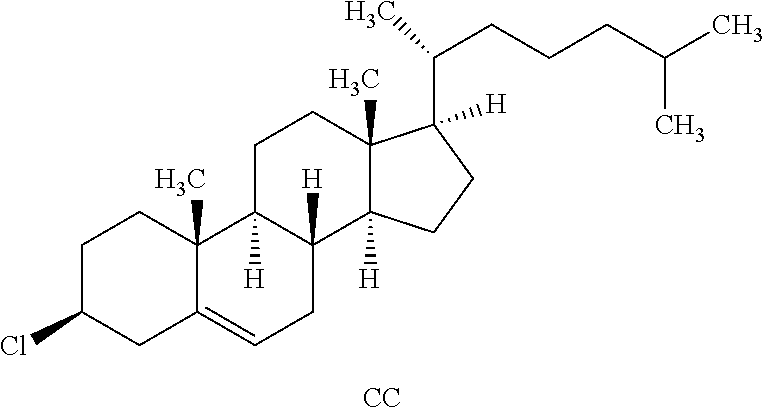 |
 |
 |
 |
 |
 |
 |
 |
-
- Vo denotes threshold voltage, capacitive [V] at 20° C.,
- ne denotes extraordinary refractive index at 20° C. and 589 nm,
- no denotes ordinary refractive index at 20° C. and 589 nm,
- Δn denotes optical anisotropy at 20° C. and 589 nm,
- ε⊥ denotes dielectric permittivity perpendicular to the director at 20° C. and 1 kHz,
- ε∥ denotes dielectric permittivity parallel to the director at 20° C. and 1 kHz,
- Δε denotes dielectric anisotropy at 20° C. and 1 kHz,
- clp., T(N,I) denotes clearing point [° C.],
- γ1 denotes rotational viscosity measured at 20° C. [mPa·s],
- K1 denotes elastic constant, “splay” deformation at 20° C. [pN],
- K2 denotes elastic constant, “twist” deformation at 20° C. [pN],
- K3 denotes elastic constant, “bend” deformation at 20° C. [pN],
- Kavg. denotes average elastic constant defined as Kavg.=⅓(1.5·K1+K3)
- LTS denotes low-temperature stability (nematic phase), determined in test cells or in the bulk, as specified.
-
- dist. distilled
- DABCO 1,4-Diazabicyclo[2.2.2]octane
- THE Tetrahydrofuran
- MTB ether Methyl-tert-butyl ether
- dist. distilled
- XPhos 2-Dicyclohexylphosphino-2′,4′,6′-triisopropylbiphenyl
- XPhos Pd G2 Chloro(2-dicyclohexylphosphino-2′,4′,6′-triisopropyl-1,1′-biphenyl)[2-(2′-amino-1,1′-biphenyl)palladium (II)
- Pd(amphos)Cl2 Bis(di-tert-butyl(4-dimethylaminophenyl)phosphine)dichloropalladium(II)


-
- Δε=8.42
- Δn=0.2701
- γ1=565 mPas


-
- Δε=8.92
- Δn=0.3776
- γ1=74 mPas


-
- Δε=10.51
- Δn=0.5021
- γ1=472 mPas


-
- Δε=9.72
- Δn=0.4573
- γ1=732 mPas


-
- Δε=1.92
- Δn=0.3329
- γ1=522 mPas
| physical | ||
| No. | Compound | properties |
| 6 |
 |
|
| 7 |
 |
|
| 8 |
 |
|
| 9 |
 |
|
| 10 |
 |
|
| 11 |
 |
|
| 12 |
 |
|
| 13 |
 |
|
| 14 |
 |
|
| 15 |
 |
|
| 16 |
 |
|
| 17 |
 |
K 52 I Δε = 9.92 Δn = 0.4079 γ1 = 70 mPas |
| 18 |
 |
K 52 N (44) I Δε = 9.14 Δn = 0.3863 γ1 = 89 mPas |
| 19 |
 |
|
| 20 |
 |
|
| 21 |
 |
|
| 22 |
 |
|
| 23 |
 |
|
| 24 |
 |
K 41 I Δε = 7.52 Δn = 0.3252 γ1 = 106 mPas |
| 25 |
 |
|
| 26 |
 |
|
| 27 |
 |
|
| 28 |
 |
|
| 29 |
 |
|
| 30 |
 |
|
| 31 |
 |
|
| 32 |
 |
|
| 33 |
 |
|
| 34 |
 |
|
| 35 |
 |
|
| 36 |
 |
|
| 37 |
 |
|
| 38 |
 |
|
| 39 |
 |
|
| 40 |
 |
|
| 41 |
 |
|
| 42 |
 |
|
| 43 |
 |
|
| 44 |
 |
|
| 45 |
 |
|
| 46 |
 |
|
| 47 |
 |
|
| 48 |
 |
|
| 49 |
 |
|
| 50 |
 |
|
| 51 |
 |
|
| 52 |
 |
|
| 53 |
 |
|
| 54 |
 |
|
| 55 |
 |
|
| 56 |
 |
|
| 57 |
 |
|
| 58 |
 |
|
| 59 |
 |
|
| 60 |
 |
|
| 61 |
 |
|
| 62 |
 |
|
| 63 |
 |
|
| 64 |
 |
|
| 65 |
 |
|
| 66 |
 |
|
| 67 |
 |
|
| 68 |
 |
K 55 SmA 123 N 191 I Δε = 9.43 Δn = 0.4827 |
| 69 |
 |
|
| 70 |
 |
|
| 71 |
 |
|
| 72 |
 |
|
| 73 |
 |
|
| 74 |
 |
|
| 75 |
 |
|
| 76 |
 |
|
| 77 |
 |
|
| 78 |
 |
|
| 79 |
 |
|
| 80 |
 |
|
| 81 |
 |
|
| 82 |
 |
|
| 83 |
 |
|
| 84 |
 |
|
| 85 |
 |
|
| 86 |
 |
|
| ST-3b-1 | 0.12 | Clp. [° C.]: | 155.5 |
| PTU-3-S | 9.988 | Δn [589 nm, 20° C.]: | 0.3688 |
| PTU-5-S | 10.9868 | ne [589 nm, 20° C.]: | 1.8739 |
| PPTU-4-S | 5.9928 | no [589 nm, 20° C.]: | 1.5051 |
| PPTU-5-S | 9.988 | Δε [1 kHz, 20° C.]: | 18.8 |
| PGTU-4-S | 5.9928 | ε|| [1 kHz, 20° C.]: | 22.8 |
| PGU-3-S | 11.9856 | ε⊥ [1 kHz, 20° C.]: | 4.0 |
| PPU-TO-S | 22.9724 | γ1 [mPa s, 20° C.]: | 464 |
| CPTU-5-S | 21.9736 | K1 [pN, 20° C.]: | 17.2 |
| Σ | 100.0 | K3 [pN, 20° C.]: | 24.9 |
| K3/K1 [pN, 20° C.]: | 1.44 | ||
| V0 [V, 20° C.]: | 1.02 | ||
| LTS bulk [h, −30° C.]: | 1000 | ||
| LTS bulk [h, −40° C.]: | 1000 | ||
| εr, || [20° C., 19 GHz]: | 3.70 | ||
| tan δε r, || [20° C., 19 GHz]: | 0.0061 | ||
| εr, ⊥ [20° C., 19 GHz]: | 2.45 | ||
| tan δε r, ⊥ [20° C., 19 GHz]: | 0.0110 | ||
| τ [20° C., 19 GHz]: | 0.338 | ||
| η [20° C., 19 GHz]: | 30.9 | ||
| PPTU-4-S | 6.0 | Clp. [° C.]: | 160.5 |
| PPTU-5-S | 10.0 | Δε [1 kHz, 20° C.]: | 16.1 |
| PGTU-4-S | 6.0 | ε|| [1 kHz, 20° C.]: | 19.8 |
| PGU-3-S | 12.0 | ε⊥ [1 kHz, 20° C.]: | 3.7 |
| PPU-TO-S | 23.0 | γ1 [mPa s, 20° C.]: | 466 |
| CPTU-5-S | 22.0 | K1 [pN, 20° C.]: | 19.0 |
| PTG(F)-3-S | 11.0 | K3 [pN, 20° C.]: | 25.8 |
| PTG(F)-4-S | 10.0 | K3/K1 [pN, 20° C.]: | 1.36 |
| Σ | 100.0 | V0 [V, 20° C.]: | 1.15 |
| LTS bulk [h, −30° C.]: | 1000 | ||
| εr, || [20° C., 19 GHz]: | 3.76 | ||
| tan δε r, || [20° C., 19 GHz]: | 0.0060 | ||
| εr, ⊥ [20° C., 19 GHz]: | 2.46 | ||
| tan δε r, ⊥ [20° C., 19 GHz]: | 0.0102 | ||
| τ [20° C., 19 GHz]: | 0.346 | ||
| η [20° C., 19 GHz]: | 34.0 | ||
| ST-3b-1 | 0.12 | Clp. [° C.]: | 158 |
| PPTU-4-S | 5.9928 | Δn [589 nm, 20° C.]: | 0.4015 |
| PPTU-5-S | 14.982 | ne [589 nm, 20° C.]: | 1.9286 |
| PPU-TO-S | 15.9808 | no [589 nm, 20° C.]: | 1.5271 |
| CPTU-5-S | 24.97 | Δε [1 kHz, 20° C.]: | 15.0 |
| PTU-3-S | 9.988 | ε|| [1 kHz, 20° C.]: | 18.6 |
| PTU-5-S | 9.988 | ε⊥ [1 kHz, 20° C.]: | 3.6 |
| CPU(F.F)-3-S | 17.9784 | γ1 [mPa s, 20° C.]: | 492 |
| Σ | 100.0 | K1 [pN, 20° C.]: | 17.6 |
| K3 [pN, 20° C.]: | 24.4 | ||
| K3/K1 [pN, 20° C.]: | 1.39 | ||
| V0 [V, 20° C.]: | 1.14 | ||
| LTS bulk [h, −30° C.]: | 1000 | ||
| LTS bulk [h, −40° C.]: | 960 | ||
| εr, || [20° C., 19 GHz]: | 3.59 | ||
| tan δε r, || [20° C., 19 GHz]: | 0.0052 | ||
| εr, ⊥ [20° C., 19 GHz]: | 2.42 | ||
| tan δε r, ⊥ [20° C., 19 GHz]: | 0.0084 | ||
| τ [20° C., 19 GHz]: | 0.328 | ||
| η [20° C., 19 GHz]: | 39.0 | ||
| PPTU-4-S | 6.0 | Clp. [° C.]: | 159.5 |
| PPTU-5-S | 15.0 | Δε [1 kHz, 20° C.]: | 13.0 |
| PPU-TO-S | 14.0 | ε|| [1 kHz, 20° C.]: | 16.4 |
| CPTU-5-S | 25.0 | ε⊥ [1 kHz, 20° C.]: | 3.4 |
| CPU(F.F)-3-S | 18.0 | γ1 [mPa s, 20° C.]: | 472 |
| PTG(F)-3-S | 11.0 | K1 [pN, 20° C.]: | 19.1 |
| PTG(F)-4-S | 11.0 | K3 [pN, 20° C.]: | 24.3 |
| Σ | 100.0 | K3/K1 [pN, 20° C.]: | 1.27 |
| V0 [V, 20° C.]: | 1.28 | ||
| LTS bulk [h, −30° C.]: | 1000 | ||
| εr, || [20° C., 19 GHz]: | 3.62 | ||
| tan δε r, || [20° C., 19 GHz]: | 0.0050 | ||
| εr, ⊥ [20° C., 19 GHz]: | 2.41 | ||
| tan δε r, ⊥ [20° C., 19 GHz]: | 0.0075 | ||
| τ [20° C., 19 GHz]: | 0.334 | ||
| η [20° C., 19 GHz]: | 44.9 | ||
| PTU-5-S | 9.0 | Clp. [° C.]: | 156.5 |
| PPTU-4-S | 6.0 | Δε [1 kHz, 20° C.]: | 14.1 |
| PPTU-5-S | 12.0 | ε|| [1 kHz, 20° C.]: | 17.5 |
| CPTU-5-S | 21.0 | ε⊥ [1 kHz, 20° C.]: | 3.4 |
| CPU(F.F)-3-S | 18.0 | γ1 [mPa s, 20° C.]: | 458 |
| CPG(F)-4-S | 4.0 | K1 [pN, 20° C.]: | 19.9 |
| PTPG(F)-4-S | 6.0 | K3 [pN, 20° C.]: | 22.7 |
| PTG(F)-4-S | 14.0 | K3/K1 [pN, 20° C.]: | 1.14 |
| PPG(F)-TO-S | 2.0 | V0 [V, 20° C.]: | 1.25 |
| PPTG(F)-4-S | 8.0 | LTS bulk [h, −20° C.]: | 144 |
| Σ | 100.0 | τ [20° C., 19 GHz]: | 0.330 |
| εr, || [20° C., 19 GHz]: | 3.58 | ||
| εr, ⊥ [20° C., 19 GHz]: | 2.39 | ||
| tan δε r, || [20° C., 19 GHz]: | 0.0047 | ||
| tan δε r, ⊥ [20° C., 19 GHz]: | 0.0069 | ||
| η [20° C., 19 GHz]: | 47.9 | ||
| PTU-3-S | 10.0 | Clp. [° C.]: | 153 |
| PPTU-4-S | 6.0 | Δε [1 kHz, 20° C.]: | 16.6 |
| PPTU-5-S | 10.0 | ε|| [1 kHz, 20° C.]: | 20.3 |
| PGTU-4-S | 6.0 | ε⊥ [1 kHz, 20° C.]: | 3.8 |
| PGU-3-S | 6.0 | γ1 [mPa s, 20° C.]: | 417 |
| PPU-TO-S | 16.0 | K1 [pN, 20° C.]: | 19.0 |
| CPTU-5-S | 18.0 | K3 [pN, 20° C.]: | 22.4 |
| PTPG(F)-4-S | 4.0 | K3/K1 [pN, 20° C.]: | 1.18 |
| PTG(F)-4-S | 16.0 | V0 [V, 20° C.]: | 1.13 |
| PPTG(F)-4-S | 8.0 | LTS bulk [h, −20° C.]: | 144 |
| Σ | 100.0 | τ [20° C., 19 GHz]: | 0.344 |
| εr, || [20° C., 19 GHz]: | 3.73 | ||
| εr, ⊥ [20° C., 19 GHz]: | 2.45 | ||
| tan δε r, || [20° C., 19 GHz]: | 0.0059 | ||
| tan δε r, ⊥ [20° C., 19 GHz]: | 0.0098 | ||
| η [20° C., 19 GHz]: | 35.1 | ||
| PTU-3-S | 11.0 | Clp. [° C.]: | 155 |
| PTU-5-S | 11.0 | Δε [1 kHz, 20° C.]: | 20.0 |
| PPTU-4-S | 6.0 | ε|| [1 kHz, 20° C.]: | 24.0 |
| PPTU-5-S | 10.0 | ε⊥ [1 kHz, 20° C.]: | 4.0 |
| PGTU-4-S | 6.0 | γ1 [mPa s, 20° C.]: | 471 |
| PGU-3-S | 12.0 | K1 [pN, 20° C.]: | 18.8 |
| PPU-TO-S | 12.0 | K3 [pN, 20° C.]: | 23.3 |
| CPTU-5-S | 22.0 | K3/K1 [pN, 20° C.]: | 1.24 |
| PTPG(F)-4-S | 10.0 | V0 [V, 20° C.]: | 1.03 |
| Σ | 100.0 | LTS bulk [h, −40° C.]: | 1000 |
| εr, || [20° C., 19 GHz]: | 3.70 | ||
| tan δε r, || [20° C., 19 GHz]: | 0.0058 | ||
| εr, ⊥ [20° C., 19 GHz]: | 2.45 | ||
| tan δε r, ⊥ [20° C., 19 GHz]: | 0.0105 | ||
| τ [20° C., 19 GHz]: | 0.338 | ||
| η [20° C., 19 GHz]: | 32.3 | ||
| PTU-3-S | 10.0 | Clp. [° C.]: | 150.5 |
| PTU-5-S | 10.0 | Δε [1 kHz, 20° C.]: | 18.4 |
| PPTU-4-S | 6.0 | ε|| [1 kHz, 20° C.]: | 22.3 |
| PPTU-5-S | 15.0 | ε⊥ [1 kHz, 20° C.]: | 3.9 |
| PGTU-4-S | 6.0 | γ1 [mPa s, 20° C.]: | 655 |
| PTPG(F)-4-S | 8.0 | K1 [pN, 20° C.]: | 18.5 |
| PP(1)TU-TO-S | 14.0 | K3 [pN, 20° C.]: | 22.2 |
| PTPU-TO-S | 6.0 | K3/K1 [pN, 20° C.]: | 1.20 |
| PPTU-4(1[2])-S | 25.0 | V0 [V, 20° C.]: | 1.06 |
| Σ | 100.00 | εr, || [20° C., 19 GHz]: | 3.81 |
| tan δε r, || [20° C., 19 GHz]: | 0.0050 | ||
| εr, ⊥ [20° C., 19 GHz]: | 2.45 | ||
| tan δε r, ⊥ [20° C., 19 GHz]: | 0.0085 | ||
| τ [20° C., 19 GHz]: | 0.357 | ||
| η [20° C., 19 GHz]: | 42.3 | ||
| PTU-3-S | 10.0 | Clp. [° C.]: | 160.5 |
| PTU-5-S | 5.0 | Δε [1 kHz, 20° C.]: | 17.7 |
| PPTU-4-S | 6.0 | ε|| [1 kHz, 20° C.]: | 21.4 |
| PPTU-5-S | 15.0 | ε⊥ [1 kHz, 20° C.]: | 3.8 |
| PGTU-4-S | 6.0 | γ1 [mPa s, 20° C.]: | 768 |
| PTPG(F)-4-S | 8.0 | K1 [pN, 20° C.]: | 19.0 |
| PP(1)TU-TO-S | 16.0 | K3 [pN, 20° C.]: | 23.4 |
| PTPU-TO-S | 8.0 | K3/K1 [pN, 20° C.]: | 1.23 |
| PPTU-4(1[2])-S | 26.0 | V0 [V, 20° C.]: | 1.09 |
| Σ | 100.0 | εr, || [20° C., 19 GHz]: | 3.86 |
| tan δε r, || [20° C., 19 GHz]: | 0.0048 | ||
| εr, ⊥ [20° C., 19 GHz]: | 2.48 | ||
| tan δε r, ⊥ [20° C., 19 GHz]: | 0.0084 | ||
| τ [20° C., 19 GHz]: | 0.357 | ||
| η [20° C., 19 GHz]: | 42.8 | ||
| PPTU-4-S | 6.0 | Clp. [° C.]: | 165 |
| PPTU-5-S | 14.0 | LTS bulk [h, −30° C.]: | 480 |
| PPU-TO-S | 22.0 | LTS bulk [h, −40° C.]: | 1000 |
| CPTU-5-S | 22.0 | εr, || [20° C., 19 GHz]: | 3.61 |
| PTU-3-S | 8.0 | tan δε r, || [20° C., 19 GHz]: | 0.0053 |
| PTU-5-S | 8.0 | εr, ⊥ [20° C., 19 GHz]: | 2.45 |
| CPG(F)-4-S | 20.0 | tan δε r, ⊥ [20° C., 19 GHz]: | 0.0084 |
| Σ | 100.0 | τ [20° C., 19 GHz]: | 0.322 |
| η [20° C., 19 GHz]: | 38.3 | ||
| PPTU-4-S | 10.0 | Clp. [° C.]: | 164 |
| PPTU-5-S | 20.0 | Δε [1 kHz, 20° C.]: | 12.3 |
| CPTU-5-S | 15.0 | ε|| [1 kHz, 20° C.]: | 15.5 |
| CPU(F.F)-3-S | 18.0 | ε⊥ [1 kHz, 20° C.]: | 3.2 |
| CPG(F)-4-S | 12.0 | γ1 [mPa s, 20° C.]: | 475 |
| CPG(F)-4-S | 10.0 | K1 [pN, 20° C.]: | 19.9 |
| PTG(F)-4-S | 15.0 | K3 [pN, 20° C.]: | 22.0 |
| Σ | 100.0 | K3/K1 [pN, 20° C.]: | 1.11 |
| V0 [V, 20° C.]: | 1.34 | ||
| εr, || [20° C., 19 GHz]: | 3.53 | ||
| tan δε r, || [20° C., 19 GHz]: | 0.0044 | ||
| εr, ⊥ [20° C., 19 GHz]: | 2.40 | ||
| tan δε r, ⊥ [20° C., 19 GHz]: | 0.0058 | ||
| τ [20° C., 19 GHz]: | 0.322 | ||
| η [20° C., 19 GHz]: | 55.9 | ||
Host Mixture H1
| ST-3b-1 | 0.12 | Clp. [° C.]: | 151 | |
| PTU-3-S | 15.98 | Δn [589 nm, 20° C.]: | 0.3779 | |
| PGU-3-S | 13.98 | ne [589 nm, 20° C.]: | 1.9169 | |
| PPTU-5-S | 19.98 | no [589 nm, 20° C.]: | 1.5390 | |
| CPU-2-S | 34.96 | Δε [1 kHz, 20° C.]: | 22.7 | |
| CPU-4-S | 14.98 | ε∥ [1 kHz, 20° C.]: | 27.0 | |
| Σ | 95.00 | ε⊥ [1 kHz, 20° C.]: | 4.4 | |
| γ1 [mPa s, 20° C.]: | 384 | |||
| K1 [pN, 20° C.]: | 16.8 | |||
| K3 [pN, 20° C.]: | 21.6 | |||
| K3/K1 [pN, 20° C.]: | 1.29 | |||
| V0 [V, 20° C.]: | 0.91 | |||
| LTS bulk [h, −20° C.]: | 1000 | |||
| LTS bulk [h, −30° C.]: | 216 | |||
| εr, ∥ [20° C., 19 GHz]: | 3.59 | |||
| tan δε r, ∥ [20° C., 19 GHz]: | 0.0059 | |||
| εr, ⊥ [20° C., 19 GHz]: | 2.47 | |||
| tan δε r, ⊥ [20° C., 19 GHz]: | 0.0106 | |||
| τ [20° C., 19 GHz]: | 0.311 | |||
| η [20° C., 19 GHz]: | 29.3 | |||
| PTU-3-S | 10.0 | er, ∥ [20° C., 19 GHz]: | 3.53 | |
| H1 | 90.0 | tan de r, ∥ [20° C., 19 GHz]: | 0.0062 | |
| 0.0 | er, {circumflex over ( )} [20° C., 19 GHz]: | 2.44 | ||
| S | 100.0 | tan de r, {circumflex over ( )} [20° C., 19 GHz]: | 0.0111 | |
| t [20° C., 19 GHz]: | 0.310 | |||
| h [20° C., 19 GHz]: | 27.9 | |||
| PTG(F)-3-S | 10.0 | εr, ∥ [20° C., 19 GHz]: | 3.59 | |
| H1 | 90.0 | tan δε r, ∥ [20° C., 19 GHz]: | 0.0063 | |
| Σ | 100.0 | εr, ⊥ [20° C., 19 GHz]: | 2.47 | |
| tan δε r, ⊥ [20° C., 19 GHz]: | 0.0109 | |||
| τ [20° C., 19 GHz]: | 0.313 | |||
| η [20° C., 19 GHz]: | 28.9 | |||
| PTG(F)-5-S | 10.0 | εr, ∥ [20° C., 19 GHz]: | 3.58 | |
| H1 | 90.0 | tan δε r, ∥ [20° C., 19 GHz]: | 0.0063 | |
| Σ | 100.0 | εr, ⊥ [20° C., 19 GHz]: | 2.46 | |
| tan δε r, ⊥ [20° C., 19 GHz]: | 0.0109 | |||
| τ [20° C., 19 GHz]: | 0.313 | |||
| η [20° C., 19 GHz]: | 28.9 | |||
| PPTU-4-S | 10.0 | er, ∥ [20° C., 19 GHz]: | 3.61 | |
| H1 | 90.0 | tan δe r, ∥ [20° C., 19 GHz]: | 0.0059 | |
| 0.0 | er, {circumflex over ( )} [20° C., 19 GHz]: | 2.49 | ||
| Σ | 100.0 | tan de r, {circumflex over ( )} [20° C., 19 GHz]: | 0.0104 | |
| t [20° C., 19 GHz]: | 0.312 | |||
| h [20° C., 19 GHz]: | 30.0 | |||
| PPTG(F)-4-S | 10.0 | εr, ∥ [20° C., 19 GHz]: | 3.63 | |
| H1 | 90.0 | tan δε r, ∥ [20° C., 19 GHz]: | 0.0057 | |
| Σ | 100.0 | εr, ⊥ [20° C., 19 GHz]: | 2.47 | |
| tan δε r, ⊥ [20° C., 19 GHz]: | 0.0102 | |||
| τ [20° C., 19 GHz]: | 0.318 | |||
| η [20° C., 19 GHz]: | 31.4 | |||
| PPTG(F)-4(1[2])-S | 10.0 | εr, ∥ [20° C., 19 GHz]: | 3.59 |
| H1 | 90.0 | tan δε r, ∥ [20° C., 19 GHz]: | 0.0055 |
| Σ | 100.0 | εr, ⊥ [20° C., 19 GHz]: | 2.45 |
| tan δε r, ⊥ [20° C., 19 GHz]: | 0.0096 | ||
| τ [20° C., 19 GHz]: | 0.318 | ||
| η [20° C., 19 GHz] | 33.1 | ||
| PPTU-4-S | 6.0 | Clp. [° C.]: | 151 |
| PPTU-5-S | 12.0 | Δε [1 kHz, 20° C.]: | 16.1 |
| PGTU-4-S | 6.0 | ε∥ [1 kHz, 20° C.]: | 19.9 |
| PGU-3-S | 16.0 | ε⊥ [1 kHz, 20° C.]: | 3.8 |
| PPU-TO-S | 26.0 | γ1 [mPa s, 20° C.]: | 419 |
| CPTU-5-S | 10.0 | K1 [pN, 20° C.]: | 18.6 |
| PTG(F)-3-S | 14.0 | K3 [pN, 20° C.]: | 24.3 |
| PTG(F)-4-S | 10.0 | K3/K1 [pN, 20° C.]: | 1.31 |
| Σ | 100.0 | V0 [V, 20° C.]: | 1.13 |
| εr, ∥ [20° C., 19 GHz]: | 3.78 | ||
| tan δε r, ∥ [20° C., 19 GHz]: | 0.0064 | ||
| εr, ⊥ [20° C., 19 GHz]: | 2.47 | ||
| tan δε r, ⊥ [20° C., 19 GHz]: | 0.0109 | ||
| τ [20° C., 19 GHz]: | 0.348 | ||
| η [20° C., 19 GHz]: | 32.1 | ||
| PPTU-4-S | 6.0 | Clp. [° C.]: | 155 |
| PPTU-5-S | 12.0 | Δε [1 kHz, 20° C.]: | 16.6 |
| PGTU-4-S | 6.0 | ε∥ [1 kHz, 20° C.]: | 20.3 |
| PGU-3-S | 16.0 | ε⊥ [1 kHz, 20° C.]: | 3.8 |
| PPU-TO-S | 24.0 | γ1 [mPa s, 20° C.]: | 445 |
| CPTU-5-S | 14.0 | K1 [pN, 20° C.]: | 19.3 |
| PTG(F)-3-S | 12.0 | K3 [pN, 20° C.]: | 24.8 |
| PTG(F)-4-S | 10.0 | K3/K1 [pN, 20° C.]: | 1.28 |
| Σ | 100.0 | V0 [V, 20° C.]: | 1.14 |
| LTS bulk [h, −30° C.]: | 72 | ||
| εr, ∥ [20° C., 19 GHz]: | 3.75 | ||
| tan δε r, ∥ [20° C., 19 GHz]: | 0.0062 | ||
| εr, ⊥ [20° C., 19 GHz]: | 2.46 | ||
| tan δε r, ⊥ [20° C., 19 GHz]: | 0.0106 | ||
| τ [20° C., 19 GHz]: | 0.343 | ||
| η [20° C., 19 GHz]: | 32.6 | ||
| PPTU-4-S | 6.0 | Clp. [° C.]: | 151 |
| PPTU-5-S | 12.0 | Δε [1 kHz, 20° C.]: | 12.4 |
| PPU-TO-S | 16.0 | ε∥ [1 kHz, 20° C.]: | 15.8 |
| CPTU-5-S | 22.0 | ε⊥ [1 kHz, 20° C.]: | 3.4 |
| CPU(F.F)-3-S | 18.0 | γ1 [mPa s, 20° C.]: | 440 |
| PTG(F)-3-S | 14.0 | K1 [pN, 20° C.]: | 17.9 |
| PTG(F)-4-S | 12.0 | K3 [pN, 20° C.]: | 24.7 |
| Σ | 100.0 | K3/K1 [pN, 20° C.]: | 1.38 |
| V0 [V, 20° C.]: | 1.27 | ||
| LTS bulk [h, −30° C.]: | 456 | ||
| εr, ∥ [20° C., 19 GHz]: | 3.59 | ||
| tan δε r, ∥ [20° C., 19 GHz]: | 0.0052 | ||
| εr, ⊥ [20° C., 19 GHz]: | 2.40 | ||
| tan δε r, ⊥ [20° C., 19 GHz]: | 0.0076 | ||
| τ [20° C., 19 GHz]: | 0.332 | ||
| η [20° C., 19 GHz]: | 43.7 | ||
| PTU-3-S | 10.0 | Clp. [° C]: | 156 |
| PPTU-4-S | 6.0 | Δε [1 kHz, 20° C.]: | 13.9 |
| PPTU-5-S | 12.0 | ε∥ [1 kHz, 20° C.]: | 17.5 |
| PPU-TO-S | 16.0 | ε⊥ [1 kHz, 20° C.]: | 3.5 |
| CPTU-5-S | 25.0 | γ1 [mPa s, 20° C.]: | 459 |
| CPU(F.F)-3-S | 18.0 | K1 [pN, 20° C.]: | 18.1 |
| PTG(F)-3-S | 13.0 | K3 [pN, 20° C.]: | 24.7 |
| Σ | 100.0 | K3/K1 [pN, 20° C.]: | 1.36 |
| V0 [V, 20° C.]: | 1.21 | ||
| LTS bulk [h, −30° C.]: | 168 | ||
| εr, ∥ [20° C., 19 GHz]: | 3.62 | ||
| tan δε r, ∥ [20° C., 19 GHz]: | 0.0052 | ||
| εr, ⊥ [20° C., 19 GHz]: | 2.43 | ||
| tan δε r, ⊥ [20° C., 19 GHz]: | 0.0080 | ||
| τ [20° C., 19 GHz]: | 0.329 | ||
| η [20° C., 19 GHz]: | 41.2 | ||
| PPTU-4-S | 6.0 | Clp. [° C.]: | 161 |
| PPTU-5-S | 15.0 | Δε [1 kHz, 20° C.]: | 15.7 |
| PGU-3-S | 12.0 | ε∥ [1 kHz, 20° C.]: | 19.3 |
| PPU-TO-S | 23.0 | ε⊥ [1 kHz, 20° C.]: | 3.6 |
| CPTU-5-S | 23.0 | γ1 [mPa s, 20° C.]: | 466 |
| PTG(F)-3-S | 11.0 | K1 [pN, 20° C.]: | 19.2 |
| PTG(F)-4-S | 10.0 | K3 [pN, 20° C.]: | 26.7 |
| Σ | 100.0 | K3/K1 [pN, 20° C.]: | 1.39 |
| V0 [V, 20° C.]: | 1.17 | ||
| εr, ∥ [20° C., 19 GHz]: | 3.75 | ||
| tan δε r, ∥ [20° C., 19 GHz]: | 0.0058 | ||
| εr, ⊥ [20° C., 19 GHz]: | 2.46 | ||
| tan δε r, ⊥ [20° C., 19 GHz]: | 0.0096 | ||
| τ [20° C., 19 GHz]: | 0.343 | ||
| η [20° C., 19 GHz]: | 35.9 | ||
| PGU-3-S | 6.0 | Clp. [° C]: | 155.5 |
| PPTU-4-S | 6.0 | Δε [1 kHz, 20° C.]: | 13.8 |
| PPTU-5-S | 12.0 | ε∥ [1 kHz, 20° C.]: | 17.3 |
| PPU-TO-S | 22.0 | ε⊥ [1 kHz, 20° C.]: | 3.5 |
| CPTU-5-S | 23.0 | γ1 [mPa s, 20° C.]: | 448 |
| CPU(F.F)-3-S | 7.0 | K1 [pN, 20° C.]: | 18.1 |
| PTG(F)-3-S | 13.0 | K3 [pN, 20° C.]: | 26.0 |
| PTG(F)-4-S | 11.0 | K3/K1 [pN, 20° C.]: | 1.43 |
| Σ | 100.0 | V0 [V, 20° C.]: | 1.21 |
| LTS bulk [h, −30° C.]: | 648 | ||
| εr, ∥ [20° C., 19 GHz]: | 3.65 | ||
| tan δε r, ∥ [20° C., 19 GHz]: | 0.0056 | ||
| εr, ⊥ [20° C., 19 GHz]: | 2.40 | ||
| tan δε r, ⊥ [20° C., 19 GHz]: | 0.0086 | ||
| τ [20° C., 19 GHz]: | 0.343 | ||
| η [20° C., 19 GHz]: | 39.9 | ||
| PTG(F)-3-S | 12.0 | |
| PTG(F)-4-S | 12.0 | |
| PPTG(F)-4-S | 12.0 | |
| PPTU-4(1[2])-S | 20.0 | |
| PTPG(F)-4-S | 8.0 | |
| PPG(F)-TO-S | 6.0 | |
| CPG(F)-4-S | 30.0 | |
| Σ | 100.0 | |
| PTG(F)-3-S | 10.0 | Clp. [° C.]: | 155.5 |
| PTU-3-S | 10.0 | Δε [1 kHz, 20° C.]: | 17.3 |
| PTU-5-S | 10.0 | ε∥ [1 kHz, 20° C.]: | 21.3 |
| PPTU-5-S | 15.0 | ε⊥ [1 kHz, 20° C.]: | 4.0 |
| CPTU-5-S | 15.0 | γ1 [mPa s, 20° C.]: | 800 |
| PPI(1)GU-5-S | 7.0 | K1 [pN, 20° C.]: | 17.2 |
| PPI(2)PU-5-S | 10.0 | K3 [pN, 20° C.]: | 26.2 |
| PGPU-5-S | 5.0 | K3/K1 [pN, 20° C.]: | 1.53 |
| PP(1)PU-5-S | 6.0 | V0 [V, 20° C.]: | 1.06 |
| PPI(1)PU-5-S | 7.0 | εr, ∥ [20° C., 19 GHz]: | 3.81 |
| CTUIU-5-S | 5.0 | tan δε r, ∥ [20° C., 19 GHz]: | 0.0043 |
| Σ | 100.0 | εr, ⊥ [20° C., 19 GHz]: | 2.60 |
| tan δε r, ⊥ [20° C., 19 GHz]: | 0.0070 | ||
| τ [20° C., 19 GHz]: | 0.317 | ||
| η [20° C., 19 GHz]: | 45.3 | ||
| PPTU-4-S | 6.0 | Clp. [° C.]: | 160.5 |
| PPTU-5-S | 15.0 | Δε [1 kHz, 20° C.]: | 13.0 |
| CPTU-5-S | 24.0 | ε∥ [1 kHz, 20° C.]: | 16.2 |
| CPU(F.F)-3-S | 18.0 | ε⊥ [1 kHz, 20° C.]: | 3.3 |
| PTUI-2-S | 12.0 | γ1 [mPa s, 20° C.]: | 477 |
| PTUI-4-S | 10.0 | K1 [pN, 20° C.]: | 20.3 |
| PPTU-4(1[2])-S | 10.0 | K3 [pN, 20° C.]: | 22.0 |
| PPTG(F)-4-S | 5.0 | K3/K1 [pN, 20° C.]: | 1.08 |
| Σ | 100.0 | V0 [V, 20° C.]: | 1.32 |
| εr, ∥ [20° C., 19 GHz]: | 3.76 | ||
| tan δε r, ∥ [20° C., 19 GHz]: | 0.0046 | ||
| εr, ⊥ [20° C., 19 GHz]: | 2.48 | ||
| tan δε r, ⊥ [20° C., 19 GHz]: | 0.0057 | ||
| τ [20° C., 19 GHz]: | 0.341 | ||
| η [20° C., 19 GHz]: | 60.3 | ||
Claims (20)


Applications Claiming Priority (4)
| Application Number | Priority Date | Filing Date | Title |
|---|---|---|---|
| EP21166153.3 | 2021-03-31 | ||
| EP21166153 | 2021-03-31 | ||
| EP21166153 | 2021-03-31 | ||
| PCT/EP2022/058184 WO2022207584A2 (en) | 2021-03-31 | 2022-03-29 | Aromatic isothiocyanates |
Publications (2)
| Publication Number | Publication Date |
|---|---|
| US20240199957A1 US20240199957A1 (en) | 2024-06-20 |
| US12203023B2 true US12203023B2 (en) | 2025-01-21 |
Family
ID=75339454
Family Applications (1)
| Application Number | Title | Priority Date | Filing Date |
|---|---|---|---|
| US18/284,204 Active US12203023B2 (en) | 2021-03-31 | 2022-03-29 | Aromatic isothiocyanates |
Country Status (7)
| Country | Link |
|---|---|
| US (1) | US12203023B2 (en) |
| EP (1) | EP4314194B1 (en) |
| JP (1) | JP2024512675A (en) |
| KR (1) | KR20230163553A (en) |
| CN (1) | CN117043304A (en) |
| TW (1) | TW202304856A (en) |
| WO (1) | WO2022207584A2 (en) |
Families Citing this family (7)
| Publication number | Priority date | Publication date | Assignee | Title |
|---|---|---|---|---|
| EP4041846B1 (en) * | 2019-10-10 | 2024-04-17 | Merck Patent GmbH | Fluorinated aromatic compounds |
| WO2022043376A1 (en) * | 2020-08-28 | 2022-03-03 | Merck Patent Gmbh | Aromatic isothiocyanates |
| US12203023B2 (en) * | 2021-03-31 | 2025-01-21 | Merck Patent Gmbh | Aromatic isothiocyanates |
| CN117625206B (en) * | 2022-08-17 | 2025-10-14 | 西安近代化学研究所 | Liquid crystal composition and high-frequency component with low viscoelastic ratio, large dielectric tunability and low dielectric loss |
| WO2024188996A1 (en) | 2023-03-15 | 2024-09-19 | Merck Patent Gmbh | Liquid crystal device and antenna |
| TW202503390A (en) * | 2023-07-04 | 2025-01-16 | 日商Dic股份有限公司 | Liquid crystal composition and liquid crystal display element, sensor, liquid crystal lens, optical communication device and antenna using the same |
| WO2025204829A1 (en) * | 2024-03-28 | 2025-10-02 | 富士フイルム株式会社 | Composition and radio wave control element |
Citations (22)
| Publication number | Priority date | Publication date | Assignee | Title |
|---|---|---|---|---|
| US4826620A (en) | 1985-09-30 | 1989-05-02 | Hoechst Aktiengesellschaft | Chiral phenolic esters of mesogenic carboxylic acids and their use as admixture in liquid crystal phases |
| US4988458A (en) | 1985-09-30 | 1991-01-29 | Hoechst Aktiengesellschaft | Liquid crystal phase containing admixtures which effect temperature compensation |
| US5043095A (en) | 1985-09-30 | 1991-08-27 | Hoechst Aktiengesellschaft | Chiral esters of mesogenic carboxylic acids in liquid crystal phases |
| US5788880A (en) | 1995-11-09 | 1998-08-04 | Consortium Fur Elektrochemische Industrie Gmbh | Liquid-crystalline organosiloxanes containing chiral dianhydrohexitol derivatives |
| US5886242A (en) | 1993-12-11 | 1999-03-23 | Basf Aktiengesellschaft | Polymerizable, chiral compounds and their use |
| US6217792B1 (en) | 1996-07-01 | 2001-04-17 | Merck Patent Gmbh | Chiral dopants |
| US6511719B2 (en) | 1997-08-13 | 2003-01-28 | Merck Patent Gesellschaft | Chiral compounds |
| DE102004029429A1 (en) | 2003-07-11 | 2005-02-03 | Merck Patent Gmbh | Control element for use in high frequency applications such as the microwave range has a liquid crystal structure |
| JP2005120208A (en) | 2003-10-16 | 2005-05-12 | Dainippon Ink & Chem Inc | Variable function device |
| US7041345B2 (en) | 2000-07-13 | 2006-05-09 | Merck Patent Gmbh | Chiral compounds III |
| US7060331B2 (en) | 2000-07-13 | 2006-06-13 | Merck Patent Gmbh | Chiral compounds 1 |
| US7318950B2 (en) | 2000-07-13 | 2008-01-15 | Merck Gmbh | Chiral compounds II |
| US7385067B2 (en) | 2000-12-12 | 2008-06-10 | Merck Patent Gmbh | Process for the preparation of compounds having a CF2O bridge |
| US7425356B2 (en) | 2001-05-21 | 2008-09-16 | Merck Patent Gmbh | Chiral compounds |
| EP2982730A1 (en) | 2014-08-08 | 2016-02-10 | Merck Patent GmbH | Liquid-crystalline medium and high-frequency components comprising same |
| US20190352564A1 (en) | 2018-05-16 | 2019-11-21 | Merck Patent Gmbh | Liquid-crystalline medium |
| US10886317B2 (en) | 2017-02-22 | 2021-01-05 | Elwha Llc | Fabrication of optical metasurfaces |
| WO2021037962A1 (en) | 2019-08-28 | 2021-03-04 | Merck Patent Gmbh | Aromatic isothiocyanates |
| US11427761B2 (en) * | 2019-04-30 | 2022-08-30 | Merck Patent Gmbh | Isothiocyanato compounds, including tolanes |
| US20230235228A1 (en) * | 2020-04-14 | 2023-07-27 | Xi'an Modern Chemistry Research Institute | Liquid crystal (lc) composition with extremely-low dielectric loss and high-frequency component including same |
| US20240199957A1 (en) * | 2021-03-31 | 2024-06-20 | Merck Patent Gmbh | Aromatic isothiocyanates |
| US20240247190A1 (en) * | 2021-04-29 | 2024-07-25 | Merck Patent Gmbh | Liquid crystal medium |
Family Cites Families (7)
| Publication number | Priority date | Publication date | Assignee | Title |
|---|---|---|---|---|
| DE3534780A1 (en) | 1985-09-30 | 1987-04-02 | Hoechst Ag | Chiral phenol esters of mesogenic carboxylic acids, a process for the preparation thereof and the use thereof as dopes in liquid-crystal phases |
| JP2770385B2 (en) * | 1989-03-16 | 1998-07-02 | セイコーエプソン株式会社 | Pyrimidine derivatives |
| DE4027869B4 (en) * | 1989-09-07 | 2007-06-21 | Merck Patent Gmbh | Difluorophenylisothiocyanate and liquid crystalline medium |
| AU2002212282A1 (en) | 2000-10-20 | 2002-05-06 | Merck Patent G.M.B.H | Chiral binaphthol derivatives |
| CN105294526B (en) | 2015-09-10 | 2017-08-08 | 西安近代化学研究所 | A kind of high birefringence rate liquid crystal compound and preparation method thereof with and combinations thereof |
| EP3312257B1 (en) * | 2016-10-18 | 2019-11-20 | Merck Patent GmbH | Liquid-crystalline medium and high-frequency components comprising same |
| CN106978192B (en) * | 2017-04-18 | 2019-02-12 | 西安近代化学研究所 | A kind of high birefringence liquid crystal compound and its preparation method and its composition |
-
2022
- 2022-03-29 US US18/284,204 patent/US12203023B2/en active Active
- 2022-03-29 JP JP2023560399A patent/JP2024512675A/en active Pending
- 2022-03-29 EP EP22718706.9A patent/EP4314194B1/en active Active
- 2022-03-29 WO PCT/EP2022/058184 patent/WO2022207584A2/en not_active Ceased
- 2022-03-29 CN CN202280023161.5A patent/CN117043304A/en active Pending
- 2022-03-29 KR KR1020237037534A patent/KR20230163553A/en active Pending
- 2022-03-31 TW TW111112512A patent/TW202304856A/en unknown
Patent Citations (26)
| Publication number | Priority date | Publication date | Assignee | Title |
|---|---|---|---|---|
| US4826620A (en) | 1985-09-30 | 1989-05-02 | Hoechst Aktiengesellschaft | Chiral phenolic esters of mesogenic carboxylic acids and their use as admixture in liquid crystal phases |
| US4988458A (en) | 1985-09-30 | 1991-01-29 | Hoechst Aktiengesellschaft | Liquid crystal phase containing admixtures which effect temperature compensation |
| US5043095A (en) | 1985-09-30 | 1991-08-27 | Hoechst Aktiengesellschaft | Chiral esters of mesogenic carboxylic acids in liquid crystal phases |
| US5886242A (en) | 1993-12-11 | 1999-03-23 | Basf Aktiengesellschaft | Polymerizable, chiral compounds and their use |
| US5788880A (en) | 1995-11-09 | 1998-08-04 | Consortium Fur Elektrochemische Industrie Gmbh | Liquid-crystalline organosiloxanes containing chiral dianhydrohexitol derivatives |
| US6217792B1 (en) | 1996-07-01 | 2001-04-17 | Merck Patent Gmbh | Chiral dopants |
| US6511719B2 (en) | 1997-08-13 | 2003-01-28 | Merck Patent Gesellschaft | Chiral compounds |
| US7041345B2 (en) | 2000-07-13 | 2006-05-09 | Merck Patent Gmbh | Chiral compounds III |
| US7060331B2 (en) | 2000-07-13 | 2006-06-13 | Merck Patent Gmbh | Chiral compounds 1 |
| US7318950B2 (en) | 2000-07-13 | 2008-01-15 | Merck Gmbh | Chiral compounds II |
| US7385067B2 (en) | 2000-12-12 | 2008-06-10 | Merck Patent Gmbh | Process for the preparation of compounds having a CF2O bridge |
| US7425356B2 (en) | 2001-05-21 | 2008-09-16 | Merck Patent Gmbh | Chiral compounds |
| US7361288B2 (en) | 2003-07-11 | 2008-04-22 | Merck Patent Gesellschaft Mit Besschrankter Haftung | Components for high-frequency technology |
| DE102004029429A1 (en) | 2003-07-11 | 2005-02-03 | Merck Patent Gmbh | Control element for use in high frequency applications such as the microwave range has a liquid crystal structure |
| JP2005120208A (en) | 2003-10-16 | 2005-05-12 | Dainippon Ink & Chem Inc | Variable function device |
| EP2982730A1 (en) | 2014-08-08 | 2016-02-10 | Merck Patent GmbH | Liquid-crystalline medium and high-frequency components comprising same |
| US10711197B2 (en) | 2014-08-08 | 2020-07-14 | Merck Patent Gmbh | Liquid-crystalline medium and high-frequency components comprising same |
| US10886317B2 (en) | 2017-02-22 | 2021-01-05 | Elwha Llc | Fabrication of optical metasurfaces |
| US20190352564A1 (en) | 2018-05-16 | 2019-11-21 | Merck Patent Gmbh | Liquid-crystalline medium |
| US11306251B2 (en) * | 2018-05-16 | 2022-04-19 | Merck Patent Gmbh | Liquid-crystalline medium |
| US11427761B2 (en) * | 2019-04-30 | 2022-08-30 | Merck Patent Gmbh | Isothiocyanato compounds, including tolanes |
| WO2021037962A1 (en) | 2019-08-28 | 2021-03-04 | Merck Patent Gmbh | Aromatic isothiocyanates |
| US20220306938A1 (en) | 2019-08-28 | 2022-09-29 | Merck Patent Gmbh | Aromatic isothiocyanates |
| US20230235228A1 (en) * | 2020-04-14 | 2023-07-27 | Xi'an Modern Chemistry Research Institute | Liquid crystal (lc) composition with extremely-low dielectric loss and high-frequency component including same |
| US20240199957A1 (en) * | 2021-03-31 | 2024-06-20 | Merck Patent Gmbh | Aromatic isothiocyanates |
| US20240247190A1 (en) * | 2021-04-29 | 2024-07-25 | Merck Patent Gmbh | Liquid crystal medium |
Non-Patent Citations (1)
| Title |
|---|
| McManamon, "Agile Nonmechanical Beam Steering," Opt. Photon. News, Mar. 17, 24-29, 2006. |
Also Published As
| Publication number | Publication date |
|---|---|
| KR20230163553A (en) | 2023-11-30 |
| EP4314194B1 (en) | 2025-09-10 |
| TW202304856A (en) | 2023-02-01 |
| US20240199957A1 (en) | 2024-06-20 |
| EP4314194A2 (en) | 2024-02-07 |
| CN117043304A (en) | 2023-11-10 |
| WO2022207584A2 (en) | 2022-10-06 |
| JP2024512675A (en) | 2024-03-19 |
| WO2022207584A3 (en) | 2022-11-10 |
Similar Documents
| Publication | Publication Date | Title |
|---|---|---|
| US12203023B2 (en) | Aromatic isothiocyanates | |
| US11739265B2 (en) | Aromatic isothiocyanates | |
| US11427761B2 (en) | Isothiocyanato compounds, including tolanes | |
| US11964933B2 (en) | Fluorinated aromatic compounds | |
| US11834599B2 (en) | Aromatic isothiocyanates | |
| US12297386B2 (en) | Aromatic isothiocyanates | |
| US20240247190A1 (en) | Liquid crystal medium | |
| CN116507695B (en) | Aromatic isothiocyanates | |
| US20240072425A1 (en) | Aromatic isothiocyanates | |
| US12528988B2 (en) | Liquid crystal medium | |
| US12077703B2 (en) | Heteroaromatic isothiocyanates | |
| US12359128B2 (en) | Heteroaromatic isothiocyanates | |
| WO2025196107A1 (en) | Indene derivatives | |
| CN121532478A (en) | Liquid crystal media | |
| WO2024175615A1 (en) | Dihydronapthalene derivatives | |
| WO2025261973A1 (en) | Thiophene derivatives | |
| TW202603143A (en) | Indene derivatives |
Legal Events
| Date | Code | Title | Description |
|---|---|---|---|
| AS | Assignment |
Owner name: MERCK PATENT GMBH, GERMANY Free format text: ASSIGNMENT OF ASSIGNORS INTEREST;ASSIGNOR:MERCK ELECTRONICS KGAA;REEL/FRAME:065032/0179 Effective date: 20230111 Owner name: MERCK ELECTRONICS KGAA, GERMANY Free format text: ASSIGNMENT OF ASSIGNORS INTEREST;ASSIGNORS:BROCKE, CONSTANZE;KLASS, DAGMAR;FRITZSCH, CARSTEN;SIGNING DATES FROM 20230523 TO 20230614;REEL/FRAME:065032/0045 |
|
| FEPP | Fee payment procedure |
Free format text: ENTITY STATUS SET TO UNDISCOUNTED (ORIGINAL EVENT CODE: BIG.); ENTITY STATUS OF PATENT OWNER: LARGE ENTITY |
|
| STPP | Information on status: patent application and granting procedure in general |
Free format text: DOCKETED NEW CASE - READY FOR EXAMINATION |
|
| STPP | Information on status: patent application and granting procedure in general |
Free format text: NON FINAL ACTION MAILED |
|
| STPP | Information on status: patent application and granting procedure in general |
Free format text: RESPONSE TO NON-FINAL OFFICE ACTION ENTERED AND FORWARDED TO EXAMINER |
|
| STPP | Information on status: patent application and granting procedure in general |
Free format text: NOTICE OF ALLOWANCE MAILED -- APPLICATION RECEIVED IN OFFICE OF PUBLICATIONS |
|
| ZAAB | Notice of allowance mailed |
Free format text: ORIGINAL CODE: MN/=. |
|
| STPP | Information on status: patent application and granting procedure in general |
Free format text: PUBLICATIONS -- ISSUE FEE PAYMENT RECEIVED |
|
| STPP | Information on status: patent application and granting procedure in general |
Free format text: PUBLICATIONS -- ISSUE FEE PAYMENT VERIFIED |
|
| STCF | Information on status: patent grant |
Free format text: PATENTED CASE |