US12201010B2 - Organometallic compound, organic light-emitting device including the organometallic compound, and diagnostic composition including the organometallic compound - Google Patents
Organometallic compound, organic light-emitting device including the organometallic compound, and diagnostic composition including the organometallic compound Download PDFInfo
- Publication number
- US12201010B2 US12201010B2 US16/392,090 US201916392090A US12201010B2 US 12201010 B2 US12201010 B2 US 12201010B2 US 201916392090 A US201916392090 A US 201916392090A US 12201010 B2 US12201010 B2 US 12201010B2
- Authority
- US
- United States
- Prior art keywords
- group
- formula
- organometallic compound
- substituted
- layer
- Prior art date
- Legal status (The legal status is an assumption and is not a legal conclusion. Google has not performed a legal analysis and makes no representation as to the accuracy of the status listed.)
- Active, expires
Links
Images


Classifications
-
- C—CHEMISTRY; METALLURGY
- C07—ORGANIC CHEMISTRY
- C07F—ACYCLIC, CARBOCYCLIC OR HETEROCYCLIC COMPOUNDS CONTAINING ELEMENTS OTHER THAN CARBON, HYDROGEN, HALOGEN, OXYGEN, NITROGEN, SULFUR, SELENIUM OR TELLURIUM
- C07F15/00—Compounds containing elements of Groups 8, 9, 10 or 18 of the Periodic Table
- C07F15/0006—Compounds containing elements of Groups 8, 9, 10 or 18 of the Periodic Table compounds of the platinum group
- C07F15/0033—Iridium compounds
-
- C—CHEMISTRY; METALLURGY
- C09—DYES; PAINTS; POLISHES; NATURAL RESINS; ADHESIVES; COMPOSITIONS NOT OTHERWISE PROVIDED FOR; APPLICATIONS OF MATERIALS NOT OTHERWISE PROVIDED FOR
- C09K—MATERIALS FOR MISCELLANEOUS APPLICATIONS, NOT PROVIDED FOR ELSEWHERE
- C09K11/00—Luminescent materials, e.g. electroluminescent or chemiluminescent
- C09K11/06—Luminescent materials, e.g. electroluminescent or chemiluminescent containing organic luminescent materials
-
- H—ELECTRICITY
- H10—SEMICONDUCTOR DEVICES; ELECTRIC SOLID-STATE DEVICES NOT OTHERWISE PROVIDED FOR
- H10K—ORGANIC ELECTRIC SOLID-STATE DEVICES
- H10K85/00—Organic materials used in the body or electrodes of devices covered by this subclass
- H10K85/30—Coordination compounds
- H10K85/341—Transition metal complexes, e.g. Ru(II)polypyridine complexes
- H10K85/342—Transition metal complexes, e.g. Ru(II)polypyridine complexes comprising iridium
-
- C—CHEMISTRY; METALLURGY
- C09—DYES; PAINTS; POLISHES; NATURAL RESINS; ADHESIVES; COMPOSITIONS NOT OTHERWISE PROVIDED FOR; APPLICATIONS OF MATERIALS NOT OTHERWISE PROVIDED FOR
- C09K—MATERIALS FOR MISCELLANEOUS APPLICATIONS, NOT PROVIDED FOR ELSEWHERE
- C09K2211/00—Chemical nature of organic luminescent or tenebrescent compounds
- C09K2211/10—Non-macromolecular compounds
- C09K2211/1018—Heterocyclic compounds
- C09K2211/1025—Heterocyclic compounds characterised by ligands
- C09K2211/1029—Heterocyclic compounds characterised by ligands containing one nitrogen atom as the heteroatom
- C09K2211/1033—Heterocyclic compounds characterised by ligands containing one nitrogen atom as the heteroatom with oxygen
-
- C—CHEMISTRY; METALLURGY
- C09—DYES; PAINTS; POLISHES; NATURAL RESINS; ADHESIVES; COMPOSITIONS NOT OTHERWISE PROVIDED FOR; APPLICATIONS OF MATERIALS NOT OTHERWISE PROVIDED FOR
- C09K—MATERIALS FOR MISCELLANEOUS APPLICATIONS, NOT PROVIDED FOR ELSEWHERE
- C09K2211/00—Chemical nature of organic luminescent or tenebrescent compounds
- C09K2211/10—Non-macromolecular compounds
- C09K2211/1018—Heterocyclic compounds
- C09K2211/1025—Heterocyclic compounds characterised by ligands
- C09K2211/1029—Heterocyclic compounds characterised by ligands containing one nitrogen atom as the heteroatom
- C09K2211/1037—Heterocyclic compounds characterised by ligands containing one nitrogen atom as the heteroatom with sulfur
-
- C—CHEMISTRY; METALLURGY
- C09—DYES; PAINTS; POLISHES; NATURAL RESINS; ADHESIVES; COMPOSITIONS NOT OTHERWISE PROVIDED FOR; APPLICATIONS OF MATERIALS NOT OTHERWISE PROVIDED FOR
- C09K—MATERIALS FOR MISCELLANEOUS APPLICATIONS, NOT PROVIDED FOR ELSEWHERE
- C09K2211/00—Chemical nature of organic luminescent or tenebrescent compounds
- C09K2211/18—Metal complexes
- C09K2211/185—Metal complexes of the platinum group, i.e. Os, Ir, Pt, Ru, Rh or Pd
-
- H—ELECTRICITY
- H10—SEMICONDUCTOR DEVICES; ELECTRIC SOLID-STATE DEVICES NOT OTHERWISE PROVIDED FOR
- H10K—ORGANIC ELECTRIC SOLID-STATE DEVICES
- H10K2101/00—Properties of the organic materials covered by group H10K85/00
- H10K2101/10—Triplet emission
-
- H—ELECTRICITY
- H10—SEMICONDUCTOR DEVICES; ELECTRIC SOLID-STATE DEVICES NOT OTHERWISE PROVIDED FOR
- H10K—ORGANIC ELECTRIC SOLID-STATE DEVICES
- H10K50/00—Organic light-emitting devices
- H10K50/10—OLEDs or polymer light-emitting diodes [PLED]
- H10K50/11—OLEDs or polymer light-emitting diodes [PLED] characterised by the electroluminescent [EL] layers
-
- H—ELECTRICITY
- H10—SEMICONDUCTOR DEVICES; ELECTRIC SOLID-STATE DEVICES NOT OTHERWISE PROVIDED FOR
- H10K—ORGANIC ELECTRIC SOLID-STATE DEVICES
- H10K50/00—Organic light-emitting devices
- H10K50/10—OLEDs or polymer light-emitting diodes [PLED]
- H10K50/14—Carrier transporting layers
- H10K50/15—Hole transporting layers
-
- H—ELECTRICITY
- H10—SEMICONDUCTOR DEVICES; ELECTRIC SOLID-STATE DEVICES NOT OTHERWISE PROVIDED FOR
- H10K—ORGANIC ELECTRIC SOLID-STATE DEVICES
- H10K50/00—Organic light-emitting devices
- H10K50/10—OLEDs or polymer light-emitting diodes [PLED]
- H10K50/14—Carrier transporting layers
- H10K50/16—Electron transporting layers
-
- H—ELECTRICITY
- H10—SEMICONDUCTOR DEVICES; ELECTRIC SOLID-STATE DEVICES NOT OTHERWISE PROVIDED FOR
- H10K—ORGANIC ELECTRIC SOLID-STATE DEVICES
- H10K50/00—Organic light-emitting devices
- H10K50/10—OLEDs or polymer light-emitting diodes [PLED]
- H10K50/17—Carrier injection layers
-
- H—ELECTRICITY
- H10—SEMICONDUCTOR DEVICES; ELECTRIC SOLID-STATE DEVICES NOT OTHERWISE PROVIDED FOR
- H10K—ORGANIC ELECTRIC SOLID-STATE DEVICES
- H10K50/00—Organic light-emitting devices
- H10K50/10—OLEDs or polymer light-emitting diodes [PLED]
- H10K50/17—Carrier injection layers
- H10K50/171—Electron injection layers
-
- H—ELECTRICITY
- H10—SEMICONDUCTOR DEVICES; ELECTRIC SOLID-STATE DEVICES NOT OTHERWISE PROVIDED FOR
- H10K—ORGANIC ELECTRIC SOLID-STATE DEVICES
- H10K50/00—Organic light-emitting devices
- H10K50/10—OLEDs or polymer light-emitting diodes [PLED]
- H10K50/18—Carrier blocking layers
Definitions
- One or more embodiments relate to an organometallic compound, an organic light-emitting device including the organometallic compound, and a diagnostic composition including the organometallic compound.
- Organic light-emitting devices are self-emission devices, which have better characteristics in terms of a viewing angle, a response time, a brightness, a driving voltage, and a response speed, and produce full-color images.
- an organic light-emitting device includes an anode, a cathode, and an organic layer between the anode and the cathode, wherein the organic layer includes an emission layer.
- a hole transport region may be between the anode and the emission layer, and an electron transport region may be between the emission layer and the cathode.
- Holes provided from the anode may move toward the emission layer through the hole transport region, and electrons provided from the cathode may move toward the emission layer through the electron transport region.
- the holes and the electrons recombine in the emission layer to produce excitons. These excitons transit from an excited state to a ground state, thereby generating light.
- Luminescent compounds may be used to monitor, sense, or detect a variety of biological materials including cells and proteins.
- An example of the luminescent compounds includes a phosphorescent luminescent compound.
- aspects of the present disclosure provide an organometallic compound, an organic light-emitting device including the organometallic compound, and a diagnostic composition including the organometallic compound.
- An aspect of the present disclosure provides an organometallic compound represented by Formula 1: M(L 1 ) n1 (L 2 ) n2 .
- Formula 1 M(L 1 ) n1 (L 2 ) n2 .
- an organic light-emitting device including: a first electrode; a second electrode; and an organic layer between the first electrode and the second electrode and including an emission layer, wherein the organic layer includes the organometallic compound.
- the organometallic compound in the emission layer of the organic layer may act as a dopant.
- Another aspect of the present disclosure provides a diagnostic composition including an organometallic compound represented by Formula 1.
- FIGURE is a schematic view of an organic light-emitting device according to an embodiment.
- An organometallic compound according to an embodiment is represented by Formula 1 below: M(L 1 ) n1 (L 2 ) n2 .
- Formula 1 An organometallic compound according to an embodiment is represented by Formula 1 below: M(L 1 ) n1 (L 2 ) n2 .
- M may be a first-row transition metal, a second-row transition metal, or a third-row transition metal, of the Periodic Table of Elements.
- M may be iridium (Ir), platinum (Pt), osmium (Os), titanium (Ti), zirconium (Zr), hafnium (Hf), europium (Eu), terbium (Tb), thulium (Tm), or rhodium (Rh).
- M may be Ir, Pt, Os, or Rh, but embodiments of the present disclosure are not limited thereto.
- L 1 in Formula 1 may be a ligand represented by Formula 2, and n1 in Formula 1 indicates the number of L 1 in Formula 1 and may be 1, 2, or 3. When n1 is two or more, two or more L 1 may be identical to or different from each other:
- n1 may be 1 or 2.
- L 2 in Formula 1 may be a monodentate ligand, a bidentate ligand, a tridentate ligand, or a tetradentate ligand, and n2 in Formula 1 indicates the number of L 2 and may be 0, 1, 2, 3, or 4. When n2 is two or more, two or more L 2 may be identical to or different from each other. L 2 is the same as described below.
- n2 in Formula 1 may be 1 or 2.
- L 1 and L 2 in Formula 1 may be different from each other.
- M may be Ir or Os, and the sum of n1 and n2 may be 3 or 4; or M may be Pt, and the sum of n1 and n2 may be 2.
- X 1 may be C, N, Si, or P, and X 21 may be C or N.
- X 21 may be C.
- ring CY 1 and ring CY 21 may each independently be a C 3 -C 60 carbocyclic group or a C 1 -C 60 heterocyclic group.
- ring CY 1 and ring CY 21 may each independently be i) a first ring, ii) a second ring, iii) a condensed ring in which two or more first rings are condensed with each other, iv) a condensed ring in which two or more second rings are condensed with each other, and v) a condensed ring in which one or more first rings and one or more second rings are condensed with each other.
- the first ring may be a cyclopentane group, a cyclopentadiene group, a furan group, a thiophene group, a pyrrole group, a silole group, an indene group, a benzofuran group, a benzothiophene group, an indole group, a benzosilole group, an oxazole group, an isoxazole group, an oxadiazole group, an isoxadiazole group, an oxatriazole group, an isoxatriazole group, a thiazole group, an isothiazole group, a thiadiazole group, an isothiadiazole group, a thiatriazole group, an isothiatriazole group, a pyrazole group, an imidazole group, a triazole group, a tetrazole group, an azasilole group, a diazasil
- the second ring may be an adamantane group, a norbornane group, a norbornene group, a cyclohexane group, a cyclohexene group, a benzene group, a pyridine group, a pyrimidine group, a pyrazine group, a pyridazine group, or a triazine group.
- ring CY 1 and ring CY 21 may each independently be a cyclopentene group, a cyclohexene group, a benzene group, a naphthalene group, an anthracene group, a phenanthrene group, a triphenylene group, a pyrene group, a chrysene group, a cyclopentadiene group, a 1,2,3,4-tetrahydronaphthalene group, a thiophene group, a furan group, an indole group, a benzoborole group, a benzophosphole group, an indene group, a benzosilole group, a benzogermole group, a benzothiophene group, a benzoselenophene group, a benzofuran group, a carbazole group, a dibenzoborole group, a dibenzophosphole group, a fluorene group,
- ring CY 1 may be a cyclopentane group, a cyclohexane group, a cycloheptane group, a cycloctane group, an adamantane group, a norbornane group, a norbornene group, a cyclopentene group, a cyclohexene group, a cycloheptene group, a benzene group, a naphthalene group, a fluorene group, a phenanthrene group, an anthracene group, a fluoranthene group, a triphenylene group, a pyrene group, a chrysene group, a pyrrole group, a thiophene group, a furan group, an imidazole group, a pyrazole group, a thiazole group, an isothiazole group, an oxazole group, an is
- X 3 may be O, S, Se, or N(R 3 )
- X 4 may be N or C(R 4 )
- X 5 may be N or C(R 5 ).
- X 3 may be O or S
- X 5 may be C(R 5 ).
- X 3 may be O or S, and X 4 may be N.
- X 4 may be N, and X 5 may be C(R 5 ).
- X 4 may be C(R 4 ), and X 5 may be C(R 5 ).
- R 1 to R 5 and R 21 may each independently be hydrogen, deuterium, —F, —Cl, —Br, —I, —SF 5 , a hydroxyl group, a cyano group, a nitro group, an amino group, an amidino group, a hydrazine group, a hydrazone group, a carboxylic acid group or a salt thereof, a sulfonic acid group or a salt thereof, a phosphoric acid group or a salt thereof, a substituted or unsubstituted C 1 -C 60 alkyl group, a substituted or unsubstituted C 2 -C 60 alkenyl group, a substituted or unsubstituted C 2 -C 60 alkynyl group, a substituted or unsubstituted C 1 -C 60 alkoxy group, a substituted or unsubstituted C 3 -C 10 cycloalkyl group, a substituted or unsubsti
- R 1 to R 5 and R 21 may each independently be:
- a1 and a21 each indicate the number of R 1 and the number of R 21 , respectively, and may each independently be an integer from 0 to 20 (for example, an integer from 0 to 10 or an integer from 0 to 5).
- a1 is two or more, two or more R 1 may be identical to or different from each other, and when a21 is two or more, two or more R 21 may be identical to or different from each other.
- ring CY 1 and R 2 are not linked to each other, and R 1 and R 2 are not linked to each other.
- Formula 2 may be a C 3 -C 10 cycloalkenyl group, a C 1 -C 10 heterocycloalkenyl group, a C 6 -C 60 aryl group, a C 1 -C 60 heteroaryl group, a monovalent non-aromatic condensed polycyclic group, or a monovalent non-aromatic condensed heteropolycyclic group, each unsubstituted or substituted with R 1 in the number of a1.
- R 1 and R 2 may each independently be:
- Formula 2 may be a phenyl group, a biphenyl group, a naphthyl group, a fluorenyl group, a phenanthrenyl group, an anthracenyl group, a fluoranthenyl group, a triphenylenyl group, a pyrenyl group, a chrysenyl group, a pyrrolyl group, a thiophenyl group, a furanyl group, an imidazolyl group, a pyrazolyl group, a thiazolyl group, an isothiazolyl group, an oxazolyl group, an isoxazolyl group, a pyridinyl group, a pyrazinyl group, a pyrimidinyl group, a pyridazinyl group, an isoindolyl group, an indolyl group, an indazolyl group, a purinyl group,
- R 1 and R 2 may each independently be:
- Formula 2 may be a group represented by Formulae 10-13(1) to 10-13(18) or 10-13:
- R 1a to R 1e may each independently the same as defined in connection with R 1 , wherein R 1a to R 1e may not each independently be hydrogen, and * indicates a binding site to a neighboring atom.
- X 4 may be N.
- R 1 to R 5 and R 21 may each independently be hydrogen, deuterium, —F, a cyano group, a nitro group, —SF 5 , —CH 3 , —CD 3 , —CD 2 H, —CDH 2 , —CF 3 , —CF 2 H, —CFH 2 , a group represented by Formulae 9-1 to 9-19, a group represented by Formulae 10-1 to 10-229, or —Si(Q 3 )(Q 4 )(Q 5 ) (wherein Q 3 to Q 5 are the same as described above), but embodiments of the present disclosure are not limited thereto:
- * indicates a binding site to a neighboring atom
- Ph indicates a phenyl group
- TMS indicates a trimethylsilyl group.
- R 4 and R 5 may optionally be linked to form a C 5 -C 30 carbocyclic group that is unsubstituted or substituted with R 10a or a C 1 -C 30 heterocyclic group that is unsubstituted or substituted with R 10a (for example, a benzene group, a cyclopentane group, a cyclopentadiene group, a furan group, a thiophene group, a pyrrole group, a silole group, an indene group, a benzofuran group, a benzothiophene group, an indole group, or a benzosilole group, each unsubstituted or substituted with R 10a ), a plurality of neighboring R 21 may optionally be linked to form a C 5 -C 30 carbocyclic group that is unsubstituted or substituted with R 10a or a C 1 -C 30 heterocyclic group that is unsubsti
- Formula 2 may be a group represented by Formulae CY21-1 to CY21-31:
- Formula 2 may be a group represented by Formulae CY21(1) to CY21(56) or a group represented by Formulae CY21-20 to CY21-31:
- L 2 may be bidentate ligands each linked via M in Formula 1 and O, S, C, N, or P.
- L 2 may be bidentate ligands each linked via M in Formula 1 and O, S, N, or P.
- L 2 may be bidentate ligands linked via M in Formula 1 and O.
- L 2 may be a monodentate ligand, for example, I ⁇ , Br ⁇ , Cl ⁇ , sulfide ion, nitrate ion, azide ion, hydroxide ion, cyanate ion, isocyanate ion, thiocyanate ion, water, acetonitrile, pyridine, ammonia, carbon monoxide, P(Ph) 3 , P(Ph) 2 CH 3 , PPh(CH 3 ) 2 , or P(CH 3 ) 3 , but embodiments of the present disclosure are not limited thereto.
- a monodentate ligand for example, I ⁇ , Br ⁇ , Cl ⁇ , sulfide ion, nitrate ion, azide ion, hydroxide ion, cyanate ion, isocyanate ion, thiocyanate ion, water, acetonitrile, pyridine,
- L 2 may be a bidentate ligand, for example, oxalate ion, acetylacetonate ion, picolinic acid, 1,2-bis(diphenylphosphino)ethane, 1,1-bis(diphenylphosphino)methane, glycinate ion, or ethylenediamine, but embodiments of the present disclosure are not limited thereto.
- a bidentate ligand for example, oxalate ion, acetylacetonate ion, picolinic acid, 1,2-bis(diphenylphosphino)ethane, 1,1-bis(diphenylphosphino)methane, glycinate ion, or ethylenediamine, but embodiments of the present disclosure are not limited thereto.
- L 2 may be a group represented by Formulae 3A to 3F:
- the C 3 -C 60 carbocyclic group and the C 1 -C 60 heterocyclic group may each independently be the same as described elsewhere herein.
- the rings CY 11 and CY 12 may each independently be the same as defined in connection with CY 21 .
- L 2 may be a group represented by Formulae 3-1 to 3-125, but embodiments of the present disclosure are not limited thereto:
- n2 may be 1 or 2
- L 2 may be a group represented by Formulae 3-111 to 3-125, but embodiments of the present disclosure are not limited thereto.
- the organometallic compound represented by Formula 1 may emit red light, for example, red light having a maximum emission wavelength in a range of about 550 nanometers (nm) or more, for example, about 550 nm to about 900 nm (in one embodiment, a maximum emission wavelength in a range of about 575 nm to about 650 nm).
- an azaindole group an azabenzoborole group, an azabenzophosphole group, an azaindene group, an azabenzosilole group, an azabenzogermole group, an azabenzothiophene group, an azabenzoselenophene group, an azabenzofuran group, an azacarbazole group, an azadibenzoborole group, an azadibenzophosphole group, an azafluorene group, an azadibenzosilole group, an azadibenzogermole group, an azadibenzothiophene group, an azadibenzoselenophene group, an azadibenzofuran group, an azadibenzothiophene 5-oxide group, an aza-9H-fluorene-9-one group, and an azadibenzothiophene 5,5-dioxide group” as used
- the organometallic compound represented by Formula 1 may be, for example, one of Compounds 1 to 78, but embodiments of the present disclosure are not limited thereto:
- L 1 is a group represented by Formula 2
- the number n1 of L 1 is 1, 2, or 3. That is, the organometallic compound is a ligand linked to a metal M and includes a group represented by Formula 2.
- ring CY 1 and R 2 are not linked to each other, and R 1 and R 2 are not linked to each other. Therefore, it is possible to prevent the transition dipole of Formula 1 from being distorted in a direction other than the orientation axis of Formula 1, thereby increasing luminescent efficiency of an electronic device, for example, an organic light-emitting device, which includes the organometallic compound represented by Formula 1.
- the 5-membered ring does not include * ⁇ N—*′ (* and *′ each indicate a binding site to a neighboring atom) as a ring-forming atom. Therefore, it is possible to prevent a reduction in the inter-molecular bonding force of the organometallic compound represented by Formula 1, thereby preventing a reduction in lifespan of an electronic device, for example, an organic light-emitting device, which includes the organometallic compound represented by Formula 1.
- HOMO highest occupied molecular orbital
- LUMO lowest unoccupied molecular orbital
- T 1 triplet energy levels of some of the compounds in the organometallic compound represented by Formula 1 were evaluated by using Gaussian 09 program accompanied by molecular structure optimization by a density functional theory (DFT) based on B3LYP, and evaluation results thereof are shown in Table 1.
- DFT density functional theory
- the organometallic compound represented by Formula 1 has such electric characteristics that are suitable for use in an electronic device, for example, for use as a dopant for an organic light-emitting device.
- an electronic device for example, an organic light-emitting device, which includes the organometallic compound represented by Formula 1, may have high luminescent efficiency.
- Synthesis methods of the organometallic compound represented by Formula 1 may be understood by one of ordinary skill in the art by referring to Synthesis Examples provided below.
- the organometallic compound represented by Formula 1 is suitable for use in an organic layer of an organic light-emitting device, for example, for use as a dopant in an emission layer of the organic layer.
- an organic light-emitting device that includes: a first electrode; a second electrode; and an organic layer that is disposed between the first electrode and the second electrode and includes an emission layer and the organometallic compound represented by Formula 1.
- the organic light-emitting device may have, due to the inclusion of an organic layer including the organometallic compound represented by Formula 1, a low driving voltage, high efficiency, high power, high quantum efficiency, a long lifespan, a low roll-off ratio, excellent color purity, or a combination thereof.
- the organometallic compound represented by Formula 1 may be used between a pair of electrodes of the organic light-emitting device.
- the organometallic compound represented by Formula 1 may be included in the emission layer.
- the organometallic compound may act as a dopant, and the emission layer may further include a host (that is, an amount of the organometallic compound represented by Formula 1 is smaller than an amount of the host).
- the emission layer may emit red light, for example, red light having a maximum emission wavelength of about 550 nm or more (for example, in a range of about 550 nm to about 900 nm).
- organometallic compounds used herein may include a case in which “(an organic layer) includes one organometallic compound represented by Formula 1” and a case in which “(an organic layer) includes two or more different organometallic compounds represented by Formula 1.”
- the first electrode may be an anode, which is a hole injection electrode, and the second electrode may be a cathode, which is an electron injection electrode; or the first electrode may be a cathode, which is an electron injection electrode, and the second electrode may be an anode, which is a hole injection electrode.
- the first electrode is an anode
- the second electrode is a cathode
- the organic layer further includes a hole transport region between the first electrode and the emission layer and an electron transport region between the emission layer and the second electrode
- the hole transport region includes a hole injection layer, a hole transport layer, an electron blocking layer, a buffer layer, or any combination thereof
- the electron transport region includes a hole blocking layer, an electron transport layer, an electron injection layer, or any combination thereof.
- organic layer refers to a single layer and/or a plurality of layers between the first electrode and the second electrode of the organic light-emitting device.
- the “organic layer” may include, in addition to an organic compound, an organometallic complex including metal.
- FIGURE a schematic view of an organic light-emitting device 10 according to an embodiment.
- the organic light-emitting device 10 includes a first electrode 11, an organic layer 15, and a second electrode 19, which are sequentially stacked.
- a substrate may be additionally disposed under the first electrode 11 or above the second electrode 19.
- the substrate any substrate that is used in general organic light-emitting devices may be used, and the substrate may be a glass substrate or a transparent plastic substrate, each having excellent mechanical strength, thermal stability, transparency, surface smoothness, ease of handling, and water resistance.
- the first electrode 11 may be formed by depositing or sputtering a material for forming the first electrode 11 on the substrate.
- the first electrode 11 may be an anode.
- the material for forming the first electrode 11 may be materials with a high work function to facilitate hole injection.
- the first electrode 11 may be a reflective electrode, a semi-transmissive electrode, or a transmissive electrode.
- the material for forming the first electrode may be, for example, indium tin oxide (ITO), indium zinc oxide (IZO), tin oxide (SnO 2 ), or zinc oxide (ZnO).
- ITO indium tin oxide
- IZO indium zinc oxide
- SnO 2 tin oxide
- ZnO zinc oxide
- magnesium (Mg) aluminum (Al), aluminum-lithium (Al—Li), calcium (Ca), magnesium-indium (Mg—In), or magnesium-silver (Mg—Ag).
- the first electrode 11 may have a single-layered structure or a multi-layered structure including two or more layers.
- the first electrode 11 may have a three-layered structure of ITO/Ag/ITO, but the structure of the first electrode 110 is not limited thereto.
- the organic layer 15 may be disposed on the first electrode 11.
- the organic layer 15 may include a hole transport region, an emission layer, and an electron transport region.
- the hole transport region may be disposed between the first electrode 11 and the emission layer.
- the hole transport region may include a hole injection layer, a hole transport layer, an electron blocking layer, a buffer layer, or any combination thereof.
- the hole transport region may include either a hole injection layer or a hole transport layer.
- the hole transport region may have a hole injection layer/hole transport layer structure or a hole injection layer/hole transport layer/electron blocking layer structure, which are sequentially stacked in this stated order from the first electrode 11.
- a hole injection layer may be formed on the first electrode 11 by using one or more suitable methods such as vacuum deposition, spin coating, casting, or Langmuir-Blodgett (LB) deposition.
- suitable methods such as vacuum deposition, spin coating, casting, or Langmuir-Blodgett (LB) deposition.
- the deposition conditions may vary according to a compound that is used to form the hole injection layer, and the structure and thermal characteristics of the hole injection layer.
- the deposition conditions may include a deposition temperature of about 100° C. to about 500° C., a vacuum pressure of about 10 ⁇ 8 torr to about 10 ⁇ 3 torr, and a deposition rate of about 0.01 (angstroms per second) ⁇ /sec to about 100 ⁇ /sec.
- the deposition conditions are not limited thereto.
- coating conditions may vary according to the material used to form the hole injection layer, and the structure and thermal properties of the hole injection layer.
- a coating speed may be from about 2,000 rpm to about 5,000 rpm
- a temperature at which a heat treatment is performed to remove a solvent after coating may be from about 80° C. to about 200° C.
- the coating conditions are not limited thereto.
- Conditions for forming a hole transport layer and an electron blocking layer may be understood by referring to conditions for forming the hole injection layer.
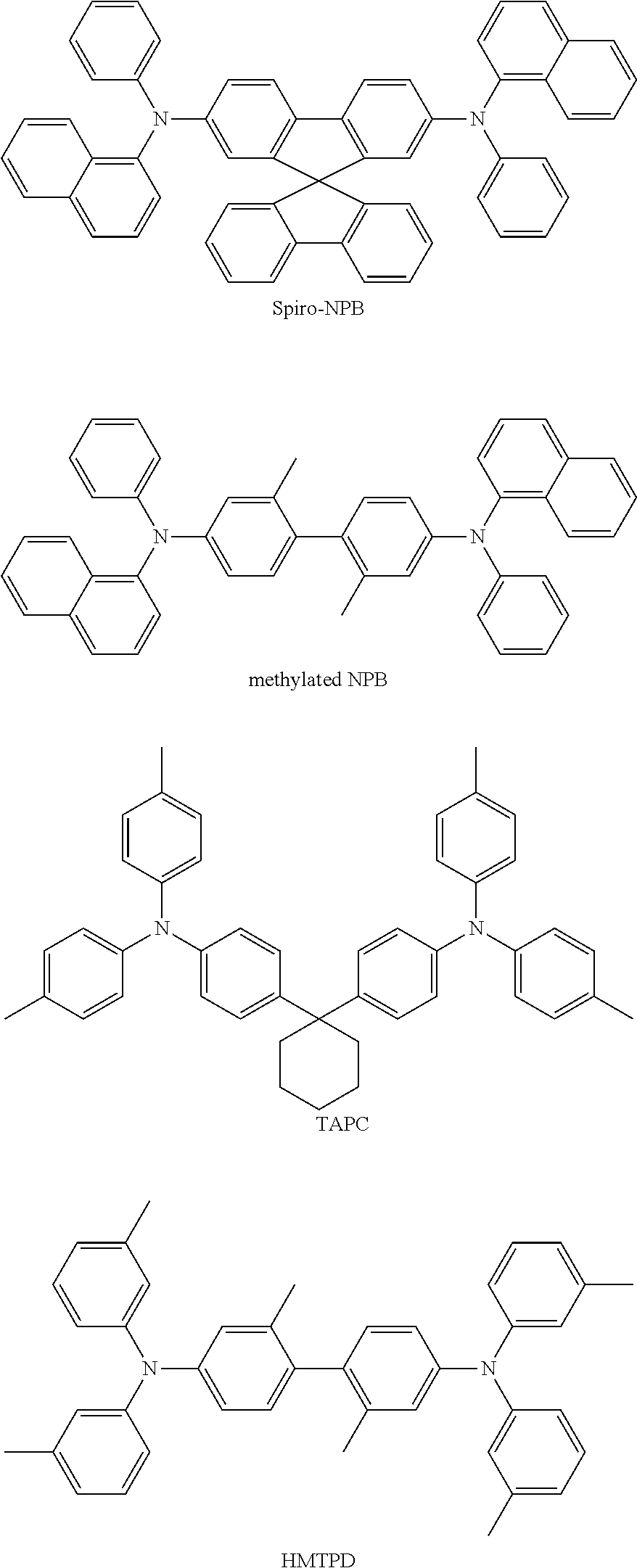
- the hole transport region may include m-MTDATA, TDATA, 2-TNATA, NPB, ⁇ -NPB, TPD, Spiro-TPD, Spiro-NPB, methylated-NPB, TAPC, HMTPD, 4,4′,4′′-tris(N-carbazolyl)triphenylamine (TCTA), polyaniline/dodecylbenzenesulfonic acid (PANI/DBSA), poly(3,4-ethylenedioxythiophene)/poly(4-styrenesulfonate) (PEDOT/PSS), polyaniline/camphor sulfonic acid (PANI/CSA), polyaniline/poly(4-styrenesulfonate) (PANI/PSS), a compound represented by Formula 201 below, a compound represented by Formula 202 below, or a combination thereof:
- Ar 101 and Ar 102 in Formula 201 may each independently be:
- xa and xb may each independently be an integer from 0 to 5, or may be 0, 1, or 2.
- xa may be 1 and xb may be 0, but xa and xb are not limited thereto.
- R 101 to R 108 , R 111 to R 119 , and R 121 to R 124 in Formulae 201 and 202 may each independently be:
- R 109 in Formula 201 may be:
- the compound represented by Formula 201 may be represented by Formula 201A, but embodiments of the present disclosure are not limited thereto:
- R 101 , R 111 , R 112 , and R 109 in Formula 201A may be understood by referring to the description provided herein.
- the compound represented by Formula 201 and the compound represented by Formula 202 may include compounds HT1 to HT20 illustrated below, but are not limited thereto:
- a thickness of the hole transport region may be in a range of about 100 angstroms ( ⁇ ) to about 10,000 ⁇ , for example, about 100 ⁇ to about 1,000 ⁇ .
- the thickness of the hole injection layer may be in a range of about 100 ⁇ to about 10,000 ⁇ , and for example, about 100 ⁇ to about 1,000 ⁇
- the thickness of the hole transport layer may be in a range of about 50 ⁇ to about 2,000 ⁇ , and for example, about 100 ⁇ to about 1,500 ⁇ .
- the hole transport region may further include, in addition to these materials, a charge-generation material for the improvement of conductive properties.
- the charge-generation material may be homogeneously or non-homogeneously dispersed in the hole transport region.
- the charge-generation material may be, for example, a p-dopant.
- the p-dopant may be a quinone derivative, a metal oxide, or a cyano group-containing compound, but embodiments of the present disclosure are not limited thereto.
- Non-limiting examples of the p-dopant are a quinone derivative, such as tetracyanoquinonedimethane (TCNQ) or 2,3,5,6-tetrafluoro-tetracyano-1,4-benzoquinonedimethane (F4-TCNQ); a metal oxide, such as a tungsten oxide or a molybdenum oxide; a cyano group-containing compound, such as Compound HT-D1 below, or a combination thereof but are not limited thereto:
- a quinone derivative such as tetracyanoquinonedimethane (TCNQ) or 2,3,5,6-tetrafluoro-tetracyano-1,4-benzoquinonedimethane (F4-TCNQ)
- a metal oxide such as a tungsten oxide or a molybdenum oxide
- a cyano group-containing compound such as Compound HT-D1 below, or a combination thereof but
- the hole transport region may include a buffer layer.
- the buffer layer may compensate for an optical resonance distance according to a wavelength of light emitted from the emission layer, and thus, efficiency of a formed organic light-emitting device may be improved.
- an emission layer may be formed on the hole transport region by vacuum deposition, spin coating, casting, LB deposition, or the like.
- the deposition or coating conditions may be the same as or similar to those applied in forming the hole injection layer, although the deposition or coating conditions may vary according to a compound that is used to form the emission layer.
- a material for the electron blocking layer may be a material for the hole transport region described above and materials for a host to be described below.
- the material for the electron blocking layer is not limited thereto.
- a material for the electron blocking layer may be mCP shown below.
- the emission layer may include a host and a dopant, and the dopant may include the organometallic compound represented by Formula 1.
- the host may include TPBi, TBADN, ADN (also referred to as “DNA”), CBP, CDBP, TCP, mCP, Compounds H50 to H52, or a combination thereof as shown below:
- the host may further include a compound represented by Formula 301:
- Ar 111 and Ar 112 in Formula 301 may each independently be:
- Ar 113 to Ar 116 in Formula 301 may each independently be:
- g, h, i, and j may each independently be an integer from 0 to 4, and may be, for example, 0, 1, or 2.
- the host may include a compound represented by Formula 302 below:
- Ar 122 to Ar 125 in Formula 302 may each independently be the same as defined in connection with Ar 113 in Formula 301.
- Ar 126 and Ar 127 in Formula 302 may each independently be a C 1 -C 10 alkyl group (for example, a methyl group, an ethyl group, or a propyl group).
- k and l may each independently be an integer from 0 to 4.
- k and l may be 0, 1, or 2.
- the emission layer may be patterned into a red emission layer, a green emission layer, and a blue emission layer.
- the emission layer may emit white light.
- an amount of the dopant may be in a range of about 0.01 parts to about 15 parts by weight based on 100 parts by weight of the host, but embodiments of the present disclosure are not limited thereto.
- a thickness of the emission layer may be in a range of about 100 ⁇ to about 1,000 ⁇ , for example, about 200 ⁇ to about 600 ⁇ . When the thickness of the emission layer is within this range, excellent light-emission characteristics may be obtained without a substantial increase in driving voltage.
- an electron transport region may be disposed on the emission layer.
- the electron transport region may include a hole blocking layer, an electron transport layer, an electron injection layer, or any combination thereof.
- the electron transport region may have a hole blocking layer/electron transport layer/electron injection layer structure or an electron transport layer/electron injection layer structure, but the structure of the electron transport region is not limited thereto.
- the electron transport layer may have a single-layered structure or a multi-layered structure including two or more different materials.
- Conditions for forming the hole blocking layer, the electron transport layer, and the electron injection layer which constitute the electron transport region may be understood by referring to the conditions for forming the hole injection layer.
- the hole blocking layer may include, for example, BCP, Bphen, BAlq, or a combination thereof but embodiments of the present disclosure are not limited thereto:
- a thickness of the hole blocking layer may be in a range of about 20 ⁇ to about 1,000 ⁇ , for example, about 30 ⁇ to about 300 ⁇ . When the thickness of the hole blocking layer is within these ranges, the hole blocking layer may have improved hole blocking ability without a substantial increase in driving voltage.
- the electron transport layer may include BCP, Bphen, Alq 3 , BAlq, TAZ, NTAZ, or a combination thereof:
- the electron transport layer may include ET1 to ET25, but are not limited thereto:
- a thickness of the electron transport layer may be in a range of about 100 ⁇ to about 1,000 ⁇ , for example, about 150 ⁇ to about 500 ⁇ . When the thickness of the electron transport layer is within the range described above, the electron transport layer may have satisfactory electron transport characteristics without a substantial increase in driving voltage.
- the electron transport layer may further include, in addition to the materials described above, a metal-containing material.
- the metal-containing material may include a Li complex.
- the Li complex may include, for example, Compound ET-D1 (lithium quinolate, LiQ) or ET-D2:
- the electron transport region may include an electron injection layer that promotes flow of electrons from the second electrode 19 thereinto.
- the electron injection layer may include LiF, NaCl, CsF, Li 2 O, BaO, or a combination thereof.
- a thickness of the electron injection layer may be in a range of about 1 ⁇ to about 100 ⁇ , for example, about 3 ⁇ to about 90 ⁇ . When the thickness of the electron injection layer is within the range described above, the electron injection layer may have satisfactory electron injection characteristics without a substantial increase in driving voltage.
- the second electrode 19 may be disposed on the organic layer 15.
- the second electrode 19 may be a cathode.
- a material for forming the second electrode 19 may be a metal, an alloy, an electrically conductive compound, or a combination thereof, which have a relatively low work function.
- lithium (Li), magnesium (Mg), aluminum (Al), aluminum-lithium (Al—Li), calcium (Ca), magnesium-indium (Mg—In), or magnesium-silver (Mg—Ag) may be used as a material for forming the second electrode 19.
- a transmissive electrode formed using ITO or IZO may be used as the second electrode 19.
- Another aspect of the present disclosure provides a diagnostic composition including at least one organometallic compound represented by Formula 1.
- the organometallic compound represented by Formula 1 may provide high luminescent efficiency. Accordingly, a diagnostic composition including the organometallic compound may have high diagnostic efficiency.
- the diagnostic composition may be used in various applications including a diagnosis kit, a diagnosis reagent, a biosensor, and a biomarker.
- C 1 -C 60 alkyl group refers to a linear or branched saturated aliphatic hydrocarbon monovalent group having 1 to 60 carbon atoms, and non-limiting examples thereof include a methyl group, an ethyl group, a propyl group, an isobutyl group, a sec-butyl group, a tert-butyl group, a pentyl group, an isoamyl group, and a hexyl group.
- C 1 -C 60 alkylene group refers to a divalent group having the same structure as the C 1 -C 60 alkyl group.
- C 1 -C 60 alkoxy group refers to a monovalent group represented by —OA 101 (wherein A 101 is the C 1 -C 60 alkyl group), and non-limiting examples thereof include a methoxy group, an ethoxy group, and an isopropoxy group.
- C 2 -C 60 alkenyl group refers to a hydrocarbon group formed by substituting a double bond in the middle or at the terminus of the C 2 -C 60 alkyl group, and examples thereof include an ethenyl group, a propenyl group, and a butenyl group.
- C 2 -C 60 alkenylene group refers to a divalent group having the same structure as the C 2 -C 60 alkenyl group.
- C 2 -C 60 alkynyl group refers to a hydrocarbon group formed by substituting a triple bond in the middle or at the terminus of the C 2 -C 60 alkyl group, and examples thereof include an ethynyl group, and a propynyl group.
- C 2 -C 60 alkynylene group refers to a divalent group having the same structure as the C 2 -C 60 alkynyl group.
- C 3 -C 10 cycloalkyl group refers to a monovalent saturated hydrocarbon monocyclic group having 3 to 10 carbon atoms, and non-limiting examples thereof include a cyclopropyl group, a cyclobutyl group, a cyclopentyl group, a cyclohexyl group, and a cycloheptyl group.
- C 3 -C 10 cycloalkylene group refers to a divalent group having the same structure as the C 3 -C 10 cycloalkyl group.
- C 1 -C 10 heterocycloalkyl group refers to a monovalent saturated monocyclic group having a heteroatom N, O, P, Si, or S as a ring-forming atom and 1 to 10 carbon atoms, and non-limiting examples thereof include a tetrahydrofuranyl group, and a tetrahydrothiophenyl group.
- C 1 -C 10 heterocycloalkylene group refers to a divalent group having the same structure as the C 1 -C 10 heterocycloalkyl group.
- C 3 -C 10 cycloalkenyl group refers to a monovalent monocyclic group that has 3 to 10 carbon atoms and a double bond in the ring thereof and no aromaticity, and non-limiting examples thereof include a cyclopentenyl group, a cyclohexenyl group, and a cycloheptenyl group.
- C 3 -C 10 cycloalkenylene group refers to a divalent group having the same structure as the C 3 -C 10 cycloalkenyl group.
- C 1 -C 10 heterocycloalkenyl group refers to a monovalent monocyclic group that has a heteroatom N, O, P, Si, or S as a ring-forming atom, 1 to 10 carbon atoms, and a double bond in its ring.
- Examples of the C 1 -C 10 heterocycloalkenyl group are a 2,3-dihydrofuranyl group, and a 2,3-dihydrothiophenyl group.
- C 1 -C 10 heterocycloalkenylene group refers to a divalent group having the same structure as the C 1 -C 10 heterocycloalkenyl group.
- C 6 -C 60 aryl group refers to a monovalent group having a carbocyclic aromatic system having 6 to 60 carbon atoms
- C 6 -C 60 arylene group refers to a divalent group having a carbocyclic aromatic system having 6 to 60 carbon atoms.
- Non-limiting examples of the C 6 -C 60 aryl group include a phenyl group, a naphthyl group, an anthracenyl group, a phenanthrenyl group, a pyrenyl group, and a chrysenyl group.
- the C 6 -C 60 aryl group and the C 6 -C 60 arylene group each include two or more rings, the rings may be fused to each other.
- C 1 -C 60 heteroaryl group refers to a monovalent group having a heterocyclic aromatic system that has a heteroatom N, O, P, Si, or S as a ring-forming atom, and 1 to 60 carbon atoms.
- C 1 -C 60 heteroarylene group refers to a divalent group having a heterocyclic aromatic system that has a heteroatom N, O, P, Si, or S as a ring-forming atom, and 1 to 60 carbon atoms.
- Non-limiting examples of the C 1 -C 60 heteroaryl group include a pyridinyl group, a pyrimidinyl group, a pyrazinyl group, a pyridazinyl group, a triazinyl group, a quinolinyl group, and an isoquinolinyl group.
- the C 1 -C 60 heteroaryl group and the C 1 -C 60 heteroarylene group each include two or more rings, the rings may be fused to each other.
- C 6 -C 60 aryloxy group used herein indicates —OA 102 (wherein A 102 is the C 6 -C 60 aryl group), and a C 6 -C 60 arylthio group used herein indicates —SA 103 (wherein A 103 is the C 6 -C 60 aryl group).
- the term “monovalent non-aromatic condensed polycyclic group” as used herein refers to a monovalent group (for example, having 8 to 60 carbon atoms) having two or more rings condensed to each other, only carbon atoms as ring-forming atoms, and no aromaticity in its entire molecular structure.
- Examples of the monovalent non-aromatic condensed polycyclic group include a fluorenyl group.
- divalent non-aromatic condensed polycyclic group refers to a divalent group having the same structure as the monovalent non-aromatic condensed polycyclic group.
- the term “monovalent non-aromatic condensed heteropolycyclic group” as used herein refers to a monovalent group (for example, having 2 to 60 carbon atoms) having two or more rings condensed to each other, a heteroatom N, O, P, Si, or S, other than carbon atoms, as a ring-forming atom, and no aromaticity in its entire molecular structure.
- Non-limiting examples of the monovalent non-aromatic condensed heteropolycyclic group include a carbazolyl group.
- divalent non-aromatic condensed heteropolycyclic group refers to a divalent group having the same structure as the monovalent non-aromatic condensed heteropolycyclic group.
- C 3 -C 60 carbocyclic group refers to a saturated or unsaturated cyclic group having, as a ring-forming atom, 3 to 60 carbon atoms (or, 5 to 30 carbon atoms) only.
- the C 3 -C 60 carbocyclic group (or, C 5 -C 30 carbocyclic group) may be a monocyclic group or a polycyclic group.
- C 1 -C 60 heterocyclic group refers to a saturated or unsaturated cyclic group having, as a ring-forming atom, a heteroatom N, O, Si, P, and S other than 1 to 60 carbon atoms (or, 1 to 30 carbon atoms).
- the C 1 -C 60 heterocyclic group (or, C 1 -C 30 heterocyclic group) may be a monocyclic group or a polycyclic group.
- a substituent of a substituted C 3 -C 60 carbocyclic group (or, C 5 -C 30 carbocyclic group), a substituted C 1 -C 60 heterocyclic group (or, C 1 -C 30 heterocyclic group), a substituted C 1 -C 60 alkyl group, a substituted C 2 -C 60 alkenyl group, a substituted C 2 -C 60 alkynyl group, a substituted C 1 -C 60 alkoxy group, a substituted C 3 -C 10 cycloalkyl group, a substituted C 1 -C 10 heterocycloalkyl group, a substituted C 3 -C 10 cycloalkenyl group, a substituted C 1 -C 1 heterocycloalkenyl group, a substituted C 6 -C 60 aryl group, a substituted C 6 -C 60 aryloxy group, a substituted C 6 -C 60 arylthio group, a substituted C 1
- Compound 6 was synthesized in the same manner as in Synthesis Example 2, except that 7-bromo-2-phenylthieno[2,3-c]pyridine was used instead of 7-bromo-2-(4-(tert-butyl)phenyl)thieno[2,3-c]pyridine in synthesizing Intermediate C2.
- CBP and Compound 1 were co-deposited at a weight ratio of 9:1 under a vacuum (10 ⁇ 7 torr) to manufacture a film having a thickness of 40 nm.
- a decay time T decay (Ex) of the film was obtained by fitting one or more exponential decay functions to the result obtained therefrom, and a radiative decay rate that is a reciprocal of T decay (Ex) was calculated, and a result thereof is shown in Table 3.
- the function used for fitting is expressed by Equation 10, and the greatest value of T decay obtained from each exponential decay function used for fitting was taken as T decay (Ex).
- a baseline or background signal curve was obtained by repeating the same measurement once more for the same measurement time as the measurement time for obtaining the TRPL curve in a dark state (a state in which a pumping signal applied to the predetermined film was blocked), and the baseline or background signal curve was used for fitting as a baseline.
- a glass substrate, on which ITO/Ag/ITO were deposited to thicknesses of 70 ⁇ /1,000 ⁇ /70 ⁇ was cut to a size of 50 millimeters (mm) ⁇ 50 mm ⁇ 0.5 mm, sonicated with isopropyl alcohol and pure water each for 5 minutes, and then cleaned by exposure to ultraviolet rays and ozone for 30 minutes. Then, the glass substrate was provided to a vacuum deposition apparatus.
- 2-TNATA was vacuum-deposited on the anode to form a hole injection layer having a thickness of 600 ⁇
- NPB 4,4′-bis[N-(1-naphthyl)-N-phenylamino]biphenyl
- CBP host
- Compound 1 dopant
- BCP was vacuum-deposited on the emission layer to form a hole blocking layer having a thickness of 50 ⁇
- Alq 3 was vacuum-deposited on the hole blocking layer to form an electron transport layer having a thickness of 350 ⁇
- LiF was vacuum-deposited on the electron transport layer to form an electron injection layer having a thickness of 10 ⁇
- Mg and Ag were co-deposited on the electron injection layer at a weight ratio of 90:10 to form a cathode having a thickness of 120 ⁇ , thereby completing the manufacture of an organic light-emitting device (which emits red light).
- Organic light-emitting devices were manufactured in the same manner as in Example 1, except that Compounds shown in Table 4 were each used instead of Compound 1 as a dopant in forming an emission layer.
- the driving voltage, maximum value (Max EQE) of external quantum efficiency, roll-off ratio, full width at half maximum (FWHM) of main peak of EL spectrum, maximum emission wavelength, and lifespan (T 97 ) of the organic light-emitting devices manufactured according to Examples 1 to 3 and Comparative Examples A to D were evaluated, and results thereof are shown in Table 4.
- a current-voltage meter (KEITHLY 2400) and a luminance meter (Minolta Cs-1000A) were used as the evaluation apparatuses, and the lifespan (T 97 ) (at 3,500 nit) indicates the time that lapsed when luminance was 97% of initial luminance (100%).
- Table 4 shows that the organic light-emitting devices of Examples 1 to 3 may emit red light and may have improved driving voltage, external quantum efficiency, roll-off ratio, and lifespan characteristics, as compared with those of the organic light-emitting devices of Comparative Examples A to D.
- an electronic device for example, an organic light-emitting device, which includes the organometallic compound may have improved driving voltage, efficiency, color purity, and/or lifespan characteristics.
- an organic light-emitting device which includes the organometallic compound may have improved driving voltage, efficiency, color purity, and/or lifespan characteristics.
- a diagnostic composition having high diagnostic efficiency may be provided by using the organometallic compound.
Landscapes
- Chemical & Material Sciences (AREA)
- Organic Chemistry (AREA)
- Engineering & Computer Science (AREA)
- Materials Engineering (AREA)
- Crystallography & Structural Chemistry (AREA)
- Inorganic Chemistry (AREA)
- Physics & Mathematics (AREA)
- Optics & Photonics (AREA)
- Electroluminescent Light Sources (AREA)
- Nitrogen Condensed Heterocyclic Rings (AREA)
- Heterocyclic Carbon Compounds Containing A Hetero Ring Having Oxygen Or Sulfur (AREA)
- Nitrogen And Oxygen Or Sulfur-Condensed Heterocyclic Ring Systems (AREA)
- Organic Low-Molecular-Weight Compounds And Preparation Thereof (AREA)
- Investigating Or Analysing Biological Materials (AREA)
- Plural Heterocyclic Compounds (AREA)
Abstract
M(L1)n1(L2)n2 Formula 1
wherein M, L1, L2, n1 and n2 are each independently the same as defined in the specification.
Description
M(L1)n1(L2)n2. Formula 1
-
- M in Formula 1 may be a first-row transition metal, a second-row transition metal, or a third-row transition metal, of the Periodic Table of Elements,
- L1 in Formula 1 may be a ligand represented by Formula 2,
- n1 in Formula 1 may be 1, 2, or 3, wherein, when n1 is two or more, two or more L1 may be identical to or different from each other,
- L2 in Formula 1 may be a monodentate ligand, a bidentate ligand, a tridentate ligand, or a tetradentate ligand,
- n2 in Formula 1 may be 0, 1, 2, 3, or 4, wherein, when n2 is two or more, two or more L2 may be identical to or different from each other, and
- L1 and L2 in Formula 1 may be different from each other:

-
- X1 may be C, N, Si, or P,
- X21 may be C or N,
- ring CY1 and ring CY21 may each independently be a C3-C60 carbocyclic group or a C1-C60 heterocyclic group,
- X3 may be O, S, Se, or N(R3),
- X4 may be N or C(R4),
- X5 may be N or C(R5),
- R1 to R5 and R21 may each independently be hydrogen, deuterium, —F, —Cl, —Br, —I, —SF5, a hydroxyl group, a cyano group, a nitro group, an amino group, an amidino group, a hydrazine group, a hydrazone group, a carboxylic acid group or a salt thereof, a sulfonic acid group or a salt thereof, a phosphoric acid group or a salt thereof, a substituted or unsubstituted C1-C60 alkyl group, a substituted or unsubstituted C2-C60 alkenyl group, a substituted or unsubstituted C2-C60 alkynyl group, a substituted or unsubstituted C1-C60 alkoxy group, a substituted or unsubstituted C3-C10 cycloalkyl group, a substituted or unsubstituted C1-C10 heterocycloalkyl group, a substituted or unsubstituted C3-C10 cycloalkenyl group, a substituted or unsubstituted C1-C10 heterocycloalkenyl group, a substituted or unsubstituted C6-C60 aryl group, a substituted or unsubstituted C6-C60 aryloxy group, a substituted or unsubstituted C6-C60 arylthio group, a substituted or unsubstituted C1-C60 heteroaryl group, a substituted or unsubstituted monovalent non-aromatic condensed polycyclic group, a substituted or unsubstituted monovalent non-aromatic condensed heteropolycyclic group, —N(Q1)(Q2), —Si(Q3)(Q4)(Q5), —B(Q6)(Q7), or —P(═O)(Q8)(Q),
- a1 and a21 may each independently be an integer from 0 to 20,
- ring CY1 and R2 are not linked to each other, and R1 and R2 are not linked to each other,
- R4 and R5 may optionally be linked to form a C5-C30 carbocyclic group that is unsubstituted or substituted with R10a or a C1-C30 heterocyclic group that is unsubstituted or substituted with R10a,
- a plurality of R21 may optionally be linked to form a C5-C30 carbocyclic group that is unsubstituted or substituted with R10a or a C1-C30 heterocyclic group that is unsubstituted or substituted with R10a,
- R10a may be the same as defined in connection with R21,* and *′ each indicate a binding site to M in Formula 1,
- a substituent of the substituted C1-C60 alkyl group, the substituted C2-C60 alkenyl group, the substituted C2-C60 alkynyl group, the substituted C1-C60 alkoxy group, the substituted C3-C10 cycloalkyl group, the substituted C1-C10 heterocycloalkyl group, the substituted C3-C10 cycloalkenyl group, the substituted C1-C10 heterocycloalkenyl group, the substituted C6-C60 aryl group, the substituted C6-C60 aryloxy group, the substituted C6-C60 arylthio group, the substituted C1-C60 heteroaryl group, the substituted monovalent non-aromatic condensed polycyclic group, or the substituted monovalent non-aromatic condensed heteropolycyclic group may be:
- deuterium, —F, —Cl, —Br, —I, —CD3, —CD2H, —CDH2, —CF3, —CF2H, —CFH2, a hydroxyl group, a cyano group, a nitro group, an amino group, an amidino group, a hydrazine group, a hydrazone group, a carboxylic acid group or a salt thereof, a sulfonic acid group or a salt thereof, a phosphoric acid group or a salt thereof, a C1-C60 alkyl group, a C2-C60 alkenyl group, a C2-C60 alkynyl group, a C1-C60 alkoxy group, or a combination thereof;
- a C1-C60 alkyl group, a C2-C60 alkenyl group, a C2-C60 alkynyl group, and a C1-C60 alkoxy group, each substituted with deuterium, —F, —Cl, —Br, —I, —CD3, —CD2H, —CDH2, —CF3, —CF2H, —CFH2, a hydroxyl group, a cyano group, a nitro group, an amino group, an amidino group, a hydrazine group, a hydrazone group, a carboxylic acid group or a salt thereof, a sulfonic acid group or a salt thereof, a phosphoric acid group or a salt thereof, a C3-C10 cycloalkyl group, a C1-C10 heterocycloalkyl group, a C3-C10 cycloalkenyl group, a C1-C10 heterocycloalkenyl group, a C6-C60 aryl group, a C6-C60 aryloxy group, a C6-C60 arylthio group, a C1-C60 heteroaryl group, a monovalent non-aromatic condensed polycyclic group, a monovalent non-aromatic condensed heteropolycyclic group, —N(Q11)(Q12), —Si(Q13)(Q14)(Q15), —B(Q16)(Q17), —P(═O)(Q18)(Q19), or a combination thereof;
- a C3-C10 cycloalkyl group, a C1-C10 heterocycloalkyl group, a C3-C10 cycloalkenyl group, a C1-C10 heterocycloalkenyl group, a C6-C60 aryl group, a C6-C60 aryloxy group, a C6-C60 arylthio group, a C1-C60 heteroaryl group, a monovalent non-aromatic condensed polycyclic group, and a monovalent non-aromatic condensed heteropolycyclic group;
- a C3-C10 cycloalkyl group, a C1-C10 heterocycloalkyl group, a C3-C10 cycloalkenyl group, a C1-C10 heterocycloalkenyl group, a C6-C60 aryl group, a C6-C60 aryloxy group, a C6-C60 arylthio group, a C1-C60 heteroaryl group, a monovalent non-aromatic condensed polycyclic group, and a monovalent non-aromatic condensed heteropolycyclic group, each substituted with deuterium, —F, —Cl, —Br, —I, —CD3, —CD2H, —CDH2, —CF3, —CF2H, —CFH2, a hydroxyl group, a cyano group, a nitro group, an amino group, an amidino group, a hydrazine group, a hydrazone group, a carboxylic acid group or a salt thereof, a sulfonic acid group or a salt thereof, a phosphoric acid group or a salt thereof, a C1-C60 alkyl group, a C2-C60 alkenyl group, a C2-C60 alkynyl group, a C1-C60 alkoxy group, a C3-C10 cycloalkyl group, a C1-C10 heterocycloalkyl group, a C3-C10 cycloalkenyl group, a C1-C10 heterocycloalkenyl group, a C6-C60 aryl group, a C6-C60 aryloxy group, a C6-C60 arylthio group, a C1-C60 heteroaryl group, a monovalent non-aromatic condensed polycyclic group, a monovalent non-aromatic condensed heteropolycyclic group, —N(Q21)(Q22), —Si(Q23)(Q24)(Q25), —B(Q26)(Q27), —P(═O)(Q28)(Q29), or a combination thereof; or
- —N(Q31)(Q32), —Si(Q33)(Q34)(Q35), —B(Q36)(Q37), —P(═O)(Q38)(Q39), or a combination thereof; and
- Q1 to Q9, Q11 to Q19, Q21 to Q29, and Q31 to Q39 may each independently be hydrogen, deuterium, —F, —Cl, —Br, —I, a hydroxyl group, a cyano group, a nitro group, an amino group, an amidino group, a hydrazine group, a hydrazone group, a carboxylic acid group or a salt thereof, a sulfonic acid group or a salt thereof, a phosphoric acid group or a salt thereof, a C1-C60 alkyl group, a C2-C60 alkenyl group, a C2-C60 alkynyl group, a C1-C60 alkoxy group, a C3-C10 cycloalkyl group, a C1-C10 heterocycloalkyl group, a C3-C10 cycloalkenyl group, a C1-C10 heterocycloalkenyl group, a C6-C60 aryl group, a C6-C60 aryl group substituted with a C1-C60 alkyl group, a C6-C60 aryl group, or a combination thereof, a C6-C60 aryloxy group, a C6-C60 arylthio group, a C1-C60 heteroaryl group, a monovalent non-aromatic condensed polycyclic group, a monovalent non-aromatic condensed heteropolycyclic group, or a combination thereof.
M(L1)n1(L2)n2. Formula 1

-
- hydrogen, deuterium, —F, —Cl, —Br, —I, a hydroxyl group, a cyano group, a nitro group, an amino group, an amidino group, a hydrazine group, a hydrazone group, a carboxylic acid group or a salt thereof, a sulfonic acid group or a salt thereof, a phosphoric acid group or a salt thereof, —SF5, a C1-C20 alkyl group, or a C1-C20 alkoxy group;
- a C1-C20 alkyl group or a C1-C20 alkoxy group, each substituted with deuterium, —F, —Cl, —Br, —I, —CD3, —CD2H, —CDH2, —CF3, —CF2H, —CFH2, a hydroxyl group, a cyano group, a nitro group, an amino group, an amidino group, a hydrazine group, a hydrazone group, a carboxylic acid group or a salt thereof, a sulfonic acid group or a salt thereof, a phosphoric acid group or a salt thereof, a C1-C10 alkyl group, a cyclopentyl group, a cyclohexyl group, a cycloheptyl group, a cycloctyl group, an adamantanyl group, a norbornanyl group, a norbornenyl group, a cyclopentenyl group, a cyclohexenyl group, a cycloheptenyl group, a phenyl group, a biphenyl group, a naphthyl group, a pyridinyl group, a pyrimidinyl group, or a combination thereof;
- a cyclopentyl group, a cyclohexyl group, a cycloheptyl group, a cycloctyl group, an adamantanyl group, a norbornanyl group, a norbornenyl group, a cyclopentenyl group, a cyclohexenyl group, a cycloheptenyl group, a phenyl group, a biphenyl group, a C1-C20 alkylphenyl group, a naphthyl group, a fluorenyl group, a phenanthrenyl group, an anthracenyl group, a fluoranthenyl group, a triphenylenyl group, a pyrenyl group, a chrysenyl group, a pyrrolyl group, a thiophenyl group, a furanyl group, an imidazolyl group, a pyrazolyl group, a thiazolyl group, an isothiazolyl group, an oxazolyl group, an isoxazolyl group, a pyridinyl group, a pyrazinyl group, a pyrimidinyl group, a pyridazinyl group, an isoindolyl group, an indolyl group, an indazolyl group, a purinyl group, a quinolinyl group, an isoquinolinyl group, a benzoquinolinyl group, a quinoxalinyl group, a quinazolinyl group, a cinnolinyl group, a carbazolyl group, a phenanthrolinyl group, a benzimidazolyl group, a benzofuranyl group, a benzothiophenyl group, an isobenzothiazolyl group, a benzoxazolyl group, an isobenzoxazolyl group, a triazolyl group, a tetrazolyl group, an oxadiazolyl group, a triazinyl group, a dibenzofuranyl group, a dibenzothiophenyl group, a benzocarbazolyl group, a dibenzocarbazolyl group, an imidazopyridinyl group, or an imidazopyrimidinyl group, each unsubstituted or substituted with a deuterium, —F, —Cl, —Br, —I, —CD3, —CD2H, —CDH2, —CF3, —CF2H, —CFH2, a hydroxyl group, a cyano group, a nitro group, an amino group, an amidino group, a hydrazine group, a hydrazone group, a carboxylic acid group or a salt thereof, a sulfonic acid group or a salt thereof, a phosphoric acid group or a salt thereof, a C1-C20 alkyl group, a C1-C20 alkoxy group, a cyclopentyl group, a cyclohexyl group, a cycloheptyl group, a cycloctyl group, an adamantanyl group, a norbornanyl group, a norbornenyl group, a cyclopentenyl group, a cyclohexenyl group, a cycloheptenyl group, a phenyl group, a biphenyl group, a C1-C20 alkyl phenyl group, a naphthyl group, a fluorenyl group, a phenanthrenyl group, an anthracenyl group, a fluoranthenyl group, a triphenylenyl group, a pyrenyl group, a chrysenyl group, a pyrrolyl group, a thiophenyl group, a furanyl group, an imidazolyl group, a pyrazolyl group, a thiazolyl group, an isothiazolyl group, an oxazolyl group, an isoxazolyl group, a pyridinyl group, a pyrazinyl group, a pyrimidinyl group, a pyridazinyl group, an isoindolyl group, an indolyl group, an indazolyl group, a purinyl group, a quinolinyl group, an isoquinolinyl group, a benzoquinolinyl group, a quinoxalinyl group, a quinazolinyl group, a cinnolinyl group, a carbazolyl group, a phenanthrolinyl group, a benzimidazolyl group, a benzofuranyl group, a benzothiophenyl group, an isobenzothiazolyl group, a benzoxazolyl group, an isobenzoxazolyl group, a triazolyl group, a tetrazolyl group, an oxadiazolyl group, a triazinyl group, a dibenzofuranyl group, a dibenzothiophenyl group, a benzocarbazolyl group, a dibenzocarbazolyl group, an imidazopyridinyl group, an imidazopyrimidinyl group, or a combination thereof; or —N(Q1)(Q2), —Si(Q3)(Q4)(Q5), —B(Q6)(Q7), or —P(═O)(Q8)(Q9), or a combination thereof, and
- Q1 to Q9 may each independently be:
- —CH3, —CD3, —CD2H, —CDH2, —CH2CH3, —CH2CD3, —CH2CD2H, —CH2CDH2, —CHDCH3, —CHDCD2H, —CHDCDH2, —CHDCD3, —CD2CH3, —CD2CD3, —CD2CD2H or —CD2CDH2; or
- an n-propyl group, an isopropyl group, an n-butyl group, an isobutyl group, a sec-butyl group, a tert-butyl group, an n-pentyl group, an isopentyl group, a sec-pentyl group, a tert-pentyl group, a phenyl group, and a naphthyl group, each unsubstituted or substituted with a deuterium, a C1-C10 alkyl group, or a phenyl group, but embodiments of the present disclosure are not limited thereto.

in Formula 2 may be a C3-C10 cycloalkenyl group, a C1-C10 heterocycloalkenyl group, a C6-C60 aryl group, a C1-C60 heteroaryl group, a monovalent non-aromatic condensed polycyclic group, or a monovalent non-aromatic condensed heteropolycyclic group, each unsubstituted or substituted with R1 in the number of a1.
-
- hydrogen, deuterium, —F, —Cl, —Br, —I, a cyano group, or —SF5; or
- a C1-C60 alkyl group, a C1-C60 alkoxy group, a C3-C10 cycloalkyl group, a C1-C10 heterocycloalkyl group, a C3-C10 cycloalkenyl group, a C1-C10 heterocycloalkenyl group, a C6-C60 aryl group, a C1-C60 heteroaryl group, a monovalent non-aromatic condensed polycyclic group, or a monovalent non-aromatic condensed heteropolycyclic group, each unsubstituted or substituted with a deuterium, —F, —Cl, —Br, —I, —CD3, —CD2H, —CDH2, —CF3, —CF2H, —CFH2, a cyano group, a C1-C20 alkyl group, a cyclopentyl group, a cyclohexyl group, a cycloheptyl group, a cycloctyl group, an adamantanyl group, a norbornanyl group, a norbornenyl group, a cyclopentenyl group, a cyclohexenyl group, a cycloheptenyl group, a phenyl group, a biphenyl group, a naphthyl group, a pyridinyl group, or a pyrimidinyl group, and
- a1 may be an integer from 0 to 10.

in Formula 2 may be a phenyl group, a biphenyl group, a naphthyl group, a fluorenyl group, a phenanthrenyl group, an anthracenyl group, a fluoranthenyl group, a triphenylenyl group, a pyrenyl group, a chrysenyl group, a pyrrolyl group, a thiophenyl group, a furanyl group, an imidazolyl group, a pyrazolyl group, a thiazolyl group, an isothiazolyl group, an oxazolyl group, an isoxazolyl group, a pyridinyl group, a pyrazinyl group, a pyrimidinyl group, a pyridazinyl group, an isoindolyl group, an indolyl group, an indazolyl group, a purinyl group, a quinolinyl group, an isoquinolinyl group, a benzoquinolinyl group, a quinoxalinyl group, a quinazolinyl group, a cinnolinyl group, a carbazolyl group, a phenanthrolinyl group, a benzimidazolyl group, a benzofuranyl group, a benzothiophenyl group, an isobenzothiazolyl group, a benzoxazolyl group, an isobenzoxazolyl group, a triazolyl group, a tetrazolyl group, an oxadiazolyl group, a triazinyl group, a dibenzofuranyl group, a dibenzothiophenyl group, a benzocarbazolyl group, a dibenzocarbazolyl group, an imidazopyridinyl group, or an imidazopyrimidinyl group, each unsubstituted or substituted with an R1 in the number of a1,
-
- hydrogen, deuterium, —F, —Cl, —Br, —I, a cyano group, or —SF5; or
- a methyl group, an ethyl group, a propyl group, an n-butyl group, an isobutyl group, a sec-butyl group, a tert-butyl group, an n-pentyl group, an isopentyl group, a sec-pentyl group, a tert-pentyl group, an n-hexyl group, an isohexyl group, a sec-hexyl group, a tert-hexyl group, an n-heptyl group, an isoheptyl group, a sec-heptyl group, a tert-heptyl group, an n-octyl group, an isooctyl group, a sec-octyl group, a tert-octyl group, an n-nonyl group, an iso-nonyl group, a sec-nonyl group, a tert-nonyl group, an n-decanyl group, an isodecanyl group, a sec-decanyl group, a tert-decanyl group, a C1-C10 alkoxy, a cyclopentyl group, a cyclohexyl group, a cycloheptyl group, a cycloctyl group, an adamantanyl group, a norbornanyl group, a norbornenyl group, a cyclopentenyl group, a cyclohexenyl group, a cycloheptenyl group, a phenyl group, a biphenyl group, a naphthyl group, a pyridinyl group, a pyrimidinyl group, a dibenzofuranyl group, or a dibenzothiophenyl group, each unsubstituted or substituted with a deuterium, —F, —Cl, —Br, —I, —CD3, —CD2H, —CDH2, —CF3, —CF2H, —CFH2, a cyano group, a C1-C20 alkyl group, a cyclopentyl group, a cyclohexyl group, a cycloheptyl group, a cycloctyl group, an adamantanyl group, a norbornanyl group, a norbornenyl group, a cyclopentenyl group, a cyclohexenyl group, a cycloheptenyl group, a phenyl group, a biphenyl group, a naphthyl group, a pyridinyl group, a pyrimidinyl group, a dibenzofuranyl group, or a dibenzothiophenyl group, and a1 may be an integer from 0 to 5, but embodiments of the present disclosure are not limited thereto.

in Formula 2 may be a group represented by Formulae 10-13(1) to 10-13(18) or 10-13:


-
- X4 may be C(R4), and
- R4 may be hydrogen, deuterium, —F, —Cl, —Br, —I, —SF5, a cyano group, a substituted or unsubstituted C1-C60 alkyl group, a substituted or unsubstituted C2-C60 alkenyl group, a substituted or unsubstituted C2-C60 alkynyl group, a substituted or unsubstituted C1-C60 alkoxy group, a substituted or unsubstituted C3-C10 cycloalkyl group, a substituted or unsubstituted C1-C10 heterocycloalkyl group, a substituted or unsubstituted C3-C10 cycloalkenyl group, a substituted or unsubstituted C1-C10 heterocycloalkenyl group, —N(Q1)(Q2), —Si(Q3)(Q4)(Q5), —B(Q6)(Q7), or —P(═O)(Q8)(Q9).
- X4 may be C(R4), and
-
- X4 may be C(R4), and
- R4 may be a substituted or unsubstituted C6-C60 aryl group, a substituted or unsubstituted C6-C60 aryloxy group, a substituted or unsubstituted C6-C60 arylthio group, a substituted or unsubstituted C1-C60 heteroaryl group, a substituted or unsubstituted monovalent non-aromatic condensed polycyclic group, or a substituted or unsubstituted monovalent non-aromatic condensed heteropolycyclic group.

in Formula 2 may be a group represented by Formulae 10-13 to 10-229, and/or R1 to R5 and R21 may each independently be hydrogen, deuterium, —F, a cyano group, a nitro group, —SF5, —CH3, —CD3, —CD2H, —CDH2, —CF3, —CF2H, —CFH2, a group represented by Formulae 9-1 to 9-19, a group represented by Formulae 10-1 to 10-229, or —Si(Q3)(Q4)(Q5) (wherein Q3 to Q5 are the same as described above), but embodiments of the present disclosure are not limited thereto:


in Formula 2 may be a group represented by Formulae CY21-1 to CY21-31:


-
- X21 and R21 may each independently be the same as described elsewhere herein,
- X22 may be C(R22)(R23), N(R22), O, S, or Si(R22)(R23),
- R22 to R29 may each independently be the same as defined in connection with R21,
- a16 may be an integer from 0 to 6,
- a15 may be an integer from 0 to 5,
- a14 may be an integer from 0 to 4,
- a13 may be an integer from 0 to 3,
- a12 may be an integer from 0 to 2,
- *″ indicates a binding site to a carbon atom of a neighboring 6-membered ring in Formula 2, and
- * indicates a binding site to M in Formula 1.

in Formula 2 may be a group represented by Formulae CY21(1) to CY21(56) or a group represented by Formulae CY21-20 to CY21-31:


-
- X21 and R21 may each independently be the same as described herein,
- R21a to R21d may each independently be the same as defined in connection with R21, wherein R21 and R21a to R21d are not each independently hydrogen,
- *″ indicates a binding site to a carbon atom of a neighboring 6-membered ring in Formula 2, and
- * indicates a binding site to M in Formula 1.

-
- Y11 may be O, N, N(Z1), P(Z1)(Z2), or As(Z1)(Z2),
- Y12 may be O, N, N(Z3), P(Z3)(Z4), or As(Z3)(Z4),
- T11 may be a single bond, a double bond, *—C(Z11)(Z12)—*′, *—C(Z11)═C(Z12)—*′, *═C(Z11)—*′, *—C(Z11)═*′, *═C(Z11)—C(Z12)═C(Z13)—*′, *—C(Z11)═C(Z12)—C(Z13)═*′, *—N(Z11)—*′, or a C5-C30 carbocyclic group that is unsubstituted or substituted with a Z11,
- a11 may be an integer from 1 to 10,
- Y13 to Y16 may each independently be C or N,
- T21 may be a single bond, a double bond, O, S, C(Z11)(Z12), Si(Z11)(Z12), or N(Z11),
- ring CY11 and ring CY12 may each independently be a C3-C60 carbocyclic group or a C1-C60 heterocyclic group,
- A1 may be P or As,
- Z1 to Z4 and Z11 to Z13 may each independently be the same as defined in connection with R21,
- d1 and d2 may each independently be an integer from 0 to 10, and
- * and *′ each indicate a binding site to M in Formula 1.


-
- Z1 to Z4, Z1a, Z1b, Z2a to Z2c, and Z11 to Z14 may each independently be the same as defined in connection with R21,
- d14 and d24 may each independently be an integer from 0 to 4,
- d13 and d23 may each independently be an integer from 0 to 3,
- d12 and d22 may each independently be an integer from 0 to 2, and
- * and *′ each indicate a binding site to M in Formula 1.


| TABLE 1 | |||||
| Compound | HOMO | LUMO | T1 | ||
| No. | (eV) | (eV) | (eV) | ||
| 1 | −4.461 | −1.667 | 2.061 | ||
| 2 | −4.520 | −1.729 | 2.055 | ||
| 5 | −4.726 | −1.796 | 2.176 | ||
| 6 | −4.566 | −1.793 | 2.040 | ||
| 7 | −4.571 | −1.530 | 2.174 | ||
| 8 | −4.669 | −1.746 | 2.172 | ||
| 9 | −4.513 | −1.747 | 2.039 | ||
| 10 | −4.500 | −1.511 | 2.162 | ||
| TABLE 2 | |
| Compound No. | Spin density |
| 1 | 0.483 |
| 2 | 0.477 |
| 3 | 0.347 |
| 4 | 0.339 |
| 5 | 0.528 |
| 6 | 0.477 |
| 7 | 0.396 |
| 8 | 0.530 |
| 9 | 0.484 |
| 10 | 0.481 |
| B | 0.286 |
| C | 0.174 |
| D | 0.303 |
   |
|



-
- a phenylene group, a pentalenylene group, an indenylene group, a naphthylene group, an azulenylene group, a heptalenylene group, an acenaphthylene group, a fluorenylene group, a phenalenylene group, a phenanthrenylene group, an anthracenylene group, a fluoranthenylene group, a triphenylenylene group, a pyrenylene group, a chrysenylenylene group, a naphthacenylene group, a picenylene group, a perylenylene group, or a pentacenylene group; or a phenylene group, a pentalenylene group, an indenylene group, a naphthylene group, an azulenylene group, a heptalenylene group, an acenaphthylene group, a fluorenylene group, a phenalenylene group, a phenanthrenylene group, an anthracenylene group, a fluoranthenylene group, a triphenylenylene group, a pyrenylene group, a chrysenylenylene group, a naphthacenylene group, a picenylene group, a perylenylene group, and a pentacenylene group, each substituted with a deuterium, —F, —Cl, —Br, —I, a hydroxyl group, a cyano group, a nitro group, an amino group, an amidino group, a hydrazine group, a hydrazone group, a carboxylic acid group or a salt thereof, a sulfonic acid group or a salt thereof, a phosphoric acid group or a salt thereof, a C1-C60 alkyl group, a C2-C60 alkenyl group, a C2-C60 alkynyl group, a C1-C60 alkoxy group, a C3-C10 cycloalkyl group, a C3-C10 cycloalkenyl group, a C1-C10 heterocycloalkyl group, a C1-C10 heterocycloalkenyl group, a C6-C60 aryl group, a C6-C60 aryloxy group, a C6-C60 arylthio group, a C1-C60 heteroaryl group, a monovalent non-aromatic condensed polycyclic group, or a monovalent non-aromatic condensed heteropolycyclic group.
-
- hydrogen, deuterium, —F, —Cl, —Br, —I, a hydroxyl group, a cyano group, a nitro group, an amino group, an amidino group, a hydrazine group, a hydrazone group, a carboxylic acid group or a salt thereof, a sulfonic acid group or a salt thereof, a phosphoric acid group or a salt thereof, a C1-C10 alkyl group (for example, a methyl group, an ethyl group, a propyl group, a butyl group, a pentyl group, a hexyl group, and so on), or a C1-C10 alkoxy group (for example, a methoxy group, an ethoxy group, a propoxy group, a butoxy group, or a pentoxy group, and so on);
- a C1-C10 alkyl group or a C1-C10 alkoxy group, each substituted with a deuterium, —F, —Cl, —Br, —I, a hydroxyl group, a cyano group, a nitro group, an amino group, an amidino group, a hydrazine group, a hydrazone group, a carboxylic acid group or a salt thereof, a sulfonic acid group or a salt thereof, or a phosphoric acid group or a salt thereof;
- a phenyl group, a naphthyl group, an anthracenyl group, a fluorenyl group, or a pyrenyl group; or
- a phenyl group, a naphthyl group, an anthracenyl group, a fluorenyl group, and a pyrenyl group, each substituted with a deuterium, —F, —Cl, —Br, —I, a hydroxyl group, a cyano group, a nitro group, an amino group, an amidino group, a hydrazine group, a hydrazone group, a carboxylic acid group or a salt thereof, a sulfonic acid group or a salt thereof, a phosphoric acid group or a salt thereof, a C1-C10 alkyl group, or a C1-C10 alkoxy group, but embodiments of the present disclosure are not limited thereto.
-
- a phenyl group, a naphthyl group, an anthracenyl group, or a pyridinyl group; or
- a phenyl group, a naphthyl group, an anthracenyl group, and a pyridinyl group, each substituted with a deuterium, —F, —Cl, —Br, —I, a hydroxyl group, a cyano group, a nitro group, an amino group, an amidino group, a hydrazine group, a hydrazone group, a carboxylic acid group or a salt thereof, a sulfonic acid group or a salt thereof, a phosphoric acid group or a salt thereof, a C1-C20 alkyl group, a C1-C20 alkoxy group, a phenyl group, a naphthyl group, an anthracenyl group, or a pyridinyl group.


-
- a phenylene group, a naphthylene group, a phenanthrenylene group, or a pyrenylene group; or
- a phenylene group, a naphthylene group, a phenanthrenylene group, or a pyrenylene group, each substituted with a phenyl group, a naphthyl group, or an anthracenyl group.
-
- a C1-C10 alkyl group, a phenyl group, a naphthyl group, a phenanthrenyl group, or a pyrenyl group; or
- a phenyl group, a naphthyl group, a phenanthrenyl group, or a pyrenyl group, each substituted with a phenyl group, a naphthyl group, or an anthracenyl group.
-
- Ar113 to Ar116 in Formula 301 may each independently be:
- a C1-C10 alkyl group, the substituted with a phenyl group, a naphthyl group, or an anthracenyl group;
- a phenyl group, a naphthyl group, an anthracenyl group, a pyrenyl, a phenanthrenyl group, or a fluorenyl group;
- a phenyl group, a naphthyl group, an anthracenyl group, a pyrenyl group, a phenanthrenyl group, or a fluorenyl group, each substituted with a deuterium, —F, —Cl, —Br, —I, a hydroxyl group, a cyano group, a nitro group, an amino group, an amidino group, a hydrazine group, a hydrazone group, a carboxylic acid group or a salt thereof, a sulfonic acid group or a salt thereof, a phosphoric acid group or a salt thereof, a C1-C60 alkyl group, a C2-C60 alkenyl group, a C2-C60 alkynyl group, a C1-C60 alkoxy group, a phenyl group, a naphthyl group, an anthracenyl group, a pyrenyl group, a phenanthrenyl group, or a fluorenyl group; or

but embodiments of the present disclosure are not limited thereto.


-
- deuterium, —F, —Cl, —Br, —I, —CD3, —CD2H, —CDH2, —CF3, —CF2H, —CFH2, a hydroxyl group, a cyano group, a nitro group, an amino group, an amidino group, a hydrazine group, a hydrazone group, a carboxylic acid group or a salt thereof, a sulfonic acid group or a salt thereof, a phosphoric acid group or a salt thereof, a C1-C60 alkyl group, a C2-C60 alkenyl group, a C2-C60 alkynyl group, a C1-C60 alkoxy group, or a combination thereof;
- a C1-C60 alkyl group, a C2-C60 alkenyl group, a C2-C60 alkynyl group, or a C1-C60 alkoxy group, each substituted with a deuterium, —F, —Cl, —Br, —I, —CD3, —CD2H, —CDH2, —CF3, —CF2H, —CFH2, a hydroxyl group, a cyano group, a nitro group, an amino group, an amidino group, a hydrazine group, a hydrazone group, a carboxylic acid group or a salt thereof, a sulfonic acid group or a salt thereof, a phosphoric acid group or a salt thereof, a C3-C10 cycloalkyl group, a C1-C10 heterocycloalkyl group, a C3-C10 cycloalkenyl group, a C1-C10 heterocycloalkenyl group, a C6-C60 aryl group, a C6-C60 aryloxy group, a C6-C60 arylthio group, a C1-C60 heteroaryl group, a monovalent non-aromatic condensed polycyclic group, a monovalent non-aromatic condensed heteropolycyclic group, —N(Q11)(Q12), —Si(Q13)(Q14)(Q15), —B(Q16)(Q17), —P(═O)(Q18)(Q19), or a combination thereof;
- a C3-C10 cycloalkyl group, a C1-C10 heterocycloalkyl group, a C3-C10 cycloalkenyl group, a C1-C10 heterocycloalkenyl group, a C6-C60 aryl group, a C6-C60 aryloxy group, a C6-C60 arylthio group, a C1-C60 heteroaryl group, a monovalent non-aromatic condensed polycyclic group, a monovalent non-aromatic condensed heteropolycyclic group, or a combination thereof;
- a C3-C10 cycloalkyl group, a C1-C10 heterocycloalkyl group, a C3-C10 cycloalkenyl group, a C1-C10 heterocycloalkenyl group, a C6-C60 aryl group, a C6-C60 aryloxy group, a C6-C60 arylthio group, a C1-C60 heteroaryl group, a monovalent non-aromatic condensed polycyclic group, or a monovalent non-aromatic condensed heteropolycyclic group, each substituted with a deuterium, —F, —Cl, —Br, —I, —CD3, —CD2H, —CDH2, —CF3, —CF2H, —CFH2, a hydroxyl group, a cyano group, a nitro group, an amino group, an amidino group, a hydrazine group, a hydrazone group, a carboxylic acid group or a salt thereof, a sulfonic acid group or a salt thereof, a phosphoric acid group or a salt thereof, a C1-C60 alkyl group, a C2-C60 alkenyl group, a C2-C60 alkynyl group, a C1-C60 alkoxy group, a C3-C10 cycloalkyl group, a C1-C10 heterocycloalkyl group, a C3-C10 cycloalkenyl group, a C1-C10 heterocycloalkenyl group, a C6-C60 aryl group, a C6-C60 aryloxy group, a C6-C60 arylthio group, a C1-C60 heteroaryl group, a monovalent non-aromatic condensed polycyclic group, a monovalent non-aromatic condensed heteropolycyclic group, —N(Q21)(Q22), —Si(Q23)(Q24)(Q25), —B(Q26)(Q27), —P(═O)(Q28)(Q29), or a combination thereof; or
- —N(Q31)(Q32), —Si(Q33)(Q34)(Q35), —B(Q36)(Q37)-P(═O)(Q38)(Q39), or a combination thereof, and
- Q1 to Q9, Q11 to Q19, Q21 to Q29, and Q31 to Q39 may each independently be hydrogen, deuterium, —F, —Cl, —Br, —I, a hydroxyl group, a cyano group, a nitro group, an amino group, an amidino group, a hydrazine group, a hydrazone group, a carboxylic acid group or a salt thereof, a sulfonic acid group or a salt thereof, a phosphoric acid group or a salt thereof, a C1-C60 alkyl group, a C2-C60 alkenyl group, a C2-C60 alkynyl group, a C1-C60 alkoxy group, a C3-C10 cycloalkyl group, a C1-C10 heterocycloalkyl group, a C3-C10 cycloalkenyl group, a C1-C10 heterocycloalkenyl group, a C6-C60 aryl group, a C6-C60 aryl group substituted with a C1-C60 alkyl group, a C6-C60 aryl group, or a combination thereof, a C6-C60 aryloxy group, a C6-C60 arylthio group, a C1-C60 heteroaryl group, a monovalent non-aromatic condensed polycyclic group, or a monovalent non-aromatic condensed heteropolycyclic group.

Synthesis of Intermediate A2

Synthesis of Intermediate B2

| TABLE 3 | |
| Compound No. | Radiative decay rate (s−1) |
| 1 | 1.53 × 10⁶ |
| 2 | 1.31 × 10⁶ |
| 6 | 1.25 × 10⁶ |
| A | 6.94 × 10⁵ |
| B | 4.62 × 10⁵ |
| C | 2.67 × 10⁵ |
| D | 3.79 × 10⁵ |
       |
|

Roll off={1−(Efficiency(at 3,500 nit)/Maximum luminescent efficiency)}×100% Equation 20
| TABLE 4 | |||||||
| Maximum | |||||||
| Dopant in | Driving | Max | Roll-Off | emission | T97 | ||
| emission | voltage | EE | ratio | FWHM | wavelength | (hr) | |
| layer | (V) | (%) | (%) | (nm) | (nm) | (at 3,500 nit) | |
| Example 1 | Compound | 4.08 | 29.7 | 3.0 | 65 | 596 | 300 |
| 1 | |||||||
| Example 2 | Compound | 4.10 | 28.4 | 3.0 | 66 | 580 | 180 |
| 2 | |||||||
| Example 3 | Compound | 4.21 | 28.0 | 8.0 | 72 | 601 | 100 |
| 6 | |||||||
| Comparative | Compound | 4.05 | 18.1 | 25 | 68 | 606 | 80 |
| Example A | A | ||||||
| Comparative | Compound | 4.32 | 26.0 | 14 | 76 | 580 | 60 |
| Example B | B | ||||||
| Comparative | Compound | 5.44 | 15.5 | 31 | 80 | 622 | 90 |
| Example C | C | ||||||
| Comparative | Compound | 5.20 | 17.9 | 28 | 82 | 565 | 25 |
| Example D | D | ||||||
       |
|||||||
Claims (10)
M(L1)n1(L2)n2, Formula 1


Applications Claiming Priority (4)
| Application Number | Priority Date | Filing Date | Title |
|---|---|---|---|
| KR20180046992 | 2018-04-23 | ||
| KR10-2018-0046992 | 2018-04-23 | ||
| KR10-2019-0046230 | 2019-04-19 | ||
| KR1020190046230A KR102626925B1 (en) | 2018-04-23 | 2019-04-19 | Organometallic compound and organic light emitting device including the same |
Publications (2)
| Publication Number | Publication Date |
|---|---|
| US20190326527A1 US20190326527A1 (en) | 2019-10-24 |
| US12201010B2 true US12201010B2 (en) | 2025-01-14 |
Family
ID=66248547
Family Applications (1)
| Application Number | Title | Priority Date | Filing Date |
|---|---|---|---|
| US16/392,090 Active 2040-09-01 US12201010B2 (en) | 2018-04-23 | 2019-04-23 | Organometallic compound, organic light-emitting device including the organometallic compound, and diagnostic composition including the organometallic compound |
Country Status (4)
| Country | Link |
|---|---|
| US (1) | US12201010B2 (en) |
| EP (1) | EP3560940B1 (en) |
| JP (1) | JP7344668B2 (en) |
| CN (1) | CN110386951B (en) |
Families Citing this family (13)
| Publication number | Priority date | Publication date | Assignee | Title |
|---|---|---|---|---|
| EP3637489A1 (en) * | 2018-10-08 | 2020-04-15 | Samsung Electronics Co., Ltd. | Organometallic compound and organic light-emitting device including the same |
| KR102710727B1 (en) * | 2019-04-11 | 2024-09-27 | 삼성전자주식회사 | Organometallic compound, organic light emitting device including the same and a composition for diagnosing including the same |
| KR102710729B1 (en) | 2019-04-16 | 2024-09-27 | 삼성전자주식회사 | Organometallic compound, organic light emitting device including the same and a composition for diagnosing including the same |
| KR102811430B1 (en) * | 2019-11-27 | 2025-05-23 | 삼성디스플레이 주식회사 | Organometallic compound and organic light emitting device including the same |
| CN110684053B (en) * | 2019-12-02 | 2022-04-01 | 吉林奥来德光电材料股份有限公司 | Complex and preparation method thereof, phosphorescent material, organic electroluminescent device, display screen and solar cell |
| US12152042B2 (en) * | 2020-05-14 | 2024-11-26 | Samsung Electronics Co., Ltd. | Organometallic compound, organic light-emitting device including the same, and electronic apparatus including the organic light-emitting device |
| US12369488B2 (en) * | 2020-09-09 | 2025-07-22 | Universal Display Corporation | Organic electroluminescent materials and devices |
| US12543492B2 (en) | 2020-09-09 | 2026-02-03 | Universal Display Corporation | Organic electroluminescent materials and devices |
| US20220165967A1 (en) * | 2020-11-24 | 2022-05-26 | Universal Display Corporation | Organic electroluminescent materials and devices |
| KR102847007B1 (en) | 2021-05-07 | 2025-08-14 | 삼성전자주식회사 | Organometallic compound, organic light emitting device including the same and electronic apparatus comprising organic light emitting device |
| US20230118106A1 (en) * | 2021-08-26 | 2023-04-20 | Universal Display Corporation | Organic electroluminescent materials and devices |
| CN114031645A (en) * | 2021-11-26 | 2022-02-11 | 北京燕化集联光电技术有限公司 | Organic luminescent material and application thereof |
| GB2616334B (en) * | 2021-12-27 | 2024-06-12 | Lg Display Co Ltd | Organometallic compound and organic light-emitting diode including the same |
Citations (26)
| Publication number | Priority date | Publication date | Assignee | Title |
|---|---|---|---|---|
| US20020132275A1 (en) * | 2000-11-03 | 2002-09-19 | Board Of Regents, The University Of Texas System | Methods for detecting the efficacy of anticancer treatments |
| US20030075720A1 (en) * | 2001-09-28 | 2003-04-24 | Eastman Kodak Company | Organic light-emitting diode having an interface layer between the hole-transporting layer and the light-emitting layer |
| US20060134462A1 (en) | 2004-12-22 | 2006-06-22 | Industrial Technology Research Institute | Organometallic complex and organic electroluminescent devices utilizing the same |
| DE102010020044A1 (en) | 2010-05-11 | 2011-11-17 | Merck Patent Gmbh | Organic electroluminescent device |
| US20110285275A1 (en) | 2010-05-18 | 2011-11-24 | Industrial Technology Research Institute | Organometallic compound, organic electroluminescence device and composition employing the same |
| WO2014023377A2 (en) | 2012-08-07 | 2014-02-13 | Merck Patent Gmbh | Metal complexes |
| US20150097169A1 (en) | 2013-10-08 | 2015-04-09 | Universal Display Corporation | Organic electroluminescent materials and devices |
| US20150188060A1 (en) | 2013-12-26 | 2015-07-02 | Industrial Technology Research Institute | Organometallic compounds and organic electroluminescence devices employing the same |
| US20150236276A1 (en) | 2014-02-14 | 2015-08-20 | Universal Display Corporation | Organic Electroluminescent Materials and Devices |
| EP2940098A1 (en) | 2014-05-02 | 2015-11-04 | Universal Display Corporation | Organic electroluminescent materials and devices |
| KR20150129504A (en) | 2014-05-12 | 2015-11-20 | 삼성전자주식회사 | Organometallic compound and organic light emitting device including the same |
| US20160155963A1 (en) | 2014-11-28 | 2016-06-02 | Samsung Electronics Co., Ltd. | Organometallic compound and organic light-emitting device including the same |
| US20160164006A1 (en) * | 2014-12-03 | 2016-06-09 | Industrial Technology Research Institute | Organic metal compound and organic light-emitting device employing the same |
| US20160165007A1 (en) * | 2014-12-04 | 2016-06-09 | International Business Machines Corporation | Quality of experience for communication sessions |
| US20160336520A1 (en) * | 2015-05-15 | 2016-11-17 | Universal Display Corporation | Organic electroluminescent materials and devices |
| US20170040551A1 (en) | 2015-08-03 | 2017-02-09 | Samsung Electronics Co., Ltd. | Organometallic compound and organic light-emitting device including the same |
| US20170062739A1 (en) | 2015-08-25 | 2017-03-02 | Samsung Electronics Co., Ltd. | Organometallic compound and organic light-emitting device including the same |
| US20170062737A1 (en) * | 2015-08-26 | 2017-03-02 | Universal Display Corporation | Organic electroluminescent materials and devices |
| KR20170024545A (en) | 2015-08-25 | 2017-03-07 | 삼성전자주식회사 | Organometallic compound and organic light-emitting device including the same |
| US20170155065A1 (en) * | 2015-11-26 | 2017-06-01 | Industrial Technology Research Institute | Organic metal compound, organic light-emitting devices employing the same |
| US20170155063A1 (en) * | 2015-11-26 | 2017-06-01 | Industrial Technology Research Institute | Organic metal compound, organic light-emitting devices employing the same |
| US20180097187A1 (en) * | 2016-10-03 | 2018-04-05 | Universal Display Corporation | Organic electroluminescent materials and devices |
| US10205106B2 (en) | 2013-07-02 | 2019-02-12 | Merck Patent Gmbh | Polycyclic compounds |
| EP3450442A1 (en) | 2017-09-05 | 2019-03-06 | Samsung Electronics Co., Ltd. | Organometallic compound, organic light-emitting device including the same, and diagnostic composition including the organometallic compound |
| US20190194234A1 (en) * | 2017-12-25 | 2019-06-27 | Chuanjun Xia | Metal complexes containing heterocycle substituted ligands, and electroluminescent devices and formulations containing the complexes |
| US20190207127A1 (en) | 2017-12-28 | 2019-07-04 | Industrial Technology Research Institute | Organic metal compound and organic light-emitting devices employing the same |
Family Cites Families (1)
| Publication number | Priority date | Publication date | Assignee | Title |
|---|---|---|---|---|
| TWI526448B (en) * | 2014-12-03 | 2016-03-21 | 財團法人工業技術研究院 | Organic metal compound, and organic light-emitting device employing the same |
-
2019
- 2019-04-23 JP JP2019081877A patent/JP7344668B2/en active Active
- 2019-04-23 EP EP19170458.4A patent/EP3560940B1/en active Active
- 2019-04-23 US US16/392,090 patent/US12201010B2/en active Active
- 2019-04-23 CN CN201910327626.6A patent/CN110386951B/en active Active
Patent Citations (34)
| Publication number | Priority date | Publication date | Assignee | Title |
|---|---|---|---|---|
| US20020132275A1 (en) * | 2000-11-03 | 2002-09-19 | Board Of Regents, The University Of Texas System | Methods for detecting the efficacy of anticancer treatments |
| US20030075720A1 (en) * | 2001-09-28 | 2003-04-24 | Eastman Kodak Company | Organic light-emitting diode having an interface layer between the hole-transporting layer and the light-emitting layer |
| US20060134462A1 (en) | 2004-12-22 | 2006-06-22 | Industrial Technology Research Institute | Organometallic complex and organic electroluminescent devices utilizing the same |
| DE102010020044A1 (en) | 2010-05-11 | 2011-11-17 | Merck Patent Gmbh | Organic electroluminescent device |
| US8941297B2 (en) | 2010-05-11 | 2015-01-27 | Merck Patent Gmbh | Organic electroluminescent device |
| US20110285275A1 (en) | 2010-05-18 | 2011-11-24 | Industrial Technology Research Institute | Organometallic compound, organic electroluminescence device and composition employing the same |
| WO2014023377A2 (en) | 2012-08-07 | 2014-02-13 | Merck Patent Gmbh | Metal complexes |
| WO2014023377A3 (en) | 2012-08-07 | 2014-09-04 | Merck Patent Gmbh | Metal complexes |
| US10205106B2 (en) | 2013-07-02 | 2019-02-12 | Merck Patent Gmbh | Polycyclic compounds |
| US20150097169A1 (en) | 2013-10-08 | 2015-04-09 | Universal Display Corporation | Organic electroluminescent materials and devices |
| US20150188060A1 (en) | 2013-12-26 | 2015-07-02 | Industrial Technology Research Institute | Organometallic compounds and organic electroluminescence devices employing the same |
| US20150236276A1 (en) | 2014-02-14 | 2015-08-20 | Universal Display Corporation | Organic Electroluminescent Materials and Devices |
| EP2940098A1 (en) | 2014-05-02 | 2015-11-04 | Universal Display Corporation | Organic electroluminescent materials and devices |
| US20150315222A1 (en) | 2014-05-02 | 2015-11-05 | Universal Display Corporation | Organic electroluminescent materials and devices |
| KR20150129504A (en) | 2014-05-12 | 2015-11-20 | 삼성전자주식회사 | Organometallic compound and organic light emitting device including the same |
| US10023598B2 (en) | 2014-05-12 | 2018-07-17 | Samsung Electronics Co., Ltd. | Organometallic compound and organic light-emitting device including the same |
| US20160155963A1 (en) | 2014-11-28 | 2016-06-02 | Samsung Electronics Co., Ltd. | Organometallic compound and organic light-emitting device including the same |
| US20160164006A1 (en) * | 2014-12-03 | 2016-06-09 | Industrial Technology Research Institute | Organic metal compound and organic light-emitting device employing the same |
| US20160165007A1 (en) * | 2014-12-04 | 2016-06-09 | International Business Machines Corporation | Quality of experience for communication sessions |
| KR20160134579A (en) | 2015-05-15 | 2016-11-23 | 유니버셜 디스플레이 코포레이션 | Organic electroluminescent materials and devices |
| JP2017002027A (en) | 2015-05-15 | 2017-01-05 | ユニバーサル ディスプレイ コーポレイション | Organic electroluminescent materials and devices |
| US20220255022A1 (en) | 2015-05-15 | 2022-08-11 | Universal Display Corporation | Organic electroluminescent materials and devices |
| US20160336520A1 (en) * | 2015-05-15 | 2016-11-17 | Universal Display Corporation | Organic electroluminescent materials and devices |
| US20170040551A1 (en) | 2015-08-03 | 2017-02-09 | Samsung Electronics Co., Ltd. | Organometallic compound and organic light-emitting device including the same |
| US20170062739A1 (en) | 2015-08-25 | 2017-03-02 | Samsung Electronics Co., Ltd. | Organometallic compound and organic light-emitting device including the same |
| KR20170024545A (en) | 2015-08-25 | 2017-03-07 | 삼성전자주식회사 | Organometallic compound and organic light-emitting device including the same |
| US20170062737A1 (en) * | 2015-08-26 | 2017-03-02 | Universal Display Corporation | Organic electroluminescent materials and devices |
| US20170155063A1 (en) * | 2015-11-26 | 2017-06-01 | Industrial Technology Research Institute | Organic metal compound, organic light-emitting devices employing the same |
| US20170155065A1 (en) * | 2015-11-26 | 2017-06-01 | Industrial Technology Research Institute | Organic metal compound, organic light-emitting devices employing the same |
| US20180097187A1 (en) * | 2016-10-03 | 2018-04-05 | Universal Display Corporation | Organic electroluminescent materials and devices |
| EP3450442A1 (en) | 2017-09-05 | 2019-03-06 | Samsung Electronics Co., Ltd. | Organometallic compound, organic light-emitting device including the same, and diagnostic composition including the organometallic compound |
| US20190194234A1 (en) * | 2017-12-25 | 2019-06-27 | Chuanjun Xia | Metal complexes containing heterocycle substituted ligands, and electroluminescent devices and formulations containing the complexes |
| US20190207127A1 (en) | 2017-12-28 | 2019-07-04 | Industrial Technology Research Institute | Organic metal compound and organic light-emitting devices employing the same |
| CN109970810A (en) | 2017-12-28 | 2019-07-05 | 财团法人工业技术研究院 | Organo-metallic compound and organic light emitting apparatus comprising it |
Non-Patent Citations (11)
| Title |
|---|
| Amedeo Santoro, et al., Synthesis MEsomorphism, and Luminescent Properties of Calamitic 2-Phenylpyridines and Their Complexes with Platinum (II), Chem. Mater. 2009, 21, 16, 3871-3882. |
| Chunmiao Han, et al. "Short-Axis Substitution Approach Selectively Optimizes Electrical Properties of Dibenzothiophene-Based Phosphine Oxide Hosts", J. Am. Chem. Soc.2012, 134, 46, 19179-19188. |
| English Translation of Office Action dated Apr. 7, 2023, issued in corresponding KR Patent Application No. 10-2019-0046230, 5 pp. |
| English Translation of Office Action dated Dec. 9, 2022, issued in corresponding CN Patent Application No. 201910327626.6, 9 pp. |
| English Translation of Office Action dated Feb. 21, 2023, issued in corresponding JP Patent Application No. 2019-81877, 4 pp. |
| Extended European Search Report issued by the Chinese Patent Office on Sep. 3, 2019 in the examination of the European Patent Application No. 19170458.4, which corresponds to the U.S. Application above. |
| Meng-Ting Lee, et al., "Host-free yellow phosphorescent material in white organic light-emitting diodes", Journal of Physics D: Applied Physics (2010), 43(44), 442003/1-442003/4. |
| Office Action dated Apr. 7, 2023, issued in corresponding KR Patent Application No. 10-2019-0046230, 6 pp. |
| Office Action dated Dec. 9, 2022, issued in corresponding CN Patent Application No. 201910327626.6, 7 pp. |
| Office Action dated Feb. 21, 2023, issued in corresponding JP Patent Application No. 2019-81877, 4 pp. |
| Wook Song and Jun Yeob Lee, "High-Power-efficiency hybrid white organic light-emitting diodes with a single emitting laer doped with blue delayed fluorescent and yellow phosphorescent emitters", Journal of Physics D: Applied Physics, 2015, vol. 48, No. 36. |
Also Published As
| Publication number | Publication date |
|---|---|
| CN110386951A (en) | 2019-10-29 |
| EP3560940A1 (en) | 2019-10-30 |
| JP7344668B2 (en) | 2023-09-14 |
| EP3560940B1 (en) | 2020-11-25 |
| CN110386951B (en) | 2023-10-27 |
| US20190326527A1 (en) | 2019-10-24 |
| JP2019189604A (en) | 2019-10-31 |
Similar Documents
| Publication | Publication Date | Title |
|---|---|---|
| US20230371359A1 (en) | Organometallic compound, organic light-emitting device including the same, and electronic apparatus including the organic light-emitting device | |
| US11731994B2 (en) | Organometallic compound, organic light-emitting device including the organometallic compound, and diagnostic composition including the organometallic compound | |
| US11780867B2 (en) | Organometallic compound, organic light-emitting device including the organometallic compound, and diagnostic composition including the organometallic compound | |
| US20190326527A1 (en) | Organometallic compound, organic light-emitting device including the organometallic compound, and diagnostic composition including the organometallic compound | |
| US12428436B2 (en) | Organometallic compound, organic light- emitting device including the same, and electronic apparatus including the organic light- emitting device | |
| US12291540B2 (en) | Organometallic compound, organic light-emitting device including the same, and electronic apparatus including the organic light-emitting device | |
| US12286448B2 (en) | Organometallic compound, organic light-emitting device including oranometallic compound, and diagnostic composition including organometallic compound | |
| US12404290B2 (en) | Organometallic compound, organic light-emitting device including the same, and electronic apparatus including the organic light-emitting device | |
| US12391714B2 (en) | Organometallic compound, organic light-emitting device including the same, and diagnostic composition including the organometallic compound | |
| US20190140192A1 (en) | Organometallic compound, organic light-emitting device including organometallic compound, and diagnostic composition including organometallic compound | |
| US20190100546A1 (en) | Organometallic compound, organic light-emitting device including the organometallic compound, and diagnostic composition including the organometallic compound | |
| US12286446B2 (en) | Organometallic compound, organic light- emitting device including the same, and diagnostic composition including the organometallic compound | |
| US12240863B2 (en) | Organometallic compound, organic light-emitting device including the same, and electronic apparatus including the organic light-emitting device | |
| US12448402B2 (en) | Organometallic compound, organic light-emitting device including the same, and diagnostic composition including the organometallic compound | |
| US11512105B2 (en) | Organometallic compound, organic light-emitting device including the organometallic compound, and diagnostic composition including the organometallic compound | |
| US12178116B2 (en) | Organometallic compound, organic light-emitting device including the same, and electronic apparatus including the organic light-emitting device | |
| US11856838B2 (en) | Organometallic compound, organic light-emitting device including the organometallic compound, diagnostic composition including the organometallic compound | |
| US20200091441A1 (en) | Organometallic compound, organic light-emitting device including the same, and diagnostic compostion including the organometallic compound | |
| US20250066404A1 (en) | Organometallic compound, organic light-emitting device including the same, and electronic apparatus including the organic light-emitting device | |
| US20210122774A1 (en) | Organometallic compound, organic light-emitting device including the same, and diagnostic composition including the organometallic compound | |
| KR20190123228A (en) | Organometallic compound, organic light emitting device including the same and a composition for diagnosing including the same | |
| US11937496B2 (en) | Organometallic compound, organic light-emitting device including the same, and electronic apparatus including the organic light-emitting device | |
| US12497418B2 (en) | Organometallic compound, organic light-emitting device including the same, and diagnostic composition including the organometallic compound | |
| US12312364B2 (en) | Organometallic compound, organic light-emitting device including the same, and diagnostic composition including the organometallic compound | |
| US12101994B2 (en) | Organometallic compound, organic light-emitting device including the organometallic compound, and diagnostic composition including the organometallic compound |
Legal Events
| Date | Code | Title | Description |
|---|---|---|---|
| FEPP | Fee payment procedure |
Free format text: ENTITY STATUS SET TO UNDISCOUNTED (ORIGINAL EVENT CODE: BIG.); ENTITY STATUS OF PATENT OWNER: LARGE ENTITY |
|
| STPP | Information on status: patent application and granting procedure in general |
Free format text: NON FINAL ACTION MAILED |
|
| STPP | Information on status: patent application and granting procedure in general |
Free format text: RESPONSE TO NON-FINAL OFFICE ACTION ENTERED AND FORWARDED TO EXAMINER |
|
| STPP | Information on status: patent application and granting procedure in general |
Free format text: FINAL REJECTION MAILED |
|
| STPP | Information on status: patent application and granting procedure in general |
Free format text: NON FINAL ACTION MAILED |
|
| AS | Assignment |
Owner name: SAMSUNG ELECTRONICS CO., LTD., KOREA, REPUBLIC OF Free format text: ASSIGNMENT OF ASSIGNORS INTEREST;ASSIGNORS:CHOI, WHAIL;KWAK, YOONHYUN;KOO, HYUN;AND OTHERS;SIGNING DATES FROM 20190418 TO 20190419;REEL/FRAME:059251/0781 |
|
| STPP | Information on status: patent application and granting procedure in general |
Free format text: RESPONSE TO NON-FINAL OFFICE ACTION ENTERED AND FORWARDED TO EXAMINER |
|
| STPP | Information on status: patent application and granting procedure in general |
Free format text: FINAL REJECTION MAILED |
|
| STPP | Information on status: patent application and granting procedure in general |
Free format text: DOCKETED NEW CASE - READY FOR EXAMINATION |
|
| STPP | Information on status: patent application and granting procedure in general |
Free format text: FINAL REJECTION MAILED |
|
| STPP | Information on status: patent application and granting procedure in general |
Free format text: DOCKETED NEW CASE - READY FOR EXAMINATION |
|
| STPP | Information on status: patent application and granting procedure in general |
Free format text: NON FINAL ACTION MAILED |
|
| STPP | Information on status: patent application and granting procedure in general |
Free format text: RESPONSE TO NON-FINAL OFFICE ACTION ENTERED AND FORWARDED TO EXAMINER |
|
| STPP | Information on status: patent application and granting procedure in general |
Free format text: FINAL REJECTION MAILED |
|
| STPP | Information on status: patent application and granting procedure in general |
Free format text: NOTICE OF ALLOWANCE MAILED -- APPLICATION RECEIVED IN OFFICE OF PUBLICATIONS |
|
| STPP | Information on status: patent application and granting procedure in general |
Free format text: PUBLICATIONS -- ISSUE FEE PAYMENT VERIFIED |
|
| STCF | Information on status: patent grant |
Free format text: PATENTED CASE |