US12197062B2 - Liquid crystal composition for light-scattering liquid crystal device, light-scattering liquid crystal device, and smart window - Google Patents
Liquid crystal composition for light-scattering liquid crystal device, light-scattering liquid crystal device, and smart window Download PDFInfo
- Publication number
- US12197062B2 US12197062B2 US17/274,906 US201917274906A US12197062B2 US 12197062 B2 US12197062 B2 US 12197062B2 US 201917274906 A US201917274906 A US 201917274906A US 12197062 B2 US12197062 B2 US 12197062B2
- Authority
- US
- United States
- Prior art keywords
- group
- liquid crystal
- carbon atoms
- mass
- general formula
- Prior art date
- Legal status (The legal status is an assumption and is not a legal conclusion. Google has not performed a legal analysis and makes no representation as to the accuracy of the status listed.)
- Active, expires
Links
Images


Classifications
-
- G—PHYSICS
- G02—OPTICS
- G02F—OPTICAL DEVICES OR ARRANGEMENTS FOR THE CONTROL OF LIGHT BY MODIFICATION OF THE OPTICAL PROPERTIES OF THE MEDIA OF THE ELEMENTS INVOLVED THEREIN; NON-LINEAR OPTICS; FREQUENCY-CHANGING OF LIGHT; OPTICAL LOGIC ELEMENTS; OPTICAL ANALOGUE/DIGITAL CONVERTERS
- G02F1/00—Devices or arrangements for the control of the intensity, colour, phase, polarisation or direction of light arriving from an independent light source, e.g. switching, gating or modulating; Non-linear optics
- G02F1/01—Devices or arrangements for the control of the intensity, colour, phase, polarisation or direction of light arriving from an independent light source, e.g. switching, gating or modulating; Non-linear optics for the control of the intensity, phase, polarisation or colour
- G02F1/13—Devices or arrangements for the control of the intensity, colour, phase, polarisation or direction of light arriving from an independent light source, e.g. switching, gating or modulating; Non-linear optics for the control of the intensity, phase, polarisation or colour based on liquid crystals, e.g. single liquid crystal display cells
- G02F1/133—Constructional arrangements; Operation of liquid crystal cells; Circuit arrangements
- G02F1/1333—Constructional arrangements; Manufacturing methods
- G02F1/1335—Structural association of cells with optical devices, e.g. polarisers or reflectors
- G02F1/133504—Diffusing, scattering, diffracting elements
-
- C—CHEMISTRY; METALLURGY
- C09—DYES; PAINTS; POLISHES; NATURAL RESINS; ADHESIVES; COMPOSITIONS NOT OTHERWISE PROVIDED FOR; APPLICATIONS OF MATERIALS NOT OTHERWISE PROVIDED FOR
- C09K—MATERIALS FOR MISCELLANEOUS APPLICATIONS, NOT PROVIDED FOR ELSEWHERE
- C09K19/00—Liquid crystal materials
- C09K19/04—Liquid crystal materials characterised by the chemical structure of the liquid crystal components, e.g. by a specific unit
- C09K19/06—Non-steroidal liquid crystal compounds
- C09K19/08—Non-steroidal liquid crystal compounds containing at least two non-condensed rings
- C09K19/30—Non-steroidal liquid crystal compounds containing at least two non-condensed rings containing saturated or unsaturated non-aromatic rings, e.g. cyclohexane rings
- C09K19/3001—Cyclohexane rings
- C09K19/3066—Cyclohexane rings in which the rings are linked by a chain containing carbon and oxygen atoms, e.g. esters or ethers
-
- C—CHEMISTRY; METALLURGY
- C09—DYES; PAINTS; POLISHES; NATURAL RESINS; ADHESIVES; COMPOSITIONS NOT OTHERWISE PROVIDED FOR; APPLICATIONS OF MATERIALS NOT OTHERWISE PROVIDED FOR
- C09K—MATERIALS FOR MISCELLANEOUS APPLICATIONS, NOT PROVIDED FOR ELSEWHERE
- C09K19/00—Liquid crystal materials
- C09K19/04—Liquid crystal materials characterised by the chemical structure of the liquid crystal components, e.g. by a specific unit
- C09K19/06—Non-steroidal liquid crystal compounds
- C09K19/08—Non-steroidal liquid crystal compounds containing at least two non-condensed rings
- C09K19/10—Non-steroidal liquid crystal compounds containing at least two non-condensed rings containing at least two benzene rings
- C09K19/12—Non-steroidal liquid crystal compounds containing at least two non-condensed rings containing at least two benzene rings at least two benzene rings directly linked, e.g. biphenyls
-
- C—CHEMISTRY; METALLURGY
- C09—DYES; PAINTS; POLISHES; NATURAL RESINS; ADHESIVES; COMPOSITIONS NOT OTHERWISE PROVIDED FOR; APPLICATIONS OF MATERIALS NOT OTHERWISE PROVIDED FOR
- C09K—MATERIALS FOR MISCELLANEOUS APPLICATIONS, NOT PROVIDED FOR ELSEWHERE
- C09K19/00—Liquid crystal materials
- C09K19/04—Liquid crystal materials characterised by the chemical structure of the liquid crystal components, e.g. by a specific unit
- C09K19/06—Non-steroidal liquid crystal compounds
- C09K19/08—Non-steroidal liquid crystal compounds containing at least two non-condensed rings
- C09K19/10—Non-steroidal liquid crystal compounds containing at least two non-condensed rings containing at least two benzene rings
- C09K19/14—Non-steroidal liquid crystal compounds containing at least two non-condensed rings containing at least two benzene rings linked by a carbon chain
-
- C—CHEMISTRY; METALLURGY
- C09—DYES; PAINTS; POLISHES; NATURAL RESINS; ADHESIVES; COMPOSITIONS NOT OTHERWISE PROVIDED FOR; APPLICATIONS OF MATERIALS NOT OTHERWISE PROVIDED FOR
- C09K—MATERIALS FOR MISCELLANEOUS APPLICATIONS, NOT PROVIDED FOR ELSEWHERE
- C09K19/00—Liquid crystal materials
- C09K19/04—Liquid crystal materials characterised by the chemical structure of the liquid crystal components, e.g. by a specific unit
- C09K19/06—Non-steroidal liquid crystal compounds
- C09K19/08—Non-steroidal liquid crystal compounds containing at least two non-condensed rings
- C09K19/10—Non-steroidal liquid crystal compounds containing at least two non-condensed rings containing at least two benzene rings
- C09K19/14—Non-steroidal liquid crystal compounds containing at least two non-condensed rings containing at least two benzene rings linked by a carbon chain
- C09K19/18—Non-steroidal liquid crystal compounds containing at least two non-condensed rings containing at least two benzene rings linked by a carbon chain the chain containing carbon-to-carbon triple bonds, e.g. tolans
-
- C—CHEMISTRY; METALLURGY
- C09—DYES; PAINTS; POLISHES; NATURAL RESINS; ADHESIVES; COMPOSITIONS NOT OTHERWISE PROVIDED FOR; APPLICATIONS OF MATERIALS NOT OTHERWISE PROVIDED FOR
- C09K—MATERIALS FOR MISCELLANEOUS APPLICATIONS, NOT PROVIDED FOR ELSEWHERE
- C09K19/00—Liquid crystal materials
- C09K19/04—Liquid crystal materials characterised by the chemical structure of the liquid crystal components, e.g. by a specific unit
- C09K19/06—Non-steroidal liquid crystal compounds
- C09K19/08—Non-steroidal liquid crystal compounds containing at least two non-condensed rings
- C09K19/10—Non-steroidal liquid crystal compounds containing at least two non-condensed rings containing at least two benzene rings
- C09K19/20—Non-steroidal liquid crystal compounds containing at least two non-condensed rings containing at least two benzene rings linked by a chain containing carbon and oxygen atoms as chain links, e.g. esters or ethers
- C09K19/2007—Non-steroidal liquid crystal compounds containing at least two non-condensed rings containing at least two benzene rings linked by a chain containing carbon and oxygen atoms as chain links, e.g. esters or ethers the chain containing -COO- or -OCO- groups
- C09K19/2021—Compounds containing at least one asymmetric carbon atom
- C09K19/2028—Compounds containing at least one asymmetric carbon atom containing additionally a linking group other than -COO- or -OCO-, e.g. -CH2-CH2-, -CH=CH-, -C=C-; containing at least one additional carbon atom in the chain containing -COO- or -OCO- groups, e.g. -COO-CH*-CH3
-
- C—CHEMISTRY; METALLURGY
- C09—DYES; PAINTS; POLISHES; NATURAL RESINS; ADHESIVES; COMPOSITIONS NOT OTHERWISE PROVIDED FOR; APPLICATIONS OF MATERIALS NOT OTHERWISE PROVIDED FOR
- C09K—MATERIALS FOR MISCELLANEOUS APPLICATIONS, NOT PROVIDED FOR ELSEWHERE
- C09K19/00—Liquid crystal materials
- C09K19/04—Liquid crystal materials characterised by the chemical structure of the liquid crystal components, e.g. by a specific unit
- C09K19/06—Non-steroidal liquid crystal compounds
- C09K19/08—Non-steroidal liquid crystal compounds containing at least two non-condensed rings
- C09K19/30—Non-steroidal liquid crystal compounds containing at least two non-condensed rings containing saturated or unsaturated non-aromatic rings, e.g. cyclohexane rings
- C09K19/3001—Cyclohexane rings
- C09K19/3003—Compounds containing at least two rings in which the different rings are directly linked (covalent bond)
-
- C—CHEMISTRY; METALLURGY
- C09—DYES; PAINTS; POLISHES; NATURAL RESINS; ADHESIVES; COMPOSITIONS NOT OTHERWISE PROVIDED FOR; APPLICATIONS OF MATERIALS NOT OTHERWISE PROVIDED FOR
- C09K—MATERIALS FOR MISCELLANEOUS APPLICATIONS, NOT PROVIDED FOR ELSEWHERE
- C09K19/00—Liquid crystal materials
- C09K19/04—Liquid crystal materials characterised by the chemical structure of the liquid crystal components, e.g. by a specific unit
- C09K19/06—Non-steroidal liquid crystal compounds
- C09K19/08—Non-steroidal liquid crystal compounds containing at least two non-condensed rings
- C09K19/30—Non-steroidal liquid crystal compounds containing at least two non-condensed rings containing saturated or unsaturated non-aromatic rings, e.g. cyclohexane rings
- C09K19/3001—Cyclohexane rings
- C09K19/3059—Cyclohexane rings in which at least two rings are linked by a carbon chain containing carbon to carbon triple bonds
-
- C—CHEMISTRY; METALLURGY
- C09—DYES; PAINTS; POLISHES; NATURAL RESINS; ADHESIVES; COMPOSITIONS NOT OTHERWISE PROVIDED FOR; APPLICATIONS OF MATERIALS NOT OTHERWISE PROVIDED FOR
- C09K—MATERIALS FOR MISCELLANEOUS APPLICATIONS, NOT PROVIDED FOR ELSEWHERE
- C09K19/00—Liquid crystal materials
- C09K19/04—Liquid crystal materials characterised by the chemical structure of the liquid crystal components, e.g. by a specific unit
- C09K2019/0444—Liquid crystal materials characterised by the chemical structure of the liquid crystal components, e.g. by a specific unit characterized by a linking chain between rings or ring systems, a bridging chain between extensive mesogenic moieties or an end chain group
- C09K2019/0448—Liquid crystal materials characterised by the chemical structure of the liquid crystal components, e.g. by a specific unit characterized by a linking chain between rings or ring systems, a bridging chain between extensive mesogenic moieties or an end chain group the end chain group being a polymerizable end group, e.g. -Sp-P or acrylate
-
- C—CHEMISTRY; METALLURGY
- C09—DYES; PAINTS; POLISHES; NATURAL RESINS; ADHESIVES; COMPOSITIONS NOT OTHERWISE PROVIDED FOR; APPLICATIONS OF MATERIALS NOT OTHERWISE PROVIDED FOR
- C09K—MATERIALS FOR MISCELLANEOUS APPLICATIONS, NOT PROVIDED FOR ELSEWHERE
- C09K19/00—Liquid crystal materials
- C09K19/04—Liquid crystal materials characterised by the chemical structure of the liquid crystal components, e.g. by a specific unit
- C09K19/06—Non-steroidal liquid crystal compounds
- C09K19/08—Non-steroidal liquid crystal compounds containing at least two non-condensed rings
- C09K19/10—Non-steroidal liquid crystal compounds containing at least two non-condensed rings containing at least two benzene rings
- C09K19/12—Non-steroidal liquid crystal compounds containing at least two non-condensed rings containing at least two benzene rings at least two benzene rings directly linked, e.g. biphenyls
- C09K2019/121—Compounds containing phenylene-1,4-diyl (-Ph-)
- C09K2019/122—Ph-Ph
-
- C—CHEMISTRY; METALLURGY
- C09—DYES; PAINTS; POLISHES; NATURAL RESINS; ADHESIVES; COMPOSITIONS NOT OTHERWISE PROVIDED FOR; APPLICATIONS OF MATERIALS NOT OTHERWISE PROVIDED FOR
- C09K—MATERIALS FOR MISCELLANEOUS APPLICATIONS, NOT PROVIDED FOR ELSEWHERE
- C09K19/00—Liquid crystal materials
- C09K19/04—Liquid crystal materials characterised by the chemical structure of the liquid crystal components, e.g. by a specific unit
- C09K19/06—Non-steroidal liquid crystal compounds
- C09K19/08—Non-steroidal liquid crystal compounds containing at least two non-condensed rings
- C09K19/10—Non-steroidal liquid crystal compounds containing at least two non-condensed rings containing at least two benzene rings
- C09K19/14—Non-steroidal liquid crystal compounds containing at least two non-condensed rings containing at least two benzene rings linked by a carbon chain
- C09K19/18—Non-steroidal liquid crystal compounds containing at least two non-condensed rings containing at least two benzene rings linked by a carbon chain the chain containing carbon-to-carbon triple bonds, e.g. tolans
- C09K2019/181—Ph-C≡C-Ph
-
- C—CHEMISTRY; METALLURGY
- C09—DYES; PAINTS; POLISHES; NATURAL RESINS; ADHESIVES; COMPOSITIONS NOT OTHERWISE PROVIDED FOR; APPLICATIONS OF MATERIALS NOT OTHERWISE PROVIDED FOR
- C09K—MATERIALS FOR MISCELLANEOUS APPLICATIONS, NOT PROVIDED FOR ELSEWHERE
- C09K19/00—Liquid crystal materials
- C09K19/04—Liquid crystal materials characterised by the chemical structure of the liquid crystal components, e.g. by a specific unit
- C09K19/06—Non-steroidal liquid crystal compounds
- C09K19/08—Non-steroidal liquid crystal compounds containing at least two non-condensed rings
- C09K19/10—Non-steroidal liquid crystal compounds containing at least two non-condensed rings containing at least two benzene rings
- C09K19/20—Non-steroidal liquid crystal compounds containing at least two non-condensed rings containing at least two benzene rings linked by a chain containing carbon and oxygen atoms as chain links, e.g. esters or ethers
- C09K19/2007—Non-steroidal liquid crystal compounds containing at least two non-condensed rings containing at least two benzene rings linked by a chain containing carbon and oxygen atoms as chain links, e.g. esters or ethers the chain containing -COO- or -OCO- groups
- C09K2019/2078—Ph-COO-Ph-COO-Ph
-
- C—CHEMISTRY; METALLURGY
- C09—DYES; PAINTS; POLISHES; NATURAL RESINS; ADHESIVES; COMPOSITIONS NOT OTHERWISE PROVIDED FOR; APPLICATIONS OF MATERIALS NOT OTHERWISE PROVIDED FOR
- C09K—MATERIALS FOR MISCELLANEOUS APPLICATIONS, NOT PROVIDED FOR ELSEWHERE
- C09K19/00—Liquid crystal materials
- C09K19/04—Liquid crystal materials characterised by the chemical structure of the liquid crystal components, e.g. by a specific unit
- C09K19/06—Non-steroidal liquid crystal compounds
- C09K19/08—Non-steroidal liquid crystal compounds containing at least two non-condensed rings
- C09K19/30—Non-steroidal liquid crystal compounds containing at least two non-condensed rings containing saturated or unsaturated non-aromatic rings, e.g. cyclohexane rings
- C09K19/3001—Cyclohexane rings
- C09K19/3003—Compounds containing at least two rings in which the different rings are directly linked (covalent bond)
- C09K2019/3009—Cy-Ph
-
- C—CHEMISTRY; METALLURGY
- C09—DYES; PAINTS; POLISHES; NATURAL RESINS; ADHESIVES; COMPOSITIONS NOT OTHERWISE PROVIDED FOR; APPLICATIONS OF MATERIALS NOT OTHERWISE PROVIDED FOR
- C09K—MATERIALS FOR MISCELLANEOUS APPLICATIONS, NOT PROVIDED FOR ELSEWHERE
- C09K19/00—Liquid crystal materials
- C09K19/04—Liquid crystal materials characterised by the chemical structure of the liquid crystal components, e.g. by a specific unit
- C09K19/06—Non-steroidal liquid crystal compounds
- C09K19/08—Non-steroidal liquid crystal compounds containing at least two non-condensed rings
- C09K19/30—Non-steroidal liquid crystal compounds containing at least two non-condensed rings containing saturated or unsaturated non-aromatic rings, e.g. cyclohexane rings
- C09K19/3001—Cyclohexane rings
- C09K19/3003—Compounds containing at least two rings in which the different rings are directly linked (covalent bond)
- C09K2019/301—Cy-Cy-Ph
-
- C—CHEMISTRY; METALLURGY
- C09—DYES; PAINTS; POLISHES; NATURAL RESINS; ADHESIVES; COMPOSITIONS NOT OTHERWISE PROVIDED FOR; APPLICATIONS OF MATERIALS NOT OTHERWISE PROVIDED FOR
- C09K—MATERIALS FOR MISCELLANEOUS APPLICATIONS, NOT PROVIDED FOR ELSEWHERE
- C09K19/00—Liquid crystal materials
- C09K19/04—Liquid crystal materials characterised by the chemical structure of the liquid crystal components, e.g. by a specific unit
- C09K19/06—Non-steroidal liquid crystal compounds
- C09K19/08—Non-steroidal liquid crystal compounds containing at least two non-condensed rings
- C09K19/30—Non-steroidal liquid crystal compounds containing at least two non-condensed rings containing saturated or unsaturated non-aromatic rings, e.g. cyclohexane rings
- C09K19/3001—Cyclohexane rings
- C09K19/3003—Compounds containing at least two rings in which the different rings are directly linked (covalent bond)
- C09K2019/3016—Cy-Ph-Ph
-
- C—CHEMISTRY; METALLURGY
- C09—DYES; PAINTS; POLISHES; NATURAL RESINS; ADHESIVES; COMPOSITIONS NOT OTHERWISE PROVIDED FOR; APPLICATIONS OF MATERIALS NOT OTHERWISE PROVIDED FOR
- C09K—MATERIALS FOR MISCELLANEOUS APPLICATIONS, NOT PROVIDED FOR ELSEWHERE
- C09K19/00—Liquid crystal materials
- C09K19/04—Liquid crystal materials characterised by the chemical structure of the liquid crystal components, e.g. by a specific unit
- C09K19/06—Non-steroidal liquid crystal compounds
- C09K19/08—Non-steroidal liquid crystal compounds containing at least two non-condensed rings
- C09K19/30—Non-steroidal liquid crystal compounds containing at least two non-condensed rings containing saturated or unsaturated non-aromatic rings, e.g. cyclohexane rings
- C09K19/3001—Cyclohexane rings
- C09K19/3003—Compounds containing at least two rings in which the different rings are directly linked (covalent bond)
- C09K2019/3027—Compounds comprising 1,4-cyclohexylene and 2,3-difluoro-1,4-phenylene
-
- C—CHEMISTRY; METALLURGY
- C09—DYES; PAINTS; POLISHES; NATURAL RESINS; ADHESIVES; COMPOSITIONS NOT OTHERWISE PROVIDED FOR; APPLICATIONS OF MATERIALS NOT OTHERWISE PROVIDED FOR
- C09K—MATERIALS FOR MISCELLANEOUS APPLICATIONS, NOT PROVIDED FOR ELSEWHERE
- C09K19/00—Liquid crystal materials
- C09K19/04—Liquid crystal materials characterised by the chemical structure of the liquid crystal components, e.g. by a specific unit
- C09K19/06—Non-steroidal liquid crystal compounds
- C09K19/08—Non-steroidal liquid crystal compounds containing at least two non-condensed rings
- C09K19/30—Non-steroidal liquid crystal compounds containing at least two non-condensed rings containing saturated or unsaturated non-aromatic rings, e.g. cyclohexane rings
- C09K19/3001—Cyclohexane rings
- C09K19/3059—Cyclohexane rings in which at least two rings are linked by a carbon chain containing carbon to carbon triple bonds
- C09K2019/3063—Cy-Ph-C≡C-Ph
-
- G—PHYSICS
- G02—OPTICS
- G02F—OPTICAL DEVICES OR ARRANGEMENTS FOR THE CONTROL OF LIGHT BY MODIFICATION OF THE OPTICAL PROPERTIES OF THE MEDIA OF THE ELEMENTS INVOLVED THEREIN; NON-LINEAR OPTICS; FREQUENCY-CHANGING OF LIGHT; OPTICAL LOGIC ELEMENTS; OPTICAL ANALOGUE/DIGITAL CONVERTERS
- G02F1/00—Devices or arrangements for the control of the intensity, colour, phase, polarisation or direction of light arriving from an independent light source, e.g. switching, gating or modulating; Non-linear optics
- G02F1/01—Devices or arrangements for the control of the intensity, colour, phase, polarisation or direction of light arriving from an independent light source, e.g. switching, gating or modulating; Non-linear optics for the control of the intensity, phase, polarisation or colour
- G02F1/13—Devices or arrangements for the control of the intensity, colour, phase, polarisation or direction of light arriving from an independent light source, e.g. switching, gating or modulating; Non-linear optics for the control of the intensity, phase, polarisation or colour based on liquid crystals, e.g. single liquid crystal display cells
- G02F1/133—Constructional arrangements; Operation of liquid crystal cells; Circuit arrangements
- G02F1/1333—Constructional arrangements; Manufacturing methods
- G02F1/1334—Constructional arrangements; Manufacturing methods based on polymer dispersed liquid crystals, e.g. microencapsulated liquid crystals
- G02F1/13345—Network or three-dimensional gels
-
- G—PHYSICS
- G02—OPTICS
- G02F—OPTICAL DEVICES OR ARRANGEMENTS FOR THE CONTROL OF LIGHT BY MODIFICATION OF THE OPTICAL PROPERTIES OF THE MEDIA OF THE ELEMENTS INVOLVED THEREIN; NON-LINEAR OPTICS; FREQUENCY-CHANGING OF LIGHT; OPTICAL LOGIC ELEMENTS; OPTICAL ANALOGUE/DIGITAL CONVERTERS
- G02F1/00—Devices or arrangements for the control of the intensity, colour, phase, polarisation or direction of light arriving from an independent light source, e.g. switching, gating or modulating; Non-linear optics
- G02F1/01—Devices or arrangements for the control of the intensity, colour, phase, polarisation or direction of light arriving from an independent light source, e.g. switching, gating or modulating; Non-linear optics for the control of the intensity, phase, polarisation or colour
- G02F1/13—Devices or arrangements for the control of the intensity, colour, phase, polarisation or direction of light arriving from an independent light source, e.g. switching, gating or modulating; Non-linear optics for the control of the intensity, phase, polarisation or colour based on liquid crystals, e.g. single liquid crystal display cells
- G02F1/133—Constructional arrangements; Operation of liquid crystal cells; Circuit arrangements
- G02F1/1333—Constructional arrangements; Manufacturing methods
- G02F1/1334—Constructional arrangements; Manufacturing methods based on polymer dispersed liquid crystals, e.g. microencapsulated liquid crystals
- G02F1/13347—Constructional arrangements; Manufacturing methods based on polymer dispersed liquid crystals, e.g. microencapsulated liquid crystals working in reverse mode, i.e. clear in the off-state and scattering in the on-state
Definitions
- the present invention relates to a liquid crystal composition for a light-scattering liquid crystal device, a light-scattering liquid crystal device using the composition, and a smart window.
- a light-scattering liquid crystal display device using a polymer network type liquid crystal as a material for transmission/scattering type dimming device among dimming materials is a liquid crystal device system in which the liquid crystal and the polymer are phase-separated in the device to form a polymer network of the polymer. Since the light-scattering liquid crystal display device is a display system utilizing the contrast ratio between the transparent state and the white turbidity state, an optical film, such as polarizing plate, is not necessary. Accordingly, the display device has a merit of realizing a bright display, and the device configuration is also simple, compared to liquid crystal display devices of TN, STN, IPS, or VA mode using a polarizing plate.
- the device is applied to optical shutter uses, such as dimming glass, and segment display uses, such as watches.
- optical shutter uses such as dimming glass
- segment display uses such as watches.
- the device is also being studied for application to projector uses, reflective display uses, etc. in combination with an active driving display device.
- liquid crystal display apparatuses with unprecedented designs, such as a transparent display and a flexible display, are also being developed for practical uses.
- liquid crystal device that is expected to be used to such applications include light-scattering liquid crystal devices of a so-called reverse mode type that becomes a transparent state when no voltage is applied and becomes a scattering state when a voltage is applied, as those described in PTLs 1 and 2.
- These light-scattering liquid crystal devices of a reverse mode type have an advantage of excellent transparency in the transparent state, compared to light-scattering liquid crystal display devices of a so-called usual mode, that is, existing light-scattering liquid crystal devices that use a liquid crystal material having a positive dielectric anisotropy and becomes a scattering state when no voltage is applied and becomes a transparent state when a voltage is applied.
- the liquid crystal molecules in the device receives a strong anchoring force by the alignment with the mesogen group in the polymer network, the liquid crystal molecules are unlikely to be driven compared to those in usual liquid crystal devices, and it is difficult to obtain a practical driving voltage.
- an object to be solved by the present invention is to provide a light-scattering liquid crystal device of a reverse mode type having excellent transparency when no voltage is applied and a reduced driving voltage.
- the present inventions have been studied diligently to solve the above problems and, as a result, have found that it is important to use a specific polymerizable compound in a liquid crystal composition for a light-scattering liquid crystal device of a reverse mode type, and the present invention has been accomplished.
- the present invention relates to a liquid crystal composition for a light-scattering liquid crystal device, the composition containing a polymerizable compound selected from the group consisting of compounds represented by the following general formula (1) as a first component and containing a compound having a negative dielectric anisotropy as a second component.
- a polymerizable compound selected from the group consisting of compounds represented by the following general formula (1) as a first component and containing a compound having a negative dielectric anisotropy as a second component.
- P 1 and P 2 each independently represent a polymerizable group; S 1 and S 2 each independently represent a spacer group or a single bond; X 1 and X 2 , when the bonding hand with S 1 or S 2 is expressed as a leftmost bond, each independently represent —O—, —S—, —OCH 2 —, —CO—, —COO—, —OCO—, —CO—S—, —S—CO—, —O—CO—O—, —CO—NH—, —NH—CO—, —SCH 2 —, —CF 2 O—, —OCF 2 —, —CF 2 S—, —SCF 2 —, —CH ⁇ CH—COO—, —CH ⁇ CH—OCO—, —COO—CH ⁇ CH—, —OCO—CH ⁇ CH—, —COO—CH 2 CH 2 —, —OCO—CH 2 CH 2 —, —COO—CH 2 —,
- the present invention further relates to a light-scattering liquid crystal device in which a polymer network is formed by polymerizing the polymerizable compound in the light-scattering liquid crystal composition.
- the present invention further relates to a smart window using the light-scattering liquid crystal device.
- the transparency when no voltage is applied is excellent, the driving voltage can be reduced.
- FIG. 1 is a diagram of an example of the configuration of a liquid crystal device of the present invention and schematically illustrating the state when no voltage is applied.
- FIG. 2 is a diagram schematically illustrating the state of the device of FIG. 1 when a voltage is applied.
- FIG. 3 is a perspective view of the state of FIG. 2 from a direction perpendicular to the transparent substrate.
- liquid crystal composition for a light-scattering liquid crystal device of the present invention contains, as described above, a polymerizable compound as a first component and a compound having a negative dielectric anisotropy as a second component are essential components.
- the liquid crystal composition for a light-scattering liquid crystal device contains a polymerizable compound selected from the group consisting of compounds represented by the following general formula (1) as a first component.
- P 1 and P 2 each independently represent a polymerizable group
- the polymerizable groups represented by P 1 and P 2 are preferably those represented by the following formulae (P-1) to (P-20):
- the polymerizable group is preferably of a formula (P-1), (P-2), (P-7), (P-12), or (P-13), more preferably of a formula (P-1), (P-2), or (P-7), and particularly preferably of a formula (P-1) or (P-2).
- S 1 and S 2 each independently represent a single bond or a spacer group and preferably an alkylene group having 1 to 18 carbon atoms from the viewpoint of especially easily expressing liquid crystallinity and reducing the driving voltage.
- the alkylene group is preferably a linear alkylene group or a branched alkylene group, and the hydrogen atoms in the alkylene group may be substituted by one or more halogen atoms, CN groups, or alkyl groups having 1 to 8 carbon atoms and having a polymerizable group mentioned above.
- One CH 2 group or two or more non-adjacent CH 2 groups present in the alkylene group may be each independently substituted by —O—, —S—, —NH—, —N(CH 3 )—, —CO—, —CH(OH)—, CH(COOH), —COO—, —OCO—, —OCOO—, —SCO—, —COS—, or —C ⁇ C— in such a manner that oxygen atoms do not directly bond to each other.
- spacer groups from the viewpoint of expressing crystallinity, preferred are a linear alkylene group having 2 to 8 carbon atoms, a fluorine-substituted alkylene group having 2 to 6 carbon atoms, and an alkylene group having 4 to 14 carbon atoms in which the alkylene group is partially substituted by —O—.
- the groups represented by X 1 and X 2 are, as described above, each independently —O—, —S—, —OCH 2 —, —CH 2 O—, —CO—, —COO—, —OCO—, —CO—S—, —S—CO—, —O—CO—O—, —CO—NH—, —NH—CO—, —SCH 2 —, —CH 2 S—, —CF 2 O—, —OCF 2 —, —CF 2 S—, —SCF 2 —, —CH ⁇ CH—COO—, —CH ⁇ CH—OCO—, —COO—CH ⁇ CH—, —OCO—CH ⁇ CH—, —COO—(CH 2 CH 2 ) m —, —OCO—(CH 2 CH 2 ) m —, —(CH 2 CH 2 ) m —COO—, —(CH 2 CH 2 ) m —OCO—(CH 2 CH 2
- each P—(S—X)— bond does not include —O—O— bond.
- the group represented by Z 1 is, as described above, —O—, —S—, —OCH 2 —, —CH 2 O—, —CO—, —COO—, —OCO—, —CO—S—, —S—CO—, —O—CO—O—, —CO—NH—, —NH—CO—, —SCH 2 —, —CH 2 S—, —CF 2 O—, —OCF 2 —, —CF 2 S—, —SCF 2 —, —CH ⁇ CH—COO—, —CH ⁇ CH—OCO—, —COO—CH ⁇ CH—, —OCO—CH ⁇ CH—, —COO—R z1 —, —OCO—R z1 —, —R z1 —COO—, —R z1 —OCO—R z1 —, —R z1 —COO—, —R z1 —OCO—,
- Z 1 s When multiple Z 1 s are present, although they may be the same or different, at least one of Z 1 s is a group selected from the group consisting of —COO—R z1 —, —OCO—R z1 —, —R z1 —COO—, and —R z1 —OCO—.
- the driving voltage can be reduced while maintaining the transparency when no voltage is applied in a good state.
- the general formula (1) although at least one group selected from the group consisting of —COO—R z1 —, —OCO—R z1 —, —R z1 —COO—, and —R z1 —OCO— may be included, in particular, only one group is preferably included in the compound represented by the general formula (1).
- n be 2 to 4 and that one Z 1 be a group selected from the group consisting of —COO—R z1 —, —OCO—R z1 —, —R z1 —COO—, and —R z1 —OCO— and other Z 1 s be single bonds, because the driving voltage can be further reduced while aligning the liquid crystal compound well to express excellent transparency when no voltage is applied.
- —R z1 — is preferably —CH 2 CH 2 —.
- a 1 and A 2 each independently represent a group selected from divalent aromatic, alicyclic, heterocyclic, and fused rings and, specifically, preferably a group selected from the following (a) to (c).
- a 1 s when multiple A 1 s are present, they may be the same or different.
- the groups (a) and (b) are preferable, and it is particularly preferable to have the group (a) as an essential structure.
- n represents an integer of 1 to 9, and n is preferably 1 to 5, more preferably 2 to 5, and particularly preferably 2 to 4.
- the compounds represented by the general formulae (1-1) to (1-24) are preferable for expressing liquid crystallinity
- the compounds represented by general formulae (1-1) to (1-12) are more preferable for expression of liquid crystallinity and a reduction in the voltage
- the compounds represented by general formulae (1-1) to (1-4) are particularly preferable for expressing liquid crystallinity, a reduction in voltage contrast, and haze properties.
- the content of the polymerizable compound represented by the general formula (1) with respect to 100 mass % of the liquid crystal composition for a light-scattering liquid crystal device according to the present invention is preferably 2 mass % or more, more preferably 3 mass % or more, further preferably 4 mass % or more, and particularly preferably 5 mass % or more from the viewpoint of forming a polymer network in the resulting liquid crystal device, and the upper limit is preferably 20 mass % or less, more preferably 15 mass % or less, further preferably 12 mass % or less, and particularly preferably 10 mass % or less from the viewpoint of reducing the driving voltage of the resulting liquid crystal device.
- the polymerizable compounds represented by the general formula (1) described in detail above as the first component may be used alone or in combination of two or more.
- a third component can be used depending on the desired performance.
- the total mass of the first component and the third component with respect to 100 mass % of the liquid crystal composition for a light-scattering liquid crystal device according to the present invention is preferably 2 mass % or more, more preferably 3 mass % or more, further preferably 4 mass % or more, and particularly preferably 5 mass % or more from the viewpoint of forming a polymer network, and is also preferably 20 mass % or less, more preferably 15 mass % or less, further preferably 12 mass % or less, and particularly preferably 10 mass % or less from the viewpoint of the driving voltage and light-scattering properties of the liquid crystal device.
- the proportion of the first component with respect to the total mass of the first component and the third component is preferably 10 mass % or more, more preferably 15 mass % or more, further preferably 20 mass % or more, further preferably 25 mass % or more, and particularly preferably 40 mass % or more from the point of enhancing the transparency when no voltage is applied to further improve the contrast and is more preferably 95 mass % or less, further preferably 90 mass % or less, and particularly preferably 85 mass % or less from the point of more enhancing the light-scattering properties in a reverse mode or the viewpoint of a reduction in driving voltage.
- polymerizable compounds represented by the following general formula (2-ii) are preferable because the driving voltage can be reduced.
- P ii1 represents a polymerizable functional group, specifically, a polymerizable group and is preferably a polymerizable group selected from the following formulae (P-1) to (P-20):
- the polymerizable group is preferably of the formula (P-1), (P-2), (P-7), (P-12), or (P-13) and more preferably of the formula (P-1), (P-7), or (P-12).
- R ii1 represents a single bond or an alkylene group having 1 to 9 carbon atoms, and one or two or more —CH 2 — groups in the alkylene group may be each independently substituted by —O—, —CO—, —COO—, or —OCO— in such a manner that oxygen atoms are not directly adjacent to each other, and one or two or more hydrogen atoms present in the alkylene group may be each independently substituted by a fluorine atom.
- R ii1 is preferably an alkylene group having 1 to 6 carbon atoms and more preferably an alkylene group having 1 to 3 carbon atoms.
- R ii2 and R ii3 preferably each independently represent an alkyl group having 1 to 21 carbon atoms in which one or two or more non-adjacent —CH 2 — groups may be substituted by —O— and one or two or more of hydrogen atoms may be each independently substituted by P ii2 , more preferably represent an alkyl group having 3 to 16 carbon atoms in which one or two or more hydrogen atoms may be each independently substituted by P ii2 , further preferably represent an alkyl group having 5 to 14 carbon atoms in which one or two or more hydrogen atoms may be each independently substituted by P ii2 , and particularly preferably represent an alkyl group having 6 to 12 carbon atoms because crystallinity can be suppressed.
- P ii2 represents an alkyl group having 1 to 6 carbon atoms.
- R ii2 and R ii3 each independently represent a hydrogen atom or an alkyl group having 1 to 21 carbon atoms, and one or two or more —CH 2 — groups in the alkyl group may be each independently substituted by —O—, —CO—, —COO—, or —OCO— in such a manner that oxygen atoms are not directly adjacent to each other, and one or two or more hydrogen atoms present in the alkyl group may be each independently substituted by P ii2 , a fluorine atom, an alkyl group having 1 to 8 carbon atoms, or a halogenated alkyl group having 1 to 8 carbon atoms.
- the total of the numbers of carbon atoms contained in R ii1 , R ii2 , and R ii3 is preferably 3 to 30, more preferably 4 to 28, further preferably 5 to 26, further preferably 6 to 24, and particularly preferably 12 to 24.
- Examples of the compound represented by the general formula (2-ii) include mono(meth)acrylates having a linear alkyl chain, such as ethyl (meth)acrylate, 2-hydroxyethyl acrylate, propyl (meth)acrylate, butyl (meth)acrylate, isobutyl (meth)acrylate, octyl (meth)acrylate, dodecyl (meth)acrylate, and stearyl (meth)acrylate, and mono(meth)acrylates having a branched alkyl chain represented by any of the following structures.
- mono(meth)acrylates having a linear alkyl chain such as ethyl (meth)acrylate, 2-hydroxyethyl acrylate, propyl (meth)acrylate, butyl (meth)acrylate, isobutyl (meth)acrylate, octyl (meth)acrylate, dodecyl (meth)acrylate, and stearyl (
- examples of the compound represented by the general formula (2-ii) include those in which R ii2 in the general formula (2-ii) is an acrylate having a linear or branched ether chain structure.
- the acrylate having an ether chain structure is preferably a compound having any of the following structures:
- q represents an integer of 1 to 10).
- the content of the polymerizable compound represented by the general formula (2-ii) with respect to 100 mass % of the total amount of the polymerizable component including the first component, i.e., with respect to 100 mass % of the total amount of the polymerizable compounds used in the liquid crystal composition for a light-scattering liquid crystal device of the present invention is more preferably 5 mass % or more, 10 mass % or more, 15 mass % or more, 20 mass % or more, or 25 mass % or more from the viewpoint of a reduction in the voltage and is further preferably 60 mass % or less or 55 mass % or less from the viewpoint of maintaining the strength of the polymer network.
- a polymerizable compound represented by the following formula (3-i) as a third component instead of the polymerizable compound represented by the general formula (2-ii) or together with the polymerizable compound represented by the general formula (2-ii).
- Y 1 and Y 2 each represent a hydrogen atom or a methyl group
- the number of the carbon atoms of the linear or branched alkylene as X 1 is within a range of 6 to 80
- the number of carbon atoms is preferably within a range of 7 to 70, in particular, within a range of 8 to 60, and especially, within a range of 9 to 50 from the point of a reduction in the driving voltage.
- X 1 in the general formula (3-i) is preferably alkylene having 6 to 80 carbon atoms where an alkylidene group is included in the alkylene from the point of a reduction in the driving voltage.
- the alkylidene group is preferably an ethylidene group or a 2,2-propylidene group.
- X 1 preferably includes a structural portion represented by the following structural formula (i-1) or structural formula (i-2) as a partial structure or a repeat unit.
- Y 3 and Y 4 each represent a methyl group or a hydrogen atom, where at least one of Y and Y 4 is a methyl group; Y 5 represents a single bond, a methylene group, or a 1,3-propylene group; and the broken lines represent bonding hands.
- Y 3 and Y 4 each represent a methyl group or a hydrogen atom, where at least one of Y 3 and Y 4 is a methyl group; Y 5 represents a single bond, a methylene group, or a 1,3-propylene group; and the broken lines represent bonding hands.
- Examples of the polymerizable compound represented by the general formula (3-i) include those having the following structures:
- n and m represent values such that n+m is 1 to 10; n 2 represents 1 to 18; n 3 and m 2 represent values such that n 3 +m 2 is 1 to 18; n 4 represents 1 to 23; n 5 represents 1 to 23; n 6 represents 4 to 30; n 7 represents 2 to 10; and n 8 represents 2 to 10).
- the content of the polymerizable compound represented by the general formula (3-i) with respect to 100 mass % of the total amount of the polymerizable component including the first component, i.e., with respect to 100 mass % of the total amount of the polymerizable compounds used in the liquid crystal composition for a light-scattering liquid crystal device of the present invention is more preferably 5 mass % or more, 10 mass % or more, 15 mass % or more, 20 mass % or more, or 25 mass % or more from the viewpoint of a reduction in the voltage and is further preferably 60 mass % or less or 55 mass % or less from the viewpoint of maintaining the strength of the polymer network.
- a polymerizable compound represented by the general formula (2-ii) and/or a polymerizable compound represented by the general formula (3-i) can be preferably used as the third component, and another polymerizable compound (hereinafter, abbreviated as “optional polymerizable compound”) may be used in combination within a range that does not impair the effects of the present invention.
- Preferred examples of the optional polymerizable compound include compounds represented by the following general formulae (2) to (8) (provided that the first component, the polymerizable compounds represented by the general formula (2-ii), and the polymerizable compounds represented by the general formula (3-i) are excluded).
- P 11 to P 74 represent polymerizable groups selected from the formulae (P-1) to (P-20) and are, among these polymerizable groups, preferably of the formula (P-1), (P-2), (P-7), (P-12), or (P-13) and more preferably of the formula (P-1), (P-7), or (P-12) from the viewpoint of enhancing the polymerizability and storage stability.
- X 11 to X 72 each independently represent —O—, —S—, —OCH 2 —, —CH 2 O—, —CO—, —COO—, —OCO—, —CO—S—, —S—CO—, —O—CO—O—, —CO— NH—, —NH—CO—, —SCH 2 —, —CH 2 S—, —CF 2 O—, —OCF 2 —, —CF 2 S—, —SCF 2 —, —CH ⁇ CH—COO—, —CH ⁇ CH—OCO—, —COO—CH ⁇ CH—, —OCO—CH ⁇ CH—, —COO—CH 2 CH 2 —, —OCO—CH 2 CH 2 —, —CH 2 CH 2 —COO—, —CH 2 CH 2 —OCO—, —COO—CH 2 CH 2 —, —OCO—CH 2 CH 2 —, —CH 2 CH 2 —
- M 11 , M 21 , M 31 , M 51 , and M 71 each independently represent a mesogen group represented by the following general formula (9-a):
- a 91 , A 92 , and A 93 are each independently a divalent group having at least one ring structure, the divalent group being a group selected from a 1,2-cyclopropylene group, a 1,3-cyclobutylene group, a 2,5-cyclopentylene group, an octahydro-4,7-methano-1H-indene-1,5-diyl group, an octahydro-4,7-methano-1H-indene-1,6-diyl group, an octahydro-4,7-methano-1H-indene-2,5-diyl group, a tricyclo[3.3.1.1 3,7 -1,3-diyl group, a 1,4-phenylene group, a 1,4-cyclohexylene group, a 1,4-cyclohexenyl group, a tetrahydropyran-2,5-diyl group
- M 41 is a trivalent organic group having a ring structure exemplified as the above-described A 91 , A 92 , or A 93
- M 61 is a tetravalent organic group having a ring structure exemplified as the above-described A 91 , A 92 , or A 93 .
- R 11 and R 31 each represent a hydrogen atom, a fluorine atom, a chlorine atom, a bromine atom, an iodine atom, a cyano group, or an alkyl group having 1 to 20 carbon atoms, where the alkyl group may be linear or branched, an arbitrary hydrogen atom in the alkyl group may be substituted by a fluorine atom, and one —CH 2 — group or two or more non-adjacent —CH 2 — groups in the alkyl group may be each independently substituted by —O—, —S—, —CO—, —COO—, —OCO—, —CO—S—, —S—CO—, —O—CO—O—, —CO—NH—, —NH—CO—, or —C ⁇ C—;
- S 11 to S 72 each independently represent a spacer group or a single bond
- the spacer group represented by S 11 to S 72 represents an alkylene group having 1 to 18 carbon atoms
- the alkylene group may be substituted by one or more halogen atoms, CN groups, alkyl groups having 1 to 8 carbon atoms, or alkyl groups having 1 to 8 carbon atoms and having a polymerizable functional group
- one CH 2 group or two or more non-adjacent CH 2 groups present in this group may be each independently substituted by —O—, —S—, —NH—, —N(CH 3 )—, —CO—, —CH(OH)—, CH(COOH), —COO—, —OCO—, —OCOO—, —SCO—, —COS—, or —C ⁇ C— in such a manner that oxygen atoms do not directly bond to each other.
- spacer groups from the viewpoint of alignment properties, preferred are a linear alkylene group having 2 to 8 carbon atoms, a fluorine-substituted alkylene group having 2 to 6 carbon atoms, and an alkylene group having 5 to 14 carbon atoms in which the alkylene group is partially substituted by —O—.
- S 11 to S 72 when multiple S n s are present, they may be the same or different.
- m1 to m7, n2 to n7, 14 to 16, and k6 each independently represent an integer of 0 to 5, and m1 to m7, n2 to n7, 14 to 16, and k6 are preferably each independently 0 or 1.
- the polymerizable compound represented by the general formula (2) is preferably a polymerizable compound represented by any of the following formulae (2-1) to (2-39).
- n and m each independently represent an integer of 1 to 10;
- R 1 , R 2 , and R 3 each independently represent a hydrogen atom, a halogen atom, an alkyl group having 1 to 6 carbon atoms, an alkoxyl group having 1 to 6 carbon atoms, or a cyano group.
- these groups are alkyl groups having 1 to 6 carbon atoms or alkoxyl groups having 1 to 6 carbon atoms, all of them may be unsubstituted or may be substituted by one or two or more halogen atoms.
- the content of the polymerizable compound represented by the general formula (2) with respect to 100 mass % of the total amount of the polymerizable compounds used in the liquid crystal composition for a light-scattering liquid crystal device of the present invention is preferably 1 mass % or more and more preferably 5 mass % or more from the viewpoint of a reduction in the voltage and is particularly preferably 50 mass % or less, 40 mass % or less, 30 mass % or less, or 25 mass % or less from the viewpoint of maintaining the strength of the polymer network.
- polymerizable compounds represented by the general formula (3) polymerizable compounds represented by the following formulae (3-1) to (3-53) are preferable.
- n and m each independently represent an integer 1 to 10
- R's each independently represent a hydrogen atom, a halogen atom, an alkyl group having 1 to 6 carbon atoms, an alkoxyl group having 1 to 6 carbon atoms, or a cyano group.
- alkyl groups having 1 to 6 carbon atoms or alkoxyl groups having 1 to 6 carbon atoms all of them may be unsubstituted or may be substituted by one or two or more halogen atoms.
- the content of the polymerizable compound represented by the general formula (3) with respect to 100 mass % of the total amount of the polymerizable compounds used in the liquid crystal composition for a light-scattering liquid crystal device of the present invention is preferably 1 mass % or more and more preferably 5 mass % or more from the viewpoint of a reduction in the voltage and is particularly preferably 50 mass % or less, 40 mass % or less, 30 mass % or less, or 25 mass % or less from the viewpoint of maintaining the strength of the polymer network.
- the compounds represented by the general formula (4) specifically, the compounds represented by the following formulae (4-1) to (4-9) are preferable because they can contribute to the formation of a polymer network and also can function as a self-alignment agent that does not require a polyimide alignment film.
- the lower limit is preferably 0.2 mass % or more, more preferably 0.5 mass % or more, further preferably 2 mass % or more, and particularly preferably 5 mass % or more from the viewpoint of utilizing it as a self-alignment additive exhibiting vertical alignment properties without using a vertical alignment film
- the upper limit is preferably 15 mass % or less, more preferably 10 mass % or less, and particularly preferably 8 mass % or less from the viewpoint of not accumulating a large amount of polymers on the substrate surface.
- tri(meth)acrylates such as trimethylolpropane tri(meth)acrylate, ethoxylated isocyanuric acid triacrylate, pentaerythritol tri(meth)acrylate, and ⁇ -caprolactone-modified tris-(2-acryloyloxyethyl) isocyanurate; and compounds represented by the following formulae (5-1) to (5-23):
- n and m each independently represent an integer of 1 to 10
- R's each independently represent a hydrogen atom, a halogen atom, an alkyl group having 1 to 6 carbon atoms, an alkoxyl group having 1 to 6 carbon atoms, or a cyano group.
- alkyl groups having 1 to 6 carbon atoms or alkoxyl groups having 1 to 6 carbon atoms all of them may be unsubstituted or may be substituted by one or two or more halogen atoms.
- n's each independently represent an integer of 1 to 10
- R's each independently represent a hydrogen atom, a halogen atom, an alkyl group having 1 to 6 carbon atoms, an alkoxyl group having 1 to 6 carbon atoms, or a cyano group.
- alkyl groups having 1 to 6 carbon atoms or alkoxyl groups having 1 to 6 carbon atoms all of them may be unsubstituted or may be substituted by one or two or more halogen atoms.
- tetra(meth)acrylates such as pentaerythritol tetra(meth)acrylate and di(trimethylolpropane) tetra(meth)acrylate
- n, m, l, and k each independently represent an integer of 1 to 10
- R's each independently represent a hydrogen atom, a halogen atom, an alkyl group having 1 to 6 carbon atoms, an alkoxyl group having 1 to 6 carbon atoms, or a cyano group.
- alkyl groups having 1 to 6 carbon atoms or alkoxyl groups having 1 to 6 carbon atoms all of them may be unsubstituted or may be substituted by one or two or more halogen atoms.
- R's each independently represent a hydrogen atom, a halogen atom, an alkyl group having 1 to 6 carbon atoms, an alkoxyl group having 1 to 6 carbon atoms, or a cyano group.
- these groups are alkyl groups having 1 to 6 carbon atoms or alkoxyl groups having 1 to 6 carbon atoms, all of them may be unsubstituted or may be substituted by one or two or more halogen atoms.
- the content of the polymerizable compound represented by the general formulae (5) to (8) with respect to 100 mass % of the total amount of the polymerizable compounds used in the liquid crystal composition for a light-scattering liquid crystal device of the present invention is preferably 1 mass % or more, further preferably 3 mass % or more, and particularly preferably 5 mass % or more from the viewpoint of enhancing the crosslink density of the polymer network, and also is preferably 20 mass % or less, more preferably 15 mass % or less, and particularly preferably 10 mass % or less from the viewpoint that the driving voltage does not become too high due to an excessively high crosslink density.
- the liquid crystal composition for a light-scattering liquid crystal device may use, with the polymerizable compound represented by the general formulae (1) to (8), another polymerizable compound having a group improving the adhesion with a base material, for example, a polar group such as a hydroxyl group, a thiol group, an amide group, an amino group, or a phosphate group, in combination.
- a polar group such as a hydroxyl group, a thiol group, an amide group, an amino group, or a phosphate group
- the total amount of the contents of the polymerizable compounds used in the liquid crystal composition for a light-scattering liquid crystal device of the present invention is, with respect to 100 mass % of the liquid crystal composition for a light-scattering liquid crystal device of the present invention, preferably 1 mass % or more, further preferably 3 mass % or more, and particularly preferably 5 mass % or more, and also is preferably 50 mass % or less, preferably 40 mass % or less, preferably 30 mass % or less, preferably 20 mass % or less, more preferably 15 mass % or less, and particularly preferably 10 mass % or less from the viewpoint that the driving voltage does not become too high due to an excessively high crosslink density.
- the liquid crystal composition for a light-scattering liquid crystal device according to the present invention contains a compound having a negative dielectric anisotropy as a second component. More specifically, the liquid crystal composition for a light-scattering liquid crystal device according to the present invention preferably contains one or two or more compounds represented by the following general formula (N-1).
- the composition for a light-scattering liquid crystal device according to the present invention, as long as at least a compound represented by the general formula (N-1) is contained, other components are not limited.
- the composition can be constituted by arbitrarily combining a group of liquid crystal compounds shown below together with a liquid crystal compound represented by the general formula (N-1).
- composition indicates a liquid crystal composition.
- the liquid crystal composition for a light-scattering liquid crystal device may contain one or two or more liquid crystal compounds represented by a general formula (N-2) or (N-3) together with one or two or more liquid crystal compound represented by the general formula (N-1). These liquid crystal compounds correspond to dielectrically negative compounds (the sign of the dielectric anisotropy is negative, and its absolute value is greater than 2).
- R N11 , R N12 , R N21 , R N22 , R N31 , and R N32 each independently represent an alkyl group having 1 to 8 carbon atoms, where one or two or more non-adjacent —CH 2 — groups in the alkyl group may be each independently substituted by —CH ⁇ CH—, —C ⁇ C—, —O—, —CO—, —COO—, or —OCO—;
- the compounds represented by the general formulae (N-1), (N-2), and (N-3) are preferably compounds having a negative dielectric anisotropy of which the absolute value is greater than 2.
- R N11 , R N12 , R N21 , R N22 , R N31 , and R N32 are preferably each independently an alkyl group having 1 to 8 carbon atoms, an alkoxy group having 1 to 8 carbon atoms, an alkenyl group having 2 to 8 carbon atoms, or an alkenyloxy group having 2 to 8 carbon atoms, preferably an alkyl group having 1 to 5 carbon atoms, an alkoxy group having 1 to 5 carbon atoms, an alkenyl group having 2 to 5 carbon atoms, or an alkenyloxy group having 2 to 5 carbon atoms, further preferably an alkyl group having 1 to 5 carbon atoms or an alkenyl group having 2 to 5 carbon atoms, further preferably an alkyl group having 2 to 5 carbon atoms or an alkenyl group having 2 or 3 carbon atoms, and particularly preferably an alkenyl group having 3 carbon atoms (
- the group is preferably a linear alkyl group having 1 to 5 carbon atoms, a linear alkoxy group having 1 to 4 carbon atoms, or an alkenyl group having 4 or 5 carbon atoms
- the group is preferably a linear alkyl group having 1 to 5 carbon atoms, a linear alkoxy group having 1 to 4 carbon atoms, or a linear alkenyl group having 2 to 5 carbon atoms.
- the total number of carbon atoms and, when present, oxygen atoms in the group is preferably five or less in total, and the group is preferably linear.
- the alkenyl group is preferably selected from the groups represented by any of formulae (R1) to (R5) (in each formula, the black circle represents a carbon atom in the ring structure).
- a N11 , A N12 , A N21 , A N22 , A N31 , and A N32 are preferably each independently aromatic when a large ⁇ n is required, and preferably aliphatic for improving the response speed, and preferably represent a trans-1,4-cyclohexylene group, a 1,4-phenylene group, 2-fluoro-1,4-phenylene group, a 3-fluoro-1,4-phenylene group, a 3,5-difluoro-1,4-phenylene group, a 2,3-difluoro-1,4-phenylene group, a 1,4-cyclohexenylene group, a 1,4-bicyclo[2.2.2]octylene group, a piperidine-1,4-diyl group, a naphthalene-2,6-diyl group, a decahydronaphthalene-2, 6-diyl group, or a 1,2,3,4-tetrahydronaphthalene
- Z N11 , Z N12 , Z N21 , Z N22 , Z N31 , and Z N32 preferably each independently represent CH 2 O—, —CF 2 O—, —CH 2 CH 2 —, —CF 2 CF 2 —, or a single bond, further preferably —CH 2 O—, —CH 2 CH 2 —, or a single bond, and particularly preferably —CH 2 O— or a single bond.
- X N21 is preferably a fluorine atom
- T N31 is preferably an oxygen atom.
- composition preferably does not contain the compounds represented by the general formula (N-2) or the general formula (N-3) from the viewpoint of enhancing the transparency of the liquid crystal device of the present invention.
- the lower limit of the content of the liquid crystal compound represented by the formula (N-1) with respect to the total amount of the nonpolymerizable liquid crystal compounds contained in the liquid crystal composition for a light-scattering liquid crystal device according to the present invention is preferably 30 mass %, and the upper limit is preferably 95 mass %.
- the lower limit of the content is more preferably 45%, and the upper limit is preferably 80 mass %.
- the content of the liquid crystal compound represented by the formula (N-2) with respect to the total amount of the nonpolymerizable liquid crystal compounds contained in the liquid crystal composition for a light-scattering liquid crystal device according to the present invention is preferably 0 mass %.
- the lower limit of the content is 1 mass % or 10 mass % and may be 20 mass %.
- the upper limit of the content is 35 mass % or 25 mass % and may be 20 mass %.
- the content of the liquid crystal compound represented by the formula (N-3) with respect to the total amount of the composition of the nonpolymerizable liquid crystal compounds contained in the liquid crystal composition for a light-scattering liquid crystal device according to the present invention is preferably 0 mass %.
- the lower limit of the content is 1% or 10 mass % and may be 20 mass %.
- the upper limit of the content is 35 mass % or 25 mass % and may be 20 mass %.
- the liquid crystal composition for a light-scattering liquid crystal device according to the present invention is required to maintain a low viscosity and have a high response speed, it is preferable that the above-mentioned lower limits be low and that the above-mentioned upper limits be low. Furthermore, when the liquid crystal composition for a light-scattering liquid crystal device according to the present invention is required to maintain a high T NI and have good temperature stability, it is preferable that the lower limits be low and the upper limits be low. In addition, when high dielectric anisotropy is required for maintaining a low driving voltage, it is preferable that the lower limits be high and the upper limits be high.
- Examples of the compound represented by the general formula (N-1) can include the group of compounds represented by the following general formulae (N-1a) to (N-1g):
- R N11 and R N12 represent the Same meaning as R N11 and R N12 in the general formula (N-1), n Na11 represents 0 or 1, n Nb11 represents 1 or 2, n Nc11 represents 0 or 1, n Nd11 represents 1 or 2, n Ne11 represents 1 or 2, n Nf11 represents 1 or 2, n Ng11 represents 1 or 2, A Ne11 represents a trans-1,4-cyclohexylene group or a 1,4-phenylene group, A Ng11 represents a trans-1,4-cyclohexylene group, a 1,4-cyclohexenylene group, or a 1,4-phenylene group and at least one A Nb11 represents a 1,4-cyclohexenylene group, and Z Ne11 represents a single bond or ethylene and at least one Z Ne11 represents ethylene).
- the compound represented by the general formula (N-1) is preferably a compound selected from the group consisting of compounds represented by general formulae (N-1-1) to (N-1-5), (N-1-10) to (N-1-18), (N-1-20), and (N-1-21).
- the compound represented by the general formula (N-1-1) is the following compound:
- R N111 and R N112 each independently represent the same meaning as R N11 and R N12 in the general formula (N-1)).
- R N111 is preferably an alkyl group having 1 to 5 carbon atoms or an alkenyl group having 2 to 5 carbon atoms and is preferably a propyl group, a pentyl group, or a vinyl group.
- R N112 is preferably an alkyl group having 1 to 5 carbon atoms, an alkenyl group having 4 or 5 carbon atoms, or an alkoxy group having 1 to 4 carbon atoms and is preferably an ethoxy group or a butoxy group.
- the compounds represented by the general formula (N-1-1) can be used alone, and a combination of two or more of the compounds can also be used.
- the type of the compound that can be used in combination is not particularly limited, an arbitrary combination is used according to the required performance, such as solubility at low temperature, transition temperature, electrical reliability, and birefringence.
- the number of types of the compound to be used is, for example, one as an embodiment of the present invention and is two, three, four, or five or more.
- the content is preferably set to higher; when the solubility at low temperature is emphasized, a higher content causes a high effect; and when T NI is emphasized, a lower content causes a high effect. Furthermore, in order to improve dripping marks and image-sticking characteristics, the content range is preferably set to medium.
- the lower limit of the content of the compound represented by the formula (N-1-1) with respect to the total amount of the nonpolymerizable liquid crystal compounds contained in the liquid crystal composition for a light-scattering liquid crystal device according to the present invention is preferably 0%, and the upper limit is preferably 25%. More preferably, the lower limit of the content is 0%, and the upper limit is 15%.
- R N121 and R N122 each independently represent the same meaning as R N11 and R N12 in the general formula (N-1)).
- R N121 is preferably an alkyl group having 1 to 5 carbon atoms or an alkenyl group having 2 to 5 carbon atoms and is preferably an ethyl group, a propyl group, a butyl group, or a pentyl group.
- R N122 is preferably an alkyl group having 1 to 5 carbon atoms, an alkenyl group having 4 or 5 carbon atoms, or an alkoxy group having 1 to 4 carbon atoms and is preferably a methyl group, a propyl group, a methoxy group, an ethoxy group, or a propoxy group.
- the compounds represented by the general formula (N-1-2) can be used alone, and a combination of two or more of the compounds can also be used.
- the type of the compound that can be used in combination is not particularly limited, an arbitrary combination is used according to the required performance, such as solubility at low temperature, transition temperature, electrical reliability, and birefringence.
- the number of types of the compound to be used is, for example, one as an embodiment of the present invention and is two, three, four, or five or more.
- the content is preferably set to higher; when the solubility at low temperature is emphasized, a lower content causes a high effect; and when T NI is emphasized, a higher content causes a high effect. Furthermore, in order to improve dripping marks and image-sticking characteristics, the content range is preferably set to medium.
- the lower limit of the content of the compound represented by the formula (N-1-2) with respect to the total amount of the nonpolymerizable liquid crystal compounds contained in the liquid crystal composition for a light-scattering liquid crystal device according to the present invention is preferably 0 mass %, and the upper limit is preferably 30 mass %. More preferably, the lower limit of the content is 0 mass %, and the upper limit is 20 mass %.
- R N131 and R N132 each independently represent the same meaning as R N11 and R N12 in the general formula (N-1)).
- R N131 is preferably an alkyl group having 1 to 5 carbon atoms or an alkenyl group having 2 to 5 carbon atoms and is preferably an ethyl group, a propyl group, or a butyl group.
- R N132 is preferably an alkyl group having 1 to 5 carbon atoms, an alkenyl group having 3 to 5 carbon atoms, or an alkoxy group having 1 to 4 carbon atoms and is preferably a 1-propenyl group, an ethoxy group, a propoxy group, or a butoxy group.
- the content is preferably set to higher; when the solubility at low temperature is emphasized, a higher content causes a high effect; and when T NI is emphasized, a higher content causes a high effect. Furthermore, in order to improve dripping marks and image-sticking characteristics, the content range is preferably set to medium.
- the lower limit of the content of the compound represented by the formula (N-1-3) with respect to the total amount of the nonpolymerizable liquid crystal compounds contained in the liquid crystal composition for a light-scattering liquid crystal device according to the present invention is preferably 5 mass %, and the upper limit is preferably 50 mass %. More preferably, the lower limit of the content is 10 mass %, and the upper limit is 35 mass %.
- the compound represented by the general formula (N-1-3) is preferably a compound selected from the group consisting of compounds represented by formulae (N-1-3.1) to (N-1-3.21), preferably a compound represented by any of formulae (N-1-3.1) to (N-1-3.7) and (N-1-3.21), and preferably a compound represented by any of formulae (N-1-3.1), (N-1-3.2), (N-1-3.3), (N-1-3.4), and (N-1-3.6).
- the compound represented by the general formula (N-1-4) is the following compound:
- R N141 and R N142 each independently represent the same meaning as R N11 and R N12 in the general formula (N-1)).
- R N141 and R N142 are preferably each independently an alkyl group having 1 to 5 carbon atoms, an alkenyl group having 4 or 5 carbon atoms, or an alkoxy group having 1 to 4 carbon atoms and preferably a methyl group, a propyl group, an ethoxy group, or a butoxy group.
- the compounds represented by the general formula (N-1-4) can be used alone, and a combination of two or more of the compounds can also be used.
- the type of the compound that can be used in combination is not particularly limited, an arbitrary combination is used according to the required performance, such as solubility at low temperature, transition temperature, electrical reliability, and birefringence.
- the number of types of the compound to be used is, for example, one as an embodiment of the present invention and is two, three, four, or five or more.
- the content is preferably set to higher; when the solubility at low temperature is emphasized, a higher content causes a high effect; and when T NI is emphasized, a lower content causes a high effect. Furthermore, in order to improve dripping marks and image-sticking characteristics, the content range is preferably set to medium.
- the lower limit of the content of the compound represented by the formula (N-1-4) with respect to the total amount of the nonpolymerizable liquid crystal compounds contained in the liquid crystal composition for a light-scattering liquid crystal device according to the present invention is preferably 0 mass %, and the upper limit is preferably 25 mass %. More preferably, the lower limit of the content is 0 mass %, and the upper limit is 15 mass %.
- the compound represented by the general formula (N-1-4) is preferably a compound selected from the group consisting of compounds represented by formulae (N-1-4.1) to (N-1-4.14), preferably a compound represented by any of formulae (N-1-4.1) to (N-1-4.4), and preferably a compound represented by any of formulae (N-1-4.1), (N-1-4.2), and (N-1-4.4).
- the compounds represented by formulae (N-1-4.1) to (N-1-4.14) can be used alone or in combination.
- the compound represented by the general formula (N-1-5) is the following compound:
- R N151 and R N152 each independently represent the same meaning as R N11 and R N12 in the general formula (N-1)).
- R N151 and R N152 are preferably each independently an alkyl group having 1 to 5 carbon atoms, an alkenyl group having 4 or 5 carbon atoms, or an alkoxy group having 1 to 4 carbon atoms and preferably an ethyl group, a propyl group, or a butyl group.
- the compounds represented by the general formula (N-1-5) can be used alone, and a combination of two or more of the compounds can also be used.
- the type of the compound that can be used in combination is not particularly limited, an arbitrary combination is used according to the required performance, such as solubility at low temperature, transition temperature, electrical reliability, and birefringence.
- the number of types of the compound to be used is, for example, one as an embodiment of the present invention and is two, three, four, or five or more.
- the content is preferably set to higher; when the solubility at low temperature is emphasized, a lower content causes a high effect; and when T NI is emphasized, a higher content causes a high effect. Furthermore, in order to improve dripping marks and image-sticking characteristics, the content range is preferably set to medium.
- the lower limit of the content of compound represented by the formula (N-1-5) with respect to the total amount of the nonpolymerizable liquid crystal compounds contained in the liquid crystal composition for a light-scattering liquid crystal device according to the present invention is preferably 0 mass %, and the upper limit is preferably 30 mass %. More preferably, the lower limit of the content is 0 mass %, and the upper limit is 20 mass %.
- the compound represented by the general formula (N-1-5) is preferably a compound selected from the group consisting of compounds represented by formulae (N-1-5.1) to (N-1-5.6) and preferably a compound represented by any of formulae (N-1-5.1), (N-1-5.2), and (N-1-5.4).
- the compounds represented by the formulae (N-1-5.1), (N-1-5.2), and (N-1-5.4) can be used alone or in combination.
- the compound represented by the general formula (N-1-10) is the following compound:
- R N1101 and R N1102 each independently represent the same meaning as R N11 and R N12 in the general formula (N-1)).
- R N1101 is preferably an alkyl group having 1 to 5 carbon atoms or an alkenyl group having 2 to 5 carbon atoms and is preferably an ethyl group, a propyl group, a butyl group, a vinyl group, or a 1-propenyl group.
- R N1102 is preferably an alkyl group having 1 to 5 carbon atoms, an alkenyl group having 4 or 5 carbon atoms, or an alkoxy group having 1 to 4 carbon atoms and preferably an ethoxy group, a propoxy group, or a butoxy group.
- the compounds represented by the general formula (N-1-10) can be used alone, and a combination of two or more of the compounds can also be used.
- the type of the compound that can be used in combination is not particularly limited, an arbitrary combination is used according to the required performance, such as solubility at low temperature, transition temperature, electrical reliability, and birefringence.
- the number of types of the compound to be used is, for example, one as an embodiment of the present invention and is two, three, four, or five or more.
- the content is preferably set to higher; when the solubility at low temperature is emphasized, a higher content causes a high effect; and when T NI is emphasized, a higher content causes a high effect. Furthermore, in order to improve dripping marks and image-sticking characteristics, the content range is preferably set to medium.
- the lower limit of the content of the compound represented by the formula (N-1-10) with respect to the total amount of the nonpolymerizable liquid crystal compounds contained in the liquid crystal composition for a light-scattering liquid crystal device according to the present invention is preferably 0 mass %, and the upper limit is preferably 35 mass %. More preferably, the lower limit of the content is 2 mass %, and the upper limit is 25 mass %.
- the compound represented by the general formula (N-1-10) is preferably a compound selected from the group consisting of compounds represented by formulae (N-1-10.1) to (N-1-10.21), preferably a compound represented by any of formulae (N-1-10.1) to (N-1-10.5), (N-1-10.20), and (N-1-10.21), and preferably a compound represented by any of formulae (N-1-10.1), (N-1-10.2), (N-1-10.20), and (N-1-10.21).
- the compounds represented by formulae (N-1-10.1), (N-1-10.2), (N-1-10.20), and (N-1-1021) can be used alone or in combination.
- the compound represented by the general formula (N-1-11) is the following compound:
- R N1111 and R N1112 each independently represent the same meaning as R N11 and R N12 in the general formula (N-1)).
- R N1111 is preferably an alkyl group having 1 to 5 carbon atoms or an alkenyl group having 2 to 5 carbon atoms and is preferably an ethyl group, a propyl group, a butyl group, a vinyl group, or a 1-propenyl group.
- R N1112 is preferably an alkyl group having 1 to 5 carbon atoms, an alkenyl group having 4 or 5 carbon atoms, or an alkoxy group having 1 to 4 carbon atoms and is preferably an ethoxy group, propoxy group, or a butoxy group.
- the compounds represented by the general formula (N-1-11) can be used alone, and a combination of two or more of the compounds can also be used.
- the type of the compound that can be used in combination is not particularly limited, an arbitrary combination is used according to the required performance, such as solubility at low temperature, transition temperature, electrical reliability, and birefringence.
- the number of types of the compound to be used is, for example, one as an embodiment of the present invention and is two, three, four, or five or more.
- the content is preferably set to higher; when the solubility at low temperature is emphasized, a lower content causes a high effect; and when T NI is emphasized, a higher content causes a high effect. Furthermore, in order to improve dripping marks and image-sticking characteristics, the content range is preferably set to medium.
- the lower limit of the content of the compound represented by the formula (N-1-11) with respect to the total amount of the nonpolymerizable liquid crystal compounds contained in the liquid crystal composition for a light-scattering liquid crystal device according to the present invention is preferably 0 mass %, and the upper limit is preferably 75 mass %. More preferably, the lower limit of the content is 2%, and the upper limit is 50 mass %.
- the compound represented by the general formula (N-1-11) is preferably a compound selected from the group consisting of compounds represented by formulae (N-1-11.1) to (N-1-11.14), preferably a compound represented by any of formulae (N-1-11.1) to (N-1-11.5), and preferably a compound represented by any of formulae (N-1-11.2) and (N-1-11.4).
- the compound represented by the general formula (N-1-12) is the following compound:
- R N1121 and R N1122 each independently represent the same meaning as R N11 and R N12 in the general formula (N-1)).
- R N1121 is preferably an alkyl group having 1 to 5 carbon atoms or an alkenyl group having 2 to 5 carbon atoms and is preferably an ethyl group, a propyl group, or a butyl group.
- R N1122 is preferably an alkyl group having 1 to 5 carbon atoms, an alkenyl group having 4 or 5 carbon atoms, or an alkoxy group having 1 to 4 carbon atoms and is preferably an ethoxy group, a propoxy group, or a butoxy group.
- the compounds represented by the general formula (N-1-12) can be used alone, and a combination of two or more of the compounds can also be used.
- the type of the compound that can be used in combination is not particularly limited, an arbitrary combination is used according to the required performance, such as solubility at low temperature, transition temperature, electrical reliability, and birefringence.
- the number of types of the compound to be used is, for example, one as an embodiment of the present invention and is two, three, four, or five or more.
- the content is preferably set to higher; when the solubility at low temperature is emphasized, a higher content causes a high effect; and when T NI is emphasized, a higher content causes a high effect. Furthermore, in order to improve dripping marks and image-sticking characteristics, the content range is preferably set to medium.
- the lower limit of the content of the compound represented by the formula (N-1-12) with respect to the total amount of the nonpolymerizable liquid crystal compounds contained in the liquid crystal composition for a light-scattering liquid crystal device according to the present invention is preferably 0 mass %, and the upper limit is preferably 25 mass %. More preferably, the lower limit of the content is 0 mass %, and the upper limit is 15 mass %.
- the compound represented by the general formula (N-1-13) is the following compound:
- R N1131 and R N1132 each independently represent the same meaning as R N11 and R N12 in the general formula (N-1)).
- R N1131 is preferably an alkyl group having 1 to 5 carbon atoms or an alkenyl group having 2 to 5 carbon atoms and is preferably an ethyl group, a propyl group, or a butyl group.
- R N1132 is preferably an alkyl group having 1 to 5 carbon atoms, an alkenyl group having 4 or 5 carbon atoms, or an alkoxy group having 1 to 4 carbon atoms and is preferably an ethoxy group, a propoxy group, or a butoxy group.
- the compounds represented by the general formula (N-1-13) can be used alone, and a combination of two or more of the compounds can also be used.
- the type of the compound that can be used in combination is not particularly limited, an arbitrary combination is used according to the required performance, such as solubility at low temperature, transition temperature, electrical reliability, and birefringence.
- the number of types of the compound to be used is, for example, one as an embodiment of the present invention and is two, three, four, or five or more.
- the content is preferably set to higher; when the solubility at low temperature is emphasized, a higher content causes a high effect; and when T NI is emphasized, a higher content causes a high effect. Furthermore, in order to improve dripping marks and image-sticking characteristics, the content range is preferably set to medium.
- the lower limit of the content of the compound represented by the formula (N-1-13) with respect to the total amount of the nonpolymerizable liquid crystal compounds contained in the liquid crystal composition for a light-scattering liquid crystal device according to the present invention is preferably 0 mass %, and the upper limit is preferably 25 mass %. More preferably, the lower limit of the content is 0 mass %, and the upper limit is 15 mass %.
- the compound represented by the general formula (N-1-14) is the following compound:
- R N1141 and R N1142 each independently represent the same meaning as R N11 and R N12 in the general formula (N-1)).
- R N1141 is preferably an alkyl group having 1 to 5 carbon atoms or an alkenyl group having 2 to 5 carbon atoms and is preferably an ethyl group, a propyl group, or a butyl group.
- R N1142 is preferably an alkyl group having 1 to 5 carbon atoms, an alkenyl group having 4 or 5 carbon atoms, or an alkoxy group having 1 to 4 carbon atoms and is preferably an ethoxy group, a propoxy group, or a butoxy group.
- the compounds represented by the general formula (N-1-14) can be used alone, and a combination of two or more of the compounds can also be used.
- the type of the compound that can be used in combination is not particularly limited, an arbitrary combination is used according to the required performance, such as solubility at low temperature, transition temperature, electrical reliability, and birefringence.
- the number of types of the compound to be used is, for example, one as an embodiment of the present invention and is two, three, four, or five or more.
- the content is preferably set to higher; when the solubility at low temperature is emphasized, a higher content causes a high effect; and when T NI is emphasized, a higher content causes a high effect. Furthermore, in order to improve dripping marks and image-sticking characteristics, the content range is preferably set to medium.
- the lower limit of the content of the compound represented by formula (N-1-14) with respect to the total amount of the nonpolymerizable liquid crystal compounds contained in the liquid crystal composition for a light-scattering liquid crystal device according to the present invention is 0 mass %, and the upper limit is preferably 25 mass %. More preferably, the lower limit of the content is 0 mass %, and the upper limit is 15 mass %.
- the compound represented by the general formula (N-1-15) is the following compound:
- R N1151 is preferably an alkyl group having 1 to 5 carbon atoms or an alkenyl group having 2 to 5 carbon atoms and is preferably an ethyl group, a propyl group, or a butyl group.
- R N1152 is preferably an alkyl group having 1 to 5 carbon atoms, an alkenyl group having 4 or 5 carbon atoms, or an alkoxy group having 1 to 4 carbon atoms and is preferably an ethoxy group, a propoxy group, or a butoxy group.
- the lower limit of the content of the compound represented by the formula (N-1-15) with respect to the total amount of the nonpolymerizable liquid crystal compounds contained in the liquid crystal composition for a light-scattering liquid crystal device according to the present invention is preferably 0 mass %, and the upper limit is preferably 25 mass %. More preferably, the lower limit of the content is 0 mass %, and the upper limit is 15 mass %.
- the compound represented by the general formula (N-1-16) is the following compound:
- R N1161 and R N1162 each independently represent the same meaning as R N11 and R N12 in the general formula (N-1)).
- R N1161 is preferably an alkyl group having 1 to 5 carbon atoms or an alkenyl group having 2 to 5 carbon atoms and is preferably an ethyl group, a propyl group, or a butyl group.
- R N1162 is preferably an alkyl group having 1 to 5 carbon atoms, an alkenyl group having 4 or 5 carbon atoms, or an alkoxy group having 1 to 4 carbon atoms and is preferably an ethoxy group, a propoxy group, or a butoxy group.
- the compounds represented by the general formula (N-1-16) can be used alone, and a combination of two or more of the compounds can also be used.
- the type of the compound that can be used in combination is not particularly limited, an arbitrary combination is used according to the required performance, such as solubility at low temperature, transition temperature, electrical reliability, and birefringence.
- the number of types of the compound to be used is, for example, one as an embodiment of the present invention and is two, three, four, or five or more.
- the content is preferably set to higher; when the solubility at low temperature is emphasized, a higher content causes a high effect; and when T NI is emphasized, a higher content causes a high effect. Furthermore, in order to improve dripping marks and image-sticking characteristics, the content range is preferably set to medium.
- the lower limit of the content of the compound represented by the formula (N-1-16) with respect to the total amount of the nonpolymerizable liquid crystal compounds contained in the liquid crystal composition for a light-scattering liquid crystal device according to the present invention is preferably 0 mass %, and the upper limit is preferably 25 mass %. More preferably, the lower limit of the content is 0 mass %, and the upper limit is 15 mass %.
- R N1171 and R N1172 each independently represent the same meaning as R N11 and R N12 in the general formula (N-1)).
- R N1171 is preferably an alkyl group having 1 to 5 carbon atoms or an alkenyl group having 2 to 5 carbon atoms and is preferably an ethyl group, a propyl group, or a butyl group.
- R N1172 is preferably an alkyl group having 1 to 5 carbon atoms, an alkenyl group having 4 or 5 carbon atoms, or an alkoxy group having 1 to 4 carbon atoms and is preferably an ethoxy group, a propoxy group, or a butoxy group.
- the compounds represented by the general formula (N-1-17) can be used alone, and a combination of two or more of the compounds can also be used.
- the type of the compound that can be used in combination is not particularly limited, an arbitrary combination is used according to the required performance, such as solubility at low temperature, transition temperature, electrical reliability, and birefringence.
- the number of types of the compound to be used is, for example, one as an embodiment of the present invention and is two, three, four, or five or more.
- the content is preferably set to higher; when the solubility at low temperature is emphasized, a higher content causes a high effect; and when T NI is emphasized, a higher content causes a high effect. Furthermore, in order to improve dripping marks and image-sticking characteristics, the content range is preferably set to medium.
- the lower limit of the content of the compound represented by the formula (N-1-17) with respect to the total amount of the nonpolymerizable liquid crystal compounds contained in the liquid crystal composition for a light-scattering liquid crystal device according to the present invention is preferably 0 mass %, and the upper limit is preferably 25 mass %. More preferably, the lower limit of the content is 0 mass %, and the upper limit is 15 mass %.
- the compound represented by the general formula (N-1-18) is the following compound:
- R N1181 and R N1182 each independently represent the same meaning as R N11 and R N12 in the general formula (N-1)).
- R N1181 is preferably an alkyl group having 1 to 5 carbon atoms or an alkenyl group having 2 to 5 carbon atoms and is preferably a methyl group, an ethyl group, a propyl group, or a butyl group.
- R N1182 is preferably an alkyl group having 1 to 5 carbon atoms, an alkenyl group having 4 or 5 carbon atoms, or an alkoxy group having 1 to 4 carbon atoms and is preferably an ethoxy group, a propoxy group, or a butoxy group.
- the compounds represented by the general formula (N-1-18) can be used alone, and a combination of two or more of the compounds can also be used.
- the type of the compound that can be used in combination is not particularly limited, an arbitrary combination is used according to the required performance, such as solubility at low temperature, transition temperature, electrical reliability, and birefringence.
- the number of types of the compound to be used is, for example, one as an embodiment of the present invention and is two, three, four, or five or more.
- the content is preferably set to higher; when the solubility at low temperature is emphasized, a higher content causes a high effect; and when T NI is emphasized, a higher content causes a high effect. Furthermore, in order to improve dripping marks and image-sticking characteristics, the content range is preferably set to medium.
- the lower limit of the content of the compound represented by the formula (N-1-18) with respect to the total amount of the nonpolymerizable liquid crystal compounds contained in the liquid crystal composition for a light-scattering liquid crystal device according to the present invention is 0 mass %, and the upper limit is preferably 35 mass %. More preferably, the lower limit of the content is 2 mass %, and the upper limit is 25 mass %.
- the compound represented by the general formula (N-1-18) is preferably a compound selected from the group consisting of compounds represented by formulae (N-1-18.1) to (N-1-18.5), preferably a compound represented by any of formulae (N-1-18.1) to (N-1-11.3), and preferably a compound represented by any of formulae (N-1-18.2) and (N-1-18.3).
- the compound represented by the general formula (N-1-20) is the following compound:
- R N1201 and R N1202 each independently represent the same meaning as R N11 and R N12 in the general formula (N-1)).
- R N1201 and R N1202 are preferably each independently an alkyl group having 1 to 5 carbon atoms or an alkenyl group having 2 to 5 carbon atoms and preferably an ethyl group, a propyl group, or a butyl group.
- the compounds represented by the general formula (N-1-20) can be used alone, and a combination of two or more of the compounds can also be used.
- the type of the compound that can be used in combination is not particularly limited, an arbitrary combination is used according to the required performance, such as solubility at low temperature, transition temperature, electrical reliability, and birefringence.
- the number of types of the compound to be used is, for example, one as an embodiment of the present invention and is two, three, four, or five or more.
- the content is preferably set to higher; when the solubility at low temperature is emphasized, a higher content causes a high effect; and when T NI is emphasized, a higher content causes a high effect. Furthermore, in order to improve dripping marks and image-sticking characteristics, the content range is preferably set to medium.
- the lower limit of the content of the compound represented by the formula (N-1-20) with respect to the total amount of the nonpolymerizable liquid crystal compounds contained in the liquid crystal composition for a light-scattering liquid crystal device according to the present invention is preferably 0 mass %, and the upper limit is preferably 25 mass %. More preferably, the lower limit of the content is 0 mass %, and the upper limit is 15 mass %.
- the compound represented by the general formula (N-1-21) is the following compound:
- R N1211 and R N1212 each independently represent the same meaning as R N11 and R N12 in the general formula (N-1)).
- R N1211 and R N1212 are preferably each independently an alkyl group having 1 to 5 carbon atoms or an alkenyl group having 2 to 5 carbon atoms and preferably an ethyl group, a propyl group, or a butyl group.
- the compounds represented by the general formula (N-1-21) can be used alone, and a combination of two or more of the compounds can also be used.
- the type of the compound that can be used in combination is not particularly limited, an arbitrary combination is used according to the required performance, such as solubility at low temperature, transition temperature, electrical reliability, and birefringence.
- the number of types of the compound to be used is, for example, one as an embodiment of the present invention and is two, three, four, or five or more.
- the content is preferably set to higher; when the solubility at low temperature is emphasized, a higher content causes a high effect; and when T NI is emphasized, a higher content causes a high effect. Furthermore, in order to improve dripping marks and image-sticking characteristics, the content range is preferably set to medium.
- the lower limit of the content of the compound represented by the formula (N-1-21) with respect to the total amount of the nonpolymerizable liquid crystal compounds contained in the liquid crystal composition for a light-scattering liquid crystal device according to the present invention is preferably 0 mass %, and the upper limit is preferably 25 mass %. More preferably, the lower limit of the content is 0 mass %, and the upper limit is 15 mass %.
- the compound represented by the general formula (N-1-22) is the following compound:
- R N1221 and R N1222 each independently represent the same meaning as R N11 and R N12 in the general formula (N-1)).
- R N1221 and R N1222 are preferably each independently an alkyl group having 1 to 5 carbon atoms or an alkenyl group having 2 to 5 carbon atoms and preferably an ethyl group, a propyl group, or a butyl group.
- the compounds represented by the general formula (N-1-22) can be used alone, and a combination of two or more of the compounds can also be used.
- the type of the compound that can be used in combination is not particularly limited, an arbitrary combination is used according to the required performance, such as solubility at low temperature, transition temperature, electrical reliability, and birefringence.
- the number of types of the compound to be used is, for example, one as an embodiment of the present invention and is two, three, four, or five or more.
- the content is preferably set to higher; when the solubility at low temperature is emphasized, a higher content causes a high effect; and when T NI is emphasized, a higher content causes a high effect. Furthermore, in order to improve dripping marks and image-sticking characteristics, the content range is preferably set to medium.
- the lower limit of the content of the compound represented by the formula (N-1-21) with respect to the total amount of the nonpolymerizable liquid crystal compounds contained in the liquid crystal composition for a light-scattering liquid crystal device according to the present invention is 0 mass %, and the upper limit is preferably 25 mass %. More preferably, the lower limit of the content is 0 mass %, and the upper limit is 15 mass %.
- the compound represented by the general formula (N-1-22) is preferably a compound selected from the group consisting of compounds represented by formulae (N-1-22.1) to (N-1-22.12), preferably a compound represented by any of formulae (N-1-22.1) to (N-1-22.5), and preferably a compound represented by any of formulae (N-1-22.1) to (N-1-22.4).
- the compound represented by the general formula (N-2) is preferably a compound selected from the group consisting of compounds represented by formula (N-2-1) or (N-2-2):
- R N211 and R N212 each independently represent the same meaning as R N21 and R N22 in the general formula (N-2).
- R N221 and R N222 each independently represent the same meaning as R N21 and R N22 in the general formula (N-2)).
- R N211 and R N221 are each preferably an alkyl group having 1 to 5 carbon atoms or an alkenyl group having 2 to 5 carbon atoms and preferably an ethyl group, a propyl group, a butyl group, a vinyl group, or a 1-propenyl group.
- R N221 and R N222 are each preferably an alkyl group having 1 to 5 carbon atoms, an alkenyl group having 4 or 5 carbon atoms, or an alkoxy group having 1 to 4 carbon atoms and preferably an ethoxy group, a propoxy group, or a butoxy group.
- the content is preferably set to higher; when the solubility at low temperature is emphasized, a higher content causes a high effect; and when T NI is emphasized, a lower content causes a high effect. Furthermore, in order to improve dripping marks and image-sticking characteristics, the content range is preferably set to medium.
- the compound represented by the formula (N-2-1) or (N-2-2) is preferably a compound selected from the group consisting of compounds represented by formulae (N-2-1.1) to (N-2-1.5) and formulae (N-2-2.1) and (N-2-2.2).
- the compound represented by the general formula (N-3) is preferably a compound selected from the group consisting of compounds represented by a general formula (N-3-2):
- R N321 and R N322 are each preferably an alkyl group having 1 to 5 carbon atoms or an alkenyl group having 2 to 5 carbon atoms and preferably a propyl group or a pentyl group.
- the compounds represented by the general formula (N-3-2) can be used alone, and a combination of two or more of the compounds can also be used.
- the type of the compound that can be used in combination is not particularly limited, an arbitrary combination is used according to the required performance, such as solubility at low temperature, transition temperature, electrical reliability, and birefringence.
- the number of types of the compound to be used is, for example, one as an embodiment of the present invention and is two, three, four, or five or more.
- the content is preferably set to higher; when the solubility at low temperature is emphasized, a higher content causes a high effect; and when T NI is emphasized, a lower content causes a high effect. Furthermore, in order to improve dripping marks and image-sticking characteristics, the content range is preferably set to medium.
- the compound represented by the general formula (N-3-2) is preferably a compound selected from the group consisting of compounds represented by formulae (N-3-2.1) to (N-3-2.3).
- the liquid crystal composition for a light-scattering liquid crystal device preferably contains one type or two or more types of liquid crystal compounds represented by a general formula (L) as the nonpolymerizable liquid crystal compound.
- the liquid crystal compound represented by the general formula (L) corresponds to a dielectrically almost neutral compound (the value of dielectric anisotropy ⁇ is ⁇ 2 to 2).
- R L1 and R L2 each independently represent an alkyl group having 1 to 8 carbon atoms, and one or two or more non-adjacent —CH 2 — groups in the alkyl group may be each independently substituted by CH ⁇ CH—, —C ⁇ C—, —O—, —CO—, —COO—, or —OCO—;
- the compounds represented by the general formula (L) may be used alone and can be used in combination.
- the type of the compound that can be used in combination is not particularly limited, an arbitrary combination is used according to the desired performance, such as solubility at low temperature, transition temperature, electrical reliability, and birefringence.
- the number of types of the compound to be used is, for example, one as an embodiment of the present invention. Alternatively, the number in another embodiment of the present invention is two, three, four, five, six, seven, eight, nine, or ten or more.
- liquid crystal composition for a light-scattering liquid crystal device it is necessary to appropriately adjust the content of the liquid crystal compound represented by the general formula (L) i according to the required performance such as solubility at low temperature, transition temperature, electrical reliability, birefringence, process adaptability, dripping mark, image-sticking, and dielectric anisotropy.
- the lower limit of the content of the compound represented by the formula (L) with respect to the total amount of the nonpolymerizable liquid crystal compounds contained in the liquid crystal composition for a light-scattering liquid crystal device according to the present invention is preferably 1 mass %, and the upper limit is preferably 85 mass %. More preferably, the lower limit of the content is 3 mass %, and the upper limit is 65 mass %.
- R L1 and R L2 are preferably both alkyl groups; when a reduction in the volatility of the compound is emphasized, they are preferably alkoxy groups; and when a reduction in viscosity is emphasized, at least one of them is preferably an alkenyl group.
- R L1 and R L2 are each preferably a linear alkyl group having 1 to 5 carbon atoms, a linear alkoxy group having 1 to 4 carbon atoms, or an alkenyl group having 4 or 5 carbon atoms; and when the ring structure to which R L1 or R L2 bonds is a saturated ring structure such as cyclohexane, pyran, and dioxane, R L1 and R L2 are each preferably a linear alkyl group having 1 to 5 carbon atoms, a linear alkoxy group having 1 to 4 carbon atoms, or a linear alkenyl group having 2 to 5 carbon atoms.
- the number of carbon atoms and, when present, oxygen atoms in each of R L1 and R L2 is preferably five or less in total, and the R L1 and R L2 are preferably linear.
- the alkenyl group is preferably selected from the groups represented by any of formulae (R1) to (R5) (in each formula, the black circle represents a carbon atom in the ring structure).
- n L1 is preferably 0 when the response speed is emphasized and is preferably 2 or 3 in order to improve the upper limit temperature of the nematic phase and is preferably 1 for balancing between them.
- a L1 , A L2 , and A L3 are preferably aromatic when a large ⁇ n is required and are preferably aliphatic in order to improve the response speed and preferably each independently represent a trans-1,4-cyclohexylene group, a 1,4-phenylene group, a 2-fluoro-1,4-phenylene group, a 3-fluoro-1,4-phenylene group, a 3,5-difluoro-1,4-phenylene group, a 1,4-cyclohexenylene group, a 1,4-bicyclo[2.2.2]octylene group, a piperidine-1,4-diyl group, a naphthalene-2,6-diyl group, a decahydronaphthalene-2,6-diyl group, or a 1,2,3,4-tetrahydronaphthalene-2,6-diyl group, more preferably represent the following structures:
- the number of halogen atoms in the molecule of the compound represented by the general formula (L) is preferably zero or one.
- the compound represented by the general formula (L) is preferably a compound selected from the group consisting of compounds represented by general formulae (L-1) to (L-9).
- the compound represented by the general formula (L-1) is the following compound:
- R L11 and R L12 each independently represent the same meaning as R L1 and R L2 in general formula (L)).
- R L11 and R L12 are each preferably a linear alkyl group having 1 to 5 carbon atoms, a linear alkoxy group having 1 to 4 carbon atoms, or a linear alkenyl group having 2 to 5 carbon atoms.
- the compounds represented by the general formula (L-1) can be used alone, and a combination of two or more of the compounds can also be used.
- the type of the compound that can be used in combination is not particularly limited, an arbitrary combination is used according to the required performance, such as solubility at low temperature, transition temperature, electrical reliability, and birefringence.
- the number of types of the compound to be used is, for example, one as an embodiment of the present invention and is two, three, four, or five or more.
- the lower limit of the content with respect to the total amount of the nonpolymerizable liquid crystal compounds contained in the liquid crystal composition for a light-scattering liquid crystal device according to the present invention is preferably 0 mass %, and the upper limit is preferably 30 mass %. More preferably, the lower limit of the content is 0 mass %, and the upper limit is 20 mass %.
- the above-mentioned lower limit be high and that the above-mentioned upper limit be high.
- the above-mentioned lower limit be medium and the above-mentioned upper limit be medium.
- the lower limit be low and the upper limit be low.
- the compound represented by the general formula (L-1) is preferably a compound selected from the group consisting of compounds represented by a general formula (L-1-1):
- R L12 represents the same meaning as that in the general formula (L-1)).
- the compound represented by the general formula (L-1-1) is preferably a compound selected from the group consisting of compounds represented by formulae (L-1-1.1) to (L-1-1.3) and preferably a compound represented by a formula (L-1-1.2) or (L-1-1.3) and, in particular, preferably a compound represented by a formula (L-1-1.3).
- the lower limit of the content of the compound represented by the formula (L-1-1.3) with respect to the total amount of the nonpolymerizable liquid crystal compounds contained in the liquid crystal composition for a light-scattering liquid crystal device according to the present invention is preferably 0%, and the upper limit is preferably 20 mass %. More preferably, the lower limit of the content is 0 mass %, and the upper limit is 13 mass %.
- the compound represented by the general formula (L-1) is preferably a compound selected from the group consisting of compounds represented by a general formula (L-1-2):
- R L12 represents the same meaning as that in the general formula (L-1)).
- the lower limit of the content of the compound represented by the formula (L-1-2) with respect to the total amount of the nonpolymerizable liquid crystal compounds contained in the liquid crystal composition for a light-scattering liquid crystal device according to the present invention is preferably 0 mass %, and the upper limit is preferably 25 mass %. More preferably, the lower limit of the content is 0 mass %, and the upper limit is 15 mass %.
- the compound represented by the general formula (L-1-2) is preferably a compound selected from the group consisting of compounds represented by formulae (L-1-2.1) to (L-1-2.4) and preferably a compound represented by any of formulae (L-1-2.2) to (L-1-2.4).
- the compound represented by the formula (L-1-2.2) is preferable for particularly improving the response speed of the composition.
- a compound represented by the formula (L-1-2.3) or (L-1-2.4) is preferably used.
- the content of the compounds represented by the formulae (L-1-2.3) and (L-1-2.4) is 30 mass % or more.
- the compound represented by the general formula (L-1) is preferably a compound selected from the group consisting of compounds represented by a general formula (L-1-3):
- R L13 and R L14 each independently represent an alkyl group having 1 to 8 carbon atoms or an alkoxy group having 1 to 8 carbon atoms).
- R L13 and R L14 are each preferably a linear alkyl group having 1 to 5 carbon atoms, a linear alkoxy group having 1 to 4 carbon atoms, or a linear alkenyl group having 2 to 5 carbon atoms.
- the lower limit of the content of the compound represented by the formula (L-1-3) with respect to the total amount of the nonpolymerizable liquid crystal compounds contained in the liquid crystal composition for a light-scattering liquid crystal device according to the present invention is preferably 0 mass %, and the upper limit is preferably 25 mass %. More preferably, the lower limit of the content is 0 mass %, and the upper limit is 15 mass %.
- the compound represented by the general formula (L-1-3) is preferably a compound selected from the group consisting of compounds represented by formulae (L-1-3.1) to (L-1-3.12) and preferably a compound represented by a formula (L-1-3.1), (L-1-3.3), or (L-1-3.4).
- the compound represented by the formula (L-1-3.1) is preferable for particularly improving the response speed of the composition.
- a compound represented by the formula (L-1-3.3), (L-1-3.4), (L-1-3.11), or (L-1-3.12) is preferably used.
- the total content of the compounds represented by the formulae (L-1-3.3), (L-1-3.4), (L-1-3.11), and (L-1-3.12) is 20 mass % or more.
- the compound represented by the general formula (L-1) is preferably a compound selected from the group consisting of compounds represented by a general formula (L-1-4) and/or (L-1-5):
- R L15 and R L16 each independently represent an alkyl group having 1 to 8 carbon atoms or an alkoxy group having 1 to 8 carbon atoms).
- R L15 and R L16 are each preferably linear an alkyl group having 1 to 5 carbon atoms, a linear alkoxy group having 1 to 4 carbon atoms, or a linear alkenyl group having 2 to 5 carbon atoms.
- the lower limit of the content of the compound represented by the formula (L-1-4) with respect to the total amount of the nonpolymerizable liquid crystal compounds contained in the liquid crystal composition for a light-scattering liquid crystal device according to the present invention is preferably 0 mass %, and the upper limit is preferably 25 mass %. More preferably, the lower limit of the content is 0 mass %, and the upper limit is 15 mass %.
- the lower limit of the content of the compound represented by the formula (L-1-5) with respect to the total amount of the nonpolymerizable liquid crystal compounds contained in the liquid crystal composition for a light-scattering liquid crystal device according to the present invention is preferably 0 mass %, and the upper limit is preferably 25 mass %. More preferably, the lower limit of the content is 0 mass %, and the upper limit is 15 mass %.
- the compounds represented by the general formulae (L-1-4) and (L-1-5) are preferably compounds selected from the group consisting of compounds represented by formulae (L-1-4.1) to (L-1-5.3) and preferably compounds represented by the formulae (L-1-4.2) and (L-1-5.2).
- the compound represented by the general formula (L-1) is preferably a compound selected from the group consisting of compounds represented by a general formula (L-1-6):
- R L17 and R L18 each independently represent a methyl group or a hydrogen atom.
- the lower limit of the content of the compound represented by the formula (L-1-6) with respect to the total amount of the nonpolymerizable liquid crystal compounds contained in the liquid crystal composition for a light-scattering liquid crystal device according to the present invention is preferably 0 mass %, and the upper limit is preferably 25 mass %. More preferably, the lower limit of the content is 0 mass %, and the upper limit is 15 mass %.
- the compound represented by the general formula (L-1-6) is preferably a compound selected from the group consisting of compounds represented by formulae (L-1-6.1) to (L-1-6.3).
- the compound represented by the general formula (L-2) is the following compound:
- R L21 and R L22 each independently represent the same meaning as R L1 and R L2 in the general formula (L)).
- R L21 is preferably an alkyl group having 1 to 5 carbon atoms or an alkenyl group having 2 to 5 carbon atoms
- R L22 is preferably an alkyl group having 1 to 5 carbon atoms, an alkenyl group having 4 or 5 carbon atoms, or an alkoxy group having 1 to 4 carbon atoms.
- the compounds represented by the general formula (L-1) can be used alone, and a combination of two or more of the compounds can also be used.
- the type of the compound that can be used in combination is not particularly limited, an arbitrary combination is used according to the required performance, such as solubility at low temperature, transition temperature, electrical reliability, and birefringence.
- the number of types of the compound to be used is, for example, one as an embodiment of the present invention and is two, three, four, or five or more.
- the content range is preferably set to medium.
- the lower limit of the content of the compound represented by the formula (L-2) with respect to the total amount of the nonpolymerizable liquid crystal compounds contained in the liquid crystal composition for a light-scattering liquid crystal device according to the present invention is preferably 0 mass %, and the upper limit is preferably 25 mass %. More preferably, the lower limit of the content is 0 mass %, and the upper limit is 15 mass %.
- the compound represented by the general formula (L-2) is preferably a compound selected from the group consisting of compounds represented by formulae (L-2.1) to (L-2.6) and is preferably a compound represented by the formula (L-2.1), (L-2.3), (L-2.4), or (L-2.6).
- the compound represented by the general formula (L-3) is the following compound:
- R L31 and R L32 each independently represent the same meaning as R L1 and R L2 in the general formula (L)).
- R L31 and R L32 are preferably each independently an alkyl group having 1 to 5 carbon atoms, an alkenyl group having 4 or 5 carbon atoms, or an alkoxy group having 1 to 4 carbon atoms.
- the compounds represented by the general formula (L-3) can be used alone, and a combination of two or more of the compounds can also be used.
- the type of the compound that can be used in combination is not particularly limited, an arbitrary combination is used according to the required performance, such as solubility at low temperature, transition temperature, electrical reliability, and birefringence.
- the number of types of the compound to be used is, for example, one as an embodiment of the present invention and is two, three, four, or five or more.
- the lower limit of the content of the compound represented by the formula (L-3) with respect to the total amount of the nonpolymerizable liquid crystal compounds contained in the liquid crystal composition for a light-scattering liquid crystal device according to the present invention is preferably 0 mass %, and the upper limit is preferably 50 mass %. More preferably, the lower limit of the content is 1 mass %, and the upper limit is 35 mass %.
- the content range is preferably set to medium.
- the compound represented by the general formula (L-3) is preferably a compound selected from the group consisting of compounds represented by formulae (L-3.1) to (L-3.7) and is preferably a compound represented by any of the formulae (L-3.1) to (L-3.4).
- R L41 and R L42 each independently represent the same meaning as R L1 and R L2 in the general formula (L)).
- R L41 is preferably an alkyl group having 1 to 5 carbon atoms or an alkenyl group having 2 to 5 carbon atoms
- R 42 is preferably an alkyl group having 1 to 5 carbon atoms, an alkenyl group having 4 or 5 carbon atoms, or an alkoxy group having 1 to 4 carbon atoms.
- the compounds represented by the general formula (L-4) can be used alone, and a combination of two or more of the compounds can also be used.
- the type of the compound that can be used in combination is not particularly limited, an arbitrary combination is used according to the required performance, such as solubility at low temperature, transition temperature, electrical reliability, and birefringence.
- the number of types of the compound to be used is, for example, one as an embodiment of the present invention and is two, three, four, or five or more.
- the content of the compound represented by the general formula (L-4) it is necessary to appropriately adjust the content of the compound represented by the general formula (L-4) according to the required performance such as solubility at low temperature, transition temperature, electrical reliability, birefringence, process adaptability, dripping mark, image-sticking, and dielectric anisotropy.
- the lower limit of the content of the compound represented by the formula (L-4) with respect to the total amount of the nonpolymerizable liquid crystal compounds contained in the liquid crystal composition for a light-scattering liquid crystal device according to the present invention is preferably 0 mass %, and the upper limit is preferably 35 mass %. More preferably, the lower limit of the content is 1 mass %, and the upper limit is 25 mass %.
- the compound represented by the general formula (L-4) is preferably, for example, a compound represented by any of formulae (L-4.1) to (L-4.3).
- the composition may contain a compound represented by the formula (L-4.1), may contain a compound represented by the formula (L-4.2), may contain both a compound represented by the formula (L-4.1) and a compound represented by the formula (L-4.2), or may contain all compounds represented by the formulae (L-4.1) to (L-4.3) according to the required performance such as solubility at low temperature, transition temperature, electrical reliability, and birefringence.
- the compound represented by the general formula (L-4) is preferably, for example, a compound represented by any of formulae (L-4.4) to (L-4.6) and is preferably a compound represented by a formula (L-4.4).
- the composition may contain a compound represented by the formula (L-4.4), may contain a compound represented by the formula (L-4.5), or may contain both a compound represented by the formula (L-4.4) and a compound represented by the formula (L-4.5) according to the required performance such as solubility at low temperature, transition temperature, electrical reliability, and birefringence.
- the compound represented by the general formula (L-4) is preferably a compound represented by any of formulae (L-4.7) to (L-4.10) and, in particular, preferably a compound represented by formula (L-4.9).
- the compound represented by the general formula (L-5) is the following compound:
- R L51 and R L52 each independently represent the same meaning as R L1 and R L2 in the general formula (L)).
- R L51 is preferably an alkyl group having 1 to 5 carbon atoms or an alkenyl group having 2 to 5 carbon atoms
- R L52 is preferably an alkyl group having 1 to 5 carbon atoms, an alkenyl group having 4 or 5 carbon atoms, or an alkoxy group having 1 to 4 carbon atoms.
- the content of the compound represented by the general formula (L-5) it is necessary to appropriately adjust the content of the compound represented by the general formula (L-5) according to the required performance such as solubility at low temperature, transition temperature, electrical reliability, birefringence, process adaptability, dripping mark, image-sticking, and dielectric anisotropy.
- the lower limit of the content of the compound represented by the formula (L-5) with respect to the total amount of the nonpolymerizable liquid crystal compounds contained in the liquid crystal composition for a light-scattering liquid crystal device according to the present invention is preferably 0 mass %, and the upper limit is preferably 50 mass %. More preferably, the lower limit of the content is 1 mass %, and the upper limit is 35 mass %.
- the compound represented by the general formula (L-5) is preferably a compound represented by a formula (L-5.1) or (L-5.2) and is, in particular, preferably a compound represented by a formula (L-5.1).
- the lower limit of the content of these compounds with respect to the total amount of the nonpolymerizable liquid crystal compounds contained in the liquid crystal composition for a light-scattering liquid crystal device according to the present invention is preferably 0 mass %, and the upper limit is preferably 20 mass %. More preferably, the lower limit of the content is 0 mass %, and the upper limit is 13 mass %.
- the compound represented by the general formula (L-5) is preferably a compound represented by a formula (L-5.3) or (L-5.4).
- the compound represented by the general formula (L-6) is the following compound:
- R LE1 and R L62 each independently represent the same meaning as R L1 and R L2 in the general formula (L), and X L61 and X L62 each independently represent a hydrogen atom or a fluorine atom).
- R L61 and R L62 are each independently an alkyl group having 1 to 5 carbon atoms or an alkenyl group having 2 to 5 carbon atoms; and one of X L61 and X LE2 is preferably a fluorine atom, and the other is preferably a hydrogen atom.
- the compounds represented by the general formula (L-6) can be used alone, and a combination of two or more of the compounds can also be used.
- the type of the compound that can be used in combination is not particularly limited, an arbitrary combination is used according to the required performance, such as solubility at low temperature, transition temperature, electrical reliability, and birefringence.
- the number of types of the compound to be used is, for example, one as an embodiment of the present invention and is two, three, four, or five or more.
- the compound represented by the general formula (L-6) is preferably a compound represented by any of formulae (L-6.1) to (L-6.9).
- the type of the compound that can be used in combination is not particularly limited, it is preferable to contain one to three of these compounds and more preferably to contain one to four of these compounds.
- a broad molecular weight distribution of the selected compounds is effective for solubility, it is preferable, for example, to select one compound represented by the formula (L-6.1) or (L-6.2), one compound represented by the formula (L-6.4) or (L-6.5), one compound represented by the formula (L-6.6) or (L-6.7), and one compound represented by the formula (L-6.8) or (L-6.9) and appropriately combine them.
- the compound represented by the general formula (L-6) is preferably a compound represented by, for example, any of formulae (L-6.10) to (L-6.17) and, in particular, preferably a compound represented by a formula (L-6.11).
- the compound represented by the general formula (L-7) is the following compound:
- R L71 and R L72 are preferably each independently an alkyl group having 1 to 5 carbon atoms, an alkenyl group having 2 to 5 carbon atoms, or an alkoxy group having 1 to 4 carbon atoms;
- a L71 and A L72 are preferably each independently a 1,4-cyclohexylene group or a 1,4-phenylene group, and hydrogen atoms on A L71 and A L72 may be each independently substituted by a fluorine atom;
- Z L71 is preferably a single bond or COO— and is preferably a single bond; and
- X L71 and X L72 are preferably hydrogen atoms.
- composition having a high T NI When an embodiment of the composition having a high T NI is desired, a higher content of the compound represented by the formula (L-7) is preferable; and when an embodiment of a low viscosity is desired, a lower content is preferable.
- the compound represented by the general formula (L-7) is preferably a compound represented by any of formulae (L-7.1) to (L-7.4) and is preferably a compound represented by a formula (L-7.2).
- the compound represented by the general formula (L-7) is a compound represented by any of formulae (L-7.21) to (L-7.23) and is preferably a compound represented by a formula (L-7.21).
- the compound represented by the general formula (L-7) is preferably a compound represented by any of formulae (L-7.41) to (L-7.44) and is preferably a compound represented by a formula (L-7.41) and/or a formula (L-7.42).
- the compound represented by the general formula (L-7) is preferably a compound represented by any of formulae (L-7.51) to (L-7.53).
- the compound represented by the general formula (L-8) is the following compound:
- R L81 and R L82 each independently represent the same meaning as R L1 and R L2 in the general formula (L);
- a L81 represents the same meaning as A L1 in the general formula (L) or a single bond, and hydrogen atoms on A L81 may be each independently substituted by a fluorine atom; and
- X L81 to X L8E each independently represent a fluorine atom or a hydrogen atom).
- R L81 and R L82 are each independently an alkyl group having 1 to 5 carbon atoms, an alkenyl group having 2 to 5 carbon atoms, or an alkoxy group having 1 to 4 carbon atoms;
- a L81 is preferably a 1,4-cyclohexylene group or a 1,4-phenylene group, and hydrogen atoms on A L71 and A L72 may be each independently substituted by a fluorine atom; the number of the fluorine atom on the same ring structure in the general formula (L-8) is preferably zero or one; and the number of the fluorine atom in the molecule is preferably zero or one.
- the type of the compound that can be used in combination is not particularly limited, compounds are combined according to the required performance such as solubility at low temperature, transition temperature, electrical reliability, and birefringence.
- the number of types of the compound to be used is, for example, one as an embodiment of the present invention and is two, three, or four.
- the content of the compound represented by the general formula (L-8) it is necessary to appropriately adjust the content of the compound represented by the general formula (L-8) according to the required performance such as solubility at low temperature, transition temperature, electrical reliability, birefringence, process adaptability, dripping mark, image-sticking, and dielectric anisotropy.
- the lower limit of the content of the compound represented by the formula (L-8) with respect to the total amount of the nonpolymerizable liquid crystal compounds contained in the liquid crystal composition for a light-scattering liquid crystal device according to the present invention is preferably 0 mass %, and the upper limit is preferably 30 mass %. More preferably, the lower limit of the content is 0 mass %, and the upper limit is 20 mass %.
- composition having a high T NI When an embodiment of the composition having a high T NI is desired, a higher content of the compound represented by the formula (L-8) is preferable; and when an embodiment of a low viscosity is desired, a lower content is preferable.
- the compound represented by the general formula (L-8) is preferably a compound represented by any of formulae (L-8.1) to (L-8.4) and is more preferably a compound represented by any of formulae (L-8.3), (L-8.5), (L-8.6), (L-8.13), (L-8.16) to (L-8.18), and (L-8.23) to (L-8.28).
- the compound represented by the general formula (L-9) is the following compound:
- R L91 and R L92 each independently represent the same meaning as R L1 and R L2 in the general formula (L)).
- R L91 and R L92 are preferably each independently an alkyl group having 1 to 5 carbon atoms, an alkenyl group having 4 or 5 carbon atoms, or an alkoxy group having 1 to 4 carbon atoms.
- the compounds represented by the general formula (L-9) can be used alone, and a combination of two or more of the compounds can also be used.
- the type of the compound that can be used in combination is not particularly limited, an arbitrary combination is used according to the required performance, such as solubility at low temperature, transition temperature, electrical reliability, and birefringence.
- the number of types of the compound to be used is, for example, one as an embodiment of the present invention and is two, three, four, or five or more.
- the lower limit of the content of the compound represented by the formula (L-9) with respect to the total amount of the nonpolymerizable liquid crystal compounds contained in the liquid crystal composition for a light-scattering liquid crystal device according to the present invention is preferably 0 mass %, and the upper limit is preferably 90 mass %. More preferably, the lower limit of the content is 0 mass %, and the upper limit is 75 mass %.
- the content range is preferably set to medium.
- the compound represented by the general formula (L-9) is preferably a compound selected from the group consisting of compounds represented by formulae (L-9.1) to (L-9.4).
- the lower limit of the total content of the compounds represented by the general formula (N) and the general formula (L) with respect to the total amount of the nonpolymerizable liquid crystal compounds contained in the liquid crystal composition for a light-scattering liquid crystal device according to the present invention is preferably 80 mass %, and the upper limit is preferably 100 mass %. More preferably, the lower limit of the content is 90 mass %, and the upper limit is 100 mass %.
- the lower limit of the total content of the compounds represented by the general formulae (N-1-1) to (N-1-18) and the general formulae (L-1) to (L-9) with respect to the total amount of the nonpolymerizable liquid crystal compounds contained in the liquid crystal composition for a light-scattering liquid crystal device according to the present invention is preferably 80 mass %, and the upper limit is preferably 100 mass %. More preferably, the lower limit of the content is 95 mass %, and the upper limit is 100 mass %.
- the liquid crystal composition for a light-scattering liquid crystal device according to the present invention preferably does not contain a compound having a structure in which oxygen atoms are bonded to each other, such as a peroxide (—CO—OO—) structure, in the molecule.
- the content of a compound having a carbonyl group with respect to the total mass of the composition is preferably 5 mass % or less, more preferably 3 mass % or less, and further preferably 1 mass % or less, and most preferably, the compound is not substantially contained.
- the content of a compound substituted by a chlorine atom with respect to the total mass of the composition is preferably 15 mass % or less, preferably 10 mass % or less, preferably 8 mass % or less, more preferably 5 mass % or less, and preferably 3 mass % or less, and further preferably, the compound is not substantially contained.
- the content of a compound of which the ring structures in the molecule are all 6-membered rings is preferably high, and the content of the compound of which the ring structures in the molecule are all 6-membered rings with respect to the total mass of the composition is preferably 80 mass % or more, more preferably 90 mass % or more, and further preferably 95 mass % or more, and most preferably, the composition is substantially constituted of only compounds of which the ring structures in each molecule are all 6-membered rings.
- the content of a compound having a methylbenzene-1,4-diyl group of which a hydrogen atom may be substituted by halogen in the molecule is preferably low, and the content of the compound having a 2-methylbenzene-1,4-diyl group in the molecule with respect to the total mass of the composition is preferably 10% or less, preferably 8% or less, more preferably 5% or less, and preferably 3% or less, and further preferably, the compound is not substantially contained.
- not substantially contained means that substances except for unintentionally contained substances are not contained.
- the liquid crystal compound contained in the liquid crystal composition for a light-scattering liquid crystal device includes an alkenyl group as a side chain
- the alkenyl group bonding to cyclohexane preferably has 2 to 5 carbon atoms
- the alkenyl group bonding to benzene preferably has 4 or 5 carbon atoms, where an unsaturated bond of the alkenyl group preferably does not directly bond to benzene.
- the average elastic constant (K AVG ) of the liquid crystal composition for a light-scattering liquid crystal device according to the present invention is preferably 10 to 25, and the lower limit thereof is preferably 10, preferably 10.5, preferably 11, preferably 11.5, preferably 12, preferably 12.3, preferably 12.5, preferably 12.8, preferably 13, preferably 13.3, preferably 13.5, preferably 13.8, preferably 14, preferably 14.3, preferably 14.5, preferably 14.8, preferably 15, preferably 15.3, preferably 15.5, preferably 15.8, preferably 16, preferably 16.3, preferably 16.5, preferably 16.8, preferably 17, preferably 17.3, preferably 17.5, preferably 17.8, and preferably 18, and the upper limit thereof is preferably 25, preferably 24.5, preferably 24, preferably 23.5, preferably 23, preferably 22.8, preferably 22.5, preferably 22.3, preferably 22, preferably 21.8, preferably 21.5, preferably 21.3, preferably 21, preferably 20.8, preferably 20.5, preferably 20.3, preferably 20, preferably 19.8, preferably 19.5, preferably 19.3, preferably 19, preferably 18.8, preferably 18.
- a light-scattering liquid crystal device using the liquid crystal composition for a light-scattering liquid crystal device of the present invention includes a phase-separated liquid crystal layer, a homeotropic alignment film, and an electrode.
- the liquid crystal device of the present invention is not particularly limited as long as it includes the above-described elements.
- the liquid crystal device may have a configuration in which a phase-separated liquid crystal layer is sandwiched in a hollow device constituted of two transparent substrates, of which at least one includes an electrode, and a homeotropic alignment film.
- the light-scattering liquid crystal device of the present invention maintains the homeotropic alignment of the phase-separated liquid crystal layer in the non-powered state. Consequently, the device can be used as a device that can be driven in a so-called reverse mode. That is, the liquid crystal device is in a transparent state when no voltage is applied and is in a scattering state when a voltage is applied.
- the alignment of liquid crystal molecules is controlled by not only a homeotropic alignment film but also a dense polymer network made of an aligning polymer. Accordingly, the liquid crystal device of the present invention is unlikely to cause alignment disorder due to external stress and has high stress resistance. Since the liquid crystal device of the present invention is unlikely to cause display failure even in an environment where bending stress is applied, the device can b bendable. Accordingly, the liquid crystal device of the present invention may have a curved surface.
- the homeotropic alignment film may be any homeotropic alignment film that has a function of inducing homeotropic alignment by directly abutting on a complex liquid crystal composition or a phase-separated liquid crystal layer.
- a known film may be used.
- a pair of the homeotropic alignment films are disposed so as to sandwich a liquid crystal phase.
- the homeotropic alignment films are respectively disposed on surfaces of a pair of substrates facing each other.
- Examples of the alignment film include a polyimide alignment film and an optical alignment film.
- Examples of the method for forming an alignment film include, when the alignment film is a polyimide alignment film, a method in which a polyimide resin composition is applied onto a transparent base material and is thermally cured at a temperature of 180° C. or more and is further subjected to rubbing treatment with cotton cloth or rayon cloth.
- a polymer film such as a polyimide film, not subjected to rubbing treatment, can also be used.
- a polyimide alignment film exhibiting vertical alignment is preferably used without rubbing.
- an optical alignment film exhibiting vertical alignment is preferably used.
- a spontaneous vertical alignment monomer self-alignment additive
- a known monomer can be used as the spontaneous vertical alignment monomer.
- the electrode is disposed in the liquid crystal device of the present invention so as to cause an electric field that can control the alignment of the liquid crystal molecules in the phase-separated liquid crystal layer.
- the electric field intensity is controlled by the degree of the voltage applied to the electrode.
- the shape of the electrode is not particularly limited, and the conduction portion may be a striped, meshed, or randomly meshed shape.
- the electrode is preferably of a so-called comb-shaped structure.
- the electrode is preferably a uniform electrode generally called a solid electrode and may be provided with a pattern according to the purpose.
- the transparent substrate for example, glass or plastic can be used.
- the transparent substrate is preferably flexible from the viewpoint of applying the liquid crystal device of the present invention to a flexible display.
- the light-scattering liquid crystal device of the present invention is preferably produced from a polymerizable liquid crystal device in which a liquid crystal composition for a light-scattering liquid crystal device is sandwiched by hollow devices from the viewpoint of productivity.
- a liquid crystal compound and a polymerizable compound including a mesogen group in the complex liquid crystal composition are in a homeotropic alignment state by the alignment restricting force of the homeotropic alignment film.
- the polymerizable compound in the complex liquid crystal composition is ultraviolet-cured by the above-described method to form a phase-separated liquid crystal layer from the complex liquid crystal composition. Consequently, a light-scattering liquid crystal device is obtained.
- the lamp may be an apparatus that is usually used for ultraviolet polymerization, such as metal halide, high-pressure mercury, and UV-LED.
- the ultraviolet intensity in a sensor of 365 nm is preferably 1 to 100 mW/cm 2 , more preferably 1 to 20 mW/cm 2 , and further preferably 2 to 10 mW/cm 2 .
- the ultraviolet irradiation energy is preferably 1 to 50 J/cm 2 and more preferably 2 to 20 J/cm 2 .
- the temperature of ultraviolet irradiation is preferably 15° C. to 30° C.
- the method for sandwiching a liquid crystal composition for a light-scattering liquid crystal device in a hollow device may be a usual method, and, for example, a vacuum injection method or an ODF method can be used.
- a closed loop bank of a sealant for example, an epoxy-based photothermal dual curing sealant
- a predetermined amount of the complex liquid crystal composition is dropped in the bank under degassing, and the front plane and the back plane are then joined to each other.
- a polymerizable liquid crystal device can be thus manufactured.
- the liquid crystal composition for a light-scattering liquid crystal device to be used in the present invention has high phase stability and is unlikely to volatilize and therefore can be suitably used in the ODF process.
- the polymerizable liquid crystal device may be produced by dropping a liquid crystal composition for a light-scattering liquid crystal device onto a substrate by a simple falling-drop method and attaching it to the opposite substrate.
- a method of sealing the entire film by lamination treatment in a post-process may be adopted.
- the light-scattering liquid crystal device of the present invention may be configured such that the alignment of the liquid crystal molecules can be controlled by applying a voltage and is preferably configured as a vertical electric field-type liquid crystal device.
- the vertical electric field-type liquid crystal device is a liquid crystal device in which the electrode is disposed so as to cause an electric field vertical to the homeotropic alignment film.
- an electrode is provided to each of two transparent substrate sandwiching a phase-separated liquid crystal layer.
- FIG. 1 is a diagram schematically illustrating the configuration of a vertical electric field-type liquid crystal device when no voltage is applied.
- a vertical electric field-type liquid crystal device according to the present invention will now be described with reference to FIG. 1 .
- the configuration of the polymer network vertical electric field-type liquid crystal device according to the present invention includes, as described in FIG. 1 , a first substrate 11 and a second substrate 12 each provided with a transparent electrode (layer) 2 made of a transparent conductive material, and a phase-separated liquid crystal layer sandwiched between the first substrate 11 and the second substrate 12 , and is a liquid crystal device in which the alignment of the liquid crystal molecules in the phase-separated liquid crystal layer when no voltage is applied is substantially vertical to a homeotropic alignment film 3 .
- the phase-separated liquid crystal layer is constituted of liquid crystal molecules 4 contained in the liquid crystal composition and an aligning polymer 5 . Incidentally, in FIG.
- the aligning polymer 5 is expressed by a large number of fixed polymerizable compound molecules.
- polymerizable compound molecules are complicatedly bound to each other to form a polymer network.
- a pair of homeotropic alignment films 3 are formed on the surfaces of the transparent electrodes (layers) 2 , respectively, so as to be in direct contact with the phase-separated liquid crystal layer.
- the polymer network vertical electric field-type liquid crystal device has a configuration in which a first substrate 11 , an electrode 2 , a homeotropic alignment film 3 , a composite layer formed by phase-separated liquid crystal molecules 4 and an aligning polymer 5 , a homeotropic alignment film 3 , an electrode 2 , and a second substrate 12 are sequentially stacked.
- FIG. 2 is a diagram schematically illustrating the configuration of the vertical electric field-type device when a voltage is applied.
- the vertical electric field-type liquid crystal device transits from the state shown in FIG. 1 to the state shown in FIG. 2 by applying a voltage to the electrodes.
- the liquid crystal molecules 4 are aligned in a direction parallel to the homeotropic alignment film by occurrence of a vertical electric field.
- the vertical electric field-type liquid crystal device shown in FIG. 2 since the alignment directions of the liquid crystal molecules 4 and the aligning polymer 5 in the phase-separated liquid crystal layer are different from each other, light scattering occurs at the interface of the respective components, and the vertical electric field-type liquid crystal device becomes a light non-transmissive state.
- the device can be utilized as a liquid crystal dimming device to be used by being incorporated in an apparatus requiring a dimming function or as a liquid crystal display device to be used in a display for displaying images.
- the vertical electric field-type liquid crystal device of the present invention can be driven in a reverse mode and is therefore especially suitable for applications requiring power saving and permeability in the event of a power outage or no power supply.
- the above-described polymer network vertical electric field-type liquid crystal dimming device is preferably used in, for example, building materials, dimming glass, in-vehicle smart windows, or dimming units of OLED displays and is particularly useful as a smart window from the point of the high light-scattering properties and of capable of reducing the driving voltage.
- the above-described vertical electric field-type liquid crystal display device can be used in the same applications as existing polymer dispersion-type liquid crystal display device and also can be preferably used in, particularly, transparent displays and flexible displays.
- the light-scattering liquid crystal device of the present invention may adopt a horizontal electric field-type or another electric field-type instead of the vertical electric field-type.
- a fringe electric field which is adopted in an FFS driving mode, may be adopted.
- Toff(0) the light transmittance [%] in the cell substrate surface normal line direction when no voltage is applied (transparent state);
- Toff(35) the light transmittance [%] in the direction of 35 degrees from the cell substrate surface normal line when no voltage is applied (transparent state);
- ⁇ Toff the difference between the light transmittance in the cell substrate surface normal line direction and the light transmittance in the direction of 35 degrees from the cell substrate surface normal line when no voltage is applied (transparent state);
- Ton(0) the saturated light transmittance [%] in the cell substrate surface normal line direction when a voltage is applied (scattering state);
- V90 the applied voltage [V] to give 90% transmittance in the light transmittance change width
- V10 the applied voltage [V] to give 10% transmittance in the light transmittance change width
- n in a polymerizable compound (2-E) represents n ⁇ 7 to 8.
- liquid crystal compositions “L-1” to “L-7” showing a negative dielectric anisotropy used in Examples and Comparative Examples are as follows (mass %).
- a polymerizable composition “A1” having the following contents (mass %) of polymerizable compounds was prepared.
- Polymerizable compositions “A1” to “A26” used in Examples and Comparative Examples are as follows (mass %).
- a liquid crystal composition for a light-scattering liquid crystal device (polymerizable liquid crystal composition) was prepared by mixing 92 mass % of liquid crystal composition “L-1”, 7.76 mass % of polymerizable composition “A1”, and 0.24 mass % of benzyl dimethyl ketal as a polymerization initiator.
- the resulting polymerizable liquid crystal composition showed a nematic phase at normal temperature.
- a liquid crystal cell in which two substrates each provided with a rectangle ITO transparent electrode and a polyimide alignment film material of a thickness of about 0.1 ⁇ m for vertical alignment were opposed to each other at an interval of 5 ⁇ m was prepared as a set.
- the prepared polymerizable liquid crystal composition was poured in this cell by a vacuum injection method.
- the alignment state in the cell was verified approximately 10 minutes after the pouring, and it was confirmed that the polymerizable liquid crystal composition was uniformly aligned in the vertical direction.
- the produced filled liquid crystal cell was irradiated with ultraviolet while maintaining at 25 ⁇ 1° C. to polymerize the polymerizable monomer to form a phase-separated liquid crystal layer from the polymerizable liquid crystal composition, thus producing a light-scattering liquid crystal device.
- the ultraviolet light source used was a metal halide lamp, and the irradiation with ultraviolet light was performed at an illumination of 8.6 mW/cm 2 for 240 seconds (total integrate energy: 2.1 J/cm 2 ).
- the illumination was measured using UNIMETER UIT-101 equipped with light receiver UVD-365PD manufactured by Ushio Inc.
- the resulting liquid crystal device when no voltage was applied was in a transparent state, and no scattering was observed. It was thus confirmed that the liquid crystal was vertically aligned.
- the voltage-transmittance characteristic was measured with an apparatus equipped with a light projector on one substrate surface side of the liquid crystal device and a light receiver on the other substrate surface side under conditions of not using any polarizing plate on the top and bottom of the liquid crystal device.
- the voltage-transmittance characteristic was measured by a method of applying a square wave between the electrodes of the liquid crystal device at a measurement temperature of 25° C., stepwise increasing the voltage in a range from 0 V to the saturation of the transmittance change, and recording the transmittance detected by the light receiver disposed on the opposite side of the light projector with respect to the liquid crystal device. It was confirmed that with an increase in voltage, the light scattering increased, and the transmittance decreased.
- the transmittances were measured at directions in which the light projection/receiving direction was in the normal direction (0°) with respect to the substrate of the liquid crystal device and in the direction (35°) tilted by 35 degrees from the normal line.
- the voltage-transmittance characteristic was measured with a liquid crystal characteristic measuring apparatus LCD-5200 (manufactured by Otsuka Electronics Co., Ltd.).
- Transmittance Toff, Ton, and V10 were determined from the voltage-transmittance characteristic curve.
- the transmittance Toff(0) when no voltage was applied was 87.3%
- the saturation transmittance Ton(0) when a voltage was applied was 28.0%
- the applied voltage V10 to give 10% transmittance in the light transmittance change width was 17 V.
- the transmittance Toff(35) in the diagonal direction (35°) from the normal line when no voltage was applied was 84.7%.
- Hz haze
- TT total light transmittance
- PT parallel light transmittance
- the determined haze of the liquid crystal device was 1.0%.
- Liquid crystal compositions (polymerizable liquid crystal compositions) for lymer network liquid crystal device in Examples 2 to 25 and Comparative Examples 1 to 4 were prepared under the same conditions as in Example 1 except that the liquid crystal compositions, the polymerizable compositions, and the initiators shown in the following tables were used in the proportions shown in the tables.
- the resulting polymerizable liquid crystal compositions showed a nematic phase at normal temperature.
- the transmittance Toff(0) when no voltage was applied the saturation transmittance Ton(0) when a voltage was applied, and the applied voltage V10 to give 10% transmittance in the transmittance change width in the normal line (0°) direction, and the transmittance Toff (35) in the diagonal direction (35°) from the normal line when no voltage was applied, and the haze of the resulting liquid crystal device were measured under the same conditions as in Example 1, and the resulting values are shown in the following tables.
- Example 1 Example 2
- Example 3 Example 4
- Example 5 Composition of Liquid crystal composition L-1 L-1 L-1 L-1 L-1 complex liquid Polymerizable composition A1 A2 A3 A4 A5 crystal Proportion of liquid crystal 92 92 92 92 composition composition in polymerizable liquid crystal composition (wt %] Initiator [wt %] 0.24 0.24 0.24 0.24 0.24 Liquid crystal cell Type of alignment film Vertical Vertical Vertical Vertical Vertical Liquid crystal layer thickness [ ⁇ m] 5 5 5 5 5 5 5 5 5 Transmittance Cell surface normal (0°) direction, 87.3 88.6 89.4 88.7 89.3 when no voltage transmittance when transparent, is applied Toff(0) [%] Cell surface diagonal (35°) direction, 84.7 86.2 88.3 86.3 87.5 transmittance when transparent, Toff(35) [%] ⁇ Toff ⁇ Toff(0) ⁇ Toff(35) ⁇ [%] 2.6 2.4 1.1 2.4 1.8 Evaluation Excellent Excellent Excellent Excellent Excellent Excellent Excellent Excellent Excellent
- Example 10 Composition of Liquid crystal composition L-1 L-2 L-2 L-3 L-3 complex liquid Polymerizable composition A6 A5 A7 A8 A9 crystal Proportion of liquid crystal 92 92 90 96 96 composition composition in polymerizable liquid crystal composition [wt %] Initiator [wt %] 0.24 0.24 0.24 0.08 0.08 Liquid crystal Type of alignment film Vertical Vertical Vertical Vertical Cell Liquid crystal layer thickness [ ⁇ m] 5 5 5 5 5 5 5 5 5 5 5 5 5 5 5 Transmittance Cell surface normal (0°) direction, 87.6 88.1 87.4 87.0 86.8 when no voltage transmittance when transparent, is applied Toff(0) [%] Cell surface diagonal (35°) 83.1 85.8 84.6 82.8 82.4 direction, transmittance when transparent, Toff(35) [%] ⁇ Toff ⁇ Toff(0) ⁇ Toff(35) ⁇ [%] 4.5 2.3 2.8 4.2 4.4 Evaluation Good Excellent Excellent Good Good Good Good Good Good Transmittance Cell surface normal (0°
- Example 16 Example 17
- Example 18 Example 19 Composition Liquid crystal composition L-5 L-6 L-6 L-6 L-6 of complex Polymerizable composition A13 A13 A14 A15 A16 liquid crystal Proportion of liquid crystal 90 90 90 90 90 90 90 90 90 composition composition in polymerizable liquid crystal composition [wt %] Initiator [wt %] 0.20 0.20 0.20 0.20 0.20 Liquid crystal Type of alignment film Vertical Vertical Vertical Vertical Cell Liquid crystal layer thickness [ ⁇ m] 5 5 5 5 5 5 5 5 5 5 5 5 5 5 5 5 5 Transmittance Cell surface normal (0°) direction, 88.5 88.8 88.6 88.5 88.7 when no transmittance when transparent, voltage is Toff(0) [%] applied Cell surface diagonal (35°) 84.0 84.3 86.4 86.5 86.8 direction, transmittance when transparent, Toff(35) [%] ⁇ Toff ⁇ Toff(0) ⁇ Toff(35) ⁇ [%] 4.5 2.2 2.0 2.1 Evaluation Good Good Excellent Excellent Excellent Excellent Transmittance
- Example Example Example 24 25 26 27 28 Composition of Liquid crystal composition L-4 L-4 L-6 L-6 L-6 complex liquid Polymerizable composition A20 A21 A26 A27 A28 crystal Proportion of liquid crystal composition in 92 92 88 88 88 composition polymerizable liquid crystal composition [wt %] Initiator [wt %] 0.28 0.28 0.20 0.20 0.20 Liquid crystal Type of alignment film Vertical Vertical Vertical Vertical Cell Liquid crystal layer thickness [ ⁇ m] 5 5 10 10 10 10 Transmittance Cell surface normal (0°) direction, 87.1 87.2 89.1 88.9 88.7 when no transmittance when transparent, Toff(0) [%] voltage is Cell surface diagonal (35°) direction, 82.6 82.7 87.3 87.1 86.9 applied transmittance when transparent, Toff(35) [%] ⁇ Toff ⁇ Toff(0) ⁇ Toff(35) ⁇ [%] 4.5 4.5 1.8 1.8 1.8 Evaluation Good Good Excellent Excellent Excellent Excellent Transmittance Cell surface normal (0°)
- the transparency haze and ⁇ Toff
- contrast contrast
- driving voltage are incompatible with each other.
- the results above demonstrate that in Examples, all of these factors are maintained at high levels.
- the liquid crystal devices of Examples have particularly practical transparency and are therefore suitable for applications requiring high transparency, such as see-through TVs, window displays, smart windows, and other optical-control driving panels.
- Comparative Example 1 demonstrate that the results of Comparative Example 1 were inferior to Examples in all of transparency, contrast, and driving voltage. Although the reasons are unclear, Comparative Examples 1 to 4 do not use a polymerizable compound forming a flexible mesogen structure having a structure of Z 1 in the mesogen skeleton represented by the general formula (1) but use a polymerizable compound forming a rigid mesogen skeleton, and it is inferred that this is due to the strong intermolecular interaction between the driving host liquid crystal and the rigid polymer network when the polymer network is formed.
- a liquid crystal device constituted by using a liquid crystal composition having a negative dielectric anisotropy
- the molecular longitudinal axis can rotate freely with a direction substantially perpendicular to the substrate surface as the rotation axis. Accordingly, as shown in FIG. 3 , it is thought that the liquid crystal molecules of the liquid crystal device are randomly aligned in the direction approximately parallel to the substrate surface. It is inferred that as a result, a refractive index difference occurs not only between the liquid crystal molecule and the mesogen group of the aligning polymer but also between the liquid crystal molecules, and light scattering can be effectively obtained in the whole phase-separated liquid crystal layer.
Landscapes
- Chemical & Material Sciences (AREA)
- Crystallography & Structural Chemistry (AREA)
- Engineering & Computer Science (AREA)
- Materials Engineering (AREA)
- Organic Chemistry (AREA)
- Physics & Mathematics (AREA)
- Nonlinear Science (AREA)
- Mathematical Physics (AREA)
- General Physics & Mathematics (AREA)
- Optics & Photonics (AREA)
- Liquid Crystal Substances (AREA)
- Liquid Crystal (AREA)
- Organic Low-Molecular-Weight Compounds And Preparation Thereof (AREA)
Abstract
Description
-
- PTL 1: Japanese Unexamined Patent Application Publication No. 5-119302
- PTL 2: Japanese Patent No. 5017963

(In the formula, P1 and P2 each independently represent a polymerizable group;
S1 and S2 each independently represent a spacer group or a single bond;
X1 and X2, when the bonding hand with S1 or S2 is expressed as a leftmost bond, each independently represent —O—, —S—, —OCH2—, —CO—, —COO—, —OCO—, —CO—S—, —S—CO—, —O—CO—O—, —CO—NH—, —NH—CO—, —SCH2—, —CF2O—, —OCF2—, —CF2S—, —SCF2—, —CH═CH—COO—, —CH═CH—OCO—, —COO—CH═CH—, —OCO—CH═CH—, —COO—CH2CH2—, —OCO—CH2CH2—, —COO—CH2—, —OCO—CH2—, —CH═CH—, —N═N—, —CH═N—N═CH—, —CF═CF—, —C≡C—, or a single bond (provided that each P—(S—X)— bond does not include —O—O—);
Z1 represents —O—, —S—, —OCH—, —CH2O—, —CO—, —COO—, —OCO—, —CO—S—, —S—CO—, —O—CO—O—, —CO—NH—, —NH—CO—, —SCH2—, —CH2S—, —CF2O—, —OCF2—, —CF2S—, —SCF2—, —CH═CH—COO—, —CH═CH—OCO—, —COO—CH═CH—, —OCO—CH═CH—, —COO—Rz1, —OCO—Rz1—, —Rz1═—COO—, —Rz1—OCO—, —COO—CH2—, —OCO—CH2—, —CH2—COO—, —CH2—OCO—, —CH═CH—, —CH2CH2—, —N═N—, —CH═N—N═CH—, —CF═CF—, —C≡C—, or a single bond (provided that —Rz1— represents an alkylene group having 2 to 6 carbon atoms and that each P—(S—X)— bond does not include —O—O—), and when multiple Z1s are present, although they may be the same or different, at least one of Z1s is a group selected from the group consisting of —COO—Rz1—, —OCO—Rz1—, —Rz1—COO—, and —Rz1—OCO—;
A1 and A2 each independently represent a group selected from divalent aromatic, alicyclic, heterocyclic, and fused rings, and when multiple A1s are present, they may be the same or different; and
n each independently represents an integer of 1 to 9.)

(In the formula, P1 and P2 each independently represent a polymerizable group;
-
- S1 and S2 each independently represent a spacer group or a single bond;
- X1 and X2 each independently represent —O—, —S—, —OCH2—, —CH2O—, —CO—, —COO—, —OCO—, —CO—S—, —S—CO—, —O—CO—O—, —CO—NH—, —NH—CO—, —SCH2—, —CH2S—, —CF2O—, —OCF2—, —CF2S—, —SCF2—, —CH═CH—COO—, —CH═CH—OCO—, —COO—CH═CH—, —OCO—CH═CH—, —COO—(CH2CH2)—, —OCO—(CH2CH2)m—, —(CH2CH2), —COO—, —(CH2CH2), —OCO—, —COO—CH2—, —OCO—CH2—, —CH2—COO—, —CH2—OCO—, —CH═CH—, —CH2CH2—, —N═N—, —CH═N—N═CH—, —CF═CF—, —C═C—, or a single bond (provided that each P—(S—X)— bond does not include —O—O—);
- Z1 represents —O—, —S—, —OCH2—, —CH2O—, —CO—, —COO—, —OCO—, —CO—S—, —S—CO—, —O—CO—O—, —CO—NH—, —NH—CO—, —SCH2—, —CH2S—, —CF2O—, —OCF2—, —CF2S—, —SCF2—, —CH═CH—COO—, —CH═CH—OCO—, —COO—CH═CH—, —OCO—CH═CH—, —COO—Rz1—, —OCO—Rz1—, —Rz1—COO—, —Rz1—OCO—, —COO—CH2—, —OCO—CH2—, —CH2—COO—, —CH2—OCO—, —CH═CH—, —CH2CH2—, —N═N—, —CH═N—N═CH—, —CF═CF—, —C≡C—, or a single bond (provided that —Rz1— represents an alkylene group having 2 to 6 carbon atoms and that each P—(S—X)— bond does not include —O—O—), and when multiple Z1s are present, although they may be the same or different, at least one of Z1s is a group selected from the group consisting of —COO—Rz1—, —OCO—Rz1—, —Rz1—COO—, and —Rz1—OCO—;
- A1 and A2 each independently represent a group selected from divalent aromatic, alicyclic, heterocyclic, and fused rings, and when multiple A1s are present, they may be the same or different; and
- n and m each independently represent an integer of 1 to 9.)


-
- (a) a trans-1,4-cyclohexylene group (one methylene group or two or more non-adjacent methylene groups present in this group may be substituted by —O— or —S—);
- (b) a phenylene group (one —CH═ group or two or more non-adjacent —CH═ groups present in this group may be substituted by a nitrogen atom); and
- (c) a cyclohexenylene group, a bicyclo(2.2.2)octylene group, a piperidine group, a naphthalene group, a decahydronaphthalene group, and a tetrahydronaphthalene group,
- (one or two or more hydrogen atoms present in the above-mentioned groups (a), (b), (c) may be each independently substituted by a fluorine atom, a chlorine atom, an alkyl group having 1 to 8 carbon atoms, a halogenated alkyl group having 1 to 8 carbon atoms, a halogenated alkoxy group having 1 to 8 carbon atoms, or an alkoxy group having 1 to 8 carbon atoms).


(in the formulae, q represents an integer of 1 to 10).

(In the formula, Y1 and Y2 each represent a hydrogen atom or a methyl group; and
-
- X1 represents a linear or branched alkylene having 4 to 80 carbon atoms, where an arbitrary carbon atom of the alkylene may be substituted by —O—, —CH═CH—, —CO—, —C≡C—, —OCO—, —COO—, or OH in such a manner that oxygen atoms are not directly adjacent to each other.)


(In the structural formula (i-2), Y3 and Y4 each represent a methyl group or a hydrogen atom, where at least one of Y3 and Y4 is a methyl group; Y5 represents a single bond, a methylene group, or a 1,3-propylene group; and the broken lines represent bonding hands.)

(in the formulae, n and m represent values such that n+m is 1 to 10; n2 represents 1 to 18; n3 and m2 represent values such that n3+m2 is 1 to 18; n4 represents 1 to 23; n5 represents 1 to 23; n6 represents 4 to 30; n7 represents 2 to 10; and n8 represents 2 to 10).


(in the general formula (9-a), A91, A92, and A93 are each independently a divalent group having at least one ring structure, the divalent group being a group selected from a 1,2-cyclopropylene group, a 1,3-cyclobutylene group, a 2,5-cyclopentylene group, an octahydro-4,7-methano-1H-indene-1,5-diyl group, an octahydro-4,7-methano-1H-indene-1,6-diyl group, an octahydro-4,7-methano-1H-indene-2,5-diyl group, a tricyclo[3.3.1.13,7-1,3-diyl group, a 1,4-phenylene group, a 1,4-cyclohexylene group, a 1,4-cyclohexenyl group, a tetrahydropyran-2,5-diyl group, a 1,3-dioxane-2,5-diyl group, a tetrahydrothiopyran-2,5-diyl group, a 1,4-bicyclo(2.2.2)octylene group, a decahydronaphthalene-2,6-diyl group, a pyridine-2,5-diyl group, a pyrimidine-2,5-diyl group, a pyrazine-2,5-diyl group, a thiophene-2,5-diyl group, a 1,2,3,4-tetrahydronaphthalene-2,6-diyl group, a naphthylene-1,4-diyl group, a naphthylene-1,5-diyl group, a naphthylene-1,6-diyl group, a naphthylene-2,6-diyl group, a phenanthrene-2,7-diyl group, a 9,10-dihydrophenanthrene-2,7-diyl group, a benzothiazole group, a 1,2,3,4,4a,9,10a-octahydrophenanthrene-2,7-diyl group, a benzo[1,2-b:4,5-b′]dithiophene-2,6-diyl group, a benzo[1,2-b:4,5-b′]diselenophene-2,6-diyl group, a [1]benzothieno[3,2-b]thiophene-2,7-diyl group, a [1]benzosenopheno[3,2-b]selenophene-2,7-diyl group, and a fluorene-2,7-diyl group, where these groups may be unsubstituted or may be substituted by one or more L1, and when multiple A91s and/or A92s are present, they may be the same or different; Z91 and Z92 each independently represent —O—, —S—, —OCH2—, —CH—O—, —CH2CH2—, —CO—, —COO—, —OCO—, —CO—S—, —S—CO—, —O—CO—O—, —CO—NH—, —NH—CO—, —SCH2—, —CH2S—, —CF2O—, —OCF2—, —CF2S—, —SCF2—, —CH═CH—COO—, —CH═CH—OCO—, —COO—CH═CH—, —OCO—CH═CH—, —COO—CH2CH2—, —OCO—CH2CH2—, —CH2CH2—COO—, —CH2CH2—OCO—, —COO—CH2—, —OCO—CH2—, —CH2—COO—, —CH2—OCO—, —CH═CH—, —N═N—, —CH═N—, —N═CH—, —CH═N—N═CH—, —CF═CF—, —C≡C—, or a single bond, and multiple Z91s and/or Z92s are present, they may be the same or different;
-
- j91 and j92 each independently represent 0 to 4, and j91+j92 represent an integer of 1 to 4; and
- L1 represents a fluorine atom, a chlorine atom, a bromine atom, an iodine atom, a pentafluorosulfuranyl group, a nitro group, an isocyano group, an amino group, a hydroxyl group, a mercapto group, a methylamino group, a dimethylamino group, a diethylamino group, a diisopropylamino group, a trimethylsilyl group, a dimethylsilyl group, a thioisocyano group, or a linear or branched alkyl group having 1 to 20 carbon atoms in which one —CH2— group or two or more non-adjacent —CH2— groups may be each independently substituted by —O—, —S—, —CO—, —COO—, —OCO—, —CO—S—, —S—CO—, —O—CO—O—, —CO—NH—, —NH—CO—, —CH═CH—COO—, —CH═CH—OCO—, —COO—CH═CH—, —OCO—CH═CH—, —CH═CH—, —CF═CF—, —N═N—, —CR1═N—N═CR1—, or —C≡C—, where an arbitrary hydrogen atom in the alkyl group may be substituted by a fluorine atom (incidentally, R1 represents a hydrogen atom or an alkyl group having 1 to 20 carbon atoms, where the alkyl group may be linear or branched, an arbitrary hydrogen atom in the alkyl group may be substituted by a fluorine atom, and one —CH2— group or two or more non-adjacent —CH2— groups in the alkyl group may be each independently substituted by —O—, —S—, —CO—, —COO—, —OCO—, —CO—S—, —S—CO—, —O—CO—O—, —CO—NH—, —NH—CO—, or —C≡C—)).
-
- m1 to m7, n2 to n7, 14 to 16, and k6 each independently represent an integer of 0 to 5.)


-
- AN11, AN12, AN21, AN22, AN31, and AN32 each independently represent a group selected from the group consisting of:
(a) a 1,4-cyclohexylene group (one —CH2— group or two or more non-adjacent —CH2— groups present in this group may be substituted by —O—);
(b) a 1,4-phenylene group (one —CH═ group or two or more non-adjacent —CH═ groups present in this group may be substituted by —N═);
(c) a naphthalene-2,6-diyl group, a 1,2,3,4-tetrahydronaphthalene-2,6-diyl group, or a decahydronaphthalene-2,6-diyl group (one —CH═ group or two or more non-adjacent —CH═ groups present in the naphthalene-2,6-diyl group or the 1,2,3,4-tetrahydronaphthalene-2,6-diyl group may be substituted by —N═); and
(d) a 1,4-cyclohexenylene group,
and the groups (a), (b), (c), and (d) may be each independently substituted by a cyano group, a fluorine atom, or a chlorine atom; - ZN11, ZN12, ZN21, ZN22, ZN31, and ZN32 each independently represent a single bond, —CH2CH2—, —(CH2)4—, —OCH2—, —CH2O—, —COO—, —OCO—, —OCF2—, —CF2O—, —CH═N—N═CH—, —CH═CH—, —CF═CF—, or —C≡C—;
- XN21 represents a hydrogen atom or a fluorine atom;
- TN31 represents —CH2— or an oxygen atom; and
- nN11, nN12, nN21, nN22, nN31, and nN32 each independently represent an integer of 0 to 3, provided that N11+nN12, nN21+nN22, and nN31+nN32 are each independently 1, 2, or 3, and in each of AN11 to AN32 and ZN11 to ZN32, when multiple ANns or ZNns are present, they may be the same or different. However, compounds represented by a general formula (i) are excluded).
- AN11, AN12, AN21, AN22, AN31, and AN32 each independently represent a group selected from the group consisting of:


and more preferably represent a trans-1,4-cyclohexylene group, a 1,4-cyclohexenylene group, or a 1,4-phenylene group.

(in the formulae, RN11 and RN12 represent the Same meaning as RN11 and RN12 in the general formula (N-1), nNa11 represents 0 or 1, nNb11 represents 1 or 2, nNc11 represents 0 or 1, nNd11 represents 1 or 2, nNe11 represents 1 or 2, nNf11 represents 1 or 2, nNg11 represents 1 or 2, ANe11 represents a trans-1,4-cyclohexylene group or a 1,4-phenylene group, ANg11 represents a trans-1,4-cyclohexylene group, a 1,4-cyclohexenylene group, or a 1,4-phenylene group and at least one ANb11 represents a 1,4-cyclohexenylene group, and ZNe11 represents a single bond or ethylene and at least one ZNe11 represents ethylene).

(in the formula, RN111 and RN112 each independently represent the same meaning as RN11 and RN12 in the general formula (N-1)).
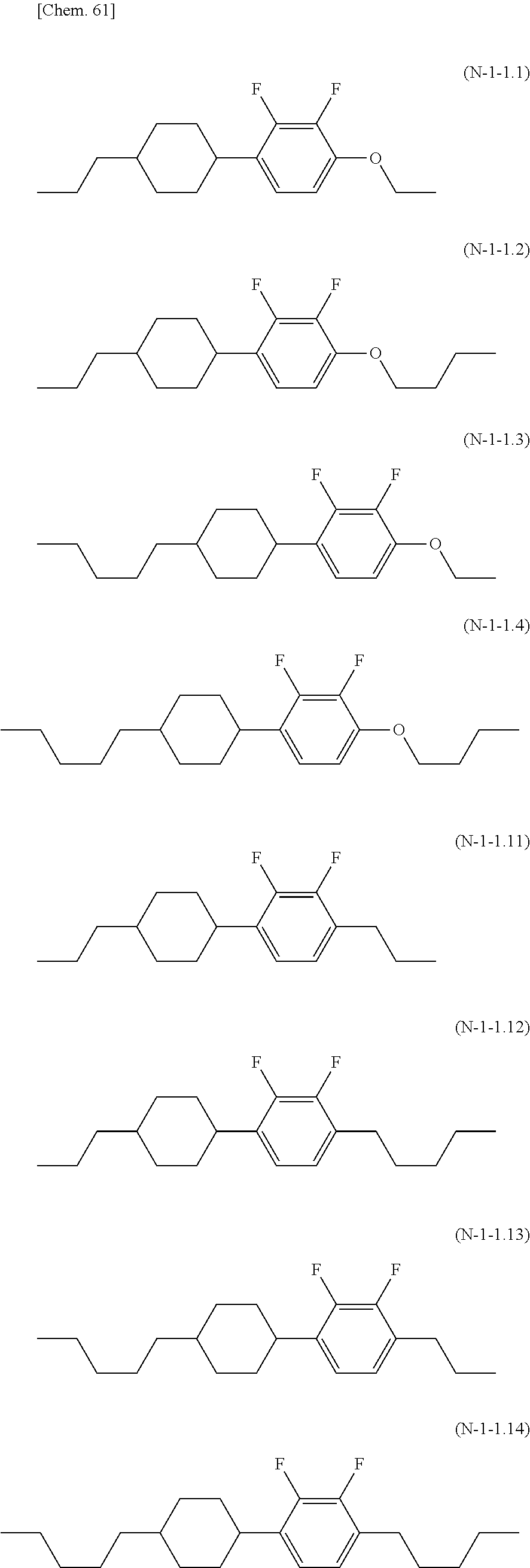


(in the formula, RN121 and RN122 each independently represent the same meaning as RN11 and RN12 in the general formula (N-1)).


(in the formula, RN131 and RN132 each independently represent the same meaning as RN11 and RN12 in the general formula (N-1)).


(in the formula, RN141 and RN142 each independently represent the same meaning as RN11 and RN12 in the general formula (N-1)).


(in the formula, RN151 and RN152 each independently represent the same meaning as RN11 and RN12 in the general formula (N-1)).


(in the formula, RN1101 and RN1102 each independently represent the same meaning as RN11 and RN12 in the general formula (N-1)).


(in the formula, RN1111 and RN1112 each independently represent the same meaning as RN11 and RN12 in the general formula (N-1)).


(in the formula, RN1121 and RN1122 each independently represent the same meaning as RN11 and RN12 in the general formula (N-1)).

(in the formula, RN1131 and RN1132 each independently represent the same meaning as RN11 and RN12 in the general formula (N-1)).

(in the formula, RN1141 and RN1142 each independently represent the same meaning as RN11 and RN12 in the general formula (N-1)).

(in the formula, RN1151 and RN1152 each independently represent the same meaning as RN11 and RN12 in the general formula (N-1).

(in the formula, RN1161 and RN1162 each independently represent the same meaning as RN11 and RN12 in the general formula (N-1)).

(in the formula, RN1171 and RN1172 each independently represent the same meaning as RN11 and RN12 in the general formula (N-1)).

(in the formula, RN1181 and RN1182 each independently represent the same meaning as RN11 and RN12 in the general formula (N-1)).


(in the formula, RN1201 and RN1202 each independently represent the same meaning as RN11 and RN12 in the general formula (N-1)).

(in the formula, RN1211 and RN1212 each independently represent the same meaning as RN11 and RN12 in the general formula (N-1)).

(in the formula, RN1221 and RN1222 each independently represent the same meaning as RN11 and RN12 in the general formula (N-1)).


(in the formula, RN211 and RN212 each independently represent the same meaning as RN21 and RN22 in the general formula (N-2). Similarly, in the formula, RN221 and RN222 each independently represent the same meaning as RN21 and RN22 in the general formula (N-2)).


(in the formula, RN321 and RN322 each independently represent the same meaning as RN#1 and RN32 in the general formula (N-3)).


(In the formula, RL1 and RL2 each independently represent an alkyl group having 1 to 8 carbon atoms, and one or two or more non-adjacent —CH2— groups in the alkyl group may be each independently substituted by CH═CH—, —C≡C—, —O—, —CO—, —COO—, or —OCO—;
-
- nL1 represents 0, 1, 2, or 3;
- AL1, AL2, and AL3 each independently represent a group selected from the group consisting of:
(a) a 1,4-cyclohexylene group (one —CH2— group or two or more non-adjacent —CH2— groups present in this group may be substituted by —O—);
(b) a 1,4-phenylene group (one —CH═ group or two or more non-adjacent —CH═ groups present in this group may be substituted by —N═); and
(c) a naphthalene-2,6-diyl group, a 1,2,3,4-tetrahydronaphthalene-2,6-diyl group, or a decahydronaphthalene-2,6-diyl group (one —CH═ group or two or more non-adjacent —CH═ groups present in the naphthalene-2,6-diyl group or the 1,2,3,4-tetrahydronaphthalene-2,6-diyl group may be substituted by —N═),
one or two or more hydrogen atoms present in the groups of the above-mentioned groups (a), (b), (c) may be each independently substituted by a cyano group, a fluorine atom, or a chlorine atom; and - ZL1 and ZL2 each independently represent a single bond, —CH2CH2—, —(CH2)S—, —OCH2—, —CH2O—, —COO—, —OCO—, —OCF2—, —CF2O—, —CH═N—N═CH—, —CH═CH—, —CF═CF—, or —C≡C—; and
- when nL1 is 2 or 3 and multiple AL2s are present, they may be the same or different, and when nL1 is 2 or 3 and multiple ZL2s are present, they may be the same or different.)


and more preferably represent a trans-1,4-cyclohexylene group or a 1,4-phenylene group.

(in the formula, RL11 and RL12 each independently represent the same meaning as RL1 and RL2 in general formula (L)).

(in the formula, RL12 represents the same meaning as that in the general formula (L-1)).


(in the formula, RL12 represents the same meaning as that in the general formula (L-1)).


(in the formula, RL13 and RL14 each independently represent an alkyl group having 1 to 8 carbon atoms or an alkoxy group having 1 to 8 carbon atoms).


(in the formulae, RL15 and RL16 each independently represent an alkyl group having 1 to 8 carbon atoms or an alkoxy group having 1 to 8 carbon atoms).
The lower limit of the content of the compound represented by the formula (L-1-5) with respect to the total amount of the nonpolymerizable liquid crystal compounds contained in the liquid crystal composition for a light-scattering liquid crystal device according to the present invention is preferably 0 mass %, and the upper limit is preferably 25 mass %. More preferably, the lower limit of the content is 0 mass %, and the upper limit is 15 mass %.


(in the formula, RL17 and RL18 each independently represent a methyl group or a hydrogen atom).
The lower limit of the content of the compound represented by the formula (L-1-6) with respect to the total amount of the nonpolymerizable liquid crystal compounds contained in the liquid crystal composition for a light-scattering liquid crystal device according to the present invention is preferably 0 mass %, and the upper limit is preferably 25 mass %. More preferably, the lower limit of the content is 0 mass %, and the upper limit is 15 mass %.


(in the formula, RL21 and RL22 each independently represent the same meaning as RL1 and RL2 in the general formula (L)).


(in the formula, RL31 and RL32 each independently represent the same meaning as RL1 and RL2 in the general formula (L)).


(in the formula, RL41 and RL42 each independently represent the same meaning as RL1 and RL2 in the general formula (L)).


(in the formula, RL51 and RL52 each independently represent the same meaning as RL1 and RL2 in the general formula (L)).


(in the formula, RLE1 and RL62 each independently represent the same meaning as RL1 and RL2 in the general formula (L), and XL61 and XL62 each independently represent a hydrogen atom or a fluorine atom).


(in the formula, RL71 and RL72 each independently represent the same meaning as RL1 and RL2 in the general formula (L); AL71 and AL72 each independently represent the same meaning as AL2 and AL3 in the general formula (L), and hydrogen atoms on AL71 and AL72 may be each independently substituted by a fluorine atom; ZL71 represents the same meaning as ZL72 in the general formula (L); and XL71 and XL72 each independently represent a fluorine atom or a hydrogen atom).


(in the formula, RL81 and RL82 each independently represent the same meaning as RL1 and RL2 in the general formula (L); AL81 represents the same meaning as AL1 in the general formula (L) or a single bond, and hydrogen atoms on AL81 may be each independently substituted by a fluorine atom; and XL81 to XL8E each independently represent a fluorine atom or a hydrogen atom).


(in the formula, RL91 and RL92 each independently represent the same meaning as RL1 and RL2 in the general formula (L)).


(Liquid Crystal Composition “L-2”)

(Liquid Crystal Composition “L-3”)

(Liquid Crystal Composition “L-4”)


(Liquid Crystal Composition “L-5”)

(Liquid Crystal Composition “L-6”)

(Liquid Crystal Composition “L-7”)

-
- Polymerizable compound (1-A): 50%
- Polymerizable compound (2-A): 35%
- Polymerizable compound (3-C): 15%
(Polymerizable Composition “A2”) - Polymerizable compound (1-A): 30%
- Polymerizable compound (2-A): 35%
- Polymerizable compound (3-A): 20%
- Polymerizable compound (3-C): 15%
(Polymerizable Composition “A3”) - Polymerizable compound (1-A): 40%
- Polymerizable compound (1-B): 15%
- Polymerizable compound (2-A): 30%
- Polymerizable compound (3-C): 15%
(Polymerizable Composition “A4”) - Polymerizable compound (1-A): 50%
- Polymerizable compound (2-A): 50%
(Polymerizable Composition “A5”) - Polymerizable compound (1-A): 60%
- Polymerizable compound (2-A): 40%
(Polymerizable Composition “A6”) - Polymerizable compound (1-A): 50%
- Polymerizable compound (2-A): 35%
- Polymerizable compound (3-D): 15%
(Polymerizable Composition “A7”) - Polymerizable compound (1-A): 60%
- Polymerizable compound (3-C): 20%
- Polymerizable compound (3-D): 20%
(Polymerizable Composition “A8”) - Polymerizable compound (1-B): 100%
(Polymerizable Composition “A9”) - Polymerizable compound (1-B): 60%
- Polymerizable compound (3-C): 40%
(Polymerizable Composition “A10”) - Polymerizable compound (1-B): 60%
- Polymerizable compound (3-C): 20%
- Polymerizable compound (3-D): 20%
(Polymerizable Composition “A11”) - Polymerizable compound (1-A): 25%
- Polymerizable compound (2-A): 75%
(Polymerizable Composition “A12”) - Polymerizable compound (1-B): 46.6%
- Polymerizable compound (2-A): 53.4%
(Polymerizable Composition “A13”) - Polymerizable compound (1-A): 30%
- Polymerizable compound (1-B): 30%
- Polymerizable compound (2-A): 40%
(Polymerizable Composition “A14”) - Polymerizable compound (1-A): 50%
- Polymerizable compound (2-A): 40%
- Polymerizable compound (3-E): 10%
(Polymerizable Composition “A15”) - Polymerizable compound (1-A): 50%
- Polymerizable compound (2-A): 40%
- Polymerizable compound (3-F): 10%
(Polymerizable Composition “A16”) - Polymerizable compound (1-A): 50%
- Polymerizable compound (2-A): 40%
- Polymerizable compound (3-G): 10%
(Polymerizable Composition “A17”) - Polymerizable compound (1-A): 50%
- Polymerizable compound (2-A): 40%
- Polymerizable compound (3-H): 10%
(Polymerizable Composition “A18”) - Polymerizable compound (1-A): 50%
- Polymerizable compound (2-A): 40%
- Polymerizable compound (3-I): 10%
(Polymerizable Composition “A19”) - Polymerizable compound (1-A): 50%
- Polymerizable compound (2-A): 40%
- Polymerizable compound (3-J): 10%
(Polymerizable Composition “A20”) - Polymerizable compound (1-B): 46.6%
- Polymerizable compound (2-A): 43.4%
- Polymerizable compound (2-B): 10%
(Polymerizable Composition “A21”) - Polymerizable compound (1-B): 46.6%
- Polymerizable compound (2-A): 43.4%
- Polymerizable compound (2-C): 10%
(Polymerizable Composition “A22”) - Polymerizable compound (3-A): 100%
(Polymerizable Composition “A23”) - Polymerizable compound (3-A): 60%
- Polymerizable compound (3-C): 40%
(Polymerizable Composition “A24”) - Polymerizable compound (3-A): 60%
- Polymerizable compound (3-C): 20%
- Polymerizable compound (3-D): 20%
(Polymerizable Composition “A25”) - Polymerizable compound (3-C): 100%
(Polymerizable Composition “A26”) - Polymerizable compound (1-A): 30%
- Polymerizable compound (1-B): 30%
- Polymerizable compound (2-A): 20%
- Polymerizable compound (2-D): 20%
(Polymerizable Composition “A27”) - Polymerizable compound (1-A): 50%
- Polymerizable compound (1-E): 50%
(Polymerizable Composition “A28”) - Polymerizable compound (1-A): 50%
- Polymerizable compound (1-F): 50%
Hz=[{TT−PT}/TT]×100(%).
-
- Excellent: less than 0.5,
- Good: 0.5 or more and less than 1.6,
- Fair: 1.6 or more and less than 4.0, and
- Poor: 4.0 or more.
ΔToff - Excellent: less than 2.0,
- Good: 2.0 or more and less than 3.0,
- Fair: 3.0 or more and less than 4.0, and
- Poor: 4.0 or more.
Contrast - Excellent: 12.0 or more,
- Good: 4.0 or more and less than 12.0,
- Fair: 2.0 or more and less than 4.0, and
- Poor: less than 2.0.
Driving Voltage V10 - Excellent: less than 16,
- Good: 16 or more and less than 31,
- Fair: 31 or more and less than 46, and
- Poor: 46 or more.
-
- Excellent: no peeling from the substrate occurred after high temperature storage at 85° C. for 500 hours,
- Good: no peeling from the substrate occurred after high temperature storage at 85° C. for 100 hours, and
- Poor: peeling from the substrate occurred after high temperature storage at 85° C. for 24 hours.
| TABLE 1 | ||||||
| Example 1 | Example 2 | Example 3 | Example 4 | Example 5 | ||
| Composition of | Liquid crystal composition | L-1 | L-1 | L-1 | L-1 | L-1 |
| complex liquid | Polymerizable composition | A1 | A2 | A3 | A4 | A5 |
| crystal | Proportion of liquid crystal | 92 | 92 | 92 | 92 | 92 |
| composition | composition in polymerizable liquid | |||||
| crystal composition (wt %] | ||||||
| Initiator [wt %] | 0.24 | 0.24 | 0.24 | 0.24 | 0.24 | |
| Liquid crystal cell | Type of alignment film | Vertical | Vertical | Vertical | Vertical | Vertical |
| Liquid crystal layer thickness [μm] | 5 | 5 | 5 | 5 | 5 | |
| Transmittance | Cell surface normal (0°) direction, | 87.3 | 88.6 | 89.4 | 88.7 | 89.3 |
| when no voltage | transmittance when transparent, | |||||
| is applied | Toff(0) [%] | |||||
| Cell surface diagonal (35°) direction, | 84.7 | 86.2 | 88.3 | 86.3 | 87.5 | |
| transmittance when transparent, | ||||||
| Toff(35) [%] | ||||||
| ΔToff {Toff(0) − Toff(35)} [%] | 2.6 | 2.4 | 1.1 | 2.4 | 1.8 | |
| Evaluation | Excellent | Excellent | Excellent | Excellent | Excellent | |
| Transmittance | Cell surface normal (0°) direction, | 28.0 | 26.0 | 30.0 | 25.0 | 32.0 |
| when a voltage | 10 V, transmittance [%] | |||||
| is applied | Cell surface normal (0°) direction, | 10.2 | 8.2 | 11.5 | 7.9 | 8.0 |
| 15 V, transmittance [%] | ||||||
| Cell surface normal (0°) direction, | 5.3 | 4.5 | 6.1 | 4.3 | 4.4 | |
| 20 V, transmittance [%] | ||||||
| Cell surface normal (0°) direction, | 3.7 | 3.5 | 4.6 | 3.4 | 3.5 | |
| saturation voltage, Ton(0) [%] | ||||||
| Evaluation | Good | Good | Good | Good | Good | |
| Contrast | Toff(0)/Ton(0) | 24 | 25 | 19 | 26 | 28 |
| Evaluation | Excellent | Excellent | Good | Excellent | Excellent | |
| Driving voltage | Voltage at 10% relative transmittance, | 17 | 15 | 19 | 12 | 14 |
| V10 [V] | ||||||
| Evaluation | Good | Excellent | Good | Good | Fair | |
| Saturation | Voltage at 1% relative transmittance, | 25 | 23 | 27 | 19 | 22 |
| voltage | V1 [V] | |||||
| Evaluation | Good | Good | Good | Good | Good | |
| Haze | Haze (when OFF), Hz [%] | 1.0 | 0.4 | 0.7 | 0.4 | 0.5 |
| Evaluation | Excellent | Excellent | Excellent | Excellent | Excellent | |
| Haze (when ON), Hz [%] | 75(30 V) | 74(30 V) | 76(30 V) | 75(30 V) | 71(30 V) | |
| Evaluation | Good | Good | Good | Good | Good | |
| TABLE 2 | ||||||
| Example 6 | Example 7 | Example 8 | Example 9 | Example 10 | ||
| Composition of | Liquid crystal composition | L-1 | L-2 | L-2 | L-3 | L-3 |
| complex liquid | Polymerizable composition | A6 | A5 | A7 | A8 | A9 |
| crystal | Proportion of liquid crystal | 92 | 92 | 90 | 96 | 96 |
| composition | composition in polymerizable liquid | |||||
| crystal composition [wt %] | ||||||
| Initiator [wt %] | 0.24 | 0.24 | 0.24 | 0.08 | 0.08 | |
| Liquid crystal | Type of alignment film | Vertical | Vertical | Vertical | Vertical | Vertical |
| cell | Liquid crystal layer thickness [μm] | 5 | 5 | 5 | 5 | 5 |
| Transmittance | Cell surface normal (0°) direction, | 87.6 | 88.1 | 87.4 | 87.0 | 86.8 |
| when no voltage | transmittance when transparent, | |||||
| is applied | Toff(0) [%] | |||||
| Cell surface diagonal (35°) | 83.1 | 85.8 | 84.6 | 82.8 | 82.4 | |
| direction, transmittance when | ||||||
| transparent, Toff(35) [%] | ||||||
| ΔToff {Toff(0) − Toff(35)} [%] | 4.5 | 2.3 | 2.8 | 4.2 | 4.4 | |
| Evaluation | Good | Excellent | Excellent | Good | Good | |
| Transmittance | Cell surface normal (0°) direction, | 32.0 | 31.0 | 27.0 | 31.0 | 29.0 |
| when a voltage | 10 V, transmittance [%] | |||||
| is applied | Cell surface normal (0°) direction, | 12.0 | 11.7 | 8.1 | 10.0 | 8.0 |
| 15 V, transmittance [%] | ||||||
| Cell surface normal (0°) direction, | 5.9 | 5.7 | 4.4 | 5.1 | 4.7 | |
| 20 V, transmittance [%] | ||||||
| Cell surface normal (0°) direction, | 4.6 | 4.5 | 3.5 | 3.5 | 3.5 | |
| saturation voltage, Ton(0) [%] | ||||||
| Evaluation | Good | Good | Good | Good | Good | |
| Contrast | Toff(0)/Ton(0) | 19 | 20 | 25 | 25 | 25 |
| Evaluation | Good | Excellent | Excellent | Excellent | Excellent | |
| Driving voltage | Voltage at 10% relative | 18 | 18 | 14 | 14 | 13 |
| transmittance, V10 [V] | ||||||
| Evaluation | Good | Fair | Excellent | Good | Good | |
| Saturation | Voltage at 1% relative trans- | 27 | 26 | 22 | 22 | 21 |
| voltage | mittance, V1 [V] | |||||
| Evaluation | Good | Good | Good | Good | Good | |
| Haze | Haze (when OFF), Hz [%] | 0.9 | 0.6 | 1.2 | 2.0 | 1.9 |
| Evaluation | Excellent | Excellent | Good | Good | Good | |
| Haze (when ON), Hz [%] | 74(30 V) | 70(30 V) | (74(30 V) | 75(30 V) | 76(30 V) | |
| Evaluation | Good | Good | Good | Good | Good | |
| TABLE 3 | |||||
| Exam | Exam | Exam | Exam | ||
| ple 11 | ple 12 | ple 13 | ple 14 | ||
| Com- | Liquid crystal | L-3 | L-3 | L-4 | L-4 |
| position | composition | ||||
| of | Polymerizable | A10 | A4 | A11 | A12 |
| complex | composition | ||||
| liquid | Proportion of liquid | 96 | 92 | 86 | 92 |
| crystal | crystal composition in | ||||
| com- | polymerizable liquid | ||||
| position | crystal composition | ||||
| [wt %] | |||||
| Initiator (wt %] | 0.08 | 0.16 | 0.28 | 0.28 | |
| Liquid | Type of alignment | Vertical | Vertical | Vertical | Vertical |
| crystal cell | film | ||||
| Liquid crystal layer | 5 | 5 | 5 | 5 | |
| thickness [μm] | |||||
| Trans- | Cell surface normal | 86.7 | 88.8 | 86.7 | 87.0 |
| mittance | (0°) direction, | ||||
| when no | transmittance when | ||||
| voltage is | transparent, Toff(0) | ||||
| applied | [%] | ||||
| Cell surface diagonal | 82.6 | 85.0 | 82.2 | 82.5 | |
| (35°) direction, | |||||
| transmittance when | |||||
| transparent, Toff(35) | |||||
| [%] | |||||
| ΔToff {Toff(0)- | 4.1 | 3.8 | 4.5 | 4.5 | |
| Toff(35)} [%] | |||||
| Evaluation | Good | Good | Good | Good | |
| Trans- | Cell surface normal | 28.0 | 75.8 | 16.3 | 15.0 |
| mittance | (0°) direction, | ||||
| when a | 10 V, transmittance | ||||
| voltage is | [%] | ||||
| applied | Cell surface normal | 7.0 | 25.3 | 7.6 | 6.7 |
| (0°) direction, | |||||
| 15 V, transmittance | |||||
| [%] | |||||
| Cell surface normal | 4.5 | 10.5 | 6.1 | 6.0 | |
| (0°) direction, | |||||
| 20 V, transmittance | |||||
| [%] | |||||
| Cell surface | 3.5 | 5.6 | 4.5 | 4.4 | |
| normal (0°) direction, | |||||
| saturation voltage, | |||||
| Ton(0) [%] | |||||
| Evaluation | Good | Good | Excel- | Excel- | |
| lent | lent | ||||
| Contrast | Toff(0)/Ton(0) | 25 | 16 | 19 | 20 |
| Evaluation | Excel- | Good | Good | Excel- | |
| lent | lent | ||||
| Driving | Voltage at 10% | 13 | 18.2 | 11 | 10 |
| voltage | relative transmittance, | ||||
| V10 [V] | |||||
| Evaluation | Good | Good | Good | Excel- | |
| lent | |||||
| Saturation | Voltage at 1% | 20 | 26 | 27 | 15 |
| voltage | relative transmittance, | ||||
| V1 [V] | |||||
| Evaluation | Good | Good | Good | Excel- | |
| lent | |||||
| Haze | Haze (when | 1.9 | 1.9 | 1.8 | 2.1 |
| OFF), Hz [%] | |||||
| Evaluation | Good | Good | Good | Good | |
| Haze (when | 76 | 77 | 76 | 75 | |
| ON), Hz [%] | (30 V) | (30 V) | (30 V) | (10 V) | |
| Evaluation | Good | Good | Good | Excel- | |
| lent | |||||
| TABLE 4 | ||||||
| Example 15 | Example 16 | Example 17 | Example 18 | Example 19 | ||
| Composition | Liquid crystal composition | L-5 | L-6 | L-6 | L-6 | L-6 |
| of complex | Polymerizable composition | A13 | A13 | A14 | A15 | A16 |
| liquid crystal | Proportion of liquid crystal | 90 | 90 | 90 | 90 | 90 |
| composition | composition in polymerizable | |||||
| liquid crystal composition [wt %] | ||||||
| Initiator [wt %] | 0.20 | 0.20 | 0.20 | 0.20 | 0.20 | |
| Liquid crystal | Type of alignment film | Vertical | Vertical | Vertical | Vertical | Vertical |
| cell | Liquid crystal layer thickness [μm] | 5 | 5 | 5 | 5 | 5 |
| Transmittance | Cell surface normal (0°) direction, | 88.5 | 88.8 | 88.6 | 88.5 | 88.7 |
| when no | transmittance when transparent, | |||||
| voltage is | Toff(0) [%] | |||||
| applied | Cell surface diagonal (35°) | 84.0 | 84.3 | 86.4 | 86.5 | 86.8 |
| direction, transmittance when | ||||||
| transparent, Toff(35) [%] | ||||||
| ΔToff {Toff(0) − Toff(35)} [%] | 4.5 | 4.5 | 2.2 | 2.0 | 2.1 | |
| Evaluation | Good | Good | Excellent | Excellent | Excellent | |
| Transmittance | Cell surface normal (0°) direction, | 15.2 | 15.0 | 15.1 | 15.4 | 15.1 |
| when a | 10 V, transmittance [%] | |||||
| voltage is | Cell surface normal (0° C.) direction, | 6.8 | 6.7 | 6.8 | 7.0 | 6.7 |
| applied | 15 V, transmittance [%] | |||||
| Cell surface normal (0°) direction, | 6.1 | 5.9 | 6.2 | 6.5 | 6.3 | |
| 20 V, transmittance [%] | ||||||
| Cell surface normal (0°) direction, | 4.7 | 4.6 | 4.2 | 4.3 | 4.4 | |
| saturation voltage, Ton(0) [%] | ||||||
| Evaluation | Excellent | Excellent | Excellent | Excellent | Excellent | |
| Contrast | Toff(0)/Ton(0) | 19 | 19 | 21 | 21 | 20 |
| Evaluation | Good | Good | Excellent | Excellent | Excellent | |
| Driving | Voltage at 10% relative | 10 | 9 | 10 | 11 | 9 |
| voltage | transmittance, V10 [V] | |||||
| Evaluation | Excellent | Excellent | Excellent | Good | Excellent | |
| Saturation | Voltage at 1% relative | 15 | 14 | 15 | 15 | 14 |
| voltage | transmittance, V1 [V] | |||||
| Evaluation | Excellent | Excellent | Excellent | Excellent | Excellent | |
| Haze | Haze (when OFF), Hz [%] | 1.8 | 1.9 | 0.7 | 0.9 | 0.7 |
| Evaluation | Good | Good | Excellent | Excellent | Excellent | |
| Haze (when ON), Hz [%] | 76(10 V) | 77(10 V) | 75(10 V) | 76(10 V) | 75(10 V) | |
| Evaluation | Excellent | Excellent | Excellent | Excellent | Excellent | |
| TABLE 5 | |||||
| Exam- | Exam- | Exam- | Exam- | ||
| ple 20 | ple 21 | ple 22 | ple 23 | ||
| Com- | Liquid crystal | L-6 | L-8 | L-6 | L-7 |
| position of | composition | ||||
| complex | Polymerizable | A17 | A18 | A19 | A13 |
| liquid | composition | ||||
| crystal | Proportion of liquid | 90 | 90 | 90 | 90 |
| composition | crystal composition in | ||||
| polymerizable liquid | |||||
| crystal composition | |||||
| [wt %] | |||||
| Initiator [wt %] | 0.20 | 0.20 | 0.20 | 0.20 | |
| Liquid | Type of alignment | Vertical | Vertical | Vertical | Vertical |
| crystal cell | film | ||||
| Liquid crystal layer | 5 | 5 | 5 | 5 | |
| thickness [μm] | |||||
| Trans- | Cell surface normal | 88.6 | 88.8 | 88.7 | 88.0 |
| mittance | (0°) direction, | ||||
| when no | transmittance when | ||||
| voltage is | transparent, Toff(0) | ||||
| applied | [%] | ||||
| Cell surface diagonal | 86.1 | 88.4 | 86.5 | 85.7 | |
| (35°) direction, | |||||
| transmittance when | |||||
| transparent, Toff(35) | |||||
| [%] | |||||
| AToff {Toff(0)- | 2.5 | 2.4 | 2.2 | 2.3 | |
| Toff(35)} [%] | |||||
| Evaluation | Excel- | Excel- | Excel- | Excel- | |
| lent | lent | lent | lent | ||
| Trans- | Cell surface normal | 15.2 | 15.5 | 15.4 | 15.1 |
| mittance | (0°) direction, | ||||
| when a | 10 V, transmittance | ||||
| voltage is | [%] | ||||
| applied | Cell surface normal | 6.8 | 7.2 | 7.0 | 6.9 |
| (0°) direction, | |||||
| 15 V, transmittance | |||||
| [%] | |||||
| Cell surface normal | 6.4 | 6.7 | 6.5 | 6.0 | |
| (0°) direction, | |||||
| 20 V, transmittance | |||||
| [%] | |||||
| Cell surface normal | 4.2 | 4.1 | 4.3 | 4.4 | |
| (0°) direction, | |||||
| saturation voltage, | |||||
| Ton(0) [%] | |||||
| Evaluation | Excel- | Excel- | Excel- | Excel- | |
| lent | lent | lent | lent | ||
| Contrast | Toff(0)/Ton(0) | 21 | 22 | 21 | 20 |
| Evaluation | Excel- | Excel- | Excel- | Excel- | |
| lent | lent | lent | lent | ||
| Driving | Voltage at 10% | 9 | 10 | 10 | 10 |
| voltage | relative transmittance, | ||||
| V10 M | |||||
| Evaluation | Excel- | Excel- | Excel- | Excel- | |
| lent | lent | lent | lent | ||
| Saturation | Voltage at 1% | 14 | 15 | 15 | 15 |
| voltage | relative transmittance, | ||||
| V1 M | |||||
| Evaluation | Excel- | Excel- | Excel- | Excel- | |
| lent | lent | lent | lent | ||
| Haze | Haze (when OFF), | 0.8 | 0.6 | 0.4 | 0.8 |
| Hz [%] | |||||
| Evaluation | Excel- | Excel- | Excel- | Excel- | |
| lent | lent | lent | lent | ||
| Haze (when ON), | 77 | 76 | 77 | 75 | |
| Hz [%] | (10 V) | (10 V) | (10 V) | (10 V) | |
| Evaluation | Excel- | Excel- | Excel- | Excel- | |
| lent | lent | lent | lent | ||
| TABLE 6 | ||||||
| Example | Example | Example | Example | Example | ||
| 24 | 25 | 26 | 27 | 28 | ||
| Composition of | Liquid crystal composition | L-4 | L-4 | L-6 | L-6 | L-6 |
| complex liquid | Polymerizable composition | A20 | A21 | A26 | A27 | A28 |
| crystal | Proportion of liquid crystal composition in | 92 | 92 | 88 | 88 | 88 |
| composition | polymerizable liquid crystal composition [wt %] | |||||
| Initiator [wt %] | 0.28 | 0.28 | 0.20 | 0.20 | 0.20 | |
| Liquid crystal | Type of alignment film | Vertical | Vertical | Vertical | Vertical | Vertical |
| cell | Liquid crystal layer thickness [μm] | 5 | 5 | 10 | 10 | 10 |
| Transmittance | Cell surface normal (0°) direction, | 87.1 | 87.2 | 89.1 | 88.9 | 88.7 |
| when no | transmittance when transparent, Toff(0) [%] | |||||
| voltage is | Cell surface diagonal (35°) direction, | 82.6 | 82.7 | 87.3 | 87.1 | 86.9 |
| applied | transmittance when transparent, Toff(35) [%] | |||||
| ΔToff {Toff(0) − Toff(35)} [%] | 4.5 | 4.5 | 1.8 | 1.8 | 1.8 | |
| Evaluation | Good | Good | Excellent | Excellent | Excellent | |
| Transmittance | Cell surface normal (0°) direction, 10 V, | 15.1 | 15.0 | 20.3 | 21.5 | 20.6 |
| when a voltage | transmittance [%] | |||||
| is applied | Cell surface normal (0°) direction, 15 V, | 6.6 | 6.7 | 8.4 | 8.7 | 8.8 |
| transmittance [%] | ||||||
| Cell surface normal (0°) direction, 20 V, | 6.0 | 6.0 | 6.8 | 7.2 | 7.1 | |
| transmittance [%] | ||||||
| Cell surface normal (0°) direction, saturation | 4.4 | 4.3 | 4.8 | 4.7 | 4.7 | |
| voltage, Ton(0) [%] | ||||||
| Evaluation | Excellent | Excellent | Excellent | Excellent | Excellent | |
| Contrast | Toff(0)/Ton(0) | 20 | 20 | 19 | 18 | 18 |
| Evaluation | Excellent | Excellent | Good | Good | Good | |
| Driving voltage | Voltage at 10% relative transmittance, V10 [V] | 10 | 10 | 14 | 15 | 17 |
| Evaluation | Excellent | Excellent | Good | Good | Good | |
| Saturation | Voltage at | 15 | 15 | 25 | 27 | 26 |
| voltage | 1% relative transmittance, V1 [V] | |||||
| Evaluation | Excellent | Excellent | Good | Good | Good | |
| Haze | Haze (when OFF), Hz [%] | 2.0 | 2.0 | 1.9 | 1.8 | 1.8 |
| Evaluation | Good | Good | Good | Good | Good | |
| Haze (when ON), Hz [%] | 74(10 V) | 75(10 V) | 77(50 V) | 78(50 V) | 76(50 V) | |
| Evaluation | Excellent | Excellent | Good | Good | Good | |
| TABLE 7 | |||||
| Comparative | Comparative | Comparative | Comparative | ||
| Example 1 | Example 2 | Example 3 | Example 4 | ||
| Composition of | Liquid crystal composition | L-3 | L-3 | L-3 | L-3 |
| complex liquid | Polymerizable composition | A22 | A23 | A24 | A25 |
| crystal | Proportion of liquid crystal composition | 96 | 96 | 96 | 98 |
| composition | in polymerizable liquid crystal | ||||
| composition [wt %] | |||||
| Initiator [wt %] | 0.08 | 0.08 | 0.08 | 0.08 | |
| Liquid crystal cell | Type of alignment film | Vertical | Vertical | Vertical | Vertical |
| Liquid crystal layer thickness [μm] | 5 | 5 | 5 | 5 | |
| Transmittance | Cell surface normal (0°) direction, | 82.0 | 80.0 | 81.1 | 55.1 |
| when no voltage | transmittance when transparent, Toff(0) | ||||
| is applied | [%] | ||||
| Cell surface diagonal (35°) direction, | 77.5 | 75.7 | 76.7 | 50.0 | |
| transmittance when transparent, | |||||
| Toff(35) [%] | |||||
| ΔToff {Toff(0) − Toff(35)} [%] | 4.5 | 4.3 | 4.4 | 5.1 | |
| Evaluation | Good | Good | Good | Poor | |
| Transmittance | Cell surface normal (0°) direction, 10 V, | 32.0 | 30.0 | 29.0 | 53.0 |
| when a voltage is | transmittance [%] | ||||
| applied | Cell surface normal (0°) direction, 15 V, | 18.0 | 17.1 | 17.0 | 50.0 |
| transmittance [%] | |||||
| Cell surface normal (0°) direction, 20 V, | 9.0 | 8.2 | 8.2 | 48.0 | |
| transmittance [%] | |||||
| Cell surface normal (0°) direction. | 6.6 | 6.0 | 6.1 | 45.0 | |
| saturation voltage, Ton(0) [%] | |||||
| Evaluation | Fair | Fair | Fair | Poor | |
| Contrast | Toff(0)/Ton(0) | 12 | 13 | 13 | 1 |
| Evaluation | Fair | Fair | Fair | Poor | |
| Driving voltage | Voltage at 10% relative transmittance, | 17 | 16 | 16 | — |
| V10 [V] | |||||
| Evaluation | Good | Good | Good | Poor | |
| Saturation | Voltage at 1% relative transmittance, V1 | 38 | 37 | 36 | — |
| voltage | [V] | ||||
| Evaluation | Poor | Poor | Poor | Poor | |
| Haze | Haze (when OFF), Hz [%] | 2.0 | 2.1 | 1.9 | 11.0 |
| Evaluation | Good | Good | Good | Poor | |
| Haze (when ON), Hz [%] | 61(30 V) | 63(30 V) | 65(30 V) | 62(30 V) | |
| Evaluation | Fair | Fair | Fair | Fair | |
-
- 11 first transparent substrate
- 12 second transparent substrate
- 2 electrode
- 3 homogeneous alignment film
- 4 liquid crystal molecule
- 5 aligning polymer
Claims (6)
P1—S1—X1


Applications Claiming Priority (3)
| Application Number | Priority Date | Filing Date | Title |
|---|---|---|---|
| JP2018-223582 | 2018-11-29 | ||
| JP2018223582 | 2018-11-29 | ||
| PCT/JP2019/028242 WO2020110364A1 (en) | 2018-11-29 | 2019-07-18 | Liquid crystal composition for light-scattering liquid crystal device, light-scattering liquid crystal device, and smart window |
Publications (2)
| Publication Number | Publication Date |
|---|---|
| US20220057672A1 US20220057672A1 (en) | 2022-02-24 |
| US12197062B2 true US12197062B2 (en) | 2025-01-14 |
Family
ID=70851951
Family Applications (1)
| Application Number | Title | Priority Date | Filing Date |
|---|---|---|---|
| US17/274,906 Active 2039-07-18 US12197062B2 (en) | 2018-11-29 | 2019-07-18 | Liquid crystal composition for light-scattering liquid crystal device, light-scattering liquid crystal device, and smart window |
Country Status (5)
| Country | Link |
|---|---|
| US (1) | US12197062B2 (en) |
| JP (1) | JP6828850B2 (en) |
| CN (1) | CN112639055B (en) |
| TW (1) | TWI862505B (en) |
| WO (1) | WO2020110364A1 (en) |
Families Citing this family (5)
| Publication number | Priority date | Publication date | Assignee | Title |
|---|---|---|---|---|
| JP6828850B2 (en) * | 2018-11-29 | 2021-02-10 | Dic株式会社 | Liquid crystal composition for light scattering type liquid crystal element, light scattering type liquid crystal element, and smart window |
| TWI751784B (en) * | 2020-11-12 | 2022-01-01 | 絢麗光電股份有限公司 | Smart window |
| JP7010401B1 (en) * | 2021-03-24 | 2022-01-26 | 凸版印刷株式会社 | Dimming sheet, manufacturing method of dimming sheet, and liquid crystal composition for polymer dispersion type |
| JP7484976B2 (en) * | 2022-07-29 | 2024-05-16 | Toppanホールディングス株式会社 | Light control sheets and screens |
| JP2025172390A (en) * | 2024-05-13 | 2025-11-26 | Toppanホールディングス株式会社 | Light-adjusting sheet and method for manufacturing the light-adjusting sheet |
Citations (12)
| Publication number | Priority date | Publication date | Assignee | Title |
|---|---|---|---|---|
| JPH05119302A (en) | 1990-11-26 | 1993-05-18 | Seiko Epson Corp | Polymer dispersed liquid crystal display device and manufacturing method thereof |
| JP2004157247A (en) * | 2002-11-05 | 2004-06-03 | Asahi Glass Co Ltd | Liquid crystal optical element, method for manufacturing the same, and optical apparatus |
| US20070298193A1 (en) * | 2004-09-16 | 2007-12-27 | Kazuhiro Nakamura | Method of Producing Light-Scattering Film, Polarizing Plate Comprising Light-Scattering Film and Liquid Crystal Display Device Comprising the Polarizing Plate |
| JP2008058374A (en) | 2006-08-29 | 2008-03-13 | Dainippon Ink & Chem Inc | Liquid crystal element |
| JP2008276197A (en) | 2007-03-30 | 2008-11-13 | Dic Corp | Polymer-stabilized ferroelectric liquid crystal composition and liquid crystal display device |
| US20110186776A1 (en) | 2010-02-04 | 2011-08-04 | Dic Corporation | Liquid crystal composition containing polymerizable compound and liquid crystal display element using the same |
| TW201512375A (en) | 2013-08-13 | 2015-04-01 | Dainippon Ink & Chemicals | Composite liquid crystal composition, display element and electric field detector |
| JP2016206445A (en) | 2015-04-23 | 2016-12-08 | Dic株式会社 | Liquid crystal display element |
| WO2018043276A1 (en) | 2016-08-30 | 2018-03-08 | Dic株式会社 | Liquid crystal element |
| WO2018105726A1 (en) | 2016-12-08 | 2018-06-14 | Jnc株式会社 | Reverse mode liquid crystal device |
| WO2018105312A1 (en) | 2016-12-06 | 2018-06-14 | Jnc株式会社 | Liquid crystal composite and liquid crystal dimmer element |
| US20220057672A1 (en) * | 2018-11-29 | 2022-02-24 | Dic Corporation | Liquid crystal composition for light-scattering liquid crystal device, light-scattering liquid crystal device, and smart window |
Family Cites Families (1)
| Publication number | Priority date | Publication date | Assignee | Title |
|---|---|---|---|---|
| US7560231B2 (en) * | 2002-12-20 | 2009-07-14 | Roche Molecular Systems, Inc. | Mannitol and glucitol derivatives |
-
2019
- 2019-07-18 JP JP2020512760A patent/JP6828850B2/en active Active
- 2019-07-18 US US17/274,906 patent/US12197062B2/en active Active
- 2019-07-18 CN CN201980057733.XA patent/CN112639055B/en active Active
- 2019-07-18 WO PCT/JP2019/028242 patent/WO2020110364A1/en not_active Ceased
- 2019-07-19 TW TW108125613A patent/TWI862505B/en active
Patent Citations (19)
| Publication number | Priority date | Publication date | Assignee | Title |
|---|---|---|---|---|
| JPH05119302A (en) | 1990-11-26 | 1993-05-18 | Seiko Epson Corp | Polymer dispersed liquid crystal display device and manufacturing method thereof |
| US5305126A (en) | 1990-11-26 | 1994-04-19 | Seiko Epson Corporation | Polymer-dispersed liquid crystal material with in-situ polymerized liquid crystal polymer grains dispersed in a layer of liquid crystal material sealed between substrates and field electrodes |
| JP2004157247A (en) * | 2002-11-05 | 2004-06-03 | Asahi Glass Co Ltd | Liquid crystal optical element, method for manufacturing the same, and optical apparatus |
| US20070298193A1 (en) * | 2004-09-16 | 2007-12-27 | Kazuhiro Nakamura | Method of Producing Light-Scattering Film, Polarizing Plate Comprising Light-Scattering Film and Liquid Crystal Display Device Comprising the Polarizing Plate |
| JP5017963B2 (en) | 2006-08-29 | 2012-09-05 | Dic株式会社 | Liquid crystal element |
| JP2008058374A (en) | 2006-08-29 | 2008-03-13 | Dainippon Ink & Chem Inc | Liquid crystal element |
| JP2008276197A (en) | 2007-03-30 | 2008-11-13 | Dic Corp | Polymer-stabilized ferroelectric liquid crystal composition and liquid crystal display device |
| US20110186776A1 (en) | 2010-02-04 | 2011-08-04 | Dic Corporation | Liquid crystal composition containing polymerizable compound and liquid crystal display element using the same |
| JP2011162571A (en) | 2010-02-04 | 2011-08-25 | Dic Corp | Liquid crystal composition containing polymerizable compound and liquid crystal display element using the same |
| TW201512375A (en) | 2013-08-13 | 2015-04-01 | Dainippon Ink & Chemicals | Composite liquid crystal composition, display element and electric field detector |
| US20160298035A1 (en) | 2013-08-13 | 2016-10-13 | Dic Corporation | Composite liquid crystal composition, display element and electric field detector |
| JP2016206445A (en) | 2015-04-23 | 2016-12-08 | Dic株式会社 | Liquid crystal display element |
| WO2018043276A1 (en) | 2016-08-30 | 2018-03-08 | Dic株式会社 | Liquid crystal element |
| WO2018105312A1 (en) | 2016-12-06 | 2018-06-14 | Jnc株式会社 | Liquid crystal composite and liquid crystal dimmer element |
| US20190292461A1 (en) | 2016-12-06 | 2019-09-26 | Jnc Corporation | Liquid crystal composite and liquid crystal dimming device |
| WO2018105726A1 (en) | 2016-12-08 | 2018-06-14 | Jnc株式会社 | Reverse mode liquid crystal device |
| CN110050226A (en) | 2016-12-08 | 2019-07-23 | 捷恩智株式会社 | The liquid crystal device of reverse mode |
| US20200183203A1 (en) * | 2016-12-08 | 2020-06-11 | Jnc Corporation | Reverse mode liquid crystal device |
| US20220057672A1 (en) * | 2018-11-29 | 2022-02-24 | Dic Corporation | Liquid crystal composition for light-scattering liquid crystal device, light-scattering liquid crystal device, and smart window |
Non-Patent Citations (3)
| Title |
|---|
| International Search Report dated Sep. 17, 2019, issued in counterpart International Application No. PCT/JP2019/028242 (3 pages). |
| Machine translation of JP2016206445 (Year: 2016). * |
| Wang et al., "Electrically controllable microstructures and dynamic light scattering properties of liquid crystals with negative dielectric anisotropy", Mar. 31, 2015, RSC Adv., 5, 33489-33495 (Year: 2015). * |
Also Published As
| Publication number | Publication date |
|---|---|
| TWI862505B (en) | 2024-11-21 |
| WO2020110364A1 (en) | 2020-06-04 |
| CN112639055B (en) | 2024-10-15 |
| US20220057672A1 (en) | 2022-02-24 |
| JPWO2020110364A1 (en) | 2021-02-15 |
| JP6828850B2 (en) | 2021-02-10 |
| TW202030315A (en) | 2020-08-16 |
| CN112639055A (en) | 2021-04-09 |
Similar Documents
| Publication | Publication Date | Title |
|---|---|---|
| US20220057672A1 (en) | Liquid crystal composition for light-scattering liquid crystal device, light-scattering liquid crystal device, and smart window | |
| US11390811B2 (en) | Liquid crystal composition and liquid crystal display element | |
| US9039929B2 (en) | Nematic liquid crystal composition | |
| US10690952B2 (en) | Liquid crystal display element | |
| US9120970B2 (en) | Liquid crystalline media and liquid crystal displays with a polymer-stabilized homeotropic orientation | |
| JP7346903B2 (en) | Liquid crystal elements and articles using liquid crystal elements | |
| US9708535B2 (en) | Liquid crystal alignment layer | |
| US10544365B2 (en) | Nematic liquid crystal composition | |
| US20180307069A1 (en) | Liquid crystal display element | |
| US20160298035A1 (en) | Composite liquid crystal composition, display element and electric field detector | |
| US20210261864A1 (en) | Material for liquid-crystal device, and liquid-crystal device | |
| US20190203122A1 (en) | Spontaneous orientation aid for liquid crystal composition, compound suitable for said spontaneous orientation aid, liquid crystal composition, and liquid crystal display element | |
| US20150203757A1 (en) | Nematic liquid crystal composition | |
| CN110651021A (en) | Spontaneous alignment assistant for liquid crystal composition | |
| US11415840B2 (en) | Liquid crystal display device | |
| TWI802610B (en) | Polymerizable compound, liquid crystal composition and liquid crystal display device using same | |
| US11326103B2 (en) | Liquid crystal display device | |
| US20170292074A1 (en) | Liquid crystal composition and liquid crystal display device including the same | |
| US11466211B2 (en) | Liquid crystal composition and liquid crystal display element including the same | |
| JP2021066875A (en) | Polymerizable composition and liquid crystal light control element | |
| JP7395147B2 (en) | Light-scattering liquid crystal composition, light control element containing the same, and smart window equipped with the same | |
| US20160194561A1 (en) | Difluorophenyl liquid crystal composition | |
| JP7388123B2 (en) | Liquid crystal composition for a light-scattering liquid crystal element, and a light-scattering liquid crystal element using the liquid crystal composition for a light-scattering liquid crystal element | |
| TWI886174B (en) | Liquid crystal composition containing polymerizable compound and liquid crystal display element | |
| JP7542974B2 (en) | Method for manufacturing liquid crystal display element |
Legal Events
| Date | Code | Title | Description |
|---|---|---|---|
| AS | Assignment |
Owner name: DIC CORPORATION, JAPAN Free format text: ASSIGNMENT OF ASSIGNORS INTEREST;ASSIGNORS:TAKASHIMA, MASANAO;HIRATA, SHINICHI;MARUYAMA, KAZUNORI;AND OTHERS;SIGNING DATES FROM 20210210 TO 20210211;REEL/FRAME:055550/0373 |
|
| FEPP | Fee payment procedure |
Free format text: ENTITY STATUS SET TO UNDISCOUNTED (ORIGINAL EVENT CODE: BIG.); ENTITY STATUS OF PATENT OWNER: LARGE ENTITY |
|
| STPP | Information on status: patent application and granting procedure in general |
Free format text: DOCKETED NEW CASE - READY FOR EXAMINATION |
|
| STPP | Information on status: patent application and granting procedure in general |
Free format text: NON FINAL ACTION MAILED |
|
| STPP | Information on status: patent application and granting procedure in general |
Free format text: RESPONSE TO NON-FINAL OFFICE ACTION ENTERED AND FORWARDED TO EXAMINER |
|
| STPP | Information on status: patent application and granting procedure in general |
Free format text: FINAL REJECTION MAILED |
|
| STPP | Information on status: patent application and granting procedure in general |
Free format text: NON FINAL ACTION MAILED |
|
| STPP | Information on status: patent application and granting procedure in general |
Free format text: FINAL REJECTION MAILED |
|
| STPP | Information on status: patent application and granting procedure in general |
Free format text: DOCKETED NEW CASE - READY FOR EXAMINATION |
|
| STPP | Information on status: patent application and granting procedure in general |
Free format text: NON FINAL ACTION MAILED |
|
| STPP | Information on status: patent application and granting procedure in general |
Free format text: RESPONSE TO NON-FINAL OFFICE ACTION ENTERED AND FORWARDED TO EXAMINER |
|
| STPP | Information on status: patent application and granting procedure in general |
Free format text: NOTICE OF ALLOWANCE MAILED -- APPLICATION RECEIVED IN OFFICE OF PUBLICATIONS |
|
| STPP | Information on status: patent application and granting procedure in general |
Free format text: PUBLICATIONS -- ISSUE FEE PAYMENT VERIFIED |
|
| STCF | Information on status: patent grant |
Free format text: PATENTED CASE |