US12195439B1 - C1-substituted isopropylamine fused heterocyclic mescaline derivatives - Google Patents
C1-substituted isopropylamine fused heterocyclic mescaline derivatives Download PDFInfo
- Publication number
- US12195439B1 US12195439B1 US18/494,382 US202318494382A US12195439B1 US 12195439 B1 US12195439 B1 US 12195439B1 US 202318494382 A US202318494382 A US 202318494382A US 12195439 B1 US12195439 B1 US 12195439B1
- Authority
- US
- United States
- Prior art keywords
- compound
- iii
- pair
- formula
- chemical
- Prior art date
- Legal status (The legal status is an assumption and is not a legal conclusion. Google has not performed a legal analysis and makes no representation as to the accuracy of the status listed.)
- Active
Links
- -1 C1-substituted isopropylamine Chemical class 0.000 title abstract description 78
- 150000001875 compounds Chemical class 0.000 claims abstract description 661
- 239000000203 mixture Substances 0.000 claims abstract description 306
- 238000009472 formulation Methods 0.000 claims abstract description 32
- 239000003237 recreational drug Substances 0.000 claims abstract description 26
- 239000000126 substance Substances 0.000 claims description 136
- 125000004435 hydrogen atom Chemical group [H]* 0.000 claims description 98
- 125000004433 nitrogen atom Chemical group N* 0.000 claims description 86
- 229910052736 halogen Inorganic materials 0.000 claims description 78
- 150000002367 halogens Chemical class 0.000 claims description 78
- 229910052757 nitrogen Inorganic materials 0.000 claims description 77
- 125000000217 alkyl group Chemical group 0.000 claims description 72
- 125000001997 phenyl group Chemical group [H]C1=C([H])C([H])=C(*)C([H])=C1[H] 0.000 claims description 56
- 125000000623 heterocyclic group Chemical group 0.000 claims description 51
- 125000002877 alkyl aryl group Chemical group 0.000 claims description 49
- HBAQYPYDRFILMT-UHFFFAOYSA-N 8-[3-(1-cyclopropylpyrazol-4-yl)-1H-pyrazolo[4,3-d]pyrimidin-5-yl]-3-methyl-3,8-diazabicyclo[3.2.1]octan-2-one Chemical class C1(CC1)N1N=CC(=C1)C1=NNC2=C1N=C(N=C2)N1C2C(N(CC1CC2)C)=O HBAQYPYDRFILMT-UHFFFAOYSA-N 0.000 claims description 41
- JJWLVOIRVHMVIS-UHFFFAOYSA-N isopropylamine Chemical compound CC(C)N JJWLVOIRVHMVIS-UHFFFAOYSA-N 0.000 claims description 41
- 125000004432 carbon atom Chemical group C* 0.000 claims description 29
- 125000002947 alkylene group Chemical group 0.000 claims description 27
- 150000001450 anions Chemical class 0.000 claims description 26
- 125000001424 substituent group Chemical group 0.000 claims description 26
- 239000000546 pharmaceutical excipient Substances 0.000 claims description 18
- 125000003118 aryl group Chemical group 0.000 claims description 14
- 239000003085 diluting agent Substances 0.000 claims description 14
- 125000005156 substituted alkylene group Chemical group 0.000 claims description 14
- 125000004169 (C1-C6) alkyl group Chemical group 0.000 claims description 11
- 125000003277 amino group Chemical group 0.000 claims description 10
- 125000005843 halogen group Chemical group 0.000 claims description 6
- 125000006273 (C1-C3) alkyl group Chemical group 0.000 claims description 5
- 125000004430 oxygen atom Chemical group O* 0.000 claims description 5
- 238000000034 method Methods 0.000 abstract description 51
- WNXJIVFYUVYPPR-UHFFFAOYSA-N 1,3-dioxolane Chemical compound C1COCO1 WNXJIVFYUVYPPR-UHFFFAOYSA-N 0.000 abstract description 7
- 102000005962 receptors Human genes 0.000 description 280
- 108020003175 receptors Proteins 0.000 description 280
- RHCSKNNOAZULRK-UHFFFAOYSA-N mescaline Chemical compound COC1=CC(CCN)=CC(OC)=C1OC RHCSKNNOAZULRK-UHFFFAOYSA-N 0.000 description 107
- 238000003556 assay Methods 0.000 description 95
- 230000027455 binding Effects 0.000 description 89
- 238000006243 chemical reaction Methods 0.000 description 67
- OKKJLVBELUTLKV-UHFFFAOYSA-N Methanol Chemical compound OC OKKJLVBELUTLKV-UHFFFAOYSA-N 0.000 description 54
- 210000004027 cell Anatomy 0.000 description 54
- 108010078791 Carrier Proteins Proteins 0.000 description 53
- 208000037265 diseases, disorders, signs and symptoms Diseases 0.000 description 53
- 239000003446 ligand Substances 0.000 description 53
- YMWUJEATGCHHMB-UHFFFAOYSA-N Dichloromethane Chemical compound ClCCl YMWUJEATGCHHMB-UHFFFAOYSA-N 0.000 description 49
- 208000035475 disorder Diseases 0.000 description 48
- 238000012360 testing method Methods 0.000 description 47
- QZAYGJVTTNCVMB-UHFFFAOYSA-N serotonin Chemical compound C1=C(O)C=C2C(CCN)=CNC2=C1 QZAYGJVTTNCVMB-UHFFFAOYSA-N 0.000 description 46
- 125000002496 methyl group Chemical group [H]C([H])([H])* 0.000 description 42
- 230000009870 specific binding Effects 0.000 description 40
- HEDRZPFGACZZDS-MICDWDOJSA-N Trichloro(2H)methane Chemical compound [2H]C(Cl)(Cl)Cl HEDRZPFGACZZDS-MICDWDOJSA-N 0.000 description 38
- OHCQJHSOBUTRHG-KGGHGJDLSA-N FORSKOLIN Chemical compound O=C([C@@]12O)C[C@](C)(C=C)O[C@]1(C)[C@@H](OC(=O)C)[C@@H](O)[C@@H]1[C@]2(C)[C@@H](O)CCC1(C)C OHCQJHSOBUTRHG-KGGHGJDLSA-N 0.000 description 34
- 239000013641 positive control Substances 0.000 description 32
- 239000002287 radioligand Substances 0.000 description 32
- 230000001404 mediated effect Effects 0.000 description 27
- 238000002360 preparation method Methods 0.000 description 27
- 230000000694 effects Effects 0.000 description 25
- 239000013642 negative control Substances 0.000 description 25
- 102000003688 G-Protein-Coupled Receptors Human genes 0.000 description 24
- 108090000045 G-Protein-Coupled Receptors Proteins 0.000 description 24
- 239000012528 membrane Substances 0.000 description 24
- 239000011541 reaction mixture Substances 0.000 description 24
- 239000000243 solution Substances 0.000 description 24
- 229940076279 serotonin Drugs 0.000 description 23
- VYPSYNLAJGMNEJ-UHFFFAOYSA-N Silicium dioxide Chemical compound O=[Si]=O VYPSYNLAJGMNEJ-UHFFFAOYSA-N 0.000 description 22
- 102000019208 Serotonin Plasma Membrane Transport Proteins Human genes 0.000 description 21
- 108010012996 Serotonin Plasma Membrane Transport Proteins Proteins 0.000 description 21
- 238000005160 1H NMR spectroscopy Methods 0.000 description 20
- 102000014914 Carrier Proteins Human genes 0.000 description 20
- VYFYYTLLBUKUHU-UHFFFAOYSA-N dopamine Chemical compound NCCC1=CC=C(O)C(O)=C1 VYFYYTLLBUKUHU-UHFFFAOYSA-N 0.000 description 20
- 239000000047 product Substances 0.000 description 20
- 230000032895 transmembrane transport Effects 0.000 description 20
- 210000004556 brain Anatomy 0.000 description 19
- 125000004043 oxo group Chemical group O=* 0.000 description 19
- XEKOWRVHYACXOJ-UHFFFAOYSA-N Ethyl acetate Chemical compound CCOC(C)=O XEKOWRVHYACXOJ-UHFFFAOYSA-N 0.000 description 18
- CSNNHWWHGAXBCP-UHFFFAOYSA-L Magnesium sulfate Chemical compound [Mg+2].[O-][S+2]([O-])([O-])[O-] CSNNHWWHGAXBCP-UHFFFAOYSA-L 0.000 description 18
- 238000002474 experimental method Methods 0.000 description 18
- SUZLHDUTVMZSEV-UHFFFAOYSA-N Deoxycoleonol Natural products C12C(=O)CC(C)(C=C)OC2(C)C(OC(=O)C)C(O)C2C1(C)C(O)CCC2(C)C SUZLHDUTVMZSEV-UHFFFAOYSA-N 0.000 description 17
- 208000012902 Nervous system disease Diseases 0.000 description 17
- UIIMBOGNXHQVGW-UHFFFAOYSA-M Sodium bicarbonate Chemical class [Na+].OC([O-])=O UIIMBOGNXHQVGW-UHFFFAOYSA-M 0.000 description 17
- 229910052799 carbon Inorganic materials 0.000 description 17
- OHCQJHSOBUTRHG-UHFFFAOYSA-N colforsin Natural products OC12C(=O)CC(C)(C=C)OC1(C)C(OC(=O)C)C(O)C1C2(C)C(O)CCC1(C)C OHCQJHSOBUTRHG-UHFFFAOYSA-N 0.000 description 17
- XLYOFNOQVPJJNP-UHFFFAOYSA-N water Substances O XLYOFNOQVPJJNP-UHFFFAOYSA-N 0.000 description 17
- YMHOBZXQZVXHBM-UHFFFAOYSA-N 2,5-dimethoxy-4-bromophenethylamine Chemical compound COC1=CC(CCN)=C(OC)C=C1Br YMHOBZXQZVXHBM-UHFFFAOYSA-N 0.000 description 16
- 229940126062 Compound A Drugs 0.000 description 16
- NLDMNSXOCDLTTB-UHFFFAOYSA-N Heterophylliin A Natural products O1C2COC(=O)C3=CC(O)=C(O)C(O)=C3C3=C(O)C(O)=C(O)C=C3C(=O)OC2C(OC(=O)C=2C=C(O)C(O)=C(O)C=2)C(O)C1OC(=O)C1=CC(O)=C(O)C(O)=C1 NLDMNSXOCDLTTB-UHFFFAOYSA-N 0.000 description 16
- 238000003786 synthesis reaction Methods 0.000 description 16
- SHXWCVYOXRDMCX-UHFFFAOYSA-N 3,4-methylenedioxymethamphetamine Chemical compound CNC(C)CC1=CC=C2OCOC2=C1 SHXWCVYOXRDMCX-UHFFFAOYSA-N 0.000 description 15
- ASXGJMSKWNBENU-UHFFFAOYSA-N 8-OH-DPAT Chemical compound C1=CC(O)=C2CC(N(CCC)CCC)CCC2=C1 ASXGJMSKWNBENU-UHFFFAOYSA-N 0.000 description 15
- 102000040125 5-hydroxytryptamine receptor family Human genes 0.000 description 14
- 108091032151 5-hydroxytryptamine receptor family Proteins 0.000 description 14
- 150000001721 carbon Chemical group 0.000 description 14
- 230000003993 interaction Effects 0.000 description 14
- 238000003756 stirring Methods 0.000 description 14
- 208000025966 Neurological disease Diseases 0.000 description 13
- 239000003814 drug Substances 0.000 description 13
- IJGRMHOSHXDMSA-UHFFFAOYSA-N nitrogen Substances N#N IJGRMHOSHXDMSA-UHFFFAOYSA-N 0.000 description 13
- 239000003921 oil Substances 0.000 description 13
- IAZDPXIOMUYVGZ-UHFFFAOYSA-N Dimethylsulphoxide Chemical compound CS(C)=O IAZDPXIOMUYVGZ-UHFFFAOYSA-N 0.000 description 12
- 239000008194 pharmaceutical composition Substances 0.000 description 12
- 238000000159 protein binding assay Methods 0.000 description 12
- 239000000725 suspension Substances 0.000 description 12
- 239000003826 tablet Substances 0.000 description 12
- 125000002252 acyl group Chemical group 0.000 description 11
- 238000004458 analytical method Methods 0.000 description 11
- 229910052760 oxygen Inorganic materials 0.000 description 11
- 230000000144 pharmacologic effect Effects 0.000 description 11
- 239000007787 solid Substances 0.000 description 11
- QIVBCDIJIAJPQS-VIFPVBQESA-N L-tryptophane Chemical compound C1=CC=C2C(C[C@H](N)C(O)=O)=CNC2=C1 QIVBCDIJIAJPQS-VIFPVBQESA-N 0.000 description 10
- SPCIYGNTAMCTRO-UHFFFAOYSA-N Psilocine Natural products C1=CC(O)=C2C(CCN(C)C)=CNC2=C1 SPCIYGNTAMCTRO-UHFFFAOYSA-N 0.000 description 10
- QIVBCDIJIAJPQS-UHFFFAOYSA-N Tryptophan Natural products C1=CC=C2C(CC(N)C(O)=O)=CNC2=C1 QIVBCDIJIAJPQS-UHFFFAOYSA-N 0.000 description 10
- 125000004429 atom Chemical group 0.000 description 10
- 229960003638 dopamine Drugs 0.000 description 10
- 229940079593 drug Drugs 0.000 description 10
- 238000001914 filtration Methods 0.000 description 10
- 102000004169 proteins and genes Human genes 0.000 description 10
- 108090000623 proteins and genes Proteins 0.000 description 10
- ZBWSBXGHYDWMAK-UHFFFAOYSA-N psilocin Chemical compound C1=CC=C(O)[C]2C(CCN(C)C)=CN=C21 ZBWSBXGHYDWMAK-UHFFFAOYSA-N 0.000 description 10
- 230000002829 reductive effect Effects 0.000 description 10
- QTBSBXVTEAMEQO-UHFFFAOYSA-N Acetic acid Chemical compound CC(O)=O QTBSBXVTEAMEQO-UHFFFAOYSA-N 0.000 description 9
- 230000036755 cellular response Effects 0.000 description 9
- 229940126214 compound 3 Drugs 0.000 description 9
- RHOGRSKNWDNCDN-UHFFFAOYSA-N escaline Chemical compound CCOC1=C(OC)C=C(CCN)C=C1OC RHOGRSKNWDNCDN-UHFFFAOYSA-N 0.000 description 9
- 125000001495 ethyl group Chemical group [H]C([H])([H])C([H])([H])* 0.000 description 9
- 239000004615 ingredient Substances 0.000 description 9
- 229910052943 magnesium sulfate Inorganic materials 0.000 description 9
- 235000019341 magnesium sulphate Nutrition 0.000 description 9
- 239000001301 oxygen Substances 0.000 description 9
- 230000008569 process Effects 0.000 description 9
- HYWLMSUAZVDUFW-UHFFFAOYSA-N proscaline Chemical compound CCCOC1=C(OC)C=C(CCN)C=C1OC HYWLMSUAZVDUFW-UHFFFAOYSA-N 0.000 description 9
- 238000000746 purification Methods 0.000 description 9
- 238000003345 scintillation counting Methods 0.000 description 9
- 241000219357 Cactaceae Species 0.000 description 8
- 108700020473 Cyclic AMP Receptor Proteins 0.000 description 8
- 239000012267 brine Substances 0.000 description 8
- 230000006870 function Effects 0.000 description 8
- 125000002887 hydroxy group Chemical group [H]O* 0.000 description 8
- 238000000338 in vitro Methods 0.000 description 8
- 230000002093 peripheral effect Effects 0.000 description 8
- 229920006395 saturated elastomer Polymers 0.000 description 8
- 239000000741 silica gel Substances 0.000 description 8
- 229910002027 silica gel Inorganic materials 0.000 description 8
- HPALAKNZSZLMCH-UHFFFAOYSA-M sodium;chloride;hydrate Chemical compound O.[Na+].[Cl-] HPALAKNZSZLMCH-UHFFFAOYSA-M 0.000 description 8
- 208000020401 Depressive disease Diseases 0.000 description 7
- LFQSCWFLJHTTHZ-UHFFFAOYSA-N Ethanol Chemical compound CCO LFQSCWFLJHTTHZ-UHFFFAOYSA-N 0.000 description 7
- QUSNBJAOOMFDIB-UHFFFAOYSA-N Ethylamine Chemical compound CCN QUSNBJAOOMFDIB-UHFFFAOYSA-N 0.000 description 7
- 208000019695 Migraine disease Diseases 0.000 description 7
- 239000000556 agonist Substances 0.000 description 7
- 230000001413 cellular effect Effects 0.000 description 7
- 238000004440 column chromatography Methods 0.000 description 7
- 229910052731 fluorine Inorganic materials 0.000 description 7
- 239000000463 material Substances 0.000 description 7
- 239000002858 neurotransmitter agent Substances 0.000 description 7
- 239000012044 organic layer Substances 0.000 description 7
- 239000012074 organic phase Substances 0.000 description 7
- 239000012071 phase Substances 0.000 description 7
- 239000000843 powder Substances 0.000 description 7
- 230000019491 signal transduction Effects 0.000 description 7
- 230000011664 signaling Effects 0.000 description 7
- 239000000377 silicon dioxide Substances 0.000 description 7
- 229910000030 sodium bicarbonate Inorganic materials 0.000 description 7
- 125000000008 (C1-C10) alkyl group Chemical group 0.000 description 6
- WFDIJRYMOXRFFG-UHFFFAOYSA-N Acetic anhydride Chemical compound CC(=O)OC(C)=O WFDIJRYMOXRFFG-UHFFFAOYSA-N 0.000 description 6
- 108091006027 G proteins Proteins 0.000 description 6
- DNIAPMSPPWPWGF-UHFFFAOYSA-N Propylene glycol Chemical compound CC(O)CO DNIAPMSPPWPWGF-UHFFFAOYSA-N 0.000 description 6
- 239000005557 antagonist Substances 0.000 description 6
- 210000004978 chinese hamster ovary cell Anatomy 0.000 description 6
- 239000012043 crude product Substances 0.000 description 6
- 239000003365 glass fiber Substances 0.000 description 6
- FPCCSQOGAWCVBH-UHFFFAOYSA-N ketanserin Chemical compound C1=CC(F)=CC=C1C(=O)C1CCN(CCN2C(C3=CC=CC=C3NC2=O)=O)CC1 FPCCSQOGAWCVBH-UHFFFAOYSA-N 0.000 description 6
- 239000007788 liquid Substances 0.000 description 6
- 238000004519 manufacturing process Methods 0.000 description 6
- 206010027599 migraine Diseases 0.000 description 6
- 230000004044 response Effects 0.000 description 6
- 201000000980 schizophrenia Diseases 0.000 description 6
- 229960002263 vortioxetine Drugs 0.000 description 6
- YQNWZWMKLDQSAC-UHFFFAOYSA-N vortioxetine Chemical compound CC1=CC(C)=CC=C1SC1=CC=CC=C1N1CCNCC1 YQNWZWMKLDQSAC-UHFFFAOYSA-N 0.000 description 6
- SFLSHLFXELFNJZ-QMMMGPOBSA-N (-)-norepinephrine Chemical compound NC[C@H](O)C1=CC=C(O)C(O)=C1 SFLSHLFXELFNJZ-QMMMGPOBSA-N 0.000 description 5
- 229940116892 5 Hydroxytryptamine 2B receptor antagonist Drugs 0.000 description 5
- 102100024956 5-hydroxytryptamine receptor 2B Human genes 0.000 description 5
- 101710138092 5-hydroxytryptamine receptor 2B Proteins 0.000 description 5
- 102100024959 5-hydroxytryptamine receptor 2C Human genes 0.000 description 5
- 101710138093 5-hydroxytryptamine receptor 2C Proteins 0.000 description 5
- 102100039126 5-hydroxytryptamine receptor 7 Human genes 0.000 description 5
- 208000019901 Anxiety disease Diseases 0.000 description 5
- PXGOKWXKJXAPGV-UHFFFAOYSA-N Fluorine Chemical compound FF PXGOKWXKJXAPGV-UHFFFAOYSA-N 0.000 description 5
- 102000030782 GTP binding Human genes 0.000 description 5
- 108091000058 GTP-Binding Proteins 0.000 description 5
- PEDCQBHIVMGVHV-UHFFFAOYSA-N Glycerine Chemical compound OCC(O)CO PEDCQBHIVMGVHV-UHFFFAOYSA-N 0.000 description 5
- 101000744211 Homo sapiens 5-hydroxytryptamine receptor 7 Proteins 0.000 description 5
- 239000007832 Na2SO4 Substances 0.000 description 5
- PMZURENOXWZQFD-UHFFFAOYSA-L Sodium Sulfate Chemical compound [Na+].[Na+].[O-]S([O-])(=O)=O PMZURENOXWZQFD-UHFFFAOYSA-L 0.000 description 5
- 230000002411 adverse Effects 0.000 description 5
- 239000011324 bead Substances 0.000 description 5
- 230000008901 benefit Effects 0.000 description 5
- 239000012230 colorless oil Substances 0.000 description 5
- 229940125782 compound 2 Drugs 0.000 description 5
- 230000003247 decreasing effect Effects 0.000 description 5
- 201000010099 disease Diseases 0.000 description 5
- DLNKOYKMWOXYQA-UHFFFAOYSA-N dl-pseudophenylpropanolamine Natural products CC(N)C(O)C1=CC=CC=C1 DLNKOYKMWOXYQA-UHFFFAOYSA-N 0.000 description 5
- 239000002552 dosage form Substances 0.000 description 5
- 239000011737 fluorine Substances 0.000 description 5
- 230000003400 hallucinatory effect Effects 0.000 description 5
- 230000036541 health Effects 0.000 description 5
- 238000001727 in vivo Methods 0.000 description 5
- 125000000956 methoxy group Chemical group [H]C([H])([H])O* 0.000 description 5
- 229960002748 norepinephrine Drugs 0.000 description 5
- SFLSHLFXELFNJZ-UHFFFAOYSA-N norepinephrine Natural products NCC(O)C1=CC=C(O)C(O)=C1 SFLSHLFXELFNJZ-UHFFFAOYSA-N 0.000 description 5
- DLNKOYKMWOXYQA-APPZFPTMSA-N phenylpropanolamine Chemical compound C[C@@H](N)[C@H](O)C1=CC=CC=C1 DLNKOYKMWOXYQA-APPZFPTMSA-N 0.000 description 5
- 229960000395 phenylpropanolamine Drugs 0.000 description 5
- 208000020016 psychiatric disease Diseases 0.000 description 5
- 238000011160 research Methods 0.000 description 5
- 238000002821 scintillation proximity assay Methods 0.000 description 5
- 229910052938 sodium sulfate Inorganic materials 0.000 description 5
- 239000002904 solvent Substances 0.000 description 5
- 230000001225 therapeutic effect Effects 0.000 description 5
- RTHCYVBBDHJXIQ-MRXNPFEDSA-N (R)-fluoxetine Chemical compound O([C@H](CCNC)C=1C=CC=CC=1)C1=CC=C(C(F)(F)F)C=C1 RTHCYVBBDHJXIQ-MRXNPFEDSA-N 0.000 description 4
- MCTWTZJPVLRJOU-UHFFFAOYSA-N 1-methyl-1H-imidazole Chemical compound CN1C=CN=C1 MCTWTZJPVLRJOU-UHFFFAOYSA-N 0.000 description 4
- 102100022738 5-hydroxytryptamine receptor 1A Human genes 0.000 description 4
- 101710138638 5-hydroxytryptamine receptor 1A Proteins 0.000 description 4
- 208000006096 Attention Deficit Disorder with Hyperactivity Diseases 0.000 description 4
- OKTJSMMVPCPJKN-UHFFFAOYSA-N Carbon Chemical compound [C] OKTJSMMVPCPJKN-UHFFFAOYSA-N 0.000 description 4
- CURLTUGMZLYLDI-UHFFFAOYSA-N Carbon dioxide Chemical compound O=C=O CURLTUGMZLYLDI-UHFFFAOYSA-N 0.000 description 4
- HEDRZPFGACZZDS-UHFFFAOYSA-N Chloroform Chemical compound ClC(Cl)Cl HEDRZPFGACZZDS-UHFFFAOYSA-N 0.000 description 4
- YJPIGAIKUZMOQA-UHFFFAOYSA-N Melatonin Natural products COC1=CC=C2N(C(C)=O)C=C(CCN)C2=C1 YJPIGAIKUZMOQA-UHFFFAOYSA-N 0.000 description 4
- 208000021384 Obsessive-Compulsive disease Diseases 0.000 description 4
- 241001660159 Trichocereus Species 0.000 description 4
- 230000004913 activation Effects 0.000 description 4
- WGQKYBSKWIADBV-UHFFFAOYSA-N benzylamine Chemical compound NCC1=CC=CC=C1 WGQKYBSKWIADBV-UHFFFAOYSA-N 0.000 description 4
- 230000015572 biosynthetic process Effects 0.000 description 4
- 239000000969 carrier Substances 0.000 description 4
- 210000003169 central nervous system Anatomy 0.000 description 4
- 239000000460 chlorine Substances 0.000 description 4
- CSJLBAMHHLJAAS-UHFFFAOYSA-N diethylaminosulfur trifluoride Chemical compound CCN(CC)S(F)(F)F CSJLBAMHHLJAAS-UHFFFAOYSA-N 0.000 description 4
- 239000007884 disintegrant Substances 0.000 description 4
- 239000003480 eluent Substances 0.000 description 4
- 229960002464 fluoxetine Drugs 0.000 description 4
- 238000002825 functional assay Methods 0.000 description 4
- 239000007789 gas Substances 0.000 description 4
- BCGWQEUPMDMJNV-UHFFFAOYSA-N imipramine Chemical compound C1CC2=CC=CC=C2N(CCCN(C)C)C2=CC=CC=C21 BCGWQEUPMDMJNV-UHFFFAOYSA-N 0.000 description 4
- 229960004801 imipramine Drugs 0.000 description 4
- 238000011534 incubation Methods 0.000 description 4
- 230000003834 intracellular effect Effects 0.000 description 4
- HQKMJHAJHXVSDF-UHFFFAOYSA-L magnesium stearate Chemical compound [Mg+2].CCCCCCCCCCCCCCCCCC([O-])=O.CCCCCCCCCCCCCCCCCC([O-])=O HQKMJHAJHXVSDF-UHFFFAOYSA-L 0.000 description 4
- 229960003987 melatonin Drugs 0.000 description 4
- DRLFMBDRBRZALE-UHFFFAOYSA-N melatonin Chemical compound COC1=CC=C2NC=C(CCNC(C)=O)C2=C1 DRLFMBDRBRZALE-UHFFFAOYSA-N 0.000 description 4
- 230000004630 mental health Effects 0.000 description 4
- 239000012299 nitrogen atmosphere Substances 0.000 description 4
- 230000008520 organization Effects 0.000 description 4
- 208000028173 post-traumatic stress disease Diseases 0.000 description 4
- BWHMMNNQKKPAPP-UHFFFAOYSA-L potassium carbonate Chemical compound [K+].[K+].[O-]C([O-])=O BWHMMNNQKKPAPP-UHFFFAOYSA-L 0.000 description 4
- 230000009467 reduction Effects 0.000 description 4
- 238000012289 standard assay Methods 0.000 description 4
- 230000001988 toxicity Effects 0.000 description 4
- 231100000419 toxicity Toxicity 0.000 description 4
- RYHBNJHYFVUHQT-UHFFFAOYSA-N 1,4-Dioxane Chemical group C1COCCO1 RYHBNJHYFVUHQT-UHFFFAOYSA-N 0.000 description 3
- WEVYAHXRMPXWCK-UHFFFAOYSA-N Acetonitrile Chemical compound CC#N WEVYAHXRMPXWCK-UHFFFAOYSA-N 0.000 description 3
- 208000020925 Bipolar disease Diseases 0.000 description 3
- RTZKZFJDLAIYFH-UHFFFAOYSA-N Diethyl ether Chemical compound CCOCC RTZKZFJDLAIYFH-UHFFFAOYSA-N 0.000 description 3
- 241001074093 Echinopsis Species 0.000 description 3
- VGGSQFUCUMXWEO-UHFFFAOYSA-N Ethene Chemical compound C=C VGGSQFUCUMXWEO-UHFFFAOYSA-N 0.000 description 3
- 239000005977 Ethylene Substances 0.000 description 3
- WSFSSNUMVMOOMR-UHFFFAOYSA-N Formaldehyde Chemical compound O=C WSFSSNUMVMOOMR-UHFFFAOYSA-N 0.000 description 3
- 241001465754 Metazoa Species 0.000 description 3
- 229920000168 Microcrystalline cellulose Polymers 0.000 description 3
- 102000008092 Norepinephrine Plasma Membrane Transport Proteins Human genes 0.000 description 3
- 108010049586 Norepinephrine Plasma Membrane Transport Proteins Proteins 0.000 description 3
- 239000002202 Polyethylene glycol Substances 0.000 description 3
- RWRDLPDLKQPQOW-UHFFFAOYSA-N Pyrrolidine Chemical compound C1CCNC1 RWRDLPDLKQPQOW-UHFFFAOYSA-N 0.000 description 3
- YXFVVABEGXRONW-UHFFFAOYSA-N Toluene Chemical compound CC1=CC=CC=C1 YXFVVABEGXRONW-UHFFFAOYSA-N 0.000 description 3
- 102000030621 adenylate cyclase Human genes 0.000 description 3
- 108060000200 adenylate cyclase Proteins 0.000 description 3
- 229960002629 agomelatine Drugs 0.000 description 3
- YJYPHIXNFHFHND-UHFFFAOYSA-N agomelatine Chemical compound C1=CC=C(CCNC(C)=O)C2=CC(OC)=CC=C21 YJYPHIXNFHFHND-UHFFFAOYSA-N 0.000 description 3
- 208000026935 allergic disease Diseases 0.000 description 3
- 230000036506 anxiety Effects 0.000 description 3
- 239000012298 atmosphere Substances 0.000 description 3
- QVGXLLKOCUKJST-UHFFFAOYSA-N atomic oxygen Chemical group [O] QVGXLLKOCUKJST-UHFFFAOYSA-N 0.000 description 3
- 239000012752 auxiliary agent Substances 0.000 description 3
- 239000011230 binding agent Substances 0.000 description 3
- 229910052794 bromium Inorganic materials 0.000 description 3
- 125000000484 butyl group Chemical group [H]C([*])([H])C([H])([H])C([H])([H])C([H])([H])[H] 0.000 description 3
- 229910002092 carbon dioxide Inorganic materials 0.000 description 3
- 229910052801 chlorine Inorganic materials 0.000 description 3
- 230000000052 comparative effect Effects 0.000 description 3
- 229940125904 compound 1 Drugs 0.000 description 3
- 239000006071 cream Substances 0.000 description 3
- 239000010408 film Substances 0.000 description 3
- 235000013305 food Nutrition 0.000 description 3
- 239000000499 gel Substances 0.000 description 3
- 125000005842 heteroatom Chemical group 0.000 description 3
- 150000002430 hydrocarbons Chemical group 0.000 description 3
- 229910052739 hydrogen Inorganic materials 0.000 description 3
- 230000005764 inhibitory process Effects 0.000 description 3
- 229910052740 iodine Inorganic materials 0.000 description 3
- 230000007794 irritation Effects 0.000 description 3
- 239000012669 liquid formulation Substances 0.000 description 3
- 239000000314 lubricant Substances 0.000 description 3
- 125000001570 methylene group Chemical group [H]C([H])([*:1])[*:2] 0.000 description 3
- 235000019813 microcrystalline cellulose Nutrition 0.000 description 3
- 239000008108 microcrystalline cellulose Substances 0.000 description 3
- 229940016286 microcrystalline cellulose Drugs 0.000 description 3
- 239000002480 mineral oil Substances 0.000 description 3
- 235000010446 mineral oil Nutrition 0.000 description 3
- 230000000926 neurological effect Effects 0.000 description 3
- 230000007170 pathology Effects 0.000 description 3
- 230000037361 pathway Effects 0.000 description 3
- 208000022821 personality disease Diseases 0.000 description 3
- 230000035479 physiological effects, processes and functions Effects 0.000 description 3
- 229920001223 polyethylene glycol Polymers 0.000 description 3
- 125000001436 propyl group Chemical group [H]C([*])([H])C([H])([H])C([H])([H])[H] 0.000 description 3
- 239000000376 reactant Substances 0.000 description 3
- 238000001525 receptor binding assay Methods 0.000 description 3
- 229940075993 receptor modulator Drugs 0.000 description 3
- 229930000044 secondary metabolite Natural products 0.000 description 3
- BEOOHQFXGBMRKU-UHFFFAOYSA-N sodium cyanoborohydride Chemical compound [Na+].[B-]C#N BEOOHQFXGBMRKU-UHFFFAOYSA-N 0.000 description 3
- 239000007858 starting material Substances 0.000 description 3
- FTVLMFQEYACZNP-UHFFFAOYSA-N trimethylsilyl trifluoromethanesulfonate Chemical compound C[Si](C)(C)OS(=O)(=O)C(F)(F)F FTVLMFQEYACZNP-UHFFFAOYSA-N 0.000 description 3
- 239000003039 volatile agent Substances 0.000 description 3
- 125000006823 (C1-C6) acyl group Chemical group 0.000 description 2
- UCTWMZQNUQWSLP-VIFPVBQESA-N (R)-adrenaline Chemical compound CNC[C@H](O)C1=CC=C(O)C(O)=C1 UCTWMZQNUQWSLP-VIFPVBQESA-N 0.000 description 2
- ZEUITGRIYCTCEM-KRWDZBQOSA-N (S)-duloxetine Chemical compound C1([C@@H](OC=2C3=CC=CC=C3C=CC=2)CCNC)=CC=CS1 ZEUITGRIYCTCEM-KRWDZBQOSA-N 0.000 description 2
- RGSVXQJPSWZXOP-UHFFFAOYSA-N 1-[1-(1-benzothiophen-2-yl)cyclohexyl]piperidine Chemical compound C1CCCCN1C1(C=2SC3=CC=CC=C3C=2)CCCCC1 RGSVXQJPSWZXOP-UHFFFAOYSA-N 0.000 description 2
- MFYSUUPKMDJYPF-UHFFFAOYSA-N 2-[(4-methyl-2-nitrophenyl)diazenyl]-3-oxo-n-phenylbutanamide Chemical compound C=1C=CC=CC=1NC(=O)C(C(=O)C)N=NC1=CC=C(C)C=C1[N+]([O-])=O MFYSUUPKMDJYPF-UHFFFAOYSA-N 0.000 description 2
- QKNYBSVHEMOAJP-UHFFFAOYSA-N 2-amino-2-(hydroxymethyl)propane-1,3-diol;hydron;chloride Chemical compound Cl.OCC(N)(CO)CO QKNYBSVHEMOAJP-UHFFFAOYSA-N 0.000 description 2
- 125000002373 5 membered heterocyclic group Chemical group 0.000 description 2
- 125000004070 6 membered heterocyclic group Chemical group 0.000 description 2
- 102000003916 Arrestin Human genes 0.000 description 2
- 108090000328 Arrestin Proteins 0.000 description 2
- CIWBSHSKHKDKBQ-JLAZNSOCSA-N Ascorbic acid Chemical compound OC[C@H](O)[C@H]1OC(=O)C(O)=C1O CIWBSHSKHKDKBQ-JLAZNSOCSA-N 0.000 description 2
- 108091003079 Bovine Serum Albumin Proteins 0.000 description 2
- WKBOTKDWSSQWDR-UHFFFAOYSA-N Bromine atom Chemical compound [Br] WKBOTKDWSSQWDR-UHFFFAOYSA-N 0.000 description 2
- 125000000041 C6-C10 aryl group Chemical group 0.000 description 2
- VEXZGXHMUGYJMC-UHFFFAOYSA-M Chloride anion Chemical compound [Cl-] VEXZGXHMUGYJMC-UHFFFAOYSA-M 0.000 description 2
- 208000026331 Disruptive, Impulse Control, and Conduct disease Diseases 0.000 description 2
- 241001502529 Echinopsis pachanoi Species 0.000 description 2
- 208000011688 Generalised anxiety disease Diseases 0.000 description 2
- 208000004547 Hallucinations Diseases 0.000 description 2
- 208000027109 Headache disease Diseases 0.000 description 2
- 229920002153 Hydroxypropyl cellulose Polymers 0.000 description 2
- 241000883511 Lophophora williamsii Species 0.000 description 2
- TWRXJAOTZQYOKJ-UHFFFAOYSA-L Magnesium chloride Chemical compound [Mg+2].[Cl-].[Cl-] TWRXJAOTZQYOKJ-UHFFFAOYSA-L 0.000 description 2
- 229920000881 Modified starch Polymers 0.000 description 2
- LQZMLBORDGWNPD-UHFFFAOYSA-N N-iodosuccinimide Chemical compound IN1C(=O)CCC1=O LQZMLBORDGWNPD-UHFFFAOYSA-N 0.000 description 2
- KDLHZDBZIXYQEI-UHFFFAOYSA-N Palladium Chemical compound [Pd] KDLHZDBZIXYQEI-UHFFFAOYSA-N 0.000 description 2
- OFBQJSOFQDEBGM-UHFFFAOYSA-N Pentane Chemical compound CCCCC OFBQJSOFQDEBGM-UHFFFAOYSA-N 0.000 description 2
- 208000028017 Psychotic disease Diseases 0.000 description 2
- KEAYESYHFKHZAL-UHFFFAOYSA-N Sodium Chemical compound [Na] KEAYESYHFKHZAL-UHFFFAOYSA-N 0.000 description 2
- DBMJMQXJHONAFJ-UHFFFAOYSA-M Sodium laurylsulphate Chemical compound [Na+].CCCCCCCCCCCCOS([O-])(=O)=O DBMJMQXJHONAFJ-UHFFFAOYSA-M 0.000 description 2
- 229920002472 Starch Polymers 0.000 description 2
- QAOWNCQODCNURD-UHFFFAOYSA-L Sulfate Chemical compound [O-]S([O-])(=O)=O QAOWNCQODCNURD-UHFFFAOYSA-L 0.000 description 2
- 239000007983 Tris buffer Substances 0.000 description 2
- DPXJVFZANSGRMM-UHFFFAOYSA-N acetic acid;2,3,4,5,6-pentahydroxyhexanal;sodium Chemical compound [Na].CC(O)=O.OCC(O)C(O)C(O)C(O)C=O DPXJVFZANSGRMM-UHFFFAOYSA-N 0.000 description 2
- 239000002253 acid Substances 0.000 description 2
- UCTWMZQNUQWSLP-UHFFFAOYSA-N adrenaline Chemical compound CNCC(O)C1=CC=C(O)C(O)=C1 UCTWMZQNUQWSLP-UHFFFAOYSA-N 0.000 description 2
- 125000003545 alkoxy group Chemical group 0.000 description 2
- 150000003863 ammonium salts Chemical class 0.000 description 2
- 239000007864 aqueous solution Substances 0.000 description 2
- 239000003125 aqueous solvent Substances 0.000 description 2
- 230000004071 biological effect Effects 0.000 description 2
- 239000008280 blood Substances 0.000 description 2
- 210000004369 blood Anatomy 0.000 description 2
- GDTBXPJZTBHREO-UHFFFAOYSA-N bromine Substances BrBr GDTBXPJZTBHREO-UHFFFAOYSA-N 0.000 description 2
- 229960001058 bupropion Drugs 0.000 description 2
- SNPPWIUOZRMYNY-UHFFFAOYSA-N bupropion Chemical compound CC(C)(C)NC(C)C(=O)C1=CC=CC(Cl)=C1 SNPPWIUOZRMYNY-UHFFFAOYSA-N 0.000 description 2
- 239000002775 capsule Substances 0.000 description 2
- 125000002915 carbonyl group Chemical group [*:2]C([*:1])=O 0.000 description 2
- 239000001768 carboxy methyl cellulose Substances 0.000 description 2
- 239000003054 catalyst Substances 0.000 description 2
- 238000012790 confirmation Methods 0.000 description 2
- 239000002537 cosmetic Substances 0.000 description 2
- 230000008878 coupling Effects 0.000 description 2
- 238000010168 coupling process Methods 0.000 description 2
- 238000005859 coupling reaction Methods 0.000 description 2
- 125000004122 cyclic group Chemical group 0.000 description 2
- 239000007933 dermal patch Substances 0.000 description 2
- 125000000532 dioxanyl group Chemical group 0.000 description 2
- 229960002866 duloxetine Drugs 0.000 description 2
- 125000001301 ethoxy group Chemical group [H]C([H])([H])C([H])([H])O* 0.000 description 2
- OAYLNYINCPYISS-UHFFFAOYSA-N ethyl acetate;hexane Chemical class CCCCCC.CCOC(C)=O OAYLNYINCPYISS-UHFFFAOYSA-N 0.000 description 2
- 239000000284 extract Substances 0.000 description 2
- 239000012091 fetal bovine serum Substances 0.000 description 2
- 239000006260 foam Substances 0.000 description 2
- 208000029364 generalized anxiety disease Diseases 0.000 description 2
- 235000011187 glycerol Nutrition 0.000 description 2
- 239000000380 hallucinogen Substances 0.000 description 2
- 235000010977 hydroxypropyl cellulose Nutrition 0.000 description 2
- 239000001863 hydroxypropyl cellulose Substances 0.000 description 2
- 230000006698 induction Effects 0.000 description 2
- XERRPAGNXOWPFF-UHFFFAOYSA-M iodanium;2,3,4-trimethylpyridine;perchlorate Chemical compound [IH2+].[O-]Cl(=O)(=O)=O.CC1=CC=NC(C)=C1C.CC1=CC=NC(C)=C1C XERRPAGNXOWPFF-UHFFFAOYSA-M 0.000 description 2
- 229960005417 ketanserin Drugs 0.000 description 2
- 230000000670 limiting effect Effects 0.000 description 2
- 239000007937 lozenge Substances 0.000 description 2
- 235000019359 magnesium stearate Nutrition 0.000 description 2
- 208000024714 major depressive disease Diseases 0.000 description 2
- 239000002609 medium Substances 0.000 description 2
- BDAGIHXWWSANSR-UHFFFAOYSA-N methanoic acid Natural products OC=O BDAGIHXWWSANSR-UHFFFAOYSA-N 0.000 description 2
- 229920000609 methyl cellulose Polymers 0.000 description 2
- 235000010981 methylcellulose Nutrition 0.000 description 2
- 239000001923 methylcellulose Substances 0.000 description 2
- 239000003094 microcapsule Substances 0.000 description 2
- 150000004682 monohydrates Chemical class 0.000 description 2
- 230000036651 mood Effects 0.000 description 2
- VLKZOEOYAKHREP-UHFFFAOYSA-N n-Hexane Chemical class CCCCCC VLKZOEOYAKHREP-UHFFFAOYSA-N 0.000 description 2
- 125000001624 naphthyl group Chemical group 0.000 description 2
- 230000001537 neural effect Effects 0.000 description 2
- 230000009871 nonspecific binding Effects 0.000 description 2
- 235000015097 nutrients Nutrition 0.000 description 2
- 208000019906 panic disease Diseases 0.000 description 2
- 235000019271 petrolatum Nutrition 0.000 description 2
- 239000001267 polyvinylpyrrolidone Substances 0.000 description 2
- 229920000036 polyvinylpyrrolidone Polymers 0.000 description 2
- 235000013855 polyvinylpyrrolidone Nutrition 0.000 description 2
- 229910000027 potassium carbonate Inorganic materials 0.000 description 2
- 230000019525 primary metabolic process Effects 0.000 description 2
- 230000000069 prophylactic effect Effects 0.000 description 2
- QQONPFPTGQHPMA-UHFFFAOYSA-N propylene Natural products CC=C QQONPFPTGQHPMA-UHFFFAOYSA-N 0.000 description 2
- 125000004805 propylene group Chemical group [H]C([H])([H])C([H])([*:1])C([H])([H])[*:2] 0.000 description 2
- LVTJOONKWUXEFR-FZRMHRINSA-N protoneodioscin Natural products O(C[C@@H](CC[C@]1(O)[C@H](C)[C@@H]2[C@]3(C)[C@H]([C@H]4[C@@H]([C@]5(C)C(=CC4)C[C@@H](O[C@@H]4[C@H](O[C@H]6[C@@H](O)[C@@H](O)[C@@H](O)[C@H](C)O6)[C@@H](O)[C@H](O[C@H]6[C@@H](O)[C@@H](O)[C@@H](O)[C@H](C)O6)[C@H](CO)O4)CC5)CC3)C[C@@H]2O1)C)[C@H]1[C@H](O)[C@H](O)[C@H](O)[C@@H](CO)O1 LVTJOONKWUXEFR-FZRMHRINSA-N 0.000 description 2
- 125000006413 ring segment Chemical group 0.000 description 2
- 150000003839 salts Chemical class 0.000 description 2
- 208000019116 sleep disease Diseases 0.000 description 2
- 229910000033 sodium borohydride Inorganic materials 0.000 description 2
- 239000012279 sodium borohydride Substances 0.000 description 2
- 239000012312 sodium hydride Substances 0.000 description 2
- 229910000104 sodium hydride Inorganic materials 0.000 description 2
- 235000019333 sodium laurylsulphate Nutrition 0.000 description 2
- 239000007921 spray Substances 0.000 description 2
- 235000019698 starch Nutrition 0.000 description 2
- 239000008107 starch Substances 0.000 description 2
- 229940032147 starch Drugs 0.000 description 2
- 230000000638 stimulation Effects 0.000 description 2
- 239000000829 suppository Substances 0.000 description 2
- 239000004094 surface-active agent Substances 0.000 description 2
- 208000024891 symptom Diseases 0.000 description 2
- 238000011200 topical administration Methods 0.000 description 2
- 229960003991 trazodone Drugs 0.000 description 2
- PHLBKPHSAVXXEF-UHFFFAOYSA-N trazodone Chemical compound ClC1=CC=CC(N2CCN(CCCN3C(N4C=CC=CC4=N3)=O)CC2)=C1 PHLBKPHSAVXXEF-UHFFFAOYSA-N 0.000 description 2
- ITMCEJHCFYSIIV-UHFFFAOYSA-N triflic acid Chemical compound OS(=O)(=O)C(F)(F)F ITMCEJHCFYSIIV-UHFFFAOYSA-N 0.000 description 2
- LENZDBCJOHFCAS-UHFFFAOYSA-N tris Chemical compound OCC(N)(CO)CO LENZDBCJOHFCAS-UHFFFAOYSA-N 0.000 description 2
- 229960003740 vilazodone Drugs 0.000 description 2
- SGEGOXDYSFKCPT-UHFFFAOYSA-N vilazodone Chemical compound C1=C(C#N)C=C2C(CCCCN3CCN(CC3)C=3C=C4C=C(OC4=CC=3)C(=O)N)=CNC2=C1 SGEGOXDYSFKCPT-UHFFFAOYSA-N 0.000 description 2
- SNICXCGAKADSCV-JTQLQIEISA-N (-)-Nicotine Chemical compound CN1CCC[C@H]1C1=CC=CN=C1 SNICXCGAKADSCV-JTQLQIEISA-N 0.000 description 1
- LNAZSHAWQACDHT-XIYTZBAFSA-N (2r,3r,4s,5r,6s)-4,5-dimethoxy-2-(methoxymethyl)-3-[(2s,3r,4s,5r,6r)-3,4,5-trimethoxy-6-(methoxymethyl)oxan-2-yl]oxy-6-[(2r,3r,4s,5r,6r)-4,5,6-trimethoxy-2-(methoxymethyl)oxan-3-yl]oxyoxane Chemical compound CO[C@@H]1[C@@H](OC)[C@H](OC)[C@@H](COC)O[C@H]1O[C@H]1[C@H](OC)[C@@H](OC)[C@H](O[C@H]2[C@@H]([C@@H](OC)[C@H](OC)O[C@@H]2COC)OC)O[C@@H]1COC LNAZSHAWQACDHT-XIYTZBAFSA-N 0.000 description 1
- VAYOSLLFUXYJDT-QZGBZKRISA-N (6ar,9r)-n,n-diethyl-7-(tritritiomethyl)-6,6a,8,9-tetrahydro-4h-indolo[4,3-fg]quinoline-9-carboxamide Chemical compound C1=CC(C2=C[C@H](CN([C@@H]2C2)C([3H])([3H])[3H])C(=O)N(CC)CC)=C3C2=CNC3=C1 VAYOSLLFUXYJDT-QZGBZKRISA-N 0.000 description 1
- 125000006832 (C1-C10) alkylene group Chemical group 0.000 description 1
- 125000003837 (C1-C20) alkyl group Chemical group 0.000 description 1
- 125000003161 (C1-C6) alkylene group Chemical group 0.000 description 1
- 229930182837 (R)-adrenaline Natural products 0.000 description 1
- SCYULBFZEHDVBN-UHFFFAOYSA-N 1,1-Dichloroethane Chemical compound CC(Cl)Cl SCYULBFZEHDVBN-UHFFFAOYSA-N 0.000 description 1
- WYCMFCPHWDZHMR-UHFFFAOYSA-N 1-(4,7-dimethyl-6,6a,8,9,10,10a-hexahydroindolo[4,3-fg]quinoline-9-yl)-n,n-dimethylmethanesulfonamide Chemical compound C1=CC(C2CC(CN(C)C2C2)CS(=O)(=O)N(C)C)=C3C2=CN(C)C3=C1 WYCMFCPHWDZHMR-UHFFFAOYSA-N 0.000 description 1
- IXPNQXFRVYWDDI-UHFFFAOYSA-N 1-methyl-2,4-dioxo-1,3-diazinane-5-carboximidamide Chemical compound CN1CC(C(N)=N)C(=O)NC1=O IXPNQXFRVYWDDI-UHFFFAOYSA-N 0.000 description 1
- MZIYRTZAYQIAHW-UHFFFAOYSA-N 1-methyl-8-(2-methylpropyl)-3,7-dihydropurine-2,6-dione Chemical compound N1C(=O)N(C)C(=O)C2=C1N=C(CC(C)C)N2 MZIYRTZAYQIAHW-UHFFFAOYSA-N 0.000 description 1
- YBYIRNPNPLQARY-UHFFFAOYSA-N 1H-indene Natural products C1=CC=C2CC=CC2=C1 YBYIRNPNPLQARY-UHFFFAOYSA-N 0.000 description 1
- FXMWUTGUCAKGQL-UHFFFAOYSA-N 2,5-dimethoxy-4-bromoamphetamine Chemical compound COC1=CC(CC(C)N)=C(OC)C=C1Br FXMWUTGUCAKGQL-UHFFFAOYSA-N 0.000 description 1
- ODVLMCWNGKLROU-UHFFFAOYSA-N 2-(1,3-benzodioxol-5-yl)acetic acid Chemical compound OC(=O)CC1=CC=C2OCOC2=C1 ODVLMCWNGKLROU-UHFFFAOYSA-N 0.000 description 1
- BVRNERFWPQRVJB-UHFFFAOYSA-N 2-(2,3-dihydro-1,4-benzodioxin-6-yl)acetic acid Chemical compound O1CCOC2=CC(CC(=O)O)=CC=C21 BVRNERFWPQRVJB-UHFFFAOYSA-N 0.000 description 1
- ITJNARMNRKSWTA-RLXJOQACSA-N 3-(2-methoxyphenoxy)-3-phenyl-n-(tritritiomethyl)propan-1-amine Chemical compound C=1C=CC=CC=1C(CCNC([3H])([3H])[3H])OC1=CC=CC=C1OC ITJNARMNRKSWTA-RLXJOQACSA-N 0.000 description 1
- FPCCSQOGAWCVBH-PSQIVULCSA-N 3-[2-[4-(4-fluorobenzoyl)piperidin-1-yl]-1,1,2,2-tetratritioethyl]-1h-quinazoline-2,4-dione Chemical compound O=C1NC2=CC=CC=C2C(=O)N1C([3H])([3H])C([3H])([3H])N(CC1)CCC1C(=O)C1=CC=C(F)C=C1 FPCCSQOGAWCVBH-PSQIVULCSA-N 0.000 description 1
- 125000001963 4 membered heterocyclic group Chemical group 0.000 description 1
- OSWFIVFLDKOXQC-UHFFFAOYSA-N 4-(3-methoxyphenyl)aniline Chemical compound COC1=CC=CC(C=2C=CC(N)=CC=2)=C1 OSWFIVFLDKOXQC-UHFFFAOYSA-N 0.000 description 1
- MDBWEQVKJDMEMK-AWEZNQCLSA-N 5-oh-dpat Chemical compound C1=CC=C2C[C@@H](N(CCC)CCC)CCC2=C1O MDBWEQVKJDMEMK-AWEZNQCLSA-N 0.000 description 1
- ZCYVEMRRCGMTRW-UHFFFAOYSA-N 7553-56-2 Chemical compound [I] ZCYVEMRRCGMTRW-UHFFFAOYSA-N 0.000 description 1
- 206010049714 Abdominal migraine Diseases 0.000 description 1
- 208000008811 Agoraphobia Diseases 0.000 description 1
- 208000007848 Alcoholism Diseases 0.000 description 1
- 206010001854 Altered state of consciousness Diseases 0.000 description 1
- 208000000044 Amnesia Diseases 0.000 description 1
- 208000000103 Anorexia Nervosa Diseases 0.000 description 1
- 208000027448 Attention Deficit and Disruptive Behavior disease Diseases 0.000 description 1
- 208000036864 Attention deficit/hyperactivity disease Diseases 0.000 description 1
- 206010003805 Autism Diseases 0.000 description 1
- 208000020706 Autistic disease Diseases 0.000 description 1
- 208000030336 Bipolar and Related disease Diseases 0.000 description 1
- 208000021500 Breathing-related sleep disease Diseases 0.000 description 1
- 206010006550 Bulimia nervosa Diseases 0.000 description 1
- 125000005915 C6-C14 aryl group Chemical group 0.000 description 1
- OYPRJOBELJOOCE-UHFFFAOYSA-N Calcium Chemical compound [Ca] OYPRJOBELJOOCE-UHFFFAOYSA-N 0.000 description 1
- UXVMQQNJUSDDNG-UHFFFAOYSA-L Calcium chloride Chemical compound [Cl-].[Cl-].[Ca+2] UXVMQQNJUSDDNG-UHFFFAOYSA-L 0.000 description 1
- 229920002134 Carboxymethyl cellulose Polymers 0.000 description 1
- PTHCMJGKKRQCBF-UHFFFAOYSA-N Cellulose, microcrystalline Chemical compound OC1C(O)C(OC)OC(CO)C1OC1C(O)C(O)C(OC)C(CO)O1 PTHCMJGKKRQCBF-UHFFFAOYSA-N 0.000 description 1
- ZAMOUSCENKQFHK-UHFFFAOYSA-N Chlorine atom Chemical compound [Cl] ZAMOUSCENKQFHK-UHFFFAOYSA-N 0.000 description 1
- 208000027691 Conduct disease Diseases 0.000 description 1
- 241000699802 Cricetulus griseus Species 0.000 description 1
- 229920002785 Croscarmellose sodium Polymers 0.000 description 1
- FBPFZTCFMRRESA-FSIIMWSLSA-N D-Glucitol Natural products OC[C@H](O)[C@H](O)[C@@H](O)[C@H](O)CO FBPFZTCFMRRESA-FSIIMWSLSA-N 0.000 description 1
- FBPFZTCFMRRESA-KVTDHHQDSA-N D-Mannitol Chemical compound OC[C@@H](O)[C@@H](O)[C@H](O)[C@H](O)CO FBPFZTCFMRRESA-KVTDHHQDSA-N 0.000 description 1
- FBPFZTCFMRRESA-JGWLITMVSA-N D-glucitol Chemical compound OC[C@H](O)[C@@H](O)[C@H](O)[C@H](O)CO FBPFZTCFMRRESA-JGWLITMVSA-N 0.000 description 1
- 206010012218 Delirium Diseases 0.000 description 1
- 206010012289 Dementia Diseases 0.000 description 1
- 206010012335 Dependence Diseases 0.000 description 1
- 208000032538 Depersonalisation Diseases 0.000 description 1
- 206010012422 Derealisation Diseases 0.000 description 1
- HCYAFALTSJYZDH-UHFFFAOYSA-N Desimpramine Chemical compound C1CC2=CC=CC=C2N(CCCNC)C2=CC=CC=C21 HCYAFALTSJYZDH-UHFFFAOYSA-N 0.000 description 1
- 208000007590 Disorders of Excessive Somnolence Diseases 0.000 description 1
- 208000025967 Dissociative Identity disease Diseases 0.000 description 1
- 102000006441 Dopamine Plasma Membrane Transport Proteins Human genes 0.000 description 1
- 108010044266 Dopamine Plasma Membrane Transport Proteins Proteins 0.000 description 1
- KCXVZYZYPLLWCC-UHFFFAOYSA-N EDTA Chemical compound OC(=O)CN(CC(O)=O)CCN(CC(O)=O)CC(O)=O KCXVZYZYPLLWCC-UHFFFAOYSA-N 0.000 description 1
- 208000030814 Eating disease Diseases 0.000 description 1
- 241000435110 Echinopsis lageniformis Species 0.000 description 1
- 241000435122 Echinopsis terscheckii Species 0.000 description 1
- 241000196324 Embryophyta Species 0.000 description 1
- YQYJSBFKSSDGFO-UHFFFAOYSA-N Epihygromycin Natural products OC1C(O)C(C(=O)C)OC1OC(C(=C1)O)=CC=C1C=C(C)C(=O)NC1C(O)C(O)C2OCOC2C1O YQYJSBFKSSDGFO-UHFFFAOYSA-N 0.000 description 1
- 241001539473 Euphoria Species 0.000 description 1
- 206010015535 Euphoric mood Diseases 0.000 description 1
- 208000035874 Excoriation Diseases 0.000 description 1
- 208000026097 Factitious disease Diseases 0.000 description 1
- 208000010541 Familial or sporadic hemiplegic migraine Diseases 0.000 description 1
- 208000019454 Feeding and Eating disease Diseases 0.000 description 1
- 208000001836 Firesetting Behavior Diseases 0.000 description 1
- 102000034286 G proteins Human genes 0.000 description 1
- 108010010803 Gelatin Proteins 0.000 description 1
- WQZGKKKJIJFFOK-GASJEMHNSA-N Glucose Natural products OC[C@H]1OC(O)[C@H](O)[C@@H](O)[C@@H]1O WQZGKKKJIJFFOK-GASJEMHNSA-N 0.000 description 1
- 206010019233 Headaches Diseases 0.000 description 1
- 206010019476 Hemiplegic migraine Diseases 0.000 description 1
- 208000016619 Histrionic personality disease Diseases 0.000 description 1
- 208000014513 Hoarding disease Diseases 0.000 description 1
- VEXZGXHMUGYJMC-UHFFFAOYSA-N Hydrochloric acid Chemical compound Cl VEXZGXHMUGYJMC-UHFFFAOYSA-N 0.000 description 1
- 206010021403 Illusion Diseases 0.000 description 1
- 201000006347 Intellectual Disability Diseases 0.000 description 1
- GUBGYTABKSRVRQ-QKKXKWKRSA-N Lactose Natural products OC[C@H]1O[C@@H](O[C@H]2[C@H](O)[C@@H](O)C(O)O[C@@H]2CO)[C@H](O)[C@@H](O)[C@H]1O GUBGYTABKSRVRQ-QKKXKWKRSA-N 0.000 description 1
- 241000883508 Lophophora Species 0.000 description 1
- 241000883507 Lophophora diffusa Species 0.000 description 1
- 206010026749 Mania Diseases 0.000 description 1
- 229930195725 Mannitol Natural products 0.000 description 1
- 208000003863 Marijuana Abuse Diseases 0.000 description 1
- 208000037490 Medically Unexplained Symptoms Diseases 0.000 description 1
- 206010027387 Merycism Diseases 0.000 description 1
- 206010027603 Migraine headaches Diseases 0.000 description 1
- 241000699666 Mus <mouse, genus> Species 0.000 description 1
- 241000699670 Mus sp. Species 0.000 description 1
- WHNWPMSKXPGLAX-UHFFFAOYSA-N N-Vinyl-2-pyrrolidone Chemical compound C=CN1CCCC1=O WHNWPMSKXPGLAX-UHFFFAOYSA-N 0.000 description 1
- FJDDSMSDZHURBJ-UHFFFAOYSA-N N-[2-(2-iodo-5-methoxy-1H-indol-3-yl)ethyl]acetamide Chemical compound COC1=CC=C2NC(I)=C(CCNC(C)=O)C2=C1 FJDDSMSDZHURBJ-UHFFFAOYSA-N 0.000 description 1
- 208000027120 Narcissistic personality disease Diseases 0.000 description 1
- 206010028980 Neoplasm Diseases 0.000 description 1
- 208000027626 Neurocognitive disease Diseases 0.000 description 1
- 208000029726 Neurodevelopmental disease Diseases 0.000 description 1
- NHNBFGGVMKEFGY-UHFFFAOYSA-N Nitrate Chemical compound [O-][N+]([O-])=O NHNBFGGVMKEFGY-UHFFFAOYSA-N 0.000 description 1
- 206010033664 Panic attack Diseases 0.000 description 1
- 206010033864 Paranoia Diseases 0.000 description 1
- 208000027099 Paranoid disease Diseases 0.000 description 1
- 208000006199 Parasomnias Diseases 0.000 description 1
- DPWPWRLQFGFJFI-UHFFFAOYSA-N Pargyline Chemical compound C#CCN(C)CC1=CC=CC=C1 DPWPWRLQFGFJFI-UHFFFAOYSA-N 0.000 description 1
- 208000018737 Parkinson disease Diseases 0.000 description 1
- 235000007612 Peruvian apple Nutrition 0.000 description 1
- 244000136787 Peruvian apple Species 0.000 description 1
- 239000004264 Petrolatum Substances 0.000 description 1
- 206010034912 Phobia Diseases 0.000 description 1
- 108091000080 Phosphotransferase Proteins 0.000 description 1
- 241001482237 Pica Species 0.000 description 1
- 201000009916 Postpartum depression Diseases 0.000 description 1
- 208000027030 Premenstrual dysphoric disease Diseases 0.000 description 1
- 208000028665 Reactive Attachment disease Diseases 0.000 description 1
- 208000005793 Restless legs syndrome Diseases 0.000 description 1
- 208000011390 Rumination Syndrome Diseases 0.000 description 1
- 208000030988 Schizoid Personality disease Diseases 0.000 description 1
- 208000024791 Schizotypal Personality disease Diseases 0.000 description 1
- 208000000810 Separation Anxiety Diseases 0.000 description 1
- BQCADISMDOOEFD-UHFFFAOYSA-N Silver Chemical compound [Ag] BQCADISMDOOEFD-UHFFFAOYSA-N 0.000 description 1
- 208000013738 Sleep Initiation and Maintenance disease Diseases 0.000 description 1
- 206010041250 Social phobia Diseases 0.000 description 1
- 239000004141 Sodium laurylsulphate Substances 0.000 description 1
- 208000027520 Somatoform disease Diseases 0.000 description 1
- 208000013200 Stress disease Diseases 0.000 description 1
- 229930006000 Sucrose Natural products 0.000 description 1
- CZMRCDWAGMRECN-UGDNZRGBSA-N Sucrose Chemical compound O[C@H]1[C@H](O)[C@@H](CO)O[C@@]1(CO)O[C@@H]1[C@H](O)[C@@H](O)[C@H](O)[C@@H](CO)O1 CZMRCDWAGMRECN-UGDNZRGBSA-N 0.000 description 1
- 208000025569 Tobacco Use disease Diseases 0.000 description 1
- 208000031674 Traumatic Acute Stress disease Diseases 0.000 description 1
- OKJPEAGHQZHRQV-UHFFFAOYSA-N Triiodomethane Natural products IC(I)I OKJPEAGHQZHRQV-UHFFFAOYSA-N 0.000 description 1
- 206010047700 Vomiting Diseases 0.000 description 1
- 208000027418 Wounds and injury Diseases 0.000 description 1
- TVXBFESIOXBWNM-UHFFFAOYSA-N Xylitol Natural products OCCC(O)C(O)C(O)CCO TVXBFESIOXBWNM-UHFFFAOYSA-N 0.000 description 1
- 108010084455 Zeocin Proteins 0.000 description 1
- 230000002159 abnormal effect Effects 0.000 description 1
- 125000002777 acetyl group Chemical group [H]C([H])([H])C(*)=O 0.000 description 1
- 230000009471 action Effects 0.000 description 1
- 239000004480 active ingredient Substances 0.000 description 1
- 239000013543 active substance Substances 0.000 description 1
- 208000026345 acute stress disease Diseases 0.000 description 1
- 208000012826 adjustment disease Diseases 0.000 description 1
- 239000000443 aerosol Substances 0.000 description 1
- 208000028505 alcohol-related disease Diseases 0.000 description 1
- 230000004075 alteration Effects 0.000 description 1
- BFNBIHQBYMNNAN-UHFFFAOYSA-N ammonium sulfate Chemical compound N.N.OS(O)(=O)=O BFNBIHQBYMNNAN-UHFFFAOYSA-N 0.000 description 1
- 230000001195 anabolic effect Effects 0.000 description 1
- 230000008485 antagonism Effects 0.000 description 1
- 230000001430 anti-depressive effect Effects 0.000 description 1
- 239000000935 antidepressant agent Substances 0.000 description 1
- 229940005513 antidepressants Drugs 0.000 description 1
- 239000003963 antioxidant agent Substances 0.000 description 1
- 235000006708 antioxidants Nutrition 0.000 description 1
- 208000024823 antisocial personality disease Diseases 0.000 description 1
- 235000010323 ascorbic acid Nutrition 0.000 description 1
- 239000011668 ascorbic acid Substances 0.000 description 1
- 229960005070 ascorbic acid Drugs 0.000 description 1
- 239000012131 assay buffer Substances 0.000 description 1
- 238000003149 assay kit Methods 0.000 description 1
- 208000015802 attention deficit-hyperactivity disease Diseases 0.000 description 1
- 208000029560 autism spectrum disease Diseases 0.000 description 1
- 208000022804 avoidant personality disease Diseases 0.000 description 1
- HONIICLYMWZJFZ-UHFFFAOYSA-N azetidine Chemical compound C1CNC1 HONIICLYMWZJFZ-UHFFFAOYSA-N 0.000 description 1
- WQZGKKKJIJFFOK-VFUOTHLCSA-N beta-D-glucose Chemical compound OC[C@H]1O[C@@H](O)[C@H](O)[C@@H](O)[C@@H]1O WQZGKKKJIJFFOK-VFUOTHLCSA-N 0.000 description 1
- 235000013361 beverage Nutrition 0.000 description 1
- 239000012148 binding buffer Substances 0.000 description 1
- 208000014679 binge eating disease Diseases 0.000 description 1
- 230000008238 biochemical pathway Effects 0.000 description 1
- 230000001851 biosynthetic effect Effects 0.000 description 1
- 230000002051 biphasic effect Effects 0.000 description 1
- 239000012455 biphasic mixture Substances 0.000 description 1
- 125000002529 biphenylenyl group Chemical group C1(=CC=CC=2C3=CC=CC=C3C12)* 0.000 description 1
- 208000022266 body dysmorphic disease Diseases 0.000 description 1
- 230000037396 body weight Effects 0.000 description 1
- 208000030963 borderline personality disease Diseases 0.000 description 1
- 239000000872 buffer Substances 0.000 description 1
- 239000006172 buffering agent Substances 0.000 description 1
- 125000004106 butoxy group Chemical group [*]OC([H])([H])C([H])([H])C(C([H])([H])[H])([H])[H] 0.000 description 1
- 125000004063 butyryl group Chemical group O=C([*])C([H])([H])C([H])([H])C([H])([H])[H] 0.000 description 1
- 239000011575 calcium Substances 0.000 description 1
- 229910052791 calcium Inorganic materials 0.000 description 1
- 239000001110 calcium chloride Substances 0.000 description 1
- 229910001628 calcium chloride Inorganic materials 0.000 description 1
- XAAHAAMILDNBPS-UHFFFAOYSA-L calcium hydrogenphosphate dihydrate Chemical compound O.O.[Ca+2].OP([O-])([O-])=O XAAHAAMILDNBPS-UHFFFAOYSA-L 0.000 description 1
- CJZGTCYPCWQAJB-UHFFFAOYSA-L calcium stearate Chemical compound [Ca+2].CCCCCCCCCCCCCCCCCC([O-])=O.CCCCCCCCCCCCCCCCCC([O-])=O CJZGTCYPCWQAJB-UHFFFAOYSA-L 0.000 description 1
- 239000008116 calcium stearate Substances 0.000 description 1
- 235000013539 calcium stearate Nutrition 0.000 description 1
- 201000011510 cancer Diseases 0.000 description 1
- 150000001720 carbohydrates Chemical class 0.000 description 1
- 235000014633 carbohydrates Nutrition 0.000 description 1
- 239000001569 carbon dioxide Substances 0.000 description 1
- 235000010948 carboxy methyl cellulose Nutrition 0.000 description 1
- 239000008112 carboxymethyl-cellulose Substances 0.000 description 1
- 229940105329 carboxymethylcellulose Drugs 0.000 description 1
- 230000001925 catabolic effect Effects 0.000 description 1
- 230000015556 catabolic process Effects 0.000 description 1
- 150000003943 catecholamines Chemical class 0.000 description 1
- 230000005754 cellular signaling Effects 0.000 description 1
- 230000008859 change Effects 0.000 description 1
- 229910052729 chemical element Inorganic materials 0.000 description 1
- 239000007795 chemical reaction product Substances 0.000 description 1
- 235000015111 chews Nutrition 0.000 description 1
- 238000004587 chromatography analysis Methods 0.000 description 1
- 230000019771 cognition Effects 0.000 description 1
- 208000030251 communication disease Diseases 0.000 description 1
- 230000009137 competitive binding Effects 0.000 description 1
- 208000012839 conversion disease Diseases 0.000 description 1
- 230000002596 correlated effect Effects 0.000 description 1
- 230000000875 corresponding effect Effects 0.000 description 1
- 229960001681 croscarmellose sodium Drugs 0.000 description 1
- 229960000913 crospovidone Drugs 0.000 description 1
- 235000010947 crosslinked sodium carboxy methyl cellulose Nutrition 0.000 description 1
- 210000004748 cultured cell Anatomy 0.000 description 1
- 210000000172 cytosol Anatomy 0.000 description 1
- 230000006378 damage Effects 0.000 description 1
- 230000001419 dependent effect Effects 0.000 description 1
- 208000030964 dependent personality disease Diseases 0.000 description 1
- 229960003914 desipramine Drugs 0.000 description 1
- 238000011161 development Methods 0.000 description 1
- 239000008121 dextrose Substances 0.000 description 1
- 238000010790 dilution Methods 0.000 description 1
- 239000012895 dilution Substances 0.000 description 1
- 235000014632 disordered eating Nutrition 0.000 description 1
- 238000006073 displacement reaction Methods 0.000 description 1
- 208000035548 disruptive behavior disease Diseases 0.000 description 1
- 238000010494 dissociation reaction Methods 0.000 description 1
- 230000005593 dissociations Effects 0.000 description 1
- 206010013461 dissociative amnesia Diseases 0.000 description 1
- 208000018459 dissociative disease Diseases 0.000 description 1
- 230000009429 distress Effects 0.000 description 1
- 230000007783 downstream signaling Effects 0.000 description 1
- 239000006196 drop Substances 0.000 description 1
- 239000013583 drug formulation Substances 0.000 description 1
- 238000010410 dusting Methods 0.000 description 1
- 230000008482 dysregulation Effects 0.000 description 1
- 208000024732 dysthymic disease Diseases 0.000 description 1
- 238000004520 electroporation Methods 0.000 description 1
- 239000003995 emulsifying agent Substances 0.000 description 1
- 239000000839 emulsion Substances 0.000 description 1
- 239000006274 endogenous ligand Substances 0.000 description 1
- 239000003623 enhancer Substances 0.000 description 1
- 229960005139 epinephrine Drugs 0.000 description 1
- MVPICKVDHDWCJQ-UHFFFAOYSA-N ethyl 3-pyrrolidin-1-ylpropanoate Chemical compound CCOC(=O)CCN1CCCC1 MVPICKVDHDWCJQ-UHFFFAOYSA-N 0.000 description 1
- 238000011156 evaluation Methods 0.000 description 1
- 238000000605 extraction Methods 0.000 description 1
- 239000003889 eye drop Substances 0.000 description 1
- 229940012356 eye drops Drugs 0.000 description 1
- 239000000945 filler Substances 0.000 description 1
- 239000000706 filtrate Substances 0.000 description 1
- 239000000796 flavoring agent Substances 0.000 description 1
- 235000013355 food flavoring agent Nutrition 0.000 description 1
- 230000037406 food intake Effects 0.000 description 1
- 235000012631 food intake Nutrition 0.000 description 1
- 235000011194 food seasoning agent Nutrition 0.000 description 1
- 235000019253 formic acid Nutrition 0.000 description 1
- 125000002485 formyl group Chemical group [H]C(*)=O 0.000 description 1
- 239000012634 fragment Substances 0.000 description 1
- 230000004927 fusion Effects 0.000 description 1
- 210000001035 gastrointestinal tract Anatomy 0.000 description 1
- 238000001502 gel electrophoresis Methods 0.000 description 1
- 229920000159 gelatin Polymers 0.000 description 1
- 239000008273 gelatin Substances 0.000 description 1
- 235000019322 gelatine Nutrition 0.000 description 1
- 235000011852 gelatine desserts Nutrition 0.000 description 1
- 239000011521 glass Substances 0.000 description 1
- 229960001031 glucose Drugs 0.000 description 1
- 239000001963 growth medium Substances 0.000 description 1
- 239000007902 hard capsule Substances 0.000 description 1
- 238000004128 high performance liquid chromatography Methods 0.000 description 1
- 239000000017 hydrogel Substances 0.000 description 1
- 239000001257 hydrogen Substances 0.000 description 1
- 235000010979 hydroxypropyl methyl cellulose Nutrition 0.000 description 1
- 239000001866 hydroxypropyl methyl cellulose Substances 0.000 description 1
- 229920003088 hydroxypropyl methyl cellulose Polymers 0.000 description 1
- UFVKGYZPFZQRLF-UHFFFAOYSA-N hydroxypropyl methyl cellulose Chemical compound OC1C(O)C(OC)OC(CO)C1OC1C(O)C(O)C(OC2C(C(O)C(OC3C(C(O)C(O)C(CO)O3)O)C(CO)O2)O)C(CO)O1 UFVKGYZPFZQRLF-UHFFFAOYSA-N 0.000 description 1
- 239000007943 implant Substances 0.000 description 1
- 230000006872 improvement Effects 0.000 description 1
- 125000003392 indanyl group Chemical group C1(CCC2=CC=CC=C12)* 0.000 description 1
- 125000003454 indenyl group Chemical group C1(C=CC2=CC=CC=C12)* 0.000 description 1
- 239000011261 inert gas Substances 0.000 description 1
- 238000001802 infusion Methods 0.000 description 1
- 239000007924 injection Substances 0.000 description 1
- 238000002347 injection Methods 0.000 description 1
- 208000014674 injury Diseases 0.000 description 1
- 208000015046 intermittent explosive disease Diseases 0.000 description 1
- 238000001361 intraarterial administration Methods 0.000 description 1
- 238000007917 intracranial administration Methods 0.000 description 1
- 238000007918 intramuscular administration Methods 0.000 description 1
- 239000007927 intramuscular injection Substances 0.000 description 1
- 239000007928 intraperitoneal injection Substances 0.000 description 1
- 238000007913 intrathecal administration Methods 0.000 description 1
- 238000001990 intravenous administration Methods 0.000 description 1
- 238000007914 intraventricular administration Methods 0.000 description 1
- 239000011630 iodine Substances 0.000 description 1
- HVTICUPFWKNHNG-UHFFFAOYSA-N iodoethane Chemical compound CCI HVTICUPFWKNHNG-UHFFFAOYSA-N 0.000 description 1
- INQOMBQAUSQDDS-UHFFFAOYSA-N iodomethane Chemical compound IC INQOMBQAUSQDDS-UHFFFAOYSA-N 0.000 description 1
- 206010023461 kleptomania Diseases 0.000 description 1
- 239000008101 lactose Substances 0.000 description 1
- 239000010410 layer Substances 0.000 description 1
- 239000002502 liposome Substances 0.000 description 1
- 239000006210 lotion Substances 0.000 description 1
- 238000004020 luminiscence type Methods 0.000 description 1
- 229910001629 magnesium chloride Inorganic materials 0.000 description 1
- 239000000594 mannitol Substances 0.000 description 1
- 235000010355 mannitol Nutrition 0.000 description 1
- 229960001855 mannitol Drugs 0.000 description 1
- 230000003340 mental effect Effects 0.000 description 1
- 150000002730 mercury Chemical class 0.000 description 1
- HEBKCHPVOIAQTA-UHFFFAOYSA-N meso ribitol Natural products OCC(O)C(O)C(O)CO HEBKCHPVOIAQTA-UHFFFAOYSA-N 0.000 description 1
- WZHJKEUHNJHDLS-QTGUNEKASA-N metergoline Chemical compound C([C@H]1CN([C@H]2[C@@H](C=3C=CC=C4N(C)C=C(C=34)C2)C1)C)NC(=O)OCC1=CC=CC=C1 WZHJKEUHNJHDLS-QTGUNEKASA-N 0.000 description 1
- 229960004650 metergoline Drugs 0.000 description 1
- OIRDBPQYVWXNSJ-UHFFFAOYSA-N methyl trifluoromethansulfonate Chemical compound COS(=O)(=O)C(F)(F)F OIRDBPQYVWXNSJ-UHFFFAOYSA-N 0.000 description 1
- 239000004530 micro-emulsion Substances 0.000 description 1
- 239000004005 microsphere Substances 0.000 description 1
- 238000012986 modification Methods 0.000 description 1
- 230000004048 modification Effects 0.000 description 1
- 210000004877 mucosa Anatomy 0.000 description 1
- 208000027881 multiple personality disease Diseases 0.000 description 1
- 210000003205 muscle Anatomy 0.000 description 1
- RIWRFSMVIUAEBX-UHFFFAOYSA-N n-methyl-1-phenylmethanamine Chemical compound CNCC1=CC=CC=C1 RIWRFSMVIUAEBX-UHFFFAOYSA-N 0.000 description 1
- 239000002088 nanocapsule Substances 0.000 description 1
- 201000003631 narcolepsy Diseases 0.000 description 1
- 230000001722 neurochemical effect Effects 0.000 description 1
- 210000002569 neuron Anatomy 0.000 description 1
- 229960002715 nicotine Drugs 0.000 description 1
- SNICXCGAKADSCV-UHFFFAOYSA-N nicotine Natural products CN1CCCC1C1=CC=CN=C1 SNICXCGAKADSCV-UHFFFAOYSA-N 0.000 description 1
- QJGQUHMNIGDVPM-UHFFFAOYSA-N nitrogen group Chemical group [N] QJGQUHMNIGDVPM-UHFFFAOYSA-N 0.000 description 1
- 230000001777 nootropic effect Effects 0.000 description 1
- 208000030459 obsessive-compulsive personality disease Diseases 0.000 description 1
- 239000002674 ointment Substances 0.000 description 1
- 208000024196 oppositional defiant disease Diseases 0.000 description 1
- 239000003960 organic solvent Substances 0.000 description 1
- 210000001672 ovary Anatomy 0.000 description 1
- 208000024817 paranoid personality disease Diseases 0.000 description 1
- 238000007911 parenteral administration Methods 0.000 description 1
- 229960001779 pargyline Drugs 0.000 description 1
- 239000004031 partial agonist Substances 0.000 description 1
- 230000035515 penetration Effects 0.000 description 1
- 125000001147 pentyl group Chemical group C(CCCC)* 0.000 description 1
- 239000002304 perfume Substances 0.000 description 1
- 210000001428 peripheral nervous system Anatomy 0.000 description 1
- 230000002085 persistent effect Effects 0.000 description 1
- 229940066842 petrolatum Drugs 0.000 description 1
- 125000001792 phenanthrenyl group Chemical group C1(=CC=CC=2C3=CC=CC=C3C=CC12)* 0.000 description 1
- CWCMIVBLVUHDHK-ZSNHEYEWSA-N phleomycin D1 Chemical compound N([C@H](C(=O)N[C@H](C)[C@@H](O)[C@H](C)C(=O)N[C@@H]([C@H](O)C)C(=O)NCCC=1SC[C@@H](N=1)C=1SC=C(N=1)C(=O)NCCCCNC(N)=N)[C@@H](O[C@H]1[C@H]([C@@H](O)[C@H](O)[C@H](CO)O1)O[C@@H]1[C@H]([C@@H](OC(N)=O)[C@H](O)[C@@H](CO)O1)O)C=1N=CNC=1)C(=O)C1=NC([C@H](CC(N)=O)NC[C@H](N)C(N)=O)=NC(N)=C1C CWCMIVBLVUHDHK-ZSNHEYEWSA-N 0.000 description 1
- 102000020233 phosphotransferase Human genes 0.000 description 1
- 230000000704 physical effect Effects 0.000 description 1
- 230000001766 physiological effect Effects 0.000 description 1
- 230000035790 physiological processes and functions Effects 0.000 description 1
- 230000006461 physiological response Effects 0.000 description 1
- 208000023961 pica disease Diseases 0.000 description 1
- 239000002798 polar solvent Substances 0.000 description 1
- 235000010482 polyoxyethylene sorbitan monooleate Nutrition 0.000 description 1
- 239000000244 polyoxyethylene sorbitan monooleate Substances 0.000 description 1
- 229920001184 polypeptide Polymers 0.000 description 1
- 229940068968 polysorbate 80 Drugs 0.000 description 1
- 229920000053 polysorbate 80 Polymers 0.000 description 1
- 235000013809 polyvinylpolypyrrolidone Nutrition 0.000 description 1
- 229920000523 polyvinylpolypyrrolidone Polymers 0.000 description 1
- 235000020004 porter Nutrition 0.000 description 1
- 210000002442 prefrontal cortex Anatomy 0.000 description 1
- 239000003755 preservative agent Substances 0.000 description 1
- 210000005215 presynaptic neuron Anatomy 0.000 description 1
- 230000002265 prevention Effects 0.000 description 1
- 125000002924 primary amino group Chemical group [H]N([H])* 0.000 description 1
- 102000004196 processed proteins & peptides Human genes 0.000 description 1
- 108090000765 processed proteins & peptides Proteins 0.000 description 1
- WYVAMUWZEOHJOQ-UHFFFAOYSA-N propionic anhydride Chemical compound CCC(=O)OC(=O)CC WYVAMUWZEOHJOQ-UHFFFAOYSA-N 0.000 description 1
- 125000001501 propionyl group Chemical group O=C([*])C([H])([H])C([H])([H])[H] 0.000 description 1
- 125000002572 propoxy group Chemical group [*]OC([H])([H])C(C([H])([H])[H])([H])[H] 0.000 description 1
- 230000001681 protective effect Effects 0.000 description 1
- 201000004645 pyromania Diseases 0.000 description 1
- 238000010791 quenching Methods 0.000 description 1
- 230000002285 radioactive effect Effects 0.000 description 1
- 238000003653 radioligand binding assay Methods 0.000 description 1
- 230000035484 reaction time Effects 0.000 description 1
- 230000000241 respiratory effect Effects 0.000 description 1
- 230000029058 respiratory gaseous exchange Effects 0.000 description 1
- 238000012552 review Methods 0.000 description 1
- 208000015212 rumination disease Diseases 0.000 description 1
- 230000024053 secondary metabolic process Effects 0.000 description 1
- 208000025874 separation anxiety disease Diseases 0.000 description 1
- 230000000862 serotonergic effect Effects 0.000 description 1
- 230000013275 serotonin uptake Effects 0.000 description 1
- 239000004017 serum-free culture medium Substances 0.000 description 1
- 230000007781 signaling event Effects 0.000 description 1
- 229910052709 silver Inorganic materials 0.000 description 1
- 239000004332 silver Substances 0.000 description 1
- 239000002356 single layer Substances 0.000 description 1
- 230000008454 sleep-wake cycle Effects 0.000 description 1
- 235000010413 sodium alginate Nutrition 0.000 description 1
- 239000000661 sodium alginate Substances 0.000 description 1
- 229940005550 sodium alginate Drugs 0.000 description 1
- PPASLZSBLFJQEF-RKJRWTFHSA-M sodium ascorbate Substances [Na+].OC[C@@H](O)[C@H]1OC(=O)C(O)=C1[O-] PPASLZSBLFJQEF-RKJRWTFHSA-M 0.000 description 1
- 235000010378 sodium ascorbate Nutrition 0.000 description 1
- 229960005055 sodium ascorbate Drugs 0.000 description 1
- 235000019812 sodium carboxymethyl cellulose Nutrition 0.000 description 1
- 229920001027 sodium carboxymethylcellulose Polymers 0.000 description 1
- 239000008109 sodium starch glycolate Substances 0.000 description 1
- 229920003109 sodium starch glycolate Polymers 0.000 description 1
- 229940079832 sodium starch glycolate Drugs 0.000 description 1
- 229940045902 sodium stearyl fumarate Drugs 0.000 description 1
- 235000011152 sodium sulphate Nutrition 0.000 description 1
- PPASLZSBLFJQEF-RXSVEWSESA-M sodium-L-ascorbate Chemical compound [Na+].OC[C@H](O)[C@H]1OC(=O)C(O)=C1[O-] PPASLZSBLFJQEF-RXSVEWSESA-M 0.000 description 1
- 239000007901 soft capsule Substances 0.000 description 1
- 239000006104 solid solution Substances 0.000 description 1
- 239000012453 solvate Substances 0.000 description 1
- 239000000600 sorbitol Substances 0.000 description 1
- 229960002920 sorbitol Drugs 0.000 description 1
- 235000010356 sorbitol Nutrition 0.000 description 1
- 201000001716 specific phobia Diseases 0.000 description 1
- DKGZKTPJOSAWFA-UHFFFAOYSA-N spiperone Chemical compound C1=CC(F)=CC=C1C(=O)CCCN1CCC2(C(NCN2C=2C=CC=CC=2)=O)CC1 DKGZKTPJOSAWFA-UHFFFAOYSA-N 0.000 description 1
- 229950001675 spiperone Drugs 0.000 description 1
- 239000008223 sterile water Substances 0.000 description 1
- 238000007920 subcutaneous administration Methods 0.000 description 1
- 208000011117 substance-related disease Diseases 0.000 description 1
- 239000005720 sucrose Substances 0.000 description 1
- 229960004793 sucrose Drugs 0.000 description 1
- 235000000346 sugar Nutrition 0.000 description 1
- 150000008163 sugars Chemical class 0.000 description 1
- 229910052717 sulfur Inorganic materials 0.000 description 1
- 239000000375 suspending agent Substances 0.000 description 1
- 230000009747 swallowing Effects 0.000 description 1
- 230000000946 synaptic effect Effects 0.000 description 1
- 239000006188 syrup Substances 0.000 description 1
- 235000020357 syrup Nutrition 0.000 description 1
- 230000009885 systemic effect Effects 0.000 description 1
- 239000007916 tablet composition Substances 0.000 description 1
- 239000006068 taste-masking agent Substances 0.000 description 1
- 235000013616 tea Nutrition 0.000 description 1
- 125000001712 tetrahydronaphthyl group Chemical group C1(CCCC2=CC=CC=C12)* 0.000 description 1
- 230000009974 thixotropic effect Effects 0.000 description 1
- 210000001519 tissue Anatomy 0.000 description 1
- 238000004448 titration Methods 0.000 description 1
- 238000010361 transduction Methods 0.000 description 1
- 230000026683 transduction Effects 0.000 description 1
- 102000027257 transmembrane receptors Human genes 0.000 description 1
- 108091008578 transmembrane receptors Proteins 0.000 description 1
- 208000002271 trichotillomania Diseases 0.000 description 1
- 125000003774 valeryl group Chemical group O=C([*])C([H])([H])C([H])([H])C([H])([H])C([H])([H])[H] 0.000 description 1
- 239000003981 vehicle Substances 0.000 description 1
- 230000001720 vestibular Effects 0.000 description 1
- 210000001835 viscera Anatomy 0.000 description 1
- 235000012431 wafers Nutrition 0.000 description 1
- 238000010792 warming Methods 0.000 description 1
- 239000011534 wash buffer Substances 0.000 description 1
- 238000004260 weight control Methods 0.000 description 1
- 239000003871 white petrolatum Substances 0.000 description 1
- 239000000811 xylitol Substances 0.000 description 1
- 229960002675 xylitol Drugs 0.000 description 1
- 235000010447 xylitol Nutrition 0.000 description 1
- HEBKCHPVOIAQTA-SCDXWVJYSA-N xylitol Chemical compound OC[C@H](O)[C@@H](O)[C@H](O)CO HEBKCHPVOIAQTA-SCDXWVJYSA-N 0.000 description 1
- XOOUIPVCVHRTMJ-UHFFFAOYSA-L zinc stearate Chemical compound [Zn+2].CCCCCCCCCCCCCCCCCC([O-])=O.CCCCCCCCCCCCCCCCCC([O-])=O XOOUIPVCVHRTMJ-UHFFFAOYSA-L 0.000 description 1
Images


Classifications
-
- A—HUMAN NECESSITIES
- A61—MEDICAL OR VETERINARY SCIENCE; HYGIENE
- A61P—SPECIFIC THERAPEUTIC ACTIVITY OF CHEMICAL COMPOUNDS OR MEDICINAL PREPARATIONS
- A61P25/00—Drugs for disorders of the nervous system
-
- C—CHEMISTRY; METALLURGY
- C07—ORGANIC CHEMISTRY
- C07D—HETEROCYCLIC COMPOUNDS
- C07D317/00—Heterocyclic compounds containing five-membered rings having two oxygen atoms as the only ring hetero atoms
- C07D317/08—Heterocyclic compounds containing five-membered rings having two oxygen atoms as the only ring hetero atoms having the hetero atoms in positions 1 and 3
- C07D317/44—Heterocyclic compounds containing five-membered rings having two oxygen atoms as the only ring hetero atoms having the hetero atoms in positions 1 and 3 ortho- or peri-condensed with carbocyclic rings or ring systems
- C07D317/46—Heterocyclic compounds containing five-membered rings having two oxygen atoms as the only ring hetero atoms having the hetero atoms in positions 1 and 3 ortho- or peri-condensed with carbocyclic rings or ring systems condensed with one six-membered ring
- C07D317/48—Methylenedioxybenzenes or hydrogenated methylenedioxybenzenes, unsubstituted on the hetero ring
- C07D317/50—Methylenedioxybenzenes or hydrogenated methylenedioxybenzenes, unsubstituted on the hetero ring with only hydrogen atoms, hydrocarbon or substituted hydrocarbon radicals, directly attached to atoms of the carbocyclic ring
- C07D317/58—Radicals substituted by nitrogen atoms
-
- C—CHEMISTRY; METALLURGY
- C07—ORGANIC CHEMISTRY
- C07D—HETEROCYCLIC COMPOUNDS
- C07D319/00—Heterocyclic compounds containing six-membered rings having two oxygen atoms as the only ring hetero atoms
- C07D319/10—1,4-Dioxanes; Hydrogenated 1,4-dioxanes
- C07D319/14—1,4-Dioxanes; Hydrogenated 1,4-dioxanes condensed with carbocyclic rings or ring systems
- C07D319/16—1,4-Dioxanes; Hydrogenated 1,4-dioxanes condensed with carbocyclic rings or ring systems condensed with one six-membered ring
- C07D319/18—Ethylenedioxybenzenes, not substituted on the hetero ring
-
- C—CHEMISTRY; METALLURGY
- C07—ORGANIC CHEMISTRY
- C07D—HETEROCYCLIC COMPOUNDS
- C07D405/00—Heterocyclic compounds containing both one or more hetero rings having oxygen atoms as the only ring hetero atoms, and one or more rings having nitrogen as the only ring hetero atom
- C07D405/02—Heterocyclic compounds containing both one or more hetero rings having oxygen atoms as the only ring hetero atoms, and one or more rings having nitrogen as the only ring hetero atom containing two hetero rings
- C07D405/06—Heterocyclic compounds containing both one or more hetero rings having oxygen atoms as the only ring hetero atoms, and one or more rings having nitrogen as the only ring hetero atom containing two hetero rings linked by a carbon chain containing only aliphatic carbon atoms
Definitions
- compositions and methods disclosed herein relate to a chemical compound known as mescaline. Furthermore, the compositions and methods disclosed herein, in particular, relate to fused heterocyclic mescaline derivatives, and more in particular to fused heterocyclic mescaline derivatives possessing a substituted isopropylamine chain.
- the biochemical pathways in the cells of living organisms may be classified as being part of primary metabolism, or as being part of secondary metabolism. Pathways that are part of a cell's primary metabolism are involved in catabolism for energy production or in anabolism for building block production for the cell. Secondary metabolites, on the other hand, are produced by the cell without having an obvious anabolic or catabolic function. It has long been recognized that secondary metabolites can be useful in many respects, including as therapeutic compounds.
- Mescaline (chemical name 3,4,5 trimethoxyphenethylamine), for example, is a secondary metabolite that is naturally produced by certain cactus species belonging to a variety of genera within the plant family of Cactaceae.
- Cactus species which can produce mescaline include, for example, cactus species belonging to the genus Lophophora , including Lophophora williamsii (peyote) and Lophophora diffusa and cactus species belonging to the genus Echinopsis/Trichocereus , including Echinopsis pachanoi/Trichocereus pachanoi (also known as San Pedro), Echinopsis peruviana/Trichocereus peruvianus (also known as Peruvian torch), ( Echinopsis lageniformis/Trichocereus bridgesihi (also known as Venezuelan torch), and Echinopsis scopulicolal Trichocereus scopulicola.
- mescaline is a psychoactive compound and is therefore used as a recreational drug.
- Mescaline is also used in Native American religious ceremonies, and for spiritual purposes by Andean indigenous cultures.
- mescaline has been evaluated for its potential in the treatment of addictions, notably alcohol addiction (Bogenschutz, M. P. and Johnson M. W. (2016), Prog. In Neuro-Psychopharmacol. & Biol. Psychiatry 64; 250-258; Romeu, A. G. et al. (2017), Exp. Clin. Psychopharmacol. 2016 August; 24(4): 229-268).
- mescaline Although the toxicity of mescaline is low, adverse side effects, including, for example, panic attacks, paranoia, and psychotic states, sometimes together or individually referred to as “a bad trip”, are not infrequently experienced by mescaline users. Furthermore, mescaline can induce nausea and vomiting.
- the present disclosure relates to mescaline and derivative compounds.
- the present disclosure relates to fused heterocyclic mescaline derivatives, and methods of making and using these compounds.
- the present disclosure relates to fused heterocyclic mescaline derivatives having a substituted isopropylamine chain and methods of making and using these compounds.
- the present disclosure provides, in at least one embodiment, in accordance with the teachings herein, a chemical compound having chemical formula (I) or chemical formula (II):
- X 4 can be a C 1 -C 3 alkylene group.
- X 4 can be an alkylene group having one carbon.
- X 4 can be an alkylene group having two carbons.
- the chemical compound can have a chemical formula (I b ) or (II b ):
- the chemical compound can have a chemical formula (I c ) or (II c ):
- the amino group (—NR 2a R 2b ) in the compound of formula (I) or formula (II) can be protonated to form (—N + HR 2a R 2b ), and chemical formula (I) or formula (II) further includes a negatively charged anion balancing the positively charged nitrogen atom.
- X 1 , X 2 , X 3 , and R 2 are each a hydrogen atom (H).
- R 1a can be an alkyl group, O-alkyl group, a halogen, or OH group
- R 1b can be a hydrogen atom
- R 1a can be a (C 1 -C 6 )-alkyl group and R 1b can be a hydrogen atom.
- Ria can be a (C 1 -C 3 )-alkyl group and R 1b can be a hydrogen atom.
- R 1a can be a methyl or ethyl group and R 1b can be a hydrogen atom.
- Ria can be fluorine (F) and R 1b can be a hydrogen atom.
- R 1a and R 1b can each be fluorine (F).
- R 1a can be a hydroxy group
- R 1b can be a hydrogen atom
- R 1a and R 1b can be joined together to form an oxo group.
- R 2 can be a hydrogen atom.
- R 2a and R 2b can be independently selected from a hydrogen atom, an optionally substituted alkyl-aryl group, or an alkyl group,
- the alkyl group can be a (C 1 -C 6 )-alkyl group.
- the alkyl group can be a (C 1 -C 3 )-alkyl group.
- the alkyl group can be a methyl group.
- the optionally substituted alkyl-aryl group can be a (C 1 -C 6 )-alkyl-aryl group, wherein the aryl group is optionally substituted.
- the optionally substituted alkyl-aryl group can be a (C 1 -C 6 )-alkyl-phenyl group, wherein the phenyl group is optionally substituted.
- the optionally substituted alkyl-aryl group can be a (C 1 -C 3 )-alkyl-phenyl group, wherein the phenyl group is optionally substituted.
- the optionally substituted alkyl-aryl group can be a —CH 2 -phenyl group, wherein the phenyl group is optionally substituted.
- the optionally substituted alkyl-aryl group can be a (C 1 -C 3 )-alkyl-phenyl group, wherein the phenyl group is substituted by at least one of a halogen atom, an O-alkyl group, and additionally two adjacent substituents are joined together, along with the carbon atoms from the phenyl group to form a (C 5 -C 10 )-heterocycle.
- the (C 5 -C 10 )-heterocycle can be a C 5 heterocycle including two oxygen hetero atoms.
- the optionally substituted alkyl-aryl group can be a —CH 2 -phenyl group, wherein the phenyl group is substituted by a halogen atom, and additionally two adjacent substituents are joined together, along with the carbon atoms from the phenyl group to form a (C 5 )-heterocycle.
- the optionally substituted alkyl-aryl group can be a —CH 2 -phenyl group, wherein the phenyl group is substituted by an (C 1 -C 6 )—O-alkyl group, and additionally two adjacent substituents are joined together, along with the carbon atoms from the phenyl group to form a (C 5 )-heterocycle.
- the optionally substituted alkyl-aryl group can be a —CH 2 -phenyl group, wherein the phenyl group is substituted by an (C 1 -C 3 )—O-alkyl group, and additionally two adjacent substituents are joined together, along with the carbon atoms from the phenyl group to form a (C 5 )-heterocycle.
- the optionally substituted alkyl-aryl group can be a —CH 2 -phenyl group, wherein the phenyl group is substituted by a methoxy group, and additionally two adjacent substituents are joined together, along with the carbon atoms from the phenyl group to form a (C 5 )-heterocycle.
- R 2a and R 2b can together form a 4-10 membered heterocyclic ring.
- the chemical compound having formula (I) can be selected from the group of compounds having chemical formula (A); (B); (C); (D); (E x ); and (E y ):
- the chemical compound having formula (I) can be selected from the group of compounds having the chemical formula: A(I)-A(III); B(I)-(VI); C(I)-C(VI); D(I)-D(VI); and E x (I)-E y (VIII):
- the nitrogen atom of the isopropylamine portion may be protonated and includes a negatively charged anion balancing the positively charged nitrogen atom.
- R 1a can be an alkyl group, O-alkyl group, a halogen, or OH
- R 1b can be a hydrogen atom or a halogen, provided however, R 1a and R 1b are not identical halogens
- the compound having chemical formula (I) or formula (II) can have the chemical formula (I d ) or (II d ):
- R 1a can be an alkyl group, O-alkyl group, a halogen, or OH
- R 1b can be a hydrogen atom or a halogen, provided however, that R 1a and R 1b are not identical halogens
- the compound having chemical formula (I) or formula (II) can have the chemical formula (I e ) or (II e ):
- R 1a can be an alkyl group, O-alkyl group, a halogen, or OH
- R 1b can be a hydrogen atom or a halogen, provided however, that R 1a and R 1b are not identical halogens
- the compound having chemical formula (I) or formula (II) can have the chemical formula (I f ) or (II f ):
- Ria and Rib can be identical halogens, or joined together to form an oxo group, and the compound having chemical formula (I) or formula (II) can have the chemical formula (I g ) or (II g ):
- the compound in at least one embodiment, in an aspect, can be a compound included in a mixture of a pair of enantiomeric compounds, the mixture comprising a first and second enantiomeric compound of a pair of enantiomers of formula (I d ), (II d ), (I e ), (II e ) (I f ), (II f ), (I g ), or (II g ).
- the compound can be a first enantiomeric compound of a pair of enantiomers consisting of a first and second enantiomeric compounds of formula (I d ), (II d ), (I e ), (II e ) (I f ), (II f ), (I g ), or (II g ), wherein the first enantiomeric compound is substantially free of a second enantiomeric compound, the second enantiomeric compound being the other compound of the pair of enantiomers.
- the compound in at least one embodiment, in an aspect, can be a compound included in a mixture of a pair of diastereomeric compounds, the mixture comprising a first and second diastereomeric compound of a pair of diastereomers of formula (I d ), (II d ), (I e ), (II e ), (I f ), or (II f ).
- the compound in at least one embodiment, in an aspect, can be a first diastereomeric compound of a pair of diastereomers consisting of a first and second diastereomeric compound of formula (I d ), (II d ), (I e ), (II e ), (I f ), or (II f ), wherein the first diastereomeric compound is substantially free of a second diastereomeric compound, the second diastereomeric compound being the other diastereomeric compound of the pair of diastereomers.
- the chemical compound having formula (I d ) can be selected from the group of compounds selected from a compound having chemical formula (B d ); (D d ); (E xd ); and (E yd ), and the chemical compound having formula (I g ) can be selected from the group of compounds having chemical formula (A g ); and (C g ):
- R 1a is an alkyl group
- R 2a and R 2b are independently selected from an alkyl group, an optionally substituted alkyl-aryl group, or a hydrogen atom, or R 2a and R 2b are joined together, along with the nitrogen atom to which they are attached, to form a 3-10-membered optionally substituted heterocyclic ring.
- the chemical compound having formula (I d ) or (I g ) can be selected from the group of compounds selected from:
- the chemical compound having chemical formula (I g ) can be a compound selected from the enantiomeric compound pair consisting of A(I ga ) and A(I gb ):
- the selected the compound can be in a mixture further comprising the other enantiomeric compound of the enantiomeric compound pair, wherein, optionally, the mixture is a racemic mixture.
- the selected compound can be substantially free of the other enantiomeric compound of the enantiomeric compound pair.
- the chemical compound having chemical formula (I g ) can be a compound selected from the enantiomeric compound pair consisting of A(III ga ) and A(III gb ):
- the selected compound can be in a mixture further comprising the other enantiomeric compound of the enantiomeric compound pair, wherein, optionally, the mixture is a racemic mixture.
- the selected compound can be substantially free of the other enantiomeric compound of the enantiomeric compound pair.
- the chemical compound having formula (I d ) can be selected from the group of compounds selected from B(I da ); B(I db ); B(I dc ); B(I dd ); B(III da ); B(III db ); B(III dc ); and B(III dd ):
- the chemical compound having formula (I d ) can be in a mixture comprising an enantiomeric pair of compounds selected from the syn-enantiomeric pair (B(I da ), B(I dc )) and the anti-enantiomeric pair B(I db ), B(I dd )), wherein, optionally, each pair is a racemic mixture.
- the selected enantiomeric pair can be substantially free from the other enantiomeric pair.
- the chemical compound having formula (I d ) can be in a mixture comprising two enantiomeric pairs (B(I da ), B(I dc )) and (B(I db ), B(I dd )), wherein in the mixture, optionally, each pair is a racemic mixture.
- the compound in at least one embodiment, in an aspect, can be selected from B(I da ); B(I db ); B(I dc ); and B(I dd ), and can be substantially free from its three other isomers.
- the chemical compound having formula (I d ) can be included in a mixture comprising an enantiomeric pair of compounds selected from the syn-enantiomeric pair (B(III da ), B(III dc )) and the anti-enantiomeric pair B(III db ), B(III dd )), wherein, optionally, each pair is a racemic mixture.
- the selected enantiomeric pair can be substantially free from the other enantiomeric pair.
- the chemical compound having formula (Id) can be included in a mixture comprising two enantiomeric pairs (B(III da ), B(III dc )) and (B(III db ), B(III dd )), wherein in the mixture, optionally, each pair is a racemic mixture.
- the compound in at least one embodiment, in an aspect, can be selected from B(III da ); B(III db ); B(III dd ); and B(III dd ), and can be substantially free from its three other isomers.
- the chemical compound having formula (I d ) can be selected from the group of compounds selected from D(I da ); D(I db ); D(I dc ); D(I dd ); D(II da ); D(II db ); D(II dc ); D(II dd ); D(III da ); D(III db ); D(III dc ); and D(III dd ):
- the chemical compound having formula (I d ) can be included in a mixture comprising an enantiomeric pair of compounds selected from the syn-enantiomeric pair (D(I da ), D(I dc )) and the anti-enantiomeric pair D(I db ), D(I dd )), wherein, optionally, each pair is a racemic mixture.
- the selected enantiomeric pair can be substantially free from the other enantiomeric pair.
- the chemical compound having formula (I d ) can be included in a mixture comprising two enantiomeric pairs (D(I da ), D(I dc )) and (D(I db ), D(I dd )), wherein in the mixture, optionally, each pair is a racemic mixture.
- the compound in at least one embodiment, in an aspect, can be selected from D(I da ); D(I db ); D(I dc ); and D(I dd ), and can be substantially free from its three other isomers.
- the chemical compound having formula (I d ) can be included in a mixture comprising an enantiomeric pair of compounds selected from the syn-enantiomeric pair (D(II da ), D(II dc )) and the anti-enantiomeric pair D(II db ), D(II dd )), wherein, optionally, each pair is a racemic mixture.
- the selected enantiomeric pair can be substantially free from the other enantiomeric pair.
- the chemical compound having formula (I d ) can be included in a mixture comprising two enantiomeric pairs (D(II da ), D(II dc )) and (D(II db ), D(II dd )), wherein in the mixture, optionally, each pair is a racemic mixture.
- the compound in at least one embodiment, in an aspect, can be selected from D(II da ); D(II db ); D(II dc ); and D(II dd ), and can be substantially free from its three other isomers.
- the chemical compound having formula (I d ) can be included in a mixture comprising an enantiomeric pair of compounds selected from the syn-enantiomeric pair (D(III da ), D(III dc )) and the anti-enantiomeric pair D(III db ), D(III dd )), wherein, optionally, each pair is a racemic mixture.
- the selected enantiomeric pair can be substantially free from the other enantiomeric pair.
- the chemical compound having formula (I d ) can be included in a mixture comprising two enantiomeric pairs (D(III da ), D(III cd )) and (D(III db ), D(III dd )), wherein in the mixture, optionally, each pair is a racemic mixture.
- the compound in at least one embodiment, in an aspect, can be selected from D(III da ); D(III db ); D(III dc ); and D(III dd ), and can be substantially free from its three other isomers.
- the chemical compound having formula (I d ) can be selected from the group of compounds consisting of E x (III da ); E x (III db ); E x (III dc ); E x (III dd ); E x (VI da ); E x (VI db ); E x (VI dc ); E x (VI dd ); E x (VII da ); E x (VII db ); E x (VII dc ); E x (VII dd ); E y (VIII da ); E y (VIII db ); E y (VIII dc ); and E y (VIII dd ):
- the chemical compound having formula (I d ) can be included in a mixture comprising an enantiomeric pair of compounds selected from the syn-enantiomeric pair (E x (III da ), E x (III dc )) and the anti-enantiomeric pair E x (III db ), E x (III dd )), wherein, optionally, each pair is a racemic mixture.
- the selected enantiomeric pair can be substantially free from the other enantiomeric pair.
- the chemical compound having formula (I d ) can be included in a mixture comprising two enantiomeric pairs (E x (III da ), E x (III dc )) and (E x (III db ), E x (III dd )), wherein in the mixture, optionally, each pair is a racemic mixture.
- the compound in at least one embodiment, in an aspect, can be selected from E x (III da ); E x (III db ); E x (III dc ); and E x (III dd ), and can be substantially free from its three other isomers.
- the chemical compound having formula (I d ) can be included in a mixture comprising an enantiomeric pair of compounds selected from the syn-enantiomeric pair (E x (VI da ), E x (VI dc )) and the anti-enantiomeric pair E x (VI db ), E x (VI dd )), wherein, optionally, each pair is a racemic mixture.
- the selected enantiomeric pair can be substantially free from the other enantiomeric pair.
- the chemical compound having formula (I d ) can be included in a mixture comprising two enantiomeric pairs (E x (VI da ), E x (VI dc )) and (E x (VI db ), E x (VI dd )), wherein in the mixture, optionally, each pair is a racemic mixture.
- the compound in at least one embodiment, in an aspect, can be selected from E x (VI da ); E x (VI db ); E x (VI dc ); and E x (VI dd ), and can be substantially free from its three other isomers.
- the chemical compound having formula (I d ) can be included in a mixture comprising an enantiomeric pair of compounds selected from the syn-enantiomeric pair (E x (VII da ), E x (VII dc )) and the anti-enantiomeric pair E x (VII db ), E x (VII dd )), wherein, optionally, each pair is a racemic mixture.
- the selected enantiomeric pair can be substantially free from the other enantiomeric pair.
- the chemical compound having formula (I d ) can be included in a mixture comprising two enantiomeric pairs (E x (VII da ), E x (VII dc )) and (E x (VII db ), E x (VII dd )), wherein in the mixture, optionally, each pair is a racemic mixture.
- the compound in at least one embodiment, in an aspect, can be selected from E x (VII da ); E x (VII db ); E x (VII dc ); and E x (VII dd ), and can be substantially free from its three other isomers.
- the chemical compound having formula (I d ) can be included in a mixture comprising an enantiomeric pair of compounds selected from the syn-enantiomeric pair (E y (VIII da ), E y (VIII dc )) and the anti-enantiomeric pair E y (VIII db ), E y (VIII dd )), wherein, optionally, each pair is a racemic mixture.
- the selected enantiomeric pair can be substantially free from the other enantiomeric pair.
- the chemical compound having formula (I d ) can be included in a mixture comprising two enantiomeric pairs (E y (VIII da ), E y (VIII dc )) and (E y (VIII db ), E y (VIII dd )), wherein in the mixture, optionally, each pair is a racemic mixture.
- the compound in at least one embodiment, in an aspect, can be selected from E y (VIII da ); E y (VIII db ); E y (VIII dc ); and E y (VIII dd ), and can be substantially free from its three other isomers.
- the present disclosure relates to pharmaceutical and recreational drug formulations comprising fused heterocyclic mescaline derivatives. Accordingly, in one aspect, the present disclosure provides, in at least one embodiment, a pharmaceutical or recreational drug formulation comprising an effective amount of a chemical compound selected from a compound having chemical formula (I) or chemical formula (II):
- the present disclosure relates to methods of treatment of psychiatric disorders. Accordingly, the present disclosure further provides, in one embodiment, a method for treating a brain neurological disorder, the method comprising administering to a subject in need thereof a pharmaceutical formulation comprising a compound having chemical formula (I) or chemical formula (II):
- the compound having chemical formula (I) or (II) upon administration can interact with a receptor in the subject to thereby modulate the receptor and exert a pharmacological effect.
- the receptor can be a G-protein coupled receptor (GPCR).
- GPCR G-protein coupled receptor
- the receptor can be a 5-HT receptor.
- the receptor can be a 5-HT 1A receptor, a 5-HT 2A receptor, a 5-HT 2B receptor, a 5-HT 2C receptor, a 5-HT 7 receptor, an ⁇ 2A receptor, or an MT 1 receptor.
- the compound having chemical formula (I) or (II) upon administration the compound having chemical formula (I) or (II) can interact with a transmembrane transport protein in the subject to thereby modulate the transmembrane transport protein and exert a pharmacological effect.
- the transmembrane transport protein can be a dopamine active transporter (DAT), a norephedrine transporter (NET), or a serotonin transporter (SERT) transmembrane transport protein.
- DAT dopamine active transporter
- NET norephedrine transporter
- SERT serotonin transporter
- the disorder in an aspect, can be a G-protein coupled receptor (GPCR)-mediated disorder.
- GPCR G-protein coupled receptor
- the disorder in an aspect, can be a 5-HT receptor-mediated disorder.
- the disorder can be a 5-HT 1A receptor-mediated disorder, a 5-HT 2A receptor-mediated disorder, a 5-HT 2B receptor-mediated disorder, a 5-HT 2C receptor-mediated disorder, a 5-HT 1D receptor-mediated disorder, a 5-HT 7 receptor-mediated disorder, a ⁇ 2A receptor-mediated disorder, or an MT 1 receptor-mediated disorder.
- a dose can be administered of about 0.001 mg to about 5,000 mg.
- the present disclosure provides, in at least one embodiment, a method for modulating (i) a receptor selected from 5-HT 1A receptor, a 5-HT 2A receptor, a 5-HT 2B receptor, a 5-HT 2C receptor, a 5-HT 7 receptor, an ⁇ 2A receptor, or an MT 1 receptor; or (ii) a transmembrane transport protein selected from a dopamine active transporter (DAT), a norephedrine transporter (NET) or a serotonin transporter (SERT) transmembrane transport protein, the method comprising contacting (i) the 5-HT 1A receptor, the 5-HT 2A receptor, the 5-HT 2B receptor, the 5-HT 2C receptor, the 5-HT 7 receptor, the ⁇ 2A receptor, the D 2 receptor, or the MT 1 receptor; or (ii) the dopamine active transporter (DAT), the norephedrine transporter (NET), or the serotonin transporter (SERT) transmembrane transport protein with a selected
- the reaction conditions can be in vitro reaction conditions.
- the reaction conditions can be in vivo reaction conditions.
- the present disclosure relates to methods of making mescaline derivatives. Accordingly, in an aspect, in at least one embodiment, provided herein is a method of making a first chemical compound having chemical formula (I) or chemical formula (II):
- the compound having chemical formula (I) can be a compound having formula (A):
- the compound having chemical formula (I) can be a compound having formula (B):
- the compound having chemical formula (I) can be a compound having formula (C):
- the compound having chemical formula (I) can be a compound having formula (D):
- the compound having chemical formula (I) can be a compound having formula (E x ):
- the compound having chemical formula (I) can be a compound having formula (E y ):
- the present disclosure provides, in at least one embodiment, a use of a chemical compound having chemical formula (I) or chemical formula (II):
- the manufacture can comprise formulating the chemical compound with an excipient, diluent, or carrier.
- the present disclosure provides, in at least one embodiment, a use of a having chemical formula (I) or chemical formula (II):
- FIG. 1 depicts the chemical structure of mescaline, and identifies a phenyl portion, comprising a substituted phenyl group, and an ethylamine portion of the compound.
- FIG. 2 depicts a certain prototype structure of mescaline derivative compounds.
- the prototype structure contains a phenyl portion, comprising a substituted phenyl group, and an isopropylamine portion, as indicated.
- Carbon atoms have been numbered C 1 , C 2 , C 3 etc. to indicate their position in the phenyl portion or isopropylamine portion, respectively.
- the isopropylamine chain extends from the C 1 carbon of the phenyl group.
- certain compounds may be named in accordance with the same.
- phenyl portion carbon atoms C 2 and C 3 are each participating in the formation of a (1,3) dioxolane group (i.e., a pentane in which the carbons at positions 1 and 3 have been replaced with an oxygen atom).
- a (1,3) dioxolane group i.e., a pentane in which the carbons at positions 1 and 3 have been replaced with an oxygen atom.
- phenyl portion carbon atoms C 3 , C 4 , and C 5 are each bonded to a methoxy group.
- FIGS. 3 A, 3 B, and 3 C show example synthesis pathways and chemical reactions comprising such pathways for certain example mescaline compounds of the present disclosure, notably example mescaline derivative compounds (A), (B), (C), (D) ( FIG. 3 A ), (E x ) ( FIG. 3 B ), and (E y ) ( FIG. 3 C ).
- Individual chemical reactions are denoted as (a), (b), (c), (d), (e), and (f) in FIG. 3 A , and (a), (b), (c), (d), (e), (f), (g) and (h) in FIGS. 3 B and 3 C .
- FIGS. 4 A, 4 B, 4 C, 4 D, 4 E, 4 F, 4 G, 4 H, 4 I, 4 J, 4 K, and 4 L depict various graphs representing certain experimental results, notably graphs obtained in the performance of experimental assays to evaluate the pharmaceutical efficacy of an example compound having chemical formula A(III), notably a radioligand 5-HT 1A receptor saturation binding assay using radiolabeled 8-hydroxy-DPAT [propyl-2,3-ring-1,2,3- 3 H] (binding curve) ( FIG. 4 A ); a 5-HT 1A receptor competition assay using DMSO (negative control) ( FIG. 4 B ); a 5-HT 1A receptor competition assay using tryptophan (negative control) ( FIG.
- FIG. 4 C a 5-HT 1A receptor competition assay using serotonin (positive control) ( FIG. 4 D ); a 5-HT 1A receptor competition assay using mescaline (positive control) ( FIG. 4 E ); a 5-HT 1A receptor competition assay using 2C-B (positive control) ( FIG. 4 F ); a 5-HT 1A receptor competition assay using MDMA (positive control) ( FIG. 4 G ); a 5-HT 1A receptor competition assay using escaline ( FIG. 4 H ); a 5-HT 1A receptor competition assay using proscaline ( FIG. 4 I ); a 5-HT 1A receptor competition assay using fluoxetine (positive control) ( FIG. 4 J ); a 5-HT 1A receptor competition assay using vortioxetine (positive control) ( FIG. 4 K ); a 5-HT 1A receptor competition assay using the compound with formula A(III) ( FIG. 4 L ).
- FIGS. 5 A, 5 B, 5 C, 5 D, 5 E, 5 F, 5 G, and 5 H depict various graphs representing certain experimental results, notably graphs obtained in the performance of experimental assays to evaluate the pharmaceutical efficacy of an example compound having chemical formula A(III), notably a radioligand 5-HT 2A receptor saturated binding assay using radiolabeled [ 3 H-ketanserin] (binding curves) ( FIG. 5 A ); a 5-HT 2A receptor competition assay using psilocin (positive control) ( FIG. 5 B ); a 5-HT 2A receptor competition assay using tryptophan (negative control) ( FIG. 5 C ); a 5-HT 2A receptor competition assay using escaline ( FIG.
- FIG. 5 D a 5-HT 2A receptor competition assay using proscaline
- FIG. 5 E a 5-HT 2A receptor competition assay using 2C-B (positive control)
- FIG. 5 F a 5-HT 2A receptor competition assay using MDMA (positive control)
- FIG. 5 G a 5-HT 2A receptor competition assay using the compound with formula A(III)
- FIG. 5 H a 5-HT 2A receptor competition assay using the compound with formula A(III)
- FIGS. 6 A, 6 B, 6 C, 6 D, 6 E, 6 F, 6 G, and 6 H depict various graphs representing certain experimental results, notably graphs obtained in the performance of experimental assays to evaluate the pharmaceutical efficacy of an example compound comprising enantiomers corresponding with chemical formula D(III), notably a 5-HT 1A cAMP receptor assay to detect relative levels of cAMP in cells with (+5-HT 1A ) and without ( ⁇ 5-HT 1A ) 5-HT 1A receptors stimulated with varying amounts of forskolin ( FIG.
- FIG. 6 A a 5-HT 1A cAMP receptor assay to detect relative levels of cAMP in cells with (+5-HT 1A ) and without ( ⁇ 5-HT 1A ) 5-HT 1A receptors stimulated with 4 ⁇ M forskolin and varying amounts of 8-OH-DPAT
- FIG. 6 B a 5-HT 1A cAMP receptor assay to detect relative levels of cAMP in cells with (+5-HT 1A ) and without ( ⁇ 5-HT 1A ) 5-HT 1A receptors stimulated with 4 ⁇ M forskolin and varying amounts of serotonin
- FIG. 6 C a 5-HT 1A cAMP receptor assay to detect relative levels of cAMP in cells with (+5-HT 1A ) and without ( ⁇ 5-HT 1A ) 5-HT 1A receptors stimulated with 4 ⁇ M forskolin and varying amounts of psilocin
- FIG. 6 D a 5-HT 1A cAMP receptor assay to detect relative levels of cAMP in cells with (+5-HT 1A ) and without ( ⁇ 5-HT 1A ) 5-HT 1A receptors stimulated with 4 ⁇ M forskolin and varying amounts of mescaline
- FIG. 6 E a 5-HT 1A cAMP receptor assay to detect relative levels of cAMP in cells with (+5-HT 1A ) and without ( ⁇ 5-HT 1A ) 5-HT 1A receptors stimulated with 4 ⁇ M forskolin and varying amounts of MDMA
- FIG. 6 F a 5-HT 1A cAMP receptor assay to detect relative levels of cAMP in cells with (+5-HT 1A ) and without ( ⁇ 5-HT 1A ) 5-HT 1A receptors stimulated with 4 ⁇ M forskolin and varying amounts of 2C-B ( FIG.
- compositions, systems or processes will be described below to provide an example of an embodiment of each claimed subject matter. No embodiment described below limits any claimed subject matter and any claimed subject matter may cover processes, compositions or systems that differ from those described below.
- the claimed subject matter is not limited to compositions, processes or systems having all of the features of any one composition, system or process described below or to features common to multiple or all of the compositions, systems or processes described below. It is possible that a composition, system, or process described below is not an embodiment of any claimed subject matter.
- compositions, system or process described below may be the subject matter of another protective instrument, for example, a continuing patent application, and the applicant(s), inventor(s) or owner(s) do not intend to abandon, disclaim or dedicate to the public any such subject matter by its disclosure in this document.
- any range of values described herein is intended to specifically include the limiting values of the range, and any intermediate value or sub-range within the given range, and all such intermediate values and sub-ranges are individually and specifically disclosed (e.g., a range of 1 to 5 includes 1, 1.5, 2, 2.75, 3, 3.90, 4, and 5).
- other terms of degree such as “substantially” and “approximately” as used herein mean a reasonable amount of deviation of the modified term such that the end result is not significantly changed. These terms of degree should be construed as including a deviation of the modified term if this deviation would not negate the meaning of the term it modifies.
- mescaline refers to a chemical compound having the structure set forth in FIG. 1 . It is noted that mescaline is also known in the art as 3,4,5 trimethoxyphenethylamine. It is further noted that mescaline includes a phenyl portion comprising a substituted phenyl group, and an ethylamine portion, as shown in FIG. 1 .
- mescaline derivative prototype structure refers to the chemical structure shown in FIG. 2 .
- the mescaline derivatives disclosed herein include the mescaline derivative prototype structure shown in FIG. 2 , wherein various atoms may be substituted, as herein described.
- the prototype structure comprises a phenyl portion and an isopropylamine portion (instead of an ethylamine portion as is the case for mescaline, see: FIG. 1 ).
- specific carbon atoms in the mescaline derivative prototype structure are numbered.
- specific carbon atoms in the phenyl portion of the prototype structure are numbered separately from the carbon atoms in the isopropylamine portion.
- mescaline derivatives in which: (i) adjacent carbon atoms C 2 and C 3 (formula (I)) or C 4 and C 5 (formula (II)) of the phenyl portion of the prototype structure participate in a fusion to a heterocycle, notably, in some embodiments, a 5-membered or 6-membered heterocycle, and notably, in some embodiments, a (1,3) dioxolane ring or a (1,4) dioxane ring; and (ii) the isopropylamine chain extending from the C 1 atom of the phenyl portion of the prototype structure is a C 1 -substituted isopropylamine chain, notably an isopropylamine chain possessing a substituted C 1 carbon atom (—CR 1a R 1b ), wherein R 1a and/or R 1b are a substituent.
- the herein disclosed mescaline derivatives can be said to
- Examples of such chemical structural formulas are structural formulas (a) and (b):
- carbon atom C 1 and C 2 are chiral carbon atoms.
- a straight bond, or a wavy or squiggly bond, drawn to a chiral carbon atom is intended to denote the S- or R-configuration, as well as mixtures thereof, in a single figure.
- a straight bond, or a wavy or squiggly bond are attached to a double bond moiety (such as —C ⁇ C—), included are the cis- or trans- (or (E)- or (Z)-) geometric isomers, or mixtures thereof.
- Mixtures include racemic mixtures, wherein the mixture contains equimolar or approximately equimolar amounts of each (a(i)) and (a(ii)), for example, or equimolar or approximately equimolar amounts of each (a(iii)) and (a(iv)), for example.
- chiral carbon atom refers to a carbon atom bonded to four different substituents.
- isomeric compound as used herein, are intended to refer to a chemical compound in reference to another chemical compound, wherein both compounds have the same chemical formula, however they may have a different three dimensional configuration. Isomeric compounds include stereoisomeric compounds and diastereomeric compounds.
- stereoisomer and “stereoisomeric compound”, as used herein, are intended to refer to a chemical compound in reference to another chemical compound, wherein both compounds have the same chemical formula when the structural formula is denoted with straight bonds.
- the structural formula of the two compounds is denoted with one or more wedge bonds ( , ) drawn to an atom, to thereby define the three dimensional configuration of the compounds, the compounds are three-dimensionally differently configured.
- the wedge bonds can signify that stereoisomers of a compound exist.
- a pair of stereoisomers can include two compounds which are configured three-dimensionally such that they are mirror images of one another, or they can be configured three-dimensionally such that they are not mirror images of one another.
- compounds (a(i)) and (a(ii)) are stereoisomers which are mirror images of one another
- stereoisomeric compounds may be configured three-dimensionally so that they are superimposable or non-superimposable.
- stereoisomeric compounds (a(v)) and (a(vi)) wherein in each compound R 1 , R 2 , R 3 , and R 4 denote non-identical substituents:
- enantiomer and “enantiomeric compound”, as used herein, are intended to refer to a stereoisomeric compound in reference to another stereoisomeric compound, wherein the two stereoisomeric compounds are non-superimposable.
- enantiomeric compounds possessing two adjacent chiral carbon atoms may be configured three dimensionally so that two substituents are bonded to the same side of the chiral carbon atoms to be syn-enantiomeric compounds, or so that two substituents are bonded to the opposite side of the chiral carbon atoms to be anti-enantiomeric compounds.
- diastereomer and “diastereomeric compound”, as used herein, are intended to refer to a stereomeric compound in reference to another stereomeric compound wherein both compounds have the same chemical formula when the structural formula is denoted with straight bonds. However, when the structural formula of the two compounds is denoted with one or more wedge bonds ( , ) drawn to an atom, to thereby define the three dimensional configuration, they are not mirror images of one another.
- hydroxy group refers to a molecule containing one atom of oxygen bonded to one atom of hydrogen, and having the chemical formula —OH. A hydroxy group through its oxygen atom may be chemically bonded to another entity.
- amino and “amino group”, as used herein, refers to a molecule containing one atom of nitrogen bonded to hydrogen atoms and having the formula —NH 2 .
- An amino group also may be protonated and having the formula —NH 3 *.
- the amino group may form an ammonium salt, for example, a chloride or sulfate ammonium salt, or an organic ammonium salt, all of which may be represented herein as NH 3 *Z ⁇ .
- An amino group through its nitrogen atom may be chemically bonded to another entity.
- an entity attached to an amino group may be referred to herein as an “aminated” entity, e.g., an aminated mescaline derivative is a mescaline derivative possessing an amino group.
- oxo group refers to the group ⁇ O, and, for example, can be formed by replacing two hydrogens bonded to the same carbon atom with ⁇ O.
- carbonyl group refers to the group —C ⁇ O, and can be formed by replacing two hydrogens bonded to the same carbon atom with ⁇ O.
- halogen refers to the class of chemical elements consisting of fluorine (F), chlorine (Cl), bromine (Br), and iodine (I). Accordingly, halogenated compounds can refer to “fluorinated”, “chlorinated”, “brominated”, or “iodinated” compounds.
- alkyl group refers to a hydrocarbon group arranged in a chain having the chemical formula —C n H 2n+1 .
- Alkyl groups include, without limitation, methyl groups (—CH 3 ), ethyl groups (—C 2 H 5 ), propyl groups (—C 3 H 7 ) and butyl groups (—C 4 H 9 ).
- the alkyl groups (including O-alkyl, and the alkyl groups present in acyl and O-acyl) in any of the embodiments of the disclosure is C 1 -C 20 -alkyl.
- the alkyl group is C 1 -C 10 -alkyl.
- the alkyl group is C 1 -C 6 -alkyl.
- the alkyl group is methyl, ethyl, propyl, butyl or pentyl.
- O-alkyl group refers to a hydrocarbon group arranged in a chain having the chemical formula —O—C n H 2n+1 .
- O-alkyl groups include, without limitation, O-methyl groups (—O—CH 3 ) (i.e., methoxy), O-ethyl groups (—O—C 2 H 5 ) (i.e., ethoxy), O-propyl groups (—O—C 3 H 7 ) (i.e., propoxy) and O-butyl groups (—O—C 4 H 9 ) (i.e., butoxy).
- N-alkyl group refers to a hydrocarbon group arranged in a chain having the chemical formula —N—C n H 2n+1 .
- N-alkyl groups include, without limitation, N-methyl groups (—N—CH 3 ), N-ethyl groups (—N—C 2 H 5 ), N-propyl groups (—N—C 3 H 7 ), and N-butyl groups (—N—C 4 H 9 ).
- acyl group refers to a carbon atom double bonded to an oxygen and single bonded to an alkyl group. The carbon atom further can be bonded to another entity.
- An acyl group can be described by the chemical formula: —C( ⁇ O)—C n H 2n+1 or e.g., (C 1 -C 6 )-acyl, (C 1 -C 3 )-acyl etc.
- O-acyl group refers to an acyl group in which the carbon atom is single bonded to an additional oxygen atom.
- the additional oxygen atom can be bonded to another entity.
- An O-acyl group can be described by the chemical formula: —O—C( ⁇ O)—C n H 2n+1 or e.g., —O—(C 1 -C 6 )-acyl, —O—(C 1 -C 3 )-acyl etc.
- alkylene refers to a divalent alkyl group.
- hetero refers to a saturated or partially saturated or aromatic cyclic group, in which one or two ring atoms are a heteroatom selected from N, O, or S, the remaining ring atoms being C. Included are, for example, (C 3 -C 20 ), (C 3 -C 10 ), and (C 3 -C 6 ) cyclic groups comprising one or two hetero atoms selected from O, S, or N.
- aryl group refers to an aromatic ring compound in which at least one hydrogen atom has been removed from the aromatic ring to permit the bonding of a carbon atom in the aromatic ring to another entity.
- the aryl groups can optionally be a substituted C 6 -C 14 -aryl.
- the aryl group can further optionally be substituted C 6 -C 10 -aryl, or phenyl.
- Further aryl groups include phenyl, naphthyl, tetrahydronaphthyl, phenanthrenyl, biphenylenyl, indanyl, or indenyl and the like.
- alkyl-aryl refers to an alkylene group substituted with an aryl group.
- receptor refers to a protein present on the surface of a cell, or in a cell not associated with a cellular surface (e.g., a soluble receptor) capable of mediating signaling to and/or from the cell, or within the cell and thereby affect cellular physiology.
- Receptors may be classified in classes, such as the G-protein coupled receptors (“GPCRs”), families, such as 5-HT receptors, and sub-families such as 5-HT 1A receptors, 5-HT 2A receptors, and 5-HT 2B receptors, and so on.
- GPCRs G-protein coupled receptors
- signaling refers to a response in the form of a series of chemical reactions which can occur when a molecule, including, for example, the fused heterocyclic mescaline derivatives disclosed herein, interacts with a receptor.
- Signaling generally proceeds across a cellular membrane and/or within a cell, to reach a target molecule or chemical reaction, and results in a modulation in cellular physiology.
- signaling can be thought of as a transduction process by which a molecule interacting with a receptor can modulate cellular physiology, and, furthermore, signaling can be a process by which molecules inside a cell can be modulated by molecules outside a cell.
- receptor binding assays for example, radioligand binding assays, such as e.g., [ 3 H]ketanserin assays may be used to evaluate receptor 5-HT 2A receptor activity
- competition assays for example, competition assays, and saturation binding assays, and the like.
- G-protein coupled receptor refers to a class of evolutionarily related transmembrane receptors capable of interacting with a class of proteins known as G-proteins (guanine nucleotide binding proteins). GPCRs can mediate cellular responses to external stimuli (Weis and Kobilka, 2018, Annual Review of Biochemistry 87: 897-919) and can be activated by interacting with a ligand, including neurotransmitters, such as serotonin or dopamine, for example, which, can then initiate an interaction of the receptor with a G-protein and can elicit dissociation of the G-protein into ⁇ and ⁇ subunits.
- G-protein coupled receptor or “GPCR”
- these ⁇ and ⁇ subunits can mediate further downstream signaling.
- GPCRs can also activate other signaling pathways, for example, through arrestin proteins and kinases. Certain ligands can preferentially activate a subset of all GPCR signaling pathways. Signaling pathways downstream of a GPCR can mediate therapeutic efficacy, or can cause drug adverse effects (Bock and Bermudez, 2021, FEBS Journal 288: 2513-2528).
- 5-HT receptor refers to a family of GPCRs receptors found in the central and peripheral nervous system and include sub-families, such as, 5-HT 1A receptors, 5-HT 2A receptors, and 5-HT 2B receptors.
- 5-HT receptors can mediate signaling through specific G-proteins, including notably G ⁇ i , G ⁇ q/11 , and G ⁇ s and can be involved in the control of multiple physiological processes including cognition, mood, and modulation of sleep-wake cycles, for example (McCorvy and Roth, 2015, Pharmacology and Therapeutics 150: 129-142).
- 5-HT receptors can further mediate signaling through arrestin as well as G-protein independent signaling pathways.
- 5-HT-receptors are implicated in multiple brain neurological disorders including migraine headaches, and neuropsychiatric disorders, such as schizophrenia and depression, for example.
- 5-HT 1A receptor refers to a sub-family of a family of receptors for the neurotransmitter and peripheral signal mediator serotonin.
- 5-HT 1A receptors can mediate a plurality of central and peripheral physiologic functions of serotonin.
- Ligand activity at 5-HT 1A is generally not associated with hallucination, although many hallucinogenic compounds are known to modulate 5-HT 1A receptors to impart physiological responses (Inserra et al., 2020, Pharmacol. Rev 73: 202).
- 5-HT 1A receptors are implicated in various brain neurological disorders, including depression and anxiety, schizophrenia, and Parkinson's disease (Behav. Pharm. 2015, 26:45-58).
- 5-HT 2A receptor refers to a sub-family of a family of receptors for the neurotransmitter and peripheral signal mediator serotonin.
- 5-HT 2A receptors can mediate a plurality of central and peripheral physiologic functions of serotonin. Central nervous system effects can include mediation of hallucinogenic effects of hallucinogenic compounds.
- 5-HT 2A receptors are implicated in various brain neurological disorders (Nat. Rev. Drug Discov. 2022, 21:463-473; Science 2022, 375:403-411).
- 5-HT 2B receptor refers to a sub-family of a family of receptors for the neurotransmitter and peripheral signal mediator serotonin.
- 5-HT 2B receptors can mediate a plurality of central and peripheral physiologic functions of serotonin. Central nervous system effects can include mediation of hallucinogenic effects of hallucinogenic compounds.
- 5-HT 2B receptors are implicated in various brain neurological disorders, including schizophrenia (Pharmacol. Ther. 2018, 181:143-155) and migraine (Cephalalgia 2017, 37:365-371).
- 5-HT 2C receptor refers to a sub-family of a family of receptors for the neurotransmitter and peripheral signal mediator serotonin.
- Antagonism of 5-HT 2C receptors by drugs such as agomelatine can increase availability of norepinephrine and dopamine in the prefrontal cortex, and can lead to antidepressant and nootropic effects (Savino et al., 2023, Brain Science 13: 734).
- 5-HT 2C receptors can play a role in food intake and body weight control (Przegalinski et al., 2023, Nutrients 15:1449).
- 5-HT 7 receptor also referred to herein as “HT7” and “HTR7” refers to a sub-family of a family of receptors for the neurotransmitter and peripheral signal mediator serotonin. 5-HT 1D receptors are implicated in various brain neurological disorders, including Alzheimer's, dementia, and associated depressive disorders (Quintero-Villegas and Valdes-Ferrer, 2022, Molecular Medicine 28: 70).
- ⁇ 2A receptor refers to a sub-family of a family of receptors for catecholamine neurotransmitters and signal mediators such as norepinephrine (noradrenaline) and epinephrine (adrenaline).
- ⁇ -2A receptors are implicated in various brain neurological disorders, including schizophrenia, bipolar disorders, and post-traumatic stress disorder (PTSD) (Saggu et al., 2023, Molecular Psychiatry 28: 588-600).
- MT 1 receptor refers to a sub-family of a family of receptors for the neural transmitter and signal mediator melatonin. MT 1 receptors are implicated in various brain neurological disorders, including sleep disorders and depression (Boiko et al., 2022, Neurochemical Research 47: 2909-2924).
- DAT refers to a transmembrane transport protein also known as “dopamine active transporter”, which is involved in transporting dopamine into the cytosol. DAT is implicated in various brain neurological disorders, notably dopamine related disorders such as attention deficit hyperactivity disorder (ADHD), bipolar disorder, and clinical depression, anxiety (Am. J. Med. Genet. B Neuropsychiatr. Genet. 2018, 177:211-231).
- ADHD attention deficit hyperactivity disorder
- bipolar disorder bipolar disorder
- anxiety Am. J. Med. Genet. B Neuropsychiatr. Genet. 2018, 177:211-231.
- NET refers to a transmembrane transport protein also known as “norepinephrine transporter” or “noradrenaline transporter” or “NAT” which is involved in Na + /Cl ⁇ dependent re-uptake of extracellular norepinephrine or noradrenaline.
- NET is implicated in various brain neurological disorders, including attention deficit hyperactivity disorder (ADHD) and clinical depression (Neurosci. Biobehav. Rev, 2013, 37:1786-800).
- SERT refers to a transmembrane transport protein also known as “serotonin transporter” which is involved in neuronal serotonin transport, notably from the synaptic cleft back to the presynaptic neuron, thereby terminating the action of serotonin. SERT is implicated in various brain neurological disorders, including anxiety and depression (Pharmacol. Rep. 2018, 70:37-46).
- modulating receptors refers to the ability of a compound disclosed herein to alter the function of receptors.
- a receptor modulator may activate the activity of a receptor or inhibit the activity of a receptor depending on the concentration of the compound exposed to the receptor. Such activation or inhibition may be contingent on the occurrence of a specific event, such as activation of a signal transduction pathway, and/or maybe manifest only in particular cell types.
- modulating receptors also refers to altering the function of a receptor by increasing or decreasing the probability that a complex forms between a receptor and a natural binding partner to form a multimer.
- a receptor modulator may increase the probability that such a complex forms between the receptor and the natural binding partner, may increase or decrease the probability that a complex forms between the receptor and the natural binding partner depending on the concentration of the compound exposed to the receptor, and or may decrease the probability that a complex forms between the receptor and the natural binding partner.
- the fused heterocyclic mescaline derivatives of the present disclosure may alter the function of a receptor by acting as an agonist or antagonist of the receptor, and that fused heterocyclic mescaline derivatives according to the present disclosure may alter the function of a receptor by directly interacting therewith or binding thereto, or by indirectly interacting therewith through one or more other molecular entities.
- the receptor may be any receptor, including any receptor set forth herein, such as, any of a 5-HT 1A , 5-HT 1B , 5-HT 2A , a 5-HT 2B , 5-HT 3A , 5-HT 2C , 5-HT 1D , 5-HT 7 , ⁇ 2A , D 2 , D 3 , MT 1 receptor, for example.
- any receptor set forth herein such as, any of a 5-HT 1A , 5-HT 1B , 5-HT 2A , a 5-HT 2B , 5-HT 3A , 5-HT 2C , 5-HT 1D , 5-HT 7 , ⁇ 2A , D 2 , D 3 , MT 1 receptor, for example.
- receptor-mediated disorder refers to a disorder that is characterized by abnormal receptor activity.
- a receptor-mediated disorder may be completely or partially mediated by modulating a receptor.
- a receptor-mediated disorder is one in which modulation of the receptor results in some effect on an underlying disorder e.g., administration of a receptor modulator results in some improvement in at least some of the subjects being treated.
- the receptor may be any receptor, including any receptor set forth herein, such as any of a 5-HT 1A , 5-HT 2A , a 5-HT 2B , 5-HT 2C , 5-HT 7 , ⁇ 2A , or a MT 1 receptor, for example. Accordingly, it will be clear, that in order to refer specific receptor-mediated disorders, terms such as “5-HT 1A receptor-mediated disorder”, “5-HT 2A receptor-mediated disorder”, “5-HT 2B receptor-mediated disorder”, and so forth, may be used.
- pharmaceutical formulation refers to a preparation in a form which allows an active ingredient, including a psychoactive ingredient, contained therein to provide effective treatment, and which does not contain any other ingredients which cause excessive toxicity, an allergic response, irritation, or other adverse response commensurate with a reasonable risk/benefit ratio.
- the pharmaceutical formulation may contain other pharmaceutical ingredients such as excipients, carriers, diluents, or auxiliary agents.
- the term “recreational drug formulation”, as used herein, refers to a preparation in a form which allows a psychoactive ingredient contained therein to be effective for administration as a recreational drug, and which does not contain any other ingredients which cause excessive toxicity, an allergic response, irritation, or other adverse response commensurate with a reasonable risk/benefit ratio.
- the recreational drug formulation may contain other ingredients such as excipients, carriers, diluents, or auxiliary agents.
- the term “effective for administration as a recreational drug”, as used herein, refers to a preparation in a form which allows a subject to voluntarily induce a psychoactive effect for non-medical purposes upon administration, generally in the form of self-administration.
- the effect may include an altered state of consciousness, satisfaction, pleasure, euphoria, perceptual distortion, or hallucination.
- the term “effective amount”, as used herein, refers to an amount of an active agent, pharmaceutical formulation, or recreational drug formulation, sufficient to induce a desired biological or therapeutic effect, including a prophylactic effect, and further including a psychoactive effect. Such effect can include an effect with respect to the signs, symptoms or causes of a disorder, or disease or any other desired alteration of a biological system.
- the effective amount can vary depending, for example, on the health condition, injury stage, disorder stage, or disease stage, weight, or sex of a subject being treated, timing of the administration, manner of the administration, age of the subject, and the like, all of which can be determined by those of skill in the art.
- treating and “treatment”, and the like, as used herein, are intended to mean obtaining a desirable physiological, pharmacological, or biological effect, and includes prophylactic and therapeutic treatment.
- the effect may result in the inhibition, attenuation, amelioration, or reversal of a sign, symptom or cause of a disorder, or disease, attributable to the disorder, or disease, which includes mental and psychiatric diseases and disorders.
- Clinical evidence of the prevention or treatment may vary with the disorder, or disease, the subject, and the selected treatment.
- pharmaceutically acceptable refers to materials, including excipients, carriers, diluents, or auxiliary agents, that are compatible with other materials in a pharmaceutical or recreational drug formulation and within the scope of reasonable medical judgement suitable for use in contact with a subject without excessive toxicity, allergic response, irritation, or other adverse response commensurate with a reasonable risk/benefit ratio.
- composition containing the first compound contains less than 5%, less than 2.5%, less than 1%, less than 0.5%, less than 0.1%, or less than 0.01% by mole percent of the second compound.
- substantially pure and “isolated”, as may be used interchangeably herein to describe a compound, e.g., a mescaline derivative, which has been separated from components that naturally accompany it.
- a compound is substantially pure when at least 60%, more preferably at least 75%, more preferably at least 90%, 95%, 96%, 97%, or 98%, and most preferably at least 99% of the total material (by volume, by wet or dry weight, or by mole percent or mole fraction) in a sample is the compound of interest.
- Purity can be measured by any appropriate method, e.g., in the case of polypeptides, by chromatography, gel electrophoresis or HPLC analysis.
- the present disclosure relates to mescaline derivatives.
- the present disclosure provides novel heterocyclic mescaline derivatives, wherein the phenyl portion participates in the formation of a heterocyclic ring structure, including, in example embodiments, a dioxolane ring or a dioxane ring, fused to the phenyl portion.
- the compounds of the present disclosure can be said to be fused heterocyclic mescaline derivatives.
- the mescaline derivatives include an isopropylamine chain (instead of an ethylamine chain, as is the case for mescaline).
- the isopropylamine chain can contain various substituent groups, including, notably C 1 substituent groups.
- the amine group in the isopropylamine chain can be substituted.
- the herein provided novel compounds can be referred to as substituted C 1 -substituted isopropylamine fused heterocyclic mescaline derivatives.
- the herein provided novel compounds exhibit functional properties which deviate from the functional properties of mescaline.
- the mescaline derivatives of the present disclosure can exhibit pharmacological properties which deviate from mescaline.
- the mescaline derivatives may exhibit physico-chemical properties which differ from mescaline.
- the fused heterocyclic mescaline derivatives may exhibit superior solubility in a solvent, for example, an aqueous solvent.
- the fused heterocyclic mescaline derivatives in this respect are useful in the formulation of pharmaceutical and recreational drug formulations.
- the fused heterocyclic mescaline derivatives of the present disclosure can conveniently be chemically synthesized.
- the practice of this method avoids the extraction of mescaline from cactus plants and the performance of subsequent chemical reactions to achieve the fused heterocyclic mescaline derivatives.
- the growth of cactus plants can be avoided thus limiting the dependence on climate and weather, and potential legal and social challenges associated with the cultivation of cactus plants containing psychoactive compounds.
- the method can efficiently yield substantial quantities of the fused heterocyclic mescaline derivatives.
- fused heterocyclic mescaline derivatives will be described. Thereafter example methods of using and making the fused heterocyclic mescaline derivatives will be described.
- the present disclosure provides derivatives of a compound known as mescaline of which the chemical structure is shown in FIG. 1 .
- the derivatives herein provided are, in particular, fused heterocyclic derivatives of mescaline.
- fused heterocyclic refers to a derivative wherein a heterocycle is bonded to two adjacent carbon atoms present in the phenyl ring of mescaline.
- fused dioxolane refers to a derivative wherein a dioxolane or a dioxane, respectively, is bonded to two adjacent carbon atoms present in the phenyl ring of mescaline.
- C 1 -substituted refers to a mescaline derivative comprising an isopropylamine chain wherein specifically the C 1 atom of the isopropylamine chain is substituted with one or two substituents.
- the present disclosure provides, in accordance with the teachings herein, in at least one embodiment, a chemical compound having chemical formula (I) or chemical formula (II):
- X 1 , X 2 , and X 3 can be independently selected from a hydrogen atom, O-alkyl, N-alkyl, OH, a halogen, or NH 2 .
- X 1 , X 2 , and X 3 can each independently be selected from a hydrogen atom, O-alkyl (e.g., O—(C 1 -C 10 )-alkyl, O—(C 1 -C 6 )-alkyl, or O—(C 1 -C 3 )-alkyl (methoxy, ethoxy, propoxy)), N-alkyl (e.g., N—(C 1 -C 10 )-alkyl, N—(C 1 -C 6 )-alkyl, or N—(C 1 -C 3 )-alkyl), OH, halogen (C, F, Cl, I), or NH 2 .
- O-alkyl e.g., O—(C 1 -C 10 )-alkyl, O—(C 1 -C 6 )-alkyl, or O—(C 1 -C 3 )-alkyl (methoxy, ethoxy, propoxy)
- all three of X 1 , X 2 , and X 3 can be identical substituents.
- all three of X 1 , X 2 , and X 3 can be identical O-alkyl groups (e.g., methoxy groups, ethoxy groups), non-identical O-alkyl groups, or partially identical O-alkyl groups (i.e., 2 identical O-alkyl groups, 1 non-identical O-alkyl group); identical N-alkyl groups, non-identical N-alkyl groups, or partially identical N-alkyl groups (i.e., 2 identical N-alkyl groups, 1 non-identical N-alkyl group); identical acyl groups, non-identical acyl groups, or partially identical acyl groups (i.e., 2 identical acyl groups, 1 non-identical acyl group); identical; or identical, non-identical or partially identical halogens (i.e., 2 identical halogens,
- X 4 can be an alkylene group or substituted alkylene group.
- X 4 can be a non-substituted alkylene, including for example a (C 1 -C 10 )-alkylene, (C 1 -C 6 )-alkylene, or a (C 1 -C 3 )-alkylene (methylene (—CH 2 —), ethylene (—CH 2 CH 2 —), propylene (—CH 2 CH 2 CH 2 —)).
- X 4 can be a substituted alkylene, including, for example, a C 1 -C 10 substituted alkylene, C 1 -C 6 substituted alkylene or a C 1 -C 3 substituted alkylene (substituted methylene (e.g., —CHR—, wherein R is a substituent), substituted ethylene (e.g., —CHRCH 2 —, wherein R is a substituent), substituted propylene (e.g., —CH 2 CHRCH 2 —, wherein R is a substituent).
- substituted methylene e.g., —CHR—, wherein R is a substituent
- substituted ethylene e.g., —CHRCH 2 —, wherein R is a substituent
- substituted propylene e.g., —CH 2 CHRCH 2 —, wherein R is a substituent
- Substituents can, for example, be selected from an oxo group (forming a carbonyl), hydroxy, halogen (F, Cl, Br, I), O-alkyl (e.g., O—(C 1 -C 10 )-alkyl, O—(C 1 -C 6 )-alkyl, or —O—(C 1 -C 3 )-alkyl), N-alkyl (e.g., N—(C 1 -C 10 )-alkyl, N—(C 1 -C 6 )-alkyl, or N—(C 1 -C 3 )-alkyl), acyl (e.g., (C 1 -C 10 )-acyl, (C 1 -C 6 )-acyl, or (C 1 -C 3 )-acyl), O-acyl (e.g., O—(C 1 -C 10 )-acyl, O—(C 1 -C 6 )-acyl,
- X 4 can be a non-substituted alkylene, notably a methylene (—CH 2 —)), and the compound having chemical formula (I) or chemical formula (II) can have a chemical formula (I b ) or (II b ):
- X 4 can be a non-substituted alkylene, notably an ethylene (—CH 2 —CH 2 —)), and the compound having chemical formula (I) or chemical formula (II) can have chemical formula (I c ) or (II c ):
- the current disclosure includes, in an aspect, in particular, mescaline derivatives including a C 1 -substituted isopropylamine chain, notably an isopropylamine chain possessing a substituted C 1 carbon atom (—CR 1a R 1b ), wherein R 1a and/or R 1b are a substituent.
- R 1a can be selected to be an alkyl group, O-alkyl group, a halogen, or OH
- R 1b can be selected to be a hydrogen atom or a halogen, or R 1a and R 1b can be joined together to form an oxo group.
- X 1 , X 2 , X 3 can each be selected to be H, or X 1 , X 2 , X 3 and R 2 can each be selected to be H, as herein illustrated by example compounds A(I)-E y (VIII).
- VIII example compounds A(I)-E y
- R 1a can be an alkyl group, O-alkyl group, a halogen, or OH group
- R 1b can be a hydrogen atom
- R 1a can be a (C 1 -C 6 )-alkyl group
- R 1b can be a hydrogen atom
- R 1a can be a (C 1 -C 3 )-alkyl group
- R 1b can be a hydrogen atom
- R 1a can be a methyl or ethyl group and R 1b can be a hydrogen atom.
- R 1a can be fluorine (F) and R 1b can be a hydrogen atom.
- R 1a and R 1b can each be a non-identical halogen.
- R 1a and R 1b can each be an identical halogen.
- R 1a and R 1b can each be fluorine (F).
- R 1a can be hydroxy (OH)
- R 1b can be a hydrogen atom
- R 1a and R 1b can be joined together to form an oxo group.
- R 2 can be a hydrogen atom or an O-alkyl group.
- R 2 can be a hydrogen atom (H).
- R 2 can be an O-alkyl group, e.g., O—(C 1 -C 10 )-alkyl, O—(C 1 -C 6 )-alkyl, or O—(C 1 -C 3 )-alkyl (methoxy, ethoxy, propoxy).
- R 2a and R 2b can be independently selected from an alkyl group, an optionally substituted alkyl-aryl group, or a hydrogen atom, or R 2a and R 2b can joined together, along with the nitrogen atom to which they are attached, to form a 3-10-membered optionally substituted heterocyclic ring.
- R 2a and R 2b can be independently selected from a hydrogen atom, an optionally substituted alkyl-aryl group, or an alkyl group.
- R 2a and/or R 2b can be an alkyl group, and the alkyl group can be a (C 1 -C 6 )-alkyl group, a (C 1 -C 3 )-alkyl group, or a methyl group.
- R 2a and/or R 2b can be an optionally substituted (i.e., a substituted or non-substituted) alkyl-aryl group
- the optionally substituted alkyl-aryl group can be a (C 1 -C 6 )-alkyl-aryl group or a (C 1 -C 3 )-alkyl-aryl group, or a —CH 2 -aryl group, wherein, in each case, the aryl group is optionally substituted, including, for example, a substituted or non-substituted phenyl group.
- R 2a and/or R 2b can be a substituted alkyl-aryl group
- the substituted alkyl-aryl group can be a (C 1 -C 3 )-alkyl-phenyl group, wherein the phenyl group is substituted by at least one of a halogen atom, an O-alkyl group, and a (C 5 -C 10 )-heterocycle (including two carbon atoms in the phenyl group) fused to the phenyl group via two adjacent phenyl group substituents, such as alkyl groups.
- the (C 5 -C 10 )-heterocycle can be C 6 heterocycle including two oxygen hetero atoms.
- R 2a and/or R 2b can be a substituted alkyl-aryl group
- the substituted alkyl-aryl group can be a substituted —CH 2 -phenyl group, wherein the phenyl group is substituted by halogen atom, and a (C 5 )-heterocycle including two oxygen hetero atoms, the (C 5 )-heterocycle (including two carbon atoms in the phenyl group) fused to the phenyl group via two adjacent phenyl group substituents, such as alkyl groups.
- R 2a and/or R 2b can be a substituted alkyl-aryl group
- the substituted alkyl-aryl group can be a substituted —CH 2 -phenyl group, wherein the phenyl group is substituted by an (C 1 -C 6 )—O-alkyl group, and a (C 5 )-heterocycle (including two carbon atoms in the phenyl group) containing two oxygen hetero atoms, the (C 5 )-heterocycle fused to the phenyl group via two adjacent phenyl group substituents, such as alkyl groups.
- R 2a and/or R 2b can be a substituted alkyl-aryl group
- the substituted alkyl-aryl group can be a substituted —CH 2 -phenyl group, wherein the phenyl group is substituted by an (C 1 -C 3 )—O-alkyl group, and a (C 5 )-heterocycle (including the two carbon atoms in the phenyl group) containing 2 oxygen hetero atoms, the (C 5 )-heterocycle fused to the phenyl group via two adjacent phenyl group substituents, such as alkyl groups.
- R 2a and/or R 2b can be a substituted alkyl-aryl group
- the substituted alkyl-aryl group can be a substituted —CH 2 -phenyl group, wherein the phenyl group is substituted by a methoxy group, and a (C 5 )-heterocycle (including the two carbon atoms in the phenyl group) containing 2 oxygen hetero atoms, the (C 5 )-heterocycle fused to the phenyl group via two adjacent phenyl group substituents, such as alkyl groups.
- R 2a and R 2b can together form a 4-20 membered, 4-14 membered, 4-10 membered, 4-8 membered, 4-6 membered, 6 membered, or 5 membered heterocyclic ring, or 4 membered heterocyclic ring.
- the amino group (—NR 2a R 2b ) in the compound of formula (I), (I b ), (I c ), (II), (II b ), and (II c ) can be protonated to form (—N + HR 2a R 2b ), and chemical formula (I), (I b ), (I c ), (II), (II b ), and (II c ) further include a negatively charged anion balancing the positively charged nitrogen atom, for example, a sulfate ion (SO 4 2- ), a nitrate ion (NO 3 ⁇ ), or a chlorine ion (Cl ⁇ ).
- a negatively charged anion balancing the positively charged nitrogen atom for example, a sulfate ion (SO 4 2- ), a nitrate ion (NO 3 ⁇ ), or a chlorine ion (Cl ⁇ ).
- example compounds in accordance with formula (I) are provided. These include compounds having the chemical formula: A(I)-A(III); B(I)-(VI); C(I)-C(VI); D(I)-D(VI); and E x (I)-E y (VIII), as hereinafter set forth.
- each of compound A(I) to A(III) optionally, the nitrogen atom of the isopropylamine portion is protonated and A(I) to A(III) includes a negatively charged anion balancing the positively charged nitrogen atom.
- each of compound B(I) to B(VI) optionally, the nitrogen atom of the isopropylamine portion is protonated and B(I) to B(VI) includes a negatively charged anion balancing the positively charged nitrogen atom.
- each of compound C(I) to C(VI) optionally, the nitrogen atom of the isopropylamine portion is protonated and C(I) to C(VI) includes a negatively charged anion balancing the positively charged nitrogen atom.
- each of compound D(I) to D(VI) optionally, the nitrogen atom of the isopropylamine portion is protonated and D(I) to D(VI) includes a negatively charged anion balancing the positively charged nitrogen atom.
- each of compound E x (I) to E y (VIII) optionally, the nitrogen atom of the isopropylamine portion is protonated and E x (I) to E y (VIII) includes a negatively charged anion balancing the positively charged nitrogen atom.
- Negatively charged anions in each of the foregoing include, for example, a chloride or sulfate ion.
- example compounds disclosed herein may be prepared in various stereochemical configurations, notably, in particular the C 1 and C 2 carbon atoms of the isopropyl amine chain, in certain embodiments, may be stereochemical centers (and chiral carbon atoms).
- example compounds of the present disclosure may be prepared in various diastereomeric forms (e.g., an anti-diastereomeric form, or a syn-diastereomeric form), or as diastereomeric mixtures, for example.
- the compounds of the present disclosure may be prepared as a single enantiomer (a single syn-enantiomer or a single anti-enantiomer), or as a pair of enantiomers, for example, a pair of syn-enantiomers, a pair of anti-enantiomers, or as a mixture of a pair of syn-enantiomers and a pair of anti-enantiomers.
- example compounds (a(i)), (a(ii)), a(iii)) or (a(iv)) may be considered:
- compounds may be prepared as a pair of syn-enantiomers having the chemical formula (a(i)) and (a(ii)), or as a pair of anti-enantiomers (a(iii)) and (a(iv)), for example.
- compounds may be prepared as a mixture comprising syn-enantiomer pair (a(i)) and (a(ii)) and anti-enantiomer pair a(iii)) and (a(iv)), for example.
- compounds may be prepared as a single enantiomer (a(i)), (a(ii)), a(iii)), or (a(iv)), for example.
- enantiomeric pairs are prepared (e.g., (a(i)) and (a(ii)), or (a(iii)) and (a(iv))) members of each enantiomeric pair may be present in different molar quantities, including, for example, in equimolar or approximately equimolar quantities, as is the case in a so called “racemic mixture”, and further, for example, in varying quantities including 10% (mole/mole) of a first member of an enantiomeric pair and 90% (mole/mole) of a second member of an enantiomeric pair; 20% (mole/mole) of a first member of an enantiomeric pair and 80% (mole/mole) of a second member of an enantiomeric pair; 30% of a first member of an enantiomeric pair and 70% (mole/mole) of a second member of an enantiomeric pair; 40% of a first member of an enantiomeric pair and 60% (mol
- mixtures of pairs of enantiomers are prepared, (e.g., a mixture containing (a(i)) (a(ii)), (a(iii)) and (a(iv)))
- the pairs may be present in different ratios, for example, 10% (mole/mole) syn-enantiomers and 90% (mole/mole) anti-enantiomers; 20% (mole/mole) syn-enantiomers and 80% (mole/mole) anti-enantiomers; 30% (mole/mole) syn-enantiomers and 70% (mole/mole) anti-enantiomers; 40% (mole/mole) syn-enantiomers and 60% (mole/mole) anti-enantiomers; 50% (mole/mole) syn-enantiomers and 50% (mole/mole) anti-enantiomers; 60% (mole/mole) syn-enantiomers and 40% (mole/mole) anti-enantiomers; 70% (mole
- R 1a can be an alkyl group, O-alkyl group, a halogen, or OH
- R 1b can be a hydrogen atom or a halogen
- Ria and Rib are not identical halogens and the compound having chemical formula (I) or (II) can have the chemical formula (I d ) or (II d ):
- R 1a can be an alkyl group, O-alkyl group, a halogen, or OH
- R 1b can be a hydrogen atom or a halogen, provided however, that R 1a and R 1b are not identical halogens, and the compound having chemical formula (I) or (II) can have the chemical formula (I e ) or (II e ):
- R 1a can be an alkyl group, O-alkyl group, a halogen, or OH
- R 1b can be a hydrogen atom, or a halogen, provided however, that R 1a and R 1b are not identical halogens and the compound having chemical formula (I) or formula (II) can have the chemical formula (I f ) or (II f ):
- R 1a and R 1b can be identical halogens, or joined together to form an oxo group, and the compound having chemical formula (I) or formula (II) can have the chemical formula (I g ) or (II g ):
- the compound can be included in a mixture of a pair of diastereomeric compounds, the mixture comprising a pair of diastereomer compounds of formula (I d ), (II d ), (I e ), (II e ), (I f ) or (II f ).
- the terms “pair of diastereomeric compounds”, and “pair of diastereomers”, as used herein, are intended to refer to a first and second chemical compound having the same molecular formula, wherein the first and second diastereomer are three-dimensionally configured in a non-identical manner, namely in such a manner that they are not mirror images of one another.
- the diastereomeric compounds of the present disclosure possess two stereocenters, chiral carbon atoms C 1 and C 2 .
- the mixture can have varying molar quantities of the first and second diastereomeric compounds of a pair of diastereomeric compounds, for example, at least 10% (mole/mole) of a first diastereomeric compound and 90% (mole/mole) of a second diastereomeric compound, or 20% (mole/mole) of a first diastereomeric compound and 80% (mole/mole) of a second diastereomeric compound, or 30% (mole/mole) of a first diastereomeric compound and 70% (mole/mole) of a second diastereomeric compound, or 40% (mole/mole) of a first diastereomeric compound and 60% (mole/mole) of a second diastereomeric compound, or a equimolar or approximately amounts of a first and of a second diastereomeric compound of
- the compound can be a single diastereomeric compound of a pair of diastereomers consisting of a first and second diastereomeric compound of formula (I d ), (II d ), (I e ), (II e ), (I f ), or (II f ) wherein the first diastereomeric compound is substantially free of a second diastereomeric compound, the second diastereomeric compound being the other diastereomeric compound of the pair of diastereomers.
- the compound can be included in a mixture of a pair of enantiomeric compounds, the mixture comprising a pair of enantiomers of formula (I d ), (II d ), (I e ), (II e ), (I f ), (II f ), (I g ), or (II g ).
- the mixture can have varying molar quantities of the first and second diastereomeric compounds of a pair of enantiomeric compounds, for example, at least 10% (mole/mole) of a first enantiomeric compound and 90% (mole/mole) of a second enantiomeric compound, or 20% (mole/mole) of a first enantiomeric compound and 80% (mole/mole) of a second enantiomeric compound, or 30% (mole/mole) of a first enantiomeric compound and 70% (mole/mole) of a second enantiomeric compound, or 40% (mole/mole) of a first enantiomeric compound and 60% (mole/mole) of a second enantiomeric compound, or a equimolar or approximately amounts of a first and of a second enantiomeric compound of a pair of diastereomeric compounds.
- the compound can be a single enantiomeric compound of a pair of enantiomers consisting of a first and second enantiomeric compound of formula (I d ), (II d ), (I e ), (II e ), (I f ), (II f ), (I g ), or (II g ) wherein the first enantiomeric compound is substantially free of a second enantiomeric compound, the second enantiomeric compound being the other enantiomeric compound of the pair of enantiomers.
- the present disclosure provides example compounds A(I g )-A(III g ):
- each of compound A(I g ) to A(III g ) optionally, the nitrogen atom of the isopropylamine portion is protonated and A(I g ) to A(III g ) includes a negatively charged anion balancing the positively charged nitrogen atom.
- the present disclosure provides example compounds A(I ga ) and A(I gb ):
- the compound can be provided in a mixture further comprising the other enantiomeric compound of the enantiomeric compound pair i.e., compounds A(I ga ) and A(I gb ), wherein the mixture optionally is a racemic mixture,
- the selected compound can be substantially free of the other enantiomeric compound of the enantiomeric compound pair, i.e., compound A(I ga ) can be substantially free of compound A(I gb ), or compound A(I gb ) can be substantially free of compound A(I ga ).
- the present disclosure provides example compounds A(III ga ) and A(III gb ):
- the compound can be provided in a mixture further comprising the other enantiomeric compound of the enantiomeric compound pair i.e., compounds A(I II ga) and A(III gb ), wherein the mixture optionally is a racemic mixture,
- the selected compound can be substantially free of the other enantiomeric compound of the enantiomeric compound pair, i.e., compound A(I II ga) can be substantially free of compound A(III gb ), or compound A(III gb ) can be substantially free of compound A(III ga ).
- the present disclosure provides example compounds B(I d )-B(VI d ):
- each of compound B(I d ) to B(VI d ) optionally, the nitrogen atom of the isopropylamine portion is protonated and B(I d ) to B(VI d ) includes a negatively charged anion balancing the positively charged nitrogen atom.
- the chemical compound can be selected from the group of compounds consisting of B(I da ), B(I db ), B(I dc ), B(I dd ), B(III da ), B(III db ), B(III dc ), and B(III dd ):
- the chemical compound can be provided in a mixture, for example, a racemic mixture, further comprising an enantiomeric counterpart.
- a mixture for example, a racemic mixture
- the enantiomeric counterpart notably the syn-enantiomeric counterpart of, for example, compound B(I da ) is compound B(I dc
- the enantiomeric counterpart notably the anti-enantiomeric counterpart of compound B(lab) is compound B(I dd ).
- the compound can be provided in a mixture comprising syn-enantiomeric pair (B(I da ), B(I dc )), or anti-enantiomeric pair (B(I db ), B(I dd )), or a mixture comprising the syn-enantiomeric pair and the anti-enantiomeric pair.
- the compound can be provided in a mixture, for example, a racemic mixture, comprising syn-enantiomeric pair (B(I da ), B(I dc )), wherein the mixture is substantially free of the anti-enantiomeric pair (B(I db ), B(I dd )).
- the compound can be provided in a mixture, for example, a racemic mixture, comprising anti-enantiomeric pair (B(I db ), B(I dd )), wherein the mixture is substantially free of the syn-enantiomeric pair (B(I da ), B(I dc )).
- the chemical compound can be provided in a mixture comprising a diastereomer pair selected from the diastereomer pairs (B(I da ), B(I db )); (B(I da ), B(I dd )); (B(I db ), B(I dc )); and (B(I dc ), B(I dd )).
- the mixture can comprise an enantiomeric counterpart pair of the selected diastereomeric pair.
- a mixture comprising the diastereomer pair (B(I da ), B(I db )) can also comprise, the enantiomeric counterpart pair (B(I dc ), B(I dd )).
- a mixture comprising the diastereomer pair (B(I da ), B(I dd )) can also comprise, the enantiomeric counterpart pair (B(I dc ), B(I db )).
- the chemical compound can be a single diastereomer of a selected diastereomer pair selected from the diastereomer pairs (B(I da ), B(I db )) and (B(I dc ), B(I dd )), wherein the compound is substantially free of the other diastereomer of the selected diastereomer pair.
- B(I da ) can be substantially free of B(I db ).
- the chemical compound can be a single isomer of the isomers B(I da ), B(I db ), B(I dc ), and B(I dd ), wherein the compound is substantially free of the other three isomers.
- B(I da ) can be substantially free of B(I db ), B(I dc ), and B(I dd ).
- the chemical compound can be provided in a mixture, for example a racemic mixture, comprising syn-enantiomeric pair (B(III da ), B(III dc )), or anti-enantiomeric pair (B(III db ), B(III dd )), or a mixture of the syn-enantiomeric pair and the anti-enantiomeric pair.
- the compound can be provided in a mixture, for example, a racemic mixture, comprising syn-enantiomeric pair (B(III da ), B(III dc )), wherein the mixture is substantially free of the anti-enantiomeric pair (B(III db ), B(III dd )).
- the compound can be provided in a mixture, for example, a racemic mixture, comprising anti-enantiomeric pair (B(III db ), B(III dd )), wherein the mixture is substantially free of the syn-enantiomeric pair (B(I II da), B(III dc )).
- the chemical compound can be provided in a mixture comprising a diastereomer pair selected from the diastereomer pairs (B(III da ), B(III db )); (B(III da ), B(III dd )); (B(III db ), B(III dc )); and (B(III dc ), B(III dd )).
- the mixture can comprise an enantiomeric counterpart pair of the selected diastereomeric pair.
- the chemical compound can be a single diastereomer of a selected diastereomer pair selected from the diastereomer pairs (B(III da ), B(III db )) and (B(III dc ), B(III dd )), wherein the compound is substantially free of the other diastereomer of the selected diastereomer pair.
- B(III da ) can be substantially free of B(III dc ).
- the chemical compound can be a single isomer of the isomers B(III da ), B(III db ), B(III dc ), and B(III dd ), wherein the compound is substantially free of the other three isomers.
- B(III da ) can be substantially free of B(III db ), B(III dc ), and B(III dd ).
- the present disclosure provides example compounds C(I g )-C(VI g ):
- each of compound C(I g ) to C(IV g ) optionally, the nitrogen atom of the isopropylamine portion is protonated and C(I g ) to C(VI g ) includes a negatively charged anion balancing the positively charged nitrogen atom.
- the present disclosure provides example compounds D(I d )-D(VI d ):
- each of compound D(I d ) to D(VI d ) optionally, the nitrogen atom of the isopropylamine portion is protonated and D(I d ) to D(VI d ) includes a negatively charged anion balancing the positively charged nitrogen atom.
- the chemical compound can be selected from the group of compounds consisting of D(I da ); D(I db ); D(I dc ); D(I dd ); D(II da ), D(II db ); D(II dc ); D(II da ); D(III da ); D(III db ); D(III dc ); and D(III dd ):
- the chemical compound can be provided in a mixture, for example a racemic mixture, comprising syn-enantiomeric pair (D(I da ), D(I dc )), or anti-enantiomeric pair (D(I db ), D(I dd )), or a mixture of the syn-enantiomeric pair and the anti-enantiomeric pair.
- the compound can be provided in a mixture, for example, a racemic mixture, comprising syn-enantiomeric pair (D(I da ), D(I dc )), wherein the mixture is substantially free of the anti-enantiomeric pair (D(I db ), D(I dd )).
- the compound can be provided in a mixture, for example, a racemic mixture, comprising anti-enantiomeric pair (D(I db ), D(I dd )), wherein the mixture is substantially free of the syn-enantiomeric pair (D(I da ), D(I dc )).
- a mixture for example, a racemic mixture, comprising anti-enantiomeric pair (D(I db ), D(I dd )), wherein the mixture is substantially free of the syn-enantiomeric pair (D(I da ), D(I dc )).
- the chemical compound can be provided in a mixture comprising a diastereomer pair selected from the diastereomer pairs (D(I da ), D(I db )); (D(I da ), D(I dd )); (D(I db ), D(I dc )); and (D(I dc ), D(I dd )).
- the mixture can comprise an enantiomeric counterpart pair of the selected diastereomeric pair.
- the chemical compound can be a single diastereomer of a selected diastereomer pair selected from the diastereomer pairs (D(I da ), D(I db )) and (D(I dc ), D(I dd )), wherein the compound is substantially free of the other diastereomer of the selected diastereomer pair.
- D(I da ) can be substantially free of D(I dc ).
- the chemical compound can be a single isomer of the isomers D(I da ), D(I db ), D(I dc ), and D(I dd ), wherein the compound is substantially free of the other three isomers.
- D(I da ) can be substantially free of D(I db ), D(I dc ), and D(I dd ).
- the chemical compound can be provided in a mixture, for example a racemic mixture, comprising syn-enantiomeric pair (D(II da ), D(II dc )), or anti-enantiomeric pair (D(II db ), D(II dd )), or a mixture of the syn-enantiomeric pair and the anti-enantiomeric pair.
- the compound can be provided in a mixture, for example, a racemic mixture, comprising syn-enantiomeric pair (D(II da ), D(II dc )), wherein the mixture is substantially free of the anti-enantiomeric pair (D(II db ), D(II dd )).
- the compound can be provided in a mixture, for example, a racemic mixture, comprising anti-enantiomeric pair (D(II db ), D(II dd )), wherein the mixture is substantially free of the syn-enantiomeric pair (D(II da ), D(II dc )).
- a mixture for example, a racemic mixture, comprising anti-enantiomeric pair (D(II db ), D(II dd )), wherein the mixture is substantially free of the syn-enantiomeric pair (D(II da ), D(II dc )).
- the chemical compound can be provided in a mixture comprising a diastereomer pair selected from the diastereomer pairs (D(II da ), D(II db )); (D(II da ), D(II dd )); (D(II db ), D(II dc )); and (D(II dc ), D(II dd )).
- the mixture can comprise an enantiomeric counterpart pair of the selected diastereomeric pair.
- the chemical compound can be a single diastereomer of a selected diastereomer pair selected from the diastereomer pairs (D(II da ), D(II db )) and (D(II dc ), D(II dd )), wherein the compound is substantially free of the other diastereomer of the selected diastereomer pair.
- D(II da ) can be substantially free of D(II dc ).
- the chemical compound can be a single isomer of the isomers D(II da ), D(II db ), D(II dc ), and D(II dd ), wherein the compound is substantially free of the other three isomers.
- D(II da ) can be substantially free of D(II db ), D(II dc ), and D(II dd ).
- the chemical compound can be provided in a mixture, for example, a racemic mixture, comprising syn-enantiomeric pair (D(III da ), D(III dc )), or anti-enantiomeric pair (D(III db ), D(III dd )), or a mixture of the syn-enantiomeric pair and the anti-enantiomeric pair.
- the compound can be provided in a mixture, for example, a racemic mixture, comprising syn-enantiomeric pair (D(III da ), D(III dc )), wherein the mixture is substantially free of the anti-enantiomeric pair (D(III db ), D(III dd )).
- the compound can be provided in a mixture, for example, a racemic mixture, comprising anti-enantiomeric pair (D(III db ), D(III dd )), wherein the mixture is substantially free of the syn-enantiomeric pair (D(III da ), D(III dc )).
- a mixture for example, a racemic mixture, comprising anti-enantiomeric pair (D(III db ), D(III dd )), wherein the mixture is substantially free of the syn-enantiomeric pair (D(III da ), D(III dc )).
- the chemical compound can be provided in a mixture comprising a diastereomer pair selected from the diastereomer pairs (D(III da ), D(III db )); (D(III da ), D(III dd )); (D(III db ), D(III dc )); and (D(III dc ), D(III dd )).
- the mixture can comprise an enantiomeric counterpart pair of the selected diastereomeric pair.
- the chemical compound can be a single diastereomer of a selected diastereomer pair selected from the diastereomer pairs (D(III da ), D(III db )) and (D(III dc ), D(III dd )), wherein the compound is substantially free of the other diastereomer of the selected diastereomer pair.
- D(I II da) can be substantially free of D(III dc ).
- the chemical compound can be a single isomer of the isomers D(III da ), D(III db ), D(III dc ), and D(III dd ), wherein the compound is substantially free of the other three isomers.
- D(III da ) can be substantially free of D(III db ), D(III dc ), and D(III dd ).
- each of compound E x (I d ) to E y (VIII d ) optionally, the nitrogen atom of the isopropylamine portion is protonated and E x (I d ) to E y (VIII d ) includes a negatively charged anion balancing the positively charged nitrogen atom.
- the chemical compound having formula (E xd ) can be selected from the group of compounds consisting of E x (III da ), E x (III db ), E x (III dc ), E x (III dd ), E x (VI da ), E x (VI db ), E x (VI dc ), E x (VI dd ), E x (VII da ), E x (VII db ), E x (VII dc ), and E x (VII dd ):
- the chemical compound can be provided in a mixture, for example, a racemic mixture, comprising syn-enantiomeric pair (E x (III da ), E x (III dc )), or anti-enantiomeric pair (E x (III db ), E x (III dd )), or a mixture of the syn-enantiomeric pair and the anti-enantiomeric pair.
- a racemic mixture comprising syn-enantiomeric pair (E x (III da ), E x (III dc )), or anti-enantiomeric pair (E x (III db ), E x (III dd )), or a mixture of the syn-enantiomeric pair and the anti-enantiomeric pair.
- the compound can be provided in a mixture, for example, a racemic mixture, comprising syn-enantiomeric pair (E x (III da ), E x (III dc )), wherein the mixture is substantially free of the anti-enantiomeric pair (E x (III db ), E x (III dd )).
- the compound can be provided in a mixture, for example, a racemic mixture, comprising anti-enantiomeric pair (E x (III db ), E x (III dd )), wherein the mixture is substantially free of the syn-enantiomeric pair (E x (III da ), E x (III dc )).
- the chemical compound can be provided in a mixture comprising a diastereomer pair selected from the diastereomer pairs (E x (III da ), E x (III db )); (E x (III da ), E x (III dd )); (E x (III db ), E x (III cd )); and (E x (III cd ), E x (III dd )).
- the mixture can comprise an enantiomeric counterpart pair of the selected diastereomeric pair.
- the chemical compound can be a single diastereomer of a selected diastereomer pair selected from the diastereomer pairs (E x (III da ), E x (III db )) and (E x (III dd ), E x (III dd )), wherein the compound is substantially free of the other diastereomer of the selected diastereomer pair.
- E x (III da ) can be substantially free of E x (III dc ).
- the chemical compound can be a single isomer of the isomers E x (III da ), E x (III db ), E x (III dc ), and E x (III dd ), wherein the compound is substantially free of the other three isomers.
- E x (III da ) can be substantially free of E x (III db ), E x (III dc ), and E x (III dd ).
- the chemical compound can be provided in a mixture, for example a racemic mixture, comprising syn-enantiomeric pair (E x (VI da ), E x (VI dc )), or anti-enantiomeric pair (E x (VI db ), E x (VI dd )), or a mixture of the syn-enantiomeric pair and the anti-enantiomeric pair.
- a racemic mixture comprising syn-enantiomeric pair (E x (VI da ), E x (VI dc )), or anti-enantiomeric pair (E x (VI db ), E x (VI dd )), or a mixture of the syn-enantiomeric pair and the anti-enantiomeric pair.
- the compound can be provided in a mixture, for example, a racemic mixture, comprising syn-enantiomeric pair (E x (VI da ), E x (VI dc )), wherein the mixture is substantially free of the anti-enantiomeric pair (E x (VI db ), E x (VI dd )).
- the compound can be provided in a mixture, for example, a racemic mixture, comprising anti-enantiomeric pair (E x (VI db ), E x (VI dd )), wherein the mixture is substantially free of the syn-enantiomeric pair (E x (VI da ), E x (VI dc )).
- the chemical compound can be provided in a mixture comprising a diastereomer pair selected from the diastereomer pairs (E x (VI da ), E x (VI db )); (E x (VI da ), E x (VI dd )); (E x (VI db ), E x (VI dc )); and (E x (VI dc ), E x (VI dd )).
- the mixture can comprise an enantiomeric counterpart pair of the selected diastereomeric pair.
- the chemical compound can be a single diastereomer of a selected diastereomer pair selected from the diastereomer pairs (E x (VI da ), E x (VI db )) and (E x (VI dc ), E x (VI dd )), wherein the compound is substantially free of the other diastereomer of the selected diastereomer pair.
- E x (VI da ) can be substantially free of E x (VI dc ).
- the chemical compound can be a single isomer of the isomers E x (VI da ), E x (VI db ), E x (VI dc ), and E x (VI dd ), wherein the compound is substantially free of the other three isomers.
- E x (VI da ) can be substantially free of E x (VI db ), E x (VI dc ), and E x (VI dd ).
- the chemical compound can be provided in a mixture, for example, a racemic mixture, comprising syn-enantiomeric pair (E x (VII da ), E x (VII dc )), or anti-enantiomeric pair (E x (VII db ), E x (VII dd )), or a mixture of the syn-enantiomeric pair and the anti-enantiomeric pair.
- a racemic mixture comprising syn-enantiomeric pair (E x (VII da ), E x (VII dc )), or anti-enantiomeric pair (E x (VII db ), E x (VII dd )), or a mixture of the syn-enantiomeric pair and the anti-enantiomeric pair.
- the compound can be provided in a mixture, for example, a racemic mixture, comprising syn-enantiomeric pair (E x (VII da ), E x (VII dc )), wherein the mixture is substantially free of the anti-enantiomeric pair (E x (VII db ), E x (VII dd )).
- the compound can be provided in a mixture, for example, a racemic mixture, comprising anti-enantiomeric pair (E x (VII db ), E x (VII dd )), wherein the mixture is substantially free of the syn-enantiomeric pair (E x (VII da ), E x (VII dc )).
- the chemical compound can be provided in a mixture comprising a diastereomer pair selected from the diastereomer pairs (E x (VII da ), E x (VII db )); (E x (VII dc ), E x (VII dd )); (E x (VII db ), E x (VII dc )); and (E x (VII dc ), E x (VII dd )).
- the mixture can comprise an enantiomeric counterpart pair of the selected diastereomeric pair.
- E x (VII da ) can be substantially free of E x (VII dc )).
- the chemical compound can be a single isomer of the isomers E x (VII da ), E x (VII db ), E x (VII dc ), and E x (VII dd ), wherein the compound is substantially free of the other three isomers.
- E x (VII da ) can be substantially free of E x (VII db ), E x (VII dc ), and E x (VII dd ).
- the chemical compound having formula (E yd ) can be selected from the group of compounds consisting of E y (VIII da ), E y (VIII db ), E y (VIII dc ), and E y (VIII dd ):
- the nitrogen atom of the isopropylamine portion may be protonated and includes a negatively charged anion balancing the positively charged nitrogen atom.
- the chemical compound can be a single diastereomer of a selected diastereomer pair selected from the diastereomer pairs (E y (VIII da ), E y (VIII dc )) and (E y (VIII db ), E y (VIII dd )), wherein the compound is substantially free of the other diastereomer of the selected diastereomer pair.
- the chemical compound can be provided in a mixture, for example, a racemic mixture, comprising syn-enantiomeric pair (E y (VIII da ), E y (VIII dc )), or anti-enantiomeric pair (E y (VIII db ), E y (VIII dd )), or a mixture of the syn-enantiomeric pair and anti-enantiomeric pair.
- a racemic mixture comprising syn-enantiomeric pair (E y (VIII da ), E y (VIII dc )), or anti-enantiomeric pair (E y (VIII db ), E y (VIII dd )), or a mixture of the syn-enantiomeric pair and anti-enantiomeric pair.
- the compound can be provided in a mixture for example a racemic mixture, comprising syn-enantiomeric pair (E y (VIII da ), E y (VIII dc )), wherein the mixture is substantially free of the anti-enantiomeric pair (E y (VIII db ), E y (VIII dd )).
- the compound can be provided in a mixture, for example, a racemic mixture, comprising anti-enantiomeric pair (E y (VIII db ), E y (VIII dd )), wherein the mixture is substantially free of the syn-enantiomeric pair (E y (VIII da ), E y (VIII dc )).
- the chemical compound can be provided in a mixture comprising a diastereomer pair selected from the diastereomer pairs (E y (VIII da ), E y (VIII db )); (E y (VIII da ), E y (VIII dd )); (E y (VIII db ), E y (VIII dc )); and (E y (VIII dc ), E y (VIII dd )).
- the mixture can comprise an enantiomeric counterpart pair of the selected diastereomeric pair.
- the chemical compound can be a single diastereomer of a selected diastereomer pair selected from the diastereomer pairs (E y (VIII da ), E y (VIII db )) and (E y (VIII dc ), E y (VIII dd )), wherein the compound is substantially free of the other diastereomer of the selected diastereomer pair.
- E y (VIII da ) can be substantially free of E y (VIII dc ).
- the chemical compound can be a single isomer of the isomers E y (VIII da ), E y (VIII db ), E y (VIII dc ), and E y (VIII dd ), wherein the compound is substantially free of the other three isomers.
- E y (VIII da ) can be substantially free of E y (VIII db ), E y (VIII dc ), and E y (VIII dd ).
- novel chemical compounds which are derivatives of mescaline, fused mescaline derivatives, including in an example embodiment, fused dioxolane mescaline derivatives.
- the novel chemical compounds have chemical formula (I) or chemical formula (II):
- the fused mescaline derivatives of the present disclosure may be used to prepare a pharmaceutical or recreational drug formulation.
- the present disclosure further provides in another aspect, pharmaceutical and recreational drug formulations comprising fused mescaline derivatives.
- the present disclosure provides in a further embodiment a pharmaceutical or recreational drug formulation comprising a chemical compound selected from a first chemical compound having chemical formula (I) or chemical formula (II):
- the pharmaceutical or recreational drug formulations may be prepared as liquids, tablets, capsules, microcapsules, nanocapsules, trans-dermal patches, gels, foams, oils, aerosols, nanoparticulates, powders, creams, emulsions, micellar systems, films, sprays, ovules, infusions, teas, decoctions, suppositories, etc. and include a pharmaceutically acceptable salt or solvate of the fused mescaline derivative compound together with an excipient.
- excipient as used herein means any ingredient other than the chemical compound of the disclosure.
- excipient may depend on factors such as the particular mode of administration, the effect of the excipient on solubility of the chemical compounds of the present disclosure and methods for their preparation will be readily apparent to those skilled in the art. Such compositions and methods for their preparation may be found, for example, in “Remington's Pharmaceutical Sciences”, 22nd Edition (Pharmaceutical Press and Philadelphia College of Pharmacy at the University of the Sciences, 2012).
- the pharmaceutical and drug formulations comprising the fused mescaline derivatives of the present disclosure may be administered orally.
- Oral administration may involve swallowing, so that the compound enters the gastrointestinal tract, or buccal or sublingual administration may be employed by which the compound enters the blood stream directly from the mouth.
- Formulations suitable for oral administration include both solid and liquid formulations.
- Solid formulations include tablets, capsules (containing particulates, liquids, microcapsules, or powders), lozenges (including liquid-filled lozenges), chews, multi- and nano-particulates, gels, solid solutions, liposomal preparations, microencapsulated preparations, creams, films, ovules, suppositories, and sprays.
- Liquid formulations include suspensions, solutions, syrups, and elixirs. Such formulations may be employed as fillers in soft or hard capsules and typically comprise a carrier, for example, water, ethanol, polyethylene glycol, propylene glycol, methylcellulose, or a suitable oil, and one or more emulsifying agents and/or suspending agents. Liquid formulations may also be prepared by the reconstitution of a solid, for example, from a sachet.
- Binders are generally used to impart cohesive qualities to a tablet formulation. Suitable binders include microcrystalline cellulose, gelatin, sugars, polyethylene glycol, natural and synthetic gums, polyvinylpyrrolidone, pregelatinized starch, hydroxypropyl cellulose and hydroxypropyl methylcellulose.
- Tablets may also contain diluents, such as lactose (monohydrate, spray-dried monohydrate, anhydrous and the like), mannitol, xylitol, dextrose, sucrose, sorbitol, microcrystalline cellulose, starch, and dibasic calcium phosphate dihydrate.
- diluents such as lactose (monohydrate, spray-dried monohydrate, anhydrous and the like), mannitol, xylitol, dextrose, sucrose, sorbitol, microcrystalline cellulose, starch, and dibasic calcium phosphate dihydrate.
- Tablets may also optionally comprise surface active agents, such as sodium lauryl sulfate and polysorbate 80.
- surface active agents may comprise from 0.2% (w/w) to 5% (w/w) of the tablet.
- Tablets may further contain lubricants such as magnesium stearate, calcium stearate, zinc stearate, sodium stearyl fumarate, and mixtures of magnesium stearate with sodium lauryl sulphate.
- Lubricants generally comprise from 0.25% (w/w) to 10% (w/w), from 0.5% (w/w) to 3% (w/w) of the tablet.
- tablets may contain a disintegrant.
- disintegrants include sodium starch glycolate, sodium carboxymethyl cellulose, calcium carboxymethyl cellulose, croscarmellose sodium, crospovidone, polyvinylpyrrolidone, methyl cellulose, microcrystalline cellulose, lower alkyl-substituted hydroxypropyl cellulose, starch, pregelatinized starch and sodium alginate.
- the disintegrant will comprise from 1% (w/w) to 25% (w/w) or from 5% (w/w) to 20% (w/w) of the dosage form.
- auxiliary ingredients include anti-oxidants, colourants, flavouring agents, preservatives, and taste-masking agents.
- the chemical compound of the present disclosure may make up from 1% (w/w) to 80% (w/w) of the dosage form, more typically from 5% (w/w) to 60% (w/w) of the dosage form.
- Exemplary tablets contain up to about 80% (w/w) of the chemical compound, from about 10% (w/w) to about 90% (w/w) binder, from about 0% (w/w) to about 85% (w/w) diluent, from about 2% (w/w) to about 10% (w/w) disintegrant, and from about 0.25% (w/w) to about 10% (w/w) lubricant.
- the pharmaceutical and recreational drug formulations comprising the fused heterocyclic mescaline derivatives of the present disclosure may also be administered directly into the blood stream, into muscle, or into an internal organ.
- the pharmaceutical and recreational drug formulations can be administered parenterally (for example, by subcutaneous, intravenous, intraarterial, intrathecal, intraventricular, intracranial, intramuscular, or intraperitoneal injection).
- Parenteral formulations are typically aqueous solutions which may contain excipients such as salts, carbohydrates, and buffering agents (in one embodiment, to a pH of from 3 to 9), but, for some applications, they may be more suitably formulated as a sterile non-aqueous solution or as a dried form to be used in conjunction with a suitable vehicle such as sterile water.
- Formulations comprising the fused heterocyclic mescaline derivatives of the present disclosure for parenteral administration may be formulated to be immediate and/or modified release.
- Modified release formulations include delayed-, sustained-, pulsed-, controlled-, targeted and programmed release.
- the chemical compounds of the disclosure may be formulated as a solid, semi-solid, or thixotropic liquid for administration as an implanted depot providing modified release of the active compound.
- examples of such formulations include drug-coated stents and poly(dl-lactic-coglycolic)acid (PGLA) microspheres.
- the pharmaceutical or recreational drug formulations of the present disclosure also may be administered topically to the skin or mucosa, i.e., dermally or transdermally.
- Example pharmaceutical and recreational drug formulations for this purpose include gels, hydrogels, lotions, solutions, creams, ointments, dusting powders, cosmetics, oils, eye drops, dressings, foams, films, skin patches, wafers, implants, sponges, fibres, bandages and microemulsions. Liposomes may also be used.
- Example carriers include alcohol, water, mineral oil, liquid petrolatum, white petrolatum, glycerin, polyethylene glycol and propylene glycol.
- Penetration enhancers may be incorporate (see: for example, Finnin, B. and Morgan, T. M., 1999 J. Pharm. Sci, 88 (10), 955-958).
- topical administration include delivery by electroporation, iontophoresis, phonophoresis, sonophoresis and microneedle or needle-free (e.g., PowderjectTM, BiojectTM, etc.) injection.
- compositions for inhalation or insufflation include solutions and suspensions in pharmaceutically acceptable, aqueous, or organic solvents, or mixtures thereof, and powders.
- the liquid or solid pharmaceutical compositions can contain suitable pharmaceutically acceptable excipients.
- the pharmaceutical compositions are administered by the oral or nasal respiratory route for local or systemic effect.
- Pharmaceutical compositions in pharmaceutically acceptable solvents can be nebulized by use of inert gases. Nebulized solutions can be inhaled directly from the nebulizing device or the nebulizing device can be attached to a face mask tent, or intermittent positive pressure breathing machine. Solution, suspension, or powder pharmaceutical compositions can be administered, e.g., orally, or nasally, from devices that deliver the formulation in an appropriate manner.
- the fused heterocycle mescaline compounds of present disclosure are used as a recreational drug
- the compounds may be included in compositions such as a food or food product, a beverage, a food seasoning, a personal care product, such as a cosmetic, perfume or bath oil, or oils (both for topical administration as massage oil, or to be burned or aerosolized).
- a personal care product such as a cosmetic, perfume or bath oil, or oils (both for topical administration as massage oil, or to be burned or aerosolized).
- the chemical compounds of the present disclosure may also be included in a “vape” product, which may also include other drugs, such as nicotine, and flavorings.
- the pharmaceutical formulations comprising the chemical compounds of the present disclosure may be used to treat a subject, and in particular to treat a brain neurological disorder in a subject. Accordingly, the present disclosure includes in a further embodiment, a method for treating a brain neurological disorder, the method comprising administering to a subject in need thereof a pharmaceutical formulation comprising a chemical compound selected from a first chemical compound having chemical formula (I) or chemical formula (II):
- Brain neurological disorders including psychiatric disorders, that may be treated include, for example, neurodevelopmental disorders such as intellectual disability, global development delay, communication disorders, autism spectrum disorder, and attention-deficit hyperactivity disorder (ADHD); bipolar and related disorders, such as mania, and depressive episodes; anxiety disorder, such as generalized anxiety disorder (GAD), agoraphobia, social anxiety disorder, specific phobias (natural events, medical, animal, situational, for example), panic disorder, and separation anxiety disorder; stress disorders, such as acute stress disorder, adjustment disorders, post-traumatic stress disorder (PTSD), and reactive attachment disorder; dissociative disorders, such as dissociative amnesia, dissociative identity disorder, and depersonalization/derealization disorder; somatoform disorders, such as somatic symptom disorders, illness anxiety disorder, conversion disorder, and factitious disorder; eating disorders, such as anorexia nervosa, bulimia nervosa, rumination disorder, pica, and binge-eating disorder; sleep disorders, such as narcolepsy,
- substance-related disorders such as alcohol-related disorders, cannabis related disorders, inhalant-use related disorders, stimulant use disorders, and tobacco use disorders
- neurocognitive disorders such as delirium; schizophrenia; compulsive disorders, such as obsessive compulsive disorders (OCD), body dysmorphic disorder, hoarding disorder, trichotillomania disorder, excoriation disorder, substance/medication induced obsessive-compulsive disorder, and obsessive-compulsive disorder related to another medical condition
- personality disorders such as antisocial personality disorder, avoidant personality disorder, borderline personality disorder, dependent personality disorder, histrionic personality disorder, narcissistic personality disorder, obsessive-compulsive personality disorder, paranoid personality disorder, schizoid personality disorder, and schizotypal personality disorder.
- Brain neurological disorders that may be treated further include headache disorders, including migraines, including, for example,
- the compounds of the present disclosure may be used to be contacted with a receptor to thereby modulate the receptor.
- Such contacting includes bringing a compound of the present disclosure and receptor together under in vitro conditions, for example, by introducing the compounds in a sample containing a receptor, for example, a sample containing purified receptors, or a sample containing cells comprising receptors.
- In vitro conditions further include the conditions described in Example 1 hereof.
- Contacting further includes bringing a compound of the present disclosure and receptor together under in vivo conditions.
- Such in vivo conditions include the administration to an animal or human subject, for example, of a pharmaceutically effective amount of the compound of the present disclosure, when the compound is formulated together with a pharmaceutically active carrier, diluent, or excipient, as hereinbefore described, to thereby treat the subject.
- the compound may activate the receptor or inhibit the receptor.
- receptors with which the compounds of the present disclosure may be contacted include, for example, the 5-HT 1A receptor, the 5-HT 2A receptor, the 5-HT 2B receptor, the 5-HT 2C receptor, the 5-HT 7 receptor, the ⁇ 2A receptor, or the MT 1 receptor.
- the condition that may be treated in accordance herewith can be any receptor mediated disorder, including, for example, a 5-HT 1A receptor-mediated disorder, a 5-HT 2A receptor-mediated disorder, a 5-HT 2B receptor-mediated disorder, a 5-HT 2C receptor-mediated disorder, a 5-HT 7 receptor-mediated disorder, a ⁇ 2A receptor-mediated disorder, or a MT 1 receptor-mediated disorder.
- a 5-HT 1A receptor-mediated disorder a 5-HT 2A receptor-mediated disorder
- a 5-HT 2B receptor-mediated disorder a 5-HT 2C receptor-mediated disorder
- 5-HT 7 receptor-mediated disorder a ⁇ 2A receptor-mediated disorder
- a MT 1 receptor-mediated disorder include, but are not limited to schizophrenia, psychotic disorder, attention deficit hyperactivity disorder, autism, and bipolar disorder.
- the compound upon having contacted a receptor, may modulate the receptor. However, at the same time other receptors may not be modulated, e.g., a compound may activate or inhibit a first receptor, e.g., a 5-HT 1A receptor, however the compound may at the same time not modulate a second receptor, e.g., a 5-HT 2A receptor, or upon having contacted a first 5-HT 2A receptor and a second 5-HT 1A receptor, the compound may modulate the first 5-HT 2A receptor, e.g., activate or inhibit the 5-HT 2A receptor, however the compound may at the same time not modulate the second 5-HT 1A receptor.
- a compound may activate or inhibit a first receptor, e.g., a 5-HT 1A receptor
- a second receptor e.g., a 5-HT 2A receptor
- the compound upon having contacted a first 5-HT 2A receptor and a second 5-HT 1A receptor, the compound may modulate the first 5-HT 2A receptor, e.g.
- the compounds of the present disclosure can interact with a transmembrane transport protein in the subject to thereby modulate the transmembrane transport protein and exert a pharmacological effect.
- Such contacting includes bringing a compound of the present disclosure and a transmembrane transport protein together under in vitro conditions, for example, by introducing the compounds in a sample containing a transmembrane transport protein, for example, a sample containing a purified transmembrane transport protein, or a sample containing cells comprising a transmembrane transport protein.
- Contacting further includes bringing a compound of the present disclosure and a transmembrane transport protein together under in vivo conditions.
- Such in vivo conditions include the administration to an animal or human subject, for example, of a pharmaceutically effective amount of the compound of the present disclosure, when the compound is formulated together with a pharmaceutically active carrier, diluent, or excipient, as hereinbefore described, to thereby treat the subject.
- the transmembrane transport protein can be a dopamine active transporter (DAT), a norephedrine transporter (NET), or a serotonin transporter (SERT) transmembrane transport protein.
- DAT dopamine active transporter
- NET norephedrine transporter
- SERT serotonin transporter
- fused heterocyclic mescaline derivatives of the present disclosure may be prepared in any suitable manner, including by any organic chemical synthesis methods, biosynthetic methods, or a combination thereof.
- FIGS. 3 A, 3 B, and 3 C Examples of suitable chemical reactions that may be performed in accordance herewith are depicted in FIGS. 3 A, 3 B, and 3 C , and are further additionally detailed hereinafter in the Example section.
- reaction conditions which permit the reactants to chemically react with each other and form a product, i.e., the heterocyclic mescaline derivatives of the present disclosure.
- reaction conditions may be selected, adjusted, and optimized as known by those of skill in the art.
- the reactions may be conducted in any suitable reaction vessel (e.g., a tube, bottle).
- suitable solvents that may be used are polar solvents such as, for example, dichloromethane, dichloroethane, toluene, and so called participating solvents such as acetonitrile and diethyl ether.
- Suitable temperatures may range from, for example, e.g., from about ⁇ 78° C. to about 60° C.
- catalysts also known as promoters, may be included in the reaction such as iodonium dicollidine perchlorate (IDCP), any silver or mercury salts, trimethylsilyl trifluoromethanesulfonate (TMS-triflate, TMSOTf), or trifluoronmethanesulfonic acid (triflic acid, TfOH), N-iodosuccinimide, methyl triflate.
- IDCP iodonium dicollidine perchlorate
- TMSOTf trimethylsilyl trifluoromethanesulfonate
- TfOH trifluoronmethanesulfonic acid
- reaction times may be varied.
- reaction conditions may be optimized, for example, by preparing several reactant preparations and reacting these in separate reaction vessels under different reaction conditions, for example, different temperatures, using different solvents etc., evaluating the obtained fused heterocyclic mescaline derivative reaction product, adjusting reaction conditions, and selecting a desired reaction condition.
- reaction conditions for example, Y. Zou et al., Eur. J. Med. Chem., 138, 199-211 (2017). K. N. Campbell et al., J. Org. Chem., 16, 1736-1740 (1951).
- the compound having chemical formula (I) can be a compound having formula (A):
- At least one chemical synthesis reaction is a reaction selected from (c); (b) and (c); and (a), (b), and (c), depicted in FIG. 3 A .
- the compound having chemical formula (I) can be a compound having formula (B):
- At least one chemical synthesis reaction is a reaction selected from (e); (c) and (e); (b), (c), and (e); and (a), (b), (c), and (e), depicted in FIG. 3 A .
- the compound having chemical formula (I) can be a compound having formula (C):
- At least one chemical synthesis reaction is a reaction selected from (d); (c) and (d); (b), (c), and (d); (a), (b), (c), and (d), depicted in FIG. 3 A .
- the compound having chemical formula (I) can be a compound having formula (D):
- At least one chemical synthesis reaction is a reaction selected from (f); (e) and (f); (c), (e), and (f); (b), (c), (e), and (f); and (a), (b), (c), (e), and (f), depicted in FIG. 3 A .
- the compound having chemical formula (I) can be a compound having formula (E x ):
- At least one chemical synthesis reaction is a reaction selected from (e); (d) and (e); (c), (d), and (e); (b), (c), (d), and (e); (a), (b), (c), (d), and (e); (h); (g) and (h); and (f), (g), and (h) depicted in FIG. 3 B .
- the compound having chemical formula (I) can be a compound having formula (E y ):
- At least one chemical synthesis reaction is a reaction selected from (e); (d) and (e); (c), (d), and (e); (b), (c), (d), and (e); (a), (b), (c), (d), and (e); (h); (g) and (h); and (f), (g), and (h) depicted in FIG. 3 C .
- heterocyclic mescaline derivatives are disclosed herein.
- the heterocyclic mescaline derivatives may be formulated for use as a pharmaceutical drug or recreational drug.
- Example embodiments and implementations of the present disclosure are further illustrated by the following examples.
- 5-HT 1A receptor 5-HT 1A receptor.
- Competition assays were performed as follows: SPA beads (RPNQ0011), radiolabeled 8-hydroxy-DPAT [propyl-2,3-ring-1,2,3- 3 H](labelled 7-(dipropylamino)-5,6,7,8-tetrahydronaphthalen-1-ol; NET929250UC), membranes containing 5-HT 1A (6110501400UA), and isoplate-96 microplate (6005040) were from Perkin Elmer (perkinelmer.com). Radioactive binding assays were carried out using a scintillation proximity assay (SPA; Maguire et al., 2012, Methods in Molecular Biology 897:31-77).
- SPA scintillation proximity assay
- binding buffer [50 mM Tris-HCl pH 7.4, 10 mM magnesium sulfate, 0.5 mM EDTA, 3.7% (v/v) glycerol, 1 mM ascorbic acid, 10 ⁇ M pargyline HCl].
- the beads and membrane were aliquoted in an isoplate-96 microplate with increasing amounts of 8-hydroxy-DPAT [propyl-2,3-ring-1,2,3- 3 H] (0.1525 nM to 5 nM) and incubated for two hours at room temperature in the dark with shaking. After incubation, the samples were read on a MicroBeta 2 Microplate Counter (perkinelmer.com). Non-specific binding was carried out in the presence of 100 ⁇ M of metergoline (M3668-500MG, Sigma-Aldrich). Equilibrium binding constant for 8-hydroxy-DPAT (K D ) was determined from a saturation binding curve using one-site saturation binding analysis from GraphPad PRISM software (Version 9.2.0).
- Test compound was dissolved to 100 mM in dimethylsulfoxide (DMSO), and dilutions were carried out in assay buffer.
- Competition binding assays were performed using 0.5 nM hot 8-hydroxy-DPAT and different concentrations of DMSO (up to 1%), tryptophan (3 nM to 1 mM), or unlabelled test compounds (3 nM to 1 mM) similar to the saturation binding assay.
- K i values were calculated from the competition displacement data using the competitive binding analysis from GraphPad PRISM software. Serotonin was used as a positive control, as it is the natural, endogenous ligand for all serotonergic receptors.
- FIG. 4 A illustrates the binding curve used to determine the K D of 8-hydroxy-DPAT.
- FIGS. 4 B and 4 C illustrate binding curves of negative controls DMSO and tryptophan, respectively. As seen in FIGS.
- FIGS. 4 B and 4 C data precluded K I determination (i.e., K i >1000 ⁇ M) which indicated no binding for these negative controls.
- Binding curves illustrated in FIGS. 4 D, 4 E, 4 F, and 4 G reveal data permitting K i determinations for the positive controls: serotonin, mescaline, 2C-B, and MDMA respectively.
- the sigmoidal curves and K i values (i.e., K i ⁇ 1000 ⁇ M) in FIGS. 4 D, 4 E, 4 F, and 4 G reveal 5-HT 1A receptor binding at indicated ligand concentrations.
- Data in FIGS. 4 H and 4 I suggest binding to 5-HT 1A receptor of escaline and proscaline respectively, at the indicated concentrations. Data in FIGS.
- FIG. 4 J and 4 K indicate binding to the 5-HT 1A receptor of fluoxetine and vortioxetine respectively.
- Data in FIG. 4 L indicates binding to the 5-HT 1A receptor of the compound with formula A(III) above levels observed for negative controls ( FIGS. 4 B and 4 C ).
- Resulting K i data for controls and test compounds in 5-HT 1A receptor binding assays is summarized in Table 1.
- 5-HT 2A receptor Competition assays were performed as for 5-HT 1A assays with the following differences.
- SPA beads RPNQ0010
- [ 3 H]ketanserin NET1233025UC
- membranes containing 5-HT 2A ES-313-M400UA
- the beads and membrane were aliquoted in an isoplate-96 microplate with increasing amounts of [ 3 H]ketanserin (0.1525 nM to 5 nM). Determination of non-specific binding was carried out in the presence of 20 mM of spiperone (S7395-250MG, Sigma-Aldrich).
- Equilibrium binding constant for ketanserin was determined from saturation binding curves using the ‘one-site saturation binding analysis’ method in GraphPad PRISM software (Version 9.2.0). Competition binding assays were performed using fixed (1 nM) [ 3 H]ketanserin and different concentrations of unlabeled test compounds (3 nM to 1 mM) similar to the saturation binding assay. Tryptophan was included as a negative control as it has no activity at the 5-HT 2A receptor. In contrast, 2C-B and MDMA were used as positive controls since they are phenylalkylamine-type molecules with relatively strong (Marcher-Rorsted et al., 2020, ACS Chem. Neurosci.
- FIG. 5 A illustrates data in support of overall K D determination for ketanserin (Panel 1), in addition to the K D owed to specific binding (Panel 2).
- FIG. 5 B illustrates data obtained for psilocin and supports binding at the 5-HT 2A receptor for this positive control.
- FIG. 5 C illustrates data obtained for tryptophan and supports a lack of binding at the 5-HT 2A receptor for this negative control.
- FIGS. 5 D and 5 E reveal binding data for escaline and proscaline, respectively, and resulting K i values (i.e., ⁇ 1000 ⁇ M) reveal binding at the 5-HT 2A receptor at indicated concentrations.
- FIG. 5 A illustrates data in support of overall K D determination for ketanserin (Panel 1), in addition to the K D owed to specific binding (Panel 2).
- FIG. 5 B illustrates data obtained for psilocin and supports binding at the 5-HT 2A receptor for this positive control.
- FIG. 5 C illustrate
- FIG. 5 F reveals binding data for 2C-B and the resulting K i value (i.e., ⁇ 1000 ⁇ M) reveals binding at the 5-HT 2A receptor.
- FIG. 5 G reveals binding data for MDMA and the resulting K i value (i.e., ⁇ 1000 ⁇ M) reveals binding at the 5-HT 2A receptor at the indicated concentrations.
- Data in FIG. 5 H indicates binding to the 5-HT 2A receptor of the compound with formula A(III) above levels observed for negative control ( FIG. 5 C ). Resulting K i data for controls and test compounds in 5-HT 2A receptor binding assays is summarized in Table 1.
- 5-HT 1A receptor functional cellular response assay Functional engagement of the 5-HT 1A receptor within an engineered cell system was assessed as described for Example 6, except the compound with formula A(III) was evaluated in place of compounds with formulae D(III da ) and D(III ab ).
- Table 5 shows functional assay results for positive controls, calibrators, and compound with formula A(III), in the form of EC 50 values.
- the EC 50 value for the compound with formula A(III) in this assay suggested no ligand-receptor engagement.
- GPCR G-protein coupled receptors
- PAA phenylalkylamine
- Tryptophan was submitted as a negative control for all assays, as tryptophan is not known to interact with any of the target receptors or transporters.
- Seven widely marketed pharmaceuticals used in the treatment of mental health disorders with long-established pharmacological profiles were additionally submitted for assay calibration purposes: vortioxetine, trazodone, duloxetine, imipramine, agomelatine, bupropion, and vilazodone. Results for all calibrator compounds, control compounds, and test compounds including the compound with formula A(III) are summarized in Table 4.
- Assays were conducted according to methodology described by Langin et al., [Eur. J. Pharmacol. 167:95-104, 1989] using conditions summarized in Table 2. As the purpose of this experiment was to gauge general binding potential of test ligand, rather than obtain detailed binding information yielding K i values, only a single concentration of test ligand was used (10 ⁇ M). Briefly, CHO cells were used to express recombinant receptor, and membrane preparation was conducted at 4° C. Binding experiments were conducted using 100 ⁇ L membrane suspension incubated with radioligand, cold ligand to ensure specific binding by test ligand, and test molecule (10 ⁇ M) in 400 ⁇ L final volume of Tris-Mg 2+ buffer.
- Assays were conducted according to methodology described by Witt-Endersby and Dubocovich [Mol. Pharmacol. 50:166-174, 1996] using conditions summarized in Table 2. As the purpose of this experiment was to gauge general binding potential of test ligand, rather than obtain detailed binding information yielding K i values, only a single concentration of test ligand was used (10 ⁇ M). Briefly, CHO cells were used to express recombinant receptor, and membrane preparation was conducted at 4° C. Binding experiments were conducted using 100 ⁇ L membrane suspension, radioligand, cold ligand to ensure specific binding by test ligand, and test molecule (10 ⁇ M) in a final volume of 500 ⁇ L.
- Assays were conducted according to methodology described by Mulheron et al., [J. Biol. Chem. 269: 12954-12962, 1994] using conditions summarized in Table 2. As the purpose of this experiment was to gauge general binding potential of test ligand, rather than obtain detailed binding information yielding K i values, only a single concentration of test ligand was used (10 ⁇ M). Briefly, HEK-293 cells were used to express recombinant receptor, and membrane preparation was conducted at 4° C. Binding experiments were conducted using radioligand, 30 ⁇ g protein (membrane suspension), cold ligand to ensure specific binding by test ligand, and test molecule (10 ⁇ M) to final volume of 200 ⁇ L.
- test ligand Assays were conducted according to methodology described by Kursar et al., [Mol. Pharmacol. 46: 227-234, 1994] using conditions summarized in Table 2. As the purpose of this experiment was to gauge general binding potential of test ligand, rather than obtain detailed binding information yielding K i values, only a single concentration of test ligand was used (10 ⁇ M). Briefly, CHO cells were used to express recombinant receptor, and membrane preparation was conducted at 4° C. Binding experiments were conducted using radioligand, 0.2 mL ( ⁇ 100 ⁇ g protein) membrane suspension, cold ligand to ensure specific binding by test ligand, and test molecule (10 ⁇ M) in 50 mM Tris pH 7.4.
- Assays were conducted according to methodology described by Bryant et al., [Life Sci. 15: 1259-1268, 1996] using conditions summarized in Table 2. As the purpose of this experiment was to gauge general binding potential of test ligand, rather than obtain detailed binding information yielding K i values, only a single concentration of test ligand was used (10 ⁇ M). Briefly, HEK-293 cells were used to express recombinant receptor, and membrane preparation was conducted at 4° C.
- Binding experiments were conducted using radioligand, 0.2 mL ( ⁇ 100 ⁇ g protein) membrane suspension, cold ligand to ensure specific binding by test ligand, and test molecule (10 ⁇ M) to final volume of 800 ⁇ L with 3 mM CaCl 2 ), 0.1% sodium ascorbate, and 50 mM Tris pH 7.4. Bound and free radioligand were separated by filtration through glass fiber Whatman filters under vacuum. The filters were then washed and subjected to scintillation counting. Results were expressed as a percent of control-specific binding ([measured specific binding/control-specific binding]*100). Results for the compound with formula A(III) are shown in Table 4.
- Assays were conducted according to methodology described by Shen et al., [J. Biol. Chem. 268: 18200-18204, 1993] using conditions summarized in Table 2. As the purpose of this experiment was to gauge general binding potential of test ligand, rather than obtain detailed binding information yielding K i values, only a single concentration of test ligand was used (10 ⁇ M). Briefly, HEK-293 cells were used to express recombinant receptor, and membrane preparation was conducted at 4° C. Binding experiments were conducted using radioligand, 30 ⁇ g protein (membrane suspension), cold ligand to ensure specific binding by test ligand, and test molecule (10 ⁇ M) to final volume of 200 ⁇ L.
- Assays were conducted according to methodology described by Tatsumi et al., [Eur J Pharmacol 368: 277-283,1999] using conditions summarized in Table 3. As the purpose of this experiment was to gauge general binding potential of test ligand, rather than obtain detailed binding information yielding K i values, only a single concentration of test ligand was used (10 ⁇ M). Briefly, CHO cells were used to express recombinant transporter, and membrane preparation was conducted at 4° C. Binding experiments were conducted using radioligand, 30 ⁇ g protein (membrane suspension), cold ligand to ensure specific binding by test ligand, and test molecule (10 ⁇ M) to final volume of 200 ⁇ L.
- Assays were conducted according to methodology described by Pristupa et al., [Mol. Pharmacol. 45: 125-135, 1994] using conditions summarized in Table 3. As the purpose of this experiment was to gauge general binding potential of test ligand, rather than obtain detailed binding information yielding K i values, only a single concentration of test ligand was used (10 ⁇ M). Briefly, CHO cells were used to express recombinant transporter, and membrane preparation was conducted at 4° C. Binding experiments were conducted using radioligand, 50 ⁇ g protein (membrane suspension), cold ligand to ensure specific binding by test ligand, and test molecule (10 ⁇ M) to final volume of 200 ⁇ L.
- compound 6 wherein R 2a and R 2b together with the nitrogen atom form a 5-membered heterocycle, corresponds with compounds B(I) and B(I d ):
- K i values obtained for compounds with formulae A(I), B(I da ), and B(I db ) at the 5-HT 1A receptor (2.0 ⁇ M, 480 ⁇ M and 37 ⁇ M, respectively; Table 1) indicate ligand-receptor binding.
- K i values obtained for compounds with formulae A(I), B(I da ), and B(I db ) at the 5-HT 2A receptor (131 ⁇ M, 4.5 ⁇ M, and 25 ⁇ M, respectively; Table 1) indicate ligand-receptor binding.
- HTR1A (5-HT 1A ), HTR2B (5-HT 2B ), HTR2C (5-HT 2C ), HTR7 (5-HT 7 ), alpha2A ( ⁇ 2A ), MT1 (MT 1 ), and 3 transporters (SERT, DAT, NET).
- Assays were conducted using the same materials and procedures outlined in Example 1, except the compounds designated A(I), diastereomer (i) (as a first B(I) enantiomeric pair), and diastereomer (ii) (as a second B(I) enantiomeric pair) were used in place of the compound with formula A(III).
- the K i values obtained for compounds designated diastereomer (iii) (as a first B(III) enantiomeric pair) and diastereomer (iv) (as a second B(III) diastereomeric mixture) at the 5-HT 1A receptor (110 ⁇ M and 16.9 ⁇ M, respectively; Table 1) indicate ligand-receptor binding.
- the K i value obtained for compound designated diastereomer (iii) at the 5-HT 2A receptor (44 ⁇ M; Table 1) indicates ligand-receptor binding.
- Compound designated diastereomer (iv) was not evaluated for binding at the 5-HT 2A receptor.
- diastereomer (iii) (as a first B(III) enantiomeric pair) and diastereomer (iv) (as a second B(III) diastereomeric mixture) were evaluated with respect to binding and/or interaction at 9 different receptors and transporters with known or suspected connections to mental health conditions and/or neurological pathologies.
- This study was conducted by the contracted research organization (CRO) Eurofins Cerep (Cell L'Evescault, France) using standard assay procedures (https://www.eurofinsdiscovery.com/solution/target-based-assays).
- HTR1A (5-HT 1A ), HTR2B (5-HT 2B ), HTR2C (5-HT 2C ), HTR7 (5-HT 7 ), alpha2A ( ⁇ 2A ), MT1 (MT 1 ), and 3 transporters (SERT, DAT, NET).
- Assays were conducted using the same materials and procedures outlined in Example 1, except compounds designated diastereomer (iii) (as a first B(III) enantiomeric pair) and diastereomer (iv) (as a second B(III) diastereomeric mixture) were used in place of the compound with formula A(III).
- a single diastereomer, as a racemic pair of enantiomers, of compound 6, wherein R 2a and R 2b together with the nitrogen atom form a 5-membered heterocycle, in the form of diastereomer (i) was prepared as described in Example 2.
- compound 6 (236 mg, 947 ⁇ mol), wherein R 2a and R 2b together with the nitrogen atom form a 5-membered heterocycle, was dissolved in anhydrous DCM (9.47 mL), and cooled to ⁇ 78° C. (Diethylamino)sulfur trifluoride (1.17 mL, 4.73 mmol) was added. The reaction mixture was allowed to stir for 30 min, then warmed to room temperature.
- Diastereomer (v) was prepared enriched with a d.r. of 87:13.
- diastereoisomer (v) corresponds with anti-enantiomeric pair (D(I db ); D(I dd )), or with syn-enantiomeric pair (D(I da ); D(I dc )).
- 5-HT 1A receptor functional cellular response assay Functional engagement of the 5-HT 1A receptor within an engineered cell system was assessed as described for Example 6, except the compound designated diastereomer (v) (as a first D(I) enantiomeric pair) was evaluated in place of compounds designated diastereomer (vii) (as a first D(III) enantiomeric pair) and diastereomer (viii) (as a second D(III) enantiomeric pair).
- Table 5 shows functional assay results for positive controls, calibrators, and compound designated diastereomer (v) (as a first D(I) enantiomeric pair), in the form of EC 50 values.
- Diastereomer (vi) corresponds with a first pair of enantiomeric compounds, which can be the pair of syn-enantiomers (D(II da ); D(II dc )):
- diastereoisomer corresponds with anti-enantiomeric pair (D(II db ); D(II dd )), or with syn-enantiomeric pair (D(II da ); D(II dc )).
- the K i value obtained for the compound designated diastereomer (vi) indicates ligand-receptor binding.
- the K i values obtained for compounds designated diastereomer (vii) (as a first D(III) enantiomeric pair) and diastereomer (viii) (as a second D(III) enantiomeric pair) at the 5-HT 1A receptor (11.3 ⁇ M and 8.1 ⁇ M, respectively; Table 1) indicate ligand-receptor binding.
- 5-HT 1A receptor The Chinese hamster ovary (CHO)-derived cell line, CHO-K1/5-HT 1A /G ⁇ 15 (GenScript M00330), stably transformed to express 5-HT 1A serotonin receptor, was used to evaluate specific agonist-mediated stimulation of 5-HT 1A signal transduction. In these non-neuronal cells, stimulation of 5-HT 1A activates the G ⁇ i/o protein leading to inhibition of adenylyl cyclase (AC) type I (Rojas and Felder, 2016, Frontiers in Cellular Neuroscience 10:272; Polter and Li, 2010, Cell Signalling 22:1406-1412).
- AC adenylyl cyclase
- 5-HT 1A activation was assessed quantitatively by measuring reduced intracellular cAMP levels. All cells were grown and maintained as a monolayer in Ham's F12 nutrient mix supplemented with 10% fetal bovine serum (FBS), 200 ⁇ g/mL zeocin or 100 ⁇ g/mL hygromycin, all obtained from ThermoFisher Scientific and used according to the manufacturer's instructions. Cells were cultured and incubated at 37° C. in a humidified oxygen atmosphere with 5% CO 2 .
- FBS fetal bovine serum
- tissue culture-treated, white-walled, clear-bottom 96-well plates (Corning, corning.com) at a density of 30,000 cells/well in 100 mL complete growth media. Cells were cultured for 24 h in a humidified incubator at 37° C. and 5% CO 2 .
- FIG. 6 A shows increasing levels of cAMP in cultured cells incubated with increasing concentrations of forskolin (FSK) independent of 5-HT 1A expression.
- FIG. 6 B illustrates reduction in cAMP levels in 5-HT 1A receptor expressing cells (+5-HT 1A ) stimulated with 4 ⁇ M forskolin as levels of 8-OH-DPAT increase, indicating 5-HT 1A receptor binding by 8-OH-DPAT in these cells. Conversely, this trend of decreasing % cAMP levels with increasing 8-OH-DPAT is not observed in cells lacking expression of 5-HT 1A receptor.
- FIG. 6 C illustrates reduction in cAMP levels in 5-HT 1A receptor expressing cells (+5-HT 1A ) stimulated with 4 ⁇ M forskolin as levels of serotonin increase, indicating 5-HT 1A receptor binding by serotonin in these cells.
- FIG. 6 D illustrates reduction in cAMP levels in 5-HT 1A receptor expressing cells (+5-HT 1A ) stimulated with 4 mM forskolin as levels of psilocin increase, indicating 5-HT 1A receptor binding by psilocin in these cells. Conversely, this trend of decreasing % cAMP levels with increasing psilocin is not observed in cells lacking expression of 5-HT 1A receptor.
- FIG. 6 F illustrate mild or no change in cAMP levels in 5-HT 1A receptor expressing cells (+5-HT 1A ) stimulated with 4 ⁇ M forskolin as levels of mescaline and MDMA increase, respectively. These results indicate mild or no 5-HT 1A receptor engagement by mescaline or MDMA in this cellular system, respectively.
- FIG. 6 G illustrates reduction in cAMP levels in 5-HT 1A receptor expressing cells (+5-HT 1A ) stimulated with 4 mM forskolin as levels of 2C-B increase, indicating 5-HT 1A receptor engagement by 2C-B in these cells. Conversely, this trend of decreasing % cAMP levels with increasing 2C-B is not observed in cells lacking expression of 5-HT 1A receptor.
- the compound designated diastereomer (vii) (as a first D(III) enantiomeric pair) was assessed for 5-HT 1A receptor modulation activity in an identical manner to that of compound designated diastereomer (viii).
- the resulting EC 50 (156 ⁇ M) indicates receptor modulation at higher ligand concentrations (Table 5).
- diastereomer (vii) (as a first D(III) enantiomeric pair) and diastereomer (viii) (as a second D(III) enantiomeric pair) were evaluated with respect to binding and/or interaction at 9 different receptors and transporters with known or suspected connections to mental health conditions and/or neurological pathologies.
- This study was conducted by the contracted research organization (CRO) Eurofins Cerep (Cell L'Evescault, France) using standard assay procedures (https://www.eurofinsdiscovery.com/solution/target-based-assays).
- HTR1A (5-HT 1A ), HTR2B (5-HT 2B ), HTR2C (5-HT 2C ), HTR7 (5-HT 7 ), alpha2A ( ⁇ 2A ), MT1 (MT 1 ), and 3 transporters (SERT, DAT, NET).
- Assays were conducted using the same materials and procedures outlined in Example 1, except the compounds designated diastereomer (vii) (as a first D(III) enantiomeric pair) and diastereomer (viii) (as a second D(III) enantiomeric pair) were used in place of the compound with formula A(III).
- the obtained product, compound 4 is a 2:1 mixture comprising of two inseparable diastereomers (ix) and (x), (based on 1 H-NMR).
- the diastereoisomer (ix) corresponds with a mixture wherein in the mixture the first pair of enantiomers (E x (VI da ); (E x (VI dc )) and second pair of enantiomers (E x (VI db ); E x (Vlad)) was present in a molar ratio of 1:2, respectively; and that diastereoisomer (x) corresponds with a mixture wherein in the mixture the first pair of enantiomers (E x (VI da ); (E x (VI dc )) and second pair of enantiomers (E x (VI db ); E x (Vlad)) was present in a molar ratio of 1:2, respectively; and that diastereoisomer (x) corresponds with a mixture wherein in the mixture the first pair of enantiomers (E x (VI da ); (E x (VI dc )) and second pair of enantiomers (
- the K i value obtained for the compound with formula E x (VI) (as a 1:1 mixture of diastereomers (ix) and (x)) at the 5-HT 1A receptor indicates ligand-receptor binding.
- formaldehyde (37% in water, 78.8 ⁇ L, 2.12 mmol) and the resulting mixture was placed at 90° C.
- R 1a is CH 3
- R 2a CH 3
- R 2b —(CH 2 )-phenyl
- Diastereomer (xi) could not be separated from diastereomer (xii).
- the diastereoisomer (xi) corresponds with a mixture wherein in the mixture the first pair of enantiomers (E x (III da ); (E x (III dc )) and second pair of enantiomers (E x (III db ); E x (III dd )) was present in a molar ratio of 1:2, respectively; and that diastereoisomer (xii) corresponds with a mixture wherein in the mixture the first pair of enantiomers (E x (III da ); (E x (III dc )) and second pair of enantiomers (E x (III db ); E x (III dd )) was present in a molar ratio of 1:2, respectively; and that diastereoisomer (xii) corresponds with a mixture wherein in the mixture the first pair of enantiomers (E x (III da ); (E x (III dc )) and
- compound 4 wherein R 1a is CH 3 , R 2a and R 2b together with the nitrogen atom form a 4-membered heterocycle, corresponds with compounds E x (VII) and E x (VII d ):
- diastereoisomer (xiii) corresponds with the anti-enantiomeric pair (E x (VII db ); E x (VII dd )), and diastereoisomer (xiv) corresponds with the syn-enantiomeric pair (E x (VII da ); E x (VII dc )).
- 1,4-benzodioxane-6-acetic acid (compound 1) (2.0 g, 10.3 mmol) was dissolved in acetic anhydride (4.97 mL, 51.5 mmol) at room temperature, and the solution was stirred and purged with nitrogen for several minutes. The reaction was initiated by the dropwise addition of 1-methylimidazole (NMI) (415 ⁇ L, 5.15 mmol), and was continuously purged with a slow flow of nitrogen at room temperature until the starting material completely disappeared (TLC). After completion (16 h), water (5 mL) was added to the reaction flask. The reaction mixture was extracted with ethyl acetate ( ⁇ 3).
- NMI 1-methylimidazole
- Diastereomer (xv) corresponds with a first pair of enantiomeric compounds, which can be the pair of syn-enantiomers (E y (VIII da ); E y (VIII dc )):
- diastereoisomer (xv) corresponds with anti-enantiomeric pair (E y (VIII db ); E y (VIII dd )), or with syn-enantiomeric pair (E y (VIII da ); E y (VIII dc )).
Landscapes
- Chemical & Material Sciences (AREA)
- Organic Chemistry (AREA)
- Health & Medical Sciences (AREA)
- Engineering & Computer Science (AREA)
- Bioinformatics & Cheminformatics (AREA)
- Biomedical Technology (AREA)
- Neurology (AREA)
- Neurosurgery (AREA)
- Chemical Kinetics & Catalysis (AREA)
- General Chemical & Material Sciences (AREA)
- Medicinal Chemistry (AREA)
- Nuclear Medicine, Radiotherapy & Molecular Imaging (AREA)
- Pharmacology & Pharmacy (AREA)
- Life Sciences & Earth Sciences (AREA)
- Animal Behavior & Ethology (AREA)
- General Health & Medical Sciences (AREA)
- Public Health (AREA)
- Veterinary Medicine (AREA)
- Pharmaceuticals Containing Other Organic And Inorganic Compounds (AREA)
Abstract
Disclosed are novel fused mescaline derivative compounds, notably C1-substituted isopropylamine fused heterocyclic mescaline derivatives, including C1-substituted isopropylamine fused dioxolane and fused dioxane mescaline derivatives, and pharmaceutical and recreational drug formulations containing the same. Methods of making and using these compounds are also disclosed.
Description
This application claims the benefit of U.S. Provisional Application No. 63/419,157 filed Oct. 25, 2022; the entire content of U.S. Patent Application No. 63/419,157 is hereby incorporated by reference.
The compositions and methods disclosed herein relate to a chemical compound known as mescaline. Furthermore, the compositions and methods disclosed herein, in particular, relate to fused heterocyclic mescaline derivatives, and more in particular to fused heterocyclic mescaline derivatives possessing a substituted isopropylamine chain.
The following paragraphs are provided by way of background to the present disclosure. They are not however an admission that anything discussed therein is prior art or part of the knowledge of a person of skill in the art.
The biochemical pathways in the cells of living organisms may be classified as being part of primary metabolism, or as being part of secondary metabolism. Pathways that are part of a cell's primary metabolism are involved in catabolism for energy production or in anabolism for building block production for the cell. Secondary metabolites, on the other hand, are produced by the cell without having an obvious anabolic or catabolic function. It has long been recognized that secondary metabolites can be useful in many respects, including as therapeutic compounds.
Mescaline ( chemical name 3,4,5 trimethoxyphenethylamine), for example, is a secondary metabolite that is naturally produced by certain cactus species belonging to a variety of genera within the plant family of Cactaceae. Cactus species which can produce mescaline include, for example, cactus species belonging to the genus Lophophora, including Lophophora williamsii (peyote) and Lophophora diffusa and cactus species belonging to the genus Echinopsis/Trichocereus, including Echinopsis pachanoi/Trichocereus pachanoi (also known as San Pedro), Echinopsis peruviana/Trichocereus peruvianus (also known as Peruvian torch), (Echinopsis lageniformis/Trichocereus bridgesihi (also known as Bolivian torch), and Echinopsis scopulicolal Trichocereus scopulicola.
The interest of the art in mescaline is well established. Thus, for example, mescaline is a psychoactive compound and is therefore used as a recreational drug. Mescaline is also used in Native American religious ceremonies, and for spiritual purposes by Andean indigenous cultures. Furthermore, mescaline has been evaluated for its potential in the treatment of addictions, notably alcohol addiction (Bogenschutz, M. P. and Johnson M. W. (2016), Prog. In Neuro-Psychopharmacol. & Biol. Psychiatry 64; 250-258; Romeu, A. G. et al. (2017), Exp. Clin. Psychopharmacol. 2016 August; 24(4): 229-268).
Although the toxicity of mescaline is low, adverse side effects, including, for example, panic attacks, paranoia, and psychotic states, sometimes together or individually referred to as “a bad trip”, are not infrequently experienced by mescaline users. Furthermore, mescaline can induce nausea and vomiting.
There exists therefore a need in the art for improved mescaline compounds.
The following paragraphs are intended to introduce the reader to the more detailed description, not to define or limit the claimed subject matter of the present disclosure.
In one aspect, the present disclosure relates to mescaline and derivative compounds.
In another aspect, the present disclosure relates to fused heterocyclic mescaline derivatives, and methods of making and using these compounds.
In another aspect, the present disclosure relates to fused heterocyclic mescaline derivatives having a substituted isopropylamine chain and methods of making and using these compounds.
Accordingly, in one aspect, the present disclosure provides, in at least one embodiment, in accordance with the teachings herein, a chemical compound having chemical formula (I) or chemical formula (II):

-
- wherein, in chemical formula (I) and chemical formula (II):
- X1, X2, and X3 are independently selected from a hydrogen atom, O-alkyl, N-alkyl, OH, a halogen, or NH2;
- X4 is an alkylene group or substituted alkylene group;
- R1a is an alkyl group, O-alkyl group, a halogen, or OH, R1b is a hydrogen atom or a halogen, or R1a and R1b are joined together to form an oxo group;
- R2 is a hydrogen atom or an O-alkyl group; and
- R2a and R2b are independently selected from an alkyl group, an optionally substituted alkyl-aryl group, or a hydrogen atom, or R2a and R2b are joined together, along with the nitrogen atom to which they are attached, to form a 3-10-membered optionally substituted heterocyclic ring.
- wherein, in chemical formula (I) and chemical formula (II):
In at least one embodiment, in an aspect, X4 can be a C1-C3 alkylene group.
In at least one embodiment, in an aspect, X4 can be an alkylene group having one carbon.
In at least one embodiment, in an aspect, X4 can be an alkylene group having two carbons.
In at least one embodiment, in an aspect, the chemical compound can have a chemical formula (Ib) or (IIb):

In at least one embodiment, in an aspect, the chemical compound can have a chemical formula (Ic) or (IIc):

In at least one embodiment, in an aspect, the amino group (—NR2aR2b) in the compound of formula (I) or formula (II) can be protonated to form (—N+HR2aR2b), and chemical formula (I) or formula (II) further includes a negatively charged anion balancing the positively charged nitrogen atom.
In at least one embodiment, in an aspect, X1, X2, X3, and R2 are each a hydrogen atom (H).
In at least one embodiment, in an aspect, R1a can be an alkyl group, O-alkyl group, a halogen, or OH group, and R1b can be a hydrogen atom.
In at least one embodiment, in an aspect, R1a can be a (C1-C6)-alkyl group and R1b can be a hydrogen atom.
In at least one embodiment, in an aspect, Ria can be a (C1-C3)-alkyl group and R1b can be a hydrogen atom.
In at least one embodiment, in an aspect, R1a can be a methyl or ethyl group and R1b can be a hydrogen atom.
In at least one embodiment, in an aspect, Ria can be fluorine (F) and R1b can be a hydrogen atom.
In at least one embodiment, in an aspect, R1a and R1b can each be fluorine (F).
In at least one embodiment, in an aspect, R1a can be a hydroxy group, and R1b can be a hydrogen atom.
In at least one embodiment, in an aspect, R1a and R1b can be joined together to form an oxo group.
In at least one embodiment, in an aspect, R2 can be a hydrogen atom.
In at least one embodiment, in an aspect, R2a and R2b can be independently selected from a hydrogen atom, an optionally substituted alkyl-aryl group, or an alkyl group,
In at least one embodiment, in an aspect, the alkyl group can be a (C1-C6)-alkyl group.
In at least one embodiment, in an aspect, the alkyl group can be a (C1-C3)-alkyl group.
In at least one embodiment, in an aspect, the alkyl group can be a methyl group.
In at least one embodiment, in an aspect, the optionally substituted alkyl-aryl group can be a (C1-C6)-alkyl-aryl group, wherein the aryl group is optionally substituted.
In at least one embodiment, in an aspect, the optionally substituted alkyl-aryl group can be a (C1-C6)-alkyl-phenyl group, wherein the phenyl group is optionally substituted.
In at least one embodiment, in an aspect, the optionally substituted alkyl-aryl group can be a (C1-C3)-alkyl-phenyl group, wherein the phenyl group is optionally substituted.
In at least one embodiment, in an aspect, the optionally substituted alkyl-aryl group can be a —CH2-phenyl group, wherein the phenyl group is optionally substituted.
In at least one embodiment, in an aspect, the optionally substituted alkyl-aryl group can be a (C1-C3)-alkyl-phenyl group, wherein the phenyl group is substituted by at least one of a halogen atom, an O-alkyl group, and additionally two adjacent substituents are joined together, along with the carbon atoms from the phenyl group to form a (C5-C10)-heterocycle.
In at least one embodiment, the (C5-C10)-heterocycle can be a C5 heterocycle including two oxygen hetero atoms.
In at least one embodiment, in an aspect, the optionally substituted alkyl-aryl group can be a —CH2-phenyl group, wherein the phenyl group is substituted by a halogen atom, and additionally two adjacent substituents are joined together, along with the carbon atoms from the phenyl group to form a (C5)-heterocycle.
In at least one embodiment, in an aspect, the optionally substituted alkyl-aryl group can be a —CH2-phenyl group, wherein the phenyl group is substituted by an (C1-C6)—O-alkyl group, and additionally two adjacent substituents are joined together, along with the carbon atoms from the phenyl group to form a (C5)-heterocycle.
In at least one embodiment, in an aspect, the optionally substituted alkyl-aryl group can be a —CH2-phenyl group, wherein the phenyl group is substituted by an (C1-C3)—O-alkyl group, and additionally two adjacent substituents are joined together, along with the carbon atoms from the phenyl group to form a (C5)-heterocycle.
In at least one embodiment, in an aspect, the optionally substituted alkyl-aryl group can be a —CH2-phenyl group, wherein the phenyl group is substituted by a methoxy group, and additionally two adjacent substituents are joined together, along with the carbon atoms from the phenyl group to form a (C5)-heterocycle.
In at least one embodiment, in an aspect, R2a and R2b can together form a 4-10 membered heterocyclic ring.
In at least one embodiment, in an aspect, the chemical compound having formula (I) can be selected from the group of compounds having chemical formula (A); (B); (C); (D); (Ex); and (Ey):

In at least one embodiment, in an aspect, the chemical compound having formula (I) can be selected from the group of compounds having the chemical formula: A(I)-A(III); B(I)-(VI); C(I)-C(VI); D(I)-D(VI); and Ex(I)-Ey(VIII):
-
- (A): A(I); A(II); and A(III):

-
- (B): B(I); B(II); B(III); B(IV); B(V); and B(VI):

-
- (C): C(I); C(II); C(III); C(IV); C(V); and C(VI):

-
- (D): D(I); D(II); D(III); D(IV); D(V); and D(VI):

-
- (E): Ex(I); Ex(II); Ex(III); Ex(IV); Ex(V); Ex(VI); Ex(VII); and Ey(VIII):

wherein in each of compound A(i) to Ey(VIII), optionally, the nitrogen atom of the isopropylamine portion may be protonated and includes a negatively charged anion balancing the positively charged nitrogen atom.
In at least one embodiment, in an aspect, R1a can be an alkyl group, O-alkyl group, a halogen, or OH, and R1b can be a hydrogen atom or a halogen, provided however, R1a and R1b are not identical halogens, and the compound having chemical formula (I) or formula (II) can have the chemical formula (Id) or (IId):

In at least one embodiment, in an aspect, R1a can be an alkyl group, O-alkyl group, a halogen, or OH, and R1b can be a hydrogen atom or a halogen, provided however, that R1a and R1b are not identical halogens, and the compound having chemical formula (I) or formula (II) can have the chemical formula (Ie) or (IIe):

In at least one embodiment, in an aspect, R1a can be an alkyl group, O-alkyl group, a halogen, or OH, and R1b can be a hydrogen atom or a halogen, provided however, that R1a and R1b are not identical halogens, and the compound having chemical formula (I) or formula (II) can have the chemical formula (If) or (IIf):

In at least one embodiment, in an aspect, Ria and Rib can be identical halogens, or joined together to form an oxo group, and the compound having chemical formula (I) or formula (II) can have the chemical formula (Ig) or (IIg):

In at least one embodiment, in an aspect, the compound can be a compound included in a mixture of a pair of enantiomeric compounds, the mixture comprising a first and second enantiomeric compound of a pair of enantiomers of formula (Id), (IId), (Ie), (IIe) (If), (IIf), (Ig), or (IIg).
In at least one embodiment, in an aspect, the compound can be a first enantiomeric compound of a pair of enantiomers consisting of a first and second enantiomeric compounds of formula (Id), (IId), (Ie), (IIe) (If), (IIf), (Ig), or (IIg), wherein the first enantiomeric compound is substantially free of a second enantiomeric compound, the second enantiomeric compound being the other compound of the pair of enantiomers.
In at least one embodiment, in an aspect, the compound can be a compound included in a mixture of a pair of diastereomeric compounds, the mixture comprising a first and second diastereomeric compound of a pair of diastereomers of formula (Id), (IId), (Ie), (IIe), (If), or (IIf).
In at least one embodiment, in an aspect, the compound can be a first diastereomeric compound of a pair of diastereomers consisting of a first and second diastereomeric compound of formula (Id), (IId), (Ie), (IIe), (If), or (IIf), wherein the first diastereomeric compound is substantially free of a second diastereomeric compound, the second diastereomeric compound being the other diastereomeric compound of the pair of diastereomers.
In at least one embodiment, in an aspect, the chemical compound having formula (Id) can be selected from the group of compounds selected from a compound having chemical formula (Bd); (Dd); (Exd); and (Eyd), and the chemical compound having formula (Ig) can be selected from the group of compounds having chemical formula (Ag); and (Cg):

wherein R1a is an alkyl group; and
wherein R2a and R2b are independently selected from an alkyl group, an optionally substituted alkyl-aryl group, or a hydrogen atom, or R2a and R2b are joined together, along with the nitrogen atom to which they are attached, to form a 3-10-membered optionally substituted heterocyclic ring.
In at least one embodiment, in an aspect, the chemical compound having formula (Id) or (Ig) can be selected from the group of compounds selected from:
-
- A: A(Ig); A(IIg); and A(IIIg):

-
- (B): B(Id); B(IId); B(IIId); B(IVd); B(Vd); and B(VId):

-
- (C): C(Ig); C(IIg); C(IIIg); C(IVg); C(Vg); and C(VIg):

-
- (D): D(Id); D(IId); D(IIId); D(IVd); D(Vd); and D(VId):

and
-
- (E): Ex(Id); Ec(IId); Ex(IIId); Ex(IVd); Ex(Vd); Ex(VId); Ex(VIId); and Ey(VIIId):

-
- wherein in each of compound A(Ig) to Ey(VIIId), optionally, the nitrogen atom of the isopropylamine portion is protonated and includes a negatively charged anion balancing the positively charged nitrogen atom.
In at least one embodiment, in an aspect, the chemical compound having chemical formula (Ig), can be a compound selected from the enantiomeric compound pair consisting of A(Iga) and A(Igb):

In at least one embodiment, in an aspect, the selected the compound can be in a mixture further comprising the other enantiomeric compound of the enantiomeric compound pair, wherein, optionally, the mixture is a racemic mixture.
In at least one embodiment, in an aspect, the selected compound can be substantially free of the other enantiomeric compound of the enantiomeric compound pair.
In an aspect, the chemical compound having chemical formula (Ig) can be a compound selected from the enantiomeric compound pair consisting of A(IIIga) and A(IIIgb):

In at least one embodiment, in an aspect, the selected compound can be in a mixture further comprising the other enantiomeric compound of the enantiomeric compound pair, wherein, optionally, the mixture is a racemic mixture.
In at least one embodiment, in an aspect, the selected compound can be substantially free of the other enantiomeric compound of the enantiomeric compound pair.
In at least one embodiment, in an aspect, the chemical compound having formula (Id) can be selected from the group of compounds selected from B(Ida); B(Idb); B(Idc); B(Idd); B(IIIda); B(IIIdb); B(IIIdc); and B(IIIdd):

-
- wherein in each of compound B(Ida), B(Idb), B(Idc), B(Idd), B(IIIda), B(IIIdb), B(IIIdc), and B(IIIdd), optionally, the nitrogen atom of the isopropylamine portion is protonated and includes a negatively charged anion balancing the positively charged nitrogen atom.
In at least one embodiment, in an aspect, the chemical compound having formula (Id), can be in a mixture comprising an enantiomeric pair of compounds selected from the syn-enantiomeric pair (B(Ida), B(Idc)) and the anti-enantiomeric pair B(Idb), B(Idd)), wherein, optionally, each pair is a racemic mixture.
In at least one embodiment, in an aspect, the selected enantiomeric pair can be substantially free from the other enantiomeric pair.
In at least one embodiment, in an aspect, the chemical compound having formula (Id), can be in a mixture comprising two enantiomeric pairs (B(Ida), B(Idc)) and (B(Idb), B(Idd)), wherein in the mixture, optionally, each pair is a racemic mixture.
In at least one embodiment, in an aspect, the compound can be selected from B(Ida); B(Idb); B(Idc); and B(Idd), and can be substantially free from its three other isomers.
In at least one embodiment, in an aspect, the chemical compound having formula (Id), can be included in a mixture comprising an enantiomeric pair of compounds selected from the syn-enantiomeric pair (B(IIIda), B(IIIdc)) and the anti-enantiomeric pair B(IIIdb), B(IIIdd)), wherein, optionally, each pair is a racemic mixture.
In at least one embodiment, in an aspect, the selected enantiomeric pair can be substantially free from the other enantiomeric pair.
In at least one embodiment, in an aspect, the chemical compound having formula (Id), can be included in a mixture comprising two enantiomeric pairs (B(IIIda), B(IIIdc)) and (B(IIIdb), B(IIIdd)), wherein in the mixture, optionally, each pair is a racemic mixture.
In at least one embodiment, in an aspect, the compound can be selected from B(IIIda); B(IIIdb); B(IIIdd); and B(IIIdd), and can be substantially free from its three other isomers.
In at least one embodiment, in an aspect, the chemical compound having formula (Id) can be selected from the group of compounds selected from D(Ida); D(Idb); D(Idc); D(Idd); D(IIda); D(IIdb); D(IIdc); D(IIdd); D(IIIda); D(IIIdb); D(IIIdc); and D(IIIdd):

-
- wherein in each of compound D(Ida), D(Idb), D(Idc), D(Idd), D(IIda), D(IIdb), D(IIdc), D(IIdd), D(IIIda), D(IIIdb), D(IIIdc), and D(IIIdd), optionally, the nitrogen atom of the isopropylamine portion is protonated and includes a negatively charged anion balancing the positively charged nitrogen atom.
In at least one embodiment, in an aspect, the chemical compound having formula (Id), can be included in a mixture comprising an enantiomeric pair of compounds selected from the syn-enantiomeric pair (D(Ida), D(Idc)) and the anti-enantiomeric pair D(Idb), D(Idd)), wherein, optionally, each pair is a racemic mixture.
In at least one embodiment, in an aspect, the selected enantiomeric pair can be substantially free from the other enantiomeric pair.
In at least one embodiment, in an aspect, the chemical compound having formula (Id), can be included in a mixture comprising two enantiomeric pairs (D(Ida), D(Idc)) and (D(Idb), D(Idd)), wherein in the mixture, optionally, each pair is a racemic mixture.
In at least one embodiment, in an aspect, the compound can be selected from D(Ida); D(Idb); D(Idc); and D(Idd), and can be substantially free from its three other isomers.
In at least one embodiment, in an aspect, the chemical compound having formula (Id), can be included in a mixture comprising an enantiomeric pair of compounds selected from the syn-enantiomeric pair (D(IIda), D(IIdc)) and the anti-enantiomeric pair D(IIdb), D(IIdd)), wherein, optionally, each pair is a racemic mixture.
In at least one embodiment, in an aspect, the selected enantiomeric pair can be substantially free from the other enantiomeric pair.
In at least one embodiment, in an aspect, the chemical compound having formula (Id), can be included in a mixture comprising two enantiomeric pairs (D(IIda), D(IIdc)) and (D(IIdb), D(IIdd)), wherein in the mixture, optionally, each pair is a racemic mixture.
In at least one embodiment, in an aspect, the compound can be selected from D(IIda); D(IIdb); D(IIdc); and D(IIdd), and can be substantially free from its three other isomers.
In at least one embodiment, in an aspect, the chemical compound having formula (Id), can be included in a mixture comprising an enantiomeric pair of compounds selected from the syn-enantiomeric pair (D(IIIda), D(IIIdc)) and the anti-enantiomeric pair D(IIIdb), D(IIIdd)), wherein, optionally, each pair is a racemic mixture.
In at least one embodiment, in an aspect, the selected enantiomeric pair can be substantially free from the other enantiomeric pair.
In at least one embodiment, in an aspect, the chemical compound having formula (Id), can be included in a mixture comprising two enantiomeric pairs (D(IIIda), D(IIIcd)) and (D(IIIdb), D(IIIdd)), wherein in the mixture, optionally, each pair is a racemic mixture.
In at least one embodiment, in an aspect, the compound can be selected from D(IIIda); D(IIIdb); D(IIIdc); and D(IIIdd), and can be substantially free from its three other isomers.
In at least one embodiment, in an aspect, the chemical compound having formula (Id) can be selected from the group of compounds consisting of Ex(IIIda); Ex(IIIdb); Ex(IIIdc); Ex(IIIdd); Ex(VIda); Ex(VIdb); Ex(VIdc); Ex(VIdd); Ex(VIIda); Ex(VIIdb); Ex(VIIdc); Ex(VIIdd); Ey(VIIIda); Ey(VIIIdb); Ey(VIIIdc); and Ey(VIIIdd):

-
- wherein in compounds Ex(IIIda), Ex(IIIdb), Ex(IIIdc), Ex(IIIdd), Ex(VIda), Ex(VIdb), Ex(VIdc), Ex(VIdd), Ex(VIIda), Ex(VIIdb), Ex(VIIdc), Ex(VIIdd), Ey(VIIIda), Ey(VIIIdb), Ey(VIIIdc), and Ey(VIIIdd), optionally, the nitrogen atom of the isopropylamine portion is protonated and includes a negatively charged anion balancing the positively charged nitrogen atom.
In at least one embodiment, in an aspect, the chemical compound having formula (Id), can be included in a mixture comprising an enantiomeric pair of compounds selected from the syn-enantiomeric pair (Ex(IIIda), Ex(IIIdc)) and the anti-enantiomeric pair Ex(IIIdb), Ex(IIIdd)), wherein, optionally, each pair is a racemic mixture.
In at least one embodiment, in an aspect, the selected enantiomeric pair can be substantially free from the other enantiomeric pair.
In at least one embodiment, in an aspect, the chemical compound having formula (Id), can be included in a mixture comprising two enantiomeric pairs (Ex(IIIda), Ex(IIIdc)) and (Ex(IIIdb), Ex(IIIdd)), wherein in the mixture, optionally, each pair is a racemic mixture.
In at least one embodiment, in an aspect, the compound can be selected from Ex(IIIda); Ex(IIIdb); Ex(IIIdc); and Ex(IIIdd), and can be substantially free from its three other isomers.
In at least one embodiment, in an aspect, the chemical compound having formula (Id), can be included in a mixture comprising an enantiomeric pair of compounds selected from the syn-enantiomeric pair (Ex(VIda), Ex(VIdc)) and the anti-enantiomeric pair Ex(VIdb), Ex(VIdd)), wherein, optionally, each pair is a racemic mixture.
In at least one embodiment, in an aspect, the selected enantiomeric pair can be substantially free from the other enantiomeric pair.
In at least one embodiment, in an aspect, the chemical compound having formula (Id), can be included in a mixture comprising two enantiomeric pairs (Ex(VIda), Ex(VIdc)) and (Ex(VIdb), Ex(VIdd)), wherein in the mixture, optionally, each pair is a racemic mixture.
In at least one embodiment, in an aspect, the compound can be selected from Ex(VIda); Ex(VIdb); Ex(VIdc); and Ex(VIdd), and can be substantially free from its three other isomers.
In at least one embodiment, in an aspect, the chemical compound having formula (Id), can be included in a mixture comprising an enantiomeric pair of compounds selected from the syn-enantiomeric pair (Ex(VIIda), Ex(VIIdc)) and the anti-enantiomeric pair Ex(VIIdb), Ex(VIIdd)), wherein, optionally, each pair is a racemic mixture.
In at least one embodiment, in an aspect, the selected enantiomeric pair can be substantially free from the other enantiomeric pair.
In at least one embodiment, in an aspect, the chemical compound having formula (Id), can be included in a mixture comprising two enantiomeric pairs (Ex(VIIda), Ex(VIIdc)) and (Ex(VIIdb), Ex(VIIdd)), wherein in the mixture, optionally, each pair is a racemic mixture.
In at least one embodiment, in an aspect, the compound can be selected from Ex(VIIda); Ex(VIIdb); Ex(VIIdc); and Ex(VIIdd), and can be substantially free from its three other isomers.
In at least one embodiment, in an aspect, the chemical compound having formula (Id), can be included in a mixture comprising an enantiomeric pair of compounds selected from the syn-enantiomeric pair (Ey(VIIIda), Ey(VIIIdc)) and the anti-enantiomeric pair Ey(VIIIdb), Ey(VIIIdd)), wherein, optionally, each pair is a racemic mixture.
In at least one embodiment, in an aspect, the selected enantiomeric pair can be substantially free from the other enantiomeric pair.
In at least one embodiment, in an aspect, the chemical compound having formula (Id), can be included in a mixture comprising two enantiomeric pairs (Ey(VIIIda), Ey(VIIIdc)) and (Ey(VIIIdb), Ey(VIIIdd)), wherein in the mixture, optionally, each pair is a racemic mixture.
In at least one embodiment, in an aspect, the compound can be selected from Ey(VIIIda); Ey(VIIIdb); Ey(VIIIdc); and Ey(VIIIdd), and can be substantially free from its three other isomers.
In another aspect, the present disclosure relates to pharmaceutical and recreational drug formulations comprising fused heterocyclic mescaline derivatives. Accordingly, in one aspect, the present disclosure provides, in at least one embodiment, a pharmaceutical or recreational drug formulation comprising an effective amount of a chemical compound selected from a compound having chemical formula (I) or chemical formula (II):

-
- wherein, in chemical formula (I) and chemical formula (II):
- X1, X2, and X3 are independently selected from a hydrogen atom, O-alkyl, N-alkyl, OH, a halogen, or NH2;
- X4 is an alkylene group or substituted alkylene group;
- R1a is an alkyl group, O-alkyl group, a halogen, or OH, R1b is a hydrogen atom or a halogen, or R1a and R1b are joined together to form an oxo group;
- R2 is a hydrogen atom or an O-alkyl group; and
- R2a and R2b are independently selected from an alkyl group, an optionally substituted alkyl-aryl group, or a hydrogen atom, or R2a and R2b are joined together, along with the nitrogen atom to which they are attached, to form a 3-10-membered optionally substituted heterocyclic ring,
- together with a pharmaceutically acceptable excipient, diluent, or carrier.
- wherein, in chemical formula (I) and chemical formula (II):
In another aspect, the present disclosure relates to methods of treatment of psychiatric disorders. Accordingly, the present disclosure further provides, in one embodiment, a method for treating a brain neurological disorder, the method comprising administering to a subject in need thereof a pharmaceutical formulation comprising a compound having chemical formula (I) or chemical formula (II):

-
- wherein, in chemical formula (I) and chemical formula (II):
- X1, X2, and X3 are independently selected from a hydrogen atom, O-alkyl, N-alkyl, OH, a halogen, or NH2;
- X4 is an alkylene group or substituted alkylene group;
- R1a is an alkyl group, O-alkyl group, a halogen, or OH, R1b is a hydrogen atom or a halogen, or R1a and R1b are joined together to form an oxo group;
- R2 is a hydrogen atom or an O-alkyl group; and
- R2a and R2b are independently selected from an alkyl group, an optionally substituted alkyl-aryl group, or a hydrogen atom, or R2a and R2b are joined together, along with the nitrogen atom to which they are attached, to form a 3-10-membered optionally substituted heterocyclic ring,
wherein the pharmaceutical formulation is administered in an effective amount to treat the brain neurological disorder in the subject.
- wherein, in chemical formula (I) and chemical formula (II):
In at least one embodiment, in an aspect, upon administration the compound having chemical formula (I) or (II) can interact with a receptor in the subject to thereby modulate the receptor and exert a pharmacological effect.
In at least one embodiment, in an aspect, the receptor can be a G-protein coupled receptor (GPCR).
In at least one embodiment, in an aspect, the receptor can be a 5-HT receptor.
In at least one embodiment, in an aspect, the receptor can be a 5-HT1A receptor, a 5-HT2A receptor, a 5-HT2B receptor, a 5-HT2C receptor, a 5-HT7 receptor, an α2A receptor, or an MT1 receptor.
In at least one embodiment, in an aspect, upon administration the compound having chemical formula (I) or (II) can interact with a transmembrane transport protein in the subject to thereby modulate the transmembrane transport protein and exert a pharmacological effect.
In at least one embodiment, in an aspect, the transmembrane transport protein can be a dopamine active transporter (DAT), a norephedrine transporter (NET), or a serotonin transporter (SERT) transmembrane transport protein.
In at least one embodiment, in an aspect, the disorder can be a G-protein coupled receptor (GPCR)-mediated disorder.
In at least one embodiment, in an aspect, the disorder can be a 5-HT receptor-mediated disorder.
In at least one embodiment, in an aspect, the disorder can be a 5-HT1A receptor-mediated disorder, a 5-HT2A receptor-mediated disorder, a 5-HT2B receptor-mediated disorder, a 5-HT2C receptor-mediated disorder, a 5-HT1D receptor-mediated disorder, a 5-HT7 receptor-mediated disorder, a α2A receptor-mediated disorder, or an MT1 receptor-mediated disorder.
In at least one embodiment, in an aspect, a dose can be administered of about 0.001 mg to about 5,000 mg.
In another aspect, the present disclosure provides, in at least one embodiment, a method for modulating (i) a receptor selected from 5-HT1A receptor, a 5-HT2A receptor, a 5-HT2B receptor, a 5-HT2C receptor, a 5-HT7 receptor, an α2A receptor, or an MT1 receptor; or (ii) a transmembrane transport protein selected from a dopamine active transporter (DAT), a norephedrine transporter (NET) or a serotonin transporter (SERT) transmembrane transport protein, the method comprising contacting (i) the 5-HT1A receptor, the 5-HT2A receptor, the 5-HT2B receptor, the 5-HT2C receptor, the 5-HT7 receptor, the α2A receptor, the D2 receptor, or the MT1 receptor; or (ii) the dopamine active transporter (DAT), the norephedrine transporter (NET), or the serotonin transporter (SERT) transmembrane transport protein with a selected from a first chemical compound having chemical formula (I), and a second chemical compound having chemical formula (II):

-
- wherein, in chemical formula (I) and chemical formula (II):
- X1, X2, and X3 are independently selected from a hydrogen atom, O-alkyl, N-alkyl, OH, a halogen, or NH2;
- X4 is an alkylene group or substituted alkylene group;
- R1a is an alkyl group, O-alkyl group, a halogen, or OH, R1b is a hydrogen atom or a halogen, or R1a and R1b are joined together to form an oxo group;
- R2 is a hydrogen atom or an O-alkyl group; and
- R2a and R2b are independently selected from an alkyl group, an optionally substituted alkyl-aryl group, or a hydrogen atom, or R2a and R2b are joined together, along with the nitrogen atom to which they are attached, to form a 3-10-membered optionally substituted heterocyclic ring,
under reaction conditions sufficient to modulate (i) the 5-HT1A receptor, the 5-HT2A receptor, the 5-HT2B receptor, the 5-HT2C receptor, the 5-HT7 receptor, the α2A receptor, or the MT1 receptor; (ii) the dopamine active transporter (DAT), the norephedrine transporter (NET), or the serotonin transporter (SERT) transmembrane transport protein.
- wherein, in chemical formula (I) and chemical formula (II):
In at least one embodiment, in an aspect, the reaction conditions can be in vitro reaction conditions.
In at least one embodiment, in an aspect, the reaction conditions can be in vivo reaction conditions.
In another aspect, the present disclosure relates to methods of making mescaline derivatives. Accordingly, in an aspect, in at least one embodiment, provided herein is a method of making a first chemical compound having chemical formula (I) or chemical formula (II):

-
- wherein, in chemical formula (I) and chemical formula (II):
- X1, X2, and X3 are independently selected from a hydrogen atom, O-alkyl, N-alkyl, OH, a halogen, or NH2;
- X4 is an alkylene group or substituted alkylene group;
- R1a is an alkyl group, O-alkyl group, a halogen, or OH, R1b is a hydrogen atom or a halogen, or R1a and R1b are joined together to form an oxo group;
- R2 is a hydrogen atom or an O-alkyl group; and
- R2a and R2b are independently selected from an alkyl group, an optionally substituted alkyl-aryl group, or a hydrogen atom, or R2a and R2b are joined together, along with the nitrogen atom to which they are attached, to form a 3-10-membered optionally substituted heterocyclic ring,
wherein the method involves the performance of at least one chemical synthesis reaction selected from the reactions depicted inFIGS. 3A, 3B and 3C .
- wherein, in chemical formula (I) and chemical formula (II):
In at least one embodiment, in an aspect, the compound having chemical formula (I) can be a compound having formula (A):

-
- wherein R2a and R2b are independently selected from an alkyl group, an optionally substituted alkyl-aryl group, or a hydrogen atom, or R2a and R2b are joined together, along with the nitrogen atom to which they are attached, to form a 3-10-membered optionally substituted heterocyclic ring,
and the at least one chemical synthesis reaction is a reaction selected from (c); (b) and (c); and (a), (b), and (c) depicted inFIG. 3A .
- wherein R2a and R2b are independently selected from an alkyl group, an optionally substituted alkyl-aryl group, or a hydrogen atom, or R2a and R2b are joined together, along with the nitrogen atom to which they are attached, to form a 3-10-membered optionally substituted heterocyclic ring,
In at least one embodiment, in an aspect, the compound having chemical formula (I) can be a compound having formula (B):

-
- wherein R2a and R2b are independently selected from an alkyl group, an optionally substituted alkyl-aryl group, or a hydrogen atom, or R2a and R2b are joined together, along with the nitrogen atom to which they are attached, to form a 3-10-membered optionally substituted heterocyclic ring,
and the at least one chemical synthesis reaction is a reaction selected from (e); (c) and (e); (b), (c), and (e); and (a), (b), (c), and (e), depicted inFIG. 3A .
- wherein R2a and R2b are independently selected from an alkyl group, an optionally substituted alkyl-aryl group, or a hydrogen atom, or R2a and R2b are joined together, along with the nitrogen atom to which they are attached, to form a 3-10-membered optionally substituted heterocyclic ring,
In at least one embodiment, in an aspect, the compound having chemical formula (I) can be a compound having formula (C):

-
- wherein R2a and R2b are independently selected from an alkyl group, an optionally substituted alkyl-aryl group, or a hydrogen atom, or R2a and R2b are joined together, along with the nitrogen atom to which they are attached, to form a 3-10-membered optionally substituted heterocyclic ring,
and the at least one chemical synthesis reaction is a reaction selected from (d); (c) and (d); (b), (c), and (d); and (a), (b), (c), and (d), depicted inFIG. 3A .
- wherein R2a and R2b are independently selected from an alkyl group, an optionally substituted alkyl-aryl group, or a hydrogen atom, or R2a and R2b are joined together, along with the nitrogen atom to which they are attached, to form a 3-10-membered optionally substituted heterocyclic ring,
In at least one embodiment, in an aspect, the compound having chemical formula (I) can be a compound having formula (D):

-
- wherein R2a and R2b are independently selected from an alkyl group, an optionally substituted alkyl-aryl group, or a hydrogen atom, or R2a and R2b are joined together, along with the nitrogen atom to which they are attached, to form a 3-10-membered optionally substituted heterocyclic ring,
and the at least one chemical synthesis reaction is a reaction selected from (f); (e) and (f); (c), (e), and (f); (b), (c), (e), and (f); and (a), (b), (c), (e), and (f), depicted inFIG. 3A .
- wherein R2a and R2b are independently selected from an alkyl group, an optionally substituted alkyl-aryl group, or a hydrogen atom, or R2a and R2b are joined together, along with the nitrogen atom to which they are attached, to form a 3-10-membered optionally substituted heterocyclic ring,
In at least one embodiment, in an aspect, the compound having chemical formula (I) can be a compound having formula (Ex):

-
- wherein R1a is an alkyl group; and
- wherein R2a and R2b are independently selected from an alkyl group, an optionally substituted alkyl-aryl group, or a hydrogen atom, or R2a and R2b are joined together, along with the nitrogen atom to which they are attached, to form a 3-10-membered optionally substituted heterocyclic ring,
and the at least one chemical synthesis reaction is a reaction selected from (e); (d) and (e); (c), (d), and (e); (b), (c), (d), and (e); (a), (b), (c), (d), and (e); (h); (g) and (h); and (f), (g), and (h) depicted inFIG. 3B .
In at least one embodiment, in an aspect, the compound having chemical formula (I) can be a compound having formula (Ey):

-
- wherein R1a is an alkyl group; and
- wherein R2a and R2b are independently selected from an alkyl group, an optionally substituted alkyl-aryl group, or a hydrogen atom, or R2a and R2b are joined together, along with the nitrogen atom to which they are attached, to form a 3-10-membered optionally substituted heterocyclic ring,
and the at least one chemical synthesis reaction is a reaction selected from (e); (d) and (e); (c), (d), and (e); (b), (c), (d), and (e); (a), (b), (c), (d), and (e); (h); (g) and (h); and (f), (g), and (h) depicted inFIG. 3C .
In another aspect, the present disclosure provides, in at least one embodiment, a use of a chemical compound having chemical formula (I) or chemical formula (II):

-
- wherein, in chemical formula (I) and chemical formula (II):
- X1, X2, and X3 are independently selected from a hydrogen atom, O-alkyl, N-alkyl, OH, a halogen, or NH2;
- X4 is an alkylene group or substituted alkylene group;
- R1a is an alkyl group, O-alkyl group, a halogen, or OH, R1b is a hydrogen atom or a halogen, or R1a and R1b are joined together to form an oxo group;
- R2 is a hydrogen atom or an O-alkyl group; and
- R2a and R2b are independently selected from an alkyl group, an optionally substituted alkyl-aryl group, or a hydrogen atom, or R2a and R2b are joined together, along with the nitrogen atom to which they are attached, to form a 3-10-membered optionally substituted heterocyclic ring,
in the manufacture of a pharmaceutical or recreational drug formulation.
- wherein, in chemical formula (I) and chemical formula (II):
In at least one embodiment, in an aspect, the manufacture can comprise formulating the chemical compound with an excipient, diluent, or carrier.
In another aspect, the present disclosure provides, in at least one embodiment, a use of a having chemical formula (I) or chemical formula (II):

-
- wherein, in chemical formula (I) and chemical formula (II):
- X1, X2, and X3 are independently selected from a hydrogen atom, O-alkyl, N-alkyl, OH, a halogen, or NH2;
- X4 is an alkylene group or substituted alkylene group;
- R1a is an alkyl group, O-alkyl group, a halogen, or OH, R1b is a hydrogen atom or a halogen, or R1a and R1b are joined together to form an oxo group;
- R2 is a hydrogen atom or an O-alkyl group; and
- R2a and R2b are independently selected from an alkyl group, an optionally substituted alkyl-aryl group, or a hydrogen atom, or R2a and R2b are joined together, along with the nitrogen atom to which they are attached, to form a 3-10-membered optionally substituted heterocyclic ring,
- together with a diluent, carrier, or excipient as a pharmaceutical or recreational drug formulation.
- wherein, in chemical formula (I) and chemical formula (II):
Other features and advantages will become apparent from the following detailed description. It should be understood, however, that the detailed description, while indicating preferred implementations of the disclosure, are given by way of illustration only, since various changes and modifications within the spirit and scope of the disclosure will become apparent to those of skill in the art from the detailed description.
The disclosure is in the hereinafter provided paragraphs described, by way of example, in relation to the attached figures. The figures provided herein are provided for a better understanding of the example embodiments and to show more clearly how the various embodiments may be carried into effect. The figures are not intended to limit the present disclosure.
The figures together with the following detailed description make apparent to those skilled in the art how the disclosure may be implemented in practice.
Various compositions, systems or processes will be described below to provide an example of an embodiment of each claimed subject matter. No embodiment described below limits any claimed subject matter and any claimed subject matter may cover processes, compositions or systems that differ from those described below. The claimed subject matter is not limited to compositions, processes or systems having all of the features of any one composition, system or process described below or to features common to multiple or all of the compositions, systems or processes described below. It is possible that a composition, system, or process described below is not an embodiment of any claimed subject matter. Any subject matter disclosed in a composition, system or process described below that is not claimed in this document may be the subject matter of another protective instrument, for example, a continuing patent application, and the applicant(s), inventor(s) or owner(s) do not intend to abandon, disclaim or dedicate to the public any such subject matter by its disclosure in this document.
As used herein and in the claims, the singular forms, such “a”, “an” and “the” include the plural reference and vice versa unless the context clearly indicates otherwise. Throughout this specification, unless otherwise indicated, “comprise,” “comprises” and “comprising” are used inclusively rather than exclusively, so that a stated integer or group of integers may include one or more other non-stated integers or groups of integers.
When ranges are used herein for physical properties, such as molecular weight, or chemical properties, such as chemical formulae, all combinations and sub-combinations of ranges and specific embodiments therein are intended to be included. Other than in the operating examples, or where otherwise indicated, all numbers expressing quantities of ingredients or reaction conditions used herein should be understood as modified in all instances by the term “about.” The term “about” when referring to a number or a numerical range means that the number or numerical range referred to is an approximation within experimental variability (or within statistical experimental error), and thus the number or numerical range may vary between 1% and 15% of the stated number or numerical range, as will be readily recognized by context. Furthermore, any range of values described herein is intended to specifically include the limiting values of the range, and any intermediate value or sub-range within the given range, and all such intermediate values and sub-ranges are individually and specifically disclosed (e.g., a range of 1 to 5 includes 1, 1.5, 2, 2.75, 3, 3.90, 4, and 5). Similarly, other terms of degree such as “substantially” and “approximately” as used herein mean a reasonable amount of deviation of the modified term such that the end result is not significantly changed. These terms of degree should be construed as including a deviation of the modified term if this deviation would not negate the meaning of the term it modifies.
Unless otherwise defined, scientific and technical terms used in connection with the formulations described herein shall have the meanings that are commonly understood by those of ordinary skill in the art. The terminology used herein is for the purpose of describing particular embodiments only, and is not intended to limit the scope of the present invention, which is defined solely by the claims.
All publications, patents and patent applications are herein incorporated by reference in their entirety to the same extent as if each individual publication, patent, or patent application was specifically and individually indicated to be incorporated by reference in its entirety.
The term “mescaline” refers to a chemical compound having the structure set forth in FIG. 1 . It is noted that mescaline is also known in the art as 3,4,5 trimethoxyphenethylamine. It is further noted that mescaline includes a phenyl portion comprising a substituted phenyl group, and an ethylamine portion, as shown in FIG. 1 .
The term “mescaline derivative prototype structure” refers to the chemical structure shown in FIG. 2 . The mescaline derivatives disclosed herein include the mescaline derivative prototype structure shown in FIG. 2 , wherein various atoms may be substituted, as herein described. It is noted that the prototype structure comprises a phenyl portion and an isopropylamine portion (instead of an ethylamine portion as is the case for mescaline, see: FIG. 1 ). Furthermore, it is noted that specific carbon atoms in the mescaline derivative prototype structure are numbered. In this respect, it is noted that specific carbon atoms in the phenyl portion of the prototype structure are numbered separately from the carbon atoms in the isopropylamine portion. Reference may be made herein to these numbered carbons, for example, C1 of the phenyl portion, C2 of the phenyl portion, or C3 of the isopropylamine portion, and so forth. It is noted that the isopropylamine chain extends from the C1 carbon atom of the phenyl portion of the prototype structure. It is further noted that, in general terms, disclosed herein are mescaline derivatives in which: (i) adjacent carbon atoms C2 and C3 (formula (I)) or C4 and C5 (formula (II)) of the phenyl portion of the prototype structure participate in a fusion to a heterocycle, notably, in some embodiments, a 5-membered or 6-membered heterocycle, and notably, in some embodiments, a (1,3) dioxolane ring or a (1,4) dioxane ring; and (ii) the isopropylamine chain extending from the C1 atom of the phenyl portion of the prototype structure is a C1-substituted isopropylamine chain, notably an isopropylamine chain possessing a substituted C1 carbon atom (—CR1aR1b), wherein R1a and/or R1b are a substituent. Thus, the herein disclosed mescaline derivatives can be said to be C1-substituted isopropylamine fused heterocyclic mescaline derivatives.
A straight bond, or a wavy or squiggly bond, drawn to an atom, including, notably, a chiral carbon atom within a structural chemical formula, indicates that the stereochemistry of the atom is undefined. Examples of such chemical structural formulas are structural formulas (a) and (b):

wherein carbon atom C1 and C2 are chiral carbon atoms. Thus, for example, a straight bond, or a wavy or squiggly bond, drawn to a chiral carbon atom is intended to denote the S- or R-configuration, as well as mixtures thereof, in a single figure. When a straight bond, or a wavy or squiggly bond, are attached to a double bond moiety (such as —C═C—), included are the cis- or trans- (or (E)- or (Z)-) geometric isomers, or mixtures thereof. Furthermore, in chemical structural formulas possessing two adjacent chiral carbon atoms (as is the case for structural formula (a) and (b) above, for example) squiggly or straight bonds drawn to such adjacent chiral carbon atoms are intended to denote the syn- or anti-enantiomers, and mixtures thereof in a single figure. Thus, for example, with respect to chemical structure (a), included are the syn-enantiomeric configurations (a(i)) and (a(ii)):

and mixtures thereof, and the anti-enantiomeric configurations (a(iii)) and (a(iv)):

and mixtures thereof. Mixtures include racemic mixtures, wherein the mixture contains equimolar or approximately equimolar amounts of each (a(i)) and (a(ii)), for example, or equimolar or approximately equimolar amounts of each (a(iii)) and (a(iv)), for example.
The term “chiral carbon atom” as used herein refers to a carbon atom bonded to four different substituents.
The terms “isomer” and “isomeric compound”, as used herein, are intended to refer to a chemical compound in reference to another chemical compound, wherein both compounds have the same chemical formula, however they may have a different three dimensional configuration. Isomeric compounds include stereoisomeric compounds and diastereomeric compounds.
The terms “stereoisomer” and “stereoisomeric compound”, as used herein, are intended to refer to a chemical compound in reference to another chemical compound, wherein both compounds have the same chemical formula when the structural formula is denoted with straight bonds. However, when the structural formula of the two compounds is denoted with one or more wedge bonds ( ,
,  ) drawn to an atom, to thereby define the three dimensional configuration of the compounds, the compounds are three-dimensionally differently configured. In this respect, the wedge bonds can signify that stereoisomers of a compound exist. A pair of stereoisomers can include two compounds which are configured three-dimensionally such that they are mirror images of one another, or they can be configured three-dimensionally such that they are not mirror images of one another. Thus, for example, compounds (a(i)) and (a(ii)) are stereoisomers which are mirror images of one another,

and compounds (a(i)) and (a(iii)) are stereoisomers which are not mirror images of one another:

Furthermore, stereoisomeric compounds may be configured three-dimensionally so that they are superimposable or non-superimposable. Thus, for example, stereoisomeric compounds (a(v)) and (a(vi)), wherein in each compound R1, R2, R3, and R4 denote non-identical substituents:

are mirror images but non-superimposable stereoisomers. By contrast, and byway of example, compounds (a(vii)) and (a(viii)), wherein R1, R2, R3, denote non-identical substituents, and wherein in each compound both substituents labeled R3 denote identical substituents:

are mirror images and superimposable depictions and are not stereoisomers but the same compound.
The terms “enantiomer” and “enantiomeric compound”, as used herein, are intended to refer to a stereoisomeric compound in reference to another stereoisomeric compound, wherein the two stereoisomeric compounds are non-superimposable. Furthermore, enantiomeric compounds possessing two adjacent chiral carbon atoms may be configured three dimensionally so that two substituents are bonded to the same side of the chiral carbon atoms to be syn-enantiomeric compounds, or so that two substituents are bonded to the opposite side of the chiral carbon atoms to be anti-enantiomeric compounds. Thus, for example, compounds (a(i)) and are (a(ii)):

are syn-enantiomeric compounds. By contrast, compounds (a(iii)) and are (a(iv)):

are anti-enantiomeric compounds.
The terms “diastereomer” and “diastereomeric compound”, as used herein, are intended to refer to a stereomeric compound in reference to another stereomeric compound wherein both compounds have the same chemical formula when the structural formula is denoted with straight bonds. However, when the structural formula of the two compounds is denoted with one or more wedge bonds (, ) drawn to an atom, to thereby define the three dimensional configuration, they are not mirror images of one another. By way of example, compounds (a(i)) and are (a(iv)):

are diastereomeric compounds.
The terms “hydroxy group”, and “hydroxy”, as used herein, refers to a molecule containing one atom of oxygen bonded to one atom of hydrogen, and having the chemical formula —OH. A hydroxy group through its oxygen atom may be chemically bonded to another entity.
The terms “amino” and “amino group”, as used herein, refers to a molecule containing one atom of nitrogen bonded to hydrogen atoms and having the formula —NH2. An amino group also may be protonated and having the formula —NH3*. In its protonated form the amino group may form an ammonium salt, for example, a chloride or sulfate ammonium salt, or an organic ammonium salt, all of which may be represented herein as NH3*Z−. An amino group through its nitrogen atom may be chemically bonded to another entity. Furthermore, it is noted that an entity attached to an amino group may be referred to herein as an “aminated” entity, e.g., an aminated mescaline derivative is a mescaline derivative possessing an amino group.
The term “oxo group”, as used herein, as used herein refers to the group ═O, and, for example, can be formed by replacing two hydrogens bonded to the same carbon atom with ═O.
The term “carbonyl group”, as used herein, as used herein refers to the group —C═O, and can be formed by replacing two hydrogens bonded to the same carbon atom with ═O.
The terms “halogen”, “halogen group”, “halo-” and “halogenated”, as used herein, refer to the class of chemical elements consisting of fluorine (F), chlorine (Cl), bromine (Br), and iodine (I). Accordingly, halogenated compounds can refer to “fluorinated”, “chlorinated”, “brominated”, or “iodinated” compounds.
The term “alkyl group”, as used herein, refers to a hydrocarbon group arranged in a chain having the chemical formula —CnH2n+1. Alkyl groups include, without limitation, methyl groups (—CH3), ethyl groups (—C2H5), propyl groups (—C3H7) and butyl groups (—C4H9). The alkyl groups (including O-alkyl, and the alkyl groups present in acyl and O-acyl) in any of the embodiments of the disclosure is C1-C20-alkyl. In another embodiment, the alkyl group is C1-C10-alkyl. In another embodiment, the alkyl group is C1-C6-alkyl. In another embodiment, the alkyl group is methyl, ethyl, propyl, butyl or pentyl.
The terms “O-alkyl group”, and “alkoxy group”, as used herein interchangeably, refer to a hydrocarbon group arranged in a chain having the chemical formula —O—CnH2n+1. O-alkyl groups include, without limitation, O-methyl groups (—O—CH3) (i.e., methoxy), O-ethyl groups (—O—C2H5) (i.e., ethoxy), O-propyl groups (—O—C3H7) (i.e., propoxy) and O-butyl groups (—O—C4H9) (i.e., butoxy).
The terms “N-alkyl group”, as used herein, refers to a hydrocarbon group arranged in a chain having the chemical formula —N—CnH2n+1. N-alkyl groups include, without limitation, N-methyl groups (—N—CH3), N-ethyl groups (—N—C2H5), N-propyl groups (—N—C3H7), and N-butyl groups (—N—C4H9).
The term “acyl group”, as used herein, refers to a carbon atom double bonded to an oxygen and single bonded to an alkyl group. The carbon atom further can be bonded to another entity. An acyl group can be described by the chemical formula: —C(═O)—CnH2n+1 or e.g., (C1-C6)-acyl, (C1-C3)-acyl etc. Furthermore, depending on the carbon chain, length specific acyl groups may be termed a formyl group (n=0), an acetyl group (n=1), a propionyl group (n=2), a butyryl group (n=3), a pentanoyl group (n=4), etc.
The term “O-acyl group”, as used herein, refers to an acyl group in which the carbon atom is single bonded to an additional oxygen atom. The additional oxygen atom can be bonded to another entity. An O-acyl group can be described by the chemical formula: —O—C(═O)—CnH2n+1 or e.g., —O—(C1-C6)-acyl, —O—(C1-C3)-acyl etc. Furthermore, depending on the carbon chain, length specific O-acyl groups may be termed an O-formyl group (n=0), an O-acetyl group (n=1), an O-propionyl group (n=2), an O-butyryl group (n=3), an O-pentanoyl group (n=4) etc.
The term “alkylene”, as used herein, refers to a divalent alkyl group.
The term “hetero”, as used herein, (e.g., “heterocycle”, “heterocyclic”, “heterocyclic group”), refers to a saturated or partially saturated or aromatic cyclic group, in which one or two ring atoms are a heteroatom selected from N, O, or S, the remaining ring atoms being C. Included are, for example, (C3-C20), (C3-C10), and (C3-C6) cyclic groups comprising one or two hetero atoms selected from O, S, or N.
The term “aryl group”, as used herein, refers to an aromatic ring compound in which at least one hydrogen atom has been removed from the aromatic ring to permit the bonding of a carbon atom in the aromatic ring to another entity. The aryl groups can optionally be a substituted C6-C14-aryl. The aryl group can further optionally be substituted C6-C10-aryl, or phenyl. Further aryl groups include phenyl, naphthyl, tetrahydronaphthyl, phenanthrenyl, biphenylenyl, indanyl, or indenyl and the like.
The term “alkyl-aryl”, as used herein, refers to an alkylene group substituted with an aryl group.
The term “receptor”, as used herein, refers to a protein present on the surface of a cell, or in a cell not associated with a cellular surface (e.g., a soluble receptor) capable of mediating signaling to and/or from the cell, or within the cell and thereby affect cellular physiology. Receptors may be classified in classes, such as the G-protein coupled receptors (“GPCRs”), families, such as 5-HT receptors, and sub-families such as 5-HT1A receptors, 5-HT2A receptors, and 5-HT2B receptors, and so on. In this respect, “signaling” refers to a response in the form of a series of chemical reactions which can occur when a molecule, including, for example, the fused heterocyclic mescaline derivatives disclosed herein, interacts with a receptor. Signaling generally proceeds across a cellular membrane and/or within a cell, to reach a target molecule or chemical reaction, and results in a modulation in cellular physiology. Thus, signaling can be thought of as a transduction process by which a molecule interacting with a receptor can modulate cellular physiology, and, furthermore, signaling can be a process by which molecules inside a cell can be modulated by molecules outside a cell. Signaling and interactions between molecules and receptors, including for example, affinity, binding efficiency, and kinetics, can be evaluated through a variety of assays, including, for example, assays known as receptor binding assays (for example, radioligand binding assays, such as e.g., [3H]ketanserin assays may be used to evaluate receptor 5-HT2A receptor activity), competition assays, and saturation binding assays, and the like.
The term “G-protein coupled receptor” or “GPCR”, as used herein, refers to a class of evolutionarily related transmembrane receptors capable of interacting with a class of proteins known as G-proteins (guanine nucleotide binding proteins). GPCRs can mediate cellular responses to external stimuli (Weis and Kobilka, 2018, Annual Review of Biochemistry 87: 897-919) and can be activated by interacting with a ligand, including neurotransmitters, such as serotonin or dopamine, for example, which, can then initiate an interaction of the receptor with a G-protein and can elicit dissociation of the G-protein into α and βγ subunits. In turn, these α and βγ subunits can mediate further downstream signaling. GPCRs can also activate other signaling pathways, for example, through arrestin proteins and kinases. Certain ligands can preferentially activate a subset of all GPCR signaling pathways. Signaling pathways downstream of a GPCR can mediate therapeutic efficacy, or can cause drug adverse effects (Bock and Bermudez, 2021, FEBS Journal 288: 2513-2528).
The term “5-HT receptor”, as used herein, refers to a family of GPCRs receptors found in the central and peripheral nervous system and include sub-families, such as, 5-HT1A receptors, 5-HT2A receptors, and 5-HT2B receptors. 5-HT receptors can mediate signaling through specific G-proteins, including notably Gαi, Gαq/11, and Gαs and can be involved in the control of multiple physiological processes including cognition, mood, and modulation of sleep-wake cycles, for example (McCorvy and Roth, 2015, Pharmacology and Therapeutics 150: 129-142). 5-HT receptors can further mediate signaling through arrestin as well as G-protein independent signaling pathways. 5-HT-receptors are implicated in multiple brain neurological disorders including migraine headaches, and neuropsychiatric disorders, such as schizophrenia and depression, for example.
The term “5-HT1A receptor”, as used herein, refers to a sub-family of a family of receptors for the neurotransmitter and peripheral signal mediator serotonin. 5-HT1A receptors can mediate a plurality of central and peripheral physiologic functions of serotonin. Ligand activity at 5-HT1A is generally not associated with hallucination, although many hallucinogenic compounds are known to modulate 5-HT1A receptors to impart physiological responses (Inserra et al., 2020, Pharmacol. Rev 73: 202). 5-HT1A receptors are implicated in various brain neurological disorders, including depression and anxiety, schizophrenia, and Parkinson's disease (Behav. Pharm. 2015, 26:45-58).
The term “5-HT2A receptor”, as used herein, refers to a sub-family of a family of receptors for the neurotransmitter and peripheral signal mediator serotonin. 5-HT2A receptors can mediate a plurality of central and peripheral physiologic functions of serotonin. Central nervous system effects can include mediation of hallucinogenic effects of hallucinogenic compounds. 5-HT2A receptors are implicated in various brain neurological disorders (Nat. Rev. Drug Discov. 2022, 21:463-473; Science 2022, 375:403-411).
The term “5-HT2B receptor” (also referred to herein as “HT2B” and “HTR2B”), as used herein, refers to a sub-family of a family of receptors for the neurotransmitter and peripheral signal mediator serotonin. 5-HT2B receptors can mediate a plurality of central and peripheral physiologic functions of serotonin. Central nervous system effects can include mediation of hallucinogenic effects of hallucinogenic compounds. 5-HT2B receptors are implicated in various brain neurological disorders, including schizophrenia (Pharmacol. Ther. 2018, 181:143-155) and migraine (Cephalalgia 2017, 37:365-371).
The term “5-HT2C receptor” (also referred to herein as “HT2C” and “HTR2C”), as used herein, refers to a sub-family of a family of receptors for the neurotransmitter and peripheral signal mediator serotonin. Antagonism of 5-HT2C receptors by drugs such as agomelatine can increase availability of norepinephrine and dopamine in the prefrontal cortex, and can lead to antidepressant and nootropic effects (Savino et al., 2023, Brain Science 13: 734). Further, 5-HT2C receptors can play a role in food intake and body weight control (Przegalinski et al., 2023, Nutrients 15:1449).
The term “5-HT7 receptor” (also referred to herein as “HT7” and “HTR7”), as used herein, refers to a sub-family of a family of receptors for the neurotransmitter and peripheral signal mediator serotonin. 5-HT1D receptors are implicated in various brain neurological disorders, including Alzheimer's, dementia, and associated depressive disorders (Quintero-Villegas and Valdes-Ferrer, 2022, Molecular Medicine 28: 70).
The term “α2A receptor” (also referred to herein as “α-2A”, and “alpha2A”) as used herein, refers to a sub-family of a family of receptors for catecholamine neurotransmitters and signal mediators such as norepinephrine (noradrenaline) and epinephrine (adrenaline). α-2A receptors are implicated in various brain neurological disorders, including schizophrenia, bipolar disorders, and post-traumatic stress disorder (PTSD) (Saggu et al., 2023, Molecular Psychiatry 28: 588-600).
The term “MT1 receptor” (also referred to herein as “MT1”), used herein, refers to a sub-family of a family of receptors for the neural transmitter and signal mediator melatonin. MT1 receptors are implicated in various brain neurological disorders, including sleep disorders and depression (Boiko et al., 2022, Neurochemical Research 47: 2909-2924).
The term “DAT”, as used herein, refers to a transmembrane transport protein also known as “dopamine active transporter”, which is involved in transporting dopamine into the cytosol. DAT is implicated in various brain neurological disorders, notably dopamine related disorders such as attention deficit hyperactivity disorder (ADHD), bipolar disorder, and clinical depression, anxiety (Am. J. Med. Genet. B Neuropsychiatr. Genet. 2018, 177:211-231).
The term “NET”, as used herein, refers to a transmembrane transport protein also known as “norepinephrine transporter” or “noradrenaline transporter” or “NAT” which is involved in Na+/Cl− dependent re-uptake of extracellular norepinephrine or noradrenaline. NET is implicated in various brain neurological disorders, including attention deficit hyperactivity disorder (ADHD) and clinical depression (Neurosci. Biobehav. Rev, 2013, 37:1786-800).
The term “SERT”, as used herein, refers to a transmembrane transport protein also known as “serotonin transporter” which is involved in neuronal serotonin transport, notably from the synaptic cleft back to the presynaptic neuron, thereby terminating the action of serotonin. SERT is implicated in various brain neurological disorders, including anxiety and depression (Pharmacol. Rep. 2018, 70:37-46).
The term “modulating receptors”, as used herein, refers to the ability of a compound disclosed herein to alter the function of receptors. A receptor modulator may activate the activity of a receptor or inhibit the activity of a receptor depending on the concentration of the compound exposed to the receptor. Such activation or inhibition may be contingent on the occurrence of a specific event, such as activation of a signal transduction pathway, and/or maybe manifest only in particular cell types. The term “modulating receptors,” also refers to altering the function of a receptor by increasing or decreasing the probability that a complex forms between a receptor and a natural binding partner to form a multimer. A receptor modulator may increase the probability that such a complex forms between the receptor and the natural binding partner, may increase or decrease the probability that a complex forms between the receptor and the natural binding partner depending on the concentration of the compound exposed to the receptor, and or may decrease the probability that a complex forms between the receptor and the natural binding partner. It is further noted that the fused heterocyclic mescaline derivatives of the present disclosure may alter the function of a receptor by acting as an agonist or antagonist of the receptor, and that fused heterocyclic mescaline derivatives according to the present disclosure may alter the function of a receptor by directly interacting therewith or binding thereto, or by indirectly interacting therewith through one or more other molecular entities. In general, the receptor may be any receptor, including any receptor set forth herein, such as, any of a 5-HT1A, 5-HT1B, 5-HT2A, a 5-HT2B, 5-HT3A, 5-HT2C, 5-HT1D, 5-HT7, α2A, D2, D3, MT1 receptor, for example. Accordingly, it will be clear, that in order to refer modulating specific receptors, terms such as “modulating 5-HT1A receptors”, “modulating 5-HT1B receptors”, “modulating 5-HT2A receptors”, “modulating 5-HT2B receptors”, and so forth, may be used herein.
The term “receptor-mediated disorder”, as used herein, refers to a disorder that is characterized by abnormal receptor activity. A receptor-mediated disorder may be completely or partially mediated by modulating a receptor. In particular, a receptor-mediated disorder is one in which modulation of the receptor results in some effect on an underlying disorder e.g., administration of a receptor modulator results in some improvement in at least some of the subjects being treated. In general, the receptor may be any receptor, including any receptor set forth herein, such as any of a 5-HT1A, 5-HT2A, a 5-HT2B, 5-HT2C, 5-HT7, α2A, or a MT1 receptor, for example. Accordingly, it will be clear, that in order to refer specific receptor-mediated disorders, terms such as “5-HT1A receptor-mediated disorder”, “5-HT2A receptor-mediated disorder”, “5-HT2B receptor-mediated disorder”, and so forth, may be used.
The term “pharmaceutical formulation”, as used herein, refers to a preparation in a form which allows an active ingredient, including a psychoactive ingredient, contained therein to provide effective treatment, and which does not contain any other ingredients which cause excessive toxicity, an allergic response, irritation, or other adverse response commensurate with a reasonable risk/benefit ratio. The pharmaceutical formulation may contain other pharmaceutical ingredients such as excipients, carriers, diluents, or auxiliary agents.
The term “recreational drug formulation”, as used herein, refers to a preparation in a form which allows a psychoactive ingredient contained therein to be effective for administration as a recreational drug, and which does not contain any other ingredients which cause excessive toxicity, an allergic response, irritation, or other adverse response commensurate with a reasonable risk/benefit ratio. The recreational drug formulation may contain other ingredients such as excipients, carriers, diluents, or auxiliary agents.
The term “effective for administration as a recreational drug”, as used herein, refers to a preparation in a form which allows a subject to voluntarily induce a psychoactive effect for non-medical purposes upon administration, generally in the form of self-administration. The effect may include an altered state of consciousness, satisfaction, pleasure, euphoria, perceptual distortion, or hallucination.
The term “effective amount”, as used herein, refers to an amount of an active agent, pharmaceutical formulation, or recreational drug formulation, sufficient to induce a desired biological or therapeutic effect, including a prophylactic effect, and further including a psychoactive effect. Such effect can include an effect with respect to the signs, symptoms or causes of a disorder, or disease or any other desired alteration of a biological system. The effective amount can vary depending, for example, on the health condition, injury stage, disorder stage, or disease stage, weight, or sex of a subject being treated, timing of the administration, manner of the administration, age of the subject, and the like, all of which can be determined by those of skill in the art.
The terms “treating” and “treatment”, and the like, as used herein, are intended to mean obtaining a desirable physiological, pharmacological, or biological effect, and includes prophylactic and therapeutic treatment. The effect may result in the inhibition, attenuation, amelioration, or reversal of a sign, symptom or cause of a disorder, or disease, attributable to the disorder, or disease, which includes mental and psychiatric diseases and disorders. Clinical evidence of the prevention or treatment may vary with the disorder, or disease, the subject, and the selected treatment.
The term “pharmaceutically acceptable”, as used herein, refers to materials, including excipients, carriers, diluents, or auxiliary agents, that are compatible with other materials in a pharmaceutical or recreational drug formulation and within the scope of reasonable medical judgement suitable for use in contact with a subject without excessive toxicity, allergic response, irritation, or other adverse response commensurate with a reasonable risk/benefit ratio.
The term “substantially free”, as used herein to describe a composition, references the substantial absence of a second compound in a composition comprising a first compound. Preferably the composition containing the first compound contains less than 5%, less than 2.5%, less than 1%, less than 0.5%, less than 0.1%, or less than 0.01% by mole percent of the second compound.
The terms “substantially pure” and “isolated”, as may be used interchangeably herein to describe a compound, e.g., a mescaline derivative, which has been separated from components that naturally accompany it. Typically, a compound is substantially pure when at least 60%, more preferably at least 75%, more preferably at least 90%, 95%, 96%, 97%, or 98%, and most preferably at least 99% of the total material (by volume, by wet or dry weight, or by mole percent or mole fraction) in a sample is the compound of interest. Purity can be measured by any appropriate method, e.g., in the case of polypeptides, by chromatography, gel electrophoresis or HPLC analysis.
General Implementation
As hereinbefore mentioned, the present disclosure relates to mescaline derivatives. In particular, the present disclosure provides novel heterocyclic mescaline derivatives, wherein the phenyl portion participates in the formation of a heterocyclic ring structure, including, in example embodiments, a dioxolane ring or a dioxane ring, fused to the phenyl portion. Thus, the compounds of the present disclosure can be said to be fused heterocyclic mescaline derivatives. Furthermore, the mescaline derivatives include an isopropylamine chain (instead of an ethylamine chain, as is the case for mescaline). The isopropylamine chain can contain various substituent groups, including, notably C1 substituent groups. In addition, the amine group in the isopropylamine chain can be substituted. Thus, the herein provided novel compounds can be referred to as substituted C1-substituted isopropylamine fused heterocyclic mescaline derivatives. In general, the herein provided novel compounds exhibit functional properties which deviate from the functional properties of mescaline. Thus, for example, the mescaline derivatives of the present disclosure, can exhibit pharmacological properties which deviate from mescaline. Furthermore, the mescaline derivatives may exhibit physico-chemical properties which differ from mescaline. Thus, for example, the fused heterocyclic mescaline derivatives may exhibit superior solubility in a solvent, for example, an aqueous solvent. The fused heterocyclic mescaline derivatives in this respect are useful in the formulation of pharmaceutical and recreational drug formulations. In one embodiment, the fused heterocyclic mescaline derivatives of the present disclosure can conveniently be chemically synthesized. The practice of this method avoids the extraction of mescaline from cactus plants and the performance of subsequent chemical reactions to achieve the fused heterocyclic mescaline derivatives. Furthermore, the growth of cactus plants can be avoided thus limiting the dependence on climate and weather, and potential legal and social challenges associated with the cultivation of cactus plants containing psychoactive compounds. The method can efficiently yield substantial quantities of the fused heterocyclic mescaline derivatives.
In what follows selected embodiments are described with reference to the drawings.
Initially example fused heterocyclic mescaline derivatives will be described. Thereafter example methods of using and making the fused heterocyclic mescaline derivatives will be described.
Accordingly, in one aspect the present disclosure provides derivatives of a compound known as mescaline of which the chemical structure is shown in FIG. 1 . The derivatives herein provided are, in particular, fused heterocyclic derivatives of mescaline. It is noted that in this respect, that the term “fused heterocyclic”, refers to a derivative wherein a heterocycle is bonded to two adjacent carbon atoms present in the phenyl ring of mescaline. Similarly, the terms “fused dioxolane”, and “fused dioxane” refer to a derivative wherein a dioxolane or a dioxane, respectively, is bonded to two adjacent carbon atoms present in the phenyl ring of mescaline. Furthermore, the derivatives are C1-substituted isopropylamine mescaline derivatives. In this respect, referring to FIG. 2 , “C1-substituted” refers to a mescaline derivative comprising an isopropylamine chain wherein specifically the C1 atom of the isopropylamine chain is substituted with one or two substituents.
Thus, in one aspect, the present disclosure provides, in accordance with the teachings herein, in at least one embodiment, a chemical compound having chemical formula (I) or chemical formula (II):

-
- wherein, in chemical formula (I) and chemical formula (II):
- X1, X2, and X3 are independently selected from a hydrogen atom, O-alkyl, N-alkyl, OH, a halogen, or NH2;
- X4 is an alkylene group or substituted alkylene group;
- R1a is an alkyl group, O-alkyl group, a halogen, or OH, R1b is a hydrogen atom or a halogen, or R1a and R1b are joined together to form an oxo group;
- R2 is a hydrogen atom or an O-alkyl group; and
- R2a and R2b are independently selected from an alkyl group, an optionally substituted alkyl-aryl group, or a hydrogen atom, or R2a and R2b are joined together, along with the nitrogen atom to which they are attached, to form a 3-10-membered optionally substituted heterocyclic ring.
- wherein, in chemical formula (I) and chemical formula (II):
Thus, referring to formulae (I), and (II), X1, X2, and X3 can be independently selected from a hydrogen atom, O-alkyl, N-alkyl, OH, a halogen, or NH2. In example embodiments, X1, X2, and X3 can each independently be selected from a hydrogen atom, O-alkyl (e.g., O—(C1-C10)-alkyl, O—(C1-C6)-alkyl, or O—(C1-C3)-alkyl (methoxy, ethoxy, propoxy)), N-alkyl (e.g., N—(C1-C10)-alkyl, N—(C1-C6)-alkyl, or N—(C1-C3)-alkyl), OH, halogen (C, F, Cl, I), or NH2. In further example embodiments, all three of X1, X2, and X3 can be identical substituents. In further example embodiments, all three of X1, X2, and X3 can be identical O-alkyl groups (e.g., methoxy groups, ethoxy groups), non-identical O-alkyl groups, or partially identical O-alkyl groups (i.e., 2 identical O-alkyl groups, 1 non-identical O-alkyl group); identical N-alkyl groups, non-identical N-alkyl groups, or partially identical N-alkyl groups (i.e., 2 identical N-alkyl groups, 1 non-identical N-alkyl group); identical acyl groups, non-identical acyl groups, or partially identical acyl groups (i.e., 2 identical acyl groups, 1 non-identical acyl group); identical; or identical, non-identical or partially identical halogens (i.e., 2 identical halogens, 1 non-identical halogen). In further example embodiments, two of X1, X2, and X3 can be identical substituents. In yet further example embodiments, all three of X1, X2, and X3 can be non-identical substituents.
Turning to X4, and referring further to formulae (I), and (II), X4 can be an alkylene group or substituted alkylene group. In an example embodiment, X4 can be a non-substituted alkylene, including for example a (C1-C10)-alkylene, (C1-C6)-alkylene, or a (C1-C3)-alkylene (methylene (—CH2—), ethylene (—CH2CH2—), propylene (—CH2CH2CH2—)).
In an example embodiment, X4 can be a substituted alkylene, including, for example, a C1-C10 substituted alkylene, C1-C6 substituted alkylene or a C1-C3 substituted alkylene (substituted methylene (e.g., —CHR—, wherein R is a substituent), substituted ethylene (e.g., —CHRCH2—, wherein R is a substituent), substituted propylene (e.g., —CH2CHRCH2—, wherein R is a substituent). Substituents can, for example, be selected from an oxo group (forming a carbonyl), hydroxy, halogen (F, Cl, Br, I), O-alkyl (e.g., O—(C1-C10)-alkyl, O—(C1-C6)-alkyl, or —O—(C1-C3)-alkyl), N-alkyl (e.g., N—(C1-C10)-alkyl, N—(C1-C6)-alkyl, or N—(C1-C3)-alkyl), acyl (e.g., (C1-C10)-acyl, (C1-C6)-acyl, or (C1-C3)-acyl), O-acyl (e.g., O—(C1-C10)-acyl, O—(C1-C6)-acyl, or O—(C1-C3)-acyl) aryl (e.g., C6-C10 aryl, e.g., phenyl, naphthyl), and alkyl-aryl group (e.g., (C1-C10)-alkyl-aryl, (C1-C6)-alkyl-aryl, or (C1-C3)-alkyl-aryl).
In an example embodiment, X4 can be a non-substituted alkylene, notably a methylene (—CH2—)), and the compound having chemical formula (I) or chemical formula (II) can have a chemical formula (Ib) or (IIb):

It is noted that in the compounds having formula (Ib) and (IIb), the 5-membered heterocyclic group fused to the phenyl portion of the compounds having formula (Ib) and (IIb), is known in the art as a dioxolane ring.
In an example embodiment, X4 can be a non-substituted alkylene, notably an ethylene (—CH2—CH2—)), and the compound having chemical formula (I) or chemical formula (II) can have chemical formula (Ic) or (IIc):

It is noted that in the compounds having formula (Ic) and (IIc), the 6-membered heterocyclic group fused to the phenyl portion of the compounds having formula (Ic) and (IIc), is known in the art as a dioxane ring.
As herein before noted, the current disclosure includes, in an aspect, in particular, mescaline derivatives including a C1-substituted isopropylamine chain, notably an isopropylamine chain possessing a substituted C1 carbon atom (—CR1aR1b), wherein R1a and/or R1b are a substituent.
Next, further example embodiments of mescaline derivatives including a C1-substituted isopropylamine chain will be described with respect to example selections of R1a and R1b substituents included in the isopropylamine chain. Referring to formulae (I) and (II) R1a can be selected to be an alkyl group, O-alkyl group, a halogen, or OH, and R1b can be selected to be a hydrogen atom or a halogen, or R1a and R1b can be joined together to form an oxo group. Furthermore, referring to formulae (I) and (II), as well as to formulae (Ib) and (IIb) and (Ic) and (IIc), it is noted that in particular example embodiments, X1, X2, X3 can each be selected to be H, or X1, X2, X3 and R2 can each be selected to be H, as herein illustrated by example compounds A(I)-Ey(VIII). These example embodiments, are in particular, but without limitation, intended to be included in conjunction with the hereinafter described example embodiments with respect to R1a and R1b.
Thus, for example, referring to formulae (I), (Ib), (Ic), (II), (IIb) and (IIc), in an example embodiment, R1a can be an alkyl group, O-alkyl group, a halogen, or OH group, and R1b can be a hydrogen atom.
Continuing to refer to formulae (I), (Ib), (Ic), (II), (IIb), and (IIc), in an example embodiment, R1a can be a (C1-C6)-alkyl group, and R1b can be a hydrogen atom.
Continuing further to refer to formulae (I), (Ib), (Ic), (II), (IIb), and (IIc), in an example embodiment, R1a can be a (C1-C3)-alkyl group, and R1b can be a hydrogen atom.
Continuing further to refer to formulae (I), (Ib), (Ic), (II), (IIb), and (IIc), in an example embodiment, R1a can be a methyl or ethyl group and R1b can be a hydrogen atom.
Continuing further to refer to formulae (I), (Ib), (Ic), (II), (IIb), and (IIc), in an example embodiment, R1a can be fluorine (F) and R1b can be a hydrogen atom.
Continuing further to refer to formulae (I), (Ib), (Ic), (II), (IIb), and (IIc), in an example embodiment, R1a and R1b can each be a non-identical halogen.
Continuing further to refer to formulae (I), (Ib), (Ic), (II), (IIb), and (IIc), in an example embodiment, R1a and R1b can each be an identical halogen.
Continuing further to refer to formulae (I), (Ib), (Ic), (II), (IIb), and (IIc), in an example embodiment, R1a and R1b can each be fluorine (F).
Continuing further to refer to formulae (I), (Ib), (Ic), (II), (IIb), and (II), in an example embodiment, in an aspect, R1a can be hydroxy (OH), and R1b can be a hydrogen atom.
Continuing further to refer to formulae (I), (Ib), (Ic), (II), (IIb), and (II), R1a and R1b can be joined together to form an oxo group.
Turning next to R2, and referring further to formulae (I), (Ib), (Ic), (II), (IIb), and (IIc), R2 can be a hydrogen atom or an O-alkyl group.
In an example embodiment, R2 can be a hydrogen atom (H).
In another example embodiment, R2 can be an O-alkyl group, e.g., O—(C1-C10)-alkyl, O—(C1-C6)-alkyl, or O—(C1-C3)-alkyl (methoxy, ethoxy, propoxy).
Turning next to R2a and R2b, referring further to formulae (I), (Ib), (Ic), (II), (IIb), and (IIc), R2a and R2b can be independently selected from an alkyl group, an optionally substituted alkyl-aryl group, or a hydrogen atom, or R2a and R2b can joined together, along with the nitrogen atom to which they are attached, to form a 3-10-membered optionally substituted heterocyclic ring.
In one example embodiment, R2a and R2b can be independently selected from a hydrogen atom, an optionally substituted alkyl-aryl group, or an alkyl group.
In example embodiments, R2a and/or R2b can be an alkyl group, and the alkyl group can be a (C1-C6)-alkyl group, a (C1-C3)-alkyl group, or a methyl group.
In further example embodiments, R2a and/or R2b can be an optionally substituted (i.e., a substituted or non-substituted) alkyl-aryl group, and the optionally substituted alkyl-aryl group can be a (C1-C6)-alkyl-aryl group or a (C1-C3)-alkyl-aryl group, or a —CH2-aryl group, wherein, in each case, the aryl group is optionally substituted, including, for example, a substituted or non-substituted phenyl group.
In further example embodiments, R2a and/or R2b can be a substituted alkyl-aryl group, and the substituted alkyl-aryl group can be a (C1-C3)-alkyl-phenyl group, wherein the phenyl group is substituted by at least one of a halogen atom, an O-alkyl group, and a (C5-C10)-heterocycle (including two carbon atoms in the phenyl group) fused to the phenyl group via two adjacent phenyl group substituents, such as alkyl groups. In an example embodiment, the (C5-C10)-heterocycle can be C6 heterocycle including two oxygen hetero atoms.
In further example embodiments, R2a and/or R2b can be a substituted alkyl-aryl group, and the substituted alkyl-aryl group can be a substituted —CH2-phenyl group, wherein the phenyl group is substituted by halogen atom, and a (C5)-heterocycle including two oxygen hetero atoms, the (C5)-heterocycle (including two carbon atoms in the phenyl group) fused to the phenyl group via two adjacent phenyl group substituents, such as alkyl groups.
In further example embodiments, R2a and/or R2b can be a substituted alkyl-aryl group, and the substituted alkyl-aryl group can be a substituted —CH2-phenyl group, wherein the phenyl group is substituted by an (C1-C6)—O-alkyl group, and a (C5)-heterocycle (including two carbon atoms in the phenyl group) containing two oxygen hetero atoms, the (C5)-heterocycle fused to the phenyl group via two adjacent phenyl group substituents, such as alkyl groups.
In further example embodiments, R2a and/or R2b can be a substituted alkyl-aryl group, and the substituted alkyl-aryl group can be a substituted —CH2-phenyl group, wherein the phenyl group is substituted by an (C1-C3)—O-alkyl group, and a (C5)-heterocycle (including the two carbon atoms in the phenyl group) containing 2 oxygen hetero atoms, the (C5)-heterocycle fused to the phenyl group via two adjacent phenyl group substituents, such as alkyl groups.
In further example embodiments, R2a and/or R2b can be a substituted alkyl-aryl group, and the substituted alkyl-aryl group can be a substituted —CH2-phenyl group, wherein the phenyl group is substituted by a methoxy group, and a (C5)-heterocycle (including the two carbon atoms in the phenyl group) containing 2 oxygen hetero atoms, the (C5)-heterocycle fused to the phenyl group via two adjacent phenyl group substituents, such as alkyl groups.
In further example embodiments, R2a and R2b can together form a 4-20 membered, 4-14 membered, 4-10 membered, 4-8 membered, 4-6 membered, 6 membered, or 5 membered heterocyclic ring, or 4 membered heterocyclic ring.
In further embodiments, the amino group (—NR2aR2b) in the compound of formula (I), (Ib), (Ic), (II), (IIb), and (IIc) can be protonated to form (—N+HR2aR2b), and chemical formula (I), (Ib), (Ic), (II), (IIb), and (IIc) further include a negatively charged anion balancing the positively charged nitrogen atom, for example, a sulfate ion (SO4 2-), a nitrate ion (NO3 −), or a chlorine ion (Cl−).
Next, in order to further exemplify the mescaline derivative compounds that are provided in accordance with the present disclosure, example compounds in accordance with formula (I) are provided. These include compounds having the chemical formula: A(I)-A(III); B(I)-(VI); C(I)-C(VI); D(I)-D(VI); and Ex(I)-Ey(VIII), as hereinafter set forth.
Thus, the present disclosure provides, in one aspect, example compounds A(I)-A(III):

wherein in each of compound A(I) to A(III), optionally, the nitrogen atom of the isopropylamine portion is protonated and A(I) to A(III) includes a negatively charged anion balancing the positively charged nitrogen atom.
In another aspect, the present disclosure provides example compounds B(I)-B(VI):

wherein in each of compound B(I) to B(VI), optionally, the nitrogen atom of the isopropylamine portion is protonated and B(I) to B(VI) includes a negatively charged anion balancing the positively charged nitrogen atom.
In another aspect, the present disclosure provides example compounds C(I)-C(VI):

wherein in each of compound C(I) to C(VI), optionally, the nitrogen atom of the isopropylamine portion is protonated and C(I) to C(VI) includes a negatively charged anion balancing the positively charged nitrogen atom.
In another aspect, the present disclosure provides example compounds D(I)-D(VI):

wherein in each of compound D(I) to D(VI), optionally, the nitrogen atom of the isopropylamine portion is protonated and D(I) to D(VI) includes a negatively charged anion balancing the positively charged nitrogen atom.
In another aspect, the present disclosure provides example compounds Ex(I)-Ey(VIII):

wherein in each of compound Ex(I) to Ey(VIII), optionally, the nitrogen atom of the isopropylamine portion is protonated and Ex(I) to Ey(VIII) includes a negatively charged anion balancing the positively charged nitrogen atom.
Negatively charged anions in each of the foregoing include, for example, a chloride or sulfate ion.
It is noted that certain example compounds disclosed herein may be prepared in various stereochemical configurations, notably, in particular the C1 and C2 carbon atoms of the isopropyl amine chain, in certain embodiments, may be stereochemical centers (and chiral carbon atoms). Thus, example compounds of the present disclosure may be prepared in various diastereomeric forms (e.g., an anti-diastereomeric form, or a syn-diastereomeric form), or as diastereomeric mixtures, for example. Furthermore, the compounds of the present disclosure may be prepared as a single enantiomer (a single syn-enantiomer or a single anti-enantiomer), or as a pair of enantiomers, for example, a pair of syn-enantiomers, a pair of anti-enantiomers, or as a mixture of a pair of syn-enantiomers and a pair of anti-enantiomers. To further illustrate the foregoing, example compounds (a(i)), (a(ii)), a(iii)) or (a(iv)) may be considered:

Referring to example compounds (a(i)), (a(ii)), a(iii)) or (a(iv)), in accordance herewith, in one embodiment, compounds may be prepared as a pair of syn-enantiomers having the chemical formula (a(i)) and (a(ii)), or as a pair of anti-enantiomers (a(iii)) and (a(iv)), for example.
Referring further to example compounds (a(i)), (a(ii)), a(iii)) or (a(iv)), in accordance herewith, in one embodiment, compounds may be prepared as a mixture comprising syn-enantiomer pair (a(i)) and (a(ii)) and anti-enantiomer pair a(iii)) and (a(iv)), for example.
Referring further to example compounds (a(i)), (a(ii)), a(iii)) or (a(iv)), in accordance herewith, in one embodiment, compounds may be prepared as a single enantiomer (a(i)), (a(ii)), a(iii)), or (a(iv)), for example.
When enantiomeric pairs are prepared (e.g., (a(i)) and (a(ii)), or (a(iii)) and (a(iv))) members of each enantiomeric pair may be present in different molar quantities, including, for example, in equimolar or approximately equimolar quantities, as is the case in a so called “racemic mixture”, and further, for example, in varying quantities including 10% (mole/mole) of a first member of an enantiomeric pair and 90% (mole/mole) of a second member of an enantiomeric pair; 20% (mole/mole) of a first member of an enantiomeric pair and 80% (mole/mole) of a second member of an enantiomeric pair; 30% of a first member of an enantiomeric pair and 70% (mole/mole) of a second member of an enantiomeric pair; 40% of a first member of an enantiomeric pair and 60% (mole/mole) of a second member of an enantiomeric pair; 60% of a first member of an enantiomeric pair and 40% (mole/mole) of a second member of an enantiomeric pair; 70% of a first member of an enantiomeric pair and 30% (mole/mole) of a second member of an enantiomeric pair; 80% of a first member of an enantiomeric pair and 20% (mole/mole) of a second member of an enantiomeric pair; or 90% of a first member of an enantiomeric pair and 10% (mole/mole) of a second member of an enantiomeric pair.
Furthermore, when mixtures of pairs of enantiomers are prepared, (e.g., a mixture containing (a(i)) (a(ii)), (a(iii)) and (a(iv))) the pairs may be present in different ratios, for example, 10% (mole/mole) syn-enantiomers and 90% (mole/mole) anti-enantiomers; 20% (mole/mole) syn-enantiomers and 80% (mole/mole) anti-enantiomers; 30% (mole/mole) syn-enantiomers and 70% (mole/mole) anti-enantiomers; 40% (mole/mole) syn-enantiomers and 60% (mole/mole) anti-enantiomers; 50% (mole/mole) syn-enantiomers and 50% (mole/mole) anti-enantiomers; 60% (mole/mole) syn-enantiomers and 40% (mole/mole) anti-enantiomers; 70% (mole/mole) syn-enantiomers and 30% (mole/mole) anti-enantiomers; 80% (mole/mole) syn-enantiomers and 20% (mole/mole) anti-enantiomers; or 90% (mole/mole) syn-enantiomers and 10% (mole/mole) anti-enantiomers.
Referring now again to the compounds (I) and (II), in one example embodiment, R1a can be an alkyl group, O-alkyl group, a halogen, or OH, and R1b can be a hydrogen atom or a halogen, provided however, Ria and Rib are not identical halogens and the compound having chemical formula (I) or (II) can have the chemical formula (Id) or (IId):

In a further embodiment, in an aspect, R1a can be an alkyl group, O-alkyl group, a halogen, or OH, and R1b can be a hydrogen atom or a halogen, provided however, that R1a and R1b are not identical halogens, and the compound having chemical formula (I) or (II) can have the chemical formula (Ie) or (IIe):

Referring now again further to the compounds (I) and (II), in one example embodiment R1a can be an alkyl group, O-alkyl group, a halogen, or OH, and R1b can be a hydrogen atom, or a halogen, provided however, that R1a and R1b are not identical halogens and the compound having chemical formula (I) or formula (II) can have the chemical formula (If) or (IIf):

In a further embodiment, R1a and R1b can be identical halogens, or joined together to form an oxo group, and the compound having chemical formula (I) or formula (II) can have the chemical formula (Ig) or (IIg):

In one embodiment, the compound can be included in a mixture of a pair of diastereomeric compounds, the mixture comprising a pair of diastereomer compounds of formula (Id), (IId), (Ie), (IIe), (If) or (IIf). The terms “pair of diastereomeric compounds”, and “pair of diastereomers”, as used herein, are intended to refer to a first and second chemical compound having the same molecular formula, wherein the first and second diastereomer are three-dimensionally configured in a non-identical manner, namely in such a manner that they are not mirror images of one another. The diastereomeric compounds of the present disclosure possess two stereocenters, chiral carbon atoms C1 and C2. The mixture can have varying molar quantities of the first and second diastereomeric compounds of a pair of diastereomeric compounds, for example, at least 10% (mole/mole) of a first diastereomeric compound and 90% (mole/mole) of a second diastereomeric compound, or 20% (mole/mole) of a first diastereomeric compound and 80% (mole/mole) of a second diastereomeric compound, or 30% (mole/mole) of a first diastereomeric compound and 70% (mole/mole) of a second diastereomeric compound, or 40% (mole/mole) of a first diastereomeric compound and 60% (mole/mole) of a second diastereomeric compound, or a equimolar or approximately amounts of a first and of a second diastereomeric compound of a pair of diastereomeric compounds.
In one embodiment, the compound can be a single diastereomeric compound of a pair of diastereomers consisting of a first and second diastereomeric compound of formula (Id), (IId), (Ie), (IIe), (If), or (IIf) wherein the first diastereomeric compound is substantially free of a second diastereomeric compound, the second diastereomeric compound being the other diastereomeric compound of the pair of diastereomers.
In one embodiment, the compound can be included in a mixture of a pair of enantiomeric compounds, the mixture comprising a pair of enantiomers of formula (Id), (IId), (Ie), (IIe), (If), (IIf), (Ig), or (IIg). The mixture can have varying molar quantities of the first and second diastereomeric compounds of a pair of enantiomeric compounds, for example, at least 10% (mole/mole) of a first enantiomeric compound and 90% (mole/mole) of a second enantiomeric compound, or 20% (mole/mole) of a first enantiomeric compound and 80% (mole/mole) of a second enantiomeric compound, or 30% (mole/mole) of a first enantiomeric compound and 70% (mole/mole) of a second enantiomeric compound, or 40% (mole/mole) of a first enantiomeric compound and 60% (mole/mole) of a second enantiomeric compound, or a equimolar or approximately amounts of a first and of a second enantiomeric compound of a pair of diastereomeric compounds.
In one embodiment, the compound can be a single enantiomeric compound of a pair of enantiomers consisting of a first and second enantiomeric compound of formula (Id), (IId), (Ie), (IIe), (If), (IIf), (Ig), or (IIg) wherein the first enantiomeric compound is substantially free of a second enantiomeric compound, the second enantiomeric compound being the other enantiomeric compound of the pair of enantiomers.
In another aspect, the present disclosure provides example compounds A(Ig)-A(IIIg):

wherein in each of compound A(Ig) to A(IIIg), optionally, the nitrogen atom of the isopropylamine portion is protonated and A(Ig) to A(IIIg) includes a negatively charged anion balancing the positively charged nitrogen atom.
In another aspect, the present disclosure provides example compounds A(Iga) and A(Igb):

or mixtures thereof, for example, racemic mixtures.
In one aspect, the compound can be provided in a mixture further comprising the other enantiomeric compound of the enantiomeric compound pair i.e., compounds A(Iga) and A(Igb), wherein the mixture optionally is a racemic mixture,
In one aspect, the selected compound can be substantially free of the other enantiomeric compound of the enantiomeric compound pair, i.e., compound A(Iga) can be substantially free of compound A(Igb), or compound A(Igb) can be substantially free of compound A(Iga).
In another aspect, the present disclosure provides example compounds A(IIIga) and A(IIIgb):

or mixtures thereof, for example, racemic mixtures.
In one aspect, the compound can be provided in a mixture further comprising the other enantiomeric compound of the enantiomeric compound pair i.e., compounds A(IIIga) and A(IIIgb), wherein the mixture optionally is a racemic mixture,
In one aspect, the selected compound can be substantially free of the other enantiomeric compound of the enantiomeric compound pair, i.e., compound A(IIIga) can be substantially free of compound A(IIIgb), or compound A(IIIgb) can be substantially free of compound A(IIIga).
In another aspect, the present disclosure provides example compounds B(Id)-B(VId):

wherein in each of compound B(Id) to B(VId), optionally, the nitrogen atom of the isopropylamine portion is protonated and B(Id) to B(VId) includes a negatively charged anion balancing the positively charged nitrogen atom.
Thus, for example, the chemical compound can be selected from the group of compounds consisting of B(Ida), B(Idb), B(Idc), B(Idd), B(IIIda), B(IIIdb), B(IIIdc), and B(IIIdd):

-
- wherein in each of compound B(Ida), B(Idb), B(Idc), B(Idd), B(IIIda), B(IIIdb), B(IIIdc), and B(IIIdd), optionally, the nitrogen atom of the isopropylamine portion may be protonated and includes a negatively charged anion balancing the positively charged nitrogen atom.
In one embodiment, the chemical compound can be provided in a mixture, for example, a racemic mixture, further comprising an enantiomeric counterpart. In this respect, it will be understood by those of skill in the art, that the enantiomeric counterpart (notably the syn-enantiomeric counterpart) of, for example, compound B(Ida) is compound B(Idc), and that the enantiomeric counterpart (notably the anti-enantiomeric counterpart) of compound B(lab) is compound B(Idd). Thus, in one embodiment, the compound can be provided in a mixture comprising syn-enantiomeric pair (B(Ida), B(Idc)), or anti-enantiomeric pair (B(Idb), B(Idd)), or a mixture comprising the syn-enantiomeric pair and the anti-enantiomeric pair. In one embodiment, the compound can be provided in a mixture, for example, a racemic mixture, comprising syn-enantiomeric pair (B(Ida), B(Idc)), wherein the mixture is substantially free of the anti-enantiomeric pair (B(Idb), B(Idd)). In one embodiment, the compound can be provided in a mixture, for example, a racemic mixture, comprising anti-enantiomeric pair (B(Idb), B(Idd)), wherein the mixture is substantially free of the syn-enantiomeric pair (B(Ida), B(Idc)).
In one embodiment, the chemical compound can be provided in a mixture comprising a diastereomer pair selected from the diastereomer pairs (B(Ida), B(Idb)); (B(Ida), B(Idd)); (B(Idb), B(Idc)); and (B(Idc), B(Idd)). The mixture can comprise an enantiomeric counterpart pair of the selected diastereomeric pair. Thus, by way of example, a mixture comprising the diastereomer pair (B(Ida), B(Idb)) can also comprise, the enantiomeric counterpart pair (B(Idc), B(Idd)). By way of another example, a mixture comprising the diastereomer pair (B(Ida), B(Idd)) can also comprise, the enantiomeric counterpart pair (B(Idc), B(Idb)).
In one embodiment, the chemical compound can be a single diastereomer of a selected diastereomer pair selected from the diastereomer pairs (B(Ida), B(Idb)) and (B(Idc), B(Idd)), wherein the compound is substantially free of the other diastereomer of the selected diastereomer pair. Thus, for example, B(Ida) can be substantially free of B(Idb).
In one embodiment, the chemical compound can be a single isomer of the isomers B(Ida), B(Idb), B(Idc), and B(Idd), wherein the compound is substantially free of the other three isomers. Thus, for example, B(Ida) can be substantially free of B(Idb), B(Idc), and B(Idd).
In one embodiment, the chemical compound can be provided in a mixture, for example a racemic mixture, comprising syn-enantiomeric pair (B(IIIda), B(IIIdc)), or anti-enantiomeric pair (B(IIIdb), B(IIIdd)), or a mixture of the syn-enantiomeric pair and the anti-enantiomeric pair. In one embodiment, the compound can be provided in a mixture, for example, a racemic mixture, comprising syn-enantiomeric pair (B(IIIda), B(IIIdc)), wherein the mixture is substantially free of the anti-enantiomeric pair (B(IIIdb), B(IIIdd)). In one embodiment, the compound can be provided in a mixture, for example, a racemic mixture, comprising anti-enantiomeric pair (B(IIIdb), B(IIIdd)), wherein the mixture is substantially free of the syn-enantiomeric pair (B(IIIda), B(IIIdc)).
In one embodiment, the chemical compound can be provided in a mixture comprising a diastereomer pair selected from the diastereomer pairs (B(IIIda), B(IIIdb)); (B(IIIda), B(IIIdd)); (B(IIIdb), B(IIIdc)); and (B(IIIdc), B(IIIdd)). The mixture can comprise an enantiomeric counterpart pair of the selected diastereomeric pair.
In one embodiment, the chemical compound can be a single diastereomer of a selected diastereomer pair selected from the diastereomer pairs (B(IIIda), B(IIIdb)) and (B(IIIdc), B(IIIdd)), wherein the compound is substantially free of the other diastereomer of the selected diastereomer pair. Thus, for example, B(IIIda) can be substantially free of B(IIIdc).
In one embodiment, the chemical compound can be a single isomer of the isomers B(IIIda), B(IIIdb), B(IIIdc), and B(IIIdd), wherein the compound is substantially free of the other three isomers. Thus, for example, B(IIIda) can be substantially free of B(IIIdb), B(IIIdc), and B(IIIdd).
In another aspect, the present disclosure provides example compounds C(Ig)-C(VIg):

wherein in each of compound C(Ig) to C(IVg), optionally, the nitrogen atom of the isopropylamine portion is protonated and C(Ig) to C(VIg) includes a negatively charged anion balancing the positively charged nitrogen atom.
In another aspect, the present disclosure provides example compounds D(Id)-D(VId):

wherein in each of compound D(Id) to D(VId), optionally, the nitrogen atom of the isopropylamine portion is protonated and D(Id) to D(VId) includes a negatively charged anion balancing the positively charged nitrogen atom.
Thus, for example, in one embodiment, the chemical compound can be selected from the group of compounds consisting of D(Ida); D(Idb); D(Idc); D(Idd); D(IIda), D(IIdb); D(IIdc); D(IIda); D(IIIda); D(IIIdb); D(IIIdc); and D(IIIdd):


-
- wherein in each of compound D(Ida), D(Idb), D(Idc), D(Idd), D(IIda), D(IIdb), D(IIdc), D(IIdd), D(IIIda), D(IIIdb), D(IIIdc), and D(IIIdd), optionally, the nitrogen atom of the isopropylamine portion may be protonated and includes a negatively charged anion balancing the positively charged nitrogen atom.
In one embodiment, the chemical compound can be provided in a mixture, for example a racemic mixture, comprising syn-enantiomeric pair (D(Ida), D(Idc)), or anti-enantiomeric pair (D(Idb), D(Idd)), or a mixture of the syn-enantiomeric pair and the anti-enantiomeric pair. In one embodiment, the compound can be provided in a mixture, for example, a racemic mixture, comprising syn-enantiomeric pair (D(Ida), D(Idc)), wherein the mixture is substantially free of the anti-enantiomeric pair (D(Idb), D(Idd)). In one embodiment, the compound can be provided in a mixture, for example, a racemic mixture, comprising anti-enantiomeric pair (D(Idb), D(Idd)), wherein the mixture is substantially free of the syn-enantiomeric pair (D(Ida), D(Idc)).
In one embodiment, the chemical compound can be provided in a mixture comprising a diastereomer pair selected from the diastereomer pairs (D(Ida), D(Idb)); (D(Ida), D(Idd)); (D(Idb), D(Idc)); and (D(Idc), D(Idd)). The mixture can comprise an enantiomeric counterpart pair of the selected diastereomeric pair.
In one embodiment, the chemical compound can be a single diastereomer of a selected diastereomer pair selected from the diastereomer pairs (D(Ida), D(Idb)) and (D(Idc), D(Idd)), wherein the compound is substantially free of the other diastereomer of the selected diastereomer pair. Thus, for example, D(Ida) can be substantially free of D(Idc).
In one embodiment, the chemical compound can be a single isomer of the isomers D(Ida), D(Idb), D(Idc), and D(Idd), wherein the compound is substantially free of the other three isomers. Thus, for example, D(Ida) can be substantially free of D(Idb), D(Idc), and D(Idd).
In one embodiment, the chemical compound can be provided in a mixture, for example a racemic mixture, comprising syn-enantiomeric pair (D(IIda), D(IIdc)), or anti-enantiomeric pair (D(IIdb), D(IIdd)), or a mixture of the syn-enantiomeric pair and the anti-enantiomeric pair. In one embodiment, the compound can be provided in a mixture, for example, a racemic mixture, comprising syn-enantiomeric pair (D(IIda), D(IIdc)), wherein the mixture is substantially free of the anti-enantiomeric pair (D(IIdb), D(IIdd)). In one embodiment, the compound can be provided in a mixture, for example, a racemic mixture, comprising anti-enantiomeric pair (D(IIdb), D(IIdd)), wherein the mixture is substantially free of the syn-enantiomeric pair (D(IIda), D(IIdc)).
In one embodiment, the chemical compound can be provided in a mixture comprising a diastereomer pair selected from the diastereomer pairs (D(IIda), D(IIdb)); (D(IIda), D(IIdd)); (D(IIdb), D(IIdc)); and (D(IIdc), D(IIdd)). The mixture can comprise an enantiomeric counterpart pair of the selected diastereomeric pair.
In one embodiment, the chemical compound can be a single diastereomer of a selected diastereomer pair selected from the diastereomer pairs (D(IIda), D(IIdb)) and (D(IIdc), D(IIdd)), wherein the compound is substantially free of the other diastereomer of the selected diastereomer pair. Thus, for example, D(IIda) can be substantially free of D(IIdc).
In one embodiment, the chemical compound can be a single isomer of the isomers D(IIda), D(IIdb), D(IIdc), and D(IIdd), wherein the compound is substantially free of the other three isomers. Thus, for example, D(IIda) can be substantially free of D(IIdb), D(IIdc), and D(IIdd).
In one embodiment, the chemical compound can be provided in a mixture, for example, a racemic mixture, comprising syn-enantiomeric pair (D(IIIda), D(IIIdc)), or anti-enantiomeric pair (D(IIIdb), D(IIIdd)), or a mixture of the syn-enantiomeric pair and the anti-enantiomeric pair. In one embodiment, the compound can be provided in a mixture, for example, a racemic mixture, comprising syn-enantiomeric pair (D(IIIda), D(IIIdc)), wherein the mixture is substantially free of the anti-enantiomeric pair (D(IIIdb), D(IIIdd)). In one embodiment, the compound can be provided in a mixture, for example, a racemic mixture, comprising anti-enantiomeric pair (D(IIIdb), D(IIIdd)), wherein the mixture is substantially free of the syn-enantiomeric pair (D(IIIda), D(IIIdc)).
In one embodiment, the chemical compound can be provided in a mixture comprising a diastereomer pair selected from the diastereomer pairs (D(IIIda), D(IIIdb)); (D(IIIda), D(IIIdd)); (D(IIIdb), D(IIIdc)); and (D(IIIdc), D(IIIdd)). The mixture can comprise an enantiomeric counterpart pair of the selected diastereomeric pair.
In one embodiment, the chemical compound can be a single diastereomer of a selected diastereomer pair selected from the diastereomer pairs (D(IIIda), D(IIIdb)) and (D(IIIdc), D(IIIdd)), wherein the compound is substantially free of the other diastereomer of the selected diastereomer pair. Thus, for example, D(IIIda) can be substantially free of D(IIIdc).
In one embodiment, the chemical compound can be a single isomer of the isomers D(IIIda), D(IIIdb), D(IIIdc), and D(IIIdd), wherein the compound is substantially free of the other three isomers. Thus, for example, D(IIIda) can be substantially free of D(IIIdb), D(IIIdc), and D(IIIdd).
In another aspect, the present disclosure provides example compounds Ex(Id)-Ey(VIIId):

wherein in each of compound Ex(Id) to Ey(VIIId), optionally, the nitrogen atom of the isopropylamine portion is protonated and Ex(Id) to Ey(VIIId) includes a negatively charged anion balancing the positively charged nitrogen atom.
Thus, for example, the chemical compound having formula (Exd) can be selected from the group of compounds consisting of Ex(IIIda), Ex(IIIdb), Ex(IIIdc), Ex(IIIdd), Ex(VIda), Ex(VIdb), Ex(VIdc), Ex(VIdd), Ex(VIIda), Ex(VIIdb), Ex(VIIdc), and Ex(VIIdd):


-
- wherein in each compounds Ex(IIIda), Ex(IIIdb), Ex(IIIdc), Ex(IIIdd), Ex(VIda) Ex(VIdb), Ex(VIdc), Ex(VIdd), Ex(VIIda), Ex(VIIdb), Ex(VIIdc), Ex(VIIdd), optionally, the nitrogen atom of the isopropylamine portion may be protonated and includes a negatively charged anion balancing the positively charged nitrogen atom.
In one embodiment, the chemical compound can be provided in a mixture, for example, a racemic mixture, comprising syn-enantiomeric pair (Ex(IIIda), Ex(IIIdc)), or anti-enantiomeric pair (Ex(IIIdb), Ex(IIIdd)), or a mixture of the syn-enantiomeric pair and the anti-enantiomeric pair. In one embodiment, the compound can be provided in a mixture, for example, a racemic mixture, comprising syn-enantiomeric pair (Ex(IIIda), Ex(IIIdc)), wherein the mixture is substantially free of the anti-enantiomeric pair (Ex(IIIdb), Ex(IIIdd)). In one embodiment, the compound can be provided in a mixture, for example, a racemic mixture, comprising anti-enantiomeric pair (Ex(IIIdb), Ex(IIIdd)), wherein the mixture is substantially free of the syn-enantiomeric pair (Ex(IIIda), Ex(IIIdc)).
In one embodiment, the chemical compound can be provided in a mixture comprising a diastereomer pair selected from the diastereomer pairs (Ex(IIIda), Ex(IIIdb)); (Ex(IIIda), Ex(IIIdd)); (Ex(IIIdb), Ex(IIIcd)); and (Ex(IIIcd), Ex(IIIdd)). The mixture can comprise an enantiomeric counterpart pair of the selected diastereomeric pair.
In one embodiment, the chemical compound can be a single diastereomer of a selected diastereomer pair selected from the diastereomer pairs (Ex(IIIda), Ex(IIIdb)) and (Ex(IIIdd), Ex(IIIdd)), wherein the compound is substantially free of the other diastereomer of the selected diastereomer pair. Thus, for example, Ex(IIIda) can be substantially free of Ex(IIIdc).
In one embodiment, the chemical compound can be a single isomer of the isomers Ex(IIIda), Ex(IIIdb), Ex(IIIdc), and Ex(IIIdd), wherein the compound is substantially free of the other three isomers. Thus, for example, Ex(IIIda) can be substantially free of Ex(IIIdb), Ex(IIIdc), and Ex(IIIdd).
In one embodiment, the chemical compound can be provided in a mixture, for example a racemic mixture, comprising syn-enantiomeric pair (Ex(VIda), Ex(VIdc)), or anti-enantiomeric pair (Ex(VIdb), Ex(VIdd)), or a mixture of the syn-enantiomeric pair and the anti-enantiomeric pair. In one embodiment, the compound can be provided in a mixture, for example, a racemic mixture, comprising syn-enantiomeric pair (Ex(VIda), Ex(VIdc)), wherein the mixture is substantially free of the anti-enantiomeric pair (Ex(VIdb), Ex(VIdd)). In one embodiment, the compound can be provided in a mixture, for example, a racemic mixture, comprising anti-enantiomeric pair (Ex(VIdb), Ex(VIdd)), wherein the mixture is substantially free of the syn-enantiomeric pair (Ex(VIda), Ex(VIdc)).
In one embodiment, the chemical compound can be provided in a mixture comprising a diastereomer pair selected from the diastereomer pairs (Ex(VIda), Ex(VIdb)); (Ex(VIda), Ex(VIdd)); (Ex(VIdb), Ex(VIdc)); and (Ex(VIdc), Ex(VIdd)). The mixture can comprise an enantiomeric counterpart pair of the selected diastereomeric pair.
In one embodiment, the chemical compound can be a single diastereomer of a selected diastereomer pair selected from the diastereomer pairs (Ex(VIda), Ex(VIdb)) and (Ex(VIdc), Ex(VIdd)), wherein the compound is substantially free of the other diastereomer of the selected diastereomer pair. Thus, for example, Ex(VIda) can be substantially free of Ex(VIdc).
In one embodiment, the chemical compound can be a single isomer of the isomers Ex(VIda), Ex(VIdb), Ex(VIdc), and Ex(VIdd), wherein the compound is substantially free of the other three isomers. Thus, for example, Ex(VIda) can be substantially free of Ex(VIdb), Ex(VIdc), and Ex(VIdd).
In one embodiment, the chemical compound can be provided in a mixture, for example, a racemic mixture, comprising syn-enantiomeric pair (Ex(VIIda), Ex(VIIdc)), or anti-enantiomeric pair (Ex(VIIdb), Ex(VIIdd)), or a mixture of the syn-enantiomeric pair and the anti-enantiomeric pair. In one embodiment, the compound can be provided in a mixture, for example, a racemic mixture, comprising syn-enantiomeric pair (Ex(VIIda), Ex(VIIdc)), wherein the mixture is substantially free of the anti-enantiomeric pair (Ex(VIIdb), Ex(VIIdd)). In one embodiment, the compound can be provided in a mixture, for example, a racemic mixture, comprising anti-enantiomeric pair (Ex(VIIdb), Ex(VIIdd)), wherein the mixture is substantially free of the syn-enantiomeric pair (Ex(VIIda), Ex(VIIdc)).
In one embodiment, the chemical compound can be provided in a mixture comprising a diastereomer pair selected from the diastereomer pairs (Ex(VIIda), Ex(VIIdb)); (Ex(VIIdc), Ex(VIIdd)); (Ex(VIIdb), Ex(VIIdc)); and (Ex(VIIdc), Ex(VIIdd)). The mixture can comprise an enantiomeric counterpart pair of the selected diastereomeric pair. Thus, for example, Ex(VIIda) can be substantially free of Ex(VIIdc)).
In one embodiment, the chemical compound can be a single isomer of the isomers Ex(VIIda), Ex(VIIdb), Ex(VIIdc), and Ex(VIIdd), wherein the compound is substantially free of the other three isomers. Thus, for example, Ex(VIIda) can be substantially free of Ex(VIIdb), Ex(VIIdc), and Ex(VIIdd).
Thus, for example, the chemical compound having formula (Eyd) can be selected from the group of compounds consisting of Ey(VIIIda), Ey(VIIIdb), Ey(VIIIdc), and Ey(VIIIdd):

wherein in each compounds Ey(VIIIda), Ey(VIIIdb), Ey(VIIIdc), and Ey(VIIIdd), optionally, the nitrogen atom of the isopropylamine portion may be protonated and includes a negatively charged anion balancing the positively charged nitrogen atom.
In one embodiment, the chemical compound can be a single diastereomer of a selected diastereomer pair selected from the diastereomer pairs (Ey(VIIIda), Ey(VIIIdc)) and (Ey(VIIIdb), Ey(VIIIdd)), wherein the compound is substantially free of the other diastereomer of the selected diastereomer pair. In one embodiment, the chemical compound can be provided in a mixture, for example, a racemic mixture, comprising syn-enantiomeric pair (Ey(VIIIda), Ey(VIIIdc)), or anti-enantiomeric pair (Ey(VIIIdb), Ey(VIIIdd)), or a mixture of the syn-enantiomeric pair and anti-enantiomeric pair. In one embodiment, the compound can be provided in a mixture for example a racemic mixture, comprising syn-enantiomeric pair (Ey(VIIIda), Ey(VIIIdc)), wherein the mixture is substantially free of the anti-enantiomeric pair (Ey(VIIIdb), Ey(VIIIdd)). In one embodiment, the compound can be provided in a mixture, for example, a racemic mixture, comprising anti-enantiomeric pair (Ey(VIIIdb), Ey(VIIIdd)), wherein the mixture is substantially free of the syn-enantiomeric pair (Ey(VIIIda), Ey(VIIIdc)).
In one embodiment, the chemical compound can be provided in a mixture comprising a diastereomer pair selected from the diastereomer pairs (Ey(VIIIda), Ey(VIIIdb)); (Ey(VIIIda), Ey(VIIIdd)); (Ey(VIIIdb), Ey(VIIIdc)); and (Ey(VIIIdc), Ey(VIIIdd)). The mixture can comprise an enantiomeric counterpart pair of the selected diastereomeric pair.
In one embodiment, the chemical compound can be a single diastereomer of a selected diastereomer pair selected from the diastereomer pairs (Ey(VIIIda), Ey(VIIIdb)) and (Ey(VIIIdc), Ey(VIIIdd)), wherein the compound is substantially free of the other diastereomer of the selected diastereomer pair. Thus, for example, Ey(VIIIda) can be substantially free of Ey(VIIIdc).
In one embodiment, the chemical compound can be a single isomer of the isomers Ey(VIIIda), Ey(VIIIdb), Ey(VIIIdc), and Ey(VIIIdd), wherein the compound is substantially free of the other three isomers. Thus, for example, Ey(VIIIda) can be substantially free of Ey(VIIIdb), Ey(VIIIdc), and Ey(VIIIdd).
Thus, to briefly summarize, in an aspect, the present disclosure provides novel chemical compounds which are derivatives of mescaline, fused mescaline derivatives, including in an example embodiment, fused dioxolane mescaline derivatives. The novel chemical compounds have chemical formula (I) or chemical formula (II):

-
- wherein, in chemical formula (I) and chemical formula (II):
- X1, X2, and X3 are independently selected from a hydrogen atom, O-alkyl, N-alkyl, OH, a halogen, or NH2;
- X4 is an alkylene group or substituted alkylene group;
- R1a is an alkyl group, O-alkyl group, a halogen, or OH, R1b is a hydrogen atom or a halogen, or R1a and R1b are joined together to form an oxo group;
- R2 is a hydrogen atom or an O-alkyl group; and
- R2a and R2b are independently selected from an alkyl group, an optionally substituted alkyl-aryl group, or a hydrogen atom, or R2a and R2b are joined together, along with the nitrogen atom to which they are attached, to form a 3-10-membered optionally substituted heterocyclic ring.
The fused mescaline derivatives of the present disclosure may be used to prepare a pharmaceutical or recreational drug formulation. Thus, in one embodiment, the present disclosure further provides in another aspect, pharmaceutical and recreational drug formulations comprising fused mescaline derivatives. Accordingly, in one aspect, the present disclosure provides in a further embodiment a pharmaceutical or recreational drug formulation comprising a chemical compound selected from a first chemical compound having chemical formula (I) or chemical formula (II):

-
- wherein, in chemical formula (I) and chemical formula (II):
- X1, X2, and X3 are independently selected from a hydrogen atom, O-alkyl, N-alkyl, OH, a halogen, or NH2;
- X4 is an alkylene group or substituted alkylene group;
- R1a is an alkyl group, O-alkyl group, a halogen, or OH, R1b is a hydrogen atom or a halogen, or R1a and R1b are joined together to form an oxo group;
- R2 is a hydrogen atom or an O-alkyl group; and
- R2a and R2b are independently selected from an alkyl group, an optionally substituted alkyl-aryl group, or a hydrogen atom, or R2a and R2b are joined together, along with the nitrogen atom to which they are attached, to form a 3-10-membered optionally substituted heterocyclic ring, together with a diluent, carrier, or excipient.
- wherein, in chemical formula (I) and chemical formula (II):
The pharmaceutical or recreational drug formulations may be prepared as liquids, tablets, capsules, microcapsules, nanocapsules, trans-dermal patches, gels, foams, oils, aerosols, nanoparticulates, powders, creams, emulsions, micellar systems, films, sprays, ovules, infusions, teas, decoctions, suppositories, etc. and include a pharmaceutically acceptable salt or solvate of the fused mescaline derivative compound together with an excipient. The term “excipient” as used herein means any ingredient other than the chemical compound of the disclosure. As will readily be appreciated by those of skill in the art, the selection of excipient may depend on factors such as the particular mode of administration, the effect of the excipient on solubility of the chemical compounds of the present disclosure and methods for their preparation will be readily apparent to those skilled in the art. Such compositions and methods for their preparation may be found, for example, in “Remington's Pharmaceutical Sciences”, 22nd Edition (Pharmaceutical Press and Philadelphia College of Pharmacy at the University of the Sciences, 2012).
The pharmaceutical and drug formulations comprising the fused mescaline derivatives of the present disclosure may be administered orally. Oral administration may involve swallowing, so that the compound enters the gastrointestinal tract, or buccal or sublingual administration may be employed by which the compound enters the blood stream directly from the mouth. Formulations suitable for oral administration include both solid and liquid formulations.
Solid formulations include tablets, capsules (containing particulates, liquids, microcapsules, or powders), lozenges (including liquid-filled lozenges), chews, multi- and nano-particulates, gels, solid solutions, liposomal preparations, microencapsulated preparations, creams, films, ovules, suppositories, and sprays.
Liquid formulations include suspensions, solutions, syrups, and elixirs. Such formulations may be employed as fillers in soft or hard capsules and typically comprise a carrier, for example, water, ethanol, polyethylene glycol, propylene glycol, methylcellulose, or a suitable oil, and one or more emulsifying agents and/or suspending agents. Liquid formulations may also be prepared by the reconstitution of a solid, for example, from a sachet.
Binders are generally used to impart cohesive qualities to a tablet formulation. Suitable binders include microcrystalline cellulose, gelatin, sugars, polyethylene glycol, natural and synthetic gums, polyvinylpyrrolidone, pregelatinized starch, hydroxypropyl cellulose and hydroxypropyl methylcellulose.
Tablets may also contain diluents, such as lactose (monohydrate, spray-dried monohydrate, anhydrous and the like), mannitol, xylitol, dextrose, sucrose, sorbitol, microcrystalline cellulose, starch, and dibasic calcium phosphate dihydrate.
Tablets may also optionally comprise surface active agents, such as sodium lauryl sulfate and polysorbate 80. When present, surface active agents may comprise from 0.2% (w/w) to 5% (w/w) of the tablet.
Tablets may further contain lubricants such as magnesium stearate, calcium stearate, zinc stearate, sodium stearyl fumarate, and mixtures of magnesium stearate with sodium lauryl sulphate. Lubricants generally comprise from 0.25% (w/w) to 10% (w/w), from 0.5% (w/w) to 3% (w/w) of the tablet.
In addition to the fused heterocyclic mescaline derivative, tablets may contain a disintegrant. Examples of disintegrants include sodium starch glycolate, sodium carboxymethyl cellulose, calcium carboxymethyl cellulose, croscarmellose sodium, crospovidone, polyvinylpyrrolidone, methyl cellulose, microcrystalline cellulose, lower alkyl-substituted hydroxypropyl cellulose, starch, pregelatinized starch and sodium alginate. Generally, the disintegrant will comprise from 1% (w/w) to 25% (w/w) or from 5% (w/w) to 20% (w/w) of the dosage form.
Other possible auxiliary ingredients include anti-oxidants, colourants, flavouring agents, preservatives, and taste-masking agents.
For tablet dosage forms, depending on the desired effective amount of the chemical compound, the chemical compound of the present disclosure may make up from 1% (w/w) to 80% (w/w) of the dosage form, more typically from 5% (w/w) to 60% (w/w) of the dosage form.
Exemplary tablets contain up to about 80% (w/w) of the chemical compound, from about 10% (w/w) to about 90% (w/w) binder, from about 0% (w/w) to about 85% (w/w) diluent, from about 2% (w/w) to about 10% (w/w) disintegrant, and from about 0.25% (w/w) to about 10% (w/w) lubricant.
The formulation of tablets is discussed in “Pharmaceutical Dosage Forms: Tablets”, Vol. 1-Vol. 3, by CRC Press (2008).
The pharmaceutical and recreational drug formulations comprising the fused heterocyclic mescaline derivatives of the present disclosure may also be administered directly into the blood stream, into muscle, or into an internal organ. Thus, the pharmaceutical and recreational drug formulations can be administered parenterally (for example, by subcutaneous, intravenous, intraarterial, intrathecal, intraventricular, intracranial, intramuscular, or intraperitoneal injection). Parenteral formulations are typically aqueous solutions which may contain excipients such as salts, carbohydrates, and buffering agents (in one embodiment, to a pH of from 3 to 9), but, for some applications, they may be more suitably formulated as a sterile non-aqueous solution or as a dried form to be used in conjunction with a suitable vehicle such as sterile water.
Formulations comprising the fused heterocyclic mescaline derivatives of the present disclosure for parenteral administration may be formulated to be immediate and/or modified release. Modified release formulations include delayed-, sustained-, pulsed-, controlled-, targeted and programmed release. Thus, the chemical compounds of the disclosure may be formulated as a solid, semi-solid, or thixotropic liquid for administration as an implanted depot providing modified release of the active compound. Examples of such formulations include drug-coated stents and poly(dl-lactic-coglycolic)acid (PGLA) microspheres.
The pharmaceutical or recreational drug formulations of the present disclosure also may be administered topically to the skin or mucosa, i.e., dermally or transdermally. Example pharmaceutical and recreational drug formulations for this purpose include gels, hydrogels, lotions, solutions, creams, ointments, dusting powders, cosmetics, oils, eye drops, dressings, foams, films, skin patches, wafers, implants, sponges, fibres, bandages and microemulsions. Liposomes may also be used. Example carriers include alcohol, water, mineral oil, liquid petrolatum, white petrolatum, glycerin, polyethylene glycol and propylene glycol. Penetration enhancers may be incorporate (see: for example, Finnin, B. and Morgan, T. M., 1999 J. Pharm. Sci, 88 (10), 955-958).
Other means of topical administration include delivery by electroporation, iontophoresis, phonophoresis, sonophoresis and microneedle or needle-free (e.g., Powderject™, Bioject™, etc.) injection.
Pharmaceutical and recreational drug formulations for inhalation or insufflation include solutions and suspensions in pharmaceutically acceptable, aqueous, or organic solvents, or mixtures thereof, and powders. The liquid or solid pharmaceutical compositions can contain suitable pharmaceutically acceptable excipients. In some embodiments, the pharmaceutical compositions are administered by the oral or nasal respiratory route for local or systemic effect. Pharmaceutical compositions in pharmaceutically acceptable solvents can be nebulized by use of inert gases. Nebulized solutions can be inhaled directly from the nebulizing device or the nebulizing device can be attached to a face mask tent, or intermittent positive pressure breathing machine. Solution, suspension, or powder pharmaceutical compositions can be administered, e.g., orally, or nasally, from devices that deliver the formulation in an appropriate manner.
In further embodiments, in which the fused heterocycle mescaline compounds of present disclosure are used as a recreational drug, the compounds may be included in compositions such as a food or food product, a beverage, a food seasoning, a personal care product, such as a cosmetic, perfume or bath oil, or oils (both for topical administration as massage oil, or to be burned or aerosolized). The chemical compounds of the present disclosure may also be included in a “vape” product, which may also include other drugs, such as nicotine, and flavorings.
The pharmaceutical formulations comprising the chemical compounds of the present disclosure may be used to treat a subject, and in particular to treat a brain neurological disorder in a subject. Accordingly, the present disclosure includes in a further embodiment, a method for treating a brain neurological disorder, the method comprising administering to a subject in need thereof a pharmaceutical formulation comprising a chemical compound selected from a first chemical compound having chemical formula (I) or chemical formula (II):

-
- wherein, in chemical formula (I) and chemical formula (II):
- X1, X2, and X3 are independently selected from a hydrogen atom, O-alkyl, N-alkyl, OH, a halogen, or NH2;
- X4 is an alkylene group or substituted alkylene group;
- R1a is an alkyl group, O-alkyl group, a halogen, or OH, R1b is a hydrogen atom or a halogen, or R1a and R1b are joined together to form an oxo group;
- R2 is a hydrogen atom or an O-alkyl group; and
- R2a and R2b are independently selected from an alkyl group, an optionally substituted alkyl-aryl group, or a hydrogen atom, or R2a and R2b are joined together, along with the nitrogen atom to which they are attached, to form a 3-10-membered optionally substituted heterocyclic ring, together with a diluent, carrier, or excipient.
- wherein, in chemical formula (I) and chemical formula (II):
Brain neurological disorders, including psychiatric disorders, that may be treated include, for example, neurodevelopmental disorders such as intellectual disability, global development delay, communication disorders, autism spectrum disorder, and attention-deficit hyperactivity disorder (ADHD); bipolar and related disorders, such as mania, and depressive episodes; anxiety disorder, such as generalized anxiety disorder (GAD), agoraphobia, social anxiety disorder, specific phobias (natural events, medical, animal, situational, for example), panic disorder, and separation anxiety disorder; stress disorders, such as acute stress disorder, adjustment disorders, post-traumatic stress disorder (PTSD), and reactive attachment disorder; dissociative disorders, such as dissociative amnesia, dissociative identity disorder, and depersonalization/derealization disorder; somatoform disorders, such as somatic symptom disorders, illness anxiety disorder, conversion disorder, and factitious disorder; eating disorders, such as anorexia nervosa, bulimia nervosa, rumination disorder, pica, and binge-eating disorder; sleep disorders, such as narcolepsy, insomnia disorder, hypersomnolence, breathing-related sleep disorders, parasomnias, and restless legs syndrome; disruptive disorders, such as kleptomania, pyromania, intermittent explosive disorder, conduct disorder, and oppositional defiant disorder; depressive disorders, such as disruptive mood dysregulation disorder, major depressive disorder (MDD), persistent depressive disorder (dysthymia), premenstrual dysphoric disorder, substance/medication-induced depressive disorder, postpartum depression, and depressive disorder caused by another medical condition, for example, psychiatric and existential distress within life-threatening cancer situations (ACS Pharmacol. Transl. Sci. 4: 553-562; J. Psychiatr. Res. 137: 273-282); substance-related disorders, such as alcohol-related disorders, cannabis related disorders, inhalant-use related disorders, stimulant use disorders, and tobacco use disorders; neurocognitive disorders, such as delirium; schizophrenia; compulsive disorders, such as obsessive compulsive disorders (OCD), body dysmorphic disorder, hoarding disorder, trichotillomania disorder, excoriation disorder, substance/medication induced obsessive-compulsive disorder, and obsessive-compulsive disorder related to another medical condition; and personality disorders, such as antisocial personality disorder, avoidant personality disorder, borderline personality disorder, dependent personality disorder, histrionic personality disorder, narcissistic personality disorder, obsessive-compulsive personality disorder, paranoid personality disorder, schizoid personality disorder, and schizotypal personality disorder. Brain neurological disorders that may be treated further include headache disorders, including migraines, including, for example, aural migraine, non-aural migraine, menstrual migraine, chronic migraine, vestibular migraine, abdominal migraine, hemiplegic migraine, and other headache disorders.
In an aspect, the compounds of the present disclosure may be used to be contacted with a receptor to thereby modulate the receptor. Such contacting includes bringing a compound of the present disclosure and receptor together under in vitro conditions, for example, by introducing the compounds in a sample containing a receptor, for example, a sample containing purified receptors, or a sample containing cells comprising receptors. In vitro conditions further include the conditions described in Example 1 hereof. Contacting further includes bringing a compound of the present disclosure and receptor together under in vivo conditions. Such in vivo conditions include the administration to an animal or human subject, for example, of a pharmaceutically effective amount of the compound of the present disclosure, when the compound is formulated together with a pharmaceutically active carrier, diluent, or excipient, as hereinbefore described, to thereby treat the subject. Upon having contacted the receptor, the compound may activate the receptor or inhibit the receptor.
In an aspect, receptors with which the compounds of the present disclosure may be contacted include, for example, the 5-HT1A receptor, the 5-HT2A receptor, the 5-HT2B receptor, the 5-HT2C receptor, the 5-HT7 receptor, the α2A receptor, or the MT1 receptor.
Thus, in a further aspect, the condition that may be treated in accordance herewith can be any receptor mediated disorder, including, for example, a 5-HT1A receptor-mediated disorder, a 5-HT2A receptor-mediated disorder, a 5-HT2B receptor-mediated disorder, a 5-HT2C receptor-mediated disorder, a 5-HT7 receptor-mediated disorder, a α2A receptor-mediated disorder, or a MT1 receptor-mediated disorder. Such disorders include, but are not limited to schizophrenia, psychotic disorder, attention deficit hyperactivity disorder, autism, and bipolar disorder.
In some embodiments, upon having contacted a receptor, the compound may modulate the receptor. However, at the same time other receptors may not be modulated, e.g., a compound may activate or inhibit a first receptor, e.g., a 5-HT1A receptor, however the compound may at the same time not modulate a second receptor, e.g., a 5-HT2A receptor, or upon having contacted a first 5-HT2A receptor and a second 5-HT1A receptor, the compound may modulate the first 5-HT2A receptor, e.g., activate or inhibit the 5-HT2A receptor, however the compound may at the same time not modulate the second 5-HT1A receptor.
In one embodiment, in an aspect, upon administration the compounds of the present disclosure can interact with a transmembrane transport protein in the subject to thereby modulate the transmembrane transport protein and exert a pharmacological effect. Such contacting includes bringing a compound of the present disclosure and a transmembrane transport protein together under in vitro conditions, for example, by introducing the compounds in a sample containing a transmembrane transport protein, for example, a sample containing a purified transmembrane transport protein, or a sample containing cells comprising a transmembrane transport protein. Contacting further includes bringing a compound of the present disclosure and a transmembrane transport protein together under in vivo conditions. Such in vivo conditions include the administration to an animal or human subject, for example, of a pharmaceutically effective amount of the compound of the present disclosure, when the compound is formulated together with a pharmaceutically active carrier, diluent, or excipient, as hereinbefore described, to thereby treat the subject.
In one embodiment, in an aspect, the transmembrane transport protein can be a dopamine active transporter (DAT), a norephedrine transporter (NET), or a serotonin transporter (SERT) transmembrane transport protein.
Turning now to methods of making the fused heterocyclic mescaline derivatives of the present disclosure, it is initially noted, by way of general comment that the fused heterocyclic mescaline derivatives of the present disclosure may be prepared in any suitable manner, including by any organic chemical synthesis methods, biosynthetic methods, or a combination thereof.
Examples of suitable chemical reactions that may be performed in accordance herewith are depicted in FIGS. 3A, 3B, and 3C , and are further additionally detailed hereinafter in the Example section.
In general, as is known to those of skill in the art, in order to perform chemical synthetic reactions selected reactants are reacted under reaction conditions which permit the reactants to chemically react with each other and form a product, i.e., the heterocyclic mescaline derivatives of the present disclosure. Such reactions conditions may be selected, adjusted, and optimized as known by those of skill in the art. The reactions may be conducted in any suitable reaction vessel (e.g., a tube, bottle). Suitable solvents that may be used are polar solvents such as, for example, dichloromethane, dichloroethane, toluene, and so called participating solvents such as acetonitrile and diethyl ether. Suitable temperatures may range from, for example, e.g., from about −78° C. to about 60° C. Furthermore, catalysts, also known as promoters, may be included in the reaction such as iodonium dicollidine perchlorate (IDCP), any silver or mercury salts, trimethylsilyl trifluoromethanesulfonate (TMS-triflate, TMSOTf), or trifluoronmethanesulfonic acid (triflic acid, TfOH), N-iodosuccinimide, methyl triflate. Furthermore, reaction times may be varied. As will readily be appreciated by those of skill in the art, the reaction conditions may be optimized, for example, by preparing several reactant preparations and reacting these in separate reaction vessels under different reaction conditions, for example, different temperatures, using different solvents etc., evaluating the obtained fused heterocyclic mescaline derivative reaction product, adjusting reaction conditions, and selecting a desired reaction condition. Further general guidance regarding appropriate reaction conditions for performing the reactions may be found in for example: Y. Zou et al., Eur. J. Med. Chem., 138, 199-211 (2017). K. N. Campbell et al., J. Org. Chem., 16, 1736-1740 (1951). D. Ghosh, et al., Tetrahedr. Lett., 58, 2014-2018 (2017). M. G. Cabiddu et al., Tetrahedron 59, 4383-4387 (2003).
In accordance with the foregoing, in an aspect, included herein, in accordance with at least one embodiment, is a method of making a first chemical compound having chemical formula (I) or chemical formula (II):

-
- wherein, in chemical formula (I) and chemical formula (II):
- X1, X2, and X3 are independently selected from a hydrogen atom, O-alkyl, N-alkyl, OH, a halogen, or NH2;
- X4 is an alkylene group or substituted alkylene group;
- R1a is an alkyl group, O-alkyl group, a halogen, or OH, R1b is a hydrogen atom or a halogen, or R1a and R1b are joined together to form an oxo group;
- R2 is a hydrogen atom or an O-alkyl group; and
- R2a and R2b are independently selected from an alkyl group, an optionally substituted alkyl-aryl group, or a hydrogen atom, or R2a and R2b are joined together, along with the nitrogen atom to which they are attached, to form a 3-10-membered optionally substituted heterocyclic ring,
wherein the method involves the performance of at least one chemical synthesis reaction selected from the reactions depicted inFIGS. 3A, 3B, and 3C .
- wherein, in chemical formula (I) and chemical formula (II):
Referring to FIG. 3A , in one embodiment, the compound having chemical formula (I) can be a compound having formula (A):

and at least one chemical synthesis reaction is a reaction selected from (c); (b) and (c); and (a), (b), and (c), depicted in
Referring to FIG. 3A , in one embodiment, the compound having chemical formula (I) can be a compound having formula (B):

and at least one chemical synthesis reaction is a reaction selected from (e); (c) and (e); (b), (c), and (e); and (a), (b), (c), and (e), depicted in
Continuing to refer to FIG. 3A , in one embodiment, the compound having chemical formula (I) can be a compound having formula (C):

and at least one chemical synthesis reaction is a reaction selected from (d); (c) and (d); (b), (c), and (d); (a), (b), (c), and (d), depicted in
Continuing to refer to FIG. 3A , in one embodiment, the compound having chemical formula (I) can be a compound having formula (D):

and at least one chemical synthesis reaction is a reaction selected from (f); (e) and (f); (c), (e), and (f); (b), (c), (e), and (f); and (a), (b), (c), (e), and (f), depicted in
Referring to FIG. 3B , in one embodiment, the compound having chemical formula (I) can be a compound having formula (Ex):

and at least one chemical synthesis reaction is a reaction selected from (e); (d) and (e); (c), (d), and (e); (b), (c), (d), and (e); (a), (b), (c), (d), and (e); (h); (g) and (h); and (f), (g), and (h) depicted in
Referring to FIG. 3C , in one embodiment, the compound having chemical formula (I) can be a compound having formula (Ey):

and at least one chemical synthesis reaction is a reaction selected from (e); (d) and (e); (c), (d), and (e); (b), (c), (d), and (e); (a), (b), (c), (d), and (e); (h); (g) and (h); and (f), (g), and (h) depicted in
It will now be clear from the foregoing that novel heterocyclic mescaline derivatives are disclosed herein. The heterocyclic mescaline derivatives may be formulated for use as a pharmaceutical drug or recreational drug. Example embodiments and implementations of the present disclosure are further illustrated by the following examples.
Example 1—Preparation of a First Fused Heterocyclic Mescaline Derivative
Referring to FIG. 3A , to a solution of compound 1 (4.70 mL, 40.5 mmol) in TFA (40.5 mL) under ambient atmosphere, at 0° C., was added propionic anhydride. (7.91 mL, 60.8 mmol). The reaction mixture was allowed to warm to room temperature—during which it gradually turned a dark pink-purple—and stirred for 24 h until TLC indicated no starting material remained (20% ethyl acetate-hexanes). The reaction mixture was poured over saturated NaHCO3 (500 mL) and extracted with ethyl acetate (3×150 mL). The organic phase was washed with brine (100 mL), dried over anhydrous magnesium sulphate, and concentrated under reduced pressure to yield a crude pink oil. Purification by column chromatography on 80 g normal-phase silica using a 0- to 10% ethyl acetate-hexanes gradient yielded the product, 2, in quantitative yield as a pale-yellow solid.
LRMS-HESI: [M+H]+ calculated 179.07, found 179.09 m/z. 1H NMR (400 MHz, CDCl3) δ 7.59 (dd, J=8.1, 1.7 Hz, 1H), 7.47 (d, J=1.7 Hz, 1H), 6.87 (d, J=8.1 Hz, 1H), 6.06 (s, 2H), 2.95 (q, J=7.3 Hz, 2H), 1.23 (t, J=7.3 Hz, 3H).
Continuing to refer to FIG. 3A , to a solution of compound 2 (7.62 g, 42.8 mmol) in chloroform (285 mL) was added a solution of bromine (2.41 mL, 47.1 mmol) in chloroform (7.6 mL). The reaction mixture was allowed to stir overnight at room temperature. Saturated NaHCO3 (200 mL) was added, and the reaction mixture extracted with DCM (3×100 mL). The combined organic layers were washed with brine (15 mL), dried over anhydrous magnesium sulphate, and concentrated under reduced pressure to yield product compound 3 as a pale-brown solid (10.6 g, 96%). No purification was necessary.
LRMS-HESI: [M+H]+ calculated 258.90, found 258.84 m/z. 1H NMR (400 MHz, CDCl3) δ 7.66 (dd, J=8.2, 1.8 Hz, 1H), 7.51 (d, J=1.8 Hz, 1H), 6.90 (d, J=8.2 Hz, 1H), 6.09 (s, 2H), 5.24 (q, J=6.6 Hz, 1H), 1.90 (d, J=6.6 Hz, 3H).
Continuing to refer to FIG. 3A , to a solution of compound 3, (962 mg, 3.74 mmol) in dry DMF (24.9 mL) under nitrogen atmosphere was added potassium carbonate (869 mg, 6.29 mmol) and N-methylbenzylamine (2.99 mL, 22.5 mmol). The reaction mixture was allowed to stir for 24 h at room temperature. After MS confirmation of product, the reaction mixture was poured into DI water (300 mL), extracted with DCM (3×100 mL), and the organic phase washed with water (5×100 mL). The organic extracts were dried over anhydrous magnesium sulphate and concentrated under reduced pressure overnight. Purification by column chromatography on 25 g normal-phase silica using a 0 to 8% methanol in dichloromethane eluent system yielded compound 4 (wherein R2a=CH3, R2b=—(CH2)-phenyl) as a yellow oil (963 mg, 87%).
LRMS-HESI: [M+H]+ calculated 298.14, found 298.14 m/z. 1H NMR (400 MHz, CDCl3) δ 7.67 (d, J=8.1 Hz, 1H), 7.52 (s, 1H), 7.34-7.22 (m, 5H), 6.84 (d, J=8.2 Hz, 1H), 6.06 (q, J=1.4 Hz, 2H), 4.27-4.19 (m, 1H), 3.66 (s, 2H), 2.24 (s, 3H), 1.31 (dd, J=12.6, 6.9 Hz, 3H). It is noted that compound 4 (wherein R2a=CH3, R2b=—(CH2)-phenyl) corresponds with compounds A(III):

as set forth herein, wherein compound A(III) and A(IIIg) was obtained as a racemic mixture of enantiomers A(IIIga) and A(IIIgb):

5-HT Receptor Radioligand Competition Assays.
5-HT1A receptor. Competition assays were performed as follows: SPA beads (RPNQ0011), radiolabeled 8-hydroxy-DPAT [propyl-2,3-ring-1,2,3-3H](labelled 7-(dipropylamino)-5,6,7,8-tetrahydronaphthalen-1-ol; NET929250UC), membranes containing 5-HT1A (6110501400UA), and isoplate-96 microplate (6005040) were from Perkin Elmer (perkinelmer.com). Radioactive binding assays were carried out using a scintillation proximity assay (SPA; Maguire et al., 2012, Methods in Molecular Biology 897:31-77). For saturation binding assays, mixtures of 10 μg of membrane containing HT1A receptor was pre-coupled to 1 mg of SPA beads at room temperature in a tube rotator for 1 h in binding buffer [50 mM Tris-HCl pH 7.4, 10 mM magnesium sulfate, 0.5 mM EDTA, 3.7% (v/v) glycerol, 1 mM ascorbic acid, 10 μM pargyline HCl]. After pre-coupling, the beads and membrane were aliquoted in an isoplate-96 microplate with increasing amounts of 8-hydroxy-DPAT [propyl-2,3-ring-1,2,3-3H] (0.1525 nM to 5 nM) and incubated for two hours at room temperature in the dark with shaking. After incubation, the samples were read on a MicroBeta 2 Microplate Counter (perkinelmer.com). Non-specific binding was carried out in the presence of 100 μM of metergoline (M3668-500MG, Sigma-Aldrich). Equilibrium binding constant for 8-hydroxy-DPAT (KD) was determined from a saturation binding curve using one-site saturation binding analysis from GraphPad PRISM software (Version 9.2.0). Test compound was dissolved to 100 mM in dimethylsulfoxide (DMSO), and dilutions were carried out in assay buffer. Competition binding assays were performed using 0.5 nM hot 8-hydroxy-DPAT and different concentrations of DMSO (up to 1%), tryptophan (3 nM to 1 mM), or unlabelled test compounds (3 nM to 1 mM) similar to the saturation binding assay. Ki values were calculated from the competition displacement data using the competitive binding analysis from GraphPad PRISM software. Serotonin was used as a positive control, as it is the natural, endogenous ligand for all serotonergic receptors. 2C-B, MDMA and mescaline were used as positive controls since they are phenylalkylamine-type molecules with relatively strong (2C-B; Rickli et al., 2015, Neuropharmacology 99: 546) or more moderate (MDMA, Simmler et al., 2013, British J. Pharmacol. 168: 458; mescaline, Rickli et al., 2016, Eur. Neuropharm. 26: 1327) 5-HT1A receptor binding activities, respectively. Escaline and proscaline were included in this study for comparative purposes, for although their 5-HT1A receptor binding mode(s) are understudied they are established mescaline-type hallucinogens with therapeutic potential (Shulgin and Shulgin, 1990. PIHKAL: A Chemical Love Story. 1St ed., Transform Press). Fluoxetine and vortioxetine were included as positive controls as they are widely prescribed pharmaceuticals with established binding to the 5-HT1A receptor (Owens et al., 1997, Journal of Pharmacology and Experimental Therapeutics 283:1305-1322; Celada et al., 2013, CNS Drugs 27:703-716). FIG. 4A illustrates the binding curve used to determine the KD of 8-hydroxy-DPAT. FIGS. 4B and 4C illustrate binding curves of negative controls DMSO and tryptophan, respectively. As seen in FIGS. 4B and 4C , data precluded KI determination (i.e., Ki>1000 μM) which indicated no binding for these negative controls. Binding curves illustrated in FIGS. 4D, 4E, 4F, and 4G reveal data permitting Ki determinations for the positive controls: serotonin, mescaline, 2C-B, and MDMA respectively. The sigmoidal curves and Ki values (i.e., Ki<1000 μM) in FIGS. 4D, 4E, 4F, and 4G reveal 5-HT1A receptor binding at indicated ligand concentrations. Data in FIGS. 4H and 4I suggest binding to 5-HT1A receptor of escaline and proscaline respectively, at the indicated concentrations. Data in FIGS. 4J and 4K indicate binding to the 5-HT1A receptor of fluoxetine and vortioxetine respectively. Data in FIG. 4L indicates binding to the 5-HT1A receptor of the compound with formula A(III) above levels observed for negative controls (FIGS. 4B and 4C ). Resulting Ki data for controls and test compounds in 5-HT1A receptor binding assays is summarized in Table 1.
5-HT2A receptor. Competition assays were performed as for 5-HT1A assays with the following differences. SPA beads (RPNQ0010), [3H]ketanserin (NET1233025UC), and membranes containing 5-HT2A (ES-313-M400UA) were from PerkinElmer. After pre-coupling, the beads and membrane were aliquoted in an isoplate-96 microplate with increasing amounts of [3H]ketanserin (0.1525 nM to 5 nM). Determination of non-specific binding was carried out in the presence of 20 mM of spiperone (S7395-250MG, Sigma-Aldrich). Equilibrium binding constant for ketanserin (Kd) was determined from saturation binding curves using the ‘one-site saturation binding analysis’ method in GraphPad PRISM software (Version 9.2.0). Competition binding assays were performed using fixed (1 nM) [3H]ketanserin and different concentrations of unlabeled test compounds (3 nM to 1 mM) similar to the saturation binding assay. Tryptophan was included as a negative control as it has no activity at the 5-HT2A receptor. In contrast, 2C-B and MDMA were used as positive controls since they are phenylalkylamine-type molecules with relatively strong (Marcher-Rorsted et al., 2020, ACS Chem. Neurosci. 11: 1238) or more moderate (Simmler et al., 2013, British J. Pharmacol. 168: 458) 5-HT2A receptor binding activities, respectively. Escaline and proscaline were included in this study for comparative purposes, for although their 5-HT2A receptor binding mode is understudied they are established mescaline-type hallucinogens known to induce head-twitch responses in mice (Halberstadt et al., 2019, J. Psychopharm. 33: 406-414). Mouse head-twitch response has been correlated with 5-HT2A receptor engagement (Halberstadt, 2015, Behav. Brain Res. 277: 99). Psilocin is included as an additional positive control as it exhibits well-established binding to 5-HT2A receptor as a partial agonist. FIG. 5A illustrates data in support of overall KD determination for ketanserin (Panel 1), in addition to the KD owed to specific binding (Panel 2). FIG. 5B illustrates data obtained for psilocin and supports binding at the 5-HT2A receptor for this positive control. FIG. 5C illustrates data obtained for tryptophan and supports a lack of binding at the 5-HT2A receptor for this negative control. FIGS. 5D and 5E reveal binding data for escaline and proscaline, respectively, and resulting Ki values (i.e., <1000 μM) reveal binding at the 5-HT2A receptor at indicated concentrations. FIG. 5F reveals binding data for 2C-B and the resulting Ki value (i.e., <1000 μM) reveals binding at the 5-HT2A receptor. FIG. 5G reveals binding data for MDMA and the resulting Ki value (i.e., <1000 μM) reveals binding at the 5-HT2A receptor at the indicated concentrations. Data in FIG. 5H indicates binding to the 5-HT2A receptor of the compound with formula A(III) above levels observed for negative control (FIG. 5C ). Resulting Ki data for controls and test compounds in 5-HT2A receptor binding assays is summarized in Table 1.
| TABLE 1 |
| Data summary for 5-HT1A and 5-HT2A receptors |
| radioligand competition assays. |
| Molecule | 5-HT1A, Ki (μM) | 5-HT2A, Ki (μM) |
| DMSO | >1000 | >1000 |
| tryptophan | >1000 | >1000 |
| serotonin | 0.0025 | N.D. |
| psilocin | N.D. | 0.0257 |
| mescaline | 8.5 | N.D. |
| 2C-B | 0.200 | 0.414 |
| |
11 | 39.9 |
| escaline | 12.4 | 61 |
| proscaline | 9.4 | 82 |
| fluoxetine | 0.306 | N.D. |
| vortioxetine | 0.0043 | N.D. |
| A(I) | 2.0 | 131 |
| A(III) | 49 | 53 |
| B(I) as diast. (i) | 480 | 4.5 |
| B(I) as diast. (ii) | 37 | 25 |
| B(III) as diast. (iii) | 110 | 44 |
| B(III) as diast. (iv) | 16.9 | N.D. |
| D(II) as diast. (vi) | 6.0 | N.D. |
| D(III) as diast. (vii) | 11.3 | N.D. |
| D(III) as diast. (viii) | 8.1 | N.D. |
| Ex(VI) as diast. (xi) and (xii) | 65.9 | N.D. |
| N.D. = not determined | ||
5-HT1A receptor functional cellular response assay. Functional engagement of the 5-HT1A receptor within an engineered cell system was assessed as described for Example 6, except the compound with formula A(III) was evaluated in place of compounds with formulae D(IIIda) and D(IIIab). Table 5 shows functional assay results for positive controls, calibrators, and compound with formula A(III), in the form of EC50 values. In view of results for controls and calibrator compounds, wherein a negative cellular response corresponded to an EC50 value>1000 μM, the EC50 value for the compound with formula A(III) in this assay (>1000 μM, Table 5) suggested no ligand-receptor engagement.
In Vitro Survey of Pharmacological Interaction Profiles at Receptors and Transporters Linked to Targeted Health Conditions.
To expand pharmacological profiling to include a broader range of targets with known involvement in, or connection to, brain neurological disorders, the compound with formula A(III) was evaluated with respect to binding and/or interaction at 9 different receptors and transporters. This study was conducted by the contracted research organization (CRO) Eurofins Cerep (Cell L'Evescault, France) using standard assay procedures (https://www.eurofinsdiscovery.com/solution/target-based-assays). Data was generated regarding interaction of derivative molecules with the following 6 G-protein coupled receptors (GPCR) receptors: HTR1A (5-HTR1A), HTR2B (5-HT2B), HTR2C (5-HT2C), HTR7 (5-HT7), alpha2A (α2A), MT1 (MT1)) and 3 transporters (SERT, DAT, NET). Assay conditions are summarized in Tables 2 and 3 for GPCR and transporters, respectively. On-site positive controls are routinely applied as part of standard industry practice at Eurofins Cerep (https://www.eurofins.com/contact-us/worldwide-interactive-map/france/eurofins-cerep-france/) to ensure functionality of each assay. To further calibrate each assay specifically for compounds bearing the phenylalkylamine (PAA) structural scaffold, a suite of six, PAA-type calibrator compounds were additionally submitted for assays: MDMA, mescaline, 2C-B, escaline, proscaline, and DOB. Additional tryptamine-type calibrators employed in these assays included serotonin and melatonin. Tryptophan was submitted as a negative control for all assays, as tryptophan is not known to interact with any of the target receptors or transporters. Seven widely marketed pharmaceuticals used in the treatment of mental health disorders with long-established pharmacological profiles were additionally submitted for assay calibration purposes: vortioxetine, trazodone, duloxetine, imipramine, agomelatine, bupropion, and vilazodone. Results for all calibrator compounds, control compounds, and test compounds including the compound with formula A(III) are summarized in Table 4.
| TABLE 2 |
| Conditions summary for GPCR (receptor) binding |
| assays. Cold ligand is included in assays to ensure |
| only specific binding is evaluated. |
| Hot | Concen- | Cold | |||||
| Hot ligand | ligand | tration | Kd | Cold ligand* | ligand* | Incubation | |
| Receptor | Name | Type | nM | nM | Name | μM | min/° C. |
| alpha2A | [3H]RX 821002 | |
1 | 0.8 | (−) |
100 | 60/20 | |
| MT1 (ML1A) | [125I]2-iodomelatonin | Agonist | 0.01 | 0.04 | |
1 | 240/20 | |
| 5-HT1A | [3H]8-OH-DPAT | Agonist | 0.5 | 0.5 | 8-OH- |
10 | 60/RT | |
| 5-HT2B | [3H] | Antagonist | 2 | 2.4 | |
10 | 60/20 | |
| 5-HT2C | [125I](±)DOI | Agonist | 0.1 | 0.9 | (±) |
10 | 60/37 | |
| 5-HT7 | [3H] | Agonist | 4 | 2.3 | |
10 | 120/20 | |
| TABLE 3 |
| Conditions summary for transporter binding assays. |
| Cold ligand is included in assays to ensure |
| only specific binding is evaluated. |
| Hot | Concen- | Cold | Cold | ||||
| Trans- | Hot ligand | ligand | tration | Kd | ligand* | ligand* | Incubation |
| porter | Name | Type | nM | nM | Name | μM | min/° C. |
| SERT | [3H] | Antagonist | 2 | 1.7 | | 10 | 60/RT | |
| NET | [3H] | Antagonist | 1 | 2.9 | | 1 | 120/4 | |
| DAT | [3H] | Antagonist | 4 | 4.5 | | 10 | 120/4 | |
i. Competition Assay to Measure Binding Affinity at Alpha2A Receptor.
Assays were conducted according to methodology described by Langin et al., [Eur. J. Pharmacol. 167:95-104, 1989] using conditions summarized in Table 2. As the purpose of this experiment was to gauge general binding potential of test ligand, rather than obtain detailed binding information yielding Ki values, only a single concentration of test ligand was used (10 μM). Briefly, CHO cells were used to express recombinant receptor, and membrane preparation was conducted at 4° C. Binding experiments were conducted using 100 μL membrane suspension incubated with radioligand, cold ligand to ensure specific binding by test ligand, and test molecule (10 μM) in 400 μL final volume of Tris-Mg2+ buffer. Incubations were quenched with the addition of 4 mL ice cold washing buffer (10 mM Tris-HCl, 0.5 mM MgCl2). Bound and free radioligand were separated by filtration through GF/C Whatman filters under vacuum. The filters were then washed and subjected to scintillation counting. Results were expressed as a percent of control-specific binding ([measured specific binding/control-specific binding]*100). Results for the compound with formula A(III) are shown in Table 4.
ii. Competition Assay to Measure Binding Affinity at MT1 Receptor.
Assays were conducted according to methodology described by Witt-Endersby and Dubocovich [Mol. Pharmacol. 50:166-174, 1996] using conditions summarized in Table 2. As the purpose of this experiment was to gauge general binding potential of test ligand, rather than obtain detailed binding information yielding Ki values, only a single concentration of test ligand was used (10 μM). Briefly, CHO cells were used to express recombinant receptor, and membrane preparation was conducted at 4° C. Binding experiments were conducted using 100 μL membrane suspension, radioligand, cold ligand to ensure specific binding by test ligand, and test molecule (10 μM) in a final volume of 500 μL. Bound and free radioligand were separated by filtration through GF/C Whatman filters under vacuum. The filters were then washed and subjected to scintillation counting. Results were expressed as a percent of control-specific binding ([measured specific binding/control-specific binding]*100). Results for the compound with formula A(III) are shown in Table 4.
iii. Competition Assay to Measure Binding Affinity at 5-HT1A Receptor.
Assays were conducted according to methodology described by Mulheron et al., [J. Biol. Chem. 269: 12954-12962, 1994] using conditions summarized in Table 2. As the purpose of this experiment was to gauge general binding potential of test ligand, rather than obtain detailed binding information yielding Ki values, only a single concentration of test ligand was used (10 μM). Briefly, HEK-293 cells were used to express recombinant receptor, and membrane preparation was conducted at 4° C. Binding experiments were conducted using radioligand, 30 μg protein (membrane suspension), cold ligand to ensure specific binding by test ligand, and test molecule (10 μM) to final volume of 200 μL. Bound and free radioligand were separated by filtration through glass fiber Whatman filters under vacuum. The filters were then washed and subjected to scintillation counting. Results were expressed as a percent of control-specific binding ([measured specific binding/control-specific binding]*100). Results for the compound with formula A(III) are shown in Table 4.
iv. Competition Assay to Measure Binding Affinity at 5-HT28 Receptor.
Assays were conducted according to methodology described by Kursar et al., [Mol. Pharmacol. 46: 227-234, 1994] using conditions summarized in Table 2. As the purpose of this experiment was to gauge general binding potential of test ligand, rather than obtain detailed binding information yielding Ki values, only a single concentration of test ligand was used (10 μM). Briefly, CHO cells were used to express recombinant receptor, and membrane preparation was conducted at 4° C. Binding experiments were conducted using radioligand, 0.2 mL (˜100 μg protein) membrane suspension, cold ligand to ensure specific binding by test ligand, and test molecule (10 μM) in 50 mM Tris pH 7.4. Bound and free radioligand were separated by filtration through glass fiber Whatman filters under vacuum. The filters were then washed and subjected to scintillation counting. Results were expressed as a percent of control-specific binding ([measured specific binding/control-specific binding]*100). Results for the compound with formula A(III) are shown in Table 4.
v. Competition Assay to Measure Binding Affinity at 5-HT2C Receptor.
Assays were conducted according to methodology described by Bryant et al., [Life Sci. 15: 1259-1268, 1996] using conditions summarized in Table 2. As the purpose of this experiment was to gauge general binding potential of test ligand, rather than obtain detailed binding information yielding Ki values, only a single concentration of test ligand was used (10 μM). Briefly, HEK-293 cells were used to express recombinant receptor, and membrane preparation was conducted at 4° C. Binding experiments were conducted using radioligand, 0.2 mL (˜100 μg protein) membrane suspension, cold ligand to ensure specific binding by test ligand, and test molecule (10 μM) to final volume of 800 μL with 3 mM CaCl2), 0.1% sodium ascorbate, and 50 mM Tris pH 7.4. Bound and free radioligand were separated by filtration through glass fiber Whatman filters under vacuum. The filters were then washed and subjected to scintillation counting. Results were expressed as a percent of control-specific binding ([measured specific binding/control-specific binding]*100). Results for the compound with formula A(III) are shown in Table 4.
vi. Competition Assay to Measure Binding Affinity at 5-HT7 Receptor.
Assays were conducted according to methodology described by Shen et al., [J. Biol. Chem. 268: 18200-18204, 1993] using conditions summarized in Table 2. As the purpose of this experiment was to gauge general binding potential of test ligand, rather than obtain detailed binding information yielding Ki values, only a single concentration of test ligand was used (10 μM). Briefly, HEK-293 cells were used to express recombinant receptor, and membrane preparation was conducted at 4° C. Binding experiments were conducted using radioligand, 30 μg protein (membrane suspension), cold ligand to ensure specific binding by test ligand, and test molecule (10 μM) to final volume of 200 μL. Bound and free radioligand were separated by filtration through glass fiber Whatman filters under vacuum. The filters were then washed and subjected to scintillation counting. Results were expressed as a percent of control-specific binding ([measured specific binding/control-specific binding]*100). Results for the compound with formula A(III) are shown in Table 4.
vii. Competition Assay to Measure Binding Affinity at Serotonin Transporter (SERT).
Assays were conducted according to methodology described by Tatsumi et al., [Eur J Pharmacol 368: 277-283,1999] using conditions summarized in Table 3. As the purpose of this experiment was to gauge general binding potential of test ligand, rather than obtain detailed binding information yielding Ki values, only a single concentration of test ligand was used (10 μM). Briefly, CHO cells were used to express recombinant transporter, and membrane preparation was conducted at 4° C. Binding experiments were conducted using radioligand, 30 μg protein (membrane suspension), cold ligand to ensure specific binding by test ligand, and test molecule (10 μM) to final volume of 200 μL. Bound and free radioligand were separated by filtration through Whatman glass fibre filters under vacuum. The filters were then washed and subjected to scintillation counting. Results were expressed as a percent of control-specific binding ([measured specific binding/control-specific binding]*100). Results for the compound with formula A(III) are shown in Table 4.
viii. Competition Assay to Measure Binding Affinity at Norepinephrine Transporter (NET).
Assays were conducted according to methodology described by Pacholczyk et al., [Nature 350: 350-354, 1991] using conditions summarized in Table 3. As the purpose of this experiment was to gauge general binding potential of test ligand, rather than obtain detailed binding information yielding Ki values, only a single concentration of test ligand was used (10 μM). Briefly, CHO cells were used to express recombinant transporter, and membrane preparation was conducted at 4° C. Binding experiments were conducted using radioligand, 30 μg protein (membrane suspension), cold ligand to ensure specific binding by test ligand, and test molecule (10 μM) to final volume of 200 μL. Bound and free radioligand were separated by filtration through Whatman glass fibre filters under vacuum. The filters were then washed and subjected to scintillation counting. Results were expressed as a percent of control-specific binding ([measured specific binding/control-specific binding]*100). Results for the compound with formula A(III) are shown in Table 4.
ix. Competition Assay to Measure Binding Affinity at Dopamine Transporter (DAT).
Assays were conducted according to methodology described by Pristupa et al., [Mol. Pharmacol. 45: 125-135, 1994] using conditions summarized in Table 3. As the purpose of this experiment was to gauge general binding potential of test ligand, rather than obtain detailed binding information yielding Ki values, only a single concentration of test ligand was used (10 μM). Briefly, CHO cells were used to express recombinant transporter, and membrane preparation was conducted at 4° C. Binding experiments were conducted using radioligand, 50 μg protein (membrane suspension), cold ligand to ensure specific binding by test ligand, and test molecule (10 μM) to final volume of 200 μL. Bound and free radioligand were separated by filtration through Whatman glass filters under vacuum. The filters were then washed and subjected to scintillation counting. Results were expressed as a percent of control-specific binding ([measured specific binding/control-specific binding]*100). Results for the compound with formula A(III) are shown in Table 4.
| TABLE 4 |
| Results for GPCR and transporter competition-based |
| binding assays. Data is shown as percent of control-specific binding. |
| Compound | HT1A | HT2B | HT2C | HT7 | α-2A | SERT | DAT | MT1 | NET |
| MDMA | 68 | 85 | 96 | 58 | 27 | 46 | 28 | 1 | 3 |
| Mescaline | 65 | 80 | 95 | 38 | 57 | −6 | −1 | 6 | −9 |
| 2C-B | 96 | 99 | 98 | 88 | 88 | 42 | 5 | 86 | 13 |
| Escaline | 44 | 81 | 95 | 16 | 45 | 0 | 0 | 0 | 6 |
| Proscaline | 71 | 85 | 97 | 5 | 40 | 23 | −2 | 3 | −9 |
| DOB | 75 | 97 | 98 | 65 | 66 | 53 | 3 | −3 | 6 |
| |
100 | 96 | 102 | 100 | 18 | 80 | 8 | 7 | −3 |
| Melatonin | 46 | 52 | 19 | 8 | −7 | 7 | 4 | 98 | −2 |
| |
6 | 0 | 25 | 11 | −4 | 1 | 1 | −2 | 1 |
| Vortioxetine | 99 | 97 | 99 | 100 | 62 | 101 | 90 | 26 | 99 |
| Trazodone | 97 | 97 | 93 | 99 | 91 | 93 | 24 | 14 | −1 |
| Duloxetine | 95 | 95 | 92 | 94 | 54 | 100 | 94 | 23 | 99 |
| Imipramine | 34 | 94 | 98 | 93 | 57 | 98 | 23 | 29 | 99 |
| Agomelatine | 58 | 93 | 92 | 20 | 2 | 30 | 1 | 99 | 1 |
| Bupropion | −1 | −2 | 1 | 4 | 2 | 25 | 92 | 83 | 12 |
| Vilazodone | 99 | 96 | 92 | 83 | 65 | 100 | 98 | 84 | 99 |
| A(I) | 73 | 19 | 45 | 3 | 24 | 25 | 95 | 5 | 59 |
| B(I) as diast. (i) | 1 | 0 | 0 | 0 | 7 | 28 | 6 | 10 | 0 |
| B(I) as diast. (ii) | 0 | 4 | 15 | 0 | 22 | 10 | 32 | 0 | 1 |
| A(III) | 4 | 32 | 7 | 0 | 42 | 5 | 74 | 77 | 38 |
| B(III) as diast. (iii) | 0 | 3 | 5 | 10 | 7 | 58 | 75 | 0 | 42 |
| B(III) as diast. (iv) | 22 | 28 | 14 | 23 | 42 | 44 | 76 | 15 | 25 |
| D(III) as diast (vii) | 36 | 29 | 36 | 60 | 86 | 35 | 69 | 23 | 50 |
| D(III) as diast (viii) | 50 | 66 | 88 | 57 | 94 | 66 | 75 | 12 | 28 |
LRMS-HESI: [M+H]+ calculated 248.13, found 248.16 m/z. 1H NMR (400 MHz, CDCl3) δ 7.79 (dd, J=8.2, 1.7 Hz, 1H), 7.64 (d, J=1.7 Hz, 1H), 6.87 (d, J=8.2 Hz, 1H), 6.06 (s, 2H), 3.93 (s, 1H), 2.67 (d, J=23.5 Hz, 4H), 1.83 (d, J=6.1 Hz, 4H), 1.41 (d, J=6.9 Hz, 3H). It is noted that compound 4, wherein R2a and R2b together with the nitrogen atom form a 5-membered heterocycle, corresponds with compounds A(I) and A(Ig):

set forth herein, wherein compound A(I) and A(Ig) was obtained as a racemic mixture of enantiomers A(Iga) and A(Igb):

Continuing to refer to FIG. 3A , to a solution of compound 4, wherein R2a and R2b together with the nitrogen atom form a 5-membered heterocycle (i.e., compound A(I)), (116 mg, 469 μmol) in methanol (3.87 mL) was slowly added sodium borohydride (92.7 mg, 2.40 mmol). The reaction mixture was allowed to stir for 24 h, after which MS indicated presence of product in high quantity. The reaction mixture was diluted with ethyl acetate (30 mL) and washed with water (2×20 mL) and brine (20 mL). The organic phase was dried over anhydrous magnesium sulphate and concentrated under reduced pressure. Purification by column chromatography using 0 to 10% methanol in dichloromethane yielded compound 6, wherein R2a and R2b together with the nitrogen atom form a 5-membered heterocycle, in the form of a mixture of two separable diastereomers (i) (33.7 mg, 58%) and (ii) (14.1 mg, 24%), as a white powders.
LRMS-HESI: [M+H]+ calculated 250.14, found 250.15 m/z.
Diastereomers (i) and (ii) were separated.
Diastereomer (i): 1H NMR (400 MHz, CDCl3) δ 6.91 (d, J=1.6 Hz, 1H), 6.82 (dd, J=8.0, 1.7 Hz, 1H), 6.77 (d, J=7.9 Hz, 1H), 5.96 (s, 2H), 4.16 (d, J=9.6 Hz, 1H), 2.87 (dq, J=9.6, 6.6 Hz, 1H), 2.70 (ttd, J=10.7, 7.9, 5.3 Hz, 4H), 1.88-1.76 (m, 4H), 0.79 (d, J=6.6 Hz, 3H).
Diastereomer (ii): 1H NMR (400 MHz, CDCl3) δ 6.89 (q, J=0.8 Hz, 1H), 6.80 (d, J=0.9 Hz, 2H), 5.96 (s, 2H), 4.96 (d, J=3.1 Hz, 1H), 2.83 (dtd, J=8.9, 4.8, 2.2 Hz, 2H), 2.73-2.63 (m, 2H), 2.47 (qd, J=6.6, 3.1 Hz, 1H), 1.85 (td, J=5.5, 3.2 Hz, 4H), 0.84 (d, J=6.6 Hz, 3H).
It is noted that compound 6, wherein R2a and R2b together with the nitrogen atom form a 5-membered heterocycle, corresponds with compounds B(I) and B(Id):

set forth herein.
Diastereomer (i), wherein R2a and R2b together with the nitrogen atom form a 5-membered heterocycle, corresponds with a first pair of enantiomeric compounds, which can be the pair of syn-enantiomers (B(Ida); B(Idc)):
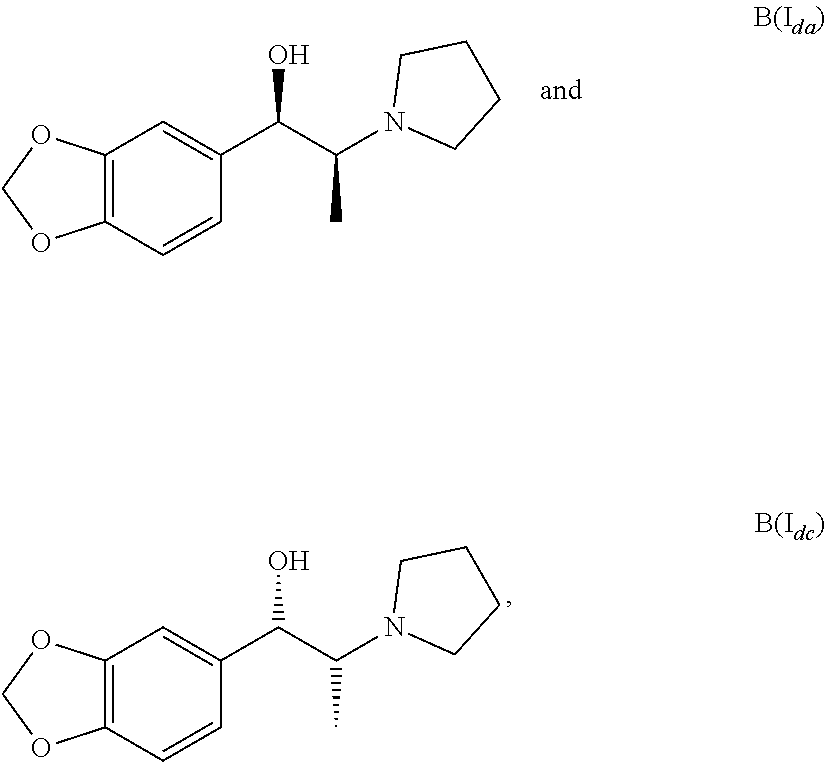
which were obtained as a racemic mixture.
Diastereomer (ii), wherein R2a and R2b together with the nitrogen atom form a 5-membered heterocycle, corresponds with a second pair of enantiomeric compounds, which can be the pair of anti-enantiomers (B(lab); B(lad)):

which were obtained as a racemic mixture. It is noted however that the accuracy of the analytical techniques used does leave some room for uncertainty with respect to the distinction between the first and second pair of enantiomers, and thus, alternatively, it is possible that the obtained diastereoisomer (i) corresponds with the anti-enantiomeric pair (B(Idb); B(Idd)), and diastereoisomer (ii) corresponds with the syn-enantiomeric pair (B(Ida); B(Idc)).
5-HT Receptor Radioligand Competition Assays.
Activity at 5-HT1A and 5-HT2A receptors were assessed as described for Example 1, except the compounds designated A(I), diastereomer (i) (as a first B(I) enantiomeric pair), and diastereomer (ii) (as a second B(I) enantiomeric pair) were evaluated in place of the compound with formula A(III). Table 1 shows radioligand competition assay results for positive controls, negative controls, and compounds designated A(I), diastereomer (i) (as a first B(I) enantiomeric pair), and diastereomer (ii) (as a second B(I) enantiomeric pair) in the form of Ki values. In view of results for both positive and negative controls, wherein negative controls yield data insufficient for reliable Ki calculations (i.e., Ki>1000 mM), the Ki values obtained for compounds with formulae A(I), B(Ida), and B(Idb) at the 5-HT1A receptor (2.0 μM, 480 μM and 37 μM, respectively; Table 1) indicate ligand-receptor binding. Similarly, Ki values obtained for compounds with formulae A(I), B(Ida), and B(Idb) at the 5-HT2A receptor (131 μM, 4.5 μM, and 25 μM, respectively; Table 1) indicate ligand-receptor binding.
In Vitro Survey of Pharmacological Interaction Profiles at Receptors and Transporters Linked to Targeted Health Conditions.
Compounds designated A(I), diastereomer (i) (as a first B(I) enantiomeric pair), and diastereomer (ii) (as a second B(I) enantiomeric pair) were evaluated with respect to binding and/or interaction at 9 different receptors and transporters with known or suspected connections to mental health conditions and/or neurological pathologies. This study was conducted by the contracted research organization (CRO) Eurofins Cerep (Cell L'Evescault, France) using standard assay procedures (https://www.eurofinsdiscovery.com/solution/target-based-assays). Data was generated regarding interaction of derivative molecules with the following 6 GPCR receptors: HTR1A (5-HT1A), HTR2B (5-HT2B), HTR2C (5-HT2C), HTR7 (5-HT7), alpha2A (α2A), MT1 (MT1), and 3 transporters (SERT, DAT, NET). Assays were conducted using the same materials and procedures outlined in Example 1, except the compounds designated A(I), diastereomer (i) (as a first B(I) enantiomeric pair), and diastereomer (ii) (as a second B(I) enantiomeric pair) were used in place of the compound with formula A(III). Overall assay conditions are summarized in Tables 2 and 3 for GPCR and transporters, respectively. Results for all calibrator compounds, control compounds, and test compounds including compounds designated A(I), diastereomer (i) (as a first B(I) enantiomeric pair), and diastereomer (ii) (as a second B(I) enantiomeric pair) are summarized in Table 4.
LRMS-HESI: [M+H]+ calculated 300.16, found 300.14 m/z.
Diastereomers (iii) and (iv) were isolated.
Diastereomer (iii): 1H NMR (400 MHz, CDCl3) δ 7.39 (d, J=4.0 Hz, 4H), 7.35-7.31 (m, 1H), 6.87 (d, J=1.6 Hz, 1H), 6.81 (dd, J=8.0, 1.6 Hz, 1H), 6.78 (dd, J=8.0, 0.5 Hz, 1H), 5.95 (s, 2H), 5.20 (s, 1H), 4.28 (d, J=9.7 Hz, 1H), 3.77 (d, J=13.0 Hz, 1H), 3.53 (d, J=13.0 Hz, 1H), 2.74 (dq, J=9.7, 6.6 Hz, 1H), 2.25 (s, 3H), 0.84 (d, J=6.7 Hz, 3H).
Diastereomer (iv): 1H NMR (400 MHz, CDCl3) δ 7.41-7.24 (m, 5H), 6.88-6.83 (m, 1H), 6.82-6.75 (m, 2H), 5.96 (d, J=4.0 Hz, 2H), 4.82 (d, J=4.9 Hz, 1H), 4.26 (d, J=9.7 Hz, OH), 3.76 (d, J=12.9 Hz, OH), 3.65 (s, 1H), 3.52 (d, J=13.0 Hz, OH), 2.89 (qd, J=6.8, 4.9 Hz, 1H), 2.23 (d, J=8.2 Hz, 3H), 1.02 (d, J=6.8 Hz, 2H), 0.83 (d, J=6.6 Hz, 1H).
It is noted that compound 6, wherein R2a=CH3, R2b=—(CH2)-phenyl, corresponds with compounds B(III) and B(IIId):

set forth herein.
Diastereomer (iii), wherein R2a=CH3, R2b=—(CH2)-phenyl, was obtained as a pair of syn-enantiomers (B(IIIda); B(IIIdc)):

which was obtained as a racemic mixture, or as a pair of anti-enantiomers (B(IIIab); B(IIIdd)):

which was obtained as a racemic mixture.
Diastereomer (iv), wherein R2a=CH3, R2b=—(CH2)-phenyl, was obtained as a mixture of compound B(IIIab):

and the enantiomeric compound pair (B(IIIda); B(IIIdc)), and compound B(IIIdd), which was obtained as a mixture containing 50% (mole/mole) B(IIIab), and 50% mole/mole of a mixture of compounds (B(IIIda), B(IIIdc), and B(IIIab).
5-HT Receptor Radioligand Competition Assays.
Activity at 5-HT1A and 5-HT2A receptors were assessed as described for Example 1, except compounds designated diastereomer (iii) (as a first B(III) enantiomeric pair) and diastereomer (iv) (as a second B(III) diastereomeric mixture) were evaluated in place of the compound with formula A(III). Table 1 shows radioligand competition assay results for positive controls, negative controls, and compounds designated diastereomer (iii) (as a first B(III) enantiomeric pair) and diastereomer (iv) (as a second B(III) diastereomeric mixture) in the form of Ki values. In view of results for both positive and negative controls, wherein negative controls yield data insufficient for reliable Ki calculations (i.e., Ki>1000 mM), the Ki values obtained for compounds designated diastereomer (iii) (as a first B(III) enantiomeric pair) and diastereomer (iv) (as a second B(III) diastereomeric mixture) at the 5-HT1A receptor (110 μM and 16.9 μM, respectively; Table 1) indicate ligand-receptor binding. Similarly, the Ki value obtained for compound designated diastereomer (iii) at the 5-HT2A receptor (44 μM; Table 1) indicates ligand-receptor binding. Compound designated diastereomer (iv) was not evaluated for binding at the 5-HT2A receptor.
In Vitro Survey of Pharmacological Interaction Profiles at Receptors and Transporters Linked to Targeted Health Conditions.
Compounds designated diastereomer (iii) (as a first B(III) enantiomeric pair) and diastereomer (iv) (as a second B(III) diastereomeric mixture) were evaluated with respect to binding and/or interaction at 9 different receptors and transporters with known or suspected connections to mental health conditions and/or neurological pathologies. This study was conducted by the contracted research organization (CRO) Eurofins Cerep (Cell L'Evescault, France) using standard assay procedures (https://www.eurofinsdiscovery.com/solution/target-based-assays). Data was generated regarding interaction of derivative molecules with the following 6 GPCR receptors: HTR1A (5-HT1A), HTR2B (5-HT2B), HTR2C (5-HT2C), HTR7 (5-HT7), alpha2A (α2A), MT1 (MT1), and 3 transporters (SERT, DAT, NET). Assays were conducted using the same materials and procedures outlined in Example 1, except compounds designated diastereomer (iii) (as a first B(III) enantiomeric pair) and diastereomer (iv) (as a second B(III) diastereomeric mixture) were used in place of the compound with formula A(III). Overall assay conditions are summarized in Tables 2 and 3 for GPCR and transporters, respectively. Results for all calibrator compounds, control compounds, and test compounds including compounds designated diastereomer (iii) (as a first B(III) enantiomeric pair) and diastereomer (iv) (as a second B(III) diastereomeric mixture) are summarized in Table 4.
A single diastereomer, as a racemic pair of enantiomers, of compound 6, wherein R2a and R2b together with the nitrogen atom form a 5-membered heterocycle, in the form of diastereomer (i) was prepared as described in Example 2. Referring to FIG. 3A , compound 6 (236 mg, 947 μmol), wherein R2a and R2b together with the nitrogen atom form a 5-membered heterocycle, was dissolved in anhydrous DCM (9.47 mL), and cooled to −78° C. (Diethylamino)sulfur trifluoride (1.17 mL, 4.73 mmol) was added. The reaction mixture was allowed to stir for 30 min, then warmed to room temperature. After 24 h, saturated NaHCO3 (10 mL) was added dropwise, and the biphasic solution allowed to vigorously stir for 1 h. The mixture was extracted with DCM (3×20 mL), and the combined organic layers washed with brine (20 mL) and dried over anhydrous magnesium sulphate. Purification by column chromatography on 12 g normal-phase silica using a 0-3% methanol in dichloromethane gradient yielded compound 7 (wherein R2a and R2b together with the nitrogen atom form a 5-membered heterocycle) as a white crystalline solid (77.7 mg, 65% with a d.r. of 87:13), diastereomerically enriched in one diastereomer (v).
LRMS-HESI [M+H]+ calculated 252.14, found 252.16 m/z.
Diastereomer (v) was prepared enriched with a d.r. of 87:13.
Diastereomer (v): 1H NMR (400 MHz, CDCl3) δ 6.87 (q, J=0.9 Hz, 1H), 6.81 (dd, J=1.9, 0.9 Hz, 2H), 5.98 (s, 2H), 5.33 (dd, J=46.6, 7.4 Hz, 1H), 3.07-2.96 (m, 1H), 2.81-2.71 (m, 4H), 1.85-1.77 (m, 4H), 0.85 (dd, J=6.7, 0.6 Hz, 3H).
It is noted that compound 7, wherein R2a and R2b together with the nitrogen atom form a 5-membered heterocycle, corresponds with compounds D(I) and D(Id):

set forth herein.
Diastereomer (v), wherein R2a and R2b together with the nitrogen atom form a 5-membered heterocycle, corresponds with a first pair of enantiomeric compounds, which can be the pair of syn-enantiomers (D(Ida); D(Idc)):

or with a second pair of enantiomeric compounds which can be the pair of anti-enantiomers (D(Idb); D(Idd)):

which was obtained as a racemic mixture. It is noted however that the accuracy of the analytical techniques used does leave some room for uncertainty with respect to the distinction between the first and second pair of enantiomers, and thus, it is possible that the obtained diastereoisomer (v) corresponds with anti-enantiomeric pair (D(Idb); D(Idd)), or with syn-enantiomeric pair (D(Ida); D(Idc)).
5-HT1A receptor functional cellular response assay. Functional engagement of the 5-HT1A receptor within an engineered cell system was assessed as described for Example 6, except the compound designated diastereomer (v) (as a first D(I) enantiomeric pair) was evaluated in place of compounds designated diastereomer (vii) (as a first D(III) enantiomeric pair) and diastereomer (viii) (as a second D(III) enantiomeric pair). Table 5 shows functional assay results for positive controls, calibrators, and compound designated diastereomer (v) (as a first D(I) enantiomeric pair), in the form of EC50 values. In view of results for controls and calibrator compounds, wherein a negative cellular response corresponded to an EC50 value>1000 μM, the EC50 value for the compound designated diastereomer (v) (as a first D(I) enantiomeric pair) in this assay (>1000 μM, Table 5) suggested no ligand-receptor engagement.
A single diastereomer, as a racemic pair of enantiomers, of benzylated compound 7, wherein R2a=CH3, R2b=—(CH2)-phenyl, in the form of diastereomer (viii) was prepared as described in Example 6. Referring to FIG. 3A , to benzylated compound 7 (39.0 mg, 129 μmol), wherein R2a=CH3, R2b=—(CH2)-phenyl, in the form of diastereomer (viii), in ethanol (1.30 mL), under nitrogen atmosphere was added palladium on carbon 10 wt % (13.8 mg, 0.0129 μmol). H2 gas was bubbled through the solution for 5 minutes, then established as atmosphere for a further 50 minutes. The catalyst was removed through filtration and the filtrate concentrated under reduced pressure. Purification using column chromatography on 4 g normal-phase silica using a 0 to 8% methanol in dichloromethane gradient yielded debenzylated compound 7, wherein R2a=CH3, R2b=H, as a colourless oil (10.8 mg, 40%) as a single diastereomer (vi).
LRMS-HESI [M+H]+ calculated 212.11, found 212.11 m/z.
Diastereomer (vi) was isolated.
Diastereomer (vi): 1H NMR (400 MHz, CDCl3) δ 6.86 (q, J=1.1 Hz, 1H), 6.82 (d, J=0.9 Hz, 2H), 6.00 (s, 2H), 5.12 (dd, J=47.4, 8.0 Hz, 1H), 3.00 (ddq, J=11.6, 8.1, 6.5 Hz, 1H), 2.50 (d, J=0.7 Hz, 3H), 0.89 (dd, J=6.5, 0.9 Hz, 3H).
It is noted that debenzylated compound 7, wherein R2a=CH3, R2b=H, corresponds with compounds D(II) and D(IId):

set forth herein.
Diastereomer (vi), corresponds with a first pair of enantiomeric compounds, which can be the pair of syn-enantiomers (D(IIda); D(IIdc)):

or with a second pair of enantiomeric compounds which can be the pair of anti-enantiomers (D(IIdb); D(IIdd)):

which was obtained as a racemic mixture. It is noted however that the accuracy of the analytical techniques used does leave some room for uncertainty with respect to the distinction between the first and second pair of enantiomers, and thus, it is possible that obtained diastereoisomer (vi) corresponds with anti-enantiomeric pair (D(IIdb); D(IIdd)), or with syn-enantiomeric pair (D(IIda); D(IIdc)).
5-HT Receptor Radioligand Competition Assays.
Activity at the 5-HT1A receptor was assessed as described for Example 1, except the compound designated diastereomer (vi) (as a first D(II) enantiomeric pair) was evaluated in place of the compound with formula A(III). Table 1 shows radioligand competition assay results for positive controls, negative controls, and compound designated diastereomer (vi) (as a first D(II) enantiomeric pair) in the form of Ki values. In view of results for both positive and negative controls, wherein negative controls yield data insufficient for reliable Ki calculations (i.e., Ki>1000 mM), the Ki value obtained for the compound designated diastereomer (vi) (as a first D(II) enantiomeric pair) at the 5-HT1A receptor (6.0 μM; Table 1) indicates ligand-receptor binding.
5-HT1A Receptor Functional Cellular Response Assay.
Functional engagement of the 5-HT1A receptor within an engineered cell system was assessed as described for Example 6, except the compound designated diastereomer (vi) (as a first D(II) enantiomeric pair) was evaluated in place of compounds designated diastereomer (vii) (as a first D(III) enantiomeric pair) and diastereomer (viii) (as a second D(III) enantiomeric pair). Table 5 shows functional assay results for positive controls, calibrators, and compound with formula D(II), in the form of EC50 values. In view of results for controls and calibrator compounds, wherein a negative cellular response corresponded to an EC50 value>1000 μM, the EC50 value for the compound with formula D(II) in this assay (>1000 μM, Table 5) suggested no ligand-receptor engagement.
A single diastereomer, as a racemic pair of enantiomers, of compound 6, wherein R2a=CH3, R2b=—(CH2)-phenyl, in the form of diastereomer (iii) was prepared as described in Example 3. Referring to FIG. 3A , compound 6, wherein R2a=CH3, R2b=—(CH2)-phenyl, in the form of diastereomer (iii) (250 mg, 835 μmol) was dissolved in dry DCM (10.0 mL) under nitrogen atmosphere and cooled to −78° C. (Diethylamino)sulfur trifluoride (DAST) (1.03 mL, 4.18 mmol) was added, and the reaction mixture was allowed to stir at the same temperature for 30 minutes prior to warming to room temperature and stirring for a further 18 h. Saturated aqueous NaHCO3 (5 mL) was slowly added to quench the reaction, and allowed to stir vigorously for 15 minutes. The biphasic mixture was extracted with DCM (3×20 mL) and the combined organic phases dried over anhydrous magnesium sulphate and concentrated under reduced pressure. Purification on 4 g normal phase silica using a 0%, then slow 5% to 7% ethyl acetate in hexanes eluent system yielded compound 7 in the form of a mixture of two separable diastereomers (vii) (51.6 mg, 41%) and (viii) (63.6 mg, 51%) as white powders.
Diastereomer (vii): LRMS-HESI [M+H]+ calculated 302.16, found 302.14 m/z.
Diastereomer (viii): LRMS-HESI [M+H]+ calculated 302.16, found as fragment 282.15 m/z.
Diastereomer (vii)1H NMR (400 MHz, CDCl3) δ 7.30 (s, 1H), 7.28-7.17 (m, 3H), 6.81 (dd, J=7.9, 0.7 Hz, 1H), 6.79-6.72 (m, 2H), 5.99 (q, J=1.4 Hz, 2H), 5.52 (d, J=47.5 Hz, 1H), 3.72-3.58 (m, 2H), 3.02 (d, J=20.7 Hz, 1H), 2.29 (s, 3H), 1.16 (d, J=6.8 Hz, 3H).
Diastereomer (viii) δ 7.34 (d, J=7.0 Hz, 4H), 7.26 (s, 1H), 6.86-6.75 (m, 3H), 6.00 (s, 2H), 5.33 (dd, J=47.6, 8.5 Hz, 1H), 3.90-3.67 (m, 2H), 3.23-3.10 (m, 1H), 2.38 (s, 3H), 0.88 (d, J=6.9 Hz, 3H).
It is noted that compound 7, wherein R2a=CH3, R2b=—(CH2)-phenyl, corresponds with compounds D(III) and D(IIId):

set forth herein.
Diastereomer (vii), wherein R2a is —CH3, and R2b is —(CH2)-phenyl, corresponds with a first pair of enantiomeric compounds, which can be the pair of syn-enantiomers (D(IIIda); D(IIIdc)):

which was obtained as a racemic mixture.
Diastereomer (viii), wherein R2a is —CH3, and R2b is —(CH2)-phenyl, corresponds with a second pair of enantiomeric compounds, which can be the pair of anti-enantiomers (D(IIIdb); D(IIIdd)):

which was obtained as a racemic mixture. It is noted however that the accuracy of the analytical techniques used does leave some room for uncertainty with respect to the distinction between the first and second pair of enantiomers, and thus, alternatively, it is possible that the diastereoisomer (vii) corresponds with the anti-enantiomeric pair (D(IIIdb); D(IIIdd)), and diastereoisomer (viii) corresponds with the syn-enantiomeric pair (D(IIIda); D(IIIdc)).
5-HT Receptor Radioligand Competition Assays.
Activity at the 5-HT1A receptor was assessed as described for Example 1, except compounds designated diastereomer (vii) (as a first D(III) enantiomeric pair) and diastereomer (viii) (as a second D(III) enantiomeric pair) were evaluated in place of the compound with formula A(III). Table 1 shows radioligand competition assay results for positive controls, negative controls, and compounds designated diastereomer (vii) (as a first D(III) enantiomeric pair) and diastereomer (viii) (as a second D(III) enantiomeric pair) in the form of Ki values. In view of results for both positive and negative controls, wherein negative controls yield data insufficient for reliable Ki calculations (i.e., Ki>1000 mM), the Ki values obtained for compounds designated diastereomer (vii) (as a first D(III) enantiomeric pair) and diastereomer (viii) (as a second D(III) enantiomeric pair) at the 5-HT1A receptor (11.3 μM and 8.1 μM, respectively; Table 1) indicate ligand-receptor binding.
Functional Receptor Potency Assays.
5-HT1A receptor. The Chinese hamster ovary (CHO)-derived cell line, CHO-K1/5-HT1A/Gα15 (GenScript M00330), stably transformed to express 5-HT1A serotonin receptor, was used to evaluate specific agonist-mediated stimulation of 5-HT1A signal transduction. In these non-neuronal cells, stimulation of 5-HT1A activates the Gαi/o protein leading to inhibition of adenylyl cyclase (AC) type I (Rojas and Felder, 2016, Frontiers in Cellular Neuroscience 10:272; Polter and Li, 2010, Cell Signalling 22:1406-1412). In cells stimulated with 4 μM forskolin, which directly stimulates AC to elevate intracellular cAMP levels, 5-HT1A activation was assessed quantitatively by measuring reduced intracellular cAMP levels. All cells were grown and maintained as a monolayer in Ham's F12 nutrient mix supplemented with 10% fetal bovine serum (FBS), 200 μg/mL zeocin or 100 μg/mL hygromycin, all obtained from ThermoFisher Scientific and used according to the manufacturer's instructions. Cells were cultured and incubated at 37° C. in a humidified oxygen atmosphere with 5% CO2. To evaluate the activation of 5-HT1A signal transduction, cells were first seeded in tissue culture-treated, white-walled, clear-bottom 96-well plates (Corning, corning.com) at a density of 30,000 cells/well in 100 mL complete growth media. Cells were cultured for 24 h in a humidified incubator at 37° C. and 5% CO2. Cells were then stimulated for 20 min with test compounds, prepared in titration beginning at 1 mM and dissolved in an induction medium (serum-free culture medium containing 4 μM forskolin (Sigma-Aldrich), 500 μM isobutyl-1-methylxanthine (IBMX, Sigma-Aldrich) and 100 μM RO 20-1724 (Sigma-Aldrich). Changes in intracellular cAMP levels were measured using the commercially available cAMP-Glo Assay Kit (Promega, promega.ca) following the manufacturers protocol. The level of luminescence derived from cells stimulated with induction medium alone was used to establish the max level of intracellular cAMP (100%) for each assay run. FIG. 6A shows increasing levels of cAMP in cultured cells incubated with increasing concentrations of forskolin (FSK) independent of 5-HT1A expression. FIG. 6B illustrates reduction in cAMP levels in 5-HT1A receptor expressing cells (+5-HT1A) stimulated with 4 μM forskolin as levels of 8-OH-DPAT increase, indicating 5-HT1A receptor binding by 8-OH-DPAT in these cells. Conversely, this trend of decreasing % cAMP levels with increasing 8-OH-DPAT is not observed in cells lacking expression of 5-HT1A receptor. 8-OH-DPAT (7-(dipropylamino)-5,6,7,8-tetrahydronaphthalen-1-ol) is a well-established full agonist of the 5-HT1A receptor (Larsson et al., 1990, Neuropharmacology 29:85-91), and was included as a positive control to ensure functionality of the cellular response system. FIG. 6C illustrates reduction in cAMP levels in 5-HT1A receptor expressing cells (+5-HT1A) stimulated with 4 μM forskolin as levels of serotonin increase, indicating 5-HT1A receptor binding by serotonin in these cells. Conversely, this trend of decreasing % cAMP levels with increasing serotonin is not observed in cells lacking expression of 5-HT1A receptor. Serotonin is the innate ligand of the 5-HT1A receptor and was thus included as a positive control. Psilocin, MDMA and 2C-B were included as calibrator compounds, since whereas these compounds are all known to bind 5-HT1A receptor to various degrees (Marcher-Rørsted et al., 2020, ACS Chem. Neurosci. 11: 1238; Simmler et al., 2013, British J. Pharmacol. 168: 458) their ability to elicit a cellular response in this particular functional assay is unknown. The binding mode of mescaline to the 5-HT1A receptor remains understudied but owing to the structural similarity of its phenylethylamine-type backbone to other derivatives within this application, it was included for comparative purposes. FIG. 6D illustrates reduction in cAMP levels in 5-HT1A receptor expressing cells (+5-HT1A) stimulated with 4 mM forskolin as levels of psilocin increase, indicating 5-HT1A receptor binding by psilocin in these cells. Conversely, this trend of decreasing % cAMP levels with increasing psilocin is not observed in cells lacking expression of 5-HT1A receptor. FIG. 6E and FIG. 6F illustrate mild or no change in cAMP levels in 5-HT1A receptor expressing cells (+5-HT1A) stimulated with 4 μM forskolin as levels of mescaline and MDMA increase, respectively. These results indicate mild or no 5-HT1A receptor engagement by mescaline or MDMA in this cellular system, respectively. FIG. 6G illustrates reduction in cAMP levels in 5-HT1A receptor expressing cells (+5-HT1A) stimulated with 4 mM forskolin as levels of 2C-B increase, indicating 5-HT1A receptor engagement by 2C-B in these cells. Conversely, this trend of decreasing % cAMP levels with increasing 2C-B is not observed in cells lacking expression of 5-HT1A receptor. 5-HT1A receptor engagement evaluation for the compound designated diastereomer (viii) (as a second D(III) enantiomeric pair) (designated simply “D(IIIenantiomer)” along the x-axis) is shown in FIG. 6H . Comparison of data acquired in +5-HT1A cultures with those acquired in −5-HT1A cultures indicates receptor modulation at evaluated ligand concentrations (EC50=10.04 μM). Table 5 summarizes EC50 data for all control, calibrator, and test compounds acquired using this functional 5-HT1A receptor assay. Additionally, the compound designated diastereomer (vii) (as a first D(III) enantiomeric pair) was assessed for 5-HT1A receptor modulation activity in an identical manner to that of compound designated diastereomer (viii). The resulting EC50 (156 μM) indicates receptor modulation at higher ligand concentrations (Table 5).
| TABLE 5 |
| Data summary for functional 5-HT1A receptor assay. |
| Molecule | 5-HT1A, EC50 (μM) | ||
| 5-OH-DPAT | 0.0007118 | ||
| serotonin | 0.001142 | ||
| psilocin | 0.9567 | ||
| mescaline | >1000 | ||
| 2C-B | 5.945 | ||
| MDMA | >1000 | ||
| A(III) | >1000 | ||
| D(I) as diast. (v) | >1000 | ||
| D(II) as diast. (vi) | >1000 | ||
| D(III) as diast. (vii) | 156 | ||
| D(III) as diast. (viii) | 10 | ||
In Vitro Survey of Pharmacological Interaction Profiles at Receptors and Transporters Linked to Targeted Health Conditions.
Compounds designated diastereomer (vii) (as a first D(III) enantiomeric pair) and diastereomer (viii) (as a second D(III) enantiomeric pair) were evaluated with respect to binding and/or interaction at 9 different receptors and transporters with known or suspected connections to mental health conditions and/or neurological pathologies. This study was conducted by the contracted research organization (CRO) Eurofins Cerep (Cell L'Evescault, France) using standard assay procedures (https://www.eurofinsdiscovery.com/solution/target-based-assays). Data was generated regarding interaction of derivative molecules with the following 6 GPCR receptors: HTR1A (5-HT1A), HTR2B (5-HT2B), HTR2C (5-HT2C), HTR7 (5-HT7), alpha2A (α2A), MT1 (MT1), and 3 transporters (SERT, DAT, NET). Assays were conducted using the same materials and procedures outlined in Example 1, except the compounds designated diastereomer (vii) (as a first D(III) enantiomeric pair) and diastereomer (viii) (as a second D(III) enantiomeric pair) were used in place of the compound with formula A(III). Overall assay conditions are summarized in Tables 2 and 3 for GPCR and transporters, respectively. Results for all calibrator compounds, control compounds, and test compounds including compounds designated diastereomer (vii) (as a first D(III) enantiomeric pair) and diastereomer (viii) (as a second D(III) enantiomeric pair) are summarized in Table 4.
Referring to FIG. 3B , 3,4-(methylenedioxy)phenylacetic acid (compound 1) (10.0 g, 55.5 mmol) was dissolved in acetic anhydride (26.8 mL, 278 mmol) at room temperature, and the solution was stirred and purged with nitrogen for several minutes. The reaction was initiated by the dropwise addition of 1-methylimidazole (NMI) (2.23 mL, 27.8 mmol), and was continuously purged with a slow flow of nitrogen at room temperature until the starting material completely disappeared (TLC). After completion (16 h), water (5 mL) was added to the reaction flask. The reaction mixture was extracted with ethyl acetate (3×75 mL). The organic layers were combined and washed with saturated aq. NaHCO3 (50 mL) followed by water, then dried over Na2SO4, filtered and concentrated. The crude product was purified using silica gel (120 g, EA/hex 0:100 to 50:50, 8 CV, product eluting at 20% EA) to afford the pure product compound 2 as a clear colorless oil (7.35 g, 74%).
1H NMR (400 MHz, CDCl3) δ 6.77 (d, J=7.8 Hz, 1H), 6.71-6.66 (m, 1H), 6.64 (ddd, J=7.8, 1.8, 0.5 Hz, 1H), 5.95 (s, 2H), 3.60 (s, 2H), 2.15 (s, 3H).
Continuing to refer to FIG. 3B , to a dry reaction vial was added sodium hydride (60% in mineral oil, 486 mg, 12.1 mmol) and dry THF (28.9 mL). While stirring under nitrogen, to the mixture was added a solution of 2 (2.06 g, 11.6 mmol) in THF (28.9 mL) dropwise, and the resulting mixture was stirred for 10 min (or until gas evolution was complete). Then, iodomethane (796 μL, 12.7 mmol) was added dropwise and the reaction mixture was stirred at RT for 1 h (or until completion). After 1 h, reaction was quenched with H2O, volatiles were removed under reduced pressure and the residue was directly purified by FC on silica gel (40 g, EA/hex 0:100 to 80:20, 10 CV) to afford product 3, wherein R1a=CH3, as a light-yellow oil (1.7 g, 77%).
LRMS-HESI: calc'd for C11H13O3 [M+H]+ 193.09 m/z; observed 193.09.
1H NMR (400 MHz, CDCl3) δ 6.76 (dt, J=6.8, 1.0 Hz, 1H), 6.69-6.66 (m, 2H), 5.94 (s, 2H), 3.65 (q, J=7.0 Hz, 1H), 2.05 (s, 3H), 1.34 (d, J=6.9 Hz, 3H).
Continuing to refer to FIG. 3B , compound 3 (500 mg, 2.60 mmol), wherein R1a=CH3, was dissolved in MeOH (13.0 mL) followed by the addition of acetic acid (179 μL, 3.12 mmol). The solution was stirred for a few minutes before the addition of benzylamine (574 μL, 5.20 mmol). The reaction mixture was then heated up to 60° C. and stirred for 3 h. After 3 h, the reaction was cooled to RT and sodium cyanoborohydride (516 mg, 7.80 mmol) was added to the mixture and stirring was continued at room temperature for 18 h. Saturated aq. NaHCO3 was added to the reaction, and the mixture was extracted with DCM (×3). The combined organic layers were washed with brine, dried over anhydrous Na2SO4, filtered, and concentrated to afford the crude product. The crude product was purified by FC on silica gel (25 g, MeOH/DCM 0:100 to 20:80, product eluting at 8% MeOH) to afford the pure product 4, wherein R1a is CH3, R2a=H, and R2b=—(CH2)-phenyl (mixture of two diastereomers) as a colorless oil (555 mg, 75%, with a d.r.: 2:1).
LRMS-HESI: calc'd for C18H22NO2 [M+H]+ 284.16 m/z; observed 284.18.
It is noted that the obtained product, compound 4, is a 2:1 mixture comprising of two inseparable diastereomers (ix) and (x), (based on 1H-NMR).
Diastereomers (ix) and (x): 1H NMR (400 MHz, CDCl3) δ 7.37-7.19 (m, 4H), 7.15-7.11 (m, 1H), 6.74 (dd, J=7.9, 3.4 Hz, 1H), 6.71-6.61 (m, 2H), 5.96-5.92 (m, 2H), 3.84 (dd, J=23.2, 13.3 Hz, 1H), 3.67 (dd, J=44.4, 13.3 Hz, 1H), 2.78-2.60 (m, 2H), 1.24 (dd, J=33.8, 6.7 Hz, 3H), 1.04 (dd, J=56.6, 6.0 Hz, 3H).
It is noted that compound 4, wherein R1a=CH3, R2a=H, R2b=—(CH2)-phenyl, corresponds with compounds Ex(VI) and Ex(VId):

set forth herein.
Diastereomer (ix), wherein R2a is H, and R2b is —(CH2)-phenyl, corresponds with a first pair of enantiomeric compounds, which can be the pair of syn-enantiomers (Ex(VIda); (Ex(VIdc)):

which was obtained as a racemic mixture, and a second pair of anti-enantiomers (Ex(VIdb); Ex(VIdd)):

which was obtained as a racemic mixture, wherein in the first pair of enantiomers and second pair of enantiomers were present in the mixture in a molar ratio of 2:1.
Diastereomer (x), wherein R2a is H, and R2b is —(CH2)-phenyl, corresponds with a first pair of enantiomeric compounds, which, can be the pair of syn-enantiomers (Ex(VIda); (Ex(VIdc)):

which was obtained as a racemic mixture, and a second pair of anti-enantiomers (Ex(VIdb); Ex(VIdd)):

which was obtained as a racemic mixture, wherein in the first pair of enantiomers and second pair of enantiomers were present in the mixture in a molar ratio of 1:2. It is noted however that the accuracy of the analytical techniques used does leave some room for uncertainty with respect to the distinction between the first and second pair of enantiomers, and thus, alternatively, it is possible that the diastereoisomer (ix) corresponds with a mixture wherein in the mixture the first pair of enantiomers (Ex(VIda); (Ex(VIdc)) and second pair of enantiomers (Ex(VIdb); Ex(Vlad)) was present in a molar ratio of 1:2, respectively; and that diastereoisomer (x) corresponds with a mixture wherein in the mixture the first pair of enantiomers (Ex(VIda); (Ex(VIdc)) and second pair of enantiomers (Ex(VIdb); Ex(VIdd)) was present in a molar ratio of 2:1, respectively.
5-HT Receptor Radioligand Competition Assays.
Activity at the 5-HT1A receptor was assessed as described for Example 1, except the compound with formula Ex(VI) (as a 1:1 mixture of diastereomers (ix) and (x)) was evaluated in place of the compound with formula A(III). Table 1 shows radioligand competition assay results for positive controls, negative controls, and the compound with formula Ex(VI) (as a 1:1 mixture of diastereomers (ix) and (x)) in the form of Ki values. In view of results for both positive and negative controls, wherein negative controls yield data insufficient for reliable Ki calculations (i.e., Ki>1000 mM), the Ki value obtained for the compound with formula Ex(VI) (as a 1:1 mixture of diastereomers (ix) and (x)) at the 5-HT1A receptor (65.9 μM; Table 1) indicates ligand-receptor binding.
LRMS-HESI [M+H]+ 298.17 m/z.
Diastereomer (xi) could not be separated from diastereomer (xii).
Diastereomer (xi) and diastereomer (xii): 1H NMR (400 MHz, CDCl3) δ 7.41-7.30 (m, 2H), 7.21-7.14 (m, 2H), 6.99-6.93 (m, 1H), 6.72 (ddd, J=7.6, 7.1, 0.4 Hz, 1H), 6.65-6.57 (m, 2H), 5.96-5.90 (m, 2H), 3.71-3.53 (m, 1H), 3.41 (dd, J=42.4, 13.6 Hz, 1H), 2.81-2.62 (m, 2H), 2.11 (d, J=40.6 Hz, 3H), 1.36-1.14 (m, 3H), 1.08-0.71 (m, 3H).
It is noted that methylated compound 4, wherein R1a is CH3, R2a=CH3, and R2b=—(CH2)-phenyl, corresponds with compounds Ex(III) and Ex(IIId):

set forth herein.
Diastereomer (xi), wherein R2a is —CH3, and R2b is —(CH2)-phenyl, corresponds with a first pair of enantiomeric compounds, which, can be the pair of syn-enantiomers (Ex(IIIda); (Ex(IIIdc)):

which was obtained as a racemic mixture, and a second pair of anti-enantiomers (Ex(IIIdb); Ex(IIIdd)):

which was obtained as a racemic mixture, wherein in the first pair of enantiomers and second pair of enantiomers were present in the mixture in a molar ratio of 2:1.
Diastereomer (xii), wherein R2a is —CH3, and R2b is —(CH2)-phenyl, corresponds with a first pair of enantiomeric compounds, which can be the pair of syn-enantiomers (Ex(IIIda); (Ex(IIIdc)):

which was obtained as a racemic mixture, and a second pair of anti-enantiomers (Ex(IIIdb); Ex(IIIdd)):

which was obtained as a racemic mixture, wherein in the first pair of enantiomers and second pair of enantiomers were present in the mixture in a molar ratio of 1:2. It is noted however that the accuracy of the analytical techniques used does leave some room for uncertainty with respect to the distinction between the first and second pair of enantiomers, and thus, alternatively, it is possible that the diastereoisomer (xi) corresponds with a mixture wherein in the mixture the first pair of enantiomers (Ex(IIIda); (Ex(IIIdc)) and second pair of enantiomers (Ex(IIIdb); Ex(IIIdd)) was present in a molar ratio of 1:2, respectively; and that diastereoisomer (xii) corresponds with a mixture wherein in the mixture the first pair of enantiomers (Ex(IIIda); (Ex(IIIdc)) and second pair of enantiomers (Ex(IIIdb); Ex(IIIdd)) was present in a molar ratio of 2:1, respectively.
Referring to FIG. 3B , compound 2, was prepared as described in Example 7.
Continuing to refer to FIG. 3B , compound 3, wherein R1a=CH3, was prepared as described in Example 7.
Continuing to refer to FIG. 3B , compound 3 (109 mg, 567 μmol), wherein R1a=CH3, was dissolved in MeOH (2.84 mL) followed by the addition of acetic acid (39.0 μL, 680 μmol), the reaction mixture was stirred for a few minutes before the addition of azetidine (76.5 μL, 1.13 mmol). The reaction mixture was then heated up to 60° C. and stirred for 3 h. The reaction mixture was cooled to RT and sodium cyanoborohydride (113 mg, 1.70 mmol) was added to the mixture and stirring was continued at room temperature for 18 h. Sat'd aq. NaHCO3 was added (10 drops) to the reaction and volatiles were removed in vacuo. The crude residue was directly purified by FC on silica gel (4 g, MeOH/DCM 0:100 to 20:80) to afford the clean product as a dark yellow oil, and as a mixture of two diastereomers. The isolated material was re-purified by FC on silica gel (12 g, MeOH/DCM 0:100 to 20:80, product eluting at 10% MeOH) to afford compound 4, wherein R1a is CH3, R2a and R2b together with the nitrogen atom form a 4-membered heterocycle, as two semi-pure diastereomers (xiii) and (xiv) (each containing 18% of the other diastereomer, d.r.=9:2).
LRMS-HESI: [M+H]+ calculated 234.15, found 234.15 m/z
Diastereomers (xiii) and (xiv) were isolated
Diastereomer (xiii): 1H NMR (400 MHz, CDCl3) δ 6.78 (d, J=0.6 Hz, 1H), 6.77 (d, J=1.7 Hz, 1H), 6.74 (d, J=1.6 Hz, 1H), 5.96 (s, 2H), 3.76 (d, J=51.9 Hz, 4H), 3.18 (dt, J=7.8, 6.5 Hz, 1H), 3.04-2.96 (m, 1H), 2.41-2.28 (m, 2H), 1.28 (d, J=7.1 Hz, 3H), 1.22 (d, J=6.6 Hz, 3H).
Diastereomer (xiv): 1H NMR (400 MHz, CDCl3): 6.79 (dt, J=7.8, 0.7 Hz, 1H), 6.67-6.63 (m, 2H), 5.97 (s, 2H), 3.98 (dq, J=15.4, 7.8 Hz, 4H), 3.34 (dd, J=6.9, 5.6 Hz, 1H), 3.04 (td, J=7.2, 5.4 Hz, 1H), 2.44 (s, 2H), 1.35 (d, J=7.2 Hz, 3H), 1.19 (d, J=6.7 Hz, 3H).
It is noted that compound 4, wherein R1a is CH3, R2a and R2b together with the nitrogen atom form a 4-membered heterocycle, corresponds with compounds Ex(VII) and Ex(VIId):

set forth herein.
Diastereomer (xiii), wherein R2a and R2b together with the nitrogen atom form a 4-membered heterocycle, corresponds with a first pair of enantiomeric compounds, which, notably, can be the pair of syn-enantiomers (Ex(VIIda); Ex(VIIdc)):

which was obtained as a racemic mixture.
Diastereomer (xiv), wherein R2a and R2b together with the nitrogen atom form a 4-membered heterocycle, corresponds with a second pair of enantiomeric compounds, which can be the pair of anti-enantiomers (Ex(VIIdb); Ex(VIIdd)):

which were obtained as a racemic mixture. It is noted however that the accuracy of the analytical techniques used does leave some room for uncertainty with respect to the distinction between the first and second pair of enantiomers, and thus, alternatively, it is possible that the diastereoisomer (xiii) corresponds with the anti-enantiomeric pair (Ex(VIIdb); Ex(VIIdd)), and diastereoisomer (xiv) corresponds with the syn-enantiomeric pair (Ex(VIIda); Ex(VIIdc)).
Referring to FIG. 3C , 1,4-benzodioxane-6-acetic acid (compound 1) (2.0 g, 10.3 mmol) was dissolved in acetic anhydride (4.97 mL, 51.5 mmol) at room temperature, and the solution was stirred and purged with nitrogen for several minutes. The reaction was initiated by the dropwise addition of 1-methylimidazole (NMI) (415 μL, 5.15 mmol), and was continuously purged with a slow flow of nitrogen at room temperature until the starting material completely disappeared (TLC). After completion (16 h), water (5 mL) was added to the reaction flask. The reaction mixture was extracted with ethyl acetate (×3). The organic layers were combined and washed with saturated aq. NaHCO3, followed by water, then dried over Na2SO4, filtered and concentrated. The crude product was purified using silica gel (25 g, EA/hex 0:100 to 70:30, 12 CV, product eluting at 30% EA) to afford the pure product compound 2 as a clear colorless oil (760 mg, 38%).
1H NMR (400 MHz, CDCl3) δ 6.82 (d, J=8.1 Hz, 1H), 6.72 (d, J=2.1 Hz, 1H), 6.68-6.65 (m, 1H), 4.25 (s, 4H), 3.58 (s, 2H), 2.14 (s, 3H).
Continuing to refer to FIG. 3C , to a dry reaction vial was added sodium hydride (60% in mineral oil, 52.4 mg, 1.31 mmol) and THF (3.12 mL). While stirring under nitrogen, to the mixture was added a solution of compound 2 (240 mg, 1.25 mmol) in THF (3.12 mL) dropwise, and the resulting mixture was stirred for 10 min (or until gas evolution was complete). Then, iodoethane (112 μL, 1.37 mmol) was added dropwise and the reaction mixture was stirred at RT until completion. After 22 h, the reaction was quenched with H2O (1 mL), volatiles were removed in vacuo and the residue was directly purified by FC on silica gel (12 g, EA/hex 0:100 to 60:40, product eluting at 30% EA) to afford the pure compound 3, wherein R1a=CH2CH3, as a colorless oil (84 mg, 31%).
Continuing to refer to FIG. 3C , compound 3, wherein R1a=CH2CH3, (84.0 mg, 381 μmol) was dissolved in MeOH (1.91 mL) followed by the addition of acetic acid (26.2 μL, 458 μmol), and the reaction mixture was stirred for a few minutes before the addition of benzylamine (84.2 μL, 763 μmol). The reaction mixture was then heated up to 60° C. and stirred for 3 h. After 3 h, the reaction was cooled to RT and sodium cyanoborohydride (75.7 mg, 1.14 mmol) was added to the mixture and stirring was continued at room temperature for 18 h. Saturated aq. NaHCO3 was added (5 mL) to the reaction, and the mixture was extracted with DCM (×3). The combined organic layers were washed with brine, dried over anhydrous Na2SO4, filtered, and concentrated to afford the crude product. The crude product was purified by FC on silica gel (4 g, MeOH/DCM 0:100 to 20:80, product eluting at 13% MeOH) to afford the pure compound 4, wherein R1a is CH2CH3, R2a=H, and R2b=—(CH2)-phenyl, as a colorless oil and a single unknown diastereomer (28 mg, 24%), diastereomer (xv).
LRMS-HESI: [M+H]+ 312.20 m/z.
Diastereomer (xv) was isolated.
Diastereomer (xv): 1H NMR (400 MHz, CDCl3) δ 7.29-7.24 (m, 2H), 7.23-7.18 (m, 1H), 7.14-7.10 (m, 2H), 6.78 (d, J=8.2 Hz, 1H), 6.64 (d, J=2.1 Hz, 1H), 6.60 (dd, J=8.2, 2.1 Hz, 1H), 4.25 (s, 4H), 3.69 (dd, J=84.1, 13.5 Hz, 2H), 2.70 (dq, J=7.9, 6.2 Hz, 1H), 2.30 (ddd, J=11.4, 7.9, 3.9 Hz, 1H), 1.79 (dqd, J=13.4, 7.4, 4.0 Hz, 1H), 1.50-1.39 (m, 1H), 1.11 (d, J=6.2 Hz, 3H), 0.69 (t, J=7.4 Hz, 3H).
It is noted that compound 4, wherein R1a is CH2CH3, R2a=H, and R2b=—(CH2)-phenyl, corresponds with compounds Ey(VIII) and Ey(VIIId):

set forth herein.
Diastereomer (xv), corresponds with a first pair of enantiomeric compounds, which can be the pair of syn-enantiomers (Ey(VIIIda); Ey(VIIIdc)):

or with a second pair of enantiomeric compounds which can be the pair of anti-enantiomers (Ey(VIIIdb); Ey(VIIIdd)):

which was obtained as a racemic mixture. It is noted however that the accuracy of the analytical techniques used does leave some room for uncertainty with respect to the distinction between the first and second pair of enantiomers, and thus, it is possible that obtained diastereoisomer (xv) corresponds with anti-enantiomeric pair (Ey(VIIIdb); Ey(VIIIdd)), or with syn-enantiomeric pair (Ey(VIIIda); Ey(VIIIdc)).
Claims (21)
1. A chemical compound having chemical formula (I) or chemical formula (II):

wherein, in chemical formula (I) and chemical formula (II):
X1, X2, and X3 are independently selected from a hydrogen atom, O-alkyl, N-alkyl, OH, a halogen, or NH2;
X4 is an alkylene group or substituted alkylene group;
R1a is a halogen, and R1b is a hydrogen atom or a halogen;
R2 is a hydrogen atom or an O-alkyl group; and
R2a and R2b are independently selected from an alkyl group, an optionally substituted alkyl-aryl group, or a hydrogen atom, or R2a and R2b are joined together, along with the nitrogen atom to which they are attached, to form a 3-10-membered optionally substituted heterocyclic ring.
2. A chemical compound according to claim 1 , wherein X4 is a C1-C3 alkylene group.
3. A chemical compound according to claim 1 , wherein the chemical compound has a chemical formula (Ib) or (IIb):

4. A chemical compound according to claim 1 , wherein the amino group (—NR2aR2b) in the compound of formula (I) or formula (II) is protonated to form (—N+HR2aR2b), and chemical formula (I) or formula (II) further includes a negatively charged anion balancing the positively charged nitrogen atom.
5. A chemical compound according to claim 1 , wherein X1, X2, X3, and R2 are each a hydrogen atom (H).
6. A chemical compound according to claim 1 , wherein R2 is a hydrogen atom.
7. A chemical compound according to claim 1 , wherein R2a and R2b is independently selected from a hydrogen atom, an optionally substituted alkyl-aryl group, or an alkyl group, optionally, a (C1-C6)-alkyl group, (C1-C3)-alkyl group.
8. A chemical compound according to claim 1 , wherein the optionally substituted alkyl-aryl group is a (C1-C6)-alkyl-aryl group, a (C1-C3)-alkyl-aryl group, or a —CH2-aryl group, wherein the aryl group is optionally substituted by at least one of a halogen atom, an O-alkyl group, optionally a (C1-C6)—O-alkyl group or a (C1-C3)—O-alkyl group, and additionally two adjacent substituents are joined together, along with the carbon atoms from the aryl group to form a (C5-C10)-heterocycle, optionally a (C5)-heterocycle, optionally including two oxygen atoms.
9. A chemical compound according to claim 8 , wherein the aryl group is a phenyl group.
10. A chemical compound according to claim 1 , wherein the chemical compound having formula (I) has the chemical formula (D):

11. A chemical compound according to claim 1 , wherein the chemical compound having formula (I) is selected from the group of compounds having the chemical formula:
(D): D(I); D(II); D(III); D(IV); D(V); and D(VI):

and
wherein in each of compound D(I) to D(VI), optionally, the nitrogen atom of the isopropylamine portion may be protonated and includes a negatively charged anion balancing the positively charged nitrogen atom.
12. A chemical compound according to claim 1 , wherein
(A) R1a a halogen, and R1b is a hydrogen atom or a halogen, provided however, R1a and R1b are not identical halogens, and the compound having chemical formula (I) or formula (II) has the chemical formula (Id) or (IIId):

or
(B) R1a is a halogen, and R1b is a hydrogen atom or a halogen, provided however, that R1a and R1b are not identical halogens, and the compound having chemical formula (I) or formula (II) has the chemical formula (Ie) or (IIe):

13. A chemical compound according to claim 12 , wherein the compound is a compound included in a mixture of a pair of enantiomeric compounds, the mixture comprising a first and second enantiomeric compound of a pair of enantiomers of formula (Id), (IId), (Ie), or (IIe).
14. A chemical compound according to claim 12 , wherein the compound is a first enantiomeric compound of a pair of enantiomers consisting of a first and second enantiomeric compounds of formula (Id), (IId), (Ie), or (IIe) wherein the first enantiomeric compound is substantially free of a second enantiomeric compound, the second enantiomeric compound being the other compound of the pair of enantiomers.
15. A chemical compound according to claim 12 , wherein the compound is a compound included in a mixture of a pair of diastereomeric compounds, the mixture comprising a first and second diastereomeric compound of a pair of diastereomers of formula (Id), (IId), (Ie), or (IIe).
16. A chemical compound according to claim 12 , wherein the compound is a first diastereomeric compound of a pair of diastereomers consisting of a first and second diastereomeric compound of formula (Id), (IId), (Ie), or (IIe), wherein the first diastereomeric compound is substantially free of a second diastereomeric compound, the second diastereomeric compound being the other diastereomeric compound of the pair of diastereomers.
17. A chemical compound according to claim 12 , wherein the chemical compound having formula (Id) has chemical formula (Dd):

wherein R2a and R2b are independently selected from an alkyl group, an optionally substituted alkyl-aryl group, or a hydrogen atom, or R2a and R2b are joined together, along with the nitrogen atom to which they are attached, to form a 3-10-membered optionally substituted heterocyclic ring.
18. A chemical compound according to claim 12 , wherein the chemical compound having formula (Id) or (Ig) is selected from the group of compounds selected from:
(D): D(Id); D(IId); D(IIId); D(IVd); D(Vd); and D(VId):

and
wherein in each of compound D(Id) to D(VId), optionally, the nitrogen atom of the isopropylamine portion is protonated and includes a negatively charged anion balancing the positively charged nitrogen atom.
19. A chemical compound according to claim 12 , wherein the chemical compound having formula (Id) is selected from the group of compounds selected from D(Ida); D(Idb); D(Idc); D(Idd); D(IIda); D(IIdb); D(IIdc); D(IIdd); D(IIIda); D(IIIdb); D(IIIdc); and D(IIIdd):

wherein in each of compound D(Ida), D(Idb), D(Idc), D(Idd), D(IIda), D(IIdb), D(IIdc), D(IIdd), D(IIIda), D(IIIdb), D(IIIdc), and D(IIIdd), optionally, the nitrogen atom of the isopropylamine portion is protonated and includes a negatively charged anion balancing the positively charged nitrogen atom.
20. A pharmaceutical or recreational drug formulation comprising an effective amount of a chemical compound according to claim 1 , together with a pharmaceutically acceptable excipient, diluent, or carrier.
21. A pharmaceutical or recreational drug formulation comprising an effective amount of a chemical compound according to claim 19 , together with a pharmaceutically acceptable excipient, diluent, or carrier.
Priority Applications (2)
| Application Number | Priority Date | Filing Date | Title |
|---|---|---|---|
| US18/494,382 US12195439B1 (en) | 2022-10-25 | 2023-10-25 | C1-substituted isopropylamine fused heterocyclic mescaline derivatives |
| US18/982,705 US20250129036A1 (en) | 2022-10-25 | 2024-12-16 | C1-substituted isopropylamine fused heterocyclic mescaline derivatives |
Applications Claiming Priority (2)
| Application Number | Priority Date | Filing Date | Title |
|---|---|---|---|
| US202263419157P | 2022-10-25 | 2022-10-25 | |
| US18/494,382 US12195439B1 (en) | 2022-10-25 | 2023-10-25 | C1-substituted isopropylamine fused heterocyclic mescaline derivatives |
Related Child Applications (1)
| Application Number | Title | Priority Date | Filing Date |
|---|---|---|---|
| US18/982,705 Continuation US20250129036A1 (en) | 2022-10-25 | 2024-12-16 | C1-substituted isopropylamine fused heterocyclic mescaline derivatives |
Publications (1)
| Publication Number | Publication Date |
|---|---|
| US12195439B1 true US12195439B1 (en) | 2025-01-14 |
Family
ID=90829570
Family Applications (2)
| Application Number | Title | Priority Date | Filing Date |
|---|---|---|---|
| US18/494,382 Active US12195439B1 (en) | 2022-10-25 | 2023-10-25 | C1-substituted isopropylamine fused heterocyclic mescaline derivatives |
| US18/982,705 Pending US20250129036A1 (en) | 2022-10-25 | 2024-12-16 | C1-substituted isopropylamine fused heterocyclic mescaline derivatives |
Family Applications After (1)
| Application Number | Title | Priority Date | Filing Date |
|---|---|---|---|
| US18/982,705 Pending US20250129036A1 (en) | 2022-10-25 | 2024-12-16 | C1-substituted isopropylamine fused heterocyclic mescaline derivatives |
Country Status (2)
| Country | Link |
|---|---|
| US (2) | US12195439B1 (en) |
| WO (1) | WO2024086933A1 (en) |
Citations (5)
| Publication number | Priority date | Publication date | Assignee | Title |
|---|---|---|---|---|
| US1964973A (en) * | 1931-09-16 | 1934-07-03 | Winthrop Chem Co Inc | 1 (3' 4' dioxyalkylene phenyl) 2 aminoalkanol (1) |
| US8101605B2 (en) | 2009-12-04 | 2012-01-24 | Aquinox Pharmaceuticals Inc. | SHIP1 modulators and methods related thereto |
| US8765994B2 (en) | 2001-10-17 | 2014-07-01 | The University Of British Columbia | Ship 1 modulators |
| US9000050B2 (en) | 2010-08-20 | 2015-04-07 | The University Of British Columbia | SHIP1 modulators and related methods |
| WO2019140265A1 (en) | 2018-01-12 | 2019-07-18 | President And Fellows Of Harvard College | Trna synthetase inhibitors |
-
2023
- 2023-10-25 WO PCT/CA2023/051422 patent/WO2024086933A1/en not_active Ceased
- 2023-10-25 US US18/494,382 patent/US12195439B1/en active Active
-
2024
- 2024-12-16 US US18/982,705 patent/US20250129036A1/en active Pending
Patent Citations (5)
| Publication number | Priority date | Publication date | Assignee | Title |
|---|---|---|---|---|
| US1964973A (en) * | 1931-09-16 | 1934-07-03 | Winthrop Chem Co Inc | 1 (3' 4' dioxyalkylene phenyl) 2 aminoalkanol (1) |
| US8765994B2 (en) | 2001-10-17 | 2014-07-01 | The University Of British Columbia | Ship 1 modulators |
| US8101605B2 (en) | 2009-12-04 | 2012-01-24 | Aquinox Pharmaceuticals Inc. | SHIP1 modulators and methods related thereto |
| US9000050B2 (en) | 2010-08-20 | 2015-04-07 | The University Of British Columbia | SHIP1 modulators and related methods |
| WO2019140265A1 (en) | 2018-01-12 | 2019-07-18 | President And Fellows Of Harvard College | Trna synthetase inhibitors |
Non-Patent Citations (17)
| Title |
|---|
| Aoyama, T. et al. "A New Class of Highly Potent Farnesyl Diphosphate-Competitive Inhibitors of Farnesyltransferase" Journal of Medicinal Chemistry, 1998, 41(2), 143-147 (Jan. 15, 1998). |
| Chandrasekhar, S. et al. "Highly efficient synthesis of 3-alkyl/aryl-4-aryl-1,2,3,4-tetrahydroisoquinolines from N,N-dibenzylaminols" Tetrahedron Letters, 2002, 43(10) 1885-1888 (Mar. 4, 2002). |
| Iversen, L. et al. "Neurochemical Profiles of Some Novel Psychoactive Substances" European Journal of Pharmacology 2013, 700(1-3), 147-151 (Dec. 21, 2012). |
| Kolaczynska, K.E. et al. "The Pharmacological Profile of Second Generation Pyrovalerone Cathinones and Related Cathinone Derivative" International Journal of Molecular Science 2021, 22(15), 8277 (Jul. 30, 2021). |
| McMillan, A. E. et al "Stereoretentive Etherification of an α-Aryl-β-amino Alcohol Using a Selective Aziridinium Ring Opening for the Synthesis of AZD7594" Journal of Organic Chemistry 2019, 84(8), 4629-4638 (Jun. 19, 2018). |
| Meetani, M.A. et al. "Enantioseparation of Synthetic Cathinones Enantiomers with Tertiary Amine Structure in Urine and Plasma" Journal of Chromatographic Science, 2019, 57(4), 361-368 (Feb. 7, 2019). |
| RN 1225844-34-7 (May 30, 2010). |
| RN 1346601-54-4 (Nov. 30, 2011). |
| RN 1346746-92-6 (Dec. 1, 2011). |
| RN 1881280-15-4 (Mar. 7, 2016). |
| RN 1893019-18-5 (Apr. 19, 2016). |
| RN 2794360-21-5 (Jul. 20, 2022). |
| RN 856081-72-6 (Jul. 20, 2005). |
| RN 857543-41-0 (Jul. 29, 2005). |
| RN 860590-50-7 (Aug. 17, 2005). |
| Sharp et al. ("Bases derived from some substituted propenylbenzenes; preparation of pure methylamine," Journal of the Chemical Society, 1931, 1468-1478). * |
| Springer, D. et al. "Metabolism and toxicological detection of the new designer drug 3′,4′-methylenedioxy-α-pyrrolidinopropiophenone studied in urine using gas chromatography—mass spectrometry" Journal of Chromatography B, 2003, 793(2), 377-388 (Aug. 15, 2003). |
Also Published As
| Publication number | Publication date |
|---|---|
| WO2024086933A1 (en) | 2024-05-02 |
| US20250129036A1 (en) | 2025-04-24 |
Similar Documents
| Publication | Publication Date | Title |
|---|---|---|
| US20230040398A1 (en) | Nitrated psilocybin derivatives and methods of using | |
| US20250205197A1 (en) | Salts of c4-carboxylic acid- and c4-carbonothioate-substituted tryptamine derivatives and methods of using | |
| US11752130B2 (en) | Carboxylated psilocybin derivatives and methods of using | |
| US20230044216A1 (en) | Aldehyde and ketone derivatives of psilocybin and methods of using | |
| US12428408B2 (en) | Fused heterocyclic mescaline derivatives | |
| US11707447B1 (en) | C4-carbonothioate-substituted tryptamine derivatives and methods of using | |
| US12195439B1 (en) | C1-substituted isopropylamine fused heterocyclic mescaline derivatives | |
| US12358885B2 (en) | Substituted n-propylamine fused heterocyclic mescaline derivatives | |
| US12492179B2 (en) | Substituted ethylamine fused heterocyclic mescaline derivatives | |
| US12077498B2 (en) | C4-carboxylic acid-substituted tryptamine derivatives and methods of using | |
| WO2023044574A1 (en) | Phosphorylated and sulfonated mescaline derivatives and methods of using | |
| US12338231B1 (en) | N-heterocycle substituted tryptamine derivatives and methods of using | |
| US20250197351A1 (en) | C4-carboxylic acid-substituted tryptamine derivatives and methods of using | |
| US20250206701A1 (en) | C4-carbonothioate-substituted tryptamine derivatives and methods of using | |
| WO2023108296A1 (en) | Isopropylamine analogues of phosphorylated and sulfonated mescaline derivatives | |
| WO2024178504A1 (en) | Tri-halo-alkoxy-substituted tryptamine derivatives and methods of using | |
| WO2025042956A1 (en) | Pde 7 modulator compounds |
Legal Events
| Date | Code | Title | Description |
|---|---|---|---|
| FEPP | Fee payment procedure |
Free format text: ENTITY STATUS SET TO UNDISCOUNTED (ORIGINAL EVENT CODE: BIG.); ENTITY STATUS OF PATENT OWNER: SMALL ENTITY |
|
| FEPP | Fee payment procedure |
Free format text: ENTITY STATUS SET TO SMALL (ORIGINAL EVENT CODE: SMAL); ENTITY STATUS OF PATENT OWNER: SMALL ENTITY |
|
| STCF | Information on status: patent grant |
Free format text: PATENTED CASE |