US12191685B2 - Power system configurations for wireless charging - Google Patents

Power system configurations for wireless charging Download PDF

Info

Publication number
US12191685B2
US12191685B2 US17/447,488 US202117447488A US12191685B2 US 12191685 B2 US12191685 B2 US 12191685B2 US 202117447488 A US202117447488 A US 202117447488A US 12191685 B2 US12191685 B2 US 12191685B2
Authority
US
United States
Prior art keywords
cells
electronic device
power
wireless power
battery
Prior art date
Legal status (The legal status is an assumption and is not a legal conclusion. Google has not performed a legal analysis and makes no representation as to the accuracy of the status listed.)
Active, expires
Application number
US17/447,488
Other versions
US20230006450A1 (en
Inventor
Weiyun Chen
Di Zhao
Current Assignee (The listed assignees may be inaccurate. Google has not performed a legal analysis and makes no representation or warranty as to the accuracy of the list.)
Apple Inc
Original Assignee
Apple Inc
Priority date (The priority date is an assumption and is not a legal conclusion. Google has not performed a legal analysis and makes no representation as to the accuracy of the date listed.)
Filing date
Publication date
Application filed by Apple Inc filed Critical Apple Inc
Priority to US17/447,488 priority Critical patent/US12191685B2/en
Assigned to APPLE INC. reassignment APPLE INC. ASSIGNMENT OF ASSIGNORS INTEREST (SEE DOCUMENT FOR DETAILS). Assignors: ZHAO, DI, CHEN, WEIYUN
Publication of US20230006450A1 publication Critical patent/US20230006450A1/en
Application granted granted Critical
Publication of US12191685B2 publication Critical patent/US12191685B2/en
Active legal-status Critical Current
Adjusted expiration legal-status Critical

Links

Images

Classifications

    • H02J7/575
    • HELECTRICITY
    • H02GENERATION; CONVERSION OR DISTRIBUTION OF ELECTRIC POWER
    • H02JCIRCUIT ARRANGEMENTS OR SYSTEMS FOR SUPPLYING OR DISTRIBUTING ELECTRIC POWER; SYSTEMS FOR STORING ELECTRIC ENERGY
    • H02J7/00Circuit arrangements for charging or depolarising batteries or for supplying loads from batteries
    • H02J7/0013Circuit arrangements for charging or depolarising batteries or for supplying loads from batteries acting upon several batteries simultaneously or sequentially
    • H02J7/0024Parallel/serial switching of connection of batteries to charge or load circuit
    • HELECTRICITY
    • H02GENERATION; CONVERSION OR DISTRIBUTION OF ELECTRIC POWER
    • H02MAPPARATUS FOR CONVERSION BETWEEN AC AND AC, BETWEEN AC AND DC, OR BETWEEN DC AND DC, AND FOR USE WITH MAINS OR SIMILAR POWER SUPPLY SYSTEMS; CONVERSION OF DC OR AC INPUT POWER INTO SURGE OUTPUT POWER; CONTROL OR REGULATION THEREOF
    • H02M3/00Conversion of DC power input into DC power output
    • H02M3/02Conversion of DC power input into DC power output without intermediate conversion into AC
    • H02M3/04Conversion of DC power input into DC power output without intermediate conversion into AC by static converters
    • H02M3/10Conversion of DC power input into DC power output without intermediate conversion into AC by static converters using discharge tubes with control electrode or semiconductor devices with control electrode
    • H02M3/145Conversion of DC power input into DC power output without intermediate conversion into AC by static converters using discharge tubes with control electrode or semiconductor devices with control electrode using devices of a triode or transistor type requiring continuous application of a control signal
    • H02M3/155Conversion of DC power input into DC power output without intermediate conversion into AC by static converters using discharge tubes with control electrode or semiconductor devices with control electrode using devices of a triode or transistor type requiring continuous application of a control signal using semiconductor devices only
    • H02M3/156Conversion of DC power input into DC power output without intermediate conversion into AC by static converters using discharge tubes with control electrode or semiconductor devices with control electrode using devices of a triode or transistor type requiring continuous application of a control signal using semiconductor devices only with automatic control of output voltage or current, e.g. switching regulators
    • H02M3/158Conversion of DC power input into DC power output without intermediate conversion into AC by static converters using discharge tubes with control electrode or semiconductor devices with control electrode using devices of a triode or transistor type requiring continuous application of a control signal using semiconductor devices only with automatic control of output voltage or current, e.g. switching regulators including plural semiconductor devices as final control devices for a single load
    • HELECTRICITY
    • H02GENERATION; CONVERSION OR DISTRIBUTION OF ELECTRIC POWER
    • H02JCIRCUIT ARRANGEMENTS OR SYSTEMS FOR SUPPLYING OR DISTRIBUTING ELECTRIC POWER; SYSTEMS FOR STORING ELECTRIC ENERGY
    • H02J50/00Circuit arrangements or systems for wireless supply or distribution of electric power
    • H02J50/10Circuit arrangements or systems for wireless supply or distribution of electric power using inductive coupling
    • HELECTRICITY
    • H02GENERATION; CONVERSION OR DISTRIBUTION OF ELECTRIC POWER
    • H02JCIRCUIT ARRANGEMENTS OR SYSTEMS FOR SUPPLYING OR DISTRIBUTING ELECTRIC POWER; SYSTEMS FOR STORING ELECTRIC ENERGY
    • H02J50/00Circuit arrangements or systems for wireless supply or distribution of electric power
    • H02J50/10Circuit arrangements or systems for wireless supply or distribution of electric power using inductive coupling
    • H02J50/12Circuit arrangements or systems for wireless supply or distribution of electric power using inductive coupling of the resonant type
    • HELECTRICITY
    • H02GENERATION; CONVERSION OR DISTRIBUTION OF ELECTRIC POWER
    • H02JCIRCUIT ARRANGEMENTS OR SYSTEMS FOR SUPPLYING OR DISTRIBUTING ELECTRIC POWER; SYSTEMS FOR STORING ELECTRIC ENERGY
    • H02J7/00Circuit arrangements for charging or depolarising batteries or for supplying loads from batteries
    • H02J7/0013Circuit arrangements for charging or depolarising batteries or for supplying loads from batteries acting upon several batteries simultaneously or sequentially
    • H02J7/0014Circuits for equalisation of charge between batteries
    • HELECTRICITY
    • H02GENERATION; CONVERSION OR DISTRIBUTION OF ELECTRIC POWER
    • H02JCIRCUIT ARRANGEMENTS OR SYSTEMS FOR SUPPLYING OR DISTRIBUTING ELECTRIC POWER; SYSTEMS FOR STORING ELECTRIC ENERGY
    • H02J7/00Circuit arrangements for charging or depolarising batteries or for supplying loads from batteries
    • H02J7/0013Circuit arrangements for charging or depolarising batteries or for supplying loads from batteries acting upon several batteries simultaneously or sequentially
    • H02J7/0014Circuits for equalisation of charge between batteries
    • H02J7/0019Circuits for equalisation of charge between batteries using switched or multiplexed charge circuits
    • H02J7/52
    • H02J7/56
    • HELECTRICITY
    • H02GENERATION; CONVERSION OR DISTRIBUTION OF ELECTRIC POWER
    • H02MAPPARATUS FOR CONVERSION BETWEEN AC AND AC, BETWEEN AC AND DC, OR BETWEEN DC AND DC, AND FOR USE WITH MAINS OR SIMILAR POWER SUPPLY SYSTEMS; CONVERSION OF DC OR AC INPUT POWER INTO SURGE OUTPUT POWER; CONTROL OR REGULATION THEREOF
    • H02M1/00Details of apparatus for conversion
    • H02M1/0083Converters characterised by their input or output configuration
    • H02M1/009Converters characterised by their input or output configuration having two or more independently controlled outputs
    • HELECTRICITY
    • H02GENERATION; CONVERSION OR DISTRIBUTION OF ELECTRIC POWER
    • H02JCIRCUIT ARRANGEMENTS OR SYSTEMS FOR SUPPLYING OR DISTRIBUTING ELECTRIC POWER; SYSTEMS FOR STORING ELECTRIC ENERGY
    • H02J2207/00Indexing scheme relating to details of circuit arrangements for charging or depolarising batteries or for supplying loads from batteries
    • H02J2207/20Charging or discharging characterised by the power electronics converter
    • H02J7/82
    • HELECTRICITY
    • H02GENERATION; CONVERSION OR DISTRIBUTION OF ELECTRIC POWER
    • H02MAPPARATUS FOR CONVERSION BETWEEN AC AND AC, BETWEEN AC AND DC, OR BETWEEN DC AND DC, AND FOR USE WITH MAINS OR SIMILAR POWER SUPPLY SYSTEMS; CONVERSION OF DC OR AC INPUT POWER INTO SURGE OUTPUT POWER; CONTROL OR REGULATION THEREOF
    • H02M1/00Details of apparatus for conversion
    • H02M1/0095Hybrid converter topologies, e.g. NPC mixed with flying capacitor, thyristor converter mixed with MMC or charge pump mixed with buck
    • HELECTRICITY
    • H02GENERATION; CONVERSION OR DISTRIBUTION OF ELECTRIC POWER
    • H02MAPPARATUS FOR CONVERSION BETWEEN AC AND AC, BETWEEN AC AND DC, OR BETWEEN DC AND DC, AND FOR USE WITH MAINS OR SIMILAR POWER SUPPLY SYSTEMS; CONVERSION OF DC OR AC INPUT POWER INTO SURGE OUTPUT POWER; CONTROL OR REGULATION THEREOF
    • H02M3/00Conversion of DC power input into DC power output
    • H02M3/02Conversion of DC power input into DC power output without intermediate conversion into AC
    • H02M3/04Conversion of DC power input into DC power output without intermediate conversion into AC by static converters
    • H02M3/06Conversion of DC power input into DC power output without intermediate conversion into AC by static converters using resistors or capacitors, e.g. potential divider
    • H02M3/07Conversion of DC power input into DC power output without intermediate conversion into AC by static converters using resistors or capacitors, e.g. potential divider using capacitors charged and discharged alternately by semiconductor devices with control electrode, e.g. charge pumps
    • HELECTRICITY
    • H02GENERATION; CONVERSION OR DISTRIBUTION OF ELECTRIC POWER
    • H02MAPPARATUS FOR CONVERSION BETWEEN AC AND AC, BETWEEN AC AND DC, OR BETWEEN DC AND DC, AND FOR USE WITH MAINS OR SIMILAR POWER SUPPLY SYSTEMS; CONVERSION OF DC OR AC INPUT POWER INTO SURGE OUTPUT POWER; CONTROL OR REGULATION THEREOF
    • H02M3/00Conversion of DC power input into DC power output
    • H02M3/02Conversion of DC power input into DC power output without intermediate conversion into AC
    • H02M3/04Conversion of DC power input into DC power output without intermediate conversion into AC by static converters
    • H02M3/10Conversion of DC power input into DC power output without intermediate conversion into AC by static converters using discharge tubes with control electrode or semiconductor devices with control electrode
    • H02M3/145Conversion of DC power input into DC power output without intermediate conversion into AC by static converters using discharge tubes with control electrode or semiconductor devices with control electrode using devices of a triode or transistor type requiring continuous application of a control signal
    • H02M3/155Conversion of DC power input into DC power output without intermediate conversion into AC by static converters using discharge tubes with control electrode or semiconductor devices with control electrode using devices of a triode or transistor type requiring continuous application of a control signal using semiconductor devices only
    • H02M3/156Conversion of DC power input into DC power output without intermediate conversion into AC by static converters using discharge tubes with control electrode or semiconductor devices with control electrode using devices of a triode or transistor type requiring continuous application of a control signal using semiconductor devices only with automatic control of output voltage or current, e.g. switching regulators
    • H02M3/158Conversion of DC power input into DC power output without intermediate conversion into AC by static converters using discharge tubes with control electrode or semiconductor devices with control electrode using devices of a triode or transistor type requiring continuous application of a control signal using semiconductor devices only with automatic control of output voltage or current, e.g. switching regulators including plural semiconductor devices as final control devices for a single load
    • H02M3/1582Buck-boost converters
    • HELECTRICITY
    • H02GENERATION; CONVERSION OR DISTRIBUTION OF ELECTRIC POWER
    • H02MAPPARATUS FOR CONVERSION BETWEEN AC AND AC, BETWEEN AC AND DC, OR BETWEEN DC AND DC, AND FOR USE WITH MAINS OR SIMILAR POWER SUPPLY SYSTEMS; CONVERSION OF DC OR AC INPUT POWER INTO SURGE OUTPUT POWER; CONTROL OR REGULATION THEREOF
    • H02M7/00Conversion of AC power input into DC power output; Conversion of DC power input into AC power output
    • H02M7/42Conversion of DC power input into AC power output without possibility of reversal
    • H02M7/44Conversion of DC power input into AC power output without possibility of reversal by static converters
    • H02M7/48Conversion of DC power input into AC power output without possibility of reversal by static converters using discharge tubes with control electrode or semiconductor devices with control electrode
    • H02M7/483Converters with outputs that each can have more than two voltages levels
    • H02M7/4837Flying capacitor converters

Definitions

  • Wireless power transfer in which power is delivered via magnetic/inductive coupling between a power transmitter (PTx) and a power receiver (PRx), is useful for powering battery powered electronic devices.
  • wireless power transfer may be used to charge a battery in a portable electronic device, such as a mobile phone, smart watch, tablet computer, or an accessory such as a stylus, wireless earphones, etc. From a user perspective it may be desirable to charge the batteries in such devices rapidly. However, the increased currents associated with such rapid charging can introduce losses that reduce overall power consumption efficiency.
  • a battery powered electronic device can include a wireless power system configured to receive power from a wireless power transmitter, a converter coupled to the wireless power system that converts a voltage from the wireless power system to a battery charging voltage, a battery comprising at least two cells, a power management unit that delivers power from one or more of the at least two cells to one or more subsystems of the electronic device, and a plurality of switching devices connecting the at least two cells, the converter, and the power management unit.
  • the plurality of switching devices can be arranged so that a first switching configuration connects the cells in series for charging from the converter and a second switching configuration connects the cells in parallel for delivering power to the power management unit.
  • the wireless power system can be further configured to deliver power from the battery powered electronic device to another device.
  • the converter can be a bi-directional three level buck boost converter.
  • the plurality of switching devices can include a ladder of four switches connected between an output of the converter and ground.
  • a first cell of the at least two cells can have a first terminal connected to a junction of an output of the converter and a first switch of the four switches and a second terminal connected to a junction between a third and fourth of the four switches.
  • a second cell of the at least two cells can have a first terminal connected to a junction of a second switch and a third switch of the four switches and a second terminal connected to ground.
  • the power management unit can be coupled to the junction of the second switch and the third switch.
  • the battery powered electronic device can further include a balancer circuit coupled to a first of the at least two cells and a second of the at least two cells that operates to equalize state of charge as between the cells.
  • the balancer circuit can include two coupled inductors and two switches in a flyback configuration.
  • the balancer circuit can include a charge transfer capacitor, a first switch pair arranged to permit power transfer between the first cell to the charge transfer capacitor, and a second switch pair arranged to permit power transfer between the second cell and the charge transfer capacitor.
  • the at least two cells can have the same capacity or different capacities.
  • the at least two cells can have the same chemistry or different chemistries.
  • a battery system for a portable electronic device can include a first cell, a second cell, a first terminal that receives input power to charge the batteries, a second terminal that delivers output power from the batteries, and a plurality of switching devices arranged to allow the first and second cells to be charged in series from the first terminal when the plurality of switching devices are in a first switching state.
  • the plurality of switching devices can be further arranged to allow the first and second cells to discharge in parallel to the second terminal when the plurality of switching devices are in a second switching state.
  • the plurality of switching devices can be further arranged to allow the first and second cells to discharge in parallel to the first terminal when the plurality of switching devices are in the second switching state.
  • the battery system can further include a balancer circuit coupled to the first and second cells, wherein the balancer circuit is operable equalize state of charge as between the cells.
  • the balancer circuit can include a first series connected inductor and switch coupled in parallel with the first cell and a second series connected inductor and switch coupled in parallel with the second cell, wherein the first and second inductors are magnetically coupled.
  • the balancer circuit can be operable as a flyback converter to transfer charge between the first and second cells.
  • the balancer circuit can also include a charge transfer capacitor, a first switch pair arranged to selectively couple the charge transfer capacitor to the first cell, and a second switch pair arranged to selectively couple the charge transfer capacitor to the second cell.
  • the balancer circuit can be operable as a voltage replicator to transfer charge between the first and second cells.
  • the cells can have the same or different rated capacities.
  • the cells can have the same or different chemistries.
  • An electronic device can include a battery comprising at least two cells, a wireless power system configured to receive power from a wireless power transmitter and to deliver power to a another device, and a bidirectional converter coupled to the wireless power system.
  • the bidirectional converter can be configured to, in a first operating mode, receive a voltage from the wireless power system and convert it to a battery charging voltage; and, in a second operating mode, receive a battery voltage and convert it to a voltage supplied to the wireless power system.
  • the electronic device can further include a power management unit that delivers power from at least one of the cells to one or more subsystems of the electronic device and a switching circuit having a first switching state that connects the cells in series for charging from the bidirectional converter and a second switching state that connects the cells in parallel for delivering power to the power management unit and the wireless system.
  • the electronic device can further include a balancer circuit coupled to a first of the at least two cells and a second of the at least two cells that operates to equalize state of charge as between the cells.
  • the balancer circuit can operate continuously.
  • the balancer circuit can operate responsive to a state of charge imbalance between the cells reaching a threshold.
  • FIG. 1 illustrates an exemplary wireless power transfer system.
  • FIG. 2 illustrates another exemplary wireless power transfer system incorporating a three-level buck-boost converter to allow for bidirectional wireless power transfer.
  • FIGS. 3 A and 3 B illustrates operation of a three-level buck-boost converter in a buck mode (e.g., drawing power from the wireless system).
  • FIGS. 4 A and 4 B illustrates operation of a three-level buck-boost converter in a boost mode (e.g., delivering power to the wireless system).
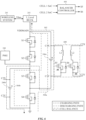
  • FIG. 5 illustrates a power system of a battery powered electronic device incorporating a three-level buck-boost converter and a 2S/2P battery arrangement.
  • FIG. 6 illustrates a power system of a battery powered electronic device incorporating a 2S/2P battery arrangement and a flyback-based cell balancer.
  • FIG. 7 illustrates a power system of a battery powered electronic device incorporating a 2S/2P battery arrangement and a switched capacitor voltage replicator-based cell. balancer.
  • a given figure may be used to illustrate the features of more than one embodiment, or more than one species of the disclosure, and not all elements in the figure may be required for a given embodiment or species.
  • a reference number when provided in a given drawing, refers to the same element throughout the several drawings, though it may not be repeated in every drawing.
  • the drawings are not to scale unless otherwise indicated, and the proportions of certain parts may be exaggerated to better illustrate details and features of the present disclosure.
  • FIG. 1 illustrates an exemplary wireless power transfer system 100 .
  • the wireless power transfer system includes a power transmitter (PTx) 102 and a power receiver (PRx) 104 .
  • Power transmitter 102 may be any of a variety of devices, such as a charging mat, pad, or stand; a charging puck; or an electronic device that is capable of both receiving and delivering wireless power.
  • Power receiver 104 can also be any of a variety of devices, including a battery-powered electronic device such as a smartphone, smart watch, tablet computer, laptop computer, a wireless accessory such as a stylus, wireless earphones, etc., or a charging case for any of the foregoing.
  • input power Pin is delivered to a regulator 110 , that in turn powers power transmitter 102 .
  • regulator 110 could be part of power transmitter 102 . In other embodiments, it may be a separate device, such as an AC/DC adapter that plugs into a wall socket to receive mains power. In any case, regulator 110 delivers DC power to an inverter 120 . Inverter 120 may be operated to generate an AC voltage that is delivered to the power transmitting coil Ltx, which magnetically couples to a power receiving coil Lrx in the wireless power receiver 104 , discussed in greater detail below.
  • the power transmitter circuit path may also include a tuning capacitor Ctx. Details of wireless power transmitter design and construction beyond the scope of this disclosure are omitted for clarity and brevity. Suffice it to say that the circuits and systems described herein may be used in conjunction with a wide variety of wireless power transmitter types.
  • Wireless power receiver 104 may also take a number of forms.
  • wireless power receiver 104 is a battery powered electronic device.
  • Wireless power receiver 104 includes a power receiving coil Lrx that may be positioned so as to be magnetically coupled to the power transmitting coil Ltx.
  • Wireless power receiver 104 may also include a tuning capacitor Crx.
  • the magnetic coupling between transmitter coil Ltx and receiver coil Lrx allows energy to be delivered from wireless power transmitter 102 to wireless power receiver. More specifically, a voltage may be induced at the input of rectifier 140 , which may deliver a DC voltage to the various electronic systems of wireless power receiver 104 as described in greater detail below.
  • Rectifier 140 may be a passive rectifier, for example a diode bridge, or may be an active rectifier made up of multiple switching components operated as a controlled rectifier. Further details of wireless power receiver design and construction beyond the scope of this disclosure are omitted for clarity and brevity. Suffice it to say that the circuits and systems described herein may be used in conjunction with a wide variety of wireless power receiver and electronic device types.
  • rectifier 140 may power a power management unit (PMU) 148 that delivers power to various subsystems of a portable electronic device.
  • PMU power management unit
  • a processing system 151 can for example include a system on a chip “SoC” or other processor/processor complex, including storage and memory systems, etc.
  • a communications system 153 can include cellular, WiFi, Bluetooth, and/or other radios and appurtenances.
  • Another subsystem could be input/output system 155 , which can include displays, loudspeakers, microphones, touch or other input devices, etc. Additional or alternative electronic subsystems may be provided as appropriate for a given embodiment.
  • Rectifier 140 may also supply power to a battery charger circuit 144 , which may be used to charge a battery 146 . Additionally, when other power sources, such as the wireless system or a separate wired power system are not available, the battery can supply power via PMU 148 to the various subsystems discussed above.
  • FIG. 2 illustrates an exemplary battery powered electronic device 200 capable of bidirectional wireless power transfer.
  • wireless power receiver 104 can either receive power from a wireless power transmitter 202 as described above with reference to FIG. 1 or can deliver power to a wireless power receiver.
  • rectifier 140 may be replaced with a bidirectional rectifier/inverter 240 .
  • rectifier inverter may be operated as a rectifier to produce a DC output for powering the various subsystems and charging the battery as described above.
  • device 202 is a wireless power receiver, it may have a rectifier 220 (or an inverter/rectifier 220 ).
  • Rectifier/inverter 240 of the “receiver” may be operated as an inverter to drive “receive” coil Lrx so as to transmit power to magnetically coupled inductor Ltx.
  • device 202 may be a wireless power transmitter, in which case inverter/rectifier 220 operates as an inverter and rectifier/inverter 240 operates as a rectifier.
  • device 202 may be a wireless power receiver, in which case inverter/rectifier 220 operates as a rectifier and rectifier inverter 240 operates as an inverter to drive receiver coil Lrx as a transmitter coil.
  • device 202 that is coupled to device 200 may be a wireless power transmitter, a wireless power receiver, or may be capable of both modes of operation.
  • electronic device 200 may be operated in various modes. In a wireless power receive mode, it can receive power via its wireless power system 241 , which power may be used to power its various subsystems via PMU 248 and to charge its battery 246 . Alternatively, electronic device 200 may be operated in a battery powered mode, in which case the battery may be used to power the various subsystems via PMU 248 . (The various subsystems discussed above with respect to FIG. 1 have been omitted from FIG.
  • electronic device 200 in its battery powered mode can supply power to another device via wireless power system 241 .
  • electronic device 200 may also include a separate wired power system (not shown) that can be used as a separate power input, power output or both.
  • a three level buck boost converter 243 is provided, operation of which is described in greater detail below with respect to FIGS. 3 and 4 .
  • FIGS. 3 A- 3 B illustrate operation of a three-level buck-boost converter in a buck mode (e.g., drawing power from the wireless system). More specifically, circuit block 301 illustrates a schematic of a three level buck boost converter. When operated in the buck mode, power flows from the input voltage Vin (which may be coupled to the Vbus voltage that is the output of rectifier 240 ) to the output voltage Vout (VDDMAIN), which may be supplied to the PMU 248 and battery 246 as illustrated in FIG. 2 above and FIGS. 5 - 6 below.
  • the three level buck converter can include a disconnect switch/diode arrangement 311 .
  • This arrangement can allow power to flow from the rectifier output to the three level buck under any operating condition (via the diode).
  • the switch may be turned on to reduce losses associated with the forward voltage drop of the diode.
  • power delivery in the boost mode discussed below with respect to FIG. 4
  • An input filter capacitor Cin may also be provided.
  • the converter includes four switching devices Q 1 -Q 4 that may be coupled between the input bus and ground in the illustrated ladder arrangement.
  • a flying capacitor Cfly may be connected between the junction of first switch Q 1 and second switch Q 2 and a junction of third switch Q 3 and fourth switch Q 4 .
  • a buck inductor L may be coupled between the junction of second switch Q 2 and third switch Q 3 and the output Vout.
  • An output filter capacitor Cout may also be provided.
  • FIGS. 3 A- 3 B Also illustrated in FIGS. 3 A- 3 B are four switching states A-D of the three level buck boost converter that correspond to the forward/buck mode of operation.
  • switching state A switches Q 1 and Q 3 are turned on, with switches Q 2 and Q 4 turned off. This results in the illustrated current path from the input, through switch Q 1 , through the flying capacitor, through switch Q 3 , through the buck inductor L, to the output.
  • state A energy is stored in both flying capacitor Cfly and the inductor L.
  • switching state B switches Q 3 and Q 4 are turned on, with switches Q 1 and Q 2 turned off. This prevents current flow through flying capacitor Cfly, which continues to store the energy deposited therein during a preceding switching state.
  • Block 303 illustrates a switching sequence applicable when the input voltage Vin (Vbus) is greater than twice the output voltage. This corresponds to an inductor charging duty cycle D less than 0.5.
  • Block 303 illustrates four waveforms Q 1 -Q 4 corresponding to the states of the switches (i.e., high corresponds to on and low corresponds to off). Thus, signals Q 1 -Q 4 may be thought of as the gate drive signals for the switches of the three level buck converter.
  • Block 303 also shows the voltage Vc appearing across the flying capacitor Cfly, which varies depending on the switching state.
  • block 303 also shows the current IL through buck inductor L, which ramps up and down depending on the switching state.
  • the sequence of switching states is B-A-B-D, which then repeats.
  • Block 305 illustrates a switching sequence applicable when the input voltage Vin (Vbus) is less than twice the output voltage. This corresponds to an inductor charging duty cycle D greater than 0.5.
  • Block 305 illustrates four waveforms Q 1 -Q 4 corresponding to the states of the switches (i.e., high corresponds to on and low corresponds to off). Thus, signals Q 1 -Q 4 may be thought of as the gate drive signals for the switches of the three level buck converter.
  • Block 305 also shows the voltage Vc appearing across the flying capacitor Cfly, which varies depending on the switching state.
  • block 305 also shows the current IL through buck inductor L, which ramps up and down depending on the switching state. As illustrated, the sequence of switching states is C-A-C-D, which then repeats.
  • the voltage conversion ratio i.e., the output voltage Vout divided by the input voltage Vin is D, which is effectively the inductor charging duty cycle.
  • the flying capacitor Cfly voltage Vc is regulated to a value equal to 1 ⁇ 2 Vin.
  • the voltage stress across each switching device is approximately Vin/2.
  • the ripple frequency of the voltage/current through inductor L is twice the switching frequency.
  • FIGS. 4 A- 4 B illustrate operation of a three-level buck-boost converter in a boost mode (e.g., delivering power to the wireless system). More specifically, circuit block 401 illustrates a schematic of a three level buck boost converter. When operated in the boost mode, power flows from the input voltage Vin (which may be coupled to VDDMAIN, i.e., the battery bus voltage) to the output voltage Vout (Vbus), which may be supplied to rectifier/inverter 240 as illustrated in FIG. 2 above and FIGS. 5 - 6 below.
  • Vin which may be coupled to VDDMAIN, i.e., the battery bus voltage
  • Vbus the output voltage Vout
  • the converter includes four switching devices Q 1 -Q 4 that may be coupled between the input bus and ground in the illustrated ladder arrangement.
  • the order of switches is the same as in FIG. 3 , above, although the input is coupled to the junction of switches Q 2 and Q 3 , and the output is taken from switch Q 1 .
  • a flying capacitor Cfly may be connected between the junction of first switch Q 1 and second switch Q 2 and a junction of third switch Q 3 and fourth switch Q 4 .
  • Inductor L is now a boost inductor, but remains in the same position relative to the other circuit elements, being may be coupled between the junction of second switch Q 2 and third switch Q 3 and the input Vin.
  • An output filter capacitor Cout may also be provided.
  • FIGS. 4 A- 4 B are four switching states A-D of the three level buck boost converter that correspond to the reverse/boost mode of operation. These states are labelled differently than in FIG. 3 , discussed above.
  • switching state A switches Q 3 and Q 3 are turned on, with switches Q 1 and Q 2 turned off. This results in the illustrated current path from the input, boost inductor L, through switches Q 3 and Q 4 to the output.
  • state A energy is stored in the inductor L.
  • switching state B switches Q 1 and Q 3 are turned on, with switches Q 2 and Q 4 turned off. This results in the illustrated current path in which current flows through boost inductor L, through switch Q 3 , through flying capacitor Cfly, though switch Q 1 to ground.
  • Block 403 illustrates a switching sequence applicable when the output voltage Vout (Vbus) is less than twice the input voltage Vin (VDDMAIN). This corresponds to an inductor charging duty cycle D less than 0.5.
  • Block 403 illustrates four waveforms Q 1 -Q 4 corresponding to the states of the switches (i.e., high corresponds to on and low corresponds to off). Thus, signals Q 1 -Q 4 may be thought of as the gate drive signals for the switches of the three level buck converter.
  • Block 403 also shows the voltage Vc appearing across the flying capacitor Cfly, which varies depending on the switching state.
  • block 403 also shows the current IL through boost inductor L, which ramps up and down depending on the switching state.
  • the sequence of switching states is A-B-A-C, which then repeats.
  • Block 405 illustrates a switching sequence applicable when the input voltage Vin (VDDMAIN) is less than half the output voltage Vout (Vbus). This corresponds to an inductor charging duty cycle D greater than 0.5.
  • Block 405 illustrates four waveforms Q 1 -Q 4 corresponding to the states of the switches (i.e., high corresponds to on and low corresponds to off). Thus, signals Q 1 -Q 4 may be thought of as the gate drive signals for the switches of the three level buck converter.
  • Block 405 also shows the voltage Vc appearing across the flying capacitor Cfly, which varies depending on the switching state.
  • block 405 also shows the current IL through boost inductor L, which ramps up and down depending on the switching state. As illustrated, the sequence of switching states is D-B-D-C, which then repeats.
  • the voltage conversion ratio i.e., the output voltage Vout divided by the input voltage Vin is 1/(1-D), where D is the inductor charging duty cycle.
  • the flying capacitor Cfly voltage Vc is regulated to a value equal to 1 ⁇ 2 Vout.
  • the voltage stress across each switching device is approximately Vout/2.
  • the ripple frequency of the voltage/current through inductor L is twice the switching frequency.
  • 2S/2P battery design refers to a configuration in which the battery includes two (or more) cells that are configured so as to charge in series and discharge in parallel. By connecting the two cells in series for charging, the voltage is effectively doubled, meaning that the same power can be delivered with half the current (reducing the conduction losses). Discharging the cells in parallel can reduce the down conversion ratio required to supply various loads, potentially allowing for reduced device voltage ratings and increased operating efficiency.
  • FIG. 5 illustrates a simplified block diagram of a power system of a battery powered electronic device incorporating a three-level buck-boost converter (as described above) and a 2S/2P battery arrangement.
  • the power system includes wireless system 241 , which, as described above, may be either a source of power for the device or may be used to wirelessly transfer power to another device.
  • Wireless system 241 is coupled to a three level buck boost converter 243 , which may be operated as described above to either down convert (buck) power from the wireless system to the battery and PMU 248 or up convert (boost) power form the battery to wireless system 241 .
  • the battery arrangement in this case includes two cells 246 a and 246 b , which may be charged in series (2S) and discharged in parallel (2P) via operation of switches S 1 -S 4 as described in greater detail below.
  • Switch S 1 -S 4 coupled between three level buck converter 243 and ground. These switches may be turned on or off by controller 560 (which can be configured to generate suitable drive signals for switches S 1 -S 4 ) to connect cells 246 a and 246 b in series or parallel depending on the mode of operation. More specifically, to facilitate series charging of cells 246 a and 246 b , switches S 1 , S 2 , and S 4 may be turned off, while switch S 3 is turned on. This results in current path 502 , which charges cells 246 a and 246 b in series via three level buck boost converter 243 . Also, in the charging mode, PMU 248 receives power via cell 246 b .
  • switches S 1 , S 2 , and S 4 may be turned on, while switch S 3 is turned off (i.e., the complement or inverse of the switching state that permits 2S charging). This allows cell 246 a to discharge via path 504 a .
  • switch S 4 being on allows current flow from cell 246 a to three level buck boost converter 243 to power the wireless system to provide power to another wireless power transfer enabled device.
  • cell 246 a can supply power to PMU 248 via switches S 4 , S 1 , and S 2 .
  • cell 246 b can supply power to three level buck boost converter 243 via turned on switches S 1 and S 2 via path 504 b .
  • PMU 248 may also draw power from cell 246 b via its direct connection.
  • all loads i.e., wireless system 241 via three level buck boost converter 243 and PMU 248 can both draw power from cells 246 a and 246 b in parallel.
  • the cells are not strictly connected in parallel.
  • cell 246 a can power three level buck boost converter 243 through a single switch S 4
  • cell 246 b can power three level buck boost converter 243 through two switches, S 1 and S 2 .
  • there will be a slight difference in impedance as between the two current paths including additional differences that may be introduced by different conductor lengths).
  • cell 246 b can power PMU 248 with no intervening switches, while cell 246 a can power PMU only through a current path that includes three switches S 1 , S 2 , and S 4 .
  • an imbalance as between the cells can occur, although the imbalance introduced during discharge may be substantially smaller because it is caused by relatively small differences in current path impedance (including the relatively small ON-resistance of the various switching devices), while the discharging imbalance is occasioned by the relatively larger power draw of the PMU 248 and subsystems powered thereby.
  • FIG. 6 illustrates a power system of a battery powered electronic device incorporating a 2S/2P battery arrangement and a flyback-based cell balancer 600 .
  • Flyback balancer 600 can be coupled across cell 246 a at terminals C 1 X and C 1 Y and across cell 246 b at terminals C 2 X and C 2 Y.
  • Flyback cell balancer 600 can include coupled inductors L 1 and L 2 connected with the asymmetric polarity shown, together with corresponding switching devices S 5 and S 6 .
  • Switches S 5 and S 6 may be turned off entirely, disabling flyback cell balancer 600 . In operation, switches S 5 and S 6 may be operated complementarily, that is, when S 5 is turned on, S 6 is turned off and vice-versa.
  • the switches may be driven with a pulse width modulated (PWM) signal responsive to the difference in state of charge as between cells 246 a and 246 b .
  • PWM pulse width modulated
  • cell voltage may serve as a proxy for state of charge.
  • battery monitoring systems may be used to provide the respective cells' states of charge to the balancer controller 601 . Responsive to the degree of imbalance between the cells, balancer controller 601 can generate drive signals for switches S 5 and S 6 to facilitate charge transfer from the more charged cell to the less charged cell.
  • balancer controller 601 can generate PWM drive signals for switch S 5 and complementary drive signals for switch S 6 to transfer charge from cell 246 a to 246 b .
  • switch S 5 When switch S 5 is turned on, cell 246 a will cause a linearly increasing current to flow in inductor L 1 , storing energy therein.
  • switch S 5 When switch S 5 is turned off and switch S 6 is turned on, the energy stored in the previous half switching cycle will be delivered from inductor L 2 via switch S 6 to cell 246 b .
  • balancer 600 can operate as a flyback converter to deliver energy from cell 246 a to 246 b , with switch S 5 acting as the main switch and switch S 6 acting as a synchronous rectifier switch.
  • switch S 6 may be driven as the main switch, storing energy from cell 246 b in the coupled inductor arrangement, and switch S 5 may be operated as a synchronous rectifier switch, delivering the stored energy to cell 246 a.
  • FIG. 7 illustrates a power system of a battery powered electronic device incorporating a 2S/2P battery arrangement and a switched capacitor voltage replicator based cell balancer 700 .
  • Balancer 700 may operate substantially similarly to flyback balancer 600 discussed above with reference to FIG. 6 . Namely, balancer 700 may be operated by a balancer controller 701 to equalize charge between cell 246 a and 246 b . Rather than a flyback topology, balancer 700 includes a switched capacitor arrangement including a capacitor Cs and two switch pairs S 5 /S 6 and S 7 /S 8 respectively coupling the capacitor to either cell 246 a or 246 b .
  • switches S 5 and S 6 may be closed while switches S 7 and S 8 are open. This will charge capacitor Cs. Then, switch pair S 5 /S 6 may be opened and switch pair S 7 /S 8 closed, connecting capacitor Cs to cell 246 b and allowing the energy stored in capacitor Cs to be transferred to cell 246 b.
  • the cell balancing circuits may operate continuously, so as to maintain charge equilibrium as between the cells.
  • the cell balancing circuits may be triggered once a first threshold imbalance level is reached and operated until the cells are balanced within a second threshold imbalance level (essentially operating as a sort of hysteretic controller).
  • the charge balancer circuitry may be configured to operate continuously during charging operations and responsive to imbalance thresholds during discharging.

Landscapes

  • Engineering & Computer Science (AREA)
  • Power Engineering (AREA)
  • Computer Networks & Wireless Communication (AREA)
  • Charge And Discharge Circuits For Batteries Or The Like (AREA)

Abstract

A battery powered electronic device can include a wireless power system configured to receive power from a wireless power transmitter, a converter coupled to the wireless power system that converts a voltage from the wireless power system to a battery charging voltage, a battery comprising at least two cells, a power management unit that delivers power from one or more of the at least two cells to one or more subsystems of the electronic device, and a plurality of switching devices connecting the at least two cells, the converter, and the power management unit. The plurality of switching devices can be arranged so that a first switching configuration connects the cells in series for charging from the converter and a second switching configuration connects the cells in parallel for delivering power to the power management unit.

Description

CROSS-REFERENCE TO RELATED APPLICATIONS
This application claims the benefit of U.S. Provisional Application No. 63/216,807, filed Jun. 30, 2021, entitled “POWER SYSTEM CONFIGURATIONS FOR WIRELESS CHARGING,” which is hereby incorporated by reference in its entirety for all purposes.
BACKGROUND
Wireless power transfer, in which power is delivered via magnetic/inductive coupling between a power transmitter (PTx) and a power receiver (PRx), is useful for powering battery powered electronic devices. In some applications, wireless power transfer may be used to charge a battery in a portable electronic device, such as a mobile phone, smart watch, tablet computer, or an accessory such as a stylus, wireless earphones, etc. From a user perspective it may be desirable to charge the batteries in such devices rapidly. However, the increased currents associated with such rapid charging can introduce losses that reduce overall power consumption efficiency.
SUMMARY
Thus, it would be beneficial to provide improved power system topologies for portable electronic devices that can allow for faster battery charging with reduced losses.
A battery powered electronic device can include a wireless power system configured to receive power from a wireless power transmitter, a converter coupled to the wireless power system that converts a voltage from the wireless power system to a battery charging voltage, a battery comprising at least two cells, a power management unit that delivers power from one or more of the at least two cells to one or more subsystems of the electronic device, and a plurality of switching devices connecting the at least two cells, the converter, and the power management unit. The plurality of switching devices can be arranged so that a first switching configuration connects the cells in series for charging from the converter and a second switching configuration connects the cells in parallel for delivering power to the power management unit. The wireless power system can be further configured to deliver power from the battery powered electronic device to another device. The converter can be a bi-directional three level buck boost converter.
The plurality of switching devices can include a ladder of four switches connected between an output of the converter and ground. A first cell of the at least two cells can have a first terminal connected to a junction of an output of the converter and a first switch of the four switches and a second terminal connected to a junction between a third and fourth of the four switches. A second cell of the at least two cells can have a first terminal connected to a junction of a second switch and a third switch of the four switches and a second terminal connected to ground. The power management unit can be coupled to the junction of the second switch and the third switch.
The battery powered electronic device can further include a balancer circuit coupled to a first of the at least two cells and a second of the at least two cells that operates to equalize state of charge as between the cells. The balancer circuit can include two coupled inductors and two switches in a flyback configuration. The balancer circuit can include a charge transfer capacitor, a first switch pair arranged to permit power transfer between the first cell to the charge transfer capacitor, and a second switch pair arranged to permit power transfer between the second cell and the charge transfer capacitor.
The at least two cells can have the same capacity or different capacities. The at least two cells can have the same chemistry or different chemistries.
A battery system for a portable electronic device can include a first cell, a second cell, a first terminal that receives input power to charge the batteries, a second terminal that delivers output power from the batteries, and a plurality of switching devices arranged to allow the first and second cells to be charged in series from the first terminal when the plurality of switching devices are in a first switching state. The plurality of switching devices can be further arranged to allow the first and second cells to discharge in parallel to the second terminal when the plurality of switching devices are in a second switching state. The plurality of switching devices can be further arranged to allow the first and second cells to discharge in parallel to the first terminal when the plurality of switching devices are in the second switching state.
The battery system can further include a balancer circuit coupled to the first and second cells, wherein the balancer circuit is operable equalize state of charge as between the cells. The balancer circuit can include a first series connected inductor and switch coupled in parallel with the first cell and a second series connected inductor and switch coupled in parallel with the second cell, wherein the first and second inductors are magnetically coupled. The balancer circuit can be operable as a flyback converter to transfer charge between the first and second cells. The balancer circuit can also include a charge transfer capacitor, a first switch pair arranged to selectively couple the charge transfer capacitor to the first cell, and a second switch pair arranged to selectively couple the charge transfer capacitor to the second cell. The balancer circuit can be operable as a voltage replicator to transfer charge between the first and second cells.
The cells can have the same or different rated capacities. The cells can have the same or different chemistries.
An electronic device can include a battery comprising at least two cells, a wireless power system configured to receive power from a wireless power transmitter and to deliver power to a another device, and a bidirectional converter coupled to the wireless power system. The bidirectional converter can be configured to, in a first operating mode, receive a voltage from the wireless power system and convert it to a battery charging voltage; and, in a second operating mode, receive a battery voltage and convert it to a voltage supplied to the wireless power system. The electronic device can further include a power management unit that delivers power from at least one of the cells to one or more subsystems of the electronic device and a switching circuit having a first switching state that connects the cells in series for charging from the bidirectional converter and a second switching state that connects the cells in parallel for delivering power to the power management unit and the wireless system. The electronic device can further include a balancer circuit coupled to a first of the at least two cells and a second of the at least two cells that operates to equalize state of charge as between the cells. The balancer circuit can operate continuously. The balancer circuit can operate responsive to a state of charge imbalance between the cells reaching a threshold.
BRIEF DESCRIPTION OF THE DRAWINGS
FIG. 1 illustrates an exemplary wireless power transfer system.
FIG. 2 illustrates another exemplary wireless power transfer system incorporating a three-level buck-boost converter to allow for bidirectional wireless power transfer.
FIGS. 3A and 3B illustrates operation of a three-level buck-boost converter in a buck mode (e.g., drawing power from the wireless system).
FIGS. 4A and 4B illustrates operation of a three-level buck-boost converter in a boost mode (e.g., delivering power to the wireless system).
FIG. 5 illustrates a power system of a battery powered electronic device incorporating a three-level buck-boost converter and a 2S/2P battery arrangement.
FIG. 6 illustrates a power system of a battery powered electronic device incorporating a 2S/2P battery arrangement and a flyback-based cell balancer.
FIG. 7 illustrates a power system of a battery powered electronic device incorporating a 2S/2P battery arrangement and a switched capacitor voltage replicator-based cell. balancer.
DETAILED DESCRIPTION
In the following description, for purposes of explanation, numerous specific details are set forth to provide a thorough understanding of the disclosed concepts. As part of this description, some of this disclosure's drawings represent structures and devices in block diagram form for sake of simplicity. In the interest of clarity, not all features of an actual implementation are described in this disclosure. Moreover, the language used in this disclosure has been selected for readability and instructional purposes, has not been selected to delineate or circumscribe the disclosed subject matter. Rather the appended claims are intended for such purpose.
Various embodiments of the disclosed concepts are illustrated by way of example and not by way of limitation in the accompanying drawings in which like references indicate similar elements. For simplicity and clarity of illustration, where appropriate, reference numerals have been repeated among the different figures to indicate corresponding or analogous elements. In addition, numerous specific details are set forth in order to provide a thorough understanding of the implementations described herein. In other instances, methods, procedures and components have not been described in detail so as not to obscure the related relevant function being described. References to “an,” “one,” or “another” embodiment in this disclosure are not necessarily to the same or different embodiment, and they mean at least one. A given figure may be used to illustrate the features of more than one embodiment, or more than one species of the disclosure, and not all elements in the figure may be required for a given embodiment or species. A reference number, when provided in a given drawing, refers to the same element throughout the several drawings, though it may not be repeated in every drawing. The drawings are not to scale unless otherwise indicated, and the proportions of certain parts may be exaggerated to better illustrate details and features of the present disclosure.
FIG. 1 illustrates an exemplary wireless power transfer system 100. The wireless power transfer system includes a power transmitter (PTx) 102 and a power receiver (PRx) 104. Power transmitter 102 may be any of a variety of devices, such as a charging mat, pad, or stand; a charging puck; or an electronic device that is capable of both receiving and delivering wireless power. Power receiver 104 can also be any of a variety of devices, including a battery-powered electronic device such as a smartphone, smart watch, tablet computer, laptop computer, a wireless accessory such as a stylus, wireless earphones, etc., or a charging case for any of the foregoing. In the illustrated embodiment, input power Pin is delivered to a regulator 110, that in turn powers power transmitter 102. In some embodiments, regulator 110 could be part of power transmitter 102. In other embodiments, it may be a separate device, such as an AC/DC adapter that plugs into a wall socket to receive mains power. In any case, regulator 110 delivers DC power to an inverter 120. Inverter 120 may be operated to generate an AC voltage that is delivered to the power transmitting coil Ltx, which magnetically couples to a power receiving coil Lrx in the wireless power receiver 104, discussed in greater detail below. The power transmitter circuit path may also include a tuning capacitor Ctx. Details of wireless power transmitter design and construction beyond the scope of this disclosure are omitted for clarity and brevity. Suffice it to say that the circuits and systems described herein may be used in conjunction with a wide variety of wireless power transmitter types.
Wireless power receiver 104 may also take a number of forms. In the illustrated example, wireless power receiver 104 is a battery powered electronic device. Wireless power receiver 104 includes a power receiving coil Lrx that may be positioned so as to be magnetically coupled to the power transmitting coil Ltx. Wireless power receiver 104 may also include a tuning capacitor Crx. The magnetic coupling between transmitter coil Ltx and receiver coil Lrx allows energy to be delivered from wireless power transmitter 102 to wireless power receiver. More specifically, a voltage may be induced at the input of rectifier 140, which may deliver a DC voltage to the various electronic systems of wireless power receiver 104 as described in greater detail below. Rectifier 140 may be a passive rectifier, for example a diode bridge, or may be an active rectifier made up of multiple switching components operated as a controlled rectifier. Further details of wireless power receiver design and construction beyond the scope of this disclosure are omitted for clarity and brevity. Suffice it to say that the circuits and systems described herein may be used in conjunction with a wide variety of wireless power receiver and electronic device types.
As mentioned above, rectifier 140 may power a power management unit (PMU) 148 that delivers power to various subsystems of a portable electronic device. One example of such subsystem is a processing system 151, which can for example include a system on a chip “SoC” or other processor/processor complex, including storage and memory systems, etc.). Another such subsystem is a communications system 153, which can include cellular, WiFi, Bluetooth, and/or other radios and appurtenances. Another subsystem could be input/output system 155, which can include displays, loudspeakers, microphones, touch or other input devices, etc. Additional or alternative electronic subsystems may be provided as appropriate for a given embodiment. Rectifier 140 may also supply power to a battery charger circuit 144, which may be used to charge a battery 146. Additionally, when other power sources, such as the wireless system or a separate wired power system are not available, the battery can supply power via PMU 148 to the various subsystems discussed above.
FIG. 2 illustrates an exemplary battery powered electronic device 200 capable of bidirectional wireless power transfer. In other words, wireless power receiver 104 can either receive power from a wireless power transmitter 202 as described above with reference to FIG. 1 or can deliver power to a wireless power receiver. To accommodate bidirectional operation, rectifier 140 may be replaced with a bidirectional rectifier/inverter 240. Thus, when a wireless power transmitter induces a voltage across receive coil Lrx, rectifier inverter may be operated as a rectifier to produce a DC output for powering the various subsystems and charging the battery as described above. Conversely if device 202 is a wireless power receiver, it may have a rectifier 220 (or an inverter/rectifier 220). Rectifier/inverter 240 of the “receiver” may be operated as an inverter to drive “receive” coil Lrx so as to transmit power to magnetically coupled inductor Ltx. Thus, in the arrangement of FIG. 2 , device 202 may be a wireless power transmitter, in which case inverter/rectifier 220 operates as an inverter and rectifier/inverter 240 operates as a rectifier. Alternatively, device 202 may be a wireless power receiver, in which case inverter/rectifier 220 operates as a rectifier and rectifier inverter 240 operates as an inverter to drive receiver coil Lrx as a transmitter coil. As a result, device 202 that is coupled to device 200 may be a wireless power transmitter, a wireless power receiver, or may be capable of both modes of operation.
As a result of the above-described operating modes, the “transmitter” and “receiver” nomenclature may be slightly confusing; however, it is preserved for sake of consistency among the various embodiments. In any case, electronic device 200 may be operated in various modes. In a wireless power receive mode, it can receive power via its wireless power system 241, which power may be used to power its various subsystems via PMU 248 and to charge its battery 246. Alternatively, electronic device 200 may be operated in a battery powered mode, in which case the battery may be used to power the various subsystems via PMU 248. (The various subsystems discussed above with respect to FIG. 1 have been omitted from FIG. 2 for brevity, but it should be understood that one or more of these various systems may also be present.) Additionally, in some embodiments, electronic device 200 in its battery powered mode can supply power to another device via wireless power system 241. In some cases, electronic device 200 may also include a separate wired power system (not shown) that can be used as a separate power input, power output or both. To facilitate the bidirectional operation described above, in which device 200 can either charge its battery from wireless power system 241 (or optionally the wired power system not shown) or can use its battery 246 to power another device via wireless power system 241, a three level buck boost converter 243 is provided, operation of which is described in greater detail below with respect to FIGS. 3 and 4 .
FIGS. 3A-3B illustrate operation of a three-level buck-boost converter in a buck mode (e.g., drawing power from the wireless system). More specifically, circuit block 301 illustrates a schematic of a three level buck boost converter. When operated in the buck mode, power flows from the input voltage Vin (which may be coupled to the Vbus voltage that is the output of rectifier 240) to the output voltage Vout (VDDMAIN), which may be supplied to the PMU 248 and battery 246 as illustrated in FIG. 2 above and FIGS. 5-6 below. The three level buck converter can include a disconnect switch/diode arrangement 311. This arrangement can allow power to flow from the rectifier output to the three level buck under any operating condition (via the diode). The switch may be turned on to reduce losses associated with the forward voltage drop of the diode. Likewise, power delivery (in the boost mode discussed below with respect to FIG. 4 ) may be enabled by turning on the switch. An input filter capacitor Cin may also be provided. In any case, the converter includes four switching devices Q1-Q4 that may be coupled between the input bus and ground in the illustrated ladder arrangement. A flying capacitor Cfly may be connected between the junction of first switch Q1 and second switch Q2 and a junction of third switch Q3 and fourth switch Q4. A buck inductor L may be coupled between the junction of second switch Q2 and third switch Q3 and the output Vout. An output filter capacitor Cout may also be provided.
Also illustrated in FIGS. 3A-3B are four switching states A-D of the three level buck boost converter that correspond to the forward/buck mode of operation. In switching state A, switches Q1 and Q3 are turned on, with switches Q2 and Q4 turned off. This results in the illustrated current path from the input, through switch Q1, through the flying capacitor, through switch Q3, through the buck inductor L, to the output. During state A, energy is stored in both flying capacitor Cfly and the inductor L. In switching state B, switches Q3 and Q4 are turned on, with switches Q1 and Q2 turned off. This prevents current flow through flying capacitor Cfly, which continues to store the energy deposited therein during a preceding switching state. During State B, energy stored in inductor L during a preceding switching state is delivered to the output. In switching state C, switches Q1 and Q2 are turned on, while switches Q3 and Q4 are turned off. As a result, in state C, current flow through flying capacitor Cfly is prevented, which allows for continued storage of energy deposited therein during a preceding switching state. However, the current path from the input to the output through inductor L causes energy to be stored in inductor L and delivered to the output. In switching state D, switches Q2 and Q4 are turned on, and switches Q1 and Q3 are turned off. As a result, energy stored in flying capacitor Cfly and inductor L is delivered to the output.
In the buck mode, differing sequences of switching states A-D may be applied to deliver a regulated output voltage Vout (VDDMAIN) from the input voltage Vin (Vbus). Block 303 illustrates a switching sequence applicable when the input voltage Vin (Vbus) is greater than twice the output voltage. This corresponds to an inductor charging duty cycle D less than 0.5. Block 303 illustrates four waveforms Q1-Q4 corresponding to the states of the switches (i.e., high corresponds to on and low corresponds to off). Thus, signals Q1-Q4 may be thought of as the gate drive signals for the switches of the three level buck converter. Block 303 also shows the voltage Vc appearing across the flying capacitor Cfly, which varies depending on the switching state. Finally block 303 also shows the current IL through buck inductor L, which ramps up and down depending on the switching state. As illustrated, the sequence of switching states is B-A-B-D, which then repeats.
Block 305 illustrates a switching sequence applicable when the input voltage Vin (Vbus) is less than twice the output voltage. This corresponds to an inductor charging duty cycle D greater than 0.5. Block 305 illustrates four waveforms Q1-Q4 corresponding to the states of the switches (i.e., high corresponds to on and low corresponds to off). Thus, signals Q1-Q4 may be thought of as the gate drive signals for the switches of the three level buck converter. Block 305 also shows the voltage Vc appearing across the flying capacitor Cfly, which varies depending on the switching state. Finally block 305 also shows the current IL through buck inductor L, which ramps up and down depending on the switching state. As illustrated, the sequence of switching states is C-A-C-D, which then repeats.
In either of the above-described cases, the voltage conversion ratio, i.e., the output voltage Vout divided by the input voltage Vin is D, which is effectively the inductor charging duty cycle. Also, in both cases, the flying capacitor Cfly voltage Vc is regulated to a value equal to ½ Vin. The voltage stress across each switching device is approximately Vin/2. Finally, the ripple frequency of the voltage/current through inductor L is twice the switching frequency.
FIGS. 4A-4B illustrate operation of a three-level buck-boost converter in a boost mode (e.g., delivering power to the wireless system). More specifically, circuit block 401 illustrates a schematic of a three level buck boost converter. When operated in the boost mode, power flows from the input voltage Vin (which may be coupled to VDDMAIN, i.e., the battery bus voltage) to the output voltage Vout (Vbus), which may be supplied to rectifier/inverter 240 as illustrated in FIG. 2 above and FIGS. 5-6 below. It will be appreciated that the inputs and outputs of circuit 401 are reversed with respect to circuit 301 discussed above. Additionally, the filter capacitor designations are reversed, thus an input filter capacitor Cin may also be provided. In any case, the converter includes four switching devices Q1-Q4 that may be coupled between the input bus and ground in the illustrated ladder arrangement. The order of switches is the same as in FIG. 3 , above, although the input is coupled to the junction of switches Q2 and Q3, and the output is taken from switch Q1. A flying capacitor Cfly may be connected between the junction of first switch Q1 and second switch Q2 and a junction of third switch Q3 and fourth switch Q4. Inductor L is now a boost inductor, but remains in the same position relative to the other circuit elements, being may be coupled between the junction of second switch Q2 and third switch Q3 and the input Vin. An output filter capacitor Cout may also be provided.
Also illustrated in FIGS. 4A-4B are four switching states A-D of the three level buck boost converter that correspond to the reverse/boost mode of operation. These states are labelled differently than in FIG. 3 , discussed above. In switching state A, switches Q3 and Q3 are turned on, with switches Q1 and Q2 turned off. This results in the illustrated current path from the input, boost inductor L, through switches Q3 and Q4 to the output. During state A, energy is stored in the inductor L. In switching state B, switches Q1 and Q3 are turned on, with switches Q2 and Q4 turned off. This results in the illustrated current path in which current flows through boost inductor L, through switch Q3, through flying capacitor Cfly, though switch Q1 to ground. As a result, energy is stored in both boost inductor L and flying capacitor Cfly. In switching state C, switches Q2 and Q4 are turned on, while switches Q1 and Q3 are turned off. As a result, in state C, current flows through boost inductor L, switch Q2, flying capacitor Cfly, switch Q4 to the output. In state C, energy is discharged from flying capacitor Cfly. In switching state D, switches Q1 and Q2 are turned on, and switches Q3 and Q4 are turned off. As a result, energy is stored in boost inductor L, while the energy in flying capacitor Cfly remains constant.
In the boost mode, differing sequences of switching states A-D may be applied to deliver a regulated output voltage Vout (Vbus) from the input voltage Vin (VDDMAIN). Block 403 illustrates a switching sequence applicable when the output voltage Vout (Vbus) is less than twice the input voltage Vin (VDDMAIN). This corresponds to an inductor charging duty cycle D less than 0.5. Block 403 illustrates four waveforms Q1-Q4 corresponding to the states of the switches (i.e., high corresponds to on and low corresponds to off). Thus, signals Q1-Q4 may be thought of as the gate drive signals for the switches of the three level buck converter. Block 403 also shows the voltage Vc appearing across the flying capacitor Cfly, which varies depending on the switching state. Finally block 403 also shows the current IL through boost inductor L, which ramps up and down depending on the switching state. As illustrated, the sequence of switching states is A-B-A-C, which then repeats.
Block 405 illustrates a switching sequence applicable when the input voltage Vin (VDDMAIN) is less than half the output voltage Vout (Vbus). This corresponds to an inductor charging duty cycle D greater than 0.5. Block 405 illustrates four waveforms Q1-Q4 corresponding to the states of the switches (i.e., high corresponds to on and low corresponds to off). Thus, signals Q1-Q4 may be thought of as the gate drive signals for the switches of the three level buck converter. Block 405 also shows the voltage Vc appearing across the flying capacitor Cfly, which varies depending on the switching state. Finally block 405 also shows the current IL through boost inductor L, which ramps up and down depending on the switching state. As illustrated, the sequence of switching states is D-B-D-C, which then repeats.
In either of the above-described cases, the voltage conversion ratio, i.e., the output voltage Vout divided by the input voltage Vin is 1/(1-D), where D is the inductor charging duty cycle. Also, in both cases, the flying capacitor Cfly voltage Vc is regulated to a value equal to ½ Vout. The voltage stress across each switching device is approximately Vout/2. Finally, the ripple frequency of the voltage/current through inductor L is twice the switching frequency.
As noted above, in at least some applications it is desirable to charge a battery of a battery powered device relatively rapidly. This requires higher charge currents, which can result in substantially increased conduction losses (sometimes called I2R losses). For example, doubling the charging current can increase conduction losses by a factor of four. This effect can be mitigated by switching from a single cell or fixed multi-cell battery design to a 2S/2P battery design. As used herein, 2S/2P battery design refers to a configuration in which the battery includes two (or more) cells that are configured so as to charge in series and discharge in parallel. By connecting the two cells in series for charging, the voltage is effectively doubled, meaning that the same power can be delivered with half the current (reducing the conduction losses). Discharging the cells in parallel can reduce the down conversion ratio required to supply various loads, potentially allowing for reduced device voltage ratings and increased operating efficiency.
FIG. 5 illustrates a simplified block diagram of a power system of a battery powered electronic device incorporating a three-level buck-boost converter (as described above) and a 2S/2P battery arrangement. The power system includes wireless system 241, which, as described above, may be either a source of power for the device or may be used to wirelessly transfer power to another device. Wireless system 241 is coupled to a three level buck boost converter 243, which may be operated as described above to either down convert (buck) power from the wireless system to the battery and PMU 248 or up convert (boost) power form the battery to wireless system 241. The battery arrangement in this case includes two cells 246 a and 246 b, which may be charged in series (2S) and discharged in parallel (2P) via operation of switches S1-S4 as described in greater detail below.
Facilitating the 2S/2P operation is a ladder of switching devices S1-S4 coupled between three level buck converter 243 and ground. These switches may be turned on or off by controller 560 (which can be configured to generate suitable drive signals for switches S1-S4) to connect cells 246 a and 246 b in series or parallel depending on the mode of operation. More specifically, to facilitate series charging of cells 246 a and 246 b, switches S1, S2, and S4 may be turned off, while switch S3 is turned on. This results in current path 502, which charges cells 246 a and 246 b in series via three level buck boost converter 243. Also, in the charging mode, PMU 248 receives power via cell 246 b. Viewed another way, a portion of the charging current that charges cell 246 a is diverted to PMU 248 before reaching cell 246 b. Subsystems 151, 153, and 155 are omitted from FIG. 5 for brevity, but it is understood that one or more such subsystems powered by PMU 248 may be present. In any case, because the presence of PMU 248 prevents cells 246 a and 246 b from being strictly in series, i.e., experiencing identical current, the difference between the charging current provided to cell 246 a and to cell 246 b (i.e., the charging current of cell 246 a less the current to PMU 248) can result in an imbalance between cells 246 a and 246 b that may be addressed as described in greater detail below.
To facilitate parallel discharge of cells 246 a and 246 b, switches S1, S2, and S4 may be turned on, while switch S3 is turned off (i.e., the complement or inverse of the switching state that permits 2S charging). This allows cell 246 a to discharge via path 504 a. In other words, switch S4 being on allows current flow from cell 246 a to three level buck boost converter 243 to power the wireless system to provide power to another wireless power transfer enabled device. Likewise, cell 246 a can supply power to PMU 248 via switches S4, S1, and S2. Similarly, cell 246 b can supply power to three level buck boost converter 243 via turned on switches S1 and S2 via path 504 b. Finally, PMU 248 may also draw power from cell 246 b via its direct connection. To summarize, all loads, i.e., wireless system 241 via three level buck boost converter 243 and PMU 248 can both draw power from cells 246 a and 246 b in parallel. However, it will be appreciated that the cells are not strictly connected in parallel. For example, cell 246 a can power three level buck boost converter 243 through a single switch S4, while cell 246 b can power three level buck boost converter 243 through two switches, S1 and S2. Thus, there will be a slight difference in impedance as between the two current paths (including additional differences that may be introduced by different conductor lengths). Similarly, cell 246 b can power PMU 248 with no intervening switches, while cell 246 a can power PMU only through a current path that includes three switches S1, S2, and S4. Thus, like in the charging case, an imbalance as between the cells can occur, although the imbalance introduced during discharge may be substantially smaller because it is caused by relatively small differences in current path impedance (including the relatively small ON-resistance of the various switching devices), while the discharging imbalance is occasioned by the relatively larger power draw of the PMU 248 and subsystems powered thereby.
FIG. 6 illustrates a power system of a battery powered electronic device incorporating a 2S/2P battery arrangement and a flyback-based cell balancer 600. Flyback balancer 600 can be coupled across cell 246 a at terminals C1X and C1Y and across cell 246 b at terminals C2X and C2Y. Flyback cell balancer 600 can include coupled inductors L1 and L2 connected with the asymmetric polarity shown, together with corresponding switching devices S5 and S6. Switches S5 and S6 may be turned off entirely, disabling flyback cell balancer 600. In operation, switches S5 and S6 may be operated complementarily, that is, when S5 is turned on, S6 is turned off and vice-versa. The switches may be driven with a pulse width modulated (PWM) signal responsive to the difference in state of charge as between cells 246 a and 246 b. For identical cells, cell voltage may serve as a proxy for state of charge. For cells having different capacities and/or different chemistries, battery monitoring systems may be used to provide the respective cells' states of charge to the balancer controller 601. Responsive to the degree of imbalance between the cells, balancer controller 601 can generate drive signals for switches S5 and S6 to facilitate charge transfer from the more charged cell to the less charged cell.
More specifically, assume that the system illustrated in FIG. 6 is operating in a mode in which cells 246 a and 246 b are being charged from wireless system 241. As discussed above, switch S3 is closed, and switches S1, S2, and S4 are open. Charging current flows along illustrated path 502 through cells 246 a and 246 b. However, the current through the respective cells is not identical because a certain amount of current is delivered to PMU 248 to power other systems of the electronic device. Thus, cell 246 a will charge at a faster rate than cell 246 b. When this difference in state of charge (SoC) is detected, balancer controller 601 can generate PWM drive signals for switch S5 and complementary drive signals for switch S6 to transfer charge from cell 246 a to 246 b. When switch S5 is turned on, cell 246 a will cause a linearly increasing current to flow in inductor L1, storing energy therein. When switch S5 is turned off and switch S6 is turned on, the energy stored in the previous half switching cycle will be delivered from inductor L2 via switch S6 to cell 246 b. Thus, balancer 600 can operate as a flyback converter to deliver energy from cell 246 a to 246 b, with switch S5 acting as the main switch and switch S6 acting as a synchronous rectifier switch. The reverse operation is also possible, namely to transfer energy from cell 246 b to cell 246 a, switch S6 may be driven as the main switch, storing energy from cell 246 b in the coupled inductor arrangement, and switch S5 may be operated as a synchronous rectifier switch, delivering the stored energy to cell 246 a.
FIG. 7 illustrates a power system of a battery powered electronic device incorporating a 2S/2P battery arrangement and a switched capacitor voltage replicator based cell balancer 700. Balancer 700 may operate substantially similarly to flyback balancer 600 discussed above with reference to FIG. 6 . Namely, balancer 700 may be operated by a balancer controller 701 to equalize charge between cell 246 a and 246 b. Rather than a flyback topology, balancer 700 includes a switched capacitor arrangement including a capacitor Cs and two switch pairs S5/S6 and S7/S8 respectively coupling the capacitor to either cell 246 a or 246 b. To transfer energy from cell 246 a to 246 b, switches S5 and S6 may be closed while switches S7 and S8 are open. This will charge capacitor Cs. Then, switch pair S5/S6 may be opened and switch pair S7/S8 closed, connecting capacitor Cs to cell 246 b and allowing the energy stored in capacitor Cs to be transferred to cell 246 b.
In the examples of FIGS. 6 and 7 , the cell balancing circuits may operate continuously, so as to maintain charge equilibrium as between the cells. Alternatively, the cell balancing circuits may be triggered once a first threshold imbalance level is reached and operated until the cells are balanced within a second threshold imbalance level (essentially operating as a sort of hysteretic controller). In some applications the charge balancer circuitry may be configured to operate continuously during charging operations and responsive to imbalance thresholds during discharging.
The foregoing describes exemplary embodiments of battery-powered portable electronic devices that include wireless power transfer capabilities. Such systems may be used in a variety of applications but may be particularly advantageous when used in conjunction with wireless power transfer systems battery-powered electronic devices such as a mobile phones, smart watches, and/or tablet computers including accessories for such devices such as wireless earphones, styluses, and the like. However, any battery-powered system for which increased overall efficiency is desired may advantageously employ the techniques described herein. Although numerous specific features and various embodiments have been described, it is to be understood that, unless otherwise noted as being mutually exclusive, the various features and embodiments may be combined in various permutations in a particular implementation. Thus, the various embodiments described above are provided by way of illustration only and should not be constructed to limit the scope of the disclosure. Various modifications and changes can be made to the principles and embodiments herein without departing from the scope of the disclosure and without departing from the scope of the claims.

Claims (14)

The invention claimed is:
1. A battery powered electronic device comprising:
a wireless power system configured to receive power from a wireless power transmitter;
a converter coupled to the wireless power system that converts a voltage from the wireless power system to a battery charging voltage;
a battery comprising at least two cells;
a power management unit that delivers power from one or more of the at least two cells to one or more subsystems of the battery powered electronic device; and
a plurality of switching devices connecting the at least two cells, the converter, and the power management unit, wherein the plurality of switching devices are arranged so that a first switching configuration connects the cells in series for charging from the converter and a second switching configuration connects the cells in parallel for delivering power to the power management unit.
2. The battery powered electronic device of claim 1 wherein the wireless power system is further configured to deliver power from the battery powered electronic device to another device.
3. The battery powered electronic device of claim 2 wherein the converter is a bi-directional three level buck boost converter.
4. The battery powered electronic device of claim 1 wherein:
the plurality of switching devices comprises a ladder of four switches connected between an output of the converter and ground;
a first cell of the at least two cells has a first terminal connected to a junction of an output of the converter and a first switch of the four switches and a second terminal connected to a junction between a third and fourth of the four switches; and
a second cell of the at least two cells has a first terminal connected to a junction of a second switch and a third switch of the four switches and a second terminal connected to ground.
5. The battery powered electronic device of claim 4 wherein the power management unit is coupled to the junction of the second switch and the third switch.
6. The battery powered electronic device of claim 1 further comprising a balancer circuit coupled to a first of the at least two cells and a second of the at least two cells that operates to equalize state of charge as between the cells.
7. The battery powered electronic device of claim 6 wherein the balancer circuit comprises two coupled inductors and two switches in a flyback configuration.
8. The battery powered electronic device of claim 6 wherein the balancer circuit comprises:
a charge transfer capacitor;
a first switch pair arranged to permit power transfer between the first cell to the charge transfer capacitor; and
a second switch pair arranged to permit power transfer between the second cell and the charge transfer capacitor.
9. The battery powered electronic device of claim 1 wherein the at least two cells have the same capacity.
10. The battery powered electronic device of claim 1 wherein the at least two cells have the same chemistry.
11. An electronic device comprising:
a battery comprising at least two cells;
a wireless power system configured to receive power from a wireless power transmitter and to deliver power to another device;
a bidirectional converter coupled to the wireless power system, the bidirectional converter being configured to:
in a first operating mode, receive a voltage from the wireless power system and convert it to a battery charging voltage; and
in a second operating mode, receive a battery voltage and convert it to a voltage supplied to the wireless power system;
a power management unit that delivers power from at least one of the cells to one or more subsystems of the electronic device; and
a switching circuit having a first switching state that connects the cells in series for charging from the bidirectional converter and a second switching state that connects the cells in parallel for delivering power to the power management unit and the wireless power system.
12. The electronic device of claim 11 further comprising a balancer circuit coupled to a first of the at least two cells and a second of the at least two cells that operates to equalize state of charge as between the cells.
13. The electronic device of claim 12 wherein the balancer circuit operates continuously.
14. The electronic device of claim 12 wherein the balancer circuit operates responsive to a state of charge imbalance between the cells reaching a threshold.
US17/447,488 2021-06-30 2021-09-13 Power system configurations for wireless charging Active 2043-04-23 US12191685B2 (en)

Priority Applications (1)

Application Number Priority Date Filing Date Title
US17/447,488 US12191685B2 (en) 2021-06-30 2021-09-13 Power system configurations for wireless charging

Applications Claiming Priority (2)

Application Number Priority Date Filing Date Title
US202163216807P 2021-06-30 2021-06-30
US17/447,488 US12191685B2 (en) 2021-06-30 2021-09-13 Power system configurations for wireless charging

Publications (2)

Publication Number Publication Date
US20230006450A1 US20230006450A1 (en) 2023-01-05
US12191685B2 true US12191685B2 (en) 2025-01-07

Family

ID=84786490

Family Applications (1)

Application Number Title Priority Date Filing Date
US17/447,488 Active 2043-04-23 US12191685B2 (en) 2021-06-30 2021-09-13 Power system configurations for wireless charging

Country Status (1)

Country Link
US (1) US12191685B2 (en)

Families Citing this family (2)

* Cited by examiner, † Cited by third party
Publication number Priority date Publication date Assignee Title
US12142953B2 (en) * 2022-02-08 2024-11-12 Apple Inc. Battery charging protection and health management system
CN118282008B (en) * 2024-05-31 2024-08-06 深圳市特瑞华腾新能源有限公司 Multifunctional vehicle-mounted charging circuit of electric automobile

Citations (3)

* Cited by examiner, † Cited by third party
Publication number Priority date Publication date Assignee Title
US9876363B2 (en) * 2014-09-11 2018-01-23 Samsung Electro-Mechanics Co., Ltd. Non-contact type power transmitting apparatus, non-contact type power transmitting-receiving apparatus, contact/non-contact type power transmitting apparatus, and contact/non-contact type power transmitting-receiving apparatus
US20190341796A1 (en) * 2018-05-07 2019-11-07 Apple Inc. Multimode battery charging
US10498148B2 (en) * 2015-12-11 2019-12-03 Milwaukee Electric Tool Corporation Method and apparatus for connecting a plurality of battery cells in series or parallel

Patent Citations (3)

* Cited by examiner, † Cited by third party
Publication number Priority date Publication date Assignee Title
US9876363B2 (en) * 2014-09-11 2018-01-23 Samsung Electro-Mechanics Co., Ltd. Non-contact type power transmitting apparatus, non-contact type power transmitting-receiving apparatus, contact/non-contact type power transmitting apparatus, and contact/non-contact type power transmitting-receiving apparatus
US10498148B2 (en) * 2015-12-11 2019-12-03 Milwaukee Electric Tool Corporation Method and apparatus for connecting a plurality of battery cells in series or parallel
US20190341796A1 (en) * 2018-05-07 2019-11-07 Apple Inc. Multimode battery charging

Also Published As

Publication number Publication date
US20230006450A1 (en) 2023-01-05

Similar Documents

Publication Publication Date Title
EP4145669A1 (en) Charging/discharging circuit and electronic device
US9018892B2 (en) Photo-voltaic array fed switched capacitor DC-DC converter based battery charging for Li-Ion batteries
US11424629B1 (en) Battery charging and discharging circuit and terminal devices
US9673638B2 (en) Apparatus and method for a switching power converter
US20150069956A1 (en) Universal power adapter
US9397506B2 (en) Voltage management device for a stacked battery
EP2891944B1 (en) Battery stack configuration in a multi-battery supply system
EP4097835A1 (en) Multi-mode dc-to-dc power converter
CN116707051B (en) Dual battery charging and discharging circuit, dual battery charging and discharging method, electronic equipment and medium
US11588391B1 (en) Power conversion structure, system, method, electronic device including power conversion structure, and chip unit
US20230275452A1 (en) Power system, charging method, and discharging method
US12191685B2 (en) Power system configurations for wireless charging
CN105745812A (en) Power Delivery System for Electronic Devices
US20170117724A1 (en) Battery voltage-multiplying charging circuit and mobile terminal
WO2024251223A1 (en) Power supply circuit and energy storage device
US20240356437A1 (en) Power supply circuit for independent control and monitoring of multi-battery charging and/or generating multiple voltage domains
KR20250145609A (en) Power supply circuit for independent control and monitoring of multi-battery charging
US12142953B2 (en) Battery charging protection and health management system
US11916478B2 (en) Parallel charger circuit with battery feedback control
CN118174390A (en) Power supply system and control method thereof, and electronic equipment
Jian et al. Charging scenario of serial battery power modules with buck-boost converters
KR20260005227A (en) Power supply circuit for independent control and monitoring of multi-battery charging and/or generation of multiple voltage domains.
CN120834701A (en) Voltage conversion module, power supply circuit, chip, electronic device and voltage conversion method
CN120528082A (en) Voltage transmission circuit, chip, electronic device and voltage transmission method
CN204361710U (en) Intelligent type mobile power

Legal Events

Date Code Title Description
AS Assignment

Owner name: APPLE INC., CALIFORNIA

Free format text: ASSIGNMENT OF ASSIGNORS INTEREST;ASSIGNORS:CHEN, WEIYUN;ZHAO, DI;SIGNING DATES FROM 20210826 TO 20210830;REEL/FRAME:057461/0703

FEPP Fee payment procedure

Free format text: ENTITY STATUS SET TO UNDISCOUNTED (ORIGINAL EVENT CODE: BIG.); ENTITY STATUS OF PATENT OWNER: LARGE ENTITY

STPP Information on status: patent application and granting procedure in general

Free format text: DOCKETED NEW CASE - READY FOR EXAMINATION

STPP Information on status: patent application and granting procedure in general

Free format text: NON FINAL ACTION MAILED

STPP Information on status: patent application and granting procedure in general

Free format text: RESPONSE TO NON-FINAL OFFICE ACTION ENTERED AND FORWARDED TO EXAMINER

STPP Information on status: patent application and granting procedure in general

Free format text: NOTICE OF ALLOWANCE MAILED -- APPLICATION RECEIVED IN OFFICE OF PUBLICATIONS

STPP Information on status: patent application and granting procedure in general

Free format text: PUBLICATIONS -- ISSUE FEE PAYMENT VERIFIED

STCF Information on status: patent grant

Free format text: PATENTED CASE