US12189727B2 - Sensor watermarking on raw images - Google Patents
Sensor watermarking on raw images Download PDFInfo
- Publication number
- US12189727B2 US12189727B2 US17/478,237 US202117478237A US12189727B2 US 12189727 B2 US12189727 B2 US 12189727B2 US 202117478237 A US202117478237 A US 202117478237A US 12189727 B2 US12189727 B2 US 12189727B2
- Authority
- US
- United States
- Prior art keywords
- watermark
- pixel
- coefficients
- array
- image
- Prior art date
- Legal status (The legal status is an assumption and is not a legal conclusion. Google has not performed a legal analysis and makes no representation as to the accuracy of the status listed.)
- Active, expires
Links
Images




Classifications
-
- G—PHYSICS
- G06—COMPUTING OR CALCULATING; COUNTING
- G06F—ELECTRIC DIGITAL DATA PROCESSING
- G06F21/00—Security arrangements for protecting computers, components thereof, programs or data against unauthorised activity
- G06F21/60—Protecting data
- G06F21/64—Protecting data integrity, e.g. using checksums, certificates or signatures
-
- G—PHYSICS
- G06—COMPUTING OR CALCULATING; COUNTING
- G06F—ELECTRIC DIGITAL DATA PROCESSING
- G06F21/00—Security arrangements for protecting computers, components thereof, programs or data against unauthorised activity
- G06F21/10—Protecting distributed programs or content, e.g. vending or licensing of copyrighted material ; Digital rights management [DRM]
- G06F21/16—Program or content traceability, e.g. by watermarking
-
- G—PHYSICS
- G06—COMPUTING OR CALCULATING; COUNTING
- G06F—ELECTRIC DIGITAL DATA PROCESSING
- G06F21/00—Security arrangements for protecting computers, components thereof, programs or data against unauthorised activity
- G06F21/60—Protecting data
- G06F21/602—Providing cryptographic facilities or services
-
- G—PHYSICS
- G06—COMPUTING OR CALCULATING; COUNTING
- G06T—IMAGE DATA PROCESSING OR GENERATION, IN GENERAL
- G06T1/00—General purpose image data processing
- G06T1/0021—Image watermarking
- G06T1/0028—Adaptive watermarking, e.g. Human Visual System [HVS]-based watermarking
-
- G—PHYSICS
- G06—COMPUTING OR CALCULATING; COUNTING
- G06T—IMAGE DATA PROCESSING OR GENERATION, IN GENERAL
- G06T1/00—General purpose image data processing
- G06T1/0021—Image watermarking
- G06T1/005—Robust watermarking, e.g. average attack or collusion attack resistant
-
- G—PHYSICS
- G06—COMPUTING OR CALCULATING; COUNTING
- G06T—IMAGE DATA PROCESSING OR GENERATION, IN GENERAL
- G06T1/00—General purpose image data processing
- G06T1/0021—Image watermarking
- G06T1/0092—Payload characteristic determination in a watermarking scheme, e.g. number of bits to be embedded
-
- H—ELECTRICITY
- H04—ELECTRIC COMMUNICATION TECHNIQUE
- H04L—TRANSMISSION OF DIGITAL INFORMATION, e.g. TELEGRAPHIC COMMUNICATION
- H04L1/00—Arrangements for detecting or preventing errors in the information received
- H04L1/004—Arrangements for detecting or preventing errors in the information received by using forward error control
-
- G—PHYSICS
- G06—COMPUTING OR CALCULATING; COUNTING
- G06F—ELECTRIC DIGITAL DATA PROCESSING
- G06F17/00—Digital computing or data processing equipment or methods, specially adapted for specific functions
- G06F17/10—Complex mathematical operations
- G06F17/14—Fourier, Walsh or analogous domain transformations, e.g. Laplace, Hilbert, Karhunen-Loeve, transforms
-
- G—PHYSICS
- G06—COMPUTING OR CALCULATING; COUNTING
- G06T—IMAGE DATA PROCESSING OR GENERATION, IN GENERAL
- G06T2201/00—General purpose image data processing
- G06T2201/005—Image watermarking
- G06T2201/0052—Embedding of the watermark in the frequency domain
-
- H—ELECTRICITY
- H04—ELECTRIC COMMUNICATION TECHNIQUE
- H04L—TRANSMISSION OF DIGITAL INFORMATION, e.g. TELEGRAPHIC COMMUNICATION
- H04L1/00—Arrangements for detecting or preventing errors in the information received
- H04L1/004—Arrangements for detecting or preventing errors in the information received by using forward error control
- H04L1/0041—Arrangements at the transmitter end
Definitions
- Multimedia data including images and video
- this transferability also includes the capability to edit photos in almost undetectable ways.
- Watermarking has long been used on printed documents to discourage counterfeiting. It is also used in digital files, including computer programs and music, for example. For images and videos, a digital watermark may appear as a visible but transparent design that is overlaid on the image or video. While the image is still visible through the watermark, this negatively impacts image quality. A watermark may also be added to the header of a file without impacting image quality, but this may be easily removed, thus defeating its purpose.
- a method of embedding a digital watermark in image content so that it is not visible to the human eye is performed on single-sensor digital camera images (often called ‘raw’ images) from an image sensor having a pixel-array.
- the raw image is transformed to generate preprocessed image coefficients; a watermark message is encrypted using a first key; the encrypted watermark message is randomized using a second key to form a watermark; and the watermark is embedded in randomly selected preprocessed image coefficients.
- a digital watermarking module includes circuitry for embedding, according to the method of the first aspect, a digital watermark in raw image data from a pixel-array.
- FIG. 1 depicts a camera imaging a scene using an image sensor, in embodiments.
- FIG. 2 is a block diagram of a digital watermarking system for use with the image sensor of FIG. 1 , in embodiments.
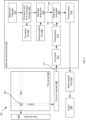
- FIG. 3 is a block diagram of the image sensor of FIG. 1 with digital watermarking, in embodiments.
- FIG. 4 is a block diagram of the image sensor FIG. 1 with digital watermarking, in embodiments.
- FIG. 5 is a diagram illustrating watermark embedding in image coefficients, in embodiments.
- FIG. 6 is a flowchart illustrating a method of embedding a watermark in raw image data, in embodiments.
- FIG. 7 is a functional block diagram of the image sensor of FIG. 1 with digital watermarking, in embodiments.
- spatially relative terms such as “beneath,” “below,” “lower,” “under,” “above,” “upper,” and the like, may be used herein for ease of description to describe one element or feature's relationship to another element(s) or feature(s) as illustrated in the figures. It will be understood that the spatially relative terms are intended to encompass different orientations of the device in use or operation in addition to the orientation depicted in the figures. For example, if the device in the figures is turned over, elements described as “below” or “beneath” or “under” other elements or features would then be oriented “above” the other elements or features. Thus, the terms “below” and “under” may encompass both an orientation of above and below.
- the device may be otherwise oriented (rotated ninety degrees or at other orientations) and the spatially relative descriptors used herein interpreted accordingly.
- a layer when referred to as being “between” two layers, it may be the only layer between the two layers, or one or more intervening layers may also be present.
- FIG. 1 depicts a camera 195 imaging a scene.
- Camera 195 includes an image sensor 192 , which includes a pixel-array substrate 190 .
- Constituent elements of pixel-array substrate 190 may include at least one of silicon and germanium.
- Pixel-array substrate 190 includes a pixel-array 112 A.
- Image sensor 192 may part of a chip-scale package or a chip-on-board package.
- Camera 195 is shown as a component of a handheld device, but it should be appreciated that other devices, such as security devices, automobile cameras, drone cameras, etc. may utilize camera 195 without departing from the scope hereof.
- Image sensor 192 captures single-sensor digital camera images (often called “raw” images or data) from pixel-array 112 A. Camera images, which may also include video, may be easily manipulated once it is in digital form. In embodiments, a digital watermark may be embedded in an image before it leaves the image sensor, in a way that is invisible in the final image and difficult to change.
- FIG. 2 is a block diagram of a digital watermarking system 200 for use with image sensor 192 , in embodiments.
- digital watermarking system 200 includes two main components: embedder 202 and extractor 204 .
- Embedder 202 combines digital data captured by images sensor 192 with a watermark using a digital watermarking module 206 .
- Watermarked image 208 leaving embedder 202 is perceptually identical to the image captured by image sensor 192 but includes an embedded digital watermark.
- Image processing 210 represents any transmission or processing of watermarked image 208 . It may also include efforts, malicious or otherwise, to change the watermarked image 208 . Image processing 210 may include, for example, interpolation, gamma correction, stretching, color adjustment or JPEG/H.264/H.265 compression, for example. If image processing 210 is performed by an attacker, the goal may be to modify watermarked image 208 to make it difficult to detect the watermark, or to covertly or overtly corrupt some part of the image. Regardless of the intent of image processing 210 , extractor 204 is able to extract the digital watermark and verify the origin of watermarked image 208 . Depending on the watermark used, extractor 204 may be able to identify a specific image sensor 192 that captured the image.
- Extractor 204 is used to recover the watermark from watermarked image 208 and detect any violation of the integrity of the image captured by image sensor 192 .
- Extractor 204 includes three main elements: watermark extractor 212 , where the watermark is extracted from a received image, watermark decoder 214 , where a watermark that has been encrypted before embedding is decrypted, and watermark verifier 216 , where the extracted and decoded watermark is verified. Although three elements are shown in FIG. 2 , this is for purposes of illustration. These elements may be combined in fewer elements, or more may be added, such as error correction or other processes.
- FIG. 3 is a block diagram of an image sensor 300 with digital watermarking, in embodiments.
- Image sensor 300 is an example of image sensor 192 of FIG. 1 .
- Image sensor 300 includes pixel-array 302 , which is an example of pixel-array 112 A of image sensor 192 .
- Pixel-array 302 includes rows(i) and columns(j) of pixels 304 .
- Raw image data 310 captured by pixels 304 is read out using row decoder 306 and column decoder 308 , then transferred to line buffer 312 in digital watermarking module 206 .
- Line buffer 312 may be a single line buffer for line embedding of digital watermarks, or a multiple line buffer, for block embedding of digital watermarks. From line buffer 312 , a pixel-array output of raw image data 310 is sent to preprocessor 314 to determine preprocessed image coefficients. Preprocessing may include a domain transform like discrete cosine transform (DCT) or discrete wavelet transform (DWT, a Fourier transform, a histogram statistic generation or a singular-value decomposition, for example).
- DCT discrete cosine transform
- DWT discrete wavelet transform
- Fourier transform a histogram statistic generation or a singular-value decomposition, for example.
- the preprocessed image coefficients may be generated by any mathematical transformation and any preprocessing transform, or a combination of different transforms, so long as the selected transformation and/or transform has an inverse, which is used by postprocessor 316 .
- Preprocessor 314 and postprocessor 316 may process one color channel or multiple color channels.
- a technical benefit of preprocessor 314 is that it allows a digital watermark to be embedded in a different domain of raw image data 310 to add a further layer of protection. Many domain transforms do not result in visible changes to an image.
- Watermark message 318 is information that is embedded in raw image data 310 .
- watermark message 318 may be an ID of image sensor 300 or a timestamp indicating when raw image data 310 was captured.
- Watermark message 318 may also incorporate a value unique to image sensor 300 , such as peak signal-to-noise ratio (PNSR) or defect pixel locations, for example.
- PNSR peak signal-to-noise ratio
- watermark message 318 may be any information associated with pixel-array 302 or image sensor 300 , for example.
- watermark message 318 may be processed to make it more confidential and robust.
- Encryption and error correction encoder 320 uses encryption key 322 to encrypt watermark message 318 .
- a variety of encryption methods may be used, such as AES (Advanced Encryption Standard), RSA (Rivest-Shamir-Adleman) or chaotic encryption, for example.
- watermark message 318 may also be processed with an error correcting code, such as a Hamming, RS (Reed-Solomon), BCH (Bose-Chaudhuri-Hocquenghem) or QR (Quick Response) Code.
- Error correction encoding is used to control errors that may occur in subsequent processing or transmission of image data.
- Message randomizer 324 is used to make the encoded watermark message look like random noise so that it is less visible in the final image, if not invisible.
- Randomization key 326 is used by message randomizer 324 .
- Watermark embedder 330 combines the digital watermark 328 from message randomizer 324 with coefficients 332 of raw image data 310 after preprocessing.
- the bit stream of digital watermark 328 is not combined with coefficients 332 directly. Instead, as described in more detail in connection with FIG. 5 , random coefficients 506 are selected from coefficients 332 .
- several coefficients 332 may be used to embed a one bit of digital watermark 328 .
- digital watermark 328 may be embedded in insensitive coefficients, such as lesser bits in a group of bits. The lesser bits within a block may not carry as much information therefore, changing these bits has less impact on the quality of the final image.
- Postprocessor 316 reverses the effects of preprocessor 314 to generate watermarked image coefficients.
- Digital watermarking module 206 operates on raw image data 310 in single or multiple lines. After postprocessor 316 , watermarked lines 334 are provided as output 336 from image sensor 300 based on the raw image data output by pixel-array 302 .
- FIG. 4 is a block diagram of an image sensor 400 with digital watermarking, in embodiments.
- Image sensor 400 is an example of image sensor 192 of FIG. 1 .
- Image sensor 400 includes pixel-array 402 of pixels 404 , row decoder 406 and column decoder 408 which are examples of pixel-array 302 , pixels 304 , row decoder 306 and column decoder 308 .
- digital watermarking module 206 includes elements as described above for FIG. 3 , with like reference numbers indicating like elements.
- encrypted, encoded and randomized watermark message 318 is embedded into a different domain of images that have been processed by image signal processor (ISP) 410 .
- ISP image signal processor
- ISP 410 includes processing raw data from pixel-array 402 using algorithms for a Bayer transformation, demosaicing, noise reduction or image sharpening, for example. As shown in FIG. 4 , after watermark message 318 is embedded in coefficients from preprocessor 314 , a watermarked image 412 is output from image sensor 400 .
- digital watermarking of raw image data is more difficult to break because an attacker needs to know both the encryption method and key, as well as the embedding method used to select image coefficients to receive bits of the digital watermark.
- Embodiments disclosed herein are also reliable because the digital watermark may still be extracted even after numerous attacks on an image.
- FIG. 5 represents coefficients 332 that have been generated by preprocessor 314 .
- a raw image is captured by a pixel-array with a number of pixels described by W ⁇ H pixels.
- the raw image is preprocessed to generate W ⁇ H coefficients 332 .
- Coefficients 332 are divided into M blocks, 502 ( 1 ) through 502 (M). Each coefficient block 502 includes (W ⁇ H)/M coefficients.
- the randomized watermark message, digital watermark 328 has a length of N bytes.
- N is determined by the length of watermark message 318 and an error correction algorithm used by Error Correction Encoder 320 .
- watermark message 318 may have a length of 32 bytes.
- encryption does not change the length of watermark message 318 .
- Message randomizer 324 does not change the length of the watermark, so digital watermark 328 has a length of N bytes.
- K coefficient blocks 502 selected from coefficient blocks 502 ( 1 -M) are used to embed one byte of digital watermark 328 .
- the number K of coefficient blocks is selected to meet the criteria that M>N ⁇ K.
- the N ⁇ K embedding blocks are selected from M blocks randomly with a seed S.
- Encryption Key 322 , Randomization Key 326 , and Seed S are independent of each other and provided to a user of digital watermarking system 200 including image sensor 192 , 300 or 400 in a secure manner.
- FIG. 6 is a flowchart illustrating a method 600 of embedding a watermark in raw image sensor data, in embodiments.
- Method 600 includes steps 602 , 606 , 608 , 610 , 612 and 614 .
- method 600 also includes at least one of steps 604 and 616 .
- Step 602 includes capturing an image using a pixel-array of an image sensor 300 .
- raw image data 310 captured by pixels 304 is read out using row decoder 306 and column decoder 308 .
- raw image data 310 is transferred to line buffer 312 .
- Step 604 includes processing raw image data.
- ISP 410 processes raw data using algorithms such as a Bayer transformation, demosaicing, noise reduction or image sharpening, for example.
- Step 606 includes preprocessing image data.
- preprocessing may be performed on raw image data from line buffer 312 or processed data from ISP 410 .
- Preprocessing may include a domain transform like discrete cosine transform (DCT) or discrete wavelet transform (DWT, a Fourier transform, a histogram statistic generation or a singular-value decomposition, for example.
- DCT discrete cosine transform
- DWT discrete wavelet transform
- DWT discrete wavelet transform
- histogram statistic generation a singular-value decomposition
- generating preprocessing coefficients can be accomplished by any mathematical transformation and any preprocessing transform or a combination of different transforms may be used as long as the selected preprocessing has an inverse used by postprocessor 316 .
- Step 608 includes selecting a watermark message.
- watermark message 318 may be an ID of image sensor 300 , a timestamp or a value unique to image sensor 300 , such as peak signal-to-noise ratio (PNSR) or defect pixel locations.
- PNSR peak signal-to-noise ratio
- Step 610 includes processing watermark message 318 to make it more confidential and robust.
- watermark message may be encrypted with encryption and error correction encoder 320 using encryption key 322 .
- watermark message 318 may also be processed with an error correcting code to control errors that may occur in subsequent processing or transmission of image data.
- Step 612 includes randomizing the processed watermark message.
- message randomizer 324 uses randomization key 326 to create a digital watermark from the encrypted watermark message that looks like random noise so that it is less visible in the final image.
- Step 614 includes embedding the digital watermark into preprocessed image data.
- watermark embedder 330 combines the digital watermark 328 from message randomizer 324 with coefficients 332 of preprocessed raw image data 310 .
- Step 616 includes postprocessing the image data with an embedded watermark.
- postprocessor 316 reverses the effects of preprocessor 314 .
- FIG. 7 is a functional block diagram of an image sensor 792 with digital watermarking, in embodiments.
- Image sensor 792 in as an example of image sensor 192 , and includes pixel-array 302 , peripheral circuitry 702 , a processor 704 , and a memory 706 .
- processor 704 is not part of image sensor 192 , while being communicatively coupled with at least one of peripheral circuitry 702 and memory 706 .
- processor 704 and memory 706 are part of peripheral circuitry 702 . In embodiments, at least one of processor 704 and memory 706 are communicatively coupled to image sensor 792 , while not being part of image sensor 792 . In embodiments, memory 706 and processor 704 are part of an application-specific integrated circuit (ASIC) or a field-programmable gate array (FPGA). In embodiments, digital watermarking module 206 includes at least one of processor 704 and memory 706 , and may be one of an ASIC and an FPGA. In embodiments, at least part of method 600 is implemented by processor 704 executing machine-readable instructions of memory 706 .
- ASIC application-specific integrated circuit
- FPGA field-programmable gate array
- pixel-array 302 generates signals from images captured by camera 195 .
- Peripheral circuitry 702 is communicatively coupled to pixel-array 302 and outputs a plurality of pixel values, representing the signals, which memory 706 stores as raw image data 310 .
- Raw image data 310 may represent a single image or a series of images that may be either consecutive images or nonconsecutive images captured by camera 195 .
- Memory 706 stores software 708 , which includes preprocessor 314 , encryption and error correction encoder 320 , message randomizer 324 and watermark embedder 330 .
- Memory 706 may be transitory and/or non-transitory and may include one or both of volatile memory (e.g., SRAM, DRAM, computational RAM, other volatile memory, or any combination thereof) and non-volatile memory (e.g., FLASH, ROM, magnetic media, optical media, other non-volatile memory, or any combination thereof). Part or all of memory 706 may be integrated into processor 704 .
- volatile memory e.g., SRAM, DRAM, computational RAM, other volatile memory, or any combination thereof
- non-volatile memory e.g., FLASH, ROM, magnetic media, optical media, other non-volatile memory, or any combination thereof.
- Part or all of memory 706 may be integrated into processor 704 .
- Embodiments disclosed herein may include one or more processors executing instructions stored in a non-transitory memory.
- a method of embedding a digital watermark may include generating preprocessed coefficients from a pixel-array output using a mathematical transform; encrypting a watermark message using a first key; randomizing the encrypted watermark message using a second key to form a randomized watermark; and embedding the randomized watermark in randomly selected preprocessed coefficients to generate image coefficients with an embedded digital watermark.
- (A2) In the method of (A1), postprocessing the image coefficients with an inverse of the mathematical transform used to generate the preprocessed coefficients to form a watermarked image; and outputting the watermarked image based on the pixel-array output.
- generating preprocessed coefficients includes receiving the pixel-array output from a line buffer.
- the line buffer comprises a single line or multiple lines.
- receiving the pixel-array output includes receiving the pixel-array output from an image signal processor.
- the method of (A1)-(A5), generating the preprocessed coefficients includes using the mathematical transform on one color channel or multiple color channels of the pixel-array output.
- a digital watermarking module includes circuitry that executes a plurality of steps including generating preprocessed coefficients from a pixel-array output using a mathematical transform; encrypting a watermark message using a first key; randomizing the encrypted watermark message using a second key to form a randomized watermark; and embedding the randomized watermark in randomly selected preprocessed coefficients to generate image coefficients with an embedded digital watermark.
- (B2) The digital watermarking module of (B1), the circuitry including: a processor, and a memory storing instructions, that when executed by the processor, control the processor to execute the plurality of steps.
- (C1) An image sensor including a pixel-array and the digital watermarking module of (B1)-(B10).
Landscapes
- Engineering & Computer Science (AREA)
- Theoretical Computer Science (AREA)
- General Physics & Mathematics (AREA)
- Physics & Mathematics (AREA)
- Software Systems (AREA)
- Computer Security & Cryptography (AREA)
- General Engineering & Computer Science (AREA)
- Computer Hardware Design (AREA)
- Health & Medical Sciences (AREA)
- General Health & Medical Sciences (AREA)
- Bioethics (AREA)
- Multimedia (AREA)
- Technology Law (AREA)
- Computer Networks & Wireless Communication (AREA)
- Signal Processing (AREA)
- Editing Of Facsimile Originals (AREA)
- Image Processing (AREA)
Abstract
Description
Claims (18)
Priority Applications (2)
| Application Number | Priority Date | Filing Date | Title |
|---|---|---|---|
| US17/478,237 US12189727B2 (en) | 2021-09-17 | 2021-09-17 | Sensor watermarking on raw images |
| CN202211129623.XA CN115829815A (en) | 2021-09-17 | 2022-09-15 | Sensor watermarking performed on raw images |
Applications Claiming Priority (1)
| Application Number | Priority Date | Filing Date | Title |
|---|---|---|---|
| US17/478,237 US12189727B2 (en) | 2021-09-17 | 2021-09-17 | Sensor watermarking on raw images |
Publications (2)
| Publication Number | Publication Date |
|---|---|
| US20230087541A1 US20230087541A1 (en) | 2023-03-23 |
| US12189727B2 true US12189727B2 (en) | 2025-01-07 |
Family
ID=85523689
Family Applications (1)
| Application Number | Title | Priority Date | Filing Date |
|---|---|---|---|
| US17/478,237 Active 2043-02-01 US12189727B2 (en) | 2021-09-17 | 2021-09-17 | Sensor watermarking on raw images |
Country Status (2)
| Country | Link |
|---|---|
| US (1) | US12189727B2 (en) |
| CN (1) | CN115829815A (en) |
Citations (11)
| Publication number | Priority date | Publication date | Assignee | Title |
|---|---|---|---|---|
| US20020016916A1 (en) * | 1997-09-29 | 2002-02-07 | Hewlett-Packard Company | Watermarking of digital object |
| US20030187798A1 (en) * | 2001-04-16 | 2003-10-02 | Mckinley Tyler J. | Digital watermarking methods, programs and apparatus |
| US20040145661A1 (en) * | 2003-01-21 | 2004-07-29 | Canon Kabushiki Kaisha | Image processing method, and image processing apparatus |
| US20050025337A1 (en) * | 2003-07-29 | 2005-02-03 | Wei Lu | Techniques and systems for embedding and detecting watermarks in digital data |
| US20050169499A1 (en) | 2001-04-24 | 2005-08-04 | Rodriguez Tony F. | Digital watermarking image signals on-chip and photographic travel logs through dgital watermarking |
| US7526099B2 (en) * | 2003-05-09 | 2009-04-28 | International Business Machines Corporation | Motion picture data processing device, method, and program |
| US7644281B2 (en) * | 2004-09-27 | 2010-01-05 | Universite De Geneve | Character and vector graphics watermark for structured electronic documents security |
| US8280098B2 (en) * | 2005-05-19 | 2012-10-02 | Uti Limited Partnership | Digital watermarking CMOS sensor |
| US20160210717A1 (en) * | 2015-01-15 | 2016-07-21 | Gopro, Inc. | Watermarking digital images to increase bit depth |
| US20220343026A1 (en) * | 2021-04-15 | 2022-10-27 | BicDroid Inc. | System and method for protecting deep image classifiers |
| US20220366522A1 (en) * | 2019-10-30 | 2022-11-17 | Sony Semiconductor Solutions Corporation | Electronic device |
-
2021
- 2021-09-17 US US17/478,237 patent/US12189727B2/en active Active
-
2022
- 2022-09-15 CN CN202211129623.XA patent/CN115829815A/en active Pending
Patent Citations (13)
| Publication number | Priority date | Publication date | Assignee | Title |
|---|---|---|---|---|
| US20020016916A1 (en) * | 1997-09-29 | 2002-02-07 | Hewlett-Packard Company | Watermarking of digital object |
| US20030187798A1 (en) * | 2001-04-16 | 2003-10-02 | Mckinley Tyler J. | Digital watermarking methods, programs and apparatus |
| US8023691B2 (en) | 2001-04-24 | 2011-09-20 | Digimarc Corporation | Methods involving maps, imagery, video and steganography |
| US20050169499A1 (en) | 2001-04-24 | 2005-08-04 | Rodriguez Tony F. | Digital watermarking image signals on-chip and photographic travel logs through dgital watermarking |
| US20040145661A1 (en) * | 2003-01-21 | 2004-07-29 | Canon Kabushiki Kaisha | Image processing method, and image processing apparatus |
| US7526099B2 (en) * | 2003-05-09 | 2009-04-28 | International Business Machines Corporation | Motion picture data processing device, method, and program |
| US20050025337A1 (en) * | 2003-07-29 | 2005-02-03 | Wei Lu | Techniques and systems for embedding and detecting watermarks in digital data |
| US7616777B2 (en) | 2004-02-04 | 2009-11-10 | Digimarc Corporation | Digital watermarking methods, systems and apparatus |
| US7644281B2 (en) * | 2004-09-27 | 2010-01-05 | Universite De Geneve | Character and vector graphics watermark for structured electronic documents security |
| US8280098B2 (en) * | 2005-05-19 | 2012-10-02 | Uti Limited Partnership | Digital watermarking CMOS sensor |
| US20160210717A1 (en) * | 2015-01-15 | 2016-07-21 | Gopro, Inc. | Watermarking digital images to increase bit depth |
| US20220366522A1 (en) * | 2019-10-30 | 2022-11-17 | Sony Semiconductor Solutions Corporation | Electronic device |
| US20220343026A1 (en) * | 2021-04-15 | 2022-10-27 | BicDroid Inc. | System and method for protecting deep image classifiers |
Also Published As
| Publication number | Publication date |
|---|---|
| US20230087541A1 (en) | 2023-03-23 |
| CN115829815A (en) | 2023-03-21 |
Similar Documents
| Publication | Publication Date | Title |
|---|---|---|
| Neekhara et al. | FaceSigns: semi-fragile neural watermarks for media authentication and countering deepfakes | |
| US8615103B2 (en) | Method and system for embedding and extracting image digital watermark | |
| US7043048B1 (en) | Capturing and encoding unique user attributes in media signals | |
| US7017045B1 (en) | Multimedia watermarking system and method | |
| JP5283732B2 (en) | Enhanced security of digital watermark for multimedia contents | |
| JP2002542523A (en) | Method and apparatus for inserting a digital signature into digital data and authenticating the digital signature in the digital data | |
| Coppersmith et al. | Fragile imperceptible digital watermark with privacy control | |
| Muhammad et al. | Secure image steganography using cryptography and image transposition | |
| US7302078B2 (en) | Apparatus and method for preventing illegal distribution of digital contents by using a fingerprinting technique | |
| Pal et al. | Study on watermarking techniques in digital images | |
| Preda | Self-recovery of unauthentic images using a new digital watermarking approach in the wavelet domain | |
| JP2005531183A5 (en) | ||
| Kannan et al. | An extensive research on robust digital image watermarking techniques: A review | |
| Ling et al. | Watermarking for image authentication | |
| Cao et al. | Using image sensor PUF as root of trust for birthmarking of perceptual image hash | |
| US20230087541A1 (en) | Sensor watermarking on raw images | |
| Al-Kadei et al. | Improve a secure blind watermarking technique for digital video | |
| Mursi et al. | A DCT-based secure JPEG image authentication scheme | |
| Benrhouma | Cryptanalysis of a hamming code and logistic-map based pixel-level active forgery detection scheme | |
| Sudha et al. | Efficient Analysis And Secure Client Side Image Using Fingerprint Embedding | |
| US8745402B2 (en) | Method for constructing inner codes for anti-collusion forensic code for watermarking digital content | |
| Ahmed et al. | A secure and robust hashing scheme for image authentication | |
| Lee et al. | Reversible data embedding for tamper-proof watermarks | |
| Shi | PURA: PUF-Driven Robust Authorship Protection for Images Using Deep Learning | |
| D’Angelo et al. | Watermark-based authentication |
Legal Events
| Date | Code | Title | Description |
|---|---|---|---|
| AS | Assignment |
Owner name: OMNIVISION TECHNOLOGIES, INC., CALIFORNIA Free format text: ASSIGNMENT OF ASSIGNORS INTEREST;ASSIGNORS:CHEN, WENSHOU;LIU, GUANSONG;FOWLER, BOYD;AND OTHERS;SIGNING DATES FROM 20210915 TO 20210916;REEL/FRAME:057517/0033 |
|
| FEPP | Fee payment procedure |
Free format text: ENTITY STATUS SET TO UNDISCOUNTED (ORIGINAL EVENT CODE: BIG.); ENTITY STATUS OF PATENT OWNER: LARGE ENTITY |
|
| STPP | Information on status: patent application and granting procedure in general |
Free format text: DOCKETED NEW CASE - READY FOR EXAMINATION |
|
| STPP | Information on status: patent application and granting procedure in general |
Free format text: NON FINAL ACTION MAILED |
|
| STPP | Information on status: patent application and granting procedure in general |
Free format text: NON FINAL ACTION MAILED |
|
| STPP | Information on status: patent application and granting procedure in general |
Free format text: RESPONSE TO NON-FINAL OFFICE ACTION ENTERED AND FORWARDED TO EXAMINER |
|
| STPP | Information on status: patent application and granting procedure in general |
Free format text: NOTICE OF ALLOWANCE MAILED -- APPLICATION RECEIVED IN OFFICE OF PUBLICATIONS |
|
| STPP | Information on status: patent application and granting procedure in general |
Free format text: PUBLICATIONS -- ISSUE FEE PAYMENT RECEIVED |
|
| STPP | Information on status: patent application and granting procedure in general |
Free format text: PUBLICATIONS -- ISSUE FEE PAYMENT VERIFIED |
|
| STCF | Information on status: patent grant |
Free format text: PATENTED CASE |